School Information System

How the Romans taught Latin

Peter Jones:

Barely a week passes without someone complaining about the teaching of English or foreign languages, usually because it involves too much, or too little, grammar. The ancients also had to face the problem. Clearly, non-Romans who wanted a career in Roman high society, the courts, civil administration or the army needed to learn Latin. So they did, and by the 2nd century AD, the Greek essayist Plutarch was able to say that almost all men used Latin. Certainly, as the Vindolanda tablets demonstrate, the Latin of the Germanic officer Cerealis was very respectable.

But Romans also admired Greek culture enormously, and Latin literature drank deeply at its well (the statesman Cicero could switch effortlessly between Latin and Greek). Trade too provided incentives for Romans to learn Greek; and as it was the lingua franca of the Mediterranean, and there were huge numbers of Greek slaves in Rome as well as immigrants, more Greek was probably spoken in Rome than the local lingo.

Share

Cracking Down on Skipping Class

Douglas Belkin:

Skipping class undetected for a game of ultimate Frisbee might become a thing of the past as more universities adopt mandatory-attendance policies and acquire high-tech trackers that snitch when students skip.

At Villanova University, student ID cards track attendance at some lectures. Administrators at University of Arkansas last semester began electronically monitoring the class attendance of 750 freshmen as part of a pilot program they might extend to all underclassman. And at Harvard, researchers secretly filmed classrooms to learn how many students were skipping lectures.

The moves reflect the rising financial consequence of skipping too many classes and, consequently, dropping out. More than four in 10 full-time college students fail to graduate in six years. Many are stuck with crippling student debt and no credentials to help them pay it back. Graduation rates also figure into closely watched school rankings.

Share

L.A. Unified’s iPad program plagued by problems early, review says

Howard Blume:

LAUSD’s $1.3-billion iPad program was plagued by lack of resources and inadequate planning, review says
U.S. Department of Education study finds similar problems with a faulty student records system

A $1.3-billion iPads-for-all program in Los Angeles schools was plagued by lack of resources and inadequate planning for how the devices would be used in classrooms and, later, how they would be evaluated, according to a federal review.

Better to get reading right….

Share

Silicon Valley Turns Its Eye to Education

Natasha Singer:

“Education is one of the last industries to be touched by Internet technology, and we’re seeing a lot of catch-up going on,” said Betsy Corcoran, the chief executive of EdSurge, an industry news service and research company. “We’re starting to see more classical investors — the Kleiner Perkinses, the Andreessen Horowitzes, the Sequoias — pay more attention to the marketplace than before.”

While rising sharply, the values of ed tech financing deals are chump change compared with the money flowing into consumer software. Uber, the ride-hailing app, for instance, raised $2.7 billion last year.

The smaller sums going into ed tech illustrate the challenges facing start-ups as they try to persuade public school systems to adopt their novel products. Companies often must navigate local school districts with limited budgets and slow procurement processes. To bypass the bureaucracy, many start-ups are marketing free learning apps and websites directly to teachers in the hopes that their schools might eventually buy enhanced services.

Still, it is too early to tell whether that direct-to-consumer “freemium” strategy, as it is often called, will pan out for education software.

Share

The missing piece to changing the university culture

Maximiliaan Schillebeeckx, Brett Maricque & Cory Lewis:

As graduate students, we have become disillusioned with our academic training. We began graduate school full of ambition, drive and optimism but have long since come to realize that we have joined a system that does not meet our diverse interests. We yearn for a community that supports creativity and the expression of future career goals instead of one with a narrow, focused interest.

Current PhD training programs are focused primarily on the academic career track despite its disheartening outlook: the number of awarded PhDs is significantly outpacing the available positions1, 2, fiscal pressures have slowed the growth of available independent research jobs3 and the time it takes to earn a PhD has not improved over the past two decades4. Each year, there are seven times more PhDs awarded in science and engineering than there are newly available faculty positions (Fig. 1). As a result, only about 25% of biomedical sciences PhD recipients are in tenure-track positions five years after earning their degree4, 5. The percent of PhDs starting postdoctoral fellowships, however, has not changed, with close to 70% of life science PhDs pursuing a postdoc after graduation in 2010 (ref. 4), which suggests that PhD students are unsure of their career goals or unequipped for a nonacademic career. In addition to the discouraging job prospects, the time required to complete a PhD adds to the bleak outlook. Despite a downward trend, the average time to degree in life sciences and engineering is still high, with half of PhD candidates requiring seven years or more to complete their degree; one-third of candidates who begin will never finish1, 4. With over 40% of graduate students indifferent or unsatisfied to some degree with their graduate school experience6, it is clear that initiatives must be taken to revamp the research training paradigm.

Share

How to raise successful children — advice from parents lucky enough to know

Lisa Grace Lednicer:

I know a divorced, single mom who is raising three children in what can only be described as a chaotic household. Her ex-husband lives in a different city, her parents live in a different state, and her high-energy kids — a tween boy and girl and their younger sister — require someone with the organizational skills of a logistics specialist to keep track of their lives. I sometimes questioned her parenting decisions until something she did stunned me.

One day, she ignored the piles of laundry and household chores, packed her kids into the car and drove north for the weekend just because the weather was gorgeous and who knew when they’d have a weekend like that again? I envied her confidence — not just because her kids will remember that trip instead of the day-to-day messiness of their lives, but because I would never think of doing something that spontaneous with my 6-year-old. Which means, maybe, I’m a bad mom.

Share

Should Schools Teach Personality?

Anna North:

Self-control, curiosity, “grit” — these qualities may seem more personal than academic, but at some schools, they’re now part of the regular curriculum. Some researchers say personality could be even more important than intelligence when it comes to students’ success in school. But critics worry that the increasing focus on qualities like grit will distract policy makers from problems with schools.

In a 2014 paper, the Australian psychology professor Arthur E. Poropat cites research showing that both conscientiousness (which he defines as a tendency to be “diligent, dutiful and hardworking”) and openness (characterized by qualities like creativity and curiosity) are more highly correlated with student performance than intelligence is. And, he notes, ratings of students’ personalities by outside observers — teachers, for instance — are even more strongly linked with academic success than the way students rate themselves. The strength of the personality-performance link is good news, he writes, because “personality has been demonstrated to change over time to a far greater extent than intelligence.”

Share

Academic Job archives

Jonathan Goodwin:

Around last year at this time, I became interested in what the archived editions of the MLA Job Information List could tell us about how the profession has changed over time. The MLA provided page-scans of all the JILs going back to 1965, and Jim Ridolfo used commercial OCR software to make them searchable. Once the documents were searchable, finding the first occurrence of various key words and graphing their frequency over time became feasible. One detail that became clear to me as I read each single issue of the JIL was that the formats differed enough to make graphs of relative frequencies somewhat misleading. Some of the editions are three times the size of others, and even normalizing over years doesn’t necessarily help here. So this image, for example, of the relative frequency of “shakespeare” in the JIL, needs additional interpretation:

Share

The Unappreciated Success Of Charter Schools

Adam Ozimek:

I think the conventional wisdom on charter school evidence could be summed up thusly: ”some charter schools appear to do very well, but on average charters do no better and no worse than public schools”. But I would like to propose a better conventional wisdom: “some charter schools appear to do very well, and on average charters do better at educating poor students and black students”. If the same evidence existed for some policy other than charter schools, I believe this would be the conventional wisdom.

Two of the most widely cited charter studies are a 2009 and 2013 analysis of charters in 16 and 27 states respectively by the Center for Research on Education Outcomes (CREDO). The results that many cite are the charter schools do no better or worse than nearby public schools on average, which was the conclusion of the 2009 study. However, I think this claim really missed the bigger picture. While overall charters and public schools compare relatively closely, both the 2009 and 2013 study found that charters did better for students in poverty. In addition, performance gap is growing over time:

Share

Regular naps are ‘key to learning’

James Gallagher:

Trials with 216 babies up to 12 months old indicated they were unable to remember new tasks if they did not have a lengthy sleep soon afterwards.

The University of Sheffield team suggested the best time to learn may be just before sleep and emphasised the importance of reading at bedtime.

Experts said sleep may be much more important in early years than at other ages.
People spend more of their time asleep as babies than at any other point in their lives.

Share

Pittsburgh hopes to attract more diverse group of applicants for top teaching jobs

Eleanor Chote:

As one of the ways to recruit current city teachers to the positions, the district today will host information sessions at board headquarters focused on “teachers of color,” although the session is open to all.

“This would be aligned with what we do when trying to build strong and diverse application pools,” said Jody Spolar, chief human resources officer. “If you want to advance the goal of diversity in your workplace … you have to be deliberate about making sure you have a strong applicant pool.”

Currently, 15 percent of the teaching staff are minorities while 11 percent of the career-ladder teachers are minorities. Sixty-six percent of students are minorities.

A notice about today’s session that went out to all teachers stated: “The district strives to ensure that teacher leaders are racially representative of our student population and aims to staff a strong and racially diverse cohort of Career Ladder educators for 2015-16.”

Share

the Baumol effect in K-12 Edu in US:

Ahsan Rizvi:

Two charts illustrating the Baumol effect in K-12 Edu in US: Growth in staffing & Cost increases vs Achievements http://t.co/Gpr6qcjyrz

Share

Black And Hispanic Students Are Making Meaningful Gains, But It’s Hard To Tell

Mikhail Zinshteyn:

Political leaders are fond of saying the United States is in an education crisis.

The U.S. is often shown to be losing ground internationally. We revisit a Sputnik moment every time international test scores are released, and some of the Sturm und Drang over our decline is a response to America’s middling ranking among other wealthy countries. However, the U.S. has historically underperformed on such cross-national comparisons. We came in 11 out of 12 on the first international assessment of math in 1964, for instance.

“People like the simple story,” said Jack Buckley, the head of research at the College Board, who previously led the U.S. Department of Education’s research arm. “And the simple story is we’re treading water while the others are pushing ahead of us. I think [that] is the narrative of the times.”

But the truth is more complicated than the image of a U.S. education system stuck in the mire. And by one important measure, the nation’s students have been improving at a steady pace for decades.

Share

Always a presence’: Longtime Madison School District superintendent Douglas Ritchie dies

Molly Beck:

Ritchie’s son John, of Madison, said becoming a superintendent was important to his dad, to the point of packing up the family of seven and moving to Boulder, Colorado, during the summer of 1962 to live in an apartment while Ritchie worked on his PhD. Ritchie’s children later attended Madison schools while he was heading the Madison School District.

“You tend to be credited for all of his decisions,” John Ritchie joked.

John Matthews, executive director of Madison Teachers Inc., arrived in Madison to head MTI about a year after Ritchie became superintendent. Matthews described their working relationship as competitive, but ultimately became “a joy,” and one with more more problems solved than created — notably ending a two-week strike in early 1976.

“Although tempers got a bit hot, he and I were able to work to resolve issues because we had developed such an honorable working relationship,” said Matthews. “Because of that, we were able to resolve the strike and move forward without animosity between staff and management. It was because of that ability that he remained so highly respected.”

Share

Ivy League’s meritocracy lie: How Harvard and Yale cook the books for the 1 percent

Lani Guinier:

A special lottery is to be held to select the student who will live in the only deluxe room in a dormitory. There are 100 seniors, 150 juniors, and 200 sophomores who applied. Each senior’s name is placed in the lottery 3 times; each junior’s name, 2 times; and each sophomore’s name, 1 time. What is the probability that a senior’s name will be chosen?

Does this kind of question look familiar? For most of you, it probably does: it represents just one of the nearly two hundred questions that presently make up the SAT. (The answer, by the way, is 3/8, or 37.5 percent, for those among us who prefer percentages to fractions.) For nearly a century, universities across the country have used SAT scores and other quantifiable metrics to make decisions about admitting one candidate versus another—decisions that can have far-reaching impact on both the admitted and declined candidates’ educational, social, professional, and financial futures. On the basis of what? we might ask. Originally the acronym SAT stood for Scholastic Aptitude Test, on the strength of the argument that a high schooler’s success on the test correlated with his or her success in the increasingly rigorous environment of college. As evidence of this correlation dwindled, the name was changed first to the Scholastic Assessment Test (keeping the handy, well-known acronym) and later to the SAT Reasoning Test. Call it what you will, the SAT still promises something it can’t deliver: a way to measure merit. Yet the increasing reliance on standardized test scores as a status placement in society has created something alien to the very values of our democratic society yet seemingly with a life of its own: a testocracy.

Allow me to be clear: I’m not talking about all tests. I’m a professor; I believe in methods of evaluation. But I know, too, that certain methods are fairer and more valuable than others. I believe in achievement tests: diagnostic tests that are used to give feedback, either to the teacher or to the student, about what individuals have actually mastered or what they’re learning. What I don’t believe in are aptitude tests, testing that—by whatever new clever code name it goes by—is used to predict future performance. Unfortunately, that is not how the SAT functions. Even the test makers do not claim it’s a measure of smartness; all they claim is that success on the test correlates with first-year college grades, or if it’s the LSAT (Law School Admission Test), that it correlates with first-year law school grades.

Share

Conversations on the Rifle Range 20: More Complaints, Factoring, and Grand Master John

Barry Garlic, via a kind email:

When I was hired for the long-term sub assignment, the principal told me it would likely last the whole semester. In order not to unduly alarm the parents, he had announced I would be there for just the third quarter. But the day came when I told my classes that Mrs. Halloran would not be coming back and I would be their teacher for the remainder of the semester.

All my classes cheered wildly. But as much as I wanted to believe I was entirely worthy of such adulation, I suspected they were reacting to the news that the super-strict Mrs. Halloran would not be returning.

My doubt was tied in large part to the email I had received from Brian’s mother , which suggested that Brian’s poor performance in algebra this semester was due to me. In even larger part, my doubt was tied to other news I received from one of the school counselors, a young woman named Robin. She had met with me the day before I made my announcement. She started on a complimentary note: “I can’t imagine walking in mid-year like you’ve done and trying to figure this all out,” and then got down to business. Two students had complained to her about my algebra 1 class. Who they were she could not disclose. The essence of the complaint was that I didn’t teach like Mrs. Halloran.

“They said she taught things one topic at a time, but you do several,” she said. This made no sense to me at first, until I remembered that in my lesson on word problems, I presented both mixture, and rate and speed problems. Ironically, Mrs. Halloran’s lesson plans called for one more, but I felt that would be too much.

“I asked them if they had talked to you about this,” Robin said. “They said they didn’t want to hurt your feelings.” As touching as this may have been to Robin, I was not impressed. I strongly suspected that 1) Brian was one of the students and 2) they feared retribution rather than hurting my feelings.

Share

Poor, Hispanic school focuses on test prep, sees huge gains. But can it be replicated?

Moriah Balingit and T. Rees Shapiro:

A grim picture of academic performance was emerging at Carlin Springs Elementary. Fewer than half of the school’s third-graders had passed the reading and math portions of the Virginia Standards of Learning exam, and numbers for history and science weren’t much better.

Teachers pored over the data, dumbfounded.

“To get information like that back can be like a shock to your system,” said Mary Clare Moller, a literacy teacher at the Arlington, Va., school, reflecting on test results that came in after the 2012-2013 school year. “You’re just thinking, like, ‘But I taught this information. I don’t understand why the kids didn’t get it.’ ”

Moller and other third-grade teachers devised a strategy for the following fall: They led six weeks of daily test preparation lessons, tracked students’ progress with a new computer program and provided extra tutoring for students who seemed at risk of missing the mark.

Share

The Secret to Raising Smart Kids

Carol Dweck:

A brilliant student, Jonathan sailed through grade school. He completed his assignments easily and routinely earned As. Jonathan puzzled over why some of his classmates struggled, and his parents told him he had a special gift. In the seventh grade, however, Jonathan suddenly lost interest in school, refusing to do homework or study for tests. As a consequence, his grades plummeted. His parents tried to boost their son’s confidence by assuring him that he was very smart. But their attempts failed to motivate Jonathan (who is a composite drawn from several children). Schoolwork, their son maintained, was boring and pointless.

Our society worships talent, and many people assume that possessing superior intelligence or ability—along with confidence in that ability—is a recipe for success. In fact, however, more than 35 years of scientific investigation suggests that an overemphasis on intellect or talent leaves people vulnerable to failure, fearful of challenges and unwilling to remedy their shortcomings.

Share

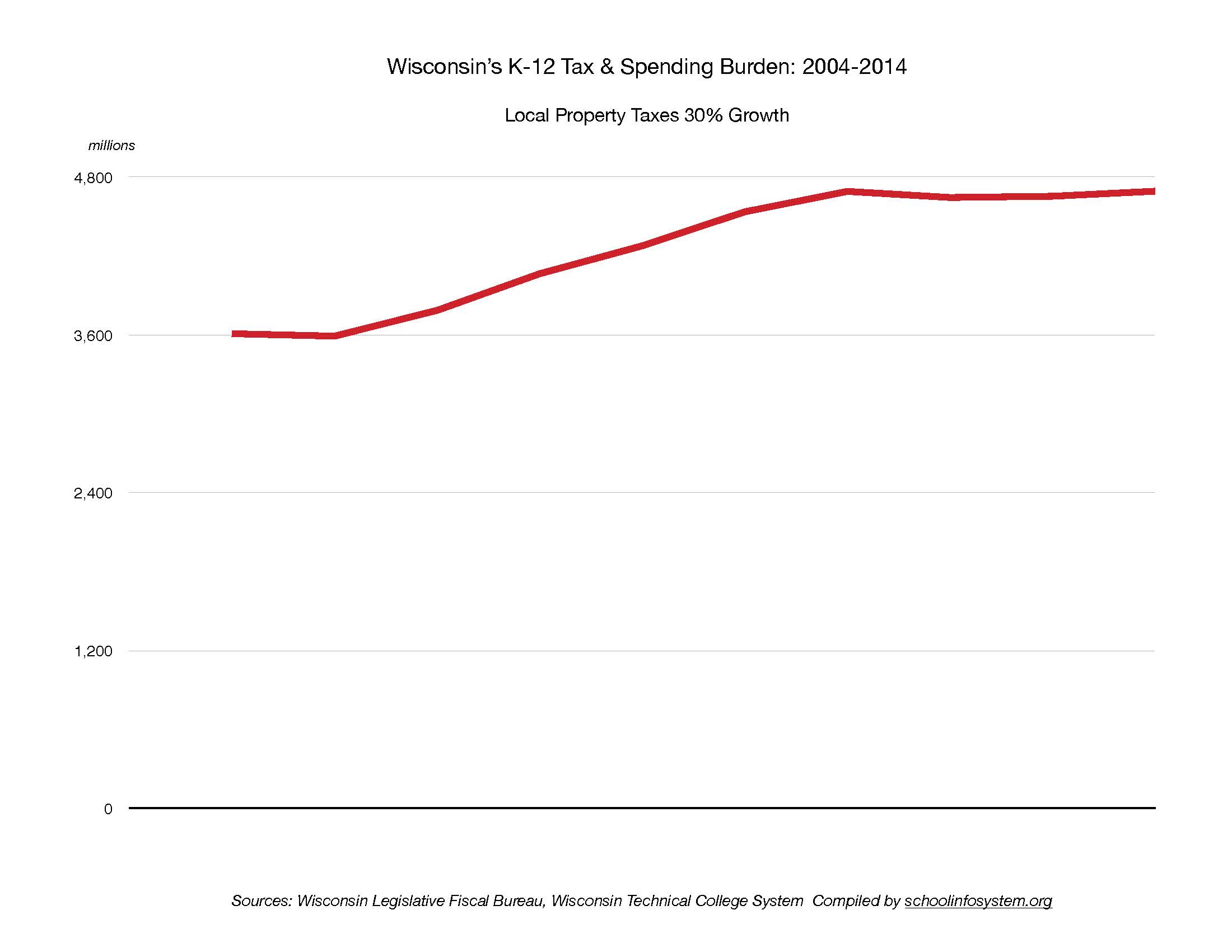
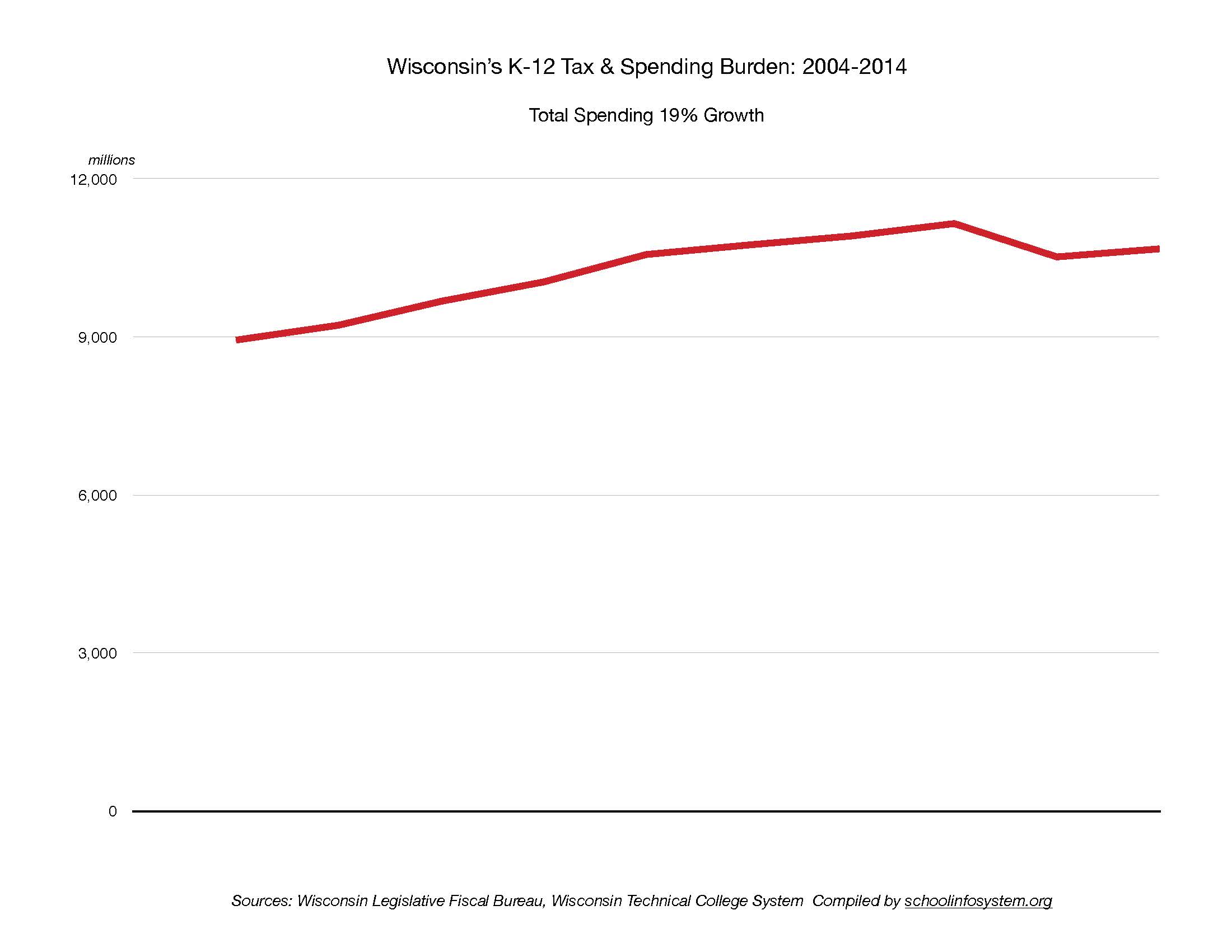
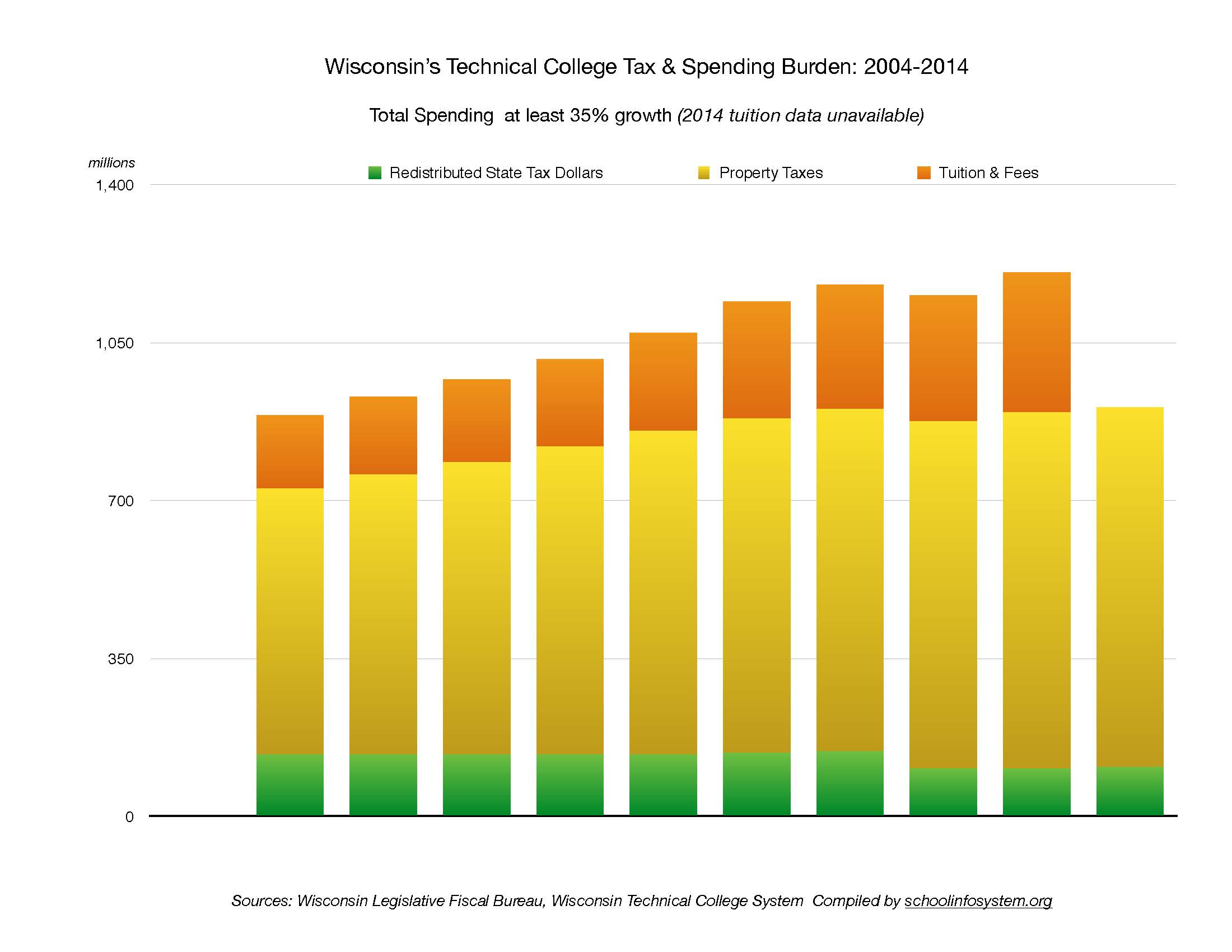
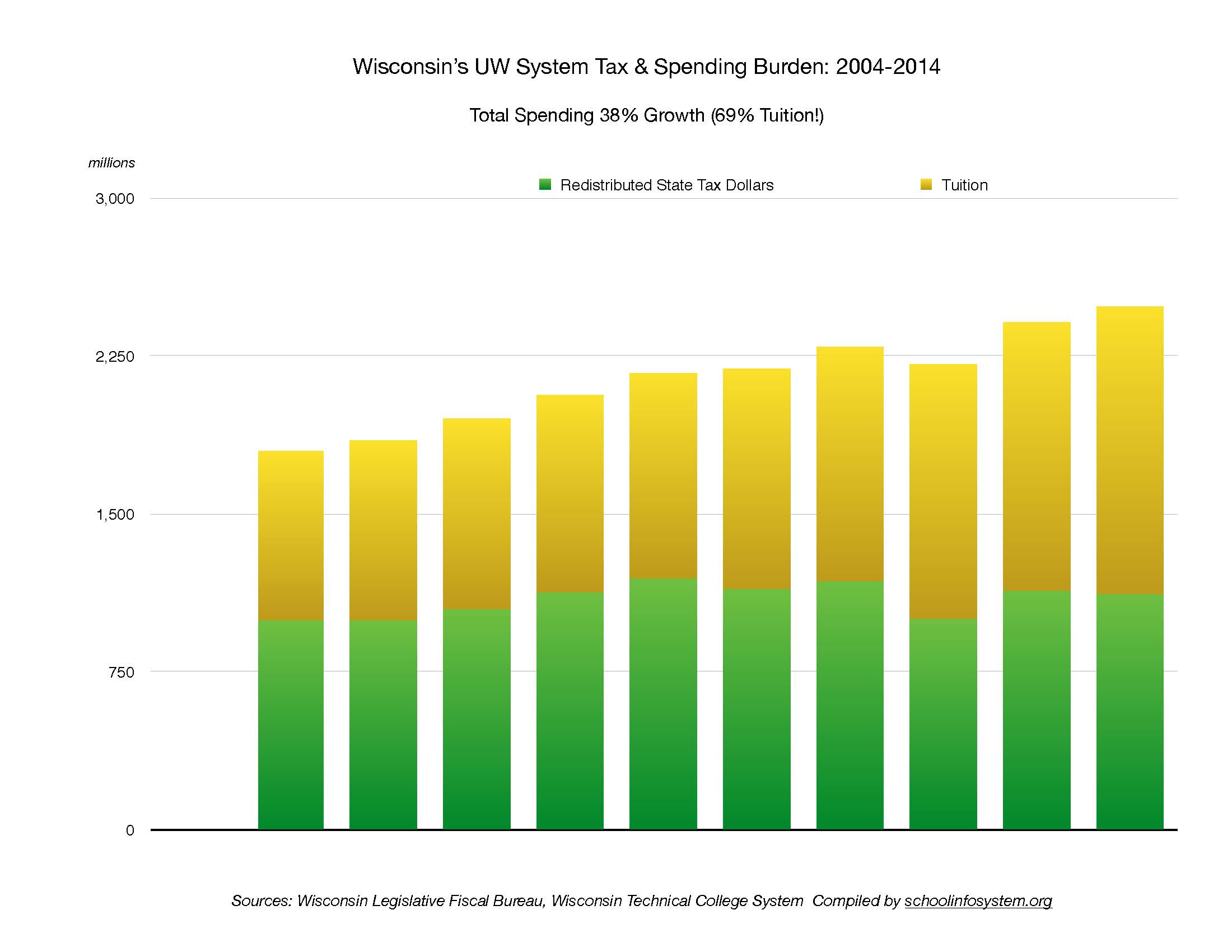
Wisconsin Education Spending 2004-2014; up 21.5% to > $14,000,000,000

Ongoing education spending rhetoric often lacks facts, such as the recent Wisconsin State Journal Headline replaying annual school budget theatre (thankfully, the article did mention the planned 9(!) increase in healthcare spending).

I recently requested historic data on Wisconsin education spending and have posted the results below, along with the raw data. Tap the charts to view a larger version.

I hope that readers will find this information useful, particularly when considering the effectiveness of these precious tax dollars.

Raw data (xlsx format) Charts in PDF format.

Share

Are we living in the age of the brain?

Philip Ball:

We’re surely now in the Age of the Brain. In the United States, the BRAIN Initiative, announced in 2013 and with a projected cost of $3bn, aims to map the activity of every neuron in the brain—first, those of mice and other animals, then of humans. The European Union has assigned €1bn to the ten-year Human Brain Project, which intends to deduce the brain’s wiring circuit in order to build a complete computer simulation of it. And now Japan has launched its own ten-year initiative, called Brain/MINDS, with a focus on understanding brain diseases and malfunctions such as Parkinson’s, schizophrenia and autism.

Of all these projects, the Japanese effort is the most modest, and likely to be the most useful. It will use a combination of brain imaging and genetics to try to figure out what goes wrong and why, in particular using marmosets as a model for humans. The European project, meanwhile, has already run into serious problems. Many neuroscientists are concerned that its ambitions are premature, and last July 130 researchers from labs around the world signed an open letter complaining of the “overly narrow approach, leading to a significant risk that it would fail to meet its goals.” The signatories say that the project could prove to be a huge waste of money, and criticize what they see as the opaque and unaccountable way the project is being run.

Some of those complaints are about infrastructure and management. But some go to the heart of what modern brain science is attempting to do, and what its realistic limits are. Those issues are searchingly explored in a new book, The Future of the Brain, edited by cognitive scientist Gary Marcus and neuroscientist Jeremy Freeman, which I have recently reviewed for Prospect.

Share

The Power of Education

IMG_9702.JPG. Via Franquin et Cie.

Share

How Parents & Community Groups Use Data

Christina Esquivel:

Meaningful family involvement in schools can make a huge difference for a child’s learning and for driving improvement in the school system as a whole. Extensive research has shown that students with involved parents have higher attendance, social skills, grades, test scores, and graduation rates. We learned a lot more about this topic when PP200_0we attended a presentation about parent engagement at the City College of New York as part of their Colloquium Series on Data and Data Driven Instruction.

Norm Fruchter of the Annenberg Institute for School Reform presented the session, entitled “How do parent & community groups use data for organizing?” Fruchter’s documentary, Parent Power, explores how parents and community groups leveraged data to advocate for educational improvement in New York City schools from 1995 to 2009. The film tells the story of a group of parents from the South Bronx who came together after learning that only 17% of their students were reading at grade level in elementary school.

Share

Racial Isolation in Public Schools

NY Times:

This is not an easy problem to solve. But the state cannot just throw up its hands. It has a moral obligation to ensure that as many children as possible escape failing schools for ones that give them a fighting chance. And history has shown that districts can dramatically improve educational opportunities for minority children — and reduce racial isolation — with voluntary transfer plans and especially with high-quality magnet schools that attract middle-class families.

This problem is especially urgent in New York’s second-largest city, Buffalo, where federal civil rights officials are enforcing an agreement intended to expand minority access to the better schools in a dysfunctional system, which has suffered from years of abysmal leadership and middle-class flight. Today nearly half the city’s public schools either have low graduation rates or rank in the bottom 5 percent of state schools in math and English.

Share

We know what we gain in letting machines and algorithms do our work for us. But what do we lose?

Christine Rosen:

One Monday in June 2009, at the start of the evening rush hour in Washington, D.C., a computer killed nine people. At least that’s one possible interpretation of the crash that occurred at a suburban Metrorail station. The train was in ATO, or “automatic train operation” mode, which means a computer was in control. Investigators later determined that the complicated automatic sensor mechanisms embedded in the trains and tracks had failed, causing one train traveling at almost 50 miles per hour to crash into the back of another stopped at the station. The human operator of the train, realizing too late what was happening, tried in the last few seconds to pull the emergency brake. She died along with eight others that day. It was the worst transportation disaster in the history of the D.C. Metro system.

No one would claim a computer intentionally killed, of course, but the day’s events were the unforeseen, tragic consequence of something that increasingly governs many aspects of our daily lives: computer automation.

Share

Who was behind the Common Core math standards, and will they survive?

Sarah Garland:

Every Saturday morning at 10 a.m., Jason Zimba begins a math tutoring session for his two young daughters with the same ritual. His youngest, Claire, 4, draws on a worksheet while his oldest, Abigail, 7, pulls math problems written on strips of paper out of an old Kleenex box, decorated like a piggy bank with a pink snout on one end and a curly-cue tail on the other, and adds the numbers as fast as she can. If she gets the answer “lickety-split,” as her dad says, she can check them off. If she doesn’t, the problem goes back in the box, to try the following week.

Zimba began the Saturday lessons to make up for what he felt was subpar math instruction at Abigail’s public elementary school in Manhattan after it switched to the Common Core, a set of controversial new math and English standards adopted by most states in 2010. The standards have been in place in many districts for three years, but most textbooks, curriculum and teacher training have yet to catch up to the Common Core’s grand vision. The math standards, in particular, have caused outrage across the country as parents have grappled with confusing homework and garbled word problems labeled Common Core. Several states are currently reconsidering the standards in response to the growing backlash.

But Zimba, a mathematician by training, is not just any disgruntled parent. He’s one of the guys who wrote the Common Core.

“I would be sleeping in if I weren’t frustrated,” Zimba says of his Saturday morning lessons, which he teaches in his pajamas. Instead, four years after signing off on the final draft of the standards, he spends his weekends trying to make up for the lackluster curriculum at his daughters’ school and his weekdays trying to make up for the lackluster curriculum and teaching at schools around the country that are struggling to shift to the Common Core.

Share

Who gets on the ‘bad’ school list? And what should come of it?

Alan Borsuk:

Who you calling bad?

It’s such an important and hot question now, as Republicans in the state Assembly make ambitious and fast-paced moves to launch a new accountability system for schools in Wisconsin.

They introduced a sweeping proposal Wednesday, and there is a public hearing on it this coming Wednesday, amid signs of divisions within the conservative ranks.

But let me start with my own bad problem.

Last week in this space, I said the accountability issue was about to heat up, and I said the term accountability was a fancy way of asking, “What are we going to do about bad schools statewide?”

I go to great lengths to avoid using a word like “bad” as a general label for schools where low percentages of students are rated as proficient or better in reading and math.

I’ll describe them as high-needs schools, low-performing schools, schools with low levels of academic success, high-poverty schools and a few other labels.

I stay away from “failing schools,” which is one of the labels the draft of the new proposal uses. At least I don’t call them “Schools Identified for Improvement,” which is what Wisconsin officials called them for several years.

But this time, being a bit too flippant and wanting to talk plain talk, I said, “bad.”

Share

Madison Schools’ Teacher “Handbook” Process Plan

Madison School District (PDF):

We know that our vision as a District doesn’t come to life without a thriving workforce. That is why we have worked hard to provide our employees with the resources and support they need to do their best work. To be successful for all students, we must be a District that attracts, develops and retains the best employees.

The District’s current employee contracts expire after the 2015-16 school year. As a result of Act 10, the District is responsible for developing a handbook that will take the place of those contracts. The MMSD Employee Handbook will be collaboratively developed and reflective of expectations of both employees and of the District.

This document outlines our approach and recommended process for developing the MMSD Employee Handbook.

Guiding Principles
Our approach to the handbook will be through the following guiding principles. The handbook
development process must:

1. Apply a clear strategy and transparent process. How will our work support our overall goal of recruiting, developing and retaining a thriving workforce?

2. Create a culture of excellence with equity. How does our work ensure that both employees and students are held to high expectations and provided the support to reach them?

3. Encourage collaborative, respectful discussion and interest-based problem solving.

4. Strategically align resources.

5. Avoid redundancies and create consistencies. Process:

1) Establish Oversight Group

a) 5 members appointed by MTI
b) 2 members appointed by AFSCME
c) 1 member appointed by Building Trades Council d) 3 building principals; up to 5 other administrators

Timeline (PDF).

Share

Obama education legacy: Pomp and fizzle?

Stephanie Simon:

President Barack Obama’s proposal to give millions of students free tuition at community colleges made a big splash on Friday, as the administration had intended.

But the moment also exposed the limits of Obama’s power on education, as his ambitions for big, legacy-defining initiatives run smack into a buzzsaw of opposition from across the political spectrum.

Congress is highly unlikely to approve a new entitlement with an estimated price tag of $60 billion over the next decade. Republicans quickly dismissed the college proposal as a political stunt. And leading Democrats expressed, at best, polite support.

In the K-12 arena, too, Obama can command the spotlight when he lays out his vision — but his clout doesn’t extend much beyond that at this point.

Education Secretary Arne Duncan is preparing to deliver a major policy speech Monday outlining the administration’s goals for revamping the No Child Left Behind law that governs some $78 billion in annual federal education spending. Yet the administration’s education policies have proved so toxic on both the left and the right that it has little leverage on the Hill, according to analysts from across the political spectrum.

Share

Madison’s K-12 Governance: “the assembly line seems like an odd way to go”

Chris Rickert:

Teachers who reach goals in the new compensation plan can also move up the pay scale faster than they were able to move up the old salary schedule, Busler said, while those not interested in reaching goals can expect nothing more than annual cost-of-living salary increases.

But overall, the amount the district would put into teacher compensation is greater than the amount it would have had to put in under the old salary schedule, he said.

I was curious about why the district bothered to include seniority and degree-attainment in the new compensation plan at all, given that research has shown seniority isn’t correlated with more effective teaching beyond about five years on the job, and there’s little, if any, connection between getting more college credit and better teaching.

School Board member Charles Uphoff, who sat on the committee that created the new plan, said a main goal of the new plan is to pay the “profession of teaching more professionally.”

It’s nice to see someone in public education realizing teachers are not, say, interchangeable workers on an assembly line.

Meanwhile, back in Madison, the school district is possibly the last one in the state still wedded to a salary schedule — by way of a collective-bargaining agreement repeatedly extended by a union-beholden School Board while Act 10 was held up in court.

Share

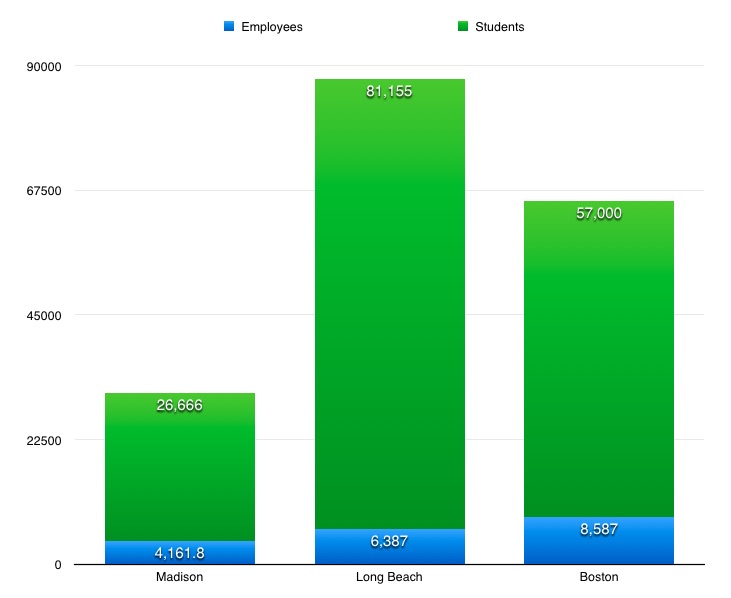
Madison’s Staffing Compared to Long Beach & Boston

In 2013, Madison Superintendent Jennifer Cheatham said “What will be different, this time“? The Superintendent further cited Long Beach and Boston as beacons in her Rotary speech.

However, based on recently released 2015-2016 budget slides (PDF) and Molly Beck’s summary, it appears that the same service, status quo governance model continues, unabated.

A focus on Adult Employment:

“Beware of legacy practices (most of what we do every day is the maintenance of the status quo), @12:40 minutes into the talk – the very public institutions intended for student learning has become focused instead on adult employment. I say that as an employee. Adult practices and attitudes have become embedded in organizational culture governed by strict regulations and union contracts that dictate most of what occurs inside schools today. Any impetus to change direction or structure is met with swift and stiff resistance. It’s as if we are stuck in a time warp keeping a 19th century school model on life support in an attempt to meet 21st century demands.” Zimman went on to discuss the Wisconsin DPI’s vigorous enforcement of teacher licensing practices and provided some unfortunate math & science teacher examples (including the “impossibility” of meeting the demand for such teachers (about 14 minutes)). He further cited exploding teacher salary, benefit and retiree costs eating instructional dollars (“Similar to GM”; “worry” about the children given this situatio

Are Administrators Golden?

The Single Best Idea for Reforming K-12 Education; ” Stop Running the system for the sake of the system.

Dirty little secret of US ed spending: Since 1950, “US schools increased their non-teaching positions by 702%.”; Ranks #2 in world on non teacher staff spending.

Reverting to the mean“.

Share

Education Secretary Arne Duncan to outline education priorities and defend testing

Lyndsey Layton:

As a new Congress gets to work to rewrite the 2002 federal education law known as No Child Left Behind, the Obama administration is drawing what Education Secretary Arne Duncan calls a “line in the sand”: The federal government must continue to require states to give annual, standardized tests in reading and math.

In a speech scheduled for Monday at an elementary school in the District, Duncan is expected to insist that any new law retain the trademark of No Child Left Behind, requiring that every public school student be tested annually in math and reading in grades 3-8 and once in high school, and also be tested in science at three points during those years.

“He will outline the need to widen and ensure opportunity for all students — the original purpose of this landmark law,” said Dorie Nolt, Duncan’s spokeswoman. “He will call for quality preschool for every child, improved resources for schools and teachers, and better support for teachers and principals. He will also call on states and districts to limit unnecessary testing so that teachers can focus needed time on classroom learning.”

Share

Deja vu: Annual Madison Schools’ Budget Play, in 4 acts (2005 to 2015)

Ruth Robarts, writing in 2005:

However, the administration’s “same service” budget requires a revenue increase of more than 4%. The Gap for next year is $8.6M.

Next will come a chorus of threats to slash programs and staff to “close the gap”. District staff will come on stage bearing long lists of positions and programs cut in previous years to close the gap. The mood will be ominous when the curtain comes down on Act 1.
On March 7, Act 2 opens with the administration revealing— with great reluctance— the annual “Cut List”. On the Cut List will be programs that motivate our kids to excel at school, such as fine arts, extracurricular sports, environmental field trips, and classes for students with special talent. Also on the list will be staff positions that assist kids with special problems, such as choosing classes and colleges, overcoming difficult home circumstances, learning job skills, or having special educational needs. School custodians may again appear on the Cut List, but not central administrators. “We have no choice” is the theme of Act 2.

Molly Beck

District spending would increase by 4.8 percent during the 2015-16 school year, largely based on staff pay and a projected health insurance rate increase of 9 percent, according to the district’s projections, and is expected to exceed district revenues by $10.1 million.

Spending grows annually, yet, reading results have long been disastrous.

Related: Madison’s Superintendent “reverts to the mean.”

Share

Madison School District Superintendent “Reverts to the Mean”….

Via a kind reader’s email.

Despite spending double the national average per student and delivering disastrous reading results – for years – Madison’s Superintendent pushes back on school accountability:

The Wheeler Report (PDF):

Dear Legislators:

Thank you for your efforts to work on school accountability. We all agree that real accountability, focused on getting the best outcomes for all children, is important. From our first review of the bill introduced today, it is clear there is a lot of work to be done before a school accountability bill can be passed.

There are several parts of this bill that need more thoughtful consideration to be the type of real accountability that our students and families deserve:

– using multiple tests that would not fairly compare public and private schools

– requiring charter conversion rather than creating a true path to improvement

– assigning letter grades that do not accurately communicate how a school is performing

– removing control from locally elected school boards.

We need an accountability bill that supports our efforts to produce the best results for all children rather than a flawed one that is rushed to pass in order to make a political point.

I would urge you to work with districts to develop a true accountability system that holds all schools to the same standards and supports them in getting the best results for children. We have not yet been given the opportunity to work with you but we would welcome it. I would be happy to answer any questions, give input or discuss with you more.

Thank you for your time and consideration. Sincerely,

Jennifer Cheatham, Ed.D.
Superintendent, Madison Metropolitan School District

A further example, try to find total spending in this 2015-2016 Madison Schools’ Budget slideware document (PDF).

Auto-pilot spending and governance practices continue:

General Fund expenditures will increase by approximately 4.8%, based on existing wage and salary commitments and an estimated health insurance rate increase of 9%, unless budget actions are taken to intervene

A Budget Gap of 2.8% (2% Revenue vs. 4.8% Expenditures) or $9-$10 million will occur unless budget actions are taken to intervene

Note the use of “General Fund”. The document neglects to mention total spending, or recent increases in redistributed state tax dollars to the Madison Schools.

A party insider recently mentioned that the “days of Dane County Democrats harvesting tax dollars from around the state and spending them here, are over”.

I further recall lunch a few years ago with a long time Madison elected official: “Always blame the State”.

Wolfram: Reverting to the mean.

Share

Booming University Staff Count

Björn Brembs:

UPDATE, 09/01/2015: A commenter made me aware of data rows in the raw data we had overlooked before. In our analysis, we evaluated all non-scientific staff, e.g., also technical support or library staff. As I’m actually quite fond of the libraries and the technical support we have, I looked at the trends for the ‘pure’ permanent administration staff and found and increase of 17% from 2005 to 2012, while permanent scientist positions increased only by 0.04%. Taking only these two groups of employees, the ratio between scientists and administrators shrinks to 0.57 in 2005 and 0.64 in 2012, i.e., the average administrator has to support less than two permanently employed scientists. In my opinion, this would have been the better data to use, but my co-author is not quite as convinced. Either way, even focusing on ‘pure’ admin staff conveys essentially the same message as the full overall data, albeit perhaps less dramatically. This is precisely why I am an open science advocate: making your data open allows you to discover more and improve your science!

Noam Chomsky, writing about the Death of American Universities, recently reminded us that reforming universities using a corporate business model leads to several easy to understand consequences. The increase of the precariat of faculty without benefits or tenure, a growing layer of administration and bureaucracy, or the increase in student debt. In part, this well-known corporate strategy serves to increase labor servility. The student debt problem is particularly obvious in countries with tuition fees, especially in the US where a convincing argument has been made that the tuition system is nearing its breaking point. The decrease in tenured positions is also quite well documented (see e.g., an old post). So far, and perhaps as may have been expected, Chomsky was dead on with his assessment. But how about the administrations?

Share

The Tough Decision to Leave the Classroom

Josh:

As the title of this post suggests, I have made the tough decision to leave the classroom for good at the end of this school year.

The decision is a painful one — both personally and professionally. It is also a public one, as I’ve been honored as recently as last month by the Waynesboro Rotary Club as its 2014 High School Teacher of the Year, my fourth such honor in six years.

In that respect, I feel an explanation is in order, as well as a prescription for what we — as a community — can do to right the ship.

Every workplace has its imperfections and challenges. I accept that. But public education is painted as a career where you make a difference in the lives of students. When a system becomes so deeply flawed that students suffer and good teachers leave (or become jaded), we must examine how and why we do things.
Waynesboro is small enough that we can tackle some of the larger problems that other school systems can’t. I want this piece, in part, to force a needed, collective conversation.

Share

A List of University Computer Science Courses

Github.

Share

Does journal peer review miss best and brightest?

David Schultz:

Sometimes greatness is hard to spot. Before going on to lead the Chicago Bulls to six NBA championships, Michael Jordan was famously cut from his high school basketball team. Scientists often face rejection of their own—in their case, the gatekeepers aren’t high school coaches, but journal editors and peers they select to review submitted papers. A study published today indicates that this system does a reasonable job of predicting the eventual interest in most papers, but it may shoot an air ball when it comes to identifying really game-changing research.

Studying peer review is difficult due to the confidential nature of the process, but sociologist Kyle Siler of the University of Toronto in Canada and colleagues were able to examine the peer-review history of 1008 articles that were submitted to three elite medical journals: Annals of Internal Medicine, The BMJ, and The Lancet. In total, just 62 of the manuscripts were accepted (6.2%), confirming just how difficult it is to be published in a top-tier journal. Editors “desk rejected” 722 of the manuscripts, meaning they never made it to the journal’s peer-review stage. However, 757 of the initially rejected articles eventually went on to be published elsewhere. This allowed Siler and his team to analyze if, like Jordan, the vetoed papers would go on to achieve greatness.

The researchers found that, by and large, the gatekeeping system was predictive of a paper’s eventual number of citations. Papers that were accepted outright by one of the three elite journals tended to garner more citations than papers that were rejected and then published elsewhere, they report online today in the Proceedings of the National Academy of Sciences. Additionally, papers that were desk rejected went on to receive fewer citations than papers that were approved by an editor, but then rejected during the subsequent peer-review process. “It’s a sign that these editors making snap decisions really quickly still have a nose for what quality is and isn’t,” Siler says.

Share

Why a Christie presidential bid is good for New Jersey’s teachers union

Laura Waters:

The nation’s atwitter about a potential Republican nomination brawl between Jeb Bush and Chris Christie, as well as a posse of Tea Party candidates.

One of the wedge issues, pundits predict, will be education policy. Picture it now: Bush and Christie, both moderate Republicans, saddled up at debate podia and straddled by an assortment of more conservative cowboys like Rand Paul, Paul Ryan, Marco Rubio, and maybe even Mike Huckabee. Remember what happened to Mitt Romney with his maladroit references to the “47%” and “corporations are people too?” Suddenly two more moderate Republican governors, one from purplish Florida and one from blue Jersey, may be forced to shift right by the collective heft of conservatives who demean the Common Core State Standards and standardized assessments.

Here’s another prediction: the likely airing of this Bush/Christie spaghetti western will warm up the political relationship between the 2015 New Jersey State Legislature and the N.J. Education Association. This shift will, in turn, affect debates and outcomes on unresolved education policies at the Statehouse this year, which include yet another effort to update the state’s twenty-year old charter school law, the future of PARCC standardized testing, school funding, local control in Newark, and the sun-setting of the pension/health benefits reform act on July 1.

Share

The 16 year old coder, Part 1: Why My Daughter No Longer Attends Public High School

Joe Eames:

This is the first in what I intend to be a series of blogs about getting my daughter into the programming industry.

These last 12 months have been a strange adventure for myself, my wife, and our 16 year old daughter Katya.

Last year I kind of coerced my daughter into taking a Web Design class at her high school. This was her sophomore year. She was rather reluctant, but still agreed. I didn’t put too much pressure on her, but enough that she probably would have chosen a different elective without my influence. After a few months in it, she was really enjoying it and found out about a program that our school district runs where she could spend half her day in a full on web development class. She decided to apply and was accepted for her Junior year.

Share

Chattering Away to Babies Is Even Better for Them Than Reading

Melissa Dahl:

Parents of tiny babies: When you’re home with the kid, keep a one-sided conversation going about anything and everything while you’re folding laundry, making dinner, or doing whatever else around the house. A steady stream of idle chatter from mom or dad’s mouth improves the child’s cognitive development, even more so than reading to them does, according to the results of a study recently published in the journal Language Teaching and Therapy.

Aisling Murray, of the Economic and Social Research Institute in Ireland, initially set out to investigate the importance of reading, and whether reading to infants was associated with higher scores on indicators of cognitive development than other language-based interactions between parent and infant, like talking. She expected that reading would win out; the question, really, was how much better reading was for language skills.

Share

GOP bill would make failing public schools charters

Jason Stein & Erin Richards:

The state would convert failing public schools to independent charter schools and cut off all state payments to failing private schools for at least four years, under a draft bill offered by Assembly Republicans Wednesday.

The sweeping measure would create a new board to assign letter grades of A through F to all publicly funded schools in the state and then lay out eventual penalties for those receiving D’s and F’s. In a shift from current law, the measure would allow private schools to use a different exam from the state test to measure student learning, though it would create a process for comparing those differing tests.

Molly Beck covers the story as well.

One wonders how long term, disastrous reading results play in the governance equation?

Share

What Students in China Have Taught Me About U.S. College Admissions

Terry Crawford:

I talk to more Chinese high school students than anyone else in the world.

At least I think I do: I operate — along with my wife — a company in China that interviews students on behalf of selective U.S. colleges and boarding schools. Instead of taking a standardized language test, a prospective student can participate in an unscripted conversation with one of our interviewers. We videotape the interview and then provide it “as-is” to admission officers. Admission officers like our interviews because they provide a trustworthy and unfiltered look at an applicant’s communication skills.

A fascinating aspect of this job is that we have a front-row seat to one of the greatest migrations of talent in history. Our thousands of conversations with students often include some variation of the question, “Why do you want to go to the U.S. for school?” Almost every interviewee responds with a version of the following: They don’t like the gaokao (the national college entrance exam), and even more they dislike the prospect of their major being determined by their gaokao score.

Share

Charter school supports grads through college

Susan Frey:

During Daisy Montes Cabrera’s final week of her first quarter at UC Davis, her father, who was terminally ill, died. Cabrera, a first-generation college student, wanted to leave Davis to be closer to her family in San Jose. But her high school college adviser, principal and teachers all encouraged her to stay, she said.

Cabrera’s high school – KIPP San Jose Collegiate – is part of the Knowledge Is Power Program charter school organization, which focuses on preparing low-income and first-generation students for college. For the past few years, KIPP has expanded its K-12 program to include supporting “KIPPsters” through their college years.

As part of the KIPP Through College program, the charter group has partnered with more than 50 public and private universities nationwide, seeking their support to help KIPP alumni integrate both academically and socially into college life. In California, 11 universities, including UC Davis, work with KIPP. Steve Mancini, communications director for KIPP, says that he doesn’t know of any other K-12 programs in the country that have this type of partnership with a wide range of universities.

“I wanted to quit Davis,” Cabrera said, “but right away I got calls and messages from all my high school teachers to keep going. I got a Facebook message from my principal saying, ‘let us know what you need.’”

Share

Wisconsin School Accountability Commentary

Jason Stein:

Top GOP leaders in the Assembly say they hope to unveil their version of an accountability bill by as soon as Wednesday. But Assembly Majority Leader Jim Steineke (R-Kaukauna) said there are still differences with Senate Republicans over whether the proposal should include upfront consequences or other “interventions” for failing schools or leave those to be determined later.

“We think there should be some accountability with the accountability bill,” he said.

This same disagreement helped stymie passage of the schools bill in the previous legislative session.

Republicans from both houses met Tuesday on the proposal, which leaders in the Senate and Assembly have said is their first priority in the legislative session opening this week.

The accountability bill seeks to place similar standards on all schools receiving taxpayer dollars, from traditional public and charter schools to private voucher schools accepting state money. The proposal is closely linked to a separate push from Republicans to expand the role of and funding for voucher schools statewide.

Both Assembly Speaker Robin Vos (R-Rochester) and Senate Majority Leader Scott Fitzgerald (R-Juneau) said that they hope to have standards legislation introduced soon in each house.

Share

The rise of modern policing also coincides with the rise of public education

David Whitehouse:

Public schools accustom children to the discipline of the capitalist workplace; children are separated from their families to perform a series of tasks alongside others, under the direction of an authority figure, according to a schedule ruled by a clock. The school reform movement of the 1830s and 40s also aimed to shape the students’ moral character. The effect of this was supposed to be that students would willingly submit to authority, that they would be able to work hard, exercise self­-control, and delay gratification.

In fact, the concepts of good citizenship that came out of school reform movement were perfectly aligned with the concepts of criminology that were being invented to categorize people on the street. The police were to focus not just on crime but on criminal types—a method of profiling backed up by supposedly scientific credentials. The “juvenile delinquent,” for example, is a concept that is common to schooling and policing—and has helped to link the two activities in practice.

Share

Divide and Conquer Part II: “Right to Work” is Dead Wrong

Solidarity Newsletter, via a kind Jeanie Kamholtz email (PDF):

Buoyed by the election which provided Republican majorities in both the Assembly (+27 majority) and the Senate (+5 majority), conservative anti-worker/anti-union legislators have announced that they will introduce Right to Work legislation when the January session begins. Right to Work laws limit collective bargaining, make it easier to outsource jobs and cut wages and benefits. Their plan was to do this in 2012, but legislators were worried that it was too soon after the 2011 protests against Act 10, and would cause public backlash. On average, workers in Right to Work states earn $7,030 a year less, according to the Congressional Research Service (6/20/12), and the rate of workplace deaths is 52.9% higher. Workers in Right to Work states are even more likely to be uninsured (16.8%, compared with 13.1% overall).

Governor Walker’s Act 10 has already done great damage to Wisconsin’s public sector workers and the economy. Act 10 has been described as “Right to Work on Steroids.” But now, the far-right is coming after the 13% of Wisconsin’s private sector workers who have the benefit of union representation. And it is because CEOs and company owners care more about big business and profits than they do about workers who create them. And, middle class families become struggling families. Right to Work will surely shrink the middle class.

Despite its misleading name, such a law does not guarantee anyone a job and it does not protect against unfair firing, i.e. it provides NO “right to work”.

Rather, a Right to Work law prohibits employers and employees from negotiating an agreement – also known as a union security clause – that requires all workers who receive the benefits of a collective bargaining agreement to pay their share of the costs of the Union in representing them. A Right to Work law mandates that unions represent every employee, whether or not he or she pays Union dues. In other words, such laws enable workers to pay nothing and still get the benefits of union membership. Imagine if a Madison resident, who sends their children to MMSD schools, but can opt out of paying property taxes to finance the schools.

Share

College Ratings and Affordable Education

Rafiq Dossani:

On Friday, December 19, 2014, the Department of Education released its much-awaited “College Ratings Framework” paper. One key goal of the proposed ratings system is to help students, particularly those who are underprivileged, make better, more affordable college choices. Will the new ratings system help achieve this goal?

There are reasons to believe that students from the middle- and lower-income tiers of society are not making affordable college choices. College debt has been rising sharply over the past several years, with $33,000 now being the average amount owed by a graduating student. For poorer students, college debt is even higher, even with financial aid factored in. Furthermore, this figure does not account for the nearly 50 percent of freshmen who will never graduate, in many cases because high college debt forced them to drop out.

Such debt seems high compared with what it should be, especially for lower-income students. The national average for annual college tuition at a four-year public college is a little less than $7,500. At a public community college, it is $3,000. However, the “net price” (i.e., including living costs and supplies), for a stay-at-home, in-state, low-income student, after considering grants and scholarships and living costs, is substantially lower. For example, while tuition at San Jose State University (which, incidentally, is the single largest source of engineers who work in Silicon Valley) is $7,500, equal to the national average, the net price for a stay-at-home student with a family income of $40,000 is $5,500. And the net price for such a student at Foothill College, a community college from which students may transfer to San Jose State University, is $3,300. In such a case, over a four-year period, a student who spends two years at the community college and then transfers to the four-year college will accumulate debt of $17,600, even if the student and his family are unable to contribute anything.

Share

The Tyranny of Meritocracy

Lani Guinier:

The term “meritocracy” was coined by the British sociologist Michael Dunlop Young as a spoof. In his 1958 satire, The Rise of Meritocracy, 1870-2033, Young gave an imaginary account of a smug elite: Instead of ancestry, ability had determined their social position. Rule by this select few appeared both benign and bountiful because of a talent-based formula for assigning status. Test scores (or other suitable substitutes for innate talent or aptitude) mattered the most. Because those who had risen in the status hierarchy had attained their positions through talent and effort, they were better able to justify their continued rule—they had earned it.

To Young, such a testocracy was not a shining vision but a nightmare. And more than 40 years after the publication of his book, he was “sadly disappointed” at how the word he coined has “gone into general circulation, especially in the United States.” He intended to warn society about what might happen if, in assigning social status, it continued to place formal educational qualifications over all other considerations. In Young’s fictional world, anyone unable to jump through educational hoops would be barred from a new, exclusive social class as discriminatory as older ones based on inheritance.

Share

Gallery of Math Ideas

Lucas/VB::

Below is a mostly comprehensive gallery of all images — illustrations, diagrams and animations — that I have created for Wikipedia over the years, some of which have been selected as featured pictures, or even picture of the day. As you’ll probably notice, they’re mostly related to physics and mathematics, which are my main areas of interest.

If you have any comments, requests, suggestions or corrections, feel free to drop me a message on my talk page. But please, before making a suggestion, first take a look and see what sort of stuff I can do. Due to time, knowledge and complexity constraints, I cannot guarantee I’ll be able to make a good illustration of any topic.

Share

NPR: Six Education Stories To Watch in 2015

Claudio Sanchez:

5. Teacher Evaluation, Training, And The Vergara Fallout
This past year, the Vergara ruling in California reinvigorated the debate over teacher tenure, especially termination and due process rights.

In 2015, critics of teacher quality will take on unions in more states, beginning in New York. This will also draw more attention to colleges of education, which this past year came under fire from the National Council for Teacher Quality in a scathing report. NCTQ and Vergara supporters argue that low-income and minority students are more likely to be subject to poorly trained and incompetent teachers.

Share

Homework assignment: Finish application for college aid

Karen Herzog:

For the past three years, Teresa Piraino of South Milwaukee has diligently filled out the federal application for financial aid for her son Anthony, who is studying criminal justice at the University of Wisconsin-Milwaukee.

In the next few weeks, the Pirainos will scramble to fill out the Free Application for Federal Student Aid again — this time for two kids, as daughter Jessica plans to study nursing at Alverno College in the fall.

“I want to get right on it,” Teresa Piraino said of the online form known as FAFSA, which becomes accessible every Jan. 1. “The stakes are high and I want to get the most we can because I can’t give them the money they’ll need.”

With the cost of college escalating — and with it, student debt — no one wants to leave money on the table.

But for many families, procrastinating on filing FAFSA may mean missing out on thousands of dollars in Federal Work-Study, low-interest Federal Perkins Loans and the Wisconsin Grant for state residents — all need-based aid awarded on a first-come, first-served basis. When the limited pool of money is gone, students who otherwise would qualify are out of luck, and are left with higher-interest federal and private loans that can pile up debt.

A low-income student potentially could leave more than $6,000 on the table in first-come, first-served money that doesn’t have to be paid back or that can be repaid at a lower interest rate than other available loans, according to financial aid officials at several Wisconsin universities.

Share

Nearly 500,000 Fewer Americans Will Pass the GED in 2014 After a Major Overhaul to the Test. Why? And Who’s Left Behind?

Daniel McGraw

As he sits in a study room at Project Learn — a non-profit on Euclid Avenue that offers adult education programs — with sample questions for the GED (General Education Diploma) waiting on a computer screen, 29-year-old Derwin Williams explains why getting his diploma is so important. He wants to get into the construction trade, maybe as a roofer or drywall hanger, and he knows he needs a diploma to get into vocational technical classes to get that done.

Williams dropped out of East High School more than a decade ago, in part because of a gunshot wound that left him hospitalized for six months and required the removal of his kidney. He’s had some legal problems since then too, mostly from a DUI conviction a few years ago, but he’ll be sober three years this coming March. He started thinking about a GED when his probation program encouraged him to do so.

Williams is unemployed and has been studying for the four-part GED since January. In previous years, 11 months of prep would likely have given him a decent chance of success. But the test was radically changed in January, and like many, Williams hasn’t yet made enough progress to take any of the four sections. According to some sample tests he’s taken, he’s getting close in the math and science portions, but is still pretty far out in the social science and language parts.

Share

Higher Ed Trends We Can Work With

Michael Meranze & Christopher Newfields

Some new things did happen in 2014 higher ed, and some of them were good.

1. The College Liberation Movement. The splashy version came from some Ivy League humanist dissidents who described elite private universities as sorting machines for those reared to rule our newly post-middle class society. There was the “excellent sheep” debate, started by William Deresiewicz’s July article, “Don’t Send Your Kid to the Ivy League” and carried on in his book, Excellent Sheep, sustained by attacks on him by Jim Sleeper among others, and brought in quieter form to the big screen by the film Ivory Tower.

Dr. Deresiewicz drew a sharp line between what happens at places like Yale, described as training in “the analytic and rhetorical skills that are necessary for success in business and the professions,” and actually learning how to think. However one felt about the details, the discussion put the humanistic goal of personal development at the center of the college agenda. It cut against the naïve vocationalism that has justified corporate reach-ins to core educational functions. It clarified that colleges must do what businesses cannot do, according to their own vision and expertise.

I have my quarrels with this Ivy humanism, starting with my dislike for the overdrawn contrast between liberal and practical arts. I think that the systematic inculcation of deep skills are next on the to-do list of public universities. But higher ed leaders have so completely lost confidence in the special powers of higher learning that they needed every kind of explanation of why teaching is not a business.

2. A New Deal for Faculty Governance. When the chancellor of the University of Illinois at Urbana-Champaign announced that she was pocket vetoing the appointment of Steven Salaita to a professorship that had been approved by every campus agency, she awakened the closest thing to a national faculty outcry that the country had seen in years. Prof. Salaita remains in limbo, and governance procedures have not been fixed. But I don’t know a single faculty member who isn’t now aware of the fall of the faculty, having in 2014 seen faculty be overridden in a main area of authority. The premature MOOC contracting of 2013 showed admin to be as ready to redesign the curriculum as it is to make all financial decisions on its own. Many faculty who weren’t worried about MOOC-mediated governance got worried about the suspension of hiring protocols by senior managers under donor pressure.

Other kinds of encroachments also got faculty attention. The newly-hatched Board of Trustees for the University of Oregon planned to write the faculty senate out of the university’s new constitution, with the effect of “relegat[ing] university stakeholders to supplicants.” Faculty generated an imposing counterattack. We learned all over again that faculty bodies, once awakened, have more than enough brains at their disposal to stop any train that “has already left the station.”

Share

College Football Coaches, the Ultimate 1 Percent

Matt Connolly

In 1925, one of college football’s biggest stars did the unthinkable. Harold “Red” Grange, described by the famous sportswriter Damon Runyan as “three or four men rolled into one for football purposes,” decided to leave college early in order to play in the National Football League.

While no fan today would begrudge an All-American athlete for going pro without his diploma, things were different for Grange. The NFL was only a few years old, and his decision to take the money in the pros before finishing his degree at the University of Illinois was a controversial one. It was especially reviled by Robert Zuppke, his coach at Illinois.

As the story goes, Grange broke the news to Zuppke before promising to return to finish his degree. “If I have anything to do with it you won’t come back here,” Zuppke replied, furious that a respectable college man would drop out and try to make a living off playing a game. “But Coach,” Grange said. “You make money off of football. Why can’t I make money off of football?”

It’s a question that has underscored the development of modern college football ever since. Aside from scholarships and (some) health insurance, the players remain unpaid. They are also subject to draconian National Collegiate Athletic Association (NCAA) rules that banish them to hell for such sins as signing an autograph for cash or selling a jersey. Meanwhile their coaches enjoy ever-swelling salaries, bonuses, paid media appearances, and other perks like free housing. According to Newsday, the average compensation for the 108 football coaches in the NCAA’s highest division is $1.75 million. That’s up 75 percent since 2007. Alabama’s Nick Saban, college football’s highest-paid coach, will earn a guaranteed $55.2 million if he fulfills the eight-year term of his contract.

Share

Gaza’s children struggle to overcome nightmares of war

AFP

Since the bombing, Muntasser is “in another world” and refuses to go to school, says the father.
“What if he were to try and kill one of his classmates?”

Suddenly Muntasser begins to speak, his eyes fixed on the floor.
“I don’t want to go to school. Before, I used to go with Zakaria, he helped me spell my name. Now he’s dead,” says the boy.

“I don’t want to do anything, I just want to get a Kalashnikov and kill them all to avenge Zakaria and my cousins,” he shouts.

For a few seconds the boy is silent before saying how he dreams of them each night.
“I dream that I am holding them in my arms. I will never go to the beach again because that’s where they died.”

Health professional Samir Zaqqut says the children of Gaza have been too traumatised to live a normal life.

Share

Politics & Wisconsin’s K-12 Governance: 2015 edition

Alan Borsuk:

Accountability. Or to put it in plain language, what are we going to do about bad schools statewide?

Public, private, charter, there are schools in all sectors where students chronically don’t achieve well. There’s lots of talk about new ideas — some Republicans want to create a state accountability board to deal with school quality.

Seems to me it would be hard to turn the idea into a reality that will have positive results.

Share

How to Learn Efficiently

Daniel Lemire:

I am convinced that much of the gap between the best college students and the worst is explained by study habits. Frankly, most students study poorly. To make matters worse, most teachers are incapable of teaching good study habits.

Learning is proportional with effort

Sitting in a classroom listening to a professor feels like learning… Reading a book on a new topic feels like learning… but because they are overwhelming passive activities, they are inefficient. It is even worse than inefficient, it is counterproductive because it gives you the false impression that you know the material. You can sit through lecture after lecture on quantum mechanics. At some point you will become familiar with the topics and the terminology. Alas you are fooling yourself which is worse than not learning anything.

Share

Considering K-12 Governance Changes

Erin Richards:

While those ideas get batted around, here’s what’s been going on in state-run districts in other states:

The Louisiana Legislature created the Recovery School District in 2003 and gave it more latitude to reshape the landscape of schools in New Orleans after Hurricane Katrina.

Today the Recovery School District comprises 57 independent charter schools enrolling more than 30,000 students in New Orleans, according to the organization’s annual report.

The standardized test scores for the district rose faster than any other public school system in the state, according to results from spring 2013.

But others have questioned reports of academic improvement for children in the system.

The Achievement School District in Tennessee was created in 2010 as a result of the state’s winning application for Race to the Top federal education funds.

According to its website, the district intends to be overseeing 30 schools and about 10,000 students by 2015-’16.

The goal of the Achievement School District is to boost the state’s bottom 5% of schools into the top 25% of schools, either by running them itself, or selecting charter school management companies to do so. The Achievement School District answers to the Tennessee Department of Education.

Long term disastrous reading results surely merits more than status quo governance.

Share

K-12 tax & Spending Climate: Taxpayers stand to gain if on-demand labour is used to improve efficiency in the provision of public services

The Economist:

This sense of nuance should inform policymaking. Governments that outlaw on-demand firms are simply handicapping the rest of their economies. But that does not mean they should sit on their hands. The ways governments measure employment and wages will have to change. Many European tax systems treat freelances as second-class citizens, while American states have different rules for “contract workers” that could be tidied up. Too much of the welfare state is delivered through employers, especially pensions and health care: both should be tied to the individual and made portable, one area where Obamacare was a big step forward.

But even if governments adjust their policies to a more individualistic age, the on-demand economy clearly imposes more risk on individuals. People will have to master multiple skills if they are to survive in such a world—and keep those skills up to date. Professional sorts in big service firms will have to take more responsibility for educating themselves. People will also have to learn how to sell themselves, through personal networking and social media or, if they are really ambitious, turning themselves into brands. In a more fluid world, everybody will need to learn how to manage You Inc.

Share

Confessions of a Fixer – Athletics

Brad Wolverton:

Fifteen miles from his home, tucked in a corner of a 10-by-10 storage unit, under an antique table, is a gray filing cabinet. Locked inside he keeps the test answers for more than a dozen online courses.

Among his files is a pink steno pad of names, covering the front and back of 80 pages, that includes some of the biggest stars in college sports. Next to the names are credit-card numbers and PINs, log-ins, passwords, Social Security numbers, and addresses.

The handwritten notes, by a onetime academic adviser and college-basketball coach, are part of an elaborate scheme. Over the past 14 years, he says, he has used test keys to cheat for hundreds of athletes, helping them meet the eligibility requirements of the National Collegiate Athletic Association.

For some players, he says, he did their work outright. For others, he provided homework answers and papers that the students would submit themselves. At exam time, he lined up proctors and conspired with them to lie on behalf of students.

Share

The two cultures of mathematics and biology

Bits of Dna:

I’m a (50%) professor of mathematics and (50%) professor of molecular & cell biology at UC Berkeley. There have been plenty of days when I have spent the working hours with biologists and then gone off at night with some mathematicians. I mean that literally. I have had, of course, intimate friends among both biologists and mathematicians. I think it is through living among these groups and much more, I think, through moving regularly from one to the other and back again that I have become occupied with the problem that I’ve christened to myself as the ‘two cultures’. For constantly I feel that I am moving among two groups- comparable in intelligence, identical in race, not grossly different in social origin, earning about the same incomes, who have almost ceased to communicate at all, who in intellectual, moral and psychological climate have so little in common that instead of crossing the campus from Evans Hall to the Li Ka Shing building, I may as well have crossed an ocean.1

I try not to become preoccupied with the two cultures problem, but this holiday season I have not been able to escape it. First there was a blog post by David Mumford, a professor emeritus of applied mathematics at Brown University, published on December 14th. For those readers of the blog who do not follow mathematics, it is relevant to what I am about to write that David Mumford won the Fields Medal in 1974 for his work in algebraic geometry, and afterwards launched another successful career as an applied mathematician, building on Ulf Grenader’s Pattern Theory and making significant contributions to vision research. A lot of his work is connected to neuroscience and therefore biology. Among his many awards are the MacArthur Fellowship, the Shaw Prize, the Wolf Prize and the National Medal of Science. David Mumford is not Joe Schmo.

Share

In-depth introduction to machine learning in 15 hours of expert videos

data school:

In January 2014, Stanford University professors Trevor Hastie and Rob Tibshirani (authors of the legendary Elements of Statistical Learning textbook) taught an online course based on their newest textbook, An Introduction to Statistical Learning with Applications in R (ISLR). I found it to be an excellent course in statistical learning (also known as “machine learning”), largely due to the high quality of both the textbook and the video lectures. And as an R user, it was extremely helpful that they included R code to demonstrate most of the techniques described in the book. (Update: The course will be offered again in January 2015!)

If you are new to machine learning (and even if you are not an R user), I highly recommend reading ISLR from cover-to-cover to gain both a theoretical and practical understanding of many important methods for regression and classification. It is available as a free PDF download from the authors’ website.

If you decide to attempt the exercises at the end of each chapter, there is a GitHub repository of solutions provided by students you can use to check your work.

Share

Laptops & Classrooms

Tal Gross:

I settled on my New Year’s resolution while giving a lecture to 85 masters students.

It was one kid who unintentionally suggested the idea. He was sitting in the back row, silently pecking away at his laptop the entire class. At times, he smiled at his screen. But he rarely looked up at me.

I had a choice. I could disrupt the class to single him out. Or I could do what most teachers in higher education do: just ignore it. After all, these students are adults, and they have to take a final exam. Do I have to be the disciplinarian?

When I was a student myself — not that long ago — no one brought laptops to class. I took notes on legal pads, and the remains of those legal pads are still filed away in my office. Today, few students take notes by hand.

Share

The plot to overhaul No Child Left Behind

Maggie Severns:

The president may be hard-pressed to veto even a very conservative bill, though the administration has signaled in the past it will take a hard line when it comes to preserving annual tests and other provisions that focus on equal access to education in NCLB. The Obama administration ushered in what has been labeled a dismantling of the law by giving states huge leeway on some of its key provisions, but the so-called waiver policy is unpopular in the states in no small part because it helped encourage the proliferation of the Common Core standards.

Lobbyists swarmed Capitol Hill in December to sway lawmakers’ positions in chaotic education debates over how often to test students and what role — if any — school vouchers should have in the law. These debates are set to erupt in January, though some groups have put themselves ahead of the curve: The National Education Association, the country’s largest teacher’s union, has been pushing to roll back testing requirements for years and is seizing on recent anti-testing sentiment in the states to make a fresh case for getting rid of annual tests on Capitol Hill.

Part of the difficulty in rewriting the law is that the most hated parts of the bill are deeply intertwined with its heralded civil rights provisions: The testing requirements, for example, allowed the government for the first time to spotlight the achievement gaps between white students with higher-income families and their peers when those test results were broken down by race and socioeconomic status. NCLB put a public spotlight on schools and districts that were falling flat when it comes to helping disadvantaged students — and pressed them to improve when no one else was.

Share

(Homeschooled) King of Clickbait

Andrew Marantz:

When Emerson Spartz was a child in La Porte, Indiana, he had the highest batting average on his Little League team. “I quickly started seeing patterns,” he told me. His coach instructed only the fastest players to steal bases. Spartz was not fast, but he noticed that the catchers were unpracticed at throwing to second base, allowing runners to advance. “I started stealing pretty much every time,” he said. “It worked extremely well, but that wasn’t what the coach cared about, apparently.” To punish Spartz for disobedience, the coach batted him eighth. “I gave him a statistical explanation of why it made no sense to put your best hitter at the bottom of the order,” Spartz said. “You can imagine how that went over.”At school, he was a precocious student who chafed at classroom structure.

A few weeks into seventh grade, he asked his parents if he could be homeschooled. His mother, Maggi, was the breadwinner, working at a local philanthropic foundation. His father, Tom, became Emerson’s teacher.

Share

The Death of Expertise

Tom Nichols:

Universities, without doubt, have to own some of this mess. The idea of telling students that professors run the show and know better than they do strikes many students as something like uppity lip from the help, and so many profs don’t do it. (One of the greatest teachers I ever had, James Schall, once wrote many years ago that “students have obligations to teachers,” including “trust, docility, effort, and thinking,” an assertion that would produce howls of outrage from the entitled generations roaming campuses today.) As a result, many academic departments are boutiques, in which the professors are expected to be something like intellectual valets. This produces nothing but a delusion of intellectual adequacy in children who should be instructed, not catered to.

We know best” has surely expired….

Share

Making Language Immersion Fun for the Kids

Danielle Pergament:

It was summer in Tuscany. The rolling hills were adorned with their famous haystacks. The cypress trees were majestically verdant against the golden backdrop. We were in the picturesque Renaissance town Pienza, its spire shooting up into a cloudless sky. I watched as my children boarded a scuolabus with 15 Italian kids they’d never met before. The bus pulled away, heading to a local terra-cotta museum. I looked at the faces of my children — crying, hysterical, their tiny hands banging on the windows. And I was filled with joy.
I should explain.

What brought me to this pocket of Italy for a month, and inspired me to take a leave of absence from work and my husband? I wanted my children to learn Italian. To be clear: I hate watching them cry as much as the next loving, fallible mother. But this was different. These tears — as well as the not insubstantial expense of the endeavor — were collateral damage toward a larger, longer-term goal.

Share

California’s anti-vaccine brigade and the dark side of individualism

The Economist:

DR BOB SEARS, a paediatrician from Orange County, California, does not like to call his patients “free-riders”. True, he specialises in treating vaccine-sceptics, those families who resent being told to immunise their children against nasty diseases, from measles to whooping cough. It is also the case that, as a trained doctor, he believes that immunisation works. He agrees that some scary illnesses have almost vanished in America because more than 90% of children are inoculated against them, creating a herd immunity that leaves diseases with few places to lurk. Yet he differs from many doctors in the conclusion that he draws from that success.

Precisely because most children are immunised, he tells parents that it is probably safe to skip or delay jabs for their offspring. This strategy amounts to “hiding in the herd”, he says delicately, as he sips a late-afternoon coffee near his surgery. Put another way, his patients worry more than most about possible side-effects from vaccinations, above all the (thoroughly discredited) claim that vaccines cause autism. Dr Bob—as he is known to fans of “The Vaccine Book”, his best-selling guide to “selective” immunisation—does not say that worried parents are right. He just thinks that, on balance, they can safely indulge their anxieties by “taking advantage of the herd all around them.” When pushed, he makes “no claim” that the alternative vaccine plans that he offers (involving fewer jabs, or jabs administered over a longer period than most doctors recommend) are safer. He concedes that if everyone refused vaccinations, some diseases would roar back.

Share

Curriculum revisions for fact-based worldview needed!

Ola Rosling:

Curriculum revisions for fact-based worldview needed! Flipped Keynote conclusion.

Share

“Children at Catholic schools do better than the neighbourhood public schools in standardised tests despite spending thousands of dollars less per student.”

The Economist:

The main reason for the closures is financial. Catholic schools used to be financed by tuition payments, with help from the parish and archdiocese to fill the gaps. But demography has undermined this model. In 1950 76% of all Catholics lived in the north-east and the Midwest, which is where most of the schools are. Today, just under half do. In the south-west Catholics are more plentiful, but they are not sending their children to Catholic schools as European immigrants once did, because those schools do not yet exist.

Schools in the north-east and Midwest have been hit by both declining revenue and rising costs. Many parishes operate at a loss. Paedophilia scandals have added to the financial stress. Twelve dioceses and archdioceses have filed for bankruptcy since 2004. Legal fees and settlements have cost the American Catholic church billions. School buildings are ageing and expensive to maintain. Labour is dear too: half a century ago, 97% of teachers were in holy orders. Today almost all are laymen, who cost more (nuns were not so concerned about pension plans). Catholic schools also face competition from charter schools, some of which even rent space in their empty buildings. Almost all the closed Catholic schools in Detroit are now occupied by charters.

Madison spends about $17K per student….

Share

Inside a Chinese a Test a Prep Factory

Brook Larmer:

The main street of Maotanchang, a secluded town in the furrowed hills of eastern China’s Anhui province, was nearly deserted. A man dozed on a motorized rickshaw, while two old women with hoes shuffled toward the rice paddies outside town. It was 11:44 on a Sunday morning last spring, and the row of shops selling food, tea and books by the pound stood empty. Even the town’s sacred tree lured no supplicants; beneath its broad limbs, a single bundle of incense smoldered on a pile of ash.

One minute later, at precisely 11:45, the stillness was shattered. Thousands of teenagers swarmed out of the towering front gate of Maotanchang High School. Many of them wore identical black-and-white Windbreakers emblazoned with the slogan, in English, “I believe it, I can do it.” It was lunchtime at one of China’s most secretive “cram schools” — a memorization factory where 20,000 students, or four times the town’s official population, train round the clock for China’s national college-entrance examination, known as the gaokao. The grueling test, which is administered every June over two or three days (depending on the province), is the lone criterion for admission to Chinese universities. For the students at Maotanchang, most of whom come from rural areas, it offers the promise of a life beyond the fields and the factories, of families’ fortunes transformed by hard work and high scores.

Share

Wisconsin saw far fewer GED graduates in 2014

Tim Damos:

The number of Wisconsinites who received a high school equivalency certification plummeted by 92 percent this year, in part due to more rigorous standards and an increase in testing fees.

Officials say the switch to a new General Education Development test this year was necessary to better prepare graduates for today’s workforce, and that there already are signs that the downward trend in graduates is beginning to reverse.

As the year came to a close, only 912 people have graduated from Wisconsin’s GED program, according to the state Department of Public Instruction. That’s a dramatic decline from 2013, when 11,378 people got their GEDs.

Madison’s Omega School, which has provided free one-on-one GED test preparation for 42 years, saw the number of graduates drop from about 139 two years ago to 15 in 2014, executive director Oscar Mireles said. In a typical year, the school has 100 graduates, half of whom are minorities.
“Students are getting frustrated,” Mireles said. “It just appears to be more daunting and they say, ‘Why should I even try.’ That’s probably the worst aspect of the change.”

Wisconsin wasn’t alone. Many other states saw a similar drop this year in the number of people seeking high school equivalency degrees, according to GED Testing Service, which contracts with states to provide the course.

Share

The Hidden Student-Debt Bomb

Jason Delisle:

It is time to re-evaluate how we measure the performance of student-loan programs—particularly whether borrowers are or are not meeting their obligations. The traditional measures of nonrepayment—delinquencies and defaults—might be fine for most types of loans, but not for outstanding student loans, nearly all of which are held or backed by the federal government. Lawmakers have provided students with options that let them punt on repayment without triggering delinquency or default. Lately, students have been availing themselves of those options at rising levels.

The forbearance benefit, for example, lets borrowers postpone payments for up to three years. By law, loan-servicing companies have a lot of discretion to grant forbearances, and getting one usually takes only a phone call on the part of the borrower. Some borrowers might have to complete a simple form and meet a payment-to-income test. But overall it is the easiest and fastest way for a borrower to suspend student-loan payments.

Share

Mind the Generation Gap….

Jonathan Margolis:

Do you send emails in literate, properly spelt English, broken down into crisp, relevant paragraphs, signed at the end, even with the mandatory extra space inserted after each full stop?

If you do, you are almost certainly old. How old? From a not hugely scientific study of everyone I happen to know, I’d say over 40, but more likely 10 years north of there.

What are the tells that make a speedy, clear, informative email the mark of advancing years?

Well, the main one is that you are emailing at all. For reasons I fail to understand (but then I am quite old) most of my younger friends prefer the cumbersome, hit-and-miss messaging of social media sites, or to use fiddly phone messaging utilities such as WhatsApp. They reserve the directness and unambiguousness of email for writing to, well, old people.

Share

The Man Behind Common Core Math Standards

Sarah Garland:

Every Saturday morning at 10 a.m., Jason Zimba begins a math tutoring session for his two young daughters with the same ritual. Claire, 4, draws on a worksheet while Abigail, 7, pulls addition problems written on strips of paper out of an old Kleenex box decorated like a piggy bank.

If she gets the answer “lickety-split,” as her dad says, she can check it off. If she doesn’t, the problem goes back in the box, to try the following week.

“I would be sleeping in if I weren’t frustrated,” Zimba says of his Saturday-morning lessons, which he teaches in his pajamas. He feels the math instruction at Abigail’s public elementary school in Manhattan is subpar — even after the school switched to the Common Core State Standards.

But Zimba, a mathematician by training, is not just any disgruntled parent. He’s one of the guys who wrote the Common Core.

And four years after signing off on the final draft of the standards, he spends his weekends trying to make up for what he considers the lackluster curriculum at his daughter’s school, and his weekdays battling the lackluster curriculum and teaching at schools around the country that are struggling to shift to the Common Core.

Share

Citizenship 101: Too many Americans are ignorant of the basics of democracy

Los Angeles Times:

But a growing number of critics charge that education in good citizenship is being shortchanged by an American educational system that is focused on other “core competencies.” The result is that too many products of that system are ignorant of the basics of how American democracy functions, and lack the knowledge to participate fully in the society it sustains. One of the most prominent spokespeople for this view is retired Supreme Court Justice Sandra Day O’Connor, the last member of the court to have held elected office.

In a 2008 article written with former Rep. Lee Hamilton of Indiana, O’Connor argued that “civic education has been in steady decline over the past generation, as high-stakes testing and an emphasis on literacy and math dominate school reforms. Too many young people today do not understand how our political system works.”

Share

What are the best ways to learn a language as an adult?

Quora:

I set up a routine where I did the same things every day.

In the mornings, I woke up and wrote out longhand the regular and irregular verb tables for 1.5-2 hours. I managed to get through an entire pad of paper in two weeks. I still believe that writing things out by hand is the best way to memorize things.

While I wrote, I would listen to Michel Thomas’ language learning mp3s (http://www.michelthomas.com/). On the CDs you listen as he teaches French to other English speakers. It’s really helpful to hear other students make mistakes that you can learn from, just like a regular classroom environment. In two weeks I listened to the foundation, advanced and language building courses twice.

I would run for 45-60 minutes in the early afternoon in the French countryside listening to catchy French music. Music is a great way to learn the intonation of a language and train your facial muscles as you sing along.

Share

Finland is not a fan of standardization in education. However, teacher education in Finland is carefully standardized

Pasi Sahlberg:

In the United States, for example, there are more than 1,500 different teacher-preparation programs. The range in quality is wide. In Singapore and Finland only one academically rigorous teacher education program is available for those who desire to become teachers. Likewise, neither Canada nor South Korea has fast-track options into teaching, such as Teach for America or Teach First in Europe. Teacher quality in high-performing countries is a result of careful quality control at entry into teaching rather than measuring teacher effectiveness in service.

In recent years the “no excuses”’ argument has been particularly persistent in the education debate. There are those who argue that poverty is only an excuse not to insist that all schools should reach higher standards. Solution: better teachers. Then there are those who claim that schools and teachers alone cannot overcome the negative impact that poverty causes in many children’s learning in school. Solution: Elevate children out of poverty by other public policies.

Share

20 years from now, labor demand for lots of skill sets will be substantially lower

AEI interview with Bill Gates:

“Software substitution, whether it’s for drivers or waiters or nurses … it’s progressing. … Technology over time will reduce demand for jobs, particularly at the lower end of skill set. … 20 years from now, labor demand for lots of skill sets will be substantially lower. I don’t think people have that in their mental model.”

Share

Chicago gave hundreds of high-risk kids a summer job. Violent crime arrests plummeted.

Emily Badger:

Research on the program conducted by the University of Chicago Crime Lab and just published in the journal Science suggests that these summer jobs have actually had such an effect: Students who were randomly assigned to participate in the program had 43 percent fewer violent-crime arrests over 16 months, compared to students in a control group.

That number is striking for a couple of reasons: It implies that a relatively short (and inexpensive) intervention like an eight-week summer jobs program can have a lasting effect on teenage behavior. And it lends empirical support to a popular refrain by advocates: “Nothing stops a bullet like a job.”

Researcher Sara Heller conducted a randomized control trial with the program, in partnership with the city. The study included 1,634 teens at 13 high schools. They were, on average, C students, almost all of them eligible for free or reduced-price lunch. Twenty percent of the group had already been arrested, and 20 percent had already been victims of crime.

Share

Autistic and Searching for a Home: Between jail and the hospital, Savannah Shannon’s life is in limbo.

Genna Buck:

Savannah Shannon has good days and bad days.

On good days, she can crack a great joke, go on and on about Harry Potter and quote Shrek with such deadpan delivery that she’ll have the whole room in stitches. Her bad days can be terrifying. May 31, 2012, wasn’t a good day.

On that day, Shannon’s name was on the schedule at the New Brunswick provincial court in Saint John next to three letters: NCR. Not criminally responsible.

Shannon sat in the prisoner’s dock; her heavyset body hunched and her short blonde hair sticking up on one side, as if she’d slept on it. With her eyebrows knit together in a scowl, she looked older than her twenty-one years. Early that morning, someone had driven her to court from the Restigouche Hospital Centre, a psychiatric centre five hours away in Campbellton. She’d been waiting at the courthouse all morning and she didn’t know where she would sleep that night.

A prosecutor, court-appointed defence lawyer and representative from the Department of Social Development were supposed to meet in front of a judge to decide on a place where Shannon could live without posing a risk to others. Since she turned nineteen, Shannon has been charged with a long list of offences. She’s pushed, she’s bitten; she’s struck someone who was trying to wash her hair. Every time, it’s been determined that she was NCR. Her autism, intellectual disability and mental health issues were to blame for the violence. By late 2010, Shannon had been kicked out of nearly every community home she’d lived in. She was sent to Restigouche and, at the time of this court date, had been there for a year and a half.

Share

Free speech is so last century. Today’s students want the ‘right to be comfortable’

Brendan O’Neil:

Have you met the Stepford students? They’re everywhere. On campuses across the land. Sitting stony-eyed in lecture halls or surreptitiously policing beer-fuelled banter in the uni bar. They look like students, dress like students, smell like students. But their student brains have been replaced by brains bereft of critical faculties and programmed to conform. To the untrained eye, they seem like your average book-devouring, ideas-discussing, H&M-adorned youth, but anyone who’s spent more than five minutes in their company will know that these students are far more interested in shutting debate down than opening it up.

I was attacked by a swarm of Stepford students this week. On Tuesday, I was supposed to take part in a debate about abortion at Christ Church, Oxford. I was invited by the Oxford Students for Life to put the pro-choice argument against the journalist Timothy Stanley, who is pro-life. But apparently it is forbidden for men to talk about abortion. A mob of furious feministic Oxford students, all robotically uttering the same stuff about feeling offended, set up a Facebook page littered with expletives and demands for the debate to be called off. They said it was outrageous that two human beings ‘who do not have uteruses’ should get to hold forth on abortion — identity politics at its most basely biological — and claimed the debate would threaten the ‘mental safety’ of Oxford students. Three hundred promised to turn up to the debate with ‘instruments’ — heaven knows what — that would allow them to disrupt proceedings.

Share

The Story of an engineering student

Oguz:

Today, I want to share my story, not a big deal but I felt like I should write about it.

When I was 14, I took OKS exam, high school entrance exam in Turkey of 2007, and I was able to go and register to any high school I want. During those days, I went to Ankara from Istanbul with my family to see graduation ceremony of one of my cousins at Middle East Technical University. My cousin took us around and made me meet his friends graduated from top high schools of Turkey. After having met a few friends, he introduced me to the top student of the department. By the way, my cousin is a graduate of computer engineering department. After having introduced, I asked him, “Where did you go to high school?”, and he answered, “Bursa High School of Science”. At that moment, believe me, it was the sentence passing through me: “Alright Oguzhan, here goes your life; first, you are going to study in Bursa High School of Science, then you are going to come here to study computer engineering.”. I never mentioned but, CS was my thing since 1998, the time when my father brought a computer to home. I simply fell in love with that box and wanted to be of those creating that technology, one day.

And I accomplished what I told myself that day. It was hard years for me, especially leaving home at 14 years old, moving to another city with 10$ in my box and no close friend or relative etc. but I had a strong purpose. It was the thing that kept me alive there.

Share

Prep girls volleyball: Platteville coach loses her job after state tournament appearance

Wisconsin State Journal:

Last month, Yvette Updike coached the Platteville girls volleyball team to its first WIAA state tournament appearance in 20 years.

Last week, Updike lost her coaching job.

On Dec. 10, the Platteville School Board decided against renewing Updike’s contract, adding another chapter — perhaps not the final one — to a long-running saga of acrimony between Updike and one or more parents of players in the program.

Share

In R.I., 55% of teachers in high poverty schools are absent >10 days in school year

Stephanie Simon:

New data out from the Education Department find sizable — and in some states, huge — disparities in children’s access to fully qualified and experienced teachers.

In Pennsylvania, for instance, more than 20 percent of teachers are unlicensed in the schools with the largest concentration of minority students. In largely white schools, just 0.2 percent of teachers lack a license, the data show.

Or consider Louisiana: Nearly 20 percent of classes in the most impoverished schools are taught by teachers who don’t meet the federal definition of “highly qualified” — which generally means they lack a bachelor’s degree, are unlicensed or don’t have a strong academic background in the subject they’re teaching. In the wealthier schools, fewer than 8 percent of classes are led by a teacher who’s not highly qualified.

Share

The Changing Framework of Online Learning

Janet Burns:

The online learning landscape has long been dominated by Blackboard, Pearson, and other large corporate platforms, which have provided virtual classrooms, hosted online course content, and supported discussion features for various on- and off-line colleges and universities. In the past several years, however, many new platforms — some reinventing the traditional pay model, and others providing free content — have arrived on the scene, taking root in their own right and changing the face of web-based education.

As higher-education writer Justin Pope noted in MIT’s Technology Review, options for online learning are forever expanding; for-profit platform Coursera and edX, the Harvard- and MIT-led nonprofit consortium, for example, “are up to nearly 13 million users and more than 1,200 courses between them.” Content from free online platform Khan Academy — borne of humble beginnings as a YouTube series — is now being incorporated into classroom learning worldwide, and made Lifehack’s list of its top 25 preferred sites for free online courses alongside Udemy, which also offers material from various sources, and Harvard Extension, one example of institution-specific course platforms. The New York Institute of Finance (NYIF), too, recently announced its plans to transition all of its test-prep courses into an online-only format as of January 2015 using the Open edX platform, making it one more in a long line of traditional institutions to take the online learning plunge.

Share

Commentary on education reform and status quo governance

Anthony Cody:

There is growing evidence that the corporate-sponsored education reform project is on its last legs. The crazy patchwork of half-assed solutions on offer for the past decade have one by one failed to deliver, and one by one they are falling. Can the edifice survive once its pillars of support have crumbled?

Teach For America: This project had as its central premise the idea that what was wrong with the teaching profession was that not enough really smart people were becoming teachers. So we will recruit some high flyers and fill the gaps in high needs schools. And because these folks are sooo smart, they do not need the year or two of preparation that regular old teachers needed – they could learn to crunch data, manage a class and prepare for tests in just five weeks. And if they leave after a couple of years, that’s ok too. They can transform education as the next generation of leaders and policymakers, because they will have brains that classroom experience, and TFA’s no excuses philosophy to guide them.

But this year TFA is hitting some serious headwinds. They are finding that recruitment has dropped for some reason, and the organization is even closing its New York training institute office. Perhaps students have been finding out some of the problems with the program, discovering in advance that five weeks is not adequate preparation for the challenge of teaching in a challenging school. Perhaps potential recruits have encountered TFA alums sharing their experiences, or even some of those organizing to resist the program. And word may have leaked out that TFA is not the best vehicle for those concerned with social justice – given that corps members are sometimes being used to replace veteran teachers.

We cannot pass laws that declare others “accountable” for making sure 100% of our children will be proficient and act as though we have accomplished something. It is time to go back to basic premises, and in every community, ask ourselves what we want from our schools? How can we meet the challenge of educating all our children – not leaving any behind? The answers will not come easily or cheaply. But just as a previous generation faced the challenge of the 20th century Civil Rights movement, our generation must respond.

Status quo governance has a substantial price as well – see Madison’s long term disastrous reading results -despite spending double the national average per student.

Share

It’s time parents accept not all kids should go to college

Dustin McKissen:

“Not every kid is meant for college.” That statement, or some close variation of it, is something I hear and read more and more. It’s usually followed by a comment on the debt associated with a degree, the need for kids to learn a trade, and the role schools should play in identifying and directing those kids toward job training, so they can be equipped to go to work out of high school.

There is no data showing that the average person stands a better chance in the employment market without a degree than with one. There are multiple studies that demonstrate the lifetime value of a bachelor’s degree—or put another way, the cost of not being meant for college.

Share

The Cost of Higher Ed: How Changing Staffing and Compensation Impact Tuition

American Institute for Research:

Colleges and universities increasingly rely on part-time faculty to meet instructional demands and rein in costs, but that hasn’t led to lower tuitions for students.

In this video interview, Donna Desrochers, a researcher at AIR, explains how rising benefit costs and increased hiring for other types of positions has undercut those savings and what that means for rising college tuitions. Desrochers is the co-author of the report by the Delta Cost Project at AIR called Labor Intensive or Labor Expensive? Changing Staffing and Compensation Patterns in Higher Education.

Share

Capsela, the game that changed my life

Jose Romaniello:

The game is about connecting capsules to create various kinds of “models”. Each capsule has a different mechanical or electrical purpose. Those models are mostly vehicles for both water and land, although it is possible to build cranes, robots, water pumps and even a cleaner dust vacuum. While the game manual comes with a vast collection of photos with models you can create, much more interesting is to let your imagination flow and build things in your head, a “crawler crane vacuum”? sounds interesting.

Every model starts from a fundamental capsule that contains the motor and two terminals that you need to “connect” to the batteries (which in turn is placed inside another capsule) or a switch using the power wires.

Mechanical capsules with gears inside are beautiful, these are real common components that exist in the mechanical industry. The explanations that comes in the manual are beautiful as well:

Share

Turkish schoolboy accused of insulting president is released from custody

The Guardian:

A Turkish teenager has been released from custody after his arrest for allegedly insulting the country’s president, Recep Tayyip Erdoğan, caused uproar.

The 16-year-old student, Mehmet Emin Altunses, was taken away from his school on Wednesday and jailed for making a speech during a student protest in which he reportedly said Erdoğan was regarded as the “thieving owner of the illegal palace”.

It was a reference to a government corruption scandal as well as a controversial 1,150-room palace Erdoğan inaugurated in October.

Share

The Changing Selectivity of American Colleges

Caroline Hoxby:

If one spends time at certain colleges’ events, one is likely to hear alumni exclaim that their college is so selective today that they would not be admitted were they to reapply. Similarly, one might hear parents worry that their children are forced into excessive resume polishing because American colleges are increasingly selective. These alumni and parents often assume that rising selectivity is a pervasive phenome- non, and they often also assume that it is caused by colleges’ not having expanded sufficiently to accommodate the ever growing population of U.S. students with post- secondary ambitions. The latter assumption—that the supply of college places has been relatively inelastic despite a growing population of prospective students—would seem to explain rising tuition. Thus, rising selectivity and rising tuition would seem to be part of the same logical phenomenon affecting higher education.

Share

The way in which students develop their skills will continue to shift away from the traditional lecture-based model

Ioanna Opidee:

What college students are learning—and how—has become a mainstream talking point across the political spectrum.

Much of this talk concerns dollars and cents—namely, cost and payoff. As a result, 2015 may be a year in which many institutions do a gut-check of their own value propositions, as pressure to increase affordability—and return on investment—pervades all of higher education. College graduates’ debt and unemployment rates also will continue to garner close attention.

“Institutions will have to do a better job of linking students and graduates to the workforce,” says Michelle Weise, a senior research fellow at the Clayton Christensen Institute. She predicts that more collaboration between colleges and employers will emerge, particularly in high-demand fields seeking specialized skills.

Share

New Orleans parents need more help choosing a public school, report says

Danielle Dreilinger:

New Orleans public school parents are happy with their children’s schools and tend to think the system is headed in the right direction, but need more good options and more information.

That’s according to a December report on school choice from the Center on Reinventing Public Education that gathered the feelings of 4,000 parents and guardians in New Orleans and seven other cities, including Detroit, Mich., and Washington, D.C.

After Hurricane Katrina in 2005, New Orleans abolished default neighborhood school assignments. Now, every family chooses a school, and it can get complicated. Adding to the challenge, there is no central administration: the system is decentralized, with both state and local administrations overseeing mostly independent charter schools.

The report praises the city’s efforts to make school choice easier for parents. New Orleans was the only city that has made “significant” investments in parent information, enrollment and transportation, the report said. For instance, several organizations issue guides to schools that include test scores, lists of extracurricular activities and the like.

Share

How academia’s liberal bias is killing social science

Pascal-Emmanuel Gobry:

have had the following experience more than once: I am speaking with a professional academic who is a liberal. The subject of the underrepresentation of conservatives in academia comes up. My interlocutor admits that this is indeed a reality, but says the reason why conservatives are underrepresented in academia is because they don’t want to be there, or they’re just not smart enough to cut it. I say: “That’s interesting. For which other underrepresented groups do you think that’s true?” An uncomfortable silence follows.

I point this out not to score culture-war points, but because it’s actually a serious problem. Social sciences and humanities cannot be completely divorced from the philosophy of those who practice it. And groupthink causes some questions not to be asked, and some answers not to be overly scrutinized. It is making our science worse. Anyone who cares about the advancement of knowledge and science should care about this problem.

That’s why I was very gratified to read this very enlightening draft paper written by a number of social psychologists on precisely this topic, attacking the lack of political diversity in their profession and calling for reform. For those who have the time and care about academia, the whole thing truly makes for enlightening reading. The main author of the paper is Jonathan Haidt, well known for his Moral Foundations Theory (and a self-described liberal, if you care to know).

Share

Raising Ambitions: The Challenge in Teaching at Community Colleges

Gina Bellafante:

Three years ago, Eduardo Vianna, a professor at LaGuardia Community College in Queens, had a student who passed an entire semester without speaking in class. Like many others, the student, Mike Rifino, had come to LaGuardia requiring remedial instruction.

But the following semester Mr. Rifino turned up in Dr. Vianna’s developmental psychology course. This time he took a seat closer to the front of the room. Taking that as a positive sign, Dr. Vianna asked him to join a weekly discussion group for students who might want to talk about big ideas in economics, education and politics, subjects that might cultivate a sense of intellectual curiosity and self-understanding among students whose backgrounds typically left them lacking in either.

Share

Theresa May plans to ‘send home UK foreign graduates’ met with anger and condemnation

Nigel Morris:

Plans by Theresa May to force students from outside the European Union to leave Britain and apply for new visas from abroad provoked anger and condemnation today.

The Home Secretary is pressing for the policy to be included in next year’s Conservative general election manifesto. It will be opposed by Labour and the Tories’ Lib Dem Coalition partners and will cause dismay in the Treasury and the Business Department because of the revenue generated overseas students.

Yvette Cooper MP, the shadow Home Secretary, said: “Theresa May is flailing around with her immigration policy in chaos. Her net migration target is in tatters, illegal immigration and exploitation are getting worse, she’s given citizenship to serious criminals and the only answer she can come up with is a few more restrictions on the overseas University students who bring billions of pounds of investment into Britain.

Share

December 22, 2014 11:39 am Thunderbird terminates MBA degrees as part of ASU takeover

Della Bradshaw:

Thunderbird, the Arizona business school that is widely regarded as the most international school in the US, is to terminate all its MBA programmes following its takeover by Arizona State University. Programmes at ASU’s Carey school of business will be unaffected by the moves.

The deal between the two institutions was finalised last week, following months of negotiations. Former IMD professor Allen Morrison has been named chief executive and director-general of Thunderbird.

Thunderbird will now concentrate on masters degrees in international management, according to ASU President Michael Crow. “We are restoring the historical focus,” he says. In addition, Thunderbird will be able to draw on the resources of the wider university for its executive education programmes in areas such as sustainability, according to Prof Crow.

Share

High Teacher Scores Bring New Scrutiny

Leslie Brody:

The vast majority of teachers and principals across New York got high grades for their work last year, state data showed Tuesday, prompting top education officials to call for tougher evaluations.

The release marked the first time New York City teachers received ratings under a new state-imposed system that aims to be more rigorous and objective than in the past.

State data showed 9.2% of city teachers were deemed highly effective, 82.5% were effective, 7% developing and 1.2% ineffective.

Outside the city, teachers got even better reviews, partly because each district had some leeway in setting goals for performance. Beyond city borders, about 58% were deemed highly effective. Last year was those districts’ second under new evaluation systems.

Related: When A Stands for Average.

Via Laura Waters.

Share

U.S. Child Study Canceled After $1.3 Billion

Alex Wayne:

The U.S. government canceled one of its most ambitious health research projects, an effort to follow 100,000 children from before birth through adolescence, after spending about $1.3 billion since 2007 without it ever really getting off the ground.

Run by the National Institutes of Health, the study was to collect data on child health and development in the hope of discovering insights into autism and other maladies.

Administrative difficulties and the project’s spiraling costs alarmed NIH Director Francis Collins, who ordered an evaluation of the study after the National Academy of Sciences raised concerns in a June 16 report.

The project was authorized by Congress in 2000 yet never got past a small pilot study to test research methods. The study “as currently designed is not feasible,” Collins said in a Dec. 12 statement on the NIH’s website.

Share