Two separate lawsuits are seeking to block a new public health emergency order that allows only a fraction of elementary school students to attend classes in person in Dane County.
19,000 employees of SF city gov are making over $150k/year.
Most startup founders make about half that. And are *creating* jobs in town.
Before we cut services like busses and lunch for kids, perhaps we should do a performance eval on those 19k ppl. https://t.co/czfoFLbrDz
— Michelle Tandler ? (@michelletandler) September 1, 2020
The College Board is tracking students and sending information about their activity to advertising platforms at companies such as Facebook and Google.
Our researchers found ads on other websites that appeared to use tracking from the College Board website.
These practices seem to contradict the College Board’s explicit promises to consumers. The company may be sharing students’ information without consent.
For millions of students, the College Board is the gatekeeper to higher education. And according to a Consumer Reports investigation, the organization uses that role to collect and share information on those students—despite apparent promises to the contrary.
The nonprofit company owns and operates the SAT test. It also administers the Advanced Placement exams high school students take to earn college credit and strengthen their applications. And when you create an account on collegeboard.org to register for the SAT, sign up for an AP test, or research colleges and scholarships, the College Board sends details about your activity to at least seven tech companies that profit from advertising.
So in a district where this was previously implemented, um, failure went down, but so did rates of students earning A’s and B’s and our level classes, um, and teachers found that it had eroded some students’ motivations. So I was wondering if that’s a concern at all in how the district might address that.
Okay, great question. I know that, um, several schools have, um, have used this in him through the year, but as well as. Just went back and looked at their grades to see how it might’ve affected most recently. Um, and teacher at West high school is providing some professional development and used his class.
He didn’t use the strategy and here actually wasn’t necessarily a fan of it. But over the summer reading and understanding, he went back and looked at last year’s grades. Right among the, the trend that we’ve seen, whether we’re talking East algebra or we’re talking West chemistry, because it did not actually inflate the number is, and B’s it did.
However, bring up, um, a few of the F’s and the reason being on this is that it brought some, it took some of the zeros and brought them up to fifties and it raised it a little bit. But here’s the interesting part of it was that. And again, this is something that we saw when we talked to summer school students, and this is something we talked when we talked to students that were in the transition academies or micro schools as well, is that when the teacher, as there were students that had one, two or three F’s and they felt that they were not going to be able to get those up, they just stopped coming.
And those, those were some of the apps that they continue to stay in those classes. Um, and so we’ve been looking at this and we have other teachers now are looking at their grade books just to see if that trend is consistent as well. I’ll also just add in there a little Julia, um, many districts across the nation have shifted their entire grading scale as they’ve moved to an equal interval grading scale.
And I would say we grappled with about three or four different grading scales, and we decided as a collective to keep the grading scale for an a through D consistent now and only. Change the 59 points for an app. So that students that were earning A’s before should still be earning A’s students that were earning bees should still be earning BS.
We didn’t feel that we were ready for kind of, um, fully going like this and blowing up the full grading scale of making those shifts. Because we also simultaneously have to work on that instructional delivery and assessing standards through the way we deliver instruction. So I think that some of the references you’re making are in terms of where they’ve done some other significant shifts and it’s just one phase and kind of where we may go with that.
Thank you. Um, I had another question. So, um, all Madison teachers that I’ve had in the past have chosen to give opportunity to make up late work or late assignments or even redo tests for partial or full credit though, could either, could encourage and keep your, to allow makeups for credit or like some districts have mandated, um, that you have a minimum 50%, if a reasonable attempt is made on the assignment, would that achieve the same goals?
It’s just removing the zero or is there a reason. Specifically, like why you went to get rid of the F basically. Yeah, so I’ll start. And then Mike, feel free to chime in. So one, we don’t have a consistent in practice right now in terms of teachers allowing to have students make up a redo. That’s one of the shifts that we’ve been working on for the last few years.
And it’s great to hear that all of your teachers have done that. I would say across a student’s day, they have had very inconsistent practices in terms of what’s allowed and what’s not. So that’s one of the things we want to standardize and to, I want to go back and just re. Besides this idea of a zero and this idea of 59 points for an AF yet nowhere near that same number of points for students to demonstrate passing.
And so for us the shift and taking away a zero. Which tanks students. Sometimes you can not come out of a zero even mathematically in any way you try. You can not come up from a zero. We want students to be able to see us as a learning organization, and we want our students to be in this continuous improvement cycle as well.
And so one way to do that is just to create equal number of points that still allows students to fail forward. Right. And to come out of that and to master the content and the skills. So that is where we’re at. I don’t think just this idea of redoing without removing a zero and that kind of disproportionate number of opportunities and an app would achieve the same goal just to go along with that is there’s sometimes there’s confusion when we use grades as punitive measures as well.
Um, an example, being somebody who cheated. Um, you know, they deserve a zero or do they deserve an F because sometimes if somebody cheats, there’s a root cause to that. And so we need to look at this and if we’re looking at a deficit mindset, Hey, I’m coming down as hard as I can you get a zero or an S I say deficit mindset.
I’m here as a student might have. Had something that they needed to do and they didn’t have to a chance to study or complete the homework. And so knowing that they’re going to either get a zero or take the chance they decided to take the chance. I think the root cause from this is we need to figure out how we can, we need to figure out what, hello.
Hello? Yeah. Okay. I hear an answer. I know that’s coming from your on Gloria has got a mute, so we need to figure out the root cause of, of the why. Um, I think there’s a hangup on and being able to fail somebody. Um, you’re still, there’ll still be people still be able to fail a student, but it’ll be with the 50% F as opposed to a zero F.
I mean, do you think that students would be less likely to make up their work or try to relearn content if it was already at 50%? I think that particular students. So if we’re being extremely, um, intentional on this, I think that students are gonna realize that as we work on your maturity as well, that they can, they still have a chance to get engaged and pass the class, as opposed to, you know, the first two or three weeks.
Let me see a few, a few zeros. I mean, we’re looking at it and then two different senses, right? I’m looking at, there are students that are intrinsically motivated. Um, earlier when I talked about the privileges, they have privileges of pants and or people supporting them. And we have some that don’t, and that’s unfortunate in reality.
And so we’re taking one of those variables out and then we’re not going to penalize somebody for not having that privilege.
cut out for a minute there, but I think I got the gist of what you’re saying. Um, I have other questions, sorry to take up more time, but, um, so some kind of going along with that idea of privilege, there’s kind of dangerous and subjective grading as well. Um, and some research has found that educators in schools with a note zero policy.
Um, give higher grades to students who are shown, who they believe are putting in more effort. Um, and I’m kind of concerned that would make grading more subjective or discouraging to students who aren’t doing as well. So could you speak to that at all?
well, I can start. And then Mike, you want to chime in. So I think this is why we want to move to standard space instruction and grading overall when teachers have rubrics and the rubrics are very clear in terms of what students need to know, be able to do and demonstrate in order to master the standards, there is no subjectivity in it, right?
We’re taking some of that subjectivity out. I would say that this kind of phase along the way. It’s still imperfect because we are still using percents and letter grades. And we haven’t moved to the full standard spaced approach. Many of our teachers use rubrics. Many of our teachers use points and those points are able to calculate on the backend to that percent.
And so we’re getting closer to that. And that has been six years of work. As Lisa said, we just recently sent people to the standards Institute. And DPI just made some shifts to their standards again. So when we can fully get to that place where we show students in advance, this is what it means to meet the standards.
Here is the rubric. There is no guessing game. I think we will be even closer to what you’re getting at Julia. And I think this is one step to that. Yeah. And I agree with the subjectivity when we hit the standards, as well, as I mentioned earlier, you have multiple entry points to show proficiency in. And so that takes some of that subjectivity out, but we also know with grading, um, participation is code for behavior.
Um, uh, if that is their active language that they’re participating in, or if they’re not necessarily, um, engaged in class, that can be a difference between getting full points of participation and getting zero points for participation. And that’s a way to, to create subjectivity as well. But if we’re talking about, um, being able to show.
Uh, I demonstrate some proficiency in multiple different ways. I can take out that subjectivity as well. Dr. Jagan. Yes, no. I was just going to say to chair Reyes and to the rest of the board members, I appreciate all the questions we’re going to be bringing this back. This isn’t the end of this. And at this particular point, we have several of the items on the agenda.
Definitely think that we could move this. And if there are any other questions, you can submit those in and, uh, we’ll definitely will respond to those. But tonight was intended to give you an overview because we’re moving. This great piece for it. So if we could, at this point, we could just end this particular presentation and thank you to those who are presenting, uh, unless the board wishes differently.
Thanks for your answers. Thank you, dr. Jenkins. I agree. I think, um, you know, we’ve been to two hours into the, uh, superintendents report. Um, I will take in one more person. I don’t, I don’t see, I didn’t see any other hands up. Um, Chris Gomez Schmidt. Um, if you could ask you questions all at once. I think Ollie had her hand up, so I don’t want to interrupt there.
I know she was. Hoping to ask my question. My question is just around the metrics that we’re using to make, to determine if, what the changes that we’re making are effective. So if you could share with us, yeah. However, you’re going to share that, um, the metrics that we’re using to, um, tell that this, these changes are helping students stay more engaged in school and that they’re increasing their mastery and learning along the way and not just increasing their GPA.
I think that would be helpful for us to understand. Well, I can start. I think we’re going to use the same metrics that we have in place in our strategic framework and the same metrics we’ve used in the past. I think in addition to that in the research has told us kind of what we should be paying attention to and why we’re making these changes.
So that’s where we are initially in terms of metrics for that. I think the other thing we will do obviously, is qualitatively along the way in our reflect and adjust process. So let me know if you want to add anything to that. Great. Thank you. I also want to say part, one of the metrics we look at is attendance and looking at some of the trend data of students from last year to this year and engagement, and there were disengagement of attending classes.
Thank you. Alright,
great presentation. Thank you. Thank you. All. This was very informative. Um, as dr. Jenkins said that, um, we, um, we’ll come back to this topic again, uh, to have another conversation, um, and update on how we’re doing. Uh, so next item on the agenda is did somebody have something before I move on? Okay. Um, is report on items that proceeded through the instruction work group.
** Machine generated transcript – there may be errors.
Notes and links on the planned Madison West High School Grading changes.
Students with disabilities who need some in-person instruction will be allowed to go to schools this fall after Public Health Madison & Dane County amended its previous order Tuesday.
PHMDC had announced on Friday, Aug. 21, that no students beyond grades K-2 were allowed for in-person instruction until certain metrics were met.
After a challenging spring for students with disabilities, who have Individualized Education Programs that outline therapies and goals, some area districts had been planning for limited in-person opportunities prior to the order. That work, part of the IEP process that includes parents and school representatives, can now continue.
The Madison Metropolitan School District had nearly 4,000 students with disabilities of nearly 27,000 students total in the 2019-20 school year. Some therapies like speech and language were easier to adapt to a virtual environment than practices like physical therapy or the social interactions that are an important part of development for students.
The Aug. 21 order, Emergency Order No. 9, is facing multiple legal challenges from area private schools, supporting groups and parents. Many private schools were set to open last week, just after the order was published.
The state Supreme Court has asked PHMDC director Janel Heinrich and County Executive Joe Parisi to respond by Wednesday at noon.
The order allows public and private schools to open for grades K-2 in person with certain hygiene, mask and distancing requirements in place.
Related: Catholic schools will sue Dane County Madison Public Health to open as scheduled
Notes and links on Dane County Madison Public Health. (> 140 employees).
which pushed Dane County this week not to calculate its percentage of positive tests — a data point the public uses to determine how intense infection is in an area.
While positive test results are being processed and their number reported quickly, negative test results are taking days in some cases to be analyzed before they are reported to the state.
The department said it was between eight and 10 days behind in updating that metric on the dashboard, and as a result it appeared to show a higher positive percentage of tests and a lower number of total tests per day.
The department said this delay is due to the fact data analysts must input each of the hundreds of tests per day manually, and in order to continue accurate and timely contact tracing efforts, they prioritized inputting positive tests.
“Positive tests are always immediately verified and processed, and delays in processing negative tests in our data system does not affect notification of test results,” the department said in a news release. “The only effect this backlog has had is on our percent positivity rate and daily test counts.”
Staff have not verified the approximately 17,000 tests, which includes steps such as matching test results to patients to avoid duplicating numbers and verifying the person who was tested resides in Dane County.
All 77 false-positive COVID-19 tests come back negative upon reruns.
Madison private school raises $70,000 for lawsuit against public health order. – WKOW-TV. Commentary.
WEAC: $1.57 million for Four Wisconsin Senators
Assembly against private school forced closure.
Wisconsin Catholic schools will challenge local COVID-19 closing order. More.
2017: West High Reading Interventionist Teacher’s Remarks to the School Board on Madison’s Disastrous Reading Results
Madison’s taxpayer supported K-12 school district, despite spending far more than most, has long tolerated disastrous reading results.
My Question to Wisconsin Governor Tony Evers on Teacher Mulligans and our Disastrous Reading Results
“An emphasis on adult employment”
Wisconsin Public Policy Forum Madison School District Report[PDF]
Booked, but can’t read (Madison): functional literacy, National citizenship and the new face of Dred Scott in the age of mass incarceration
Happy first day of school from this Wisconsin education reporter!!! I’m starting my day at Lincoln Elementary in Appleton, and I’m STOKED to be back chatting with kiddos, teachers and parents as I work to chronicle a school year that’s sure to be unlike any other. pic.twitter.com/e5Ym1wwTlT
— Sami West (@BySamanthaWest) September 1, 2020
Related: Catholic schools will sue Dane County Madison Public Health to open as scheduled
Notes and links on Dane County Madison Public Health. (> 140 employees).
which pushed Dane County this week not to calculate its percentage of positive tests — a data point the public uses to determine how intense infection is in an area.
While positive test results are being processed and their number reported quickly, negative test results are taking days in some cases to be analyzed before they are reported to the state.
The department said it was between eight and 10 days behind in updating that metric on the dashboard, and as a result it appeared to show a higher positive percentage of tests and a lower number of total tests per day.
The department said this delay is due to the fact data analysts must input each of the hundreds of tests per day manually, and in order to continue accurate and timely contact tracing efforts, they prioritized inputting positive tests.
“Positive tests are always immediately verified and processed, and delays in processing negative tests in our data system does not affect notification of test results,” the department said in a news release. “The only effect this backlog has had is on our percent positivity rate and daily test counts.”
Staff have not verified the approximately 17,000 tests, which includes steps such as matching test results to patients to avoid duplicating numbers and verifying the person who was tested resides in Dane County.
All 77 false-positive COVID-19 tests come back negative upon reruns.
Madison private school raises $70,000 for lawsuit against public health order. – WKOW-TV. Commentary.
WEAC: $1.57 million for Four Wisconsin Senators
Assembly against private school forced closure.
Wisconsin Catholic schools will challenge local COVID-19 closing order. More.
2017: West High Reading Interventionist Teacher’s Remarks to the School Board on Madison’s Disastrous Reading Results
Madison’s taxpayer supported K-12 school district, despite spending far more than most, has long tolerated disastrous reading results.
My Question to Wisconsin Governor Tony Evers on Teacher Mulligans and our Disastrous Reading Results
“An emphasis on adult employment”
Wisconsin Public Policy Forum Madison School District Report[PDF]
Booked, but can’t read (Madison): functional literacy, National citizenship and the new face of Dred Scott in the age of mass incarceration
Well-meaning, white teachers” should “talk about systemic racism,” not stories of individual achievement, advises Robert Harvey, superintendent of New York City’s East Harlem Scholars Academies charters, in an Education Week commentary.
“When we neglect to talk about how systemic racism is embedded within American structures — education, justice, employment, housing, and health care — we unintentionally teach students” that successful Blacks are “exempt from racist structures,” Harvey writes.
I can’t imagine anyone teaching that Black heroes were “exempt” from racism. They overcame it. Is it good to tell kids that racism is systemic — and impossible to overcome. “Abandon hope all ye enter here” is the motto for hell.
The commentary is a good example of the “lunacy unfolding on the ‘anti-racist education’ front, writes Rick Hess.
Bomb:
The butler is a good metaphor for the relationship of very ordinary, small people to power. Most of us aren’t given governments to run or coup d’etats to lead. We have to offer up the little services we have perfected to various people: to causes, to employers, to organizations and hope for the best—that we approve of the way it gets used. This is a condition that I want to write about. It struck me that the figure of the butler, the man who serves, someone who is so close and yet so very far from the hub of power would be a useful person to write through. And there’s the other reason that you’ve hinted at … It’s precisely because the butler has become such a mythical figure in British culture. I’ve always found that bizarre and amusing. This has got something to do with the fact that I come from a Japanese background. There are certain things that are very exotic to me about Englishness.
GS
Although, you could say that the butler is a figure who leads, by necessity, a very stylized existence. Dignity is enormously important to this character. There is a resemblance with Japan—that feeling of dignity, service, life as a kind of performance. There is a strong echo of An Artist of the Floating World. The central character of that novel, Masuji Ono, is also concerned with dignity. Yet Stevens is a much less self-knowing and more pathetic character. He seems to have this terrible blindness about his own experience. The only thing which redeems him is the enormous importance he attaches to dignity. Do you think of dignity as a virtue?
KI
I’m not quite sure what dignity is, you see. This is part of the debate in The Remains of the Day. Stevens is obsessed with this thing that he calls dignity. He thinks dignity has to do with not showing your feelings, in fact he thinks dignity has to do with not having feelings.
GS
It’s to do with the suppression of feelings.
Dane County Madison Public Health:
The Wisconsin Department of Health Services’ (DHS) Activity Tracker, Harvard guidance, COVID-local and COVIDActNow served as the main sources of the targets used for determining in-person instruction by grade level.
Related: Catholic schools will sue Dane County Madison Public Health to open as scheduled
Notes and links on Dane County Madison Public Health. (> 140 employees).
which pushed Dane County this week not to calculate its percentage of positive tests — a data point the public uses to determine how intense infection is in an area.
While positive test results are being processed and their number reported quickly, negative test results are taking days in some cases to be analyzed before they are reported to the state.
The department said it was between eight and 10 days behind in updating that metric on the dashboard, and as a result it appeared to show a higher positive percentage of tests and a lower number of total tests per day.
The department said this delay is due to the fact data analysts must input each of the hundreds of tests per day manually, and in order to continue accurate and timely contact tracing efforts, they prioritized inputting positive tests.
“Positive tests are always immediately verified and processed, and delays in processing negative tests in our data system does not affect notification of test results,” the department said in a news release. “The only effect this backlog has had is on our percent positivity rate and daily test counts.”
Staff have not verified the approximately 17,000 tests, which includes steps such as matching test results to patients to avoid duplicating numbers and verifying the person who was tested resides in Dane County.
All 77 false-positive COVID-19 tests come back negative upon reruns.
Madison private school raises $70,000 for lawsuit against public health order. – WKOW-TV. Commentary.
WEAC: $1.57 million for Four Wisconsin Senators
Assembly against private school forced closure.
Wisconsin Catholic schools will challenge local COVID-19 closing order. More.
2017: West High Reading Interventionist Teacher’s Remarks to the School Board on Madison’s Disastrous Reading Results
Madison’s taxpayer supported K-12 school district, despite spending far more than most, has long tolerated disastrous reading results.
My Question to Wisconsin Governor Tony Evers on Teacher Mulligans and our Disastrous Reading Results
“An emphasis on adult employment”
Wisconsin Public Policy Forum Madison School District Report[PDF]
Booked, but can’t read (Madison): functional literacy, National citizenship and the new face of Dred Scott in the age of mass incarceration
In Fall 2020, all MIT students and the general public are welcome to join Professors Richard Young and Facundo Batista as they discuss the science of the pandemic during this new class. Special guest speakers include: Anthony Fauci, David Baltimore, Britt Glaunsinger, Bruce Walker, Eric Lander, Michel Nussenzweig, Akiko Iwasaki, Arlene Sharpe, Kizzmekia Corbett, and others. The class will run from September 1, 2020 through December 8, 2020 and begin each Tuesday at 11:30 a.m. ET. See the syllabus for lecture details.
A 2018 graduate of West High School, Obuseh comes from a military family and moved to Madison in 2016 after having lived in Germany for some six years. Her younger brother is about to start his sophomore year at West.
Before Germany, they lived in Delaware, Alabama and Georgia, where Obuseh was born in Atlanta. She said moving a lot as she was growing up taught her the importance of “finding structure within chaos.”
“I’m not the type of person to really get in the mix of things,” Obuseh said. “I feel like I can instead try to create a little bit of order.”
She said even though activism takes up a lot of her time, she is “still 19” and likes to hang out with friends and go outside and paint, and enjoys poetry and TED Talks.
She is a student at UW-Madison exploring her interests in law and healthcare but took some time off in the spring to focus on an internship at the Capitol and other roles, including creating the youth-led group Impact Demand. Obuseh said she and some of her peers who she used to protest with in high school wanted to organize for the Black Lives Matter movement and show the community where youths stand.
Why is it important to get the youth voice out there?
The youth is the future. The youth are the people that are living through all the policies that are being created. A lot of people you see protesting will be the loudest people in the room, or at the Capitol, but not making any legislation. A lot of things don’t get done in terms of writing the legislation and holding people accountable. We have all this energy, and now it’s directed energy towards a purpose. In terms of our group, I helped to spearhead the policy action. We still have a lot more to do and a long way to go, but we’re putting the work in.
Do you find it hard for people to take the youth seriously?
I think people support the youth vocally and make it seem like they take it seriously but not on the ballot where it matters or monetarily. The youth right now has the energy, the motivation and the will to educate themselves and others to make this movement stronger. I feel like if you see somebody younger than you doing something bigger than themselves, that has an impact. A lot of the older generations are coming around and realizing that we need to be able to have the floor. We’ll always need them to mentor and give us advice, but let the youth be empowered. I think that’s the biggest thing right now is just letting us take the lead and allowing us to move with our energy and momentum towards policy.
What are Impact Demand’s goals?
The biggest goal is to see accountability across the board, whether it be in the police department, in hospitals, in housing. Our group, Impact Demand, we demand action. We demand change immediately. I want to see policies in place because we deserve more as a community. Change should be immediate, things like town halls and civilian oversight. At the end of the day, we’re all in this community and all want the best for ourselves. We all want to live equally and live freely, and it takes everyone to do that.
Related: Catholic schools will sue Dane County Madison Public Health to open as scheduled
Notes and links on Dane County Madison Public Health. (> 140 employees).
which pushed Dane County this week not to calculate its percentage of positive tests — a data point the public uses to determine how intense infection is in an area.
While positive test results are being processed and their number reported quickly, negative test results are taking days in some cases to be analyzed before they are reported to the state.
The department said it was between eight and 10 days behind in updating that metric on the dashboard, and as a result it appeared to show a higher positive percentage of tests and a lower number of total tests per day.
The department said this delay is due to the fact data analysts must input each of the hundreds of tests per day manually, and in order to continue accurate and timely contact tracing efforts, they prioritized inputting positive tests.
“Positive tests are always immediately verified and processed, and delays in processing negative tests in our data system does not affect notification of test results,” the department said in a news release. “The only effect this backlog has had is on our percent positivity rate and daily test counts.”
Staff have not verified the approximately 17,000 tests, which includes steps such as matching test results to patients to avoid duplicating numbers and verifying the person who was tested resides in Dane County.
All 77 false-positive COVID-19 tests come back negative upon reruns.
Madison private school raises $70,000 for lawsuit against public health order. – WKOW-TV. Commentary.
WEAC: $1.57 million for Four Wisconsin Senators
Assembly against private school forced closure.
Wisconsin Catholic schools will challenge local COVID-19 closing order. More.
2017: West High Reading Interventionist Teacher’s Remarks to the School Board on Madison’s Disastrous Reading Results
Madison’s taxpayer supported K-12 school district, despite spending far more than most, has long tolerated disastrous reading results.
My Question to Wisconsin Governor Tony Evers on Teacher Mulligans and our Disastrous Reading Results
“An emphasis on adult employment”
Wisconsin Public Policy Forum Madison School District Report[PDF]
Booked, but can’t read (Madison): functional literacy, National citizenship and the new face of Dred Scott in the age of mass incarceration
Germany’s largest trade union, IG Metall, is proposing its members call for a four-day week to offset economic pressures heightened by the pandemic.
The proposal has had a mixed reception, with the German labour minister open to the possibility, while others are fundamentally opposed.
The idea of a reduced working week has already been raised in other countries – and coronavirus could make others willing to consider it.
At 34.2 hours, Germany already has one of the shortest average working weeks in Europe. And there are loud voices calling for it to be shorter still.
The country’s largest trade union, IG Metall, has proposed a four-day week to limit job losses in the automotive industry. Coronavirus woes are compounding economic pressure from existing structural shifts in the sector.
Let’s compare: Middleton and Madison Property taxes
Madison property taxes are 22% more than Middleton’s for a comparable home, based on this comparison of 2017 sales.
Fall 2020 Administration Referendum slides.
(Note: “Madison spends just 1% of its budget on maintenance while Milwaukee, with far more students, spends 2%” – Madison’s CFO at a fall 2019 referendum presentation.)
MMSD Budget Facts: from 2014-15 to 2020-21 [July, 2020]
Property taxes up 37% from 2012 – 2021.
– via a kind reader (July 9, 2020 update).
2017: West High Reading Interventionist Teacher’s Remarks to the School Board on Madison’s Disastrous Reading Results
Madison’s taxpayer supported K-12 school district, despite spending far more than most, has long tolerated disastrous reading results.
My Question to Wisconsin Governor Tony Evers on Teacher Mulligans and our Disastrous Reading Results
“An emphasis on adult employment”
Wisconsin Public Policy Forum Madison School District Report[PDF]
Booked, but can’t read (Madison): functional literacy, National citizenship and the new face of Dred Scott in the age of mass incarceration
Once, small firms centred on inventors were responsible for most of our innovation. Larger firms might buy or exploit these steps forwards, but they did not typically make them. And then for a brief period, this changed: many of the best new products, tools, and ideas came from research labs within large corporations. This brief period also happened to be the era when scientific, technological, and economic productivity sped forward at its fastest ever clip. Yet almost as soon as it arrived, the fruitful period was over and we returned to a situation where small companies and small-business-like teams at universities developed innovations outside of large companies and sold them in a market for ideas. Though we might enjoy the innovation created by small flexible firms, we should not dismiss the contributions made by large corporate labs. The corporate lab may be creeping back, but aggressively prosecuting antitrust against large firms growing organically through in-house research could easily snuff this spark out.
In November 2011, the Louisville-Southern Indiana Ohio River Bridges Project published a 595-page document that was supposed to finally end a decades-long battle over a highway. The project was a controversial one, to say the least.
At a time when many cities around the country were re-evaluating whether urban highways had a place in their downtowns, Louisville was doubling down. It not only wanted to keep the infamous “Spaghetti junction” where Interstates 64, 65, and 71 meet in a tangled interchange, but it wanted to build more on top of it. In addition, the political alliance behind the project aimed to expand the I-64 crossing to double the lane capacity, as well as build a whole new bridge just down the river—doubling the number of lanes that crossed the river from six to 12—all for a tidy $2.5 billion.
But in order to get approval to use federal funds for this expensive proposition, the project backers had to provide evidence that Louisville actually needed this expansion. Using a legally-mandated industry practice called Travel Demand Modeling (TDM), the project backers hired an engineering firm to predict what traffic will look like 20 years in the future, in this case, by 2030. They concluded that the number of cross-river trips would increase by 29 percent. The implication was obvious: if they did nothing, traffic would get worse. As a result, the project got federal approval and moved ahead.
Dale Chu, via a kind reader:
The tremor that you felt last week was the dropping of a new Emily Hanford radio documentary, “What the Words Say: Many kids struggle with reading—and children of color are far less likely to get the help they need.” Since she started reporting on reading several years ago, Hanford has kept up the pressure on the scourge of educational malpractice that is America’s approach to reading instruction. Her formula is simple but effective: gut-wrenching stories interwoven with science, data, and a just-the-facts-ma’am ethos.
Clocking in at just under fifty-three minutes, Hanford’s latest entry hones in on how early reading problems are particularly acute with Black, Hispanic, and Native American students. Unlike White and Asian children who often have more opportunities to develop E.D. Hirsch’s concept of cultural literacy at home, low-income children of color often attend schools that fall short in building content knowledge, vocabulary, and reading comprehension, a failure from which they rarely fully recover.
Hanford’s first documentary on reading, now three years old, explored how poorly kids with dyslexia are being served. Her next two tackled the broader problem of reading instruction failure, stemming from misbegotten strategies and schools’ refusal to teach decoding. This time, Hanford delves deep into the importance of building knowledge and vocabulary so kids can understand the words they decode—lest they start the path toward dropping out of school and being consigned to the criminal justice system.
Indeed, in a windowless cinderblock room at a juvenile detention facility in Houston, Hanford sat in on a cringeworthy reading lesson with a fifteen-year-old that had been failed by his teachers and his schools:
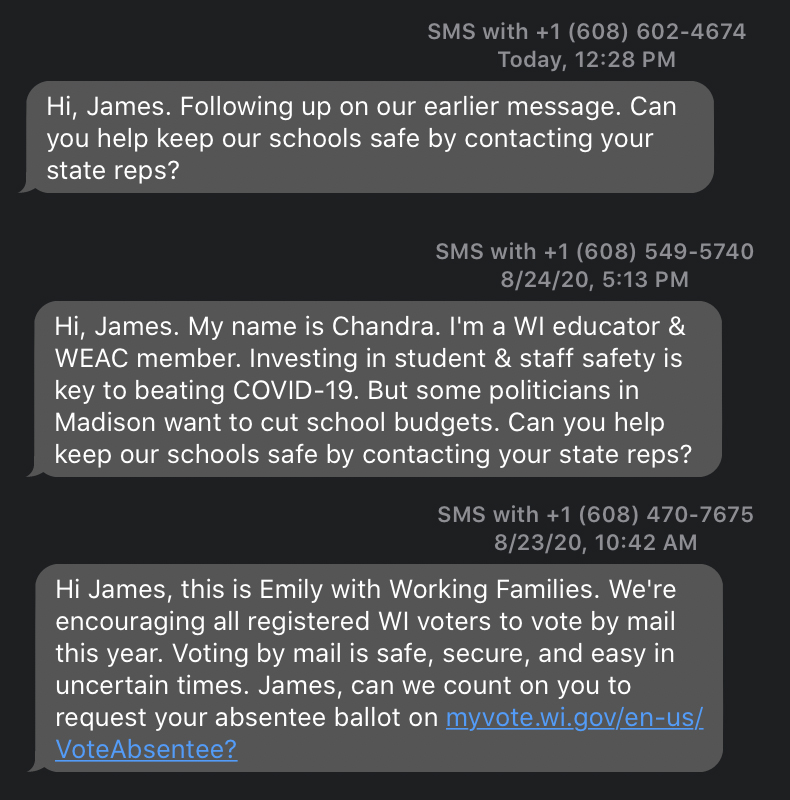
There seems to be a rhythm to the text message touch attempts.
Related: Catholic schools will sue Dane County Madison Public Health to open as scheduled
Notes and links on Dane County Madison Public Health. (> 140 employees).
which pushed Dane County this week not to calculate its percentage of positive tests — a data point the public uses to determine how intense infection is in an area.
While positive test results are being processed and their number reported quickly, negative test results are taking days in some cases to be analyzed before they are reported to the state.
The department said it was between eight and 10 days behind in updating that metric on the dashboard, and as a result it appeared to show a higher positive percentage of tests and a lower number of total tests per day.
The department said this delay is due to the fact data analysts must input each of the hundreds of tests per day manually, and in order to continue accurate and timely contact tracing efforts, they prioritized inputting positive tests.
“Positive tests are always immediately verified and processed, and delays in processing negative tests in our data system does not affect notification of test results,” the department said in a news release. “The only effect this backlog has had is on our percent positivity rate and daily test counts.”
Staff have not verified the approximately 17,000 tests, which includes steps such as matching test results to patients to avoid duplicating numbers and verifying the person who was tested resides in Dane County.
All 77 false-positive COVID-19 tests come back negative upon reruns.
Madison private school raises $70,000 for lawsuit against public health order. – WKOW-TV. Commentary.
WEAC: $1.57 million for Four Wisconsin Senators
Assembly against private school forced closure.
Wisconsin Catholic schools will challenge local COVID-19 closing order. More.
2017: West High Reading Interventionist Teacher’s Remarks to the School Board on Madison’s Disastrous Reading Results
Madison’s taxpayer supported K-12 school district, despite spending far more than most, has long tolerated disastrous reading results.
My Question to Wisconsin Governor Tony Evers on Teacher Mulligans and our Disastrous Reading Results
“An emphasis on adult employment”
Wisconsin Public Policy Forum Madison School District Report[PDF]
Booked, but can’t read (Madison): functional literacy, National citizenship and the new face of Dred Scott in the age of mass incarceration
Complex human societies, including our own, are fragile. They are held together by an invisible web of mutual trust and social cooperation. This web can fray easily, resulting in a wave of political instability, internal conflict and, sometimes, outright social collapse.
Analysis of past societies shows that these destabilizing historical trends develop slowly, last many decades, and are slow to subside. The Roman Empire, Imperial China and medieval and early-modern England and France suffered such cycles, to cite a few examples. In the U.S., the last long period of instability began in the 1850s and lasted through the Gilded Age and the “violent 1910s.”
We now see the same forces in the contemporary U.S. Of about 30 detailed indicators I developed for tracing these historical cycles (reflecting popular well-being, inequality, social cooperation and its inverse, polarization and conflict), almost all have been moving in the wrong direction in the last three decades.
Every year U.S. law schools churn out about 25,000 “surplus” lawyers, many of whom are in debt. A large number hope to enter politics.
The roots of the current American predicament go back to the 1970s, when wages of workers stopped keeping pace with their productivity. The two curves diverged: Productivity continued to rise, as wages stagnated. The “great divergence” between the fortunes of the top 1 percent and the other 99 percent is much discussed, yet its implications for long-term political disorder are underappreciated. Battles such as the recent government shutdown are only one manifestation of what is likely to be a decade-long period.
How does growing economic inequality lead to political instability? Partly this correlation reflects a direct, causal connection. High inequality is corrosive of social cooperation and willingness to compromise, and waning cooperation means more discord and political infighting. Perhaps more important, economic inequality is also a symptom of deeper social changes, which have gone largely unnoticed.
Increasing inequality leads not only to the growth of top fortunes; it also results in greater numbers of wealth-holders. The “1 percent” becomes “2 percent.” Or even more. There are many more millionaires, multimillionaires and billionaires today compared with 30 years ago, as a proportion of the population.
Let’s take households worth $10 million or more (in 1995 dollars). According to the research by economist Edward Wolff, from 1983 to 2010 the number of American households worth at least $10 million grew to 350,000 from 66,000.
Born in an Indian village with cerebral palsy, Kuli Kohli was lucky to survive. Neighbours told her parents they should throw her in the river, instead they brought her to the UK. As she grew up here, writing became her means of escape – and transformed her life in ways she never expected.
Waiting to be called on stage in her home town of Wolverhampton, Kuli Kohli felt sick with anxiety. She was petrified her words wouldn’t come out and worried she would fall flat on her face. Her heart soared and her nerves clattered. Self-doubt raced through her mind. “Why am I putting myself through all of this?” she asked herself.
The host welcomed Kuli to the empty chair that was waiting for her. It was dark, a spotlight illuminated the stage, and a small wave of applause rippled around the room.
Emerging from the side of the stage, Kuli nervously approached the mic. She took a breath and a few seconds of silence passed before she shared one of her poems with an audience for the very first time.
Choose Life.
Are they a saving grace for families displaced from traditional schooling or yet another mirage hiding serious educational inequities.
Like most things it matters who you ask.
Much of the media coverage of pods has shown a deceptively white face which predictably has drawn significant warnings of widening gaps in educational outcomes.
I understand the concerns, but it’s still a damned shame there is more vigilance about hamstringing solutions rather than finding them.
The idea of self-determined home-based solutions for education has barely made it into the mainstream. The public has only a slight idea of what pods are, but already the always-on social justice naysayers and self-interested bureaucrats are breakdancing chicken little suitsall over pod news stories.
Of course we should care if the unintended consequences of educational trends will hurt societies most marginalized children, but that fear shouldn’t immobilize creative attempts to stem the learning loss school shutdowns have caused.
Related: Catholic schools will sue Dane County Madison Public Health to open as scheduled
Notes and links on Dane County Madison Public Health. (> 140 employees).
which pushed Dane County this week not to calculate its percentage of positive tests — a data point the public uses to determine how intense infection is in an area.
While positive test results are being processed and their number reported quickly, negative test results are taking days in some cases to be analyzed before they are reported to the state.
The department said it was between eight and 10 days behind in updating that metric on the dashboard, and as a result it appeared to show a higher positive percentage of tests and a lower number of total tests per day.
The department said this delay is due to the fact data analysts must input each of the hundreds of tests per day manually, and in order to continue accurate and timely contact tracing efforts, they prioritized inputting positive tests.
“Positive tests are always immediately verified and processed, and delays in processing negative tests in our data system does not affect notification of test results,” the department said in a news release. “The only effect this backlog has had is on our percent positivity rate and daily test counts.”
Staff have not verified the approximately 17,000 tests, which includes steps such as matching test results to patients to avoid duplicating numbers and verifying the person who was tested resides in Dane County.
All 77 false-positive COVID-19 tests come back negative upon reruns.
Madison private school raises $70,000 for lawsuit against public health order. – WKOW-TV. Commentary.
WEAC: $1.57 million for Four Wisconsin Senators
Assembly against private school forced closure.
Wisconsin Catholic schools will challenge local COVID-19 closing order. More.
2017: West High Reading Interventionist Teacher’s Remarks to the School Board on Madison’s Disastrous Reading Results
Madison’s taxpayer supported K-12 school district, despite spending far more than most, has long tolerated disastrous reading results.
My Question to Wisconsin Governor Tony Evers on Teacher Mulligans and our Disastrous Reading Results
“An emphasis on adult employment”
Wisconsin Public Policy Forum Madison School District Report[PDF]
Booked, but can’t read (Madison): functional literacy, National citizenship and the new face of Dred Scott in the age of mass incarceration
As the fall semester begins, many college students will be attending classes from the relative safety of their family homes. Others have arrived to live on university campuses, with varying amounts of success; even schools that enforce strict social distancing guidelines are seeing outbreaks of the coronavirus.
But some students are pursuing a third option: Renting giant houses with friends — sometimes in far-flung locales — and doing school remotely, together. Call it the rise of the college “collab house.”
Two groups of students at the Massachusetts Institute of Technology, for example, have rented large houses in Hawaii for the fall semester. Six rising seniors at Columbia University will be living in a house in Portland, Ore. Several rising seniors at Harvard are renting property in Montana. There are at least seven large houses that have been rented in the greater Salt Lake City area alone, filled with students from different colleges.
These houses range in scale from lavish and pricey productions to smart, budget-friendly solutions for first generation, low-income students.
Ald. Max Prestigiacomo, who has represented the student-dominated 8th District since winning a special election to fill a vacancy in April, posted the flyer circulating online on his Facebook page after the shooting in Kenosha.
“Madison stands with Kenosha,” reads the flyer promoting protests Sunday and Monday. “F—- Kenosha PD. F—- Madison PD. F—- Milwaukee PD. F—- Chicago PD. No bad protesters. No good cops. Come prepared. Wear a mask. Bring water. No peace police. Do what you want. F—- S—- up.”
On Monday and Tuesday nights, peaceful protests in Madison became violent with some people starting dumpster and trash fires, breaking windows, looting multiple businesses, and throwing projectiles at police officers, who deployed chemical agents and made at least 10 arrests. Peaceful protests continued through the week without major incidents.
On Tuesday, when he saw the posting, resident Barnaby Kerr posted a comment on Prestigiacomo’s Facebook page and said Prestigiacomo blocked him. Kerr sent a screenshot of the posting to all City Council members and also contacted other city officials. Kerr said he intends to ask the council to censure Prestigiacomo at Tuesday’s council meeting.
Related: Catholic schools will sue Dane County Madison Public Health to open as scheduled
Notes and links on Dane County Madison Public Health. (> 140 employees).
which pushed Dane County this week not to calculate its percentage of positive tests — a data point the public uses to determine how intense infection is in an area.
While positive test results are being processed and their number reported quickly, negative test results are taking days in some cases to be analyzed before they are reported to the state.
The department said it was between eight and 10 days behind in updating that metric on the dashboard, and as a result it appeared to show a higher positive percentage of tests and a lower number of total tests per day.
The department said this delay is due to the fact data analysts must input each of the hundreds of tests per day manually, and in order to continue accurate and timely contact tracing efforts, they prioritized inputting positive tests.
“Positive tests are always immediately verified and processed, and delays in processing negative tests in our data system does not affect notification of test results,” the department said in a news release. “The only effect this backlog has had is on our percent positivity rate and daily test counts.”
Staff have not verified the approximately 17,000 tests, which includes steps such as matching test results to patients to avoid duplicating numbers and verifying the person who was tested resides in Dane County.
All 77 false-positive COVID-19 tests come back negative upon reruns.
Madison private school raises $70,000 for lawsuit against public health order. – WKOW-TV. Commentary.
WEAC: $1.57 million for Four Wisconsin Senators
Assembly against private school forced closure.
Wisconsin Catholic schools will challenge local COVID-19 closing order. More.
2017: West High Reading Interventionist Teacher’s Remarks to the School Board on Madison’s Disastrous Reading Results
Madison’s taxpayer supported K-12 school district, despite spending far more than most, has long tolerated disastrous reading results.
My Question to Wisconsin Governor Tony Evers on Teacher Mulligans and our Disastrous Reading Results
“An emphasis on adult employment”
Wisconsin Public Policy Forum Madison School District Report[PDF]
Booked, but can’t read (Madison): functional literacy, National citizenship and the new face of Dred Scott in the age of mass incarceration
The District Court threw out the lawsuit, but it was reinstated by a panel in the Sixth Circuit in a 2-1 opinion. We explained the background and appeals court decision in Oberlin College loses appeal in suit by expelled male student, case reinstated:
To refresh your memory, John Doe No. 1’s case involved whether a female student gave “consent” as defined by Oberlin College to what on the surface was a consensual sexual encounter, as I wrote in December 2017, Lawsuit: Oberlin College sexual assault hearing process rigged, 100% conviction rate.
John Doe No. 1 had his case dismissed in the federal district court on legal grounds, despite the judge finding there was reason to doubt the result, as I wrote in April 2019, Male student lawsuit against Oberlin College dismissed despite possibly flawed sexual assault disciplinary decision.The appeal was argued in December 2019, Cautious optimism for expelled Oberlin College male student after appellate argument.
The 6th Circuit just issued its Opinion (pdf.), reversing the dismissal and reinstating the case. In so doing, the court excoriated Obelin College’s alleged misconduct (which the court had to accept as true at this procedural stage)….
In his briefs, Kaul states, “For over a century, Wisconsin has maintained a public health infrastructure that empowers local health officials to be a critical line of defense, barring public gatherings and swiftly taking any actions that are reasonable and necessary to suppress spreading diseases. That is precisely what Dane County did here, barring in-person school instruction in order to prevent outbreaks of COVID-19.”
The petitions challenging the emergency order were filed on behalf of eight Dane County families, five private schools, School Choice Wisconsin Action, and the Wisconsin Council of Religious and Independent Schools, by the conservative Wisconsin Institute for Law & Liberty (WILL).
In its petitions, WILL states the emergency order exceeds Heinrich’s statutory authority and violates petitioners’ religious liberties and right to direct their children’s education by barring in-person education.
“This order injected unnecessary chaos, confusion, and frustration into the lives of children, families, and school leaders preparing to navigate a difficult new school year,” WILL President and General Counsel Rick Esenberg said in a statement.
Unsurprising.
Related: Catholic schools will sue Dane County Madison Public Health to open as scheduled
Notes and links on Dane County Madison Public Health. (> 140 employees).
which pushed Dane County this week not to calculate its percentage of positive tests — a data point the public uses to determine how intense infection is in an area.
While positive test results are being processed and their number reported quickly, negative test results are taking days in some cases to be analyzed before they are reported to the state.
The department said it was between eight and 10 days behind in updating that metric on the dashboard, and as a result it appeared to show a higher positive percentage of tests and a lower number of total tests per day.
The department said this delay is due to the fact data analysts must input each of the hundreds of tests per day manually, and in order to continue accurate and timely contact tracing efforts, they prioritized inputting positive tests.
“Positive tests are always immediately verified and processed, and delays in processing negative tests in our data system does not affect notification of test results,” the department said in a news release. “The only effect this backlog has had is on our percent positivity rate and daily test counts.”
Staff have not verified the approximately 17,000 tests, which includes steps such as matching test results to patients to avoid duplicating numbers and verifying the person who was tested resides in Dane County.
All 77 false-positive COVID-19 tests come back negative upon reruns.
Madison private school raises $70,000 for lawsuit against public health order. – WKOW-TV. Commentary.
WEAC: $1.57 million for Four Wisconsin Senators
Assembly against private school forced closure.
Wisconsin Catholic schools will challenge local COVID-19 closing order. More.
2017: West High Reading Interventionist Teacher’s Remarks to the School Board on Madison’s Disastrous Reading Results
Madison’s taxpayer supported K-12 school district, despite spending far more than most, has long tolerated disastrous reading results.
My Question to Wisconsin Governor Tony Evers on Teacher Mulligans and our Disastrous Reading Results
“An emphasis on adult employment”
Wisconsin Public Policy Forum Madison School District Report[PDF]
Booked, but can’t read (Madison): functional literacy, National citizenship and the new face of Dred Scott in the age of mass incarceration
In a typical year, more than 1 million students come from all over the world to study at U.S. colleges and universities. They’ve never had more reasons to reconsider. The coronavirus pandemic has brought health concerns, travel restrictions and shifting immigration rules; online classes and social distancing promise a diluted college experience at a full-strength price. Students from Asia, who make up three quarters of foreign nationals on U.S. campuses, have yet another concern. Anti-Asian bias and hate crimes are at an all-time high.
Foreign students contributed an estimated $41 billion to the economy in the 2018-19 academic year, according to NAFSA: Association of International Educators. The intangible benefits to the U.S. are harder to measure but no less real: By one count, more than 60 world leaders attended U.S. schools. Still, America’s near-monopoly on elite higher education is weakening. After 12 years of steady growth, the number of international students in the U.S. plateaued in 2019, Institute of International Education data show. Other countries including the U.K., Canada and Australia are eager to attract students from overseas.
WKRC:
Students at Mercy Montessori will enjoy some of their classes outdoors.
Principal Patty Normile has been working with parents and experts for months on plans to make the school safe. She has set up tents outdoors to create spaces for teachers to hold some classes.
“Our goal is to have them outside as much as we can,” Normile said. “With the various guidelines of having the fresh air, it just seems like a no-brainer for our community.”
Normile said it was important for students to be back in the classroom five days a week. The tents will be used to create classroom space along with other outdoor spaces that can be used.
“We’re really concerned about the mental health of children who have not had the opportunity to be among their peers for socialization,” Normile said.
Marybeth Flaspohlar teaches fourth through sixth grade. She is excited to welcome back the students and believes they will enjoy the outdoor classrooms.
Four overnight camps in Maine successfully stemmed the spread of the novel coronavirus and conducted sessions with over 1,000 attendees from 41 states and international locations this summer, according to a new report published on Wednesday.
The findings in the Centers for Disease Control and Prevention’s (CDC) Morbidity and Mortality Weekly Report contrasted with that of an overnight camp in Georgia, where the disease reportedly spread to at least 44% of staff and attendees.
All Maine camp attendees for the season between June and August were asked to quarantine with families for 10–14 days before arrival, and camps advised members to arrive in a family vehicle.
About a week before arrival, the attendees were tested for the coronavirus, and three of the four camps mandated submission of these results before entry.
To address exposure during travel, all camps quarantined attendees by groups for 14 days after arrival.
Two separate lawsuits are seeking to block a new public health emergency order that allows only a fraction of elementary school students to attend classes in person in Dane County.
The legal challenges come days after Public Health Madison and Dane County officials in their ninth emergency order restricted in-person schooling to grades K-2 and outlined metrics required for students in higher grades to return in-person.
PHMDC’s Friday announcement at 5:18 p.m. came just days before many area private and parochial schools were set to return with at least some in-person instruction. At least one school already had, which formed the basis for the first challenge, filed directly to the Wisconsin Supreme Court Tuesday.
Related: Catholic schools will sue Dane County Madison Public Health to open as scheduled
Notes and links on Dane County Madison Public Health. (> 140 employees).
which pushed Dane County this week not to calculate its percentage of positive tests — a data point the public uses to determine how intense infection is in an area.
While positive test results are being processed and their number reported quickly, negative test results are taking days in some cases to be analyzed before they are reported to the state.
The department said it was between eight and 10 days behind in updating that metric on the dashboard, and as a result it appeared to show a higher positive percentage of tests and a lower number of total tests per day.
The department said this delay is due to the fact data analysts must input each of the hundreds of tests per day manually, and in order to continue accurate and timely contact tracing efforts, they prioritized inputting positive tests.
“Positive tests are always immediately verified and processed, and delays in processing negative tests in our data system does not affect notification of test results,” the department said in a news release. “The only effect this backlog has had is on our percent positivity rate and daily test counts.”
Staff have not verified the approximately 17,000 tests, which includes steps such as matching test results to patients to avoid duplicating numbers and verifying the person who was tested resides in Dane County.
All 77 false-positive COVID-19 tests come back negative upon reruns.
Madison private school raises $70,000 for lawsuit against public health order. – WKOW-TV. Commentary.
WEAC: $1.57 million for Four Wisconsin Senators
Assembly against private school forced closure.
Wisconsin Catholic schools will challenge local COVID-19 closing order. More.
2017: West High Reading Interventionist Teacher’s Remarks to the School Board on Madison’s Disastrous Reading Results
Madison’s taxpayer supported K-12 school district, despite spending far more than most, has long tolerated disastrous reading results.
My Question to Wisconsin Governor Tony Evers on Teacher Mulligans and our Disastrous Reading Results
“An emphasis on adult employment”
Wisconsin Public Policy Forum Madison School District Report[PDF]
Booked, but can’t read (Madison): functional literacy, National citizenship and the new face of Dred Scott in the age of mass incarceration
He added that MTI “recognizes the need” for supporting families through child care, but believes safety remains the top priority. MTI has also asked the district to seek volunteers, including within the teaching workforce, to staff in-person services and is encouraging all staff to get a COVID-19 test prior to working with students and families.
LeMonds wrote that the district had put together a “thoughtful health and safety plan” and said the summer child care model was “very successful.” Safety guidelines include masks, social distancing when possible, a symptom check before starting the program, staying home with a positive test or symptoms and working with public health to determine who should quarantine if there is a positive case within a building.
The classes are expected to be limited to 15 students per room and located at many elementary schools around the district.
When the district announced it was going virtual, Dean was initially relieved, he wrote, as he remains concerned about COVID-19. But if he had to work in-person he would “be extremely hurt if I caused harm to a kid or adult by spreading something I can’t tell is in my system.”
Related: Catholic schools will sue Dane County Madison Public Health to open as scheduled
Notes and links on Dane County Madison Public Health. (> 140 employees).
which pushed Dane County this week not to calculate its percentage of positive tests — a data point the public uses to determine how intense infection is in an area.
While positive test results are being processed and their number reported quickly, negative test results are taking days in some cases to be analyzed before they are reported to the state.
The department said it was between eight and 10 days behind in updating that metric on the dashboard, and as a result it appeared to show a higher positive percentage of tests and a lower number of total tests per day.
The department said this delay is due to the fact data analysts must input each of the hundreds of tests per day manually, and in order to continue accurate and timely contact tracing efforts, they prioritized inputting positive tests.
“Positive tests are always immediately verified and processed, and delays in processing negative tests in our data system does not affect notification of test results,” the department said in a news release. “The only effect this backlog has had is on our percent positivity rate and daily test counts.”
Staff have not verified the approximately 17,000 tests, which includes steps such as matching test results to patients to avoid duplicating numbers and verifying the person who was tested resides in Dane County.
All 77 false-positive COVID-19 tests come back negative upon reruns.
Madison private school raises $70,000 for lawsuit against public health order. – WKOW-TV. Commentary.
WEAC: $1.57 million for Four Wisconsin Senators
Assembly against private school forced closure.
Wisconsin Catholic schools will challenge local COVID-19 closing order. More.
2017: West High Reading Interventionist Teacher’s Remarks to the School Board on Madison’s Disastrous Reading Results
Madison’s taxpayer supported K-12 school district, despite spending far more than most, has long tolerated disastrous reading results.
My Question to Wisconsin Governor Tony Evers on Teacher Mulligans and our Disastrous Reading Results
“An emphasis on adult employment”
Wisconsin Public Policy Forum Madison School District Report[PDF]
Booked, but can’t read (Madison): functional literacy, National citizenship and the new face of Dred Scott in the age of mass incarceration
Brutalism has seen a surge in interest among young people keen on bold uncompromising Modernist design. Whole books of moody photographic studies of concrete buildings are snapped up by fans of urban life and retro design. A crop of new books explores the Brutalism of socialist states.
While Constructivism and avant-gardism in fine art came to prominence during the October Revolution, it was suppressed in favour of Socialist Realism by the mid-1930s. In architecture more adventurous forms and materials persisted, although in the minority. Under Stalin there was a degree of stylistic conformity and austerity, yet adventurous architecture was not seen as “bourgeois formalism” as it was in art. Following the death of Stalin in 1953, historicism receded and a greater variety of art, design and architecture (including Modernist architecture) became possible.
While supposedly for the masses, many of the showpiece constructions were moribund from the start: inverted ziggurat hotels that were barely occupied and shopping centres with few consumer goods to offer. Much of this architecture was completed less than a decade before the economic and political collapse of the Eastern Bloc.
This decline in overall satisfaction among K-12 parents is largely due to a drop in the percentage saying they are completely satisfied, from 41% one year ago to 32% in the latest Gallup poll, conducted July 30-Aug. 12. This decrease comes as the coronavirus pandemic continues to ravage the U.S. and K-12 schools are being forced to adapt to keep students and staff members safe. While many school districts around the country will provide distance learning at the start of the 2020-2021 school year, as they did at the end of the last school year, many others have tried to find a way to offer in-person schooling.
Gallup’s COVID-19 tracking poll in May found that although parents largely gave their child’s school positive ratings for its remote learning, they found aspects of it to be challenging. Meanwhile, more recent data show that parents are torn about what type of schooling they prefer for the new school year and that teachers are “very concerned” about returning to their classroom.
“The Gallup poll finds that public school enrollment will drop from 83% to 76%. That would be about 3.5 million students leaving public schools.” – Corey Deangelis.
Reddit is a Democrat/Chinese Tencent organization with a political agenda. This sub and r/conspiracy and maybe a couple others seem to the only places where at least some discussion is still tolerated.
William Binney was formerly the NSA’s technical director for world geopolitical and military analysis and designer of many agency programs now in use. He has been outspoken that the DNC emails were not hacked by Russia.
Here are some related articles & info if you want to look more into what Bill Binney is saying. The censorship is bad enough though.
(Aug 9, 2017) This was the original big story when it first came out https://www.thenation.com/article/archive/a-new-report-raises-big-questions-about-last-years-dnc-hack/
(May 12, 2020) Jimmy Dore interview w/ Aaron Mate; Crowdstrike has no evidence https://www.youtube.com/watch?v=WRoTGlQ4JMA
Madison Metropolitan School District Superintendent Carlton Jenkins shared a statement Wednesday condemning the shooting of Jacob Blake, a Black man who was shot in the back seven times by Kenosha police.
In his statement, Jenkins said the school district stands with the city and the country in the wake of the shooting of Blake and other acts of violence against Black Americans, which he said resemble “modern day lynchings.”
“In my thirty years as an educator, and 54 years of life, the horrifying events of racial injustice we have had to bear witness to this summer have been among the most challenging situations I have experienced,” Jenkins said. “I have repeatedly stated ‘I don’t want to have the same conversations about safety with my African American grandson that my mother had with me.’”
Tuesday night, Jenkins joined other community leaders — including Boys & Girls Club of Dane County President and CEO Michael Johnson, Representative Shelia Stubbs and former Madison Mayor Paul Soglin — for a march calling for peace in the wake of the Kenosha shooting.
In his statement, Jenkins called on the community to advocate for human decency, saying the nation can not decide who is worthy of “life, liberty and the pursuit of happiness,” based on identity.
As of August 24, 2020, nearly 5.7 million cases of Covid-19 had been reported in the United States, with more than 176,000 deaths. Although there is debate about the accuracy of these specific numbers — many people with mild symptoms are never tested for Covid, for example, and especially early in the epidemic, the difference between dying from Covid and dying with Covid may not have been accurately captured — the increase in excess mortality rates reported by the Centers for Disease Control and Prevention is consistent with a significant loss of life associated with the disease.
At the same time, the Covid-19 pandemic has led to staggering economic losses in the United States. Closing down the economy has had a devastating impact on the American people, even though the closure was imposed to save lives. The longest economic expansion on record abruptly ended in February, and the country officially entered a recession late that month.
The U.S. unemployment rate in February was 3.5% — a half-century low. By March, it was 4.4%, and by April, 14.7%, with 20.5 million people losing their jobs and more than 20% of the labor force filing for unemployment benefits. Experts predicted that the unemployment rate would approach 20% in May; instead, it was reported as 13.3%, although there’s debate about whether this figure reflected some workers’ self-classification as only temporarily laid off. The June unemployment rate was even lower — 11.1% — but the economy was still operating with 15 million fewer jobs than it had in February, and there was new concern that the economic impact of the pandemic may linger, given the recent resurgence of new cases.
As the country reopens, it’s important to assess how we can be better prepared to stave off such enormous economic losses during the next wave or the next epidemic. In my view, a few key policy changes will be critical.
A lawsuit was filed in Wisconsin’s Supreme Court on Tuesday arguing that Janel Heinrich, the Public Health Officer of Madison and Dane County, does not have the legal authority to keep children home from school.
Public Health Madison and Dane County issued Emergency Order #9, which went into effect Monday. It orders all Dane County schools to begin the 2020 school year virtually for students in grades 3-12. That includes private schools, many of which had intended to reopen to in-person classes.
The order says “At issue is whether one unelected official has the power to order children to ‘stay home’ from school whether or not they are sick, or to prohibit them from gathering in-person with other children to receive a religious education.”
The petitioner in the case is Sarah Lindsey James. Within the order she is identified as a Fitchburg single mom, who enrolled her two children at Our Redeemer Lutheran School saying “she believes that it is essential that her children’s education take place ‘in-person’ and ‘together with others as part of the body of Christ.’” It says her children began in-person learning Wednesday.
The order asks the Supreme Court to end Emergency Order No. 9, and prevent Heinrich from creating any other orders that would close private schools or restrict private gatherings. The court has asked Heinrich to respond by 4 p.m. Friday.
Related: Catholic schools will sue Dane County Madison Public Health to open as scheduled
Notes and links on Dane County Madison Public Health. (> 140 employees).
which pushed Dane County this week not to calculate its percentage of positive tests — a data point the public uses to determine how intense infection is in an area.
While positive test results are being processed and their number reported quickly, negative test results are taking days in some cases to be analyzed before they are reported to the state.
The department said it was between eight and 10 days behind in updating that metric on the dashboard, and as a result it appeared to show a higher positive percentage of tests and a lower number of total tests per day.
The department said this delay is due to the fact data analysts must input each of the hundreds of tests per day manually, and in order to continue accurate and timely contact tracing efforts, they prioritized inputting positive tests.
“Positive tests are always immediately verified and processed, and delays in processing negative tests in our data system does not affect notification of test results,” the department said in a news release. “The only effect this backlog has had is on our percent positivity rate and daily test counts.”
Staff have not verified the approximately 17,000 tests, which includes steps such as matching test results to patients to avoid duplicating numbers and verifying the person who was tested resides in Dane County.
All 77 false-positive COVID-19 tests come back negative upon reruns.
Madison private school raises $70,000 for lawsuit against public health order. – WKOW-TV. Commentary.
WEAC: $1.57 million for Four Wisconsin Senators
Assembly against private school forced closure.
Wisconsin Catholic schools will challenge local COVID-19 closing order. More.
2017: West High Reading Interventionist Teacher’s Remarks to the School Board on Madison’s Disastrous Reading Results
Madison’s taxpayer supported K-12 school district, despite spending far more than most, has long tolerated disastrous reading results.
My Question to Wisconsin Governor Tony Evers on Teacher Mulligans and our Disastrous Reading Results
“An emphasis on adult employment”
Wisconsin Public Policy Forum Madison School District Report[PDF]
Booked, but can’t read (Madison): functional literacy, National citizenship and the new face of Dred Scott in the age of mass incarceration
A group of parents and private religious schools is asking the Wisconsin Supreme Court to void a Dane County order barring in-person school for most students, saying the order issued in response to the COVID-19 pandemic infringes on the right to worship and to an education.
“This case challenges the authority of one unelected bureaucrat to upend the education plans of thousands of students and families and their schools located throughout Dane County via the stroke of a pen,” asserts the petition filed Wednesday by the conservative Wisconsin Institute for Law and Liberty on behalf of 14 parents, five religious schools, and interest groups for school vouchers and religious and independent schools.
Issued Friday and effective Monday, Emergency Order No. 9 bars schools from offering in-person instruction for grades 3 through 12 until the county meets certain benchmarks showing the coronavirus is better contained. In effect, it applies almost exclusively to private schools because public schools in Dane County had already decided to start the year online for almost all students in almost every grade.
In the WILL petition and a separate one filed on behalf of Fitchburg mother Sara Lindsey James on Tuesday, attorneys argue that Janel Heinrich, director of Public Health Madison and Dane County, doesn’t have authority under state law to close schools and that the order runs counter to the decision the high court made in May striking down the statewide stay-at-home order.
In the May case, the court did not strike down the part of the stay-at-home order closing schools, but that order only closed them through the end of last school year. James’ petition argues state law allowing the state’s public health director to close schools in a public health emergency does not extend to local public health directors such as Heinrich.
(Some) Madison Governance Rhetoric on University of Wisconsin Governance Plans
Madison private school raises $70,000 for lawsuit against public health order. – WKOW-TV. Commentary.
WEAC: $1.57 million for Four Wisconsin Senators
Assembly against private school forced closure.
Wisconsin Catholic schools will challenge local COVID-19 closing order. More.
2017: West High Reading Interventionist Teacher’s Remarks to the School Board on Madison’s Disastrous Reading Results
Madison’s taxpayer supported K-12 school district, despite spending far more than most, has long tolerated disastrous reading results.
My Question to Wisconsin Governor Tony Evers on Teacher Mulligans and our Disastrous Reading Results
“An emphasis on adult employment”
Wisconsin Public Policy Forum Madison School District Report[PDF]
Booked, but can’t read (Madison): functional literacy, National citizenship and the new face of Dred Scott in the age of mass incarceration
As a child in the United States, justice often depends on where you live, the color of your skin, which police officer arrests you, or which judge, prosecutor or probation officer happens to be involved in your case.
Juvenile courts across the country processed nearly 750,000 cases in 2018. About 200,000 of these cases involved detention – removing a young person from home and locking them away, according to data from the federal Office of Juvenile Justice and Delinquency Prevention.
Depending on where a young person lives, a crime like simple assault or gun possession could lead to a customized rehabilitation program with help from mentors. It also could mean confinement in a group home, where kids wear their own clothes and counselors call them by their first names. Or it could mean time in a barbed wire-rimmed “prison for kids,” part of a system rife with rioting, suicide and sexual assault.
“We call it justice by geography,” said Elizabeth Cauffman, a developmental psychologist at University of California, Irvine. “Where you live determines how you’re treated as a juvenile.”
Madeline Heim, Annysa Johnson and Samantha West:
As hundreds of thousands of students return to classrooms across Wisconsin, the state has no plans to publicize details about COVID-19 outbreaks when they occur at schools.
Freedom of information advocates say that information should be available to the broader public, and some researchers say data could help schools learn from one another. But others worry about protecting students, parents and communities from stigma if information about outbreaks is shared widely.
Without a state-level source of information, what you know about outbreaks in your schools may depend on the openness of local school districts and health departments.
The Wisconsin Department of Health Services confirmed last week it will publish only the number of schools in the state with COVID-19 investigations, which launch when as few as two cases are identified in a given space. The department doesn’t plan to name the schools or describe the severity of the outbreaks.
Yesterday I posted a letter (read it here) from the New Jersey Public Charter Schools Association to the Democratic National Committee. The 65 signatories express grave disappointment at the DNC’s anti-charter stance, which the signatories call “especially egregious” in light of powerful support from Black and Latino parents. Today the Fordham Institute published a report called “Schooling Covid-19: Lessons from Leading Charter networks from Their Transition to Remote Learning.” Here, Gregg Vanourek examines the successful approach of eight charter management organizations (CMO’s) during pandemic-induced remote instruction and what traditional districts can learn from them.
Sometimes timing is everything.
There’s just so much at stake. McKinsey projects that by the time school starts back up, whether in-person, remotely, or some kind of hybrid, low-income students will have fallen by over a year, Black students by 10.3 months and Hispanic students by 9.2 months. Public charters (both nationwide and in NJ) disproportionately enroll these high-risk students. So what can traditional districts learn from them? What can we do differently in these challenging circumstances so that all students stay on track given the constraints of zoom and Google Classroom? (And why isn’t the DNC celebrating the succcesses of public schools that get it right instead of promising anti-charter lobbyists they’ll stifle their growth?)
For this study, Fordham selected Achievement First, DSST Public Schools, IDEA Public Schools, KIPP DC, Noble Network of Charter Schools, Rocketship Public Schools, Success Academy, and Uncommon Schools. (Uncommon has 4 schools in Camden serving 800 students and 14 schools in Newark serving over 5,500 students. The other CMO’s don’t have Jersey locations so I’ll feature Uncommon because that’s the way we roll.) Here, Mike Petrilli explains how these schools made the cut:
During the first month of the coronavirus shutdown, 9-year-old Drew Schnurman read books, played board games and watched YouTube. But he got bored a lot.
“He was really needy, asking me to play with him all the time and looking for a lot of attention,” said his mother, Dana Schnurman, a public-relations freelancer who was trying to keep him occupied while working from her Deerfield, Ill., home.
Christine Ruiz, the mother of three boys, called it “ridiculous” that her Los Angeles-area school district is deemed safe enough to offer parent-paid child care at its buildings but not taxpayer-funded in-person education.
“Our empty classrooms that the taxpayers are funding are being converted to day-care centers, and they’re charging parents $800 a month per child to drop off their kids — at our old classrooms,” Ms. Ruiz said. “If it’s OK for our schools to open up their classrooms for day care, why can’t you open up for school?”
This guide begins with an introduction called, ‘So what’s plain English?’
The guide then looks at the main ways to make writing clearer.
▪ Keep your sentences short
▪ Prefer active verbs
▪ Use ‘you’ and ‘we’
▪ Use words that are appropriate for the reader
▪ Don’t be afraid to give instructions
▪ Avoid nominalisations
▪ Use lists where appropriate
The guide then looks at the difficult subject of apologising, and deals with some of the myths that can get in the way of clear communication.
The guide finishes with a summary and a list of words to avoid.
Arrests at Chicago Public Schools are at an all-time low, new district-wide data shows. But there’s deep racial inequity, with the vast majority of students arrested being Black.
The data shows nearly three out of every four students and young people arrested on Chicago Public School grounds during the 2019-2020 academic year were Black. But enrollment data show Black students make up only 36 percent of district students.
District records show 408 active students were arrested on school grounds during the 2019-2020 academic year. That’s a drop from the previous school year when 651 students were arrested.
Of the students and young people arrested during the 2019-2020 school year, 73.4 percent of those people were Black.
Online classes planned by the Rialto Unified School District were canceled for Monday, Aug. 24, after some district technology was crippled by a malware attack, officials said over the weekend.
Planned instruction on Monday won’t happen for over 24,500 students assigned to 29 schools and one adult learning facility, district spokeswoman Syeda Jafri said Sunday night.
“The district is looking into this sensitive matter,” Jafri said. “In our students’ and staff’s best interests, it may be premature to release further details at this time.”
The malware attack was announced over the weekend on social media. It comes as students are learning remotely during the coronavirus pandemic under a system called Bridge Academy.
“To tell [students], ‘Sorry, we are too incompetent or too fearful to figure out how to protect your elders, so you have to disrupt your education,’ would be a gross disservice to them and a default of our responsibility,” –Mitch Daniels
As an avid reader, I’ve owned several generations of Kindle devices, from the original to the Paperwhite, and loved each of them.
However, I have also kept a watchful eye on the abuse potential of the new format. Because Amazon technically owns the content you view, they may revoke it at any time. There have been cases of Amazon removing specific books from customer accounts (and kindles). Considerably worse, there are also cases of Amazon revoking user accounts and removing all access to purchased books.
Kindle services leverage reading data to offer some nice features that traditional books can’t offer: maintaining bookmarks and notes between devices, keeping all devices synced with the last read page, and more. It also shows ads and recommendations for next books to read on the kindle.
I was curious to know if the Kindle was only sending the data required for these services, or if other data about me was being sent.
In internal emails unsealed Friday by an Arizona judge in an ongoing consumer fraud lawsuit, Google employees admitted that some parts of their applications’ location privacy settings were confusing and could be misleading.
In May, Attorney General Mark Brnovich filed a heavily redacted lawsuit alleging that Google’s data-collection processes had violated the state’s Consumer Fraud Act.
The Attorney General’s Office began investigating Google after an Associated Press article in 2018 revealed certain ways the company tracks users movements and the difficulties of removing those tracking permissions.
“I agree with the article,” an unnamed Google employee wrote in an internal email released Friday along with other exhibits that are part of the state’s case. “Location off should mean location off; not except for this case or that case.”
Many taxpayer supported K-12 School Districts use Google services, including Madison.
Dozens of universities, including Columbia and Stanford, are hosting the Chinese government-funded Confucius Institute despite increasing scrutiny from the federal government.
Many elite universities with Confucius Institute programs appear to be unfazed by the Trump administration’s decision last week to designate the D.C-based headquarters of the program as a “foreign mission”—a label the U.S. government applies to entities it finds to be directly controlled by a foreign power. Despite the announcement, nearly 50 colleges and universities will continue their partnership with Confucius Institute programs, which comes with up to $1 million in Chinese government funding.
Blank defended the decision to reopen campus at a faculty committee meeting on Monday, saying UW-Madison will nearly double the number of tests administered within the county and add 35 contact tracers to the county’s ranks.
The number of tests UW-Madison plans to administer — up to 8,000 weekly, covering roughly 15% to 20% of the students and employees expected on campus — closely compares to the percentage of people being tested at the Alliant Energy Center, she said. UW-Madison will run the tests in its own labs and shoulder the cost, which is estimated to be $15 million.
Related: Catholic schools will sue Dane County Madison Public Health to open as scheduled
Notes and links on Dane County Madison Public Health. (> 140 employees).
which pushed Dane County this week not to calculate its percentage of positive tests — a data point the public uses to determine how intense infection is in an area.
While positive test results are being processed and their number reported quickly, negative test results are taking days in some cases to be analyzed before they are reported to the state.
The department said it was between eight and 10 days behind in updating that metric on the dashboard, and as a result it appeared to show a higher positive percentage of tests and a lower number of total tests per day.
The department said this delay is due to the fact data analysts must input each of the hundreds of tests per day manually, and in order to continue accurate and timely contact tracing efforts, they prioritized inputting positive tests.
“Positive tests are always immediately verified and processed, and delays in processing negative tests in our data system does not affect notification of test results,” the department said in a news release. “The only effect this backlog has had is on our percent positivity rate and daily test counts.”
Staff have not verified the approximately 17,000 tests, which includes steps such as matching test results to patients to avoid duplicating numbers and verifying the person who was tested resides in Dane County.
All 77 false-positive COVID-19 tests come back negative upon reruns.
Madison private school raises $70,000 for lawsuit against public health order. – WKOW-TV. Commentary.
WEAC: $1.57 million for Four Wisconsin Senators
Assembly against private school forced closure.
Wisconsin Catholic schools will challenge local COVID-19 closing order. More.
2017: West High Reading Interventionist Teacher’s Remarks to the School Board on Madison’s Disastrous Reading Results
Madison’s taxpayer supported K-12 school district, despite spending far more than most, has long tolerated disastrous reading results.
My Question to Wisconsin Governor Tony Evers on Teacher Mulligans and our Disastrous Reading Results
“An emphasis on adult employment”
Wisconsin Public Policy Forum Madison School District Report[PDF]
Booked, but can’t read (Madison): functional literacy, National citizenship and the new face of Dred Scott in the age of mass incarceration
America has awakened. Or gone woke. So has American journalism, or much of it. Only two decades ago, boycotts of unpopular ideas and the people who held them were confined to extreme newsletters, obscure journals and college campuses, where students have long taken pride in shutting down provocative speakers.
But the decline of “legacy” newspapers and the growing concentration of power and influence in the hands of Big Tech – primarily Google, Facebook, Apple and Twitter – have enabled those behind these causes to exert far greater influence.
While social media and digital platforms feature more diverse views of dramatically varying quality from more people from across the globe than ever before, they have also empowered as never before individuals and small groups of critics to bully and silence views they deem politically incorrect.
Posts on Twitter calling for activists to “rise up” in response to perceived intellectual and cultural offences instantly go viral. Online shaming, callouts, doxing (digging up and disseminating dirt on targets and foes) and so-called “cancel culture” writ large have become the order of the day.
Ever wonder how we got to this point? How did a nation that defined itself with the superlatives, “land of the free and the home of the brave,” “America the Beautiful“ and “one nation under God” turn into a broken culture with no boundaries, no borders, no law, no order and no soul so fast?
How did we lurch from being the United States into a divided people so quickly?
Where did this all come from: the vitriol and vice, the anger and hatred, the looting, the riots, the destruction, the nihilistic confusion, the science-denying gender-bending sexuality, the suicidal infatuation with socialism, the adolescent whining for safety rather than freedom?
How in the world did these demons possess our national body politic in what seems to be just the blink of an eye?
The answer may be closer than you think. It might be right there at your kitchen table or on the couch right beside you. Just look over your son’s or daughter’s shoulder, and you might find the answer.
On Aug. 10, Matthew Kay, a Philadelphia teacher, wondered openly on Twitter how he and his fellow teachers would cope with an unwanted intrusion in this new era of online education. In his post, Mr. Kay, who teaches English at the Science Leadership Academy, a Philadelphia public school, expressed his concern about the “damage” that “parents” might cause if they overheard the lessons he had prepared for their children.
“The notion that parents inherently know what school is best for their kids is an example of conservative magical thinking.”; “For whatever reason, parents as a group tend to undervalue the benefits of diversity in the public schools….”
Growing up in a greener urban environment boosts children’s intelligence and lowers levels of difficult behaviour, a study has found.
The analysis of more than 600 children aged 10-15 showed a 3% increase in the greenness of their neighbourhood raised their IQ score by an average of 2.6 points. The effect was seen in both richer and poorer areas.
There is already significant evidence that green spaces improve various aspects of children’s cognitive development but this is the first research to examine IQ. The cause is uncertain but may be linked to lower stress levels, more play and social contact or a quieter environment.
The increase in IQ points was particularly significant for those children at the lower end of the spectrum, where small increases could make a big difference, the researchers said.
“There is more and more evidence that green surroundings are associated with our cognitive function, such as memory skills and attention,” said Tim Nawrot, a professor of environmental epidemiology at Hasselt University in Belgium, where the study was conducted.
For a very, very long time I’ve written about why teacher “no strike” laws are pointless at best, and serve only to mislead the public about what we have politely termed “labor peace.”
Last Friday, the Rutgers School of Management and Labor Relations, which modestly calls itself “the world’s leading source of expertise on managing and representing workers, designing effective organizations, and building strong employment relationships,” revealed its research on every teacher strike since 2012.
According to the center, there have been 92 strikes in 21 states from 2012 through 2019, of which 42 were illegal in the state where they took place. Thirty-five of these occurred in just the last two years.
About a century ago, there was a tussle in higher education policy about the freedom of professors to express opinions. Academic tenure was not yet well-established, and so the prospect of professors being fired because they openly disagreed with someone in academic or political power were quite real. In 1915, the “General Report of the Committee on Academic Freedom and Academic Tenure” was presented at the annual meetings of the American Association of University Professors. It was published in the Bulletin of the American Association of University Professors (December 1915, pp. 15-43), and is readily available through the magic of HathiTrust.
In my reading, the report sought to strike a balance. It affirmed in strong terms that professors had a right to speak out, conclude what they wanted from their research, write what they wanted, join political movements,and so on. However, it also stated that professors should either forebear or be cautious, in several specific contexts, from expressing political opinions. In particular, the report argued against professors bringing their political beliefs into the classroom or into the institutional purpose of the university. To put it another way, part of the tradeoff for the freedom and security of academic tenure in the personal sphere was an assumption of responsibility that the university itself not take overtly or excessively partisan positions, whether officially or in its classrooms. It also argued that this standard should be enforced by other faculty members.
Shortly after normal office hours on Friday (08-21-2020) Madison/Dane County Public Health issued an order closing down in-school education for students above second grade at private schools for the upcoming school year — matching the voluntary stance taken by area public schools.
“This is clearly about making sure private schools aren’t allowed to show up the [unionized] MTI teachers in the public schools,” a well connected attorney told the Werkes.
In response, the Catholic Diocese of Madison plans to file lawsuit this week contesting the coronavirus pandemic order. Many Catholic schools had been scheduled to open today (Monday 08-24-2020). Fourteen diocesan Catholic schools are located in Dane County; another 20 outside the county in southwest Wisconsin.
Notes and links on Dane County Madison Public Health. (> 140 employees).
which pushed Dane County this week not to calculate its percentage of positive tests — a data point the public uses to determine how intense infection is in an area.
While positive test results are being processed and their number reported quickly, negative test results are taking days in some cases to be analyzed before they are reported to the state.
The department said it was between eight and 10 days behind in updating that metric on the dashboard, and as a result it appeared to show a higher positive percentage of tests and a lower number of total tests per day.
The department said this delay is due to the fact data analysts must input each of the hundreds of tests per day manually, and in order to continue accurate and timely contact tracing efforts, they prioritized inputting positive tests.
“Positive tests are always immediately verified and processed, and delays in processing negative tests in our data system does not affect notification of test results,” the department said in a news release. “The only effect this backlog has had is on our percent positivity rate and daily test counts.”
Staff have not verified the approximately 17,000 tests, which includes steps such as matching test results to patients to avoid duplicating numbers and verifying the person who was tested resides in Dane County.
Madison private school raises $70,000 for lawsuit against public health order. – WKOW-TV. Commentary.
WEAC: $1.57 million for Four Wisconsin Senators
Assembly against private school forced closure.
Wisconsin Catholic schools will challenge local COVID-19 closing order. More.
2017: West High Reading Interventionist Teacher’s Remarks to the School Board on Madison’s Disastrous Reading Results
Madison’s taxpayer supported K-12 school district, despite spending far more than most, has long tolerated disastrous reading results.
My Question to Wisconsin Governor Tony Evers on Teacher Mulligans and our Disastrous Reading Results
“An emphasis on adult employment”
Wisconsin Public Policy Forum Madison School District Report[PDF]
Booked, but can’t read (Madison): functional literacy, National citizenship and the new face of Dred Scott in the age of mass incarceration
The group of around 35 is now walking to Public Health Madison and Dane County Director Janel Heinrich’s house. pic.twitter.com/3zOvRqUD8F
— Caroline Dade (@CarolineDade) August 22, 2020
“What kind of president does Joe Biden want to be?” ask Chad Aldeman and Alex Spurrier of Bellwether Education Partners. Will he fight for the underdogs or for the teachers’ unions?
The Democratic Party’s platform, based on a Biden-Sanders “unity” task force’s recommendations, “steer Biden away from the coalition of Black and low-income voters who brought him the nomination,” write Aldeman and Spurrier. “Maybe this shouldn’t come as a surprise — given that two of the eight members of the task force are the heads of the two major teachers unions.”
School closures have affected over 55 million K–12 students in the U.S. since March as the nation deals with the coronavirus pandemic. Although numerous private schools and day care centers have adjusted to the pandemic and reopened, many public school districts and teachers unions are fighting to remain closed in the name of safety. In fact, 85 percent of the country’s 20 largest public school districts have already announced that they will not be reopening schools for any in-person instruction as the school year begins.
Some have noted these reopening decisions often appear to be driven by politics rather than public health. Unfortunately, many teachers groups are contributing to this appearance. In their report on safely reopening schools, for example, the Los Angeles’ teachers union went beyond detailing the safety needs of teachers and students, also calling for politicians to enact a wealth tax, Medicare for All, and a ban on charter schools.
Similarly, 10 teachers unions across the country joined a coalition that included the Democratic Socialists of America to “Demand Safe Schools.” But rather than focus on student and teacher safety, they demanded a ban on new charter schools and voucher programs as well as the cancellation of rents and mortgages.
When a reporter asked Washington, D.C., Mayor Muriel Bowser if trends in the city’s COVID-19 cases justified the all-virtual start to the school year, Bowser responded, “No. I wouldn’t say the attention to the health metrics is the only thing that’s leading to our decision today” and that “clearly we want to work with our workforce.”
Distance learning was one of the hardest things I had to go through in my life. In the beginning before the pandemic I had just made the lacrosse team after weeks of hard work. I had good grades and everything was great.
It was a Friday and our English teacher said to us that she thought we weren’t going back to school after that weekend. None of us thought it was true, though. And, of course, we did not go back.
At that time, we did not realize how badly this would affect our lives. The first week was not too bad considering we were “going back” in a couple of weeks. After another week went by, I got very ill and I could hardly breathe. I thought I was going to die, it was so bad. I was never so sick.
I was recovering as the first COVID deaths hit Bridgewater after we left school. We were all on high alert while this was going on. We all knew we were in a crisis. The stores were packed with people. All the masks and hand sanitizers were gone. People were treating this like it was the apocalypse. I did not learn anything from supposed distance learning, but I did learn not to take the privileges you have like school for granted.
Alison Young and Jessica Blake:
The mouse infected with a lab-created type of SARS coronavirus was squirming upside down, dangling by its tail as a scientist carried it to a weighing container one day in February 2016. But the mundane task turned dangerous in seconds inside the North Carolina laboratory, which has drawn scrutiny for its partnership on similar research with China’s Wuhan Institute of Virology.
In that moment, it wasn’t enough that the experiment was taking place inside a biosafety level 3 lab, the second-highest security level, which was layered in high-tech equipment designed to keep dangerous pathogens from escaping. Or that the scientist was covered head-to-toe in gear to protect against infection: a full-body Tyvek suit, boot covers and double gloves, plus a powered air-purifying respirator.
As she carried the mouse, it climbed up its tail and bit her hard, breaking through the gloves and plunging its teeth — and potentially the virus — into her ring finger.
This remains a critical time for Dane County to decrease the spread of COVID-19, keep people healthy, and maintain a level of transmission that is manageable by health care and public health systems. While research on school-aged children continues to emerge and evolve, a number of systematic reviews have found that school-aged children contract COVID at lower rates than older populations. This is particularly pronounced among younger school-aged children. Locally, as of August 20, 2020, nine (9) percent of all COVID cases were among children aged 0-17 in Dane County. This population comprises 22% of the county population overall. Cases among 0-4 year olds comprised 1.3% of all cases; 5-10 year olds comprised 2.7% of overall cases; and 11-17 year olds comprised 5.3% of all cases. Outbreaks and clusters among cases aged 5-17 have been rare; of the 401 cases within this age group, 32 (8.0%) were associated with an outbreak or cluster. A recent analysis also showed a higher proportion of adults with COVID in Dane County had symptoms compared to school-aged children and that the most common risk factor among school-aged children was household contact with a confirmed case. No deaths among children who have tested positive for COVID-19 have occurred in Dane County. Based on current data and our reopening metrics, PHMDC is allowing in-person student instruction for grades kindergarten through second grade (K-2) at this time.
This Order also continues the face covering requirements and limitations on taverns and mass gatherings for the reasons explained in Order 8.
For students in grades 3-5 to return in person, Dane County must have at or below a 14-day average of 39 cases per day for four consecutive weeks, while grades 6-12 will require 19 cases per day for four consecutive weeks.
Dane County is averaging 42 cases per day as of Aug. 21, according to the release. If that number rises beyond 54, public health would consider closing all schools for in-person instruction.
The science has been mixed on how children spread and are affected by the coronavirus. While some countries have returned with few issues, some states in the United States have seen outbreaks. It is believed that older children are more likely to transmit the disease than their younger peers..
“As we’ve seen throughout the country, schools that are opening too quickly — particularly with older students — are having outbreaks,” Dane County Executive Joe Parisi said in the release. “By allowing K-2 students to return to the classroom with strict precautions and keeping grades 3-12 virtual, we can minimize outbreaks.”
Nice White Parents is currently the #1 podcast on Apple, and this excerpt is a perfect encapsulation of its entire ethos pic.twitter.com/nFop6K9CON
— Mason ?♂️✂️ (@webdevMason) August 21, 2020
Starting in the fall, Madison high school students won’t receive less than a 50% grade on assignments; the weight of formal assessments such as exams compared to informal work such as homework on final grades will be consistent across all classes; and the way semester grades are calculated will put less emphasis on quarters.
According to a memo sent to the Madison School Board earlier this month, the district’s goal is to transition from an “antiquated” system of grading in the country built on beliefs that schools function to sort students, only a subset of students can meet academic expectations, and “extrinsic motivation” is the best way to influence learning.
Instead, Madison’s high schools are moving in a direction of “more accurate and equitable grading practices that better serve students and families,” the district said in statement Thursday in response to questions about the changes.
2017: West High Reading Interventionist Teacher’s Remarks to the School Board on Madison’s Disastrous Reading Results
Madison’s taxpayer supported K-12 school district, despite spending far more than most, has long tolerated disastrous reading results.
My Question to Wisconsin Governor Tony Evers on Teacher Mulligans and our Disastrous Reading Results
“An emphasis on adult employment”
Wisconsin Public Policy Forum Madison School District Report[PDF]
Booked, but can’t read (Madison): functional literacy, National citizenship and the new face of Dred Scott in the age of mass incarceration
Idaho can develop effective non-Common Core standards for mathematics and English/reading if its Legislature requires the development of K-12 standards in mathematics and in English/reading with the following features and guiding policies:
In mathematics:
Standards for all basic arithmetical operations (addition, subtraction, multiplication, short and long division) and standard algorithms are taught at the same grade levels as in Singapore Math’s original series for the elementary grades. Here are articles about the original Singapore Mathematics program for K-5/6 after it began to be taught in 3 elementary schools in the North Middlesex Regional School District in Massachusetts:
Boston.com
PR News Wire
ChristianBook
Singapore math study
Standards that enable all children in public elementary schools to be prepared via their mathematics curriculum to enroll in and complete a traditional Algebra I course in grade 7 or 8 before going on to advanced science and math in high school.
Standards/lessons from Dolciani-authored or co-authored mathematics textbooks in grade 8 and above, where possible.
Ruben Anthony, via a kind email:
Dear Parents,
I know that supporting children in this online learning environment is new territory for most parents. I’ve heard many people express questions about how to navigate the different virtual learning platforms, how to access technology, how best to monitor and support your child’s progress, and much more.
Thanks to an initial grant from the Evjue Foundation, charitable arm of the Capital Times, the Urban League will launch a new program in the coming weeks that will include seminars, a “helpline,” linkage to our work with the Schools of Hope tutoring program, and other resources to help parents navigate this new learning environment.
To ensure our success, we need your feedback!
If you are the parent of a K-12 student, your response to this brief, 5 minute survey will help us tremendously. We hope to have all responses by next Wednesday, August 26th.
Yours in the movement,
CBC:
Andrea, why on Earth would you want to put out a journal full of dull research?
Well, I think science has a problem and it’s a problem with publication bias.
We believe that a lot of the other journals are biased in the other direction — towards publishing attractive, catchy, strong, statistically significant results.
We kind of want to fill the void and publish results that are the opposite of that —unsurprising, weaker, statistically insignificant, not conclusive and so on.
former East High School business and marketing teacher was charged Wednesday with seven more counts of attempting to create child pornography by using hidden cameras and one new charge of transporting seven minors to Minnesota with the intention of creating child pornography with hidden cameras.
The additional charges against David M. Kruchten, 38, of Cottage Grove, issued by a federal grand jury in a superseding indictment, involve alleged acts on different dates than those in the original indictment, issued on Jan. 29. The original indictment alleged that Kruchten attempted to create child pornography on Oct. 27, 2019, and on Jan. 20, 2019, all in Wisconsin.
The new indictment contains those alleged acts as well as seven more on Oct. 29, 2019, again all in Wisconsin. The charge of transporting minors is for allegedly taking minors to Minnesota on Dec. 6, 2019, with the intent to create child pornography.
One exciting thing about being alive at this pivotal moment in history is that I’m constantly learning about strong opinions I didn’t previously know I had. Before mid-March 2020, if you’d asked me how I felt about videoconferencing, I’d have shrugged. It’s fine? Now I would have to amend that opinion slightly. It’s not fine. It’s horrible, a form of psychic torture, and I hate it so deeply that my hatred feels physical, like an allergic reaction.
This allergy isn’t caused by my adult professional experiences: I can force myself to participate in online panels and meetings and literary events (though I will not, I’m sorry, attend my extended family’s weekly Zoom happy hour). I can plan ahead and deal with the sucked-dry, brain-dead exhaustion that follows a Zoom-heavy day. My hatred comes, rather, from having coached my 5-year-old son Raffi through virtual schooling in the spring. And I’m dreading the fall, when his kindergarten class will be conducted at least partially, and possibly entirely, remotely. I’m eager to be proved wrong, but I suspect that for him and for my family, Zoom kindergarten might be worse than no school at all.
A reader who works for a federal agency (he asked me not to disclose which one) writes about his recent experience in a leadership training program.
Twenty percent of the training, 1 day’s worth, is devoted to woke diversity. I have attached the sanitized version of the power point that was presented to us. Going back, I realized this document did not have all the woke aspects that were presented to us.
I have spent decades in liberal bastions of academia (student, grad student and professor on the tenure track) and federal government (USDA). Diversity has been preached as a good unto itself. But diversity trainings have changed over time. They have become much more woke.
1. Equity instead of equality. Equality is no longer the goal. Rather equity and ensuring equal outcomes. The examples were that pay, bonuses, raises, etc were provided the same across racial groups. The trainer did not mention equality or equal opportunity at all. It was all about equity and equal outcomes.
2. Allyship. It is no longer acceptable for people to exhibit tolerance. We must be allies who accept and embrace however people identify themselves. One of the largest topics was allyship particularly for LGBTQ. I must accept and embrace sinful behavior or else. I can’t just tolerate and work with people fairly, I must embrace all aspects of them and their behavior.
3. The training had the beginnings of a struggle session. The facilitator stressed repeatedly and at length that we need to make ourselves uncomfortable by self introspection and that we should change our beliefs.
4. The facilitator repeatedly associated the term “Fair and balanced” with bigoted and biased people whose actions are clearly discriminatory.
The president of the state’s largest public teachers union tallied up its recent wins in an online meeting with thousands of members earlier this month: Schools around the state will start later. State funding won’t be cut. Worcester, Swampscott, Lawrence, and many other districts will open remotely.
As the COVID-19 pandemic has reshaped and redefined the discussion around how best to educate the state’s children, the state’s three influential teachers unions have played a key role in elevating health concerns related to reopening, including pointing out that many schools have inadequate ventilation systems and advocating for the state to provide masks and testing.
David V. Rosowsky and Bridget M. Keegan:
If you stay in the trench, you can’t see what’s in front of you, let alone what’s on the horizon. Reflecting upon years of discussion about American higher education, we’ve noticed that the very structures and principles that have made our model great are potentially holding us back. It’s time to ask ourselves: Are those principles and structures ones that we would design were we to start from scratch?
Specifically, does our current system of organizing our institutions as academic schools, colleges and departments still make sense? Have our organizational structures evolved as we have added — but rarely subtracted — new departments, programs and centers? Is a proliferation of departments good for students, faculty members, employers or the university?
In the midst of the tremendous uncertainty we are experiencing with COVID-19, and the numerous changes forced upon our most basic activities, administrative restructuring may not be a high priority for many people in academe. But faculty have demonstrated tremendous creativity in responding to the pandemic, and our hope is that this might inspire greater openness and curiosity, as well as a sense of agency regarding embracing what would be a very constructive change.
If recent developments are any indication, at most universities, we start with a collection of disparate scholars and fields, impose a departmental structure and then go to great lengths to create centers and institutes and cross-cutting programs that work around that department structure. But can universities function with so many different subcultures? Are we broadening opportunities for students or confusing them? Are we creating too many choices? Are we inviting too many surfaces for tension between academic units, faculty or disciplines? Are departments organized to engage in meaningful discussions around interdisciplinary education and scholarship? How about for faculty hiring or decisions about promotion and tenure?
Qelbinur Sedik has witnessed wanton cruelty, gratuitous violence, humiliation, torture, and death meted out to her people on an unimaginable scale — but has been forced to keep the crushing secret until now.
When she first arrived in Europe, she was so traumatized she could barely speak about her ordeal. Then she found the Dutch Uyghur Human Rights Organization (DUHRO), where people patiently listened through her many tears. The DUHRO wrote down her story, calling it “Qelbinur Sidik: A Twisted Life.” Through it, she now feels ready to tell the world what she saw in the internment camps of Xinjiang.
This account is based on excerpts from the memoir and my own interviews with her.
Her personal story begins 51 years ago in Urumqi, capital of the Xinjiang Autonomous Region (XUAR) in northwestern China. A middle child in a family of six children, she remembers her childhood warmly. Her parents emphasized honesty and education, and each child grew up to become a valued member of society, some even taking government jobs.
She started her teaching career in the Chinese language department of Number 24 Primary School in the Saybagh region of downtown Urumqi. By April 2018, she had worked there for 28 years. But as a rookie teacher in 1990, with life before her, she could never have envisaged the tidal wave of destruction that would engulf her people and its culture.
“Of course I agree with the statement (Black lives matter),” but the Black Lives Matter organization is “not something that I as a conservative can or will ever support,” Damico wrote, adding he compared the group to the KKK.
The comparison is one others such as a New York assemblyman and a sandwich shop owner in California have also come under fire for making.
The Ku Klux Klan, founded at the end of the Civil War, is an American hate group with Black Americans the Klan’s primary target, according to the Southern Poverty Law Center. The SPLC, a U.S. nonprofit organization that monitors the activities of domestic hate groups, said the KKK was formed to intimidate Southern Blacks to prevent them from enjoying basic civil rights.
Black Lives Matter is a global organization whose goal is to eradicate white supremacy, its website says. BLM was founded in 2013 in response to the acquittal of the man who killed Trayvon Martin, a Black teenager, in Florida. The organization is in the spotlight in the aftermath of the George Floyd death in Minneapolis, a Black man who died after a white police officer knelt on his neck for nearly nine minutes while in police custody. Protesters have called for an end to racial injustice and have chanted “Black lives matter.”
Damico, who was the assistant coach for three seasons, said Germantown High School Athletic Director Sara Unertl told him the district was concerned about his Facebook posts, some of which also referenced “rioting and looting,” and “most having firearm references.”
An advocacy group of Black leaders is opposing the Madison School District’s $350 million ask of taxpayers this fall, arguing the proposals are under-developed and the district hasn’t done enough to support African American children to get their endorsement on the two November ballot referendums.
In a statement sent to some media members Tuesday, Blacks for Political and Social Action of Dane County said it’s concerned with the progress on closing wide racial achievement gaps; the cost of the referendums could be burdensome on fixed-income residents; and educational priorities in the COVID-19 pandemic have shifted since the referendums were first proposed more than a year ago.
“We have not been presented with evidence that links additional public expenditures with increasing the academic performance of African American students,” the organization said in the statement. “More of the same for African American students is unacceptable.”
Last month, the Madison School Board approved two referendums for the Nov. 3 ballot: A $317 million facilities referendum largely focused on renovating the high schools and a $33 million operating referendum that could permanently raise the budget by that amount within four years.
With only about 10% of Black elementary and middle school students scoring proficient or higher in reading and math on a state test, Blacks for Political and Social Action said “taxpayers have not received a fair return on investment.”
Let’s compare: Middleton and Madison Property taxes
Madison property taxes are 22% more than Middleton’s for a comparable home, based on this comparison of 2017 sales.
Fall 2020 Administration Referendum slides.
(Note: “Madison spends just 1% of its budget on maintenance while Milwaukee, with far more students, spends 2%” – Madison’s CFO at a fall 2019 referendum presentation.)
MMSD Budget Facts: from 2014-15 to 2020-21 [July, 2020]
Property taxes up 37% from 2012 – 2021.
– via a kind reader (July 9, 2020 update).
2017: West High Reading Interventionist Teacher’s Remarks to the School Board on Madison’s Disastrous Reading Results
Madison’s taxpayer supported K-12 school district, despite spending far more than most, has long tolerated disastrous reading results.
My Question to Wisconsin Governor Tony Evers on Teacher Mulligans and our Disastrous Reading Results
“An emphasis on adult employment”
Wisconsin Public Policy Forum Madison School District Report[PDF]
Booked, but can’t read (Madison): functional literacy, National citizenship and the new face of Dred Scott in the age of mass incarceration
New Orleans is the new Finland in Douglas N. Harris’s new book, Charter School City. An obsession with Finland swept through the education policy world in the first years of this century, when that country’s students posted particularly strong results on some international tests. Researchers, advocates, and policymakers flocked to Finland to identify the secret of their success. Most of them returned home trumpeting whatever policy they had already been championing as the “key” to superior performance in Finland. If they opposed testing, they noted Finland’s low reliance on standardized testing. If they favored higher teacher pay and stricter credentialing, they touted Finland’s teacher preparation and compensation policies. If they favored progressive education pedagogy, they focused on the priority Finland gives to the arts and child-centered learning.
In truth, these analysts had no way of isolating which features of the Finnish education system or society might be responsible for that country’s high test scores. All of these policies were in place at the same time, and any of them could have helped, hurt, or had no effect on Finnish results. For all we know, strong test performance there was caused by the type of fish the Finns eat—or it was merely a fluke. Undeterred, those determined to learn from Finland chose to focus on a particular feature and tell a plausible story about how that feature produced Finnish success, as if that were persuasive evidence of a causal effect.
Tennessee will not publicly report the number of confirmed COVID-19 cases linked to schools despite Gov. Bill Lee’s previous commitment to create such a plan, state officials said Tuesday.
On Aug. 4, Lee said his administration was in the process of creating a plan that would allow schools to share information about the number of COVID-19 cases in their facilities.
The governor’s commitment came just days after officials with the state Department of Health said the agency would not ask for and collect data on the number of cases and deaths at each school.
“The real challenge is to provide as much information as possible to provide for transparency and to give information that is important to the public but continue to provide and adhere to privacy restrictions that FERPA and HIPAA require,” Lee said during a news briefing Tuesday, citing federal health and education privacy laws. “And that’s a balance.”
OCPA:
By a two-to-one margin, Oklahomans say that if schools don’t open in the fall, parents should be able to take their tax dollars and go to another school.
This according to a statewide survey of active likely voters conducted August 10–13, 2020. The survey, with a sample size of 630 and a margin of error of +/- 3.9 percent, was commissioned by OCPA and conducted by Cor Strategies (script here, results here, methodology here).
Let the Money Follow the Child
As uncertainty continues to swirl around COVID-19, voters were asked if parents should be given more options:
“If a local school district decides not to hold classes in person, do you agree or disagree that each parent in that district should have the right to take their children and tax dollars to the school of their choice, whether public or private?”
Strongly agree … 45%
Somewhat agree … 18%
Total agree … 63%
Somewhat disagree … 8%
Strongly disagree … 23%
Total disagree … 31%
Unsure … 6%
Support is extremely high among Republicans (79% agree, 16% disagree) and very high among Independents (58% agree, 34% disagree). Among Democrats, 44% agree while 49% disagree.
The concentration of market power in a handful of companies lies behind several disturbing trends in the U.S. economy, like the deepening of inequality and financial instability, two Federal Reserve Board economists say in a new paper.
Isabel Cairo and Jae Sim identify a decline in competition, with large firms controlling more of their markets, as a common cause in a series of important shifts over the last four decades.
Those include a fall in labor share, or the chunk of output that goes to workers, even as corporate profits increased; and a surge in wealth and income inequality, as the net worth of the top 5% of households almost tripled between 1983 and 2016. This fueled financial risks and higher leverage, the economists say, as poorer households borrowed to make ends meet while richer ones shoveled their wealth into bonds — feeding the demand for debt instruments.
“The rise of market power of the firms may have been the driving force” in all of these trends, Cairo and Sim write in the paper. Published this month by the non-partisan Fed Board staff, which doesn’t reflect the views of governors, it’s the latest in a series examining the risks that weaker competition poses to a market economy.
That issue is increasingly prominent on the agenda of both America’s main political parties. Democrats said in a recent summary of policy priorities that they’re “concerned about the increase in mega-mergers and corporate concentration across a wide range of industries.” The Department of Justice under President Donald Trump is probing large technology platforms.
Madison’s taxpayer supported K-12 system has long resisted student and parent choice.
Let’s compare: Middleton and Madison Property taxes
Madison property taxes are 22% more than Middleton’s for a comparable home, based on this comparison of 2017 sales.
Fall 2020 Administration Referendum slides.
(Note: “Madison spends just 1% of its budget on maintenance while Milwaukee, with far more students, spends 2%” – Madison’s CFO at a fall 2019 referendum presentation.)
MMSD Budget Facts: from 2014-15 to 2020-21 [July, 2020]
Property taxes up 37% from 2012 – 2021.
– via a kind reader (July 9, 2020 update).
2017: West High Reading Interventionist Teacher’s Remarks to the School Board on Madison’s Disastrous Reading Results
Madison’s taxpayer supported K-12 school district, despite spending far more than most, has long tolerated disastrous reading results.
My Question to Wisconsin Governor Tony Evers on Teacher Mulligans and our Disastrous Reading Results
“An emphasis on adult employment”
Wisconsin Public Policy Forum Madison School District Report[PDF]
Booked, but can’t read (Madison): functional literacy, National citizenship and the new face of Dred Scott in the age of mass incarceration
The effect of the new national-security law that China imposed on Hong Kong is extending far beyond the territory to American college campuses.
Classes at some elite universities will carry a warning label this fall: This course may cover material considered politically sensitive by China. And schools are weighing measures to try to shield students and faculty from prosecution by Chinese authorities.
At Princeton University, students in a Chinese politics class will use codes instead of names on their work to protect their identities. At Amherst College a professor is considering anonymous online chats so students can speak freely. And Harvard Business School may excuse students from discussing politically sensitive topics if they are worried about the risks.
A Goodyear employee said the company has put out a new policy that has some calling it not equal for all.
A photo seen circulating on social media shows a slide that was presented during a diversity training showing what’s acceptable and what isn’t acceptable as part of Goodyear Tire and Rubber Co.‘s zero-tolerance policy.
Under acceptable: Black Lives Matter (BLM), Lesbian, Gay, Bisexual, Transgender Pride.
Listed as unacceptable: Blue Lives Matter, All Lives Matter, MAGA Attire, Political Affiliated Slogans or Material.
An English professor at Iowa State University has threatened to dismiss students who voice opposition to abortion or the Marxist Black Lives Matter organization from her upcoming class this fall. She falsely claims students who resist leftist orthodoxy hold a viewpoint “that takes at its base that one side doesn’t deserve the same basic human rights as you do.”
According to the syllabus obtained exclusively by Young America’s Foundation, Chloe Clark includes a “GIANT WARNING,” for her English 250 class bolded near the top of the document:
“GIANT WARNING: any instances of othering that you participate in intentionally (racism, sexism, ableism, homophobia, sorophobia, transphobia, classism, mocking of mental health issues, body shaming, etc) in class are grounds for dismissal from the classroom. The same goes for any papers/projects: you cannot choose any topic that takes at its base that one side doesn’t deserve the same basic human rights as you do (ie: no arguments against gay marriage, abortion, Black Lives Matter, etc). I take this seriously.”
Iowa State’s response.
Chris Stewart discusses our long term, disastrous reading results with Kaleem Caire.
2011: A majority of the Madison School Board aborted the proposed Madison Preparatory IB Charter school.
Kaleem Caire notes and links.
Let’s compare: Middleton and Madison Property taxes
Madison property taxes are 22% more than Middleton’s for a comparable home, based on this comparison of 2017 sales.
Fall 2020 Administration Referendum slides.
(Note: “Madison spends just 1% of its budget on maintenance while Milwaukee, with far more students, spends 2%” – Madison’s CFO at a fall 2019 referendum presentation.)
MMSD Budget Facts: from 2014-15 to 2020-21 [July, 2020]
Property taxes up 37% from 2012 – 2021.
– via a kind reader (July 9, 2020 update).
2017: West High Reading Interventionist Teacher’s Remarks to the School Board on Madison’s Disastrous Reading Results
Madison’s taxpayer supported K-12 school district, despite spending far more than most, has long tolerated disastrous reading results.
My Question to Wisconsin Governor Tony Evers on Teacher Mulligans and our Disastrous Reading Results
“An emphasis on adult employment”
Wisconsin Public Policy Forum Madison School District Report[PDF]
Booked, but can’t read (Madison): functional literacy, National citizenship and the new face of Dred Scott in the age of mass incarceration
So everyone is talking about UNC’s COVID-19 mess – and all that criticism is perfectly valid.
But we also need to talk about why the uni-administration probably had no choice.
Buckle up and let’s talk about university finances and the 4 horsemen of the academipocalypse. 1/lots?
— Bret Devereaux (@BretDevereaux) August 19, 2020
What becomes of government credibility in the post-lockdown period? There are thousands of politicians in this country for whom this is a chilling question, even a taboo topic.
The reputation of government was already at postwar lows before the lockdowns, with only 17% of the American public saying that they trusted government to do the right thing. That was before the federal government and 43 state governors decided to turn a virus into a pretext for totalitarian closures, lockdowns, travel restrictions, and home quarantines of most people.
The lockdowns and random policy impositions by government will surely contribute to take the confidence number down to rock bottom. Already, loss of confidence has devastated consumer sentiment. No matter how many headlines blame the virus for all the carnage, the reality is all around us: it’s the government’s response that bears the responsibility.
In 2006, the great epidemiologist Donald Henderson warned that if government pursued coercive measures to control a virus, the result would be a “loss of confidence in government to manage the crisis.” The reason is that the measures do not work. Further, the attempt to make them work turns a manageable crisis into a catastrophe.
Let’s compare: Middleton and Madison Property taxes
Madison property taxes are 22% more than Middleton’s for a comparable home, based on this comparison of 2017 sales.
Fall 2020 Administration Referendum slides.
(Note: “Madison spends just 1% of its budget on maintenance while Milwaukee, with far more students, spends 2%” – Madison’s CFO at a fall 2019 referendum presentation.)
MMSD Budget Facts: from 2014-15 to 2020-21 [July, 2020]
Property taxes up 37% from 2012 – 2021.
– via a kind reader (July 9, 2020 update).
2017: West High Reading Interventionist Teacher’s Remarks to the School Board on Madison’s Disastrous Reading Results
Madison’s taxpayer supported K-12 school district, despite spending far more than most, has long tolerated disastrous reading results.
My Question to Wisconsin Governor Tony Evers on Teacher Mulligans and our Disastrous Reading Results
“An emphasis on adult employment”
Wisconsin Public Policy Forum Madison School District Report[PDF]
Booked, but can’t read (Madison): functional literacy, National citizenship and the new face of Dred Scott in the age of mass incarceration
The Secret Service paid for a product that gives the agency access to location data generated by ordinary apps installed on peoples’ smartphones, an internal Secret Service document confirms.
The sale highlights the issue of law enforcement agencies buying information, and in particular location data, that they would ordinarily need a warrant or court order to obtain. This contract relates to the sale of Locate X, a product from a company called Babel Street.
The hallways of Milwaukee School of Languages were empty Monday morning.
There were no students excitedly catching up on their busy summer break. No lockers slamming or announcements over the loudspeaker. No one running to get to class on time.
Spanish teacher Marielle Rivera sat in a sunny corner of her classroom, flags of the United States and Latin American countries overhead and Black Lives Matter posters on the front of her desk. And she laid out her expectations for the school year for her eighth-grade students, whose faces she sees on the computer screens in front of her.
Teachers’ unions aren’t just fighting to keep their own public schools closed, writes Fordham’s Checker Finn. They don’t want charters and private schools to open either.
He lives in Montgomery County, Maryland, which ordered private schools to stay closed, then backed down after Gov. Larry Hogan, a Republican, intervened.
I would wager my high school diploma that the Montgomery County teachers union, having achieved its wish to keep the public schools virtual this fall (after having thrown much sand into the district’s efforts at online learning during the spring), and in the heat of a vexed negotiation over its next contract, whispered into (County Executive Marc) Elrich’s receptive ears that it would be unfair to allow the private schools to open for business and thereby show them up. And I’d wager my college degree that the peeved private school parents who protested the county’s move to Hogan’s office fed gubernatorial suspicions that this school-closing order was again the handiwork of the union, its catspaw in the County Executive’s office, and its fellow travelers at the state level.
Across the country, teachers’ unions are using strike threats to block reopening plans. While teachers say they’re concerned with safety, demands include “paying teachers and other school personnel extra to work during the pandemic, and keeping charter and private schools closed, too, lest the competition look more appealing to parents, politicians, and possibly teachers themselves,” writes Finn.
Fealty to “diversity” and denunciations of white privilege have been a unifying theme in academia for decades, of course. What’s different this time is the sheer venom of the denunciations. College presidents and deans competed for the most sweeping indictment of the American polity, rooted in the claim that blacks are everywhere and at all times under threat.
“We are again reminded that this country’s 400-year history of racism continues to produce clear and present danger to the bodies and lives of Black people in every part of the United States,” wrote Ted Ruger, dean of the University of Pennsylvania law school. Amherst College president Carolyn “Biddy” Martin announced that the “virulent anti-black racism in this country has never NOT been obvious, and yet there are those who continue to deny it.” Martin was making a plea, she said, “to white people in particular, to acknowledge the reality of anti-black racism, its long history, and its current force; to recognize how embedded it is in our institutional structures, social systems, and cultural norms; and to assume our responsibility for ending it.” UCLA chancellor Gene Block declared that “racism permeates every sector of our society, from education to employment, from housing to health care, from board rooms to court rooms.” It was not just name-brand colleges that pumped out sweeping accusations. Queens University of Charlotte, North Carolina, for example, demanded that “our society, systems, and institutions” stop “treat[ing] black and brown Americans violently and perpetuat[ing] deep inequality.”
Some presidents hastily crafted a redo of their initial George Floyd statements after their first effort was deemed insufficiently damning of America. Middlebury College president Laurie Patton apologized for not focusing enough on the “root cause and specific harm” of the black community’s “profound pain” in her initial letter to the college. “I needed to name the specific and systemic violence experienced by Black people,” Patton said. “I now understand that members of our community needed to hear that.” Patton’s second effort took no chances. The Floyd death was the “result of centuries of entrenched racism in a nation built on and maintained by unjust and inequitable systems of power, including the policies and practices of law enforcement,” she wrote.
Eighteen and dreaming of the future must be hard in 2020. Can you even count how many apocalypses, disasters and fascists there are? Eighteen and wondering which one is going to ruin you. For many they just found out: A-Level results. Obviously it has gone catastrophically wrong, but why? To summarise, mistakes have occurred throughout, but I am going to focus on two key technical mistakes. 1) The experimental design is faulty, leaving all conclusions unsupported and 2) the core algorithm is mathematically unsound, generating results that are problematic.
Let’s start with the model used by Ofqual to predict grades (p85 onwards of their 319 page report). Each school submits a list of their students from worst student to best student (it included teacher suggested grades, but they threw those away for larger cohorts). Ofqual then takes the distribution of grades from the previous year, applies a little magic to update them for 2020, and just assigns the students to the grades in rank order. If Ofqual predicts that 40% of the school is getting an A then that’s exactly what happens, irrespective of what the teachers thought they were going to get. If Ofqual predicts that 3 students are going to get a U then you better hope you’re not one of the three lowest rated students. And so on.
As of 8:30 a.m. Monday, out of the 12,820 public school teachers statewide, there were 496 requests for substitutes, according to the Department of Education. Substitutes cover for teachers who take personal leave or are out sick as well as vacant positions. On any given day, the number of subs needed ranges from 300 to 1,000, the department said.
At Waialua, all teachers came to work except for one who was out sick, Alexander said. While the day went well for the kids, she acknowledged it was a lot of work for the staff, given the new safety protocols.
“Don’t get me wrong,” she said. “We are all exhausted.”
Hunter Harris, 17, has been on the front lines of the debate over school reopenings as the student representative on the statewide Board of Education. He is starting his senior year at Kapolei High from his home in Makakilo.
His school originally intended to have all students come to campus for a full day of orientation over this week, but ultimately made it optional and cut the time to two hours, he said.
“With the recent triple-digit cases for the past week, almost two weeks, it was very smart on their part to lessen the time and the number of kids,” he said. “I think that right now we need to come together as a community to make sure we are all safe,” he said. Collaboration is so key right now.”
Records released by the Madison Metropolitan School District show feedback from staff and community members included plenty of praise and criticism for the two finalists for the district’s superintendent position this summer.
Both Carlton Jenkins and Carol Kelley received positive feedback from many who filled out the forms, which asked respondents to answer two questions for each: strengths and areas of growth.
“I was not expecting much from a candidate that would be applying at this point in the year — but I really do feel as if Madison has found our next superintendent,” one person wrote about Jenkins.
That respondent was correct, as Jenkins, at the time the superintendent of Robbinsdale Area Schools in Minnesota, was ultimately chosen and began Aug. 4. Kelley remains the superintendent of the Oak Park Elementary School District 97 outside Chicago.
Let’s compare: Middleton and Madison Property taxes
Madison property taxes are 22% more than Middleton’s for a comparable home, based on this comparison of 2017 sales.
Fall 2020 Administration Referendum slides.
(Note: “Madison spends just 1% of its budget on maintenance while Milwaukee, with far more students, spends 2%” – Madison’s CFO at a fall 2019 referendum presentation.)
MMSD Budget Facts: from 2014-15 to 2020-21 [July, 2020]
Property taxes up 37% from 2012 – 2021.
– via a kind reader (July 9, 2020 update).
2017: West High Reading Interventionist Teacher’s Remarks to the School Board on Madison’s Disastrous Reading Results
Madison’s taxpayer supported K-12 school district, despite spending far more than most, has long tolerated disastrous reading results.
My Question to Wisconsin Governor Tony Evers on Teacher Mulligans and our Disastrous Reading Results
“An emphasis on adult employment”
Wisconsin Public Policy Forum Madison School District Report[PDF]
Booked, but can’t read (Madison): functional literacy, National citizenship and the new face of Dred Scott in the age of mass incarceration
As far as mea culpas go, Greenspan’s was considerably more concise, but also much more insightful as to the root problem. Greenspan admitted the problem was not due to misguided user expectations, or to poorly worded license agreements, or to rogue developers. Instead he recognized the problem lay in a worldview that seemed to work for a while … until it didn’t. In the immediate after-math of the financial crisis, there were calls for reforms, not only of the financial services industry, but also within universities, where it was thought that unrealistic models and assumptions within economics departments20 and business schools11 were also responsible for inculcating a worldview that led to the crisis. It is time for us in computing departments to do some comparable soul searching.
This article is one attempt at this task. It argues the well-publicized social ills of computing will not go away simply by integrating ethics instruction or codes of conduct into computing curricula. The remedy to these ills instead lies less in philosophy and more in fields such as sociology, psychology, anthropology, communications, and political science. That is, because computing as a discipline is becoming progressively more entangled within the human and social lifeworld, computing as an academic discipline must move away from engineering-inspired curricular models and integrate the analytic lenses supplied by social science theories and methodologies. To this end, the article concludes by presenting three realistic recommendations for transforming academic computing in light of this recognition.
I’m a professional software engineer with two middle-school aged children and a working partner cramped into a small apartment. Since the shelter in place orders happened and my employer switched everyone to work from home, my apartment has seemed less and less suitable for productivity. It’s also not the best environment for children to remain cooped up in their rooms on electronics all day, every day. My partner and I have experimented with some online camps and our local public schools have gone purely virtual, but I’m considering alternative schools this year as well as moving out of our cramped apartment.
Parents: What have you tried? What did you love? What did you hate?
Thirty-seven states have so far changed their mail-in voting procedures this year in response to the Coronavirus. Despite frequent claims that President Trump’s warning about vote fraud/voting buying with mail-in ballots is “baselessly” or “without evidence” about mail-in vote fraud, there are numerous examples of vote fraud and vote buying with mail-in ballots in the United States and across the world. Indeed, concerns over vote fraud and vote buying with mail-in ballots causes the vast majority of countries to ban mail-in voting unless the citizen is living abroad.
Most developed countries ban mail-in ballots unless the citizen is living abroad or require Photo-IDs to obtain those ballots. Even higher percentages of European Union or other European countries ban mail-in ballots for in country voters. In addition, some countries that allow voting by mail for citizens living the country don’t allow it for everyone. For example, Japan and Poland have limited mail-in voting to those who have special certificates verifying that they are disabled.
Even after losing 37 international students because of visa troubles, Hill-Murray School is full and has a waiting list for the first time in 20 years.
Unlike its neighboring public schools, which are continuing some level of distance learning because of the coronavirus pandemic, the Maplewood Catholic school is fully reopening this week with in-person instruction daily at every grade, 6-12.
“Overwhelmingly, parents are looking for options where kids can be safe, but they want them to come back to school,” President Jim Hansen said.
Work schedules, infection fears and struggles with online learning are forcing parents across the state to reconsider their children’s education options this fall.
Those who are uneasy about returning to school can choose full-time distance learning for the entire school year, which Gov. Tim Walz has ordered every public district and charter school to offer in addition to whichever other modes of instruction the schools pick. Some private schools are offering a distance learning option, too.
But parents who are eager to get back to a normal schedule are unlikely to find it anytime soon in their local public schools.
Accusations of unfairness over this year’s A-level results in England have focused on an “algorithm” for deciding results of exams cancelled by the pandemic.
This makes it sound Machiavellian and complicated, when perhaps its problems are really being too simplistic.
There have been two key pieces of information used to produce estimated grades: how students have been ranked in ability and how well their school or college has performed in exams in recent years.
So the results were produced by combining the ranking of pupils with the share of grades expected in their school. There were other minor adjustments, but those were the shaping factors.
It meant that at a national level there would be continuity – with this year’s estimated results effectively mirroring the positions of recent years.
After a spring of pandemic lockdowns and a summer of uncertainty as coronavirus infections surged, working parents with school-age children now face what could be a year of online schooling, presenting a buffet of bad options.
Sacrifice earnings and career advancement to stay home. Hire a nanny, if you can afford it. Lean on elderly relatives. Enroll kids in private schools or expensive day care programs and risk exposing them or others to the disease.
There are no good solutions, and every decision comes with trade-offs.
“There’s no solution that won’t harm someone,” said Hollis Rudiger, a teacher in the Madison School District and mother of two school-age children.
Let’s compare: Middleton and Madison Property taxes:
Madison property taxes are 22% more than Middleton’s for a comparable home, based on this comparison of 2017 sales.
Fall 2020 Administration Referendum slides.
(Note: “Madison spends just 1% of its budget on maintenance while Milwaukee, with far more students, spends 2%” – Madison’s CFO at a fall 2019 referendum presentation.)
MMSD Budget Facts: from 2014-15 to 2020-21 [July, 2020]
Property taxes up 37% from 2012 – 2021.
– via a kind reader (July 9, 2020 update).
2017: West High Reading Interventionist Teacher’s Remarks to the School Board on Madison’s Disastrous Reading Results
Madison’s taxpayer supported K-12 school district, despite spending far more than most, has long tolerated disastrous reading results.
My Question to Wisconsin Governor Tony Evers on Teacher Mulligans and our Disastrous Reading Results
“An emphasis on adult employment”
Wisconsin Public Policy Forum Madison School District Report[PDF]
Booked, but can’t read (Madison): functional literacy, National citizenship and the new face of Dred Scott in the age of mass incarceration
The district and the union have been discussing work expectations for this fall, sparring over the prospect of some instructors providing in-person services. This marks the third straight summer when bargaining talks have cast doubt over the first day of school.
Robinson denied that the idea of a delayed start was being explored because not enough teachers were trained in the spring and summer.
“There is no tie in to some sort of need to make up for deficiencies over the summer,” he wrote.
The district has offered some opportunities to brush up on skills since the closures. Since spring, over 1,400 educators took a course on Schoology, the district’s learning management system, according to a fall “reopening” plan the district submitted to the state. A few hundred more took different courses on topics like recording videos for the internet and digital citizenship. The union represents about 6,000 SPS employees.
Let’s compare: Middleton and Madison Property taxes:
Madison property taxes are 22% more than Middleton’s for a comparable home, based on this comparison of 2017 sales.
Fall 2020 Administration Referendum slides.
(Note: “Madison spends just 1% of its budget on maintenance while Milwaukee, with far more students, spends 2%” – Madison’s CFO at a fall 2019 referendum presentation.)
MMSD Budget Facts: from 2014-15 to 2020-21 [July, 2020]
Property taxes up 37% from 2012 – 2021.
– via a kind reader (July 9, 2020 update).
2017: West High Reading Interventionist Teacher’s Remarks to the School Board on Madison’s Disastrous Reading Results
Madison’s taxpayer supported K-12 school district, despite spending far more than most, has long tolerated disastrous reading results.
My Question to Wisconsin Governor Tony Evers on Teacher Mulligans and our Disastrous Reading Results
“An emphasis on adult employment”
Wisconsin Public Policy Forum Madison School District Report[PDF]
Booked, but can’t read (Madison): functional literacy, National citizenship and the new face of Dred Scott in the age of mass incarceration
The Department of Justice today notified Yale University of its findings that Yale illegally discriminates against Asian American and white applicants in its undergraduate admissions process in violation of Title VI of the 1964 Civil Rights Act. The findings are the result of a two-year investigation in response to a complaint by Asian American groups concerning Yale’s conduct.
“There is no such thing as a nice form of race discrimination,” said Assistant Attorney General Eric Dreiband for the Civil Rights Division. “Unlawfully dividing Americans into racial and ethnic blocs fosters stereotypes, bitterness, and division. It is past time for American institutions to recognize that all people should be treated with decency and respect and without unlawful regard to the color of their skin. In 1890, Frederick Douglass explained that the ‘business of government is to hold its broad shield over all and to see that every American citizen is alike and equally protected in his civil and personal rights.’ The Department of Justice agrees and will continue to fight for the civil rights of all people throughout our nation.”
As a condition of receiving millions of dollars in taxpayer funding, Yale expressly agrees to comply with Title VI of the Civil Rights Act of 1964, a cornerstone civil-rights law that prohibits discrimination on the basis of race, color, or national origin in programs and activities that receive federal financial assistance.
There is no better time to make a change than right now, when public education is in chaos.
What’s that popping sound? Could it be a million figurative lightbulbs clicking on above public-school parents’ heads?
The vast majority of American families send their children to public schools. Only 11 percent of children attend private schools, and fewer than 5 percent are homeschooled. And as one school board after another gives the no go signal for the coming school year, families are being thrown into crisis. And yet, the great American entrepreneurial spirit is awakening as parents are forced to rethink education for their children. And that is to the benefit of children and the nation.
Even before the pandemic, American families had concerns about the quality of education their children were receiving from our public schools. Education Secretary Betsy DeVos called the latest national assessment “devastating.” Two-thirds of American students can’t read at grade level, and reading scores have worsened in 31 states.
The teaching of history has given way to the teaching of social studies, which is now morphing into lessons in civic action from a leftist perspective. A recent study of curriculum in American public schools found that the majority of civics classes teach students how to protest in favor of progressive political causes. Students are not free to disagree.
Let’s compare: Middleton and Madison Property taxes:
Madison property taxes are 22% more than Middleton’s for a comparable home, based on this comparison of 2017 sales.
Fall 2020 Administration Referendum slides.
(Note: “Madison spends just 1% of its budget on maintenance while Milwaukee, with far more students, spends 2%” – Madison’s CFO at a fall 2019 referendum presentation.)
MMSD Budget Facts: from 2014-15 to 2020-21 [July, 2020]
Property taxes up 37% from 2012 – 2021.
– via a kind reader (July 9, 2020 update).
2017: West High Reading Interventionist Teacher’s Remarks to the School Board on Madison’s Disastrous Reading Results
Madison’s taxpayer supported K-12 school district, despite spending far more than most, has long tolerated disastrous reading results.
My Question to Wisconsin Governor Tony Evers on Teacher Mulligans and our Disastrous Reading Results
“An emphasis on adult employment”
Wisconsin Public Policy Forum Madison School District Report[PDF]
Booked, but can’t read (Madison): functional literacy, National citizenship and the new face of Dred Scott in the age of mass incarceration
Where there is no bread, there is no Law. Where there is no Law, there is no bread.
— Rabbi Elazar Ben Azariah
Racial identity politics has become the rage in the media, entertainment, and political worlds. You cannot read a mainstream publication, attend a sporting event, or browse a new educational curriculum without running a gauntlet of admonitions about America’s “systemic” racism and how it must be addressed, including through violence.
Millionaire athletes, anchors, non-profits, and corporate executives genuflect to groups like Black Lives Matter, an organization with openly radical, neo-Marxist aims. Yet amidst all this, very little attention has focused on what actually works for minorities who have faced harsh treatment in the past. By focusing largely on white guilt, suggests Rolling Stone’s Matt Taibbi, movements like BLM embrace a form of “egghead racialism” that sees salvation as part of an effort to “strive to be less white,” as if their very pigmentation is a mark of inherent evil.
No doubt this agenda is working profitably for some, such as writers and administrators in the diversity “industry” and even some black fashion designers. But rhetorical genuflecting and quotas for board seats does little to improve the conditions on the ground for the vast majority of historically disadvantaged groups like African-Americans. As John McWhorter pointed out in the Atlantic, the idea that black progress relies largely on addressing white sinfulness seems an extreme form of “dehumanizing condescension” that robs Blacks, and other minorities, of any agency outside protest or destruction and does little to address the underlying causes of despair.
What works? A historical perspective