School Information System

Seattle: Why it’s Hard to Take Our District Seriously

Melissa Westbrook:

This is our district and how it operates even during hard times.
Update: I attended the joint Mayor/Superintendent event tonight (separate thread to come) but I asked the Mayor two things. One, how many staff at City Hall got a raise since he has been Mayor because the District had and, if he was hearing from powers that be about taking over the school district. (I pointed out that we RIFed teachers, laid off elementary counselors and maintenance workers with a $500M backlog in maintenance.) On the latter, he said no and that he felt that they were still in the collaboration stage with the district and it was working well. On the former he stated that the unionized city workers had been persuaded to NOT take a 2% raise but take the amount of inflation and that NO other city workers (non-unionized) had a raise. (He said he could not himself take a pay cut under City Charter but had given $10k to charities and that his staff was making less than the previous administration.)
The Superintendent jumped in and said that they gave bumps to people who got promotions. I had specifically said in my question to the Mayor that these were not for people with promotions and/or additional job responsibilities and I said that again. She then said that they had found that they hadn’t been paying people what they should and gave them raises. You can imagine how that went over in the room.
Paying administrative people what they are worth in a poor economy in a district that says it has no money. It is not the fault of those people to ask for the money but it is wrong for the district to pay them more now. There’s no amount of waffling that can change that.

Share

Colorado Board Of Education Being Sued By Three Civil Liberties Unions

Andrea Rael:

Three civil liberties unions plus some Douglas County parents filed a lawsuit this morning against the authorization of funds by the state treasurer to a lottery program created to subsidize scholarships to private schools–many of which are religious schools.
The national Americans Civil Liberties Union (ACLU) and ACLU of Colorado, Americans United for the Separation of Church and State filed the lawsuit in Denver District Court on behalf of plaintiffs who allege that the Douglas County Pilot Voucher Program disrupts the separation between church and state.
The Douglas County school board-approved Pilot Voucher Program is a scholarship lottery for 500 students to attend one of 19 private schools, but 14 of those schools are religious. In charge of implementing the state’s first ever voucher program is Dr. Christian Cutter, assistant superintendent for the Douglas County School District.

Share

Rahm Emanuel defends decision to cancel 4 percent teacher raises

Fran Spielman

Mayor Rahm Emanuel on Thursday defended the decision by his handpicked school board to cancel 4 percent pay raises for Chicago teachers, arguing that teachers have gotten two types of pay raises since 2003 while students got “the shaft.”
With a $712 million deficit, Emanuel said the Board of Education could not continue to honor a contract that satisfied everybody’s concerns but the only group that really matters: Chicago Public School students.
“Teachers got two types of pay raises. People in public life got labor peace. Can anybody explain to me what the children got? I know what everybody else got,” Emanuel said.
“Just a little north of 50 percent of our kids graduate. Our [test] scores haven’t moved. Yet, in all that time, not one additional minute of instructional time for the children of Chicago where they can be safe and learning. . . . Our future — which is what this is about, the mission of education — our children got the shaft. . . . I will not accept our children continuing to get the shaft.”

Share

Seattle Schools’ report card: faltering progress on academic goals

Dick Lilly:

In an unusually blunt assessment, the board says its academic-performance goals, particularly for disadvantaged students, “are not on track to be met.”
Each year about this time Seattle School Board members evaluate their only employee, the district’s superintendent. With an interim superintendent on the job only a few months, this year had to be a little different.
In fact, you could say the board did the evaluation three months ago when they fired the previous superintendent, Maria Goodloe-Johnson, following revelations that an employee had spent money on contracts for which the district received little or nothing in return.
With Goodloe-Johnson gone and no need to attach accomplishments or failures to the superintendent or go through the agony of determining whether or not she got a raise, the board in a report at its regular meeting last week focused on what the district itself had or had not accomplished. The result was surprising and refreshingly candid language about where the district stands.

Charlie Mas has more.

Share

Q & A with Jon Schwartz of Kids Like Blogs

Katherine Vander Ark:

Jon Schwartz is an elementary school teacher and runs the site Kids Like Blogs! He believes that blogs motivate students to write, read, create art, and the use of technology. See the Q & A with Jon and be sure to see the work that his students are producing.

Q: There are many ways to incorporate technology in the classroom. What made you decide to have the children begin to blog?
A: There were several factors. One, I always had my students write a lot, whether I am teaching first or fifth grade. What happens is they end up with a huge amount of work, and I was never satisfied with how it just went in a folder at school, a binder, their desk, or got sent home. I wanted to be able to keep an efficient record of their work that could easily be referenced and shared with others. For example, they may not have written a lot in the previous year, and when their prior teachers want to see how much they have grown, with a blog, you send them a url, rather than sending over a bunch of papers (which they already have stacks of). By either having the students type on a blog, or have them write on paper and then scanning their handwritten work and art and posting it on the blog as a jpeg, you basically have an online gallery and portfolio. This can be shared with the principal who can then look it over quickly and give a quick high five to the kid as they pass in the halls.
One of the biggest advantages is that by creating an online portfolio, you are in effect creating virtual office hours. With class sizes in some cases doubling (I had a 4/5 combo class this year with 39 kids nearly equally split between 4th and 5th grade), you can imagine there is very little opportunity for one on one conferences, the time when you can give input to children on their work.

Share

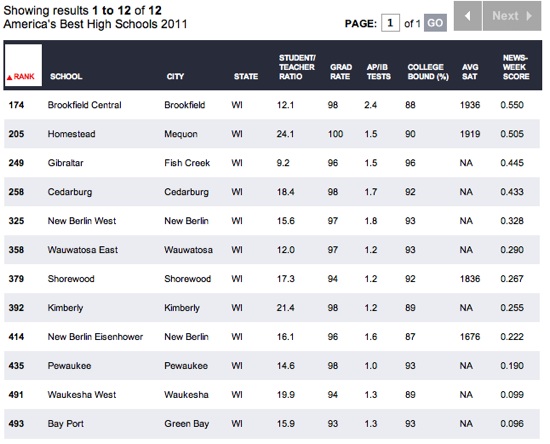
Best American High Schools; Wisconsin: 12 out of 500, None from Dane County


Newsweek:

To compile the 2011 list of the top high schools in America, NEWSWEEK reached out to administrators, principals, guidance counselors, and Advanced Placement/International Baccalaureate coordinators at more than 10,000 public high schools across the country. In order to be considered for our list, each school had to complete a survey requesting specific data from the 2009-2010 academic year. In total, more than 1,100 schools were assessed to produce the final list of the top 500 high schools.
We ranked all respondents based on the following self-reported statistics, listed with their corresponding weight in our final calculation:
Four-year, on-time graduation rate (25%): Based on the standards set forth by the National Governors Association, this is calculated by dividing the number of graduates in 2010 by the number of 9th graders 2006 plus transfers in minus transfers out. Unlike other formulas, this does not count students who took longer than four years to complete high school.
Percent of 2010 graduates who enrolled immediately in college (25%): This metric excludes students who did not enroll due to lack of acceptance or gap year.
AP/IB/AICE tests per graduate (25%): This metric is designed to measure the degree to which each school is challenging its students with college-level examinations. It consists of the total number of AP, IB, and AICE tests given in 2010, divided by the number of graduating seniors in order to normalize by school size. AP exams taken by students who also took an IB exam in the same subject area were subtracted from the total.
Average SAT and/or ACT score (10%)
Average AP/IB/AICE exam score (10%)
AP/IB/AICE courses offered per graduate (5%): This metric assesses the depth of college-level curriculum offered.  The number of courses was divided by the number of graduates in order to normalize by school size.

Just 12 Wisconsin high schools made the list, not one from Dane County. It would be interesting to compare per student spending (Madison spends about $14,476 per student) , particularly in light of a significant number of “southern” high schools in the top 50. Much more on United States per student spending, here. Wisconsin State Tax Based K-12 Spending Growth Far Exceeds University Funding.

Share

Is it time to kill the liberal arts degree?

Kim Brooks:

Every year or two, my husband, an academic advisor at a prestigious Midwestern university, gets a call from a student’s parent. Mr. or Mrs. So-and-so’s son is a sophomore now and still insistent on majoring in film studies, anthropology, Southeast Asian comparative literature or, god forbid … English. These dalliances in the humanities were fine and good when little Johnny was a freshman, but isn’t it time now that he wake up and start thinking seriously about what, one or two or three years down the line, he’s actually going to do?
My husband, loyal first and foremost to his students’ intellectual development, and also an unwavering believer in the inherent value of a liberal arts education, tells me about these conversations with an air of indignation. He wonders, “Aren’t these parents aware of what they signed their kid up for when they decided to let him come get a liberal arts degree instead of going to welding school?” Also, he says, “The most aimless students are often the last ones you want to force into a career path. I do sort of hate to enable this prolonged adolescence, but I also don’t want to aid and abet the miseries of years lost to a misguided professional choice.”
Now, I love my husband. Lately, however, I find myself wincing when he recounts these stories.

Share

Let’s hear it for plain speakers

Harry Eyres:

I think you’ll know what I mean by the “higher guff” – the kind of sonorous and empty talk which often issues from the mouths of heads of state and princes. I heard a classic example recently at a British media awards ceremony from the admirable Prince Felipe of Spain. He was being courteous and diplomatic, praising the links and similarities “between our two great countries”, once imperial powers and once sworn enemies. “We have so much in common,” he enthused; an ironic commentary came from my neighbour, a photographer with a wicked wit: “Yes,” said Michael, “we’re both in deep shit.” The prince can’t have heard this, because he went on: “Indeed, so many of your citizens decide to move to Spain.”
“Yep,” was the uncharitable response from Michael: “All the criminals.”
The rule is that the higher the language soars, unless you’re careful, the more it leaves itself open to attack from below. Shakespeare was the dramatist who knew this best, especially in the excruciating scene from Troilus and Cressida where Thersites provides a scabrous commentary on the seduction of Cressida by Diomedes. “Lechery, lechery, still wars and lechery” is his conclusion: the pretensions of the Trojan war reduced to an itch and a scratch.

Share

Administrators who want to push harder

Jay Matthews:

We have been discussing the issue of tracking in high school, particularly the standard system of regular (or general), honors (or advanced) and Advanced Placement or International Baccalaureate courses. Parents in Fairfax County are resisting the school district’s elimination of honors courses, leaving only a choice between regular or AP classes. I suggested the district get rid of the regular and leave only honors and AP, because research shows that the college skills taught in honors classes are also important for students who want to get a good job or go to trade school right out of high school.
This generated much comment from around the country, including the two responses below from high school administrators who share the belief that they are not giving all of their students the enriched education they need. I think they provide a useful perspective from inside schools. What do you think of what they are saying?
Mike Musick is the principal of Conifer High School in Conifer, Colo. About nine percent of its students are low-income, and its AP test participation rate is high enough to rank well on my annual Challenge Index list. Amy Fineburg, an assistant principal, asked that I identify her high school only as a high-achieving one in Alabama. But I can say that its demographic and academic characteristics are similar to Conifer High’s.

Share

New Jersey’s Teacher Union Climate

New Jersey Left Behind:

The big news today is that the Senate Budget and Appropriations Committee in a 9-4 vote released legislation that would increase public employee contributions to health care premiums from 1.5% to between 3.5%-35% of the premium. Higher-paid employees would contribute more and lower-paid employees would contribute less. Pension contributions would also go up by a percentage point or two, and the increases would be phased in over a few years.
The bill now goes to the Assembly Budget Committee on Monday, and then to the full Senate on Thursday.
It’s unclear whether Assemblywoman Sheila Oliver’s proposal to have the legislation sunset after four years is still a go.
Amidst the Senate deliberations yesterday, public worker unions, including NJEA, held a smaller-than-expected rally; the subsequent news reports and editorials in today’s papers largely express astonishment at the loss of power of collective bargaining units. Here’s a sampling:
Vince Giordano, NJEA Executive Director, sounded both bewildered and threatening in NJ Spotlight:

Share

Chicago Teachers Union Confronts Some Crucial Decisions

Rebecca Vevea:

The newly seated Chicago Board of Education may have won the first battle with Chicago teachers this week when it rescinded a 4 percent pay raise, but it may also have ended a relatively peaceful era in labor relations and created a more pugnacious adversary.
The Chicago Teachers Union has absorbed a number of recent setbacks. On Monday, a sweeping education bill that reformed teacher tenure and limited teachers’ ability to strike was signed into law. And on Wednesday, the board unanimously nullified raises that would have cost nearly $100 million.
Some teachers and observers say that backing the union into a corner on wages and other key issues could be the spark to reinvigorate the membership.
“If you act in a confrontational way, you’re poking your finger in the eye of those teachers, and very typically you generate unintended negative consequences,” said Robert Bruno, director of the labor education program at the University of Illinois at Chicago.

Share

Knowing How to Know

Students in schools of education pay a lot of attention to the problems of learning how to learn, lifelong leaning, and the like. In the absence of much knowledge of history, economics, physics, literature, foreign languages, chemistry, calculus and so on, this can degenerate into what Professor E.D. Hirsch, Jr., calls “How-to-ism,” an absorption in “pedagogy” without any secure foundation in academic knowledge.
It is also the case that most graduates of our schools of education are shocked by the day-to-day problems of managing youngsters with Twitter, popular music, sports, popularity, and Grand Theft Auto on their minds. But it should be noted that it is very hard to get students interested in academic work, for instance history, if the teacher doesn’t know any history herself. This problem causes some number of coaches who teach Social Studies to shy away from the Renaissance in favor of current events, which may seem more approachable both to them and their students. How ’bout those Bruins!
In the meantime, even American students who are Seniors in high school show a pitiful ignorance of the most basic knowledge of the history of their own country, as revealed in the latest National Assessment of Educational Progress report released this month.
In The Knowledge Deficit, E.D. Hirsch, Jr., tried to get across the point that teaching learning skills, for example, which pedagogy graduates are supposed to be good at, does little or nothing for helping students acquire knowledge. He argues that the only way to increase knowledge is to build on a stronger and stronger base of knowledge, not by wasting time on the dubious techniques of “Learning How to Learn.”
I am convinced that one of the reasons even some students who do not require remediation in reading and writing when they get to college still fail to gain a degree after six or eight years, in part go under academically because they do not bring enough knowledge to help them understand what the professor is talking about. Their ignorance makes them feel lost. Some become determined to find the knowledge they have not been given in high school, but too many quit instead.
To be more fair to the education schools, even Harvard has had great difficulty in committing its faculty to teach certain basic areas of knowledge. The faculty tried to avoid arguing over what needed to be taught, so they fell back on allowing each department to teach “the skills” of its discipline, which they believed could be taught with any subject matter (such as that which the professor’s research happened to focus on at the moment).
The problem, as pointed out in an article by Caleb Nelson in The Atlantic called “Harvard’s Hollow Core,” is that “One cannot think like a physicist, for example, without actually knowing a great deal of physics.” Similarly, it is quite hard to think like a historian if you don’t know any history.
So the whole “Learning How to Learn” paradigm collapses of its own emptiness and leads to academic failure for many students who have been offered rubrics, techniques and skills as a substitute for the academic knowledge they would need to survive in college.
The Common Core is offering national goals for knowledge. Others have critiqued their weakness in math, but I would suggest that their goals for reading in history are scarcely challenging for eight graders. Reading The Declaration of Independence and A Letter from the Birmingham Jail is not a waste of time, but for high school students, why not offer Mornings on Horseback, Washington’s Crossing, Battle Cry of Freedom and The Path Between the Seas? In other words, actual history books? I cannot find out when it was decided (or by whom) that American high school students can manage European history, calculus, Latin, chemistry and so on, but cannot be expected to read through even one complete history book? How did our expectations for nonfiction reading (and gathering knowledge thereby) get so dramatically dumbed down? Of course STEM is very important, but even engineers and scientists need to read and write.
To demonstrate how far we have slid down the slope of expectations since Thomas Jefferson’s day, here is an example from The Knowledge Deficit (p. 9):

“In our pre-romantic days, books were seen as key to education. In a 1786 letter to his nephew, aged fifteen, Jefferson recommended that he read books (in the original languages and in this order) by the following authors: [history] Herodotus, Thucydides, Xenophon, Anabasis, Arian, Quintus Curtius, Diodorus Siculus, and Justin. On morality, Jefferson recommended books by Epictetus, Plato, Cicero, Antoninus, Seneca, and Xenophon’s Memorabilia, and in poetry Virgil, Terence, Horace, Anacreon, Theocritus, Homer, Euripides, Sophocles, Milton, Shakespeare, Ossian, Pope and Swift.”

Will Fitzhugh
The Concord Review
17 June 2011
Share

State budget will force most Wisconsin school districts to cut property taxes

Jason Stein and Karen Herzog:

The state budget bill now in Gov. Scott Walker’s hands would leave schools with roughly $900 million less in state aid and property tax authority over the next two years, state figures show.
Going beyond simple cuts in state aid to schools, the budget bill would also end up requiring many districts – perhaps two-thirds of them statewide – to cut their property tax levies, according to one analysis by a University of Wisconsin-Madison professor.
Now that the 2011-’13 budget bill stands on the verge of becoming law and the protests have died down, schools – and taxpayers – can start to digest the changes in store for them. Those range from new savings on teachers’ benefits to expansions of private school voucher programs in Milwaukee and Racine.
“We’re really entering a new phase in school funding,” said Dan Rossmiller, lobbyist for the Wisconsin Association of School Boards. “It suggests huge challenges.”
The cuts to schools are the single biggest item in the Republican budget toward closing a two-year, $3 billion budget deficit without relying on tax increases. The controversy about the cuts is likely to continue, with at least one district saying it’s considering a lawsuit.

Related: Wisconsin State Tax Based K-12 Spending Growth Far Exceeds University Funding.

Share

Saving the NJEA from Itself

Laura Waters:

What’s wrong with this picture?
Last week Democratic heavyweight George Norcross got up on a stage with Gov. Chris Christie to announce that not only does he support the Opportunity Scholarship Act (the voucher bill) but also he’s opening charter schools Camden.
To add to the cognitive dissonance, the New Jersey Education Association (NJEA) joined forces with the nepotistic Elizabeth school board to campaign against Sen. Ray Lesniak (D-Union), the former chair of the NJ Democratic party — and the chief sponsor of the school voucher bill.
To muddy matters further, Assembly Speaker Sheila Oliver (D-Essex), a steadfast ally of the teachers union, looks likely to overcome her initial opposition to a health and pension benefits reform bill — despite protestations from NJEA leaders. The legislation would require public employees, including teachers, to contribute substantially more than the current 1.5 percent of base pay toward pension and healthcare premiums. (The Assembly Budget Committee just announced it will hear the bill on Monday.)

Share

Kids, Get High Off Drugs, Not Debt. It’s More Fun And People Are Nicer To You When It’s Time To Recover.

Elie Mystal:

Let’s say that instead of taking on huge debts while I was in law school, I had taken up a wicked cocaine habit. Let’s say I had done loads and loads of blow from 2000 to 2007 and then went into a 12-step program. If I had been lucky enough to avoid an overdose or jail, you could argue that things would be better for me right now — even if I had a really serious cocaine problem where I spent my all my disposable income on the drug, and even if I put a good job and a good marriage straight up my nose. If I had been through all that and then wrote an essay about the highs and the lows of doing cocaine throughout my legal career, if I was telling kids that they could overcome a wicked cocaine habit even though the consequences were severe, if I was truthfully telling people that even though I’m trying to stay clean and sober now I’m not “ashamed” of my past life, I’d have nearly everybody in my corner.
Instead, I didn’t have a cocaine habit in law school and beyond. I defaulted on my student debts.
Really, the smart thing to do would have been to default on all my loans, then blame it on the cocaine that I was “powerless” to stop. But instead of playing the victim, I marshaled what autonomous power I had and chose not to pay back my loans in a timely manner. I decided to go down on my own terms, not the terms set out for me in a promissory note.

Share

In Homework Revolt, School Districts Cut Back

Winnie Hu:

After Donna Cushlanis’s son, who was in second grade, kept bursting into tears midway through his math problems, which one night took over an hour, she told him not to do all of his homework.
“How many times do you have to add seven plus two?” Ms. Cushlanis, 46, said. “I have no problem with doing homework, but that put us both over the edge. I got to the point that this is enough.”
Ms. Cushlanis, a secretary for the Galloway school district, complained to her boss, Annette C. Giaquinto, the superintendent. It turned out that the district, which serves 3,500 kindergarten through eighth-grade students, was already re-evaluating its homework practices. The school board will vote this summer on a proposal to limit weeknight homework to 10 minutes for each year of school — 20 minutes for second graders, and so forth — and ban assignments on weekends, holidays and school vacations.

Share

High-stakes school war

Joe Williams:

As he won control of the city’s public schools nine years ago this week, Mayor Bloomberg boldly promised: “We will not have to tolerate an incapable bureaucracy which does not respond to the needs of the students.”
Sadly, New York City isn’t even close to achieving that bold vision: We learned this week that only one in three city high-school graduates is prepared for college-level work.
Meanwhile, Bloomberg’s promise is being put to the test like never before.
As the school year winds down, City Hall and the United Federation of Teachers have ratcheted up an intense game of chicken over the future direction of the city’s school system. What schools will look like come the fall is anyone’s guess.

Share

Wisconsin Senate Democrat Members’ Proposed Budget Amendment: Save Talented & Gifted Funding

JR Ross:

The second Dem amendment includes a whole host of provisions on education.

See it here.

Here are some details, according to a summary from Minority Leader Mark Miller’s office:

-increase funding to K-12 by $356 million.

-repeal expansion of the choice program.

-repeal elimination of funding for gifted and talented programs, AODA grants, and science, technology, engineering and match grants.

-Fund the Wisconsin GI Bill and tie financial aid to increases in tuition.

-Boost funding to tech colleges by $17 million annually.

-repeal a provision JFC put into the budget that would create an individual income tax credit derived from property assessed as manufacturing or agricultural property. The tax credit would kick in Jan. 1, 2013, and when fully phased in for tax year 2016 would be worth $128.7 million annually.

— By JR Ross

Fascinating. I wonder what’s behind this?

Share

Wisconsin Voucher debate reveals deep divisions about public schools

Susan Troller:

As of early afternoon Wednesday the fate of voucher schools in Green Bay is uncertain. Rumors are flying that the proposal to use tax dollars to pay families to send their children to private and religious schools in that city will be pulled from the state budget.
It’s been a hot topic.
The voucher story I posted on Chalkboard last week detailed Green Bay Supt. Greg Maass’ unhappy reaction to both the proposal and the abrupt legislative process that put it in the budget. It definitely struck a nerve, and drew many comments.
Some of the most interesting reactions went well beyond the issue of vouchers and whether public money should be used to fund private schools. They expressed the heart of the debate surrounding public schools, or “government” schools as some folks call them.
Are public schools failing? Who’s to blame? What responsibilities does a civil society owe to children who are not our own? What kind of reforms do parents, and taxpayers, want to see?
Here are some excerpts that are revealing of the divide in the debate:

VHOU812 wrote: …As a consumer of the public (or private) educational institutions, I am demanding more value. If it is not provided, I will push to refuse to purchase and home school. This is not what I want. I want security knowing that I am satisfied with the investment in my children’s education. I don’t get that feeling right now from publc schools, and that is the core of the problem that public schools need to fix. I also see that private institutions, by their nature, can make changes to respond to consumer demands very quickly, and it is clear public schools either can’t, or won’t.

I’m glad Susan posted these comments. Looking at the significant growth in Wisconsin K-12 spending over the past few decades along with declining performance, particularly in reading compels us all: parents, taxpayers, students, teachers, administrators and the ed school community, to think different.
Wolfram’s words are well worth considering: “You have to ask, what’s the point of universities today?” he wonders. “Technology has usurped many of their previous roles, such as access to knowledge, and the social aspects.

Share

Seattle Schools’ Strategic Plan Update

Melissa Westbrook:

Here is the presentation from today’s Work Session on the Strategic Plan with survey results.

Highlights:

  • 5905 responses – 64% family member, 26% teacher or school staff, 1% principals, 5% community, 4% Central Office
  • By zip code – looks like a somewhat even distribution with  NE – 98115 with 528 responses, SE – 98118 with 221 responses, SW – 98136 with 118 responses, West Seattle – 98116 with 182 responses and NW – 98117 with 433 responses.  (There were more zip codes than those.)
  • page 8 has a breakdown of coaches and costs – overall it costs $6.4M for 65.6 coaches  (the salary swings are interesting)
  • Professional development in math, science and reading helping teachers and students – the big answer was …. no opinion.  And, out of the nearly 6,000 responses, only 3443 people answered this question.  Effective/somewhat effective (families-27%/teachers-51%). Ineffective/somewhat ineffective (families-22%/teachers-28%)
  • MAP test results effectiveness.  Effective/Somewhat Effective (families-41%/teachers-33%).  Somewhat effective/ineffective (families-45%/teachers50%).   Out of 6k responses, only 3682 respondents answered.
  • MAP- how many times a year should it be used?  3x- families-30%, teachers-23%, principals-40%.  Hmm, looks like principals like it more than teachers.   2x -families-29%,teachers-30%, principals, 40%.  That’s a lot closer.  And hey, they ARE reducing MAP to two times a year for 2011-2013 (winter and spring)
  • NSAP.   More efficient/somewhat more – families-42%/teachers 23%/principals 55%.   Somewhat less/less efficient – families-27%/teachers-29%/principals-31%. 

Download the Seattle Strategic Plan update, here.

Share

Wisconsin Governor Walker’s Read to Lead task force met on May 31st at the State Capitol. Following are observations from WRC.

Wisconsin Reading Coalition, via email:

Governor Walker’s Read to Lead task force met on May 31st at the State Capitol. Following are observations from WRC.
Note: Peggy Stern, an Oscar-winning filmmaker currently working on a project about dyslexia, had a crew filming the meeting. If we are able to acquire footage, we will make it available. If you would like Wisconsin Eye to record future meetings, please contact them at comments@wiseye.org.
Format: Unlike the first task force meeting, this meeting was guided by two facilitators from AIR, the American Institutes for Research. This was a suggestion of Senator Luther Olsen, and the facilitators were procured by State Superintendent Tony Evers. Evers and Governor Walker expressed appreciation at not having to be concerned with running the meeting, but there were some problems with the round-robin format chosen by the facilitators. Rather than a give-and-take discussion, as happened at the first meeting, this was primarily a series of statements from people at the table. There was very little opportunity to seek clarification or challenge statements. Time was spent encouraging everyone to comment on every question, regardless of whether they had anything of substance to contribute, and the time allotted to individual task force members varied. Some were cut off before finishing, while others were allowed to go on at length. As a direct result of this format, the conversation was considerably less robust than at the first meeting.
Topics: The range of topics proved to be too ambitious for the time allowed. Teacher preparation and professional development took up the bulk of the time, followed by a rather cursory discussion of assessment tools. The discussion of reading interventions was held over for the next meeting.
Guests:
Dawnene Hassett, Asst. Prof. of Curriculum and Instruction and new elementary literacy chair, UW-Madison
Tania Mertzman Habeck, Assoc. Prof. of Curriculum and Instruction, UW-Milwaukee
Mary Jo Ziegler, Reading Consultant, Wis. Department of Public Instruction
Troy Couillard, Special Education Team, Wis. Department of Public Instruction
Next Meetings: The Governor’s office will work to set up a schedule of meetings for the next several months. Some of the meetings may be in other parts of the state.
Action: WRC suggests contacting the offices of the Governor, Luther Olsen, Steve Kestell, and Jason Fields and your own legislators to ask for several things:
Arrange for filming the next meeting through Wisconsin Eye
Bring in national experts such as Louisa Moats, Joe Torgesen, and Peggy McCardle to provide Wisconsin with the road map for effective reading instruction, teacher preparation, and professional development . . . top university, DPI, and professional organization leaders at the May 31st meeting asked for a road map and admitted they have not been able to develop one
Arrange the format of the next meeting to allow for more authentic and robust discussion of issues
Summary
Teacher Training and Professional Development
The professors felt that the five components of reading (phonemic awareness, phonics, fluency, vocabulary, and comprehension) are generally taught in preparation programs, but that instruction varies widely from one institution to another. Reading course work requirements can vary from 12 credits to just one course. They also felt, as did the teachers on the panel, that there needs to be more practical hand-on experience in the undergraduate program. There was a feeling that teachers “forget” their instruction in reading foundations by the time they graduate and get into the classroom. They have better luck teaching masters level students who already have classroom experience. The linguistic knowledge means very little without a practicum, and we may need to resort to professional development to impart that information. Teachers need to be experts in teaching reading, but many currently don’t feel that way. It is important, especially with RTI coming, to be able to meet the needs of individual students.Both professors and teachers, as well as others on the panel, felt a “road map” of critical information for teacher preparation programs and literacy instruction in schools would be a good idea. This was a point of agreement. Hassett felt that pieces of a plan currently exist, but not a complete road map. The professors and some of the teachers felt that teacher prep programs are doing a better job at teaching decoding than comprehension strategies. They were open to more uniformity in syllabi and some top-down mandates.
Marcia Henry mentioned studies by Joshi, et al. that found that 53% of pre-service teachers and 60% of in-service teachers are unable to correctly answer questions about the structure of the English language. Tony Pedriana cited another Joshi study that showed college professors of reading were equally uninformed about the language, and the majority cannot distinguish between phonemic awareness and phonics. He also said it was very difficult to find out what colleges were teaching; one college recently refused his request to see a syllabus for a reading course. Steve Dykstra read from the former Wisconsin Model Academic Standards and the current Wisconsin Model Early Learning Standards, which contained incorrect definitions and examples of phonemic awareness. He questioned whether teachers were being adequately prepared in decoding skills. Rep. Steve Kestell was concerned with the assessment that most teachers do not feel like experts in teaching reading, and he wondered if updated techniques for training teachers would make a difference.
Sarah Archibald (aide to Luther Olsen) proposed looking at a more rigorous foundations of reading test, as found in other states, as a requirement for teacher licensure. This would be one way to move toward more uniform instruction in teacher prep programs. Steve Dykstra pointed out that a test alone will not necessarily drive changes in teacher preparation, but publishing the passage results linked to individual colleges or professors would help. Evers indicated that DPI has been looking for several months into teacher testing and licensure.
Gov. Walker asked if the ed schools were looking at the latest trends in teacher preparation to become better. The professors indicated that the ed schools confer with local districts in an effort to improve.
Supt. Evers said it was probably not a good idea that teacher prep programs across Wisconsin vary so much.
Hassett indicated that some flexibility needs to be retained so that urban and rural areas can teach differently. There was some disagreement as to whether teachers of upper grades need to be trained in reading, or at least trained the same way.
Linda Pils pointed out that the amount and quality of professional development for Wisconsin teachers is very spotty. Most panel members felt that a coaching model with ongoing training for both teachers and principals was essential to professional development, but the coaches must be adequately trained. There was some discussion of Professional Development Plans, which are required for relicensure, and whether the areas of development should be totally up the individual teacher as they are now. Steve Dykstra felt that much existing professional development is very poor, and that money and time needs to be spent better. Some things should not count for professional development. Michele Erikson felt that it would be good to require that Professional development be linked to the needs of the students as demonstrated by performance data. Mary Read pointed out that coaching should extend to summer programs.
The main consensus here was that we need a road map for good reading instruction and good teacher training and coaching. What is missing is the substance of that road map, and the experts we will listen to in developing it.
Assessment
Mary Jo Ziegler presented a list of formal and informal assessment tools used around Wisconsin. Evers pointed out that assessment is a local district decision. Many former Reading First schools use DIBELS or some formal screener that assesses individual skills. Balanced literacy districts generally use something different. Madison, for example, has its own PLA (Primary Language Assessment), which includes running records, an observational survey, word identification, etc. MAP assessments are widely used, but Evers indicated that have not been shown to be reliable/valid below third grade. Dykstra questioned the reliability of MAP on the individual student level for all ages. PALS was discussed, as was the new wireless handheld DIBELS technology that some states are using statewide. Many members mentioned the importance of having multiple methods of assessment. Kathy Champeau delivered an impassioned plea for running records and Clay’s Observational Survey, which she said have been cornerstones of her teaching. Kestell was surprised that so many different tools are being used, and that the goal should be to make use of the data that is gathered. Dykstra, Henry, and Pedriana mentioned that assessment must guide instruction, and Archibald said that the purpose of an assessment must be considered. Couillard said that the Wis. RTI center is producing a questionnaire by which districts can evaluate assessment tools they hear about, and that they will do trainings on multiple and balanced assessments. Dykstra questioned the three-cue reading philosophy that often underlies miscue analysis and running records. no consensus was reached on what types of assessment should be used, or whether they should be more consistent across the state. Hassett questioned the timed component of DIBELS,and Dykstra explained its purpose. Some serious disagreements remain about the appropriateness of certain assessment tools, and their use by untrained teachers who do not know what warning signs to look for.
Intervention
Evers began the topic of intervention by saying that DPI was still collecting data on districts that score well, and then will look at what intervention techniques they use. Henry suggested deferring discussion of this important topic to the next meeting, as there were only 8 minutes left.

Share

Chicago School Board rejects 4 percent raises for teachers

Rosalind Rossi:

Newly-seated Chicago School Board members ruled Wednesday that the cash-strapped CPS system does not have the $100 million it would cost to cover promised 4 percent raises for teachers and other union workers.
The unanimous decision to stop the raises from going into effect came after board members were told that nearly three-quarters of the system’s teachers will still get other raises based on length of service and educational advancement — at a cost to the district of $35 million.
The decision came during a “special meeting” called to determine if the district had enough money to fund the scheduled 4 percent raises to teachers and seven other bargaining units representing building engineers and other support staff. Under the contract, the board can reject contractual raises if it determines the system does not have the funds to pay for them.
Even without the 4 percent pay hikes, the raises most teachers will receive could range between 3 and 5 percent for those with less than 13 years in the system, and 1 percent for those with more experience, officials said.

Rosalind Vevea & Crystal Yednak:

Pleading poverty, the newly-seated Chicago Board of Education voted Wednesday to rescind a scheduled 4 percent raise for Chicago Public Schools teachers that would have cost almost $100 million.
The board’s unanimous decision came after it revealed that the CPS budget deficit — which it said is now $712 million — includes millions of dollars in previously undisclosed costs.
The yearly raises are part of the Chicago Teachers Union contract, which is in its final year, but they are only enacted if the board agrees the district can afford them. The raises have been approved each year since the current contract began in 2007.
Board president David Vitale said teacher layoffs could still occur despite the vote. The CTU and other unions whose contractual raises were affected have until 11:59 p.m. Monday to ask to re-open part of their contracts in order to negotiate around the raises.

The Chicago Sun-Times:

Facing an estimated $712 million deficit, the new Chicago Board of Education cried uncle on Wednesday, voting for the first time in 20 years not to fund promised raises.
Now it’s time for Chicago teachers to stand up and accept reality.
Chicago teachers and the seven unions representing other school employee unions should accept the wage freeze or, at a minimum, try to negotiate less than the promised 4 percent raise.
Holding on to the pipe dream of getting that 4 percent raise — and risking a summer of uncertainty and a possible strike at the end — does no one, least of all Chicago students, any good.
The Board of Education simply has no more rabbits to pull from its budget hat.
We say that cautiously, knowing that CPS said much the same last year as it tried to persuade teachers to forgo their raise. And then, voila, CPS managed to fill its deficit without increasing class size or scaling back programs significantly.

Share

B-Schools Embrace China

Beth Gardiner:

Just like large companies eager to get a foothold in one of the world’s most important markets, international business schools are moving into China in a big way.
Eager to capitalize on demand in a fast-growing economy that has a huge need for well-trained managers, big name B-schools from Europe and the U.S. are launching and expanding M.B.A.-program collaborations with Chinese universities or going it alone with courses aimed at mid-career executives.
Experience in China is also a selling point at home, since Western students increasingly see the benefits of studying at an institution whose faculty have close-up experience of the country. Such links can also give M.B.A. students the chance to study in China for a module or a semester.
“The lure is to go and learn about what’s happening, and be in the middle of the action in one of the most dynamic economies in the world,” says Krishna Palepu, senior associate dean for international development at Harvard Business School. The school has had a faculty research base in China for about 20 years but now shares a new Shanghai classroom with other Harvard schools.

Share

“You have to ask, what’s the point of universities today?” he wonders. “Technology has usurped many of their previous roles, such as access to knowledge, and the social aspects.”

The Economist:

“THERE is no dramatic distinction between the processes of the weather and the workings of the human brain,” says Stephen Wolfram, a physicist and the founder of Wolfram Research, a software company. “There isn’t anything incredibly special about intelligence, it’s just sophisticated computational work that has grown up throughout human history.” Dr Wolfram is hardly the first scientist to compare the human brain to a computer. Alan Turing, who helped develop the precursors of today’s programmable computers during the second world war, began considering the possibility of thinking machines in the 1940s. The difference is that Dr Wolfram claims to have succeeded in codifying vast areas of human knowledge and even replicating supposedly uniquely human attributes such as creativity.
“One of my realisations, or maybe it’s just a piece of arrogance, is that the amount of knowledge and data in the world is big, but it’s not that big,” he says. “In astronomy, there’s a petabyte–a million gigabytes–of data about what’s out there in the universe. There are also swathes of data from digital cameras, Twitter feeds and even road-traffic movements. It’s a bit daunting, but I soon realised that the bigger challenge is not the underlying data but the computations that get done on them.”

Share

OK, So Here’s Who’s Running for Seattle School Board 2011

Riya Bhattacharjee:

I have been trying to find the campaign websites for all the candidates running for Seattle School Board this year (candidate filings closed 5 p.m. Friday), and the final list looks something like this. Two things: there’s like a ton of them and only four open seats; not all of them have a website yet.

Most of the new candidates are running because they are tired of the corruption and cronyism in Seattle Public Schools. Some want to focus on closing the achievement gap and raising test scores. Others are just sick of the influence a plethora of foundations have on education these days.

At least one of the candidates is a reluctant one who says he’s running because he is tired of mediocrity in our schools and the “business as usual approach” of our school board. Another lists this thing as his campaign website. This one sued the district against its new high school math textbooks in 2009.

The incumbents say they are fed up of the same things their challengers are (of course, I mean there can only be so many problems in one district, right?).

Share

K-12 Tax & Spending Climate: States face long slog after recession

Associated Press:

At statehouses around the country, the Great Recession is far from over: It could take years for many states to climb out of the hole and return to pre-downturn spending levels.
An Associated Press examination of 50 balance sheets shows state budgets and bank accounts still ravaged by a drop in tax revenue. Many states are also facing enormous long-term pension and health care obligations. At the same time, the payout of stimulus money from Washington that helped many states in their darkest hours has come to an end.
While some states saw a modest jump in tax collections this spring, the combined revenue projected by the 50 states in the coming fiscal year – $734 billion – is still down by about $34 billion, or 5 percent, from the 2007-08 fiscal year, when the recession began.
Some states are in far worse shape. New Jersey, Nevada, Oregon, Illinois and Louisiana reported deficits that are more than 20 percent of the state general fund.

Share

Students Stumble Again on the Basics of History

Stephanie Banchero:

Fewer than a quarter of American 12th-graders knew China was North Korea’s ally during the Korean War, and only 35% of fourth-graders knew the purpose of the Declaration of Independence, according to national history-test scores released Tuesday.
The results from the National Assessment of Educational Progress revealed that U.S. schoolchildren have made little progress since 2006 in their understanding of key historical themes, including the basic principles of democracy and America’s role in the world.
Only 20% of U.S. fourth-graders and 17% of eighth-graders who took the 2010 history exam were “proficient” or “advanced,” unchanged since the test was last administered in 2006. Proficient means students have a solid understanding of the material.

Share

The ends of education reform

Mike Petrilli:

Diane Ravitch’s New York Times op-ed seems to have stuck in the craw of many a reformer, including Arne Duncan himself. What really burned people up was Ravitch’s “straw man” arguments: that reformers say poverty doesn’t matter, or only care about gains in student achievement. “No serious reformer says accountability should just be based on test scores. We all favor multiple measures,” Jon Schnur* complained to Jonathan Alter last week.

Rather than get defensive at Diane’s defeatism, we reformers should clarify the ends that education reform can achieve.

Please. Remember the old adage, watch what we do, not what we say? The No Child Left Behind act is still the law of the land, and it most definitely rests on the principle that poverty is “no excuse” for low achievement. And it absolutely punishes schools for bad test scores alone. Diane is on firm ground when she writes:

Share

Some teachers more ‘minimally effective’ than others?

Bill Turque:

The big shoe ready to drop this summer on the DCPS labor relations front involves the estimated 550 teachers who are subject to dismissal if they receive a second consecutive “minimally effective” rating on the IMPACT evaluation system. For Mayor Vincent C. Gray and Acting Chancellor Kaya Henderson, it will be a closely watched test of their resolve to follow through on a signature initiative of the Michelle Rhee era, designed to improve teacher effectiveness by pushing poor performers out of the system.
It now appears that some teachers — most likely younger ones — will get a reprieve from the two-strikes-and-out rule established in 2009. Earlier this week, human capital chief and IMPACT architect Jason Kamras told principals that if they had young teachers with promise who were headed for a second poor evaluation, they could apply for exceptions.
“We recognize that in some cases, a principal might want to retain a second-year teacher who has received minimally effective ratings in each of his or her first two years of teaching but has demonstrated improvement and the potential to become an effective teacher in the following year,” Kamras said.

Share

Arne Duncan’s ‘Plan B’ May Leave ‘No Child’ Behind

NPR:

Secretary of Education Arne Duncan is signaling that he’s prepared to give public schools relief from federal mandates under No Child Left Behind if Congress does not pass the law’s long-awaited overhaul and re-authorization this year.
“This is absolutely plan B,” Duncan told reporters during an embargoed conference call on Friday. “The prospect of doing nothing is what I’m fighting against.”
That relief could take the form of granting waivers on test scoring to flexibility on how schools spend federal dollars. “We can’t afford to do nothing,” he said.
Both Republicans and Democrats agree that the mandate, signed into law in 2002 with bi-partisan support, is dated and flawed. One of the major complaints is that some schools have been labeled failures despite making improvements.

Share

Grading Standards in Education Departments at Universities

Cory Koedel, University of Missouri, via a kind reader’s email:

Students who take classes in education departments at universities receive significantly higher grades than students who take classes in other academic departments. The higher grades awarded by education departments cannot be explained by differences in student quality or by structural differences across departments (i.e., differences in class sizes). The remaining explanation is that the higher grades are the result of lower grading standards. This paper formally documents the grading-standards problem in education departments using administrative grade data from the 2007-2008 academic year. Because a large fraction of the teachers in K-12 schools receive training in education departments, I briefly discuss several possible consequences of the low grading standards for teacher quality in K-12 schools.
There is a large and growing research literature showing that teacher quality is an important determinant of student success (recent studies include Aaronson et al., 2007; Koedel, 2008; Nye et al., 2004; Rivkin et al., 2005; Rockoff, 2004).
But while there is persistent research into a variety of interventions aimed at improving teacher quality, surprisingly little attention has been paid to the primary training ground for K-12 teachers–education departments at universities.
This paper provides an evaluation of the grading standards in these education departments. I show that education students receive higher grades than do students in every other academic discipline. The grading discrepancies that I document cannot be explained by differences between education and non-education departments in student quality, or by structural differences across departments.
The likely explanation is grade inflation.
The earliest evidence on the grading-standards problem in education departments comes from Weiss and Rasmussen in 1960. They showed that undergraduate students taking classes in education departments were twice as likely to receive an “A” when compared to students taking classes in business or liberal arts departments. The low grading standards in education departments, illustrated by these authors over 50 years ago, are still prevalent today.

Share

High school education no longer one-size-fits-all

Maureen Magee:

The caps and gowns haven’t changed much. “Pomp and Circumstance” continues to mark the occasion. And many of those valedictorians are bound to quote “The Road Not Taken.”
Commencement ceremonies have remained virtually unchanged over the years. But don’t be fooled. The high school experience leading up to graduation has never looked so different for American teenagers.
Everything from technology to academic innovations to the lagging economy has influenced high schools and the students they serve — locally and nationwide.
No longer a novelty, independent charter schools will issue a record number of diplomas to students who received a new brand of education — often in some unlikely venues, including shopping malls, museums and an old Navy boot camp.
More students than ever will graduate this year after taking some of their courses online.
And tough economic times have created a rising population of homeless students — and programs and schools designed to educate and help them.

Share

“Fix the Workforce or Die” Bucyrus Finds Skilled Labor in Texas

John Schmid:

Not long ago, Bucyrus International Inc. stood out in Milwaukee as a veritable poster child for business opportunity and expansion. Mayor Tom Barrett singled out chief executive Tim Sullivan in his 2005 “state of the city” address: “Thank you for believing and investing in our city.”
And so it was awkward last week when Sullivan told a packed auditorium of civic leaders that he needed to make a “confession,” something he’s kept quiet for years. Finding qualified, factory-grade welders in an old-line industrial city such as Milwaukee had become arduous to near impossible. Calling himself a “killjoy,” Sullivan said he quietly phoned a few contacts in Texas to see whether the Lone Star State could provide him enough welders who are qualified to piece together the colossal mining machines that Bucyrus ships to India, China and elsewhere around the world.
A delegation of senior Texas government authorities met Sullivan at the airport, including the mayor of the town of Kilgore. In a one-hour lunch, they matched Bucyrus with a ready-to-occupy factory with every possible amenity.
More important, they asked Sullivan exactly what sort of workers he needed. Sullivan said 80 with specific skill. The state gave Sullivan a guarantee that the workers would be waiting when the doors opened at the expansion site in Kilgore. State officials customized a recruitment, training and certification program. One year later, when the expansion site in Kilgore opened its doors, the 80 welders were waiting.
In the two years since then, the Texas site has more than doubled to 184 total workers and plans to keep hiring. And back in Milwaukee, Sullivan has said next to nothing in public about the Kilgore expansion.
“We have a complete disconnect between jobs and education and training,” Sullivan said. In Milwaukee, “we’re a long way” from replicating the feat in Texas.
“There is no stomach in this state to change the curriculum,” he said. “Who is initiating education reform in the state right now? No one.”
Although taxpayer-funded MATC probably is the institution best suited to address the skills mismatch, the tech school cannot bear all the blame for its inability to deliver customized workforce training, Sullivan said.
Many Milwaukee-trained welders simply are not mentally prepared by metro Milwaukee’s grade schools and high schools, Sullivan said.

Share

Grading For Learning: Grade Inflation Panacea? Or More Dr. FeelGood?

sp-eye:

At tomorrow’s (June 13) school board meeting, an “informational” agenda item will be presented regarding the switch from conventional grading/report card system to the “Grading For Learning” system throughout grades K-7. This switch will be flipped for the 2011-12 school year.
Grading for Learning has been looming on the horizon for several years now. It’s not something new to Sun Prairie. In fact, a number of school districts have implemented it and a number will begin implementation this year. Grading for Learning is a concept introduced by Ken O’Connor.
What is the background and research for Grading for Learning?

Share

Time for year-round school in Madison

Chris Rickert:

But after learning of the Madison School District’s failure to adequately boost test scores under No Child Left Behind, I had to wonder: Heat or no heat, what cause for picnicking is there in the advent of a nearly three-month long break from formal learning for brains that, in their youth, are veritable sponges for knowledge?
I’m less worried about my children, who have a standard pair of educated, middle-class parents. They probably won’t make major academic strides over the summer, but they won’t lose much ground or — worse — fill their free time picking up bad habits.
But here’s the thing about the Madison district: Increasingly, its students aren’t like my kids.
They are like the kids who live in the traditionally lower-income, higher-crime Worthington Park neighborhood. These and the kids from the tonier Schenk-Atwood neighborhood where we live share a school, but they don’t necessarily share the same social, educational and financial advantages.

Much more on the oft-criticized WKCE, here and “Schools should not rely on only WKCE data to gauge progress of individual students or to determine effectiveness of programs or curriculum”. It certainly is long past time for a new academic benchmark… Wisconsin students should participate in global examinations, such as TIMSS, among others.

Share

1 in 4 Sun Prairie High School Seniors Graduate with High Honors!! ???

SP-EYE:

A school board member shared the following information which was received from a community member, knowing grade inflation is one of SP-EYE’s hot buttons. The contributor wasn’t identified, but it doesn’t matter. It’s a great comparison from 20 years ago to today. If these numbers are valid (and we have absolutely no reason to suspect they are not), they represent cause for alarm.

Class of 2011 Class of 1991
Total Students 485 300
# on Honor Roll 187* (39%) 24 (8%)
* This is reportedly the lowest in the past 7-8 years!
# new NHS members 80 (16%) 14 (4%)

Sun Prairie High School.

Share

The argument against double standards in education

Benjamin Todd Jealous:

New York City has become the latest battleground in the national fight for education equality.
In some schools, hallways serve as a stark dividing line. Classrooms with peeling paint and insufficient resources sit on one side, while new computers, smartboards and up-to-date textbooks line the other. One group of students is taught in hallways and cramped basements, while others under the same roof make use of fully functional classrooms.
New York City has increasingly resorted to co-locating charter schools inside existing public school buildings as way to cut costs. When handled improperly, co-location can lead to visible disparities, division and tension among students. In many instances, traditional students are forced into shorter playground periods than their charter school counterparts, or served lunch at 10 am so that charter students can eat at noon. The inequity is glaring, and it is certainly not lost on the students themselves.

Share

Sasse urges Rhode Island Governor Chafee to veto Teacher retiree rehiring bills

Katherine Gregg:

That is the way Gary Sasse, a top-level official in the Carcieri administration — and long-time head of the Rhode Island Public Expenditure Council — described the front-page news Friday about the Senate’s votes a day earlier for bills allowing retirees to return to return to work with state pensions and paychecks.
“It was not that long ago that many of us spoke out against the practice of allowing retired public employees to a collect retirement check while on the state’s payroll. Now it appears that the practice may be coming back. Situational expediency should not trump sound personnel practices. Based on Rhode Island history this could be a dangerous precedent,” wrote Sasse in an email.
Now the director of the Bryant University’s Institute for Public Leadership, Sasse was commenting on the Senate’s approval of a bill to allow up to 50 retired school teachers and administrators to work as $500-a-day consultants to the Department of Education, without giving up their pensions. The sponsor: state Sen. Hanna Gallo, a speech pathologist in the Cranston school system.

Share

A Year of Drama and Hard Feelings in Education

Josh Goodman

“Today marks the beginning of a very dark week at The School District of Philadelphia,” began a press release issued last Monday by the District itself. No doubt many Philadelphia school employees would agree. That day, the District issued layoff notices to 3,024 of its workers, including 1,523 of the District’s approximately 11,000 teachers.
Budget problems are nothing new for Philadelphia’s School District, which was taken over by the state of Pennsylvania a decade ago in part because of its chronic funding problems. Through all those difficulties, though, it has no modern history of teacher layoffs on this scale.
The moves were designed to close a $629 million shortfall in the School District’s $2.7 billion budget–a gap caused by the end of federal stimulus funding and the knowledge that cuts in state funding were on the way.

Share

Introduction to Seattle Public Schools

Charlie Mas:

I recently met with one of the several new employees at Seattle Public Schools and gave a rundown on history and culture of the District.
Here’s the short version:
1. There is a complete disconnect between what is said, done, and decided in the JSCEE and what happens in the schools.
The headquarters folks make bad decisions because they have no idea how those decisions will actually play out in the schools – and they don’t want to know. Their decisions don’t matter because they don’t check to confirm they are being followed and they couldn’t enforce them anyway. The schools know all of this – that the District headquarters is clueless about the realities of schools, that their decisions are horrible, that they will never come around and confirm compliance with the decision, and that they are powerless to enforce those decisions – so they simply ignore the decisions. The schools see the gap between them and the district headquarters as insulation and they work to keep it. They don’t want any district interference because it is always bad. The schools work to go unnoticed by the district headquarters. Ideally, they would like the District headquarters to forget they are there. The tall blade of grass gets cut; the high nail gets hammered down. If you have ever been part of an alternative school or an advanced learning program, you’ve heard people say “Don’t make waves, we don’t want to attract the District’s attention.” There are very, very few examples of district intervention in a school that proved beneficial. I think the District’s decision to put elementary APP in Lowell in 1997 was one. The interventions at Hawthorne and West Seattle Elementary are looking like they could buck the trend. STEM might also. If so, they would be the exceptions rather than the rule.

Share

5 reasons to believe progress is being made to address Wisconsin reading crisis

Alan Borsuk:

What if, despite everything else going on, we were able to put together a strong, multi-faceted campaign that made progress in fighting the reading crisis in our midst?
The optimist in me says it might happen, and I point to five things that are going on to support that. (Don’t worry, the pessimist in me will show up before we’re done.)
One: I attended the second meeting of Gov. Scott Walker’s Read to Lead Task Force recently. Unlike most anything else going on in the Capitol, this was a civil, constructive discussion involving people of diverse opinions. The focus of the afternoon-long session was how to improve the way teachers are trained to teach reading.
Walker and Tony Evers, the state superintendent of public instruction, disagree strongly on some major school issues, but they sat next to each other, facing university professors, teachers, reading advocates of varying philosophies, and others. There even seemed to be some emerging agreement that the state Department of Public Instruction and university leaders could and should take steps to ensure that teachers are better trained before they get into classrooms and, once there, get more effective help in continuing to develop their skills.
The broad goal of Walker’s task force is to get almost all kids reading on grade level before they leave third grade – a wonderful goal. But reaching it raises a lot of issues, including how to deal with sharply contending schools of thought on how to best teach reading.
Nonetheless, at least for an afternoon, important people were engaged in a serious discussion on a huge issue, and that seemed encouraging.

Related: Wisconsin Reading Coalition.
Madison School District Literacy Program; 2011-12 Proposed Budget Hearing Remarks.
Advocating a Standard Graduation Rate & Madison’s “2004 Elimination of the Racial Achievement Gap in 3rd Grade Reading Scores”. Well worth revisiting.

Share

University Administrators Will Outnumber College Faculty by 2014; It’s Already A Reality at UM-Flint

Mark Perry:

According to Malcom Harris writing in n+1:
“And while the proportion of tenure-track teaching faculty has dwindled, the number of managers has skyrocketed in both relative and absolute terms. If current trends continue, the Department of Education estimates that by 2014 there will be more administrators than instructors at American four-year nonprofit colleges. A bigger administration also consumes a larger portion of available funds, so it’s unsurprising that budget shares for instruction and student services have dipped over the past fifteen years.”

Share

Cuomo Urges Broad Limits to N.Y. Public Pensions

Danny Hakim:

Gov. Andrew M. Cuomo, joining a parade of officials from across the country who are seeking to rein in spending by limiting public employees’ pensions, proposed Wednesday to broadly limit retirement benefits for new city and state workers in New York.
Mr. Cuomo said New York State and New York City simply could no longer afford to offer new employees the generous benefits their predecessors received.
Among the most significant changes the governor proposes is to raise the minimum retirement age to 65 from 62 for state workers, and to 65 from 57 for teachers.
“The numbers speak for themselves — the pension system as we know it is unsustainable,” the governor said in a statement. “This bill institutes common-sense reforms to bring government benefits more in line with the private sector while still serving our employees and protecting our retirees.”
Mr. Cuomo’s proposal escalates a battle between the first-term Democrat and a major Democratic Party constituency: public-sector labor unions.

Share

Chinese school defies rigid exam-focused education

Rob Schmitz:

In most Chinese high schools, outdated rote learning is the norm. But one school in Beijing is promoting creativity and independent thinking.
TESS VIGELAND: This week, we’ve been looking at China’s higher education system — what it takes to get into college and what happens once students get there. China’s emphasis on taking tests to get ahead in society raises questions about whether those students will be creative enough to thrive in an economy based on innovation. One school in Beijing is trying to get away from the testing culture.
Our China correspondent Rob Schmitz has the final of three reports.

Share

Legislative Update: Our Spending Authority Goes Up; Rewritten Charter School Bill Tiptoes Toward Plausibility

Madison School Board Member Ed Hughes:

There’s been a considerable legislative activity affecting our schools lately, with the Joint Finance Committee completing its work on the Governor’s proposed budget and other legislative committees active as well.
Here’s an update on two developments of particular interest to those of us in Madison – the retention of school districts’ ability to use property tax carryover authority to increase spending above otherwise applicable revenue limits and the most recent iteration of the Republican charter school expansion legislation working its way through committee.
Other legislative developments will have significant impact elsewhere in the state in the short run and could well affect Madison significantly in the longer run – I’m thinking of the expansion of voucher schools into all of Milwaukee County and Racine and perhaps Green Bay – but the two developments that will likely have a more immediate impact are my focus for today.

Share

Iowa collecting data on students who took community college classes while in high school

Associated Press:

Education officials are collecting data on Iowa students who earn community college credits while in high school to see how well-prepared those students are for college.
According to a new report by the Iowa Department of Education, more than 38,200 high school students in Iowa took classes last year for credit through community colleges, 50 percent more than five years earlier. Those students accounted for more than 25 percent of the enrollment at the state’s community colleges.
The Des Moines Register reported Wednesday that the state hasn’t tracked passing and failing rates, and officials don’t know whether the courses are as tough as those offered at the college level. But state officials are now collecting that information, said Roger Utman, administrator for the Education Department’s Division of Community Colleges and Workforce Preparation.

Share

Education Psychology: When should you teach children, and when should you let them explore?

The Economist:

IT IS one of the oldest debates in education. Should teachers tell pupils the way things are or encourage them to find out for themselves? Telling children “truths” about the world helps them learn those facts more quickly. Yet the efficient learning of specific facts may lead to the assumption that when the adult has finished teaching, there is nothing further to learn–because if there were, the adult would have said so. A study just published in Cognition by Elizabeth Bonawitz of the University of California, Berkeley, and Patrick Shafto of the University of Louisville, in Kentucky, suggests that is true.
Dr Bonawitz and Dr Shafto arranged for 85 four- and five-year-olds to be presented, during a visit to a museum, with a novel toy that looked like a tangle of coloured pipes and was capable of doing many different things. They wanted to know whether the way the children played with the toy depended on how they were instructed by the adult who gave it to them.
One group of children had a strictly pedagogical introduction. The experimenter said “Look at my toy! This is my toy. I’m going to show you how my toy works.” She then pulled a yellow tube out of a purple tube, creating a squeaking sound. Following this, she said, “Wow, see that? This is how my toy works!” and then demonstrated the effect again.

Share

Getting it Right on Layoffs

Marc Korashan:

In a report on WNYC today, Beth Fertig described the plight of a promising young teacher who is waiting to find out if he will be laid off by the mayor. In the report she wrote, “Lee, 26, teaches third grade at PS 124 in Manhattan’s Chinatown. The union contract requires the least experienced teachers to be let go first meaning that elementary teachers with less than four years’ experience are most at risk.”
Unfortunately, this is not true. The UFT contract makes only one reference to layoffs which is to say that if they are necessary they will done in accordance with applicable state law. It is the law and not the contract that creates a seniority based system for layoffs. This is a small error in an otherwise well done report.

Share

Public Employee Unions vs. Democratic Governors – Part 93

Mike Antonucci:

d an on-again, off-again relationship with Gov. John Kitzhaber. The Oregon Education Association endorsed his opponent in the Democratic primary, largely because of Kitzhaber’s “performance-based funding” proposal. When Kitzhaber won the nomination, OEA and other public sector unions bet the ranch on him.

Gov. Kitzhaber’s latest proposal is a merger of the state boards dealing with K-12 and higher education, which has caused OEA some heartburn. “I am surprised and disappointed to hear that OEA has changed course and now opposes Senate Bill 909 and a package of modest education reforms that would deliver better results for students, more resources for teachers and more accountability for taxpayer dollars. For them to cling to the status quo is not in the best interest of Oregonians,” said Kitzhaber in a statement.

Meanwhile in California, David Kieffer, the executive director of the state SEIU affiliate announced his opposition to Gov. Jerry Brown’s plan for a special election in September to extend and raise taxes. The state’s public sector unions are interested parties because they would be expected to fund the campaign with dues dollars.

Share

Real Grad Rates

Tom Vander Ark:

I love Salt Lake but having grown up in Denver it makes me nervous to have mountains in the east. I’ve also noticed that they may be more conservative here than in my new hometown of Seattle. The newspaper is reporting with some surprise today that a local anthropologist has found evidence that Darwin was on to something with that evolution stuff.

The editorial page explains that the precipitous drop in the Utah high school graduation rate is a result of all those Latino students moving in.

Share

An Interview with Joe Nathan: How Cincinnati, Ohio Public Schools Eliminated the High School Graduation Gap between White and African American Students

Michael F. Shaughnessy

1) Joe, there seems to be a lot of good news coming out of Cincinnati in terms of increased high school graduation rates. What’s happening in Cincinnati?
Recently Elizabeth Holtzapple, Cincinnati Public Schools Director of Research, Evaluation and Testing, told me that the district’s public schools increased overall high school graduation rates to 81.9% in 2010. That is up from 51% to 2000. She also reported the district also has maintained something major it first achieved in 2007. While continuing to increase overall high school graduation rates, CPS also has eliminated the high school graduation gap between white and African American students.
2) About how long has this concerted effort been going on?
This work has been going on for the last decade. It has involved a series of coordinated, research-based strategies, along with tremendous, creative and courageous work by people in schools, as well as the broader community. There was no single, “silver bullet.”
3. What were the key strategies?
Cincinnati used several strategies. The most important included
Focusing on just a few goals (increasing overall graduation rates and reducing the high school graduation gap).
Taking educators, parents, community leaders and students to visit some of the nation’s most effective urban district and charter public schools.
Focusing staff development on a few key areas: literacy, numeracy and learning to work more effectively with today’s urban youth.
Increasing youth/community service so students learned they are capable of more than they thought.
Positive ongoing leadership from the Cincinnati Federation of Teachers
Holding principals accountable and replacing some in schools where there was not much progress.

Share

Backlash: Are These End Times for Charter Schools?

Andrew Rotherham:

Is it the best of times or end times for public charter schools? Four thousand charter-school leaders, teachers, advocates and policymakers will gather in Atlanta this month at the National Alliance for Public Charter Schools’ annual conference. The gathering of upstarts is larger than what many long-standing traditional-education groups can muster, but in states and cities across the country, charter schools are facing increased political pressure and scrutiny. In Georgia, the state’s supreme court just ruled that the arrangements for charter schools are unconstitutional. Welcome to town! (See what makes a charter school great.)
Charter schools, the first of which was created in 1992, are public schools that are open to all students but run independently of local school districts. There are now more than 5,000 of them educating more than a million students. Charter schools range in quality from among the best public schools in the country to among the worst. That variance is proving to be a political Achilles’ heel for charter schools, fueling a serious backlash. (See “KIPP Schools: A Reform Triumph, or Disappointment?”)
In New York City, the NAACP joined the teachers’ union in a lawsuit that would have the effect of curbing charter-school growth. That sparked a protest by families in Harlem, and the NAACP was roundly criticized for its stance, which apparently owes more to politics than kids.

Share

Time to Make Professors Teach My new study suggests a simple way to cut college tuition in half.

Richard Vedder:

No sooner do parents proudly watch their children graduate high school than they must begin paying for college. As they write checks for upwards of $40,000 a year, they’ll no doubt find themselves complaining loudly about rising college costs–even asking: “Is it worth it?”
It’s a legitimate question. As college costs have risen wildly, the benefits of the degree seem less and less clear. Larger numbers of college graduates are taking relatively low-paying and low-skilled jobs.
The good news? There are ways to greatly ease the burden and make college more affordable, according to new data from the University of Texas at Austin.
In a study for the Center for College Affordability and Productivity, Christopher Matgouranis, Jonathan Robe and I concluded that tuition fees at the flagship campus of the University of Texas could be cut by as much as half simply by asking the 80% of faculty with the lowest teaching loads to teach about half as much as the 20% of faculty with the highest loads. The top 20% currently handle 57% of all teaching.

Share

Special education advocates press Oakland Schools to hire more experienced teachers

Katy Murphy:

In the last two years, teaching candidates from Oakland Teaching Fellows and Teach for America pretty much had a lock on all open special education positions in the Oakland school district.
All but three of the 70 new hires during that time period were teachers placed in Oakland schools through one of those two programs, according to a report the school district released today.
But district staff say in the report that is about to change:

Share

MPS board votes to ask union for pension concession to save jobs

Karen Herzog:

The Milwaukee School Board voted Tuesday night to ask the teachers union for up to a 5.8% pension contribution, which potentially could be done under legislation passed last week by the Legislature’s budget committee. That legislation, if passed by the full Legislature, would allow districts to enter into side agreements without reopening contracts.
If the Milwaukee Teachers’ Education Association agreed to the pension contribution, the $19.2 million generated could save 198 teaching positions, including 51 positions in the Student Achievement Guarantee in Education, or SAGE, program, according to district estimates. That program allows an 18-to-1 student-to- teacher ratio in kindergarten through third grade at schools with qualifying low-income children.
The pension contribution savings also could restore 22 nurses and one nursing supervisor position, plus 27 art and music teachers, said Board President Michael Bonds, who proposed that the union be approached for the concession as the board wrestled with its budget for the 2011-’12 fiscal year.
“This is a golden opportunity to save jobs, help our kids, and it’s consistent with state law,” Bonds said after the meeting.

Share

Report says L.A. principals should have more authority in hiring teachers

Howard Blume:

School principals should be able to hire any teacher of their choosing, and displaced tenured teachers who aren’t rehired elsewhere within the system should be permanently dismissed, according to a controversial new report on the Los Angeles Unified School District. The report will be presented Tuesday to the Board of Education.
The research, paid for largely by funding from the Bill & Melinda Gates Foundation, offers a roadmap for improving the quality of teaching in the nation’s second-largest school system, with recommendations strongly backed by L.A. Mayor Antonio Villaraigosa.

Share

Grading Schools: How to Determine the ‘Good’ From the ‘Bad’?

NewsHour:

Now we grade the students, but how do we determine if a school is “good” or “bad”?
NewsHour Education Correspondent John Merrow explores the question in this report.
JOHN MERROW: Reading is the foundation of all learning. But according to the nation’s report card, only 33 percent of fourth-graders are competent readers.
At this elementary school in New York City, 33 percent would be good news. Last year on the state reading test, only 18 percent of fourth-graders were on grade level, strong evidence of a failing school.
STUDENTS: One, two, three, four, five, six, seven, eight.
JOHN MERROW: By contrast, this school is filled with enthusiastic students. Teachers provide a supportive and nurturing environment.

Share

Wisconsin Governor Walker plans to link job training money, local education reform

John Schmid:

Gov. Scott Walker on Thursday will announce a new policy to disburse hundreds of millions of dollars in federal job training funds each year – and will link the funds to reforms of local education curriculums.
The disclosure came Wednesday morning from Tim Sullivan, chief executive officer of Bucyrus International and the chairman of the Governor’s Council on Workforce Investment, a state advisory panel. Sullivan spoke at a meeting of the Milwaukee 7 economic development group.
Under the current system, federal job training funds, disbursed by multiple federal agencies, are paid directly to five state agencies, which in turn have established formulas to spend their share.

Share

N.J. Nears Deal to Cut Pensions, Benefits

Lisa Fleisher:

New Jersey Gov. Chris Christie and Senate legislative leaders have reached a deal to cut pensions and benefits for current public employees, according to a person familiar with the matter.
The deal would require workers to pay more of their salaries into the pension system, give up annual cost-of-living increases and pay a percentage of their health care premiums in a tiered system based on their salary, this person said. New employees would have to work longer to get full benefits. Current retirees would not be affected by the deal, nor will people who have at least 25 years in the system.
Top Democratic lawmakers appear to support the proposal. Senate President Stephen Sweeney, who is also a private-sector labor leader, believes he has the votes in his caucus to make it work, according to a person familiar with the matter. It’s unclear whether Assembly Speaker Sheila Oliver is on board with the deal — one legislative source said she was — and if she would be able to muster enough votes in the Assembly, which has been more of an obstacle to Christie’s agenda.

Share

The Dangerous Mr. Khan

David Clemens:

Bill Gates likes Salman Khan a lot, so much so that the Bill and Melinda Gates Foundation is streaming cash to his Khan Academy, an internet silo of over 2,100 free, downloadable video tutorials on Calculus, Physics, Organic Chemistry, et al. Mr. Khan’s Academy only has a “faculty of one,” but my own students enjoy Mr. Khan’s glib teaching style, and they consult his clips on quadratic equations, conic sections, and those hated word problems involving railroad trains. So is the Khan video approach a “disruptive technology” which undermines the existing deathbed educational model by doing it faster, better, and cheaper? Mr. Gates thinks so. “It’s a revolution,” he enthuses. “Everyone should check it out.” (www.khanacademy.org) Wearing his education reformer hat, Mr. Gates declares himself “superhappy.”
Mr. Khan, then, by all reports, is an entertaining, trustworthy, and helpful tutor of math and science. However, when he essays history, it’s a different story and one that exposes something disquieting about a hidden potential of Internet learning, especially if, as some predict, The Khan Academy is the future of education.
Curious about Mr. Khan’s take on something non-science, I pulled up his video “U.S. History Overview 3–World War II to Vietnam”
The screen looks like a squashed, two-dimensional schoolroom; you see a combined blackboard and bulletin board with colorful squiggly dates on a scroll down timeline, random photos (Hitler, Sputnik, Yuri Gagarin, mushroom cloud), and tiny maps. Mr. Khan remains offscreen but writes or circles things onscreen with his pointer and provides his signature breathless voiceover.

Much more on the Khan Academy, here.

Share

The Cheap Schools Plan

Bruce Murphy:

e are rapidly on course to create a dual-level school system for Wisconsin students. In smaller cities and rural and suburban areas, school systems will continue to spend about $10,000 per pupil. That is a bit less than the national average of $10,499, as a recent Census Bureau report found.
But in big cities such as Milwaukee and Racine, and perhaps in Green Bay and Beloit, more and more students will be educated at choice schools that spend about $6,400 per pupil. These school systems tend to have students who are poorer, more likely to have learning disabilities, and they are typically the most challenging to teach. Yet Gov. Scott Walker and Republican legislators propose to spend less than two-thirds of the average per-pupil spending in other schools in the state and nation.
This situation, I might add, is not simply the fault of Republicans. Many Democrats, in hopes of killing school choice, have adamantly opposed spending more on vouchers in the past, so the per-pupil rate has always been absurdly low. On the other side are Republicans who can’t lose with school choice: It undercuts public schools and lowers the number of teachers union members in cities such as Milwaukee. And it allows them to portray themselves as reformers trying to do something about failing schools.

Share

Rhode Island High Schools Rank Worst in the Country

Dan McGowan:

Rhode Island is one of only a handful of states to not have a single school included in the Washington Post’s annual High School Challenge, a ranking of more than 1,900 high schools throughout the country.
The reason: Rhode Island students are significantly behind the national average when it comes to taking Advanced Placement (AP) exams, and near the bottom of the country when it comes to passing them. In the class of 2010, only 17.9 percent of Ocean State students took an AP exam (compared with 28.3 percent nationally) and just 10.9 passed (compared with 16.9 percent nationally), according to a report issued by the College Board.
According to The Post, the formula used to rank the schools was to “divide the number of Advanced Placement, International Baccalaureate or other college-level tests a school gave in 2010 by the number of graduating seniors.” The goal wasn’t to measure to overall quality of the schools, but simply to track how well they are preparing “average students” for college.

Share

Madison Teachers, Inc. head: Time to get ‘down and dirty’

Matthew DeFour:

“They’re ready,” Matthews said afterward, “to do whatever it takes.”
After 43 years as executive director of Madison Teachers Inc., Matthews is in the spotlight again after encouraging a four-day sick-out that closed school in February. The action allowed teachers to attend protests at the Capitol over Gov. Scott Walker’s proposal to curb collective bargaining by public employees. The matter remains in the courts, but it prompted a hasty contract negotiation between the district and union.
Teachers aren’t happy about some of the changes, and Matthews is preparing for a street fight.
“It’s going to get down and dirty,” Matthews said, alluding to the possibility of more job actions, such as “working the contract” – meaning teachers wouldn’t work outside required hours – if the School Board doesn’t back off changes in the contract. “You can’t continually put people down and do things to control them and hurt them and not have them react.”
Moreover, the latest battle over collective bargaining has taken on more personal significance for Matthews, whose life’s work has been negotiating contracts.

Much more on John Matthews, here. Madison Teachers, Inc. website and Twitter feed.

Share

What is a college education really worth?

Naomi Schaefer Riley:

Did Peter Thiel pop the bubble? That was the question on the minds of parents, taxpayers and higher education leaders late last month when the co-founder of PayPalannounced that he was offering $100,000 to young people who would stay out of college for two years and work instead on scientific and technological innovations. Thiel, who has called college “the default activity,” told USA Today that “the pernicious side effect of the education bubble is assuming education [guarantees] absolute good, even with steep student fees.”
He has lured 24 of the smartest kids in America and Canada to his Silicon Valley lair with promises of money and mentorship for their projects. Some of these young people have been working in university labs since before adolescence. Others have consulted for Microsoft, Coca-Cola and other top companies. A couple didn’t even have to face the choice of putting off college — one enrolled in college at age 12 and, at 19, had left his PhD studies at Stanford to start his own company.
Of course, Thiel’s offer isn’t going to change the way most universities do business anytime soon. These 24 kids represent the narrowest swath of the country’s college-bound youth. (Though it’s important to note: When we talk about America having the greatest system of higher education in the world, these are the kind of people we’re bragging about.)

Share

Social Darwinism

Robin Dunbar:

In May 1846, a year and a half before gold was discovered at Sutter’s Mill, several extended families and quite a few unattached males headed with their caravans from Illinois to California. Due to poor organization, some bad advice, and a huge dose of bad luck, by November the group had foundered in the deep snows of the Sierra Nevada. They came to a halt at what is now known as Donner Pass, and, in an iconic if unpleasant moment in California’s history, they sat out winter in makeshift tents buried in snow, the group dwindling as survivors resorted to cannibalism to avert starvation.
From an evolutionary point of view, what makes the story interesting is not the cannibalism — which, in the annals of anthropology, is relatively banal — but who survived and who did not. Of the 87 pioneers, only 46 came over the pass alive in February and March of the next year. Their story, then, represents a case study of what might be termed catastrophic natural selection. It turns out that, contrary to lay Darwinist expectations, it was not the virile young but those who were embedded in families who had the best odds of survival. The unattached young men, presumably fuller of vigor and capable of withstanding more physical hardship than the others, fared worst, worse even than the older folk and the children.

Share

State school official blasts voucher program expansion to Green Bay

Karen Herzog:

State Superintendent Tony Evers on Monday blasted the Legislature’s budget committee for its late-night vote Friday to expand to Green Bay a program that allows students to attend private and religious schools at taxpayer expense.
The voucher expansion should be removed from the state budget and “a true local public debate needs to occur,” Evers said in a statement. He also referred to the budget committee’s vote to include Racine in the voucher program Thursday night.
“Raising taxes on the citizens of Green Bay and Racine in the dead of night, without public hearings or the support of their locally elected school officials echoes the type of non-representative, undemocratic actions taken by the English parliament against the American colonists through their stamp and tea taxes,” Evers said.
He raised several questions about the action Friday night by the Legislature’s Joint Finance Committee to include in the state budget an expansion of the school voucher program for Green Bay.
Green Bay property taxpayers are now on track to pay millions for private and religious schools, Evers said. “At the same time, their public school system is being cut $40 million, which will certainly raise class sizes and reduce educational opportunities for public school students.”

Share

Claims of Discrimination By Milwaukee Public Schools Pop Up Again in ED Drug Case

MacIver News Service:

In March, it was announced with much fanfare that the Milwaukee teachers’ union was dropping it’s controversial Viagra lawsuit against MPS.
However, the MacIver News Service has learned that the effort to force MPS to provide coverage for erectile dysfunction treatments has arisen again, albeit in a different venue.
The Milwaukee Teachers Education Association’s (MTEA) decision earlier this year came just eight months after filing their August of 2010 suit in Milwaukee County Circuit Court wherein they argued that the board’s policy of excluding erectile dysfunction drugs from their health plan coverage was discriminatory against men.

Share

DPI Report: Madison Schools Are Out of Compliance on Gifted and Talented Education

Lori Raihala:

In response, Superintendent Nerad directed West to start providing honors courses in the fall of 2010. West staff protested, however, and Nerad retracted the directive.
Community members sent another petition in July, 2010-this time signed by 188 supporters-again calling for multiple measures of identification and advanced levels of core courses for 9th and 10th graders at West. This time there was no response but silence.
In the meantime, Greater Madison Urban League President Kaleem Caire told us: “The law is there for a reason. Use it.”
So, after years of trying to work with the system, we filed a formal complaint with the DPI in September, 2010. Little did we know what upheaval the next months would bring. In October, the district administration rolled out its College and Career Readiness Plan; teachers at West agitated, and students staged a sit-in. In February, our new governor issued his reform proposal; protesters massed at the Capitol, and school was called off for four days.
In the meantime, the DPI conducted its investigation. Though our complaint had targeted West for its chronic, blatant, willful violations, the DPI extended its audit to the entire Madison School District.

Much more on the Madison parents complaint to the Wisconsin DPI, here.

Share

Are we creating dual school systems with charters, vouchers?

Bill McDiarmid:

Recently I participated in a panel discussion following a showing of the film ” Waiting for Superman .” The film is deeply moving. Only a heart of granite would remain unmoved by the plight of the children and caretakers as they learn they would not get into their schools of choice.
In the discussion, Jim Johnson, a UNC-Chapel Hill Kenan-Flagler Business School professor and founder of the Union Independent School in Durham, made a crucial observation. He noted that the debate around public charter schools versus traditional public schools, or private versus public schools, deflected us from the underlying issue: the plight of children who have no adult advocates.
As Johnson pointed out, despite failing to win a place in their school of choice, the students featured in the film all had a least one adult in their lives who knowledgeably advocated for them and cared deeply about their learning opportunities.

Share

Md. teacher evaluation redesign bogs down

Michael Alison Chandler:

Last summer, Maryland won a $250 million federal grant with a promise to build a model to evaluate teachers and principals that would be “transparent and fair” and tie their success for the first time to student test scores and learning.
Now, the state that prides itself on cutting-edge practices and top-in-the-nation schools is struggling — along with every state or school system that has ever tried — to come up with a reliable formula for improving the teacher workforce and rooting out the lowest performers.

Share

Temporary pay cut approved by Los Angeles teachers

Howard Blume:

Members of the Los Angeles teachers union voted overwhelmingly to approve a temporary salary reduction in exchange for sparing thousands of jobs, the union announced Saturday.
The vote, which took place Thursday and Friday, means that the Los Angeles Unified School District’s swollen class sizes will not increase next year and that the vast majority of teachers, nurses, librarians and magnet school coordinators — who run popular special programs — are likely to keep their jobs.

Share

K-12 Tax & Spending Climate: Why the Democratic Party Has Abandoned the Middle Class in Favor of the Rich

Kevin Drum:

The first is this: Income inequality has grown dramatically since the mid-’70s–far more in the US than in most advanced countries–and the gap is only partly related to college grads outperforming high-school grads. Rather, the bulk of our growing inequality has been a product of skyrocketing incomes among the richest 1 percent and–even more dramatically–among the top 0.1 percent. It has, in other words, been CEOs and Wall Street traders at the very tippy-top who are hoovering up vast sums of money from everyone, even those who by ordinary standards are pretty well off.
Second, American politicians don’t care much about voters with moderate incomes. Princeton political scientist Larry Bartels studied the voting behavior of US senators in the early ’90s and discovered that they respond far more to the desires of high-income groups than to anyone else. By itself, that’s not a surprise. He also found that Republicans don’t respond at all to the desires of voters with modest incomes. Maybe that’s not a surprise, either. But this should be: Bartels found that Democratic senators don’t respond to the desires of these voters, either. At all.
It doesn’t take a multivariate correlation to conclude that these two things are tightly related: If politicians care almost exclusively about the concerns of the rich, it makes sense that over the past decades they’ve enacted policies that have ended up benefiting the rich. And if you’re not rich yourself, this is a problem. First and foremost, it’s an economic problem because it’s siphoned vast sums of money from the pockets of most Americans into those of the ultrawealthy. At the same time, relentless concentration of wealth and power among the rich is deeply corrosive in a democracy, and this makes it a profoundly political problem as well.

Share

Voucher schools to expand amid questions about their performance

Susan Troller:

If Gov. Scott Walker’s budget is passed with recommendations approved Thursday by the Joint Committee on Finance, there will be more students in more voucher schools in more Wisconsin communities.
But critics of school voucher programs are hoping legislators will look long and hard at actual student achievement benefits before they vote to use tax dollars to send students to private schools. They also suggest that studies that have touted benefits of voucher programs should be viewed with a careful eye, and that claims that graduation rates for voucher schools exceed 90 percent are not just overly optimistic, but misleading.
“The policy decisions we are making today should not be guided by false statistics being propagated by people with a financial interest in the continuation and expansion of vouchers nationwide,” wrote state Rep. Sondy Pope-Roberts, D-Middleton, in a news release Friday.
Pope-Roberts is particularly critical of statistics that school choice lobbyists and pro-voucher legislators are using that claim that 94 percent of school voucher students graduated from high school in four years.
It’s good news, she says, but it tells a very selective story about a relatively small subset of students who were studied. That graduation rate reflects only the graduation rate for students who actually remained in the voucher program for all four years: Just 318 of the 801 students who began the program stayed with it.

Related:

Per student spending differences between voucher and traditional public schools is material, particularly during tight economic times.

Share

Class Struggle: India’s Experiment in Schooling Tests Rich and Poor

Geeta Anand:

Instead of playing cricket with the kids in the alleyway outside, four-year-old Sumit Jha sweats in his family’s one-room apartment. A power cut has stilled the overhead fan. In the stifling heat, he traces and retraces the image of a goat.
In April, he enrolled in the nursery class of Shri Ram School, the most coveted private educational institution in India’s capital. Its students include the grandchildren of India’s most powerful figures–Prime Minister Manmohan Singh and Congress party President Sonia Gandhi.
Sumit, on the other hand, lives in a slum.
His admission to Shri Ram is part of a grand Indian experiment to narrow the gulf between rich and poor that is widening as India’s economy expands. The Right to Education Act, passed in 2009, mandates that private schools set aside 25% of admissions for low-income, underprivileged and disabled students. In Delhi, families earning less than 100,000 rupees (about $2,500 a year) qualify.
Shri Ram, a nontraditional school founded in 1988, would seem well-suited to the experiment. Rather than drill on rote learning, as many Indian schools do, Shri Ram encourages creativity by teaching through stories, songs and art. In a typical class, two teachers supervise 29 students; at public schools nearby, one teacher has more than 50. Three times a day, a gong sounds and teachers and students pause for a moment of contemplation. Above the entrance, a banner reads, “Peace.”

Share

What does the future hold for education in Wisconsin?

Alan Borsuk:

Mr. Educational Landscape Watcher here, with his jaw hanging open while he thinks about a few questions that boil down to this: What next?
In January, Gov. Scott Walker told a convention of school board members and administrators from around Wisconsin that he was going to give them new tools to deal with their financial issues. Naïve me – I thought he meant bigger hammers and saws.
It turned out Walker was thinking along the lines of those machines that can strip-mine most of China in a week.
Goodness gracious, look at where things stand less than five months later, with more earth moving and drama ahead. Every public school in Wisconsin will be different in important ways because of what has happened in Madison. The private school enrollment in the Milwaukee and Racine areas will get a boost, maybe a large one. The decisions many people make on schooling for their kids are likely to be changed by what has happened in Madison. And then there’s the future of Milwaukee Public Schools (he said with a shudder).
As the Legislature’s budget committee wraps up its work, let’s venture thoughts on a few questions:

Share

Update on The Madison School District’s High School Curriculum Alignment

Superintendent Dan Nerad:

In 2008, MMSD received a 5.3 million dollar grant Smaller Learning Communities Grant from the federal government. This grant is known locally as Relationships, Engagement, and Learning (REaL). Work to date has focused on developing teacher capacity, aligning curriculum, improving instructional practice all for the end goal of improving student achievement. During the 2010-11 school year, MMSD unveiled a comprehensive process plan for aligning curriculum PrK-12 with specific focus on the four high schools. The attached report serves as a status update on the MMSD High School Curriculum Alignment Process.

Share

Energy industry shapes lessons in public schools

Kevin Sieff:

In the mountains of southwestern Virginia, Gequetta Bright Laney taught public high school students this spring about a subject of keen interest to the region’s biggest employer: the economics of coal mining.
“Where there’s coal, there’s opportunity,” Bright Laney told her class at Coeburn High School in Wise County.
Her lessons, like others in dozens of public schools across the country, were approved and funded by the coal industry. Such efforts reflect a broader pattern of private-sector attempts to influence what gets taught in public schools.
Eager to burnish its reputation, the energy industry is spending significant sums of money on education in communities with sensitive coal, natural gas and oil exploration projects. The industry aims to teach students about its contributions to local economies and counter criticism from environmental groups.

Share

Madison School District Dual Language Immersion Program Evaluation

Daniel A. Nerad, Superintendent:

In Winter 2011, the Center for Applied Linguistics conducted a comprehensive evaluation of the dual language immersion (DLI) programs in the Madison Metropolitan School District, including a charter school with DLI implemented K-5, three elementary schools just beginning implementation, and one middle school site with DLI in sixth grade. The goal of the evaluation was to gather sufficient information for strategic planning to adjust any program components that are in need of improvement, and to strengthen those areas of the programs that are already in alignment with best practices. This report provides feedback on student outcomes, things that are going well, and recommendations for the short-, mid-, and long-term.

Share

Madison School District Fine Arts Task Force Update

Laurie Fellenz, Teacher Leader- Fine Arts:

High School course sequence and alignment by course title across the four large high schools is nearly complete. All course titles will be fully aligned by 2011-12. This allows us to look at fine arts courses that are being offered at all of our high schools and what courses are more building-specific. Fine Arts Leadership Teams and High School Department chairs have discussed the equity (and inequity) across the attendance areas, and these two groups will offer recommendations during the 2011- 12 school year to improve access for all students to a wide variety of high school fine arts offerings.
Through the new Curricular Materials budget process now managed by Curriculum & Assessment (formerly ELM), the purchase of the Silver Burdett Making Music series for all elementary schools began this spring. All kindergarten books have been purchased, and 1″ grade materials will be purchased with the 2011-12 Curriculum Materials budget. The decision was made to purchase one grade at a time so that all elementary schools have equitable resources.
Funds from the Curricular Materials budget and the Fine Arts Task Force allocation were used to purchase REMO World Music Drumming instruments and curriculum forall32elementaryschools. Schools were assessed on their current inventory- some schools received full sets and some schools will divide sets based on need. All schools will receive the full complement o f curriculum materials, and professional development in 2011-12 will include world music drumming and drum circles.

Much more on the Fine Arts Task Force, here.

Share

Madison School District Literacy Program Evaluation

Lisa Wachtel, Executive Director of Curriculum & Assessment:

2010-11 was the first year in which a formal curricular review cycle has been initiated. According to the program review cycle approved by the MMSD Board of Education, literacy was the first area to be reviewed. As a part of an intensive first year (Year 1) review cycle, the Literacy Evaluation and Recommendations were presented to the Board in February, 2011. At the March, 2011 Board meeting, a panel presentation was made in addition to sharing updated action plans and budget implications. Additional budget clarifications were made at the April, 2011 Board meeting.
Recommendations Requested on June 6, 2011
It is recommended that the Board approve the Literacy Program Evaluation: Findings and Recommendations.
It is recommended that the Board approve $611,000 to support the Literacy Program Evaluation recommendations. $531,000 of this amount is included in the Superintendent’s 2011-12 Balanced Budget Funding for READ 180 in the amount of $80,000 is included in the recommended funding for additions to the 2011-12 cost-to-continue budget (memo dated May 16, 2011) from cost savings measures.
It is recommended that the Board approve the plan to purchase learning materials to support literacy in the amount of $415,000. In October, 2011, the Board requested a plan to outline the purchase. This plan supports the Literacy Evaluation Recommendations, including K-12 literacy instructional materials, Dual Language Immersion, and equity purchases. Funding for the $415,000 purchases is included in 2010-11 contingency accounts (Fund 10) transferred to Curriculum & Assessment (Fund 10) to supplement the Instructional Learning Materials Budget (ELM).
Supporting Documentation
The full report, K-12 Literacy Program Evaluation: Findings and Recommendation for Continual Improvement of Literacy Achievement & K-12 Alignment was submitted by courier to the Board on February 22, 2011. This document is in a 3-ring binder, and is not being re-sent in this packet
A summary document, titled Recommendations, Cost Considerations and Plan Description (dated March 17, 2011) provides more detail regarding how the action steps are being carried and reflects the most current budget requests totaling $611,000.

Share

Madison School District Math Task Force Update

Lisa Wachtel, Executive Director of Curriculum and Assessment Sarah Lord, Mathematics Teacher Leader (2010-2011) Jeff Ziegler, Mathematics Teacher Leader (2011-2012) Grant Goettl, Middle School Math Specialist Resource Teacher Laura Godfrey, Mathematics Resource Teacher:

During the 2010-2011 school year, the Mathematics Division of Curriculum and Assessment (C&A) focused on implementing recommendations regarding Middle School Mathematics Specialists. Additionally, progress has been made in working towards consistent district-wide resources at the high school level.
Recommendations #1 – #5:
Recommendations #1-#5 focus on increasing mathematical knowledge for teaching in MMSD ‘s middle school teachers of mathematics. These recommendations address our workforce, hiring practices, professional development, partnerships with the UW and work with the Wisconsin DPI to change certification requirements.
The C&A Executive Director, C&A Assistant Director, Deputy Superintendent, Assistant Superintendent of Secondary Schools and Mathematics Instructional Resource Teacher met with Human Resources to discuss the implementation of the district-wide expectation for the hiring and retention of Math Specialists. This team created wording to be inserted into all middle school positions that state expectations for teachers involved in teaching mathematics.
The Mathematics Instructional Resource Teacher from Curriculum and Assessment has visited middle schools across Madison to share information with teaching staff and answer questions regarding the Middle School Math Specialist professional development program and the associated expectation for middle school teachers of mathematics. The resource teacher has also met with the Middle School Math Leadership Academy, and the Learning Coordinators to share information and answer questions. A website was created to provide easy access to the needed information. (A copy of the website is attached as Appendix E.)
The Middle School Math Specialist Advisory group that includes UW Mathematics, UW Mathematics Education, Education Outreach and Partnerships, and Madison Metropolitan School District has met throughout the year to provide updates, guidance to the development of the Math Specialist program, and continual feedback on the courses and implementation.
The first cohort of classes in the Middle School Math Specialist program being offered at UW-Madison began in August of20!0. During the first year, the three courses were co-taught by representatives from UW-Mathematics (Shirin Malekpour), UW- ( Mathematics Education (Meg Meyer), and MMSD (Grant Goettl). A total of22 MMSD teachers participated, with seven completing one course, two completing two courses, and ten completing all three offered courses. The topics of study included number properties, proportional reasoning, and geometry.
The first cohort will continue into their second year with eleven participants. The topics of study will include algebra and conjecture. The first cohort will complete the five course sequence in the spring of 2012.
The second cohort is currently being recruited. Advertising for this cohort began in March and sign-up began in April. This cohort will begin coursework in August of 2011. In the first year they will participate in three courses including the study of number properties, proportional reasoning, and geometry. This cohort will complete the five course sequence in the spring of 2013.
The tentative plan for facilitation of the 2011-2012 courses is as follows:

Much more on the Math Task Force, here.

Share

Some Illinois public school teachers earning six-figure salaries

Rosalind Rossi & Art Golab:

Want to wind up making at least six figures as a public school teacher?
Send your resume to Highland Park or Deerfield High School, both in Township High School District 113.
The district — which has no teachers union — boasted the highest average teacher pay in the state last school year, at $104,737.
More than half of all District 113 full-time teachers — 55 percent to be exact — pulled down at least $100,000 in total compensation, including benefits and extra pay for extracurricular activities.
“I would love it if we weren’t number one,” said District 113 School Board President Harvey Cohen. “Our goal isn’t to say, ‘Lake Forest pays $50,000 so we’ll go $60,000.’

Share

High Tech MCAT Cheating

CBC:

Two B.C. men are facing criminal charges for allegedly attempting a high-tech scam to cheat on a medical school entrance exam using secret cameras, wireless transmitters and three tutors, who at first did not realize they were being duped.
According to documents filed in provincial court in Richmond, B.C., Josiah Miguel Ruben and Houman Rezazadeh-Azar are each facing six charges including theft, unauthorized use of a computer, using a device to obtain unauthorized service and theft of data.
Police allege that on Jan. 29, Rezazadeh-Azar sat down in a room at the University of Victoria to write the Medical College Admissions Test, or MCAT, run by the Association of Medical Colleges.
Police allege he used a pinhole camera and wireless technology to transmit images of the questions on a computer screen back to his co-conspirator, Ruben, at the University of British Columbia.

Share

Eva Moskowitz, Harlem Success And The Political Exploitation Of Children

Leo Casey:

As educators, one of our defining beliefs is the principle that we do not use the students entrusted in our care as a vehicle for promoting and accomplishing our political agendas. We hold to this core value even when the political agendas we are pursuing involves causes that will better the lives of those young people, such as full funding for day care centers and schools. When communities and families send their young to us to be educated, they trust that we will exercise the authority given to us as teachers responsibly: we do not manipulate young people into political action they do not fully understand, but educate them into the skills and knowledge of democratic citizenship, in order that one day they will be prepared to make and act on their own informed choices of political action.
So when Eva Moskowitz and her Harlem Success Academies turned out students and parents to support the closing of district schools at the February meetings of the Panel for Educational Policy, many of us present were shocked at the way in which 5 year old and 6 year old children were sent to the microphones to speak words they clearly did not understand, put into their mouths by adults who called themselves educators, even as they ignored our most fundamental professional ethics. But if we were paying attention, we would have seen that this crass political exploitation of children is actually a consistent behavior of Moskowitz and Harlem Success.

Share

Aspen Institute Highlights Teacher Union and School District Collaboration

The Aspen Institute:

oday the Aspen Institute examined the historic partnership in Pittsburgh between the Pittsburgh Federation of Teachers (PFT) and Pittsburgh Public Schools (PPS) through release of a research paper and at a panel discussion.
Panel moderator and executive director of the Aspen Institute Education & Society Program Ross Wiener underlined that an adversarial relationship between management and labor is not inevitable if both sides are committed to maximizing student outcomes by providing the best-equipped, most effective teachers.
The partnership between PPS and the PFT is a powerful example of what’s possible when districts and unions honestly confront the issues, and when leaders on both sides are willing to change. “Pittsburgh’s pursuit of an ambitious reform agenda through cooperative efforts offers a powerful counterpoint to the current focus on union-district discord,” said Wiener. “While collaboration can’t substitute for a substantive improvement agenda, there’s every reason to believe we’ll make more progress when people are working together. Genuine collaboration will look different in every context, but there are important lessons in Pittsburgh’s journey.”
Hosted by the Aspen Institute Education & Society Program, the panel discussion was based upon release of its newest report: “Forging a New Partnership: The Story of Teacher Union and School District Collaboration in Pittsburgh.” The report, authored by Pittsburgh Post-Gazette staff writer Sean Hamill, provides an in-depth look at the breakthrough collaboration that took place in Pittsburgh over the past five years. The report also highlights important principles applicable to other districts across the US.

Share

Why DFER is the most important advocacy group in the US

Tom Vander Ark:

Democrats for Education Reform (DFER) may be the most important advocacy group in America.
In the long run, education is the issue that will most determine this country’s role in the world.
In the long run, it will be the position of the leaders of the Democratic party, state by state and in congress, that will determine the quality of education in America. Democrats have historically supported increased spending but not always measures that increase quality. DFER makes the case in its statement of principles:

A first-rate system of public education is the cornerstone of a prosperous, free and just society, yet millions of American children today – particularly low-income and children of color – are trapped in persistently failing schools that are part of deeply dysfunctional school systems. These systems, once viewed romantically as avenues of opportunity for all, have become captive to powerful, entrenched interests that too often put the demands of adults before the educational needs of children. This perverse hierarchy of priorities is political, and thus requires a political response.

Share

Trading K-12 Tax & Spending Climate: Students for Employees: Teacher Count Up, Student Count Down

Mike Antonucci:

With politicians and education policy-makers preoccupied by budget cuts and layoffs, it is easy to overlook why we find ourselves in this position. Fortunately, the U.S. Census Bureau rides in to remind us.
Each year the bureau publishes a comprehensive report on public school revenues and expenditures. Coupled with education staffing statistics from the U.S. Department of Education’s National Center for Education Statistics Common Core of Data, it gives us a fundamental picture of the finances and labor costs of the American public school system.
The latest Census Bureau report provides details of the 2008-09 school year, as the nation was in the midst of the recession. That year, 48,238,962 students were enrolled in the U.S. K-12 public education system. That was a decline of 157,114 students from the previous year. They were taught by 3,231,487 teachers (full-time equivalent). That was an increase of 81,426 teachers from the previous year.
This is not new information. We knew last October that the entire public education workforce – teachers, principals, administrators and support workers – grew by more than 137,000 employees during the recession.

Share

Chinese whispers

Tom Meltzer:

A British language teacher claims he can teach people to speak Putonghua in just two days. Can it be done?
”In theory,” says language teacher Paul Noble, forming a steeple with his fingers in true professorial style, “you should learn Chinese today and tomorrow quicker than anyone has ever learned it on the planet.”
In theory, because I’m the first student to take his intensive two-day course in Putonghua, which he is teaching me with his wife, native speaker Chou Kaiti, in the basement of a north London art gallery. If their prototype course works as well as they are hoping, then two days from now I will, as the spiel on Noble’s website boasts, “have learned to speak Chinese the way it is really spoken”.

Share

RI schools chief: Cooperation key to school reform

Associated Press:

The state’s top education official told lawmakers Wednesday that it will take more than money and standardized tests to improve Rhode Island’s public schools.
In an address to a joint session of the state House and Senate, Education Commissioner Deborah Gist said parents, teachers and elected leaders must work together to increase student performance and turn out graduates ready for jobs or college.
“To transform our schools, we must also transform the culture,” she told lawmakers. “We need to speak out in support of public education and the things we believe in, but we should not question the good intentions of those with whom we disagree. We must never let our dialogue and discourse become toxic.”

Share

Save the Frogs: California High School Bans Dissections

Kayla Webley:

ids, step away from the scalpels.
In a win for animal rights activists, foregoing the formaldehyde-laced high school rite of passage, Rancho Verde High School in Moreno Valley, California will swap real frogs for their virtual counterparts. In exchange for a minimum five-year commitment, the school will receive free software courtesy of animal-rights groups who advocate for the virtual curriculum.
While the school’s assistant principal, Kevin Stipp, said the virtual lesson will not be the same as performing the dissection on a real animal, he told the Riverside Press Enterprise, “it’s not so drastically different that the kids won’t get something out of it.”

Share

Newspaper’s lawsuit seeks sick notes for Madison school teachers during protest

Matthew DeFour:

The Madison School District failed to follow state law when it denied the Wisconsin State Journal access to more than 1,000 sick notes submitted by teachers who didn’t show up for work in February, according to a lawsuit filed by the newspaper Thursday.
The lawsuit, filed in Dane County District Court, asks the court to force the district to release the notes under the state’s open records law, which requires government agencies to release public documents in most circumstances.
The lawsuit says the sick notes are public records because the public has a special interest in knowing how governments discipline employees, who are ultimately responsible to the public.
“We can’t know if things were dealt with appropriately if we can’t see the underlying documents on which decisions were made,” said April Rockstead Barker, the newspaper’s lawyer.
Dylan Pauly, a School District lawyer, declined comment until she had a chance to review the lawsuit.

Share

For-Profit Colleges: First and Last Victims of Higher Education ‘Bubble’?

Derek Thompson:

The for-profit college boom looks an awful lot like the subprime mortgage bubble. But it’s the differences that can teach us how to change the market for higher education.
In the 2000s, home prices went on an historic tear. Easy credit backstopped by government loan guarantees and securitized by Wall Street created excess demand for residential investment. “Fringey” market players like exurban developers and subprime lenders finally blew the bubble past the breaking point.
When a bubble watcher like Vikram Mansharamani looks at the market for higher education, he can’t help but find parallels. Historic price increase? College inflation outpaces health care inflation. Easy credit? Total financial aid for college has doubled since 2002. Fringey market players? For-profit schools stand accused of luring low-income students into government-sponsored debt to obtain degrees of questionable value. Easy money, moral hazard, artificial demand? Check, check, check.
But the parallels between the housing bubble and education have their limits. The Great Recession started with a domino of broken promises and failed expectations. Families stopped paying back mortgages, banks wrote down mortgage-backed assets, contagion spread. In education, the domino line is shorter. If students don’t pay back their loans to the federal government, the government just pays itself the difference. The only way for the market to change is for Washington to change the market.

Share

At Elite School, Longer Classes To Go Deeper

Jenny Anderson:

At 10:35 a.m. on a Wednesday, six seniors at the Calhoun School, a progressive private school on the Upper West Side, were discussing the role of social class in “Year of Wonders,” a historical novel about an English village hit by the plague in the 17th century.
At noon, the students were still at it. They had moved on from deconstructing the novel, by Geraldine Brooks, to hashing out topics for research papers in the science and social studies class, called Disease and Society: one wanted to tackle 17th-century grave digging in London; another would explore the obligation midwives had to report illegitimate children. Throughout, they had staged only one mutiny, asking to work elsewhere because the classroom was first too cold, then too intellectually stifling (requests denied).
If the subject matter was a bit unusual for high school students, the amount of time they had to grapple with it was more so — 2 hours 10 minutes, in what is called a class block. Long blocks became standard this year at Calhoun, as part of a radical attempt to alter the structure of the school day and school year.

Share

Why not honors courses for all?

Jay Matthews:

Parents in Fairfax County have proved themselves one of the largest and most powerful forces for innovation in American education. But they have taken a wrong turn in their effort to save the three-track system–basic, honors and AP/IB– in the county’s high schools.
Many Fairfax parents actively oppose the elimination of honors courses in upper high school grades. They don’t want to leave their children with the choice of just the basic course or the college level Advanced Placement or International Baccalaureate version. “Let’s keep choices on the table,” West Potomac High School parent Kate Van Dyck told me.
They can win this fight and keep the honors courses, but it will take some courage and imagination. Instead of insisting on the old three tracks, tell the schools to keep the honors option and eliminate the basic course.

Share

STEM: Changemakers Competition due 8/3/2011

Carnegie Corporation of New York:

Solving the world’s most pressing challenges will require innovations in science, technology, engineering, and mathematics (also called STEM). From climate change to fiscal meltdowns, renewable energy to eradicating diseases, from food security to global and local health, the STEM disciplines are at the very center of our quest to improve our lives and the condition of our world.
If we are to bring new ideas to long-standing problems and new talent to emerging opportunities, we need to educate all of our young people to higher levels of understanding in the STEM fields. Despite the heroic efforts of our nation’s best teachers and principals, our schools are ill-equipped to do that: According to international comparisons, U.S. students ranked below 22 countries in science and below 30 countries in math. And yet our communities are filled with many of the world’s most talented professionals in these fields. They work in hospitals, universities, and museums; biotech, engineering, and architecture firms; graphic-design and urban-planning studios; hedge funds, banks, and computer-software, gaming, and pharmaceutical companies. They just rarely directly impact our public schools.

Share

Let me say this about that: Powerpoint in School…..

James Lileks:

Let me say this about that
Daughter comes home from school in the usual mood, with a smile and offhand assurances that school was fine and everything’s fine and so on and so forth, but: for moment I catch her staring into the Void, a shadow on her features, and it’s time for the parental probe: what’s the matter? Oh nothing. C’mon. Something’s the matter. You know I’ll ask until I get it. Nothing’s the matter. i can tell. Nothing – well, there was this one thing.
And so it transpired that she did not get the score in Technology class she thought she deserved, at least relative to the other Powerpoints the kids had done. They had do a PP on an animal. As far as she could tell she had the same amount of content, and applied transitions to the bullet points, which no one else did. Then she said that the kids who got higher marks used all kinds of transitions between the slides, and she only used a fade, so maybe that was it, but that was STUPID.

Share

Madison School District Final Audit Report: Gifted and Talented Standard

Wisconsin Department of Public Instruction:

On September 20,2010, eight residents of the Madison Metropolitan School District (MMSD) filed a complaint (numerous others were listed as supporting the complaint) alleging the school district was not in compliance with the Gifted and Talented (G/T) standard, Wis. Stat. sec. 121.02(1)(t), that requires that each school board shall “provide access to an appropriate program for pupils identified as gifted and talented.” Based upon this complaint, the Wisconsin Department of Public Instruction (department) initiated an audit pursuant to Wis. Admin Code sec. PI 8.02. The purpose ofthe audit was to determine whether the school district is in compliance with Wis. Stat. sees. 121.02(1)(t) and 118.35, and Wis. Admin. Code
sec. PI 8.01(2)(t)2. The investigation focused on three core content areas: English/language arts; science; and social studies; in particular at the 9th and 1oth grade levels, per the letter of complaint.
The department informed the school district of the audit on October 13, 2010, and requested information and documentation for key components of the G/T plan. The school district provided a written response and materials on November 29, 2010 and supplemental materials on December 21 , 2010.
On January 25 and 26, 2011, a team of four department representatives conducted an on-site audit which began with a meeting that included the school board president, the district administrator, the deputy superintendent, the secondary assistant superintendent, the executive director of curriculum and assessment, the interim Talented and Gifted (TAG) administrator, an elementary TAG resource teacher, a secondary TAG resource teacher, and legal counsel. After this meeting, the team visited East, West, LaFollette, and Memorial High Schools. At each of these sites, the team conducted interviews with the building principal, school counselors, teachers, and students. At the end ofeach ofthe two days the department team met with parents.

Share

Waiting for a School Miracle

Diane Ravitch

TEN years ago, Congress adopted the No Child Left Behind legislation, mandating that all students must be proficient in reading or mathematics by 2014 or their school would be punished.
Teachers and principals have been fired and schools that were once fixtures in their community have been closed and replaced. In time, many of the new schools will close, too, unless they avoid enrolling low-performing students, like those who don’t read English or are homeless or have profound disabilities.
Educators know that 100 percent proficiency is impossible, given the enormous variation among students and the impact of family income on academic performance. Nevertheless, some politicians believe that the right combination of incentives and punishments will produce dramatic improvement. Anyone who objects to this utopian mandate, they maintain, is just making an excuse for low expectations and bad teachers.
To prove that poverty doesn’t matter, political leaders point to schools that have achieved stunning results in only a few years despite the poverty around them. But the accounts of miracle schools demand closer scrutiny. Usually, they are the result of statistical legerdemain.

Share

Statement by State Education Chiefs Supporting the National Council on Teacher Quality’s Review of Colleges of Education

Foundation for Excellence in Education, via a Kate Walsh email:

Today, the following members of Chiefs for Change, Janet Barresi, Oklahoma State Superintendent of Public Information; Tony Bennett, Indiana Superintendent of Public Instruction; Steve Bowen, Maine Commissioner of Education; Chris Cerf, New Jersey Commissioner of Education; Deborah A. Gist, Rhode Island Commissioner of Elementary and Secondary Education; Kevin Huffman, Tennessee Commissioner of Education; Eric Smith, Florida Commissioner of Education; and Hanna Skandera, New Mexico Public Education Department Secretary-Designate, released a statement supporting the National Council on Teacher Quality’s colleges of education review.
“Great teachers make great students. Preparing teachers with the knowledge and skills to be effective educators is paramount to improving student achievement. Ultimately, colleges of education should be reviewed the same way we propose evaluating teachers – based on student learning.”
“Until that data becomes available in every state, Chiefs for Change supports the efforts of the National Council on Teacher Quality to gather research-based data and information about the nation’s colleges of education. This research can provide a valuable tool for improving the quality of education for educators.”

Related: Georgia, Wisconsin Education Schools Back Out of NCTQ Review

Public higher education institutions in Wisconsin and Georgia–and possibly as many as five other states–will not participate voluntarily in a review of education schools now being conducted by the National Council for Teacher Quality and U.S. News and World Report, according to recent correspondence between state consortia and the two groups.
In response, NCTQ and U.S. News are moving forward with plans to obtain the information from these institutions through open-records requests.
In letters to the two organizations, the president of the University of Wisconsin system and the chancellor of Georgia’s board of regents said their public institutions would opt out of the review, citing a lack of transparency and questionable methodology, among other concerns.
Formally announced in January, the review will rate education schools on up to 18 standards, basing the decisions primarily on examinations of course syllabuses and student-teaching manuals.

When A Stands for Average: Students at the UW-Madison School of Education Receive Sky-High Grades. How Smart is That?:
Teacher colleges balk at being rated Wisconsin schools say quality survey from national nonprofit and magazine won’t be fair.

Share

How Valuable is a College Degree?

Tina Barseghian:

Most parents dream of seeing their kids graduate from a good college. The assumption is that the vaunted degree will guarantee a successful career, the closest thing to being financially stable, and ultimately, a happy, fulfilling life.
But a number of authors and high-profile businesspeople and entrepreneurs are debunking the notion that college is the best solution. They’re questioning whether paying tens of thousands of dollars and investing four or five years in an institution should be the default for young people when so many more options exist. With free, high-quality education available to anyone, is college necessary? These folks say no.

Share