School Information System

Hawaii attempts random drug tests of teachers

Mark Niesse:

Hawaii public school teachers signed off on first-in-the-nation statewide random drug testing in exchange for pay raises, but now the state claims the educators are trying to take the money and run.
Since the teachers’ union approved the pact nearly two years ago, they’ve accepted the 11 percent boost in pay while fighting the random tests as an illegal violation of their privacy rights. No teacher has been tested.
The showdown over teacher drug testing arose from the highly publicized arrests of six state Education Department employees in unrelated drug cases over a six-month period. One, special education teacher Lee Anzai at Leilehua High School, pleaded guilty to selling more than $40,000 worth of crystal methamphetamine to an undercover agent.

Share

Free Maryland Teachers from Unions

Tom Neumark:

Though some teachers may not realize it, Maryland’s laws infringe on their freedoms, place the interests of unions over individual teachers and restrict the ability of teachers to become entrepreneurs.
Teachers ought to have the right to be represented by a union. But they should also have the right to not be represented. Maryland forces teachers to be represented by unions, which violates teachers’ rights and has negative consequences for teachers and students.
There is an important distinction between being “represented” by a union and being a “member” of a union. Maryland law – like that in many other states – does not require that teachers be members of a union, but it does require them to be represented. This means that individual teachers are not permitted to negotiate their own salaries, benefits and working conditions, even if they want to. Forbidding workers from negotiating on their own behalf and requiring that a third party be involved serves no public purpose, but it does benefit unions.

Loretta Johnson responds

Share

An Update on Madison’s Small Learning Community / High School “Redesign” Plans

The Madison School Board recently received a presentation (25mb mp3 file) from the Administration on its plans for High School “redesign” and the use of the $5,500,000 Small Learning Community grant funded by our federal tax dollars. Assistant Superintendent Pam Nash along with representatives from the four large high schools participated in the discussion. The Board asked some interesting questions. President Arlene Silveira asked how this initiative relates to the District’s “Strategic Planning Process”? Vice President Lucy Mathiak asked about opportunities for advanced students.
Related:

The interesting question in all of this is: does the money drive strategy or is it the other way around? In addition, what is the budget impact after 5 years? A friend mentioned several years ago, during the proposed East High School curriculum change controversy, that these initiatives fail to address the real issue: lack of elementary and middle school preparation.

Share

Dane County High School AP Course Offering Comparison

The College Board recently updated their AP Course Audit data. Dane County offerings are noted below, including changes from 2007-2008:

  • Abundant Life Christian School: 3 Courses in 2007/2008 and 3 in 2008/2009
  • Cambridge High School: 1 Course in 2007/2008 and 0 in 2008/2009
  • De Forest High School: 8 Courses in 2007/2008 and 8 in 2008/2009
  • Madison East High School: 12 Courses in 2007/2008 and 12 in 2008/2009
  • Madison Edgewood High School: 11 Courses in 2007/2008 and 10 in 2008/2009 (11 are on offer this year. There’s been a paperwork delay for the 11th course, AP Biology due to a new teacher)
  • Madison LaFollette High School: 12 Courses in 2007/2008 and 6 in 2008/2009
  • Madison Memorial High School: 18 Courses in 2007/2008 and 17 in 2008/2009
  • Madison West High School: 6 Courses in 2007/2008 and 0 in 2008/2009 (I’m told that West has 6, but the College Board has a paperwork problem)
  • Marshall High School: 5 Courses in 2007/2008 and 5 in 2008/2009
  • McFarland High School: 6 Courses in 2007/2008 and 6 in 2008/2009
  • Middleton-Cross Plains High School: 8 Courses in 2007/2008 and 8 in 2008/2009
  • Monona Grove High School: 9 Courses in 2007/2008 and 8 in 2008/2009
  • Mt. Horeb High School: 5 Courses in 2007/2008 and 5 in 2008/2009
  • Oregon High School: 9 Courses in 2007/2008 and 9 in 2008/2009
  • Sauk Prairie High School: 10 Courses in 2007/2008 and 10 in 2008/2009
  • Stoughton High School: 7 Courses in 2007/2008 and 10 in 2008/2009
  • Sun Prairie High School: 15 Courses in 2007/2008 and 17 in 2008/2009
  • Verona High School: 10 Courses in 2007/2008 and 11 in 2008/2009
  • Waunakee High School: 6 Courses in 2007/2008 and 6 in 2008/2009
  • Wisconsin Heights High School: 6 Courses in 2007/2008 and 6 in 2008/2009

Related: Dual Enrollment, Small Learning Communities and Part and Full Time Wisconsin Open Enrollment.

Share

A Look at Stephen Strachan: Principal of LA’s Jordan High School

Sandy Banks:

Under Stephen Strachan, students wear uniforms, it takes a C to pass and a ‘fifth-year senior’ program is bringing dropouts back.
You can blame the failure of Los Angeles’ latest school superintendent on racial politics, an incompetent school board or a bureaucracy impervious to reform.
But you can’t sell that to Stephen Strachan.
Strachan is the principal at Jordan High in Watts. Like Supt. David Brewer, Strachan thinks big and is brimming with self-confidence.
But unlike Brewer, Strachan has managed to move beyond summits and slogans to remake a high school long considered one of the district’s worst.
I met Strachan two years ago — about the time Brewer arrived in Los Angeles. I visited Jordan High because I wanted to know what it was like running a school that bordered one of the city’s most dangerous housing projects.

Share

The “Certified” Teacher Myth

Wall Street Journal Editorial:

Like all unions, teachers unions have a vested interest in restricting the labor supply to reduce job competition. Traditional state certification rules help to limit the supply of “certified” teachers. But a new study suggests that such requirements also hinder student learning.
Harvard researchers Paul Peterson and Daniel Nadler compared states that have genuine alternative certification with those that have it in name only. And they found that between 2003 and 2007 students in states with a real alternative pathway to teaching gained more on the National Assessment of Educational Progress (a federal standardized test) than did students in other states.
“In states that had genuine alternative certification, test-score gains on the NAEP exceeded those in the other states by 4.8 points and 7.6 points in 4th- and 8th-grade math, respectively,” report the authors in the current issue of Education Next. “In reading, the additional gains in the states with genuine alternative certification were 10.6 points and 3.9 points for the two grade levels respectively.”
The study undermines the arguments from colleges of education and teachers unions, which say that traditional certification, which they control, is the only process that can produce quality teachers. The findings hold up even after controlling for race, ethnicity, free-lunch eligibility, class size and per-pupil state spending.

From the report:

Forty-seven states have adopted a pathway to teaching, alternative to the standard state certification otherwise required. Is this new pathway genuine or merely symbolic? Does it open the classroom door to teachers of minority background? Does it help–or hinder–learning in the classroom? Claims about all of these questions have arisen in public discourse. Recently, data have become available that allow us to check their validity.
To receive a standard state certification in most states, prospective teachers not only must be college graduates but also must have taken a specific set of education-related courses that comprise approximately 30 credit hours of coursework. Prospective teachers are well advised to pursue studies at a college or university within the state where they expect to teach, because it is often only within that state that students can get the courses required for state certification in the subject area and for the grade levels that they will be teaching.
Such certification requirements limit the supply of certified teachers, and as a result, serious teaching shortages are regularly observed. For example, in California, one-third of the entire teacher work force, about 100,000 teachers, will retire over the next decade and need to be replaced, compounding what the governor’s office calls a “severe” current teacher shortage. Other states are facing a similar situation. The National Council of Teachers of Mathematics projects a shortfall of 280,000 qualified math and science teachers by 2015. As former National Education Association president Reg Weaver put it, “At the start of every school year, we read in the newspaper…stories about schools scrambling to hire teachers.”

Share

Please, sir, what’s history?
A missed chance to make hard choices about what children should learn

The Economist:

IF YOU are in your 40s and British, it is quite possible that your spelling is an embarrassment. You may never have been taught the distinction between “there”, “their” and “they’re”, or perhaps even your times tables. If you moved house during your primary years you may have entirely missed some vital topic–joined-up writing, say. And you may have struggled to learn to read using the “initial teaching alphabet”, a concoction of 40 letters that was supposed to provide a stepping stone to literacy but tripped up many children when they had to switch to the standard 26.
Those days of swivel-eyed theorising and untrammelled experimentation–or, as the schools inspectorate put it at the time, “markedly individual decisions about what is to be taught”–ended in 1988 with the introduction of a national curriculum. But though that brought rigour and uniformity, it also created an unwieldy–and unworldly–blueprint for the Renaissance Child. Schools have struggled to fit it all in ever since. Now, 20 years later, the primary curriculum is to be cut down.

Share

Gangs in Dane County? Yes, they’re everywhere, detective says

Karyn Saemann:

Gangs are everywhere in Dane County, from the largest Madison high schools to the smallest rural hamlets.
In the latest of a series of informational meetings led by a Dane County detective who monitors local gang activity, Sun Prairie parents were told their help is needed.
Detective Joel Wagner estimated that 3 to 4 percent of Dane County youths are involved in a gang. Recruiting begins in the fourth grade, he said; gang members can be of any race and socioeconomic status, but are primarily kids who have fallen away from school and family and are looking for a group to belong to.
“The best thing is prevention,” Wagner said. “We need to get back to eyes and ears.”
“Know your children’s friends. Know them well,” he said. “Know your children’s friends’ parents. Know them better.”
Wednesday night’s meeting at Sun Prairie High School stretched more than two hours and included disturbing video of gang fights and other violence from Dane County and across the nation as well as online photos of gang members who identify themselves as being from Sun Prairie and other Dane County communities.
Particularly disturbing was video — not from Dane County — of a gang initiation in which a teen’s head was smashed into a cement curb and into a florescent light tube. In another video, a teen was beaten in a bathroom as part of an initiation.

Related:

Share

Dynamo Brought IB and Rigor To All Students

Jay Matthews:

The first story Bernie Glaze ever told me was about Kevin and Duc, two basketball-crazed teens who felt her Theory of Knowledge class at Mount Vernon High School was not their thing. All that talk of Kant and Aristotle and other dead guys with no jump shot made their brains hurt, they told her.
But one day she heard them talking about an NBA playoff game. They were interpreting, predicting, differentiating and synthesizing. Ha! She had them. “Listen to yourselves,” she said. “Your brains know what to do. Just treat Plato as though he were Michael Jordan.”
Bernie died Nov. 20 of complications from lung cancer. She was 62. Some people might remember her as the talkative woman who unaccountably left the faculty of the celebrated Thomas Jefferson High School for Science and Technology, with its 7 percent annual bonus for all teachers, to help start an International Baccalaureate program at Mount Vernon High in Fairfax County, then considered one of the worst schools in Northern Virginia. I remember her as the dynamo who helped turn Fairfax, known for gifted education and science prodigies, into a national model for teachers, like her, who preferred to spend their days looking for the hidden potential in C students.

Share

Student Weeks

The High School Survey of Student Engagement (Indiana University, 2004) found that 55% of the 80,000 students surveyed said they did fewer than three hours of homework each week, and most received As and Bs anyway.
I just received a paper by a HS student from Oregon, and her information sheet
included a listing of the hours per week she spends on activities:
Equestrian Team: 5 hours a week [52 weeks a year]
Theater/Drama: 15 hours a week [13 weeks a year]
Teach Africa: 3 hours a week [40 weeks a year]
Volunteering at the Hunt Club: 1 hour a week [50 weeks a year]
Volunteering for NARAL: 10 hours a week [1 week a year]
Scholars’ Alliance: 3 hours a week [10 weeks a year]
Food Drive: 15 hours a week [2 weeks a year]
Total outside of homework and school: 52 hours a week for one or more weeks.
[To be fair, the “Scholars’ Alliance” is a Saturday seminar taught by the superintendent
of the district on critical thinking skills, metacognition, the Art of War, the Tao, etc.]
Even so, it might be instructive to note this level of commitment (52 hours/week), in addition to any computer games, television, and instant messaging and other social activities during perhaps an average HS student week–the Kaiser Foundation has found that the average American teen spends nearly 45 hours a week on electronic entertainment media–and compare it with the Indiana University finding of half the HS students spending less than three hours a week on homework.
Could this have something to do with current levels of academic achievement? Is the question of the number of hours American HS students spend on non-academic activities during their waking periods each week worthy of a research study? I think so. If this has been done, please refer me to the study.
Will Fitzhugh
The Concord Review
www.tcr.org

Share

A Retired Teacher on Governance, Administrators and Education Flavor of the Month Theories

James Behrend:

Extraordinary times command extraordinary measures and grant extraordinary opportunities. Our state’s budget crisis calls already for kids and schools to sacrifice. It does not have to be. This is Olympia’s chance to substantially improve our entrenched education system and save some money.
Here are three problems Olympia must tackle to make a real difference:
1. Washington taxpayers support 295 independent school districts. Each district is top-heavy with too many administrators: superintendents, assistant superintendents, executive directors, curriculum directors, special ed directors, human resources directors, finance directors, transportation directors, purchasing directors and other nonteaching executives.
2. The second problem is lack of stability. Administrators introduce too often “new” educational theories. With each new administrator come new ideas. What was the silver bullet in education one year ago is toxic with a new principal or new superintendent.
I experienced over a period of 12 years changes from a six periods day to a four periods “block system” (several years in the planning). After starting the block, my school planned for two years to establish five to six autonomous Small Schools, but only one was eventually organized. In the midst of those disruptive changes, Best Practices was contemplated but never enacted; special ed and ESL students were mainstreamed, and NovaNet, a computerized distant learning, was initiated with former Gov. Gary Locke present and praising our vision. Finally, all honors classes were abandoned and differentiated instruction was introduced.
Eventually, all these new methods were delegated to the trash heap of other failed educational experiments. By 2008, the school was where it had been in 1996, minus some very good teachers and more than a few dollars.
3. The third problem is the disconnect between endorsements and competency. A sociology major gets a social sciences endorsement from the Office of Superintendent of Public Instruction and may teach history, or math, or Spanish. A PE teacher may instruct students in English literature or history. A German or English teacher may teach U.S. history.

Share

America’s Best High Schools 2008

US News & World Report:

The Top 100

Video

Search by State

Wisconsin Results

Share

Washington Teacher’s Union Settles Campaign Finance Lawsuit

Amy Rolph:

After eight years and several go-rounds in court, Washington’s teacher and school employee union will pay $975,000 to settle a campaign finance lawsuit.
The Washington Education Association was accused in 2000 of illegally spending nonmember fees on political campaigns. The lawsuit, instigated by a complaint from the Evergreen Freedom Foundation, has bounced through several levels of court — most recently the U.S. Supreme Court, which ruled that states can force public-sector unions to get workers’ approval before spending dues on politics.
But the Legislature modified Washington’s law in 2007, effectively reducing the influence of that provision by stating unions can use dues on political spending provided they have sufficient general-treasury funding from other sources.
The WEA reached a settlement with the state Attorney General’s Office on Wednesday, agreeing to pay the state $735,000 and return $240,000 to nonmembers who paid fees from the academic years starting in 2003 and ending in 2007. During that time the WEA’s political action committee spent more than $2.7 million on state political races, with most of the money going to Democratic candidates and causes.

Share

Montgomery County Teachers & Administrators Forego 5% Pay Raise to Help Balance the Budget

Daniel de Vise & Ann Marimow:

Montgomery County teachers and other school employees have agreed to give up a 5 percent pay raise next year, a concession that saves the school system $89 million and allows Superintendent Jerry D. Weast to balance the budget.
The Montgomery County Board of Education, meeting in closed session last night, tentatively accepted the renegotiated labor deals, according to a school official.
Leaders of four employee associations, representing more than 22,000 workers, agreed Tuesday to forgo the raise all workers would have received in the fiscal year that begins in July. Weast said he and other top administrators in Maryland’s largest school system would also lose annual raises.
School officials said it was the first time since the early 1990s that Montgomery school employees had given up a contractual pay raise, a sign of the magnitude of the economic challenge. School board President Nancy Navarro (Northeastern County) credited unions with “tremendous sacrifice during these tough times.”
Budget constraints have prompted Gov. Martin O’Malley (D) to consider requiring unpaid furloughs for more than 67,000 state employees and contractors. And across the region, school officials are wondering whether they can fund cost-of-living raises in the 2009-10 academic year. Loudoun County teachers were forced to go without such raises this school year.

Share

Murdoch: “Schools a Moral Scandal”

Glynne Sutcliffe Adelaide:

Rupert Murdoch has used his fourth Boyer Lecture to slam Australian schooling. No punches pulled here. “Our public education systems are a disgrace” was almost his opening sentence. And the reason is clear : “despite spending more and more money, our children seem to be learning less and less.”
A residual affection for the land of his birth is probably the main driving force of his critique. His country is going down the gurgler. It is a realistic assessment of the situation we are in. India and China especially are poised to wipe us out. Finland irks. Singapore and Korea also graduate students who both know more and think better than Aussie grads. Intellectual sophistication in Australia is an increasingly rare and obviously endangered phenomenon. Football commands the Aussie imagination. Those who study think of learning as work, from which escape must be regularly programmed in order to maintain sanity.
Explanations for poor results abound. The teaching staffs of our schools manifest a huge compassion for instance, for the children who have a low SES (Socio-Economic Status) rating, and stress that these children don’t/can’t learn because they don’t have space at home to do their homework. Murdoch is properly scathing about this and about all the other various excuses offered to explain why so many children are learning so little:”a whole industry of pedagogues (is) devoted to explaining why some schools and some students are failing. Some say classrooms are too large. Others complain that not enough public funding is devoted to this or that program. Still others will tell you that the students who come from certain backgrounds just can’t learn.”
While George Bush may be reasonably classified as a major disaster, someone seems to have provided him with a memorable, useful and highly pertinent assessment. (The US Dept of Ed has been a good deal more useful to humanity than its Dept Of Defence).His words were resonant. He said we should overthrow “the tyranny of low expectations”.(I have written more extensively on this dereliction of professional duty in a paper that can be read at http://review100childrenturn10.blogspot.com)
Murdoch is of the same view, that all our students need us to have high expectations of them, and”the real answer is to start pursuing success”.

Share

Survey Finds Growing Deceit Among Teens
64 Percent Admit Cheating on Test In High School

David Crary:

In the past year, 30 percent of U.S. high school students have stolen from a store and 64 percent have cheated on a test, according to a new, large-scale survey suggesting that Americans are apathetic about ethical standards.
Educators reacting to the findings questioned any suggestion that today’s young people are less honest than previous generations, but several agreed that intensified pressures are prompting many students to cut corners.
“The competition is greater, the pressures on kids have increased dramatically,” said Mel Riddle of the National Association of Secondary School Principals. “They have opportunities their predecessors didn’t have [to cheat]. The temptation is greater.”
The Josephson Institute, a Los Angeles-based ethics institute, surveyed 29,760 students at 100 randomly selected high schools nationwide, both public and private. All students in the selected schools were given the survey in class; their anonymity was assured.
Michael Josephson, the institute’s founder and president, said he was most dismayed by the findings about theft. The survey found that 35 percent of boys and 26 percent of girls — 30 percent overall — acknowledged stealing from a store within the past year. One-fifth said they stole something from a friend; 23 percent said they stole something from a parent or other relative.

Share

Should Teachers Ignore Poverty’s Impact?

Jay Matthews:

I received a message from a young woman named Erika Owens recently that was so honest and so important to our national argument about teachers that I decided to coax responses from smart people on both sides of the issue. It is an uncomfortable topic, making it all the more important that we pick at it a bit.
Owens described her effort to join the Philadelphia Teaching Fellows program, and her reaction to the prevailing view in that organization that good teachers should be able to raise the achievement of even the poorest kids. That is my belief, and the belief of the educators I most admire. But most Americans, including Owens, think people like me are wrongly discounting the effects of poverty and thus hurting, rather than helping, the national movement to raise the level of instruction in impoverished neighborhoods.
The issue can get very personal, which might explain why I rarely hear discussions of it. It is too easy to make one side think they are being called racists and the other side think they are being called bullies. So this time, it is a debate at a distance, nobody in the same room, just sending e-mails to a nosy columnist. Owens is up first, then several people who know schools well, then me.

Share

Can She Save Our Schools? Michelle Rhee

Amanda Ripley:

In 11th grade, Allante Rhodes spent 50 minutes a day in a Microsoft Word class at Anacostia Senior High School in Washington. He was determined to go to college, and he figured that knowing Word was a prerequisite. But on a good day, only six of the school’s 14 computers worked. He never knew which ones until he sat down and searched for a flicker of life on the screen. “It was like Russian roulette,” says Rhodes, a tall young man with an older man’s steady gaze. If he picked the wrong computer, the teacher would give him a handout. He would spend the rest of the period learning to use Microsoft Word with a pencil and paper.
One day last fall, tired of this absurdity, Rhodes e-mailed Michelle Rhee, the new, bold-talking chancellor running the District of Columbia Public Schools system. His teacher had given him the address, which was on the chancellor’s home page. He was nervous when he hit SEND, but the words were reasonable. “Computers are slowly becoming something that we use every day,” he wrote. “And learning how to use them is a major factor in our lives. So I’m just bringing this to your attention.” He didn’t expect to hear back. Rhee answered the same day. It was the beginning of an unusual relationship.
The U.S. spends more per pupil on elementary and high school education than most developed nations. Yet it is behind most of them in the math and science abilities of its children. Young Americans today are less likely than their parents were to finish high school. This is an issue that is warping the nation’s economy and security, and the causes are not as mysterious as they seem. The biggest problem with U.S. public schools is ineffective teaching, according to decades of research. And Washington, which spends more money per pupil than the vast majority of large districts, is the problem writ extreme, a laboratory that failure made. (See pictures of a diverse group of American teens.)

Related: Nurith Aizenman:

“It was a very hard decision,” Rhee said of her vote. “I’m somewhat terrified of what the Democrats are going to do on education.”
No word on whether the intermediary was Jason Kamras, a top Rhee aide who advised the Obama campaign on education issues.
Now that Obama has won office, Rhee has reasons for both hope and alarm.
Before clinching the nomination, Obama bucked the National Education Association to introduce a Senate bill that would reward teachers according to the sort of statistically-based rating system Rhee champions. In his book “The Audacity of Hope,” Obama also stressed the need for linking increased teacher pay to greater accountability. And in his last debate with McCain, Obama even praised Rhee, describing her as “a wonderful new superintendent … who’s working very hard with the young mayor … who initiated, actually supports, charters.” (Rhee said she slept through that moment.)

Share

Bill and Melinda Gates go back to school
Their crusade to fix schools earned a “needs improvement,” so they have a new plan. The most surprising beneficiaries? Community colleges.

Claudio Wallis & Spencer Fellow:

ince 2000 the Bill & Melinda Gates Foundation has invested $2 billion in public education, plus another $2 billion in scholarships. Most of it went into efforts to improve high schools that serve poor and minority students – mainly breaking up big, urban high schools and creating smaller, friendlier, and in theory more scholastically sound academies. (All told, the Gates Foundation gave money to 2,602 schools in 40 school districts.) Overall, it hasn’t worked. [Much more on Small Learning Communities]
“We had a high hope that just by changing the structure, we’d do something dramatic,” Gates concedes. “But it’s nowhere near enough.”
The results were a disappointing setback. So Gates and his $35 billion foundation went back to school on the issue. They spent more than a year analyzing what went wrong (and in some cases what went right). They hired new leaders for their education effort, while Gates turned his attention to philanthropy full-time after stepping away from his operating role at Microsoft last summer.
In mid-November, when Gates and his wife, Melinda, were finally ready to unveil their fresh direction, they delivered the news at a private forum at the Sheraton Seattle for America’s education elite, including New York City schools chief Joel Klein, his Washington, D.C., counterpart, Michelle Rhee, Education Secretary Margaret Spellings, and top advisors to President-elect Obama.
The upshot is that Education 2.0 is bolder and more aggressive in its goals, and it involves even more intensive investment – $3 billion over the next five years. This time the focus isn’t on the structure of public high schools but on what’s inside the classrooms: the quality of the teaching and the relevance of the curriculum. It steers smack into some of the biggest controversies in American education – tying teacher tenure and salaries to performance, and setting national standards for what is taught and tested.
And it looks beyond high school. “Our goal, with your help, is to double the number of low-income students who earn post-secondary degrees or credentials that let them earn a living wage,” declared Melinda French Gates at the Seattle gathering.

Share

Feds, teachers differ on ‘highly qualified’

Laura Diamond:

Georgia teachers differ with the federal government as to how qualified they are, according to a national report released Tuesday.
While about 95 percent of Georgia’s middle and high school teachers met the federal requirement of “highly qualified,” only 65 percent of the teachers said in a survey that they had the appropriate certification, according to the study from the Education Trust, a child advocacy group.
The two percentages come from different reports completed during the 2003-04 school year, the last time the teacher survey was conducted by the U.S. Department of Education. The two reports also defined teacher quality differently.
The survey asked teachers to indicate whether they have full state certification in the subject they are assigned to teach.
The “highly qualified” label is mandated by the federal No Child Left Behind Act to ensure that all students have effective teachers. Congress passed the law in 2001 and allowed each state to develop its own definition of what constitutes a “highly qualified” teacher.
Georgia teachers are “highly qualified” if they have an academic degree in the subject matter they’re teaching; or if their college course work is equivalent to a major in that area; or if they pass a state content test in the subject.

Share

Study: Math teachers a chapter ahead of students

Libby Quaid:

Math can be hard enough, but imagine the difficulty when a teacher is just one chapter ahead of the students. It happens, and it happens more often to poor and minority students. Those children are about twice as likely to have math teachers who don’t know their subject, according to a report by the Education Trust, a children’s advocacy group.
Studies show the connection between teachers’ knowledge and student achievement is particularly strong in math.
“Individual teachers matter a tremendous amount in how much students learn,” said Ross Wiener, who oversees policy issues at the organization.
The report looked at teachers with neither an academic major nor certification in the subjects they teach.
Among the findings, which were based on Education Department data:
_In high-poverty schools, two in five math classes have teachers without a college major or certification in math.
_In schools with a greater share of African-American and Latino children, nearly one in three math classes is taught by such a teacher.
Math is important because it is considered a “gateway” course, one that leads to greater success in college and the workplace. Kids who finish Algebra II in high school are more likely to get bachelor’s degrees. And people with bachelor’s degrees earn substantially more than those with high school diplomas.

Share

Will Fitzhugh’s Madison Talk – Audio


Author, publisher, entrepreneur and good guy Will Fitzhugh recently visited Madison. Listen to the 90 minute event via this 41MB mp3 audio file [CTRL-Click to Download]. (Please note that the audio level varies a bit during the talk – sorry). Video version is available here.
I’d like to thank www.activecitizensforeducation.org, www.madisonunited.org and supporters who wish to remain anonymous for making Will’s visit a reality.

Share

Anything but Knowledge

Why Johnny’s Teacher Can’t Teach” (1998)
from The Burden of Bad Ideas
Heather Mac Donald
Chicago: Ivan R. Dee, 2000, pp. 82ff.
America’s nearly last-place finish in the Third International Mathematics and Sciences Study of student achievement caused widespread consternation this February, except in the one place it should have mattered most: the nation’s teacher education schools. Those schools have far more important things to do than worrying about test scores–things like stamping out racism in aspiring teachers. “Let’s be honest,” darkly commanded Professor Valerie Henning-Piedmont to a lecture hall of education students at Columbia University’s Teachers College last February. “What labels do you place on young people based on your biases?” It would be difficult to imagine a less likely group of bigots than these idealistic young people, happily toting around their handbooks of multicultural education and their exposés of sexism in the classroom. But Teachers College knows better. It knows that most of its students, by virtue of being white, are complicitous in an unjust power structure.
The crusade against racism is just the latest irrelevancy to seize the nation’s teacher education schools. For over eighty years, teacher education in America has been in the grip of an immutable dogma, responsible for endless educational nonsense. That dogma may be summed up in the phrase: Anything But Knowledge. Schools are about many things, teacher educators say (depending on the decade)–self-actualization, following one’s joy, social adjustment, or multicultural sensitivity–but the one thing they are not about is knowledge. Oh, sure, educators will occasionally allow the word to pass their lips, but it is always in a compromised position, as in “constructing one’s own knowledge,” or “contextualized knowledge.” Plain old knowledge, the kind passed down in books, the kind for which Faust sold his soul, that is out.
The education profession currently stands ready to tighten its already viselike grip on teacher credentialing, persuading both the federal government and the states to “professionalize” teaching further. In New York, as elsewhere, that means closing off routes to the classroom that do not pass through an education school. But before caving in to the educrats’ pressure, we had better take a hard look at what education schools teach.
The course in “Curriculum and Teaching in Elementary Education” that Professor Anne Nelson (a pseudonym) teaches at the City College of New York is a good place to start. Dressed in a tailored brown suit, and with close-cropped hair, Nelson is a charismatic teacher, with a commanding repertoire of voices and personae. And yet, for all her obvious experience and common sense, her course is a remarkable exercise in vacuousness.

(more…)

Share

“The Obamas Walk Away from Public Schools” and a Look at Sidwell Friends

Andrew Coulson:

Not that there’s anything wrong with that. In fact, it’s wonderful that the Obamas had such a broad range of public and private school choices available to them. What’s puzzling is that the president-elect opposes programs that would bring that same easy choice of schools within reach of families who lack his personal wealth. By his actions, Senator Obama is demonstrating that he is not willing to wait for his own policy prescriptions to “fix and improve” public schools, but he expects folks with less ample bank accounts to patiently await his hoped-for change.
And while many reports will no doubt trumpet the $25,000+ tuition at Sidwell Friends, implying that this is extravagantly beyond what is spent in D.C. public schools, they will be mistaken. As I wrote in the Washington Post and on this blog, D.C. public schools also spent about $25,000 per child in the 2007-08 school year.
It’s not that president-elect Obama is against spending a lot of money on other people’s kids — he’s just against letting their parents choose where that money is spent.

Michael Binyon:

It is the Quaker ethos that is the most striking feature of Sidwell Friends School, the one chosen by President-elect Obama for his daughters Sasha and Malia. A sense of community, equality and friendship runs through every classroom: children are encouraged to strive for their best, but to value above all their relations with each other and their place in the school family.
For any president trying to ensure that his children enjoy as normal an education as possible, such an ethos is invaluable. However rich, influential or politically important the parents – as many at Sidwell are – what matters is the “inner light” in every child. Pupils are not ranked by academic scores, and Sidwell never releases its SAT scores or college admission list. In race, wealth and nationality and in all else, all are treated the same. The two Obama girls will find their White House address is officially all but irrelevant.
Sidwell, founded in 1883 and now enrolling more than 1,000 children from kindergarten to 18, was a committed pioneer of integration and coeducation. More than one third of its intake belongs to ethnic minorities and one fifth receives financial assistance to help with the fees. The only preference is to those with Quaker connections. Since my wife and I went to Quaker schools, our daughter spent three happy primary years there during my time as bureau chief in Washington.

Share

US officials flunk test of Amerian history, economics, civics

2008-2009 American Civic Liberty Report:

US elected officials scored abysmally on a test measuring their civic knowledge, with an average grade of just 44 percent, the group that organized the exam said Thursday.
Ordinary citizens did not fare much better, scoring just 49 percent correct on the 33 exam questions compiled by the Intercollegiate Studies Institute (ISI).
“It is disturbing enough that the general public failed ISI’s civic literacy test, but when you consider the even more dismal scores of elected officials, you have to be concerned,” said Josiah Bunting, chairman of the National Civic Literacy Board at ISI.
“How can political leaders make informed decisions if they don’t understand the American experience?” he added.
The exam questions covered American history, the workings of the US government and economics.
Among the questions asked of some 2,500 people who were randomly selected to take the test, including “self-identified elected officials,” was one which asked respondents to “name two countries that were our enemies during World War II.”

Take the quiz.

Share

Alan Kay: A powerful idea about teaching ideas

TED Talks:

Share

Reform Teacher Training & Education Research

David Moltz:

Bryk said, noting that less than 0.25 percent of the overall education budget — an estimate based on education as a $500 billion a year industry in the United States — is allocated to research and development. By contrast, he noted, in fields such as medicine and engineering, 5 to 15 percent of the total budget is spent on R&D.
Bryk expressed, moreover, concern that most research is being conducted in the university setting where, as he wrote, “new theory development is more valued than practical solutions.” This environment, he said, is not conducive to the creation of workable solutions in education reform — not as long as scholarly articles in journals are considered the acme of accomplishment in educational research.

Share

You are Invited: Varsity Academics in Madison Tonight, 11/19 @ 7:00p.m.

Wednesday, November 19, 2008; 7:00p.m. in Madison. [PDF Flyer]
Lecture Hall 1345
Health Sciences Learning Center (HSLC)
750 Highland Avenue Madison, WI [Map]

We hope that Mr. Fitzhugh’s appearance will create new academic opportunities for Wisconsin students.

Parking

Metered parking is available at the University Hospital (UWHC) Patient/Visitor Lot [Map], just south of the HSLC. Free parking is available in Lot 85, across the street from the HSLC and next to the Pharmacy Building at 2245 Observatory Drive [Map].

About the Speaker:

Low standards led Will Fitzhugh to quit his job as a history teacher in 1987 and begin publishing the journal [The Concord Review] out of his home in Concord, Mass.

Concerned that schools were becoming anti-intellectual and holding students to low standards, he thought the venture could fuel a national–even international–interest in student research and writing in the humanities.
“As a teacher, it is not uncommon to have your consciousness end at the classroom wall. But I came to realize that there was a national concern about students’ ignorance of history and inability to write,” he said.
During his 10 years of teaching at Concord-Carlisle High School, the 62-year-old educator said in a recent interview, he always had a handful of students who did more than he asked, and whose papers reflected serious research.

Those students “just had higher standards, and I was always impressed by that,” Mr. Fitzhugh said. “I figured there have got to be some wonderful essays just sitting out there. I wanted to recognize and encourage kids who are already working hard, and to challenge the kids who are not.”

Fitzhugh will discuss the problems of reading, writing and college readiness at the high school level. There will be an extended discussion period.

For more information, or to schedule some time with Mr. Fitzhugh during
his visit, contact Jim Zellmer (608 213-0434 or zellmer@gmail.com), Lauren Cunningham (608 469-4474) or Laurie Frost (608 238-6375).

Share

Wisconsin Poll on Public Education:
A Slight Majority Believe They Received a Better Education than Students Do Today
Residents Support Major Reforms in Teacher Compensation

Wisconsin Policy Research Institute:

There are some issues that seemingly never change. Twenty years ago 49% of Wisconsin residents thought they had received a better education in elementary and secondary schools than students today. In 2008, 47% of Wisconsin residents had the same view. Twenty years ago 70% of our residents rated their local schools as excellent or very good. Today, 69% rated their local schools as excellent or good.
Twenty years ago 76% of our residents supported merit pay for teachers; today 77% of our residents support merit pay for teachers. Twenty years ago 58% of our residents thought that discipline in our public schools was too lenient; today 60% hold this view.
These are among the key findings about statewide policy issues from the most recent survey of 600 Wisconsin residents conducted by the Wisconsin Policy Research Institute, Inc. and Diversified Research between November 9 and 10, 2008.
The Overall Quality Of Education
47% of the respondents in this survey thought that they had received a better education at the elementary and secondary level than students do today; 44% disagreed. Twenty years ago 49% thought they had received a better education and 45% thought they had not. Demographically there is a large gap in this response based on race–46% of Whites in 2008 thought they had received a better education, but 90% of Black respondents thought they had received a better education and only 10% thought that students today received a better education.

Alan Borsuk has more.

Share

Head of Teachers’ Union Offers to Talk on Tenure and Merit Pay

Sam Dillon:

Randi Weingarten, president of the American Federation of Teachers, said Monday that given the economic crisis, her union would be willing to discuss new approaches to issues like teacher tenure and merit pay.
“Faced with declining tax revenues, state and local governments are cutting” education budgets nationwide, Ms. Weingarten said in a speech to education policy makers in Washington.
“In the spirit of this extraordinary moment, and as a pledge of shared responsibility, I’ll take the first step,” she said. “With the exception of vouchers, which siphon scarce resources from public schools, no issue should be off the table, provided it is good for children and fair to teachers.”
It is unclear how much practical effect Ms. Weingarten’s speech will have on the stance her 1.4-million-member union and its locals take in negotiations with school districts or in lobbying state legislatures.

Share

Not Everyone Wants to Move Toward Rating Educators by Student Progress

Jay Matthews:

For a while, the fight over how to improve public schools seemed to be quieting down. During the presidential campaign, Republican and Democratic education advisers happily finished each other’s sentences on such issues as expanding charter schools, recruiting better teachers and, in particular, rating schools by how much students improve.
Moving to the growth model for school assessment, by measuring each student’s progress, seems to be the favorite education reform of the incoming Obama administration. Up till now, we have measured schools by comparing the average student score one year with the average for the previous year’s students. It was like rating pumpkin farmers by comparing this year’s crop with last year’s rather than by how much growth they managed to coax out of each pumpkin.
The growth model appeals to parents because it focuses on each child. It gives researchers a clearer picture of what affects student achievement and what does not. Officials throughout the Washington area have joined the growth model (sometimes called “value-added”) fan club. The next step would be to use the same data to see which teachers add the most value to their students each year.

Share

Keeping Notes Afloat in Class

Michael Alison Chandler:

Third-graders at Hunters Woods Elementary School are required to learn the fundamentals of the violin. They know how to stand up straight, how to hold their instruments and how to use the tippy tips of their fingers when they press on the strings so they don’t make what their teacher calls “an icky sound.”
After learning a grand total of eight notes, they also know how to make music. Their repertoire one fall morning included pieces from a range of cultures and styles: “Caribbean Island,” “Seminole Chant,” “Good King Wenceslas.”
In Fairfax County and elsewhere, students often begin studying violin in fourth grade. Hunters Woods, an arts and science magnet school in Reston, gives them a one-year head start. Experts say the earlier children begin, the more likely they are to succeed in music.
Hunters Woods, with 950 students, is one of more than a dozen local schools in which teachers are trained through the Kennedy Center for the Performing Arts to infuse arts education into other subjects. For instance, students might build instruments from recycled materials, learn science through lessons on sound and vibration or study math through measurement and patterning. Some also compose songs with lyrics inspired by Virginia history.
But music programs and the rest of the education budget are under scrutiny as the county School Board seeks to close a $220 million budget shortfall for the fiscal year that begins in July. One proposal to save about $850,000 would trim band and strings teaching positions, making it tough to keep such programs in third and fourth grades, said Roger Tomhave, fine arts coordinator for Fairfax schools.

This tune sounds familiar. Madison formerly offered a 4th grade strings program (now only in 5th).

Share

Another Look at the Madison School District’s Use of “Value Added Assessment”


Andy Hall:

The analysis of data from 27 elementary schools and 11 middle schools is based on scores from the Wisconsin Knowledge and Concepts Examination (WKCE), a state test required by the federal No Child Left Behind law.
Madison is the second Wisconsin district, after Milwaukee, to make a major push toward value-added systems, which are gaining support nationally as an improved way of measuring school performance.
Advocates say it’s better to track specific students’ gains over time than the current system, which holds schools accountable for how many students at a single point in time are rated proficient on state tests.
“This is very important,” Madison schools Superintendent Daniel Nerad said. “We think it’s a particularly fair way … because it’s looking at the growth in that school and ascertaining the influence that the school is having on that outcome.”
The findings will be used to pinpoint effective teaching methods and classroom design strategies, officials said. But they won’t be used to evaluate teachers: That’s forbidden by state law.
The district paid about $60,000 for the study.

Much more on “Value Added Assessment” here.
Ironically, the Wisconsin Department of Public Instruction stated the following:

“… The WKCE is a large-scale assessment designed to provide a snapshot of how well a district or school is doing at helping all students reach proficiency on state standards, with a focus on school and district-level accountability. A large-scale, summative assessment such as the WKCE is not designed to provide diagnostic information about individual students. Those assessments are best done at the local level, where immediate results can be obtained. Schools should not rely on only WKCE data to gauge progress of individual students or to determine effectiveness of programs or curriculum.”

Related:

Share

Incompletes
Most from class of 2000 have failed to earn degrees

James Vaznis:

About two-thirds of the city’s high school graduates in 2000 who enrolled in college have failed to earn degrees, according to a first-of-its-kind study being released today.
The findings represent a major setback for a city school system that made significant strides in recent years with percentages of graduates enrolling in college consistently higher than national averages, according to the report by the Boston Private Industry Council and the School Department.
However, the study shows that the number who went on to graduate is lower than the national average.
The low number of students who were able to earn college degrees or post-secondary certificates in a city known as a center of American higher education points to the enormous barriers facing urban high school graduates – many of whom are the first in their families to attend college. While the study did not address reasons for the low graduation rates, these students often have financial problems, some are raising children, and others are held back by a need to retake high school courses in college because they lack basic skills.
The students’ failure to complete college could exacerbate the fiscal problems in the state’s economy, which requires a highly skilled workforce, say business leaders and educators. While tens of thousands of students around the globe flock to the region’s colleges each fall, many of them leave once receiving their degrees.

(more…)

Share

“Good News isn’t News”: Addressing Health Care Costs

FoxPolitics via a Steve Loehrke email:

Fremont School District Board of Education and FoxPolitics reader, wrote to update me with positive (!!) financial news from a school district. Refreshing!
In early March, 2007, the Post-Crescent, striving to illustrate the Freedom of Information Act for readers, requested invoices for legal charges from Weyauwega Fremont (W-F), a 1000-student school district west of Appleton. Per one of the newspaper’s articles at the time:

Using the state’s Open Records law, the newspaper fought for 10 months to see detailed invoices for attorney services after the district released heavily redacted copies ….

(P-C, March 11, 2007. The articles are no longer linkable. You can pay the P-C for an archived copy, or access articles from 1999 and later, free with your library card via Newsbank on the Appleton Public Library website.)
Loehrke objected to carte blanche (unredacted) release of the information and the P/C suit ended up costing district taxpayers about $25,000.
Quoting again from the March 11, 2007 P/C article:

District officials maintain they have not broken the law nor spent money irresponsibly, that the media is hyping the issue, and a handful of antagonistic residents are digging for dirt where none exists.
“We have willingly and openly responded promptly to more than 30 open records requests in the last year,” school board president Steve Loehrke wrote in an e-mail to The P-C this past week.

Much of the legal work paid for by W-F and questioned by the P-C, was in response to actions by district retirees unhappy with health insurance changes the board and administration were considering – changes which ultimately led to substantial savings for the District.
Loehrke is proud of his school district and concerned that good news isn’t reported.

To update you, our school district changed to a self-funded insurance plan and got rid of the WEAC owned insurance carrier. This year the school district put $800,000 (8%) of our budget into the Fund Balance. Tax rate is lowest of all surrounding school districts. Test scores are up. Permanently fixed the OPEB [Other Post-Employment Benefits] problem. Balanced the next year’s budget. Many things the newspaper could have and should have reported. Instead they wanted a whipping boy to help them sell papers. They never showed up at this year’s annual meeting. News silence. Good news isn’t news.

I talked with W-F District Administrator Jim Harlan to confirm Loehrke’s claims, and if accurate, to get the low-down on how the district achieved all this good stuff.
It seems to me the primary story is one of doggedly doing everything they can to reduce costs – to reduce costs that don’t impact learning in the classroom. Lo and behold, one way W-F reduced costs was by controlling – surprise, surprise – health insurance costs.

(more…)

Share

Research scientist helps Edgewood eighth-graders explore biochemistry

Pamela Cotant:


Students at Edgewood Campus School are learning with the help of a research scientist.
This is the third year Edgewood is participating in the SMART (Students Modeling A Research Topic) Team program where students learn what active research scientists investigate in their labs. Along the way, students learn hands-on molecular modeling to better understand biochemistry and what happens when diseases occur.
“It tries to show students what research science is like,” said Edgewood Campus School teacher Dan Toomey. “Science is not a collection of facts.”
Toomey’s three eighth-grade science classes are participating in the program, which was integrated into his classroom after he first ran it as an after-school program.
For one activity this year, the students created a three-dimensional model of amino acids to learn how they interact.
“It’s a lot easier than, like, seeing a picture,” said eighth-grader Anna Heffernan.

Share

Fenty, Rhee Look for Ways Around DC Teacher’s Union
Proposals Would Set Stage For School System Rebuild

Bill Turque:

Mayor Adrian M. Fenty and Schools Chancellor Michelle A. Rhee are discussing a dramatic expansion of their effort to remove ineffective teachers by restoring the District’s power to create nonunionized charter schools and seeking federal legislation declaring the school system in a “state of emergency,” a move that would eliminate the need to bargain with the Washington Teachers’ Union.
If adopted, the measures would essentially allow the District to begin building a new school system. Such an effort would be similar to one underway in New Orleans, where a state takeover after Hurricane Katrina placed most of the city’s 78 public schools in a special Recovery School District. About half of the district’s schools are charters, and it has no union contract.
Pursuit of the ideas would intensify the considerable national attention that Washington has drawn as a staging ground for school reforms. The moves could force a major confrontation with the union and its parent organization, the American Federation of Teachers, which has denounced the changes in New Orleans. The proposals also could place Fenty (D) and Rhee at odds with President-elect Barack Obama, who has praised their reform efforts but who also counts federation President Randi Weingarten as a major supporter in the labor movement.
Fenty and Rhee referred questions about the proposals to mayoral spokeswoman Mafara Hobson.

Share

Putting education — not unions — first

Ben DeGrow:

This year brought the biggest electoral Democratic wave in more than three decades. Yet Colorado teachers union officials may have lost, rather than gained, political ground.
Sometimes, the interests of the Democratic Party and teachers union officials align closely. The Colorado Education Association and Colorado Federation of Teachers together give Democrats about $50 in contributions for every $1 they give Republicans.
Of course, not all Democratic legislators are in the pockets of the teachers union hierarchy. It is remarkable, though, to see not one but two legislators without union connections assume the highest positions at our state Capitol. Peter Groff’s Democratic peers voted to re-elect him as state Senate president, and Rep. Terrance Carroll was selected to become the new speaker of the House.
Supporters of public school parental choice could find no better friends in the Democratic caucus than Groff and Carroll. Both men have a strong record of protecting charter schools against union-backed legislative attacks, even attacks launched by other Democrats.

Share

AP Students Forced to Accept Less

Jay Matthews:

A teacher with the sign-on name of pfelcher posted a provocative comment on the Web version of my Nov. 3 column for the Post’s Metro section. I was repeating for the 4,897th time my view that even low-income students who have not performed well in school can learn in a college-level high school course, like Advanced Placement or International Baccalaureate, if given extra time and encouragement.
Pfelcher would have none of my argument. To support his opinion, he cited a personal experience in his classroom. I always find first-person accounts helpful when debating this issue. I decided to send his comment to a few other AP teachers I knew, and see what they had to say.
Here is the post from pfelcher, whom I do not know and cannot identify further, followed by the reactions of three teachers, plus a student who sent me his view. If we want to make our high schools better, we have to work this out. I think such exchanges help us figure out what to do:
……
It’s not about who wins in a class of students with such disparate preparation and skill; it’s about who loses. The students ready to march ahead are forced instead to grind to a halt as the other students have to be taught the basics with which they should have entered the class.
At the end of the year, those unprepared students who might have gained from my class but who still had too far to go to attain the literacy and competence the test requires, failed miserably on the AP exam. So, did these lower-end students gain from the experience? Yes, they did to some degree, even though egos that had never really been tried suffered when they saw how they compared to the nation.

Share

Vouchers in Texas, A Worthy Experiment

The Economist:

THE Edgewood independent school district covers an unassuming part of west San Antonio, a district of fast-food joints and car-body shops, with houses that run from modest to ramshackle. It is mostly poor and mostly Hispanic, and in 1968 its government-funded public schools were so bad that a parents’ group sued the state, prompting a debate over school funding that lasted for decades. By 1998 the situation had improved. The National Education Association, America’s largest teachers’ union, said that Edgewood could be a model for other urban school districts.
Then its voucher programme started. In 1998 the Children’s Educational Opportunity Foundation, a private group, announced that it would put up $50m over the next ten years to provide vouchers for private education to any low-income Edgewood student who wanted one. The “Horizon” plan was meant to show legislators that vouchers could help students and motivate schools through competition.
Critics said the programme would take money from a school district that was poor already. One teacher wrote an angry editorial comparing Horizon to Napoleons invasion of Russia“>Napoleon’s invasion of Russia, destined for “history’s trash heap of bad ideas”.
But a report published in September [3.5MB PDF Report] by the Texas Public Policy Foundation (TPPF), a conservative think-tank, argues that the programme was a hit over its ten-year span. More than 4,000 students claimed the vouchers; their test scores jumped, and only two dropped out.

Share

Page Per Year Plan

Diane Ravitch recently pointed out that, “the campaign against homework goes on. Its success will guarantee a steady decline in the very activities that matter most in education: independent reading; thoughtful writing; research projects.”
It is clearer and clearer that most high school students, when they do read a book, read fiction. The College Board’s Reading List of 101 Books for the College-Bound Student includes only four works of nonfiction: Walden, Emerson’s Essays, Night, and The Autobiography of Frederick Douglass. Nothing by David McCullough, David Hackett Fischer, or any other great contemporary (or past) historian is suggested for the “College-Bound Student.”
The SAT, ACT, and NAEP writing assessments, and most state writing standards, require no prior knowledge and challenge students to write their opinions and personal stories in 25 minutes. Unless college history professors start assigning term papers by saying: “‘History repeats itself.’ See what you can write about that in 25 minutes and turn it in six weeks from now,” our high school graduates will continue to find that they have been sadly misled about the demands for academic writing they will face.
A national study done for The Concord Review in 2002, of the assignment of high school history term papers, found that 81% of public high school history teachers never assign a 20-page paper, and 62% never assign a 12-page paper any more, even to high school seniors. The Boston Latin School, a famous exam school, no longer assigns the “traditional history term paper.”
One reason for this, I believe, is that teachers find that by the time their students are Juniors and Seniors in high school, they have done so little academic expository writing that they simply could not manage a serious history research paper, if they were asked to do one.

(more…)

Share

How Much Homework is Too Much?

Linda Thomas, via email:

Q: My son is in elementary school and has already gotten far more homework than last year, going from fourth to fifth grade. The work isn’t difficult, but there’s a lot of it. Keeping him on task is a nightly struggle at our house. I’ve talked with his teacher and she says no one else has complained. How much is too much homework?
A: I hate homework. Do I lose my mom sash and crown for admitting that?
I understand the importance of homework: It gives students a chance to review what they’re learning in class; it is feedback for teachers so they’ll know whether students understand the subjects covered in school; it’s a way to extend learning by having students discover new information about a subject; it’s practice; it gives parents an opportunity to be involved in their kids’ education. That’s all positive. But some nights, the homework routine in our house makes me feel like a crinkled, crumpled sheet of notebook paper.
Seattle Public Schools requires its teachers to assign homework. The district’s homework policy was adopted way back in 1983 and hasn’t been modified since. Here are the district’s guidelines for the minimum/maximum amount of homework a student should receive:
Grades K-2: Five to 10 minutes per day or 20 to 40 minutes each week
Grades 3-4: 10 to 20 minutes per day, 40-80 minutes each week
Grades 5-6: 20 to 40 minutes per day, 80-160 minutes a week
Middle School: One to two hours per night, five to 10 hours per week
High School: Two hours per night, 10 hours each week

Share

Washington, DC School Chief Takes on Teacher Tenure, and Stirs a Fight

Sam Dillon:

Michelle Rhee, the hard-charging chancellor of the Washington public schools, thinks teacher tenure may be great for adults, those who go into teaching to get summer vacations and great health insurance, for instance. But it hurts children, she says, by making incompetent instructors harder to fire.
So Ms. Rhee has proposed spectacular raises of as much as $40,000, financed by private foundations, for teachers willing to give up tenure.
Policy makers and educators nationwide are watching to see what happens to Ms. Rhee’s bold proposal. The 4,000-member Washington Teachers’ Union has divided over whether to embrace it, with many union members calling tenure a crucial protection against arbitrary firing.
“If Michelle Rhee were to get what she is demanding,” said Allan R. Odden, a professor at the University of Wisconsin who studies teacher compensation, “it would raise eyebrows everywhere, because that would be a gargantuan change.”
Last month, Ms. Rhee said she could no longer wait for a union response to her proposal, first outlined last summer, and announced an effort to identify and fire ineffective teachers, including those with tenure. The union is mobilizing to protect members, and the nation’s capital is bracing for what could be a wrenching labor struggle.

Share

On Class Size & Adversity

Malcolm Gladwell:

The man who boasts of walking seven miles to school, barefoot, every morning, happily drives his own grandchildren ten blocks in an S.U.V. We have become convinced that the surest path to success for our children involves providing them with a carefully optimized educational experience: the “best” schools, the most highly educated teachers, the smallest classrooms, the shiniest facilities, the greatest variety of colors in the art-room paint box. But one need only look at countries where schoolchildren outperform their American counterparts–despite larger classes, shabbier schools, and smaller budgets–to wonder if our wholesale embrace of the advantages of advantages isn’t as simplistic as Carnegie’s wholesale embrace of the advantages of disadvantages.
In E. J. Kahn’s Profile, he tells the story of a C.E.O. retreat that Weinberg attended, organized by Averell Harriman. It was at Sun Valley, Harriman’s ski resort, where, Kahn writes, it emerged that Weinberg had never skied before:

Share

Gates Foundation releases new giving plans for education & Plans “National Standards”

Linda Shaw:

The Bill & Melinda Gates Foundation today unveiled new directions for its education giving, which include working to double the number of students who complete some kind of postsecondary degree.
Efforts also would be made to identify and reward good teaching, help average teachers get better, devise better tests and create a national set of learning standards for high schools.
Bill and Melinda Gates announced these and other plans today to a group of about 100 guests in Seattle that included many big names in U.S. education.
The leaders of the nation’s two largest teachers unions were there, as well as superintendents of some of the biggest districts in the country, including New York, Chicago, and Washington D.C. Advisers to president-elect Barack Obama also were present, as were several people who are rumored to be in the running to be the next U.S. Secretary of Education.

More here.

Share

Stoughton teacher hopes to get kids stuck on fruits, veggies

Pamela Cotant:

Physical education teacher John Ames wants to teach kids about the importance of healthy eating habits while they’re young.
So for the last couple of months Ames has been spending his lunch hour in the Kegonsa Elementary School cafeteria handing out stickers to kids who eat a fruit or vegetable in their lunch. The students have been excitedly showing him empty grape vines, apple cores and banana peels — evidence that they are eating fruit.
The students placed the stickers on the large wall poster that reads, “We Go Bananas for Physical Education.” The students filled up one letter and then moved on to the next on the poster in the cafeteria, which also is the school’s gym.
Ames calls the effort Project Banana.
“I wanted to get the kids excited about physical education class and add a health component to it,” said Ames, who was wearing a yellow “Banana Man” T-shirt he found on the Internet. “Diet and exercise are the main staples to a healthy life.”

Share

Bullying, Brawling and Bringing Weapons; Maryland Students Discuss Realities of School Life

Nelson Hernandez:

As about 200 students from across Maryland took their seats at a summit to discuss the problem of school violence, the stereo played an instrumental version of a song familiar, questionable and yet somehow appropriate: “Gangsta’s Paradise.”
Coolio’s elegy to gang violence (sample lyric: “You better watch how you talking, and where you walking/Or you and your homies might be lined in chalk”) perhaps didn’t speak to the experience of the students from rural Garrett County in western Maryland, but the causes and tragic outcomes of school violence haven’t changed much since the hit song was released in 1995.
Gossip, rumors, dirty looks exchanged in the hallway. Neighborhood beefs or quarrels over a girlfriend or boyfriend. The temptation to bully somebody defenseless or different. All could kick off a fight back then, and to listen to the students who spoke at the summit last week in Greenbelt, they still do.
A girl from Parkville High School in Baltimore County rattled off a list of the things she sees at her school: “Gang violence. Student-teacher violence. Sexual harassment. Bullying.”

Share

Wide Access To AP, IB Isn’t Hurting Anybody

Jay Matthews:

Jason Crocker, an educational consultant in Prince George’s County, is exasperated with me and my rating of high schools, called the Challenge Index, based on how many college-level Advanced Placement or International Baccalaureate tests schools give. In response to one of my columns, Crocker vowed to refute anything nice I say about AP, particularly in his county.
He reflects the views of many in the Washington area. People wonder why kids are taking wearisome three-hour AP exams (or five-hour IB exams) in history, calculus or physics when their grades aren’t that good and their SAT scores are low. Crocker, who is African American, is particularly worried about what all this testing is doing to black students.
“Mr. Mathews, AP in Prince George’s County is about setting African American students up for failure to satisfy your Challenge Index,” he said. “The flip side of this is that most of these new students taking the exam are not adequately prepared for the exam and Prince George’s County cannot recruit enough teachers to teach the exam who are highly qualified.”

Related: Dane County, WI High School AP course offering comparison.

Share

O’Conner on the Crisis in K-12 Civics Education

Chloe White:

A survey shows more young people today can name the Three Stooges than the three branches of government, former Supreme Court Justice Sandra Day O’Connor told a packed auditorium Friday at the University of Tennessee. Civic education has “really lost ground” in the United States, and “unless we do something to reverse that disturbing trend, the joke may be on us,” O’Connor said at the 1,000-seat Cox Auditorium at the UT Alumni Memorial Building.
O’Connor was at UT to celebrate the opening of the Howard H. Baker Jr. Center for Public Policy.
“Only an educated citizen can ensure our nation’s commitment to liberty is upheld. If we fail to educate young people to be active and informed participants at all levels, our democracy will fail,” said O’Connor, the first woman on the nation’s high court.
She spoke about the need for civic education, citing three problems with what she calls “civic illiberty”: the lack of time schools spend teaching civics; a static approach to civic education; and the lack of modern teaching methods such as computer programs in teaching civics.
“Creating engaged and active citizens is too important a priority to shortchange in curriculum planning in schools,” she said.
O’Connor, 78, is co-chairwoman of the National Advisory Council of the Campaign for the Civic Mission of Schools, a group with which the Baker Center works. The campaign promotes civic education and provides K-12 curriculum.

Share

Salvaging School Accountability

Thomas Toch & Douglas Harris, via a kind reader’s email:

George W. Bush rode to the White House pledging high standards for all students. He’ll leave Washington with the nation’s public education system focused on teaching basic skills to disadvantaged student populations, with the United States lagging in international comparisons of educational attainment, and with his signature education law plagued by so many problems and mired in so much controversy that it has put at serious risk two decades of work to improve public schooling by making educators accountable for their students’ success.
The most important thing Barack Obama or John McCain could do quickly to salvage the accountability movement is change the way that the federal No Child Left Behind Act judges schools. Not by abandoning NCLB’s focus on students’ meeting standards, a move that would be unwise on both policy and political grounds, but by making the law a more legitimate report card of school performance, one that provides a fair and accurate gauge of educators’ contribution to their students’ achievement. Since its inception, NCLB has instead held schools responsible for factors they can’t control and perversely encouraged states to set standards low.
It’s critical in any accountability system that the metrics used to judge performance reflect accurately the contributions of those being judged. In education, that means measuring how much progress a school’s students make during the school year, a “value added” approach that accounts for the disadvantages (or advantages) students may bring to school because of the quality of prior instruction or their family backgrounds. It’s a strategy that pressures schools working with disadvantaged students to work hard in their students’ behalf without penalizing educators for taking on tough assignments. And it’s a strategy that doesn’t reward rich schools merely for having privileged students.

Clusty Search Thomas Toch and Douglas Harris.

Share

Fight at Madison Memorial shows difficulty of keeping school hallways safe

Jessica VanEgeren:

If art really does imitate life, then a peek into the interracial dynamics of high school life in Madison can be found every morning inside Room 272 at West High School. There, the students, hand-picked because of their ethnicity, respond to bullying, gang-related activities, body awareness issues and racial stereotyping by creating skits that mimic common situations students experience in school.
Lounging on pillows and passing around a bag of suckers at 9 a.m., the students, from varying backgrounds including Hmong, Chinese, African-American, Albanian and Laotian, are at ease with one another. This is not a dynamic reflected by every student in every school.
Sometimes an inspiration for a skit can be found right outside the classroom door, as junior Louisa Kornblatt found out on a recent morning when a student yelled, “Watch where your tall white ass is going, bitch,” during a break between classes. Although Kornblatt returned to the classroom with a flushed face, asking if anyone else had heard the comment, most of the students reacted to it nonchalantly.
“That’s just part of a day,” said senior John Reynolds, one of the students in the Multico theater group, which performs in schools all over the district. “You learn to ignore it. West is a culturally diverse place, and you’ll hear those kinds of statements in the hallways. You just need to learn to focus on the good, not the bad.”

Related: Police calls near Madison High Schools 1996-2006.

Share

Wisconsin SAGE program’s 15-student limit is often exceeded, report says

Amy Hetzner:

About half of the classrooms participating in the state’s school class-size reduction program in 2006-’07 exceeded its 15-student limit at least part of the school day, according to a recent report.
Dwindling resources and enrollment fluctuations were the main reasons given for the variation, according to the report by the Wisconsin Center for Education Research at the University of Wisconsin-Madison.
Although the report raises concerns about such practices, including that some school administrators seemed unaware of the program’s 15-student maximum, it concludes, “There are multiple ways to implement reduced class size well.”
The report is part of the state Department of Public Instruction’s regular monitoring of the $111 million SAGE program – Student Achievement Guarantee in Education – that aims to reduce class sizes for kindergarten through third grade in more than 470 Wisconsin schools. The center has another study in the works looking at long-term quantitative results from the program.

Share

Low-Cost Multi-point Interactive Whiteboards Using the Wiimote

Johnny Chung Lee:

Since the Wiimote can track sources of infrared (IR) light, you can track pens that have an IR led in the tip. By pointing a wiimote at a projection screen or LCD display, you can create very low-cost interactive whiteboards or tablet displays. Since the Wiimote can track upto 4 points, up to 4 pens can be used. It also works great with rear-projected displays.

Share

Best Los Angeles Area High Schools; 2008

Los Angeles Magazine:

So how did we choose the best high schools on this honor roll? The Academic Performance Index (API) scores range from 200 to 1000 and are calculated from the results for each school’s students on statewide tests. Public schools in Los Angeles County were considered for this analysis if their 2006-7 API score was at least 800, the median of a basic score (725) and a proficient one (875) and the state’s performance goal for all schools. In addition, schools had to meet minimum standards: an enrollment of 200 students for all schools, a graduating class of 50 students for public schools, and a graduating class of 65 students for private schools. Schools were excluded if they declined to participate or if data were not available. Our index is based on a weighted average of scores assigned to five variables: API score, student-teacher ratio, percentage of students going to college, dropout rate, and advanced placement ratio (this ratio represents the number of AP sections offered, divided by the number of graduates). Private schools had to meet similar standards to avoid exclusion; their index is based on a weighted average of scores assigned to a slightly different set of variables, including the average SAT score for students enrolled at the school. The SAT is scored on a scale of 200 to 800 in each of three sections–writing, mathematics, and critical reading–allowing for a total possible score of 2400. SAT scores were used in evaluating private schools but not public schools. Scores for API testing (taken by public school students only) are considered a more accurate form of measuring students’ academic abilities. If a school was missing only its SAT result, the number was projected through a technique known as imputation.

Share

Parallel Universe

Progressive educators often argue that a focus on standards, testing and accountability prevents teachers from exercising their creativity and imagination on the job. As an experiment in imagination, I offer the following suggested parallel universe.
In this universe, there is an Edupundit who gives 200 lectures a year to athletic directors and administrators in the schools (at $5,000 each) on the subjects of competition, standards, testing, and accountability (keeping score) in athletics.
He points out that exercise is a bad idea, that physical fitness is harmful, and that sports destroy a sense of community in education. He argues that rewarding coaches for good performance by their teams and individual athletes is “odious,” and about merit pay for such work, he says, “If you jump through hoops, we’ll give you a doggie biscuit in the form of money.”
He reveals that poor athletes often fail to succeed in sports and that this constitutes “what could be described as” athletic “ethnic cleansing.” He says that the number of games and matches student athletes take part in is “mind-boggling.”
Keeping score in games and matches, he says, is “not just meaningless. It’s worrisome.” And concludes that “Standards,” scoring, “and Other Follies” (like competition) have no place in the athletic program in the schools. He has written popular books calling for an end to discipline, rewards, and competition in sports.
This may be all very well in that universe, but how would it play in ours? When it comes to athletics, I doubt very much if anyone advocating such views would be invited to speak by a high school athletic director anywhere in the country. And I assume that books making those arguments would have no sales at all.
However, in our own space-time situation, we do have Alfie Kohn, whose books include: The Homework Myth; What Does it Mean to be Well-Educated?, and More Essays on Standards, Grading, and Other Follies; Punished by Rewards; No Contest: The Case Against Competition; The Case Against Standardized Testing; Beyond Discipline, etc.
It has been reported that he does indeed give 200 speeches a year, mostly to administrators and educators, at $5,000 each, and that in them he fights against academic work, standards, testing, discipline, competition, and accountability just as his imaginary counterpart opposes all those things for athletics in that other universe.
But Alfie Kohn’s books do sell here, he gets invited to share these ideas of his, and large audiences of our educators come to be told that if they do their jobs very well, and receive financial rewards, they are good dogs and are being given doggie biscuits for jumping through hoops.
It is not clear whether he regards his own lecture fees as doggie biscuits, but he does claim that when students do poorly in school, the remedy is not more and better homework, because he has already made the case against homework. And rather than calling for higher academic standards, and more student diligence in school, he thinks what we need is an end to “educational ethnic cleansing” instead.
The damage done by such an Edupundit to the effort to achieve educational reform through higher academic standards and better accountability is not easy to gauge. Perhaps some who attend his 200 lectures think he is funny, somewhat like those progressive educators who are so intent on “hands-on learning,” “field trips,” and “social activism” on the part of students that one can almost imagine them saying to students, in effect, “Step away from that book and no one gets hurt!”
Surely Mister Kohn is one of a kind, but we would not have achieved the high and world-renowned levels of mediocrity in our nation’s schools if there were not thousands of educational workers who think as he does, and dedicate themselves each day to keeping academic standards low, preventing students from being challenged academically, and fighting hard against any information which might come from tests which could hold them accountable for the ignorance and academic incompetence of their (our) students.
We need to find educators for our schools who have succeeded academically themselves and as a result are not trying to block the academic achievement of their students. Steve Jobs of Apple Computer used to say that “A people hire A people, and B people hire C people.” We need more ‘A’ people looking for their peers to help them raise academic standards for our students. Educators who have done poorly in school may like Mr. Kohn’s arguments. Most of those who have done well would not.
[Mr. Kohn’s quotes are from a story by Lisa Schnecker in The Salt Lake Tribune from 17 October 2008]
Will Fitzhugh [founder]
Consortium for Varsity Academics® [2007]
The Concord Review [1987]
Ralph Waldo Emerson Prizes [1995]
National Writing Board [1998]
TCR Institute [2002]
730 Boston Post Road, Suite 24
Sudbury, Massachusetts 01776 USA
978-443-0022; 800-331-5007
www.tcr.org; fitzhugh@tcr.org
Varsity Academics®

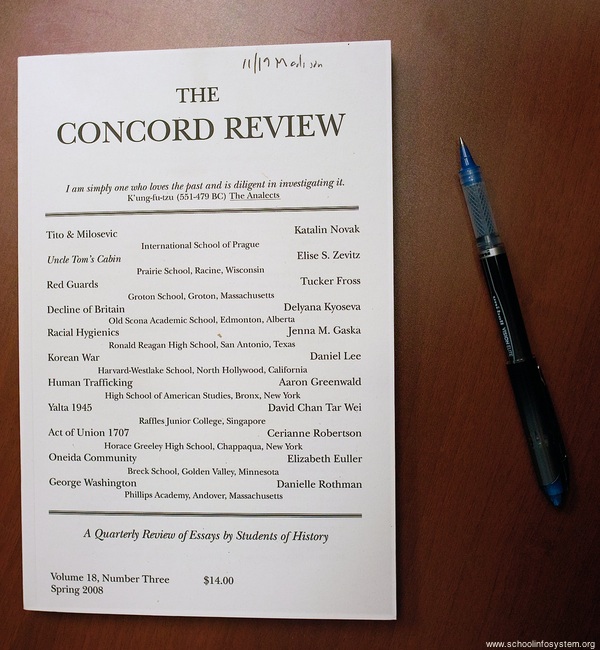
Share

High Schools Add Electives to Cultivate Interests

Winnie Hu:

The students in the jewelry and metalsmithing class at Pelham Memorial High School painstakingly coiled copper and brass wires into necklaces the other morning, while across the hall, the history of rock ‘n’ roll class pondered the meaning of Don McLean’s “American Pie.”
These are two of the 17 electives added this year to the curriculum in this affluent Westchester County suburb, redefining traditional notions of a college-preparatory education and allowing students to pursue specialized interests that once were relegated to after-school clubs and weekend hobbies. Now, budding musicians take guitar lessons, amateur war historians re-enact military battles, and future engineers build solar-powered cars — all during school hours, and for credit.
“It’s letting people learn about what they love rather than dictating what they should be learning,” said Morgan McDaniel, a senior who added the rock ‘n’ roll class to her roster of Advanced Placement classes in calculus, biology, European history and studio art.

Share

Michelle Rhee & The “Educational Insurgency”

Jay Matthews:

To understand D.C. Schools Chancellor Michelle A. Rhee and the educational insurgency she is part of, you have to know what happened when she taught at Baltimore’s Harlem Park Elementary School in the early 1990s.
The Teach for America program threw well-educated young people such as Rhee — bachelor’s degree from Cornell, master’s from Harvard’s John F. Kennedy School of Government — into classrooms full of impoverished children after only a summer of training. “It was a zoo, every day,” she recalled. Thirty-six children, all poor, suffered under a novice who had no idea what to do.
But within months, for Rhee and other influential educators in her age group, the situation changed. She vowed not “to let 8-year-olds run me out of town.” She discovered learning improved when everyone sat in a big U-pattern with her in the middle and she made quick marks on the blackboard for good and bad behavior without ever stopping the lesson. She spent an entire summer making lesson plans and teaching materials, with the help of indulgent aunts visiting from Korea. She found unconventional but effective ways to teach reading and math. She set written goals for each child and enlisted parents in her plans.

Share

Long Battle Expected on DC Plan to Fire Teachers

Bill Turque:

D.C. Schools Chancellor Michelle A. Rhee and the Washington Teachers’ Union — aided by its national parent organization — are digging in for what could be a protracted struggle over Rhee’s plan to fire instructors deemed to be ineffective.
School officials have posted job openings for an unspecified number of “helping teachers” to counsel instructors who have received notice to improve or face termination. Principals have been asked to identify teachers who can be placed on the so-called 90-day plan, which gives teachers 90 school days — or about five months — to upgrade their performance. The helping teachers will also document all assistance given to instructors and report to central office administrators, according to the job description posted on the D.C. schools Web site.

Share

Can Interdistrict Choice Boost Student Achievement?
The Case of Connecticut’s Interdistrict Magnet School Program

Robert Bifulco, Casey Cobb & Courtney Bell [320K PDF]:

In response to a landmark civil rights ruling, the state of Connecticut has adopted models of choice-based interdistrict desegregation that appear to satisfy current legal constraints. In this paper, we focus on Connecticut’s interdistrict magnet schools, and estimate the effects these schools have had on student achievement. We use longitudinal data on individual student test performance and information from admissions lotteries to implement quasi-experimental, regression-based, and propensity score estimators. Preliminary analyses show that lottery based methods, propensity score methods, and regression analysis provide similar estimates of achievement effects of for the small set of schools for which all three methods can be implemented. We then proceed to use the latter two methods to estimate effects for all of the interdistrict magnet high schools and middle schools that serve students from Hartford, Waterbury and New Haven. Results indicate that, on average, interdistrict magnet high schools have positive effects on both math and reading achievement, and interdistrict magnet middle schools have positive effects on reading achievement. Extensions of our analysis indicate that interdistrict magnet high schools have positive effects particularly on the achievement of students in Hartford, New Haven and Waterbury and do so regardless of how much attending an interdistrict magnet high school reduces racial isolation. The positive effects of magnet middle schools appear to be limited to suburban students, except in those schools that are able to achieve substantial reductions in racial isolation for their central city students.

Share

Counting on the Future: International Benchmarks in Mathematics for American School Districts

Dr. Gary W. Phillips & John A. Dossey [2.5MB PDF Report]:

Students in six major U.S. cities are performing on par or better in mathematics than their peers in other countries in grades 4 and 8, according to a new study by the American Institutes for Research (AIR). However, students from five other major cities are not faring as well, and overall, U.S. student performance in mathematics falls off from elementary to middle school grades — and remains behind many industrialized nations, particularly Asian nations.
The AIR study offers the first comparison between students from large U.S. cities and their international peers. The study compares U.S. 4th grade students with their counterparts in 24 countries and 8th grade students with peers in 45 countries.
“Globalization is not something we can hold off or turn off…it is the economic equivalent of a force of nature… like the wind and water” (Bill Clinton)
If you are a student today competing for jobs in a global economy, the good jobs will not go to the best in your graduating class–the jobs will go to the best students in the world. Large urban cities are intimately connected to the nations of the world. Large corporations locate their businesses in U.S. cities; foreign students attend U.S. schools; and U.S. businesses export goods and services to foreign nations. Large urban cities need to know how their students stack up against peers in the nations with which the U.S. does business. This is especially important for students in the fields of science, technology, engineering, and mathematics. The students in these fields will allow our future generation to remain technologically innovative and economically competitive.
This report provides a comparison of the number of mathematically Proficient students in Grades 4 and 8 in 11 large cities in the United States with their international peers.
This comparison is made possible by statistically linking the National Assessment of Educational Progress (NAEP) in 2003 and the Trends in International Mathematics and Science Study (TIMSS) in 2003 when both assessments were conducted in the United States in the same year and in the same grades.
After the statistical linking was completed, it was possible to compare the most recent NAEP results (from 2007) to the most recent TIMSS results (from 2003). How the United States compares to the overall international average.
At Grade 4, five countries (Singapore, Hong Kong SAR, Chinese Taipei, Japan, and the Flemish portion of Belgium) performed significantly better than the United States (Figure 1). However, the United States (at 39% proficiency) performed better than the international average (27% proficiency) of all 24 countries (Figure 13).
At Grade 8, eight countries (Singapore, Hong Kong SAR, Republic of Korea, Chinese Taipei, Japan, Belgium (Flemish), Netherlands, and Hungary) performed significantly better than the United States (Figure 1). However, the United States (at 31% proficiency) performed better than the international average (21% proficiency) of all 44 countries (Figure 14).
….
Because of the persistent requests of urban school districts, the U .S . Congress authorized NAEP to assess, on a trial basis, six large urban school districts beginning in 2002 . Since then, more districts have been added, resulting in 11 school districts in 2007 (and plans are underway to include even more districts in the future) . The urban school chiefs in these 11 large school districts, which voluntarily participated in the 2007 NAEP, recognized the global nature of educational expectations and the importance of having reliable external data against which to judge the performance of their students and to hold themselves accountable . They should be commended for their visionary goal of trying to benchmark their local performance against tough national standards. National standards provide a broad context and an external compass with which to steer educational policy to benefit local systems . The purpose of this report is to further help those systems navigate by providing international benchmarks.

Clusty Search: Gary W. Phillips and John A. Dossey.
Greg Toppo has more:

Even if the findings are less-than-stellar, he says, they should help local officials focus on improving results.
“In that sense, I think it could be a very positive thing to use in-house, in the district, to keep their nose to the grindstone,” says Kepner, a former middle- and high-school math teacher in Iowa and Wisconsin.”If they can show they’re improving, they might be able to attract more companies to a system that’s on the move.”
Phillips says the findings prove that in other countries “it is possible to do well and learn considerably under a lot of varied circumstances — in other words, being low-income is not really an excuse when you look around the rest of the world.”

Math Forum audio & video.

Share

Doggie Biscuit for Kohn: Author rips testing, other sacred classroom concepts

By Lisa Schencker:

Rising test scores are no reason to celebrate, author Alfie Kohn told teachers at the Utah Education Association (UEA) convention on Friday.
Schools that improve test scores do so at the expense of other subjects and ideas, he said.
When the scores go up, it’s not just meaningless. It’s worrisome,” Kohn told hundreds of educators on the last day of the convention. “What did you sacrifice from my child’s education to raise scores on the test?”
Kohn, who’s written 11 books on human behavior, parenting and schools, spent nearly two hours Friday morning ripping into both established and relatively new education concepts. He slammed merit pay for teachers, competition in schools, Advanced Placement classes, curriculum standards and testing–including Utah’s standards and testing system — drawing mixed reactions from his audience.
“Considering what we hear a lot, it was pure blasphemy,” said Richard Heath, a teacher at Central Davis Junior High School in Layton.
Kohn called merit pay–forms of which many Utah school districts are implementing this year–an “odious” type of control imposed on teachers.
If you jump through hoops, we’ll give you a doggie biscuit in the form of money,” Kohn said.

(more…)

Share

NAEP Writing Assessment 2011

An Interview with Will Fitzhugh: About Assessing Writing EdNews.org Houston, Texas, 24 January 2007
Michael F. Shaughnessy Senior Columnist EdNews.org:

1) I understand that you have just finished a stint on the ACT/NAGB Steering Committee for the 2011 NAEP (National Assessment of Educational Progress) Writing Assessment. What was that like? (And what does NAGB stand for?)
WF: NAGB is the National Assessment Governing Board, which runs the NAEP, “America’s Report Card,” as they say. I was glad that Diane Ravitch recommended me for the Steering Committee for the new national writing assessment scheduled for 2011. I was very impressed with the intelligence and competence of Mary Crovo, representing NAEP, and Rosanne Cook, who is running the project for American College Testing. Many people on the Committee were from the National Council of Teachers of English and the College Composition world, which have little interest in having students read history books or write history research papers. In fact that world favors, or has favored in the past, personal and creative writing and the five-paragraph essay, which do a terrible job of preparing high school students for the nonfiction books and the academic term papers most will be asked to cope with in college.
2) Given the paucity of writing that goes on in the high schools of America, is it really fair to ask high school students to engage in a robust writing assessment?
WF: It would not be fair to ask high school students to play in a football game if they hadn’t had an opportunity for lots of practice, and it is very hard to ask high school students to do the sort of academic expository writing they should be doing if they have never done it in all their years in school. But we need to start somewhere. Every high school student does not need to be able to play football, but they all need to be able to read nonfiction books and write serious term papers.
3) On the other hand, since so much of the college experience is writing, are high school teachers doing students a disservice by NOT requiring more writing?
WF: High school teachers would make terrible football coaches and their teams would lose most if not all of their games, if the teacher/coaches did not have time to practice their teams. We take football seriously, and we take band seriously, so ample time and money are made available to produce the best teams and the best bands the high school can manage. We allow really no time for a public high school teacher to work with students on heavy-duty term papers. We don’t make time for them, because we don’t think they are that important. Not as important as drama practice, yearbook, chorus, debate or a host of other activities. As a result our high school students are, once again, ill-prepared for college reading and writing. AP courses in history do not require, in most cases, that students read a complete nonfiction book, and most of the AP teachers say they don’t have time to ask the student to write a research paper, because they “have to get students ready for the AP Exam.”

(more…)

Share

The High School Dropout’s Economic Ripple Effect

Gary Fields:

Mayors Go Door to Door, Personally Encouraging Students to Stay in the Game for Their Own Good — and for the Sake of the City
As the financial meltdown and economic slump hold the national spotlight, another potential crisis is on the horizon: a persistently high dropout rate that educators and mayors across the country say increases the threat to the country’s strength and prosperity.
According to one study, only half of the high school students in the nation’s 50 largest cities are graduating in four years, with a figure as low as 25% in Detroit. And while concern over dropouts isn’t new, the problem now has officials outside of public education worried enough to get directly involved.
The U.S. Conference of Mayors [PDF Report] is focusing its education efforts on dropouts. Mayors in Houston and other Texas cities go door to door to the homes of dropouts, encouraging them to return to school. Atlanta Mayor Shirley Franklin meets on weekends with students and helps them with life planning. Other cities, like Milwaukee and Kansas City, Mo., have dropout prevention programs.
Some new studies show far fewer students completing high school with diplomas than long believed. “Whereas the conventional wisdom had long placed the graduation rate around 85%, a growing consensus has emerged that only about seven in 10 students are actually successfully finishing high school” in four years, said a study by the Editorial Projects in Education Research Center, a nonprofit group based in Bethesda, Md. It was released this year by America’s Promise Alliance, a nonpartisan advocacy group for youth. In the nation’s 50 largest cities, the graduation rate was 52%.

Share

Content Knowledge Requirements Proposed for Illinois Teachers

Carlos Sadovia:

As many as 5,000 middle school teachers in Chicago could be required to go back to school for additional training to continue teaching under a plan expected to be approved by the Board of Education this week.
Under the proposal, 6th-, 7th- and 8th-grade teachers would be asked to gain an “endorsement” noting they are qualified for specific subjects at those grade levels, said Xavier Botana, head of elementary education for the Chicago Public Schools.
While teachers must be state-certified to teach in the district, currently neither the district nor the state requires teachers to gain the additional credential for classes such as math, English and science. Chicago is following many other districts in toughening requirements, officials said.
Botana said that while potentially 5,000 middle school teachers are affected, many already may have the necessary credits.
“Going forward, all of our kids in 6th through 8th grades will be taught by somebody who has a deeper level of content area knowledge than what is currently required,” he said. “We need to aim higher.”
Mary McClure, a Chicago Teachers Union official, said the union supports the move and has been working with the district to make sure teachers have enough time to take the classes.

Share

Problems Without Figures For Fourth to Eighth Grade

A Math book for “High Schools and Normal Schools by S.Y. Gillan [9.6MB PDF]:

Arithmetic can be so taught as to make the pupil familiar with thc fact that we may use a number in a problem without knowing what particular number it is. Some of the fundamentals of algebra may thus be taught along with arithmetic. But, as a rule, whenever any attempt is made to do this the work soon develops or degenerates into formal algebra, with a full quota of symbolism, generalization and formulae — matter which is not wholesome pabulum for a child’s mind and the result has been that teachers have given up the effort and have returned to the use of standardized knowledge put up in separate packages like baled hay, one bale labeled “arithmetic,” another “algebra,” etc.
Every problem in arithmetic calls for two distinct and widely different kinds of work: first, the solution, which involves a comprehension of the conditions of the problem and their relation to one another; second, the operation. First we
decide what to do; this requires reasoning. Then we do the work; this is a merely mechanical process, and the more mechanical the better. A calculating machine, too stupid to make a mistake, will do the work more accurately than a
skillful accountant. Adding, subtracting, multiplying and dividing do not train the power to reason, but deciding in a given set of conditions which of these operations to use and why, is the feature of arithmetic which requires reasoning.
The problems offered here will furnish material to promote thinking; and a few minutes daily used in this kind of work will greatly strengthen the pupils’ power to deal with the problems given in the textbook.
After consultation with teachers, the author decided to print the problems without regard to classification. They range all the way from very simple work suitable for beginners up to a standard adapted to the needs of eighth grade pupils. As a review in high school and normal school classes the problems may be taken in order as they come, and will be found Interesting and stimulating. For pupils in the grades, the teacher will Indicate which ones to omit; this discrimination will be a valuable exercise for the teacher.
A few “catch problems” are put in to entrap the unwary. To stumble occasionally into a pitfall makes a pupil more watchful of his steps and gives invigorating exercise in regaining his footing. The groove runner thus learns to use his wits and see the difference between a legitimate problem and an absurdity.
It is recommended that these exercises be used as sight work, the pupils having the book in hand and the teacher designating the problems to be solved without previous preparation.
S. Y. GILLAN.
Milwaukee, Wisconsin, May 21, 1910.

Many thanks to Dick Askey for providing a copy (the!) of this book.
From the book:

To answer in good, concise English, affords an excellent drill in clear thinking and accurate expression. This one is suitable for high school, normal school and university students, some of whom will flounder in a most ludicrous fashion when they first attempt to give a clear-cut answer conforming to the demands of mathematics and good English.
224. After a certain battle the surgeon sawed off several wagon loads of legs. If you are told the number of legs in each load and the .price of a cork leg, how can you find the expense of supplying these men with artificial legs? Writeout a list of twenty other expense items incurred in the fighting of a battle.
225. The American people spend each year for war much more than for education. If you know the total amount spent for each purpose, how can you find the per capita expense for war and for schools?
227. A boy travels from Boston to Seattle in a week. Every day at noon he meets a mail train going east on which he mails a letter to his mother in Boston. If there is no delay, how frequently should she receive his letters?

Share

Madison School district hopes to be anchor for homeless students

Pat Schneider:

That is sometimes the function — although not the intent, really, of the TEP program — which provides academic and emotional support for students whose chaotic life circumstances can set them grades behind their classmates.
The Zavala kids are among more than 280 students identified as homeless in the school district in the first six weeks of the school year. That number is a rolling count, updated throughout the school year as the district as students become homeless.
The district is on pace to exceed last year’s total, which was up sharply from the year before. The nation’s growing economic crisis is a likely culprit for at least some of the increase. One longtime TEP teacher says more homeless students are coming from established Madison families, not just those who have recently arrived to the city without housing.
As a result, homeless students are now in the attendance areas of schools all over the city — and not just those near homeless shelters and motels used to house homeless families. As a result, school officials this year are re-examining how best to use their limited resources, said Nancy Yoder, director of alternative programs. The school district now spends more than $750,000 on homeless services, but more district dollars are highly unlikely, Superintendent Dan Nerad said Thursday. District officials are preparing for a November referendum asking voters to approve increasing their spending limit by a total of $13 million over the next three years just to preserve current programs.

Share

Wisconsin State & School Finance Climate Update

I recently had an opportunity to visit with Todd Barry, President of the Wisconsin Taxpayers Alliance [29 minute mp3]. A summary of this timely conversation follows:
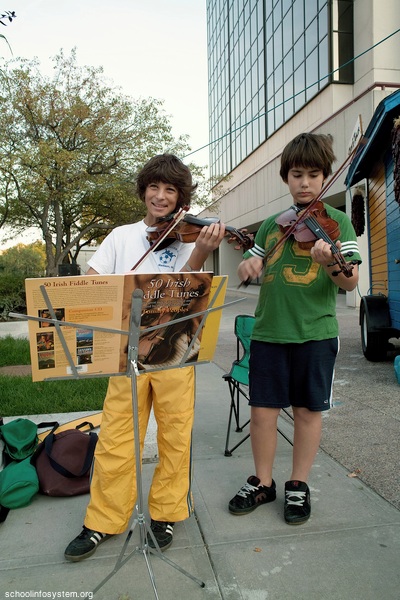
[2:25] Post Retirement Liabilities: Milwaukee Public Schools Post Retirement Health Care Liabilities: $2.2 to $2.5 billion
[3:01] Wisconsin’s $2.44 Billion structural deficit. The State debt load ($4billion to $9billion from 2000 to 2007) is now among the top 10.
[7:48] On property values and assessment changes. Two years ago, property values grew 9%, last year 6%, 3% this year with most of the recent growth coming from commercial properties.
[8:57] Wisconsin Income Growth: Per Capita personal income “The canary in the mineshaft” and how we lag the national average by 6% or more.
Why?
The population is aging. Senior population will double by 2030. School age population is stagnant.
Employment growth peaked before the nation (04/05)
Wisconsin wages per worker is about 10% less than the national average. 1969; 4% below national average, 1980’s; 10 or 11% below national average. Wisconsin wagers per worker are now 14% below national average. We’ve been on a 40 year slide.
We’ve hid this because the labor force participation of women has increased dramatically.
Wisconsin is losing corporate headquarters.
[18:18] What does this all mean for K-12 spending?
“If there is going to be growth in any state appropriation,it is going to be schools and Medicaid“. The way the Legislature and Governor have set up these two programs, they are more or less on auto-pilot. They will grab whatever money is available and crowd out most everything else. So you get this strange situation where state aid to schools has tripled in the last 25 years while funding for the UW has barely doubled. That sounds like a lot, but when you look at it on a year by year basis, that means state funding for the University of Wisconsin System has grown less than the rate of inflation on an annual average basis while school aids has outpaced it (inflation) as has Medicaid.”
Is there anything on the horizon in terms of changes in school finance sources? A discussion of shifting state school finance to the sales tax. “It’s clear that in states where state government became even more dominant (in K-12 finance) than in Wisconsin, the net result, in the long run, was a slowing of state support for schools. The legislature behaves like a school board, micromanaging and mandating. California is the poster child.
[20:52] On why the Madison School District, despite flat enrollment and revenue caps, has been able to grow revenues at an average of 5.25% over the past 20 years. Barry discussed: suburban growth around Madison, academic competition amongst Dane County high schools. He discussed Madison’s top end students (college bound kids, kids of professionals and faculty) versus the “other half that doesn’t take those (college entrance) tests” and that the “other half” is in the bottom 10 to 20% while the others are sitting up at the top on college entrance exams.
[23:17]: This is a long way of saying that Madison has made its problem worse and has put itself on a course toward flat enrollment because of social service policies, school boundary policies and so forth that have pushed people out of the city.
[23:42] “If there is a way within state law to get around revenue caps, Madison has been the poster child”. Mentions Fund 80 and frequent and successfully passing referendums along with Madison’s high spending per pupil.
People think of the Milwaukee Public Schools as a high spending District. When you really look start to dig into it, it is above average, but Madison is way out there compared to even MPS. People argue that argue that MPS is top heavy in terms of administrative costs per student, Madison actually spends more in some of those categories than Milwaukee. (See SchoolFacts, more)
[26:45] On K-12 School finance outlook: The last time we blew up the school finance system in Wisconsin was in 1994. And, it happened very quickly within a span of 2 to 3 months and it had everything to do with partisan political gotcha and it had nothing to do with education.
[28:26] “Where are the two bastians of Democratic seats in the legislature? Madison and Milwaukee. Madison is property rich and Milwaukee is relatively property poor. Somehow you have to reconcile those two within a Democratic environment and on the Republican side you have property rich suburbs and some very property poor rural districts.

Share

Wisconsin, Mississippi Have “Easy State K-12 Exams” – NY Times

Sam Dillon:

A state-by-state analysis by The New York Times found that in the 40 states reporting on their compliance so far this year, on average, 4 in 10 schools fell short of the law’s testing targets, up from about 3 in 10 last year. Few schools missed targets in states with easy exams, like Wisconsin and Mississippi, but states with tough tests had a harder time. In Hawaii, Massachusetts and New Mexico, which have stringent exams, 60 to 70 percent of schools missed testing goals. And in South Carolina, which has what may be the nation’s most rigorous tests, 83 percent of schools missed targets.

Related:

Share

2008 Madison Schools’ Referendum – Key Issues

1. Mortgage on future property with permanent increase: Asking taxpayers to refinance/mortgage their futures and that of the school district with a permanent increase of $13 million yearly for the operations budget. It has been stated the district needs the money to help keep current programs in place. It is expected that even after 3 years of this referendum totaling $27 million, the Board is projecting a continued revenue gap and will be back asking for even more.
2. No evaluation nor analysis of programs and services: The Board will make budget cuts affecting program and services, whether or not this referendum passes. The cuts will be made with no assessment/evaluation process or strategy for objective analyses of educational or business programs and services to determine the most effective and efficient use of money they already have as well as for the additional money they are asking with this referendum.
3. Inflated criteria for property value growth: The dollar impact on property to be taxed is projected on an inflated criteria of 4% growth in property valuation assessment; therefore, reducing the cost projection for the property tax levy. The growth for property valuation in 2007 was 3.2% and for 2008 it was 1.0%. Given the state of the economy and the housing market, the growth rate is expected to further decline in 2009. [10/13 Update: The above references to property valuation assessment growth are cited from City of Madison Assessor data. See ACE document “Watch List Report Card” [2008 Referendum Watch List 755K PDF] for State Department of Revenue citations for property valuation base and growth rate used for determination of MMSD property tax levy.]
4. No direct impact on student learning and classroom instruction: There is District acknowledgement of a serious achievement gap between low-income and minority student groups compared with others. There are no plans evident for changing how new or existing money will be spent differently in order to have an impact on improving student learning/achievement and instructional effectiveness.
5. Lack of verification of reduction in negative aid impact on taxes: District scenarios illustrating a drastic reduction in the negative impact on state aids from our property-rich district is unsubstantiated and unverified, as well as raising questions about unknown possible future unintended consequences. The illustrated reduction is from approximately 60% to 1% results by switching maintenance funds from the operations budget and 2005 referendum proceeds to a newly created “Capital Expansion Fund–Fund 41” account. [Update: 10/13: The reduction in the negative aid impact will take affect regardless of the outcome of the referendum vote. See the ACE document “Watch List Report Card” [2008 Referendum Watch List 755K PDF] for details.]

(more…)

Share

School Buses: Still Vehicles for Change
High Transportation Costs Are Forcing Kids Back To Neighborhood Schools, Limiting Diversity

Robert Thomsho:

A generation ago, the yellow school bus became a symbol of school desegregation, with thousands of the iconic vehicles ferrying minority children away from schools in their own neighborhoods to others in higher-income white areas.
Although the Supreme Court has tightly restricted such overt racial integration efforts in recent years, buses are still crucial to many magnet schools, open-enrollment programs and other school-choice strategies designed to encourage diversity and provide options for students in low-performing schools, as is required under the No Child Left Behind law.
But more and more school districts are curtailing bus service for such programs as a result of higher fuel costs and other financial pressures. That has sparked fears that the only choice for many students will be neighborhood schools attended by classmates of their own race and economic background, which has the unintended effect of re-segregating schools.
“Basically, you can’t have racial and class diversity of any sort if you don’t provide transportation,” says Gary Orfield, co-director of the Civil Rights Project, a research group at the University of California at Los Angeles. “This is kind of closing the last door for urgently needed opportunities for kids who are in schools that are really dysfunctional and inadequate.”

Share

How NCLB Ignored the Elephant in America’s Classroom — POVERTY

Jim Trelease:

A politician after politician and CEO after CEO have pontificated for 20 years about what is wrong in American schools, all the while offering simple-minded solutions (higher expectations girded by more high-stakes testing), nearly all have ignored the great elephant in the classroom: poverty. Their behavior said, “If we pretend it isn’t there, either it will go away or cease to exist.”
Before looking at the single most intelligent approach to urban school woes (see Harlem solution below), let’s look at what most impacts the classroom from outside the classroom. It is the weight of poverty that rides the at-risk child like a six-ton elephant. Consider the observations of Pulitzer-winning reporter David K. Shipler:

About 35 million Americans live below the federal poverty line. Their opportunities are defined by forces that may look unrelated, but decades of research have mapped the web of connections. A 1987 study of 215 children attributed differences in I.Q. in part to ‘social risk factors’ like maternal anxiety and stress, which are common features of impoverished households. Research in the 1990’s demonstrated how the paint and pipes of slum housing — major sources of lead — damage the developing brains of children. Youngsters with elevated lead levels have lower I.Q.’s and attention deficits, and — according to a 1990 study published in The New England Journal of Medicine — were seven times more likely to drop out of school.
Take the case of an 8-year-old boy in Boston. He was frequently missing school because of asthma attacks, and his mother was missing work so often for doctors’ appointments that she was in danger of losing her low-wage job. It was a case typical of poor neighborhoods, where asthma runs rampant among children who live amid the mold, dust mites, roaches and other triggers of the disease.”1

The inherent suggestion in NCLB is that all of that will go away if we just expect more of our teachers and students. That is an insult to both of them and it diminishes the enormity of the problem while doing nothing to solve it.

Related: “Limit Low Income Housing“.

Share

No Common Denominator: The Preparation of Elementary Teachers in Mathematics by America’s Education Schools

Julie Greenberg and Kate Walsh, National Council on Teacher Quality1.5MB PDF:

American students’ chronically poor performance in mathematics on international tests may begin in the earliest grades, handicapped by the weak knowledge of mathematics of their own elementary teachers. NCTQ looks at the quality of preparation provided by a representative sampling of institutions in nearly every state. We also provide a test developed by leading mathematicians which assesses for the knowledge that elementary teachers should acquire during their preparation. Imagine the implications of an elementary teaching force being able to pass this test.

Share

Merit & The Washington, DC School System

NY Times Editorial:

Mayor Adrian Fenty of Washington has moved at warp speed to make reforms since lawmakers gave him direct control of the city’s corrupt and dysfunctional school system a little more than a year ago. He named a hard-nosed schools chancellor, Michelle Rhee, who has replaced dozens of inept principals and reined in a rapacious central bureaucracy that was infamous for wasting money and thwarting reform.
The mayor and his chancellor are now hoping to negotiate an innovative new teachers’ contract that, if ratified, could become a model for underperforming school systems throughout the country.
Like many other cities, Washington wants to relax seniority rules that make it difficult to remove underperforming teachers and to reward high performers with fewer years of service.
Ms. Rhee has proposed a new approach in which teachers could choose between two employment options. The first would continue the traditional tenure arrangement, under which teachers would be compensated based on their years of experience and educational attainment. Or teachers could choose to give up tenure protection — for the first year of the new contract — and would have to agree to an evaluation of their teaching skills. The teachers who temporarily relinquished tenure, and passed the review, would be rewarded with higher salaries and bonuses that could push their earnings to as high as $130,000 a year. At present, a teacher with a Ph.D. and 21 years of experience makes $87,500 a year. Those who received lower ratings, however, would risk being fired during a probationary year.

Share

Arts Task Force to present findings and recommendations to Madison School Board: Presentation at 6 pm, Monday, October 6, 2008

Doyle Administration Building, 545 West Dayton Street, Madison [Map]

“The arts are not a luxury; they are essential”. State Supt. of Public Instruction Elizabeth Burmaster
Being concerned about the effect of cuts to funding, staffing and instruction time on arts education and the effect of these cuts on low-income students and students of color, the Madison Metropolitan School District’s (MMSD) Board of Education formed the district’s Fine Arts Task Force in January 2007 to respond to three charges:

  1. Identify community goals for Madison Metropolitan School District K-12 Fine Arts education including curricular, co-curricular and extra-curricular.
  2. Recommend up to five ways to increase minority student participation and participation of low-income students in Fine Arts at elementary, middle and high school levels.
  3. Make recommendations regarding priorities for district funding of Fine Arts.

Members of the Task Force will present the findings and recommendations to the MMSD School Board on Monday, October, 6, 2008, at 6:15 pm, in the McDaniels Auditorium of the Doyle Administration Building, 545 West Dayton Street, Madison.
Students, parents and the general public are encouraged to attend to show support for the role of the arts in ensuring a quality education for every MMSD student. Attendees can register in support of the report at the meeting.
Nineteen community members, including 5 MMSD students, were appointed by the School Board to the Task Force, which met numerous times from February 2007 through June 2008. The Task Force received a great deal of supportive assistance from the Madison community and many individuals throughout the 16 month information gathering and , deliberation process. More than 1,000 on-line surveys were completed by community members, parents, artists, arts organizations, students, administrators and teachers, providing a wealth of information to inform the task force?s discussions and recommendations.
The full Task Force report and appendices, and a list of Task Force members, can be found at http://mmsd.org/boe/finearts/.
Fine Arts Task Force Report [1.62MB PDF] and appendices:

For more information, contact Anne Katz, Task Force co-chair, 608 335 7909 | annedave@chorus.net.

Share

More Online Education Options: Now from Wharton High School @ U of Pennsylvania

Knowledge @ Wharton High School, via a kind reader email:

Knowledge@Wharton High School is an interactive site for high school students interested in finding out more about the world of business. It’s a subject that touches your lives in many ways — from the malls you shop and the plastics you recycle to the entrepreneurs, sports managers, fashion designers, stock brokers, artists and other leaders that you might become. At KWHS, you will find features about the companies you know and the people who run them, games to improve your financial skills and test your commitment to a greener marketplace, tools to explain how business works, and podcasts and videos that spotlight the world’s most creative and colorful people. As part of a network of global online business publications published by The Wharton School at the University of Pennsylvania, KWHS will show you how your ideas can change the world.

Related: Credit for non-Madison School District courses:

In the agreement announced Tuesday, there were no program changes made to the current virtual/online curriculum, but requirements outlined in the agreement assure that classes are supervised by district teachers.
During the 2007-08 school year, there were 10 district students and 40 students from across the state who took MMSD online courses.

Share

Curriculum Compacting: One way to help advanced students move ahead and learn at their own level.

Tamara Fisher:

Professional development. What thoughts and feelings do those words conjure up for you? Excitement? Boredom? A chance to improve your skills and learn new, interesting teaching strategies? Or a painful time of listening to someone talk about a topic you already know?
We’ve all been there–sitting in a required in-service class listening to someone go over Bloom’s Taxonomy or some other concept or strategy that we’ve been using effortlessly for years. We grumble our way through the session, irritated that we have to sit on our butts “re-learning” a topic we could have taught just as well ourselves, if not better. Partly we’re irritated because we have so much else to do! Many teachers would categorize a situation like this as wasted time.
Of course, not all professional development is like that. But I use the example because it is a great way to help teachers relate to what a gifted kid experiences when the material being taught in class is not at the right readiness-level for him or her. We don’t like it when someone else puts us into that kind of a situation, yet we routinely do the same to the gifted students.

Share

Owl Creek neighborhood raises red flags for city, schools

Sandy Cullen:


The first thing the school principal noticed was the large number of new students coming from a tiny, isolated neighborhood that didn’t exist two years ago.
Then it was the repeated fights — which would begin on the bus ride home, fester in the neighborhood, then come back to school the next day, said Glendale Elementary School Principal Mickey Buhl.
And there were other troubling signs — youngsters shaving their eyebrows and cutting their hair in ways that Buhl said indicated flirtation with the idea of gangs. Glendale staff who went to the Owl Creek neighborhood, off Voges Road on the southeast side near McFarland, saw an unfinished development sandwiched between two industrial parks and far from stores, social services and bus lines.
Madison police also noticed problems. From March 1 to June 30 of this year, police responded to 81 calls for service, ranging from theft to battery, in the tiny development, said Lt. Carl Strasburg.

Related: Police calls near Madison area high schools: 1996-2006.

Share

The New Paternalism in Urban Schools

David Whitman:

By the time youngsters reach high school in the United States, the achievement gap is immense. The average black 12th grader has the reading and writing skills of a typical white 8th grader and the math skills of a typical white 7th grader. The gap between white and Hispanic students is similar. But some remarkable inner-city schools are showing that the achievement gap can be closed, even at the middle and high school level, if poor minority kids are given the right kind of instruction.
Over the past two years, I have visited six outstanding schools. (For a list of schools, see sidebar.) All of these educational gems enroll minority youngsters from rough urban neighborhoods with initially poor to mediocre academic skills; all but one are open-admission schools that admit students mostly by lottery. Their middle school students perform as well as their white peers, and in some middle schools, minority students learn at a rate comparable to that of affluent white students in their state’s top schools. (For one impressive example, see Figure 1.) At the high school level, low-income minority students are more likely to matriculate to college than their more advantaged peers, with more than 95 percent of graduates gaining admission to college. Not surprisingly, they all have gifted, deeply committed teachers and dedicated, forceful principals. They also have rigorous academic standards, test students frequently, and carefully monitor students’ academic performance to assess where students need help. “Accountability,” for both teachers and students, is not a loaded code word but a lodestar. Students take a college-prep curriculum and are not tracked into vocational or noncollege-bound classes. Most of the schools have uniforms or a dress code, an extended school day, and three weeks of summer school.

Share

Sun Prairie teacher with creative approach to reading honored

Pamela Cotant:

Sandra Kowalczyk’s creative approach to helping students read is evident when you walk into her classroom at Patrick Marsh Middle School in Sun Prairie.
Kowalczyk, who has traveled to 55 countries in five continents, decorated her room with a variety of artifacts such as wood carvings and masks from Ghana, batik sarongs from Malaysia and Indonesia, mud paintings from the Ivory Coast, mola cloth from Panama, puppets from India and books from around the world.
“My philosophy is build interest, give them background,” said Kowalczyk, who was named the Wisconsin Middle/Junior High School Teacher of the Year.
As Teacher of the Year, she received $3,000 from Sen. Herb Kohl, D-Wis., through the Herb Kohl Educational Foundation. She was recognized by state Superintendent Elizabeth Burmaster along with the other three 2008-09 Teachers of the Year during the recent State of Education speech and awards ceremony at the Capitol.

Share

Carol Ann Tomlinson explains how differentiated instruction works and why we need it now.

Anthony Rebora:

Differentiated instruction–the theory that teachers should work to accomodate and build on students’ diverse learning needs–is not new. But it’s unlikely that anyone has done more to systematize it and explicate its classroom applications than University of Virginia education professor Carol Ann Tomlinson.
A former elementary school teacher of 21 years (and Virginia Teacher of the Year in 1974), Carol Ann Tomlinson has written more than 200 articles, chapters, and books, including The Differentiated Classroom: Responding to the Needs of All Learners and Fulfilling the Promise of the Differentiated Classroom: Strategies and Tools for Responsive Teaching. Characterized by a rigorous professionalism and a strong underlying belief in both teachers’ and students’ potential, her work has given many educators both practical and philosophical frameworks for modifying instruction to meet the individual needs of all students.

Share

Disrupting Class: Student-Centric Education Is the Future

Clayton M. Christensen & Michael B. Horn:

The answer isn’t simply investing more in computer equipment and technology for schools, either. The United States has spent more than $60 billion equipping schools with computers during the last two decades, but as countless studies and any routine observation reveal, the computers have not transformed the classroom, nor has their use boosted learning as measured by test scores. Instead, technology and computers have tended merely to sustain and add cost to the existing system.
That schools have gotten so little back from their investment comes as no surprise. Schools have done what virtually every organization does when implementing an innovation. An organization’s natural instinct is to cram the innovation into its existing operating model to sustain what it already does. This is perfectly predictable, perfectly logical — and perfectly wrong.
Student as Consumer
The key to transforming the classroom with technology is in how it is implemented. We need to introduce the innovation disruptively — not by using it to compete against the existing paradigm and serve existing customers, but to target those who are not being served — people we call nonconsumers. That way, all the new approach has to do is be better than the alternative — which is nothing at all.
To convey what we mean, we need to briefly explain the disruptive-innovation theory. In every market, there are two trajectories: the pace at which technology improves and the pace at which customers can utilize the improvements. Customers’ needs tend to be relatively stable over time, whereas technology improves at a much faster rate. As a result, products and services are initially not good enough for the typical customer, but, over time, they improve and pack in more features and functions than customers can use.

Much more on Clayton Christensen.

Share

Wisconsin State Tax Based K-12 Spending Growth Far Exceeds University Funding

via WISTAX

WISTAX published a fascinating chart in their most recent issue of FOCUS [Page 1, Page 2]:

However, the state pledge to provide two-thirds of schools revenues in 1996-97 changed the budget landscape. By 2006-07, state-tax support for the UW System had almost doubled during Ihe 25 years prior. However, inflation (CPI, up 115%). school aids/credits (320%). and overall slate GPR expenditures (222%) rose more.

Related:

Further proof that there is no free lunch. The ongoing calls for additional state redistributed tax dollars for K-12 public education will likely have an effect on other programs, as this information illustrates. I do think that there should be a conversation on spending priorities.

Share

Beware of the Easy School Fix

Jay Matthews:

When fixing schools, beware of miracle cures. Every week people send me ideas they say will change the future of education and lead all humanity to enlightenment. So, when management expert William G. Ouchi let me look at his new work on the surprising power of total student loads per teacher, or TSL, I was skeptical.
He says when middle or high school principals are given control of their schools’ budgets — a rare occurrence in big districts — they tend to make changes in staffing, curriculum and scheduling that sharply reduce TSL, the number of students each of their teachers is responsible for. Some urban districts have TSLs approaching 200 kids per teacher. But after principals get budgeting power, the load drops sharply, sometimes to as low as 80 kids per instructor. When that happens, the portion of students scoring “proficient” on state tests climbs. A group of New York schools had a surge of 11 percentage points after they reduced average TSL by 25 students per teacher.
I hear the mumbles out there. Yes, correlation is not causation. Test scores are not a perfect measure. Many other factors could explain the rise in achievement. For instance, the principals might be using their new powers to hire good teachers and fire bad ones.

Share

The Special Needs Kindergarten Crunch

Christine Gralow:

It’s the third week of pre-school. Kids are still settling in, and many are still crying when their parents drop them off in the morning. During these first weeks of school, pre-school teachers do a lot of waiting and wondering — waiting patiently for the separation tears to end and wondering what fascinating young characters will begin to emerge in this year’s class. My students’ parents, however, are already thinking about next year — they’re worried about getting their kids into kindergarten.
As a pre-school special needs teacher in New York, I’ve learned that the city’s culture of cut-throat competition extends to kindergarten admissions. And from that, an unexpected part of my job has evolved — providing psychological and emotional support to parents as they undertake the daunting task of finding an appropriate placement for their child. Securing a good spot in an oversubscribed New York City kindergarten, whether public or private, is difficult enough for most parents. But for the parents of children with special needs, it is especially challenging.

Share

Perceiving the World in Alternative Terms

Mark Edmundson:

Because really good teaching is about not seeing the world the way that everyone else does. Teaching is about being what people are now prone to call “counterintuitive” but to the teacher means simply being honest. The historian sees the election not through the latest news blast but in the context of presidential politics from George Washington to the present. The biologist sees a natural world that’s not calmly picturesque but a jostling, striving, evolving contest of creatures in quest of reproduction and survival. The literature professor won’t accept the current run of standard clichés but demands bursting metaphors and ironies of an insinuatingly serpentine sort. The philosopher demands an argument as escapeproof as an iron box: what currently passes for logic makes him want to grasp himself by the hair and yank himself out of his seat.
Good teachers perceive the world in alternative terms, and they push their students to test out these new, potentially enriching perspectives. Sometimes they do so in ways that are, to say the least, peculiar. The philosophy professor steps in the window the first day of class and asks her students to write down the definition of the word “door.” Another sees that it’s hard to figure out how the solar system works by looking at the astronomy book. So he takes his friends outside and designates one the sun, the other the earth and gets them rotating and revolving in the grassy field. (For reasons of his own, he plays the part of the moon.) The high-school teacher, struck by his kids’ conformity, performs an experiment. He sends the hippest guy in the class off on an errand and while he’s gone draws pairs of lines on the board, some equal, some unequal. When the hip kid comes back, the teacher asks the class, who are in on the game, which lines are the same length and which are different and, as they’ve been instructed, they answer the wrong way. They’re surprised at how often the cool kid disobeys the evidence of his own eyes and goes along with the pack. A few hours later, at home, they’re surprised at how good they were at fooling their friend and how much pleasure they took in making him the butt of the experiment.

Share

California’s new 8th-grade algebra rule gets some poor marks

Howard Blume:

The new state policy of requiring algebra in the eighth grade will set up unprepared students for failure while holding back others with solid math skills, a new report has concluded.
These predictions, based on national data, come in the wake of an algebra mandate that the state Board of Education, under pressure from Gov. Arnold Schwarzenegger, adopted in July. That decision won widespread praise from some reform advocates and the Bush administration, putting California out front in a national debate over improving mathematics instruction.
The policy also led to a lawsuit filed this month by groups representing school districts and school administrators. They contend that the state board adopted the new rules illegally. Their underlying concern is that the algebra policy is unworkable and unfunded.
The new study, released today by the Brookings Institution in Washington, D.C., looked at who is taking eighth-grade algebra and how they are doing.
And there was some ostensibly good news. Nationwide, more students are taking algebra than before. Over five years, the percentage of eighth-graders in advanced math — algebra or higher — went up by more than one-third. In total, about 37% of all U.S. students took advanced math in 2005, the most recent year in the analysis.

More here and here.

Share

History Lesson

Bob McGum:

Want to read another story about the dumbing down of American students? How far SAT scores have dropped or standards fallen?
If so, look elsewhere.
We wish instead to draw your attention to one of those little starbursts of intelligence sparkling over our dreary educational landscape: The Concord Review. The first and only academic journal dedicated to the work of high school students, The Concord Review has published essays on everything from the sinking of the Lusitania to the Pullman Strike of 1894 and the Harlem Renaissance. Appropriately enough, it is published out of the same town where, more than two centuries back, embattled farmers fired the shot heard ’round the world.
The Review is the child of Will Fitzhugh, a Harvard alumnus who started publishing it out of his own home in 1987 while a high school teacher himself. The next year he quit his job and dedicated himself to the journal full-time. Not least of the spurs behind his decision was having witnessed two of his fellow Concord teachers propose an after-school program to help a select group of students prepare a serious history essay-only to be shot down by the administration on the grounds of “elitism.”
Like most such academic adventures, the Review isn’t going to challenge People magazine any time soon; it still has only about 850 subscribers, and among the high schools that don’t subscribe are a number whose students have been published in the Review itself. But it is attracting attention. The Concord Review has received endorsements from a cross-section of prominent historians such as David McCullough, Eugene Genovese, Diane Ravitch, and Arthur Schlesinger, Jr., who says “there should be a copy in every high school.” Another fan is James Basker, a Barnard and Columbia professor who also serves as president of the Gilder Lehrman Institute of American History.
“Students rise to the expectations you have of them,” states Mr. Basker. “All you have to do is show them they are capable of writing serious historical essays, and off they go.” To emphasize the point, his institute will on June 10 inaugurate three annual Gilder Lehrman Essay Prizes in American History drawn from Concord Review essayists. This year’s first prize, for $5,000, goes to Hannah S. Field for her contribution about library efforts to suppress Frank Baum’s Wizard of Oz.
All this acclaim notwithstanding, Mr. Fitzhugh believes today’s culture retains a pronounced bias against academic achievement and excellence. He cites the example of a Concord Review essayist from Connecticut who subsequently went on to Dartmouth and will be studying medicine this fall at Harvard. When Mr. Fitzhugh paid a visit to her high school, he found that though everyone knew she was all-state in soccer, no one knew that an essay of hers had appeared in the Review, beating out hundreds of the finest student essays from not only the U.S. but other parts of the English-speaking world. It’s one of the things that tells him that the need for such a journal remains strong.
“Varsity athletics and athletes are celebrated everywhere,” Mr. Fitzhugh says. “We’ve decided to celebrate varsity academics.”

Share

Recalculating The 8th-Grade Algebra Rush

Jay Matthews:

Nobody writing about schools has been a bigger supporter of getting more students into eighth-grade algebra than I have been. I wrote a two-part series for the front page six years ago that pointed out how important it is to be able to handle algebra’s abstractions and unknown quantities before starting high school. I have argued that we should rate middle schools by the percentage of students who complete Algebra I by eighth grade.
Now, because of a startling study being released today, I am having second thoughts.
Tom Loveless, director of the Brown Center on Education Policy at the Brookings Institution, has looked at the worst math students, those scoring in the bottom 10th on the National Assessment of Educational Progress eighth-grade test. He discovered that 28.6 percent of them — let me make that clear: nearly three out of every 10 — were enrolled in first-year algebra, geometry or second-year algebra. Almost all were grossly misplaced, probably because of the push to get kids into algebra sooner.
The report (to be available at http://www.brookings.edu/brown.aspx ) reprints this simple NAEP problem:
There were 90 employees in a company last year. This year the number of employees increased by 10 percent. How many employees are in the company this year?
A) 9
B) 81
C) 91
D) 99
E) 100
The correct answer is D. Ten percent of 90 is 9. Add that to 90 and you get 99. How many of the misplaced students got it right? Just 9.8 percent. Not good.

Share

Scrap the Sacrosanct Teacher Salary Schedule

Jacob Vigdor:

On what basis should we distribute rewards to salespeople?
It seems like a silly question, doesn’t it? First, “we,” meaning the public at large, don’t usually get to decide such matters. Second, there are obvious systems of rewards for salespeople already in place, foremost among them the system of commissions, which pays salespersons for the value they directly contribute to a firm’s operation.
Replace the word “salespeople” with “teachers,” however, and we move from the realm of silly questions to the arena of intense policy debate. Teachers are in most cases public employees. So we do, in theory at least, get to decide how they are paid. The commission model for teachers, variants of which have been proposed for many years, would involve compensating them for the value they provide to their school’s operation, that is, the degree to which they educate their students. Unfortunately, the amount of education a student receives in a given year is much harder to quantify than the total sales recorded by a clerk in a store. Measuring student growth has been made somewhat easier by recent advances in the tracking of student performance on standardized tests over time. But the notion of paying teachers on the basis of their ability to improve test scores, often termed “merit pay,” while earnestly debated by education policy researchers, is strongly opposed by teachers unions and is a political nonstarter in many parts of the country.

Share

The Harmful Mistakes of Sex Education in School

Minette Marrin:

Those who can, do, according to the old saying, and those who can’t, teach. That has always seemed to me unfair. However, I have come to think that those who can’t teach, teach sex education.
Judged by its results – not a bad way of judging – sex education has been an utter failure. The increase in sex education here in recent years has coincided with an explosion of unwanted pregnancies and sexually transmitted disease (STD) far worse than anywhere else in Europe. Since the government’s teenage pregnancy strategy was introduced in 1999, the number of girls having abortions has soared. You might well be tempted to argue that sex education causes sexual delinquency.
Only two months ago the Health Protection Agency reported that a culture of promiscuity among the young had driven the rate of STDs to a record. Almost 400,000 people – half of them under 25 – were newly diagnosed, 6% more than in 2006.
When something fails, the usual procedure is to drop it and try something else. With sex education, the worse it gets, the more people cry out for more of it and earlier. Ministers are considering whether to make schools offer more sex education, offer it earlier and deny parents the right to withdraw their children from it.

Share

Cultivating Algebra Enthusiasm

Michael Alison Chandler:

“Nothing like a little math to wake you up in the morning,” teacher Tricia Colclaser said this month after a taxing round of word problems.
Abstract math is not known for its stirring effect on U.S. teenagers. But algebra is viewed as increasingly essential for students preparing for college or careers in a fast-changing, technology-based economy. Some advocates call it the new literacy.
Strengthening the math abilities of all students is a steep challenge. Educators must reinforce basic concepts early on, attract teachers talented enough to go beyond dictating formulas, and, not least, overcome an anti-math bias many students harbor long into adulthood, that all the hours spent mixing letters and numbers yield more punishment than possibility.
How hard can it be?
The question led this education reporter back to high school to try again, as a student in Colclaser’s class. To prepare, I reviewed a recent version of Virginia’s Algebra II Standards of Learning exam. The 50 questions conjured a familiar wave of anxiety but little actual math. I then fumbled through a state Algebra I test, getting at most 10 answers right.

Share

Mentoring, in addition to metal detectors, are needed to curb violence in schools.

Milwaukee Journal – Sentinel Editorial:

The stabbing at Hamilton High School last week, in which a 15-year-old girl was attacked with a knife by another girl in a bathroom, came on the day the school was to roll out its airport-quality metal detector.
But while metal detectors can keep weapons out of schools when properly used, we believe no machine could have guaranteed this attack wouldn’t have happened. Students can be attacked anywhere. In order to get a handle on violence, more mentoring is needed among at-risk youth.
The Violence-Free Zones program, now in use in seven local high schools, has been successful in reducing violence and suspensions by offering a big brother, big sister type of approach.

Police calls at and near Madison high schools: 1996-2006.

Share

Educating Migrant Children

The Economist:

How migrants fare in school, and what schools can learn from them.
MOST teachers admit that occasionally, when a lesson is going badly, they suspect the problem lies not with the subject or pedagogy, but with the pupils. Some children just seem harder to teach than others. But why? Is it because of, say, cultural factors: parents from some backgrounds place a low value on education and do not push their children? Or is it to do with schools themselves, and their capacity to teach children of different abilities?
It might seem impossible to answer such a question. To do so would require exposing similar sorts of children to many different education systems and see which does best. As it happens, however, an experiment along those lines already exists–as a result of mass migration. Children of migrants from a single country of origin come as near to being a test of the question as you are likely to find.

Share

An Email to Madison Superintendent Dan Nerad on Credit for non MMSD Courses

Dear Superintendent Nerad:
I was rather surprised to learn today from the Wisconsin State Journal that:
“The district and the union also have quarreled over the role of MTI members in online learning for seven years. Under the new agreement, ANY (my emphasis) instruction of district students will be supervised by Madison teachers. The deal doesn’t change existing practice but confirms that that practice will continue.”
You are quite new to the MMSD. I am EXTREMELY disappointed that you would “cave in” to MTI regarding a long-standing quarrel it has had with the MMSD without first taking the time to get input from ALL affected parties, i.e., students and their parents as well as teachers who might not agree with Matthews on this issue. Does this agreement deal only with online learning or ALL non-MMSD courses (e.g., correspondence ones done by mail; UW and MATC courses not taken via the YOP)? Given we have been waiting 7 years to resolve this issue, there was clearly no urgent need for you to do so this rapidly and so soon after coming on board. The reality is that it is an outright LIE that the deal you just struck with MTI is not a change from the practice that existed 7 years ago when MTI first demanded a change in unofficial policy. I have copies of student transcripts that can unequivocally PROVE that some MMSD students used to be able to receive high school credit for courses they took elsewhere even when the MMSD offered a comparable course. These courses include high school biology and history courses taken via UW-Extension, high school chemistry taken via Northwestern University’s Center for Talent Development, and mathematics, computer science, and history courses taken at UW-Madison outside of the YOP. One of these transcripts shows credit for a course taken as recently as fall, 2005; without this particular 1/2 course credit, this student would have been lacking a course in modern US history, a requirement for a high school diploma from the State of Wisconsin.
The MMSD BOE was well aware that they had never written and approved a clear policy regarding this matter, leaving each school in the district deciding for themselves whether or not to approve for credit non-MMSD courses. They were well aware that Madison West HAD been giving many students credit in the past for non-MMSD courses. The fact is that the BOE voted in January, 2007 to “freeze” policy at whatever each school had been doing until such time as they approved an official policy. Rainwater then chose to ignore this official vote of the BOE, telling the guidance departments to stop giving students credit for such courses regardless of whether they had in the past. The fact is that the BOE was in the process of working to create a uniform policy regarding non-MMSD courses last spring. As an employee of the BOE, you should not have signed an agreement with MTI until AFTER the BOE had determined official MMSD policy on this topic. By doing so, you pre-empted the process.
There exist dozens of students per year in the MMSD whose academic needs are not adequately met to the courses currently offered by MTI teachers, including through the District’s online offerings. These include students with a wide variety of disabilities, medical problems, and other types of special needs as well as academically gifted ones. By taking appropriate online and correspondence courses and non-MMSD courses they can physically access within Madison, these students can work at their own pace or in their own way or at an accessible location that enables them to succeed. “Success for all” must include these students as well. Your deal with MTI will result in dozens of students per year dropping out of school, failing to graduate, or transferring to other schools or school districts that are more willing to better meet their “special” individual needs.
Your rush to resolve this issue sends a VERY bad message to many families in the MMSD. We were hoping you might be different from Rainwater. Unfortunately, it says to them that you don’t really care what they think. It says to them that the demands of Matthews take primarily over the needs of their children. Does the MMSD exist for Matthews or for the children of this District? As you yourself said, the MMSD is at a “tipping point”, with there currently being almost 50% “free and reduced lunch” students. Families were waiting and hoping that you might be different. As they learn that you are not based upon your actions, the exodus of middle class families from the MMSD’s public schools will only accelerate. It will be on your watch as superintendent that the MMSD irreversibly turns into yet another troubled inner city school district. I urge you to take the time to learn more about the MMSD, including getting input from all interested parties, before you act in the future.
VERY disappointingly yours,
Janet Mertz
parent of 2 Madison West graduates
Tamira Madsen has more:

“Tuesday’s agreement also will implement a measure that requires a licensed teacher from the bargaining unit supervise virtual/online classes within the district. The district and union have bickered on-and-off for nearly seven years over the virtual/online education issue. Matthews said the district was violating the collective bargaining contract with development of its virtual school learning program that offered online courses taught by teachers who are not members of MTI.
In the agreement announced Tuesday, there were no program changes made to the current virtual/online curriculum, but requirements outlined in the agreement assure that classes are supervised by district teachers.
During the 2007-08 school year, there were 10 district students and 40 students from across the state who took MMSD online courses.
Though Nerad has been on the job for less than three months, Matthews said he is pleased with his initial dealings and working relationship with the new superintendent.
“This is that foundation we need,” Matthews said. “There was a lot of trust level that was built up here and a lot of learning of each other’s personalities, style and philosophy. All those things are important.
“It’s going to be good for the entire school district if we’re able to do this kind of thing, and we’re already talking about what’s next.”

Share

The Death of WKCE? Task Force to Develop “Comprehensive Assessment System for Wisconsin”

The Wisconsin Department of Public Instruction [150K PDF], via a kind reader’s email:

Wisconsin needs a comprehensive assessment system that provides educators and parents with timely and relevant information that helps them make instructional decisions to improve student achievement,” said State Superintendent Elizabeth Burmaster in announcing members of a statewide Next Generation Assessment Task Force.
Representatives from business, commerce, and education will make recommendations to the state superintendent on the components of an assessment system that are essential to increase student achievement. Task force members will review the history of assessment in Wisconsin and learn about the value, limitations, and costs of a range of assessment approaches. They will hear presentations on a number of other states’ assessment systems. Those systems may include ACT as part of a comprehensive assessment system, diagnostic or benchmark assessments given throughout the year, or other assessment instruments and test administration methods. The group’s first meeting will be held October 8 in Madison.

A few notes:

.

Share

States hire foreign teachers to ease shortages

AP:

The school system in coastal Baldwin County — 60 miles by 25 miles of Alabama farmland framed on two sides by waterfront towns — was short on teachers, especially in courses such as math and science.
So short, in fact, that district officials went around the world last year, with expenses paid by a teacher recruiting firm, and brought back Michel Olalo of Manila and 11 other Filipinos to teach along the shores of the Gulf Coast and Mobile Bay and in the communities in between.
That raised some eyebrows in Baldwin County, where nine out of 10 people are white, just one in 50 is foreign-born and, as the county’s teacher recruiter Tom Sisk noted recently, “Many of our children will never travel outside the United States.”
Yet school administrators throughout the U.S. are plucking from an abundance of skilled international teachers, a burgeoning import that critics call shortsighted but educators here and abroad say meets the needs of students and qualified candidates.

Share

Read On Wisconsin Website Launched

Via a Jessica Doyle email:

Greetings and welcome to the updated website! Read On Wisconsin, is my book club for students and book-lovers across the state. I hope you will get involved in this statewide book club by reading and discussing fascinating books. This year’s top picks are recommended by students and educators across the state. Through the club, students, teachers, and parents can read and discuss award-winning books in and outside of the classroom.
I hope you will use the improved Student and Teacher Web Logs, and the Events section to keep you informed of school visits. I really encourage you to post your opinions and reactions to the books.

Share

Massachusetts Lowers Science Standards

Worcester Telegram:

The state Board of Elementary and Secondary Education this week took a step back from educational excellence by approving “emergency rules” that will permit high school students to appeal for relief from the MCAS science requirement after just one failure.
The change undermines a key goal of the state’s education reform effort: to ensure all high school graduates have achieved at least minimal competence in science.
An appeals process exists for English or math requirements. However, students are eligible to appeal only after failing those portions of the MCAS tests three times — a policy that, properly, gives students an incentive to improve their skills.

Share

Becoming an Autism Educator

Christine Gralow:

For the first time in my six-year teaching career, I am not completely freaked out by going back to school. I have, however, more than paid my dues to reach this stage of teacher emotional stability. In my first year of teaching, I freaked out not only in September, but pretty much every day (and well into every night) of the school year. At the time, I taught teenagers with learning disabilities in the South Bronx, including many emotionally disturbed students. I somehow managed to stick it out, and the next year, I met a Bronx teenager who would change my life and set me on my current career path.
Jeremy has Asperger’s syndrome, a high-functioning form of autism. As guilty as I feel admitting this as a teacher, there’s no denying that Jeremy was my favorite student. He may always be. While other teachers seemed exasperated by Jeremy’s autistic quirks, I got along with him easily. We hung out during lunch. He fixed the classroom computers and shared his unique life insights. He also easily passed a New York State Science Regents exam on his first try, which quickly shifted the school administration’s attitude from, “We have to get rid of this kid,” to, “We need this kid for our numbers.” Sadly, Jeremy didn’t exactly receive a stellar public education in the Bronx. I often wondered how much further he could have gone had he received stronger educational support from an early age.

Share