School Information System

Are You a Toxic Parent?

Marc Fisher:

True or False:

  • Kids are going to drink anyway, so they might as well do it at home, under adult supervision
  • Restricting teenagers makes no sense when they’ll be on their own in college soon enough
  • You’d rather be your child’s friend than an authority figure

If you answered ‘true’ to any of the above, you are not alone.
But that doesn’t mean you’re right
Lots of parents sign the pledge, often because of peer pressure: If everyone else is signing, how would it look if your name were not on the list? Who opposes keeping kids safe? But it’s something else entirely actually to pick up the phone and call other parents, especially when your kid is 15, 16, 17 years old.
Nancy Murray calls. She calls even though her kids are “so embarrassed.” She calls even when — especially when — she doesn’t know the parents who are hosting the party. She calls and runs through her questions: Will you be there? Will you be in the room? Will you be checking who comes in the door?
The host parents answer, sometimes readily, sometimes grudgingly. But, however the parent on the phone responds, Murray has concluded, “you really don’t know, no matter what they say.” Murray, who has two kids in high school and two already finished, has learned not to trust other parents, even those she knows fairly well. “These are people I socialize with,” she says. “And they say, ‘Well, they’re going to drink anyway, they might as well do it at my house, where I can watch them and know they’re safe.’ I tell them that’s against our rules, and they say, ‘Oh, you’re being naive.'”
Few parents realize until they are deep into the battle to keep their kids safe that the enemy is often other parents.

Share

Not to Worry: Neal Gleason Responds to Marc Eisen’s “Brave New World”

Neal Gleason in a letter to the Isthmus Editor:

I have long admired Marc Eisen’s thoughtful prose. But his recent struggle to come to grips with a mutli-ethnic world vvers from xenophobia to hysteria (“Brave New World”, 6/23/06). His “unsettling” contact with “stylish” Chinese and “turbaned Sikhs” at a summer program for gifted children precipitated first worry (are my kids prepared to compete?), And then a villain (incompetent public schools).
Although he proclaims himself “a fan” of Madison public schools, he launches a fusillade of complaints: doubting that academic excellence is high on the list of school district pirorities and lamentin tis “dubious maht and reading pedagogy.” The accuracy of these concerns is hard to assess, because he offers no evidence.
His main target is heterogeneous (mixed-ability) classes. He speculates that Madison schools, having failed to improve the skills of black and Hispanic kids, are now jeopardizing the education of academically promising kids (read: his kids) for the sake of politically correct equality. The edict from school district headquarters: “Embrace heterogeneous classrooms. Reject tracking of brighter kids. Suppress dissent in the ranks.” Whew, that is one serious rant for a fan of public schools.

(more…)

Share

ED.Gov: New Report Shows Progress in Reading First Implementation and Changes in Reading Instruction

US Department of Education:

Children in Reading First classrooms receive significantly more reading instruction and schools participating in the program are much more likely to have a reading coach, according to the Reading First Implementation Evaluation: Interim Report, released today by the U.S. Department of Education. The report shows significant differences between what Reading First teachers report about their instructional practices and the responses of teachers in non-Reading First Title I schools, which are demographically similar to the Reading First schools.
“The goal of Reading First is to help teachers translate scientific insights into practical tools they can use in their classrooms,” Secretary Spellings said. “The program is helping millions of children and providing teachers with high-quality, research-based support. As we push towards our ultimate goal of every child reading and doing math on grade level by 2014, Reading First is a valuable help to our efforts.”
The report shows Reading First schools appear to be implementing the major elements of the program as intended by the No Child Left Behind legislation. Reading First respondents reported that they made substantial changes to their reading materials and that the instruction is more likely to be aligned with scientifically based reading research; they are more likely to have scheduled reading blocks and spend more time teaching reading; they are more likely to apply assessment results for instructional purposes, and they receive professional development focused on helping struggling readers more often than non-Reading First Title I schools in the evaluation.

Reading First funds, subject to some controversy, were rejected by the Madison School District a few years ago. UW’s Mark Seidenberg wrote a letter to Isthmus addressing reading last year (.doc file). More on Seidenberg.
Madison School Board Superintendent Art Rainwater wrote an email responding to a Wisconsin State Journal’s Editorial.

Share

One classroom, many classes

Kate Grossman:

“There are high expectations” for the top students, “and expectations that we’ll perform miracles on the low end.” — Third-grade teacher Natalie Brady
In the first six weeks of school, Leigha Groves, whose daughter is one of Brady’s top students, asks for a syllabus repeatedly and meets with Brady several times. Early on, she only saw math homework coming home and dismissed it as simple.
“When you hear the University of Chicago, you know they want the best, but it’s not a gifted program,” says Groves, a 39-year-old police officer and college grad. “I wondered where the challenge would come from.”
Her daughter, Aleigha, transferred from a gifted program at South Loop elementary. Groves also wanted her daughter with more black students.
Nicole Miller says she thinks her son is changing, for the worse

Share

Homebodies

C.W. Nevius:

When 24-year-old ________________ began dating someone new, she had to make an awkward confession. She was still living at home in Sonoma with her parents.

No problem, her new friend said. He was still living with his.

Doesn’t it seem like they all are? Who are these puzzling, 20ish tweeners who don’t want to leave home? They’re not really adults, at least by traditional standards, and they certainly aren’t kids any more.

Share

SAT Group Can do Better

Karen Arenson:

The College Board should acquire better scanning software, increase training for test center personnel and make other improvements in its procedures to help prevent errors in scoring SAT exams, according to a report released yesterday.
The report, by the consulting firm Booz Allen Hamilton, was commissioned by the board after more than 5,000 SAT exams were incorrectly scored last October, some by as many as 450 points out of a possible 2,400 points. The College Board owns and manages the SAT.
The report said the board had already taken significant steps to improve scoring processes since March, when the errors were disclosed. But it said further changes could be made, like improving the manual procedures used to check whether SAT answer sheets have been scanned properly.
Gaston Caperton, the College Board president, said that he welcomed the report’s conclusions and that its recommendations were “very executable.”
But critics of the College Board questioned the independence of Booz Allen, which received $5.2 million in consulting fees from the board in the year ending June 30, 2005, according to a board filing with the Internal Revenue Service.
“This isn’t the outside independent scrutiny” that is needed, said Brad MacGowan, a college counselor in Newton, Mass.

Share

Pittsburgh Outsources Curriculum

Joanne Jacobs:

Pittsburgh has hired a private company to write a coherent curriculum for city schools, reports the Post-Gazette.
Because course content is uneven and out of sync with state standards, the Pittsburgh Public School district is paying New York-based Kaplan K12 Learning Services $8.4 million to write standardized curricula for grades six through 12.
. . . Teachers in other districts have complained that Kaplan’s detailed curriculum turned them into automatons and deprived them of time to cover material in adequate detail or help students with individual needs.
. . . Pittsburgh school officials cite an urgent need to bring coherence and rigor to what’s taught and tested in the district’s classrooms.

Interesting. Perhaps an RFP looking for different ideas might be useful. Public and private organizations could respond. One only has to look at the “Cathedral and the Bazaar” to see the power of a community vs a top down approach. Leadership, particularly that which embraces the community is critical – as Lucy Mathiak recently pointed out:

Later, she added: “I think one of the fundamental questions facing our district is whether we treat parents as resources or problems. Any parent who is concerned about safety, discipline or academic issues needs to feel confident that their concerns are going to be heard. We have to court the parents. The future of our schools depends on their confidence that we are working as partners with them.”

Here’s a parent’s perspective on curriculum and school climate. Another. A vast majority of the UW Math Department’s perspective (35 of the 37 signed this letter). Marc Eisen offers still another perspective.

Share

Learnings Per Share

Denis Doyle:

If education is funded without measuring results decisions are based on impulse and sentiment, a risky business that. Yet if education is to be funded on results we need a high degree of social consensus on what results are desirable (and measurable).
As it happens, this sentiment does not respect party lines. Former Minnesota DFL Senator John Brandle famously said – more than 20 years ago – “there will be more dollars for education when there is more education for the dollar.”
Conceptually, the task is straightforward: identify what value schooling adds and measure it. While most people associate the value add of schooling with academic progress, there is also a social dimension, ranging from socialization to custodial care. These too can be measured.
Take year ‘round schooling as an example. Students who attend 240 days (rather than the typical US 180-day year) are likely to escape “summer learning loss.” While preliminary evidence suggests that with poor children in particular, summer learning loss is diminished significantly with year ‘round schooling, it is an empirical question. Risk-taking school districts could offer year ‘round schooling on a pilot basis and measure what happens – who enrolls, how popular is the program, and what are the results? (One prediction: working parents will love it.)
Alternately, 13 180-day years equals 2,340 days from K to graduation. Taken in 240 day installments, a typical student could graduate in 10 rather than 13 years. This too is an empirical question. Are there answers? Certainly Japanese experience suggests that there is. The Japanese school year is 240 days long and the typical graduate (after 13 years) is reputed to have completed the equivalent of two years of a good American college.
What business or industry would close for one-third of the year? What other human capital intensive activity — health care facility, for example — would shut its doors one-third of the year?

Share

Comparing Low Income with Teacher Attributes

The question was recently asked on this site as to how teacher experience compared with poverty levels by school. Using the 2004-05 school data provided in the 2005-06 detailed budget, I compared low-income percentages with: number of years’ experience; % of teachers with advanced degrees; student / teacher ratio. Below are summary charts for all schools in the MMSD.

The first chart compares each school’s low-income percentage with the average number of years of experience their teachers have. Each pink data point represents a different school within the district. For example, the highest point on the chart represents Schenk Elementary School, which had 51% low-income (reading from the x-axis), and an average teachers’ experience of 22.8 years (reading from the y-axis). The black line is the Excel-generated trend line depicting the relationship between teacher experience and school poverty levels. Notice that the points in the chart are widely scattered – they are not closely surrounding the trend line. This dispersion implies a very weak relationship between teacher experience and poverty levels. The very weak relationship that does exist suggests teacher experience declines slightly as low-income levels increase. The oft-stated lament in this country is that as teachers become more experienced, they gravitate toward the “easier” schools with fewer low-income kids. In the MMSD at least, that gravitation appears to be occurring at a remarkably slow rate.

(more…)

Share

What to do About Homework….

Dan Green:

There is an interesting post and series of comments about homework at The Daily Grind.
I agree that homework needs to be assigned every class period. But, like every teacher, I’ve struggled with how to best hold students accountable for not just completing it, but understanding it. In our freshmen math courses (Algebra 1, Numeracy), we give students full credit on an assignment if it is completed and turned in on time (we don’t assess it for correctness at all). We also don’t accept late work, unless students have an excused absence. The purpose of this is to build the ethic of doing homework and turning it in – as many students seem to come to high school with out having done much – if any – homework in the past. We are pretty successful at getting students to turn in their work by the end of freshman year. Getting them to really think about it, try hard on questions they don’t understand, and seek help when they have difficulties is another thing altogether.

Share

Public vs. Private School

NY Times Editorial:

The national education reform effort has long suffered from magical thinking about what it takes to improve children’s chances of learning. Instead of homing in on teacher training and high standards, things that distinguish effective schools from poor ones, many reformers have embraced the view that the public schools are irreparably broken and that students of all kinds need to be given vouchers to attend private or religious schools at public expense.
This belief, though widespread, has not held up to careful scrutiny. A growing body of work has shown that the quality of education offered to students varies widely within all school categories. The public, private, charter and religious realms all contain schools that range from good to not so good to downright horrendous.
What the emerging data show most of all is that public, private, charter and religious schools all suffer from the wide fluctuations in quality and effectiveness. Instead of arguing about the alleged superiority of one category over another, the country should stay focused on the overarching problem: on average, American schoolchildren are performing at mediocre levels in reading, math and science — wherever they attend school.

Share

Parents Want Tougher Policy on Sex Offenses

Susan Troller:

Nancy Greenwald, an attorney and one of the parents involved in the complaint, urged the board to accept Superintendent Art Rainwater’s recommendation that Vazquez be fired and to turn over all relevant files to the Wisconsin Department of Public Instruction, which has begun an investigation that could lead to the revocation of Vazquez’s teaching license.
In addition, Greenwald said, “We need you to do more. We urge you to step in and turn this administration around. From the beginning, the administration tried to push this complaint under the rug.”
Kelly Fitzgerald, PTO president at Jefferson, said in an interview after the meeting: “It has been arduous and painstaking. That it took this long for the administration to recommend removing this teacher is obscene.”
Board member Lucy Mathiak, chair of the district’s Partnerships Committee, said that supporting and enhancing relationships with parents would be a priority for her committee.
Later, she added: “I think one of the fundamental questions facing our district is whether we treat parents as resources or problems. Any parent who is concerned about safety, discipline or academic issues needs to feel confident that their concerns are going to be heard. We have to court the parents. The future of our schools depends on their confidence that we are working as partners with them.”

WKOW-TV has more:

Parent Nancy Greenwald is still troubled about what it took to get Vazquez out of the classroom.
“We found the system seriously flawed.”
Greenwald and other parents say school investigators originally failed to connect the dots of Vazquez’s alleged pattern of sexual harassment.

Sandy Cullen:

“The recommendation finally reached after 13 months included an independent investigation and an evaluation by a psychotherapist who was asked to determine whether or not Mr. Vazquez poses a danger to our children,” Greenwald said, adding that if the psychotherapist’s evaluation “is one reason for the superintendent’s recommendation, as we believe it is, then the initial dismissal of our concerns by the administration was not only wrong, it was dangerously wrong.”
“It should not take the yearlong efforts of a large group of parents that happens to include two attorneys to get the administration to do the right thing,” Greenwald said. “Students who are the victims of sexual harassment are often vulnerable, needy children with little support at home. Who’s going to protect them?”

Share

Madison School Board Wellness Presentation / Discussion

Monday evening’s Madison School Board meeting included a discussion of the proposed Nutrition Policy. 84MB Video | 13MB MP3 Audio.

Share

Kids Today

Stanford Alumni Magazine:

Share

Commentary on the New Jersey Voucher Lawsuit

Kristen Graham:

Organizers called the suit an important step in the civil-rights movement, pointing out that many students in the defendant districts are poor and minorities.
“This lawsuit today is as important as the Montgomery bus boycott of the mid-1950s,” said the Rev. Reginald T. Jackson, executive director of the Black Ministers Council of New Jersey, which joined in the suit. “This, too, will launch a national effort.”
Also supporting the suit are Excellent Education for Everyone, a pro-voucher group with offices in Newark and Camden; the Latino Leadership Alliance of New Jersey; and the Alliance for School Choice, a national organization based in Phoenix.
Voucher programs have been implemented with varying success in Arizona, Florida, Ohio and Wisconsin. They have been unsuccessful in California, Georgia, Illinois, and New York.

Jim Wooten has more.

Share

Meadville High Commencement Speech

FTC Chairman Deborah Platt Majoras [PDF]:

I have yet to see a “blamer” – someone who fails to stand up and take responsibility – who is truly successful or satisfied. This is because blaming, while easy, is contrary to who we are as Americans. It runs contrary to our fundamentals. As author Philip Howard put it in his book The Death of Common Sense, “taking responsibility was, of course, the basic premise of the republic.”4 And in a recently published book, America Against The World, the authors reported that in a survey of 44 nations, the United States was among the top in believing that those who fail have themselves, not society, to blame.5 These authors describe us as “a people who are more personally freewheeling, self-reliant, and adverse to government involvement” than peoples of most other nations. This tells me that taking responsibility is still fundamentally engrained in our culture and in our beings.
When you stand up and take responsibility, you will show yourself as a leader and as one who deserves respect.

Share

Summer leisure and Drop-out Students

My 13 year old son was complaining the other day about how “hard” it was he had to get up and swim at 7 a.m. for his local swim club. (7 is a little early when it’s cold but…) He then complained about umpiring a Little League game because a coach yelled at him.
As a calm and understanding parent I lost my temper, “They created summer for farm children to get up at sun rise and pick corn, cotton, etc… and all you have to do is play sports and relax. I had to haul hay and clean rental homes for my dad, you need to work more that is your problem!” Which of course, as a parent I am completely guilty of making this life too easy for my children, and I will be correcting that problem next summer…my motto now is if they are bored give them a chore…….
Which reminded me of an idea I had when I was in high school, and again when I was teaching high school, and again when I recently read an article in Newsweek
In North Carolina there are several school districts that have an agreement with their local community colleges (MATC) that allows Junior and Senior students in high school to receive credits for both a skill and high school. When these students graduate they have a degree from High School and an associates degree in whatever interest them. WOW! That was my idea 20 year ago. I noticed when I was in high school that many of my friends and myself left school at 3:00 and went to work. Some were so interested in work and the skills they learned they left school to make money and pursue a more interesting skill.
We could reduce the drop out rate if we arranged a similar association with MATC for our students not bound for college. They would be ready for a job, have a diploma, and excited about their future. If they changed their mind they still have a H.S. degree and could go to college. 16 and 17 year olds get into trouble because they are bored….and they are bored because we wait until they are 18 to treat them as participants in society. We assume they are all interested in calculus and becoming lawyers, of course that is not true. Most other industrialized countries realize this and have created “prep” schools for those that will attend college. The great part about the N.C. plan is they will have a degree and can change their direction or mind to attend college, because 16 is a young age to decide your future, but at least they would have a skill to fall back on.
I remember how busy I was the last two years of high school, not studying but doing all kinds of activities, taking college courses, working a couple of jobs, and I was not even away from home yet. We need to advance these capable students forward to an area that interests them. Utilize their endless energy. Let’s look at this model and see if this would help resolve our gap, dropout rate and problem students for MMSD. We have the community college right here and plenty of educators…..this is an issue that should be discussed.

Share

Soglin on Allied Drive, Gangs

Former Madison Mayor Paul Soglin:

he future for Allied Drive and the City of Madison appears bleak. WMTV-15 reported two nights ago:
Allied Drive Crowds a Growing Concern for Police
Madison police say they have needed to call for backup three times within the last week due to troublesome crowds of people in the Allied Drive neighborhood. And that’s draining resources from other parts of the city.
Police report groups of 20 to 80 people shouting, sometimes pounding on squad cars while officers try to make an arrest…
This report is not from Milwaukee, or even the Town of Madison but the city of Madison, the self-avowed hotbed of progressive leadership. For those interested in verbose, lengthy analysis, go to Waxingamerica.com to any of my posts under the category of gangs.

Last Fall’s Gangs and School Violence Forum is a must watch (listen – mp3 audio). Participants included representatives from law enforcement, principals and county/state service employees.
Forum notes can be found here along with a number of background links

Share

Confronting the transition to high school

Ms. Cornelius:

Mr.McNamar posted some excellent points at The Daily Grind regarding the struggle of freshmen as they transition to high school, and Graycie has a thought-provoking post of her own on the same subject entitledTransition Years.

This subject has been of great interest to me, since I was a middle school teacher for many years. Anyone who has been following this blog from its inception knows that while I adore middle school kids, I am no fan of the “middle school philosophy.” I don’t think we help our kids get an education by allowing them to coast academically for several years while they try to get their heads on straight– I don’t believe that should be the primary goal of education.

Share

“Working Teens are a Dying Breed”

Angela Nissel:

Commentator Angela Nissel recalls her summer and after-school jobs. She examines how teenagers who once would have spent their summers working at McDonalds or life-guarding are now spend their time at cello camp or internships.

Morning Edition – audio.

Share

A Historical Look at Student Debt

Inside Higher Ed:

The landscape for student borrowing has changed significantly in the last 15 years, in several ways: The federal government now has different rules for who can borrow (and how much debt they can take on), and, of course, the price of college has continued to shoot ever skyward. For those and other reasons, it’s difficult to fully gauge the implications for today’s borrowers of a study on student indebtedness released Wednesday by the U.S. Education Department’s National Center for Education Statistics. But the report found that most borrowers who finished college in the early 1990s were able to manage their student loan burden without enormous strain.
The report, “Dealing With Debt: 1992-93 Bachelor’s Degree Recipients 10 Years Later,” taps into one of the government’s most vibrant databases of student outcomes, the Baccalaureate and Beyond Longitudinal Study, to examine the debt burdens and repayment histories of students who graduated with four-year degrees during the 1992-93 academic year.

Share

Clear, high goals help schools close the achievement gap

Kati Haycock, interviewed by Alan Borsuk:

Q. The gap is a huge issue in Milwaukee. What would you do if you had full power to do something about things here?
A. When we look at the districts that are making the biggest gains, in terms of both overall achievement and narrowing gaps between groups, what seems to set them apart is their focus. They have very, very clear and high goals for kids. They focus a lot on instruction.

More on Kati Haycock.

Share

A better math idea? Check the numbers

Robert Miller:

He created Reasoning Mind because he had a dismal opinion of American education, from kindergarten through high school.
This Web-based math program “does not merely incorporate technology into teaching. It is based in technology and capitalizes on the power of technology to deliver information and content,” Dr. Alexander R. “Alex” Khachatryan said.
The results from a pilot program during the 2005-06 school year were impressive. At-risk students at a Houston school and advanced math students at a school in College Station were introduced to Reasoning Mind.
“At the inner-city school, the test group’s average improvement from the pre-test to the post-test was 67 percent, while the control group improved 6 percent,” Dr. Khachatryan said.
“The test group students also demonstrated extraordinary results – a 20 percent higher passing rate – on the Texas Assessment of Knowledge and Skills test, despite the fact that only three out of 48 problems directly checked students’ knowledge of the two math units covered by RM in the pilot,” he said.

Reasoning Mind website.

Share

The School Testing Dodge

NY Times Editorial:

Many of the nations that have left the United States behind in math and science have ministries of education with clear mandates when it comes to educational quality control. The American system, by contrast, celebrates local autonomy for its schools. When Congress passed the No Child Left Behind Act, it tried to address the quality control problem through annual tests, which the states were supposed to administer in exchange for federal dollars. But things have not quite worked out as planned.
A startling new study shows that many states have a longstanding tradition of setting basement-level educational standards and misleading the public about student performance. The patterns were set long before No Child Left Behind, and it will require more than just passing a law to change them.
Policy Analysis for California Education (PACE), a research institute run jointly by Stanford and the University of California, showed that in many states students who performed brilliantly on state tests scored dismally on the federal National Assessment of Educational Progress, which is currently the strongest, most well-respected test in the country.
The study analyzed state-level testing practices from 1992 to 2005. It found that many states were dumbing down their tests or shifting the proficiency targets in math and reading, creating a fraudulent appearance of progress and making it impossible to tell how well students were actually performing.

Read Wisconsin’s “Broad interpretation of how NCLB progress can be “met” through the WKCE”, Alan Borsuk’s followup article, including Wisconsin DPI comments and UW Math Professor Dick Askey’s comments on “Madison and Wisconsin Math Data, 8th Grade“.

PACE Report: Is the No Child Left Behind Act Working? “The Reliability of How States Track Achievement” [PDF]
Andrew Rotherham has more.

Share

More Discussion on Spending & Education Quality

Ryan Boots:

From time to time I’ve mentioned the disastrous Kansas City experiment, which tends to be a rallying point for those who dare to contradict the Kozol doctrine that increased spending will cure all that ails American education. Looks like somebody didn’t get the memo, because we have a Kansas City for the new millennium:

Boots references George Stratigos, President of the Marin city School District – blog.

Gregory Kane:

In the 40th anniversary of the beginning of the Black Power movement in the United States, there is no clearer indication of black power’s failure than in urban school systems like Baltimore’s that are run by Democrats. Washington, D. C. schools are some of the worst in the country. Democrats run D.C.
In the Manhattan Institute study, Baltimore’s graduation rate was 91st of the country’s 100 largest school systems. But Detroit’s — another city run by Democrats — was 98th. In both Baltimore and Detroit, most of those Democrats are black who are supposed to be exercising black power to improve conditions for black folks.

– via Rotherham.

Share

High School Math Teacher’s Blog

Dan Greene, a San Jose, CA high school math teacher maintains a blog whose purpose is to “help generate and share ideas for teaching high school math concepts to students whose skills are below grade level.”.

Share

Chinese Medicine for American Schools

Nicholas Kristof follows up Marc Eisen’s recent words on a world of competition for our children:

But the investments in China’s modernization that are most impressive of all are in human capital. The blunt fact is that many young Chinese in cities like Shanghai or Beijing get a better elementary and high school education than Americans do. That’s a reality that should embarrass us and stir us to seek lessons from China.
On this trip I brought with me a specialist on American third-grade education — my third-grade daughter. Together we sat in on third-grade classes in urban Shanghai and in a rural village near the Great Wall. In math, science and foreign languages, the Chinese students were far ahead.
My daughter was mortified when I showed a group of Shanghai teachers some of the homework she had brought along. Their verdict: first-grade level at a Shanghai school.
Granted, China’s education system has lots of problems. Universities are mostly awful, and in rural areas it’s normally impossible to hold even a primitive conversation in English with an English teacher. But kids in the good schools in Chinese cities are leaving our children in the dust.

(more…)

Share

Brave New World: Are our kids ready to compete in the new global economy? Maybe not

Marc Eisen:

Most of us have had those eerie moments when the distant winds of globalization suddenly blow across our desks here in comfortable Madison. For parents, it can lead to an unsettling question: Will my kids have the skills, temperament and knowledge to prosper in an exceedingly competitive world?
I’m not so sure.
I’m a fan of Madison’s public schools, but I have my doubts if such preparation is high on the list of school district priorities. (I have no reason to think things are any better in the suburban schools.) Like a lot of parents, I want my kids pushed, prodded, inspired and challenged in school. Too often — in the name of equity, or progressive education, or union protectionism, or just plain cheapness — that isn’t happening.

(more…)

Share

What Price, Privilege? Has our overinvolved parenting style created a generation of kids with an impaired sense of self? If so, how can we work to get it back?

Madeline Levine:

Sensing their children’s vulnerabilities, parents find themselves protecting their offspring from either challenge or disappointment. Fearful that their kids will not be sturdy enough to withstand even the most mundane requirements of completing homework, meeting curfew, straightening their rooms or even showing up for dinner, discipline becomes lax, often nonexistent. While demands for outstanding academic or extracurricular performance are very high, expectations about family responsibilities are amazingly low. This kind of imbalance in expectations results in kids who regularly expect others to “take up the slack,” rather than learning how to prioritize tasks or how to manage time. Tutors, coaches, counselors and psychotherapists are all enlisted by parents to shore up performance and help ensure the kind of academic and athletic success so prized in my community. While my patients seem passive and disconnected, their parents are typically in a frenzy of worry and overinvolvement. They tend to shower their children with material goods, hoping to buy compliance with parents’ goals as well as divert attention away from their children’s unhappiness.

Share

Edwize on the Poor Track Record of Small Learning Communities

Maisie adds notes and links to the recent Business Week interview with Bill and Melinda Gates on their Small Learning Community High School initiative (now underway at Madison’s West High chool – leading to mandatory grouping initiatives like English 10):

Business Week has a cover story this week about Bill and Melinda Gates’ small schools efforts. The story starts in Denver, where the Gates folks made a mess of breaking up that city’s lowest-performing school, “a complete failure,” in the Denver superintendent’s words. Summarizing reporters’ visits to 22 Gates-funded schools around the country, the article finds that “while the Microsoft couple indisputably merit praise for calling national attention to the dropout crisis and funding the creation of some promising schools, they deserve no better than a C when it comes to improving academic performance…Creating small schools may work sometimes, but it’s no panacea.”
The article points to some real successes. Some are in New York City, and the article says part of the reason for the success is Gates’ partnership with New Visions for Public Schools, which has been in the small-schools business a lot longer than Bill and Melinda. Mott Haven Village Prep HS [pdf] is one example. But of all the Gates schools in NYC, the report says one-third had ineffective partnerships, many have rising “social tensions,” and suspensions have triped in the new schools over the last three years to reach the system average.
We are never snippy but we told you so. The UFT’s 2005 Small Schools Task Force found too many of the Gates-funded small schools have been started with little planning, inexperienced leadership, minimal input from staff or stakeholders and no coherent vision. Some are little more than shells behind a lofty–sometimes ridiculously lofty–name.

Share

2006 / 2007 Madison Middle School Changes

Madison Metropolitan School District June 22, 2006 memorandum on 06/07 middle school changes.
[pdf version]

Share

How Schools Pay a (Very High) Price for Failing to Teach Reading Properly

Brent Staples:

Imagine yourself the parent of an otherwise bright and engaging child who has reached the fourth grade without learning to read. After battling the public school bureaucracy for what seems like a lifetime, you enroll your child in a specialized private school for struggling readers. Over the next few years, you watch in grateful amazement as a child once viewed as uneducable begins to read and experiences his first successes at school.
Most parents are so relieved to find help for their children that they never look back at the public schools that failed them. But a growing number of families are no longer willing to let bygones be bygones. They have hired special education lawyers and asserted their rights under the federal Individuals With Disabilities Education Act, which allows disabled children whom the public schools have failed to receive private educations at public expense.
Federal disability law offers public school systems a stark choice: The schools can properly educate learning-disabled children — or they can fork over the money to let private schools do the job.

More on Brent Staples.

Share

Study: Gifted Students Become Bully Magnets

Bullying in the gifted-student population is an overlooked problem that leaves many of these students emotionally shattered, making them more prone to extreme anxiety, dangerous depression and sometimes violence, according to a Purdue University researcher.
In what is believed to be the first major study of bullying and gifted students, researchers found that by eighth grade, more than two-thirds of gifted students had been victims. Varying definitions of bullying in other studies make comparisons difficult, although the prevalence here is similar to findings in a few other studies.
“All children are affected adversely by bullying, but gifted children differ from other children in significant ways,” says Jean Sunde Peterson, an associate professor of educational studies in Purdue’s College of Education.
“Many are intense, sensitive and stressed by their own and others’ high expectations, and their ability, interests and behavior may make them vulnerable. Additionally, social justice issues are very important to them, and they struggle to make sense of cruelty and aggression. Perfectionists may become even more self-critical, trying to avoid mistakes that might draw attention to themselves.”
Read the entire article here.

Share

Making the Grade: Madison High Schools & No Child Left Behind Requirements

Susan Troller:

Don’t assume that a school is bad just because it’s not making adequate yearly progress under the federal No Child Left Behind law. That comment came today from Madison School Board member Lucy Mathiak, whose children attend or have attended East High School.
East and three other Madison public high schools were cited for not making the necessary progress outlined by No Child Left Behind legislation, which requires that all students be proficient in reading and math by 2014. In addition to being cited for not making adequate yearly progress, East was also rapped for not having made sufficient progress for two straight years.
La Follette High School, which was on the list last year for not making progress two years in a row, was removed from that list this year. However, there were other areas this year where La Follette did not meet the required proficiency levels for some groups of students.
“I’m not saying I’m thrilled to see the results,” Mathiak said. “But it’s not as if all schools have equal populations of students facing huge challenges in their lives, chief among them issues of poverty.”

Sandy Cullen:

Art Rainwater, superintendent of the Madison School District, said the preliminary list of schools that didn’t make adequate yearly progress, which the Department of Public Instruction released Tuesday, “didn’t tell us anything we didn’t know.”
“Sooner or later, between now and 2013, every school in America is going to be on the list,” Rainwater said.
Rainwater said there are students at all schools who aren’t learning at the level they should be, and that the district has been working hard to address the needs of those students.

WKOW-TV:

It’s a list no school wants to land on. In Wisconsin, the number of schools not meeting federal guidelines more than doubled, from 45 last year to 92 in 2005-06. The lists can be seen here. One list contains schools not making adequate yearly progress (AYP) for one year. Schools in need of improvement are schools who have failed to meet AYP for two or more years in a row.
Of the 92 schools were the four main Madison high schools, though Superintendent Art Rainwater cautioned against reading too much into it.
At many local schools this past school year, only one or two segments of students failed to score high enough on state tests.
In Madison, East, La Follette, West, and Memorial high schools all did not make enough yearly progress. The state department of public instruction cited low reading scores at three of those four.
Superintendent Art Rainwater said those lower scores came from special needs and low-income students. “Certainly this in a very public way points out issues, but the fact that they didn’t do well on this test is secondary to the fact that we have children who are in the district who aren’t successful,” said Rainwater.
Staff at Memorial and LaFollette were already working on changes to those schools’ Read 180 programs, including adding special education teachers.

DPI’s press release.
DPI Schools Identified for Improvement website.
Much more from Sarah Carr:

The list has “broken some barriers relative to different parts of the state,” Deputy State Superintendent Tony Evers said. Still, the majority of schools on the list are from urban districts such as Milwaukee, Madison and Racine.

Share

Audio / Video: Madison School Board Schools of Hope / Reading Presentation

The Madison School Board heard a presentation on the Schools of Hope initiative Monday evening. There was a lively discussion on the results of this initiative.
MP3 Audio or Video
Share

Audio / Video: Madison Middle School Redesign Presentation

The Madison School Board’s Performance & Achievement Committee heard an Administration presentation on the Middle School Redesign project Monday night.
MP3 Audio or Video

More on the middle school redesign.

Share

Fast Learners Benefit From Skipping Grades, Report Concludes

Jay Matthews:

Few educators these days want to go back to the early 19th century, when often the only opportunities for learning were one-room schoolhouses or, if you were rich, private tutors. But a report from the University of Iowa says at least those students had no age and grade rules to hold them back.
What was lost in the 20th century was “an appreciation for individual differences,” scholars Nicholas Colangelo, Susan G. Assouline and Miraca U.M. Gross conclude in the report, “A Nation Deceived: How Schools Hold Back America’s Brightest Students.” Now, the report says, “America’s school system keeps bright students in line by forcing them to learn in a lock-step manner with their classmates.”

Download the report here.

Share

Some learn, some barely show up

Alann Borsuk continues a very deep look at Milwaukee’s Public High Schools:

You see the most heart-warming and admirable things in Milwaukee’s large public high schools.
Except for when you don’t.
You meet great kids, kids who are going to go on to great things. They’re engaged, hardworking, goal-oriented, involved in extracurricular activities. You find them in every school, even those with the weakest reputations.
Except, in many schools, they are outnumbered by kids who trudge up to school doors carrying no backpacks or book bags – how many of them actually had homework last night? – and plod through the day, sullen, unengaged, unmotivated and often unchallenged by what is going on around them. And that’s not to mention the kids who aren’t present at all – generally about 20% of the total high school enrollment with unexcused absences on any given day.

Borsuk’s first article in this series can be read here: “What is this Diploma Worth?”

Share

“What is This Diploma Worth?”

Alan Borsuk:

But there is a crisis for many of those who graduate, too – a crisis of educational quality and rigor that generally goes unspoken, perhaps for fear that it’s not politically correct to talk about it.
If students who graduate from MPS – still the largest single body of high school students in southeastern Wisconsin and by far the most diverse – are to be successful, they need to be better prepared than they are.
The diploma gap can be seen in the scores on ACT college entrance tests. The composite score for MPS students taking the tests in 2004-’05 was 17.5, the lowest in at least the last nine school years. Statewide, the average was 22.2. At Homestead High, one of the better local schools, the average was 25.
Eric Key, a math professor at UWM who analyzed the scores of incoming students on math placement tests, looked at data on the average math scores of MPS students on the ACT and said, “These scores are basically saying they’re ready to start ninth grade.” It’s not an official judgment – ACT doesn’t say what a ninth-grader ought to score – but the point stands. ACT does say what a student ought to score to have a reasonable chance of doing well in a first level college math course – a 22. The MPS average score in math: 17.
The degree to which low rigor is a problem varies not only between MPS and other districts but within MPS, where some high schools are clearly more challenging than others.

Share

Schools That Work

Megan Boldt, Maryjo Sylwester, Meggen Lindsay and Doug Belden:

On paper, the schools appear troubled: low-income students, low state test scores. But a closer look reveals 13 are doing better than expected.
The challenges are not uncommon at schools such as Dayton’s Bluff that serve mostly low-income students. But Siedschlag had faith in the teachers she said nurtured students, and she thought things would get better.
They did. A new principal arrived in 2001 and renewed the school’s energy. Expectations became clear. Students respected teachers. And staffers now go out of their way to support parents.
School visits and interviews showed that the factors seen as critical to success at Dayton’s Bluff also are found at many of the other schools: They have strong principals and a cohesive staff who offer students consistency and structure. They emphasize reading and writing above all else. And they focus instruction on the needs of individual students rather than trying to reach some average child.
These successful schools have focused on basics — reading, writing and math — as they educate their at-risk students. They also have shifted to small-group learning and one-on-one instruction.
“We used to teach to this mythical middle student,” said literacy coach Paul Wahmanholm, who has taught at Dayton’s Bluff for eight years. Now, “we got away from this one-size-fits-all approach and focused on individualized instruction.”

Via Joanne.
Megan Boldt notes the importance of high expectations for all, or as a local teacher friend says: “Standards not sympathy”.

So shouldn’t the level of poverty be taken into account when determining how well schools teach kids?
No, say educators and researchers who contend that doing so would create two classes of U.S. schools and eviscerate the No Child Left Behind federal education law, which aims to have all students proficient in reading and math by 2014.
“Changing that would create a two-tier system of education — one with high expectations for the wealthy and a set of lower expectations for low-income students,” said Diane Piché, executive director of the Citizens’ Commission on Civil Rights.
“It’s simply not fair for students born into poverty to expect less of them when we know what’s possible,” she said. “That’s what we should focus on, rather than what’s likely.

Share

Superintendent Rainwater’s Reply Regarding the Math Coordinator Position

Madison Metropolitan School District Superintendent Art Rainwater replied via email to our “Open letter about Math Coordinator position at MMSD“:

On Wed, 31 May 2006, Art Rainwater wrote:
Dear Steffen and others;
Thank you for sharing your concens.
The District has always employed outstanding curriuclum leaders in our Teaching and Learning Department. Mary Ramberg has been a leader in Teaching and Learning as have Lisa Wachtel in Science and Mary Watson Peterrson in Literacy and Language Arts.
Please rest assured that I. even more than you, am committed to employing the best possible math corrdinator. The minimum requirements posted are exactly what they say. They are minimum requirements and failure to meet the requirements eliminates the person from consideration immedately without even a further paper screen. Our district has a hiring process that has served us vrey well over the years and this is only the first part of that process.
The breadth and depth of knowledge of mathematics is obviously one of two key components in determining who will be the final pick for this position. However, equally important in the decision is the breadth and depth of pedogogical knowledge. Both of these will be given equal weight and I will not employ anyone who does not have both.
Art Rainwater

My reply:

Dear Art,
Thanks for your prompt reply.
What caused all of us to write/sign this letter is that the posted job ad does precisely NOT require what we consider two MINIMUM requirements for this position, namely (and I repeat):

  1. subject knowledge equivalent to a strong bachelor’s degree in mathematics, and
  2. teaching experience at the highest level in the high school curriculum.

I do hope that the school board and the district administration will RESTRICT its search to ONLY candidates meeting these two MINIMUM requirements.
Thanks for your attention!
Steffen

Share

Open letter about Math Coordinator position at MMSD

OPEN LETTER:
Dear Members of the School Board, dear Superintendent Rainwater,
We are writing to strongly urge that the new Coordinator of Mathematics have the depth of knowledge of mathematics that we believe is essential for the position. While we are obviously concerned about the preparation of students entering the University, our concerns are much broader than that. The new Coordinator must have a high level of understanding of both mathematical content and pedagogy to independently navigate through the controversies that surround the established standards and published curricula. These “navigational skills” are essential if we are to achieve a program for the Madison school system that meets the needs and aspirations of all the students in the system.

(more…)

Share

Links and Notes on Parent Involvement and Student Education

J.D. Fisher:

Here’s a brief list of the research (you can find it here) about parent involvement related to student achievement. Enjoy.
Ann Shaver and Richard Walls (1998) looked at the impact of school-based parent workshops on the achievement of 335 Title I students in nine schools in a West Virginia district . . . . The researchers found that students with more highly involved parents were more likely to gain in both reading and math than children with less involved parents. This finding held across all income and education levels.

Share

State Test Scores Adjusted to Match Last Year

Sandy Cullen:

A new statewide assessment used to test the knowledge of Wisconsin students forced a lowering of the curve, a Madison school official said.
The results showed little change in the percentages of students scoring at proficient and advanced levels.
But that’s because this year’s Wisconsin Knowledge and Concepts Examinations- Criterion Referenced Tests proved harder for students than last year’s assessment, said Kurt Kiefer, director of research and evaluation for the Madison School District, prompting adjustments to the statewide cut-off scores for determining minimal, basic, proficient and advanced levels that were in line with last year’s percentages, Kiefer said.
“The intent was not to make a harder test,” Kiefer said, adding that the test was particularly more difficult at the eighth- and 10th-grade levels. “It had nothing to do with how smart the kids were.”
While scores can differ from district to district, Kiefer said, increases in students testing proficient and advanced are not as profound as districts might have hoped.

Kevin Carey recently wrote how states inflate their progress under NCLB:

But Wisconsin’s remarkable district success rate is mostly a function of the way it has used its flexibility under NCLB to manipulate the statistical underpinnings of the AYP formula.

I’m glad Sandy is taking a look at this.
UW Emeritus Math Professor Dick Askey mentioned changes in state testing during a recent Math Curriculum Forum:

We went from a district which was above the State average to one with scores at best at the State average. The State Test was changed from a nationally normed test to one written just for Wisconsin, and the different levels were set without a national norm. That is what caused the dramatic rise from February 2002 to November 2002. It was not that all of the Middle Schools were now using Connected Mathematics Project, which was the reason given at the meeting for these increases.

Alan Borsuk has more:

This year’s results also underscore a vexing question: Why does the percentage of students who are proficient or advanced drop from eighth to 10th grades? The decline was true almost across the board, including across ethnic groups, except in language arts. In reading statewide, the percentage of students who were advanced and proficient held close to steady from third through eighth grade and then dropped 10 points, from 84% to 74% for 10th grade. The decline was even steeper for black and Hispanic students – in each case, 17-point drops from eighth to 10th grade.
Overall, lower test scores at 10th grade are part of a broader picture of concern about how students are doing in high school that has put that level of education on the front burner nationwide, whether it is special programming from Oprah Winfrey or efforts by the National Governors Association, the Bill and Melinda Gates Foundation or others.
But assistant state schools superintendent Margaret Planner said one factor in the 10th-grade drop simply might be that many students at that level do not take the tests very seriously. Their own standing is not affected by how they do, although the status of their school could be affected seriously. She referred to the tests as “low stakes” for students and “high stakes” for schools under the federal education law.

Planner was most recently principal at Madison’s Thoreau Elementary School.
Madison Metrpolitan School District’s press release.

Share

Wisconsin’s “Broad interpretation of how NCLB progress can be “met” through the WKCE”

A reader involved in these issues forwarded this article by Kevin Carey: Hot Air: How States Inflate Their Educational Progress Under NCLB [Full Report: 180K PDF]

Critics on both the Left and the Right have charged that the No Child Left Behind Act tramples states’ rights by imposing a federally mandated, one-size-fits-all accountability system on the nation’s diverse states and schools.
In truth, No Child Left Behind (NCLB) gives states wide discretion to define what students must learn, how that knowledge should be tested, and what test scores constitute “proficiency”—the key elements of any educational accountability system. States also set standards for high school graduation rates, teacher qualifications, school safety and many other aspects of school performance. As a result, states are largely free to define the terms of their own educational success.
The Pangloss Index ranks Wisconsin as the most optimistic state in the nation. Wisconsin scores well on some educational measures, like the SAT, but lags behind in others, such as achievement gaps for minority students. But according to the Wisconsin Department of Public Instruction, the state is a modern-day educational utopia where a large majority of students meet academic standards, high school graduation rates are high, every school is safe and nearly all teachers are highly qualified. School districts around the nation are struggling to make Adequate Yearly Progress (AYP), the primary standard of school and district success under NCLB. Yet 99.8 percent of Wisconsin districts—425 out of 426—made AYP in 2004–05.
How is that possible? As Table 2 shows, some states have identified the large majority of districts as not making AYP. The answer lies with the way Wisconsin has chosen to define the AYP standard.
NCLB requires states to base AYP designations on the percentage of students who score at the “proficient” level on state tests in reading and math. That percentage is compared to a target percentage, which must be met by both the student body as a whole and by “subgroups” of students, such as students from specific racial and ethnic populations. Districts that fail to make AYP for multiple consecutive years become subject to increasingly serious consequences and interventions.
Wisconsin has a relatively homogenous racial makeup and many small school districts, resulting in fewer subgroups in each district that could potentially miss the proficiency targets. But Wisconsin’s remarkable district success rate is mostly a function of the way it has used its flexibility under NCLB to manipulate the statistical underpinnings of the AYP formula.

Bold added. Also via eduwonk.
Kevin Carey comments on a Indiana newspaper’s editorial coverage of this issue:

Then comes the final pox-on-both-their-houses flourish, “what does any of it, really….” Maybe there are people out there who really don’t think that reporting accurate public information about the success of the school system has anything to do with the success of the school system. I just didn’t expect to find newspapers among their number.

Share

The Baby Sitters’ Guide

Channel3000:

Baby sitters may be more prepared than ever for caring for kids these days, but how much is that preparation worth?
A survey of more than 500 parents found the pay for baby sitters ranged from $1.25 an hour to $16 an hour.
“I will hear in the range from $1 an hour to $10 an hour,” said baby sitting instructor Joyce Muxfeld. “I often have at least one person in the class who said they receive about $10 an hour.”
On June 1, the state’s minimum wage will change. Minors will make $5.90 an hour, but baby sitters earn a lot more than that.

Share

Acting White

by ROLAND G. FRYER

“Go into any inner-city neighborhood, and folks will tell you that government alone can’t teach kids to learn. They know that parents have to parent, that children can’t achieve unless we raise their expectations and turn off the television sets and eradicate the slander that says a black youth with a book is acting white.”

—Barack Obama, Keynote Address, Democratic National Convention, 2004
Acting white was once a label used by scholars, writing in obscure journals, to characterize academically inclined, but allegedly snobbish, minority students who were shunned by their peers.
Now that it has entered the national consciousness—perhaps even its conscience—the term has become a slippery, contentious phrase that is used to refer to a variety of unsavory social practices and attitudes and whose meaning is open to many interpretations, especially as to who is the perpetrator, who the victim.
I cannot, in the research presented here, disentangle all the elements in the dispute, but I can sort out some of its thicker threads. I can also be precise about what I mean by acting white: a set of social interactions in which minority adolescents who get good grades in school enjoy less social popularity than white students who do well academically.

Share

The Model Students

From the New York Times a discussion of how Asian families value education and how those family values result in successful students.
The Model Students
By NICHOLAS D. KRISTOF
Why are Asian-Americans so good at school? Or, to put it another way, why is Xuan-Trang Ho so perfect?
Trang came to the United States in 1994 as an 11-year-old Vietnamese girl who spoke no English. Her parents, neither having more than a high school education, settled in Nebraska and found jobs as manual laborers.
The youngest of eight children, Trang learned English well enough that when she graduated from high school, she was valedictorian. Now she is a senior at Nebraska Wesleyan with a 3.99 average, a member of the USA Today All-USA College Academic Team and a new Rhodes Scholar.
Increasingly in America, stellar academic achievement has an Asian face. In 2005, Asian-Americans averaged a combined math-verbal SAT of 1091, compared with 1068 for whites, 982 for American Indians, 922 for Hispanics and 864 for blacks. Forty-four percent of Asian-American students take calculus in high school, compared with 28 percent of all students.

(more…)

Share

MSRI Workshop on Equity in Math Education

This is to briefly summarize from my point of view what went on at the MSRI workshop on equity in math education last week. (Vicki was also there and may wish to give her side of the story so you get a more complete picture. It was a very broad workshop, 13 hours a day for 3 days. The web site is down right now, but you can view a cached version here.)
The charge of the workshop was to brainstorm solutions to the underrepresentation of (racial and ethnic) minorities in mathematics and mathematics courses which frequently serve as gatekeepers to other areas.
The participants were thus rather heterogeneous, policy-makers, mathematics educators, mathematicians and teachers, including several groups of young people from various projects who serve as mentors and tutors in mathematics.
The talks and presentations were thus rather mixed, from talks by a law professor about constitutional issues on education to examples of math games played by young tutors and an actual 9th grade math class right with 22 students from a nearby high school right in front of all participants.
There were also some chilling descriptions of the abominable conditions at some schools serving mostly black and native American students.
The usual disagreements between research mathematicians and math educators were not brought to the surface much, but were brought up in many personal conversations during breaks and meals. However, there was general agreement that the underrepresentation of minorities is a serious national problem, and that more resources and better teachers are crucial to its solution.
However, no firm solutions or consensus emerged.
The two things I took away from the workshop are:

  1. the need for more math content by math teachers, mainly at the elementary and middle school teachers, and
  2. a small but important comment by a representative from the American Indian Science and Engineering Society: Asked about cultural sensitivity in math classes for her students, she answered that even though there are some issues around this, but in the end, her students need to learn “main-stream” mathematics in order to succeed, not take watered down courses; and the earlier this starts, the more beneficial it will be to her students.
Share

A Judge Stands Up for Ignorance

Debra Saunders:

I wish I were shocked at a last-minute judicial fiat that runs roughshod over a much-needed school reform — much as, in a different age, a French aristocrat’s coach might ram over peasants unfortunate enough to stand in the way. In this brave new world, if anyone tries to improve schools — and you can’t improve schools without raising standards — no matter how weak those standards are, some court likely will step in to quash the reform lest it hurt someone.
As if ignorance doesn’t hurt children.

Share

Math or Technology: Take Your Pick

Sarah Natividad:

Recently Utah schools have been given an F for technology use in the classroom (or lack thereof). This is one area I hope Utah continues to fail in. Technology has been touted as a fabulous tool for teaching math and other subjects, but it’s not. Technology teaches technology; you still have to learn math separately if you want to know math too.

I agree. The basics come first – technology, which changes frequently and may not always be appropriate (see Powerpoint, and here.)

Share

Scores on New SAT Expected to Decline

Jay Matthews:

College Board officials say they are expecting as much as a five-point average decline in math and verbal scores on the new SAT, leading many high school counselors to conclude that the longer test is wearing out test takers and hurting their performance.
At least 15 colleges and universities have reported even greater drops in the average scores on the nation’s leading college entrance exam among applicants for this fall’s freshman class. On the nine campuses of the University of California, the largest user of the SAT, average scores declined by 15 points, and the University of North Carolina at Chapel Hill reported a 12-point drop. Final national figures are not expected until August.

Share

A Letter to Parents Regarding Reading

Brett:

Research has clearly shown that parental involvement – parents seen reading in the home, parents reading to their children, parents ensuring that children have an array of reading materials available to them – is one of the most critical indicators of success in helping a child learn how to read.
And the education community treats this as an unmentionable secret.

Share

Good Teaching for Poor Kids

Former Teacher and Principal Ruby Payne:

To survive in poor communities, Ms. Payne contends, people need to be nonverbal and reactive. They place priority on the personal relationships that are often their only significant resources and rely on entertainment to escape harsh realities. Members of the middle class, in contrast, succeed or fail through the use of paper representations and plans for the future. They value work and achievement.
. . . teachers must recognize that children from poor families often benefit from explicit instruction and support in areas that could be taken for granted among middle-class students. Those include the so-called unspoken rules, mental models that help learners store symbolic information, and the procedures that it takes to complete an abstract task.
A teacher attentive to the needs of her low-income students fills the day with pointers and checklists. She puts tools for organizing information into her students’ hands, and helps them translate it from its “street” version to its school one. She spells out reasons for learning.

via Joanne Jacobs.

Share

Going the Behavior Route

Sandra Boodman:

What non-drug treatments work to combat attention-deficit hyperactivity disorder (ADHD)?
It’s a question more parents are asking doctors, prompted by new concerns about the safety of medicines used to treat a problem that affects an estimated 4.4 million American children.

Share

Nine Madison School District students named All-State Scholars

Madison Metropolitan School District:

Nine Madison School District students named All-State Scholars

Nine students from the Madison School District have earned the All-State Scholars honor out of 120 so named in Wisconsin. In addition, the nine Madison students comprise 60% of the 15 students chosen from the six-county Second Congressional District.

The All-State Scholars from Madison are:

  • Lauren Brown, La Follette HS
  • Brian Lee, Memorial HS
  • Adeyinka Lesi, West HS
  • Neil Liu, Memorial HS
  • Edson Makuluni, Memorial HS
  • Alexander Pinigis, East HS
  • Yaoli Pu, West HS
  • Mitchell Shanklin, La Follette HS
  • Mary Thurber, West HS

Selection as an All-State Scholar is based primarily on a student’s
overall high school grade-point average and ACT or SAT scores. In the
event of a tie, judges consider student statements, extracurricular
activities, and leadership.

All-State Scholars receive a $1,500 one-year scholarship which can be renewed for an additional three years.

Share

MMSD Cross-High School Comparison — continued

I recently posted a comparative list of the English courses offered to 9th and 10th graders at Madison’s four high schools. The list showed clearly that West High School does not offer its high achieving and highly motivated 9th and 10th grade students the same appropriately challenging English classes that are offered at East, LaFollette and Memorial.
Here is the yield from a similar comparison for 9th and 10th grade Social Studies and Science.

(more…)

Share

Milwaukee Graduation Rates – Poverty & Governance

Milwaukee Journal-Sentinel editorial:

t is simply nothing short of catastrophic that so many Milwaukee youngsters are being left behind in a world in which a bachelor’s degree is the new high school diploma. It’s a trend that bodes ill for the region’s capacity to grow and compete.
Yes, Milwaukee again makes a list it should wish it weren’t on with a ranking that should properly make every Milwaukee Public Schools official, School Board member, teacher, parent and taxpayer intensely introspective, not to mention angry.
That’s because, whether the graduation rate is 45% – ranking it 94th among the 100 largest school districts in the country, according to the generally conservative-leaning Manhattan Institute – or 61% or 67%, what, respectively, the state and district say it is, that’s too few high schoolers graduating.
And the gap between African-American and white achievement in Wisconsin (and between boys and girls) should be topics getting more focus than they have to date. The Manhattan Institute study, released Tuesday, says Wisconsin overall enjoys an 85% graduation rate, but for African-Americans statewide, it’s 55%, the second lowest in the country.
Yes, we know all the societal factors involved in low graduation rates, mostly revolving around poverty. However, these graduation figures also point to a degree of failure in the district in dealing with these realities

Share

Classroom Realities

Shari Wilson:

Finally I attended a valuable workshop on high- and low-context learners. Suddenly I could understand why certain students wanted to know about the whole semester’s work at the start of the first few classes. And why other students were happy to have information parceled out at two-week intervals. Desperate to improve retention, I rewrote my class materials again. I drafted a day-by-day course outline that provided not only important due dates, but guidelines of what we’d be doing in each class. Some were general ideas; others were specific instructions, listing handouts and work to be done.
My high-context students were thrilled. They immediately skimmed the course outline and highlighted certain dates. Armed with knowledge, they started to feel more accountable. Many spent more time on assignments, saw tutors, and turned in better work. My low-context students, of course, were not affected. They simply read what was immediately due the next day and accomplished that one piece. A few read ahead — if only to avoid scheduling problems with their busy social lives. Others only consulted the syllabus minutes before class
started.

Share

Teachers Unions as Agents of Reform

Sara Reed:

Voters in Denver, Colo., in 2005 overwhelmingly approved a $25 million tax increase to fund a new, nine-year performance-based pay system for the city’s teachers. Brad Jupp taught in Denver’s public schools for 20 years, and was the lead DCTA negotiator on the team that negotiated the pilot project in 1999, and for the next 5 years he worked on the team that implemented the ProComp pilot.
ES: Why were you able to develop a pay-for-performance model in Denver when other places haven’t been?
BJ: Denver had a combination of the right opportunities and people who were willing, once they saw the opportunities, to put aside their fears of losing and work with other people to try to take advantage of those opportunities. The people included a school board president willing to say, “If the teachers accept this, we’ll figure out how to pay for it. They included the teacher building reps who said, “This is too good to refuse outright; let’s study it.” They included a local foundation that, once we negotiated the pay for performance pilot, realized we might actually be serious and offered us a million dollars to help put it in place. They included the Community Training and Assistance Center, the group that provided us with technical support and a research study of our work. They were willing to take on the enormous and risky task of measuring the impact of the pilot. And they included 16 principals in Denver who were able to see that this was going to be an opportunity for their faculties to build esprit de corps, to make a little extra money, to do some professional development around measuring results. I don’t really think there was a secret ingredient other than people being able to move past their doubts and seize an opportunity. It was a chance to create opportunities where the rewards outweighed the risks. I don’t think we do that much in public education.
………
But public schools have a harder time making changes, especially in the way people are paid, for a number of reasons. First, we don’t have a history of measuring results, and we don’t have a results-oriented attitude in our industry. Furthermore, we have configured the debate about teacher pay so that it’s a conflict between heavyweight policy contenders like unions and school boards. Finally, we do not have direct control over our revenue. It is easier to change a pay system when there is a rapid change in revenue that can be oriented to new outcomes. Most school finance systems provide nothing but routine cost of living adjustments. If that is all a district and union have to work with, they’re not going to have money to redistribute and make a new pay system.

Fascinating interview.

Share

Can We Talk 3: 3rd Quarter Report Cards

Ms. Abplanalp and MMSD District Staff (cc’d to the Board of Education),
 
I read with some confusion your letter [350K PDF] sent to all elementary school parents about the lack of measurable change in students marking period as too small to report to parents on their third quarter report cards.  
 
Here’s my confusion.  I have complained many times about the lack of communication from MMSD to parents concerning students grades or progress.  At the elementary level the “grade issue” seems to do with the lack of any measurable assessments.  While I know testing is a bad word in the education world I find it amusing that between the end of Jan. and beginning of April,  my two elementary students failed to have any measurable change in their grades.  My 7th grader had a full report card…..with grades and everything.  I’m old at 42, but we used to have report cards come home every 6 weeks. My parents could assess my progress rather well that way, and I got lots of candy from Grandma.  I accept the quarter system as being more practical but seriously…you can’t even accomplish quarterly reports.  
 
I am wondering why my two elementary students were sent home early on April 4th.  My tax dollars went to pay for what?…..four grades evaluated out of 31 (not including behavior grades).  The teachers spent the time to log onto the computers to tell me about one grade in reading and 3 in math.  My daughter who is in 5th grade tells me lots of social studies and science occurred from Jan. to April but I guess none was graded.  The paper work, the early release, the time spent logging on for four grades has to rank up there with the last day of school with the amount of  waste of tax payer money (last day is one and 1/2 hour of school with bus service and all). 

(more…)

Share

Students Receive Academic Honors

Via the Capital Times:

Three Madison students are among 800 high school seniors honored for their academic excellence by the National Achievement Scholarship Program, which recognizes talented African-American youths.
Aubrey M. Chamberlain and Adeyinka Lesi, both seniors at West High School, and Kayla M. McClendon, a senior at Memorial High School, were named Achievement Scholarship winners.
The National Achievement Program, a privately financed academic competition, is conducted by the National Merit Scholarship Corporation. Competitors for the award were chosen based on their high scores on the Preliminary SAT/National Merit Scholarship Qualifying Test, taken when the students were juniors. Finalists were judged on their academic record, recommendation by their high school principals, submission of an essay about personal interests and goals, and earning an SAT score that confirmed their PSAT performance.

Share

The heterogeneous debate: Some say best students get short shrift

Sandy Cullen:

Some parents say the Madison School District’s spending cuts, combined with its attempts to close the achievement gap, have reduced opportunities for higher-achieving students.
Jeff Henriques, a parent of two high-achieving students, said one of the potential consequences he sees is “bright flight” – families pulling students with higher abilities out of the district and going elsewhere because their needs aren’t being met.
One of the larger examples of this conflict is surfacing in the district’s move toward creating “heterogeneous” classes that include students of all achievement levels, eliminating classes that group students of similar achievement levels together.
Advocates of heterogeneous classes say students achieving at lower levels benefit from being in classes with their higher-achieving peers. But some parents of higher-achieving students are concerned their children won’t be fully challenged in such classes – at a time when the amount of resources going to talented and gifted, or TAG, programs is also diminishing.

Check out Part I and Part II of Cullen’s series.
Watch Professor Gamoran’s presentation, along with others related to the homogeneous / heterogeneous grouping debate here. Links and commentary and discussion on West’s English 10. Jason Shepherd took a look at these issues in his “Fate of the Schools” article.

Share

Madison Schools Make Effort to Close the Achievement Gap

Sandy Cullen:

Working in conjunction with the Schools of Hope project led by the United Way of Dane County, the district has made progress in third-grade reading scores at the lowest achievement levels. But racial and income gaps persist among third-graders reading at proficient and advanced levels.
Other initiatives are taking place in the middle and high schools. There, the district has eliminated “dead-end classes” that have less rigorous expectations to eliminate the chance that students will be put on a path of lower achievement because they are perceived as not being able to succeed in higher-level classes.
In the past, high school students were able to take classes such as general or consumer math. Now, all students are required to take algebra and geometry – or two credits of integrated mathematics, combining algebra, statistics and probability, geometry and trigonometry – in order to graduate.
One of the district’s more controversial efforts has been a move toward “heterogeneous” classes that include students of all achievement levels, eliminating classes that group students of similar achievement levels together.
Advocates of heterogeneous classes say students who are achieving at lower levels benefit from being in classes with their higher-achieving peers. But others say the needs of higher-achieving students aren’t met in such classes.
And in addition to what schools are already doing, Superintendent Art Rainwater said he would like to put learning coaches for math and reading in each of the district’s elementary schools to improve teachers’ ability to teach all students effectively.

The first part of Cullen’s series is here.

Share

Promises Betrayed

Five years ago we moved to Madison. A big factor in this decision was the expectation that we could rely on Madison public schools to educate our children. Our eldest went through West High School. To our delight the rigorous academic environment at West High transformed him into a better student, and he got accepted at several good public universities.
Now we are finding this promise betrayed for our younger children. Our elementary school appears to be sliding into disarray. Teachers and children are threatened, bullied, assaulted, and cursed at. Curricula are dumbed down to accommodate students who are unprepared for real school work. Cuts in special education are leaving the special needs kids adrift, and adding to the already impossible burdens of classroom teachers. To our disappointment we are forced to pull one child out of public school, simply to ensure her an orderly and safe learning environment.
Unless the School Board addresses these challenges forcefully and without obfuscation, I am afraid a historic mistake will be made. Madison schools will slip into a vicious cycle of middle class flight and steady decline. The very livability of our city might be at stake, not to mention our property values.
To me the necessary step is clear. The bottom five to ten percent of students, and especially all the aggressive kids, must be removed from regular classes. They should be concentrated in separate schools where they can receive the extra attention and intensive instruction they need, with an option to join regular classes if they are ready.

(more…)

Share

Kristof: Student Reporting Trip Around the World

Nick Kristof:

“I’m looking for a masochist. If your dream trip doesn’t involve a five-star hotel in Rome or Bora-Bora, but a bedbug-infested mattress in a malarial jungle as hungry jackals yelp outside – then read on.
“Over the next month, I’ll be holding a contest to find a university student to accompany me on a reporting trip to the developing world. I’m not sure where yet, and that will depend partly on what’s in the news at the time. But to give you a sense of the kind of travel I’m thinking of, the possibilities include a jaunt through rural Burundi and Rwanda in central Africa, or an odyssey from the coast of Cameroon inland to the heart of the Central African Republic …”

Share

New Glarus Parent Files Gifted Ed Lawsuit Against DPI, DPI Superintendent Burmaster

New Glarus parent and Madison attorney Todd Palmer has filed a lawsuit against the Wisconsin Department of Public Instruction and DPI Superintendent Elizabeth Burmaster for their failure to promulgate rules for the identification and appropriate education of Wisconsin’s 51,000 academically gifted students, as is required by Wisconsin state law. Here is the press release; a link to the lawsuit itself may be found at the end.
Todd will be joining us for the beginning portion of our Madison United for Academic Excellence meeting on Thursday, March 23, at 7:00 p.m. in Room 209 of the Doyle Administration Building. We will also be discussing the INSTEP process and the District’s new TAG education plan, currently under development. Come share your experiences and offer your input. All who care about rigorous curriculum and high educational standards are welcome.

(more…)

Share

The Rose Report: Independent Review of the Teaching of Early Reading

BBC:

The national curriculum in England is to be revised so children are taught to read primarily using the method known as synthetic phonics [Full Report 432K PDF]
In the most famous experiment, in Clackmannanshire, children taught using synthetic phonics were years ahead of their contemporaries by the time they moved on to secondary school.
The method is already endorsed by the Scottish Executive.
Unless you can actually decode the words on the page you will not be able, obviously, to comprehend them,” Jim Rose
Critics say it might teach children to read – but not necessarily to understand what they are reading.

Share

Ruling Supports Virtual School

A circuit court judge ruled on Friday (3/17/06) that a virtual charter school in Wisconsin did NOT violate state law by allowing parents to assume some duties of state-certificated teachers. See the Wis. Coalition of Virtual School Families’ Press Release. Andrew Rotherham has more.
Charter Schools Strive to Expand
DPI Charter School Grant Info Meetings on March 22 & 23
Explore Websites of 30 “Green” Charter Schools
Sign up for NAPCS’ E-Newsletter (National Alliance for Public Charter Schools)

Share

MIT’s Open Courseware

MIT:

A free and open educational resource for faculty, students, and self-learners around the world. OCW supports MIT’s mission to advance knowledge and education, and serve the world in the 21st century. It is true to MIT’s values of excellence, innovation, and leadership.

Share

SAT Takers Advised to Pay for Test Reviews

Anne Marie Chaker and John Hechinger:

In the wake of grading errors that wrongly lowered the SAT scores of thousands of students, a number of guidance counselors and college test-prep services say they are urging test takers to pay extra for backup scoring services to verify results. These services, which can range from $10 to $100 on top of the $41.50 fee for the test, are available only through the College Board itself. They include sending students copies of their answer sheets that they can check themselves, or hand scoring the test, which is usually graded by machine.
Some services may not be available to all students, depending on what month they take the test. And recent test takers probably won’t be able to use them to affect the current college-application season, which is in full swing. But as reports of mistakes continue, counselors and students say their confidence in the scoring process is eroding.
“This is like ‘Election 2000’ in Florida,” says Bari Meltzer Norman, associate director of college counseling at Ben Lipson Hillel Community High School in North Miami Beach, Fla., who says she will suggest the hand-scoring service to all future test takers.

Share

Madison School Board Candidate Take Home Test Week 7

Isthmus:

Great questions.

Share

Vo-Tech as a Door to College

Lori Aratani:

Every day, after a morning of classes at Wheaton High School, David Gonzales, a dark-haired, slightly scruffy senior, headed to Thomas Edison High School of Technology. There he donned a tool belt and goggles and went to work as part of a team of student builders who have been constructing a…

Share

Professor Goodgrade

Louise Churchill:

This fall I gave my students grades for the first time. Of course, my students have received grades from me before, but I was always of the philosophy that those grades should be the ones they had earned.
This semester, that changed. I began giving A’s like gifts. Why? I need to get tenure.
At my midtenure review, I performed excellently in all areas but one — the computerized scores calculated from student evaluations of my teaching. Despite my solid scholarship, a wide range of academic service, great rapport with colleagues, and, most significantly, many strong written testimonials from students praising my teaching, I was warned that my computer scores needed to rise significantly in order for me to be sure of tenure at my small college.
On the written evaluations, students attest that my high standards, impressive expertise, and challenging assignments mean that they learn a great deal in my class. Many students express gratitude for that.

Share

Further discussion of ability grouping postponed

The continued public discussion of “some” versus “no” ability grouping originally scheduled for tonight’s Performance and Achievement Committee meeting has been postponed. Instead, according the the District website, the agenda for tonight consists of a 2005 Summer School report and 2006 budget recommendations.
In response to a suggestion that the discussion has been postponed because U.W. Sociology Professor Adam Gamoran’s January 30 presentation to the Performance and Achievement Committee had not provided the “green light” on heterogeneous grouping that the BOE had hoped for, BOE President Carol Carstensen wrote, “I am not putting off the discussion on heterogeneous classes because of any information, pro or con, from any of the presentations so far. I have always said that this should be a complete discussion – and that the Board should not rush into any decisions. I am hoping that we can continue these discussions in May and early June.” Ms. Carstensen also reminded us that Shwaw Vang is chair of the Performance and Achievement Committee.

(more…)

Share

Elementary school students build cardboard cities

Amanda Becker:

After months of constructing miniature cardboard buildings and houses, more than 800 students from 10 Dane County elementary schools brought their box cities to Monona Terrace Friday.
The young architects and carpenters-in-training also brought their yellow hard hats with them, and spread their cities, like urban picnics, on green tarps representing the land, applying duct tape for roads and blue construction paper as water.
Each school created its own model city. A typical display filled the space of about three dinner tables.
The models showed whatever the children thought belonged in a city: people, cars, hospitals, police and fire departments and even schools.

Share

The Gap According to Black

Bridging the Achievement Gap: Positive Peer Pressure – Just the Push Students Need to Succeed
Cydny Black:
The decisions we make, especially as adolescents, are influenced by the people who surround us, and by how we feel about ourselves. I’ve found that the encouragement of my friends and family, and the examples they set, have a lot to do with my academic success. My friends challenge themselves and encourage me to do the same. This concept is known as peer pressure—a term that often has a negative connotation. In many situations, however, peer pressure can be positive and powerful. Positive peer pressure can give students the push they need to succeed.
It occurs to me that friends who value academic success help give us the support we need to do well. Not only does it help to have friends who push us to do better in school, but these friends also help us to feel better about ourselves.
In school, I notice that many students who are not making the leap over this gap are students who are surrounded by negative reinforcements. These students often lack friends who value education. Negative friends don’t challenge themselves by taking difficult classes, or holding Thursday night study sessions. Negative friends don’t work with you to prepare for final exams.
So what can we do? For all the students reading this who are succeeding in school, my advice is to step out and lend a helping hand to those who are not as successful. Be a supportive classmate, and more importantly, be a good role model. Promote the idea that getting good grades does not mean you’re acting “white” or “selling out” and it definitely does not mean you’re nerdy.

Share

The Dropout Rate as a Civil Rights Issue

Mitchell Landsberg:

The high school dropout problem is “the new civil rights issue of our time,” Los Angeles Mayor Antonio Villaraigosa declared Wednesday in a speech that drew a line from the efforts to desegregate the South a half-century ago to today’s struggles over the performance of Los Angeles students, who are predominantly Latino.

Share

Madison and Wisconsin Math Data, 8th Grade

At a meeting on February 22 (audio / video), representatives of the Madison Metropolitan School District presented some data [820K pdf | html (click the slide to advance to the next screen)] which they claimed showed that their middle school math series, Connected Mathematics Project, was responsible for some dramatic gains in student learning. There was data on the percent of students passing algebra by the end of ninth grade and data from the state eighth grade math test for eight years. Let us look at the test data in a bit more detail.

All that was presented was data from MMSD and there was a very sharp rise in the percent of students scoring at the advanced and proficient level in the last three years. To see if something was responsible for this other than an actual rise in scores consider not only the the Madison data but the corresponding data for the State of Wisconsin.

The numbers will be the percent of students who scored advanced or proficient by the criteria used that year. The numbers for Madison are slightly different than those presented since the total number of students who took the test was used to find the percent in the MMSD presented data, and what is given here is the percent of all students who reached these two levels. Since this is a comparative study, either way could have been used. I think it is unlikely that those not tested would have had the same overall results that those tested had, which is why I did not figure out the State results using this modification. When we get to scores by racial groups, the data presented by MMSD did not use the correction they did with all students ( All 8th grade students in both cases)

MMSD Wisconsin
Oct 97 40 30
Feb 99 45 42
Feb 00 47 42
Feb 01 44 39
Feb 02 48 44
Nov 02 72 73
Nov 03 60 65
Nov 04 71 72

This is not a picture of a program which is remarkably successful. We went from a district which was above the State average to one with scores at best at the State average. The State Test was changed from a nationally normed test to one written just for Wisconsin, and the different levels were set without a national norm. That is what caused the dramatic rise from February 2002 to November 2002. It was not that all of the Middle Schools were now using Connected Mathematics Project, which was the reason given at the meeting for these increases.

It is worth looking at a breakdown by racial groups to see if there is something going on there. The formats will be the same as above.

Hispanics
MMSD Wisconsin
Oct 97 19 11
Feb 99 25 17
Feb 00 29 18
Feb 01 21 15
Feb 02 25 17
Nov 02 48 46
Nov 03 37 38
Nov 04 50 49
Black (Not of Hispanic Origin)
MMSD Wisconsin
Oct 97 8 5
Feb 99 10 7
Feb 00 11 7
Feb 01 8 6
Feb 02 13 7
Nov 02 44 30
Nov 03 29 24
Nov 04 39 29
Asian
MMSD Wisconsin
Oct 97 25 22
Feb 99 36 31
Feb 00 35 33
Feb 01 36 29
Feb 02 41 31
Nov 02 65 68
Nov 03 55 53
Nov 04 73 77
White
MMSD Wisconsin
Oct 97 54 35
Feb 99 59 48
Feb 00 60 47
Feb 01 58 48
Feb 02 62 51
Nov 02 86 81
Nov 03 78 73
Nov 04 88 81

I see nothing in the demography by race which supports the claim that Connected Mathematics Project has been responsible for remarkable gains. I do see a lack of knowledge in how to read, understand and present data which should concern everyone in Madison who cares about public education. The School Board is owed an explanation for this misleading presentation. I wonder about the presentations to the School Board. Have they been as misleading as those given at this public meeting?

Richard Askey
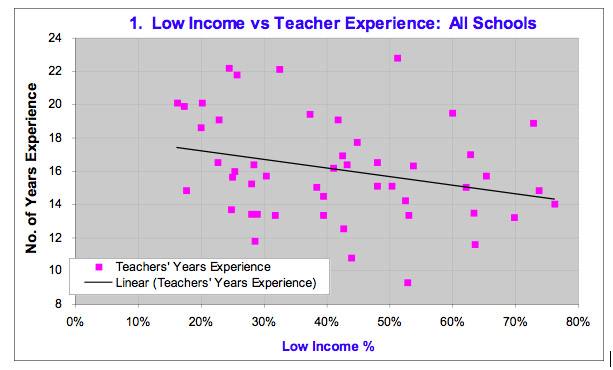
Share

Making One Size Fit All: Rainwater seeks board input as schools cut ability-based classes

Jason Shephard, writing in this week’s Isthmus:

Kerry Berns, a resource teacher for talented and gifted students in Madison schools, is worried about the push to group students of all abilities in the same classrooms.
“I hope we can slow down, make a comprehensive plan, [and] start training all teachers in a systematic way” in the teaching methods known as “differentiation,” Berns told the Madison school board earlier this month. These are critical, she says, if students of mixed abilities are expected to learn in “heterogeneous” classrooms.
“Some teachers come about it very naturally,” Berns noted. “For some teachers, it’s a very long haul.”
Following the backlash over West High School replacing more than a dozen electives with a single core curriculum for tenth grade English, a school board committee has met twice to hear about the district’s efforts to expand heterogeneous classes.
The school board’s role in the matter is unclear, even to its members. Bill Keys told colleagues it’s “wholly inappropriate” for them to be “choosing or investigating curriculum issues.”
Superintendent Art Rainwater told board members that as “more and more” departments make changes to eliminate “dead-end” classes through increased use of heterogeneous classes, his staff needs guidance in form of “a policy decision” from the board. If the board doesn’t change course, such efforts, Rainwater said, will likely be a “major direction” of the district’s future.

Links and articles on Madison West High School’s English 10, one class for all program. Dr. Helen has a related post: ” I’m Not Really Talented and Gifted, I Just Play One for the PC Crowd”

(more…)

Share

Lending a Brain

Inside Higher Ed:

With scientific expertise sweeping the globe, the next generation of American scientists and engineers are going to face unprecedented competition, and college is too late to begin preparing them for it, according to the National Science Board.
The board released its “Science and Engineering Indicators, 2006″[pdf] report Thursday. The report, which focused on elementary and secondary education, cast a foreboding tone. According to the report, while the scores of American students on national math assessments have risen slightly in recent years, the same cannot be said for science. According to the 2003 Trends in International Mathematics Science Study , fourth and eighth graders in the United States performed better in math and science than the international average of industrial nations, but improvement since 1995 was modest for eighth graders, and fourth graders took a slight step backward.
Even a fourth grade student who is getting his or her first exposure to science might already be left in the starting blocks, according to Jo Ann Vasquez, a National Science Board member and the lead author of the report. “[Kids] have to get science by third grade,” she said, “or that wonderment disappears.”

Share

” I’m Not Really Talented and Gifted, I Just Play One for the PC Crowd”

Dr. Helen:

Wouldn’t the proper way to answer the question of why Blacks and Hispanics are lagging behind Whites and Asians be to conduct research on the factors that may be causing the discrepancies and remedy those rather than setting up a phony group of gifted students whose only gift may be that they have a teacher who holds self-esteem and looking diverse in higher regard than children actually learning anything?
With such unscientific inquiry, it is no wonder more and more parents are homeschooling or turning to private schools to educate their children. I foresee that the more schools substitute “diversity” for education, the more parents will take flight from the public schools.

The link includes several interesting comments.

Share

Middle School Design Team: Final Report to the Superintendent

The Madison schools middle school curriculum design team’s final report is now available [1.7MB pdf]. Topics addressed include:

  • Math
  • Music
  • Art
  • World Languages
  • Health/Family and Consumer Education
  • Information and Technology Literacy
  • Student Services

The report closed with a discussion of the Future Areas for Discussion:

The Design Team had a very specific charge. As the team met, it quickly became apparent that additional areas that pertain to middle level education are ripe for discussion. The final recommendation from the team includes a wish to continue this discussion over time. The areas that are of interest include:

  • K-8 model
  • Scheduling around part-time staff. Sharing staff.
  • Distance Learning, i.e. district on-line course offerings
  • Mental health and severe behavioral issues
  • Alternative educational settings
  • Bus safety
  • Regular articulation meetings between middle and high school staff in all content areas
  • Regular articulation meetings between middle and high schools among student
  • services staff to increase communication and develop a set of agreed upon
  • expectations and practices regarding 8th to 9th transition.
  • Advisories
  • Safety issues, i.e. bullying, climate
  • City-wide projects and competitions
  • Revisit the juxtaposition of the MMSD Educational Framework, the Equity Framework, the MMSD Middle School Common Expectations, and the current middle school models used in MMSD.
Share

Secrets of Graduating from College

Jay Matthews:

The first Toolbox provided the most powerful argument by far for getting more high school students into challenging courses, my favorite reporting topic. Using data from a study of 8,700 young Americans, it showed that students whose high schools had given them an intense academic experience — such as a heavy load of English courses or advanced math or Advanced Placement — were more likely to graduate from college. It has been frequently cited by high school principals, college admissions directors and anyone else who cared about giving more choices in life to more students, particularly those from low-income and minority families.
The new Toolbox is 193 pages [pdf] of dense statistics, obscure footnotes and a number of insightful and surprising assessments of the intricacies of getting a college degree in America. It confirms the lessons of the old Toolbox using a study of 8,900 students who were in 12th grade in 1992, 10 years after the first group. But it goes much further, prying open the American higher education system and revealing the choices that are most likely to get the least promising students a bachelor’s degree.

(more…)

Share

Knowledge of Elders Stream Into Area Classrooms

Maria Glod:

“You don’t learn if you don’t listen,” Gundersen said, quieting the pair just a little.
“We have to respect each other,” Erin acknowledged, nodding his head.
Gundersen, a 30-year veteran of the State Department who comes to Birney one afternoon each week to talk with Erin about history or homework or life, is among a growing cadre of older adults and retirees who volunteer regularly in schools across the country, helping children learn to read, practice multiplication tables and learn geography.

Share

UW: Future Artists Showcase

University of Wisconsin:

The arts are not only a means of personal expression. Ideas also regularly travel the compelling highways that the arts of all kinds provide.
Case in point: The ideas embedded in the works that apprentice artists — students — are exploring and articulating in “The Chancellor Presents the Performing Artists of the Future: A World Class Evening of Music, Drama and Dance,” Saturday, Feb. 25, at the Overture Center.

Quite a deal at $15.00.

Share

Strategies to Raise SAT Scores

Ian Shapira:

School officials said they are weighing several options, including encouraging more non-honors or non-AP students to enroll in Algebra II by sophomore year instead of participating in an easier, two-year Algebra I course; financing the PSAT for sophomores and perhaps freshmen; and, on a more basic level, adding more testing sites within the county so that students can take the exam in a comfortable setting without having to commute long distances.

Share

“We Must Show Every Child The Light”

Reaction to Joel Rubin and Nancy Cleeland’s “The Vanishing Class“:

So Much Damage
Perhaps these fiascos could be avoided if public officials first tested proposed policy changes on a small scale (instead of blindly applying them to tens of millions of students with no insight on the potential impact). At this point, so much damage has been done to so many people, I’m uncertain how the situation can be rectified (except perhaps to save future generations of students).
— MARC
Learning … Is Work
Get rid of calculators … [and get rid of the] false belief that learning should be fun! Learning, the repeated cycles of drill and mastery, is WORK!
— KATHRYN
Squeaky Wheel
Parents need to be more involved, and this involvement has to originate from the schools. With the large numbers of students whose parents do not speak English, the schools must do a better job of bringing these parents into the school community and getting them involved in their child’s education. Many a night I sat frustrated and nearly on the verge of tears because I couldn’t help my son. My son was lucky, though, I was the proverbial squeaky wheel that ensured he was not passed over, but most students aren’t that lucky.
— PAUL ROBINSON
Individual Attention
As a member of a school board in Ventura County (not the rich part), I can say that I think there are two reasons that LAUSD is failing its students. First, the system is simply too large. How can a school of 4,000 do everything well? Our kids need individual attention, and I just don’t see how any massive organization like LAUSD can succeed. Second, I believe that because politics are involved in such an intimate way in these large districts, the kids get left in the dust. The unions are fighting for ever more of the financial pie (most districts spend 85% to 90% of their total [budget] on personnel and benefits); the administration is beholden to the myriad rules and regulations coming at them from both the state and federal level; and less and less control is at the local level. The politicians don’t want to pay for raises for employees or lower student-staff ratios, so the existing dollars must be stretched. That means more students per class, more students per counselor, more students per custodian, maintenance person, etc. And we wonder why the kids feel like no one cares about them?
— JOHN G.

These links include many more words and are well worth reading.

Share

Sex and the Single Bee

Via Joanne Jacobs:

If parents really told their kids about the birds and the bees, sex would be less popular, Eugene Volokh writes. “Now, daughter, think of yourself as a bee. There’s a 99.99% chance that you’ll never get any, and instead of…

Share

Advanced Classes Open Doors for Minorities

School district works to boost participation
By Kelly McBride
The path toward post-secondary education formed naturally for 18-year-old Wekeana Lassiter.
Her mom always emphasized the importance of learning. An older sister attends college at the University of Wisconsin-Milwaukee. And Lassiter is a studious Green Bay Preble High School senior with aspirations of becoming an architect.
If college was a given, the Advanced Placement courses that are preparing her for it — as well as allowing her to earn college credit — made just as much sense for Lassiter, who will attend UWM in the fall.
“Originally, why I took AP classes was to get credit,” said Lassiter, who is enrolled in AP physics and AP calculus. “Now that I’m in them, they’re really difficult, (but) it’s awesome. You get kind of a feel about how college classes are going to be.”
But the doors that have opened for Lassiter, who is black, have in many cases stayed closed for some of her peers, say officials in the Green Bay School District.
Minority participation in AP courses continues to lag behind that of their white counterparts, with a lower percentage of minority students, by about 15 percentage points, taking AP courses than that of whites during 2004-05, data show.
But the figures are improving, and district officials say new initiatives can help alter the disparity.

Share

Students Form Video News Team

Marcia Standiford:

A class of sixteen high school juniors and seniors is meeting everyday in the Doyle building to learn video production and journalism skills. This district-wide High School Video News Production class is being offered for the first time thanks to the efforts of Mary Ramberg, Director of Teaching and Learning and Gabrielle Banick, Coordinator of Career and Technical Education and a grant from the Wisconsin Department of Public Instruction.

Cool.

Share

Expecting High Quality Work from Students

Mary Ramberg, MMSD Teaching and Learning:

If nothing is expected of a man, he finds that expectation hard to contradict.

Frederick Douglas

The converse of what Frederick Douglas learned from his life experience has been tested and verified by educational researchers.
Research in Chicago schools looked at what happens when teachers expect more of students. In other words, if teachers expect much of students, are those expectations affirmed? The answer is “YES.”
When students are expected — and supported — to do high quality work and to learn important content, that’s exactly what they do.

Share

“Why We May Have to Move …”

I received a copy of this personal essay — a letter to the Administration and BOE — last night. The author said it was fine for me to post it, if I thought it was worth it. I most definitely think it’s worth it because it so poignantly describes a family’s real life experience and frustration in our schools … not to mention their agony over whether or not to move elsewhere.

Our kids are in 5th, 4th and 1st grades. I am really very concerned about our son going into sixth grade next year. He has some special education needs related to Asperger Syndrome, such as sensory defensiveness and skills to do with what some have called “theory of mind” (self-control, recognizing and assessing others’ points-of-view and feelings, anger management). I love the idea that Spring Harbor is smaller because of his sensitivities to light, personal space issues, noise levels and the like. I do not like that they are relatively inflexible in meeting special needs otherwise because they are small and missing some services – or severely limited – due to space and spending constraints. I also do not like that we would have NO options as to who his special ed case manager/teacher would be, because there is essentially one person to cover it all for each grade, whether or not they display and apply the kind of flexibility that being a “cross-categorical” special ed teacher demands.

(more…)

Share

“Beat the Achievement Gap” Student Conference

The Simpson Street Free Press will be holding a city-wide “Beat the Achievement Gap” conference on Saturday, February 25, at 2:00 p.m. at LaFollette High School, 702 Pflaum Road. At the conference, students will take the following pledge: “I will be an active role model for younger students. I will work to spread a positive message of engagement at my school and in my community. I will encourage academic success among my peers.”
For more information, see “The Gap According to Black: A Feature Column by Cydny Black” and the inspiring two-page spread entitled “Education: Bridging the Achievement Gap” in the January, 2006, issue of The Simpson Street Free Press.
Additional information at www.simpsonstreetfreepress.org

Share

Fragile Futures: Risk and Vulnerability Among Latino High Achievers

Patricia Gándara
Policy Information Center, Educational Testing Service
December 2005
The achievement gap usually refers to the chasm between low- and higher-performing students. But, as this study makes clear, disparities are just as pronounced among separate groups of high-achieving students. For example, in 2002 the top fifth of Latino test-takers scored means of 598 and 646 on the SAT verbal and math sections, respectively. Their white peers’ mean scores were 65 points higher on the verbal section and 74 points higher in math. Yet of the hundreds of studies reviewed for this report, hardly any “acknowledge… that high-achieving students might need support and that this support might differ from what is needed by their lower-achieving peers.” It’s tempting to think that smart youngsters, regardless of socio-economic situations or ethnic backgrounds, will turn out just fine. But as these data show, that’s not always true. Bright Latino students, who often come from low-income families and have parents with little education, are particularly susceptible to becoming frustrated or discouraged with schoolwork and the school environment. These kids require just as much encouragement, support, and instruction as their lower-performing peers, albeit in different ways. They, too, need goals, and information on where academic achievement can lead (college). But too often, they don’t receive it. Even when Latino students earn good grades in high school, register for the SAT (not an insignificant step), and do well on the exam, many still make poor college decisions. We cannot address achievement gaps by continuing to ignore these bright youngsters.

Share

The New Reverse Class Struggle

Jay Matthews:

The idea seems odd to many. But some scholars and administrators say raising class sizes and teacher pay might improve achievement
It was 9:45 a.m. on a Wednesday morning. Jane Reiser’s mathematics class in Room 18 was stuffed with sixth- and seventh-graders. There were 32 of them, way above the national class size average of 25. Every seat was filled — 17 girls, 15 boys, all races, all learning styles. A teacher’s nightmare.
And yet, despite having so many students, Reiser’s class was humming, with everybody paying attention. She held up a few stray socks to introduce a lesson on probabilities with one of those weird questions that interest 11- and 12-year-olds:

Share

High Grades, No Skills

Joanne Jacobs:

Honor students who can’t pass California’s graduation exam should be angry, writes Ken at It Comes in Pints? They should be angry at teachers who gave them A’s they didn’t deserve.

While the hardest questions on the graduation exam require 10th grade English skills and algebra (allegedly an 8th grade skill in California), students with basic skills who guess blindly on the harder multiple-choice questions should be able to get a minimum passing grade in their first, second, third, fourth or fifth try at the test. The minimum passing grade is 60 percent for English and only 55 percent for math.

In Tracy, a girl who claims a 3.6 grade point average says she’s failed the math exam five times because teachers didn’t teach her right. She doesn’t seem to question the validity of her A’s and B’s.

My great potential is being snuffed by this test.

Share

Tutor Program Going Unused

Susan Saulny:

The No Child Left Behind law requires consistently failing schools that serve mostly poor children to offer their students a choice if they want it: a new school or tutoring from private companies or other groups, paid for with federal money — typically more than $1,800 a child in big cities. In the past the schools would have been under no obligation to use that Title I federal poverty grant to pay for outside tutoring.
City and state education officials and tutoring company executives disagree on the reasons for the low participation and cast blame on each other. But they agree that the numbers show that states and school districts have not smoothed out the difficulties that have plagued the tutoring — known as the supplemental educational services program — from its start as a novel experiment in educational entrepreneurship: largely private tutoring paid for with federal money.
Officials give multiple reasons for the problems: that the program is allotted too little federal money, is poorly advertised to parents, has too much complicated paperwork for signing up, and that it has not fully penetrated the most difficult neighborhoods, where there are high concentrations of poor, failing students.

Share

For Fraught Preteen Years, A Class on Being a Friend

Michael Alison Chandler:

She surrenders her room, with its cozy couch, to the ponytailed pre-adolescents, and their dramas unfold: How could you pretend you didn’t see me in the hallway? Or: Why did you invite Celia to your slumber party and not me? There’s the inevitable “That hurt my feelings” and the occasional “I’m sorry.” On a good day, they leave the room Best Friends Forever. Again.
Many of the girls are graduates of “Chicks and Cliques,” a course Dunne designed to curb the gossiping, rumor-spreading and snubbing that’s endemic to girls. She helps them figure out how to talk through their problems, then she lets them borrow her office to use their new skills.

Share

Charge to the equity task force

Jason Shepard reports in this week’s Isthmus that the newly appointed task force on equity will look at “Differences in curriculum opportunities, extracurricular programs and access to meaningful information about a school’s performance . . .”
However, I can’t find a charge to the task force. Can someone post it or provide a link?

Share