School Information System

Better Education Through Innovation
Today, the shame of our cities isn’t bubonic plague; it’s ignorance

Cory Booker, John Doerr and Ted Mitchell:

In the summer of 1918, as tuberculosis, bubonic plague and a flu pandemic threatened America’s newly crowded cities, the chemist Charles Holmes Herty took a walk through New York City with his colleague J.R. Bailey. Herty posed a question: Suppose Bailey discovered an exceptionally powerful medicine. What institution would allow him to take his breakthrough from lab experiment to widespread cure?
Bailey replied, “I don’t know.”
That alarming answer moved Herty to propose a visionary solution — an institution that would encourage research and development throughout the country. It would find its value, Herty said, “in the stimulus which it gives” to research, thought and discovery by practitioners in the field.
Nearly a century later, that vision stands as the National Institutes of Health. Its record, from deciphering and mapping the human genome to finding the source of AIDS, leaves no doubt about the NIH’s ability to stimulate innovation.
Today, the shame of our cities isn’t bubonic plague; it’s ignorance. In our urban areas, only one child in five is proficient in reading. On international tests, we rank behind the Czech Republic and Latvia; our high school graduation rate barely makes the top 20 worldwide. As columnist David Brooks has noted, educational progress has been so slow that “America’s lead over its economic rivals has been entirely forfeited.” Under-education may not end lives the way infectious diseases do, but it just as surely wastes them. For all the hard work of our good teachers, our system is failing to keep pace with the demands of a new century.
Share

Safety Climate: A look at Police Calls to Madison High Schools

Doug Erickson:

Total police calls to Madison’s four main high schools declined 38 percent from the fall semester of 2006 to last spring. But those figures tell only a partial story, and not a very meaningful one.
That’s because the numbers include all police calls, including ones for 911 disconnects, parking lot crashes and stranded baby ducks. (It happened at La Follette last May.)
The State Journal then looked at police calls in eight categories closely related to safety — aggravated batteries, batteries, weapons offenses, fights, bomb threats, disturbances, robberies and sexual assaults. Those calls are down 46 percent from fall 2006 to spring 2008.
The schools varied little last spring in the eight categories. Memorial and West each had 13 such calls, La Follette 14 and East 16.
School officials are relieved by the downward trend but careful not to read too much into the figures.
“We know there’s almost a cyclical nature to crime statistics and even to individual behavior,” said Luis Yudice, who is beginning his third year as district security coordinator.
Art Camosy, a veteran science teacher at Memorial, said he thinks the climate is improving at his school. Yet he views the police figures skeptically, in part because the numbers are “blips in time” but also because he wonders if the district’s central office is behind the drop.
“Are our building administrators being pressured not to call police as often?” he asks.
John Matthews, the longtime executive director of Madison Teachers Inc. (MTI), the district’s teachers union, contends that the district’s leadership has indeed done this from time to time, directing building administrators to hold off on calling police so often.
Yudice, a former Madison police captain, said there was a time years ago when the district was extremely sensitive about appearing to have a large police presence at its schools. He rejects that notion now.
“It’s just the opposite,” he said. “We are more openly acknowledging that we have issues that need to be dealt with by the police. Since I’ve been working here, there has never been a directive to me or the school principals to minimize the involvement of police.”

All four Madison high schools feature an open campus. It appears that Erickson only reviewed calls to the High Schools, not those nearby. 1996-2006 police calls near Madison High Schools is worth a look along with the Gangs & School violence forum.
Finally, I hope that the Madison Police Department will begin publishing all police calls online, daily, so that the public can review and evaluate the information.

Share

A time for heat – and light – on Milwaukee schools

Milwaukee Journal-Sentinel Editorial:

Mayor Tom Barrett and the Milwaukee School Board agree on this much: The community needs an accurate reading on the district’s finances.
Unfortunately, that may be the only thing they agree on.
Both are moving separately on plans to get the numbers. The School Board wants to spend $50,000 of taxpayers’ money to perform an audit to see where the Milwaukee Public Schools can be more efficient. Barrett is seeking funding from local foundations for an assessment of the struggling district’s financial and operational situation — a study that also could take the next step and recommend restructuring and how to best direct resources to the classroom where they can most help educate Milwaukee’s kids.
On paper, we believe Barrett’s plan goes beyond that of the School Board, because it will home in on a half-dozen or so top priorities that, when funded adequately, will improve MPS performance and increase the district’s credibility among parents, taxpayers and decision-makers in Madison.
For Barrett’s plan to have bite, he needs the support of foundations to retain a firm expert in urban school system finance and operations. Then the mayor needs to pressure the board and administration to get to work.

Share

Another Milwaukee view: Voucher schools are part of the problem

Barbara Miner:

You want truly radical education reform in Milwaukee?
Form a countywide system so that Milwaukee children can, without restrictions, attend schools in Whitefish Bay and Greendale. Or launch a regional onslaught against the economic, housing and transportation disparities that, in the absence of locally owned breweries, now make Milwaukee famous.
Unfortunately, it’s not likely to happen. If you even mention the region’s divides, you are labeled as anti-suburban.
Luckily, the U.S. Census Bureau isn’t afraid of Milwaukee’s culture of silence about such realities. Once again (I’ve lost count of the many similar reports) Milwaukee made the news last week, for having the seventh-worst poverty rate of any major city. Waukesha County, in contrast, had the fifth-lowest poverty rate of any major county.

Share

A Watershed Teacher Labor Negotiation in Washington, DC

Steven Pearlstein:

As we head into the Labor Day weekend, it is only fitting that we consider what may be the country’s most significant contract negotiation, which happens to be going on right here in Washington between the teachers union and the District’s dynamic and determined new schools chancellor, Michelle Rhee.
Negotiations are stalled over Rhee’s proposal to give teachers the option of earning up to $131,000 during the 10-month school year in exchange for giving up absolute job security and a personnel-and-pay system based almost exclusively on years served.
If Rhee succeeds in ending tenure and seniority as we know them while introducing merit pay into one of the country’s most expensive and underperforming school systems, it would be a watershed event in U.S. labor history, on a par with President Ronald Reagan’s firing of striking air traffic controllers in 1981. It would trigger a national debate on why public employees continue to enjoy what amounts to ironclad job security without accountability while the taxpayers who fund their salaries have long since been forced to accept the realities of a performance-based global economy.
Union leaders from around the country, concerned about the attention the Rhee proposal has received and the precedent it could set, have been pressing the Washington local to resist. But Rhee clearly has the upper hand. The chancellor has the solid support of the mayor and city council, and should it come to a showdown, there is little doubt that the voters would stand behind her in a battle with a union already badly tarnished by an embezzlement scandal and deeply implicated in the school system’s chronic failure.

There are signs that things may be a bit different in Madison today, compared to past practices.

Share

School District Consolidation feasibility study grants

Wisconsin Department of Public Instruction:

The Department of Public Instruction has awarded consolidation feasibility study grants for six consortiums (a total of 14 school districts). The grants, $10,000 to each consortium, are intended to provide funding for the identification of issues, data analysis, and the development of reports to inform the communities on the possibility of consolidation.
The grants went to consortiums consisting of: Chetek and Weyerhaeuser, Glidden and Park Falls, Bruce and Ladysmith-Hawkins; Benton, Cuba City, Southwestern, and Shullsburg; Montello and Westfield; and Prairie Du Chien and Wauzeka-Steuben.

Share

Madison School District Goes to Court Over Athletic Directors

Andy Hall:

On June 19, Rainwater told the Wisconsin State Journal that the district wouldn’t appeal Flaten’s decision, saying, “The standard to overturn an arbitrator’s ruling is just really, really high.”
“It is,” Bob Nadler, the district’s executive director of human resources, agreed in an interview Friday.
The district, Nadler said, filed the suit because Friday was the deadline for filing a challenge to Flaten’s decision, and the district needed to preserve that option in case ongoing talks break down.
The district and union will continue to negotiate, outside of court and the WERC, to seek a settlement, Nadler said. The next session is Tuesday.
Nadler said the suit shouldn’t be viewed as a signal that Daniel Nerad, who succeeded Rainwater as superintendent on July 1, is taking a harder line with the union.
“I think this is just a very specific case that we feel we may have to challenge in the future,” Nadler said.
But John Matthews, executive director of the teachers union, called the filing of the suit “a stupid waste of money because there’s absolutely no way that they can succeed.

Certainly a change from past practices.

Share

The “War of Milwaukee Public Schools”

Bruce Murphy:

ast week all hell broke loose regarding the fate of Milwaukee Public Schools. Mayor Tom Barrett proposed an outside audit of the system. As a candidate for mayor, Barrett floated the idea of a mayoral takeover of the schools, so this looks like a first step toward establishing control – and a clear message the MPS ship is sinking.
Meanwhile, a new group called Milwaukee Quality Education was formed, led by Metropolitan Milwaukee Association of Commerce President Tim Sheehy and former MPS Superintendent Howard Fuller. Reforms tried in other cities were supposed to be discussed, with the obvious aim of dramatically changing MPS. “We have urgency coming out of our ears,” Sheehy declared.
Add to this the Milwaukee Journal Sentinel’s three-part series suggesting MPS wasted most of a $100 million effort to cut back busing, and the takeaway message is that a dysfunctional school system needs rescue.
Meanwhile, the Greater Milwaukee Committee has been engaged in an ongoing effort to improve MPS, creating a plan of “corrective action.” One insider tells me Sister Joel Read, former Alverno College president, was very influential in formulating the plan.

Share

Madison Police Chief Noble Wray Sees “Serious Gang Connection” in Crime Hike

Kristin Czubkowski:

Making connections among various types of crimes and ways to remedy them was the theme of the night as Police Chief Noble Wray gave a talk on public safety in Madison to the City Council Wednesday night.
Statistically, crime in Madison was a mixed bag in 2007, Wray said. While overall crime was up 5.5 percent from 2006, according to the FBI’s Uniform Crime Reports, that increase stemmed primarily from an 8.3 percent increase in property crimes such as burglary, theft and arson. By contrast, violent crime, which includes acts such as homicide, rape and aggravated assault, decreased 14.2 percent in 2007.
Wray explained that the rising rates of property crimes came from the increased theft of precious metals, in particular copper, as well as thefts of big-ticket items such as televisions from businesses, which were directly related to gang activity and the drug trade, he said.
“This is the first time that I’ve noticed this, and I’ve worked for the Madison department for 24 years, that there is a serious gang connection with these (burglaries),” he said. “We haven’t had that in the past.”

Related:

Share

New Orleans superintendent Paul Vallas occupies spotlight

Greg Toppo:

In a makeshift waiting room of the warehouse that serves as the headquarters for public schools, three young prospective teachers sit.
As superintendent, Paul Vallas could someday be their boss. As he passes through the room, he stops to shake hands. Then he tries to persuade them to teach someplace else.
He has more than enough teachers for the new school year, which began last week, he explains. Have they considered Baton Rouge?
“I know Baton Rouge doesn’t have the French Quarter,” he says. “That’s OK. It’s OK to be far from the French Quarter — keep you out of trouble.”
As Vallas begins his second and probably final year trying to rebuild the ailing public school system, he not only has more teachers than he needs. He has eye-popping funding, nearly unchecked administrative power and “a sea of goodwill” that stretches across the USA.
The biggest question isn’t whether he’ll be able to turn around the system, at least in the short term. It’s whether there’s anything standing in his way.
If Vallas succeeds, observers say, he’ll show that with a clean slate, extra cash and a few big ideas, a hard-charging reformer can fix an ailing system and create a template for other districts. If he doesn’t succeed, they worry, Americans’ faith in urban public schools could burn out for good.

Share

Referendum Climate: “State Budget Keeps Getting Worse”

Wisconsin State Journal Editorial:

The house of cards known as the state budget is predictably collapsing.
A Dane County judge heard arguments this week on the legality of a $200 million raid state leaders made on a special fund that’s supposed to cover large medical malpractice awards.
Doctors pay into the fund to hold down their insurance rates. So the Wisconsin Medical Society, which represents about 60 percent of doctors, sued the state last year after the governor and Legislature raiding the fund to patch a state budget hole.
The state raid was just the latest in a series of poor financial moves that voters should remember when voting for legislative candidates this fall.
Voters should favor those candidates willing to scrutinize spending and resist expensive new programs. The accounting tricks and money raids need to stop. And the longer Wisconsin waits to get its financial house in order, the harder and more painful it will be to fix.

Share

Alexandria’s New Superintendent Urges Educators to Stop, Reflect, Act

Theresa Vargas:

“Part of what we’re going to be doing is writing the next chapter of the story of this school district,” Sherman, the school system’s new superintendent, said he told them.
Educators often spend their days running from decision to decision. Sherman said he thinks it is important for them to sometimes stop, find a quiet moment and reflect on what they are trying to achieve for the students.
Sherman, 58, is the Washington region’s newest superintendent, on contract for $250,000 a year through June 2012. A former superintendent in Tenafly, N.J., he replaces Rebecca L. Perry in heading the 10,600-student system.
Sherman said his first task involves being a “good anthropologist.”

Share

‘New’ Voice Speaks About Teachers at Convention

Michele McNeil:

The teachers’ unions weren’t the only voices representing teachers on the first night of the Democratic National Convention.
Enter Jon Schnur.
The CEO of the reform group New Leaders for New Schools, also an adviser to Barack Obama’s campaign, got a prime seat on the stage of the Democratic National Convention Monday night during the first of three American town halls.
The 15-minute town hall meeting managed to cram in issues including health care, tax reform, and education

Share

Radical idea: Open the doors of affluent suburban schools to Chicago students

Richard Kahlenberg via a kind reader’s email:

Sen. James Meeks’ (D-Chicago) proposed student boycott of Chicago public schools next month has sparked furious controversy. Should students miss their first day of class for the worthy goal of promoting equity in public school spending? Leaders such as Mayor Richard Daley and Chicago Public Schools Chief Arne Duncan are worried about the disruption involved as Meeks seeks to enroll Chicago students at New Trier High School in Winnetka.
Missing from the discussion is a bigger point: The main reason New Trier’s students achieve and graduate at much higher levels isn’t per-pupil expenditure; it’s differences in the socioeconomic status of the student bodies in Chicago and New Trier.
Decades of research have found that the biggest determinant of academic achievement is the socioeconomic status of the family a child comes from and the second biggest determinant is the socioeconomic status of the school she attends. The main problem with Chicago schools isn’t that too little is spent on students but that the school district has overwhelming concentrations of poverty.
In the 2005-06 school year, Chicago public schools spent $10,409 per pupil, much less than New Trier ($16,856), but slightly more than several high-performing suburban school districts, including ones in Naperville ($9,881) and Geneva ($9,807). The key difference is that while 84.9 percent of Chicago students come from low-income homes, New Trier has a low-income population of 1.9 percent, Naperville has 5 percent and Geneva 2.4percent.

Share

November 2008 Referendum Chatter

Mitch Henck discusses Monday evening’s Madison School Board 7-0 vote to proceed with a recurring referendum this November. 19 minutes into this 15mb mp3. Topics include: property taxes, uncontested elections, health care costs, concessions before negotiations and local control. Via a kind reader’s email.

Share

When Education is Unequal

Cheryl Jackson via a kind reader’s email:

his week, in a lawsuit brought against the State of Illinois and the State Board of Education, the Chicago Urban League and Quad County Urban League called on the courts to end the discriminatory and unconstitutional way public school education is funded in Illinois. This is not just an educational issue, but a civil rights issue, too, for thousands of African-American and Latino students whose social and economic future is being shortchanged by a flawed state policy.
After more than a decade of legislative gridlock on education funding reform, set against a bleak backdrop of crumbling schoolhouses, moldy books and shamefully low graduation rates–the time has come to dismantle the current property-based system of school financing.
That system is discriminatory in its impact, sustaining huge funding gaps between black and white schools.
It makes quality education nearly impossible for thousands of students of color. It confounds the best efforts of well-meaning parents, teachers and administrators. And it puts children on a pathway to lifelong poverty and social pathologies that squander their potential and exact enormous social costs.

Share

Future of education is online, Web-school pioneer says

The Arizona Republic:

Damian Creamer, founder of Primavera Online High School, was the guest last week on Live Talk Wednesday, talking about secondary education via the computer.
Creamer formerly was an enrollment counselor at the University of Phoenix.
“Their (online) program was in its infancy and it was a unique opportunity to be involved with such a dynamic organization as they pioneered online education at the post-secondary level,” he said.
Afterward, he helped a small charter school in the West Valley found two additional charter schools.
Creamer opened Primavera Technical Learning Center (the predecessor to Primavera Online High School) in 2001.
” In its first year, Primavera had a few hundred students. Last year, I believe that we carried an average daily membership of 2,700 students,” Creamer said.
Last year, Primavera graduated 469 students, according to Creamer.
Info: www.primaveratech.org.

Share

In Support of the November, 2008 Madison School District Referendum

Community and Schools Together:

We have a referendum!
Community and Schools Together (CAST) has been working to educate the public on the need to change the state finance system and support referendums that preserve and expand the good our schools do. We are eager to continue this work and help pass the referendum the Madison Metropolitan School District Board of Education approved on Monday, August 25, 2008.
“The support and interest from everyone has been great,” said Franklin and Wright parent and CAST member Thomas J. Mertz. “We’ve got a strong organization, lots of enthusiasm, and we’re ready to do everything we can to pass this referendum and move our schools beyond the painful annual cuts. Our community values education. It’s a good referendum and we are confident the community will support it.”
Community and Schools Together (CAST) strongly supports the Madison Metropolitan School District Board of Education’s decision to place a three-year recurring referendum on the November 4, 2008 ballot. This is the best way for the district to address the legislated structural deficit we will face over the next few years.

Much more on the November, 2008 Referendum here.

(more…)

Share

Madison School Board OKs Nov. referendum

Tamira Madsen:

Members of the Madison School Board will ask city taxpayers to help finance the Madison Metropolitan School District budget, voting Monday night to move forward with a school referendum.
The referendum will be on the ballot on Election Day, Nov. 4.
Superintendent Dan Nerad outlined a recommendation last week for the board to approve a recurring referendum asking to exceed revenue limits by $5 million during the 2009-10 school year, $4 million for 2010-11 and $4 million for 2011-12. With a recurring referendum, the authority afforded by the community continues permanently, as opposed to other referendums that conclude after a period of time.
Accounting initiatives that would soften the impact on taxpayers were also approved Monday.
One part of the initiative would return $2 million to taxpayers from the Community Services Fund, which is used for afterschool programs. The second part of the initiative would spread the costs of facility maintenance projects over a longer period.

Andy Hall:


Madison School District voters on Nov. 4 will be asked to approve permanent tax increases in the district to head off projected multimillion-dollar budget shortfalls.
In a pair of 7-0 votes, the Madison School Board on Monday night approved a proposal from Superintendent Daniel Nerad to hold a referendum and to adopt a series of accounting measures to reduce their effect on taxpayers.
Nerad said the district would work “day and night” to meet with residents and make information available about the need for the additional money to avert what school officials say would be devastating cuts in programs and services beginning in 2009-10, when the projected budget shortfall is $8.1 million.

WKOW-TV:

“I understand this goes to the community to see if this is something they support. We’re going to do our best to provide good information,” said Nerad.
Some citizens who spoke at Monday’s meeting echoed the sentiments of board members and school officials.
“Our schools are already underfunded,” said one man.
However, others spoke against the plan. “This is virtually a blank check from taxpayers.

Channel3000:

Superintendent Dan Nerad had to act quickly to put the plan together, facing the $8 million shortfall in his first few days on the job.
“I will never hesitate to look for where we can become more efficient and where we can make reductions,” said Nerad. “But I think we can say $8 million in program cuts, if it were only done that way, would have a significant impact on our kids.”
The plan was highly praised by most board members, but not by everyone who attended the meeting.
“This virtually gives the board a blank check from all of Madison’s taxpayers’ checkbooks,” said Madison resident David Glomp. “It may very well allow the school board members to never have to do the heavy lifting of developing a real long-term cost saving.”

NBC 15:

“We need to respect the views of those who disagree with us and that doesn’t mean they’re anti-school or anti-kids,” says board member Ed Hughes.
Board members stressed, the additional money would not be used to create new programs, like 4-year-old kindergarten.
“What’s a miracle is that our schools are continuing to function and I think that’s the conversation happening around Wisconsin, now, says board vice president Lucy Mathiak. “How much longer can we do this?”
The referendum question will appear on the November 4th general election ballot.
The board will discuss its educational campaign at its September 8th meeting.

Much more on the planned November, 2008 referendum here.
TJ Mertz on the “blank check“.

Share

DC Teachers Torn as Rhee Tries to Allay Fears About Pay Plan

Bill Turque:

The morning began with the buoyant spirit of a pep rally — all cheers, prizes and inspirational words from Mayor Adrian M. Fenty and other officials to launch the District’s teachers into the fall term that starts Monday.
Before it ended, however, the “welcome back” assembly at the Walter E. Washington Convention Center yesterday took a more anxious turn. Schools Chancellor Michelle A. Rhee and Washington Teachers’ Union President George Parker each seized the opportunity to speak to the audience of 4,000 teachers about Rhee’s pay package proposal, which has roiled and divided them.
Rhee was there to win hearts and minds. Parker was there to count them.
Rhee is offering teachers a “green tier” plan that would boost many of them over the $100,000 mark in salary and performance bonuses. In exchange, they must surrender tenure protections for a year and risk dismissal by going on probation. Teachers who want to retain tenure can opt for the “red tier,” which would offer lower, but still significant, raises and bonuses.

Share

Give students the choice to attend charter schools where kids perform well

Collin Hitt via a kind reader’s email:

In protest of Chicago’s failing school system, Sen. James Meeks (D-Chicago) is staging a field trip of sorts. He’s urging kids from his legislative district to skip the first day of school, board buses, travel to Winnetka, and attempt to enroll in New Trier High School.
One can understand why Meeks would want better educational options for Chicago kids. But on his way to Winnetka, the senator might want to take a look out the window where there are already many Chicago public schools–charter schools–that are performing on par with top-notch suburban and downstate schools. One such school, Chicago International Charter School, graduates its students 86 percent of the time–comparing quite favorably with public schools Downstate and suburban Chicago, which have an average graduation rate of 84 percent. Overall, charter public schools in Chicago graduate 77 percent of their students, compared with a citywide average of 51 percent.
Why aren’t there more charter schools in Chicago? Because state law caps the number of charters in the city at 30. Today, approximately 13,000 Chicago public school children are on a waiting list to get into charters–schools that have offered a proven formula for success. To give inner-city kids the opportunities they deserve, the charter-school cap should be lifted.

Share

Madison’s City Budget & Education

TJ Mertz:

I’ve been so tied up with life and the referendum stuff that I haven’t been much paying attention to the city budget process. A story in today’s Wisconsin State Journal got my attention, this graphic in particular. Two items on the possible cut list will directly impact the school district budget and at least three more will make things harder for our schools to do their job.
These possible cuts have been identified early in the budget process. Mayor Cieslewicz asked all departments to list what they would propose in the way of a 5% budget cut. If things go as the Mayor envisions, about 37% of these cuts will need to be enacted. Nothing is set in stone at this point. The Mayor will propose his budget in October and the Common Council will act in November.

Share

Referendum Climate: Charts – Enrollment; Local, State, Federal and Global Education Spending

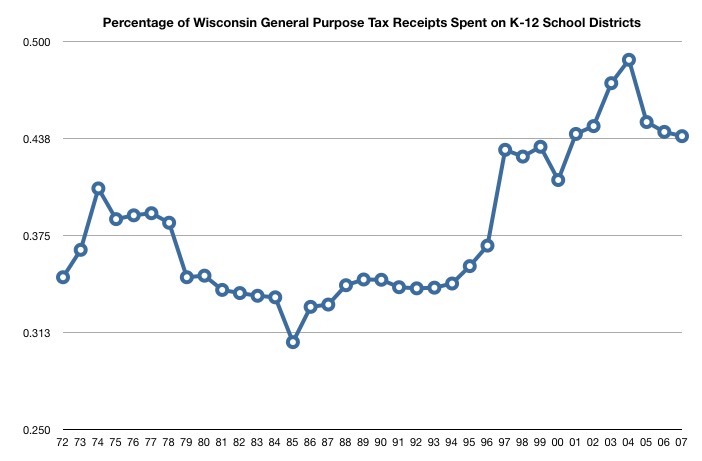
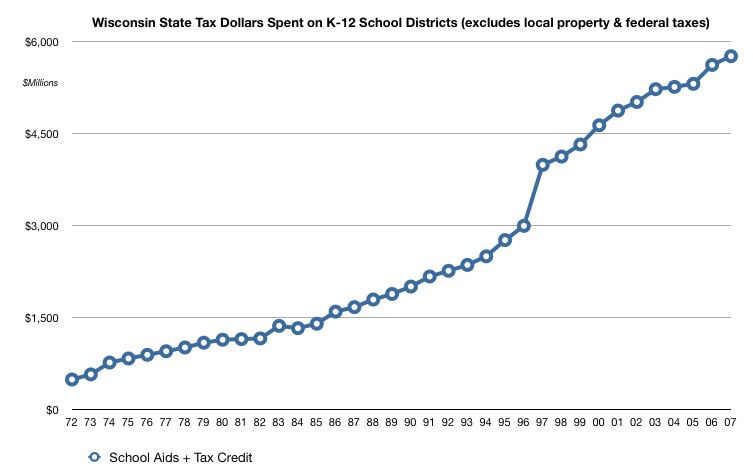
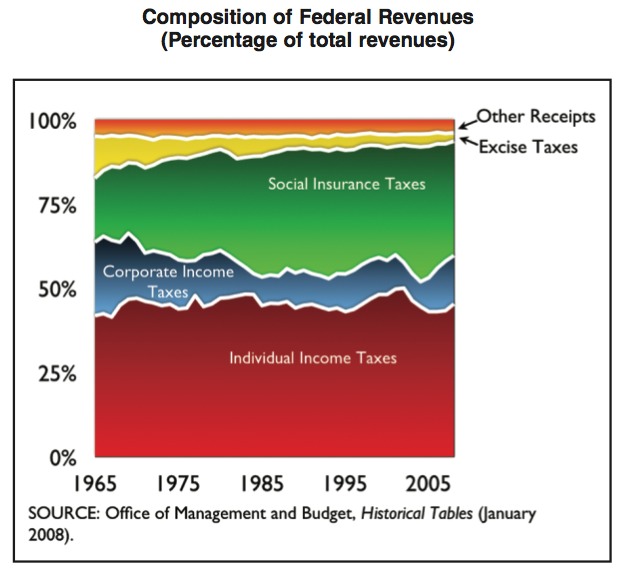
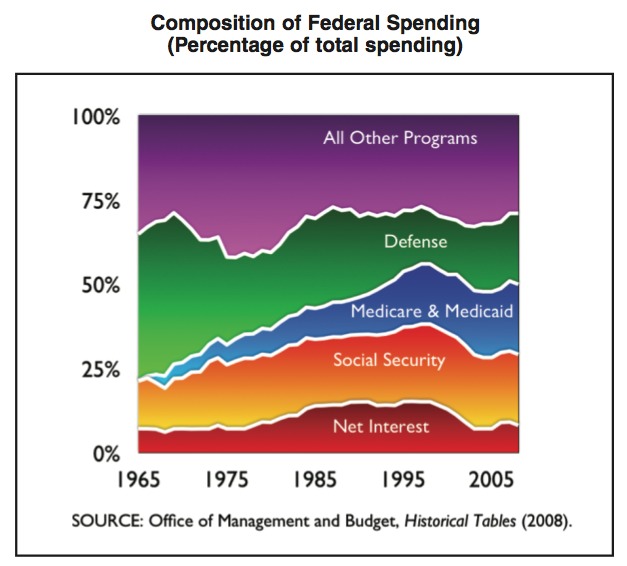
Variations of this question are often asked: “Are we spending too much, too little or just the right amount on education?” I thought it might be useful to have a look at some local, state, federal and global information. Click to view the charts in detail:

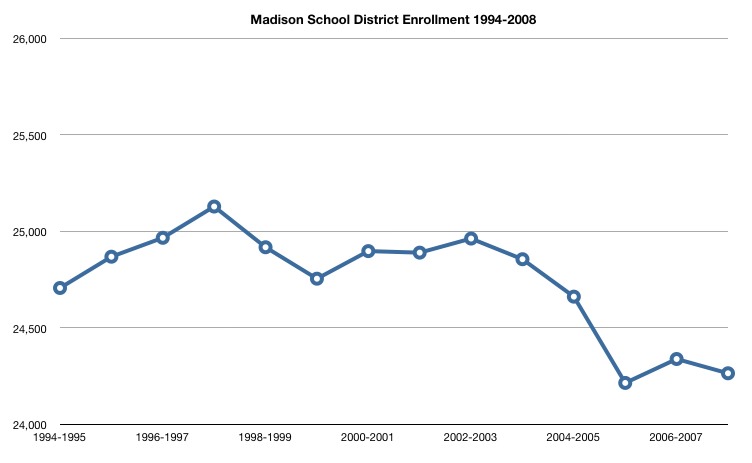
Madison School District Enrollment: 1994-2007 (the demographics have changed during this time)

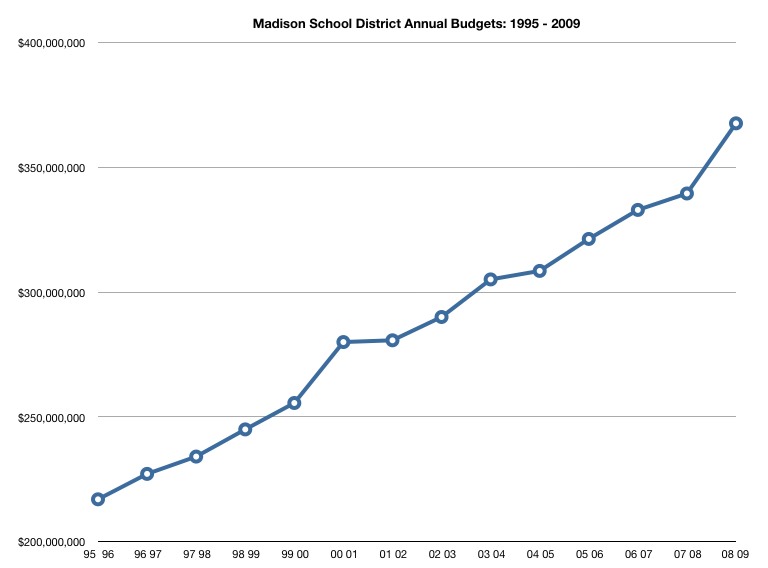
Madison School District Budgets: 1995-2009

Percentage of Wisconsin General Purpose State Tax Revenue Spent on K-12 School Districts: 1972-2007

Wisconsin State Tax Dollars Spent on K-12 School Districts: 1972-2007

US Government Tax Revenue, by Source: 1965-2005

Composition of US Government Spending: 1965-2005

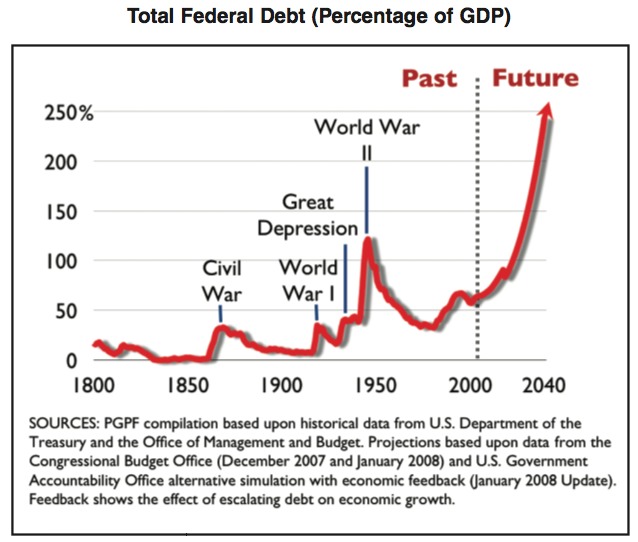
Total US Governement Debt, as a percentage of GDP

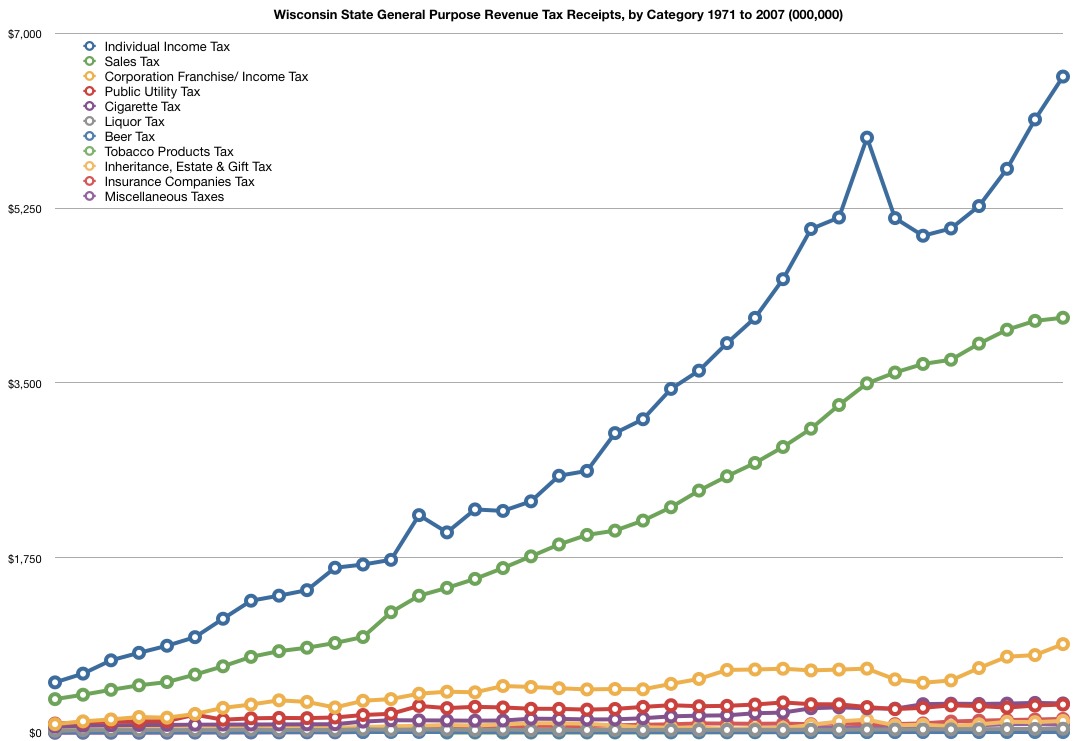
Wisconsin General Purpose Revenue Tax Receipts by Category: 1971-2007

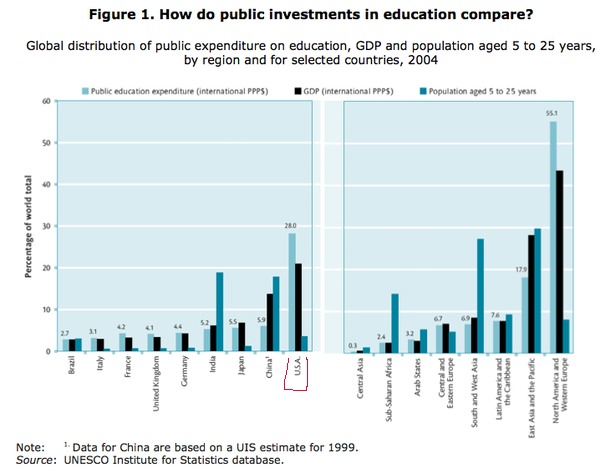
Global Distribution of public expenditure on Education: ages 5 to 25

Data via the Madison School District (various budget documents and statistics), The Wisconsin Taxpayers Alliance, I.O.U.S.A: One Nation, Under Stress, in Debt and the UNESCO Institute for Statistics Database.
US Bureau of Labor Statistics: Consumer Price Index. $1000 in 1995 requires $1443.33 according to their inflation calculator, while $1000 in 1972 requires $5,262.30 in 2008.
November Madison School District Planned November, 2008 Referendum notes & links. Tax climate notes & links: When is a Tax Cut Really a Tax Hike by Gene Epstein, 20 Reasons to Kill Corporate Taxes by James Pethokoukis, I.O.U.S.A the Movie, the Economist: Inflation’s Last Hurrah and Dave Blaska on the proposed referendum.

Share

Another view: MPS analysis must address all the issues

Karen Royster:

Milwaukee’s children are the city’s future, and their education is a profound concern to all of us. Milwaukee Public Schools is responsible for ensuring students have the knowledge and skills to be capable workers and good citizens.
Like other urban school districts in the country, MPS struggles against mighty odds to fulfill this mission. There are major successes and many problems. Trying to overcome these problems is crucial, and there is room for all sectors of the city and region to share in the work.
A new initiative to audit or otherwise examine MPS could be very helpful if the analysis addresses all the fundamental issues at play, including the following:
• The households MPS students come from are in increasing economic distress, and almost one in five students come to the classroom with special needs — emotional, physical and cognitive — that require additional personnel and resources.

Karen Royster is executive director of the Institute for Wisconsin’s Future; Jack Norman is the institute’s research director. The institute is funded by national foundations and does not receive money from state or local teachers unions.

Share

For many Milwaukee parents, the nearby school never entered their reckoning

Alan Borsuk:

Auer Avenue Elementary School was “the poster child,” as one school official put it, for why Milwaukee Public Schools needed a Neighborhood Schools Initiative.
The reason was obvious: In the fall of 1999, kids from the attendance area for the school at N. 24th St. and W. Auer Ave. were enrolled in more than 90 schools all over Milwaukee, many of them no better than Auer Avenue.
So MPS spent $2 million to improve facilities for the school’s students, added sixth-, seventh- and eight-grade classes and added before- and after-school services, all to encourage neighborhood enrollment.
The result? Today, students in the area attend more than 90 schools elsewhere in Milwaukee. The percentage of students in Auer Avenue who are from the neighborhood has actually gone down, as has total enrollment in the school.
Those facts tells you an awful lot about how little impact the $102 million neighborhood school plan has had.

Share

Student Control

Thomas Crocker:

In a world of increased occasions for forms of social control, the university is extending its reach. In an AP story today we learn that universities are broadening the scope of their campus behavior codes to apply to student conduct off campus, in an effort to cultivate humanity, to borrow from Martha Nussbaum. One purpose is to make students better citizens within the community. From the article:

We have a responsibility to educate our students about being responsible citizens,” said Elizabeth A. Higgins, Washington’s director of community standards and student conduct, whose office has ‘educated’ 19 students since the extended code of conduct took effect in January.
The scope of these codes can be quite broad, as the article reports that the University of Colorado code “regulates any conduct that ”affects the health, safety or security of any member of the university community or the mission of the university.” The article further reports that Seattle University “has put its students on notice that cyber-patrolling will continue this year.”

Tangentially, this is one of the issues worth looking into around local high schools: given the open campus, how much undesirable activity occurs near those facilities, and who has jurisdiction? This data: Madison police calls near local high schools: 1996-2006.

Share

Schools As Social Service Centers?

Greg Forster:

Believe it or not, that more or less sums up the big new marketing campaign the teachers’ unions are using to try to lure you into giving them more money. It’s actually called “Broader, Bolder.” If you’ve ever seen a title that sounded more like a gimmick to sucker people out of their money, you’ve seen more marketing gimmicks than I have.
The argument runs like this: kids do better in school when they’re well fed, healthy, and so forth. Therefore schools should be transformed into social-service centers that will not only teach students, but also provide health care and lots of other services. Schools would be open all day and provide a wide variety of community programs.
This will, of course, cost a ton of money and entail a huge expansion of the government educational bureaucracy. Which has nothing to do with why the unions want it.

Share

Madison’s superintendent seeking balance, gaining fans

Andy Hall:

One of the biggest differences between Nerad and Rainwater, according to School Board members, is that Nerad provides the board with more information about what’s happening in the district. Silveira said Nerad’s weekly memos help board members feel engaged, and she’s hopeful that after the current financial questions are settled, the board can turn its focus to improving student achievement.
Mathiak said she was thrilled last week after hearing Nerad’s plan. “I think there is a honeymoon period and I think we’re still in it.”
Winston said after watching Nerad at work, “I’m convinced we made the right choice. I think he’s here for the long haul, too.”

Notes and links on Dan Nerad, the planned November, 2008 referendum and Active Citizens for Education Memo: Taxpayers should NOT be asked to give the Madison School Board a blank check!.

Share

Taxpayers should NOT be asked to give the Madison School Board a blank check!

Active Citizens for Education (ACE) calls for the Madison Metropolitan School District Board of Education to delay making specific decisions for the presentation of a recurring referendum to the taxpayers for a vote on the November election ballot.
Passage of a recurring referendum on the November 2008 ballot would allow the board and school administration to permanently exceed the state mandated revenue spending caps. Such a move to fix a so-called current “budget gap” would allow the board and administration to exceed annual spending caps permanently, every year into the future. This would virtually give the board a “blank check” from district taxpayers to plug future budget gaps or shortfalls. It could prevent the board and administration from having to carefully and thoughtfully budget, like every taxpayer must do when their household budget faces tough economic times and shortfalls.
The plans and communications presented in recent weeks by the board and administration provide greater hope for more effective decision-making now and in the future. The recommendations for changes in policy and accountability options in community services, transportation, lease contracts, fund balances and capital expansion (maintenance) will have positive impacts on reducing the so-called “budget gap.”
The Board must earn the trust of the taxpayers by clearly showing that they can be “good stewards” of taxpayer dollars. Past experience has not earned that trust! If a referendum is ultimately required to fix upcoming budgets, it should be a non-recurring referendum, thereby preventing ‘mortgaging’ the future with year-after-year, permanent increases in spending authority.
The Board and administration must correct the absence of specific processes and strategies for analysis and evaluation of business and educational services, programs, practices and policies. Urgent and substantial investments of time and work are critical for these processes to evolve into hard evidence. This evidence is absolutely necessary to show the public that serious steps are under way to provide clear, concrete data and options for identifying the most effective and efficient results-oriented management of the financial resources of the district. It must be shown that the resources will be directly applied to improvements in student learning and achievement.

(more…)

Share

A Promise of Pre-K for All Is Still Far Off in New York

Winnie Hu:

More than 10 years after New York’s political and education leaders promised to work toward providing access to pre-kindergarten classes to every 4-year-old across the state, more than a third of the 677 local school districts have no such programs. Last year, fewer than 91,000 children attended state-financed pre-kindergarten classes — 38 percent of the state’s 4-year-olds.
The early promise of universal pre-kindergarten programs was undermined by state budget problems, especially after 9/11, and local districts were never required to offer them. But even as funding dedicated to pre-kindergarten has more than doubled over the last three years, hundreds of mainly suburban and rural districts have rejected the state money, with many saying they would have to cut other things or raise taxes to establish the programs.
Last year, local districts passed up $67.5 million of the $438 million the state set aside for pre-K.
“Universal pre-K is an idea that looks good on paper, but it doesn’t work for a district of this size,” said Superintendent Edward Ehmann of the Smithtown school district on Long Island, which turned down $459,000 in state aid because, he said, it would cover only a quarter of the cost of providing pre-kindergarten to 750 children.

Share

Five school districts consider lawsuit in investment downturn

Amy Hetzner:

Five Wisconsin school districts could face combined losses of tens of millions of dollars in a complex investment scheme to help fund employee retirement benefits, according to investigators hired by the districts.
The value of district investments has declined by $120 million – or 60% – since the transactions were undertaken within the last two years, according to a news release from a public relations firm for the attorneys who examined the deals.
School district officials released statements accompanying the news release Wednesday, saying they were misled by a financial adviser, and that the investments were much riskier than they had been told.

Share

Connecticut Faces a School Tax Revolt: Distinguishing Between Needs and Wants

Lewis Andrews:

On June 30, the board of education and the town council in Enfield, Conn., convened to hear the results of a citizen cost-cutting committee. Among its other recommendations, the 17 residents recommended replacing some public school teachers with low-cost college interns, restricting the use of school vehicles, and increasing employee contributions to benefit plans.
These may seem modest steps toward fiscal responsibility — but they are emblematic of a significant change in this very blue state: growing disenchantment with the price of government, especially of public education.
Over the past two and a half decades, the student population in Connecticut has increased only 10%. Yet the cost of schooling more than doubled — to $8.8 billion in 2006, up from $3.4 billion in 1981. Seventeen years ago, the state enacted an income tax with promises to cut other taxes. Instead, real-estate assessments soared, creating a massive income transfer from the private to the public sector, fueled in part by a state cost-sharing formula that uses taxes on residents in the suburbs to subsidize urban schools. Helping to soak up all that money were binding arbitration laws, skewed to give teacher unions an advantage in collective bargaining negotiations.

Non-Partisan Action for a Better Redding:

Redding is a fabulous place. And Connecticut is a great state. Our goal is to help make Redding even better!
Since about three-quarters of our budget supports our schools, we explored ways to get a bigger bang for the education buck while simultaneously improving the quality of education. So we developed The School Choice Plan. Not only does it save money for all taxpayers, it also empowers parents with choice and improves education. The Plan is summarized in our School Choice Plan brochure as is the School Grants Calculator we developed. Take a look at the brochure.

Yankee Institute.

Share

“Protect Our Kids from Preschool”

Shikha Dalmia & Lisa Snell:

Barack Obama says he believes in universal preschool and if he’s elected president he’ll pump “billions of dollars into early childhood education.” Universal preschool is now second only to universal health care on the liberal policy wish list. Democratic governors across the country — including in Illinois, Arizona, Massachusetts and Virginia — have made a major push to fund universal preschool in their states.
But is strapping a backpack on all 4-year-olds and sending them to preschool good for them? Not according to available evidence.
“Advocates and supporters of universal preschool often use existing research for purely political purposes,” says James Heckman, a University of Chicago Noble laureate in economics whose work Mr. Obama and preschool activists routinely cite. “But the solid evidence for the effectiveness of early interventions is limited to those conducted on disadvantaged populations.”
Mr. Obama asserted in the Las Vegas debate on Jan. 15 that every dollar spent on preschool will produce a 10-fold return by improving academic performance, which will supposedly lower juvenile delinquency and welfare use — and raise wages and tax contributions. Such claims are wildly exaggerated at best.

Share

Independent Group Seeks Change in the Milwaukee Public Schools

Dani McClain:

A new group calling itself the Milwaukee Quality Education Initiative has joined the accelerating, behind-the-scenes conversations about the future of the city’s schools, and is hosting a retreat this weekend at the Wingspread Conference Center in Racine.
The group’s goal is to brainstorm ways to improve K-12 education in the city, including public, voucher and charter schools, Metropolitan Milwaukee Association of Commerce President Tim Sheehy said Friday.
“We didn’t come down here to blow up MPS,” he said Friday when reached at Wingspread. “We came down here to figure out what action steps we might take to reach a starting point to a broader conversation in the city.”
Sheehy, voucher school advocate and former MPS superintendent Howard Fuller and former state Secretary of Commerce Cory Nettles launched the group several months ago but hadn’t made their efforts known to the larger public, Fuller said. He added that their work hasn’t been particularly influenced by events this week such as Mayor Tom Barrett’s call for an independent audit of MPS or a Journal Sentinel investigation of the district’s Neighborhood Schools Initiative.

Share

Milwaukee Mayor Seeks Private Funds for Public School Financial Audit

Dave Umhoefer & Dani McClain:

He downplayed his previously stated interest in mayoral control of the district, but said all options for control of the district should be explored.
“I’m not interested in a power grab,” Barrett said. “I’m interested in MPS performance. But confidence is not high right now.”
Barrett made his comments after a Journal Sentinel investigation this week of the district’s neighborhood schools plan. Despite spending $102 million to expand schools, MPS failed to reduce busing as hoped or attract more students to local schools, leaving a trail of empty or severely underused building additions. Many of the schools that got new classrooms and other improvements also have seen a decline in student test scores.
Two School Board leaders, reacting to the mayor Thursday night, said a study would merely duplicate one soon to get under way.
The mayor said that in recent months, he has stepped up his behind-the-scenes efforts regarding the “very stressed” district. He said he has been talking with a firm that specializes in financial and operational reviews of urban school systems

Related Milwaukee Journal-Sentinel editorial:

And now, thanks to the in-depth reporting this week by the Journal Sentinel’s Alan J. Borsuk and Dave Umhoefer, we know that the district has wasted millions of taxpayer dollars on the failed Neighborhood Schools Initiative.
What isn’t known precisely is how bad things are.
Milwaukee Mayor Tom Barrett said Thursday he wants to hire a consultant to do an audit of the district. The audit would be paid for, he hopes, by local foundations. Previously, the School Board had ordered a “long-term stability” audit to be performed by Robert W. Baird & Co., the district told reporters.

Share

Welcome to the Nerad era
Madison’s new school chief seems ready for a tough job

Marc Eisen:

Nerad is earnest, diplomatic and clear spoken. It’s a good bet that most anybody who hears him talk will find something they like in his message. Whether that adds up to support for a coherent educational program remains to be seen.
He faces huge challenges: not just closing the achievement gap while maintaining programs that attract middle-class families, but doing it while state fiscal controls continually squeeze his budget.
Equally hard will be overcoming the district’s own organizational stasis — it’s tendency to stick with the status quo. For all of Madison’s reputation as a progressive community, Madison schools are conservatively run and seriously resistant to change.
Authoritarian, top-down management grew under Nerad’s predecessor, Art Rainwater. Innovations like charter schools are still viewed skeptically, including by Nerad. Four-year-old kindergarten, which could be key to narrowing the achievement gap, is still seen as a problem. The middle school redesign project of a few years ago has been judged by insiders as pretty much a non-event. The high school redesign effort that Nerad inherited seems intent on embracing a program that is still unproven at West and Memorial.

Much more on Dan Nerad here, including his January, 2008 public appearance video.

Share

Madison Property Tax History: 2001-2007

via the City of Madison Assessor’s office: “The 2008 Property Tax Base of the City of Madison (52K PDF)”. The City’s tax base continues to expand. There are 71,939 parcels in Madison, up from 40,069 in 1990. The Total 2008 assessed value is 21,496,000,000, up from $13,791,000,000 in 2002. Such growth provides great latidude in easing mill rates. Of course, as valuations flatten or decline, the mill rate may dramatically increase, depending on the magnitude of government/school spending increases.

Share

Dalles Eases Grading Policies in an Effort to Limit Dropouts

Jeffrey Ball:

As students prepare to return to school here Monday, teachers and parents criticized the relaxation of the district’s grading policies in a state that helped trigger national testing requirements.
The Dallas Independent School District’s new policies give students who do poorly more chances to improve their grades. Among the changes: High-school students who fail major tests can retake them within five school days, and only the higher scores count.
School officials say the changes are designed to reduce one of the highest dropout rates in the state. According to the Texas Education Agency, 25.8% of students in the Dallas district who enrolled as ninth-graders in 2003 dropped out before their class’s scheduled 2007 graduation.
But the policies have sparked criticism since the Dallas Morning News reported them last week, with angry parents and teachers contending that the district is watering down educational standards for its more than 160,000 students.

Locally, the ongoing implementation of a one size fits all curriculum has been rather controversial.
Links: Center on Reinventing Public Education.

Share

Buildings rise, test scores fall
Spate of school expansions is no tonic for student proficiency

Alan Borsuk & Dave Umhoefer:

The $102 million spent on reviving the concept of the neighborhood school in Milwaukee hasn’t improved academic success at most of the schools where the money was used, a Journal Sentinel investigation found.
With a few exceptions, student achievement has shown little improvement – and in some cases it has fallen dramatically – at 22 schools that were among the largest beneficiaries of the district’s school construction program.
The district’s Neighborhood Schools Initiative was conceived as a way to get children off buses and into their local schools – which MPS officials hoped to improve with new classrooms, before-school and after-school services, and such things as state-of-the-art science labs and libraries.
But bricks and mortar have not raised student performance, testing data shows.
In 16 of the 22 schools, the percentage of fourth-graders rated as proficient or better in reading was lower last year than it was in 2002 – the year the school building initiative hit high gear. Nine schools saw their math scores drop.
Overall, combined fourth-grade reading and math scores have declined sharply at a half dozen of the22 schools where more than $1 million was spent on improvements. Only five schools have had major increases in their combined reading and math performance.

Share

Beth Moss, Arlene Silveira & Lucy Mathiak on the Fall, 2008 Madison Schools’ Referendum

Tamira Madsen:

But Silveira also said the 2005 referendum campaign suffered because the School Board itself was divided on it, “and it was a pretty split community speaking out on both sides in favor and being opposed.
“We are on the same page now. We’re really changing our focus to one of really spending more time on student achievement.”
For board member Lucy Mathiak, a key difference between Nerad’s proposal and past ones are the measures he has taken to cut costs already.

Share

(Madison) School Referendum News

I have appreciated having the opportunity to talk about our schools with you and value your insights, so I wanted to let you know where matters stand on the possibility of a school spending referendum on the November ballot.
As you probably know, Superintendent Dan Nerad submitted his recommendations to the Board at a School Board meeting Monday night (1MB PDF, 3 year financial forecast PDF). In summary, the structural deficit the school funding law imposes on districts as well as increased fixed costs result in a projected budget deficit of $8.1 million for the 2009-2010 school year, $4.4 million for the 2010-2011 school year, and $4.3 million for the 2011-2012 school year, calculated on a same-service basis.
To meet these gaps, the superintendent recommends that the Board approve a referendum asking the voters to authorize the district to exceed our spending limits by $5 million next year, and $4 million in each of the following two years. This would be a recurring referendum, meaning that the authorization for the increased spending in the specified amounts would continue indefinitely.
The amount of extra spending authority we would seek is less than the projected budget gaps. The idea is that this a shared-sacrifice sort of proposal – we would be asking the community to permit us to erase some of the gap through additional taxes while we pledge to address the remainder through seeking out savings and efficiencies that will not have a detrimental impact on classroom learning. As is probably apparent, the referendum is not designed to allow us to restore in a significant way any of the painful cuts we have made in previous years.

(more…)

Share

Referendum Discussion: Vicki McKenna & Don Severson

Download or listen to this 15MB mp3 audio file.
Related:

  • $367M+ Budget notes and links
  • Don Severson’s memo to the Madison School Board on the current financial situation.
  • Marj Passman and Don Severson discuss school finance with Mitch Henck.
  • Madison Superintendent Dan Nerad’s budget and recommendations memorandum to the School board (1MB PDF):

    In 1993, three pieces of legislation were enacted by the State of Wisconsin directly affecting school districts throughout the state. These pieces of legislation created revenue limits, created the state’s commitment to two·thirds funding, and created the qualified economic offer (QEO) in Wisconsin. Since 1993 revenue limits in Wisconsin have allowed the Madison Metropolitan School District to increase revenues annually by 2.2% on average. Conversely the QEO requires school boards to offer a comprehensive salary and benefit package to certified teaching staff of not less than 3.8% annually to avoid binding arbitration. Recognizing that the Madison Metropolitan School District’s budget is comprised of 84% salary and benefits, it must be recognized that while our revenues increase annually by 2.2%, the largest portion of our budget is mandated to minimally increase by 3.8%. Due to these competing pieces of legislation, the Board of Education since 1993 has reduced program and services by over $60 million to comply with state mandated revenue limits, of which $35 million has occurred within the past five years.
    Since the 1992·93 School Year the Madison Metropolitan School District has increased the total tax levy by $74,944,431 through the projected 2008·09 property tax levy. This amounts to an average annual increase of 2.56% since the 1992·93 School Year (see Attachment A). During that same time frame from 1992·93 through the projections for the 2008·09 property tax rate, the Madison Metropolitan School District has decreased the total tax rate from $20.69 to a projected rate of $9.92 for the 2008·09 School Year (see Attachment B).

    Nerad also posted a 3 year financial forecast (250K PDF)

  • City of Madison Assessor: 2008 Madison Property Tax base (PDF)
  • A look at the growth in Madison’s tax base: In 1990, the City of Madison included 40,069 parcels, a number that grew to 64,976 in 2005. Assessment and parcel growth mitigates tax levy increases, or allows it to decline (though this of course, depends on the real estate market along with tax policies).
Share

Don Severson & Marj Passman on School Spending & The Proposed November Madison School Referendum

Chart via Global Education Spending data via UNESCO Institute for Statistics

Mitch Henck @ WIBA: 15MB mp3 audio file. Marj discussed her views on US taxes vis a vis education spending versus other countries.
Much more on the Madison School District’s $367M 2008-2009 budget along with the referendum.

Share

Madison Superintendent Recommends Three Year Recurring Spending Increase via a November, 2008 Referendum

Channel3000:

Nerad told school board members on Monday night that he’s recommending a three-year recurring referendum.
It’s part of what he called a partnership plan to address the budget shortfall.
The plan would put a referendum on the November ballot for $5 million and would ask voters for $4 million in the two following years.
Nerad said to make up the remaining $3 million gap the district would move $2 million from the district’s fund balance, eliminate $600,000 in unallocated staff, which are positions set aside in case of additional enrollment, and make up the remaining $400,000 through other reductions, which he has not yet named.
“We’re working both sides of this and in the end our kids need things from us, our taxpayers need us to be sensitive and all I can say is we tried every step of putting these recommendations together to be responsive on both fronts,” said Nerad.

Andy Hall:

The measure, a “recurring referendum,” would give the district permission to build on the previous year’s spending limit increase by additional amounts of $4 million in 2010-11 and another $4 million in 2011-12. The measure would permit a total increase of $13 million — a change that would be permanent, unlike the impact of some other referendums that end after a specified period.
Approval of the referendum would cost the owner of a home with an assessed value of $250,000 an estimated $27.50 in additional taxes in the 2009-10 school year. That represents an increase of 1.1 percent of the School District’s portion of the tax bill.
But for at least the next two years, the schools’ portion of that homeowner’s tax bill would decline even if the referendum is approved, under the plan developed by Nerad and Erik Kass, assistant superintendent for business services.
They estimate the tax bill for 2010-11 would be $27.50 lower than it is now, and the bill the following year would be about $100 below its current level if voters back the referendum and the School Board implements proposed changes in accounting measures.

Tamira Madsen:

In the first year, the referendum would add an additional $27.50 onto the tax bill of a $250,000 home. Another initiative in Nerad’s recommendation, drawn up along with Assistant Superintendent of Business Services Erik Kass, is to enact changes to help mitigate the tax impact of the referendum. Nerad and Kass said these changes would decrease taxes for homeowners in the second and third year of the referendum.
One aspect of the proposal would return $2 million of an equity to the taxpayers in the form of a reduced levy in the Community Services Fund (Fund 80) for the 2009-10 school year. The second part of the tax impact referendum would be implementation of a Capital Expansion Fund, called Fund 41, in an effort to levy a property tax under revenue limits to spread the costs of facility maintenance projects over a longer period.
Nerad said the referendum process has been a deliberative process, and he’s been cognizant of weighing board members and community questions.

Links:

Links:

Share

Denver Teacher Contract Negotiations: Controversey over Incentive Pay and Increased Compensation for Younger Teachers

Stephanie Simon:

National education experts are dismayed. If merit pay can’t work in Denver, “future initiatives are destined to fail,” said Matthew Springer, director of the National Center on Performance Incentives at Vanderbilt University in Tennessee.
The breakdown stems from a philosophical disagreement between the school district and the union.
The district is offering large increases in incentive pay. But the biggest rewards will go to early- and midcareer teachers — and to those willing to take risks by working in impoverished schools or taking jobs few others want, such as teaching middle-school math. Yearly bonuses for such work would nearly triple, to about $3,000.
The union is all for boosting bonuses but also wants an across-the-board pay increase. Most crucially, union leadership objects to proposed changes that would hold down the salaries of veteran teachers to free more money for novices.
Mediation is scheduled to begin Wednesday. If it fails, the union could begin job actions just as the Democratic National Convention comes to town.

Much more on Denver incentive pay here.
It will be interesting if similar issues arise in Madison’s next teacher contract.

Share

Great Little Schools Without a Name

Jay Matthews:

For awhile I figured that didn’t matter. These schools are raising student achievement to new heights without a cool, overarching label. Maybe they don’t need one. But I changed my mind about that after reading David Whitman’s splendid new book about these schools, “Sweating the Small Stuff.”
Whitman is a terrific reporter whose 365-page paperback, published by The Thomas B. Fordham Institute, provides a lively, readable and exhaustive account of this fast-growing phenomenon. Whitman focuses on six schools that represent different forms of this approach–the American Indian Public Charter School in Oakland, the Amistad Academy in New Haven, the Cristo Rey Jesuit High School in Chicago, the KIPP Academy in the South Bronx, the SEED public charter school in Washington, D.C. and the University Park Campus School in Worcester, Mass. The profiles of the schools and their founders are well-written. Whitman’s analysis of what has made them work is thoughtful and clear.
My problem is this: I hate his subtitle, “Inner-City Schools and the New Paternalism.” And I like his decision to refer to this group as “the paternalistic schools” even less.

Share

Advocating a November 4, 2008 Madison School District Referendum

Capital Times Editorial:

But even those who might oppose a referendum should be in favor of board action at this point.
If the board moves now, the referendum question can be on the Nov. 4 ballot.
Because the presidential race between Democrat Barack Obama and Republican John McCain is expected to draw a record voter turnout on that day, there could be no better point at which to assess the level of support for the school district in general and the current board’s strategies in particular.
Wisconsin has a great tradition of involving all taxpayers in the process of setting and supporting education priorities. We keep the decision-making process at the grass roots level. We elect school boards. We put major spending and building questions to the voters in the form of referendums. The system has worked well — even as state meddling in the structures of school financing has made things difficult. And it works best when referendums attract maximum participation.

Transcript & mp3 audio file: 7/28/2008 Madison School Refererendum Discussion.
Referendum climate.
Don Severson: Madison School District’s Financial Situation: Memo to the School Board & Administration.

Given the critical values briefly outlined above, it is premature at this time to make recommendations or decisions on a course or courses of action to seek more spending authority as a solution regarding the financial needs of the district. The groundwork for decision-making and the development of improved levels of public confidence in the Board and administration have to continue to be proactively matured for both short- and long-term successes in the district. We urge you to proceed carefully, firmly and in a strategic and progressive manner.

Share

Why Resist a Successful School Strategy?

Boston Business Journal:

Imagine this scenario: You are the head of a declining business. Without much fanfare, you have developed a new product that is highly effective and wildly popular when test-marketed on a limited basis. What would you do? Most likely, expand the new product as rapidly as possible while you reach out to potential new customers.
This first part of this situation exists in our own city in a key enterprise with great significance for the region: the Boston public school system. The product is the pilot school, which gives autonomy to individual schools, enabling them to control their budgets, staffing, schedule and curriculum. Research has established that Boston school students thrive in pilot schools, outperforming their peers in traditional schools. They test better, accrue fewer suspensions, are less likely to drop out and more likely to further their schooling.

Clusty search: Boston Pilot Schools.

Share

Transcript: Madison School Board 7/28/2008 Referendum Discussion

Meeting Transcript:

We begin the presentation by focusing on why is there a problem. And we wanna first and foremost point out that the issues affecting this school district are issues that are also occurring in other school districts in the state. While there may be some circumstances, and there are circumstances that are unique to one place or another, we know that this funding dilemma and the gap that exists between what the current state funding formula provides and how expenses are being dealt with in school district is not unique to this school district. Although we have our story here that is certainly unique. And again I want to emphasize that it really lies at the heart of it is the constraint between the current formula that was put into place in 1993 which basically asserted that the state provide more resources to schools through the two thirds funding if, in turn, school districts would control their costs in two ways. One was through the revenue cap and the second was through the qualified economic offer. And so that was the kind of exchange or the quid pro quo that was made at that time in public policy; to be able to provide more state funding for schools at the same time to place limitations on how much a school district could spend.
In the document we point out examples of this dilemma as it is affecting some of the top ten school districts in the state. Ranging in, for example Waukesha school district of 2.6 million dollar program and service reduction for the 08/09 school year. The district that I am most recently familiar with, Greenbay with a 6.5 million program and service reduction. And just to point out the difference we mentioned we seen there, we use a wording increase revenue authority that represents their gap but that’s also, its described that way because of having more authority through a successfully passed referendum to exceed the revenue cap within that community. So that is what’s meant by an increase revenue of authority.
Now the funding formula is one that school districts across the state are wrestling with. You know the history that this school district has had in terms of the types of decisions that have been made which we are going to underscore in just a minute to accommodate that funding formula but as I turn this over to Eric for the bulk of the rest of the presentation, I’ll conclude its all with the idea yes there is a need to have school funded but its around the assertion that our kids have to have a high quality education to be successful in the world that they are growing into. And yes we do have a fiscal responsibility to use community resources in the most cost effective manner and the reality of it is there are constraints in meeting that proposition. So with that, and I will return for the conclusion, I’ll turn it to Eric who will provide us with more detail of the nature of the problem.

Related:

Share

A Teachable Moment: On Changes in Governance and Curriculum in New Orleans Schools


Paul Tough:

But it wasn’t only sympathy for the survivors of Katrina that drew them to New Orleans. The city’s disastrously low-performing school system was almost entirely washed away in the flood — many of the buildings were destroyed, the school board was taken over and all the teachers were fired. What is being built in its place is an educational landscape unlike any other, a radical experiment in reform. More than half of the city’s public-school students are now being educated in charter schools, publicly financed but privately run, and most of the rest are enrolled in schools run by an unusually decentralized and rapidly changing school district. From across the country, and in increasing numbers, hundreds of ambitious, idealistic young educators like Hardrick and Sanders have descended on New Orleans, determined to take advantage of the opportunity not just to innovate and reinvent but also to prove to the rest of the country that an entire city of children in the demographic generally considered the hardest to educate — poor African-American kids — can achieve high levels of academic success.
Katrina struck at a critical moment in the evolution of the contemporary education-reform movement. President Bush’s education initiative, No Child Left Behind, had shined a light on the underperformance of poor minority students across the country by requiring, for the first time, that a school successfully educate not just its best students but its poor and minority students too in order to be counted as successful. Scattered across the country were a growing number of schools, often intensive charter schools, that seemed to be succeeding with disadvantaged students in a consistent and measurable way. But these schools were isolated examples. No one had figured out how to “scale up” those successes to transform an entire urban school district. There were ambitious new superintendents in Philadelphia, New York City, Denver and Chicago, all determined to reform their school systems to better serve poor children, but even those who seemed to be succeeding were doing so in incremental ways, lifting the percentage of students passing statewide or citywide tests to, say, 40 from 30 or to 50 from 40.

Related:Clusty Search:

Fascinating. Innovation occurs at the edges and is more likely to flourish in the absence of traditional monolithic governance, or a “one size fits all” approach to education.
More from Kevin Carey.

Share

Madison School District’s Financial Situation: Memo to the School Board & Administration

Thank you for engaging the community in such a meaningful way with the forums this week. I believe the forums were successful in that the participating citizens had the opportunity to openly ask questions, seek information and give suggestions for consideration. The information provided by Dan and Erik was clear and helpful. We believe, that with the actions of the board and administration in recent weeks, there is a new openness, a willingness for exercising greater due-diligence, and an openness to examine more fully the opportunities and challenges with fresh insights and strategies.
There is a challenging road ahead with very heavy lifting to be done to continue to more fully communicate with and engage the public in the decision-making process regarding the future of the district in the educational, business and financial elements. These processes are absolutely critical to charting the course toward more effectivenss in student achievement results and business management. At this point in time, the plans and communications provide greater hope for more effective decision-making. However, time is critical for these processes to evolve with hard evidence to show the public that serious steps are actually underway and are producing information and results in order to provide for clearer future options and enlightened decision-making.
Given the critical values briefly outlined above, it is premature at this time to make recommendations or decisions on a course or courses of action to seek more spending authority as a solution regarding the financial needs of the district. The groundwork for decision-making and the development of improved levels of public confidence in the Board and administration have to continue to be proactively matured for both short- and long-term successes in the district. We urge you to proceed carefully, firmly and in a strategic and progressive manner.
I am available and willing at any time to engage in discussion regarding these statements and recommendations.
Sincerely,
Don Severson
President
Active Citizens for Education
577-0851

Share

Colorado Lt. Gov. O’Brien talks education reform

Charlotte Burrous:

Many educators and visitors had an opportunity to learn how Colorado is addressing education reform during the back-to-school kick-off workshop Wednesday at Cañon City High School.
“Gov. Ritter and I are doing (this) all over the state” to kick off the beginning of the school year, Lt. Gov. Barbara O’Brien said prior to her speech. “We want to talk about changes that we’re implementing through the P-20 Education Coordinating Council. P is for preschool and the 20 is to get us all ready for graduate school.”
During her presentation, she explained how several recommendations were passed through the Legislature that took affect July 1.

Share

Referendum or no referendum? First school forum draws dozens

Tamira Madsen:

On Aug. 18 Nerad will present his recommendations to the board on whether a referendum is the way to trim an $8.2 million hole in the budget, and the board likely will vote Aug. 25 to formulate referendum questions for the Nov. 4 election. In addition, the gap is expected to be $6 million in the 2010-11 school year and $5.1 million in 2011-12.
Since a state-imposed revenue formula was implemented in 1993 to control property taxes, the district has cut $60 million in programs, staffing and services. The district did not have to make budget reductions during the 2008-09 school year after it benefited from a one-time, $5.7 million tax incremental financing district windfall from the city. The district will spend approximately $367.6 million during the 2008-09 school year, an increase of about 0.75 percent over the 2007-08 school year budget.

Andy Hall:

In addition to exploring reductions, Madison officials are researching how much it would cost to begin offering kindergarten to 4-year-olds in the district — a program offered by two-thirds of the school districts in Wisconsin.
Resident William Rowe, a retired educator, urged school officials to generate excitement by offering 4K, which research has shown can help improve academic achievement.
“I believe this is the time to go for it,” said Rowe, who proposed that a 4K referendum be offered separately from a referendum that would help avert budget cuts.
Don Severson, president of Active Citizens for Education, a district watchdog group, praised district officials for making the process so open to the public. However, he urged officials to provide more information about the costs and benefits of specific programs to help the public understand what’s working and what’s not. He predicted a referendum is “going to be very difficult to pass” but said he still hasn’t decided whether one is needed.

Much more on the budget here.

Share

LA’s $7,000,000,000 School Bond

LA Times:

The Los Angeles Unified School District’s Board of Education voted on Aug. 1 to put a $7 billion school bond on the Nov. 4 ballot. That’s more than twice the amount the school board was mulling just two weeks earlier. The size of the bond may have jumped because polling showed voters would approve it, and because the Community College District trustees voted the previous week to put a $3.2 billion bond on the same ballot.
But the board may have overreached. About $2 billion of the bond is not yet allocated to any particular project. That lack of specificity may run afoul of the California constitutional amendment that allows school bonds to pass with just a 55% vote, rather than the two-thirds needed for other local bonds. The larger number may also be more of a reflection of bargaining with charter schools over funding and backing for the bond, and Mayor Antonio Villaraigosa’s desire to demonstrate progress on improving schools, than actual need.

Share

Madison High School “Redesign”: $5.5M Small Learning Community Grant for Teacher Training and Literacy Coordinators

Andy Hall:

A $5.5 million federal grant will boost efforts to shrink the racial achievement gap, raise graduation rates and expand the courses available in the Madison School District’s four major high schools, officials announced Monday.
The five-year U.S. Department of Education grant will help the district build stronger connections to students by creating so-called “small learning communities” that divide each high school population into smaller populations.
Many of those structural changes already have been implemented at two high schools — Memorial and West — and similar redesigns are planned for East and La Follette high schools.
Under that plan, East’s student body will be randomly assigned to four learning communities. La Follette will launch “freshman academies” — smaller class sizes for freshmen in core academic areas, plus advisers and mentors to help them feel connected to the school.

Tamira Madsen:

“The grant centers on things that already are important to the school district: the goals of increasing academic success for all students, strengthening student-student and student-adult relationships and improving post-secondary outlooks,” Nerad said.
Expected plans at Madison East include randomly placing students in one of four learning neighborhoods, while faculty and administrators at La Follette will create “academies” with smaller classes to improve learning for freshmen in core courses. Additional advisors will also be assigned to aid students in academies at La Follette.

Related:

The interesting question in all of this is: does the money drive strategy or is it the other way around? In addition, what is the budget impact after 5 years? A friend mentioned several years ago, during the proposed East High School curriculum change controversy, that these initiatives fail to address the real issue: lack of elementary and middle school preparation.
Finally, will this additional $1.1m in annual funds for 5 years reduce the projected budget “gap” that may drive a fall referendum?

Share

The Thinking Behind Critical Thinking Courses

Jay Matthews:

Looking for a way to improve your mind and make some money? Check out the latest “critical thinking” courses. Many come up on a Google search. Many promise better grades and higher test scores. Without much effort, you can create your own course and tap into this hot topic.
The only thing is, it turns out such programs don’t work very well, except as a measure of the gullibility of even smart educators. A remarkable article by Daniel T. Willingham, the University of Virginia cognitive scientist outlines the reasons. Critical thinking, he explains in a summer 2007 American Educator article, overlooked until now by me, is not a skill like riding a bike or diagramming a sentence that, once learned, can be applied in many situations.
Instead, as your most-hated high school teacher often told you, you have to buckle down and learn the content of a subject–facts, concepts and trends–before the maxims of critical thinking taught in these feverishly-marketed courses will do you much good.

Share

School’s Health Reviewed

Jessica Blanchard:

It wasn’t until he hand-delivered bottles of the discolored water to School Board members at a public meeting that the district took action.
That was five years ago, and Seattle Public Schools has addressed those problems and adopted tough water-quality standards since then. But Cooper warns of similar environmental health and safety problems in schools statewide – and that Washington’s code is woefully outdated.
With the state Board of Health on the cusp of revising its rule governing environmental health and safety in schools – the first major changes in nearly four decades – it’s time for the public to take note, Cooper said.
“If you don’t pay attention, and don’t get involved, it will be your own backyard, your own child being affected,” he said.
The proposal under consideration would modernize the rule, adding standards for indoor air and water quality and playground safety.

Share

A Second-Rate Secondary Education
High schools need to start treating their students with the same respect colleges do.

Leon Botstein:

The weakest and most vulnerable element in education, particularly in the developed world, is the education of adolescents in our secondary-school systems. Relative economic prosperity and the extension of leisure time have spawned an inconsistent but prevalent postponement of adulthood. On the one hand, as consumers and future citizens, young people between the ages of 13 and 18 are afforded considerable status and independence. Yet they remain infantilized in terms of their education, despite the earlier onset of maturation. Standards and expectations are too low. Modern democracies are increasingly inclined to ensure rates of close to 100 percent completion of a secondary school that can lead to university education. This has intensified an unresolved struggle between the demands of equity and the requirements of excellence. If we do not address these problems, the quality of university education will be at risk.
To make secondary education meaningful, more intellectual demands of an adult nature should be placed on adolescents. They should be required to use primary materials of learning, not standardized textbooks; original work should be emphasized, not imitative, uniform assignments; and above all, students should undergo inspired teaching by experts. Curricula should be based on current problems and issues, not disciplines defined a century ago. Statistics and probability need to be brought to the forefront, given our need to assess risk and handle data, replacing calculus as the entry-level college requirement. Secondary schools and their programs of study are not only intellectually out of date, but socially obsolete. They were designed decades ago for large children, not today’s young adults.

Raise, not lower standards. Quite a concept. Clusty Search: Leon Botstein.
High School Redesign.

Share

Referendum Climate: Stupid Budget Tricks

Michael Granof:

STATE governments across the country are reeling from the effects of the current economic downturn. New York, facing a $26.2 billion deficit over the next three years, is particularly hard hit. Like most other states, it is looking to balance its budget mainly by cutting spending.
But if history is a guide, governors and legislators across the country will seek to avoid the difficult choices that are required. Instead, they will likely pass the costs of the services that we enjoy today on to our children and grandchildren, through creatively deceptive budgeting.
This is a time-honored practice. In 1991, the State of New York sold Attica prison to none other than itself. The buyer was a state agency that financed the $200 million purchase price by issuing bonds. The agency then leased the prison back to the state, with the lease payments being equal to the debt service on the bonds.
In substance, of course, the transaction was nothing more than a borrowing arrangement — the equivalent of borrowing $200 million from the buyers of the bonds. Nevertheless, the state booked the entire sale price as revenue for the year. The previous year, the state sold the Cross Westchester Expressway to the New York Thruway Authority — in other words, to itself.

Share

As Program Moves Poor to Suburbs, Tensions Follow

Solomon Moore:

rom the tough streets of Oakland, where so many of Alice Payne’s relatives and friends had been shot to death, the newspaper advertisement for a federally assisted rental property in this Northern California suburb was like a bridge across the River Jordan.
Ms. Payne, a 42-year-old African-American mother of five, moved to Antioch in 2006. With the local real estate market slowing and a housing voucher covering two-thirds of the rent, she found she could afford a large, new home, with a pool, for $2,200 a month.
But old problems persisted. When her estranged husband was arrested, the local housing authority tried to cut off her subsidy, citing disturbances at her house. Then the police threatened to prosecute her landlord for any criminal activity or public nuisances caused by the family. The landlord forced the Paynes to leave when their lease was up.
Under the Section 8 federal housing voucher program, thousands of poor, urban and often African-American residents have left hardscrabble neighborhoods in the nation’s largest cities and resettled in the suburbs.
Law enforcement experts and housing researchers argue that rising crime rates follow Section 8 recipients to their new homes, while other experts discount any direct link. But there is little doubt that cultural shock waves have followed the migration. Social and racial tensions between newcomers and their neighbors have increased, forcing suburban communities like Antioch to re-evaluate their civic identities along with their methods of dealing with the new residents.

Why is crime rising in so many American cities? The answer implicates one of the most celebrated antipoverty programs of recent decades by Hanna Rosin @ the Atlantic Monthly:

Lately, though, a new and unexpected pattern has emerged, taking criminologists by surprise. While crime rates in large cities stayed flat, homicide rates in many midsize cities (with populations of between 500,000 and 1 million) began increasing, sometimes by as much as 20percent a year. In 2006, the Police Executive Research Forum, a national police group surveying cities from coast to coast, concluded in a report called “A Gathering Storm” that this might represent “the front end … of an epidemic of violence not seen for years.” The leaders of the group, which is made up of police chiefs and sheriffs, theorized about what might be spurring the latest crime wave: the spread of gangs, the masses of offenders coming out of prison, methamphetamines. But mostly they puzzled over the bleak new landscape. According to FBI data, America’s most dangerous spots are now places where Martin Scorsese would never think of staging a shoot-out–Florence, South Carolina; Charlotte-Mecklenburg, North Carolina; Kansas City, Missouri; Reading, Pennsylvania; Orlando, Florida; Memphis, Tennessee.
Memphis has always been associated with some amount of violence. But why has Elvis’s hometown turned into America’s new South Bronx? Barnes thinks he knows one big part of the answer, as does the city’s chief of police. A handful of local criminologists and social scientists think they can explain it, too. But it’s a dismal answer, one that city leaders have made clear they don’t want to hear. It’s an answer that offers up racial stereotypes to fearful whites in a city trying to move beyond racial tensions. Ultimately, it reaches beyond crime and implicates one of the most ambitious antipoverty programs of recent decades.

Related:

Share

School Program Puts Focus On Graduation, Not Grades

Ian Shapira:

Bria Heard, 14, a rising sophomore in Prince William County, had a couple of options after she failed world history last year. She could retake the course over six weeks in summer school or during the next school year and try to improve her grade.
Or, she could choose a fairly novel program available in the school system. She could do the course work using a new computer-based program that would not improve her grade, but would allow her to earn the credits needed to stay on track to graduate in four years. To her, the benefits outweighed the cost of not getting a better grade. The program is free and can be completed in days.

Share

Referendum Climate: Wisconsin 9th in State / Local Tax “Burden”

Gerald Prante @ Tax Foundation [340K PDF]:

For 18 consecutive years the Tax Foundation has published an estimate of the combined state-local tax burden shouldered by the residents of each of the 50 states. For each state, we calculate the total amount paid by the residents in taxes, and we divide those taxes by the total income in each state to compute a “tax burden” measure.
We make this calculation not only for the most recent year but also for earlier years because tax and income data are revised periodically by government agencies, and in our own methodology to take advantage of new datasets.
The goal is to focus not on the tax collectors but on the taxpayers. That is, we answer the question: What percentage of their income are the residents of this state paying in state and local taxes? We are not trying to answer the question: How much money have state and local governments collected?

Related: Milwaukee Journal-Sentinel Editorial on McCain & Obama’s deficit spending plans.

Share

Teacher Lobbying Raises Union’s Ire

Bill Turque:

A community group that supports D.C. Schools Chancellor Michelle A. Rhee’s proposed salary and bonus package for teachers has hired a small group of instructors at $1,000 a week to lobby colleagues for the plan, drawing accusations from union leaders of interference with the collective bargaining process.
A spokesman for Strong Schools DC, founded in May by half a dozen local philanthropists with a history of involvement in education issues, said five public school teachers were employed “to spread the word” about Rhee’s plan. A recruiting e-mail, sent by one of the teachers, said the group was prepared to hire as many as 20 “teacher contract outreach coordinators.”
But Todd Lamb, the spokesman, said the group has decided to pull back for the moment, principally because contract talks between Rhee and the Washington Teachers’ Union have not concluded.

Share

Primary schools: the shocking truth

Deborah Orr:

This year’s Sats results suggest, for the third year in a row, that only 67 per cent of pupils are achieving the writing standard required of them. For boys, the figure is worse, with just 60 per cent able to put pencil to paper with any proficiency. I use the word “any” advisedly. I think that many people would be pretty shocked to see the unimpressive level of literacy that is needed for pupils to manage a pass. Yet the numbers achieving even this modest benchmark, teachers themselves say, offer an exaggerated picture of the writing ability of schoolchildren.
Nearly all secondary schools now feel obliged to re-test their intake when they start this new phase of their education. They cannot trust what Sats tell them, and feel obliged to find out for themselves what sort of remedial input a child really needs. Such measures attest that the problem is not marginal. It is not without the bounds of probability to infer that as many as half of all boys are going into secondary education without having mastered the basic skills needed to express their thoughts on paper. How dismal.
This miserable state of affairs gives the lie to the fantasy that has been long promulgated by the Government, which insists that primary education is fine, and all the trouble begins at secondary school. Of course pupils will run into difficulties at secondary school, if the groundwork laid down in their previous six years of education has not been thorough. This has been happening for years.

Share

Two Forums Set on a Potential Madison School Referendum

Tamira Madsen:

At this juncture, several board members won’t say if they favor a referendum, instead choosing to wait to hear what the public has to say and to discover what Nerad’s recommendations are. But it is widely expected that a referendum will be the path they will take in order to close a gaping hole in the budget.
One other topic of discussion that was brought up at Monday’s meeting was Nerad’s stance on implementing 4-year-old kindergarten. Nerad and Eric Kass, the district’s assistant superintendent of business services, are working on a cost analysis of bringing 4K to the district. Fully exploring the options of how the program can be funded until it generates revenue is Nerad’s main concern, and though Kass is gathering the data, the district won’t be ready to present the data in time for a possible fall referendum.
“My preference would be to see if there are any other options short of a referendum to address the first two years of the funding,” Nerad said. “I will also say that I haven’t closed my mind at all because if those other options don’t work, then we need to have the discussion about addressing this in any other way.”

Related:

  • Much more on the local referendum climate here.
  • Andy Hall:


    The property tax effect of a potential referendum will be unveiled in two weeks, Madison schools Superintendent Daniel Nerad said Monday.
    At the Madison School Board’s meeting on Aug. 18, Nerad plans to recommend whether the School Board should ask voters for additional money to avoid deep budget cuts.
    The district’s budget shortfall is projected to be $8.2 million in the 2009-10 school year and about $5 million each of the following three years.
    The referendum could appear on the Nov. 4 ballot.

  • TJ Mertz
  • Madison School District: Current Financial Condition.
Share

School needs bold blueprint, not formula fiddling

Jim Wooten:

Governors one after another have tinkered with public education inputs and funding formulas, promising all the while to succeed where their predecessors had failed. Had those approaches worked —- more inputs and revised formulas recommended by blue ribbon commissions —- schools would be fixed by now.
They aren’t.
It’s the model that’s broken, not the funding formulas.
Across the country industries beset by new marketplace dynamics —- industries that include newspapers, health care providers and all others, automobiles among them, that compete globally —- are frantically at work reinventing their business models.
Education’s marketplace changed decades ago. The best hope now is to stop fighting the marketplace and, instead, let competition work. Give parents choice —- and the means to exercise it. Improve public schools, yes. But don’t keep children prisoners until the system is perfected.

Share

Success in education

Arthur Rothkopf:

Jan Morrison of the Gates Foundation recently posed a rhetorical question that perfectly sums up the state of K-12 education: “Do our schools still look like they did in the 1950s – now ask yourself, do our companies still look like they did in the 1950s?”
The answer is quite clear – the world economy has changed dramatically since the 1950s, and any company that refuses to keep up is soon out of business. The same cannot be said of American schools, where the curricula are largely unchanged since the 1950s and classroom technology isn’t much better. Even our school calendar is still based on an agrarian society. How many bushels of corn has your child harvested this summer?
Although our schools are not going out of business, their results are akin to a company ready to file for Chapter 11. While 90 percent of the fastest-growing jobs in America require some postsecondary education, about a third of our nation’s students do not even finish high school in four years. Our highest-performing state, Massachusetts, can only boast that 51 percent of its eighth grade students are proficient in math. There is a growing consensus that education reform is critical to our nation’s competitiveness, and there should be when confronted by statistics like these.

Share

District Wants to Stay on 4 Day Week

Lisa Schencker:

One of Utah’s smallest school districts wants to move to a four-day week permanently, saying the schedule has helped increase instructional time for many students.
Tiny Rich School District in northern Utah asked state education leaders Friday to consider allowing it to continue holding school four days a week in the future. The schedule saves the district about $1,500 a week in transportation costs, said Ralph Johnson, Rich school board president.
Beginning Monday, many state government offices will also be open only four days a week in a move meant to lower energy costs for the state and employees.
But saving energy is not the main reason the district wants to continue the four-day schedule, which started two years ago and is due to continue next year under an agreement approved by the Utah State Board of Education. Rich, which last school year had 436 students attending four schools, conceived the arrangement to deal with sports and activities.

Share

Milwaukee Schools Urged to Revise Discipline Policy

Alan Borsuk:

A team of national experts has urged a major overhaul in the way Milwaukee Public Schools handles behavior issues in schools, saying MPS does not do enough to deal with problems short of suspending students and may have the highest suspension rate of any urban school system in America.
“District staff members need to mobilize to meet this challenge” of dealing with behavior issues in ways that don’t involve suspensions but are more effective in improving both a student’s behavior and academic work, the team said in a report to MPS officials.
Superintendent William Andrekopoulos said in an interview that changes in line with the report’s recommendations are under way, including a new policy in which every parent will be given a written statement this fall on the disciplinary practices that will be used in a child’s classroom.
The report, submitted several months ago, is the second in two years by a team from the Council of Great City Schools that was critical of major aspects of what goes on in MPS classrooms. In both cases, the reports were not made public until a Journal Sentinel reporter asked for them. In 2006, a report from the council criticized academic practices and low achievement by students, called for more direction from the central administration of what was being done in schools, and said people involved in MPS, from the School Board to the classroom, “appear fairly complacent.”

Madison police calls near local high schools 1996-2006.

Share

On Math Curriculum Reduction

Emily Messner:

The students swapped stories of little sisters, brothers and cousins who were taking above-grade-level math and getting good grades, yet did not seem to have a firm grasp of the material. The curriculum is being “narrowed and shallowed,” Walstein said. “The philosophy is that they squeeze you out the top like a tube of toothpaste. That’s what Montgomery County math is.”
Several students nodded their heads. This thesis has become Walstein’s obsession: In its drive to be the best, please affluent parents and close the achievement gap on standardized tests, the county is accelerating too many students in math, at the expense of the curriculum — and the students. The average accelerated math student “thinks he’s fine. His parents think he’s fine. The school system says he’s fine. But he’s not fine!” Walstein declares on one occasion. On another, Walstein is even less diplomatic. ” ‘We have the best courses and there’s no achievement gap and everything is wonderful,’ ” he says, parroting the message he believes county administrators are trying to project.
“The problem is, they’re lying!”

Math Forum audio / video links.

Share

Racine’s Superintendent Candidate Meets the Community

Pete Selkowe:

In Shaw’s educational universe, “It’s the teachers who are important.” His goal — doubling the number of kids in the “advanced:” category in five years — focuses on teachers. “Most of the variable is teachers so you focus on teaching. You try to use techniques that are effective with different kinds of kids.” And he also would use a pay-for-performance plan to reward the best teachers.
Although he’s been a professor at UW-Madison for five years, he had a key criticism: “At the University of Wisconsin, the best teachers get the best kids. That system is not working. We need to share the best teachers with the kids who are struggling.” And he wants to improve teaching at Unified first by speeding up the hiring process, cutting through the delays that let the best new grads commit early to other districts, and by developing our existing teachers through active coaching. “Teachers working with other teachers, not just lectures. Professional development must be embedded in the schedule,” he said.

Share

School Board to Focus on Money

Andy Hall:


In the first major test for newly hired Superintendent Daniel Nerad, Madison school officials this week will begin public discussions of whether to ask voters for additional money to head off a potentially “catastrophic” $8.2 million budget gap for the 2009-10 school year.
The Madison School Board’s meetings in August will be dominated by talk of the possible referendum, which could appear on the Nov. 4 ballot.
The public will be invited to speak out at forums on Aug. 12 and 14.

Related:

Props to the District for finding a reduced spending increase of $1,000,000 and looking for more (The same service budget growth, given teacher contract and other increases vs budget growth limits results in the “gap” referred to in Hall’s article above). Happily, Monday evening’s referendum discussion included a brief mention of revisiting the now many years old “same service” budget approach (28mb mp3, about 30 minutes). A question was also raised about attracting students (MMSD enrollment has been flat for years). Student growth means additional tax and spending authority for the school district.
The Madison school board has been far more actively involved in financial issues recently. Matters such as the MMSD’s declining equity (and related structural deficit) have been publicly discussed. A very useful “citizen’s budget” document was created for the 2006-2007 ($333M) and 2007-2008 ($339M) (though the final 2007-2008 number was apparently $365M) budgets. Keeping track of changes year to year is not a small challenge.

Share

To Speak Out Against the City’s School System, One Man Turns to the Power of Parody

Jennifer Medina:

Nearly 50 New York City school principals were fired immediately in what Schools Chancellor Joel I. Klein declared a “warning shot across the bow.” Blackwater USA was awarded a no-bid contract to take over school security. And a national education foundation offered a $100 million endowment to any university that established a degree in “high-stakes test-taking.”
Those satirical news items, which appear on an education blog, are always slightly off-kilter, but several have seemed believable enough to prompt inquiries to the Education Department’s headquarters from parents and journalism students asking to follow up on a story they saw elsewhere.
“The best part is when people can’t distinguish their reality from the reality that is made up,” said Gary Babad, the writer of dozens of mock news items dealing with the Education Department. “I think of it as a kind of therapy and my form of quiet dissent. And it’s a stress reliever.”

Share

Time to Eliminate Taj Mahal School Building Projects

Open Education:

As education expenses continue to grow, strapped taxpayers have begun pushing back on state and local governments. In the tiny State of Maine, many school districts are finding that passing a school budget for the upcoming school year a sincere challenge.
Even the tiny town of Monmouth, home to one of Maine’s finest public school systems, has seen such a rebellion, leaving school officials without a school budget for 2008-09. With another school year set to begin in less than a month’s time, Monmouth finds itself in an extremely challenging position.

Share

The Biggest Issue

David Brooks:

Why did the United States become the leading economic power of the 20th century? The best short answer is that a ferocious belief that people have the power to transform their own lives gave Americans an unparalleled commitment to education, hard work and economic freedom.
Between 1870 and 1950, the average American’s level of education rose by 0.8 years per decade. In 1890, the average adult had completed about 8 years of schooling. By 1900, the average American had 8.8 years. By 1910, it was 9.6 years, and by 1960, it was nearly 14 years.
As Claudia Goldin and Lawrence Katz describe in their book, “The Race Between Education and Technology,” America’s educational progress was amazingly steady over those decades, and the U.S. opened up a gigantic global lead. Educational levels were rising across the industrialized world, but the U.S. had at least a 35-year advantage on most of Europe. In 1950, no European country enrolled 30 percent of its older teens in full-time secondary school. In the U.S., 70 percent of older teens were in school.
In “Schools, Skills and Synapses,” Heckman probes the sources of that decline. It’s not falling school quality, he argues. Nor is it primarily a shortage of funding or rising college tuition costs. Instead, Heckman directs attention at family environments, which have deteriorated over the past 40 years.

Related:

Share

Kalamazoo’s lesson: Educate and they will come

Jeff Bennett:

More than a year ago, Kaiser Aluminum Corp. was looking for a spot to build an $80 million office-and-research center that would employ 150 workers.
After considering cities in three different states, the maker of aluminum products settled on Kalamazoo, Mich., a once-prosperous manufacturing city that had lost thousands of jobs in the last decade or so.
One of the draws: The Kalamazoo Promise, a program that provides at least partial college tuition to all graduating seniors who spent their high-school years in the city’s public schools.
Just as Kaiser was gearing up its search, a group of wealthy philanthropists who have remained anonymous unveiled the Promise as a gift to the city. The lure of the program as a benefit for Kaiser employees, and its potential to produce a highly educated work force, proved a big attraction, says Martin Carter, vice president and general manager of common alloy products at Foothill Ranch, Calif.-based Kaiser.

Share

The Final Bell:
Is closing an underperforming high school part of the solution to what ails our public education system—or part of the problem?

Paul Burka:

Seven years ago, I watched my daughter, Janet, receive her diploma from Johnston High School, in East Austin. No parent will ever do that again: In June, Johnston ceased to exist. A few days before this year’s graduation ceremony, Texas education commissioner Robert Scott informed the Austin Independent School District that he was invoking the nuclear option authorized by the Texas Education Code to close the school after five consecutive years of “academically unacceptable” performances on the Texas Assessment of Knowledge and Skills test. Scores improved this year, but not enough to save the school. State rules mandate that three fourths of Johnston’s teachers and half of its students be reassigned when the 2008—2009 academic year begins (some students and teachers can opt to remain at the current campus, which will be “repurposed”). The Johnston name will be expunged, and AISD must produce a plan for some sort of educational triage.
I was saddened to read about Johnston’s fate—but not surprised. For almost two years I had served on its campus advisory council (CAC) with other parents, teachers, administrators, and representatives of the community. I knew Johnston’s problems all too well. In one of my first meetings, we learned that 50 percent of the freshman class had failed all four core courses (English, math, science, social studies) the previous year. In an educational environment dominated by high-stakes testing, Johnston got the black mark, but the roots of the problem reached back into the elementary and middle schools that had failed to prepare their students for high school.

Share

Big change for welfarist Sweden: School choice

Malin Rising:

Schools run by private enterprise? Free iPods and laptop computers to attract students?
It may sound out of place in Sweden, that paragon of taxpayer-funded cradle-to-grave welfare. But a sweeping reform of the school system has survived the critics and 16 years later is spreading and attracting interest abroad.
“I think most people, parents and children, appreciate the choice,” said Bertil Ostberg, from the Ministry of Education. “You can decide what school you want to attend and that appeals to people.”
Since the change was introduced in 1992 by a center-right government that briefly replaced the long-governing Social Democrats, the numbers have shot up. In 1992, 1.7 percent of high schoolers and 1 percent of elementary schoolchildren were privately educated. Now the figures are 17 percent and 9 percent.
In some ways the trend mirrors the rise of the voucher system in the U.S., with all its pros and cons. But while the percentage of children in U.S. private schools has dropped slightly in recent years, signs are that the trend in Sweden is growing.

Share

On Superintendent Leadership

PBS Newshour:

An ongoing series takes a look at Paul Vallas in New Orleans and Michelle Rhee in Washington, DC.

Share

Attention all faculty and staff: The principal is out of the building. Again.

Ray Cox:

I thoroughly enjoy working for my principal. He’s a great guy, has a no-nonsense approach to dealing with discipline and doesn’t try to micromanage the staff. He’s not perfect (e.g. he still requires me to wear a tie), but after reading all of the comments about other principals, he does an outstanding job. That said, I would very much enjoy to see him more at school, not off at DISD-mandated principals’ meetings.
Now, I don’t know the exact number he has gone to meetings across Dallas, but it’s often more than once a week, and usually half a day or longer. He tries to make it every morning, give the announcements, meet with parents, etc., but then he’s off in a flash to learn about some new initiative, see how our OHI scores are faring, or TAKS test security guidelines. And when we hit the AYP list the first time, he was gone almost twice as much. I’ve yet to see the man take a day off and I wonder how he maintains his sanity sitting in meetings all the time.

Share

Madison rapped for preschool gap

Bill Lueders:

Jeff Spitzer-Resnick says the case could spur the Madison school district to offer 4-year-old kindergarten and amp up its assistance to dozens of families.
“My clients can afford preschool,” says Spitzer-Resnick, an attorney with Disability Rights Wisconsin, a nonprofit public-interest law firm. “The people who most need help and most stand to benefit are the ones who can’t.”
Spitzer-Resnick is representing the parents of a 4-year-old special needs child. A district evaluation in mid-2007 determined that the child qualified for special education services, as is mandated for 3- and 4-year-olds by state and federal law.
But the Madison district does not offer 4-year-old kindergarten and has only nominal programming for kids in this category. And so the parents (whom Isthmus is not naming to protect their child’s privacy) asked Disability Rights Wisconsin to argue that the district must pay the costs of a private preschool they used as an alternative.

Share

Madison Referendum Climate: Local Property Tax Bite & Entitlements

Wisconsin State Journal Editorial: “Tame State’s Tax Bite on Homes”:

The poor rating should serve as yet another warning to state and local leaders not to jack up this worst-of-all tax even higher. It also should energize groups such as The Wisconsin Way, which is brainstorming for creative and fair ways to reduce our state ‘s property tax burden while growing our high-tech economy.
If anything, the Taxpayers Alliance ranking Tuesday minimized the pinch many Wisconsin homeowners feel. That ‘s because the group looked at the burden on all properties together — homes, businesses, farms and other land.
If you single out just homes, a different study last year suggested Wisconsin property taxes rank No. 1 in the nation. The National Association of Home Builders compiled property tax rates on a median-valued home in each state. Only Wisconsin and Texas (which doesn ‘t have a state income tax) exceeded $18 per $1,000 of property value.
In its report Tuesday, the Taxpayers Alliance measured the property tax bite more broadly. It ranked states based on ability to pay. It found that Wisconsin ‘s property tax burden eats up about 4.4 percent of personal income here.

Mark Perry – “A Nation of Entitlements“:

These middle class retirement programs, Social Security, Medicaid and Medicare, cost more than $1 trillion annually (about the same as the entire economic output of Canada, the 13th largest ecoomy in the world, see chart above), and will cause federal spending to jump by half, from 20% of the economy to 35% by 2035. This tsunami of spending is a major threat to limited government because it runs on auto-pilot with automatic increases locked in by each program’s governing laws. While other programs are constrained through annual budgets, entitlements get first call on resources. Other goals such as defense or national security must compete for an increasingly smaller share of what’s left.

Share

Danel Nerad, stop shutting out student input

Natalia Thompson:

A case in point: When a class of local elementary school students wrote emails to district officials last year expressing their disappointment over a canceled field trip, the district responded by reprimanding their teacher. (See “The Danger of Teaching Democracy,” 2/7/08.) Apparently, Rainwater didn’t appreciate the teacher’s efforts to give her students a little civics lesson.
That’s not to say the district doesn’t listen to students at all. Each year, students complete a school climate survey, which gathers their opinions on the fairness of school policies and the effectiveness of support services.
But if students want to share what’s on their minds on their own terms? Forget it.

Share

D.C. Schools Chief Institutes Tough Changes, Weathers Controversy

John Merrow @ NewsHour:

JOHN MERROW: … when she announced she would close the 23 chronically under-enrolled schools. Ongoing protests did not slow Rhee down. By the end of the school year, she had removed 36 principals, 22 assistant principals, and 121 employees in her central office.
She also revealed plans to overhaul 27 additional schools that had failed to meet federal standards for academic improvement.
MICHELLE RHEE: I’m proud of the fact that we have made some very difficult decisions that there was very vocal opposition to, that we stuck to our guns.
ADRIAN FENTY: We have a once-in-a-lifetime opportunity to make this school system excellent. And to the extent we can allow her to do that, as free from outside obstacles as humanly possible, the faster she will move.
JOHN MERROW: Last year, D.C. voted to dissolve the elected school board. Unlike her predecessors, Rhee reports to one person alone: the mayor.
Has he ever said no to you?
MICHELLE RHEE: No.
JOHN MERROW: Never?

Share

Texas schools with high dropouts get a break in state rankings

Terrence Stutz:

Texas schools with student dropout problems are getting a break in the state’s performance ratings this year – a move likely to spare dozens of school districts and campuses from being slapped with “academically unacceptable” ratings.
State Education Commissioner Robert Scott has decided to excuse schools that fail to meet minimum criteria under the new federal definition for dropouts as long as their passing rates for all student groups on the Texas Assessment of Knowledge and Skills are satisfactory.
The decision means that no school district or campus can receive an unacceptable rating solely for dropout or student completion rates that fall short of the federal standards.
Those standards basically require a high school completion rate of at least 75 percent and an annual dropout rate of no more than 1 percent of the students in grades 7 and 8. The current completion rate refers to the percentage of ninth graders from five years ago who graduated in the Class of 2007.

Share

Oakland Military Institute

Darren:

Earlier today I had the high privilege of visiting and being given a tour of the Oakland Military Institute, a charter school in the Oakland (California) School District. Summer school was in session so I did get to see some cadets, but I look forward to visiting again some time when the full student population is present–that’s the only way to get a true feel for a school.
The school board and local teachers union were hostile to the creation of OMI from the very beginning; it was only the persistence of then-Mayor Jerry Brown (former CA governor, current attorney general), that allowed the school to get off the ground. For its first few years, OMI was located at the former Oakland Army Base. But that facility became needed, and OMI had to find a new home. There was a closed elementary school in a residential neighborhood…

Share

Planned “Global School” A Positive Trend

Wisconsin State Journal Editorial:

Six school districts in Dane County are showing that when the going gets tough, the tough come up with smart ideas.
Administrators in the six districts hope to pool resources and work with Madison Area Technical College to offer courses in specialized skills that might not otherwise be possible.
The administrators hope to launch by 2010 what ‘s being called The Global Academy, a hybrid of career-related high school and college courses for high school juniors and seniors from the Verona, Middleton-Cross Plains, Belleville, McFarland, Mount Horeb and Oregon school districts.
Changing enrollments, higher expenses, taxpayer angst and the state ‘s faulty school financing system are making it harder for individual districts to provide as many courses or offer new ones.

Share

L.A.’s Santee school to team up with Trade-Tech College

Gale Holland:

Mayor Villaraigosa announces a program to train students in culinary arts and tourism while they complete high school. The goal is to prepare them for both a career and further college education.
A $1.2-million program designed to curb galloping high school dropout rates will send Santee Education Complex students to Los Angeles Trade Technical College to train in culinary arts and tourism Mayor Antonio Villaraigosa announced Tuesday.
Funded by a grant from the James Irvine Foundation,, the three-year program will combine college classes with hands-on work experience to produce graduating seniors who are both college-ready and qualified to join the workforce, officials said. Currently, nearly half of Santee’s mostly low-income students drop out.

Share

Referendum Climate: Wisconsin Net Property Tax Levies up 5.7% in 2008; Madison’s up 6.9%

WisTax:

Net property taxes in Wisconsin rose 5.7% in 2008, the largest increase since 2005, the year before the recent levy limits on municipalities and counties were imposed. A new report from the Wisconsin Taxpayers Alliance (WISTAX) found that while gross property taxes climbed 6.2%, state lawmakers increased the school levy credit $79.3 million to $672.4 million to lessen the impact on property taxpayers. The new study, “The Property Tax in National Context,” notes that 2006 property taxes here were ninth highest nationally and higher than those in all surrounding states.
According to the new study, school levies rose the most, 7.4%. With the recent state budget delayed until October 2007, school aids were unchanged from 2006-07. Since school property taxes are tied to state aids through state-imposed revenue limits, the budget delay resulted in higher school property taxes, WISTAX said. Now in its 76th year, WISTAX is a nonprofit, nonpartisan public-policy research organization dedicated to citizen education.
County and municipal levy increases were limited by state lawmakers to the greater of 3.86% or the increase in property values due to new construction. There were exceptions to the limits, particularly for new debt service. The WISTAX report noted that, with a slowing real estate market, statewide net new construction growth was 2.5%. However, municipal property taxes climbed 5.0%, and county levies were up 4.5%.
Among the three types of municipalities, municipal-purpose property tax levies in cities (5.3%) grew fastest, followed by villages (4.6%) and towns (4.2%). The report noted that the state’s two largest municipalities had above-average increases: Milwaukee was up 9.0%, while Madison’s municipal levy climbed 6.9%. The largest county increases were in Eau Claire (19.2%), Polk (13.5%), Door (12.4%), and Pierce (12.3%) counties.

Related: Wisconsin State Tax revenues up 2.9%.

Share

Educators debate gulf dividing schools, students

Andy Gammill:

Ruby Payne and Jawanza Kunjufu had never shared the stage before Friday, but their careers have intertwined for years in a debate over how American teachers differ from their students.
Both believe teachers fail to make connections with students because of differences in cultural backgrounds. Payne, a white former principal, believes poverty is the root of that disconnect. Kunjufu, a black educator, says that theory ignores race.
The two have sparred in writing and in separate appearances but spoke together for the first time Friday at Indiana Black Expo to a room of hundreds of educators from around the state.
“They do not agree on many issues, but they have agreed on one important thing: They have agreed to come together and talk to us and help us better understand their views,” Brownsburg Schools Superintendent Kathleen Corbin said in an introduction.

Share

International education ‘a fundamental need’ today

Linda Lantor Fandel:

Ellen Estrada is principal of Walter Payton College Prep High School on the near north side of Chicago, near downtown. The public magnet school, which opened in 2000, is named in honor of the legendary Chicago Bears football player, who died shortly before it opened. In 2006, Walter Payton won a prestigious Goldman Sachs Prize for Excellence in International Education. Almost all students take four years of a foreign language and have the opportunity to travel abroad. Videoconferences have been held with students in Iraq, South Africa, Morocco, China and Chile, among other places. The school’s reputation for nurturing global citizens brought U.N. Secretary General Ban Ki-moon to the school for a visit in February. Estrada was interviewed by Linda Lantor Fandel, deputy editorial-page editor.

Share

Chicago high school emphasizes fundamentals – and a world view

Linda Lantor Fandel:

Jordan Nolan didn’t have to show up after school on a Friday in late May for a discussion about the invisible children of Uganda. Neither did about 30 other teenagers sprawled on couches and chairs in a classroom at Walter Payton College Prep High School in Chicago.
But after a brief presentation by four students, they engaged in a spirited, hour-long debate about just whose responsibility it is to try to end a civil war fought with kidnapped child soldiers.
The turnout wasn’t surprising, not even at the end of a week near the end of the school year.
Not at a public high school that’s an American showcase for how to prepare young people for a globally competitive economy in the 21century.
While the national and international conversation grows louder about how to define a world-class education, Payton is a real-life laboratory.

Share

State audits again find problems in spending by Seattle Public Schools

Jessica Blanchard:

or the seventh year in a row, state audits of Seattle Public Schools highlighted some questionable expenses and persistent payroll problems.
The audits, released Monday, noted about $23,890 worth of questionable expenses from the 2006-07 school year. In one case, a former school district secretary forged her supervisor’s signature to get paid for nearly 300 hours of overtime that she had not worked, costing the district more than $8,700. The district fired her.
In another case, auditors found that more than $15,100 in Associated Student Body money was used improperly to pay for plane tickets to bring South African exchange students and teachers to Seattle as part of a high school foreign-exchange program.
The district also was faulted for paying some Seattle high school students participating in the exchange program approximately $25,000 up front for travel expenses to South Africa and Ireland. The district should have reimbursed them later, auditors said, and shouldn’t have covered some improper purchases made during the trips — including alcoholic drinks and host gifts.

Share

Jackson Public Schools trim superintendent list to 5

Nicole Spinuzzi:

Parents have said they want to be more involved with the selection process. About 25 JPS parents and Jackson residents rallied on South State Street in front of the district’s administration buildings Friday, urging the board to slow down the selection process and allow for more community involvement.
In an attempt to get the public more involved, the board asked community members to submit suggested questions for the board to ask applicants. Stamps said at least 20 community members responded.

Jackson supports about 31,000 students and the article notes that “20 community members responded”. I recall that the Madison Superintendent Search consultants mentioned that the approximately 400 community responses (in a district with 24,268 students) was quite good. Certainly, apathy reigns.

Share

Referendum Climate: Wisconsin State Tax Collection Update

Department of Revenue:

This report includes general purpose revenue (GPR) taxes collected by the Wisconsin Department of Revenue, and does not include taxes collected by the Office of the Commissioner of Insurance (OCI), administrative fees, and other miscellaneous revenues. Total General Fund tax collections are reported in the Department of Administration’s Report of Monthly General Fund Financial Information, which includes GPR and program revenue taxes collected by all state agencies.

Overall tax collections are up 2.9%, however, state spending is growing at a faster rate, which has caused state and local spending changes. I wonder how the 2.9% tax collection increase compares to the average annual wage changes?
More: “Where Does All That Money Go?” by John Matsusaka:

Some of it went to cover increases in the cost of living, and state spending naturally grows with the size of the population. But even adjusting for inflation and population growth, state spending is up almost 20% compared with four years ago, a big enough bump that ordinary Californians should be able to notice it. The state’s financial statements describe where the money went — the big gainers were education ($13 billion), transportation ($10 billion) and health ($10 billion) — but not why these billions don’t create even a blip on our day-to-day radar.
One possibility is that we simply do not notice all of the valuable services we receive. A national 2007 survey by William G. Howell at the University of Chicago and Martin R. West at Brown University found that respondents underestimated spending in their school district by 60%; on average, they believed spending was $4,231 per student when in fact it was $10,377. They also found that Americans underestimated teacher salaries by 30%. How many Californians know that public school teachers in the state earn an average of $59,000 a year, essentially tied with Connecticut for the highest average pay in the country? Likewise, perhaps we don’t notice the repaired roads or new buses and trains that take us to work.
On the other hand, maybe these billions of dollars just do not translate into services that are valuable to us.

Share

Global Academy Magnet School from the Verona, Middleton Cross Plains, Belleville, McFarland, Mount Horeb and Oregon School Districts

Seth Jovaag via a kind reader’s email:

Local school officials took another early step Monday toward creating a Verona-based magnet school that could offer area high school students specialized classes they might not get otherwise.
With Madison Area Technical College searching for a new place to build a campus in southwestern Dane County, six area school districts are lining up behind the idea of a “Global Academy,” where high schoolers could learn job skills and earn post-secondary credits.
The Verona Area school board Monday approved the spending of $6,750 to hire a consultant to put together a detailed plan for how the six districts could work with MATC – and possibly the University of Wisconsin – to create such a campus.
That money will pool with similar amounts from five districts – Oregon, Belleville, Mount Horeb, McFarland and Middleton-Cross Plains – eager to see MATC land nearby, too.
The consultant, expected to start Aug. 15, will be asked to hone the concept of the school, including how it could be organized and how the consortium would work together.
Though the academy is currently little more than a concept, board member Dennis Beres said that if it comes to fruition, it could be a huge addition for the district.

Deborah Ziff:

Administrators from six Dane County school districts are planning to create a program called The Global Academy, a hybrid of high school and college courses offering specialized skills for high school juniors and seniors.
The consortium of districts includes Verona, MiddletonCross Plains, Belleville, McFarland, Mount Horeb and Oregon.
The Global Academy would offer courses in four career clusters: architecture and construction; health science; information technology; and science, technology, engineering and mathematics.
“We really see a need for vocational and technical programs and career planning,” said Dean Gorrell, superintendent of Verona Schools. “It’s tough to keep those going.”

Smart. Related: Credit for non-MMSD Courses.

Share

As education in Iowa slips, where’s the public outcry?

Des Moines Register Editorial:

What would it take for Iowa – and the nation – to fully prepare students for the globally competitive world of today and tomorrow?
What does that mean for the curriculum, training of teachers and expectations for students? What is the best way to transform classrooms to deliver this world-class education, not just to elite students but to everyone? Are national standards the answer, or should that be left to states?
Those are some of the questions The Des Moines Register’s editorial board has asked in recent months. We’ve talked with educators and policymakers, we’ve visited schools and we’ll visit others here and abroad.
everal things are clear from conversations to date:
One is a growing, though hardly universal, concern that the United States must better educate students to keep its competitive edge in a fast-changing global economy. The rise of Asia and the flattening of the world with technology – allowing jobs to move virtually anywhere in the world – create great opportunities but also pose significant threats. That’s especially worrisome when American youngsters perform so poorly in math and science on international tests compared to their peers in many other places.
Interest grows in higher standards.

Share

School District Citizen’s Audit Committee Gets Results

Dr. Armand Fusco:

On June 30 and July 1st an historic educational event took place in Enfield, CT (school population of 6500) where a joint meeting of the Board of Education and Town Council convened to hear four reports from a citizen’s audit committee composed of 17 members that was authorized by the Board of Education in January 2008.
It was the determined effort of one board member, Sue Lavelli-Hozempa, who was responsible for getting the audit committee authorized.She learned about the audit committee approach from one of my presentations that she attended on school finance and budgeting that I conduct throughout Connecticut.
It’s historic for four reasons.First, it is probably the first time an audit committee proved that ordinary citizens who were selected without any required qualifications could, with training, education and direction, be a tremendous community and board asset in providing effective and meaningful fiscal oversight of school spending.
But it went beyond what is typically done with typical financial audits; instead, it was also designed to begin a Performance Review Audit (PRA) process.The PRA is “an examination of a program, function, operation or management systems and procedures to assess whether the district is achieving economy, efficiency and effectiveness in the employment of available resources.”This is really what taxpayers want to know and certainly it should be what every school board member would want to know and what every administrator should be doing:determining how money is actually spent and whether waste and mismanagement exists in school operations, practices, procedures and policie–something a fiscal audit does not do.

Clusty Search: Armand A. Fusco.

Share

The Mayor & Madison Schools, Redux

Jason Joyce’s useful weekly summary of Madison Mayor Dave Cieslewicz’s schedule often offers a few useful nuggets. This week we find that Madison School Board member Ed Hughes is lunching with Mayor Dave today.

Share

Use technology to connect students around the world

Des Moines Register Editorial:

Elementary students in Sioux City and Wales have been getting together occasionally for years to talk about holiday traditions, sports and school lunches, said Jim Christensen, distance-learning coordinator at the Northwest Area Education Agency in Sioux City. They’ve made presentations and held interactive question-and-answer sessions.
“It’s easy to say, ‘What does that have to do with the curriculum?’ But it has everything to do with learning to communicate and a perspective on the world that’s unbelievable,” he said.
Colin Evans, head teacher of the school in Wales, echoed those thoughts in an e-mail: “Exchanging e-mails or written letters and photographs would be a poor substitute for these experiences. This has brought a whole new dimension to the curriculum… Use of technology is uniting two schools 6,000 miles apart into one global classroom.”

Related: Credit for Non Madison School District Courses.

Share