School Information System

The Next Step Toward School Integration: Duncan Chooses the Suburbs

Dana Goldstein via a kind reader’s email:

“Upper caucasia” is not the nicest name for one of Washington, D.C.’s “nicest” areas. Situated west of Rock Creek Park and just south of tony Bethesda, Maryland, are a number of neighborhoods — Chevy Chase, Friendship Heights, Tenleytown — that offer suburban- style living with an urban address. In a city that is 55 percent black and 17 percent poor, the residents here are, for the most part, white and wealthy.

Most children in this area attend private school, despite the presence of several well-regarded public options. So it was hardly a surprise last November when self-segregated Upper Caucasia erupted into turf wars as the Obamas toured elite preparatory academies, seeking a school appropriate for the first daughters. They settled, predictably, on Sidwell Friends, Chelsea Clinton’s alma mater.

But a month later, another prominent family’s search for a school went largely unnoticed. Secretary of Education Arne Duncan moved with his family from Chicago, where he had been chief executive officer of the city’s public schools, to Arlington, Virginia. High-quality suburban public schools were “why we chose” to live in Arlington, Duncan told Science magazine in March. “It was the determining factor.”

Share

Dan Nerad on WIBA Radio

Madison School District Superintendent Dan Nerad appeared recently on WIBA 1310 radio’s “Outreach” program. Listen to the conversation via this 20MB mp3 audio file.

Share

Slow the Pre-K Bandwagon

Chester Finn:

President Obama has pledged to spend $10 billion more a year on “zero to five” education, and his 2010 budget makes a $2 billion “down payment” on that commitment. (Billions more are already in the “stimulus” package.) Any number of congressional leaders want more preschool, as do dozens of governors. Not to mention the National Education Association and the megabucks Pew Charitable Trusts, which is underwriting national and state-level advocacy campaigns on behalf of universal pre-kindergarten. At least three states are already on board.
Underlying all this activity and interest is the proposition that government — state and federal — should pay for at least a year of preschool for every American 4-year-old. One rationale is to boost overall educational achievement. Another is to close school-readiness gaps between the haves and have-nots.
Almost nobody is against it. Yet everybody should pause before embracing it.

Joanne has more.

Share

Mandated K-12 Testing in Wisconsin: A System in Need of Reform

Mark C. Schug, Ph.D., M. Scott Niederjohn, Ph.D.:

By law public schools in Wisconsin must administer a rigid, comprehensive set of tests. In the fall of every school year students are tested in reading, math, language, science and social studies. Test results from each district and each school are posted on the Internet, passed along to the federal government to comply with No Child Left Behind requirements and are made available to parents. In an era where measurable student performance is essential, it is expected that Wisconsin’s elaborate system of testing will tell us how Wisconsin students are performing. Unfortunately the testing required by Wisconsin state law is not very good.


The purpose of state standards and state-mandated testing is to increase academic achievement. Does Wisconsin’s elaborate system of testing advance this goal? From every quarter the answer is a clear no. That is the consensus of independent, third-party evaluators. Wisconsin’s massive testing program has come under fire from the U.S. Department of Education which said that Wisconsin testing failed to adequately evaluate the content laid out in the state’s own standards. Further, a joint report issued by the independent Fordham Institute and the Northwest Evaluation Association performed a detailed evaluation of testing in every state and ranked Wisconsin 42nd in the nation. The Fordham Institute gave Wisconsin’s testing a grade of “D-minus.”


Perhaps even more troublesome is that many Wisconsin school districts find the testing system inadequate. Over 68% of Wisconsin school districts that responded to a survey said they purchase additional testing to do what the state testing is supposed to do. These districts are well ahead of the state in understanding the importance of timely, rigorous testing.


This report lays out the thirty-year history of testing in Wisconsin and the criticism of the current testing requirement. It is the first of two reports to be issued regarding Wisconsin’s testing program. The second report will show how a new approach to testing will not only meet the standards that parents, teachers and the public expect, but will also allow teachers and policy makers to use testing to actually increase the achievement of Wisconsin’s children.

Alan Borsuk has more:

But perhaps as early as the 2010-’11 school year, things will be different:

  • Changes are expected in the state standards for what students are supposed to learn in various grades and subjects. The primary goal of the WKCE is to measure how well students overall are doing in meeting those standards. But Mike Thompson, executive assistant to the state superintendent of public instruction, said new standards for English language arts and math should be ready by the end of this year.


    As the policy institute studies note, the existing standards have been criticized in several national studies for being among the weakest in the U.S.

  • The tests themselves will be altered in keeping with the new standards. Just how is not known, and one key component won’t be clear until perhaps sometime in 2010, the No Child Left Behind Act could be revised. What goes into the new education law will have a big impact on testing in every state.
  • The way tests are given will change. There is wide agreement that the wave of the future is to do tests online, which would greatly speed up the process of scoring tests and making the results known. The lag of five months or more now before WKCE scores are released aggravates all involved.

    The policy institute studies called for online testing, and the DPI’s Thompson agrees it is coming. Delays have largely been due to practical questions of how to give that many tests on computers in Wisconsin schools and the whole matter of dealing with the data involved.

  • Also changing will be the way performance is judged.

Now, Wisconsin and most states measure which category of proficiency each student falls into, based on their answers. Reaching the level labeled “proficient” is the central goal.

Much more on the WKCE here.

Share

Small school district innovates quietly

Carol Cain:

Ernando Minghine would have enjoyed having time to listen to U.S. Education Secretary Arne Duncan talk about the U.S. school system and Detroit Public Schools during a stop last week.
But Minghine, superintendent of Westwood Community Schools, was swamped with a to-do list that included:

  • Hiring a high school principal.
  • Finishing months of work in pursuit of a New Tech high school.
  • Hiring another instructor from China to add to the three he has already teaching Mandarin in grade and middle schools.
  • Expanding the district’s Cyber High School — which started in February and has been such a hit that the school with 180 students is growing to 500 this fall.

As Duncan made stops at a school in Detroit and Cobo Center, conversing with new Mayor Dave Bing, Gov. Jennifer Granholm and others and sharing his thoughts about the state of Detroit Public Schools, Minghine wished he could have listened in and talked with the education secretary about his district.

Smart, particularly the Mandarin offering in grade and middle schools along with the cyber options.

Share

Gingrich, Sharpton Finally Teammates: Close Education Gap

Brigid Schulte:

Politics often produces strange bedfellows. But yesterday, on the 55th anniversary of the landmark Brown v. Board of Education decision that integrated the nation’s schools, when former Republican House speaker Newt Gingrich shared the stage at a boisterous rally in front of the White House with the Rev. Al Sharpton, even Gingrich called the two the “Original Odd Couple.”
What unites the conservative Gingrich and the liberal Sharpton, Gingrich said, is the urgent mission to close the persistent achievement gap that divides students along racial and socioeconomic lines and to make educational equality the civil rights issue of the 21st century.
“I know it’s possible to educate every child from every background,” Gingrich said to loud applause from the largely African American crowd that had come to Washington in 70 buses from 22 cities. “We’re not telling you what the answer is. But we’re telling you to keep changing until you find a solution.”

Share

Georgia strives to race to top in education

Kathy Cox:

eorgia is in a race to the top and, in many respects, we’re leading the way.
U.S. Secretary of Education Arne Duncan announced recently that $5 billion in grants are being made available to states that — in his words — adopt “college and career-ready internationally benchmarked standards” and “state of the art data collection systems, assessments and curricula to meet these higher standards.”
To me, it sounds like Secretary Duncan was reading straight from our Strategic Plan. For six years, Georgia has been focused on implementing a world-class curriculum, raising expectations and using quality data to make decisions. We have received high marks for the policies and standards we’ve put in place from groups across the nation.
But the journey to “the top” is not always smooth and raising standards is not easy. The truth is that the material that Georgia students are learning today is more rigorous than it has ever been and, consequently, the assessments they are taking are more difficult.
Over the past few years, we’ve seen the pass rates on our state tests — like the Criterion-Referenced Competency Tests and End of Course Tests — drop in the first year we’ve implemented our new curriculum and given the new state exams. This is to be expected: Whenever you raise the bar, there’s going to be a temporary drop in the number of people that can reach that bar. That’s true in any situation.

Share

Legacy enrollments offered in two top L.A.-area school districts

Seema Mehta:

Emulating a controversial practice at many colleges, two high-achieving public school districts in California are giving preference to the children of alumni.
The Beverly Hills Unified School District and the Santa Monica-Malibu Unified School District have adopted legacy admissions policies for children of former students who live outside their enrollment boundaries. The policies appear to be the first in the nation at public schools, education experts said.
The programs vary slightly, but leaders of both districts say they hope to raise money by forging closer ties with alumni who may be priced out of their hometowns as well as with grandparents who still live there. In each district, nonresident legacy students will make up a tiny percentage of the student population, officials said.
“I’m taking a page out of the university or college playbook,” said Steve Fenton, a Beverly Hills Unified trustee. “Alumni are the lifeline for any academic institution.”
Critics argue that such policies are antithetical to American public education.

Share

Together we learn better: inclusive schools benefit all children

Michael Shoultz, writing in MMSD Today:

Inclusive schools are places where children and young adults of all abilities, races, and cultures share learning environments that build upon their strengths while supporting their diverse needs.
Utilizing inclusive practices, school staff create flexible goals, methods, materials, and assessments that accommodate the interests and needs of all of their learners. Inclusive schools also allow for the development of authentic relationships between students with and without identified differences.
The MMSD’s Dept. of Educational Services is committed to building the capacity of school district staff to provide inclusive educational practices. To address this departmental priority, school district staff have been provided with two unique opportunities to further develop their knowledge and skills in this area.
First of all, in honor of Inclusive Schools Week (December, 2008), the Department provided a year-long opportunity for schools to highlight the accomplishments of educators, families and communities in promoting inclusive schools.

Share

State of Wisconsin to seek 5% cut in school, local aid

Steven Walters, Erin Richards & Larry Sandler:

Gov. Jim Doyle said Friday that falling tax collections will force him to propose new cuts of up to 5% in state spending for public schools and aid to local governments.


Aid to public schools has been Doyle’s top priority during his 6 1/2 years as governor, and Friday was the first time he said it will have to be reduced.


“There are going to have to be cuts in school aids,” Doyle said when he signed a bill rewriting state unemployment compensation laws so that the state can capture federal stimulus funds.


Aid cuts like those envisioned by Doyle could cost Milwaukee Public Schools – the state’s largest district – more than $20 million. The cut would cost other districts anywhere from several thousand dollars to several million dollars.


At the same time, Doyle said his plan would include levy limits on districts, which would prevent them from recouping all of the cuts through higher property taxes.


This year, state aid for public schools totals $5.17 billion, according to the Legislative Fiscal Bureau. A 5% cut would cost schools about $258 million, although they are getting federal stimulus money, Doyle noted.

Related, WISTAX:

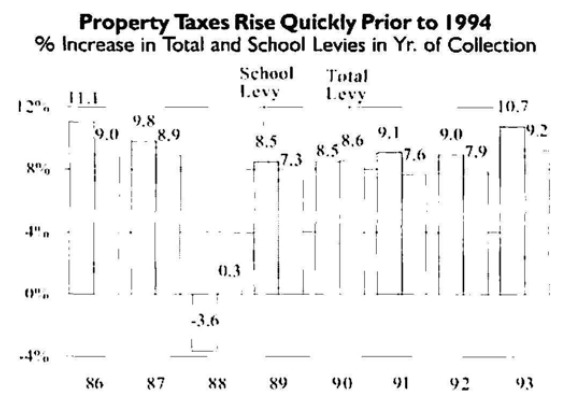
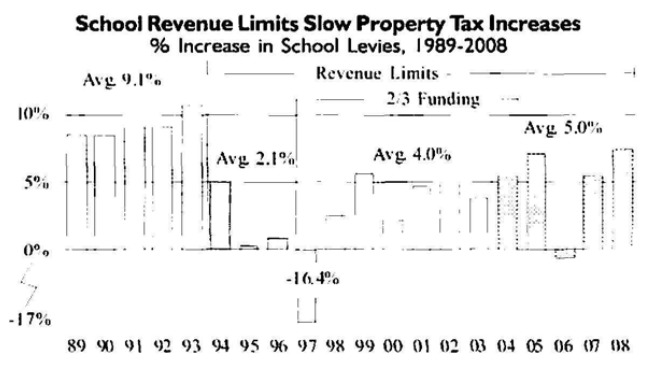
However, the state pledge to provide two-thirds of schools revenues in 1996-97 changed the budget landscape. By 2006-07, state-tax support for the UW System had almost doubled during Ihe 25 years prior. However, inflation (CPI, up 115%). school aids/credits (320%). and overall slate GPR expenditures (222%) rose more.

Share

After tough meeting, MPS board chief to keep pushing for changes

Alan Borsuk:

New Milwaukee School Board President Michael Bonds said Friday he will continue to push for major structural changes in the central office of Milwaukee Public Schools, despite the board balking at his plans.


A meeting on the budget for next year that ended at 2:45 a.m. Friday showed Bonds is nowhere near prevailing with his ideas – and that no major change in either specific matters or the culture of the organization is likely to come quickly or easily.


Things went so poorly for 20 amendments that Bonds had submitted to the $1.2 billion budget proposal from Superintendent William Andrekopoulos that even Bonds didn’t vote for one of his own proposals. On two others, his was the only vote in favor.


“We have a status quo board at this point,” Bonds said afterward. “I don’t think much was accomplished.”


But other board members clearly believed that a lot of Bonds’ ideas were wrong or counterproductive. Bonds has been calling for major change since he was elected board president April 28.

Share

The mythologizing of Arne Duncan

Parents United for Responsible Education (Chicago):

The mythologizing of Arne Duncan is moving along at a pretty fast past. Bernie Noven alerted me to this adulatory article from the London Economist and urged me to respond using some of the recent data about Arne’s record here in Chicago, saying that people “out there” have no idea about the reaiity here in Chicago. Here’s what I sent.
“Golden Boy” Arne Duncan is a pleasant fellow who held the position of Chicago Executive Officer (CEO) of the Chicago Public Schools for seven years without losing his cool.
He’s so cool, in fact, that butter wouldn’t melt in his mouth.
As a long-time Chicago public school parent advocate, I have had a front row seat at the Arne Duncan show. When Mayor Richard Daley appointed Mr. Duncan to replace Paul Vallas in 2001, there was a palpable sense of relief across the city. The new CEO’s Opie-from-Mayberry modesty was a soothing antidote to the previous six years spent with a CEO who could suck the oxygen out of a room.
We soon discovered, however, that Mr. Duncan simply provided a more complaisant and – more importantly – a more compliant cover for City Hall’s machinations.

Share

Detroit Public Schools will not renew contracts of 33 principals

Oralander Brand-Williams:

The contracts of 33 principals will not be renewed, Detroit Public Schools officials announced this afternoon.The district also is reassigning more than two dozen school principals.
Robert Bobb, the district’s emergency financial manager, said additionally, the district will conduct a full scale national search for 10 principal positions, district officials said.
Bobb told The Detroit News Thursday that he plans to change the operation of the district’s school by giving its principals more autonomy and authority over finances and school budgets.

Share

Monona Grove school leaders consider busing students to solve overcrowding

Gena Kittner:

The Monona Grove School District is considering busing some of Cottage Grove’s youngest students to Monona to help ease space problems in the district.
District leaders are quick to say such a change isn’t likely: Parents want to keep their children in their neighborhood schools, and busing students is costly.
But the possibility has been left in the mix to illustrate the breadth of options being considered to resolve crowding in Cottage Grove’s two elementary schools.
“This is something I was hoping to get off the table, but I think there was enough concern of the committee that the community have an understanding that we’re really looking outside the box,” said Monona Grove Superintendent Craig Gerlach. “This (option) is certainly outside the box.”

Share

Third Grade Mathematics in Hong Kong and Massachusetts
Why Massachusetts Students, the Best in the U.S., Lag Behind Best-in-the-World Students of Hong Kong


Steven Leinwand, American Institutes for Research and Alan Ginsburg, US Department of Education [2.5MB PDF] via a kind reader’s email:

Higher expectations for achievement and greater exposure to more difficult and complex mathematics are among the major difference between Hong Kong, home of the world’s top-performing 4th grade math students, and Massachusetts, which is the highest scoring state on the U.S. National Assessment of Education Progress (NAEP), according to a report by the American Institutes for Research (AIR).

While Massachusetts 4th grade students achieved a respectable fourth place when compared with countries taking the 2007 Grade 4 Trends in Mathematics and Science Study (TIMSS-4), Hong Kong students outperformed the Bay State 4th graders in numerous categories.

The Hong Kong performance advantage over Massachusetts was especially large in the percentage of its students achieving at the very highest level. For example, 40 percent of Hong Kong students achieved at the advanced TIMSS level, compared with only 22 percent of Massachusetts students.

To help understand why Hong Kong students outperform Massachusetts students, the AIR study identified differences between the items on Hong Kong’s and Massachusetts’ internal mathematics assessments administered in the spring of grade 3 in 2007 to gather insight into the relative mathematical expectations in Hong Kong and Massachusetts.

The AIR report found that the Hong Kong assessment contained more difficult items, especially in the core areas of numbers and measurement, than the Massachusetts assessment.

“The more rigorous problems on the Hong Kong assessment demonstrate that, even at Grade 3, deep conceptual understanding and the capacity to apply foundational mathematical concepts in multistep, real-world situations can be taught successfully,” said Steven Leinwand, Principal Research Analyst at AIR and co-author of the report.

Share

AP and Honors in the Same Class

Jay Matthews:

As those of us in the newspaper business have discovered to our misfortune, productive original thinking is hard, and rare. Even after the Internet began nibble at our toes, we couldn’t come up with a way to do our jobs that would keep us from losing a leg or two, maybe more.


The same is true of original thought in education, but good ideas about schools are more common than people might imagine. My latest example is Sande Caton, a Delaware high school science teacher who has come up with a simple but smart solution to the ongoing battle between Advanced Placement and honors courses for our nation’s teenagers.


Caton revealed her method in an online comment to one of my recent columns on this blog. Her timing is good. In early June, newsweek.com will unveil the new Newsweek Top High Schools list, its annual ranking of the best 1,500 public high schools. Newsweek uses a rating formula I invented in the 1990s. Many readers think this method, called the Challenge Index, has helped AP push honors courses out of our schools. Here comes Caton with a way to make everyone happy.


Many high schools used to offer juniors and seniors a choice of a regular, an honors or an AP course in popular subjects like history or English. In recent years some have removed the honors options, saying they can’t staff three different courses. They feel honors students should be taking the more challenging AP courses anyway. My suggestion, offered with no hope of it ever being accepted, was to remove not the honors option, but the regular option. In my experience, regular students were capable of handling honors or even AP courses if well taught. Why confine them to a regular class taught to the lowest standard?

Share

In Politics of School Reform, Transparency Doesn’t Equal Accountability

Andrew Rotherham:

Transparency is powerful and President Obama has rightly made it a pillar of his administration’s approach to policymaking. But transparency also offers the seductive promise of an easy way out for policymakers. It can trap proponents of various policy proposals in an intellectual cul de sac because it becomes easy to see information as sufficient to drive reform rather than just as a predicate for change. The risk is especially potent when proponents are convinced of the obviousness of the changes they seek.
We’ve seen this repeatedly with federal education policy. The Bush administration assumed the federal No Child Left Behind law would produce a tidal wave of student and school performance data that would swamp opposition to school improvement efforts. Seven years later the political resistance to education reform is as potent as ever and former Bush aides now acknowledge placing too much faith in the power of information.
In 1997, Congress tried unsuccessfully to increase accountability for colleges of education and teacher training programs by requiring them to report more data about outcomes. “Congress asked colleges of education to take stock of quality issues, but instead the colleges mostly whitewashed the problem,” says Ross Weiner, a senior adviser at The Education Trust. No Child Left Behind also required states and school districts to issue better report cards about educational performance. There, too, evasion rather than aggressive efforts are the norm.

Share

Barrett, state, Milwaukee Public Schools play nice at meeting

Alan Borsuk:

No fireworks, lots of pledges to work together.
That summarizes a meeting Tuesday evening involving Mayor Tom Barrett, state Secretary of Administration Michael Morgan and the Milwaukee School Board on what to do in the aftermath of a consultant’s report that criticized the business culture of Milwaukee Public Schools and said MPS could save up to $103 million a year by changing practices.
All the participants agreed that MPS faces daunting financial problems, getting worse over the next several years, if there are not major changes in the way money comes in and is spent. There also was agreement that everyone – the state, the city, MPS and others – needs to work together to improve the financial picture and to improve academic outcomes overall.
Gov. Jim Doyle and Barrett sought the report after becoming concerned about trends in MPS, including continuing low test scores overall and large property tax increases in recent years.
A week ago, Barrett and Doyle did not come to meet with board members and did not send representatives, causing some members, particularly budget committee chairman Terry Falk, to criticize them. But for this special meeting of the board, Barrett was there, Doyle sent Morgan, and everyone acted diplomatically.

Share

Action Needed, Please Sign on…. Math Teacher Hiring in the Madison School District

via a kind reader’s email: Janet Mertz and Gabi Meyer have written a letter about new math hires that they would like you to sign on to. Please send your name, your school(s), and any relevant identifying information or affiliation to:

mertz@oncology.wisc.edu

Dear Superintendent Nerad and members of the Board of Education:

To address as quickly as possible the MMSD’s need for more middle school teachers with outstanding content knowledge of mathematics, we, the undersigned, urge you to consider filling any vacancies that occur in the District’s middle schools for the coming academic year with applicants who majored in the mathematical sciences or related fields (e.g., statistics, computer science, physics) in college, but may be currently deficient in teaching pedagogy. You might advertise nationally in appropriate places that applications from such candidates would be welcome. In recent years, many outstanding graduates with such backgrounds went into the computing, consulting, and financial industries. However, in the current economic climate, such jobs are much less available, especially to new college graduates. Thus, jobs in the teaching profession may be viewed much more favorably now by folks trained in the mathematical sciences despite the significantly lower salary. One indication of this is the fact that applications to Teach for America were up 42% this year. Teach for America had to reject over 30,000 applicants this spring, including hundreds of graduates from UW-Madison, due to the limited numbers they can train and place. Undoubtedly, some of these applicants were math majors who would be happy to live in Madison. Math for America, a similar program that only accepts people who majored in the mathematical sciences, likely also had to turn away large numbers of outstanding applicants. Possibly, the MMSD could contact Teach for America and Math for America inquiring whether there might be a mechanism by which your advertisement for middle school math teachers could be forwarded to some of the best of their rejects. As these programs do, the MMSD could provide these new hires with a crash course in teaching pedagogy over the summer before they commence work in the fall. They could be hired conditionally subject to completing all of the requirements for state teacher certification within 2 years and a commitment to teach in the MMSD for at least 3-5 years.

While the District’s proposal to provide additional content knowledge to dozens of its current middle school teachers of mathematics might gradually improve the delivery of mathematics to the District’s students, it would take numerous years to implement, involve considerable additional expense, and may still not totally solve the long-term need for math-qualified teachers, especially in view of the continuing wave of retirements. The coincidence of baby boomer retirements with the current severe economic recession provides a rare opportunity to fill our middle schools now with outstanding mathematics teachers for decades to come, doing so at much lower cost to the District since one would be hiring new, B.A.-level teachers rather than retraining experienced, M.A.-level ones. Thus, we urge you to act on this proposal within the next few weeks, in possible.

Sincerely,

Ed Hughes comments over at Madison United for Academic Excellence:

It is interesting to note that state law provides that “A school board that employs a person who holds a professional teaching permit shall ensure that no regularly licensed teacher is removed from his or her position as a result of the employment of persons holding permits.”

Share

With Critics Quiet, Hearing Praises D.C. School Voucher Program

Bill Turque:

The Senate’s most outspoken supporter of the D.C. voucher initiative orchestrated more than two hours of uniformly glowing testimony for the program at a committee hearing yesterday and said the dissenting voices he invited turned him down.


Sen. Joseph I. Lieberman (I-Conn.), chairman of the Committee on Homeland Security and Government Affairs, is pushing for reauthorization of the D.C. Opportunity Scholarship Program, which provides up to $7,500 a year in federally funded tuition to 1,700 D.C. children from low-income families to attend private schools.


Congressional Democrats, supported by teachers unions and other liberal education groups that generally oppose using public money for private education, included language in the recent omnibus spending bill that would end the program in 2010. Last week, President Obama proposed continuing the scholarships so the students currently receiving money can finish high school. The program would be closed to new students.


Lieberman wants to fully revive the program and said yesterday that he has a commitment from Majority Leader Harry M. Reid (D-Nev.) to bring the matter to the floor for debate and a vote this year.

Share

New test scores promising at Madison’s first dual-language immersion school

Samara Kalk Derby:

Madison’s only dual-language immersion school, Nuestro Mundo, has been popular with parents and students, but initial low test scores have been a concern. New test results, however, show that students at the east side elementary school are quickly showing improvement in math and reading.


The improved scores are not only important within the confines of Nuestro Mundo, where Principal Javier Bolivar says the school’s biggest challenge is to prove that its students can learn proficiently while speaking two languages, but to the school district as a whole. Two more dual-language immersion programs have been approved and are due to open in the next year.


“We are gaining,” says Bolivar of the encouraging test scores. “Even if we are gaining one point, it means we are doing what we are supposed to be doing and we are closing the achievement gap.”


A public charter school inside Allis Elementary School at 4201 Buckeye Road, Nuestro Mundo started with a kindergarten class in 2004 and has added one grade per year. The school’s first kindergartners are now fourth-graders who took the Wisconsin Knowledge Concepts Examination for the first time last school year. Third grade is the first year for state testing.

Share

More black lawmakers open to school vouchers

Greg Toppo:

Back when he was on the city council for the District of Columbia, attorney Kevin Chavous would occasionally run into fellow Democrats concerned about the state of the USA’s urban schools.
They were open to a lot of ideas, but most Democrats have historically rejected taxpayer-supported private-school vouchers, saying they drain precious cash from needy public schools. Chavous, who served from 1992 to 2005, openly supported vouchers. He would ask others why they didn’t.
“Several of them would whisper to me, ‘I’m with you, but I can’t come out in front,’ ” Chavous says.
That was then.
While vouchers will likely never be the clarion call of Democrats, they’re beginning to make inroads among a group of young black lawmakers, mayors and school officials who have split with party and teachers union orthodoxy on school reform. The group includes Sacramento Mayor Kevin Johnson, Newark Mayor Cory Booker and former Washington, D.C., mayor Anthony Williams.

Share

Detroit Public Schools to Close 29 Schools

Peggy Walsh-Sarnecki:

Emergency financial manager Robert Bobb said the plan takes aim at more than just the district’s $305-million deficit and has the potential to boost student achievement. Many of the remaining buildings will be fixed up with federal funds.
Most of the closures were expected, although 10 buildings not on the list in April were added to the chopping block. Four schools once slated to close were spared.
Bobb made it clear that everything is on the table when it comes to fixing the 40 schools in need of restructuring. That means anything from replacing staff to changing curriculum to making them charter schools. He said some of the restructured schools could be turned over to a private school-management company.
“The students and the parents deserve better from the school district,” Bobb said. “We can no longer afford to let our children linger in underperforming schools.”

Share

The Harlem Miracle

David Brooks, via a kind reader’s email:

The fight against poverty produces great programs but disappointing results. You go visit an inner-city school, job-training program or community youth center and you meet incredible people doing wonderful things. Then you look at the results from the serious evaluations and you find that these inspiring places are only producing incremental gains.
That’s why I was startled when I received an e-mail message from Roland Fryer, a meticulous Harvard economist. It included this sentence: “The attached study has changed my life as a scientist.”
Fryer and his colleague Will Dobbie have just finished a rigorous assessment of the charter schools operated by the Harlem Children’s Zone. They compared students in these schools to students in New York City as a whole and to comparable students who entered the lottery to get into the Harlem Children’s Zone schools, but weren’t selected.
They found that the Harlem Children’s Zone schools produced “enormous” gains. The typical student entered the charter middle school, Promise Academy, in sixth grade and scored in the 39th percentile among New York City students in math. By the eighth grade, the typical student in the school was in the 74th percentile. The typical student entered the school scoring in the 39th percentile in English Language Arts (verbal ability). By eighth grade, the typical student was in the 53rd percentile.

More here.

Share

Our View: Teachers’ e-mails at work are public records

Wausau Daily Herald via a kind reader’s email:

Sometime in the spring of 2007, Don Bubolz of Vesper didn’t like what he heard at a meeting of the Wisconsin Rapids School Board.


He filed an open records request on April 16 of that year seeking the release of all e-mail messages sent to and from the accounts of five teachers in the district, for a period of about six weeks. At the time, he told the Wisconsin Rapids Daily Tribune that he wanted to find out — and wanted school administrators to know — whether the teachers were “doing their job the way it’s supposed to be done.”


The district superintendent indicated he would release the e-mails. The Wisconsin Education Association Council, representing the five teachers, filed an injunction to block their release.


The case made its way through trial court, and last month the Appeals Court certified it for consideration by the state Supreme Court. The appeals court said that there is no existing legal guideline in Wisconsin about whether personal e-mails constitute public records. If it chooses to rule on the case, then, the Supreme Court’s decision would have far-reaching implications.

Share

California Senate Approves Software as an Alternative to Textbooks

Patrick McGreevy:

California teenagers may be spared having to lug back-breaking loads of textbooks to school under a proposal that would make it easier for campuses to use electronic instructional material.


Allowing high schools greater freedom to spend state money on software to put textbooks on laptops and other electronic devices was backed by the Los Angeles Unified School District and approved Monday by the state Senate.


The Assembly will consider the proposal, drafted by state Sen. Elaine Alquist (D-Santa Clara). “Today’s K-12 students represent the first generation to have spent their entire lives surrounded by and using computers, video games, digital music players, video cameras, cellphones and all the other gadgets of the digital age,” Alquist said after the 36-0 Senate vote.


“Today’s students are no longer the students of blackboards and chalk.”


California law limits how school districts can use state funds for instructional materials, requiring them to purchase enough textbooks for all students before spending money on electronic material.


As a result, some districts have purchased materials in both book form and software or have refrained from buying software, Alquist said.

I’ve read a number of ebooks on my iPhone while on travel. The benefit: light and easy to carry. Downside: it is still quite a different experience, but the text is certainly readable. This is certainly the future, particularly as the small devices become more powerful.

Share

Bullying, Thefts Persist Despite Drop in Violence

Valerie Strauss:

Even though spasms of intense violence erupt on campuses occasionally and linger in the social consciousness, violence at schools across the country has been decreasing for a number of years.
That doesn’t necessarily mean schools are safe havens. Consider:
— Eighty-six percent of public schools in 2005-06 reported that one or more violent incidents, thefts of items valued at $10 or greater or other crimes had occurred — a rate of 46 crimes per 1,000 enrolled students.
— Almost a third of students ages 12 to 18 reported being bullied inside school.
— Nearly a quarter of teenagers reported the presence of gangs at their schools.

Indicators of School Crime and Safety.

Share

Proposed Budget Cuts in the Milwaukee Public Schools

Alan Borsuk:

With a wad of budget amendments, Michael Bonds, the new president of the Milwaukee School Board, will push this week for what he labels “a major restructuring” of the MPS central office.
“There’s a lot of fat and waste in the district – a lot,” Bonds said in an interview. He said approving his budget ideas would “signal to the public that the board is serious about addressing the finance issue.”
Action on Bonds’ proposals is likely to provide some of a list of major moments this week in the fast-moving drama over charting the way the school system is controlled and what direction it is headed.
Gov. Jim Doyle and Milwaukee Mayor Tom Barrett are expected to announce early in the week the members of an advisory committee that they want to get involved in MPS matters. Although the group will have no legal authority, its creation may turn out to be a significant step toward Doyle and Barrett involving themselves in school issues in ways not seen before.
And Barrett and a representative of Doyle are expected to meet with the School Board in an open session Tuesday to discuss the repercussions of a consultant’s report the governor and mayor released last month that was strongly critical of the business culture of MPS. The report said as much as $103 million a year could be saved if MPS made better decisions.
Bonds has hit the ground running in less than two weeks as the board’s leader. He met last week with Barrett and the incoming state superintendent of public instruction, Tony Evers, and he has said there will be big changes in the way the 85,000-student system is run, many of them in line with the consultant’s report.

Share

Students campaign for a voice on Madison School Board

Gayle Worland:

Call it the “student liaison whistle-stop tour.”
Four ambitious candidates will be making the rounds today at Madison high schools — giving stump speeches, outlining their platforms and extending a teenaged handshake to anyone who’s interested.
Jonathan Delgado, a sophomore at East High School, Sarah Maslin, a junior at West, and Nathan Powell, a junior at Memorial, are in a three-way race for the position of student liaison to the Madison School Board, a job that entails rounding up and representing the opinions of the district’s 25,000 students.

Share

America’s classroom equality battle

Clive Crook:

The most ambitious US presidency in living memory hardly needs to extend its list of tasks, you might think. Yet the country’s long-term economic prospects turn on something that is all too easy to neglect, just as it has been neglected in the past. The US is failing calamitously in primary and secondary education. The average quality of its workforce is falling, and its schools are adding to the problem rather than mitigating it.
Much of what ails the country – including growing economic inequality – can be traced to this source. Politicians recognise the fact, and prate about it endlessly. Barack Obama puts improving the schools alongside health reform and alternative energy whenever he lays out his long-term goals.
The trouble is, fixing the schools is not something that a crisis ever forces you to do. The consequences of a third-rate education system creep up on you and, experience shows, can be tolerated indefinitely. Many vested interests prefer it that way. Talk about the issue and move on is the line of least political resistance.
Just how badly is the US school system failing? A new study by McKinsey bravely attempts to come up with some numbers – and its estimates, though arrived at conservatively, are pretty startling*.
According to the Programme for International Student Assessment, a long-term comparison project from the Organisation for Economic Co-operation and Development, the US lags far behind the industrial-country average in a standardised measure of maths and science skills among 15-year-olds. It sits among low-achievers such as Portugal and Italy, and way behind the best performers, such as South Korea, Finland, Canada and the Netherlands. It scores worse than the UK, which is about average on both measures.

Share

A $100 Billion Question: How Best to Fix the Schools?

Jay Matthews:

If you had $100 billion to fix our schools, what would you do? A surprisingly smart list of suggestions for the education portion of the federal stimulus money is circulating in the education policy world. A group of experts claims authorship. I don’t believe committees are capable of good ideas, so I doubt the alleged origins of the list. But let’s put that aside for a moment and see what they’ve got.
Better yet, why not come up with our own ideas? My column seeking cheap ways to improve education yielded interesting results. By contrast, think of what we could do if we had enough money to buy the contract of every great quarterback: guarantee the Redskins a Super Bowl victory. Many expensive school-fixing schemes proved just as insane and just as useless. But Barack Obama is president, and we are supposed to be hopeful.

Share

What impact do high school mathematics curricula have on college-level mathematics placement?

James Wollack & Michael Fish [280K PDF], via a kind reader’s email UW Center for Placement Testing [Link to Papers]:

Major Findings:

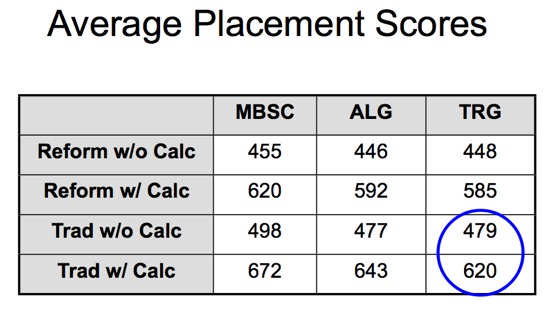
  • CORE-Plus students performed significantly less well on math placement test and ACT-M than did traditional students
  • Change in performance was observed immediately after switch
  • Score trends throughout CORE-Plus years actually decreased slightly – Inconsistent with a teacher learning-curve hypothesis
  • CORE-AP students fared much better, but not as well as the traditional – AP students – Both sample sizes were low


Related:

[280K PDF Complete Presentation]

Share

Unions sue governor over schools funding

Nanette Asimov:

Two of California’s smaller education unions, unwilling to wait for voters to decide May 19 whether to authorize more than $9 billion in education funds, sued the governor Friday to force the state to pay money they say is owed to schools and to clarify the law so schools can count on funds in the future.
“We’re filing this suit to make it clear that the state owes this money to schools and community colleges,” said Marty Hittleman, president of the California Federation of Teachers, representing about 100,000 educators in schools and community colleges.
The 37,000-member Service Employees International Union local that represents janitors, clerks, bus drivers, and other school workers also joined the suit, filed in San Francisco Superior Court.

Share

Many Views on Obama and Vouchers

Washington Post:

The Post asked education and political experts to assess the president’s plan for D.C. students. Below are contributions from Andrew J. Rotherham, Dick Durbin, Tom Davis, Randi Weingarten, Michelle Rhee, Michael Bennet, Lanny J. Davis, Margaret Spellings, Andrew J. Coulson, Ed Rogers, Michael J. Petrilli, Anthony A. Williams, Joseph E. Robert Jr., Harold Ford Jr. and Lisa Schiffren.

Share

Oregon, WI Schools to Consider Virtual Classroom Integration

Gena Kittner:

Fresh air and sunshine stream from large windows into the brightly painted basement of Jennifer Schmitt’s two-story home where she teaches seven students ranging from first to seventh grade a geometry lesson. Later the students scatter to separate whiteboard-topped tables to work puzzles or to pillow-padded nooks to read.

“Scholars, listen up!” Schmitt said as she gathered the students back together after a break to resume their studies.

It’s 8:30 a.m. and the “Schmitt Academy” is in full swing.

Schmitt’s students are either home schooled or take classes online through one of the state’s several “virtual schools.” They go to Schmitt — a certified teacher whose two youngest children attend a virtual school — for lessons in math and language arts.

Her operation, now in its fifth year, demonstrates the growing popularity of classrooms that go beyond the traditional brick and mortar.

Share

Milwaukee teachers reject longer day for more pay

Alan Borsuk:

The Milwaukee Public Schools teachers union has rejected a proposal that would lengthen the school day and pay teachers for the extra time with federal economic stimulus money, says Superintendent William Andrekopoulos.


The MPS chief said Thursday night that the union rejected adding 25 minutes to the school day for teaching math at all elementary and kindergarten-through-eighth grade schools. The union also rejected a proposal that would give all teachers six additional hours a month to work on improving programs in their schools. In both cases, teachers would have been paid for the additional time in line with their hourly rate of pay.


Tom Morgan, executive director of the Milwaukee Teachers Education Association, insisted Friday that there are better ways to improve education than lengthening the school day.


“We’ve taken a consistent view that doing the same thing longer is going to produce the same results,” said Morgan of the idea to add 25 minutes a day.


Speaking to School Board members at a budget meeting Thursday night, Andrekopoulos called the union decisions “unfortunate” and “disturbing.”


Earlier this week, MPS budget officials painted a picture for School Board members that is fast getting uglier when it comes to the $1.2 billion MPS budget and in which there is a dispute over how best to spend tens of millions of dollars in stimulus money.

Share

Radical idea: Ask what we get for the money

Daniel Weintraub:

No matter what happens in the special election May 19, California’s government finances will remain a mess. It took years of mismanagement and economic misfortune for the state to dig itself into this hole, and it is going to take many years to climb out of it.
As the climbing begins, the state needs to make fundamental changes in the way it collects and spends the taxpayers’ money. Otherwise, the next generation of lawmakers will repeat the same old mistakes as their predecessors.
Proposition 1A, with its rainy-day fund, would be one improvement, requiring lawmakers to set money aside in good times to cushion the blow of the next downturn. A bipartisan commission that has been studying the tax system will soon release its recommendations on how to make California’s revenue collections fairer and more stable. That could also improve things.

Share

Education Critic to Obama: Tell the Truth

Jay Matthews:

If there was any doubt that education analyst Gerald W. Bracey doesn’t play favorites, that’s gone now. After excoriating the Bush administration and its education officials for eight years, after canvassing his neighborhood, donating his own money and voting for Barack Obama for president, Bracey is giving the new president just what he gave the old one — unrelenting grief.
In a speech to the American Educational Research Association in San Diego last month on “countering the fearmongers about American public schools,” Bracey added to his list of non-truthtellers President Obama and Education Secretary Arne Duncan. “Obama and Duncan seem to be following the long-established line that you can get away with saying just about anything you choose about public schools and no one will call you on it,” Bracey said. “People will believe anything you say about public education as long as it’s bad.”
Bracey and I disagree on many issues, but I have long been one of his most appreciative readers, dating back to the days when I knew him only as a sharp-witted writer whose pieces occasionally appeared in The Washington Post’s Outlook section. When I came back to Washington to cover local schools, I introduced myself to Bracey, who was then living in Northern Virginia, and wrote a piece about him and his long battle to persuade policymakers, political candidates and journalists to stop exaggerating our educational problems to win themselves appropriations, votes and attention. He lost at least one job because of his writing. Instead of using his doctorate in educational psychology to get a cushy university or think tank job, he has devoted his life to setting us straight, in his less financially secure role as freelance writer, author and speaker.

Share

The Instigator: Steve Barr

Douglas McGray:

Steve Barr stood in the breezeway at Alain Leroy Locke High School, at the edge of the Watts neighborhood of Los Angeles, on a February morning. He’s more than six feet tall, with white-gray hair that’s perpetually unkempt, and the bulk of an ex-jock. Beside him was Ramon Cortines–neat, in a trim suit–the Los Angeles Unified School District’s new superintendent. Cortines had to be thinking about last May, when, as a senior deputy superintendent, he had visited under very different circumstances. That was when a tangle between two rival cliques near an outdoor vending machine turned into a fight that spread to every corner of the schoolyard. Police sent more than a dozen squad cars and surged across the campus in riot gear, as teachers grabbed kids on the margins and whisked them into locked classrooms.
The school’s test scores had been among the worst in the state. In recent years, seventy-five per cent of incoming freshmen had dropped out. Only about three per cent graduated with enough credits to apply to a California state university. Two years ago, Barr had asked L.A.U.S.D. to give his charter-school-management organization, Green Dot Public Schools, control of Locke, and let him help the district turn it around. When the district refused, Green Dot became the first charter group in the country to seize a high school in a hostile takeover. (“He’s a revolutionary,” Nelson Smith, the president and C.E.O. of the National Alliance for Public Charter Schools, said.) Locke reopened in September, four months after the riot, as a half-dozen Green Dot schools.

Share

So Long, Washington, DC School Choice…..

The Economist:

FOR all of the hype that preceded the Tea Parties, the first protest to win some sort of concession from Barack Obama’s administration may have been the protests against the end of Washington’s school-voucher programme. A month ago, the programme’s funding was shamefully struck from the president’s proposed budget. This prompted libertarian and liberal groups to fight back, culminating in a protest yesterday. And today comes news of a compromise of sorts:

President Obama will propose setting aside enough money for all 1,716 students in the District’s voucher program to continue receiving grants for private school tuition until they graduate from high school, but he would allow no new students to join the program.

Actually, that’s not much of a compromise. That’s more of a cover-up. Let’s remember that Mr Obama, who sends his own children to private school, made the following promise during his inaugural address:

Share

‘Housed’ Los Angeles teacher tells his side of the story

Jason Song:

The teacher whom the Los Angeles school district has spent seven years and nearly $2 million trying to fire spoke publicly for the first time Wednesday, saying he did not sexually harass students and is the target of discrimination.
Matthew Kim, a former special education teacher at Grant High School in Van Nuys, had declined to speak to The Times numerous times over the last several months. But his mother, Cecilia, contacted the newspaper Wednesday after publication of a story that highlighted her son’s case. Family members were angry and charged that the article has embarrassed them, and they wanted to tell their side of the story.

Share

2009-2010 MMSD Budget

We passed the 2009-2010 Madison public school district budget last night. This was the second year in a row that we were able to reallocate to avoid ugly ugly cuts.
This was the first year that we moved to undo damage by reallocating money to put back beginning of the year “Ready Set Goal” parent-teacher conferences AND stop doubling up our art, music, gym, and computer classes through “class and a half.” Both items were cuts from past years that were absolute disasters for elementary students.
We expect to receive the strategic planning report in June, and it will inform planning for the 2010-11 budget as we move forward this coming year. In the meantime, we are waiting to hear how the state budget will impact school finance. And we are continuing work to modernize and refine the ways that we work with resources to find additional ways to strengthen our schools.

Share

Writing in Trouble

For many years, Lucy Calkins, described once in Education Week as “the Moses of reading and writing in American education” has made her major contributions to the dumbing down of writing in our schools. She once wrote to me that: “I teach writing, I don’t get into content that much.” This dedication to contentless writing has spread, in part through her influence, into thousands and thousands of classrooms, where “personal” writing has been blended with images, photos, and emails to become one of the very most anti-academic and anti-intellectual elements of the education we now offer our children, K-12.
In 2004, the College Board’s National Commission on Writing in the Schools issued a call for more attention to writing in the schools, and it offered an example of the sort of high school writing “that shows how powerfully our students can express their emotions“:
“The time has come to fight back and we are. By supporting our leaders and each other, we are stronger than ever. We will never forget those who died, nor will we forgive those who took them from us.”
Or look at the National Assessment of Educational Progress (NAEP), the supposed gold standard for evaluating academic achievement in U.S. schools, as measured and reported by the National Center for Education Statistics. In its 2002 writing assessment, in which 77 percent of 12th graders scored “Basic” or “Below Basic,” NAEP scored the following student response “Excellent.” The prompt called for a brief review of a book worth preserving. In a discussion of Herman Hesse’s Demian, in which the main character grows up, the student wrote,
“High school is a wonderful time of self-discovery, where teens bond with several groups of friends, try different foods, fashions, classes and experiences, both good and bad. The end result in May of senior year is a mature and confident adult, ready to enter the next stage of life.”

(more…)

Share

LA teachers banned from class still getting paid

AP:

As the nation’s second-largest school district considers mass layoffs to deal with a budget deficit, it continues to pay about $10 million a year to about 160 instructors and others who are forbidden to enter a classroom.
The Los Angeles Unified School District employees earn salaries while misconduct complaints against them are reviewed.
Last month, the school board voted to lay off as many as 2,400 teachers and 2,000 other personnel to deal with a $596 million budget shortfall for the upcoming school year.
Matthew Kim, a special education teacher, was removed from Grant High School in Van Nuys in 2002 amid allegations that he improperly touched female students. The board voted to fire him in 2003 but he has challenged the decision in both administrative hearings and court.

Share

Charter Schools: Experiment or Solution

Valerie Visconti, Tania McKeown and David Wald:

Is a change in management enough to transform some of the worst schools in the country? Paul Vallas seems to think so, which might explain why the New Orleans superintendent is one of the biggest cheerleaders for charter schools. Because charter schools are free from district control and often from teacher unions, they have the power to hire and fire, choose the curriculum, and set student rules.
Over half of Vallas’ schools are now charters, and most of them are outperforming traditionally-run schools in New Orleans. But Vallas wants to ‘charterize’ the entire district, even though there’s evidence that charters may be abusing their freedom.

Share

Don’t let ideology block education reforms that work

Torrey Jaeckle:

A report last week from the National Assessment of Educational Progress — widely known as the “Nation’s Report Card” — shows that total education spending per pupil has doubled since 1971.
Yet overall test results for our high school seniors remain unchanged.
In effect, we’re spending twice as much money to achieve the same results as more than 35 years ago.
If that isn’t sad enough, consider these additional facts gleaned from various news stories over the past few weeks:
• A headline from the Wall Street Journal on April 23: “Demand for Charter Schools is High, Seats are Few.”

Share

Obama to Eliminate New Washington, DC Voucher Students, Continue Current Students

Bill Turque & Shailagh Murray:

President Obama will propose setting aside enough money for all 1,716 students in the District’s voucher program to continue receiving grants for private school tuition until they graduate from high school, but he would allow no new students to join the program, administration officials said yesterday.
The proposal, to be released in budget documents today, is an attempt to navigate a middle way on a contentious issue. School choice advocates, including Republicans and many low-income families, say the program gives poor children better access to quality education. Teachers unions and other education groups active in the Democratic Party regard vouchers as a drain on public education that benefits relatively few students, and they say the students don’t achieve at appreciably higher levels at their new schools.

Share

Reason Foundation’s New Weighted Student Formula Yearbook

Lisa Snell:

Much of our education funding is wasted on bureaucracy. The money never actually makes it into the classroom in the form of books, computers, supplies, or even salaries for better teachers. Weighted student formula changes that. Using weighted student formula’s decentralized system, education funds are attached to each student and the students can take that money directly to the public school of their choice.
At least 15 major school districts have moved to this system of backpack funding. Reason Foundation’s new Weighted Student Formula Yearbook examines how the budgeting system is being implemented in each of these places and, based on the real-world data, offers a series of “best practices” that other districts and states can follow to improve the quality of their schools.
In places where parents have school choice and districts empower their principals and teachers we are seeing increased learning and better test scores. The results from districts using student-based funding are very promising. Prior to 2008, less than half of Hartford, Connecticut’s education money made it to the classroom. Now, over 70 percent makes it there. As a result, the district’s schools posted the largest gains, over three times the average increase, on the state’s Mastery Tests in 2007-08.

Share

Rare Alliance May Signal Ebb In Union’s Charter Opposition

Jay Matthews:

I didn’t see many other reporters Tuesday in the narrow, second-floor meeting room of the Phoenix Park Hotel in the District. A U.S. senator’s party switch and new National Assessment of Educational Progress data were a bigger draw. But in the long term, the news conference at the hotel might prove a milestone in public education. It isn’t often you see a leading teachers union announce it is taking money from what many of its members consider the enemy: corporate billionaires who have been bankrolling the largely nonunion charter school movement.
Of course, it might turn out to be just another publicity stunt. But the people gathered, and what they said, impressed me.
Randi Weingarten, president of the American Federation of Teachers, unveiled the first union-led, private foundation-supported effort to provide grants to AFT unions nationwide to develop and implement what she called “bold education innovations in public schools.” The advisory board of the AFT Innovation Fund includes celebrities of my education wonk world: former Cleveland schools chief Barbara Byrd-Bennett, Stanford professor Linda Darling-Hammond, Harvard professor Susan Moore Johnson and even Caroline Kennedy, well known for other reasons but identified at the conference as an important fundraiser for New York schools.

Share

Easy grades equate to failing grads

Heather Vogell:

Some metro Atlanta public high schools that don’t grade rigorously produce more graduates lacking the basic English and math skills needed for college, The Atlanta Journal-Constitution has found.
Many graduates of those high schools are sent to freshmen remedial classes to learn what high school didn’t teach them. As many as a third or more college-bound graduates from some high schools need the extra instruction.
Problems with classroom grading came to light in a February state study that showed some high schools regularly awarded good marks to students who failed state tests in the same subject.
The AJC found that metro high schools where classroom grading appeared lax or out-of-step with state standards tended to have higher rates of students who took remedial classes. And at dozens of high schools, most graduates who received the B average needed for a state HOPE scholarship lost it in college after a few years.
Unprepared high-school graduates are a growing problem for the public university system, where remedial students are concentrated in two-year colleges.
Statewide, the remedial rate has climbed to 1 in 4 first-year students after dropping in the 1990s, said Chancellor Erroll Davis Jr. of the University System of Georgia. The cost to the system: $25 million a year.
Students such as Brandon Curry, 20, a graduate of Redan High in DeKalb County, said they were surprised to learn decent high school grades don’t always translate into college success.

Georgia remedial class database – very useful.

Share

Arne Duncan’s Choice

Wall Street Journal Editorial:

Washington, D.C.’s school voucher program for low-income kids isn’t dead yet. But the Obama Administration seems awfully eager to expedite its demise.


About 1,700 kids currently receive $7,500 vouchers to attend private schools under the Opportunity Scholarship Program, and 99% of them are black or Hispanic. The program is a huge hit with parents — there are four applicants for every available scholarship — and the latest Department of Education evaluation showed significant academic gains.


Nevertheless, Congress voted in March to phase out the program after the 2009-10 school year unless it is reauthorized by Congress and the D.C. City Council. The Senate is scheduled to hold hearings on the program this month, and Senate Majority Leader Harry Reid has promised proponents floor time to make their case. So why is Education Secretary Arne Duncan proceeding as if the program’s demise is a fait accompli?


Mr. Duncan is not only preventing new scholarships from being awarded but also rescinding scholarship offers that were made to children admitted for next year. In effect, he wants to end a successful program before Congress has an opportunity to consider reauthorizing it. This is not what you’d expect from an education reformer, and several Democrats in Congress have written him to protest.

Share

In Favor of Everyday Math; Middleton Cross Plains Math Scores Soar

Angela Bettis:

The most recent research from the U.S. Department of Education shows that American 15-year-olds are behind their International counterparts when it comes to problem solving and math literacy.


The report showed the U.S. ranks 24th out of 29 nations.


But a math program, gaining in popularity, is trying to change that.
The program is called Everyday Math.


Lori Rusch is a fourth grade teacher at Middleton’s Elm Lawn Elementary. This year she teaches an advanced math class.


On Monday, students in Rusch’s class were mastering fractions and percentages.


But her students began learning fractions and percentages in first grade.

“We’ve been incredibly successful with it,” said Middleton’s curriculum director George Marvoulis. “Our students on all of our comparative assessments like WKCE, Explorer Plan, ACT, our students score higher in math than any other subject area so we’ve been very pleased.”


According to Marvoulis, Middleton was one of the first school districts in the nation to use the Everyday Math program in 1994.


“The concept is kind of a toolbox of different tools they can use to solve a problem,” explained Marvoulis.

Related: Math Forum and Clusty Search on Everyday Math.

Share

The Politics of Education and the Perils of Preferment

The Economist:

PLEDGES are shrinking to aspirations; aspirations are quietly evaporating; no more hoodies are being hugged or huskies stroked (or was it the other way around?). The sunny Californian Conservatism that David Cameron once espoused has been darkened by the crunch. His promise of a happier tomorrow now hangs on a few upbeat policies. Chief among them is education reform–which could make Michael Gove, the shadow schools secretary, among the most privileged and pressured members of a future Tory government.
Ed Balls, his counterpart in the cabinet, is an equally important figure for Labour, before and after the next general election. Ire over public services often focuses on bad hospitals: death is more heart-wrenching than illiteracy. But pound for pound (and there have been a lot of them), Labour’s education spending has been less rewarding than its health splurge. It falls to Mr Balls to defend its record on what Tony Blair proclaimed his main priority–and to soften the recession’s impact on teenagers and soothe a rumbling moral panic about harm done by and to children.

Share

Harford County should get the elected school board it wants

Baltimore Sun:

Under the measure, the school board would gradually transition from seven appointed members to six elected and three appointed members. The current school board believes the bill is too vague and that the transition will be difficult. But the bill clearly outlines the proposed changes, and only a couple of minor details need to be worked out.
Contrary to the board’s objection, the difficulty of the transition would likely be minimal. In order for three board members’ terms to end on June 30, 2011, one board member’s term would be lengthened by a year, and another’s would be shortened. On July 1, 2011, three elected board members would take office along with two appointed members. The board members in office on July 1, 2011 would serve for four years, and in the next election cycle six members would be elected.
So the school board’s vocal opposition is misleading. Why should these minor issues prevent Harford County’s constituents from influencing how their tax dollars are spent on their children’s education? Despite prior bills, Harford County is one of the last counties in which voters cannot elect school board members.

Share

Rare Alliance May Signal Ebb In Union’s Charter Opposition

Jay Matthews:

I didn’t see many other reporters Tuesday in the narrow, second-floor meeting room of the Phoenix Park Hotel in the District. A U.S. senator’s party switch and new National Assessment of Educational Progress data were a bigger draw. But in the long term, the news conference at the hotel might prove a milestone in public education. It isn’t often you see a leading teachers union announce it is taking money from what many of its members consider the enemy: corporate billionaires who have been bankrolling the largely nonunion charter school movement.
Of course, it might turn out to be just another publicity stunt. But the people gathered, and what they said, impressed me.
Randi Weingarten, president of the American Federation of Teachers, unveiled the first union-led, private foundation-supported effort to provide grants to AFT unions nationwide to develop and implement what she called “bold education innovations in public schools.” The advisory board of the AFT Innovation Fund includes celebrities of my education wonk world: former Cleveland schools chief Barbara Byrd-Bennett, Stanford professor Linda Darling-Hammond, Harvard professor Susan Moore Johnson and even Caroline Kennedy, well known for other reasons but identified at the conference as an important fundraiser for New York schools.

Share

Federal education money goes to all the wrong places

Dan Thomasson:

A funny thing has been happening to some of that widely heralded federal education money. It has fallen off the bus on the way to school. At least a few cash-strapped local governments upon notification of the federal input have eliminated an equal amount from their own budgets, hardly what the Obama administration had in mind for the $100 billion aimed at vastly improving the nation’s schools.
While the practice is not general and there are strict rules about the use of the federal bucks as part of the economic recovery effort, local and state officials are being forced to reduce manpower in vital services like fire and police. The temptation to relieve some of that pressure and to prevent teacher layoffs seems overwhelming and likely to grow.
For instance, the local press here recently reported that Loudon County in the nearby Virginia suburbs was a case in point. Upon hearing that the county would receive more than $11 million in new school money from Uncle Sam, the county’s supervisors slashed $7.3 million from the regular school budget. According to the reports, the board also has made it clear that schools might have to give more local money back if there were other federal contributions. Similar actions have been taken elsewhere and Arne Duncan, the new secretary of Education, has warned of strong reprisals if this abuse of the president’s intentions is not stopped.

Share

Failure Gets a Pass: Firing tenured teachers can be a costly and tortuous task

Jason Song:

A Times investigation finds the process so arduous that many principals don’t even try, except in the very worst cases. Jettisoning a teacher solely because he or she can’t teach is rare.
The eighth-grade boy held out his wrists for teacher Carlos Polanco to see.
He had just explained to Polanco and his history classmates at Virgil Middle School in Koreatown why he had been absent: He had been in the hospital after an attempt at suicide.
Polanco looked at the cuts and said they “were weak,” according to witness accounts in documents filed with the state. “Carve deeper next time,” he was said to have told the boy.
“Look,” Polanco allegedly said, “you can’t even kill yourself.”
The boy’s classmates joined in, with one advising how to cut a main artery, according to the witnesses.

Share

School reform must have urban focus

Rochester Democrat & Chronicle Editorial:

he state Board of Regents, which oversees public schools in the state among its duties, has a lot on its plate at the moment. There is the problem of the crippled state finances and their impact on local schools. There is the arrival of a new education secretary, Arne Duncan, who not only is handing out stimulus money but is looking for national school reform.
And then there is the regents’ task of choosing a commissioner to replace Richard Mills, who is leaving the job this summer, a leader who changed the conversation about public school performance by championing consistent, measurable standards in academic fundamentals.
The value of a measuring process based almost entirely on standardized tests was often questioned, but test scores did show with great clarity the disparity between urban and suburban schools.

Share

Madison School District 2009-2010 Budget Discussion

44MB mp3 audio file. The April 30, 2009 meeting discussed:

  1. undo class and a half for SAGE schools
  2. not extend class and a half for non-SAGE schools
  3. restore funding for Ready Set Go conferences

The board also discussed member compensation, future proposals from task forces such as the fine arts and math along with the strategic plan.
Via a kind reader’s email.

Share

An Update on the Madison School District’s 4 year old Kindergarten Plans

Dan Nerad 100K PDF:

The 4K steering committee had four meetings reviewing prior history, leaming from other districts, and looking at what needs to be accomplished prior to start up. At the last meeting we came to consensus on a time-line. As a result, the steering committee is recommending that the Board of Education make a commitment in May to begin 4K no later than fall, 2010.
The next 4K meeting is tentatively scheduled for Monday, May 11, from 9:30 to 11:30, site to be determined. At this meeting we will divide into working subcommittees focused around the Tasks Ahead piece developed in previous meetings. Attached is a list of the tasks.
The steering committee is a terrific group of individuals to work with and there is no lack of enthusiasm and passion for this initiative.

Share

The Madison School District on WKCE Data

Madison School District 1.5MB PDF:

The 2008-09 school year marked the fourth consecutive year in which testing in grades 3 through 8 and 10 was conducted in fulfillment of the federal No Child left Behind law. The Wisconsin Knowledge and Concepts Exams (WKCE) is a criterion-referenced test (CRT) where a student’s performance is compared to a specific set of learning standard outcomes. The WKCE-CRT includes testing in all seven grade levels reading and math and in grades 4, 8 and 10 additional testing in language arts, science and social studies. Just under 12,400 MMSD students participated in this year’s WKCE-CRT.


Under NClB, schools are required to test 95% of their full academic year (FAY) students in reading and math. Madison’s test participation rates exceeded 95% in all grade levels. Grades 3 through 8 achieved 99% test participation or higher while the District’s 10th graders reached 98% in test participation.


In general, performance was relatively unchanged in the two academic areas tested across the seven grade levels. In reading, across the seven grades tested four grade levels had an increase in the percentage of students scoring at the proficient or higher performance categories compared with the previous year while three grades showed a decline in the percentage. In math, three grades increased proficient or higher performance, three grades declined, and one remained the same.


The changing demographics of the district affect the overall aggregate achievement data. As the district has experienced a greater proportion of students from subgroups which are at a disadvantage in testing, e.g., non-native English speakers, or English language learners (Ells), the overall district averages have correspondingly declined. Other subgroups which traditionally perform well on student achievement tests, i.e., non-low income students and white students, continue to perform very high relative to statewide peer groups. Therefore, it is important disaggregate the data to interpret and understand the district results.

Jeff Henriques recently took a look at math performance in the Madison School District.

Schools should not rely on only WKCE data to gauge progress of individual students or to determine effectiveness of programs or curriculum

Share

Putting Students on the Same High-Performance Page

Lydia Gensheimer:

What happens when you have a law that’s supposed to improve performance among the nation’s school children but instead it creates confusion, lowers expectations and can result in a “dummying down” of state standards?
That’s what a panel of educational experts is trying to address with a plan to incorporate common academic standards. They are urging Congress to support a state-led initiative to develop more-uniform, clear and integrated standards that reflect both the global marketplace and Americans’ mobility within the country.
Under the 2002 No Child Left Behind law (PL 107-110), states set their own standards — resulting in what Education Secretary Arne Duncan calls a “dummying down” of state standards in order to meet benchmarks set by the law.
Those who advocate for common standards contend that a system of variable expectations — ones that are often too low — leads American students to underperform when compared with their peers in Finland or China. President Obama called for common standards in a March 10 speech, and Duncan has said he would use a portion of a $5 billion “Race to the Top” fund under his discretion to reward states working toward that goal.
The panel — which included Randi Weingarten, president of the American Federation of Teachers; former North Carolina Gov. James B. Hunt Jr.; and Dave Levin, founder of the KIPP charter schools — testified April 29 at a House Education and Labor Committee hearing.

Share

AP More Open, But Not Dumbed Down

Jay Matthews:

More than a decade ago, when I began investigating the odd uses of Advanced Placement courses and tests in our high schools, I tried to find out why AP participation was so much lower than I expected in my neighborhood public school, Walt Whitman High of Bethesda. At least one high school in neighboring D.C., and many more in suburban Maryland, had higher participation rates than Whitman, even though it was often called the best school in the state.


That is how I stumbled on what I call the Mt. Olympus syndrome. There were, I discovered from talking to students, a few AP teachers at that school who didn’t want to deal with average students. One of them actively discouraged juniors who were getting less than an A in a prerequisite course from taking his AP course when they were seniors. He only wanted students who were going to get a 5, the equivalent of an A on the three-hour college-level AP exam, where a score of 3 and above could earn college credit. That test, like all AP exams, was written and graded by outside experts, mostly high school and college instructors. The only way that teacher thought he could control the number of 5s was to make sure only top quality students–the academic gods of the Whitman High pantheon–were allowed into his course.

Related: Growing Pains in the Advanced Placement Program: Do Tough Tradeoffs Lie Ahead?

Share

Is new board president Bonds a ‘clean slate’ for the Milwaukee Public Schools?

Alan Borsuk:

New Milwaukee School Board President Michael Bonds took a stand Wednesday in support of major changes in the direction of Milwaukee Public Schools, calling for a hiring freeze in the central office, more school closings and less busing.
Bonds said MPS could save millions of dollars by taking a series of steps, including some similar to what was in a stinging consultant’s report done for Gov. Jim Doyle and Milwaukee Mayor Tom Barrett.
Bonds said he was sending letters to Doyle and Barrett, asking for weekly meetings with them or their representatives to develop a unified effort to improve education in Milwaukee. He also held out the prospect of involvement by city and state representatives in MPS decision-making.
He said MPS should not seek or expect more money from the state, both because it is not realistic and because the district needs to do more to control its own spending.
“I still think we have millions in unrealized efficiencies,” he said.

Share

A Primer on Wisconsin School Revenue Limits

The Wisconsin Taxpayer 3.4MB PDF:

Since 1994, Wisconsin school districts have operated under state-imposed revenue limits and the associated qualified economic offer (QEO) law.

  • Revenue limits have helped reduce school property tax increases to less than 5% per year from more than 9% annually prior to the caps.
  • The limits have had \aried impacts on school districts, with growing districts experiencing the largest revenue gains. Low-spending districts prior to the caps have seen the largest per student gains.
  • The QEO law has helped school districts keep compensation costs somewhat in line with revenue limits. However, since benefits are given more weight, teacher salary increases have slowed.

Since 1994. Wisconsin school districts have operated under slate-imposed revenue limits, which arc tied to inflation and enrollments. The associated qualified economic offer (QEO) law limits staff compensation increases to about 4% annually. With declining student counts, fluctuations in stale school aid. and various concerns over teacher pay. revenue limits and the QEO have attracted increasing debate.
The governor, in his proposed 2009-11 state budget, recommends eliminating the QEO. I le has also talked about providing ways for school districts to move away from revenue limits. This report does not address these specific proposals. Rather, it seeks to help inform discussions by examining the history of revenue limits and the QEO, legislative attempts to fix various issues, and the impacts of limits on schools, educators, and taxpayers.
THE REVENUE LIMIT LAW
School districts collect revenue from a variety of sources. The two largest sources are the property tax and state general (or equalization) aid, General aid is distributed based on district property wealth and spending. Combined, these two revenue sources account for about 75% of an average district’s funding. The remainder is a combination of student fees, federal aid. and state categorical aids. such as those for special education and transportation.
The revenue limit law was implemented in 1994 (1993-94 school year) and caps the amount districts can collect from property taxes and general aid combined. It does not restrict student fees, federal aid. or state categorical aid. A district’s revenue limit is determined by its prior-year cap, an inflation factor, and enrollments. There is an exception to the limit law for districts defined as “low-revenue.” Currently, districts with per student revenues less than S9.000 are allowed to increase their revenues to that level.
Background
While Wisconsin’s revenue limit law began in 1994. its roots date back to several teacher strikes in the early 1970s, culminating with the 1974 Hortonville strike during which 86 teachers were fired. That strike gained national attention.


Related: K-12 tax & spending climate. A number of links on local school spending and tax increases before the implementation of State limits on annual expenditure growth. The Madison School District spent $180,400,000 during the 1992-1993 school year. In 2006, the District spent $331,000,000. The 2009/2010 preliminary Citizen’s Budget proposes spending $367,912,077 [Financial Summary 2.1MB pdf], slightly down from 2008/2009’s $368,012,286.

Share

Pass bill to boost science, math teachersPass bill to boost science, math teachers

Wisconsin State Journal Editorial

: Public schools across Wisconsin expect a critical shortage of math and science teachers in the next few years. Supply is not keeping up with demand.


That’s why the Legislature should approve Senate Bill 175. This sensible proposal would lure more math and science professionals into classrooms by creating a shorter and less expensive route to a teaching license for anyone with a college degree.


SB 175 also could attract more black men into the teaching profession to serve as role models in urban schools — a key selling point for Rep. Jason Fields, D-Milwaukee, who is part of a bipartisan group of sponsors.

Share

Primary schoolchildren will learn to read on Google in ‘slimmer’ curriculum

Graeme Paton:

Computing skills will be put on an equal footing with literacy and numeracy in an overhaul of primary education that aims to slim down the curriculum – but not lose the basics.

Children will be taught to read using internet search engines such as Google and Yahoo in the first few years of school, it is announced.


Pupils in English primary schools will learn to write with keyboards, use spellcheckers and insert internet “hyperlinks” into text before their 11th birthday under the most significant reform of timetables since the National Curriculum was introduced in 1988.


The review by Sir Jim Rose, former head of inspections at Ofsted, also recommends the use of Google Earth in geography lessons, spreadsheets to calculate budgets in maths, online archives to research local history and video conferencing software for joint language lessons with schools overseas.


Sir Jim insisted the changes would not replace come at the expense of traditional teaching, saying: “We cannot sidestep the basics”.


He told BBC Radio 4’s Today programme: “We’ve let the curriculum become too fat. We need to give teachers the opportunity to be more flexible.”


His report, which will be accepted in full by ministers, also proposes more IT training for teachers to keep them ahead of “computer savvy pupils”.

John Sutherland has more.


Google (and other search engine) users should be aware of the many privacy issues associated with these services. Willem Buiter:

Google is to privacy and respect for intellectual property rights what the Taliban are to women’s rights and civil liberties: a daunting threat that must be fought relentlessly by all those who value privacy and the right to exercise, within the limits of the law, control over the uses made by others of their intellectual property. The internet search engine company should be regulated rigorously, defanged and if necessary, broken up or put out of business. It would not be missed.


In a nutshell, Google promotes copyright theft and voyeurism and lays the foundations for corporate or even official Big Brotherism.


Google, with about 50 per cent of the global internet search market, is the latest in a distinguished line of IT abusive monopolists. The first was IBM, which was brought to heel partly by a forty-year long antitrust regulation (which ended in 1996) and partly by the rise of Microsoft.

We must also keep in mind the excesses of Powerpoint in the classroom.

Related: Democracy Now on a Google Anti-Trust investigation.

Share

Growing Pains in the Advanced Placement Program: Do Tough Trade-Offs Lie Ahead?

Ann Duffett & Steve Farkas:


In 2002-2003, 1 million students participated in AP by taking at least one exam. Five years later, nearly 1.6 million did—a 50+ percent increase. But is growth all good? Might there be a downside? Are ill prepared students eroding the quality of the program? Perhaps harming the best and brightest? To find out, the Thomas B. Fordham Institute commissioned the Farkas Duffett Research Group to survey AP teachers in public high schools across the country. Perhaps not surprisingly, the AP program remains very popular with its teachers. But there are signs that the move toward “open door” access to AP is starting to cause concern. Read the report to learn more.

Jacques Steinberg:

A survey of more than 1,000 teachers of Advanced Placement courses in American high schools has found that more than half are concerned that the program’s effectiveness is being threatened as districts loosen restrictions on who can take such rigorous courses and as students flock to them to polish their résumés.

The study, by the Thomas B. Fordham Institute, an educational research and advocacy organization, noted the sharp growth in the A.P. program’s popularity. The number of high school students who took at least one college-level A.P. course increased by 45 percent, to 1.6 million from 1.1 million, from the school year ended 2004 to that ended 2008.

The number of A.P. exams those students took — with hopes, in part, of gaining exemption from some college class work, depending on how well they scored — increased by 50 percent, to 2.7 million.>Dane County, WI High School AP course offering comparison.

Share

School Reform Talk Is Good, Now Let’s See the Walk

Wall Street Journal Editorial:

Secretary of Education Arne Duncan tells us that “School Reform Means Doing What’s Best for Kids” (op-ed, April 22). His cry for “doing what’s best for kids” rings a bit hollow when he failed to do what is best for the 1,700 low-income kids in Washington, D.C. who were counting on him. Those kids were given a lifeline — a voucher to escape schools that continually failed them, schools in a district to which neither Mr. Duncan nor his boss would send their own children. When crunch time arrived, politics trumped educational freedom, at least when it came to poor, inner-city kids in the District of Columbia.
Mr. Duncan speaks eloquently about how the public education establishment must change. He correctly says “we need a culture of accountability in America’s education system if we want to be the best in the world.” But what greater accountability can there be than that which comes from customers exercising free choices? True accountability in education will only come about when all parents are empowered to choose what they deem is best for their own children, not just those, like President Obama, Mr. Duncan, and most readers of the Wall Street Journal, who have financial means. So my question is, “When will the Obamas, Duncans, et. al. stand up for low-income parents so that they, too, can make choices that are best for their kids?”

Share

Waukesha to use child care centers for 4-K classes

Erin Richards:

bout 15 local child care centers are likely to host the Waukesha School District’s new half-day, 4-year-old kindergarten program next year, a district curriculum and instruction coordinator said.
Deb Wells, the district coordinator for the new 4-K program and coordinator for kindergarten and elementary social studies, said her staff is conducting site visits at 15 or 16 community child care sites in Waukesha to determine that they meet high standards for 4-K instruction.
Wells said that about 20 community sites applied to be a part of the program.
Of the 15 or 16 they’ve settled on, Wells said, the district will likely work with most if not all of them.

Share

Wisconsin’s Latest State K-12 Test Results, and Related Criticism

Gayle Worland:

Across Wisconsin, educators like Hensgen are part of a growing chorus to reassess the way the state assesses students. Currently, teachers and districts wait five months for WKCE results, so they have little time to react to the findings and adjust their curriculum. The tests eat into a week of class time and are based on standards that, critics say, are too low to give parents and teachers a clear picture of how students measure up globally.
“It’s widely agreed that the WKCE is a really lousy test that measures lame standards,” said Phil McDade, a departing member of the Monona Grove School Board. “The bigger issue to me in Wisconsin is that there’s a sense of self-satisfaction with our school districts, that we’re doing fine, that we’re Lake Wobegon, that everybody here’s above average.”
The Department of Public Instruction commissioned a state task force on the issue last fall and is reviewing the group’s recommendations, said Michael Thompson, executive assistant to the state superintendent of schools. The state’s current testing contract lasts at least another two years.

Alan Borsuk has more.
“Schools should not rely on only WKCE data to gauge progress of individual students or to determine effectiveness of programs or curriculum”
The ACT Explore test was mentioned in Gayle Worland’s article.

Share

No long-term plan, no research – fine-tuning of language policy reflects a lack of values

Jonathan Lai, principal, Lee Kau Yan Memorial School in San Po Kong:

This is an era of “NO Values” – that is confirmed! Ten years have passed since 1998 and the medium-of-instruction pendulum is swinging again. From one side to the other, or rather, back to square one, although the government refuses to admit the fact and gives the latest policy move a beautiful name: “fine-tuning”. Yet, who will feel fine? The Education Bureau? Parents? Teachers? Students?
While the community is deeply involved in the discussion about the so-called labelling effect that could be caused by the fine-tuning policy, what has made the pendulum swing back remains a complete mystery. No one will be interested in the mystery, they will be too busy getting their surfboards ready for the tide to turn again.
However, this mysterious force is pushing our community into an era without beliefs and values. The issue of teaching language should not be considered as something solely related to education, it should be viewed and discussed from a wider angle. It is, in fact, demonstrating how our government formulates and adjusts its public policies.
Let us have a look at the Education Bureau’s proposal. The officials are now suggesting that teachers hold a grade six in the International English Language Testing System (IELTS), considered appropriate to be able to conduct a lesson in English in the future.
What is IELTS? According to the official webpage www.ielts.org) , it is an internationally recognised English test measuring the ability of a student to communicate in English across all four language skills – listening, reading, writing and speaking – for people who intend to study or work where English is the language of communication.
Just like TOEFL, this is an English benchmarking test for students who wish to further their studies overseas and for people who are applying for migration to an English-speaking country.

(more…)

Share

Are ‘No-Fail’ Grading Systems Hurting or Helping Students?

Joshua Rhett Miller via a kind reader’s email:

What’s a kid gotta do to get an “F” these days?
At a growing number of middle schools and high schools across the country, students no longer receive failing marks when they fail. Instead, they get an “H” — for “held” — on their report cards, and they’re given a chance to rectify their poor performance without tanking the entire semester.
Educators in schools from Costa Mesa, Calif., to Maynard, Mass., are also employing a policy known in school hallways as ZAP — or “Zeros Aren’t Permitted” — which gives students an opportunity to finish the homework they neglected to do on time.
While administrators and teachers say the policies provide hope for underperforming students, critics say that lowering or altering education standards is not the answer. They point to case studies in Grand Rapids, Mich., where public high schools are using the “H” grading system this year and, according to reports, only 16 percent of first-semester “H” grades became passing grades in the second semester.
Click here to see schools that implement some type of no-fail policy.

Much more on “standards based report cards“, here.

Share

Mayoral Control of Schools Unlikely in St. Paul

Emily Johns & Chris Havens:

St. Paul Mayor Chris Coleman often says that education is the key to many things that make a city successful, including economic development, crime fighting and neighborhood stability.
“Every mayor has to make education their Number 1 priority,” he says.
U.S. Secretary of Education Arne Duncan takes it one step further — he wants more big-city mayors to follow the lead of Michael Bloomberg in New York City and take over their cities’ school systems to help improve their leadership and stability.
“Where you’ve seen real progress in the sense of innovation, guess what the common denominator is?” Duncan asked. “Mayoral control.”
That said, could the mayors take over the schools here?

Share

Rancor Where Private-School Parents Make Public-School Decisions

Peter Applebome:

If you wanted to help a Martian understand this sliver of the planet in Rockland County, you might do two things.
First, you would take him (or her or it) to the cavernous Foodmart International on the main drag, Route 59.
The shoppers chatter in the broad, chilly aisles in every language under the sun. The wares include Cuban bread, Thai jasmine rice, Vietnamese chili-garlic sauce, Chinese kidney and liver herb extract, Haitian sugar, Salvadoran pickled vegetables, Honduran cream, Malaysian papaya pudding — like the provisions for some modern ark.
Then, you would head a mile or so down the road toward Monsey, where you would see gaggles of observant Jews in traditional garb walking on the street, pushing strollers, popping into shops offering kosher pizza, falafel and ice cream.
This would be helpful in understanding not just this area, but disputes along sensitive cultural fault lines that are playing out in several suburban communities. In fact, the East Ramapo school district here is going through the same drama as the district in Lawrence, on Long Island.

Share

Doyle, Barrett warn Milwaukee Schools on tax increase

Alan Borsuk:

Gov. Jim Doyle and Milwaukee Mayor Tom Barrett warned Friday that it “defies common sense” to consider a large increase in property taxes for Milwaukee Public Schools for next year and said they will hold MPS leaders accountable if there is such an increase.
They did not spell out exactly what they meant by accountable, but their sharp statement came as the two consider supporting major changes in the way MPS is run, including a possible mayoral takeover of the system. It also came shortly before they name a commission to oversee putting into action a consultant’s report that said MPS could save millions of dollars if it operated like a well-run business.
The governor and mayor were reacting to Thursday’s release of a proposed budget for MPS by Superintendent William Andrekopoulos. The proposal did not include a projection for property taxes for next year – that won’t come for months – but it did include a statement that it was likely there would be “a significant property tax increase.” Some MPS leaders have suggested it could be 10% or more.
The reaction also came the same day incoming state Superintendent of Public Instruction Tony Evers told the state Assembly’s Education Reform Committee that he intends to appoint a “federal funds trustee” to oversee how MPS spends tens of millions of dollars of federal economic stimulus money.
Doyle and Barrett jointly issued a brief statement about the MPS property tax picture:

Somewhat related: Joel McNally on the QEO.

Share

Madison School District Strategic Planning Update


The Madison School District’s Strategic Planning Group met this past week. Several documents were handed out, including:

This recent meeting was once again facilitated by Dr. Keith Marty, Superintendent of the Menomonee Falls school district. Non-MMSD attendance was somewhat lower than the initial 2.5 day session.

Share

Minnesota House passes legislation to hold school funding flat

Tim Pugmire:

The Minnesota House has passed an education finance bill that would hold state funding for public schools flat over the next two years.
The vote Thursday night was 85-48. With the state facing a $4.6 billion budget deficit, House Democrats say the bill provides dependable funding in difficult times. But Republicans argue that schools need more.
The House K-12 bill maintains current state funding for education by using federal economic stimulus money, as well as delayed payments to school districts and property tax accounting shifts, to offset spending cuts.
DFL Rep. Mindy Greiling of Roseville, chair of the House K-12 Education Finance Division, said the bill holds the ship steady until the state reaches calmer economic waters. Greiling said the bill lays the groundwork for a new school finance system that would begin ramping up funding levels in 2014.
“Education is something that even in the hard times we should prioritize,” Greiling said. “And that’s what this bill does. Because building a workforce that’s ready to compete in a global economy has always been and must remain a Minnesota priority.

Share

Charter Schools’ Secret Weapon: Ivy Grads

Jay Matthews:

I am ignorant of many things, but I think I know charter schools, particularly what makes the best ones successful. I have a new book out on that subject. I discuss the issue often in this column. For instance, in a recent piece I sifted reader reaction and concluded the best name for our highest-achieving charters is No Excuses schools, because their teachers believe their students’ impoverished backgrounds are no barrier to learning.
But here comes Steven F. Wilson, one of the savviest of charter school scholars, making me look dumb. He has revealed an important facet of No Excuses schools that never occurred to me. I tried to cover my embarrassment when I read his American Enterprise Institute paper, “Success at Scale in Charter Schooling.”
“Oh, yeah, I knew that,” I said.

Share

MPS juniors get school day to take free ACT college entrance exam

Alan Borsuk:

Earth Day is one thing, but for Milwaukee Public Schools high school students, Wednesday was also ACT day.
For the first time, every junior in MPS was given the opportunity to take the ACT college entrance exam for free and on a normal school day. MPS officials said indications were that a very large percentage of them did that.
Terry Falk, the School Board member who initiated the plan, said his goal was to get more students, teachers and administrators to take college-readiness more seriously.
“In the long run, it’s about holding kids to higher standards,” he said.
Falk said he also hoped the step would lead state and local school officials to pay more attention to the performance of students beyond the point early in 10th grade when they take the last round of state standardized tests.
Falk and other MPS officials said the testing Wednesday went smoothly.

Share

Seattle School Board Delays New Math Program

Nick Eaton:

Divided on whether to adopt a recommended new high school textbook program Wednesday, the Seattle Public Schools Board of Directors postponed voting on the issue until next month.


The reason? The attending directors, indicating how they planned to vote, split 3-3 on Wednesday. Director Cheryl Chow, who was absent while traveling, could be the tie-breaker at the board’s May 6 meeting.


“This is one of the few times when we have the opportunity to change the direction when it comes to the school district’s instruction,” board President Michael DeBell said.


No official vote took place, but DeBell said he planned to vote against the math-adoption motion.


Up for approval was a policy that would overhaul the Seattle school district’s math program by adopting new textbooks, standardizing its curriculum and renaming its classes. The Integrated Math 2 classes, for example, would become Advanced Algebra, said Anna-Maria de la Fuente, the district’s K-12 mathematics program coordinator.


A Seattle Public Schools math committee, after about six months of investigation and debate, recommended a textbook program called Discovering Mathematics for all of the district’s math classes, except for statistics.

Much more on math here.

Share

How Members of the 111th Congress Practice Private School Choice

Lindsey Burke:

Policies that give parents the ability to exercise private-school choice continue to proliferate across the country. In 2009, 14 states and Washington, D.C., are offering school voucher or education tax-credit programs that help parents send their children to private schools. During the 2007 and 2008 legislative sessions, 44 states introduced school-choice legislation.[1] In 2008, private-school-choice policies were enacted or expanded in Arizona, Florida, Georgia, Louisiana, Pennsylvania, and Utah[2]–made possible by increasing bipartisan support for school choice.[3]


On Capitol Hill, however, progress in expanding parental choice in education remains slow. Recent Congresses have not implemented policies to expand private-school choice. In 2009, the 111th Congress has already approved legislative action that threatens to phase out the D.C. Opportunity Scholarship Program (OSP), a federal initiative that currently helps 1,700 disadvantaged children attend private schools in the nation’s capital.


Congress’s Own School Choices


At the same time, many Members of Congress who oppose private-school-choice policies for their fellow citizens exercise school choice in their own lives. Senator Richard Durbin (D-IL), the chief architect of the language that threatens to end the OSP, for instance, sends his children to private school[4] and attended private school himself.[5]

Washington Post editorial: “Only for the Privileged Few?“:

NEW SURVEY shows that 38 percent of members of Congress have sent their children to private school. About 20 percent themselves attended private school, nearly twice the rate of the general public. Nothing wrong with those numbers; no one should be faulted for personal decisions made in the best interests of loved ones. Wouldn’t it be nice, though, if Congress extended similar consideration to low-income D.C. parents desperate to keep their sons and daughters in good schools?


The latest Heritage Foundation study of lawmakers’ educational choices comes amid escalating efforts to kill the federally funded D.C. Opportunity Scholarship Program that helps 1,700 disadvantaged children attend private schools. Congress cut funding beyond the 2009-10 school year unless the program, which provides vouchers of up to $7,500, gets new federal and local approvals. Education Secretary Arne Duncan cited that uncertainty as the reason for his recent decision to rescind scholarship offers to 200 new students. Senate hearings on the program’s future are set for this spring, and opponents — chiefly school union officials — are pulling out all the stops as they lobby their Democratic allies.

Share

Educator offers a radical approach

Jeremy Meyer:

Michelle Rhee, a national firebrand for education reform, urged Colorado educators and lawmakers Thursday night to continue their efforts to change the state of education.
Rhee — chancellor of Washington, D.C., schools who closed 23 schools in her first year, fired 36 principals and proposed paying more money to good teachers and firing the bad ones — spoke at a meeting of the Democrats for Education Reform in the auditorium of the Denver Newspaper Agency building.
The standing-room-only crowd included Lt. Gov. Barbara O’Brien, state Senate President Peter Groff and U.S. Rep. Jared Polis.
“We have public schools so that every kid can have an equal shot in life,” Rhee said. “That is not the reality for children in Washington, D.C., today or many children in urban cities today. That is the biggest social injustice imaginable.”
Rhee said radical changes are necessary. “Unless we do something massive about this right now, unless we are willing to turn the system on its head . . . then all of the ideals of this country are actually hollow,” she said.

Share

Taking School Choice for Granted

Lindsey Burke & Dan Lips:

President Obama, Education Secretary Arne Duncan, and most members of Congress have never known the sense of desperation that LaTasha Bennett feels.
Bennett is one of hundreds of Washington, D.C., parents who recently opened a letter from the U.S. Department of Education with devastating news: Her child was no longer eligible to receive a private-school scholarship for the upcoming school year. This sent Bennett and other parents scrambling to find their children spots in good public schools — a challenge in a city where few students read at grade level and barely half graduate from high school.
President and Mrs. Obama faced the same problem when they moved to the District in January, but they were able to afford a private school for their daughters. And for Secretary Duncan and his wife, finding a good school was a top concern when deciding where to live in the D.C. area. They wound up choosing Arlington, Va., a community with good public schools. Duncan recently told Science magazine: “My family has given up so much so that I could have the opportunity to serve; I didn’t want to try to save the country’s children and our educational system and jeopardize my own children’s education.”

George Will has more:

He has ladled a trillion or so dollars (“or so” is today’s shorthand for “give or take a few hundreds of billions”) hither and yon, but while ladling he has, or thinks he has, saved about $15 million by killing, or trying to kill, a tiny program that this year is enabling about 1,715 D.C. children (90 percent black, 9 percent Hispanic) to escape from the District’s failing public schools and enroll in private schools.


The District’s mayor and school superintendent support the program. But the president has vowed to kill programs that “don’t work.” He has looked high and low and — lo and behold — has found one. By uncanny coincidence, it is detested by the teachers unions that gave approximately four times $15 million to Democratic candidates and liberal causes last year.


Not content with seeing the program set to die after the 2009-10 school year, Education Secretary Arne Duncan (former head of Chicago’s school system, which never enrolled an Obama child) gratuitously dashed even the limited hopes of another 200 children and their parents. Duncan, who has sensibly chosen to live with his wife and two children in Virginia rather than in the District, rescinded the scholarships already awarded to those children for the final year of the program, beginning in September. He was, you understand, thinking only of the children and their parents: He would spare them the turmoil of being forced by, well, Duncan and other Democrats to return to terrible public schools after a tantalizing one-year taste of something better. Call that compassionate liberalism.

Share

Financial Manager Targets Detroit Schools

Noah Ovshinsky:

Detroit’s public schools are under the microscope — and a new state-appointed emergency financial manger is addressing a $300 million deficit. In the month Robert Bobb has been on the job, he has proposed closing up to 50 schools in the next two years.

Share

How to Raise the Standard in America’s Schools

Walter Isaacson:

National standards have long been the third rail of education politics. The right chokes on the word national, with its implication that the feds will trample on the states’ traditional authority over public schools. And the left chokes on the word standards, with the intimations of assessments and testing that accompany it. The result is a K-12 education system in the U.S. that is burdened by an incoherent jumble of state and local curriculum standards, assessment tools, tests, texts and teaching materials. Even worse, many states have bumbled into a race to the bottom as they define their local standards downward in order to pretend to satisfy federal demands by showing that their students are proficient.
It’s time to take another look. Without national standards for what our students should learn, it will be hard for the U.S. to succeed in the 21st century economy. Today’s wacky patchwork makes it difficult to assess which methods work best or how to hold teachers and schools accountable. Fortunately, there are glimmers of hope that the politics surrounding national standards has become a little less contentious. A growing coalition of reformers — from civil rights activist Al Sharpton to Georgia Republican governor Sonny Perdue — believe that some form of common standards is necessary to achieve a wide array of other education reforms, including merit pay for good teachers and the expansion of the role of public charter schools. (See pictures of inside a public boarding school.)
The idea of “common schools” that adopt the same curriculum and standards isn’t new. It first arose in the 1840s, largely owing to the influence of the reformer Horace Mann. But the U.S. Constitution leaves public education to the states, and the states devolve much of the authority to local school districts, of which there are now more than 13,000 in the U.S. The Federal Government provides less than 9% of the funding for K-12 schools. That is why it has proved impossible thus far to create common curriculum standards nationwide. In 1989, President George H.W. Bush summoned the nation’s governors to Charlottesville, Va., to attempt a standards-based approach to school reform. The result was only a vague endorsement of “voluntary national standards,” which never gained much traction. In 1994, President Bill Clinton got federal money for standards-based reform, but the effort remained in the hands of the states, leading to a wildly varying hodgepodge of expectations for — as well as ideological battles over — math and English curriculums.

Share

School Reform Means Doing What’s Best for Kids

Arne Duncan:

As states and school districts across America begin drawing down the first $44 billion in education funds under the American Recovery and Reinvestment Act, they should bear in mind the core levers of change under the law. In order to drive reform, we will require an honest assessment by states of key issues like teacher quality, student performance, college-readiness and the number of charter schools. We’ll also have a strategy to address low-performing schools and provide incentives to compel improvement.


When stakeholders — from parents and business leaders to elected officials — understand that standards vary dramatically across states and many high-school graduates are unprepared for college or work, they will demand change. In fact, dozens of states are already independently working toward higher standards in education. Union leaders have also signed on.


When parents recognize which schools are failing to educate their children, they will demand more effective options for their kids. They won’t care whether they are charters, non-charters or some other model. As President Barack Obama has called for, states should eliminate restrictions that limit the growth of excellent charter schools, move forward in improving or restructuring chronically failing schools, and hold all schools accountable for results.

Share

The Economic Impact of the Achievement Gap in America’s Schools

McKinsey [772K PDF]:

McKinsey’s report, The Economic Impact of the Achievement Gap in America’s Schools, examines the dimensions and economic impact of the education achievement gap. While much controversy exists on the causes of the gap and on what the nation should do to address it, the full range of the achievement gap’s character and consequences has been poorly understood.

This report examines the dimensions of four distinct gaps in education: (1) between the United States and other nations, (2) between black and Latino students and white students, (3) between students of different income levels, and (4) between similar students schooled in different systems or regions.

The report finds that the underutilization of human potential as reflected in the achievement gap is extremely costly. Existing gaps impose the economic equivalent of a permanent national recession—one substantially larger than the deep recession the country is currently experiencing. For individuals, avoidable shortfalls in academic achievement impose heavy and often tragic consequences via lower earnings, poor health, and higher rates of incarceration.

Share

The State of Education in New York City

The Economist:

As The Economist’s education correspondent, I’ve been invited by Economist Conferences, one of the businesses in the Economist group, to chair a conference in New York entitled “Global Education 2020“. It’s just one day, but if I’m going to make the trip from London, I may as well stay longer and visit some schools. Those in the city’s poor neighbourhoods have long been known for having serious problems–violence, astronomical drop-out rates and abysmal standards of achievement–but in the last few years exciting things have been happening under Joel Klein, the chancellor of the city ‘s department of education, and I want to see some of the success stories with my own eyes.
Monday morning, and I’m off to Starbucks on 93rd and Broadway to meet Wendy Kopp, the Princeton graduate who in 1990 founded Teach for America (TFA), a non-profit organisation that recruits top-notch graduates from elite institutions and gets them to teach for two years in struggling state schools in poor areas. I know the basics already–TFA been widely copied, including in England. But I quickly realise that I’ve misunderstood TFA’s true purpose.
All three are tired. Their classrooms are not much like the rest of the school where they work, and their heroic efforts are only supported by Chester and each other, not by their co-workers. “The first year was unbelievably bad,” one tells me. “So many years with low expectations meant a lot of resistance from the kids. Eventually they saw the power and the growth they were capable of–but during the first few months we were just butting heads every day.”

Share

Billions “Wasted” on Scottish Education

Lorraine Davidson:

“It is clear from the research that the extra spending is simply not delivering value for money,” Geoff Mawdsley, director of Reform Scotland, said. “Put another way, billions of pounds have been spent in the last decade to little or no effect.”
While spending per pupil has risen from £2,092 to £4,638 at primary level and from £3,194 to £6,326 at secondary schools, the proportion of those gaining five good grades at the end of fourth year has fallen from 47 per cent to 46 per cent.
Reform Scotland also claimed that data it had obtained showed that pupils in England who had been lagging behind Scotland in 1998 are now ahead, with the number achieving equivalent grades rising from 36 per cent to 48 per cent.
The Scottish education system has long been regarded as among the best in the world, but the report claims that this view is now a myth.
Mr Mawdsley called on the Scottish government to publish more information about pupils’ performance. “Using the measure of the pupils attaining five good grades by S4, including maths and English, would be a good start,” he said.

Share

Madison School Board Rejects Teaching & Learning Expansion; an Interesting Discussion

One of the most interesting things I’ve observed in my years of local school interaction is the extensive amount of pedagogical and content development that taxpayers fund within the Madison School District. I’ve always found this unusual, given the proximity of the University of Wisconsin, MATC and Edgewood College, among other, nearby Institutions of Higher Education.


The recent Math Task Force, a process set in motion by several school board elections, has succeeded in bringing more attention to the District’s math curriculum. Math rigor has long been a simmering issue, as evidenced by this April, 2004 letter from West High School Math Teachers to Isthmus:

Moreover, parents of future West High students should take notice: As you read this, our department is under pressure from the administration and the math coordinator’s office to phase out our “accelerated” course offerings beginning next year. Rather than addressing the problems of equity and closing the gap by identifying minority math talent earlier, and fostering minority participation in the accelerated programs, our administration wants to take the cheaper way out by forcing all kids into a one-size-fits-all curriculum.


It seems the administration and our school board have re-defined “success” as merely producing “fewer failures.” Astonishingly, excellence in student achievement is visited by some school district administrators with apathy at best, and with contempt at worst. But, while raising low achievers is a laudable goal, it is woefully short-sighted and, ironically, racist in the most insidious way. Somehow, limiting opportunities for excellence has become the definition of providing equity! Could there be a greater insult to the minority community?

The fact the Madison’s Teaching & Learning Department did not get what they want tonight is significant, perhaps the first time this has ever happened with respect to Math. I appreciate and am proud of the Madison School Board’s willingness to consider and discuss these important issues. Each Board member offered comments on this matter including: Lucy Mathiak, who pointed out that it would be far less expensive to simply take courses at the UW-Madison (about 1000 for three credits plus books) than spend $150K annually in Teaching & Learning. Marj Passman noted that the Math Task Force report emphasized content knowledge improvement and that is where the focus should be while Maya Cole noted that teacher participation is voluntary. Voluntary participation is a problem, as we’ve seen with the deployment of an online grading and scheduling system for teachers, students and parents.

Much more on math here, including a 2006 Forum (audio / video).

Several years ago, the late Ted Widerski introduced himself at an event. He mentioned that he learned something every week from this site and the weekly eNewsletter. I was (and am) surprised at Ted’s comments. I asked if the MMSD had an internal “Knowledge Network”, like www.schoolinfosystem.org, but oriented around curriculum for teachers? “No”.


It would seem that, given the tremendous local and online resources available today, Teaching & Learning’s sole reason for existence should be to organize and communicate information and opportunities for our teaching staff via the web, email, sms, videoconference, blogs, newsletters and the like. There is certainly no need to spend money on curriculum creation.

Men more frequently require to be reminded than informed.”

Listen to tonight’s nearly 50 minute Madison School Board math discussion via this 22MB mp3 audio file.

Share

Madison School District Superintendent Dan Nerad on Local Stimulus / Splurge Spending

4.6MB mp3 audio file. Roughly 11M over two years plus grant opportunities. Much more on the stimulus / splurge here.

Share

Gabriele Meyer on the Madison School District’s Math Program

University of Wisconsin-Madison math lecturer Gabriele Meyer advocates the use of Singapore math in this 3 minute mp3 audio file. Much more on Madison’s math program here.


Related: the politics (and spin) of calculator use.

Share

Tonight’s Madison School Board Meeting at O’Keefe Middle School

The meeting, which will discuss math (TJ Mertz comments), non-SAGE schools and many other topics. The meeting begins at 6:00p.m.
O’Keeffe Middle School
510 South Thornton Ave. [Map]
Madison, WI 53703
Library Media Center
The meeting agenda can be found here.

Share

California Schools Superintendent Wants to Water Down Academic Standards in Name of “21st-Century Skills”

Bill Evers:

California State Schools Superintendent Jack O’Connell spoke to the annual EdSource Forum in Irvine today (April 17).
O’Connell, who holds a nonpartisan office, began his speech with political partisanship:

President Obama won a mandate for change that has placed him in a position to cause a massive shift in the way our government operates and in the manner in which it serves the needs of its citizens….
In just the first few months of this Administration, I can easily and confidently say that we have seen a dramatic shift in the willingness of this White House to be a partner to states — this is a welcome difference from the previous Administration….

There was more, but you get the general idea.
O’Connell then went on to identify “four key areas” that the Obama administration wants states to concentrate on:

Share

Response to the Madison School District’s Math Task Force Recommendations

To: comment@madison.k12.wi.us
Cc: askey@math.wisc.edu
There are a number of points in the Summary of Administrative Response to MMSD Mathematics Task Force Recommendations which should be made. As a mathematician, let me just comment on comments on Recommendation 11. There are other comments which could be made, but I have a limited amount of time at present.
The first question I have is in the first paragraph. “One aspect of the balanced approach is represented in the four block approach to structuring mathematics lessons. The four blocks include Problem Solving, Number Work, Fluency and Maintenance and Inspecting Equations.” There is a missing comma, since it is not clear whether Maintenance goes with the previous word or the last two. However, in either case, “Inspecting Equations” is a strange phrase to use. I am not sure what it means, and when a mathematician who has read extensively in school mathematics does not understand a phrase, something is wrong. You might ask Brian Sniff, who seems to have written this report based on one comment he made at the Monday meeting, what he means by this.
In the next paragraph, there are the following statements about the math program used in MMSD. “The new edition [of Connected Math Project] includes a greater emphasis on practice problems similar to those in traditional middle and high school textbooks. The new edition still remains focused on problem-centered instruction that promotes deep conceptual understanding.” First, I dislike inflated language. It usually is an illustration of a lack of knowledge. We cannot hope for “deep conceptual understanding”, in school mathematics, and Connected Math falls far short of what we want students to learn and understand in many ways. There are many examples which could be given and a few are mentioned in a letter I sent to the chair of a committee which gave an award to two of the developers of Connected Mathematics Project. Much of my letter to Phil Daro is given below.
The final paragraph for Recommendation 11 deals with high school mathematics. When asked about the state standards, Brian Sniff remarked that they were being rewritten, but that the changes seem to be minimal. He is on the high school rewrite committee, and I hope he is incorrect about the changes since significant changes should be made. We now have a serious report from the National Mathematics Advisory Panel which was asked to report on algebra. In addition to comments on what is needed to prepare students for algebra, which should have an impact on both elementary and middle school mathematics, there is a good description of what algebra in high school should contain. Some of the books used in MMSD do not have the needed algebra. In addition, the National Council of Teachers of Mathematics has published Curriculum Focal Points for grades PK-8 which should be used for further details in these grades. Neither of these reports was mentioned in the response you were sent.

(more…)

Share

Why Your Taxes May Double

David Walker:

Even under the best of economic circumstances, tax season is a tense time for American households. The number of hours we collectively spend working on our returns is probably a lot more than government agencies claim.
The burden in financial terms is even greater: A recent independent survey found that the average American’s total federal, state and local tax bill roughly equals his or her entire earnings from January 1 up until right before tax day.
Now imagine that tax bill doubling over time.
In recent years, the federal government has spent more money than it takes in at an increasing rate. Total federal debt almost doubled during President George W. Bush’s administration and, as much as we needed some stimulus spending to boost the economy, the nonpartisan Congressional Budget Office now estimates total debt levels could almost double again over the next eight years based on the budget recently outlined by President Obama.
Regardless of what politicians tell you, any additional accumulations of debt are, absent dramatic reductions in the size and role of government, basically deferred tax increases. Remember the old saw? “You can pay me now or you can pay me later, with interest.”
To help put things in perspective, the Peterson Foundation calculated the federal government accumulated $56.4 trillion in total liabilities and unfunded promises for Medicare and Social Security as of September 30, 2008. The numbers used to calculate this figure come directly from the audited financial statements of the U.S. government.

Editor’s Note: David M. Walker served as comptroller general of the United States and head of the Government Accountability Office from 1998 to 2008. He is now president and CEO of the Peter G. Peterson Foundation.
On a related note, the Madison School Board will be discussing an “Update on planning regarding funds that MMSD may be eligible to receive under the American Recovery and Reinvestment Act“.

Share

Madison School District Math Program: Proposal to Increase Teacher Training and Teaching & Learning Staff

Monday evening’s Madison School Board meeting will discuss a proposal to increase math teacher training and add staff to the Teaching & Learning Department. 215K PDF.

Interestingly, the latest document includes these words:

MMSD Teaching & Learning Staff and local Institute of Higher Education (IHE) Faculty work collaboratively to design a two-year professional development program aimed at deepening the mathematical content knowledge of MMSD middle school mathematics…

It is unusual to not mention the University of Wisconsin School of Education in these documents…. The UW-Madison School of Education has had a significant role in many Madison School District curriculum initiatives.

Related:

Share

Virginia Superintendent Thinks Small in Plan to Revamp Middle Grades

Theresa Vargas:

Alexandria Superintendent Morton Sherman was less than a week into the job, greeting parents outside an elementary school, when he was first asked how he planned to fix the middle schools.
Last night came his answer: through a massive overhaul.
Sherman, seven months into his tenure, presented a plan for restructuring the city’s two middle schools, which have never met federal benchmarks and which, he said, contribute to Alexandria’s dropout rate being among the highest in the area.
Locally and across the nation, middle schools have generally been regarded as the problem child for school systems, marking the turbulent teenage years in which test scores and enthusiasm drop. In response, school systems have begun getting creative and investing more resources into those grade levels. The District school system, for example, has a program that pays students for their performance, and Montgomery County schools have committed to a three-year, $10 million plan to accelerate curriculum, train teachers and improve the leadership structure.
Sherman’s plan, which he presented to the Alexandria School Board last night, calls for splitting the two middle schools into five smaller ones, each with its own principal and staff. The change would not cost the school system more, he said, adding that staff would be reallocated. If the board approves the plan, the new structure will be in place in time for the next school year.

Sherman, wisely, has a blog, including comments!

Share

An Update on the Madison School District’s Strategic Planning Process

The Madison School District’s strategic planning group will meet next week and review the work to date, summarized in these documents:

Much more on the Madison School District’s Strategic Planning Process here.
It is important to note that this work must be approved (and perhaps modified) by the school board, then, of course, implemented by the Administration.

Share