School Information System

A Chance to Say Yes The GOP and Obama Can Agree on School Reform

Richard Bond, Bill McInturff & Alex Bratty:

Many issues have created a “politics as usual” atmosphere on Capitol Hill recently, but when it comes to educating our children, it appears President Obama and the Republican Party share some views. This commonality of interest provides the president and the GOP a rare opportunity to cooperate on a major issue.
In a March address on education, the president proposed several reforms, three of which the Republican Party has been championing for years.
First, he called for merit pay for teachers:
“Good teachers will be rewarded with more money for improved student achievement, and asked to accept more responsibilities for lifting up their schools.”
Next, he called for removing ineffective teachers:
“Let me be clear: If a teacher is given a chance . . . but still does not improve, there is no excuse for that person to continue teaching. I reject a system that rewards failure and protects a person from its consequences.”
Finally, he called for the expansion of public charter schools:

Share

Time for Oregon schools to stretch

John Tapogna:

Will Oregon be among the recipients of the Race to the Top Fund, $4 billion in stimulus package money that the Obama administration has set aside to encourage new ways of teaching?
Lost in the clatter of the health-care debate, President Obama quietly launched his plan to transform America’s schools in late July. Fed up with sluggish learning gains and stubborn gaps in achievement between rich and poor kids, the administration has leveraged the stimulus package to create several well-endowed venture funds aimed at entrepreneurial states, school districts and nonprofits eager to test new ways of teaching.
The grand prize is the Race to the Top Fund, $4 billion being dangled in front of perhaps as few as a dozen states. The prospect of being among this elite group of innovators has unleashed a cascade of legislation across the country as lawmakers scrambled to align state laws with the Obama vision. Already the fund has altered the K-12 landscape before it’s awarded a single dollar.

Share

The Tradeoff Between Teacher Wages and Layoffs to Meet Budget Cuts

Marguerite Roza via a Deb Britt email:

School districts faced with large budget gaps could avoid some or all teacher layoffs by rolling back salaries. While this option may not work for all districts, a new analysis shows that district officials–and teachers unions–could both serve students and teachers by trimming classroom pay.
Marguerite Roza based her analysis on the fact that 93 percent of school districts in the U.S. negotiate and structure teacher-pay according to a fixed salary schedule, consisting of annual as well as step increases. Step increases average 3.16 percent a year. The annual increase for the salary schedules she calculated at the average Consumer Price Index (CPI) for the 1997–2007 period at 2.87 percent. The total for the two, at 6.03 percent, may not make sense this year, says Roza.
In a simple chart, she provides five possible decision-options showing how, if salaries are rolled back, fewer teachers get laid off and class sizes increase by fewer students.

Share

Wisconsin Governor Doyle going after student performance, federal money

Mark Pitsch:


Gov. Jim Doyle is planning a series of education reforms designed to boost student achievement and help the state compete for billions of dollars in federal school improvement grants.
The changes include better tracking of student performance, using test data to help evaluate teachers and raising high school graduation requirements.
“We’re going to be working very hard in my administration with the Legislature, with educators in the state, to put together really, I think, a transformational application that will help Wisconsin education for years to come,” Doyle said in a recent interview.
But it’s unclear whether the state would even qualify for the federal money — part of a $4.35 billion program dubbed “Race to the Top” — because of a state law that bars using student test scores to evaluate teachers.
Draft rules for the program prohibit states that have such laws in place from receiving the money. Secretary of Education Arne Duncan last week called Wisconsin’s law “ridiculous.”

Wisconsin Representative Mike Huebsch:

Cut education funding by 3 percent. Check.
Make sure teachers’ raises aren’t jeopardized by the cuts. Check.
Pretend property taxes won’t go up. Check.
Begin dismantling Wisconsin’s School Choice Program. Check.
Jeopardize Wisconsin’s eligibility for new federal education funding. Check.
This is the state of public education in Wisconsin under the leadership of self-proclaimed education governor Jim Doyle and Democrat majorities in the state Senate and Assembly.
Governor Doyle and Democrat lawmakers wrote a state budget that cuts school funding $294 million, raises property taxes $1.5 billion, repeals the Qualified Economic Offer, says local school boards can’t consider the recession, job loss rates, and property values when negotiating teacher compensation and makes politically-motivated changes to the Milwaukee Parental Choice Program (School Choice).
Now the governor shrugs off reports that Wisconsin won’t be eligible to participate in the Obama Administration’s Race to the Top grant program, while Democrat lawmakers remain predictably silent. Approximately $4.35 billion will be doled out to states with plans for reforming public education. Under the proposed application guidelines released by the United States Department of Education last week, only Wisconsin, New York and California would be barred from receiving federal funds.

Share

School spotlight: Summer program combines science and black history

Pamela Cotant:

For the last 14 years, a summer program has found a way to make learning about a particular area of science fun while also exposing elementary and middle school students to blacks who have made a difference in that field.
This year, flight was the theme for the program, called a Celebration of Life. In general, about two-thirds of those in attendance are returning participants like Synovia Knox, who also had four siblings who attended.
“Each year I would leave wanting to be someone else,” said Knox, who has attended since third grade. “They just make everyone seem so interesting.”
The annual event is one of the programs put on by the African American Ethnic Academy of Madison. The site of the program and its co-sponsor is the BioPharmaceutical Technology Center Institute, the non-profit affiliate of Promega, which offers the use of its Fitchburg facilities.
The program, which is held during the morning for two weeks, is divided into two sessions — one for students entering grades three through five and another for students going into grades six through eight. A total of 28 students attended this year and the organizers hope the numbers will grow, said Barbara Bielec, who helps run the Celebration of Life as the K-12 program coordinator for the BioPharmaceutical Technology Center Institute.

Promega offered the Madison School District free land in the mid-1990’s for a tech oriented Middle School. The offer was turned down and the proposed school eventually became Wright Middle School.

Share

Washington Steps Up on Schools

New York Times Editorial, via a kind reader’s email:

The federal government talks tough about requiring the states to improve schools in exchange for education aid. Then it caves in to political pressure and rewards mediocrity when it’s time to enforce the bargain. As a result, the country has yet to achieve many of the desperately needed reforms laid out in the No Child Left Behind Act of 2002 and other laws dating back to the 1990’s.
Education Secretary Arne Duncan is ready to break with that tradition as he prepares to distribute the $4.3 billion discretionary pot of money known as the Race to the Top Fund. States that have dragged their feet or actively resisted school reform in the past are screaming about the rigorous but as yet preliminary criteria by which their grant applications will be judged.
President Obama gave fair notice of this shift in a speech earlier this year, when he talked about pressuring the states to do better by the country’s 50 million schoolchildren. But Mr. Duncan will need cover from the White House to weather the storm.
The long and detailed list of criteria just released by the administration includes a fine-grained evaluation process under which states get points for reforms they have made and points for changes they promise to make — and conditional funding that can be revoked if they don’t make them. The process finally allows the federal government to reward states that have made progress and to bypass slackers.

Share

True democracy is not just about taking part

John Kay:

Like most people, I want to eat rich desserts, but do not want to get fat. I want to enjoy a secure retirement, but I do not want to save towards it. I want lower taxes, and I also want better public services. Of course I do. It would be odd if I did not. Irrationality does not lie in wanting inconsistent things. Irrationality is being unwilling to make choices between inconsistent things.
There was a time when crowds would wait for hours for a once in a lifetime opportunity to see and hear William Gladstone. But technology has steadily increased possibilities for the public to participate in the political process. It has not, however, created a corresponding increase in the time the public wants to devote to the political process. If anything, the opposite: by offering so many other ways to spend leisure time and by spreading prosperity, the modern age has reduced the intensity of public commitment to politics.
Many people take the view that more avenues for participation make democracy more real. They are excited by the opportunities offered by the internet: Barack Obama was elected after a campaign that made extensive use of computers and mobile phones. Our leaders blog and twitter, receive online petitions and e-mails, consult focus groups and monitor opinion polls. If the measure of democracy is the frequency of communication between politicians and their voters, then society is steadily becoming more democratic.
But these developments do not make society better governed. If these methods of participation are extensive, they are also superficial. If democracy is about delivering what the electorate wants, it is not clear that policies that respond to every angry headline in the Daily Mail achieve that result. Popular esteem for politicians and public approval of political decisions have declined, not increased. When Winston Churchill was advised to keep his ear to the ground, he commented that the public would not have much respect for leaders observed in that position. Politicians planning appearances on YouTube might reflect on his advice.

Share

A Message from Wisconsin State Senate President Fred Risser on the K-12 Budget, the QEO and Tax Redistributions

Fred Risser, via a kind reader’s email:

July 30, 2009
Dear ________
Due to your interest in the public education, I am writing to update you on the outcome of the 2009 State Budget and how it will impact K-12 Education in Wisconsin.
Despite the financial difficulties that the state finds itself in, a number of programs in this budget will have a positive and lasting effect on public education.  The high point of the budget this year is the repeal of the Qualified Economic Offer (QEO). Since the QEO was passed, teacher pay has lost more than 7% to inflation and fallen even further behind in per capita income. Wisconsin has long prided itself in having a top-notch public education system, yet we have lost countless qualified educators over this law. The elimination of the QEO removes one obstacle toward ensuring that our children have access to the best educators possible.
Other items of note in this budget include additional funding for the expansion of Four-Year-Old Kindergarten programs; increases in aid for high-poverty districts; and additional grant funding to improve school safety efforts.
Unfortunately, the reduction in available state funding resulted in some cuts in school aids.  However, I was pleased that overall funding for public education was maintained at a reasonable level under current circumstances, ensuring that we are able to give Wisconsin students the best resources possible. Funding education is an investment in the future of Wisconsin.
Thank you for your continued support of public education in Wisconsin.  If I can ever be of assistance to you, please do not hesitate to contact my office.
Most sincerely,
FRED A. RISSER
President,
Wisconsin State Senate

Share

Special Education Vouchers

Jay Greene:

In 1975, Congress passed legislation giving students with disabilities the right to an appropriate education at public expense. But having a right is only as good as your ability to enforce it. In New York City and elsewhere, public schools regularly delay and frustrate disabled students seeking appropriate services–everything from tutoring to speech therapy to treatment of severe disabilities–making their federally protected right all but meaningless. Rather than compelling families with disabled children to contend with obstinate public school systems, we should give them the option of purchasing the services they need for their children from a private provider. That is, we should give them special-ed vouchers–good for the same amount of money that we already spend on them in the public school system–that they could then use to pay for private school. Not only would this bring better services to disabled New York students; it could also save the public money.
Many parents of disabled students have a lot of trouble ensuring that public schools give their kids an appropriate education. The parents have to know what they’re entitled to, and most do not. They must negotiate services from the local schools–but the schools are experienced in these negotiations, while the parents generally aren’t, so the schools often get away with minimizing their responsibilities. And even if parents win at the negotiating table, getting the schools actually to deliver on their promises is enormously difficult.

Share

Education in Chicago: Why School Reform Won’t Happen

Bill Sweetland:

At the end of my last blog, I said that in my next post I would show why so-called “school reform” has become another empty abstraction, a slogan for politicians. I said I would demonstrate why there is no chance that real school reform will ever happen in Chicago. Here are half a dozen reasons:
(1) For 50 years we — the public, the critics of education, the education establishment itself — have known that schooling is in deep trouble, and not just public instruction in ghetto schools. Yet no substantive reforms have been carried out.
Everything has been proposed, everything tried — several times. The latest cure-all promises tough, real action and painless, revolutionary, unprecedented, serendipitous, timely benefits. Its results have proven to be mixed — and puny.
The more we talk, the greater the uncertainty about what to do grows. The more ideas put forward, the more difficult practical action becomes. The more we “innovate,” the more resistant and hardened the problems of removing ignorance become.

Share

More on Wisconsin, California and New York’s Law Against Tying Teacher Pay to Class Performance

PBS NewsHour:

“If you set and enforce rigorous and challenging standards and assessments, if you put outstanding teachers at the front of the classroom, if you turn around failing schools, your state can win a ‘Race to the Top’ grant that will not only help students out-compete workers around the world, but let them fulfill their God-given potential,” President Obama said.
Some reforms are controversial.
The reforms touted by the Obama administration have supporters and detractors.
California, New York and Wisconsin have laws against tying teacher pay to how their students perform in class. Teacher unions, which are organizations with teacher members that use collective bargaining to get better pay and benefits, are also wary of teacher pay reform.
“The devil really is in the details. On the issues where you have differences, you try to work those out,” Randi Weingarten, president of the American Federation of Teachers, told the Washington Post.
As head of schools in Chicago, Secretary Duncan started a program that paid some teachers according to how their students performed to see if it worked.

Share

A Race to the Bottom? Wisconsin’s Academic Standards & Teacher Accountability

Charles Barone:

One of the funnest and most instructive concepts in philosophy is the “logical fallacy.” Here’s an example:

  1. Nothing is better than eternal happiness.
  2. Eating a hamburger is better than nothing.
  3. Therefore, eating a hamburger is better than eternal happiness.

The arguments being advanced by the interest groups that are lining up in opposition to President Obama’s and Secretary Duncan’s call to tear down teacher-student data firewalls bear a striking similarity to hamburger eating and eternal happiness.

First up, the great state of New York:
1. The Race to the Top Guidance issued by Secretary Duncan on Friday states that:
“to be eligible under this program, a State must not have any legal, statutory, or regulatory barriers to linking student achievement or student growth data to teachers for the purpose of teacher and principal evaluation.”
2. New York law states that:
“The regents shall, prescribe rules for the manner in which the process for evaluation of a candidate for tenure is to be conducted. Such rules shall include a combination of the following minimum standards: a. evaluation of the extent to which the teacher successfully utilized analysis of available student performance data and other relevant information when providing instruction but the teacher shall not be granted or denied tenure based on student performance data.”

Reactions in California and Wisconsin.

Share

Join me at the REACH Awards Day next Wed 8/5; Education Reform’s Moon Shot; A $4B Push for Better Schools; Taken to school: Obama funding plan must force Legislature to accept education reforms; President Obama Discusses New ‘Race to the Top’ Program

1) I hope you can join me a week from Wednesday at the REACH Awards Day from 10-12:30 on Aug. 5th at the Chase branch on 39th and Broadway (see full invite at the end of this email).
REACH (Rewarding Achievement; www.reachnyc.org) is a pay-for-performance initiative that aims to improve the college readiness of low-income students at 31 inner-city high schools in New York by rewarding them with up to $1,000 for each Advanced Placement exam they pass. I founded it, with funding from the Pershing Square Foundation and support from the Council of Urban Professionals.
This past year was the first full year of the program and I’m delighted to report very substantial gains in the overall number of students passing AP exams at the 31 schools, and an even bigger gain among African-American and Latino students (exact numbers will be released at the event). As a result, more than 1,000 student have earned nearly $1 MILLION in REACH Scholar Awards! Next Wednesday, the students will come to pick up their checks, Joel Klein will be the highlight of the press conference at 11am, and there will be a ton of media. I hope to see you there! You can RSVP to REACH@nycup.org.
2) STOP THE PRESSES!!! Last Friday will go down in history, I believe, as a key tipping point moment in the decades-long effort to improve our K-12 educational system. President Obama and Sec. Duncan both appeared at a press conference to announce the formal launch of the Race to the Top fund (KIPP co-founder Mike Feinberg also spoke and rocked the house!). Other than not being there on vouchers, Obama and Duncan are hitting ALL of the right notes, which, backed with HUGE dollars, will no doubt result in seismic shifts in educational policy across the country.
Here’s an excerpt from Arne Duncan’s Op Ed in the Washington Post from Friday (full text below — well worth reading):

Under Race to the Top guidelines, states seeking funds will be pressed to implement four core interconnected reforms.
— To reverse the pervasive dumbing-down of academic standards and assessments by states, Race to the Top winners need to work toward adopting common, internationally benchmarked K-12 standards that prepare students for success in college and careers.
— To close the data gap — which now handcuffs districts from tracking growth in student learning and improving classroom instruction — states will need to monitor advances in student achievement and identify effective instructional practices.
— To boost the quality of teachers and principals, especially in high-poverty schools and hard-to-staff subjects, states and districts should be able to identify effective teachers and principals — and have strategies for rewarding and retaining more top-notch teachers and improving or replacing ones who aren’t up to the job.
— Finally, to turn around the lowest-performing schools, states and districts must be ready to institute far-reaching reforms, from replacing staff and leadership to changing the school culture.
The Race to the Top program marks a new federal partnership in education reform with states, districts and unions to accelerate change and boost achievement. Yet the program is also a competition through which states can increase or decrease their odds of winning federal support. For example, states that limit alternative routes to certification for teachers and principals, or cap the number of charter schools, will be at a competitive disadvantage. And states that explicitly prohibit linking data on achievement or student growth to principal and teacher evaluations will be ineligible for reform dollars until they change their laws.

(more…)

Share

Should Higher Education Be Free?

Max Page:

Andrew Delbanco effectively describes the tragedy that is unfolding at American universities: after a generation of expanding of opportunity, both private and public colleges are increasingly out of reach of the lower classes [“The Universities in Trouble,” NYR, May 14]. Unfortunately, Delbanco avoids the solution that is sitting right before him: free higher education. That’s the way most of the civilized world deals with the cost of higher education. And we have past and present examples in our own nation of providing free higher education–the GI Bill, CUNY, California’s community colleges, Georgia’s HOPE scholarships. My father went from immigrant to soldier to Ph.D. in the space of a decade, thanks to the GI Bill.
Would this be insanely expensive? The total cost of sending every single public university undergraduate to college for a year (that group makes up 75 percent of the total college enrollment) was $39.36 billion in 2006-2007. That’s not chicken feed, but it’s less than the bailout amount for two large banks, or the cost of three or four months in Iraq.

Share

Nearly 75% of DC Residents Want Vouchers: Where Does Washington, DC Go in K-12 Education?

Paul DePerna & Dan Lips:

Historically, the District of Columbia has struggled to improve the educational opportunities available to students living in the nation’s capital. Over the past decade, District residents have witnessed signifi cant changes in the D.C. education system. New reforms have included the creation of nearly sixty public charter schools on approximately ninety campuses; Mayor Adrian Fenty and Chancellor Michelle Rhee’s overhaul of the traditional public school system; and the creation of the federal D.C. Opportunity Scholarship Program.
As policymakers in District government and on Capitol Hill consider the future of these and other education reform initiatives, attention should be paid to the views of D.C. citizens. In July 2009, the Friedman Foundation for Educational Choice commissioned Braun Research, Inc. to conduct a statistically representative survey of 1,001 registered voters in the District of Columbia.
Why conduct a survey on education issues in the District of Columbia? Why now?
This is a critical moment for the District and its residents. With so many proposals being suggested in the public domain – to initiate, expand, scale back, or eliminate programs and policies – it can be dizzying to policy wonks and casual observers alike. We hope that this survey can bring a pause for perspective. Each of the organizations endorsing this survey’s fi eldwork felt it was important to take a step back and refl ect on the wishes of
D.C. citizens regarding their city’s education system.

Joanne has more.

Share

Don Severson & Vicki McKenna Discuss the Madison School District’s $12M Budget Deficit

26MB mp3 audio file.

Share

Madison School District Strategic Planning Update, with Links

Madison Board of Education President Arlene Silveira, via email:

TO: MMSD Strategic Planning Committee
Good afternoon,
I am writing to provide you with a Board update on the MMSD strategic plan. Before getting into details, I again want to thank you for all of the time and effort you put into development of the plan. It is appreciated.
On July 21, the Board of Education held our second meeting to review the strategic planning document that you, our community-based strategic planning committee, submitted. The Board unanimously approved the following components of the new strategic plan. The mission, beliefs and parameters were approved with no changes to the plan you submitted. Some language in the strategic objectives was modified for clarity and completeness.

We have not yet approved any of the action plans.

Much more on the Strategic Planning Process here.

Share

WIBA’s Mitch Henck Discusses the Madison School District’s Budget with Don Severson

24MB mp3 audio file. Mitch and Don discuss the Madison School District’s $12M budget deficit, caused by a decline in redistributed tax dollars from the State of Wisconsin and generally flat enrollment. Topics include: Fund 80, health care costs, four year old kindergarten, staffing, property taxes (which may increase to make up for the reduced state tax dollar funding).
Madison School District Board President Arlene Silveira sent this message to local Alders Saturday:

Good afternoon,
Below is an update of the MMSD budget situation.
As you know, the biennial budget was signed into law at the end of June. The budget had numerous provisions that will effect the future of public education that include:

  • Repeal of the Qualified Economic Offer (QEO)
  • Decrease in funding for public education by the state of approximately $14720million
  • Decrease in the per pupil increase associated with revenue limits

The repeal of the QEO will potentially impact future settlements for salries and benefits. The decrease in funding for public education by the state creates the need for a tax increase conversation in order to sustain current programs. The decrease in the revenue limit formula will cause MMSD to face more reductions in programs and services for the next 2 years at a minimum.
EFFECT OF STATE BUDGET ON MMSD

  • Decrease in state aid: $9.2 million
  • Reduction in revenue: $2.8 million (decrease in the per pupil increase from $275 to $200/pupil)

Total decrease: projected to to be $12 million
Last May, the Madison Board of Education passed a preliminary 2009-10 budget that maintained programs and services with a modest property tax increase. The groundwork for our budget was laid last fall when the Board pledged our commitment to community partnership and the community responded by supporting a referendum that allowed us to exceed revenue caps to stabilize funding for our schools. Two months later, with programs and staff in place for next year, we find ourselves faced with State funding cuts far exceeding our worst fears.
HOW DID THIS HAPPEN?
We are in this position in part because Wisconsin’s school funding formulas are so complicated that the legislature and supporting agencies did not accurately predict the budget’s impact on school districts. State aid to Madison and many other districts was cut by 15%. In practical terms, coupled with additional State cuts of $2.8 million, MMSD is saddled with State budget reductions of $12 million this year.
This grim situation is a result of a poor economy, outdated information used by the legislature, and a Department of Public Instruction policy that penalizes the district for receiving one-time income (TIF closing in Madison). Federal stimulus funds will, at best, delay cuts for one year. We are left with a gaping budget deficit when many fiscal decisions for the upcoming school year cannot be reversed.
WHAT ARE WE GOING TO DO?
We are working on strategies and options and are looking carefully at the numbers to ensure our solutions do not create new problems. We will evaluate options for dealing with the budget in early August.
To repair our budget, we are working with legislators and the DPI to appeal decisions that have placed us in this position. We continue to look for changes in resource management to find additional cost reductions. We are seeking ways to offset the impact of school property tax increases if we need to increase our levy.
At the same time, we pledge that we will not pass the full cost of the cuts along as increased property taxes. We will not resort to massive layoffs of teachers and support staff, t he deadline having passed to legally reduce our staff under union contracts.
I will be back in touch after our August meeting when we have made decisions on our path forward.
If you have any questions, please do not hesitate to contact me.
Arlene Silveira
Madison Board of Education
608-516-8981

Related: Sparks fly over Wisconsin Budget’s Labor Related Provisions.
Share

Can Wisconsin go from ‘ridiculous’ to ‘impressive’ in education?

Alan Borsuk:

Simply ridiculous.
If you wanted to gain good standing with some guy giving away a mountain of money, you would probably be alarmed if you heard him use that language publicly about you.
You’d have choices at that point. You could get upset and tell him to keep his stupid money. You could try to convince him that you weren’t ridiculous without really changing your ways. Or you could change your ways.
U.S. Secretary of Education Arne Duncan is that guy right now. Wisconsin is who he’s talking about. And it’s certainly clear that only the third option is going to please him. He wants change.
The immediate subject is $4.35 billion that Duncan and the education department will be awarding to states this year and next. Called the Race to the Top program, the goal is to help states that are leading the way in innovation and commitment to improving achievement, particularly among low-income and minority students.
President Barack Obama and Duncan on Friday unveiled proposed rules on how the money will be awarded. One of the firmest: “To be eligible under this program, a state must not have any legal, statutory or regulatory barriers to linking student achievement or student growth data to teachers for the purpose of teacher and principal evaluation.”
Wisconsin is one of the few states that have such a rule, right there in state law.
Or, as Duncan put it in a New York Times interview: “Believe it or not, several states, including New York, Wisconsin and California, have laws that create a firewall between students and teacher data. I think that’s simply ridiculous. We need to know what is and is not working and why.”

Share

Sparks fly over Wisconsin budget’s labor-related provisions

Steven Walters & Stacy Forster:

As the dust settles around the new state budget, partisan disagreement continues over the boost that unions – particularly education unions – got by making it easier for them to sign up thousands of new members and by repealing the 3.8% annual limit on teachers’ pay raises.
The provisions passed because Democrats, who got control of the Legislature for the first time in 14 years, partnered with Democratic Gov. Jim Doyle to advance changes the governor and unions had been pushing for years.
Unions traditionally help elect Democratic politicians. The largest teachers union, the Wisconsin Education Association Council, spent about $2.1 million before last November’s elections, with much of that backing Democrats.
Most of the labor-related provisions in the budget were added to provide people with “good, family-supporting jobs,” said Rep. Mark Pocan (D-Madison), co-chairman of the Legislature’s Finance Committee.
“The idea that we’re shifting back to the worker, rather than just big business and management, that’s part of what Democrats are about,” Pocan said.
It also helped that the two top Democratic legislators, Assembly Speaker Mike Sheridan of Janesville and Senate Majority Leader Russ Decker of Weston, are veteran labor leaders.
Sheridan is the former president of a Janesville union for General Motors; Decker was a union bricklayer when he was elected president of the Central Wisconsin Building Trades.
In a statement, Sheridan said Assembly Democrats focused on giving workers struggling through the recession “an opportunity to negotiate for better working circumstances or wages.” They also made sure the budget included tax breaks to help businesses create and protect jobs, he said.
Republican leaders say taxpayers will be the ultimate losers, when they must pay public employees higher wages and better benefits.
Republicans also say Doyle and Democratic legislative leaders approved the changes to thank unions for their campaign cash and endorsements before last November’s elections. The Democrats also are laying groundwork to win support heading into the 2010 elections, GOP lawmakers say.

One striking example of lobbying effectiveness during challenging economic times: the budget includes a change to arbitration rules between school districts and teacher unions:

To make matters more dire, the long-term legislative proposal specifically exempts school district arbitrations from the requirement that arbitrators consider and give the greatest weight to
revenue limits and local economic conditions. While arbitrators would continue to give these two factors paramount consideration when deciding cases for all other local governments, the importance of fiscal limits and local economic conditions would be specifically diminished for school district arbitration.

This is obviously the kind of thing frequently seen in Washington…. It would be interesting to see the players (and money) behind this legislation. In related local news, the Madison School District and the local teacher union have yet to agree to a new contract. Perhaps this arbitration change plays a role in the process?

Share

GAO Sees Progress, Problems After D.C. Schools Takeove

Bill Turque:

The District’s struggling public school system has made significant progress during two years of mayoral control, but lack of planning and transparency has hindered some reforms, the U.S. Government Accountability Office reported Thursday.
The report, requested by the Senate subcommittee that oversees District affairs, praised Mayor Adrian M. Fenty (D) and Chancellor Michelle A. Rhee for “bold steps” taken to close under-enrolled schools, improve test scores and develop teachers’ skills and methods of monitoring their performance.
But Cornelia M. Ashby, director of education and workforce issues for GAO, told the Senate subcommittee that “some false steps” had hampered efforts to transform the system, which serves 45,000 students in 128 schools.

Share

Charter schools need a shout-out in Madison action plans

Scott Milfred:

Yet try to find any mention of charter schools in the Madison School District’s new strategic plan and you’ll feel like you’re reading a “Where’s Waldo?” book. You almost need a magnifying lens to find the one fleeting reference in the entire 85-page document. And the words “charter school” are completely absent from the strategic plan’s lengthy and important calls for action.
It’s more evidence that much of liberal Madison clings to an outdated phobia of charter schools. And that attitude needs to change.
Nearly 10 percent of Wisconsin’s public schools are charters. That ranks Wisconsin among the top five states. Yet Madison is below the national average of 5 percent.
Charter schools are public schools free from many regulations to try new things. Parents also tend to have more say.
Yet charters are held accountable for achievement and can easily be shut down by sponsoring districts if they don’t produce results within a handful of years.
One well-known Madison charter school is Nuestro Mundo, meaning “Our World” in Spanish. It immerses kindergartners, no matter their native language, in Spanish. English is slowly added until, by fifth grade, all students are bilingual. My daughter attends Nuestro Mundo.
It was a battle to get this charter school approved. But Nuestro Mundo’s popularity and success have led the district to replicate its dual-language curriculum at a second school without a charter.
The School Board has shot down at least two charter school proposals in recent years, including one for a “Studio School” emphasizing arts and technology.
Madison School Board President Arlene Silveira told me Friday she supports adding charter schools to the district’s action plans in at least two places: under a call for more “innovative school structures,” and as part of a similar goal seeking heightened attention to “diverse learning styles.”

I agree. I believe that diffused governance, in other words a substantive move away from the current top down, largely “one size fits all” governance model within the Madison public schools is essential.

Share

Chicago Report: STILL LEFT BEHIND

Civic Committee of The Commercial Club of Chicago
June 2009
KEY FINDINGS 150K PDF
Most of Chicago’s students drop out or fail. The vast majority of Chicago’s elementary
and high schools do not prepare their students for success in college and beyond.
There is a general perception that Chicago’s public schools have been gradually
improving over time. However, recent dramatic gains in the reported number of CPS
elementary students who meet standards on State assessments appear to be due to
changes in the tests made by the Illinois State Board of Education, rather than real
improvements in student learning
.
At the elementary level, State assessment standards have been so weakened that most
of the 8th graders who “meet” these standards have little chance to succeed in high
school or to be ready for college
. While there has been modest improvement in real
student learning in Chicago’s elementary schools, these gains dissipate in high school.
The performance of Chicago’s high schools is abysmalwith about half the students
dropping out of the non-selective-enrollment schools, and more than 70% of 11th
grade students failing to meet State standards
. The trend has remained essentially flat
over the past several years. The relatively high-performing students are concentrated
in a few magnet/selective enrollment high schools. In the regular neighborhood high
schools, which serve the vast preponderance of students, almost no students are
prepared to succeed in college
.
In order to drive real improvement in CPS and fairly report performance to the public,
a credible source of information on student achievement is essential. Within CPS
today, no such source exists. CPS and the State should use rigorous national
standardized tests. Also, the Board of Education should designate an independent
auditor with responsibility for ensuring that published reports regarding student
achievement in CPS are accurate, timely and distributed to families and stakeholders
in an easily understood format.
Efforts to provide meaningful school choices to Chicago’s families must be aggressively
pursued–including expanding the number of charter and contract schools in
Chicago. Most of these schools outperform the traditional schools that their students
would otherwise have attended; and the choices that they offer parents will help spur
all schools in CPS to improve.

Share

Private Schools as Charities: The war against fee-paying schools takes on new life

The Economist:

EVEN among left-wingers, few talk about banning independent schools nowadays. There are craftier ways of overhauling the education system to fight privilege. One of them hit the headlines this week when the Charity Commission published its first “public-benefit” assessment, including five private schools among its chosen charitable specimens. Two–Highfield Priory in Lancashire and S. Anselm’s in Derbyshire–failed the tough new requirement to show that they are helping the general public. The schools have a year to come up with a plan to get on track, or risk being taken over or closed down.
For centuries education has been considered a charitable activity, with no questions asked. In 2006 the rules were changed. Under the Charities Act of that year, schools are no longer entitled to the tax breaks that charitable status confers simply because they provide teaching. Instead, they have to demonstrate that they are actively benefiting the public. It has fallen to the regulator to interpret and apply the law: the commission says charities that charge fees, such as private schools, must ensure that “people in poverty” can use their services. The two schools that the commission flunked did not provide those who cannot afford the fees “sufficient opportunity to benefit”.

Share

California threatened with loss of funds if it doesn’t use test scores in evaluating teachers

Jason Felch & Jason Song:

U.S. education secretary is expected to withhold millions of dollars in education stimulus money if the state doesn’t comply with his demand.
California could lose out on millions of federal education dollars unless legislators change a law that prevents it from using student test scores to measure teachers’ performance, Secretary of Education Arne Duncan is expected to announce in a speech today.
California has among the worst records of any state in collecting and using data to evaluate teachers and schools.
Moreover, a 2006 law that created a teacher database explicitly prohibited the use of student test scores to hold teachers accountable on a statewide basis, although it did not mention local districts.
Only a few of the state’s nearly 1,000 districts evaluate teachers by using their students’ scores, though a dozen more are considering such moves, according to state officials. Los Angeles Unified, the state’s largest, does not grade teachers based on student performance.
Data-driven school reform is a major focus of the Obama administration’s education policies.

Share

Obama to unveil $4 billion school improvement plan

Reuters:

President Barack Obama is set to announce on Friday a competition for $4 billion in federal grants to improve academic achievement in U.S. schools, the Washington Post reported on Thursday.
Obama wants states to use funds from the competition, dubbed the “Race to the Top,” to ease limits on so-called charter schools, link teacher pay to student achievement and move toward common U.S. academic standards, the Post said.
Charter schools receive public funding but generally are exempt from some state or local rules and regulations. They are operated as an alternative to traditional public schools.
“What we’re saying here is, if you can’t decide to change these practices, we’re not going to use precious dollars that we want to see creating better results; we’re not going to send those dollars there,” Obama told the Post in an interview.

Michael Shear and Nick Anderson have more.

Share

Proposed “Common Core Standards”

The Common Core State Standards Initiative is a joint effort by the National Governors Association Center for Best Practices (NGA Center) and the Council of Chief State School Officers (CCSSO) in partnership with Achieve, ACT and the College Board [10MB PDF]:

Governors and state commissioners of education from across the country committed to joining a state-led process to develop a common core of state standards in English-language arts and mathematics for grades K-12. These standards will be research and evidence-based, internationally benchmarked, aligned with college and work expectations and include rigorous content and skills. The NGA Center and CCSSO are coordinating the process to develop these standards and have created an expert validation committee to provide an independent review of the common core state standards, as well as the grade-by-grade standards. The college and career ready standards are expected to be completed in July 2009. The grade-by-grade standards work is expected to be completed in December 2009.

“>10MB Proposed standards pdf document.

Share

Detroit Schools Official On State Of System

NPR:

Education Secretary Arne Duncan has called Detroit’s schools a “national disgrace.” The system suffers from budget deficits, corruption and a falling student population. Detroit Public Schools Emergency Financial Manager Robert Bobb, the official who will decide whether the school system will file for bankruptcy protection by the end of the summer, discusses the financial state of the Detroit Public School system.

Kai Ryssdal interviews Detroit’s emergency financial manager Robert Bobb.

Share

Cleveland schools planning more buildings in areas where enrollment is dropping, study shows

Thomas Ott:

The Cleveland school district continues to plan for new elementary schools in blighted neighborhoods where enrollment has plunged, threatening to chew up state construction money that could be used in more stable parts of town, an analysis shows.
Enrollment is dropping faster than projected in some neighborhoods, primarily on the East Side. If construction continues, taxpayers could wind up paying for more school space than is needed, according to a report released today by the Bond Accountability Commission. The group monitors the one-third local share of a $1.5 billion construction and renovation program.
The analysis by commission administrator James Darr assumes that more than 25 schools not scheduled for work will close. If the buildings remain open, the surplus of space will soar, he said.
Darr called on the district to promptly shrink or eliminate schools where necessary.

Share

Madison School District Strategic Planning Update

On July 21, the Board unanimously approved the following components of the new strategic plan.

  • Mission
  • Beliefs
  • Parameters
  • Strategic Objectives

We have not yet approved any of the action plans.
New Mission: Our mission is to cultivate the potential in every student to thrive as a global citizen by inspiring a love of learning and civic engagement, by challenging and supporting every student to achieve academic excellence, and by embracing the full richness and diversity of our community.
Strategic Objectives:

Student
We will ensure that all students reach their highest potential and we will eliminate achievement gaps where they exist. To do this, we will prepare every student for kindergarten, raise the bar for all students, create meaningful student-adult relationships, and provide student-centered programs and supports that lead to prepared graduates.
Curriculum
To improve academic outcomes for all students and to ensure student engagement and student support, we will strengthen comprehensive curriculum, instruction and assessment systems in the District.
Staff
We will implement a formal system to support and inspire continuous development of effective teaching and leadership skills of all staff who serve to engage and support our diverse student body while furthering development of programs that target the recruitment and retention of staff members who reflect the cultural composition of our student body.
Resource/Capacity
We will rigorously evaluate programs, services and personnel through a collaborative, data-driven process to prioritize and allocate resources effectively and equitably, and rigorously pursue the resources necessary to achieve our mission.
Organization/Systems
We will promote, encourage, and maintain systems of practice that will create safe and productive learning and work environments that will unify and strengthen our schools, programs, departments and services as well as the District as a whole.

Next steps:
We did not approve any action plans. We went around the table and listed our priority areas and the Administration will develop action plans to support those areas and bring them back to the Board in August. There will be plenty of opportunity for discussion around the action plans brought forward. We have structured our process this way to ensure we keep moving forward as the plan is Important for setting the future direction of the District.
Arlene

Share

Who Will Congress Put First? Children or Teachers Unions?; Testing Tactics Helped Fuel D.C. School Gains; Why Cory Booker Likes Being Mayor of Newark; No Ordinary Success; Gates Says He Is Outraged by Arrest at Cambridge Home

1 & 2 here
3) A wise comment in response to one of my recent emails:

Petrilli is right on the money – I can’t tell you how many times I’ve heard certain reformers denigrate “higher order thinking” and “problem solving” as just more union code words for an anti-accountability agenda. The problem is, when they insist that all that matters is basic skills and proficiency tests, they sound ridiculous to parents and teachers, and that limits their effectiveness. Basic skills, just because they’re easily tested, are NOT all that matter, and our pursuit of more and more accountability needs to not be accompanied by a dumbing down of the accountability systems so we can have an easier time measuring and can make an argument against those who inappropriately assert that everything is unmeasurable.

4) A great blog post following the recent death of Frank McCourt, the author of Angela’s Ashes, who taught in NYC public schools for decades before becoming an author:

Frank McCourt was my English teacher in my senior year at Stuyvesant (class of ’74). He introduced us to African literature such as Chinua Achebe’s Things Fall Apart, which sounded even more dramatic in his thick brogue.
When one student asked why we should read this book, what possible use would it be to us in our lives, he answered, “You will read it for the same reason your parents waste their money on your piano lessons. So you won’t be a boring little shyte the rest of your life.”
It was the most honest answer to such a question I ever heard from any teacher. Whenever the question came to my head about any subject thereafter I fondly remembered Mr. McCourt and resolved not to be a boring little shyte.

(more…)

Share

OP hopefuls meet for first time, critique Jim Doyle’s tenure, make their cases to be governor.

Marc Eisen & Charlie Sykes via a kind reader’s email:

Sykes: The Milwaukee Public Schools have been an educational and fiscal disaster for a long time. Is it time to blow up MPS? Is it time to consider a state takeover?
Walker: It’s time to do something dramatic. Whether or not it’s a state takeover–Tommy Thompson talked about that a decade ago. An alternative would be to break it up into smaller districts. When you start talking about anywhere from 80,000 to 100,000 kids, it becomes very difficult for anybody to get their hands around it.
I would lift the lid entirely on school choice. I would allow schools throughout the county to [participate]. Take Thomas Moore, which has a very successful program, but can’t currently operate [as a choice school] because part of its property is in St. Francis. I would allow for expansion, and I would lift some of the limits on charter schools,
Neumann: There is dramatic change needed in education. What’s going on in policy in Madison right now is that more rules, regulations and red tape are being thrown at our choice and charter schools so that less and less dollars get to the classroom. They’re tying the hands of the innovative people in education. We need to expand the opportunity in choice and charter schools.

Share

K-12 Wisconsin Tax & Spending Climate: A look at Wisconsin’s Economic Base

Thomas Hefty & John Torinus, Jr:

Our state motto is “Forward,” but Wisconsin is falling behind in the economic race to create jobs and raise family incomes.
As we’ll show here, Wisconsin is lagging its own economic performance of the 1990s and losing ground to other states–especially to other upper Midwest states like Minnesota, Iowa and Illinois. It is even failing to meet its own goals–established in 1997 with much fanfare by a blue ribbon commission–for ramping up the state economy.
Although our political and media leaders ignore these failings, Wisconsin residents intuitively understand how our economic anemia has sapped their incomes and diminished their opportunities.
Since 2005, Wisconsin has experienced growing out-migration. Our citizens have voted with their feet, moving to states where they foresee a better future.
In the end, gauging economic success is really pretty simple for most people. Is Wisconsin gaining jobs? Are family incomes rising? Are wages increasing? In a word: No. Yet our state officials go out of their way (perhaps understandably) to emphasize the good news about Wisconsin business while ignoring the bad.
Consider how officials in the Doyle administration have massaged the unemployment rate to make Wisconsin job performance look better than it really is.

Share

Madison School Proposed Board Strategic Plan Discussion – Audio

The Madison School Board discussed the proposed Strategic Plan [PDF] last evening. Listen to this discussion via this 85MB mp3 audio file. Much more on the proposed Strategic Plan here. Some recent written questions from the Board to the Administration can be found here.

Share

Just 3 new Milwaukee voucher schools approved

Alan Borsuk:

A board authorized by the state Legislature to control the entry of schools into Milwaukee’s controversial private school voucher program is beginning its life with a powerful statement that it will stop any school it doesn’t think is prepared to provide a quality education from getting off the ground.
The New Schools Approval Board, part of the Institute for the Transformation of Learning at Marquette University, voted last week to give a green light to only three new voucher schools for this fall. Each of them involves an existing education program that has not received public voucher payments previously.
The board stopped 16 schools from opening, generally start-up operations that were on track to meet the requirements for opening that existed prior to this year.
Leaders of some of those organizations were angered by the decisions and say they will meet soon to consider further action, such as a lawsuit. The new state law provides no appeals process for decisions by the New Schools Approval Board.
Three schools will be the smallest number of new voucher participants in years. In the past five years, there have been between eight and 15 new schools in the voucher program each September. Combined with the closing of other schools, the total number of participating schools has stayed in the range of 120 to 125.

Share

Singapore Math Workbook Only Purchase Discussion (No textbooks or teacher guides) at the Madison School Board

26MB mp3 audio file. Marj Passman, Lucy Mathiak and Maya Cole raised a number of questions regarding the purchase of $69K worth of Singapore Math Workbooks (using Federal tax dollars via “Title 1“) without textbooks or teacher’s guides at Monday evening’s Board Meeting. The purchase proceeded, via a 5-2 vote. Ed Hughes and Beth Moss supported the Administration’s request, along with three other board members.
Related Links:

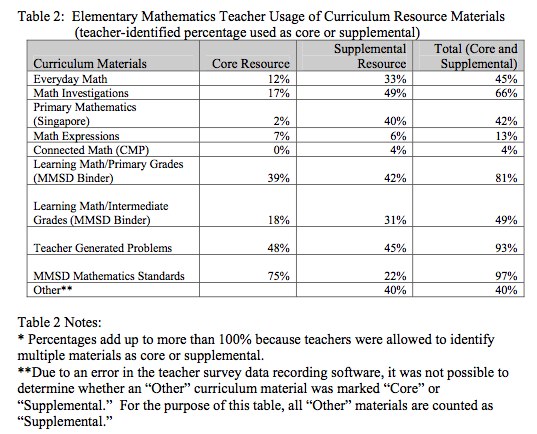
The Madison Math Task Force Report [3.9MB PDF] found that local elementary school teachers used the following curricular materials (page 166):

What, if anything has the Math Task Force report addressed?

Share

Wisconsin K-12 Tax & Spending Climate: Democrat State Senator Mark Miller on the recent Budget


Christian Schneider @ WPRI:

Over the weekend, Democrat State Senator Mark Miller took to the airwaves to explain what happened. Here is Miller’s (albeit clumsy) explanation of why Madison area districts are taking a big hit in this budget, from the “Here and Now” show:
Now, the pages of this blog have not been very friendly to Miller and his cohorts during the budget process. But on this one, I think he’s getting a bad rap – and explaining why helps illustrate the constant struggle the state has with the school finance formula.
(CAUTION: What follows is an attempt at explaining school aids, and may be dreadfully boring. If it gets too bad, feel free to go over and read the Dogs With Mustaches blog and come back in 15 minutes.)
Let’s look at the purpose of the school aid equalization formula. As its name suggests, it exists to “equalize” the relative wealth of districts. The theory behind the formula is that kids in property poor districts should have access to the same resources as kids in property rich districts (like Madison), even if the local district doesn’t have the same property values on which to draw. Thus (and this is a substantial generalization), the state grants more money to property poor districts and less money to property rich districts.
(For a full explanation of the complexities of the school aid formula, take about four caffeine pills and read this.)
For example, take a school district like Peshtigo, with per pupil property values of $275,466. Peshtigo receives about 81.6% of their budget from the state. On the other end of the scale, the Madison Metropolitan School District boasts property values of $844,000 per student, and thus receive about 41.25% of their budget in state aid. (Since you were wondering, the Geneva J4 school district, with per pupil property values of $3.3 million, receive the lowest in state aid, at 16.9%. Beloit gets 85.1% of their budget paid for by the state, since apparently nobody there has discovered indoor plumbing.)

Related by Lucy Mathiak: Mark Miller “explains” how State budget isn’t all that bad

Share

Pay bump for teachers with master’s degrees could be put to better use

The Center on Reinventing Public Education via a Debra Britt email:

Seattle, WA, July 20, 2009 — In this recessionary climate of depressed revenues and budget cuts for education, school districts across the U.S. “would be foolhardy” not to rethink paying teachers for master’s degrees, according to a new report out today.
“On average, master’s degrees in education bear no relation to student achievement,” say education researchers Marguerite Roza and Raegen Miller in their short paper, Separation of Degrees: State-By-State Analysis of Teacher Compensation for Master’s Degrees.
The brief was produced jointly by the Center on Reinventing Public Education and the Center for American Progress.
“During this time of fiscal stringency, it should raise eyebrows when a state automatically allocates such large sums of the average per-pupil expenditure in a manner that is not even suspected of promoting higher levels of student achievement,” say the authors.
In hard dollars, this means New York state spends an extra $416 per student (for a total of $1.121 billion a year) just because 78 percent of its teachers hold master’s degrees. In Washington state, the analogous numbers are $319 per pupil (or $330 million a year total) for the 56 percent of its teachers with a master’s. These expenditures, respectively, represent 2.78 percent and 3.30 percent of the total federal, state, and local money devoted to education in each state.
Roza and Miller chart these numbers for each state and suggest that the money now committed to the master’s bump in pay could be better spent, writing that: “Teaching candidates with salient and meaningful master’s degrees should be given preferential attention when competing for jobs, all else being equal. A master’s degree in engineering, for example, should be construed as evidence that a candidate possesses a deep understanding of a subject matter that is relevant to teaching mathematics or science.”

(more…)

Share

How states like Illinois rig school tests to hype phony achievement

Wall Street Journal Editorial:

When President Obama chose Arne Duncan to lead the Education Department, he cited Mr. Duncan’s success as head of Chicago’s public school system from 2001 to 2008. But a new education study suggests that those academic gains aren’t what they seemed. The study also helps explain why big-city education reform is unlikely to occur without school choice.
Mr. Obama noted in December that “in just seven years, Arne’s boosted elementary test scores here in Chicago from 38% of students meeting the standard to 67%” and that “the dropout rate has gone down every year he’s been in charge.” But according to “Still Left Behind,” a report [158K PDF] by the Civic Committee of the Commercial Club of Chicago, a majority of Chicago public school students still drop out or fail to graduate with their class. Moreover, “recent dramatic gains in the reported number of CPS elementary students who meet standards on state assessments appear to be due to changes in the tests . . . rather than real improvements in student learning.”
Our point here isn’t to pick on Mr. Duncan, but to illuminate the ease with which tests can give the illusion of achievement. Under the 2001 No Child Left Behind law, states must test annually in grades 3 through 8 and achieve 100% proficiency by 2014. But the law gives states wide latitude to craft their own exams and to define math and reading proficiency. So state tests vary widely in rigor, and some have lowered passing scores and made other changes that give a false impression of academic success.
The new Chicago report explains that most of the improvement in elementary test scores came after the Illinois Standards Achievement Test was altered in 2006 to comply with NCLB. “State and local school officials knew that the new test and procedures made it easier for students throughout the state — and throughout Chicago — to obtain higher marks,” says the report.

Share

Madison School District Budget Update: Wisconsin K-12 State Budget Changes

Superintendent Dan Nerad [184K PDF]:

Every two years the State of Wisconsin goes through a process to finalize a two year budget for all governmental programs. This biennial budget process is the source of the State’s commitment to public education here in Wisconsin, historically driven by legislative guidance to adhere to two-thirds funding.
The two-thirds funding has changed over recent years, but for the most part the State of Wisconsin was able to continue annual increases to public education in an attempt to keep up with rising costs within this sector.
The biennial budget was sigued into law near the end of June by Governor Jim Doyle after various proposals and with relatively few vetoes. This budget has numerous provisions that will effect the future of public education that include:

  • Repeal of the Qualified Economic Offer (QEO)
  • Decrease in funding for public education by the state of approximately $147 million
  • Decrease in the per pupil increase associated with revenue limits

Each of these provisions can and Will have a very unique impact on :MMSD over the years to come. The repeal of the QEO will potentially impact future settlements for salaries and benefits. The decrease in funding for public education by the state is projected to create the need for a tax increase conversation in order to sustain current programs. The decrease in the revenue limit formula will cause MMSD to face more reductions in programs and services fur the next two years at a minimum.
Many public and private organizations are dealing with this issue. It is perhaps a time to make lemonade out of lemons. In the MMSD’s case, getting out of the curriculum creation business (teaching & learning) and placing a renewed focus on hiring the most qualified teachers and letting them run.

Share

Arne Duncan Public School System has biggest black-white achievement gap in USA

Edward Hayes:

A phony interpretation of Chicago Public Schools’ academic progress isn’t the only beast threatening your local schools. For decades now, in every school district with a fireplug, a Walgreens, and a crooked alderman, the test scores of white children have been higher than those of black youngsters. The monster is called the achievement GAP. It slithers into your school even when the black and white students are sitting right next to each other in the same classroom. Furthermore, black middle-class students cannot escape its wrath because the GAP tracks them down even when their parents escape to the suburbs or move uptown.
Boring but important: The stupidly named National Assessment for Education Progress (NAEP) exams, administered by the National Center for Education Statistics, the statistical arm of the U.S. Department of Education (whew!), reports that the national GAP has narrowed for 9 to 13 year olds in math and reading since 1978, but remains unchanged for the last ten years. But there are isolated pockets of small success where the gap narrowed a bit.
4th Grade Reading: Three states reduced the GAP (1990-2007) -Delaware, Florida, & New Jersey.

Share

Are Obama and Duncan attacking teachers and local control?

Jesse ALred:

Since Franklin Roosevelt’s 1933 victory, working familes have been the heart of the Democratic Party. Except for African-Americans, Obama did not win the party’s heart in his primary contest with Hillary Clinton. He won with the support of affluent social liberals, well-educated youthful volunteers and superior financial support from the corporate sector.
The public schools’ policies of President Obama and his Secretary of Education Arne Duncan so far suggest this middle-class feeling that in spite of all his gifts Mr. Obama may lack the common touch or grounding in everyday reality may be right.
Secretary of Education Arne Duncan’s agenda seems designed to alienate middle-class teachers and parents who depend on public schools. His school reform proposals lack a well-grounded sense of why schools fail. His agenda includes the following:

Share

Reading Strategies and Cargo Cult Science

Robert Pondiscio:

The idea that it’s enough to simply “find what works, adopt it, and spread it around,” notes scientist/blogger Allison over at Kitchen Table Math is an example of what physicist Richard Feynman called “Cargo Cult Science“:

In the South Seas there is a Cargo Cult of people. During the war they saw airplanes land with lots of good materials, and they want the same thing to happen now. So they’ve arranged to make things like runways, to put fires along the sides of the runways, to make a wooden hut for a man to sit in, with two wooden pieces on his head like headphones and bars of bamboo sticking out like antennas–he’s the controller–and they wait for the airplanes to land. They’re doing everything right. The form is perfect. It looks exactly the way it looked before. But it doesn’t work. No airplanes land. So I call these things Cargo Cult Science, because they follow all the apparent precepts and forms of scientific investigation, but they’re missing something essential, because the planes don’t land.

“Cargo Cult education seems to be all the rage in lots of communities,” Allison notes. “Sure, districts could just start grabbing lessons from high performing schools but that won’t make the students suddenly read or write. Unless they understand what’s underneath the ‘lessons of the high performing school’ then it won’t matter.”

Share

Democrats’ math fuzzy on school aid; Districts can do better at cutting, too

James Wigderson:

tate Democrats are congratulating themselves on two points. They made the trains run on time; they passed the state budget just before the deadline.
They also claim that 99 percent of us will not see a tax increase.
If they had taken just a little more time with the budget they would have recognized they did not even come close to their 99 percent threshold. Even their own budget document lists so many tax and fee increases you would have to be a contortionist to get around them.
But their budget also plays a cruel game of peek-a-boo with taxpayers. The Democrats hide tax increases by pushing them to the local level. Taxpayers in the Waukesha School District are discovering the first of these hidden taxes.
The Waukesha School District is getting hit with a $6 million reduction in state aid. Never fear, we’re told. This does not mean an actual cut in school spending. It means the district will raise local property taxes to make up for the shortfall, a 10.51 percent increase in the tax levy.

Share

D.C. Chancellor Gains Ground With Aggressive Agenda

NPR Audio:

Washington, D.C., Public Schools Chancellor Michelle Rhee is pushing forward with her efforts to turn around the local school system. Those efforts have thrust Rhee’s agenda onto a national stage, as educators across the country grapple with struggling school districts. Rhee discusses her work, which includes recently narrowing an achievement gap between white and minority students.

Share

Testing Tactics Helped Fuel D.C. School Gains

Bill Turque:

When Mayor Adrian M. Fenty announced the continued growth of standardized test scores for District students Monday, he hailed it as “powerful evidence of the incredible work being done by teachers, principals and most importantly our students.”
What Fenty did not say was that the two-year improvement in District of Columbia Comprehensive Assessment System results — including an average of nearly 15 percentage points in the pass rates on elementary reading and math tests — was also the product of a strategy that relied on improved statistical housekeeping.
These include intensive test preparation targeted to a narrow group of students on the cusp of proficient, or passing, scores, and “cleaning the rosters” of students ineligible to take the tests — and also likely to pull the numbers down.
Chancellor Michelle A. Rhee described some of these approaches as the pursuit of “low-hanging fruit.”

Share

Connected Kids At Elite High Schools

Alexander Russo:

‘ve been ignoring the UofI clout story for weeks now, feeling like it was more of a higher ed thing than something about local high schools, but this latest story from the Tribune really caught my eye:
Half of the 616 Illinois students who received preferential treatment from 2005 to 2009 graduated from just 22 high schools, all but one in the metro area. Highland Park High had the most kids on the list, with Loyola Academy coming in second. There were only 25 kids on the clout list from CPS schools.

Share

Charter Schools Gain in Stimulus Scramble
Cash-Strapped States, Districts Signal Expansion of Public-Education Alternative Despite Some Teachers’ Strong Opposition

Rob Tomsho:

Some cash-strapped states and school districts are signaling a major expansion of charter schools to tap $5 billion in federal stimulus funds, despite strong opposition from some teachers unions.
Charter schools are typically non-unionized, publicly funded alternative schools that have been widely promoted by conservatives as a needed dose of competition in public education.
Last month, the Louisiana legislature voted to eliminate that state’s cap on new charter schools. The Tennessee legislature recently passed a bill expanding charter schools after U.S. Education Secretary Arne Duncan personally lobbied Democrats who had been blocking it. And the Rhode Island legislature reversed a plan to eliminate funding for new charters after Mr. Duncan warned such a move could hurt the state’s chances for grant money.
The most striking example may be in Massachusetts. Gov. Deval Patrick and Boston Mayor Tom Menino — both Democrats with histories of strong labor support — are proposing new state laws that would give them broader power to overhaul troubled schools, open more charter schools and revamp collective-bargaining agreements.
Mr. Menino, who oversees the Boston schools, wants Massachusetts communities to be able to transform traditional public schools into district-controlled charter schools and link teachers’ pay to performance.
Formerly a charter-school critic, Mr. Menino said he is fed up with opposition from the Boston Teachers Union. “I’m just tired of it,” he said. “We’re losing kids.”

Share

California’s Proposition 98, which guards funding for state’s schools, is tested again

Eric Bailey:

n the tug of war over state’s deficit, Schwarzenegger would like to suspend it. The California Teacher’s Assn. wants reassurances.
Reporting from Sacramento — For years it has been this government town’s equivalent of a stone fortress, a bastion of public policy under the watchful eye of a potent political army.
But this summer, Proposition 98, the law that guarantees public schools roughly 40% of general fund revenue, is being tested as it has been only a few times before.
Schwarzenegger has talked of suspending Proposition 98 and has reopened a battle with the law’s guardian and protector, the powerful California Teachers Assn. Both sides have waged war over the airwaves for the last week, with dueling TV commercials typically not seen in a nonelection year.
The governor and Republicans have rejected Democratic calls for new taxes on oil or tobacco. With no added taxes, cuts to schools are among the last ways the state can balance its books.
The unpopularity of such cuts guarantees difficult negotiations. But the talks over Proposition 98 have been made even more complex by lingering suspicions each side has of the other’s motives.

Share

Millions more going to college?

Joseph Aoun:

THIS WEEK, President Obama unveiled a multibillion-dollar proposal to boost enrollment in the nation’s community colleges. His plan seeks to graduate 5 million more Americans from two-year colleges by 2020, and follows a more sweeping goal he announced during his first address to Congress in February: for America to once again have the highest number of college graduates in the world by 2020.
While some will question whether these prospective students are ready for college, many of us in higher education are asking ourselves: Are we ready?
In the months following the president’s congressional speech, there has been spirited debate in the education community about whether or not the president’s goal is attainable. A member of a federal commission on higher education called it “sheer fantasy.” Others have said the deadline should be pushed from 2020 to 2025.

Share

Online education: Raising Alabama

The Economist:

An experiment in levelling the playing field
ON A sweltering day in Alexander City, Alabama, summer school was in full swing. Two girls were reading “Julius Caesar” as two others wrestled with maths. A boy worked his way through a psychology quiz, and a teacher monitored an online discussion with students from around the state: Was Napoleon the last enlightened despot or the first modern dictator?
This is not a traditional classroom scene, but it has become common enough in Alabama. The state has many small, rural schools. Because of their size, and the relative scarcity of specialised teachers, course offerings have been limited. Students might have had to choose between chemistry or physics, or stop after two years of Spanish. But thanks to an innovative experiment with online education, the picture has changed dramatically.
In 2005 the governor, Bob Riley, announced a pilot programme called Alabama Connecting Classrooms Educators and Students Statewide, or ACCESS. The idea was to use internet and videoconferencing technology to link students in one town to teachers in another. It was something of a pet cause for Mr Riley, who comes from a rural county himself. He was especially keen that students should have a chance to learn Chinese.
……..
Joe Morton, the state superintendent of schools, points to the number of black students taking AP courses. In 2003, according to the College Board, just 4.5% of Alabama’s successful AP students (those who passed the subject exam) were black. In 2008 the number was up to 7.1%. There is still a staggering gap–almost a third of the state’s students are black–but the improvement in Alabama was the largest in the country over that period. “That makes it all worthwhile right there,” says Mr Morton.

Share

The Children at Judge Sonia Sotomayor’s Bronx School

Manny Fernandez:

The hardwood floor was shiny yet scuffed, from the tiny chairs and desks that have rubbed against it for generations. The open windows let in a cool breeze. The pencil sharpener on the window sill sat at attention, as did Dorothy Faustini’s fourth- and fifth-grade math students.
The problem on the chalkboard: What is 72,641 divided by 10?
Hands shot up, hands stayed down. “Do not be afraid of the big numbers,” Ms. Faustini reminded the children.
Jacqueline Garcia, 8, sat at the front of the classroom, inside Blessed Sacrament School in the Bronx on Wednesday morning. Math does not frighten her. She likes it, because she wants to be a doctor, and to be a doctor, she said, you have to learn math, science and reading.
One of Jacqueline’s older schoolmates, Alicia Sylvester, 12, wants to go to Penn State University and learn to be a pharmacist. Another student, Alex Nunez, 10, is undecided on his career path, but he said it’s a toss-up between a scientist and an astronaut.
“I can go to space and discover new planets and fix some satellites,” Alex said.

Share

Education reform in Massachusetts A chance for charters

The Economist:

Independent public schools may be getting a chance in the Bay State
MASSACHUSETTS ranks at or near the top of national measures of how well schoolchildren do at reading and mathematics. A leader in early-years education, it is also applauded for its vocational, technical and agriculture schools. Still, there are problems. The disparity between students in affluent districts and those in low-income urban ones is shocking. In the Concord/Carlisle school district, for instance, 92% of students graduated from high-school on time and planned to attend a four-year college or university in 2007, compared with just 12.8% in Holyoke, one of the poorest cities in the state.
Many states have turned to charter schools (self-governing publicly-funded schools) to close achievement gaps like that, but charters are a tricky subject in Massachusetts even though the few they do have, such as Boston Collegiate, are among the best in the country. Unions abhor them while the school boards that run most public schools fear losing power and funding. Politicians have been unwilling to take on Massachusetts’s mighty unions.
Last year Deval Patrick, the self-styled “education governor” of the state, unveiled a 55-point plan to overhaul the state’s education system. The governor’s package includes the introduction of three types of “readiness schools” to turn around poorly performing districts. Like charters, they will have greater flexibility, autonomy and will be held accountable for their results. But they will not be fully independent, remaining under the control of local school boards. Mr Patrick will introduce a bill authorising these schools later this month. One sort would have an external partner, such as a university, while another would be teacher-led.

Share

Connecticut Schools, Charters, Politics, Parents and the Achievement Gap

Sam Dillon:

Connecticut is another Northern state where achievement gaps are larger than in states across the South, the federal study shows. That is partly because white students in Connecticut score above the national average, but also because blacks there score lower, on average, than blacks elsewhere”.

This validates my personal belief, and something that I have been saying for several years now, that Connecticut does not have great public schools, rather, it has one of if not the highest percentages of households with 4-year and advanced college degrees (CT, NJ and MA are always at the top of this list). This high percentage of well educated households makes Connecticut’s public schools look good — it is the household that is the difference maker, not the public schools. To prove my point, why is it that not one DRG B school does not outperform just one DRG A school?…or just one DRG C school out perform just one DRG B school?…makes no sense if the school were in fact the difference maker. DRG = Demographic Reference Group which is how the Dept. of Ed. here in CT groups all of its school districts to rate performance and other statistical data. It is generally rated by median household income but size of the community and other socioeconomic factors are part of the equation too. A = the most wealthy communities (also the “best” schools) and it goes down form there.
…it is all about socio-economics not how great Connecticut’s public schools are, which they are not.
Connecticut’s high-performing, public charter schools are making a difference, and that is an objective statement based on proven data.
We should do everything in our powers to embrace the proven Achievement First (Amistad Academy) model and replicate it far and wide. Why it is being stiff-armed by our legislators and the teachers union is simply bewildering. But then again both have proven to put their interests (political careers and pay checks) first and Connecticut’s children second — the teachers union is particularly good at that.

Share

Using the Rout in Housing to Lower Taxes

MP McQueen:

Kim Davidson lives in Bonita, Calif., a San Diego suburb hit hard by tumbling property values. Earlier this year, she made the best of a bad situation and appealed her tax assessment. The county reduced her annual tax bill by more than $1,000 to $3,500.
“I did the whole thing online and walked [my application] down to the mailbox, and a month and a half later, I learned I saved all that money,” says Ms. Davidson, a 44-year-old account manager for a business consulting firm, who purchased the home last year. “It was incredible.”
Tens of thousands of homeowners across the country are trying to wring something positive from an epic real-estate crash. In Cuyahoga County, Ohio, which includes Cleveland, hit hard by rising unemployment and foreclosures, nearly 23,000 property owners applied for property-tax reductions this year, up from an annual average of 1,700. Appeals in California’s Sacramento County soared to 12,000 in 2008 from a typical rate of 1,800 a year earlier.
The number of property owners seeking a tax reduction in Clark County, Nevada, which includes Las Vegas, soared to 6,000 this year from about 1,000 annually in recent years. About three-quarters of those who filed appeals succeeded in having their valuations lowered, most by 30% to 40%, county officials say. The county already had reduced valuations across the board for the vast majority of its residential property owners, says Michele Shafe, assistant director of the Clark County Assessor’s office. She said staffers had to work overtime and Saturdays to keep up with demand for reassessments.

Share

More on Obama and Community Colleges

Christopher Beam:

There’s a joke among snooty Boston-area high-school kids: If they don’t get good grades, they’ll end up at Cape Cod Community College, or “4 C’s by the Sea.” In suburban Washington, D.C., the punch line is Maryland’s Montgomery College, or “M.K.” for short. Kids in Houston use San Jacinto College, long known as “Harvard on the Highway.”
Community colleges don’t get a lot of respect. Except, as of this week, from President Obama. In a speech Tuesday in Warren, Mich., he proposed sinking nearly $12 billion into revamping the country’s community-college system. The plan would provide $9 billion in grant money to boost academic programs and raise graduation rates, plus another $2.5 billion to upgrade school facilities. It would also fund open-source online courses so that schools don’t have to build more classrooms to admit more students.

Share

Study: Achievement gap persists in Minnesota, rest of U.S.

Tom Weber:

A new report from the U.S. Education Department shows black students are scoring better in math and reading, but not enough to close a nationwide gap between them and white students.
The study also shows Minnesota has one of the nation’s largest achievement gaps, but not necessarily for the reasons you might think.
The study looked at fourth and eighth-grade math and reading scores from a nationwide achievement test called the NAEP.
The test is scored on a 500-point scale. Of the students the study looked at, black students scored 26-to-31 points below white students in reading and math.
The study concludes that every state still has an achievement gap, but at least that gap isn’t getting any bigger. Fifteen states saw their gap shrink on fourth-grade math, but not a single state has narrowed the gap in eighth-grade reading.
The disparity, though, is not caused by black students getting worse. Scores for blacks continue to improve, but they’re also improving for white students. Researchers note it’s hard to close the gap when everyone is improving.
Minnesota, meanwhile, has one of the nation’s largest achievement gaps. But again, that’s not necessarily because blacks are slipping, according to Jim Angermeyr, the head of research for Bloomington schools.

Share

Education Reform

Jeff Nolan:

There is a lot of talk in California right now about how the budget crisis will affect education investments, and I write investments very deliberately because education spending is a form of investment that is supposed to yield future returns. It’s evident that we’ll have to deal with the budget hole by cutting education spending rather dramatically, in fact it is absolutely unavoidable because education spending is about 50% of the state budget and when you include all of the other initiative mandated spending, the state government controls less than 20% of the actual budget… with a $26b hole in the budget the state could cut every dollar spent on things not mandated by voters and there would still be a deficit.
Okay, so we’re going to have a less generously funded school system, a system that already competes for last place in the country in terms of educational quality. There is also the reality that we will dramatically reduce our funding for community colleges and at the same time raise fees, a reality for the California State University system and the University of California system.
While we are going through this fiscal realignment is it not also appropriate to ask what we are getting out of our education system? K-12 is a basket case and parents with economic means opt out of the system while those on lower income tiers are effectively denied something every child deserves, a quality education.

Share

Wonk alert! More details on Obama’s community college proposal

Mary Beth Marklein:

Wonk alert! I’m posting additional background information on the community college initiative that President Obama announced today, along with a link to the Council of Economic Advisers report, out Monday, called Preparing the Workers of Today for the Jobs of Tomorrow.
The name of Obama’s proposal: The American Graduation Initiative
The cost: see what I’ve underlined below.
The four main features:

Frederick Hess has more.

Share

Sloppy Wisconsin K-12 budget hits Madison, other schools hard

Scott Milfred:

It’s not just Madison schools getting hit with a much bigger cut in state aid than expected.
Middleton-Cross Plains is in the same leaky boat. So are schools in Adams-Friendship, Green Lake, Markesan, Montello, Princeton, Westfield and Wisconsin Dells.
State lawmakers had said no school district in Wisconsin should experience a state aid cut of more than 10 percent, under the state budget just signed into law.
But more than 90 school districts, including all of those listed above, just learned they’re facing cuts greater than 15 percent. In addition, school districts including Lodi and Cambridge are facing cuts of more than 12 percent.
It’s a stunning blow to local schools.
In Madison, it means the worst-case scenario of a 10 percent cut of $6 million next school year just became a much bigger reduction of more than $9 million.
That’s likely to trigger higher local property taxes and cuts to instruction — despite last fall’s referendum that was supposed to steady Madison schools for three years.

Share

CAST July 09 MMSD Budget Statement

via a TJ Mertz and Jackie Woodruff email: July 15, 2009
The school referendum approved overwhelmingly by Madison Metropolitan School District voters in November 2008 was based on a “Partnership Plan” that promised to maintain educational quality, initiate a community-wide strategic planning process, and mitigate the impact on property tax-payers in a variety of ways.
While the school district remains committed to the principles of this Partnership Plan, with the uncertain economy many things have changed since November. Most significantly, the recently enacted state budget has left MMSD facing what now looks like a $9 million reduction in state aid as well as requiring an almost $3 million reduction in expenditures for the 2009-10 school year.
As the MMSD Board of Education seeks ways to address the shortfalls created by the state budget, Community and Schools Together (CAST) believes it is important that the community recognize that this problem was created by state officials, not local decisions. The reductions in revenues and in funding for targeted programs (via categorical aids) will impact every district in the state. Madison is one of about 100 districts that have had their general state aid cut by 15%, but almost all districts are experiencing significant reductions in state support and will be contemplating higher than anticipated property tax increases.
These cuts come after 16 years of inadequate funding, annual cuts in most districts as well as reductions of the state’s portion of education costs in recent years. This recent state budget moves us further away from the sustainable, equitable and adequate educational investments that are needed to keep Madison and Wisconsin strong and competitive.
It is also important that the community understand that the tax and revenue projections in the Partnership Plan and those used in the preliminary district budget passed in May were good projections made in good faith based on the best available information. That preliminary budget strengthened education and held property tax mil rate increase to 1¢ (far below the 11¢ increase anticipated prior to the referendum).
In the coming months the Board of Education must find ways to meet the shortfalls created by the state budget. There are no good choices.
These choices involve some combination re-budgeting and re-allocating, potential new cuts, use of the district’s recently growing fund balance, temporarily employing targeted stimulus monies, or increasing the local tax levy. CAST urges the Board to retain their commitment to quality education and community involvement. We also ask the community to take advantage of opportunities to let all our state and local elected officials know that Madison values education.
###
Community and Schools Together (CAST) is a grass roots organization dedicated to securing sustainable, adequate and equitable public education investments in Madison and Wisconsin.
(Contact) CAST Co-Chairs:
Thomas J. Mertz – 608-255-1542, Carol Carstensen – 608-255-8441, Troy Dassler — 608-241-5183

Share

Madison School Board Discussion: Private/Parochial, Open Enrollment Leave, Open Enrollment Enter, Home Based Parent Surveys

22MB mp3 audio file. A summary of the survey can be seen here. The Board and Administration are to be commended for this effort. It will be interesting to see how this initiative plays out.

Share

Fine Arts Task Force Report Discussion – Audio

The Madison School Board’s discussion last evening via a 42MB mp3 audio file. An interesting discussion, particularly with respect to the School District’s interaction with the community and the Teaching & Learning Department. Much more on the Fine Arts Task Force here.

Share

The Culture Wars’ New Front: U.S. History Classes in Texas

Stephanie Simon:

The fight over school curriculum in Texas, recently focused on biology, has entered a new arena, with a brewing debate over how much of the Bible belongs in American history classrooms.
The Texas Board of Education, which recently approved new science standards that made room for creationist critiques of evolution, is revising the state’s social studies curriculum. In early recommendations from outside experts appointed by the board, a divide has opened over how central religious theology should be to the teaching of history.
Three reviewers, appointed by social conservatives, have recommended revamping the K-12 curriculum to put the Bible, the Christian faith and the civic virtue of religion front-and-center in the study of American history. Two of them want to remove or de-emphasize references to several historical figures who have become liberal icons, such as César Chávez and Thurgood Marshall.

Share

Education data system key to additional federal stimulus money

Kristi Swartz:

Almost like being tagged with a barcode, at some point schoolchildren in Georgia will receive a unique number that tracks their test scores and other data from the moment they enter kindergarten until they’ve graduated.
Such a data system, which would update nightly, school officials say, may sound like a pipe dream. In fact, if the state wants a crack at a huge pot of additional stimulus money from the U.S. Department of Education, that system must one day become a reality.
The money, $4 billion total in what Education Secretary Arne Duncan has dubbed the “Race to the Top” fund, will be distributed next year at Duncan’s discretion.
A strong data system is one of four measures the secretary will use in awarding the grants. The others are creating international academic standards, turning around low-performing schools and teacher quality.
Because of the sums of money involved, and because the grants will only go to a few states, the Race to the Top represents a potentially enormous payoff.
The amount of the grants or how they will be distributed is unknown at this point.

Share

DPS gives control of lagging schools to private sector

Marisa Schultz:

Detroit Public Schools Emergency Financial Manager Robert Bobb announced Friday that he has hired four educational management companies to turn around 17 of the worst-performing high schools in the district, a move that marks what leaders say is the largest public school district overhaul of its kind in the nation.
“We have not been making the grade,” Bobb said at a press conference at Central High School.
School board members expressed shock and dismay Friday — just one day after they rolled out their own academic plan that they’ve asked Bobb to fund. Some accused Bobb of overstepping his bounds as a financial manager by launching an academic plan that will affect 20,000 students in three-quarters of the district’s high schools without the board’s knowledge.
The board was charged with working on the academics, while Gov. Jennifer Granholm brought in Bobb to work on the finances for a year.
“We have asked Robert Bobb to do a very difficult job and he needs the authority to do it right,” said Granholm’s spokeswoman Liz Boyd, noting Bobb is not overstepping his role. “He doesn’t need to be micromanaged.”
The district signed multiyear contracts with four out-of-state companies that will be funded through $20 million in federal stimulus dollars. The aim is to improve student achievement, discipline, respect, safety and graduation rates, district officials said.

Share

Task force on Minn. high schools taking shape

AP:

A task force asked to suggest ways to design an accountability system for Minnesota high schools is seeking suggestions itself.
The panel created this spring by the Legislature is soliciting advice through July 15 on the key issues it should tackle.
From there, the task force plans to produce a report on high school assessments and accountability. Preliminary recommendations could be out this fall, and the goal is to deliver a final report to the state education commissioner and lawmakers by year’s end.

Share

Madison School District: Private/Parochial, Open Enrollment Leave, Open Enrollment Enter, Home Based Parent Surveys

Kurt Kiefer, MMSD Chief Information Officer [1.3MB PDF]:

This memo is a summary of the results from the surveys completed during the past school year with various parent groups whose children reside within the MMSD attendance area but receive certain alternative education options. Also included are results of the survey conducted with non-residents who attend MMSD schools via the Open Enrollment program (Le., Open Enrollment Enter).


Background
Groups were surveys representing households whose students were enrolled in one of four different educational settings: MMSD resident students attending private/parochial schools, MMSD resident students attending other public schools via the Open Enrollment program, non-resident students attending MMSD schools via the Open Enrollment program, and MMSD resident students provided home based instruction.


The surveys were conducted between December 2008 and February 2009. The surveys were mailed to households or they could complete the survey online. Two mailings were conducted – the initial mailing to all households and a second to non-respondents as a reminder request. Total group sizes and responses are provided below.

This document will be discussed at Monday evening’s Madison School Board meeting.
UPDATE:

Share

Everybody Hates The Teachers’ Unions Now

Mickey Kaus:

When Father Hesburgh throws down … How can we know when the tide of respectable opinion has decisively turned against the teachers’ unions? When a panel that includes Father Hesburgh, Birch Bayh. Bill Bradley, Eleanor Holmes Norton and Roger Wilkins goes medieval on them, saying their resistance to reforms designed to hold schools accountable has hurt “disadvantaged students” and led to “calcified systems in which talented people are deterred from applying or staying as teachers …”
Here are two undiplomatic grafs from the report’s final page:

The unions have battled against the principle that schools and education agencies should be held accountable for the academic progress of their students. They have sought to water down the standards adopted by states to reflect what students should know and be able to do. They have attacked assessments designed to measure the progress of schools, seeking to localize decisions about test content so that the performance of students in one school or community cannot be compared with others. They have resisted innovative ways-such as growth models-to assess student performance.
In their attack on education reform, the national unions have often been unconstrained by considerations of propriety and fairness. They have sought to inject weakening amendments in appropriations bills, hoping that they would prevail if no hearings were held and the public was unaware of their efforts. They have used the courts to launch an attack on education reform, employing arguments that could imperil many federal assistance programs going back to the New Deal. They have failed to inform their own members of the content of federal reform laws.

Locally, it will be interesting to see what substantive changes, if any, come out of the current Madison School District / Madison Teachers, Inc. bargaining.

Share

Hawaii Board of Education Approves 12.6% Budget Reduction ($227M on $1.8Billion Annual Spending)

Loren Moreno:

Faced with the most drastic budget cuts ever to the state’s public education system, the Board of Education approved a plan yesterday that includes about $117 million in yet-to-be negotiated labor savings — from potential pay cuts to furloughs of teachers and administrators.


The plan, which trims a total of $227 million from the $1.8 billion school system budget, includes a 5 percent across-the-board cut to school-level programs, a reduction of part-time workers and slashing of school-level funding.


Several board members said the plan is certain to have repercussions on teaching and learning.


“There is nobody in this room who wants to do what we’re about to do. But the fiscal reality is such that we have to do this,” said board member John Penebacker.

Share

Teachers union attacks Schwarzenegger’s proposed suspension of Proposition 98

Michael Rothfeld:

The California Teachers Assn. unveiled a television ad Thursday attacking Gov. Arnold Schwarzenegger for his proposal to suspend Proposition 98, the law that sets funding guarantees for schools.
Schwarzenegger last week proposed reducing the guarantee by $3 billion for the coming fiscal year to help address the state’s $26.3-billion deficit.
The well-funded union, which has turned public opinion against the governor in the past, focuses its commercial on Schwarzenegger’s failure in 2005 to repay money he had promised to return after suspending the guarantee the year before. “He said he was sorry,” the ad says. “He said never again. . . . And now Schwarzenegger says he’ll break the minimum guarantee to our schools again.”
Schwarzenegger spokesman Aaron McLear said the governor would not be dissuaded.

Share

Indiana providing teaching fellowships in Science, Technology, Engineering & Mathematics (STEM)

The Woodrow Wilson National Fellowship Foundation:

The Woodrow Wilson Indiana Teaching Fellowship seeks to attract talented, committed individuals with backgrounds in the STEM fields–science, technology, engineering, and mathematics–into teaching in high-need Indiana high schools. Learn more…
Funded through a $10 million grant from the Lilly Endowment, the Fellowship offers rigorous disciplinary and pedagogical preparation, extensive clinical experience, and ongoing mentoring. Eligible applicants include current undergraduates, recent college graduates, midcareer professionals, and retirees who have majored in, or had careers in, STEM fields.

When will the MMSD and the State of WI follow suit?
Related:

Share

School Choice and Supreme Court Nominee Sonia Sotomayor

Andy Smarick:

Will Judge Sonia Sotomayor’s life experience, including attending a private Catholic school, lead to an uncomfortable conclusion–that government-supported school choice is just?
The Obama administration has made Judge Sonia Sotomayor’s life story a central part of her introduction to the nation as a Supreme Court nominee. The administration has focused attention on her inspiring, only-in-America path from public housing through elite institutions of higher education to the top of the legal profession.
……
Consequently, we might expect to see these experiences clearly reflected in their positions on three contemporary issues.
First, President Obama ought to be a vigorous defender of the D.C. Opportunity Scholarship Program, which provides vouchers to low-income students in the nation’s capital so they can attend private schools.
Second, the president should be expected to act forcefully to save America’s urban Catholic and other faith-based schools, which are disappearing at a rapid pace, robbing disadvantaged families of desperately needed private education options.
Third, we should expect Judge Sotomayor to decide in favor of school choice programs while on the bench.
In practice, however, there appears to be a limit to the influence of personal experience. President Obama failed to stand up for the D.C. voucher program, and Democratic congressional leaders went after it with a vengeance. If his 2010 budget is adopted, no new students will be allowed into the program, and it will slowly wither away. Similarly, while his Department of Education has $100 billion in stimulus funding for America’s schools, neither he nor Education Secretary Arne Duncan has uttered a word about preserving faith-based urban schools.

Share

Duncan’s Donut: The Ed. Sec.’s Impact on Chicago Student Achievement Was Near Zero

Andrew Coulson:

For seven months, Secretary of Education Arne Duncan and the media have bombarded us with tales of how Duncan dramatically boosted student achievement as leader of Chicago Public Schools. Based on two new independent analyses, Duncan’s real impact appears to have been near zero.
The usual evidence presented for Duncan’s success is the rise in the pass rate of elementary and middle school students on Illinois’ own ISAT test. But state tests like the ISAT are notoriously unreliable (they tend to be corrupted by teaching to the test and subject to periodic “realignments” in which the passing grade is lowered or the test content is eased). In January, the Schools Matter blog argued that exactly such a realignment had occurred in 2006.
So to get a reliable measure of Duncan’s impact, I pulled up the 4th and 8th grade math and reading scores for Chicago on the National Assessment of Educational Progress — a test that is much less susceptible to massaging by states and districts. I then compared the score changes in Chicago to those for all students in Large Central Cities around the nation, and tested if the small differences between them were statistically significant. Not one of them is even remotely significant at even the loosest accepted measure of significance (the p < 0.1 level). Chicago students did no better than those in similar districts around the nation between 2002/2003 and 2007, a period covering virtually all of Duncan's tenure in Chicago.

Share

Lessons for Failing Schools

NY Times Editorial:

Mr. Duncan has said from the start that he wants the states to transform about 5,000 of the lowest-performing schools, not in a piecemeal fashion but with bold policies that have an impact right away. The argument in favor of a tightly focused effort aimed at these schools is compelling. We now know, for example, that about 12 percent of the nation’s high schools account for half the country’s dropouts generally — and almost three-quarters of minority dropouts. A plan that fixed these schools, raising high school graduation and college-going rates, would pay enormous dividends for the country as a whole.
Mr. Duncan can use his burgeoning discretionary budget to reward states that take the initiative in this area. But Congress could push the reform effort further and faster by granting the education department’s request for two changes in federal education law. The first would be to come up with new federal school improvement money and require the states to focus 40 percent of it on the lowest-performing middle and high schools. The second change would allow the secretary to directly finance charter-school operators that have already produced high-quality schools.

Share

Bout with cancer gave Evers the drive to become Wisconsin schools chief

Alan Borsuk:

When the surgery was over, the worst of the aftermath survived, and the tumor gone, Tony Evers met with his oncologist, Linn Khuu.
“You know, you’ve been given a second chance,” she told him. “Go do something great.”
Evers felt a bit insulted at first. He thought he had worked hard and done good things for years. For one thing, he had been deputy state superintendent of public instruction for almost seven years at that point.
Then he decided she was right.
Now, Evers said, he would tell people who went through what he went through, “If you do get a second chance, make the most of it.”
At 11 a.m. Monday, Evers, 57, will show what he is doing to make the most of it. He will be sworn in as Wisconsin’s 26th superintendent of public instruction – and almost surely the first without an esophagus.
Within months of being told he had a form of cancer that generally has low survival rates, Evers decided to undertake a race for statewide office.
“Once you get over a hurdle, it does make you a bit more fearless,” he said in an interview last week.

Share

A Union Promotion
An enemy of education reform gets kicked upstairs.

Wall Street Journal Editorial:

In her weekly “What Matters Most” newspaper column, Randi Weingarten recently bid the Big Apple farewell. Ms. Weingarten has been elevated to president of the national American Federation of Teachers from head of its New York City affiliate, and she had some notable parting words: “One of the most rewarding (and exhausting) things about working in public education in New York City is that it is the best laboratory in the world for trying new things.”
Well, it could be, if it weren’t for Ms. Weingarten’s union. Since taking over in 1998, she has done everything she could to block significant reforms to New York’s public schools. Take her opposition to charter schools. She resisted raising the state cap on charters from 100 unless the union could organize them. (She lost and the cap now is 200.)

Share

Mayoral control isn’t the answer for Detroit schools

Andy Kroll:

On a recent visit to Cody High School in southwestern Detroit, U.S. Secretary of Education Arne Duncan reiterated one of his key talking points on how to improve the nation’s underachieving urban public school districts: Put mayors in charge of big-city public schools.
Transferring authority over urban school districts from school boards and superintendents to mayors, Duncan explained in March at the Mayors’ National Forum on Education in Washington, D.C., will ensure greater stability in the leadership of school districts. Duncan pointed out that mayors usually hold office longer than the average school superintendent.
The secretary of education also said that mayors make stronger leaders at the helm of public schools.

Share

Wisconsin K-12 Tax & Spending Climate: State Redistributions to Madison Smaller Than Expected

Mark Pitsch:

Barely a week after the Legislature approved a budget that local and state officials said would slash state aid to Madison schools by no more than 10 percent, new estimates show the cuts will actually top 15 percent.
Word of the $9.2 million cut in general state school aids next year came as a rude shock to lawmakers and district officials. That’s because cuts approved by the Legislature’s budget committee were estimated to be 13.1 percent, but the final budget was believed to limit the cuts to 10 percent.
Dave Schmiedicke, Gov. Jim Doyle’s budget director, said several factors affected the new school funding calculation, including the number of students expected to enroll this fall, the district’s relatively larger increase in spending per student compared with other Wisconsin districts and the district’s high property values.

Related: Open Enrollment.

Share

US Education Secretary Duncan Promotes Charter School Debate

Mary Bruce:

chools specialize in math, science or the arts. Some are Afro-centric, others are religious. They are publicly funded but operate independently of local schools boards and, often, teacher unions.
They all make up the growing charter school movement that the Obama administration would like to see flourish.
“The charter movement is absolutely one of the most profound changes in American education, bringing new options to underserved communities and introducing competition and innovation into the education system,” Education Secretary Arne Duncan told attendees at the National Alliance for Public Charter Schools’ annual conference last week.

Share

Return of Board of Education means parents have less say on schools

Meredith Kolodner & Rachel Monahan:

Parents who’ve complained for years about having little input under mayoral control of schools, have even less power under the resurrected Board of Education.
They say they have been left with fewer avenues for involvement, including the loss of their Community Education Councils, which expired with mayoral control.
“We had no power when we were authorized, what power will we have now?” said Queens CEC 26 head Robert Caloras.
He plans to file a formal complaint over the appointment of a deputy mayor to represent Queens on the Board of Ed.
He said the appointment of Deputy Mayor Dennis Walcott to the seven-member board was a conflict of interest, since he works for the mayor.

Share

Shake-up in Seattle schools coming soon

Danny Westneat via a kind reader’s email:

Maybe it was brought on by lean times. Or maybe long-simmering angst about the state of Seattle schools is finally boiling over on its own.
But the decision this month to lay off 165 of Seattle schools’ newest teachers in a “last hired, first fired” manner has got some of liberal Seattle suddenly sounding more like a conservative red state.
More than 600 school parents have signed an online petition, at supportgreatteachers.com, that calls out the teachers union for causing “great distress and upheaval” in the schools. At issue is the policy of choosing who gets laid off solely by seniority.
“Wake up and see how union refusal to consider merit is damaging the profession and our kids,” wrote one parent.
“We want the best teachers, not the oldest, teaching our kids,” wrote another.
“Teacher unions are an anachronism,” said another.
The organizers of the petition are a group of parents called Community and Parents for Public Schools. They agree what they’re doing is very un-Seattle.

Share

Seniority vs. Effectiveness

Seattle: Support Great Teachers:

As a Seattle community, we can and must speak up to improve the effectiveness of every school, in every neighborhood.
We, the undersigned, ask our leaders to do the following:
1. Delay the immediate assignment of replacement teachers until the effects of attrition and retirement are understood. Keep successful teams intact.
2. In the new contract between the teachers’ association and the school district, change the layoff policy to prioritize effectiveness. Put in place a system that promotes, rewards and protects teamwork, expertise, best teaching practices and each site’s unique programmatic needs.
3. Ensure that all kids have consistent access to highly effective teachers.
4. Give our principals the tools they need to support and retain effective teachers within their individual schools.

Share

US Education Secretary Duncan Advocates Merit Pay at NEA

Stephen Sawchuck:

To answer the question I’m sure you all have: Yes. Teachers booed and hissed during some of the performance-pay portions of Secretary of Education Arne Duncan’s speech. And they weren’t overwhelmingly happy with the talk of reform to seniority and tenure systems, either.
But some of the stories I’ve seen around the Web on the speech are billing this as “tough love” for the teachers’ unions. There was some of that, sure, but President Barack Obama and Duncan clearly telegraphed their intentions to push hard on these issues in the stimulus legislation, and that passed months ago.
So there was an element to this whole proceeding that came off as a little bit rehearsed to me. I wonder if Duncan had prepared his seemingly ad-libbed line for when the booing started: “You can boo; just don’t throw any shoes, please.” And I’m pretty sure most of the delegates had gotten their vocal chords ready, too.
To me, the biggest news out of the speech is that the administration is increasingly emphasizing student achievement as one measure of teacher pay or evaluation, although not the only measure. That is a big issue, and it’s one that helped sink congressional attempts to renew the No Child Left Behind Act in 2007.

Joanne has more along with Thomas.
Libby Quaid:

Education Secretary Arne Duncan challenged members of the National Education Association Thursday to stop resisting the idea of linking teacher pay to student achievement.
It was Duncan’s first speech at the union’s annual meeting, a gathering at which President Barack Obama was booed when he mentioned the idea of performance pay last year. By contrast, Duncan drew raucous applause and only a smattering of boos.
“I came here today to challenge you to think differently about the role of unions in public education,” Duncan told the 3.2 million-member union in San Diego.
“It’s not enough to focus only on issues like job security, tenure, compensation, and evaluation,” he said. “You must become full partners and leaders in education reform. You must be willing to change.”

Share

Massachusetts Teachers Union Votes Down Advanced Placement Grant

Mike Antonucci:

Today’s lesson comes courtesy of Bernadette Marso, president of the Leominster Education Association in Massachusetts. Her members just voted down, by a 305-47 margin, a five-year, $856,000 grant from the Advanced Placement Training and Award Program. The program, among other things, pays teachers of Advanced Placement courses bonus money “if they successfully recruit more students to take AP courses and if the students perform well on the end-of-the-year AP exam.”

Some district officials and parents complained about the union decision because the bonuses were just one part of the program, which includes professional development and a subsidy to offset the AP exam fee for the students. But the union stood firmly opposed.

“We understand that some people will not understand the vote, but we confronted this from a union perspective,” Marso said. “We have a fair and equitable contract with the district, and to have a third party come in and start paying certain teachers more money than other hard-working teachers goes against what a union is all about.”

It will be interesting to see how the Madison School District’s contract negotiations play out with respect to community 4K partners and other curriculuar issues.

Share

Tony Evers Evokes Change as He Enters Wisconsin DPI Superintendent Office

WisPolitics:

“Education is all about continued improvement, and the status quo is not satisfactory,” Evers told the audience at a WisPolitics.com luncheon Tuesday at the Madison Club.


In addition to guiding local schools as they navigate state cuts and an influx of federal stimulus funding, Evers is promoting a single federal test and an overhaul of accountability and assessment standards for public education. Under the new system, which Evers said would be formed quickly over the next few months, the state will be able to consistently measure other educational categories aside from test scores.


The test score measurement mandates under the federal No Child Left Behind law drew criticism from Evers for their incomplete picture of education, but he said the federal standard has done educators “a tremendous favor” by showing disparities between performance of white and non-white students.


He also called for a national standard of testing and curriculum, which he said 46 states had backed. He said that Wisconsin isn’t able to truly compare its educational growth to other districts and states because 50 different tests are being administered annually. He also called the current system “economically irrational.”
“Public education, even though it’s a state responsibility, is a national endeavor, and we have to view it as such,” Evers said. “By doing this, we’re going to make our system more transparent.”


Perhaps nothing will test the new state accountability system as much as Milwaukee. Evers went to great lengths to discuss the “magic” that teachers work with many less fortunate students in the state’s largest school district, but recognized a graduation rate that, despite increasing to about 70 percent, lags well behind the state average.

Share

Sports Salaries Show What We Really Value

Allen Barra:

The issue of escalating compensation and rising ticket prices in professional sports has been around for years. But next month it could reach a boiling point when 21-year-old Stephen Strasburg, the No. 1 pick in this year’s Major League Baseball draft, signs for at least $15 million. And that’s just a bonus before salary is even discussed.
The blogosphere and radio call-in shows are already buzzing, with people saying things like “Man, the [Washington] Nationals” — or whatever team ends up signing Mr. Strasburg — “are sure going to have to raise prices to pay for this guy. You’ll be lucky to afford a beer when you go out to the ballpark to see him pitch.”
Well, if you can’t afford to buy a beer at the ballpark then it didn’t do the team much good to sign the player, did it? Sportswriters and radio guys delight in reminding fans that every time a team acquires an expensive player the cost of everything goes up. But that’s just not the way economics works.

Share

University Of Illinois Tracked Applicants With ‘Clout’

David Schaper:

The state of Illinois is embroiled in yet another political scandal. This one involves the University of Illinois and allegations that students with political clout were admitted to the school over other, more qualified applicants.
A Shoo-In
When William Jones graduated from high school three years ago, he thought he had done what he had to do to get into University of Illinois that fall.
“I was mostly an A student. A’s, with a couple of B’s. I got a 29 on my ACT,” Jones said. “So when I originally applied to U of I, I guess I cockily thought I was a shoo-in, but apparently not.”
Jones scored high enough to get on Illinois’ waiting list before ultimately being denied. His Plan B was to go to the University of Iowa, where he paid out-of-state tuition.

Share

Wisconsin School funding getting precarious Budget removes option for districts to cap increases for teachers’ salaries, benefits

Alan Borsuk & Amy Hetzner:

The three-legged stool is now down to one leg.
Will that leave either schools or taxpayers wobbly? Will the last leg fall, too?
In any case, Wisconsin’s old order for how to fund schools is coming to an end, and what comes next remains to be decided, perhaps two years from now when the next state budget is adopted. Pressure for an overhaul is growing, even as economic realities are providing strong pressure to hold down budgets.
When Gov. Jim Doyle signed the state budget for 2009-’11 on Monday, the leg of the stool known as the qualified economic offer fell away. The QEO meant school districts had the option of capping increases in teachers’ pay and benefits to 3.8% a year.
A second leg – the state’s commitment to fund two-thirds of general operations of public schools – has been weakening over the past six years. It looks as if it now will be the state’s commitment to fund something over 60% of school costs but not the full two-thirds.
That will leave only the third leg – revenue caps – in force. There will still be limits on how much school districts can collect in state aid and property taxes combined, a rule that will keep total spending growth restricted in general, but with widely varying impacts on property tax increases.
The three-legged stool was created in the mid-1990s, when Republican Tommy Thompson was governor. The goal was to put brakes on rapidly rising property taxes by increasing state aid, while holding down increases in overall spending through revenue caps and the threat of QEOs.

Share

Can Charter-School Execs Help Failing Public Schools?

Gilbert Cruz:

In the late ’90s, software entrepreneur John Zitzner was pretty close to being bankrupt. Yet within six months — in one of those typical “holy crap” dotcom-era stories — Zitzner had sold his company and become “a very modest millionaire.” Fantastic. And in one of those typical “What do I do with all this money?” stories, he decided to help make the world a better place — specifically by co-founding a charter school in Cleveland. (Read TIME’s report: “How to Raise the Standard in America’s Schools.”)
That was three summers ago. Fast-forward to last Monday, when Zitzner was in the audience in Washington as Secretary of Education Arne Duncan appealed to a gathering of charter-school operators to “adapt your educational model to turning around our lowest-performing schools.” For months now, Duncan has talked about closing 5,000 — or about 5% — of the nation’s lowest-performing public schools. By throwing down the gauntlet to charter schools, Duncan is challenging an industry that has become very proficient at opening up brand-new schools, but has very little experience in going into a preexisting school and turning those kids from low performers into high-quality students. But Zitzner, whose Entrepreneurship Preparatory has about 200 students in grades 6 to 8, can’t wait to dive in. In the past three years his students have gone from fairly abysmal test results to scoring in the top quartile on the Ohio standardized test, and he doesn’t see why that model can’t be replicated among other underperforming students. “Charter-school people are entrepreneurs — we like challenges, and this industry needs people who can make order out of chaos.”

Share

K-12 Tax & Spending Climate: The View from Germany

Gabor Steingart via Der Spiegel:

The occupant of the White House may have changed recently. But the amount of ill-advised ideology coming from Washington has remained constant. Obama’s list of economic errors is long — and continues to grow.
The president may have changed, but the excesses of American politics have remained. Barack Obama and George W. Bush, it has become clear, are more similar than they might seem at first glance.
The crisis, Summers intoned last week at a conference of Deutsche Bank’s Alfred Herrhausen Society in Washington, was caused by too much confidence, too much credit and too many debts. It was hard not to nod along in agreement.
But then Summers added that the way to bring about an end to the crisis was — more confidence, more credit and more debt. And the nodding stopped. Experts and non-experts alike were perplexed. Even in an interview following the presentation, Summers was unable to supply an adequate explanation for how a crisis caused by frivolous lending was going to be solved through yet more frivolity.
The Obama Administration’s Five Errors
Mistake number one: It’s not as bad as it seems. The US amassed much more debt during World War II, it is often said. That, though, is not true. According to conservative forecasts, Obama’s policies could end up being three times as expensive as US expenditures during World War II. If one calculates using today’s prices, America spent $3 trillion for the war. Obama’s budgetary calculations for the decade between 2010 and 2020 assume additional debt of $9 trillion.

Share

Moderate Senate Democrats Embrace Education Reform

Washington–Ten moderate Senate Democrats today sent a letter to President Barack Obama voicing support for his key education goals and pledging to “lend our voices to the debate as proponents of education reform.”
The letter was initiated by Senators Evan Bayh (D-IN), Tom Carper (D-DE), and Blanche Lincoln (D-AR), leaders of the Senate Moderate Dems Working Group, and signed by seven of their moderate colleagues.
“As legislators, we believe we must embrace promising new approaches to education policy if we are to prepare our children to fill the jobs of the future,” they wrote to President Obama. “By 2016, four out of every 10 new American jobs will require at least some advanced education or training. To retain our global economic leadership, we share your sense of urgency in moving an education reform agenda through Congress.”
Saying that “now is the time to explore new paths and reject stale thinking,” the moderate Democrats commended President Obama for his focus on teacher quality and noted a recent report by McKinsey and Company that highlights the achievement gaps that persist among various economic, regional and racial backgrounds in the United States and the gaps between American students and their peers in other industrialized nations. Based on this report, the senators noted that “had the United States closed the gap in education achievement with better-performing nations like Finland, Iceland, and Poland, our GDP could have been up to $2.3 trillion higher last year.”
The senators expressed support for new pay-for-performance teacher incentives and expansions of effective public charter schools. They also endorsed the Obama administration’s desire to extend student learning time to stay globally competitive and called for investments in state-of-the-art data systems so school systems can track student performance across grades, schools, towns and teachers.
Other signatories on the letter include Senators Mary Landrieu (D-LA), Michael Bennet (D-CO), Joseph Lieberman (ID-CT), Bill Nelson (D-FL), Claire McCaskill (D-MO), Mark Warner (D-VA) and Herb Kohl (D-WI).

(more…)

Share

Editorial: Save these charters

The Providence Journal:

The Rhode Island House Finance Committee budget unveiled last week slashed $1.5 million for two new charter schools in Central Falls and Cumberland, both of which would serve minority students.
This is a tough year, and cuts must be made. But slashing these funds — a tiny part of a proposed $7.76 billion budget — makes little sense, given that freezing out charter schools would put in jeopardy federal aid under the Race to the Top Program, a $5 billion Washington initiative that rewards innovation in education. Education Secretary Arne Duncan said on Monday that Rhode Island may be putting itself at “at a huge competitive disadvantage” for the money.
Innovation in education may be why the two charters, the Mayoral Academy and the Segue Institute for Learning, were spurned. Teachers unions testified against the proposed Mayoral Academy for fear that it would threaten their economic interests, since the school would be permitted to hire and fire teachers without union red tape. A similar school in Harlem has done wonders in helping minority students achieve at a level comparable with students in excellent suburban schools.

Share

Who Are We as Americans?

Nat Hentoff:

resident Obama, in his May 21 speech at the National Archives Museum in Washington said that “we can defeat Al Qaeda …if we stay true to who we are…anchored in our timeless ideals.” A much more somber note, however, was in a warning by retiring Supreme Court Justice David Souter the day before at Georgetown University Law Center.
Deeply concerned at how little knowledge Americans have of how this republic works, Justice Souter cited as an example that the majorities of the public can’t name — according to surveys — the three branches of government.
Who we are, Souter continued, “can be lost, it is being lost, it is lost, if it is not understood.” What is needed, he said, “is the restoration of the self-identity of the American people. … When I was a kid in the eighth and ninth grades, everybody took civics. That’s no longer true. (Former Justice) Sandra Day O’Connor says 50 percent of schools teach neither history nor civics.” Justice Souter continued that when he was in school, “civics was as dull as dishwater, but we knew the structure of government.”
This alert to the citizenry was almost entirely ignored by the press.
Admirably, O’Connor is trying to engage students in learning who they are as Americans through her Web site: Our Courts – 21st Century Civics (www.ourcourts.org). The site asks students what part of government they would most want to be a part of. And she invites teachers to click and “find lesson plans that fit your classroom needs.”

I complete agree with Hentoff. These words are particularly relevant when elected officials, such as Democrat Charles Schumer advocate biometric ID cards for all workers:

“I’m sure the civil libertarians will object to some kind of biometric card — although . . . there’ll be all kinds of protections — but we’re going to have to do it. It’s the only way,” Schumer said. “The American people will never accept immigration reform unless they truly believe their government is committed to ending future illegal immigration.”

The Obama Administration is advocating easy sharing of IRS data… (not good).

Share

Wisconsin State K-12 Budget: “Robin Hood” for Madison Schools?

Steven Walters:

School-aid shift: Democrats added a shift in school-aid funding that would guarantee that no district loses more than 10% of state aid. The shift would give the Madison School District up to $1.8 million more, and take about that much from five Milwaukee-area suburban districts – Elmbrook, Oconomowoc, Mequon-Thiensville, Fox Point-Bayside and Nicolet.
QEO: The committee adopted a Senate-backed plan for an immediate repeal of the qualified economic offer system of limiting teachers’ pay raises. Doyle and the Assembly proposed a delay of the repeal until the 2010-’11 school year. Teachers have long complained that the QEO has unfairly kept salaries low; others say it keeps property taxes in check.

It will be interesting to see how the shift of money for Madison, at the expense of others plays out as state politics inevitably change…

Share

K-12 Tax & Spending Climate: The Wisconsin Budget, with an Earmark Appearance by David Obey

Nathaniel Inglis Steinfeld:

After working for the federal government in Washington, DC for two years, I was excited to move back to the Midwest. Returning to study public policy and law, I specifically came to learn more about state’s rights from the practical, decent state of Wisconsin. This past year I kept a close eye on state news, even more so as the biennial budget process began. How does Wisconsin make the biennial budget? What does the final budget look like?
The Legislative Reference Bureau seems like a better place to start than the federal level Schoolhouse Rock tutorial. The process of creating the Wisconsin budget is fairly simple – it follows the general legislative process, except in this case the process begins with the Governor. As the chief executive for the state, the Governor collects agencies’ estimates on their expenses. Once the Governor matches budget priorities to the expected revenues, the Joint Finance Committee takes the proposal to amend, review, and debate in a small committee. Once voted on by members of the joint committee, each chamber gets a chance to amend, review, and vote on the budget.
So the process itself doesn’t sound too complicated – what about the length of the timeline? Perhaps showing my age, this is the first state budget I’ve followed. The process is clearly not meant to proceed quickly. The purpose of going slowly no doubt comes from the size of the task, compiling all state agencies’ budgets and crafting budget priorities. Why force deliberation? I would imagine (and hope) slowing the process would limit rash decisions and promote a rational and well-justified budget. The biennial budget has long-ranging impacts, so the proposal usually is given plenty of time.

Our political class at work in Washington, fighting of an earmark for a LA public school training center, named, of course, for a congresswoman.

Waters and Obey have had an ongoing dispute about an earmark for a public school employment training center in Los Angeles that was named after Waters when she was a state representative.
Obey rejected that earmark as violating policies against so-called “monuments to me.” Waters revised her request to go to the school district’s whole adult employment training program, so the district could decide whether the money would go to the school named after Waters.
Thursday was the committee markup of the spending bill that would include the earmark, and Obey let it be known that the earmark would be denied. She approached him and complained.
A Waters aide said that Obey had pushed her.

Locally, Lynn Welch takes a look at the Madison School District and the State budget.

Share

Do charter schools work?

The Economist:

AMERICA’S universities are the best in the world, but the kindest verdict on its schools is “could do better”. It spends enough on them–around the rich-world average of 3.8% of GDP–but its pupils do poorly in tests of reading, writing and mathematics, and too many drop out before completing school. Teaching attracts few ambitious and able graduates; school leaders have little autonomy. The solution, to free-marketeers, seems obvious. Give taxpayers’ money not to a state-run monopoly, but to independent schools.
Since Minnesota started the experiment in 1991, most states have introduced independent, or charter, schools in some form. Evaluations have been broadly positive, but their enemies, including the politically powerful teachers’ unions, can fairly claim that more research is needed. Do charter schools’ pupils do better at tests because they have been coached intensively at the expense of a broad education? Do charters mean the most motivated students cluster in a few schools, to the detriment of the majority? Do they kick out–or coax out–the toughest to teach?

Share

Unions, charter schools, and the Arne Duncan National School System

Edward Hayes:

First the banks; then the automobile companies, and now the schools. Planet Unicorn’s most entertaining experiment, the United States, has truly fallen down the rabbit hole. All three are failed industries run by weak, overpaid, and disingenuous charlatans disguised as experts. Thank goodness for the occasional Bernie Madoff, or we’d never have any fun at all. At least the phony finance guys go to jail now and then, and most of us enjoyed watching the General Motors clod get kicked off the island after flying to Washington D.C. on a private jet to beg for taxpayer money, but amazingly the man in charge of the nation’s worse urban school system gets promoted and is now in charge of all of our public schools. That is Lewis B. Carroll math to be sure, but it is the only arithmetic we have.
If Arne Duncan accomplished anything in Chicago besides avoiding the potholes in Hyde Park, it was the establishment of a handful of charter schools. The core value of the charter school is its freedom from union structure and restrictions. However, just last week the teachers at the three campuses of the Chicago International Charter School (CICS), voted to unionize. There were rumors and reports of increasing teacher workloads, larger and larger class sizes, and high personnel turnover in the magic kingdom of the charter schools. Furthermore, there is a bill sitting on the governor’s desk that would make it easier for charters to go union. Duncan’s school reform may have the same effect on us as Chinese food; we’ll be hungry again in an hour.
Curiously, the day after the CICS voted in the union, Arne was in town at the Hyatt Regency as a guest of an educational policy group. Inside the hotel they probably gave him an award for his wonderful achievements in education, while outside, C.O.R.E., Caucus of Rank-and-File Educators (a really scary name), was demonstrating against his wonderfulness. The Chicago teachers in the C.O.R.E. picket line were protesting the process by which a worm public school becomes a butterfly charter institution. Apparently the larvae stage is called: TURNAROUND.

Share

NONRESIDENT TUITION EXEMPTIONS FOR CERTAIN UNDOCUMENTED WISCONSIN PERSONS

via email a kind reader’s email:

[LFB Paper 812]
Governor/Joint Finance: Provide that a person who is a citizen of another country is exempt from nonresident tuition if that person meets all of the following requirements: (a) the person graduated from a Wisconsin high school or received a high school graduation equivalency declaration from this state; (b) the person was continuously present in this state for at least three years following the first day of attending a Wisconsin high school or immediately preceding the receipt of a declaration of equivalency of high school graduation; and (c) the person enrolls in a UW System institution and provides the institution with an affidavit that the person has filed or will file an application for a permanent resident visa with the U.S. Citizenship and Immigration Services as soon as the person is eligible to do so. Specify that this provision would first apply to persons who enroll for the semester or session following the bill’s effective date.
Please make the call!
Please call your legislators today.
To locate your legislators online, visit:
http://www.legis.wisconsin.gov/w3asp/waml/waml.aspx
You can also call the legislative hotline at 1-800-362-9472
Thank you for your participation to pass the tuition bill
Sincerely
Rafael Gomez

Share

Justices Rule For Parents Of Special Ed Student

Larry Abramson:

The Supreme Court on Monday made it easier for parents of special education students to get reimbursement for private school tuition. School administrators fear the 6-3 ruling will lead to a jump in private school placements.
The student in the case is known simply as “T.A.” The Forest Grove School District, outside of Portland, Ore., noticed that he was having problems in high school, but suspected marijuana use and refused to give him special education services. Toward the end of his junior year, T.A.’s parents pulled him out of public school and sent him to a private residential academy.
The parents then sued the school district to recover the $65,000 they spent on private tuition. The school district argued the parents stepped over the line and lost the ability to seek reimbursement when they transferred him without first giving public special education a try.

Share