School Information System

In Search of The Real Michelle Rhee

Marc Fisher:

W hen Michelle Rhee was a teenager — long before anyone imagined she would ever spend her career trying to turn America’s inner-city public schools into something more like the elite private school she attended back in Ohio — she was a stellar student, a good field hockey player and a kind, caring friend. But she already had the mouth for which she has become infamous. She said what was on her mind, even if it stung. Finally, one day, her mother had just had it with her daughter’s blunt, even brusque, manner. Inza Rhee said to Michelle, “What is wrong with you? You just don’t care what people think of you!”

Share

Turning grand education plans into reality will take preparation, speed and ruthlessness

The Economist:

SINCE Labour came to power in 1997 proclaiming education its priority, one grand policy after another has foundered. Schools were told to run themselves–but forbidden to do the things that matter most, such as paying good teachers more. Parents were encouraged to choose schools–but with too few attractive ones to choose from, many were rejected by the schools they selected. They were urged to lobby local government for new schools–but were largely ignored when they did so. A total of two “parent-promoted” schools actually opened.
The opposition Conservatives, who are on course to form the next government, will be making much of their own grand plans for schools at their party conference beginning on October 4th. Citing Sweden’s “free-school” reforms of the 1990s as their model, they say they will smash the state’s monopoly by funding new schools, to be run by charities or groups of parents, as generously as state ones. Michael Gove, their schools spokesman, reckons that 220,000 new places–as many as 500 schools–might be made available during their first term in office. The policy could see new suppliers responding to demand, innovating and competing to drive up standards. It could be a revolution.
Or it could be another almighty flop. Among the pessimists is Anders Hultin, an architect of Sweden’s reforms and co-founder of Kunskapsskolan, the country’s largest chain of free schools. He now works for GEMS, a Dubai-based chain of commercial schools operating in nine countries, including Britain. Of Sweden’s 1,000-odd free schools, three-quarters are run for profit, he points out–but the Tories, afraid of the charge that they plan to hand little children over to big business, would ban schools from making profits. “I think it is a tactical decision,” says Mr Hultin. “But it will surely mean fewer schools opening.”

Share

K-12 Tax & Spending Climate: Attack high tax burden on Wisconsin homes

Wisconsin State Journal Editorial:

If you own a home or business in Wisconsin, you already know your property taxes are high.
But now it’s official.
So let’s keep the pressure on government at all levels to try to ease the burden.
Wisconsin has the ninth highest property tax in the nation, a nonprofit research group reported this week. The Tax Foundation, based in Washington, D.C., used new Census Bureau data to rank the best and worst real estate tax burdens across the country.
Wisconsin’s median property tax last year was $2,963, compared to the national median of $1,897, the group reported.
When home values are factored in, Wisconsin moves up the list to fourth highest among the 50 states. By this measure, our burden is almost twice as heavy as the national median.

Notes and links from former Madison Mayor Paul Soglin along with Paul Caron. WISTAX:

Wisconsin’s two largest taxes, the income tax and property tax, generate more than $15 billion for state and local governments.
In 2008, income tax collections totalled $6.71 billion. At 3.3% of personal income, Wisconsin’s income tax collections ranked 10th highest nationally. On a per capita basis ($1,137), the Badger state was 13th.
Recent income tax law changes reduced the capital gains exclusion from 60% in 2008 to 30% in 2009 and added a fifth tax bracket (7.75%). In 2008, the top tax rate was 6.75%

Ted Kolderie urges “dramatic change” in the public sector.

Share

Madison School District & Madison Teachers Union Reach Tentative Agreement: 3.93% Increase Year 1, 3.99% Year 2; Base Rate $33,242 Year 1, $33,575 Year 2: Requires 50% MTI 4K Members and will “Review the content and frequency of report cards”

via a kind reader’s email (200K PDF):

The Madison Metropolitan School District and Madison Teachers Inc. reached a tentative agreement Tuesday evening on the terms and conditions of a new two-year Collective Bargaining Agreement for MTI’s 2,600 member teacher bargaining unit. Negotiations began April 15.
The Contract, for July 1, 2009 to June 30, 2011, needs ratification from both the Board of Education and MTI. The Union will hold its ratification meeting on Wednesday, October 14, beginning at 7:00 p.m. at the Alliant Energy Center, Dane County Forum. The Board of Education will tentatively take up the proposal in a special meeting on October 19 at 5:00 p.m.
Terms of the Contract include:
2009-2010 2010-11
Base Salary Raise – 1.00% Base Salary Raise – 1.00%
Total Increase Including Benefits – 3.93% Total Increase Including Benefits – 3.99%
Bachelor’s Degree Base Rate $33,242 Bachelor’s Degree Base Rate $33,575
A key part of this bargain involved working with the providers of long term disability insurance and health insurance. Meetings between MTI Executive Director John Matthews and District Superintendent Dan Nerad and representatives of WPS and GHC, the insurance carriers agreed to a rate increase for the second year of the Contract not to exceed that of the first year. In return, the District and MTI agreed to add to the plans a voluntary health risk assessment for teachers. The long term disability insurance provider reduced its rates by nearly 25%. The insurance cost reductions over the two years of the contract term amount to roughly $1.88 million, were then applied to increase wages, thus reducing new funds to accomplish this.
The new salary schedule increase at 1% per cell, inclusive of Social Security and WRS, amount to roughly $3.04 million. Roughly 62% of the salary increase, including Social Security and WRS, was made possible by the referenced insurance savings.
Key contract provisions include:

    Inclusion in the Contract of criteria to enable salary schedule progression by one working toward the newly created State teacher licensure, PI 34. Under the new Contract provision, one can earn professional advancement credits for work required by PI 34.

  • Additive pay regarding National Board for Professional Teaching Standards, i.e. an alternative for bargaining unit professionals who are not teachers (nurses, social workers, psychologists, et al) by achieving the newly created Master Educator’s License.
  • Continuance of the Teacher Emeritus Retirement Program (TERP).
  • The ability after retirement for one to use their Retirement Insurance Account for insurance plans other than those specified in the Collective Bargaining Agreement. This will enable one to purchase coverage specific to a geographic area, if they so choose, or they may continue coverage with GHC or WPS – the current health insurance providers.
    For elementary teachers, the frequency and duration of meetings has been clarified, as have several issues involving planning time. All elementary teachers and all elementary principals will receive a joint letter from Matthews and Nerad explaining these Contract provisions.
  • For high school teachers who volunteer for building supervision, there is now an option to enable one to receive compensation, rather than compensatory time for the service. And there is a definition of what “class period” is for determining compensation or compensatory time.
  • For elementary and middle school teachers, MTI and the District will appoint a joint committee for each to study and recommend the content and frequency of report cards.
    For elementary specials (e.g. art, music) teachers, the parties agreed to end the class and a half, which will mean that class sizes for specials will be similar to the class size for elementary classroom teachers.
  • For coaches, and all others compensated on the extra duty compensation schedule, the additive percentage paid, which was frozen due to the State imposed revenue controls, will be restored.
  • School year calendars were agreed to through 2012-2013.
  • Also, MTI and the District agreed to a definite five-year exemption to the Contract work assignment clause to enable the District to assist with funding of a community-based 4-year-old kindergarten programs, provided the number of said 4-K teachers is no greater than the number of District employed 4-K teachers, and provided such does not cause bargaining unit members to be affected by adverse actions such as lay off, surplus and reduction of hours/contract percentage, due to the District’s establishment of, and continuance of, community based [Model III] 4-K programs. (See note below.)

(more…)

Share

Bad Title, Mind-Changing Book

Jay Matthews:

We education writers receive many books in the mail with terrible titles, real slumber-time stuff. Here are some on my bookshelf: “Learning and Understanding: Improving Advanced Study of Mathematics and Science in U.S. High Schools”;| “Rethinking High School Graduation Rates & Trends”; and “SREB Fact Book on Higher Education.”
Those volumes proved to be pretty good, as evidenced by the fact that I didn’t throw them out. I mention this because on top of that stack is a new book that sets the record for largest gap between quality of work and liveliness of title.
It is “Schoolhouses, Courthouses, and Statehouses: Solving the Funding-Achievement Puzzle in America’s Public Schools” by Eric A. Hanushek and Alfred A. Lindseth| I forced myself to read it because it was on the agenda of a conference I was attending.
I’m glad I did. It is enlightening, maddening, hopeful, frustrating and amazingly informative, all in just 411 pages. I don’t like admitting this, but it even changed my mind on a hot issue, the connection between U.S. schools and U.S. economic success.
I probably would have read “Schoolhouses, Courthouses, and Statehouses” cq that serial comma eventually, because Hanushek is one of the bad boy economists who have been providing some of the most provocative education research. I don’t know Lindseth, an attorney and national expert on school finance law, but the chapters on that subject were very good, and comprehensible, so he also deserves some credit.

Share

Unions Criticize Obama’s School Proposals as ‘Bush III’

Nick Anderson:

To the surprise of many educators who campaigned last year for change in the White House, the Obama administration’s first recipe for school reform relies heavily on Bush-era ingredients and adds others that make unions gag.
Standardized testing, school accountability, performance pay, charter schools — all are integral to President Obama’s $4.35 billion “Race to the Top” grant competition to spur innovation. None is a typical Democratic crowd-pleaser.
Labor leaders, parsing the Education Department’s fine print, call the proposal little more than a dressed-up version of the No Child Left Behind law enacted seven years ago under Obama’s Republican predecessor.
“It looks like the only strategies they have are charter schools and measurement,” said Randi Weingarten, president of the American Federation of Teachers. “That’s Bush III.” Weingarten, who praises Obama for massive federal aid to help schools through the recession, said her 1.4 million-member union is engaged in “a constructive but tart dialogue” with the administration about reform.

Share

Alameda School District Master Plan

Alameda, California:

At the March 24th Board of Education meeting, Superintendent Vital proposed to the Board that together they begin a Master Plan process, to be completed by December. The result of the process will be a detailed plan that will provide the district a clear road map for decision-making over the next several years.
Our school district faces many challenges ahead, and important and difficult decisions about facilities, programs and staffing will have to be made. These decisions will impact all of our community so it is imperative that students, families, and staff – as well as the overall Alameda community – participate in the Master Plan process and face these challenges together.

Related: The Madison School District’s Strategic Planning Process.

Share

“Dramatic Change in the Public Sector”

Ted Kolderie:

The Route Out of Minnesota’s Fiscal Crisis: “We Can Change ‘the Way We Do Things'”
A response limited to cutting-and-taxing would destroy Minnesota. To offset the disadvantages of our cold, remote location we sell a quality state at a high but reasonable price. This is a fragile balance. We could easily lose what attracts people to come here and to stay. And the fight would poison our politics; tear the state apart.
We do a pretty good job upgrading our physical infrastructure. And we do think about productivity in the private economy. But we lack a program for productivity in the public sector.

Much more on Ted Kolderie here.

Share

Revised Madison School District Strategic Plan Posted

via a kind reader’s email:
September 21, 2009 Revision: 900K PDF.
Comments on the District’s website.
Madison School Board President Arlene Silveira’s email on the latest version and upcoming board discussions:

Good afternoon everyone,
The proposed action plans for the strategic plan are now on the district web site.
Please go to the home page (www.mmsd.org), click on bullet for Strategic Planning;
click on “Read and comment on the proposed Strategic Plan – Sept. 21, 2009
Click on “Strategic Plan (proposed) Sept. 21, 2009”
The action plans start on page 30. The Board had requested additional support information. The Administration has added performance measures for each of the strategies. In addition, the plans are cross-referenced to the top critical issues that you identified as a group in your strategic planning meetings. The Board had also asked for a review of the wording for clarity and to lessen the use of educational jargon; a review of priorites to lessen the number of priorities one in the first year; and identification of the connections between various action items as well as connections to oterh plans presented to and/or approved by the Board.
The Board has a meeting scheduled for September 29 at 6:00pm to review/discuss the action plans. If you have any comments prior to that meeting, you can reply on the web or send me an email. I will ensure the Board sees your comments.
Please let me know if you have any questions.
Best regards,
Arlene

Letter from Madison School Board members Ed Hughes and Marj Passman on the revised Strategic Plan:

This Tuesday evening, September 29, the School Board will be having a last and, hopefully, final discussion on the Strategic Plan.
Even though the plan has evolved somewhat since our initial meetings, we think that you will find that it represents the spirit and essence of all your efforts.
You may share your views with the Board, Tuesday at 6:00 P.M., in the Doyle Auditorium.
If you would like to read the plan, please go to http://www.madison.k12.wi.us/
and click on the bullet for Strategic Planning.
It will be good to see you again.
Ed Hughes and Marj Passman
Committee Chairs
MMSD Planning and Development Committee

Much more on the Madison School District’s Strategic Planning process here.

Share

National Academic Standards: The First Test

New York Times:

The first official draft of proposed national educational standards was released on Monday, a joint project of the National Governors Association and the Council of Chief State School Officers. The curriculum guidelines detail math and English skills that all students should have by the end of high school. Forty-eight states (Texas and Alaska are the holdouts) have signed on to the effort, called the Common Core Standards Initiative, to write the standards. This is one step on a long road: there is a 30-day comment period, and then the panel convened by the governors association will work on grade-by-grade standards from kindergarten onward.
What are some strengths and weaknesses of the new proposal? What are the obstacles to adopting common curriculum standards? Should this be a national goal, or should education reform efforts be directed elsewhere?

Share

State politics could block Detroit’s chance for educational progress

Amber Arellano:

magine if, in a strange twist, Michigan was holding up the city of Detroit’s progress.
It would be a shocking, right? After all, for decades the state’s business and civic establishments and chattering classes (myself included) have blathered on about how Detroit and its schools and its dysfunctional leadership have dragged down the economic growth of the state and metropolitan region and harmed their social viability and global reputation. It’s a painfully true statement, except now there’s an exception to that rule.
To the surprise of many, Detroit could be held back by the state when it comes to educational progress, or at least the strategic policymaking needed to make that happen.
While the Detroit Public Schools’ emergency financial manager Robert Bobb and his impressive administration appear to be well-prepared to compete for President Barack Obama’s Race to the Top competitive education stimulus money, Lansing is stuck in an ideological battle, threatening to risk Michigan’s application to win hundreds of millions for Michigan schools. Just six months ago, the opposite seemed to be true. Detroit was mired in a self-created swamp of corruption and low performance. Michigan, meanwhile, led by progressive state Superintendent Mike Flanagan, was putting itself in position to woo U.S. Secretary of Education Arne Duncan, who has more money at his disposal to transform American education than any other education secretary has in decades, if ever.

Share

Real Governance Change in the Milwaukee Public Schools?

Alan Borsuk:

WTMJ-TV (Channel 4) led its 10 p.m. news one night a few weeks ago with a story that the Milwaukee School Board had voted to spend up to $250,000 to fight the idea of giving control of the school system to Mayor Tom Barrett.
In the report, board member Tim Petersons told people who support the idea, “You’re calling people who voted for us incapable of making the right decisions.” And board member Larry Miller said, “We will resist the anti-democratic nature of this declaration.”
But democracy is an interesting subject when it comes to the School Board. In reality, Petersons won his first race for the board in 2007 as the only person on the ballot from a district covering the northwest side. Miller was the only person on the ballot when he won his first bid in April in a district covering much of the east side and near south side.
Voter turnout in the election in April, which included hotly contested races for the state superintendent of public instruction and a seat on the state Supreme Court, was just less than 10% citywide. In the February primary election, which included two contested School Board primaries, turnout was 4.3%.

Share

Teachers find Obama not the friend they had expected

Rob Hotakainen:

When Gov. Arnold Schwarzenegger proposed merit pay for teachers and lifting the cap on charter schools, the head of the California NAACP stood by his side.
And when the Los Angeles school board voted to approve a plan that could turn over a third of its schools to private operators, Latino members and Mayor Antonio Villaraigosa led the charge.
The nation’s public school teachers are feeling the squeeze from all sides these days, and some of the heat is coming from unlikely sources: minorities and longtime Democratic allies.
One of them is President Barack Obama, who is irking teachers by suggesting that student test scores be used to judge the success of educators.
The pressure is particularly intense in California, where U.S. Education Secretary Arne Duncan says the state has “lost its way” with public schools.
In an attempt to improve California’s schools, the Obama administration is threatening to withhold federal stimulus money if the Golden State does not rescind a state law that prevents the state from tying test scores to teacher performance.

Share

A Look at Teacher Compensation in Oshkosh

Adam Rodewald:

Oshkosh teachers received annual salary raises that averaged more than 3 percent per school year over the past five years, according to an analysis by The Northwestern.
The analysis examined the salaries of 420 full-time teachers who were continuously employed by the Oshkosh Area School District from 2004 to 2008 and did not have significant changes in duties, which would skew salary increases.
The results show those teachers received raises averaging 4.4 percent in 2008 for an average salary of $52,171. That doesn’t account for the value of their benefits, which average another $35,800.
In the past five years, the teachers’ average pay, excluding benefits, increased 16 percent, from $44,884 to $52,171 due to “step” increases in pay that are given based on experience and professional development. That represents an average annual raise of 3.06 percent at a time when teachers’ unions argued that state bargaining rules stagnated salary increases.
Teacher pay and benefits are likely to come under more scrutiny as Wisconsin struggles with a growing $6.6 billion budget deficit, which could force the state to further cut aids to local schools, forcing more of the funding burden to local property tax payers. Gov. Jim Doyle’s budget also contains a provision to repeal the state’s Qualified Economic Offer rule, which allows school boards to avoid contract arbitration by offering a 3.8 percent salary and benefit increase.

Share

That, my friends, is what totalitarianism is all about: Education in Venezuela

Thomas P.M. Barnett:

Last time Hugo started screwing with the schools, he got himself a coup attempt in response. Since then he’s spent a ton of time and money and police effort to try and eliminate all such enemies.
A new August law shoved through the rubber-stamp Parliament “already has the opposition talking of civil disobedience.”
Naturally, this will be an American plot, because any such spontaneous popular civil disobedience could ONLY come as a result of American meddling, and not the bad actions of dictators nor their fed-up and brutalized citizens.
Teaching will be structured now according to “Bolivarian doctrine.” Hmm, sounds promising all right. The ruling socialist party will run all the schools through their community store fronts known as “communal councils.” The central gov will directly determine who gets into college and will take control of the training of teachers.

Share

Teacher Contract Agreement with the Kent, Washington School District

Kent (Washington) School District:

September 13, 2009
At about 7:00 p.m. tonight, the KEA and KSD bargaining teams reached a tentative agreement. As part of our agreement, both sides agreed that neither side would discuss specific details of the Tentative Agreements until the KEA Leadership has the opportunity to present the Tentative Agreements to their members for ratification. The KEA leadership will present the contract terms to its members at 7:30 a.m., Monday, September 14, at Kentlake High School.
Superintendent Vargas commented, “On behalf the KSD Board of Directors, I want to congratulate and thank the two bargaining teams for their tremendous effort and success during this most challenging time. We are excited about moving forward together with our Kent Education Association partners and our entire school community. Our focus is students and their success–they are the reason we are here.”
September 12, 2009
The KSD and KEA bargaining teams have been negotiating throughout today and this evening. The teams have exchanged proposals as they work to achieve resolution.
The proposals are displayed in the menu to the right. The process is ongoing. Please continue to monitor this website for updates.

The page includes links to numerous school district proposals along with a Judge’s order.

Share

Wages tie up Colorado school deals

Jeremy Meyer:

Nearly a month into the school year and teachers in several Front Range districts are still working without a contract.
“We have more locals that have not been able to settle than is typical for this time of year,” said Deborah Fallin, spokeswoman for the Colorado Education Association. “Usually, most of the contracts are settled before school starts.”
Colorado teachers have not waged a strike for 15 years — since Denver teachers struck for five days in 1994.
No one expects a strike this year, but teachers unions from Pueblo to Greeley are battling their districts over contract offers they say are unfair.
Districts say they have less money this year, citing plummeting state revenues and an overall financial crisis.

Share

Obama, Education, DC Vouchers & Senator’s School Choices

Las Vegas Review Journal:

Give Mr. Obama credit for much of what he said, and continues to say, about educational reform. In rhetorical defiance of that major Democratic Party constituency, America’s unionized schoolteachers, Mr. Obama deserves credit for talking a good game on merit pay, charter schools, and breaking down the “tenure” barrier that bars removal of ineffective educators.
Unfortunately, in a now familiar pattern, Mr. Obama does not fare as well when one examines his actual actions, in contrast to his rhetoric.
If Mr. Obama favors innovation designed to increase competition and the range of educational options, particularly for underprivileged kids, why on earth did he stand silent on the sidelines last winter as senators from his own party took the fledgling, highly celebrated Washington, D.C., voucher program out behind the barn and shot it?

Share

Democrats sit on both sides of debates on Milwaukee mayoral control, performance pay

Alan Borsuk:

What does it mean to be a Democrat when it comes to education? Does it mean you stand for sticking pretty much to the way things are now, except for adding more money? Or does it mean calling for some big changes in the way things are done?
Those aren’t just philosophical questions. They point to one of the most interesting and significant things to watch as the political thunderstorms build over Milwaukee Public Schools, the state Capitol and the national education world.
In the debate over mayoral takeover of MPS, so far, it’s Gov. Jim Doyle and Mayor Tom Barrett against an array of Milwaukee political and community figures. Almost all of the people on both sides are Democrats.
Use of student performance data in evaluating teachers is almost sure to be a hot issue in the fall session of the Legislature. It’s a good bet Doyle will be on one side and the teachers unions on the other. Again, all Democrats.
The nationwide push for performance pay for teachers, for more charter schools, and for stiffer accountability – it’s President Barack Obama and Secretary of Education Arne Duncan doing the pushing, with resistance from the education establishment, especially teachers unions. And almost all of the cast are Democrats.

Share

Gingrich & Sharpton on Tour for Education Reform

NPR:

Host Scott Simon speaks with Republican former House Speaker Newt Gingrich and Reverend Al Sharpton about President Obama’s health care speech to Congress, U.S. Rep. Joe Wilson’s outburst and their upcoming education reform tour. The duo has joined forces with Education Secretary Arne Duncan to push cities to fix failing schools. The tour will make stops in Philadelphia, New Orleans and Baltimore.

Share

A Virtual Revolution Is Brewing for Colleges

Zephyr Teachout:

Students starting school this year may be part of the last generation for which “going to college” means packing up, getting a dorm room and listening to tenured professors. Undergraduate education is on the verge of a radical reordering. Colleges, like newspapers, will be torn apart by new ways of sharing information enabled by the Internet. The business model that sustained private U.S. colleges cannot survive.
The real force for change is the market: Online classes are just cheaper to produce. Community colleges and for-profit education entrepreneurs are already experimenting with dorm-free, commute-free options. Distance-learning technology will keep improving. Innovators have yet to tap the potential of the aggregator to change the way students earn a degree, making the education business today look like the news biz circa 1999. And as major universities offer some core courses online, we’ll see a cultural shift toward acceptance of what is still, in some circles, a “University of Phoenix” joke.
This doesn’t just mean a different way of learning: The funding of academic research, the culture of the academy and the institution of tenure are all threatened.

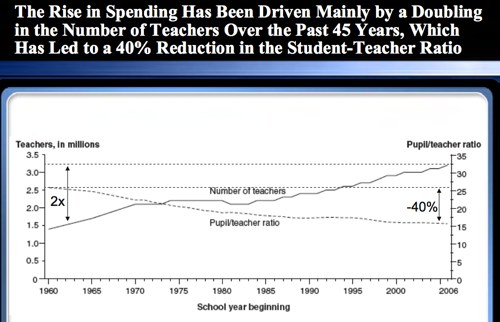
K-12 spending will not continue to increase at the rate it has over the past twenty years (5.25% annually in the case of the Madison School District). Online education provides many useful learning opportunities for our students. While it is certainly not the “be all and end all”, virtual learning can be used to supplement and provide more opportunities for all students. Staff can be redeployed where most effective (The budget pinch, flat enrollment despite a growing metropolitan area along with emerging learning opportunities are two major reasons that the Madison School District must review current programs for their academic and financial efficiency. Reading recovery and reform math are two useful examples).
Related: K-12 Tax & Spending Climate, the coming reset in state government spending and the Madison School District’s planned property tax increase. TJ Mertz on the local budget and communications.
Jeff Jarvis has more.

Share

Obama’s Chat with 9th Graders

Los Angeles Times:

THE PRESIDENT: Thank you. So this is the first day of high school?
STUDENTS: Yes.
THE PRESIDENT: Wow. I’m trying to remember back to my first day of high school. I can’t remember that far back. But it is great to see all of you here. I’m really proud of my Secretary of Education, Arne Duncan, who is just doing a great job trying to create an environment where all of you can learn. And I know it’s a little intimidating with all these cameras around and all this —
SECRETARY DUNCAN: Don’t pay any attention to them.
THE PRESIDENT: — so just pretend that they’re not there.
Here’s the main reason I wanted to come by. As Arne pointed out, when I was growing up, my dad wasn’t in the house. We weren’t poor, but we weren’t rich. My mother had to….
…work really hard, so sometimes my grandparents had to fill in. And my wife, Michelle, who all of you have seen — the First Lady — her dad worked in a — as a — basically in a blue-collar job, an hourly worker. Her mom worked as a secretary. And they lived in a tiny — they didn’t even live in a house, they lived upstairs above her aunt’s house. And so neither of us really had a whole lot when we were growing up, but the one thing that we had was parents who insisted on getting a good education.

Share

In Syracuse, Biden & Geithner promote education’s importance

William Kates:

Getting into college and being able to pay for it are essential to staying on the middle-class track, Vice President Joe Biden told a college audience Wednesday.
“The president and I believe there is no better ticket to the middle class than a college education,” Biden told about 1,000 people inside Goldstein Auditorium at Syracuse University, where he attended law school.
Biden appeared along with Treasury Secretary Timothy Geithner and Education Secretary Arne Duncan as part of the White House Task Force on Middle Class Families. The task force has held town hall-style meetings across the country focusing on raising the living standards of middle-class, working families.
During Wednesday’s forum, Biden reviewed proposals and reforms the administration believes will make a college degree more attainable for working families.
The administration wants to simplify the financial aid application process, extend eligibility to more students and provide more money for direct student aid while extending tax credits to working families with students.

Share

The value of education: Obama’s message good for any classroom

Greg Jordan:

Tuesday I went to Bluefield Intermediate School and watched as fourth-grade students did something that just didn’t happen when I was their age — listen to the president of the United States.
President Obama urged them and other students across the country to stay in school and strive to succeed despite any adversity fate threw their way. He recounted his own struggles to acquire an education, and spoke about how education was a vital part of finding success.
He stayed off controversial topics such as health care and bills like cap and trade, and kept driving home the fact that students needed to take advantage of their opportunities to get an education.
The sight of those children getting to see a live broadcast of the president’s speech brought to mind that time so many years ago when I first heard the word “president.” Things have really changed.

Greg Toppo:

Obama to kids: ‘You can’t drop out of school and into a good job’
President Obama delivered a pointed message to U.S. students Tuesday, telling high-schoolers in a packed Washington-area school gymnasium, “I expect you to get serious this year.”
Ignoring a simmering controversy among political opponents over the planned speech, which was broadcast live coast-to-coast, Obama exhorted students at Wakefield High School to stay in school, ask for help when they need it and resist giving up when school gets difficult. “You can’t drop out of school and into a good job. You’ve got to work for it and train for it and learn for it.”

Wall Street Journal:

A Real Education Outrage
President Obama’s speech to students this week got plenty of attention, and many conservatives looked foolish by fretting about “indoctrination.” They would have done far more good joining those who protested on Tuesday against the President’s decision to shut down a school voucher program for 1,700 low-income kids in Washington, D.C.
“It’s fundamentally wrong for this Administration not to listen to the voices of citizens in this city,” said Kevin Chavous, the former D.C. Council member who organized the protest of parents and kids ignored by most media. Mr. Chavous, a Democrat, is upset that the White House and Democrats in Congress have conspired to shut down the program even though the government’s own evaluation demonstrates improved test scores.

Share

Reeducating unions

LA Times:

Even with signs that the U.S. economy might be stirring, this is a strained Labor Day for the many Americans who are going without raises, and whose hours are being cut at the same time that they are asked to take heavier workloads — and especially for those who are without employment.
Teachers find themselves in all these categories, across the nation and right here, where the dire financial condition of the Los Angeles Unified School District has led to layoffs or demotions from regular teaching to substitute, and where class sizes will be larger and other cutbacks will reduce salaries. On a bigger scale, the unions that brought teachers better pay, benefits and job security find themselves at a tipping point, their power under threat in ways that seemed barely possible a few years ago.
Gov. Arnold Schwarzenegger, whose 2005 proposal to modify teacher tenure was brought down by the full-on might of the California Teachers Assn., is now calling for a change in state law that would allow teachers’ performance reviews to be linked to test scores. And there is barely a political peep to be heard about it; the Obama administration has demanded such changes if California is to receive a share of new education funding. Obama and his Education secretary, Arne Duncan, openly admire high-performing charter schools and reform-minded superintendents such as Michelle Rhee of Washington, who is working to revamp tenure rules there.

Share

Trench Warfare on the Board of Ed

Peter Meyer:

I couldn’t believe it.
John, the new board of education president, had just proposed that we move “Old Business” to the beginning of our meetings.
I had spent roughly a year-and-a-half arguing that it made no sense to put Old Business at the end of each school board meeting, which usually arrived about 10pm, the third hour of these star chambers of modern public education. By then, most people, including the lone reporter, had gone home. That, of course, was the point: Old Business was dirty laundry, things not done. Why flaunt it?
I had gotten nowhere with my arguments because my colleagues on the school board thought I was the devil. I was the infamous “rogue” board member, the person that school board associations give seminars about. Not a team player. The local paper wrote an editorial about me that prompted a friend, after church, to remark, “I’ve seen kinder things said about murderers.”
In fact, I had slipped on to the school board as a write-in candidate, after a stealth, two-day campaign waged only by email.

Share

What the Public Thinks of Public Schools

Paul Peterson:

Yesterday President Barack Obama delivered a pep talk to America’s schoolchildren. The president owes a separate speech to America’s parents. They deserve some straight talk on the state of our public schools.
According to the just released Education Next poll put out by the Hoover Institution, public assessment of schools has fallen to the lowest level recorded since Americans were first asked to grade schools in 1981. Just 18% of those surveyed gave schools a grade of an A or a B, down from 30% reported by a Gallup poll as recently as 2005.
No less than 25% of those polled by Education Next gave the schools either an F or a D. (In 2005, only 20% gave schools such low marks.)
Beginning in 2002, the grades awarded to schools by the public spurted upward from the doldrums into which they had fallen during the 1990s. Apparently the enactment of No Child Left Behind gave people a sense that schools were improving. But those days are gone. That federal law has lost its luster and nothing else has taken its place.

Share

National Standards

The Concord Review & The National Writing Board
8 September 2009
Specific, detailed, universally-accepted national standards in education are so vital that we have now had them for many decades–in high school sports. Athletics are so important in our systems of secondary education that it is no surprise that we have never settled for the kind of vague general-ability standards that have prevailed for so long in high school academic aptitude tests. If athletic standards were evaluated in the way the SAT measures general academic ability, for example, there would be tests of “general physical fitness” rather than the impressive suite of detailed measures we now use in high school sports.
The tests that we require in football, basketball, track and other sports are not called assessments, but rather games and meets, but they test the participants’ ability to “do” sports in great detail–detail which can be duly communicated to college coaches interested in whether the athletes can perform in a particular sport.
These two different worlds of standards and assessment–athletics and academics–live comfortably side-by-side in our schools, usually without anyone questioning their very different sets of expectations, measures, and rewards.
The things our students have to know when they participate in various athletic activities are universally known and accepted. The things they have to do to be successful in various sports are also universally known and accepted across the country.
The fact that this is not the case for our academic expectations, standards, and rewards for students is the reason there has been so much attention drawn to the problem, at least since the Nation at Risk Report of 1983.
At the moment there are large efforts and expenditures being brought to bear, by the Department of Education, the Education Commission of the States, the Council of Chief State School Officers, many state governments, and others, for the development of academic National Standards for the United States.
There has been, and will continue to be, a lot of controversy over what novels students of English should read, what names, dates and issues history students should be familiar with, what languages, if any, our students should know, and what levels of math and science we can expect of our high school graduates.
The Diploma to Nowhere Report, released by the Strong American Schools Project in the summer of 2008, pointed out that more than one million of our high school graduates are enrolled in remedial courses each year when they get to the colleges which have accepted them. It seems reasonable to assume that the colleges that accepted them had some way of assessing whether those students were ready for the academic work at college, but perhaps the tools for such assessment were not up to the universal standards available for measuring athletic competence.
One area in which academic assessment is especially weak, in my view, is in determining high school students’ readiness for college research papers. The Concord Review did a national study of the assignment of research papers in U.S. public high schools which found that, while 95% of teachers surveyed said research papers were important, or very important, 81% did not assign the kind that would help students get ready for college work. Most of the teachers said they just didn’t have the time to spend on that with students.
Imagine the shock if we discovered that our student football players were not able to block or tackle, in spite of general agreement on their importance, or that our basketball players could not dribble, pass, or shoot baskets with any degree of competence, and, if, when surveyed, our high school coaches said that they were sorry that they just didn’t have time to work on that with their athletes.
Whatever is decided about National Standards for the particular knowledge which all our students should have when they leave school, I hope that there is some realization that learning to do one research paper, of the kind required for every International Baccalaureate Diploma now, should be an essential part of the new standards.
If so, then we come to the problem of assessing, not just the ability of students to write a 500-word “personal essay” for college admissions officers, or to perform the 25-minute display of “writing-on-demand” featured in the SAT writing test and the NAEP assessment of writing, but their work on an actual term paper.
As with our serious assessments in sports, there are no easy shortcuts to an independent assessment of the research papers of our secondary students. Since 1998, the National Writing Board, on a small scale, has produced three-page reports on research papers by high school students from 31 states and two Canadian provinces. Each report has two Readers, and each Reader spends, on average, one hour to read and write their evaluation of each paper. Contrast this with the 30 papers-an-hour assessments of the SAT writing test. The National Writing Board process is time-consuming, but it is, in my biased view, one serious way to assess performance on this basic task that every student will encounter in college.
Share

L.A. Schools Chief Sees Woes as Catalyst

Lauren Schuker:

This city’s school district is the second largest in the nation, with nearly 700,000 students. But it has far fewer dollars per student than other major urban districts. Overcrowding and teacher turnover are among the worst in the country.
As new city schools Superintendent Ramon C. Cortines prepares on Wednesday to start his first full year at the helm, his strategy for a turnaround is to emphasize those very points.
By shining a spotlight on some of the most egregious failings of the city’s schools, Mr. Cortines said he hopes to create enough transparency, embarrassment and even outrage to break a logjam among the school board, city leadership and local teachers union that has stymied past attempts at change.
Mr. Cortines also wants to break a taboo against evaluating teachers’ performance and has threatened to reorganize the city’s worst schools. “I want this district to be data-driven and transparent about everything,” he said. “That means that sometimes we’re not going to look so good. But let me tell you, if we’re going to improve, we need to know where we are.”

Share

A $5 Billion Bet on Better Education

Albert Hunt:

Over these next few weeks, 56 million American kids will start kindergarten through 12th grade. Even before an assignment or test is handed out, Education Secretary Arne Duncan has a grade for the system: B.
“We’ve stagnated,” Mr. Duncan says of the U.S. educational system. “Other countries have passed us by.”
Few dispute that. An evaluation by the Organization for Economic Cooperation and Development ranked the United States 18th among 36 countries in secondary education. Almost 25 percent of U.S. students fail to graduate from high school on time; in South Korea, it’s 7 percent.

More money, in the absence of structural reform (in my mind, more charters to start with) will not work. Two useful articles here and here.

Share

Obama Speech Good for Wakefield, But I Haven’t Changed My Mind

Jay Matthews:

The president’s speech at Wakefield High was a wonderful experience for those hard-working students and the school’s exceptional staff. I was particularly taken with the president’s generosity in answering questions from students before the speech. They will remember this day forever.
But as I said in my much-maligned blog post on Friday, I don’t think it was nearly as big a thrill for students who weren’t there, but watched it on TV at their own schools. It was a great speech, saying all the right stuff. The president knows exactly what is wrong with our schools, and talks about the solutions more clearly and vividly than I do. But most kids have heard versions of his speech before, and without his physical presence, moment loses a lot of its electricity.

Share

Certification Of Teachers as Painful Farce

Jay Matthews:

Iwas flooded with e-mails after my Aug. 24 column on high school teacher Jonathan Keiler. Prince George’s County officials said he was going to lose his certification because he had not taken enough education school courses, even though he had a law degree and was the only person at his school with the highly regarded National Board Certification. Shortly after I told county and state officials that I was going to write about Keiler’s situation, he was told that he had enough courses after all.
That change of tune was maddening to the teachers who wrote me. So were what they considered the uselessness of many education courses they were required to take and the faulty information they often received about the advanced training they did or didn’t need. I learned much from them. Here is a sampling:
“I’m a 17-year science teacher in Montgomery County. I was actually fired two years ago for not having the ‘right’ Advanced Professional Certificate (APC) credits. The online credits I was told would be accepted were denied. I later managed to complete the required credits online from the University of Phoenix — which was extremely lame but easy to do and is recognized by Montgomery County — in less than three weeks. By then the deadline had run out and I was fired from my job but rehired as a long-term substitute. Demoralizing to say the least. Financially I took a very big hit.”

Share

Can Arne Duncan (And $5 Billion) Fix America’s Schools?

Gilbert Cruz:

The secretary of education is on fire. He’s running up and down a makeshift basketball court in a Kentucky parking lot and has just executed one of those rare flashy moves that also manage to be completely functional: a behind-the-back, no-look pass to a teammate, who cuts backdoor for an easy layup. Moments later, he drains a fadeaway jumper with an opponent dead in his face.
On some weekends, when the rest of Washington is on the back nine or a racquetball court, Arne Duncan (whose first name is pronounced Are-knee) can be found playing in three-on-three street-ball tournaments across the nation. On a muggy, overcast Saturday in late July, while 50 Cent’s “I Get Money” blares from a set of speakers, the former head of the Chicago Public Schools pounds the blacktop, alternating between playing intensely and walking off to take calls on his BlackBerry. Almost none of the other ballers know who the white dude with the salt-and-pepper hair is, and even fewer expect him to last long in the tournament. And yet his team goes on to win every game (20-10, 20-6, 18-9, 20-11, 20-10, etc.) and eventually the grand prize of $10,000.
That may sound like a lot of money–Duncan plans to give his share to charity–but it’s chump change compared with the kind of cash he gets to play with at work. The economic-stimulus bill passed by Congress in February included $100 billion in new education spending. Of that total, Duncan has $5 billion in discretionary funding. That money alone makes him the most powerful Education Secretary ever. “I had very little–in the single-digit millions,” says Margaret Spellings, Duncan’s predecessor. “That’s millions, with an m.”

Share

Milwaukee School Board takes key powers from administration

Erin Richards:

After a Milwaukee School Board vote that created a new accountability office, the superintendent and two board members said the restructuring won’t improve the efficiency of the bureaucracy and may hurt the district’s chances of securing a high-flying new superintendent.
Superintendent William Andrekopoulos strongly opposed the accountability services office proposal, led by School Board President Michael Bonds. Andrekopoulos told the School Board Thursday that it creates a difficult-to-lead “bifurcated system” and takes away from the superintendent key powers, such as heading charter schools and governmental lobbying efforts. He added the plan was not discussed openly with the public or district employees who would be affected.
Changing the district’s organization was based on “fundamental misunderstandings of the existing system” and would “distract from the current efforts to improve the district’s financial and educational position,” he said.
The board approved the new office and job description of its leader Thursday night in a 5-2 vote, with members Jeff Spence and Bruce Thompson opposed and Tim Petersons voting “present.” David Voeltner was absent from the special board meeting.

Share

Equal funding for California’s schools
No one really understands the crazy quilt system now in place.

Los Angeles Times:

If there is one bright spot in the state’s dismal funding of schools this year, it’s that the Legislature is finally paying attention to long-standing and truly nonsensical disparities in the way that money is distributed.
There is no particular pattern to the inequities, except that a handful of the wealthiest school districts receive far more money per student than others, and the differences have nothing to do with what those districts’ relative needs are. Rather, the crazy quilt of funding relies on outdated formulas that made little sense when they were devised and make even less sense now.
The Los Angeles and Inglewood school districts, for instance, have similar populations and educational challenges. Yet Inglewood received $1,400 less per student in 2007-08, the last year for which figures are available. And the relatively affluent Capistrano Unified School District in south Orange County got $1,000 less than that, while the well-off Laguna Beach schools received $3,000 more than Inglewood.

Share

Loudon residents, school board comfortable with camera at meetings

Hugh Willett:

A Tennessee School Board Association recommendation that would allow school boards to restrict the use of cameras and video recorders from board meetings found little support from the members of the Loudon County School Board on Thursday night.
During a review of TSBA’s proposed policy changes, board members and residents expressed their concerns about the policy. Some were concerned that the Nashville-based TSBA’s suggested policy was unconstitutional.
“I can’t believe you’re getting such bad legal advice,” said Loudon resident Shirley Harrison.
Pat Hunter, a Loudon County activist who has recently posted video clips of school board members and other county officials on her Web site, said she was concerned about taxpayer money being used to fund TSBA.

Power to the people, as it were!

Share

K-12 Tax & Spending Climate: The Coming Reset in State Government

Mitch Daniels:

State government finances are a wreck. The drop in tax receipts is the worst in a half century. Fewer than 10 states ended the last fiscal year with significant reserves, and three-fourths have deficits exceeding 10% of their budgets. Only an emergency infusion of printed federal funny money is keeping most state boats afloat right now.
Most governors I’ve talked to are so busy bailing that they haven’t checked the long-range forecast. What the radar tells me is that we ain’t seen nothin’ yet. What we are being hit by isn’t a tropical storm that will come and go, with sunshine soon to follow. It’s much more likely that we’re facing a near permanent reduction in state tax revenues that will require us to reduce the size and scope of our state governments. And the time to prepare for this new reality is already at hand.
The coming state government reset will be particularly wrenching after the happy binge that preceded this recession. During the last decade, states increased their spending by an average of 6% per year, gusting to 8% during 2007-08. Much of the government institutions built up in those years will now have to be dismantled.

Share

Will California Use Student Test Scores to Evaluate Teachers?

Raymond Barglow:

In decades past, education in California was a top priority for government, and the state’s schools were “the cutting edge of the American Dream.” Today, spending per pupil in the state has fallen to 47th in the country. Due to deep budget cuts, California school districts have been laying off teachers, expanding class sizes, closing some schools, and canceling bus service and summer school programs.
As for future funding of public education–the state of California is caught between the proverbial rock and a hard place. The current dilemma stems from a provision in California’s Education Code that can be interpreted as ruling out the use by state officials of test scores to evaluate teacher performance and compensation. On the one hand, the Obama administration has informed state officials that this provision represents an unacceptable “firewall between students and teacher data” and must be removed if California is to be eligible to receive an educational grant from the administration’s $4.35 billion Race to the Top stimulus fund. On the other hand, California teachers are making it clear through their unions that the use by state government of student test scores to evaluate teachers would be detrimental to education and is an idea that must be rejected.
Taking up this issue has been the Senate Committee on Education, which held a hearing on Aug. 26 chaired by Senator Gloria Romero. The Committee is considering amending California law to ensure that the state qualifies for federal funding. “It is my goal,” Romero says, “to do everything possible to ensure that the Golden State has access to precious federal dollars that can help provide our students the best possible education.”

Share

School speech backlash builds

Nia-Malika Henderson:

School districts from Maryland to Texas are fielding angry complaints from parents opposed to President Barack Obama’s back-to-school address Tuesday – forcing districts to find ways to shield students from the speech as conservative opposition to Obama spills into the nation’s classrooms.
The White House says Obama’s address is a sort of pep talk for the nation’s schoolchildren. But conservative commentators have criticized Obama for trying to “indoctrinate” students to his liberal beliefs, and some parents call it an improper mix of politics and education.
“The gist is, ‘I want to see what the president has to say before you expose it to my child.’ Another said, ‘This is Marxist propaganda.’ They are very hostile,” said Patricia O’Neill, a Democrat who is vice president of the Montgomery County School Board, in a district that borders Washington, D.C. “I think it’s disturbing that people don’t want to hear the president, but we live in a diverse society.”
The White House moved Thursday to quell the controversy. First it revised an Education Department lesson plan that drew the ire of conservatives because it called for students to write letters about how they can help the president.

Tim Padgett:

When Barack Obama won Florida last November — the first Democrat to take the Sunshine State since FDR — many saw it as a sign of centrist GOP Governor Charlie Crist’s moderating influence. But lately, Florida’s disgruntled Republicans aren’t looking very moderate. This week, in fact, the peninsula’s GOP registered arguably the loudest outcry over the education speech President Obama plans to deliver to U.S. primary and secondary students via webcast and C-Span next Tuesday. In perhaps the most over-the-top performance, state Republican Chairman Jim Greer called it an attempt to use “our children to spread liberal propaganda” and “President Obama’s socialist ideology.”
Thanks in large part to the Administration’s ham-handed advance work, the strident conservative anger that erupted this summer over health-care reform has shifted from town halls to school halls. On the surface, Obama’s intentions for Tuesday seem nothing more threatening than a presidential pep talk about taking education seriously. But some ill-advised prep material from the Education Department — like suggestions that teachers have students write letters on “how to help the President” and recommendations that those pupils read his books — has left the door ajar (and that’s all it seems to take these days) for Republican charges that Obama “wants to indoctrinate our kids,” as Clara Dean, GOP chairwoman of Florida’s Collier County, puts it. (Read Joe Klein on Barack Obama’s August to forget.)

Share

Lavish public spending on the well-being of children does not always hit the mark

The Economist:

WHEN the poet William Wordsworth declared that “the Child is father of the Man“, he meant that the gifts of childhood endow adults with some of their finest qualities. And many governments, these days, feel that the path to happiness for society as a whole lies through spending on the welfare of its youngest members: their health, education and general well-being. A report* from the Organisation for Economic Co-operation and Development (OECD), a rich-country think-tank, scrutinises these efforts and asks if the aim is being achieved.
With its stress on quantifiable facts, the spirit of the OECD report differs from one by UNICEF, the UN children’s agency, in 2007 which made waves by saying children in Britain did badly. UNICEF relied too much on asking youngsters how they felt (did they have “kind and helpful” schoolmates?); the new study stresses meatier things like vaccination and test scores.
With equal rigour, the OECD avoids a single index of child welfare in its 30 member states. Instead, after sifting hundreds of variables, the researchers settled on 21 that coalesce into six categories: material well-being; housing and environment; educational well-being; health and safety; risky behaviour; and quality of school life. Then they ranked countries six times.

Share

The Politics of President Obama’s “Back to School Speech” Beamed to Classrooms

Foon Rhee:

Here’s the latest exhibit on how polarized the country is and how much distrust exists of President Obama.
He plans what seems like a simple speech to students around the country on Tuesday to encourage them to do well in school.
But some Republicans are objecting to the back-to-school message, asserting that Obama wants to indoctrinate students.
Florida GOP Chairman Jim Greer said in a statement that he is “absolutely appalled that taxpayer dollars are being used to spread President Obama’s socialist ideology” and “liberal propaganda.”
Wednesday, after the White House announced the speech, the Department of Education followed up with a letter to school principals and a lesson plan.
Critics pointed to the part of the lesson plan that originally recommended having students “write letters to themselves about what they can do to help the president.”

Eric Kleefeld:

The Department of Education has now changed their supplementary materials on President Obama’s upcoming address to schoolchildren on the importance of education — eliminating a phrase that some conservatives, such as the Florida GOP, happened to have been bashing as evidence of socialist indoctrination in our schools.
In a set of bullet points listed under a heading, “Extension of the Speech,” one of the points used to say: “Write letters to themselves about what they can do to help the president. These would be collected and redistributed at an appropriate later date by the teacher to make students accountable to their goals.”
However, that bullet point now reads as follows: “Write letters to themselves about how they can achieve their short‐term and long‐term education goals. These would be collected and redistributed at an appropriate later date by the teacher to make students accountable to their goals.”

Alyson Klein:

om Horne, Arizona’s superintendent of public instruction, put out his own statement, with an education-oriented critique of the speech and its lesson plans.
Here’s a snippet from his statement:

The White House materials call for a worshipful, rather than critical approach to this speech. For example, the White House communication calls for the students to have ‘notable quotes excerpted (and posted in large print on the board),’ and for the students to discuss ‘how will he inspire us,’ among other things. …In general, in keeping with good education practice, students should be taught to read and think critically about statements coming from politicians and historical figures.

Eduwonk:

Just as it quickly became impossible to have a rationale discussion about health care as August wore on, we could be heading that way on education. If you haven’t heard (don’t get cable news?), President Obama plans to give a speech to the nation’s schoolchildren next week. To accompany it the Department of Education prepared a – gasp – study guide with some ideas for how teachers can use the speech as a, dare I say it, teachable moment.
Conservatives are screaming that this is unprecedented and amounts to indoctrination and a violation of the federal prohibition on involvement in local curricular decisions. Even the usually level-headed Rick Hess has run to the ramparts. We’re getting lectured on indoctrination by the same people who paid national commentators to covertly promote their agenda.
Please. Enough. The only thing this episode shows is how thoroughly broken our politics are. Let’s take the two “issues” in turn.

Michael Alison Chandler & Michael Shear:

The speech, which will be broadcast live from Wakefield High School in Arlington County, was planned as an inspirational message “entirely about encouraging kids to work hard and stay in school,” said White House spokesman Tommy Vietor. Education Secretary Arne Duncan sent a letter to principals nationwide encouraging them to show it.
But the announcement of the speech prompted a frenzied response from some conservatives, who called it an attempt to indoctrinate students, not motivate them.

I think Max Blumenthal provides the right perspective on this political matter:

Although Eisenhower is commonly remembered for a farewell address that raised concerns about the “military-industrial complex,” his letter offers an equally important — and relevant — warning: to beware the danger posed by those seeking freedom from the “mental stress and burden” of democracy.
The story began in 1958, when Eisenhower received a letter from Robert Biggs, a terminally ill World War II veteran. Biggs told the president that he “felt from your recent speeches the feeling of hedging and a little uncertainty.” He added, “We wait for someone to speak for us and back him completely if the statement is made in truth.”
Eisenhower could have discarded Biggs’s note or sent a canned response. But he didn’t. He composed a thoughtful reply. After enduring Senator Joseph McCarthy of Wisconsin, who had smeared his old colleague Gen. George C. Marshall as a Communist sympathizer, and having guarded the Republican Party against the newly emergent radical right John Birch Society, which labeled him and much of his cabinet Soviet agents, the president perhaps welcomed the opportunity to expound on his vision of the open society.
“I doubt that citizens like yourself could ever, under our democratic system, be provided with the universal degree of certainty, the confidence in their understanding of our problems, and the clear guidance from higher authority that you believe needed,” Eisenhower wrote on Feb. 10, 1959. “Such unity is not only logical but indeed indispensable in a successful military organization, but in a democracy debate is the breath of life.”

Critical thinking is good for kids and good for society.
I attended a recent Russ Feingold lunch [mp3 audio]. He spoke on a wide range of issues and commendably, took many open forum questions (unlike many elected officials), including mine “How will history view our exploding federalism?”. A fellow luncheon guest asked about Obama’s use of “Czar’s” (operating outside of Senate review and confirmation). Feingold rightly criticized this strategy, which undermines the Constitution.
I would generally not pay much attention to this, but for a friends recent comment that his daughter’s elementary school (Madison School District) teacher assigned six Obama coloring projects last spring.
Wall Street Journal Editorial:

President Obama’s plan to speak to America’s schoolchildren next Tuesday has some Republicans in an uproar. “As the father of four children, I am absolutely appalled that taxpayer dollars are being used to spread President Obama’s socialist ideology,” thunders Jim Greer, chairman of Florida’s Republican Party, in a press release. “President Obama has turned to American’s children to spread his liberal lies, indoctrinating American’s [sic] youngest children before they have a chance to decide for themselves.” Columnists who spy a conspiracy behind every Democrat are also spreading alarm.
This is overwrought, to say the least. According to the Education Department’s Web site, Mr. Obama “will challenge students to work hard, set educational goals, and take responsibility for their learning”–hardly the stuff of the Communist Manifesto or even the Democratic Party platform. America’s children are not so vulnerable that we need to slap an NC-17 rating on Presidential speeches. Given how many minority children struggle in school, a pep talk from the first African-American President could even do some good.
On the other hand, the Department of Education goes a little too far in its lesson plans for teachers to use in conjunction with the speech–especially the one for grades 7 through 12. Before the speech, teachers are urged to use “notable quotes excerpted (and posted in large print on board) from President Obama’s speeches about education” and to “brainstorm” with students about the question “How will he inspire us?” Suggested topics for postspeech discussion include “What resonated with you from President Obama’s speech?” and “What is President Obama inspiring you to do?”

Share

Milwaukee Public Schools Mayoral Control plan has more questions than answers

Eugene Kane:

As Milwaukee students return to school this week, their first lesson might be to learn a new phrase so they don’t feel out of the loop.
Just like teenagers are known to create new words for their social networking sites, the adults in charge of making decisions about the future of Milwaukee Public Schools have upgraded their lingo, too.
Take note: It’s not being called a “takeover” of MPS anymore; it’s being called “mayoral governance.”
(I know; it doesn’t quite roll off the tongue the same way, does it?)
Mayor Tom Barrett says the new verbiage is the latest attempt to find a less-imposing description of a controversial education initiative that has been attempted by several other public school districts nationally.
With discussions on the topic heating up among social, business and civic groups, it seemed a name change was in order.
“Words do carry connotations,” Barrett said during an interview. “For some people, takeover sounded nefarious.”

Share

Revised Madison school budget boosts tax increase

Gayle Worland:

The owner of a $250,000 Madison home would pay $82.50 more in school property taxes this year under a proposal by city schools superintendent Dan Nerad that seeks to partially cover a projected $9.2 million cut in general state aids to the district.
That’s $80 more than estimated under a preliminary 2009-10 district budget approved by the school board in May, when the board expected state cuts to be less severe.
The tax increase would cover only a portion of the state cut. School officials said the remaining gap would be bridged through cost-saving measures that do not directly affect students.
“Am I comfortable or happy?” with the district’s proposal, said Arlene Silveira, school board president. “No. But the whole (budget) situation doesn’t make me comfortable or happy. I appreciate that there are ways that we can deal with this gap without really cutting programs and without putting too much of a burden back on our community.”
The Madison district’s $350 million budget for the current school year won’t be final until the school board votes on it in late October. Officials are awaiting final student counts in late September, which figure into the amount of aid each district receives from the state.
..
“In terms of where we are in this economy and where we are in public education, you need to be realistic,” said [Erik] Kass. “You need to be conservative, and you need to realize there are things that are going to pop up during the year. But I think you also need to be cognizant of the fact that you’re being a steward of public resources, and you need to utilize those resources to provide a service that the public is giving you the money to provide.”

Share

An Interesting Presentation (Race, Income) on Madison’s Public Schools to the City’s Housing Diversity Committee

Former Madison Alder Brenda Konkel summarized the meeting:

The Madison School District shared their data with the group and they decided when their next two meetings would be. Compton made some interesting/borderline comments and they have an interesting discussion about race and how housing patterns affect the schools. There was a powerpoint presentation with lots of information, without a handout, so I tried to capture it the best I could.
GETTING STARTED
The meeting was moved from the Mayor’s office to Room 260 across the street. The meeting started 5 minutes late with Brian Munson, Marj Passman, Mark Clear, Judy Compton, Dave Porterfield, Brian Solomon and Marsha Rummel were the quorum. Judy Olson absent, but joined them later. City staff of Bill Clingan, Mark Olinger, Ray Harmon and Helen Dietzler. Kurt Keifer from the School District was here to present. (Bill Clingan is a former Madison School Board member. He was defeated a few years ago by Lawrie Kobza.

A few interesting notes:

Clear asks if this reflects white flight, or if this just reflects the communities changing demographics. He wants to know how much is in and out migration. Kiefer says they look more at private and parochial school attendance as portion of Dane County and MMSD. Our enrollment hasn’t changed as a percentage. There has been an increased activity in open enrollment – and those numbers have gone up from 200 to 400 kids in the last 8 – 10 years. He says the bigger factor is that they manage their enrollment to their capacities in the private and parochial schools. Even with virtual schools, not much changes. The bigger factor is the housing transition in Metropolitan area. Prime development is happening in other districts
……
Kiefer says smaller learning communities is what they are striving for in high schools. Kiefer says the smaller learning initiative – there is a correlation in decrease in drop out rate with the program. Compton asks about minority and Caucasian level in free lunch. She would like to see that.
…….
Kiefer says that Midvale population is not going up despite the fact that they have the highest proportion of single detached units in Midvale – they are small houses and affordable, but also highest proportion of kids going to private and parochial schools. He says it was because of access because to parochial schools are located there. Kiefer says they think the area is changing, that the Hilldale area has been an attractor for families as well as Sequoya Commons. Family and school friendly areas and he tells the city to “Keep doing that”. He is hopeful that Hill Farms changes will be good as well.

Fascinating. I wonder how all of this, particularly the high school “small learning community initiatives” fit with the District’s strategic plan and recently passed Talented and Gifted initiative?

Share

L.A. charter schools get a chance to grow, but how big?

Howard Blume:

A groundbreaking plan to open 51 new Los Angeles schools and 200 existing ones to possible outside control has Randy Palisoc feeling as if salvation is just steps away. A new $54-million campus he covets is rising a block from where his award-winning charter school operates in a rented church.
Palisoc is among many with big dreams since the Los Angeles Board of Education approved its landmark school control resolution last week. The management of about a fourth of all district schools could be up for grabs.
As a result, leading charter school operators anticipate accelerated growth for their organizations and better facilities for some current schools. An 11-school nonprofit group controlled by Mayor Antonio Villaraigosa is eyeing a new high school south of downtown and may bid for more existing campuses. Momentum is building for internal district proposals.
And even the powerful teachers union, which vigorously opposed the plan, is preparing to take part.

Share

Arizona’s Private School Tax Credit Program

The East Valley Tribune:

Day 1: Aug. 1, 2009
THE FIX : The tuition tax credits law was supposed to revolutionize school choice for disadvantaged children. Instead it fostered a rigged system that keeps private education a privilege for the already privileged.
NO OVERSIGHT: The state has no way of ensuring that $55 million a year in tax credits really goes toward scholarships for private school students as the law intended.
Day 2: Aug. 4, 2009
HOW-TO GUIDE: Many private schools teach parents how to skirt the law by lining up donors for their children.
PLOT TWIST : The tale of Maricopa County Schoolhouse Foundation begins with criminal indictments and fraud, but ends as an example of tuition tax credits’ promise for serving the underprivileged.

Kevin Carey has more.

Share

Minneapolis schools present new overhaul plan

Tom Weber:

The Minneapolis school district has finished updating a wide-ranging overhaul plan that will close several schools and change the way students are transported.
The district first proposed the plan in April and is presenting a final version to school board members Tuesday night. A final vote is expected in about three weeks.
The effort, called “Changing School Options,” addresses a number of aspects of how the district is run — from transportation to curriculum to which programs and school buildings remain in use. The aim is to save millions of dollars but also make instruction more equitable throughout the district.
The original plan called for closing schools, returning some magnet schools to regular community schools, and changing busing options for students. It was tabled a week after it was proposed because Superintendent Bill Green said the votes weren’t there to assure passage by the board. The new plan still proposes many of the same changes but has been altered in ways some board members found crucial to assuring their vote.
For board chair Tom Madden, the new plan includes more details on issues like attendance boundaries. “Parents can now look at it and see exactly how they fit into the plan, and they couldn’t do that before,” he said.

Share

NEA Internal Survey on Health Care Reveals “Huge Divide Between NEA Executives and Presidents and Rank and File

Mike Antonucci:

The National Education Association has appeared front and center in the debate over reform of the health care and insurance system, spending hundreds of thousands of dollars on lobbying and media buys. But a 2008 internal survey of NEA members and officers on health care issues indicates varying levels of enthusiasm for proposed reforms.
Though the survey itself was not made available to EIA, the union’s collective bargaining and member advocacy department has been briefing union activists on its findings throughout 2009. I have posted a link to the relevant information on EIA’s Declassified page. The report included statistics such as the average health insurance premium paid in 2007 by NEA members was $603 for employee-only coverage – about 12.6% of the total cost. Eight affiliates reported members paid nothing.
NEA commissioned the polling firm of Greenberg Quinlan Rosner to learn member and officer attitudes about health care reform. Most of those surveyed were concerned about the system, but satisfied with their own health care. NEA members were also more favorably disposed towards government health care programs than the average American.
Still, the survey found that NEA members were “split on whether government or employers should provide health care” and that a “Massachusetts-style proposal [is] susceptible to arguments against it.”

Share

Seize opportunity for education reform in Wisconsin

Tim Cullen:

Three factors have conjoined this month to make education reform in Wisconsin a real possibility in the next year and a half:

  • The announcement by Gov. Jim Doyle not to seek re-election but serve out his term.
  • The tragic, but courageous incident involving Milwaukee Mayor Tom Barrett, a promoter of education reform in Wisconsin’s largest city.
  • The potential of qualifying for new federal education dollars.

The logjam created by the state teachers union’s political activities — which contribute millions of dollars per election year almost entirely on behalf of Democrats — has led over the past 15 years to no educational policies put forward by Democrats or Republicans.
Some individual legislators have had proposals, but they have not gone far in the legislative process.
The political ground rules in Madison have been too crassly partisan on both sides of the aisle. It goes like this: If the Democrats control Madison, Wisconsin Education Association Council gets what it wants. If Republicans control Madison, WEAC gets nothing that it wants.
This is disheartening to the many people across the political spectrum who want reform and progress.
The newly aligned stars offer a chance to break the logjam. Doyle lacks the need for WEAC because he is not running again. Barrett’s popularity has surged after he was injured when he came to the aid of a woman threatened by a pipe-wielding attacker. And the federal aid is a carrot.
Reformers have been helped by President Barack Obama’s secretary of education, who called one Wisconsin law on education “ridiculous.” That law currently makes Wisconsin ineligible for its share of $4 billion of federal education money.
Wisconsin now has a chance to take advantage of this alignment to make dramatic fixes to the Milwaukee public school system, change Wisconsin law so teachers can be at least partially evaluated by student test scores, and make long overdue changes in K-12 educational funding formulas.
The funding formulas currently in place will, with no doubt, increase property taxes, increase class sizes, and increase teacher layoffs.
One more entity needs to get its star aligned — the state Legislature. The Democrats do need WEAC in 2010. But I believe there are good people in the Legislature who, I hope, will grab this moment.
The goal of public education is clear and simple: improve student achievement. There are three major items that accomplish this:

  • Better family structure and parental involvement in schools.
  • Adequate funding — without involving students in the unpopular reliance on property taxes, the most unpopular tax of all. Think about it, the funding of our prisons does not involve the property tax wars, but paying to educate our children does.
  • Appreciated teachers who continue to stimulate students to improve and are evaluated and rewarded for outstanding performance.

These times for reform do not come often.
Cullen, former state Senate majority leader, is a member of the Janesville School Board.

Share

Arne Duncan Has Become a National Embarrassment, Part II

Leonie Haimson:

In a previous column, I reported how Arne Duncan has become an embarrassment here in New York City for his misuse of statistics and his slavish support of our billionaire Republican mayor, Michael Bloomberg, who is running for re-election to a third term. Duncan also called a series of blatantly propagandistic articles that supported Bloomberg’s education record as “thoughtful,” published in the NY Post, the tabloid owned by Rupert Murdoch.
But the problem is much larger than this: Duncan’s policies now threaten to alienate voters nationwide. The latest embarrassment is a national “tour,” where Duncan plans to join Al Sharpton and Newt Gingrich in cities around the country, pushing for more privatization, including the proliferation of more charter schools.
The fact that Duncan is joining these two disreputable figures reveals troubling insensitivity on his part. The last time Gingrich got involved in the education issue, Newt proposed forcibly removing children from inner-city parents to put them in orphanages and boarding schools.

Share

Educating America
Bold action required to change schools so they can prepare students to compete

Las Vegas Sun:

Since being confirmed by the Senate this year, Education Secretary Arne Duncan has been rolling out an aggressive plan to overhaul the nation’s lagging public school systems. It is time, in his words, for “fundamental reform.”
Congress, at President Barack Obama’s urging, is putting billions of stimulus dollars into education. It is a stunning amount of money, and this is a time like none other for American schools.
The nation has a high-school dropout rate of 30 percent, Duncan said, and those who graduate are behind students in other nations. With American students competing for jobs in a world economy, it is important they have the best education possible.
“As the president has said many times, we have to educate our way to a better economy,” Duncan said Wednesday in a meeting with the Las Vegas Sun’s editorial board.
As the former chief executive of the public school system in Chicago, Duncan understands the variety of issues facing education, including public safety concerns and money woes. He understands the need for change and wants to upend the status quo. Duncan has put together a broad array of plans that, if implemented, could significantly improve schools. To wit:
A well-rounded education. The emphasis under the No Child Left Behind Act, the Bush administration’s hallmark education policy, was standardized testing that covered a few subjects. Principals and teachers across the country, consequently, “teach to the test.” The result often has been a limited curriculum. Duncan wants to see children receive a well-rounded education including physical education, art and music. He said he wants public school students “to have the opportunities private school students have always had.”

Share

Texas High-School Athletes Gain Ground in Class

http://online.wsj.com/article/SB125150176952368293.html:

A new Texas law that could double the amount of academic credit high-school athletes receive for playing sports is stoking a long-standing debate in the Lone Star State about whether athletics should count the same as schoolwork.
Texas is unusual in that high-school sports aren’t completely extracurricular. The state has long allowed students who are members of sports teams to take one athletics class during a normal school day, a period that can be filled with anything from watching game films and weight lifting to sitting in study hall.
The state formerly permitted high schoolers to apply only two credits — or two years’ worth — of athletics classes toward the 26 credits needed to graduate. But a law passed by the Texas legislature in May effectively increased the number of such credits that can apply toward the degree to four.
Coaches and athletic directors welcomed the change, which they had sought from the Texas Board of Education for the past two years.
“We think it’s a good idea to allow parents and kids to have some flexibility,” said Robert Young, athletic director at Klein Independent School District.
The Texas State Teachers Association also supported the increase in athletics credits, saying it gives students more opportunities to take classes that interest them the most.

Share

Safer Schools

Philadelphia Enquirer:

The Philadelphia School District should move quickly to fix flaws in the expulsion process of its zero-tolerance discipline policy.
The district had not expelled any students in the four years prior to Superintendent Arlene C. Ackerman’s arrival. But officials recommended 156 expulsions last school year. An expulsion can last for up to a year.
The School Reform Commission recently voted to expel 65 students, and at least 25 cases are in the pipeline.
A “no-nonsense” disciplinary policy is long overdue in a school system where students and staff often feel unsafe. But a backlog in expulsion cases left dozens of students in limbo for months. That is unacceptable.
These lengthy delays deny students due process and can unfairly harm innocent students waiting for a hearing. If the system is ill-equipped to handle the high volume of expulsion cases, then it needs to be fixed.
A parent of an Olney West High School student said her son spent five months at an alternative disciplinary school waiting for a hearing in which he was eventually exonerated. By then, he had missed most of his senior year.
The Education Law Center says suspended students facing possible expulsion should get a hearing within 10 days. The district contends it is not required to meet that timeline. OK, but it has to do better than have students miss most of an academic year before their case is heard.

Share

Accountability in Public Schools

New York Times Editorial:

The Obama administration laid down an appropriately tough line in late July when it released preliminary rules for the $4.3 billion pot of money known as the Race to the Top Fund. The administration rightly sees it as a way to spur reform by rewarding states that embrace high standards and bypassing those that do not.
Federal regulations are often modified in line with criticisms that arise during the legally mandated comment period. But Education Secretary Arne Duncan will need to hold firm against the likes of the National Education Association, the nation’s largest teachers’ union, and others who are predictably clinging to the status quo.
The administration plan would award grants based on how well state applications cover several topic areas. States must, for example, submit plausible plans for improving teacher effectiveness, equalizing teacher quality across rich and poor schools. They must also show how they would turn around failing schools.

Share

How Kennedy Took Politics Out of Education

Jay Matthews:

It is startling to realize, as we consider the legacy of Massachusetts Sen. Edward M. Kennedy, that this very liberal, very partisan Democrat was key to the consensus that has unified the two parties on education policy for the last two decades.
.
I was slow to pick up on this. It wasn’t until I looked carefully at the presidential candidate positions in 2000 that I understood how much the two parties agreed on how to make public schools better. George W. Bush and Al Gore were very different people, but their education platforms, once you got past their favorite wedge issue, vouchers, were nearly identical. Both wanted to use test scores to make schools accountable for improving achievement. If Gore had gotten to the White House, he would have produced a law similar to No Child Left Behind.
For some time I have attributed this to the good sense of education experts on both sides of the aisle. The people guiding the candidates on this issue have seen what works in schools, particularly in low income neighborhoods, and have rescued their parties from the kind of anti-testing rhetoric that was so popular with teacher union leaders.

Share

The Rubber Room: The battle over New York City’s worst teachers.

Steven Brill:

In a windowless room in a shabby office building at Seventh Avenue and Twenty-eighth Street, in Manhattan, a poster is taped to a wall, whose message could easily be the mission statement for a day-care center: “Children are fragile. Handle with care.” It’s a June morning, and there are fifteen people in the room, four of them fast asleep, their heads lying on a card table. Three are playing a board game. Most of the others stand around chatting. Two are arguing over one of the folding chairs. But there are no children here. The inhabitants are all New York City schoolteachers who have been sent to what is officially called a Temporary Reassignment Center but which everyone calls the Rubber Room.
These fifteen teachers, along with about six hundred others, in six larger Rubber Rooms in the city’s five boroughs, have been accused of misconduct, such as hitting or molesting a student, or, in some cases, of incompetence, in a system that rarely calls anyone incompetent.
The teachers have been in the Rubber Room for an average of about three years, doing the same thing every day–which is pretty much nothing at all. Watched over by two private security guards and two city Department of Education supervisors, they punch a time clock for the same hours that they would have kept at school–typically, eight-fifteen to three-fifteen. Like all teachers, they have the summer off. The city’s contract with their union, the United Federation of Teachers, requires that charges against them be heard by an arbitrator, and until the charges are resolved–the process is often endless–they will continue to draw their salaries and accrue pensions and other benefits.
“You can never appreciate how irrational the system is until you’ve lived with it,” says Joel Klein, the city’s schools chancellor, who was appointed by Mayor Michael Bloomberg seven years ago.
Neither the Mayor nor the chancellor is popular in the Rubber Room. “Before Bloomberg and Klein took over, there was no such thing as incompetence,” Brandi Scheiner, standing just under the Manhattan Rubber Room’s “Handle with Care” poster, said recently. Scheiner, who is fifty-six, talks with a raspy Queens accent. Suspended with pay from her job as an elementary-school teacher, she earns more than a hundred thousand dollars a year, and she is, she said, “entitled to every penny of it.” She has been in the Rubber Room for two years. Like most others I encountered there, Scheiner said that she got into teaching because she “loves children.”
“Before Bloomberg and Klein, everyone knew that an incompetent teacher would realize it and leave on their own,” Scheiner said. “There was no need to push anyone out.” Like ninety-seven per cent of all teachers in the pre-Bloomberg days, she was given tenure after her third year of teaching, and then, like ninety-nine per cent of all teachers before 2002, she received a satisfactory rating each year.

Share

Reforming Los Angeles’s Schools

Los Angeles Times Editorial:

It’s not a total coincidence that, on the day after the Los Angeles Unified school board passed the first major reform to turn around its lowest-performing campuses, the Obama administration announced that it would target billions of federal dollars to districts that reconfigured their persistently failing schools.
From the start, board Vice President Yolie Flores Aguilar said her reform initiative was inspired by U.S. Education Secretary Arne Duncan’s “Race to the Top” campaign, which will funnel stimulus money to troubled schools that commit to transforming their operations. Passed by the board Tuesday, Flores Aguilar’s resolution allows district and outside groups to submit competing proposals for operating 50 new schools, as well as up to 200 schools that have failed to meet federal improvement goals for several years.
The signs of a new era were visible at L.A. Unified headquarters even before the vote. Thousands of parents representing both sides crowded into the building and filled the streets outside, a level of involvement too rarely seen in debates over local schools. And though the usual amount of posturing took place on the dais, there was a greater openness among board members about the role of labor unions in reform attempts.

Share

The Overhaul of Wisconsin’s Assessment System (WKCE) Begins

Wisconsin Department of Public Instruction [52K PDF]:

Wisconsin will transform its statewide testing program to a new system that combines state, district, and classroom assessments and is more responsive to students, teachers, and parents needs while also offering public accountability for education.
“We will be phasing out the Wisconsin Knowledge and Concepts Examinations (WKCE),” said State Superintendent Tony Evers. “We must begin now to make needed changes to our state’s assessment system.” He also explained that the WKCE will still be an important part of the educational landscape for two to three years during test development. “At minimum, students will be taking the WKCEs this fall and again during the 2010-11 school year. Results from these tests will be used for federal accountability purposes,” he said.
“A common sense approach to assessment combines a variety of assessments to give a fuller picture of educational progress for our students and schools,” Evers explained. “Using a balanced approach to assessment, recommended by the Next Generation Assessment Task Force, will be the guiding principle for our work.”
The Next Generation Assessment Task Force, convened in fall 2008, was made up of 42 individuals representing a wide range of backgrounds in education and business. Tom Still, president of the Wisconsin Technology Council, and Joan Wade, administrator for Cooperative Educational Service Agency 6 in Oshkosh, were co-chairs. The task force reviewed the history of assessment in Wisconsin; explored the value, limitations, and costs of a range of assessment approaches; and heard presentations on assessment systems from a number of other states.
It recommended that Wisconsin move to a balanced assessment system that would go beyond annual, large-scale testing like the WKCE.

Jason Stein:


The state’s top schools official said Thursday that he will blow up the system used to test state students, rousing cheers from local education leaders.
The statewide test used to comply with the federal No Child Left Behind law will be replaced with a broader, more timely approach to judging how well Wisconsin students are performing.
“I’m extremely pleased with this announcement,” said Madison schools Superintendent Dan Nerad. “This is signaling Wisconsin is going to have a healthier assessment tool.”

Amy Hetzner:

Task force member Deb Lindsey, director of research and assessment for Milwaukee Public Schools, said she was especially impressed by Oregon’s computerized testing system. The program gives students several opportunities to take state assessments, with their highest scores used for statewide accountability purposes and other scores used for teachers and schools to measure their performance during the school year, she said.
“I like that students in schools have multiple opportunities to take the test, that there is emphasis on progress rather than a single test score,” she said. “I like that the tests are administered online.”
Computerized tests give schools and states an opportunity to develop more meaningful tests because they can assess a wider range of skills by modifying questions based on student answers, Lindsey said. Such tests are more likely to pick up on differences between students who are far above or below grade level than pencil-and-paper tests, which generate good information only for students who are around grade level, she said.
For testing at the high school level, task force member and Oconomowoc High School Principal Joseph Moylan also has a preference.
“I’m hoping it’s the ACT and I’m hoping it’s (given in) the 11th grade,” he said. “That’s what I believe would be the best thing for Wisconsin.”
By administering the ACT college admissions test to all students, as is done in Michigan, Moylan said the state would have a good gauge of students’ college readiness as well as a test that’s important to students. High school officials have lamented that the low-stakes nature of the 10th-grade WKCE distorts results.

(more…)

Share

K-12 Tax & Spending Climate: Stimulus Funds “Fall Short” & A Worsening US Debt Outlook

Stacy Teicher Khadaroo:

The announcement earlier this year that roughly $100 billion in federal stimulus funds would flow to public schools came with great expectations – both for saving jobs and for fostering reforms in education. But the way the money is being used so far is decidedly more mundane.
In a new survey of 160 school-district leaders, 53 percent say they have not been able to use the money to save teaching positions in core subject areas or special education. And 67 percent say the opportunity to direct the money to reforms has been limited or nil.
“Everybody appreciated getting the money …, but primarily all the money did was help to backfill the budget deficits they were already facing,” says Daniel Domenech, executive director of the American Association of School Administrators (AASA) in Arlington, Va., which released the survey Tuesday.
The majority of survey respondents did prioritize saving various personnel positions, along with investing in professional development. Other top uses of the money included buying technology, equipment, and supplies for classrooms and paying for school repairs.
Survey respondents cited several key reasons for not being able to focus more on reforms.
The money is coming through several streams, and the most flexible one, known as State Fiscal Stabilization, was primarily used to fill holes left by declining state and local funding.

Sarah O’Connor, Edward Luce & Krishna Guha:

The CBO released sharply higher deficit projections predicting the 10-year deficit would reach $7,140bn, some $2,700bn more than it had thought in March. Unlike the White House’s calculations, the CBO estimate assumes all policies will stay exactly as they are.
“If you include the administration’s fiscal plans, this implies a deficit increase way in excess of $10 trillion over the next decade – the numbers are deeply alarming,” said Bill Gale, a senior economist at the Brookings Institution.
The deficit projections are a political millstone for the Obama administration as it seeks to promote health reform and other priorities. However, there is no sign of a rebellion in the bond market, where 10-year Treasuries were on Tuesday yielding 3.44 per cent. This suggests the market still sees a weak recovery ahead, even though data on house prices and consumer confidence suggested the recession was ending.

Share

Charter School Struggles To Find Students

NPR:

In continuation of the program’s focus on education issues, guest host Jennifer Ludden checks in with Kavitha Cardoza, a reporter for NPR member station WAMU-FM in Washington, D.C., about enrollment problems at the National Preparatory Public Charter School, which is opening next month. More than a third of students in the nation’s capitol are enrolled in charter schools — the largest percentage in the country. But National Prep is having trouble meeting its enrollment figures.

Share

Ohio School District Report Cards

Julie Carr Smyth:

A record 116 Ohio school districts have been rated excellent and overall student achievement returned to a 10-year high last year, but the statewide graduation rate fell to its lowest in five years, the state’s latest rankings show.
Data released Tuesday show that more schools and districts were rated effective or higher. However, test scores in the fifth and eighth grades — entry points to middle and high schools — failed to meet targets in reading, math, science and social studies. The statewide graduation rate for the previous year also fell to 84.6 percent.
And the Youngstown schools descended into academic emergency, the first district to receive the state’s lowest ranking since the 2004-05 school year. A special distress commission will be dispatched to the Steel Belt city to help administrators on the problem.
About 15 charter schools could be closed for failing to meet state academic performance standards, said state Superintendent Deborah Delisle.
The rankings will serve as a benchmark for judging the success of an overhaul of the state’s ailing public school system that Gov. Ted Strickland championed in his January State of the State address and during this spring’s state budget-writing process.

Share

Will Legislature Approve Takeover of Milwaukee Public Schools?

Bruce Murphy:

Back in the mid-1990s, the idea of the mayor taking over Milwaukee Public Schools was occasionally floated, but never got anywhere because Mayor John Norquist was seen as overbearing, too eager to amass more power. No one has ever made the same accusation of his successor.
Indeed, when Tom Barrett first ran for mayor in 2004, he proposed such a governance change, and in the face of criticism, backed off within two days. “I don’t want to be the piñata on this issue,” he told me at the time.
In the last couple years, Barrett has gotten increasing pressure, from the business community, from local community activists, from Gov. Jim Doyle, to take over the schools. But he kept dragging his feet. Perhaps the final convincer was U.S. Secretary of Education Arne Duncan, who has offered the carrot of federal funding for Milwaukee Public Schools should that happen. If a governance change was ever going to happen, the time to do so was clearly now.
Under the proposed change, the mayor would directly appoint the MPS superintendent, and would appoint school board members, with Common Council approval. The idea is being attacked, with the same bizarre argument offered over and over.

Share

Would you ace a Milwaukee School Board quiz?

Eugene Kane:

With the new school year set to begin next week, it’s time for a back-to-school quiz.
Not for students. This one is for parents with children in Milwaukee Public Schools or anyone concerned about the future of MPS.
In the past few weeks, the future of MPS has been widely debated due to a blockbuster announcement about a plan to take over control of MPS from the Milwaukee School Board and give it to the mayor of Milwaukee.
Under this plan, endorsed by both Gov. Jim Doyle and state Superintendent of Public Instruction Tony Evers, the Milwaukee School Board would become an appointed body rather than an elected one and the responsibility for choosing the next superintendent would lie with the mayor instead of School Board members.
This kind of thing has been attempted in other cities, with no clear track record of success or failure. But just the fact that Barrett, Doyle and others even floated this trial balloon suggests they think it’s an idea whose time has come. Which raises the question:
How much do people know about their Milwaukee School Board? Get your No. 2 pencils ready:

Share

Lowe and Behold
The controversial (Texas) State Board of Education has a new chair. Here’s how she can keep it from becoming the State Board of Embarrassment.

Paul Burka:

The State Board of Education is the most dysfunctional agency in Texas government. This is quite an achievement, considering the competition: the Texas Department of Insurance, which allows the highest home insurance rates in the land; the Texas Commission on Environmental Quality, which changes names every few years but not its polluter-friendly policies; the Public Utility Commission, whose chairman, responding to a petition this summer to prohibit electric utilities from disconnecting low-income and elderly customers until the heat wave broke, argued that it wasn’t really unusually hot. And let us not forget the Texas Department of Transportation, which can’t abide the idea of a highway without a tollbooth on it.
But there is nothing like the idiosyncratic, bitterly divided SBOE, whose fifteen elected members are charged with overseeing public education in Texas. They decide what Texas schoolchildren are supposed to learn. They establish statewide curriculum standards. They determine whether textbooks include the required material. They set graduation requirements. They are responsible for investing the Permanent School Fund, the endowment for the public schools. They accept or reject requests to establish innovative charter schools. At least, that’s what the SBOE is supposed to do. What it has really done, for two decades or more, is argue incessantly over peripheral issues: the theory of evolution, sex education, role models for women.
For the past sixty years, the board has been composed of people from the education community: school board members, teachers, administrators. They have operated in relative obscurity and discharged their duties in a routine way. About the only time the SBOE made news was when critics like Mel and Norma Gabler, of Longview, began showing up at meetings to complain that textbooks under consideration had a liberal, anti-Christian point of view. But by the nineties, a new group of conservatives, many motivated by their religious beliefs, targeted the board for a takeover. They have been so successful that today they are the majority faction, and the SBOE has become the front line of the culture wars in Texas.

Share

New education clash in Venezuela

BBC:

Venezuelan police have fired teargas to stop thousands of protesters against a new education law from breaking past a security cordon in the capital Caracas.
Protesters accuse the government of President Hugo Chavez of indoctrinating children into backing socialist values.
Health officials said dozens of people were treated for minor injuries.
Rallies for and against the law, which passed last week, have been held for over a week. Last Friday’s protests also met a tough response from police.
Elsewhere in the capital on Sunday, thousands of Chavez supporters held a counter-rally.
They say the new law will give everyone equal access to education, regardless of their economic position.
‘Bolivarian Doctrine’
The government says changes to the law – which among other things, broadens state control over schools and makes the education system secular – were long overdue.
But the Catholic Church and university authorities in Venezuela have opposed the law.

Share

Latino groups back Milwaukee Schools Mayoral takeover proposal; opponents rally at church

Georgia Pabst & Jessa Garza:

Two leading Latino organizations voiced support for the takeover of Milwaukee Public Schools proposed by Gov. Jim Doyle and Mayor Tom Barrett, while nearly 150 people rallied against the plan Friday at a north side church.
Darryl D. Morin, Wisconsin director of the League of United Latin American Citizens, said his organization spent the last two years holding seminars on local educational issues and decided to endorse the proposal after evaluating various options.
But he also called for a mandatory reauthorization for the takeover so that voters could determine whether the new system is working.
“There’s an educational crisis in Milwaukee, and the primary question is how long will we wait,” he said. “It’s time to rise up together and say now is the time. Milwaukee can’t afford to fail its future.”
He was joined by Maria Monreal-Cameron, president and CEO of the Hispanic Chamber of Commerce of Wisconsin, who said the city stands at a crossroads.
“We need to try something different because the current educational system is broken, and we need to fix it,” she said.
Their endorsement of the proposed takeover is the first organized public support for the plan, which has drawn fire from many, including School Board President Michael Bonds.

Share

Wisconsin again rated poorly in efforts to improve schools

Alan Borsuk:

There it was again last week: A chart from a reputable national education organization that put Wisconsin at the top of the list, provided you were standing on your head.
The New Teacher Project, a private, nonprofit organization that has done a lot of work with Wisconsin and Milwaukee education, created a scorecard of the chances of each state to win some of the $4.35 billion to be given out by the U.S. Department of Education to places where there are bold, well structured plans to improve low-performing schools.
Wisconsin had the worst scorecard of all 51 candidates (including the District of Columbia).
A few weeks ago, there was a report from the National Assessment of Educational Progress, a program created by the federal government, on the racial gaps in reading and math achievement for fourth- and eighth-graders. The gaps were generally wider in Wisconsin than anywhere else. The scores of African-American students were lower in Wisconsin than in any other state – Mississippi, Louisiana, you name it.
A couple of years ago, Education Sector, a nonprofit organization, rated the states on how they were dealing with the No Child Left Behind education law. Wisconsin was rated as doing the best job in the country of evading the consequences of the law. The organization called it the Pangloss index, after a fictional character who believed everything was in its best possible condition even when it wasn’t. We were the most Panglossian state, so to speak.

Share

Performance Management in Portfolio School Districts

Robin Lake & Paul Hill, via a Deb Britt email:

Under pressure from state standards-based reform and No Child Left Behind, and with increasing competition from schools of choice, urban school districts are looking for ways to offer a high-performing mix of schools that meet the diverse needs of their communities.
Many districts see themselves as portfolio managers, operating some schools in the traditional way, hiring independent groups to run other schools, and holding all schools accountable under the same performance standards.
Portfolio management requires school districts to do three things they were not designed to do: judge the performance of individual schools, decide which are effective enough to continue supporting, and decide whether to shore up struggling schools or create new ones. Districts currently adopting a portfolio strategy, partially or fully, include New York, Chicago, New Orleans, Denver, Philadelphia, Hartford, and the District of Columbia. Many other districts are considering the strategy.
Performance Management in Portfolio School Districts provides ideas for portfolio school districts and others that are trying to manage schools for performance. Based on studies of other government agencies and businesses that have shifted from inputs- to performance-based accountability, this report:

Complete report: 1.3MB PDF.

Share

California Governor proposes merit pay for educators

Jason Song & Jason Felch:

Gov. Arnold Schwarzenegger announced this morning a special legislative session focusing on education that he hopes will establish merit pay for teachers, allow students at low-performing schools to transfer to other campuses and use data to track students and educators.
The governor also wants the legislature to abolish a law that bars the use of student test scores in teacher evaluations. Under federal guidelines, states that prohibit the use of student test scores to evaluate teachers cannot apply for $4.35 billion in education stimulus money known as Race to the Top funding.
Some California educational leaders have said federal officials are misinterpreting state law, but Schwarzenegger vowed to do everything necessary to make sure California qualifies for the federal funding.
“This is an incredible opportunity for our students and our schools,” he said at a press conference in Sacramento.
Not all of Schwarzenegger’s proposals apparently would have to be passed by the Legislature to be implemented, but the governor said he hoped state lawmakers could finish their work by early October so the state could meet the deadline to apply for federal funds.

Share

Families, Activists Rally to Restore 216 Rescinded Washington, DC Tuition Vouchers

Michael Birnbaum:

Classes in District public schools start Monday, and 216 students are hoping they won’t have to go back. About 70 parents, children and activists joined Thursday in front of the U.S. Department of Education to encourage Secretary of Education Arne Duncan to award vouchers to help the students pay for private school.
The students, who were offered vouchers worth as much as $7,500 toward tuition from the D.C. Opportunity Scholarship Program this spring before Duncan rescinded them in the face of the program’s uncertain future, were left to find placements in public and charter schools. Some families have complained that by the time the vouchers were rolled back, there were few spots available at competitive public schools.
“We’re hoping that Secretary Duncan is going to look out the window so he can see how strongly the parents support it,” said Virginia Walden Ford, executive director of D.C. Parents for School Choice, one of the groups that organized the protest. “They just put families into a bad situation.”

Share

US Education Secretary Duncan Phones Eau Claire School Administrator

Christena O’Brien:

Returning home Friday from the Twin Cities, Chris Hambuch-Boyle didn’t hesitate answering her cell phone – even though the call was coming from an unknown number.
To the surprise of the longtime Eau Claire school district educator, the caller on the other end was U.S. Education Secretary Arne Duncan.
“He said, ‘Hi, Chris. This is Arne Duncan,’ ” she recalled after Monday night’s school board meeting. “I was flabbergasted that he’d even call.”
Hambuch-Boyle spent about the next 10 minutes talking with Duncan about Eau Claire, Gov. Jim Doyle and state support for public schools in Wisconsin.
It wasn’t their first time talking. Hambuch-Boyle, vice president of the Eau Claire Association of Educators, was among a group of educators sitting behind Duncan last month as he spoke at the National Education Association’s annual meeting and representative assembly in San Diego. When he finished, she ran after him, yelling “Mr. Secretary! Mr. Secretary!”
“He said, ‘Homework?’ ” recalled Hambuch-Boyle, who was waving several “Save Our Schools” postcards in her hand, “and I said, ‘No, a present from Wisconsin.’ “

Share

The Adolescent Politics of Virtual Education

Tom Vander Ark:

In 1995, I was sure that the explosion of the web would result in a good deal of online learning competition — and fast. I may have been right about the first but not the second. It took a dozen years for online learning to get big and competitive, but it is finally a force to be reckoned with. Next month there will be close to two million students learning online at home and at school.
Back then I was superintendent in Federal Way Washington, between Seattle and Tacoma. We were a founding district in Microsoft’s Anytime Anywhere Learning initiative and began rolling out laptop programs to all of our secondary schools. The brave new world of education blending the best of online and onsite learning seemed right around the corner.
In September 1996, we opened the Internet Academy, the nation’s first K-12 virtual school. It was a bootstrapped operation; a group of intrepid teachers staying a day ahead of the kids and testing the application of the state’s seat time requirements.
Enrollment quickly grew to over 1,000 students with about half new to public education (i.e., home and private school students) with an even split between students seeking acceleration and those seeking credit recovery. For most of a decade, Internet Academy had Washington’s virtual space to itself.

Share

Cap on Virtual Schools Jeopardizes Wisconsin’s Eligibility for Federal Education Funds

Brian Fraley:

Online public charter schools (or virtual schools) are charter schools under contract with a school board in which all or a portion of the instruction is provided through means of the Internet, and the pupils enrolled in and instructional staff employed by the school are geographically remote from each other.
Virtual schools have become an incredibly popular option throughout the country. In Wisconsin, thousands of families from Green Bay to Lancaster, from Racine to Rhinelander and other communities in every county in the state, have chosen to enroll their children in these unique and innovative public schools. School districts across Wisconsin (including those in Grantsburg, Appleton, Monroe, Fredonia, Waukesha and McFarland) currently offer or are exploring this option.
But in Wisconsin, even though online public charter schools are successful and embraced by parents, teachers and administrators alike, access to this innovation is rationed.

Share

Special-Education Stigmatization
School vouchers may be the best way to curb abuse of public funds.

Marcus Winters & Jay Greene:

Federal law first insisted in 1975 that public schools educate disabled students. Since then, the portion of students receiving special education services has increased 64%. Today, 13.5% of all public school students have been diagnosed with a disability. Special education, it turns out, is no longer particularly special at all.
Taxpayers pay a substantial price for the growth in special education. In New York state, for instance, in 2007, the average special education student cost $14,413 more to educate than a regular-enrollment student.
What has produced such rapid growth in the percentage of American students identified as disabled? Don’t worry–it’s not “something in the water.”
Better means of identification explain part of special education’s expansion. However, a growing body of research points to a less benign cause: Schools see a financial incentive to designate low-achieving students as disabled, while they may not actually be disabled at all.

Share

Grand Rapids Teacher Union Ratifies Contract

Kym Reinstadler:

The Grand Rapids Education Association has ratified a four-year tentative labor agreement with the Grand Rapids school district.
The contract was approved 727-236, with one ballot thrown out.
The Grand Rapids Board of Education has a special meeting to consider the contract at 4:30 p.m. Wednesday at the district’s administration building, 1331 Franklin St. SE.
After informational meetings last week, several teachers said they were frustrated the pact includes no retroactive salary increase for the two years they worked without a contract and a modest 2 percent salary raise for the coming school year.
Many are also dismayed the contract does not cap class sizes, language they say claim they sought to include.

Share

Dangling Money, Obama Pushes Education Shift

Sam Dillon:

Holding out billions of dollars as a potential windfall, the Obama administration is persuading state after state to rewrite education laws to open the door to more charter schools and expand the use of student test scores for judging teachers.
That aggressive use of economic stimulus money by Education Secretary Arne Duncan is provoking heated debates over the uses of standardized testing and the proper federal role in education, issues that flared frequently during President George W. Bush’s enforcement of his signature education law, called No Child Left Behind.
A recent case is California, where legislative leaders are vowing to do anything necessary, including rewriting a law that prohibits the use of student scores in teacher evaluations, to ensure that the state is eligible for a chunk of the $4.3 billion the federal Education Department will soon award to a dozen or so states. The law had strong backing from the state teachers union.
Illinois, Indiana, Louisiana, Tennessee and several other states have moved to bring their laws or policies into line with President Obama’s school improvement agenda.

Kevin Carey has more.

Share

Washington, DC School Choice Advocates Step Up Campaign

Tim Craig:

School choice advocates are gearing up for a final push this week to try to get U.S. Education Secretary Arne Duncan to reverse his decision to rescind scholarships for 216 low-income District students.
The advocates, led by D.C. Parents for School Choice and DC Children First, are planning radio, newspaper and Internet ads. The advocates, who have formed www.savethe216.com, are also holding a vigil at noon Thursday outside the U.S. Department of Education.
The campaign, billed as a major escalation of their efforts, is designed to get Duncan to reinstate the scholarships before the school year begins.
“Time is truly running out for Secretary Duncan to reverse his disastrous decision and to save these 216 children,” said former Ward 7 D.C. Council member Kevin Chavous, a Democrat who is heading up efforts to save the students’ scholarships. “Scholarship money is already available for the 216 students and there is no law or regulation preventing them from accessing these scholarships. Secretary Duncan needs to show the nation that this administration is serious about reforming education.”

Share

Still time to fix Wisconsin school finance

Wisconsin State Journal Editorial:

School finance reform should be at the top of Gov. Jim Doyle’s to-do list before he leaves office.
Reform won’t be easy.
Yet fixing the state’s broken system of paying for public education has always been a monumental task. That’s why so many politicians — Democrats and Republicans — have largely ignored it for so long.
Doyle, who announced Monday he won’t seek a third term, has advantages in pressing for major change now, even if he’s viewed as a lame duck.
The Democratic governor won’t have to fear the political repercussions of reform because he’s leaving anyway. And his fellow Democrats who control the Legislature might be happy to let Doyle take ownership of the thorny and complicated issue. Then Doyle can be the fall guy if special and local interests balk at difficult yet necessary state decisions.

Share

Newt Gingrich, Al Sharpton won’t hold back on education tour

Mark Silva:

Reporting from Washington – Here’s an unlikely trio for a road tour:
Education Secretary Arne Duncan plans to take the Obama administration’s vision of educational improvements, innovation and the “challenges facing America’s school systems” on a multi-city tour. And he’s taking former House Speaker Newt Gingrich (R-Ga.) as well as the Rev. Al Sharpton, civil rights leader and onetime Democratic presidential candidate.
Duncan, who met with Gingrich and Sharpton earlier this year, called them “two of the most candid people I have ever known.”
“They are willing to challenge conventional thinking, and I can absolutely promise some provocative conversations on education reform.”
The tour starts Sept. 29 in Philadelphia, heads to New Orleans Nov. 3, then Baltimore on Nov. 13 — cities selected for what they can teach others about school reform. The Department of Education plans to add other stops, including a rural venue.

Share

More on the Madison School District’s $12M Budget Deficit

Channel3000:

A multimillion-dollar budget shortfall means major decisions are afoot for Madison Metropolitan School District officials.
The district’s school board is getting a first look this week at how to deal with a budget massively in the red, and Superintendent Dan Nerad gave a breakdown on Friday on the proposal being put forward.
Overall the district is facing a $12 million shortfall in the next school year. Nerad said that he has a plan to address it. He said he thinks the proposal will affect learning and taxpayers as little as possible.
Nerad said he has had his staff hard at work scouring the district budget, trying to find out how to mitigate two major changes in state funding. The first is a nearly $3 million drop in the revenue cap and the second is a 15-percent cut in state aid.
“We’re really pushing to say what’s out there, where can we make these budget decisions and I’m looking from this point forward and I’ve been here for a year, and we feel real good about these options,” Nerad said.
To cover the loss in revenue cap funding, district officials are contemplating taking $300,000 from its contingency fund and adjusting budget amounts for elementary teachers’ salaries and substitute teacher days. The district came in under budget in the new teachers hired this year and fewer sub days have been used, WISC-TV reported.

Share

Milwaukee Schools’ Power struggle likely to be messy

Alan Borsuk:

The decision by Gov. Jim Doyle and Milwaukee Mayor Tom Barrett last week to push for giving Barrett control of some major aspects of Milwaukee Public Schools will prompt a historic, intense and almost surely messy test of the body politic of the city and the state when it comes to education issues.
Here’s an early guide on what to watch for when it comes to body parts and their role in the debate:
• Spine: Any major change in the status quo around here takes a lot of backbone – this is Milwaukee, after all. Making a change as controversial as this will take an especially large amount of determination. Are Doyle and Barrett willing to put that much of their spines into this fight?
Are opponents such as the Milwaukee teachers union sufficiently determined to fight a powerful list of backers, including not only Doyle and Barrett but major business leaders, U.S. Secretary of Education Arne Duncan and state school superintendent Tony Evers?

Share

The case against national school standards: Obama’s push would homogenize education even further

Andrew J. Coulson:

President Obama recently announced a $4.35 billion “Race to the Top” fund that he and Education Secretary Arne Duncan will use, among other things, to “reward states that come together and adopt a common set of standards and assessments.” Duncan has championed uniform national standards as a key to educational improvement since taking office. “If we accomplish one thing in the coming years,” he said back in February, “it should be to eliminate the extreme variation in standards across America.”
That goal now seems within reach.
Both the National Governors Association and the Council of Chief State School Officers recently stepped forward to lead the charge, and 46 states are already behind them. The day may soon come when every student in the country is expected to master the same material at the same age.
Let’s hope that day never comes.

Share

K-12 Tax & Spending Climate: Dane County Expects Higher Property Tax Growth

Matthew DeFour:

For only the second time in 13 years, Dane County Executive Kathleen Falk said she won’t be able to hold property tax growth to her self-imposed index.
Coupled with the value of existing Dane County residential property this year dropping $700 million, or 2 percent, that means homeowners may see a higher county property tax increase than usual.
County property tax increases have been relatively low in recent years because of the county’s tremendous growth and Falk’s practice of increasing the property tax levy by the rate of population growth plus inflation. But the index for next year would be based on inflation of 0.75 percent and population growth of 0.44 percent, or 1.19 percent — “the lowest in recent memory,” Falk wrote to the County Board.
If she stuck to the limit, the total tax levy would increase $1.4 million. But next year, Human Services faces $2 million in state cuts and the Sheriff’s Office costs $1 million more just to maintain services.

Share

Doyle, Barrett say mayor should pick Milwaukee Public Schools’ leaders

Erin Richards & Larry Sandler:

Gov. Jim Doyle and Mayor Tom Barrett both said for the first time Thursday that achieving significant reform in Milwaukee Public Schools would require the mayor to lead the school system and select the next superintendent.
Mayoral control of the school system – a tactic that experts say has improved the academic and fiscal performance of some other urban districts – has been hinted at in Milwaukee since late spring, but wasn’t formally endorsed until Doyle did so Thursday in an interview with a member of the Journal Sentinel’s editorial board.
In addition to selecting the superintendent, Barrett said, the mayor should also appoint the School Board. Doyle did not commit to that but indicated he was open to new ways for the School Board to operate.
If done correctly, he added, changes to the governance of MPS could bring significant benefits to the district.
The comments from Doyle and Barrett, which were supported by state Superintendent of Public Instruction Tony Evers, set off immediate criticism from Milwaukee School Board President Michael Bonds.

Share

Pa. education board OKs new high-school tests

Peter Jackson:

The state Board of Education on Thursday approved proposed new tests to measure Pennsylvania students’ competence to graduate from high school.
The 14-2 vote clears the way for months of regulatory review of the proposed Keystone Exams, including scrutiny by the Legislature, where critics still could block the new requirements if they can muster majority support in both houses.
The Keystone Exams, developed after two years of discussion and revision, would replace the Pennsylvania System of School Assessment tests now administered in the 11th grade.
Students would take the exams on specific subjects as they complete their course work throughout their high school years , generally grades nine through 12. The scores would count as at least one-third of their final grade.
Proponents say the Keystones would more effectively measure student progress toward meeting statewide academic standards, reducing district-to-district discrepancies evident under the present system, while allowing local districts to substitute their own tests with state approval.

Share

Detroit School Woes Deepen

Alex Kellogg:

Five employees of the Detroit public school system were charged Wednesday with multiple felonies as part of an investigation into alleged corruption and the loss of tens of millions of dollars in school funds.
The charges come as the Detroit Public Schools is struggling with an estimated budget deficit of $259 million and weighing a potential bankruptcy filing.
Zuma Press
Robert Bobb, emergency financial manager for Detroit Public Schools, shown last week, is expected to decide this month whether to make a bankruptcy filing.
Kym Worthy, the prosecutor for Wayne County, announced the charges Wednesday. If convicted, the accused could face decades of jail time because Michigan law allows harsh penalties for public officials found guilty of wrongdoing.
The allegations include eight felony embezzlement charges against a district administrative staffer and a high-school teacher’s aide who together allegedly embezzled more than $50,000. Another clerical worker at an elementary school was charged with writing checks and withdrawing roughly $25,000 of the district’s money. The smallest alleged crime was related to a food-services employee accused of stealing more than $400 of lunch money at another elementary school.

Share

Three Peas in a Pod

Aaron Pallas:

Mike Bloomberg’s comments at Monday’s press conference announcing plans to extend a test-based promotion policy to grades four and six were eerily reminiscent of Arne Duncan’s and Joel Klein’s reactions to two reports on social promotion released by the Consortium on Chicago School Research in 2004. The Chicago Consortium, an independent research group studying Chicago schools, examined the effects of promotional gates at the third-, sixth- and eighth-grade levels. (I reviewed one of the draft reports at the request of the Consortium.) The findings were unequivocal: Test-based retention did not alter the achievement trajectories of third-graders, and sixth-graders who were retained had lower achievement growth than similar low-achieving students who were promoted. Implementing the eighth-grade promotional gate reduced overall dropout rates slightly, but clearly lowered the likelihood of high school graduation for very low achievers and students who were already overage for grade at the time they reached the gate.
David Herszenhorn, writing in the New York Times at the time, described a Chicago press conference releasing the reports. He quoted Arne Duncan, then the chief executive of the Chicago public schools, as saying, “Common sense tells you that ending social promotion has contributed to higher test scores and lower dropout rates over the last eight years … I am absolutely convinced in my heart, it’s the right thing to do.” Herszenhorn delicately noted that Duncan made claims about the promotional policies that were not supported by the two reports. “While the report drew no such conclusion,” he wrote, “[Duncan] credited the tough promotion rules for improvements in the system as a whole, including better overall test scores, higher graduation and attendance rates and a lower overall dropout rate.”
In the same article, Herszenhorn suggested that NYC Chancellor Joel Klein had “seemed to push aside the findings.” He cited a statement by Klein that, “The Chicago study strongly supports our view that effective early grade interventions are key to ending social promotion and preparing students for the hard work they will encounter in later grades.” Klein’s statement was patently false: the Chicago studies didn’t examine early grade interventions. Rather, authors Jenny Nagaoka and Melissa Roderick pointed out that a great many students in Chicago were struggling well before the third-grade promotional gate, suggesting the desirability of early intervention with struggling students.

Share

Pay Wisconsin teachers for performance

Wisconsin State Journal Editorial:


“You’re finally going to begin to see some innovation in teacher compensation.”
— Gov. Jim Doyle
It’s about time.
For too long, Wisconsin public school teachers have earned their pay based on years of service and advanced degrees.
Their performance wasn’t a factor.
Finally, it appears, that’s going to change, thanks to pressure from President Barack Obama and his reform-minded Education Secretary Arne Duncan.
Obama recently announced $4.35 billion in competitive grants for states that propose innovative ways to improve student achievement, especially among disadvantaged students. But to qualify for Obama’s “Race to the Top” grants, states must allow local school districts to use student test scores in evaluating teachers — something Wisconsin law now bans.
Duncan recently called Wisconsin’s law “simply ridiculous.” And Rep. Brett Davis, R-Oregon, and Sen. Randy Hopper, R-Fond du Lac, introduced legislation Tuesday to repeal the state’s silly ban on pay for performance.
No one is suggesting that testing be the only factor in evaluating teachers. Moreover, the focus should be on student progress over time — not a single test. School districts should compare student performance at the beginning of a school year with their performance at the end to help gauge the effectiveness of teachers and teaching techniques.

Share

The Madison School District = General Motors?

A provocative headline.
Last Wednesday, Ripon Superintendent Richard Zimman spoke to the Madison Rotary Club on “What Wisconsin’s Public Education Model Needs to Learn from General Motors Before it is too late.” 7MB mp3 audio (the audio quality is not great, but you can hear the talk if you turn up the volume!).
Zimman’s talk ranged far and wide. He discussed Wisconsin’s K-12 funding formula (it is important to remember that school spending increases annually (from 1987 to 2005, spending grew by 5.10% annually in Wisconsin and 5.25% in the Madison School District), though perhaps not in areas some would prefer.
“Beware of legacy practices (most of what we do every day is the maintenance of the status quo), @12:40 minutes into the talk – the very public institutions intended for student learning has become focused instead on adult employment. I say that as an employee. Adult practices and attitudes have become embedded in organizational culture governed by strict regulations and union contracts that dictate most of what occurs inside schools today. Any impetus to change direction or structure is met with swift and stiff resistance. It’s as if we are stuck in a time warp keeping a 19th century school model on life support in an attempt to meet 21st century demands.” Zimman went on to discuss the Wisconsin DPI’s vigorous enforcement of teacher licensing practices and provided some unfortunate math & science teacher examples (including the “impossibility” of meeting the demand for such teachers (about 14 minutes)). He further cited exploding teacher salary, benefit and retiree costs eating instructional dollars (“Similar to GM”; “worry” about the children given this situation).
Zimman noted that the most recent State of Wisconsin Budget removed the requirement that arbitrators take into consideration revenue limits (a district’s financial condition @17:30) when considering a District’s ability to afford union negotiated compensation packages. The budget also added the amount of teacher preparation time to the list of items that must be negotiated….. “we need to breakthrough the concept that public schools are an expense, not an investment” and at the same time, we must stop looking at schools as a place for adults to work and start treating schools as a place for children to learn.”
In light of this talk, It has been fascinating to watch (and participate in) the intersection of:

Several years ago, former Madison Superintendent Art Rainwater remarked that “sometimes I think we have 25,000 school districts, one for each child”.
I found Monday evening’s school board meeting interesting, and perhaps indicative of the issues Zimman noted recently. Our public schools have an always challenging task of trying to support the growing range of wants, needs and desires for our 24,180 students, staff members, teachers, administrators, taxpayers and parents. Monday’s topics included:

I’ve not mentioned the potential addition of 4K, high school redesign or other topics that bubble up from time to time.
In my layperson’s view, taking Zimman’s talk to heart, our public schools should dramatically shrink their primary goals and focus on only the most essential topics (student achievement?). In Madison’s case, get out of the curriculum creation business and embrace online learning opportunities for those students who can excel in that space while devoting staff to the kids who need them most. I would also like to see more opportunities for our students at MATC, the UW, Edgewood College and other nearby institutions. Bellevue (WA) College has a “running start” program for the local high school.

Chart via Whitney Tilson.
Richard Zimman closed his talk with these words (@27 minutes): “Simply throwing more money at schools to continue as they are now is not the answer. We cannot afford more of the same with just a bigger price tag”.
General Motors as formerly constituted is dead. What remains is a much smaller organization beholden to Washington. We’ll see how that plays out. The Madison School District enjoys significant financial, community and parental assets. I hope the Administration does just a few things well.

Share

Secretary of Education Arne Duncan, educational kingmaker

Nia-Malika Henderson:

When Arne Duncan was the head of the Chicago public schools, one of the calls he dreaded most came from a certain federal bureaucracy — the Department of Education.
“It wasn’t a call about teaching kids to read,” Duncan recalled. “It was a call about a compliance report or something.”
Now Duncan sits atop the Education Department — meaning he’s the one making those calls to school systems across the country, hoping to reshape education and the role of the federal government in what traditionally has been a state and local effort.
With nearly $5 billion in stimulus funds at his disposal, Duncan has the chance to be a sort of educational kingmaker, doling out money to states as he sees fit. He’s also got something intangible but just as important — a close friend in the White House, in President Barack Obama.
And that’s a combination that some are saying could end up making Duncan the most powerful education secretary in the history of the job.

Share

$11,654,078 Additional Madison School District Spending Via the Federal Taxes & US Treasury Borrowing (“Stimulus”)

Madison School District Superintendent Dan Nerad [838K PDF]:

As part of Federal Stimulus funding iliat will be made available the district will receive American Recovery and Reinvestment Act (ARRA) funds to be used over a two year period.
These funds are in IDEA, IDEA EC and Title 1.
Program Costs/FundingiConsultation Service Employment Contract
The district has prepared a two year funding proposal along with a budget analysis for 2009-10 and 2010-11 for each of the sources for your review. The proposal amounts are as follows:
IDEA – $6,199,552
IDEA EC – $293,082
Title I – $5,161,444
Salary Savings
The funding proposals would increase FTE’s and include funding sources during the two year period of the ARRA funds

The proposal includes quite a bit of professional development, such as $400,000 for dual language immersion, $1.48M for 4K staff and $456,000 for 4K furniture and $100,000 for talented & gifted assessment.
Plan B, without 4K spending, includes $1,150,000 for professional development in the following areas: Topics include universal design, differentiation, mental health,
inclusive practices, autism, and quality IEPs.

Share

Property Tax Implications of the Madison School District 09/10 Budget Deficit

Madison Superintendent Dan Nerad [100K PDF]:

The 2009-11 State of Wisconsin Biennial budget created two issues for the Madison Metropolitan School District as it relates to the 2009-10 budget. The two main issues are from a reduction in the amount of revenue the school district is projected to receive in 2009-10 and a reduction in the amount of state aid the school district is projected to receive in 2009-10.
The amount of revenue the district is projected to lose amounts to $2,810,851 for the 2009-10 school year compared to the preliminary budget approved by the board of education, This amount is due to the decrease in numerous categorical aids the school district receives annually and the reduction of the per pupil increase from $275 per child to $200 per child.
The amount of state aid the school district is projected to lose is in 2009-10 is approximately $9.2 million, Under current revenue limit laws, for every dollar of state aid lost, the school district would have the ability to increase taxes by that same amount. Over the past month, administration has worked to mitigate the tax impact due to the loss in state aid.

Share

The fruitful alliance of Arne Duncan and Rupert Murdoch

Elizabeth Green:

The New York Post patted its own back today, hard, for helping the state renew the mayor’s control of the public schools. The surprising thing is that Secretary of Education Arne Duncan joined in, thanking the newspaper, owned by the ambitious Rupert Murdoch, for its “leadership” and “thoughtfulness.”
New York City newspapers have a proud tradition of waging campaigns both on and off the editorial page, and then congratulating themselves when they hit their marks. But having a cabinet member for a sitting president join the cheering is more unusual.
“I think that must be out of context, that Arne Duncan is giving the Post credit for mayoral control,” the president of the principals’ union, Ernest Logan, said when I called to ask his impression.
Richard Colvin, who directs the Hechinger Institute for education journalism at Columbia University, said he found the whole news story baffling. “It reads like nothing I’ve ever seen. It reads like the worst kind of back-patting, self-congratulatory press release that has no perspective whatsoever,” he said.

Share

An Education Lived

David Steiner [PDF], via a kind reader’s email:

Two lucky accidents served to take this education out of the realms of the ordinary.
First, the Perse had, years earlier, been home to a remarkable teacher of English who had invented something called the “mummery system.” The English classrooms had as a result been converted into mummeries–small theatres complete with stages, costumes, lights, and sound. Four mornings a week, half the class would perform scenes from Shakespeare while the other half would watch and then critique. On some of these days, we would instead have to recite poems or engage in debates with our classmates. On the fifth day we would discuss other readings or study grammar. I owe much to those many hours of oral presentations–it gave me the skills I would one day use in the Oxford Union Society, and a life-long ease with the demands of public speaking. More importantly, acting Shakespeare gave us a familiarity with those plays that went well beyond what was available through reading alone.
The second piece of luck was our history teacher, one “Charlie T,” a gentleman of indeterminate age, whose grimy ancient gown trailing halfway down his torn tweed jacket belied a mind of brittle precision, extraordinary passion, and relentlessly demanding standards. Only once in the seven years in which I studied with Mr. T. did I see him use notes (during a lecture on some military campaigns in Turkey). His memory for detail rivaled any I have ever encountered, and his ability to weave these details into compelling accounts left an indelible impression. Several of Mr. T.’s students would later become noted historians–one of international renown. While my pre-O level years–marred by dyslexia–passed with no sign of academic distinction, Charlie T.’s teaching produced a hint of better to come.

David Steiner is the new New York State Commissioner of Education.

Share

Charter Schools Eschew Teacher Tenure

Danielle Williamson:

The agreement between teachers and management at the North Central Charter Essential School is similar to one that may be found at almost any traditional public school. There is a salary scale with lanes and steps, and stipends for extra duties. Some teachers serve as representatives for the larger group in a “collaborative bargaining process.”
Absent from the school’s teachers’ employee handbook, however, is a clause that gives veteran teachers job protection. “Professional status,” more commonly known as tenure, doesn’t exist there. Everyone is an employee at will, and a teacher of 10 years can be dismissed as easily as a first-year educator.
“If a teacher is not a fit, we have to be honest about that,” said Patricia May, principal of the Fitchburg school. “That’s not working for anybody.”
Having no union affiliations appears to be working for the area’s charter schools. Despite a full-court press from the state’s second largest teachers union, charter schools in Central Massachusetts haven’t hopped onto the union bandwagon. Statewide, only one charter school has signed up with the American Federation of Teachers in the two years the organization has been approaching charters, which are publicly financed but operate outside of school districts.

Share

‘Obama Effect’ at school: Black parents volunteer, expect more

Greg Toppo:

A new survey suggests that President Obama’s victory last November had a positive effect not just on the academic expectations of black Americans — it may have raised parents’ interests in volunteerism.
The “Obama Effect,” documented last winter, showed that Obama’s rise during the 2008 presidential election helped improve African Americans’ performance on skills tests, which helped narrow a black-white achievement gap.
In the new findings, African-American parents of children in K-12 schools say they’re much more likely to volunteer in a classroom this fall, in effect narrowing a volunteering gap.
The survey, being released today by GreatSchools, a San Francisco non-profit that promotes parental involvement, finds a jump of 37 percentage points in the portion of African-American parents who say they’ll volunteer in their child’s school — 60% vs. 23% a year ago.

Share

Internal NEA Report on Performance Pay Calls for “Creating a Positive

Mike Antonucci:

ver since candidate Barack Obama began promoting the concept of performance pay in 2007, the National Education Association has labored to generate a coherent strategy to stay ahead of the issue. The union realizes a consistent “no, no, no” may be satisfying and direct, but is harmful to its public image and its relationship with moderate Democrats and Republicans alike.
Last year, NEA assigned its teacher quality department to visit six locations that had established alternative compensation models and to interview union officers, members and staff to determine the lessons and pitfalls of various approaches. The results were compiled in a 51-page report (labeled “Not For External Distribution” and “intended for NEA leaders and staff only”) titled Alternative Compensation Models and Our Members. I have uploaded the document to EIA’s Declassified page.
The six locations were the local school districts of Denver and Eagle County, Colorado, Hamilton County, Tennessee, Helena, Montana, and Manitowoc, Wisconsin, along with the state of Minnesota, which has its statewide Q Comp program.
Reactions to the programs were all over the map, with some teachers loving the new system and others hating it, but a few common sentiments were expressed. The most important of these was the lack of simplicity. Many teachers didn’t understand exactly how their pay or bonuses were being generated and were forced to trust the district administrators to correctly apply and compute the pay. This is problematic for a lot of reasons, not the least of which is knowing how much should be in your check each pay period. This complexity makes the clarity of the traditional salary schedule more appealing by comparison.

Share

Duncan Wields $100 Billion to Make U.S. Schools Like Chicago’s

Molly Peterson:

Sue Duncan has taught poor kids at her after-school center on Chicago’s South Side for 48 years. She says her son Arne spent seven days a week there as he was growing up.
“It was absolutely formative,” Arne Duncan, 44, said of working with his mother. He learned that “kids from totally dysfunctional home situations, total poverty, can do extraordinarily well if we give them a chance.”
What he absorbed matters because Duncan is now U.S. education secretary, in charge of improving a public school system that ranks below those of other developed nations in some studies. He’s armed with $100 billion in stimulus money from his friend, President Barack Obama, more than twice the budget of any of his predecessors.
“We want to put unprecedented resources out there, but the tradeoff is unprecedented reform,” said Duncan, who ran Chicago’s public schools before taking on the U.S. job in January. He said in an interview he wants to “fundamentally change the status quo” by raising academic standards, holding states and schools more accountable, and luring “the best and the brightest” into teaching.

Share

Federal Tax Receipts Decline 18%, Dane County (WI) Tax Delinquencies Grow

Stephen Ohlemacher:

The recession is starving the government of tax revenue, just as the president and Congress are piling a major expansion of health care and other programs on the nation’s plate and struggling to find money to pay the tab.
The numbers could hardly be more stark: Tax receipts are on pace to drop 18 percent this year, the biggest single-year decline since the Great Depression, while the federal deficit balloons to a record $1.8 trillion.
Other figures in an Associated Press analysis underscore the recession’s impact: Individual income tax receipts are down 22 percent from a year ago. Corporate income taxes are down 57 percent. Social Security tax receipts could drop for only the second time since 1940, and Medicare taxes are on pace to drop for only the third time ever.
The last time the government’s revenues were this bleak, the year was 1932 in the midst of the Depression.
“Our tax system is already inadequate to support the promises our government has made,” said Eugene Steuerle, a former Treasury Department official in the Reagan administration who is now vice president of the Peter G. Peterson Foundation.

Channel3000.com recently spoke with Dane County Treasurer Dave Worzala on the growing property tax delinquencies:

While there aren’t any figures for this year, property tax delinquencies have been on a steep climb the last few years, WISC-TV reported.
Delinquencies increased 11 percent in 2006, 34 percent in 2007 and 45 percent in 2008, where there is now more than $16 million in unpaid taxes in the county.
“It affects us in that we have to be sure that we have enough resources to cover county operations throughout the year even though those funds aren’t here. And we do that, we are able to do that, but 40 percent increases over time become unsustainable,” said Dane County Treasurer David Worzala.
“I can see that there are probably some people that either lost their jobs or were laid off, they’re going to have a harder time paying their taxes,” said Ken Baldinus, who was paying his taxes Thursday. “But I’m retired, so we budget as we go.”
Big portions of those bills must go to school districts and the state. Worzala said the county is concerned about the rise in delinquencies because if the jumps continue the county could run into a cash flow issue in paying bills.

Resolution of the Madison School DistrictMadison Teachers, Inc. contract and the District’s $12M budget deficit will be a challenge in light of the declining tax base. Having said that, local schools have seen annual revenue increases for decades, largely through redistributed state and to a degree federal tax dollars (not as much as some would like) despite flat enrollment. That growth has stopped with the decline in State tax receipts and expenditures. Madison School District revenues are also affected by the growth in outbound open enrollment (ie, every student that leaves costs the organization money, conversely, programs that might attract students would, potentially, generate more revenues).

Share

Dumb Money Too many nations are wasting their school spending. Here’s how to get it right.

Stefan Theil:

“If we want to become a strong economy again, the best thing we can do is have an educated workforce.” Few would object to U.S. Secretary of Education Arne Duncan’s explanation of why Washington is funneling $100 billion to schools and universities as part of February’s giant stimulus package. Indeed, other countries are following suit, with Britain, Germany, Canada, China, and others making new education funding part of their anticrisis strategies.
What’s far less clear is that this money is going where it’s most needed–or likely to have the greatest social and economic payoff. In Germany, the bulk of nearly €10 billion in new school spending is being used to renovate buildings–a bonanza for construction companies and popular with parents and teachers, but unlikely to have much effect on the quality of German graduates. In Britain, Prime Minister Gordon Brown is pushing for more PCs and Web access in schools–another policy that’s popular but considered irrelevant by educators. In the United States, a July audit by the Government Accountability Office found that schools were not using the stimulus money to boost student achievement, as promised by Duncan, but to fund their general budgets. And in still other countries, governments are using money to help build new world-class universities–projects that a World Bank study in July warned risk bleeding resources away from more desperately needed areas. “I’m not sure that the people making these decisions even realize the trade-offs involved,” says Jamil Salmi, author of the study.
That’s particularly unfortunate today, given the economic stakes. According to an April report by McKinsey, the United States’ GDP would have been 9 to 16 percent–or $1.3 trillion to $2.3 trillion–higher in 2008 had U.S. high-school graduates attained the average skills of their peers in Canada, Finland, or South Korea. This fall, the Organization for Economic Cooperation and Development (OECD) will unveil a similar study in Paris detailing the losses suffered by other laggards. Andreas Schleicher, author of the OECD study, says that “in a whole row of countries, the economic losses of educational underperformance are significantly higher than the costs of the financial crisis.” What’s worse, he says, countries pay the price for their mistakes year after year.

Share