School Information System

K-12 Tax & Spending Climate: Wisconsin Debt would balloon under Doyle’s, lawmakers’ budget bills

Jason Stein:

In another sign of the fiscal crisis, repaying debt will take a greater share of Wisconsin’s revenue in years to come.
Like a financially strapped consumer facing higher credit card bills, the state would face unprecedented debt payments over the next four years under state budget proposals by Democratic Gov. Jim Doyle and lawmakers.
By 2012, yearly payments on state debt will likely consume at least 4.5 percent of the state’s total income from taxes and fees, according to projections by the Legislature’s and Doyle’s budget offices. That’s 13 percent higher than the 4 percent threshold state officials have long considered to be a reasonable limit.
“If you cross that threshold, that’s a new development,” said Todd Berry, president of the Wisconsin Taxpayers Alliance. “We have been pushing the borrowing and debt envelope because we haven’t been coming to grips with our budget problems.”
The rising debt levels are one more sign of how the state’s financial crisis — the worst in at least a generation — will linger for years to come, threatening further cuts to state services and increasing pressure to raise taxes.

Share

Wisconsin DPI Superintendent Chooses Staff

State schools Superintendent-elect Tony Evers has named Michael Thompson, of Sun Prairie, as his deputy state superintendent.
Thompson, currently executive assistant at the Department of Public Instruction, holds a master’s degree and doctorate in educational administration from UW-Madison.
Evers will be inaugurated July 6, at Hi-Mount Elementary School in Milwaukee, which he said was a symbolic location meant to bring “a singular focus to both the successes and challenges facing public education, not only in Milwaukee, but throughout the state.”
Jennifer Thayer, currently director of curriculum and instruction for the Monroe School District, has been named as assistant state superintendent in the Division for Reading and Student Achievement. Evers’ other cabinet members will include Sue Grady, executive assistant; and assistant state superintendents Richard Grobschmidt, Libraries, Technology and Community Learning; Deborah Mahaffey, Academic Excellence; Brian Pahnke, Finance and Management; and Carolyn Stanford Taylor, Learning Support: Equity and Advocacy.

Share

The Clock is Ticking for the Milwaukee Public Schools

Bruce Murphy:

Wow, is Milwaukee Public Schools in trouble.
Back in 2004, I did a story for the Milwaukee Journal Sentinel that found Milwaukee Public Schools was spending 51 cents on benefits for every dollar spent on salaries in 2003. That was projected to increase to 55 cents in 2004. Recently, JS reporter Alan Borsuk did a story noting (toward the back) that MPS was now up to 60 cents on benefits for every dollar in salary and this was expected to increase to 63 cents next year.
That’s a mind-blowing trend. If it continues – and it will, unless major changes are made in its benefits structure – MPS will be forced to gut its staff, impose annual double-digit tax increases or both. The heart of the problem is health care: The plan for employees has few cost controls. And the plan for retirees (many
of whom get lifetime health insurance) is funded on a “pay-as-you-go” basis. The latter is an actuarial nightmare: Each year there are more retirees covered by the health insurance and ever-higher premiums, but the system hasn’t put any money aside to pay for this growth, as a government pension plan normally does. So the costs have started to mushroom.

Share

California Schools’ Tough Choices

Stu Woo:

Residents of some affluent cities in this broke state are banding together to make up for cuts in public education, opening rifts between rich and poor school districts.
Key to the debate are parcel taxes, flat fees on property that are used by some cities to help fund public schools.
A handful of communities, such as the tony Bay Area enclave of Piedmont, Calif., have passed new parcel taxes to compensate for proposed state cutbacks, and others are considering them. Piedmont said the emergency measures would enable it to lay off only five of its 200 teachers, rather than nine.
“We’re very, very fortunate that our community is supportive of our schools,” said Ray Gadbois, vice president of Piedmont’s school board.
In less-affluent communities where voters are loath to approve parcel taxes, the state’s funding cuts are expected to hit harder.
One is Hayward, 15 miles south of Piedmont. At the city’s Tyrrell Elementary School, Principal Rosanna Mucetti said she stands to lose nine of 30 teachers.

Share

“Whoppers in Arne Duncan’s Education Week Essay”

Parents United for Responsible Education:

Considering the billion of dollars and millions of children’s lives that are at stake, Education Secretary Arne Duncan’s claims about his record in Chicago merit special scrutiny. Mr. Duncan has made it clear that he intends to tie federal education funds to requirements that districts across the nation rapidly replicate the “Chicago model.”
Advocates in Chicago have a special vantage point for this effort. We have been comparing Mr. Duncan’s rhetoric with reality for several years, and finding significant factual errors and misstatements. For these inaccurate statements to be repeated on the national stage and in service to a potential orgy of spending on programs that have a questionable track record of success puts our children’s educational future at serious risk. Chicagoans must speak out and share what we know.
For example, we have learned that independent research on the Duncan reforms (known collectively as Renaissance 2010) by the Rand Corporation (2008) and SRI International (2009) finds that his new schools perform only “on par” with traditional neighborhood schools. We’ve also found that the new schools serve fewer low-income, special education, and limited-English proficient students.
In other words, Renaissance 2010 has yet to yield academic improvement, even with less-challenging students. Yet Mr. Duncan decries “school officials (who) have been content with changes that produce nominal progress.”

Share

Wisconsin State budget deal bought with earmarks, Including $500,000 for Madison’s Proposed 4K Program

Steven Walters:

Facing a record deficit that forced them to raise taxes and fees by $2.1 billion to balance the budget, Assembly Democrats added millions for projects they can brag about back home – a $500,000 upgrade for an opera house; $50,000 for a shooting range; and $46,000 for a town’s recycling bins.
As they erased a $6.6 billion, two-year deficit, Assembly Democrats added $36.7 million in regional favors, according to a Legislative Fiscal Bureau summary.
Five of the projects – including the $500,000 for the Oshkosh Opera House, $500,000 for an Aldo Leopold Climate Change Classroom and Laboratory, and $125,000 for the Phillips Library in Eau Claire – have not been recommended by the state Building Commission, which is supposed to approve construction and maintenance spending.
The shooting range is in Eau Claire, and the recycling bins are for the Town of Wrightstown.
Some of the so-called earmarks don’t cost money, but get around limits on the number of liquor licenses in communities. The Assembly-passed budget would award a new liquor license in the Madison suburb of Monona, for example, and hand out three more liquor licenses in St. Francis.
Jay Heck, executive director of Common Cause in Wisconsin, said Assembly Democrats behaved just like Assembly Republicans, who controlled that half of the Legislature for a 14-year period that ended in January.

Share

The Madison School District’s Strategic Plan, By the Numbers

Via a kind reader’s email:

Culturally Relevant/Cultural Relevance 40
Standards 24
Content 21
Measure (including measurement) 28
DPI 2
TAG 17
Special Education 8
ELL 2 (it comes up 45 times, but the other 43 were things like ZELLmer)
inclusion 0
differentiation 0
science 2
mathematics 0
literacy 4
reading 7 (of these, three were in the appendix with the existing ‘plan’)
African American 7
Hmong 1 (and not in any of the action plans)
Latino or Latina 0
Hispanic 0
Spanish speaking or Spanish speakers 0
Anyone see a problem here?????

The free Adobe Reader includes a text search field. Simply open the proposed document (773K PDF) and start searching.
The Proposed Strategic Plan, along with some comments, can be viewed here.
Interested readers might have a look at this Fall, 2005 Forum on Poverty organized by Rafael Gomez (audio/video). Former Madison School Board member Ray Allen participated. Ray mentioned that his daughter was repeatedly offered free breakfasts, even though she was fed at home prior to being dropped off at school. The event is worth checking out.
I had an opportunity to have lunch with Madison Superintendent Dan Nerad last summer. Prior to that meeting, I asked a number of teachers and principals what I should pass along. One of the comments I received is particularly relevant to Madison’s proposed Strategic Plan:

  1. Curriculum: greater rigor
  2. Discipline: a higher bar, much higher bar, consistent expectations district wide, a willingness to wrestle with the negative impact of poverty on the habits of mind of our students and favor pragmatic over ideological solutions
  3. Teacher inservice: at present these are insultingly infantile
  4. Leadership: attract smart principals that are more entrepreneurial and less bureaucratic, mindful of the superintendent’s “inner circle” and their closeness to or distance from the front lines (the classrooms)

I know these are general, but they are each so glaringly needy of our attention and problem solving efforts.

Notes and links on Madison’s Strategic Planning Process.

Share

Notes and Links on Last Week’s Southwest Madison Student Murder

David Blaska mentions that Madison’s Mayor is holding a meeting this morning. The meeting includes Madison School District Superintendent Dan Nerad:

Several landlords have invited the mayor to take up residence on our troubled streets so that he can experience firsthand what many of our neighbors must put up with in their daily lives. Some of them extended the invitation/challenge even before — hours before — the murder. [Let the Mayor come to Meadowood.]
In the meantime, Mayor Dave Cieslewicz has made good on his promise to convene a meeting to deal with the “Lord of the Flies” chaos in certain sections of southwest Madison.
The mayor’s meeting will be held Wednesday morning — exactly one week after Madison woke up to the news that a 17-year-old boy had been shot to death at Leland and Balsam Roads the previous evening, June 9, on the troubled southwest side. Shortly afterward, three 16-year-olds boys were apprehended and charged in connection with his murder — two of them as adults for first degree intentional homicide.
Some of us, including Ald. Pham-Remmele, saw the trouble coming long agI blogged on May 20, quoting a neighbor, “Unless the police are able to get a handle on the roaming gangs, this summer is going to be bloody.” [Going to be a long, hot summer]

A previous post mentioned this:

Police officer Amos said the principal of Toki Middle School will not permit him to arrest children in the school, even though some of them are chronic drug users.
“These people know how to work the system,” said another. Yes, they know their rights but not their responsibilities.

Nearly four years ago, Rafael Gomez organized a Gangs & School Violence forum. The conversation, which included local high school principals, police personnel and Luis Yudice, among others, is worth revisiting.
Related: Police calls near local high schools 1996-2006 and more recent police calls via a map.

Share

U.S. to Spend Up to $350 Million For Uniform Tests in Reading, Math

AP:

The federal government will spend up to $350 million to help states developing national standards for reading and math, Education Secretary Arne Duncan announced Sunday.
In the current patchwork of benchmarks across the nation, students and schools considered failing in one state might get passing grades in another. The Obama administration is urging states to replace their standards for student achievement with a common set.
Every state except Alaska, South Carolina, Missouri and Texas has signed on to the concept, but getting them to adopt whatever emerges as the national benchmark will be politically difficult.

Share

Mayoral Control and the New York City Schools

NY Times Editorial:

The New York State Assembly is expected to pass a bill this week that would extend, and improve, Mayor Michael Bloomberg’s direct control of New York City’s school system. The legislation extends the powers that have allowed Mr. Bloomberg to bring order to a school system that was once known mainly for patronage and gridlock. It also allows for greater transparency and more input from parents and communities.
It would preserve the mayor’s right to appoint a majority of the members of the board that advises him on school matters. But it also calls for several changes that would make that board slightly more independent and give it more of a voice in the policy-making process.
Mr. Bloomberg, for example, would be required to appoint parents to at least two of the eight seats that he controls on the 13-member board. Currently, the school system’s chancellor, who serves at the mayor’s pleasure, leads the board. The board would instead elect its own chairman. The board also would have broader powers and responsibilities, including greater authority over some procurement contracts. It would be required to hold well-publicized meetings at least once a month. In another step for accountability, the bill gives the city comptroller and the city’s Independent Budget Office the authority to examine scores, dropout rates and other data.

Share

‘Voucher’ rider stirs fight over education

Niki Kelly:

A scholarship tax credit provision inserted into Gov. Mitch Daniels’ budget proposal has ignited a philosophic debate about public and private education in Indiana.
And some opponents say the timing of the move is inconvenient, as lawmakers are trying to pass a new state budget in a special legislative session amid plummeting state tax collections.
Opponents call the provision a back door to vouchers, but supporters say it simply provides an opportunity for low-income students struggling in traditional schools to attend a private school.
“It’s scholarship money. Call it vouchers. Call it what you want,” said Sen. Marlin Stutzman, R-Howe. “I’d call it an opportunity for a child.”
During the regular season, Stutzman was the co-author of a bill authorizing the program. Even though it passed the Republican-controlled Senate on several occasions, the Democratic-led House declined to move it forward.
The idea surfaced again in late budget negotiations but ultimately was left out of a compromise between the House and Senate.

Share

Milwaukee makes gain, wants more, in school voucher funding

Alan Borsuk:

Milwaukee officials got a hit when they went to bat for a better deal for city taxpayers on how the private school voucher program is paid for, but they definitely didn’t hit a home run.
That’s one way to summarize state budget deliberations when it comes to fixing the so-called voucher funding flaw.
Decisions by the state Legislature’s Joint Finance Committee endorsed last week by the Assembly, would give the city a better deal when it comes to paying for the program, which is costing the state and city about $130 million this year for about 20,000 students to go to about 120 private schools.
But the outcome will not make a sharp difference in the forecast for property taxes to pay for schools for next year – which is to say, there remains a definite possibility that the Milwaukee School Board will wrestle with the prospect of a double-digit increase in the tax levy this fall.
The budget now goes to the Senate, which is expected to vote this week.
Jennifer Gonda, senior legislative fiscal manager for the city, estimated that provisions in the new state budget would save a typical Milwaukee homeowner $20 next year and $38 the next year. That’s based on the average home assessment in the city, $127,500.

Share

Our Changing World


This graphic, from Boeing’s Current Market Outlook (2009-2028) provides a very useful look at the changes our children are facing. The Asia Pacific region is forecast to take delivery of more airplanes than North America, with Europe close behind. We should substantively consider whether the current systems, curriculum and organizations, largely created in the Frederick Taylor model over 100 years ago, are up to the challenge….
Locally, the Madison School District’s Proposed Strategic Plan will be discussed Monday evening.
Related: China Dominates NSA Coding Contest.

Share

Will Federal Education Standards Help US Students?

Dave Cook:

Education Secretary Arne Duncan threw his weight Wednesday behind a Text”common” education standard for all of America’s schoolchildren, saying the current state-by-state system has produced uneven results in which some students “are totally, inadequately prepared to go into a competitive university, let alone graduate.”
Mr. Duncan, who has been on a cross-country “listening tour” in preparation for submitting revisions for the No Child Left Behind Act, says he’s encountered support for the idea of a national standard. “Teachers have been really positive on this idea of common standards,” he said at a Monitor-sponsored breakfast for reporters. “That has played much better with teachers than I thought it would.”

Share

Alaska Opts Out of US National Standards Initiative

Jessica Calefati:

Gov. Sarah Palin has opted out of an effort to develop national education standards for reading and math curricula, a decision that has riled some but satisfied other Alaskan education officials, the Anchorage Daily News reports.
Forty-six states have agreed to help create the Common Core State Standards Initiative, an effort to allow states to compare their students’ academic progress at each grade level using a single rubric. Alaska joins Missouri, South Carolina, and Texas on the shortlist of states that have bowed out of the attempt to form what many believe education in the United States has lacked for too long: a common denominator.
Carol Comeau, superintendent of the Anchorage School District, said she was disappointed in Palin’s decision. Alaska’s pupils have a right to know how they measure up against their peers in other parts of the country, Comeau said. The Anchorage School District serves nearly half of Alaska’s 120,000 public school students.

Share

Marketplace’ will help rein in college costs: Duncan

Lynn Sweet:

Education Secretary Arne Duncan, the former Chicago Public Schools chief and basketball buddy of President Obama, says the “marketplace” will work to keep university costs down.
And he seems intrigued with the notion of developing “no-frills” campus options for financially strapped students.
Duncan has moved his family from Hyde Park in Chicago to the northern Virginia suburbs, where his kids go to a public school. I caught up with Duncan at a breakfast with reporters last week.
He has been on his own “listening tour” of the nation to figure out what needs to be changed in the No Child Left Behind law. He said he has no timetable for asking Congress to rewrite the controversial Bush-era program.
The economic stimulus measure has given Duncan $10 billion in discretionary spending. By comparison, President George W. Bush’s first education secretary, Rod Paige, had only $17 million in the cash drawer to pass around.
Duncan said he wants to use some of the federal money as an incentive to “change behavior” when it comes to college expenses.

Share

K-12 Tax & Spending Climate: The US Fiscal Black Hole

Willem Bueter:

It does not yet include price tag for the laudable ambition of the Obama administration to ensure that no American is without health insurance. Nor does it include planned government outlays for updating America’s clapped-out infrastructure or the pursuit of the environmental agenda. Bringing American secondary education (numeracy, literacy, foreign language skills etc.) up to the levels of the most successful emerging markets will also be very expensive, although more government money is only a necessary condition for significant progress in this area; a major change in the governance arrangements for schools in the incentives faced by teachers, heads, pupils and parents are also necessary. And I cannot really envisage Obama confronting the American Federation of Teachers. Without reform in governance and incentives, even vastly increased public spending on health and education will achieve in the US what it achieved the UK under Labour in the past six years: very little indeed.

Share

Obama’s Charter Stimulus

Wall Street Journal Editorial:

The Obama Administration’s $100 billion in “stimulus” for schools has mostly been a free lunch — the cash dispensed by formula in return for vague promises of reform. So we were glad to hear that Education Secretary Arne Duncan is now planning to spend some of that money to press states on charter schools.


“States that don’t have charter school laws, or put artificial caps on the growth of charter schools, will jeopardize their application” for some $5 billion in federal grant money, Mr. Duncan said in a conference call with reporters this week. “Simply put, they put themselves at a competitive disadvantage for the largest pool of discretionary dollars states have ever had access to.”


Charter schools improve public education by giving parents options and forcing schools to compete for students and resources. For low-income minority families, these schools are often the only chance at a decent education. Charters are nonetheless opposed by teachers unions and others who like the status quo, no matter how badly it’s serving students. As a result, 10 states lack laws that allow charter schools (see nearby table), and 26 others cap charter enrollment.


To his credit, Mr. Duncan singled out some of the worst anticharter states. “Maine is one of 10 states without a charter schools law, but the state legislature has tabled a bill to create one,” he said. “Tennessee has not moved on a bill to lift enrollment restrictions. Indiana’s legislature is considering putting a moratorium on new charter schools. These actions are restricting reform, not encouraging it.”

Share

Public Debt: The biggest bill in history


The Economist:

THE worst global economic storm since the 1930s may be beginning to clear, but another cloud already looms on the financial horizon: massive public debt. Across the rich world governments are borrowing vast amounts as the recession reduces tax revenue and spending mounts–on bail-outs, unemployment benefits and stimulus plans. New figures from economists at the IMF suggest that the public debt of the ten leading rich countries will rise from 78% of GDP in 2007 to 114% by 2014. These governments will then owe around $50,000 for every one of their citizens (see article).
Not since the second world war have so many governments borrowed so much so quickly or, collectively, been so heavily in hock. And today’s debt surge, unlike the wartime one, will not be temporary. Even after the recession ends few rich countries will be running budgets tight enough to stop their debt from rising further. Worse, today’s borrowing binge is taking place just before a slow-motion budget-bust caused by the pension and health-care costs of a greying population. By 2050 a third of the rich world’s population will be over 60. The demographic bill is likely to be ten times bigger than the fiscal cost of the financial crisis.
Will they default, inflate or manage their way out?

Related: earmarks, K-12 Tax & Spending Climate.

Share

Data-Driven Schools See Rising Scores

John Hechinger:

Last fall, high-school senior Duane Wilson started getting Ds on assignments in his Advanced Placement history, psychology and literature classes. Like a smoke detector sensing fire, a school computer sounded an alarm.
The Edline system used by the Montgomery County, Md., Public Schools emailed each poor grade to his mother as soon as teachers logged it in. Coretta Brunton, Duane’s mother, sat her son down for a stern talk. Duane hit the books and began earning Bs. He is headed to Atlanta’s Morehouse College in the fall.
If it hadn’t been for the tracking system, says the 17-year-old, “I might have failed and I wouldn’t be going to college next year.”
Montgomery County has made progress in improving the lagging academic performance of African-American and Hispanic students. See data.
Montgomery spends $47 million a year on technology like Edline. It is at the vanguard of what is known as the “data-driven” movement in U.S. education — an approach that builds on the heavy testing of President George W. Bush’s No Child Left Behind law. Using district-issued Palm Pilots, for instance, teachers can pull up detailed snapshots of each student’s progress on tests and other measures of proficiency.
The high-tech strategy, which uses intensified assessments and the real-time collection of test scores, grades and other data to identify problems and speed up interventions, has just received a huge boost from President Barack Obama and Education Secretary Arne Duncan.

Related notes and links: Wisconsin Knowledge & Concepts (WKCE) Exam, Value Added Assessments, Standards Based Report Cards and Infinite Campus.
Tools such as Edline, if used pervasively, can be very powerful. They can also save a great deal of time and money.

Share

Wisconsin Democrats vote for student cap in Milwaukee’s school-choice program

Steve Walters, Stacy Forster & Patrick Marley:

Democrats who control the state Assembly voted Thursday to cap participation in Milwaukee’s parental choice program at 19,500 students for the next two years – about the same number of students who now attend private schools at state expense.
If it becomes law, the change would reverse a 2006 compromise that would have allowed participation to grow to 22,500.
The 19,500 cap was added to the state budget, which the full Assembly was scheduled to debate at 10 a.m. Friday, by state Rep. Fred Kessler (D-Milwaukee). It was one of the final decisions made by the 52 Democrats, who ended four days of closed-door caucus meetings that resulted in dozens of proposed changes to the 2010-’11 budget.
Assembly Speaker Mike Sheridan (D-Janesville) said Democrats will have enough votes to pass the budget Friday.
“When you look at the document, it’s well-balanced, and I think we did a lot of good things,” Sheridan said.
An opponent of the choice program, Kessler said it would be the first major reduction in the number of choice students – a number that had been expected to grow next year.
The two-year budget includes $2 billion in tax and fee increases, cuts aid to local governments and schools and would force 6% across-the-board spending cuts by state agencies.
But choice supporters said the cap would be fought in both the Assembly and Senate.

Share

Schwarzenegger seeks online revolution in schools

Juliet Williams:

In the state that gave the world Facebook, Google and the iPod, Gov. Arnold Schwarzenegger says forcing California’s students to rely on printed textbooks is so yesterday.
The governor recently launched an initiative to see if the state’s 6 million public school students can use more online learning materials, perhaps saving millions of dollars a year in textbook purchases.
“California is home to software giants, bioscience research pioneers and first-class university systems known around the world. But our students still learn from instructional materials in formats made possible by Gutenberg’s printing press,” Schwarzenegger wrote in a recent op-ed in the San Jose Mercury News.
In a state with a projected $24 billion budget deficit, Schwarzenegger has asked education officials to review a wealth of sources that already are on the Internet, many of which are free, and determine whether they meet curriculum standards.

Share

Wisconsin Assembly Democrats Approve a $500,000 Earmark for the Madison School District’s 4K Program

Jason Stein:

The hope of four-year-old kindergarten in Madison schools stayed alive early Thursday as Assembly Democrats pushed through a $500,000 start-up grant for the district as part of the state budget bill.
But even with that money, the challenges to offering the program remain great as the district could face an $8 million cut in its state aid, or 13 percent, under one new estimate of the effect of state budget cuts on Madison schools.
And Republicans criticized the grant money to the district as an earmark that comes at a time when schools statewide are having their funding cut.
“Any funding that can help mitigate the (four-year-old kindergarten) costs in the first two years is very helpful,” said Madison Schools superintendent Dan Nerad. “We’re very pleased with the proposal that’s been advanced.”

Fascinating.

Share

US Education Secretary Duncan Shares His Plans

NPR’s Talk of The Nation:

Secretary of Education Arne Duncan knows there are dire problems with the U.S. school system. He sees no other issue as more pressing, and calls it “the civil rights issue of our generation.”
Duncan shares his plan for a complete overhaul of the public schools.

Share

K-12 Tax & Spending Climate: After the Crisis: Macro Imbalance, Credibility and Reserve-Currency

Dr. André Lara Resende:

High rates of growth, based on the increase in consumption of the mature economies of first-world countries, cannot be sustained for a prolonged period. First-world countries have low or zero demographic growth, an inverted demographic pyramid and already very high standards of living. The maintenance of a high rate of consumption growth depends, both on the creation of new consumption needs and on the permanent expansion of credit to families with ever higher levels of debt. The rich central countries consume, financed by ever higher levels of debt, in order to satisfy ever more artificial needs, with products made in China, which controls its labor costs and buys raw materials from emerging countries. No need of a profound analysis to conclude that in the long run this model is unsustainable.
There are two currents of interpretation of the present crisis. The first emphasizes a deficiency of the regulatory framework. It argues that it was such deficiency that ultimately led to the excess of leverage in the financial system. The explosion of ingenuity that followed the development of contingent contracts, the so called “derivatives”, and the securitization of credits transformed the financial system from a relationship oriented system into a market transaction oriented system. It should have been more and better regulated in order to avoid the resulting excesses. The second current emphasizes the presence of large international macroeconomic imbalances. Obviously both interpretations are at least partially correct, but they are above all complementary. The macroeconomic imbalance would not have been so deep and persistent without the extraordinary development of the financial market. Indebtedness and leverage would not have reached such extremes in the world without the international macroeconomic imbalance. To accept that both interpretations are complementary does not necessarily lead to the conclusion that to redesign the regulatory framework is as important as to find a way to reverse the international macroeconomic imbalance. If promoted in a hurry and under the emotional impact provoked by the need to inject public money to limit the damage of recent excesses, a new regulatory framework carries the risk of being too repressive, geared to avoid errors of the past and not necessarily able to cope with the challenges of the future. It is easier to restrict and to prohibit than to adapt the regulatory framework to the impending challenges.[2] The design of a new financial regulatory framework, as important as it is, at this present moment, would not be able either to unlock the financial system, or to help the recovery of the world economy. The central question today is how to give a new dynamism to the world economy based on factors different from those that lead to the imbalances or the last decades. Which would be the institutional framework capable to guarantee a sustainable dynamism to the world economy without resuming and deepening the imbalances of the last decade?

Related: Top Chinese banker calls for US to issue Yuan debt instruments.

Share

US Federal Government Stimulus / Splurge Funds and Wisconsin School District Budgets

Jason Stein:

The possible cuts come on top of other proposed changes to school finance, including ending an effective 3.8 percent cap on teacher pay and benefits in July 2010.
“I think you can argue that this is the worst state budget for public schools in a generation,” said Todd Berry, president of the Wisconsin Taxpayers Alliance, who said a few districts may have to consider closing.
UW-Madison economist Andy Reschovsky said the Madison School District could see a net cut in aid of $4.1 million, or 4.6 percent, possibly forcing program cuts, teacher layoffs and big increases in property taxes. His analysis, which is less precise when looking at any single district, suggests the falling aid could set up Madison schools to raise property taxes by up to 7 percent.
Stimulus math
Over the next two years, the state would cut direct aid to schools by nearly $300 million under a budget proposal that still must be approved by the Assembly and Senate and signed by Doyle. Over that period, the federal government is expected to pump $350 million in stimulus money directly into schools through two main streams. The money would mainly have to be used to help poor and special education students.
Doyle’s budget director, Dave Schmiedicke, noted the budget uses some additional stimulus money and $55 million in state money not included in Reschovsky’s analysis to offset part of the increase in property taxes.

Related: Wisconsin K-12 Tax and Spending Growth: 1988-2007

Share

Illinois joins school march toward national standards, test

Tara Malone:

Illinois has joined a growing list of states that favor common learning guidelines for math and English, a movement that could lead to national testing and what supporters say is a better way for teachers and parents to gauge whether students are improving and measuring up on a nationwide level.
With a deadline for signing onto the idea Wednesday, officials hope to move quickly and have set December as a target for mapping out grade-by-grade standards from kindergarten through senior year.
The initiative would represent a dramatic departure from the past, by ending the current patchwork of state-set expectations and exams that vary widely in rigor. It also could save millions of dollars in redundant tests at a time when governments are struggling with budget deficits.
Backers believe that the groundswell of state support — together with the endorsement of Education Secretary Arne Duncan and a promise of stimulus funds to bankroll the project — may spell success where past efforts have failed.

Share

Alternative Teacher Certification Works

UW-Madison professors Peter Hewson and Eric Knuth took up a valid cause in their May 15 guest column when they voiced concerns about having under-prepared teachers in Wisconsin classrooms.
But they’re off base in implying that alternative certification programs such as the American Board for Certification of Teacher Excellence, proposed in SB 175, will mean more students won’t have effective teachers.
Research has shown otherwise.
A recent study in “Education Next” showed states with genuine alternative certification programs see higher test scores and more minority teachers. A Brookings Institute study from 2006 showed that teachers who have come through colleges of education are no more effective than teachers who come through an alternative certification program or no certification program at all.
In addition, ABCTE’s rigorous teacher preparation program includes nearly 200 hours of workshops on topics such as pedagogy and classroom assessment. Our exams are difficult, with only 40 percent of candidates passing on the first try. As a result, our teacher retention rate is 85 percent after three years, compared to less than 65 percent for traditional certification routes.
I understand Hewson and Knuth’s motivation for suggesting that an alternative to traditional certification may not produce great teachers. That philosophy is good for their employer, but not — as research has shown — any better for students.
/– David Saba, president, ABCTE, Washington, D.C./

Share

Duncan: States Could Lose Stimulus Dollars if they Fail to Embrace Charters

Libby Quaid:

Education Secretary Arne Duncan says states will hurt their chance to compete for millions of federal stimulus dollars if they fail to embrace innovations like charter schools.
Duncan was responding to a question about Tennessee, where Democratic state lawmakers have blocked an effort to let more kids into charter schools. President Barack Obama wants to expand the number of charter schools.

Share

Detroit schools’ moment? Union and school leaders rally teachers to embrace change

Amber Arellano:

You could almost feel the hunger to hope.
Thousands of teachers poured into Detroit’s Cobo Center Tuesday morning, waving homemade school flags and buzzing with excitement. They were so geared up, they seemed as if they were the ones who are supposed to graduate from school this spring.
The 6,000-plus crowd came to an unprecedented rally to discuss major reforms to their teacher union contract, a move that is necessary to radically overhaul Detroit schools for the sake of the city’s children.
This could not have happened even a few months ago. But things are moving forward swiftly — and positively — in Detroit public education for the first time in decades.

Share

Wisconsin State Budget Includes Millions in Earmarks

Patrick Marley & Stacy Forster:

Facing a record $6.6 billion deficit, the Legislature’s Joint Finance Committee on Friday passed a budget crafted late at night and largely behind closed doors that included tax increases, trims in state aid and millions of dollars in pork-barrel projects in Democratic districts.
Working overnight Thursday until 5:30 a.m. Friday, lawmakers included provisions that would impose a tax on oil companies, increase the cigarette tax, release prison inmates early and reduce funding for local governments and school districts.
The committee wrapped up its work after a 12-hour session with a 12-4, party-line vote to close the shortfall over two years.
Democrats, who control both houses of the Legislature, are expected to pass the package of tax and fee increases and spending cuts, with few changes. Democratic Gov. Jim Doyle praised the deal, suggesting he would use his vast veto powers sparingly.
The Assembly will take up the budget as early as June 9; it will then go to the Senate and governor, who plans to sign it before the July 1 start of the new budget year.

Share

The Proposed Madison School District Strategic Plan; School Board Discussion on June 15, 2009

Madison Metropolitan School District, via an Ann Wilson email.

Attached to this e-mail is the Proposed Strategic Plan and a cover memorandum to the Board of Education. We invite all of you to the June 15 Special Board of Education meeting at 6:00 p.m. The Plan, along with a way to respond, is on the district’s website (www.mmsd.org) on the home page, under Hot Topics. This is the direct link:
http://drupal.madison.k12.wi.us/node/2246
Thanks to all of you for your hard work and willingness to participate.

Dan Nerad’s memorandum to the Madison School Board [PDF] and the most recent revision of the Strategic Plan [PDF].
Much more on the Madison School District’s Strategic Planning Process here.

Share

WEAC on the QEO

Christian Schneider:

For a decade and a half, the state’s teachers union has been hammering away at Republican state lawmakers for failing to repeal the Qualified Economic Offer law (QEO), which essentially allowed school districts to grant a 3.8% increase in salary and benefits to teachers without going to arbitration.
In the state budget he submitted in February, Governor Jim Doyle proposed repealing the QEO. Since Democrats hold both houses of the Legislature, it seemed to be a sure thing that they would go along with Doyle’s suggestion.
But then yesterday, a funny thing happened. WEAC, the state’s largest teachers’ union, offered up a “compromise” plan to the Legislature instead of simply doing away with the QEO.
Your first question is probably obvious: “Exactly with whom are they compromising?” They own the Wisconsin Legislature. They can get whatever they want – why would they feel the need to “compromise” with anyone, seeing as the thing they have hated most for 15 years is a couple of votes from being history? And who exactly represents the taxpayers in this “compromise?”
The “compromise” they offered essentially delays repeal of the QEO for one year. So they’ve been ripping on Republicans for years for not eliminating the QEO, but then when it comes time to actually do it, they want to push it off for a year – when they have the votes to eliminate it immediately.
What they’ve done is put into writing what most others have realized over the years – the QEO is actually a pretty good deal, especially in a bad economy. They have recognized that if you pull away the QEO now, they could end up with a lot less than a 3.8% pay and benefits increase. In tough economic times, it’s a floor rather than a ceiling – ask any of the 128,000 private sector workers who have lost their jobs in Wisconsin in the past year if they’d settle for a guaranteed 3.8% increase.

Share

Superintendent Dan Nerad’s Response to “Action Needed, Please Sign on…. Math Teacher Hiring in the Madison School District”

Madison School District Superintendent Dan Nerad via email:

Dr. Mertz-
Thank you for sharing your thoughts regarding this critical issue in our middle schools. We will continue to follow the conversation and legislative process regarding hiring Teach for America and Math for America candidates. We have similar concerns to those laid out by UW Professors Hewson and Knuth (http://www.madison.com/wsj/home/forum/451220). In particular they stated, “Although subject-matter knowledge is essential to good teaching, the knowledge required for teaching is significantly different from that used by math and science professionals.” This may mean that this will not be a cost effective or efficient solution to a more complex problem than many believe it to be. These candidates very well may need the same professional learning opportunities that we are working with the UW to create for our current staff. The leading researchers on this topic are Ball, Bass and Hill from the University of Michigan. More information on their work can be found at (http://sitemaker.umich.edu/lmt/home). We are committed to improving the experience our students have in our mathematics class and will strive to hire the most qualified teachers and continue to strengthen our existing staff.
Dan Nerad

Share

WEAC’s QEO Proposal & Wisconsin K-12 School Spending

WisPolitics:

he WEAC memo urges JFC members to support the governor’s original recommendation to repeal the QEO. But in lieu of that, the memo offers the alternative of keeping the QEO in place until July 1, 2010, and provide a one-year “hiatus” on interest arbitration proceedings for resolving contract issues.
Administrators still have concerns that changes to arbitration proposed by the governor will lead to unmanageable compensation increases. Doyle’s proposals would de-emphasize school district revenues in arbitration with employees.
The WEAC memo urges the committee members to keep these modifications intact.
WEAC lobbyist Dan Burkhalter said the alternative was offered as districts deal with a tough economic climate.
It would keep management from being able to impose arbitration in the first year without a union’s consent, Burkhalter said.. If a contract would go to arbitration in the first year, the contract would be settled under the new arbitration rules under the compromise offered by WEAC.
Burkhalter said the reaction of lawmakers was positive to the compromise, but he didn’t know what the committee would ultimately put forward.
See the memo here.

Share

K-12 Tax & Spending Climate: China Expresses Concern over US Money Printing Strategy


Ambrose Evans-Pritchard:

Richard Fisher, president of the Dallas Federal Reserve Bank, said: “Senior officials of the Chinese government grilled me about whether or not we are going to monetise the actions of our legislature.”

“I must have been asked about that a hundred times in China. I was asked at every single meeting about our purchases of Treasuries. That seemed to be the principal preoccupation of those that were invested with their surpluses mostly in the United States,” he told the Wall Street Journal.

His recent trip to the Far East appears to have been a stark reminder that Asia’s “Confucian” culture of right action does not look kindly on the insouciant policy of printing money by Anglo-Saxons.

Mr Fisher, the Fed’s leading hawk, was a fierce opponent of the original decision to buy Treasury debt, fearing that it would lead to a blurring of the line between fiscal and monetary policy – and could all too easily degenerate into Argentine-style financing of uncontrolled spending.

However, he agreed that the Fed was forced to take emergency action after the financial system “literally fell apart”.

Nor, he added was there much risk of inflation taking off yet. The Dallas Fed uses a “trim mean” method based on 180 prices that excludes extreme moves and is widely admired for accuracy.

Better to support economic and tax base growth rather than try to raise tax rates, which rarely work, and mostly end up soaking the middle class. Willem Buiter has more. More here. The Financial Times: Exploding Debt Threatens the US.

Share

Statewide test for Wisconsin school children needs better grade

Wisconsin State Journal Editorial:

Wisconsin’s statewide test given to hundreds of thousands of students each year deserves a poor grade for its own performance.
The test has some of the weakest standards in the nation.
The test takes far too long to process.
The Wisconsin Knowledge and Concepts Examination also fails to compare student proficiency at the beginning of a school year with proficiency at the end of the same academic year.
All of that needs to change, as recommended last week in reports by the Wisconsin Policy Research Institute, a conservative study group in Hartland.

Share

Wisconsin K-12 Budget Sausage Making

Follow the sausage making at the WisPolitics Budget blog. TJ Mertz comments and notes that Madison Superintendent Dan Nerad appeared on Wisconsin Public Television recently.

Share

School Reform, Through the Eyes of New York City Chancellor Joel Klein

Michael Alison Chandler:

Before D.C. Mayor Adrian M. Fenty (D) took over the city’s public schools two years ago, he paid a visit here to learn about a school system at the center of urban education reform.
Mayor Michael R. Bloomberg (I) had taken charge of the 1.1 million-student system in 2002, naming a litigator with little professional education experience to turn it around.
In seven years as schools chancellor, Joel I. Klein has emphasized accountability and school choice. He has granted principals more autonomy and money in exchange for results, piloted a performance-based teacher compensation plan and raised millions of dollars in private funds to support his initiatives, including $100 million from the Bill & Melinda Gates Foundation to create smaller, more personalized high schools.

Share

Elvehjem Elementary parents lead push to upgrade classroom technology

Gayle Worland:

When the Elvehjem Elementary School parents who raised $200,000 for a playground outside the school last year started looking for a new fundraising project, they thought of the teacher on the itty-bitty chair.
She’s someone like Julie Fitzpatrick, a first-grade teacher at Elvehjem who uses a nearly decade-old classroom computer to track attendance, fill out report cards and answer parents’ e-mails. The bulky monitor and sluggish hard drive sit on a desk sized for the 6- and 7-year-olds who also use the terminal, one of two PCs in Fitzpatrick’s room.
Even if the teacher wanted to bring more modern equipment from home, like a laptop, she couldn’t access the Internet with it. There’s no wireless connection.
“I go in to take my son to his first day of school, and I see these two ancient-looking computers with floppy disc drives,” said Brian Johnson, vice-president of operations for a Madison high-tech firm and a parent in the group LVM Dreams Big Technology, which hopes to raise $20,000 this summer to buy the school some of the latest classroom tools: document cameras that can project computer and other images on a screen, an interactive “whiteboard” called a Smart Board, and a message board with an LCD screen at the school entrance to announce the day’s activities. They hope to come up with another $5,000 for grants aimed at teachers wanting to try new technologies.

Share

An Intriguing Alternative to No Child Left Behind

Jay Matthews:

If the No Child Left Behind law, focused on raising test scores, proves to be a dead end, what do we do next? I rarely read or hear intelligent discussion of this question. The Pentagon has battle plans from A to Z. Why do those of us who care about schools keep bickering over the current system, rather than expand the debate to realistic alternatives?
Thankfully, one of the most thoughtful and imaginative education scholars, Richard Rothstein, has come to the rescue. As usual, I am getting to his new book, “Grading Education: Getting Accountability Right,” a few months later than I should have, making it the latest selection of my Better Late Than Never Book Club. It is a must-read for anyone who wonders, as I often have, how we might replace or augment standardized testing with measures of what is happening in the classroom beyond just the few days in spring when our kids take the state tests.
Rothstein is a research associate of the Economic Policy Institute and a former national education columnist for the New York Times. He spent much of his career as an analyst of school district spending. No one knows more than he does about the strange ways we use our education dollars. In the past few years he has become an articulate national spokesman for the view that our urban public schools cannot succeed unless health, social and employment issues are addressed in those communities with the same passion and persistence that the teachers I write about put toward classroom learning issues.

Share

Fairfax, Virginia School Board Passes a Flat Budget, With Larger Class Sizes

Michael Alison Chandler:

Fairfax County students can expect larger classes, new bell schedules and higher parking fees next year, all part of a $2.2 billion budget the School Board unanimously approved last night. The plan also freezes salaries for teachers and staff.


The spending plan for the region’s largest school system accounts for 5,000 more students but is $18 million and 800 positions lighter than this year’s budget.


The Fairfax Board of Supervisors froze funding for the 169,000-student system, but an infusion of $50 million in federal stimulus money helped stave off deeper cuts. More than half of that will be spent on special education or high-poverty schools.


Still, school officials said the spending plan increases burdens on teachers and reduces the quality of education that families expect from a world-class system.


“We are at a tipping point,” said School Board budget chairman Phillip A. Niedzielski-Eichner (Providence). “If we are not careful we will pass it and realize we have done some permanent damage.”

Share

Detroit tries to turnaround failing school system

Corey Williams:

Just like the auto companies that fuel this city, struggling Detroit schools are undergoing a painful restructuring to avoid complete failure and bankruptcy.
Next fall, 29 public schools will close, another 40 will be restructured, 900 teachers and staff will be pink-slipped and 33 principals fired. A former FBI agent also has been brought in to ferret out corruption and fraud. And a request has been made to declare the district a “special presidential emergency.”
The changes were ordered by Robert Bobb, who was appointed emergency financial manager of the district in January by the governor. He has one year to correct a $300 million budget deficit, improve test scores and address a graduation rate that’s among the nation’s lowest.
Without his intervention, Bobb said, the district “would have gone into the abyss and the biggest losers would have been students and their parents.”

Share

Students, teachers oust Calif. town’s school board

Terence Chea:

Residents of a rural community near Yosemite National Park have overwhelmingly voted to recall all five members of the local school board after a group of high school students launched a campaign to unseat them, election officials said Wednesday
Unofficial results show the Big Oak Flat-Groveland Unified School District school board was recalled by more than a 2-to-1 margin, and a slate of new candidates was elected to replace them, the Tuolumne County Elections Department said.
The department had not finished counting ballots Wednesday, but it’s unlikely the election results would change, an elections official said.
“It was a lot of work, but it was totally worth it. Our school district can finally get back on track,” said Elise Vallotton, 18, a senior at Tioga High School who helped lead the recall effort. “We knew we needed to get people in there who could make the right decisions.”
The recall of an entire school board is uncommon and possibly unprecedented in California, said Brittany McKannay, a spokeswoman for California School Boards Association.

Share

Report Prompts Call for Rules on Restraining Students

Maria Glod:

Citing “disturbing” reports of schoolchildren harmed when teachers physically restrained them, U.S. Education Secretary Arne Duncan called on state school chiefs yesterday to develop plans this summer to ensure that restraints are used safely and sparingly.
Virginia and Maryland have policies that call on teachers to use other means to calm students and to turn to physical restraint only when a student is in danger of hurting himself or others. D.C. law provides no guidance on the issue for public schools but restricts public money from going to private schools if they restrain students in ways that are physically dangerous.
Duncan’s announcement came a day after federal investigators revealed word of hundreds of allegations that youngsters were improperly held, bound or isolated in schools over the past two decades. Investigators with the Government Accountability Office highlighted a 2002 case in Texas that involved a teacher who now works in Loudoun County. Teacher Dawn Marie Hamilton lay on a 14-year-old boy who refused to stay in his seat, and the boy died, according to the report.

Share

Ranking the States: Federal Education Stimulus Money and the Prospects for Reform

Marguerite Roza:

Modeling the effect of education stimulus funds on state education spending
This brief presents projections of changes in state K-12 education spending, amidst both state revenue gaps and the addition of ARRA funds. The idea is to rank order states according to how much budget gaps and stimulus funds are likely to affect state education spending.
This analysis relies on the most current state projections of budget shortfalls (as reported by the Center for Budget and Policy Priorities), ARRA allocations for education by state, and 2009 state education budgets. The analysis does not take into account any of the decisions that state lawmakers are making on their budgets. Rather, it projects spending as if revenue gaps are first applied proportionately to education during 2008-09 and 2009-10, and then as if 70% of all education ARRA funds are applied to K-12 education during the 2008-09 and 2009-10 school years.
The numbers don’t reflect ongoing changes made in states, but rather their vulnerability to cuts as a result of these 2 changes (revenue gaps and stimulus funds).

Share

The Next Step Toward School Integration: Duncan Chooses the Suburbs

Dana Goldstein via a kind reader’s email:

“Upper caucasia” is not the nicest name for one of Washington, D.C.’s “nicest” areas. Situated west of Rock Creek Park and just south of tony Bethesda, Maryland, are a number of neighborhoods — Chevy Chase, Friendship Heights, Tenleytown — that offer suburban- style living with an urban address. In a city that is 55 percent black and 17 percent poor, the residents here are, for the most part, white and wealthy.

Most children in this area attend private school, despite the presence of several well-regarded public options. So it was hardly a surprise last November when self-segregated Upper Caucasia erupted into turf wars as the Obamas toured elite preparatory academies, seeking a school appropriate for the first daughters. They settled, predictably, on Sidwell Friends, Chelsea Clinton’s alma mater.

But a month later, another prominent family’s search for a school went largely unnoticed. Secretary of Education Arne Duncan moved with his family from Chicago, where he had been chief executive officer of the city’s public schools, to Arlington, Virginia. High-quality suburban public schools were “why we chose” to live in Arlington, Duncan told Science magazine in March. “It was the determining factor.”

Share

Dan Nerad on WIBA Radio

Madison School District Superintendent Dan Nerad appeared recently on WIBA 1310 radio’s “Outreach” program. Listen to the conversation via this 20MB mp3 audio file.

Share

Slow the Pre-K Bandwagon

Chester Finn:

President Obama has pledged to spend $10 billion more a year on “zero to five” education, and his 2010 budget makes a $2 billion “down payment” on that commitment. (Billions more are already in the “stimulus” package.) Any number of congressional leaders want more preschool, as do dozens of governors. Not to mention the National Education Association and the megabucks Pew Charitable Trusts, which is underwriting national and state-level advocacy campaigns on behalf of universal pre-kindergarten. At least three states are already on board.
Underlying all this activity and interest is the proposition that government — state and federal — should pay for at least a year of preschool for every American 4-year-old. One rationale is to boost overall educational achievement. Another is to close school-readiness gaps between the haves and have-nots.
Almost nobody is against it. Yet everybody should pause before embracing it.

Joanne has more.

Share

Mandated K-12 Testing in Wisconsin: A System in Need of Reform

Mark C. Schug, Ph.D., M. Scott Niederjohn, Ph.D.:

By law public schools in Wisconsin must administer a rigid, comprehensive set of tests. In the fall of every school year students are tested in reading, math, language, science and social studies. Test results from each district and each school are posted on the Internet, passed along to the federal government to comply with No Child Left Behind requirements and are made available to parents. In an era where measurable student performance is essential, it is expected that Wisconsin’s elaborate system of testing will tell us how Wisconsin students are performing. Unfortunately the testing required by Wisconsin state law is not very good.


The purpose of state standards and state-mandated testing is to increase academic achievement. Does Wisconsin’s elaborate system of testing advance this goal? From every quarter the answer is a clear no. That is the consensus of independent, third-party evaluators. Wisconsin’s massive testing program has come under fire from the U.S. Department of Education which said that Wisconsin testing failed to adequately evaluate the content laid out in the state’s own standards. Further, a joint report issued by the independent Fordham Institute and the Northwest Evaluation Association performed a detailed evaluation of testing in every state and ranked Wisconsin 42nd in the nation. The Fordham Institute gave Wisconsin’s testing a grade of “D-minus.”


Perhaps even more troublesome is that many Wisconsin school districts find the testing system inadequate. Over 68% of Wisconsin school districts that responded to a survey said they purchase additional testing to do what the state testing is supposed to do. These districts are well ahead of the state in understanding the importance of timely, rigorous testing.


This report lays out the thirty-year history of testing in Wisconsin and the criticism of the current testing requirement. It is the first of two reports to be issued regarding Wisconsin’s testing program. The second report will show how a new approach to testing will not only meet the standards that parents, teachers and the public expect, but will also allow teachers and policy makers to use testing to actually increase the achievement of Wisconsin’s children.

Alan Borsuk has more:

But perhaps as early as the 2010-’11 school year, things will be different:

  • Changes are expected in the state standards for what students are supposed to learn in various grades and subjects. The primary goal of the WKCE is to measure how well students overall are doing in meeting those standards. But Mike Thompson, executive assistant to the state superintendent of public instruction, said new standards for English language arts and math should be ready by the end of this year.


    As the policy institute studies note, the existing standards have been criticized in several national studies for being among the weakest in the U.S.

  • The tests themselves will be altered in keeping with the new standards. Just how is not known, and one key component won’t be clear until perhaps sometime in 2010, the No Child Left Behind Act could be revised. What goes into the new education law will have a big impact on testing in every state.
  • The way tests are given will change. There is wide agreement that the wave of the future is to do tests online, which would greatly speed up the process of scoring tests and making the results known. The lag of five months or more now before WKCE scores are released aggravates all involved.

    The policy institute studies called for online testing, and the DPI’s Thompson agrees it is coming. Delays have largely been due to practical questions of how to give that many tests on computers in Wisconsin schools and the whole matter of dealing with the data involved.

  • Also changing will be the way performance is judged.

Now, Wisconsin and most states measure which category of proficiency each student falls into, based on their answers. Reaching the level labeled “proficient” is the central goal.

Much more on the WKCE here.

Share

Gingrich, Sharpton Finally Teammates: Close Education Gap

Brigid Schulte:

Politics often produces strange bedfellows. But yesterday, on the 55th anniversary of the landmark Brown v. Board of Education decision that integrated the nation’s schools, when former Republican House speaker Newt Gingrich shared the stage at a boisterous rally in front of the White House with the Rev. Al Sharpton, even Gingrich called the two the “Original Odd Couple.”
What unites the conservative Gingrich and the liberal Sharpton, Gingrich said, is the urgent mission to close the persistent achievement gap that divides students along racial and socioeconomic lines and to make educational equality the civil rights issue of the 21st century.
“I know it’s possible to educate every child from every background,” Gingrich said to loud applause from the largely African American crowd that had come to Washington in 70 buses from 22 cities. “We’re not telling you what the answer is. But we’re telling you to keep changing until you find a solution.”

Share

Georgia strives to race to top in education

Kathy Cox:

eorgia is in a race to the top and, in many respects, we’re leading the way.
U.S. Secretary of Education Arne Duncan announced recently that $5 billion in grants are being made available to states that — in his words — adopt “college and career-ready internationally benchmarked standards” and “state of the art data collection systems, assessments and curricula to meet these higher standards.”
To me, it sounds like Secretary Duncan was reading straight from our Strategic Plan. For six years, Georgia has been focused on implementing a world-class curriculum, raising expectations and using quality data to make decisions. We have received high marks for the policies and standards we’ve put in place from groups across the nation.
But the journey to “the top” is not always smooth and raising standards is not easy. The truth is that the material that Georgia students are learning today is more rigorous than it has ever been and, consequently, the assessments they are taking are more difficult.
Over the past few years, we’ve seen the pass rates on our state tests — like the Criterion-Referenced Competency Tests and End of Course Tests — drop in the first year we’ve implemented our new curriculum and given the new state exams. This is to be expected: Whenever you raise the bar, there’s going to be a temporary drop in the number of people that can reach that bar. That’s true in any situation.

Share

Together we learn better: inclusive schools benefit all children

Michael Shoultz, writing in MMSD Today:

Inclusive schools are places where children and young adults of all abilities, races, and cultures share learning environments that build upon their strengths while supporting their diverse needs.
Utilizing inclusive practices, school staff create flexible goals, methods, materials, and assessments that accommodate the interests and needs of all of their learners. Inclusive schools also allow for the development of authentic relationships between students with and without identified differences.
The MMSD’s Dept. of Educational Services is committed to building the capacity of school district staff to provide inclusive educational practices. To address this departmental priority, school district staff have been provided with two unique opportunities to further develop their knowledge and skills in this area.
First of all, in honor of Inclusive Schools Week (December, 2008), the Department provided a year-long opportunity for schools to highlight the accomplishments of educators, families and communities in promoting inclusive schools.

Share

State of Wisconsin to seek 5% cut in school, local aid

Steven Walters, Erin Richards & Larry Sandler:

Gov. Jim Doyle said Friday that falling tax collections will force him to propose new cuts of up to 5% in state spending for public schools and aid to local governments.


Aid to public schools has been Doyle’s top priority during his 6 1/2 years as governor, and Friday was the first time he said it will have to be reduced.


“There are going to have to be cuts in school aids,” Doyle said when he signed a bill rewriting state unemployment compensation laws so that the state can capture federal stimulus funds.


Aid cuts like those envisioned by Doyle could cost Milwaukee Public Schools – the state’s largest district – more than $20 million. The cut would cost other districts anywhere from several thousand dollars to several million dollars.


At the same time, Doyle said his plan would include levy limits on districts, which would prevent them from recouping all of the cuts through higher property taxes.


This year, state aid for public schools totals $5.17 billion, according to the Legislative Fiscal Bureau. A 5% cut would cost schools about $258 million, although they are getting federal stimulus money, Doyle noted.

Related, WISTAX:

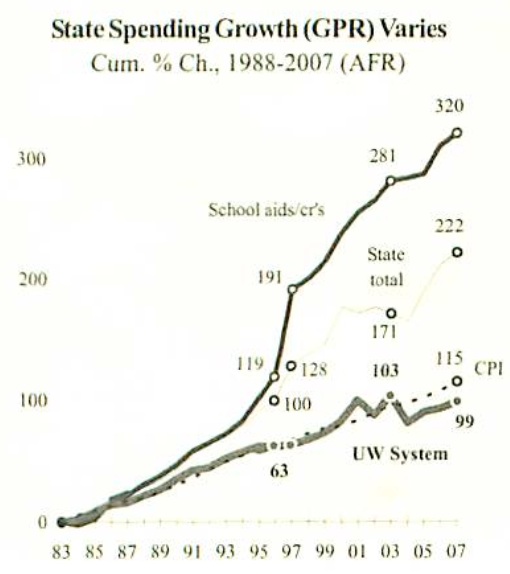
However, the state pledge to provide two-thirds of schools revenues in 1996-97 changed the budget landscape. By 2006-07, state-tax support for the UW System had almost doubled during Ihe 25 years prior. However, inflation (CPI, up 115%). school aids/credits (320%). and overall slate GPR expenditures (222%) rose more.

Share

After tough meeting, MPS board chief to keep pushing for changes

Alan Borsuk:

New Milwaukee School Board President Michael Bonds said Friday he will continue to push for major structural changes in the central office of Milwaukee Public Schools, despite the board balking at his plans.


A meeting on the budget for next year that ended at 2:45 a.m. Friday showed Bonds is nowhere near prevailing with his ideas – and that no major change in either specific matters or the culture of the organization is likely to come quickly or easily.


Things went so poorly for 20 amendments that Bonds had submitted to the $1.2 billion budget proposal from Superintendent William Andrekopoulos that even Bonds didn’t vote for one of his own proposals. On two others, his was the only vote in favor.


“We have a status quo board at this point,” Bonds said afterward. “I don’t think much was accomplished.”


But other board members clearly believed that a lot of Bonds’ ideas were wrong or counterproductive. Bonds has been calling for major change since he was elected board president April 28.

Share

The mythologizing of Arne Duncan

Parents United for Responsible Education (Chicago):

The mythologizing of Arne Duncan is moving along at a pretty fast past. Bernie Noven alerted me to this adulatory article from the London Economist and urged me to respond using some of the recent data about Arne’s record here in Chicago, saying that people “out there” have no idea about the reaiity here in Chicago. Here’s what I sent.
“Golden Boy” Arne Duncan is a pleasant fellow who held the position of Chicago Executive Officer (CEO) of the Chicago Public Schools for seven years without losing his cool.
He’s so cool, in fact, that butter wouldn’t melt in his mouth.
As a long-time Chicago public school parent advocate, I have had a front row seat at the Arne Duncan show. When Mayor Richard Daley appointed Mr. Duncan to replace Paul Vallas in 2001, there was a palpable sense of relief across the city. The new CEO’s Opie-from-Mayberry modesty was a soothing antidote to the previous six years spent with a CEO who could suck the oxygen out of a room.
We soon discovered, however, that Mr. Duncan simply provided a more complaisant and – more importantly – a more compliant cover for City Hall’s machinations.

Share

In Politics of School Reform, Transparency Doesn’t Equal Accountability

Andrew Rotherham:

Transparency is powerful and President Obama has rightly made it a pillar of his administration’s approach to policymaking. But transparency also offers the seductive promise of an easy way out for policymakers. It can trap proponents of various policy proposals in an intellectual cul de sac because it becomes easy to see information as sufficient to drive reform rather than just as a predicate for change. The risk is especially potent when proponents are convinced of the obviousness of the changes they seek.
We’ve seen this repeatedly with federal education policy. The Bush administration assumed the federal No Child Left Behind law would produce a tidal wave of student and school performance data that would swamp opposition to school improvement efforts. Seven years later the political resistance to education reform is as potent as ever and former Bush aides now acknowledge placing too much faith in the power of information.
In 1997, Congress tried unsuccessfully to increase accountability for colleges of education and teacher training programs by requiring them to report more data about outcomes. “Congress asked colleges of education to take stock of quality issues, but instead the colleges mostly whitewashed the problem,” says Ross Weiner, a senior adviser at The Education Trust. No Child Left Behind also required states and school districts to issue better report cards about educational performance. There, too, evasion rather than aggressive efforts are the norm.

Share

Barrett, state, Milwaukee Public Schools play nice at meeting

Alan Borsuk:

No fireworks, lots of pledges to work together.
That summarizes a meeting Tuesday evening involving Mayor Tom Barrett, state Secretary of Administration Michael Morgan and the Milwaukee School Board on what to do in the aftermath of a consultant’s report that criticized the business culture of Milwaukee Public Schools and said MPS could save up to $103 million a year by changing practices.
All the participants agreed that MPS faces daunting financial problems, getting worse over the next several years, if there are not major changes in the way money comes in and is spent. There also was agreement that everyone – the state, the city, MPS and others – needs to work together to improve the financial picture and to improve academic outcomes overall.
Gov. Jim Doyle and Barrett sought the report after becoming concerned about trends in MPS, including continuing low test scores overall and large property tax increases in recent years.
A week ago, Barrett and Doyle did not come to meet with board members and did not send representatives, causing some members, particularly budget committee chairman Terry Falk, to criticize them. But for this special meeting of the board, Barrett was there, Doyle sent Morgan, and everyone acted diplomatically.

Share

With Critics Quiet, Hearing Praises D.C. School Voucher Program

Bill Turque:

The Senate’s most outspoken supporter of the D.C. voucher initiative orchestrated more than two hours of uniformly glowing testimony for the program at a committee hearing yesterday and said the dissenting voices he invited turned him down.


Sen. Joseph I. Lieberman (I-Conn.), chairman of the Committee on Homeland Security and Government Affairs, is pushing for reauthorization of the D.C. Opportunity Scholarship Program, which provides up to $7,500 a year in federally funded tuition to 1,700 D.C. children from low-income families to attend private schools.


Congressional Democrats, supported by teachers unions and other liberal education groups that generally oppose using public money for private education, included language in the recent omnibus spending bill that would end the program in 2010. Last week, President Obama proposed continuing the scholarships so the students currently receiving money can finish high school. The program would be closed to new students.


Lieberman wants to fully revive the program and said yesterday that he has a commitment from Majority Leader Harry M. Reid (D-Nev.) to bring the matter to the floor for debate and a vote this year.

Share

U.S. education chief touts mayoral control of Detroit Public Schools

Jennifer Mrozowski & Santiago Esparza:

U.S. Secretary of Education Arne Duncan today advocated for Detroit’s new mayor to take over the city school system, saying strong change happens when good leaders are in control.
“I am strongly advocating for mayoral control,” he said at Detroit’s Cody High School, where he was conducting a listening tour to hear from students on how to improve schools.
Duncan, who headed Chicago Public Schools, reiterated his stance when addressing people gathered for the United Way’s national convention at Cobo Center.
Detroit Mayor Dave Bing, who accompanied Duncan on his tour at Cody, said this year is the right time for mayoral control, but added that a ballot measure is preferable to legislative action.
“A lot of the leadership is perfectly aligned to make changes,” he said.
Bing, later addressing his first national convention since becoming mayor, said improving the district would be a top priority and that he would rely on partnerships to help get the job done.
Duncan said he hopes Detroit Public Schools can move from being a “national disgrace” to a “national model,” and he would like to commit significant federal resources to help the system.

Share

More black lawmakers open to school vouchers

Greg Toppo:

Back when he was on the city council for the District of Columbia, attorney Kevin Chavous would occasionally run into fellow Democrats concerned about the state of the USA’s urban schools.
They were open to a lot of ideas, but most Democrats have historically rejected taxpayer-supported private-school vouchers, saying they drain precious cash from needy public schools. Chavous, who served from 1992 to 2005, openly supported vouchers. He would ask others why they didn’t.
“Several of them would whisper to me, ‘I’m with you, but I can’t come out in front,’ ” Chavous says.
That was then.
While vouchers will likely never be the clarion call of Democrats, they’re beginning to make inroads among a group of young black lawmakers, mayors and school officials who have split with party and teachers union orthodoxy on school reform. The group includes Sacramento Mayor Kevin Johnson, Newark Mayor Cory Booker and former Washington, D.C., mayor Anthony Williams.

Share

Our View: Teachers’ e-mails at work are public records

Wausau Daily Herald via a kind reader’s email:

Sometime in the spring of 2007, Don Bubolz of Vesper didn’t like what he heard at a meeting of the Wisconsin Rapids School Board.


He filed an open records request on April 16 of that year seeking the release of all e-mail messages sent to and from the accounts of five teachers in the district, for a period of about six weeks. At the time, he told the Wisconsin Rapids Daily Tribune that he wanted to find out — and wanted school administrators to know — whether the teachers were “doing their job the way it’s supposed to be done.”


The district superintendent indicated he would release the e-mails. The Wisconsin Education Association Council, representing the five teachers, filed an injunction to block their release.


The case made its way through trial court, and last month the Appeals Court certified it for consideration by the state Supreme Court. The appeals court said that there is no existing legal guideline in Wisconsin about whether personal e-mails constitute public records. If it chooses to rule on the case, then, the Supreme Court’s decision would have far-reaching implications.

Share

Duncan Wants Title I Dollars to Drive Reform

Ed.gov:

Education Secretary Arne Duncan today told a leading think tank that the Obama administration is changing the federal Title I program to aggressively drive reform in schools that need it the most.
Through the American Recovery and Reinvestment Act (ARRA) and the proposed 2010 budget, the administration is shifting billions of dollars into the Title I School Improvement Fund (SIF), which allows for bold strategies to help turn around underperforming schools and advance other key reforms.
The $13 billion for Title I under the ARRA includes $10 billion that is distributed by formula to schools with significant low-income populations and $3 billion for the SIF. The proposed 2010 budget also includes $1.5 billion for the SIF — almost triple the amount in the SIF in the 2009 budget, not including ARRA.
Speaking at the Brookings Institution in Washington, Duncan said, “Title I was set up to correct funding inequities — and that is important. But it really should be more focused on correcting educational inequities.”
The administration is also using the transparency requirements under the ARRA State Fiscal Stabilization Fund to challenge states and districts to turn around low-performing schools using Title I dollars. Specifically, states must identify the bottom five percent of their schools and report on how many have undergone reconstitution.

Molly Peterson has more.

Share

Proposed Budget Cuts in the Milwaukee Public Schools

Alan Borsuk:

With a wad of budget amendments, Michael Bonds, the new president of the Milwaukee School Board, will push this week for what he labels “a major restructuring” of the MPS central office.
“There’s a lot of fat and waste in the district – a lot,” Bonds said in an interview. He said approving his budget ideas would “signal to the public that the board is serious about addressing the finance issue.”
Action on Bonds’ proposals is likely to provide some of a list of major moments this week in the fast-moving drama over charting the way the school system is controlled and what direction it is headed.
Gov. Jim Doyle and Milwaukee Mayor Tom Barrett are expected to announce early in the week the members of an advisory committee that they want to get involved in MPS matters. Although the group will have no legal authority, its creation may turn out to be a significant step toward Doyle and Barrett involving themselves in school issues in ways not seen before.
And Barrett and a representative of Doyle are expected to meet with the School Board in an open session Tuesday to discuss the repercussions of a consultant’s report the governor and mayor released last month that was strongly critical of the business culture of MPS. The report said as much as $103 million a year could be saved if MPS made better decisions.
Bonds has hit the ground running in less than two weeks as the board’s leader. He met last week with Barrett and the incoming state superintendent of public instruction, Tony Evers, and he has said there will be big changes in the way the 85,000-student system is run, many of them in line with the consultant’s report.

Share

Students campaign for a voice on Madison School Board

Gayle Worland:

Call it the “student liaison whistle-stop tour.”
Four ambitious candidates will be making the rounds today at Madison high schools — giving stump speeches, outlining their platforms and extending a teenaged handshake to anyone who’s interested.
Jonathan Delgado, a sophomore at East High School, Sarah Maslin, a junior at West, and Nathan Powell, a junior at Memorial, are in a three-way race for the position of student liaison to the Madison School Board, a job that entails rounding up and representing the opinions of the district’s 25,000 students.

Share

A $100 Billion Question: How Best to Fix the Schools?

Jay Matthews:

If you had $100 billion to fix our schools, what would you do? A surprisingly smart list of suggestions for the education portion of the federal stimulus money is circulating in the education policy world. A group of experts claims authorship. I don’t believe committees are capable of good ideas, so I doubt the alleged origins of the list. But let’s put that aside for a moment and see what they’ve got.
Better yet, why not come up with our own ideas? My column seeking cheap ways to improve education yielded interesting results. By contrast, think of what we could do if we had enough money to buy the contract of every great quarterback: guarantee the Redskins a Super Bowl victory. Many expensive school-fixing schemes proved just as insane and just as useless. But Barack Obama is president, and we are supposed to be hopeful.

Share

Unions sue governor over schools funding

Nanette Asimov:

Two of California’s smaller education unions, unwilling to wait for voters to decide May 19 whether to authorize more than $9 billion in education funds, sued the governor Friday to force the state to pay money they say is owed to schools and to clarify the law so schools can count on funds in the future.
“We’re filing this suit to make it clear that the state owes this money to schools and community colleges,” said Marty Hittleman, president of the California Federation of Teachers, representing about 100,000 educators in schools and community colleges.
The 37,000-member Service Employees International Union local that represents janitors, clerks, bus drivers, and other school workers also joined the suit, filed in San Francisco Superior Court.

Share

Many Views on Obama and Vouchers

Washington Post:

The Post asked education and political experts to assess the president’s plan for D.C. students. Below are contributions from Andrew J. Rotherham, Dick Durbin, Tom Davis, Randi Weingarten, Michelle Rhee, Michael Bennet, Lanny J. Davis, Margaret Spellings, Andrew J. Coulson, Ed Rogers, Michael J. Petrilli, Anthony A. Williams, Joseph E. Robert Jr., Harold Ford Jr. and Lisa Schiffren.

Share

Radical idea: Ask what we get for the money

Daniel Weintraub:

No matter what happens in the special election May 19, California’s government finances will remain a mess. It took years of mismanagement and economic misfortune for the state to dig itself into this hole, and it is going to take many years to climb out of it.
As the climbing begins, the state needs to make fundamental changes in the way it collects and spends the taxpayers’ money. Otherwise, the next generation of lawmakers will repeat the same old mistakes as their predecessors.
Proposition 1A, with its rainy-day fund, would be one improvement, requiring lawmakers to set money aside in good times to cushion the blow of the next downturn. A bipartisan commission that has been studying the tax system will soon release its recommendations on how to make California’s revenue collections fairer and more stable. That could also improve things.

Share

Education Critic to Obama: Tell the Truth

Jay Matthews:

If there was any doubt that education analyst Gerald W. Bracey doesn’t play favorites, that’s gone now. After excoriating the Bush administration and its education officials for eight years, after canvassing his neighborhood, donating his own money and voting for Barack Obama for president, Bracey is giving the new president just what he gave the old one — unrelenting grief.
In a speech to the American Educational Research Association in San Diego last month on “countering the fearmongers about American public schools,” Bracey added to his list of non-truthtellers President Obama and Education Secretary Arne Duncan. “Obama and Duncan seem to be following the long-established line that you can get away with saying just about anything you choose about public schools and no one will call you on it,” Bracey said. “People will believe anything you say about public education as long as it’s bad.”
Bracey and I disagree on many issues, but I have long been one of his most appreciative readers, dating back to the days when I knew him only as a sharp-witted writer whose pieces occasionally appeared in The Washington Post’s Outlook section. When I came back to Washington to cover local schools, I introduced myself to Bracey, who was then living in Northern Virginia, and wrote a piece about him and his long battle to persuade policymakers, political candidates and journalists to stop exaggerating our educational problems to win themselves appropriations, votes and attention. He lost at least one job because of his writing. Instead of using his doctorate in educational psychology to get a cushy university or think tank job, he has devoted his life to setting us straight, in his less financially secure role as freelance writer, author and speaker.

Share

The Instigator: Steve Barr

Douglas McGray:

Steve Barr stood in the breezeway at Alain Leroy Locke High School, at the edge of the Watts neighborhood of Los Angeles, on a February morning. He’s more than six feet tall, with white-gray hair that’s perpetually unkempt, and the bulk of an ex-jock. Beside him was Ramon Cortines–neat, in a trim suit–the Los Angeles Unified School District’s new superintendent. Cortines had to be thinking about last May, when, as a senior deputy superintendent, he had visited under very different circumstances. That was when a tangle between two rival cliques near an outdoor vending machine turned into a fight that spread to every corner of the schoolyard. Police sent more than a dozen squad cars and surged across the campus in riot gear, as teachers grabbed kids on the margins and whisked them into locked classrooms.
The school’s test scores had been among the worst in the state. In recent years, seventy-five per cent of incoming freshmen had dropped out. Only about three per cent graduated with enough credits to apply to a California state university. Two years ago, Barr had asked L.A.U.S.D. to give his charter-school-management organization, Green Dot Public Schools, control of Locke, and let him help the district turn it around. When the district refused, Green Dot became the first charter group in the country to seize a high school in a hostile takeover. (“He’s a revolutionary,” Nelson Smith, the president and C.E.O. of the National Alliance for Public Charter Schools, said.) Locke reopened in September, four months after the riot, as a half-dozen Green Dot schools.

Share

So Long, Washington, DC School Choice…..

The Economist:

FOR all of the hype that preceded the Tea Parties, the first protest to win some sort of concession from Barack Obama’s administration may have been the protests against the end of Washington’s school-voucher programme. A month ago, the programme’s funding was shamefully struck from the president’s proposed budget. This prompted libertarian and liberal groups to fight back, culminating in a protest yesterday. And today comes news of a compromise of sorts:

President Obama will propose setting aside enough money for all 1,716 students in the District’s voucher program to continue receiving grants for private school tuition until they graduate from high school, but he would allow no new students to join the program.

Actually, that’s not much of a compromise. That’s more of a cover-up. Let’s remember that Mr Obama, who sends his own children to private school, made the following promise during his inaugural address:

Share

Is Barack Obama’s education secretary too good to be true?

The Economist:

IT IS hard to find anybody with a bad word to say about Arne Duncan, Barack Obama’s young education secretary. Margaret Spellings, his predecessor in the Bush administration, calls him “a visionary leader and fellow reformer”. During his confirmation hearings Lamar Alexander, a senator from Tennessee and himself a former education secretary, sounded more like a lovesick schoolgirl than a member of the opposition party: “I think you’re the best.” Enthusiastic without being over-the-top, pragmatic without being a pushover, he is also the perfect embodiment of mens sana in corpore sano–tall and lean, clean-cut and athletic, a Thomas Arnold for the digital age.
Since moving to the Education Department a couple of months ago he has been a tireless preacher of the reform gospel. He supports charter schools and merit pay, accountability and transparency, but also litters his speeches with more unfamiliar ideas. He argues that one of the biggest problems in education is how to attract and use talent. All too often the education system allocates the best teachers to the cushiest schools rather than the toughest. Mr Duncan also stresses the importance of “replicating” success. His department, he says, should promote winning ideas (such as “Teach for America”, a programme that sends high-flying university graduates to teach in underserved schools) rather than merely enforcing the status quo.
Nor is this just talk. Mr Duncan did much to consolidate his reputation as a reformer on May 6th, when the White House announced that it will try to extend Washington, DC’s voucher programme until all 1,716 children taking part have graduated from high school. The Democrat-controlled Congress has been trying to smother the programme by removing funding. But Mr Duncan has vigorously argued that it does not make sense “to take kids out of a school where they’re happy and safe and satisfied and learning”. He and Mr Obama will now try to persuade Congress not to kill the programme.

Share

No choice in D.C.
Congress supports vouchers for cars but not schools

Washington Times Editorial:

Fighting to save the District’s popular school-voucher program, some 1,000 parents, pupils and politicians gathered near Mayor Adrian Fenty’s office on Wednesday to protest Congress’ plans to end school choice in Washington.
That same day, the Senate approved a $4,500 voucher for cars, encouraging citizens to trade in their old automobiles for newer ones that burn less fuel.
So, Congress thinks that vouchers for schools are bad, but vouchers for cars are good.
Slashing school vouchers spares teachers’ unions from competition. On the other hand, car vouchers are supposed to boost demand for cars built by the United Auto Workers. The obvious explanation for this schizophrenia: Congress does whatever helps unions.
A closer look reveals that Congress has it wrong in both cases – which is what happens when lawmakers let interest groups trump common sense.

Share

Our view paying for college: To stretch education dollars, cut out the middleman

USA Today Opinion:

Obama seeks student aid hike, falls short on cost control.
To look at higher education these days, it seems that no one cares about financially strapped students.
On the one hand, colleges have long been raising tuition at a rate faster than the cost of living. On the other, lenders have treated families’ increased borrowing needs as an invitation to easy profits.
To address this, President Obama wants to expand federal Pell Grants for low- and middle-income students. The expansion would be financed by ending the private, scandal-plagued Federal Family Education Loan Program and replacing it with direct government lending.
The obvious question is: Will all this actually make college more affordable? In the past, universities have driven up costs through lavish building, money-losing sports, swelling bureaucracies and a tolerance of professors who barely teach. Simply throwing more money at them isn’t going to prompt necessary belt-tightening.

Share

Don’t let ideology block education reforms that work

Torrey Jaeckle:

A report last week from the National Assessment of Educational Progress — widely known as the “Nation’s Report Card” — shows that total education spending per pupil has doubled since 1971.
Yet overall test results for our high school seniors remain unchanged.
In effect, we’re spending twice as much money to achieve the same results as more than 35 years ago.
If that isn’t sad enough, consider these additional facts gleaned from various news stories over the past few weeks:
• A headline from the Wall Street Journal on April 23: “Demand for Charter Schools is High, Seats are Few.”

Share

Obama to Eliminate New Washington, DC Voucher Students, Continue Current Students

Bill Turque & Shailagh Murray:

President Obama will propose setting aside enough money for all 1,716 students in the District’s voucher program to continue receiving grants for private school tuition until they graduate from high school, but he would allow no new students to join the program, administration officials said yesterday.
The proposal, to be released in budget documents today, is an attempt to navigate a middle way on a contentious issue. School choice advocates, including Republicans and many low-income families, say the program gives poor children better access to quality education. Teachers unions and other education groups active in the Democratic Party regard vouchers as a drain on public education that benefits relatively few students, and they say the students don’t achieve at appreciably higher levels at their new schools.

Share

Arne Duncan tells Education Writers Association: NCLB has to go (the name, not the law)

Dale Mezzacappa:

Secretary of Education Arne Duncan addressed the annual convention of the Education Writers Association in Washington, DC Thursday night, and he said that the name “No Child Left Behind” has to go.
“The name ‘No Child Left Behind’ is toxic,” he said.
Duncan doesn’t want to scrap NCLB by a long shot, but he wants to see some changes, especially in how schools are evaluated. He called himself a big fan of value-added methods of judging school progress — in other words, looking at growth in test scores — rather than relying on a basic proficiency rate.
On testing, Duncan said he realizes the limits of standardized tests, but doesn’t want to get rid of them. “Test scores don’t tell us everything, but they tell us some things. We must use what we have until we come up with something better.”
One other indicator he wants to add to NCLB — or whatever it will be called — is a measure for high schools of how well they keep ninth graders on track.

Share

Arne Duncan’s Choice

Wall Street Journal Editorial:

Washington, D.C.’s school voucher program for low-income kids isn’t dead yet. But the Obama Administration seems awfully eager to expedite its demise.


About 1,700 kids currently receive $7,500 vouchers to attend private schools under the Opportunity Scholarship Program, and 99% of them are black or Hispanic. The program is a huge hit with parents — there are four applicants for every available scholarship — and the latest Department of Education evaluation showed significant academic gains.


Nevertheless, Congress voted in March to phase out the program after the 2009-10 school year unless it is reauthorized by Congress and the D.C. City Council. The Senate is scheduled to hold hearings on the program this month, and Senate Majority Leader Harry Reid has promised proponents floor time to make their case. So why is Education Secretary Arne Duncan proceeding as if the program’s demise is a fait accompli?


Mr. Duncan is not only preventing new scholarships from being awarded but also rescinding scholarship offers that were made to children admitted for next year. In effect, he wants to end a successful program before Congress has an opportunity to consider reauthorizing it. This is not what you’d expect from an education reformer, and several Democrats in Congress have written him to protest.

Share

The Politics of Education and the Perils of Preferment

The Economist:

PLEDGES are shrinking to aspirations; aspirations are quietly evaporating; no more hoodies are being hugged or huskies stroked (or was it the other way around?). The sunny Californian Conservatism that David Cameron once espoused has been darkened by the crunch. His promise of a happier tomorrow now hangs on a few upbeat policies. Chief among them is education reform–which could make Michael Gove, the shadow schools secretary, among the most privileged and pressured members of a future Tory government.
Ed Balls, his counterpart in the cabinet, is an equally important figure for Labour, before and after the next general election. Ire over public services often focuses on bad hospitals: death is more heart-wrenching than illiteracy. But pound for pound (and there have been a lot of them), Labour’s education spending has been less rewarding than its health splurge. It falls to Mr Balls to defend its record on what Tony Blair proclaimed his main priority–and to soften the recession’s impact on teenagers and soothe a rumbling moral panic about harm done by and to children.

Share

Harford County should get the elected school board it wants

Baltimore Sun:

Under the measure, the school board would gradually transition from seven appointed members to six elected and three appointed members. The current school board believes the bill is too vague and that the transition will be difficult. But the bill clearly outlines the proposed changes, and only a couple of minor details need to be worked out.
Contrary to the board’s objection, the difficulty of the transition would likely be minimal. In order for three board members’ terms to end on June 30, 2011, one board member’s term would be lengthened by a year, and another’s would be shortened. On July 1, 2011, three elected board members would take office along with two appointed members. The board members in office on July 1, 2011 would serve for four years, and in the next election cycle six members would be elected.
So the school board’s vocal opposition is misleading. Why should these minor issues prevent Harford County’s constituents from influencing how their tax dollars are spent on their children’s education? Despite prior bills, Harford County is one of the last counties in which voters cannot elect school board members.

Share

Rare Alliance May Signal Ebb In Union’s Charter Opposition

Jay Matthews:

I didn’t see many other reporters Tuesday in the narrow, second-floor meeting room of the Phoenix Park Hotel in the District. A U.S. senator’s party switch and new National Assessment of Educational Progress data were a bigger draw. But in the long term, the news conference at the hotel might prove a milestone in public education. It isn’t often you see a leading teachers union announce it is taking money from what many of its members consider the enemy: corporate billionaires who have been bankrolling the largely nonunion charter school movement.
Of course, it might turn out to be just another publicity stunt. But the people gathered, and what they said, impressed me.
Randi Weingarten, president of the American Federation of Teachers, unveiled the first union-led, private foundation-supported effort to provide grants to AFT unions nationwide to develop and implement what she called “bold education innovations in public schools.” The advisory board of the AFT Innovation Fund includes celebrities of my education wonk world: former Cleveland schools chief Barbara Byrd-Bennett, Stanford professor Linda Darling-Hammond, Harvard professor Susan Moore Johnson and even Caroline Kennedy, well known for other reasons but identified at the conference as an important fundraiser for New York schools.

Share

Federal education money goes to all the wrong places

Dan Thomasson:

A funny thing has been happening to some of that widely heralded federal education money. It has fallen off the bus on the way to school. At least a few cash-strapped local governments upon notification of the federal input have eliminated an equal amount from their own budgets, hardly what the Obama administration had in mind for the $100 billion aimed at vastly improving the nation’s schools.
While the practice is not general and there are strict rules about the use of the federal bucks as part of the economic recovery effort, local and state officials are being forced to reduce manpower in vital services like fire and police. The temptation to relieve some of that pressure and to prevent teacher layoffs seems overwhelming and likely to grow.
For instance, the local press here recently reported that Loudon County in the nearby Virginia suburbs was a case in point. Upon hearing that the county would receive more than $11 million in new school money from Uncle Sam, the county’s supervisors slashed $7.3 million from the regular school budget. According to the reports, the board also has made it clear that schools might have to give more local money back if there were other federal contributions. Similar actions have been taken elsewhere and Arne Duncan, the new secretary of Education, has warned of strong reprisals if this abuse of the president’s intentions is not stopped.

Share

School reform must have urban focus

Rochester Democrat & Chronicle Editorial:

he state Board of Regents, which oversees public schools in the state among its duties, has a lot on its plate at the moment. There is the problem of the crippled state finances and their impact on local schools. There is the arrival of a new education secretary, Arne Duncan, who not only is handing out stimulus money but is looking for national school reform.
And then there is the regents’ task of choosing a commissioner to replace Richard Mills, who is leaving the job this summer, a leader who changed the conversation about public school performance by championing consistent, measurable standards in academic fundamentals.
The value of a measuring process based almost entirely on standardized tests was often questioned, but test scores did show with great clarity the disparity between urban and suburban schools.

Share

Madison School District 2009-2010 Budget Discussion

44MB mp3 audio file. The April 30, 2009 meeting discussed:

  1. undo class and a half for SAGE schools
  2. not extend class and a half for non-SAGE schools
  3. restore funding for Ready Set Go conferences

The board also discussed member compensation, future proposals from task forces such as the fine arts and math along with the strategic plan.
Via a kind reader’s email.

Share

An Update on the Madison School District’s 4 year old Kindergarten Plans

Dan Nerad 100K PDF:

The 4K steering committee had four meetings reviewing prior history, leaming from other districts, and looking at what needs to be accomplished prior to start up. At the last meeting we came to consensus on a time-line. As a result, the steering committee is recommending that the Board of Education make a commitment in May to begin 4K no later than fall, 2010.
The next 4K meeting is tentatively scheduled for Monday, May 11, from 9:30 to 11:30, site to be determined. At this meeting we will divide into working subcommittees focused around the Tasks Ahead piece developed in previous meetings. Attached is a list of the tasks.
The steering committee is a terrific group of individuals to work with and there is no lack of enthusiasm and passion for this initiative.

Share

California High school students weigh in on Prop. 1A

San Francisco Chronicle:

The nonpartisan California Budget Challenge is a free online educational tool from the public-policy group Next 10 that lets users try to balance California’s books and see how their choices would affect the state five years into the future.
Users set their own priorities and make tough decisions about what is best for the people of the state. This allows everyday people the chance to consider the effects of important policy choices. This year, Next 10 is taking the challenge on the road, visiting classrooms and diverse communities throughout the state. Staff members teach audiences about the workings of California’s finances and give them a flavor for what it takes to balance the state’s budget. Here are reactions to Proposition 1A from six Bay Area high school students:

Share

Keep the Wisconsin QEO

Wisconsin State Journal Editorial:

Wisconsin’s three-legged stool of school finance is wobbling and about to fall over.
The Legislature needs to prevent a terrible crash by rejecting the governor’s attempt to kick out the sturdiest leg of the system — the QEO, or “qualified economic offer,” which limits increases in teacher compensation.
Wisconsin’s system of paying for public schools has long been described as a three-legged stool. It’s designed to protect property taxpayers and the quality of K-12 education.
The three legs are:

Much more on the QEO and Wisconsin school revenue limits here.

Share

School districts brace for economic hard times

Amy Hetzner & Erin Richards:

Flat state funding, dropping enrollments and fears about overburdening local taxpayers are helping to shape some of the most difficult financial decisions that school districts have faced in years.
In response, school officials have proposed staff reductions, maintenance cutbacks, energy efficiencies and other ways to curb costs. What’s absent is a reliance on the record levels of new federal funding flowing to the state – already anticipated at $857 million and climbing – for the next two years.
Thus far into school districts’ planning for their 2009-’10 budgets:

Share

Putting Students on the Same High-Performance Page

Lydia Gensheimer:

What happens when you have a law that’s supposed to improve performance among the nation’s school children but instead it creates confusion, lowers expectations and can result in a “dummying down” of state standards?
That’s what a panel of educational experts is trying to address with a plan to incorporate common academic standards. They are urging Congress to support a state-led initiative to develop more-uniform, clear and integrated standards that reflect both the global marketplace and Americans’ mobility within the country.
Under the 2002 No Child Left Behind law (PL 107-110), states set their own standards — resulting in what Education Secretary Arne Duncan calls a “dummying down” of state standards in order to meet benchmarks set by the law.
Those who advocate for common standards contend that a system of variable expectations — ones that are often too low — leads American students to underperform when compared with their peers in Finland or China. President Obama called for common standards in a March 10 speech, and Duncan has said he would use a portion of a $5 billion “Race to the Top” fund under his discretion to reward states working toward that goal.
The panel — which included Randi Weingarten, president of the American Federation of Teachers; former North Carolina Gov. James B. Hunt Jr.; and Dave Levin, founder of the KIPP charter schools — testified April 29 at a House Education and Labor Committee hearing.

Share

Is new board president Bonds a ‘clean slate’ for the Milwaukee Public Schools?

Alan Borsuk:

New Milwaukee School Board President Michael Bonds took a stand Wednesday in support of major changes in the direction of Milwaukee Public Schools, calling for a hiring freeze in the central office, more school closings and less busing.
Bonds said MPS could save millions of dollars by taking a series of steps, including some similar to what was in a stinging consultant’s report done for Gov. Jim Doyle and Milwaukee Mayor Tom Barrett.
Bonds said he was sending letters to Doyle and Barrett, asking for weekly meetings with them or their representatives to develop a unified effort to improve education in Milwaukee. He also held out the prospect of involvement by city and state representatives in MPS decision-making.
He said MPS should not seek or expect more money from the state, both because it is not realistic and because the district needs to do more to control its own spending.
“I still think we have millions in unrealized efficiencies,” he said.

Share

A Primer on Wisconsin School Revenue Limits

The Wisconsin Taxpayer 3.4MB PDF:

Since 1994, Wisconsin school districts have operated under state-imposed revenue limits and the associated qualified economic offer (QEO) law.

  • Revenue limits have helped reduce school property tax increases to less than 5% per year from more than 9% annually prior to the caps.
  • The limits have had \aried impacts on school districts, with growing districts experiencing the largest revenue gains. Low-spending districts prior to the caps have seen the largest per student gains.
  • The QEO law has helped school districts keep compensation costs somewhat in line with revenue limits. However, since benefits are given more weight, teacher salary increases have slowed.

Since 1994. Wisconsin school districts have operated under slate-imposed revenue limits, which arc tied to inflation and enrollments. The associated qualified economic offer (QEO) law limits staff compensation increases to about 4% annually. With declining student counts, fluctuations in stale school aid. and various concerns over teacher pay. revenue limits and the QEO have attracted increasing debate.
The governor, in his proposed 2009-11 state budget, recommends eliminating the QEO. I le has also talked about providing ways for school districts to move away from revenue limits. This report does not address these specific proposals. Rather, it seeks to help inform discussions by examining the history of revenue limits and the QEO, legislative attempts to fix various issues, and the impacts of limits on schools, educators, and taxpayers.
THE REVENUE LIMIT LAW
School districts collect revenue from a variety of sources. The two largest sources are the property tax and state general (or equalization) aid, General aid is distributed based on district property wealth and spending. Combined, these two revenue sources account for about 75% of an average district’s funding. The remainder is a combination of student fees, federal aid. and state categorical aids. such as those for special education and transportation.
The revenue limit law was implemented in 1994 (1993-94 school year) and caps the amount districts can collect from property taxes and general aid combined. It does not restrict student fees, federal aid. or state categorical aid. A district’s revenue limit is determined by its prior-year cap, an inflation factor, and enrollments. There is an exception to the limit law for districts defined as “low-revenue.” Currently, districts with per student revenues less than S9.000 are allowed to increase their revenues to that level.
Background
While Wisconsin’s revenue limit law began in 1994. its roots date back to several teacher strikes in the early 1970s, culminating with the 1974 Hortonville strike during which 86 teachers were fired. That strike gained national attention.
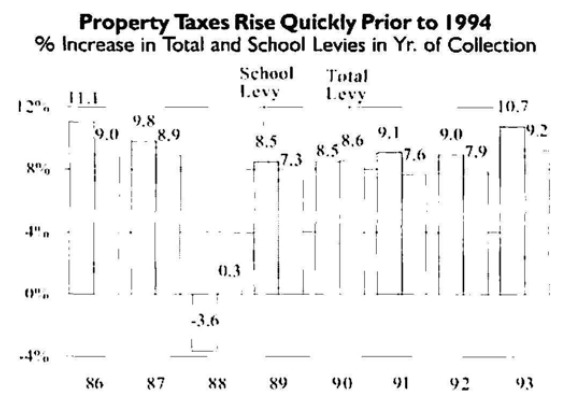
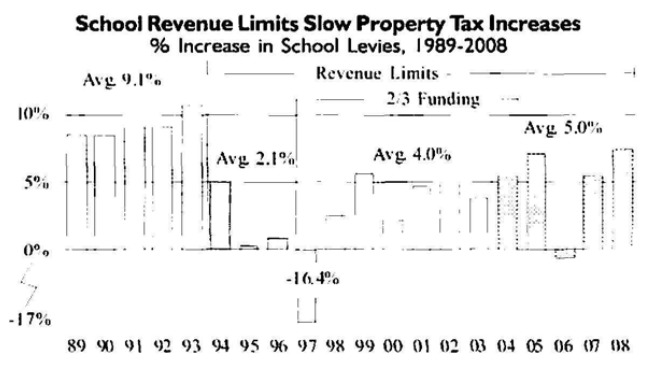
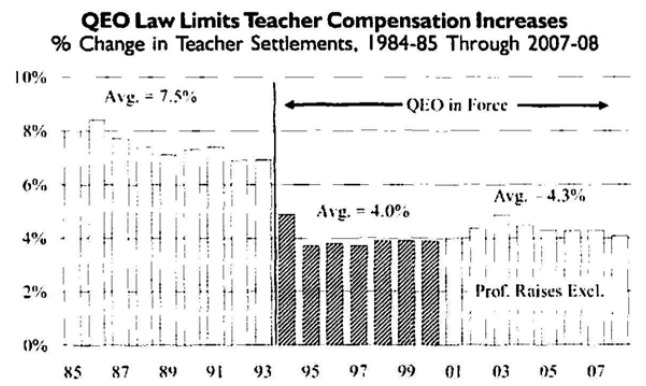

Related: K-12 tax & spending climate. A number of links on local school spending and tax increases before the implementation of State limits on annual expenditure growth. The Madison School District spent $180,400,000 during the 1992-1993 school year. In 2006, the District spent $331,000,000. The 2009/2010 preliminary Citizen’s Budget proposes spending $367,912,077 [Financial Summary 2.1MB pdf], slightly down from 2008/2009’s $368,012,286.

Share

Californians want schools to spend more wisely

Nanette Asimov:

Californians care deeply about public education – and most want school funding protected in the state budget – but they are feeling less generous than in past years about giving schools more money, a new statewide survey reveals.
People feeling the recession’s bite want schools do a better job with the money already allocated, according to the survey of education attitudes by the Public Policy Institute of California.
At the same time, people are far less willing than in past years to pay higher taxes even to maintain existing levels of school funding.
“Californians are concerned about school quality and they’re concerned about school funding. But that hasn’t translated into more support for taxes and spending,” Mark Baldassare, president of the independent research firm, said in a statement. “They’re looking for reform and innovation that can lead to gains in school performance and student achievement.”

Mitchell Landsberg has more.

Share

Pass bill to boost science, math teachersPass bill to boost science, math teachers

Wisconsin State Journal Editorial

: Public schools across Wisconsin expect a critical shortage of math and science teachers in the next few years. Supply is not keeping up with demand.


That’s why the Legislature should approve Senate Bill 175. This sensible proposal would lure more math and science professionals into classrooms by creating a shorter and less expensive route to a teaching license for anyone with a college degree.


SB 175 also could attract more black men into the teaching profession to serve as role models in urban schools — a key selling point for Rep. Jason Fields, D-Milwaukee, who is part of a bipartisan group of sponsors.

Share

School Reform Talk Is Good, Now Let’s See the Walk

Wall Street Journal Editorial:

Secretary of Education Arne Duncan tells us that “School Reform Means Doing What’s Best for Kids” (op-ed, April 22). His cry for “doing what’s best for kids” rings a bit hollow when he failed to do what is best for the 1,700 low-income kids in Washington, D.C. who were counting on him. Those kids were given a lifeline — a voucher to escape schools that continually failed them, schools in a district to which neither Mr. Duncan nor his boss would send their own children. When crunch time arrived, politics trumped educational freedom, at least when it came to poor, inner-city kids in the District of Columbia.
Mr. Duncan speaks eloquently about how the public education establishment must change. He correctly says “we need a culture of accountability in America’s education system if we want to be the best in the world.” But what greater accountability can there be than that which comes from customers exercising free choices? True accountability in education will only come about when all parents are empowered to choose what they deem is best for their own children, not just those, like President Obama, Mr. Duncan, and most readers of the Wall Street Journal, who have financial means. So my question is, “When will the Obamas, Duncans, et. al. stand up for low-income parents so that they, too, can make choices that are best for their kids?”

Share

Mayoral Control of Schools Unlikely in St. Paul

Emily Johns & Chris Havens:

St. Paul Mayor Chris Coleman often says that education is the key to many things that make a city successful, including economic development, crime fighting and neighborhood stability.
“Every mayor has to make education their Number 1 priority,” he says.
U.S. Secretary of Education Arne Duncan takes it one step further — he wants more big-city mayors to follow the lead of Michael Bloomberg in New York City and take over their cities’ school systems to help improve their leadership and stability.
“Where you’ve seen real progress in the sense of innovation, guess what the common denominator is?” Duncan asked. “Mayoral control.”
That said, could the mayors take over the schools here?

Share

Doyle, Barrett warn Milwaukee Schools on tax increase

Alan Borsuk:

Gov. Jim Doyle and Milwaukee Mayor Tom Barrett warned Friday that it “defies common sense” to consider a large increase in property taxes for Milwaukee Public Schools for next year and said they will hold MPS leaders accountable if there is such an increase.
They did not spell out exactly what they meant by accountable, but their sharp statement came as the two consider supporting major changes in the way MPS is run, including a possible mayoral takeover of the system. It also came shortly before they name a commission to oversee putting into action a consultant’s report that said MPS could save millions of dollars if it operated like a well-run business.
The governor and mayor were reacting to Thursday’s release of a proposed budget for MPS by Superintendent William Andrekopoulos. The proposal did not include a projection for property taxes for next year – that won’t come for months – but it did include a statement that it was likely there would be “a significant property tax increase.” Some MPS leaders have suggested it could be 10% or more.
The reaction also came the same day incoming state Superintendent of Public Instruction Tony Evers told the state Assembly’s Education Reform Committee that he intends to appoint a “federal funds trustee” to oversee how MPS spends tens of millions of dollars of federal economic stimulus money.
Doyle and Barrett jointly issued a brief statement about the MPS property tax picture:

Somewhat related: Joel McNally on the QEO.

Share

Madison School District Strategic Planning Update


The Madison School District’s Strategic Planning Group met this past week. Several documents were handed out, including:

This recent meeting was once again facilitated by Dr. Keith Marty, Superintendent of the Menomonee Falls school district. Non-MMSD attendance was somewhat lower than the initial 2.5 day session.

Share

Minnesota House passes legislation to hold school funding flat

Tim Pugmire:

The Minnesota House has passed an education finance bill that would hold state funding for public schools flat over the next two years.
The vote Thursday night was 85-48. With the state facing a $4.6 billion budget deficit, House Democrats say the bill provides dependable funding in difficult times. But Republicans argue that schools need more.
The House K-12 bill maintains current state funding for education by using federal economic stimulus money, as well as delayed payments to school districts and property tax accounting shifts, to offset spending cuts.
DFL Rep. Mindy Greiling of Roseville, chair of the House K-12 Education Finance Division, said the bill holds the ship steady until the state reaches calmer economic waters. Greiling said the bill lays the groundwork for a new school finance system that would begin ramping up funding levels in 2014.
“Education is something that even in the hard times we should prioritize,” Greiling said. “And that’s what this bill does. Because building a workforce that’s ready to compete in a global economy has always been and must remain a Minnesota priority.

Share

Big Milwaukee School Tax Hike Likely

Alan Borsuk:

Even though a proposed Milwaukee Public Schools budget released Thursday calls for no increase in overall core spending next year, the property tax levy increase might still reach double digits – a year after a 14.6% jump.
The new budget proposal answers two big questions about MPS, and leaves two others unanswered.
Unanswered: How much will property taxes go up? Michael Bonds, chair of the School Board’s finance committee, said this week that he won’t vote for anything over 10%. But the board may find itself debating something in that range after the state budget is set and other factors play out. Or, as the budget documents say: “Despite the district’s efforts to contain costs, the budget likely will require a significant property tax increase.”
Unanswered: What about the nearly $100 million in federal economic stimulus money coming to MPS over the coming two years, according to an announcement by Gov. Jim Doyle on Thursday? Stay tuned – a second budget proposal will be made by mid-May, Superintendent William Andrekopoulos said. It appears it won’t call for citywide use of the “year-round” school calendar and longer days for elementary students, but it is likely to make steps in those directions, along with other initiatives that would draw on stimulus money.
But that money is not expected to help with property taxes.

Share