School Information System

Tracking covid-19 excess deaths across countries

The Economist:

One way to account for these methodological problems is to use a simpler measure, known as “excess deaths”: take the number of people who die from any cause in a given region and period, and then compare it with a historical baseline from recent years. We have used statistical models to create our baselines, by predicting the number of deaths each region would normally have recorded in 2020 and 2021.

Share

“the referenced study made no mention of the education of its educators as a variable”

Noah Diekemper:

It’s little wonder that the American Enterprise Institute’s education research fellow Max Eden has denounced college requirements for preschool teachers as “regressive,” declaring that there is “ no evidence to support this will help with student outcomes .”

Why, then, are lawmakers considering a federal law that would fund preschool programs only if lead teachers have years of experience in special collegiate programs? After all, how many people genuinely believe preschool instruction is a discipline that requires years to learn and not a matter of brief on-the-job training?

It’s no secret that college graduates are more liberal than the typical person. Pew Research Center polling over the past 20 years has seen the proportions of white Democrats self-identifying as liberal scale directly with education levels . More education tracks with more liberal engagement and activism and familiarity with niche woke jargon . In 2015, the share of “mostly” or “consistently liberal” people was 26% among those with “high school or less” education, 36% with “some college,” 44% with a college degree, and 54% with postgraduate experience .

And those numbers consider people on the basis of education in general — there’s reason to believe that those with college degrees in the humanities would be even further extreme than a generic graduate. A 2016 study that analyzed the party registration of college professors found that more “hard” disciplines, such as economics and law, featured less skewed ratios of registered Democrats to Republicans than departments such as “journalism/communications” and history. (“Education” was not a department studied.) History professors who were registered Democrats outnumbered Republicans 33.5 to 1. If increased Democratic registration tracks with more humanities fields, such as education, and with more liberal attitudes, then the above numbers about self-identified liberalism probably understate the ideological slant of this group.

The data clearly indicate that being able to read is not a requirement for graduation at (Madison) East, especially if you are black or Hispanic”

2017: West High Reading Interventionist Teacher’s Remarks to the School Board on Madison’s Disastrous Reading Results 

Madison’s taxpayer supported K-12 school district, despite spending far more than most, has long tolerated disastrous reading results.

My Question to Wisconsin Governor Tony Evers on Teacher Mulligans and our Disastrous Reading Results

“An emphasis on adult employment”

Wisconsin Public Policy Forum Madison School District Report[PDF]

WEAC: $1.57 million for Four Wisconsin Senators

Friday Afternoon Veto: Governor Evers Rejects AB446/SB454; an effort to address our long term, disastrous reading results

Booked, but can’t read (Madison): functional literacy, National citizenship and the new face of Dred Scott in the age of mass incarceration.

When A Stands for Average: Students at the UW-Madison School of Education Receive Sky-High Grades. How Smart is That?

Share

“Why all of a sudden are we teaching our 5-year-olds to be divided by color?” she said. “They don’t care what color your skin is until you tell them that that 5-year-old’s grandpa was mean 200 years ago.”

Sabrina Tavernise:

Demographics are changing too. Growing numbers of Hispanic people and Asian people from the Marshall Islands call Enid home. The county of Garfield, in which Enid is the seat, was 94 percent white in 1980. Last year, that figure was about 68 percent. The county experienced one of the largest increases in racial diversity in the country over the past decade, 2020 census data show.

Teachers and administrators in Enid’s school system have worked hard to integrate growing numbers of immigrant children. But everyone else interviewed in Enid, including Ms. Crabtree, who is white, expressed surprise when told of the scale of this change. Immigrants tend to live in certain parts of town and work in certain jobs, like at the meat plant, and do not yet have high-profile positions of power.

Still, she could feel that change overall was accelerating, and that was making her feel like she was losing her country, like it was becoming something she did not recognize.

“I truly think that what we are doing is pulling our republic apart at the seams,” she said.

So when she heard about the indoor mask mandate proposal last year in her city, she jumped to get involved. She discovered that she liked bringing people together, people whose thinking she shared. It felt good to learn together, and to belong to this group she was building with urgent purpose. Eventually she made a Facebook page called Enid Freedom Fighters.

Share

In August I challenged the UC vaccine mandate in federal court. Yesterday the University fired me for refusing the vaccine.

Aaron Kheriaty:

Yesterday I received the following notice from the University of California, effective immediately, where I have served for almost fifteen years as Professor at UCI School of Medicine and Director of the Medical Ethics Program at UCI Health:

This termination has been an opportunity for me to reflect on my time at UCI, especially my time there during the Covid pandemic. Two years ago I never could have imagined that the University would dismiss me and other doctors, nurses, faculty, staff, and students for this arbitrary and capricious reason. I want to share a bit of my story, not because I am unique but simply because my experience is representative of what many others—who do not necessarily have a public voice—have experienced since these mandates went into effect.I worked in-person at the hospital every day during the pandemic, seeing patients in our clinic, psychiatric wards, emergency room, and hospital wards—including Covid patients in the ER, ICU, and medicine wards. As our chief ethics consultant, I had countless conversations with families of patients dying of Covid, and tried my best to console and guide them in their grief. When our pregnant residents were worried about consulting on Covid patients, the administration reassured these residents that they had no elevated risks from Covid—a claim without any evidential basis at the time, and which we now know to be false. I saw the Covid consults for these worried residents, even when I was not covering the consult service.I also remember in the early weeks of the pandemic when N-95 masks were in short supply and the hospital kept them under lock and key. Hospital administrators yelled at nurses for wearing surgical or cloth masks (this was before masks became all the rage after the CDC suggested, with little evidence, that they might help). At that early stage the truth was we didn’t know whether masks worked or not, and nurses were doing the best they could under pressure in a situation of uncertainty. The administrators yelled and ridiculed them, not wanting to admit the real issue was that we simply did not have enough masks. So I called local construction companies and sourced 600 N-95s from them. I supplied some to the residents in our department and my attending colleagues in the ER, then donated the rest to the hospital. Meanwhile the University administrators—the same ones who fired me yesterday—were working safely from home and did not have to fret about PPE shortages.

Share

Where are the students? For a second straight year, school enrollment is dropping

Anya Kamanetz, Cory Turner and Mansee Khurana:

The challenge now, for educators, is understanding where those young children and their older siblings went. Did they simply stay home — or did their families enroll them elsewhere?

A shift to private schools 

Private and parochial schools generally enroll about 10 percent of all students in the United States, or about 5.7 million students. While nationwide enrollment in private schools dropped last year along with public schools, this year it has rebounded.

The National Association of Independent Schools comprises private, non-parochial schools. They report a net enrollment growth of 1.7% over the two pandemic years.

There’s a particularly big rebound in private preschool enrollment in the NAIS sample. That number dropped dramatically between 2019-20 and 2020-21, but then grew 21% this fall for a net growth of 6% over two years.

While accurate data are not yet available for parochial schools, media reports suggest their enrollment has rebounded this fall as well.

“We saw a couple thousand students that transferred over to private schools in the city,” says Martinez, who took over as chief executive officer this summer in Chicago. “And that was because the private schools were assuring the families that they would be open in-person, no matter what.”

Share

California education official resigns after working from Texas

Susannah Luthi:

A second high-ranking California Department of Education official has resigned because she lives out of state.

Pamela Kadakia served as a CDE equity project manager but resides in Texas, based on public records and her LinkedIn profile.

Her exit follows the departure of Daniel Lee, a Philadelphia-based psychologist, life coach and long-time acquaintance of California schools chief Tony Thurmond, who was involved in Lee’s hiring. Lee was the state’s first superintendent of equity and earned more than $161,000 annually.

Lee, 51, resigned shortly after POLITICO reported that his appointment may have violated state policy decreeing that state employees must live in California unless their jobs require them to live elsewhere, such as those lobbying the federal government in Washington.

Share

10 times universities said no to the woke mob in 2021

Kate Hirzel:

Campus Reform has covered various instances of colleges, faculty, and students fighting back against leftist ideology in 2021.

Below are the top 10 examples of sanity prevailing this year. 

10. Hillsdale’s ‘1776 Curriculum’ is a patriotic response to the ‘1619 Project’

Hillsdale College announced its ‘1776 Curriculum’ that helps K-12 students appreciate America. Hillsdale’s curriculum was created by “teachers and professors—not activists, not journalists, not bureaucrats”. It was made in response to Nikole Hannah-Jones “1619 Project.”

9. BREAKING: ASU rejects student demands, refuses to ban Rittenhouse from future enrollment

Arizona State University refused to give into students’ demands to ban Kyle Rittenhouse from attending the university. After heated protests on campus, ASU told Campus Reformthey will treat Rittenhouse’s application “as any other would be” if he applied. 

“As a university that measures itself by whom it includes and how they succeed, should he choose to seek admission in the future, his application will be processed as any other would be,” the school told Campus Reform.

Share

The Dangerous Push to Give Boosters to Teens

Marty Makary:

The U.S. government is pushing Covid-19 vaccine boosters for 16- and 17-year-olds without supporting clinical data. A large Israeli population study, published in the New England Journal of Medicine earlier this month, found that the risk of Covid death in people under 30 with two vaccine shots was zero.

Booster mandates for healthy young people, which some colleges are imposing, will cause medical harm for the sake of transient reductions in mild and asymptomatic infections. In a study of 438,511 males 16 to 24, 56 developed myocarditis after their second Pfizer dose (or 1 in 7,830, at least seven times the usual rate). True, most cases were mild, but in the broader group of 136 people (including older and female patients) who developed myocarditis after the vaccine, seven had a “complicated course,” and one 22-year-old died. Moderna’s vaccine carries an even higher rate of heart complications, which is why some European countries have restricted it for people under 30. But in the U.S., the Food and Drug Administration and the Centers for Disease Control and Prevention indiscriminately push for boosters for all young people.

Those recommendations came over the objections of the agencies’ own experts. The last vote by FDA advisers, in September, rejected the proposal 16-2. FDA leaders revisited the proposal in November and simply bypassed the experts. So did the CDC, whose advisers had rejected boosters for people not at high risk. Two top FDA scientists, including the head of the agency’s vaccine efforts, quit around the time of the September vote over White House pressure to authorize boosters for all. They wrote in detail about their concerns.

Share

Harvard, Yale, Other Ivies Report Near-Record Numbers of Early-Admission Applications

Melissa Korn:

Early-admission applications to some of the nation’s most selective colleges remained near historic highs this year, as the admissions process for those institutions continues to shift into high gear earlier and grow more uncertain for applicants and schools.

Applications for binding early decision or more flexible early action programs jumped last year at schools including Harvard University and Brown University as anxious high-school seniors embarked on a chaotic admissions cycle. Schools ditched testing requirements, placed campus visits on hold because of the pandemic and are still sorting through whether students who deferred enrollment from the prior year would take away spots from the coming class.

This fall, early decision applications declined at the University of Pennsylvania, Dartmouth College and Columbia University from fall 2020, but remained far higher than the volume reported in other recent years.

Columbia received 6,305 early-decision applications this year, a 2% drop from 2020 but a figure that still tops the prior record by more than 40%. Applications to Dartmouth were off by 1%, and at Penn they declined by 2%.

Brown reported an 11% increase in early-decision applications, citing the expansion of its financial aid program as a likely factor in the heightened interest.

Share

Fresh evidence the White House put teachers unions ahead of science on school COVID safety

NY Post:

“Follow the science,” it said about handling COVID. But for Team Biden, it was follow the teachers unions when it came to reopening schools.

Emails between the White House, the Department of Health and Human Services and the Centers for Disease Control and Prevention — provided to the watchdog group Americans for Public Trust via a Freedom of Information Act request — reveal that the Biden administration not only consulted national teachers unions before releasing school reopening guidance to the public, it put a heavy thumb on the scales in favor of the unions’ agenda.

The messages show that White House staff arranged a meeting between CDC Director Rochelle Walensky and the head of the nation’s largest teachers union, National Education Association president Becky Pringle. 

Heck, one NEA official used her access to score a job inside the Department of Health and Human Services, which oversees the CDC. Having an “inside man” ensured that the unions were always seated at the policy table. 

In one damning email to others in the department, HHS official Michael Baker wrote: “We need to think about this in the broader context of teacher contract negotiations.”

The CDC even tightened mask guidelines after the unions balked and threatened to go public with their criticisms.

“An emphasis on adult employment”

WEAC: $1.57 million for Four Wisconsin Senators

Booked, but can’t read (Madison): functional literacy, National citizenship and the new face of Dred Scott in the age of mass incarceration.

When A Stands for Average: Students at the UW-Madison School of Education Receive Sky-High Grades. How Smart is That?
Share

K-12 Tax & Spending Climate: How Higher Interest Rates Could Push Washington Toward a Federal Debt Crisis

Brian Riedl:

Today’s trendy economic argument asserts that the current debt-to-GDP ratio of 100% has not harmed the economy, and therefore Congress can easily afford large new government expansions. But that argument has two fatal flaws. First, it fails to acknowledge that over the next few decades—even without new legislation—the debt is already projected to reach levels that even debt doves would likely consider unsustainable. Second, this argument assumes that interest rates will forever remain near today’s low levels, thus minimizing Washington’s cost of servicing this debt. However, economic trends rarely remain linear indefinitely, and interest-rate movements have rarely followed forecaster projections. Indeed, several realistic economic scenarios could easily push interest rates back up to 4%–5% within a few decades—which would coincide with a projected debt surge to greatly increase federal budget interest costs. Debt doves have no backup plan for this possibility. Policymakers should now enact reforms that scale back the escalating long-term debt projections in order to limit the federal government’s risk exposure to a fiscal crisis.

Share

The media and civic health

Share

Abolishing grades on homework will hurt the neediest kids

Jay Matthews:

Now some schools are experimenting with easing homework and grading as a way to be fair and coax students back into the learning process. I had assumed educators would quickly realize this was a formula for disaster.

But I have learned such take-it-easy policies are being seriously considered in what I have considered for many decades to be one of the best school districts in the country — Arlington County, Va., right next to our nation’s capital.

Arlington teachers are revolting against the ideas. District spokesman Frank Bellavia said it is all preliminary. The district “is in the early stages of revising the grading and homework policies and policy implementation procedures,” he said. “As part of Phase 1, we provided some ideas for staff to look at as a starting point.”

I think even that is going too far.

Arlington County is studying proposals that would, among other things, remove penalties for missing homework deadlines and prohibit grading of what is called formative work — daily assignments. Faculty would grade only what are called summative assessments, which generally means tests.

The data clearly indicate that being able to read is not a requirement for graduation at (Madison) East, especially if you are black or Hispanic”

2017: West High Reading Interventionist Teacher’s Remarks to the School Board on Madison’s Disastrous Reading Results 

Madison’s taxpayer supported K-12 school district, despite spending far more than most, has long tolerated disastrous reading results.

My Question to Wisconsin Governor Tony Evers on Teacher Mulligans and our Disastrous Reading Results

“An emphasis on adult employment”

Wisconsin Public Policy Forum Madison School District Report[PDF]

WEAC: $1.57 million for Four Wisconsin Senators

Friday Afternoon Veto: Governor Evers Rejects AB446/SB454; an effort to address our long term, disastrous reading results

Booked, but can’t read (Madison): functional literacy, National citizenship and the new face of Dred Scott in the age of mass incarceration.

When A Stands for Average: Students at the UW-Madison School of Education Receive Sky-High Grades. How Smart is That?

Share

Parents and the taxpayer supported K-12 system

Share

K-12 Tax & Spending Climate: Broad money supply and price inflation are rather correlated.

Lyn Alden:

The most precise way to phrase it is that rapid money supply growth is necessary but not sufficient to cause widespread price inflation.

In other words, price inflation always tends to happen when money supply grows very quickly, but a rapid growth in money supply does not always lead to substantial price inflation.

In the United States, for example, we can look at the 5-year rolling growth rate of M2 and CPI over the past 150 years:

Share

An Efficiency Comparison of Document Preparation Systems Used in Academic Research and Development

Markus Knauff , Jelica Nejasmic

The choice of an efficient document preparation system is an important decision for any academic researcher. To assist the research community, we report a software usability study in which 40 researchers across different disciplines prepared scholarly texts with either Microsoft Word or LaTeX. The probe texts included simple continuous text, text with tables and subheadings, and complex text with several mathematical equations. We show that LaTeX users were slower than Word users, wrote less text in the same amount of time, and produced more typesetting, orthographical, grammatical, and formatting errors. On most measures, expert LaTeX users performed even worse than novice Word users. LaTeX users, however, more often report enjoying using their respective software. We conclude that even experienced LaTeX users may suffer a loss in productivity when LaTeX is used, relative to other document preparation systems. Individuals, institutions, and journals should carefully consider the ramifications of this finding when choosing document preparation strategies, or requiring them of authors.

Share

Robert Reich: “The Ivy League is ripping off America.”

Glenn Reynolds:

In fact, a cynic might think — and, in fact, I do think — that much of this is just to make Harvard’s already extensive discrimination against Asians easier and harder to prove.

Asian students do very well on objective tests, on average. If Harvard admitted students based solely on SAT scores, its population would be very heavily Asian. Harvard doesn’t want that. So it aims to use softer variables instead.

This isn’t new. The Ivy League did the same thing in the first half of the last century, when it was afraid it would be overrun by Jews. It started emphasizing “well-roundedness,” “leadership,” athletics and things that Jewish immigrants would find harder to satisfy. Now it’s doing it again.

Share

Gigantism Is a Never-Ending Temptation for Engineers and Designer

Vaclav Smil:

THERE IS A FUNDAMENTAL DIFFERENCE between what can be designed and built and what makes sense. History provides a lesson in the shape of record-setting behemoths that have never since been equaled.

The Egyptian pyramids started small, and in just a few generations, some 4,500 years ago, there came Khufu’s enormous pyramid, which nobody has ever tried to surpass. Shipbuilders in ancient Greece kept on expanding the size of their oared vessels until they built, during the third century BCE, a tessarakonteres, with 4,000 oarsmen. That vessel was too heavy, too ponderous, and therefore a naval failure. And architect Filippo Brunelleschi’s vast cupola for Florence’s Cathedral of Santa Maria del Fiore, built without scaffolding and finished in 1436, was never replicated.

The modern era has no shortage of such obvious overshoots. The boom in oil consumption following the Second World War led to ever-larger oil tankers, with sizes rising from 50,000 to 100,000 and 250,000 deadweight tonnes (dwt). Seven tankers exceeded 500,000 dwt, but their lives were short, and nobody has built a million-dwt tanker. Technically, it would have been possible, but such a ship would not fit through the Suez or Panama canals, and its draft would limit its operation to just a few ports.

The economy-class-only configuration of the Airbus A380 airliner was certified to carry up to 853 passengers, but it has not been a success. In 2021, just 16 years after it entered service, the last plane was delivered, a very truncated lifespan. Compare it with the hardly puny Boeing 747, which will see its final delivery in 2022, 53 years after the plane’s first flight, an almost human longevity. Clearly, the 747 was the right-sized record-breaker.

Share

Civics: Canada’s public health agency admits it tracked 33 million mobile devices during lockdown

Swikar Oli:

“In principle, of course, cell data can be used for tracking.”

Mobility data analysis “helps to advance public health objectives,” the PHAC spokesperson said. The findings have been regularly shared with provinces and territories via the special advisory committee to “inform public health messaging, planning and policy development,” the spokesperson said.

The data is also used for the COVID Trends portal, a dashboard that provides a summarized data of movement trends.

Lyon urged a need for greater information “regarding exactly what was done, what was achieved and whether or not it truly served the interests of Canadian citizens.”

Share

Donor withholds $4.5 million from Chicago school until former terrorist prof. is fired

Maggie Litt:

A Chicago businessman is withholding $4.5 million in donations from the University of Illinois (UI) Urbana-Champaign until the school agrees to get rid of former domestic terrorist and convicted murderer James Kilgore.

Richard Hill, the retired CEO of Novellus Systems, wrote a letter to Ul at Chicago administrators notifying them of his intent to rescind his pledge to donate $6.5 million to the school’s bioengineering department, according to The Chicago Tribune. Hill has already donated $2 million dollars of that money, but is refusing to cash in the other $4.5 million until the school agrees to fire Kilgore.

“I no longer wish to be associated with University of Illinois,” Hill wrote to in a letter to UI, following the board’s decision. “The Academy at the University of Illinois has clearly lost its moral compass.”

As Campus Reform previously reported, the university announced they would be renewing Kilgore’s contract in November after initially dropping him from his adjunct faculty position, due to controversy over his employment.

Share

“Sir, you need to go to prison.”

Ann Althouse:

Circuit Judge Ellen Berz said the sentence [8 years] for Treveon Thurman was the first time outside a homicide or child sexual assault case that she had ever sentenced someone to prison for their first adult convictions….

Thurman, 20, pleaded guilty… to charges in eight of the 26 felony cases… four counts of operating a motor vehicle without the owner’s consent, two counts of taking and driving a motor vehicle without the owner’s consent and two counts of second-degree reckless endangerment….

Thurman would sometimes broadcast live video of himself while speeding around the Madison area in stolen cars, sometimes showing the speedometer at speeds over 100 mph. In one instance he broadcast himself going about 140 mph in a stolen car.

Share

Notes on the 1619 History Project

George Will:

The 1619 Project, which might already be embedded in school curricula near you, reinforces the racial monomania of those progressives who argue that the nation was founded on, and remains saturated by, “systemic racism.” This racial obsession is instrumental; it serves a radical agenda that sweeps beyond racial matters. It is the agenda of clearing away all impediments, intellectual and institutional, to — in progressivism’s vocabulary — the “transformation” of the nation. The United States will be built back better when it has been instructed to be ashamed of itself and is eager to discard its disreputable heritage.

The 1619 Project aims to erase (in Wood’s words) “the Revolution and the principles that it articulated — liberty, equality and the well-being of ordinary people.” These ideas are, as Wood says, the adhesives that bind our exceptional nation whose people have shared principles, not a shared ancestry.

The Times says “nearly everything that has truly made America exceptional” flows from “slavery and the anti-black racism it required.” So, the 1619 Project’s historical illiteracy is not innocent ignorance. Rather, it is maliciousness in the service of progressivism’s agenda, which is to construct a thoroughly different nation on the deconstructed rubble of what progressives hope will be the nation’s thoroughly discredited past.

Share

Mandates, adult employment and children’s mental health

I think about whenever I (frequently) see children running around outside, masked.

Notes and links on Dane County Madison Public Health’s mandates (via unelected taxpayer funded administrators).

Share

Learning in double time: The effect of lecture video speed on immediate and delayed comprehension

Dillon H. Murphy, Kara M. Hoover, Karina Agadzhanyan, Jesse C. Kuehn, Alan D. Castel:

We presented participants with lecture videos at different speeds and tested immediate and delayed (1 week) comprehension. Results revealed minimal costs incurred by increasing video speed from 1x to 1.5x, or 2x speed, but performance declined beyond 2x speed. We also compared learning outcomes after watching videos once at 1x or twice at 2x speed. There was not an advantage to watching twice at 2x speed but if participants watched the video again at 2x speed immediately before the test, compared with watching once at 1x a week before the test, comprehension improved. Thus, increasing the speed of videos (up to 2x) may be an efficient strategy, especially if students use the time saved for additional studying or rewatching the videos, but learners should do this additional studying shortly before an exam. However, these trends may differ for videos with different speech rates, complexity or difficulty, and audiovisual overlap.

Share

Jeju becomes an education magnet for Korean parents

Song Jung-a:

Yanbo Li began searching for an international school in Asia as soon as his son Zhilun was born.

A Chinese businessman who works in the IT sector, Li eventually chose a British school on South Korea’s subtropical island of Jeju over schools in Shanghai, Hong Kong and Singapore. Two years ago he bought a house on Jeju and moved from China with his son, now a seventh grader at the island’s North London Collegiate School.

Li now takes care of his Beijing-based business remotely, only visiting his company in emergencies. “Schools here offer high quality education and great outdoor activities,” said Li.

Share

The Students Returned, but the Fallout From a Long Disruption Remained

Erica Green:

Three hours into a recent Monday morning, blood had already been spilled in a hallway at Liberty High School. With his walkie-talkie in hand, the principal, Harrison Bailey III, called on the custodial staff to clean up the remnants of a brawl while hurrying to the cafeteria in hopes of staving off another.

This is how Dr. Bailey has spent many of his hours since the school welcomed back its 2,800 students for in-person learning in August: dashing around the 400,000-square-foot building, outrunning bells and crowds of students, and hoping that his towering presence will serve as an inspiration to pull up masks and a deterrent to other, less obvious burdens that his students have had to contend with since returning.

Like schools across the country, Liberty has seen the damaging effects of a two-year pandemic that abruptly ejected millions of students from classrooms and isolated them from their peers as they weathered a historic convergence of academic, health and societal crises. Teenagers arguably bore the social and emotional brunt of school disruptions.

Nationally, the high school-age group has reported some of the most alarming mental health declines, evidenced by depression and suicide attempts. Adolescents have failed classes critical to their futures at higher rates than in previous years, affecting graduations and college prospects. And as elected leaders and public health officials scrambled to bring students back to school last winter and spring, the focus on having the youngest and most vulnerable students return to in-person instruction left many high school students to languish, with large numbers missing most or all of the 2020-21 academic year.

Share

Children develop robust and sustained cross-reactive spike-specific immune responses to SARS-CoV-2 infection

Alexander C. Dowell, Megan S. Butler, …Shamez Ladhani

SARS-CoV-2 infection is generally mild or asymptomatic in children but a biological basis for this outcome is unclear. Here we compare antibody and cellular immunity in children (aged 3–11 years) and adults. Antibody responses against spike protein were high in children and seroconversion boosted responses against seasonal Beta-coronaviruses through cross-recognition of the S2 domain. Neutralization of viral variants was comparable between children and adults. Spike-specific T cell responses were more than twice as high in children and were also detected in many seronegative children, indicating pre-existing cross-reactive responses to seasonal coronaviruses. Importantly, children retained antibody and cellular responses 6 months after infection, whereas relative waning occurred in adults. Spike-specific responses were also broadly stable beyond 12 months. Therefore, children generate robust, cross-reactive and sustained immune responses to SARS-CoV-2 with focused specificity for the spike protein. These findings provide insight into the relative clinical protection that occurs in most children and might help to guide the design of pediatric vaccination regimens.Download PDF

Share

‘The Corpse Bride Diet’: How TikTok Inundates Teens With Eating-Disorder Videos

Tawnell Hobbs, Rob Barry and Yoree Koh:

Some included tips about taking in less than 300 calories a day, several recommended consuming only water some days, another suggested taking laxatives after overeating.

Other videos showed emaciated girls with protruding bones, a “corpse bride diet,” an invitation to a private “Christmas-themed competition” to lose as much weight as possible before the holiday and a shaming for those who give up on getting thin: “You do realise giving up after a week isn’t going to get you anywhere, right?…You’re disgusting, it’s really embarrassing.”

On Thursday, several days after the Journal sought comment for the findings detailed in this article, TikTok said it would adjust its recommendation algorithm to avoid showing users too much of the same content, part of a broad re-evaluation of social-media platforms and the potential harm they pose to younger users. The company said it is testing ways to avoid pushing too much content from a certain topic to individual users—such as extreme dieting, sadness or breakups—to protect their mental well-being.

Share

Crime Data and Home Search Commentary

Zachary Halaschak:

On the same day that Realtor.com announced that it was removing its crime data, Redfin came out with a full-throated denunciation of crime data being included on real estate websites. Redfin’s chief growth officer Christian Taubman announced that, after consideration, the company would not be adding crime data to its own platform.

Taubman said that Redfin had been weighing whether to add information about crime because one of the metrics that consumers consider when looking for a home to purchase is how safe the area around that home is. The company concluded that available crime data doesn’t accurately answer that question, and “given the long history of redlining and racist housing covenants in the United States there’s too great a risk of this inaccuracy reinforcing racial bias.”

Share

Educators Inspired Amid Covid

Wall Street Journal :

Americans rightly cheer the cops, firemen, nurses and emergency medical technicians who stayed on the job during the pandemic. But in education some big contributions have gone largely unsung. We hope that changes now that the Discovery Center in Springfield, Mo., has won the $1 million STOP Award.

This is the first year for the award, a partnership between the Center for Education Reform and Forbes funded by education reformer and philanthropist Janine Yass and her husband, Jeff. STOP stands for the criteria used to select the winning program: Sustainable, Transformational, Outstanding and Permissionless. By the latter the judges mean they are looking for people who don’t wait for official permission when they see a need.

The Discovery Center was chosen from nearly 1,000 applications. It is a nonprofit center that encourages children to be curious about science and the world. When Covid hit, its board voted to keep the center open, and then transformed its 60,000-square-foot building to serve children of essential workers, offering everything from free meals and child care to tutoring.

Share

The story of the Jesuits—how the Society of Jesus charted the world

M. Antoni J. Ucerler:

To pursue their objectives, the Jesuits did something that they had originally determined that they should not do: establish schools. The order’s principal founder, Ignatius of Loyola, had fretted that taking on responsibility for institutions would hinder their mobility and availability for the mission, but he was soon persuaded that education could be a potent instrument of cultural influence and religious transformation. Their first college was established in Messina in Sicily in 1548. Dozens of colleges were built throughout Italy under the patronage of the local nobility and of rulers and within decades there were several hundred Jesuit institutions of learning across Europe, Latin America and Asia. But none was more important than the Collegio Romano or Roman College, established in 1551 and dedicated to religioni et bonis artibus, ‘religion and solid learning [the arts]’ – a simple motto summarising what it sought to achieve. These new schools became powerhouses of learning and repositories of knowledge, regulated by carefully crafted guidelines, known as the Ratio studiorum, which outlined in great detail a curriculum that included the subjects of the traditional trivium (grammar, logic, and rhetoric) and quadrivium (arithmetic, geometry, music, and astronomy), as well as philosophy, theology, and other subjects, including elaborate theatrical performances. They thus prescribed a rigorous training both in the classical studia humanitatis and in the sciences, with a special emphasis on mathematics, physics and astronomy.

It was at the Roman College that the Jesuits engaged in debate with Galileo. Most prominent among them was Christopher Clavius (1538– 1612), who taught mathematics and astronomy to generations of students. Clavius’s 1574 Latin edition of Euclid’s Elementsbecame a popular text book, was reprinted dozens of times over an 80-year period and earned him the title of the ‘Euclid of the 16th century’. The college was also where that most remarkable of 17th-century polymaths and eccentric par excellence, Athanasius Kircher (1602–80), set up his famous hall of wonders and cabinet of curiosities, which became the Roman College Museum. The sources for the objects and information that he so copiously reproduced in his works were in great part his fellow Jesuits, engaged in the principal and original pursuit of the Society – working in its missions across the globe. For better or for worse, it was an exciting and transformative age of maritime exploration and discovery and the Jesuits took full advantage of the new horizons beyond Europe, which they no longer considered their final frontier.

Share

The Forever Student Loan Emergency

Wall Street Journal:

Merry Christmas, student loan borrowers. Taxpayers will have to settle for airing their grievances a la Festivus. That’s the result of the Biden Administration’s decision on Wednesday to extend its payment moratorium again to May 1. Unlike its last pause through January, the Administration isn’t saying this extension is final—probably because it’s not.

The Cares Act in March 2020 relieved borrowers from making payments on $1.6 trillion in federal student loans and waived interest accrual through September 2020. President Trump extended the pause through January despite no legislative authority to do so. Mr. Biden compounded the injury to taxpayers and the separation of powers by extending it through this September.

Over the summer the Administration resisted progressive pressure for another extension. But it ultimately surrendered, as it did with the Centers for Disease Control and Prevention’s rental eviction moratorium. The Education Department in August claimed this “final extension” was necessary to “reduce the risk of delinquency and defaults.” Democrats don’t want the pandemic emergency to end because it’s too politically useful.

Claims of financial hardship for borrowers were dubious then and are even more so now as the unemployment rate among bachelor’s degree recipients has fallen to 2.3%. Some 1.1 million more were employed in November than in February 2020. The pause has on average saved borrowers $400 per month.

Share

In France, Criticism Grows Over U.S.-Inspired Activism on Race, Gender

Matthew Dalton:

Prominent French politicians and intellectuals say that the country faces a growing threat: U.S.-style activist movements that are foisting American multiculturalism and gender politics onto France.

In recent months, President Emmanuel Macron, government ministers and other high-profile figures have said that activism on a range of issues—from gender-neutral language to condemnation of French historical figures for racism and sexism—is threatening to cleave the republic along the lines of race, religion, gender and sexual orientation.

That, they say, contradicts France’s republican ideals, which call for citizens to subordinate such group identities to the country’s universalist values of “liberty, equality and fraternity.”

To characterize the purported threat, some have adopted the English term “woke.” Coined in the U.S. to describe a heightened awareness of racism and other prejudice, it has become shorthand for a worldview that puts identity politics front and center in addressing injustice and inequality.

As such, the term has been used as an epithet in the U.S., and now in France, by those who challenge that view as dogmatic.

Share

Waffle House has an official poet laureate. For real.

Andrew Alexander:

The phrase “scattered, smothered, and covered” has a certain poetic ring, so it’s fitting that Waffle House has its own poet laureate. Georgia Tech poetry professor Karen Head is the first to lay claim to that title. We caught up with the recently anointed scribe in advance of her appearance at this weekend’s Decatur Book Festival:

How did you become Waffle House Poet Laureate?
Georgia Tech and Waffle House are very firmly connected. All of the heads of Waffle House have been Georgia Tech graduates. The current CEO Walt Ehmer is a Georgia Tech graduate, and the former CEO Bert Thornton was a Tech graduate. Bert and I got to know each other through some alumni events. We talked about Georgia Tech’s guaranteed admission for any valedictorian or salutatorian in the state. The first year it was offered, there were 37 counties that did not send a single application. Many students just don’t have any examples of someone who has gone to college in their lives. I didn’t. I’m a first-gen college student, Neither of my parents graduated high school. I told Bert I wanted to go out to the most rural schools in the most far-flung counties and talk about arts and poetry. I wanted the students to hear my story about going to college. Bert suggested I write up a proposal for the foundation. I asked for a modest grant to cover travel to 12 schools and a poetry competition, which would pay the winner’s tuition to the state’s online college core program. They agreed to fund my idea and mailed me a Waffle House nametag with an official title, Waffle House Poet Laureate. The idea of it has just sort of caught on. People want to tell me their own Waffle House stories. It’s been fascinating.

Share

United Auto Workers of the Ivy League

Wall Street Journal:

What do Deere & Co. and Columbia University have in common? Their workers are represented by the United Auto Workers and have gone on strike this fall seeking higher compensation. Yet the contrasts are instructive about the state of higher education.

Many Columbia class sections have been canceled since early November, and final grades have been thrown in jeopardy due to a seven-week strike by the Student Workers of Columbia-UAW, which includes 3,000 graduates and undergraduates who assist with teaching, grading and tutoring. Columbia recently told undergrads they could choose to receive a pass-fail in any course this semester in “appreciation of how difficult this term may have been for you.” Many would prefer actual grades.

While workers at companies like Volkswagen and Amazon have rejected unions, Big Labor is winning with university employees. Last week the UAW was recognized as labor representative for 17,000 student researchers at the University of California. About a quarter (100,000) of UAW members are university employees.

Share

Commentary on Madison East High School’s Restorative Justice Program

Elizabeth Beyer:

ast High School administrators hope to head off altercations between students well before they reach the type of brawl that happened last month by facilitating discussion between feuding parties.

The practice school administrators have begun to put in place, known as restorative justice, seeks to bring students together for a mediated discussion to solve their qualms.

Community members, such as Jennifer Conti, who attended a Saturday workshop on the topic, could take part in that process as mediators or advocates after a series of trainings led by the school’s restorative justice coordinator.

“I think (restorative justice and trauma-informed care) are both really important practices,” she said. “They’re crucial mindsets.”

More than a dozen parents, staff and community members gathered in East’s auditorium Saturday morning for a full day of restorative justice and trauma-informed response training. Saturday’s school-based training session was the second of two led by East’s restorative justice coordinator, Ericka Brown, following a series of high-profile fights connected to the school in recent months.

Share

New York City Teachers’ Union Expresses Concern Over School COVID-19 Testing Protocols, Says Remote Learning May Have To Happen

CBS New York:

The city teachers’ union has come out with a stern warning for the incoming mayoral administration — fix the COVID-19 testing problems, or risk having to go back to remote learning.

We’ve seen cases surge in the city, and that’s also been the case at schools. We’ve seen COVID among students, teachers, support staff, and if things don’t improve, it could result in kids having to stay home, CBS2’s Kevin Rincon reported Wednesday.

Share

Black Students in the Condition of Education 2020

NSBA:

Better education for every student is a pivotal change that public schools are pursuing. However, the recently released congressionally mandated annual report — the Condition of Education 2020 — painted a very unsettling national picture of the state of education for Black students. The report, prepared by the National Center for Education Statistics (NCES), aims to use data to help policymakers and the public to monitor educational progress of all students from prekindergarten through postsecondary education in the United States.

The Center for Public Education (CPE) selected relevant data from this report to help school leaders not only monitor the educational progress of Black students, but also rethink what public schools can do better for Black students. We follow the NCES report using the term Black or African American — “a person having origins in any of the black racial groups of Africa. Used interchangeably with the shortened term Black.”

The poverty rate is still the highest for Black students

In 2018, nearly one third of Black students lived in poverty (32%), compared with 10% of white students in families living in poverty. The percentage of Black students who lived in households where the highest level of education attained by either parent was a bachelor’s or higher degree was 27%, compared with 69% of Asian students and 53% of white students.

Share

At a time when the U.S. needed Covid-19 dialogue between scientists, Francis Collins moved to shut it down

Vinay Prasad:

This week, emails released through a Freedom of Information Act request filed by the American Institute for Economic Research revealed what I see as worrisome communication between Francis Collins, Anthony Fauci, and others within the National Institutes of Health in the fall of 2020. At issue was the Great Barrington Declaration, an open letter written in October 2020 and eventually signed by thousands of scientists. It argues that Covid-19 policy should focus on protecting the elderly and vulnerable, and largely re-open society and school for others.

At the time, Americans would have benefited from a broad debate among scientists about the available policy options for controlling the Covid-19 pandemic, and perhaps a bit of compromise. The emails tell us why that isn’t what we got.

An email written by Collins, the director of the NIH, which was addressed to Fauci, the director of the National Institute of Allergy and Infectious Diseases, and several others read:

Share

The Constitution and Religious Schools

Mark Bauerlein:

The latest installment of an ongoing interview series with contributing editor Mark Bauerlein. Ashley Berner joins the podcast to discuss the Maine religious school tuition case.

Share

U.S. Schools Are Buying Phone-Hacking Tech That the FBI Uses to Investigate Terrorists

Tom McKay and Dhruv Mehrotra

In May 2016, a student enrolled in a high-school in Shelbyville, Texas, consented to having his phone searched by one of the district’s school resource officers. Looking for evidence of a romantic relationship between the student and a teacher, the officer plugged the phone into a Cellebrite UFED to recover deleted messages from the phone. According to the arrest affidavit, investigators discovered the student and teacher frequently messaged each other, “I love you.” Two days later, the teacher was booked into the county jail for sexual assault of a child.

The Cellebrite used to gather evidence in that case was owned and operated by the Shelby County Sheriff’s Office. But these invasive phone-cracking tools are not only being purchased by police departments. Public documents reviewed by Gizmodo indicate that school districts have been quietly purchasing these surveillance tools of their own for years.

In March 2020, the North East Independent School District, a largely Hispanic district north of San Antonio, wrote a check to Cellebrite for $6,695 for “General Supplies.” In May, Cypress-Fairbanks ISD near Houston, Texas, paid Oxygen Forensics Inc., another mobile device forensics firm, $2,899. Not far away, majority-white Conroe ISD wrote a check to Susteen Inc., the manufacturer of the similar Secure View system, for $995 in September 2016.

Gizmodo has reviewed similar accounting documents from eight school districts, seven of which are in Texas, showing that administrators paid as much $11,582 for the controversial surveillance technology. Known as mobile device forensic tools (MDFTs), this type of tech is able to siphon text messages, photos, and application data from student’s devices. Together, the districts encompass hundreds of schools, potentially exposing hundreds of thousands of students to invasive cell phone searches.

Share

Tun for President game

icivics:

Do you want to be the next President of the United States? This refreshed version of Win the White House challenges you to build your campaign and allows you to simulate a presidential election:

  • Building arguments to support timely issues that are relevant to you
  • Strategically raise funds to support your campaign
  • Keeping campaign momentum through targeted media campaigns and personal appearances
  • Polling local voters to see what issues resonate

You’ll also meet our new campaign manager, named Ana, who will guide you through the process.

Share

Edgewood High School Student Pitch Competition

Pamela Cotant:

The students succeeded in landing an investment from Shannon McDonough, associate principal at Edgewood High School who was posing as a tycoon searching to invest in businesses and products. The gutter pitch particularly resonated with McDonough because she once got stuck for awhile on her roof after she cleaned her gutters and was unsure how to swing her leg around to get down on the ladder. She didn’t have her phone with her to call for help so she was on the roof for awhile before she “took a leap of faith” and figured out how to make it back down.

Share

Leaked Documents and Audio from the California Teachers Association Conference Reveal Efforts to Subvert Parents on Gender Identity and Sexual Orientation

Abigail Shrier

Last month, the California Teachers Association (CTA) held a conference advising teachers on best practices for subverting parents, conservative communities and school principals on issues of gender identity and sexual orientation. Speakers went so far as to tout their surveillance of students’ Google searches, internet activity, and hallway conversations in order to target sixth graders for personal invitations to LGBTQ clubs, while actively concealing these clubs’ membership rolls from participants’ parents.

Documents and audio files recently sent to me, and authenticated by three conference participants, permitted a rare insight into the CTA’s sold-out event in Palm Springs, held from October 29-31, 2021. The “2021 LGBTQ+ Issues Conference, Beyond the Binary: Identity & Imagining Possibilities,” provided best practices workshops that encouraged teachers to “have the courage to create a safe environment that fosters bravery to explore sexual orientation, gender identity and expression,” according to the precis of a talk given by fifth grade teacher, C. Scott Miller

“How We Run a ‘GSA’ in Conservative Communities”

Several of the workshops advised teachers on the creation of middle school LGBTQ clubs (commonly known as “Gay-Straight Alliance” clubs or “GSA”). One workshop—“Queering in the Middle”—focused “on what practices have worked for successful middle school GSAs and children at this age developmentally.”

But what makes for a successful LGBTQ middle school club? What to do about meddlesome parents who don’t want their middle schoolers participating in such a club? What if parents ask a club leader—point blank—if their child is a member?

“Because we are not official—we have no club rosters, we keep no records,” Buena Vista Middle School teacher and LGBTQ-club leader, Lori Caldeira, states on an audio clip sent to me by a conference attendee. “In fact, sometimes we don’t really want to keep records because if parents get upset that their kids are coming? We’re like, ‘Yeah, I don’t know. Maybe they came?’ You know, we would never want a kid to get in trouble for attending if their parents are upset.”

Share

Good News: Biden Says Schools ‘Must’ Stay Open. Bad News: Many Won’t.

Matt Welch:

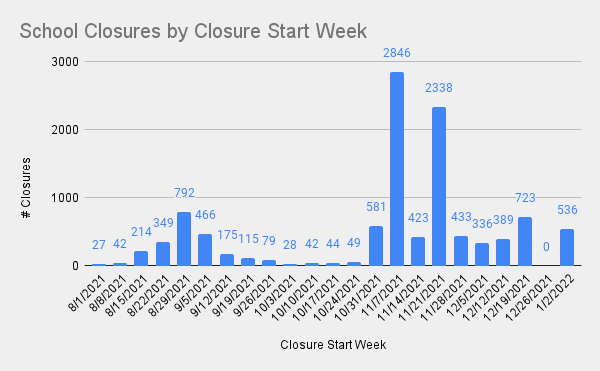
But despite that $197 billion and counting in extra federal COVID funding over the past 21 months, an increasing number of public K-12 schools keep on closing, at least in little spurts. Why? Well, if we’re being a bit catty (if truthful), there has been some opportunistic, last-minute, teacher-friendly days off conjured up near weekends and federal holidays:

But the reality is that the rapid omicron surge in positive cases, especially throughout the Northeast and Midwest, is putting strain on school systems that have not figured out a way to translate money into student testing and emergency staffing capacity.

The school-tracking site Burbio provides a thorough weekly survey of school-closing trends; this weekend’s report shows “an increase in disruptions beginning the week of December 20th as well as in early January.” Details:

Share

How Fauci and Collins Shut Down Covid Debate

Wall Street Journal:

In public, Anthony Fauci and Francis Collins urge Americans to “follow the science.” In private, the two sainted public-health officials schemed to quash dissenting views from top scientists. That’s the troubling but fair conclusion from emails obtained recently via the Freedom of Information Act by the American Institute for Economic Research.

The tale unfolded in October 2020 after the launch of the Great Barrington Declaration, a statement by Harvard’s Martin Kulldorff, Oxford’s Sunetra Gupta and Stanford’s Jay Bhattacharya against blanket pandemic lockdowns. They favored a policy of what they called “focused protection” of high-risk populations such as the elderly or those with medical conditions. Thousands of scientists signed the declaration—if they were able to learn about it. We tried to give it some elevation on these pages.

That didn’t please the lockdown consensus enforced by public-health officials and the press. Dr. Collins, the director of the National Institutes of Health until Sunday, sent an email on Oct. 8, 2020, to Dr. Fauci, the director of the National Institute of Allergy and Infectious Diseases.

“This proposal from the three fringe epidemiologists . . . seems to be getting a lot of attention – and even a co-signature from Nobel Prize winner Mike Leavitt at Stanford. There needs to be a quick and devastating published take down of its premises,” Dr. Collins wrote. “Is it underway?”

Facebook censored mentions of the Great Barrington Declaration. This is how groupthink works

Share

Ontario Court Declares Teacher Math Proficiency Test Unconstitutional

Ontario Teachers Union:

The Ontario Divisional Court has ruled that the Ontario College of Teachers shall grant certification to teacher candidates who have not yet passed the Math Proficiency Test but who have otherwise met all other teacher certification requirements.

The Divisional Court found that the Math Proficiency Test had an adverse impact on entry to the teaching profession for racialized teacher candidates and other reasonable alternatives should have been implemented.

“OTF applauds the efforts of the Ontario Teacher Candidates’ Council (OTCC) for pursuing this successful legal challenge. There is no research to suggest that a standardized test would improve student outcomes or enhance teacher pedagogy. Ontario has some of the best educated teachers in the world and this decision reinforces their professionalism,” stated OTF President Chris Cowley.

My Question to Wisconsin Governor Tony Evers on Teacher Mulligans and our Disastrous Reading Results

Share

This Scientist Created a Rapid Test Just Weeks Into the Pandemic. Here’s Why You Still Can’t Get It.

Lydia DePillis

When COVID-19 started sweeping across America in the spring of 2020, Irene Bosch knew she was in a unique position to help.

The Harvard-trained scientist had just developed quick, inexpensive tests for several tropical diseases, and her method could be adapted for the novel coronavirus. So Bosch and the company she had co-founded two years earlier seemed well-suited to address an enormous testing shortage.

E25Bio — named after the massive red brick building at MIT that houses the lab where Bosch worked — already had support from the National Institutes of Health, along with a consortium of investors led by MIT.

Within a few weeks, Bosch and her colleagues had a test that would detect coronavirus in 15 minutes and produce a red line on a little chemical strip. The factory where they were planning to make tests for dengue fever could quickly retool to produce at least 100,000 COVID-19 tests per week, she said, priced at less than $10 apiece, or cheaper at a higher scale.

Bosch’s prototype attracted a top Silicon Valley venture capital firm, which pitched in $2 million.

Share

Read it and cheer: David Banks’ wise words about literacy instruction in NYC schools

Robert Pondisco:

In some of his first public comments since being named New York City’s incoming schools chancellor, David Banks has drawn cheers from savvy education observers and literacy experts for remarks critical of “balanced literacy,” the city’s long-standing approach to teaching reading.

“‘Balanced literacy’ has not worked for Black and Brown children. We’re going to go back to a phonetic approach to teaching. We’re going to ensure that our kids can read by the third grade,” Banks told CBS2′s Marcia Kramer. “That’s been a huge part of the dysfunction.”

The incoming mayor seems to agree. “We are in a city where 65% of Black and Brown children never reach proficiency and we act like that’s normal, it’s all right,” said Eric Adams, introducing Banks last week. If the same number of white children couldn’t read proficiently, he said, “they would burn this city down.”

Adams citing this inexcusable failure and Banks laying the blame on “balanced literacy” suggests our new mayor and his hand-picked chancellor understand that equity starts with literacy.

That said, keep the champagne corked for now. This is not the first time New Yorkers have heard the supposed death knell of balanced literacy. Former Chancellor Joel Klein, the first person ever put in charge of the system under mayoral control, became convinced of its shortcomings late in his tenure, and wished in his memoir that he’d acted sooner. “Our ‘balanced literacy’ approach wasn’t all that balanced,” he wrote.

The data clearly indicate that being able to read is not a requirement for graduation at (Madison) East, especially if you are black or Hispanic”

2017: West High Reading Interventionist Teacher’s Remarks to the School Board on Madison’s Disastrous Reading Results 

Madison’s taxpayer supported K-12 school district, despite spending far more than most, has long tolerated disastrous reading results.

My Question to Wisconsin Governor Tony Evers on Teacher Mulligans and our Disastrous Reading Results

“An emphasis on adult employment”

Wisconsin Public Policy Forum Madison School District Report[PDF]

WEAC: $1.57 million for Four Wisconsin Senators

Friday Afternoon Veto: Governor Evers Rejects AB446/SB454; an effort to address our long term, disastrous reading results

Booked, but can’t read (Madison): functional literacy, National citizenship and the new face of Dred Scott in the age of mass incarceration.

When A Stands for Average: Students at the UW-Madison School of Education Receive Sky-High Grades. How Smart is That?

Share

TikTok Got More Traffic Than Freakin’ Google in 2021

Brianna Provenzano:

TikTok is truly unstoppable: The video-sharing platform just pushed Google aside to become the most popular website in the world, according to web performance and security company Cloudflare’s 2021 Year in Review internet traffic rankings.

TikTok cracked Cloudflare’s list of top 10 sites last year, coming in at seventh in popularity behind the .coms for Google, Facebook, Microsoft, Apple, Netflix and Amazon. For 2021, the order of that list is largely unchanged—Amazon jumped up one slot, switching places with Netflix—aside from TikTok’s surge to the top. 

In a blog post, Cloudflare noted that comparing the numbers between the two years could yield potentially misleading results, since the service only culled data from September to December in 2020 (compared to all 12months being accounted for in 2021). According to Cloudflare, TikTok first peaked in the global traffic rankings on Feb. 17, 2021, followed by a few more days in March and June and then, finally, a more permanent stay at the top beginning in late August.

The app’s popularity has surged during the pandemic; while it initially attracted a teenaged audience set on coordinating lip sync and dance videos, TikTok has since piqued the curiosity of users of all ages and demographics, who flock to the app for its cooking hacks, memes, and spirituality content, to name just a few topics.

Share

Burn the Universities and Salt the Earth

Handwaving Freakoutery:

Somewhere at some point some useful idiot came up with the idea of giving anyone who wants to go to college a loan, regardless of their ability to pay it back, on the understanding that the diploma itself would convey enough value to them that they would be able to earn more and pay back the loan. This useful idiot confused correlation with causation, assigned a value to a piece of paper that the paper didn’t necessarily convey, and presumed that if every person in the country got a college degree they would all get a college level job, everyone would be richer, and everyone could pay back the loan.

This useful idiot did not consider the fact that handing out more degrees does nothing to change the job profile of the United States. The job market still needs just as many garbage men and ditch diggers and baristas today as it did thirty years ago, it’s just now the baristas have college degrees and debt. The federally backed student loan program did achieve its objective. There are doctors, lawyers, engineers, and accountants today who come from poor backgrounds and made their way because of student loans. But because of the way the useful idiot set the program up, their success is on the backs of the rest of the indebted poor.

This useful idiot was not one man, but rather fifty years of all of us, involving dozens of laws and changes to those laws, going back to 1956. Half a century of useful idiots who all confused correlation with causation, building the giant that exists today to eat Millennials and grind their bones to make its bread. But the useful idiots in government who provided a vehicle for permanent debt to acquire a mostly valueless piece of paper are only half of the beast.

Share

K-12 Tax & Spending Climate: The Texas population grew by about four million people in the past decade—

Tom Foster:

The Texas population grew by about four million people in the past decade—far more than any other state in raw numbers, and enough as a percentage to make it the third-fastest-growing state in the nation over that period, behind Utah and Idaho. Roughly 3,800 more people move here every week than move out of state. Tick down any list of the fastest-growing cities in the country, and Texas shows up again and again. Fort Worth, Austin, and San Antonio all landed on the list of cities with a population gain of at least 100,000 over the past decade, according to the U.S. Census Bureau, which released its latest data in August. Frisco easily topped the list of large cities, followed by a lot of other suburbs and exurbs, such as New Braunfels, McKinney, and Conroe.

You get the idea: the Texas population is booming.

That growth, of course, has come with plenty of hand-wringing about everything from an overheated housing market to fears of a hostile takeover by liberal coastal elites. News headlines have stoked those worries in the past two years. And then there was Greg Abbott’s 2018 campaign slogan: “Don’t California My Texas.” But perhaps unsurprisingly, partisans may have it wrong.

For one thing, despite all the public focus on Californication, there are intriguing signs that many of the newest arrivals share key characteristics with lifelong Texans. Many are coming for abundant jobs, lower taxes, fewer regulations, and a more reasonable cost of living (which may be hard to believe for Texan buyers and renters fretting over the housing market but is a fact).

Share

Milwaukee’s taxpayer supported K-12 schools financial rhetoric

Will Flanders & Libby Sobic:

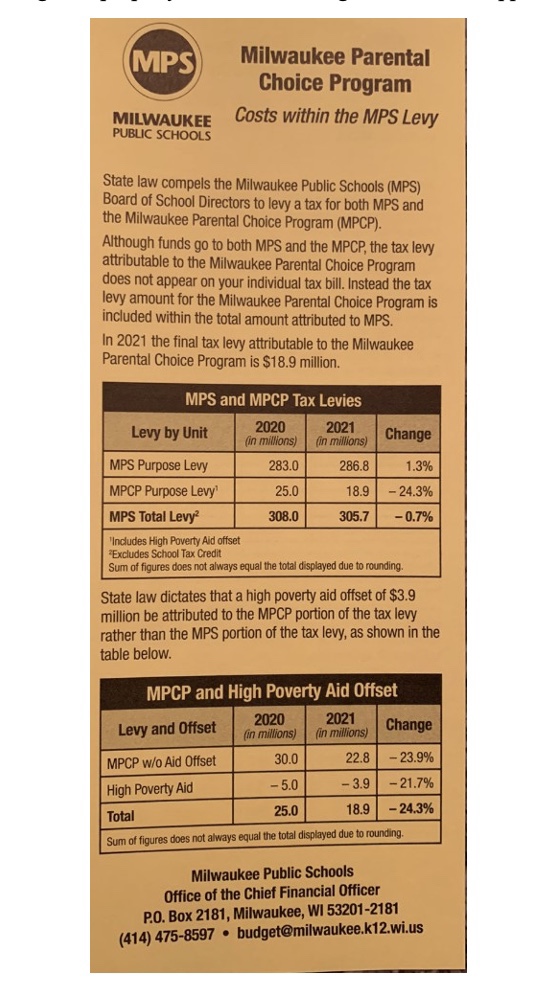
Like an old IPod set on repeat, Milwaukee Public Schools’ attempts to attack and provide misleading data about the Milwaukee Parental Choice Program (MPCP) is a song-and-dance that never stops. In their latest salvo against providing families with educational options, the district included information on the “cost” to Milwaukee residents of the Milwaukee Parental Choice Program (MPCP) with property tax bills. An image of the mailer appears below.

The information on the cards is accurate, as far as it goes.  But it leaves out key pieces of information which mislead rather than inform about the impact of this program on the city’s residents.

Overview of the MPCP 

The MPCP, founded in 1990, is the nation’s first voucher system for low-income students. Today, students attending a private school on a Milwaukee Parental Choice voucher receive $8,336 per pupil for grades kindergarten through eight, and $8,982 for students enrolled in grades nine through twelve. No public-school student receives funding this low for any students.

In 2021, there were 129 private schools participating in the MPCP with a total enrollment of about 28,770 students. Each one of these 28,000 students live in the City of Milwaukee. With over 100,000 total students in the city of Milwaukee, students participating in the MPCP is still a relatively small percentage of the overall student population. Nevertheless, anti-choice advocates like to claim that the MPCP costs more than it is worth.

The data clearly indicate that being able to read is not a requirement for graduation at (Madison) East, especially if you are black or Hispanic”

2017: West High Reading Interventionist Teacher’s Remarks to the School Board on Madison’s Disastrous Reading Results 

Madison’s taxpayer supported K-12 school district, despite spending far more than most, has long tolerated disastrous reading results.

My Question to Wisconsin Governor Tony Evers on Teacher Mulligans and our Disastrous Reading Results

“An emphasis on adult employment”

Wisconsin Public Policy Forum Madison School District Report[PDF]

WEAC: $1.57 million for Four Wisconsin Senators

Friday Afternoon Veto: Governor Evers Rejects AB446/SB454; an effort to address our long term, disastrous reading results

Booked, but can’t read (Madison): functional literacy, National citizenship and the new face of Dred Scott in the age of mass incarceration.

When A Stands for Average: Students at the UW-Madison School of Education Receive Sky-High Grades. How Smart is That?

Share

Madison East High restorative justice workshop commentary

Elizabeth Beyer:

East High restorative justice workshop seeks to educate community on non-punitive discipline

East High School administrators hope to head off altercations between students well before they reach the type of brawl that happened last month by facilitating discussion between feuding parties.

The practice school administrators have begun to put in place, known as restorative justice, seeks to bring students together for a mediated discussion to solve their qualms.

Community members, such as Jennifer Conti, who attended a Saturday workshop on the topic, could take part in that process as mediators or advocates after a series of trainings led by the school’s restorative justice coordinator.

“I think (restorative justice and trauma-informed care) are both really important practices,” she said. “They’re crucial mindsets.”

More than a dozen parents, staff and community members gathered in East’s auditorium Saturday morningfor a full day of restorative justice and trauma-informed response training. Saturday’s school-based training session was the second of two led by East’s restorative justice coordinator, Ericka Brown, following a series of high-profile fights connected to the school in recent months.

Between 40 and 50 people signed up between both workshops, which included presentations on restorative practices and trauma-informed responses to student behavioral issues, as well as conversation circles for the attendees, in hopes of mitigating conflicts between students or within the community before they reach the schools.

Share

Frautschi’s dónate $1m to Monona’s (Madison suburb) One City School

Scott Girard:

One City Schools received a $1 million donation from the W. Jerome Frautschi Foundation to support the school as it expands to serve students in grades 4K-12.

“The Frautschi family has a long history of investing in initiatives to make Madison a great city for everyone, dating back to their contributions to downtown and the University of Wisconsin-Madison in the early 1900s,” One City founder and CEO Kaleem Caire said in a press release announcing the donation. “We are truly grateful to be a part of Mr. Jerome Frautschi’s extraordinary personal legacy of giving to projects that inspire the heart and art of human kindness, community and innovation in our capital city.”

Renovation of a 157,000-square-foot facility at 1707 W. Broadway in Monona is scheduled to be complete by August 2022. The school announced its plan to move there and an initial $14 million donation from Pleasant Rowland in March.

Notes and links on One City schools (Governor Evers latest budget proposal would have aborted the University of Wisconsin’s charter school authorization authority – thus killing One City).

The data clearly indicate that being able to read is not a requirement for graduation at (Madison) East, especially if you are black or Hispanic”

2017: West High Reading Interventionist Teacher’s Remarks to the School Board on Madison’s Disastrous Reading Results 

Madison’s taxpayer supported K-12 school district, despite spending far more than most, has long tolerated disastrous reading results.

My Question to Wisconsin Governor Tony Evers on Teacher Mulligans and our Disastrous Reading Results

“An emphasis on adult employment”

Wisconsin Public Policy Forum Madison School District Report[PDF]

WEAC: $1.57 million for Four Wisconsin Senators

Friday Afternoon Veto: Governor Evers Rejects AB446/SB454; an effort to address our long term, disastrous reading results

Booked, but can’t read (Madison): functional literacy, National citizenship and the new face of Dred Scott in the age of mass incarceration.

When A Stands for Average: Students at the UW-Madison School of Education Receive Sky-High Grades. How Smart is That?

Share

106-11 high school basketball game commentary

Tim Cullen:

If any of them say they are dealing with this privately, I say sorry, this was a public game that taught so many bad life lessons to children and adults. The public silence has been deafening. We need more girls playing basketball, and this does not help.

Have the Verona and Janesville superintendents spoken about this? If so, who called who first? These types of issues need the “fresh air” of public discussion.

Share

Understanding pandemic-emergent personality & behavioral psychopathology

JD Haltigan:

The latest round of acute COVID hysteria over a new mutant variant of the SARS-CoV-2 virus (#B11529)was the final nudge I needed to write this post to hopefully help provide insight into the diverse human behavioral and psychological reaction to the pandemic and what such reactions may reveal about individual differences in sensitivity to environmental context. As my scientific work is largely in the field referred to as developmental psychopathology, I draw on concepts and theories that have generated much thinking and research within it. Broadly speaking, developmental psychopathology is an academic field of research and scholarship that examines the development of mental illness symptoms and disorders across the life course and the biological, social, and cultural factors that may give rise to and maintain them. 

Although my initial thinking on the behavioral response to the pandemic centered around a differential susceptibility1 to environmental influences model as possessing significant heuristic and explanatory value, I am now strongly inclined to think the classic diathesis-stress model possesses the most explanatory value (and is the more efficient or parsimonious of the two models) for the marked emergence of anxiety and fear in a distinct class of the population. Although beyond the scope of this piece, it should be noted that these models, as well as other models of the development of psychopathology (e.g., the stress inoculation model), overlap both in terms of the thinking behind them as well as the predictions they make, and thus adoption of one model to explain population-level human phenomena should not be seen as necessarily excluding the others.

Below I discuss the diathesis-stress or dual-risk model of sensitivity to environmental context, how it relates to the pandemic and individual behavioral responses to it, and offer some broader, loosely organized observations with especial reference to a more general conceptual notion of sensory processing sensitivity and “Long COVID”.

Share

Federal Court of Appeals Rules DPI Violated State Law When Denying Transportation Benefits to Private School Families

WILL:

The News: A three-judge panel of the federal Seventh Circuit Court of Appeals issued a decision in St. Augustine v. Underly, a lawsuit first filed by the Wisconsin Institute for Law & Liberty (WILL) in 2016, that the Wisconsin Department of Public Instruction (DPI) violated state law when denying transportation benefits to families attending St. Augustine School, an independent Catholic school in Washington County. The case was remanded to U.S. District Court for a determination of damages and of whether an injunction should issue.

The Quote: WILL Deputy Counsel, Anthony LoCoco said, “The Seventh Circuit’s decision makes clear that government has no business denying students transportation aid on the basis of its own religious judgments. This is a win for private school families across Wisconsin.”

Background: Wisconsin provides transportation aid to qualifying private school students as long as there is not an overlapping attendance area between private schools that are affiliated with one another, or more specifically, affiliated with the same sponsoring group. In this case, DPI and Friess Lake School District (now part of Holy Hill Area School District) denied St. Augustine students busing rights because there is an Archdiocesan Catholic school in the attendance area.

But St. Augustine is independent and unaffiliated with the Archdiocese. In this case, the school district and DPI determined the definition of Catholic and withheld government benefits until St. Augustine agreed not to call itself “Catholic.”

Share

For Deaf People Like Me, Mask Mandates Impose Never-Ending Isolation

Brad Kirby:

I was born with hearing loss in both ears. Since the age of six, I have worn hearing aids. Being hearing-impaired has been a huge life disadvantage. For example, as a child I couldn’t hear the whistle while trying to play sports, and continued playing until I see people laughing or trying to get my attention. I’ve missed jokes because I couldn’t understand the words being spoken. When I laugh, my hearing aids squeal because my ears move and the gap in my ear canals causes feedback.

I only hear parts of sentences and I am constantly having to process, in a fraction of a second, the sounds of words said, then to mentally match those sounds to words I have heard before, then to put the whole sentence together in my mind just to be able to communicate.

Trying to be “normal” and have a normal life was always my goal. That has been nearly impossible for nearly two years now. In spring 2020, the first face mask mandate due to Covid-19 went into effect. I knew I was in trouble.

Notes and links on taxpayer supported Dane County Madison Public Health mandates, lawsuits and lawfare.

Share

college admissions has, does, and will always serve only the institutions and their incredible greed

Freddie deBoer:

Harvard, then, and soon all the rest because of them. I’m not going to rehash all of my SAT stuff here. If you want the litany –

Here is what I want to say to you: at the end of this process, no matter how you change it, no matter how many statements the schools put out about diversity, no matter how many thumbs you put on all the scales to select for a certain kind of student, at the end of this process are self-serving institutions of limitless greed and an army of apparatchiks who are employed only to protect their interests. That’s it. You can’t make college admissions fair by getting rid of the SAT because colleges admissions can’t be “fair.” College admissions exist to serve the schools. Period. End of story. They always have, they always will. College admissions departments functioned as one big anti-Semitic conspiracy for decades because that was in the best interest of the institution. Guys who the schools know will never graduate but who run a 4.5 40 jump the line because admissions serves the institution. Absolute fucking dullards whose parents can pay – and listen, guys, it’s cute that you think legacies are somehow the extent of that dynamic, like they won’t let in the idiot son of a wealthy guy who didn’t go there – get in because admissions serves the institution. Some cornfed doofus from Wyoming with a so-so application gets in over a far more qualified kid from Connecticut because the marketing department gets to say they have students from 44 states in the incoming class instead of 43 that way, because admissions serves the institution. How do you people look at this world and conclude that the problem is the SAT?

Share

Censorship

Share

Amazon agreed to allow only five-star reviews for Xi’s book in China

The Times:

Amazon quietly removed criticism of President Xi’s books by scrubbing bad reviews, ratings and comments from its Chinese site, it has emerged.

The US retail giant agreed to Beijing’s demand to have anything below a five-star review of Xi Jinping’s book The Governance of China removed from Amazon.cn about two years ago, Reuters reported, citing two unidentified sources.

The move is the latest example of western tech companies willing to work with Chinese censors for access to the country’s massive consumer market.

Share

Everyone Should Read ‘Teaching Machines’

John Warner:

As I was reading Audrey Watters’s Teaching Machines: The History of Personalized Learning, recently published by MIT Press, the word “landmark” kept occurring to me.[1]

This is a landmark book. It is a landmark book in both senses of the word: one, a marker by which we can establish a present location, and two, a turning point after which we can see a clear change in trajectory.

At least I hope that’s going to be the case, because Watters’s history of personalized learning reflects Faulkner’s aphorism from “Requiem for a Nun” — “The past isn’t dead. It isn’t even past.” Better understanding this presence may make for clearer decision making for how we integrate technology into teaching and learning.

Reading Teaching Machines is like donning a pair of glasses that suddenly makes much of the present more explicable. This is why I want to urge people to read this book with all possible haste.

It isn’t even a matter of history repeating itself so much as the forces that have governed the pursuit of a teaching machine being ever-present in education atmosphere where humans and their variable behaviors and specific needs are treated as defects that need remedying. The vision of the creators of these teaching machines suggests that if we could just get everyone with the program (pun intended), we could save ourselves a lot of trouble.

Teaching Machines is several books rolled up into one. It is a history of the teaching machines themselves, including chapters on Sidney Pressey’s “Automatic Teacher” of the late 1920s and early ’30s, B. F. Skinner’s multiple attempts through the 1950s, and the multiple space race-related efforts of the ’60s, as education technologists promised that a device straight out of the Jetsons was always right around the corner.

These teaching machines were by their nature, design and philosophies essentially behavioralist, not at all removed from Skinner’s operant conditioning work with pigeons, the bird that has served as a symbol of Watters’s long-standing work at her Hack Education blog.

Share

“Historically, days before long vacations bring low student attendance, Vitti added, saying there is “no reason to use the day” to again fall short of the state requirement.”

Ethan Bukali:

The district also cited concerns that some students who check out laptops to learn during what was to be the last remote Friday would not return them after the winter break. Vitti said schools would be “operationally challenged” if the laptops are not returned. The laptops, he said, are used for day-to-day instruction and testing. During the remote Fridays, students were able to check out a school laptop on Thursdays, but were required to return them the next Monday.

“The day off also serves as an opportunity to address the culminating challenges we have all experienced regarding COVID and social media threats.” The latter refers to threats the Detroit district, and many across Michigan, have been receiving after the shootings at Oxford High School on Nov. 30 that left four students dead and many others injured.

Rumors of a potential districtwide dismissal had circulated ahead of the official district statement. All school buildings will reopen to students and staff on Jan. 3. 

In late November, before the Thanksgiving break, district officials announced schools would move to remote instruction for three Fridays in December to address concernsabout mental health, COVID cases, and school cleanliness. The district also extended its Thanksgiving break two days.

Share

Notes on k-12 health climate; December, 2021

Share

“The risk of severe outcomes to kids from coronavirus infection is low, and the risks to kids from being out of school are high.”

Joseph Allen:

The early evidence from outside the United States suggests that kids will remain low risk during the Omicron surge as well. The latest data from South Africa for the week ending Dec. 12 shows that school-age children (5-to-19-year-olds) had the lowest hospitalization of any age group, and even with the Omicron uptick, the hospitalization rate is four to six per 100,000 — higher than one in 100,000 but still quite low. The latest data from Britain is similar. As of Dec. 12, the hospitalization rate for 5-to-14-year-olds is 1.4 per 100,000 — the lowest hospitalization rate of any age group.

The usual caveats apply: This is early data, and hospitalizations lag cases. On the other hand, the trends are encouraging: The wave in Gauteng, South Africa, is already peaking. Additionally, 7 to 15 percent of children were hospitalized with Covid, not for Covid. This is a key distinction. Covid was an incidental discovery because of routine testing during a hospital visit for some other medical reason, or the patients were there for isolation, not treatment. (This has been seen in the United States and Britain, too, where consistently 15 to 20 percent of hospitalizations are incidental.)

Notes and links on taxpayer supported Dane County Madison Public mandates, closed schools and litigation.

Madison private school raises $70,000 for lawsuit against public health order. – WKOW-TV. Commentary.

WEAC: $1.57 million for Four Wisconsin Senators

Assembly against private school forced closure.

Wisconsin Catholic schools will challenge local COVID-19 closing order. More.

2017: West High Reading Interventionist Teacher’s Remarks to the School Board on Madison’s Disastrous Reading Results

Madison’s taxpayer supported K-12 school district, despite spending far more than most, has long tolerated disastrous reading results.

My Question to Wisconsin Governor Tony Evers on Teacher Mulligans and our Disastrous Reading Results

“An emphasis on adult employment”

Wisconsin Public Policy Forum Madison School District Report[PDF]

Booked, but can’t read (Madison): functional literacy, National citizenship and the new face of Dred Scott in the age of mass incarceration.

Share

With an emphasis on connecting to nature, some Wisconsin students spend their entire school days outside — despite the weather

Madeline Fox:

For most schools, the past two years have brought a complicated weighing of the risks of being in a classroom: in-person versus virtual learning, masks, class sizes, ventilation. But a growing number of schools around the country have sidestepped many of those concerns by leaving the classroom behind.

In La Farge, in the sprawling Kickapoo Valley Forest Reserve, 29 students show up at school each day and, aside from a daily nap, stay outside the whole day, no matter what the weather throws at them.

The Kickapoo Valley Forest School is only in its first year of being a full-day, full-week charter school. Previously, the forest reserve hosted a weekly outdoor learning program for half a day on Fridays. The outdoor education advocacy group Natural Start Alliance tallied 563 outdoor preschools and kindergartens last year, more than double the number in 2017 — including several day care, preschool and elementary-level programs in Wisconsin. 

Each student at Kickapoo Valley Forest School, or KVFS, gets a full rain kit — boots, pants, jacket — and their families are sent extensive guidance on how to layer kids up to keep them warm, even when the temperature falls well below freezing. One student, a 5-year-old named Mia Shird, counted four layers of clothing on a 30-degree day in November.

Share

Civics: TVs and newspapers spread rumors in the last 5 years, without any proof

Idelber Avelar:

It would not be an exaggeration to say that it was the greatest journalistic collapse of the 21st century. We are not talking about a factual error by the news anchor at 11 pm or three poorly scored stories in the print newspapers.

It took five years of daily coverage on CNN and MSNBC and hundreds of stories in the New York Times and the Washington Post about something that proved to be a hoax, a ghost, a poorly told story whose incongruities have accumulated until it completely collapsed: the Russiagate, the so-called “Russian interference in the 2016 elections”, the result of “Trump’s collusion with the Kremlin”.

Let’s get to the facts.

Share

NPR covers a Rhode Island Mom

Joe Setyon:

But instead of reporting on these events, The Public’s Radio told a different tale, reporting uncritically and at length on a new proposed “anti-racism” policy adopted by the district, portraying Solas and the Goldwater Institute as impediments to that policy and grossly mischaracterizing the Institute’s work to promote academic transparency and school choice. Their journalistic malpractice wasn’t for lack of information: Goldwater Director of National Litigation Jon Riches gave an extensive interview to the article’s author, Alex Nunes, who chose to quote neither from Solas nor from Riches.

One would think a journalist might understand better than most the importance of public records requests to enable the public to keep account of what its government is up to. Public records laws are a crucial tool to help reporters—and citizen activists—uncover truths about their governments, whether they be details about taxpayer-funded expenditures or information about what children are learning in public school classrooms.

Instead, Nunes depicted Solas as a nuisance whose requests imposed a “burden” on local government employees, while also quoting a “racial justice” advocate who attacked Solas’ motives. This framing portrays the government as an entity that should selectively choose what public records should be made available based on the subject of the request or the motivations of the requester, neither of which is an appropriate basis under the law.

Share

Fury over Oxford University plan to hire academics based on how woke they are

Camilla Turner:

Oxford dons are furious that a candidate’s “woke score” could be part of the criteria for hiring academics, under new proposals aimed at boosting staff diversity….

Share

Why we must shed old fears of changing school boundaries to help poor and minority kids

Jay Matthews:

Educators and community leaders who wanted to help low-income students no longer tried to move them into better schools. Instead, they focused on improving schools in impoverished neighborhoods. Their work has been at the center of my reporting. They have had successes, but news of their progress has spread slowly.

Ignoring the segregated state of our education systemhas led some people to assume it is a natural situation — that perhaps there’s nothing wrong with students attending schools full of other students who look like themselves.

The lines that divide: School district boundaries often stymie integration

Nothing challenges such thinking more effectively than a new study by Tomás Monarrez and Carina Chien of the Urban Institute, titled “Dividing Lines: Racially Unequal School Boundaries in US Public School Systems.”

Story continues below advertisement

Most of us probably don’t know — like I didn’t, before reading the think tank’s report — that if you study the history of school boundaries that divide neighborhoods by income and ethnicity, many reflect the redlining maps issued by a federal agency, the Home Owners’ Loan Corporation (HOLC), in the 1930s and 1940s. Scholars disagree over whether President Franklin D. Roosevelt, who founded the agency as a New Deal initiative, can be blamed for making neighborhoods look bad on those maps, but there is little doubt that labeling some areas as “hazardous” for mortgage loans hurt the local schools.

Monarrez and Chien say they found more than 2,000 pairs of neighboring public schools that “are vastly different in terms of the racial and ethnic composition of the population living on either side of the boundary.”

Full report.

Madison has not addressed boundaries for decades. Yet, we recently expanded our least diverse schools, despite space in nearby facilities.

Share

Jefferson Middle School teacher on leave after planned reenactment lesson

Scott Girard:

A Jefferson Middle School teacher is on administrative leave after planning a Colonial-era reenactment lesson that asked students “to assume stereotypical roles which brought racialized harm,” according to an email from the school’s principal.

The incident comes 10 months after officials in the nearby Sun Prairie Area School District apologized to parents for a middle school lesson that asked students to consider a question of how they would punish a slave under Hammurabi’s code in ancient Mesopotamia.

Other lessons around the country asking students to assume the role of slaveholders or slaves have drawn criticism in recent years, with parents expressing concerns that rather than imparting empathy, the lessons are traumatizing for students of color.

In some of the most extreme cases, students have been grouped based on their race and told to treat each other as if they were in their roles in situations like a slave trading exercise. A 2019 Education Week article mentioned two then-recent incidents, one in which a fifth-grade class held a “slave auction” and another with a fourth-grade class sending students “back to the plantation” in a game about the Underground Railroad.

Maxine McKinney de Royston, an assistant professor in the University of Wisconsin-Madison Department of Curriculum and Instruction, said innovative classroom activities are important for teachers to try, but that they must be thought through and consider what the learning goals are. Even role-playing and reenactments from times of slavery can be OK, she said, but “context matters” in considering when that is appropriate, and there are important safeguards for teachers to put in place in classrooms.

The data clearly indicate that being able to read is not a requirement for graduation at (Madison) East, especially if you are black or Hispanic”

2017: West High Reading Interventionist Teacher’s Remarks to the School Board on Madison’s Disastrous Reading Results 

Madison’s taxpayer supported K-12 school district, despite spending far more than most, has long tolerated disastrous reading results.

My Question to Wisconsin Governor Tony Evers on Teacher Mulligans and our Disastrous Reading Results

“An emphasis on adult employment”

Wisconsin Public Policy Forum Madison School District Report[PDF]

WEAC: $1.57 million for Four Wisconsin Senators

Friday Afternoon Veto: Governor Evers Rejects AB446/SB454; an effort to address our long term, disastrous reading results

Booked, but can’t read (Madison): functional literacy, National citizenship and the new face of Dred Scott in the age of mass incarceration.

When A Stands for Average: Students at the UW-Madison School of Education Receive Sky-High Grades. How Smart is That?

Share

NFL Marks Taiwan as Part of China

Josh Christenson:

The NFL released a marketing map that designated Taiwan as part of China, a further sign American sports leagues are more than willing to appease the hardline regime in order to pursue business opportunities.

The map, which introduced markets for 18 NFL teams in eight countries, shows Taiwan unlabeled and colored in as part of China. The erasure of Taiwan comes two months after President Xi Jinping gave a speech in October calling for the “reunification” of the island nation with China, whether in a “peaceful manner” or by “firm will.”

Share

Lockdown mandates

The Great Barrington Declaration.

Share

Wisconsin Supreme Court to Hear WILL Challenge to Dane County Health Orders (without elected official votes)

WILL:

The News: The Wisconsin Supreme Court granted a motion to bypass in Becker v. Dane County, meaning the Wisconsin Supreme Court will hear and decide the case brought by two Dane County residents and a Dane County business challenging the authority of the county health officer to issue sweeping orders without approval by the Dane County Board. The Wisconsin Institute for Law & Liberty (WILL) filed this case in January 2021 in response to a series of emergency orders from Public Health of Madison and Dane County (PHMDC) that restricted and regulated life and commerce in Dane County.

The Wisconsin Supreme Court will schedule oral arguments at a later date.

The Quote: WILL Deputy Counsel, Luke Berg, said, “This case presents the Court with an opportunity to clarify that local health officers cannot unilaterally issue orders that restrict daily life without approval from a legislative body. The Dane County Board cannot pass the buck and allow an unelected health officer to issue whatever orders she sees fit.”

Background: WILL filed an original action to the Wisconsin Supreme Court in November 2020 challenging the legal authority of Dane County’s health department to issue sweeping emergency orders that restrict life and commerce in Dane County. WILL argued the orders are an overreach of the legal authority granted to local health officers and an unlawful delegation of authority from local elected bodies. In particular, WILL argued the new restrictions were not voted on by the Dane County Board.

Allison Garfield, Jessie Opoien and Scott Girard:

“This case presents the court with an opportunity to clarify that local health officers cannot unilaterally issue orders that restrict daily life without approval from a legislative body. The Dane County Board cannot pass the buck and allow an unelected health officer to issue whatever orders she sees fit,” said WILL deputy counsel Luke Berg in a statement.

Mandates, litigation/lawfare and the taxpayer funded Dane County Madison Department.

Share

Thinking different on “mandates”

Share

First Book: Sending Pornography to PK-12 Classrooms

The Locke Society:

While many organizations and news outlets were shocked over a reporter saying “someone needs to create porn for children,” the reality is that pornographic/erotic materials are disturbingly already in PK-12 classrooms across the country. First Book is providing CRT/”social justice” books along with books vividly detailing oral sex, anal sex, masturbation, watching/searching for pornography, and more. With a network of over 500,000 teachers, and having a presence in schools in every state across America, First Book is an organization you should know and monitor. Through their partnerships with various organizations, they are able to provide books at extremely reduced prices, and in some cases for free, by having corporate donors, unions, or other organizations provide First Book gift cards to educators.

Some examples of these disturbing books that First Book is possibly sending to your child’s classroom or school library include the following:

Share

Curricular suggestions

Share

“For over 18 months, the Fairfax County School Board has focused on every political issue of the day,” O’Neal Jackson said. “In turn, [it] has not focused on what’s best for our students and families in Fairfax County.”

Alex Nester:

Parents in Virginia’s largest school district collected enough signatures to recall a school board member who ignored parental concerns and kept schools closed during the pandemic.

Open FCPS Coalition, a bipartisan group of parents, on Wednesday filed with a county circuit court a petition to recall school board member Laura Jane Cohen. The group accuses Cohen of ignoring studies that showed reopening was safe and keeping students isolated from peers for more than a year was harmful for their mental health.

Republican candidates swept Virginia’s statewide elections in November, victories many attributed to parents’ frustration with school closures. But that momentum may not be enough to recall Cohen, who was not up for reelection this cycle. A local attorney backed by left-wing megadonor George Soros quashed Open FCPS Coalition’s attempt to recall a school board member.

In a statement Thursday, Open FCPS Coalition founder Dee O’Neal Jackson said the 8,000 signatures gathered show the group’s mission resonates with the community.

“For over 18 months, the Fairfax County School Board has focused on every political issue of the day,” O’Neal Jackson said. “In turn, [it] has not focused on what’s best for our students and families in Fairfax County.”

A judge will verify the authenticity of the signatures and decide whether to hold a trial and special election to replace Cohen. The coalition also wants to recall at-large school board member Abrar Omeish, who in May came under fire after she in two social media posts referred to Israel as an “apartheid” state.

The data clearly indicate that being able to read is not a requirement for graduation at (Madison) East, especially if you are black or Hispanic”

2017: West High Reading Interventionist Teacher’s Remarks to the School Board on Madison’s Disastrous Reading Results 

Madison’s taxpayer supported K-12 school district, despite spending far more than most, has long tolerated disastrous reading results.

My Question to Wisconsin Governor Tony Evers on Teacher Mulligans and our Disastrous Reading Results

“An emphasis on adult employment”

Wisconsin Public Policy Forum Madison School District Report[PDF]

WEAC: $1.57 million for Four Wisconsin Senators

Friday Afternoon Veto: Governor Evers Rejects AB446/SB454; an effort to address our long term, disastrous reading results

Booked, but can’t read (Madison): functional literacy, National citizenship and the new face of Dred Scott in the age of mass incarceration.

When A Stands for Average: Students at the UW-Madison School of Education Receive Sky-High Grades. How Smart is That?

Share

Many elite liberals now feel, as I do, that long school closures in blue metropolitan areas were a disastrous mistake.

Michelle Goldberg:

In August, Los Angeles Magazine profiled Cecily Myart-Cruz, head of that city’s teachers union, who insisted that there was no such thing as pandemic-related learning loss. “It’s OK that our babies may not have learned all their times tables,” she said. “They learned resilience. They learned survival. They learned critical-thinking skills. They know the difference between a riot and a protest.”

Even now, the teachers union in Portland, Ore., is proposing that high school students go remote every Friday, arguing that students and educators are both overwhelmed. “There needs to be some kind of relief valve somewhere and this provides some of that for educators,” a union negotiator was quoted saying in The Oregonian.

Share

What Children Lose When Their Brains Develop Too Fast

Alison Gopnik:

The great Swiss psychologist Jean Piaget used to talk about “the American question.” In the course of his long career, he lectured around the world, explaining how children’s minds develop as they get older. When he visited the U.S., someone in the audience was sure to ask, “But Prof. Piaget, how can we get them to do it faster?” 

Today it’s no longer just impatient Americans who assume that faster brain and cognitive development is better. Across the globe, as middle-class “high investment” parents anxiously track each milestone, it’s easy to conclude that the point of being a parent is to accelerate your child’s development as much as possible. Both parents and policy makers increasingly push preschools to be more like schools.

Share

Why Wolfram Tech Isn’t Open Source—A Dozen Reasons

Jon Mcloone:

Over the years, I have been asked many times about my opinions on free and open-source software. Sometimes the questions are driven by comparison to some promising or newly fashionable open-source project, sometimes by comparison to a stagnating open-source project and sometimes by the belief that Wolfram technology would be better if it were open source.

At the risk of provoking the fundamentalist end of the open-source community, I thought I would share some of my views in this blog. While there are counterexamples to most of what I have to say, not every point applies to every project, and I am somewhat glossing over the different kinds of “free” and “open,” I hope I have crystallized some key points.

Much of this blog could be summed up with two answers: (1) free, open-source software can be very good, but it isn’t good at doing what we are trying to do; with a large fraction of the reason being (2) open source distributes design over small, self-assembling groups who individually tackle parts of an overall task, but large-scale, unified design needs centralized control and sustained effort.

I came up with 12 reasons why I think that it would not have been possible to create the Wolfram technology stack using a free and open-source model. I would be interested to hear your views in the comments section below the blog.

Share

Civics: New Google Drive policy could make your files inaccessible — what you need to know

Tom Pritchard:

Google announced this change in a blog post, revealing that restrictions may be put in place on files that violate Google’s Terms of Service or abuse program policies. While the owner will still have full access, this move means sharing privileges will be revoked — even if someone already has a link.

According to Google file owners will receive an email when files are restricted. Not only does that alert them to the fact it’s happened, it will also give them the opportunity to appeal the decision and request a review.

Many taxpayer supported K-12 school districts use Google services, including Madison.

Share

Houston School Board Governance Changes

Sam González Kelly, Alejandro Serrano:

Incumbents lost two of the four runoff elections for the Houston ISD board Saturday night, clearing the way for two new conservative trustees in the state’s largest public school district. The results mark the end of campaigns politicized by clashes over cultural talking points in what are traditionally viewed as nonpartisan races.

Pastor Kendall Baker beat Trustee Holly Maria Flynn Vilaseca by less than 100 votes to win the seat in District 6. In District 7, Trustee Anne Sung lost to former PTO President Bridget Wade.

Baker and Wade both garnered support from prominent Texas Republicans and spoke out in their campaigns against mask mandates and critical race theory in education.

About 5,300 people, less than 7 percent of registered voters, participated in the District 6 runoff, while over 12,400 people, about 12 percent of registered voters, turned out for the District 7 election, according to Harris County election statistics.

Share

Loudoun County paid at least $500,000 to be twice delivered suggestions about “social emotional learning.”

Matt Taibbi:

In preparation for today’s forthcoming story, A Culture War in Four Acts: Loudoun County, Virginia. Part Two: ‘The Incident,’ TK News sent Freedom of Information requests to the county on several questions. Concerned with the issue of when the controversial “Equity Collaborative” was hired, we asked for “procurement or purchasing process documents, stakeholder emails and communique leading to the hiring of ‘The Equity Collaborative’ as consultant or business partner for any role by Loudoun County School District/County.” We’ve enclosed documents we received in response here. 

A lot of these had already been made public in stories like this one from the Washington Free Beacon, but there is some new information, and what we did get raised some new questions. There’s still no record of how the Collaborative came to win the original Equity Assessment contract, and the chronology in which the firm submitted a formal bid for further work only after it had already won a no-bid, $500,000 contract remains, to say the least, confusing. A number of documents are listed as having been re-submitted, and it’s not easy to sort out when the originals were produced.

Included here is the firm’s original “Equity Assessment,” its “Action Plan to Combat Systemic Racism,” a “Comprehensive Equity Plan,” and pay stubs for several additional rounds of equity coaching. 

A great deal of vitriol has been spent in Loudoun litigating the question of whether the arrival of the “Equity Collaborative” was triggered by the “runaway slave game” incident (see today’s forthcoming story) or whether there was a pre-existing relationship with the soon-to-be-infamous consultancy. The county insists the assessment was already in the works, and records do reveal that as far back as the previous summer, on August 20, 2018, the county spent $6000 on an “Equity Leadership Team Planning Meeting Facilitation” with the Collaborative, indicating an existing relationship.

However, sources both inside and outside the school system insist the bulk of that money was for normal teaching and support services mainly geared toward the county’s Spanish-speaking minority. There were still sizable allocations for items like “Instruction Facilitator, Equity and Culturally Responsive” ($339,516), “Equity Training Across Departments” ($72,000), and “Diversity Interview Panels” ($50,000), among other things, but there are mixed reports on what the rest of those line items mean. 

More TK, as we say around here. Part 2 of the Loudoun series will be out momentarily. In the meantime, here are the EC docs:

The data clearly indicate that being able to read is not a requirement for graduation at (Madison) East, especially if you are black or Hispanic”

2017: West High Reading Interventionist Teacher’s Remarks to the School Board on Madison’s Disastrous Reading Results 

Madison’s taxpayer supported K-12 school district, despite spending far more than most, has long tolerated disastrous reading results.

My Question to Wisconsin Governor Tony Evers on Teacher Mulligans and our Disastrous Reading Results

“An emphasis on adult employment”

Wisconsin Public Policy Forum Madison School District Report[PDF]

WEAC: $1.57 million for Four Wisconsin Senators

Friday Afternoon Veto: Governor Evers Rejects AB446/SB454; an effort to address our long term, disastrous reading results

Booked, but can’t read (Madison): functional literacy, National citizenship and the new face of Dred Scott in the age of mass incarceration.

When A Stands for Average: Students at the UW-Madison School of Education Receive Sky-High Grades. How Smart is That?

Share

Test results in American schools plummeted during the pandemic

The Economist:

“A school district where one-quarter of students were black spent, on average, 10 more weeks in the classroom than one where three-quarters of students were black.”

recent working paper by a group of researchers led by Emily Oster, of Brown University and the National Bureau of Economic Research, looked at the results of standardised tests taken by children in grades three to eight (aged roughly eight to 13). The tests, which vary slightly between states, assessed pupils’ grasp of maths and English. The researchers examined 12 states, comparing the results of tests taken in 2019, before lockdowns, with those taken in 2021. They found a 14 percentage-point drop in the pass rates for maths and a six-point drop for English.

Scores in English and maths were falling even before the pandemic(although researchers cannot agree on why). To isolate the effect that remote schooling had on childrens’ performance the authors built a statistical model. For each district the model contained information on the amount of time that pupils spent attending school in person. It also contained information on covid-19 cases, the racial composition of the district and the number of pupils who were eligible for reduced-price lunches (a proxy for income).

The authors found that, even when controlling for these other factors, the amount of in-person schooling in a given school district had a big impact on pass rates. The results suggested that moving from fully virtual to fully in-person lessons counteracted the drop in scores by around ten percentage points for maths, and just over three percentage points for English. In both subjects, the detrimental effect of virtual schooling was largest in poorer areas, where students are more likely to lack the space for undisturbed study or the technology to access online lessons.

The data clearly indicate that being able to read is not a requirement for graduation at (Madison) East, especially if you are black or Hispanic”

2017: West High Reading Interventionist Teacher’s Remarks to the School Board on Madison’s Disastrous Reading Results 

Madison’s taxpayer supported K-12 school district, despite spending far more than most, has long tolerated disastrous reading results.

My Question to Wisconsin Governor Tony Evers on Teacher Mulligans and our Disastrous Reading Results

“An emphasis on adult employment”

Wisconsin Public Policy Forum Madison School District Report[PDF]

WEAC: $1.57 million for Four Wisconsin Senators

Friday Afternoon Veto: Governor Evers Rejects AB446/SB454; an effort to address our long term, disastrous reading results

Booked, but can’t read (Madison): functional literacy, National citizenship and the new face of Dred Scott in the age of mass incarceration.

When A Stands for Average: Students at the UW-Madison School of Education Receive Sky-High Grades. How Smart is That?

Share

Princeton Commencement Speech: 1913

You, enlightened, self-sufficient, self-governed, endowed with gifts above your fellows, the world expects you to produce as well as to consume, to add to and not to subtract from its store of good, to build up and not tear down, to ennoble and not degrade. It commands you to take your place and to fight your fight in the name of honor and of chivalry, against the powers of organized evil and of commercialized vice, against the poverty, disease, and death which follow fast in the wake of sin and ignorance, against all the innumerable forces which are working to destroy the image of God in man, and unleash the passions of the beast. There comes to you from many quarters, from many voices, the call of your kind. It is the human cry of spirits in bondage, of souls in despair, of lives debased and doomed. It is the call of man to his brother … such is your vocation; follow the voice that calls you in the name of God and of man. The time is short, the opportunity is great; therefore, crowd the hours with the best that is in you.

Share

Civics: Boston Police Bought Spy Tech With a Pot of Money Hidden From the Public

Shannon Dooling and Christine Willmsen:

A WBUR investigation with ProPublica found elected officials and the public were largely kept in the dark when Boston police spent $627,000 on this equipment by dipping into money seized in connection with alleged crimes.

Also known as a “stingray,” the cell site simulator purchased by Boston police acts like a commercial cellphone tower, tricking nearby phones into connecting to it. Once the phones connect to the cell site simulator’s decoy signal, the equipment secretly obtains location and other potentially identifying information. It can pinpoint someone’s location down to a particular room of a hotel or house.

While this briefcase-sized device can help locate a suspect or a missing person, it can also scoop up information from other phones in the vicinity, including yours.

The Boston police bought its simulator device using money that is typically taken during drug investigations through what’s called civil asset forfeiture.

Share

K-12 Tax & Spending Climate: Worker pay isn’t keeping up with inflation

Kate Marino:

For all the hype that wage growth has received this year, pay isn’t keeping up with price growth. Real earnings, or wage growth less inflation, turned sharply negative the last two months, after eeking out gains over the summer, consumer price data out Friday show.

Why it matters: That’s an erosion of spending power, which is a bummer. But for the time being, it takes the edge off worries of a wage-price spiral, which happens when higher wages fuel inflation, which fuels the need for even higher wages — and so on. 

  • The most recent data, of course, doesn’t tell us where we’re headed. “But you can try to extrapolate based on trends … and it seems like this fear of a wage-price spiral might not play out if wages aren’t actually keeping up with inflation,” Megan Greene, chief economist at the Kroll Institute and senior fellow at Harvard Kennedy School, tells Axios. 

The big picture: Wage growth and price inflation are closely intertwined, but like the proverbial chicken and egg, experts have different views on what causes what.

Share

‘15 minutes to save the world’: a terrifying VR journey into the nuclear bunker

Julian Borger:

The VR simulation has been developed by a team from Princeton, American and Hamburg universities, based on extensive research, including interviews with former officials, into what would happen if the US was – or believed itself to be – under nuclear attack. They have called their project the Nuclear Biscuit, after the small card bearing the president’s launch authorization codes.

Over the past few days, it has been tried out in Washington by nuclear weapons experts and former officials (the researchers would not say whether any serving decision-makers had a go).

“You walk into that simulation and come out a changed person,” Richard Burt, who was the US chief negotiator in arms control negotiations with the Soviet Union, said after his turn.

Share

Wisconsin K-12 Practice vs Governance Climate

The data clearly indicate that being able to read is not a requirement for graduation at (Madison) East, especially if you are black or Hispanic”

2017: West High Reading Interventionist Teacher’s Remarks to the School Board on Madison’s Disastrous Reading Results 

Madison’s taxpayer supported K-12 school district, despite spending far more than most, has long tolerated disastrous reading results.

My Question to Wisconsin Governor Tony Evers on Teacher Mulligans and our Disastrous Reading Results

“An emphasis on adult employment”

Wisconsin Public Policy Forum Madison School District Report[PDF]

WEAC: $1.57 million for Four Wisconsin Senators

Friday Afternoon Veto: Governor Evers Rejects AB446/SB454; an effort to address our long term, disastrous reading results

Booked, but can’t read (Madison): functional literacy, National citizenship and the new face of Dred Scott in the age of mass incarceration.

When A Stands for Average: Students at the UW-Madison School of Education Receive Sky-High Grades. How Smart is That.

Share

Mandates, Quality of life and outcomes

Notes and links on Dane County Madison Public Health.

Share

Civics: Portland

Nate Hochman:

For seven months, Dylan Carrico Rogers slept in his bike shop with a shotgun. TriTech Bikes, located in the Montavilla neighborhood of northeast Portland, Ore., where Rogers grew up, had been battered by three break-ins, two nearby shootings, and countless instances of vandalism. Portland’s serially understaffed police force was nowhere to be found. And in the face of $25,000 of stolen bike parts, TriTech’s insurance company was ready to jump ship. “They said, ‘if you claim another one, we’re just gonna drop you,’” Rogers told National Review. “So I’m paying $1,200 every three months to be told that I have to replace [everything] on my own dime. And then at the same time, the cops don’t show up. So we’re just in a free-for-all.”

The lifelong Portland resident finally packed up and left in August. By that point, he said, the building landlord “told me that it wasn’t worth it anymore.” The graffiti, property damage, constant break-ins, and unattended-to police reports were just no longer worth the investment. “He tore up a three-year lease. The building’s vacant now,” Rogers said. The gloomy metropolis of 660,000, perched at the northwestern tip of Oregon, is not quite the anarchic dystopia that it is occasionally made out to be in some corners of conservative media. But in the wake of spasms of political violence, a slashed law-enforcement budget, a wave of early police retirements, and punitive lockdown measures that have devastated small businesses such as TriTech, it’s inching ever closer to genuine lawlessness.

This is the Portland way of life. “You have people that are just blatantly taking advantage of the fact that there are no police officers,” Rogers said. “I mean, this has spread everywhere now. It’s not just the Portland bike shops. Grocery-store workers are getting attacked, because we have drug addicts that are literally walking in and doing these blitz raids.”

Share

So, What’s Web3?

Tante:

Let’s talk Web3. If you skipped the Technology part, welcome back. Let’s try to summarize what Web3 actually is. Web3 isn’t a clearly defined set of technologies or protocols or workflows, but Web2.0 wasn’t either really. Just like Web2.0 Web3 has certain technological foundations and assumptions but is just as much an aspirational term, a set of overlapping visions, ideologies and goals. In a lot of ways Web3 is doing something and calling it Web3. But with all the contradictions and unclarity a few things are foundational to Web3.

Let’s try a quick first attempt of a description:

Web3 is a blockchain based backend and infrastructure layer on top of existing network technologies that aims at restructuring the internet in a radically decentralized and individual way. Services required for individuals to be able to act within that new infrastructure (like identity management, content storage, etc.) are provided by decentralized smart contracts or services built on them. While frontends to use the Web3 Internet still look similar to current ones (browser based apps) they no longer get their content from centralized servers but from blockchain based content providers giving individuals enforceable ownership of the data and content they create or buy.

Web3 is not intended for you to throw your browser away. In fact many things are not supposed to change: You can for example write a comment under someone’s blog article. But that comment will not live on the server of that person but is stored in a blockchain and attached to one of your identities meaning that it can never be fully deleted. The original post might no longer show it but it’s still there and linked to the original content.

Share

Civics: Jerry Brown on advice to Gavin Newsom on California’s crime, budget and more

Elex Michaelson:

Nearby properties are full of cows and not many people. 

“It is rather conservative, most people here voted for Trump, voted for the recall are not vaccinated. But, they are good neighbors,” Brown said. 

Despite the remote environment, Brown is constantly on Zoom calls and staying up with the news. 

“I’m not just here chasing the cows or the elks away,” he joked. 

He serves as chair of the California-China Climate Institute and chair of the Oakland Military Institute, a school he founded.

Share

Mathematician Hurls Structure and Disorder Into Century-Old Problem

Erica Klarreich:

The mathematician Ben Green of the University of Oxford has made a major stride toward understanding a nearly 100-year-old combinatorics problem, showing that a well-known recent conjecture is “not only wrong but spectacularly wrong,” as Andrew Granville of the University of Montreal put it. The new paper shows how to create much longer disordered strings of colored beads than mathematicians had thought possible, extending a line of work from the 1940s that has found applications in many areas of computer science.

The conjecture, formulated about 17 years ago by Ron Graham, one of the leading discrete mathematicians of the past half-century, concerns how many red and blue beads you can string together without creating any long sequences of evenly spaced beads of a single color. (You get to decide what “long” means for each color.)

This problem is one of the oldest in Ramsey theory, which asks how large various mathematical objects can grow before pockets of order must emerge. The bead-stringing question is easy to state but deceptively difficult: For long strings there are just too many bead arrangements to try one by one.

“Sometimes there’s these very basic-looking questions where we really don’t understand almost anything,” said Jacob Fox of Stanford University. “I think this was one of those questions that really surprised a lot of people, how little we understood.”

Share

Civics: Hong Kong Court Sentences Jimmy Lai to Prison Over Tiananmen Vigil

Vivian Wong & Austin Ramzey:

A Hong Kong court on Monday sentenced the former media mogul Jimmy Lai and seven other prominent pro-democracy activists to prison for their roles last year in trying to commemorate Beijing’s June 4, 1989, crackdown on peaceful protesters in Tiananmen Square.

The sentences — between four months and 14 months — were the latest example of the wide-ranging crackdown on dissent and free speech in the city, a former British colony that once had significantly stronger civil liberties than the rest of China. While this case was not prosecuted under a stringent national security law imposed on Hong Kong by Beijing last year, several of the defendants, including Mr. Lai, also face separate charges under that law.

Mr. Lai and the other activists — including Chow Hang-tung, Gwyneth Ho and Lee Cheuk-Yan — gathered on June 4 last year in Victoria Park before an annual vigil organized by the Hong Kong Alliance in Support of Patriotic Democratic Movements of China, a pro-democracy group. The alliance had hosted those vigils, a potent symbol of Hong Kong’s differences from the rest of China, in the park for three decades. But the government banned the gathering last year, citing the coronavirus pandemic, and again this year.

Share

Cultures Where Men and Women Don’t Speak the Same Language

Richard Brooks:

For example,  in the following cultures, men and women really do speak different languages (at least some of the time).

Chukchi

Chukchi is an endangered language spoken by 5,000 people in East Siberia.  Traditionally, the Chukchi herd reindeer and hunt for seals and whales.

The Chukchi language is made up of two gender-based dialects, one for men and one for women. The differences between the two dialects are mostly phonetic. For example, women typically substitute the ts sound for ch and r. So “ramkichhin,” which means “people,” is pronounced as written by men and as “tsamkitstsin” by women.

At the same time, the differences aren’t quite as simple as just swapping one consonant for another, which is why scholars refer to Chukchi as having two separate, but still mutually intelligible, gender dialects [PDF].

Share

On ACT / SAT and student opportunities

Share

President Daniels responds to Chinese student’s harassment

Mitch Daniels:

December 15, 2021
Dear Purdue students, staff and faculty,

Purdue learned from a national news account last week that one of our students, after speaking out on behalf of freedom and others martyred for advocating it, was harassed and threatened by other students from his own home country. Worse still his family back home, in this case China, was visited and threatened by agents of that nation’s secret police.

We regret that we were unaware at the time of these events and had to learn of them from national sources. That reflects the atmosphere of intimidation that we have discovered surrounds this specific sort of speech.

Any such intimidation is unacceptable and unwelcome on our campus.

Purdue has punished less personal, direct and threatening conduct. Anyone taking exception to
the speech in question had their own right to express their disagreement, but not to engage in the actions of harassment which occurred here. If those students who issued the threats can be identified, they will be subject to appropriate disciplinary action. Likewise, any student found to have reported another student to any foreign entity for exercising their freedom of speech or belief will be subject to significant sanction.

International students are nothing new at Purdue University, which welcomed its first Asian admittees well over a century ago. We are proud that several hundred international students, nearly 200 of them Chinese, enrolled again this fall.

But joining the Purdue community requires acceptance of its rules and values, and no value is more central to our institution or to higher education generally than the freedom of inquiry and expression. Those seeking to deny those rights to others, let alone to collude with foreign governments in repressing them, will need to pursue their education elsewhere.

Sincerely,

Mitch

Share