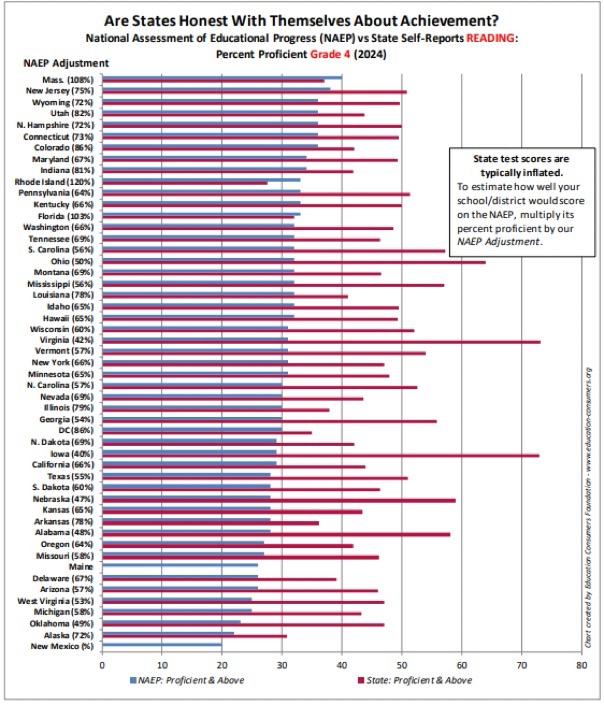
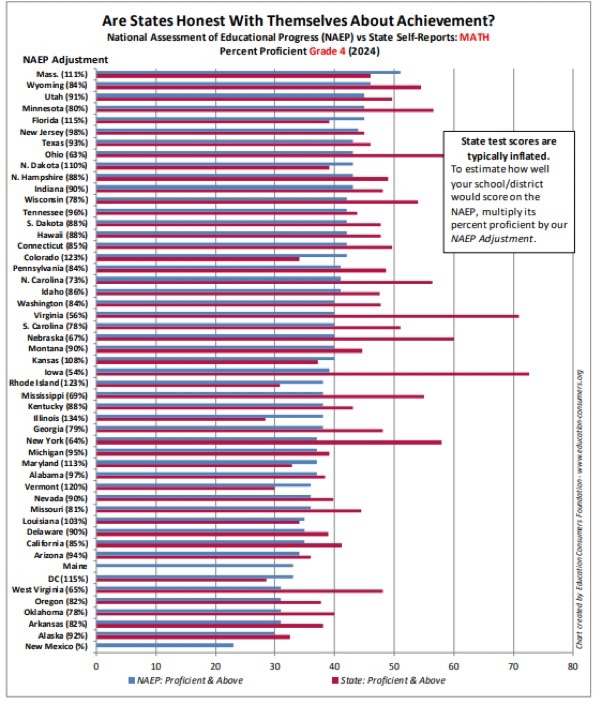
“Are States Honest with Themselves About Student Achievement” (!)
“too many states have chosen to tell parents their children are on track when they aren’t” say Arne Duncan and Margaret Spellings in a new Ed Week piece linked below.
These charts compare the most recent National Assessment of Education Progress (NAEP) 4th gr reading and math reports with the state testing reports.
The discrepancies are surprising. If judged by national standards, students in most states are not as proficient in reading and math as the state tests say they are. Link to more charts below.
——-
To get education back on track, let’s start at the top
By Margaret Spellings & Arne Duncan
However, Washington can’t simply send dollars to states and call its job done. The president and Congress should reestablish a clear national commitment to education excellence—setting ambitious goals for student outcomes, investing in research, preserving measurement, and ensuring parents and taxpayers can see whether students are on track.
We’ve done it before. Under No Child Left Behind and Race to the Top, the federal government spurred states to raise standards. States set expectations for districts and schools to serve every child. Students responded, with average reading scores for 9-, 13-, and 17-year-olds rising for the first time in decades. Scores for 9- and 13-year-olds even reached historic levels from 2008 to 2012. We need to get back to a balanced federal-state approach that benefits all students.
A priority for the federal side must be a national research agenda. Federal investments in research have rewritten our approach to education, enabling stakeholders to move beyond assumptions to identify best practices. The federal government’s core obligation should be to support research and evaluation so states invest in proven, high-impact strategies.
If the federal government can focus on its responsibility to provide research funding and accountability, and states on setting standards, we can create a federal-state compact that commits both levels of government to advancing a focused set of national priorities: common-sense goals, evidence-based strategies, distinct measures of progress, and public transparency.
————-
“The government restricts supply, zoning laws and university certifications. And then the government responds to the political pressure caused by the rising prices by subsidizing demand. And of course, if you subsidize demand and a fixed supply, you get skyrocketing prices”
————-
Notes and links on the taxpayer funded Wisconsin DPI and Jill Underly.
“Did you know my school was bad like this when you decided to put me here?” she asked.
Madison’s district, despite an elite university pipeline, hypereducated leadership, and a shiny, new strategic plan, suffers the same frailties as Milwaukee’s: basement performance, backbreaking spending. But while Milwaukee is pulling out of its tailspin due to courageouschoices from the top, Madison is ponderously ambling to nowhere. Just ask the locals. “You need the marketing, and you need the product,” as a parent told a reporter. “I’m missing the product.”
2025-2026 Madison 4k-3rd grade Early Literacy Screener report: The bar moves faster than the kids.
Joe Gothard, Becky Kundert and Sonia Spencer Remarks on Madison’s K-12 Literacy Crisis.
2026-2027 Madison K-12 $pending continues to grow, fueled by a 9.7% (!) property tax increase. Total spending will be at least $706,000,000 for 25,003 students, or $28,236 per student.
May 2026 Madison School District Presentation: 7,095 adults for 25,003 students (3.52 students per adult!)
2024-2025 Early Literacy Screener Map.
Map: Foundations of Reading Results: 2015–2024
Where have all the students gone?
3,887 Madison 4 year old to third grade students scored lower than 75% of the students in the national comparison group.
Madison taxpayers have long supported far above average k-12 tax & $pending. This despite our long term, disastrous reading results. May, 2026: 7,095 Staff for 25,003 students; $pending > $26k per student!
Madison Schools: More $, No Accountability
The taxpayer funded Madison School District long used Reading Recovery…
The data clearly indicate that being able to read is not a requirement for graduation at (Madison) East, especially if you are black or Hispanic.
My Question to Wisconsin Governor Tony Evers on Teacher Mulligans and our Disastrous Reading Results
2017: West High Reading Interventionist Teacher’s Remarks to the School Board on Madison’s Disastrous Reading Results
Madison’s taxpayer supported K-12 school district, despite spending far more than most, has long tolerated disastrous reading results.
“An emphasis on adult employment”
Wisconsin Public Policy Forum Madison School District Report[PDF]
WEAC: $1.57 million for Four Wisconsin Senators
Friday Afternoon Veto: Governor Evers Rejects AB446/SB454; an effort to address our long term, disastrous reading results
Booked, but can’t read (Madison): functional literacy, National citizenship and the new face of Dred Scott in the age of mass incarceration.
When A Stands for Average: Students at the UW-Madison School of Education Receive Sky-High Grades. How Smart is That?
China’s PhD Glut Drives Top Graduates to High School Teaching Jobs