“Illinois school districts across the state have placed a whopping $2.1 billion in bond referendums on the Nov. 3 ballot”
That’s the amount Illinois school districts want for renovations, additions, fieldhouses, career centers, and “21st-century learning.” The cost to taxpayers of all those proposals over the next 30 years, if passed, will be nearly $4 billion when interest costs are included.
There’s more than just debt taxpayers will be on the hook for when it comes to school districts. There are several rate-hike referendums and a few 1% sales-tax-hike proposals, the biggest being for Lake County. Those hikes, if passed, will hit residents with another nearly $2 billion in new taxes over a ten-year period.
If that weren’t enough, there are 56 other bond and tax hike initiatives for various municipalities and library, park, and community college districts. They total another $315 million in borrowings (nearly $600 million in total costs to taxpayers when interest is included) and another $300 million in taxes over ten years tax as a result of rate increases.
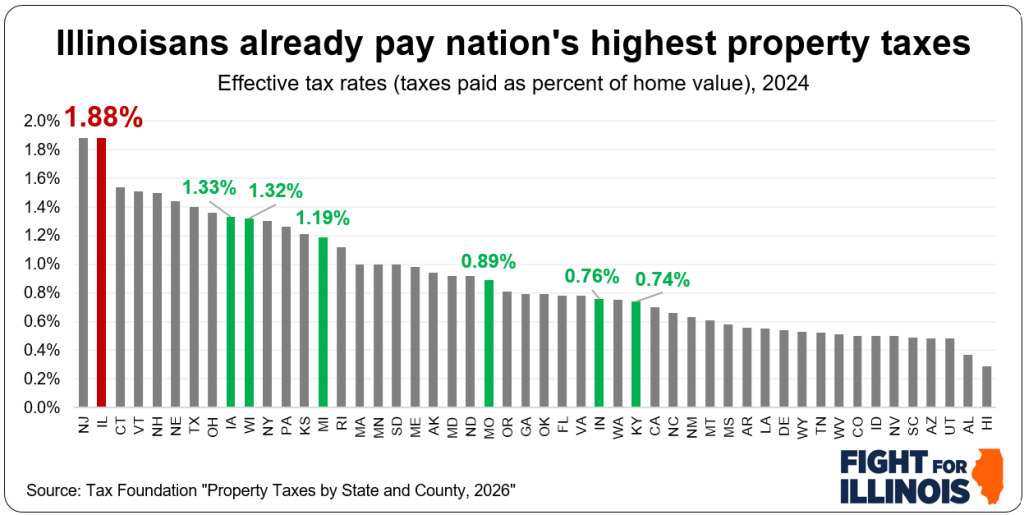
It’s impossible to satisfy Illinois politicians’ desire for more money. Never mind the highest-in-the-nation property tax rates, the spiking energy costs, and Illinois’ shrinking school enrollments – our local politicians everywhere want more. Unsurprisingly, talk of spending reforms and efficiencies for tax relief is nowhere to be seen. Share this piece with someone who still thinks Illinois taxes aren’t the problem.
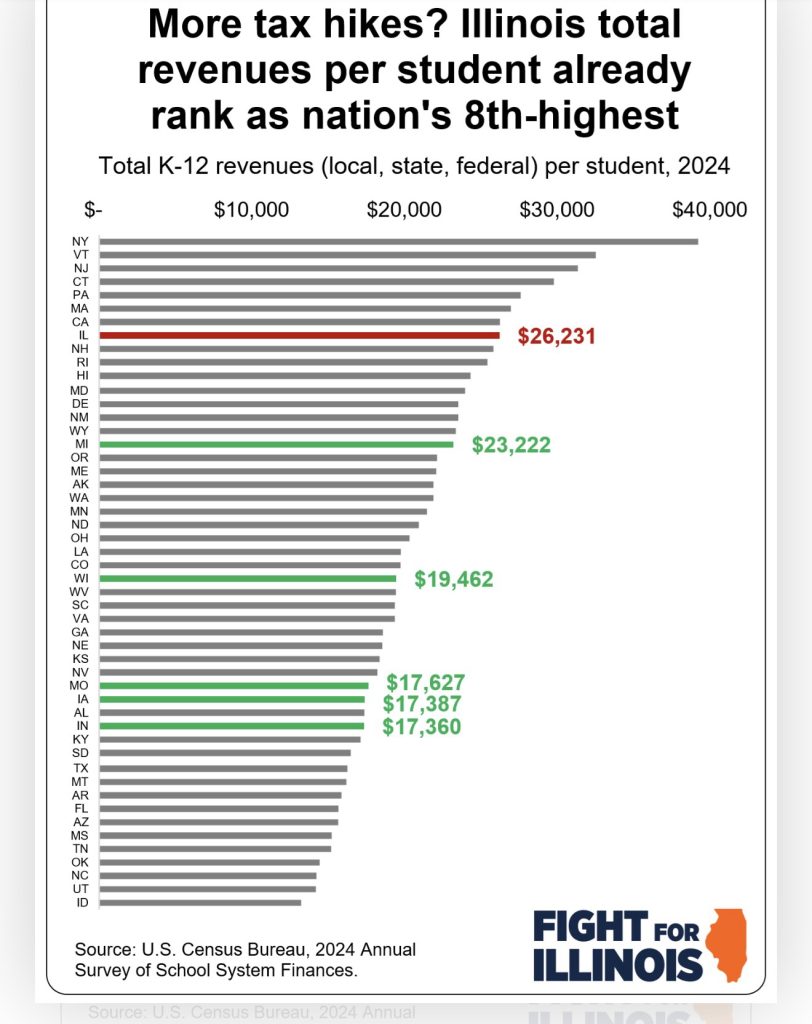
We also know Illinois has the eighth-highest revenues in the country dedicated to K-12 education. When you add up all the local, state and federal dollars, Illinois takes in $26,200 per student – more than 42 other states (U.S. Census data). It’s by far the most in the Midwest. Indiana, Iowa and Kentucky all collect $7,000 to $9,000 less per student, and yet their student outcomes on national tests are on par with those of Illinois. Illinois doesn’t need more money for education.
———-
“Did you know my school was bad like this when you decided to put me here?” she asked.
Madison’s district, despite an elite university pipeline, hypereducated leadership, and a shiny, new strategic plan, suffers the same frailties as Milwaukee’s: basement performance, backbreaking spending. But while Milwaukee is pulling out of its tailspin due to courageouschoices from the top, Madison is ponderously ambling to nowhere. Just ask the locals. “You need the marketing, and you need the product,” as a parent told a reporter. “I’m missing the product.”
2025-2026 Madison 4k-3rd grade Early Literacy Screener report: The bar moves faster than the kids.
Joe Gothard, Becky Kundert and Sonia Spencer Remarks on Madison’s K-12 Literacy Crisis.
2026-2027 Madison K-12 $pending continues to grow, fueled by a 9.7% (!) property tax increase. Total spending will be at least $706,000,000 for 25,003 students, or $28,236 per student.
May 2026 Madison School District Presentation: 7,095 adults for 25,003 students (3.52 students per adult!)
2024-2025 Early Literacy Screener Map.
Map: Foundations of Reading Results: 2015–2024
Where have all the students gone?
3,887 Madison 4 year old to third grade students scored lower than 75% of the students in the national comparison group.
Madison taxpayers have long supported far above average k-12 tax & $pending. This despite our long term, disastrous reading results. May, 2026: 7,095 Staff for 25,003 students; $pending > $26k per student!
Madison Schools: More $, No Accountability
The taxpayer funded Madison School District long used Reading Recovery…
The data clearly indicate that being able to read is not a requirement for graduation at (Madison) East, especially if you are black or Hispanic.
My Question to Wisconsin Governor Tony Evers on Teacher Mulligans and our Disastrous Reading Results
2017: West High Reading Interventionist Teacher’s Remarks to the School Board on Madison’s Disastrous Reading Results
Madison’s taxpayer supported K-12 school district, despite spending far more than most, has long tolerated disastrous reading results.
“An emphasis on adult employment”
Wisconsin Public Policy Forum Madison School District Report[PDF]
WEAC: $1.57 million for Four Wisconsin Senators
Friday Afternoon Veto: Governor Evers Rejects AB446/SB454; an effort to address our long term, disastrous reading results
Booked, but can’t read (Madison): functional literacy, National citizenship and the new face of Dred Scott in the age of mass incarceration.
When A Stands for Average: Students at the UW-Madison School of Education Receive Sky-High Grades. How Smart is That?
China’s PhD Glut Drives Top Graduates to High School Teaching Jobs