We are setting up a generation to fail at school
There was one problem: even as these visits were taking place, Finnish scores were in a sustained slide. Today, its results are little better than the average country, and many argue its exceptional performance — which peaked around 2000 — owed more to the conventional comprehensive approach it had used in previous decades.

Recent results in the UK support this theory. Scotland, Wales and Northern Ireland went down similar routes to Finland during the 2010s, shifting away from established curricula and towards more broadly defined learning outcomes, scrapping school league tables and some standardised tests. By contrast, England doubled down on the established curriculum with strict guidance on the content schools must cover in core subjects, alongside the use of league tables with performance measures that made the rankings harder to game. Fifteen years on, England’s results have held up, propelling it into the top ten internationally, while in Scotland, Wales and Northern Ireland they have plummeted.

It is a similar story in the US, where children in poorer southern states like Mississippi have made huge gains, overtaking their counterparts in wealthy states like California and moving from well below the national average to above it. Improvements have been especially pronounced among the lowest-scoring children. There, as in the UK, the most common explanations are Mississippi’s adoption of evidence-based classroom methods including teaching phonics at an early age, and its emphasis on accountability, from school rankings to requiring that children be capable readers before they progress.

———
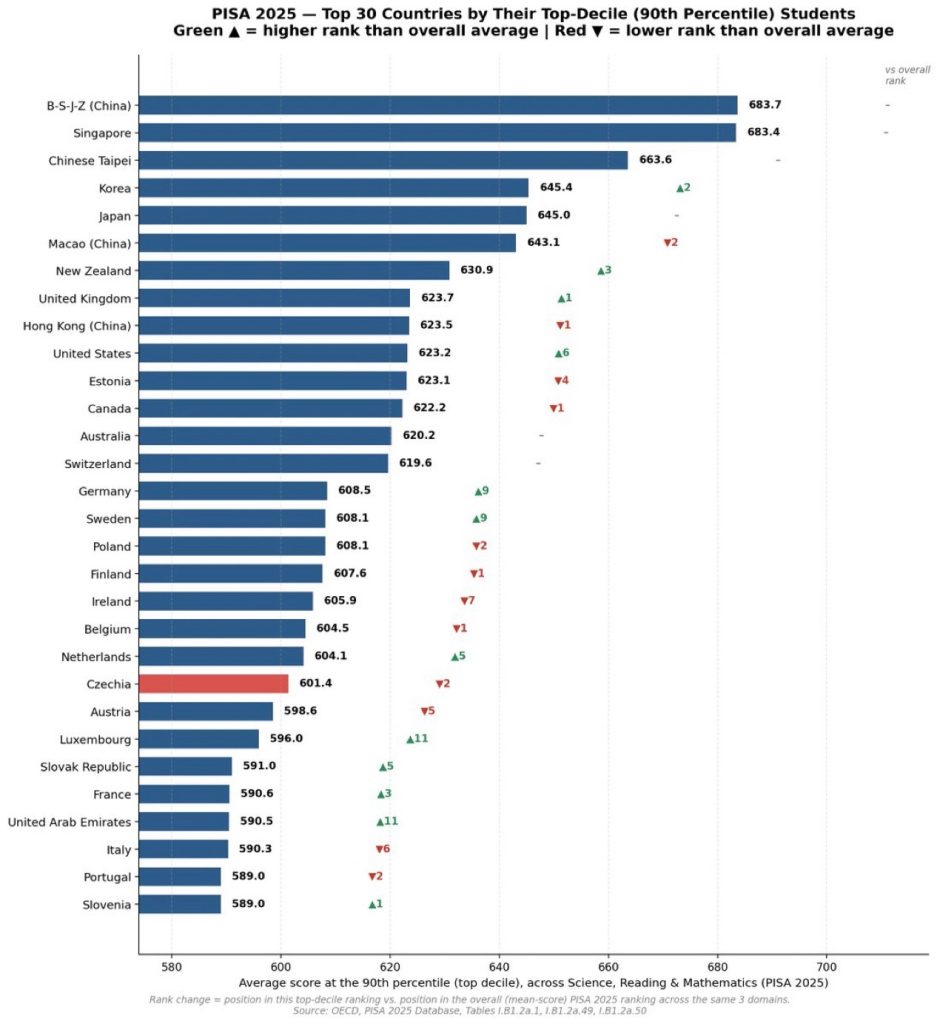
A lot of people asked for a comparison of elite pupils across different countries. Cross-comparing specific school types like gymnasiums isn’t really possible, since these vary a lot from country to country, so the most straightforward way to do it is to simply compare the top decile of students in each country (combined science, reading & math).
To make it a bit more interesting, I added how each country’s ranking changes compared to the overall ranking of all students. Here you can see that Czech elite students aren’t particularly elite by comparison — our ranking actually gets slightly worse when you isolate the top decile.
Notes on 2025 PISA
VERY THREE years the OECD, a club mostly of rich countries, releases the results of international school tests sat by 15-year-olds all across the world. There were reasons to hope that the latest data, published on September 8th, would bring positive news. Marks in mathematics, reading and science had collapsed in the previous round of testing, which was carried out just after the pandemic. Policymakers dared hope that, with the calamity well in the past, grades might start to rebound.
PISA 2025 Results (Volume I) “Future-Ready Students”
OECD:
————-
Rahm Emanuel (@RahmEmanuel) is suddenly preaching phonics, science of reading, and teacher training. How convenient.
He is the same mayor who ran Chicago Public Schools for eight years and never made evidence-based reading, writing, and math instruction the non-negotiable core of how classroom teachers were prepared or supported.
He closed 50 schools—the largest mass closing in U.S. history—overwhelmingly in Black neighborhoods, promising better academics. University of Chicago research found the closings did not deliver meaningful academic gains for the kids who were moved. Graduation rates rose. Proficiency did not keep pace. A later look at students who started elementary school on his watch showed large shares still not reading or doing math at grade level.
————
I’m fairly certain the average American teacher doesn’t even know what good teaching looks like.
————
Madison’s district, despite an elite university pipeline, hypereducated leadership, and a shiny, new strategic plan, suffers the same frailties as Milwaukee’s: basement performance, backbreaking spending. But while Milwaukee is pulling out of its tailspin due to courageouschoices from the top, Madison is ponderously ambling to nowhere. Just ask the locals. “You need the marketing, and you need the product,” as a parent told a reporter. “I’m missing the product.”
2025-2026 Madison 4k-3rd grade Early Literacy Screener report: The bar moves faster than the kids.
Joe Gothard, Becky Kundert and Sonia Spencer Remarks on Madison’s K-12 Literacy Crisis.
2026-2027 Madison K-12 $pending continues to grow, fueled by a 9.7% (!) property tax increase. Total spending will be at least $706,000,000 for 25,003 students, or $28,236 per student.
May 2026 Madison School District Presentation: 7,095 adults for 25,003 students (3.52 students per adult!)
2024-2025 Early Literacy Screener Map.
Map: Foundations of Reading Results: 2015–2024
Where have all the students gone?
3,887 Madison 4 year old to third grade students scored lower than 75% of the students in the national comparison group.
Madison taxpayers have long supported far above average k-12 tax & $pending. This despite our long term, disastrous reading results. May, 2026: 7,095 Staff for 25,003 students; $pending > $26k per student!
Madison Schools: More $, No Accountability
The taxpayer funded Madison School District long used Reading Recovery…
The data clearly indicate that being able to read is not a requirement for graduation at (Madison) East, especially if you are black or Hispanic.
My Question to Wisconsin Governor Tony Evers on Teacher Mulligans and our Disastrous Reading Results
2017: West High Reading Interventionist Teacher’s Remarks to the School Board on Madison’s Disastrous Reading Results
Madison’s taxpayer supported K-12 school district, despite spending far more than most, has long tolerated disastrous reading results.
“An emphasis on adult employment”
Wisconsin Public Policy Forum Madison School District Report[PDF]
WEAC: $1.57 million for Four Wisconsin Senators
Friday Afternoon Veto: Governor Evers Rejects AB446/SB454; an effort to address our long term, disastrous reading results
Booked, but can’t read (Madison): functional literacy, National citizenship and the new face of Dred Scott in the age of mass incarceration.
When A Stands for Average: Students at the UW-Madison School of Education Receive Sky-High Grades. How Smart is That?