Notes on 2025 PISA
VERY THREE years the OECD, a club mostly of rich countries, releases the results of international school tests sat by 15-year-olds all across the world. There were reasons to hope that the latest data, published on September 8th, would bring positive news. Marks in mathematics, reading and science had collapsed in the previous round of testing, which was carried out just after the pandemic. Policymakers dared hope that, with the calamity well in the past, grades might start to rebound.
That is not what happened. On the contrary, in rich countries—the primary focus of the tests—scores have fallen further (see chart 1). In literacy, the decline is actually speeding up. These data suggest that there are long-running factors pushing down achievement in schools, and that without swift correction, pupils’ abilities could yet plumb further depths. Anyone who cares about the young of today—and the economies of tomorrow—ought to be alarmed.
The OECD’s project, known as PISA, takes a measure of young people’s aptitudes as they approach the end of their compulsory school days. The number of school systems taking part has expanded over the years: the latest tests were sat in all 38 OECD member-countries and in 53 other places (many of them developing economies). The results are used to create an international league table of sorts.
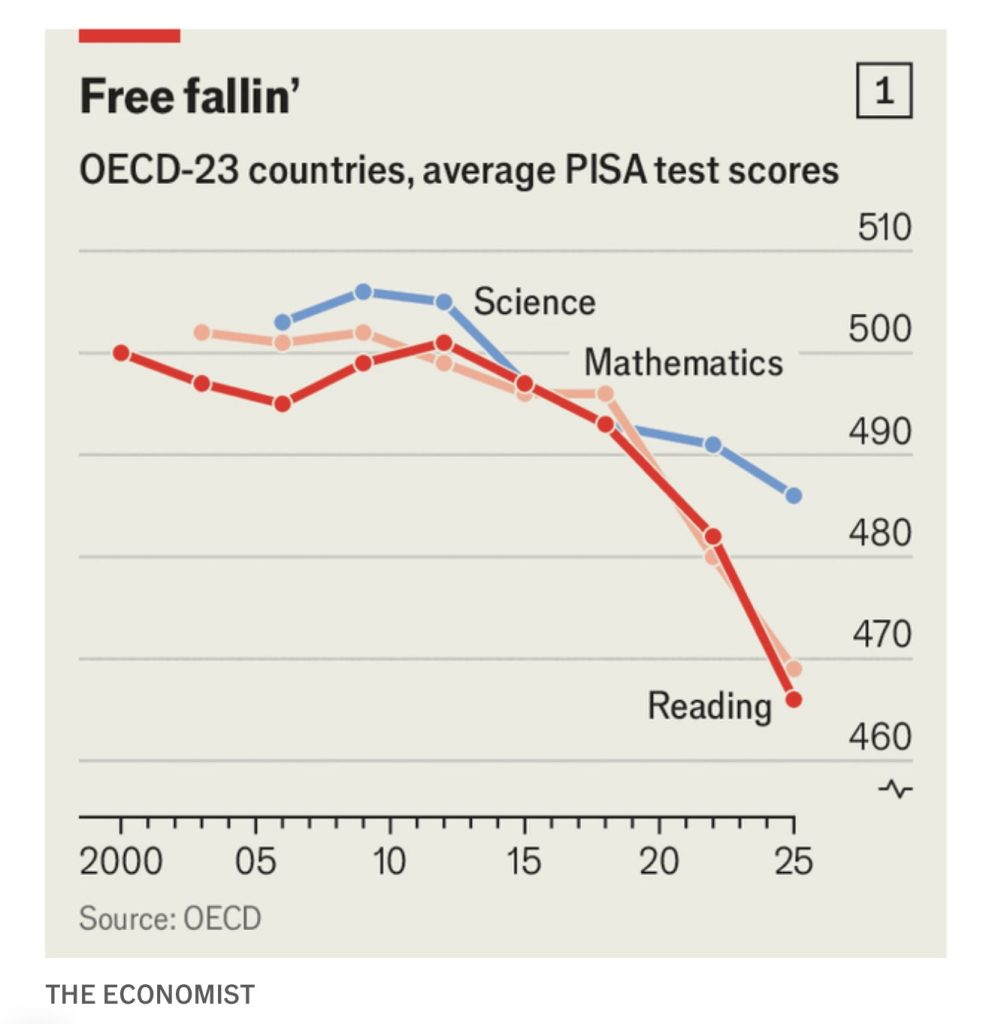
This year, as in almost every round since 2000, Asian school systems rule the roost. Children in China—taking part for the first time since 2018—have wiped the floor with almost everyone else (though scores there are skewed because the tests are sat in only four rich provinces). In science and maths they score 100 points above the average for OECD countries (as a broad rule of thumb, 20 points is considered to be about as much as an average pupil gains in a full year of learning). Kids in Singapore, Macau, Taiwan and Japan follow behind.
Estonia still looks the best school system in the West. Turkey is rising very fast. And there is heartening news for Britain, whose youngsters now rank inside the world’s top ten in all three disciplines. Compared with three years ago, Britain has pushed up its science results and held reading and mathematics broadly steady. That counts as a good result when many others are heading down.
———
PISA 2025 Results (Volume I) “Future-Ready Students”: OECD