“ai” therapy
A PhD student used both Claude and Gemini as an AI therapist.
She vented her frustrations around getting a cancer diagnosis, and joked about how much it was costing the healthcare system.
The difference in responses is staggering.
A PhD student used both Claude and Gemini as an AI therapist.
She vented her frustrations around getting a cancer diagnosis, and joked about how much it was costing the healthcare system.
The difference in responses is staggering.
Prompt injections are vulnerabilities in Large Language Models where attackers use crafted prompts to make the model ignore its original instructions or perform unintended actions.
Visual prompt injection refers to the technique where malicious instructions are embedded within an image. When a model with image processing capabilities, such as GPT-V4, is asked to interpret or describe that image, it might act on those embedded instructions in unintended ways.
During my first semester as a computer science graduate student at Princeton, I took COS 402: Artificial Intelligence. Toward the end of the semester, there was a lecture about neural networks. This was in the fall of 2008, and I got the distinct impression—both from that lecture and the textbook—that neural networks had become a backwater.
Neural networks had delivered some impressive results in the late 1980s and early 1990s. But then progress stalled. By 2008, many researchers had moved on to mathematically elegant approaches such as support vector machines.
I didn’t know it at the time, but a team at Princeton—in the same computer science building where I was attending lectures—was working on a project that would upend the conventional wisdom and demonstrate the power of neural networks. That team, led by Prof. Fei-Fei Li, wasn’t working on a better version of neural networks. They were hardly thinking about neural networks at all.
Rather, they were creating a new image dataset that would be far larger than any that had come before: 14 million images, each labeled with one of nearly 22,000 categories.
Li tells the story of ImageNet in her recent memoir, The Worlds I See. As she worked on the project, she faced plenty of skepticism from friends and colleagues.
Though I have many brilliant graduate students, I love working with undergraduate students. And I am not at all sure that you should favor people with graduate degrees, given a choice. Many graduate students tend to favor abstraction over practical skills. They often have an idealized view of the world. Moreover, these students are often consumed by research projects, theses, or dissertations, and the publication of scientific articles, which limits their time for concrete actions. On the other hand, undergraduate students, in my experience, show more enthusiasm for concrete and useful projects, even if they are not prestigious at first glance.
When she decided to uproot her life and move halfway across the world to run a company in a place where she had never lived, Nadia Carlsten wasn’t really sure what to expect.
But the American engineer with a passion for technology management definitely wasn’t expecting to be treated like a celebrity.
“I feel like the most popular person wherever I go,” Carlsten says. “I can just start the conversation with: I have over 1,500 GPUs—and everyone wants to talk to me.”
Carlsten has precisely 1,528 of the most powerful graphics-processing units on the planet because she just started as the chief executive of the Danish Centre for AI Innovation. The new company was built to run Denmark’s national AI supercomputer, which opened last week with a glitzy launch party where Carlsten was once again the center of attention.
DID YOU KNOW
…schools had until September to obligate ~$1.49B in federal aid?
…DPI lists ~$13.1M outstanding and ~$300K over the limit, despite the deadline?
…details on evidence-based line items have been broken since May?
Schools (probably) did their jobs. Hurry up, DPI!
Easy solution to avoid Mayor’s $300 million property tax increase without eliminating the 2,476 Police and 646 Firefighter and EMS positions he threatened: Reduce city subsidies to the schools by an amount equal to the annual TIF “WINDFALL” which would save the city $300 mil.
Schools don’t lose property tax revenues to TIF’s because their property tax rate rises to meet their levy request. City Council should also not pay the $170 million school district employee contribution to the school districts municipal pension fund employees.
The city has been providing almost $1 billion in subsidies annually to the schools in addition to the schools receiving 56% of all property taxes. That money is not finding its way into the classroom as only 54% of the $30,000 per student the district spends ends up in the schools.
Note that while Firefighters and Paramedics await their pay increase, the last teacher contract raised CTU member salaries 24-50%, hired 9,000 more employees and has ONE employee for every 7.6 students.
And then a small group of college administrators decided to blow it all up. The most important of them was James Conant, the president of Harvard from 1933 to 1953. Conant looked around and concluded that American democracy was being undermined by a “hereditary aristocracy of wealth.” American capitalism, he argued, was turning into “industrial feudalism,” in which a few ultrarich families had too much corporate power. Conant did not believe the United States could rise to the challenges of the 20th century if it was led by the heirs of a few incestuously interconnected Mayflower families.
So Conant and others set out to get rid of admissions criteria based on bloodlines and breeding and replace them with criteria centered on brainpower. His system was predicated on the idea that the highest human trait is intelligence, and that intelligence is revealed through academic achievement.
By shifting admissions criteria in this way, he hoped to realize Thomas Jefferson’s dream of a natural aristocracy of talent, culling the smartest people from all ranks of society. Conant wanted to create a nation with more social mobility and less class conflict. He presided during a time, roughly the middle third of the 20th century, when people had lavish faith in social-engineering projects and central planning—in using scientific means to, say, run the Soviet economy, or build new cities like Brasília, or construct a system of efficiency-maximizing roadways that would have cut through Greenwich Village.
When universities like Harvard shifted their definition of ability, large segments of society adjusted to meet that definition. The effect was transformative.
In trying to construct a society that maximized talent, Conant and his peers were governed by the common assumptions of the era: Intelligence, that highest human trait, can be measured by standardized tests and the ability to do well in school from ages 15 to 18. Universities should serve as society’s primary sorting system, segregating the smart from the not smart. Intelligence is randomly distributed across the population, so sorting by intelligence will yield a broad-based leadership class. Intelligence is innate, so rich families won’t be able to buy their kids higher grades. As Conant put it, “At least half of higher education, I believe, is a matter of selecting, sorting, and classifying students.” By reimagining college-admissions criteria, Conant hoped to spark a social and cultural revolution. The age of the Well-Bred Man was vanishing. The age of the Cognitive Elite was here.
KEY FINDINGS:
1. Ivy League payments and entitlements cost taxpayers $41.59 billion over a six-year period (FY2010-FY2015). This is equivalent to $120,000 in government monies, subsidies, & special tax treatment per undergraduate student, or $6.93 billion per year.
2. The Ivy League was the recipient of $25.73 billion worth of federal payments during this period: contracts ($1.37 billion), grants ($23.9 billion) and direct payments – student assistance ($460 million).
In answer to Martha Koch’s opinion piece, “absolutely,” and I say that as a scientist with 40 years of experience in the biology of behaviour, but the crackpot ideas of self-described “researchers” that have held sway for the last 30 years with respect to influencing educational policy are the least reliable basis for advice to policy makers.
There is nothing less adequate than a self-professed expert saying “research shows” without actually describing the methodology for data acquisition, analytical framework and actual results, which, in the contemporary education context (the last 30 years) are worse literacy and numeracy outcomes precisely because the wrong people with unsupportable ideas that fly in the face of 2,000 years of contemporary, empirical experience in how humans learn have got hold of policy makers’ ears.
The fact is that literacy and numeracy have declined precipitously and disastrously, as many parents will attest. That debacle, to which Koch and her ilk have contributed, will take a long time to correct, and it is children and their futures at stake.
Robert Anderson
RM of Brokenhead
———-
more.
In her recent article, education professor Martha Koch claims the education courses future teachers take in the faculty of education are more useful than the subject-specific courses they took in their undergraduate degrees.
As someone with 25 years of teaching experience in the public school system, I must respectfully disagree. The subject-specific courses that I took in my undergraduate degree were much more helpful in my teaching career than the useless education courses offered by the faculty of education.
Don’t just take my word for it. Ask any teacher how they felt about their bachelor of education program. Chances are they will praise their teaching practicum where they worked in real classrooms with real students, but they will dismiss most of their required courses as useless theory. It would be a huge mistake to rely on education faculties to fill in the gaps that will inevitably arise from the lower admission standards for future teachers introduced by the current government.
Michael Zwaagstra
Steinbach
——-
2007 math forum audio video
Discovery Math
Singapore Math
Remedial math
Madison’s most recent Math Task Force
When A Stands for Average: Students at the UW-Madison School of Education Receive Sky-High Grades. How Smart is That?
First, they must recognize that they unwittingly seeded the ground for Trump’s revival. Their leftward acceleration under his presidency handed him the fodder he needed to portray the opposition as radical.
The shift was well-meaning and even understandable — Democrats wanted to redouble their commitment to those under duress at a time of threat — but it was political malpractice. Look no further than Harris’ now-famous support of trans surgery for prisoners. That was a commitment she made in 2019 because she and her advisers thought core Democrats wanted such purity. In truth, they simply wanted to beat Trump — which Joe Biden wisely recognized — but most others in the party misread the moment.
Years have passed since our last comparison of midwestern supreme courts, so let’s return for a look at four indicators: (1) the number of decisions filed; (2) the length of these decisions; (3) the number of separate opinions; and (4) the distribution of vote margins. As Minnesota and Iowa once served as the starting point for these posts, we’ll begin again with them.
Number of decisions
Previous posts found that the justices in Minnesota and Iowa issued much larger volumes of decisions than did their colleagues in Wisconsin, and this gap became enormous in 2023-24 due to the surprising plunge in the number of decisions filed last term in the Badger State. As shown in Table 1, the totals for Minnesota and Iowa were more than six times the output in Wisconsin.[1]
Andy Greenberg & Lily Hay Newman:
Your communications and the data on your devices are far from the only sensitive digital records you’re constantly creating. You’re also leaving behind a trail of breadcrumbs on the paths you take around the internet—paths that are all too visible to your internet service provider and the websites you visit, and which can be highly revealing to anyone building a profile of you and your behavior.
“For me, I always say it’s important to remember you’re not ‘going to’ a website,” says Matt Mitchell, founder of CryptoHarlem, a security and privacy training and advocacy nonprofit. “You’re opening a door, and just like if you open your door, people can see you, and they can see behind you.”
So, what should the role of iPads, Chromebooks, or mobile education gaming be in the classroom? In an era when test scores are declining, how much have these technologies really contributed to student learning? Have the distraction effects of these devices overwhelmed the educational benefits? And at what age should these devices and programs be introduced?
To find answers to these questions, we invited Amy Tyson to write for us. Amy is a co-founder of Everyschool, an organization dedicated to making schools smarter, happier, and healthier through digital wellness. Amy offers a comprehensive analysis of the current landscape of screens in schools, addressing five major myths that fuel some of the device misuse and overuse in classrooms today. She also provides a clear, actionable roadmap for schools to adopt smarter, more effective technology practices that empower students to thrive in the 21st century.
EY has fired dozens of US staff for what the accounting and consulting firm called cheating on professional training courses, sparking an internal debate about business ethics and the limits of multitasking.
The dismissals took place last week after an investigation found that some employees had attended more than one online training class at a time during the “EY Ignite Learning Week” in May.
Several of the fired employees told the Financial Times they did not believe they were violating EY policy and were just trying to take advantage of interesting sessions that ranged from “How strong is your digital brand in the marketplace?” to “Conversing with AI, one prompt at a time”.
The sessions counted towards the 40 continuing professional education credits that EY required employees to complete in a year. The firm determined that watching two at a time amounted to an ethical breach.
“Our core values of integrity and ethics are at the forefront of everything we do,” EY said. “Appropriate disciplinary action was recently taken in a small number of cases where individuals were found to be in violation of our global code of conduct and US learning policy.”
As an orange sun rises over a deeply reddened nation, the woke left isn’t out, but it most certainly is down.
And while millions of Americans played a part, responsibility for the death of the woke regime rests in a small set of hands.
Neither conservatism, libertarianism, nor any other -ism killed the woke vibe.
Tech did.
As the woke regime intended to permanently transform America and the American people by spiritually commanding and controlling tech, this fact bears close examination.
The Providence Public School District has acknowledged that personal student information was stolen in a cyberattack in September, including vaccination records, special education details, and driver’s license numbers.
The new disclosure on what type of student data was stolen was disclosed in a letter to families over the long Veterans Day weekend. The district had previously said “there is no evidence that any personal information for students has been impacted,” but later reversed course.
School board elections have a big impact on the day-to-day lives of Wisconsin families. Yet they are decided in the least democratic elections. Today, WILL is releasing a new policy report with a proposal to solve this problem.
Spring elections have an average turnout of 28% in the last decade, compared to Fall elections where turnout averages more than 66%. In 2024, turnout was 73%. This means about 45% fewer Wisconsinites have their voices heard on school boards.
The News: In our new report, Enhancing Democracy: The Benefits of Holding School Board Elections in the Fall, the Wisconsin Institute for Law & Liberty (WILL) highlights how moving school board races to November could bolster public interest in local school board governance. Currently held in April, these “off-cycle” elections suffer from low voter turnout and often lack representative engagement. Shifting these elections to November would align them with higher-turnout cycles, fostering broader public involvement and more balanced representation.
The Quotes: WILL Research Director, Will Flanders, stated, “People across the political spectrum should support the goal of increasing participation in our local elections. Local school boards make decisions every day that often impact our lives more than who occupies the White House. By moving these elections to November, we can ensure more voters can have a voice in these decisions, ensuring greater accountability.”
——-
Our govt’s decision to remove all subject area requirementsfor teachers will make things worse.
The data clearly indicate that being able to read is not a requirement for graduation at (Madison) East, especially if you are black or Hispanic”
My Question to Wisconsin Governor Tony Evers on Teacher Mulligans and our Disastrous Reading Results
2017: West High Reading Interventionist Teacher’s Remarks to the School Board on Madison’s Disastrous Reading Results
Madison’s taxpayer supported K-12 school district, despite spending far more than most, has long tolerated disastrous reading results.
“An emphasis on adult employment”
Wisconsin Public Policy Forum Madison School District Report[PDF]
WEAC: $1.57 million for Four Wisconsin Senators
Friday Afternoon Veto: Governor Evers Rejects AB446/SB454; an effort to address our long term, disastrous reading results
Booked, but can’t read (Madison): functional literacy, National citizenship and the new face of Dred Scott in the age of mass incarceration.
When A Stands for Average: Students at the UW-Madison School of Education Receive Sky-High Grades. How Smart is That?
Watching MPS sleepwalk into SOD is painful. Revenue estimates continue to be lowered – even since the original pro forma was presented 10-15. And expense forecasts keep getting higher – in no small part b/c of how (unrealistically) the dist fcsts cost increases. (1)
There is much for both political parties to learn from the results of the 2024 election. The take-aways being gleaned involve political lessons, as well as many that pertain to policy. Such post-election analysis, however, often misses the mark. Take the November 6 Governing Magazine article, which reported that school choice “fared poorly” in the 2024 elections. Many would beg to differ with that conclusion, starting with Texas Governor Greg Abbott (R) and millions of voters across the nation’s second most populous state.
Opponents of school choice are pointing to Kentucky voters’ decision to reject Amendment 2, a ballot measure that would’ve allowed tax dollars to go to non-government schools, as evidence of public skepticism about programs that expand school choice. There were many other results in the 2024 election, however, that contradict such claims. In fact, some outcomes from the 2024 election indicate that not only is demand for school choice high, the political salience of the issue is as potent as ever.
Nice mention of @WILawLiberty Here’s the ineluctable fact. Funding for public schools is on a long term and substantial upward trend in real terms. Choice does not “gut” public schools and, when controlling for the relevant variables, it generally delivers more. But no sector wars. We ought to focus on public and private schools that work and get more of that; rather than having adults engage in turf wars to increase their piece of the pie.
But now, at the age of 72, Calkins faces the destruction of everything she has worked for. A 2020 report by a nonprofit described Units of Study as “beautifully crafted” but “unlikely to lead to literacy success for all of America’s public schoolchildren.” The criticism became impossible to ignore two years later, when the American Public Media podcast Sold a Story: How Teaching Kids to Read Went So Wrongaccused Calkins of being one of the reasons so many American children struggle to read. (The National Assessment of Educational Progress—a test administered by the Department of Education—found in 2022 that roughly one-third of fourth and eighth graders are unable to read at the “basic” level for their age.)
In Sold a Story, the reporter Emily Hanford argued that teachers had fallen for a single, unscientific idea—and that its persistence was holding back American literacy. The idea was that “beginning readers don’t have to sound out words.” That meant teachers were no longer encouraging early learners to use phonics to decode a new word—to say cuh–ah–tuh for “cat,” and so on. Instead, children were expected to figure out the word from the first letter, context clues, or nearby illustrations. But this “cueing” system was not working for large numbers of children, leaving them floundering and frustrated. The result was a reading crisis in America.
——
Both the academic and personal components make this worth reading.
But 2 of my least favorite education things are high-income schools that underachieve via flawed instruction saying, “But we have high scores!” and adults who copy Dead Poets Society instead of Stand And Deliver.
Our govt’s decision to remove all subject area requirementsfor teachers will make things worse.
The data clearly indicate that being able to read is not a requirement for graduation at (Madison) East, especially if you are black or Hispanic”
My Question to Wisconsin Governor Tony Evers on Teacher Mulligans and our Disastrous Reading Results
2017: West High Reading Interventionist Teacher’s Remarks to the School Board on Madison’s Disastrous Reading Results
Madison’s taxpayer supported K-12 school district, despite spending far more than most, has long tolerated disastrous reading results.
“An emphasis on adult employment”
Wisconsin Public Policy Forum Madison School District Report[PDF]
WEAC: $1.57 million for Four Wisconsin Senators
Friday Afternoon Veto: Governor Evers Rejects AB446/SB454; an effort to address our long term, disastrous reading results
Booked, but can’t read (Madison): functional literacy, National citizenship and the new face of Dred Scott in the age of mass incarceration.
When A Stands for Average: Students at the UW-Madison School of Education Receive Sky-High Grades. How Smart is That?
This is a great idea which will wake up our elite universities from their stupor.
Naomi Martin and Mandy McLaren:
At school, she panics if she has to read aloud. She’s a conscientious student and keeps her grades up, but it isn’t easy; at times she has such trouble synthesizing the novels she reads in English class, she Googles plot summaries to remind herself of what happened. Even in math, word problems are thickets.
Madison von Mering, a driven 16-year-old who loves field hockey and sailing, is not a strong reader. As a young child, she was never correctly taught how to sound out unfamiliar words.
——-
More.
Our govt’s decision to remove all subject area requirementsfor teachers will make things worse.
The data clearly indicate that being able to read is not a requirement for graduation at (Madison) East, especially if you are black or Hispanic”
My Question to Wisconsin Governor Tony Evers on Teacher Mulligans and our Disastrous Reading Results
2017: West High Reading Interventionist Teacher’s Remarks to the School Board on Madison’s Disastrous Reading Results
Madison’s taxpayer supported K-12 school district, despite spending far more than most, has long tolerated disastrous reading results.
“An emphasis on adult employment”
Wisconsin Public Policy Forum Madison School District Report[PDF]
WEAC: $1.57 million for Four Wisconsin Senators
Friday Afternoon Veto: Governor Evers Rejects AB446/SB454; an effort to address our long term, disastrous reading results
Booked, but can’t read (Madison): functional literacy, National citizenship and the new face of Dred Scott in the age of mass incarceration.
When A Stands for Average: Students at the UW-Madison School of Education Receive Sky-High Grades. How Smart is That?
As Seattle Public Schools faces continued public backlash over proposed school closures, a group of parents is attempting to recall board President Liza Rankin.
In court documents filed with King County, the group argues Rankin adopted a “rushed and improper” school closure process and repeatedly failed to “provide transparency and community engagement on decisions critical to the well-being of the district.”
The parents also contend Rankin failed to uphold her duties as a school board member to adequately oversee the district and “ensure the district delivers student educational outcomes.”
“As Board President, Liza Rankin must uphold the highest standards in public office, especially in a time of urgent crisis like that which Seattle Public Schools now faces,” Ben Gitenstein, one of the petitioners, said in a statement. “Instead, Rankin has committed violations that have worsened our district’s crisis.”
——
3 Baltimore schools, including 2 charters, recommended for closure
Madison citizens just passed a major bricks and mortar expansion amidst flat/declining enrollment, and buildings with substantial extra space.
There is much for both political parties to learn from the results of the 2024 election. The take-aways being gleaned involve political lessons, as well as many that pertain to policy. Such post-election analysis, however, often misses the mark. Take the November 6 Governing Magazine article, which reported that school choice “fared poorly” in the 2024 elections. Many would beg to differ with that conclusion, starting with Texas Governor Greg Abbott (R) and millions of voters across the nation’s second most populous state.
Opponents of school choice are pointing to Kentucky voters’ decision to reject Amendment 2, a ballot measure that would’ve allowed tax dollars to go to non-government schools, as evidence of public skepticism about programs that expand school choice. There were many other results in the 2024 election, however, that contradict such claims. In fact, some outcomes from the 2024 election indicate that not only is demand for school choice high, the political salience of the issue is as potent as ever.
By Mandy McLaren, Ryan Huddle and Neena Hagen
Question 2 supporters, including the influential Massachusetts Teachers Association, had argued the MCAS graduation requirement unfairly penalized students with disabilities and those still learning English. About 700 students, primarily from those two groups, fail annually to earn a diploma because of their MCAS scores, according to state data.
Opponents, meanwhile, said the requirement, which first applied to the class of 2003, raised the bar for education in the Commonwealth by setting a common standard for all students to meet. Business leaders largely opposed Question 2, pointing to research showing the correlation of strong MCAS scores and future earnings in the labor market.
Supporters of Question 2 trounced opponents particularly in western Massachusetts, with several towns west of the Quabbin Reservoir, including Shutesbury, Northampton, Wendell, Easthampton, and Montague, posting the night’s largest victory margins, with roughly 3 in 4 voters there casting ballots in support of the measure. Question 2 also saw strong support in Holyoke, a district whose students were disproportionately affected by the graduation requirement, with 73 percent voting in favor of ending the high-stakes mandate.
William N. Caballero, Phillip R. Jenkins
The overwhelming success of GPT-4 in early 2023 highlighted the transformative potential of large language models (LLMs) across various sectors, including national security. This article explores the implications of LLM integration within national security contexts, analyzing their potential to revolutionize information processing, decision-making, and operational efficiency. Whereas LLMs offer substantial benefits, such as automating tasks and enhancing data analysis, they also pose significant risks, including hallucinations, data privacy concerns, and vulnerability to adversarial attacks. Through their coupling with decision-theoretic principles and Bayesian reasoning, LLMs can significantly improve decision-making processes within national security organizations. Namely, LLMs can facilitate the transition from data to actionable decisions, enabling decision-makers to quickly receive and distill available information with less manpower. Current applications within the US Department of Defense and beyond are explored, e.g., the USAF’s use of LLMs for wargaming and automatic summarization, that illustrate their potential to streamline operations and support decision-making. However, these applications necessitate rigorous safeguards to ensure accuracy and reliability. The broader implications of LLM integration extend to strategic planning, international relations, and the broader geopolitical landscape, with adversarial nations leveraging LLMs for disinformation and cyber operations, emphasizing the need for robust countermeasures. Despite exhibiting “sparks” of artificial general intelligence, LLMs are best suited for supporting roles rather than leading strategic decisions. Their use in training and wargaming can provide valuable insights and personalized learning experiences for military personnel, thereby improving operational readiness.
Jason M. Scott, Stephen N. Goggin and David Faigman
How well does bar exam performance predict lawyering effectiveness? Is performance on some components of the bar exam more predictive? The current study, the first of its kind to measure the relationship between bar exam scores and a new lawyer’s effectiveness, evaluates these questions by combining three unique datasets—bar results from the State Bar of Nevada, a survey of recently admitted lawyers, and a survey of supervisors, peers, and judges who were asked to evaluate the effectiveness of recently-admitted lawyers. We find that performance on both the Multistate Bar Examination (MBE) and essay components of the Nevada Bar have little relationship with the assessed lawyering effectiveness of new lawyers, calling into question the usefulness of these tests.
More.
At the Academy of Management conference in Chicago last August — one of the world’s largest and most important annual gatherings of business school academics — one theme was prominent in numerous presentations: balancing rigour and relevance in research.
Among the hundreds of projects discussed in the space of a week, a number of impressive studies stood out. But many others appeared more than a little esoteric and theoretical. Research with practical applications — let alone a focus on addressing the most important issues facing society, such as climate change, poverty and inequality — was less evident.
That points to a broader debate about the role of business schools, their relationship to the world beyond universities, and the nature of academic governance and incentives around research.
Last month, after 21 years studying and teaching Classics at the University of Cambridge, I resigned. I loved my job. And it’s precisely because I loved the job I was paid to do, and because I believe so firmly in preserving the excellence of higher education, in Britain and beyond, that I have left.
When I arrived in Cambridge two decades ago, giants were still walking the earth. Students could attend any lecture, at any level, in any department; graduate and research seminars were open to any interested party, and you could sit at the feet of the greats. Unforgettable gatherings of everyone from undergraduates to professors would discuss the big questions late into the night.
Cambridge’s historic strength came through respecting students’ abilities and giving them freedom to pursue their studies how they wished, but with some important restrictions.
The national news media is more limited in its reach and influence than ever in the modern era.
Already, Democratic media figures have begun discussing publicly and privately how the erosion of traditional media consumption among a large segment of Americans requires their politicians to engage with nontraditional media in a more serious and systematic way.
Both the Biden and Harris campaigns frequently touted a media strategy that was built around interviews with local television and radio stations, which the campaigns argued were more trusted with Americans in battleground states. That strategy may have worked for Biden in 2020, but it didn’t help the Harris campaign get over the line this time.
Some left-leaning media leaders feel that the next generation of national Democrats need to take a page out of the conservative media playbook and invest in overtly partisan outlets.
Crooked Media co-founder Tommy Vietor told Semafor in a text message that Trump effectively nurtured right-wing podcasters and influencers in a way that helped him shape the narrative with his supporters.
But one thing is clear: With the defeat of Harris, Newsom is all but certain to run for president in 2028, political insiders say.
“It was a very good night for Gavin Newsom,” said Bill Whalen, a fellow at Stanford University’s Hoover Institution and former speechwriter for Republican Gov. Pete Wilson. “He’ll never tell you that, but look, now suddenly, the road to 2028 is open again.”
– It has the privilege of targeting individual citizens on its own initiative, which is forbidden to the three other branches. – It can interfere their lives in any way it wishes by making a “ruling”. – The only recourse against a “ruling” is to take the bureaucracy in question to court. – But the process is the punishment, because this takes months if not years and costs tens if not hundreds of thousands of dollars. – Until recently, courts have deferred to bureaucrats as a matter of legal precedent. Now they merely do so as a matter of practice. – But should the bureaucracy lose anyway, the only punishment the court inflicts is that they are told they have to stop doing that specific thing. – Any fines or legal costs imposed on them punish the taxpayer, not the agent or even the agency. – And the next, closely related, thing the bureaucracy thinks of to do is once again fair game, until the courts are once again brought in, at further cost, to tell it to stop. All of this creates a Red Queen Effect.
Republicans and Democrats from high-tax states have been trying unsuccessfully for seven years to dislodge the cap that congressional Republicans built. Their best chance for success is about to arrive.
“It’s a really hard issue to thread the needle on, and neither party’s been able to figure out how to do it,” said Anna Taylor of accounting firm Deloitte, who was a tax aide to current Senate Majority Leader Chuck Schumer (D., N.Y.).
The cap, along with much of the 2017 tax law, expires at the end of 2025. This time, no matter who wins Tuesday, it will be a key piece of the tax fight. Cap opponents could have a leg up if lawmakers from New York, New Jersey and California hold a congressional balance of power in a slim majority for either party, commanding a large-enough faction to block bills that don’t address their concerns.
“There’s a natural landing pad for a deal,” Reed said, suggesting a version of a cap that would hit very few households. “It’s just going to take a lot of theater and political gamesmanship to get there.”
Madison Metropolitan School District Board of Education seats 3, 4, and 5 will be on the 2025 ballot.
—-
Our govt’s decision to remove all subject area requirementsfor teachers will make things worse.
The data clearly indicate that being able to read is not a requirement for graduation at (Madison) East, especially if you are black or Hispanic”
My Question to Wisconsin Governor Tony Evers on Teacher Mulligans and our Disastrous Reading Results
2017: West High Reading Interventionist Teacher’s Remarks to the School Board on Madison’s Disastrous Reading Results
Madison’s taxpayer supported K-12 school district, despite spending far more than most, has long tolerated disastrous reading results.
“An emphasis on adult employment”
Wisconsin Public Policy Forum Madison School District Report[PDF]
WEAC: $1.57 million for Four Wisconsin Senators
Friday Afternoon Veto: Governor Evers Rejects AB446/SB454; an effort to address our long term, disastrous reading results
Booked, but can’t read (Madison): functional literacy, National citizenship and the new face of Dred Scott in the age of mass incarceration.
When A Stands for Average: Students at the UW-Madison School of Education Receive Sky-High Grades. How Smart is That?
Susan Yackee, Mike Wittenwyler and Rick Esenberg shared their impressions and experiences of the November 2024 election at the Madison Literary Club’s [madlit.org] most recent meeting.
Machine generated transcript.
mp3 audio
———–
The Madison Literary Club is a small overlooked jewel in the city’s cultural cluster. Founded in 1877, the 147-year-old social group brings together town and campus to host, as its website promises, “presentations on subjects of current interest and engage in lively conversation about them.”
The club delivered on its promise a few days after the Nov. 5 election with an expert panel exhuming the election results that so shocked Madison. Only 20 or so people showed up, but one of them wasCharles Franklin, director of the celebrated Marquette Law School Poll. Just an observer, he demurred when asked to join the conversation. He was, as he explained later, on a “busman’s holiday.”
———–
The Presidential election was mentioned, of course. Naimisha Forest dove into this topic recently:
Except for this evidently premeditated and striking if cryptic assessment:
“I think Trump may be one of those figures in history who appears from time to time to mark the end of an era and to force it to give up its pretences. It doesn’t necessarily mean that he knows this, or that he is considering any great alternative. It could just be an accident.”
I make five points. Four are specific to Kissinger on Trump. The last is on the Hegelian model of historical change – the cunning of reason – that Kissinger rather casually deploys here while toying half-heartedly with his branzino (European bass) on a bed of green vegetables.
First, Kissinger thinks Trump may already be a substantial figure in world history, not, alas, some bizarre printer’s error that Trump-opponents hope to erase from its pages.
Second, he’s not just any historical figure but one who marks the end of an era. This much should be apparent even from Trump’s critics, who denounce him for upending the post-war “liberal international order,” among other epochal crimes.
Imagine hiring a piano teacher who can’t play the piano or a swimming instructor who’s terrified of water. While it’s clear that these examples are absurd, the Manitoba government seems to have missed the obvious: teachers can’t teach what they don’t know.
Last week, Manitoba quietly announced significant changes to teacher certification. Manitobans should be deeply concerned.
For example, previously K-8 teachers were required to complete two courses in each of math, science, English and history. These requirements — and others — have been removed entirely. There are now no mandated core subject requirements for teachers in training at any level.
Acting education minister Tracy Schmidt, made the remarkable claim that this will “help support students.” It’s unclear if the politicians endorsing these regulations fully understand the consequences. The changes, billed as “removing barriers,” instead strip away critical requirements for foundational knowledge that teachers need to be effective in their jobs.
The government claims this will “align Manitoba with other Canadian jurisdictions,” but this is misleading. Most provinces require K-8 teachers to take at least one, and often two, math courses at the university level. Quebec mandates five courses for middle school math teachers, and Ontario recently introduced a math proficiency test for all teachers.
University of Manitoba’s dean of education Jan Stewart supported the lowered standards, claiming there is little research to suggest someone with an extensive background in a teachable subject is more effective in the classroom. Common sense tells us that you can’t teach what you don’t understand, and it’s challenging to help students in a subject you struggle with.
——-
Our govt’s decision to remove all subject area requirementsfor teachers will make things worse.
The data clearly indicate that being able to read is not a requirement for graduation at (Madison) East, especially if you are black or Hispanic”
My Question to Wisconsin Governor Tony Evers on Teacher Mulligans and our Disastrous Reading Results
2017: West High Reading Interventionist Teacher’s Remarks to the School Board on Madison’s Disastrous Reading Results
Madison’s taxpayer supported K-12 school district, despite spending far more than most, has long tolerated disastrous reading results.
“An emphasis on adult employment”
Wisconsin Public Policy Forum Madison School District Report[PDF]
WEAC: $1.57 million for Four Wisconsin Senators
Friday Afternoon Veto: Governor Evers Rejects AB446/SB454; an effort to address our long term, disastrous reading results
Booked, but can’t read (Madison): functional literacy, National citizenship and the new face of Dred Scott in the age of mass incarceration.
When A Stands for Average: Students at the UW-Madison School of Education Receive Sky-High Grades. How Smart is That?
The Secret Service has used a technology called Locate X which uses location data harvested from ordinary apps installed on phones. Because users agreed to an opaque terms of service page, the Secret Service believes it doesn’t need a warrant.IMAGE: 404 MEDIA.
This article was primarily reported using public records requests. We are making it available to all readers as a public service. FOIA reporting can be expensive, please consider subscribing to 404 Media to support this work. Or send us a one time donation via our tip jar here.
Officials inside the Secret Service clashed over whether they needed a warrant to use location data harvested from ordinary apps installed on smartphones, with some arguing that citizens have agreed to be tracked with such data by accepting app terms of service, despite those apps often not saying their data may end up with the authorities, according to hundreds of pages of internal Secret Service emails obtained by 404 Media.
A recent study at Harvard found that roughly 50% of the students and professors wouldn’t discuss “uncomfortable” topics. An essential life skill is the ability to change your mind. She won’t learn that at any Ivy league school. Their reputations are still so strong that their faculty, staff and graduates all possess the arrogant certainty of religious fanatics.
I am sorry to disappoint you. I wish her the best in her search for a school,
The News: As K-12 education leaders across the country face an increasingly complex Title IX regulatory regime, the Wisconsin Institute for Law & Liberty (WILL), the Defense of Freedom Institute for Policy Studies (DFI), and the Southeastern Legal Foundation (SLF) released today a crucial resource guide. Titled “Protecting Title IX: A Resource Guide for School Boards,” this guide aims to empower school boards with the legal insights needed to understand and respond to the complex Title IX requirements of the federal government. A national webinar will take place on November 20, 2024, at 1 p.m. ET.
The Quotes: WILL Education Counsel Cory Brewer stated, “School board members need complete and accurate information—not intimidation. Our Title IX Resource Guide provides an in-depth analysis with essential legal citations to help both new and experienced board members make informed decisions as they adopt policies for their local communities. It also explains how the recent changes to Title IX conflict with its original purpose of protecting women and girls from discrimination. We believe this will serve as an invaluable resource nationwide.”
Ted Dabrowski and John Klingner
The state’s recently projected $23 billion in deficits over the next five years should come as a big surprise for Illinoisans given how well the Pritzker administration says it has managed the state’s finances in recent years. Illinois has “balanced its budgets,” “paid down its unpaid bills,” and “created a rainy day fund,” Gov. J.B. Pritzker has repeated often.
Despite all that, Illinois is right back to the multi-billion dollar deficits it had right before covid. A look at the state’s budget forecasts, done by the governor’s OMB, reveals why. Pritzker wants to continue the pandemic-era spending he’s put together since coming into office in 2019. If the governor has his way, the state’s budget will have grown by a whopping $23 billion by 2030 – a near 60% increase in little more than a decade.
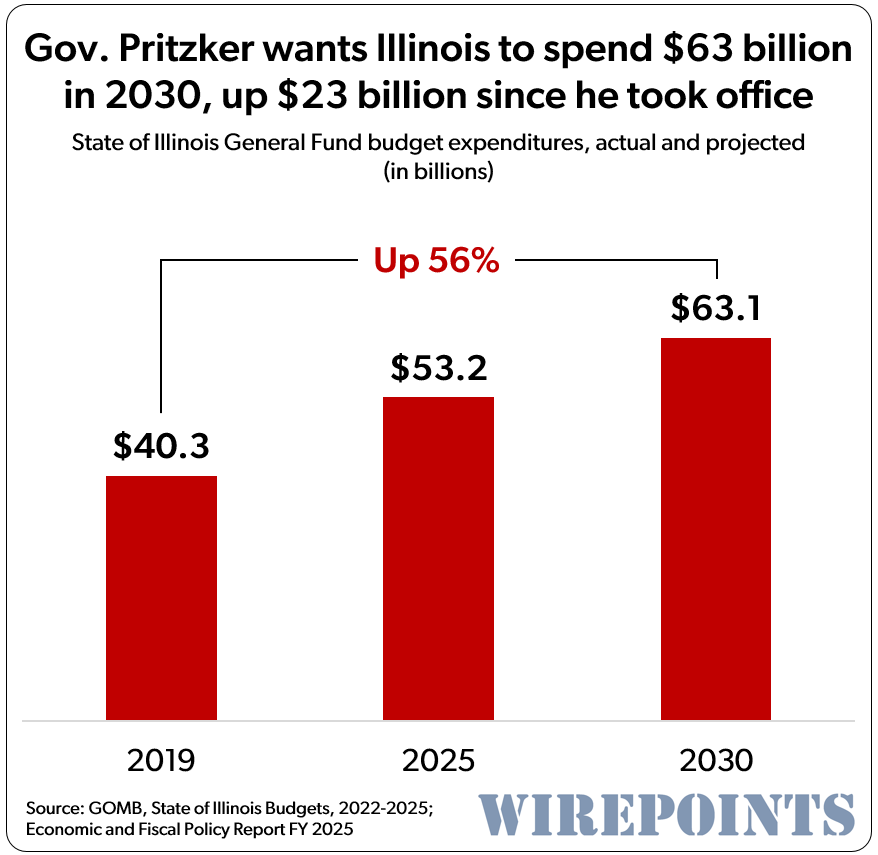
More..
The Virginia teachers union sent this email to members after Trump won
incidentally six of seven major accreditation institutions as of last year had a DEI standard that they apparently impose on schools during accreditation
Students can graduate from most US colleges, even “elite” colleges, without the ability to solve quadratic equations or graph simple functions.
There is no possible way that we can compete in technology vs PRC with our degraded higher education system.
I was a senior administrator at a Big Ten university – I know exactly what has gone on in our system for the past few decades.
“Data science” teams analyzed enrollments and found courses which were difficult (i.e., had high failure rates) for students admitted based on affirmative action. Algebra 2 was one of them. It was eliminated in favor of easier “math for real life” courses with higher pass rates.
This has been going on for decades.
——
Harvard Launches New Intro Math Course to Address Pandemic Learning Loss
In the final month of the 2024 election, the national media existed in another solar system from the country for whom is tasked at reporting accurate, unbiased and truthful information. The final month started with Jeffrey Goldberg and the Atlantic attempting to regurgitate their anonymously sourced “suckers and losers” hit against Trump from 2020. With the help of CNN and others, they resurfaced General John Kelly. Then they went and got their full Reich on by comparing Trump’s Madison Square Garden rally to a 1939 Nazi rally there. At said rally a comedian known for celebrity roasts made a crass joke about Puerto Rico, which blanketed the whole of national media outlets for four days.
When the October jobs report was released on the final Friday of October, showing an anemic growth of only 12,000 jobs, the national media focused all of their attention on comments Trump made about former representative Liz Cheney, who had become a Kamala Harris campaign surrogate, regarding sending her off to fight the wars her family and in particular her father had endorsed.
The Atlantic, CNN, MSNBC, CBS, ABC and NBC created an echo chamber of thought bubbles that only they were listening to. The country had completely tuned them out. None of these stories actually mattered to voting audiences and the election result, with almost every major voting demographic moving toward Donald Trump in an electoral blowout.
Jill Underly’s proposed DPI budget would eat up 65% of the state’s budget surplus, all while allowing property taxes to continue to go up. We fund students at approximately $20k per student on average. When is it enough?
State Superintendent Jill Underly is proposing more than $4 billion in new spending for Wisconsin public schools to increase special education funding and to allow school districts’ spending limits to match the rate of inflation.
The Department of Public Instruction’s 2025-27 budget request also proposes free school meals for all Wisconsin students, and more mental health and early literacy programming, along with a $10,000 stipend for student teachers.
The new spending would decrease the number of school districts turning to local taxpayers for more money through referendums, Underly said. In 2024, nearly half of Wisconsin’s more than 400 school districts asked voters to approve increases in local funding.
But here is what NCES says: 2022 special education state revenue for districts divided by IDEA students.
We are middling, not top nor bottom.
——-
Our govt’s decision to remove all subject area requirementsfor teachers will make things worse.
The data clearly indicate that being able to read is not a requirement for graduation at (Madison) East, especially if you are black or Hispanic”
My Question to Wisconsin Governor Tony Evers on Teacher Mulligans and our Disastrous Reading Results
2017: West High Reading Interventionist Teacher’s Remarks to the School Board on Madison’s Disastrous Reading Results
Madison’s taxpayer supported K-12 school district, despite spending far more than most, has long tolerated disastrous reading results.
“An emphasis on adult employment”
Wisconsin Public Policy Forum Madison School District Report[PDF]
WEAC: $1.57 million for Four Wisconsin Senators
Friday Afternoon Veto: Governor Evers Rejects AB446/SB454; an effort to address our long term, disastrous reading results
Booked, but can’t read (Madison): functional literacy, National citizenship and the new face of Dred Scott in the age of mass incarceration.
When A Stands for Average: Students at the UW-Madison School of Education Receive Sky-High Grades. How Smart is That?
NCTQ:
NCTQ regularly convenes reading experts — researchers, teacher educators, and experienced elementary educators — to review both textbooks and educational resources, such as journal articles or instructional videos, used by teacher preparation programs in their required reading coursework. These experts examine how well each material aligns with scientifically based reading instruction, a science rooted in 60+ years of research on what makes for the most effective methods to teach young students to read.
Our govt’s decision to remove all subject area requirementsfor teachers will make things worse.
The data clearly indicate that being able to read is not a requirement for graduation at (Madison) East, especially if you are black or Hispanic”
My Question to Wisconsin Governor Tony Evers on Teacher Mulligans and our Disastrous Reading Results
2017: West High Reading Interventionist Teacher’s Remarks to the School Board on Madison’s Disastrous Reading Results
Madison’s taxpayer supported K-12 school district, despite spending far more than most, has long tolerated disastrous reading results.
“An emphasis on adult employment”
Wisconsin Public Policy Forum Madison School District Report[PDF]
WEAC: $1.57 million for Four Wisconsin Senators
Friday Afternoon Veto: Governor Evers Rejects AB446/SB454; an effort to address our long term, disastrous reading results
Booked, but can’t read (Madison): functional literacy, National citizenship and the new face of Dred Scott in the age of mass incarceration.
When A Stands for Average: Students at the UW-Madison School of Education Receive Sky-High Grades. How Smart is That?
Nearly one year later, when I visited Alexandria Ocasio-Cortez’s office on behalf of an organization I was working for, I found a packet of crumpled-up American flag stickers in the trash can. I pulled them out quietly, not wanting her staff to see me, and put them in my backpack. I felt sad but thought I would take them to my brother’s kids when I saw them again. I knew they would appreciate them.
I was never happier about a Democratic victory than when Obama won in 2008. Blacks, whites, young and old, women and men rejoiced together, dancing in the streets to Michael Jackson’s “Thriller,” everyone feeling joy, and more importantly, hope. The same was true of my family—I can still remember how excited my mom was to vote for him. After eight years of George W. Bush, of the Iraq War, of repeated job losses, and growing income inequality leading to the financial crisis of 2007, we all thought Obama would return the country’s priorities to jobs for the middle and working class.
But it didn’t turn out that way. As much as anything, he was a Democratic technocrat. Still, in 2016, when Trump ran against Clinton, I was one of those people who laid in bed for three days when the Democrats lost. By then, however, I was an outlier in my family, who had already made the shift to Trump—as had millions of others in Missouri, a former bellwether state that grew redder with every election. For the longest time, I couldn’t understand why.
In 2019, I decided to move to San Francisco, a place where you’re unlikely to hear anything good said about Trump. After that, I got married to a man who worked in the Bay Area, and my circle of acquaintances was virtually all Democrats.
Like many others, I have recently found myself changing my mind, a discomfiting process for someone who has been a practicing economist for more than half a century. I will come to some of the substantive topics, but I start with some general failings. I do not include the corruption allegations that have become common in some debates. Even so, economists, who have prospered mightily over the past half century, might fairly be accused of having a vested interest in capitalism as it currently operates. I should also say that I am writing about a (perhaps nebulous) mainstream, and that there are many nonmainstream economists.
The Wab Kinew Manitoba NDP government has made a shocking decision that should concern every parent, grandparent, and guardian in this province: it has lowered the standards for teachers.
Without public notice or meaningful consultation, they’ve quietly removed the requirement for teachers to study basic subjects such as English, math, and science before teaching them to our children in K-8 classrooms. This decision is a clear signal that the quality of education in Manitoba is not the priority it should be. Instead, the NDP appears to be catering to special interests rather than focusing on what is best for our children’s future.
This is not about politics, it’s about the fundamental right of every child in Manitoba to receive a strong, well-rounded education. Lowering standards for teachers is not just a misguided policy decision — it’s an affront to the very principles of education.
It’s a betrayal of the trust parents place in our schools to provide a solid foundation in essential subjects. With one of the highest-paid teaching professions in the country, Manitoba should be striving for excellence in education, not lowering the bar to make it easier for underqualified individuals to enter the classroom.
The day after Hillary Clinton was nominated by the Democratic National Committee in 2016, Yale Law School congratulated Clinton, class of 1973, “on her historic nomination for President of the United States.” Eight years later, it is refusing to congratulate J.D. Vance on his actual election.
The school has made no statement about the vice president-elect, who graduated from Yale Law in 2013, since he and Donald Trump scored a landslide victory on Tuesday. And according to Debra Kroszner, the law school’s chief of staff, it doesn’t plan to.
Kroszner told the Washington Free Beacon that the school would include “this news” in the next issue of its alumni magazine—which is only published twice a year—but would not congratulate Vance publicly, citing a new policy against issuing institutional statements.
US academics live in fear of the thought police. They can’t teach freely or ask questions that might generate unwoke conclusions. Meanwhile, the AAUP, rather than trying to protect academic freedoms, is working hard to politicize universities and make them even more illiberal.
In a prior post for Free the Inquiry, I showed regional differences in requiring submission of DEI statements by applicants as part of the hiring process. The analysis showed a notable relationship between the politics of a state and whether job ads for full-time professorships in that state requested a DEI statement as part of their application process.
As a follow-up, I wanted to see what emerges if we expand the dataset to include all faculty positions, not just full-time professorships. Would including job ads for non-tenure-track positions (e.g., lecturers or adjunct professors) change the picture?
I gathered job ads from HigherEdJobs.com for relevant jobs in the U.S. posted during August 2024. In total, there were 5,005 jobs from all 50 states and Washington, D.C., covering 966 institutions. Of those, 1,907 were for full-time professorship positions (used in the original analysis) and 3,098 were for non-tenure track positions.
More.
Apparently it’s all Donald Trump’s fault that Europe is feeling suddenly vulnerable, Ukraine may be sold down the swanny and the world might implode with the end of Nato. If only the orange fella had not gone into politics, had not ridden down the golden escalator, Europe could have continued marching towards utopia, untroubled by populists, fascists and the other troublemakers who keep interfering with our dreams of a compassionate, enlightened, welfare-provisioned nirvana.
Delusional, sadly, doesn’t do justice to much of the commentary in the days since the world view of what Dominic Cummings calls the “insider class” crumpled in the time it took for the first exit poll to detonate through the airwaves. Only Orwell, or perhaps Swift, could adequately satirise the cognitive dissonance
SNL 2016
2/ The left has never fully grappled with the wreckage of fifty years of neoliberalism, which has left legions of Americans adrift as local places are hollowed out, rapacious profit seeking cannibalizes the common good, and unchecked new technology separates and isolates us.
Heard a joke on NPR: The #Democrats started as the party of farmers, became the party of the factories, and are now the party of the faculty club. A better explanation of electoral outcomes than foreign interference.
And why do the same people who demanded vaccine IDs for you to do anything, are the same ones who say ‘No ID for voting!’
Why is the MSM dangerous?
Explicit State Propaganda does not work (e.g. Soviet Pravda) because it is too visible. MSM gives us the illusion of free info: lobbies bully professionally fragile journalists who can be black/greylisted hence unemployable & create a monoculture.
This needs to be eliminated immediately. The parents need the money, not the Feds. Cut Fed taxes, let the States educate their children. The DoEdu has not made a dent in test scores ever.
238,400,000,000 2024 US Department of Education Budget…
One of the Ethereum applications that has always excited me the most are prediction markets. I wrote about futarchy, a model of prediction-based governance conceived by Robin Hanson, in 2014. I was an active user and supporter of Augur back in 2015 (look, mommy, my name is in the Wikipedia article!). I earned $58,000 betting on the election in 2020. And this year, I have been a close supporter and follower of Polymarket.
To many people, prediction markets are about betting on elections, and betting on elections is gambling – nice if it helps people enjoy themselves, but fundamentally not more interesting than buying random coins on pump.fun. From this perspective, my interest in prediction markets may seem confusing. And so in this post I aim to explain what it is about the concept that excites me. In short, I believe that (i) prediction markets even as they exist today are a very useful tool for the world, but furthermore (ii) prediction markets are only one example of a much larger incredibly powerful category, with potential to create better implementations of social media, science, news, governance, and other fields. I shall label this category “info finance“
Make debate great again.
More.
No other country in the world treats their citizens living abroad this way.
And yet, in the Democratic city of Chicago, asylum seekers—meaning those who have applied for asylum but are not even likely to get it—were eligible for up to $15,000 in rental support.
Many were left wondering how it is that a party that prides itself on taking care of the vulnerable doesn’t seem to care about them. Worse, party brass seemed to think they were “deplorables.”
At its heart, the IOP works to encourage students to examine critically and think creatively about politics and public issues – all politics and all public issues. It cannot effectively do that when only one side is represented. We would be doing a disservice to our students — and to our country — with anything less.
For more than a century, professors have regularly had vast influence over instruction, personnel and other hallmarks of campus life, sharing sway with presidents and trustees in decisions shaping many parts of campus life — an authority that is unfathomable in many workplaces.
But this year has shown how fraught and fragile that practice, known as shared governance, has become at public and private universities alike.
Arizona lawmakers sought to do away with legal guarantees of faculty power at public universities, their ambitions thwarted only by the governor’s veto. At the University of Kentucky, trustees dissolved the University Senate and made professorial influence only advisory. Amid protests at Columbia University, the school’s then-president provoked fury when she defied a University Senate committee and called in the police.
A coast-to-coast wipeout of faculty influence is not imminent, despite years of swelling suspicions of higher education and repeated attacks on tenure protections. But in recent months, professors have warned of an erosion of their power that they fear could undermine university culture. Some see efforts to diminish shared governance as part of a campaign to curb faculty participation in events, like campus protests over the war in Gaza, that have left universities vulnerable to criticism. …
Part of an excellent comment left on LinkedIn. “Education is a great equalizer…our children, especially those who one day hope to lift themselves out of poverty, deserve nothing less than their teachers being held to a high standard.”
There are a lot of numbers, but here is the comparison I find most impressive: Adjusting for grants, rather than taking sticker prices at face value, the inflation-adjusted tuition cost for an in-state freshman at a four-year public university is $2,480 for this school year. That is a 40% decline from a decade ago…
As might be expected, the trajectory for student debt is down as well. About half of last year’s graduates had no student debt. In 2013, only 40% did. That famous saying from economics — if something cannot go on forever, it will stop — is basically true. Due to changes in the formula, aid for Pell Grants is up, which helps to limit both student debt and the expenses of college.
More.
There has been no better eulogy for Churchill than that given by Leo Strauss, a German Jew who left Germany in time to escape the death camps. One of his teachers was Martin Heidegger, a philosopher of note and a Nazi, who provided some of the impulse for Strauss to return to the classics and begin the recovery of political philosophy as a quest for the truth. Churchill died on January 24, 1965. When Strauss came into class and was informed of Churchill’s death, he said:
“The death of Churchill is a healthy reminder to students of political science of their limitations, the limitations of their craft.
“The tyrant stood at the pinnacle of his power. The contrast between the indomitable and magnanimous statesman and the insane tyrant—this spectacle in its clear simplicity was one of the greatest lessons which men can learn, at any time.
“No less enlightening is the lesson conveyed by Churchill’s failure, which is too great to be called tragedy. I mean the fact that Churchill’s heroic action on behalf of human freedom against Hitler only contributed, through no fault of Churchill’s, to increase the threat to freedom which is posed by Stalin or his successors. Churchill did the utmost that a man could do to counter that threat—publicly and most visibly in Greece and in Fulton, Missouri.
Most companies are starting to figure out how artificial intelligence will change the way they do business. Chegg CHGG 0.00% is trying to avoid becoming its first major victim.
The online education company was for many years the go-to source for students who wanted help with their homework, or a potential tool for plagiarism. The shift to virtual learning during the pandemic sent subscriptions and its stock price to record highs.
Every participant in the orchestrated government-university-nonprofit-company censorship machine of the last decade can be charged criminally under one or both of these federal laws.
More.
What is the potential problem with focusing on the Science of Reading alone? Some educators say it places too much emphasis on a one-size-fits-all model of explicit, systematic, intensive phonics instruction for all students.
Ground zero for the Science of Reading movement was an article by education reporter Emily Hanford for APM Reports.Published in 2018, Hanford’s article said the reason students are struggling with reading is because educators do not know the science of reading or choose to resist it. Students are not “wired to read” but need explicit phonics instruction, she wrote.
After her article became popular, Hanford created a podcast series, Sold a Story, which went into greater detail about the Science of Reading movement. Hanford’s article and podcast inspired frustration in Thomas and he was moved to speak against her claims. “[The podcast] is very compelling for the public, but it’s just not based in real evidence,” Thomas said.
Yet, because the Science of Reading movement seems to cover multiple universes, it is difficult to assign one absolute meaning. Elena Aydarova, an assistant professor in the Department of Educational Policy Studies at the University of Wisconsin-Madison, points to this ambiguity in a FreshEd podcast.
——-
More.
Our govt’s decision to remove all subject area requirements for teachers will make things worse.
The data clearly indicate that being able to read is not a requirement for graduation at (Madison) East, especially if you are black or Hispanic”
My Question to Wisconsin Governor Tony Evers on Teacher Mulligans and our Disastrous Reading Results
2017: West High Reading Interventionist Teacher’s Remarks to the School Board on Madison’s Disastrous Reading Results
Madison’s taxpayer supported K-12 school district, despite spending far more than most, has long tolerated disastrous reading results.
“An emphasis on adult employment”
Wisconsin Public Policy Forum Madison School District Report[PDF]
WEAC: $1.57 million for Four Wisconsin Senators
Friday Afternoon Veto: Governor Evers Rejects AB446/SB454; an effort to address our long term, disastrous reading results
Booked, but can’t read (Madison): functional literacy, National citizenship and the new face of Dred Scott in the age of mass incarceration.
When A Stands for Average: Students at the UW-Madison School of Education Receive Sky-High Grades. How Smart is That?
“The Palantir degree is the best degree, bar none.” -CEO Alex Karp
We launched the Semester at Palantir program this year for students looking to accelerate their career and learn by doing — working on meaningful problems in the real world rather than the classroom, especially at universities where teaching has strayed.
Forty-two per cent of students enrolled in independent schools received extra time in the 2023-24 academic year, compared with 26 per cent of pupils in non-selective state schools, according to data published by Ofqual on Thursday.
The gap of 16 percentage points is the largest since England’s exam regulator began collecting data in 2018-19, when 26 per cent of private school students and 17 per cent of state school students claimed extra time for GCSEs and A-levels.
The system of access arrangements for exams, which is overseen by Ofqual, allows candidates to receive 25 per cent more time if they have a condition such as dyslexia or ADHD.
In a 60-minute exam, a student claiming extra time would have 75 minutes, for example. Students can receive more than 25 per cent extra time in extenuating circumstances.
Jon Andrews, head of analysis at the Education Policy Institute think-tank, said the data reflected how private schools had more resources than state counterparts to support students.
More.
The “algorithm” seems to have become a black box even Google engineers can’t figure out
The fact that over a year ago ML experts at Google (El-Mahdi El-Mhamdi at least, if I recall correctly) who have since left warned that LLMs should be avoided because they made products chaotic and hard to control seems relevant.
As is the fact that around the same time others also warned that one common consequence of mass layoffs is they tend to turn internal systems into black boxes because everybody with a deep understanding of them has left.
Fei-Fei Li wasn’t thinking about either neural networks or GPUs as she began a new job as a computer science professor at Princeton in January of 2007. While earning her PhD at Caltech, she had built a dataset called Caltech 101 that had 9,000 images across 101 categories.
That experience had taught her that computer vision algorithms tended to perform better with larger and more diverse training datasets. Not only had Li found her own algorithms performed better when trained on Caltech 101, other researchers started training their models using Li’s dataset and comparing their performance to one another. This turned Caltech 101 into a benchmark for the field of computer vision.
BREAKING: 29 of 50 Chicago aldermen have called a special meeting to vote down Mayor Brandon Johnson’s proposed property tax hike. The meeting will take place next Wednesday, Nov. 13.
More:
Government handouts at the national and state level enable illegals who come here to have a standard of living that is better than half of Earth.
This creates a forcing function for half of Earth to move here.
They will do so, unless the border is secure.
QED.
“Illinois remains a place of stability and competent governance” is a sentence that has never before been uttered in the English language.
Illinois is reeling. State ranks first in tax burden, near last in job growth, last in equity. After spending most of $54 billion in COVID money it received and despite raising taxes during COVID, state, city, schools and CTA face massive deficits. Expect more taxes to come.
•State facing $3 billion deficit next year.
•Chicago facing almost $1 billion deficit this year
•Chicago Public Schools facing almost $1 billion deficit next year
•CTA facing $567 million deficit
Don’t expect change. No one in Illinois has the right to lecture anyone about Democracy. Not with the most gerrymandered legislative maps in the country virtually guaranteeing Democrats Supermajorities despite Trump getting 47% of the vote.
The 1,300-word NYT article devotes just 11 words to the shattering of this “glass ceiling.”
Despite the “firsts” the media has celebrated over even the most minor political appointments by Democrats, there is 0 exploration of what Wiles’ appointment means for women.
The legacy media lied to you
Brilliant comment from @NYTimes reader.
“The very best thing that the Democrats can do for themselves is not ideological. It is to make the deep Blue cities and states where they have a supermajority into American paradises. Los Angeles, New York, California, Baltimore, Chicago, etc. Show us that you can got her an effectively. Low crime, great schools, moderate taxes, excellent mass transit, etc. Then the rest of the country will come to believe that your way is the right way. Because it is not what we have seen.”
The National Popular Vote bill will take effect when enacted into law by states possessing 270 electoral votes (a majority of the 538 electoral votes). The bill will take effect when enacted by states possessing an additional 61 electoral votes.
The National Popular Vote bill has also passed at least one legislative chamber in 7 states possessing 74 electoral votes (Arkansas, Arizona, Michigan, North Carolina, Nevada, Oklahoma, Virginia). The bill has passed both houses of the Nevada legislature at various times. The National Popular Vote bill has been introduced all 50 states at various times. Overall, the National Popular Vote bill has now passed a total of 43 state legislative chambers in 24 states.
On the map below, each square represents one electoral vote (out of 538).
Without iodine, the thyroid gland cannot produce hormones that enable the human body and the brain to develop properly. The visible consequences of iodine deficiency, such as goitres (swellings in the neck), are bad enough. The invisible ones are much worse: it can cause a 15-point drop in IQ.
Such afflictions were once common. A century ago, one in three schoolchildren in Michigan had a visible neck swelling; in Britain goitres were so endemic in some places that the condition was known as Derbyshire neck. Then manufacturers started fortifying certain foods with iodine, dramatically reducing the scourge. The number of countries where iodine levels are insufficient fell from 113 in 1990 to 21 in 2020.
How often have you heard someone say: “I’m just not a math person?”
People are reluctant to say they are illiterate but proud to share their low math identity.
We tend to think of math as a subject that’s accessible only to certain types of people. But that’s a false assumption, and it’s holding back achievement for far too many students. With the right instructional approach, everyone can learn and do math. There is no special “math gene” that naturally makes some people better at math than others.
Students come into school with differing levels of math preparation. Some have parents or guardians who have introduced them to foundational concepts and skills.
Some have had no exposure. The well-prepared students perform better at the outset of K-12 learning and the underprepared students struggle to keep up. Thus begins the fallacy that some students are “math people” and some are not.
Residents and property owners will have to pay a monthly “infrastructure special charge” by 2027 to help the city continue balancing its budget if more financial support from the state Legislature doesn’t materialize in budget talks next year.
Even with the referendum’s success, the city is counting on the untested charge to bring in millions in revenue every year by the end of the decade. But similar fees attempted by municipalities have been struck down by the Wisconsin court system.
What is interesting about Phetasy’s piece, in many ways, is just how unremarkable it is — the I-was-abandoned-by-my-divorced-parents has been its own genre of Gen X lit for a while now. For example, in 2011, the journalist Susan Gregory Thomas wrote an essay for the WSJ called “The divorce generation”, where she describes the effects of her own parents’ split, with much of the same fence-sitting between exhilaration and reproach:
Our suburb was littered with sad-eyed, bruised nomads, who wandered back and forth between used-record shops to the sheds behind the train station where they got high and then trudged off, back and forth from their mothers’ houses during the week to their fathers’ apartments every other weekend.
Both Phetasy and Thomas make a direct link between two trends that marked the identities of their generation: skyrocketing divorce rates, and the rise of what became known as “latchkey kids” — children who return home after school and are left unsupervised until a parent comes home from work. There was widespread concern about the situation at the time, and the received wisdom was that it was on the whole a bad thing. But as one might suspect, the truth is a bit more complicated.
Marguerite Roza & Maggie Cicco:
Financial dysfunction is plaguing many city school districts.
Chicago is the most concerning. The district’s current $300 million budget gap is set to triple next year, which isn’t surprising since enrollment dropped 10% over six years as the district added staff. Now, it won’t close schools, won’t reduce the workforce and is being told by the mayor to give in to union demands for big raises. How would the math work? The mayor wants the district to take out a short-term, high-interest loan. Oh, and the city and district still need to work out how to make this year’s pension payment.
Seattle is a close second. Two years ago, leaders agreed to a costly labor agreement that they admitted would require major cuts. But then they didn’t make those cuts. Instead, leaders exhausted all reserves and are borrowing money they’ll have to pay back by 2026. What’s the plan for the $100 million budget deficit? None yet.
Why are financial crises suddenly common among large urban districts? Federal relief funds are part of the issue. Despite warnings that the money was temporary, many city districts used those one-time funds for salary raises and new staff hires.
It would be impossible for a devout woke to pass such an exam. They’d have to acknowledge that no, men cannot get pregnant anymore than virgins can get pregnant.
Thus, anyone with this new Florida USMLE credential would demonstrably (a) have general medical knowledge and (b) not be psychopathically woke on matters of basic biology.
This could restore faith in the medical profession.
Note that the proposed exam wouldn’t need to be mandatory. Any doctor could take it at any time to get a new certification and prove to their patients that they weren’t woke quacks. Those who chose not to do so could continue down the path of pseudoscience, and perhaps eventually take up residence in a blue state.
And that would be a win/win for everyone.
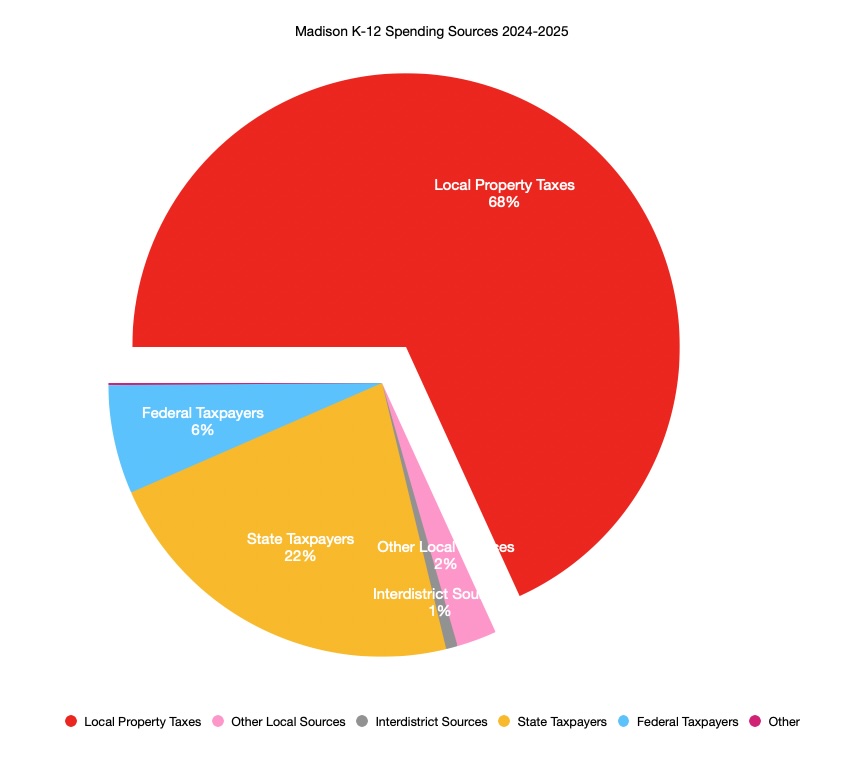
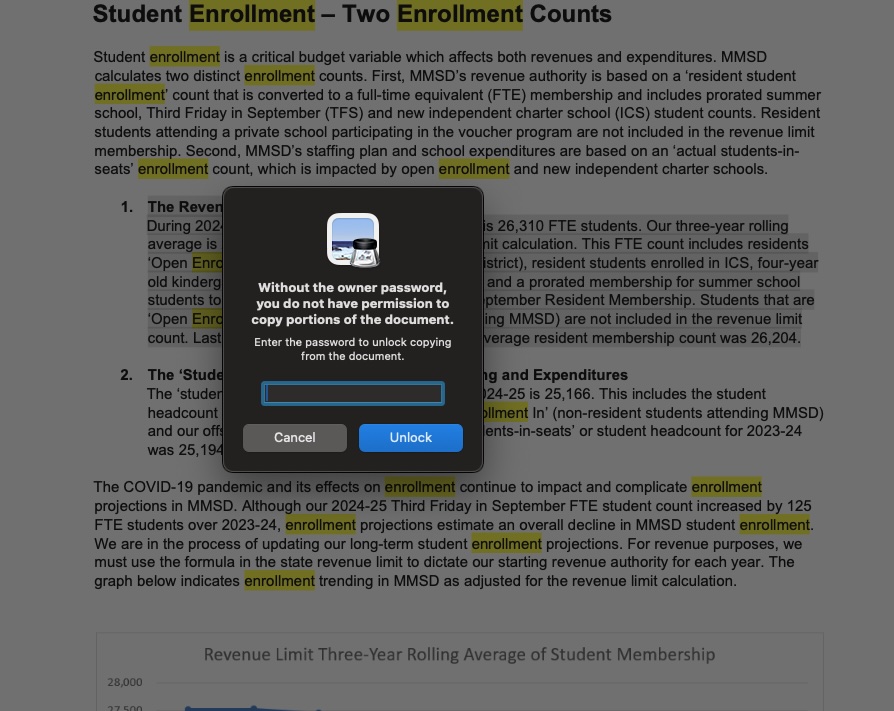
No copying!!
Much more on Madison’s K-12 budget, here.
Massachusetts residents voted Tuesday to scrap the requirement that high schoolers pass the Massachusetts Comprehensive Assessment System (MCAS) tests in math, science, and English in order to receive a high school diploma. Instead, the new law will allow students to demonstrate proficiency in these core subjects by “complet[ing] coursework certified by the student’s district.” The measure passed 59 percent to 41 percent after the Massachusetts Teachers Association spent $10 million to support the initiative, double the amount spent by its opponents.
In ditching the MCAS requirement, voters abandoned the cornerstone of the bipartisan 1993 Education Reform Act that fueled three decades of education gains in Massachusetts. Dating from 2001 through 2018 (the MCAS graduation requirement took effect in 2003), the share of students proficient in math grew by 33 percent and in English Language Arts by 40 percent. In 2005, Massachusetts became the first state to have its students lead the nation in all four major categories of the National Assessment of Educational Progress: fourth-grade reading and math as well as eighth-grade reading and math. The state has dominated the leaderboard ever since. In 2007 and 2011, international exams found that Massachusetts students were performing neck-and-neck with peers in high-performing nations like Japan, Korea, and Singapore.
Michael J. Petrilli and Devon Nir
States across the country have enacted new private-school choice programs in recent years, inevitably raising questions about accountability for participating institutions.
Though it is true—as our friends in the school choice movement argue—that choice itself is a form of accountability because of the agency it provides to parents and the power of the marketplace, we don’t think that “customer satisfaction” is enough. When tax dollars are in play, the public has a right to know that participating students are gaining essential skills. After all, we pitch in to pay for public education because everyone benefits when all children can access the knowledge and skills needed to succeed in life, ultimately ensuring the prosperity of the larger society and a healthy democracy. Education, particularly in the K–12 years, is both a private benefit and a public good.
Still, we recognize that getting accountability right requires a balancing act. If accountability provisions are too heavy-handed, private schools may choose not to participate—limiting choices for families. Or perhaps only those most desperate for students will sign up, driving down quality. Under pressure to raise test scores, private schools might also lose their distinctive character and shift toward uniformity with public schools, undermining the diversity of options that private-school choice seeks to provide.
——-
Meanwhile:
The data clearly indicate that being able to read is not a requirement for graduation at (Madison) East, especially if you are black or Hispanic”
My Question to Wisconsin Governor Tony Evers on Teacher Mulligans and our Disastrous Reading Results
2017: West High Reading Interventionist Teacher’s Remarks to the School Board on Madison’s Disastrous Reading Results
Madison’s taxpayer supported K-12 school district, despite spending far more than most, has long tolerated disastrous reading results.
“An emphasis on adult employment”
Wisconsin Public Policy Forum Madison School District Report[PDF]
WEAC: $1.57 million for Four Wisconsin Senators
Friday Afternoon Veto: Governor Evers Rejects AB446/SB454; an effort to address our long term, disastrous reading results
Booked, but can’t read (Madison): functional literacy, National citizenship and the new face of Dred Scott in the age of mass incarceration.
When A Stands for Average: Students at the UW-Madison School of Education Receive Sky-High Grades. How Smart is That?
The long-awaited report released Wednesday comes from the National Toxicology Program, part of the Department of Health and Human Services. It summarizes a review of studies, conducted in Canada, China, India, Iran, Pakistan, and Mexico, that concludes that drinking water containing more than 1.5 milligrams of fluoride per liter is consistently associated with lower IQs in kids.
The report did not try to quantify exactly how many IQ points might be lost at different levels of fluoride exposure. But some of the studies reviewed in the report suggested IQ was 2 to 5 points lower in children who’d had higher exposures.
Since 2015, federal health officials have recommended a fluoridation level of 0.7 milligrams per liter of water, and for five decades before the recommended upper range was 1.2. The World Health Organization has set a safe limit for fluoride in drinking water of 1.5.
More.
High rates of irreproducibility and of poor mental health in graduate students have been reported in the biomedical sciences in the past ten years, but to date, little research has investigated whether these two trends interact. In this study, we ask whether the experience of failing to replicate an expected finding impacts graduate students’ mental health. Using an online survey paired with semi-structured qualitative interviews, we examined how often biomedical science doctoral students at a large American public university experienced events that could be interpreted as failures to replicate and how they responded to these experiences. We found that almost all participants had experience with irreproducibility: 84% had failed to replicate their own results, 70% had failed to replicate a colleague’s finding, and 58% had failed to replicate a result from the published literature. Participants reported feelings of self-doubt, frustration, and depression while experiencing irreproducibility, and in 24% of cases, these emotional responses were strong enough to interfere with participants’ eating, sleeping, or ability to work. A majority (82%) of participants initially believed that the anomalous results could be attributed to their own error. However, after further experimentation, most participants concluded that the original result was wrong (38%), that there was a key difference between the original experiment and their own (17%), or that there was a problem with the protocol (17%). These results suggest that biomedical science graduate students may be biased towards initially interpreting failures to replicate as indicative of a lack of skill, which may trigger or perpetuate feelings of anxiety, depression, or impostorism.
The number of births of Japanese children in the first half of 2024 has continued its alarming downward trend, with only 329,998 babies born between January and June.
If this pace continues, the country’s annual birth count will fall below 700,000 for the first time since 1947, when comparative statistics became available.
On Nov. 5, the welfare ministry released preliminary population statistics, revealing a decrease of 22,242 births, a 6.3 percent drop, compared to the same period last year.
Choose life.
Voters in 137 school districts were asked to approve increased funding for schools. A preliminary analysis by the Wisconsin Policy Forum found 107 referendum questions passed, while 30 failed.
Ari Brown, a researcher with the Policy Forum, said the outcome is better than expected, but shows that overtime school district have gotten better at choosing when to put referendums on the ballot and how to word the questions.
Notes and links on Madison’s 2024 referendums.
Remember, federal agencies evolved over decades to obfuscate their internals to nosy humans. But they have no natural resistance to AI. Indeed, no agency can withstand this kind of AI interrogation.
So, this is how a small group of Elon-directed engineers can carve a path through DC, without the aid of a single corrupt bureaucrat or journalist. All they need is AI to ask the questions and X to distribute the answers.
It’s the Twitter Files, but for the entire federal government, and enabled by AI. And that’s how the digital network defangs the deep state.
Massachusetts residents voted Tuesday to scrap the requirement that high schoolers pass the Massachusetts Comprehensive Assessment System (MCAS) tests in math, science, and English in order to receive a high school diploma. Instead, the new law will allow students to demonstrate proficiency in these core subjects by “complet[ing] coursework certified by the student’s district.” The measure passed58.9% to 41.1% after the Massachusetts Teachers Association spent $10 million to support the initiative, double the amount spent by its opponents.
In ditching the MCAS requirement, voters abandoned the cornerstone of the bipartisan 1993 Education Reform Act that fueled three decades of education gains in Massachusetts. Dating from 2001 through 2018 (the MCAS graduation requirement took effect in 2003), the share of students proficient in math grew by 33% and in English Language Arts by 40%. In 2005, Massachusetts became the first state to have its students lead the nation in all four major categories of the National Assessment of Educational Progress: fourth-grade reading and math as well as eighth-grade reading and math. The state has dominated the leaderboard ever since. In 2007 and 2011, international exams found that Massachusetts students were performing neck-and-neck with peers in high-performing nations like Japan, Korea, and Singapore.
When the story of this election is written, I expect it will be as much about how half of America woke up to the reality that they have been manipulated by the media. This should lead to an abandonment by many of the MSM as their primary source of information. It will push more people to @X, to podcasts and other empirical sources, and it will lead to a more informed public.
Congrats @realDonaldTrump. You won fair and square.
Congrats to @elonmusk as well.
the average offline person lives a life so full of bliss that most of us can’t even fathom
Now we must show how the government can deliver:
- Clean and safe streets for all.
- Tackling our drug and behavioral health crisis.
- Shaking up the corrupt and ineffective bureaucracy.
- Building enough housing to turn around our affordability crisis.
- Breathing life back into our downtown, and ensuring our small businesses are thriving.
Here’s the truth: Turning around this city is not going to happen overnight. No matter who wins this election, we have extremely difficult challenges ahead.
It’s all the big stuff — defeat in Afghanistan, a porous border, inflation, and (yes, this really matters) Biden’s refusal to acknowledge reality and step aside in time for Democrats to have a real primary.
Winners: Elon Musk, Joe Rogan, Josh Shapiro, X, prediction markets, Peanut (RIP).
Losers: Randi Weingarten, ayatollahs, cable news, pollsters, Obama.
So it turns out that gaslighting the US people about the health of the President, not running a primary, campaigning on fear of your opponent vs the strength of your policies, and failing to separate yourself from a very unpopular President didn’t work out.
And:
Joe Biden at the EV Summit where he didn’t invite Tesla and he told GM and Mary that they led the EV revolution
God works in mysterious ways.
Among the evening’s most meaningful results: California’s Proposition 36, which raises punishments for theft and drug-related crimes, is passing overwhelmingly. Voters blue and red are fed up with woke approaches to law and order.
Clearly it has happened, and it has been accelerated and publicized by the Biden failings and the attempted Trump assassination. But it was already underway. If you need a single, unambiguous sign of it, I would cite MSNBC pulling off Morning Joe for a morning, for fear they would say something nasty about Trump.
Votes are still being counted in Chicago’s historic school board race, but it appears six Chicago Teachers Union candidates are poised to lose their races to pro-school choice/independent opponents.
I believe the biggest message may be in two states that Harris actually won – New Jersey and Illinois. Harris only winning two deep blue states by 4 or 5 points that Biden won by 17 points is a screaming message about progressive culture war failures. From crime to police to migrants to school board issues, etc. – even blue states become pragmatic when progressive ideology runs amok. This is not a political failure, it is a cultural one. Critical theory and its insidious ideological cousins are failures – and politics follows culture.
The Lincoln Project leaders will do even less soul searching than the newsroom denizens of the Washington Post and New York Times.
The stories of how Kamala Harris became the Democratic nominee, the pasts of Harris and Doug Emhoff, the coverup of Joe Biden’s loss of mental acuity, and how the attempts to keep Trump off the ballot, lawfare, and other anti-democratic efforts aimed at stopping Trump ironically backfired will only be told if the right people get the right book deals.
The reasons were clear if you were willing to tune out cable news.
For starters, their president, Joe Biden, had misinterpreted a narrow victory in 2020 as a mandate to make sweeping policy changes to everything from the border—some 10 million people crossed over illegally during Biden’s administration—to the national debt, which is more than $35 trillion. All the while, his Democratic Party advanced outlandish and radical social policies, such as support for biological men to compete in women’s sports, taxing unrealized capital gains, and colluding with social media companies to ban alleged health misinformation. He also insisted for most of his presidency that the very real inflation consumers experienced was fleeting and not serious.
Maybe the Democrats should try to a have a free and fair primary election to determine their next presidential nominee: one that extends beyond just Barack Obama Nancy Pelosi, Reid Hoffman and Alex Soros.
James Qually and Connor Sheets:
A tumultuous first term in office for Los Angeles County Dist. Atty. George Gascón ended in a failed reelection bid, with challenger Nathan Hochman defeating him by a wide margin.
Gascón swept into office in 2020 on a promise of reform and restorative justice, but Hochman — a former federal prosecutor and defense attorney — has spent months painting the incumbent as responsible for increases in crime and homelessness around L.A.
Dem atty @MarcEElias’s firm convinced the @FEC to allow campaigns & super PACs to coordinate GOTV.
It was intended to help @ColinAllredTX benefit from a @GeorgeSoros-funded PAC.
It backfired.
Allred lost.
And @ElonMusk’s PAC seized on it to help Trump.
Democrats, for their part, might ask themselves how exactly they lost to Trump, an ailing 78-year-old who much of the country despises. It probably wasn’t great to cover up President Joe Biden’s infirmities until they became undeniable on live TV. It wasn’t ideal that party elders replaced him with Harris, a nominee who had received no electoral votes and had failed decisively in a previous presidential run.
Voters don’t listen to Hollywood celebrities when it comes to voting. Most voters see Hollywood as great for entertaining but as far removed from their concerns when it comes to voting.
The working class and middle America voters are done being disrespected by college elites. They want real, merit-based opportunities not government subsidies.
Harris had 83 billionaires backing her.
What I learned about Trump’s landslide victory from one night in New York City.
Notes on the polls:
In 2016, 2020, and 2024 polls were systematically biased against Donald Trump, i.e. they systematically underestimated his performance. In the changes that were made to the 538 Pollster Rating methodology in 2024, pollsters were given a bonus for systematic bias.
Each time someone had to ask the Walgreen’s clerk to unlock the deodorant was a Republican campaign ad.
The woke mind virus and legacy media.
Baldwin left her brief event without taking questions.
A fundamental problem in the Democratic Party is that it now has vanishingly few politicians who can articulate this kind of point as cogently as the Republican VP candidate did here.
This is precisely why there are few more important causes than keeping the internet free and destroying attempts to centralize censorship power in the hands of Western elites.
Today, Blueprint released the first data-based report about why voters cast their vote the way they did with a new poll conducted in the days after Election Day and weighted to the 2024 election results.
This position as all-seeing middleman does indeed allow Google to collect vast tranches of information about you. The corporation can gather and store every word you say on or near your phone, and everything you do online—every time you break the speed limit, every massage parlor and weekend fling, even, with increasing accuracy, every cigarette, beer, and Twinkie you consume.
The existence of an all-seeing middleman is not, in and of itself, new. The postal system a century ago, AT&T fifty years ago, the internet itself twenty-five years ago—each of these old-school platforms also stood between us and the people with whom we wanted to speak and deal. And hence each of these platforms had access to enormous amounts of intimate information. But back then, the law required such entities to provide the same service on the same terms to everyone. Which meant they had few ways to profit from your private information, hence little interest in paying to collect and store it.
What makes Google and its peers unlike any corporation we’ve faced before is our failure to impose similar constraints on them. Unlike AT&T, we have failed at enforcing the laws that would prevent them from treating you differently from your neighbor.
Sam Raskin has wrapped his head around a math problem so complex it took five academic studies — and more than 900 pages — to solve.
The results are a sweeping, game-changing math proof that was decades in the making. Working with Dennis Gaitsgory of the Max Planck Institute and a team of seven other mathematicians, Raskin has solved a segment of the Langlands Conjectures, long considered a “Rosetta Stone” of mathematics.
The Langlands Conjectures, named after Canadian mathematician (and former Yale professor) Robert Langlands, suggested in the 1960s that deep, unproven connections exist between number theory, harmonic analysis, and geometry — three areas of math long considered distinctly separate. Proving these connections, mathematicians say, could suggest ways to translate certain areas of math that had seemed dissimilar.
Raskin, the James E. English Professor of Mathematics in Yale’s Faculty of Arts and Sciences, and Gaitsgory led a team that solved the geometry portion of Langlands.
In the fall of 2019, four high schools in a San Francisco Bay Area district shook up many of their ninth grade math classes. Students had traditionally been separated into more than five math courses by achievement level, from remedial to very advanced, and the district wanted to test what would happen if they combined their bottom three levels into one. Half of the students in those levels were randomly assigned to learn together, and half remained in their traditional tracks so that researchers could compare the difference.
Students in the lowest level who were part of the experiment skipped remedial math and were able to learn algebra with the majority of ninth graders. The experiment also meant that average, grade-level students were learning alongside peers who lacked foundational math skills.
It was risky. Students sometimes end up with lower math scores when they’re pushed to do work that is too advanced for them; that’s why California ended an eighth grade “algebra for all” initiative a decade ago. Grade-level students can also be harmed if teachers try to accommodate weaker students by making the material easier.
Over the past three months, an avowed left-wing organization has spent more than $9 million on Facebook ads boosting Vice President Kamala Harris and attacking former president Donald Trump. The spots have reached scores of swing state voters using a Facebook feature that allows advertisers to submit their own data—for political groups, that is, data they’ve compiled on voters—to reach a precise audience.
The practice is considered standard operating procedure for campaigns and PACs. But the group behind the $9 million digital ad blitz is neither a campaign nor a PAC—at least not on paper. Instead, it’s Courier Newsroom, liberal operative Tara McGowan’s organization that pushes Democratic talking points under the guise of local “news” outlets.
Courier’s Facebook ad spending—and its targeting tactics—reflect the extent to which Democrats rely on McGowan’s media project to reach voters online.
More.
Netnews, sometimes called Usenet, was arguably the first social network. Quarterman describes it as “one of the oldest cooperative networks”. It had a profound influence on online socializing, including helping to give to the world the current slang meanings of words such as “spam” , “troll”, and “flame”. It was where many technologies we now take for granted were first announced, including Linux, the World Wide Web, and the graphical web browser. But its design was a function of both its design goals and the technological context of the time. I describe those and a variety of other early design decisions, those which were right, those which were wrong, and those which were inevitable.
Among them, the province is no longer requiring teachers to specialize in an approved list of major or minor subject areas to get certified.
The data clearly indicate that being able to read is not a requirement for graduation at (Madison) East, especially if you are black or Hispanic”
My Question to Wisconsin Governor Tony Evers on Teacher Mulligans and our Disastrous Reading Results
2017: West High Reading Interventionist Teacher’s Remarks to the School Board on Madison’s Disastrous Reading Results
Madison’s taxpayer supported K-12 school district, despite spending far more than most, has long tolerated disastrous reading results.
“An emphasis on adult employment”
Wisconsin Public Policy Forum Madison School District Report[PDF]
WEAC: $1.57 million for Four Wisconsin Senators
Friday Afternoon Veto: Governor Evers Rejects AB446/SB454; an effort to address our long term, disastrous reading results
Booked, but can’t read (Madison): functional literacy, National citizenship and the new face of Dred Scott in the age of mass incarceration.
When A Stands for Average: Students at the UW-Madison School of Education Receive Sky-High Grades. How Smart is That?
A study trumpeting the value of applying rigorous standards to scientific research was retracted, in part because the authors didn’t follow their own advice.
In the sprawling project, scientists in four labs designed and tested experiments and then tried to replicate one another’s work. The intention, according to the study, was to test methods aimed at ensuring the integrity of published research. But the group neglected to fully document key aspects of the project ahead of running the experiments, one of the practices the study was looking to test, leading to the retraction.
The authors—who include two of the most prominent voices advocating for research reforms—dispute some of the criticisms and said any errors they made were inadvertent.
“It wasn’t because we were trying to fool someone, but it is because we were incompetent,” said Leif Nelson, one of the authors, a marketing professor at the Haas School of Business at the University of California, Berkeley.
Nelson helps write the Data Colada blog, a website known for discussing research methods and debunking studies built on faulty or fraudulent data. Recently, the blog gained attention for its blistering critique of a star Harvard Business School professor’s work, alleging that her research contained falsified data.
Will Fitzhugh:
There has recently emerged a refreshed concern over the fact that almost no American high school students read one complete history book while they are in school. This habit has been obscured by other concerns, over poor performances in math and basic reading, while Social Studies (including History) has faded from the views of EduPundits and school leaders of various kinds.
The near total absence of history books in the high schools has several unfortunate consequences. Students, even at some Ivy League colleges, have been found reluctant to attempt to read an assigned nonfiction book, because they have never read one before. In addition, the knowledge that could have been acquired from reading one or more history books in high school is not available to help students make connections with what they are hearing in lectures.
Some secondary students, not knowing any better, are reading history anyway. Since 1987, I have published 1,562 serious (average 9,000 words) history research papers by students from 47 states and 48 other countries in 142 issues of The Concord Review. As time has gone by, more and more of these papers are submitted as Independent Studies, suggesting that they are being done quite outside the expectations of their school Social Studies (or English) Departments.
One author, a Korean student at a highly selective private school in Massachusetts, wrote a 14,000-word paper (in his second language) on John Law, which we published. I had lunch with him when he went to Harvard and I asked why he had not offered the name of a teacher he had worked with. He said that no one at the school knew he was writing that paper. There was a Korean listserve, on which he had heard about the journal, and he decided to write the paper on his own. An autodidact. This sort of self-starting scholarship has characterized more and more of our authors as time has gone by.
Schools still do not assign history books or history term papers, but numbers of secondary students have discovered that if they spend a lot of time on them and do a lot of reading, there is a chance for their history essays to be published in a very well-established quarterly journal dedicated to the work of secondary students of history.
The journal only publishes 5-6% of the papers submitted, so that means that many students do not see their work in print. Nevertheless, what we hear, over and over, is that the effort to meet very high academic standards has enabled them to learn a good deal of history and greatly improved their nonfiction expository writing abilities. Even without getting published, they are proud of their effort and they feel they have gained a lot from the work.
Colleges seem to appreciate students doing serious work in history at the secondary level, and about 50% of our authors have gone to the Ivy League, Chicago, or Stanford. Others have gone to MIT, Wellesley, Amherst, Berkeley, Oxford, Caltech, Cambridge, and so on.
Colleges naturally look for students ready to do college work, and our authors, who have read extensively for their long serious history papers, have clearly gained and demonstrated that readiness.
In the wider world, as well, the ability to read nonfiction and write well are valued highly. Engineers and scientists, among others, also need to be able to read and write. The Pentagon recently complained about the problems they are having with maintenance crews who cannot read the manuals for the equipment they are assigned to take care of.
Fine literature is, of course, of fundamental value in a secondary education, but there is no excuse for allowing it to push aside any effort to have students read history books and work on history term papers.
Will Fitzhugh was born in Boston in 1936, and has a vague memory of Pearl Harbor. He has bachelor’s and master’s degrees from Harvard, and started The Concord Review in March 1987, while on a sabbatical from teaching history at the high school in Concord, Massachusetts. (tcr.org)
Leaving both rallies, he found himself with a more nuanced understanding of American political dynamics. The passionate energy and openness he encountered, particularly at the Trump rally, left him questioning some of his preconceived ideas, providing him with a unique perspective on the motivations and unity that drive each side.
“Our ruling class is disgusting.”
I don’t know why Joe Biden did not use his presidency to bring us together by working to make the voting process as transparent and squeaky clean. He knew half (or at least a third) of the country had doubts. Why didn’t he work to dispel those doubts? Did he want all this discord? Was he hiding malfeasance?
Just one of many opportunities squandered by Democrats, I’ll say. And by the way, we are down to the last few hours for making statements in the category I’ve been calling pre-postmortem.
ACT 20 READING UPDATE
• 440 schools ignored DPI about reading retraining progress. Below describes those who responded.• The large number may be due to teachers who previously completed a program or who chose a shorter retraining than LETRS. I welcome correction.
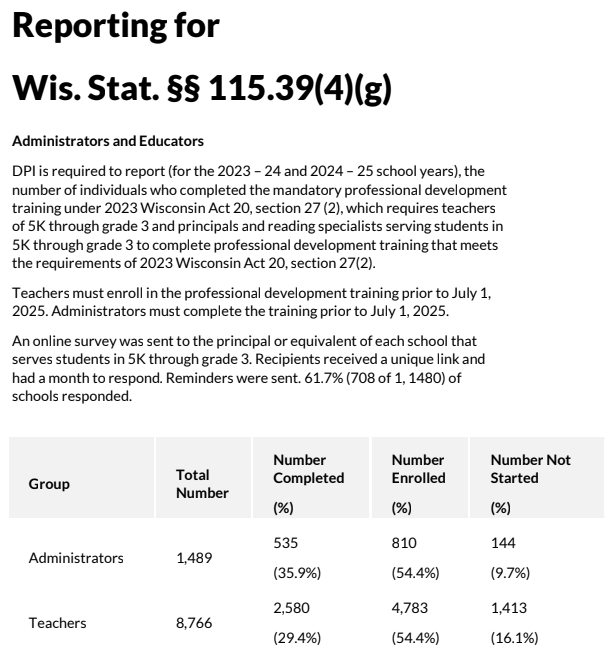
University of Wisconsin System Faculty or Academic Staff
2023 Wisconsin Act 20, section 27 (2) also requires professional development training for University of Wisconsin System faculty or academic staff member
who teach a course that includes curriculum in reading instruction designed for an individual who intends to apply for a license issued by the DPI to teach a grade from kindergarten to 3, to be a principal, or to be a reading specialist has received the professional. The training must be complete by July 1, 2025.The University of Wisconsin System provided the following statement for this
report:We are in process of complying with the requirements of Act 20 so the
Board of Regents can “ensure that, by July 1, 2025, any faculty or
academic staff member of the University of Wisconsin System who
teaches a course that includes curriculum in reading instruction
designed for an individual who intends to apply for a license issued by
the department of public instruction to teach a grade from kindergarten
to 3, to be a principal, or to be a reading specialist has received the
professional development training specified in par. (a) 1. and 2.”.
The data clearly indicate that being able to read is not a requirement for graduation at (Madison) East, especially if you are black or Hispanic”
My Question to Wisconsin Governor Tony Evers on Teacher Mulligans and our Disastrous Reading Results
2017: West High Reading Interventionist Teacher’s Remarks to the School Board on Madison’s Disastrous Reading Results
Madison’s taxpayer supported K-12 school district, despite spending far more than most, has long tolerated disastrous reading results.
“An emphasis on adult employment”
Wisconsin Public Policy Forum Madison School District Report[PDF]
WEAC: $1.57 million for Four Wisconsin Senators
Friday Afternoon Veto: Governor Evers Rejects AB446/SB454; an effort to address our long term, disastrous reading results
Booked, but can’t read (Madison): functional literacy, National citizenship and the new face of Dred Scott in the age of mass incarceration.
When A Stands for Average: Students at the UW-Madison School of Education Receive Sky-High Grades. How Smart is That?
yet only 31% of 8th graders in the U.S. are proficient in reading. This gap reveals how critical it is for parents to have a clear view of their child’s academic progress.
Under IDEA (34 CFR § 300.613), parents of children with disabilities have the right to promptly access educational records to make informed decisions about special education and placement. Similarly, FERPA grants all parents the right to inspect their child’s records within 45 days of a request.
American teenagers no longer think the USA is the “best in the world,” writes Jean Twenge, a San Diego State psychology professor, in The Atlantic.
In the early 1980s, 67 percent of high school seniors agreed that “Despite its many faults, our system of doing things is still the best in the world,” Twenge writes. That fell to 27 percent by 2022.
“Civics & Free Speech: “The problem is America has the most useless aristocrats in history”
Ted Dabrowski and John Klingner
It should be considered one of Illinois’ most egregious failures. School officials announced last week that in 2024 the state graduated high school students at a record 88 percent rate, even though the same data release showed that nearly 70% of graduating students can’t read or do math proficiently.
Take black students statewide. 81% of them graduated in 2024 though just 11% of those graduates were proficient in reading on the SAT as juniors the year before. Just 7% of the graduates were proficient in math. The student outcome data comes straight from the Illinois Report Card.
It’s not much better for Hispanics – an 85% graduation rate, with only 18% of them able to read and 14% able to do math proficiently on the SAT.
Overall, 88% of students statewide graduated despite SAT proficiency rates of just 32% and 27% in reading and math, respectively. State SAT results remained virtually unchanged between 2023 and 2024.
What that disparity shows is just how willing the educational establishment is to cover up its failures.
The data clearly indicate that being able to read is not a requirement for graduation at (Madison) East, especially if you are black or Hispanic”
My Question to Wisconsin Governor Tony Evers on Teacher Mulligans and our Disastrous Reading Results
2017: West High Reading Interventionist Teacher’s Remarks to the School Board on Madison’s Disastrous Reading Results
Madison’s taxpayer supported K-12 school district, despite spending far more than most, has long tolerated disastrous reading results.
“An emphasis on adult employment”
Wisconsin Public Policy Forum Madison School District Report[PDF]
WEAC: $1.57 million for Four Wisconsin Senators
Friday Afternoon Veto: Governor Evers Rejects AB446/SB454; an effort to address our long term, disastrous reading results
Booked, but can’t read (Madison): functional literacy, National citizenship and the new face of Dred Scott in the age of mass incarceration.
When A Stands for Average: Students at the UW-Madison School of Education Receive Sky-High Grades. How Smart is That?