School Information System

KEEP DIVERSITY IN THE CLASSROOM

The school board race has exposed beliefs among some citizens that I thought I had escaped by moving to a progressive city.
The people of Madison should be proud of the school board’s efforts to create a real world environment for our kids in the classroom, a real world made up of all types of learners of all economic backgrounds. To say that a teacher cannot teach a variety of students in the same classroom is an insult to Madison’s teachers.
Creating homogeneous classrooms would harm all students because it would deprive them of learning the skill and art of “getting along” with those who are different. The attitude that students should be segregated is outdated and prejudicial. It is also against the law. Students learn and absorb so much more in school than the content of a lesson.
I will vote for Arlene Silveira and Juan Jose Lopez because they are committed to maintaining an inclusive environment in our classrooms.
– Beth Moss, Madison
Letter to the Editor
Wisconsin State Journal, March 30, 2006

Share

Mathiak, Cole Will Restore Leadership

Now is the time for independent voices with fresh perspectives on the Madison School Board. Lucy Mathiak and Maya Cole offer both.
These two talented, qualified, progressive candidates will put children’s education and classroom support first, work hard to grow Madison’s schools of excellence and build community support for public education.
During March, the Madison School Board has had no discussions about next year’s $320 million-plus budget that will include more than $8 million in educational cuts. They won’t do this until late April. Meanwhile, administrators will mail staff cuts and levels to school principals on April 3.
Where is the public discussion about the budget? Where are the school board discussions on important issues of budget and curriculum policy, especially important during tight financial times?
Mathiak and Cole will bring leadership and governance of our schools back to the school board and back to the public.
Letter to Editor
Thursday, March 30, 2006 WI State Journal

Share

Channel3000, For the Record: Madison School Board Candidates

QT Video Neil Heinen hosted a “For The Record” discussion with the four candidates for Madison School Board. This video clip, from their podcast feeds is about 23 minutes long. Click on the image to view. Subscribe to their podcasts here.
Share

Wisconsin State Journal Endorses Maya Cole and Lucy Mathiak

The Madison School Board can no longer afford to do business as usual.
More to the point, families in the Madison School District can no longer afford a school board unwilling to take bolder action.
For that reason, voters should elect to the board on Tuesday two candidates promoting change: Maya Cole and Lucy Mathiak.
From Wisconsin State Journal, April 2, 2006
At stake is the School Board’s ability to pull the district’s budget out of quicksand, address shifting demographics, narrow the achievement gap between minority and white students and restore the public’s trust.
Cole, 43, is a stay-at-home mom with three sons from 6 to 9 years of age. She has been involved in a variety of school and political organizations, from the Franklin/Randall Parent Teacher Organization to Mothers Acting Up, a group encouraging mothers to be politically active on behalf of children.
Mathiak, 50, is an assistant dean at the University of Wisconsin’s College of Letters and Science. She has two teen-age sons, and her husband has two older daughters. She has been involved in several East High School organizations.
Cole and Mathiak come to the school board race from different backgrounds. But both believe that challenges closing in on the Madison schools demand action that the current majority on the School Board is failing to take.
They are right.
Their opponents, in contrast, are far too comfortable with the status quo. Running against Cole for Seat No. 1 on the board, being vacated by Bill Keys, is Arlene Silveira, 47, a marketing director for Promega Corp. of Fitchburg, and president of the Cherokee Middle School Parent-Teacher Organization. While Silveira would bring a welcome business perspective to the board, she lacks Cole’s drive to change the board approach.
Mathiak’s opponent for Seat No. 2 is incumbent Juan Lopez, a board member for 12 years who is too wedded to the way things have been done.
The Madison School Board is in an unenviable position. Outdated and unproductive state school financing rules have put school districts like Madison in a perpetual financial squeeze.
Meanwhile, the makeup of the district’s population has been shifting. Minorities compose a greater proportion of the student population, and the population is shifting from where the schools are to where they aren’t. In addition, the achievement gap between minority and white students continues to suggest that Madison’s schools are failing to deliver for too many students.
The board has cut, combined and conserved to hold costs down, and it has made some encouraging progress on closing the achievement gap. However, the board’s majority continues to shrink from new approaches, preferring to blame the state for a lack of money.
Yes, the Legislature should address school funding. But waiting for a magic solution from the Capitol only compounds the problem. Rather than looking to the state for answers, the board should look to itself.
The times require bold action. Between the two of them, Cole and Mathiak have some enlightened ideas, including plans to make the school budget process simpler, improve oversight of the budget and curriculums, reach minority students with more effective teaching and fairer discipline, challenge students with higher standards and consider the consolidation of administrative staff in the district’s central office.
A year ago the State Journal endorsed incumbents in two school board races on the belief that the board would continue to set priorities and address challenges. But since then, a lack of public trust in the board contributed to the failure of two out of three questions on a school referendum, and the board’s majority appeared to stick its head in the sand during the budget process.
It is obvious now that change is required.
Cole and Mathiak can supply new direction.

Share

The real race and the real story

Lets face it. We all take sides whether in the school yard, the Board room or the School Board Race.
Already, we see the lines of division. The Mathiak/Cole group on one side, the Lopez/ Silveira group on the other. What is ultimately at stake is the best interests of our children.
What do we do? In the case of the School Board race, I believe it all comes down to Who gets to run the show. And blame is at the root of it all.
As I look over all the candidates, skills, commitment, ability to articulate, ability to form solid opinions and positions I know who I will vote for. But when I lift the covers and look underneath something smells very fishy to me, it looks like one of the factions in the School Board race wants to change Superintendents. The BLAME game. We hear statements like, “We got here because he is in bed with the Teachers Union”; or “He doesn’t make good fiscal decisions”; or “He is responsible for cutting this or that, that “I” want for my child!”
An opinion piece in the April 1 Wall Street Journal by the School Board President of the Glen Ridge Board of Education in Glen Ridge, NJ states the case very well. She says “…Anyone with even a passing familiarity with New Jersey’s property tax woes knows that the real problem is not superintendents’ contracts, but legislators’ unwillingness to fix a school funding system that is irretrievably broken…” She went on, “Superintendents are responsible to local boards and taxpayers and on call 24/7. They build budgets, negotiate contracts, meet with parents, serve as the ‘public face’ of their districts, deal with facilities and construction projects, hire, evaluate and mentor administrators, observe teachers, and much more.”
On April 4 we have decision to make. Do we start over, as Ms. Cole says, and tear down what we have? Or, as Ms. Silveira says, do we build from a strong foundation? Do we bring in new talent as urged by Ms. Mathiak who has no public service record, or go with a proven child advocate, namely Juan Jose Lopez, who has a solid track record in the district?
These are the questions we must ask ourselves. We need to remember; when challengers to the current system say that we are spending more than we take in, keep in mind who made that misleading claim since our own legislature has mandated spending caps and rules that FORCE us to spend more annually than we take in. Some $8 million more.
This is not the fault of the Board or the Superintendent. And, although candidates for “change” Cole and Mathiak — state that they want to review the budget for more effective ways to use existing funds, I doubt that the current School Board hasn’t already examined all the options. Ms. Cole wants some type of 5 year plan to deal with the $40 million budget. That still leaves $8 million less per year to run the public schools. Ms. Mathiak, who wants to sell the Doyle building, is essentially saying, ?OK, here are a few bucks for this year and a de-centralized administration for the future. This makes no sense at all. It is hard enough to find the right person in one building let alone the communication nightmares we will would encounter as the school staff tries to work together from disparate locations.
The only plan that will help the budget crisis that our schools are in is for us citizens to elect public officials, local and statewide, who will give us more realistic budgets for our schools!
What to do. I am biased. I want stability, I want representatives that know change comes not from wholesale “slaughter” of our current system during an ongoing fiscal crisis, but from within. I want representatives for MY CHILDREN and ALL THE CHILDREN of Madison. I will vote for stability and sanity. Please join me in voting for the best interests of our children and vote on April 4 for Juan Lopez and Arlene Silveira.
David Wandel,
Past PTO President, Midvale/Lincoln,
Commissioner, Community Services Commission and Community Activist

Share

4 Candidates Vie For Madison School Board

NBC15:

Vying for Seat 1 on the board are Maya Cole and Arlene Silveira. On the matter of budget cuts, Silveira says keeping as many cuts as possible away from the classroom is her first priority, along with finding a better way to fund public schools.
“The state funding is broken and that’s going to continually strain all districts in the state of Wisconsin. That’s something we have to focus on lobbying the legislature to try and fix.”
Cole agrees that state funding is not working, but says the district needs to get organized first.
“I don’t see that we have the political capitol yet. Does that mean I’m not going to work on it? Of course not, but we need to be organized as a district and get the trust of our constituents before we can say it’s all the legislators fault.”
Cole also says the board needs to simplify the budget process, so the public knows exactly what it’s voting on if it comes down to a referendum.

Share

Endorsements come in many colors

In campaigning for the Madison School Board, I learned something that may be useful for voters. There are two very different kinds of political endorsements.
Endorsements that candidates seek. Some candidates seek the endorsement of organizations. In these situations, the organizations endorse the candidate only if the candidate passes its litmus tests. Madison Teachers Inc. (MTI) has this kind of process. Candidates are invited to complete a very long and detailed questionnaire and must appear before the Political Action Committee (PAC) to explain their answers. Endorsed candidates receive direct financial assistance from the PAC and help with the campaign (leafleting neighborhoods and get-out-the-vote phone banks). The PAC also buys “independent” radio and newspaper ads supporting the endorsed candidate.
Endorsements that candidates do not seek.. There is, however, a second kind of endorsement. Candidates who run as “independents” do not seek organizational endorsements and PAC funds. They do not make promises to move the organization’s agenda forward. They make clear that they are not seeking PAC funds. Nonetheless, the organization decides independently to support the candidate. The organization decides without consulting the candidate. It exercises its independent right to buy ads in support of a candidate. In the April election, ads from the “Get Real” organization are an example of the second kind of endorsement.
Big picture? Independent candidates–as in the April 4 school board race—offer value choices to voters. They stand as individuals. They ask for support for their goals. The only promises that they make are the promises to the voters. If elected, they are free to work for the values that the voters shared. They are not in the position of the candidates who owe their election, at least in part, to organizations that have their own interests.

Share

For The Record

Sunday 10 a.m., Channel 3’s For the Record will feature a debate among the four candidates for school board.
Here is my email to Neil Heinen regarding the station’s coverage including a discussion of some of the issues at stake in the race: To: Neil Heinen Subject: Sunday show
Dear Neil,
A new post up on SIS (https://www.schoolinfosystem.org/) discusses a debate at East yesterday covered by your station. Thank you for this and for dedicating Sunday’s show to the race.
One point that I’m not sure was reported correctly however, is the assertion in your coverage that the current board has not said who they support. The five-member majority has clearly stated their support for Silveira and Lopez (who is of course part of that majority and a candidate) while Robarts and Kobza have stated their support for Mathiak and Cole.
This race truly is for control of the majority and will dictate how we go forward on matters of heterogeneous classrooms (the dismantling of honors and possibly AP at West is part of that), school boundary changes, the construction of new and closure of existing schools, budget concerns, how to responsibly provide teachers health insurance, etc.
The Silveira/Lopez line is that Mathiak and Cole are focused merely on “process”. This significantly minimizes what’s at stake. The board is currently divided and removed from community input. For instance, when a school board member can’t get an item on the agenda because she’s in the minority, or she can’t get information she has requested from the superintendent, we’ve got closed, dysfunctional governance. Mathiak and Cole may not always vote the same with each other or Kobza or Robarts, but the four of them are dedicated to transparency and public participation. With that, I believe the community will be better informed and more likely to support the hard decisions facing our district as we go forward into a land of $40 million more in budget cuts over the next five years.
But there’s an even bigger topic that might be coming up soon. I’d appreciate if you could ask the candidates what they’d look for in a new superintendent. Rainwater has made no secret of his plan to retire in the not too distant future and it’s no stretch to believe that the next board majority will determine whether we hire someone like Art or someone who is less, shall we say, autocratic/didactic, someone who takes his direction FROM the board on policy matters rather than dictating it TO them?
Let me close by focusing on hetergeneous classes. The trend everywhere else is to have more not less AP and honors classes. I met a woman recently who is an education professor at Marquette. She was shocked to learn of MMSD’s policy changes, pointing out that in Milwaukee even the most impoverished schools have AP, with the focus being how to increase participation by more students, especially minority students. Extending the K-8 model into high school is irresponsible. The data clearly indicate that this model is failing our students. Indeed, even at West, the internal data show that the one-size-fits-all English 9 and now English 10 doesn’t work as advertised. Our children attend Stanford and Macalester. Almost all their classmates have had the full range of AP courses in their high schools, even those coming from small towns. Especially in science and math, this is critical. Success after MMSD is a measure that doesn’t get much play, but it really should be the ultimate measure of our students’ success, not just those who go on to college and post-graduate careers, but all our students. Are they prepared to participate meaningfully in society. Do they have the skills they need to be good critical thinkers, to make informed decisions.
As our district grows increasingly more diverse ethnically, and as the disparity socieconomically widens, we have to ask whether we can meet all students’ needs with the little red school house approach, if that model ever worked in a town our size. More important, perhaps, will be how the community will perceive this—a posting a few months back on SIS looked at the district’s demographic data and demonstrated that brain flight has already happened out of the West HS district. Folks will be voting with their feet if they feel those setting policy don’t care about all the children.
How we see ourselves and whether Madison continues to draw new folks to our community depends heavily on the strength of our schools. Obviously I believe we need a fresh start, but however you come down on it, the stakes are high.
Best,
Joan

Share

Northside Candidate Forum of 30-Mar-2006

The Northside Coalition sponsored a Candidate Forum on March 30, 2006 at the Warner Park Community Center.
The video of the forum QT Video is 170MB and 1 hour 50 minutes long. Click on the image at left to watch the video. The video will begin to play almost immediately so you can watch the forum as it continues to download; at DSL speeds, you should not experience any disruptions. The video contains chapter headings which allow quick navigation to each section and question asked (after that portion of the video has been downloaded), so you will be able to quickly view those portions of interest to you.
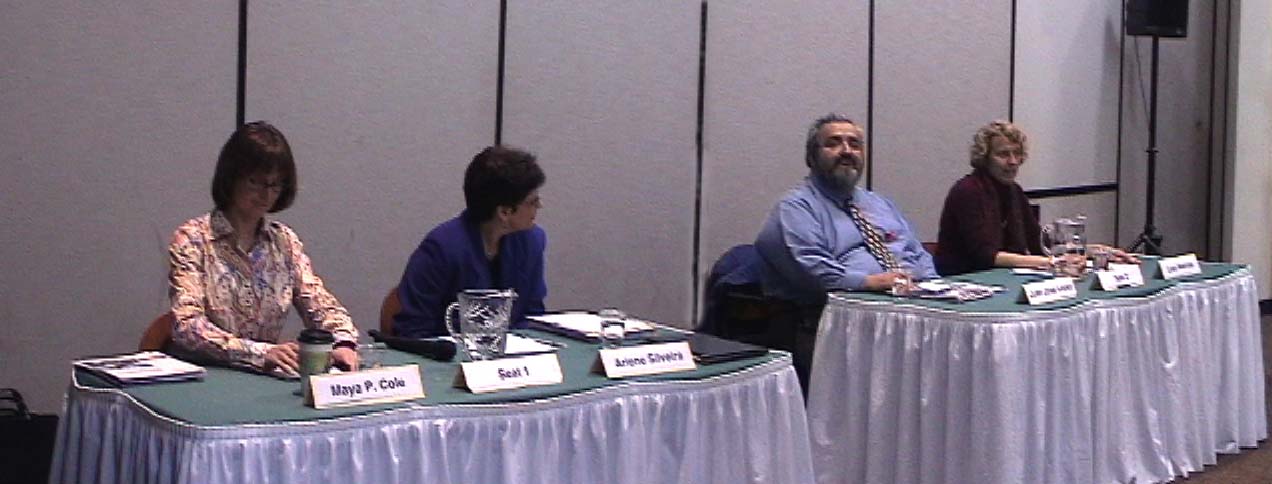
The candidates are, from left to right, Maya Cole and Arlene Silveira, vying for Seat 1, and Juan Lopez and Lucy Mathiak, vying for Seat 2.
One caveat. I was unsuccessful in my attempt to have the forum preceedings paused to allow me to change video tapes. Therefore, there is a 30 second gap in the video during the public questions portion, wherein a question was asked concerning the Reading Recovery program. The question itself was not recorded, and only a portion of Arlene Silveira’s response is present. The responses by Maya Cole, Juan Lopez, and Lucy Mathiak are complete.
If anyone recalls the missing question, please include it in a comment to this entry.

Share

Get Real PAC Money

This past Monday, I learned that the PAC Get Real planned to take out independent ads urging people to vote for Maya Cole and me for school board.
I have spoken with Get Real members and have been clear with Get Real and its leadership from the start: I do not accept PAC money or group endorsements. Its members need to read my responses to MTI and other campaign statements to see if they agree with my positions before offering support, because there are issues on which I do NOT agree with Get Real or its individual members. I am talking to all groups who invite me because I want all voters to understand what I believe and stand for.
After learning about the planned ads, I called Nancy Harper, as did several other people including Maya Cole, Ruth Robarts, and Lawrie Kobza. Some of us also called current Get Real president, Sam Johnson. Our message was clear and simple: you do not have permission to use our names, and we do not want you to run an ad in our behalf. They didn’t listen.
I, and other people, then consulted the editors of the two dailies and Isthmus to ask what recourse we had under the circumstances. It turns out that we have no recourse, legal or otherwise, if an independent political group wishes to post an ad using our names. That information was confirmed by my consultation with a lawyer.
While I support freedom of speech, I am deeply disappointed that Get Real chose to insert itself into my campaign at this time and in this way. And troubled that there is no way to prevent the false impression that I sought and accepted their endorsement.

Share

School Board Election is Pivotal

Sandy Cullen:

Who wins the two seats up for grabs on the Madison School Board could have a major impact on how the seven-member board deals with challenges ranging from budgets to curriculum.
The outcome of Tuesday’s pivotal election could shift the board majority from members some perceive as being too accepting of a course set by the administration to those clamoring for new ways of doing business.
If candidates Maya Cole and Lucy Mathiak win, they will join the two board members who support them – Lawrie Kobza and Ruth Robarts – in calling for new ways of approaching the district’s budget and other growing challenges. But incumbent Juan Jose Lopez – who faces Mathiak in his bid for a fifth three-year term – and Arlene Silveira – who is running against Cole – said they are anything but status quo.

Share

School Board Candidates Want to Get Past Politics

Channel3000:

Tuesday’s school board election will bring big changes as the winner replaces veteran school board member Bill Keys.
Maya Cole and Arlene Silveira both want to take over for Keys. Each woman has been aligned with one of the two factions of the school board.
But both candidates told News 3 the education of of the must rise above petty differences.
Cole on Friday told a local radio audience that she’ll ask a lot of questions as a fresh voice on the school board. Cole is cast in the role of a maverick who represents change, WISC-TV reported.
“That’s the way some people are perceiving it, and I think it’s unfortunate,” said Silveira. “I’m a very independent person, and I’ve been saying from day one that change is necessary.”
Silveira has the campaign literature and buttons that show she has the backing of the teacher’s union. She’s been cast in the role of a person who would stay the course, WISC-TV reported.

Share

Why I’m Voting for Mathiak and Cole on April 4

I think the State Journal received so many pro-Mathiak/Cole letters, they had to leave a lot of them out! Here’s my 200-word submission that didn’t make the cut:
Dear WSJ,
I am voting for Lucy Mathiak and Maya Cole on April 4. As a long time advocate for academic excellence for all students, I believe these courageous and independent-thinking women understand the complexity of the issues and will not settle for simplistic solutions. They understand, for example, that we cannot honor, much less celebrate, much less meet the educational needs of our diverse student population by treating all students the same. Cookie-cutter curricula and one-size-fits-all classrooms in our middle and high schools may make some adults feel good; but research shows clearly that those simple-minded approaches meet no student’s needs well. As Jefferson said, “Nothing is so unequal as the equal treatment of unequals.”
I am also deeply concerned about the longstanding culture of bullying on the BOE. I believe it has rendered the Board completely ineffective. I am convinced that a change of membership is the only way to bring back respectable and respectful behavior — not to mention increased transparency of operations and a thoroughgoing accountability to the public.
I am voting for Lucy Mathiak and Maya Cole because I believe that, as our elected officials, they will insist on data-based decision-making and refuse to collude with the current culture of secrecy.

Laurie Frost
Madison

Share

What would Juan and Arlene do?

Maya and Lucy have been clear about wanting a different budget process and document that might reflect the district’s commitments, policies, and activities. The current budget document and process don’t. The process uses a black box into which the administration inserts last year’s expenditures and presto! this year’s cuts come out.
I can’t find Juan or Arlene saying much about changing the budget process or document. Could those of you who support them (or even those who don’t) cite their discussions or suggestions on the budget process and document? Maybe I’m just not looking in the right places.

Share

VOTE FOR COLE AND MATHIAK

VOTE FOR COLE AND MATHIAK
This was a letter to the editor published in the Wisconsin State Journal, March 30, 2006
Dear Editor,
The best reason to vote for Maya Cole and Lucy Mathiak: Electing both will change the majority on the school board. Together, Maya and Lucy will restore decorum to a board now typified by bullying and rigidity. Open government, accessible to all, and transparent decision-making will be the new order. Instead of simply rubberstamping administration and union positions, Lucy and Maya will work hard to build consensus, to develop creative answers to knotty issues like budget constraints, curriculum standards, equity; and they will support their decisions with real data gleaned from outside the current echo chamber. A vast improvement over the status quo, they will also exercise genuine oversight, making the board, not the superintendent or the union president, the final arbiter of district policy.
These are women of high standards, integrity and a refreshing honesty, both deeply committed to educating our children. Please join me in voting for Cole and Mathiak on April 4th. Together, they will transform board governance by resurrecting civility, accountability and public accessibility so that our schools can best prepare all children for their and our future.
Joan Knoebel

(more…)

Share

Make Your Picks for the Madison School Board

The Wisconsin State Journal ran a number of letters to the editor in yesterday’s “Spectrum” section. Check them out here.

Share

Channel 3000 on the school board election

Yesterday, Juan Jose Lopez and I had the honor of debating in Mr. Borowski’s AP American Government and Politics class. The debate was open to anyone at East High School who wanted to attend. The students organized it, wrote and asked the questions, and managed one of the best debates that we’ve had since the campaign season began. Kudos to East and the class. Here is the Channel 3000 report ( Neil Heinen’s Sunday morning show will be taped dialogue with all 4 candidates)
School Board Candidates Face Off In Debate
Two Seats Are Open On Board

UPDATED: 9:25 am CST March 31, 2006
MADISON, Wis. — School board candidates up for election next Tuesday brought their debate to a Madison high school classroom on Thursday.
Incumbent board member Juan Jose Lopez and challenger Lucy Mathiak debated in a Madison East High School civics class.
During the debate, the students asked questions about some of their concerns, including curriculum questions about math and advanced placement classes.
Candidates responded by expressing their hopes and intentions for the district, WISC-TV reported.
Lopez said that he supports where the district is headed and that focusing on certain expectations have translated into the schools’ success.
“I’ve focused on student achievement. Student achievement is one of the most important things for young people in this community,” he said. “We value public education. We value excellence. We value what’s important to our young people in this community. Our public schools are No. 1 because that’s what we value.”
Mathiak said that she supports changes in district policy on things like the budget. She said that it’s important to plan for the future to keep the city’s schools ahead of the curve, WISC-TV reported.
“In Madison, we take a lot of pride in having strong schools,” she said. “We have excellent teachers, we have very strong programs, but I don’t think we can afford to be complacent. And by that, I mean we cannot afford to sit back and think that we have always had great schools so we always will”
Retiring school board member Bill Keys said that what’s at stake in this election is really an attitude toward public education.
“It’s going to have a decades-long impact to make the right kind of vote,” Keys said. “They should make an informed vote. They should read the literature.”
The two open seats for the school board have four candidates. Mathiak and Lopez are competing for one seat and Maya Cole and Arlene Silveira for the seat that Keys is vacating.
Lopez and Silveira have endorsements from Madison Teacher’s Inc., the teachers’ union. Mathiak and Silveira have been endorsed by the Capitol Times in their respective races.
The current board is split on who it will endorse, WISC-TV reported.

Share

Study to Examine California Public Schools

Mitchell Landsberg:

The studies, to be completed by the end of the year, will be aimed at giving state officials the information needed to reform the system, with a focus on whether funding is adequate and whether it is allocated efficiently and fairly.
That will mean taking on some politically delicate topics such as the discrepancies between rich and poor districts, and the difficulty of assigning the best teachers to the neediest schools.
“We admit we have an achievement gap, and that achievement gap is unacceptable,” state Supt. of Schools Jack O’Connell said in a telephone news conference about the research project. “We need a clear idea of what it’s going to cost to meet the different educational needs of our very diverse student population.”

Share

Monona Referendum: Mayor vs. School Board

WKOW-TV:

The Monona Grove School District referendum is just five days away, and the tension has just gotten thicker.
The issue has split the community, and now it has Monona’s Mayor and the School Board divided.
Both sides issued statements today and exchanged some heated words.
The Board accused the Mayor and Council of meddling in the District’s business, and Mayor Robb Kahl says the Board is personally attacking him.
This all started after the Mayor came out and publicly opposed the $29 million referendum, saying there’s a cheaper solution.
“When you can find a solution for about half that cost, it’s something where I don’t think I had a choice but to come out and make that known,” says Mayor Kahl.

Share

A Teacher on Education Schools

Ms. Cornelius:

Help me with something. What makes ed schools so special? In all seriousness are ed schools truly needed and if so, why? Why can students not have a liberal arts major and an education minor, student teach and then go into the classroom with full knowledge of the subject they are teaching. I guess a better question might be if I were to be a teacher what classes do I take as an undergrad and how many (and which) of those classes are truly meaningful and challenging? Which of the classes truly prepare me to teach?
…Just something I have wondered about — Today, it might help more people want to become teachers if they could teach something they were passionate about. Again, I do not know what classes education majors are required to take.
This is a serious question that deserves careful consideration, by people who have been in education schools and then tested out the theories taught there in the classroom. Unfortunately, serious and civil discussion is all too lacking. So let’s try. Here’s an expanded version of a comment I made:

Share

‘Virtual’ symposium brings nanotech, biotech topics to K-12 science teachers

University of Wisconsin:

The convergence of nanoscience, biotechnology and information technology is a major frontier in research, with potential to enhance human abilities and improve the nation’s productivity and quality of life. This virtual symposium provides an opportunity for K-12 science teachers and other educators to gain an understanding of the concepts and applications involved in these disciplines to solve current and future problems and for making the United States more competitive in the world marketplace. Science teachers will learn how to use these technologies topics to demonstrate the interdependency of the sciences of biology, chemistry and physics with technology in their science classrooms.

Share

Budget Forum Audio / Video

Rafael Gomez held a “Parent and Taxpayer Perspective on School Budgets” last evening. Participants included: Carol Carstensen, Peter Gascoyne, Don Severson, Jeff Henriques, Shari Entenmann, Jerry Eykholt and Larry Winkler. This 70 minute event is well worth watching (or listening via the audio file).

  • Carol discussed the “three legs” of school finance and passed around an article she wrote recently “State Finance of Public Education and the MMSD Budget” [112K pdf version];
  • Peter Gascoyne suggested that we embrace long term financial forecasts as a means to guide our planning. Peter also expressed doubts about any material change to state school financing of public education over the next five years (I agree with this assessment).
  • Don Severson mentioned Madison’s historic strong financial support for public education and the need to be as efficient as possible with the District’s $321M+ budget.

Audio [mp3] and video

Share

John Nichols: Maya Cole’s no closet conservative

Capital Times, March 30, 2006
By John Nichols
Paul Wellstone has been dead for a long three years, and yet there is rarely a national political debate that does not cause me to think: What would Wellstone do?
The late Minnesota senator was an epic political figure, who fought not just against right-wing Republicans but against those in his own Democratic Party who would warp it into a pale reflection of the GOP. Wellstone’s willingness to challenge the accepted political “wisdom” of the moment often put him at odds with folks he expected or at least hoped would be his supporters.
Madison School Board candidate Maya Cole, a graduate of “Camp Wellstone,” the candidate training program developed by the former senator’s family and friends to train a new generation of rabble-rousing contenders, knows that feeling. She’s a passionate progressive who has poured her energies into struggles to stop the war in Iraq, reduce gun violence, defend voting rights, challenge racism and reorder economic priorities so that society will be more just.

(more…)

Share

Performance and Achievement Meeting of 27-Mar-2006 Available

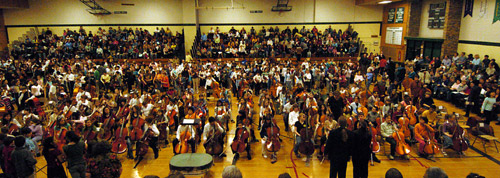
The Performance and Achievement Meeting of 27-Mar-2006 is now available. Julie Palkowski, the District’s Fine Arts Coordinator, made a presentation on the current Elementary Schools Strings program, and discussed future directions.

Share

Facts and Folly – Thomas L. Friedman, NYT

I was leaving for a trip the other day and scooped up some reading material off my desk for the plane ride. I found myself holding three documents: one was the Bush administration’s National Security Strategy for 2006; another was a new study by the Economic Strategy Institute entitled “America’s Technology Future at Risk,” about how America is falling behind the world in broadband. And the third was “Teaching at Risk,” a new report by the Teaching Commission, headed by the former I.B.M. chairman Louis Gerstner Jr., about the urgent need to upgrade the quality and pay of America’s K-12 teachers.
The contrast was striking. The Bush strategy paper presupposes that we are a rich country and always will be, and that the only issue is how we choose to exercise our power. But what the teaching and telecom studies tell us is that key pillars of U.S. power are eroding, and unless we start tending to them in a strategic way, we aren’t going to be able to project power anywhere.

(more…)

Share

MMSD Solicits Comments on Food Policy

Please share your opinion on the MMSD’s proposed food policy at http://www.mmsd.org/topics/food/food_survey.htm you can agree/disagree and comment on each section of the policy as well as see it. This is especially important because the policy has been changed since the final draft came out of Student Senate and thus bans pretty much all soda and candy/baked goods sales in the schools.

Share

Take Home Test: Week 10

Isthmus:

Share

MTI on Inclusion

For what it’s worth, this comes up when you Google for Madison and inclusion [pdf version]:
From a 1996 MTI document. Note the emphasis on appropriate support and funding, and the statement “MTI opposes the exclusive use of any full inclusion model.” Can anyone posting to this blog tell us whether this is still the MTI position (and I am not criticizing it) and what this means for the push to extend heterogeneous classrooms to all Madison Schools, as one of a parent noted in board testimony in early February?

  1. MTI believes that Inclusion exists when student(s) with disability(ies) attend age appropriate regular education class(es), with appropriate support and funding.
  2. MTI believes that Inclusion is one option in the full continuum of services and full range of delivery models available to students with disabilities as determined by the Individualized Educational Plan (IEP).
  3. MTI believes that Inclusion requires additional Federal and State funding. This funding is mandatory prior to the implementation of Inclusion and will continue for as long as this option exists.
  4. MTI believes that coordinated planning time for all educational employees involved is a requirement for successful Inclusion.
  5. MTI believes that the impact of Inclusion must be bargained.
  6. MTI believes that regular educators, special educators and support personnel must be involved as full partners in the planning for and implementation of Inclusion.
  7. MTI believes that inservice education for all educational employees involved in the implementation of Inclusion must be provided.
  8. MTI believes that modification in class size, scheduling, and curriculum design may be needed to accommodate the shifting demands that Inclusion creates.

Madison Teachers Inc. believes the prime consideration in the placement of all students should be the welfare of each student thereby requiring a full continuum of placement options. MTI opposes the exclusive use of any full inclusion model. Any decision concerning the placement of an exceptional student must be a majority opinion of those participating in the Individualized Education Plan (IEP) team meeting. MTI further believes that adequate safeguards must be provided for the classroom teacher to ensure that a proper classroom atmosphere be maintained at all times.

Share

Response to Betzinger et al on Heterogeneous Grouping

March 29, 2006
To the Editor of the Capital Times:
I read with interest the March 28 letter from Betzinger et al regarding heterogeneous grouping.
Using inflammatory “tracking” vs. “inclusion” rhetoric, the authors clearly misrepresent my position on the current debate, which was posted through the Isthmus on-line questions to candidates two weeks ago. I have stated my position in front of the board and in several forums attended by their group. I also have asked for dialogue with Barb Katz on more than one occasion and she has declined my request to learn more about her position.
Under the circumstances, I can only believe that the authors would prefer not to be confused by the record, which is:
Mathiak: Despite noble rhetoric in favor of this plan, I have deep reservations about the current push for “mixed ability grouping” (a.k.a. “heterogeneous grouping”). The district has failed to clarify whether the goal is to achieve a perfect demographic balance in each classroom or address the historic segregation of Madison’s advanced academic programs.
These are two very different objectives that would require different strategies to succeed.
Since 2000, the district has known that 27% of high school drop outs scored above the 84th percentile in the 5th grade math test; this group includes a large number of low income and minority students. If the district wanted to desegregate advanced academics it would require:

  • Early testing of all students to identify and nurture high ability students of color and low income students.
  • Reform of the middle school and high school guidance system to encourage rather than discourage advanced classes among students of color and low income students.
  • Creation of enough places in advanced classes to accommodate all students capable of success.

If the goal is to achieve a perfect population mix, we need to have a plan that meets the needs of all of the students in that mix. This means addressing several factors identified in successful models but which are not part of Madison’s current public school practice including:

  • The ability to control who attends the school and under what terms
  • The ability to require teachers to be trained in and to implement differentiated curriculum (one expert recently testified that this takes ten or more years to put in place).
  • Generous levels of in-stepping for students who are significantly above grade level.
  • Adequate numbers of support staff — social workers, psychologists, learning disabilities specialists, librarians, TAG specialists, and other core staff — to allow teachers to teach to all levels.
Share

TODAY’S CAPITAL TIMES LETTERS TO THE EDITOR

Beth Swedeen: Silveira best pick for School Board
A letter to the editor
Dear Editor: Arlene Silveira is the best choice for Madison School Board. She has shown her commitment to the overall issues facing the district through activities such as the effort to support a referendum last year and tireless work on the boundary task force. Instead of flip-flopping on tough issues, like whether a new school should be built to alleviate Leopold crowding, she has taken consistent stands and done the research to support her positions.
She doesn’t use jargon like “transparency” as an excuse to put off hard decisions. She has listened with respect to many stakeholders: parents, community leaders, school staff and those whose voice isn’t always heard. Because she has an asset-based approach, she will work for constant improvement in the district, not just for the sake of change.
Beth Swedeen
Madison
Published: March 29, 2006
The Capital Times
Michael Maguire: No business as usual for Cole, Mathiak
A Letter to the Editor
Dear Editor: The recent years’ actions of our Madison School Board create a nice template for a new reality television series, “School Boards Behaving Badly!”
The passionate, yet appropriately measured, and get-things-done approaches of Ruth Robarts and Lawrie Kobza would be complemented quite well by Maya Cole and Lucy Mathiak.
Cole is a bright, out-of-the-box child advocate who has a very clear focus on short-, mid- and long-tem thinking about how to tackle the school district’s toughest, high-priority issues of budgeting and enrollment. She brings no baggage of influences created by long-term relationships with district personnel, the major point of contention I have with Arlene Silveira’s candidacy. I worked with Arlene on the Memorial/West Task Force and I know that she has some good ideas.
With Maya Cole, district stakeholders can be assured that there are no favors to be made in doing what’s best for our district’s children, their families and taxpayers.
Lucy Mathiak is simply the better candidate. To date, she’s only delivered a no-nonsense, non-emotional vision for good district planning that, like Cole, is not burdened with a “business-as-usual” approach often assumed by incumbent board members.
Let’s create a majority of transparent doers on the School Board! Vote Cole and Mathiak!
Michael Maguire
Madison
Published: March 29, 2006
The Capital Times

Share

Ruth Robarts: Cole, Mathiak Offer Fresh Perspectives For School Board

From The Capital Times, Tuesday, March 28, 2006
Dear Editor: Old problems facing the Madison school district will continue and worsen unless the School Board opens its mind to new solutions.
We must raise public confidence in our decision-making, in order to gain support for the programs that our children need and the construction of new schools that is on the horizon. An open process that considers all the options would greatly increase confidence in our decisions, the likelihood of passing well-conceived referendums and business support.
I am supporting Maya Cole and Lucy Mathiak in the April 4 board election because both candidates bring new perspectives and independent thinking to the important public discussion of the future of our schools. Both worked their way through public schools and have children in our schools. Both volunteer in the schools. Both are committed to giving the public a bigger role in setting the course of the Madison schools. Both are aggressively looking for new approaches, and both understand that board members are the voice of the community when it comes to choosing curriculum to meet our children’s needs.
At the same time, Maya Cole and Lucy Mathiak are very much individuals. They offer different skills and work experiences. They think their own thoughts and communicate with a wide range of different friends, neighbors and colleagues. They are not clones of each other or anybody. They offer us a new synergy on the School Board.
Albert Einstein said, “We can’t solve problems by using the same kind of thinking we used when we created them.” He was talking to us. Let’s give his idea a serious try.

Share

Michael Maguire: No business as usual for Cole, Mathiak

From The Capital Times, March 29, 2006
Dear Editor: The recent years’ actions of our Madison School Board create a nice template for a new reality television series, “School Boards Behaving Badly!”
The passionate, yet appropriately measured, and get-things-done approaches of Ruth Robarts and Lawrie Kobza would be complemented quite well by Maya Cole and Lucy Mathiak.
Cole is a bright, out-of-the-box child advocate who has a very clear focus on short-, mid- and long-tem thinking about how to tackle the school district’s toughest, high-priority issues of budgeting and enrollment. She brings no baggage of influences created by long-term relationships with district personnel, the major point of contention I have with Arlene Silveira’s candidacy. I worked with Arlene on the Memorial/West Task Force and I know that she has some good ideas.
With Maya Cole, district stakeholders can be assured that there are no favors to be made in doing what’s best for our district’s children, their families and taxpayers.
Lucy Mathiak is simply the better candidate. To date, she’s only delivered a no-nonsense, non-emotional vision for good district planning that, like Cole, is not burdened with a “business-as-usual” approach often assumed by incumbent board members.
Let’s create a majority of transparent doers on the School Board! Vote Cole and Mathiak!
Michael Maguire
Madison

Share

INCLUSIVE EDUCATION AS A CIVIL RIGHTS ISSUE

A letter to the editor
Dear Editor: We are dismayed that two of the candidates running for the Madison School Board, Lucy Mathiak and Maya Cole, would work toward reversing access for students by promoting ability-grouping and tracking. In fact, Cole called the district’s efforts to provide more heterogeneous classes that all students could access “worrisome.”
Consider these points:
• The research has clearly shown that ability-grouping and tracking lead to unequal educational opportunities for students, particularly students of color, poor students and students with disabilities.
• Madison schools are regularly studied and visited by other urban districts looking for successful ways to increase inclusion.
• Only nine-tenths of 1 percent of MMSD’s African-American students are taking advanced placement classes, while more than 30 percent receive special education support.
• The achievement gap between white, middle-income students and all other students in the district is just starting to show improvement.
This is an issue of civil rights and full access for traditionally marginalized groups. Mathiak, Cole and their supporters can point to no hard data showing that including all students in classes with appropriate supports, services and differentiated curriculum harms the highest echelon. At most, they claim that some high-achieving students may be “bored.” Hardly a concern when the dropout rates, AP course access, and postgraduate outcomes for traditionally marginalized students continue to be both a nationwide and an MMSD problem.
Using words like “cookie cutter” approach and “one size fits all,” they portray the issue of access as one of “dumbing down” to low achievers. Nothing could be further from the truth in successful differentiated classes, where all students access curriculum at the learning levels that are appropriate for their individual needs and goals.
In fact, teaching in a fully inclusive model requires the best-trained, most creative and hardest-working school staff available. While Mathiak and Cole say it sounds good in theory, we have seen effective inclusive education in classrooms all over the district.
That’s why Madison Partners supports strong leadership, high-level training and total team teaching as strategies to improve Madison schools and outcomes for all students. Just because inclusive strategies are challenging doesn’t mean these research-proven methods aren’t worth doing.
We encourage the community to step forward on this critical civil rights issue.
Kelli Betzinger, Kristina Grebener, Helen Hartman, Barb Katz, Jane and Randy Lambert, Lisa and Mike Pugh, Tom Purnell, Beth Swedeen and Terry Tuschen on behalf of Madison Partners for Inclusive Schools
Published: March 28, 2006
Copyright 2006 The Capital Times

Share

Madison School Board Leopold Expansion and New West Side School Discussion

Watch or listen to the Madison School Board’s discussion and approval of expanding Leopold Elementary School and a new west side school. Though the Board did not vote on how to fund these schools. That decision will be taken at their April 10, 2006 meeting, according to Susan Troller. Video | MP3 Audio

Additional coverage:

Many links, articles and videos regarding the Leopold discussion can be found here.

Share

New Berlin School District Sells Naming Rights

Reid Epstein:

While other public schools have named sports stadiums after major donors, New Berlin is believed to be the first Wisconsin district to actively solicit naming rights sponsors for other areas of its schools.
The InPro corporate sponsorship, which is worth $150,000 to the district, is the first of what New Berlin school officials hope will be a gravy train of private money for the Reagan school and the district’s high school additions.
Quite literally, the names of everything from conference rooms to weight rooms are for sale.

Share

Majors Not For High School Students

Josh Cohen:

Lost in this consumer’s plight is the student’s struggle to figure things out for his or herself. Gained is a concentration of power in the state.
What may be most egregious about the plan is that with the inevitable succession of self-proclaiming experts will come the further diminishment of a teacher’s authority in the classroom. Teenagers may think this sounds cool, but several years later, in the real world, they will find themselves terribly misled. The Senate should resist the powerful forces at hand, reject Gov. Bush’s proposal and relegate adolescents back to where they belong: in high school, without a clue.

Share

Mathiak wins Capital Times endorsement

Under the headline, Mathiak for School Board, the Capital Times editors, wrote:

Lucy Mathiak sounds in many ways like a veteran member of the Madison School Board. She knows the budget, she is well versed regarding major debates about boundaries, curriculum, construction and referendums, and she well understands the complex personal and political dynamics of the current board. But Mathiak is not a board member. Rather, she is a first-time candidate challenging a board veteran, Juan Jose Lopez, whom this newspaper has always backed in the past. It is a measure of how impressive Mathiak is that we are endorsing her this year, despite our respect for Lopez. Mathiak is a super-engaged parent and citizen who, while raising two children, earning a doctorate in history and working as director of communications and college relations for the University of Wisconsin’s College of Letters & Science, has taken a remarkably active role in the debate over public education for the better part of two decades. . . .

Share

Board of Ed Elections

The recent years’ actions of our MMSD Board of Ed create a nice template for a new reality television series, “School Boards Behaving Badly!”
The passionate, yet appropriately measured and get-things-done approaches of Ruth Robarts and Laurie Kobza would be complemented quite well by Maya Cole and Lucy Mathiak.
Cole is a bright, out-of-the-box child advocate who has a very clear focus on short-, mid- and long-term thinking about how to tackle MMSD’s toughest, high-priority issues of budgeting and enrollment. She brings no baggage of influences created by long-term relationships with MMSD personnel, the major point of contention I have with Arlene Siveira’s candidacy. I worked with Arlene on the Memorial/West Task Force and I know that she has some good ideas.
With Maya Cole, district stakeholders can be assured that there are no favors to be made in doing what’s best for our district’s children, their families, and taxpayers.
Lucy Mathiak is simply the better candidate. To date, she’s only delivered a no-nonsense, non-emotional vision for good district planning that, like Cole, is not burdened with a ‘business-as-usual’ approach often assumed by incumbent board members.
Let’s create a majority of transparent do-ers on the BOE! Vote Cole & Mathiak!

Share

Johnny’s Big Idea

As a member of the Memorial/West Task Force, I recently received an e-mail for BOE member Johnny Winston. Doing his best caped crusader, Johnny pontificates to us about saving the day for Leopold families. To wit,
[title of his e-mail] “The Leopold Community Needs School Board Leadership
By Johnny Winston, Jr., Vice President of the Madison School Board” and,
“I pledge to provide strong leadership in both the short and long-range plans for Leopold Elementary school and the affected communities.”
Johnny’s BID IDEA is to build more space at Leopold. Like we haven’t proposed that before.
Among the proclamations he made in his mini missive was this sign off: “The time is now for the Madison school board to provide the leadership necessary to solve Leopold Elementary School’s current overcrowding and the welcomed challenges that growth brings.”

(more…)

Share

REFLECTIONS ON ISTHMUS ARTICLE, “THE FATE OF THE SCHOOLS” BY 22 PARENTS AND COMMUNITY MEMBERS

Last Thursday, the Isthmus newspaper published an extensive article by Jason Shepard entitled “The Fate of the Schools.” While the article covered many areas of interest regarding the school district and the upcoming school board elections, we have significant concerns about the way in which the article was written. These concerns include:
CONTEXT:
• The data in the article were used inappropriately. This story compares Madison’s schools with the small, suburban, middle-class districts surrounding it. A more comparable study would have looked at other districts with similar proportions of low-income students, such as Green Bay, LaCrosse, Racine and Milwaukee. The data also was not dis-aggregated. If it had been, it would have revealed that Madison’s white, non-poor children do as well as and even surpass both Dane County and larger districts in Wisconsin. Of that group, 96% of the “non-low-income” students scored proficient or advanced.
• Additionally, MMSD has 35% of the county’s 3rd graders – and 70% of the county’s low-income 3rd graders. On the math scores quoted in the article, it wasn’t pointed out that while Madison “only matches” the state average, Madison’s overall poverty rate is 30 percent higher. Madison continues to score above state and national averages on the ACT exam each year, despite the fact that more low-income and non-white students are taking the exam each year. MMSD had 69% of all the National Merit Semifinalists in the county this year (with only about 40% of the students).
SOURCES:
• The top sources of information listed in the article when talking about diminishing public support for MMSD and data on the schools come from two sources: talk radio and the SIS blog, neither of which are primary sources. Also, no grassroots parent groups or civic groups were interviewed other than SIS. And, no educational experts from curriculum and instruction at UW-Madison were interviewed, yet it is listed as the number one Graduate School of Curriculum and Instruction in the United States (U.S. News and World Report, 2006).
• We acknowledge that many families have opted-out of the district, for a variety of reasons. However, the overall trends for enrollment in and outside of Madison also reflect the growth and availability of new housing. It is very difficult to pull out whether the bulk of the enrollment choices were based on perceived educational quality of MMSD or for a larger house with more young families in the neighborhood. Just as anecdotal evidence from SIS and other sources indicate disengagement from MMSD, we could assert, with just as much authority that, based on our own experiences with people we know, families continue to move into MMSD for its breadth of instruction, diversity, and high quality teachers and staff.
ACCURACY:
• On the issue of equity, MMSD should not be blamed for segregated housing in Madison. And in fact, many of the board members have supported increased resources to schools with high poverty rates, not just Ruth Robarts and Lawrie Kobza. The formation of a new equity task force came from Carol Carstensen. Lawrie Kobza voted against its formation.
We raise these concerns in the interest of fairness, to give our fellow SIS readers a broader understanding of the issues covered in the article.
Submitted by: Francoise Davenport, Kirsten Engel, Jerry Eykholt, Kristina Grebener, Andrew Halada, Denise Halada, Molly Immendorf, Barbara Katz, Ed Kuharski, Jane Lambert, Randy Lambert, Beth Moss, Duncan Moss, Marge Passman, Lisa Pugh, Thomas Purnell, Fred Swanson, Beth Swedeen, Terry Tuschen, Barbara Wagner, Margaret Walters, and Andrea Wipperfurth.

Share

Educational Flatline in Math and Reading Bedevils USA

Greg Toppo:

Despite nearly 30 years of improvements in U.S. children’s overall quality of life, their basic academic skills have barely budged, according to research led by a Duke University sociologist.
The “educational flatline,” as measured by scores on math and reading exams, defies researchers’ expectations, because other quality-of-life measures, such as safety and family income, have improved steadily since 1975.
More recently, even areas that had worsened in the 1970s and 1980s, such as rates of teen suicide, have improved dramatically, so researchers had expected that education improvements would soon follow. They didn’t.

2006 Child Well-Being Results.
The Educational Flatline, Causes and Results:The Education Flatline: Causes and Solutions

Share

Teaching Commission Final Report

The Teaching Commission:

The Teaching Commission, the non-profit advocacy organization founded by former IBM chairman and CEO Louis V. Gerstner, Jr., this morning released a final report urging state and local leaders to go “far further, far faster” in transforming the teaching profession. The message comes as the Commission ends its work on schedule, three years after its inception.
“If teaching remains a second-rate profession, America’s economy will be driven by second-rate skills,” said Gerstner. “We can wake up today-or we can have a rude awakening sooner than we think.”
In its final report, Teaching at Risk: Progress and Potholes [Complete PDF Report], the Commission cites significant progress since 2003-but, due to the urgency of the challenge of improving America’s skills in an increasingly competitive global economy, gives state, local and federal leaders disappointing grades for their work in four crucial areas:
….
Local districts. Superintendents and school boards should, among other things, “resist the pressure to continue paying teachers more money across the board without any meaningful changes in the way those increases are doled out,” and “much more attention needs to be paid to how teachers are hired, moving up timetables and eliminating transfer rights on the basis of seniority.”

They also published a companion report on state’s legislative activity [pdf report] in four areas:

  1. Compensation and Performance
  2. Skills and Preparation, and
  3. Leadership and Support

Wisconsin had no legislative activity in these areas during 2004-2005. I’ve seen a number of teachers go the extra mile (or more), whether it’s working after school hours with children who are far behind in math and reading, adding more children to a classroom to help another teacher or implementing a new curriculum better suited to student’s needs. I hope, over time, we as a society can create better compensation models for teachers. Paul Soglin has more on this.
Marjorie Passman’s words, in the comments below are well worth reading.

Share

Marisue, will you open your posts for comments?

I noticed that you haven’t left your last couple of posts open for comments. I hope that you just forgot and didn’t do it to keep people from engaging you in a discussion.
If the comments were open, I’d have asked you whether you will be asking the board tonight to support the MMSD string program. Will you be?

Share

Task Forces Are an Important Mechanism for Bringing People With Different Perspectives Together to Work on Important Issues – What About Music and Art Education?

Tonight the School Board’s Performance and Achievement Committee will discuss a status report on the elementary strings class, which they received last Thursday.
This report describes the current course, but the report a) is not an assessment of the course and b) says nothing about the future of the course. (Mr. Rainwater told me the committee only asked for a status report.) I have been one of hundreds of advocates for this course over the past 5 springs, and I see the same thing unfolding again this year that I have in the 4 previous springs without any work from the preceding year on this academic course. This course is much loved by generations of people who live in Madison, many who do not have children in the schools but do vote.
Not included with the status report is a draft vision statement developed by a group of string teachers. It’s long, needs more discussion with string teachers and the community (all string teachers have seen this) but with this draft statement a) these teachers tried to come up with something meaningful, which top management asked them to do and b) these teachers have had less than two hours of group time to even discuss what the future could be and that ended abruptly in December with no further next steps. These same teachers were given no time to work together on what adjustments needed to be made to curriculum when class time is cut in half. In June, they asked the interim FAC, who forwarded this request to Supt. Rainwater. The meetings did not take place. I don’t feel this should happen, especially when drastic curriculum changes are being considered.
For five years, hundreds of students, parents, community members and community organizations have asked for your help – either restructuring the course of redesigning this course, but working with the community in some way to keep arts strong, because it’s so important for achievement.
I and others have been strong proponents of making the course work in our current financial situation. Over these five years, I feel we have lost opportunities to develop relationships which are important for acquiring funds, to assess and redesign the K-5 music education curriculum, to develop funding sources for small group lessons for children afterschool to further strengthen what they learn during the school day.
Last year the elementary strings course reached about 1,800 students in 27 schools. Nearly 600 children (42% of the low income children in Grades 4 & 5 participated in this course). This year the course is teaching 1,650 students. The status report does not say how many low income. I do know from conversations with the Fine Arts Coordinator and with teachers that more low income children indicated an interest in taking elementary strings than were in the class for many reasons, I am sure.
I think elementary strings is an example where there have been hundreds of advocates for keeping this course, but minimal positive response and support from the School Board to bring the professionals and advocates together to work on this and other music and art issues. We have task forces for boundary changes, afterschool, live animals in the classroom, equity, etc. Given the community’s love of the arts, such a task force seems right for the arts.
I’d like to see the dialogue change this year for elementary strings and for music and art education to one where we talk about how can we work together. I would like to see the School Board consider a community task force under the oversight of the Performance and Achievement and the Partnership Committees that would bring advocates for music and art education and professionals together to work on this issue. I would like to see such a committee work on short-term issues re the elementary strings course, but also develop a 5 year fine arts strategic community plan. I have spoken with teachers, music organizations, private music teachers, the Fine Arts Coordinator and the Superintendent about the need for this. I have heard positive responses from community members and teachers, interest from the Fine Arts Coordinator.
I feel such a committee needs to be led by well-known community leaders who support the arts and arts education in the schools, because developing relationships within the community will be important for partnerships and possible fundraising.
I also think such a committee is important for credibility and for continuity. Over 5 years, MMSD has had 3 fine arts coordinators with one year without a fine arts coordinator. In spring 2003, the last fine arts coordinator was getting up to speed, in the 04-05 school year a teaching team was to help with coordination when the fine arts coordinator position was cut but this group was not put in place, and now the district has a new fine arts coordinator, who is working hard, meeting the community, teachers, helping in many ways. I think this is a critical position on the district and an important member to be on a community fine arts education committee.
Lastly, without classes during the day for elementary strings, there is no way to reach as many low-income children as the course currently reaches. Also, the district loses something special. Hundreds of children have asked the Board for help. I hope they do.
I will commment on this at the School Board meeting tonight. I have taken to writing on the blog vs. speaking at School Board meetings, because, after 5 years, and personal attacks, it takes too much out of me.

Share

Live Animal Discussions Important – It’s the Lack of Budget Discussion that Concerns Me and the Likely $8 Million in Cuts Going to Schools on Monday, April 3rd

Dear School Board Members:
When I looked at the School Board calendar for March, what jumped out at me was the lack of any Finance and Operations committee meetings on 06-07 budget issues even though a) allocations go to schools on April 3rd and b) tonight the School Board majority will likely vote to pay for the debt service on an addition to Leopold with what could amount to an additional $350,000 cut from the operating budget.
What I did see were meetings on Live Animals in the Classroom. My concern was not so much that I saw Live Animals in the Classroom on the agenda (although I wish this issue had been resolved positively and fairly when it first came up 1.5 years ago, I support and mean no disrespect to the members or the work of this committee) but that budget discussions were missing. Earlier this calendar year I was left with the impression that the Superintendent had informed the School Board that March would be filled with discussions about the budget.
I did see important issues such as the Equity Task Force meeting and board discussions about boundaries and schools, but I did not see any discussions about the budget scheduled, and I do not yet see any formal meetings re the budget on the School Board calendar as yet.
In her email to PTO Presidents, Carol Carstensen said the School Board decided not to consider cuts until after the School Board has the entire budget and they will have the document sooner this year rather than later this year, but not until the end of April, or thereabouts. I and others have made suggestion along these lines in previous years – you do want to discuss cuts in the context of the entire budget; however, the devil is in the details and that is where I have concerns.
The budget timeline the School Board is working from says the administration is going to send out allocations to schools on April 3rd. Straight forward administrative task – once again the devil is in the details. In his email to me, Superintendent Rainwater said that the timing of allocations is driven by the union contract deadlines for layoff notices (late May) and surplus notices (July 1 but MMSD gives them in mid-April). Also, Mr. Rainwater informed the School Board earlier this year that the District would be facing $8 million in cuts next year.
Now, as the Superintendent informed me, many things go into allocations. However, he will have $8 million less next year than he felt would be needed, so $8 million in cuts will have to be made. The question is when and how will these cuts be made? If the union deadlines drive the April 3rd date, then I would expect cuts will be included with the allocations that go out to schools on April 3rd as has been the case in preceeding years. If that is the same this year, I feel the School Board and the public needed to know what budget framework is being used to send out the allocations – class sizes, courses, etc. I feel there needed to be public discussions about this.
School Board members tell the public that final decisions about cuts are their decisions. That’s true, but in practice it is not. By the time allocations are determined in mid-May, there will be little opportunity for the public or the School Board to have much, if any discussion about the budget and the $8 million in cuts. I don’t agree with that. I think it is bad policy.
I believe live animals in the classroom are important. Re this issue, I only wish that more progress had been made by now – I looked up references to this as far back as Fall 2004. My daughter attended Franklin Elementary School and visited Mary Powell’s classroom – so did I! Re. live animals in the classroom, I think we need a board policy that makes this experience part of our children’s education. I guess I thought the existing policy, as Mary Powell pointed out in Fall 2004, addressed the issue.
Sincerely,
Barb Schrank

Share

Cap Times Heartily Endorses Silveira for Seat #1

A Cap Times editorial
It has been a good long while since Madison Metropolitan School District voters have had an opportunity to vote for a new School Board candidate who is as prepared as Arlene Silveira is to hit the ground running and to have an immediately positive impact on the process.
The parent of an 8th-grader, Silveira currently serves as the president of the Cherokee Middle School PTO and is the past president of the Leopold Elementary School PTO. She’s been a highly engaged member of the school district’s West/Memorial demographics task force and has worked closely with the Madison Foundation for Public Schools. She’s on the steering team of Madison CARES, the group set up to inform voters about referendum issues. She’s a regular at School Board meetings, and she showed up for her Capital Times endorsement interview with a copy of the budget in hand and a clear familiarity with the document.
To a board where new members are often marginalized by a demanding learning curve, particularly when it comes to budget issues, Silveira will bring knowledge, skills and contacts that are likely to make her a more significant contributor than several veteran members.
That’s important, because difficult budget, referendum timing and curriculum issues are on the agenda immediately and this board is no place for a newcomer who will simply fall in line with one of the two relatively well-defined factions that have developed around Carol Carstensen, the current board president, and Ruth Robarts, the loudest and most frequent critic of the board majority and school district administrators.
Silveira is backed by Carstensen and other members of the board majority, while her opponent, Maya Cole, is backed by Robarts and board member Lawrie Kobza. But Silveira, who works for the Promega Corp., is too sharp and too concerned about issues facing the school district to fit easily into one of the board’s existing camps. Her own experiences as the mother of a Latina daughter in the public schools, as an active parent at the elementary and middle school levels, and as a member of bodies charged with advising the board on critical issues regarding overcrowding and new construction, have made her exceptionally sensitive with regard to the achievement gap, to curriculum and to spending matters that have divided the board in the past. As such, she is refreshingly blunt about her desire to build new coalitions so that the board can present a more coherent message to the community particularly when it comes time for referendum votes.
It is this combination of experience and independence that underpins our faith that Silveira is the better choice in the contest for Seat One on the board, which is being vacated by former board President Bill Keys. We think her no-nonsense approach will help the board overcome some of the pettiness that has distracted it in recent years, and we are excited by the prospect that as a savvy newcomer she will forge an effective working relationship with Kobza, who has much to contribute.
The only qualm we have about endorsing Silveira has nothing to do with her. Rather, it has to do with her opponent.
Maya Cole is an exceptionally appealing candidate. Like Silveira, she is a genuine progressive, with a track record of activism that is as long as it is impressive. Cole would be a fine School Board member, and we hope that she will run again in the future.
But, at this essential turning point for the schools, we are convinced that Silveira is better prepared to join the board as a fully prepared and fully engaged member. She is ready to serve as the progressive coalition builder that the board needs to get focused and to win the confidence of all the constituencies students, staff, parents, taxpayers whose support is essential to maintaining one of America’s great urban school systems.
Published: March 27, 2006
Copyright 2006 The Capital Times

Share

Longtime advocates for academic rigor and educational excellence back Mathiak and Cole

Recent post from the Madison United for Academic Excellence (MUAE) list serve:
Dear MUAE Friends,
When we volunteered to oversee a District-wide “TAG” parents email list back in 2002, it was in part to help out the District “TAG” staff and in part to make the list available for explicit “TAG” advocacy efforts. We never expected that it (or we) would become explicitly political; but then, never in million years did we expect to have the crystal clear choice in BOE candidates that we have before us this year.
As fellow members of this on-line community, we think you need to know that Juan Lopez — however laudable his other views and positions may be — has the most extreme and consistent anti-“TAG” voting record of any BOE member who has served on the Board in the ten years that we have been involved with the issues. Juan once actually said to Jeff in a budget-focused BOE meeting, when Jeff was arguing in support of “TAG” funding, something like “Jeff, why should I support this? It has nothing to do with minority students.” Not surprisingly, Juan has shown absolutely no interest whatsoever in the District dropout data that we have “put out there” many times in the past three years.
In very stark contrast, we first met Lucy Mathiak almost ten years ago, when we were still relatively new Franklin ES parents. We had attended a couple of District-wide “TAG” parent meetings and wanted to do some organizing and educating within the Franklin community. Someone gave us Lucy’s name as a very well-informed east side parent and excellent speaker. We invited her to a meeting; she came; she educated us about Standard t and how to influence our school’s SIP (“School Improvement Plan”); and she inspired us to greater things, as both parents and education advocates. In a word, we were thrilled last fall when we learned that Lucy had decided to run for School Board.
It is our firm belief that if the District’s academically talented and motivated students are to have a fighting chance at having their educational needs met in our schools, they need a strong voice and representation on the BOE. They need someone on the BOE who understands their lived experience; someone who understands the issues facing the District in a way that includes them. Lucy Mathiak thoroughly understands these students, their needs, and the issues, in part, because she has lived them as a parent. As we see it, Lucy has the experience, the knowledge, the commitment, and the deep confidence to make sure that the brightest students of all colors and backgrounds are well taken care of by the Madison schools. In our opinion, no one else even comes close. For voters who care about academic excellence for all, the choice couldn’t be more clear.

VOTE FOR LUCY MATHIAK FOR MADISON SCHOOL BOARD SEAT #2 ON TUESDAY, APRIL 4.
What about the race for Seat #1? The truth is, we do not know either Maya Cole or Arlene Silveira nearly as well as we feel we know Juan and Lucy. Nevertheless, we know who we are voting for.
Consider the following paragraph from an op ed piece of Arlene’s that appeared in the Wisconsin State Journal in January:

Racial and economic achievement gaps.
The School Board must address differences in proficiency levels and graduation rates between racial and ethnic groups. In addition to continuing efforts such as School of Hope, small class sizes and cultural competence training opportunities for teachers and support staff, we must develop partnerships with community groups and provide venues for parents to come together to help the district find ways to allow all children to succeed. With the high mobility rates of some students, we must look at ways to help stabilize students’ school experience. The board cannot be proud of the district’s progress until all groups of students achieve equal success in all academic disciplines throughout their school careers.

(bold added)

Frankly, that last line scares us. We have asked Arlene more than once what she means by it, but she has yet to respond. Arlene is openly pro-heterogeneous classrooms, we know that; but her vision sounds like Camazotz, the evil place in “A Wrinkle In Time.”
In contrast, we have spoken at length with Maya about her candidacy, her vision for the BOE and the District, and her own experiences as a parent. It is our very strong impression that she has started down the road that the rest of us are already on and that — like Lucy — she “gets it.” Maya is a courageous and independent thinker who will insist on data and documentation and who will not be cowed by bullies. She understands the need for increased transparency and increased accountability on the BOE and in the District administration. She does not support cookie-cutter curricula. She does not support heterogeneous classes. Like Lucy, she wants to find ways to increase minority participation in “high end” classes, not get rid of the classes according to some misguided notion of what constitutes educational equity. If you care enough about rigorous curricula and high academic standards to be on this list serve, then Maya Cole is the one for you.
VOTE FOR MAYA COLE FOR MADISON SCHOOL BOARD SEAT #1 ON TUESDAY, APRIL 4.

There is one more reason why we are voting for Lucy and Maya on April 4. As longtime observers of the Madison School Board, we are deeply concerned about the culture of bullying and secrecy that exists in the Doyle Building and on the BOE. We feel it has paralyzed the Board and rendered it completely ineffective. We are convinced that a change of BOE membership is the only way to bring back respectable and respectful behavior — not to mention increased transparency of operations and a thoroughgoing accountability to the public — to the task of educating our children.
Many thanks for your consideration,
Laurie Frost, Ph.D., and Jeff Henriques, Ph.D.
West HS and Hamilton MS Parents
Former Franklin-Randall ES parents
Former Franklin-Randall PTSO Board member (Diversity and Community-Building Committee Chair) (LF)
West HS PTSO Board Member (Treasurer) (JH)
Advisory Board Member, Wisconsin Center for Academically Talented Youth (WCATY) (LF)
Madison United for Academic Excellence

Share

Madison Schools’ Proposed Comprehensive Food Policy

Madison Metropolitian School District News Release:

Community asked for feedback on proposals, Board will begin to consider next month
As the next step in developing a Madison School District comprehensive food policy, recommendations are being released today by a student work group for consideration by the Board of Education.

There’s been quite a bit of discussion on this topic here.

(more…)

Share

2006 West Side Strings Festival: Photos & Video


Check out the photos and video from this great event.
[Download a video ipod compatible file here.]

Share

A Parent and Taxpayer Perspective on School Budgets

Rafael Gomez is hosting a Forum this Wednesday evening (3/29/2006) from 7 to 8:00p.m. at the McDaniels Auditorium [map and driving directions]. The topic is a A Parent and Taxpayer Perspective on School Budgets. Rafael’s guests on the panel include:

We hope to see you there!

Share

MAFAAC & Communities United School Board Candidate Forum Audio

MAFAAC (the Madison Area Family Advisory/Advocacy Committee) and Communities United (a broadly-based coalition of groups and individuals representing Madison’s minority communities, and other citizens working on behalf of social justice and civil rights) held a school board candidate forum yesterday. MP3 Audio clips are avaible below:

  • Opening Statements: [10.7MB mp3]
  • Question 1: What do you think the causes are of the achievement gap? [7MB mp3]
  • Question 2: What role do community groups play in addressing the achievement gap? [4MB mp3]
  • Question 3: How would you rate the leadership of Superintendent Art Rainwater? [7.5MB mp3]
  • Question 4: What are the sources of the discord, the disagreement on the board? [7.5MB mp3]
  • Question 5: Barbara Golden Statement on Dissent, David (I could not catch his last name) has a question on the budget & Candidate Responses to the budget priorities. [6MB mp3]
  • Question 6: Latinos Unite for Change in the Classroom. What are you going to do to support the needs of the ELL students? [3.5MB mp3]
  • Question 7: The district insists that a young child go through an ESL program. The parents disagree. What is your role if someone brings you a case like this? [4.5MB mp3]
  • Question 8: The chair of Communities United’s Statement and Question: What specifically would you do to insure that there is equity in the (District’s) programs. [8.5MB]
  • Question 9: Audience questions regarding heterogeneous vs homogeneous classrooms; can people in the community who care about an issue like heterogeneity, get that in front of the school board? The way the board is currently comprised, the answer is no. [10.5MB mp3]
  • Complete Event: 2 hours, 30 Minutes [65MB mp3]
Share

“D.C.’s Distinction: $16,344 Per Student, But Only 12% Read Proficiently”

Education & Academia:

he District of Columbia spends far more money per student in its public elementary and secondary schools each year than the tuition costs at many private elementary schools, or even college-preparatory secondary schools. Yet, District 8th-graders ranked dead last in 2005 in national reading and math tests.
Not one U.S. state can boast that a majority of the 8th-graders in its public schools last year had achieved grade-level proficiency or better in either reading or math.
How much money did your state spend per pupil while failing to adequately educate in reading and math the majority of students in its public schools? The answers are in the chart below.

Wisconsin ranked 11th in per student spending ($9,805 – Madison spends about $13,107 per student (321M budget [pdf]) / 24,490). Via Joanne, who notes that there is not much correlation between spending and NAEP test performance. UW-Madison emeritus professor Dick Askey discussed NAEP scores with respect to math performance recently.

Share

“City Schools Could try Pirating Students”

Susan Lampert Smith takes a light hearted look at the effects of the state school aid formula (based on growing or declining enrollments):

In this week’s Crawford County Independent, reporter Charley Preusser writes that school districts out there are so desperate for students (and the $5,900 in state aid that comes with them) that they’re actively courting and stealing each other’s students.
This odd situation was set up by our state aid formula, which brutally punishes districts that decline in enrollment. By now these districts have cut so many of the extras that their remaining students are starting to look elsewhere.
A thoughtful columnist would urge that the Legislature fix this situation before Wisconsin’s public schools are destroyed. But I’ve tried that, and apparently our legislators can’t be bothered by something so trivial.

Jason Shepherd referenced this issue in his definitive Isthmus article on the April 4, 2006 Madison School Board race. Madison’s enrollment has declined somewhat over the past few years, while the city and county continue to grow. This exacerbates the District’s financial challenges.

Share

Bridgette and Gregg White: Silveira best choice for School Board

A letter to the editor
Dear Editor: We believe supporting Arlene Silveira for Madison School Board is the best choice.
Large organizations like the school district need care and attention. Silveira has communicated with broad constituencies in her PTO, referendum and task force work awareness. She seems to know that you have to problem-solve and promote at the same time in order to keep the school system from suffering the consequences of many modern institutions.
We urge a vote for Silveira on April 4 so that our schools keep delivering the value they are known for.
Bridgette and Gregg White
Madison
Published: March 24, 2006
The Capital Times

Share

MSCR committee planting questions at School Board forum

Ruth Robarts originally posted the following:
On March 30, the North Side Planning Council will host a public forum for school board candidates at the Warner Park Community Recreation Center starting at 7 p.m. Usually, the NSCP moderates a panel discussion with the school board candidates. During the forum, the candidates respond to a set of questions developed by NSCP. When time permits, the moderator facilitates questions from the audience.
There’s a new twist this year. A citizen advisory committee for the Madison School Community Recreation (MSCR) program is planning to bring a list of its own questions.
On Tuesday, March 28 the MSCR Citizen’s Advisory Committee will meet to “develop questions to ask Board of Education candidates” at the NSCP forum, according to the official agenda of the committee.
The citizen members of the advisory committee are all appointed by the Board of Education. Board member Johnny Winston, Jr., is currently the representative of the school board on the committee. Senior staff from MSCR participate in these meetings.

Share

MSCR committee planting questions at School Board forum

On March 30, the North Side Planning Council will host a public forum for school board candidates at the Warner Park Community Recreation Center starting at 7 p.m. Usually, the NSCP moderates a panel discussion with the school board candidates. During the forum, the candidates respond to a set of questions developed by NSCP. When time permits, the moderator facilitates questions from the audience.
There’s a new twist this year. A citizen advisory committee for the Madison School Community Recreation (MSCR) program is planning to bring a list of its own questions.
On Tuesday, March 28 the MSCR Citizen’s Advisory Committee will meet to “develop questions to ask Board of Education candidates” at the NSCP forum, according to the official agenda of the committee.
The citizen members of the advisory committee are all appointed by the Board of Education. Board member Johnny Winston, Jr., is currently the representative of the school board on the committee. Senior staff from MSCR participate in these meetings.

Share

The fate of the schools

Will the Madison district sink or swim?
April 4th elections could prove pivotal

At the end of an especially divisive Madison school board meeting, Annette Montegomery took to the microphone and laid bare her frustrations with the seven elected citizens who govern Madison schools.
“I don’t understand why it takes so long to get anything accomplished with this board!” yelled Montgomery, a Fitchburg parent with two children in Madison’s Leopold Elementary School. She pegged board members as clueless about how they’ve compromised the trust of the district’s residents.
“You don’t think we’re already angry? What do we have to do to show you, to convince you, how angry we are? If I could, I’d impeach every single one of you and start over!”
Impeachment isn’t being seriously considered as solution to the Madison Metropolitan School District’s problems. But infighting and seemingly insurmountable budget problems have increasingly undercut the board’s ability to chart a positive course for Madison schools.

And that’s not good, given the challenges on the horizon for a district of 24,490 kids with a $319 million budget. These include declining enrollment of upper- and middle-class families; continuing increases in low-income families and racial minorities; an overall stagnant enrollment which limits state funding increases; and prolonged battles with parent groups over everything from boundary changes to curriculum choices.
By Jason Shepard, Isthmus, March 23, 2006

(more…)

Share

Schools Cut Back Subjects to Push Reading and Math

Sam Dillon:

Thousands of schools across the nation are responding to the reading and math testing requirements laid out in No Child Left Behind, President Bush’s signature education law, by reducing class time spent on other subjects and, for some low-proficiency students, eliminating it.
Schools from Vermont to California are increasing — in some cases tripling — the class time that low-proficiency students spend on reading and math, mainly because the federal law, signed in 2002, requires annual exams only in those subjects and punishes schools that fall short of rising benchmarks.
The changes appear to principally affect schools and students who test below grade level.

Share

MMSD administrators will propose cutting 92 positions

According to a document apparently floating around the Doyle Administration Building and MTI offices, the MMSD administration will recommend cutting 92 positions when the Board of Education meets on April 3.
Disappointment best describes my reaction. I’m not surprised, of course. I’m not even upset that the union has the information even before the board, since it might be wise to alert John Matrhews rather than surprise him on April 3.
I’m disappointed. Disappointed because the board and administration have not listened to a single plea about following a new budget process. This is the same-old same-old. The administration puts last year’s spending into a black box. And presto! Cuts come out.
For years, those of us on schoolinfosytem.org and others throughout the community have begged and pleaded for a more understandable budget process, for input on the budget from the community, for a budget that reflects some set of priorities, and this year a budget that reflects the $100 budget exercise.
We should have saved our breath.
The administration and board don’t hear.
They only want to talk AT us — to tell us that we don’t understand the state budget, don’t understand the district’s changing demographics, don’t understand the complexity of school issues – like we’re all dummies.
But we DO understand all of that!
What we don’t understand is the MMSD budget process, the MMSD budget document, and the MMSD budget priorities. And to tell you my frank opinion, neither does a single soul on the board because they too never get to see inside the black box and they have no priorities to reflect in the budget.
It’s time to throw the bums out and replace them with board members who will listen, respond, and create an open process and understandable budget.

Share

Considering the Future of Madison Schools

Marc Eisen:

Unless you have a kid in the Madison schools, many of the issues discussed by the four Madison school board candidates in our weekly Take-Home Test may not strike a familiar chord.

That’s why we asked our schools reporter Jason Shepard to provide an overview in this week’s Isthmus of the trends buffeting the 24,000-student district. The cover story is: The Fate of the Schools: Will the Madison district sink or swim? April 4th elections could prove pivotal.

As you’ll read, the growing number of poor students, decreased state funding and nasty board infighting provide a sobering context for the election.

Shepherd has written the definitive piece for the April 4, 2006 election. Pick up the current Isthmus and have a look or view the article online here. I’ve placed two charts from the article below (click continue reading….. if you don’t see them).

(more…)

Share

“Regional Tax Base Sharing”

Madison Alder Zach Brandon:

Joint Economic Development Zones
A “Capital Corridor” municipal tax base sharing model
It is imperative that the City of Madison, and the surrounding municipalities, seek out new opportunities to expand and diversify the region’s economic base. Utilizing forward-thinking business development strategies to create jobs is essential in meeting that goal. The City of Madison should be proactive in facilitating regional economic development through innovative cooperative agreements with neighboring municipalities and through the development of regional strategies for growth.

via the daily page.

Share

“Expectations for Our Teachers Are Misplaced”

Arthur Levine, writing in the Chronicle of Higher Education:

Several years ago, I was part of a group that a philanthropist had assembled to review his foundation’s education agenda. In the course of a two-day meeting, the conversation turned negative only once, when education schools were discussed.
The philanthropist said he had given up on education schools, preferring to work with business schools or organizations outside of colleges and universities. A former governor who was known to be a thoughtful education-policy leader chimed in, calling the flagship education school in his state largely irrelevant. A major school-system superintendent reported having told the two education schools in his area that if they were unable to turn one of his high schools around, they should go out of business. Dismissively he said that only one of the education schools was even trying. A union leader nodded in agreement, something the superintendent had rarely experienced.
This is an age of finger-pointing. As profound demographic, economic, global, and technological changes rack the country, all of our social institutions — created to serve a disappearing world — perform less well than they once did. As they try to adjust to a society in motion, they appear to be broken and unable to fix themselves. Thus we say the government is broken. The American family is broken. So it is with the education school.
The response by the public is to withdraw. As it does, we increasingly see the institution in distorted caricature, and we develop unrealistic expectations for what it should be able to accomplish. We blame the institution for all of the problems in its field and deem its inability to change willful.

Share

Dumbing Down Proficient: Intel, State Farm Heads Say Easy State Tests Sap U.S. Education

Bloomberg:

After only 50 percent of Arizona’s eighth-grade public school students passed a standardized reading test, state education officials took decisive action: They made the exam easier. Last year, 71 percent of students were rated “proficient” in reading.
As students throughout the U.S. undergo the latest round of tests this month, corporate leaders including Craig Barrett, chairman of Intel Corp., and Edward Rust, chief executive officer of State Farm Mutual Automobile Insurance Co., say they’re concerned about slipping standards among states. They’re exploring whether to renew a decade-old push for national tests.

A commenter over at Joanne Jacobs notes that “Every state must participate in the NAEP every year”.

Share

Back to School

The Economist:

“TEACHERS, teachers, teachers.” Thus the headmistress of a school near Helsinki, giving her not-exactly-rocket-science explanation for why Finland has the best education system in the world.
…….
It has achieved all this by changing its entire system, delegating
responsibility to teachers and giving them lots of support. There is no streaming and no selection; no magnet schools; no national curriculum; and few national exams. It is all, as that Finnish headmistress suggested, about getting good teachers–and then giving them freedom. If there is a lesson for EU leaders, it is: forget about multiple priority areas and action plans. European governments should go back to school. In Finland.

(more…)

Share

“Public education is the foundation of our democracy”

George Lucas, writing about education and his Foundation (via Maya Cole’s post on Effective School Boards:

Public education is the foundation of our democracy — the stepping stones for our youth to reach their full potential. My own experience in public school was quite frustrating. I was often bored. Occasionally, I had a teacher who engaged my curiosity and motivated me to learn. Those were the teachers I really loved. I wondered, “Why can’t school be exciting all of the time?” As a father, I’ve felt the imperative to transform schooling even more urgently.
Traditional education can be extremely isolating — the curriculum is often abstract and not relevant to real life, teachers and students don’t connect with resources and experts outside of the classroom, and schools operate as if they were separate from their communities.
Project-based learning, student teams working cooperatively, students connecting with passionate experts, and broader forms of assessment can dramatically improve student learning. New digital multimedia and telecommunications can support these practices and engage our students. And well-prepared educators are critical.
Our Foundation documents and disseminates the most exciting classrooms where these innovations are taking place. By shining the spotlight on these inspiring teachers and students, we hope others will consider how their work can promote change in their own schools.

Share

Nutrtitional Battle Lines Form at Schools

Brenda Ingersoll:

Mindful of the obesity epidemic and nutritional goals, the Madison School District is thinking of banning soda sales in its high schools, and candy in elementary and middle schools.
In the DeForest School District, a committee is mulling giving students more whole- wheat bread and switching to lower-fat milk.
In Mount Horeb, a similar “wellness” committee is pondering phasing out the chips and candy bars available in vending machines, and replacing them with fresh fruit and granola bars.
And Oregon is considering offering raw carrots, broccoli and celery daily, instead of a few times a week.

Share

WIBA Interview with School Board Candidates Lucy Mathiak and Maya Cole

12MB mp3 audio file from today’s WIBA interview.

Share

“What Kind of School Board Will You Vote For April 4th?”

Seat 1 Candidate Maya Cole:

I’ve got this stopwatch in my house that my campaign manager gave me for practicing speeches. The problem is that I can’t figure out how to stop it; and, it occassionally will sound off from the deep recessess of my laptop bag. It goes off probably once a day.
My kids pretend it’s a ticking timebomb. I think of it as a reminder to use every day wisely. It is a metaphor for my school board campaign that will be decided on April 4th.
So I kindly suggest to voters and supporters to concentrate on the issues. The task before you is one of choosing your school board; and make no mistake, this race is about status quo or investing in something new.
To help you out I have taken the liberty of providing five characteristics that make an effective school board. I see these suggestions as a guideline for change. Read them and then try to guess the source.

Links, articles and interviews with Maya Cole and her opponent, Arlene Silveira, are available here.

Share

SHOULD LEOPOLD EXPANSION BE PAID FOR OUT OF THE OPERATING BUDGET?

A proposal is before the Madison Metropolitan School Board to approve a $2.8 million addition to Leopold funded under the revenue caps. The Board may vote on this proposal on Monday, March 27. While the Leopold overcrowding is a serious problem that absolutely must be addressed, the question for the Board is whether this should be addressed by cutting an additional $343,000 (the yearly debt service on the $2.8 million loan) from programs and services from our operating budget.
What would we have to cut to pay for this? We don’t know yet, but examples of items that could be proposed for cuts include:

  • Elimination of the entire elementary strings programs (approx. $250,000)
  • Elimination of High School Hockey, Gymnastics, Golf, and Wrestling ($265,000)
  • Reduction of 4 Psychologists or Social Workers ($277,000)
  • Reduction of 7 Classroom Teachers ($350,000)

While no one wants to pit one educational need against another, that is what happens in the budgeting process when we are constrained by revenue caps. Paying for necessary physical improvements to Leopold now out of the operating budget means that other programs will be cut. On the other hand, failure to make those physical improvements now out of the operating budget means that either Leopold students will be required to deal with very overcrowded conditions without any assurance that a referendum to pay for a solution to the overcrowding will pass, or that boundary changes will have to be made that will affect many students in the West attendance area.
Difficult decisions must be made on what to fund out of our operating budget, and ultimately it comes down to a question of how we prioritize our District’s different educational needs. I would appreciate readers’ thoughts (click the comments below) on how to prioritize these needs and whether they believe the Leopold expansion should be paid for out of the operating budget.

Share

MMSD Staffing Resources/Cuts Go To Schools April 3rd – Where’s the School Board, Where’s the Board Governance?

It’s nearly the end of March, and there’s a strange quiet at the Madison School Board. Every March for the past five plus years has meant public School Board discussions and meetings about next year’s budget, budget cuts and referendum. Earlier this year, Superintendent Rainwater informed the School Board there would be budget discussions throughout the month of March. Yet, here we are at the end of March – silence on a $320+ million budget, but cuts are being planned just out of the public’s eye while pets in the classroom take front and center stage.
Funny – isn’t there a school board election on April 4th?
On Monday, April 3rd, on the eve of the 2006 spring school board election, MMSD school principals will receive their staffing allocations for the 2006-2007 school year according to the District’s published budget timeline (updated March 15, 2006). The administration will provide school principals with the number of staff they will have for next year, and the principals will need to provide the Human Resources Department of MMSD with information on April 10th about how they will use the staff – number of teachers, social workers, psychologists, etc. For the most part principals have little say about how their staffing is allocated, especially in the elementary school. These dates are driven in part by teacher contract requirements for surplus notices and layoff notices that are due in late May.
Earlier this year, the Superintendent advised the School Board that $8 million in cuts will be needed next year. That means the staffing allocations going out on April 3rd will need to include these cuts. There are also plans afoot to avoid a referendum to add an addition to Leopold and borrow the money in a way that does not require a referendum. However, this approach will negatively affect the operating budget. The estimated additional cost will mean $350,000 in cuts on top of the $8 million in cuts estimated for next year. Where will those $350,000 in additional cuts come from – you can expect more cuts in teachers in the classroom, districtwide classes such as elementary strings, social workers, TAG resources, books, larger class sizes.
In opinion, this is one of the worst, closed budget processes I have seen in years. On March 9th, I blogged about five points that I feel are important considerations in a budget process, especially when we are in a financial crisis. Our School Board majority is missing most, if not all of them and will not even discuss budget items in March! Parents and the community ought to be alarmed. Madison will have to pass referendums to keep our schools strong in these punative financial times that Madison and all WI schools are facing. Conducting Board budget business in this way – behind closed doors, will not build community confidence and will not pass referendums!
I asked Superintendent Rainwater where was the cut list and what budget was he using to determine the allocations. He said this year the Board would be discussing cuts in the context of the entire budget? Huh? Decisions about cuts and reductions in allocations are being made now – what budget is being used? Why isn’t the School Board publicly discussing the budget? Who’s making the decisions and governing the school district – not the current School Board majority. We need a School Board majority that will do the business the public entrusted them with and who will do their work in public.

Share

Standardized Tests Face a Crisis Over Standards

Michael Winerip:

Which brings us to Connecticut. Last year, Connecticut filed suit against the federal Department of Education, contending that federal officials had failed to pay the cost of all the tests required by No Child Left Behind. While the suit got much news media play, many of the underlying testing issues were missed.
Connecticut wants to maintain its state tests, which feature many essay questions and problems that require students to explain their work. The state maintains that to administer these tests every year from third to eighth grade, as the federal law requires, will cost $8 million more than federal financing provides.
In a May 3, 2005, letter, the federal education secretary, Margaret Spellings, said that while Connecticut’s tests “are instructionally sound, they go beyond what was contemplated by N.C.L.B.” Federal officials suggested that Connecticut switch to multiple-choice tests and eliminate writing tests to cut costs.

Share

Madison School Board Candidate Take Home Test Week 9

Isthmus:

Share

Candidates Split on District’s Direction

Susan Troller:

It’s an old truism that our strengths are our weaknesses. When a citizen runs for local office, he or she is likely to learn that in the glare and scrutiny of the campaign, the very qualities that make them an appealing candidate may cause some anguish in the tussle and turmoil of the race.
Madison School Board candidates Maya Cole and Arlene Silveira have both taken some flak: Cole for a hurtful comment that infuriated supporters of the Leopold Elementary School addition and Silveira for her business background and thoughtful style that has been occasionally characterized as too corporate.
For both, issues of personality have become a part of a race that offers significant differences in perspective on the school district as well as distinct choices of style and personality.

It’s interesting that the Cap Times raised this issue, given that Maya’s drawn quite a bit of partisan attention at recent (mostly thinly attended) candidate forums (Ideally, these things should be cordial, but that has not always been the case). A reader emailed this link to the first post failed May, 2005 Referenda Long Range Planning Committee meeting. This is the meeting where a number of people spoke, including Seat 1 candidate and very active referenda supporter (Madison Cares, a group Arlene spearheaded, spent over $40K promoting passage of the questions – fwiw, I told Carol I thought that all 3 questions would pass while she was leafletting the Farmer’s Market, up until the ballot error/reprinting problem) Arlene Silveira.
The Cap Times’ article discussed Board members behaving poorly toward one another:

She said she was surprised by the number of people who follow the School Board meetings on television, and said that some of the occasionally fractious behavior on the part of board members diminishes the group’s credibility. “That must stop,” she [Arlene] said firmly.

Certainly, this video fuels the discussion, with Arlene first up.
From my perspective, the Fitchburg school saga must include the mid-1990’s MMSD turn-down of Bill Linton’s offer of free land near Promega (Current President Carol Carstensen and incumbent Juan Jose Lopez were on the board at the time). That land became the private Eagle School. A Promega partnership may well have spawned more by today. Interestingly, I learned about this years ago, while waiting for luggage at the Dane County Airport next to then Superintendent Cheryl Wilhoyte. She seemed excited about the possibilities.

Share

Bigelow: County Democrats Support Silveira

Wayne Bigelow:

Dear Editor: On March 8, almost 100 members of the Dane County Democratic Party endorsed Arlene Silveira for Madison School Board.
Although it had been more than a decade since the Democratic Party made an endorsement in a School Board race, we felt that Silveira was an extraordinarily well-qualified candidate who will be a great addition to the board. She combines a long history of a advocacy for all students, leadership positions in her school involvement and a commitment to challenging curriculum for Madison’s youth.

(more…)

Share

Young Madison Activists Reflect On Resistance

Three years ago, a group of fifth-graders at Madison’s Crestwood Elementary School took on “The Man,” as they like to put it.
The students, dubbed the “Recess Rebels,” tried to restore an outdoor recess that administrators had removed in a restructuring of the school day.
They didn’t win, but they claimed a few victories along the way, such as forcing a districtwide vote by all elementary teachers on the issue.
The students, now eighth-graders at Jefferson Middle School, have given up the fight but not the passion.
Six of them will present a 90-minute workshop Thursday at the National Service Learning Conference in Philadelphia titled “Taking a Stand: Empowering Youth in the Community.” The students wrote a proposal for the workshop and were accepted to present.
About 2,000 educators and 1,000 students are expected to attend the conference, which promotes an educational method in which students identify and address community needs. Former President Clinton is the keynote speaker.
By Doug Erickson, Wisconsin State Journal, March 21, 2006
derickson@madison.com 608-252-6149

(more…)

Share

Madison Schools’ Potential Food Policy Update

Channel3000:

A new controversial, food policy proposal in the Madison Metropolitan School District could take food out of children’s mouths and funding for clubs, activities and supplies.
The district’s Board of Education will consider district-wide recommendations on food policy within the next few days that might include a ban on candy, soda and snack food sales during school hours, according to the student representatives to the board.
The administrator writing the final recommendations refused to reveal if a ban will be part of the proposed policy, WISC-TV reported.
Supporters of the proposal argue that the food policy is to promote healthy eating and food safety.
A ban would impact food sales in school cafeterias and vending machines, as well as fundraisers sponsored by school clubs and extracurricular activities.

UPDATE: Bill Novak has more:

The school sale of junk food, candy and sugar-filled soft drinks could be affected by food policy changes to be considered by the Madison School Board.
The School Board is expected to consider new food policy recommendations within the week.
Madison Metropolitan School District spokesman Ken Syke confirmed the food policy is on the table but wouldn’t release details on what recommendations are in the new report.
“It’s a comprehensive food policy, and many different groups weighed in on it,” Syke said. “Does it ban junk food? I can’t say.”

Share

Kristof: Student Reporting Trip Around the World

Nick Kristof:

“I’m looking for a masochist. If your dream trip doesn’t involve a five-star hotel in Rome or Bora-Bora, but a bedbug-infested mattress in a malarial jungle as hungry jackals yelp outside – then read on.
“Over the next month, I’ll be holding a contest to find a university student to accompany me on a reporting trip to the developing world. I’m not sure where yet, and that will depend partly on what’s in the news at the time. But to give you a sense of the kind of travel I’m thinking of, the possibilities include a jaunt through rural Burundi and Rwanda in central Africa, or an odyssey from the coast of Cameroon inland to the heart of the Central African Republic …”

Share

Supporting Neighborhood Schools

Seat 1 School Board Candidate Maya Cole:

Boundary changes create a larger effect on a district than the direct impact on the children and their families.

  • Neighborhood schools are vital for a community.
  • Transportation costs eat away at a budget.
  • Kids don’t get the daily benefit from a walk to school every day.

These are a few reasons that I feel strongly that we need to support and maintain all of our neighborhood schools.
I think it’s important to keep in mind that Madison has become a growing urban school district. Our community has undergone radical transformation in the past 20 years, and any plan to address the community’s educational needs must take those changes into account.
My vision is to continue the work of the long-range planning groups and expand it to form a strategic plan along the lines of the University of Wisconsin strategic planning. Long-term goals for the district, in my opinion, should be at least ten years or more.

Share

Why You Should Choose Math in High School

Espen Andersen, Associate Professor, Norwegian School of Management and Associate Editor, Ubiquity:

[The following article was written for Aftenposten, a large Norwegian newspaper. The article encourages students to choose math as a major subject in high school – not just in preparation for higher education but because having math up to maximum high school level is important in all walks of life. Note: This translation is slightly changed to have meaning outside a Norwegian context.]
Why you should choose math in high school
A recurring problem in most rich societies is that students in general do not take enough math – despite high availability of relatively well-paid jobs in fields that demand math, such as engineering, statistics, teaching and technology. Students see math as hard, boring and irrelevant, and do not respond (at least not sufficiently) to motivational factors such as easier admission to higher education or interesting and important work.

Share

What does it mean if NCLB wants to leave history

Ms. Cornelius:

A few of us from the high school got together with a couple of our middle school counterparts a while back. They wanted to meet with us to see how they could help align the skills and content they teach to help support their students who want to take AP level courses in high school. This was a watered down version of a concept known in AP world as “vertical teaming.”
What finally came out after we got finished talking about specific things like creating a thesis statement and analyzing documents and pictorial evidence was this: they have gotten the message from administrators that their only function in an NCLB world is to reinforce the English curriculum. They were meeting with us in a bid to justify their existence as an independent department. Of course, this situation is already in jeopardy when you have not one soul teaching a social studies class in two of the three grades in one of the middle schools who has an actual major in social studies or history.
Not. One.

Share

Providence School forum will explore fresh approach to math

Linda Borg writing in the Providence Journal:

Michael Lauro, the district’s new math coordinator, will discuss plans for a curriculum called FASTT Math.
PROVIDENCE – Osiris Harrell, an outspoken critic of the school district’s math curriculum, has invited parents and school officials to a meeting March 22 to discuss the effectiveness of the math program.
The forum will be held from 6 to 8 p.m. at the Federal Hill House, 9 Cortland St., Providence.
Michael Lauro, the district’s new math coordinator, will discuss plans for a fresh approach to math called FASTT Math. The district is considering trying it on a limited basis next year.
Harrell has met with Lauro to discuss his concerns about the current math program and to agree on how to work together, according to school spokeswoman Maria Tocco.
Harrell, in a recent interview with The Providence Journal, said he was distressed by the district’s approach to math instruction, a program called Math Investigations that teaches students how to think about problem-solving rather that drilling them in the basics. The district adopted it in 2003 at the urging of then-Supt. Diana Lam.

(more…)

Share

Candidates agree education is at crossroads

Madison School Board candidates Juan Jose Lopez and Lucy Mathiak look at what is happening in schools here in very different ways, but on at least one issue they are in complete agreement: Public education here and throughout the Badger State is at a critical crossroads.
But the two candidates vying for School Board Seat No. 2, which Lopez has held since 1994, have quite distinct notions about the nature of the challenges facing the Madison Metropolitan School District.
By Susan Troller, The Capital Times, March 21, 2006

(more…)

Share

When Ability Grouping Makes Good Sense

By James J. Gallagher
I am posting this article from 1992 given the recent debate on one size fits all classrooms. Professor Gallagher makes the point that the argument that homogeneous grouping hurts no one is clearly false: research consistently shows that high ability students do better when they are in classes with similarly able peers.
The recent educational literature has been filled with discussions of the effects of ability grouping, tracking, etc., and new virtues have been found in the concept of heterogeneous grouping of students. The homogeneous grouping of slow-learning children does not appear to be profitable, but the homogeneous grouping of bright students is a very different matter, and often ignored in these discussions. (See “Tracking Found To Hurt Prospects of Low Achievers,” Education Week, Sept. 16, 1992.)
The goal of heterogeneous grouping appears to be a social one, not an academic one.(emphasis added) The desirability of that goal needs to be argued on its own merits, which I believe to be considerable. The argument is clouded, however, by the insistence of the proponents that nothing is lost in academic performance by such grouping. This position is clearly false, in my judgment, as it applies to bright students. Apart from the meta-analyses which indicate substantial gains for gifted students grouped for ability, there is a small matter of common sense.

(more…)

Share

More on Allied Drive Redevelopment

Dean Mosiman:

Madison Mayor Dave Cieslewicz is offering a vision for troubled Allied Drive as he tries to get support for buying and redeveloping a series of worn buildings in the heart of the neighborhood.
The vision includes buying nine apartment buildings on Allied Drive and redeveloping them with condos and perhaps retail space, supporting “good landlords,” and closely monitoring the fate of a row of buildings on Carling Drive – a block off Allied Drive – with the potential of another city purchase.
Neighborhood input is important and a planning process will be completed in July, Cieslewicz stressed. But “I’d like people to be clear on what it is I’d like to accomplish.”

Madison alder Brenda Konkel has more.

Share

Expedition Education

David Herszenhorn:

After four days and nights camping in the Rockland County woods, Donnell Tribble, a baby-faced 15-year-old from Brooklyn with tight cornrow braids, learned to trust and depend on his classmates and his teacher.
Along with 13 other boys and girls from James Baldwin High School in Manhattan, he struggled through moments of misery. The students pitched tarps for shelter, shuddered and whined in the cold and rain, ate strange foods like muesli, griped about the lack of comforts, and worried about meeting a bear outside the safety of the Bronx Zoo.

Share

What Islands of Excellence Would You Expand

Maya Cole wants to expand the district’s island of excellence if she’s elected to the school board.
What islands of excellence would you expand?
The islands might be a particular teacher, an afterschool program, an academic program, or a particular class. Just list what you’d like to expand and briefly tell how you’d expand it.
To get things started, I’d expand the championship chess at West High School by recruiting chess enthusiasts to teach chess after school at each school in the district.

Share

New Glarus Parent Files Gifted Ed Lawsuit Against DPI, DPI Superintendent Burmaster

New Glarus parent and Madison attorney Todd Palmer has filed a lawsuit against the Wisconsin Department of Public Instruction and DPI Superintendent Elizabeth Burmaster for their failure to promulgate rules for the identification and appropriate education of Wisconsin’s 51,000 academically gifted students, as is required by Wisconsin state law. Here is the press release; a link to the lawsuit itself may be found at the end.
Todd will be joining us for the beginning portion of our Madison United for Academic Excellence meeting on Thursday, March 23, at 7:00 p.m. in Room 209 of the Doyle Administration Building. We will also be discussing the INSTEP process and the District’s new TAG education plan, currently under development. Come share your experiences and offer your input. All who care about rigorous curriculum and high educational standards are welcome.

(more…)

Share

“The World is Complacent”

Eduwonk:

In relation to the story in today’s Times about black men which has obvious eduimplications (including the grad rate issue the article mentions) Joe Williams notes that “this problem is so much more severe than the “World Is Flat” problem that everyone seems to be talking about.”
I couldn’t agree more. One is a long-term problem, the other is staring us in the face, right now, every day. Good Brian Friel story in National Journal ($) getting at this a few weeks ago.

Erik Eckholm’s NYT article is a must read:

Focusing more closely than ever on the life patterns of young black men, the new studies, by experts at Columbia, Princeton, Harvard and other institutions, show that the huge pool of poorly educated black men are becoming ever more disconnected from the mainstream society, and to a far greater degree than comparable white or Hispanic men.
Especially in the country’s inner cities, the studies show, finishing high school is the exception, legal work is scarcer than ever and prison is almost routine, with incarceration rates climbing for blacks even as urban crime rates have declined.

Share

The Rose Report: Independent Review of the Teaching of Early Reading

BBC:

The national curriculum in England is to be revised so children are taught to read primarily using the method known as synthetic phonics [Full Report 432K PDF]
In the most famous experiment, in Clackmannanshire, children taught using synthetic phonics were years ahead of their contemporaries by the time they moved on to secondary school.
The method is already endorsed by the Scottish Executive.
Unless you can actually decode the words on the page you will not be able, obviously, to comprehend them,” Jim Rose
Critics say it might teach children to read – but not necessarily to understand what they are reading.

Share

Gates’ Small Learning Communities: The Wrong Investment?

Diane Ravitch:

Bill, I heard you speak a few weeks ago at Davos, when you told a large audience that education is the biggest challenge for the future. You are right about that. You pointed to the 1,500 or so small high schools that the Gates Foundation has funded as evidence of your commitment to make a difference. If you are worried about our nation’s future competitiveness, I am not so sure you made the right investment.
Small schools are not always the best answer to low achievement. Sometimes they are, sometimes not. Poor academic results can be found in large schools and in small schools. Great academic results can be found in schools of any size. Success is the result of a solid curriculum, dedicated teachers, a strong principal and students who arrive in high school with the skills and motivation to succeed.
There is another investment that you could make that would be far more effective in raising student achievement than churning out another thousand or so small high schools. As the chief executive officer of the largest software company in the world, you have a certain competitive advantage. Your company really knows how to use advanced technology to teach people almost anything.
American students are accustomed to using computers and getting instant answers. Yet, when they open their textbooks, they find wooden prose. Instead of inspiring them to dig deeper into their studies, the textbooks more often than not simply turn them off. The medium itself is a problem, especially when compared with what they are used to doing for themselves on a computer. Textbooks have never been known for their sparkling prose, but today more than ever their obsolescence is apparent when they compete with new technologies.

Share

In Defense of Big Schools

Gotham Gazette’s Reading NYC Book Club met with author Samuel Freedman, New York Times education columnist, and Jessica Siegel, the teacher who is one of the subjects of “Small Victories: The Real World of a Teacher, Her Students and Their High School.”An edited transcript is below:

The problem is that you have this tail of this big grant from the Gates Foundation wagging this policy dog at the Department of Ed. Because Gates has a big priority to start small schools, the Department of Education is jumpstarting 50 a year, year after year. It’s just impossible to have quality opening up schools in that kind of frenetic way. It also means a lot of these schools get opened up with these ultra-niche academic orientations – sports careers or architecture – that I think are really preposterous for a ninth grader. I think what they tend to do is serve the interests of community organizations that are sponsors. These may be perfectly well-intended sponsoring groups, but that doesn’t mean that the high school as a whole is going to work with a curriculum that is defined that narrowly, especially when there is a good reason to put more emphasis on language, science, math and a lot of the core subjects.


Joanne Jacobs has more
, including this”

Gotham Gazette: Jonathan Kozol recently wrote an article for Gotham Gazette Segregated Schools: Shame Of The City, in which he argued that one issue that is being ignored is racial segregation. He said that until that is confronted, other reforms will not accomplish much. What is your perspective on that?
Jessica Siegel: What is the percentage of the public schools students that are children or color? Eighty-five percent? It’s not even relevant. That’s who is in the public schools. To me it’s not an issue of segregation so much as what kind of education you are going to give to the kids there.
Samuel Freedman: I completely agree with Jessica. Kozol espouses a point of view you pick up in education schools. But it is a high-minded excuse for paralysis.
. . . It’s part of educational suicide to say now, however well intentioned you are, that until you solve poverty or segregation nothing can happen in the schools. Something has to be able to happen in the schools.

Share

Ruling Supports Virtual School

A circuit court judge ruled on Friday (3/17/06) that a virtual charter school in Wisconsin did NOT violate state law by allowing parents to assume some duties of state-certificated teachers. See the Wis. Coalition of Virtual School Families’ Press Release. Andrew Rotherham has more.
Charter Schools Strive to Expand
DPI Charter School Grant Info Meetings on March 22 & 23
Explore Websites of 30 “Green” Charter Schools
Sign up for NAPCS’ E-Newsletter (National Alliance for Public Charter Schools)

Share

Wisconsin SAGE Class Size Discussion

Amy Hetzner:

If his school couldn’t exceed the SAGE ratios, Burdick K-8 School Principal Robert Schleck said his school probably would have dumped the program.
“There’s different models that are being used throughout the city,” he said, noting that in some SAGE classrooms, groups of students are pulled into the hallway or other locations during the day to maintain the teacher-to-student ratio.
Particularly in schools with fewer low-income students, which receive less SAGE funding, the state Department of Public Instruction has been willing to allow classrooms to exceed the law’s 15-student cap, although it often requires that they have extra personnel for reading and mathematics.
State DPI data show that at least 40% of SAGE schools employed half-time teachers to meet the program’s requirements in 2004-’05.

Marjorie Passman wrote:

Help me out here. I don’t quite understand your point in quoting Amy Hetzner’s article. Why not include the following web article as well: which concludes: Compared head-to-head against school vouchers, SAGE is far more effective in improving student achievement.

Share

Wisconsin Charter School News

You’re invited to the WISCONSIN CHARTER SCHOOLS FAIR. The FAIR is a FREE public event in Appleton on April 2, Sunday afternoon (1:00 to 4:30 pm). HURRY APRIL !
DISCOVER NEW CHOICES IN PUBLIC EDUCATION
Learn about the Performance of Public Charter Schools in Wisconsin from UW-Madison Professor John Witte. View 20 charter school displays and visit with students and teachers from several charter schools. The FREE FAIR will be held at the Radisson Paper Valley Hotel in downtown Appleton —
The FAIR precedes the 2006 Wisconsin Charter Schools Conference, co-sponsored by the WCSA & DPI, on April 3 & 4 in Appleton.
Conference Overview (program, registration, hotel, etc.)
Schedule & 40+ Concurrent Sessions (i.e. seminars):
You can TOUR charter schools in Appleton
REGISTRATION INFO

Share

MIT’s Open Courseware

MIT:

A free and open educational resource for faculty, students, and self-learners around the world. OCW supports MIT’s mission to advance knowledge and education, and serve the world in the 21st century. It is true to MIT’s values of excellence, innovation, and leadership.

Share

Milt Rosenberg: Public Schools, Choice and Reform

Retired University of Chicago Professor Milt Rosenberg recently hosted a discussion on the state of Americas public schools and make a case for school reform and school choice. Joseph Bast, president and CEO of the Heartland Institute, and Herbert Walberg, research professor of education and psychology at the University of Illinois Chicago along with a number of call-in teachers participated. 87 minute mp3 audio file

Share

“What if They Don’t Want to Be Saved?”

Ms. Cornelius“:

I was working in my room the other day during a prep period when I overheard raised voices down the hall. One of my colleagues, Mr. Spector*, was debating with a kid from his classroom. It was obvious the kid was lipping off to Mr. Spector and basically refusing to do anything but sleep in Mr. Spector’s class. When Mr. Spector insisted he remain upright, the kid took exception.
Mr. Spector is a fifty-ish second-careerist who is caring, funny, and an ultraconservative. (I forgive him and I love him anyway.) The man can squeeze a quarter so hard that snot comes out of George Washington’s nose. He tries every day to do right by his students and expects them to learn something, and that’s what matters to me.

Share

An innovative teacher turns kids into writers

Stacy Teicher:

“Out of all my classes, this is the most exciting – she captures your attention while she’s teaching,” says senior Phillip Longo, who first encountered her in an after-school class for students who had failed English.
Loved as she is for handing out creative assignments, never “busywork,” her students also give Barile credit for insisting they put their commas in the right place.
“She helps everyone with their writing so much,” says Autumn Zandt, a senior in Barile’s advanced-placement course. “It’s been really nice to have someone focusing on [grammar] before we go away to college.”

Share

Lopez, Silveira support one-size-fits-none classrooms

From an article in The Capital Times by Susan Troller:

Noting that he grew up poor in a segregated school district, Lopez said firmly, “I don’t like segregating kids.” He said that there are real advantages for all students in classes that reflect the real world. He also said that he believes young people benefit from teaching to, and learning from, each other.
Silveira, who has an eighth-grade daughter and has been involved with school issues as a volunteer for almost a decade, agreed with Lopez.
“I’m a proponent of the heterogeneous classroom,” she said.

Heterogeneous classrooms mix students of all skill levels. For example, English 10 at West places non-readers and college-level readers in the same classroom.
While the board still investigates the appropriateness of one-size-fits-none, it’s disappointing to have two candidates whose minds are already made up.

Share

SAT Takers Advised to Pay for Test Reviews

Anne Marie Chaker and John Hechinger:

In the wake of grading errors that wrongly lowered the SAT scores of thousands of students, a number of guidance counselors and college test-prep services say they are urging test takers to pay extra for backup scoring services to verify results. These services, which can range from $10 to $100 on top of the $41.50 fee for the test, are available only through the College Board itself. They include sending students copies of their answer sheets that they can check themselves, or hand scoring the test, which is usually graded by machine.
Some services may not be available to all students, depending on what month they take the test. And recent test takers probably won’t be able to use them to affect the current college-application season, which is in full swing. But as reports of mistakes continue, counselors and students say their confidence in the scoring process is eroding.
“This is like ‘Election 2000’ in Florida,” says Bari Meltzer Norman, associate director of college counseling at Ben Lipson Hillel Community High School in North Miami Beach, Fla., who says she will suggest the hand-scoring service to all future test takers.

Share