Price leaving MMSD
Roger Price has been hired by MATC.
Roger Price has been hired by MATC.
Heidi Reynolds doesn’t deny that, ultimately, she’d like see the Madison school board rescind its decision to name a new school on Madison’s southwest side after General Vang Pao, a controversial Hmong leader implicated in drug trafficking and summary executions. But for now, “We just want to reopen the debate.”
Reynolds, the parent of children who will attend the new school when it opens in fall 2008, says the board’s April 9 vote to select this name “was done way too quickly, there was not enough debate. It was all done under the radar.”
It’s about time that this community approached the budget process with the honesty and integrity that we homeowners are required to do. For the past several years, the Superintendent and his associates have made a projected budget by increasing all categories of the budget by a certain percentage (about 5%) whether costs in that area are going up or not. (This is a “cost-plus” approach for those econ majors among you.) Each year, the projected budget comes up short of what is available and the games begin. Cuts are made to beloved programs or high profile student services; the community is upset and the board calls for a referendum or reform of the state funding scheme.
How about budgeting the way I have to? My house, my car, my medical costs and my insurance eat up the majority of the household income. So it is with the district. Teacher’s salaries and benefits use up 85% of the budget and go up 4.7% each year. This is essentially a fixed cost that isn?t going to change much. We can complain about rising medical insurance costs or cut a few teachers from beloved “extras” like Strings, but those actions simply raise the ire of the community. I don?’t like that car costs jump up significantly over the several years that pass between purchases. My partner can complain about the mortgage, but we’re not moving out of the house.
The reality is that the remaining 15% of the budget IS where the cuts need to be made. When the pocket money in our household drops down during lean times, the morning latte and pastry are replaced by home-perked coffee and a 30-cent bagel. When the muffler blew at the same time as the back tire, we replaced them both and began setting aside money for a new car. How can it be that during the “lean years” of state-imposed constraints, we have had a computer program for budgeting written by consultants who over-ran their budget by hundreds of thousands of dollars? How did the Doyle building get re-furbished from floor tile to light fixture with nary a cough at the timing of it? Where did the money come from to install a district-wide phone system that will likely be outpaced by cellular technology within two or three years? How do we manage to come up with the funds to pay non-union electricians for work when our own full-time employees sit idle (and therefore on target for the chopping block)?
How is it that our district has a 20% “better” child to administrator ratio, (195 children/administrator in Madison vs. 242 children/administrator statewide) and yet we’ve only let a handful of positions go unfilled? How did Roger Price manage to OVERSPEND his consultant budget by a million dollars, but in his next breath recommend cutting $300,000 for Strings for little kids?
These kinds of budgetary abuses continue despite their being easily defined differences between “student contact” budgetary items (teachers, books, Strings, etc.) and non-student contact items (computer consultants, budgeting programs, etc.). In those years when things like building maintenance costs didn’t go up, or the need for consultants is not proven, why can’t those non-student contact items be subjected to a freeze?. As a board, I’m sure that your task of managing the “little things” is as difficult for you as it is for me to convince my partner of the virtues of DVD rentals over a night out on the town. But, when the pocket money for the week is frozen at $20, and the credit card is hidden, home-popped corn smells extra good. Perhaps it is time that you send the current budget recommendations back to Mr. Rainwater and Mr. Price with notification that all non-student contact budgetary items will be frozen for the coming year. I’m sure they can work out the details from there.
Thanks for supporting our children first.
Community colleges today do far more than offer a ladder to the final years. They train the people who repair your furnace, install your plumbing, take your pulse. They prepare retiring baby boomers for second or third careers, and provide opportunities for a growing number of college-age students turning away from the high cost and competition at universities. And charged with doing the heavy remedial lifting, community colleges are now as much 10th and 11th grade as 13th and 14th.
It’s a long to-do list on a tightening public purse. Two-year colleges receive less than 30 percent of state and local financing for higher education, according to the American Association of Community Colleges. Yet they are growing much faster than four-year colleges and universities, enrolling nearly half of all undergraduates. That’s 6.6 million students. Add those taking just a course or two, and the total reaches some 12 million.
When Anne Arundel County Executive John R. Leopold stepped into the council chamber yesterday to present the first budget of his administration, several key officials were notably absent: the county’s school superintendent and the president, vice president and several other members of the school board.
They were the same school officials who had fought for months with Leopold (R) over how much funding he would give them. So when Leopold finally announced what share of the county’s $1.2 billion budget would go to the schools, they made a point not to be there.
School officials had requested a $101 million increase in direct funding from the county. Leopold said he would give schools significantly less — about a $27 million increase, to $542 million. He said in his speech that he was balancing “what resources are necessary to achieve excellence within the parameters of fiscal responsibility.”
The Madison School District may have “opened a big door” by authorizing the consolidation of golf teams at its four high schools into two programs as a tiny part of its $7.9 million in budget cuts, a Wisconsin Interscholastic Athletic Association official said Tuesday.
The Madison School Board included that measure as it balanced the district’s $339.6 million budget late Monday night because, as in most school districts, costs have grown faster than the state allows the district to raise property taxes.
If the merger of the golf teams gains Big Eight Conference and WIAA approval before a June 1 deadline, Madison Memorial will combine with Madison West, and Madison La Follette will combine with Madison East, beginning with the boys seasons in 2008.
The projected $14,895 savings to the district – all in the form of coaching salaries – was the smallest of the last-minute additions to the district’s budget cuts.
Rick Carlson of SCF Educational Consultants, a company the district engaged at the end of March to help conduct the superintendent search, said seven people applied for the job, and that he had contacted Schmidt this spring to tell him about the opening.
Before becoming Waukesha’s superintendent in 1998, Schmidt worked for 23 years in the Appleton district.
“I spent 10 years there as a teacher, five years as a principal and eight years as a system superintendent,” Schmidt said, adding that his family in the Appleton area, including his wife, made the job attractive to him. “I live here and she lives there and we do weekends,” he said of his current family-work balance.
“From a student’s perspective, the odds of getting into college are a function of two things: the number of qualified students who apply, and the number of slots that colleges make available. It’s true that the number of prospective college students is growing, as The New York Times, The Washington Post and The Wall Street Journal all noted in nearly identical articles published recently. Driven by the baby-boom echo, the number of high school graduates jumped from 2.9 million in 2002 to 3.1 million in 2006, an increase of 8.4 percent.
“But the number of spaces in elite colleges is increasing too, at a nearly identical rate. According to U.S. Department of Education statistics, the 60-odd colleges and universities rated ‘Most Competitive” by Barron’s Guide to Colleges sent out 199,821 acceptance letters in 2002. In 2006, the number of ‘fat envelopes’ had increased to 215,738, an 8.0 percent jump. As the nation has grown, its elite colleges have grown along with it.
“Why, then, the high anxiety? Because college admissions scare stories aren’t based on the overall ratio of admissions to applicants. They’re based on the ratio of admissions to applications, as reported by individual colleges. And the number of applications to elite schools is skyrocketing, increasing 18.9 percent from 2002 to 2006.”
Every spring, the media send a bolt of fear into the heart of the upper middle class. The message is clear: “Your children are never getting into a good college.”
As Ivy League universities report — once again — that admissions rates have fallen to record lows, newspapers rush to publish stories documenting the increasingly “frenzied” (variants: “frantic,” “brutal”) competition among students vying for a coveted slot in an elite school. The stock characters include the tearful student — dreams crushed under an avalanche of rejection letters — the angry parent, the frenzied guidance counselor, and the college admissions official or other expert who notes with grateful wonder, “If I had to apply to my alma mater today, I couldn’t get in.”
There’s just one problem: it’s not true. The declining odds of getting into an elite college are mostly a statistical mirage, caused by confusion between college applicants and college applications.
Our school volunteered to beta test a new feature whereby parents can log in to the school website and see their students’ grades daily, in real time. Many teachers oppose this. I do not, for a few reasons. I think it’s a great idea for parents and students to be able to access their grades. I feel it places more responsibility on the student to keep up with their grades, and provides teachers another means of “contact” with parents who, perhaps, don’t return phone calls or emails – a last resort.
Nicholas Kristoff gets everything right in his Times column($) about teacher policy, which basically re-summarizes the findings and conclusions of Gordon, Kane, and Stager’s widely-discussed Hamilton Project paper. Long-time Quick and ED readers know all about the report, of course, since we blogged about it on April 14th…of 2006. But better late than never, I say. To quote our post from last year:
“For decades researchers have been struggling to tease out bits of evidence pointing to the small impact of various traditional methods of categorizing teachers–certified, uncertified, alt-route, has a Master’s degree, licensure exam scores, this disposition, that disposition, etc. etc. Some of these things matter a little, or somewhat; some (like having a Masters’ degree) appear not to matter at all. The lack of definitive results has left plenty of room for people of different camps to comfortably keep various ideological arguments going ad infinitum, with little danger of actually resolving the issue and thus having to find something else to do.
But at the same time, research has also consistently found huge variations in teacher effectiveness within any category of teacher you care to name–old or young, certified or not, black or white, short or tall. Some teachers are just much, much better than others, regardless of external labels or credentials.
In the book of Proverbs we are told: “Train up a child in the way he should go: and when he is old, he will not depart from it.”
Somehow that lesson gets lost for many families when it comes to teaching children about money — even though there are a number of government agencies, nonprofit organizations and private companies promoting financial literacy.
As parents, we know it’s imperative to teach our kids to say no to drugs and alcohol. But can we honestly say we’re doing enough to help them fend off consumerism and credit dealers? I’m doing my best, but I could do better.
Most important, are you training your children to live off an average salary as young adults? Or are they now living so large based on your income that they will be incapable of managing their finances on a modest starting salary once they get into the real world?
Ugly!
Last night’s budget session can only be described as ugly.
Ugly on so many different levels:
– Art Rainwater bullying Lucy Mathiak for asking questions;
– Moss, Cole, and Winston voting contrary to what they stated on “consolidation” in the campaign;
– Nickle and diming programs while huge chunks of the budget never get even a casual review;
– Board members ignoring parents, staff, and taxpayers on issues like coaches in schools and damned near any other issue on the agenda.
Board members and administrators alike should feel nothing but shame.
Personally, I’m done. I’m going to do my best never to give the MMSD another serious thought.
I’m going to tackle easier issues — global warming, peace between Jews and Arabs, ending the war in Iraq, the end of cheap oil, and other issues where I might actually be able to make a difference.
As the MMSD heads to decay and dysfunction, I just don’t give a damn.
Board members tussled over dozens of suggestions to try to find money to return various programs and services to the district that had been cut by the administration in an effort to balance the $339.6 million budget.
The administration had originally proposed about $8 million in cuts, including $2 million from special education aimed at helping students with speech or language problems, increased class size at the elementary level and closing Lindbergh Elementary and Black Hawk Middle School, and consolidating Marquette and Lapham.
The board also approved a district proposal to eliminate busing for five Catholic schools in the district, and offer parents a $450 subsidy to transport their children themselves, to save about $230,000. State statutes require that public schools provide transportation for all students in their district. Parents of students at other area private schools take the subsidy in lieu of busing.
Board member Lucy Mathiak and Superintendent Art Rainwater had several testy exchanges as Mathiak grilled administrators on their programs and expenses.
“I’m trying to understand why our district requires so many more people in teaching and learning than other districts,” Mathiak said.
“Our priorities since I’ve been superintendent are highly trained, highly skilled teachers in a small class. After that, we believe in highly trained, highly skilled teachers in front of a large class. We don’t believe in poorly trained teachers in small classes,” Rainwater said sharply as he defended the Madison district’s focus on professional development.
Board members also disagreed on how aggressively to use projected salary savings, an accounting method that predicts how many teachers will leave the district. Any shortfall would have to come out of the district’s equity fund, which some board members feel is dangerously low.
In a six-plus-hour meeting punctuated by flaring tempers, the board also found ways to stave off most proposed increases in elementary class sizes by raising fees and increasing projected savings in salaries for the 2007-08 school year.
The board also spared the district’s fifth-grade strings program from elimination.
The moves came as the board balanced the district’s $339.6 million budget by cutting $7.9 million from existing services and programs.
The budget finally was approved just after midnight on a 6-1 vote. Lucy Mathiak was the lone dissenter.
Board members voted 4-3 to consolidate Marquette and Lapham at Lapham, 1045 E. Dayton St., into a kindergarten through fifth-grade school, while rejecting a proposal from Superintendent Art Rainwater to close Lindbergh, 4500 Kennedy Road. Currently, Lapham hosts K-2 students while Marquette hosts grades three through five.
Rainwater also had proposed consolidating Black Hawk Middle School into Sherman and O’Keeffe middle schools, but that proposal wasn’t adopted.
Voting for the consolidation of Marquette and Lapham, to save $522,000, were Lawrie Kobza, Arlene Silveira, Beth Moss and Maya Cole. Opposing the measure were Johnny Winston Jr., Carol Carstensen and Mathiak.
The Madison school board approved the consolidation of Marquette and Lapham elementary schools under next year’s budget. The two schools will combine under Lapham’s roof, reported WISC-TV.
Under the budget, Marquette will be used for alternative education programs.
The school board also approved combining all high school boys golf teams into two and elminated bussing to Wright and Spring Harbor charter schools.
The moves are all a part of cutting the budget by more than $7 million.
Many of those linked to affected schools have loudly spoken out in opposition to the closings, and Monday was no exception. Parents and students put their concerns in writing outside the Doyle Administration Building — children writing in chalk on the ground — hoping to catch the eye of board members before the meeting inside.
Brenda Konkel, TJ Mertz and Paul Soglin have more. Paul mentioned:
“From the debate, the motions and the votes, it seems that all of the rancor over ideological splits in the Madison Metropolitan School Board is irrelevant” given the vote to consolidate Marquette and Lapham schools
I think the current diversity of viewpoints on the Madison School Board is healthy. Rewind the clock three years and imagine how some of these issues might have played out. Would there have been a public discussion? Would the vote have been 6 – 1, or ? One of the reasons the “spending gap” in the MMSD’s $339.6M+ budget was larger this year is due to the Board and Administration’s public recognition of the structural deficit. The MMSD’s “equity” has declined by half over the past 7 years. More from Channel3000.com.
LARRY BISIG grew up in Louisville, Kentucky, where he went to Catholic school and where he now runs a local marketing firm. He has seen his local school district’s history from several angles. In 1975, when a court-ordered desegregation drive began, his public-school friends started waking up at five o’clock to be bussed to new schools across town. His Catholic school made reassuring intercom announcements, saying that the public-school buses had arrived safely—despite the violent protests and threats. And he remembers the sudden influx of new students into his own school, as white Protestant families chose a Catholic education for their children rather than sending them to public school with blacks.
By the 1990s, however, the Jefferson County school district, which includes Louisville, was far more racially integrated (see chart). Its public schools had also become much more attractive to the white families who had stayed in the district, and Catholic schools had such a hard time keeping students that Mr Bisig’s marketing firm began working with some of them to handle the stiffer competition. These days, Jefferson County is eager to keep the racially integrated school system it has created. But that integration—which began with a federal court order driven by Supreme Court precedents—is now under threat from the Supreme Court itself.
: Edline — and other programs like it, such as SchoolFusion and School Center — provide students, teachers and parents with an online meeting place to discuss day-to-day assignments, tests and grades. But it also enables parents to keep track of a kid’s academic progress — or lack of progress — in a heretofore unthinkably micromanagerial way. Parents can know everything; children have no wiggle room. Gone is the fudge factor, the white lie. A student makes a D on a quiz, a D shows up on Edline. No matter that a student leads a discussion in class or puts forth a cogent point. Or has the possibility to retake the quiz, make up the poor grade or do extra credit work over the weekend.
This swift knowledge of success or failure can drive a wedge into families.
The Madison School District has invested in a new student information system. It will be interesting to see how this plays out, given the recent report card reductions in some schools. More here.
Henry Cordes & Michaela Saunders:
Sustaining funding for such a major push will be difficult, he said. And no outside group can control the biggest void behind youths who fail: their home life.
“What do you do when the parents aren’t there?” he said. “You can’t regulate that stuff.”
Fred Schott, president and CEO of Boys and Girls Club of Omaha, said the initiative is focusing on “the right six things to make a long-term impact.”
He said, however, that the organizers should be prepared for some suspicion in the community. There’s understandable anger, he said, that it’s taken so long to recognize the area’s poverty.
“Our north Omaha community has seen many task forces,” he said.
Schools in metro Milwaukee must adapt to a knowledge-based economy, which is demanding that they perform better than they ever have. Their mission requires hard work, creativity and fiscal reforms.
Milwaukee Journal-Sentinel Editorial:
At one time, men and women could get ahead in life without much by way of a formal education. Now, a high school diploma, and the learning it implies, is a prerequisite for success.
Schools must better adapt to their more demanding mission. They must continue to change their orientation from adults to children and to search for new ways to reach the kids they are not now reaching. They must also engage the community.
The state must help solve the fiscal crisis that grips many school districts. The community must recognize that all schools – public and private, secular and religious – serve an important public purpose. And other institutions must do their duty with respect to children; for instance, families must raise children right, and businesses must give them hope by spreading around jobs.
Milwaukee Journal-Sentinel Roundtable:
We view education as key to virtually every other effort to revitalize the metro area economically and socially.
Here are excerpts from the rich discussion. You can also watch it here
The recent announcement that Montgomery County school officials were starting work on an annual report of crimes committed by students and other disciplinary incidents underscored a surprising fact: In this era of heightened concern about school safety, few Washington area school systems regularly report such offenses to the public.
The annual School Safety Report, slated for publication in Montgomery starting in the 2008-09 academic year, will place the county almost alone among Maryland and Northern Virginia school systems in reporting detailed school crime statistics to the public, according to education leaders and lawmakers. In much of this region, as in much of the nation, comprehensive reports on weapons, drugs and sex in individual public schools simply don’t exist.
Among the area’s largest school systems, only Fairfax County reports school crime data online, as part of its searchable database of school report cards. One other county, Anne Arundel, publishes a hard-copy student discipline report with annual crime data for individual schools. School systems in Montgomery, Prince George’s, Howard, Loudoun and Prince William counties publish no such document.
“It’s all theoretically available to the public but rather difficult to obtain,” said Montgomery County Council member Phil Andrews (D-Gaithersburg-Rockville), who has pushed for annual school crime reporting.
Madison Country Day School Letter to local parents: [550K PDF]. MCDS web site, more on their IB program. Their letter to parents begins:
Dear Parents,
Open up the newspaper and it’s hard to miss what is happening in our local schools. In the effort to leave no one behind, many of our most talented students are finding themselves ignored. It used to be a simple decision where to send your talented son or daughter to school. Not any more .
Madison County Day School proposes a unique alternative for the greater Dane County community. Upon our accreditation to become an International Baccalaureate (IB) World School, we will offer in the fall of 2008 the IB Diploma Programme to our Upper School junior and senior classes.
In the 1970s, Dmitri Yurasov was a precocious Moscow schoolboy obsessed with Russian history. He began reading the imposing 16-volume Soviet Historical Encyclopedia, which put the official Communist Party stamp to the glorious advances of the Lenin and Stalin years.
Only when Yurasov came across the odd description of a dead scholar as “illegally repressed and rehabilitated after his death” did he get his first inkling that Stalin had jailed and murdered millions in the Great Terror of the 1930s.
As a budding scholar, Yurasov later secured a job working in the Soviet archives and surreptiously burrowed deep into the secret records to begin recapturing the Soviet Union’s suppressed history.
Ying Vang was just a small boy when Gen. Vang Pao sent a helicopter to rescue his family from the jungles of Laos. He remembers his parents putting their fingers to their lips and saying “Shhh” because North Vietnamese soldiers were nearby. The women and children ran to the helicopter, which airlifted them to safety. Ying Vang’s father stayed behind with the rest of the men to fight.
A couple of years later, Vang Pao came to visit Ying Vang’s school. Despite the chaos, the Hmong general had ordered schools to be built in remote locations of the Laotian jungle. Now he was coming to personally deliver supplies. Ying Vang was in second grade and remembers Vang Pao handing each student a case of paper, pencils and textbooks.
Lakota is about the same size, but spends $23.5 million less on special ed than Dayton, where 1 in 5 receive aid.
Scott Elliott:
For one private duty nurse at Gorman Elementary School, the school day begins not at the schoolhouse door but at her student’s home, where she dresses and feeds a severely handicapped child. Then she rides the bus with him to school.
The student’s class has a teacher and two teaching aides for six students, in addition to the private nurse and two school nurses on duty. All of this, by law, is paid by Dayton Public Schools. For more several severely handicapped students, Dayton spends more than $50,000 a year.
Half an hour down the Interstate 75 toward Cincinnati, Lakota is a sprawling school district in a fast-growing suburb that last year passed Dayton to become the seventh-largest school district in Ohio. But although Lakota is similar in size to Dayton, its students — and the district’s responsibilities because of them — are completely different.
Where Dayton has 20 percent of kids in special education, Lakota has 9 percent. And by one Ohio Department of Education poverty measure, 65 percent of Dayton’s students qualify as poor, while just 8 percent do in Lakota.
Elliott also compared administrative spending.
Here are 10 good reasons to put the paired elementary schools, Lapham and Marquette, into one building.
In my view, of almost all the budget items the School Board is looking at, this item has the fewest negative impacts on students. It will be a shame if the Board’s concerns about political pressure trump its concerns about what is best for students.
The district and Madison Teachers Inc. exchanged initial proposals Wednesday to begin negotiations on a new two-year contract that will run through June 30, 2009. The current one expires June 30.
“Frankly, I was shocked and appalled by the school district’s initial proposal because it was replete with take-backs in teachers’ rights as well as the economic offer,” John Matthews, executive director of MTI, said in an interview Thursday.
But Bob Butler, a staff attorney with the Wisconsin Association of School Boards who is part of the district’s bargaining team, said he believed the district’s proposal was fair and flexible.
He said the administration’s proposal on health care provides two new HMO plans that could bring savings to the district and new options to employees, while still providing an option for the more expensive Wisconsin Physicians Service plan for employees who want it.
The district is proposing that teachers accept language that would allow two new HMO insurance plans, provided by Dean Care and Physicians Plus, to be added to the two plans currently offered.
Slightly more than 53 percent of the employees represented by the teachers’ bargaining unit use the less expensive Group Health Cooperative plan, which is a health maintenance organization, or HMO. The district’s costs for the GHC plan for next year are $364.82 per month for singles and $974.08 for families. Employees who opt for the GHC do not pay a percentage of the premium themselves but are responsible for co-pays for drugs that range from $6 to $30.
If about the same number of district employees — 1,224 — use the GHC plan next year, it would cost the district about $11.6 million.
The other option currently available to teachers is provided by Wisconsin Physicians Service. A preferred provider organization plan, it provides health insurance to just under 47 percent of the district’s teacher unit.
A more flexible plan that allows participants to go to different doctors for different medical specialties, the WPS plan next year will cost the district $747.78 per month for singles and $1,961.13 for families. Under the current contract, employees pay 10 percent of the cost of the WPS plan, which this year is $65.65 per month for singles, and $172.18 per month for families.
The cost estimate for the school district’s share of the WPS plan under the current contract would be about $19 million. Employees, who pick up 10 percent of the cost as their share of the premium, would pay another $2 million under the current structure.
It’s important to remember that a majority of the Madison School Board voted several months ago to not arbitrate with MTI over health care costs. Andy Hall has more:
But with the Madison School Board facing a $10.5 million budget shortfall, is the board giving away too much with its promises to retain teachers’ increasingly pricey health insurance and to discard its legal mechanism for limiting teachers’ total compensation increase to 3.8 percent?
Yes, School Board Vice President Lawrie Kobza said Saturday, “I feel very strongly that this was a mistake,” said Kobza, who acknowledged that most board members endorse the agreement with Madison Teachers Inc., the teachers union.
State law allows districts to avoid arbitration by making a so-called qualified economic offer, or QEO, by boosting salaries and benefits a combined 3.8 percenter a year.
“To agree before a negotiation starts that we’re not going to impose the QEO and negotiate health care weakens the district’s position,” Kobza said. She contended the district’s rising health-care costs are harming its ability to raise starting teachers’ salaries enough to remain competitive.
The “voluntary impasse resolution” agreements, which are public records, are used in only a handful of Wisconsin’s 425 school districts, according to the Wisconsin Employment Relations Commission.
Carol Carstensen posted an alt view on Concessions before negotiations. Related: What a sham(e), Sun Prairie Cuts Health Care Costs & Raises Teacher Salaries – using the same Dean Healthcare Plan and “Going to the Mat for WPS“. TJ Mertz says Susan neglected to mention the QEO (note that the a majority of the MMSD school board agreed not to arbitrate over the QEO or health care casts in “Concessions before negotiations”.
Cullen has proposed a plan of attack he hopes will lead to more money from the state. Several school board members expressed support for the idea.
Members hope to start their push for change May 7, when they meet with the state Sen. Judy Robson, D-Beloit, and Assembly Rep. Mike Sheridan, D-Janesville.
If anything can be done, it must be done soon. The Legislature is working on a two-year budget for the state, with a deadline to pass it by June 30.
Cullen proposes districts like Janesville’s could get relief from the state under a “50-25-25” formula:
Interesting, including former State Senator Tim Cullen’s presence on the Janesville school board. Health care costs are also an issue in Janesville.
For the second time in a decade, Chicago Public Schools leaders are making a push in Springfield to restrict the power of local school councils to hire and fire principals.
Board President Rufus Williams and other district leaders met with key legislators last week to discuss possible changes to the 1995 School Reform Act, which gave these elected councils of parents and community members broad authority to approve school budgets and select principals. The district wants councils to get approval from the central administration before firing a principal—a movecouncil advocates denounced as a power grab.
Valencia Rias, a director with the reform advocacy group Designs for Change, decried the legislative maneuver during the public comment segment of the Board of Education meeting Wednesday.
“You are trying to gut the power of 575 [local school councils] . . .because of what happened with one LSC,” said Rias, referring to the recent controversy over the council firing of the popular principal at Curie Metropolitan High School. “No one wants to have $110,000 contracts handed out by this board, by the mayor of this city.”
Gov. Jennifer Granholm announced this morning she will order a $125-per-pupil cut for public school students to deal with the state’s growing fiscal problem.
Letters to school superintendents informing them of the cuts will go out on Monday, the governor said.
The Legislature would then have 30 days to react. Lawmakers could accept or reject the cuts, or come up with the money to avoid the reductions.
“I’m angry at the Senate Republicans for having an extremist ideology. No matter what happens to Michigan, they won’t consider revenues,” Granholm told reporters this morning.
Michigan has lost many auto industry jobs over the past few years.
A letter to the editor from The Capital Times:
Dear Editor: With the multitude of challenges it’s facing, the Madison Metropolitan School District needs all the friends it can get. But the district is alienating central city neighborhoods that value quality public education and the people who are willing to pay for it.
At election time, voters in Ward 34 on Madison’s near east side always turn out in huge numbers to support schools. In May 2005, Ward 34 cast the most votes in the district in favor of all three referendum questions, including one calling for a new Leopold School on the south side. In fall 2006, Ward 34 cast the most yes votes — 1,849 of them — on the referendum that included building an elementary school on the far west side.
So where is MMSD planning to cut costs to deal with its latest budget crisis? Ward 34!
O’Keeffe Middle and Marquette Elementary (where Ward 34 votes) are two of the most successful schools in the district, by any measure. But for some reason, the district thinks it’s a good idea to save money by uprooting and consolidating Marquette at the Lapham site and transforming O’Keeffe into a mega-middle school of as many as 800 students. That’s some gratitude.
The district will need a lot of support as it struggles with state-imposed spending caps, exploding health care costs, changing demographic patterns, and other threats. But if the district follows through on its plans for Marquette and O’Keeffe, it can no longer take that support for granted.
Joseph Rossmeissl, Madison
A press release from the Urban League:
Media Release
April 26, 2007
Contact: Scott Gray
(608) 251-8550
sgray@ulgm.org
Cherokee Middle School Principal to Receive the 2007 Whitney M. Young, Jr. Equal Opportunity Award
Madison, WI: The Urban League of Greater Madison recently announced that it will present Cherokee Heights Middle School Principal Karen Seno with the Whitney M. Young, Jr. Equal Opportunity Award.
The award is given annually by Boards of Directors of Urban League affiliates from across the country in memory of the great civil rights leader and former head of the National Urban League. Young was one of America’s most charismatic, courageous and influential civil rights pioneers. He worked tirelessly to gain access for blacks to good jobs, education, housing, health care and social services.
Today, more than one million students fail to finish high school, including half of African American and Hispanic students. Of those who do graduate, only half have the knowledge and skills they need to succeed. Over the last seven years, the foundation has made significant investments to reverse these startling statistics.
In her new position, (Vicki) Phillips will join the U.S. Program team and direct the foundation’s education portfolio. The portfolio also includes scholarship programs to remove the financial barriers to college for promising students and an initiative to improve early learning in Washington state. Dr. Phillips will complete the school year in Portland and begin work at the foundation August 1, overseeing and expanding upon more than $3.4 billion in strategic education investments and partnerships.
Related Links:
Imagine that your boss wants you to sign a document accusing you of something you don’t believe you did—a fireable offense like assaulting someone at work, for example—and your response is not only to refuse to sign, but to let loose a damning accusation that your boss was making up the allegation.
And, for good measure, you call your boss “fat.”
Now, in just about any industry you can think of, this would not bode well for your continued employment. But in this case, we’re not talking about just any kind of workplace, but perhaps the most dysfunctional employee-employer interface in the history of paychecks.
In other words, the New York City public school system.
Much higher test scores and graduation rates, greatly improved attendance, reduced discipline problems and stronger parent involvement – the draft version of a grand plan for Milwaukee Public Schools sets specific, ambitious goals for major improvements over the next several years.
The strategic plan is the product of extensive work by administrators, School Board members and teachers union members. The process of creating the plan, which included more than 40 meetings across the city in recent months, is being paid for by the Greater Milwaukee Committee, a private group of civic leaders.
“We cannot achieve different results without doing things differently,” an opening message signed by MPS and union leaders says. “We are at a crucial turning point.”
The plan is short on specifics for how to achieve many of its goals, but it does give a detailed version of what the characteristics of a higher-functioning school system would be, including what to expect of a successful principal, how a school community should function and what the role of the central office should be. It calls for continuing the current MPS strategy of focusing on improving the teaching and curriculum in a specific list of low-performing schools and reducing the size of that list year by year.
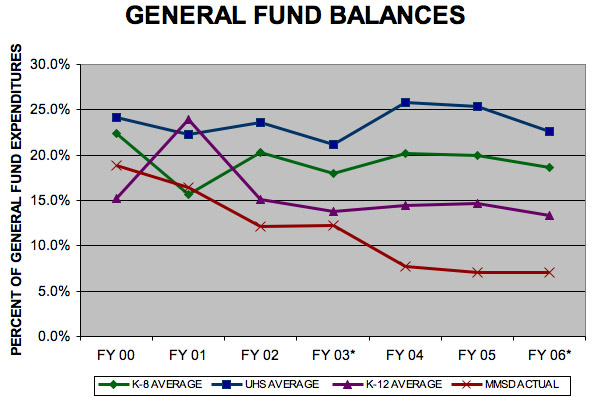
| Fund Balance as Percent of General Fund Expenditures FY 2000 Thru FY 2006 Source: Wisconsin Taxpayers Alliance |
||||||||
| FY 00 | FY 01 | FY 02 | FY 03* | FY 04 | FY 05 | FY 06* | ||
| K-8 AVERAGE | 22.4% | 15.7% | 20.3% | 18.0% | 20.2% | 20.0% | 18.6% | |
| UHS AVERAGE | 24.1% | 22.3% | 23.6% | 21.2% | 25.8% | 25.4% | 22.6% | |
| K-12 AVERAGE | 15.2% | 23.9% | 15.1% | 13.8% | 14.5% | 14.7% | 13.4% | |
| MMSD ACTUAL | 18.9% | 16.4% | 12.1% | 12.2% | 7.7% | 7.1% | 7.1% | |
| MMSD Budget | $252M | $333M | ||||||
| Equity Fund (M) | $48M | $24M |
Related:
“Why did our equity go down this past year since we, the board, passed a balanced budget in 2005/2006? Why did it go down by $2.8M (about a 1% variance in last year’s $319M+ budget)?
Answer: “Negative expenditure of $6M in salaries (tuition income was down, special ed high incidence aid was down) $5.9M “structural deficit in place”.”
The Administration used a “salary savings” account to “balance” the budget. When such savings did not materialize, the MMSD’s equity (the difference between an organization’s assets and liabilities) declined.
Interestingly, Madison School Board members Beth Moss, Carol Carstensen and Maya Cole have advocated the continued reduction in the District’s equity as a means to help balance the 2007 / 2008 $339M+ budget. Beth proposed budgeting an additional $2.133M in “salary savings” above the planned $1M while Carol sought $2M and Maya asked for an additional $500K. [Board member proposed 2007/2008 budget amendments 540K PDF]
Finally, several years ago, I received an email from a person very concerned about the “dramatic” decline in the MMSD’s “reserves”, which according to this person were, at one time over $50M. I asked for additional data on this matter, but never heard from that person again.
The equity fund’s decline gives the MMSD less wiggle room over time, and means that we, as a community face decisions related to facilities, staffing and services. Hopefully, the MMSD board and administration can start to consider and implement new approaches, including virtual learning tools and expanded collaboration with community assets like the UW, MATC and others. I hope that we can move beyond the annual “same service approach” and begin to think differently. Peter Gascoyne’s 5 year approach to budgeting is a good place to start
“[Ask] what is the best quality of education that can be purchased for our district for $280 million a year. Start with a completely clean slate. Identify your primary goals and values and priorities. Determine how best to achieve those goals to the highest possible level, given a budget that happens to be $40 million smaller than today’s. Consider everything – school-based budgeting, class sizes, after-school sports, everything.”
A definition of “equity”. 2007 / 2008 $339M+ MMSD Citizen’s Budget
Development on the isthmus continues, according to two two stories in the news today, making the prospect of closing central-city schools rather shortsighted.
From a longer story by Mike Ivey in The Capital Times:
E. Dayton Apartments: In other action Monday night, a plan from developer Scott Lewis and architect John Sutton for a five-story, 48-unit apartment building at 22 E. Dayton St. was referred to the May 7 meeting of the commission.
A plan for the site was approved in August 2006 that included razing a former church building wing for expansion of the First United Methodist Church on East Johnson Street. Those plans also called for moving a seven-unit apartment building from 18 E. Dayton to 208 N. Pinckney St. and demolishing a two-family home at 24 E. Dayton — all to allow construction of the 48-unit apartment building.
The new apartment building would feature 47 underground parking spaces and a mix of studio, one- and two-bedroom units.
From a story by Barry Adams in the Wisconsin State Journal:
Marling Lumber Co. will move from the 1800 block of East Washington Avenue near the Yahara River and has put the 3.8-acre property up for sale. Officials with the 103-year-old company, which has been at the location since 1920, say the move to T. Wall Properties’ The Center for Industry & Commerce along Highway 51 will provide room for growth.
The sale will also likely mean new life for the East Washington Avenue site and help create a gateway to the central city.
“That’s a very critical site especially when you factor in Fiore Plaza across the street,” said Steve Steinhoff, Dane County’s community development coordinator. “The two of those redevelopment projects together really have the potential to redefine that area.”
I previously wrote that growth on the city’s outskirts will likely slow as the world runs short of petroleum products and gasoline prices climb beyond where they’ve ever been before

Billionares to start $60M Education Issue Presidential Campaign PR Effort.
Eli Broad and Bill Gates, two of the most important philanthropists in American public education, have pumped more than $2 billion into improving schools. But now, dissatisfied with the pace of change, they are joining forces for a $60 million foray into politics in an effort to vault education high onto the agenda of the 2008 presidential race.
Experts on campaign spending said the project would rank as one of the most expensive single-issue initiatives ever in a presidential race, dwarfing, for example, the $22.4 million that the Swift Vets and P.O.W.s for Truth group spent against Senator John Kerry in 2004, and the $7.8 million spent on advocacy that year by AARP, the lobby for older Americans.
Under the slogan “Ed in ’08,” the project, called Strong American Schools, will include television and radio advertising in battleground states, an Internet-driven appeal for volunteers and a national network of operatives in both parties.
“I have reached the conclusion as has the Gates foundation, which has done good things also, that all we’re doing is incremental,” said Mr. Broad, the billionaire who founded SunAmerica Inc. and KB Home and who has long been a prodigious donor to Democrats. “If we really want to get the job done, we have got to wake up the American people that we have got a real problem and we need real reform.”
I’m glad they are doing this. However, top down rarely works, particularly with an issue this broad.
www.edin08.com. Former LA Superintendent and Colorado Governor Roy Romer is Chair. [118K PDF]
Ed Policy 08 is a “A non-partisan blog focused on Educational Policy in the 2008 election for President of the United States.” The site is written anonymously by a classroom teacher. RSS feed.
Catholic school parents and administrators are upset by proposed Madison school district budget cuts that would eliminate the bus service they receive to get their kids to school.
But the school district is hoping to trim nearly $230,000 from its budget by offering more than $162,000 directly to parents to transport their children instead of providing yellow school bus service to five Catholic schools in the Madison district. Busing those students is projected to cost about $392,000 in 2007-08.
State statutes require public school districts to provide transportation for students in private schools as well as public schools, but Madison district officials say it costs them more than 50 percent more per pupil to bus the Catholic school students. Underlying the proposal is the need for the Madison School Board and administrators to find nearly $8 million to cut from next year’s budget to comply with state-imposed revenue caps.
There are 358 students who attend St. Dennis, St. James, Edgewood Campus School, St. Maria Goretti and Queen of Peace schools who would be affected by the policy change.
2006/2007 and 2007/2008 MMSD Citizen’s Budget.
Fascinating issue.
Madison School Board member Lucy Mathiak’s proposed 2007 / 2008 MMSD budget amendments. The 07/08 budget will grow from $333M+ on 06/07 to $339M+. Much more on the budget, here. 2006 / 2007 MMSD citizen’s budget [2007 / 2008 35K PDF – thanks to Chan S. for sending this link in]
Lucy mentioned that she supports Lawrie Kobza’s proposal to restore 5th grade strings.
Some critics decry the way the Knowledge Is Power Program presents itself as the savior of inner city education. My answer: KIPP doesn’t do that. We sloppy journalists do.
Let me present Exhibit A: The latest annual report card from the KIPP Foundation in San Francisco. It has 93 pages of remarkable data. (See, there I go again, making KIPP the miracle cure. Let me change that to “interesting” data.) The report card tells how well each of the KIPP schools is doing, but it does not claim to be saving our cities.
I understand why we education reporters try to make KIPP sound like more than it is. We are starved for good news about low-income schools. KIPP is an encouraging story, so we are tempted to gush rather than report. We don’t ask all the questions we should. We don’t quote critics as often as we ought to. We don’t emphasize how new and incomplete the KIPP data is. But none of that is KIPP’s fault. Data costs money, and KIPP tries to use most of its funds to educate kids.
One of the best things about KIPP, a network of 52 independent public schools in 16 states and the District, is that it tries very hard to make the statistics it has available to everyone. Focusing on results is one of the organization’s basic principles. Anyone can order a free copy of the new report card by going to www.kipp.org. And on page 57 you will find numbers that help explain why KIPP is firing its middle school in Buffalo, N.Y., the sixth time a KIPP school has left the network.
The deal would increase base pay by 23 percent, compounded over nearly seven years, and add 15 minutes to principals’ and assistant principals’ workdays. The contract would also revamp how principals are rated on their performance each year, discarding the blunt thumbs-up or thumbs-down system under which they are labeled either satisfactory or unsatisfactory.
It would be replaced by a more nuanced review, aligned to the Education Department’s new accountability system, which grades schools from A to F based on students’ progress.
Starting salaries for assistant principals who work all year rather than just the 10 months that schools are in session would rise to $108,869 from $88,398, and their maximum salary would be $130,100, up from $108,869.
City officials expressed particular pleasure that the contract agreement included incentive provisions that are often opposed by unions. “In the private sector, financial incentives encourage actions that are good for the company,” Mr. Bloomberg said. “And there is no reason we shouldn’t also use financial incentives in the public sector to encourage actions that are good for our schools.”
As part of the deal to end the seniority rights of assistant principals, the city would help find a position for anyone who is left without an assignment. Should an assistant principal still not get an offer from any principal, the city, for the first time, would be able to extend a buyout of up to one year’s pay.
Assistant principals who declined a buyout would be placed in schools where they could be required to teach three periods a day and perform other duties.

Some years ago, while reading a book on Sherman’s March to the sea, a distant relative (who lives in the south) pointed out that the book was “one perspective”. Madison has a middle school named “Sherman“. Which sort of proves the point. A reader pointed out that Sherman middle school was named for “Roger Sherman”, signer of the Declaration of Independence.
Indeed, it was one perspective.
Vang Pao elementary school offers us an opportunity to discuss the American experience in Southeast Asia with our children:
From a story by Susan Troller in The Capital Times:
Several principals spoke persuasively about the advantages of mid-size schools at Monday night’s Madison School Board meeting, but they apparently failed to sway any votes in support of school closings.
Cherokee Middle School Principal Karen Seno said she has allocated resources at her school to emphasize small class size, and the result is a school where there are generally two adults in every classroom.
Principals are weighing in on their view of possible school closings.
“Cherokee feels to me like a happy medium,” Seno said, neither too big nor too small. “It feels really intimate,” she added, which helps students connect with teachers and creates a learning environment where no one falls through the cracks. But the numbers at Cherokee — 538 students this year — also allow for a degree of program options and staffing that smaller schools don’t enjoy.
Newly elected board members Maya Cole and Beth Moss, who took their oaths of office at the meeting, said they were still inclined to vote against school consolidations. That seems to be the majority position on the board, with Carol Carstensen and Lucy Mathiak also saying they oppose consolidation plans that would affect a number of small schools on the east side.
Also for the first time, some Alabama elementary and middle schools, including Mobile’s Council Traditional, that can feed into IB high schools will within the next few years begin offering IB programs for younger students.
“This is a great thing for the whole area,” said Mobile County Public School System Superintendent Harold Dodge. “It sort of ratchets up our expectations one more level.”
The three local high schools are on track to allow their current ninth-graders to take IB classes beginning their junior year in fall 2008, officials said.
By taking IB’s rigorous courses, students will be able to earn up to a year’s worth of college credit before they graduate from high school. They’ll also be more attractive candidates for scholarship money.
The three schools are in the application process and still must meet some requirements before receiving official approval from the Geneva, Switzerland-based agency that oversees International Baccalaureate.
Via a reader’s email; Solomon Friedberg:
Mathematics is crucial in the modern world. It is the foundation of modern science and engineering, and the prerequisite to any number of careers. Children’s formal learning of mathematics occurs throughout elementary school, and their success or failure at this level will have an impact on the entire rest of their lives.
Thus it is vital that elementary teachers be well-prepared to teach mathematics.
You would think that all elementary teachers know elementary math. After all, they are college graduates. Unfortunately, you’d be wrong. For example, mathematics educator Liping Ma, a senior scholar at the Carnegie Foundation for the Advancement of Teaching, reports that only 43 percent of a group of “above average” U.S. elementary teachers chosen for their interest in math could carry out a simple calculation involving division of fractions.
Moreover, teaching elementary school math requires more than simply knowing how to do elementary school math. Teachers must be able to present mathematics as a coherent body of knowledge rather than a bunch of arbitrary rules, to recognize and address a range of misconceptions, to encourage mathematical thinking and develop student self-confidence. They need to know elementary math well enough to teach it in all its subtlety.
In Ma’s study, only 4 percent of U.S. teachers were able to write a story problem that corresponded to the division of fractions problem. If that’s the case, how can they teach this subject well?
No one talked about — unless asked, and then only in hushed tones so the 238 children who attend school there couldn’t hear — the Detroit school board’s recent vote to close the building at the end of this academic year and to relocate students and staff.
“It’s always in the back of our minds that this school is going to be closed,” says secondgrade teacher Thomas DiLuigi, a 28-year veteran of the east side school. “But if we were to dwell on that, the children would be affected and they’re our main priority.”
As one of the 34 recently announced Detroit public schools to be closed during the next two academic years — to cut operating costs and help close a multimillion-dollar hole in the district’s roughly $1.2 billion budget — Berry’s history as a place of learning is about to grudgingly end. Those schools will be joining the 25 other vacant schools owned by the district that are waiting to be rented or sitting, sometimes decaying, in neighborhoods throughout the city.
Watching enrollment fall from 175,168 students in 1997 to 115,047 this year, district officials had to come up with criteria to use to determine which schools would be shuttered, says Darrell Rodgers, the district’s chief of facilities maintenance and auxiliary services and chair of the facilities realignment committee. They settled on enrollment trends, student capacity in each building, how each school was progressing academically and the condition of the buildings. About 40 of the district’s 232 schools are operating at less than half of their student capacity.
1. Kennedy Heights Community Center with the support of many other individuals and groups is organizing a walk from Kennedy Heights Community Center to Gompers Elementary School to raise awareness about the potential closings of Lindbergh Elementary School and Black Hawk middle school. Neighborhood Schools are a community resource for the children and families in Kennedy Heights and the northside; closing the schools would negatively impact our neighborhood, our community center, and the families that live here. Please come and walk with us to keep northside schools open.
The walk will start at the Kennedy Heights Community Center at 4:00 PM on Monday April 23rd – we will walk together from Kennedy Heights to Gompers Elementary school about 1.3 miles. At Gompers their will be a brief discussion and Popsicles for kids. All are welcome please distribute widely.
PS I know that school board members have a meeting at 5:00 PM, but I hope you can join us
for the beginning of our walk.
2. Join a grassoots rally: “An Hour For Marquette” – On Friday, April 27, from 1:30 – 2:30 come to Marquette and pull your Marquette student from class to protest the proposed consolidation (All concerned parents, students, and other community members are welcome to join in). We will rally at the school. Bring a sign that expresses your feeling about Marquette. We will be working to get press coverage and a visit from the Mayor. If you are interested in attending the rally e-mail Dea Larsen Converse at dealarsen@yahoo.com or Maria Moreno at mcmoreno@tds.net so we can give a head count to the papers.
(Note that this is not a PTG sponsored event)
It’s not over yet! Let’s keep the pressure on!
The MMSD could save one or more teaching positions by combining two positions – public relations and government relations.
The government relations position seems unnecessary given the excellent work of Arlene Silviera and the Wisconsin Alliance for Excellent Schools. They have done more in a few short months than the MMSD has ever done to raise awareness about inadequate state funding.
Additionally, most district do not employ a lobbyist, but rely on the Wisconsin Association of School Boards, Wisconsin Association of School Business Officials, Wisconsin Association of School District Administrators, Wisconsin Council for Administrators of Special Services, and other organizations lobbying in the state Capitol
The PR position doesn’t seem necessary because the press seems to want to talk to the superintendent, not the PR guy.
Put the two positions together and the MMSD loses nothing and saves services delivered directly to students.
Curriki is more than your average Website; we’re a community of educators, learners and committed education experts who are working together to create quality materials that will benefit teachers and students around the world.
Curriki is an online environment created to support the development and free distribution of world-class educational materials to anyone who needs them. Our name is a play on the combination of ‘curriculum’ and ‘wiki’ which is the technology we’re using to make education universally accessible.
Verizon Thinkfinity offers the highest quality, standards-based, K-12 lesson plans, student materials, interactive tools and Web sites in seven academic disciplines. A companion professional development program prepares educators to effectively utilize these exceptional resources to support student learning and achievement. Follow the links below to learn about Thinkfinity resources for K-12 Education.
KitchenTableMath and Text Savvy aren’t happy with the Education Department’s advice to parents on teaching children math:
Try to be aware of how your child is being taught math, and don’t teach strategies and shortcuts that conflict with the approach the teacher is using.
There are many reasons parents might be interested in their children’s math program(s), including this discussion of math scores. Math Forum audio / video.
A controversial plan to close and consolidate schools on Madison’s North and East sides appears dead a week before the Madison School Board’s self- imposed deadline for determining $7.9 million in spending reductions.
Four of the board’s seven members plan to vote against Superintendent Art Rainwater’s proposal to save $1 million by closing tiny Lindbergh Elementary and reshuffling hundreds of other students in elementary and middle schools, according to interviews with all board members.
The plan could be revived, however, if board members fail to find a comparable amount of cost savings elsewhere in the district’s 2007-08 budget.
Related 2007-2008 MMSD Budget (07/08 budget is either $339M or $345M (- I’ve seen both numbers used); up from $333M in 06/07) Posts:
Can anyone explain why the discussion of ways to meet the gap in next year?s school budget has not included any mention of the cost of teachers? salaries and benefits and how much they are expected to go up next year?
The district has projected a budget deficit for next year of $7.9 million. To arrive at this figure, the district has to make some assumption about the costs of salaries and benefits for next year, which necessarily implies an assumption about how much those costs will increase. There seems to be no information available from the district that explains that assumption.
In last week’s Isthmus, Jason Shepard wrote that salaries and benefits are slated to rise 4.7% next year. That figure comes from a five-year budget projection that is available on the district’s web site. However, I have been told that that figure is not accurate. The district’s contract with MTI for next year has not yet been negotiated (bargaining commences on April 25). I have been told that the district wants to keep its budget assumptions about salaries and benefits confidential for now, in order to avoid adversely affecting its bargaining position. The idea is to preserve the possibility that the district could do better in its bargaining than it is now assuming.
This explanation does not seem compelling to me, for a couple of reasons. First, call me a cynic, but I can’t imagine that the very competent folks at MTI cannot figure out what assumptions the district is utilizing, and so those the district is leaving in the dark include everyone except MTI. Second, once the district has gone through the agony of the current round of budget cuts, it will have very little incentive to try to do better in bargaining than the result that it has already planned for.
It seems to me that the cost of salaries and benefits is the dog that didn’t bark in the current discussion of budget cuts. The amount by which those costs will go up next year has a significant impact on the amount of cuts that will be required.
From Diana Kasbaum, Mathematics Consultant & School Improvement Consultant, Title I and School Support Team, WI Department of Public Instruction
This is a reminder that the WI Mathematics Council’s Annual Conference (May 2-4) is fast approaching and will provide valuable opportunities to schools and districts using Title I funding for mathematics. As noted below, the Wednesday pre-conference focus is ‘Meeting the Needs of Diverse Learners’ and will focus on ELL, Special Education and Gifted & Talented. The information will be valuable to those who work with Title I students. There are also keynote and sectional presentations about interventions, struggling learners, special education and Title I at the conference on Thursday and Friday.
Additional information can also be found at: http://wismath.org/GL.html.
If you have further questions about Title I mathematics, please feel free to contact me: Diana.Kasbaum@dpi.state.wi.us.
Madtown Chris:
The 115-page report — based on previously conducted audits and analyses as well as interviews with more than 100 district employees — describes an operation beset by an almost complete lack of accountability or consequences for poor performance, running from the most senior staff to school principals. Job descriptions are often unclear and evaluations rarely pegged to improved district performance, while communication among various corners of the organization is muddled or nonexistent, the report found.
“The most apparent and inhibiting deficit standing in the way of instructional coherence in LAUSD today is a lack of accountability,” said the report by Florida-based Evergreen Solutions. “Currently, directives are given but few, if any, consequences are enforced for noncompliance.”
Perhaps the overriding message in the report is that past recommendations, made in one study after another, have rarely moved from paper to reality. In an interview, Brewer promised that things would be different this time.
In the 1970s, when Ms. Magazine came out, there was a great story about three (heterosexual) couples who got together for dinner: a lawyer, a chemist, a teacher, a lawyer, a manager, and a lawyer, and one of the lawyers looked around the room and said: “This will be great, we’re all lawyers!” (the men were lawyers).
In a similar way, I feel that history books just get completely overlooked in schools. People who talk about writing in the schools, talk about fiction, and people who talk about reading (in the schools) talk as if nonfiction just did not exist. It does not seem to find a place in their thoughts. Literature Rules! (good and bad)…
I know that, in the early days of women’s liberation (1970s version), men would sometimes catch themselves, and say, “or she,” and the like, but it was a real struggle. Now in schools there may be people who mention nonfiction in the same way, but history and other nonfiction have not really moved into the mainstream. There is a glass ceiling for nonfiction so thick, that people standing on it, as a floor, do not even see nonfiction down there waiting its turn.
The Nonfiction Liberation Movement should challenge that Hegemonic monopoly and at least teach educators that to mention writing, without mentioning academic expository writing (term papers), and to talk of reading, without mentioning history, is to be politically incorrect!
Then perhaps the downtrodden brothers and sisters in the History Departments will dare to assert themselves and say, boldly, to the astonishment of their peers, “I am going to assign a complete history book this semester!” and “I am going to assign a serious Extended Research Essay this semester!” A cadre of new Nonfiction Freedom Riders will arise, and our kids will no longer be sent off to college and into the world never having read a complete history book or written one serious nonfiction term paper.
Will Fitzhugh [founder]
Consortium for Varsity Academics? [2007]
The Concord Review [1987]
Ralph Waldo Emerson Prizes [1995]
National Writing Board [1998]
TCR Institute [2002]
730 Boston Post Road, Suite 24
Sudbury, Massachusetts 01776 USA
978-443-0022; 800-331-5007
www.tcr.org; fitzhugh@tcr.org
Susan Troller writes:
But when you ask the kids why they like poetry, they don’t talk about history or literature. They just say it’s fun.
Making school names local, as suggested by Capital Times editor John Nichols, is a sensible goal. Make school names local The Madison School Board had an open nomination process and it held televised public hearings on the naming of the new west side elementary school. We did so to hear the preferences of local people and their reasons for their choices.
Over several months, we sought and received nominations. While we heard from some people living outside the district, we heard primarily from people from the district.
During these months I came to the conclusion that naming a school after Hmong General Vang Pao would meet important local needs, the need to recognize the sacrifices of the Hmong generation who were US allies during the Vietnam War and to explain the Hmong presence in our community which is a direct result of that alliance.
Having heard from many Hmong speakers during the hearings and from my colleague, Shwaw Vang, about the role that Vang Pao played in their lives, I did not feel that substituting a different Hmong name was an option. I could not imagine telling Shwaw Vang that I had decided that he is a more appropriate hero for the Hmong people in the Madison district. I believe that such an action would have shown great disrespect for the very people that we hope to acknowledge are part of our community and play very positive roles in our community.
The tradition in MMSD—rightly or wrongly—has been to name some schools after national heroes, some after locations, some after people who made significant contributions to the state or the district and some after people who have earned respect locally, even though the honorees were not without controversy. To me, naming the school after General Vang Pao fits in that range.
A joint legislative committee deadlocked Wednesday on whether to study Wisconsin’s class-size reduction program, ultimately defeating the measure in what Republicans called a partisan maneuver and Democrats hailed as supporting a popular initiative.
In proposing an audit of the Student Achievement Guarantee in Education program, or SAGE, Republican lawmakers characterized it as a routine request for a decade-old program that the governor has recommended spending $109 million on in the next school year.
State Rep. Kitty Rhoades (R-Hudson) also raised concerns about the state Department of Public Instruction’s practice of granting waivers that allow school districts to exceed the 15-student class limit called for in the law.
“The waiver process was not established by statute, nor was it established by the Legislature, nor do we even know what it is,” she said during a hearing Wednesday.
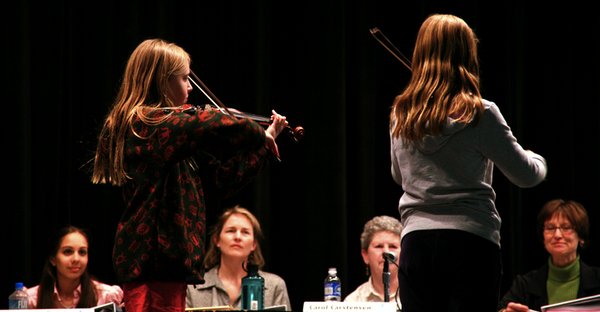
The new Madison School Board heard a brief strings performance from some students this evening at a Memorial High School budget hearing.
Left to right: Jacinth Sohi, Beth Moss, Carol Carstensen, Maya Cole, Johnny Winston, Jr., Lawrie Kobza, Arlene Silveira and Lucy Mathiak.
According to a report from a recent East High United meeting, where MMSD Assistant Superintendent for Secondary Schools Pam Nash did a presentation on the District’s high school redesign plans, the following eleven people have been named to the redesign committee:
Pam Nash — Assistant Superintendent for Secondary Schools, former principal of Memorial HS. While at Memorial, Ms. Nash oversaw the development and implementation of the “neighborhoods” school restructuring and implementation of the 9th grade core curriculum.
Alan Harris — Principal of East HS, former principal at Black Hawk MS.
Loren Rathert — Interim principal at LaFollette HS, former interim principal at East HS, former MMSD Social Studies Coordinator, and former principal at West HS. While at West, Mr. Rathert oversaw the development and initial implementation of the SLC grant, including the initial implementation of the school restructuring and the 9th and 10th grade core curriculum.
Ed Holmes — Principal at West HS (since fall, 2004), former principal at Wright MS and former assistant principal at West HS. Mr. Holmes has been principal at West during the continued implementation of the SLC grant, school restructuring, and 9th and 10th grade core curriculum.
Bruce Dahmen — Principal at Memorial HS.
Sally Schultz — Principal at Shabazz HS.
Steve Hartley — MMSD Director of Alternative Programs. These include the Transitional Education Program (TEP), the School-Age Parent Program (SAPAR), Operation Fresh Start, the Omega program and many others. Mr. Hartley also oversees the District’s implementation of the state-mandated Youth Options Program (YOP), which requires the District to pay for appropriate educational opportunities for eligible high school juniors and seniors whose needs cannot be met at their own schools. A wide range of students may take advantage of YOP. The District’s YOP implementation and — importantly — policy regarding the giving of high school credit for non-MMSD courses is currently under review and has been discussed on this blog —
https://www.schoolinfosystem.org/archives/2006/11/youth_options_p.php
https://www.schoolinfosystem.org/archives/2006/09/madison_school_37.php
https://www.schoolinfosystem.org/archives/2006/10/latest_madison.php
Lisa Wachtel — Director of MMSD Teaching and Learning Department, former MMSD Science Coordinator. Dr. Wachtel oversees a staff of 30-40 educational professionals across a variety of content areas. Possibly important, when asked by the Superintendent to cut two people from her staff for next year, she chose to eliminate two TAG staff (leaving a TAG staff of only five people for the entire district, if the BOE approves the cut).
L. Alan Phelps — Professor in the U.W. Department of Educational Leadership and Policy Analysis (School of Education) and Director of the U.W. Center on Education and Work. He seems to have special interests in special education and intercultural learning. Here are links to two of his recent papers, one entitled “Using Post-School Outcomes Data to Improve Practices and Policies in Restructured Inclusive High Schools” and another entitled “High Schools with Authentic and Inclusive Learning Practices: Selected Features and Findings” —
http://www.ncset.org/publications/viewdesc.asp?id=1096
http://eric.ed.gov/ERICDocs/data/ericdocs2/content_storage_01/0000000b/80/28/02/91.pdf
M. Bruce King — Faculty Associate in the U.W. Department of Educational Leadership and Policy Analysis (School of Education). Dr. King is a longtime West area parent and was hired by the District to serve as the West HS SLC Evaluator. He is the author of the November, 2005, report on West’s English 10 initiative that has been heavily discussed on this blog — https://www.schoolinfosystem.org/archives/2005/11/evaluation_of_t.php
Diana Hess — Associate Professor in the U.W. Department of Curriculum and Instruction (School of Education). Dr. Hess’s special area is social studies education, with a particular interest in training teachers to do discussion-based instruction, especially around controversial issues. Here is a link to an article by Dr. Hess entitled “Teaching Students to Discuss Controversial Public Issues” — http://www.indiana.edu/~ssdc/cpidig.htm
From the MMSD:
For immediate release
Thursday, April 19, 2007
Six elementary schools to have different principals
Six elementary schools will have different principals next year in a series of transfers and changes within the Madison School District. The principals who are transferring have been at their current schools from four to ten years.
The list of new assignments, by principal, with current school and length of service:
Deborah Hoffman to Lincoln from Franklin (10 yrs.)
Beth Lehman to Hawthorne from Lincoln (6 yrs.)
Catherine McMillan to Franklin from Hawthorne (10 yrs.)
Michael Hertting to Lapham from a leave of absence
Kristi Kloos to Lake View from Lapham (4 yrs.)
Joy Larson to Allis from Marquette (4 yrs.)
Allis Principal Chris Hodge and Gompers Principal Sherrill Wagner will retire this summer, and Lake View Principal Linda Sweeney will take a leave of absence for career exploration. Hertting will come off a similar leave; previously he led Orchard Ridge for five years. Vacancies will be filled within the next few months.
“We believe these assignment changes are good for the students, the staff, the principals and the district,” said Superintendent Art Rainwater. “Last year, we shifted six other elementary principals after stays of similar length.”
Parents at each of the schools were notified yesterday. The changes will take place over the summer in time for the Tuesday, September 4 start of the new school year. Each of the principals will assist her successor in the transition to make it more effective and efficient.
Constant shuffling of principals damages the effectivenss of the MMSD. All the rhetoric about building relationships amounts to nothing but words, when these actions speak louder.
The superintendent named no principal at Marquette. Apparently, he plans to “consolidate” Lapham and Marquette regardless of whether the board votes for it or not.
With the uncertainty and stress about staff cuts and school closings, the changes could not come at a worse time.
Is the superintendent hell-bent on destroying the MMSD?
After hours of emotional debate, a Milwaukee School Board panel approved a measure Tuesday night that would allow safety aides to use flexible handcuffs to restrain students who demonstrate threatening behavior.
“We’ve been in situations where we’ve had to restrain students for 30 minutes, 40 minutes, an hour,” said Shawn Buford, a safety aide at Custer High School. Buford said he has been out of school three times this school year after being assaulted by students.
But Raphiel Cole called use of handcuffs “a form of pre-institution that you are doing for our kids.”
Cole, who has nieces and nephews in Milwaukee Public Schools, added: “Anything but these handcuffs. You are going to have holding cells for the children, what’s next?”
After more than two years of study, a group of Waukesha educators has drafted a set of guidelines that challenge some traditional notions of grading.
Among the recommendations:
- Removing evaluations of student participation, effort, attendance and behavior from academic results.
- Ending the use of zeros for late or unfinished work, a “potentially damaging practice in a 100 point scale,” in favor of other methods that motivate students to complete their assignments.
- Allowing homework used for practice or preparation to account for no more than 10% of a grade, with project work getting more weight.
- Replacing averages, which allow single grades to skew final class assessments, with medians, which more accurately reflect a student’s overall class performance, in final grades.
School District officials stress that the guidelines, which are in the midst of being distributed to principals and teachers and go before a School Board committee today, are just that – guidelines. They insist the district is not interested in mandating universal changes to how teachers assign grades, often considered among a teacher’s most personal tasks.
I’ve heard from local parents again concerned about the lack of data in some Madison elementary school report cards. Several 2006 posts addressed this issue: Can We Talk 3: 3rd Quarter Report Cards; Mary Kay Battaglia, an Elvejhem Parent via Ruth Robarts and Thoreau parents.
The American Wind Energy Association (AWEA) is pleased to announce the launch of the AWEA Educational Scholarship Fund. In cooperation with the generous support of Suzlon Wind Energy and Vestas Americas, this new scholarship program was created to provide complimentary conference registration for individuals interested in enhancing their knowledge of the wind industry, including full-time students, faculty and staff of K-12 institutions among others who want to attend those interested in attending the WINDPOWER 2007 Conference and Exhibition in Los Angeles, June 3-6, 2007.
The deadline for submitting an application for WINDPOWER 2007 Conference and Exhibition is April 28, 2007.
More details and application here.
The reorganization is a sort of inversion of the city school administration. Instead of the traditional model in which principals work directly for a superintendent, each of the city’s more than 1,400 principals will choose a “school support organization” to work with their schools, and will pay these groups out of the school’s budget.
“Until now many educational decisions were made outside of the schools and classrooms,” Mr. Klein said during a news conference at Education Department headquarters.
Principals will have a menu of choices, at various prices, Mr. Klein said. At the low end, principals will pay $29,500 to join the so-called “empowerment network,” in which they are largely freed from oversight in exchange for agreeing to meet performance targets that include higher test scores.
At the high end, schools can choose to contract with the Success for All Foundation, a private nonprofit company based in Baltimore that offers a “whole school reform” model at a cost of up to $145,215, depending on enrollment. Smaller schools will be able to contract with the Success for All for as little as $44,694.
I did not give much thought to my college daughter’s plans to spend her spring semester last year in Chile. I did not study the brochures. I did not ask the study abroad office any questions. Neither my wife nor I had ever studied overseas. We had no stories to tell and no expertise to share. We figured this was one area where we would not be our usual overbearing, interfering selves, and let Katie take care of everything.
She did a fine job. But then she was robbed in Santiago. It was at a Starbucks where she liked to study. A young man approached and asked her what was in an espresso coffee. She thought this was an odd question, but he was good-looking and wasn’t until she finished her answer that she realized he had gotten a hand on the strap of her book bag — with wallet, passport, laptop and lots of other good stuff. In another second he was out the door. She never saw him, or her belongings, again.
I got the call that afternoon sitting where I am sitting now, at my computer at work. Katie was upset, but had already contacted the Santiago office of her study abroad program. They were helping her deal with the police and start the frustrating process of replacing everything she had lost.
For decades, undergraduate women have been moving in ever greater numbers into science and engineering departments at American universities. Yet even as they approach or exceed enrollment parity in mathematics, biology and other fields, there is one area in which their presence relative to men is static or even shrinking: computer science.
 The Madison School District’s Math Task Force was introduced to the School Board last night. Watch the video or listen to the mp3 audio.
Background Links:

6th Grade Textbooks: Connected (left) and Singapore Math.
UPDATE: A reader emailed this:
I noticed that there were 10 student books in the 6th grade pile for CMP. That was surprising since there are only 8 in publication. Then I looked at the teacher editions and noticed there were 10 as well. There are two copies of both How Likely is It? and Covering and Surrounding.
The statement, “A quick look at the size of the Connected Math textbooks compared to the equivalent Singapore Math course materials illustrates the publisher and author interests in selling these large volumes irrespective of curriculum quality and rigor (not to mention the much larger potential for errors or the lost trees….)” is following the picture in one of the discussions. Taking a look at the Singapore Math website It appears that in addition to the 2 textbooks pictured and student workbooks pictured, there are Intensive Practice books, Extra Practice Books, and Challenging Word Problems books, as well as other resources. Also, the white book on the bottom of the pile appears to be an answer key. There are also teacher guides for 6A and 6B that are not in the picture.
I’m not suggesting the statement above is false, I would just like to point out that the picture being used is not an accurate comparison. I hope you find this information valuable.
According to Arlene Silveira, the superintendent named the following members of a math task force:
Merle Price (co-chair): an adjunct faculty member in education policy at Cal State University, Northridge. A former high school principal and deputy superintendendt for Los Angeles Unifed School District.
Jim Lewis (co-chair): professor of mathematics at University of Nebraska, Lincoln. Was department for 15 years and has numerous NSF grants, including funding to improve mathematics education.
Neither co-chair has been directly involved in NCTM-based curricula implementation, in the interest of impartiality.
Other members:
Norman Webb, mathematics educator and evaluator
Martha Alibali, cognitive scientist
David Griffeath, mathematician
Eric Knuth, math education researcher
Mitchell Nathan, cognitive scientist
Ken Zeichner, university teacher education expert
A K-12 teacher and a parent are still to be named.
Arlene added:
No MMSD employee is on the task force, in the interest of impartiality. Lisa Wachtel and Brian S. will serve as point people for the task force if information or data is needed for the district.
The Board will be responsible for setting the direction of the task force and making decisions on “branch points” in the process. The community will be involved.
While 98 percent of Americans believe that good writing skills are very important to succeed in today’s economy, roughly half believe the quality of students’ writing skills has declined over the past 20 years, a report released by the Berkeley, Calif.-based National Writing Project says.
Two-thirds of the people surveyed wanted more resources earmarked for writing instruction, and almost three-fourths thought writing should be taught to students in every subject at every grade level. Seventy-four percent of respondents thought good writing skills were important regardless of what career students pursue. The study surveyed a representative sample of 1,501 adults in the United States.
Via EdWeek.
Where there once were 15 large high schools in the Milwaukee Public Schools system, there will be about 50 high schools of all different sizes under the MPS umbrella this fall, and many have untraditional names.
The options outside MPS used to be primarily a handful of large Catholic and Lutheran high schools. Many of those schools still are thriving, but the array of non-MPS options is growing, thanks to the private school voucher program for low-income families and to charter schools authorized by the University of Wisconsin-Milwaukee and Milwaukee’s City Hall. New schools in those ranks are also set to open in the fall.
A fresh wave of MPS charter high schools is almost certain to get approval from the School Board on Thursday night. Each of the proposals was approved by a board committee last week and was given preliminary approval by the board months ago.
Here’s a snapshot of new schools coming before the board this week:
This is a two-parter.
Part 1
In 2006-2007, the Business Services Department of the MMSD spent $111,286,422, according to page 2-118 of the document titled Department & Division Detailed Budget.
In the previous year’s budget process, the board approved spending of $110,245,079, according to page 10 of the Executive Summary, 2006-2007 School Year.
Why did Business Services overspend by $1,041,343? Did the board approve additional spending beyond what was initially approved in the 2006-2007 budget?
Part 2
In the current budget for next year, the superintendent’s proposed budget would INCREASE the amount to $114,239,659. Simply freezing the Business Services budget would reduce spending in the proposed budget by $2,953, 237 ($114,239,659 minus $111,286,422 = $2,953, 237).
The freeze would avoid micro-management by the board. It simply gives the administration a budget figure, and the administration will be free to operate within the budget.
The proposed plans to “consolidate” schools and move alternative programs would save $769,450. [See Discussion Item C-19 of the document titled Superintendent’s Budget Changes (Reductions to Balance the Budget) 2007-08]
The Texas-based author says in her book “A Framework for Understanding Poverty”: Parents in poverty typically discipline children by beating or verbally chastising them; poor mothers may turn to sex for money and favors; poor students laugh when they get in trouble at school; and low-income parents tend to “beat around the bush” during parent-teacher conferences, instead of getting to the point.
But many academics say her works are riddled with unverifiable assertions. At the American Educational Research Association’s annual conference in Chicago last week, professors from the University of Texas at Austin delivered a report on Payne that argued that more than 600 of her descriptions of poverty in “Framework” cannot be proved true.
“She claims there is a single culture of poverty that people live in. It’s an idea that’s been discredited since at least the 1960s,” said report co-author Randy Bomer.
Miranda S. Spivack and Daniel de Vise:
Some council members said they resent the pressure.
“The suggestion,” Duchy Trachtenberg (D-At Large) said, “is that unless I support 100 percent” of Weast and the school board’s budget plan, “I’m not a friend to education.”
Weast’s budget proposal this year included an increase of more than 7 percent from last year’s budget and totals nearly half of the county’s $4 billion spending plan. Leggett proposed a 6.3 percent increase for the schools. The school system’s budget has increased 31 percent over the past four years, according to a county report.
“I am hard-pressed to believe that in a budget of $2 billion . . . [Weast] cannot find ways to absorb” $20 million, Leggett said recently.
Leggett also has taken a different approach from Duncan to drafting the county budget. Duncan left behind a budget gap that ballooned to nearly $200 million this year, Leggett said, leaving it to him to ask government agencies across the board to scale back their wish lists. The school system, whose annual spending of more than $13,000 per student leads the state, would not be immune, he told Weast in one of their few private meetings.
Grade 5 elementary string students need your help. There are ways you can support the hundreds of ten-year olds who are in Grade 5 strings and this year’s Grade 4 students who would like the chance to take the course next year:
A. Bring your child to play his/her instrument at Thursday’s Budget Hearing – April 19th at 6:00 p.m., Memorial High School Auditorium.
If your child would like to “play” in support of Grade 5 strings, there will be an opportunity to do this at Thursday’s budget hearing to be held in the auditorium at Memorial High School ( http://www.mmsd.org/145.htm). Students from grades 5-12 are welcome. There will be adults present to help coordinate the playing of a few songs from the strings festival. If you want to play, please come at 6 p.m., so we can organize the students.
B. Email the School Board – comments@madison.k12.wi.us – let them know:
1. you support the program for all children,
2. what this course has meant to your child if your child is/has
taken elementary strings,
3. you would like the newly formed school board community task
force on fine arts to have a chance to do it’s work, which
includes:
a. identifying the community’s fine arts education values and
goals,
b. identifying ways to increase low-income/minority
participation in the arts (45% elementary string students
are minority, 35% are low income), and
c. identifying funding priorities for the School Board
C. Speak at the Budget Hearings – 6:30 p.m. – Tuesday, April 17th at La Follette High School Auditorium and Thursday, April 19th at Memorial High School Auditorium:
There are two public hearings next week on the budget – Tuesday, April 17th, 6:30 p.m. at La Follette High School and Thursday, April 19th, 6:30 p.m. at Memorial High School – both public hearings are in the school’s auditoriums. If you come, you need to sign if you want to speak. You can sign in and not speak but say you support the program. Each person who speaks is given 3 minutes.
For nearly 40 years, MMSD has had an elementary strings program. Two years ago, elementary string instruction was cut in half. Last year, Grade 4 strings was cut entirely. This year, Superintendent Rainwater is proposing to cut Grade 5 strings, which would eliminate all string instruction during the school day.
Thank you for your support of Grade 5 strings and a strong fine arts education for our children.
Susan Troller’s recent article on possible school closings mentioned that some Madison Schools have smaller populations than others in the District. I’ve posted a simple table that summarizes MMSD elementary, middle and high school student population numbers with those from nearby suburban communities: Middleton-Cross Plains, Monona Grove, Stoughton, Sun Prairie, Verona and Waunakee. MMSD facility map.
I’d like to add more districts to this table along with links to performance data, then plot it all on a map. Let me know if you have some time to help compile the data.
Karyn Saemann’s article on Monona’s search for new young families adds another twist to the discussion.
In March 2005, The San Francisco Chronicle Magazine published my article exploring how the over-the-top youth sports culture was affecting kids and families. Titled “How Much Is Too Much?” it generated tremendous reader response, and two months later I signed a deal with Gotham Books to investigate the issue on a national scale. The results of that research, conducted in the academic year 2005-2006, appear in my book, “Revolution in the Bleachers: How Parents Can Take Back Family Life in a World Gone Crazy Over Youth Sports.”
In the book, I look at the way youth sports have changed in the past 20 years and how those changes have altered the nature of childhood in America and patterns of family life. Many households are putting demanding sports schedules above bonding rituals such as eating dinner together, taking family vacations, spending holidays with relatives and relaxing at home on weekends. Lots of kids are stressed out, and some are getting burned out. I wondered if, for this generation, success at sports was coming at too high a cost. And I came up with suggestions of how parents can bring balance back into their children’s lives.
Jay Matthews:
William Lichten, the distinguished Yale professor emeritus of physics, is at it again, trying to keep U.S. high schools from giving so many Advanced Placement courses and tests to racial minorities and low income students. Too many of those people fail the tests, he says. They should be given something easier to do.
Most of the AP teachers I know think Lichten is out of his depth on this issue. I agree with them. He is a brilliant man who knows the dynamics of the forces of nature, but he does not understand the dynamics of American public high schools. What he sees as harmful failure on AP college-level tests is actually beneficial exercise of flabby academic muscles. Interviews with many students, and some major studies, indicate that struggling with hard courses in high school helps prepare students for the academic demands they will face in college.
High school teachers often try not to think about the true sources of irritation in their lives. The perfidy of principals and the selfishness of parents can sometimes be too much to bear and are best ignored. Such denial has its virtues. But maybe the faculty of Scarsdale High School has taken it too far. They have decided that the best way to recover the love of learning at their famously competitive campus is to get rid of the Advanced Placement program.
The Scarsdale faculty make their case in their “Proposal for Advanced Topics Implementation,” a plan to create a set of courses deeper, more challenging and less prone to grade grubbing than AP. Their proposal is worth considering. It will appeal to teachers across the country. It also will help destroy the myth that Advanced Placement and International Baccalaureate courses and tests are the major cause of student anxiety in our most affluent neighborhoods because anyone who knows Scarsdale can see that AP is not their biggest problem.
Student-writers often believe that the secret of good writing is a reliance upon bigger and “better” words. Thus the haphazard thesaurus use that I wrote about last month. Another danger for student-writers involves the assumption that good writing is a matter of stuffy, ponderous sentences. Stuffy sentences might be explained by the need to make a required word-count, but I see such sentences even in writing assignments of only modest length. Most often, I think, these sentences originate in the mistaken idea that stuffiness is the mark of serious, mature writing.
A writer can begin to unstuff a sentence by looking closely at each of its elements and asking if it is needed. Here is an extreme example:To begin, it is important to note that the theme of regret is an important theme in “The Road Not Taken,” which was written by Robert Frost, and that evidence for it can be found throughout the entire poem.
“To begin”: Like “to conclude,” this phrase is an unnecessary, empty transition. If a point is coming early (or late) in an essay, trust that a reader can see that. Removing “To begin” involves no loss of meaning.
2.1MB PDF
First, a disclaimer. I am far from an expert on most of the topics which will be illustrated by questions. One of my aims in giving this talk is to let others know about a serious problem which exists beyond the problem of mathematical knowledge of teachers.
I have written about the problem in mathematics and hope that some others will use the resouces which exist to write about similar problems in other areas.
In his American Educational Research Association Presidential Address, which was published in Educational Researcher in 1986, Lee Shulman introduced the phrase “pedagogical content knowledge”. This is a mixture of content and knowing how to teach this content and is the one thing from his speech which has been picked up by the education community. However, there are a number of other points which he made which are important. Here is an early paragraph from this speech:
We begin our inquiry into conceptions of teacher knowledge with the tests for teachers that were used in this country during the last century [the 19th] at state and county levels. Some people may believe that this idea of testing teacher competence in subject matter and pedagogical skill is a new idea, an innovation spawned in the excitement of this era of educational reform, and encouraged by such committeed and motivated national leaders as Albert Shanker, President, American Federation of Teachers, Bill Honig, State Superintendent of Schools, California, and Bill Clinton, Governor of Arkansas. Like most good ideas, however, it’s roots are much older.
It took Wisconsin almost 20 years to adopt this “good idea”.
At the heart of the issue is the fact that the East High School attendance area has more elementary schools and schools with smaller populations than the other attendance areas in the district. Of the 10 elementary schools in the East High attendance area, only Hawthorne has more than 300 students.
By contrast, La Follette and Memorial high schools’ attendance areas have seven elementary schools, and the West High School attendance area has eight elementary schools. The populations of these schools average over 400 students.
But hundreds of staunch fans of the East area elementary schools are rallying to the defense of their schools, saying that they are successful hubs of their communities, and that their small size and close-knit students and staff help engage families across all demographics while improving student achievement.
“People living on the east and northeast sides of the city shouldn’t be punished because the schools in this area were built to be small,” parent and longtime school volunteer Jill Jokela said at a gathering last week.
Brittany Burns, 12 years old, has always been on the heavy side. Last year in fifth grade, neighborhood kids started picking on her at the bus stop, calling her “fatty” and “chubby wubby.” Then someone else piled on: Brittany’s school.
In a letter dated Oct. 2, 2006, the Campbell County School District No. 1 invited “select students” to take part in a fitness and nutrition program set up for some of the district’s most overweight kids. At 5 feet 2 inches tall and 179 pounds, Brittany qualified.
Receiving the letter was “embarrassing,” Brittany says. Her mother, Mindi Story, a clerk at an Albertsons supermarket, says she seethed “pure anger” because, she argues, her daughter’s weight shouldn’t be the school’s concern: “I send her to school to learn math and reading.”
Spurred by a local doctor and an enthusiastic school board, Gillette has banned soda and second helpings on hot meals. This year, it included students’ body-mass index — a number that measures weight adjusted for height — on report cards, and started recommending students like Brittany for after-school fitness programs. It even offers teachers the chance to earn bonuses based on their fitness.
Can anyone explain Discussion Item C-9, which says “Excluding from the cross-categorical special education allocation formula, Students with a Speech and Language Only Disability?” (I attached the district’s explanation below.)
It appears that speech and language clinicians will provide “special education services and supports,” but speech and language clinicians aren’t trained to deliver special education services. Is it a good idea to have untrained staff providing services to kids who need specially trained staff?
Additionally, this change will supposedly eliminate 22.5 FTE educational assistants and 22.5 FTE teachers. Will those positions be special education EAs and teachers?
It appears to me that special education students are going to be badly short-changed and mis-served.
Does anyone have another take on the cuts?
From: Thomas Mertz
Subject: Referendum Budget and School Closings
A group of parents and community members are working to convince the Board not to close schools or make other nearly irreversible cuts before offering the voters a chance to pass an operating referendum. You can help. More details here.
Please follow the link, read and sign on.
TUESDAY, APRIL 17, 2007
6:30 p.m. Special Board of Education Meeting
1. Public Hearing on the 2007-08 Proposed MMSD Budget
2. Adjournment
La Follette High School Auditorium
702 Pflaum Road
Madison, WI 53716
———————————————————————-
THURSDAY, APRIL 19, 2007
6:30 p.m. Special Board of Education Meeting
1. Public Hearing on the 2007-08 Proposed MMSD Budget
2. Adjournment
Memorial High School Auditorium
201 S. Gammon Road
Madison, WI 53717
What students learn in high school doesn’t match with what they need to know as college freshmen, according to a national study released yesterday.
Professors believe high school teachers should cover fewer topics with more depth to prepare students for college. That is one of the findings of the survey by ACT, a nonprofit educational and testing organization.
“A really common complaint from (college) faculty is students not being able to put together a complete sentence properly,” said Erin Goldin, director of the Writing Center, which provides tutoring at Cal State San Marcos.
“When students come in here, . . . I try to explain the rules, but they don’t seem to have learned the structure of a sentence.”
ACT Report.
More here and here
The case for national standards is so self-evidently powerful that I am always surprised that it has to be made. Indeed, for years I have expected national standards to emerge spontaneously, with state after state seeing the wisdom of pooling resources rather than re-inventing standards 50 times over. After all, America is rich and powerful because we are a democratic, continental common market with a shared language and civic and popular culture. With these traits aligned could national standards be far behind?
Oddly enough, the answer is “yes,” they have been and continue to be far behind. But perhaps not forever. The Council of the Great City Schools – an association of 66 of the nation’s urban districts – has endorsed the idea as have selected think tanks like the Fordham Foundation. Equally important, some of the nation’s premier superintendents are calling for national standards (see Ed Week, vol. 26, no. 26, March 7, 2007, The Case for National Standards in American Education, Rudy Crew, Paul Vallas and Michael Casserly). Times they are a changin’.
The principle reason – and the principled reason — opponents have rejected the idea of national standards is to preserve local control. Such a slender reed on which to lean, reminding me of nothing so much as Janis Joplin’s Saturday Night Swindle: “freedom’s just another name for nothing left to lose…”
Yesterday, a school bus collided with a truck in Brampton, Ontario, critically injuring a 10-year-old boy and seriously harming another child. It was the latest in a series of dramatic crashes that have heightened many parents’ fears about the safety of the yellow buses their kids ride on every day.
In Atlanta last month, an accident involving a motor coach killed six college-baseball-team members, and in Huntsville, Ala., in November, a school-bus crash killed four teenage girls.
Some parents, such as Gwen MacMillan, a Leawood, Kan., mother of three, opt to drive their kids themselves rather than entrust them to a school bus. “I really don’t understand why the buses don’t have seat belts, because it seems like they would make them safer,” says Ms. MacMillan, echoing many parents’ concerns.
Yet accident data and interviews with transportation experts suggest school buses are actually far safer than other forms of school transport, including the family car. Indeed, according to the National Highway Traffic Safety Administration, school buses are by far the safest passenger vehicles on the road.
School-bus makers have made several upgrades in the past few years to address everything from driver visibility to handing, maneuverability and comfort. Space-age adhesives replace spot welds and rivets in certain body and chassis parts, and some new buses have Global Positioning Systems and computerized controls that function like the “black box” recorders found in aircraft. Many of the new models represent the first significant changes to school-bus design since the most recent federal safety standard for school buses took effect in 1977.
From an Associated Press story in the Capital Times by Scott Bauer:
MADISON (AP) – If Wisconsin businesses would pay the national average in state and local taxes, an additional $1.3 billion would flow to school districts, fire departments and other governmental services, a new report concluded.
The study released Wednesday by the Institute for Wisconsin’s Future, a Democratic-leaning group founded in 1994 and based in Milwaukee, concludes that too many of Wisconsin’s biggest profit-makers are underpaying taxes when compared with their counterparts in other states.
Please write the School Board about what is important to you and your state legislature about funding our public schools. Following is a copy of my letter to the school board on Grade 5 strings:
Dear School Board Members (comments@madison.k12.wi.us),
I am happy to serve as a member of the newly created Fine Arts Task Force for the next year. The second charge to the committee is: ” Recommend up to five ways to increase minority student participation and participation of low income students in Fine Arts at elementary, middle and high school levels.”
I noticed in the Grade 5 strings report you received last week there was no information on low-income and minority student enrollment. Our task force received this specific demographic information at our March 26th meeting along with additional information, so I would like to share it with you, because I think it is important. As the program has been cut in the past two years, the low-income and minority student enrollment (numbers and percentage) has remained strong [but the cuts have affected hundreds of low-income students as the numbers show]. For this school year, 44% of the string students are minority students (47% of all Grade 5 students are minority students), and 35% of the string students are low income (44% of Grade 5 students are low income students). This information is captured in the attached Chart for the this year and the previous two years when the program was offered to students in Grades 4 and 5. I’ve also included information on special education student enrollment. I was not able to access ELL information for the previous years.
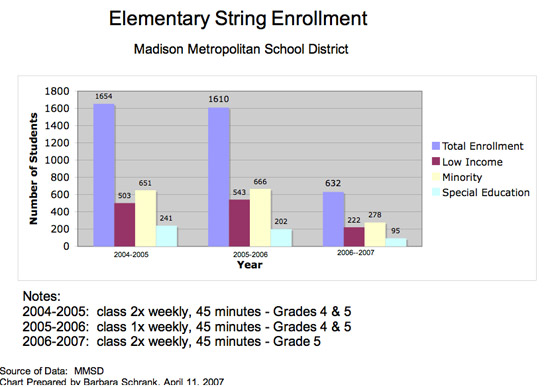
Decreasing academic opportunities to develop skills at a younger age is more likely to hurt participation at higher grades for low income and minority students who often lack support outside school to strengthen and reinforce what is learned in school either at home or through additional, private opportunities.
I hope you make the decision to give the Fine Arts Task Force an opportunity to complete its charge before making additional cuts to courses, because these cuts may prove to be more harmful to those students we want to reach than we realize. Also, if changes are made, I hope they are done equitably and with time for transitions. I’m asking this not only for arts education but also for other programs and activities Madison values in its public education. Eliminating elementary strings entirely would be the third year of major cuts in either funds or instruction time for students in this program. This seems to me to be overly harsh, especially when you consider that no extracurricular sports have been cut (nor would I support that).
Elementary strings is one arts course, but it has taught up to 2,000+ children in one year and is valued highly by parents and the community. I have 500+ signatures on a petition, which I will share with the board next week that says: “Madison Community Asks the MMSD School Board: Don’t Cut, Work with the Community to Strengthen and Grow Madison’s Elementary String Program. I have many emails with these signatures, and I’m planning to ask folks to write you about what this program means to them, so you hear their words and not only my words.
As I stated when I spoke before you earlier this year, there are those activities where a mix of public and private funding along with fees and grants might work for the arts and for extracurricular sports, for example. Please consider support of this and please consider helping with transitions toward different approaches.
Thank you for your hard work and support for public education.
Barbara Schrank
P.s. – note, I am speaking as an individual and not on behalf of the fine arts task force.
I would also like to add for SIS readers – I know due to the current financing scheme, the state is not funding public schools adequately nor fairly and is placing a huge burden on personal income and property taxes. I also know there have been cuts in previous years to the arts, increases in class sizes, fewer SAGE classes, etc. Just so you know, that is not the point of this letter. I see the need to work both locally and at the state. I also feel we need to be doing something more than referendums at the local level, and I don’t mean cut or referendum. I think in the areas of extracurricular sports, some of the arts, we may be able to put in place a financial package of public, private, fees, grants – but this takes time and planning and commitment by our school board following public discussions on the topic.
Not all minority children are low income, but by far, the majority of low income children are minority. By not working with the community on funding for this high demand, highly valued program, several hundred fewer low income students are receiving skill-based training on an instrument, which scientific research is showing more and more has a positive effect on other areas of academics.
No where else in this city do so many low-income children have the opportunity to learn how to play an instrument and to do so as inexpensively per student. This is a program where “thinking outside the box” for the School Board could come in handy, so we can continue this academic program as part of the school day for so many children.
UCLA – Graduation School of Education:
The nation’s college freshmen are more financially advantaged today than they have been at any point in the last 35 years and come from families with a median income 60 percent higher than the national average, according to a new UCLA report that examined 40 years of data from UCLA’s national survey of entering undergraduates at four-year colleges and universities.
The report, “American Freshmen: Forty-Year Trends 1966–2006,”documents the values and characteristics of college freshmen nationwide and is part of the Cooperative Institutional Research Program administered by the Higher Education Research Institute at UCLA’s Graduate School of Education & Information Studies.
“As colleges and universities continue their financial policies of increasing tuition and fees, we are seeing direct effects on students that come from poorer families,” said José Luis Santos, UCLA assistant professor of education and an author of the report. “Poorer students alter their choices of whether or not to go to college at all, or choose a college based on financial costs and packages. Students from wealthier families can endure greater fluctuations in ‘sticker price’ than poorer students, and as a result, more students entering college come from homes that are increasingly wealthier than the national median income.”
In 2005, entering freshmen came from households with a parental median income of $74,000, 60 percent higher than the national average of $46,326. This represents a 14 percent increase from 1971, whenstudents’ median family income was $13,200, 46 percent higher than the national average of $9,028.
The Waukesha School District’s 2006-2007 Budget ($165,388,112 for 13,063 students = $12,660 – similar per student spending to the Madison Schools. Wisconsin’s average per student spending is just under $10,000.) [1.1MB PDF]
Amy Hetzner:
Only a month after voting to eliminate the equivalent of 62 full-time staff positions to avoid a budget shortfall in the coming school year, the School Board began discussions Wednesday about ways to broach nearly $3.7 million in reductions for 2008-’09.
Waukesha Taxpayer League’s Teacher Salary Study
Mark Belling:
In no school district in Wisconsin is the school tax situation more disgusting than Waukesha. In that community, a demagogic school board and superintendent are threatening draconian cuts including the elimination of all high school sports. Their tactic is anything but subtle. They’re laying the groundwork for a tax increase proposal.
In fact, the Waukesha School District is awash in cash. It has been raising school taxes for decades and is spending thousands more per student than it did only a few years ago. I can solve its budget “crisis” now.
The month of April brings showers; however, for the Madison BOE it brings new beginnings, budget challenges and community dialogue.
First, regarding new beginnings, let me congratulate Beth Moss and Maya Cole on their election onto the Madison School Board. They will be replacing the retiring Shwaw Vang and Ruth Robarts. Our community should be proud of Mr. Vang and Ms. Robarts’ years of service. I was also re-elected to a second term and look forward to continued public service in this position.
In addition to new Board members, the Board decided unanimously to name the new school General Vang Pao Elementary.
Second, the Madison School District faces a $7.9 million dollar shortfall, which has the Board discussing school closings and consolidations, increasing elementary class sizes in several schools, increasing class sizes across the district in elementary art, music, gym and REACH, and eliminating the 5th grade strings program. After 14 years of being under the state imposed revenue limits, the budget cuts are now reaching the point of cutting into the foundation of our educational values.
Third, several public hearings on the budget reductions will be held throughout the community including on Tuesday April 17th at La Follette and Thursday April 19th at Memorial. Both hearings are at 6:30 pm. The 2007-08 budget will be finalized in late April or early May.
Fourth, the Board voted down an operating referendum proposal that could have taken place in the summer. However, given our budgetary situation I won’t be surprised to see an operating referendum on the ballot in February 2008.
Fifth, the Board approved a Request For Proposals for consultants to conduct a superintendent search, and decided on health insurance contributions for administrators.
Board Committees
A full month of public hearings and Board workshop agendas kept many committees from meeting since my last report. However, the committees have played an important part in analysis and discussion this year.
Finance and Operations (Lawrie Kobza, Chair) continues its work on the citizen’s budget. Long Range Planning (Carol Carstensen, Chair) held public hearings in the community regarding the proposed closings and consolidations.
Communications (Arlene Silveira, Chair) held a special workshop regarding community advocacy efforts regarding lobbying our state government for additional K-12 funding. Community Partnerships (Lucy Mathiak, Chair) received a presentation regarding the process and procedure the UW Foundation uses to engage people to make contributions.
MMSD News
On Monday March 26th, the MMSD held its annual recognition awards honoring district staff, students and citizens who have made significant contributions to Madison’s outstanding schools. Nine students received the Joe Thomas Community Service Award, five teachers were recognized for their work toward the Kohl Teacher Fellowship, and eleven individuals received the Distinguished Service Award. For more MMSD news click here: http://mmsd.org/today/
Thank you for your interest and support of the MMSD.
Johnny Winston, Jr., President, Madison Board of Education
jwinstonjr@madison.k12.wi.us
Want district information? Go to www.mmsd.org
Write to the entire school board at comments@madison.k12.wi.us.
Sign up for MMSD communications at http://mmsd.org/lists/newuser.cgi
Watch school board meetings and other district programs on MMSD Channel 10 & 19.
Ken Syke
Public Information
Madison School District
voice 663 1903; cell 608 575 6682; fax 608 204 0342
John Nichols:
So how did Cole secure her 3,000-vote majority?
The answer would appear to have a lot to do with threats by school administrators to consolidate and perhaps close schools on the isthmus. A few months before the election, the administration floated the notion that budgets could be balanced by radically altering how Lapham and Marquette elementary schools and O’Keeffe Middle School are organized.
The Board of Education at its April 9 meeting unanimously voted to name the new elementary school on the far West side for General Vang Pao, a prominent, national Hmong leader.
His name was selected from a list of 39 names that were nominated earlier this year by community members.
Vang led the Hmong in the Secret War against the communists in Laos and Southeast Asia. After he arrived in the U.S. in 1975, he worked to help resettle the Hmong in this country and has been an advocate here for the rights of Hmong people.
The naming process defined by a previously established Board of Education policy also involved holding a public hearing at which dozens of persons spoke to the Board about the various names for the new school. There was also the opportunity for citizens to provide feedback by e-mail and via the Internet.
From the Wisconsin Charter Schools Association:
You’re invited to join educators, environmentalists and others at the Environmental Charter Schools Workshop.
Date: May 2, 2007, Wednesday
Time: 9:00am to 2:30pm
Site: MADISON, UW Arboretum
Workshop Program: Unique features of “green” charter schools, integrated environmental curriculum, standards and accountability, charter partners supporting sustainable schools, and implementing a green charter school. Learn more at Green Charter Schools.
Presenters, Partners & Discussion Leaders: JIM McGRATH, founder and former principal of Oshkosh Environmental Charter School; VICTORIA RYDBERG, Teacher, River Crossing Charter School; JULIE SPALDING, Educator, Fox River Academy, and INGRID BEAMSLEY, WCSA Deputy Director
Registration: The registration fee is only $20, which covers the conference, lunch and materials. Send registrant’s name and email address, along with a $20 check payable to the WCSA, to: Wisconsin Charter Schools Association, PO Box 1704, Madison, WI 53701-1704 . Questions? Contact the WCSA at: Tel: 608-661-6946 or Email: info@wicharterschools.org or FAX: 608-258-3413
Links to 40 “GREEN” charter schools.
Read about “Green Charter Schools” in Wisconsin Trails magazine.
Madison West Student Natalia Thompson:
Re “In Homework Wars, Student Wins a Battle: More Time to Unwind on Vacation” (On Education column, April 4):
As a 15-year-old high school sophomore with a demanding course load, I read your article with interest.
On regular weekdays, my evenings fill up quickly with daily homework assignments and extracurricular activities. My weekends are my opportunity to catch up on projects and essays, review notes and study for upcoming tests — which leaves hardly any time to relax.
Spring break is a rare occasion for me to unwind, reflect, rejuvenate and prepare for the onslaught of work when I return to school. It’s the only way I keep going.
In an effort to ensure racial diversity, the school system here in northern Westchester County is set up in an unusual way, its six school buildings divided not by neighborhood but by grade level. So all of the second and third graders in the Ossining Union Free School District attend the Brookside School.
But some minority students, the black boys at Brookside, are set apart, in a way, by a special mentoring program that pairs them with black teachers for one-on-one guidance outside class, extra homework help, and cultural activities during the school day. “All the black boys used to end up in the office, so we had to do something,” said Lorraine Richardson, a second-grade teacher and mentor. “We wanted to teach them to help each other” instead of fight each other.
While many school districts have long worked to close the achievement gap between minority and white students, Ossining’s programs aimed to get black male students to college are a new frontier.
The largest cuts in the superintendent’s budget are through the consolidation of some schools.
Lindbergh parents were surprised on Monday night to hear the superintendent is backing a plan that would close their school.
They had anticipated their school being taken off the district’s chopping block.
Many of the parents have been fighting to keep up with the information coming from the board, and now they’re hoping the board will listen to their concerns.
Parent Jeffrey Lewis has had three children go to Lindbergh Elementary, but with a budget plan calling for the close of the school, he’s worried about how it would affect all of the students there.
“The district has looked at this from a monetary standpoint, but never have they addressed how this is going to impact equity,” said Lewis. “How will they maintain the opportunity that kids currently have in small schools?
 Long time teacher, former school board member/president and activist