School Information System

Giving Proper Credit To Home-Schooled

Michael Alison Chandler:

In the pursuit of a homemade high school education, Jay Voris played drums in Guinea, Colin Roof restored a 134-year-old sailboat in Ireland, and Rebecca Goldstein wrote a 600-page fantasy novel and took calculus at the University of Maryland Baltimore County.
The independent-minded Maryland students and two dozen others gathered at a Unitarian Universalist Church in Annapolis one afternoon this month for an alternative graduation ceremony that is becoming more common across the country as home schooling expands. Now the movement is gaining ground in a crucial arena: college admissions.

Share

Rating Education Gains

Jay Matthews:

Achievement Gaps, Advanced Placement Exams, Demographic Shifts and Charter Schools: What Do They Add Up To for Students?
We seem to be doing a bit better educating our most disadvantaged students. But many educators think that is not enough.
The numbers displayed in the graphic smorgasbord known as “The Condition of Education 2007,” from the U.S. Education Department’s National Center for Education Statistics, reveal the struggles of a generation to make schools work for all children.
Enrollment in publicly funded day care increased significantly from 1991 to 2005. The portion of black children using such services rose from 58 percent to 66 percent. For Hispanic children, the figure rose from 39 percent to 43 percent; for non-Hispanic whites, from 54 percent to 59 percent.
More public day care does not necessarily mean more learning is going on, although the quality of such centers appears to be improving as more states increase support for pre-kindergarten classes and in some cases make them available to all who want them. The relatively low number of Hispanic children in such programs might be a problem, as improving their grasp of English is crucial to the educational success of the largest minority group.

Share

Ed Hughes to run for Madison school board

Marc Eisen:

The next Madison School Board election is ten long months away, but the first candidate to replace retiring board member Carol Carstensen has already emerged.
Attorney Ed Hughes, 54, an east-side parent activist, says he will seek Carstensen’s seat in the spring 2008 election.
“My interest in the school board started with my frustration over its budgeting process,” he says. “Several years ago, I remember attending a strings concert and wondering why cutting strings kept coming up year after year as a budget option.”
Hughes shares the common perception that the Madison schools are hurt by the state’s current formula for funding education. But be also thinks the school board undercuts public understanding of the district’s plight by not being fully transparent in its budget-making. Hughes feels the board can do a better job of explaining its spending decisions to the public.
“The budgetary issues are paramount,” he says. “The quality of the schools won’t be maintained if we have to cut from $5-to$7 million dollars every year. We’ll have to go referendum, but referendums aren’t easy to pass.”

Ed Blume was correct when he said that “it’s never too early to run for the school board”.

Share

Will Marquette & Lapham students be safe?

This is a report from the Madison police department on calls to the alternative programs that will be relocated to Lapham and Marquette. [The report had individuals’ names in a few instances, but I deleted them.]
06/07/07 14:48:28 M A D I S O N P O L I C E D E P A R T M E N T
M.M.S.D. CALLS FOR SERVICE / SEPTEMBER 1, 2006 THRU JUNE 7 2007
* * * * * * ALTERNATIVE LEARNING ACADEMY 15 S BREARLY ST * * * * * * * *
CALL DATE TIME CALL TYPE CASE # REPORT OFFIC
DISPATCH NOTES: Y/N?
09/12/2006 11:54 VIOLCRTORD 06-110419 2 STUDENTS PHYSICAL AND VERBAL WERE OUTSIDE 1154,002 Y FAVOU
09/27/2006 12:32 SXASLTCHIL 06-117349 3 STUDENTS REPORTING THEY HAVE BEEN SEXUALLY ASSAULTED, DIDNT Y FAVOU
10/03/2006 14:22 THREATS 06-119989 THREATS REPORT, VICT IN #207, SUSPECT IS IN THE PRINC OFFICE, N WALKE
10/05/2006 09:49 JUV COMPLT 06-120707 CK STUDENT – [Name deleted] 9/27/89 LISTED AS A Y FAVOU
10/20/2006 11:03 WPNS OFFNS 06-127224 SEE 17 IN THE CLUSTER PROGRAMS ROOM TOOK A KNIFE OFF A Y HENNE
10/23/2006 12:45 BATTERY 06-128387 15YOA FEMALE, OUT OF CONTROL. THE FEMALE IS ALSO PREGNANT AND Y COVER
11/06/2006 12:28 AGGR BATT 06-134539 FIGHT OCCURRED BETWEEN 2 STUDENTS ONE HAD A KNIFE 1228,002 Y ZIEGL
11/10/2006 12:47 JUV COMPLT 06-136265 KIDS RETURNING TO SCHOOL FROM A TRIP DOWNTOWN ARE REPORTING AN Y RAMIR
11/20/2006 08:44 JUV COMPLT 06-140009 NO DATA Y FAVOU
11/21/2006 10:36 DRUG INCID 06-140448 NO DATA Y FAVOU
12/12/2006 14:54 DAM PROPTY 06-148289 REPORT DAMAGE TO AUTO. HAVE SUSPECT INFO. IN THE PARKING LOT. N GOEHR
01/19/2007 08:56 THREATS 07-006335 SEE [Name deleted] HERE, NEEDS TO REPORT A THREAT, ANOTHER 0856,002 Y VALEN
01/30/2007 12:42 THREATS 07-010608 THREATS OF VIOLENCE AGAINST A STUDENT-VICTIM OF THE THREAT IS Y MCCON
02/07/2007 09:45 911 DISCNT 07-013478 MISDIAL 0946,004 N HENNE
03/12/2007 12:35 JUV COMPLT 07-026047 2 STUDENTS HAD AN ALTERCATION NO EMS NEEDED GO TO Y COUTT
03/22/2007 13:34 JUV COMPLT 07-030197 JUVENILE DISTURBING. THEY ARE IN THE STAIRWELL RIGHT NOW. N HENNE
03/29/2007 11:36 SUSPCS PRS 07-033232 2 PEOPLE CAME IN,AND TRIED TO GET TO A STUDENT;THEY RAN OUT Y MCCON
04/12/2007 14:41 CHK PERSON 07-038233 17 SAYS A MALE WHO HAS BEEN ABUSING A FEMALE HERE WAS JUST AT N GOEHR
04/16/2007 09:07 JUV COMPLT 07-039735 [Name deleted] IS HERE. THINK THAT SHE MAY BE A RUNAWAY. Y MCCON
04/17/2007 08:39 ASST CITZN 07-040174 THEY HAVE A STUDENT AT SCHOOL TODAY WHO WAS REPORTED BY HIS N MCCON
04/17/2007 09:53 THREATS 07-040202 SEE 17 IN THE OFFICE ABOUT A FEMALE STUDENT WAS THREATENED ON Y MCCON
04/25/2007 12:07 JUV COMPLT 07-043723 SCHOOL REQUEST STUDENT ISSUED FOR HIBITUAL TRUENCY. SHE IS Y MCCON
04/27/2007 08:42 DISTURBANC 07-044457 PLS SEE 17 IN THE OFFICE, REF TO A DISTURBANCE THAT OCCURRED Y FAVOU
05/02/2007 08:49 DISTURBANC 07-046747 COME TO SAPAR FEMALE STUDENT HERE THEY WANT OUT OF THE Y HARLE
05/10/2007 15:12 DISTURBANC 07-050650 HAPPENED ON E WASH/INGERSOLL BY BUS STOP – ONE OF GIRLS IN Y GOEHR
05/16/2007 11:36 DISTURBANC 07-053258 STUDENT OUT OF CONTROL IN THE OFFICE VERY AGITATED 1136,007 Y HENNE
05/18/2007 09:09 ASST FR/PO 07-054161 SMOKE IN THE BUILDING 0909,001 N SLAWE
05/31/2007 11:00 DISTURBANC 07-060205 14YO CAUSING PROBLEMS, VERBAL ONLY AT THIS TIME COME IN MAIN N PAYNE
06/06/2007 08:33 WPNS OFFNS 07-062961 ONE OF THE KIDS SUPPOSEDLY HAS A KNIFE IN SCHOOL HAS NOT N MCCON
06/06/2007 12:26 DRUG INCID 07-063049 HAVE 3 STUDENTS SELLING MARAJUANA WOULD LIKE TO INTERVIEW N HENNE
TOTAL CALLS FOR THIS SCHOOL
COUNT 30
* * * E N D O F R E P O R T * * *

Share

No answer on Reading First from Dept. of Ed

The MMSD ballyhooed its effort to be reinstated for eligibilty to apply for Reading First funds, even after the superintendent returned more than $2 million in Reading First funds in 2004.
In reponse to my question about the status of being reinstated, MMSD employee Joe Quick last week said that the MMSD has recieved no substantive response from the Department of Education.

Share

A Public-Private Effort to Fill Teacher Vacancies in Math and Science

Howard Blume:

Sherry Lansing retired as head of Paramount Pictures two years ago to head a foundation devoted to education and other causes. What if, she wondered recently, other retirees like her wanted to do the same.
Well, not exactly like her and not precisely the same way. She had in mind a lower-budget, in-the-trenches contribution: namely, becoming a teacher.
That plan blossomed into a media event led by Gov. Arnold Schwarzenegger on Friday heralding a public-private partnership to lure retirees into teaching math and science.
The effort was unveiled at Roosevelt High, where Lansing worked as a long-term substitute teacher in math shortly after graduating from college some 40 years ago.
Math, science and special education teachers are at a premium, and state officials estimate that 100,000 teachers will retire over the next decade, about one-third of the teacher workforce. Over that same period, California’s schools will need more than 33,000 new science and math instructors.

Share

Milwaukee School Violence Data

Madison Parents School Safety Site:

The heading of this post from the Milwaukee Journal Sentinel’s “School Zone” blog reads “MPS data shows spike in violence-related suspensions; 45% of high school students suspended at least once this school year.” But there’s a buried (or at least competing) lede of good news here: first, that the Milwaukee Public Schools’ school board has a dedicated Safety Committee (MMSD does not); second, that the committee has made it a priority to compile, present to the board, and make available to the public current information on suspension statistics and trends; and third, that the district acknowledges publicly that it is “aware we need to do a better job summarizing district incidents and actions.”

Share

OECD: Improving US Primary and Secondary Education

OECD:

Improving primary and secondary education. US school students are outperformed in international tests by their peers in many other countries. Although the causes of this are unclear, a partial explanation is that decentralised standards, curriculum and examinations are undemanding. Federal legislation that aims at addressing such system weaknesses is in general well conceived. However, it could be strengthened, for instance by extending the legislated framework of standards, assessment and accountability through high school. Responsibility for education lies primarily with the states and local authorities, which have to adopt and implement more challenging standards.

Share

Can D.C. Schools Be Fixed?

After decades of reforms, three out of four students fall below math standards. More money is spent running the schools than on teaching. And urgent repair jobs take more than a year . . .
Dan Keating and V. Dion Haynes:

Yet a detailed assessment of the state of the school system, based on extensive public records, suggests that the challenge is enormous: The system is among the highest-spending and worst-performing in the nation. Kelly Miller is one small example of a breakdown in most of the basic functions that are meant to support classroom learning.
Tests show that in reading and math, the District’s public school students score at the bottom among 11 major city school systems, even when poor children are compared only with other poor children. Thirty-three percent of poor fourth-graders across the nation lacked basic skills in math, but in the District, the figure was 62 percent. It was 74 percent for D.C. eighth-graders, compared with 49 percent nationally.
The District spends $12,979 per pupil each year, ranking it third-highest among the 100 largest districts in the nation. But most of that money does not get to the classroom. D.C. schools rank first in the share of the budget spent on administration, last in spending on teachers and instruction.

Share

Virtual High Schools and Innovation in Public Education

Bill Tucker:

There has been no shortage of solutions for improving the nation’s public schools. School leadership, teacher quality, standards, testing, funding, and a host of other issues have crowded reform agendas. But an important trend in public education has gone largely unnoticed in the cacophony of policy proposals: the rise of a completely new class of public schools—”virtual” schools using the Internet to create online classrooms—that is bringing about reforms that have long eluded traditional public schools.
Virtual schools served 700,000 students in the 2005–06 school year, mostly at the high school level. Although that is only a fraction of the nation’s 48 million elementary and secondary students, it is almost double the estimate of students taking online learning courses just three years earlier, and it’s a number that is likely to continue to rise rapidly. In 2006–07, Missouri, North Carolina, South Carolina, and South Dakota became the latest of the two dozen states to establish state-run virtual high school programs. And in Michigan, the legislature went a step further with a mandate requiring students to complete an online learning experience to graduate from high school.

Share

Season of Gratitude

As we begin the last week of the school year, I’d like to encourage everyone to make a point of saying “thank you” to at least one teacher, administrator or other school staff person in the coming few days. Teaching is one of the hardest jobs on the planet. We have some really fine ones in our schools. Take a moment to write a note or an email, make a phone call, or stop by a classroom.

Share

The Class-Consciousness Raiser

Paul Tough:

For the Glynn County Board of Education, Payne’s visit was a big deal. It was back in 2005 that Marjorie Varnadoe, the board’s director of professional development, called to request a presentation from Payne, and this particular Thursday, two years later, was the earliest available date. Principals had ordered Payne’s books and DVDs by the boxload, mostly her ur-text, “A Framework for Understanding Poverty,” and they made the books required reading for their staffs. All over the county, which is on the coast, down near the Florida border, schools held small workshops on class and education, using Payne’s “Framework” as a guide, and teachers sat down together for informal discussions and lunchroom chats about poverty and wealth. When the big day came, the entire school system was given the day off, and by 8 a.m. almost every single teacher and administrator in the county was packed into the Jekyll Island Conference Center, along with the school board, the Chamber of Commerce and various local dignitaries.

Clusty Search: Ruby Payne.

Share

Federal Grant to Support Gradual Charter Rollout

Nelson Hernandez:

Maryland will receive an $18.2 million federal grant to fund the expansion of the state’s nascent charter school program, state education officials announced yesterday.
The grant may allow the state to launch as many as 30 additional charter schools during the next three years, a spokesman for the Maryland State Department of Education said. This would more than double the number of charter schools in Maryland, which began its charter program in 2003 as a way of providing alternative methods of public school instruction.

Share

Teachers union out of touch with average worker

Milwaukee Teacher Steve Paske:

Regardless, I took the time to analyze the union proposal and came away with the same opinion I had before. As a rule, the MTEA uses its membership resources with gross inefficiency when it comes to garnering public support for the teaching profession.
Case in point: Several years ago, the union clashed with the School Board over suggested changes to the medical plan that would require teachers to pay a deductible and co-payment for services. As part of its strategy, it came up with the slogan “Attract and Retain” as the mantra for suggesting that these benefits cuts would not attract or retain quality teachers within the Milwaukee Public Schools.
Never mind that the board’s benefits proposal was still better than 90% of the public’s – those who pay our salary. The union engaged in a public relations disaster by sending members to the picket lines, thus alienating Joe Factory Worker who himself had a $1,000 deductible with 80% coverage despite belonging to a union.
Fast-forward to some of today’s issues: providing a quality teacher in every classroom, eliminating the residency requirement and creating safety in schools. Let’s look at how the union is approaching the issue of school safety.

More on Steve Paske. Joe Williams has more. Michael Rosen offers a different take.

Share

Accelerated Biology at West HS Stands Still

I have a friend who is fond of saying “never ascribe to maliciousness that which can be accounted for by incompetence.” These words have become a touchstone for me in my dealings with the Madison schools. I work harder than some people might ever believe to remember that every teacher, administrator and staff person I interact with is a human being, with real feelings, probably very stressed out and over-worked. I also do my best to remember to express gratitude and give kudos where they are due and encourage my sons to do the same. But recent events regarding Accelerated Biology at West HS — and how that compares to things I have heard are happening at one of the other high schools in town — have stretched my patience and good will to the limit.

(more…)

Share

Madison School Board selects a firm for superintendent search

For immediate release: Friday, June 8, 2007 (sent late Friday afternoon)
The Madison Board of Education has selected the firm of Hazard, Young, Attea & Associates of Glenview, ILto conduct the search for the hiring of a new superintendent. HYA was selected from among four businesses which applied for the search contract.
Board President Arlene Silveira said, “We are delighted to reach an agreement with Hazard, Young, Attea & Associates because they are nationally known and very highly respected in the field of superintendent searches. They specialize in working with districts of more than 20,000 students.” The MadisonSchool District’s enrollment is 24,755 students.
Superintendent Art Rainwater has announced that he will retire in June 2008.
Among the early steps in the search process, interviews will be conducted with school district and community representatives in order to develop for the Board a leadership profile of a new superintendent.
The flat fee for the search services to be provided by HYA will be $24,000.
COMMENTS OR QUESTIONS? PLEASE CONTACT:
Madison Metropolitan School District
Public Information Office
545 W. Dayton St.
Madison, WI 53703
608-663-1879

Links:

Share

“The Public Needs to Know What’s Going On”

Madison Parent’s School Safety Site:

Today’s “Watchdog” section of Isthmus has a quick report (at the link, scroll down to the third item, titled “Dangerous work, take 2″) on recent incidents of violence in Madison schools against school staffers. In two of the incidents where staffers were injured, police declined to file criminal charges, citing the lack of criminal intent on the part of the student offenders. According to the item, one of these incidents occurred in early May at LaFollette High School. I was disappointed to find no mention of this (or other school-based incidents) in the latest newsletter from the Madison Police Department East District (whose boundaries includes LaFollette).

Related: Milwaukee Teachers are “Shell Shocked”.

Share

“End the Vang Pao Debacle”

Marc Eisen:

Finally, the Madison school board is showing signs it may back away from its wrongheaded decision to name a new elementary school for Hmong warlord Vang Pao.
To a remarkable degree, the board has stubbornly ignored all evidence of Vang Pao’s bloody past. That’s because Madison’s emergent Hmong community has rallied behind the proposal, and the board, wishing to celebrate Madison’s multicultural makeup, has decided that the Hmong’s time is now, no matter what the objections.
Carol Carstensen has been the lone exception in her willingness to reconsider the naming decision.
Not surprisingly, Bill Keys, the former school board member and perhaps the city’s most arrogant and self-righteous liberal, has been in the frontlines of Vang Pao’s supporters. Disappointingly, several past and present board members who should know better also threw their credibility behind the school naming, despite serious accusations of Vang Pao’s war crimes, drug dealing and suspect fundraising activities.

Share

Tonight;’s BOE Special Meeting Canceled

Tonight’s BOE meeting and information session (high school redesign, District-wide SLC grant) at Wright MS has been canceled due to impending bad weather (and concerns about poor attendance, as a result). The meeting has been re-scheduled for Monday night, June 11.

Share

State School Standards Vary Widely in Study

Tamar Lewin:

What students must learn to be deemed academically proficient varies drastically from state to state, the United States Department of Education said today in a report that, for the first time, showed the specific extent of the differences.
The report supports critics who say the political compromise of the federal No Child Left Behind law, President Bush’s signature education initiative, has led to a patchwork of educational inequities around the country, with no common yardstick to determine whether schoolchildren are learning enough.
The law requires that all students be brought to proficiency by 2014, but lets each state set its own proficiency standards and choose its own tests to measure achievement.

Mapping 2005 State Proficiency Standards Onto the NAEP Scales: 433K PDF File:

Under the No Child Left Behind Act (NCLB), states are required to report the percentages of students achieving proficiency in reading and mathematics for grades 3 through 8. For each subject and grade combination, the percentages vary widely across states. For grades 4 and 8, these percentages can be compared to the estimated percentages of students achieving proficiency with respect to the standard established by the National Assessment of Educational Progress (NAEP). Again, large discrepancies are observed. This variation could derive from differences in both content standards and student academic achievement from state to state, as well as from differences in the stringency of the standards adopted by the states. Unfortunately, there is no way to directly compare state proficiency standards because states are free to select the tests they employ and to establish their own performance standards.

More here.

Share

Democrats for Education Reform

Elizabeth Green:

A money manager recently sent an e-mail to some partners, congratulating them on an investment of $1 million that yielded an estimated $400 million. The reasoning was that $1 million spent on trying to lift a cap on the number of charter schools in New York State yielded a change in the law that will bring $400 million a year in funding to new charter schools.
The money managers who were among the main investors in this law — three Harvard MBAs and a Wharton graduate named Whitney Tilson, Ravenel Boykin Curry IV, Charles Ledley, and John Petry — are moving education-oriented volunteerism beyond championing a single school. They want to shift the political debate by getting the Democratic Party to back innovations such as merit pay for teachers, a longer school day, and charter schools.

Democrats for Education Reform website.

Share

Memorial High Junior Scores Perfect on the ACT

Kristin Czubkowski:

Alex Trevino had a good feeling when he walked out of the ACT testing room on a cold, winter morning this past February.
“I felt good,” he said. “I didn’t know how good at the time, but I knew I did well.”
That confidence, however, did not prevent the jolt that went through the Madison Memorial junior when he opened a letter from CEO Richard Ferguson of the ACT Board eight weeks ago congratulating him on being one of 30 students in the country — and the only one in the state — to have earned a perfect composite score on the test.
“He has a look on his face when he’s really, really excited, and he could not wipe that grin off his face,” Alex’s mother Jackie D’Aoust-Trevino said. “He just said, I got a 36.'”

Share

Troops to Teachers

Jamaal Abdul-Alim:

The military features prominently in Room 412 of the Milwaukee Education Center – a special education classroom that contains some of the school’s most challenging students.
A U.S. Marine flag hangs just beneath the American flag. War books are propped up on a blackboard tray.
The teacher at the front of the class is Stan Loper, 44, a beefy, clean-shaven former U.S. Marine who is built like a tank. He begins the school day in a manner not much different from what you might expect from a drill sergeant, telling his students to use “nice and loud outside voices” as they recite their daily affirmation as members of “Club FAITH” – an acronym for Friendly, Able, Intelligent, Talented and Helpful.
“Who are we?” Loper yells.
“Club FAITH!” the students yell back.
Loper found his way into the classroom through Troops to Teachers, a U.S. Department of Defense-sponsored program that, among other things, offers up to $10,000 to get service members, both active and retired, to serve as teachers in the nation’s neediest schools. About 80 teachers around Wisconsin got their start in the program, which began in 1994.

Share

Scores Up Since ‘No Child’ Was Signed

Amit Paley:

The nation’s students have performed significantly better on state reading and math tests since President Bush signed his landmark education initiative into law five years ago, according to a major independent study released yesterday.
The study’s authors warned that it is difficult to say whether or how much the No Child Left Behind law is driving the achievement gains. But Republican and Democratic supporters of the law said the findings indicate that it has been a success. Some said the findings bolster the odds that Congress will renew the controversial law this year.

There has been some controversy over the quality and rigor of state standards, including Wisconsin’s. Sam Dillon has more. Joanne Jacobs adds a few comments and links to this article.

Share

The Next School Name

A Capital Times Editorial:

The new elementary school on Madison’s far west side will not be named for Hmong Gen. Vang Pao, who has been arrested by federal authorities on charges of masterminding a plot to use money collected from Hmong refugees in the United States to massacre Laotians in a violent coup.
Whether the Madison School Board recognizes that fact immediately or in a few weeks — after what board President Arlene Silveira describes as an investigation into the “nature of the charges” against Vang — there is no way that Madison, or any other city, is going to build a “Vang Pao Elementary School.”
That’s the first reality of the moment.
It is not a judgment regarding the guilt or innocence of Vang. The charges against the general, who for many years during the Vietnam War era did the dirty work of the U.S. Central Intelligence Agency, are serious. But just as there must always be an assumption of innocence, there should also be a measure of skepticism when it comes to federal claims regarding conspiracies.

Much more on the Vang Pao Elementary School here.

Share

Omaha-Area Districts to Share Revenue, Programs

Christina Samuels:

The new law retains the previous measure’s concept of creating a “learning community” of the 11 districts, located in Douglas and Salpy counties, which educate about 100,000 children.
The goal is for each school to have 35 percent students who are of low socioeconomic status. Students would be able to transfer freely between schools that have space for them, regardless of the district where they live. A paid, 18-member board will oversee specific issues that do not relate to the operations of the individual districts for the learning community.
The state will levy a common tax on the two counties that will be distributed to districts based on enrollment and other needs. Districts will be able to levy their own tax, and another, smaller tax levy will pay for an areawide school construction program.
The plan calls for the creation of “focus schools,” with programs intended to attract students from more than one district. The construction of those boundaryless schools will be part of the duties of the new learning-community board.

Share

Live Chat: Teachers and Performance Pay

via a reader involved in these issues:

WHEN: Wednesday, June 6, 4 p.m. to 5 p.m., Eastern time
WHERE: edweek-chat.org
Submit questions in advance here.
Earlier this spring, a panel of 18 highly accomplished teachers assembled by the Center for Teaching Quality—and known as the TeacherSolutions group— released a report that strongly advocates performance-pay systems for teachers.
Under TeacherSolutions’ recommendations, teachers would be paid more over time as they advance along a career ladder that extends from “novice” to “expert,” but they could also receive extra pay for taking on leadership roles, improving students academic performance, acquiring new knowledge and skills, and working in low-performing schools. According to the report, in Wake County, N.C., for example, novice teachers could make as little at $30,000, while experts could make up to $130,000 per year depending on their performance.
“We have to provide more for those teachers who continually go above and beyond to ensure high academic gains,” Betsy Rogers, a member of TeacherSolutions, wrote in an article for teachermagazine.org. “[TeacherSolutions’] goal is to encourage—even provoke—a deep conversation about quality teaching and how a variegated pay system could support the development of teaching as a profession.”
In this chat, two members of the TeacherSolutions group, Nancy Flanagan and Lori Nazareno, will be online to take your questions about their recomendations, current issues in teacher compensation and career advancement, and the challenges of evaluating teacher performance.
Please join us for the discussion.
Submit questions in advance here.

Share

Thomas back on his mission to bring music to kids

Zoe Mezin:

Elegantly ensconced in an elaborately embroidered armchair at the British ambassador’s residence, Michael Tilson Thomas reveals his recipe for drawing young people to classical music.
“Rosebud,” says the San Francisco Symphony music director, who was in Paris until Monday filming a future installment of the “Keeping Score” documentary series.
“When Charles Foster Kane dies (in the movie “Citizen Kane”), a paperweight falls and he says the word ‘Rosebud.’ ‘Keeping Score’ is like that. It tries to go behind the scenes, into the unconscious of the composers and their world. It builds up from small, seemingly inconsequential things to see what drives them.”
Storytelling is central to the “Keeping Score” series that aired on PBS to 3.5 million viewers in November 2006. In forthcoming episodes, Thomas follows the same formula.

Share

Multiplying Benefits of College for Everyone

Jay Matthews:

Many intelligent people don’t think going to college is so important. They send me emails whenever I vent about the need to prepare more low-income students for higher education. They ask a simple, excellent question: Why should college be for everybody?
They say some kids are not capable of succeeding in college. They say some kids don’t want to go to college. They say if everyone went to college, who would do the important non-college jobs, like plumbing and carpentry and auto repair? They say if everyone went to college, we would have a lot of unemployed college graduates–as has happened in some underdeveloped countries–with neither the skills nor the desire to work with their hands.

Share

West Bend School Board considers seeking $119 million in referendum

Don Behm:

The West Bend School Board will decide Monday whether to ask voters to spend $119 million in a referendum proposal that would, if approved in November, be the largest to pass in state history.
West Bend has not built a new school since the 1969 construction of its twin high schools at the same site, and the growing district needs to replace a few schools and provide more space for students and educational programs, said School Board President Charlie Hillman. The district serves about 7,000 students and is the 19th largest in the state.
The original piece of the district’s oldest school, Jackson Elementary, was built in 1894, and there is no room on the site for further expansion, school officials have said.
“It is time to take care of our problems,” Hillman said. “We will ask the voters if this is worthwhile.”

Share

3 Simple Things: Conduct Board Business Differently

  1. Good Health Care at an Affordable Price: Reduce Costs by $12 Million
  2. Put a Lid on the Cookie Jar: Cut Taxes Over $9 Million
  3. Eliminate Chaos: Board Decisions; Priceless: Improve Student Achievement.

MADISON MARKET COMPARITIVE HEALTH CARE COSTS

The bargained contract between the Madison Metropolitan School District and Madison Teachers, Inc. (representing teachers) stipulates health coverage from a ‘preferred provider’ (WPS) and a ‘health maintenance organization’ (GHC).

Bids have not been solicited from health care providers in many years. Comparative monthly premium costs for the employer and the employee in the Madison market:

Plan Single Coverage Family Coverage
Employer Employee Employer Employee
MMSD (WPS) $673.00 $75.00 $1,765.00 $196.00
MMSD (GHC) $365.00 $00.00 $974.00 $00.00
City (Dean) $406.00 $13.09 $1,010.00 $33.00
County (Phys Plus) $385.00 $00.00 $905.00 $33.00
State (Dean) $438.00 $22.00 $1.091.00 $55.00

VIDEO: watch the press conference here. Download the 823K PDF presentation materials.

Share

An Interesting Report on the Financial Condition and Position of the Milwaukee Public Schools

Wisconsin Taxpayers Alliance and the Metropolitan Milwaukee Association of Commerce [330K PDF]:

As will be seen, MPS already has many challenges:

  • Declining student numbers and a host of viable options for K12 students and their families;
  • Rising and, in some cases, difficult to control costs. Though MPS’s finances are similar to other large, diverse districts, its salaries relative to staff experience and its benefit expenditures are relatively high. The size of middle management within schools is also atypical.
  • Highly aided by both the state and federal governments, the Milwaukee district is unusually vulnerable to political decisions and policy made elsewhere. An anticipated decline in federal monies will directly impact MPS’s bottom line. And, any slowdown or reduction in state aid, has a direct property-tax impact in a high-tax city.

WISTAX projections show the future to be even more difficult. All these factors combine to suggest a future where revenue growth will be modest, at best, while costs will grow inexorably. If no further budget adjustments are made—and some have already been implemented—the Milwaukee school district faces a recurring and growing gap between slowing revenues and growing expenditures.
Needless to say, MPS has difficult years in its immediate future. From our work, we know that district, MMAC, and community leaders are passionate about improving education for all Milwaukee’s children. We wish them only the very best.

Alan Borsuk:

A study from the Wisconsin Taxpayers Alliance includes figures from 2005 placing Milwaukee Public Schools in perspective with statewide figures and with seven districts judged to be closest to comparable to MPS (Beloit, Green Bay, Kenosha, Madison, Racine, Superior, Wausau).

  • Teacher salaries
    $35,439 average in MPS
    $43,038 median statewide

  • Fringe benefits
    $21,439 average in MPS
    $20,324 median statewide

  • Assistant principals per student
    1:541 in MPS
    1:1,177 average for comparable districts listed above

In the report, Berry writes, “The combined effect of lost market share, district spending choices (particularly in the fringe benefit area), tightening state revenue controls and uncertain federal funding means that the expenditure demands MPS faces will grow faster than available revenues. Annual rounds of budget retrenchment are inevitable.”
Even as spending per student has increased significantly in MPS, the impact of financial belt-tightening has increased, the report says. Rising health care costs and costs for retirees are major reasons.

Education spending has increased annually at the federal, state and local level. Clearly, something different than the usual “same service” or “cost to continue” approach is warranted.
Jay Bullock’s notes and links.

Share

Mission Creep: How Large School Districts Lose Sight of the Objective — Student Learning

Mike Antonucci:

The growth of education bureaucracy constitutes what former Education Secretary William Bennett once called “the education ‘blob.’”
A 1998 study by the Alexis de Tocqueville Institution defines “the blob” as nearly 40 Washington-based organizations, with more than 3,000 employees and combined budgets of more than $700 million. They have inter-locking directors, share staffs that move between groups and in and out of the revolving door of government, and generally stand united on every major education issue.
But while this national education establishment is often the subject of critical commentary, left undiscussed is the growth of smaller “mini-blobs” at the local, district level. With class size reduction and school size reduction on the public’s mind, educators are coming to the realization that bigger is not always better – but school district size has not yet made it onto the education policy agenda.
In 1937, there were 119,001 school districts. By 1970, that number had dropped to 17,995. In 1996, there were only 14,841. For decades, Americans have accepted the premise that a large city requires one mammoth school district. But evidence suggests that the larger a school district gets, the more resources it devotes to secondary or even non-essential activities. Schools provide transportation, counseling, meals, child care, health services, security, and soon these “support” functions require support of their own.
In sum, large school districts engage in “mission creep,” building support activities which rapidly lose any connection to the original goal of educating children.

Share

Cramming May Not Be the Best Practice

Washington Post:

Take it from Isabela Guimaraes, a top D.C. high school student who said she has been there and done that: Cramming for an exam is better than not studying at all, but it’s hardly a best practice.
Once, faced with a test in a troublesome trigonometry class, the Georgetown Day School student tried to fill her head with formulas for hours beforehand, only to find that her brain went blank at the critical moment. On her test, she wrote to her teacher:

Share

Who’s Cheating the Most?

The Washington Post:

Donald McCabe says he has the research to prove it: Business students probably cheat the most.
“Students in business already have a bottom-line mentality,” said McCabe, founder of the Center for Academy Integrity and a professor at Rutgers University in New Jersey. ” ‘I have to get the job done, and how I get it done is less important.’ That kind of thinking.”

Share

In Finals, Pressure Seems Unending

Valerie Strauss:

In libraries, classrooms and coffee shops, with books, computers and calculators, students are trying to squeeze in the last bit of studying for final exams that can spell the difference between a good grade and summer school.
Some schools keep buildings open for late-night, middle-of-the-night and early-morning cramming sessions, while others have official “study days,” when the entire campus is focused on that one task.

Share

Our schools are like family and budget cuts are hurting important family values

LaFollette Teacher Sean Storch:

hen the Madison School Board eliminated two high school athletic director positions to meet state-imposed budget restrictions, the La Follette High School family lost a critically valuable teacher, coach, adviser and school leader. Jim Pliner was modest when he said the surplus move “stings a little bit.”
In another sense, Pliner is quite right to be humble. He is not the only excessively dedicated school leader who works 16-hour days and long weekends trying to hold the school community together.
At La Follette High School alone, add the entire administration, teachers who come in two hours early and leave at least two hours late, and all coaches and extracurricular advisers who volunteer countless hours because they thrive on strengthening their community by nurturing future leaders.

Share

Pao Vowed to Lead the Hmong Home

Tony Barboza and Ashley Powers:

Vang Pao, a key figure among those arrested Monday on suspicion of plotting the overthrow of the communist Laotian government, is so well-known in the local Hmong community that his family always keeps fruit, soda and water on the living room coffee table to greet the constant stream of visitors who drop by his Westminster home.
An aging Pao would often regale them with war stories while seated under portraits of the former Laotian king and other royalty — and one of himself in military dress from his younger days.
But in addition to the nationwide image of patriarch and benefactor, Pao also has another reputation — that of a tough leader who worked for the CIA in its “secret war” in Laos during the Vietnam War more than 30 years ago.

Brittany Schoepp and Andy Hall have more, as does Susan Troller.

Share

DC Begins School Audit

David Nakamura:

D.C. government officials will launch an extensive audit of the city’s public schools today designed to pinpoint how the system is spending its $1 billion budget and identify areas of waste and mismanagement.
The audit, scheduled for announcement at a midday news conference, comes as Mayor Adrian M. Fenty (D) prepares to take control of the 55,000-student school system and is patterned after similar studies in other jurisdictions, including New York, St. Louis and New Orleans. But those studies have not always provided clear answers and, in some cases, resulted in new problems created by the auditors.

Share

Some High Schools Avoid Valedictorians

NPR’s Steve Inskeep:

Some high schools are getting rid of a senior class tradition — naming a valedictorian. They say that lowering competition among students is better for their overall success. Eden Prairie High School in Minnesota will graduate its last valedictorians this year. Next year, exceptional students will receive just an honors diploma.

audio

Share

Hmong here speak reverently of Gen. Vang Pao

Susan Troller:

Like countless thousands of other Hmong who had been American allies during the Vietnam War and who became hunted enemies in their own country when the United States withdrew from southeast Asia, Chue Thao lived as a refugee, eventually finding his way to the United States in 1987.
And like many in Madison’s Hmong community, he credits Hmong military and civilian leader Gen. Vang Pao with first establishing a proud Hmong ethnic identity and then opening the door for his people to build a new life in America, based on education and hard work.
Harrowing experiences of discrimination, war and violent dislocation are the rule for local Hmong families who escaped to America, and they help explain the fervent passion many feel towards naming a new west-side elementary school honoring Vang Pao.

Much more on Vang Pao Elementary School here.

Share

On Parochial School Busing

Arlene Silveira:

I want to clarify the facts about the Madison School Board’s decision on private school busing.
This is a financial budget change with no hidden agenda. This is not about “us versus them.” This is not about Madison schools being “afraid of diversity.” We embrace diversity. Visit any of our schools and see for yourself. This is not about the board wanting the private school children to bring in $13,000 of additional funds per child (an inaccurate number, by the way). In our deliberations, the School Board never discussed any of these topics.
This is, sadly, a matter of a state budget system that does not allow school districts in Wisconsin to provide adequately for their students … across the board.

(more…)

Share

When Should a Kid Start Kindergarten?

Elizabeth Weil:

According to the apple-or-coin test, used in the Middle Ages, children should start school when they are mature enough for the delayed gratification and abstract reasoning involved in choosing money over fruit. In 15th- and 16th-century Germany, parents were told to send their children to school when the children started to act “rational.” And in contemporary America, children are deemed eligible to enter kindergarten according to an arbitrary date on the calendar known as the birthday cutoff — that is, when the state, or in some instances the school district, determines they are old enough. The birthday cutoffs span six months, from Indiana, where a child must turn 5 by July 1 of the year he enters kindergarten, to Connecticut, where he must turn 5 by Jan. 1 of his kindergarten year. Children can start school a year late, but in general they cannot start a year early. As a result, when the 22 kindergartners entered Jane Andersen’s class at the Glen Arden Elementary School near Asheville, N.C., one warm April morning, each brought with her or him a snack and a unique set of gifts and challenges, which included for some what’s referred to in education circles as “the gift of time.”

Share

Harvard, Stanford on an iPod near you

Evelyn Shih:

ver want to attend a world-class university like Stanford or Harvard but don’t have the time, opportunity or grades? Now, thanks to the magic of podcasts, all you need is a portable audio player and an Internet connection to enjoy the growing body of online lecture courses provided for free by top colleges.
As the podcast snowball continues rolling – podcast users accounted for 12 percent of the Net’s population in 2006 – universities are beginning to jump on the bandwagon. Now, everyday folks around the world can listen to lectures like “Geography of World Cultures,” “The Historical Jesus” or “European Civilization From the Renaissance to the Present” during a jog or a long commute.

Share

Linguistics: Words in Code

The Economist:

The speakers of tonal and non-tonal languages have genetic differences
FIVE years ago three well-known academics, including Noam Chomsky, wrote that the half-century old “interdisciplinary marriage” between biology and linguistics “has not yet been fully consummated.” That same year other scientists described the molecular evolution of a gene called FOXP2 which, when mutated, seems to cause people severe difficulty with grammar and articulation.
Another genetic condition that could shed light on the biology of linguistics is microcephaly (sometimes rudely called “pin-headedness”). It is linked to six genes, a spanner in the works of any of which leads the human brain to grow to only two-thirds of a pint in adults. That is less than a third of its normal volume. Those genes are alluring objects for studying the evolution of language because brain size has ballooned in people since their line split with that of their closest relatives. Even though birds sing and bees dance, nothing in nature matches a human’s richly complicated system of vocal communication. In short, language makes humans unique and genes active in the developing brain make language possible.

Share

No more romp and circumstance

Amy Hetzner:

Students and their families should enjoy the pomp and circumstance that come with the upcoming graduation season, Milwaukee-area high school officials said.
They just would prefer a little more pomp and a little less circumstance.
So in the interest of preserving the decorum of their graduation proceedings, a number of school districts have drafted agreements with graduating seniors and their guests outlining behavioral expectations.

Share

Schools streamline how math is taught: Same textbooks, same lessons, at the same time

Via a reader, interested in this issue:

Jessica Blanchard:

When Seattle elementary-schoolers open their math textbooks this fall, they’ll all be on the same page — literally.
In an attempt to boost stagnant test scores, elementary teachers will start using the same math textbooks and materials and covering lessons at the same time as their colleagues at other Seattle elementary schools, the School Board decided Wednesday.
“It’s clear to me that the math adoption is long overdue, and Seattle desperately needs a consistent and balanced approach,” board member Brita Butler-Wall said.
Lessons will now be taught using the conceptual “Everyday Math” books, which help students discover algorithms on their own and explore multiple ways to solve problems, and the more traditional “Singapore Math” books, which help hone students’ basic computation skills through repetition and problem solving. Teachers will follow the district’s guidelines for the order the lessons would be taught.

Share

West HS English 10: Time to Show Us the Data

According to the November, 2005, report by SLC Evaluator Bruce King, the overriding motivation for the implementation of West’s English 10 core curriculum (indeed, the overriding motivation for the implementation of the entire 9th and 10th grade core curriculum) was to reduce the achievement gap. As described in the report, some groups of West students were performing more poorly in English than were other groups of West students. Poor performance was defined as:

  1. not electing to take the more rigorous English electives offered at West during 11th and 12th grade and
  2. failing one or more English classes.

The current West 10th graders — the first class to take English 10 — has almost finished two semesters of the new course. As well, they registered for their 11th grade courses several weeks ago. Seems to me it’s about time to take a look at the early data.
I would like to know what English courses the current 500 or so West sophomores signed up for for next year and if the distribution of their course selections — broken down by student groups — looks significantly different from that of previous 10th grade classes? When final grades come out later this month, I would also like to know what the impact of the first two semesters of English 10 has been on the achievement gap as defined by the “grade earned” criterion.
Thinking about the need to evaluate the impact of English 10 brings to mind the absence of data on English 9 that became so glaringly apparent last year. [English 9 — like English 10, a core curriculum delivered in completely heterogeneous classes — has been in place at West for several years. And yet, according to Mr. King’s report, it is not clear if English 9 has done anything to reduce the achievement gap in English among West students. (More precisely, according to email with Mr. King and others after the SLC report was made public, it is not clear that the impact of English 9 on the achievement gap at West has even been empirically evaluated. Readers may recall that some of us tried valiantly to get the English 10 initiative put off, so that the effect of English 9 could be thoroughly evaluated. Unfortunately, we failed.)] I would like to know what has been done this year to evaluate the impact of English 9 on the gap in achievement between different groups of West HS students.
Bruce (King), Heather (Lott), Ed (Holmes) and Art (Rainwater), I do hope you will soon “show us the data,” as they say, for West’s English 9 and English 10. And BOE, I do hope you will insist on seeing these data asap.
While we’re at it, what do the before-and-after data look like for Memorial’s 9th grade core curriculum? (In contrast to West, Memorial implemented only a 9th grade core curriculum. TAG and Honors classes still begin in 10th grade, as does access to Memorial’s 17 AP classes.)
With the District in the process of applying for a federal grant that may well result in the spread of the West model to the other three comprehensive high schools, we should all be interested in these data.
So should officials in the Department of Education.

Share

Economic Snapshot: The $363,000 High School Diploma

June is when many Wisconsin families celebrate high school graduations. As usual, Wisconsin ranks near the top nationally, with nearly a 90 percent high school graduation rate. Data from the Wisconsin Department of Public Instruction indicates that in the 2005-2006 school year, many schools in the Capital Region graduated over 95 percent of their students. However, 260 students (14.4%) in the Madison School District dropped out of high school in that school year.
What is the cost of high school dropouts? The U.S. Census estimates that in 2005, high school graduates in Dane County earned $9,083 more than high school dropouts. The 263 Madison students who did not complete high school in 2006 will earn $94.5 million less ($363,320 less each) over a 40-year career. At the state level, estimated lost earnings over a lifetime are nearly $1.4 billion.
According to the U.S. Census, 31.6 percent of families in Wisconsin headed by a person without a high school diploma live in poverty. According to reports filed with the Department of Health and Human Services for the 2004-2005 fiscal year, 48 percent of the adults requiring Temporary Assistance for Needy Families (TANF) in Wisconsin did not have a high school degree.
In addition to the $94.5 million in lost earnings, studies show that adults who lack high school degrees are at an elevated risk of incarceration and needing publicly financed medical care.
2005-2006 high school dropouts total lifetime earnings loss:
Madison Metropolitan School District — $95,553,160
Milwaukee School District — $590,775,360
Wisconsin total — $1,390,584,360
Source: WINSS, Wisconsin Department of Public Instruction, 2005 American Community Survey, U.S. Census Table: B2004, U.S. Department of Health and Human Services, TANF, TAble 25, FY 04-05.
For more information, contact Professor Andy Lewis, Center for Community and Economic Development, U.W. Extension, at andy.lewis@uwex.edu.

Share

Madison Students Participate in an International Origami Exhibit

Gayle Worland:

There are plenty of pages to turn in a library, though usually it’s between book covers. At the Pinney Branch Library, carefully arranged and locked behind glass, stand adventures in paper of a much different sort: “Origami By Children,” a traveling exhibit of tiny, ingeniously folded works selected in an international competition by the group OrigamiUSA.
Two Madison students have works in the exhibit, which was first assembled in 2005 but only now has arrived in Madison. Each creation is deceptively simple: many are made from a single sheet of paper, yet turned into a fanciful creature or sharp-edged geometric shape by the skilled, young hands of their creators.
“Origami is a very different art than arts that are based on expression, like painting,” says Natalya Thompson, a Madison West High School sophomore whose interlocking paper “Bow-Tie Motif,” made from 48 squares of three-inch-by-three-inch paper, is featured in the exhibit. Most pieces in the small show are based on designs created by published origami masters.

Origami USA website

Share

MMSD Paid Math Consultant on Math Task Force

mmsdmathconsult.jpg
Click to view MMSD Accounting Details.
A number of questions have been raised over the past few years regarding the Madison School District’s math curriculum:

  • West High Math Teachers:

    Moreover, parents of future West High students should take notice: As you read this, our department is under pressure from the administration and the math coordinator’s office to phase out our “accelerated” course offerings beginning next year. Rather than addressing the problems of equity and closing the gap by identifying minority math talent earlier, and fostering minority participation in the accelerated programs, our administration wants to take the cheaper way out by forcing all kids into a one-size-fits-all curriculum.

  • Dick Askey:

    Madison and Wisconsin 8th Grade Math Data

  • Math Forum Video, Notes and Links.

The Madison School Board’s most recent Superintendent evaluation process included the requirement (board minutes) that a math task force be formed to review the District’s curriculum. Details. The Board discussed this requirement on April 16, 2007 (Video and links) (Minutes)
The Task force includes David Griffeath, who, according to this document, provided by a reader, has been a paid math consultant for the Madison School District.

35 members of the UW-Madison Math Department sent an open letter to Madison School Board and Superintendent regarding the District’s math coordinator position.
Related: Take the Math Homework Survey – via Joanne

Share

SCHOOL BOARD WATCHDOG GROUP TO HOLD NEWS CONFERENCE TUESDAY at 12:15 pm

In reference to current talk about a referenda proposal by the Madison Metropolitan School Board (MMSD), Active Citizens for Education (ACE) will hold a news conference this coming Tuesday, June 5th at 12:15 p.m. at The Coliseum Bar, 232 East Olin Ave, Madison [map].
The group will advance three proposals that the School Board should adopt and initiate in the process of deciding whether or not to place any additional requests before the voters for taxpayer funds or exemptions from the state-imposed revenue caps. The proposal topics are:

  • GOOD HEALTH CARE AT AN AFFORDABLE PRICE
  • PUT THE LID ON THE COOKIE JAR
  • ELIMINATE THE CHAOS OF BOARD DECISIONS

Speakers will include Don Severson, president of ACE, and former Madison Alder Dorothy Borchardt, an activist in school and community issues.
In addition to comments by Severson and Borchardt, there will be five display boards briefly outlining the proposals as well as duplicated handouts. The presentation part of the news conference will last 15 minutes, followed by questions.

Share

Milwaukee Schools finding way around budget cap

Alan Borsuk:

A path for getting around a state-imposed cap on how much a school district can spend is allowing Milwaukee Public Schools to add driver’s education programs, fund more arts programs, maintain after-school centers that are losing federal aid and even add a position to the staff of the School Board.
The path means there will be fewer invasive plant species to be seen at two nature preserves owned by MPS.
But it also means property taxes will be going up more than they otherwise would.
In two years, the School Board has raised the amount being collected through what is called its extension fund by almost 60%, which comes to an increase of about $8 for each resident of the city.
The growing interest in using the extension fund to support initiatives in MPS was evident Thursday night and Friday morning as the board approved amendments to the proposed budget for 2007-’08 that added more than $500,000 in spending to the fund.

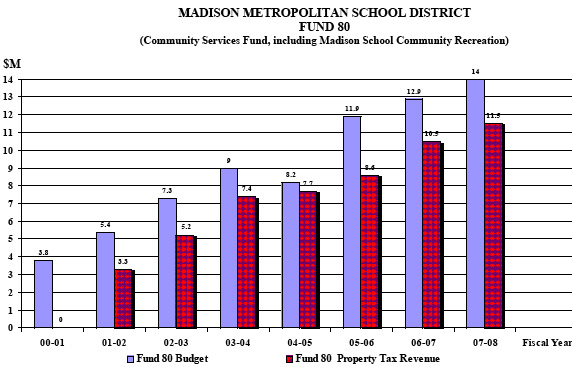
The Madison School District’s growing use of Fund 80 (expenditures outside the state revenue caps) has been the subject of some controversy.

Share

No Group Discount For Autism Care

Susan DeFord:

Randy and Lynn Gaston received the distressing diagnosis not once but three times.
Their sons, Zachary, Hunter and Nicholas, are triplets, and as the brown-haired boys grew into toddlers, Lynn noticed how oddly they played, how little they babbled, how they cried inconsolably at doctor’s offices and family gatherings.
Two years ago, when the boys were 4, specialists confirmed the Gastons’ suspicions: The boys have varying degrees of autism, a neurological disorder that hampers communication and social interactions and can include obsessive-compulsive behavior.
“It was shocking,” Lynn said, “but in my heart, I knew, yes, somebody finally sees it.”

Share

Agenda for June 7, 2007 BOE Meeting on High School Redesign Update & Possible Grant

6:30pm – Special BOE Meeting – Workshop, Wright Middle, 1717 Fish Hatchery Rd [map], Gym

  • Progress on MMSD High School Redesign
  • Smaller Learning Communities Grant Opportunity
Share

Community invited to give input on grant opportunity

(It seems that the public information session on the work of the High School Redesign Committee — including how it relates to the SLC grant described below — has been turned into something else quite entirely.)

On Thursday, June 7, 2007, Superintendent Art Rainwater will be leading a discussion to solicit the Board of Education’s and community’s input on a $5.5 million dollar grant application to the U.S. Department of Education.
The grant recipients would be the four comprehensive MMSD high schools. The focus of the grant will be the expansion or creation of personalized learning environments so that all students in these high schools will be able to access programs and classes that will make the most of each student’s intellectual potential and provide a clear pathway to post secondary education or careers.
The grant is titled “Smaller Learning Communities” and focuses on the well-researched idea that schools with populations approaching two thousand need a variety of ways for students to meaningfully connect with adults, to form strong, productive peer relationships, and to be successfully challenged by a rigorous academic program.
This discussion will take place at a Special Board of Education meeting that will be held at Wright Middle School, 1717 Fish Hatchery Road [map], starting at 6:30 PM.
COMMENTS OR QUESTIONS? PLEASE CONTACT:
Madison Metropolitan School District
Public Information Office
545 W. Dayton St.
Madison, WI 53703
608-663-1879
comments@madison.k12.wi.us

Share

Isabel Jacobson National Spelling Bee Roundup

  • Audrey Hoffer:

    The silence crackled in a downtown hotel Thursday as Isabel A. Jacobson, an eighth-grader from Madison and the sole Wisconsin entrant to the Scripps National Spelling Bee, enunciated “c-y-a-n-o-p-h-y-t-i-o-n.”
    Ping, the telltale final bell. Shoulders shrugging helplessly. Applause.
    Misspelling the word cyanophycean, Isabel, the last girl in the group of five finalists, dropped out in Round 9, tying for third place. Cyanophycean is a blue-green alga.
    “I feel great but kind of sad because it was my last spelling bee, and I’ll never be up on the stage again,” said Isabel, 14.
    “I’m not shocked that she’s done this well,” said Jeff Kirsch, her tutor. “Luck is a factor, as is skill. But she studied and she’s smart – the last surviving girl.”

  • Gena Kittner:

    he nation now knows what Madison has long understood — Isabel Jacobson can kick some spelling derri?re.
    Isabel, 14, made her prime-time television spelling debut Thursday night at the Scripps National Spelling Bee, correctly spelling the French word epaulement, but later slipping up on cyanophycean and ultimately tying for third.
    Isabel, an eighth-grader at O’Keeffe Middle School, was the only female speller by the end of Round 8 in a competition that went 13 rounds.

  • Elissa Silverman:

    One was only 11 and the oldest topped out at 14, but many of these kids had been here before. They knew the white-hot intensity of the competition, the absurdity of some of the words they were being asked to spell on national television and the warm applause that inevitably burst from the crowd when they got them right.
    Most of the 15 finalists in this year’s Scripps National Spelling Bee were a seasoned crew. And that, in the end, might have helped propel Evan M. O’Dorney, 13, who has taken to eating tuna sandwiches from Subway for good luck each of the three times he has been in the finals, to victory last night.
    Evan, an eighth-grader from Walnut Creek, Calif., exuded confidence as he faced the only other contestant still standing, Nate Gartke, 13, of Edmonton, Alberta. First, Evan spelled “Zoilus.” Nate, a musician who is a member of a curling team, countered by correctly spelling “vituline.” The Canadian gave a thumbs-up as a half-dozen of his nation’s flags waved from the audien

  • Google News roundup.
  • Isabel’s words.
Share

2007 National Condition of Education Report Released

US Department of Education:

This website is an integrated collection of the indicators and analyses published in The Condition of Education 2000–2007. Some indicators may have been updated since they appeared in print.

Chad Aldeman:

CES released their annual report this morning on the condition of education in the U.S. They took the opportunity to highlight high school coursetaking trends. More states are requiring more coursework for graduation, and overall, the average number of course credits completed by graduates increased from 21.7 in 1982 to 25.8 in 2004. More students are taking more math, science, and English courses with no declines in art or social studies, but to the detriment of study halls, vocational education, and career training. They’re taking more advanced courses as well. The number of students taking at least one AP exam doubled between 1997 and 2005.
Great news. Bust open the bubbly. Surely additional credit hours in the basics translates to higher test scores, right? That is the assumption behind the drive for the basics, no? Actually, the data suggests there was minor, incremental, or even no change. On NAEP in 1971 in reading, 17 year olds averaged a scale score of 285. On NAEP in 2004 in reading, 17 year olds averaged a scale score of 285. That’s not a typo. During the same time frame, math scores increased from 300 to 307, a 2.3% increase over 33 years. For some comparability, the coursetaking trend discussed above is a 19% increase since 1982. The numbers don’t quite compute.
When asked about this conundrum, Grover J. (Russ) Whitehurst, Director of the Institute of Education Sciences, admitted there was a “legitimate concern” that courses had been watered down. He labeled it a top priority to analyze what exactly these courses are teaching, and said data including course syllabi and the textbooks used in the classes exists, but has yet to be fully analyzed. That’s why I left “the condition of education 2007” feeling like I had been bombarded with statistics without much context.

Share

Grade-School Girls, Grown-Up Gossip

Stephanie Rosenbloom:

WHEN Britney Spears shaved off her signature blond locks, Alexis Gursky, 9, found herself wondering not why Ms. Spears picked up a razor in the first place, but why she did not do more with the hair she shaved off.
“I just thought it was a little weird to just do it and not to give it to people who have cancer,” said Alexis, a third grader in Manhattan.
And while scores of people were petitioning Gov. Arnold Schwarzenegger of California to keep Paris Hilton from having to report to jail on June 5, Jessie Urvater, 8, could not muster any sympathy.
“I don’t like Paris,” said Jessie, of Manhattan, who was quick to point out that hotel heiresses are not above the law. “I think she should go to jail.”

Share

NYC Expands School Test Program

Julie Bosman:

Schools Chancellor Joel I. Klein announced yesterday that the city school system would spend $80 million over five years on a battery of new standardized tests to begin this fall for most of New York City’s 1.1 million public school students.
The contract awarded to the testing giant CTB/McGraw-Hill will involve a significant expansion of exams, known as periodic tests, which monitor students’ progress and are supposed to help predict how students will perform in the annual state exams. Mr. Klein’s announcement immediately rekindled the debate over whether such testing is emphasized too much or is even a useful tool for teachers.
Pupils in Grades 3 through 8 will be tested five times a year in both reading and math, instead of three times as they are now. High school students, for the first time, will be tested four times a year in each subject. In the next few years, the tests will expand to include science and social studies.

Share

Dayton Charter School Faces Budget Cuts

Bob Driehaus:

The 32 students who graduated from the Dayton Early College Academy on Wednesday evening were mostly from low-income families. Few of their parents went to college.
But every member of the graduating class, the school’s first, will attend college in the fall on the strength of their academic achievements and $2 million in scholarship offers, a remarkable success story in a school district plagued by budget shortfalls and challenges endemic to urban schools.
That success, however, may not be enough to save the experimental public high school. Voters rejected a school tax levy on May 8, forcing the school district to cut $30 million from its budget. That could result in the academy’s reverting to a more traditional model.

Share

Nurturing Student Mothers

Sarah Carr:

This winter, at Northern Star School, Parker found a place where she could finally settle in.
Over the past five years, Northern Star’s leaders have created a vibrant school unique to both Milwaukee and the country: a middle school focused on teenage mothers. Milwaukee’s Lady Pitts also works with pregnant and parenting teens, but at the high school level.
Locally and nationally, the teen birth rate continues to decline and cities are closing alternative high schools for pregnant teens, mainstreaming the young women instead. Yet in Milwaukee, Northern Star’s prominence continues to grow.

Share

An elite education should be open to all who can benefit, not just those who can pay

The Economist:

NO exam question is as perplexing as how to organise schools to suit the huge variety of pupils they serve: rich and poor, clever and dim, early developers and late starters. Every country does it differently. Some try to spot talent early. Others winnow out the academic-minded only at 18. Some believe in parent-power. Others trust the state. Finland has state-run uniform comprehensives; Sweden, another good performer, has vouchers and lots of private schools.
The British system produces some world-class high-flyers, mainly in its private schools and the 164 selective state “grammar” schools that survived the cull in the 1960s and 1970s when the country moved to a non-selective system. But it serves neither its poor children nor its most troublesome ones well. The best state schools, especially the grammar schools, are colonised by the middle classes, and the whole system is disfigured by a long straggling tail of non-achievers.

(more…)

Share

Putting His Wealth to Work To Improve Urban Schools

Jay Matthews:

He and his wife, Edythe, have committed more than $250 million to school improvement projects since 1999, and they plan to spend most of the Broad Foundation’s $2.25 billion in assets on education. The Los Angeles couple, along with Bill and Melinda Gates, are widely considered the most influential public education philanthropists in the country.
Broad (rhymes with road) has provided much of the money and advice behind efforts to bring business practices — including freedom from what he considers meddlesome school boards — to New York, Boston, Los Angeles and Philadelphia. Now he has turned his attention to the District. His conversations with D.C. officials, Broad watchers say, are likely to bring more money and expertise to efforts to overhaul the school system.

Share

Standardizing the Standards

Ann Hulbert:

“I know you’re restless today, but I need to see you sitting at your desks. Angel, that means you, too!” In the second-grade classroom at the Washington school where I volunteer, the teacher turned to me and said with a sigh, “It’s testing week.” In fact, her class wasn’t suffering through the standardized ordeal, just tiptoeing around while others did. The “adequate yearly progress” (A.Y.P.) assessments mandated by the No Child Left Behind legislation, which was enacted in 2002 with high hopes of closing the achievement gap for minorities, don’t kick in until third grade. But when it comes to tests, N.C.L.B. is fulfilling its inclusive mission all too well: nobody — not even kids too young to be filling in the bubbles yet — escapes the atmosphere of exam-induced edginess.
The president’s signature domestic initiative, now due for its five-year reauthorization, was supposed to be a model of the hardheaded rigor it aims to instill in America’s schools. “No ‘accountability proposals’ without accountability,” a Bush education adviser declared early on. So one of the most glaring legacies of No Child Left Behind is surprising: it has made a muddle of meaningful assessment. Testing has never been more important; inadequate annual progress toward “proficiency” triggers sanctions on schools. Yet testing has never been more suspect, either. The very zeal for accountability is confusing the quest for consistent academic expectations across the country.

Share

Detroit Mayor Advocates Charters

Kwame Kilpatrick:

Imagine what would happen if Detroit’s auto manufacturers decided to build and sell only mid-size sedans. Despite whatever media campaign they might mount to convince consumers a mid-size sedan was what they should buy, there would clearly still be buyers who would want to purchase SUVs or other types of vehicles. Worse, there would be lots of people whose needs would not be met by a mid-size sedan.
This scenario is no different from thinking that all parents will simply accept whatever school assignment Detroit Public Schools has to offer. Parents will choose what is best for their children.

Share

On Good Writing

John Leo:

At my local recycling center, the first bin is labeled “commingled containers.” Whoever dreamed up this term could have taken the easy way out and just written “cans and bottles.” But no, the author opted for a term out of the bureaucrat’s style book. He chose the raised pinky elegance of a phrase distant from normal English. He also added poor spelling (“comingled is spelled two different ways), and pointless redundancy (the concept of “co” is already embedded in the word “mingled”). How did they pack so many writing errors into two words of modern environmental prose?
George Orwell, at the beginning of his essay, “Politics and the English Language,” made clear that he thought the language had become disheveled and decadent. That was in 1946. Intending shock, Orwell offered five examples of sub-literate prose by known writers. But these examples don’t look as ghastly to us as they did to Orwell, because language is so much worse today. If you doubt this, I offer a few examples.

Share

Law lacks direction for gifted students

Amy Hetzner:

What the law doesn’t mandate is how students such as Adam will be educated – even though state legislators have identified programming for students with gifts and talents as one of 20 essential components of public education. The result? A mixed bag of approaches for how Wisconsin students identified as gifted are educated. Some are taught in regular classes with alternative activities to help speed them through lessons. Others are pulled out of class for about an hour a week of special instruction. Some may find a spot in a magnet program with other gifted students. And others get no special instruction at all.
These inconsistencies have led parents and others to sound alarms about the state of gifted education, invoking some of the same civil-rights arguments that spurred landmark legislation in the 1970s for students with disabilities.
They say gifted kids need special attention and programs, too.

Racine Jefferson Lighthouse School’s Gifted Programs:

Jefferson Lighthouse School has the largest pupil-teacher ratio of any public elementary school in Racine.
Parts of its building are more than 100 years old. Its technology is nearly non-existent. Its librarian works half time.
And every year, parents of about 10 times as many children as the school plans to admit in the fall line up in the hallway, hoping for a chance at enrollment.
“It’s like a lottery ticket to get in here,” said Principal Soren Gajewski.
What makes Jefferson Lighthouse desirable to so many parents living in Racine, those connected to it say, is its commitment to teaching students with intellectual gifts and the perception that it has few behavioral problems.
The school is able to meet the needs of many of the district’s gifted students, as well as siblings and others lucky enough to get in on the lottery, without added expense. In fact, given that the school has the second-lowest per-pupil costs of the Racine Unified School District, parents say such a program is a cost-effective way to ensure that gifted pupils get needed attention while the school remains open to educating non-gifted students as well.

Share

Wisconsin DPI: Cracking Down on SAGE Class Size Waivers

Amy Hetzner:

The state Department of Public Instruction gave wide leeway last year to a school district seeking to avoid the strictures of Wisconsin’s class-size reduction program, even as the DPI rolled out its plan to clamp down on such exceptions.
The Chippewa Falls School District was allowed to hold classes with one-third more students than the Student Achievement Guarantee in Education program demanded and still receive $100,000.
But such permissiveness is coming to an end, promised state schools Deputy Superintendent Tony Evers.
Already this year, several school systems that previously received funding while exceeding SAGE’s 15-to-1 class-size requirements have had their requests denied.
Others have quietly dropped their programs after determining that they would not be able to meet the class-size standards and that DPI staff would become more involved in monitoring their programs, Evers said.

Share

Core Classes Not Enough, Report Warns

Jay Matthews:

It’s no secret to most high school students that taking the required courses, getting good grades and receiving a diploma don’t take much work. The average U.S. high school senior donning a cap and gown this spring will have spent an hour a day on homework and at least three hours a day watching TV, playing video games and pursuing other diversions.
This is sometimes a surprise to adults, particularly state legislators and school board members who thought that by requiring a number of courses in English, math, science and social studies they had ensured that students would dig in and learn what they need to succeed in college.
Guess again, says a new study, “Rigor at Risk: Reaffirming Quality in the High School Core Curriculum [350K PDF Report],” by the Iowa City-based testing company ACT Inc. “Students today do not have a reasonable chance of becoming ready for college unless they take a number of additional higher-level” courses beyond the minimum, the report said. Even those who do, it concluded, “are not always likely to be ready for college either.”

More here.

Share

The Culture of Testing: A look at the Assessment Industry

Jay Matthews:

Blank blue computer screens frustrated thousands of Virginia students this month during online state exams in a series of disruptions that underscored vulnerabilities in the educational testing industry. Such episodes, experts said, could prompt changes in how the nation’s schools assess student performance.
Test software malfunctions in several states, coupled with staff shortages and cutthroat competition in the industry, have fueled a growing debate over whether to cut the number of tests taken under the federal No Child Left Behind law or adjust the testing calendar.
“The system has had a lot of pressure put on it,” said Adam J. Newman, a managing vice president of the market research group Eduventures Inc. in Boston.

Share

A Parent in Prison, a Void at Home

Kari Lydersen:

When 12-year-old Heaven Carr wakes up, her mother is not there to make her breakfast. As the school year ends, Heaven is already sad that her mother will not be around to do the back-to-school shopping come August.
Carr’s mother, Elaine, has been behind bars for five years. Her father, Shaun, who was once jailed himself, does his best to pick up the slack, even as he runs a home remodeling business during the day and a cleaning service at night. But Heaven says it’s not the same.
“There are no services for men in this position — none,” Shaun said. “You’d think that if a man decides to stay with his kids, people would embrace you and help you pull through. But it’s the opposite.”
The stakes are high for Heaven and her three siblings. Those who deal regularly with the incarcerated suggest that 50 to 70 percent of children of imprisoned parents will end up behind bars. Such children are also less likely to do well in school, a growing body of research suggests.

Share

The Case Against Homework

Book: The Case Against Homework: How Homework Is Hurting Our Children and What We Can Do About It:

Does assigning fifty math problems accomplish any more than assigning five? Is memorizing word lists the best way to increase vocabulary—especially when it takes away from reading time? And what is the real purpose behind those devilish dioramas?
The time our children spend doing homework has skyrocketed in recent years. Parents spend countless hours cajoling their kids to complete such assignments—often without considering whether or not they serve any worthwhile purpose. Even many teachers are in the dark: Only one of the hundreds the authors interviewed and surveyed had ever taken a course specifically on homework during training.
The truth, according to Sara Bennett and Nancy Kalish, is that there is almost no evidence that homework helps elementary school students achieve academic success and little evidence that it helps older students. Yet the nightly burden is taking a serious toll on America’s families. It robs children of the sleep, play, and exercise time they need for proper physical, emotional, and neurological development. And it is a hidden cause of the childhood obesity epidemic, creating a nation of “homework potatoes.”
In The Case Against Homework, Bennett and Kalish draw on academic research, interviews with educators, parents, and kids, and their own experience as parents and successful homework reformers to offer detailed advice to frustrated parents. You’ll find out which assignments advance learning and which are time-wasters, how to set priorities when your child comes home with an overstuffed backpack, how to talk and write to teachers and school administrators in persuasive, nonconfrontational ways, and how to rally other parents to help restore balance in your children’s lives.

Bennetts’s website. Via Cory Doctorow.

Share

US Per Student Spending, By State

US Census Bureau:

The nation’s public school districts spent an average of $8,701 per student on elementary and secondary education in fiscal year 2005, up 5 percent from $8,287 the previous year, the U.S. Census Bureau reported today.
Findings from Public Education Finances: 2005, show that New York spent $14,119 per student — the highest amount among states and state equivalents. Just behind was neighboring New Jersey at $13,800, the District of Columbia at $12,979, Vermont ($11,835) and Connecticut ($11,572). Seven of the top 10 with the highest per pupil expenditures were in the Northeast.
Utah spent the least per student ($5,257), followed by Arizona ($6,261), Idaho ($6,283), Mississippi ($6,575) and Oklahoma ($6,613). All 10 of the states with the lowest spending per student were in the West or South.
The report and associated data files contain information for all local public school systems in the country. For example, in New York City, the largest school district in the country, per pupil spending was $13,755.
In all, public school systems spent $497 billion, up from $472.3 billion the previous year. Of these expenditures, the largest portions went to instruction ($258.3 billion) and support services such as pupil transportation and school administration ($146.3 billion).

Madison spends $13,684 per student ($333,101,865 2006/2007 citizen’s budget) / 24,342 students

Share

Chinese See Piano as Key to Children’s Success

Robert Turnbull:

Shanghai — NO one paying attention to recent musical trends in Asia can have failed to notice it: The Chinese are crazy about piano playing. Among city dwellers, there’s been nothing like this enthusiasm since the ’80s, when an embrace of the Japanese-originated Suzuki teaching method created a national army of child violinists. According to some estimates, as many as 15 million hopefuls in China — most of them young — are toiling to gain proficiency in this highly competitive skill, and the number is growing. Those unable to make it through the tough entrance exams of the country’s nine overflowing conservatories opt for one of hundreds of private piano schools sprouting all over.
The sheer availability of pianos — one company alone, Pearl River, claims to turn out 280 every day — seems also to have focused many middle-class parents’ aspirations, especially in a country that still enforces a single-child policy. For these people, the incentive to see their kids seated at a keyboard is less about artistry or copying the West than about producing offspring of demonstrable excellence.

Share

Elite Colleges Open New Door to Low-Income Youths

Sara Rimer:

o Mr. Jack, unlike many of his classmates, food stamps are not an abstraction. His family has had to use them in emergencies. His mother raised three children as a single parent and earns $26,000 a year as a school security guard. That is just a little more than half the cost of a year’s tuition, room and board, fees and other expenses at Amherst, which for Mr. Jack’s class was close to $48,000.
So when Mr. Jack, now 22 and a senior, graduates with honors on May 27, he will not just be the first in his family to earn a college degree, but a success story in the effort by Amherst and a growing number of elite colleges to open their doors to talented low-income students.
Concerned that the barriers to elite institutions are being increasingly drawn along class lines, and wanting to maintain some role as engines of social mobility, about two dozen schools–Amherst, Harvard, Princeton, Stanford, the University of Virginia, Williams and the University of North Carolina, among them–have pushed in the past few years to diversify economically.

Erin O’Connor has more.

Share

Prime Time is Goal for Madison Speller

Gena Kittner:

Isabel Jacobson remembers every word she was dealt while on stage at the Scripps National Spelling Bee last year, including the word that ended her run in Round 7 — symminct.
This week she’ll return to the national bee in Washington, D.C., with a well-stocked arsenal of spelling bee words and an improved knowledge of foreign words.
At age 14, this is the Madison teen’s last chance to vie in the national bee, where she’ll be one of 286 champion spellers. The semifinal rounds, starting with 90 students, will be televised on Thursday afternoon on ESPN and the finals on ABC that night. She will try to better last year’s run when she tied for 14th.

Share

2 LA School Campus Faculty discuss joining a Charter

Joel Rubin:

Signaling deep discontent and a possible spreading revolt among the city’s public school teachers, faculty at two more Los Angeles high schools met this week with a leading charter school operator to discuss alliances aimed at breaking away from the school district.
The meetings between Steve Barr, founder of Green Dot Public Schools, and faculty members at Santee Education Complex in South Los Angeles and Taft High in Woodland Hills come after a majority of teachers at Locke High School took steps to convert the deeply troubled campus into a series of Green Dot schools.
Teachers at Santee and Taft said the surprise move by Locke’s teachers tapped into a well of frustration and discontent they also feel over the slow pace of reforms and lack of support from leaders of the Los Angeles Unified School District.
“With what happened at Locke, we’ve entered into a new chapter. They’ve instigated reform that all these district hot shots either are unable or unwilling to make happen,” said Santee English teacher Jordan Henry, who arranged the meeting with Barr. “When you see something that looks promising … it behooves you to have a conversation about it.”

Share

Where Education Is a Matter of Prestige

Abdul Kargbo:

In today’s debates about how best to improve student performance, little mention is made of how students’ personal views on learning may affect their academic achievement. Specifically, commentators seldom discuss students’ understanding of the utility of an education and the effects of this perception on how much they value education and how well they perform in school. Perhaps because doing so can be controversial.
Ask talk-show host and philanthropist Oprah Winfrey, who faced criticism earlier this year when, in comparing students in South Africa to those in U.S. inner-city schools, she indicated that the American students valued education less. “I became so frustrated with visiting inner-city schools that I just stopped going. The sense that you need to learn just isn’t there,” Winfrey told Newsweek. “If you ask the kids what they want or need, they will say an iPod or some sneakers. In South Africa, they don’t ask for money or toys. They ask for uniforms so they can go to school.” Winfrey quickly drew the disapproval of a Washington Post columnist, who countered that in the inner-city schools he’s visited, most students “desperately want to learn.”
As someone who attended school in both Africa and the United States, I think both Winfrey and her detractors are somewhat off the mark. It’s not enough to argue about whether or not inner-city students want to learn. Rather, we should be asking why these students don’t value education enough to want to do well at it.

Update: A reader emailed this article. by Fred Reed, author of Nekkid in Austin: Drop Your Inner Child Down a Well.

Share

Finalist for San Francisco Superintendent

Jill Tucker:

The search for a new San Francisco schools superintendent is down to one finalist — former Las Vegas schools chief Carlos Garcia, The Chronicle has learned.
In interviews Friday, four San Francisco school board members said the selection process is down to final steps such as checking references before making an offer.
The four — Mark Sanchez, Hydra Mendoza, Norman Yee and Jane Kim — gave Garcia nothing but rave reviews.
They noted that he was a principal of San Francisco’s Horace Mann Middle School from 1988 to 1991, when it had a waiting list of 2,000 children. He was also superintendent of the Fresno Unified School District from 1997 to 2000.

The Madison School Board interviewed four superintendent search consultants this week.

Share

iRobot Create Challenge

iRobot:

Enter the iRobot Create Challenge and Earn Your Rightful Title as Creator Extroidinaire plus Win a $5,000 Cash Prize! Use the iRobot® Create™ Programmable Robot platform to develop your own innovative, useful, entertaining, fun or simply amazing robot and you could win $5,000. Visit http://www.tomshardware.com/irobot for details about the contest and entry instructions.

Share

Saving Our Schools

Andy Moore:

The sun came up over the near east side Tuesday morning. It wasn’t supposed to. Forecasters said to expect thunderstorms. But for an hour or so, sunshine painted the upper branches of the sugar maples that line the streets within the heart of the isthmus.
For those of us in the Lapham and Marquette neighborhoods, it was hard to avoid the symbolism. Clear skies rode in on the fair winds of change at the previous night’s school board meeting. The board’s earlier decision to consolidate Lapham and Marquette schools at Lapham — and close Marquette — was reversed.
The original decision was a harsh product of the inexorable pressure of state revenue caps on the school budget. The reversal was a product of many things. Among them, a courageous, open-minded school board willing to, as board member Johnny Winston Jr. put it, “think outside the box.”

Share

Vang Pao Elementary School Groundbreaking

Andy Hall:

A windswept field on Madison’s Far West Side became a place of reverence Wednesday for 60 Hmong residents who attended the groundbreaking ceremony of Vang Pao Elementary, a $12.9 million school whose funding was embraced by taxpayers but whose name remains controversial.
“I just want to take this as a memory,” explained Bee Vang, 47, as he held a softball-sized clod of warm, moist earth. “This will be a really great school.”
Vang said he will show his four children the dirt and tell them that school leaders spoke of giving all people, including Hmong, the opportunity to learn.

Share

How Much More MPS (Milwaukee Public Schools) Administration Do We Have To Pay For?

Ted Kanavas:

Could someone please remind me what purpose the Milwaukee Public School system serves? Educating the children of Milwaukee? Right, right, that’s it. What is the reality of the public education system in Milwaukee? More and more money is being spent by the Milwaukee school system with results that would make a private business close its doors.
The recent elections brought new blood to the MPS Board of School Directors and new hope for families who send their kids to MPS. What was the first order of business for the new Board? Under cover of darkness, the new Board showed how they plan on solving the problems with MPS. Their solution? Increasing their own staff by 25 percent.
As you pick yourself up off the floor after reading that, let me explain what this all means. This change by the Board shows that they feel the need to set up a “shadow” administration to run MPS. More administration is the solution to this problem, according to all but two members of the Board (kudos to Board members Jeff Spence and Bruce Thompson for voting against this waste of money). More importantly, it serves as a vote of no confidence for Superintendent Bill Andrekopoulos.

Share

Van Pao will be green school

The Van Pao Elementary School will be certified for Leadership in Energy and Envrionmental Design (LEED), according to a story from Channel3000:

In spite of the controversy over its name, Vang Pao Elementary is officially under construction.
Ground was broken at the new school site on Wednesday. School board members along with Superintendent Art Rainwater and the building designers all turned the first soil where the school will stand.
The new school will cost $12,923,000. The 86,396-square foot school will have 36 classrooms and house 690 students and 90 teachers. It’s expected to be completed by September 2008.
The green building will be LEED Silver Certified, and will include geothermal day lighting and solar electric panels. The school will be located on Madison’s far West Side off of Valley View Road west of County Highway M on Ancient Oak Lane.

(more…)

Share

2006 MMSD WKCE Scores: A Closer Look

Test scores from the November 2006 Wisconsin Knowledge and Concepts Examination (WKCE) and companion Wisconsin Alternate Assessment (WAA) were released by the state Department of Public Instruction this week. The MMSD press release on Madison students’ scores (“Despite changes and cuts, Madison students test well”) reports the following “notable achievements”:

  1. that reading scores have remained steady and math scores have gone up;
  2. that non-low income MMSD students score better than their non-low income peers statewide;
  3. that a higher percentage of MMSD African-American students perform at the highest proficiency level than do other African-American students across the state as a whole; and
  4. that a consistently higher percentage of MMSD students perform at the highest proficiency level than do students across the state as a whole.

Let’s take a closer look at the PR and the data:

(more…)

Share

Local high school students graduate from Information Technology Academy

On Saturday, June 2, 14 area high school students will receive Certificates of Graduation for completing an intensive information technology training program through the University of Wisconsin-Madison called the Information Technology Academy (ITA).
ITA is a four-year precollege program that provides hands-on training and access to technology for talented students of color and economically disadvantaged students attending Madison public schools. During their four-year ITA experience, the students meet biweekly during the academic year to learn Web design, animation, graphic design and other technology skills. They also participate in two-week technology training camps in the summer, hone their technical skills in short-term internships and strengthen their leadership skills through community service projects. Their learning and development is further enhanced through matches with mentors, who help guide and support students during their involvement with the program.

(more…)

Share

Special BOE Meeting to Discuss HS Redesign and SLC Grant

The MMSD BOE will hold a special meeting and public information session to discuss the High School Redesign initiative and the Small Learning Communities (SLC) grant at the following time and place:
Thursday, June 7
6:30 p.m.
Wright MS gym
1717 Fish Hatchery Road

Share

School District Abandons Both Rhyme and Reason in Language Programs

Douglas J. Buege:

As budget cuts extract another ton of flesh from Madison’s public school students, classroom teachers reel from the aftershocks. Keeping a smooth, consistent curriculum takes a lot from an educator, yet as our well-trained teachers meet tough demands, we witness a loss of both rhyme and reason at both the school and the district level. Nowhere do the wounds from budget cuts show more clearly than in foreign language education. If you think Junior should learn a second language, you might consider relocating once you learn the facts.
A child’s chance of learning the language of their choice depends heavily upon where they live within the district. In the fall of 2007, high school students at West, LaFollette, and Memorial will be able to choose from five non-English languages; kids at East get two. The German program, recently axed at East, leaves Spanish and French as the only options, stranding several students like Daniel Schott who’d devoted his time and energy to learning German. Daniel’s choice of German will carry with him through college where his opportunity to earn back credit for high school work diminishes—unless he’s willing to travel to LaFollette daily, an option that will disrupt his daily schedule beyond reason.
Imagine your child taking a novel language, say Italian, as a middle schooler. Students at Spring Harbor and Wright Middle Schools have that option. Unfortunately, the high schools to which Spring Harbor and Wright feed do not offer Italian, creating an academic dead-end for those without the resources to move to the LaFollette area. Even then, the Italian program there may disappear given the recent exodus of the Italian teacher for greener soccer pitches.

Vie the Daily Page.

Share

Bullied girl alone no more

She finds comfort in letters from hundreds of strangers, a campaign begun by Mill Valley sisters

Ilene Lelchuk:

Sitting in her living room amid stacks of handwritten letters from all over the nation and the world, 14-year-old Olivia Gardner of Novato said she no longer feels alone.
A victim of extreme bullying that spanned two years and three schools, Olivia said she has been pulled from the depths of depression by a letter-writing campaign started by two sisters at Tamalpais High in Marin County after they read in The Chronicle in March about Olivia’s ordeal.
At least 1,000 strangers have sent her letters and e-mails of support, and there’s talk of a book deal, Web sites and letter campaigns for other children who are bullied, and the three girls have received countless interview requests.
Whether Olivia likes it or not, she helped bring attention to the widespread and tenacious problem of bullying in school hallways, on cell phones and in cyberspace.

Share

Free speech vs. class disruption

Paul Shukovsky and Nina Akhmeteli:

Once upon a time, a student who wanted to poke fun at a teacher would have left graffiti on the blackboard. These days, it’s a video clip on YouTube.com and MySpace.com.
It was a sophomoric online video criticizing the hygiene of a teacher that was at issue in U.S. District Court on Monday, when Gregory Requa, a senior at Kentridge High School, asked a judge to order the lifting of his 40-day school suspension for his supposed involvement in producing and posting the video.
Requa’s lawyer, Jeannette Cohen, said the teen didn’t produce the video — taken in an English classroom at Kentridge. But even if he did, his suspension is a violation of the U.S. Constitution’s First Amendment guarantee of freedom of speech, she argued in court.

Share

Can the Milwaukee Public Schools Close the Achievement Gap?

Alan Borsuk:

Three years ago, the gap between white and black high school sophomores in Milwaukee Public Schools in reading proficiency was 33 percentage points. This year, it was 35 points.
In math, the gap was 36 points three years ago and 42 this year, according to the data released Tuesday by the state Department of Public Instruction and MPS.
Two years ago, 37% of black sophomores in MPS were rated proficient or advanced in reading, based on their performance on the statewide standardized tests. This year, it was 31%. In math, the figure is 18%, down from 20% in each of the prior two years.
That means the results for 10th grade, the most advanced point in which standardized tests are given in Wisconsin, are important.
That means it matters in the big picture that at Custer High School, only 27% of 10th-graders who had been in the school for a full year were proficient or better in reading. In recent years, that figure has gone up and down a bit. What was it four years ago? 27%.
It matters that at Genesis, a small high school in the building that was formerly North Division High, only 14% of sophomores were proficient in reading and 4% in math.

Share

Washington Delays Math, Science Graduation Requirements

Donna Gordon Blankinship:

Gov. Chris Gregoire on Tuesday delayed until 2013 a requirement that students pass the math and science portions of a high stakes exam in order to graduate from high school.
She also liberally applied her veto pen to four large sections of the bill overhauling the Washington Assessment of Student Learning exam.
Gregoire said she would have preferred to delay the math and science WASL graduation requirement only until 2012.
She eliminated the sections of the WASL-overhaul bill that would have established end-of-course exams, regional appeals, a special exemption for students learning English as a second language and the clause declaring an emergency.

Share

Google bans essay writing adverts

Sean Coughlan:

Google is to ban adverts for essay writing services – following claims that plagiarism is threatening the integrity of university degrees.
There have been complaints from universities about students being sold customised essays on the internet.
The advert ban from the Google search engine has been “warmly welcomed” by university authorities.
But it has angered essay writing firms which say this will unfairly punish legitimate businesses.

Share

Jefferson geography whiz puts state on map

Leah Nylen:

Need to know the capital of Estonia or the highest mountain in Tajikistan?
Just ask Bjorn Ager-Hart, a 14-year-old home-schooled student from Jefferson who represented Wisconsin on Tuesday at the National Geographic Bee. Sponsored by National Geographic, the bee brings together 55 middle school students from all the states and U.S. territories to compete for a $25,000 college scholarship.
For the past three years, Bjorn has spent hours — about five each week — poring over geography books to learn enough to make it to the national competition.
“I like geography,” Bjorn said. “You get to learn about a lot of different places in the world.”
He first learned of the contest in 2004. Since then, he has made the state championships every year, but only this year attained his goal to advance to the national contest. In sixth grade, Bjorn got two questions wrong and last year lost during the tie-breaker round. But on March 30 this year, he got a perfect score during the competition and won a trip to Washington for him and his family.

Share

Call for Study of Access to Arts Education

Dodd, Alexander Call for Study of Access to Arts Education
Introduce Resolution in Recognition of Music Education
May 8, 2007
Today Senator Chris Dodd (D-CT) and Senator Lamar Alexander (R-TN) sent a letter to David Walker, the Comptroller General of the Government Accountability Office (GAO), requesting that the GAO conduct a study on access to music and arts education in the American public school system since passage of the No Child Left Behind Act. This week, Senators Dodd and Alexander also introduced a resolution recognizing the benefits and importance of school-based music education. Senators Dodd and Alexander are members of the Senate Committee on Health, Education, Labor and Pensions (HELP), and are Chairman and Ranking Member of its Subcommittee on Children and Families.
“No child should be deprived of the chance to explore his or her creativity in a nurturing educational environment,” said Dodd. “Picking up a musical instrument, a paint brush, or a script can allow a child to discover a hidden talent and can serve as a much-needed positive influence in the midst of the many difficult decisions that young people face today. I am hopeful that the GAO will act quickly to deliver findings about the current condition of arts education in American public schools so that we can seek to improve it during the reauthorization of the No Child Left Behind Act.”
Added Alexander: “Music Education is important. I had some great teachers, but my piano teacher, Miss Lennis Tedford was the best. From age five until my high school senior recital, I spent thirty minutes with her each week. ‘Don’t play that monkey business,’ she would say, as she could always tell when I’d been playing too much Jerry Lee Lewis. From Miss Tedford I learned more than music. She taught me the discipline of Czerny and the metronome, the logic of Bach, the clean joy of Mozart. She encouraged me to let my emotions run with Chopin and Rachmaninoff. She made sure I was ready for the annual piano competition, and that I performed completely under control. I still thank her for the discipline and love of music she gave me each time I sit at the piano today.”
A companion resolution – introduced by Reps. Jim Cooper (D-TN) and Jon Porter (R-NV) – passed the House of Representatives on April 26 by unanimous consent.
The full text of the letter is below:

(more…)

Share

Moving California’s English Learner’s to English Proficiency

Joanne Jacobs [3.7MB PDF]:

Only 9.6 percent of English Learners (ELs) in California public schools were redesignated to Fluent English Proficient status during the 2005-06 school year. According to one state education department study, only one-third of those who start in kindergarten are reclassified by fifth grade. This prompted state Superintendent Jack O’Connell to instruct school districts to reexamine their reclassification policies and procedures.
Reclassification rates vary significantly from one school district to the next. School districts discussed range from Riverside’s Alvord Unified, where 1 percent of ELs were reclassified as proficient last year, to Glendale Unified, where 19.7 percent of ELs were reclassified.
Some school districts set higher bars for reclassification than others, requiring higher scores on state tests, writing or math proficiency and passing grades. However, some districts with high requirements also have high reclassification rates because of effective instruction, close monitoring of students’ progress and a higher percentage of ELs from middle-class and Asian families.

Via the Lexington Institute.

Share