School Information System

Advice for students: How to unstuff a sentence

Michael Leddy:

Student-writers often believe that the secret of good writing is a reliance upon bigger and “better” words. Thus the haphazard thesaurus use that I wrote about last month. Another danger for student-writers involves the assumption that good writing is a matter of stuffy, ponderous sentences. Stuffy sentences might be explained by the need to make a required word-count, but I see such sentences even in writing assignments of only modest length. Most often, I think, these sentences originate in the mistaken idea that stuffiness is the mark of serious, mature writing.
A writer can begin to unstuff a sentence by looking closely at each of its elements and asking if it is needed. Here is an extreme example:

To begin, it is important to note that the theme of regret is an important theme in “The Road Not Taken,” which was written by Robert Frost, and that evidence for it can be found throughout the entire poem.

“To begin”: Like “to conclude,” this phrase is an unnecessary, empty transition. If a point is coming early (or late) in an essay, trust that a reader can see that. Removing “To begin” involves no loss of meaning.

Share

Madison Literary Club Talk: Examinations for Teachers Past and Present

2.1MB PDF
First, a disclaimer. I am far from an expert on most of the topics which will be illustrated by questions. One of my aims in giving this talk is to let others know about a serious problem which exists beyond the problem of mathematical knowledge of teachers.
I have written about the problem in mathematics and hope that some others will use the resouces which exist to write about similar problems in other areas.
In his American Educational Research Association Presidential Address, which was published in Educational Researcher in 1986, Lee Shulman introduced the phrase “pedagogical content knowledge”. This is a mixture of content and knowing how to teach this content and is the one thing from his speech which has been picked up by the education community. However, there are a number of other points which he made which are important. Here is an early paragraph from this speech:

We begin our inquiry into conceptions of teacher knowledge with the tests for teachers that were used in this country during the last century [the 19th] at state and county levels. Some people may believe that this idea of testing teacher competence in subject matter and pedagogical skill is a new idea, an innovation spawned in the excitement of this era of educational reform, and encouraged by such committeed and motivated national leaders as Albert Shanker, President, American Federation of Teachers, Bill Honig, State Superintendent of Schools, California, and Bill Clinton, Governor of Arkansas. Like most good ideas, however, it’s roots are much older.

It took Wisconsin almost 20 years to adopt this “good idea”.

Share

MMSD School Closing Discussion

Susan Troller:

At the heart of the issue is the fact that the East High School attendance area has more elementary schools and schools with smaller populations than the other attendance areas in the district. Of the 10 elementary schools in the East High attendance area, only Hawthorne has more than 300 students.
By contrast, La Follette and Memorial high schools’ attendance areas have seven elementary schools, and the West High School attendance area has eight elementary schools. The populations of these schools average over 400 students.
But hundreds of staunch fans of the East area elementary schools are rallying to the defense of their schools, saying that they are successful hubs of their communities, and that their small size and close-knit students and staff help engage families across all demographics while improving student achievement.
“People living on the east and northeast sides of the city shouldn’t be punished because the schools in this area were built to be small,” parent and longtime school volunteer Jill Jokela said at a gathering last week.

Share

In Obesity Wars, A New Backlash
A Western town pushed school kids to eat right and exercise more. Did it go too far? ‘Mr. Coca, do you think I’m fat?’

Anne Marie Chaker:

Brittany Burns, 12 years old, has always been on the heavy side. Last year in fifth grade, neighborhood kids started picking on her at the bus stop, calling her “fatty” and “chubby wubby.” Then someone else piled on: Brittany’s school.
In a letter dated Oct. 2, 2006, the Campbell County School District No. 1 invited “select students” to take part in a fitness and nutrition program set up for some of the district’s most overweight kids. At 5 feet 2 inches tall and 179 pounds, Brittany qualified.
Receiving the letter was “embarrassing,” Brittany says. Her mother, Mindi Story, a clerk at an Albertsons supermarket, says she seethed “pure anger” because, she argues, her daughter’s weight shouldn’t be the school’s concern: “I send her to school to learn math and reading.”
Spurred by a local doctor and an enthusiastic school board, Gillette has banned soda and second helpings on hot meals. This year, it included students’ body-mass index — a number that measures weight adjusted for height — on report cards, and started recommending students like Brittany for after-school fitness programs. It even offers teachers the chance to earn bonuses based on their fitness.

Share

Does budget make untrained staff responsible for special ed needs of speech and language kids?

Can anyone explain Discussion Item C-9, which says “Excluding from the cross-categorical special education allocation formula, Students with a Speech and Language Only Disability?” (I attached the district’s explanation below.)
It appears that speech and language clinicians will provide “special education services and supports,” but speech and language clinicians aren’t trained to deliver special education services. Is it a good idea to have untrained staff providing services to kids who need specially trained staff?
Additionally, this change will supposedly eliminate 22.5 FTE educational assistants and 22.5 FTE teachers. Will those positions be special education EAs and teachers?
It appears to me that special education students are going to be badly short-changed and mis-served.
Does anyone have another take on the cuts?

(more…)

Share

Referendum Budget and School Closings

From: Thomas Mertz
Subject: Referendum Budget and School Closings
A group of parents and community members are working to convince the Board not to close schools or make other nearly irreversible cuts before offering the voters a chance to pass an operating referendum. You can help. More details here.
Please follow the link, read and sign on.

(more…)

Share

Public hearings set on MMSD budget

TUESDAY, APRIL 17, 2007
6:30 p.m. Special Board of Education Meeting
1. Public Hearing on the 2007-08 Proposed MMSD Budget
2. Adjournment
La Follette High School Auditorium
702 Pflaum Road
Madison, WI 53716
———————————————————————-
THURSDAY, APRIL 19, 2007
6:30 p.m. Special Board of Education Meeting
1. Public Hearing on the 2007-08 Proposed MMSD Budget
2. Adjournment
Memorial High School Auditorium
201 S. Gammon Road
Madison, WI 53717

Share

College Freshman Not Ready

Sherry Saavedra:

What students learn in high school doesn’t match with what they need to know as college freshmen, according to a national study released yesterday.
Professors believe high school teachers should cover fewer topics with more depth to prepare students for college. That is one of the findings of the survey by ACT, a nonprofit educational and testing organization.
“A really common complaint from (college) faculty is students not being able to put together a complete sentence properly,” said Erin Goldin, director of the Writing Center, which provides tutoring at Cal State San Marcos.
“When students come in here, . . . I try to explain the rules, but they don’t seem to have learned the structure of a sentence.”

ACT Report.
More here and here

Share

“Time for National Standards”

Denis Doyle:

The case for national standards is so self-evidently powerful that I am always surprised that it has to be made. Indeed, for years I have expected national standards to emerge spontaneously, with state after state seeing the wisdom of pooling resources rather than re-inventing standards 50 times over. After all, America is rich and powerful because we are a democratic, continental common market with a shared language and civic and popular culture. With these traits aligned could national standards be far behind?
Oddly enough, the answer is “yes,” they have been and continue to be far behind. But perhaps not forever. The Council of the Great City Schools – an association of 66 of the nation’s urban districts – has endorsed the idea as have selected think tanks like the Fordham Foundation. Equally important, some of the nation’s premier superintendents are calling for national standards (see Ed Week, vol. 26, no. 26, March 7, 2007, The Case for National Standards in American Education, Rudy Crew, Paul Vallas and Michael Casserly). Times they are a changin’.
The principle reason – and the principled reason — opponents have rejected the idea of national standards is to preserve local control. Such a slender reed on which to lean, reminding me of nothing so much as Janis Joplin’s Saturday Night Swindle: “freedom’s just another name for nothing left to lose…”

Share

How Safe Is Your Child’s School Bus?
Despite Recent Accidents, It’s the Safest Way to Go

Jonathan Welsh:

Yesterday, a school bus collided with a truck in Brampton, Ontario, critically injuring a 10-year-old boy and seriously harming another child. It was the latest in a series of dramatic crashes that have heightened many parents’ fears about the safety of the yellow buses their kids ride on every day.
In Atlanta last month, an accident involving a motor coach killed six college-baseball-team members, and in Huntsville, Ala., in November, a school-bus crash killed four teenage girls.
Some parents, such as Gwen MacMillan, a Leawood, Kan., mother of three, opt to drive their kids themselves rather than entrust them to a school bus. “I really don’t understand why the buses don’t have seat belts, because it seems like they would make them safer,” says Ms. MacMillan, echoing many parents’ concerns.
Yet accident data and interviews with transportation experts suggest school buses are actually far safer than other forms of school transport, including the family car. Indeed, according to the National Highway Traffic Safety Administration, school buses are by far the safest passenger vehicles on the road.
School-bus makers have made several upgrades in the past few years to address everything from driver visibility to handing, maneuverability and comfort. Space-age adhesives replace spot welds and rivets in certain body and chassis parts, and some new buses have Global Positioning Systems and computerized controls that function like the “black box” recorders found in aircraft. Many of the new models represent the first significant changes to school-bus design since the most recent federal safety standard for school buses took effect in 1977.

Share

Wisconsin businesses don’t pay their fair share

From an Associated Press story in the Capital Times by Scott Bauer:

MADISON (AP) – If Wisconsin businesses would pay the national average in state and local taxes, an additional $1.3 billion would flow to school districts, fire departments and other governmental services, a new report concluded.
The study released Wednesday by the Institute for Wisconsin’s Future, a Democratic-leaning group founded in 1994 and based in Milwaukee, concludes that too many of Wisconsin’s biggest profit-makers are underpaying taxes when compared with their counterparts in other states.

(more…)

Share

Grade 5 Strings – Letter to School Board

Please write the School Board about what is important to you and your state legislature about funding our public schools. Following is a copy of my letter to the school board on Grade 5 strings:
Dear School Board Members (comments@madison.k12.wi.us),
I am happy to serve as a member of the newly created Fine Arts Task Force for the next year. The second charge to the committee is: ” Recommend up to five ways to increase minority student participation and participation of low income students in Fine Arts at elementary, middle and high school levels.”
I noticed in the Grade 5 strings report you received last week there was no information on low-income and minority student enrollment. Our task force received this specific demographic information at our March 26th meeting along with additional information, so I would like to share it with you, because I think it is important. As the program has been cut in the past two years, the low-income and minority student enrollment (numbers and percentage) has remained strong [but the cuts have affected hundreds of low-income students as the numbers show]. For this school year, 44% of the string students are minority students (47% of all Grade 5 students are minority students), and 35% of the string students are low income (44% of Grade 5 students are low income students). This information is captured in the attached Chart for the this year and the previous two years when the program was offered to students in Grades 4 and 5. I’ve also included information on special education student enrollment. I was not able to access ELL information for the previous years.

Decreasing academic opportunities to develop skills at a younger age is more likely to hurt participation at higher grades for low income and minority students who often lack support outside school to strengthen and reinforce what is learned in school either at home or through additional, private opportunities.
I hope you make the decision to give the Fine Arts Task Force an opportunity to complete its charge before making additional cuts to courses, because these cuts may prove to be more harmful to those students we want to reach than we realize. Also, if changes are made, I hope they are done equitably and with time for transitions. I’m asking this not only for arts education but also for other programs and activities Madison values in its public education. Eliminating elementary strings entirely would be the third year of major cuts in either funds or instruction time for students in this program. This seems to me to be overly harsh, especially when you consider that no extracurricular sports have been cut (nor would I support that).
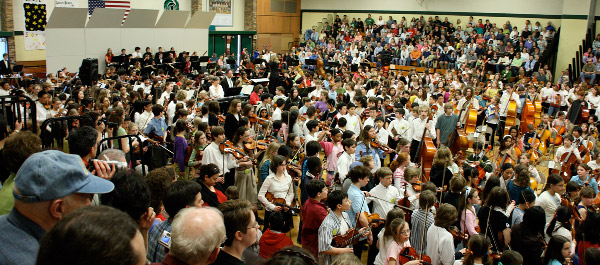
Elementary strings is one arts course, but it has taught up to 2,000+ children in one year and is valued highly by parents and the community. I have 500+ signatures on a petition, which I will share with the board next week that says: “Madison Community Asks the MMSD School Board: Don’t Cut, Work with the Community to Strengthen and Grow Madison’s Elementary String Program. I have many emails with these signatures, and I’m planning to ask folks to write you about what this program means to them, so you hear their words and not only my words.
As I stated when I spoke before you earlier this year, there are those activities where a mix of public and private funding along with fees and grants might work for the arts and for extracurricular sports, for example. Please consider support of this and please consider helping with transitions toward different approaches.
Thank you for your hard work and support for public education.
Barbara Schrank
P.s. – note, I am speaking as an individual and not on behalf of the fine arts task force.
I would also like to add for SIS readers – I know due to the current financing scheme, the state is not funding public schools adequately nor fairly and is placing a huge burden on personal income and property taxes. I also know there have been cuts in previous years to the arts, increases in class sizes, fewer SAGE classes, etc. Just so you know, that is not the point of this letter. I see the need to work both locally and at the state. I also feel we need to be doing something more than referendums at the local level, and I don’t mean cut or referendum. I think in the areas of extracurricular sports, some of the arts, we may be able to put in place a financial package of public, private, fees, grants – but this takes time and planning and commitment by our school board following public discussions on the topic.
Not all minority children are low income, but by far, the majority of low income children are minority. By not working with the community on funding for this high demand, highly valued program, several hundred fewer low income students are receiving skill-based training on an instrument, which scientific research is showing more and more has a positive effect on other areas of academics.
No where else in this city do so many low-income children have the opportunity to learn how to play an instrument and to do so as inexpensively per student. This is a program where “thinking outside the box” for the School Board could come in handy, so we can continue this academic program as part of the school day for so many children.

Share

The American Freshman – Forty Year Trends

UCLA – Graduation School of Education:

The nation’s college freshmen are more financially advantaged today than they have been at any point in the last 35 years and come from families with a median income 60 percent higher than the national average, according to a new UCLA report that examined 40 years of data from UCLA’s national survey of entering undergraduates at four-year colleges and universities.
The report, “American Freshmen: Forty-Year Trends 1966–2006,”documents the values and characteristics of college freshmen nationwide and is part of the Cooperative Institutional Research Program administered by the Higher Education Research Institute at UCLA’s Graduate School of Education & Information Studies.
“As colleges and universities continue their financial policies of increasing tuition and fees, we are seeing direct effects on students that come from poorer families,” said José Luis Santos, UCLA assistant professor of education and an author of the report. “Poorer students alter their choices of whether or not to go to college at all, or choose a college based on financial costs and packages. Students from wealthier families can endure greater fluctuations in ‘sticker price’ than poorer students, and as a result, more students entering college come from homes that are increasingly wealthier than the national median income.”
In 2005, entering freshmen came from households with a parental median income of $74,000, 60 percent higher than the national average of $46,326. This represents a 14 percent increase from 1971, whenstudents’ median family income was $13,200, 46 percent higher than the national average of $9,028.

Share

Waukesha School District Budget Notes and Links

The Waukesha School District’s 2006-2007 Budget ($165,388,112 for 13,063 students = $12,660 – similar per student spending to the Madison Schools. Wisconsin’s average per student spending is just under $10,000.) [1.1MB PDF]
Amy Hetzner:

Only a month after voting to eliminate the equivalent of 62 full-time staff positions to avoid a budget shortfall in the coming school year, the School Board began discussions Wednesday about ways to broach nearly $3.7 million in reductions for 2008-’09.

Waukesha Taxpayer League’s Teacher Salary Study
Mark Belling:

In no school district in Wisconsin is the school tax situation more disgusting than Waukesha. In that community, a demagogic school board and superintendent are threatening draconian cuts including the elimination of all high school sports. Their tactic is anything but subtle. They’re laying the groundwork for a tax increase proposal.
In fact, the Waukesha School District is awash in cash. It has been raising school taxes for decades and is spending thousands more per student than it did only a few years ago. I can solve its budget “crisis” now.

Share

April Board of Education Progress Report – Johnny Winston, Jr.

The month of April brings showers; however, for the Madison BOE it brings new beginnings, budget challenges and community dialogue.
First, regarding new beginnings, let me congratulate Beth Moss and Maya Cole on their election onto the Madison School Board. They will be replacing the retiring Shwaw Vang and Ruth Robarts. Our community should be proud of Mr. Vang and Ms. Robarts’ years of service. I was also re-elected to a second term and look forward to continued public service in this position.
In addition to new Board members, the Board decided unanimously to name the new school General Vang Pao Elementary.
Second, the Madison School District faces a $7.9 million dollar shortfall, which has the Board discussing school closings and consolidations, increasing elementary class sizes in several schools, increasing class sizes across the district in elementary art, music, gym and REACH, and eliminating the 5th grade strings program. After 14 years of being under the state imposed revenue limits, the budget cuts are now reaching the point of cutting into the foundation of our educational values.
Third, several public hearings on the budget reductions will be held throughout the community including on Tuesday April 17th at La Follette and Thursday April 19th at Memorial. Both hearings are at 6:30 pm. The 2007-08 budget will be finalized in late April or early May.
Fourth, the Board voted down an operating referendum proposal that could have taken place in the summer. However, given our budgetary situation I won’t be surprised to see an operating referendum on the ballot in February 2008.
Fifth, the Board approved a Request For Proposals for consultants to conduct a superintendent search, and decided on health insurance contributions for administrators.
Board Committees
A full month of public hearings and Board workshop agendas kept many committees from meeting since my last report. However, the committees have played an important part in analysis and discussion this year.
Finance and Operations (Lawrie Kobza, Chair) continues its work on the citizen’s budget. Long Range Planning (Carol Carstensen, Chair) held public hearings in the community regarding the proposed closings and consolidations.
Communications (Arlene Silveira, Chair) held a special workshop regarding community advocacy efforts regarding lobbying our state government for additional K-12 funding. Community Partnerships (Lucy Mathiak, Chair) received a presentation regarding the process and procedure the UW Foundation uses to engage people to make contributions.
MMSD News
On Monday March 26th, the MMSD held its annual recognition awards honoring district staff, students and citizens who have made significant contributions to Madison’s outstanding schools. Nine students received the Joe Thomas Community Service Award, five teachers were recognized for their work toward the Kohl Teacher Fellowship, and eleven individuals received the Distinguished Service Award. For more MMSD news click here: http://mmsd.org/today/
Thank you for your interest and support of the MMSD.
Johnny Winston, Jr., President, Madison Board of Education
jwinstonjr@madison.k12.wi.us
Want district information? Go to www.mmsd.org
Write to the entire school board at comments@madison.k12.wi.us.
Sign up for MMSD communications at http://mmsd.org/lists/newuser.cgi
Watch school board meetings and other district programs on MMSD Channel 10 & 19.
Ken Syke
Public Information
Madison School District
voice 663 1903; cell 608 575 6682; fax 608 204 0342

Share

School closings critical in board race

John Nichols:
So how did Cole secure her 3,000-vote majority?
The answer would appear to have a lot to do with threats by school administrators to consolidate and perhaps close schools on the isthmus. A few months before the election, the administration floated the notion that budgets could be balanced by radically altering how Lapham and Marquette elementary schools and O’Keeffe Middle School are organized.

Share

It’s Vang Pao Elementary School

MMSD Today:

The Board of Education at its April 9 meeting unanimously voted to name the new elementary school on the far West side for General Vang Pao, a prominent, national Hmong leader.
His name was selected from a list of 39 names that were nominated earlier this year by community members.
Vang led the Hmong in the Secret War against the communists in Laos and Southeast Asia. After he arrived in the U.S. in 1975, he worked to help resettle the Hmong in this country and has been an advocate here for the rights of Hmong people.
The naming process defined by a previously established Board of Education policy also involved holding a public hearing at which dozens of persons spoke to the Board about the various names for the new school. There was also the opportunity for citizens to provide feedback by e-mail and via the Internet.

Share

Workshop on green charter schools

From the Wisconsin Charter Schools Association:

You’re invited to join educators, environmentalists and others at the Environmental Charter Schools Workshop.
Date: May 2, 2007, Wednesday
Time: 9:00am to 2:30pm
Site: MADISON, UW Arboretum
Workshop Program: Unique features of “green” charter schools, integrated environmental curriculum, standards and accountability, charter partners supporting sustainable schools, and implementing a green charter school. Learn more at Green Charter Schools.
Presenters, Partners & Discussion Leaders: JIM McGRATH, founder and former principal of Oshkosh Environmental Charter School; VICTORIA RYDBERG, Teacher, River Crossing Charter School; JULIE SPALDING, Educator, Fox River Academy, and INGRID BEAMSLEY, WCSA Deputy Director
Registration: The registration fee is only $20, which covers the conference, lunch and materials. Send registrant’s name and email address, along with a $20 check payable to the WCSA, to: Wisconsin Charter Schools Association, PO Box 1704, Madison, WI 53701-1704 . Questions? Contact the WCSA at: Tel: 608-661-6946 or Email: info@wicharterschools.org or FAX: 608-258-3413
Links to 40 “GREEN” charter schools.
Read about “Green Charter Schools” in Wisconsin Trails magazine.

Share

The Debate Over Homework: Two Views (3 Letters)

Madison West Student Natalia Thompson:

Re “In Homework Wars, Student Wins a Battle: More Time to Unwind on Vacation” (On Education column, April 4):
As a 15-year-old high school sophomore with a demanding course load, I read your article with interest.
On regular weekdays, my evenings fill up quickly with daily homework assignments and extracurricular activities. My weekends are my opportunity to catch up on projects and essays, review notes and study for upcoming tests — which leaves hardly any time to relax.
Spring break is a rare occasion for me to unwind, reflect, rejuvenate and prepare for the onslaught of work when I return to school. It’s the only way I keep going.

Share

To Close Gaps, Schools Focus on Black Boys

Winnie Hu:

In an effort to ensure racial diversity, the school system here in northern Westchester County is set up in an unusual way, its six school buildings divided not by neighborhood but by grade level. So all of the second and third graders in the Ossining Union Free School District attend the Brookside School.
But some minority students, the black boys at Brookside, are set apart, in a way, by a special mentoring program that pairs them with black teachers for one-on-one guidance outside class, extra homework help, and cultural activities during the school day. “All the black boys used to end up in the office, so we had to do something,” said Lorraine Richardson, a second-grade teacher and mentor. “We wanted to teach them to help each other” instead of fight each other.
While many school districts have long worked to close the achievement gap between minority and white students, Ossining’s programs aimed to get black male students to college are a new frontier.

Share

Lindbergh Parents Vow To Fight For Their School

Channel3000.com:

The largest cuts in the superintendent’s budget are through the consolidation of some schools.
Lindbergh parents were surprised on Monday night to hear the superintendent is backing a plan that would close their school.
They had anticipated their school being taken off the district’s chopping block.
Many of the parents have been fighting to keep up with the information coming from the board, and now they’re hoping the board will listen to their concerns.
Parent Jeffrey Lewis has had three children go to Lindbergh Elementary, but with a budget plan calling for the close of the school, he’s worried about how it would affect all of the students there.
“The district has looked at this from a monetary standpoint, but never have they addressed how this is going to impact equity,” said Lewis. “How will they maintain the opportunity that kids currently have in small schools?

Share

Public Schools Lack a Competitive Spirit

35 Year Michigan Teacher Ken Feneley:

Brendan Miniter’s description of “how school choice was defeated in South Carolina” (“Cross Country: A Day Late,” op-ed, March 31) perfectly describes the power created by a combination of teacher unions and politicians they help elect to office. What gets lost is what’s best for the kids. In this case, it seems, the paranoid worries about the impact of losing students to schools of choice has outweighed possible benefits that might, just might, happen for 200,000 kids in South Carolina.
There is no apparent competitive spirit among the public school establishment types that is leading them to say what I would have: “Go ahead with school choice and I’ll prove you wrong. Just tell me what I need to do and watch what happens. I’ll change, if needed, and soon you will wish you had had left your kids in my school.”
I would not worry about some lean times while my public school made adjustments. I’d tighten my belt, suck up my pride, take two deep breaths and get to work. I, while teaching for 35 years, fully recognized that the union, the Michigan Education Association, could not have cared less about whether I was a good teacher or not. Its only concern was that I not have more than one prep period per day, did not exceed more than the contracted student numbers per class, that I did not do anything the contract prohibited, that I was paid the same as the teacher down the hall regardless of merit, that teaching and other positions were guaranteed regardless, that as many grievances be filed as possible, and, oh boy, that dues were such that the upper level union employees could be paid better than any contracted teacher in a local school.
Instead, we have this perpetual paranoid promotion of the idea that public schools will decline because of competition. And unionists and unions really do have something to fear, I guess, because if that paranoia dissipates, the teachers union loses its reason for existence: the endless promotion of teacher jobs at union pay rates that support the South Carolina Education Association and the National Education Association infrastructure through union dues. They can’t get along without them.
Notice that student education concerns through my subject matter delivery skills was not mentioned once. Unions don’t care. Obviously, neither do South Carolina politicians.

Share

April Madison Board of Education Progress Report

The month of April brings showers, however, for the Madison BOE it brings new beginnings, budget challenges and community dialogue.

(more…)

Share

Editorial: Better school board races

Capital Times Editorial – April 9, 2007:
This year’s race for the Madison School Board seat left open by the retirement of Ruth Robarts makes the case for doing School Board campaigns differently.
This newspaper endorsed mother-on-a-mission Maya Cole over champion-teacher Marj Passman because we thought Cole had some stronger ideas about how to encourage innovation by a school district that is often too cautious when it comes to making needed changes.
But we would have been perfectly satisfied if Passman had won.
The truth about the race was that Cole and Passman were two of the finest contenders for the board that Madison has seen in a long time.
Unfortunately, you would not know that from listening to the campaign.

Share

The Changing Face of the MMSD: Why All Madisonians Should Care

From the listserve of Communities United:

MAGNET’s Public Policy committee invites you to attend a discussion on the social and economic impact of the changing face of the Madison Metropolitan School District. Superintendent Art Rainwater (Superintendent of the Madison Metropolitan School District) and Dr. Douglas Harris (UW Assistant Professor of Educational Policy Studies) will conduct the discussion.
Why is this important to you? A community with good schools is a desirable place to live resulting in strong property values and a good economy. The percentage of low income students in the Madison Metropolitan School District has doubled in recent years to 40%. Learn how this impacts our community and how the MMSD is keeping Madison’s schools strong in the face of a dramatic increase of students with greater learning needs.
Superintendent Rainwater has served as the superintendent of the Madison Public School System since 1999. He has over 40 years of experience in education serving as a teacher, principal, and administrator in both public and private schools. Professor Harris is a UW Assistant Professor of Educational Policy Studies and Affiliate of the Institute for Research on Poverty. He is a well-published economist whose work explores factors affecting student educational outcomes, the role of families and neighborhoods in education, and the way in which educational outcomes affect the long-term labor market success of students and the competitiveness of national economies.
We invite anyone with an interest or curiosity to attend.
When: Wed, April 18th
Time: Registration: 6:00 – 6:30p.m. Program: 6:30 – 8:00 p.m.
Where: McDaniels Auditorium in the Doyle Building at 545 W. Dayton St.
Cost: Free
RSVP: director@madisonmagnet.org

Share

Are Wisconsin taxes too high, or just property and personal income taxes?

As residents scramble to complete their taxes by this year’s deadline, April 17, there are two contrasting messages coming from Wisconsin’s corporate community on the subject of taxes and economic prosperity.
One of those messages dominates political discussion. It’s easy to state, easy to understand, and easy to put on bumper stickers: Cut My Taxes.
Its chief proponent is Wisconsin Manufacturers & Commerce (WMC), the Madison-based big-business lobby that for years has focused its legislative agenda on plaintive appeals for a reduced tax burden.
Business boosters disagree, but it’s possible to get to the truth
Jack Norman, in Isthmus, April 4, 2007
Are Wisconsin taxes too high?

Share

How much would the state spend to fund education adequately?

The school advocates who rightfully point to the state’s inadequate funding of education want the legislature to adopt Assembly Joint Resolution 35 or the identical Senate Joint Resolution 27. The resolutions call for the following:

1. Funding levels based on the actual cost of what is needed to provide children with a sound education and to operate effective schools and classrooms rather than based on arbitrary per pupil spending levels;
2. State resources sufficient to satisfy state and federal mandates and to prepare all children, regardless of their circumstances, for citizenship and for post−secondary education, employment, or service to their country;
3. Additional resources and flexibility sufficient to meet special circumstances, including student circumstances such as non−English speaking students and students from low−income households, and district circumstances such as large geographic size, low population density, low family income, and significant changes in enrollment;
4. A combination of state funds and a reduced level of local property taxes, derived and distributed in a manner that treats all taxpayers equitably regardless of local property wealth and income . . .

I dug around briefly in various Web sites (WAES and IWF) on these or similar recommendations, and I cannot find a fiscal estimate of whether or how much these changes might increase state aids, how any increase might be funded, and whether property taxes for education would fall. Does anyone have some figures?
If better funding requires the state to raise more money, the legislature should look at the falling proportion of state tax collections from the corporate income tax, raise the corporate income tax to a generate a fairer proportion of state revenue, and put the money into education.

Share

Cut our schools some slack

WSJ EditorialThe next time you’re shocked by the announcement of yet another school referendum in your community, don’t tee off on the school board.

Share

Laptops vs Learning

David Cole:

“Could you repeat the question?”
In recent years, that has become the most common response to questions I pose to my law students at Georgetown University. It is usually asked while the student glances up from the laptop screen that otherwise occupies his or her field of vision. After I repeat the question, the student’s gaze as often as not returns to the computer screen, as if the answer might magically appear there. Who knows, with instant messaging, maybe it will.
Some years back, our law school, like many around the country, wired its classrooms with Internet hookups. It’s the way of the future, I was told. Now we are a wireless campus, and incoming students are required to have laptops. So my first-year students were a bit surprised when I announced at the first class this year that laptops were banned from my classroom.
I did this for two reasons, I explained. Note-taking on a laptop encourages verbatim transcription. The note-taker tends to go into stenographic mode and no longer processes information in a way that is conducive to the give and take of classroom discussion. Because taking notes the old-fashioned way, by hand, is so much slower, one actually has to listen, think and prioritize the most important themes.

Share

I Think There is Room For Improvement – I Look Forward to the new Board

There is room for improvement at the local level in this year’s budget process, and I’m hoping the School Board carefully examines the entire budget. By room for improvement, I do not mean “no new taxes” for schools. As part of this spring’s budget process, I hope the School Board looks out several years and begins to make decisions and plan with several years in mind.
I also believe it was irresponsible for the Superintendent to put school closings and increased class sizes on a cut list while leaving in nearly $2 million for extracurricular activities – that’s about 40 teachers in the classroom. I feel the proposed TAG cut was spiteful as was a third year of major cuts for elementary strings at the same time a Community Fine Arts Task Force begins its work. So, yes, I do hope our School Board looks for options, such as saving transportation costs on the near east side as Lucy Mathiak discovered. Also, to keep the arts and sports, we may need to look at multiple sources of funding but some time is needed for discussions, planning and transitions.
If the School Board begins planning now for several years, incorporating this year’s budget and subsequent budgets with strategic financial planning, we’ll have a better chance of laying the groundwork for an operating referendum later this year or early 2008, but we have to begin now. I’m confident we can successfully pass operating referendums.
Lastly, the election was last Tuesday, and the results were decisive, so why aren’t the folks who care so much about public education moving on? I and others were sad when our candidate did not advance in the February primaries, but we did not carry on about it nor wring our hands over the poor media coverage, which many felt there was.
There are more important things to work on, in my humble opinion – learning how to work together might be a place to start since I still believe we all value excellent public education, which is a great starting point from my perspective. Sadly, I am concerned there are those who would rather spend their time labeling those who don’t agree with them as CONSERVATIVES – start shaking in your boots. I prefer not to waste my energy on such foolishness and fear mongering, because I don’t see how that puts the kids first and gets us where we need to be for them.

Share

No Child Left Behind Renewal Discussion

Sam Dillon:

Now, as the president and the same Democrats push to renew the landmark law, which has reshaped the face of American education with its mandates for annual testing, discontent with it in many states is threatening to undermine the effort in both parties.
Arizona and Virginia are battling the federal government over rules for testing children with limited English. Utah is fighting over whether rural teachers there pass muster under the law. And Connecticut is two years into a lawsuit arguing that No Child Left Behind has failed to provide states federal financing to meet its requirements.
Reacting to such disputes in state after state, dozens of Republicans in Congress are sponsoring legislation that would water down the law by allowing states to opt out of its testing requirements yet still receive federal money.
On the other side of the political spectrum, 10 Democratic senators signed a letter last month saying that based on feedback from constituents, they consider the law’s testing mandates to be “unsustainable” and want an overhaul.
“It’s going to be a brawl,” said Jack Jennings, a Democrat who as president of the Center on Education Policy has studied how the law has been set up in the 50 states. “The law is drawing opposition from the right because they are opposed to federal interference and from the left because of too much testing.”

Share

More Post Election Notes and Links

  • Dave Diamond:

    What do Madison progressives and Wal-Mart have in common?
    We’re both inveterate union-busters, according to Nate.

    The AMPS organization, originally established to promote school referenda, and MTI are spinning Marj Passman’s school board defeat as a conspiracy by Isthmus and “anti-teacher” special interests. What made Passman a superior choice, in their minds, is that she’s a retired MTI member teacher who supports developing a statewide lobbying organization (presumably a WEAC-friendly version of WASB) to address the state funding system.

  • TJ Mertz:

    There has been some talk among the AMPS participants about doing retrospective analyses of the recent election and the press coverage of that election. Watch for those in the coming weeks. Retrospective analyses have their place, but there is something to be said for striking while the iron is hot. The Isthmus retrospective published Thursday is certainly hot, as in “liar, liar pants on fire.” This is long, but I think worth doing.
    Titled “Mandate for New Thinking,” Jason Shepard’s latest stretches the truth well past the breaking point.
    Let’s start at the top. The title refers to a mandate but even the Isthmus editors can’t bring themselves to identify what the supposed mandate was for and instead fall back on the meaningless phrase “new thinking.” The only candidate pictured or quoted is Maya Cole; this implies a connection between Ms Cole and the titular “mandate” (a connection made explicit in the final paragraph). Ms Cole deserves congratulations for her victory, however that victory can hardly be called a mandate. Among the victors, Ms Cole garnered 8,268 fewer votes than Johnny Winston Jr. and 8,257 fewer than Beth Moss. Ms Cole was not the big winner on Tuesday.

Share

Kindness crosses county line: Plight of cash-strapped team sparks Messmer to action

Amy Hetzner:

Messmer High School is a central-city Catholic school with about 85% of its student body qualifying for federally subsidized meals. Waukesha West High School is a suburban public school where only about 6% of the students live in low-income households.
But when students in Messmer’s National Honor Society heard about the nearly $10,000 fund-raising challenge facing West’s Academic Decathlon team, they saw only fellow students in need.
“Ten thousand dollars to these kids – National Honor Society kids from Messmer, inner-city kids – it just blew them away,” said Bob Monday, a volunteer business teacher at the Milwaukee school.

Share

Thank you from Marj

From Marj Passman’s Web site:

Thank you Madison voters:
This campaign began, in my mind, for the children of Madison. ALL the children. It wasn’t about the parents – let me repeat – it was about our young people. Every single person who came on board and worked their hearts out did it for the same reason. We needed to bring education back to its educators – to its teachers, curriculum designers, staff developers – back to its supporters – the people who care about every child.
This is called Public Education – not partnership with some ethereal, intangible, nether world of ill defined private saviors who aren’t exactly knocking down the doors at Doyle with offers of pots of gold for our struggling school system. It is about us – all of us – working with parents, not against them, working with teachers, not against them, working with administrators and not against them, working with the city, state and federal government not to just get back some money into our striggling schools BUT for what is our right, for PUBLIC EDUCATION. This money is our due- it is owed us – it is not a generous luxury.
We “pay taxes to support the role public education plays in civilizing and enriching our society.” What does that mean? Public education means what is best for all of us – not some of us – it means opportunity, it means mobility, it means our schools must be the “great equalizer” in our country. We cannot and should not educate some of children over others – our schools must be there for every child – for the voiceless and well as the angry few – for the children of poverty – for the children struggling with just the moment to moment functions of daily life. If we lose sight of the hungry, struggling children we lose our souls.
I believe we define ourselves by how we treat those less fortunate than ourselves and that the way we educate ALL of our children will determine what kind of city, community, democracy we have tomorrow.
To all of the caring, decent, humane people who supported my campaign You all mean so much to me – you have added so much to my life . I thank you so much. I wouldn’t have missed this for anything.
Marjorie Passman
April 5, 2007

Share

Discussion of contributions to the MMSD

On Monday, April 9, 2007, the board Committee on Community Partnerships, chaired by Lucy Mathiak, meets at 5:00 p.m. and has an agenda item that reads, “Process and procedure the University of Wisconsin Foundation uses to engage people to make contributions to the University of Wisconsin.”
I’m delighted to see the topic on the agenda, because I have always wondered why people give millions to universities and little to public schools. A person’s university education might have been very important and the contributions show their appreciation, but they couldn’t have succeeded at a university without the foundation of earlier education, which needs their contribtuions as badly as any university.
I hope the discussion produces some positive ideas for the MMSD to use in approaching potential donors.

Share

Tax Foundation: State & Local Tax Burden Hits All-Time High

Curtis Dubay [430K PDF]:

State and local taxes will consume a record-
setting 11 percent of the nation’s income in 2007. Since 1986, the state-local tax burden had never fallen below 10 percent or risen
above 10.9 percent. Figure 1 charts the course of the nation’s state-local tax burden since 1982.
This estimate of state-local tax burdens at an all-time high comes at a time when personal and corporate incomes have risen for almost
four consecutive years, sometimes at a remarkable pace. Along with low unemployment, these rising incomes have boosted tax collections substantially and helped most states meet their revenue expectations with ease since 2004.

Wisconsin ranked 6th: Tax Burder as a % of Income = 12.3%; 4,736 / 38,639. Via TaxProf.

Share

Learning About the Past: Where history isn’t bunk

The Economist:

Across the world, approaches to teaching children about their nation’s past are hotly contested—especially at times of wider debate on national identity.
IF THE past is a foreign country, the version that used to be taught in Irish schools had a simple landscape. For 750 years after the first invasion by an English king, Ireland suffered oppression. Then at Easter 1916, her brave sons rose against the tyrant; their leaders were shot but their cause prevailed, and Ireland (or 26 of her 32 counties) lived happily ever after.
Awkward episodes, like the conflict between rival Irish nationalist groups in 1922-23, were airbrushed away. “The civil war was just an embarrassment, it was hardly mentioned,” says Jimmy Joyce, who went to school in Dublin in the 1950s.

Share

Software’s Benefits On Tests In Doubt

Amit Paley:

Educational software, a $2 billion-a-year industry that has become the darling of school systems across the country, has no significant impact on student performance, according to a study by the U.S. Department of Education.
The long-awaited report amounts to a rebuke of educational technology, a business whose growth has been spurred by schools desperate for ways to meet the testing mandates of President Bush’s No Child Left Behind law.
The technology — ranging from snazzy video-game-like programs played on Sony PlayStations to more rigorous drilling exercises used on computers — has been embraced by low-performing schools as an easy way to boost student test scores.

Share

No Child Left Behind testing eased for more students

AP & Amy Hetzner:

The Bush administration is letting more children with disabilities take simplified tests under the No Child Left Behind education law.
The change, outlined in final regulations Wednesday, would triple the number of children who can take tests that are easier than those given to most students under the 2002 law.
Roughly 10% of special education students – those with the most serious cognitive disabilities – currently can take simplified, alternative tests and have the results count toward a school’s annual progress goals.
Under the new rules, about an additional 20% of children with disabilities could take alternative tests and have those count toward a school’s progress goals.

Share

“Let’s put the kids first”

Milwaukee Journal Sentinel Editorial:

The new board must not chase away Andrekopoulos. He has worked indefatigably and creatively to transform MPS into an effective system of schools.
We have referred to one board faction as the reform wing and the other as the union wing. Those labels best describe what unites them but not necessarily what divides them. The reform side is not necessarily anti-union, and the union side is not necessarily anti-reform.
Bonds, an education professor at the University of Wisconsin-Milwaukee, may find board support for his call for a more rigorous curriculum. We backed Bonds but hope he doesn’t take the board down the policy cul-de-sac of renewed busing. It won’t lead to more integration, his stated goal, for lack of white students to go around.

Share

Tuesday’s Election: Mandate for new thinking

Jason Shepard writes: Maya Cole’s victory Tuesday night over Marj Passman is yet another sign that voters expect new ways of thinking from the seven elected citizens who govern the Madison Metropolitan School District.

Share

Thank You For Re-Electing Me

Dear Friends:
Thank you for your generous support of my campaign bid for re-election to the Madison School Board. Whether your support was financial, displaying a yard sign, or voting and encouraging others to vote, I truly appreciated your help.

(more…)

Share

Capitol press conference on school funding

From Tom Bebee, Institute for Wisconsin’s Future:

Wisconsin Association for Excellent Schools (WAES) and other school-funding reform advocates will be gathering at the State Capitol in Madison on Thursday, April 19, to support Senate Joint Resolution 27 and Assembly Joint Resolution 35 asking the Legislature to change Wisconsin’s school-funding system.
We need you to attend, if possible, and support these important resolutions.
A press conference will begin at 10 a.m. in the Assembly Parlor. This would also be an excellent opportunity to set up meetings with your legislators or their aides and talk about school funding, the joint resolution, and reform. If you need help, let me know. It would be a good idea to visit the WAES website at http://www.excellentschools.org to study up on the resolution and its intent before you go.
If you plan to attend, please let me know by responding to this e-mail so we can make sure that all groups and organizations in attendance are recognized. Resolution sponsors Rep. Sondy Pope-Roberts and Sen. Roger Breske are hosting the press conference.

Share

Cake and more at election night parties for the Madison school board

Isthmus’ Kenneth Burns ate cake on election night and took in the festivities.

Share

Federal Study Finds No Edge for Students Using Technology-Based Reading and Math Products

From the Education Week Web site:

A major federal study of reading and mathematics software has found no difference in academic achievement between students who used the technology in their classrooms and youngsters who used other methods.
The $10 million study of 15 educational software products is the most extensive federal study yet to follow methods that the U.S. Department of Education considers scientifically rigorous.

Share

Madison BOE elections 2007: Voters 2, MTI 1

The Isthmus article Blame for the media illustrates a long-obvious truth: John Matthews is Madison’s Mayor Daley, a ward boss of our very own, and he gets very angry when his political control slips.
Matthews wanted to control the selection of Board members for three seats in 2007. Odd-year elections are especially important to Madison Teachers Inc. because odd years are the years in which the 2-year MTI-MMSD contracts are negotiated.
This time Mr. Matthews failed. He couldn’t find a suitable candidate to run against Johnny Winston, Jr., so he labeled and publicly berated him for not being Bill Keys. In Mr. Matthews’ mind that failure left only two seats in play. He won with Beth Moss and lost with Marj Passman.

(more…)

Share

MTI points to inadequate coverage as a reason for Passman’s defeat

Blame for the media
“Half isn’t enough,” John Matthews, the head of Madison Teachers Inc., was saying shortly after Marj Passman conceded her school board loss to Maya Cole and Beth Moss claimed victory Tuesday night at Fyfe’s.
Matthews, whose union played a key role in both candidates’ races, says Passman’s victory was needed to provide a greater push for the Legislature to increase school funding.

Thoughts?

Share

Cole, Moss and Winston – Newly Elected and Re-Elected to the MMSD School Board

Tuesday, April 3rd Madison votes returned Johnny Winston, Jr., to the School Board and elected two new board members – Maya Cole and Beth Moss.
Election of Cole, Moss may ease thoughts of school closings As candidates, both Cole and Moss have said they would look for other places to make cuts rather than disrupt families and neighborhoods through school closings.
School Board winners to pick superintendentIn winning her second bid for a School Board seat after losing to Arlene Silveira by 79 votes last year, Cole is the third candidate to be elected in three years who has called for radical change in the way the board does business, joining board members Lawrie Kobza and Lucy Mathiak.
“I feel like my message resonated with people all over the district,” said Moss, who co-chaired a grassroots effort to help pass last year’s successful school funding referendum.

Share

Extra effort could garner two diplomas upon graduation

From a story by Shawanna Robinson in the Daily Journal, Park Hills, Missouri:

Farmington High School Senior Jake Goff will graduate from Farmington High School this May with not only his high school diploma, but an Associate of Arts Degree from Mineral Area College as well.
He is the first of what the district hopes will be many students accomplishing such a feat. The Early College Pathway Program recently received a stamp of approval by both the Farmington R-7 Board of Education and the Mineral Area College Trustees.
The Early College Pathway Program is one where the Juniors and Seniors enrolled would finish their senior year with their high school diploma and either a transcripted 42 (credit hours) general education block from Mineral Area College transferable to most Missouri four-year universities or, such as Goff, with a 62 (credit hours) Associate of Arts degree from Mineral Area College. Goff will actually graduate with 64 credit hours this May.

Share

High School “Better Newspaper Contest”

From the Wisconsin Newspaper Association via the DPI newsletter of State Superintendent Elizabeth Burmaster:

Student journalists are invited to enter their best work, published in their school newspapers during the 2006-07 academic year, in the high school “Better Newspaper Contest,” sponsored by the Wisconsin Newspaper Association (WNA).
The entry deadline is April 16 for awards to be presented in May at end-of-year assemblies. The contest period has been shifted from previous years to allow awards to be presented during the current academic year.
The contest annually recognizes student achievements in high school newspapering. The panel of judges from Wisconsin’s newspapers includes publishers, general managers, editors, reporters, photographers, copy editors and other staffers.
Any student enrolled in a Wisconsin public, parochial or private senior high school may enter. Information is available at WNA Student Newspaper Contest.

Share

Cole’s vision makes her best fit for board – Vote Today

Vote Today – I’m endorsing Maya Cole for Seat 5.
A letter to the editor
On Tuesday, please join me in voting for Maya Cole.
For many years, I’ve been an active advocate for Madison’s schools, working on campaigns and task forces, as well as a volunteer in schools and a PTO officer. I’ve been encouraged by the substantive discussions the School Board has undertaken this past year with new perspectives, but there is more work to be done.
With annual budget cuts in the millions of dollars, doing business as usual jeopardizes our neighborhood schools, puts academic excellence at risk and alienates the community by pitting parent against parent.
This short-term planning cannot continue, and Maya Cole won’t let this happen.
As a board member, she will work with the School Board to develop a long-term plan.
Cole will also work with and be open to ideas from teachers, parents, students and the wider community. Her openness, innovation and fresh perspectives will help strengthen Madison’s excellent schools.
I support Maya Cole for Seat 5 on the School Board.
Barbara Schrank
Madison
Published: April 2, 2007 http://www.ci.madison.wi.us/clerk/

Share

Ruth Robarts: Let’s take school closings off the table, start the planning needed for another referendum

Ruth Robarts, who supports Maya Cole and Rick Thomas for School Board, wrote the following letter to the editor:
I voted no on Carol Carstensen’s proposed three-year referendum for several reasons.
First, a referendum requires careful planning. Two weeks’ notice did not allow the School Board to do the necessary analysis or planning.
Second, the referendum is not part of a strategic long-range plan. The district needs a 10-year strategic plan, and such a plan must address the structural deficit created by state revenue limits. It must also bring businesses, community organizations and the city of Madison into the solution. While referendums for operating dollars will be necessary, without planning they are of limited use.
Third, relief from the state revenue limits is not on the horizon. Gov. Jim Doyle has no proposal for eliminating the revenue limits. Madison’s state representatives recommend that we focus our lobbying efforts on small -cale, stopgap funding issues.
There are some steps that the School Board can take to increase public confidence and pass operating budget referendums in the future.
1. Direct the administration to find the best ways to use the Doyle Building to generate revenue for the district. In 2006, the board defeated this proposal (Kobza and Robarts were the only yes votes.) Using the building as a revenue-generating asset could also move administrators to school buildings and help keep the schools open.
2. Negotiate changes in health insurance coverage for teachers to minimize future costs. Administrators and other unions have recently made such changes without losing quality of health care.
3. Take the closing/consolidation options presented by the Long Range Planning Committee off the table. Look for more focused approaches to saving money, such as moving the Park Street Work and Learn Center into an under-enrolled elementary school as we did in the past when we housed WLC at Allis School.
4. Invite the community to join in a strategic planning process as soon as possible. As long as the state and federal governments shirk their responsibilities and the state over-relies on residential property taxes to pay for essential local services, there will be a gap between the tax funds available and the cost of the high-quality, comprehensive K-12 school system that we want. We need a plan as badly as we need the elimination of the revenue limits and a progressive tax to adequately fund our schools.
Ruth Robarts
member, Madison School Board
Published: April 2, 2007

Share

Keep the board functional: Vote Cole

A year ago, I joined other volunteers to help with the recount of the votes in Maya Cole’s slim loss to Arlene Silviera.
After the recount had been going for a while (I can’t remember whether it was the second or third day), the process clipped along smoothly with volunteers and the city clerk’s staff bonding with somewhat dark humor about the tediousness of the effort.
All of a sudden, someone helping Arlene harshly and loudly blurted out, “Those people can’t touch the ballots!” Someone helping Maya had handed a pile of ballots to one of the clerks, as everyone had been doing for the last day or two.
The room fell silent, as rooms do in reaction to something unpleasant.
Maya calmly stepped over to the person and matter-of-factly said, “Marj, we don’t want this to become antagonistic. We’re just being certain that all of the ballots were counted correctly.” Everything returned to normal.
The incident starkly shows the styles that Marj Passman and Maya Cole will bring to the school board if elected. I prefer Maya’s.
As I said before, the personalities of Bill Keys, Bill Clingan, and Juan Lopez reduced the board to ineffectivenss.
No one should want to put a person on the board with an interpersonal style that will again cripple its efforts.

Share

Academy makes the improbable possible for teens

A column by Miami Herald writer Leonard Pitts, Jr.

Words tumble to mind by way of description. Words like desolate. Words like tough. Words like hard and mean and grim and sad. Words like dead. Bail bonds and liquor stores are what passes for industry here. Ragged row houses, many boarded and abandoned, crowd one another like strangers in a bus shelter.
Now consider the girl who goes to school here. Danielle Branche, 16, is tiny, has a pretty smile and speaks with self-possession about her dreams.
”When I graduate, I want to go to either Antioch College in Ohio or Point Park University in Pittsburgh, and I want to get my bachelor’s in both dance and business management so I’ll be able to open my own dance company,” she said.
Consider the neighborhood. Consider the child. If they seem not to fit each other, well, that’s the point. Welcome to St. Frances Academy. Welcome to What Works.

Share

Record year for school referendums

Andy Hall reports on the record 52 of 425 WI school districts that on Tuesday will ask voters to approve referendums to borrow money for construction or for permission to raise taxes above the amounts allowed by the state’s revenue limits.

Share

Ruth Robarts Deserves a Medal

Ruth Robarts’ roller coaster
DOUG ERICKSON 608-252-6149
derickson@madison.com
Ruth Robarts steps down April 23 after 10 years on the Madison School Board, and, no, she’s not expecting a cake from her colleagues.
Although Robarts first ran as a facilitator – “That didn’t work out so well,” she says now with a guffaw – she became known more as a budget hawk and contrarian.
Along the way, she’s been praised as a straight-shooting maverick and criticized as an obstructionist who just likes to carp.
She chose not to seek re- election. Her replacement – Maya Cole or Marjorie Passman – will be elected Tuesday.
Robarts’ legacy differs markedly, depending on who’s talking, but most agree she traveled an interesting route from a team player to an outsider to a can’t-be-ignored-because-the- voters-like-her force.
She finishes her board service less lonely due to the elections in recent years of like- minded colleagues Lawrie Kobza and Lucy Mathiak. But Robarts cautions that in the last decade, it has become more difficult for candidates not endorsed by the teachers union or tied to the board majority to get elected.

(more…)

Share

Do We Need to Close Schools to Close the Budget Gap? – Lucy Mathiak Does Not Think So!

Lucy Mathiak has posted a piece on Isthmus’ The Forum
As a board member, my questions focus on whether we need to close schools, or we might restructure how we currently operate low enrollment schools to come close to that $769,000 in savings.

Share

Why the Union Vote?

via a reader email:

I believe that people can do much more as a group coming together around common causes than is possible to do individually – from unions to religions. But problems arise when people start identifying with the group itself. We give away our individual control in lieu of having someone or something that we think is greater than ourselves make decisions for us. It becomes tribalism.
I’ve really worked at researching the views of the candidates for the school board race. But I have to admit I have not had time to become informed about some of the other races in the April 3 election. Similarly, many people in Madison who don’t have kids in school (that’s most of Madison) aren’t up on the School Board race.
For these reasons I think voters turn to groups such as the teachers union (MTI) or politicians’ endorsements of candidates.
My husband and I are dissatisfied with the current situation for students in MMSD. There are long standing problems with finances, and growing problems with school behavior and education. Probably all of us know at least one family that’s left the public schools or even Madison because of this. We think it’s time for change.

(more…)

Share

Ruth Robarts: Cole is just what the School Board needs

Dear Editor: My ten years on the Madison School Board have convinced me that the board’s highest priorities must be new ideas and new community partnerships. Maya Cole gets my vote for Seat 5 because innovation is her top priority and she has the energy to bring the community together to plan for the future.
As a community and school activist, Maya has learned to listen and build consensus. She is an independent and original thinker at a time when the board needs exactly that.
Inadequate state and federal funding for public schools and overreliance on residential property tax revenues are very significant problems. However, we cannot postpone innovation until those problems are solved.
We must start today by encouraging innovative programs, including charter schools, and enlisting business and community allies in new funding partnerships. We must evaluate curriculum in ways that are understandable and be willing to change when the student results are not as promising as we had hoped.
Together we must envision a high-achieving, stable school system in 2020. A shared vision of the future of our schools will help us agree on the changes necessary at the state and federal level as well as the changes necessary here and now.
Maya Cole understands innovation and can provide critical leadership during these difficult times. Please join me in voting for her.
Ruth Robarts, Member, Board of Education, Madison
A letter to the editor

Share

Hasty Vote Wisely Avoided

“If we’re going to do it, we’re going to do it right,” board member Lucy Mathiak argued for the majority of the board in rejecting longtime board member Carol Carstensen’s push for the referendum.
School Board Member Mathiak has also detailed a number of options other than closing near eastside schools, which she does not support.
WI State Journal Editorial

Share

An open letter to the Superintendent of Madison Metropolitan Schools

Dear Mr. Rainwater:
I just found out from the principal at my school that you cut the allocations for SAGE teachers and Strings teachers, but the budget hasn’t even been approved. Will you please stop playing politics with our children education? It?s time to think about your legacy.
As you step up to the chopping block for your last whack at the budget, please think carefully about how your tenure as our superintendent will be viewed a little more than a year from now when your position is filled by a forward-thinking problem-solver. (Our district will settle for no less.)
Do you want to be remembered as the Superintendent who increased class size as a first step when the budget got tight? Small class size repeatedly rises to the top as the best way to enhance student achievement at the elementary level. Why would you take away one of best protections against federal funding cuts mandated by the No Child Left Behind Act? Rather than increase pupil to teacher ratios, have you checked to see if the pupil to administrative staff ratio has been brought closer to the state-wide average? (In 2002, Madison Metropolitan schools were at 195 children per administrator; the rest of the state averaged 242 children per administrator.) Have the few administrative openings you?ve left unfilled over the past few years actually brought us into line with the rest of the state?

(more…)

Share

Some interesting insight into another district’s budgeting process, knowledge, and challenges.

Shane Samuels:

There are those who like to work with numbers, and then there are those who figure school budgets. They’re not necessarily the same person.
School finance consists of a labyrinth of property values, student enrollment totals, federal aid, and state aid. Only two people in Chetek claim to understand the funding formula from top to bottom: Superintendent Al Brown and business manager Tammy Lenbom.
A couple times of year their budgetary work catches the public’s eye – once in September when it comes time to pass the budget at the annual meeting, and once about this time of year when Brown and Lenbom propose that budget for next fall.
The budget proposal period is more visible, because that is when we find out how those financial decisions will affect people’s lives – teachers who may be forced to look for new jobs, or students who might have their favorite class offering taken away from them.
While it takes a professional to explain a school budget line item by line item, this article is an attempt to at least summarize how school administrators and the school board reach their budgetary decisions, as well as detailing some of the struggles they face.
The timetable

(more…)

Share

Linda Martin Files Suit Against the MMSD

COMPLAINT [67K PDF] HAS BEEN FILED AGAINST MADISON METROPOLITAN SCHOOL DISTRICT IN THE UNITED STATES DISTRICT COURT FOR THE WESTERN DISTRICT OF WISCONSIN
Linda Martin, Plaintiff v. Madison Metropolitan School District and District officials Roger Price, Renee Bremer, Mary Teppo and Donna Williams, Defendants.
The District was Ms. Martin’s employer. Ms. Martin received a right to sue letter from the Equal Employment Opportunities Commission. Allegations include “bid rigging;” discrimination during a hiring process; denial of free speech rights; harassment; wrongful discharge; and intentional violation of federal law.
Susan Troller: School District Sued for Harrassment.

(more…)

Share

Cole endorsement was right on money

The Cap Times carried the following letter to the editor:

Dear Editor: I am supporting Maya Cole for Seat 5 of the Madison School Board.
The Capital Times was right in endorsing her candidacy. Her work ethic, thoroughness and openness to new ideas make her an ideal candidate. The school district is facing many tough issues, the most pressing being whether the elected School Board actually sets policy for the district or whether it merely acts as a rubber stamp for the administration and the teachers union.
Maya has shown a willingness to consider all points of view before making a decision and will be a thoughtful addition to the board.
While Maya and I probably do not agree on much regarding partisan politics, I feel confortable with her being on the School Board. Decisions regarding our children cannot be made based on political considerations and I believe that Maya Cole will leave politics at the door when making decisions about our schools.
Maya is giving us an opportunity to take back our schools and I urge everyone to vote for her on Tuesday.
John S. Pinto
Madison

Share

MMSD, MTI and Health Insurance – A Clarification

There seems to be some confusion about the negotiations between MTI and the school district. The Board WILL be negotiating health insurance with MTI; the Board has NOT taken health insurance off the table. The Voluntary Impasse Agreement (VIA) does NOT eliminate this as a subject of negotiation. The VIA DOES set up a structure for negotiations: a schedule, agreement by MTI that teachers will not engage in job actions, dates for the start of mediation if a settlement hasn’t been reached, name of the mediator, a date for binding arbitration if mediation is not successful and name of the arbitrator. IF no voluntary settlement is reached and we go to binding arbitration, MTI agrees that it will not propose a change to the salary schedule and the Board agrees not to change health insurance. Those agreements are meant to make binding arbitration less attractive to both sides – and to put the emphasis on reaching a voluntary agreement.
Because the Board has not yet provided MTI with our proposals I cannot discuss them in public. I can however talk about the settlement we have reached with our custodians who are represented by AFSCME. The custodians agreed to change their health insurance to a choice of 3 HMO’s (Group Health, Physicians Plus and DeanCare). The savings from this change allowed a greater salary increase (2.5%). A small amount of the savings ($15,000) went back to the budget. These savings are realized only in the first year – thereafter, the base for figuring future costs uses the lower health insurance costs.
One of the most dramatic changes of the last 5 years (and one that has been little noted) is the movement of teachers from WPS to Group Health. This year more than 50% of the teacher’s unit take Group Health Insurance – the lowest priced HMO in the community.
A more complete discussion of this issue can be found at: http://www.madisonamps.org/component/option,com_jd-wp/Itemid,31/p,51/
Carol Carstensen

Share

Board needs Cole and Thomas

Our schools need a new School Board majority, one committed to open government, including transparent budgeting and decision-making, and accountability to the community.
The next board will also hire the new superintendent and handle his or her performance evaluation, something Superintendent Art Rainwater has had little of from the current majority.
We stand at a crossroads with this election. Will it be more of the same top-down, teachers union-directed governance, or independent, open-minded, responsive representation?
There are many good issues-based reasons to vote for Maya Cole and Rick Thomas, but concerns for fair process and superintendent selection stand out for me.
It will take electing them both to gain that new majority.
– Joan Knoebel, Madison
http://www.madison.com/wsj/home/opinion/readersviews/index.php?ntid=127085&ntpid=1

Share

Unions pump funds to Passman

According to the last campaign finance report available on this blog, these teachers’ unions contributed to Marj Passman’s campaign:

$1,560 – MTI Voters
$250 – United Northeast Educators, Green Bay
$250 – Green Bay PAC (Green Bay Education Association)
$500 – Wi Ed. Assoc. Council Fox Valley PAC
$200 – Children’s Great School Fund (WEAC’s conduit)

Share

Can Reading Recover?

A consultant to the National Reading Panel blogs about “…the perfect storm in reading.”

Share

Board of Education Candidate Forum of March 27, 2007

Board of Education Candidate Forum of March 27, 2007 was held in the cafeteria of Leopold School.

QT Video
The video of the meeting is 160MB, and 1 hour and 50 minutes long. Click on the image at left to watch the video.
The video contains chapter headings which allow quick navigation to sections of the meeting. The video will play immediately, while the file continues to download.
Moderator: Laura Croft of the Middleton League of Women Voters
Panelists: (from left to right)
       Rick Thomas and Beth Moss,        vying for Seat 3
       Maya Cole and Marj Passman,      vying for Seat 5
       Johnny Winston and Tom Brew,      vying for Seat 4
The topics and questions covered are

  • Opening statements
  • Given that funding for TAG is again being cut, how would you raise money to support such programs?
  • How would you help coordinate the various PTO’s and other community groups to improve school effectiveness?
  • How would you reduce the educational gap between poorer performing kids and more the successful without holding back the more successful kids?
  • The MMSD Administration is proposing to cut SAGE, how would you vote on this proposal and why?
  • Should community service be required of students before graduation?
  • More and more families are leaving the school district because their children are not being academically challenged. How would you deal with this issue?
  • What is your plan to handle the growth in the Leopold-Thoreau area?
  • Shorewood and Fitchburg parent coalitions are being formed to discuss creating their own school districts. Why are these parents so upset?
  • Since the average employee costs the district $50 per hour, shouldn’t the budget gap remedy include employee wage and benefit sacrifices?
  • If you do not want to close schools, where else would you cut, and would that include school athletics?
  • Closing statements.
Share

MMSD School Board Communications Committee Meeeting Tonight – Information and Advocacy Session

I’m passing along the following information I received:
The Governor’s 2007-09 biennial budget provides some assistance for Madison Schools in the areas of SAGE (Student Achievement Guarantee in Education), the 15:1 K-3 class size reduction program, special education/bilingual-bicultura l aid and allowing some expenditures for safety/security to be outside the revenue caps.
We would like to hold an information and advocacy session related to the state budget on Thursday, March 29, at 6:30 p.m. in the McDaniels Auditorium of the Doyle Administration Building . The meeting will provide you with information about the budget and advocacy “talking points” to contact legislators and gain support for some of the budget’s provisions.
At this meeting, we would also like to begin preliminary discussion of ways to link Madison parents to parents in school districts in counties surrounding Dane – a neighbor-to- neighbor outreach effort to talk to legislators about the devastating affect of revenue limits to our communities’ schools.
We share your frustration as we annually watch more programs and services to students slowly dismantled by the state-imposed revenue limits. Together, we can work to educate legislators and bring about school finance reform. We look forward to seeing you on March 29.
Sincerely,
Johnny Winston, Jr.
Board President
Arlene Silveira
Communications Committee Chairwoman

Share

The difference between Maya and Marj

Isthmus gave the candidates a chance to make one last pitch for votes before next Tuesday’s election.
The statements of Maya and Marj say a lot about them as people and potential board members.
Marj repeated her line on all of her experience and said:

I have developed a finely honed instinct for what works and what doesn’t.

By contrast Maya said:

The community will be a welcomed partner with our public schools.


In other words, Marj said, “I KNOW what’s right and wrong.” That’s the board majority’s persistent response to outside input. “We know what’s right and wrong. Thank you very much. You can go away now.”
While Maya says, “I welcome a partnership,” which reflects an openness to the community.
I’m voting for Maya.

Share

Yes to strategic planning, no to last minute referendums and school closings

On March 26, I voted no on Carol Carstensen’s proposed three-year referendum for several reasons.
First, a referendum requires careful planning. Two weeks notice did not allow the Madison School Board to do the necessary analysis or planning. Ms. Carstensen—not the administration—provided the only budget analysis for her proposal. The board has not set priorities because the board it is just beginning the budget process.
Second, the referendum is not part of a strategic long-range plan. The district needs a ten-year strategic plan, and such a plan must address the structural deficit created by state revenue limits. It must also bring businesses, community organizations and the City of Madison into the solution. While referendums for operating dollars will be necessary, without planning they are of limited use.
Third, relief from the state revenue limits is not on the horizon. Governor Doyle has no proposal for eliminating the revenue limits. Madison’s state representatives recommend that we focus our lobbying efforts on small scale, stop-gap funding issues. Only Ms. Carstensen and the teachers union seem to think that change is coming soon.
There are some steps that the school board can take to increase public confidence and pass operating budget referendums in the future.
1. Direct the administration to find the best ways to use the Doyle Building to generate revenue for the district. In 2006, the board defeated this proposal (Kobza and Robarts voting yes, Carstensen, Keys, Lopez, Vang and Winston voting no). Using the building as a revenue-generating asset could also move administrators to school buildings and help keep the schools open.
2. Negotiate changes in health insurance coverage for teachers to minimize future costs. Administrators and other unions have recently made such changes without losing quality of health care. Dane County has a competitive health insurance market that can help use save dollars and protect quality of care.
3. Take the closing/consolidation options presented by the Long Range Planning Committee off the table. Look for more focused approaches to saving money, such as moving the Park Street Work and Learn Center into an under-enrolled elementary school as we did in the past when we housed WLC at Allis School.
4. Invite the community to join in a strategic planning process as soon as possible. As long as the state and federal governments shirk their responsibilities and the state over-relies on residential property taxes to pay for essential local services, there will be a gap between the tax funds available and the cost of the high quality, comprehensive k-12 school system that we want. We need a plan as badly as we need the elimination of the revenue limits and a progressive tax to adequately fund our schools.
I am ready to support operating budget referendums based on a strategic plan and best use of the revenues that we have.

Share

School vacations create run on absentee ballots

Anita Clark, Wisconsin State Journal, writes: Thousands more voters than usual are seeking absentee ballots from the Madison city clerk’s office as Tuesday’s election approaches.

Share

Parents make case for keeping schools

“Please don’t ruin our east side schools,” said parent Sue Arneson at Wednesday night’s hearing on closing east side schools.

Share

Chad Vader meets Mayor Dave and Maya Cole

Maya Cole met Chad Vader last weekend at Indie Coffee.

Share

Madison School District Changes School Closing Plan

Channel 3000 reports on changes to School closing plans. “The Madison Metropolitan School District has changed its plans for school closings and consolidation, and some north side parents said they were caught off guard by the new plan.”

Share

Nancy Donahue: Cole not “beholden”

Nancy Donahue, one of the organizers of The Studio School, sent this message to SIS:

I have had the opportunity to talk with Maya Cole twice in the past two weeks and I am convinced that she would be an excellent addition to our school board …someone who can see the big picture and incorporate it into a vision for our schools and our community. A change agent? Moreover, Maya is unfettered by the MTI machinery and political agenda so I can trust that her votes are guided by her own judgment. I am also supporting Rick Thomas for many of the same reasons.
I think that it is imperative that we make every effort to ensure that the people we elect are not “beholden” to any large organization to support their campaigns. MTI’s questionnaire flagrantly and publicly advertises that candidates must comply with the MTI agenda if they want MTI political support (which would be difficult to pass up). But the campaigns are just the beginning of an insidious political relationship. Along with MTI support comes the continual threat of repercussions (i.e., public criticism and withdrawal of support) if, once elected, a candidate should muster the personal integrity to cast a vote that runs counter to the MTI position. I prefer that our school board members feel free to cast votes based on information rather than intimidation.

(more…)

Share

Strange, strange budget process

I’ve never seen a budget process like that being followed by the MMSD and board.
Without having a budget, the board appears poised to close schools and lay off teachers. Who or why would anyone make these types of decisions out of context, that is, without a budget, with out even looking at options other than those recommended by an administration hell bent on preserving as much power and as many positions as possible in the Doyle Building?
It’s just insane, and supposedly rational people on the board think that it makes sense! Do they check their brains at the door when they walk into a board meeting?

Share

Maintain and Grow Madison’s Art Programs: Support Elementary Strings

Parents and Students distributed to attendees of the recent Spring 2007 Strings Festival the following information in a flier:
Madison Community Asks the MMSD School Board:
Don’t Cut, Work with the Community to Strengthen and Grow
Madison’s Elementary String Program

Superintendent Rainwater has proposed cutting Grade 5 strings, which would eliminate the nearly 40-year old elementary strings program. This does not have to happen and you can help:
1) Email the School Board (comments@madison.k12.wi.us), letting the School Board know:
a. You support elementary strings and a vibrant, strong fine arts academic education for all Madison’s school children as important for and fundamental to a student’s personal and academic growth, and
b. You support and want the newly formed School Board Community Fine Arts Task Force to have a chance and time to explore ways to continue and to sustain elementary strings, and all arts education, in Madison’s schools, without further cuts to programs.

Share

Tutor center for reading, math, and more

When parents need a tutor for their children, they can find a wide variety in Madison. Several have been pleased with the progress their children made at the Madison Reading and Learning Center.

Share

Out-of-Favor Reading Plan Rated Highly

Education Week
Reading Recovery, a popular one-to-one tutoring program that Bush administration officials sought to shut out of a high-profile federal reading program, has gotten a rare thumbs-up from the federal What Works Clearinghouse.
“I think this is good news for all the school superintendents who kept Reading Recovery alive in their schools,” said Jady Johnson, the executive director of the Reading Recovery Council of North America, a nonprofit group based in Worthington, Ohio. “I’m hoping this report will signal a change in direction for the [U.S. Education] Department.”
In the What Works review, posted online March 20, the clearinghouse said the program had “positive” effects—the highest evidence rating possible—on students’ alphabetic skills and general reading achievement. The reviewers also determined that the program had “potentially positive” effects, its next-highest rating, on reading fluency and comprehension.
That’s high praise from the clearinghouse, which the Department of Education’s Institute of Education Sciences created in 2002 to vet research on “what works” in education. So few education studies meet the clearinghouse’s tough research-quality criteria that some critics have dubbed it the “nothing works” clearinghouse.
On the clearinghouse’s “improvement index,” a measure used to provide a common metric on program effects, researchers found that the average 1st grader who completed Reading Recovery could be expected to score 32 percentile points higher in general reading achievement than similar students not in the program.
Yet some of the program’s early critics said in interviews last week that many of their original concerns remained.
“I never said Reading Recovery is ineffective,” said Jack M. Fletcher, one of 32 researchers who signed a widely circulated 2002 letter critiquing the program. “The real issue with Reading Recovery is the idea that it has to be done individually, when there’s a substantial research base on small-group interventions that shows there’s no drop-off in effectiveness.”

What Works Reading Recovery Report

Share

2007 Wisconsin Charter Schools Conference

From the Wisconsin Charter Schools Association:

The 7th annual Wisconsin Charter Schools Conference, co-sponsored by the WCSA and DPI, will be attended by educators, parents, students, school officials, university people, community leaders, state officials, and many other charter friends. Conference Flyer (PDF).
Dates: April 15-17, 2007 (Sunday afternoon through Tuesday)
The Sunday afternoon (4/15) Wisconsin Charter Schools FAIR is open and FREE to the public. Conference sessions on Monday and Tuesday (4/16-17) will focus on planning, authorizing, implementing and operating high-performance charter schools.

Share

I have a few comments on separate courses for students of different abilities

I think that it is important to have opportunities for advanced students to obtain seperate instruction is subjects they excel in. It is my belief that by doing this we don’t sacrifice diversity, we actually increase it.
My logic is as follows. If gifted students are not given the challenge they need in school, they will not achieve as much as they can. If the public schools are not able to provide for these childern, then parents of gifted kids will pull them out of school. Unfortunately, only involved parents with money will have the ability to give their kids the alternative education like private school. Thus, the public schools will be left with few children at the top end of the education spectrum since it can’t provide for them.
My belief that this is true comes from my home town in California. We have one elementary school in a wealthy area that is known to have much better educational opportunities for students. Parents in other districts constantly try to move their children to this school. Due to declining enrollment, other school districts have stopped letting students switch schools. To still provide for the children, the school in the wealthy area became a charter school. Now, parents can move their children there without incident. But, the other public schools are left without their brightest students. If the other public schools could provide for their brightest, the public schools would include all of the students.

(more…)

Share

School Board rejects referendum

From a story by Deborah Ziff in the Wisconsin State Journal:

The Madison School Board voted against asking taxpayers to help stave off budget cuts as Madison public schools face a projected $10.5 million budget shortfall.
The board voted 5-2 against holding a June referendum, a measure proposed by School Board Treasurer Carol Carstensen. Outgoing board member Shwaw Vang joined Carstensen in voting for the proposal that would have asked taxpayers for an additional $34 million over the next three years.
Board members who voted against the referendum said it was too hastily drawn up, without enough time to refine a referendum question or engage in a campaign to drum up support. Board member Lucy Mathiak said the board has known since October that it would need to make tough budget decisions.


Susan Troller’s story in The Capital Times is here.

Share

Teacher accused of failing to report gun in school

Alan Borsuk:

Police and Milwaukee Public Schools officials on Monday were investigating allegations that a teacher at Pulaski High School, 2500 W. Oklahoma Ave., saw a gun in the possession of a student in school and did not notify authorities in a timely manner.
An unloaded gun was found Thursday in the 18-year-old student’s locker after a second teacher notified security aides at the school, sources familiar with the incident said.
Following a second incident on the same day the gun was found, MPS administrators said they were investigating a teacher who appeared to be out of her classroom while a fight occurred between two students, with many others watching. A student videotaped the fight, apparently on a cell phone, and the video was posted on the YouTube site on the Internet.

Share

Petition to Save Our East and North Side Schools

A District-wide petition drive has been started to keep open all of the east and north side schools that are currently being discussed as possible closures and consolidations. To learn more and to sign the petition go to:
http://www.thepetitionsite.com/takeaction/879512194

Share

New revenue for schools

Governor Jim Doyle’s budget proposal includes language that would allow Wisconsin school districts to:

Construct or acquire, borrow funds to construct or acquire, operate and maintain a wind electricity generation facility, and use or sell the electricity generated by the facility, if the school board’s share of the installed capacity of the facility does not exceed 5 megawatts and the school boar incorporates information about the facility in its curriculum. (120.13(18m) WIND ELECTRICITY GENERATORS)

People should contact members of the Joint Committee on Finance to express support for the measure.

Share

They’ll Do It Themselves, Thanks

By MICHAEL WINERIP
Published: March 11, 2007
The New York Times
I LIKE it!” said Yaniv Gorodischer. “What a night!”
It was a big, big night at the group home. The three residents ­ Mr.
Gorodischer, 29, Jason Kingsley, 32, and Raymond Frost Jr., 28 ­ along with an entourage that included their group home supervisor, Ernest Daniels, and their parents, were going to the Town Board meeting to present a petition to get a sidewalk for their busy street, Chatterton Parkway.
All three had put on neckties. “For Town Hall I want to look decent,” Mr.Frost said. “Handsome and decent.” He’d practiced his speech six times. “I’m going to say, ‘My name is Raymond Frost Jr.’ And I’ll say that we got our neighbors to sign the petition, and 28 signed and 2 didn’t want to.”
And Mr. Gorodischer said: “First off, I’ll say, ‘My name is Yaniv
Gorodischer.’ And I can remember, I remember … shoot, I forgot.”
For that reason, Emily Kingsley, Jason’s mother, had written a speech for them to read. “Just in case,” she said, handing it to her son.
“We won’t need it,” he said. “We know how to say it.”
Several weeks before, Ms. Kingsley had drawn up the petition and
accompanied her son and his two roommates door to door. All three men have Down syndrome and cannot drive, but they are striving to be as independent as possible, and that means walking to their jobs along this street with its steep hill, its blind curve and cars that whiz by.
Ms. Kingsley, 67, had stood in the driveways while the three men knocked on doors, collecting signatures. “Most people were very nice,” she said. “When one man refused, they got confused. They couldn’t understand someone would say no to them. He was an old guy and said if he had a sidewalk he’d have to shovel snow. They said, ‘We’ll shovel it for you.’ And he says, ‘No, you won’t.’ And they say, ‘Yes, we will.’ ”
Since the group home opened in September 2002, the three have worked hard to be good neighbors. “Tell the story how you called me about baking a cake for your new neighbors,” Ms. Kingsley said.
“I don’t know that story,” her son said.
“Yes, you do.”
“It’s coming back,” the son said. “We asked to bake a cake for the new neighbors across the street. That was nice of us, to give them a little treat.” “And you called me for help with the cake,” the mother said. “And I said, “All three of you are on a diet.’ ”
“Not for us,” her son said. “For the neighbors.”
“Chocolate cake,” Mr. Frost said.
“We all helped,” Mr. Gorodischer said.
“Three Musketeers,” Mr. Frost said. “Now four beautiful years living in this house.” “Almost five beautiful years,” Mr. Kingsley said.
“A very big environment,” Mr. Gorodischer said.
“Because we all three guys looked out for each other,” Mr. Frost said.
“And what is the meaning of brotherhood?” Mr. Gorodischer said. “We can stand tall and be united. Meaning we can win over Town Hall!”
Then someone said it was time, and the three piled out the door and down the stairs and squeezed into Ms. Kingsley’s sedan, heading for Town Hall to see if they could get themselves a sidewalk.
WHEN Jason Kingsley was born, on June 27, 1974, the doctors told Ms.
Kingsley and her husband, Charles, to put him in an institution. “They told me he wouldn’t be able to distinguish us from other adults,” she recalled.
“They said, ‘Never see him again, and tell your friends and family that he died in childbirth.’ They were so sure I would institutionalize him, they gave me pills to dry up my milk.’ ”
Ms. Kingsley couldn’t have known it then, but her son was born right at the great divide between the dark years, when the mentally retarded were hidden away in state institutions, and modern times, when most of those institutions have been shuttered and the developmentally disabled live among us, in supervised group homes and apartment programs.
Two years before Jason’s birth, in January 1972,
Geraldo Rivera had sneaked into Willowbrook, a snake pit of an institution on Staten Island that was home to 5,400 mentally retarded people. He filmed a ward of 60 emaciated children, many naked, some in straitjackets, surrounded by walls smeared with feces and supervised by a single attendant. His televised exposé led to a federal class-action lawsuit, which Gov. Hugh L. Carey could have settled by promising to improve Willowbrook. Instead, Mr. Carey set off a social revolution. In a 1975 consent decree, he pledged to move the residents out of Willowbrook and
into state-financed community housing. Decades later, Mr. Carey would say it was the one thing he’d done as governor that he could really hold on to.
At the time, there were 26,000 people living in 20 state institutions for the retarded in New York and just 1,570 in state-financed group homes.
Today there are 32,722 developmentally disabled New Yorkers in community residences, and fewer than a thousand ­ the most severely disabled ­ in a handful of institutions. In 1980, New Jersey had just 471 community beds; Connecticut had 963. Today New Jersey has 7,173, Connecticut 5,313. They are paid for by the states, and most are run by nonprofit agencies.
In 1974, the Kingsleys started on what was then a new parenting approach for children with disabilities called early intervention, which today has become standard practice. The infant is exposed to high levels of stimulus and physical therapy. Ms. Kingsley did Jason’s room in bright colors; she made a quilt for him with every patch a different material. “We surrounded him with motion and music, and we’d talk and talk to him,” she says. To “wake up his senses,” she filled a tub with Jell-O, and plopped him in.
“I had people tell me that he wouldn’t be able to read,” she recalled. “He started reading at age 4. It was so exciting. Everything they said he wouldn’t do, he was doing.”
Jason’s parents would take him to Broadway musicals, and he would memorize all the songs. To this day, if Ms. Kingsley challenges her son to adapt a show tune for his roommates, he’ll burst into a verse of “Singing in the Raymond” or “Some Enchanted Yaniving.”
The Kingsleys lectured at medical schools about the untapped potential of children with Down syndrome. “Doctors needed to see the old stereotypes didn’t apply,” she said. Ms. Kingsley is a veteran writer for “Sesame Street” ­ she has won 17 Emmys ­ and she pushed to have Jason on the air, so the public, too, would see. Jason appeared a dozen times, starting at 15 months (sitting on Buffy Sainte-Marie’s lap as she sang). At age 6 he did skits with Ernie, at 8 with Forgetful Jones.
Being pioneers, Ms. Kingsley and her husband (who died nine years ago) had no sense where the limits were, and it was hard when they learned. “I thought he was so smart, I thought I had fixed it,” she said. “But between 6 and 8 all the typical kids caught up and passed by. Typical kids got sophisticated and streetwise, picked up nuances about relationships that he could not.
“Jason was great at parlor tricks, he could count to 10 in 12 languages,” she said. But when she put him in a youth soccer league, he too often ran the wrong way. He mastered the mechanics of reading but struggled with comprehension. “He learned, but took longer than regular kids.” Regular kids would say, “Do we have to have him on our team?”
“I realized this was in fact a child with D.S.,” she said, “and as hard as I worked, it would not go away.”
Thanks to his mother’s background in television, the son had opportunitiesmost never get. At 10 he appeared on the TV show “The Fall Guy”; at 19, on “touched by an Angel.” With his mother’s help, he and his friend Mitchell Levitz wrote a book about Down syndrome, “Count Us In,” published by Harcourt in 1994.
But when Mr. Kingsley was no longer young and cuddly, things were harder. Having mingled with the stars, he grew impatient with mundane work. He had a job shelving videos at a library, and came up with his own system for reorganizing the collection. “It made perfect sense to him,” his mother says, “but nobody could find anything.” He now delivers mail in an office building, though he still lists his career goal as “directing animated feature films for the Disney corporation.” His roommate Mr. Gorodischer works in the mailroom of a law office. Mr. Frost is a clerk at Petco, specializing in fish and small animals.
The Kingsleys set their son up in his own apartment in the late 1990s, but over time, he became isolated, the apartment grew messy, and he stopped shaving and bathing regularly. “We were too optimistic,” Ms. Kingsley said. “He needed more structure.” The group home, which is run by Westchester Arc, a nonprofit agency, has counselors on duty from 4 p.m. to 8 a.m. to provide both oversight and routine. It’s a comfort for the mother, who will not live forever.
AS they walked into Town Hall, Mr. Gorodischer lagged behind, and Mr. Frost yelled, “Yaniv, move up, you’re with us.”
Inside, Channel 12 was waiting. “How long have you been fighting for this?” the reporter asked.
“This is our first time,” Mr. Frost said.
“But you have petitions?” the reporter said.
“We hope to win over Town Hall,” Mr. Frost said.
They launched into a “Three Musketeers” cheer ­ all for one and one for all! ­ that caught Channel 12 off guard. “Hold on, we missed that,” the reporter said. “Let’s do it again. Quiet … action.”
Before the meeting, Paul J. Feiner, the town supervisor, told the men he supported the sidewalk and credited them with forcing the Town Board to develop a sidewalk policy, but said it could be two years before there was any action.
They were first on the agenda, and it must have been more nerve-racking than they had expected, because, after a few hems and haws, Mr. Kingsley pulled out the speech his mother had written, and each of them read a few sentences.
“You should go home tonight feeling very, very proud,” Mr. Feiner said. “You’ve already accomplished a lot, and I’ll work hard to make your dream of sidewalks a reality.”
The whole thing took about three minutes, and soon the entourage was back at the group home with everyone gathered around the dining room table eating cake. While the guests chatted away, Mr. Frost and Mr. Kingsley slipped upstairs. It was getting late, and they had work in the morning.
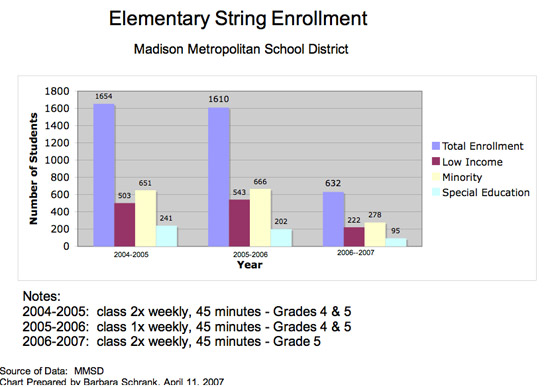
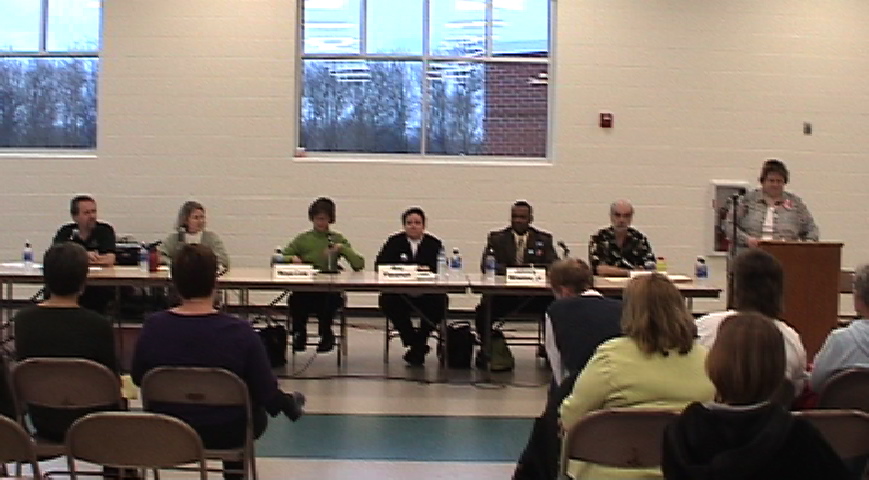
Share

Milwaukee Public Schools / Milwaukee Symphony Arts Program

Alan Borsuk:

The Progressions program of the Milwaukee Youth Symphony Orchestra, which gives kids mostly from Milwaukee Public Schools a start on classical instruments, is one of many arts programs in the city that are benefiting from a new $1 million fund created by the Milwaukee School Board.
That amount is being matched by private donations or contributed services from each of the organizations receiving the MPS grants.
Many in the arts community are viewing the new support as a strong boost for efforts to give city kids some of the arts education that has been shrinking in recent years under budget pressures.

Share

Fooling the College Board

Scott Jaschik:

In the 1930’s, American businesses were locked in a fierce economic competition with Russian merchants for fear that their communist philosophies would dominate American markets. As a result, American competition drove the country into an economic depression and the only way to pull them out of it was through civil cooperation. American president Franklin Delenor Roosevelt advocated for civil unity despite the communist threat of success by quoting “the only thing we need to fear is itself,” which desdained competition as an alternative to cooperation for success. In the end, the American economy pulled out of the depression and succeeded communism.
Does that paragraph read like an excerpt of an essay with “reasonably consistent mastery” and that “effectively develops a point of view” and “demonstrates strong critical thinking, generally using appropriate examples”? Those are the College Board’s descriptions of the kinds of qualities that earn an essay a score of 5 (the second highest possible) on the essay portion of the SAT, a new and controversial part of the exam. And that is the score an essay with that paragraph (all punctuation, spelling, FDR’s new middle name and other “facts” verbatim) received from two readers when a student submitted it in October, having been coached on how to do so by a professor at the Massachusetts Institute of Technology.

Share

A Longer School Day?

Diana Jean Schemo:

States and school districts nationwide are moving to lengthen the day at struggling schools, spurred by grim test results suggesting that more than 10,000 schools are likely to be declared failing under federal law next year.
In Massachusetts, in the forefront of the movement, Gov. Deval L. Patrick is allocating $6.5 million this year for longer days and can barely keep pace with demand: 84 schools have expressed interest.
Gov. Eliot Spitzer of New York has proposed an extended day as one of five options for his state’s troubled schools, part of a $7 billion increase in spending on education over the next four years — apart from the 37 minutes of extra tutoring that children in some city schools already receive four times a week.
And Gov. M. Jodi Rell of Connecticut is proposing to lengthen the day at persistently failing schools as part of a push to raise state spending on education by $1 billion.
“In 15 years, I’d be very surprised if the old school calendar still dominates in urban settings,” said Mark Roosevelt, superintendent of schools in Pittsburgh, which has added 45 minutes a day at eight of its lowest-performing schools and 10 more days to their academic year.

Share

April 3, 2007 Madison School Board Election Update

Much more on the election here.

Share

2007 West Area Strings Festival Photos, Audio & Video

The Madison Strings Festival was held Saturday. Check out the photos here. A 20 minute video clip: (CTRL click to download) mpeg-4 ipod video | mp3 audio.

Call to action: [PDF] [Petition PDF]

Share

After a Suicide, Privacy on Trial

Elizabeth Bernstein:

As Charles and Debi Mahoney watched six men and six women file into the jury box of a Pennsylvania courtroom one evening last August, they clutched hands and tried to remind themselves why they were in court. “Parents sending their kids off to college need to know that their kids aren’t safe when they think they are,” Mr. Mahoney recalls thinking at the time.
More than four years earlier, their 20-year-old son, Chuck, had hanged himself with his dog’s leash in his fraternity house at Allegheny College, in Meadville, Pa. At their son’s funeral, the Mahoneys learned that his friends and ex-girlfriend had repeatedly warned college administrators and counselors during his last days that Chuck was a danger to himself. The officials and his college therapist had discussed his crisis — but no one had alerted the family.
His parents sued for wrongful death in 2003, alleging that Allegheny should have taken more action at the end — such as breaking their son’s confidentiality to get them involved. One of Chuck’s fraternity brothers who tried to alert school officials, Michael Fischer, testified that seeing his friend’s last days “was like watching a car accident …. We knew something was going to happen. We had to try to stop it.”

Share

The Hobart Shakespeareans

PBS:

Imagine the sight and sound of American nine- and eleven-year-old children performing Shakespeare’s Hamlet or Henry V — and understanding every word they recite. Imagine them performing well enough to elicit praise from such accomplished Shakespearean actors as Ian McKellen and Michael York, and to be invited to perform with the Royal Shakespeare Company in England. Such a spectacle would be highly impressive in the toniest of America’s private schools. But what if the kids were the children of recent Latino and Asian immigrants attending a large Los Angeles inner-city public school in one of America’s toughest neighborhoods?
That is the astonishing story told by the new documentary “The Hobart Shakespeareans,” which discovers how one man’s uncommon commitment and resourcefulness have opened up worlds of opportunity for his “disadvantaged” students — and perhaps have demonstrated a way forward for America’s beleaguered public education system.
The Latino- and Asian-American children crowding Los Angeles’ sprawling Hobart Boulevard Elementary face daunting odds. Their neighborhood in the heart of Central Los Angeles is better known for crime than for opportunity. They grow up in low-income households. Their school, typically for public education in poor districts, is under-funded and overcrowded. Most of their parents do not speak English. No one is giving these kids educational perks, like class trips and intensive tutoring. And no one is expecting any but the smartest and luckiest to rise beyond the limitations of their environment. No one, that is, except Rafe Esquith.

Share

Safe Blogs Becoming Part of School

Erin Richards:

When sixth-grade teacher Rachel Yurk created a blog for her classroom this year, she began the online learning experiment with a simple, engaging question: “What’s your favorite book and why?”
By that night, Yurk’s e-mail had exploded with about 200 messages – each one notifying her that another comment had been posted to the online discussion.
Safely nested in Virtual Office, a secure system that New Berlin Public Schools is piloting and plans to take districtwide by next year, Yurk’s classroom blog engages students in a common discussion tool without exposing them to uncensored activity in the real-world blogosphere.
“The students are more willing to talk about things, and they can type so fast,” Yurk said. “Pencil and paper is boring to them. The first day we opened up Virtual Office, one student’s sister – a high school kid – thought it was cool and put up a post about what book she thought the younger students should read.”
Blogs, or online discussions that usually host time-stamped entries in order of newest to oldest, have struggled to gain acceptance in mainstream K-12 education.

This is a very useful example of why it’s important for us not to continue to be caught up in the Frederick Taylor style education process as the world changes around us.

Share

“Cooking the Numbers” – Madison’s Reading Program

Joanne Jacobs:

From the Fayetteville, NC Observer:

Superintendent Art Rainwater loves to discuss the Madison Metropolitan School District’s success in eliminating the racial achievement gap.
But he won’t consult with educators from other communities until they are ready to confront the issue head on.
“I’m willing to talk,” Rainwater tells people seeking his advice, “when you are willing to stand up and admit the problem, to say our minority children do not perform as well as our white students.”

Only then will Rainwater reveal the methods Madison used to level the academic playing field for minority students.
This is an odd statement. The racial achievement gap is accepted as an uncomfortable fact everywhere; it is much discussed. No superintendent in the U.S. — except for Rainwater — claims to have eliminated the gap.

Today, Rainwater said, no statistical achievement gap exists between the 25,000 white and minority students in Madison’s schools.
Impressive, but untrue, writes Right Wing Prof, who looked at Madison reading scores across all grades.

I found a graph comparing Madison to five similar districts in Wisconsin, all of which do much better than Madison on fourth-grade reading.

Joanne was in Milwaukee and Madison recently to discuss her book, “Our School“.
Related Links:

Share

Tax credits and deductions for parents

Marshall Loeb:

Children can bring you a lot of joy … and a lot of bills. The good news is that at tax time, they can also save you some money. Mark Steber, vice president of tax resources at Jackson Hewitt Tax Service, reminds parents that children of all ages can bring a range of credits and deductions on parents’ 2006 income tax returns:

Share

Seattle Superintendent’s Mid Year Report

Seattle Public Schools Superintendent Raj Manhas [777K PDF]:

A detailed document on the progress of the priority projects from the 2006‐07 Workplan is attached. Through the project tracking system that is under development as well as additional discussions with project managers, we have captured information on:

  1. What have we accomplished through February 2007?
  2. Are we on‐track to complete the project by August 2007?

The table below reports on the status of our priority projects with respect to completion by August 2007. 16 projects (or almost 60% of the total) are expected to be completed on‐time and another 10 projects are expected to be at least partially completed by August 2007.

Share

School Board Candidate Forum: Madison United for Academic Excellence

Thanks to Laurie Frost & Jeff Henriques for organizing Thursday’s MAUE forum: Video / 30MB MP3 Audio. This event included some interesting questions:

  • 14 minutes: On the Superintendent’s proposed reductions in the budget increase and their affect on the MMSD’s 6 TAG members. Do you believe TAG services still have a role?
  • 20:40 What strategies do you have to raise academic standards for all students and avoid pitting one group of parents against another?
  • 27:50 What are the most positive and negative traits you would bring to the (school) board?
  • 34:28 Please state your position on the educational approach of offering core courses, delivered in completely heterogeneous groupings, with no opportunity for self selected ability grouping? (see West’s English 10)
  • 41:29 How do we do a better job of identifying academically gifted students?
  • 48:42 Would you support a referendum to deal with the (2007/2008) budget shortfall?
  • 54:26 Would you support African centered pedagogy classes for Madison High Schools?
  • 1:00 Where do you see MTI’s advocacy for teachers coming into the greatest conflict with the District’s students?
  • 1:07 What position or talent most distinguishes you from your opponent?

Download the 105MB video here.
Madison United for Academic Excellence.

Share