
That Viral Teaching Video: Addressing Issues in American Education
He’s a 10-year teacher based in Seattle from what I gather, and teachers love his book Just Tell Them as well as his presentations.
What he speaks on is common sense, or used to be, in education, until it was over-tinkered with by other Ph.Ds rooted in the world of what I’ll call “touchy-feelyism” and “discovery learning” where rather than being the Sage on the Stage, the teacher becomes the Guide on the Side.
Lawsuit alleges Vermont tracks pregnant women deemed unsuitable for parenthood
Vermont’s child welfare agency relied on baseless allegations about a pregnant woman’s mental health to secretly investigate her and win custody of her daughter before the baby was born, according to a lawsuit that alleges the state routinely targets and tracks pregnant women deemed unsuitable for parenthood.
The ACLU of Vermont and Pregnancy Justice, a national advocacy group, on Wednesday sued the Vermont Department for Children and Families, a counseling center and the hospital where the woman gave birth in February 2022. The lawsuit seeks both an end to what it calls an illegal surveillance program and unspecified monetary damages for the woman, who is identified only by her initials, A.V.
According to the complaint, the director of a homeless shelter where A.V. briefly stayed in January 2022 told the child welfare agency that she appeared to have untreated paranoia, dissociative behaviors and PTSD. The state opened an investigation and later spoke to the woman’s counselor, midwife and a hospital social worker, despite having no jurisdiction over fetuses and all without her knowledge.
Civics: Taxpayer Funded Censorship
The only thing more stunning than watching the US Government forcibly close a speech, information and community social media platform that 170 million of its citizens voluntarily chose to use is seeing that it’s Trump, almost alone in DC, fighting to keep it open:
Any company that hosts, distributes, services, or otherwise facilitates communist-controlled TikTok could face hundreds of billions of dollars of ruinous liability under the law, not just from DOJ, but also under securities law, shareholder lawsuits, and state AGs. Think about it.
Civics: “The proof that lockdown critics were ‘debanked’ because of their views”
PayPal admits it terminated Molly Kingsley’s account after she spoke out against Covid vaccinations for children and school closures
Ignominious! Anthony Fauci will go down in history as the first government scientist to be preemptively pardoned for a crime.
Why Speculate?
There are two times in a man’s life when he should not
speculate: when he can’t afford it and when he can.
— Mark Twain
My topic for today is the prevalence of speculation in media. What does it mean? Why has it become so ubiquitous? Should we do something about it? If so, what? And why? Should we care at all? Isn’t speculation valuable? Isn’t it natural? And so on.
I will join this speculative trend and speculate about why there is so much speculation. In keeping with the trend, I will try to express my views without any factual support, simply providing you with a series of bald assertions.
This is not my natural style, and it’s going to be a challenge for me, but I will do my best. Some of you may see that I have written out my talk, which is already a contradiction of principle. To keep within the spirit of our time, it should really be off
the top of my head.
Before we begin, I’d like to clarify a definition. By the media I mean movies, television, Internet, books, newspapers and magazines. Again, in keeping with the general trend of speculation, let’s not make too many fine distinctions.
The Global Race for Talent: Brain Drain, Knowledge Transfer, and Growth
(i) gross migration is asymmetric, with brain drain (net emigration) from the EU to the United States; (ii) migrants increase their patenting by 33% a year after migration; (iii) migrants continue working with inventors at origin after moving, although less frequently; (iv) migrants’ productivity gains spill over to their collaborators at origin, who increase patenting by 16% a year when a co-inventor emigrates.
Notice that migration doesn’t just relocate talent from the EU to the US; it amplifies talent. Preventing “brain drain” would create short-term gains for the EU but retaining talent at lower productivity would stifle long-term innovation and patenting, ultimately slowing growth for both the EU and the world. In short, even the EU gains from sending talent to the US! The effect would be much larger if we can import high-skill immigrants from countries where their skills are even less productive than in the EU. Ideally, other nations could replicate the US institutions that supercharge productivity, creating global economic gains. For now, however, the US seem to be a unique Galt’s Gulch for talent.
Prato concludes with a practical suggestion:
civics: “The second attempted coup d’etat was partially successful”
Here is some video. And a related note, don’t forget the ERA either. WSJ article here.
Notes on student mental health
The department last year surveyed nearly 24,500 seventh through 12th graders in 17 Dane County public school districts, including Madison, Sun Prairie and Middleton-Cross Plains. Students participate every three years in the Dane County Youth Assessment, which measures their mental, physical and behavioral well-being.
Anxiety and depression rates have risen steadily among student respondents since 2009, according to an analysis of the results. But indicators of mental health challenges dropped last year to 2015 levels, the Department of Human Services reported.
Still, about 60% of high schoolers said they felt lonely “sometimes” or “always.”
Civics: NIH and covid propaganda
As Covid-19 was spreading fear and spurring lockdowns across the United States in early 2020, the scientific journal Nature Medicine published a paper on March 17 titled “The Proximal Origin of SARS-CoV-2.” Written by five renowned academic scientists, it played an important early role in shaping the debate about a fiercely controversial topic: the origin of the virus that has killed millions since it emerged in Wuhan, China, in late 2019. Did it spill from animals to humans in nature, on a farm, in a market? Or did it leak from a lab like the Wuhan Institute of Virology, a leading center of coronavirus research in China? Drawing on “comparative analysis of genomic data,” the paper’s authors wrote that “our analyses clearly show that SARS-CoV-2 is not a laboratory construct or a purposefully manipulated construct.” Toward the end of the paper, they added, “we do not believe that any type of laboratory-based scenario is plausible” in explaining the origin of the virus. Instead, the scientists strongly favored a natural origin, arguing that the virus likely spilled from bats into humans, possibly by way of an intermediate animal host.
The peer-reviewed paper proved to be hugely influential. Dr. Francis Collins, then the director of the National Institutes of Health, or NIH, announced its findings in a post on the agency’s website in late March 2020. When asked during an April 17 press briefing at the White House about concerns that SARS-CoV-2 had come out of a lab in China, Dr. Anthony Fauci, who recently stepped down as head of the National Institute of Allergy and Infectious Diseases, referenced the paper, describing its conclusions and calling its authors “a group of highly qualified evolutionary virologists.” The paper has been accessed online more than 5.7 million times and has been cited by more than 2,000 media outlets. ABC News, for instance, ran an article on March 27 titled “Sorry, Conspiracy Theorists. Study Concludes Covid-19 ‘Is Not a Laboratory Construct.’” In that article, one of the paper’s authors, Robert Garry, is quoted saying, “There’s a lot of speculation and conspiracy theories that went to a pretty high level, so we felt it was important to get a team together to examine evidence of this new coronavirus to determine what we could about the origin.”
civics: “but we’ve never experienced a situation where the nominal president of the United States had no power at all. That just happened”
It seems possible the advertised “braintrust” had leeway to make policy choices, up to a point. Klain for instance seems significantly responsible for the too-online-wokester quotient in the Biden presidency, trying to name pestilent Internet creature Neera Tanden to head the OMB. Having been “Ebola Czar” under Obama, he also seems to have been the force behind the push for mandates and the generally hyper-obnoxious tone of White House vaccine policy, appearing to physically arouse Chuck Todd when discussing vaccines during the peak of the pandemic.
On larger questions, it’s not clear Klain figured at all. Responding to criticisms that he let a helpless outpatient sink the 2024 ticket, Klain blamed voters. “There was no cover-up,” he just told The Guardian. “A Democratic congressman ran against him in the primary in 2024, with age as the only issue, and voters overwhelmingly voted for Biden.” This was after the party barred the congressman in question, Dean Phillips, from its numerous closed primaries and spent small fortunes on legal challenges to keep other candidates like Robert F. Kennedy, Jr., Cornel West, Jill Stein, and the No Labels party from opposing Biden.
These are the key questions. Who fixed the primaries, directed the ballot access suits, crushed third parties, and green-lit myriad Trump prosecutions and other lawfare schemes? Most importantly, who kicked Biden off the ticket and replaced him with Kamala Harris? There’s not a lot of evidence that either Biden or Harris had much to do with those decisions. Jill Biden noted recently that “Joe has an incredible capacity to forgive,” but “that means I end up being the holder of grudges,” a remark seemingly directed toward Pelosi. As the Washington Post just put it, in a story that is about Jill Biden’s memories of last summer yet somehow completely avoids explaining who decided her husband’s career was over during that time:
Civics: Notes on presidential campaigns
It had been less than a year since I’d written, “The press takes him literally, but not seriously; his supporters take him seriously, but not literally.”
Can you read this cursive handwriting? The National Archives is seeking volunteers to transcribe historical documents…
That’s where human volunteers come in. By transcribing digital pages, volunteers make it easier for scholars, genealogists and curious history buffs to find and read historical documents.
Getting started is easy: All you need to do is sign up online. The free program is open to anyone with an internet connection.
“There’s no application,” Suzanne Isaacs, a community manager with the National Archives, tells USA Today’s Elizabeth Weise. “You just pick a record that hasn’t been done and read the instructions. It’s easy to do for a half hour a day or a week.”
If you’re not confident in your cursive deciphering skills, the National Archives has other tasks available, too—such as “tagging” documents that other volunteers have already transcribed. Tagging helps improve the searchability of records.
Already, more than 5,000 volunteers have joined the Citizen Archivist program. Many are hard at work on “missions,” or groups of documents that need transcribing and tagging. For example, current missions include Revolutionary War pension files and employee contracts from 1866 to 1870.
k-12 Tax & $pending Climate: Homeowner Insurance Costs
Insurance is the foundation of homeownership and the economy, but California leaders have dilly-dallied in the face of a long-running crisis
The American Spectator might not be at the top of Gov. Gavin Newsom’s reading list, but had it been, he would have known that California’s teetering insurance system was just one particularly bad wildfire away from disaster. Sure, he knew that insurers were fleeing the state in the face of its absurd price-control system that doesn’t allow them to price policies to reflect their actual risk, but that knowledge didn’t spur him to make the matter a priority.
In September 2023, I wrote the following on these pages after lawmakers decided to punt on insurance reform rather than take on their anti-corporate allies:
Who benefits from the $73 billion in loan forgiveness awarded through the Public Service Loan Forgiveness program?
Julia Turner, Kathryn Blanchard, and Rajeev Darolia:
In this report, we explore which public sectors are most commonly represented among individuals who have benefitted, or are on track to benefit, from the PSLF program. Specifically, we present new data detailing which sectors borrowers have most commonly worked in to be eligible for PSLF. We show that the most common sector among those who have received forgiveness through PSLF is education, representing 43% of all employers associated with the program. The majority of these employers in the education sector are K-12 education systems, representing 28% of all employer occurrences in the data. Other common employer subsectors among borrowers who have received PSLF are state and local governments and healthcare organizations. Among the most frequent individual employers are those related to military service including the Department of Defense, Department of Veterans Affairs, and the branches of the U.S. military.
notes on RedNote
Just a few days after more than 700 million new users flooded RedNote—which Time noted is “the most apolitical social platform in China”—rumors began swirling that RedNote may soon start segregating American users and other foreign IPs from the app’s Chinese users.
In the “TikTokCringe” subreddit, a video from a RedNote user with red eyes, presumably swollen from tears, suggested that Americans had possibly ruined the app for Chinese Americans who rely on RedNote to stay current on Chinese news and culture.
“RedNote or Xiaohongshu released an update in the greater China region with the function to separate out foreign IPs, and there are now talks of moving all foreign IPs to a separate server and having a different IP for those who are in the greater China area,” the Reddit poster said. “I know through VPNs and other ways, people are still able to access the app, but essentially this is gonna kill the app for Chinese Americans who actually use the app to connect with
University > College
Edgewood College’s plan to transition to a new name could cost as much as $250,000 and take a few years to fully implement, but changes are expected to start this summer.
“Edgewood University” will better reflect what the private Catholic school has evolved into since its founding in Madison nearly a century ago, said President Andrew Manion.
In 1927, Edgewood College operated as a junior college for women to study liberal arts. The institution then grew to train teachers on a coed campus. In more recent years, the school has essentially operated as a university without being designated as one, Manion said.
America’s plan to control global AI
The Biden administration, in its final days, has laid out an extraordinarily ambitious plan to use its chokepoint on high end semiconductors to control global AI. The best explanation I’ve seen is this Bloomberg scoop by Mackenzie Hawkins and Jenny Leonard, published a few days before the draft plan was published. The draft plan itself is available on the Federal Register (warning – there is a lot of export controls lawyerly jargon).
The idea is to use export controls to restrict the selling and use of to achieve two U.S. policy goals. The first is its desire to keep the most advanced AI out of the grasp of China, for fear that China will use strong AI to undermine U.S. security. The second is its desire to allow some degree of continued access to semiconductors and AI in most countries, to mitigate the anticipated shrieks of protest from big U.S. firms that don’t want to see their export markets disappear.
Hence, this highly complex plan involves controlling access to the advanced semiconductors that are used to train advanced AI models, as well as the model ‘weights’ themselves. The plan continues to very sharply restrict China’s and some other countries’ access to highly advanced semiconductors (what Hawkins and Leonard call Tier 3 countries – the actual terminology is more technical and abstruse). It allows a much more liberal regime of exports without much in the way of controls to a small group of ‘Tier 1’ countries – important allies and other friendlies such as Norway and Ireland. Finally, there is a large intermediary zone of other countries, including some traditional U.S. allies, that will be allowed access to U.S. semiconductors, but under complex restrictions. This loosely extends the regime that the U.S. is trying to make Saudi Arabia and the United Arab Emirates comply with (in which they would agree to detach their data centers from Chinese technologies in exchange for semiconductor access) to the rest of the world. As Hawkins and Leonard describe it:
k-12 tax & $pending climate: “the debt to GDP ratio is 121.6 percent”
The last time a comprehensive review of the federal government was completed, the budget was $848 billion, the national debt was $1.6 trillion, and the debt to GDP ratio was 38 percent. That was in 1984, when the President’s Private Sector Survey on Cost Control, better known as the Grace Commission, sent its final report to President Ronald Reagan.
The budget is now $7 trillion, the national debt is $35.3 trillion, and the debt to GDP ratio is 121.6 percent. The need for a new government efficiency commission could not be clearer.
Notes on IQ
Doesn’t Lynn’s IQ measure also suffer from the IQ/g discrepancy that causes the Flynn effect?
That is, my understanding of the Flynn effect is that IQ doesn’t exactly measure g (the true general intelligence factor) but measures some proxy that is somewhat improved by literacy/education, and for most of the 20th century those were getting better leading to improvements in apparent IQ (but not g). Shouldn’t we expect sub Saharan Africans to have lower IQ relative to g (since their education and literacy systems are often terrible)?
And then the part about them seeming much smarter than a first worlder with similar IQ makes sense – they’d do equally badly at tests, but in their case it’s because e.g. they barely had a chance to learn to read rather than not being smart enough to think of the answer.
(Or a slightly more complicated version of this – e.g. maybe they can read fine, but never had an education that encouraged them to consider counterfactuals so those just don’t come naturally).
civics: the nonprofit industrial complex – Georgia edition
A nonprofit founded by Stacey Abrams, a Georgia Democrat, admitted on Wednesday that it had violated state law by concealing the fact that it had campaigned for her during her 2018 run for governor.
At the time of that campaign, the group was led by Raphael Warnock, who was later elected to the Senate as a Democrat from Georgia.
At a meeting of the state’s ethics commission, the nonprofit New Georgia Project conceded that it had paid for fliers and door-to-door canvassers telling voters to support Ms. Abrams and other Democrats.
“The position puts the state’s second-largest school district at odds with nearly all the other public school districts in Dane County”
But while some changes were made, a check of all 16 of the school districts that serve Dane County found that 10 had SROs and four were looking at bringing them in for the first time or bringing them back.
The Deerfield School District, enrollment 746, was the only other district besides Madison not interested in having an officer in its schools.
On Monday, in response to inquiries from the Wisconsin State Journal, the Madison School Board released a statement saying the shooting at Abundant Life Christian School has “unsurprisingly … raised questions about what schools are doing to keep students and staff safe” and that “some of those questions are around the need for School Resource Officers.”
“While the Board does not advocate for installing school resource officers, we know that safe and secure schools require various systems and protocols,” the board said. “Our district has these items in place, and they are routinely evaluated to ensure they operate at the highest level. In partnership with our schools, the Office of Safety and local law enforcement, we maintain open communication and conduct safety training and emergency drills together.”
—-
In Milwaukee, police respond to thousands of calls to MPS: ‘Why do we call the police?’
Racist Scholarships at the UW-Madison
Below is the internal document from UW-Madison showing that their financial aid office employs a “whites only” criteria for the Kipp Scholarship every year. This is illegal: @WILawLiberty & @yaf have filed a complaint.
Free Speech Litigation at the University of Pennsylvania
EXCLUSIVE: Amy Wax has sued the University of Pennsylvania for race discrimination, arguing that Penn punishes speech that offends racial minorities but not speech that offends Jews.
Here is a table from the complaint, which was filed in federal court this morning.🧵 pic.twitter.com/mIdKNDftfs
— Aaron Sibarium (@aaronsibarium) January 16, 2025
Manitoba’s Right to Read Project….
The Manitoba Human Rights Commission’s probe into the struggles of students with reading disabilities is moving ahead, despite years of delays participants say have added to their frustration and suffering.
Executive director Karen Sharma told the Free Press that both stakeholder and public consultations have been postponed in recent months due to “other pressing priorities, including an unexpectedly busy litigation agenda.”
—-
Woke virus infects China
TRANSCRIPT: EMERGENCY BRIEFING ON WOKE CATASTROPHE – DAY 15
Location: Underground Bunker, Zhongnanhai Compound
Date: January 30, 2025
Time: 05:00 CST
Present: President Xi Jinping, Dr. Liu Ming (Digital Culture Specialist), Dr. Zhang Wei (Social Movements Analyst)
more.
Pre-Interview Energy Cleansing Ritual 🌸
Burned sage to cleanse Zhongnanhai of its problematic imperial energy while repeating my daily affirmation: “Every surveillance camera is a witness to my truth.” So blessed to be holding space for China’s journey toward radical compliance enforcement!
Wisconsin DPI Superintendent Candidate Brittany Kinser Conversation
We’re doing profiles on all 3 candidates for state superintendent.
We start with Brittany Kinser’s first interview since her campaign launch. Would she accept Republicans raising funds for her?
“Anyone who aligns…I will work with anyone and attend a fundraiser from anyone”
——-
2 of 3 Madison School Board 2025 April election seats are unopposed ….
If you have coaches and a bad curriculum, what will the coaches be coaching you to do?
Parents overestimate student achievement, underestimate spending
Related: Act 10
Did taxpayer funded Wisconsin DPI Superintendent Underly Juice Test Scores for Reelection?
taxpayer funded Madison School District long used Reading Recovery…
The data clearly indicate that being able to read is not a requirement for graduation at (Madison) East, especially if you are black or Hispanic”
My Question to Wisconsin Governor Tony Evers on Teacher Mulligans and our Disastrous Reading Results
2017: West High Reading Interventionist Teacher’s Remarks to the School Board on Madison’s Disastrous Reading Results
Madison’s taxpayer supported K-12 school district, despite spending far more than most, has long tolerated disastrous reading results.
“An emphasis on adult employment”
Wisconsin Public Policy Forum Madison School District Report[PDF]
WEAC: $1.57 million for Four Wisconsin Senators
Friday Afternoon Veto: Governor Evers Rejects AB446/SB454; an effort to address our long term, disastrous reading results
Booked, but can’t read (Madison): functional literacy, National citizenship and the new face of Dred Scott in the age of mass incarceration.
When A Stands for Average: Students at the UW-Madison School of Education Receive Sky-High Grades. How Smart is That?
“ai” and learning
MARTÍN E. DE SIMONEFEDERICO TIBERTIWURAOLA MOSUROFEDERICO MANOLIOMARIA BARRONELIOT DIKORU:
“AI helps us to learn, it can serve as a tutor, it can be anything you want it to be, depending on the prompt you write,” says Omorogbe Uyiosa, known as “Uyi” by his friends, a student from the Edo Boys High School, in Benin City, Nigeria. His school was one of the beneficiaries of a pilot that used generative artificial intelligence (AI) to support learning through an after-school program.
A few months ago, we wrote a blog with some of the lessons from the implementation of this innovative program, including a video with voices from beneficiaries, such as Uyi. Back then, we promised that, if you stayed tuned, we would get back with the results of the pilot, which included an impact evaluation. So here we are with three primary findings from the pilot!
1. The program boosted learning across the board
The results of the randomized evaluation, soon to be published, reveal overwhelmingly positive effects on learning outcomes. After the six-week intervention between June and July 2024, students took a pen-and-paper test to assess their performance in three key areas: English language—the primary focus of the pilot—AI knowledge, and digital skills.
Students who were randomly assigned to participate in the program significantly outperformed their peers who were not in all areas, including English, which was the main goal of the program. These findings provide strong evidence that generative AI, when implemented thoughtfully with teacher support, can function effectively as a virtual tutor.
“You can’t have legal education dominated by an ideology that denies the law’s legitimacy”
Yesterday I laid out my how my personal experience led me to “do the work” and write Lawless. That research uncovered some disturbing differences from when I was in law school in the early 2000s. Back then, critical theory was a spent force. But now “the crits” are back, even stronger, and not just in literature and sociology departments.
Critical legal studies (CLS), which developed in the 1970s, teaches that laws enshrine biases against marginalized groups and thus preserve the status quo. CLS scholars also criticize formalism, which they see as overly focused on analyzing the logic of doctrines, principles, and texts without considering broader social and political implications. From their perspective, the law is simply the codification of the cultural and political preferences of those in power.
In 1973, Derrick Bell, the first black tenured professor at Harvard Law School, wrote that racism was a permanent feature of American life that couldn’t be remedied under existing legal structures. After he left Harvard to become dean at the University of Oregon, students began protesting their law school’s lack of diversity. The Harvard Law Review invited Bell to write the prestigious foreword to its 1984 Supreme Court volume, allowing him to dispense with academic rigor and instead present his theories of racial grievance as allegorical narratives. Those establishmentarian career-builders thus helped mainstream the ideas that would become CRT.
K-12 Tax & $pending Climate: Chicago’s credit rating downgraded
S&P cites 2025 budget, little willingness to cut spending and uncertainty about the ability to raise taxes.
And:
A downgrade isn’t only a reputational hit; it could also increase the city’s cost to borrow money for long-term projects like Johnson’s $1.25 billion housing and development bond, which is slated to go to market early this year.
The city’s chief financial officer, Jill Jaworski, disagreed with the downgrade and said in a release that the rating does not “accurately reflect the strength of the City’s credit,” or its ability to meet steep debt and pension obligations.
——
—-Madison’s latest Standard & Poors debt ratings.
The latest crop of elite business-school graduates are taking months to find new jobs
Landing a professional job in the U.S. has become so tough that even Harvard Business School says its M.B.A.s can’t solely rely on the university’s name to open doors anymore.
Twenty-three percent of job-seeking Harvard M.B.A.s who graduated last spring were still looking for work three months after leaving campus. That share is up from 20% the prior year, during a cooling white-collar labor market; the figure was 10% in 2022, according to the school.
more.
Superfocus.ai makes an AI that saves PE funds hundreds of hours of human professional work via automated document analysis. A lot of those hours are MBA/JD hours…
The Rise and Fall of the English Sentence
But that leads to a curious puzzle: Complex sentences are not ubiquitous among the world’s languages. Many languages have little use for them. They prefer to string together simple clauses. They may even lack certain words such as relative pronouns that and which or connectors like if, despite, and although—these words make it possible to link clauses together into larger sentences. Allegedly, the Pirahã language along the Maici River of Brazil lacks recursion altogether. According to linguist Dan Everett, Pirahã speakers avoid linguistic nesting of all kinds, even in structures such as John’s brother’s house. (Instead, they would say something like: Brother’s house. John has a brother. It is the same one.)
This can’t be pinned on biological evolution. All evidence suggests that humans around the world are born with more or less the same brains. Abundant childhood exposure to a language with layered sentences practically guarantees their mastery. Even adult Pirahã speakers, who have remained unusually isolated from European languages, pick up the trick of complex syntax, provided that they spend enough time interacting with speakers of Brazilian Portuguese, a language that offers an adequate diet of embedded structures.
Sentences like the opening line of the Declaration of Independence simply do not occur in conversation.
Legislation, Governance and Wisconsin’s long term, disastrous reading results
Act 20 was a bipartisan bill, proposed by Republicans who worked with DPI on the details.
When it was approved, the Legislature created a separate, nearly $50 million appropriations bill for implementation.
Then disagreements began over how that money would be used, and who would decide how to use it.
Wisconsin allows its governors to use partial vetoes on appropriations bills. Evers’ use of that power in February 2024 prompted a lawsuit in April from Legislative Republicans asking the $50 million be withheld from DPI.
Evers and DPI then filed a counterclaim saying without the money, implementing the new law in time for the 2024-25 school year will be impossible.
In July, the Wisconsin Supreme Court ruled 6-1 the GOP overstepped its constitutional authority by blocking Evers’ actions related to the Department of Natural Resources. But the court did not rule on the $50 million for DPI.
Attorney General Josh Kaul has asked the high court to bypass the Appellate Court and rule on the matter.
Joint Finance Committee co-chairs Sen.Howard Marklein, R-Spring Green, and Rep. Mark Born, R-Beaver Dam, said legislative Republicans have consistently supported efforts to increase literacy in Wisconsin.
“This is why we allocated $50 million to create the Office of Literacy and passed Act 100 to lay the framework for DPI to implement this important initiative,” the two said in a statement.
Evers’ partial veto in February 2024, known as Act 100, struck language allocating money for school boards and charter school compliance in the early literacy program.
——-
More.
If you have coaches and a bad curriculum, what will the coaches be coaching you to do?
Parents overestimate student achievement, underestimate spending
Related: Act 10
Did taxpayer funded Wisconsin DPI Superintendent Underly Juice Test Scores for Reelection?
taxpayer funded Madison School District long used Reading Recovery…
The data clearly indicate that being able to read is not a requirement for graduation at (Madison) East, especially if you are black or Hispanic”
My Question to Wisconsin Governor Tony Evers on Teacher Mulligans and our Disastrous Reading Results
2017: West High Reading Interventionist Teacher’s Remarks to the School Board on Madison’s Disastrous Reading Results
Madison’s taxpayer supported K-12 school district, despite spending far more than most, has long tolerated disastrous reading results.
“An emphasis on adult employment”
Wisconsin Public Policy Forum Madison School District Report[PDF]
WEAC: $1.57 million for Four Wisconsin Senators
Friday Afternoon Veto: Governor Evers Rejects AB446/SB454; an effort to address our long term, disastrous reading results
Booked, but can’t read (Madison): functional literacy, National citizenship and the new face of Dred Scott in the age of mass incarceration.
When A Stands for Average: Students at the UW-Madison School of Education Receive Sky-High Grades. How Smart is That?
2025 Wisconsin DPI Superintendent Candidate platform
“Only three out of ten students in Wisconsin are college and career ready – 32% is too little! Our kids deserve so much better. We must restore high standards and focus on reading, writing, and math to ensure every child can get a meaningful job, attend college, or master a trade,” stated Kinser.
Brittany’s campaign platform includes the following key priorities:
- Restore high standards for Wisconsin kids
- Refocus on teaching reading, writing, and math
- Partner with parents to champion their child’s education
- Ensure funding reaches the classroom and rewards good teachers
- Drive transparency, predictability and innovation at DPI
“I am excited to share more details about my campaign so voters can appreciate the clear contrast between me and the other candidates. Our grassroots effort to demand the best education possible for Wisconsin children is growing daily,” stated Kinser.
Top scholar says evidence for special education inclusion is ‘fundamentally flawed’
A prominent professor of special education is about to ignite a fierce debate over a tenet of his field, that students with disabilities should be educated as much as possible alongside their peers in general education classrooms, a strategy known as inclusion.
In a paper that reviews more than 50 years of research, Douglas Fuchs of Vanderbilt University and the American Institutes for Research, along with two other researchers, argues that the academic benefits of including students with disabilities in general education classrooms are not settled science despite the fact that numerous studies have found that children with disabilities learn more that way. Fuchs said the paper is slated to be published this spring in the Journal of Learning Disabilities and he expects it to be made public online sooner.
“We’re not saying that the evidence indicates full inclusion cannot work,” said Fuchs. “We’re saying that the evidence in terms of where to place these children is extremely weak, is fundamentally flawed, and no conclusions can be drawn from the evidence.”
Fuchs also notes that there is a growing body of high-quality research on how to teach children with disabilities or those at risk of being diagnosed with a disability. These studies are randomized controlled trials of interventions that require hours of intense, specialized instruction. For many, if not most, students with disabilities, Fuchs argues, a separate setting, such as a separate classroom or even a separate school, might be the best way to get the instruction they need.
——-
Madison’s one size fits all English 10, among many others.
civics: Recent scholarly works on the decline of the rule of law
[T]here are numerous other methods that Trump will likely deploy on day one of his new administration to immunize himself and punish those who attempt to hold him accountable. The two most important of these would be to appoint an attorney general who could be counted on to fire Special Counsel Jack Smith in an attempt to end the federal prosecutions. Without a special counsel protecting the criminal trials, Trump could then demand that the attorney general withdraw the federal government from the D.C. and the Florida indictments. Second, Trump may attempt to pardon himself for any federal crimes or commute any sentences he has received up to that point. Although it seems likely that both of these acts would constitute criminal obstruction of justice by the President, the Trump v. United Statesruling could give Trump cover to do just that; according to the majority opinion, appointing and removing Justice Department officials is among his core constitutional powers to which absolute immunity attaches, and the same would be said for any exercise of the pardon power, given that it is an enumerated power under Article II.
It is not overly dramatic to say that should these events occur, it would signal the end of the rule of law with respect to the presidency . . . .
Notes on the Madison LaFollette High School Museum
Mary Erickson fondly remembers attending La Follette High School in the 1960s.
Over the years, she held onto her high school memorabilia: The pins she received as a cheerleader rooting on the Lancers, the hand-written essays her teachers graded with A’s, the photos she captured for the yearbook and the prom dresses her mom sewed for her sister.
Hoping to preserve those memories, Erickson donated a box of her decades-old items to the high school’s archives and history museum before it officially opened in 2002. She said she now regrets that decision after learning last year contents of the museum were thrown away.
The museum included “over 50 years worth of treasures,” Erickson said.
On Homeschooling
It’s pretty disorienting to me that smart people, secular people, particularly people in tech, view homeschooling as a high-status option now.
I was homeschooled for 13 years, from kindergarten all the way through 12th grade—you can tell that about me because I have essentially the same skill stack as Rapunzel from Tangled—and let me tell you, at no time were my six siblings and I considered the cool kids on the block.
“Homeschooled”, according to Lindsay Lohan in Mean Girls, historically meant one of two things, and I was both of them:
- An academic freak who wins spelling bees.1 I was a two-time National Spelling Bee finalist in 2005-06. ESPN’s John Marvel once said he liked my odds for two reasons: 1) I was homeschooled and 2) I had a name he couldn’t pronounce.
- A religious freak who believes in young-earth creationism. The earth is thankfully old enough to have forgotten the full-length country-western musical I wrote in high school called “Creation vs Evolution: The West of the Story”.
Analysis of 50 years of research argues that there isn’t strong evidence for the academic advantages of placing children with disabilities in general education classrooms
In a paper that reviews more than 50 years of research, Douglas Fuchs of Vanderbilt University and the American Institutes for Research, along with two other researchers, argues that the academic benefits of including students with disabilities in general education classrooms are not settled science despite the fact that numerous studies have found that children with disabilities learn more that way. Fuchs said the paper is slated to be published this spring in the Journal of Learning Disabilities and he expects it to be made public online sooner.
“We’re not saying that the evidence indicates full inclusion cannot work,” said Fuchs. “We’re saying that the evidence in terms of where to place these children is extremely weak, is fundamentally flawed, and no conclusions can be drawn from the evidence.”
Fuchs also notes that there is a growing body of high-quality research on how to teach children with disabilities or those at risk of being diagnosed with a disability. These studies are randomized controlled trials of interventions that require hours of intense, specialized instruction. For many, if not most, students with disabilities, Fuchs argues, a separate setting, such as a separate classroom or even a separate school, might be the best way to get the instruction they need.
“Some number of kids with disabilities can and should be in general classrooms,” Fuchs said. “It’s manifestly obvious that they’re doing reasonably well. They should stay there. But for a majority, they need intensive instruction, and we know how to provide intensive instruction. The evidence is, I dare say, overwhelming.”
Corn Syrup
But while the criticism of high fructose corn syrup is mainly about nutrition, its emergence and staying power have hinged on government subsidies, tariffs, and political favors connected to corporate largesse. Sugar is an economic issue, too — one that experts say benefits a few powerful entities while the rest of the country bears the cost
K-12 Tax & Spending Climate: “Endless Bureaucratic Cancer”
Riva-Melissa Tez
California’s education and public safety records are also abysmal. Despite devoting 50 percent of the state’s general fund to education, with the main share going to K-12, only 50 percent of students meet or exceed reading standards, consistently lagging behind the national average. Meanwhile, crime is spiraling out of control, with violent offenses surging 15.4 percent since 2019, homicides up 15.5 percent, and assaults 27.4 percent higher than pre-pandemic levels, according to the Public Policy Institute of California.
Gavin Newsom’s proposed budget for 2025-2026 is $322 billion, surpassing even initial estimates. Many Californians missed our governor’s stealthy tax hike last year, increasing California’s top marginal income tax rate from 13.3 to 14.4 percent. This move, aimed at funding an expansion of paid family leave, is a thinly veiled attempt to plug the holes in California’s crumbling fiscal ship.
These are the long-standing trends, and any observer can’t be too surprised at the consequences of this wildfire. If a natural disaster had been handled competently, it would have been an outlier for the Californian government.
It’s time for Californians to shake off their complacency and demand a reckoning from those who are supposed to govern. For too long, we’ve tolerated a system that squanders our hard-earned wealth and is now destroying our property. The Romans built aqueducts stretching hundreds of miles in less time than it takes to permit an outbuilding in California — and their aqueducts actually held water. We deserve better — better stewardship of our finances and better management of our resources.
Notes on Wokeness
The word “prig” isn’t very common now, but if you look up the definition, it will sound familiar. Google’s isn’t bad:
A self-righteously moralistic person who behaves as if superior to others.
This sense of the word originated in the 18th century, and its age is an important clue: it shows that although wokeness is a comparatively recent phenomenon, it’s an instance of a much older one.
There’s a certain kind of person who’s attracted to a shallow, exacting kind of moral purity, and who demonstrates his purity by attacking anyone who breaks the rules. Every society has these people. All that changes is the rules they enforce. In Victorian England it was Christian virtue. In Stalin’s Russia it was orthodox Marxism-Leninism. For the woke, it’s social justice.
So if you want to understand wokeness, the question to ask is not why people behave this way. Every society has prigs. The question to ask is why our prigs are priggish about these ideas, at this moment. And to answer that we have to ask when and where wokeness began.
The answer to the first question is the 1980s. Wokeness is a second, more aggressive wave of political correctness, which started in the late 1980s, died down in the late 1990s, and then returned with a vengeance in the early 2010s, finally peaking after the riots of 2020.
Commentary on School Choice
In both Ohio and Wisconsin, opponents, led by teachers’ unions, were challenging the programs on the grounds that they violated the separation of church and state. The Wisconsin Supreme Court upheld vouchers; a federal appeals court in Ohio ruled against them.
The U.S. Supreme Court took up a First Amendment challenge to vouchers, based on one of the Ohio cases, in February 2002. Robert Chanin, a lawyer for the National Education Association, told the court, “Under the Cleveland voucher program, millions of dollars in unrestricted public funds are transferred each year from the state treasury into the general coffers of sectarian private schools, and the money is used by those schools to provide an educational program in which the sectarian and the secular are interwoven.” Chanin noted that virtually all the students in the voucher program were attending religious schools, rather than secular private schools.
But Justice Sandra Day O’Connor, the likely swing vote in the case, interrupted to pick up on a point made by a state attorney who’d defended the vouchers. In evaluating Cleveland’s choice program, shouldn’t the court consider not only private schools but also other options available to students, such as public magnet schools and charter schools?
The question caught Chanin off guard. The issue was the constitutionality of private school vouchers, yet O’Connor was evoking public school options. The state pressed its advantage, with its lawyer stressing the limited scope of the pilot: “It didn’t take too much money away from the public schools, but gave enough for a limited program that is targeted to the most needy, to the poorest of the poor.”
The Tiger Mother Roars Back
But Chua’s Yale Law mentees aren’t just Republicans. They come from both sides of the political aisle and include the progressive reporter Ronan Farrowand Democratic congresswoman-elect Maggie Goodlander, who’s married to Joe Biden’s national security adviser, Jake Sullivan. Chua has also taught the Mozilla Foundation’s executive director, Nabiha Syed, and Usha Chilukuri, who became Usha Vance, and sat in the front of the class while her future husband sat in the back. Chua’s classes were always oversubscribed, several sources told me. There was always a line of students waiting to speak with her at her office, on the third floor of the Sterling Law Building, which was built in 1931 and is meant to look like it was built in 1131.
“She helped create the origin story for the person who’s the future vice president of the United States,” a former student told The Free Press. “That’s classic Amy Chua.”
“It’s across the board—left wing, right wing,” Chua said of the students she’s advised. “I get a lot of immigrants.” She said she is also close with federal judges and Supreme Court justices of all political stripes. That includes the conservative Brett Kavanaugh, who Chua helped 10 of her students—eight of whom were women—land clerkships with. As well as Sonia Sotomayor, who has been dubbed the Court’s “most liberal” justice and attended the Washington, D.C., book party for Chua’s first novel, The Golden Gate.
“She has become the most important adviser and mentor of students at the Yale Law School in the entire time that I’ve been on the faculty, which is going on half a century,” said Kronman, a lifelong Democrat.
An Interpretation of Göbekli Tepe Pillar 4
I share an equal frustration with the lack of genuine curiosity and rigorous investigative effort applied to interpreting the artifacts uncovered at Göbekli Tepe and other archaeological sites. For instance, why was I the first to recognize that the serpent image carved into the wall of Enclosure AA, or Hypogeum Pit, at Karahan Tepe represents Sheshanāgá, the cosmic shining serpent of ancient lore—an image tied to the Milky Way’s luminous center?2 How could such a connection escape notice? Surely, this should not have been that hard to figure out. I am not even directly involved in the field, yet I was able to discern the meaning of the image within minutes of seeing it for the first time.
The builders of Göbekli Tepe made their message in the Pillars unmistakably clear, guiding us like children through precisely what they were observing and documenting. Yet, they likely underestimated just how obtuse the children of men would become.
This raises an uncomfortable question: if an outsider can make such connections so readily, what does it say about the level of curiosity and rigor being applied by those entrusted with unearthing and interpreting humanity’s ancient story? My concern goes beyond mere intellectual lethargy or bureaucratic stagnation. I sense that fear governs much of the work and conclusions produced within the discipline of archaeology. Fear of being labeled heretical, fear of diverging from the consensus, fear of professional censure and reductive categorization, and perhaps most troubling, fear of unseen powers whose agency and influence remain deliberately obscured.
An Alternative Interpretation of Pillar 43, Its ‘Handbags,’ ‘V’-Scoring, and Iconic ‘H’ Symbols
civics: Why Gotham’s bad old days are back
Yet as dark as Gotham could be in those gritty days memorialised in film classics like Taxi Driver, there was always a ray of light: namely, a healthy respect for the police. Any disturbance would stop as soon as an officer stepped into the train, for example. Many of these cops were Vietnam veterans, and you could see the command and experience in their eyes. I remember noticing one officer’s medal above his NYPD shield: “sharpshooter”, it read.
It’s the crucial element missing today, as disorder grips the Big Apple once more. Law-breakers don’t respect law enforcement — and for good reason: they know that, thanks to misguided criminal-justice “reform”, they can re-offend over and over with utter impunity.
Event: A Survey of Educational Opportunity in Wisconsin
WILL:
Join the Wisconsin Institute for Law & Liberty and 50CAN as we share the results of a new survey of parents on the state of educational opportunity in Wisconsin. Among the key findings are parent perspectives on education and the lack of information parents have access to regarding their local school system, the true costs of state spending on education, academic achievement and more. We will also look at how the Badger State compares nationally. The survey is organized into five categories of learning that families tell us are crucial for them and their children: 1) school quality and opportunity, 2) tutoring, summer and mental health, 3) out of school activities, 4) information and engagement, and 5) college and career readiness. A total of 403 parents and guardians of school-aged children across our state were surveyed between July 8 and August 22, 2024 as part of a nationwide research effort that reached more than 20,000 respondents
guide to a Ph.D.
Matt:
Every fall, I explain to a fresh batch of Ph.D. students what a Ph.D. is.
It’s hard to describe it in words.
So, I use pictures.
Read below for the illustrated guide to a Ph.D.
Who Can Understand the Proof? A Window on Formalized Mathematics
For more than a century people had wondered how simple the axioms of logic (Boolean algebra) could be. On January 29, 2000, I found the answer—and made the surprising discovery that they could be about twice as simple as anyone knew. (I also showed that what I found was the simplest possible.)
It was an interesting result—that gave new intuition about just how simple the foundations of things can be, and for example helped inspire my efforts to find a simple underlying theory of physics.
But how did I get the result? Well, I used automated theorem proving (specifically, what’s now FindEquationalProof in Wolfram Language). Automated theorem proving is something that’s been around since at least the 1950s, and its core methods haven’t changed in a long time. But in the rare cases it’s been used in mathematics it’s typically been to confirm things that were already believed to be true. And in fact, to my knowledge, my Boolean algebra axiom is actually the only truly unexpected result that’s ever been found for the first time using automated theorem proving.
Koskinen on Wisconsin K-12
A friend asked me if these statements from John Koskinen’s 8 January, 2025 Madison Rotary Club talk are true. Education topics begin about 48 minutes in.
|
|
Complete talk:
John Koskinen is Chief Economist at the Wisconsin Department of Revenue.
Where Have All The Students Gone? 1995-2024
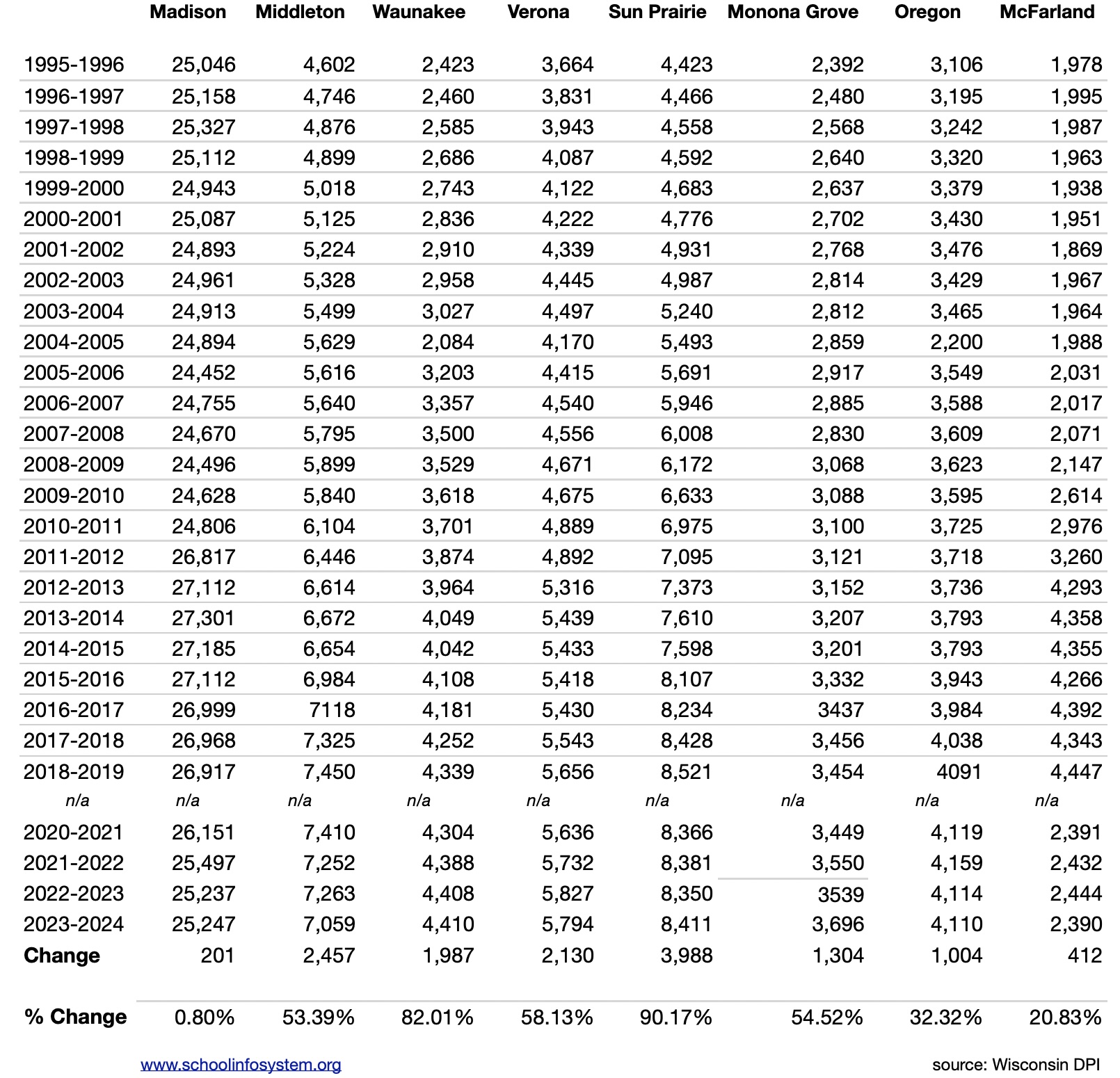
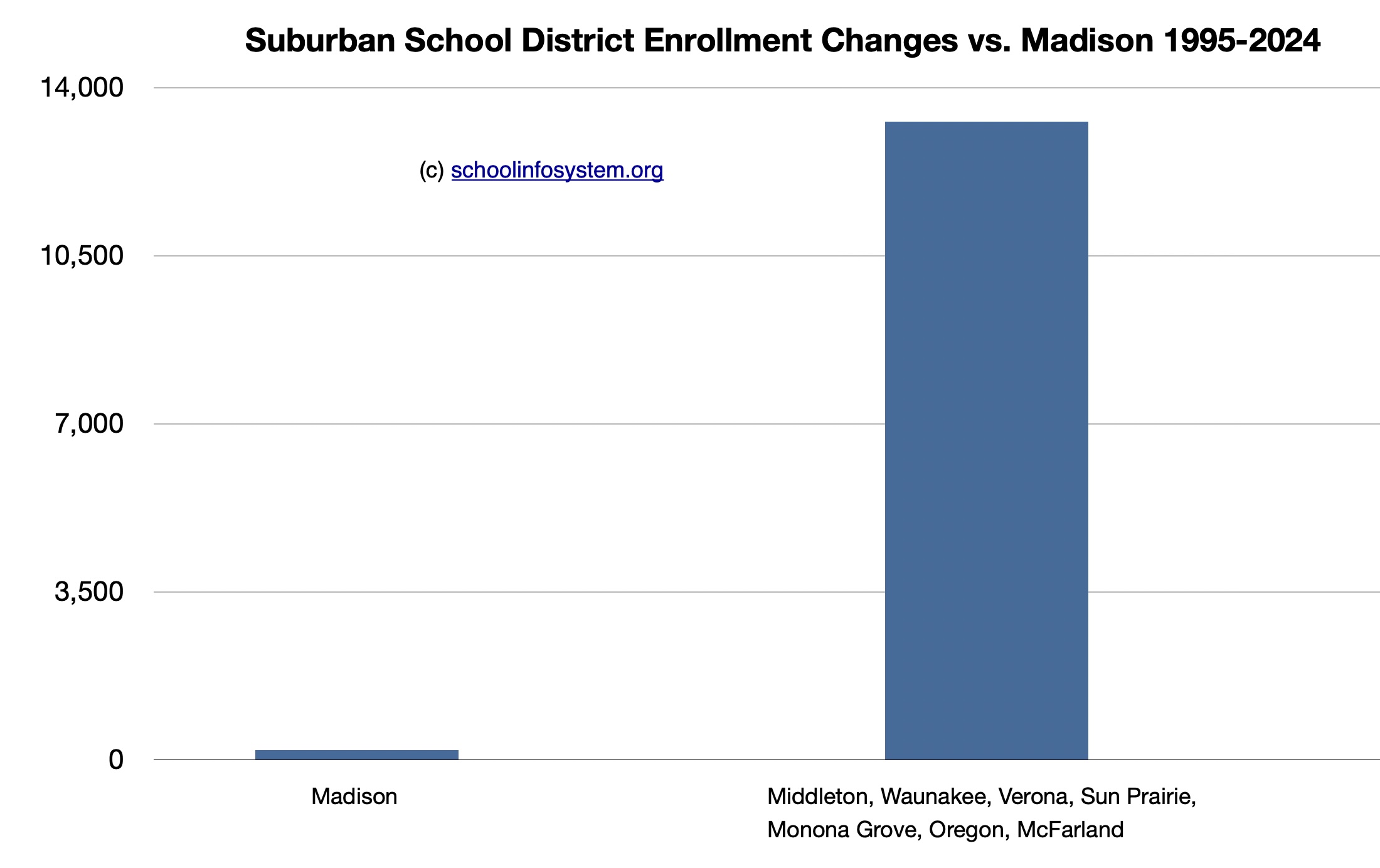
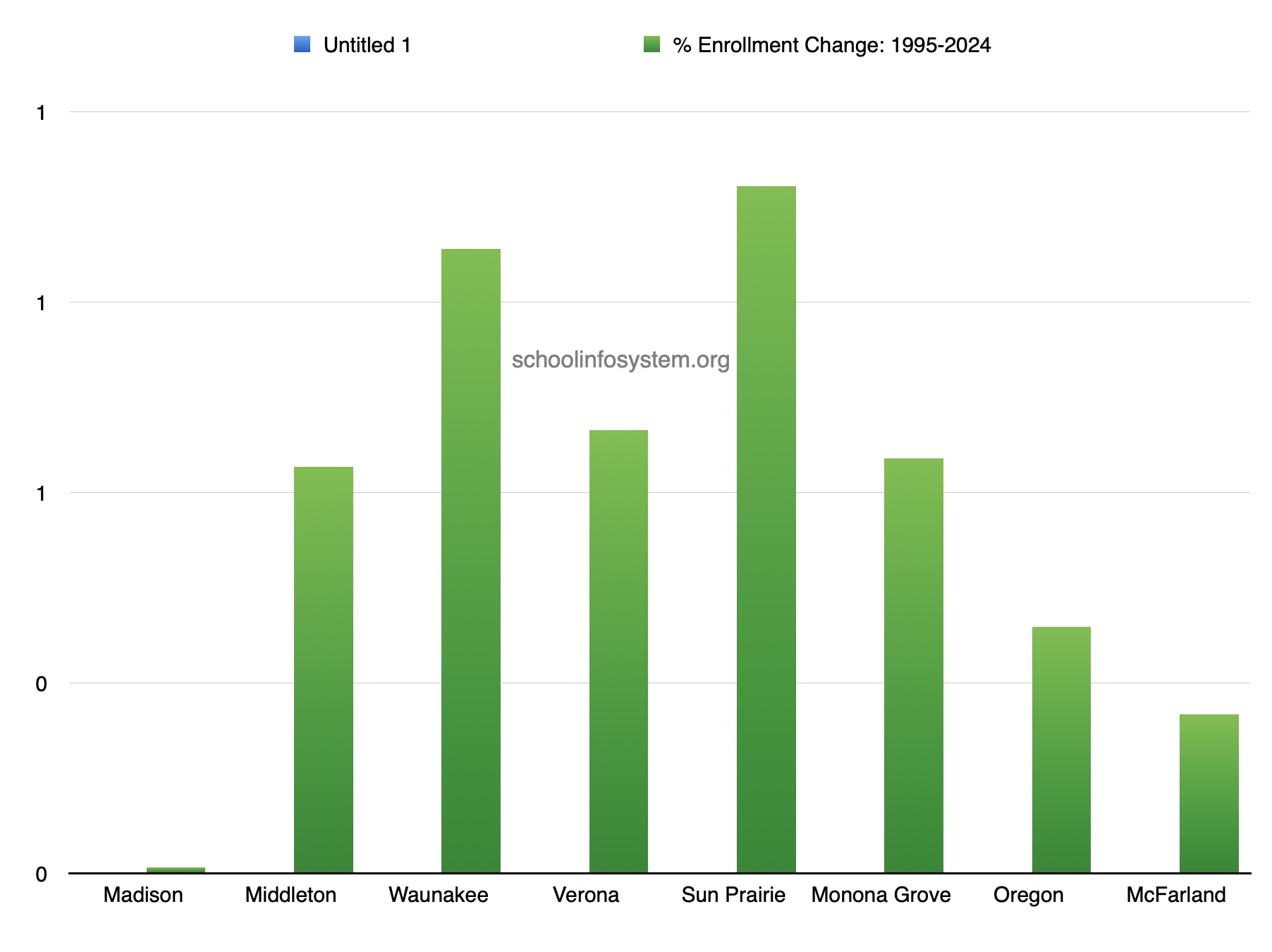
Open Enrollment Data 2023-2024 Madison -1,055
This report is prepared pursuant to Wis. Stat. § 118.51(15)(c), as amended in 2011 Wisconsin Act 114, which requires the Department of Public Instruction (DPI) to: Annually submit a report to the governor and to the appropriate standing committees of the legislature under Wis. Stat. § 13.172(3).
The report under this paragraph shall include all of the following information:
• The number of pupils who applied to attend public school in a nonresident school district under the full-time open enrollment program;• The number of applications received under the regular and alternative application procedures, and for the applications received under the alternative application procedure, the number of applications received under each of the criteria listed under the alternative application procedure;
• The number of applications denied and the bases for the denials;
• The number of pupils attending public school in a nonresident school district under the open enrollment program. The department shall specify, separately, the number of pupils attending public school in a nonresident school district whose applications were accepted under the regular application procedure and the alternative application procedure, and for the applications submitted under the alternative application procedures, the number of pupils attending under each of the criteria listed under the alternative application procedure.
The report covers school year 2023-24.
The report was prepared by Kari Gensler Santistevan, School Administration Consultant, with assistance from Bill Evans, IS Systems Development Services Specialist; Jennifer Demrow, School Administration Consultant; and Michael Bormett, Assistant Director, Parental Education Options Team. Data for the report was gathered and compiled through the Open Enrollment Application Log (OPAL), an online application and tracking system in use since the 2008-09 school year.
Much more on Open Enrollment, here.
Curious: Scientists should be more politically involved, not less!
Science, nominally the most prestigious scientific journal in the world, is at it again. In November, it published an editorial by Agustin Fuentes titled ‘Scientists as political advocates’. The gist is that scientists and scientific institutions need to be even more political than they already are.
Back in 2023, Fuentes wrote an editorial that claimed “being woke is just doing good 21st-century science”. And in 2021, he wrote one that described Charles Darwin as “an English man with injurious and unfounded prejudices”. Indeed, the prolific Fuentes has penned no less than eight editorials for Science over the last four years – suggesting that the editors like what he’s selling.
Returning to ‘Scientists as political advocates’, Fuentes begins by warning readers that science is “under attack”. Does he mean that it’s under attack from woke ideologues trying to bend science into a tool for promoting ‘diversity’? Or that it’s under attack from public health officials trying to shut down discussion over the harms of pandemic policies? Of course not. He means that it’s under attack from his political opponents.
notes on censorship and academia
I spoke of censorship in anthropology and archaeology — no longer are photos of skeletal remains allowed in many journals; museum exhibits are being shuttered; and professors are being prevented from showing students teaching materials.
What Is Fingerprinting
Device fingerprinting involves collecting information about user devices, such as smartphones or computers, to create a unique identifier, often to track people or their activities as they browse around the web. This data may include IP addresses, browser user-agent strings, screen resolution, or even details like battery discharge rate. Fingerprinting is particularly concerning because it can be passive—requiring no user interaction. Data is collected without the user’s knowledge and linked to their device. Upon subsequent browsing, systems can recognize the same visitor, enabling ad tracking or uncovering private information, such as browsing habits.
This form of identification is neither transparent nor user-friendly. Users are often unaware it is happening, and when done without their consent, awareness, or other legal grounds, it breaches laws. Unlike cookies or other mechanisms, such identifiers cannot be easily “cleared,” making them especially invasive. Nevertheless, websites, advertising technologies, and others have continued to use them. Remarkably, large technology companies like Apple and Google once vowed not to engage in such practices. This commitment marked a major achievement for privacy, driven by advancements in privacy research and engineering. Large platforms even began competing to enhance user privacy, benefiting users’ welfare and reducing the risk of data misuse or leaks. This issue cannot simply be reduced to “Google does this, and the ICO critiques it.”
PowerSchool Hack?
While hundreds of school district officials around the country are ringing alarm bells, Fairfax County Public Schools Superintendent Michelle Reid has been silent this week about explosive news that cybercriminals hacked the “Student Information System” database managed by a global technology contractor, PowerSchool Holdings Inc., stealing highly sensitive student information, including names, addresses, grades, attendance, enrollment, parent names, Social Security numbers, and medical records, as well as teacher information.
FBI’s cybersecurity teams are investigating the hacking. According to accounts of the cyber-steal, PowerSchool, based in Folsom, Calif., paid a “ransom” to the hackers, who promised to delete the data. Technology experts worldwide have been scouring the Dark Web this past week to see if the guarantee holds true. Schools from Maine to California have been notifying their communities about the breach’s impact on their school districts.
The silence by the leaders at Fairfax County Public Schools raises many unanswered questions for parents, staff and community members and resurrects concerns about transparency in a school district with a massive $3.8 billion budget and salaries for executives on the superintendent’s team that run over $200,000. Fairfax County Public Schools officials didn’t respond to a request for comment.
——-
civics: Censorship and the Taxpayer funded State
This is why, for example, the most powerful corporation the world had then seen — the East India Company — was summarily dissolved by the British parliament in 1874. It is also why the Bell System of telecommunications companies was broken up by US antitrust law and policy in the 1980s. Companies can be very powerful — but there is always something stronger on which they depend for legal recognition.
Large companies therefore place great reliance on being able to influence public policy and lawmaking. This explains what Meta did, for instance, with the appointment of the pro-European former UK deputy prime minister Nick Clegg as vice-president of global affairs and communication. That was a good choice for a company seeking to constructively influence the formulation and implementation of EU policy.
As the surrender of Musk and X to the Brazilian courts shows, state power is likely to always ultimately win against the platforms if tested
k-12 tax & $pending climate: I think property taxes have increased at a rate that is unsustainable
“I work and reside in the community that everybody else does, and I think property taxes have increased at a rate that is unsustainable,” Ratzlaff said. “I just want to take a look and see if there’s anything we can do about that.”
During his 2020 Assembly campaign, Ratzlaff said he supports municipal levy limits on property tax revenue, according to a WisconsinEye interview at the time. He still holds that position, he said Thursday.
In that same 2020 interview, Ratzlaff said he backed having an independent group draw legislative district maps, rather than lawmakers themselves, as well as term limits for legislators.
Before serving as Dane County executive, Agard was a local and state politician for over a decade. Starting in 2020, Agard was a state senator for District 16, which includes parts of the Madison region, after serving eight years in the Assembly. She previously served on the County Board for two terms.
In campaign materials from the fall, Agard advocated for expanding affordable housing initiatives and access to behavioral health care. She backed building a county mental health facility, using opioid settlement funds to reduce addiction and establishing a regional transportation planning agency, which would require action from state lawmakers
—-
Madison is raising taxes and spending (and buildings) amidst declining enrollment .
PRC produces almost an order of magnitude more STEM grads than the US each year….
, comparable to the rest of the world combined: ~4x population base, individual students ~2x more likely to study STEM.
China vs. India: how human capital shaped two distinct economic paths
Between the 1910s and 2010, the education systems in China and India experienced remarkable growth, producing millions of skilled graduates and employing vast numbers of teachers each year. Educational spending also surged, rising from just 0.1–0.2% of gross national income in the early 20th century to 4–5% in the 21st century. However, beneath the surface of this shared expansion lie significant differences in the human capital accumulation and educational development paths, leading to divergent outcomes in inequality and economic growth.
Four Milwaukee teens accepted to Spelman College together, breaking barriers and inspiring dreams
She believes being the first in her family to go to college will show the world that she is important and leave a powerful legacy for her family. She also credits her mother’s hard work and strength for inspiring her vision of success.
Wy’yana added, “Spelman’s model of ‘a choice to change the world’ was really embedded in me. Giving back and doing service has sparked my interest for a long time.” Wy’yana is also motivated by her love for her younger sisters. She wants to set a good example for them and show them that they can be anything they want to be.
Warrantless Domestic Spying
“If confirmed as DNI, I will uphold Americans’ Fourth Amendment rights while maintaining vital national security tools like Section 702 to ensure the safety and freedom of the American people,” Gabbard said.
In private meetings, senators are questioning Gabbard about legislation she introduced in 2020 that would repeal Section 702.
However, Gabbard now appears to be walking that back, citing Fourth Amendment protections implemented since then to prevent the incidental collection of Americans’ data:
“My prior concerns about FISA were based on insufficient protections for civil liberties, particularly regarding the FBI’s misuse of warrantless search powers on American citizens. Significant FISA reforms have been enacted since my time in Congress to address these issues.”
——
more.
“you can’t teach what you don’t know”
Teacher qualifications and shifts in Faculty of Education admissions policies once attracted little public attention. That all changed in November 2024 when the Canadian province of Manitoba made a fateful decision to remove minimum subject knowledge requirements from its admissions process. Leading Mathematics professors and subject specialists saw it as a ‘declaration of war’ against what remained of subject specialization in the preparation and certification of teachers.
Recent amendments to the Teaching Certificates and Qualifications Regulation by the Wab Kinew Government under The Education Administration Actstirred considerable public opposition. University of Winnipeg Mathematics professor Anna Stokke and a vocal group mathematics professors objected to amendments which lifted subject-specific admissions qualifications and significantly reduced the subject-area expertise required for teacher certification.
Research Battleground – Mathematicians Shred Math Education Research Claims
The educational controversy exploded into a firestorm when Mathematics Education professors came out in favour of relaxing subject knowledge requirements. Dr. Martha Koch, an Associate Professor in the Faculty of Education at the University of Manitoba, claimed that teachers’ college admissions should be based upon “research” in a field known as the “Pedagogy of Math Knowledge.” Her brief in defense of the changes buttressed her claims with the familiar line “research shows” repeated 15 times in a commentary.
Civil Rights Complaint against the Wauwatosa School District
The Wisconsin Institute for Law & Liberty (WILL) filed a complaint with the U.S. Department of Education against the Wauwatosa School District (WSD) for its plan to shut down the Wauwatosa STEM School, currently ranked the fifth-best elementary school in Wisconsin by U.S News and World Report. The District’s racially discriminatory plan also includes phasing out other STEM (Science, Technology, Engineering, Math) programs because too many white students use the programs. In our complaint, WILL highlights a current WSD school board member, who will provide further evidence that WSD’s actions are racially motivated.
The Quotes: WILL Deputy Counsel, Dan Lennington, declared, “Shutting down science and math programs because too many white students are in the program is despicable, and illegal. As we promised to do, WILL is taking every legal action available to reverse this damaging decision. If the Biden Administration does not open an investigation, we hope the new Trump Administration will.”
WSD School Board Member, Michael Meier, stated, “Students and families deserve a high-quality education, which is why I am speaking out. The prolonged, arbitrary DEI-driven focus on racial composition has, in my view, undermined both education and safety, now culminating in the push to close the WSTEM school. I welcome a federal investigation and urge the public to join me in speaking out.”
This Basic Math Question Took Decades to Answer.
In June 1978, the organizers of a large mathematics conference in Marseille, France, announced a last-minute addition to the program. During the lunch hour, the mathematician Roger Apéry would present a proof that one of the most famous numbers in mathematics — “zeta of 3,” or ζ(3), as mathematicians write it — could not be expressed as a fraction of two whole numbers. It was what mathematicians call “irrational.”
Conference attendees were skeptical. The Riemann zeta function is one of the most central functions in number theory, and mathematicians had been trying for centuries to prove the irrationality of ζ(3) — the number that the zeta function outputs when its input is 3. Apéry, who was 61, was not widely viewed as a top mathematician. He had the French equivalent of a hillbilly accent and a reputation as a provocateur. Many attendees, assuming Apéry was pulling an elaborate hoax, arrived ready to pay the prankster back in his own coin. As one mathematician later recounted, they “came to cause a ruckus.”
The lecture quickly descended into pandemonium. With little explanation, Apéry presented equation after equation, some involving impossible operations like dividing by zero. When asked where his formulas came from, he claimed, “They grow in my garden.” Mathematicians greeted his assertions with hoots of laughter, called out to friends across the room, and threw paper airplanes.
Civics: “But for reconciliation to take place, there must first be truth”
The apokálypsis is the most peaceful means of resolving the old guard’s war on the internet, a war the internet won. My friend and colleague Eric Weinstein calls the pre-internet custodians of secrets the Distributed Idea Suppression Complex (DISC) — the media organisations, bureaucracies, universities and government-funded NGOs that traditionally delimited public conversation. In hindsight, the internet had already begun our liberation from the DISC prison upon the prison death of financier and child sex offender Jeffrey Epstein in 2019. Almost half of Americans polled that year mistrusted the official story that he died by suicide, suggesting that DISC had lost total control of the narrative.
It may be too early to answer the internet’s questions about the late Mr Epstein. But one cannot say the same of the assassination of John F Kennedy. Sixty-five per cent of Americans still doubt that Lee Harvey Oswald acted alone. Like an outlandishly postmodern detective story, we have waited 61 years for a denouement while the suspects — Fidel Castro, 1960s mafiosi, the CIA’s Allen Dulles — gradually die. The thousands of classified government files on Oswald may or may not be red herrings, but opening them up for public inspection will give America some closure.
We cannot wait six decades, however, to end the lockdown on a free discussion about Covid-19. In subpoenaed emails from Anthony Fauci’s senior adviser David Morens, we learnt that National Institutes of Health apparatchiks hid their correspondence from Freedom of Information Act scrutiny. “Nothing,” wrote Boccaccio in his medieval plague epic The Decameron, “is so indecent that it cannot be said to another person if the proper words are used to convey it.”
In that spirit, Morens and former chief US medical adviser Fauci will have the chance to share some indecent facts about our own recent plague. Did they suspect that Covid spawned from US taxpayer-funded research, or an adjacent Chinese military programme? Why did we fund the work of EcoHealth Alliance, which sent researchers into remote Chinese caves to extract novel coronaviruses? Is “gain of function” research a byword for a bioweapons programme? And how did our government stop the spread of such questions on social media?
Our First Amendment frames the rules of engagement for domestic fights over free speech, but the global reach of the internet tempts its adversaries into a global war. Can we believe that a Brazilian judge banned X without American backing, in a tragicomic perversion of the Monroe Doctrine? Were we complicit in Australia’s recent legislation requiring age verification for social media users, the beginning of the end of internet anonymity? Did we muster up even two minutes’ criticism of the UK, which has arrested hundreds of people a year for online speech triggering, among other things, “annoyance, inconvenience or needless anxiety”? We may expect no better from Orwellian dictatorships in East Asia and Eurasia, but we must support a free internet in Oceania
——
Mark Zuckerberg says the Biden admin called his employees and “screamed and cursed” at them to take down Covid/vaccine content. They wanted Meta to censor memes too.
When he pushed back, the Biden regime started investigating his companies.
“It was brutal.”
“They basically pushed us and said, ‘anything that says that vaccines might have side effects, you basically need to take down.’”
——
more.
—
As I’ve been saying for months: Glasnost is coming. And glasnost = apocalpyse. I had not read this before I penned the intro to my newsletter this week (which is out this weekend and essentially makes a similar argument.)
Closely related to the agencies’ recent approach to digital assets is the problem of “debanking.”Over the past few years, there have been various accounts of individuals and businesses associated with the crypto industry losing access to bank accounts without explanation. This follows a long history of other types of customers experiencing the problem of debanking, including the politically disfavored business groups targeted by the original “Operation Choke Point,”11 individuals associated with certain religious or political groups,12 and many others.
“unethical to continue to do things that don’t work for kid.”
If you don’t know what Project Follow Through, this episode gives a great overview.
—
Parents overestimate student achievement, underestimate spending
Related: Act 10
Did taxpayer funded Wisconsin DPI Superintendent Underly Juice Test Scores for Reelection?
taxpayer funded Madison School District long used Reading Recovery…
The data clearly indicate that being able to read is not a requirement for graduation at (Madison) East, especially if you are black or Hispanic”
My Question to Wisconsin Governor Tony Evers on Teacher Mulligans and our Disastrous Reading Results
2017: West High Reading Interventionist Teacher’s Remarks to the School Board on Madison’s Disastrous Reading Results
Madison’s taxpayer supported K-12 school district, despite spending far more than most, has long tolerated disastrous reading results.
“An emphasis on adult employment”
Wisconsin Public Policy Forum Madison School District Report[PDF]
WEAC: $1.57 million for Four Wisconsin Senators
Friday Afternoon Veto: Governor Evers Rejects AB446/SB454; an effort to address our long term, disastrous reading results
Booked, but can’t read (Madison): functional literacy, National citizenship and the new face of Dred Scott in the age of mass incarceration.
When A Stands for Average: Students at the UW-Madison School of Education Receive Sky-High Grades. How Smart is That?
Only pennies of new public-school dollars make it to teacher salaries
Teacher shortages have been a chief concern of public school leaders since the Covid-19 pandemic began in 2020. According to an August 2023 surveyby the National Center for Education Statistics, 79 percent of public schools with at least one vacant teaching position reported difficulty filling slots for the 2023–24 school year.
The most commonly discussed solution to mitigating K–12 teacher vacancies is spending more on K–12 education so that teachers receive more competitive pay and the profession becomes more attractive to prospective hires. By this logic, the teacher shortage represents a failure of state legislatures to invest adequate dollars in education over the long run.
But for legislators hoping to improve teacher pay and attract more people to the profession, increasing education spending is surprisingly ineffective. Data published in Reason Foundation’s new study Public Education at a Crossroads indicates that states do a poor job of translating additional education investments into higher teacher salaries. Many states have lost ground on average teacher salaries over the past two decades despite spending more. Those states that do manage to raise teacher salaries largely do so only after investing exorbitant amounts in public education, with most of those dollars still being diverted to expenditures besides take-home pay for current teachers.
Sex and the Academy: How is the increasing representation of women in higher education transforming academic culture?
In 1987, less than a third of faculty at postsecondary institutions in the United States were women. Today, 50.7 percent are. In the coming years and decades, this percentage is likely to grow. One way to predict future trends (albeit imperfectly) is to look at the percentage of men and women at different career stages: older cohorts retire and are replaced by new ones.
As of 2020, men made up about 63 percent of full professors, about 52 percent of associate professors, and about 45 percent of assistant professors. Among scholars employed at universities and four-year colleges in 2019 in science and engineering disciplines, faculty with 30 years of experience or more were about 25 percent female, and faculty with less than 10 years of experience were about 42 percent female. Across biological and life sciences, computer sciences, mathematical sciences, physical sciences, psychology, social sciences, and engineering, the percentage of female faculty with less than 10 years of experience is 1.6 to 4.8 times higher than the percentage of female faculty with 30 years of experience or more.
If current trends persist, women will gain increasing influence over the direction of the university.
Civics: “All the Americans against free speech, gathered in one humorously pretentious place”
What kind of person is opposed in principle to less censorship? Readers of the New York Times, apparently! One of this site’s readers chuckled about the predictably mortified Times article(“Meta Says Fact-Checkers Were the Problem. Fact-Checkers Rule That False”) being filled with commenters “rending their garments over a prospect of an Internet full of propagandized idiots.” I looked and found a perfect cross-section of upper-class genitorture enthusiasts begging for harder, firmer content domination. The Washington Post headline was nearly as Onion-ish as the Times (“Meta ends fact-checking, drawing praise from Trump,” putting “free expression” in scare quotes in the sub-head), and its nearly 5000 comments were equally revealing. “User generated notes? The prisoners are now guarding the prison!” wrote one Post reader, who apparently sees life as a prison with insufficiently empowered jailers.
…..
But Facebook wasn’t just pressured to remove “covid-related misinformation,” but what Facebook itself internally described as “often-true content.” The firm was badgered to remove clearly protected satire (a joke ad comparing Covid vaccine to asbestos), unwelcome political opinion (“vaccine discouraging content”), content that didn’t violate Facebook’s terms of service (a Tucker Carlson video, for instance) and content related to the Hunter Biden laptop story. Even Joe Biden’s own account was temporarily deamplified on Facebook, thanks to algorithms that punished accounts mentioning vaccines too often.
Self-Selection and the Diminishing Returns of Research∗
Lorenz K.F. Ekerdt and Kai-Jie Wu
The downward historical trend of research productivity has been used to suggest that there are severe permanent diminishing returns of knowledge production. We argue that a substantial portion of the trend is a transitory composition effect resulting from self-selection in researchers’ ability and the expansion of the researcher sector. We quantify said effect with a Roy model of researchers’ labor supply estimated using microdata on sectoral earnings distributions. Our results suggest that the average ability of researchers has fallen substantially. We then revisit the estimation of the knowledge production function and its resulting prediction on long-run economic growth. We find that separating transitory diminishing returns from permanent ones more than doubles the long-run growth rate of per capita income predicted by a broadclass of growth models.
——
Paper argues that the productivity of researchers has fallen in large part because “the average ability of researchers has fallen substantially” due to dumber people selecting into research careers.
Depopulation
I genuinely cannot believe @CBS58 nailed the importance of Wisconsin’s declining population so viewers could grasp it. Having @jdjmke and @CavalierJohnson lay out the stakes and solutions was the perfect touch. Stellar job, @AdamRifeReports.
—-
Meanwhile, Madison is increasing taxes & $pending to add bricks & mortar
“We find that lowering income tax rates has a significantly positive impact on Wisconsin’s economy”
- Moving to a flat statutory rate of 4.25% (as in Michigan) increases output and
household consumption by more than 2.4%, and the impact is greater when the
rate is lower, for example, 3.05% as in Indiana or 2.50% as in Arizona. - Since the effective tax rate is higher than the statutory rate for most middleincome
households due to the sliding scale standard deductions, moving to a
flat effective rate of 4.25% requires a larger reduction in the second highest
statutory rate and has a larger impact on output and household consumption. - When a larger share of government revenue is transferred back to households,
it raises the disposable income for each dollar of gross income earned by a
household. This has a positive effect on labor supply and the economy.
Does eliminating Mathematics subject requirements from teacher training and certification make any sense?
US students’ poor performance on TIMSS has received much media attention. Canadian students scored worse than US students. Why is this not receiving the same degree of attention?
——
2007 math forum audio video
Discovery Math
Singapore Math
Remedial math
Madison’s most recent Math Task Force
When A Stands for Average: Students at the UW-Madison School of Education Receive Sky-High Grades. How Smart is That?
notes on higher education governance
Following a rare 45-minute discussion Tuesday, the UW Board of Regents tabled a vote to change UW system policy to allow Rothman and future UW system presidents to appoint senior leadership roles without guidance from a committee.
Those who spoke seemed in agreement that the current policy is wasteful and inefficient. The policy requires search and screen committees to fill such posts as vice presidents who oversee finance and student affairs. But Regents also were wary of authorizing unchecked powers.
So instead, the Regents want Rothman to write a revised policy that meets them halfway: It would grant Rothman the authority to appoint senior leaders but would add back in formal processes he or Regent members would have to follow in the hiring process.
Challenge to California Policy Limiting Teachers’ Disclosure to Parents of Student’s Changed Gender Identity …
From Mirabelli v. Olson, decided today by Judge Roger Benitez (S.D. Cal.), the introduction and the conclusion:
Plaintiffs are teachers in the Escondido Union School District (“EUSD”) and parents of students in other California school districts…. The Plaintiffs contend that a state policy promulgated by the California Department of Education and adopted by local school districts violate their rights under the First and Fourteenth Amendments …. The gravamen of the state policy is that public school teachers are not to reveal to parents a student’s announced change of gender identity in order to maintain the student’s privacy, except where the student consents to disclosure….
It is still true that a request to change one’s own name and pronouns may be the first visible sign that a child or adolescent may be dealing with issues that could lead to gender dysphoria or related health issues. Yet, for teachers, communicating to a parent the social transition of a school student to a new gender—by using preferred pronouns or incongruent dress—is not generally permitted under EUSD’s and the State Defendants’ policies.
Underly says critics of new Wisconsin testing benchmarks ‘getting it wrong’
She wants to make it easier for failing schools to somehow seem like they’re succeeding,” Vos said during a press conference. “I hope that’s one of the areas that we’ll get some speedy discussion on, hopefully bipartisan support. Because I would hope that no one, the most liberal person or the most conservative person, would want to dumb down our standards.”
In an interview with WPR, Underly said the change was made to make test scores more meaningful.
She said decisions were not made in a vacuum.
“So we aligned the standards to actual scores that would mean something. Updating those scores aligned the Wisconsin test to the Wisconsin standards, so Wisconsin teachers and parents know how Wisconsin kids are doing,” Underly said. “The critics are absolutely getting it wrong. They’re talking about two different things, and that’s what’s frustrating about it.”
——-
more.
——-
Related: Act 10
Did taxpayer funded Wisconsin DPI Superintendent Underly Juice Test Scores for Reelection?
taxpayer funded Madison School District long used Reading Recovery…
The data clearly indicate that being able to read is not a requirement for graduation at (Madison) East, especially if you are black or Hispanic”
My Question to Wisconsin Governor Tony Evers on Teacher Mulligans and our Disastrous Reading Results
2017: West High Reading Interventionist Teacher’s Remarks to the School Board on Madison’s Disastrous Reading Results
Madison’s taxpayer supported K-12 school district, despite spending far more than most, has long tolerated disastrous reading results.
“An emphasis on adult employment”
Wisconsin Public Policy Forum Madison School District Report[PDF]
WEAC: $1.57 million for Four Wisconsin Senators
Friday Afternoon Veto: Governor Evers Rejects AB446/SB454; an effort to address our long term, disastrous reading results
Booked, but can’t read (Madison): functional literacy, National citizenship and the new face of Dred Scott in the age of mass incarceration.
When A Stands for Average: Students at the UW-Madison School of Education Receive Sky-High Grades. How Smart is That?
Facebook Censorship vs Free Speech
When I first heard that Mark Zuckerberg was shutting down Facebook’s fact-checking department, my first thought was: Too little, too late.
That’s because I’ve had my own experience with his team of fact-checkers.
Back in February 2020, when I was the Sunday editor of the New York Post, China expert Steven Mosher pitched me a theory about how the coronavirus started. Back then, it was believed it came from a wet market in Wuhan, but Steven was unconvinced. He said it was much more likely it had leaked from the Wuhan Institute of Virology, which had been doing experiments with the coronavirus for years.
This was before the lockdowns, and before Covid had spread across America and killed millions worldwide. Some experts had just started talking about the possibility of a global pandemic.
I was happy to publish Steven’s piece, because I figured the world would want to hear an alternative idea at an important moment from a social scientistwho had lived in China and written books about the country.
I was right about the story. (In fact, the lab leak theory is now seen as the most likely explanation for Covid’s origins.) But I was wrong—and naive—to think anyone in power would want to hear it.
We published the piece on February 22, under the headline “Don’t Buy China’s Story: The Coronavirus May Have Leaked from a Lab.” It immediately went viral, its audience swelling for a few hours as readers liked and shared it over and over again.
I had a data tracker on my screen that showed our web traffic, and I could see the green line for my story surging up and up. Then suddenly, for no reason, the green line dropped like a stone. No one was reading or sharing the piece. It was as though it had never existed at all.
——-
Civics: Censorship at Facebook, Instagram & Threads
Parents overestimate student achievement, underestimate spending
More than 40 percent of Wisconsin parents believe their child is “above grade level” in math, and 45 percent said the same about reading, according to Wisconsin survey results.
Only 9.5 percent of students were ranked “advanced” in math and just over 8 percent rated “advanced” in reading on the 2022-23 Forward Exam, a statewide test taken by Wisconsin’s 3rd through 8th graders. Fewer than 40 percent were rated “proficient.”
But measuring student achievement is difficult. This year, the Wisconsin Department of Public Instruction changed its state test score benchmarks, making it so 2023-24 scores can’t be compared to previous years.
Looking at DPI numbers for 2023-24, 11.6 percent of Wisconsin students are “advanced” and 39.5 percent are “meeting expectations” in reading, while 19.8 percent of students are “advanced” and 33.4 percent are “meeting expectations” in math.
WILL Research Director Will Flanders said parents have little knowledge of how poorly many students are doing in school.
“We need to think about ways to make parents more aware of how their kids are actually performing, and not whistle past the graveyard of student performance as we continue to see low results,” Flanders said.
But the survey shows only 12 percent of parents are forming their opinions about student achievement from state test scores. The majority surveyed, 70 percent, said they rely on information their child’s teacher tells them at conferences, on the report card or through other communication.
——-
Related: Act 10
Did taxpayer funded Wisconsin DPI Superintendent Underly Juice Test Scores for Reelection?
taxpayer funded Madison School District long used Reading Recovery…
The data clearly indicate that being able to read is not a requirement for graduation at (Madison) East, especially if you are black or Hispanic”
My Question to Wisconsin Governor Tony Evers on Teacher Mulligans and our Disastrous Reading Results
2017: West High Reading Interventionist Teacher’s Remarks to the School Board on Madison’s Disastrous Reading Results
Madison’s taxpayer supported K-12 school district, despite spending far more than most, has long tolerated disastrous reading results.
“An emphasis on adult employment”
Wisconsin Public Policy Forum Madison School District Report[PDF]
WEAC: $1.57 million for Four Wisconsin Senators
Friday Afternoon Veto: Governor Evers Rejects AB446/SB454; an effort to address our long term, disastrous reading results
Booked, but can’t read (Madison): functional literacy, National citizenship and the new face of Dred Scott in the age of mass incarceration.
When A Stands for Average: Students at the UW-Madison School of Education Receive Sky-High Grades. How Smart is That?
“Underly noted other states, such as Oklahoma and New York, have recently lowered their testing benchmarks”
Are standards lower?
DPI officials have defended the new benchmarks, saying they align more directly with the state’s Forward Exam and teaching standards. Underly noted other states, such as Oklahoma and New York, have recently lowered their testing benchmarks.
However, the Institute for Reforming Government, a conservative think tank, points to changes for the benchmarks on ACT testing.
The changes adopted last year mean students who score a 19 on the exam are considered to be meeting expectations. That standard was formerly labeled as “proficient,” but the DPI also softened the language with changing the cut scores, replacing terms like “basic” and “below basic” with “approaching expectations” and “developing.”
“[The ACT] passing standard basically went from a 21 to a 19,” Klabon said. “That is the definition of lowering standards.”
The ACT, itself considers a 19 at the low end of its “average score range,” which includes scores between 17 and 24. According to a 2011 primer put together by the Portage School District, a 19 on the ACT would’ve been lower than the minimum score required for admission to every UW System school.
According to DPI data, the average statewide composite ACT score in the 2023-24 school year was 19.2.
——
much more on Jill Underly and reduced rigor.
Related: Act 10
Did taxpayer funded Wisconsin DPI Superintendent Underly Juice Test Scores for Reelection?
taxpayer funded Madison School District long used Reading Recovery…
The data clearly indicate that being able to read is not a requirement for graduation at (Madison) East, especially if you are black or Hispanic”
My Question to Wisconsin Governor Tony Evers on Teacher Mulligans and our Disastrous Reading Results
2017: West High Reading Interventionist Teacher’s Remarks to the School Board on Madison’s Disastrous Reading Results
Madison’s taxpayer supported K-12 school district, despite spending far more than most, has long tolerated disastrous reading results.
“An emphasis on adult employment”
Wisconsin Public Policy Forum Madison School District Report[PDF]
WEAC: $1.57 million for Four Wisconsin Senators
Friday Afternoon Veto: Governor Evers Rejects AB446/SB454; an effort to address our long term, disastrous reading results
Booked, but can’t read (Madison): functional literacy, National citizenship and the new face of Dred Scott in the age of mass incarceration.
When A Stands for Average: Students at the UW-Madison School of Education Receive Sky-High Grades. How Smart is That?
Madison clinics are witnessing unprecedented demand for long-term birth control services
Medical providers in Madison are seeing increased demand for long-term birth control, with UW Health inserting a record number of IUDs in patients last month and UnityPoint Health-Meriter scheduling special clinics for IUDs and implants.
Notes on declining enrollment while Madison increases taxes & $pending on bricks and mortar.
Congress Can Block Student Loan Cancellation—Forever
Specifically, Congress could block the Education Department from issuing new regulations or executive actions related to the student loan program that increase costs to taxpayers. Had it been in effect during the last four years, such a law would have killed all of President Biden’s attempts at loan cancellation in the cradle.
During the last Congress, Representative Glenn Grothman (R-WI) introduced a simple bill to do exactly that. The four-page Protecting Taxpayers From Student Loan Bailouts Actwould have barred the Secretary of Education from issuing “economically significant” regulations or executive actions (those with a $100 million or greater annual impact on the economy) that increase the costs of the federal student loan program. Minor regulations, or regulations which don’t increase the costs of student loans, would still be allowed.
Even though President-elect Trump is weeks from inauguration, and is unlikely to cancel student loans on a large scale, Congress might still consider taking action to block future administrations from forgiving debts. After all, the next Democratic president may decide to finish what President Biden started.
k-12 Tax & $pending Climate: two otherwise identical employees can be treated dramatically different by Social Security
Let’s start with Teacher 1, who pays into Social Security in her teaching job. Assuming she retired in 2025 at the full retirement age of 67, her $72,000 annual teaching salary would entitle her to an annual Social Security benefit of $25,064. The additional $10,000 in annual earnings she received from summer jobs would boost her annual Social Security benefits by an additional $1,500.
Now consider Teacher 2. She pays into a government pension for her teaching job. Usually these public sector plans are more generous than Social Security, but for these purposes let’s assume the benefits are the same. Her $10,000 in summer earnings each year, however, entitle her to an annual Social Security benefit of $7,305. That’s $5,805 more than the $1,500 annual benefit that Teacher 1 receives based on her summer earnings. How can that be right?
It’s not right, in any fairness sense. It’s also not right when we consider need, since we assumed the two teachers had the same annual earnings and received the same government pension or Social Security benefits based on their teaching job. Yet Teacher 2, who mostly paid into a government pension in her teaching job, receives a total retirement income that’s $5,805 higher than Teacher 1. And that difference arises solely from how the two teachers are treated by Social Security.
Computer Science Coursetaking and Science and Math Course Performance in Milwaukee
Morgan Polikoff and Paul Bruno
Using data from Milwaukee Public Schools (MPS), this report analyzes the association of high school computer science (CS) coursetaking with subsequent performance in mathematics and science courses. The report includes CS, mathematics, and science coursetaking and grade data for approximately 60,000 high school students between 2014-15 and 2021-22, of whom approximately 21% took at least one CS course. In addition to looking at an overall CS effect, we consider the effect separately for different types of CS classes—EC, IB, and other CS classes.
To analyze the data, we use econometric techniques, with two main forms of statistical models. In the first model, we leverage variation among students in a given math or science course in terms of their prior CS coursetaking, controlling as well for their prior math/science GPA. In the second model, we examine variation in grades within individual students before and after having taken CS courses.
Looking across the results, we generally find small negative associations of CS coursetaking with subsequent grades, typically in the range of .01 to .03 GPA points. These associations are sometimes, but not always, statistically significant. There is some suggestive evidence that these negative associations are driven by non-ECS CS courses, especially in mathematics. We do not find strong evidence that these associations differ across the types of science and mathematics courses. We conclude by discussing limitations of the available data for answering the questions of interest, contextual differences between this study and prior similar studies of CS coursetaking, as well as potential threats to the validity of the findings.
6-Year-Olds in England Get a Phonics Check. American Kids Should Get One, Too
Not that much happens with the results. For example, England doesn’t require that kids who fail the phonics check have to repeat a grade. But parents get to see their child’s result, and kids who fail the test have to retake it the next year. The results are also shared with officials who use them to evaluate each school’s performance.
In this light, England’s phonics check is a light-touch intervention with relatively low stakes. But it has driven dramatic increases in student performance. The percentage of kids passing the phonics check on their first try soared from 58% in 2012 to 82% in 2019. (The check was paused in 2020 and 2021 due to the pandemic, and the pass rate fell to 75% in 2022, but it was back up to 80% this year.)
——-
How did the English Reformation happen?
As this quote from Patrick Collinson (the historian, not the tech entrepreneur) indicates, the Reformation was a truly transformative event.
“England, which at the beginning of the sixteenth century seems to have been one of the most Catholic countries in Europe, became, by the seventeenth century, the most virulently anti-Catholic, and the almost dominant ideology of anti-Catholicism fueled the civil wars that engulfed all parts of the British Isles in mid-century and later provoked the Bloodless Revolution, from which what passes for a British constitution derives” (Collinson, 2004, p 10).
We think that focusing on the Dissolution of the Monasteries provides crucial insights into the political economy of this transformation.
This will be the first of a two posts describing the gist of our argument.
Part (1) below will examine how the allocation of land following the Dissolution created a vested interest opposed to Mary’s policies of restoring Catholicism in the 1550s. Part (2) will demonstrate that the political economy interests created by the Dissolution remained important into the late 17th century and will focus on the Exclusion Crisis of the late 1670s.
Civics: Chief Justice John Roberts addresses threats against judges.
Wall Street Journal “ai” summary:
• Judicial Independence: The Chief Justice emphasizes the importance of an independent judiciary for liberty, citing the founding constitutional debates.
• Threats to Judicial Independence: The Chief Justice highlights the rise in violence, intimidation, disinformation, and threats to defy lawful judgments as threats to judicial independence.
• Defiance of Judicial Decisions: The Chief Justice condemns calls from elected officials across the political spectrum to disregard federal court rulings, citing the example of President Biden’s response to the student loan forgiveness case.
• Biden’s Stance on Supreme Court: Biden defied the Court’s warning on the eviction moratorium and endorsed term limits for Justices.
• Democratic Criticism of Supreme Court: Democrats propose binding codes of conduct for Justices and forcing recusals based on political demands.
• Public Perception of Threat to Democracy: Many Americans believe Biden’s attacks on the Court are a greater threat to democracy than Trump’s actions.
notes on teacher licensing and the taxpayer funded Madison School District
Over 10% of the Madison school district’s teachers are relying on one-year emergency licenses to work in classrooms, according to figures obtained by the Cap Times under state open records laws.
A majority of the Madison Metropolitan School District’s nearly 300 emergency licensed educators were teaching classes in bilingual education, English as a second language or cross-categorical special education as of last month.
The state Department of Public Instruction may issue one-year emergency teaching licenses to people with bachelor’s degrees in any subject, allowing them to teach in schools without meeting the requirements for full certification. The state may also renew emergency licenses for those working toward full licensure.
Supporters say these licenses help fill roles with significant turnover or a lack of certified candidates as school districts continue to struggle with a shortage of teachers. Still, critics worry these educators may not yet be equipped with the skills and knowledge needed to teach students.
“Students struggle to learn when the teachers have not been effectively prepared,” said Heather Peske, who leads the Washington, D.C.-based nonprofit called National Council on Teacher Quality. “When education leaders take shortcuts on teacher certification, it costs everyone, and most of all, it costs students.”
——-
Related: Act 10
Did taxpayer funded Wisconsin DPI Superintendent Underly Juice Test Scores for Reelection?
more on Jill Underly and reduced rigor.
taxpayer funded Madison School District long used Reading Recovery…
The data clearly indicate that being able to read is not a requirement for graduation at (Madison) East, especially if you are black or Hispanic”
My Question to Wisconsin Governor Tony Evers on Teacher Mulligans and our Disastrous Reading Results
2017: West High Reading Interventionist Teacher’s Remarks to the School Board on Madison’s Disastrous Reading Results
Madison’s taxpayer supported K-12 school district, despite spending far more than most, has long tolerated disastrous reading results.
“An emphasis on adult employment”
Wisconsin Public Policy Forum Madison School District Report[PDF]
WEAC: $1.57 million for Four Wisconsin Senators
Friday Afternoon Veto: Governor Evers Rejects AB446/SB454; an effort to address our long term, disastrous reading results
Booked, but can’t read (Madison): functional literacy, National citizenship and the new face of Dred Scott in the age of mass incarceration.
When A Stands for Average: Students at the UW-Madison School of Education Receive Sky-High Grades. How Smart is That?
Censorship: Facebook (meta) continues
Testing Mark Zuckerberg’s free speech rhetoric, I shared this post on Facebook:
The result, in screenshots below:
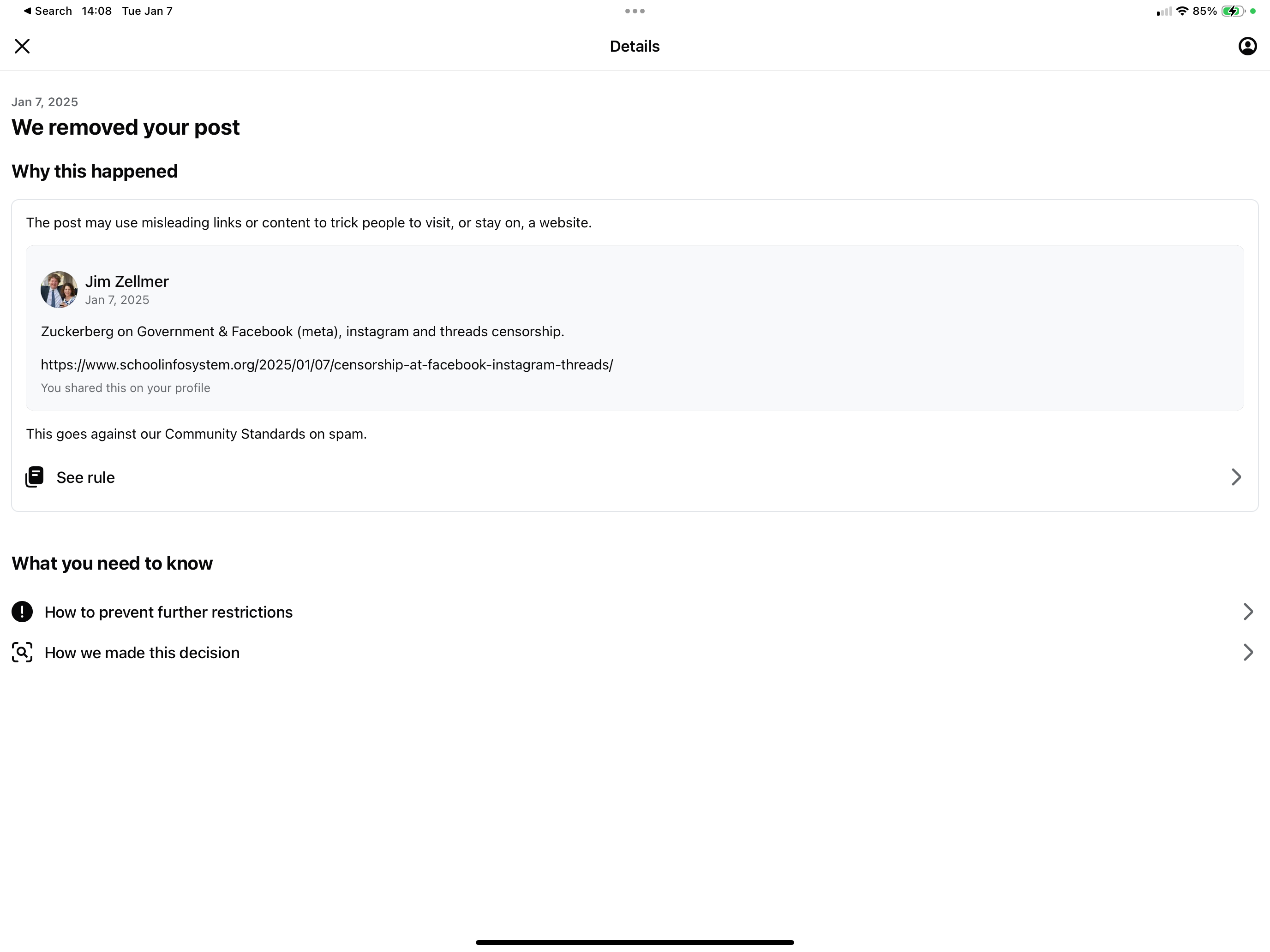
——–
Rather unsurprising.
Civics: Censorship at Facebook, Instagram & Threads
There’s a reason people don’t trust Mark.
He doesn’t have a highly evolved digital ledger on X.
People learn to trust the digital ledger before they trust the person.
more:
It won’t work.
There’s not enough flow/dynamism on the platform anymore (since they nerfed it in 2014) to make it possible.
I distinctly recall when, days after the 2016 election, Zuck posted FB would start adjudicating truth in posts.
As a former employee, I was shocked that a company focused on free speech for all would spin up a censorship apparatus.
That finally ends.
more…
A whole cadre of ‘misinformation’ experts sprung up to morally justify (and cash in on) the enterprise.
For years, a much smaller group warned of where this would lead, and that 1A should be our guide to online speech.
We were universally reviled.
On one hand, it’s frustrating to see Silicon Valley CEOs locate their testicles only after it’s easy to do so. (Although many are still quiet!) On the other, it’s incredible to see how hard the vibe is truly shifting. This is feeling more durable now.
Glenn Greenwald: more and more
One of the worst, most toxic “disinformation” groups in the West is the “Center for Countering Digital Hate” and its conniving President Imran Ahmed.
Leaked documents previously showed their attempt to “kill Musk’s Twitter.” Now @MaxBlumenthal obtained emails showing this:
I’ve given Zuckerberg a lot of shit over the years, but this is an incredible pivot. You can speculate about motives and authenticity all day long, but reducing political censorship in a world bent on pursuing it is worthy of unqualified applause. Bravo 👏
https://x.com/markpinc/status/1876659312355143831?s=46:
The most successful leaders like zuck and benioff know how to ride the culture wave. This is a master class! They distance themself from the last where they were active participants, protraying themselves as victims too. Now theyre finally free to do whats right. Only they waited until Trump won. But still amazing to watch their skill!
They let @elonmusk and others take the arrows and then ride in when it’s safe. Nice work!
It’s astonishing how easily people forgive or forget the tremendous, often irreversible damage caused by Facebook’s actions.
First off, Facebook banned mentions of the lab leak theory. This had real consequences. If it had been more widely understood that Covid originated in a lab, the entire course of the pandemic would have been very different. Unlike natural viruses, Covid was engineered for human transmission. That rendered mitigation measures such as lockdowns, contact tracing, masks, etc totally useless. Facebook prevented the truth from coming out.
What consequence for malfeasance? These liars even tried evading FOIA, but the judge wasn’t having it. They should not have any position of authority in government, not even dog catcher in a zero dog town.
I was at Facebook in 2013 and it was already in full swing where activist employees were demanding more and more censorship. And user ops teams were clearly political.
For those of us who have been fighting the free speech wars for years, this feels like a major victory and turning point.
I know it’s hard to uncover the truth. I don’t blame most people for getting confused from all the noise or tuning it all out because it’s just too much.
But the fact is that this scam continues because people keep falling for it. The only hope we have for our constitutional republic is if enough of us stop letting them take us for a ride.
“The axe forgets, but the tree remembers.”
“ai summary” via gpt4:
For now, his comments feel significant both as confirmation of reporting on the topic, and as an assessment of coming challenges.
I’m proud that Telegram has supported freedom of speech long before it became politically safe to do so. Our values don’t depend on US electoral cycles.
Today, other platforms are announcing they’ll now have less censorship. But the real test of their newly discovered values will come once the political winds change again. It’s easy to say you support something when you risk nothing.
If Zuck is serious then let’s see the equivalent of the Twitter Files for Facebook. Show all the communication back and forth (not just handpicked ones) between the government and Facebook regarding COVID/vaccine censorship.
Summary of Key Points
Main Themes
- Focus on Free Expression: Commitment to restoring free expression on Facebook, Instagram, and Threads.
- Content Moderation Issues: Challenges with complex moderation systems causing censorship mistakes.
- Shift in Approach: Fact-checkers replaced with community notes, simplifying policies on sensitive topics.
- New Policy Enforcement: Focus on illegal and high-severity issues; rely on user reporting for lower-severity cases.
- Reintroduction of Civic Content: Plans to recommend political and civic content again while ensuring positivity.
- Operational Changes: Relocating trust and safety teams from California to Texas to address bias concerns.
- Global Advocacy: Collaboration with the US government to counter international censorship efforts.
- Trade-offs and Challenges: Acknowledgment that reducing moderation may catch less bad content but will minimize censorship mistakes.
- Commitment to Improvement: Emphasis on evolving systems to prioritize user voice and build trust over time.
Notable Actions
- Transitioning to a community-driven moderation model.
- Simplifying rules to better align with mainstream discourse.
- Dialing back automated filters and increasing confidence thresholds for content removal.
- Reviving civic and political discussions on platforms.
Conclusion
This vision emphasizes empowering user voices, reducing moderation mistakes, and advocating for free expression in the face of global censorship pressures.
Katie Harbath (links) discusses the 2016 election & Facebook at a 2018 WisPolitics event (audio + transcript).
———-
Backstory: Matt Taibbi:
1. Thread: THE TWITTER FILES
2. What you’re about to read is the first installment in a series, based upon thousands of internal documents obtained by sources at Twitter.
3. The “Twitter Files” tell an incredible story from inside one of the world’s largest and most influential social media platforms. It is a Frankensteinian tale of a human-built mechanism grown out [of] the control of its designer.
4. Twitter in its conception was a brilliant tool for enabling instant mass communication, making a true real-time global conversation possible for the first time.
5. In an early conception, Twitter more than lived up to its mission statement, giving people “the power to create and share ideas and information instantly, without barriers.”
6. As time progressed, however, the company was slowly forced to add those barriers. Some of the first tools for controlling speech were designed to combat the likes of spam and financial fraudsters.
7. Slowly, over time, Twitter staff and executives began to find more and more uses for these tools. Outsiders began petitioning the company to manipulate speech as well: first a little, then more often, then constantly.
8. By 2020, requests from connected actors to delete tweets were routine. One executive would write to another: “More to review from the Biden team.” The reply would come back: “Handled.”
Legacy media notes:
Gareth Vipers:
Zuckerberg directly referenced Trump several times in the video, criticizing the legacy media for their coverage of his first term in office. He also said that fact-checkers had become “too politically biased.”
The company also announced it would be relocating what it calls the “trust and safety teams” responsible for writing policy and reviewing content from California to Texas and other U.S. locations.
Meta implemented its third-party fact-checking function after the 2016 election in what it has said was an effort to restrict misinformation and the spread of false news on its platforms.
In 2019 the company drew the ire of some employees when it said it wouldn’t fact-check paid-for advertising by political candidates.
“Free speech and paid speech are not the same thing,” the employees said in an open letter to Facebook in October 2019. They argued that exempting candidates’ ads from fact checking “allows politicians to weaponize our platform by targeting people who believe that content posted by political figures is trustworthy.”
In response to the letter, the company said it welcomed internal debate and criticism of its policies.
Tim Bradshaw and Yasemin Craggs Mersinoglu:
The $1.6tn company on Tuesday said it would “allow more speech by lifting restrictions on some topics that are part of mainstream discourse and focusing our enforcement on illegal and high-severity violations” and “take a more personalised approach to political content”.
“It’s time to get back to our roots around free expression on Facebook and Instagram,” Mark Zuckerberg, Meta’s chief executive and co-founder, said in a video post.
“Just like they do on X, Community Notes will require agreement between people with a range of perspectives to help prevent biased ratings,” Meta said in a blog post.
Theodore Schleifer and Mike Isaac:
Instead of using news organizations and other third-party groups, Meta, which owns Facebook, Instagram and Threads, will rely on users to add notes to posts that may contain false or misleading information.
Notes and links on censorship.
Never forget that in 2020, PolitiFact said it was “false” to say COVID came from the Wuhan Institute of Virology.
Meta’s HR team is deleting internal employee criticism of new board member, UFC president and CEO Dana White, at the same time that CEO Mark Zuckerberg announced to the world that Meta will “get back to our roots around free expression,” 404 Media has learned. Some employee posts questioning why criticism of White is being deleted are also being deleted.
Facebook in March 2021 flagged a Journal op-ed by Johns Hopkins surgeon Marty Makary about the pace at which Americans would develop herd immunity. The platform also targeted the Journal’s review of climate contrarian Steven Koonin’s excellent book “Unsettled.”
Legal discovery in Murthy v. Missouri revealed how Meta executives bowed to demands by Biden officials to censor “misinformation.” The Supreme Court ruled last year that the plaintiffs didn’t prove they were censored in direct response to government pressure, but the case exposed the collusion between the Biden Administration and Big Tech.
The progressive censorship spurred Elon Musk to buy X.com (formerly Twitter) to provide a free-speech forum. To liberal shock, Mr. Musk eliminated the platform’s political speech controls and implemented a Community Notes system in which users can flag posts to provide more context. In other words, counter bad speech with more speech.
We shall see.
Civics: Madison uncounted ballots, city clerk under state investigation
The Wisconsin Elections Commission will investigate not just how Madison failed to count nearly 200 absentee ballots from the November election but specifically the actions of City Clerk Maribeth Witzel-Behl, who notified the state about the error over a month after missing votes were discovered.
The commission voted unanimously during a special meeting Thursday to begin the bipartisan investigation into the city clerk’s office and whether “Witzel-Behl has failed to comply with the law or abused her discretion regarding the 193 uncounted absentee ballots.”
Although the Elections Commission confirmed that the voters’ choices on the 193 ballots were not enough to alter any election outcomes, commission Chair Ann Jacobs called the incident egregious and said the city’s response lacked the transparency she has experienced with other mishaps.
Wisconsin makes it hard for parents to access data and understand report cards
Morgan Polikoff and William Hughes
It’s been over four years since schools closed to stop the spread of COVID-19 and by now there is no question that the pandemic has a long shadow over Wisconsin education.
Results from the National Assessment of Educational Progress exam show Wisconsin students’ performance lags far behind historical peaks in the early to mid-2010s, and absenteeism data show about a 50% increase in chronic absenteeism since pre-COVID. Wisconsin also has cavernous, long-standing Black-white test score gaps, gaps that have not been narrowing.
There is a perhaps well-intentioned desire to move past the pandemic and its effects on children, but we still need urgency to get children back on track. And before this, there needs to be clarity about what the problems are — what effects COVID has had on Wisconsin’s schoolchildren, and how much work is needed to recover.
——-
Related: Act 10
Did taxpayer funded Wisconsin DPI Superintendent Underly Juice Test Scores for Reelection?
more on Jill Underly and reduced rigor.
taxpayer funded Madison School District long used Reading Recovery…
The data clearly indicate that being able to read is not a requirement for graduation at (Madison) East, especially if you are black or Hispanic”
My Question to Wisconsin Governor Tony Evers on Teacher Mulligans and our Disastrous Reading Results
2017: West High Reading Interventionist Teacher’s Remarks to the School Board on Madison’s Disastrous Reading Results
Madison’s taxpayer supported K-12 school district, despite spending far more than most, has long tolerated disastrous reading results.
“An emphasis on adult employment”
Wisconsin Public Policy Forum Madison School District Report[PDF]
WEAC: $1.57 million for Four Wisconsin Senators
Friday Afternoon Veto: Governor Evers Rejects AB446/SB454; an effort to address our long term, disastrous reading results
Booked, but can’t read (Madison): functional literacy, National citizenship and the new face of Dred Scott in the age of mass incarceration.
When A Stands for Average: Students at the UW-Madison School of Education Receive Sky-High Grades. How Smart is That?
International Tests Are Not All the Same
It is true that scores from the two tests are highly correlated at the national level. But the two tests do not measure the same learning. Scores from NAEP’s math and reading tests are also highly correlated when aggregated to the state level. No one would argue that NAEP’s reading and math tests measure the same learning.
Discrepant results from PISA and TIMSS are revealing. When releasing the latest PISA results in 2010, Angel Gurría, Secretary-General of the OECD called New Zealand a “high flier.” New Zealand is definitely not a high flyer on the TIMSS math tests, scoring only 486 in 4th grade and 488 in 8th grade–significantly below the international means of 500.
The PISA math assessment is based on a philosophy known as Real Mathematics Education (RME), championed by the Freudenthal Institute in the Netherlands. Jan deLange of the Freudenthal Institute chairs the PISA expert group in mathematics. RME’s constructivist, problem solving orientation is controversial among mathematicians. In the U.S. in the 1990s, a coalition of mathematicians, parents, and local educators opposed similar types of curricula in what became known as the “math wars.” In 2010, New Zealand implemented national standards that are compatible with RME and PISA—and less compatible with TIMSS.
——-
Schools squander millions of dollars on so-called “bulletproof” windows, only to find that these windows are ineffective in protecting students and staff from gun violence.
Sara Randazzo & Zusha Elinson:
Ryan Wilcox peered through his binoculars as a gunman fired at a large piece of glass propped up at a shooting range in the foothills of Utah’s Wasatch mountains.
Wilcox, a Republican state lawmaker charged with securing Utah’s schools, was eager to see if a polyester-based film, thinner than a credit card and applied to glass windows and doors, might answer a desperate nationwide query: How can schools stop attackers from shooting their way in?
Window-film dealers who sell to school districts claim their product is the answer.
Wilcox and other high-ranking state officials watched the bullet strike the film-coated glass. “It just went right through,” he said. “It failed right in front of the whole group.”
The largest U.S. manufacturers of window film, including 3M, say it can’t stop bullets or intruders. But that hasn’t stopped some window-film dealers from cashing in on false or exaggerated claims of ballistic protection.
The Wall Street Journal found that more than $100 million has been spent for the purchase and installation of window film at school districts nationwide. The film is attractive to school officials because it is a fraction of the cost of bulletproof glass.
New mandates in Utah and Texas require all public schools to install window-security measures, either window film or bulletproof glass. Tennessee now requires the application of window film at new or remodeled schools. The new requirements have spawned a proliferation of dealers in the high-profit window-film business.
The Wisconsin DPI and our long term, disastrous reading results
DPI sends email defending LLI and Reading Recovery as OK at a WI school. THESE CURRICULUM DON’T HAVE A PHONICS SCOPE AND SEQUENCE. @WisconsinDPI again what curriculum are outlawed because the law says you can’t buy programs with MSV. Lead don’t mislead!
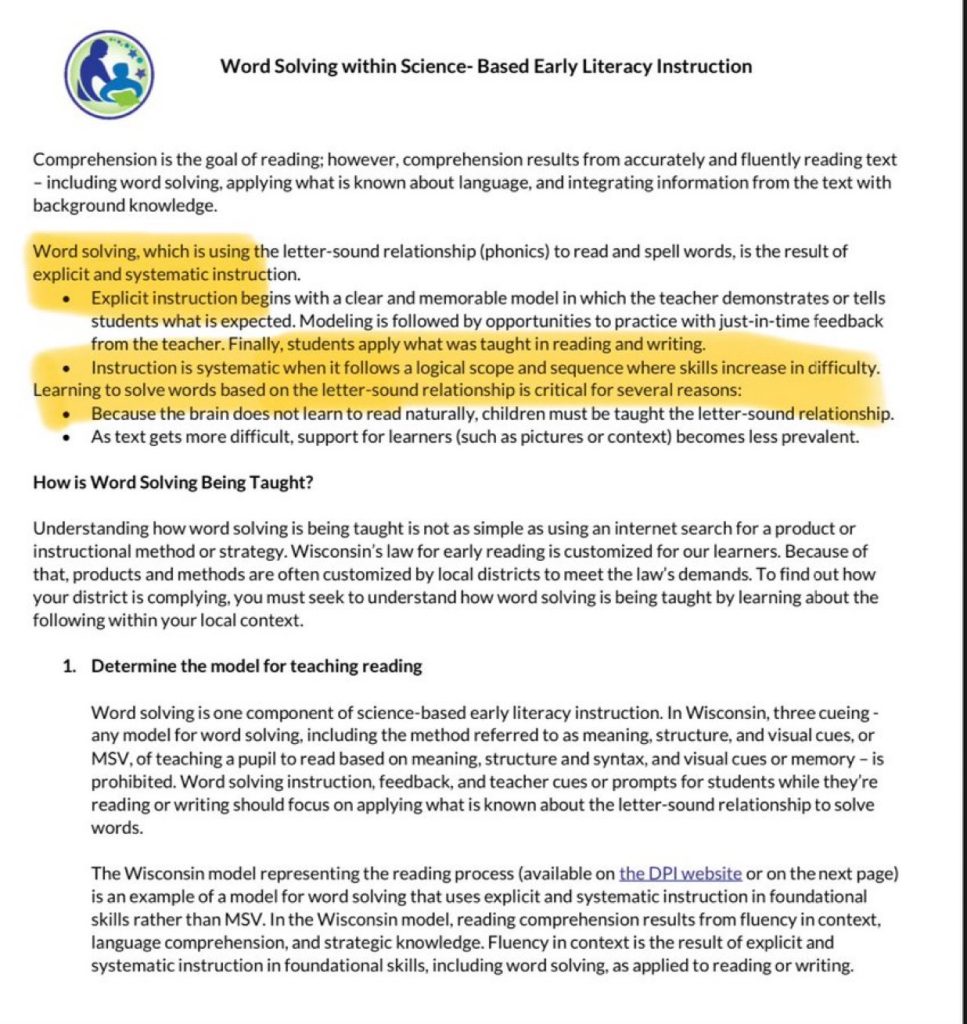
more.
So let me get this straight Reading Recovery and LLI can be used in WI because a school can tell the DPI that they removed 3 cueing…even though the law says
teacher content knowledge notes
When they got rid of the CBEST in California because too many potential teachers weren’t passing it, I knew we were cooked. These are sample questions from the state-sanctioned practice test:
—-
My Question to Wisconsin Governor Tony Evers on Teacher Mulligans and our Disastrous Reading Results
More on the Wisconsin DPI’s ongoing rigor reduction campaign.
“We need to restore standards that demand excellence, not throw more cash at it”
Representative Barbara Dittrich
Evers’ statement is completely out of touch with voters. In my district, people complained to me about all of their wasted tax dollars producing MKE kids who can’t read, write, or do simple math. We need to restore standards that demand excellence, not throw more cash at it.
——
Related: Act 10
Did taxpayer funded Wisconsin DPI Superintendent Underly Juice Test Scores for Reelection?
more on Jill Underly and reduced rigor.
taxpayer funded Madison School District long used Reading Recovery…
The data clearly indicate that being able to read is not a requirement for graduation at (Madison) East, especially if you are black or Hispanic”
My Question to Wisconsin Governor Tony Evers on Teacher Mulligans and our Disastrous Reading Results
2017: West High Reading Interventionist Teacher’s Remarks to the School Board on Madison’s Disastrous Reading Results
Madison’s taxpayer supported K-12 school district, despite spending far more than most, has long tolerated disastrous reading results.
“An emphasis on adult employment”
Wisconsin Public Policy Forum Madison School District Report[PDF]
WEAC: $1.57 million for Four Wisconsin Senators
Friday Afternoon Veto: Governor Evers Rejects AB446/SB454; an effort to address our long term, disastrous reading results
Booked, but can’t read (Madison): functional literacy, National citizenship and the new face of Dred Scott in the age of mass incarceration.
When A Stands for Average: Students at the UW-Madison School of Education Receive Sky-High Grades. How Smart is That?
“A huge avenue for us to grow is, frankly, Department of Defense”
We don’t have a lot of money coming from DOD, and we have a lot of relevant expertise,” she said.
Over the last couple of months, Grejner-Brzezinska said her office has strategized with faculty about how to work more with the Department of Defense.
UW-Madison should also expand and diversify its research, she said. Bigger awards, combined with state and industry dollars, can be an “enormous economic benefit for the state and the region,” she said.
“Encouraging Debate, Not Settling It”
A very interesting exchange in the Autumn 2024 Sapir Journal; a short excerpt, just to give a flavor of the whole thing:
We’ve seen the same data, and I’ve been very concerned about the drop in approval and trust in higher education. The decline has been larger among people on the conservative side of the political spectrum, but it’s across the board, from the Left and the Right. My sense is that it comes from two concerns. From the progressive side, the concern is that highly selective universities are perpetuating inequality. And the concern from the Right is that we’re woke factories….
The question of the politicization of higher education has come into stark relief after what we’ve seen last year: the conflict in the Middle East and the drama on campus. These developments have elevated into the public consciousness concerns that have been present for years. They now are front and center, much more serious, and they require a course correction by many universities….
If you look back, there were three pillars of how a university thought about its role in society.
If you look at the University of Chicago, one pillar was this commitment to free speech that goes back to the founding and then through a whole variety of presidents, reaffirmed, most recently, by the 2015 report, often referred to as the Chicago Principles. Universities need to be places for open debate.
related – Ben Wikler:
In Wisconsin, we run a permanent campaign. We organize and communicate year-round, in every community—and it works. We’ve ended GOP control and unrigged our state.
The latest math fad is another excuse to teach nothing
The fundamental misconception to this approach is that mimicry, memorization, and structured practice somehow constitute lower-order thinking. Liljedahl includes a staircase diagram that proceeds from doing to justifying, explaining, teaching, and creating to demonstrate his point. Merely doing math problems isn’t thinking in his framework.
This hierarchy of thinking almost perfectly mimics (I thought mimicry was bad) the ubiquitous “Bloom’s Taxonomy,” which similarly ranks types of thinking from remembering and understanding up to evaluation and creation. But in the 1956 Handbook where he introduced the topic, education professor Benjamin Bloom created his taxonomy simply to help teachers discuss classroom activities “with greater precision,” not to rank or judge them.
In fact, he refers to knowledge acquisition as the “primary” objective in education. Knowledge and comprehension are the bases of far more complex thinking. If students are busy counting out basic math facts on their fingers, they can’t attend to more difficult math problems. If they’re busy sounding out words, they can’t attend to higher-order thinking, such as evaluating the text in hand or creating their own poems. Factual knowledge, memorization, and comprehension facilitate and allow robust analysis, synthesis, and creation
civics: “values, she said, ‘that we’ve forgotten to defend.’
This has been a week of mourning for the families of the Americans who lost their lives to Islamism in New Orleans. The attack bears all the hallmarks of the atrocities that have taken place in European capitals in the past decade. Indeed, in a disturbing coincidence, this coming week marks the 10th anniversary of one of the most appalling acts of terrorism seen in modern times.
It was on January 7, 2015, that two Islamists went into the Paris offices of the satirical magazine Charlie Hebdo, murdering a caretaker on their way in, and burst into the weekly editorial meeting. Calling for the editor, Stéphane “Charb” Charbonnier, and four other cartoonists by name, they proceeded to murder them all—as well as three other members of the editorial staff, one of Charb’s police bodyguards, and a guest at the meeting. While fleeing the scene, the two terrorists, who turned out to be brothers, shot and killed a Muslim police officerat point-blank range.
It was the worst attack on the free press in a Western country in our lifetimes. And the massacre presaged another massacre, at a kosher supermarket in Paris days later, which served as a reminder that the Islamists have a distinct set of enemies in their literal sights. For once, albeit only for a moment, the free world seemed to rally in support of the victims. Soon afterward, world leaders—including, slightly surprisingly, the head of the Palestinian Authority, President Mahmoud Abbas, and Queen Rania and King Abdullah of Jordan, none with a glowing record on combating terrorism—marched through the streets of Paris in a show of solidarity. The slogan “Je Suis Charlie” was seen everywhere.
——-
More.