School Information System

Monkey See, Monkey Do. Monkey Read?

Erin Loury, via a kind reader:

Monkeys banging on typewriters might never reproduce the works of Shakespeare, but they may be closer to reading Hamlet than we thought. Scientists have trained baboons to distinguish English words from similar-looking nonsense words by recognizing common arrangements of letters. The findings indicate that visual word recognition, the most basic step of reading, can be learned without any knowledge of spoken language.
The study builds on the idea that when humans read, our brains first have to recognize individual letters, as well as their order. “We’re actually reading words much like we identify any kind of visual object, like we identify chairs and tables,” says study author Jonathan Grainger, a cognitive psychologist at France’s National Center for Scientific Research, and Aix-Marseille University in Marseille, France. Our brains construct words from an assembly of letters like they recognize tables as a surface connected to four legs, Grainger says.

Mark Seidenberg emails:

here’s what you need to know:
http://languagelog.ldc.upenn.edu/nll/?p=3912
Basically, the study shows nothing of any interest about reading. it shows that baboons could pick up on differences in letter frequencies between word and nonword stimuli that allowed to tell them apart about 75% of the time.
This is trivial compared to what a reader knows about the properties of written English.
the paper is here:

https://www.sciencemag.org/content/336/6078/245.full

Share

The kids will be alright: Q&A with translator and TEDx organizer Kristine Sargsyan

Thu-Huong Ha:

So you hope to reach young people in Armenia.
Yes. As a parent you have to think about your kid and other kids. Recently there was a program on TV discussing environmental issues in Armenia. My son watched it, then he went to his room and started crying. He said, “I hate people because they do so much harm to our Earth. How are we going to change things?” I thought, What are we doing for our kids?
Actually my son is famous! In Armenia everybody knows he’s the reason I started TEDx. On the way here I was stopped in the airport by a British woman. She said, “Aren’t we friends on Facebook? Aren’t you the mom of this great kid who pushed you to do TEDxYerevan?”

Share

Madison (MI) School District teachers call 10% pay cut illegal, threaten lawsuit

Lori Higgins:

Teachers in the Madison School District said the Board of Education there violated the law by imposing a 10% pay cut last week that is retroactive to the beginning of the current school year.
Bobby Robinson, president of the Madison Education Association, which represents 77 teachers and other professional employees, said the union plans to file a lawsuit Monday.
He cited a May ruling in a case that said employers can’t apply a pay cut retroactively.
Robinson said he raised those issues with the district administration after the board took action Monday, but paychecks teachers received Friday reflected the deduction. District and board leaders could not be reached Friday.
“They ignored it,” Robinson said.

Share

School Vouchers Gain Ground

NCPA:

The Louisiana state legislature has approved a new school vouchers system that, when signed by Governor Bobby Jindal, will be one of the largest in the country. The move caps 18 months of extensive expansion of voucher programs nationwide and broadens the national argument about the future of public education, says the Wall Street Journal.
With growing systems in Florida, Virginia and Indiana joining older programs such as those in Washington, D.C., and Milwaukee, Wisconsin, the use of vouchers has increased rapidly since 2010.

  • Nineteen states and Washington, D.C., have either voucher systems or “scholarship” programs that provide tax benefits to individuals and businesses for contributions that help pay for students to attend private school.
  • The vast majority of these programs are targeted at specific groups of at-risk students, such as low-income or those with special needs.
  • The Friedman Foundation for Educational Choice, an organization that advocates vouchers, estimates that about 220,000 students are currently enrolled in the programs nationwide.

The Louisiana program would add hundreds of thousands of students to the voucher camp, and would also implement several innovative policy provisions that would help put the program at the cutting edge of education.

Share

Jamie Oliver attacks Michael Gove over school meals

The Telegraph:

The celebrity chef, who has campaigned for healthier school meals over the past decade, warned the progress made in recent years risks being undone by new academies which are allowed to ignore nutrient-based Government standards.
In an interview with The Observer Food Monthly, Oliver said: “This mantra that we are not going to tell (academy) schools what to do just isn’t good enough in the midst of the biggest obesity epidemic ever.
“The public health of five million children should not be left to luck or chance.”
The chef said he was “totally mystified” as to why academies are being allowed to determine what food should be on offer, while state schools follow the national standards introduced in 2008.

Share

Could you pass a US citizenship test?

Christian Science Monitor:

In order to become a US citizen, immigrants must pass the Naturalization Test. American citizenship bestows the right to vote, improves the likelihood of family members living in other countries to come and live in the US, gives eligibility for federal jobs, and can be a way to demonstrate loyalty to the US. Applicants must get 6 answers out of 10 in an oral exam to pass the test. According to US Citizenship and Immigration services, 92 percent of applicants pass this test.

Share

Preparing the Way for a Madison School District Maintenance Referendum

Gayle Worland::

The analysis comes on the heels of a 2012-13 budget for the district proposed by Nerad that would increase Madison School District property taxes by 4.1 percent. Nerad’s $379.3 million budget did not specify a funding source for his high-profile plan to raise the achievement levels of low-income and minority students, originally estimated to cost $105.6 million over the next five years.
The report outlines several options for doubling the district’s maintenance funds, such as using money already within the district’s budget, increasing the property tax levy, using current and future equity reserves, long-term borrowing, or asking voters to approve a referendum that would allow for annual increases for maintenance.
The district spends $4.5 million, or 2.77 percent of its budget, on facility maintenance, which the committee recommended increasing by $4.2 million.
That would amount to $566 per pupil, according to the report. By contrast, the Monona Grove school district spends $1,825 per pupil on facility costs; Sun Prairie schools spend $1,787; and Waunakee spends $1,443, the report said.

Related regarding the most recent Madison School District maintenance referendum: Madison School Board member may seek audit of how 2005 maintenance referendum dollars were spent.

Share

Big reward for your teaching strategies

Jay Matthews:

Here is an example of a school assignment sent to me by an inventive high school psychology teacher:
“To gain a better understanding of Piaget’s Stages of Cognitive Development, you will go to a toy store and choose one toy for each stage of development. In a paper, you will discuss what aspect of the toy corresponds with what developmental milestone in Piaget’s theory. Additionally you will discuss the issue of gender identity formation, based on your visit to the toy store.”
It is one of many such ideas that pop up on my Class Struggle blog. The teacher who forwarded the assignment, Patrick Mattimore, suggested an activity in which readers send in effective teaching strategies. He and I would select the best entries. Knowing the state of newsroom budgets, Mattimore suggested a reward of some value but no cost: publicity for the winner.

Share

Sun Prairie’s WKCE Data

sp-eye:

The Sun Prairie School District has “use data to drive decisions” as part of its credo.
So…here’s the data. This is how we stack up against other Dane Co. school districts.
As always, we highlight grades 4,8, and 10 because at these grades students are tested beyond reading an math. At these grades, all students are tested in Language Arts, Science and Social Studies in addition to Reading and Math.
You decide…are we doing as well as you think we should?
How about instead of some 200 page Monitoring Report that could cure the world’s worst case of insomnia, the school board hold a working session where they talk candidly about our district’s educational performance on the WKCE?

Share

The Global Market Place II: A One-Day K-12 Teacher Workshop (April 25, 2012)

UW-Madison Center for European Studies, via a kind reader’s email:

The on-going global economic crisis has done much to highlight the significance of the study of international economics and the interconnectedness of regional and national economies worldwide. UW-Madison faculty, graduate students and regional outreach specialists along with guest speakers from the community will discuss aspects of the global economy, explore the ways in which specific regions and countries have been affected by economic crises, and present resources and opportunities available for the study and teaching of international economics, national economies, and business practices. Specific themes for this workshop include Fair Trade, Microfinance, NGOs, the European crisis and the prospects for the euro.

Share

Angry Your Employment Security is in Jeopardy?

Madison Teachers, Inc. Solidarity Newsletter (92K PDF):

Layoff: Seniority is a right that is earned under MTI’s various Collective Bargaining Agreements. Seniority is based on one’s years of service and provides protection from indiscriminate layoff.
Under MTI’s Contracts, seniority protects members of MTI’s various bargaining units from subjective or discriminatory layoff. When layoff is necessary, the Contracts provide an objective means, including tie-breakers for those with the same seniority.
Governor Walker’s Act 10 puts seniority in jeopardy because all collective bargaining agreements in Wisconsin covering school district employees will disappear in 2013 under Walker’s Act 10 (blekko, clusty, google news).
What can you do to protect your employment security? Get involved in this spring’s RECALL ELECTION. There are only 15 days until the RECALL PRIMARY ELECTION. Candidates Barrett, Falk, La Follette and Vinehout have promised to reverse Act 10 and to restore public employees’ rights to collectively bargain.
Without your help, there is no chance of reversing the negative impact of Act 10 on school district employees. Call/email MTI Assistant Director Jeff Knight (jknight@madisonteachers.org / 608-257-0491) to offer assistance via your Union.

Share

The Future of Reading

Sonia Saraiya:

What is the future of reading? How can we make it more social?

One of the things that bugs me about the Kindle Fire is that for all that I didn’t like the original Kindle, one of its greatest features was that you couldn’t get your email on it. There was an old saying in the 1980s and 1990s that all applications expand to the point at which they can read email. An old geek text editor, eMacs, had added a capability to read email inside your text editor. Another sign of the end times, as if more were needed. In a way, this is happening with hardware. Everything that goes into your pocket expands until it can read email.

But a book is a “momentary stay against confusion.” This is something quoted approvingly by Nick Carr, the great scholar of digital confusion. The reading experience is so much more valuable now than it was ten years ago because it’s rarer. I remember, as a child, being bored. I grew up in a particularly boring place and so I was bored pretty frequently. But when the Internet came along it was like, “That’s it for being bored! Thank God! You’re awake at four in the morning? So are thousands of other people!”

More from Tom Tunguz.

Share

Wisconsin Teachers & Healthcare Plans

Erica Breunlin:

The Greendale School District’s high-deductible plan has been in place for the past four years but was not available to teachers until last year. When the district first offered the plan, nonunion employees agreed to try it out but teachers declined, Green said. Once Act 10 came into effect, the district offered the high-deductible plan to teachers again. The district allowed teachers to choose between the high-deductible plan and the traditional plan this school year, and 70% decided to go the high-deductible route after seeing how it was working for other staff members, Green said.
The district runs the plan in conjunction with a health reimbursement account.
In addition to a wellness plan, the Greendale district provides an on-site nurse practitioner from Aurora Health Care.
Green said the high-deductible plan significantly reduces the price of health insurance plans for school districts. When factoring in the cost of the high-deductible plan each year plus what the district is putting into the health reimbursement account, the total is about $1,000 less per family plan per year than the traditional plan.

Related: The Madison School District recently ended their longtime support of a costly WPS healthcare plan.

Share

Malloy’s education consultant arouses Connecticut union fears

Ken Dixon:

For months, Leeds Global Partners, a New York-based firm specializing in educational issues as “attractive investment opportunities,” has been closely involved in developing Gov. Dannel P. Malloy’s proposed school reforms.
And while the governor’s major proposals, including teacher evaluations, changes to tenure and the expansion of charter schools are meeting opposition in the General Assembly and the state’s educational community, Leeds Global’s school-privatization agenda has been front and center in a variety of closed-door negotiations.
Unionized teachers and a leading state lawmaker take the privatization proposals — including plans to circumvent teacher contracts and public bidding procedures — as major threats, underscored by the company’s track record in creating individual agreements with teachers hired to turn around failing urban school districts.

Share

Automated Grading Software In Development To Score Essays As Accurately As Humans

David Hill:

April 30 marks the deadline for a contest challenging software developers to create an automated scorer of student essays, otherwise known as a roboreader, that performs as good as a human expert grader. In January, the Hewlett Foundation of Hewlett-Packard fame introduced the Automated Student Assessment Prize (ASAP…get it?) offering up $100,000 in awards to “data scientists and machine learning specialists” to develop the application. In sponsoring this contest, the Foundation has two goals in mind: improve the standardized testing industry and advance technology in public education.
The contest is only the first of three, with the others aimed at developing automated graders for short answers and charts and graphs. But the first challenge for the nearly 150 teams participating is to prove their software has the spell checking capabilities of Google, the insights of Grammar Girl, and the English language chops of Strunk’s Elements of Style. Yet the stakes are much higher for developing automated essay scoring software than the relatively paltry $60,000 first-place prize reflects.

Share

Admissions 101: Will new tool help low-income students tackle admissions?

Jay Matthews:

Lloyd Thacker is a former college counselor who has become a one-man movement for reform of the admissions process. He hates the U.S. News and other college rankings, although is kind to people like me who support the rankings but can see their flaws. He has created the Education Conservancy, a nonprofit organization promoting change, with the help of several friendly university admission deans and other good souls.

Share

Cops Take School Kids’ DNA in Murder Case

Alyssa Newcomb:

Samples of DNA were collected without parental consent from students at a Sacramento, Calif., middle school in connection with the murder of an 8 th grade student who was found stabbed, strangled and beaten to death near the dugout of a local park.
The Sacramento Sheriff’s Department, which has been spearheading the investigation into the murder of Jessica Funk-Haslam, 13, said parental consent was not required in the DNA collection and interview of minors, several of whom were taken out of class during the day last week at Albert Einstein Middle School.
“These are interviews, not interrogations,” Sheriff’s Deputy Jason Ramos told ABCNews.com. “They are all consensual. Once it’s done, there is a mechanism in place for school administrators to notify parents.”

Share

Education expected to be a ‘major issue’ in Walker recall election

Matthew DeFour:

Education is shaping up to be a key, yet complicated, issue in the upcoming recall election of Gov. Scott Walker.
Democrats vying to oust the first-term Republican say his cuts to state education funding are a top issue in the campaign, and it’s as important or even more so than the issue that sparked the recall effort — the governor’s rollback of public employee collective bargaining.
“It’s the major issue in the campaign why we’re recalling the governor,” said Sen. Kathleen Vinehout, D-Alma, one of four Democrats in the May 8 primary. “It comes back to the issue of priorities.”
But Walker is telling voters the cuts were necessary to balance the state budget, and that collective bargaining changes have allowed school districts to become more efficient.
In recent weeks he’s taken the fight to the state’s largest teachers union over how to interpret the impact of the cuts. In a recent campaign ad he highlighted that school property taxes declined 1 percent this year statewide.

2012’s Act 166 is Wisconsin’s most substantive K-12 change in decades. Learn more, here.

Share

Housing Costs, Zoning, and Access to High-Scoring Schools

Jonathan Rothwell:

As the nation grapples with the growing gap between rich and poor and an economy increasingly reliant on formal education, public policies should address housing market regulations that prohibit all but the very affluent from enrolling their children in high-scoring public schools in order to promote individual social mobility and broader economic security.
View our interactive feature to find data on test scores, housing, and income.
Go to the profiles page for detailed statistics on your metropolitan area.
An analysis of national and metropolitan data on public school populations and state standardized test scores for 84,077 schools in 2010 and 2011 reveals that:
Nationwide, the average low-income student attends a school that scores at the 42nd percentile on state exams, while the average middle/high-income student attends a school that scores at the 61st percentile on state exams. This school test-score gap is even wider between black and Latino students and white students. There is increasingly strong evidence–from this report and other studies–that low-income students benefit from attending higher-scoring schools.
Northeastern metro areas with relatively high levels of economic segregation exhibit the highest school test-score gaps between low-income students and other students. Controlling for regional factors such as size, income inequality, and racial/ethnic diversity associated with school test-score gaps, Southern metro areas such as Washington and Raleigh, and Western metros like Portland and Seattle, stand out for having smaller-than-expected test score gaps between schools attended by low-income and middle/high-income students.
Across the 100 largest metropolitan areas, housing costs an average of 2.4 times as much, or nearly $11,000 more per year, near a high-scoring public school than near a low-scoring public school. This housing cost gap reflects that home values are $205,000 higher on average in the neighborhoods of high-scoring versus low-scoring schools. Near high-scoring schools, typical homes have 1.5 additional rooms and the share of housing units that are rented is roughly 30 percentage points lower than in neighborhoods near low-scoring schools.

Madison results can be viewed here (PDF).

Share

The Paradox of College: The Rising Cost of Going (and Not Going!) to School

Derek Thompson:

The most important issue in higher education might not be cost control. It might be advertising.
Have you heard about the dangerous, rising cost of not going to college? In the last 30 years, the typical college tuition has tripled. But over the exact same period, the earnings gap between college-educated adults and high school graduates has also tripled. In 1979, the wage difference was 75%. In 2003, it was 230%.
Over the last three decades, the cost of going to college has increased at nearly the exact same rate as the cost not going to college. How can the price of getting something and not getting something both rise at the same time?
That is the paradox of college costs.
BUYING THEIR ATTENTION
In the fight to put low-income kids on the college track, one of the simplest weapons is also one of the most controversial. It’s cash. If a student gets a good grade, he gets some money. If he doesn’t get a good grade, he gets no money. Same goes for teachers. If their students succeed, they get richer. If they don’t, then they don’t.

Share

The decline and fall of America’s literary ecosystem

Christopher Caldwell:

This week the Pulitzer Prize board deemed the latest crop of American novels and short-story collections not up to scratch. Asked to choose between the late David Foster Wallace’s The Pale King, Denis Johnson’s Train Dreams and Karen Russell’s Swamplandia!, the judges answered: none of the above. Since the prize was established in 1917 there have been 10 other years when no book got the nod, but it hadn’t happened since 1977. The publishing industry is reeling from the impact of ebooks. Editors and writers needed a morale-booster.
The novelist Ann Patchett complained in The New York Times that most readers would “just figure it was a bum year for fiction” – and would be wrong. Her fellow novelist Doug Magee, by contrast, declared himself “ecstatic”. He wrote: “The prize only serves to heighten and concentrate a hierarchy built primarily on promotion.” In this view, the judges’ demurral looks like a victory for standards. But the situation is probably more dire than Ms Patchett or Mr Magee realise.

Share

Texas technical colleges want to link state funding and employment outcomes

Paul Fain:

Technical colleges in Texas are poised to up the ante on performance-based state funding, linking 45 percent of their operating budget to the employment rates and salaries of alumni.
State lawmakers have provided legislative encouragement to the Texas State Technical College System as it works on the still-developing proposal; the Legislature last year mandated that the system devise a funding formula that rewards “job placement and graduate earnings projections, not time in training.”
But system officials have voluntarily forged ahead with the plan, which they fully support and believe will help the system be more efficient.
“Some sort of outcomes-based methodologies are inevitable for likely all of public higher ed,” said Michael L. Reeser, the system’s chancellor. “We thought we’d be the first.”

Share

Madison School Board plans to hire consultant to help in search for superintendent

Matthew DeFour:

The Madison School Board is moving quickly to conduct a search for a new superintendent to replace Dan Nerad.
The board plans to vote Monday on hiring a consultant for up to $3,000 to assist with the search process.
A board committee Friday recommended hiring George McShan, a former president of the National School Boards Association from Harlingen, Texas. McShan advised the board in 2007-08 when it hired Nerad.
The committee also recommended hiring a search firm by the end of July to help find the best candidate.
Separately, the board is considering candidates to hire on an interim basis should Nerad leave sooner than expected and the search for a permanent replacement is still ongoing.

A bit of history and perspective on recent Madison Superintendent hires.

Share

New state rule would limit cost-of-living increases for unions

Jason Stein and Patrick Marley:

Gov. Scott Walker used his broad new powers to reshape a state rule and effectively lower the cost-of-living raises that public worker unions can win through bargaining.
For workers in public schools and technical colleges, the revised emergency rule put in place Thursday could reduce the upper limit of their allowed salary increases by an estimated 30% or more. A spokeswoman for the Walker administration said that the change was necessary to properly implement the labor legislation signed by the Republican governor last year.
Under that law, unions’ bargaining is limited to cost-of-living adjustments and the change by Walker would limit that bargaining more than the original rule proposed by his own appointees.
Katy Lounsbury, a Madison labor attorney, said the rules effectively neuter teachers unions in their bargaining over salaries. She said the rules may result in legal action because she believes they violate people’s rights to associate.
“It certainly seems worthy of a challenge,” she said. “It penalizes members of a union.”

Share

Unrepaired Education Department System Leaves Thousands Stuck in Default

Kelly Field:

Karla De La Torre kept her end of the bargain.
After defaulting on her federal student loan, she entered into a “rehabilitation” agreement with the collection agency and made the required nine on-time payments toward the debt. According to the agreement, her loan was supposed to be restored to good standing last September.
Instead, Ms. De La Torre is stuck in default, the victim of a systems glitch that is taking the Education Department months to correct. Her collection agency told Ms. De La Torre, an executive assistant whose husband was laid off a year and a half ago, that she has to keep paying until the problems are fixed, and it can’t say for sure how long that will be.

Share

Key Reason for Wage Inequality Is Education

Neil Shah:

The widening gap between America’s haves and have-nots (highlighted in a Journal article today) is fueling debate across the political spectrum. But here’s one less-appreciated take-way: It suggests getting a college education — and indeed, an advanced degree — might just be worth the hefty price tag.
Let’s back up. As most people know, the cost of a four-year college education is rising, forcing students to take on a pile of debt that some economists fear will spark America’s next debt mess. There’s talk of a student-loan “bubble.” And some feel America should be funneling more kids into vocational training instead of encouraging everyone to get seemingly useless liberal arts degrees — something Germany already does.

Share

Links and Comments on Arne Duncan’s Madison Visit

via a kind reader:

Alexander Russo linked the Badger Herald’s video excerpt:
(I hope that the common core standards will lead to high school graduates knowing when to use “fewer” instead of “less,” because evidently a Princeton degree doesn’t \snark. It’s interesting to see the Madison business community represented in this video, given the economic development implications of the district’s challenges.)
http://badgerherald.com/news/2012/04/18/us_sec_backs_forgivi.php
(Good reporting by the Badger Herald.)
http://www.ed.gov/blog/2012/03/wisconsin-community-targets-achievement-gap/
(The reflections by Dan Nerad and Sue Abplanalp on the district’s achievement gap plan may be of interest here.)
http://host.madison.com/wsj/news/local/education/local_schools/u-s-education-secretary-praises-madison-schools-efforts-on-achievement/article_88563b3c-8983-11e1-97b5-0019bb2963f4.html?mode=story
(I think an earlier version of this article included a description of Kaleem Caire asking Secretary Duncan if he was aware of other places that have been successful in addressing the achievement gap, and Duncan replying something to the effect of ‘it’s a challenge for everyone.’ It would have been useful information for the audience if Duncan would have mentioned that Massachusetts reduced the percentage of low income black students performing at the below basic level on the NAEP in 4th grade reading from 54% to 43% between 2003 and 2011, compared to Wisconsin, where it went up from 62% to 67%.)

Share

Accelerated education, taken to the nth degree

Barb Shelly:

The big news out of New York City is that the admissions test for the city’s gifted kindergarten programs is about to get tougher.
News organizations report that a portion of the current test, which assesses which 4-year-olds have an exceptional grasp of shapes, colors and numbers, will be replaced with a way to better gauge logic and reasoning skills.
It’s about time, is all I can say. The last thing we need in this country is a bunch of overrated preschoolers coasting into gifted kindergarten.
Wait a second … gifted kindergarten?
You have got to be kidding.

Share

Why Are Community Colleges Being Treated Worst When They’re Needed Most?

Kevin Carey:

By the time the police arrived with the pepper spray, sending throngs of college students choking to the ground, it was clear that Santa Monica College’s plan to raise tuition had gone badly awry.
Days earlier, the trustees of the 31,000-student community college had announced a novel strategy for dealing with the state of California’s latest round of punishing budget cuts. It would open up new sections of perpetually over-subscribed courses like English and Math–but only to students willing to pay four times the standard price. The college’s mostly-minority, low- and middle-income students saw this as an affront to the institution’s bedrock tradition of affordable higher education. They protested, the cops arrived, the pepper spray was deployed, cell-phone videos of screams and chaos were instantly broadcast, the media descended, and in short order the leadership caved and cancelled the plan.

Share

AP’s approval of ‘hopefully’ symbolizes larger debate over language

Monica Hesse:

The barbarians have done it, finally infiltrated a remaining bastion of order in a linguistic wasteland. They had already taken the Oxford English Dictionary; they had stormed the gates of Webster’s New World College Dictionary, Fourth Edition. They had pummeled American Heritage into submission, though she fought valiantly — she continues to fight! — by including a cautionary italics phrase, “usage problem,” next to the heretical definition.
Then, on Tuesday morning, the venerated AP Stylebook publicly affirmed (via tweet, no less) what it had already told the American Copy Editors Society: It, too, had succumbed. “We now support the modern usage of hopefully,” the tweet said. “It is hoped, we hope.”

Share

Play Attention! A Joyful Response to the Digital Distraction Dirge (to Bauerlein)

Cathy Davidson:

In his marvelously insightful and useful new book Net Smart: How to Thrive on Line, Howard Rheingold tells the story of what may be the world’s first email interruption. David Levy, formerly a researcher at the legendary PARC think tank in Palo Alto, was demonstrating how the very first email interface worked when a new email happened to come in. He switch from demonstrating to answering the email, thus ushering in (if you believe some pundits) The End of Civilization As We Know It.
This delightful story goes on. Now a professor at the University of Washington, Levy teaches a class called “Information and Contemplation.” Like so many digital innovators I work with, Levy is concerned with deep breathing, mindfulness, and introspection. Rather than that being in contradiction to email interruption or compensation for what Rheingold calls “our always-on lives,” mindfulness, according to Levy, is a response to attention overload not just for a digital age but for a modern age in which just about everything we do, for the last two hundred or so years, has come time-stamped. The Industrial Revolution required humans to act as much like machines as possible. Yes, the digital interrupts our well-learned assembly line rhythms. Yes, multimedia distract us. But returning to the nostalgia of the “good old days”–meaning any time before April of 1993 when the Mosaic 1.0 browser went public–is a misplaced nostalgia for the most recent attempt to mechanize the human soul. It is hardly a return (as Levy, Rheingold, and I would say) to an introspective, unregulated, mindful inner life that eludes not only the multimedia digital age but the regulated, machinic assembly line of industrialism too.

Share

Moving On Up: How Tuition Tax Breaks Increasingly Favor the Upper-Middle Class

Stephen Burd:

The last several years has seen significant cuts to federal student aid funding to shore up the budget of the Pell Grant program, the primary source of government aid to low-income students. But in a new Chart You Can Trust, Education Sector’s Stephen Burd argues that there’s a better way to keep the Pell Grant program viable: elimination of the American Opportunity Tax Credit and the other federal tuition tax break programs.
Moving On Up: How Tuition Tax Breaks Increasingly Favor the Upper-Middle Class takes a look at tax breaks that have been portrayed as a way to help middle-class families. But the data show that increasingly, it is families with the highest incomes that benefit.

Share

Buck Up, California, and Learn From Rhode Island’s Big Pension Reforms

Sara Rosenberg:

Rhode Island is a tiny state with just over one million people in one thousand square miles. California is 37 times more populous and many times that size. And yet, when it comes to public employee pension reform, the tiny state of Rhode Island is acting both bigger and bolder.
For years, Rhode Island lawmakers watched fearfully as the state’s required pension contributions, the second-fastest-growing line item in its budget, exploded, doubling from 2003 to 2010. Without significant reforms, the liability was on track to double again by 2013. Lawmakers knew that if the pension liability remained unchecked, it would severely limit funding for other budget priorities.
California finds itself on a similarly unsustainable path. Earlier this month, the California Teachers’ Retirement Board announced that the $152 billion pension fund faces a $64.5 billion shortfall over the next three decades, an increase of $8.5 billion from last year. To put this in perspective, California spent $64.4 billion on K-12 education during 2010-11. Unless California acts to make its pension system more sustainable, the K-12 education budget – along with other important government priorities – will likely be carved up to feed the ever-growing pension deficit.

Share

How can schools teach students to be more innovative? Offer hands-on classes and don’t penalize failure

Tony Wagner:

Most of our high schools and colleges are not preparing students to become innovators. To succeed in the 21st-century economy, students must learn to analyze and solve problems, collaborate, persevere, take calculated risks and learn from failure. To find out how to encourage these skills, I interviewed scores of innovators and their parents, teachers and employers. What I learned is that young Americans learn how to innovate most often despite their schooling–not because of it.
Though few young people will become brilliant innovators like Steve Jobs, most can be taught the skills needed to become more innovative in whatever they do. A handful of high schools, colleges and graduate schools are teaching young people these skills–places like High Tech High in San Diego, the New Tech high schools (a network of 86 schools in 16 states), Olin College in Massachusetts, the Institute of Design (d.school) at Stanford and the MIT Media Lab. The culture of learning in these programs is radically at odds with the culture of schooling in most classrooms.

Share

Robots Are Grading Your Papers! The fact is: Machines can reproduce human essay-grading so well

Marc Bousquet:

“Insufficient number of supporting examples. C-minus. Meep.” (Photo by Flickr/CC user geishaboy500)
A just-released report confirms earlier studies showing that machines score many short essays about the same as human graders. Once again, panic ensues: We can’t let robots grade our students’ writing! That would be so, uh, mechanical. Admittedly, this panic isn’t about Scantron grading of multiple-choice tests, but an ideological, market- and foundation-driven effort to automate assessment of that exquisite brew of rhetoric, logic, and creativity called student writing. Without question, this study is performed by folks with huge financial stakes in the results, and they are driven by non-education motives. But isn’t the real question not whether the machines deliver similar scores, but why?
It seems possible that what really troubles us about the success of machine assessment of simple writing forms isn’t the scoring, but the writing itself – forms of writing that don’t exist anywhere in the world except school. It’s reasonable to say that the forms of writing successfully scored by machines are already – mechanized forms – writing designed to be mechanically produced by students, mechanically reviewed by parents and teachers, and then, once transmuted into grades and sorting of the workforce, quickly recycled. As Evan Watkins has long pointed out, the grades generated in relation to this writing stick around, but the writing itself is made to disappear. Like magic? Or like concealing the evidence of a crime?
The Pen is Advanced Technology
Of course all machines, from guitars to atom bombs, have no capacity to achieve any goals on their own. Nonetheless detractors of machine grading point out the obvious, that machines don’t possess human judgement, as if they possessed some other, alien form of reasoning. Computers can’t actually read the papers, they insist. Computers aren’t driven by selfless emotions, such as caring about students. Faced with proof that human test graders don’t always meaningfully read the papers or care about students, machine-grading detractors pull the blankets over their heads and howl: But they’re not human, damn it!
But the evidence keeps piling up. Machines successfully replicate human mass-scoring practices of simple essay forms, including the “source-based” genre. After reading reports released on the topic for nearly twenty years now, most working teachers of student writing grumble for a while, then return to the stack of papers at their elbow-and grade them mechanically.
The fact is: Machines can reproduce human essay-grading so well because human essay-grading practices are already mechanical.
To be sure, these results are usually derived from extremely limited kinds of writing in mass-scoring situations. They are easily defeated by carefully constructed “bad faith” responses. Since machines don’t read, they don’t comprehend the content, and cannot give feedback on rhetorical choices and many aspects of style. They can-and do-give feedback on surface features and what is sometimes called, more appropriately than ever, mechanical correctness. They cannot assess holistically, but can provide a probabilistic portrait by assembling numerous proxies, usually the same as those that human teachers use to substantiate holistic judgments, such as complexity of word choice and variety of sentence construction. Automated scoring can detect rhetorical dimensions of an essay, including the presence of evidence and the syntax used in simple argument.
Humans Acting Badly
Developers of these programs generally admit these limitations, primarily offering automation as an alternative to human graders in mass-assessment circumstances. When performed by humans, large-scale scoring of simple writing is commonly outsourced to poorly paid, under-qualified, overworked temps managed by incompetent greed-merchants in the scandal-ridden standardized testing industry.
Like the machines that replicate their efforts so well, the humans working in mass writing assessment are working to cookie-cutter specifications. They are not providing meaningful feedback on content. Spending a minute or two on a few hundred words, they are generally not “reading,” but scanning for many of the same characteristics that machine scorers are programmed to do. Like factory workers, they are providing results as quickly and cheaply as possible in order to line their employers’ pockets. Routinized, working to narrow formula, scanning superficially for prescribed characteristics at high speed, often incompetently managed and administered, most mass graders perform robotically.
Reading like a confessional “I was an economic hit man” for managed instruction, Making the Grades by Todd Farley chronicles one temp essay-scorer’s rise to high living at the pinnacle of mass testing’s profit-accumulation scheme. Riding in hired cars through burned-out public school districts to eat exotic meals prepared by celebrity chefs, Farley details how the for-profit scheme of high-stakes testing forces public-school teachers, students and parents on a faux-learning assembly line featuring teaching as test-prep drill instruction with 60 students in a class.
But Are Robots Also Teaching?
Teaching and test-scoring are very different circumstances. The fact that test scorers act mechanically doesn’t mean that teachers do. Except that most teachers are under very similar pressures-too many students, too little time, intense bureaucratic control, insufficient training, insufficient rewards to recruit and retain talent, and pedagogically unsound working conditions.
Just like teachers of other subjects, high school writing teachers are expected to “teach to the test,” usually following a rigid curriculum tailored to produce essays that do well in the universe of mechanical scoring, whether that mechanical scoring is provided by machines or degraded humans. Because of the high stakes involved, including teacher pay and continuing employment, the assessment drives the rest of the process. There are plenty of teachers who have the ability to teach non-mechanical forms of writing, but few are allowed to do so.
This managed–often legislated–pedagogy generally fails. Mechanical writing instruction in mechanical writing forms produces mechanical writers who experience two kinds of dead end: the dead end of not passing the mechanical assessment of their junk-instructed writing, and the dead end of passing the mechanical assessment, but not being able to overcome the junk instruction and actually learn to write.
As bad as this pedagogy’s failure is its successes. Familiar to most college faculty is the first-year writing student who is absolutely certain of their writing performance. She believes good writing is encompassed by surface correctness, a thesis statement, and assiduous quote-farming that represents “support” for an argument ramified into “three main points.”
In reality, these five-paragraph essays are near-useless hothouse productions. They bear the same relationship to future academic or professional writing as picking out “Chopsticks” bears to actually playing music at any level. Which is to say, close to none.
But students, particularly “good” students, nonetheless have terrific confidence in these efforts because they’ve been mechanically assessed by caring human beings who are, reasonably enough, helping them through the gates represented by test after test that looks for these things.
Not everything that teachers do is mechanical, but the forces of standardization, bureaucratic control, and high-stakes assessment are steadily shrinking the zone in which free teaching and learning can take place. Increasingly, time spent actually teaching is stolen from the arid waste of compulsory test preparation-in writing instruction as much as in every other subject. In this, teachers resemble police officers, nurses, and other over-managed workers, who have to steal time from their personal lives and from management in order to actually do law enforcement or patient care, as The Wire points out.
What Would Be Better?
Rebecca Moore Howard is a researcher in one of the nation’s flagship doctoral institutions in writing studies, the program in Composition and Cultural Rhetorics at Syracuse University. Howard’s Citation Project explores the relationship of college writers to source material. The first major findings of the 20-researcher project, conducted at 16 campuses? Even academically successful students generally don’t understand the source material on which they draw in their school writing.
Howard employs the term “patchwriting” to describe one common result of what I have long called the”smash and grab” approach that students employ to produce what we encourage them to pass off as “researched writing:” Scan a list of abstracts like a jewelry store window. Punch through the plate glass to grab two or three arguments or items of evidence. Run off. Re-arrange at leisure. With patchwriting, students take borrowed language and make modest alterations, usually a failed attempt at paraphrase. Together with successful paraphrase and verbatim copying, patchwriting characterizes 90 percent of the research citations in the nearly 2,000 instances Howard’s team studied at a diverse sampling of institutions. Less than 10 percent represented summary of the sense of three or more sentences taken together.
My own take on this research is that it strongly suggests the need for a different writing pedagogy. These students aren’t plagiarists. Nor are most of them intrinsically bad writers, whatever that might mean. Instead, I believe they’ve been poorly served by ill-conceived mass instruction, itself a dog wagged by the tail of mass assessment.
Like most of the students I’ve seen in two decades of teaching at every level including doctoral study, they have no flipping idea of the purpose of academic and professional writing, which is generally to make a modest original contribution to a long-running, complicated conversation.
To that end, the indispensable core attribute of academic writing is the review of relevant scholarly literature embedded within it. An actual academic writer’s original contribution might be analytical (an original reading of a tapestry or poem). Or it might be the acquisition or sorting of data (interviews, coding text generated in social media, counting mutations in an insect population). It might be a combination of both. In all of these cases, however, an actual academic writer includes at least a representative survey of the existing literature on the question.
That literature review in many circumstances will be comprehensive rather than merely representative. It functions as a warrant of originality in both professional and funding decisions (“We spent $5-million to study changes in two proteins that no other cancer researcher has studied,” or “No one else has satisfactorily explained Melville’s obsession with whale genitalia”). It offers a kind of professional bona fides (“I know what I’m talking about”). It maps the contribution in relation to other scholars. It describes the kind of contribution being made by the author.
Typically actual academic writers attempt to partly resolve an active debate between others, or answer a question that hasn’t been asked yet, what I describe to my students as “addressing either a bright spot of conflict in the map of the discourse, or a blank spot that’s been underexplored.”
In many professional writing contexts, such as legal briefing, literature review is both high-stakes and the major substance of the writing.
So why don’t we teach that relationship to scholarly discourse, the kind represented by the skill of summary in Howard’s research? Why don’t we teach students to compose a representative review of scholarship on a question? On the sound basis of a lit review, we could then facilitate an attempt at a modest original contribution to a question, whether it was gathering data or offering new insight.
The fact is, I rarely run into students at the B.A. or M.A. level who have been taught the relationship to source material represented by compiling a representative literature review. Few even recognize the term. When I do run into one, they have most commonly not been taught this relationship in a writing class, but in a small class in an academic discipline led by a practicing researcher who took the trouble to teach field conventions to her students.
Quote-Farming: So Easy a Journalist Can Do It
I personally have a lot of respect for journalists, and sympathize with their current economic plight, which is so similar to that of teachers and college faculty. They too do intellectual work under intense bureaucratic management and increasingly naked capitalist imperatives. So there are reasons why their intellectual product is often so stunted and deformed that the country turns to Jon Stewart’s parody of their work for information as well as critical perspective.
Albeit not always due to the flaws of journalists themselves: If there are real-world models for the poor ways we teach students to write, they’re drawn from newspaper editorials and television issue reporting. In editorials, “sources” are commonly authorities quoted in support of one’s views or antagonists to be debunked. In much television issue reporting, frequently composed in minutes on a deadline, quick quotes are cobbled together, usually in a false binary map of she’s-for-it and he’s-against-it. (NPR made headlines this year when it formally abandoned the fraudulent practice of representing or simulating balance by the common journalistic method of “he said, she said,” or reporting differing views, usually two, as if they held equal merit or validity, when in reality there can as easily be 13 sides, or just one, all with very different validity.)
Of course journalism can do better and often does, but it is some of journalism’s most hackneyed practices that have shaped traditional pedagogy for academic writing: quote-farming, argument from authority, false binarism, fake objectivity.
Those practices are intrinsically unappealing, but the real problem is the mismatch.
Academic writing bears a very different relationship to academic “sources” than journalism. For journalists in many kinds of reporting, academic sources are experts, hauled onto stage to speak their piece and shoved off again, perhaps never to be met with again.
It’s this sort of smash-and-grab, whether from the journalist’s Rolodex/smart phone, from a scholarly database, or the unfairly-blamed Google (as if this practice were invented by internet search!) that we teach to our students by requiring them to make thesis statements and arguments “supported by sources.”
For practicing academic and professional writers, other professional sources are rarely cited as authorities, except as representative of general agreement on a question. Most other citations are to the work of peer writers, flawed, earnest, well-meaning persons who have nonetheless overlooked an interesting point or two.
Surveying what these peers tried to do fully and fairly, and then offering some data or some insight to resolve an argument that some of them are having, or point to an area they haven’t thought about—is what we do. The substance of the originality in most academic and professional writing is a very modestly-framed contribution carefully interjected into a lacuna or debate between persons you will continue to interact with professionally for decades. In almost every respect it little resembles the outsized ambitions (let’s resolve reproductive rights in 600 words!) and modest discursive context (a news “peg”) of mass-mediated opinion.
Sure, no question, “everything’s an argument,” but argument or generic notions of persuasion used in the mass media aren’t always the best model for academic and professional discourse. (And I say this as someone who’s not afraid to argue.)
A big reason for the success of They Say/I Say, a popular composition handbook by Cathy Birkenstein and Jerry Graff, is its effort to provide an introduction to the actual “moves that matter in academic writing,” moves which generally involve relating one’s position to a complicated existing conversation.
Teaching & Grading Academic Writing By Persons Who Don’t Do It
What Becky Howard has in common with Birkenstein & Graff is valuing the ability to represent that complicated existing conversation. What is particularly useful to all of us is that they grasp that this is a problem that can’t be harrumphed out of existence-“Well, if those kids would actually read!” Let’s leave out the fact that most of the persons enrolled in higher ed aren’t kids, and that they do read, and write-a lot. Let’s leave out the whole package of dysfunctional pedagogies we impose on students and the contradictory narratives we tell about them: Large lecture classes are fine, but video capture of large lectures is bad! (Right, grandpa: it’s much better to deny me access to discussing the material with experienced faculty actively researching in their field because you’ve scaled her up with an auditorium sound system and not a video camera–that makes total sense. Defend the lecture hall!) As David Noble and I and others have pointed out many times: the reason current technologies don’t, won’t, and can’t eliminate the labor of actual teaching is the reason that earlier technologies, like the book, post office, television and radio did not: Actual teaching is dialogic and occurs in the exchange between faculty and students. The more exchange, the more learning. (Of course much of what is certified as learning isn’t anything of the kind.)
Our writing pedagogy is the main problem here what we ask faculty and teachers to do, who we ask to do it, and the ways we enable & disable them by bureaucracy and greed, whether the greed is for-profit accumulation or harvesting tuition dollars for in-house spending on a biochemist’s lab. (As I’ve previously insisted, the for-profits can accumulate capital with sleazy cheap teaching because the nonprofits do the same thing, except accumulating their capital as buildings & grounds, etc.)
One of the reasons students don’t learn to read academic articles and compose literature reviews in writing classes is that they are taught by persons who don’t do it themselves–nontenurable faculty, many without the Ph.D., or graduate students newly studying for it, many of whom don’t get an education in the practice themselves until they begin their own comprehensive lit review in preparation for a thesis. Often they are highly managed faculty, working like high-school teachers (except with much less training) to a scripted curriculum with mass syllabi, identical assignments that are easy to produce mechanically and grade mechanically-in a routinized “teaching” factory that is easy to assess mechanically, train mechanically, and supervise mechanically.
Unsurprisingly: No reliable computerized assessment can tell whether a review of scholarly literature is an accurate representation of the state of knowledge in a field. Nor can it adjudge whether a proposed intervention into a conflict or neglected area in that field is worthy of the effort, or help a student to refine that proposed experiment or line of analysis. Of course, many of the persons we presently entrust with writing instruction lack the ability, training, or academic freedom to do so as well.
If we are to do more with writing classes and writing assignments, we need to put aside the hysteria about machine grading and devote our attention to the mechanical teaching and learning environment in which we daily, all but universally, immerse our writing faculty. We need to change the kind of writing we ask them to teach. We need to enable writing faculty to actually do the kind of academic writing they should be teaching–which means changing our assumptions about how they’re appointed, supported, evaluated and rewarded. You want to be a machine-breaker and fix writing pedagogy? Great. Start with with your professional responsibility to address the working circumstances of your colleagues serving on teaching-only and teaching-intensive appointment.

Share

NEA, Kleiner Tackle Online Education With $16M For Coursera

Deborah Gage:

Backed by $16 million from two of Silicon Valley’s largest venture capital firms, Coursera launched today to deliver free online courses from elite universities to millions of people around the world.
Kleiner Partner John Doerr: “Elite education is too expensive, and it’s available for too few.”
The company is headed by two Stanford University computer science professors, Daphne Koller and Andrew Ng, who developed an online education platform last fall that served two courses that attracted about 200,000 students, despite having no marketing.
The project was such a success that Koller and Ng decided to spin it out of Stanford and create a company. New Enterprise Associates General Partner Scott Sandell, who backed a previous company founded by Koller’s husband, said he heard a brief pitch from Koller on a Saturday in October when the two families were eating lunch together at Sandell’s house.

More, here.

Share

A Future Full of Badges

Kevin Carey:

In the grand University of California system, the Berkeley and UCLA campuses have long claimed an outsized share of the public imagination. It’s easy to forget that the state system has more than two great institutions of higher education. In the heart of the Central Valley, UC-Davis has grown in a hundred years from being the “university farm” to becoming one of the world’s most important research universities. Now it’s part of a process that may fundamentally redefine the credentials that validate higher learning.
Throughout the 20th century, scientists at UC-Davis, a land-grant institution, helped significantly increase crop yields while leading research on plant genetics, water conservation, and pest control. When the present century began, Davis leaders knew the times called for not just production but conservation and renewal. So they created a new, interdisciplinary major in sustainable agriculture and food systems. Many different departments were involved in crafting curricula that range across life sciences, economics, and humanities, along with experiential learning in the field.

Share

High-stakes testing called into question Marina Hernandez

Marina Hernandez:

Four Rhode Island school districts — Coventry, East Providence, Providence and Woonsocket — were flagged for suspicious test scores between 2008 and 2011 in a recent study of standardized testing by the Atlanta Journal-Constitution. The results have prompted debate on the need for high-stakes testing to evaluate teacher effectiveness and student proficiency.
The Atlanta Journal-Constitution investigated 196 school districts nationwide and “flagged” those districts where more than 10 percent of classes — which are composed of all students enrolled in the same grade at the same school — demonstrated unusually high or low performance compared to the norm.
In Coventry, 14.29 percent of classes were flagged for abnormal performance in 2009, but this number dropped to below 4 percent in 2011, the study showed. In 2009, 12.5 percent of classes in East Providence scored unusually high or low. Nearly 30 percent of classes in the Woonsocket district demonstrated a large number of scores outside the norm in 2008, a rate more than double that of any other Rhode Island school district that year. Providence classes were flagged at rates of 13.27 percent in 2008 and 11.21 percent in 2011, but abnormal score levels fell below 10 percent in the years between.

Share

Taking water into exams could boost grades

Nick Collins:

A study of university students found that those who brought drinks, especially water, with them as they sat their exams performed up to 10 per cent better than those who did not.
Psychologists said it was unclear why drinking water would improve your performance but said that being better hydrated could have a helpful impact on the brain, and knowing you had a bottle with you might make you feel more reassured.
The researchers studied hundreds of university students in their first and second years of degree courses and at pre-degree “foundation” level and observed what drinks, if any, they brought into exam halls with them.
Their study, presented at the British Psychological Society annual conference in London on Wednesday, found that those who brought drinks in with them averaged five per cent better in exams.

Share

Yes, University of Phoenix is Disruptive; No, That Doesn’t Make It the End-All

Michael Horn:

Many of my friends in the education world are fond of talking about how the University of Phoenix is not in fact a disruptive innovation.
They don’t just stop this statement with the University of Phoenix of course. I’m using the University of Phoenix as shorthand. What they mean are many of the distinctly online universities that have emerged over the last couple of decades–everyone from Kaplan University to DeVry to Bridgepoint.
They are wrong. These online universities are disruptive innovations relative to traditional universities. They are now on their own sustaining innovation track, which every disruptive innovation moves to as it grows, expands, improves, and marches up market. It’s also true that not all of them will succeed in these endeavors.
The fact that I’m saying they are disruptive innovations in the face of many saying they aren’t strikes me as ironic, given that I often find my job is to correct people who want to declare nearly everything disruptive and misapply the term. I also readily admit that online learning isn’t inherently disruptive; when it’s used in a hybrid format to complement or extend traditional brick-and-mortar learning, chances are it’s being used as a sustaining innovation. No technology is inherently a disruptive innovation, as all technologies can be applied to sustain or disrupt the industry’s incumbents.

Share

University agriculture school grows in new areas

Alex Friedrich:

When many people picture the typical agriculture student at the University of Minnesota, chances are they’d think of a rural farm boy.
For a long time they would have been on target. Many students probably arrived as a freshman to learn agronomy, soil or animal science and planned to return to the family farm or go to work for a big agricultural company.
That’s no longer true. Professors are seeing a different kind of agricultural student on the Twin Cities campus.
“It’s a woman who grew up in suburban Twin Cities, and is a transfer student from some place in MnSCU,” said Jay Bell, associate dean the U of M’s College of Food, Agricultural and Natural Resource Sciences.

Share

Teaching students about plagiarism reduces plagiarism.

Daniel Willingham:

Most colleges have strict polices about student plagiarism, often including stringent penalties for those who violate the rules. (At the University of Virginia, where I teach, the penalty is expulsion.) Yet infractions occur. Why?
My own intuition has been that plagiarism is often due to oversight or panic. A student will fall behind and, with a deadline looming, get sloppy in the writing of a paper: a few sentences or even a paragraph makes its way into the student paper without attribution. In the rush to finish the student forgets about it, or decides it doesn’t matter.
Thomas Dee and Brian Jacob had a different idea.

Share

To Pay Off Loans, Grads Put Off Marriage, Children

Sue Shellenbarger:

Between the ages of 18 and 22, Jodi Romine took out $74,000 in student loans to help finance her business-management degree at Kent State University in Ohio. What seemed like a good investment will delay her career, her marriage and decision to have children.
Ms. Romine’s $900-a-month loan payments eat up 60% of the paycheck she earns as a bank teller in Beaufort, S.C., the best job she could get after graduating in 2008. Her fiancé Dean Hawkins, 31, spends 40% of his paycheck on student loans. They each work more than 60 hours a week. He teaches as well as coaches high-school baseball and football teams, studies in a full-time master’s degree program, and moonlights weekends as a server at a restaurant. Ms. Romine, now 26, also works a second job, as a waitress. She is making all her loan payments on time.
They can’t buy a house, visit their families in Ohio as often as they would like or spend money on dates. Plans to marry or have children are on hold, says Ms. Romine. “I’m just looking for some way to manage my finances.”

Share

Disrupting Smartboards: Penveu smart ‘whiteboard’ pen on test in US schools

Laura Locke:

An innovative electronic pen which could replace whiteboards is to be tested in schools in the US.
Los Angeles Unified School District, the nation’s second largest with 770,000 students, will soon try out the gadget, named Penveu.
The handheld wireless device “electronically” works on any surface such as a bare wall, computer monitor or pulldown screen.
Penveu’s makers say it is far cheaper than existing whiteboard systems.
The device, which writes, points, and highlights on any flat surface, costs $499 (£312) for educational use – far less than existing interactive whiteboards which can cost more than £2,000.

Share

A Conversation on Education with Horace Dediu


I’ve followed Horace’s excellent online writing (“precision, poetry”) for the past few years and had the opportunity to meet him at Friday’s asymconf.
I’ve been impressed by the depth and breadth of his writing and analytical presentations. That naturally led me to ask about his education (he moved 30+ times growing up), work and more recent experience with Finland’s system ( more here) as a parent. I also asked where he mastered such a broad command of the English language. Listen for the answer.
I hope you find this podcast (28mb mp3) as illuminating as I did.
Links: asymco.com, asymconf.com, quora and twitter.com/asymco.
Update (4.26.2012): A transcript is available here.

Share

Superintendents: Lightning Challenge for School Reformer

David Wessel:

Paul Vallas made his mark in education-reform circles as school superintendent in the big cities of Chicago, Philadelphia and New Orleans, post-Katrina. Now the superstar superintendent is trying to turn around the schools in much smaller Bridgeport, Conn.–in 150 days or so.
This is more than a curiosity: America’s economic future depends on fixing its public schools. And, as Mr. Vallas observes, “There are a lot of Bridgeports”–small, de-industrialized, cash-short cities with failing schools.
If he succeeds here–within “existing financial constraints,” as he puts it, and with strong unions–Bridgeport can inspire others. “There are models for school improvement that don’t cost $1 million a school,” Mr. Vallas argues, a not-so-subtle swipe at the cost of experiments elsewhere.
The saga of schools in Bridgeport (pop. 144,229), a poor city amid the wealth of Fairfield County, is too long for this space. The short version: For nearly a decade, the state has flunked the 20,250-student, 37-school system. Only 10% of tenth graders meet state math and reading standards. At the best-performing of the city’s three high schools, the dropout rate is 23%; at the worst, 45%.
For years, members of the elected school board were at odds both with each other and with the city. The city hasn’t increased school funding for four years.In July, with quiet backing from the mayor, governor and wealthy education-reform enthusiasts, the school board took the extraordinary step of voting itself out of existence and asked the state to take over. A new state-appointed board fired the superintendent and, in December, signed Mr. Vallas to a one-year contract, raising money from private donors whose identities weren’t disclosed to pay his $229,000 salary and settle with his predecessor. But in February, the state Supreme Court declared the takeover illegal, and ordered a special election for a new school board. The date has yet to be set.

Bridgeport’s 2010-2011 budget spent $215,843,895 for “more than” 21,000 students = about $10,278/student. Madison spent $14,858.40/student during the 2011-2012 budget cycle.

Share

LAUSD Looks To Raise The Bar For Graduating Seniors

CBS:

Officials with the Los Angeles Unified School District were considering a plan on Wednesday that would require all students to take advanced courses and earn at least a “C” in order to graduate.
The proposal is part of the district’s effort to make every LAUSD graduate meet the minimum standards for admission to University of California and Cal State University Systems.
The change would require students graduating in 2016 to pass a third year of math and two years of foreign language courses. With these changes, the district would no longer require the currently mandated health and applied technology courses.

Share

Which College Majors Pay Best?

Phil Izzo:

We know that a college diploma boosts earnings, but a student’s choice of major also plays a big part.
The gap wages rates between electrical-engineering and general-education majors is nearly as large as the difference between college graduates and high school graduates, according to a wide-ranging study by Joseph G. Altonji, Erica Blom and Costas Meghir of Yale University.
The economists examine the large differences in labor-market outcomes across college majors in several ways. In one section of their paper, they look at data on wages by college major obtained through the Census Bureau’s 2009 American Community Survey. They find that among other things, math skills are correlated to higher earnings. “Wages tend to be high for engineers and low for elementary education majors, suggesting that perhaps much of the wage differences between majors are due to differences in mathematical ability and high school course work,” the authors write.

Share

Badger Rock charter school plan hits hurdle

Matthew DeFour:

Madison School District officials are warning that the group financing a building for the city’s newest charter school is short of its fundraising goal, and families are wondering if their children will be in another temporary location in the fall.
The organization building an environmental campus that will include Badger Rock Middle School is “100 percent confident” it will be able to secure $1.1 million in loans and raise about $340,000 over the next two months.
Also, the construction manager for the project said Tuesday the building will be completed by July 31, in time for the school’s second year of operation.
“Although administration doesn’t share their confidence, we fully agree that there is sufficient time to finish this project if there is an increased sense of urgency on the job site in the very near future,” Superintendent Dan Nerad wrote in a memo to the Madison School Board last week.
Nerad briefed the board on the matter Monday night.

Share

Florida school board election may be barometer for school choice

Ron Matus:

Florida has long given folks nationwide good reason to pay attention to school choice happenings at the state level. Now comes a compelling story at the local level.
Glen Gilzean, 31, is seeking a school board seat to help lead the 101,000-student Pinellas County school district. He’s a former staffer with the state education department; an education entrepreneur whose business helps low income kids; an energetic guy with a solid grasp of education issues. He also happens to openly support school choice options like vouchers and tax credit scholarships.
That support prompted headlines after Florida Gov. Rick Scott appointed Gilzean to the District 7 seat in January. And it was mentioned again when Gilzean announced last week that he’s running to hold on to the seat. It should be kept in perspective.

Share

Madison School Board reviews Proposed $373,000,000 Budget

The Madison Metropolitan School District Board reviewed the almost $373 million budget proposed by Superintendent Dan Nerad Monday night.
If the superintendent’s budget is approved, Madison property taxes could increase more than four percent, about a $100 tax increase on the average home in Madison.
The estimate does not include a proposed $12.4 million put aside to help the achievement gap in Madison schools.
The budget already poses an estimated $12.4 million deficit.

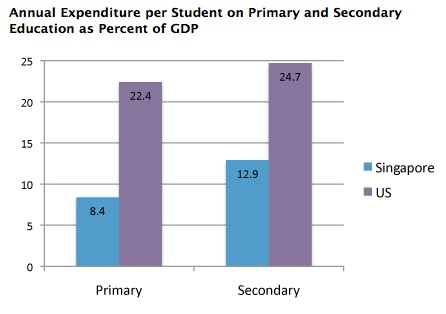
Related: Singapore vs. Madison/US Schools: Do We (Americans) Put Money into Our Children?

Share

2012-13 California budget is a looming fiasco

U-T San Diego:

It’s become a pattern in California. An exhausted Legislature finally completes work on a tardy state budget. Soon afterward, it becomes obvious the budget is a farce stitched together with funny numbers and delusional assumptions.
With the 2012-13 budget, however, the process has accelerated. Even before Gov. Jerry Brown issues his May revised budget, decisions made by lawmakers, the courts and federal bureaucrats – combined with bad news on the revenue front – make it close to impossible to expect a spending plan with a shred of credibility or accounting substance.
The most basic problem is that the governor plans to introduce a budget premised on the idea that voters in November will approve a midyear increase in income taxes on the wealthy and sales taxes, with “trigger cuts” hammering public schools if they are rejected. This screwball brinkmanship bodes terribly for schools if it fails and sets a horrible precedent if it succeeds. Only in Sacramento could a budget strategy that evokes a legendary National Lampoon cover – “buy this magazine or we’ll kill the dog” – be seen as inspired.

Share

Madison School District’s Debt

Madison School District Superintendent Dan Nerad 188K PDF:

The important component of this information, is to realize that MMSD prior to re- financing for lower interest rates, had debt service for the unfunded pension liability all along with an interest rate of 7.8%. It wasn’t transparent as it was simply paid on an annual basis, but to recognize lower interest rates, we chose to issue bonds that will save the district over $13 million in interest costs.
There are a few ways to look at what the appropriate level of debt is for a school district, and we have attempted to put information together relative to each differing way. The ways are:

Share

Milledgeville Police Handcuff 6-Year-Old Girl for Misbehaving at School

Judy Le & Pansy Hall:

Milledgeville’s acting police chief, Dray Swicord, said Tuesday that he stands by an officer’s decision to handcuff an elementary school student for safety Friday after she allegedly threw a tantrum.
Swicord said the arresting officer is not under investigation for his actions.
According to the police report, kindergartner Salecia Johnson is accused of tearing items off the walls and throwing furniture.

Share

In defense of public-records requesters

Laurie Rogers:

“There are laws to protect the freedom of the press’s speech, but none that are worth anything to protect the people from the press.” ~Mark Twain
“If you’re not careful, the newspapers will have you hating the people who are being oppressed, and loving the people who are doing the oppressing.” ~Malcolm X
It’s true; the media have the power to destroy. But their real job is to uphold truth, accountability and transparency; to inform the people; and to investigate and shine a light on wrongdoing.
Today’s media are struggling to remain afloat. Challenged by blogs and Web sites, and accused of shallowness and bias, traditional media are scrambling to remain relevant and to retain readership. Many have cut space and reporting staff and now depend heavily on wire reports. Basic principles of journalism have been ground into dust under the need to satisfy advertisers and allies. It’s become convenient for media to use “stories” already written by government agencies (including school districts) and corporations. In return, the agencies ask for favorable coverage, which they get.

Share

Why Don’t We Make Learning A Computer Language A Requirement In High School?

Brad Feld:

I spent this weekend at LindzonPalooza. Once a year Howard Lindzon gets together a bunch of his friends at the intersection of financing, tech, media, and entrepreneurship, we descend on The Del in Coronada, and have an awesome 48 hours together. Many interesting and stimulating things were said, but one I remember was from Peter Pham over dinner. It was a simple line, “why do we teach languages in junior high and high school but not a computer language?” that had profound meaning to me.
When I was in high school, I had to take two years of a foreign language. I had three choices – French, Spanish, or German. I didn’t really want to learn any of them so I opted for French. I hated it – rote memorization and endless tedious classes where I didn’t really understand anything. Fortunately I liked my teacher for the first two years and I did fine academically (I got an A) and ended up taking a third year of French.

Share

ULGM Seeking Teachers to Teach ACT Prep Classes – $50/hr

Laura DeRoche-Perez:

The Urban League of Greater Madison would like to inform you of our new ACT College Readiness Academies, which have recently been established through a generous grant we received earlier this year from Great Lakes Higher Education Guaranty Corporation. As such, ULGM is currently seeking certified teachers to teach ACT prep classes. Please forward this paid opportunity to your staff. Classes run in the evenings or on Saturdays, making it possible for teachers who are currently working full-time to lend their expertise to our ACT Readiness Academies. Teachers should contact Stephen Perez at 608-729-1209 or sperez@ulgm.org if interested. Please forward this message to other educators.

Share

Madison Teachers, Inc. Solidarity Newsletter

Madison Teachers Inc 92K PDF Newsletter:

EMOCRACY IS NOT A SPECTATOR SPORT. That is one message that should be evident with all that has happened in the last year. A functioning democracy requires an informed and engaged citizenry. Such is as true with union democracy as it is in a political democracy. MTI is a union of 4,700 members in five bargaining units, each with Bylaws enabling democratic governance to ensure the union reflects the will of its members. Each MTI unit elects its leadership – every member has a vote, and is free to seek office. Also, Collective Bargaining Agreements are subject to member ratification, with every member having a vote. Similarly, the MTI Budget is enacted only after approval by the MTI Finance Committee and by approval by the MTI Joint Fiscal Group, which is comprised of representatives proportionate to the membership of each of the five bargaining units. But,just like the right of suffrage cannot ensure voter participation, neither can union Bylaws ensure member participation in the union. Only you can. YOU ARE THE UNION.
In the coming months, your union will be engaging in a number of initiatives to further engage individuals in discussion about your union, what we have achieved together, what is at risk, and where we can go from the terrible situation created by Governor Walker’s Act 10. Beginning with a Member Engagement Survey which is being sent to the personal e-mail addresses of all MTI members who have shared their email address with the Union from all five bargaining units. Members are encouraged to take ten minutes to complete the on-line survey and share their thoughts. If you have not already provided your personal e-mail address to MTI, please do so now by contacting kantzlerr@madisonteachers.org. Those for whom MTI does not have a personal email address may access the survey on MTI’s webpage www.madisonteachers.org or by calling MTI Headquarters (257-0491).

Share

WEA Trust looks to adapt: Nonprofit insurer sees revenue decline almost $70 million

channel3000.com:

The nonprofit insurer that covered about two-thirds of Wisconsin school districts last year has seen its revenue decline almost $70 million after the state gave districts more freedom to switch insurers.
But WEA Trust said it’s still in good shape. Spokesman Steve Lyons said the insurer is expanding its customers from just school districts to municipalities and individual state employees.
The insurer’s business took a hit after Gov. Scott Walker eliminated certain collective bargaining rights for most public employees.
Walker’s office touts data showing that 52 school districts that switched carriers saved a total of $30 million.

Share

The Liberal Arts & Careers

Scott Jaschik:

For Wake Forest University students in the “Options in the World of Work” course on Wednesday, the topic was location. Heidi Robinson, the instructor, walked students through exercises in which they discussed how to evaluate job opportunities in different localities. The students were divided into small groups, each with an iPad with material designed to compare a specific job here (in a relatively small, affordable city) and a larger city such as Boston or Los Angeles. Salaries are provided for the jobs, and students are given websites to find out how much they would spend on groceries in a week, the cost of an apartment, and so forth.
Before they do the analysis, Robinson leads the class in a discussion of a range of issues to consider when deciding where to pursue jobs — the possibility for advancement (or moving to different companies in the same city), the quality of these jobs, opportunities for a social life. Then she listens in on the small groups, firing questions at the students. When someone boasts of finding an affordable apartment in Los Angeles, Robinson asks if she can see photos of the apartment and figure out whether the neighborhood is one she would want to live in. When a student jokes about being able to afford living in Boston if she could just skip buying any groceries, Robinson gently reminds the group that groceries aren’t optional for post-college life. As she moves around the room engaging with students, it’s clear she knows each student’s major, internship history and home town.

Share

The Business Side of World University Rankings

Kris Olds:

Over the last two years I’ve made the point numerous times here that world university rankings have become normalized on an annual cycle, and function as data acquisition mechanisms to drill deep into universities but in a way that encourages (seduces?) universities to provide the data for free. In reality, the data is provided at a cost given that the staff time allocated to produce the data needs to be paid for, and allocating staff time this way generates opportunity costs.
See below for the latest indicator of the business side of world university rankings. Interestingly today’s press release from Thomson Reuters (reprinted in full) makes no mention of world university rankings, nor Times Higher Education, the media outlet owned by TSL Education, which was itself acquired by Charterhouse Capital Partners in 2007. Recall that it was that Times Higher Education began working with Thomson Reuters in 2010.

Share

Professor starts e-text company to compete with textbook publishers

Kathleen Gallagher:

M. Ryan Haley, a University of Wisconsin-Oshkosh economics professor, has started a company that he hopes will disrupt the academic textbook publishing industry and help college students save a lot of money.
CoreTxt Plus Inc. is distributing a free digital statistics textbook to UW-Oshkosh students that’s prepared the same way as at big publishing houses.
“We bypassed the middleman, which is the people making all the money off our students,” Haley said. “They’re putting new editions out every few years now and it’s absurd. Statistics hasn’t changed in 150 years.”
Haley estimates the e-text has saved UW-Oshkosh students $100,000 to $150,000 in textbook costs during the four semesters the school has been using it.

Share

It takes a village? No, when it comes to schooling, it takes parents

John Coons:

Editor’s note: As momentum builds across the United States for expanded school choice, it is important to understand the movement’s legal and philosophical foundations. For more than 40 years, John E. Coons, redefinED co-host and professor of law, emeritus, University of California at Berkeley, has argued that parents – and not government – have the primary legal and moral responsibility and authority to educate their children. Coons is a powerful thinker whose reflections are best consumed slowly and with respect. Enjoy this special post.
It takes a village to raise a child–or so they say, and perhaps it’s true. Humans are interdependent, and every particular village -whatever that word means – has influence, for good or ill.
But the phrase is murky and subject to many interpretations. It can be read as the quirky proposition that the village is what logicians call a “sufficient condition” of some outcome; alone, by itself, it determines the bundle of effects that will be the person called Andrew or Susie.

Share

What’s In a Title?

sp-eye:

Is this Title Envy Part 2?
At the Human Resources Committee this week, Part II of the Employee Handbook (i.e., replacement for bargaining union contract) will be discussed. Part I was general information for all district employees. Part II is for the teachers….er…better make that “Professional Educators”.
Beneath the surface the (former) teacher’s union (SPEA) has long desired to be treated as “professionals”…and so now, to underscore that, they now will be known as “Professional Educators”.
Will this mean that there will now be “Parent-Professional Educator conferences”?
Now you leave an apple on the desk for “Professional Educator”?
Does Van Halen need to re-release the single from their “1984” CD as “Hot For Professional Educator”?

Share

Value-Added Versus Observations, Part One: Reliability

Matthew Di Carlo:

Although most new teacher evaluations are still in various phases of pre-implementation, it’s safe to say that classroom observations and/or value-added (VA) scores will be the most heavily-weighted components toward teachers’ final scores, depending on whether teachers are in tested grades and subjects. One gets the general sense that many – perhaps most – teachers strongly prefer the former (observations, especially peer observations) over the latter (VA).
One of the most common arguments against VA is that the scores are error-prone and unstable over time – i.e., that they are unreliable. And it’s true that the scores fluctuate between years (also see here), with much of this instability due to measurement error, rather than “real” performance changes. On a related note, different model specifications and different tests can yield very different results for the same teacher/class.
These findings are very important, and often too casually dismissed by VA supporters, but the issue of reliability is, to varying degrees, endemic to all performance measurement. Actually, many of the standard reliability-based criticisms of value-added could also be leveled against observations. Since we cannot observe “true” teacher performance, it’s tough to say which is “better” or “worse,” despite the certainty with which both “sides” often present their respective cases. And, the fact that both entail some level of measurement error doesn’t by itself speak to whether they should be part of evaluations.*

Share

Save Rhode Island: Do the Math

Mike Magee:

This is a story of hope, but you will have to read all the way to the end to know why.
This past October, all of Rhode Island’s 11th grade public school students sat down to take the NECAP test. As recently reported in the Providence Journal, one of the questions went like this:
Courtney walks three laps around a ¼-mile track. How many feet does she walk? (1 mile = 5,280 feet.)
A 440 feet. B 1,320 feet. C 3,960 feet. D 7,040 feet.
Being able to multiply and divide four-digit numbers would have helped but as long as students understood the problem and the concept of fractions, a rough estimate (what is ¾ of 5280?) would have given them the answer: C.
Sixty-nine percent of them chose the wrong answer.

Share

Working Conditions Are Terrible for Teachers in [Nearby City]

Mike Antonucci:

But in researching the history of this battle over the surveys, I came across something much more illuminating and – let’s face it – entertaining.
When the governor first began making his claims of improved schools last fall, WEAC reacted in the traditional manner – by drawing up talking points. One memo, dated November 29, is still posted on the web site of the West Allis-West Milwaukee Education Association. It’s not unusual, until you get to the sample statement/press release that locals were supposed to use as a model. I repost it here in its entirety – warts and all:

Share

Can Restorative Justice Stop the Schoolhouse-to-Jailhouse Pipeline?

Jeremy Adam Smith, via a kind reader’s email:

Instead of being kicked out for fighting, stealing, talking back, or other disruptive behavior, public school students in San Francisco are being asked to listen to each other, write letters of apology, work out solutions with the help of parents and educators, or engage in community service. All these practices fall under the umbrella of “restorative justice”–asking wrongdoers to make amends before resorting to punishment.
The program launched in 2009 when the San Francisco Board of Education passed a resolution for schools to find alternatives to suspension and expulsion. In the previous seven years, suspensions in San Francisco spiked by 152 percent, to a total of 4,341–mostly among African Americans, who despite being one-tenth of the district made up half of suspensions and more than half of expulsions.
This disparity fed larger social inequalities: Two decades of national studies have found that expelled or suspended students are vastly more likely to drop out of school or end up in jail than those who face other kinds of consequences for their actions.

Share

The next Chicago teachers contract Create the flexibility to succeed

Chicago Tribune:

Mayor Rahm Emanuel’s school team is locked in a tense negotiation with the Chicago Teachers Union over a new teachers contract.
The threat of a teachers strike looms; CTU President Karen Lewis says that an informal poll of members at 150 schools shows “overwhelming” support for a strike. Lewis told reporters that she has “never seen anything like the hostile climate that exists right now.”
Strike talk in April. Before negotiations have even officially hit an impasse. Not a good sign.

Share

K-12 Tax & Spending Climate: A Modest Proposal

Sheila Bair:

Are you concerned about growing income inequality in America? Are you resentful of all that wealth concentrated in the 1 percent? I’ve got the perfect solution, a modest proposal that involves just a small adjustment in the Federal Reserve’s easy monetary policy. Best of all, it will mean that none of us have to work for a living anymore.
For several years now, the Fed has been making money available to the financial sector at near-zero interest rates. Big banks and hedge funds, among others, have taken this cheap money and invested it in securities with high yields. This type of profit-making, called the “carry trade,” has been enormously profitable for them.
So why not let everyone participate?

and
Buffett Rule is a Political Gimmick That Won’t Work, and
Corruption Is Why You Can’t Do Your Taxes in Five Minutes

Share

Arguing About Language

Gary Gutting:

Today I’m going to hopefully beg a question which will incentivize the reader to share their views. Yes, I’m writing about English grammar and usage.
Debates about linguistic norms typically set traditionalists against revisionists. The two sides are particularly entrenched because each is rooted in a fundamental truth: the traditionalists are right that the rules are the rules (for instance, pronouns do need to agree in number with their referents), and the revisionists are right that language does change over time (nouns can come to be used as verbs).

Share

Making Education Brain Science

Jenny Anderson:

LAST month, two kindergarten classes at the Blue School were hard at work doing what many kindergartners do: drawing. One group pursued a variation on the self-portrait. “That’s me thinking about my brain,” one 5-year-old-girl said of her picture. Down the hall, children with oil pastels in hand were illustrating their emotions, mapping where they started and where they ended. For one girl, sadness ended at home with a yummy drink and her teddy bear.
Grappling so directly with thoughts and emotions may seem odd for such young brains, but it is part of the DNA of the Blue School, a downtown Manhattan private school that began six years ago as a play group. From the beginning, the founders wanted to incorporate scientific research about childhood development into the classroom. Having rapidly grown to more than 200 students in preschool through third grade, the school has become a kind of national laboratory for integrating cognitive neuroscience and cutting-edge educational theory into curriculum, professional development and school design.

Share

WKCE & Madison Students

Madison School Board Member Ed Hughes:

Finally, the troubling differences in levels of student learning that give rise to our achievement gap present an enormous challenge for our teachers. We as a District have long been committed to inclusive and heterogeneous elementary school classrooms. Consequently, given the gap, our teachers frequently lead classrooms with a number of high-achieving students and a number of struggling students. Imagine how much dedication and ingenuity it must take for our classroom teachers to provide a learning environment where all their students can thrive. It would be helpful to hear from teachers about how they think they can be most effective in teaching all students in classes with such a wide span of developed capabilities, given our resource limitations.
Even test results as generally uninformative as the WKCE make clear the extent of our achievement gap in Madison. From the perspective of the WKCE and based on statewide averages, our white students on the whole seem to be doing just fine while our African-American students on the whole are struggling. This shouldn’t come as news to anyone, but it does underscore what’s at stake when over the next several weeks the School Board starts to decide what components of the superintendent’s achievement gap plan we’re actually willing to raise taxes to support.

Related: 60% to 42%: Madison School District’s Reading Recovery Effectiveness Lags “National Average”: Administration seeks to continue its use

Share

Singapore vs. Madison/US Schools: Do We (Americans) Put Money into Our Children?


I read with interest Nathan Comps’ article on the forthcoming 2012-2013 Madison School District budget. Board Vice President Marj Passman lamented:

“If Singapore can put a classroom of students on its money, and we can’t even put our money into children, what kind of country are we?” asks Passman, Madison school board vice president. “It’s going to be a horrible budget this year.”

Yet, according to the World Bank, Singapore spends 63% less per student than we do in America on primary education and 47% less on secondary education. The US spent $10,441/student in 2007-2008 while Madison spent $13,997.27/student during that budget cycle. Madison’s 2011-2012 budget spends $14,858.40/student.
The Economist on per student spending:

Those findings raise what ought to be a fruitful question: what do the successful lot have in common? Yet the answer to that has proved surprisingly elusive. Not more money. Singapore spends less per student than most. Nor more study time. Finnish students begin school later, and study fewer hours, than in other rich countries.
In Finland all new teachers must have a master’s degree. South Korea recruits primary-school teachers from the top 5% of graduates, Singapore and Hong Kong from the top 30%.

Rather than simply throwing more money (Madison taxpayers have long supported above average K-12 spending) at the current processes, perhaps it is time to rethink curriculum and just maybe, give Singapore Math a try in the Madison schools.
Related:


Via the Global Report Card. The average Madison student performs better than 23% of Singapore students in Math and 35% in reading.

Share

Log-on Learning

Michael Jonas:

As online education continues to grow, says Bill Tucker, the managing director of Education Sector, a Washing­ton, DC, think tank, we need to strike a balance that encourages innovation while also holding schools and companies accountable for results. “I want the sector to have the space to grow,” says Tucker, who specializes in education technology and virtual school issues. “At the same time, it would be foolish or naïve just to think, ‘OK, let everybody do what they want and it will just naturally get better.'”
When it comes to full-time virtual schools, the state is now trying to figure out how to strike that balance. Mitchell Chester, the state’s education commissioner, says he thinks there is “a small percentage of the population for whom this mode of learning would be beneficial.” But he says he is “very uncomfortable” with the provision of the 2010 reform law that allows districts to decide on their own to open virtual schools that enroll students statewide. The Green­field-based school is “a statewide school with no role for the state,” he says.

Share

The Long-Term Effects of Student-Loan Debt

Frank Donoghue:

First, let’s break down the staggering $1-trillion in student debt that has become so familiar a number to all of us in the last year or so. First, according to the Consumer Financial Protection Bureau, as quoted in Sheryl Nance-Nash’s recent article in Forbes, “Unlike other consumer credit products, student debt keeps growing at a steady clip. Students borrowed $117-billion in just federal loans last year. And students continue to borrow private student loans, which lack the income-based repayment and deferment options of federal student loans.” The average total loan debt for undergraduates is $26,000, with the debt for those choosing to attend law school, medical school, or business school obviously much greater.
This enormous amount of debt has consequences for all of us since–although few economists discuss it at length–it represents a tremendous drain on the economy and is slowing our recovery from the recession that began in 2008. College graduates and postgraduates, instead of buying cars, buying houses, getting married, having children–in other words, becoming full-fledged consumers are, as Nance-Nash puts it, “running back home.” That hurts us all.

Share

Who is advising MPS teachers?

Howard Karsh:

The Milwaukee Teachers’ Education Association recently asked its members to voluntarily contribute a week’s salary to help improve class sizes in Milwaukee Public Schools. The teachers overwhelmingly voted no.
They had a right to do that. They are angry about the new laws enacted by Gov. Scott Walker that will affect them at the end of their current contract. They are angry about the attack on collective bargaining.
But it was teachers who said that, had they been asked to the table instead of attacked, they would have done the right thing. Could the recent vote make that claim now look like something less?
Many of the strongest proponents of the recall effort against Walker are MPS teachers. They were in Madison last spring during the protests and were well-represented at rallies and foremost in collecting recall signatures.
They have a right to be proud of their efforts. And it has been their voices that have been loud and clear about the harm they believe is being caused by the Walker administration to the very kids they teach – the kids who need more teachers and more resources.

Share

Academic Decathlon team at Waukesha West: As dedicated as any athletes

Alan Borsuk:

It’s 8:45 on a weeknight and five students are gathered in a dimly lighted corridor of Waukesha West High School. They’re dedicated. They’re energized. They’re getting ready to compete for a national championship. They’re part of what may well be the most dominating high school team in Wisconsin.
They’re reading out loud parts of essays they have written about the impact of British colonialism in Africa and Asia between 1800 and 1900. They’re critiquing each other. You spent much time lately interpreting Joseph Conrad’s 1899 novella, “Heart of Darkness?” These kids have.
They’ve been doing activities like this almost every night after school since last fall. Last week, school was out for spring break, but they and their teammates were at school from 9 a.m. to 3 p.m. each day.
This is the Waukesha West Academic Decathlon team. State champions 11 years in a row – can any sports team claim a run like that? They’re getting ready to go to Albuquerque, N.M., at the end of this month for another shot at the national championship. The school won once, in 2002, and has finished in the top five repeatedly.

Share

Struggle Over Longer School Day Poised To Continue As Study Finds 10-Hour Teacher Workdays

Progress Illinois:

Chicago Public School teachers work almost double their required daily instruction hours, according to a new study released Monday, and the findings worry some teacher advocates as the district gets ready to extend the school day.
On average, public school teachers work 58 hours per week, according to the report, “Beyond the Classroom: An analysis of a Chicago Public School Teacher’s Actual Workday.”
The study– put together by the University of Illinois at Urbana-Champaign’s Labor Education Program — analyzed surveys from nearly 1,000 CPS teaches and found on a typical school day teachers work more than 10 hours.
Teachers can also rack up more than five additional hours during weekday evenings and on the weekend, according to the report.

Share

WE DON’T WANT TO KNOW YOU

Three times a year, The Boston Globe (in the Athens of America) has a 14-16-page Special Supplement celebrating local “scholar-athletes” with pictures and brief write-ups. These are high school students who have taken part in soccer, tennis, golf, football, swimming, baseball, basketball, softball, wrestling, and what-have-you, and done well by various measures. Their coaches, too, get their pictures in the paper and sometimes a paragraph of praise. In addition to these supplements, hardly a day goes by during the school year when some high school athletes, team, coach or event doesn’t get “covered” by The Boston Globe. A local philanthropic group has recently raised several million dollars to promote sports in our public high schools.
As we all know, sports involve students, parents, boosters and the like, and they build teamwork, discipline, character, equality (of a sort), ambition, competition, and attendance. Parents do not need to be dragged to games the way they do to school meetings or Parents’ Night to talk to teachers. In many cases, they pay fees to allow their youngsters to participate in sports, and some even raise money as boosters for trips to games, tournaments, etc. Community involvement is fairly easy to get in sports, and there are very few edupundits who find work advising schools and communities on how to get parents and other community members involved when it comes to school sports. I know of no new initiatives or workshops to teach parents how to get involved in their children’s sports programs. Athletes also enjoy rallies, cheerleaders, and coverage in their high school newspaper as well.
Recently a young student basketball player in Massachusetts, 6’10” and very good at his sport, “reclassified” himself (changed from a Junior to a Senior?), so that he could choose among the many colleges whose coaches want him to come play at their institutions. His picture not only appeared several times in his local school newspaper, but also showed up several times with stories in The Boston Globe (the Sports Section is one of only four main sections in the paper each day). Apparently we want to know who our good high school athletes are, and what they are achieving, and what they look like, etc.
There is another group in our high schools, which might be called not “scholar-athletes,” but perhaps “scholar scholars,” as their achievements are in the academic work for which, some believe, we build our schools with our taxes in the first place. But we tell those “scholar scholars” that we really don’t want to know them. Their work does not appear in The Boston Globe. Their pictures and stories do not appear in the three-a-year Special Supplements or in the daily paper (there is no “academics” section in the paper of course), or even in their local high school newspaper.
Whenever the subject of students who do exemplary academic work in our schools comes up, our cliché response tends to be that “they can take care of themselves.” But if we don’t seem to feel that good high school athletes should have to get along in anonymity, why do we think that anonymity for our best high school students will serve them (and us) well enough, in our education system, and in the country, which is in a serious fight to stay up with other countries who take their best students and their academic achievement very seriously indeed.
Sometimes when I mention that it might serve us well if we gave some recognition to our best high school “scholar scholars” people say that I must be “against sports.” I am not. I am just critical of the huge imbalance between our attention to athletes and what we give to scholars at the high school level. 100 to zero doesn’t make the best balance we can achieve in recognizing them, in my view.
Of course, I am biased, because for 25 years I have been publishing exemplary history research papers by high school students (so far 1,022 papers from 46 states and 38 other countries) in a unique quarterly journal, and none of them ever gets mentioned for their history scholarship in The Boston Globe. Folks tell me this practice is not limited to the Athens of America, of course.
If we are worried about the performance of our student athletes, then the relentless coverage of their efforts might seem justified. I know we are worried about the academic achievements of our public high schools, yet when scholar scholars in the high schools get published in The Concord Review (and then go on to Stanford, Yale, Harvard, and Princeton (as about 35% of our authors do), or get to be Rhodes Scholars (as several have), they don’t get mentioned in The Boston Globe. Actually one author, Jessica Leight from Cambridge Rindge and Latin School, did get her picture in the paper when she got her Rhodes Scholarship, after being named Junior Eight Phi Beta Kappa and graduating summa cum laude at Yale, but no mention was made of her Emerson Prize-winning paper on Anne Hutchinson, which was published in that unique international journal when she was still in a local public high school.
So let’s do continue to praise our local high school athletes and their coaches. But isn’t it time at long last now to think about the message such publicity sends to our diligent and successful scholar scholars and their coaches (I mean their teachers–who are also ignored) about what we value as a society? Why has it been so important all these years to send them, when they are doing not only what we ask them to do in school, but well above and beyond what we have expected, the message that, sorry, but “We Don’t Want to Know About You”?
The Concord Review

Share

Monkey See, Monkey Do. Monkey Read?

Erin Loury, via a kind Richard Askey email:

Monkeys banging on typewriters might never reproduce the works of Shakespeare, but they may be closer to reading Hamlet than we thought. Scientists have trained baboons to distinguish English words from similar-looking nonsense words by recognizing common arrangements of letters. The findings indicate that visual word recognition, the most basic step of reading, can be learned without any knowledge of spoken language.
The study builds on the idea that when humans read, our brains first have to recognize individual letters, as well as their order. “We’re actually reading words much like we identify any kind of visual object, like we identify chairs and tables,” says study author Jonathan Grainger, a cognitive psychologist at France’s National Center for Scientific Research, and Aix-Marseille University in Marseille, France. Our brains construct words from an assembly of letters like they recognize tables as a surface connected to four legs, Grainger says.
Much of the current reading research has stressed that readers first need to have familiarity with spoken language, so they can connect sounds (or hand signs for the hearing-impaired) with the letters they see. Grainger and his colleagues wanted to test whether it’s possible to learn the letter patterns of words without any idea of what they mean or how they sound–that is, whether a monkey could do it.

Share

The Flipped Classroom Infographic

newton:

A new method of teaching is turning the traditional classroom on its head.

Share

Las Rights for Higher Ed Graduation Rates

Libby Nelson:

WASHINGTON — A long-held wish of many community colleges is on the verge of becoming reality: the Education Department has announced its plans to change how student success is measured in higher education, taking into account students who transfer, part-time students and students who are not attending college for the first time.
The department outlined its plans Wednesday to carry out the recommendations of the Committee on Measures of Student Success, a federal panel that called for changing how data on completion rates and other measures at community colleges is reported in the Integrated Postsecondary Educational Data System, or IPEDS.

Share

Kids & Cars

Ed Wallace:

A question asked in numerous stories a week ago was put best in a headline at the Atlantic: “Why Don’t Young Americans Buy Cars?” A year or so ago, of course, the question was why young people don’t read a newspaper; and before that it was something else young people don’t do that we seem to expect them to. While it’s been a great while since I sat inside dealerships to see exactly what the demographical makeup of their buyers was in any given month, it was fairly obvious decades ago that the makeup of car buyers was changing dramatically.
The Atlantic story gave out a few important facts, including that only half of kids 19 or younger now hold a driver’s license, down from “nearly two-thirds in 1998.” Following that statistic the magazine covered CNW Marketing Research’s study, which showed that young adults “between the ages of 21 and 34 buy just 27 percent of all new vehicles sold in America.” And that was down by 11 percentage points from 1985.
The Automotive News, in a similar story, pointed out that in 1983 fully 94 percent of persons in their 20s held a driver’s license as compared to just 84 percent today.y

Share

Ireland to take schools from Church control

Jamie Smyth:

Dublin plans to remove hundreds of schools from the control of the Roman Catholic Church to reflect Ireland’s increasingly diverse population, in the biggest shake-up of its education system in almost a century.
Ruairi Quinn, Ireland’s minister for education, said on Tuesday that there was a need to transfer the patronage of hundreds of Roman Catholic schools to provide more choice for people of other faiths and reflect changes that had taken place in Irish society.
The proposals come amid a bitter debate about the role of the Church in Irish society, prompted by revelations of clerical child sex abuse and subsequent cover-ups by the Church authorities. But they also follow a sharp rise in the number of foreign-born residents – which now account for 17 per cent of the Irish population, up from 6 per cent in 1991 – as well as a growing secularisation of society.

Share

Rhode Island’s fiscal reforms offer hope

Gillian Tett:

A few weeks ago, I wrote a column lamenting the dismal state of America’s local public sector pensions system. For with some $3,000bn (or more) of unfunded liabilities, the maths looks truly alarming – particularly given the gridlock besetting so much of the American political machine.
But what my column did not address, for reasons of space, was what might fix these woes. So, in the spirit of spring (and Easter) cheer, it is worth noting one small example where a local American government is now attempting some fiscal rebirth – not least because it holds some intriguing lessons for investors, both in America and Europe.
The location in question is Rhode Island, the iconic north eastern US state. Three years ago, this epitomised everything wrong with American state finances: the public pension fund was underfunded by more than 50 per cent, and it looked as if the state would soon be using a third of all its annual tax revenue to meet claims. Big spending cuts loomed, and the unions and politicians were at loggerheads.

Share

Uncompromising Photos Expose Juvenile Detention in America

Pete Brook:

On any given night in the U.S., there are approximately 60,500 youth confined in juvenile correctional facilities or other residential programs. Photographer Richard Ross has spent the past five years criss-crossing the country photographing the architecture, cells, classrooms and inhabitants of these detention sites.
The resulting photo-survey, Juvenile-In-Justice, documents 350 facilities in over 30 states. It’s more than a peek into unseen worlds — it is a call to action and care.
“I grew up in a world where you solve problems, you don’t destroy a population,” says Ross. “To me it is an affront when I see the way some of these kids are dealt with.”

Share

Longevity Annual Increases: Even Without Contracts, Unions in State Get Raises

Danny Hakim:

Public employees are working without contracts in cities and counties across New York State, as labor negotiations stall because local governments say they cannot afford to raise wages.
But many union members are still taking home larger paychecks, thanks to a state law that allows workers to continue receiving longevity-based salary increases after their contracts expire.
The pattern is seen throughout the state. All labor contracts in Albany, New Rochelle and Yonkers have expired. So have seven of nine contracts in Syracuse, six of eight in Buffalo and most of the contracts in New York City.

Share

Has constructivism increased special-education enrollment in public schools?

Nakonia (Niki) Hayes:

As a teacher and administrator for 28 years, I rebelled against the disastrous fad of constructivism that began in the 1980’s. While its drumbeaters declared it was a higher form of intellectualism, it didn’t seem all that “intelligent” to me. Frankly, I thought it would help create failures among all groups of students–regular, special, and gifted.
For those who don’t know what “constructivism” is, it is an educational theory that, in practice, looks like this in America’s classrooms:

Share

Wake Forest examines value of college education

Tom Breen:

For Bill Zandi, the son of Moody’s Analytics Chief Economist Mark Zandi, enrolling as a student at a prestigious private institution like Wake Forest University was less surprising than the student’s choice of major: philosophy.
“Originally I was going to follow in my dad’s footsteps, but I’ve always been more interested in philosophical ideals,” the younger Zandi said.
With the cost of higher education soaring, from Ivy League schools to community colleges, an increasingly loud chorus of voices is questioning whether the results justify the cost, and whether the traditional liberal arts education, with its ideal of shaping well-rounded lives, is outmoded in the contemporary world of high-tech work.

Share

Proposed Madison school budget would hike taxes 4.1%; flat last year, 9% 2 years ago

Matthew DeFour:

Madison School District property taxes would increase 4.1 percent, or about $10 million, under superintendent Dan Nerad’s proposed 2012-13 budget.
The increase would be a change from last year’s $245 million school property levy, which was a slight decrease from the previous year.
The district estimates a $255 million levy would increase property taxes by $108 on an average Madison home. However, updated property assessments for the city won’t be available until the end of next week, city assessor Mark Hanson said.
The $379.3 million proposed budget would increase total spending by $6.3 million, or 1.7 percent, from this past year’s budget.
The district is increasing property taxes partly to keep up with state-imposed revenue limits and qualify for additional state aid, Nerad said.

Notes and links on the 2010-2011 and 2011-2012 budgets.

Share

The Core of Good Teaching

Steve Peha:

The recent draft release of a Common Core exemplar lesson on The Gettysburg Address caused quite a kerfuffle.
Proponents of the Common Core State Standards Initiative (CCSSI) approach view the lesson as a strong example of good teaching. It’s tightly scripted and focused on a particular view of “close reading” through instructions like the following:
“Refrain from giving background context or substantial instructional guidance at the outset…. This close reading approach forces students to rely exclusively on the text instead of privileging background knowledge, and levels the playing field for all students as they seek to comprehend Lincoln’s address.”

Share

L.A. schools chief pushes to change system’s culture

Teresa Watanabe and Howard Blume:

It’s 7:30 a.m. and the chief of the Los Angeles Unified School District briskly launches a powwow on the sensitive topic of how to place the strongest math teachers with the weakest students.
Supt. John Deasy leads two dozen administrators through statistics showing the schools where the district’s most effective algebra instructors teach. They brainstorm incentives to get principals and teachers to buy into the plan, aimed at raising abysmal scores on state math tests. Some may believe it a waste to put their best with the worst, one administrator cautions, but Deasy’s response is quick and characteristically blunt:
“You really shouldn’t teach in LAUSD if you believe that,” he says.

Share

Online Privacy: Kids Know More Than You Think

Tina Barseghian:

Much of the anxiety around tweens and social media lies in the fear that they don’t care about or understand privacy settings. Parents worry that kids will either willingly or unintentionally expose themselves to dangerous anonymous predators, or that they don’t fully understand that the information they share about themselves can be used against them.
But tweens are much more savvy about their privacy settings than adults give them credit for, even when it comes to subtleties of “frenemies” dynamics, according to a small, qualitative study by researchers at the Harvard Graduate School of Education that’s forthcoming in the journal Learning, Media, & Technology.
“Tweens value privacy, seek privacy from both strangers and known others online, and use a variety of strategies to protect their privacy online,” wrote researchers Katie Davis and Carrie James, who conducted in-depth interviews with 42 middle-school students for the study. “Tweens’ online privacy concerns are considerably broader than the ‘stranger danger’ messages they report hearing from teachers.”

Share

Even in retirement, teachers bring warmth to their former Oakland school

Katy Murphy:

Bella Vista School teachers gathered on this last morning before spring break for a treat — breakfast prepared by three retired teachers. The delicious repast included home fries, grits, donuts, and cheesy scrambled eggs. Tired staff, looking forward to the coming break almost as much as their students, took time to gather, enjoy the food, and spend some time together before the last day.
Carolyn Matson, Louise Broome, and Karen Chin have always been generous when it comes to sharing their cooking gifts with the staff at Bella Vista; ask any member of the staff from the past four decades and she will remember a potluck (or several) featuring one of Mrs. Broome’s tasty cooked treats, and for the past several years the social committee has been helmed by the dedicated, enthusiastic Mrs. Matson and Ms. Chin.

Share

Innovation Spotlight: Baldwin County Public Schools, Alabama

David DeSchryver:

Change is difficult in public education. There are many reasons for this but the way we finance our schools is one of the larger obstacles. Our school districts are not set up to fund innovation. They distribute funds based on staff positions, personnel benefits, and selected programs. These expenses repeat annually and, over time, become entrenched costs. Anything new or different is usually just layered onto the base. Simply adding new programs to existing services may be feasible in good economic times, but it is not an option when funding is scarce.

Share

The High Cost of Low Community College Graduation Rates

Richard Rider:

I’ve written before about the absurdly low cost of California community colleges, and the resulting 30% class “drop rate.” Here’s a more national perspective on the widespread failure of community colleges to graduate students. It’s even worse than I thought.

Share

Political, legal fights over school vouchers’ fate

Kimberly Hefling:

Students like Delano Coffy are at the heart of brewing political fights and court battles over whether public dollars should go to school vouchers to help make private schools more affordable.
He was failing in his neighborhood public elementary school in Indianapolis until his mother enrolled him in a Roman Catholic school. Heather Coffy has scraped by for years to pay the tuition for Delano, now 16 and in a Catholic high school, and his two younger siblings, who attend the same Catholic elementary as their brother did. She’s getting help today from a voucher program, passed last year at the urging of GOP Gov. Mitch Daniels, that allows her to use state money for her children’s education.
“I can’t even tell you how easy I can breathe now knowing that for at least for this year my kids can stay at the school,” said the single mother, who filed a petition in court in support of the law. The state Supreme Court is hearing a challenge to the law, which provides vouchers worth on average more than $4,000 a year to low- and middle-income families. A family of four making about $60,000 a year qualifies.

Share

Latin American schools: disconnected

Andres Oppenheimer:

Two new studies confirm what we have long suspected: Latin American companies cannot effectively compete in the world economy because their countries’ educational systems are totally disconnected from reality.
The Global Information Technology Report 2012, a 442-page report by the World Economic Forum and the INSEAD business school, places most Latin American countries far behind the world’s most technologically connected countries in its ranking of “network readiness.”
The index takes into account various measurements, including internet use and people’s ability to use it productively, from international organizations and a survey of more than 15,000 executives worldwide.
According to the report, Latin America “continues to suffer from an important lag” in adopting information and communications technologies to improve countries’ competitiveness in a hyper-connected world.

Share

UK Free schools ‘harm education of children nearby’

Richard Garner:

The Government’s flagship free schools are seriously damaging the education of children in neighbouring schools, according to research published today.
Analysis of those free schools already approved by the Education Secretary, Michael Gove, reveals that many have been set up in areas where existing schools already have surplus places.
Their arrival has caused a loss of pupils for existing comprehensives – threatening their viability, says the report. In one school – an academy highly rated by Ofsted, the education standards watchdog – the headteacher estimated he will lose £1m a year as a result of a new free school being set up.
So far, 24 free schools have been opened by the Government – run by parents, teachers and faith groups. A further 70 will open in the next 12 months.

Share