School Information System

Dumbing down the French language will create a whole generation of illiterate undergraduates

Anne-Elisabeth Moutet:

I’m rarely in sympathy with the hashtagged collective wisdom of the internet but I’ll make an exception over the #JeSuisCirconflexe fury. The French Ministry of Education has decided to enforce an Académie Française decision dating back to 1990 to “simplify” the French language by changing some 2,400 words.

“You don’t need to be George Orwell to see that there is something sinister in any regime that sacrifices the memory and structure of the language”

Share

The Radical, 18th-Century Scottish System for Paying for College

Shannon Chamberlin:

The saddest part of the debate over how to rein in the cost of college is that rising prices have not been tied to any real improvement in the quality of education. Skyrocketing tuition, it’s generally agreed, has been brought on by the expansion of student services. There are nothing but bad choices, it seems: Allow the status quo to persist and saddle students with debt that will hamper their ability to buy houses, start families, or even get the jobs they need to pay off their debt. Or make college (and graduate school, argues Samual Garner, a bioethicist who chronicled his personal student-debt crisis in Slate) taxpayer-funded, and risk a larger and more catastrophic version of the cost escalation that can come with a pot of free money.

Share

The Rise and Fall of American Growth: The U.S. Standard of Living since the Civil War

Robert Gordon:

In the century after the Civil War, an economic revolution improved the American standard of living in ways previously unimaginable. Electric lighting, indoor plumbing, home appliances, motor vehicles, air travel, air conditioning, and television transformed households and workplaces. With medical advances, life expectancy between 1870 and 1970 grew from forty-five to seventy-two years. Weaving together a vivid narrative, historical anecdotes, and economic analysis, The Rise and Fall of American Growth provides an in-depth account of this momentous era. But has that era of unprecedented growth come to an end?

Gordon challenges the view that economic growth can or will continue unabated, and he demonstrates that the life-altering scale of innovations between 1870 and 1970 can’t be repeated. He contends that the nation’s productivity growth, which has already slowed to a crawl, will be further held back by the vexing headwinds of rising inequality, stagnating education, an aging population, and the rising debt of college students and the federal government. Gordon warns that the younger generation may be the first in American history that fails to exceed their parents’ standard of living, and that rather than depend on the great advances of the past, we must find new solutions to overcome the challenges facing us.

A critical voice in the debates over economic stagnation, The Rise and Fall of American Growth is at once a tribute to a century of radical change and a harbinger of tougher times to come.

Share

The Water Next Time: Professor Who Helped Expose Crisis in Flint Says Public Science Is Broken

Steve Kolowich:

I am concerned about the culture of academia in this country and the perverse incentives that are given to young faculty. The pressures to get funding are just extraordinary. We’re all on this hedonistic treadmill — pursuing funding, pursuing fame, pursuing h-index — and the idea of science as a public good is being lost.

Share

A Conversation with Jonathan Haidt

John Leo

On January 11, John Leo, editor of “Minding the Campus,” interviewed social psychologist Jonathan Haidt, one of the editors of the five-month-old site, “Heterodox Academy,” and perhaps the most prominent academic pushing hard for more intellectual diversity on our campuses. Haidt, 52, who specializes in the psychology of morality and the moral emotions, is Professor of Ethical Leadership at NYU’s Stern School of Business and author, most recently, of The Righteous Mind: Why Good People are Divided by Politics and Religion (2012).

JOHN LEO: You set off a national conversation in San Antonio five years ago by asking psychologists at an academic convention to raise their hands to show whether they self-identified as conservatives or liberals.

JONATHAN HAIDT: I was invited by the president of the Society for Personality and Social Psychology to give a talk on the future of Social Psychology. As I was finishing writing The Righteous Mind, I was getting more and more concerned about how moral communities bind themselves together in ways that block open-minded thinking. I began to see the social sciences as tribal moral communities, becoming ever more committed to social justice, and ever less hospitable to dissenting views. I wanted to know if there was any political diversity in social psychology. So I asked for a show of hands. I knew it would be very lopsided. But I had no idea how much so. Roughly 80% of the thousand or so in the room self-identified as “liberal or left of center,” 2% (I counted exactly 20 hands) identified as “centrist or moderate,” 1% (12 hands) identified as libertarian, and, rounding to the nearest integer, zero percent (3 hands) identified as “conservative.”

JOHN LEO: You and your colleagues at your new site, Heterodox Academy, have made a lot of progress in alerting people to the problem that the campuses are pretty much bastions of the left. What kind of research did that prompt?

Share

Corporate education reform goes global

Nicholas Tampio:

From its inception in 1945, the United Nations has been involved with education on a global scale. The U.N. views education as crucial to eradicating poverty, building peace and fostering intercultural dialogue, and it remains committed to “a holistic and humanistic vision of quality education worldwide.”

Yet there has been a dramatic shift in the U.N.’s educational mission from supporting a well-rounded, humanistic conception of education to one that focuses on teaching children the “hard skills” necessary to participate in the global economy. This turn began with the Millennium Development Goals (2000-2015) and has intensified with the Sustainable Development Goals that launch this month. One of the new targets, for instance, is to “increase the number of youth and adults who have relevant skills, including technical and vocational skills, for employment, decent jobs and entrepreneurship” by 2030.

Share

The Limits of Education Reform: A Road Paved With the “Best Intentions”?

tressiemc

There is one question that animates the sociology of education more than any other: how do we explain and predict the difference in outcomes among black and white students in the post Civil Rights era of greater equality of opportunity? Sure, we talk about Hispanic and Asian students but really they are often deployed as a means of clarifying the black-white racial hierarchy in the U.S. And, yes, we sometimes talk about other things like class or the more robust “social class”, which includes the social conditions of economic positions relative to one another. But, really social class is often a proxy for race for those who would rather not discuss race head-on and class is so entangled with intersecting processes of racialization that really the easiest way to critique those kinds of analyses is to point out, “but what about race and racism though”. The debate persists because, despite our best intentions, public education in the U.S. does not serve black students well.

Share

How a Lincoln High teacher gets all his students to pass the AP Calculus exam

Steve Lopez:

Twenty-five youngsters watch and listen as a smiling Anthony Yom takes his pre-calculus class on a right-angle trigonometry thrill ride through a maze of sines and cosines, out to prove that three squared plus five squared is going to equal H squared, or the world is off its axis.

“I am done teaching,” Yom finally says before starting students on their own problem-solving missions. “You need to get to work now.”

As they dig pencils into paper, Alexis Pong, a sophomore, tells me it’s challenging work, but fun, too. And she has this to say about Yom’s way:

“He challenges us to the max, so we do better on tests.”

Share

The Seventy Four, founded by controversial advocate, takes over LA School Report

Howard Blume:

Seventy Four, an organization whose co-founder is a controversial education advocate, has taken over LA School Report, a website covering the Los Angeles Unified School District.

The organization’s name is a reference to 74 million students attending public schools in the United States. The site was co-founded by former CNN anchor Campbell Brown, who is part of a lawsuit seeking to overturn tenure protections for teachers in New York.

Share

Education Deserts

Nicholas Hillman & Taylor Weichman:

When deciding where to go to college, students ask several important questions: How much will it cost? What academic programs are available? Will it prepare me for my future? What colleges and universities are nearby? While most research and policy conversations understandably focus on helping students answer the rst few, this last question about geography and place is too often overlooked. Perhaps it is overlooked because we assume geography is irrelevant in the Internet age. Maybe we assume every community in the United States has a college or university nearby, or that students are highly mobile. Whatever the reason for overlooking the context of place, this paper explains why place still matters.

In fact, place matters even more for today’s college students, many of whom work full-time, care for depen- dents, and have close social ties to their communities. If higher education is to better serve students and expand educational opportunities, then stakeholders must prioritize the importance of place and understand how it shapes college options. Nonetheless, federal policy conversations and researchers often discuss col- lege choice as though place and geography do not matter (Turley 2009). For example, federal policy e orts like the College Scorecard, Financial Aid Shopping Sheet, and College Navigator all seek to get “better information” into the hands of students with the hopes they will make “better choices” about where to enroll. But for prospective students who live in communities with few educational options, their educational desti- nations are bound by whatever institution is nearby.

Share

A Beloved Bronx Teacher Retires After a Conflict With His Principal

David Gonzales:

career has always been based on the emotional and social well-being of the child,” he said, inside an office whose walls were decorated with awards, proclamations and photos of him alongside several school chancellors; Michael R. Bloomberg, the mayor at the time; and the rapper DMC. “Now, I don’t know where teaching is headed. I just know I can’t anymore. I find it torture. I’d rather separate myself from the classroom doing something that is distasteful and try to spend my days doing things that are important.”

Share

Will our children really not know economic growth?

Lawrence Summers:

Gordon’s The Rise and Fall of American Growth is an extraordinary work of economic scholarship. At a time when too much of the economics profession prioritises theorising about small issues, Gordon provides new data bearing on what may be the most important economic question of all—what will economic growth be like over the next couple of generations? Moreover, this is one of the rare economics books that is on the one hand deeply analytical, with over 100 figures and tables, and on the other a pleasure to read: it is chock full of anecdotes about everything from flying out of Chicago’s O’Hare airport in the 1970s to the spread of radio in the 1920s to the travails of pharmaceutical research. Pick any random page and you will learn something interesting about American life.

Share

A reflection on nour education system: It’s Stupid That My Actor Dad Is The One Who Has To Teach Us Not To Be Dumb

Harry Dreyfuss:

My father, actor Richard Dreyfuss, is taking heat for attending a Ted Cruz rally. I shouldn’t have to write this, but here goes: curiosity is not a sin.

My father went to a Ted Cruz rally. My father also won an oscar in the 70s and his name is Richard Dreyfuss. Those two things are only related because by virtue of being famous, my father’s attendance at a Cruz rally got written about by a couple of media outlets. Those write-ups were absorbed by a number of mouth-breathers, and so began The Dumb.

Share

The Impact of Teacher Collective Bargaining Laws on Student Achievement: Evidence from a New Mexico Natural Experiment

Benjamin Lindy:

This Note uses the 1999 sunset and 2003 reauthorization of New Mexico’s public employee collective bargaining law to estimate the causal effect of teacher collective bargaining on student achievement. This Note finds that mandatory teacher bargaining laws increase the performance of high-achieving students while simultaneously lowering the performance of poorly achieving students. After establishing this core empirical result, the Note explores its implications for current trends in American education policy and for normative arguments about the role of teachers’ unions in public schools.

More here.

Act 10.

Share

Research Suggests D.C.’s Tough Teacher Evaluation System Helped Students. 7 Big Lessons for Other Cities

Matt Barnum:

There were cheers last week after the release of a new working paper by the National Bureau of Economic Research that showed students in Washington, D.C. benefited when low-performing teachers left the classroom.
Among those advocating for more rigorous instructional standards across the country, the report was held up as proof that Washington D.C. was right to implement tougher teacher evaluation policies, which required low performers to be fired.

The study is good news for D.C. school leaders, who faced fierce opposition in implementing a policy that rewarded good teachers while pushing ineffective ones out of the system. But policymakers across the country who might be thinking of replicating the city’s results elsewhere must read beyond the headlines to note what makes the D.C. success story so unique.

Share

Shariah Is Creeping Into Public School Classrooms

Investors:

Islamofascism: A U.S. Marine has sued a Maryland school district for forcing his daughter to recite the Islamic profession of faith in history class. Schools across the nation are forcing such Islamic indoctrination.

We applaud John K. Wood for refusing to allow his daughter to be subjected to the promotion of the Muslim religion in her high school World History, class as part of pro-Islamic curriculum implemented by the Charles County Public Schools in Maryland.

Wood, who was deployed in Iraq and also responded as a firefighter to the 9/11 Islamic terror attack on the Pentagon, couldn’t stand by as his daughter was compelled by liberal educrats to memorize and recite the five pillars of Islam, and write out faith statements of the religion in worksheets and quizzes.

Share

Universities around the world offer tuition in English

Nic Mitchell:

There are now almost 8,000 courses being taught in English by leading universities in non-English speaking countries, according to a project mapping their expansion.

The rise of universities teaching in English, rather than their own local language, has become a global phenomenon.

These are not only appealing to the world’s five million international students who travel abroad, they are also being chosen by students staying in their own countries who prefer to study in English rather than their own language.

Share

may be hard to admit, but education trumps athletics

Luke Schaetzel:

But last week the UW Athletic Department sent out an email to supporters detailing more possible major renovations. Those renovations could include improvements to club seating and suite seating. One of the more interesting options would be a field-level club. Other improvements would include improved concessions areas and renovated restrooms.

According to Justin Doherty, the senior associate athletic director for external relations, nothing is set in stone or imminent, they are simply trying to gain feedback. But they wouldn’t have sent the email, including details of possible renovations, if they didn’t have an idea of what they want to do. The reason to renovate Camp Randall again is the decrease in ticket sales over the past two years.

The possible plans of another Camp Randall renovation begs the question, how is a stadium that had renovations 10 years ago already outdated and why are fewer and fewer people coming to games? If anything it is the football team’s results on the field and UW athletics should focus on the on-field product — but that is a topic for the sports section.

Wouldn’t the logical thing to do is put all the money garnered from college sports should be spent back into athletic programs, rather than facilities?

Share

Ministerial meddling with national curriculum is ‘serious problem’

Richard Adams:

Government ministers should be barred from horse-trading over what schools teach, the shadow education secretary will say in a speech calling for an end to the political interference seen during Michael Gove’s period as education secretary.

Labour’s Lucy Powell will say that “ministerial meddling” has reached new heights since 2010, citing examples including members of the cabinet being given effective veto over details of the national curriculum.

“Under the Tories we’ve seen parts of the curriculum personally drafted by the education secretary and then circulated for sign-off amongst cabinet ministers, each making a case for their own pet project to be included,” Powell will tell her audience at the Education Foundation’s education reform summit in Sheffield.

Share

A look at economic (and tax base) growth in some southern cities

Emily Badger

In the economic analysis the Brookings Institution released last week — the one where Washington looks remarkably bad — Austin, Raleigh and Nashville are all humming. Their economies are growing. Aggregate wages are rising. The number of jobs in these regions is expanding, too.

That’s all great news if you believe that a rising tide lifts all boats. Except, in these places, it hasn’t. Whatever economic growth these metropolitan areas have experienced since the recession isn’t improving the quality of life for everyone.

Take Austin: Among the 100 largest metropolitan areas in the country, it ranks 2nd in the nation on Brookings’ combined measure of economic growth. On “inclusion” — which reflects improvements in relative poverty, median wages and employment — it ranks 60th. Austin fares barely better when you consider those metrics particularly among non-whites.

Look across all 100 of these metros, and there’s only a weak relationship between economic growth and inclusion. Areas with rapid growth haven’t necessarily swept up the poor and working class. In many places where relative poverty has declined (like Jackson, Miss.), the economy isn’t growing much:

Share

What Ivy League students are reading that you aren’t

Christopher Ingraham:

If you want an Ivy League education, you could fork over $200 grand or so and go to Cornell or Harvard for four years. Alternatively, you could save a ton of cash by simply reading the same books Ivy League students are assigned.

That became easier recently with the release of the Open Syllabus Explorer, an online database of books assigned in over 1 million college courses over the past decade or so.

As the group behind the project explains: There’s an “intellectual judgment embedded” in the lists of books college students are required to read. The most frequently-assigned books at the nation’s universities are essentially our canon: the body of literature that society’s leaders are expected to be familiar with. So what does that canon look like?

Share

Students are demanding to be protected from ideas they find offensive or just uncomfortable. Academics should stop indulging this idea; students should grow up

Feank Furedi:

On both sides of the Atlantic, the cultural politics of higher education are undergoing a profound transformation. The values of experimentation, risk-taking and openness to new ideas promoted in the 1960s and 1970s have given way to a climate of moral regulation and conformism. University life has always been subject to pressures to conform, of course, and to submit to political and economic interests. However, until relatively recently, the main threat to academic freedom came from sources outside universities. Today it is no longer merely the illiberal media and intolerant politicians who call for dissident academics to be silenced or controversial speakers to be banned. Such calls are more likely to emanate from inside universities, and their most vociferous proponents are students, not faculty.

For anyone who believes that academic freedom and free speech are fundamental values that underpin university life, the casual manner in which these principles are being cast aside in Britain and the United States will come as a shock. Contempt for these freedoms is now openly expressed. A good example is “The Doctrine of Academic Freedom,” a polemic published in the Harvard Crimson, a student newspaper, in February 2014. The article depicted academic freedom as a barrier to the achievement of justice. The undergraduate author, Sandra YL Korn, displayed a chilling disdain for a value central to academic life, describing it as the “obsession” of a privileged professorial caste.

Share

American Students Know Almost Nothing About Their College Loans

Natalie Kitroeff:

Handing an 18-year-old a loan for tens of thousands of dollars to get a college degree comes with many risks. One is that the borrower may not understand anything about the contract being signed.

A new study suggests that young people with education debt don’t know the most basic facts about their loans. The survey, conducted in January by Lendedu, a company that provides information about loan refinancing options, adds to a growing body of research into the widespread ignorance among young people about debt that could follow them to their graves.

Share

The Water Next Time: Professor Who Helped Expose Crisis in Flint Says Public Science Is Broken

Steve Kolowich:

Last fall he said there was lead in the water in Flint, Mich., despite the reassurances of state and local authorities that the water was safe. He was right about that, too.

Working with residents of Flint, Mr. Edwards led a study that revealed that the elevated lead levels in people’s homes were not isolated incidents but a result of a systemic problem that had been ignored by state scientists. He has since been appointed to a task force to help fix those problems in Flint. In a vote of confidence, residents last month tagged a local landmark with a note to the powers that be: “You want our trust??? We want Va Tech!!!”

But being right in these cases has not made Mr. Edwards happy. Vindicated or not, the professor says his trials over the last decade and a half have cost him friends, professional networks, and thousands of dollars of his own money.

Share

PARCC — MORE ACCURATE THAN ASK, AND THE NUMBERS PROVE IT

Laura Waters:

As a recap, remember that last year’s arguments against PARCC testing had far less to do with the purported accuracy of new tools to measure student learning than concerns about a new evaluation system that links student growth to teacher and administrator job security.

For better or worse, a compromise between state legislators and union lobbyists diminishes that reciprocity. PARCC was not ‘high stakes’ for students and now it’s not high stakes for educators.

This elimination of a major anti-testing talking point gives us an opportunity to strip away the political arguments against PARCC and extract some preliminary comparisons among three different ways we’ve gauged student academic growth.

Share

Teens Aren’t Ruining Language

Adrianne LaFrance:

I have not heard these terms, except ironically among old friends, since maybe 1999. I’m pretty sure that’s because no one outside of a cluster of schools in my Philadelphia-area hometown uttered them in the first place. More broadly, this was an era when agreeable circumstances were “phat,” high-maintenance friends were “spazzes,” and you might taunt someone by saying, “psyche!” (Or was it “sike”?) And then, the 1990s ended, and all that slang did what it does best: It faded.

Fad words often have a different trajectory in today’s social-network-connected, meme-ified world. Platforms like Vine and Twitter have helped spread and standardize terms that might otherwise have stayed regional. And certainly the Internet has shortened the lifespan of some slang, especially when co-opted by brands trying to speak in teen parlance. (See also: On fleek, bae, basic, et al.)

Share

Why Aren’t More Black Students Identified as Gifted?

Jason Grissom:

Nationally, black and Hispanic students are underrepresented in gifted programs, which provide specialized instruction or other services to meet the needs of especially bright or talented students.

Data from the U.S. Department of Education show that black and Hispanic students make up 40 percent of public school students but make up only 26 percent of students enrolled in gifted programs.

So what are the reasons for this underrepresentation?

Share

How colleges’ net prices fluctuate over time

Robert Kelchen:

A graduate sits on his bed after his graduation ceremony next to his textbooks and belongings as he gets ready to move out of his dorm at a university in Heifei, Anhui province, June 25, 2011. China’s State Council said that the country is facing a risk of creating jobs for millions of college students who will graduate between 2011 and 2015, as it forecasts a steady increase in the number of graduates over the next five years, Xinhua News Agency reported. According to the Ministry of Human Resources and Social Security, China will have about 6.6 million college graduates in 2011.
As student loan debt has exceeded $1.2 trillion and many colleges continue to raise tuition prices faster than inflation, students, their families, and policymakers have further scrutinized how much money students pay to attend college. A key metric of affordability is the net price of attendance, defined as the total cost of attendance (tuition and fees, books and supplies, and a living allowance) less all grants and scholarships received by students with federal financial aid. The net price is a key accountability metric used in tools such as the federal government’s College Scorecard and the annual Washington Monthly college rankings that I compile. In this post, I am focusing on newly released net price data from the U.S. Department of Education through the 2013-14 academic year.

I first examined trends in net prices since the 2009-10 academic year for the 2,621 public two-year, public four-year, and private nonprofit four-year colleges that operate on the traditional academic year calendar. I do this for all students receiving federal financial aid (roughly 70% of all college students nationwide), as well as students with family incomes below $30,000 per year—roughly the lowest income quintile of students. Note that students from different backgrounds qualify for different levels of financial aid from both the federal government and the college they attend (and hence face different net prices). Table 1 shows the annual percentage changes in the median net price by sector over each of the five most recent years, as well as the median net price in 2013-14.

Share

Iowa Per Student Spending Drops, Unlike Madison, Which Continues To Grow

Alexander Russo:

School spending per student drops for a third year in a row Hechinger Report: Per-pupil spending in the nation’s public schools fell for the third straight year in 2012-13*, according to the most recent federal financial data, which was released on January 27, 2016. In that school year, U.S. public schools spent only $10,763 per elementary, middle and high school student, on average, across the country.

Chicago Teachers Union Rejects ‘Serious Offer’ From District AP: The Chicago Teachers Union says it has rejected a contract proposal because it does not address school conditions, lack of services to some students and the long-term fiscal crisis of the nation’s third-largest school district… See also Sun-Times, Chicago Tribune.

Madison plans to spend more than $17,000 per student during the 2015-2016 school year, substantially more than most. Despite this, Madison has long tolerated disastrous reading results.

Share

Do Elite Colleges Lead to Higher Salaries? Only for Some Professions

Eric Eide:

all the thought that families put into choosing a college, very often the decision is dominated by a simple line of reasoning: The more prestigious the school you attend, the higher your salary will be after you graduate.

So, they focus their efforts on getting their children into the best possible college they can afford, figuring that even if they’re paying more tuition now, they’re maximizing earnings down the road.

But that formula doesn’t always hold true. And following it blindly can leave graduates burdened with much more debt than necessary when they get out of school.

Share

The serious reason boys do worse than girls

Jeff Guo:

After stripping away all the alternative explanations, the economists found that the schools themselves do deserve some of the blame for causing boys to suffer academically compared to girls. There’s something about the way that class is conducted at Florida’s worst schools that disadvantages boys. It may have to do with how students are disciplined, or the way that lessons are taught.

Share

Cecil Rhodes statue to remain at Oxford University after alumni threaten to withdraw millions

Javier Espinoza:

The governing body of Oriel College, which owns the statue, has ruled out its removal after being warned that £1.5m worth of donations have already been cancelled, and that it faces dire financial consequences if it bows to the Rhodes Must Fall student campaign.

A leaked copy of a report prepared for the governors and seen by this newspaper discloses that wealthy alumni angered by the “shame and embarrassment” brought on the 690-year-old college by its own actions have now written it out of their wills.

The college now fears a proposed £100m gift – to be left in the will of one donor – is now in jeopardy following the row.

The donors were astonished by a proposal to remove a plaque marking where Rhodes lived, and to launch a six-month consultation over whether the statue of the college’s biggest benefactor should be taken down.

But Oriel College confirmed in a statement to the Telegraph: “Following careful consideration, the College’s governing body has decided that the statue should remain in place.”

Share

How a Mathematical Superstition Stultified Algebra for Over a Thousand Years

Robert Coolman:

later, as a graduate researcher of chemical engineering at the University of Wisconsin, I realized that by not knowing anything about the origins of these branches of mathematics, I was missing out on something extremely important. I began rummaging through this history to see their elaborate unfolding myself and, to my surprise, found that geometry was far more developed than algebra for a long time: Geometric solutions to many mathematical problems were discovered more than a millennium before their algebraic equivalents.

This is the story of how an ancient, arbitrary rule of Greek thinkers obstructed algebra’s progress for more than a thousand years, and how a peculiar loophole allowed geometry to anticipate mathematics far ahead of its time.

Share

Comptational Biology Slides

Dr. Ron Unger:

These are the slide presentations of the course in “Computational Biology” I have given in Bar-Ilan University in Israel for the last several years. These presentations should be used in conjunction with the new book “Biological Computational” by Lamm and Unger published by CRC Press.

Share

How Low-Income Children in Silicon Valley Are Missing Out on Early-Education Opportunities

Alia Wong:

January is preschool open house season, and parents with the wherewithal to be picky have lots of criteria to think about. In Silicon Valley—home to public schools that produce some of the best test scores in California—hoards of moms and dads are likely narrowing down their myriad options as they tour campuses, review guidebooks, and consult with fellow parents. The area reflects the degree to which American parents have become obsessed with ensuring their kids have an academic edge by the time they start kindergarten. It also reflects the growing national reality that the children born to low-income immigrants are typically among the children who get left behind: Close to three-quarters of Silicon Valley’s poor preschool-age kids have at least one foreign-born parent, and thousands of them enter kindergarten without any prior formal education.

Share

Math whizzes of ancient Babylon figured out forerunner of calculus

Ron Cowen:

Tracking and recording the motion of the sun, the moon, and the planets as they paraded across the desert sky, ancient Babylonian astronomers used simple arithmetic to predict the positions of celestial bodies. Now, new evidence reveals that these astronomers, working several centuries B.C.E., also employed sophisticated geometric methods that foreshadow the development of calculus. Historians had thought such techniques did not emerge until more than 1400 years later, in 14th century Europe.

Share

Stop Talking About Teachers As If They’re Missionaries

Amanda Ripley:

When Lisette Partelow embarked on a new career in 2012, she had all the props of an elite Washington professional: an Ivy League degree, management responsibility, challenging work, and a paycheck that placed her—in her first year on the job—in the top 25 percent of US salaries. Yet when she told people about her work, the response was very different than the one that awaited her attorney husband. “The reaction was ‘Oh, that’s cute,’ ” she remembers. “ ‘You must be sweet. But kind of dull.’ ”

Share

‘A young black man is more likely to be in prison than at a top university’

Tim Shipman and Sia:

DAVID CAMERON has launched an outspoken attack on Britain’s top universities for failing to recruit more black students, saying that racism in the UK’s leading institutions “should shame our nation”.

The prime minister accused the universities, the armed forces and Britain’s biggest businesses of “ingrained, institutional and insidious” attitudes that hold people back. He waded into the row about racism at Oxford, accusing his own university of “not doing enough” to find places for non-white students and the poor.

In an article in The Sunday Times he demanded that universities go “the extra mile” to tackle racism and class discrimination and said: “It’s not enough to simply say you are open to all.”

Share

Lexical Distance Among the Languages of Europe

Teresa Elms:

This chart shows the lexical distance — that is, the degree of overall vocabulary divergence — among the major languages of Europe.

The size of each circle represents the number of speakers for that language. Circles of the same color belong to the same language group. All the groups except for Finno-Ugric (in yellow) are in turn members of the Indo-European language family.

English is a member of the Germanic group (blue) within the Indo-European family. But thanks to 1066, William of Normandy, and all that, about 75% of the modern English vocabulary comes from French and Latin (ie the Romance languages, in orange) rather than Germanic sources. As a result, English (a Germanic language) and French (a Romance language) are actually closer to each other in lexical terms than Romanian (a Romance language) and French.

Share

Spyware Installed On University Of California Data Networks

Michael Meranze and Christopher Newfield:

The San Francisco Chronicle has coverage of an issue that has been circulating on faculty email networks at UC Berkeley for a few days. The piece, “Cal professors fear UC bosses will snoop on them,” is behind a paywall. The first sentence reads, “UC Berkeley faculty members are buzzing over news that University of California President Janet Napolitano ordered the installation of computer hardware capable of monitoring all e-mails going in and out of the UC system.” UC’s Chief Operating Officer says “that UC policy “forbids the university from using such data for nonsecurity purposes.” UC Berkeley’s Senate chair replies, “What has upset a lot of the faculty was that the surveillance was put in place without consulting the faculty. In fact, the people installing the system were under strict instructions not to reveal it was taking place.” On the blog’s Facebook page, we’ve had some debate about how new this capability is, with some faculty from various universities saying they’ve always assumed their university email could be monitored at any time, and others saying this is a new level of intrusion.

Share

Why Are Newark Public Charter Students Ending Up in College, And Staying in College?

Eric:

We Found One of the Reasons – KIPP New Jersey’s KTC Program!

Last week The Newark Report took a look at the Link Community charter school, where innovative strides are taking place in education.

Link’s unique “elective” program is not only providing Newark students with a world-class education but also showcasing what can happen when communities and schools come together.

Via Laura Waters.

Share

Several London post-92s see falls in battle for students

John Morgan:

The government’s removal of student number controls has led some English universities to increase their student intake by more than 20 per cent in a year, while others have recorded drops of up to 10 per cent, with larger institutions in London seeing a particular decline.

Analysis by Times Higher Education of figures published last week by Ucas on UK student total acceptances for 2015 shows that Russell Group institutions such as the University of Liverpool, Queen Mary University of London, the University of Nottingham and the University of Warwick all capitalised on the scrapping of number controls to expand their intakes by more than 10 per cent compared with 2014.

Share

The next generation of journalism students has no idea what they’re getting into

Erica Berger:

In the 1950s, M. King Hubbard devised an economic theory about what would happen when humans hit our peak oil extraction point. Several decades later, I think Hubbard’s theory, with a little tweaking, makes for a pretty good descriptor of the current media landscape. Or, as I like to call it, “peak content.”

Most of the time, when we talk about journalism and media, we talk about ad dollars, circulation revenue, and attention (let’s be real—clicks) from the audience. I’m not the first to write about the decline in the quality of editorial content or ad dollars. But it is rare that we discuss what online media in particular is doing to journalists, writers, and editors in the fast-moving digital age.

Essentially, many newsroom writers and editors feel that they are bumping up against their maximum output, even as their bosses demand ever-more productivity.

Many newsroom writers and editors feel that they are bumping up against their maximum output.

Share

The 27th Letter

Mairead Small Staid:


“This isn’t the whole story,” wrote Larry Levis in “In the City of Light.” “The fact is, I was still in love. / My father died, & I was still in love.” There it is, that Levisian ampersand, if I can coin a term to mean curled like the vines he plucked grapes from in the San Joaquin Valley of his youth, tractor-wrought under the dusty sun. Soft as the spilled eyes of horses, while the words on either side kick like hooves. Two loops inseparable and yet trying to be closer still, trying to enter each other like lovers, trying to draw all around them into their maw, a black hole, gasping and cosmic. Two loops like the “handcuffs that join / Each wrist in something that is not prayer, although / It is as urgent.”

Share

Not, ahem, hoping for another 20 years of Madison’s achievement gap

Chris Rickert:

Charter schools that overhaul the usual public school model — such as the proposed Madison Preparatory Academy, which the school board rejected in 2011 — are another approach. Madison has not embraced the charter school movement with nearly as much vigor as some other districts with race- and income-based achievement gaps.

This is not to say other districts that have adopted these or other more radical changes have shown consistent success.

Some ideas for improving public education have a basis in research, while others have proven only anecdotally effective.

Carol Carstensen, a former Madison School Board member who also was instrumental in getting Schools of Hope started, said she’s not aware of evidence that charter schools, on the whole, make more progress than traditional public schools.

By contrast, the “summer slide” and need for remedial education in the fall, especially for low-income students, have long been documented and seem a pretty good rationale for year-round school.

Despite spending more than most ($17,000+ per student during the 2015-2016 school year), Madison has long tolerated disastrous reading results.

Share

The Best Teacher I Never Had

Bill Gates:

Thirty years ago I went on vacation and fell for Richard Feynman.

A friend and I were planning a trip together and wanted to mix a little learning in with our relaxation. We looked at a local university’s film collection, saw that they had one of his lectures on physics, and checked it out. We loved it so much that we ended up watching it twice. Feynman had this amazing knack for making physics clear and fun at the same time. I immediately went looking for more of his talks, and I’ve been a big fan ever since. Years later I bought the rights to those lectures and worked with Microsoft to get them posted online for free.

In 1965, Feynman shared a Nobel Prize for work on particle physics. To celebrate the 50th anniversary of that honor, the California Institute of Technology—where he taught for many years before his death in 1988—asked for some thoughts about what made him so special. Here’s the video I sent:

Share

On Higher Academc Standards

Natalie Coleman:

Are we ready?

This question is front-and-center in the conversation surrounding education in Tennessee.

This is the question ringing in classrooms across the state, the question plaguing teachers working tirelessly to adjust instruction to more rigorous expectations, striving to help students reach heights monumentally higher than they’ve ever been asked to, much less prepared to, before.

This is the question of parents, nervous their children’s scores will not be as high as they’re accustomed to, worried that everything they’ve heard about the standards and Race to the Top and the over-testing is true, worried that the changes happening in our state may not be good for our children.

This is the question of students whose target has been moved each year, who have been told TCAP counts as a grade (and that it doesn’t), that it’s the last year for TCAP tests (and that it’s not), and that now it is time for us to be TNReady. As a state, we have even branded our new test with a name that echoes our question—Are we ready? Are we TNReady?

Share

Rhodes must stay if we value free speech in our universities

James Blitz:

riel College has done the right thing not to remove the statue of Cecil Rhodes from its buildings at Oxford university. The “Rhodes Must Fall” campaigners have responded furiously to the decision to keep the imperialist in place, describing it as “outrageous, dishonest and cynical”. But thankfully — and despite an initial wobble over the matter — the college authorities have held firm. They have sent out an important message to academia and beyond over how we should view the past.

Anger over the presence of Rhodes’ statue is understandable. He was a colonialist who began the policy of enforced racial segregation in South Africa. His presence on the college wall is bound to cause unease, not least because of the continuing lack of racial equality in British universities.

Share

D.C. Principal Says He Was Swarmed by School Children on Red Line

Quinn Meyers:

Michael Thomasian, the principal of St. Anthony’s Catholic School in Brookland, was on his way to a dinner in Georgetown last night when his trip on Metro was brutally interrupted by a group of school children.

Thomasian got on a Red Line train at the Brookland station around 4:40 p.m. yesterday to ride to Friendship Heights where a ride was waiting for him. At NoMa-Gallaudet, Thomasian says that a group of kids, all wearing khaki-colored pants, got on the train and surrounded him, yelling loudly while taking videos and pictures with their phones.

“They pulled the hat off my head and threw it,” he said. “I just kind of laughed it off, but I looked around the train to see who would help me if anything goes down.”

Thomasian said that at Union Station, the kids began throwing snow and hit another rider in the face. “No one hit me, but they were totally in my space, sitting on top of the seats, three inches from my face,” he says.

According to a WMATA spokesperson, the people in question were “believed to have boarded a Red Line train that was intercepted by MTPD at Gallery Place. Six individuals were stopped, identified, and checked for warrants. All were released pending follow-up investigation.”

Share

Should Los Angeles County Predict Which Children Will Become Criminals?

Matt Stroud:

One of the primary goals of Los Angeles County’s child welfare system is keeping kids out of lock-up. But in this pursuit, the county took a surprising step: It used a predictive analytics tool as part of a program to identify which specific kids might end up behind bars.

The process wasn’t incredibly complicated: It involved analyzing data about a child’s family, arrests, drug use, academic success, and abuse history. But the goal was abundantly clear: separating out the good kids from the potentially bad.*

Share

MIT Dean for graduate education to take leave, start new university

William Navarre:

Ortiz is stepping down from her post as dean for graduate education to found a new residential research university.

Formally, Ortiz is taking a one-year leave from the Institute beginning after the end of the academic year, Chancellor Cynthia Barnhart PhD ’88 said in an email yesterday.

Whether or not she actually returns to her materials science professorship in 2017, Ortiz said, will depend on the progress of the new university.

“The goal for the next year,” she said in an interview with The Tech, “is really to try to create a non-profit university with a new model for a research university.”

Share

Shrewd governments welcome foreign students. Stupid ones block and expel them

The Economist:

YOUNGSTERS have long crossed borders in search of an education. More than 2,000 years ago the Roman poet Horace went to Athens to join Plato’s Academy. Oxford University admitted its first known international student, Emo of Friesland, in 1190. Today more than 4.5m students are enrolled in colleges and universities outside their own countries (see article). Their fees subsidise local students. Their ideas broaden and enliven classroom debate. Most go home with happy memories and valuable contacts, making them more likely in later life to do business with the country where they studied. Those who stay on use what they have learned to make themselves and their hosts wealthier, by finding work as doctors, engineers or in some other skilled career.

Immigration policy is hard: Europe is tying itself in knots over how many Syrian refugees to admit. But the question of whether to welcome foreign students ought to be much easier. They more than pay their way. They add to the host country’s collective brainpower. And they are easy to assimilate. Indeed, for ageing rich countries seeking to import young workers to plug skills gaps and prop up wobbly pension systems, they are ideal. A foreign graduate from a local university is likely to be well-qualified, fluent in the local lingo and at ease with local customs. Countries should be vying to attract such people.

Share

What do we mean when we talk about ‘selective’ universities?

Edward Peck:

Adopting language already in common use elsewhere, the Office for Fair Access (OFFA) has taken to calling those universities who admit the fewest students from low-income households the ‘selective’ universities. But what does ‘selective’ mean in this context?

Is it accurate to apply the term only to those higher education institutions admitting more privileged students? What does it do to the broader perception – and perhaps, more importantly, the self-perception – of those students from poorer backgrounds when it is implied that they are not attending a ‘selective’ university? In the context of the recent Green Paper, where do the best prospects of driving social mobility lie?

Share

This Boy Was Thrown Out Of School Because Of His DNA, Parents Say

:

On Oct. 10, 2012, 11-year-old Colman Chadam was pulled out of class at his public middle school in Palo Alto, California, and asked if he wanted to say goodbye to his friends. According to Chadam’s parents, the teacher told him it was his last day at the school. Officials allegedly told the Chadams that the reason for their son’s dismissal involved his DNA: Colman had genetic markers associated with the rare disease cystic fibrosis — even though, James and Jennifer Chadam say, he is healthy and has never had the actual disease.

The Chadams say that a teacher revealed this confidential information to other parents, who then complained that Colman posed a health risk to their children, inciting the Palo Alto Unified School District to force Colman to transfer schools, according to their complaint.

Share

How Rich Parents Can Exacerbate School Inequality

Laura McKenna:

I’m a card-carrying member of three parent school associations. I write the weekly newsletter for the special-education parents’ group and help organize social events for disabled kids. But my involvement is minimal compared to the extraordinary efforts by others who raise money for schools in our town. With fundraising skills honed by former careers in business and law, these parents tap into the deep pockets of residents to collect large sums of money, which purchase items as small as a doormat in front of the school for muddy boots to costly gifts, like Chromebooks for every child. These groups also assist those in the community who are less affluent, providing college scholarships and helping create social connections for marginalized families with special-needs children.

Share

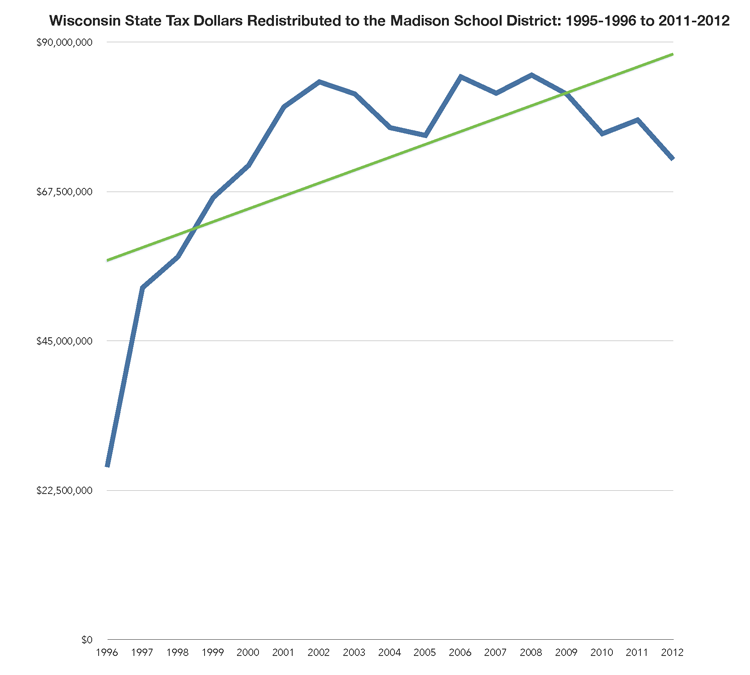
A rather remarkable chart from the Madison School District Admini$tration

Tap for a larger version (view the complete pdf slide presentation).

I am astonished that the Madison School District’s administration published this chart. Why not publish the change in redistributed state (and federal) tax dollars over time as a percentage of total spending, along with academic outcomes?

This chart displays Madison’s redistributed state tax dollar receipts from 1995 to 2011-2012 (more here and here):

Further, this (PDF) enrollment document is a surprise after the community (small percentage voting) passed a rather large facility expansion referendum in early 2015. These funds include the expansion of Madison’s least diverse school: Hamilton Middle School.

Share

DPI/UW grant to address achievement gap

Wisconsin’s Department of Public Instruction, along with the Wisconsin Center for Educational Research and the Institute for Research on Poverty at the University of Wisconsin-Madison, have received a four-year, $5.25 million grant to advance the work of DPI’s Promoting Excellence for All initiative.

Promoting Excellence for All is focused on reducing achievement gaps for student of color, low-income students, and students with disabilities, though most of the attention seems to be on students of color. The Promoting Excellence for All website has information and an e-Course that educators can use to “deepen their understanding and use of strategies proven to close the gap.”

This new grant will allow DPI to further study Wisconsin schools with promising practices for reducing gaps, and determine to what extent those practices can be replicated in other locations. Perhaps this will lead to more meaty specificity on the website, where the current strategies are general and aspirational in nature. Although Wisconsin posts some of the largest performance gaps in the country, it does not appear that DPI will be looking beyond the borders of our state for possible solutions.

Media outlets have been reporting on the grant as well as reflecting on the disgraceful size of the gaps in Wisconsin and the lack of progress in narrowing them.

Milwaukee Journal Sentinel
Capital Times
Green Bay Press Gazette

It will be important to remember that some very worthy practices, such as explicit and sequential teaching of foundational reading skills, may raise the performance of the low groups of students without appreciably narrowing the gap. That is because the same instructional practices that benefit the students at the bottom also benefit the students at the top, raising all ships.

Share

Galway teen’s child poverty song sends shivers down the spine

magicmum:

A bi-lingual song penned by a talented Irish teenager to highlight the plight of children living in poverty has sent shivers down our spines.

16-year old Transition Year student Róisín Seoige from Galway has won the PREDA song contest for her beautiful tune ‘Freedom Song’. PREDA is a charity which provides aid to children living in poverty in the Philippines and the work they do inspired Róisín’s powerful song.

Irish singer songwriter and PREDA advocate Damien Dempsey has commended her talent, saying he was overcome with emotion because “this young songwriter truly connected with the plight of the children”.

And we’re not far behind. Róisín’s melodious voice conveys a depth of emotion far beyond her years and it has really touched a chord (pardon the pun!) with us here.

Share

Lumosity must pay $2 million for misleading advertising

Wisconsin Reading Coalition:

Lumosity, the heavily advertised “brain training” program, will pay $2 million to settle deceptive advertising charges brought by the Bureau of Consumer Protection of the Federal Trade Commission. The company must notify subscribers of their right to cancel their subscriptions.

The FTC Press Release

Oher commentary:
​http://www.consumer.ftc.gov/blog/brain-training-lumosity-does-it-really-work

http://www.cbc.ca/news/health/lumosity-ftc-1.3390544

http://gizmodo.com/lumosity-brain-games-are-bullshit-1649901132

Share

Mapping Huckleberry Finn’s Mississippi River Journey

Andrew DeGraff:

America may be the land of the free, but the two leading contenders for the title of “great American novel” actually take place on the water. For Melville, the ocean contained all of humanity’s great secrets (and metaphors); but for Twain, it was the water itself that was the key. In Adventures of Huckleberry Finn, the river is both the setting of the novel and its central theme. And the fact that it also paved the way (so to speak) for the American road movie is just an added bonus.

Share

Why Female Professors Get Lower Ratings

Anya Kamenetz:

A new study argues that student evaluations are systematically biased against women — so much so, in fact, that they’re better mirrors of gender bias than of what they are supposed to be measuring: teaching quality.

Anne Boring, an economist and the lead author of the paper, was hired by her university in Paris, Sciences Po, to conduct quantitative analysis of gender bias. Through her conversations with instructors and students, she became suspicious of what she calls “double standards” applying to male and female instructors.

Share

Chicago Schools Delay 875 Million Bond Sale

FRAN SPIELMAN AND DAN MIHALOPOULOS:

The Chicago Public Schools on Wednesday abruptly put off $875 million in borrowing needed to ease its financial crunch amid signs it would pay a heavy price — in the form of record-high interest rates — to attract investors.

The City of Chicago’s chief financial officer, Carole Brown, and CPS financial chief Ron DeNard tried to put the best possible face on the decision to postpone the bond sale one day after a preliminary interest rate of 7.7 percent was sent out to investors.

Share

Reading Notes, 2016

Wisconsin Reading Coalition:

Milwaukee Summer Reading Project
As MSRP enters its 7th year, Rep. Joe Sanfelippo has proposed legislation that would provide $1.1 million for the program over two years. The six-week summer program for Milwaukee students exiting 1st and 2nd grades has seen student scores rise significantly. Dr. Howard Fuller, who spearheaded MSRP, credits much of the success to intensive training of its teachers with Language Essentials for Teachers of Reading and Spelling (LETRS). A fourth cohort of educators, including teachers, tutors, and coaches from the community, will start LETRS training in March. With the outcome of the legislation uncertain, Fuller will continue to rely on the generosity of local foundations to fund MSRP.

TED Talk on Dyslexia: How to Mix Oil and Water So That Nearly Everyone Learns How to Read; Tim Conway

IFERI: The International Foundation for Effective Reading Instruction website is an excellent resource with input from leading researchers and advocates.

Introductory Wilson Training at CESA #1 in February: Just Words and Wilson Reading System

Share

Indications of dyslexia found in infant brains

Wisconsin Reading Coalition:

A study by Nadine Gaab et al. from Boston Children’s Hospital’s Laboratory of Cognitive Neuroscience has detected alterations in the arcuate fasciculus in infants whose family history suggests risk for dyslexia. The arcuate fasciculus is a “bundle of fibers that connect the posterior cortex, which is involved in mapping sounds and word/letter recognition, with the frontal cortex, which integrates and comprehends this information.”

This follows a 2012 study in Gaab’s lab where MRI’s showed left hemisphere differences in brains of pre-reader kindergartners with a familial history of dyslexia.

Implications for early intervention are discussed.

http://vector.childrenshospital.org/2015/12/for-dyslexia-writing-is-often-on-the-wall-from-birth/

Share

George Boole: A 200-Year View

Stephen Wolfram:

Today is the 200th anniversary of the birth of George Boole. In our modern digital world, we’re always hearing about “Boolean variables”—1 or 0, true or false. And one might think, “What a trivial idea! Why did someone even explicitly need to invent it?” But as is so often the case, there’s a deeper story—for Boolean variables were really just a side effect of an important intellectual advance that George Boole made.

When George Boole came onto the scene, the disciplines of logic and mathematics had developed quite separately for more than 2000 years. And George Boole’s great achievement was to show how to bring them together, through the concept of what’s now called Boolean algebra. And in doing so he effectively created the field of mathematical logic, and set the stage for the long series of developments that led for example to universal computation.

Share

Data Scientist Training for Librarians – re-skilling libraries for the future

The Library Lab:

Loud and clear: Data Scientist Training for Librarians (DST4L) is a wonderful concept. It’s an experimental course developed at Harvard-Smithsonian Center for Astrophysics Library with the aim to train librarians to respond to the growing data needs of there communities. We all know the story: The Internet happened and the amount of information and data exploded. And it’s right in front of everybody’s nose – the neighbor kid as well as the scholar. Information and data in any form is the building bricks of science and knowledge and with the rapid increase of these the need to gain tools and skills to tame and analyze them grow. This development has changed the way academia works and when academia changes the library should pay attention and think of it’s options.

Share

Public speaking: Tips from the top

BBC:

One of a chief executive’s most important roles is communication, which often means public speaking to very large groups. But it’s not easy to get everyone’s attention.

What’s the best way to keep audiences informed, engaged and inspired?

Share

14-1-5.2. Age restrictions for children. – (a) Children under ten (10) years of age shall not be left home alone.

State of Rhode Island (PDF):

14-1-5.2. Age restrictions for children. – (a) Children under ten (10) years of age shall not be left home alone.
(b) Children at least ten (10) years of age and not more than twelve (12) years of age shall be allowed to stay home alone for brief periods of time, but not after 9:00 pm.

(c) Children over twelve (12) years of age may be left home alone, but not overnight.
(d) Parents and legal guardians should use their judgment to access the maturity and responsibility of their children and to discuss safety procedures and precautions before deciding whether to leave their child(ren) home alone.

Share

School Choice: The End Of The Beginning

Andy Smarick:

expanding school choice. I think it’s the right thing to do for kids, families, educators, neighborhoods, civil society, and much else. In fact, I’m convinced that years from now, students of history will be scandalized to learn that we used to have a K–12 system defined by one government provider in each geographic area.

“Do you mean,” they’ll ask, “that kids were actually assigned to schools based on home address, even if those schools were persistently underperforming?”

But probably the most important lesson I’ve learned over the last fifteen years—the reason why school choice progress moves so slowly—is this: An education system without school choice makes perfect sense from the point of view of central administrators.

In fact, the district-based system (a single public sector operator of schools) that we’ve had for the last century is extraordinarily rational when viewed from above. A city has lots of kids, and those kids need to be educated. A central schooling authority will take care of it.

Share

Data Privacy Day: Take Charge of Your Family’s Privacy

EFF:

recently launched Spying on Students—an online resource dedicated to helping students, parents, teachers, and school administrators learn more about the privacy issues surrounding school-issued devices and cloud services. The website—part of our new campaign to promote student privacy—provides useful guides for adjusting privacy settings on mobile devices. It also answers common questions about the legal and technological landscape regarding student privacy and offers suggestions on how you can connect with other concerned parents.

Share

Educating Refugees

The Economist:

AFTER Aida Hadzialic’s parents fled war-torn Bosnia for Sweden in the early 1990s, they put their five-year-old daughter in a school full of native Swedes and made sure she studied hard to get ahead. It worked. Today Ms Hadzialic, 27, is Sweden’s minister for upper secondary education. Like her counterparts across Europe, she faces a new challenge: ensuring that a fresh wave of refugee children can integrate as successfully as she did.

Even before this year’s surge, western Europe had lots of immigrant students. According to the Organisation for Economic Cooperation and Development (OECD), the proportion of 15-year-old schoolchildren in Spain who are foreign-born rose from 3% to 8% from 2003 to 2012 (though in Germany it fell by about the same amount). The new wave of migrants from Syria, Afghanistan, Iraq and elsewhere has redoubled the strains on school systems.

Share

Nearly half of young black men in Chicago out of work, out of school: report

Alexia Elejalde-Ruiz:

Nearly half of young black men in Chicago are neither in school nor working, far exceeding the share nationally and in comparable big cities, according to a new report.

Forty-seven percent of 20- to 24-year-old black men in Chicago, and 44 percent in Illinois, were out of school and out of work in 2014, according to the report from the University of Illinois at Chicago’s Great Cities Institute that was commissioned by the Alternative Schools Network.

Related: Madison’s long-term, disastrous reading results.

Share

Victorian London in Incredible Detail

Mapping London:


Here’s a real treat. The National Library of Scotland’s Map Department, supported by David Rumsey, have taken some very high-resolution scans of the Ordnance Survey 1:1056 (that’s 60 inches to the mile!) set of 500+ maps of London issued between 1893 and 1896 and, crucially, reorientated and stitched them together, so that they can be presented seamlessly (using OpenLayers) on top of a “standard” Google web map or OpenStreetMap, with the base map acting as a m

Share

NCTQ report; online parent discussion group; congratulations

Wisconsin Reading Coalition:

A new report has been released by the National Council on Teacher Quality: Learning About Learning: What Every New Teacher Needs to Know. In terms of instructional strategies that help students learn and retain new concepts, a lot was found missing from textbooks currently used to train teachers.

The Learning Difference Network of Dane County has formed an online discussion group for parents of children with dyslexia and other related learning differences. To join, click the following link, log into Facebook, and when group page opens, click the box “Join Group” – the administrator will get your request and approve your membership within 24 hours. https://www.facebook.com/groups/LDNParentGroup/

Congratulations to the Children’s Dyslexia Center-Madison on opening four new classrooms! The expansion was made possible by the Scottish Rite Masons and the Madison community.

Share

The Open Syllabus Project

link:

The OSP is an effort to make the intellectual judgment embedded in syllabi relevant to broader explorations of teaching, publishing, and intellectual history. The project has collected over 1 million syllabi, has extracted citations and other metadata from them, and is now pleased to make the Syllabus Explorer publicly available as a means of exploring this corpus. Looking ahead, the OSP’s goal is to expand the collection and make it more useful to authors, teachers, administrators, and students.

Share

Seminal Papers in Software Engineering: The Carnegie Mellon Canonical Collection

Mary Shaw (editor), Jonathan Aldrich, Travis D. Breaux,
David Garlan, James D. Herbsleb, Christian Kästner, Claire Le Goues, William L. Scherlis
:

To understand the context of current research, it is essential to understand how current results evolved from early fundamental papers. These classic papers develop timeless ideas that transcend technology changes, and the ideas embodied in their solutions often apply to current problems (and, indeed, are reinvented by researchers who are ignorant of the classic literature).

Share

The Secret of Immigrant Genius

Eric Weiner:

the roster of history’s intellectual and artistic giants, and you quickly notice something remarkable: Many were immigrants or refugees, from Victor Hugo, W.H. Auden and Vladimir Nabokov to Nikolas Tesla, Marie Curie and Sigmund Freud. At the top of this pantheon sits the genius’s genius: Einstein. His “miracle year” of 1905, when he published no fewer than four groundbreaking scientific papers, occurred after he had emigrated from Germany to Switzerland.

Share

Can a Pill Make You Smarter? The Brave New World of Smart Drugs

Larry Schwartz:

In the 2011 movie Limitless, our loser-turned-hero Bradley Cooper takes a pill, writes a novel in a few days, becomes an investment tycoon, and performs other tricks of mental derring-do. And of course at the end of the movie (spoiler alert!), he gets the girl. If only such a pill really existed.

Well, it may. Sort of. Welcome to the world of nootropics, or smart drugs. Nootropics (derived from Greek words that mean to bend the mind) are categories of drugs, supplements and other additives and stimulants that enhance memory, cognitive function and even intelligence. For thousands of years, humankind has sought ways to improve the mind, and many believe that modern science is on the cusp of achieving that goal, albeit with many caveats.

Share

Wisconsin’s Performance on the 2015 NAEP

Tap for a larger version.

Wisconsin Reading Coalition:

Are you interested in how Wisconsin 4th graders’ reading performance stacks up against other 4th graders nationwide? The National Assessment of Education Progress (NAEP), administered every two years, is the one way we can get answers. See the attached document for the results from the 2015 NAEP, including our current and historical national ranking and how subgroups of Wisconsin students compare to each other as well as to their peers in higher performing states.

The first step in improving outcomes is always to be knowledgeable and honest about our current performance.

Much more, here (PDF Commentary).

Wisconsin’s long serving WKCE exam was often criticized for its low standards.

Share

The New Wisconsin Forward Exam

Wisconsin Reading Coalition:

The Badger Exam lasted just one year, to be replaced this spring with the Wisconsin Forward Exam. Wisconsin contracted with Data Recognition Corporation (DRC) to develop the new test with input from Wisconsin teachers.

In addition to rolling out the new assessment, DPI must complete the important process of setting proficiency standards. We hope they will continue to set proficiency cut scores based on the NAEP standards. For many years, Wisconsin yielded to the temptation to set its standards low, making it appear that we had higher percentages of proficient students than was actually the case. As reported by the Wisconsin Policy Research Institute, the required level for proficiency in 4th grade reading in Wisconsin was actually below the level that NAEP set for the basic performance category.

“In this report, which involved mapping state proficiency standards in reading and mathematics onto the appropriate NAEP scale (2004-05), Wisconsin was among the states at the lower levels.

At grade 4 in reading, Wisconsin proficiency levels rated well below the NAEP Basic cut score and considerably below the NAEP Proficient cut score. Wisconsin ranked 22cd out of 32 states, far behind the leading states of Massachusetts, South Carolina, and Wyoming. “

DPI has also been asked by the U.S. Department of Education with finding a way to increase the number of students taking the statewide assessment. Wisconsin was one of 12 states that had a lower-than-required participation rate last year. A letter from the Department of Education spelled out the requirements as well as listing possible strategies to achieve compliance from districts.

Wisconsin’s long serving WKCE exam was often criticized for its low standards.

Share

Badger Exam results; Madison Substantially Lags State Results….

Tap for a larger version.

Wisconsin Reading Coalition, via a kind email:

LETRS Training
For the fourth year, the Milwaukee Summer Reading Project will offer free training in Language Essentials for Teachers of Reading and Spelling (LETRS) in Milwaukee. Ten Saturday classes run from March into June. There are approximately ten open spots, with registration being first come-first served. If you are interested, please reply to this email to receive detailed information.

The Badger Exam
For 2014-15, the Badger Exam was Wisconsin’s annual statewide test in English Language Arts, taking the place of the WKCE. Badger was the name used in Wisconsin for the assessment developed by the Smarter Balanced Assessment Consortium (SBAC), one of two Common Core-aligned assessments utilized by multiple states.

As was the case in other states that used this SBAC assessment, a much higher percentage of fourth grade students reached the proficient level than on the National Assessment of Educational Progress (NAEP). See https://edreformnow.org/how-do-new-naep-scores-compare-with-smarter-balanced-and-parcc/ In Wisconsin, 50.4% of fourth graders were proficient on the Badger, while only 37% were proficient on the NAEP. This discrepancy could be attributed to differing exam content as well as different standards for setting proficiency cut scores. (Wisconsin was not included in the above-linked article because DPI delayed release of Badger results from the spring, 2015 exam until January 13, 2016.)

As is true in the NAEP data, the Badger scores reflect deep and persistent gaps between different groups of students. Proficiency percentages were only 20.2 for African-American fourth graders, 24.3 for students with disabilities, and 37.1 for low income students. DPI’s press release contains details.

At this point, Wisconsin’s DPI has not posted district and school Badger results on its website, which limits public access to this important information. An article in the Wisconsin State Journal provides information on districts in Dane County. In the Milwaukee Journal Sentinel, Alan Borsuk reports that Milwaukee proficiency percentages were so low that former U.S. Secretary of Education Arne Duncan called it a “national disgrace.”

The Badger exam is now history in Wisconsin. Legislation required development of the new Forward exam for this year. Since we will not longer be able to compare scores with other states who are taking the SBAC exam, it is critical that Wisconsin be honest about setting its proficiency cut scores at a level that corresponds to the NAEP standards.

2015 data via a .xlsx, .numbers file or PDF. Milwaukee School District Slides (PDF).

Wisconsin’s long serving WKCE exam was oft criticized for very low standards.

Madison has long tolerated disastrous reading results, despite spending more the $17,000 per student annually.

Tap for a larger version.

Share

analysis of math, reading scores ‘very disconcerting’

Greg Toppo:

Decades of bleak results from kids’ standardized tests now seem almost routine, but a new study made public Tuesday scratches beneath the surface to pin down just how many students in major U.S. metropolitan areas can actually read or do math proficiently. The results: Startlingly few.

If all of Detroit’s fourth-graders took the well-respected National Assessment of Educational Progress (NAEP) tests, just 120 African-American fourth-graders across the entire city, by researchers’ estimates, would score “proficient” or above in math.
“This is not a misprint,” the authors warn.

Madison has long tolerated disastrous reading scores.

Wisconsin’s long serving WKCE exam was often criticized for its low standards.

Share

Tweens hooked on the photo-sharing app have developed their own language and ‘goals’

Katie Rophie:

I recently got into an argument with an Average Twelve-Year-Old (ATYO) about language and Instagram, an argument which, I have to admit, is semi-signalling to me the end of the world. When a teen posts a cute picture of, say, a puppy or a baby brother on the photo-sharing app, other teens invariably comment “awe”. I pointed out to the ATYO that they really mean “awww” and that “awe” actually means “an overwhelming feeling of reverence, admiration, fear or wonder produced by that which is grand, sublime, extremely powerful”. She seemed unimpressed by the distinction. If there is a difference between God and a cute puppy it’s uninteresting to her.

Continuing in this vein, I said that all the kids commenting on Instagram and using “artsy” as a great compliment were misusing that word — “artsy” actually being a negative term meaning pretentious or fake or trying too hard to seem artistic. The ATYO looked at me with the pity one might feel towards a tourist struggling to read a menu in a strange land: “That’s not what it means on Instagram.” I realised, to my horror, that she was right. The words, as I and the Oxford English Dictionary understood them, were rapidly vanishing into the world of Instagram and its 400 million users, in which “awe” is about puppies, and “artsiness”, skilfully filtered, is vastly preferable to art.

Share

Fountain of Youth: The Secret Power of Friends and Family

Jo Marchant:

The Nicoya peninsula in northwestern Costa Rica is one of the most beautiful places on the planet. This 75-mile sliver of land, just south of the Nicaraguan border, is covered with cattle pastures and tropical rain forests that stretch down to the crashing waves of the Pacific Ocean. The coastline is dotted with enclaves of expats who fill their time surfing, learning yoga and meditating on the beach.

For the locals, life is not so idyllic. They live in small, rural villages with limited access to basics such as electricity, linked by rough tracks that are dusty in the dry season and often impassable when it rains. The men earn a living by fishing and farming, or work as laborers or sabaneros (cowboys on huge cattle ranches), while the women cook on wood-burning stoves. Yet Nicoyans have a surprising claim to fame that is attracting the attention of scientists from around the world.

Share

Spelling, punctuation and grammar: can you outsmart an 11 year old?

Guardian:

Can you spot a relative clause? Primary school students face a tough new English test this year – see how you’d fare with our quiz

Note: some sample questions have been adapted for a quiz format

Share

Minnesota’s foster system, kids go from bad to worse

Brandon Stahl:

Minnesota’s foster care system is falling short of state and federal standards meant to ensure that abused children are placed into stable and permanent homes, a Star Tribune review of state records has found.

Those records reveal that too many abused foster children in Minnesota are returned to their parents too quickly, suffer more maltreatment and end up back in foster care. Thousands of children have been further traumatized by being shuttled among numerous foster homes as they wait, sometimes in vain, for adoption, state records show.

As the number of foster children has grown to more than 11,000, fewer families are signing on as foster parents, records show. That problem could intensify, as a child protection task force formed by Gov. Mark Dayton recommended on Monday numerous reforms that will likely see more children removed from abusive homes.

“I don’t think we’re ready for that increase,” Robert O’Connor, a member of the task force and a social work professor at Metropolitan State University, said after reviewing the data compiled by the Star Tribune.

Share

Can 15-year-old Wikipedia remain the planet’s font of all knowledge?

Andrew Lih:

This month, Wikipedia officially celebrates 15 years as the internet’s free encyclopedia, cataloguing humankind’s achievements in real time and, more importantly, rescuing desperate students facing assignment deadlines.

In that time, it has hastened the end of Microsoft’s Encarta encyclopedia and supplanted Britannica as the dominant reference work in English. While the digital landscape has changed drastically over the past decade, Wikipedia has not, and still delivers that rare site that strives for neutrality and accuracy, all with no commercial advertisements.

It’s hard to overstate how influential Wikipedia has been, not just as a free alternative to traditional knowledge sources, but as a vanguard for maintaining and delivering up-to-date information. Each month, nearly 100,000 volunteers around the world actively contribute content to Wikipedia so that anyone may freely read, copy or redistribute its articles.

Dr James Heilman, a Canadian emergency room doctor and a volunteer Wikipedia editor, found that it was the most turned-to source of information on the internet during the height of the recent Ebola outbreak in West Africa. In the Journal of Medical Internet Research, he noted, “Wikipedia appears to be the single most used website for health information globally, exceeding traffic observed at the National Institutes of Health, WebMD and the World Health Organisation.” With substantial editions in more than 100 languages, it has become a critical educational resource in emerging markets ignored by traditional publishers.

Share

Young, gifted and held back

The Economist:

THE world of “The Hunger Games” youngsters are forced to fight to the death for the amusement of their white-haired rulers. Today’s teen fiction is relentlessly dystopian, but the gap between fantasy and reality is often narrower than you might think. The older generation may not resort to outright murder but, as our special report this week on millennials describes (see article), in important ways they hold their juniors down.

Roughly a quarter of the world’s people—some 1.8 billion—have turned 15 but not yet reached 30. In many ways, they are the luckiest group of young adults ever to have existed. They are richer than any previous generation, and live in a world without smallpox or Mao Zedong. They are the best-educated generation ever—Haitians today spend longer in school than Italians did in 1960. Thanks to all that extra learning and to better nutrition, they are also more intelligent than their elders. If they are female or gay, they enjoy greater freedom in more countries than their predecessors would have thought possible. And they can look forward to improvements in technology that will, say, enable many of them to live well past 100. So what, exactly, are they complaining about?

Share

New study suggests the SAT may over- or underpredict first-year college grades of hundreds of thousands of students.

Scott Jaschik:

College Board has claimed for decades that the SAT’s strength is that it predicts the grades students will earn in the first year of college. But what if, in many cases, it doesn’t?

A study released Monday suggests that hundreds of thousands of students a year may have SAT scores that predict they will receive either better or worse grades than they are actually likely to receive. While the SAT may predict accurately for many others, the scholars who have produced the new study say it raises questions about the fairness and reliability of the SAT (including the new version about to be unveiled), which remains a key part of the admissions process at many colleges and universities.

Share

Placing documents into the public domain

DJ Bernstein:

Most rights can be voluntarily abandoned (“waived”) by the owner of the rights. Legislators can go to extra effort to create rights that can’t be abandoned, but usually they don’t do this.

In particular, you can voluntarily abandon your United States copyrights:

It is well settled that rights gained under the Copyright Act may be abandoned. But abandonment of a right must be manifested by some overt act indicating an intention to abandon that right. See Hampton v. Paramount Pictures Corp., 279 F.2d 100, 104 (9th Cir. 1960).

Share

The Inequality of Arithmetic and Geometric Means from Multiple Perspectives

Richard Askey, Ryota Matsuura, and Sarah Sword (PDF):

Given three numbers a, b, and c, we can find their mean (or average) as (a + b + c)/3. More precisely, this expression yields the
arithmetic mean of a, b, and c. A different kind of mean, however, uses the product of these numbers instead of their sum. It is called the geometric mean and is given by the expression (abc)1/3. We may interpret the geometric mean of nonnegative a, b, and c as the side length of a cube whose volume is the same as that of a right rectangular prism with dimensions a, b, and c.
In NCTM’s Focus in High School Mathematics: Reasoning and Sense Making in Algebra (2010), Graham, Cuoco, and Zimmermann use similar triangles and angles inscribed in circles to prove that, for two nonnegative numbers a and b, the arithmetic mean is greater than or equal to the geo- metric mean. Symbolically, this is written as (a + b)/2 ≥ (ab)1/2. This fact, called the inequality of arithmetic and geometric means (AGM), is actu- ally true for any number of nonnegative values. For three nonnegative numbers a, b, and c, for instance, we have (a + b + c)/3 ≥ (abc)1/3.

Share

To Be Young, ‘Gifted’ And Black, It Helps To Have A Black Teacher

Anya Kamanetz

On a recent, chilly Sunday morning, children ranging in age from 4 to 6 waited with their parents in the cafeteria of a Brooklyn school. Each wore a name tag.

The kids chatted cheerfully (in several languages) until each was summoned upstairs to be tested for a spot in New York City’s gifted program. Their parents sent them off with hugs and the promise of special treats for doing their best.

When a student is identified as “gifted,” the label is a vote of confidence — as in the indelible Nina Simone song. It also comes with a prize package: extra services, accelerated classes, individualized learning plans. The availability of these services varies widely from district to district. The chances of being identified as gifted also varies — notably, by race.

Share

How Your Social Life Changes Your Microbiome

Ed Yong:

Social contact can clearly spread disease: That’s why we lean away from snotty hugs, tell sick colleagues to go home, and quarantine people during epidemics. But the germs behind infectious illnesses are but a tiny fraction of our full microbiome—the microbes that share our bodies. Most of these are harmless, perhaps even helpful. And they can hop between individuals, too.

A growing number of studies, including two recent ones with chimps and baboons, have shown that social interactions affect the composition of the microbiome. Through hugs, handshakes, and even hip-checks, we translate our social networks into microbial ones, transferring benign or beneficial microbes to our neighbors, and acquiring theirs in return.

This means that there’s a “pan-microbiome”—a meta-community of microbe species that spans a group of hosts. If you compare your microbiome to your private music collection, the pan-microbiome is like the full iTunes store, and every handshake is an act of file-sharing.

Share

The Full History of Board Games

Peter Attia:

Within the past few years board games have gone through an explosion of growth. In 2012 The Guardian went as far as dubbing it “A Golden Age for Board Games”, stating board games have seen a growth rate as high as 40% year over year. It’s also quickly becoming one of Kickstarter’s most funded project categories.

The budding interest has gone as far as inspiring Wil Wheaton and Felicia Day to start a popular Youtube series, called Table Top. This series pits internet celebrities against each other and garners several hundred thousand views per video.

So, how did something so archaic become so popular? Where did it all start?
The First Board Game

Share

Broken Science

Ronald Bailey:

Nullius in verba is the motto of one of the earliest scientific associations-the Royal Society, founded in 1663. Broadly translated, the phrase means “Don’t take anybody’s word for it.”

You know how it’s supposed to work: A scientist should ideally be able to do the same experiment as any other scientist and get similar results. As researchers check and recheck each other’s findings, the sphere of knowledge expands. Replication is the path to scientific advancement.

Some 15 million researchers published more than 25 million scientific papers between 1996 and 2011. Among them were several casting doubt on the veracity and reliability of the rest—suggesting that even studies published in gold-standard journals by researchers from top-tier institutions are far more likely than anyone previously realized to be false, fudged, or flukey. The upshot is that many researchers have come to believe that science is badly battered, if not broken.

Share

Big Time College Athletic Departments Are Taking In More Money Than Ever

Will Hobson & Steven Rich:

In September, Auburn University’s football stadium debuted one of the largest video boards in North America. At just shy of 11,000 square feet, the high-definition screen is roughly the size of a five-story building. During a test one night this summer, the glow was visible in the skies over the rural plains of eastern Alabama nearly 30 miles away.

When he announced the purchase, Auburn Athletic Director Jay Jacobs said the new board would help recruit star athletes and sell tickets. This convinced Auburn’s board of trustees to approve the $13.9 million expense even though the athletics department posted a deficit of more than $17 million the previous year, an analysis of financial records shows, one of the worst fiscal years in Auburn athletics history.

Share

In South Korea, a rehab camp for Internet-addicted teenagers

Anna Fifield:

The first day he arrived and had to turn over his devices was a day of despair. “I thought, ‘My future is pitch-black,’ ” he said over a lunch of spaghetti Bolognese and kimchi on a recent day. “I’m so frustrated. I feel like I’m being held captive.”

Share

What Syllabuses Can Teach Us

JOE KARAGANIS and DAVID McCLURE:

COLLEGE course syllabuses are curious documents. They represent the best efforts by faculty and instructors to distill human knowledge on a given subject into 14-week chunks. They structure the main activity of colleges and universities. And then, for the most part, they disappear.

Some schools archive them, some don’t. Some syllabus archives are public, some aren’t. Some faculty members treat their syllabuses as trade secrets, others are happy to post them online. Despite the bureaucratization of higher education over the past few decades, syllabuses have escaped systematic treatment.

Until now. Over the past two years, we and our partners at the Open Syllabus Project (based at the American Assembly at Columbia) have collected more than a million syllabuses from university websites. We have also begun to extract some of their key components — their metadata — starting with their dates, their schools, their fields of study and the texts that they assign.

Share

This Map Shows Which States Make It Easiest and Hardest to Obtain a College Degree

Kristina Rizga:

income disparities between those who have a college degree and those who don’t have been growing bigger and bigger for decades. But college graduation rates in the United States have slowed down, especially among kids from low-income families. As recently as in the mid-1990s, the United States had the highest college graduation rate in the world. Today, its rank has slipped to No. 12, in large part because college costs have skyrocketed.

It’s no surprise, then, that more students rely on community colleges as a way to save money: 1.7 million students enroll each year, and about 80 percent say they want to go beyond earning an associate’s degree or a vocational certificate by finishing with a college diploma in their hands. In the 2013-14 academic year, at least 46 percent of all students who earned college diplomas went to community colleges, and a new report published on Tuesday found that some states do a much better job than others at getting their students to graduate.

Share

You Can’t Trust What You Read About Nutrition

Christie Aschwanden:

As the new year begins, millions of people are vowing to shape up their eating habits. This usually involves dividing foods into moralistic categories: good/bad, healthy/unhealthy, nutritious/indulgent, slimming/fattening — but which foods belong where depends on whom you ask.

The U.S. Dietary Guidelines Advisory Committee recently released its latest guidelines, which define a healthy diet as one that emphasizes vegetables, fruits, whole grains, low- or nonfat dairy products, seafood, legumes and nuts while reducing red and processed meat, refined grains, and sugary foods and beverages.1 Some cardiologists recommend a Mediterranean diet rich in olive oil, the American Diabetes Association gives the nod to both low-carbohydrate and low-fat diets, and the Physicians Committee for Responsible Medicine promotes a vegetarian diet. Ask a hard-bodied CrossFit aficionado, and she may champion a “Paleo” diet based on foods our Paleolithic ancestors (supposedly) ate. My colleague Walt Hickey swears by the keto diet.

Share