School Information System

Representative LaKeshia Myers on Wisconsin AB446

mp3 audio

Transcript (Machine Generated).

Representative LaKeshia Myers.

Related: Assembly bill AB446

2017: West High Reading Interventionist Teacher’s Remarks to the School Board on Madison’s Disastrous Reading Results 

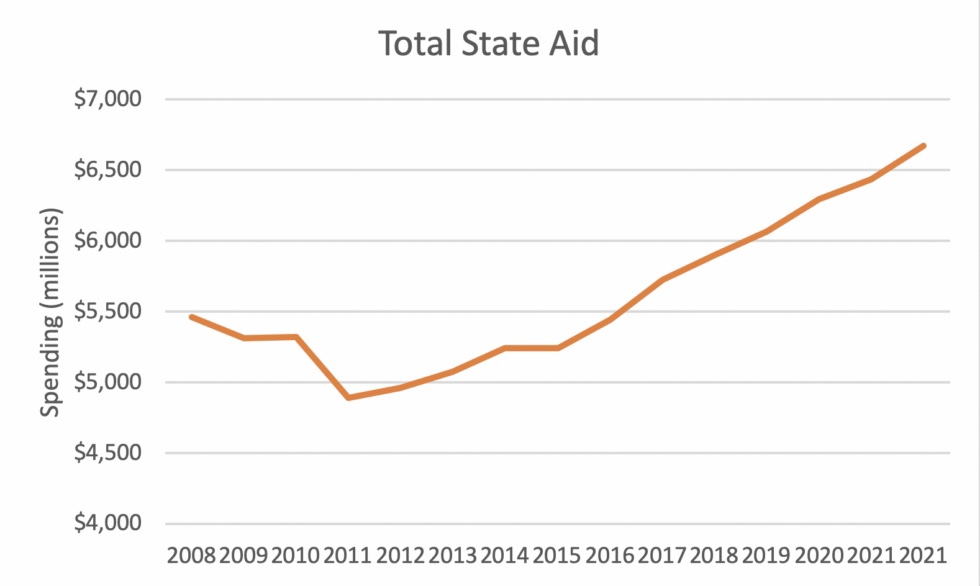
Madison’s taxpayer supported K-12 school district, despite spending far more than most, has long tolerated disastrous reading results.

My Question to Wisconsin Governor Tony Evers on Teacher Mulligans and our Disastrous Reading Results

“An emphasis on adult employment”

Wisconsin Public Policy Forum Madison School District Report[PDF]

WEAC: $1.57 million for Four Wisconsin Senators

Booked, but can’t read (Madison): functional literacy, National citizenship and the new face of Dred Scott in the age of mass incarceration.

Share

John Humphries Testimony on Wisconsin AB446

mp3 audio

Related: Assembly bill AB446

Share

Wisconsin Senate SB454 reading readiness assessments: DPI Testimony

I believe the DPI presenters were Barbara Novak and Tom McCarthy.
mp3 audio [Transcript: machine generated]

Written testimony (PDF):

Thank you Chairwoman Darling and committee members for holding a hearing on Senate Bill 154 today.

In Wisconsin, 64% of fourth graders are not proficient readers, according to the National Assessment of Educational Progress, with 34% failing to meet even the test’s basic standal Nationally, Wisconsin ranks dead last in reading achievement among black students, falling 31 places since 1992. In the same timeframe, reading achievement for Wisconsin white students has fallen from 6th to 27th, and Hispanic students from 1st to 28th. Wisconsin ha a dire reading problem.

Reading is critical to future success. Children who don’t learn to read by the end of third grade are likely to fall behind in other subjects and remain poor readers for the rest of their lives. Poor readers are more likely to drop out of high school, live in poverty, and end up in the criminal justice system. Of those who fail to gain a high school diploma, almost 90 percent experienced trouble reading in the third grade and seven in 10 prison inmates cannot read above a fourth-grade level.

Although Wisconsin was once a leader in literacy, our students now lag behind states where evidence-based approaches to early literacy have been adopted. Thankfully, over the past two decades, neuroscience – including groundbreaking research at UW-Madison – has allowed us to move beyond theory and guesswork, to identify exactly how children become skilled readers AND what effective literacy interventions look like for a child struggling to read. SB 454 aligns Wisconsin law with this growing body of research by strengthening state literacy screening standards, providing more transparency and ensuring teachers have the framework and tools needed to help every child become a proficient reader.

Under current law. Wisconsin schools are required to select and administer an annual literacy assessment to students in four-year-old kindergarten through 2nd grade. Screening assessments are typically only a few minutes in length, and consist of a teacher or volunteer using a flipchart or tablet to guide a child through a handful of exercises. Costs of these assessments are reimbursed by the state. Senate Bill 454 strengthens these existing state screening standards and provides the framework and tools to help every child learn to read in five major ways: Broadens Screening Components to Reflect Evidence-Based Best Practices: Dozens of literacy screeners are available to schools, but not all assess what research shows are the most critical components for reading. This bill expands the required screening components from two to five components to ensure schools are using high quality, evidence-based screeners. This helps teachers more easily identify reading difficulties AND select effective intervention strategies to help children overcome reading difficulties as early as possible.

Increases Assessment Frequency from annually to three times per year to better evaluate student progress, build a baseline for each student, and catch reading difficulties earlier.

Keeps Parents Involved and Informed: Too many parents do not find out their child is struggling to read until third grade (!) when they receive their child’s Forward Exam results. SB 454 requires schools to notify parents of screener results within 15 days, including plain language about the child’s score, percentile rank and if the child is identified as “at-risk”. The bill also requires schools to inform parents if a child begins a reading intervention plan, and detail the interventions that will be used.

Creates Clear Direction to Get Kids Back on Track: There are currently no requirements for when schools must provide additional literacy screening, and there are minimal requirements regarding reading interventions for students. This bill requires students who score below the 25th percentile on a literacy screener be given a more comprehensive screener to inform targeted, evidence-aligned interventions. Increases Transparency and Accountability: Under the bill, schools must annually report the number of students identified as at-risk at each assessment level and the number of students provided with literacy interventions. Statewide consistency across screening components, testing frequency and reporting will give districts, DPI and the legislature critical information to help us all make better informed policy decisions.

The bottom line is that research shows that the earlier we catch reading difficulties and begin simple interventions, the more successful those interventions will be. Strengthening our existing literacy screening laws will ensure that every struggling reader gets the help they need before they’ve fallen behind, lost self-esteem, and disengage from school and learning.

Related: Assembly bill AB446 SB454

2017: West High Reading Interventionist Teacher’s Remarks to the School Board on Madison’s Disastrous Reading Results 

Madison’s taxpayer supported K-12 school district, despite spending far more than most, has long tolerated disastrous reading results.

My Question to Wisconsin Governor Tony Evers on Teacher Mulligans and our Disastrous Reading Results

“An emphasis on adult employment”

Wisconsin Public Policy Forum Madison School District Report[PDF]

WEAC: $1.57 million for Four Wisconsin Senators

Booked, but can’t read (Madison): functional literacy, National citizenship and the new face of Dred Scott in the age of mass incarceration.

Share

K-12 Tax & Spending Climate: 50 Percent Of All U.S. Workers Made $34,612.04 Or Less Last Year

Michael Snyder:

By definition, 50 percent of wage earners had net compensation less than or equal to the median wage, which is estimated to be $34,612.04 for 2020.

Share

Flying Blind: majority of taxpayer funded Madison Students opt out of state tests…, wordsmithing at the DPI

Elizabeth Beyer:

More than half of Madison School District students opted out of statewide assessments last school year, far more than the unusually high number of students statewide who opted out amid the COVID-19 pandemic.

The high opt-out rate makes comparing the test results with those of previous years nearly impossible.

The results showed Madison having among the highest percentage of proficient or better students among Dane County schools, even though the district usually ranks near the bottom. That suggests the students who opted out disproportionately would have scored below proficient.

Roughly 1 in 6 students opted of the exam statewide during the 2020-21 school year, compared with an opt-out percentage below 3% in all test subjects during the 2018-19 school year.

Notes and links:

2017: West High Reading Interventionist Teacher’s Remarks to the School Board on Madison’s Disastrous Reading Results 

Madison’s taxpayer supported K-12 school district, despite spending far more than most, has long tolerated disastrous reading results.

My Question to Wisconsin Governor Tony Evers on Teacher Mulligans and our Disastrous Reading Results

“An emphasis on adult employment”

Wisconsin Public Policy Forum Madison School District Report[PDF]

WEAC: $1.57 million for Four Wisconsin Senators

Booked, but can’t read (Madison): functional literacy, National citizenship and the new face of Dred Scott in the age of mass incarceration.

Share

How Baylor Steered Lower-Income Parents to Debt They Couldn’t Afford

Tawnell D. Hobbs and Andrea Fuller:

Some of the wealthiest U.S. colleges are steering parents into no-limit federal loans to cover rising tuition, leaving many poor and middle-class families with debt they can’t repay.

Parents at Baylor University had the worst repayment rate for a type of federal loan called Parent Plus among private schools with at least a $1 billion endowment, according to a Wall Street Journal analysis of available Education Department data. Only about a quarter of Baylor parents paid down any of what they originally borrowed after two years.

Unlike undergraduate loans that have limits, there is no cap on what parents can borrow through the fast-growing Parent Plus program, no matter their income. Some parents wanting the best schools available for their children sign on the dotted line unaware how the debt can burden them into retirement.

Baylor increased its tuition sharply to transform itself from a regionally known Baptist college into a national brand that now has a $1.8 billion endowment. The central Texas school has added facilities, built a sports powerhouse and climbed college-ranking lists in a push to become a world-class research institution.

“They told me it was ‘good debt’—that it will pay itself off,” Ms. Massey said of family members who encouraged her to attend Baylor. “I honestly haven’t found anybody that cares about where I went to school.”

Share

Teachers unions influenced last-minute CDC school guidance, received copies before public release, emails show

Joe Schoffstahl:

The records further show that the American Federation of Teachers and the National Education Association, the two largest teachers unions in the U.S., received a copy of the guidance before the CDC released it to the public. The guidance included a phased reopening approach for K-12 schools based on coronavirus cases in the area.

“These documents are further evidence that instead of following the science, the White House and the CDC allowed politics to influence policy,” Caitlin Sutherland, executive director of Americans for Public Trust, told Fox News.

Sutherland’s group obtained the emails as part of an ongoing lawsuit against the CDC and the Department of Health and Human Services and provided them to Fox News. The group filed the litigation after the government failed to provide records on the decision-making process regarding school guidance.

2017: West High Reading Interventionist Teacher’s Remarks to the School Board on Madison’s Disastrous Reading Results 

Madison’s taxpayer supported K-12 school district, despite spending far more than most, has long tolerated disastrous reading results.

My Question to Wisconsin Governor Tony Evers on Teacher Mulligans and our Disastrous Reading Results

“An emphasis on adult employment”

Wisconsin Public Policy Forum Madison School District Report[PDF]

WEAC: $1.57 million for Four Wisconsin Senators

Booked, but can’t read (Madison): functional literacy, National citizenship and the new face of Dred Scott in the age of mass incarceration.

Share

Amherst College Drops Admissions Advantage for Children of Alumni

Melissa Korn:

Amherst College is abandoning its policy of giving preference to applicants whose parents attended the Massachusetts liberal-arts school, placing it among the first elite private colleges to ditch legacy admissions.

Selective schools like Amherst have been under intense scrutiny in recent years for putting a thumb on the scale for legacy applicants, with critics arguing the programs do little more than cement the privilege of students, and leave fewer slots for applicants from less-represented backgrounds.

“We’re doing what we can to examine where the barriers are and change what we can change” as the school pushes forward on efforts to broaden access, said Amherst President Biddy Martin.

The school, which this year had an 8.5% acceptance rate, historically gave preference to any children of graduates who were academically qualified. Dr. Martin said legacies are often among the top applicants, so many may still be admitted without considering their familial ties.

Share

Male Workers Allowed Into (Oberlin) Baldwin, Unsettling Residents

Peter Fray-Witzer:

When I asked other Baldwin residents how they felt about the whole debacle, some responded with the usual complaints about any hardware project — the mess, the noise, the suddenness — but others admitted that they weren’t entirely comfortable with the way the installation had been handled and the fact that they were subject to the whims of the contractors. One resident told me that they were instructed to ask another resident to hurry up in the shower so that the workers could have access to the bathrooms. In my experience, if the workers couldn’t hear the water running, they would come into the communal bathroom as they pleased, regardless of who was occupying it.

I understand, of course, that installations like this are routine; the College needs to improve its facilities occasionally, and who am I to stand in the way of that? After all, I get a brand-spanking-new radiator, right in time for the cold weather. But why not finish the project during the four months of the summer semester, when the building was unoccupied? Why not alert us earlier to the intrusion? Why didn’t the College make a schedule detailing when the workers would be likely to arrive at each dorm and in each room? They should have taken measures to keep students comfortable and safe — especially those who have elected to live in a specifically designated safe space.

Share

Wisconsin Senate Bill 454 SB454: reading readiness assessments

October 2021 hearing Materials:

Share

Roadmap to Reading Success Wisconsin Assembly Vote (AB446)

October 21, 2021 11:00a.m. CST. Watch via Wisconsin Eye.

Wisconsin AB 446; SIS links.

The list of lobbying organizations (many taxpayer supported!) opposed to Roadmap to Reading Success is remarkable:

Association of Wisconsin School Administrators

League of Women Voters Wisconsin (!)

Pearson NA (!)

Southeastern Wisconsin Schools Alliance

WIRSA

Wisconsin Association of School Boards

Wisconsin Association of School Business Officials

Wisconsin Association of School Personnel Administrators

Wisconsin Education Association Council

Wisconsin Retired Educators Association

Wisconsin State Reading Association

2017: West High Reading Interventionist Teacher’s Remarks to the School Board on Madison’s Disastrous Reading Results 

Madison’s taxpayer supported K-12 school district, despite spending far more than most, has long tolerated disastrous reading results.

My Question to Wisconsin Governor Tony Evers on Teacher Mulligans and our Disastrous Reading Results

“An emphasis on adult employment”

Wisconsin Public Policy Forum Madison School District Report[PDF]

WEAC: $1.57 million for Four Wisconsin Senators

Booked, but can’t read (Madison): functional literacy, National citizenship and the new face of Dred Scott in the age of mass incarceration.

Share

Hong Kong Is Erasing the Tiananmen Square Massacre

Jillian Kay Melchior:

A gruesome sculpture rises from a courtyard at the University of Hong Kong. It depicts dozens of human bodies contorted in agony, some with mouths open in silent screams, some skeletal and apparently motionless. The public university has demanded that this work of art be removed by 5 p.m. Wednesday (5 a.m. Eastern in the U.S.)—an ultimatum Hong Kongers find more horrifying than the statue’s grisly presence.

The sculpture, “The Pillar of Shame,” memorializes the victims of the 1989 Tiananmen Square massacre. Its creator, Danish artist Jens Galschiøt, calls the work “an overt accusation of the old men’s regime in Beijing” and “a litmus test of the authorities’ vow to respect human rights and free speech in Hong Kong.” The Chinese Communist Party has “already erased the memory of what happened at Tiananmen inside of China, and now they will do the same in Hong Kong,” Mr. Galschiøt says.

In a letter last week, the university’s lawyers said that if “The Pillar of Shame” wasn’t gone by their deadline, “the Sculpture will be deemed abandoned,” and “the University will deal with the Sculpture at such time and in such manner as it thinks fit without further notice.”

Beijing imposed a national-security law on Hong Kong last year that criminalizes dissent, so finding a new local forum willing to display “The Pillar of Shame” will be difficult, especially on short notice, Mr. Galschiøt says. He adds that his fiber cement sculpture has already required repairs and “probably is a bit frail.” He fears that “if people from a construction firm come from a crane and truck and try to put this away, then they will, I think, destroy it. Maybe they want to destroy it, who knows.”

Share

AAP, AACAP, CHA declare national emergency in children’s mental health

AAP:

The AAP, American Academy of Child and Adolescent Psychiatry (AACAP) and Children’s Hospital Association have declared a national emergency in children’s mental health, citing the serious toll of the COVID-19 pandemic on top of existing challenges.

They are urging policymakers to take action swiftly to address the crisis.

“Young people have endured so much throughout this pandemic and while much of the attention is often placed on its physical health consequences, we cannot overlook the escalating mental health crisis facing our patients,” AAP President Lee Savio Beers, M.D., FAAP, said in a statement. “Today’s declaration is an urgent call to policymakers at all levels of government — we must treat this mental health crisis like the emergency it is.”

Before the pandemic, rates of childhood mental health concerns and suicide had been rising steadily for at least a decade. By 2018, suicide was the second leading cause of death for youths ages 10-24 years.

Share

Taxpayer funded lobbying: National Association of School Boards

Matt Beienburg:

Educational leaders around the country are disavowing the National School Boards Association’s (NSBA) inflammatory claim that the parents of school children are perpetrating a form of “domestic terrorism,” just for daring to stand up to the rise of politicized curriculum in their kids’ classrooms. But in Arizona, school leaders who wish to distance themselves from the organization and its state affiliate may not be given their freedom without a fight.

Indeed, the Arizona School Boards Association (ASBA) has implemented tactics—such as declaring legal ownership over school districts’ publicly adopted governing policies and alleging potential copyright infringement against member districts who would break away from the ASBA—coercing member districts into continued financial submission even when they wish to cease supporting an increasingly radicalized political agenda.

As explored in a new Goldwater Institute report, Under Control: Arizona School Boards Are Being Forced to Fund Critical Race Theory at Taxpayer Expense, the ASBA has demonstrated its support for ideologically charged programming in public schools while at the same time holding hostage dissenting school board members by staking out outlandish claims of legal control over the board’s existing policy infrastructure.

In particular, the report highlights the following:

  • Like its national affiliate, the Arizona School Boards Association (ASBA) is using taxpayer-funded dues from virtually every district in the state to promote programming aligned with Critical Race Theory (CRT), even as its state and national leadership deny the existence of CRT in K-12. Like other proponents of this politically charged and racially divisive content, the ASBA has struggled to reconcile its avowed impartiality with the organization’s own actions and statements.
  • The ASBA has coerced governing board members who have sought to terminate their district’s affiliation with the association due to its political activism: In testimony before the district governing board of Western Maricopa Education Center (West-MEC) in August 2021, the ASBA declared that it legally owns the district’s publicly adopted board policies, rendering the district essentially captive to the association in perpetuity.
  • The ASBA asserted that member school districts would be guilty of copyright infringement for using the districts’ own previously adopted policies (or replicating those of other public bodies) if they ceased paying membership fees to the ASBA.

In other words, the ASBA claims that the framework of rules, procedures, and protocols that elected members of school districts—that is, public agencies—have adopted, are actually the private property of the association, and that any district that surrenders its membership in the ASBA could be sued for copyright violation unless that district replaces its publicly adopted suite of rules and policies with completely new ones.

Share

Academia and Freedom of Speech

Share

Civics: but challenging the order may involve going to court, incurring costs disproportionate to any legal or moral victory.

Tim Bradshaw:

My tweet was one of dozens identified by the record label as “unlicensed reproductions” of the Beastie Boys track. If I reposted it, or other infringing material, Twitter warned, I face the prospect of “permanent account suspension”. 

While some Twitter users have been “cancelled” by an online mob, my copyright infringement was most likely identified by an algorithmic crawler

This is my 15th year on Twitter. Since 2006, I have posted more than 26,000 tweets, made countless valuable contacts and broken plenty of stories thanks to the platform. But those 26,000 tweets are now also a potential liability. Is there another ticking time bomb buried amid the #breakingnews and my musings on sandwiches? 

While some Twitter users have been “cancelled” by an online mob, my copyright infringement was most likely identified by an algorithmic crawler, which scans the web continuously on behalf of the record labels. Twitter has not yet struck the kind of music licensing agreementthat YouTube and TikTok have with labels that can insulate their users from some complaints. I could argue that my clip was “fair use”, which permits short excerpts without a licence, but challenging the order may involve going to court, incurring costs disproportionate to any legal or moral victory.

Share

The Woke Profession Of Faith At American Universities

Ben Reinhard:

Applying for academic jobs is, as any graduate student will tell you, very nearly a job itself. When I was on the market in 2013, compiling, submitting, and tracking applications consumed my time, even though most of my countless applications were all variations on the same theme. But one application package was different: In addition to the standard cover letter, CV, and writing sample, Christendom College required a separate statement in support of the college’s Catholic mission and identity.

This request, though unusual, made sense. Christendom is a fiercely independent confessional college and a bastion of conservative Catholicism. It refuses all federal funding in pursuit of its educational apostolate, and its faculty make a yearly profession of faith and oath of fidelity. Thus the orthodoxy of the faculty is central to the mission of the college; its students, alumni, and donors expect nothing less. As a practicing Catholic, I was happy to write the statement and overjoyed to accept the job.

Less than a decade has passed since I was on the job market, but the world has changed dramatically. What was peculiar to Christendom in 2013 has become common practice in 2021. It is now difficult to find a job posting in the humanities that does not require some sort of profession of faith—albeit in a radically different creed.

Consider this recent job posting from my alma mater:

Purdue University’s Department of History is committed to advancing diversity in all areas of faculty effort including discovery, instruction, and engagement. Candidates should address at least one of these areas in a separate diversity and inclusion statement, indicating their past experiences, current interests or activities and / or future goals to promote a climate that values diversity and inclusion.

This is, all things considered, a relatively benign example of the genre, a fact perhaps attributable to Purdue’s identity as an agriculture and engineering school, its location in conservative Indiana, and its current leadership (Mitch Daniels, the school’s president, is a former GOP governor and dark horse presidential candidate). But despite all this, Purdue’s history department believes that a commitment to diversity and inclusion is necessary for a candidate who hopes to teach the history of medieval science.

Share

Yale Law School’s Bullying, Coercive Diversity Leaders
By

Andrew Koppelman:

But in other respects, the diversity and inclusion movement is becoming the enemy of diversity and inclusion, imposing a cookie-cutter orthodoxy and trying to turn thinking human beings into marionettes. An already-notorious recent episode at Yale Law School (disclosure: I’m an alumnus) highlights the problem. It offers lessons in how to, and how not to, manage issues of inclusion.

Trent Colbert, a Yale Law student who belongs to the Native American Law Students Association (he’s part Cherokee) and the conservative Federalist Society, had invited classmates to an event cohosted by both groups. “We will be christening our very own (soon to be) world-renowned Nalsa Trap House … by throwing a Constitution Day Bash in collaboration with FedSoc,” he wrote. The invitation promised “Popeye’s chicken, basic-bitch-American-themed snacks (like apple pie, etc.)” and hard and soft drinks.

It is unsurprising that Colbert did not know all the connotations of “trap house.” The term, which originally referred to crack houses in poor neighborhoods, has, according to Urban Dictionary, “since been abused by high-school students who like to pretend they’re cool by drinking their mom’s beer together and saying they’re part of a ‘traphouse.’” It is one of a huge variety of slang terms from marginalized urban culture that have entered the mainstream, where many people acquire it ignorant of its etymology.

Additional Commentary.

Share

Cybersecurity Experts Sound Alarm on Apple and E.U. Phone Scanning Plans

Kellen Browning:

More than a dozen prominent cybersecurity experts on Thursday criticized plans by Apple and the European Union to monitor people’s phones for illicit material, calling the efforts ineffective and dangerous strategies that would embolden government surveillance.

In a 46-page study, the researchers wrote that the proposal by Apple, aimed at detecting images of child sexual abuse on iPhones, as well as an idea forwarded by members of the European Union to detect similar abuse and terrorist imagery on encrypted devices in Europe, used “dangerous technology.”

“It should be a national-security priority to resist attempts to spy on and influence law-abiding citizens,” the researchers wrote.

The technology, known as client-side scanning, would allow Apple — or, in Europe, potentially law enforcement officials — to detect images of child sexual abuse in someone’s phone by scanning images uploaded to Apple’s iCloud storage service.

Share

How the pandemic affected enrollment at the University of California and California’s community colleges differently

Nani Sumida:

California is home to three public higher education systems: the University of California (UC), California State University (CSU) and the California Community Colleges (CCC). Together, they educate about 80% of the nearly three million college students in the state.

But the three systems vastly differ in the types of students they educate and the impact that the coronavirus pandemic has had on undergraduate enrollment. Overall, the community college system educates more students of color and is experiencing dramatic declines in enrollment, leading to thousands of students of color leaving California’s public higher education system.

The Chronicle collected data on undergraduate enrollment for the 2019 and 2020 fall semesters for each of the three systems. Data on the current fall semester (2021) is not yet available and therefore was not included in the analysis.

Ordinarily, community college enrollment increases during an economic recession, with students choosing to attend school instead of compete for scarce jobs. But the pandemic is fundamentally different. Commuting to school has health risks for students and their families. Student parents — roughly four in ten at California Community Colleges — have limited child care assistance with most child care centers closed. Others attend school while also serving as front-line or essential workers.

“We just can’t overestimate the level of responsibility that the students that we serve have to their families and to this notion of working as a necessity. When you think about communities that have to make real choices about what to do during very challenging times, the choice often becomes what can I do to survive? And education can become second on the list for many of these students,” said Executive Vice Chancellor Dr. Lizette Navarette

Share

How Time Series Databases Work—and Where They Don’t

Alex Vondrak:

In my previous post, we explored why Honeycomb is implemented as a distributed column store. Just as interesting to consider, though, is why Honeycomb is not implemented in other ways. So in this post, we’re going to dive into the topic of time series databases (TSDBs)and why Honeycomb couldn’t be limited to a TSDB implementation.

If you’ve used a traditional metrics dashboard, you’ve used a time series database. Even though metrics are cheap to generate, they were historically quite costly to store. TSDBs are therefore ubiquitous nowadays because they’re specifically optimized for metrics storage. However, there are some things they aren’t designed to handle:

Share

Selective abortion in India could lead to 6.8m fewer girls being born by 2030

Amrit Dhillon:

An estimated 6.8 million fewer female births will be recorded across India by 2030 because of the persistent use of selective abortions, researchers estimate.

Academics from King Abdullah University of Science and Technology in Saudi Arabia projected the sex ratio at birth in 29 Indian states and union territories, covering almost the entire population, taking into account each state’s desired sex ratio at birth and the population’s fertility rates.

The cultural preference for a son was found to be highest in 17 states in the north of the country, with the most populous state of Uttar Pradesh showing the highest deficit in female births. Researchers predict that the cumulative number of missing female births in the state would be 2 million between 2017 and 2030.

Share

11 shot Saturday into Sunday, including 11-year-old injured when another child, 8, accidentally shot him (chicago)

Talia Soglin:

An 11-year-old boy, wounded when another child accidentally shot him, was among 11 people shot in Chicago between Saturday afternoon and Sunday morning, according to Chicago police.

The 11-year-old had been in the living room of a residence in the 4000 block of South King Drive in Bronzeville with two other children when one of them, an 8-year-old, accidentally fired a handgun around 2 a.m. Sunday, police said in a statement. The 11-year-old was struck in the thigh and taken to Comer Children’s Hospital in Chicago, where he had been listed in fair condition.

Hours later, a man was fatally shot in the 600 block of South Springfield Avenue in the East Garfield Park neighborhood shortly before 8:45 a.m. Police said the man — who was being referred to as a John Doe because investigators could not immediately identify him — suffered multiple gunshot wounds. He was taken to Stroger Hospital in Chicago where he was pronounced dead.

About 11:55 p.m. Saturday, two teenagers — a 17-year-old girl and a 19-year-old woman — were shot while traveling in a vehicle in the 4600 block of South Paulina Avenue in the Back of the Yards neighborhood, police said.

Share

K-12 Tax & Spending Climate: How the Fed Finances U.S. Debt

Judy Shelton:

But Treasury Secretary Janet Yellen nixed the idea. “It’s really a gimmick,” she said. The platinum coin “is equivalent to asking the Federal Reserve to print money to cover deficits that Congress is unwilling to cover by issuing debt. It compromises the independence of the Fed, conflating monetary and fiscal policy.”

This worry about mixing the central bank and the budget was ironic, given the cross-pollination that already exists. In the past two years alone, the Fed acquired more than $3.3 trillion of Treasury debt—which equates to more than half of the combined federal budget deficits for 2020 and 2021.

Moreover, the Fed takes the interest payments received on its portfolio holdings of Treasury securities and other U.S. government-backed securities and sends the vast bulk of that income as revenues to Treasury. The Fed’s “remittances” to Treasury totaled $87 billion in 2020—some 85% of the Fed’s $102 billion annual interest income. Remittances to Treasury are running even higher this year, based on the Fed’s June 2021 quarterly report, and will likely exceed $100 billion. How’s that for a gimmick?

hose numbers are significant in the debate over whether the U.S. government might default. Consider that $6.3 trillion of the $28.4 trillion in total public debt is Treasury debt issued to federal trust funds and other government accounts. The interest paid on those securities is treated as an “intragovernmental” transaction that has no effect on the budget deficit. The payments and receipts are both recorded in the same category of spending in the federal budget.

It is the cost of financing the remaining $22.1 trillion in federal debt held by the public—of which the Federal Reserve holds $5.4 trillion—that bears on the size of the federal budget deficit. Given that the Congressional Budget Office estimates net interest expense at $413 billion this year, the remittances transferred to Treasury by the Fed have a significant effect, offsetting the government’s interest expense (i.e., its net interest outlay) by some 25% or more.

In short, with the Fed owning roughly one-quarter of the federal debt held by the public on which the Treasury must pay interest—and with the Fed’s practice of sending weekly remittances to Treasury—it’s clear that monetary and fiscal policy are conflated.

Madison’s well funded K-12 system is set to receive an additional $70M in federal taxpayer and borrowed funds….

Share

College Mandate Climate

Jennifer Smith:

ollege students at schools across America are lashing out against ongoing COVID-19 rules that include tracking them with apps, restricting their travel, threatening them with arrest unless they disclose their vaccination status, and making them leave the classroom if they want to take a sip of water.

The messy new era of the pandemic has some students and millions of Americans increasingly frustrated, with one student calling it ‘the growth of the surveillance state’ and that it ‘feels like the school is blackmailing me.’

The rules vary by school. In some, they apply only to unvaccinated students, with those who have received the shots able to come and go as they please once they prove they are vaccinated.

But in some, even vaccinated students are being told they must undergo weekly testing and continue to wear masks in classrooms.

Colorado State University, where tuition is $31,712 a year for out-of-state students, is going further and threatening any student who doesn’t register their vaccine status with arrest for trespassing.

The University of Southern California, where fees are $60,446 a year, will not allow students to even take sips of water in class because it means they would have to slip their masks down to their chins. They must leave the room if they want to have a drink.

Harvard is mandating vaccines for all students and staff, and Yale is enforcing it among students. Other Ivy Leagues, like Princeton, are forcing unvaccinated students to continue wearing masks.

Many students say the rules are an ‘overreach’ by college staff and a violation of their privacy.

Share

“Less than 50% of Minneapolis students read at grade level.”

Karen Vaites:

Later that evening, Minneapolis superintendent Ed Graff nearly lost his job. Four school board directors voted not to extend his contract. The only named concerns related to literacy, a weak spot in his performance review and a source of community concern (cut to 1:52:15 of the meeting for more). Graff held onto his job by only one vote.

The story is both unique and all-too-familiar to literacy advocates. It deserves national attention – especially by superintendents in balanced literacy districts (which is most school districts in America). 

The concerns in Minneapolis aren’t new. Parents with concerns about literacy outcomes in MPS have been organizing for more than a year now, and held their first protest back in June

These concerns also aren’t unique to MPS. Minneapolis teaches kids to read via an approach described as balanced literacy. It’s the dominant model in K–12 schools, having risen to popularity over the last two decades – a period marked by flat reading outcomes in US schools. And while the nuances of implementation vary, common issues persist in balanced literacy curricula and classrooms.

Parents are catching on to these issues, as evidenced by a growing chorus of voices in social media and a growing number of districts whose parents have organized to advocate for better approaches. The issues in Minneapolis are absolutely reflected in districts across America.

Share

Facial Recognition Cameras in UK School Canteens

Cynthia O’Murchu:

Facial recognition computers have found an unlikely new niche: scanning the faces of thousands of British pupils in school canteens. 

On Monday, nine schools in North Ayrshire will start taking payments for school lunches by scanning the faces of pupils, claiming that the new system speeds up queues and is more Covid-secure than the card payments and fingerprint scanners they used previously. 

“It’s the fastest way of recognising someone at the till — it’s faster than card, it’s faster than fingerprint,” said David Swanston, the managing director of CRB Cunninghams, the company that installed the systems.

Share

San Francisco School Board Recall

Share

Civics: ACLU defends censorship in Virginia

Hans Bader:

In Virginia, the ACLU did nothing to help parents who were subjected to clearly-unconstitutional censorship in Fairfax County. Instead, it filed a brief in support of censorship in neighboring Loudoun County.

In Virginia’s Fairfax County, mothers Debra Tisler and Callie Oettinger suspected their Fairfax County school district was wasting taxpayer money on excessive legal fees. Tisler made a Freedom of Information Act request, and Oettinger published some of the records Tisler received on her website, after redacting any confidential information. School officials sued both women, demanding that the court order the mothers to return the documents—even though Tisler had legally obtained them—and order Oettinger to take the information off her website.

Incredibly, a state court judge granted a temporary order last month ordering Oettinger to take down the information. This was a flagrant, obvious violation of Supreme Court rulings declaring that such court orders against speech are unconstitutional “prior restraints” that violate the First Amendment. The Supreme Court has long made clear that people can’tbe prevented from publishing information given to them by the government, even when the government gave them that information by mistake, and even when the information is highly private in nature. (See, e.g., Florida Star v. B.J.F. (1989)).

As of today, the ACLU has not said one word about this highly-publicized instance of censorship, which has been widely discussed in the media in the last couple weeks, such as at Fox News, on TV, and in print publications.

Share

They need everyone working and paying taxes. EVERYONE. Even then their system doesn’t work, but it fails SLOWER.

Hello Galt:

Third, yeah, we can see it coming. They want all our money. Why should we work for them?

This is something the left doesn’t get.

The other thing they don’t get because they can’t, is that no, they don’t have the support of the majority. Or even a substantial plurality. And that this country is not one large city. It’s vast, chaotic and ornery.

They’re starting to panic at sick-outs and resistance to the stupid vax mandates. They should panic harder, because as rumor leaks, more people are going to go “F*ck you. Make me.*

And the other part is that they can’t help themselves. They. Can’t. Help. Themselves. Noisome, having survived the recall through fraud is outlawing…. private homes and the two cycle engine? Thanks, Governor Noisome. My home in CO went up 50k this MONTH. Not that Polis is much better, but I guess Californians still want to go somewhat blue? And we’re …. freer. I guess.

Share

Two out of three low-income black and Latino students in California read below grade level.

Joanne Jacobs:

The Report Card focuses on low-income Latino third graders, who make up 43 percent of public school students. Only one school district in California — Bonita Unified in Los Angeles County — has more than 60 percent of these students reading at grade level; 12 teach the 50 percent mark.

The best-performing districts for low-income Hispanic students aren’t the best funded or the most affluent, writes Collins. He’s a school board member in Palo Alto, where 80 percent of low-income Latino third graders are reading below grade level.

2017: West High Reading Interventionist Teacher’s Remarks to the School Board on Madison’s Disastrous Reading Results 

Madison’s taxpayer supported K-12 school district, despite spending far more than most, has long tolerated disastrous reading results.

My Question to Wisconsin Governor Tony Evers on Teacher Mulligans and our Disastrous Reading Results

“An emphasis on adult employment”

Wisconsin Public Policy Forum Madison School District Report[PDF]

WEAC: $1.57 million for Four Wisconsin Senators

Booked, but can’t read (Madison): functional literacy, National citizenship and the new face of Dred Scott in the age of mass incarceration.

Share

Civics: The Washington Post & Waukesha School Board

Dan O’Donnell:

Rajnicek never actually said that students would become spoiled by free lunches.  While speaking ahead of the board’s decision to exit the Seamless Summer Option, she wondered aloud whether she and other upper middle-class parents like her might unfairly take advantage of a program for low-income families that was never intended to include them. During a school board meeting in June, she raised the possibility that she and other parents like her who could easily afford to pay for lunches for their children would become spoiled by taking advantage of a program that was never intended for upper-income families.

“Can we just get back to, ‘If I have children, I should be able to provide for them and if can’t, there is help for them?’ Stop feeding people who can provide for them,” she said.  “I feel that this is a big problem.  And it’s really easy to get sucked into and to become spoiled and to think it’s not my problem anymore.  It’s everyone else’s problem to feed my children.”

The Post never included this context in its original story and deliberately misquoted Rajniceck in both its tweet and headline, and as a result she bore the brunt of the hatred from outraged liberals, who review-bombed her salon for days on end.

Share

A teacher is targeted after she described the baleful effect of critical race theory.

Wall Street Journal:

Bad teachers are rarely held accountable, but the public school bureaucracy seems to be less tolerant of teachers who transgress against the Democratic-union establishment. Behold how one middle-school English teacher in Providence, Rhode Island, is being run out after publicly criticizing critical race theory.

The Providence Public School District hauled in Ramona Bessinger on Wednesday for a “pre-disciplinary administrative” hearing because she allegedly let students leave her classroom during a school lockdown related to a fight between a student and staff member. Ms. Bessinger, who has taught for 22 years, denies the charge.

Her real offense is chronicling the alarming effects of critical race theory on students and teachers. “I love being a teacher and I care a great deal about my students, almost all of whom are non-white. This past 2020/21 school year was a sad and worrisome turning point for me as an educator,” she wrote this summer on the blog Legal Insurrection.

Share

The myth of the ‘stolen country’ What should the Europeans have done with the New World?

Jeff Flynn-Paul:

Last month, in the middle of the Covid panic, a group of first-year university students at the University of Connecticut were welcomed to their campus via a series of online ‘events’. At one event, students were directed to download an app for their phones. The app allowed students to input their home address, and it would piously inform them from which group of Native Americans their home had been ‘stolen’.

We all know the interpretation of history on which this app is based. The United States was founded by a monumental act of genocide, accompanied by larceny on the grandest scale. Animated by racism and a sense of civilisational superiority, Columbus and his ilk sailed to the New World. They exterminated whomever they could, enslaved the rest, and intentionally spread smallpox in hopes of solving the ‘native question’. Soon afterwards, they began importing slave labour from Africa. They then built the world’s richest country out of a combination of stolen land, wanton environmental destruction and African slave labour. To crown it all, they have the audacity to call themselves a great country and pretend to moral superiority.
This ‘stolen country’ paradigm has spread like wildfire throughout the British diaspora in recent years. The BBC recently ran a piece on the 400th anniversary of the Plymouth landings, whose author took obvious delight in portraying the Pilgrim Fathers as native-mutilating slave drivers. In Canada, in the greater Toronto school district, students are read a statement of apology, acknowledging European guilt for the appropriation of First Nations lands, before the national anthem is played over the PA system every morning.

As a professional historian, I am keenly aware of the need to challenge smug, feelgood interpretations of history. I understand that nationalism and civilisational pride carry obvious dangers which were made manifest by the world wars of the 20th century. And I understand that these things can serve as subtle tools not only of racism but of exploitation of many stripes, and as justification for a status quo which gets in the way of meritocracy and fairness.

But I also know that if the pendulum of interpretation swings too far in any one direction, thin

Share

Community College Is Already Affordable

Preston Cooper:

The reconciliation bill currently under debate in Congress includes a scheme to provide two years of free community college, the centerpiece of a $111 billion boost to higher education funding. The bill’s Democratic backers say that “every American should have the opportunity to get the quality and affordable education they need to find a rewarding career.” But community college is already affordable. The problem is the quality, which is something the free-tuition plan does too little to address.

Nationwide, average community college tuition is just $3,770. Over the last decade, real tuition at these schools has risen by only $50 per year, far less than the increase at four-year colleges.

But even that overstates the cost. The $3,770 figure represents the “sticker” price of tuition at community colleges. In practice, most students get financial aid from federal and state governments, which defrays the cost of attendance. After applying financial aid, the average community college student pays no tuition at all.

Yes, you read that right: on average, community college is already free.

Share

Civics: Atmospherics vs Reality

Casey Chalk:

“The growing influence of the doctrine on my way of thinking came up against the resistance of my whole nature,” writes Nobel laureate Czeslaw Miłosz in The Captive Mind, of his experience in post-war Stalinist Poland of bureaucratically driven tyranny. That also well describes the feeling many Americans have—Miłosz describes it as something originating in the stomach—when confronted with the ever-growing list of irrational behaviors demanded of us by the progressivist pandemic regime.

Like the Eastern Bloc, our culture is one in which our public behavior bears increasingly little resemblance to what we know to actually be the case. Such a dualistic, dissociative identity disorder is not a recipe for civic health.

In countless scenarios acted out every day, Americans are expected to engage in various performative gestures that we know are incoherent—if not absurd—and yet, for the sake of conformity and a very real concern that we will be professionally or personally penalized, we assent to them. In the process, our real self becomes disconnected from our public self, and we slowly become cynical and disillusioned. When citizens no longer believe laws, rules, and cultural norms are coherent or ordered to their good, they lose faith in their society and its governing institutions.

Perhaps the most salient example of play-acting is America’s handling of the Covid-19 pandemic, which has resulted in what comedian Jim Breuer describes as an endless game of “Simon Says.” As Breuer explains: “Simon Says: ‘Put your mask on when you go into a restaurant.’ Simon Says: ‘Sit down and take it off.’” If we get up to use the restroom, the mask must go back on; as long as we are periodically sipping our beer or water, the mask can stay off. At our jobs, our cafeterias are filled with maskless coworkers talking, laughing, eating, spreading their germs all over the place, but we are mandated to keep ours on as we walk past them. We know this doesn’t make any sense, but we play along anyway, often out of a sense of exhaustion or fear of retribution.

But it’s not just pandemic-related health directives. The technocratic regime commands us to respect the ever-expanding list of preferred pronouns and gender identities of our fellow citizens or risk accusations of “gendered violence” or “deadnaming”—crimes that until recently no one even knew existed. Our employers urge us to affirm and celebrate coworkers who spend company time organizing events and writing corporate emails declaring their sexual preferences and lifestyles, while we silently wonder how these people’s fetishes have anything to do with, well, work. And though it remains illegal for an employer to make decisions about job assignments and promotions based on race, recruiters and managers are explicitly or implicitly coerced to diversify their offices and ensure the “right people” are promoted for the sake of diversity and inclusion.

Share

Notes & Commentary on the Mequon-Thiensville School Board Recall

MD Kittle:

The “extremists” in question are the friends and neighbors of the recall opponents who have grown increasingly frustrated by a school board and administrators they say have refused to listen to their concerns.

Many are sick of the district’s stringent COVID-19 mitigation policies. Others have had it with radical curriculum and race-obsessed indoctrination in the classrooms. Schroeder, who has grown so frustrated she pulled her younger children from the district and enrolled them in private school, said a lot of recall supporters feel the school board is nothing but a “rubber stamp” for an administration disconnected from the community’s needs.

It seems a lot of school district residents are fed up. Recall organizers collected more than 17,000 signatures from members of the Mequon-Thiensville community over a 60-day period.

Parents across the nation are rising up and speaking out against overreaching educrats, who in turn are asking President Joe Biden to check the opposition through the politically weaponized use of federal law enforcement agencies. 

Johnson said the same people who say they are standing up for civility are bullying her and other recall supporters online. She said she’s been attacked for her Latina heritage. She’s been told to leave Mequon.

“The mayor signed off on this saying, ‘That’s okay. I stand with the people that are treating other constituents like this,’” she said.

Johnson, who is a candidate challenging an incumbent in the upcoming recall election, said she and supporters will not be silenced.

“The mama bears are waking up,” Schroeder said.

No Pukaite said she’s “dismayed by the lack of civility” and the refusal of people to work for the “common good.” She said the school board recall effort is part of that incivility.

Share

Civics: Censorship and the ACLU

Share

USC to apologize for WWII actions that derailed education of Japanese American students

Teresa Watanabe:

In the throes of World War II, weeks after a 1942 presidential executive order forced the removal of all persons of Japanese ancestry from the West Coast, then-UC Berkeley President Robert G. Sproul sprung into action.

He sent an impassioned letter to university presidents across the country, asking them to accept his displaced students, most of them U.S. citizens and “excellent” scholars. Other major West Coast universities joined, including the University of Washington and Occidental College, to assist an estimated 2,500 Japanese American students. 

There was one glaring exception: USC.

Then-USC President Rufus B. von KleinSmid — now disgraced for his legacy of eugenics support, antisemitism and racism — and other campus officials refused to release transcripts of Japanese American students so they could study elsewhere. When some students tried to reenroll after the war, USC would not honor their previous coursework and said they would have to start over, according to their surviving family members.

Share

The unexamined rise of therapeutic education: How social-emotional learning extends K–12 education’s reach into students’ lives and expands teachers’ roles

Robert Pondiscio:

Social and emotional learning (SEL) has drifted ever closer to being a central purpose of education without a full and proper examination of its role or a sufficient discussion about its practices or expectations for its effectiveness.

To many, SEL is an unwelcome intrusion into what is traditionally the work of families, faith, culture, and other institutions and relationships in American life.

Ideas and techniques borrowed from popular psychology have aggressively inserted themselves into classroom practice, resulting in the rise of therapeutic education.

The unexamined rise of SEL has led to schools assuming powers and responsibilities far beyond their brief and educators working beyond their training and expertise.

Share

Why Are Highly Vaxxed Colleges Implementing Strict COVID Policies?

Vinay Prasad:

Vaccinated college students at many elite schools are the subject of an ongoing experiment — a screening study, in fact. Every week, or twice a week, depending on the school, they are asked to take a test for SARS-CoV-2. If positive, they have to quarantine, and if enough kids test positive, the entire school or campus has an escalation of restrictions. This experiment is being run at several schools across the country, but notably not others. Sadly, this experiment is not technically research. It did not receive institutional review board approval, and the primary purpose is not to track whether it works. Instead it has simply been mandated by the colleges. Also regrettably, it does not have a clear control arm.

Share

How we got into the ‘debt trap’

Joanne Jacobs:

In The Debt Trap, Wall Street Journal writer Josh Mitchell explains the history of federal higher education policy and “how student loans became a national catastrophe.”

The book is worth reading, writes George Leef, but he thinks Mitchell “uncritically accepts” the idea that subsidizing “college for all” will boost productivity and lessen poverty and inequality.

Thanks to federal loans, more students went to college. Colleges raised tuition, knowing there was plenty of federal aid to cover it.

College graduates and dropouts owe more than a trillion dollars in student loans, writes Leef, editorial director of the Martin Center for Academic Renewal.

President Obama, who set a goal of becoming the nation with the highest percentage of college-educated workers, made it easier for students to repay loans, but many still “found themselves deeply in debt after graduation.”

Share

IoT Hacking and Rickrolling My High School District

Whitehoodhacker:

On April 30th, 2021, I rickrolled my high school district. Not just my school but the entirety of Township High School District 214. It’s the second-largest high school district in Illinois, consisting of 6 different schools with over 11,000 enrolled students.

This story isn’t one of those typical rickrolls where students sneak Rick Astley into presentations, talent shows, or Zoom calls. I did it by hijacking every networked display in every school to broadcast “Never Gonna Give You Up” in perfect synchronization. Whether it was a TV in a hall, a projector in a classroom, or a jumbotron displaying the lunch menu, as long as it was networked, I hacked it!

In this post, I’ll be explaining how I did it and how I evaded detection, as well as the aftermath when I revealed myself and didn’t get into trouble.

Share

A Young Girl Learns the Value of Questioning Authority

Kathleen Wilcox:

In Annabel Pickering and the Sky Pirates: The Fantastical Contraption, 13-year-old Annabel, a latter-day Pippi Longstocking, gets ensnared in a battle between authoritarians and freedom fighters after her parents are kidnapped by the police, who turn out to be the bad guys. She finds herself assisted in her own escape by rebel pirates, who turn out to be the good guys.

Bretigne Shaffer, a journalist who has turned to full-time fiction writing, considers themes of betrayal in Annabel Pickering. The middle-grade adventure book follows Annabel’s steam-powered adventures, which transport her from an elite girls’ school to the rule-breaking world of buccaneers. Set in an alternate 19th-century England—illustrated via Florian Garbay’s black-and-white images—Shaffer explores Annabel’s psychological changes as she sees loved ones’ darker sides. Shaffer explains that she wanted to show children the “nature of empire and war, freedom of speech and thought, [and] how prohibition affects society.” She also, she admits, is interested in pirates, having briefly written about piracy in the South China Sea in her past life as a journalist.

Share

Lawfare, politics, curriculum, parents and school boards…

Peter Kirsanow and J Christian Adams:

We have combed the internet for signs that parents petitioning school boards are anything approaching a national problem. Nearly all of what we have seen so far makes us proud to be Americans: Parents care about the education of their children, and they are not willing to allow them to be indoctrinated into a radical ideology.7 It is always possible that a few of these parents have gotten out of hand and made threats that they should not have. If so, law enforcement is entirely appropriate. But is there evidence that state and local law enforcement is not up to the job? Why is federal intervention needed here and not in the thousands of other unrelated cases of overheated exchanges that occur regularly across the country? Why does this case call for federal intervention? Is it surprising to you that concerned parents across the country view your memorandum as an endorsement of the NSBA’s description of their protests as comparable to “domestic terrorism”?

Share

Tracking School Buses

Share

The Art Institute of Chicago fires all 122 of its (unpaid and volunteer) docents because they aren’t sufficiently “diverse”

Link:

This is a story that, for obvious reasons, has gotten almost no airplay in Chicago, and none nationally, with no reporting in the major media. So let me tell you about it.

The Art Institute of Chicago (AIC), one of the world’s finest art museums, harbors (or rather, harbored) 122 highly skilled docents, 82 active ones and 40 “school group greeters.” All are volunteers and are all unpaid. Their job is to act as guides to the Museum’s collection of 300,000 works, which they explain to both adults and schoolchildren. I’ve seen them in action at the Museum, and they’re terrific.

Despite the lack of remuneration—they do this to be helpful and because they love art—their training to be docents is extremely rigorous. First, they have to have two training sessions per week for eighteen months, and then “five years of continual research and writing to meet the criteria of 13 museum content areas” (quote from the docents’ letter to the Director of the AIC). On top of that, there’s monthly and biweekly training on new exhibits. Then there are the tours themselves, with a docent giving up to two one-hour tours per day for 18 weeks of the year and a minimum of 24 one-hour tours with adults/families. Their average length of service: 15 years. There are other requirements listed by the Docents Council in the ChicagoNow column below (first screenshot).

Share

Today’s Most Pressing Questions in AI Are Human-Centered

Shana Lynch:

Not everyone has access to classes at Stanford, UC Berkeley, or MIT. How do we broaden access to AI education?

I got involved in online education for just this reason: In 2010 Sebastian Thrun and I taught the intro AI class to Stanford students, and when in 2011 we were asked to teach it again, we thought that we should step up and try to reach a worldwide audience who couldn’t attend Stanford. In one sense this worked great, in that 100,000 students signed up and 16,000 completed the course. But in another sense the approach was still limited to a select group of highly self-motivated learners. The next challenge is to reach people who lack self-confidence, who don’t see themselves as capable of learning new things and being successful, who think of the tech world as being for others, not them. To do this takes more than just having great content in a course; we also need to foster a sense of community through peer-to-peer and mentor-to-learner relationships.

Today we see more programs teaching kids from kindergarten to grade 12 to code. Should we? Is this the right approach for grade school?

Learning to code is a useful skill. When I was in middle school, we didn’t have coding, but I was required to learn touch typing. That was also a useful skill. But learning to type well does not change the way you see the world, and by itself neither does learning the syntax of a programming language. The important part is what you do when you’re coding: moving past small rote-learning exercises to substantial multi-part projects; learning how to choose your own projects; learning to model some aspects of the world, make hypotheses, and test them; committing errors and correcting them without getting discouraged; working on a team; creating something useful that others will use, giving you pride of accomplishment. If you can do all that with coding, great. If you can do it with a no-code or low-code approach to technology, also great. If you can do it by sending kids out into nature to explore and do experiments on their own, equally great.

Share

“Torching” taxpayer funded Government credibility

Bretigne Shaffer:

But there is a silver lining, and it is this: These governments, and many more around the world, have taken a torch to their own credibility, to their own legitimacy. Never again will any thinking person accept unquestioningly the pronouncements of “public health authorities.” Never again will they turn to CNN, the New York Times, the Washington Post, or any other mainstream media outlets as “trusted” sources of information. And more people than ever before are aware of just how broken the worlds of scientific research and centrally controlled medical systems are.

As I leave my friend, the wind blows a lone cloth mask in front of me and it rolls across my path like a tumbleweed.

This wind. It’s tearing apart old alliances, old tribes, even long-held friendships. Even families.

But it’s also sweeping people into new groupings, pushing us together out of necessity, whereupon many of us realize: These are the people we should have had in our lives all along. These are the right alliances, better tribes. And it seems crazy that it’s taken this wild windstorm to bring us together.

And we’re building. People are starting Private Membership Associations, in education and other areas. Here’s ours, modeled after the mutual-aid societies of a century ago, and with the mission of educating for a free society; creating healthcare that respects individual choice; and serving those with special needs and the elderly. Here’s another one, a grocery store selling organic products to its members, started by a couple in Penn Valley California – and there are many more coming.

A Waunakee Mom:

“Waunakee, they’re getting 65% proficiency. That’s great for Wisconsin. That’s great. Want to keep to doing great. And so we like really, we’re going to move there (from Madison).

By afternoon, the wind is in a real fury. Our giant inflatable pumpkin family has been blown across the yard and now sits huddled around our tiny weeping cherry tree. I go out and corral them back into place next to the giant inflatable Halloween tree, and for a while anyway, all seems as it should be.

How are we going to tutor all the kids we’ve missed in Wisconsin?”

Share

Families Flock to School Choice Options Amid Pandemic

Will Flanders:

Many have made the case that the pandemic increased the movement of families away from traditional public schools. Families are moving to nontraditional options, like learning pods, as well as to more established educational options, including public charter and private schools. Now, more and more data is available that helps to confirm this notion.

The latest example comes from a study by the National Alliance for Public Charter Schools (NAPCS).  They examined public charter school enrollment state-by-state over the period that included the start of the COVID-19 pandemic.  Of the 42 states across the nation that have public charter schools, 39 saw a significant increase in enrollment over that time period (the only states to see a decline in public charter enrollment were Illinois, Iowa and Wyoming).  The rate of enrollment growth nationwide at 7% was the highest since the 2014-15 school year. This increase is different from that seen in 2014-15 because at that time, the increase was due to a quickly growing number of new schools, which was not the case during the pandemic.

Wisconsin was among the states that saw significant growth in student enrollment.  According to the research, public charter school enrollment grew by 13.8% growth even as public school district enrollment declined by about 3.8% in the state.  Wisconsin ranked 11th in the rate of public charter enrollment growth among the 42 states.

This was not simply a story of public charter schools remaining open while public schools closed their doors, but rather of public charter schools having a great ability to offer options tailored to student need. For example, the study highlight public charter schools that emphasized the mental health of students and the ability offer one-to-one technological support in virtual learning as key drivers of growth.

This is consistent with research conducted by WILLwhich showed that schools that offered in-person instruction, as well as those that had pre-pandemic experience with virtual learning, grew in Wisconsin during the pandemic. Traditional school districts that went fully virtual saw a 3% decline in enrollment, while those that remained in-person, as some public charter schools did, saw far smaller enrollment declines. Virtual public schools in Wisconsin are classified as public charter schools by the Department of Public Instruction. These schools saw enrollment growth of about 4%, which likely helped to spur the overall growth found by NAPCS.

Share

Civics, Rigor and the media

Share

Civics and Censorship

NYT got a Pulitzer for the fake news Russian story — NY Post got banned for the true news Hunter Biden story. Any questions?

And: He was hired to build a fake news op but now wants to put things right.

Rhetoric and posturing in every direction, including schools.

Share

Bad news on NAEP math and Reading Results

Joanne Jacobs:

Reading and math scores fell between 2012 and 2020, especially for 13-year-olds, according to the National Assessment of Educational Progress (NAEP), which released is 2020 assessment of long-term trends today.

High performing students did as well as ever, but low-performing students slid farther behind, reports Kevin Mahnken on The 74.

Students were tested before the pandemic lockdowns. Tests in 2022 are expected to show the effect of disrupted education.

Scores for nine-year-olds held steady, except for girls, who did significantly worse in math than in 2012.

“It’s really a matter for national concern, this high

Share

A Yale Law Student Sent a Lighthearted Email Inviting Classmates to His ‘Trap House.’ The School Is Now Calling Him To Account.

Aaron Sibarium:

Administrators at Yale Law School spent weeks pressuring a student to apologize for a “triggering” email in which he referred to his apartment as a “trap house,” a slang term for a place where people buy drugs. Part of what made the email “triggering,” the administrators told the student, was his membership in a conservative organization.

The second-year law student, a member of both the Native American Law Students Association and the conservative Federalist Society, had invited classmates to an event cohosted by the two groups. “We will be christening our very own (soon to be) world-renowned NALSA Trap House … by throwing a Constitution Day Bash in collaboration with FedSoc,” he wrote in a Sept. 15 email to the Native American listserv. In keeping with the theme, he said, the mixer would serve “American-themed snacks” like “Popeye’s chicken” and “apple pie.”

Share

Orange County Public Schools board chair ejects parents, speakers from meeting

AP Dillon:

North State Journal has requested emails related to the creation of the resolution but has not yet received any documents from the district.

Several of those speakers Mackenzie had ejected were members of the “Proud Boys,” who came to address the resolution and the discovery of books they called “porn” in the district’s high schools.

The resolution makes a number of claims including a “growing presence of white nationalist displays and intimidating behavior, including bigoted, misogynistic, racist, homophobic and transphobic language” with the intent of “bullying” board members, as well as minority and LGBT students.

Written by Mackenzie and Orange County schools superintendent Monique Felder, the resolution praises Black Lives Matter while claiming the aforementioned alleged behavior has caused “emotional and psychological harm” and that harm “has been deepened by White people standing by and applauding, failing to intervene, or even failing to name the racist, bigoted, and threatening behavior.”

An Orange County parent who did not wish to be identified says “the entire goal of the resolution is to paint rightly concerned and outraged parents as extremists.”

Share

Australians ‘complacent’ to rapid growth in digital surveillance

Dedham Sadler:

She said Australians need to be more aware of the influence of tech and media monopolies on their activities online and their freedom of speech and expression.

“When I first came to Australia, I thought people were too complacent. Australian media is controlled by a few monopolies which creates this sense of fear, complacency and self-censorship,” Ms al-Sharif said on the panel.

“Living in a democracy is scary when tech manipulation becomes a form of soft oppression. People don’t realise they are being manipulated and that they are victims of persuasive technology. We think we have reached a conclusion from our own freedom of thinking. This is completely misleading.

“Once you go online and are facing a machine that understands who you are, what makes you tick and how to keep you engaged – there is no freedom of choice and freedom of thinking anymore.”

Share

Choice for me but not for thee

Share

Former head of USC’s School of Social Work allegedly gave Mr. Ridley-Thomas’s son admission in exchange for county contracts

Christine Mai-Duc:

A Los Angeles city councilman and a former University of Southern California dean have been indicted on federal corruption charges stemming from an alleged scheme to trade county contracts for graduate-school admission for the politician’s son.

Mark Ridley-Thomas, previously a Los Angeles county supervisor, is accused of conspiring with Marilyn Louise Flynn, former dean of USC’s School of Social Work, to award the school contracts for county services believed to be worth millions of dollars.

In return, Ms. Flynn allegedly arranged in late 2017 and early 2018 for the school to admit Mr. Ridley-Thomas’s son, Sebastian Ridley-Thomas, to the social work school’s master’s program on full scholarship and offered him a paid position as a professor.

Share

MIT Abandons Its Mission. And Me.

:

I have been a professor in the Department of the Geophysical Sciences at the University of Chicago for the past 10 years. I work on topics ranging from climate change to the possibility of life on extrasolar planets using mathematics, physics, and computer simulation.

I have never considered myself a political person. For example, a few days before an election I go to ISideWith.com and answer the policy questions, then I assign my vote using a weighted draw based on my overlap with the candidates. It’s an efficient algorithm that works perfectly for a nerd like me.

But I started to get alarmed about five years ago as I noticed an increasing number of issues and viewpoints become impossible to discuss on campus. I mostly just wanted to do my science and not have anyone yell at me, and I thought that if I kept my mouth shut the problem would eventually go away. I knew that speaking out would likely bring serious reputational and professional consequences. And for a number of years I just didn’t think it was worth it.

But the street violence of the summer of 2020, some of which I witnessed personally in Chicago, and the justifications and dishonesty that accompanied it, convinced me that I could no longer remain silent in good conscience.

In the fall of 2020 I started advocating openly for academic freedom and merit-based evaluations. I recorded some short YouTube videos in which I argued for the importance of treating each person as an individual worthy of dignity and respect. In an academic context, that means giving everyone a fair and equal opportunity when they apply for a position as well as allowing them to express their opinions openly, even if you disagree with them.

As a result, I was immediately targeted for cancellation, primarily by a group of graduate students in my department. Whistleblowers later revealed that the attack was partially planned and coordinated on the Ford Foundation Fellowship Program listserv by a graduate student in my department. (Please do not attack this person or any of the people who attacked me.)

Share

The American Educational Research Association’s Trans Activism Leaves Little Room for Debate

Richard Phelps:

Recently, I received a broadcast message from my online neighborhood chat room news feed. An autistic neighbor was soliciting donations for “medically necessary and lifesaving” top surgery.1 Before researching this article, I would have had no idea what “top surgery” was. Essentially, plastic surgeons transform a biological male chest into a transgender female chest, or vice versa. (Many transgenders undergo “bottom surgery” too.)2

Two neighbors responded online. The first suggested therapy first as a young person is likely to change their mind a lot by middle age. The second asked how top surgery was “lifesaving.” In response, the trans neighbor suggested the questioner research transgender suicide rates.

My libertarian bias tells me that if an adult wishes to undergo gender transition, and they pay for it themselves, more power to them. Turns out, insurance was paying for most of my neighbor’s top surgery; even Medicare will pay for transgender surgeries. Donations would pay for some uncovered medical procedures, such as the anesthetization, and travel expenses.

My empathic bias tells me that if someone is willing to put themselves through all the hassle, including drug and hormone treatments, social stigma, incapacitation time, as well as the major surgeries — removing body parts, or fabricating new ones from skin grafts — they must feel genuinely compelled.

But I would not agree that gender transitions represent just another instance of an oppressed group fighting for equal rights, as have native Americans and African-Americans, women, and gays. For two reasons: (1) if transitions are financed by the public through insurance, the public does have standing to participate in the policy debate; and (2) if the person transitioning is legally a minor, adults remain responsible for their welfare.

Moreover, transitions aren’t the only source of transgender controversy. There is also the hot-button issue of trans youth participating in competitive sports. Here, again, others have standing in the policy debate. Some girls have complained that trans girls (that is, transgenders who were classified as male at birth) enjoy unfair physical advantages in many sports.

d

Share

The Quest for an “Automatic Teacher” – Education Next

Audrey Waters:

For nearly a decade, Audrey Watters has cast herself as a snarky and skeptical writer about education technology. From theories of personalized learning to new education-technology companies, Watters attempts to cut down the hype and to dash hopes.

In her writings, she frequently covers the history of education, and argues that many of the ideas behind education technology and innovation are neither new nor good.

Audrey Watters
Audrey Watters
Her new book, Teaching Machines: The History of Personalized Learning, rests on these two pillars. The book presents two compelling microhistories of teaching machines sandwiched between a preface and a conclusion that attempt unsuccessfully to use those histories to contextualize—and cast doubt upon—personalized learning and today’s efforts to deploy new technology in that effort. Her big objection to personalized learning and education technology is that the two inevitably entail a crude behaviorist approach to instruction that deprives students and teachers of freedom.

Although the teaching machine is most associated with Harvard psychology professor B. F. Skinner, Watters takes the reader back to the era of President Calvin Coolidge and Ohio State Professor Sidney Pressey’s efforts to build and commercialize an “Automatic Teacher”—a machine that would allow students to answer questions, receive feedback, and, at the switch of a lever, progress only after they correctly answered the question.

Pressey’s background was in the field of standardized intelligence testing, which had become popular at the time. Although he knew much about standardized tests and textbooks, “the manufacturing of a piece of scientific equipment was something quite different,” Watters writes.

Watters presents a lengthy description of Pressey’s foibles and frustrations in commercializing his invention. It’s a history that foreshadows Skinner’s experience, and Watters makes sure the reader doesn’t miss the echoes by pointing out that would-be innovators such as Skinner ignored the past and seemed to believe that, in Watters’s words, “Surely this time, things would be different.”

Share

Long-Term NAEP Scores for 13-Year-Olds Drop for First Time Since Testing Began in 1970s — ‘A Matter for National Concern,’ Experts Say

Kevin Mahnken:

Thirteen-year-olds saw unprecedented declines in both reading and math between 2012 and 2020, according to scores released this morning from the National Assessment of Educational Progress (NAEP). Consistent with several years of previous data, the results point to a clear and widening cleavage between America’s highest- and lowest-performing students and raise urgent questions about how to reverse prolonged academic stagnation.

The scores offer more discouraging evidence from NAEP, often referred to as “the Nation’s Report Card.” Various iterations of the exam, each tracking differentsubjects and age groups over several years, have now shown flat or falling numbers.

RelatedA ‘Disturbing’ Assessment: Sagging Reading Scores, Particularly for Eighth-Graders, Headline 2019’s Disappointing NAEP Results

The latest release comes from NAEP’s 2020 assessment of long-term trends, which was administered by the National Center for Education Statistics to nine- and 13-year-olds before COVID-19 first shuttered schools last spring. In a Wednesday media call, NCES Commissioner Peggy Carr told reporters that 13-year-olds had never before seen declines on the assessment, and the results were so startling that she had her staff double-check the results.

“I asked them to go back and check because I wanted to be sure,” Carr recalled. “I’ve been reporting these results for…decades, and I’ve never reported a decline like this.”

2017: West High Reading Interventionist Teacher’s Remarks to the School Board on Madison’s Disastrous Reading Results 

Madison’s taxpayer supported K-12 school district, despite spending far more than most, has long tolerated disastrous reading results.

My Question to Wisconsin Governor Tony Evers on Teacher Mulligans and our Disastrous Reading Results

“An emphasis on adult employment”

Wisconsin Public Policy Forum Madison School District Report[PDF]

WEAC: $1.57 million for Four Wisconsin Senators

Booked, but can’t read (Madison): functional literacy, National citizenship and the new face of Dred Scott in the age of mass incarceration.

Share

Covid, lockdown and the retreat of scientific debate

Martin Kulldorf:

But with lockdown, science is in danger of being suppressed by politics. Lockdown moved instantly from untested theory to unchallengeable orthodoxy: where dissenters face personal attack. Understandable on social media perhaps, but it has now crept into the British Medical Journal (BMJ) in a recent article about the Great Barrington Declaration (GBD). 

The GBD, which I wrote, together with Dr. Jay Bhattacharya at Stanford and Dr. Sunetra Gupta at Oxford, argues for focused protection. Rather than a blanket lockdown which inflicts so much harm on society, we wanted better protection of those most at risk – mindful that Covid typically poses only a mild risk to the young. For saying so, we are smeared as ‘the new merchants of doubt’ – as if scepticism and challenge is regarded by the BMJ as something to be condemned. 

The BMJ article is full of errors that ought to have never found their way into any publication. Here are some examples:

  1. My colleagues and I are described as ‘critics of public health measures to curb Covid-19’. On the contrary, throughout the pandemic we have strongly advocated better public health measures to curb Covid-19 – specifically protection of high-risk older people, with manyclearly defined’ proposals. The failure to implement such measures, in our view, has led to many unnecessary Covid deaths.
  2. We are described as ‘proponents of herd immunity’which is akin to accusing someone of being in favour of gravity. Both are scientifically established phenomena. Every Covid strategy leads to herd immunity. The key is to minimise morbidity and mortality. The language, here, is non-scientific: herd immunity is not a creed. It’s how pandemics end.
  3. It says we have ‘expressed opposition to mass vaccination’. Dr. Gupta and I have spent decades on vaccine research and we are all strong advocates for Covid and other vaccines. They are among the greatest inventions in history. To falsely credit the anti-vaccine movement with support from professors at Harvard, Oxford and Stanford is damaging for vaccine confidence. This is unworthy of a medical journal.
  4. The GBD is referred to as a ‘sophisticated science denialism’. Note here how something that challenges an orthodoxy is described as anti-science – a label that presumably could have been applied to any scientific innovator who ever questioned a failed orthodoxy. Collateral public health damage from Covid restrictions are real and enormous oncardiovascular disease, cancer, diabetes,backsliding childhood vaccinations, starvation andmental health, just to name a few. It is not the GBD, but those who downplay lockdown harms who should be equated with those who question the harms of tobacco or climate change.
  5. The GBD was not ‘sponsored by the American Institute for Economic Research (AIER) – and I’m pleased to see that the BMJ has at least retracted this claim. We were there for media interviews, with no sponsorship. How did such a blunder end up in print in the first place? The AIER staff did not even know about the Declaration until the day before it was signed, and the AIER president and board did not know about it until after publication. If we had written the Declaration at say, Starbucks, would the BMJ have claimed that it was sponsored by the coffee shop?
Share

Civics: That One Side Would Like to Utterly Destroy the Other Side Seems Significant, To Me

Freddie deBoer:

Ezra Klein interviews David Shor about his recent rise in visibility, his particular take on Democratic policy and messaging, and the debate over “popularism.” It also glancingly mentions Shor’s cancellation, for expressing limited and polite skepticism about the political outcomes of post-George Floyd riots.

Klein references this controversy, as he must, but it’s kept separate as a piece of flavoring for the larger argument, rather than central to the discussion that follows. (It’s framed as one of the media’s favorite “ironic” tales these days, that Shor was actually helped by being cancelled – which far from being a defense of canceling is as damning an indictment I can think of.) But I find Klein’s disposing of that story so quickly to be quite odd, as it seems totally germane to the topic of who will determine the future of the Democratic party. What could be more relevant to the conversation than pointing out that one slice of that conversation feels perfectly comfortable attempting to utterly destroy their opponents, and everyone else is too scared to condemn them for it?

If you’re unaware, Shor was canceled for accurately summarizing the contents of an academic paper. Shor made a point that he felt was important for the messaging of the Democrats. At the time the country was exploding in riots aligned with BlackLivesMatter and driven by anger over the deaths of George Floyd and Breanna Taylor. Shor linked to a paper that argued that riots have bad political consequences for Democrats. This would not seem to be particularly inflammatory; people indiscriminately burning and smashing shit has little obvious utility for the marginalized or anyone else. But Shor lost his job for tweeting that paper and agreeing with its thesis. Similarly, the Intercept’s Lee Fang was absolutely mobbed for the crime of recording an interview with a young Black man who was critical of the riots and the protest movement from which they sprang. He almost lost his job, as well.

(Here’s a fun tip for you all: if you have the power to get someone fired or otherwise ruin their life you are not a powerless, marginalized Other.)

Not that they had rebutted a particularly coherent pro-riot argument. There was little in the way of defense of riots in 2020 at all, really. Many attempted to invoke Martin Luther King in that regard, which is hilarious and bizarre concerning a man who among many other critiques of riots said that they “are not revolutionary but reactionary because they invite defeat; they offer an emotional catharsis, but they must be followed by a sense of futility,” and that close to the end of his life. (In their defense, almost no one who invokes MLK has actually read him.) But what Shor and Fang were guilty of was not of breaking with some intellectual mandate within liberalism but with speaking out of turn, with criticizing the wrong people. The difference between Shor and Fang’s criticism of the pro-riot side and the behavior of those who rose against them is that Shor and Fang never tried to destroy anyone, didn’t tweet at anyone’s boss in an attempt to get them fired, didn’t have the inclination or the power to punish those who dared to disagree with them. But those who targeted them were operating in a bizarre liberal discursive culture where, if you dress up what you’re doing in vague language about oppression, you can operate however you’d like without rebuke and attempt to ruin the life of whoever you please.

Share

Poll: Voters reject hypocritical politicians on school choice

David Bass:

A new national poll from the pro-school choice organization the American Federation for Children shows most voters dislike politicians who deny school choice to other families while practicing it for their own.

The poll of more than 2,000 registered voters found that 62% said they would be less likely to vote for a candidate who opposes school choice policies yet sent his or her own child to a private school. Nine percent would be more likely to vote for such a candidate, and 20% said it make would no difference.

The trendline held true across political parties, with 66% of Republicans, 65% of Independents, and 56% of Democrats saying they would be less likely to vote for such a candidate.

“Unfortunately, we too often see politicians who bow to special interests and block expanded educational opportunity for families, despite exercising that freedom for themselves and their own children,” said AFC CEO Tommy Schultz. “From presidents of the United States to governors to state lawmakers, and school board members, many in such places of privilege disregard the needs of families who want nothing but the same opportunity to access an educational environment that meets their own children’s needs.”

High-profile politicians in North Carolina — including Democratic Gov. Roy Cooper — have chosen elite private-school options for their own children while rallying against choice for others. Support for school choice in the Tar Heel State remains strong, with over 77% of respondents to a recent Civitas poll saying that parents are best suited to determine where a child should attend school.

Share

How well are schools teaching disadvantaged students to read? In California, it depends where you live.

Todd Collins:

How do we know if a school district is doing one of its most basic jobs—teaching students to read? That’s one of the main questions the California Reading Coalition, which I helped organize earlier this year, set out to answer with the California Reading Report Card, released in September.

Early reading achievement has gained increasing popular attention with the emergence of the “science of reading” and the success of Mississippi (and before it, Florida) in raising fourth grade NAEP reading scores, especially for low-income and Black and Brown students.

In California, reading results are grim. The state ranks fortieth in fourth grade NAEP reading for all students, and thirty-first for Latino students, who make up almost half of our 6 million students (Florida and Mississippi are first and and second for Latino students, respectively). Two out of every three low-income Black and Latino California students are below grade level.

But reading is tricky, since schools aren’t the only place kids learn to read. Particularly in families with affluence and educational attainment, learning to read starts at home, with everything from bedtime stories to direct phonics instruction. It’s not surprising that in California, over 75 percent of high-income White and Asian third graders read at grade level. Even if the school fails them, their parents can pick them up.

Share

Taxpayer supported lobbying, redux: National Association of school boards

Fred Lucas:

“They are sympatico on public education and the power of unions,” Watson said. “Teacher unions have organized campaigns to win school boards.”

Reed D. Rubinstein, senior counselor and director of oversight and investigations for America First Legal Foundation, signed the letter of complaint to the Justice Department’s inspector general.

In their Sept. 29 letter to Biden, the National School Boards Association’s Garcia and Slaven called for the administration to “investigate, intercept, and prevent the current threats and acts of violence against public school officials through existing statutes, executive authority, interagency and intergovernmental task forces.” 

The association’s letter states that threats of violence “could be the equivalent to a form of domestic terrorism and hate crimes.” It asks for a review to: 

Share

Schools boards, bastions of local democracy, persecute dissident parents

Glenn Reynolds:

American parents are organizing to fight racist critical race theories being taught in their kids’ schools. Attorney General Merrick Garland, once touted as a moderate, has responded by asking the FBI to treat them as domestic terrorists.

As befits the Biden administration, this over-the-top authoritarianism is accompanied by the stench of corruption, as it turns out that Garland’s son-in-law is in the business of selling educational materials on CRT.

Garland’s self-dealing and thuggery are grounds for resignation. But that isn’t the worst thing that’s happened. Bad as it is, the Biden administration’s poisonous combination of graft and authoritarianism can be remedied by getting rid of the administration — something that, if polls are any indication, is eminently doable.

The bigger problem is that school boards all over America seem to be growing ever more authoritarian themselves. Instead of serving as bastions of small-scale representative democracy, boards seem to regard themselves as above accountability to the voters and parents.

It was, after all, the National School Boards Association that, citing shaky claims of “threats,” asked the administration to investigate anti-CRT parents as “domestic terrorists,” specifically invoking the Patriot Act in its letter.

Share

What the impending state takeover of SFUSD means

CW Nevius:

The San Francisco Unified School District has been a slow-motion car crash for years.

Declining enrollment, unhappy parents and school board meetings that drone aimlessly into the night? Yep, that sounds like the SFUSD.

But recently we came upon two tipping point moments that we can’t ignore.

First, for all the exasperation about the district, last week’s news had to shock even jaded critics.

The state of California announced that the SFUSD budget was so deep in the red that the state is likely going to take over. This as the district predicts deficits over $100 million, beginning in 2022.

It doesn’t take much calculation to understand the dilemma. The district is not attracting new students, meaning attendance continues to drop, which means less funding, at a time when the district is already unable to pay its bills. It’s not just a vicious circle, it’s a death spiral. 

Things are so bad we’ve lost control of our school system. That should get all of our attention. 

The second point is actually good news. A confluence of factors, including the likely recall of three members of the school Board, might result in the kind of systemic teardown and rebuild that is clearly needed.

Share

School Suspension Policies and student safety

Will Flanders and Ameillia Wedward:

Federal intervention in school discipline policy became an issue of increasing importance beginning during the Obama administration. Based on the argument that differences in the rates of discipline for students of different racial groups was evidence of racism, the administration issued a “Dear Colleague” letter informing school districts that they needed to work to reduce gaps in suspensions for those of different racial backgrounds.

A reprieve of sorts occurred during the Trump administration, with the “Dear Colleague” letter eventually being rolled back. But, under President Biden, we are likely to see similar, or even more stringent, federal intervention. What, then,
was the result of previous interventions under Obama? This report seeks to answer that question through the prism of Milwaukee Public Schools (MPS), which was subject to an inquiry from the Department of Education’s Civil Rights Division, and eventually entered into an agreement with them to reduce disparate suspension outcomes.

We combine several data sets in this analysis. Data from the Wisconsin Department of Public Instruction on suspension rates at the school level is combined with data from a UW-Milwaukee survey of students on how safe they feel in
their school.

Among the key takeaways from this study:

• Suspension Rates Declined in Milwaukee After MPS Agreement. While suspension rates increased in Milwaukee for several years, there was an immediate decline following an agreement between MPS and the Civil Rights Division of the Department of Education.

• Reduced Suspension for African American Students Resulted in Lower Reports of Safety. When suspension rates for African American students fell, the share of students reporting that they feel unsafe in their school’s hallways went up.

• Suspension Rates for Other Student Groups Change in a more “normal” manner.
Among all students and Hispanic students, higher suspension rates occur in schools where students report feeling less safe.

• African American Students Suffer the
Most. African American students are heavily concentrated in schools with other African Americans, meaning other African American students bear the brunt of lax discipline practices.
This research has important implications for policy makers at both the state and federal level. It shows there are real-world, negative implications from applying political correctness to school discipline standards. Moreover, students in the group that is ostensibly meant to be helped by relaxed discipline are actually the most likely to be harmed.

Share

What better wake up call do you need than the fact that you have to worry about your kindergartener being ideologically manipulated at school by teachers and administrators?

William Jacobson:

For the first decade of Legal Insurrection, we documented and did our best to oppose the “gradually” phase of societal collapse, what in 2017 on our 9th anniversary I described as the continuing loss of institutions:

Imagine living in a repressive country in which the government blocked access to and suppressed internet content. You don’t need to move. It’s coming here but from private industry. This is, in many ways, more dangerous than government suppression of free speech because at least in the U.S. the government is subject to the First Amendment, and can be voted out of office.

I don’t know if there are any uncorrupted institutions left that matter. The education system, from public grade school through public and private higher ed, is gone. The frontal assault on free speech on campuses is the result. If you think this is just a Humanities and Social Sciences problem, stay tuned. In 3-5 years, if we’re still here, we’ll be writing about how the social justice warriors have corrupted the STEM fields. It’s happening now, it’s just not in the headlines yet.

There is a rising tide of absolutism in ideas and enforcement of ideological uniformity that is palpable. I feel it in the air, even at Cornell which is far from the worst….

Even language as a means of communication is corrupted, with terminology manipulated and coerced to achieve political ends. It started on campuses, and it’s moved into the AP stylebook and the mainstream.

The press could stand as a bulwark against this slide, but it too is corrupted.

We are in the suddenly phase now.

All the “progressive” pieces were in place but needed a spark to burn down the house. That spark was the death of George Floyd in late May 2020.

What followed was state-sanctioned lawlessness, rioting, and looting; a vicious cultural purge from academia to corporations to the military to historical monuments; gaslighting and burying of news by a corrupt and dishonest mainstream corporate media and Big Tech; and the solidification of our post-truth world where we are required to state things we know to be untrue or with which we disagree in order to avoid social ostracization, where feelings matter more that facts, and where telling facts some people don’t like can get you fired, denounced, and boycotted.

We don’t have mean tweets anymore, instead we have a sociopathic federal government that wants to watch over almost every financial transaction we make and labels as domestic terrorists parents who raise objections to their kids being force-fed ideological poison at school. All the while destroying our borders, our energy independence, and the credibility of our military.

You cannot depend on the government of your personal safety, certainly not in large cities. When seconds count, the police are 1619 minutes away.

Share

Facing major campus disruption and firings, LAUSD extends staff COVID-vaccine deadline

Howard Blume:

The Los Angeles school district — confronted with widespread campus disruption and the firing of potentially thousands of unvaccinated teachers and other staff — has extended the looming deadline for all workers to be fully immunized for COVID-19.

The prior deadline of Oct. 15 — this Friday — has been moved to Nov. 15, when employees must have received the second of two doses of either the Pfizer or Moderna vaccine, according to a brief district statement. The district did not clearly state a timetable for the single-dose Johnson & Johnson vaccine. 

Interim Supt. Megan Reilly said the move represents the right balance of firmness and forbearance.

“We don’t want people to be out of jobs,” Reilly said in an interview. “Our employees are one of the strongest assets that we have.” At the same time, she said, “we’re absolutely adamant about keeping our schools the safest possible environment — and vaccinations are clearly the pathway to keeping them safe.”

Share

Compulsory Mental Health Education

Ni Dandan:

Beijing’s education authority has instructed the city’s primary and junior middle schools to include mental health education in their curricula and ensure each school has at least one dedicated counselor to address the students’ psychological needs.

On the eve of World Mental Health Day on Sunday, the Beijing Municipal Commission of Education said teachers should provide support to students struggling with academic difficulties, those from single-parent households, and children of migrant workers to avert any possible mental health crises. Teachers are also required to closely monitor students with disabilities and severe health issues to ensure their physical and mental wellbeing. 

In China, an estimated 24.6% of the country’s teenagers live with some form of depression, according to the latest report on mental health published by the Institute of Psychology under the Chinese Academy of Sciences. As many as 7.41 million children aged between 4 and 16 are said to suffer from mental or behavioral conditions, according to media reports citing a survey, while a separate report published in 2019 estimated that nearly 100,000 minors died from suicide annually. 

“Half of all mental health conditions start by 14 years of age, but most cases are undetected and untreated,” according to the World Health Organization, which also says suicide is the fourth leading cause of death among teens aged 15 and 19 worldwide.

Share

RI (and maybe Ohio) will require financial literacy

Joanne Jacobs:

Rhode Island students will have to study financial literacy to earn a diploma, reports Marianna McMurdock on The 74. It will be a requirement starting with the class of ’24.

“On average, Rhode Island graduates have the second-highest student loan debt of any state, at $36,193,” she writes.

Last year, senior Saloni Jain took a personal finance course in a hybrid learning setup, with three days of learning online, at the suburban East Greenwich High School. She said course simulations, like completing mock returns on TurboTax and creating a budgeting spreadsheet, kept her engaged during virtual learning.

“We were getting paychecks — how do we put that money towards a 401(k) and pay all our bills and pay down our credit card or student loan debt? That was really helpful to visualize, you know, how we might live in the future,” Jain said. “It was just a one-semester course, but it honestly changed the way I think a lot.”

Nationally, 21 other states teach financial literacy, usually as part of math or civics classes, writes McMurdock, but “only seven require that a standalone, full-semester course be completed before graduation.”

Ohio may be the next to make financial literacy a graduation requirement. A bill passed with strong bipartisan support and is now on the governor’s desk.

Young people (and their parents) are more wary about the risks of taking on college debt, which may be fueling the interest in financial planning.

Share

Kelly Butler Wisconsin AB446 Testimony

Transcript (machine generated)

mp3 audio

Notes and links on AB446.

Kelly Butler Barksdale Reading Institute bio.

2017: West High Reading Interventionist Teacher’s Remarks to the School Board on Madison’s Disastrous Reading Results 

Madison’s taxpayer supported K-12 school district, despite spending far more than most, has long tolerated disastrous reading results.

My Question to Wisconsin Governor Tony Evers on Teacher Mulligans and our Disastrous Reading Results

“An emphasis on adult employment”

Wisconsin Public Policy Forum Madison School District Report[PDF]

WEAC: $1.57 million for Four Wisconsin Senators

Booked, but can’t read (Madison): functional literacy, National citizenship and the new face of Dred Scott in the age of mass incarceration.

Share

Kymyona Burk Wisconsin AB446 Testimony

Kymyona Burk bio.

Wisconsin AB446 notes and links.

Share

Joel Kitchens and Kathleen Bernier on Wisconsin AB446

Machine generated transcript.

September 14, 2021 Assembly Education Committee Hearing audio.

October 7, 2021 Senate Education Committee Hearing audio.

Much more on our long term, disastrous reading results and Wisconsin AB446, here.

Share

Waunakee (former Madison PTO President) Mom on our Disastrous Reading Results

“Waunakee, they’re getting 65% proficiency. That’s great for Wisconsin. That’s great. Want to keep to doing great. And so we like really, we’re going to move there (from Madison).

How are we going to tutor all the kids we’ve missed in Wisconsin?”

Machine generated transcript.

2017: West High Reading Interventionist Teacher’s Remarks to the School Board on Madison’s Disastrous Reading Results 

Madison’s taxpayer supported K-12 school district, despite spending far more than most, has long tolerated disastrous reading results.

My Question to Wisconsin Governor Tony Evers on Teacher Mulligans and our Disastrous Reading Results

“An emphasis on adult employment”

Wisconsin Public Policy Forum Madison School District Report[PDF]

WEAC: $1.57 million for Four Wisconsin Senators

Booked, but can’t read (Madison): functional literacy, National citizenship and the new face of Dred Scott in the age of mass incarceration.

Share

Donna Hejtmanek Wisconsin AB446 Testimony

“1993: Wisconsin Students #3 in the Nation in Reading

2019: #27

If Mississippi can do it, we can do it”.

2017: West High Reading Interventionist Teacher’s Remarks to the School Board on Madison’s Disastrous Reading Results 

Madison’s taxpayer supported K-12 school district, despite spending far more than most, has long tolerated disastrous reading results.

My Question to Wisconsin Governor Tony Evers on Teacher Mulligans and our Disastrous Reading Results

“An emphasis on adult employment”

Wisconsin Public Policy Forum Madison School District Report[PDF]

WEAC: $1.57 million for Four Wisconsin Senators

Booked, but can’t read (Madison): functional literacy, National citizenship and the new face of Dred Scott in the age of mass incarceration.

Share

Notes on Google (YouTube) Censorship

Share

Standoff over face mask results in lockdown at LHS

Greg Johnson & Eve Newman:

Laramie High School was locked down for about 90 minutes Thursday morning during a showdown of wills between school administration and a 16-year-old junior who was arrested and removed from the school in handcuffs.

Grace Smith returned to LHS on Thursday morning after serving two consecutive two-day suspensions for not complying with Albany County School District #1’s mask mandate, which says anyone inside a district building must have his or her face covered. The rule, brought on by an upsurge in COVID-19 cases, was put in place last month and will be reviewed by the school board next week, ahead of a scheduled Oct. 15 sunset.

Share

Ethnic studies becomes graduation requirement for California students

Joe Hong:

After a years-long battle reignited in recent months by controversies over misunderstandings of critical race theory, California students will soon be required to take ethnic studies to graduate high school.

Gov. Gavin Newsom signed AB 101 into law on Friday afternoon, requiring California high school students to take ethnic studies to graduate, starting with the class of 2030. Educators and recent studies attest to the benefits of students learning the histories and cultures of marginalized communities, but a few parents still worry the requirement could create more tensions between students.

“The inclusion of ethnic studies in the high school curriculum is long overdue,” said Assemblymember Jose Medina, a Democrat from Riverside who authored AB 101. “Students cannot have a full understanding of the history of our state and nation without the inclusion of the contributions and struggles of Native Americans, African Americans, Latinos, and Asian Americans.”

Last year, Newsom vetoed a similar bill, also authored by Medina, citing the need for revision in the model curriculum.

Share

City, county groups push back against GOP bills geared toward affordable housing, property assessments

Mitchell Schmidt:

Other bills in the package would create new limits for how assessors can calculate a property’s value, allow cities use increased tax revenue from some properties to fund new affordable housing projects and create a sales and use tax exemption for building materials used for workforce housing projects.

Share

In Defense of Sandra Stotsky

Richard Phelps:

In a review essay appearing in the Fall 2019 issue of AQ, James Shuls criticized author Sandra Stotsky for suggesting in her 2018 book Changing the Course of Failure that the federal government should take control of the education of low-achieving students by establishing something resembling boarding schools. “That’s a dangerous belief,” Shuls wrote, “it would be a short step for someone on the fringe to take from Stotsky’s idea of a voluntary boarding school to the mandatory internment of low achieving children.” In a response to Shuls in the same issue, Stotsky explained that her recommendation was one of several that addressed a fact that educators have failed to adequately address: “massive adolescent underachievement is a social problem, one that has not been solved by our educational institutions in over fifty years.” Below, Richard Phelps offers a defense of Stotsky’s body of work followed by a reply from Shuls.

Sandra Stotsky can claim experience that the vast majority of pundits, policy advisors, and advocates who directly influence our country’s education policy cannot: she helped design and operate a large-scale program—combining reforms of curriculum, professional development, and student assessment—that consistently raised educational achievement for all students. She put in the long hours working out the details, reaching consensus, making adjustments, and managing systemwide solutions that worked. Her patient work was integral to the Massachusetts “education miracle” of the 1990s and early 2000s, the envy of forty-nine states. Few individuals involved in education reform in the United States have affected as much positive change.

Stotsky, a co-author with me and Mark McQuillan on a 2015 study for the Pioneer Institute for Public Policy Research, also deserves respect for her independence of thought and word. In a U.S. education policy world full of grifters, enablers, and sellouts, organized largely into cliques, Sandra Stotsky shines through. Like so many of the policy analysts aligned with either of the major political parties, she could have taken the money and become a prominent player in the Gates Foundation’s regressive Common Core World. Unlike so many others, however, she has chosen to keep her own counsel, navigated by a steady compass of core principles and evidence.

Not conforming, however, appears to have made her some enemies. In an astonishingly slanted review of the first of her two recent books (Academic Questions, Fall 2019, 412–421), James V. Shuls accused her of writing what she did not and characterized its entirety based on his misreading of just one of her several suggested “possible long-term solutions.”

Briefly, in response to Shuls’s perverted perspective, in Changing the Course of Failure:

Share

History of Mathematics

Website:

A virtual interactive exhibit being developed for the National Museum of Mathematics in New York City

Share

America is the place that ‘invented freedom’

Joanne Jacobs:

Raised in Berkeley — she remembers when free speech was a left-wing thing — Caitlin Flanagan though of America as “this all-powerful, invulnerable, monolithic thing,” she tells Yascha Mounk in a Persuasion conversation.
After 9/11 happened, she remembered that a real estate company had put foot-high plastic American flags on everyone’s lawn for Fourth of July. She found them in the garage and put them in her front yard.

I remember . . . for the only time in my entire life feeling like I’m an American, and I love this country, and I stand for this country. . . . (It was) the only time in my life that I ever thought that this is a good place. Growing up the way I did, all I’d ever thought about was things like the School of the Americas teaching torture in Latin and Central America — all these terrible, terrible things America has done.

People say the history of American taught in school celebrates the triumphs and ignores the evils, says Flanagan. But Berkeley schools didn’t just teach history, “warts and all.” It was all warts. Students learned “that we were just an imperialist, colonialist country.”

Share

Parents and the education establishment

“An emphasis on adult employment”.

“An emphasis on adult employment.”

Share

This Drop Came So Quickly’: Shrinking Schools Add to Hong Kong Exodus

Vivian Wang:

Long before the school year began, Chim Hon Ming, a primary school principal in Hong Kong, knew this year’s student body would be smaller. The city’s birthrate had already been falling, and families were increasingly frustrated by Hong Kong’s strict pandemic restrictions and the political turmoil.

Even he was not prepared for the extent of the exodus. When school started last month in his district of western Hong Kong Island, the first-grade classes were about 10 percent smaller than the previous year’s — a decrease of more than 100 students.

“This drop came so quickly,” Mr. Chim said.

As Hong Kong has been battered by two years of upheaval, between the pandemic and a sweeping political crackdown from Beijing, many of the consequences have been immediately visible. Businesses have shuttered, politicians have been arrested, tourists have disappeared. One major change is just coming into focus: some residents’ determination that the city is no longer where they want to raise their children.

Last year, Hong Kong experienced a population drop of 1.2 percent, its biggest since the government began keeping records in the 1960s. From July 2020, when China imposed a national security law, through the following July, more than 89,000 people left the city of 7.5 million, according to provisional government data.

Share

Ideology and Law Schools

George Leaf:

Law schools in the U.S. used to be run by no-nonsense individuals who, whatever their personal politics, thought that their institutions existed to teach students about the law, not to engage in advocacy or speculation.

That began to change in the 1980s, as some younger law professors started to push into previously forbidden terrain, introducing blatantly ideological material, and getting away with it. As law professor Charles Rounds put it in this 2010 Martin Center article, the legal curriculum started to fill up with courses that were “bad sociology, not law.”

At Columbia, president Lee Bollinger (a former law dean), saidthat introducing Critical Race Theory was “urgent and necessary.” And Professor Gillian Lester, referring to the Columbia Law faculty, stated, “Their scholarship, teaching and advocacy have illuminated the pervasive effects of structural racism in our society and the law.”

But is teaching CRT anything to brag about, in law school or any other educational institution? Many think not. For instance, professors Richard Vedder and Amy Wax, writing for Independent Institute, state, “the most pernicious aspect of CRT instruction is not its content, but the one-sided, dogmatic intolerance of any alternative points of view.”

Vedder and Wax continue,

The CRT approved story is that white racism is pervasive and accounts for all racial disparities. What is not taught—what students are not even allowed to hear—is the contrary position that persistent racial inequalities are oftentimes rooted in cultural differences and behavioral tendencies that are not traceable to slavery and cannot be solved by purging the vague category of ‘structural racism.’

To that point, I would add that it is also forbidden to argue that government policies are to blame for the poor average economic results experienced by blacks and some other groups. Law students “learning” CRT aren’t going to question the harmful effects of public education or licensing laws, for example, even if they were appropriate topics for legal study.

Share

Attacked from within

atdt:

This article attempts to fundamentally rethink what constitutes community and society on the web, and what possibilities exist for their maintenance and reconstruction in the face of scale and malicious users. The recommendations reached, after analyzing the weaknesses of the web forums we all know and love, are:

User anonymity should be forced.
Barriers to participation should be as low as possible.
Moderation should not focus on users or on comments in isolation, but on the relational quality of comments.
Passive moderation filters can mitigate problems of scale.
Preservation of community must shift from being based on exclusion to being based on demonstrated constructive interaction.
Forums should discriminate between content types: original content, links, and personal content.
Story promotion and front page position should be driven by conversation, not voting.

Share

“used surveys in early 2020 to assess how students felt in their math classes and what teachers thought about their own efforts to help students feel like they belong”

Scott Girard:

Key findings include that classroom and school belonging are distinct and that teachers with more confidence in their ability to teach math had a stronger sense of classroom belonging among their students. The research also found there was no systematic difference in math classroom belonging across racial/ethnic groups or by gender.

“I’m heartened to know that second finding, that teachers’ sense of their efficacy has an impact on kids,” said Madison Metropolitan School District executive director of research and innovation Beth Vaade. “That’s what we want, we want to know as educators that what we do in a classroom is going to be connected to what scholars feel.”

MEP, which is a partnership between the University of Wisconsin-Madison and MMSD, initially hoped to use observations and interviews with students and staff to complement the data from the surveys. But the COVID-19 pandemic prevented that extra step, something researcher and MEP co-director Eric Grodsky called “disappointing.”

Specifically, they explored that feeling in middle school math classrooms. Grodsky said that decision came partly because of the “stereotype threat” surrounding the subject, with the assumption that women and students of color are worse at math creating a psychological threat as soon as they enter a classroom. MMSD STEM director Patti Schaefer said math was an “appealing” subject for this type of research.

“We see math as I’m either a math person or I’m not, a very split way of seeing ourselves in math,” Schaefer said.

To measure belonging, researchers surveyed 1,887 students and 60 teachers at five MMSD middle schools.

Math curriculum/rigor and student performance are not new topics. A few links: Connected Math, Discovery Math, Math Task Force, 21% of University of Wisconsin System Freshman Require Remedial Math, UW-LaCrosse’s Remedial Math Courses and Math forum.

What impact do high school mathematics curricula have on college-level mathematics placement? (Traditional math curriculum students placed higher).

2017: West High Reading Interventionist Teacher’s Remarks to the School Board on Madison’s Disastrous Reading Results 

Madison’s taxpayer supported K-12 school district, despite spending far more than most, has long tolerated disastrous reading results.

My Question to Wisconsin Governor Tony Evers on Teacher Mulligans and our Disastrous Reading Results

“An emphasis on adult employment”

Wisconsin Public Policy Forum Madison School District Report[PDF]

WEAC: $1.57 million for Four Wisconsin Senators

Booked, but can’t read (Madison): functional literacy, National citizenship and the new face of Dred Scott in the age of mass incarceration.

Share

“The State Does Not Own Your Children”

Paula Bolyard:

** I recall a former Madison Superintendent occasionally using these words “we have the children”. **

Moms and dads, you know what’s best for your own children. That’s long been my mantra, harkening back to my early blogger days when I fiercely defended a parent’s right to determine the course of his or her child’s education. Although I’m an unapologetic advocate for homeschooling, I recognize that it’s not the best option for every family. But regardless of my personal views, I trust you, as parents, to do what’s best for your own personal children. How you educate your children is none of my business, just like it’s none of my business whether you choose to breastfeed or bottle-feed or whether or not you believe in spanking. It’s not any of the government’s business, either. God gave your children to you, not to the state, and He’s tasked you, not the government, with the task of raising them.

I’m always disappointed when I hear parents ceding the education of their kids to teachers and school boards, believing that the schools know best. After all, many of you reason, teachers and administrators at your kids’ school have advanced degrees in education! Surely, they know better than you do what your kids need. Only trained professionals are qualified to decide what kids should be taught, right? And lest you think I’m exaggerating, this poll offers proof that many parents trust the schools more than they trust their own judgment:

2017: West High Reading Interventionist Teacher’s Remarks to the School Board on Madison’s Disastrous Reading Results 

Madison’s taxpayer supported K-12 school district, despite spending far more than most, has long tolerated disastrous reading results.

My Question to Wisconsin Governor Tony Evers on Teacher Mulligans and our Disastrous Reading Results

“An emphasis on adult employment”

Wisconsin Public Policy Forum Madison School District Report[PDF]

WEAC: $1.57 million for Four Wisconsin Senators

Booked, but can’t read (Madison): functional literacy, National citizenship and the new face of Dred Scott in the age of mass incarceration.

Share

Training Urged New Jersey Teachers To Track Conversations With Parents, Students Regarding The COVID-19 Vaccine

Kendall Tietz:

A training provided by Made to Save, a vaccine “equity” nonprofit, the National Education Association (NEA) and the American Federation of Teachers (AFT) directed teachers to “follow up and track” conversations with parents and teachers regarding the COVID-19 vaccine, Fox News reported.

They were told to log their conversations into the Democrat campaign app, “Reach” and incentivized with gift cards to be active users. Campaign operative Jake DeGroot devised Reach, which New York Rep. Alexandria Ocasio-Cortez utilized in her 2018 campaign, Fox News reported.

“Having the audacity to back this type of presentation shows that the NJEA, NEA, AFT, and any other organization involved clearly does not regard educators as professionals or critical thinkers,” Mess told Fox News. “We literally teach our students to be able to look at information critically before making a decision.”

Share

The Politicization of Education Research and the AERA

Richard Phelps:

A story line in one of my favorite television shows—a courtroom drama—concerns a rogue judge caught tipping the proverbial scale of justice toward his own personal biases. At his disciplinary hearing, the presiding judge says to him matter-of-factly, “You’re not supposed to care who wins, remember?”

As it is supposed to be with judges in the U.S. court system, so it is supposed to be with academic research faculty. As Bertrand Russell implored, objective scientific inquiry requires that investigators not be diverted by what they wish to believe, or think would have beneficial social effects if it were believed. If not genuinely disinterested, objective scientists should at least conduct their research such that unfavored outcomes are possible. Otherwise, outcomes are predetermined, and the activity is not research, but advocacy. If research is performed for the sake of advocacy, that fact should be made transparent.

To the casual observer, the name of the century-old American Educational Research Association (AERA)—a professional organization largely comprising education school professors—might sound like any academic society, such as the American Historical Association or the Association for Psychological Science. Indeed, that juxtaposition fools many who naïvely assume the AERA to be a comprehensive resource for objective expertise.

In its early days, a century ago, the AERA hosted objective research in the teaching and learning of subject matter knowledge and skills. That was before the creation of graduate schools of education, back when most education researchers were either psychology professors or state or local agency program evaluators, and teachers were trained in apprenticeship-like programs at “normal schools.” AERA’s current mission statement hints at this legacy.

Share

Literacy and numeracy targeted as foundation for later success in low-income countries

Andrew Jack:

Please use the sharing tools found via the share button at the top or side of articles. Copying articles to share with others is a breach of FT.com T&Cs and Copyright Policy. Email licensing@ft.com to buy additional rights. Subscribers may share up to 10 or 20 articles per month using the gift article service. More information can be found at https://www.ft.com/tour.
https://www.ft.com/content/7caf45b1-a5ef-4156-8332-e8794049d56d

At her primary school in Ndiebel, western Senegal, Marietou Diagne has seen a sharp improvement in her young pupils’ grasp of the basics of reading since she adopted a new approach to teaching two years ago.

Children in the first three grades now study in Wolof, their mother tongue, before switching to French, the country’s main language of instruction. Based on these stronger foundations, the aim is to improve the children’s learning and progression through the education system.

“I’ve seen real advances,” says Diagne. “The children are much more at ease and grasp the essentials very quickly. They take books home and their family can help them read. I’ve even had a couple of parents say the younger children are better at reading than their older brothers and sisters.”

Share

Showing up to dress down school boards over their dereliction of duty isn’t a crime. It’s good parenting and good citizenship.

Maud Maron:

I am a mother of four, a criminal defense attorney and a lifelong liberal who is deeply concerned about the direction of New York City’s public schools. I’ve been outspoken about my views, along with an untold number of frustrated parents. For that, the FBI is considering using the PATRIOT Act against me. 

Let me explain: late last month, the National School Boards Association, an umbrella organization representing thousands of local elected school board officials, sent a letter addressed to President Biden. It warned that “America’s public schools and its education leaders are under an immediate threat.” But not just any threat: “the classification of these heinous actions could be the equivalent to a form of domestic terrorism and hate crimes.” The letter implored the White House to enlist the support of Homeland Security, the FBI and the Department of Justice to investigate the threat — adding that the alleged crimes fall under the purview of the “PATRIOT Act in regards to domestic terrorism.”

I read the letter with grave concern, as would any American who cares about our public schools and the safety of teachers and students. What was the nature of this threat? And would my own children be at risk?

As it turns out, the threat is me. The threat is parents showing up to dress down school boards over their dereliction of duty. That is what the NSBA considers a crime.

I urge you to read the letter in full. You will see that it contains 24 footnotes. The worst of the so-called crimes include prank calls; a single individual in Ohio yelling a “Nazi salute in protest of masking requirements”; another individual in Washington State whose disorderly conduct prompted the board to call a recess; “spreading misinformation” online, and disorderly conduct arrests. In New York, where I live, disorderly conduct is not even a criminal offense. 

And yet within days of the NSBA letter, the top law enforcement official in the country, Attorney General Merrick Garland, publicly responded to the letter with a memorandum to the director of the FBI. Garland agreed with the NSBA that “there has been a disturbing spike in harassment, intimidation, and threats of violence” against board members — without providing any evidence. He further announced specialized training for board members to “aid in the investigation and prosecution of these crimes” and, more worryingly, the creation of a task force composed of FBI and Justice Department representatives to “determine how federal enforcement tools can be used to prosecute these crimes.” The FBI’s clear message to parents is that the NSBA is on the right track.

Commentary.

2017: West High Reading Interventionist Teacher’s Remarks to the School Board on Madison’s Disastrous Reading Results 

Madison’s taxpayer supported K-12 school district, despite spending far more than most, has long tolerated disastrous reading results.

My Question to Wisconsin Governor Tony Evers on Teacher Mulligans and our Disastrous Reading Results

“An emphasis on adult employment”

Wisconsin Public Policy Forum Madison School District Report[PDF]

WEAC: $1.57 million for Four Wisconsin Senators

Booked, but can’t read (Madison): functional literacy, National citizenship and the new face of Dred Scott in the age of mass incarceration.

Share

Loudoun County Schools Tried To Conceal Sexual Assault Against Daughter In Bathroom, Father Says

Luke Rosiak:

On June 22, Scott Smith was arrested at a Loudoun County, Virginia school board meeting, a meeting that was ultimately deemed an “unlawful assembly” after many attendees vocally opposed a policy on transgender students.

What people did not know is that, weeks prior, on May 28, Smith says, a boy, allegedly wearing a skirt, entered a girls’ bathroom at nearby Stone Bridge High School, where he sexually assaulted Smith’s ninth-grade daughter. 

Juvenile records are sealed, but Scott’s attorney, Elizabeth Lancaster told The Daily Wire that a boy was charged with two counts of forcible sodomy, one count of anal sodomy, and one count of forcible fellatio, related to an incident that day at that school.

Share

“One district issued exemptions to 14 percent of its school employees”

Mike Antonucci:

The Daily Herald in Everett, Washington posted a story that should be a model for news outlets everywhere. Headlined, “Mandate won’t keep unvaccinated teachers out of classrooms,” it not only provides details of what the state and local vaccine mandates entail, but also gives the vaccination counts of every school district in the area.

While most school employees are complying with the mandate, the Edmonds school district notified parents that 13 teachers, 25 aides, 26 bus drivers and five custodians had still not been vaccinated or granted an exemption. Teachers with exemptions can either teach online or, if they return to the classrrom, must wear a KN95 mask and face shield and get tested once a week.

Vaccination rates, particularly among teachers, are high, but the Herald notes the “robust” number of exemptions granted. One district issued exemptions to 14 percent of its school employees.

Share

School board meetings show only that freedom is messy

Selma Zito:

When Carson used a media platform in discussions about school district issues, as he did last year when the children in the Pittsburgh Public Schools went for months without in-person education, he said he had to be “profoundly cautious” in expressing his views.

School board meetings have been around forever, and they have always had the potential to become raucous. I remember attending them with my mother as a teenager, then as a mother myself when my children were young. I also had to attend a few as a reporter for the local newspaper I worked for at the time. Emotions often ran high, as they should when children’s welfare is involved. Good parents never lose sight that the people who educate their children spend more day time with them in a classroom setting than parents themselves do. Emotions also ran high when new buildings were proposed, which always eventually meant higher taxes. 

I have often told young reporters that if they want to see firsthand the most important political process in the U.S. system, turn off cable news, get off the iPhone, turn their eyes away from Washington, and cover a local school board meeting.

No one should accept threats or physical violence at a school board meeting or anywhere else. But such conduct is fortunately rare. The problem today is, can we trust our government to distinguish between the actual threat of violence and the passionate expression of viewpoints by parents?

Share

Civics: “It’s that a tiny handful of oligarchs (and political class influencers) are dictating what is knowable, or what views are valid.”

Joel Kotkin:

Attempts to shape or control thought by the tech giants are proceeding with astonishing speed. Staffers at Google, Facebook and Twitter increasingly “curate” the content on their sites. Often this means eliminating conservative views, according to former employees; companies increasingly use algorithms intended to screen out “hate groups.” But as reporting has shown, the e-programmers put in charge of this work often have trouble distinguishing between “hate groups” and those who might simply express dissenting if legitimate supported views.

If once we thought the IT revolution would foster a more democratic era in communications, what happened was the opposite: The media became more concentrated, with just a few companies controlling all the information pipelines.The steady erosion in anti-trust enforcement under both parties has left firms like Facebook and Google with almost unlimited power to acquire or crush competitors and ideological opponents. And these firms are near-absolute monopolies; they hold market shares that exceed eighty percent in key markets like search, social media, and book sales, as well as phone and PC operating systems.

Share