School Information System

Vouching for Tolerance at Religious Schools Critics say the schools promote division. The research says otherwise.

Jay Greene:

On President Obama’s recent visit to Ireland, he offered a surprising explanation of the enduring tensions there: “If towns remain divided–if Catholics have their schools and buildings, and Protestants have theirs–if we can’t see ourselves in one another, if fear or resentment are allowed to harden, that encourages division. It discourages cooperation.” Given his use of the word “we,” it is hard to avoid the conclusion that this is also how the president views religious “schools and buildings” in the United States.
Like much of the Democratic Party leadership, Mr. Obama supports allowing families to use public funds to attend the school of their choice, including charter schools, but strongly opposes the inclusion of private religious schools among the options. Opponents of voucher programs that include religious schools often cite “separation of church and state” concerns.

Share

Why Chess May be an Ideal Laboratory for Gender Gaps in Science & Beyond

Holly Capelo:

Hands over temples and eyes closed, as if trying to contain the shifting permutations of tactical possibilities, a chess champion calculates twenty moves forward in her game. In the shop windows of Istanbul, there are chess boards for sale to tourists. In the common rooms of state prisons across the United States, inmates play endless rounds over black and white boards. Right now, many of the 7.5 million registered online chess players from 160 countries are sparring with one another from their computers. Researchers in the Brain and Behavioral Sciences Department at UT Dallas ask chess players to quickly memorize and re-identify positions on a chess board, and compare this ability to the capacity for facial pattern recognition.
Each chess game holds the promise of resolution by one player’s aggressive victory, by the other’s blunder, by a draw, or by the clock. The game therefore forms a closed system, with an objective ranking system, onto which researchers can map other, less resolved, quandaries. For some decades, cognitive and social scientists have used chess as a proxy to investigate how the interpersonal aspects of a competitive experience may affect its outcome.

Share

Other People’s Children: Why are white people so eager to advocate for the sort of schools to which they would never send their own children?

edushyster:

Reader: more and more white people agree that strict, “no excuses” style charter schools provide an ideal learning environment for poor minority kids. As proof of this surging enthusiasm I give you exhibit A: a glowing report about Harlem’s Democracy Prep charter school featured in the current issue of the New Yorker, one of America’s whitest magazines. (Full disclosure: I am white and also a New Yorker subscriber). Which brings us to today’s fiercely urgent question: why are white people so eager to advocate for the sort of schools to which they would never send their own children?
Through the Gauntlet
The New Yorker piece, by writer Ian Frazier, is subtitled ‘Up Life’s Ladder’–but ‘gauntlet’ might be a more accurate metaphor. Frazier is dazzled by the spectacle of the 44 members of Democracy Prep’s first graduating class, on stage at the Apollo Theater in their school-bus-yellow robes, UN Secretary General Ban Ki-moon on hand to fete them. But more than three quarters of Democracy Prep’s students–23% each year–never made it onto the stage. If Frazier is aware of the school’s attrition rate, among the highest in New York City, he doesn’t mention it. Nor does Frazier have anything to say about the school’s strict “no excuses” disciplinary policy. Instead, he seems excited by the fact that students at the school are required to take Korean, the only foreign language offered. Best of all, Frazier likes the fact that 100% of the remaining graduates are headed to a four-year college.

Share

Rocketship pushes to enter Milwaukee school orbit

Erin Richards:

t’s midmorning on a Saturday in June when Will Reichardt unlocks the front door of a south side office and grabs the day’s supplies: clipboard, school fliers in Spanish and English, some enrollment applications.
Just in case.
Then Reichardt drives his minivan to the local laundromats, where he circles dryers and washers and toddlers and parents, asking each family, in Spanish, to consider the opportunities at a new school opening in August called Rocketship.
A newcomer to Milwaukee, Rocketship Education is a nonprofit elementary charter-school network based in San Jose, Calif., that’s attracting national attention for its low-cost schools that blend traditional instruction with technological intervention.
Rocketship’s first national expansion site is Southside Community Prep, a new school at 3003 W. Cleveland Ave. which will operate under a special charter with the City of Milwaukee. If successful, Rocketship may open up to eight schools serving up to 4,000 children in Milwaukee.
The organization’s mission is to eliminate the achievement gap by rapidly replicating schools that perform better and cost less than local options. It intends to grow from 3,800 students in California to 25,000 students in six states by 2018.
In a decade, leaders estimate, they could be educating 200,000 students in 30 cities.
But in Milwaukee, Rocketship is an unknown, and the hurdles to recruiting students in a highly competitive school landscape have it scrambling to enroll at least 300 students by an Aug. 19 start date — now four weeks away.

Related: A majority of the Madison school board rejected the proposed Madison Preparatory IB charter school last year.

Share

Higher Ed Data Central: Student Loan Default Rates as Consumer Information

Andrew Gillen:

Our new study, In Debt and In the Dark: It’s Time for Better Information on Student Loan Defaults, made two main points. First, we should improve the way we use default rates to hold colleges accountable by comparing expected to actual default rates rather than having a single cutoff that applies to all colleges (See a short synopsis).
The second point was that default rates are a great source of information for prospective students. One of the ways we illustrated this was by finding (to our dismay) the many colleges where default rates were greater than the graduation rates. We warned that these colleges should set of a “red flag” in the minds of students who will need to borrow to attend these colleges. Caution is warranted, as graduation rates are only tracked for first-time, full-time students based on when they begin college whereas default rates are tracked for borrowers based on when they start repaying their loans (and they ignore students’ Perkins and GradPLUS loans).
In the report, we looked at these red flag colleges from several angles in Table 1 on page 11 (e.g., the adjusted default rate takes into account the percent of students borrowing). Today, we introduce another angle: geography. The maps below show the locations of red flag colleges in four college towns – Boston, San Francisco, Houston, and Chicago.

Share

Shrinking Districts in Indiana Spend Most

Mike Antonucci:

Per-pupil spending in Indiana, and growth in same, trailed the national averages in 2010-11. But while spending in the booming Hamilton Southeastern Schools topped out at $7,374, the two highest spending school districts in the state both had rapidly shrinking K-12 enrollment.
The Indianapolis Public Schools lost 13.3 percent of its students between 2006 and 2011 and was in danger of being overtaken by Fort Wayne as the largest school district in Indiana. Nevertheless, Indianapolis spent $13,908 per pupil, over $4,500 more per pupil than the state average.

Madison has long spent more per student than most districts. The most recent 2012-2013 budget, via a kind Donna Williams and Matthew DeFour email is $392,789,303 or $14,496.74 per student (27,095 students, including pre-k).

Share

Georgia Tech’s $7000 polyester masters in computer science

Cringely:

Programmers in Bangalore will soon boast Georgia Tech degrees without even having a passport.
There are plenty of online courses available from prestigious universities like MIT and Harvard — most of them free. There are plenty of online degree programs, too — most of them not free and in fact not even discounted. So this Georgia Tech program, made possible by a $2 million grant from AT&T, is something else. It could be the future of technical education. It could be the beginning of the end for elite U.S university programs. Or it might well be both.
The online classes are all free, by the way, it’s just the degree that costs money.
This technical capability has been around for several years but no prestigious U.S. university has made the jump before now because it’s too scary. Georgia Tech is launching its program, I believe, to gain first-mover advantage in this new industry, which I suppose is education, maybe training, but more properly something more like brand sharing or status conferral.

Share

Where are the kid coders? Not in U.S. schools

Caroline Craig:

If you plan to help your kids with their homework in the future, better start boning up on your programming skills now. (And you thought new math was hard!)
The U.K. Department of Education this week made a radical departure from its current curriculum, announcing plans to begin teaching “rigorous computer science” to all children ages 5 to 14. After studying the current state of instruction, the department concluded that computing in British schools had been “dumbed down” and attempts to teach programming dropped. Children were instead merely being exposed to word processors and spreadsheets, “mostly Word, Excel, and, of course, all running on Windows.” They axed the curriculum, saying it was “so harmful, boring, and/or irrelevant it should simply be scrapped.”
As the British education minister commented:

Share

Giving up cosmetic surgery rider could help save school music programs

The Buffalo News:

One of the most preposterous expenses that Western New York taxpayers are forced to bear is the cosmetic surgery rider included in some public union contracts, including that of Buffalo teachers, where the cost has become particularly onerous.
Facing elimination of nearly half the Buffalo School District’s band and orchestra programs, the School Board is targeting superficial anti-wrinkle procedures such as facial peels and microderm abrasions. The cost of such procedures to the district in the 2011-12 school year came to nearly $1.7 million, according to School Board member John B. Licata, who has sponsored a resolution to deny such claims from teachers and administrators.
We sympathize with Licata and the board, which unanimously approved his resolution in late June, but as Philip Rumore, president of the Buffalo Teachers Federation, noted, this is a contractual issue. For reasons that defy understanding, the school district at one time provided that benefit to some teachers and administrators.
As foolish as it was, the cosmetic surgery rider is in the contract. That makes it difficult, if not impossible, for the district simply to decide not to cover certain procedures.
But now, teachers and students are about to pay a steep price for it. Licata believes the savings from his proposal could help preserve the endangered music programs, whose pending termination has stirred anger in the community.

Share

Data-Driven Instruction Can’t Work If Instructors Don’t Use The Data

Matthew DiCarlo

In education today, data, particularly testing data, are everywhere. One of many potentially valuable uses of these data is helping teachers improve instruction – e.g., identifying students’ strengths and weaknesses, etc. Of course, this positive impact depends on the quality of the data and how it is presented to educators, among other factors. But there’s an even more basic requirement – teachers actually have to use it.
In an article published in the latest issue of the journal Education Finance and Policy, economist John Tyler takes a thorough look at teachers’ use of an online data system in a mid-sized urban district between 2008 and 2010. A few years prior, this district invested heavily in benchmark formative assessments (four per year) for students in grades 3-8, and an online “dashboard” system to go along with them. The assessments’ results are fed into the system in a timely manner. The basic idea is to give these teachers a continual stream of information, past and present, about their students’ performance.
Tyler uses weblogs from the district, as well as focus groups with teachers, to examine the extent and nature of teachers’ data usage (as well as a few other things, such as the relationship between usage and value-added). What he finds is not particularly heartening. In short, teachers didn’t really use the data.

Share

Statistics: Male Students Are Falling Behind

Ruthie:

Our great nation is known for the constant pursuit of equality and for “offering every citizen “life, liberty and the pursuit of happiness.” In education, while there is an increasing focus on minority achievement, especially for African American and Hispanic students, few people are acknowledging the growing disparity in gender achievement in the United States.
According to New York Times bestselling author Michael Gurian, for every 100 girls suspended from elementary and secondary school, 250 boys are suspended. For every 100 girls diagnosed with a learning disability, 276 boys are so diagnosed. Also, for every 100 girls expelled from school, 355 boys are expelled.
Similarly, boys are expelled from preschool at five times the rate of girls, and boys are 60% more likely to be held back in kindergarten than girls. More girls than boys take college prep courses in high school and take the SAT. On average, girls get better grades than boys and graduate with high GPA’s. Considering these statistics it is not at all surprising that more girls receive college degrees.
In his book, Why Boys Fail, Richard Whitmire reports that the reading skills of the average 17-year-old boy have steadily declined over the last 20 years. According to estimates, if 5% more boys completed high school and matriculated to college, the nation would save $8 billion a year in welfare and criminal justice costs.

Share

Madison’s Proposed Property Tax Increase: Additional links, notes and emails

I received a kind email from Madison School Board President Ed Hughes earlier today regarding the proposed property tax increase associated with the 2013-2014 District budget.
Ed’s email:

Jim —
Your comparison to the tax rates in Middleton is a bit misleading. The Middleton-Cross Plains school district that has a mill rate that is among the lowest in Dane County. I am attaching a table (.xls file) that shows the mill rates for the Dane County school districts. As you will see, Madison’s mill rate is lower than the county average, though higher than Middleton’s. (Middleton has property value/student that is about 10% higher than Madison, which helps explain the difference.)
The table also includes the expenses/student figures relied upon by DPI for purposes of calculating general state aid for the 2012-13 school year. You may be surprised to see that Madison’s per-student expenditures as measured for these purposes is among the lowest in Dane County. Madison’s cost/student expenditures went up in the recently-completed school year, for reasons I explain here: http://tinyurl.com/obd2wty
Ed

My followup email:
Hi Ed:
Thanks so much for taking the time to write and sending this along – including your helpful post.
I appreciate and will post this information.
That said, and as you surely know, “mill rate” is just one part of the tax & spending equation:
1. District spending growth driven by new programs, compensation & step increases, infinite campus, student population changes, open enrollment out/in,
2. ongoing “same service” governance, including Fund 80,
3. property tax base changes (see the great recession),
4. exempt properties (an issue in Madison) and
5. growth in other property taxes such as city, county and tech schools.
Homeowners see their “total” property taxes increasing annually, despite declining to flat income. Middleton’s 16% positive delta is material and not simply related to the “mill rate”.
Further, I continue to be surprised that the budget documents fail to include total spending. How are you evaluating this on a piecemeal basis without the topline number? – a number that seems to change every time a new document is discussed.
Finally, I would not be quite as concerned with the ongoing budget spaghetti if Madison’s spending were more typical for many districts along with improved reading results. We seem to be continuing the “same service” approach of spending more than most and delivering sub-par academic results for many students. (Note the recent expert review of the Madison schools Analysis: Madison School District has resources to close achievement gap.)
That is the issue for our community.
Best wishes,
Jim
Related: Middleton-Cross Plains’ $91,025,771 2012-2013 approved budget (1.1mb PDF) for 6,577 students, or $13,840.01 per student, roughly 4.7% less than Madison’s 2012-2013 spending.

Share

Overwhelmed and Undertrained: If 3291 American teenagers were killed by a foreign government, we’d go to war.

Allen St. John:

“We were having fun, and in a split second, he was dead.”
In 2011, 3291 American teenagers were killed in automobile accidents. Car crashes account for more than a third of teenage deaths, by far the largest cause-surpassing the number of teens killed separately by guns, drugs, cancer, homicide, and suicide. Drivers between 16 and 19 years old have a fatal-accident rate more than three times that of those between 30 and 69.
If this were a disease, we’d declare it an epidemic. If kids were being killed by a foreign government, we’d go to war. But since these deaths happen one at a time, nine or so Donovan Tessmers every day, no one seems to care enough to do anything. Not the government, not the insurance companies, not even the parents.
Upper-middle-class American parents spend almost $9000 annually on enrichment activities for their children. But $100-per-hour cello lessons won’t make most kids Yo-Yo Ma. The soccer career of the average boy or girl in a $1500-a-season travel league ends with high school. Most teenagers will drive for the rest of their lives.
Yet parents tend to cheap out when it comes to teaching driving to kids. The price of a typical driving course is $300. When Mercedes-Benz started its driving academy in 2009-at $1390, more than four times as expensive as the average American driving class-the company conducted focus groups with its upper-income customers, asking them how they would go about selecting a piano teacher for their kids. The answers were thoughtful, including soliciting referrals from other parents, conducting personal interviews, and observing actual lessons. By contrast, those same parents found driving schools through the Yellow Pages.

Share

Want to fix the US student loan crisis? Put colleges on the hook

Helaine Olen:

The question of student loans is taking on an increasing urgency everywhere but Washington.
Rates on federally subsidized loans doubled to almost 7% on July 1,thanks to Congressional bickering and dithering. The latest attempt to roll back the rates failed to get out of the Senate earlier this week, when sponsoring Democrats failed to break a Republican filibuster against the bill.
There’s a clear double standard here. If you are a Congressman who needs to fly somewhere, you can rely on your fellow elected officials to bail you out with special legislation designed to exempt air traffic controllers from the impact of sequester within a day or so. If you are a student who needs to know student loan rates so you can actually apply for one before the start of the academic year later this summer … well, good luck to you. No majority in Congress has your back.
Senator Elizabeth Warren wants to set the rate at 0.75% for the next year, the same rate the Federal Reserve charges banks that borrow money from them on a short-term basis.Others – including many Republicans and President Barack Obama – would like to see a floating rate tied to the ten-year Treasury note.

Share

Lets Play: Ancient Greek Geometry

Nicomollo:

Today I’m releasing Let’s Play: Ancient Greek Geometry. It’s a Compass and Straightedge tool/puzzle game written in JavaScript. I’ve always thought Geometric Construction felt like a puzzle, so to me this pairing was quite natural. Compass and Straight edge is a technique for constructing shapes out of circles, straight lines, and their intersection points. You can read the wikipedia here – but watch out, some of the gifs are spoilers for the game.

Share

Math, Science Popular Until Students Realize They’re Hard

Khadeeja Safdar:

Math and science majors are popular until students realize what they’re getting themselves into, according to new research.
In a working paper published by the National Bureau of Economic Research, researchers Ralph Stinebrickner of Berea College and Todd R. Stinebrickner of the University of Western Ontario say that college students are fleeing from math, physics, chemistry and the like after dipping into some classes.
The researchers surveyed 655 students entering Berea College, a private liberal arts college located in Kentucky, in the falls of 2000 and 2001. The students were asked about their beliefs pertaining to majors 12 times during each year they were in school, the first time prior to starting college. The questions covered a variety of topics, including their certainty of graduating with a particular major, their anticipated grade point average and the amount of work they expected to do each day.

Share

Florida Schools readying for online education expansion

Anastasia Dawson:

A new law aims to offer more online classes to Florida students than ever before, but making sure it works as intended will take lots of time and planning, school officials say.
Gov. Rick Scott signed the bill into law July 1, allowing more out-of-state digital learning companies to partner with developing Florida online classes and requiring the Department of Education to research the effects. Now, the state has to figure out how to hold online teachers and curricula accountable.
The goal is to improve education for all Florida students, said Sen. Jeff Brandes, R-St. Petersburg, one of the bill’s sponsors.
“One of the biggest variables in students’ lives is the quality of the teacher at the front of their classroom,” Brandes said. “If we can somehow standardize the quality of instruction they’re receiving, we can remove one of the variables from their educational success. I don’t think we’re going to get to that point where every student is learning the same thing, but we should be using technology to help our teachers facilitate that process.”

Share

Lupe Fiasco Blasts U.S. Education System In Speech For High School Graduates

Trevor Smith:

Lupe Fiasco is known for his outspoken political attitude. The rapper has been known to rant about his views, and most recently wrote for Kanye West’s racially charged track “Black Skinhead”. Fiasco got a chance to speak to some recent graduates this weekend at the 2013 Mass Black Male Graduation And Transition To Manhood Ceremony, where he was able to speak about his issues with the American education system.
Lupe began his speech with a critique of the U.S. school system. “Congratulations, you have graduated from one of the most terrible, substandard school systems in the entire world. You have just spent the last…12 years receiving one of the worst educations on earth. You are at least four, five steps behind people in other countries that are younger than you,” he declared.

Share

45% (!) Increase in Madison Schools’ Fund 80 Property Taxes from the 2011-2012 to 2012-2013 School Year; No Mention of Total Spending


July, 2013 Madison Schools 2013-2014 Budget Presentation (PDF). Notes:

  • No mention of total spending…. How might the Board exercise its oversight obligation without the entire picture?
  • The substantial increase in redistributed state tax dollars (due to 4K) last year is not mentioned. Rather, a bit of rhetoric: “The 2013-14 budget development process has focused on actions which begin to align MMSD resources with the Strategic Framework Priorities and strategies to manage the tax levy in light of a significant loss of state aid.” In fact, according to page 6, the District expects to receive $46,392,012 in redistributed state tax dollars, which is a six (6%) increase over the funds received two years ago.
  • The District’s fund equity (financial cushion, or reserves) has more than doubled in the past eight years, from $22,368,031 in 2005 to $46,943,263 in 2012.
  • Outbound open enrollment continues to grow, up 14% to 1,041 leavers in 2013 (281 inbound from other Districts).
  • There is no mention of the local tax or economic base:


  • The growth in Fund 80 (MSCR) property taxes and spending has been controversial over the years. Fund 80, up until recently was NOT subject to state imposed property tax growth limitations.
  • Matthew DeFour briefly summarizes the partial budget information here. DeFour mentions (no source referenced or linked – in 2013?) that the total 2013-2014 budget will be $391,000,000. I don’t believe it:

    The January, 2012 budget document mentioned “District spending remains largely flat at $369,394,753” (2012-2013), yet the “baseline” for 2013-2014 mentions planned spending of $392,807,993 “a decrease of $70,235 or (0.02%) less than the 2012-13 Revised Budget” (around $15k/student). The District’s budget generally increases throughout the school year, growing 6.3% from January, 2012 to April, 2013. Follow the District’s budget changes for the past year, here.

Finally, the document includes this brief paragraph:

Work will begin on the 2014-15 early this fall. The process will be zero-based, and every line item and FTE will be carefully reviewed to ensure that resources are being used efficiently. The budget development process will also include a review of benefit programs and procurement practices, among other areas.

One hopes that programs will indeed be reviewed and efforts focused on the most urgent issues, particularly the District’s disastrous reading scores.
Ironically, the recent “expert review” found that Analysis: Madison School District has resources to close achievement gap. If this is the case (and I agree with their conclusion – making changes will be extraordinarily difficult), what are students, taxpayers and citizens getting for the annual tax & spending growth?
I took a quick look at property taxes in Middleton and Madison on a $230,000 home. A Middleton home paid $4,648.16 in 2012 while a Madison home paid 16% more, or $5,408.38.

Share

Work to improve ALL schools in Milwaukee

Abby Andrietsch and Kole Knueppel, via several kind reader emails:

Charter. Choice. Public.
In recent weeks, these words became more politically charged than ever before. They are emblematic of the divisive debate surrounding school funding and policy changes included in the new state budget.
Now, the time for discussion and deliberation is over. The budget is law. It is time for Milwaukee’s education stakeholders to move forward and to do so together for the benefit of all our city’s children — no matter what type of school they attend. For the sake of our city’s prosperity and quality of life today and in the future, we must turn our collective efforts toward improving the quality of all schools.
Despite decades of effort, too many Milwaukee children still lack access to an effective, high-quality education. In fact, we have the largest racial achievement gap in the country. Without the opportunity to attend an excellent school, students will continue to fall behind, their challenges compounding into insurmountable roadblocks to success in academics and life.
In Milwaukee, there are great Milwaukee Public Schools, choice schools and charter schools. Still, each of these categories contains some of the worst schools in our community. Instead of bickering over how schools are organized, we need more collaboration and sharing of best practices across all three sectors. We need to work together to ensure that every type of school is capable of equipping students for the future.
Since 2010, Schools That Can Milwaukee has partnered with and supported high-quality and high-potential schools across all three sectors to close the Milwaukee achievement gap and ensure all students have the opportunity to learn and succeed. By focusing on kids and quality instead of the differences between school types, STCM is leading an unprecedented cross-sector collaboration of talented leaders from MPS, charter and choice schools serving predominantly low-income students.
Over the past three years, schools supported by STCM have outperformed their Milwaukee peers on the annual standardized Wisconsin Knowledge and Concepts Exam, and many also have beaten state test score averages. During the 2013-’14 school year, STCM will work with 35 traditional MPS, charter and choice schools, supporting more than 150 school and teacher leaders reaching over 13,000 students. Not only are these leaders coming together with a vision of excellence for their own schools, but also a larger vision of quality for our community and our children.

Share

Do the ‘Math Wars’ Really Exist?

Barry Garelick, via a kind email

The New York Times recently published a piece called “The Faulty Logic of the Math Wars” by W. Stephen Wilson (a math professor at Johns Hopkins University) and Alice Crary. While the article itself is worth reading, I found the reaction of the readers to be equally fascinating. They revealed the ideological divide that defines this “war”. I was reminded of Tom Wolfe’s famous description of the reaction of the New Yorker literati to his 1965 article in the New York Herald Tribune that criticized the culture of The New Yorker magazine: “They screamed like weenies over a wood fire.”

Share

Oregon plan would shift tuition payment to after graduation: No Such Thing as ‘Free Tuition’

Kevin Kiley:

That seems to be the case with an Oregon proposal that has generated headlines such as “Plan would make tuition free at Oregon colleges,” “Oregon is doing free higher education the right way,” and “Oregon looking to eliminate tuition and loans for higher education students.”
Despite the headlines, the state didn’t suddenly abandon all plans to charge tuition. Last week the Oregon legislature took the first steps toward possibly implementing a plan that would allow public college and university students to forgo upfront tuition payments in exchange for paying a portion of their wages back to their alma mater for about 25 years following graduation. While it may mean no money down, it could still add up to large tuition bills.
But the program is a long way from actually being instituted. The bill approved by the legislature, if it is signed by the governor, would only direct the state’s Higher Education Coordinating Commission – a relatively new agency created amid broader governance changes in recent years — to create a pilot program for legislative consideration in 2015. If the governor signs the bill, the commission would work between now and the 2015 legislative session to figure out how to overcome significant logistical barriers to implementation and the pros and cons of implementing such a system.

Share

The quantified baby: Do parents really need infant-ready sensor tech?

Ki Mae Heussner:

The so-called quantified self movement is knocking on the nursery door. As adults rush to wrap their wrists with activity trackers and fill their smartphone screens with calorie counters, a number of new companies are trying to court them with gadgets for their most vulnerable appendages: their babies. But is all of that data really useful?
The most recent (and buzzworthy) product is a “smart diaper” from New York-based Pixie Scientific that uses camera technology and chemistry to detect when a baby might be suffering from a urinary tract infection, dehydration or other problems. The front of the diaper displays a square with colored boxes that change color when they interact with a protein, bacteria or other urine content that indicates a potential abnormality. To decode the colored patch, parents snap a picture of the diaper with a smartphone app that analyzes the color changes and returns a result.
“I was driving with my wife and daughter one day, when my wife asked if the baby had wet herself,” Yaroslav Faybishenko, Pixie’s founder, told the New York Times. “I realized she was sitting in data.”

Share

The Unseen Costs of Cutting Law School Faculty

Victor Fleischer:

The law school at Seton Hall University has put its untenured faculty on legal notice that their contracts may not be renewed for the 2014-15 academic year. The firings of these seven individuals are not certain, depending on the outcome of other steps the administration will try to bring the budget in balance.
The situation at Seton Hall is representative of many other non-elite law schools. Firing untenured faculty is a shortsighted approach to managing an academic budget. It encroaches on an important principle of academic freedom, namely that a tenure decision should be based on the merit of the case, not the budget of the department.
As a tax scholar who writes about issues that can hit rich people in the pocketbook, I am sometimes reminded why the institution of tenure, for all its flaws, is worth keeping around.

Paul Caron has more.

Share

Enough with the teacher bashing. It’s not helping students or anyone else

Ashley Lauren Samsa:

“Look at you. You’re so tan! Sometimes I wish I were a teacher so I could get summers off, too,” a friend says to me at an Independence Day barbecue. I decide not to mention that the only reason I have a tan is because I sit outside on my patio while writing – a second job I need during the summers in order to pay our ever-increasing bills.
My husband, also a teacher, has been on a pay freeze for three years, not even receiving the cost-of-living increase most jobs that require a bachelor’s degree offer. So, we both take on extra work during the summer on top of the planning and preparation we have for the upcoming school year.
My husband and I are not alone. About 62% of teachers have another job outside of teaching in order to make ends meet. Because of this stress, almost half of public school teachers leave the profession within the first five years of their career in order to take other jobs that pay a living wage, or at least pay closer to what their college-educated peers are earning.
It’s a popular trope in this day and age to bash teachers. The public’s hard-earned money goes to taxes that pay teacher salaries, and when teachers work only 10 months out of the year, why should they get paid more?

Share

Keeping Roma Students in High School

Christopher Schuetze:

Kosta Kuzmanovic’s wish is to be a radiologist in Australia. But the path is lined with hurdles for the 17-year-old Roma student from this dusty East European city, which still bears scars from wartime bombings in 1999.
As a member of one of Europe’s more disenfranchised minority groups, he may face financial, linguistic, bureaucratic and social barriers. If he does make it to an Australian university, it will be because of both his hard work and the Secondary Scholarship Program, run by the Roma Education Fund, a regional organization.
The program makes it possible for him to attend the Novi Sad Medical High School here, which offers counseling and financing for Roma students. “I have an opportunity, why wouldn’t I use it?” he said.
The Serbian government does not track how many Roma youth are in school. But the R.E.F. estimates that only one in three Roma students in Serbia even attempts to enroll in high school.

Share

Student Loan Pretenders New evidence that subsidized debt is harming borrowers.

The Wall Street Journal:

Government researchers continue to show that federal student loans are hazardous to both students and taxpayers. But Senate liberals don’t seem to care, as long as the money keeps flowing to their constituents in the nonprofit academic world.
As the Senate prepares for Wednesday voting on student-loan subsidies, a coalition that includes congressional Republicans, President Obama and moderate Democrats favors reform that ties the rates on student loans to the 10-year Treasury rate. This protects taxpayers from having to guarantee low fixed rates to students while the government’s own borrowing costs rise. And it provides some marginal encouragement to students to consider whether their chosen course of study is worth the money.

Share

Going to college not all its cracked up to be

Gabriella Hoffman:

A new study from McKinsey & Company reveals that 45 percent of four-year college graduates now work jobs that don’t require college degrees.
The study also revealed that one-third of college students believe their four-year education insufficiently prepared them for lives as adults.
If you read Campus Reform on a regular basis these findings should come as no surprise to you.
For the past several years, administrators and faculty at many institutions have abandoned the true purpose of college ­- equipping students with a true education. They have instead focused scarce resources on teaching the doctrines of tolerance, inclusion, and a host of other liberal false idols.
For example, students may now study for four years to receive degrees in subjects such as gender equality, labor studies, and medical marijuana growing.
Leftist faculty are using more traditional degrees as vessels for their leftist ideologies.

Share

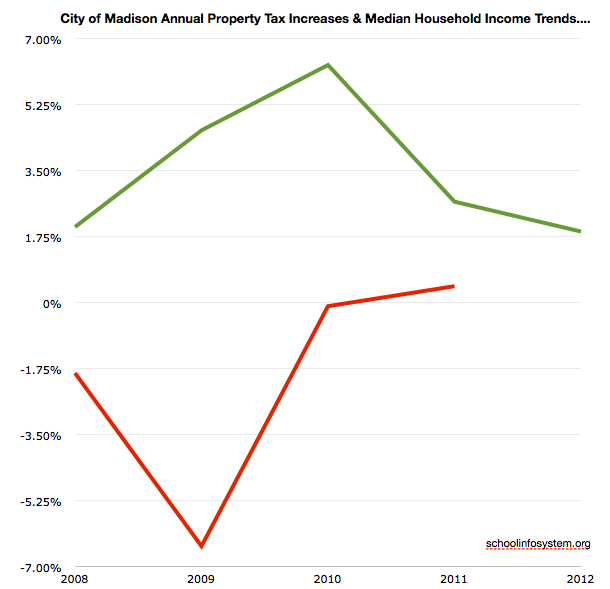
A Look at Property Taxes Around the World and Madison’s 16% increase since 2007; Median Household Income Down 7.6%; Middleton’s 16% less


Sources:
Department of Numbers.
City of Madison Assessor Reports
Related:
August, 2006 (Deja-vu): Property Taxes Outstrip Income.
Budget Cuts: We Won’t Be as Bold and Innovative as Oconomowoc, and That’s Okay.
Madison Schools’ 2013-2014 Budget Charts, Documents, Links, Background & Missing Numbers.
Madison’s long-term disastrous reading results.
The Hated Property Tax: Salience, Tax Rates, and Tax Revolts.
Levying the Land.
Revenue Potential and Implementation
Challenges (IMF PDF)
.
Tax Policy Reform and Economic Growth (OECD).
Stagnant School Governance; Tax & Spending Growth and the “NSA’s European Adventure”.


Analysis: Madison School District has resources to close achievement gap.
A Middleton home paid $4,648.16 in 2012 while a Madison home paid 16% more, or $5,408.38. Local efforts to significantly increase property taxes may grow the gap with Middleton..

Share

Football Needs A Guardian, Not A CEO

Frank DeFord:

Our other team sports — baseball, basketball, ice hockey, not to mention soccer — all have strong foreign elements. Football is the all-American game, but, ironically, already middle-class all-American parents ­­– even fathers who played themselves — are showing a reluctance to allow their sons to play

Share

Class struggle Hostility to free markets starts at school

The Economist:

BOTH relief and tears will greet the results of France’s school-leavingbaccalauréat exam on July 5th. With breathtaking efficiency, the entire country’s exam papers are corrected and marked within just two weeks. Founded in 1808 by Napoleon, the bac is an entry ticket to university as well as a yearly national ritual, which opens with a gruelling compulsory four-hour philosophy general paper that even scientists have to sit. This year the papers seem particularly revealing of how French youngsters are taught to view the world.
“What do we owe to the state?” was one essay option in the philosophy exam. In the economics and social science paper, pupils were asked to comment on a wealth-distribution table, showing that 10% of French households owned 48% of the country’s wealth, and then told to “demonstrate that social conflict can be a factor behind social cohesion”. We still have the mentality of the class struggle, says Nicolas Lecaussin, of the Institute of Fiscal and Economic Research (IREF), a think-tank, and author of a report on economics textbooks.

Share

Public education innovation — if not from the place that needs it most

Chris Rickert:

It might seem strange that it’s an overwhelmingly white, middle-class school district about one-seventh the size of Madison’s that is considering a strategy that could narrow the kind of long-standing achievement gap Madison is becoming known for.
It’s not. Heavily influenced by its host city’s brand of establishment liberalism, the Madison School District isn’t known for tinkering much with the sacred cow that is traditional public education.
But should that change, school leaders might be wise to take a gander 11 miles south.
The Oregon School District has a task force to look into converting one of its three elementary schools, Netherwood Knoll, to a year-round calendar — something no other public school in Dane County has.
Spreading the standard 180-day school year out over 11 or 12 months is an intriguing idea given the well-documented “summer learning loss” phenomenon.
Even more to the point, summer learning loss is most apparent among low-income, often minority, students, and recent research has shown that year-round learning can be of most benefit to them.
New Madison superintendent Jennifer Cheatham said through a spokeswoman that year-round school isn’t on the district’s radar.

Related: Budget Cuts: We Won’t Be as Bold and Innovative as Oconomowoc, and That’s Okay..

Share

The indebted ones Student debt risks becoming an enduring burden for young Americans. It should be lightened

The Economist:

STUDENT loans are based on a simple idea: that a graduate’s future flow of earnings will more than cover the costs of doing a degree. But with unemployment rates in parts of the rich world at post-war highs, that may no longer hold true for many people. The consequences will be felt by everybody.
All over the world student indebtedness is causing problems–witness this month’s violent protests in Chile (see article). In Britain, according to a recent parliamentary report, rising university fees mean that student debt is likely to treble to £70 billion by 2015. But, partly because higher education there is so expensive, the scale of the problem is far greater in America. When the next official estimates of outstanding student debt there are published, it is expected to be close to $1 trillion, higher than credit-card borrowing (see article). Credit quality in other classes of consumer debt has been improving; delinquency rates on student loans are rising.
Many of the anti-Wall Street protesters push the idea of blanket debt forgiveness as a solution. But that is the wrong answer. Higher education is not a guarantee of employment, but it improves the odds immensely. Unemployment rates among university graduates stood at 4.4% on average across OECD countries in 2009. People who did not complete secondary school faced unemployment rates of 11.5%. Much of the debt that students are taking on is provided or guaranteed by the government. Imposing write-offs on all taxpayers to benefit those with the best job prospects is unfair; and ripping up contracts between borrowers and private lenders is usually a bad idea.

Share

The silver-haired safety net More and more children are being raised by grandparents

The Economist:

BARACK OBAMA was raised by his grandparents for part of his childhood. He remembers his grandmother as being “tough as nails”. Clarence Thomas, a Supreme Court judge, was raised by his grandparents because his mother could not make ends meet. He called his grandfather “the greatest man I have ever known”. Grandparents have always reared children when need arose. Most have done it well. A few have done it badly–the late comedian Richard Pryor, who was raised by his grandmother in a brothel she owned, was constantly beaten.
What is new is that, as the nuclear family frays, grandparents are taking more and more of the strain. Of the 75m children in America, 5.5m live in households headed by grandparents, a number that has risen by almost a million since 2005, according to the Census bureau. Beware stereotypes. Child-rearing grandparents are disproportionately black, but in absolute terms most are white, live above the poverty line and own their own homes. When a parent loses a job or cannot pay the mortgage, many families move in with grandma. Sometimes, however, the parents have disappeared: an estimated 900,000 children are being raised solely by grandparents.

Share

Lessons from the first millionaire online teacher

Sarah Lacy:

Software programming? Yeah it’s an okay way to make a living. But the real money is in teaching.
Or at least that’s the recent experience of Scott Allen, a programmer and teacher the tech-y online education platform Pluralsight.com. Allen has earned more than $1.8 million through fees and royalties from Pluralsight over the last five years. He says each monthly royalty check has increased in size over that period — the smallest increase being 10 percent month-over-month. That far outdid his expectations when he started making educational videos for Pluralsight. “It’s amazing,” he says.
I got pitched this story this morning with the subject line “Online ed’s first millionaire teacher.” I was drawn to it, because I could imagine the same story being pitched about blogging or online journalism several years ago. There are a lot of parallels between what those two industries are going through, and how each are grappling with the Web’s potential for disruption.

Share

‘Designer babies’: the ultimate privileged elite?

Heather Long:

When the world looks back at how the “designer babies” trend began, they will see an innocent start. A Philadelphia couple who had gone through the physical and emotional marathon of trying to have a child turned to intra-uterine insemination and ultimately IVF. Like any rational people, they wanted to do everything to increase their chances that IVF would work. In this case, they sent the embryos to an Oxford lab, which ran a kind of minimal DNA test to see which embryos would be most likely to take.
It’s hard to deny this Philadelphia couple the chance to be parents. David Levy and Marybeth Scheidts look very wholesome in their family photo holding their son Connor, born in May 2013. They clearly weren’t trying to select the embryo with their preferred hair or eye color or other physical or mental traits. In fact, they didn’t even have a full DNA analysis done, only a scan of the chromosomes, the structures that hold genes. This isn’t Brave New World-esque test tube babies. It’s a traditional family – with the best of modern medicine.

Share

Honours without profits? A business school’s link-up with a private firm is an interesting case study

The Economist:

THE sort of people who go through business school, one might think, would have no problem with the idea of education being provided for a profit. But when Thunderbird, a struggling school based in Arizona, announced three months ago that it was planning a partnership with Laureate, an education company, there was uproar among its alumni and students. A petition calling for the deal to be halted has won almost 2,000 signatures. By “selling out”, Thunderbird’s management is diluting the school’s brand and cheapening its degrees, it says.
Thunderbird insists that the school itself, founded on a former air-force base after the second world war, will remain a non-profit. The partnership will be used to create foreign campuses, to expand the school’s online teaching and courses for executives, and to introduce undergraduate degrees. But a damning report on America’s for-profit higher-education firms, issued last year by a Senate committee, helps to explain the suspicions about the deal. It found that such institutions got $32 billion of student aid from the government in the 2009-10 academic year. They charge higher fees than state universities but spend less on teaching. Their drop-out rates are alarming: in 2008-09 the median student lasted just four months.

Share

Rising Early: Why Successful People Do It & How You Can Too

Eric Siu:

As a kid, waking up early used to be really tough. Especially for school. My mom would have to hound me at least 3 times each morning to get out of bed because I hated to wake up for something I didn’t really care for. When you grow a little older, things change. Especially as an entrepreneur. Your day becomes filled with different tasks to do and if you’re just starting out, you’re wearing multiple hats and jumping all over the place. And if you have a family, that’s another full time job for you. There’s just so many things happening that it’s hard to stay focused. So what’s the best way to really lock down on important tasks? Join The 5 a.m Club. Simply put, that means wake up at or around 5 a.m in the morning. Let’s look at some examples of people that rise early:

Share

College Girls, Bottled Water and the Emerging American Police State

John Whitehead:

What do college girls and bottled water have to do with the emerging American police state? Quite a bit, it seems.
Public outcry has gone viral over an incident in which a college student was targeted and terrorized by Alcohol Beverage Control agents (ABC) after she purchased sparkling water at a grocery store. The girl and her friends were eventually jailed for daring to evade their accosters, who failed to identify themselves or approach the young women in a non-threatening manner.
What makes this particular incident significant (other than the fact that it took place in my hometown of Charlottesville, Va.) is the degree to which it embodies all that is wrong with law enforcement today, both as it relates to the citizenry and the ongoing undermining of our rule of law. To put it bluntly, due in large part to the militarization of the police and the equipping of a wide range of government agencies with weaponry, we are moving into a culture in which law enforcement officials have developed a sense of entitlement that is at odds with the spirit of our Constitution–in particular, the Fourth Amendment.
The incident took place late in the evening of April 11, 2013. Several University of Virginia college students, including 20-year-old Elizabeth Daly, were leaving the Harris Teeter grocery store parking lot after having purchased a variety of foodstuffs for an Alzheimer’s Association sorority charity benefit that evening, including sparkling water, ice cream and cookie dough, when they noticed a man staring at them as they walked to their car in the back of the parking lot.

Share

7 ways that technology is transforming education, with Pearson’s chief digital officer

Martin Bryant:

This year’s The Next Web Conference Europe is already more than two months in the past and we’re looking forward to our forthcoming events in São Paulo andNew York City. To fill the gap, let’s take a look at a really interesting talk from our Amsterdam event.
Juan Lopez-Valcarcel is Chief Digital Officer at education and publishing companyPearson. In his talk, he noted that education is a $4 trillion industry – that’s three times bigger than the mobile industry. The opportunities for investors, technology companies, educators and (most importantly) learners are vast.
Lopez-Valcarcel took us through seven trends in the education technology space, from robot-assisted learning to international ‘rockstar’ teachers and beyond. Take a break for whatever you’re doing, grab a coffee and watch…

Share

Fancy college dorms, gyms don’t help draw applicants, research says

Jon Marcus:

Universities and colleges may be competing to build such perks as climbing walls and fancy dormitories, but the “arms race” over residence halls, food services, and fitness centers is having little effect on college applicants’ choices, new research shows.
Conducted before and after the economic downturn by economists Kevin Rask of Colorado College and Amanda Griffith of Wake Forest University, the research saysstudents are more interested in price and prestige than in amenities.
Families that do and do not qualify for financial aid are equally concerned about cost and reputation, particularly as measured by the U.S. News and World Report rankings, Rask and Griffith found after surveying high-achieving students in various income categories who started college between 2005 and the academic year just ended.

Share

New national curriculum to introduce fractions to five-year-olds

Richard Adams:

The education secretary Michael Gove’s efforts to revolutionise learning in England’s schools will see five-year-olds studying fractions and writing computer programs in their first year of school, according to final versions of the new national curriculum published on Monday.
Among the changes are a requirement for 3-D printers to be used in design and technology lessons, after major revisions to the subject’s curriculum.
According to a Whitehall source: “Three-dimensional printers will become standard in our schools – a technology that is transforming manufacturing and the economy. Combined with the introduction of programming, it is a big step forward from Labour’s dumbed-down curriculum.”

Share

How Technology Is Changing Education For Students With Disabilities

K Jackson:

Some people see computers as little more than gaming consoles and shopping tools. Recently developed electronics, however, have revolutionized education for children with disabilities. If you know a child with disabilities who is struggling, you might want to explore some of these devices.
Technology for Kids With Autism
Children with autism often don’t develop typical communication skills. It takes years and years of therapy for some of these children to start using simple language. Just because a child cannot speak does not mean that he or she doesn’t have something to say.
That’s where revolutionary electronics come in. For years, counselors have used picture cards to communicate with non-verbal children. Now, they can use some of these apps that let autistic kids express practically any thought or feeling. They just load the app on a laptop of your choice so the kids can point and click their way to expression.

Share

Trying to Influence the Mums

Chris Parr:

In days past, parents in Britain were often uninterested bystanders when it came to decisions about where their children would go to university. Now they are so important that student recruitment advertising is targeting them directly.
Online forum and social media network the Student Room has partnered with Mumsnet, the online forum for parents, to allow universities to aim advertising directly at parents and their children at the same time.
A marketing pitch by the Student Room sent to universities reads as follows: “Over the past year we’ve had the pleasure of talking to many of you about reaching the student market … but one thing we’ve been asked for time and again is ‘how can we reach the parents?’ So we’ve teamed up with … Mumsnet, to offer you a brilliant parent targeting solution.”
Jason Geall, managing director of the Student Room, said the traffic the site receives from parents has “grown substantially” over the past two years, with figures suggesting that there are more than 16,000 parents active on its forums – a 20 percent increase over the past 12 months. “In the parental market, we are seeing people coming on to the site for monitoring purposes: they are able to assess and understand what is being talked about before helping their children make informed decisions,” Geall said.

Share

Howard academic deans allege ‘fiscal mismanagement’

Nick Anderson:

Senior academic leaders at Howard University have charged that “fiscal mismanagement is doing irreparable harm” to the school in Northwest Washington and urged the dismissal of Howard’s chief financial officer, asserting that his actions have put its survival at risk.
Howard’s Council of Deans alleged that staff cuts at the university have been based on “inaccurate, misleading” data, lamented a decline in research expenditures and contended that a “burdensome” tuition increase has driven away students.
In a letter obtained by The Washington Post, the deans said Howard’s external auditor, PricewaterhouseCoopers, had cited “grave concern about the quality of fiscal decision-making” recently as it terminated its work for the university. Above all, the deans blamed the “fiscal direction” of Robert M. Tarola, an independent contractor who serves as the university’s senior vice president for administration, chief financial officer and treasurer.

Share

In defence of the ideal university: The battle for Cooper Union

The Independent:

Cooper Union in the USA was founded to offer ‘education equal to the best’ while staying ‘open and free to all’ – but this ideal is under threat from new management. This is the story of the students’ battle to keep their institution true to itself
Looking out over Manhatten, the occupiers at Cooper Union seem to have a pretty good setup. With the college president’s office now occupied for eight weeks, the protestors have made themselves into the school’s alternative administration.
Alumni have made key campaigners plaques for their desks, and the entrance to the space, formerly a reception area, now shows a proportion of the artwork and installations that the campaign has inspired. The message that education is a public good, and that it should be available to all regardless of finances, rings loud and true.
Cooper Union, founded in 1859 by Peter Cooper, was created to ensure that ‘education equal to the best’ was, and is, ‘open and free to all’. The university at present provides a full tuition scholarship to all its students, ensuring that at least in principle, the opportunity to study in the institution is not hindered by race, class or wealth. This ideal is core to both the campaign currently taking place, and also the beliefs of all those who I met during my time in New York.

Share

Why Teachers Should Play Minecraft–In Class

Joel Levin:

Dig, dig, dig. Break and build. Such are the simple, hallmark mechanics behind one of the world’s most popular indie games, Minecraft, which has sold an estimated 20 million copies across different platforms and consoles since its alpha release in 2009.
That includes copies at more than 1,400 schools across six continents, shared Joel Levin, the “Minecraft Teacher” who many accredit for bringing the game into the classroom. Levin, who teaches computer science at Columbia Grammar and Preparatory School in New York City, is the co-creator of MinecraftEDU, the official version of the game specifically tailored for teachers and students. His popular blog serves as a nexus of the Minecraft educator community.
“I see myself more as a gardener,” Levin humbly stated in an interview at the recent 2013 Games for Change Festival.”
And the garden that he’s nurtured has blossomed into a collection of colorful worlds, projects and contraptions of every imaginable scope and scale. Perhaps the grandest is the World of Humanities, made up of ancient cities and landmarks filled with additional readings, missions and quests for students. Its creator, Eric Walker, a teacher at the American School in Kuwait, has poured 600–and counting–hours into the project.

Share

The Devolution of American Higher Ed., A Quick Illustration

Scott Lemieux:

I was just reminded by Kathy Geier on FB and Twitter that when she was a student at Hunter College in the early 1990s, she took a comparative literature course with Philip Roth. According to Kathy, Roth had no TAs, designed the course himself, graded all the papers (and there was a lot of writing), and was paid reasonably.

Share

The Collapse of Science, Not Housing, Ended the American Dream

Dr. Douglas Fields:

The job of a scientist is to predict the future and get there first. We do this by looking for patterns in subtle clues; organizing the fragments thoughtfully to project their likely trajectory. It is this process that moves me to write this essay; in essence an epitaph from the future.
After giving a guest lecture at a departmental seminar in one of the nation’s leading medical schools a few weeks ago, I met with a group of eager graduate students and postdoctoral fellows over a lunch of sandwiches and chips as is customary for visiting speakers. I enjoy these sessions immensely as we go around the table and listen to each of the enthusiastic budding scientists share in turn their current research project with passion. This was an exceptionally bright and highly motivated group, but before any of us took a bite of lunch the meeting went off script. No one shared their research. Instead the group confessed fear. Uncertainty and bewilderment for the life choices they had made began to spill out.

I am more optimistic than Fields. continuing the practices of the past does not guarantee similar future results. there are certainly opportunities to re-think our spending priorities. Locally, we could and should eliminate programs such as the expensive and partially implemented Infinite Campus system, among others.

Share

Amid Tests and Tight Budgets, Schools Find Room for Arts

Jessica Siegel

Seventy-five 10th graders, who in other schools might ordinarily be texting, flirting, laughing, razzing each other, maybe even giving teachers a hard time, enter Laurie Friedman-Adler’s music classroom at Brooklyn College Academy (BCA) on Coney Island Avenue ready to play–and work. Members of the World Music Ensemble, they spend four days a week learning to play Indian tablas, Japanese taiko drums, African djembes, Native American flutes, Senagalese balaphones, Australian dijerydos, a banjo, a shofar, a harmonium and an Appalachian hammer dulcimer.
These are among the 150 instruments that Friedman-Adler, a professional clarinetist, has collected on travels around the world, and they are the tools for this remarkable orchestra and opportunity for musical development. Every year since 2003, Friedman-Adler and her students have spent a year working on a piece that she composes for a concert in June, melding together all these instruments.
While the World Music Ensemble would be remarkable if it existed in Great Neck, Scarsdale or Montclair, N.J., it is even more so here in New York City since, thanks to a variety of factors, arts and music programs are struggling in the schools, according to arts education advocates.
A combination of forces–budget cuts, the pressure on schools to focus on standardized tests, the elimination of dedicated funds for the arts, the replacement of large high schools with smaller schools with more limited budgets–have worked together to crowd the arts out of many schools. The trend makes a program like Friedman-Adler’s doubly amazing.

Share

Democrats testing the waters for Scott Walker challengers, including Madison School Board Member Mary Burke

Patrick Marley:

With a recently leaked poll, the first contours of the 2014 race for governor are coming into view.
Democrats have contended for months that they see Gov. Scott Walker as vulnerable, but they have not offered a candidate to run against him. But last month a poll was conducted testing the viability of Mary Burke, a former state commerce secretary and former Trek Bicycle Corp. executive.
The poll was conducted around the same time an unknown person registered five Burke-themed Internet addresses, such as BurkeForWisconsin.com and BurkeForGovernor.com. None of the websites are active.
Burke, who was elected to the Madison School Board last year, has not responded to interview requests since the poll surfaced in June. Mike Tate, the chairman of the state Democratic Party, issued a statement at the time saying Democrats were conducting polls for “several potential strong challengers” to Walker.
Democrats are hungry for a victory after Walker became the first governor in the nation’s history to survive a recall election last year. Republicans are equally motivated to keep him in office after having to elect him twice for one term.
Democratic strategists said Burke is seriously considering a run but has not made a final decision. They noted others could run, but they hoped to have just one candidate to avoid a Democratic primary.
Democrats said they liked Burke’s background in business and economic development — as well as the personal funds she could bring to the race — while Republicans pointed to her ties to former Gov. Jim Doyle and other issues as matters they could exploit.

Share

As schools slide into the red, could it be time for countywide districts?

Loti Higgins:

With a record number of school districts sinking into a deficit, and two districts possibly on their way to being dissolved, state Superintendent Mike Flanagan is urging drastic action — such as converting Michigan’s nearly 550 districts, 56 intermediate districts and nearly 280 charter schools into countywide school districts.
If that can’t be done right away, he said, the state should give more power to intermediate school districts so operations such as transportation and food services can be consolidated.
Flanagan predicted that countywide districts or his hybrid option could save millions — money he said could be used to teach students. But little, if any, research supports his position, a fact that’s drawing concern from educators and others.
Don Wotruba, deputy director of the Michigan Association of School Boards, said his organization is open to discussing the idea. But, he said, a one-size-fits-all mandate isn’t the way to go.

Share

Voucher schools don’t always take special needs students

Rory Linnane:

Kim Fitzer’s daughter, Trinity, was attending kindergarten at Northwest Catholic School in Milwaukee with a voucher from the state for the 2011-12 school year. But Trinity, then 6, had gastrointestinal problems and anxiety — conditions that Fitzer said the private school was ill-equipped to address.
Fitzer said the school repeatedly called her to pick up Trinity, saying she was “out of control.” After Trinity knocked papers to the floor and kicked a teacher who tried to restrain her, Fitzer was told the girl was no longer welcome at the school.
Northwest Catholic Principal Michelle Paris said in an email statement that “every decision was made in the very best interest of the child with mutual agreement of our school leadership and the parent.”
But Fitzer said it was not her decision, and she “didn’t have an option.”
Trinity transferred to a Milwaukee public school, where she has received special education services that address her anxiety as a disability.
Under the state’s parental choice program, Northwest Catholic received a $6,442 voucher for Trinity’s enrollment in the private school, but the public school got no extra money for taking her through the end of the school year. Critics of school choice, and a pending federal lawsuit, charge that students with disabilities, such as Trinity, are being underserved by publicly funded vouchers meant to give low-income students in Milwaukee and Racine the chance of a private education.

Much more on the Wisconsin Center for Investigative Journalism

Share

K-12 Tax & Spending Climate: Health care in America is ludicrously expensive


The Economist:.

Share

Education At a Glance: OECD Indicators 2013


OECD PDF

Governments are paying increasing attention to international comparisons as they search for effective policies that enhance individuals’ social and economic prospects, provide incentives for greater efficiency in schooling, and help to mobilise resources to meet rising demands. As part of its response, the OECD Directorate for Education and Skills devotes a major effort to the development and analysis of the quantitative, internationally comparable indicators that it publishes annually in Education at a Glance. These indicators enable educational policy makers and practitioners alike to see their education systems in light of other countries’ performance and, together with the OECD country policy reviews, are designed to support and review the efforts that governments are making towards policy reform.
Education at a Glance addresses the needs of a range of users, from governments seeking to learn policy lessons to academics requiring data for further analysis to the general public wanting to monitor how its country’s schools are progressing in producing world-class students. The publication examines the quality of learning outcomes, the policy levers and contextual factors that shape these outcomes, and the broader private and social returns that accrue to investments in education.
Education at a Glance is the product of a long-standing, collaborative effort between OECD governments, the experts and institutions working within the framework of the OECD Indicators of Education Systems (INES) programme and the OECD Secretariat.

Related: www.wisconsin2.org

Share

Chicago’s Harper High School

This American Life:

We spent five months at Harper High School in Chicago, where last year alone 29 current and recent students were shot. 29. We went to get a sense of what it means to live in the midst of all this gun violence, how teens and adults navigate a world of funerals and Homecoming dances. We found so many incredible and surprising stories, this show is a two-parter; you can listen to Part Two here.

Share

A Game-Changing Education Book from England

Our educators now stand ready to commit the same mistakes with the Common Core State Standards. Distressed teachers are saying that they are being compelled to engage in the same superficial, content-indifferent activities, given new labels like “text complexity” and “reading strategies.” In short, educators are preparing to apply the same skills-based notions about reading that have failed for several decades.
E. D. Hirsch, Jr.

A British schoolteacher, Daisy Christodoulou, has just published a short, pungent e-book called Seven Myths about Education. It’s a must-read for anyone in a position to influence our low-performing public school system. The book’s focus is on British education, but it deserves to be nominated as a “best book of 2013″ on American education, because there’s not a farthing’s worth of difference in how the British and American educational systems are being hindered by a slogan-monopoly of high-sounding ideas–brilliantly deconstructed in this book.
Ms. Christodoulou has unusual credentials. She’s an experienced classroom teacher. She currently directs a non-profit educational foundation in London, and she is a scholar of impressive powers who has mastered the relevant research literature in educational history and cognitive psychology. Her writing is clear and effective. Speaking as a teacher to teachers, she may be able to change their minds. As an expert scholar and writer, she also has a good chance of enlightening administrators, legislators, and concerned citizens.
Ms. Christodoulou believes that such enlightenment is the great practical need these days, because the chief barriers to effective school reform are not the usual accused: bad teacher unions, low teacher quality, burdensome government dictates. Many a charter school in the U.S. has been able to bypass those barriers without being able to produce better results than the regular public schools they were meant to replace. No wonder. Many of these failed charter schools were conceived under the very myths that Ms. Christodoulou exposes. It wasn’t the teacher unions after all! Ms. Christodoulou argues convincingly that what has chiefly held back school achievement and equity in the English-speaking world for the past half century is a set of seductive but mistaken ideas.
She’s right straight down the line. Take the issue of teacher quality. The author gives evidence from her own experience of the ways in which potentially effective teachers have been made ineffective because they are dutifully following the ideas instilled in them by their training institutes. These colleges of education have not only perpetuated wrong ideas about skills and knowledge, but in their scorn for “mere facts” have also deprived these potentially good teachers of the knowledge they need to be effective teachers of subject matter. Teachers who are only moderately talented teacher can be highly effective if they follow sound teaching principles and a sound curriculum within a school environment where knowledge builds cumulatively from year to year.
Here are Ms Christodoulou’s seven myths:
1 – Facts prevent understanding
2 – Teacher-led instruction is passive
3 – The 21st century fundamentally changes everything
4 – You can always just look it up
5 – We should teach transferable skills
6 – Projects and activities are the best way to learn
7 – Teaching knowledge is indoctrination
Each chapter follows the following straightforward and highly effective pattern. The “myth” is set forth through full, direct quotations from recognized authorities. There’s no slanting of the evidence or the rhetoric. Then, the author describes concretely from direct experience how the idea has actually worked out in practice. And finally, she presents a clear account of the relevant research in cognitive psychology which overwhelmingly debunks the myth. Ms. Christodoulou writes: “For every myth I have identified, I have found concrete and robust examples of how this myth has influenced classroom practice across England. Only then do I go on to show why it is a myth and why it is so damaging.”

This straightforward organization turns out to be highly absorbing and engaging. Ms. Christodoulou is a strong writer, and for all her scientific punctilio, a passionate one. She is learned in educational history, showing how “21st-century” ideas that invoke Google and the internet are actually re-bottled versions of the late 19th-century ideas which came to dominate British and American schools by the mid-20th century. What educators purvey as brave such as “critical-thinking skills” and “you can always look it up” are actually shopworn and discredited by cognitive science. That’s the characteristic turn of her chapters, done especially effectively in her conclusion when she discusses the high-sounding education-school theme of hegemony:

I discussed the way that many educational theorists used the concept of hegemony to explain the way that certain ideas and practices become accepted by people within an institution. Hegemony is a useful concept. I would argue that the myths I have discussed here are hegemonic within the education system. It is hard to have a discussion about education without sooner or later hitting one of these myths. As theorists of hegemony realise, the most powerful thing about hegemonic ideas is that they seem to be natural common sense. They are just a normal part of everyday life. This makes them exceptionally difficult to challenge, because it does not seem as if there is anything there to challenge. However, as the theorists of hegemony also realised, hegemonic ideas depend on certain unseen processes. One tactic is the suppression of all evidence that contradicts them. I trained as a teacher, taught for three years, attended numerous in-service training days, wrote several essays about education and followed educational policy closely without ever even encountering any of the evidence about knowledge I speak of here, let alone actually hearing anyone advocate it….For three years I struggled to improve my pupils’ education without ever knowing that I could be using hugely more effective methods. I would spend entire lessons quietly observing my pupils chatting away in groups about complete misconceptions and I would think that the problem in the lesson was that I had been too prescriptive. We need to reform the main teacher training and inspection agencies so that they stop promoting completely discredited ideas and give more space to theories with much greater scientific backing.


The book has great relevance to our current moment, when a majority of states have signed up to follow new “Common Core Standards,” comparable in scope to the recent experiment named “No Child Left Behind,” which is widely deemed a failure. If we wish to avoid another one, we will need to heed this book’s message. The failure of NCLB wasn’t in the law’s key provisions that adequate yearly progress in math and reading should occur among all groups, including low-performing ones. The result has been some improvement in math, especially in the early grades, but stasis in most reading scores. In addition, the emphasis on reading tests has caused a neglect of history, civics, science, and the arts.
Ms. Christodoulou’s book indirectly explains these tragic, unintended consequences of NCLB, especially the poor results in reading. It was primarily the way that educators responded to the accountability provisions of NCLB that induced the failure. American educators, dutifully following the seven myths, regard reading as a skill that could be employed without relevant knowledge; in preparation for the tests, they spent many wasted school days on ad hoc content and instruction in “strategies.” If educators had been less captivated by anti-knowledge myths, they could have met the requirements of NCLB, and made adequate yearly progress for all groups. The failure was not in the law but in the myths.

Our educators now stand ready to commit the same mistakes with the Common Core State Standards. Distressed teachers are saying that they are being compelled to engage in the same superficial, content-indifferent activities, given new labels like “text complexity” and “reading strategies.” In short, educators are preparing to apply the same skills-based notions about reading that have failed for several decades.

Of course! They are boxed in by what Ms. Christodoulou calls a “hegemonic” thought system. If our hardworking teachers and principals had known what to do for NCLB– if they had been uninfected by the seven myths–they would have long ago done what is necessary to raise the competencies of all students, and there would not have been a need for NCLB. If the Common Core standards fail as NCLB did, it will not be because the standards themselves are defective. It will be because our schools are completely dominated by the seven myths analyzed by Daisy Christodoulou. This splendid, disinfecting book needs to be distributed gratis to every teacher, administrator, and college of education professor in the U.S. It’s available at Amazon for $9.99 or for free if you have Amazon Prime.

Share

A 4th of July reflection on student intellectual autonomy

Grant Wiggins:

I recall my son, Ian, as a 4-year-old, pondering which ‘work’ to do that day, on the way to school: food work? sewing work? Or Drawing? Well, why might you choose one or the other today? I asked. And he proceeded to do a cute think-aloud with little furrowed brow, about the pros and cons (based on recent choices and skill deficits).
Fast forward: grown-up Ian has lost 2 room-mates as he begins senior year in college this coming fall. Why did they leave? They were unable to handle the complete freedom to set their schedule and honor their obligations.
What is wanted in education is a curriculum and assessment system that builds in, by design, a gradual release of teacher responsibility across the long-term scope and sequence. Traditional curriculum design runs completely counter to this idea, of course: the work gets harder and harder but the student has practically no executive control over the intellectual agenda up until graduation.
Making matters worse, a number of people have wrongly interpreted the Gradual Release model to say that the last step is called “Independent Practice.” This is utterly misguided. Independent practice is still scaffolded, prompted, and simplified activity in which the student knows full well what single move we want them to use. There is no strategic thinking or executive control needed. The acid test of autonomy therefore, arrives when students confront a genuine challenge requiring thought, and no advice about strategy or technique is provided or hinted at.

Share

Essay by a teacher in a black high school

Posted on Craigslist, St. Louis

The truth is usually a tough thing to accept, so I understand if this is flagged. It would be a cowardly thing to do, but I understand it. Some people just ignore unpleasant truths. However, if you think ignoring the problem, or trying to censor the truth, will help our black children improve, you’re dreaming. This is important, so I’m happy to repost – indefinitely if necessary. I find it interesting that NO ONE has had the intellect to refute anything in the essay. They can only attempt to censor it, as if doing so somehow makes it invalid. Weak minds, weak minds.
Until recently I taught at a predominantly black high school in a southeastern state.
The mainstream press gives a hint of what conditions are like in black schools, but only a hint. Expressions journalists use like “chaotic” or “poor learning environment” or “lack of discipline” do not capture what really happens. There is nothing like the day-to-day experience of teaching black children and that is what I will try to convey.
Most whites simply do not know what black people are like in large numbers, and the first encounter can be a shock.
One of the most immediately striking things about my students was that they were loud. They had little conception of ordinary decorum. It was not unusual for five blacks to be screaming at me at once. Instead of calming down and waiting for a lull in the din to make their point — something that occurs to even the dimmest white students — blacks just tried to yell over each other.

Share

Real classrooms: Teacher education must emphasize the practical

Pittsburgh Post-Gazette:

An abundance of research shows that teacher quality is the single most important determinant of student learning. It’s also the conclusion of a report by the National Council on Teacher Quality — part of a project funded by major U.S. foundations.
Unfortunately, the same report found that colleges and their schools of education do a poor job of training teachers and preparing them for real-life challenges in the classroom.
“We don’t know how to prepare teachers,” says Arthur Levine, former president of Columbia University Teachers College. “We can’t decide whether it’s a craft or a profession.” Mr. Levine blames low admission standards, less-than-relevant academic work and an out-of-touch faculty in schools of education — some of whom haven’t set foot in a school for years.
Part of the problem is that the teaching profession does not attract, in general, the nation’s most talented students. Less than one in four of U.S. teachers graduated in the top third of their high school class, the report states, compared to 100 percent in Singapore and Finland.

Related: NCTQ 4-3-2-1 Star-Rating of University Teacher Preparation Programs in the USA: “the evaluations provide clear and convincing evidence, based on a four-star rating system, that a vast majority of teacher preparation programs do not give aspiring teachers…. Much more on the NCTQ teacher preparation report, here.

Share

Madison lawyer battling voter ID, Act 10 says ‘facts still matter’

Bill Glauber:

ines helped spearhead the legal challenge against Act 10, which curtailed collective bargaining for most public sector workers. In a case involving Madison Teachers Inc. and Public Employees Local 61 in Milwaukee, a Dane County circuit judge struck down portions of the law.The case now goes to the state Supreme Court.
In another case involving Pines and Madison Teachers Inc., a Dane County judge struck down a portion of a law that gave Walker the power to veto rules written by the state schools superintendent. The case is now before the 4th District Court of Appeals in Madison.
Pines, representing the League of Women Voters, successfully argued in front of a Dane County judge that the state’s voter ID law violated the Wisconsin Constitution. The decision was overturned by the 4th District Court of Appeals, and the league has petitioned the Supreme Court to review the ruling. The voter ID measure remains on hold because of a ruling in a separate case.
“I believe that my law firm — because of the position we’re in and because of the work we’ve done — has disrupted the (Walker) agenda by using appropriate means and calling on the third equal branch of government (the court) to stop the majoritarian and authoritarian impulses of this Legislature,” he says.
The outcome of the cases is far from certain. But one thing is clear: Pines will keep up the fight.

Much more on Act 10, here.

Share

Stagnant School Governance; Tax & Spending Growth and the “NSA’s European Adventure”

The Madison School District’s recent rhetoric around annual property tax increases (after a significant increase in redistributed state tax dollars last year and a “return to normal” this year) is, to the ongoing observer, unsurprising. We appear to be in the Rainwater era “same service” approach to everything, from million$ spent on a partially implemented Infinite Campus to long-term disastrous reading scores.
Steve Coll’s 5 July 2013 New Yorker column nails it:

The most likely explanation is that President Obama never carefully discussed or specifically approved the E.U. bugging, and that no cabinet-level body ever reviewed, on the President’s behalf, the operation’s potential costs in the event of exposure. America’s post-September 11th national-security state has become so well financed, so divided into secret compartments, so technically capable, so self-perpetuating, and so captured by profit-seeking contractors bidding on the next big idea about big-data mining that intelligence leaders seem to have lost their facility to think independently. Who is deciding what spying projects matter most and why?

Much more on annual local property tax increases, here:

The Madison School Board should limit the school property tax hike to the rate of inflation next year, even if that means scaling back a proposed 1.5 percent across-the-board salary increase for school district employees, says member Mary Burke.
“I think in an environment where we’ve seen real wages in Dane County decrease, and a lot of people are on fixed incomes, we have to work as hard as possible to limit any increase to the inflation rate,” Burke said Tuesday in an interview.

But School Board discussions have focused around reducing the proposed salary hike, and cutting back on facility maintenance to pare down the $392 million proposed budget enough to bring the property tax increase to 4 or 5 percent, board President Ed Hughes told me.
The district under state law could increase its levy by as much as $18,385,847 or 9 percent. Keeping the increase to around the rate of inflation would mean an increase of less 2 percent.

Board member TJ Mertz can’t vote on salaries because his wife is a teacher’s aide with the school district, he told me, but he has long been outspoken in his belief in good pay for teachers to ensure the best academic achievement for students.
“As a citizen, I understand our staff needs to be compensated,” he said, adding that teachers have taken losses in take-home pay since they were required to begin making contributions to their pensions in 2011. “If the state won’t invest in our children, it has to come from the property tax,” he said.
Mertz said he would prefer a tax increase steeper than the 4 percent or 5 percent the board as a whole is focusing on. “I firmly believe the most important thing we can do is invest in our students; the question should not be what property tax levy can we afford,” he said.

I appreciate Schneider’s worthwhile questions, including a discussion of “program reviews”:

Several School Board members interviewed for this story stressed that the 2013-2014 budget will be a transitional one, before a broad re-evaluation of spending planned by Cheatham can be conducted.

Yet, it would be useful to ask if in fact programs will be reviewed and those found wanting eliminated. The previous Superintendent, Dan Nerad, discussed program reviews as well.
Madison Schools’ 2013-2014 Budget Charts, Documents, Links, Background & Missing Numbers.
The Madison School Board seat currently occupied by Mr. Hughes (Seat 7, and Seat 6 – presently Marj Passman) will be on the Spring, 2014 ballot (candidate information is available at the Madison City Clerk’s website).


Share

What’s the most critical component to reform education in West Virginia?

Glynis Board:

“Any changes in education–such as the single-sex classes or the calendar–have to work with what’s in the community. We have to stop a single curriculum where we’re teaching everyone to be an engineer in college. We have to adjust our curriculum so that it meets the needs of every student. But those are decisions that the community and the individual schools should be making.”
Lee maintains that statewide efforts to improve education should be focused on how to keep quality teachers in the state. He says the quality of education we deliver, with diversified curriculums, using digital learning tools, and reaching every student, will follow suit.
“Education in West Virginia is at a real crisis point. We have to have reform that is educator-lead and educator-driven. Teachers are the expert in public education. They know the direction that we need in the classroom.”

Share

Dixon School of the Arts converting to private school next year

weartv.com:

The Dixon School of the Arts, in Pensacola, is no longer a charter school. Dixon opened three years ago, but has received failing grades from the state. More failing grades were expected this year, and that would have forced its closure by the state. So, the board of directors announced today it will become a private school, and K through 6th grade enrollment will be limited.
As Amber Southard reports,the move means the school is no longer eligible for full funding from the state, and no longer subject to the same rules as public schools. “The students that attend the new private school will have to follow a code of conduct that will allow the teaching of church in the classroom.” Board members say becoming a private school will allow them to teach religion and try to get families more involved in the students education. Lutimothy May “We can use those values as core values to teach our children about their self worth and how to operate in a world that is diverse.”

Share

Red Balloon School In Brazil Helps Students Learn English By Correcting Celebrities’ Grammar On Twitter

Huffington Post

In an awesome attempt to help its students learn English, a school in Brazil named Red Balloon challenged a group of eight to 13-year-olds to play “grammar cops” for their favorite celebrities on Twitter. The kids picked out grammatically incorrect tweets from big-name stars like Justin Bieber and Paris Hilton and responded directly with their edits. The results were, unsurprisingly, hilarious and wonderful.
Check out a sampling, below, and watch the video above to learn more about the creative school project.

Share

School choice and ability grouping

John Merrfield

For years, it was lost in the wreckage from the crash of the politically incorrect “tracking” of students. But now, the worthy concept of “ability grouping” is making a comeback. A June 9 New York Times article on its resurgence is good news, but in the current public school system the much-needed ability grouping by subject is especially costly, with a very a limited upside. If parents had more freedom to choose within a system that could easily diversify its instructional offerings in response to families’ interests and needs, the power and attractiveness of the concept would be much greater.
Unlike tracking, which assumes an across-the-board, one-dimensional level of student ability – i.e., students are uniformly brilliant, average, or slow – ability grouping by subject recognizes children have strengths and weaknesses. Strengths probably correlate with interest/talent, so in a system of genuine school choices, parents recognizing those interest/talents would tend to enroll their children in schools specializing in those particular areas. They’d be in classrooms with children who are similarly passionate and able to progress at similar, fast rates. And, likewise, for necessary subject matter in which they are not as adept, again, they’d be in a room and school building full of kids more similar to them. Stigma gone; no self-esteem threat.

Related: English 10.

Share

Is Grammar Necessary? The (Passive) Voice From The Past

Professor Baker:

Is grammar necessary? It’s an old question, and if a glance is taken, quite casually, at the textbooks on the market nowadays, there would be a unanimous verdict: Grammar is necessary.
Our textbooks are full of grammar, our readers are full of grammar. Thus, grammar is necessary. Case closed. Grammar is necessary.
Even the passive voice, it’s necessary, despite those who would try to live without it. I mean, try being born without the passive voice. Which phrase feels more comfortable to you?
1. I was born in (year). – Passive Voice
or
2. My mother gave birth to me in (year). – Active Voice

Share

Cleveland school district plans staff changes, training and new approaches for 13 ‘Investment Schools’

Patrick O’Donnell:

The Cleveland school district’s improvement plan for 13 schools this upcoming school year will bring major changes for some and smaller, but substantial, ones for others.
Teachers will receive special training at all 13 schools, some of which will get new principals and see significant staff changes. And a few of the schools will have outside agencies come in to give the schools new styles and approaches.
All together, the district is spending more than $2 million this upcoming year on staff training and outside help to try to improve these schools, which the district has labeled “Investment Schools.”
“We’re looking to have 13 different plans for 13 unique needs,” said Eric Gordon, the district’s chief executive officer.
More changes are in the works. After the district met with staff, parents and community leaders at each of the schools in May, schools will host additional meetings over the summer to refine the plans.

Cleveland spent $15,072 per student during the 2012-2013 budget year, similar to Madison’s spending.

Share

Teaching Computers Shows Us How Little We Understand About Ourselves

Cory Doctorow:

A quote variously attributed to Richard Feynman and Albert Einstein has it that ”If you can’t explain it to a six year old, you don’t really understand it.” Most of us have encountered this in our lives: you think you really know something and understand it, and then you try to teach it and realize that you never understood it in the first place.
Computers are the children of the human race’s mind, and as they become intimately involved in new aspects of our lives, we keep stumbling into semantic minefields, where commonly understood terms turn out to have no single, well-agreed-upon meaning across all parts of society. These conflicts all have a quiet drama, because on the definition of these ”commonly understood” terms turns questions of social control with profound implications for our human lives.
Take names. When Google rolled out its Facebook-a-like service Google Plus in 2011, it stirred up controversy by declaring that it would adopt Facebook’s ”real name” policy, meaning that its users would be expected to use their real, legal names in their online interactions. Google offered a lot of explanations for this policy – mostly revolving around reducing cruel behavior and spamming – and opponents of the idea offered their own arguments in response. Some pointed out that they were widely known by a name other than the one on their legal documents; others wanted the ability to socialize without making their real identities visible to violent stalkers; refugees from oppressive regimes raised the spectre of retaliation against their in-country relatives if they participated in visible online debates under their real names.

Share

State Aid picture remains rosy for Sun Prairie

sp-eye:

The Department of Public Instruction (DPI)’s July 1 estimate of state aid for the 2013-14 school year shows Sun Prairie getting 10.98% MORE aid than last year.
The most current budget estimates projected we’d receive a 10% increase over last year.
The net effect is that the district is receiving $3.8M more than last year, and $382K more than projected.
Let the spending begin!

Share

District-Charter Collaboration Compact: Interim Report

Sarah Yatsko, Elizabeth Cooley Nelson, Robin Lake, via a kind Deb Britt email:

The Center on Reinventing Public Education (CRPE), with funding from the Bill & Melinda Gates Foundation, has been monitoring, supporting, and analyzing the cross-sector collaborative work undertaken in 16 District-Charter Compact cities. CRPE tracks progress on agreements and reports on local political, legal, and financial barriers to collaboration, and also facilitates networking and problem-solving among participants. Using data and documents from interviews with district and charter leaders, this interim report details the first two years of Compact work and finds evidence that these cities have made mixed progress on a number of fronts, such as facilities sharing, equitable funding for charter schools, more high-performing schools, and improved access to high-quality special education. But challenges like leadership transitions, local anti-charter politics, and key leaders’ unwillingness to prioritize time and resources for implementation have thwarted efforts in some cities. The report includes key Compact agreements and measurements of progress for each city, plus a checklist for district and charter leaders considering a collaboration Compact.

Share

Dutch iPad Schools Seek to Transform Education

Marco Evers:

Plenty of schools use iPads. But what if the entire education experience were offered via tablet computer? That is what several new schools in the Netherlands plan to do. There will be no blackboards or schedules. Is this the end of the classroom?
Think different. It was more than an advertising slogan. It was a manifesto, and with it, former Apple CEO Steve Jobs upended the computer industry, the music industry and the world of mobile phones. The digital visionary’s next plan was to bring radical change to schools and textbook publishers, but he died of cancer before he could do it.
Some of the ideas that may have occurred to Jobs are now on display in the Netherlands. Eleven “Steve Jobs schools” will open in August, with Amsterdam among the cities that will be hosting such a facility. Some 1,000 children aged four to 12 will attend the schools, without notebooks, books or backpacks. Each of them, however, will have his or her own iPad.
There will be no blackboards, chalk or classrooms, homeroom teachers, formal classes, lesson plans, seating charts, pens, teachers teaching from the front of the room, schedules, parent-teacher meetings, grades, recess bells, fixed school days and school vacations. If a child would rather play on his or her iPad instead of learning, it’ll be okay. And the children will choose what they wish to learn based on what they happen to be curious about.
Preparations are already underway in Breda, a town near Rotterdam where one of the schools is to be located. Gertjan Kleinpaste, the 53-year-old principal of the facility, is aware that his iPad school on Schorsmolenstraat could soon become a destination for envious — but also outraged — reformist educators from all over the world.
And there is still plenty of work to do on the pleasant, light-filled building, a former daycare center. The yard is littered with knee-deep piles of leaves. Walls urgently need a fresh coat of paint. Even the lease hasn’t been completely settled yet. But everything will be finished by Aug. 13, Kleinpaste says optimistically, although he looks as though the stress is getting to him.

Share

Wisconsin Governor Scott Walker: Future voucher expansion should be based on student performance

Matthew DeFour:

“If the students are performing at or better than they were in the schools they came from, then that would be a compelling case to offer more choices like that to more families across the state,” Walker said. “If the majority are not performing better, you could make a pretty compelling argument not to.”
Sen. Luther Olsen, R-Ripon, chairman of the Senate Education Committee, said work on an accountability bill is wrapping up and he hopes it will begin circulating for sponsors by the end of this month. He hopes hearings will be held in late summer and early fall with a bill sent to the governor by the end of the year.
“I hope that everyone comes away happy that this is the right thing to do,” Olsen said. “The voucher people want a bill like this because they’re only as good as their weakest school.”
Olsen said the bill will not only apply the report card system to schools participating in the voucher program, it will also make changes to the report card for public schools.
The report card released last fall didn’t measure high school student growth, because it was based on one test taken in 10th grade. The state budget the governor signed Sunday expands high school testing to grades nine and 11. The accountability bill will ensure future report cards include those tests, Olsen said.
Democrats have been skeptical that Republicans will follow through on holding private voucher schools accountable. Earlier this year Senate Minority Leader Chris Larson, D-Milwaukee, compared talk of a bill to Lucy pulling the football away from Charlie Brown.
In February, Walker told the State Journal editorial board that he hoped to sign a voucher school accountability bill before the budget was approved. That didn’t happen, but Walker said there was push back from the Legislature.

Much more on vouchers, here.

Share

Adjunct Professors and the Modern Guild

James Otteson:

An article on the plight of adjunct professors in higher education, “Labor of Love or Cheap Labor? The Plight of Adjunct Professors,” was brought to my attention by its author, Celine James. Ms. James kindly asked me for my thoughts about her article. I thought Pileus readers might be interested in what I sent her. Here it is in full:

Dear Celine,
I have had a chance to read your article. I empathize with the plight of adjunct instructors that you describe. It is, or can be, a terribly difficult life. I am afraid, however, that I cannot endorse the solution you suggest, namely unionization.
Higher education is operated like a medieval guild, with special protections for the lucky few who make it in and special benefits to them that come at the expense of all those who were not lucky enough to get in. The problem is the rigidity in the labor market that this creates: once a person is in, he or she cannot be fired, regardless of performance, for life.That is a great deal for those who get in, and it explains why so many try so desperately hard to get in, but it is a model for maintaining an unjust, and slowly dying, status quo rather than responding to changing economic realities we actually face.
The solution would be not to extend the guild system to a slightly larger cohort, but, rather, to abandon it altogether. In other words, we should abolish the tenure system. In a world with thousands of institutions of higher education, along with now an almost unlimited upper bound of educational opportunities online, there can be no justification for the economically stifling and restricting system of guild benefits for a privileged elite.

Share

I Used To Think … And Now I Think (Part 2)

Larry Cuban:

I published Part 1 about how my ideas about school reform have changed over the past half-century. Here is Part 2.
***************************************************************************
I used to think that structural reforms (e.g., creating non-graded schools; new district and school site governance structures; novel technologies; small high schools with block schedules, advisories, and student learning communities) would lead to better classroom instruction.And now I think that, at best, such structural reforms may be necessary first steps toward improving instruction but are (and have been) seldom sufficient to alter traditional teaching practices.
In teaching nearly 15 years, I had concluded that policies creating new structures (see above examples) would alter common teaching practices which, in turn, would get students to learn more, faster, and better.
I revised that conclusion, albeit in slow motion, as I looked around at how my fellow teachers taught and began to examine my own classroom practices. I reconsidered the supposed power of structures in changing teaching practices after I left the classroom and began years of researching how teachers have taught following the rainfall of progressive reforms on the nation’s classrooms in the early 20th century and similar showers of standards-based, accountability-driven reforms in the early 21st century.[i]

Share

An Oregon Plan to Eliminate Tuition & Loans at State Schools

Richard Perez-Pena:

Going to college can seem like a choice between impossibly high payments while in school or a crushing debt load for years afterward, but one state is experimenting with a third way.
This week, the Oregon Legislature approved a plan that could allow students to attend state colleges without paying tuition or taking out traditional loans. Instead, they would commit a small percentage of their future incomes to repaying the state; those who earn very little would pay very little.
The proposal faces a series of procedural and practical hurdles and will not go into effect for at least a few years, but it could point to a new direction in the long-running debate over how to cope with the rising cost of higher education. While the approach has been used in Australia, national education groups say they do not know of any university in the United States trying it.

Share

Five Complications for Common Core Education Standards

Mike McShane:

Last week, Secretary of Education Arne Duncan gave a speech to the Society of News Editors that Education Week called “The strongest defense yet of Common Core Standards.”
In it, he said that the Common Core – educational standards that are being adopted by most states – “has become a rallying cry for fringe groups,” that opposition has been “misguided” and “misinformed” and that legislation in state houses across the country aimed at stopping the standards is “based on false information.”
While it is true that some criticism of the Common Core has been over the top, it is also true that the Common Core does not have to be a malign conspiracy to be problematic.
Even if you believe that the standards are a “boon” for schools, as the Washington Post’s and USA Today’s editorial boards do, it is important to recognize that the Common Core’s ultimate success will hinge on its implementation. As such, several issues loom large.

Share

Little or no increased risk of autism in IVF treatments, study finds

Alok Jha:

IVF treatments that require the direct injection of sperm into the egg are associated with a small increased risk of intellectual disability in the resulting children, according to a study.
Scientists also found that standard IVF treatment posed no increased risk of children developing intellectual disabilities or autism.
IVF is considered generally safe. About 4% of IVF children have physical or mental problems at birth, compared with 3% of those conceived naturally.
In the latest study, the largest so far into links between reproductive treatments and neurodevelopment, scientists examined how IVF might affect the incidence of autism and intellectual disability.

Share

The Ever-Changing NAEP Sample

Matt DiCarlo:

Next, by grade: In 1978, 28 percent of NAEP-LTT test takers were in 7th grade or lower, compared with 39 percent in 2012. Although standards and curriculum are different today, it’s worth noting that the 13-year old sample has changed as far as where they are in the K-12 system.
Third, there is the difference in parental education. The proportion of the 2012 sample with parents who completed college is over twice as high (54 percent) as in 1978 (26 percent). Conversely, the percentage of 13-year olds with parents who have a high school diploma or less is half its 1978 level. Again, some of this change is recent – for example, the proportion with a high school diploma or less was 27 percent in 1999, compared with 20 percent in 2012.
In short, the student population, and thus the NAEP samples, are changing, over the short- and longer terms. Any concurrent changes in testing performance may just as easily be due to these and many other shifts in the characteristics of the test takers- including unobservable factors that cannot be gleaned from breakdowns by subgroup – as to any change in school performance. This most certainly does not mean that schooling quality is unimportant, only that raw NAEP scores by themselves do not measure it very well, and they’re not supposed to.

Share

And the Looting of Public Institutions Continues

Scott Lemieux:

Not all adjuncts at CUNY are being paid at subsistence level:
David H. Petraeus will earn a $150,000 salary when he joins the City University of New York’s Macaulay Honors College this fall as a visiting professor of public policy, according to documents obtained by the Web site Gawker through a public-records request.
Shall we make the obvious comparison? I think we shall:
CUNY adjuncts usually earn less than $3,000 per course.

Share

Catching on at last: New technology is poised to disrupt America’s schools, and then the world’s

The Economist:

IN A small school on the South Side of Chicago, 40 children between the ages of five and six sit quietly learning in a classroom. In front of each of them is a computer running software called Reading Eggs. Some are reading a short story, others building sentences with words they are learning. The least advanced are capturing all the upper- and lower-case Bs that fly past in the sky. As they complete each task they move through a cartoon map that shows how far they have progressed in reading and writing. Along the way they collect eggs which they can use to buy objects in the game, such as items to furnish their avatar’s apartment. Now and then a child will be taken aside for scheduled reading periods with one of the two monitoring teachers.
The director of North Kenwood-Oakland school says this sort of teaching, blending software with human intervention, helps her pupils learn faster. It also allows teachers at this school–which, like other charter schools, is publicly funded but has some freedom to teach as it likes–to spend more time teaching and less time marking written work and leading pupils through dull drills of words and numbers. On top of that the school gains an accurate, continuous record of each child’s performance through the data its various programs collect and analyse.
As well as evidence from these schools, the effectiveness of particular bits of software has been studied. The Department of Education spent four years evaluating literacy programs; it concluded that Read 180, a program to help students who have fallen behind in reading, was good at combating adult illiteracy. A randomised control trial of Cognitive Tutor, which helps teachers identify weaknesses and strengths in maths, among 400 15-year-olds in Oklahoma found that children using the program reached the same level of proficiency as the control group in 12% less time.
Meanwhile, the Khan Academy, a creator of online tutorials widely used as a form of home tutoring, is beginning to provide hard evidence for why it is considered one of edtech’s rising stars. At Oakland Unity, in tough inner-city Oakland, test scores for 16-17-year-olds in algebra and geometry have risen significantly in the two years since Khan courses were introduced. These courses are now being adopted by the Los Altos school district, also in California, which is already one of the best-performing in America. Khan Academy pinpoints the way in which edtech can turn conventional education on its head: in its “flipped classroom” pupils are no longer given lectures in the classroom and set problems as homework, but watch instructional videos at home and work on problems in class, where teachers and peers can help them.

Related: Madison’s long-tem disastrous reading resultsa

Share

Getting teachers who make a difference

Pearson:

Getting teachers who make a difference
Teachers matter …
One point of broad agreement in education is that teachers matter greatly. Students of certain teachers simply do better in a way that has a marked effect on social and economic outcomes. For example, a recent study drawing on data covering about 2.5 million US children found that, after correcting for other factors, pupils assigned to teachers identified as delivering better educational results “are more likely to attend college, attend higher-ranked colleges, earn higher salaries, live in higher [socio-economic status] neighbourhoods, and save more for retirement. They are also less likely to have children as teenagers.”[6] Professor Schwartz believes that “the single most important input variable [in education] is the quality of teaching.” However, teacher quality, notes William Ratteree – until recently, education sector specialist at the International Labour Organisation – “is a mix of factors which are difficult to pin down.”
Much of the research in this area has focused on what education systems can do to ensure that they find teachers who add value. Even here, though, says Professor Hanushek, “the rules tend to be country-specific.” McKinsey’s 2010 report, How the World’s Most Improved School Systems Keep Getting Better, argues that the best interventions even depend on the current state of the school system. In McKinsey’s view, systems currently marked by “fair” levels of performance should focus on teacher accountability, while “good” systems are likely to benefit more from enhancing the status of the teaching profession.
… But what matters for getting good teachers?

Share

Stop the Rush to the Common Core

Neal McCluskey, Williamson Evers and Sandra Stotsky:

The Common Core — effectively national math and English curriculum standards coming soon to a school near you — is supposed to be a new, higher bar that will take the United States from the academic doldrums to international dominance.
So why is there so much unhappiness about it? There didn’t seem to be much just three years ago. Back then, state school boards and governors were sprinting to adopt the Core. In practically the blink of an eye, 45 states had signed on.
But states weren’t leaping because they couldn’t resist the Core’s academic magnetism. They were leaping because it was the Great Recession — and the Obama administration was dangling a $4.35 billion Race to the Top carrot in front of them. Big points in that federal program were awarded for adopting the Core, so, with little public debate, most did.
Major displeasure has come only recently, because only recently has implementation hit the district level. And that means moms, dads and other citizens have recently gotten a crash course in the Core.
Their opposition has been sudden and potent — with several states now considering legislation to either slow or end implementation, and Indiana, Pennsylvania and Michigan having officially paused it.

Share

K-12 Tax & Spending Climate: Illinois pension bill was equal to 241 percent of its revenues

Reuters:

Ten U.S. states have public pension liabilities that are at least as big as their annual revenues, according to aMoody’s Investors Service report released on Thursday that found the Illinois pension bill was equal to 241 percent of its revenues.
The rating agency took a new approach to determining the health of public retirement systems by weighing each plan’s net pension liability – the difference between the projected benefit payments and the assets set aside to cover those payments – against state revenue.
The typical discussion about how much money public pensions have is incomplete, said the author of the Moody’s report, senior analyst Marcia Van Wagner. By comparing those amounts to states’ revenues, though, the rating agency can get a better sense of states’ abilities to pay for the obligations, she said.
For many of the states that ability is very limited. In nearly half, the pension liability is equal to half the state’s annual revenue.
After Illinois, Connecticut had the highest pension burden in the country, with a pension liability equal to 189.7 percent of revenues. That was followed by Kentucky, at 140.9 percent; New Jersey, 137.2 percent; Hawaii, 132.5 percent; and Louisiana, s 130.2 percent. Colorado’s net pension liability was slightly more than revenues at 117.5 percent and Maryland’s slightly less at 99.5 percent.

Share

How algorithms rule the world

Leo Hickman:

On 4 August 2005, the police department of Memphis, Tennessee, made so many arrests over a three-hour period that it ran out of vehicles to transport the detainees to jail. Three days later, 1,200 people had been arrested across the city – a new police department record. Operation Blue Crush was hailed a huge success.
Larry Godwin, the city’s new police director, quickly rolled out the scheme and by 2011 crime across the city had fallen by 24%. When it was revealed Blue Crush faced budget cuts earlier this year, there was public outcry. “Crush” policing is now perceived to be so successful that it has reportedly been mimicked across the globe, including in countries such as Poland and Israel. In 2010, it was reported that two police forces in the UK were using it, but their identities were not revealed.
Crush stands for “Criminal Reduction Utilising Statistical History”. Translated, it means predictive policing. Or, more accurately, police officers guided by algorithms. A team of criminologists and data scientists at the University of Memphis first developed the technique using IBM predictive analytics software. Put simply, they compiled crime statistics from across the city over time and overlaid it with other datasets – social housing maps, outside temperatures etc – then instructed algorithms to search for correlations in the data to identify crime “hot spots”. The police then flooded those areas with highly targeted patrols.

Share

Couple sue son’s school over $50k fingerpainting

ninemsn.com:

New York City socialite Michelle Heinemann and her investment banker husband, Jon, are suing the Cathedral School of St. John the Divine after they were charged $50,000 for a finger painting, the NY Post reports.
Ms Heinemann worked with her son’s kindergarten class to create a finger painting that could be sold at the school’s fundraiser charity auction in March this year.
The painting consisted of traced-and-cut-out paper hands of their son, Hudson and his 17 classmates.
After they were told paintings typically sell at fundraisers for up to $1200, the couple agreed they would place the winning bid at $3000 as they could not attend the event, their lawsuit filed in the Manhattan Supreme Court said.
However, the school’s director of advancement had a first-grade teacher, Ms Bryant, drove up the bid to “the outrageous sum of $50,000”, the suit alleges.

Share

National Writing Board report on the First Paper from China

145K PDF

I. Reading (Sources)
Score: (1-6) Reader One 6 Reader Two 5
Reader One:
Yours is a mature and demanding subject. Your work is both convincing and authoritative, and your research is first class. From Jean Bethke Elshtain onward you cover all the bases in the field of ethics. Your use of primary source material is outstanding. There are flashes of genuine distinction in all you do. Congratulations.
Reader Two:
This paper is based on the author’s reading of an impressive number and quality of sources, 63 (!) of them altogether. ey include writings by Augustine, Aquinas, Grotius, and Kant, articles in scholarly journals, and monographs on the subject, such as Michael Doyle’s examination of Kant’s “democratic peace thesis” and, especially, Jean Bethke Elshtain’s scholarship. e bibliography is not in alphabetical order, as it should be.

Share

An Interview with Emma Scoble: Reflecting on The Concord Review

Michael F. Shaughnessy

Emma, first of all tell us about what you are currently, doing, studying, and the like.
I am graduating from high school this week and heading to New York University in the fall. Having gone through the grueling college admissions process and four years of high school, I am dedicating my summer to surfing, reading, and hanging out on the beaches of Santa Cruz…
2) Now, I understand that you were published a while ago in The Concord Review. What was your topic and when did this occur?
My paper on the Broderick-Terry Duel was published in the Spring 2013 Issue of The Concord Review. The Broderick-Terry Duel was a pistol duel in 1859 between U.S. Senator David Broderick and California Supreme Court Justice David Terry. The duel was the culmination of a decade of dramatic and divisive politics in California between the pro and anti-slavery democrats. Broderick’s legacy has been imprinted in history, for his death in the duel reversed the pro-slavery Democrats’ victory in the 1859 statewide elections and ensured that California would remain firmly in the Union.
3) What prompted you to write a major research paper on the topic of your choice?
I was inspired by Colonel Edward Baker’s eulogy for his friend, U.S. Senator David Broderick. One of the finest orators of his time, Baker wrote eloquently about how Broderick stood up to a pro-slavery president as well as the California and national legislatures, and repeatedly, won against all odds. He spoke of Broderick’s conviction and courage, his fight against the pro-slavery movement in California, and of how his unwillingness to cave to injustice ultimately cost him his life. Over one hundred years later, Baker’s words still had the power to move me to tears and compel me to research Broderick’s story and the context of his time.
4) Who helped you? Parents, teachers, principals?
My father is a constant source of information and support. My earliest childhood memories are playing with my doll while watching Ken Burns’ Civil War documentary with my father. As I have grown older, we continue to share a love of history.
5) I understand you have some concerns about the current emphasis on Science, Technology, Electronics and Math. Tell us about your concern?
As was recently stated in The Concord Review’s blog, “The Emerson Prizes lost their funding last year…Intel still has $680,000 in prizes for High School work…” I can attest to the contrast in reception of academic achievement in STEM fields versus the Humanities, even at the small, academically-focused, independent school (The College Preparatory School in Oakland, California) that I attend. This year, one of my classmates received an Intel Award and teachers continually publicly recognize and celebrate her achievement in school assemblies and newsletters, which is entirely appropriate because she did extraordinary work.
However, I told several of my teachers about my paper being published in The Concord Review, an internationally recognized academic journal, and while they congratulated me, neither my published paper, nor my Emerson Prize, was acknowledged in a public forum until the last day of school, as a brief afterthought.
I understand that STEM is currently receiving a lot of attention in the national news because it is closely tied to our economic expansion and workforce. I recall a statistic from the U.S. Department of Labor stated that 5% of the American workforce is employed in a STEM related field while 50% of our economic expansion relies on STEM related professions. Clearly, there is a great demand for talent in STEM fields and we are looking to the next generation of brilliant young minds to fill the gap. However, it is essential that students with an aptitude for the humanities be encouraged as well, for man does not live by science alone.
How bland would life be without literature, history, poetry, and music? How will society advance, if we do not understand who we are and where we have been? We need young people who are gifted in English, History, or Language for our economy, too. Our nation needs teachers, writers, law makers, orators, translators, researchers, etc. We need brilliant minds–period, and academic excellence and achievement should be celebrated and nurtured across all fields.
6) Some people talk about “life changing events.” Do you see getting your paper published as a life changing event?
Being published in The Concord Review was one of the happiest moments of my life. The research that I put into the paper will stay with me forever, for through the course of my writing, Senator Broderick became my personal hero. His character and the life that he led have inspired me to live my life with principle and integrity. Serendipitously, by having my paper published, I met another hero, Mr. Fitzhugh, the founder and editor of The Concord Review.
Although I am only acquainted with him through email correspondence, I greatly admire that he has dedicated his life to advocating for youths and youth education. I follow his blog and posts on The Concord Review’s Facebook page, and although his posts are usually serious, they can also be really funny and sassy.
7) What kind of writing are you doing now?
Poems, love letters, creepy Facebook statuses…In all seriousness, I am hoping to write for NYU’s student newspaper in the fall.
8) What have I neglected to ask?
How is learning to write a history research paper relevant and useful to high school students?
In my opinion, writing a history research paper encompasses all of the skills of the humanities discipline–reading, writing, critical thinking, researching, and understanding a subject within its historical context. These abilities teach and reinforce essential skills for any student’s academic and professional career. Being able to think critically about an event or issue within its context is vital to understanding and solving any kind of problem, and in the modern age of the internet, it is crucial that everyone know how to research and identify credible sources. Furthermore, knowing how to methodically organize and support one’s ideas is key to being able to communicate or argue a point and understanding someone else’s argument.
Outside of the classroom, these skills have enabled me to give back to my community. Currently, I am on the Board of the Oakland Fund for Children and Youth, which guides the allocation of $12-20 million towards programs that serve impoverished and at-risk children and their families. Although I am the youngest on the commission, my vote has equal power, so I take my responsibility seriously. I prepare for each meeting by reading and analyzing briefs, data, and long government documents in order to understand the issues at hand as well as the greater community context.
It is not easy reading, and I have learned that many local and national policy and funding issues are complex and interconnected; but, by treating each meeting’s agenda as a subject to be researched, I am able to contribute to the Board’s discussions at public hearings and make funding recommendations.


Share

Chicago Layoffs Harbinger of Statewide Future?

Mike Antonucci:

It’s treacherous to predict future trends based on the recent past in education labor policy, but the uproar over school closings and layoffs in Chicago may soon be replicated in other areas of the state as staffing levels are reduced to match student enrollment.
In the early 2000s Chicago was like most large urban districts in the U.S. in that it hired K-12 teachers faster than the school population grew. But when enrollment fell – and it did by 3.6 percent between 2006 and 2011 – and money got tight, the staffing couldn’t be sustained. So Chicago teacher levels were reduced by 14.4 percent in that same time frame. That trend is continuing today.
A look at the rest of the state’s largest districts suggest others may follow suit. Rockford, Schaumburg and Palatine all had enrollment declines but grew their teacher workforce by 8 percent or more. In fact, 17 of the 25 largest districts increased staffing beyond enrollment, or didn’t reduce staffing to match enrollment losses.

Share

Redux: Up, Down & Transparency: Madison Schools Received $11.8M more in State Tax Dollars last year, Local District Forecasts a Possible Reduction of $8.7M this Year; taxes up 9% a few years ago


Matthew DeFour:

Madison’s aid amount is about the same as it was in 2010-11. The district received a $15 million boost in aid last year mostly because 4-year-old kindergarten enrollment added about 2,000 students.
The Madison School Board taxed the maximum amount allowed last year, resulting in a 1.75 percent property tax increase. That amount was low compared to previous years because of the state aid increase. The additional funds allowed the district to spend more on building maintenance and a plan to raise low-income and minority student achievement.
Property tax increase coming
Cheatham said she hopes to propose a lower property tax increase than 6.8 percent when she introduces her budget on July 15. A group of local and national experts recently advised the district that it should reallocate more funding from the administration into classrooms. Cheatham expects to do a deeper review of district finances for the 2014-15 budget.
“I would not be reluctant to ask the taxpayers of Madison to support us with additional funding moving forward if I knew that we were spending every dollar in the best possible way to support the students in our school district,” Cheatham said. “I’ll know that next budget cycle.”
To reduce the budget, Cheatham said she doesn’t expect any major changes that will affect classroom learning.
Instead she could cut a 1.5 percent proposed increase in the employee salary schedule, reduce maintenance spending or make some previously recommended reductions in administrative positions.

Much more in the 2013-2014 budget, here.
Related: Up, Down & Transparency: Madison Schools Received $11.8M more in State Tax Dollars last year, Local District Forecasts a Possible Reduction of $8.7M this Year.
Madison spends significantly more per student than most districts. Property taxes were increased 9% just a few years ago.
Finally the ongoing tax increases may play a role in Madison School Board member Mary Burke’s rumored race for Governor.
Wages fall at record pace.
Madison’s long term disastrous reading scores.

Share

Can we make ourselves happier?

Pascale Harter:

Can we make ourselves happier? According to studies from all over the globe collated by the World Happiness Database in Rotterdam, we can. But the path to happiness may not be where we are looking for it.
Prof Ruut Veenhoven, Director of the Database and Emeritus professor of social conditions for human happiness at the Erasmus University in Rotterdam, says his own study found a slight negative correlation between the number of times people in a study spontaneously mentioned “goals” and their happiness.
“Though it is generally assumed that you need goals to lead a happy life, evidence is mixed. The reason seems to be that unhappy people are more aware of their goals, because they seek to change their life for the better.”
Although there is some positive correlation between seeing meaning in life and being happy, studies suggest this is not a necessary condition for happiness. In fact, studies suggest leading an active life has the strongest correlation with happiness.

Share

As More Attend College, Majors Become More Career-Focused

Nate Silver:

A popular article by Verlyn Klinkenborg last week in The New York Times Sunday Review lamented the decline of English majors at top colleges and universities. Mr. Klinkenborg is worried about the “technical narrowness” of some college programs and the “rush to make education pay off”- which, he writes, “presupposes that only the most immediately applicable skills are worth acquiring.”
I am sympathetic to certain parts of Mr. Klinkenborg’s hypothesis: for instance, the potential value of writing skills even for students who major in scientific or technical fields, and the risks that specialization can pose to young minds that are still in their formative stages.
But Mr. Klinkenborg also neglects an important fact: more American students are attending college than ever before. He is correct to say that the distribution of majors has become more career-focused, but these degrees may be going to students who would not have gone to college at all in prior generations.

Share

The Innovator: Robots invade the children’s nursery

Tim Bradshaw:

If ever you start to fret about being replaced by a robot in some Terminator-style apocalypse, look up a YouTube video entitled “PR2 Autonomously Pairing Socks”. The two-minute clip from a University of California, Berkeley research project in 2011 shows a robot identifying the two matching pairs from five socks. After carefully flattening the socks to inspect their shape and pattern, it checks they’re not inside out, then couples them.
It’s an impressive feat of robot engineering, of course. But for some it will be quite comforting that this task, dispatched in seconds by us humans, takes the $280,000 Willow Garage PR2 robot fully half an hour. On a cost-benefit basis alone, robot armies are unlikely to be marshalled against us in the near future.
Yet robots are about to invade our homes – and they’re coming not for our laundry but for our children. Rather than androids with arms, clunky thumbs and screens for eyes, they’re arriving as toy cars, balls and babysitters – and costing not $200,000 but $200. You might call them robots in disguise.

Share

Illiberal Education and the ‘Heart of the Matter’

Peter Berkowitz:

The Heart of the Matter,” the just-released report by the American Academy of Arts and Sciences, deserves praise for affirming the importance of the humanities and social sciences to the prosperity and security of liberal democracy in America. Regrettably, however, the report’s failure to address the true nature of the crisis facing liberal education may cause more harm than good.
In 2010, leading congressional Democrats and Republicans sent letters to the American Academy of Arts and Sciences asking that it identify actions that could be taken by “federal, state and local governments, universities, foundations, educators, individual benefactors and others” to “maintain national excellence in humanities and social scientific scholarship and education.”
In response, the American Academy formed the Commission on the Humanities and Social Sciences, with Duke University President Richard Brodhead and retired Exelon CEO John Rowe as co-chairmen. Among the commission’s 51 members are top-tier-university presidents, scholars, lawyers, judges, and business executives, as well as prominent figures from diplomacy, filmmaking, music and journalism.

Share

E-ducation A long-overdue technological revolution is at last under way

The Economist:

“IT IS possible to teach every branch of human knowledge with the motion picture,” observed Thomas Edison in 1913, predicting that books would soon be obsolete in the classroom. In fact the motion picture has had little effect on education. The same, until recently, was true of computers. Ever since the 1970s Silicon Valley’s visionaries have been claiming that their industry would change the schoolroom as radically as the office–and they have sold a lot of technology to schools on the back of that. Children use computers to do research, type essays and cheat. But the core of the system has changed little since the Middle Ages: a “sage on a stage” teacher spouting “lessons” to rows of students. Tom Brown and Huckleberry Finn would recognise it in an instant–and shudder.
Now at last a revolution is under way (see article). At its heart is the idea of moving from “one-size-fits-all” education to a more personalised approach, with technology allowing each child to be taught at a different speed, in some cases by adaptive computer programs, in others by “superstar” lecturers of one sort or another, while the job of classroom teachers moves from orator to coach: giving individual attention to children identified by the gizmos as needing targeted help. In theory the classroom will be “flipped”, so that more basic information is supplied at home via screens, while class time is spent embedding, refining and testing that knowledge (in the same way that homework does now, but more effectively). The promise is of better teaching for millions of children at lower cost–but only if politicians and teachers embrace it.

Share

A factory model for schools no longer works

Michael B. Horn And Meg Evans:

The past several decades have seen technology transform industry after industry. Nearly every sector in America has used new technologies to innovate in ways nearly unimaginable a generation before the change.
One sector, however, has remained nearly the same as it was a century ago.
The education system in place in urban school districts around the country was created in the early 1900s to serve a different time with different needs. In 1900, only 17% of all jobs required so-called knowledge workers, whereas over 60% do today.
Back then, the factory-model system that educators adopted created schools that in essence monolithically processed students in batches. By instituting grades and having a teacher focus on just one set of students of the same academic proficiency, the theory went, teachers could teach the same subjects, in the same way and at the same pace to all children in the classroom.
When most students would grow up to work in a factory or an industrial job of some sort, this standardization worked just fine. But now that we ask increasingly more students to master higher order knowledge and skills, this arrangement falls short.
Milwaukee and Wisconsin as a whole have felt this pressure acutely. Between 2011 and 2012, Wisconsin had the biggest six-month decline in manufacturing jobs in the nation after California. According to a Milwaukee Journal Sentinel special report, the city’s pool of college-educated adults ranks among the lowest of the country’s 50 biggest cities. To become an average city among the top 50, Milwaukee would need another 36,000 adults with college degrees. Since 1990, it has added fewer than 1,000 a year.

Spot on. Much more on our “Frederick Taylor” style K-12 system and its’ focus on adult employment, here.

Share

Seattle Schools’ Administrative Governance: “Culture of Bureaucracy”

Melissa Westbrook

There are sometimes days doing this watchdog work that are defeating, sad and frustrating. Today is one those. I’ll get to the issue at hand but a few thoughts first.
I’ve said this before – I do truly believe we have some good and decent people working in SPS. There are several up the food chain who are almost great but, like many a bureaucracy, have those whose work either drags them down or mires them in place.
I’ve also said this before – anyone who works in leadership at SPS who does not read and heed the words in the Moss-Adams report of 2002 is doomed to failure. Or, at least doomed to frustration.
The echo in my head from that brilliant report (and I paraphrase here) –
It does not matter what structural or systemic change you bring to an institution, if the culture of bureaucracy at an institution does not change, nothing changes.

Related: Deja Vu: A Focus on “Adult Employment” or the Impossibility of Governance Change in the Madison Schools.

Share

NCTQ 4-3-2-1 Star-Rating of University Teacher Preparation Programs in the USA: “the evaluations provide clear and convincing evidence, based on a four-star rating system, that a vast majority of teacher preparation programs do not give aspiring teachers

Kelsey Sheehy:

Teaching was once dubbed “the profession that eats its young” and many educators liken their first few years in the classroom to a hazing ritual. The result is an industry that hemorrhages new teachers nearly as fast as it can license them.

One factor feeding the high turnover rate is lack of preparation, according to Randi Weingarten, president of the American Federation of Teachers, a national union representing 1.5 million educators.

Newly minted teachers are tossed the keys to their classrooms … and left to see if they (and their students) sink or swim,” she wrote in a December 2012 report for the AFT. The report called for higher standards and accountability in teacher training programs.

The 2013 NCTQ Teacher Prep Ratings, released today by U.S. News, are a step in that direction.

[Read U.S. News Editor Brian Kelly’s opinion on the NCTQ ratings.]

Part of a broader effort by the National Council on Teacher Quality, the ratings are a subset of the NCTQ Teacher Prep Review, published today by the nonprofit educational research and advocacy group. The review is a 2.5-year effort to gauge the quality of the bachelor’s and master’s degree tracks required to enter the teaching profession.

Share

The Great Divide in High School College Readiness Rates

Rhonda Rosenberg:

10 percent of the schools produce nearly half the college-ready graduates Last week the city announced that 22.2% of students from the high school Class of 2012 met the state’s college-ready standard, up from 21.1% for the Class of 2011. What the announcement didn’t say was that this already weak college-readiness rate was inflated by a small group of schools that contribute a disproportionate number of students to the city’s college-ready percentage. The differences between schools were so great that the city’s overall college-readiness rate of 22.2% did not represent the reality for even most city schools. In fact, only a quarter of the city’s high schools had a college-ready rate that was 22% or better. Here’s one way to look at the numbers: –

Share

Working to Combat The Stigma of Autism

Al Baker:

Autism, or the fear of it, chased one Korean mother from her Queens church. “I very carefully told the mom: ‘I think your child is a little different. Why don’t you take the test for autism?’ ” said the Rev. Joy Lee of the Korean Presbyterian Church in Flushing. “She told me, ‘Oh no, my child will be O.K.’ So then she quit. After that, she did not pick up the phone.”
It crushed another Korean mother — twice. First, she said, when her son received the diagnosis, and again when friends saw it as a sign that she herself was sick. To cure him, they said, she needed psychotherapy.
Sun Young Ko, of Forest Hills, whose 8-year-old son, Jaewoo Kwak, was given a diagnosis of autism 18 months ago, said her own mother refused to discuss her grandson with relatives or friends. “She’s kind of hiding,” Ms. Ko said.

Share