School Information System

Wisconsin stays the course so far amid shifting winds on standards

Alan Borsuk:

National education news:
Item 1: Georgia dropped out last week from a national consortium developing a new generation of standardized tests for kindergarten through 12th graders because the projected cost ($29.50 per student per year) was too high.
Item 2: A few days ago, the House of Representatives passed a bill that would sharply reduce the federal role in education. The vote was almost strictly along party lines. But the bill won’t go anywhere in gridlocked Washington.
Item 3: The American Federation of Teachers released a study last week concluding that excessive standardized testing is taking up large amounts of time and money that could be used for actually educating students.
It seems it was so recently — 18 months ago, maybe? — when there was a high degree of consensus on where things should head in setting expectations for students and keeping an eye on their success. All but five states had signed on to the Common Core initiative outlining things students learn in reading, language arts and math and had joined in one of two big efforts to create tests pegged to the standards. Best as I could see, Wisconsin was one of the states that had the most to gain from these initiatives.
But the national consensus is getting frayed. Opposition to the Common Core, from the left and, more so, from the right, has gained energy. And Georgia is the fifth state to drop out or cut back its involvement in the now-quite-troubled testing consortium it joined.
Where does all this leave Wisconsin?

Share

Grades are in: June’s final exams in math show more failure in Montgomery County Schools


Donna St. George, via a kind reader’s email:

For another semester, Montgomery County high school students flunked their final exams in math courses in startlingly high numbers, according to new figures that show failure rates of 71 percent for Geometry and 68 percent for Algebra 1.
The numbers add to a phenomenon that goes back more than five years and came to widespread public attention this spring, setting off a wave of concern among parents as well as elected officials in the high-performing school system.
Latest math-exam figures show high failure rates persist in the high-performing school system.
The new figures, for exams given in June, show that failure rates worsened in Algebra 1 and Geometry; improved in Precalculus and Bridge to Algebra 2; and stayed fairly even in Algebra 2, Honors Precalculus, Honors Algebra 2 and Honors Geometry.
Overall, 45 percent of high school students in eight math courses failed their June finals — about 14,000 students out of roughly 31,000 enrolled.
Exactly what explains steep failure rates for exam-takers has been an issue of debate in recent months.
In a memo to the school board, School Superintendent Joshua P. Starr released a preliminary figure on test-skipping: As many as 500 students were no-shows for the Algebra 1 exam in June, accounting for one-sixth of the 2,912 students who failed the test.
Starr said student motivation was one of a half-dozen issues under study as a newly created math work group seeks to understand the failure problem and suggest ways to turn it around. Other possible causes cited include alignment between the curriculum and the exam, school system practices and policies, and the “cognitive demands” of the exam.

Related: Math Forum audio & video along with a number of connected matharticles.
2004 (!) Madison West High School math teacher letter to Isthmus on dumbing down the curriculum.

Share

America’s best educated kids don’t go to school

Jack Kelly:

Brian Ray, president of the National Home Education Research Institute, compared home schoolers and public school students on the results of three standardized tests — the California Achievement Test, the Iowa Test of Basic Skills and the Stanford Achievement Test — for the 2007-2008 academic year. With public school students at the 50th percentile, home schoolers were at the 89th percentile in reading, the 86th percentile in science, the 84th percentile in language, math, and social studies.
Socio-economic factors may have a lot to do with why home schoolers do so much better. Virtually all have a mother and a father who are living together. Nearly two thirds of fathers and 62 percent of mothers have a bachelor’s degree or higher.
The explosive growth in home schooling has been fueled by dissatisfaction with public schools.
We spend more per pupil than any other country, but among industrialized nations, American students rank near the bottom in science and math. Only 13 percent of high school seniors knew what high school seniors should know about American history, says the National Assessment of Education Progress. Half of 18 to 24 year olds in a National Geographic Society survey couldn’t locate New York state on a map.
The United States is only major country where young people will not know more than their parents, the education expert for the Organization of Economic Cooperation and Development told the BBC last year.
About 2 million children are home schooled. Since 1999, the number being home schooled has increased 7 percent a year. Enrollment in public schools fell 5 percent between 2005 and 2010.
The first students to leave public schools tend to be the better ones, because their parents care more about education, said University of Tennessee law professor Glenn Reynolds. “When they leave, the overall quality of the remaining students, and thus the schools, will drop.”
When enrollment declines, funding is cut. Because teacher unions are so powerful, first on the chopping block are music, art and athletic programs. (In Buffalo, N.Y., where teachers get free cosmetic surgery, music programs may be eliminated in half the schools.) These cuts make public schools less attractive, accelerating departures.

Share

High Confidence Not Translating Into High Math Scores for American & European Students

Nima Sanandaji, via a kind reader:

Swedish fourth graders are leading the world in mathematics, followed closely by those in other developed European nations, at least if we look at students’ reported self-confidence in the subject. Fully 77% of Swedish students at fourth grade express a high level of confidence about their learning, compared to merely 5% who express a low level. In Austria, Germany, Denmark, and Norway seven out of ten students have high confidence about their mathematics knowledge. One in ten or fewer have low confidence. Self-confidence is somewhat less common amongst US fourth graders, where 67% believe that they perform highly in mathematics and 10% express the opposite view. Unfortunately, this confidence – in America and elsewhere – is not backed up by high achievement.
As shown by the Trends in International Mathematics and Science Study, the average US student with high confidence only scored 551 on the test. This is just half a standard deviation from the average score of 500. The phenomenon where many students believe that they are doing well in mathematics – while they are in fact lagging behind other nations – is even more evident in several European nations. In Sweden the average score of the self-identified high achievers is only 514. The sureness of Swedish students seems to rise from a progressive school system. As more focus is put on promoting self-expression and raising self-esteem than on actual knowledge gathering and hard work, students with only slightly higher international scores identify themselves as being high achievers.

Related: www.wisconsin2.org

Share

What Is A Flipped Classroom?

Jeff Dunn:

Flipped learning has been around for awhile. It’s a rethinking of the standard classroom model that puts students in the driver’s seat. With the influx of technology into education, the flipped classroom model has really taken off. In fact, it’s one of the hottest education trends we’ve been monitoring on Edudemic for the past 4 years. We published a useful guide to flipped classrooms many moons ago but were excited to see an updated visual guide to flipped classrooms from the fine folks at We Are Teachers. It details the basics of flipping, apps that you should use in a flipped classroom, and more.

Share

Preschool Math: Education’s Secret Weapon

Matthew Petersen:

What happens when an educational game designer has young kids?
I’m at an educational conference in Wisconsin taking a break to write an article about the importance of early childhood education. Just as I’m about to start writing I get a call from my 4-year-old son.
“Daddy, this game you made is really hard! I’ve been trying to solve it for three days. I tried everything.”
He’s trying to get through KickBox, a multi-step thinking game I released for the iPad a while back.
“Isn’t it cool when it’s hard to figure something out?” I ask him.
“Yes Daddy, it’s cool, but I need two more lasers. Or maybe a laser that can shoot in two directions at the same time. That would also work.”

Share

First public school seized by parents set to open

Stephanie Simon:

A grand experiment in letting parents seize control of their neighborhood schools is unfolding in an impoverished Mojave Desert town — and lawmakers as far away as Pennsylvania, Florida and Michigan are watching, and pondering the implications for troubled schools in their own states.
Desert Trails Preparatory Academy in Adelanto, Calif., will open for the academic year on Monday as the first school in the nation to have been remade under a law that gives parents the power to take over a low-performing public school and fire the principal, dismiss teachers or bring in private management.
The law, known as “parent trigger“, passed in California in 2010 and has since been adopted by six other states — Connecticut, Indiana, Louisiana, Mississippi, Ohio and Texas — though parents have not yet taken over schools in any of them.
Parent Revolution, a nonprofit dedicated to organizing trigger campaigns, anticipates a surge of interest in other state legislatures as Desert Trails and three other California schools transformed by parent activism reopen over the next month. Parent empowerment has strong bipartisan support in many states — a sign of the diminished clout of teachers unions, which oppose trigger laws but have not been able to stop their traditional allies in the Democratic Party from endorsing the concept.

Share

Student Drought Hits Smaller Universities

Cameron McWhirter & Douglas Belkin:

As Loyola University New Orleans gears up for fall classes next month, the 101-year-old Jesuit University faces a crisis: There will be 25% fewer freshmen than the school had banked on.
“It was a pretty big hit,” said Marc K. Manganaro, provost and vice president for academic affairs.
Getting a targeted number of accepted students to commit to a college’s freshman class–known as the “yield”–has become more crucial for thousands of schools.
Enrollment rates for numerous smaller and lesser-known colleges and universities are falling this year, due to a decline in the U.S. college-age population, years of rising tuition, increasing popularity of Internet courses and a weak job market for recent graduates.
Now, along with preparing for fall courses, Loyola officials are agonizing about how to plug a $9.5 million shortfall in the school’s $163 million annual budget, the result of 221 fewer freshmen than expected.
Since last May, the 5,000-student private college has imposed a hiring freeze, reduced faculty hours, hired outside firms to revamp its marketing and financial aid, and is setting up early-retirement packages for some faculty. If that isn’t sufficient to fill the gap, the school may tap its $275 million endowment. Layoffs are “a last option,” a spokeswoman said.

Share

Minnesota leads the way on preschool education

Arne Duncan:

The best ideas to put children on a path to school success rarely come from Washington.
President Barack Obama has put forward a plan to make high-quality preschool affordable for all children — a vital step in putting young people on a path to a thriving middle class. As I’ve seen firsthand in a pair of visits in the Minneapolis area, that effort builds on the work of states such as Minnesota.
The day began at Pond Early Childhood Family Center in Bloomington, Minn., where I sat with students who sang a song, recited the alphabet and discussed some of their favorite words.
The visit was an inspiring example of great educators helping children get ready for kindergarten in a setting of joy and support.
Later, Gov. Mark Dayton, Education Commissioner Brenda Cassellius and other leaders from business, the military, government and the clergy joined a town-hall discussion at Kennedy Senior High School.

Share

Four Ideas to Fix Higher Education

David Wessel:

Still, the average cost of in-state tuition, room and board ($12,110 a year last year) at a four-year public university, after scholarships and tax breaks, has risen 40% faster than economywide inflation over the past decade, the College Board estimates. Private schools are more expensive (average net cost $23,840), but their inflation-adjusted net price has climbed more slowly, at 9%.
White House insiders say the president is frustrated that increases in federal aid have coincided with–some say, fueled–rising costs in higher education and steep cuts in state funding. “Over the four years of the Obama administration, federal support for higher ed rose by $20 billion and states cut by $10 billion,” says David Bergeron, who recently retired after 30 years at the U.S. Education Department.
Increasingly one hears parallels in Washington being drawn between higher education and health care. Both are heavily financed by the federal government. Both are essential and inefficient. Both are characterized by century-old institutions and habits that may block technology from improving productivity.

Share

”They were afraid that if he went to school, he’d get lazy,'”

David Leonhardt:

An intense man who liked to argue and was fond of helping other researchers, Mr. Tukey was also an amateur linguist who made significant contributions to the language of modern times. In a 1958 article in American Mathematical Monthly, he became the first person to define the programs on which electronic calculators ran, said Fred R. Shapiro, a librarian at Yale Law School who is editing a book on the origin of terms. Three decades before the founding of Microsoft, Mr. Tukey saw that ”software,” as he called it, was gaining prominence. ”Today,” he wrote at the time, it is ”at least as important” as the ” ‘hardware’ of tubes, transistors, wires, tapes and the like.”

Much more on John Tukey, here.

Share

“The question is not whether they can replicate the current experience of going to college. The question is whether they can make it easier to get educated.”

Megan McArdle:

Start with the student population that was using the Udacity courses; many of them were high school students or in the military. These people were not substituting a MOOC for sitting in a college classroom; they were substituting them for not taking the class at all. Even if only 12 percent of students passed one of the classes, that represents a substantial number of people who might otherwise never have learned the material at all.
But possibly even more important is that MOOCs can change the whole approach to learning. In a traditional college classroom, you put a small number of kids in a room and the professor attempts to herd every one of them past the finish line of a passing grade. (Then they mostly forget almost everything they’ve learned.) It’s an intensive approach with a very low failure rate.
MOOCs will always have a very high failure rate. But that’s OK, as long as the cost of trying is low. Don’t have time for class right now? Drop out and come back when you have more time. Didn’t master Taylor Polynomials this time around? Do the course again.
As I’ll talk about in my forthcoming book, failure is often the best way to learn. More tries and more failures are almost always better than fewer tries and a lower failure rate. Letting people try a bunch of stuff, and fail at a lot of it, and then try again, is what makes the U.S. so innovative. We should welcome the ability to try this approach in education.
And it’s not just cost that makes software a particularly effective way to harness the learning power of failure. Software is very good at targeting exactly where a student is going wrong. Unlike a lecturer, or a teaching assistant, software can identify exactly what fundamental concepts a student hasn’t grasped, and let them practice over and over again until they master that concept. And practice, of course, makes perfect.

Share

Study: Charters Edge Out Neighborhood Schools In Special Education

Shaun Heasley:

As charter schools continue to proliferate across the country, a new study finds that they are offering benefits for students with disabilities.
In a report out this week, the Center for Research on Education Outcomes at Stanford University compared the performance of students at charters with that of students attending traditional public schools in 25 states, the District of Columbia and in New York City. The analysis is an update to a similar report issued in 2009.
Overall, the study finds that charters are improving, particularly when it comes to often-underserved groups like poor and minority students and those with disabilities.
To assess students in special education, researchers compared those attending charters to students at traditional public schools by matching children who started out testing at the same level in order to mitigate the influence of their disability. Then, they looked at standardized test results from the same students years later to determine which schools they fared better in.
While gains in reading were similar for the two groups, the report found that special education students at charters saw greater advances in math, equivalent to 14 extra days of learning.
“The results reveal that the charter school sector is getting better on average and that charter schools are benefiting low-income, disadvantaged and special education students,” said Margaret Raymond, director of the Stanford center that produced the analysis.

Share

The Biggest Concern For Schools Deploying iPads

Katie Lepi:

When my mother-in-law recently gotan iPad for her elementary school classroom, her initial response to us was ‘Really? How fast are they going to break that thing?!”
While not all kids are going to break your classroom technology, they’re perhaps less likely than an adult to be careful with it. In the past we’ve looked at a few different options for protecting your classroom tablets, but we haven’t ever really looked at how often they’re actually damaged, and what damage is occurring. The handy infographic from Volume Cases below takes a look at classroom tablet damage, big concerns for schools deploying iPads, and its pretty interesting! Keep reading to learn more.
Broken Tablet Facts

Share

Dissertation Embargoes and the Rights of Scholars: AHA Smacks the Hornet’s Nest

Rick Anderson:

A recent statement by the American Historical Association is generating heated debate about the rights and best interests of junior scholars, the market dynamics for scholarly monographs, and the competing needs of publishers, libraries, authors, and readers.
In its statement, the AHA “strongly encourage(s) graduate programs and university libraries to adopt a policy that allows the embargoing of completed history PhD dissertations in digital form for as many as six years.”
The Association goes on to explain:

Share

College Enrollment Falls as Economy Recovers

Richard Perez-Pena:

The long enrollment boom that swelled American colleges — and helped drive up their prices — is over, with grim implications for many schools.
College enrollment fell 2 percent in 2012-13, the first significant decline since the 1990s, but nearly all of that drop hit for-profit and community colleges; now, signs point to 2013-14 being the year when traditional four-year, nonprofit colleges begin a contraction that will last for several years. The college-age population is dropping after more than a decade of sharp growth, and many adults who opted out of a forbidding job market and went back to school during the recession have been drawn back to work by the economic recovery.
Hardest hit are likely to be colleges that do not rank among the wealthiest or most prestigious, and are heavily dependent on tuition revenue, raising questions about their financial health — even their survival.

Share

5 Levels Of Technology Integration In Curriculum

Terry Heick:

The integration of technology in learning is not new. In the 1980s, many schools had fancy calculators, Macintosh computers, and were even teaching students basic coding.
This kind of integration often happened at the lesson or activity level, meaning that it was often surface-level, tacked-on, and perhaps a bit superficial.
The power of technology is difficult to fully leverage without curriculum-level integration. This means choosing tools, platforms, and policies based on standards, assessment, and instruction. A side benefit to this approach is the possibility of teacher collaboration and “same-pageness.”
The following technology integration matrix we spotted over on zzwriter.com’s excellent blog takes a look at this idea of embedding technology at the curriculum level. Across the top are the levels-similar to our “4 Stages:The Integration of Technology in Learning,” while on the left side are descriptors of what each level might look like in the classroom.

Share

For Danielsons of Osceola, exceptional golf is par for the course: The Danielson siblings Charlie (from left), Lindsay and Casey combined to win 10 WIAA titles in golf.

Gary D’Amato:

Osceola –Their home is miles from anything that could charitably be called a city. They grew up not on a golf course, but on a lake in northwestern Wisconsin, the kind of tranquil place where people vacation to get away from it all, where the call of a loon carries across the sparkling water on a quiet midsummer morning.
It’s a beautiful place, to be sure. But it’s kind of, um, in the middle of, uh…
“Nowhere?” Casey Danielson says, and the rest of the Danielson family laughs with her. “Yes, it is. It’s in the middle of nowhere.”
It’s almost inconceivable that not one, not two, but three exceptional young golfers could come from a place so far removed from the best courses and top-flight competition, not to mention a year-round golf season or an airport.
But this is where Lindsay, Charlie and Casey Danielson grew up. This is home.

Share

You can’t fire your way to Finland. You actually have to build the capacity of teachers.

Peter Cookson, Jr., via a kind reader’s email

ES: What are your thoughts about evaluating teachers by their students’ standardized test scores? What’s missing from the public debate?
LD-H: Teacher-bashing infuriates me. The commitment of individuals who go into teaching in this country is extraordinary. And many teachers are highly able. We do have a wide range of access to knowledge for teachers, just like we have a wide range of access to knowledge for students. That means that teachers are left with one hand tied behind their backs if they aren’t given the knowledge and the skills they need.
Evaluation has to begin at the very beginning of the career. Finland’s rise to the top of the international rankings is typically attributed by the Finns to the deep training of teachers in a highly professionalized master’s degree program. [In Finland education] students have strong content background, and they study teaching methods while they spend a year in a model school, pursuing a clinically supported internship. In addition, there is a lot of attention to learning how to teach special education students and to personalize teaching for all students. The idea is if you can teach kids who struggle to learn, then you can teach anyone. It really pays off. Finally, teachers learn how to use and conduct research, and [each writes] a thesis in which he or she researches an educational issue as part of the master’s degree.
In Finland there is very little formal evaluation that happens after teachers get into the profession because the bar is so high at the beginning, and there are so many supports to get better. There are some analysts who have claimed, “Oh, if you fire the bottom 10 percent of teachers every year, you’ll get educational outcomes like those in Finland.” In fact, that is not how Finland gets high educational outcomes. You can’t fire your way to Finland. You actually have to build the capacity of teachers.
We ought to be having a conversation about performance assessments for entering the field. [American Federation of Teachers President] Randi Weingarten has called for a “bar exam” for teachers. I’ve been involved in building teacher performance assessments in which beginning teachers demonstrate that they can plan a curriculum, teach it, produce and evaluate student learning. We find that these assessments improve teaching and improve the quality of teacher education.

Related: Wisconsin adopts its first teacher content knowledge licensing requirement – for elementary English candidates, from Massachusetts (MTEL).

Share

How Not to Help the Poor: The Lesson of Soaring College Prices

Josh Freedman:

Whenever policymakers argue over ways to lower the budget deficit, one of the most popular ideas on both sides of the aisle is “means testing” programs like Medicare or Social Security. Instead of cutting everybody’s benefits, the idea is to reduce them for the rich and middle classes while leaving them intact for the poor.
In theory, means-tested programs should be more efficient and progressive because they don’t spend money on those who can pay their own way. But one concern that dogs these proposals is that the programs will lose support and funding as soon as budgets get tight. As the saying often goes: “Programs for the poor are poor programs.”
Over the last several years, we’ve witnessed a high-profile example of that principle in action. Inadvertently, America’s higher education system has become a massive lab experiment, the results of which suggest that means testing social programs can ultimately hurt the very people it is meant to protect.

Share

K-12 Tax & Spending Climate: Detroit bond decision risks raising costs of other states

Stephen Foley and Vivianne Rodrigues

Local governments across the US face potential reviews of their credit ratings and higher funding costs if a financial restructuring proposal for Detroit is endorsed by a bankruptcy judge.
Rating agencies and institutional investors in municipal bonds say they will reconsider their views on so-called “general obligation” (GO) bonds, if Detroit is allowed to treat the owners of these securities as unsecured creditors.
The largest city bankruptcy in US history is being watched closely by people across the $3.7tn municipal bond market, for fear it could upturn long-held assumptions about the relative safety of GO bonds.
Fitch, the credit rating agency, warned it could re-evaluate its approach to GO bonds, depending on the outcome of Detroit’s restructuring, and Moody’s and Standard & Poor’s both said they were monitoring the case closely.

Share

Despite Common Core, States Still Lack Common Standards

Paul Peterson & Peter Kaplan:

Only 35 percent of U.S. 8th graders were identified as proficient in math by the 2011 National Assessment of Educational Progress (NAEP). According to the most recent calculations available, the United States stands at the 32nd rank in math among nations in the industrialized world. In reading, the U.S. ranks 17th in the world (see “Are U.S. Students Ready to Compete?” features, Fall 2011).
The low performance of U.S. students has been attributed to low expectations set by states under the 2002 federal law, No Child Left Behind (NCLB), which expects all students to reach full proficiency by 2014. In this, the fifth in a series of Education Next reports, we compare the proficiency standards set by each state to those set by NAEP, which has established its proficiency bar at levels comparable to those of international student assessments.
Most states have set their proficiency bars at much lower levels, perhaps because it causes less embarrassment when more students can make it across the proficiency bar, or because it was the easiest way for states to comply with the NCLB requirement to bring all students up to full proficiency.
Unhappy with the low level and wide variation in state standards, the National Governors Association and the Council of Chief State School Officers, with the financial backing of the Bill & Melinda Gates Foundation and the political support of the U.S. Department of Education (ED), formed a consortium in 2009 that invited each state to join in an effort to set Common Core State Standards (CCSS). Those states that take that step and institute other education reforms improve their chances of receiving an ED waiver of onerous NCLB regulations. That waiver, which has been granted to 37 states and the District of Columbia, provides a strong incentive to participate in CCSS. (Virginia is the only state to receive a waiver without adopting the standards.)

Share

Uncle Sam’s Phantom Student Loan Revenues Underestimating costs and defaults lets the feds claim billions in profits that will never happen.

Wayne Winegarden:

You may have heard that lawmakers in Washington struck a deal last week to preserve the current low student-loan rates for at least another year. You may not have heard that for fiscal year 2013 the federal government booked $32 million in revenues–profits, if it were a private entity–for every $100 million in loans for students. The year before, it booked revenues of $4.4 billion on its $233 billion mortgage-insurance program for low-income families.
These high returns make it appear that Uncle Sam is an unusually skilled lender. In reality, they are a testament to the fantasy world of government accounting.
The federal government books all future interest paid by a borrower as income in the year the loan is made–and does the same for all current and future costs associated with servicing the loans. The phony accounting problem arises because Congress forces the federal government to underestimate the default rate for its loans, as well as the cost of administering them.
These underestimates make it look like the loans are profitable for taxpayers. Instead, the government will ultimately lend more money to borrowers than borrowers will repay.

Share

In Debt and In the Dark: It’s Time for Better Information on Student Loan Defaults

Andrew Gillen:

Student college loan default rates have nearly doubled in recent years. The three-year default rate exceeds 13 percent nationally. Tracking and reporting default rates is a crucial means of monitoring how well higher education dollars are spent. Yet, the way default data is gathered, measured, and reported by the federal government clouds institutional accountability. Limitations in the data–from not including which types of students are more likely to default on their loans to which majors have more defaults–make it even more difficult for prospective students and their parents to make the best decisions about college loans.
In Debt and In the Dark: It’s Time for Better Information on Student Loan Defaults by Education Sector Research Director Andrew Gillen examines default rates at American colleges and demonstrates how using input-adjusted rates can indicate if schools are doing better–or worse–than expected in preparing their students for success.
By combining federal data from the Integrated Postsecondary Education Data System (IPEDS) and the Student Financial Aid database, Gillen illustrates through a series of charts, how adjusting for just two risk factors affects the range of default rates among colleges with similar students and provides a fuller picture of how well certain schools are preparing students for life after college. Gillen also finds that pairing a school’s default rate with its graduation rate gives an even clearer understanding of college outcomes. These changes would be an immediate improvement to an existing higher education accountability system.

Share

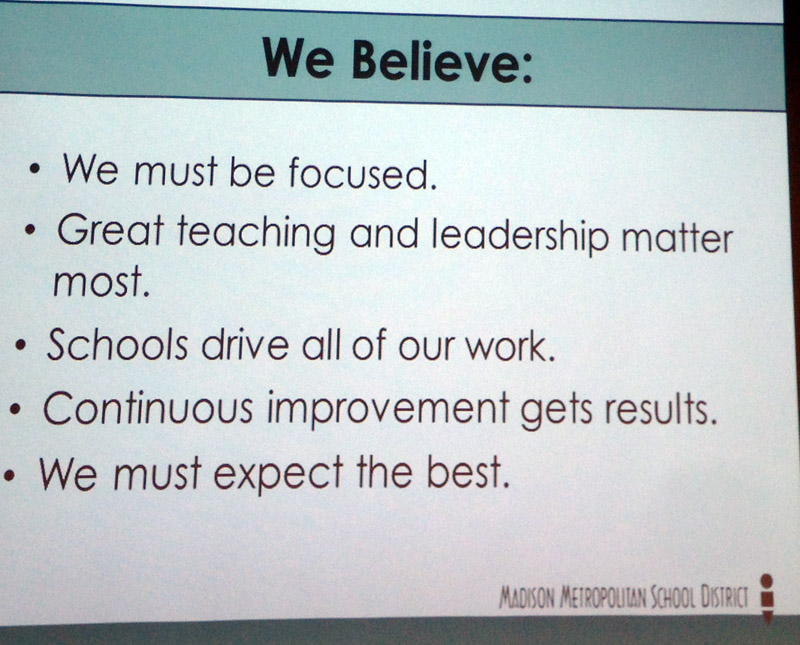
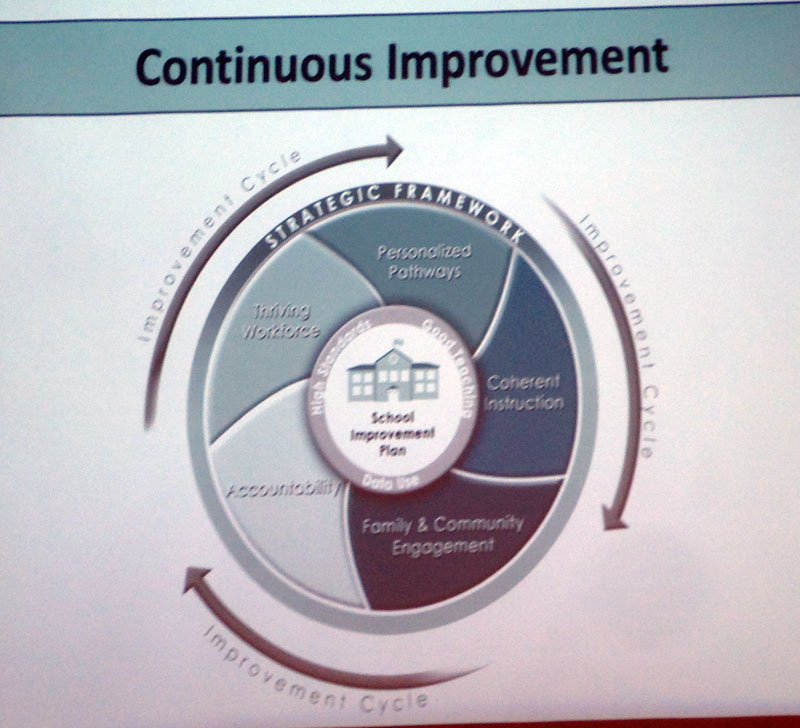
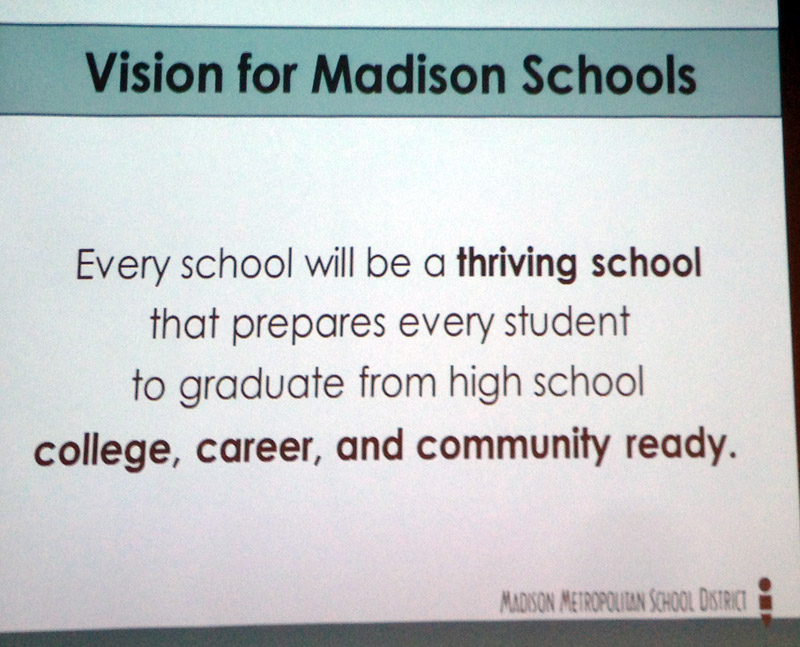
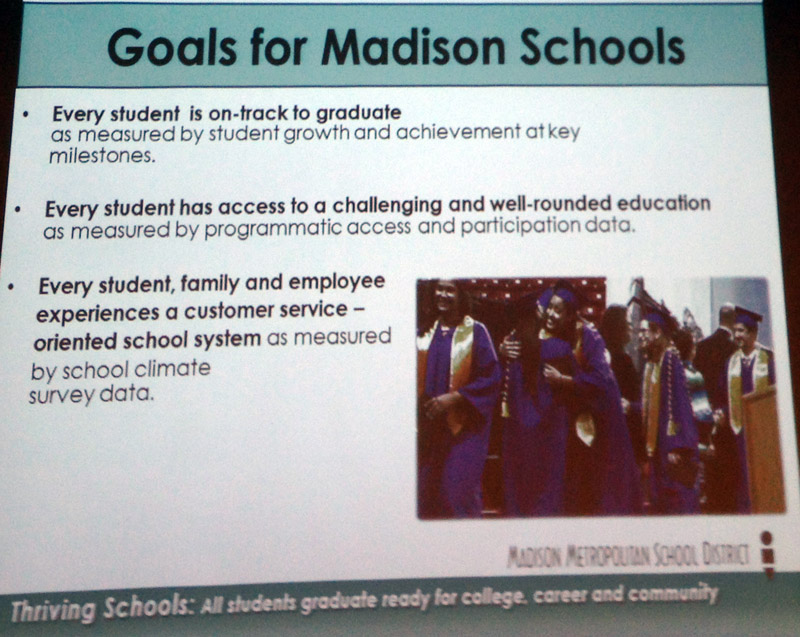
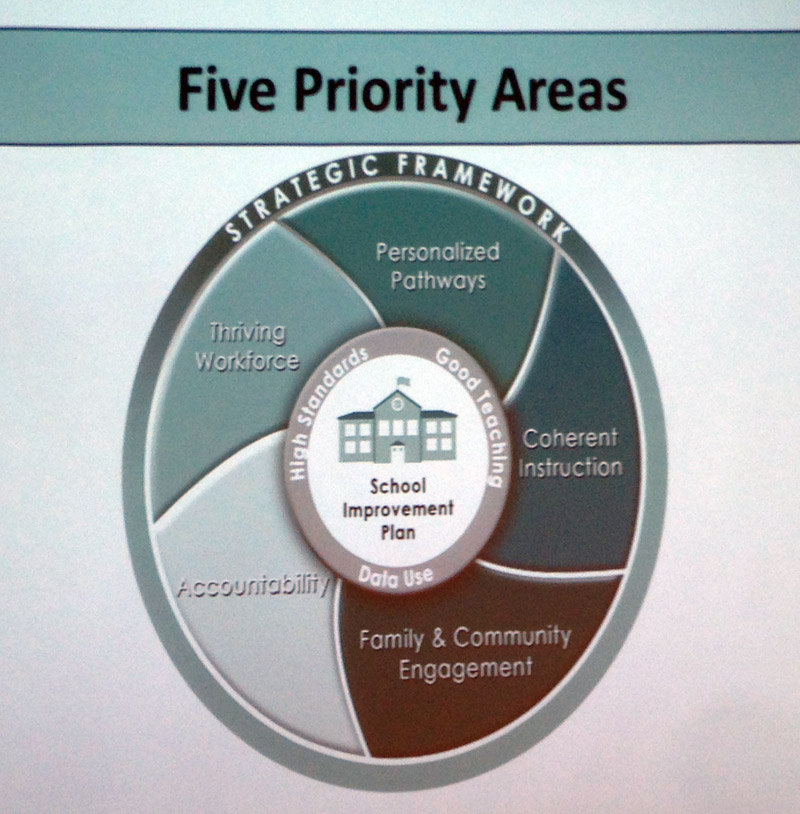
Madison Superintendent Cheatham’s Rotary Club Talk (audio & slides): “What will be different this time?”

15mb mp3 audio.

Superintendent Cheatham’s slides follow (4MB PDF version). I hope that the prominence of Madison’s disastrous reading scores – slide 1 – indicates that this is job one for our $15,000ish/student organization.


A few of the Superintendent’s words merit a bit of analysis:
1. “What will be different this time?” That rhetoric is appropriate for our Madison schools. I compiled a number of notes and links on this subject, here.
2. “Ready to partner with local businesses and other organizations”. Great idea. The substance of this would certainly be a change after the Madison Preparatory Academy IB Charter school debacle (Urban League) and, some years ago, the rejection of Promega’s kind offer to partner on Madison Middle Schools 2000.
3. Mentions “all Madison schools are diverse”. I don’t buy that. The range of student climate across all schools is significant, from Van Hise and Franklin to LakeView, Mendota and Sandburg. Madison school data by income summary. I have long been astonished that this wide variation continues. Note that Madison’s reading problems are not limited to African-American students.
4. Mentioned Long Beach and Boston as urban districts that have narrowed the achievement gap. Both districts offer a variety of school governance models, which is quite different than Madison’s long-time “one size fits all approach”.
5. Dave Baskerville (www.wisconsin2.org) asked a question about benchmarking Madison students vs. the world, rather than Green Bay and Milwaukee. Superintendent Cheatham responded positively to that inquiry. Interestingly, the Long Beach schools prominently display their status as a “top 5 school system worldwide”.
6. “Some teachers and principals have not been reviewed for as long as 7 years”. This points to the crux of hard decision making. Presumably, we are at this point because such reviews make no difference given rolling administrator contracts and a strong union umbrella (or floor depending on your point of view). Thus, my last point (below) about getting on with the hard decisions which focus the organization on job number one: reading.
Pat Schneider and Matthew DeFour summarize the Superintendent’s press release and appearance.
Finally, I found it a bit curious that the Superintendent is supporting spending (and related property tax growth) for current programs in light of the larger strategy discussed today along with the recent “expert review”. The review stated that the “Madison School District has resources to close achievement gap”
This would be a great time to eliminate some programs such as the partially implemented Infinite Campus system.
Superintendent Cheatham’s plan indicates that choices will be made so that staff and resources can focus on where they are most needed. I wholeheartedly agree. There is no point in waiting and wasting more time and money. Delay will only increase the cost of her “strategy tax“.

Share

Teaching to See

Inge Druckery:

“This [film] is about patient and dedicated teaching, about learning to look and visualize in order to design, about the importance of drawing. It is one designer’s personal experience of issues that face all designers, expressed with sympathy and encouragement, and illustrated with examples of Inge [Druckrey]’s own work and that of grateful generations of her students. There are simple phrases that give insights into complex matters, for example that letterforms are ‘memories of motion.’ Above all, it is characteristic of Inge that in this examination of basic principles the word ‘beautiful’ is used several times.”
Matthew Carter
Type Designer, 2010 MacArthur Fellow

Share

4 Steps to Upgrade Teacher & Administrator Prep Programs

Sandra Stotsky, via a kind reader’s email:

The part of public education that has received the least attention for reform is the most important: whom our education schools admit and how they are prepared to be teachers, administrators, education researchers, and education policy makers. Although there is very little high quality research on these topics, useful information for reforming education schools came from the massive review undertaken by the National Mathematics Advisory Panel for its report in 2008.
It found no relationship between student achievement and traditional teacher education programs, certification status, and mentoring and induction programs. That means that teachers who have completed a traditional teacher preparation program, hold a teaching license, and have participated in an induction program get no higher student performance on average than other teachers.
Researchers have found no relationship between student achievement and master’s degree programs in education, most of which are for those already holding a teaching license from an undergraduate program.
In addition, the Panel found almost no evidence that professional development programs increase student achievement, whether or not they increase teachers’ knowledge of the subject they teach. Nor is student achievement related to whether prospective teachers graduate from a traditional teacher education program or an alternative program.
However, the Panel did find teachers’ knowledge of the subject they teach significantly related to student achievement. In other words, the more academically competent the teacher is, the more students learn. That finding wouldn’t surprise anyone who thinks content matters.
There may be other characteristics of an effective teacher, but so far no credible body of research has told us what they are. Part of the problem lies with educational research itself. Over 16,000 potentially relevant studies were located by Abt Associates for the Panel’s consideration. But Abt judged only a tiny number worthy of review.

Share

Rebooting online education

Los Angeles Times:

The disappointing results from San Jose State’s experiment with online courses shouldn’t be interpreted to mean that such courses can’t help students. But the classes the university offered in collaboration with online provider Udacity were practically a model of how to do online education badly: rushed into existence and sloppily overseen. No one was even aware that some students who had signed up for the classes lacked reliable access to computers. The one thing the college did well was monitor the results of the three pilot courses and call a timeout when failure rates proved unacceptably high.
It’s hard to draw conclusions about one of the three courses because it enrolled a mix of students from varied backgrounds, while the comparable classes held on campus enrolled regular San Jose State students. But that wasn’t the case for the other two courses, and overall, the results of this much-ballyhooed venture were startlingly bad: At least 74% of students passed the campus-based courses, while no more than 51% passed any of the Udacity courses.
Online courses can have tangible benefits. They overcome the limitations of brick and mortar; theoretically, at least, there is no limit to the number of seats. And they are a boon for working students who need flexibility in their schedules. But a rush to offer them, which Gov. Jerry Brown has been pressing for, would mean higher rates of failure, costing students time and money they can ill afford.

Share

Anyone Still Listening? Educators Consider Killing the Lecture

Holly Korbey:

Scott Aikin admits that he’s “a very conservative pedagogue.” That’s why the author and Associate Professor of Philosophy at Vanderbilt University says that, this fall, he’s asking his students to keep their laptops at home. Instead, he wants their full attention for his main method of teaching: lecturing.
“I call it ‘the chalk and talk.’ I have a piece of chalk and I talk. I fill the board with notes and sometimes diagram things or map out an argument. Students are allowed to stop and ask questions or challenge at any time, and I’ll make good on answers. That’s it. Students only need pens and paper for the class (if not their books, too),” he said.
Aikin’s method appears beyond retro — some would even call it obsolete — but Aikin says that’s fine with him. He finds being the “sage on the stage” to be most effective. “The most content-full and involved classes from my college (and even graduate) days were primarily lecture courses,” he said. “Everything I do as a lecturer now I’ve cribbed from those I thought effective in front of a class.”
Studies show lecturing to be an effective tool for transferring information: for example, a 2011 study of classroom teaching methods performed by Guido Schwerdt of Harvard’s Program on Education Policy and Governance and Amelie C. Wuppermann at the University of Mainz, Germany, found that larger amounts of class time lecturing increased junior high math and science students’ test scores over time spent on problem-solving activities. But the majority of higher education seems to be moving in the opposite direction, toward project-based and student-led work, especially for time spent in class.

Share

American education and the IQ trap: For students, one score doesn’t tell all

Scott Barry Kaufman:

What does it mean to be gifted in the United States?
A national survey in 2011 found that the predominant method of assessment, by far, is the administration of IQ tests and standardized academic tests. At least 34 states, including California, consider such tests an indication of giftedness; they are mandated by at least 16 states. In contrast, only nine states require the use of tests that measure “creativity” and even fewer require the assessment of leadership, motivation or a talent for the performing arts. Although no state permits a single IQ score to determine gifted eligibility, 18 states set strict cutoff scores, and testing is typically a one-shot deal: You’re either gifted or you’re not, for the rest of your life.
On every count, these policies profoundly limit the intellectual and innovative possibilities of all students.
I can attest to just how limiting the process is. As a child, I was diagnosed with an auditory disorder that made it difficult for me to process speech in real time. I repeated third grade. Then, after an anxiety-ridden IQ testing session in fourth grade, I was sent to a school for students with learning disabilities. By the time I reentered public school in sixth grade, the label “special ed” was hard to overcome, despite my yearning for more intellectual challenges. If it weren’t for a couple of teachers (thank you Mrs. Jeuell and Mrs. Acton!) who considered the kid rather than the system’s preconceptions, I might never have earned a doctorate at Yale.

Share

“too many school districts were afraid of innovation, clinging to “archaic ideas.”

Javier Hernandez, via a kind reader’s email

Now Mr. Vallas, a veteran of big-city education battles, faces the once-unimaginable prospect that he will be driven out of town by summer’s end. A retired judge filed a lawsuit arguing that his lack of an education degree makes him unfit for the office, despite his years of experience running other school districts. Last month, a superior court judge agreed, and now Mr. Vallas has appealed the case to the Connecticut Supreme Court.
The battle in Bridgeport highlights the divisiveness of change in American education. Critics of the existing system are pushing centralized control, weaker teacher tenure protections and expanded charter schools, and some have made installing superintendents with backgrounds outside of education a priority, causing rifts in many districts.
Arne Duncan, the federal education secretary, said the opposition to Mr. Vallas was “beyond ludicrous.” He said too many school districts were afraid of innovation, clinging to “archaic ideas.”
“This, to me, is just another painfully obvious, crystal-clear example of people caught in an old paradigm,” Mr. Duncan said in an interview. “This is the tip of the iceberg.”
Mr. Vallas was hired in late 2011 to much fanfare: a nationally known advocate of change in education, with stints in Philadelphia, Chicago and New Orleans on his résumé, coming to the aid of a modest school district mired in budget cuts.

Much more on Paul Vallas, here, including a recent Madison appearance.

Share

The Cognitive Effects of Micronutrient Deficiency: Evidence from Salt Iodization in the United States

James Feyrer, Dimitra Politi, David N. Weil:

Iodine deficiency is the leading cause of preventable mental retardation in the world today. The condition, which was common in the developed world until the introduction of iodized salt in the 1920s, is connected to low iodine levels in the soil and water. We examine the impact of salt iodization on cognitive outcomes in the US by taking advantage of this natural geographic variation. Salt was iodized over a very short period of time beginning in 1924. We use military data collected during WWI and WWII to compare outcomes of cohorts born before and after iodization, in localities that were naturally poor and rich in iodine. We find that for the one quarter of the population most deficient in iodine this intervention raised IQ by approximately one standard deviation. Our results can explain roughly one decade’s worth of the upwardtrend in IQ in the US (the Flynn Effect). We also document a large increase in thyroid related deaths following the countrywide adoption of iodized salt, which affected mostly older individuals in localities with high prevalence of iodine deficiency.

Share

Superintendent Jennifer Cheatham cites previous lack of “long-term vision” in presenting 2013-14 budget for Madison schools

Bennet Goldstein:

Cheatham said Madison schools have already implemented a variety of initiatives to increase student achievement but have not seen “measurable improvements.”
“It isn’t for lack of working very hard and doing a lot of things at once,” she said. “I feel pretty confident the reason that hasn’t occurred is because of the lack of long-term vision.”
Cheatham recommended the board focus on strengthening existing programs and infrastructure, which would not require new expenditures.
“I want to be more strategic and thoughtful about this than how we did it in the past,” she added.

Much more on the Madison School District’s planned spending & property tax increases via the 2013-2014 budget, here.
Related: Analysis: Madison School District has resources to close achievement gap.

Share

Despite Education Advances, a Host of Afghan School Woes

Rod Norland:

There is not an ounce of fat on the wiry frame of Abdul Wahid, and no wonder.
After he finishes his morning work shift, he walks 10 miles down mountain trails in northern Afghanistan to the first road, where he catches a bus for the last couple of miles to the teacher training institute in Salang. He walks back up the mountain another 10 miles to get home, arriving well after dark, just in time to rest up for his day job.
In his determination to formally qualify as a teacher, Mr. Wahid, 33, exemplifies many of the gains for Afghan education in recent years. “It’s worth it, because this is my future,” he said.
But he also personifies how far the efforts here have yet to go. Mr. Wahid’s day job is being the principal of the high school in his village, Unamak. Though he has only a high school diploma, he is the best educated teacher that his 800 students have.
It is widely accepted that demand among Afghans for better schooling — and the actual opportunity to attend, particularly for girls — is at its highest point in decades. For Western officials seeking to show a positive legacy from a dozen years of war and heavy investment in Afghanistan, improvements in education have provided welcome news.
But for those who are working to make it happen — local Afghan officials, aid workers, teachers and students — there are concerns that much of the promise of improvement is going unfulfilled, and major problems are going unsolved.

Share

A Journalist Describes a History Lesson (Part 1)

Larry Cuban:

A small, crowded building set quite unpretentiously (for an American high school), [is] in a neighborhood once almost entirely Jewish, now almost entirely black….This is not, however, a slum school. No place in America is positively good for a black, but [this Midwestern city] seems to be about the least bad. The parents of many of these students make a lower-middle-class income or better, the atmosphere in Green’s halls is as free as it is in Scarsdale’s, and the attitude toward education seems to have no more than the usual degree of suspicion. Still, these children are black, part of an actively repressed minority group. As seen on a very brief visit, Green would seem to be considerable of an accomplishment. One history class provided evidence that students here are learning more than just social studies: when the teacher made reference to “The Mar-see-yay,” a mutter of “Mar-say-yez” rose from around the borders of the room.
The teacher in this American History class is a hawk-nosed, lean crew-cut young man named [Leon Pierson] … a teacher with a personal devotion to history. He balances American History around the Civil War for teaching purposes, but he does so out of respect, not contempt, for his black students. He begins the class by handing out ”a very short reading list–on which there will be no comments.” Then he writes four names on the board:

Share

Chicago lays off more than 2,000, including 1,000 teachers

Noreen S. Ahmed-Ullah and Kim Geiger:

Citing a $1 billion budget deficit, Chicago Public Schools will lay off more than 2,000 employees, more than 1,000 of them teachers, the district said Thursday night.
About half of the 1,036 teachers being let go are tenured. The latest layoffs, which also include 1,077 school staff members, are in addition to 855 employees — including 420 teachers — who were laid off last month as a result of the district’s decision to close 49 elementary schools and a high school program.
CPS spokeswoman Becky Carroll said the district was “scraping the bottom” of reserves to provide financial relief and had made cuts in other spending before making layoffs.
“We’re not going to be able to cut our way out of this crisis,” Carroll said. “Our revenues are simply not keeping in line with our spending increases.”

Share

Bill Gates on the future of education, programming and just about everything else

Derick Harris:

Gates talked a lot about the issue throughout the Q&A session, and his hypothesis is simple: Education in the United States is broken — it has the highest higher-education dropout rate among rich countries — and MOOCs can help fix it. In fact, the Bill and Melinda Gates Foundation has invested a lot of money into the education field (to the chagrin of some experts), including strong support of Massive Open Online Course, or MOOC, startups such as the Khan Academy.
Gates acknlowedged during the session that some of his work might have unintended, negative consequences, but not this one. “In the education space,” he responded to a question from the audience, “I frankly don’t see that much of a downside.”
Online courses can give students access to new areas of study that can align their skills with high-paying jobs. They can even help physical institutions personalize student learning through gathering data about attendance, engagement, real-time understanding of the subject matter and other things. They can give those few elite minds responsible for such great inventions even easier access to new knowledge.

Share

Madison’s Planned $pending & Property Tax Increase: Does it Include $75/Student “Unrestricted” State Budget Increase (Outside of Revenue Caps)?

Wisconsin Association of School Boards, via a kind reader’s email:

The 2013-15 state budget act provides for state categorical aid payments to each district of $75 per pupil in the first year and $150 per pupil in 2014-15 (reflecting $75 from the first year + an additional $75) and each year thereafter. (“Categorical aid” in this case simply means that it is received outside the revenue cap (as distinguished from general aid, which is under the revenue cap).
This per-pupil aid may be spent irrespective of the district’s revenue limit and can be used for any purpose. (Unlike most other categorical aid, it is not tied to any specific student population or program.) This aid will be received by all districts and is likely to be welcomed by high per-pupil property wealth districts that receive little general aid.
In addition, the 2013-15 state budget act provides for a $75 per-pupil increase in the revenue limit in each year. These increases add on top of one another (so $75 gets added to the base in the first year and another $75 on top gets added of that in the second year–for a total of $130 million in new revenue limit authority statewide). Note: The budget act makes no provision for a revenue limit adjustment in 2015-16 or thereafter.
Together, it is argued that the revenue limit adjustment and the per-pupil categorical aid will provide districts with an additional $150 per pupil in each year of the biennium. (While this $150 figure doesn’t equate to the inflationary adjustment contemplated by the WASB resolutions, it compares quite favorably with the $0 per-pupil “budget freeze” proposed in the budget as originally introduced.) Half of this increase ($75 per pupil) comes from an increase in revenue limits, while the remainder ($75 in the first year, and that $75 plus an additional $75 in the second year) comes from the new categorical aid that will benefit all school districts.
(Technically, the increase in spendable resources for most districts is actually $100 per pupil in the first year because the $50 per-pupil payment received by districts that levied to the max in 2012-13 was one-time money and goes away. For the 27 or so districts that didn’t qualify for the state matching money, the increase in additional resources over 2012-13 resources actually IS $150 per pupil. See Legislative Fiscal Bureau memo on this subject.)
Significantly, the per-pupil categorical aid that is provided to every district is permanent and will continue in 2014-15 and each school year thereafter. It is funded through a sum sufficient GPR appropriation, making it the first sum sufficient appropriation for public school districts since the state abandoned the statutory commitment to two-thirds funding in the 2003-05 state budget bill. Because this is a sum sufficient appropriation, the payments to individual school districts won’t be affected (e.g., pro-rated) by changes in statewide membership. The per-pupil amount is, in effect, guaranteed.) And unlike the $50 per-pupil categorical aid that was provided in 2012-13 to 397 school districts, there is no requirement that a district levy a certain amount in order to qualify for this categorical aid.
The calculation is also straightforward–each district aid is determined by using its three-year rolling average membership to calculate the number of pupils in each district times $75 per pupil. Thus, the $75 per student categorical aid payment in the coming year will be calculated on a current-year basis (using the current year membership count plus the two previous years). As a result, the DPI will have to wait until each district has completed its third Friday in September count in order to complete the calculation. School boards and school administrators who have to hold their annual meeting and get the levy approved by district electors by Oct. 31 should be able to calculate their district’s allotment.
Finally, the $75 per-pupil payment won’t be made by the state until the fourth Monday in March, so it isn’t likely to solve districts’ biggest cash flow issues, but will provide a needed boost.

Much more on the Madison School District’s planned spending & property tax increases via the 2013-2014 budget, here.
Related: Analysis: Madison School District has resources to close achievement gap.

Share

Udacity Founder on the Future of Learning

Rachel Metz:

San Jose State University is suspending courses it has been offering through Udacity that involved both high school and San Jose State students, due to low course-passing rates as compared to traditional classes, and plans to start things up again in the spring. How do you feel about this?
We felt we got these kids, they worked really hard, and they stayed with it, but they didn’t get the skills they needed to be proficient. We asked them why, and they said they needed more time. Literally, this is a truly joint decision; I’m totally behind it because I feel the objective must be to give students a great education.
How has online learning changed since you started Udacity?
We’ve evolved the MOOC concept into one that really helps people throughout the course to complete the course. The most recent completion rates in pilots we’ve been running have been 85 percent, as opposed to 5 percent or 4 percent, which is common in MOOC-land.

udacity

Share

Growing up Muslim in America

Anna Fifield:

Bay Ridge is geographically close to the hipster Brooklyn neighbourhoods of Park Slope and Williamsburg but could not be more culturally different. It is a world away from the financial district in Manhattan, the epicentre of the September 11 2001 attacks. But Brooklyn is also home to the largest group of people in the US who trace their lineage back to the Arab world, according to census data. And while the heightened sense of a threat from Islamic terrorism that existed post-attacks may have gone, it has given way to a persistent, low-level paranoia that pervades the everyday lives of the million-plus Muslim Arab Americans living here and throughout the country.
Islamophobia in the US is becoming entrenched, according to some Muslim leaders. “We’re living in one of the most hostile civic environments for the Muslim community,” says Faiza Ali, a community organiser at the Arab American Association in Bay Ridge. “And it’s gotten worse since 9/11.”
Hate-crime statistics collected by the Federal Bureau of Investigation showed a sharp spike in violence against Muslims after the 2001 attacks, which levelled out until 2009, when it started ticking up again. There are always problems following events carried out by Muslims, such as the Boston Marathon bombings in March.
The US Equal Employment Opportunity Commission reports that in 2011, 21 per cent of the religion-based complaints it received were from Muslims – although they comprise less than 1 per cent of the population.

Share

Students Prefer Print for Serious Academic Reading

Sara Grossman:

E-reader use is on the rise, and the textbook market is shifting toward customizable digital products. Are students ditching print in favor of electronic alternatives for their academic reading? A forthcoming small study from the City University of New York asked that question and found that, like previous generations, at least some Millennials still prefer reading long texts and academic selections in print.
The study, “Student Reading Practices in Print and Electronic Media,” to be published in September 2014 in the journal College & Research Libraries, tracked the reading habits of 17 CUNY students through diary entries, interviews, and discussion groups over the course of two weeks. The students were mostly juniors, seniors, and graduate students, and most were younger than 25.
The research found that they almost always used e-book readers, mobile devices, and tablet computers for nonacademic reading but relied on paper printouts for academic reading.
The study’s author, Nancy M. Foasberg, a humanities librarian at CUNY’s Queens College, acknowledged the difficulties in generalizing from such a small sample. But the takeaway is that “the students in the study really wanted to use print to read for serious academic purposes,” Ms. Foasberg said. They reported that computers and e-books were “fine for less serious work,” but when they “really wanted to get work done, they gravitated to print.”

Share

Autistic man breaks through the silence

Emily Le Coz:

The last word Watson Dollar spoke before autism erased his ability to do so was “lights.”
The chubby cheeked toddler lay in his father’s arms as anesthesia, administered for an ear-tube surgery, dimmed his consciousness. Head lolling back, body going limp, Watson gazed at the fluorescent lamps above him, uttering the one-syllable noun.
Then he closed his eyes and never spoke again. That was 20 years ago.
In the two months between Halloween and Christmas of 1992, Watson had lost almost of all of his 150-word vocabulary along with an interest in the world.
His parents initially failed to notice the change, chalking up the subtle signs to stubbornness or fatigue or the ever-changing nature of a developing child.
By New Year’s, though, the difference was both inescapable and worrisome.

Share

American Federation of Teachers Poll: Parents don’t support many education policy changes

Lindsay Layton:

Most parents with children in public schools do not support recent changes in education policy, from closing low-performing schools to shifting public dollars to charter schools to private school vouchers, according to a new poll to be released Monday by the American Federation of Teachers.
The poll, conducted by Democratic polling firm Hart Research Associates, surveyed 1,000 parents this month and found that most would rather see their neighborhood schools strengthened and given more resources than have options to enroll their children elsewhere.
AFT President Randi Weingarten is expected to highlight the poll’s findings during a speech Monday at the union’s annual meeting in Washington. The AFT is the nation’s second-largest teachers union and represents school employees in most of the major urban school districts.
In the speech, Weingarten will call for a reinvestment in public schools and say that education reform hasn’t worked and isn’t what parents want. “Decades of top-down edicts, mass school closures, privatization and test fixation with sanctions, instead of support, haven’t moved the needle — not in the right direction, at least,” Weingarten says in remarks from the speech provided to The Washington Post. “You’ve heard their refrain: competition, closings, choice. Underlying that is a belief that disruption is good and stability is bad.”

Share

Public Unions vs the Public

Philip Howard:

ties and states are sinking under the burden of debt brought about by public service union contracts. How did it get this way and what can be done about it?

Video.

Share

Video lectures of mathematics courses available online for free

Math Overflow:

It can be difficult to learn mathematics on your own from textbooks, and I often wish universities videotaped their mathematics courses and distributed them for free online. Fortunately, some universities do that (albeit to a very limited extent), and I hope we can compile here a list of all the mathematics courses one can view in their entirety online.
Please only post videos of entire courses; that is, a speaker giving one lecture introducing a subject to the audience should be off-limits, but a sequence of, say, 30 hour-long videos, each of which is a lecture delivered in a class would be very much on-topic.

Share

Fighting the Wrong Enemy

Elisa Villanueva Beard

On top of it all, the most challenging piece for me was how underprepared I actually was. I graduated from high school in the top 10% of my class. But as a freshman at DePauw, I realized I was living the educational inequity that exists in our country.
I’ll never forget Intro to Philosophy. Some of my classmates would spend 45 minutes studying for a test and get A’s, while I would spend hours at the library studying every night, and still wound up with a C+ in that class. I started to lose confidence. Self-doubt began to haunt me.
But with the support and deep belief of my parents and my mentor, Joe Disque, I overcame it. In fact, I conquered it. I came out the other side with a newfound sense of social responsibility.
And that led me to Teach For America. In 1998 I joined the corps in Phoenix where I taught for 3 years. Getting to know my kids and their families inspired me to make this my life’s work.
Later–I saw alumni friends create a new normal in founding and leading schools where I grew up. These schools expected that 100% of their mostly first generation college students would go to and expected to get through college within 6 years. This inspired me, and I have never turned back.

Share

Finally, a film that celebrates public education

Peter Dreier:

Harvard political scientist Marshall Ganz’s book, “Why David Sometimes Wins,” uses the Biblical David vs. Goliath story as a metaphor about the battle for social justice. Once in a while, writes Ganz, a long-time union organizer, the have-nots conquer the haves, but they have to be more clever and resourceful.
I recently saw a documentary film, “Go Public: A Day in the Life of an American School District,” that is like the slingshot in the ongoing war over public education. This scrappy documentary celebrates public schools without ignoring its problems. It is an antidote to misleading films like “Waiting for Superman” and “Won’t Back Down,” which view traditional public schools as failures and charter schools and corporate-oriented “privatization” as the solution to what ails public education.
Not surprisingly, “Waiting for Superman” and “Won’t Back Down” were funded and promoted by the same right-wing billionaires and corporate foundations that have been waging war against public schools. Those two films are part of the propaganda and political arsenal assembled by what Diane Ravitch calls the “Billionaires Boys Club.” By contrast, “Go Public” has no ideological axe to grind other than to present a balanced exploration into the lives of the teachers, students, parents, and others who populate a typical urban public school system.

Share

What Is It With US Students and Programming Contests?

Alfred Thompson:

I saw this recently on SlashDot – No US College In Top 10 For ACM International Programming Contest 2013 Now the ACM International Programming Contest is sort of a big deal. In the first fifteen or so years US teams won first place every year. Since 1997 though a US team has not taken first place. In Microsoft’s Imagine Cup competitions there is no US winner in any of the 15 or so categories this year. In fact US results in programming and software development competitions have been pretty poor (one might say embarrassing) for a while. One has to ask why?
I don’t think it is because they US doesn’t have students who can compete. I think we do. I think many of the best and brightest choose not to compete. Why? Well I don’t think they see enough value in the competitions to take time from other things that they value more. If you are a top student in a top US university you probably already think your value is obvious. And realistically it is. Top companies (Google, Facebook, Microsoft, etc.) are recruiting on your campus. You are already doing enough to get their attention. On the other hand if you are in a university in a small eastern European or Asian country that no one has heard of outside the area an an international contest victory may be just the edge you need to get noticed.

Share

Despite Education Advances, a Host of Afghan School Woes

Rod Norland:

There is not an ounce of fat on the wiry frame of Abdul Wahid, and no wonder.
After he finishes his morning work shift, he walks 10 miles down mountain trails in northern Afghanistan to the first road, where he catches a bus for the last couple of miles to the teacher training institute in Salang. He walks back up the mountain another 10 miles to get home, arriving well after dark, just in time to rest up for his day job.
In his determination to formally qualify as a teacher, Mr. Wahid, 33, exemplifies many of the gains for Afghan education in recent years. “It’s worth it, because this is my future,” he said.
But he also personifies how far the efforts here have yet to go. Mr. Wahid’s day job is being the principal of the high school in his village, Unamak. Though he has only a high school diploma, he is the best educated teacher that his 800 students have.
It is widely accepted that demand among Afghans for better schooling — and the actual opportunity to attend, particularly for girls — is at its highest point in decades. For Western officials seeking to show a positive legacy from a dozen years of war and heavy investment in Afghanistan, improvements in education have provided welcome news.
But for those who are working to make it happen — local Afghan officials, aid workers, teachers and students — there are concerns that much of the promise of improvement is going unfulfilled, and major problems are going unsolved.

Share

Florida charter schools back decision to ease school grades

Sherri Ackerman:

Charter schools are among those supporting a tense Board of Education decision this week that prevents state grades for public schools from dropping more than one letter.
But some of them worry the move might add to the confusion parents and others already have about Florida’s A through F grading system – and erode public confidence in it.
“I think it becomes confusing to parents when the state says it wants to move forward with higher standards and wants them to be more rigorous, and then makes a safety net” when those standards aren’t met, said Cynthia Adversa, principal of Indian River Charter High School in Vero Beach, which is a member of the Florida Consortium of Public Charter Schools.
Teachers and students worked hard to meet those expectations, said Daviem Dina Miller, who heads Somerset Academy in Davie. So when some schools that didn’t hit the mark still benefit from a higher grade, “I think a lot of parents would question that.”

Share

California High School’s AP Test Scores Invalidated

Aaron Kinney:

In a rare move that has Mills High School in an uproar, the College Board and Educational Testing Service have invalidated the Advanced Placement test results of as many as 224 students, citing “seating irregularities” when the 11 exams were taken in May.
Students are now demanding that the College Board reinstate the test scores, which have not been disclosed, rather than readminister the tests next month. They claim their scores may suffer in retaking the exams, and some graduating seniors say the delay is disrupting their college enrollment.
Incoming senior Gavin Wong learned of the problem Wednesday, when his family received a letter from Mills about the cancellation. The school said that, despite the seating problem, the scores “were not invalidated as a result of student misconduct,” according to a copy of the letter provided by Wong.
“Students aren’t to blame,” said Wong, 17, “but we are being punished harshly.”

Share

Lessons from Yet Another PLUS Loan Scandal

Andrew Gillen

PLUS loans are experiencing yet another scandal. The ultimate source of this particular one is the way the federal government calculates student loan default rates for college accountability. Colleges are punished if their student loan default rates go too high. But the government’s default formula only includes Stafford loans. PLUS (both Parent and Grad) loans and Perkins loans are ignored in the calculation. This is a gaping loophole, and some colleges appear to have been exploiting it. As Rachel Fishman of New America explains:
“… there’s evidence that some colleges and universities might be steering students away from other, better federal student loans and toward Parent PLUS to avoid penalties associated with high student loan default rates.”

Share

Wisconsin hopes to mirror Massachusetts’ test success for teaching reading

Alan Borsuk:

A second-grade teacher notices that one of her students lacks fluency when reading aloud. The first thing the teacher should do to help this student is assess whether the student also has difficulties with:
A. predicting
B. inferring
C. metacognition
D. decoding
Don’t worry if you’re not into metacognition. The correct answer is decoding — at least according to the people who put together the test teachers must pass in Massachusetts if they are going to teach children to read.
The Massachusetts test is about to become the Wisconsin test, a step that advocates see as important to increasing the quality of reading instruction statewide and, in the long term, raising the overall reading abilities of Wisconsin students. As for those who aren’t advocates (including some who are professors in schools of education), they are going along, sometimes with a more dubious attitude to what this will prove.
The Wisconsin Department of Public Instruction officially launched the era of the new test for reading licenses with a memo sent last week to heads of all teacher preparation programs in the state. The memo spelled out the details of implementing a law passed in 2011 that called for Wisconsin to use the Massachusetts test. The memo included setting the passing score, which, after a short phase-in period, will match what is regarded as the demanding Massachusetts standard.
In a nutshell, after Jan. 31, 2014, anyone who wants to get a license that allows them to teach reading in Wisconsin will have to pass this test, with 100 multiple choice questions and two essay questions, aimed at making sure they are adequately prepared to do so. (Those currently licensed will not need to pass the test.)
Why Massachusetts? Because in the 1990s, Massachusetts launched initiatives, including requiring students to pass a high school graduation test, requiring teachers to pass licensure tests specific to the subjects they teach, and increasing spending on education, especially in schools serving low-income children.
At that point, Wisconsin and Massachusetts were pretty much tied, and down the list of states a bit, when it came to how students were doing. Within a few years, scores in Massachusetts rose significantly. The state has led the nation in fourth- and eighth-grade reading and math achievement for a decade. Wisconsin scores have stayed flat.

Many notes and links on Wisconsin’s adoption of Massachusetts (MTEL) elementary English teacher content knowledge standards. UW-Madison Professor Mark Seidenberg’s recommended Wisconsin’s adoption of MTEL.

Share

Technical Life Skills

Kevin Kelly:

If you are in school today the technologies you will use as an adult tomorrow have not been invented yet. Therefore, the life skill you need most is not the mastery of specific technologies, but mastery of the technium as a whole — how technology in general works. I like to think of this ability to deal with any type of new technology as techno-literacy. To be at ease with the flux of technology in modern-day life you’ll need to speak the language of the technium, and to master the the following principles:
Anything you buy, you must maintain. Each tool you use requires time to learn how to use, to install, to upgrade, or to fix. A purchase is just the beginning. You can expect to devote as much energy/money/time in maintaining a technology as you did in acquiring it.
Technologies improve so fast you should postpone getting anything until 5 minutes before you need it. Get comfortable with the fact that anything you buy is already obsolete. Therefore acquire at the last possible moment.
You will be newbie forever. Get good at the beginner mode, learning new programs, asking dumb questions, making stupid mistakes, soliticting help, and helping others with what you learn (the best way to learn yourself).

Share

Inflation-adjusted current expenditures per pupil for public elementary and secondary education in the United States: Fiscal years 1996-2011


Stephen Q. Cornman (PDF):

The 50 states and the District and Columbia reported $604.3 billion in revenues collected for public elementary and secondary education in fiscal year 2011 (FY 11) (table 1). State and local governments provided $528.8 billion, or 87.5 percent of all revenues; and the federal government contributed $75.5 billion or 12.5 percent of all revenues (derived from table 1 and figure 1).
Adjusting FY 10 data for inflation, total revenues decreased by 0.7 percent (from $608.4 to $604.3 billion), local revenues decreased by 1.8 percent (from $266.8 to $262.0 billion), state revenues increased by 1.0 percent (from $264.1 to $266.8 billion), and federal revenues decreased by 2.6 percent (from $77.5 to $75.5 billion) for FY 11 compared to FY 10 (derived from table 1 and table C-1, after adjusting for inflation).1
Current expenditures totaled $527.2 billion in FY 11 (table 2). Expenditures for instruction amounted to $322.5 billion, total support services accounted for $183.0 billion, food services were $20.4 billion, and enterprise operations accounted for $1.3 billion. Adjusting FY 10 data for inflation, current expenditures decreased 1.5 percent (from $535.3 to $527.2 billion) for FY 11 compared to FY 10 (derived from table 2 and table C-2, after adjusting for inflation).1
Current expenditures per pupil for public elementary and secondary education were $10,658 on a national level in FY 11 (table 3). Current expenditures per pupil ranged from $6,326 in Utah to $20,793 in the District of Columbia. Expenditures per pupil were next highest in New York ($18,834); New Jersey ($16,855); Alaska ($16,663); Connecticut ($16,224); and Wyoming ($15,815).
Adjusting for inflation, per pupil state and local revenues increased by 0.2 percent on a national basis from FY 10 to FY 11, while per pupil current state and local expenditures decreased by 1.6 percent (table 4). Adjusting for inflation, per pupil state and local revenues decreased by 1 percent or more in 28 states and increased by 1 percent or more in 14 states from FY 10 to FY 11. Per pupil current expenditures decreased by 1 percent or more in 30 states and increased by 1 percent or more in 9 states from FY 10 to FY 11.
Adjusting for inflation, current expenditures per pupil steadily climbed at least 1 percent per year between FY 96 and FY 08. However, the increases in current expenditures per pupil became smaller (less than 1 percent) from FY 08 to FY 09 and from FY 09 to FY 10; and then negative (i.e. a decrease of more than 1 percent) between FY 10 and FY 11 (derived from table 5 and figure 2).
In FY 11, instruction and instruction-related expenditures totaled $347.4 billion, or 65.9 percent, of all current expenditures for public elementary and secondary education; student support services were 29.3 billion, or 5.6 percent; administration costs were 56.3 billion, or 10.7 percent; and operations were 94.2 billion, or 17.9 percent (figure 3 and table 6).
1 FY 10 data were adjusted to FY 11 by utilizing the direct multiplier in the Consumer Price Index provided by the U.S. Department of Labor, Bureau of Labor Statistics, and adjusted to a school year basis (July through June).
See Digest of Education Statistics, Advance Release of Selected 2012 Tables, Table 34. http://nces.ed.gov/programs/digest/d11/tables/dt11_034.asp, downloaded May 29, 2013. For example, FY10 federal revenue was adjusted by multiplying 75,997,858,024 by 1.02007982097954 =77,523,881,408.
In FY 11, states reported $322.5 billion in current instruction expenditures, which included $212.8 billion, or 66.0 percent, for salaries; and $75.2 billion, or 23.3 percent, in employee benefits for teachers and teacher aides (figure 4 and derived from table 7).
Total expenditures for public elementary and secondary education were $604.2 billion in FY 11, including $527.2 billion in current expenditures, $41.0 billion in facilities acquisition and construction, $3.4 billion in land and existing structures, $6.5 billion in equipment, $8.2 billion for other programs, and $17.9 billion in interest on debt (table 8).

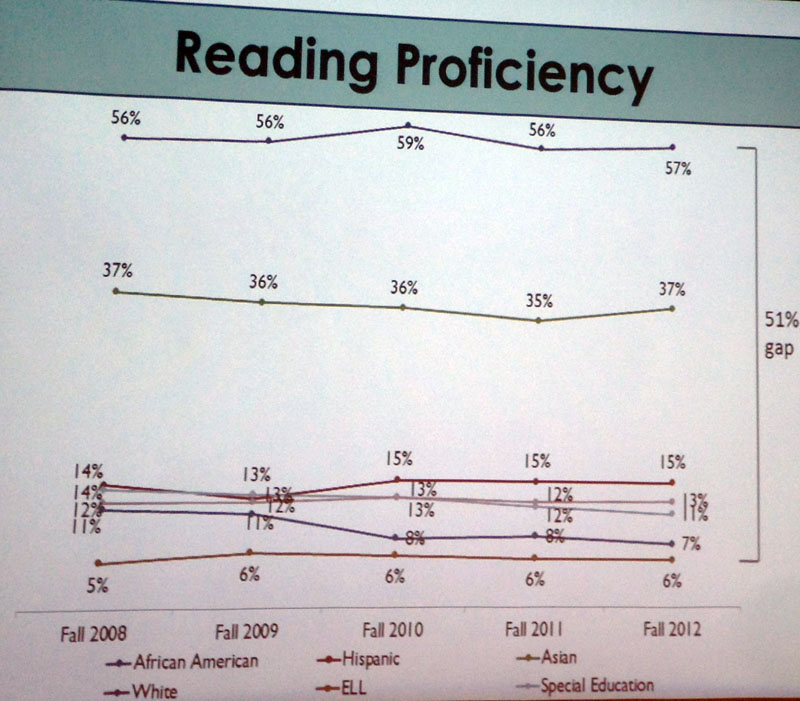
Share

Grants to fund 5 new after-school sites in Madison

Channel3000.com:

The Madison area is adding five new after-school sites to the already existing six sites throughout the city thanks to a federal 21st Century Community Learning Center grant, according to a release.
The CLC grant program will be supporting after-school activities for students at 107 new sites throughout Wisconsin for the 2013-14 school year, according to the release.
The 30 new grants and 77 continuing grants total $7.8 million, according to the release.
Those 107 new sites, along with 113 existing after-school program sites are sharing $16 million in federal CLC grant money, according to the release.
The new Madison area after-school sites include Lowell Elementary School, O’Keefe Middle School, Black Hawk Middle School, Leopold Elementary School and Sandburg Elementary School.

Share

Indian state orders headteachers to taste all school lunches

Jason Burke:

Authorities in the eastern Indian state of Bihar have ordered headteachers to taste all school lunches before they are served after 23 schoolchildren died eating a lunch contaminated with pesticide.
Amarjeet Sinha, the top official in the local education department, told reporters that cooking oil used at the school in Chapra District, 40 miles from the Bihar state capital of Patna, had been stored in or near a container previous filled with pesticide.
Sinha said notices published on Thursday morning in local newspapers ordering headteachers to taste food and to ensure safe storage of ingredients would “dispel any fear in [children’s] minds that the foods are unsafe.”
Children across Bihar, one of the poorest states in India, have been refusing to eat free school lunches since the incident on Tuesday.

Share

Student Loans 101: Why Uncle Sam is your banker

Connie Cass:

A look at the 55-year history of federal student loans:
___
Americans got a shock from the sky in October 1957.
The first artificial satellite was passing overhead. And it wasn’t just man-made, it was Soviet-made.
Beach ball-sized Sputnik touched off a space race and stoked big fears that American students might not be up to the challenges of the Cold War.
Calls to improve science and technical education led President Dwight Eisenhower to establish a low-interest college loan program through the National Defense Education Act of 1958. The loan dollars came directly from the government.
___
Then came Lyndon Johnson’s “war on poverty.”
Student loans got a major boost in 1965 as part of the president’s Great Society initiatives. The Higher Education Act expanded loans as well as grants to help needy students, contributing to the era’s college boom. It also changed the way the federal loan program was financed. Instead of using government money directly, the loans would be made by bankers. But the government guaranteed that if students defaulted, the U.S. government would cover the tab.

Share

How Far from Home Do US Students Travel to Attend College? ACT Report Shows Higher-Achieving Students Travel Farther Than Lower-Achieving Students

ACT, via a kind reader:

IOWA CITY, IOWA–The greater a student’s academic achievement, the farther away from home that student is likely to attend college, according to a new research report from ACT. The findings of the report, entitled College Choice Report–Part 2: Enrollment Patterns, point to an opportunity to better inform lower-achieving students of the choices available to them.
The ACT research shows that 2012 U.S. graduates who took the ACT®college readiness assessment attended college a median distance of 51 miles from their home. That median distance, however, increases dramatically as ACT composite scores go higher.
For students with an ACT composite score of 28 to 36–the upper scoring range on the 1 to 36 scale–the median distance from home to college was more than 113 miles; for students with a score of 33 or higher, the median distance was 170 miles. In contrast, students who earned an ACT composite score below 24 attended college a median distance of less than 50 miles from home.

Share

K-12 Tax & Spending Climate: Detroit, tip of a vast pensions liability iceberg

Heidi Moore:

Detroit’s filing of the biggest municipal bankruptcy in US historycaps three decades of the city’s steady decline, characterized by crime, shrinkage of auto manufacturing industry, and a population all too eager to leave for the more hospitable suburbs.
Detroit’s bankruptcy is, primarily, a lesson in how cities and states cannot avoid their pension responsibilities without a backlash of biblical proportions. In 2006, Detroit, like many other cities and states, was facing a $1.5bn gap in its pension payments to its public employees. As Quartz noted:
The city converted them into debt called “certificates of participation”, or COPs, which it sold through a legally separate financial vehicle at a floating interest rate. Then it entered into a swap with UBS that converted those to fixed rates. This swap became very expensive when rates dropped after the financial crisis. A very similar arrangement led to the Jefferson County bankruptcy, and a massive scandal that sent several financiers to jail.

Share

Health insurance changes a cure for what ails Madison schools budget?


Christ Rickert

The Madison School District won an historic concession from its teachers union over the last two years — the ability to require that teachers pay part of their health insurance premiums.
It came as the district was quickly extending union contracts before a law eliminating most collective bargaining rights took effect, and again while that law was held up in court.
But now as the district goes about crafting a 2013-14 budget that — among other cost-savings measures — reduces maintenance spending, freezes equipment budgets and includes no money for new efforts to close the district’s achievement gap, it doesn’t appear there’s much interest in implementing the concession.
The budget proposal from new Superintendent Jennifer Cheatham doesn’t subject teachers to health insurance premiums, and that’s fine with School Board President Ed Hughes.
“Because of our recent transitions, this was not the budget to take up significant changes to our structure of salary and benefits,” he said in an email. “I and other board members are looking forward to an in-depth review of salary and benefit levels as part of next year’s budget, when we’ll have the benefit of input from Jen Cheatham and (assistant superintendent for business services) Mike Barry, as well as from our affected teachers and staff. I’m sure that health insurance contributions will be part of that discussion.”
“Recent transitions” didn’t keep Cheatham from proposing changes to the district’s salary schedules, though.

Madison’s expensive approach to healthcare benefits are not a new subject.
Much more on the Madison School District’s 2013-2014 plans for spending and property tax increases, here.
Mr. Hughes in 2005

Share

Study Finds Spatial Skill Is Early Sign of Creativity

Douglas Quenqua:

A gift for spatial reasoning — the kind that may inspire an imaginative child to dismantle a clock or the family refrigerator — may be a greater predictor of future creativity or innovation than math or verbal skills, particularly in math, science and related fields, according to a study published Monday in the journal Psychological Science.
The study looked at the professional success of people who, as 13-year-olds, had taken both the SAT, because they had been flagged as particularly gifted, as well as the Differential Aptitude Test. That exam measures spatial relations skills, the ability to visualize and manipulate two-and three-dimensional objects. While math and verbal scores proved to be an accurate predictor of the students’ later accomplishments, adding spatial ability scores significantly increased the accuracy.
The researchers, from Vanderbilt University in Nashville, said their findings make a strong case for rewriting standardized tests like the SAT and ACT to focus more on spatial ability, to help identify children who excel in this area and foster their talents.
“Evidence has been mounting over several decades that spatial ability gives us something that we don’t capture with traditional measures used in educational selection,” said David Lubinski, the lead author of the study and a psychologist at Vanderbilt. “We could be losing some modern-day Edisons and Fords.”

Steve Hsu comments.

Share

Process Over Product

Doug Ward:

American higher education suffers from an identity crisis that threatens its long-term viability.
As costs have surged and free online courses have proliferated, colleges and universities have elevated image over substance and clung to an antiquated structure that has left them vulnerable in an era of rapid change. Until they focus seriously on improving their core function – student learning – they risk foundering in a sea of mixed messages.
On the one hand, administrators explain the immense long-term value of a degree and the immediate payoff in job opportunities and higher salary. On the other hand, they elevate sports teams to godlike status, pay coaches many times morethan they do professors, reward volume of research over innovative teaching, and compete for students by promoting what Jose Bowen calls the “campus spa.”
Overcoming this identity crisis requires an understanding of what I argue are the three main components of higher education: promise, process and product. Colleges and universities have long promised a path to broader thinking, an entree to a leadership class, and a means to bolster a democratic society.

Share

Why New Jersey’s teachers’ union is on the sidelines in this Senate race

Laura Waters:

With less than four weeks until New Jersey’s primary election for U.S. Senate, the latest Monmouth University poll shows that 49 percent of likely voters support Cory Booker, a lead that Monmouth pollster Patrick Murray calls “impregnable.” Fellow Democrats Frank Pallone, Rush Holt, and Sheila Oliver garner anywhere from an anemic 12 percent to a moribund 3 percent. Rush Holt comes in at 8 percent.
U.S. Congressman Holt’s middle-of-the-losers status is rankling his new consultant Bob Braun, who this week unleashed a tirade at N.J.’s primary teachers’ union, NJEA. Braun, a 50-year veteran of the Star-Ledger and faithful labor union lackey, is appalled that traditional public school lobbyists have failed to endorse any candidate, let alone Holt. NJEA typically issues endorsements for U.S. Senate candidates – in 2008 it endorsed the late Frank Lautenberg (whose open seat is in contention) and in 2012 it endorsed Bob Menendez.
For Braun, NJEA’s uncharacteristic passivity this election cycle is indefensible because Booker is a proponent of school vouchers, a controversial plan that would allow parents to use state money for private and parochial school tuition. NJEA hates vouchers and Braun bridles at the union’s failure to interfere with Booker’s coronation. He attributes NJEA’s silence to cowardice:

Share

Kennedy Center picks Madison for arts education push

Gayle Worland:

All young children in Madison public schools would have greater access to the arts under a program being launched in the city this fall by the Kennedy Center.
The Washington, D.C.-based Kennedy Center — best known as a national showcase and landmark hub of the arts — has selected Madison as the 12th U.S. city for its “Any Given Child” program. The initiative is designed to create a long-range arts education plan to reach every public school student in grades K-8.
“The (Madison) district has specific goals about closing the achievement gap, and we know that the arts can help achieve that,” said Ray Gargano, director of programming and community engagement for the Overture Center for the Arts, which is coordinating the local side of Any Given Child.
In the first year of the multi-year program, two representatives from the Kennedy Center will assist a committee of about 35 local citizens to audit the arts resources in every Madison elementary and middle school, said Darrell Ayers, vice-president of education for the Kennedy Center.
That information will be used to create a long-term plan to make sure healthy arts programs are happening in every school for every child, not just some.
“The next two or three years (following the audit), we stay with the community to assure that the work is going to be completed,” Ayers said. “We’re not bringing money, but we’re certainly bringing expertise. We’ve done this in a number of communities and been very successful.”

Share

Teach for America isn’t perfect, but it has been a boost to education

Anthony Britt:

As an African-American male born to a teenage mother, my future was bleak, but I had an extended family of teachers, mentors and coaches whose high expectations and support helped me grow from a young boy with an uncertain future to a young man with a college degree.
Although, I found a viable pathway, I remained agitated that we can predict a child’s life trajectory based primarily on their zip code. Teach For America (TFA), an organization on a mission to ensure an excellent education for all children by putting talented college graduates into teachingroles, seemed like the perfect fit, so I headed south to teach 8th Grade science in the Mississippi Delta just three days after graduating from Harvard University.

Share

A Philadelphia School’s Big Bet on Nonviolence

Jeff Deeney:

Last year when American Paradigm Schools took over Philadelphia’s infamous, failing John Paul Jones Middle School, they did something a lot of people would find inconceivable. The school was known as “Jones Jail” for its reputation of violence and disorder, and because the building physically resembled a youth correctional facility. Situated in the Kensington section of the city, it drew students from the heart of a desperately poor hub of injection drug users and street level prostitution where gun violence rates are off the charts. But rather than beef up the already heavy security to ensure safety and restore order, American Paradigm stripped it away. During renovations, they removed the metal detectors and barred windows.
The police predicted chaos. But instead, new numbers seem to show that in a single year, the number of serious incidents fell by 90%.
The school says it wasn’t just the humanizing physical makeover of the facility that helped. Memphis Street Academy also credits the Alternatives to Violence Project (AVP), a noncoercive, nonviolent conflict resolution regimen originally used in prison settings that was later adapted to violent schools. AVP, when tailored to school settings, emphasizes student empowerment, relationship building and anger management over institutional control and surveillance. There are no aggressive security guards in schools using the AVP model; instead they have engagement coaches, who provide support, encouragement, and a sense of safety.

Share

Improving Students’ College Math Readiness: A Review of the Evidence on Postsecondary Interventions and Reforms

Michael Hodara:

A major challenge facing students as they pursue a postsecondary degree is a lack of academic preparedness for college-level coursework, and, in particular, college-level math. This paper reviews the research on the effectiveness of strategies that seek to improve the math preparedness and success of high school students entering college. These include assessing students’ math skills in high school using college placement exams; providing math bridges, boot camps and brush-ups before students start college; reforming developmental math sequences; and improving instruction in developmental and college-level math courses.

Share

Turning big ships or changing large organizations

Doug Lederman:

On what one might call the “vulnerability index” — how higher education institutions shake out in terms of their financial viability in the short- to mid-term — the universities represented in a session titled “Remaining Nimble in the Face of External Challenges” at the annual meeting of college business officers here Tuesday are some of the lucky ones.
Unlike some smaller and less-differentiated private and public colleges and universities, public flagship universities like the University of California at Berkeley and the University of Illinois and selective (and highly visible) private institutions like the University of Notre Dame are not only going to survive whatever turmoil higher education faces in the next decade or two — at least — they’re likely to thrive, too.
But that doesn’t mean they can stand pat in the face of the many pressures they (like other colleges and universities) are facing: reduced state appropriations for public institutions, public pressure to control (if not lower) tuition, escalating health care and other costs, and many more. So before a room of 200-plus finance administrators at the National Association of College and University Business Officers, leading officials at Berkeley, Illinois and Notre Dame described how they have been “managing through uncertainty,” as Patrice DeCorrevont, national head of higher education banking at JPMorgan Chase, described the environment in which they and everyone else in higher education have been operating.

Related: Madison School Board President Ed Hughes.
Two Madison school board seats will be on the spring 2014 ballot. Ed Hughes and Marj Passman presently occupy those seats. Learn more at the City of Madison Clerk’s website.

Share

Tainted School Lunch Kills at Least 23 Indian Children

Rajesh Roy & Vibhuti Agarwal:

In a threadbare hospital here, 5-year-old Rashmi Kumari is fighting a powerful poison. “She is a brilliant student,” said her uncle as he tried to distract her by asking her to recite poems.
Rashmi is also the only child in her household left alive.
Her cousins, Anshu and Kushboo, died after eating a school lunch now believed to have been contaminated with a pesticide compound, according to a hospital official. The disaster has left at least 23 children dead as of Thursday morning and spotlights the shortcomings in a government school-lunch program intended to feed India’s millions of malnourished students.

Share

Mayor Paul Soglin Discusses Education Reform with U.S. Secretary of Education Arne Duncan

City of Madison, via a kind reader’s email:

Mayor Paul Soglin joined U.S. Secretary of Education Arne Duncan, other mayors and school superintendents in Washington, DC, today to discuss partnership opportunities between cities and the U.S. Department of Education to foster effective approaches to education reform.
Participating city leaders are part of a new Mayors’ Education Reform Task Force co-chaired by National League of Cities (NLC) First Vice President Chris Coleman, Mayor of Saint Paul, MN, and NLC Second Vice President Ralph Becker, Mayor of Salt Lake City, UT. Mayors Coleman and Becker formed the task force in March 2013 to explore how cities can and should be involved in local education reform efforts.
During today’s meeting, task force members highlighted the growing commitment by municipal officials across the country to promoting educational achievement.
“Mayors and elected officials can bring together all the stakeholders in the education conversation in their cities,” said Mayor Soglin. “The perspectives from mayors of cities large to small are valuable to local and national policymakers. I’m glad we had an opportunity to talk with the Secretary and his staff about the role mayors can play in education transformation.”
Local leaders shared examples of city-school partnerships they have formed in their communities in areas such as school improvement, early learning, afterschool programming, and postsecondary success.
“The trajectory of learning begins at birth and extends over a lifetime,” said Mayor Becker, who was unable to attend the meeting. “Cities now experience an unprecedented level of collaboration and discussion in formulating specific plans for postsecondary access and success and productive out-of-school time learning.”
The meeting with Secretary Duncan provided mayors with an opportunity to discuss how lessons learned at the city level can inform federal education policy. Among the key issues of concern identified by the task force are:

  • Finding a “third way” in education reform that balances a commitment to accountability with a spirit of collaboration among school administrators, teachers, and cities;
  • Transforming schools into centers of community that support parent engagement and provide wraparound services to children and families;
  • Building on successful “cradle-to-career” models to develop a strong educational pipeline;
  • Securing adequate and equitable funding for local education initiatives; and
  • Promoting college access and completion.

“In this global economy, cities and towns depend on an educated workforce and schools are depending on us. We need to work together to ensure that our children graduate high school ready for postsecondary education and career success,” said NLC President Marie Lopez Rogers, Mayor of Avondale, AZ. “As city leaders, we have an important message that must be heard and we must be at the table in guiding federal and local education reform policies.”
In addition to Mayors Soglin, Coleman and Becker participants in today’s meeting included: Mayor Karen Freeman-Wilson of Gary, Indiana; Mayor Edna Branch Jackson of Savannah, Georgia; Mayor Dwight Jones of Richmond, Virginia; Mayor Pedro Segarra of Hartford, Connecticut; Riverside (Calif.) Unified School District Superintendent Rick Miller; Gary Community School Corporations Superintendent Cheryl Pruitt; and New York City Deputy Chief Academic Officer Josh Thomases.
The National League of Cities (NLC) is dedicated to helping city leaders build better communities. NLC is a resource and advocate for 19,000 cities, towns and villages, representing more than 218 million Americans.

Related:

Share

Technology Is a Tool, Not a Learning Outcome

Tina Barseghian:

Something about this very simple list struck a chord with many educators. Author Bill Ferriter explains: “Kids AREN’T motivated by technology. Instead, they’re motivated by opportunities to make a difference in the world; they are motivated by opportunities to ask and answer their own questions; and they are motivated by opportunities to learn together with like-minded peers.”
Do you agree?

Share

Iris scans are the new school IDs

CNN Money:

Kids lose their school IDs but they don’t often lose their eyeballs.
That’s one of the reasons why a growing number of schools are replacing traditional identification cards with iris scanners. By the fall, several schools — ranging from elementary schools to colleges — will be rolling out various iris scanning security methods.
Winthrop University in South Carolina is testing out iris scanning technology during freshman orientation this summer. Students had their eyes scanned as they received their ID cards in June.
“Iris scanning has a very high level of accuracy, and you don’t have to touch anything, said James Hammond, head of Winthrop University’s Information Technology department. “It can be hands free security.”

Wow.

Share

Report detailing widespread fraud in the N.J. school lunch program

Ted Sherman and Christopher Baxter:

Officials said the report, which will be made public by comptroller Matthew Boxer, details fraud in the National School Lunch Program in New Jersey school districts, including by public employees and public officials.
The investigation comes in the wake of a series of stories by The Star-Ledger into lunch program abuses in Elizabeth, where the president of the school board was indicted after the newspaper found her children were receiving subsidized meals despite a family income far exceeding federal eligibility limits set by the federal government.
The state attorney general’s office said it launched its investigation into the Elizabeth program after The Star-Ledger reported that the children of Marie L. Munn, then serving as board president, were enrolled in the program. At the time, her financial disclosure statements showed she was employed as a human resources administrator for a nonprofit organization and her husband, who was employed by the New York Times, was also the owner and head coach of a semi-pro football team.

Share

New Jersey Democrats asleep on education reform

Laura Waters:

New Jersey’s political races for U.S. Senate and Governor have dominated local media, despite the lack of meaningful competition for shoo-ins Newark Mayor Cory Booker, and Governor Chris Christie.
The latest Quinnipiac poll shows that 52 percent of voters support Booker; U.S. Congressmen Frank Pallone and Rush Holt each garner less than 10 percent of the electorate, and laggard Sheila Oliver barely musters 3 percent.
In the gubernatorial race, Christie is running about 40 points ahead of N.J. Sen. Barbara Buono.
Lock or not, N.J.’s public education system is a big talking point for all candidates. In fact, the current electoral discussions get to the heart of a puzzle for this blue state’s Democratic leadership: in the realm of education reform, what does it mean to be a New Jersey Democrat?
If you ask Cory Booker, a “Democratic” agenda includes charter school expansion, data-driven teaching evaluations, top-down accountability, focus on poor urban school districts, and vouchers. But if you ask Barbara Buono for her prescription for improving public education, a “Democratic” agenda, antithetical to Booker’s, includes restrictions on charter school growth, protection for teachers from the vagaries of data, and local control.
This stark contradiction in agenda between two of the state’s most prominent Democrats says less about national trends and more about the paralysis of N.J. party leaders. While the national Democratic Party has integrated education reform tenets into its platform on public school improvement – indeed, except for the vouchers Booker’s agenda mirrors President Obama’s — N.J.’s elected Democrats are stuck in a time warp.
One way to think about this is in the context of the GOP’s national problem, post the 2012 presidential election. Republicans, it’s often noted, are trapped in a shrinking tent that not only appears too small for the 47 percent (remember Mitt Romney’s infamous comments about Americans who rely on some sort of governmental support?) but is too diminished for immigrants and the LGBTQ community.

Share

Why I’ve Decided to Avoid US Genetic Testing

Ben Collier:

Hello everyone! I’ve been away for a while, but for a good reason. Last Friday, my wife gave birth to two beautiful boys. They’re asleep at the moment, and my wife has gone off to have a nap, the house is clean, so I’m clear to do some blogging.
Now, a few months ago, I was talking about having my genome sequenced by a US genetic-testing firm. They’ve got a great site, they seem to have loads of added-value features, and they’re reasonably priced, even once you factor in postage to the UK. The companies in this country seem pretty lacklustre, so although I normally like to support UK business, I thought I’d give this US company a chance. So then my boys were conceived, and supposed to be non-identical, but on Friday they were born, declared identical, and the placenta(s) were disposed of before our regular consultant had a chance to prove that this later diagnosis was wrong.
Enter the genetic tests. I needed to know whether they were mono- or di-zygotic. “Aha!” I thought, “genome sequencing will be perfect for this!”. But then I was struck with another thought. The image of Edward Snowden loomed into my mind, and I began to mull over the consequences of handing my children’s genome(s) to a US firm. Essentially, any information held on them by a US company could be passed over to the US government. The PRISM scheme, and laws associated with it, essentially allow all manner of information to be requested by US agencies, and the firm receiving the request are legally prevented from disclosing the fact the the request took place to the person whose data has been grabbed. How far this will stretch in future is unclear, and this applies to any US-based informatics firm. The same applies to any other genetics company for informatics organisation, of whatever sort.

Share

College Path May Not Be Best

Brandon Busteed:

If Americans are judging the colleges they choose a, they may be better off not choosing a college at all. It turns out that college graduates are significantly less engaged in their jobs than everyone else. And this finding is true across all professions, age ranges, and income levels. College graduates are less engaged than technical/vocational school grads, high school grads, and even high school dropouts. This finding alone is about as devastating as it gets for higher education, but it’s actually worse than you think.
The key driver of college graduates being less engaged is that they are much less likely than everyone else to say they have an opportunity to “do what they do best every day.” In other words, something about college isn’t working — it appears it doesn’t do a good enough job of bringing students closer to figuring out what they are best at. The implications of this are so profound that it will literally change everything in higher education. From rethinking what its ultimate purpose should be, to the very basics of how we teach, coach, mentor, and develop learners.
College — based on recent economic analyses — does produce higher earnings over a lifetime. But it does not always lead to a “good job” – one in which people are engaged in their work and doing what they do best. At least, not compared to everyone else who doesn’t go to college. The magnitude of this failure can’t be over-exaggerated, especially considering what Gallup knows about human development and wellbeing — where nothing is more fundamental than doing what you’re best at every day.

Share

How I Transformed iPad Workflow In My School

Don at edteacher.org:

A solid digital workflow system addresses many of these questions. But before exploring the myriad systems out there, figure out what you already have in place, and what you really want the system to do.
Ask yourself the following questions before your start evaluating options – the answer will help narrow your choices:
Do I need a webpage for my class that has all resources, assignments, class info, my info, messaging, etc?
Do I simply need an organized way to exchange work back and forth with students?

Share

New Jersey Democrats asleep on education reform

Laura Waters:

New Jersey’s political races for U.S. Senate and Governor have dominated local media, despite the lack of meaningful competition for shoo-ins Newark Mayor Cory Booker, and Governor Chris Christie.
The latest Quinnipiac poll shows that 52 percent of voters support Booker; U.S. Congressmen Frank Pallone and Rush Holt each garner less than 10 percent of the electorate, and laggard Sheila Oliver barely musters 3 percent.
In the gubernatorial race, Christie is running about 40 points ahead of N.J. Sen. Barbara Buono.
Lock or not, N.J.’s public education system is a big talking point for all candidates. In fact, the current electoral discussions get to the heart of a puzzle for this blue state’s Democratic leadership: in the realm of education reform, what does it mean to be a New Jersey Democrat?
If you ask Cory Booker, a “Democratic” agenda includes charter school expansion, data-driven teaching evaluations, top-down accountability, focus on poor urban school districts, and vouchers. But if you ask Barbara Buono for her prescription for improving public education, a “Democratic” agenda, antithetical to Booker’s, includes restrictions on charter school growth, protection for teachers from the vagaries of data, and local control.

Share

“Failing Liberty 101: How We Are Leaving Young Americans Unprepared for Citizenship in a Free Society”

William Damon, via a kind reader’s email:

William Damon was interviewed about his book, “Failing Liberty.” In the book, Prof. Damon argues that we are not properly preparing our young people to become responsible citizens. This interview was recorded at the Hoover Institution on the campus of Stanford University.

Share

How Scholastic Sells Literacy To Generations Of New Readers

Lynn Neary:

Chances are you have had contact with Scholastic Publishing at some point in your life: You might have read their magazines in school, or bought a book at one of their book fairs, or perhaps you’ve read Harry Potter or The Hunger Games? From its humble beginning as publisher of a magazine for high schoolers, Scholastic has become a $2 billion business and one of the biggest children’s book publishers in the world.
Scholastic is a leader in the school book fair business — which is in keeping with the company’s origins. Nearly 100 years ago, the company started out by building its business in schools.
“If you think of Scholastic, it’s a relationship company with teachers and parent and kids,” says Dick Robinson, Scholastic’s chairman and CEO. “And it succeeded by going on from generation to generation.”

Share

All In All You’re Just A . . .

Linda:

The 6th Circuit ruled several weeks ago that the German homeschooling-and-evangelical-Christian family is not eligible for refugee status and should be deported. The Romeikes appealed for a rehearing en banc. The DOJ responded on the 26th of June. At this point, the parties are waiting to see if the 6th Circuit will grant the rehearing. If they do not, the Romeikes’ next step will be to appeal directly to SCOTUS.
Now I’ve had a peek at the two latest briefs. They aren’t long or complicated. Basically, the Petitioners said the 6th Circuit panel did not follow precedent for evaluating asylum claims, and further that the panel’s new rule is flawed and the decision erroneous.
The United States responded first with the obligatory standard of proof argument that every party not bearing heightened scrutiny uses in the hopes of winning without getting to the merits of the case. Then they basically said nuh-uh, they did too decide correctly.
The arguments are mainly legal, but the DOJ also disagrees on a crucial point of fact: whether the German government uses its compulsory attendance law in order to prevent Christians from homeschooling their children for religious reasons.
Appellate courts give deference to trial-level findings of fact. Since this was an administrative case, the trial level wasn’t in a federal district court, but rather before an administrative judge, who granted the Romeikes’ request for asylum. In order to rule in their favor, the judge must have made factual findings in favor of the Romeikes. Yet, the only reference to findings of fact is in a DOJ reference to the “Board.” How that relates to the administrative judge’s decision, I do not know.

Share

Districts Prepare for New High School Diploma Rules

Morgan Smith:

Some Texas high school students who failed state standardized exams this spring were given a reprieve under the comprehensive education bill that Gov. Rick Perry signed in early June.
Under current law, they would have had to take 15 state standardized exams to graduate. With the changes in House Bill 5 that begin in the coming school year, they will need to pass only 5. Shortly after Perry signed the bill, which cleared both chambers of the Legislature unanimously, the Texas Education Agency announced that current high school students would not have to retake exams they had failed in any of the six subjects that the new law removed from the state’s testing requirements. They are algebra II, chemistry, English III, geometry, physics and world history.
But as educators welcome the relief that the legislation brought from what were widely considered onerous state testing requirements, some school districts are now looking ahead at another part of the law, which will take effect in the 2014-15 school year and broadly expand the courses that will count toward a diploma.

Share

The Secret to Finland’s Success With Schools, Moms, Kids–and Everything

Olga Khazan, via a kind reader’s email:

It’s hard not to get jealous when I talk to my extended family.
My cousin’s husband gets 36 vacation days per year, not including holidays. If he wants, he can leave his job for a brief hiatus and come back to a guaranteed position months later.
Tuition at his daughter’s university is free, though she took out a small loan for living expenses. Its interest rate is 1 percent.
My cousin is a recent immigrant, and while she was learning the language and training for jobs, the state gave her 700 euros a month to live on.
They had another kid six years ago, and though they both work, they’ll collect 100 euros a month from the government until the day she turns 17.
They of course live in Finland, home to saunas, quirky metal bands, and people who have for decades opted for equality and security over keeping more of their paychecks.
Inarguably one of the world’s most generous — and successful — welfare states, the country has a lower infant mortality rate, better school scores, and a far lower poverty rate than the United States, and it’s the second-happiest country on earth (the U.S. doesn’t break the top 10). According to the OECD, Finns on average give an 8.8 score to their overall life satisfaction. Americans are at 7.5.

Much more on Finland’s schools, here.

Share

Yes, Aid Fuels Tuition Inflation

Neal McCluskey:

At this point, I think I’ve said all I need to about the doubling of interest rates on subsidized federal student loans. Basically, the doubling won’t have a big impact one way or another, but putting a little more payment burden on the students consuming higher education is probably a good thing. Why? Because cheap aid encourages students to demand stuff they otherwise wouldn’t, and enables colleges to raise their prices at excessive rates.
That said, since the nation will likely be talking about student aid for a while longer, now is probably a good time to reprint – and expand – the list of empirical studies that have, in one way or another, found that schools in large part capture aid money rather than becoming more affordable. The list probably isn’t exhaustive, and there are many limitations that make it impossible to prove that aid fuels inflation, but combined with the logic that you’ll willingly pay more if you have someone else’s money, these studies show that there is very good reason to conclude that aid is counterproductive:
John D. Singell, Jr., and Joe A. Stone, “For Whom the Pell Tolls: The Response of University Tuition to Federal Grants-in-Aid,” Economics of Education Review 26, no. 3 (2006): 285-95.

Share

The Economics of Student Debt

Matt McDonald, Laura Crawford, Tucker Warren, Russ Grote.

Share

What I Learned In College: The greatest challenge our species has ever faced is the educational system itself.

Erik McClure

“In times of change, learners inherit the earth, while the learned find themselves beautifully equipped to deal with a world that no longer exists.” ― Eric Hoffer
Yesterday, the University of Washington finally mailed me my diploma. A Bachelor of Science in Applied Computational Math and Science: Discrete Math and Algorithms. I learned a lot of things in college. I learned how to take tests and how to pinpoint exactly what useless crap a particular final needed me to memorize. I learned that math is an incredibly beautiful thing that has been butchered so badly I hated it all the way until my second year of college. I learned that creativity is useless and all problems have one specific right answer you can find in the back of a textbook somewhere, because that’s all I was ever graded on. I learned that getting into the CSE major is more about fighting an enormous, broken bureaucratic mess than actually being good at computer science. But most of all, I learned that our educational system is so obsessed with itself it can’t even recognize it’s own shortcomings.
The first accelerated program I was accepted into was the Gifted program in middle school. I went from getting As in everything to failing every single one of my core classes. Determined to prove myself, I managed to recover my grades to Bs and Cs by the end of 7th grade, and by the end of 8th grade I was back up to As and Bs. I didn’t do this by getting smarter, I did it by getting better at following directions. I got better at taking tests. I became adept at figuring out precisely what the teacher wanted me to do, and then doing only that, so I could maximize both my free time and my grades. By the time I reached high school, I would always meticulously go over the project requirements, systematically satisfying each bullet point in order to maximize my score. During tests, I not only skipped over difficult questions, I would actively seek out hints in the later questions to help me narrow down possible answers. My ability to squeeze out high grades had more to do with my aptitude at filling in the right bubbles on a piece of paper then actually understanding the material.

Share

Who Ruined the Humanities? Of course it’s important to read the great poets and novelists. But not in a university classroom, where literature has been turned into a bland, soulless competition for grades and status.

Lee Siegel

You’ve probably heard the baleful reports. The number of college students majoring in the humanities is plummeting, according to a big study released last month by the American Academy of Arts & Sciences. The news has provoked a flood of high-minded essays deploring the development as a symptom and portent of American decline.
But there is another way to look at this supposed revelation (the number of humanities majors has actually been falling since the 1970s).
The bright side is this: The destruction of the humanities by the humanities is, finally, coming to a halt. No more will literature, as part of an academic curriculum, extinguish the incandescence of literature. No longer will the reading of, say, “King Lear” or D.H. Lawrence’s “Women in Love” result in the flattening of these transfiguring encounters into just two more elements in an undergraduate career–the onerous stuff of multiple-choice quizzes, exam essays and homework assignments.
The disheartening fact is that for every college professor who made Shakespeare or Lawrence come alive for the lucky few–the British scholar Frank Kermode kindled Shakespeare into an eternal flame in my head–there were countless others who made the reading of literary masterpieces seem like two hours in the periodontist’s chair. In their numbing hands, the term “humanities” became code for “and you don’t even have to show up to get an A.”

Share

Big Data’s Dehumanizing Impact On Public Policy

Matt Asay:

One of the mantras of the Big Data revolution is that causation no longer matters. It’s enough, the theory goes, to seek correlations in our copious data, deciphering “what” is happening and not bothering with “why.” But not only is this problematic for a business looking for optimal retail pricing strategies, it’s dramatically more so for those charged with crafting public policy.
For governments and other public institutions, it turns out that understanding causation matters a great deal.
Causation Loses Its Sex Appeal
The “forget-causation-seek-correlation” Big Data crowd has been around for years and its most sophisticated proponents are Kenneth Cukier (The Economist) and Viktor Mayer-Schönberger (Oxford University). In their excellent Big Data, the authors argue: “In a big-data world … we won’t have to be fixated on causality; instead we can discover patterns and correlations in the data that offer us novel and invaluable insights. Big data is about what, not why.”
The idea is that given enough data, algorithms can appreciate correlations between seemingly disparate data sets without bothering to understand those correlations. It is enough to see that a rise in the purchase of Pop-Tarts at Wal-Mart highly correlates with hurricane warnings. Wal-Mart needn’t understand why: it just needs to stock Pop-Tarts in a visible area of the store whenever hurricane warnings are issued.

Share

Homeschooling In and Out of Our League

No One of Any Import:

Blogging, Parenting, Political Correctness 9 June 2013 Comments: 11
I want to talk a little more about my decision to fundraise for the Tampa Bay HEAT.
My decision is based on something bigger than the gratitude I feel for this organization. I am fundraising for the HEAT’s dream of a full service school building because I see a tremendous need for it.
As I have encountered various homeschool groups in the last two years, I have noticed a pattern. Each group tends to have a particular focus: academics, informal fellowship, or sports. Of course, these goals overlap, but most groups give priority to one category over the others.
Without question, the hardest need to satisfy when homeschooling is participation in team sports. “Tebow” laws are great but not a complete answer to the question of how we provide team sports to the homeschooling community at large.

Share

Madison School Forest a teachers’ educational tool

Jeffrey Davis:

In the literary world, forests have often been the symbol of menace.
Think of how many times someone has uttered “we’re not out of the woods yet.”
But a forest is a great place to begin one’s outdoors education and apply science, math, reading and writing.
And the Madison Metropolitan School District is playing a role.
Several retired MMSD teachers recently spoke of alerting newer teachers to take advantage of the opportunity to introduce children to the Madison School Forest, a 307-acre woods the district owns southwest of Verona in Wisconsin’s Driftless Area. It is also known as the Jackson School Forest after naturalist Joseph “Bud” Jackson.

The school forest is a gem.

Share

Test scores should inform, not punish students

Diane Kern and Lynne Derbyshire:

Next spring, thousands of Rhode Island high school students may be denied a diploma, not because of poor grades, but because of low scores on New England Common Assessment Program tests. The current state Board of Education’s plan to use the standardized test to help grant or deny high school diplomas will certainly fail, not educate, our bright and capable students.
It is not right or wise to use high-stakes testing to keep college and career-ready students from graduating high school. Research also does not support using NECAP, or other high-stakes tests for that matter, as a high-school graduation requirement.
There are many flaws in the current board policy and the state Department of Education’s five-year strategic plan, now ending its third year. We’ll raise two here.
The foremost issue is the Rhode Island public school funding formula, which currently denies students access to an equitable quality public education. As our neighbors in Massachusetts did 10 years ago, we should have frontloaded the resolution of this serious problem.

Share

What Do State Appropriations Buy a University?

Andrew Gillen:

Colorado State University-Global Campus was in the news last fall as the first college to offer credit for a MOOC course. No one has yet taken up CSU-Global on its offer, though keep in mind it was a single course in computer science.
But offering credit for a MOOC is not the only uncommon practice at CSU-Global:
CSU-Global is a public university that is entirely online – no labs, football stadium, dorms, etc.
It doesn’t receive any state appropriations. After some state startup capital, CSU-Global operates without state funding and administrators say it is financially sustainable. (The average per-student state appropriation for a four-year public university is around $8,000.)
CSU-Global relies entirely on adjunct professors; no tenured faculty.
It has a very small administration–72 full-time employees for 8,500 students.
To enroll in CSU-Global, students already must have 12 credit hours from another university.

Share

Mother’s Antibodies May Explain a Quarter of Autism Cases

Maia Szalavitz:

A test for six antibodies in an expectant mom’s blood may predict with more than 99% certainty which children are at highest risk of developing autism.
In a study published in Translational Psychiatry, researchers report that 23% of all cases of autism may result from the presence of maternal antibodies that interfere with fetal brain development during pregnancy. The work builds on a 2008 study from the same scientists that first described the group of antibodies in mothers-to-be. The latest paper describes the specific antibodies and provides more detail on what they do.
“It’s very exciting,” says Alycia Halladay, Senior Director of Environmental and Clinical Sciences for Autism Speaks, who was not associated with the research.

Share

Beware, ‘education’ tax hike might not actually do much for schools

Colorado Springs Gazette:

Politicians, including Colorado Gov. John Hickenlooper, want voters in November to approve a massive, historic and permanent billion-dollar-a-year tax increase that will raise income tax rates of middle-class wage earners from 4.63 percent to as high as 5.9 percent. It could be a hard sell, to say the least, but politicians tell us it’s all for the children. It’s an education tax, they insist.
The progressive tax, which would do away with Colorado’s fair and enviable flat tax, would cost almost $600 each year for a family living on $100,000. For someone earning $45,000, the cost would be $166.50.
Most decent human beings care about children and value education, so perhaps they’ll think a giant wallop to Colorado’s economy, along with a hit to household budgets, makes good sense. Anything for the children.
Just make sure the politicians prove it. Make sure this money will go for education before even considering a vote in favor of something that will tax Colorado incomes at a rate higher than is paid in more progressive states, such as Michigan, Massachusetts and Illinois. Understand that voting to take an additional $1 billion a year out of Colorado payrolls will be a gift to flourishing states, such as Texas and Wyoming, that charge no income tax and try to lure talent and employers away from Colorado on that basis.

Related: Madison’s planned spending and property tax increase for 2013-2014.

Share

To teach kids math, keep hands moving

Andy Henion:

Students perform better in math when their instructors use hand gestures–a simple teaching tool that could pay off in higher-level classes like algebra.
The study published in Child Development [1] provides some of the strongest evidence yet that gesturing may have a unique effect on learning. Teachers in the United States tend to use gestures less than teachers in other countries.
Straight from the Source
Read the original study [1]
“Gesturing can be a very beneficial tool that is completely free and easily employed in classrooms,” says Kimberly Fenn, study co-author and assistant professor of psychology at Michigan State University. “And I think it can have long-lasting effects.”
Fenn and her colleagues conducted an experiment with 184 second, third, and fourth-graders in Michigan elementary classrooms.
Half of the students were shown videos of an instructor teaching math problems using only speech. The others were shown videos of the instructor teaching the same problems using both speech and gestures.
The problem involved mathematical equivalence (i.e., 4+5+7=__+7), which is known to be critical to later algebraic learning. In the speech-only videos, the instructor simply explains the problem. In the other videos, the instructor uses two hand gestures while speaking, using different hands to refer to the two sides of the equation.

Share

What Should an Essay Do? Two new collections reinvent the form

Leslie Jamison:

Near the end of The Faraway Nearby–a collage-style memoir that brings together history and myth, science and confession–Rebecca Solnit describes an arctic sled made of frozen meat and bones. It falls to pieces during a sudden heat wave when the dogs devour its newly thawed parts. What’s remarkable about the image isn’t just its macabre silhouette but the kind of restless thinking it generates. Solnit doesn’t deploy the sled as a metaphoric vehicle for any single message; she uses it to consider multiple truths at once: how suddenly a whole can dissolve into its parts, how our hungers compel us to destroy what we need, and how our most precious objects fall apart for reasons we can’t predict or forestall.
Throughout The Faraway Nearby, Solnit draws analogies between disparate objects and anecdotes in order to make newly available–thawed, edible–those connections she finds between them. She presents these connections as a series of consolations: “Pared back to its bare bones,” Solnit writes, “this book is a history of an emergency and the stories that kept me company then.” The “emergency” is her mother’s dementia, and its urgency reminds us that the associative structure of The Faraway Nearby is less about intellectual virtuosity and more about survival. Solnit finds echoes across registers in order to feel less alone.

Share

Oconomowoc & Madison

I read with interest Madison School Board President Ed Hughes’ blog post on local spending, redistributed state tax dollars & property tax increases. Mr. Hughes mentioned Oconomowoc:

Superintendent Cheatham and new Assistant Superintendent for Business Services Mike Barry (recently arrived from the Oconomowoc school district to replace Erik Kass) promise a zero-based approach to budgeting for the 2014-15 school year, so the budgeting process promises to be more lively next year.

Mr. Hughes, writing on May 3, 2012: Budget Cuts: We Won’t Be as Bold and Innovative as Oconomowoc, and That’s Okay..
Alan Borsuk recently followed up on the changes (fewer, but better paid teachers) in Oconomowoc.
Rocketship and Avenues are also worth looking into.

Share

Florida DOE to superintendents: Don’t deter students from Florida Virtual School

Sherri Ackerman:

After months of reports that some Florida public schools are limiting or denying students access to Florida Virtual School, the state’s chancellor of public schools is putting districts on notice.
“School districts may not limit student access to courses offered through the FLVS,” Pam Stewart wrote in a recent memo to superintendents. “Since the Florida Legislature passed legislation in 2013 that impacts the funding of school districts and FLVS will receive, it is important that you remember the statutory requirements.”
As redefinED has noted, the new funding formula has left fewer state dollars for both districts and FLVS and resulted in an unintended consequence: a dramatic drop in enrollment for Florida Virtual, the nation’s largest provider of online classes. Some districts immediately started steering students away from FLVS, while at least a few charter schools told students they would have to pay for FLVS courses.

Share

n Debt and In the Dark: It’s Time for Better Information on Student Loan Defaults

Andrew Gillen:

This analysis examines default rates at American colleges and demonstrateshow using input-adjusted rates can indicate if schools are doing better–or worse–than expected in preparing their students for success, and how they could immediately improve an existing higher education accountability system.

Share