Wisconsin Public Radio is canceling its long-running weekend program “Old Time Radio Drama,” with station officials citing the “racist and sexist material” present in many of the plays of the Golden Age of Radio.
Elena Hailwood, William Wannynis and Suparna Choudhury:
‘Mindfulness doesn’t help me,’ says Tyler, a 13-year-old student in a deprived area of southwest England. ‘Some people it helps, some it can make ’em feel worse.’ Gathered around a table in a large, cluttered classroom, five other students nod. Kayleigh cuts in: ‘Sometimes other things help me more. But they don’t listen to us, they just tell us to do mindfulness.’ Sharp, eloquent, indignant, the students explain what does help them when they are stressed or upset: talking to people they trust, being listened to, having fun. To them, mindfulness practices of feet-feeling and belly-breathing feel abstract, irrelevant and counterintuitive. They have many ideas about what their school can do to help them, but it seems like no one is listening.
Over the past decade, schools across Europe and North America have begun teaching mindfulness meditation to their pupils. In these classes, students learn to pay attention to their immediate experience (sensations, thoughts, emotions) with a friendly and nonjudgmental attitude. The goal is to help them develop resilience, improve their attention and self-regulation, and prevent everyday stress spiralling into major psychological problems. Addressing mental health and wellbeing in this way is part of the current ‘therapeutic turn’ in education. In the United Kingdom, a £6.4 million trial is assessing whether school mindfulness training is ‘effective and cost-effective’ for improving mental health in 11- to 14-year-olds.
We are researchers at the intersection between cognitive neuroscience, sociology and education; as such, we investigate the cultural contexts of mindfulness interventions and the subjective experience of young people learning mindfulness at school. Our work has involved interviews with teachers, policymakers, researchers and students, and we have observed numerous lessons of the leading programmes in the United States and the UK. We have found that, while mindfulness improves educational attainment and reduces emotional problems in some young people, for others it has no obvious impact. Worse than that, for some students, mindfulness lessons can fuel disaffection and resentment.
I have not responded to these nasty Twitter attacks, but unfortunately they have gotten enough traction that I feel I need to respond now. [ Note: I have been informed that some of the signatures on their petition are fake, including one purported to be from my colleague Corey Washington! See counter petition and support letters on my behalf. ]
The attacks attempt to depict me as a racist and sexist, using short video clips out of context, and also by misrepresenting the content of some of my blog posts. A cursory inspection reveals bad faith in their presentation.
The accusations are entirely false — I am neither racist nor sexist.
The Twitter mobs want to suppress scientific work that they find objectionable. What is really at stake: academic freedom, open discussion of important ideas, scientific inquiry. All are imperiled and all must be defended.
One of the video clips is taken from an interview I did with YouTuber Stefan Molyneux in 2017. Molyneux was not a controversial figure in 2017, although he has since become one. Prominent scientists working on human intelligence who were interviewed on his show around the same time include James Flynnand Eric Turkheimer. (Noam Chomsky was also a guest some time after I was.) Here is what I said to Molyneux about genetic group differences in intelligence:
President Stanley asked me this afternoon for my resignation. I do not agree with his decision, as serious issues of Academic Freedom and Freedom of Inquiry are at stake. I fear for the reputation of Michigan State University.
However, as I serve at the pleasure of the President, I have agreed to resign. I look forward to rejoining the ranks of the faculty here.
It has been a great honor working with colleagues in the administration at MSU through some rather tumultuous times.
To my team in SVPRI, we can be proud of what we accomplished for this university in the last 8 years. It is a much better university than the one I joined in 2012.
For decades, there has been widespread anxiety over how, when or whether the educational test score gap between white and non-white youngsters could be closed. But that gap has already been closed by the Success Academy charter school network in New York City.
Their predominantly black and Hispanic students already pass tests in mathematics and English at a higher rate than any school district in the entire state. That includes predominantly white and Asian school districts where parental income is some multiple of what it…
One piece of rhetoric that seems plausible on the surface is that charter schools “skim the cream” of students, leaving the public schools worse off. But this ignores the fact that admission to New York City charter schools is by lottery—that is, by luck—and not by students’ academic records or test results.
No doubt more motivated students are more likely to apply to charter schools. But only a fraction of those who enter the admissions lotteries win. This means that the majority of those motivated students remain in traditional public schools. The fraction that go into charter schools do not prevent traditional public schools from properly educating the much larger number who remain. If traditional public schools fail to do so, that is their own responsibility, and cannot be blamed on charter schools.
Teachers unions and traditional public school administrators have every reason to fear charter schools. In 2019 there were more than 50,000 New York City students on waiting lists to transfer into charter schools.
If that many students were allowed to transfer, in a city where expenditures per pupil are more than $20,000 a year, the result would be that more than a billion dollars a year would transfer with them to charter schools.
Sowell’s book “Charter Schools and Their Enemies” is scheduled to be available June 30.
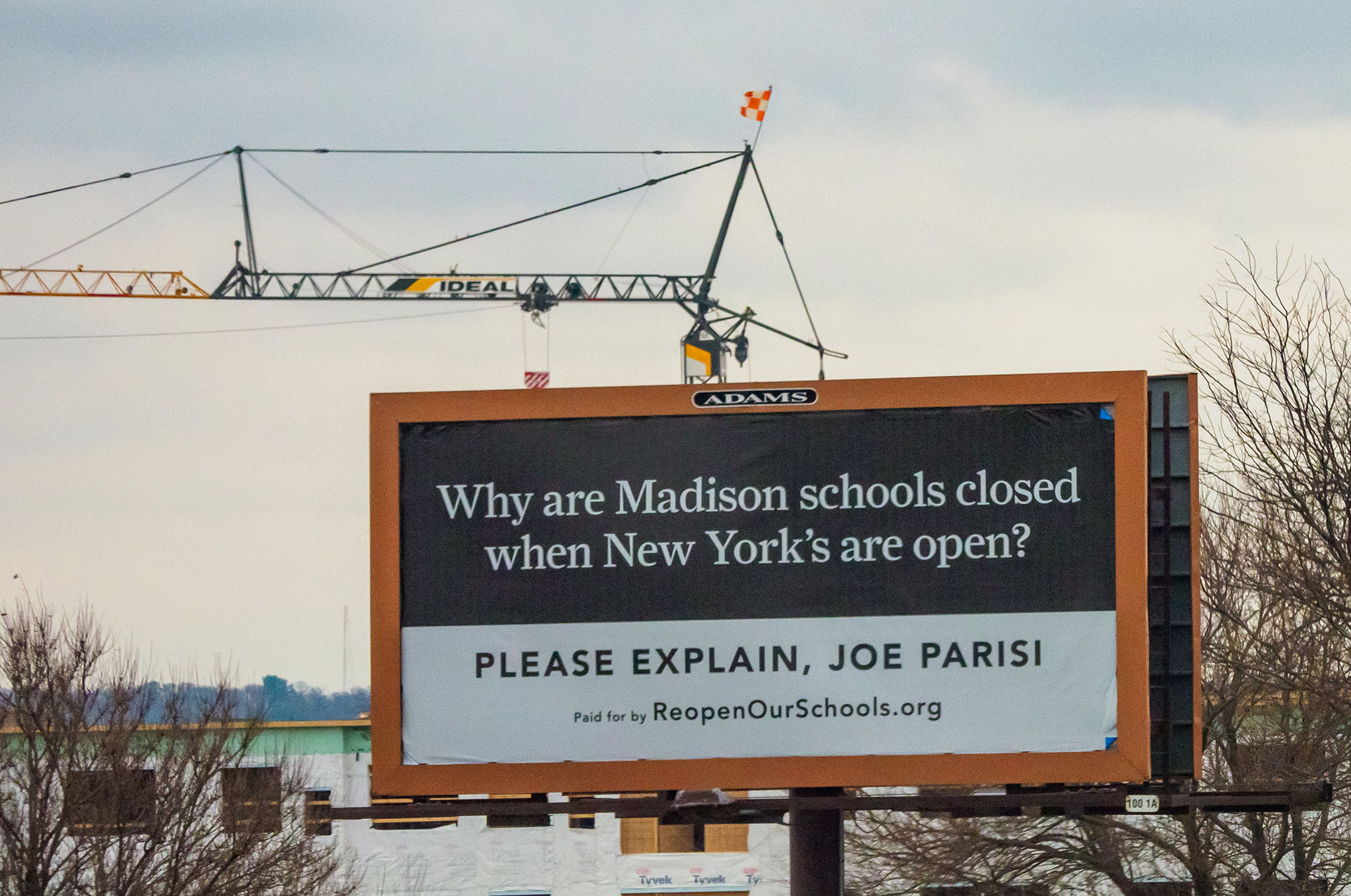
2011: A majority of the taxpayer supported Madison School Board aborted the proposed Madison Preparatory Academy IB charter school.
2017: West High Reading Interventionist Teacher’s Remarks to the School Board on Madison’s Disastrous Reading Results
Madison’s taxpayer supported K-12 school district, despite spending far more than most, has long tolerated disastrous reading results.
My Question to Wisconsin Governor Tony Evers on Teacher Mulligans and our Disastrous Reading Results
“An emphasis on adult employment”
Wisconsin Public Policy Forum Madison School District Report[PDF]
Booked, but can’t read (Madison): functional literacy, National citizenship and the new face of Dred Scott in the age of mass incarceration
The police in China are collecting blood samples from men and boys from across the country to build a genetic map of its roughly 700 million males, giving the authorities a powerful new tool for their emerging high-tech surveillance state.
They have swept across the country since late 2017 to collect enough samples to build a vast DNA database, according to a new study published on Wednesday by the Australian Strategic Policy Institute, a research organization, based on documents also reviewed by The New York Times. With this database, the authorities would be able to track down a man’s male relatives using only that man’s blood, saliva or other genetic material.
An American company, Thermo Fisher, is helping: The Massachusetts company has sold testing kits to the Chinese police tailored to their specifications. American lawmakers have criticized Thermo Fisher for selling equipment to the Chinese authorities, but the company has defended its business.
Michael Kinsley once wrote — back in the days when liberals were running our journalistic institutions — that “if no one or almost no one disagrees, it also is probably not a good subject for an editorial.” By contrast, the new Times opinion editor, Kathleen Kingsbury, reportedly told the staff, “Anyone who sees any piece of Opinion journalism, headlines, social posts, photos — you name it — that gives you the slightest pause, please call or text me immediately.”
The Times has been cleansed of reactionary elements. The paper is in the hands of The People. Others will follow.
You may also have noticed another progressive slogan gaining popularity these days: “Silence is violence.” It’s no longer enough not to peddle wrongthink in the op-ed pages of the local paper, but now you must also actively champion woke progressive positions or you too are tacitly engaged in violence and racism.
This is a neat trick: To speak out in the wrong way is violence. Not to speak out is violence. Not to speak out in the way progressives dictate is violence. This is why your apolitical local lawn-care company is sending out emails promising to dedicate themselves to Black Lives Matter. No one wants to be accused of harboring counterrevolutionary sympathies.
That doesn’t leave much room for dissent, does it? Virtually anyone in the public square who doesn’t conform (save those who work for conservative political journals, perhaps) risks being humiliated and ruined.
Russians are fond of quoting Sergei Dovlatov, a dissident Soviet writer who emigrated to the United States in 1979: “We continuously curse Comrade Stalin, and, naturally, with good reason. And yet I want to ask: who wrote four million denunciations?” It wasn’t the fearsome heads of Soviet secret police who did that, he said. It was ordinary people.
Collective demonizations of prominent cultural figures were an integral part of the Soviet culture of denunciation that pervaded every workplace and apartment building. Perhaps the most famous such episode began on Oct. 23, 1958, when the Nobel committee informed Soviet writer Boris Pasternak that he had been selected for the Nobel Prize in literature—and plunged the writer’s life into hell. Ever since Pasternak’s Doctor Zhivago had been first published the previous year (in Italy, since the writer could not publish it at home) the Communist Party and the Soviet literary establishment had their knives out for him. To the establishment, the Nobel Prize added insult to grave injury.
Within days, Pasternak was a target of a massive public vilification campaign. The country’s prestigious Literary Newspaper launched the assault with an article titled “Unanimous Condemnation” and an official statement by the Soviet Writers’ Union—a powerful organization whose primary function was to exercise control over its members, including by giving access to exclusive benefits and basic material necessities unavailable to ordinary citizens. The two articles expressed the union’s sense that in view of Pasternak’s hostility and slander of the Soviet people, socialism, world peace, and all progressive and revolutionary movements, he no longer deserved the proud title of Soviet Writer. The union therefore expelled him from its ranks.
Amidst the events of recent weeks, a number of alumni and others have taken up formal and public means to insist that Hillsdale College issue statements concerning these events. The College is charged with negligence — or worse.
It is not the practice of the College to respond to petitions or other instruments meant to gain an object by pressure. The College operates by reasoned deliberation, study, and thought. The following observations, however, may be helpful and pertinent.
The College is pressed to speak. It is told that saying what it always has said is insufficient. Instead, it must decry racism and the mistreatment of Black Americans in particular. This, however, is precisely what the College has always said.
The College is told that invoking the high example of the Civil War or Frederick Douglass is not permitted. Perhaps it is thought that nothing relevant can be learned about justice and equality from the words and actions of great men and women in history. Instead, the College is guilty of the gravest moral failure for not making declarations about … justice and equality.
The College is told that it garners no honor now for its abolitionist past — or that it fails to live up to that past — but instead it must issue statements today. Statements about what? It must issue statements about the brutal and deadly evil of hating other people and/or treating them differently because of the color of their skin. That is, it must issue statements about the very things that moved the abolitionists whom the College has ever invoked.
Craig Franklin, via a kind email:
1. The total 2019 tax levy for City of Madison property is $713,571,544.19. This amount includes lottery, school levy and first dollar credits paid by the State of Wisconsin. The total tax outstanding, from City of Madison property owners, as of May 31, 2020 (the date of the last settlement) is $69,035,668.53. [9.6%]
2. Of the 76,048 parcels in the City of Madison, 12,077 are currently utilizing the installment method of payment (as of the May 31, 2020 settlement). [15.8%]
Madison’s taxpayer supported K-12 school district, despite spending far more than most, has long tolerated disastrous reading results. [the Madison School District administration has been planning a substantial 2020 tax & spending increase referendum].
My Question to Wisconsin Governor Tony Evers on Teacher Mulligans and our Disastrous Reading Results
“An emphasis on adult employment”
Wisconsin Public Policy Forum Madison School District Report[PDF]
Booked, but can’t read (Madison): functional literacy, National citizenship and the new face of Dred Scott in the age of mass incarceration
Surveillance is widespread at protests. Both local and federal authorities have broad authority to undertake both covert and overt intelligence-gathering and surveillance of demonstrations.
Law enforcement uses location data for other kinds of investigations as well. Cops need to get a warrant to track a specific individual’s mobile phone. Doing it the other way around, though—picking a location, and then looking at who was there—has fewer restrictions.
Late last year, for example, federal investigators trying to solve an arson case in Wisconsin gathered location-history data from 1,500 devices that passed through the area over a nine-hour window. A similar reverse location warrant used in Florida led police mistakenly to identify a man who happened to be riding his bike near the scene of a burglary as the top suspect.
Other private entities also use geofencing tools to zero in on individuals. Ambulance-chaser law firms, for example, have advertised to people who have visited hospital emergency rooms.
While phone owners may understand that their devices collect location data for certain uses, consumers often have no idea how broadly sold and traded that information then is. That’s according to Keith Chen, a behavioral economics professor at University of California, Los Angeles, who spoke to the WSJ. “To the degree that this becomes very common, I do worry that it starts to put a chill on people’s willingness to peaceably assemble,” Chen told the Journal.
Google faces a proposed class action lawsuit that accuses the tech giant of invading people’s privacy and tracking internet use even when browsers are set to “private” mode. The suit, filed Tuesday in the US District Court for the Northern District of California, alleges that Google violates wiretapping and privacy laws by continuing to “intercept, track, and collect communications” even when people use Chrome’s incognito mode and other private web browser modes.
“Google tracks and collects consumer browsing history and other web activity data no matter what safeguards consumers undertake to protect their data privacy,” reads the complaint. The search giant surreptitiously collects data through Google Analytics, Google Ad Manager, website plug-ins and other applications, including mobile apps, according to the complaint.
The lawsuit seeks at least $5 billion from Google and its parent company, Alphabet, according to Reuters. The complaint says the proposed class may include “millions” of Google users and is looking for damages of at least $5,000 for each individual.
Google said it disputes the claims and plans to defend itself vigorously against them.
Many taxpayer supported K-12 school districts use Google services, including Madison.
Urban schools don’t inspire much confidence these days. Politicians and policy leaders routinely bemoan their quality. And media outlets regularly run stories of “failing urban schools.”
Middle- and upper-income parents have expressed misgivings, too. But they’ve done it much less volubly. With relatively little fuss, they’ve simply picked up and moved—departing from city school systems at ever-greater rates. Among expressions of no-confidence, this has arguably been the most significant, because it has reshaped district demography. Each year, it seems, urban schools serve larger concentrations of poor students, racial minorities, and English-language learners. As higher-income families depart, resources go with them, and schools are faced with the daunting prospect of doing more with less.
If such departures are driven by good information about school quality, one can hardly blame parents with resources for acting in the best interests of their children.
Yet what if the information people are acting on is inaccurate or misleading?
Thanks largely to No Child Left Behind, the public has access to performance data for all public elementary and high schools. The data collected and reported, however, largely consist of student standardized test scores. As George W. Bush, who as president signed the act into law, put it, “We measure. We post the scores. We look at results.” Today, over 15 years after NCLB first went into effect, test scores are commonly used—by policy leaders, parents, and the general public—as a measure of school quality, often in the total absence of other information. A New York Times feature, for instance, produced a set of charts for prospective suburban homebuyers using only two inputs: “home price data from Redfin … and school quality data based on test scores.”
Wisconsin public school teachers made, on average, $55,985 in salary during the 2017–18 school year with an average of 14.2 students per teacher. During that school year, spending was $13,670 per student in local, state and federal funding. This means that about $195,392 is spent on the average classroom in the state. Of that, only about 28.4% ends up in the pockets of teachers. Where is the rest of the money going?
An illuminating answer comes from investigating the share of district staff who are teachers relative to those in other roles. We can use data from DPI’s “All Staff” files over the past decade to tease this out. The chart below shows the percentage of Full Time Equivalent (FTE) staff in the 10 largest districts in the state that are identified as teachers by the Department of Public Instruction since 2008. The majority of districts fall below the 50% threshold in every year — meaning that for every teacher in the district, there is more than one employee in another role.
The biggest offenders in recent years are Eau Claire, Milwaukee, Racine. Both of these districts have dropped below the 40% level in recent years for several consecutive years. In fact, WILL’s 2019 Truth in Spending study found, “The percentage of money a district spends on [administration and transportation costs] relative to others is associated with lower performance on state exams.”
Madison’s taxpayer supported K-12 school district, despite spending far more than most, has long tolerated disastrous reading results.
My Question to Wisconsin Governor Tony Evers on Teacher Mulligans and our Disastrous Reading Results
“An emphasis on adult employment”
Wisconsin Public Policy Forum Madison School District Report[PDF]
Booked, but can’t read (Madison): functional literacy, National citizenship and the new face of Dred Scott in the age of mass incarceration
Will Lewis, the former boss of Dow Jones and the Wall Street Journal, and ex-Financial Times editor Lionel Barber have also spoken of their uneasiness about the “blurring” of opinions and facts in journalism.
Lewis – who recently left his role and missed out in the race to become the BBC’s next director general – said that in “this increasingly resource-constrained time… journalistic standards are inevitably slipping. And we’re beginning to see the blurring of facts and comments in a way that I think is extremely worrying and extremely challenging.”
He exempted the FT, Wall Street Journal, Associated Press and New York Times from his criticism.
Barber, who was speaking with Lewis on a video conference (see below) organised by the Centre for the Study of Financial Innovation, said: “I would make a more general point – we’ve seen this particularly at the BBC: We have to be very careful in the way journalists are using social media.
“They are essentially seeing [their social media pages as] their own platforms, and it’s definitely comment. And therefore this blurring that Will rightly identifies has been massively accentuated by social media.
“And it’s not good enough for journalists to say: Oh, by the way, on my Twitter handle, these views are [my own] – because they do work for an organisation.”
This morning, the Supreme Court denied all of the major cert petitions raising the question of whether qualified immunity should be reconsidered. This is, to put it bluntly, a shocking dereliction of duty. As Cato has argued for years, qualified immunity is an atextual, ahistorical judicial invention, which shields public officials from liability, even when they break the law. The doctrine not only denies justice to victims whose rights have been violated, but also exacerbates our crisis of confidence in law enforcement. By holding police officers to a far lower standard of accountability than ordinary citizens, qualified immunity deprives the entire law enforcement community of the public trust and credibility they need to do their jobs safely and effectively.
There was simply no excuse for the Court to decline this golden opportunity to begin addressing its mistakes in creating and propagating the doctrine of qualified immunity. The petitions before the Court plainly demonstrated both the moral injustices and practical absurdities of the “clearly established law” standard. In Corbitt v. Vickers, for example, the Supreme Court let stand an Eleventh Circuit decisiongranting immunity to a police officer who shot a ten‐year‐old child in the back of the knee, while repeatedly attempting to shoot a pet dog that wasn’t threatening anyone. And in Baxter v. Bracey, the Court let stand a Sixth Circuit decision which said that a prior case holding it unconstitutional for police to deploy a canine against a suspect who had surrendered by lying on the ground did not “clearly establish” that it was unlawful for police to deploy a canine against a suspect who had surrendered by sitting on the ground with his hands up.
Oxford University has revealed plans to “decolonise” its maths and science degrees and will allow students of any subject who have been affected by the Black Lives Matter furore to seek lenient marking.
In a letter to the student union, Louise Richardson, vice-chancellor, said that the mathematical, physical and life sciences division had been awarded a grant to develop teaching resources that supported the diversification of its curriculums, describing it as “an area that is frequently overlooked”.
Corey DeAngelis & Matthew Nielsen:
On average, the United States currently spends over $15,000 per student each year, and inflation-adjusted K-12 education spending per student has increased by 280% since 1960. In California, where the previously mentioned football coach resides, inflation-adjusted spending on K-12 education has increased by 129% since 1970. Furthermore, data from the U.S. Census Bureau show that nearly a third of all state budget expenditures go toward education.
This is a particularly pernicious myth in the education debate because increased education spending generally isn’t associated with better results. Stanford University economist Eric Hanushek reviewed nearly 400 studies on the topic and concluded that “there is not a strong or consistent relationship between student performance and school resources.”
Madison’s taxpayer supported K-12 school district, despite spending far more than most, has long tolerated disastrous reading results.
My Question to Wisconsin Governor Tony Evers on Teacher Mulligans and our Disastrous Reading Results
“An emphasis on adult employment”
Wisconsin Public Policy Forum Madison School District Report[PDF]
Booked, but can’t read (Madison): functional literacy, National citizenship and the new face of Dred Scott in the age of mass incarceration
According to the surviving records, the first enslaved African in Massachusetts was the property of the schoolmaster of Harvard. Yale funded its first graduate-level courses and its first scholarship with the rents from a small slave plantation it owned in Rhode Island (the estate, in a stroke of historical irony, was named Whitehall). The scholarship’s first recipient went on to found Dartmouth, and a later grantee co-founded the College of New Jersey, known today as Princeton. Georgetown’s founders, prohibited by the rules of their faith from charging students tuition, planned to underwrite school operations in large part with slave sales and plantation profits, to which there was apparently no ecclesiastical objection. Columbia, when it was still King’s College, subsidized slave traders with below-market loans. Before she gained fame as a preacher and abolitionist, Sojourner Truth was owned by the family of Rutgers’s first president.
From their very beginnings, the American university and American slavery have been intertwined, but only recently are we beginning to understand how deeply. In part, this can be attributed to an expansion of political will. Barely two decades ago, questions raised by a group of scholars and activists about Brown University’s historic connection to slavery were met with what its then-president, Ruth Simmons, saw as insufficient answers, and so she appointed the first major university investigation. Not long before that, one of the earliest scholars to independently look into his university’s ties to slavery, a law professor at the University of Alabama, began digging through the archives in part to dispel a local myth, he wrote, that “blacks were not present on the campus” before 1963, when “Vivian Malone and James Hood enrolled with the help of Nicholas Katzenbach and the National Guard.” He found, instead, that they preceded its earliest students, and one of the university’s first acts was the purchase of an enslaved man named Ben. In Virginia, a small consortium founded three years ago to share findings and methods has expanded to include nearly three dozen colleges and universities across North America and two in European port cities. Almost all of these projects trace their origins to protests or undergraduate classes, where a generation of students, faculty, archivists, activists, and librarians created forums for articulating their questions, and for finding one another.
Robin Lake, Betheny Gross and Alice Opalka:
Researchers at the Center on Reinventing Public Education spent this spring analyzing 82 school districts’ responses to COVID-19 closures.
Our analysis focused on large, high-profile school systems. While the districts served more than 9 million students combined, we wondered if it represented school systems across the country.
Now, we know the picture it painted was too rosy.
We recently released an analysis of a statistically representative sample of 477 school districts. This allows us, for the first time, to compare districts by student demographics and location. And the results are sobering.
Just 1 in 3 districts has been expecting all teachers to deliver instruction — and rural and small-town districts were far less likely than urban and suburban districts to communicate that expectation.
Nonetheless, Ald. Tag Evers its all J’accuse!
“We have defunded our schools — 90% of our black and brown students are not reading at grade level — and then used police to keep order.”
Madison has “defunded our schools”? Since when? On an absolute dollar basis, the State of Wisconsin has never shoveled more money at K-12 education. Madison taxpayers approve extra-spending referenda almost every other election.
Madison school property taxes are UP 37% since 2012,
While 4K-12 enrollment is down 1.6% from 2014-15.
Total expenditures (excluding construction fund): is UP 17.0% during the same period.
The proposed school budget for next year increases per pupil spending 19.0% from 2014-15. (Cost of living is up 10% during that time.)
Madison’s taxpayer supported K-12 school district, despite spending far more than most, has long tolerated disastrous reading results.
My Question to Wisconsin Governor Tony Evers on Teacher Mulligans and our Disastrous Reading Results
“An emphasis on adult employment”
Wisconsin Public Policy Forum Madison School District Report[PDF]
Booked, but can’t read (Madison): functional literacy, National citizenship and the new face of Dred Scott in the age of mass incarceration
Administrators are concerned about a potential state budget repair bill that could cut funding to K-12 schools, though Gov. Tony Evers told the Cap Times last week he’s hopeful such a measure can be avoided amid lower than anticipated revenue for the state. The budget Ruppel recommended Monday would save $8.4 million from what has been previously discussed, mostly through cuts to wage increases to save room in case such a bill is approved.
“Pause on any new spending in order to maintain the most flexibility until we know more,” Ruppel said.
If the previously planned increases in base wages and the “steps” on the district’s salary structure were maintained, as many as 92 school-based staff positions could be cut, according to the presentation.
If a state budget repair bill did not come to fruition or there was additional funding from the federal government, raises could be reinstated before the final budget approval, while reinstating the positions in the middle of the school year would be more challenging.
Ruppel also offered expense-saving possibilities of keeping five vacant central office positions open for a savings of $500,000 or more as well as a pause on Strategic Equity Projects like a new reading curriculum and increases to School Security Assistant pay, saving up to $550,000.
Board member Savion Castro said he was supportive of Ruppel’s recommendation among the options presented Monday night, although he acknowledged it was not a good choice to have to make. Most others expressed a similar sentiment.
Madison’s taxpayer supported K-12 school district, despite spending far more than most, has long tolerated disastrous reading results.
My Question to Wisconsin Governor Tony Evers on Teacher Mulligans and our Disastrous Reading Results
“An emphasis on adult employment”
Wisconsin Public Policy Forum Madison School District Report[PDF]
Booked, but can’t read (Madison): functional literacy, National citizenship and the new face of Dred Scott in the age of mass incarceration
1 APR 3 and 4 are modified to the extent that applicants for admission to practice law who are currently registered for either the July or September 2020 bar examination and who have received a Juris Doctorate degree from an ABA accredited law school, and applicants currently registered to take the LLLT examination scheduled for July 2020, are granted the option of receiving a diploma privilege to practice in Washington. The bar examinations in July and September 2020 will still be offered for those who do not qualify for the diploma privilege and those who wish to take the exam to receive a Uniform Bar Exam (UBE) score.
2 The diploma privilege option will be available to applicants currently registered to take the examinations who are taking the tests for the first time and those who are repeating the tests.
Cornell University law professor William Jacobson thought he had grown callous to petitions for his ouster. Activists—including students, faculty, and alumni—have called for his firing on numerous occasions since he launched the popular conservative website Legal Insurrection in 2008, but the campaign against him has taken personal attacks to new levels in the wake of George Floyd’s death in police custody.
“On [the Black Lives Matter] issue, you cannot deviate one iota or they will try to get you kicked out of the school, they will falsely accuse you of being racist, they will do a ‘name and shame’ campaign against you,” Jacobson told the Washington Free Beacon. “It’s been a problem for multiple decades in academia.”
BLM supporters, in a coordinated effort with the Black Law Student Association, Cornell alumni, and law school faculty, are calling on the school to sack Jacobson for publicly critiquing BLM’s ideology. An alumni petition began on June 11 calling on the university to “take immediate action” to drive him out. The professor said his accusers are disingenuously attacking his character to force the school’s hand.
This is a school that a lot of uninformed people would regard as “safe”:
No one likes it when dire predictions come true. For years the leftists on our campus have operated largely as Fabians: they thought the structure was corrupt, but they figured they could effect the changes from within it. They had many successes, but each success brought with it an appetite for more. They were waiting for the moment when the revolution that had taken place at the level of culture could take place at the level of administrative control. This is their moment. This is when the very nature of the institutions change, not so much in terms of their structures, which they’ll largely maintain, but in terms of their animating principles. For colleges such as mine this means the replacement of Christianity with the religion of anti-racism.
It did not take our president long after the death of George Floyd to issue a statement asseverating definitively that Floyd’s death was “an act of racism,” despite the fact that he couldn’t possibly know if this was true. He also expressed his “deep grief” and how “heart-broken” he was, as if Floyd were his own child. He did this in part because, like any sane person, he was horrified both by Floyd’s death and by the specter of racism, and in part because he was getting enormous pressure (no pun intended) put on him by faculty and alumni.
Since then, even though it’s summer, things have gotten worse. The president has issued more statements expressing his hurt and committing college resources to “combat racism,” even though college campuses are the least racist places in America. We’ve been having townhall meetings where people can tell their stories of oppression, and express their fear about how much danger they’re in because some people won’t bow to their gods. All these townhall meetings include calls to action that become increasingly heavy-handed.
A couple of years ago, under the radar, the administration issued a new policy that anyone involved in a hire had to undergo implicit bias training. When I told my dean that I found the idea of implicit bias training to be faulty at both a philosophical and social science level, and a serious threat to academic freedom and so would not participate, he replied “That’s too bad, because you won’t be participating in any searches, and frankly you make valuable contributions on those.”
Background : “IQ” is a stale test meant to measure mental capacity but in fact mostly measures extreme unintelligence (learning difficulties), as well as, to a lesser extent (with a lot of noise), a form of intelligence, stripped of 2nd order effects — how good someone is at taking some type of exams designed by unsophisticated nerds. It is via negativa not via positiva. Designed for learning disabilities, and given that it is not too needed there (see argument further down), it ends up selecting for exam-takers, paper shufflers, obedient IYIs (intellectuals yet idiots), ill adapted for “real life”. (The fact that it correlates with general incompetence makes the overall correlation look high, even when it is random, see Figures 1 and 2.) The concept is poorly thought out mathematically by the field (commits a severe flaw in correlation under fat tails and asymmetries; fails to properly deal with dimensionality; treats the mind as an instrument not a complex system), and seems to be promoted by
In the last couple of weeks, as the purges of alleged racists have intensified in every sphere, and as so many corporations, associations, and all manner of civic institutions have openly pledged allegiance to anti-racism, with all the workshops, books, and lectures that come with it, I’m reminded of a Václav Havel essay, “The Power of the Powerless.”
It’s about the dilemma of living in a world where adherence to a particular ideology becomes mandatory. In Communist Czechoslovakia, this orthodoxy, with its tired slogans, and abuse of language, had to be enforced brutally by the state, its spies, and its informers. In America, of course, with the First Amendment, this is impossible. But perhaps for that very reason, Americans have always been good at policing uniformity by and among themselves. The puritanical streak of shaming and stigmatizing and threatening runs deep. This is the country of extraordinary political and cultural freedom, but it is also the country of religious fanaticism, moral panics, and crusades against vice. It’s the country of The Scarlet Letter and Prohibition and the Hollywood blacklist and the Lavender Scare. The kind of stifling, suffocating, and nerve-racking atmosphere that Havel evokes is chillingly recognizable in American history and increasingly in the American present.
Today U.S. Senator Josh Hawley (R-Mo.) sent a letter to Zoom calling for the company to choose a side: American principles and free-speech, or short-term global profits and censorship. His letter comes after Zoom chose to close the accounts of prominent U.S.-based critics of the Chinese Communist Party (CCP) for discussing the Tiananmen Square massacre, claiming the closures were necessary to “comply with local law.”
“These oppressive ‘local laws’ are what Party officials use to oppress more than a billion people, including more than one million Uighurs who have been forced into slavery. These ‘local laws’ are what China is using to crack down on protesters in Hong Kong who just want the basic liberties they were promised by international treaty.”
Senator Josh Hawley
To Zoom CEO Eric Yuan, Senator Hawley continued, “Trading American values for Beijing profits never ends well. The Chinese Communist Party has a long history of inviting American companies into its borders, only to steal proprietary information and technology and then repurpose that data for its own use. When you censor for the Communist Chinese Party, you may think it benefits you, but the only one who will benefit in the long run is the Chinese Communist Party.”
“I’ve never had any run-ins with the cops before. I’ve never been to jail and have no criminal record, so when the FBI showed up to my workplace, it scared the piss out of me,” says Katy, a 22-year-old who works for a custodial services company in Cookeville, a small college town in middle Tennessee. “I really thought I was going to lose my job. The whole experience was terrifying.”
Moved by the video of the police killing of George Floyd in Minneapolis, Katy — who requested she only be identified by her first name — and a friend had created a Facebook event for a Black Lives Matter rally in Cookeville’s public square on Saturday, June 6. She soon connected with several other Cookeville locals who wanted to help with planning the event, and enthusiasm grew as word of the rally spread.
“I’ve never organized a rally before, I was just winging it,” Katy said. “I didn’t expect a lot of people to show up, but overnight 600 people had RSVP’d on Facebook.”
Counter-protesters organized their own Facebook group, Protect Cookeville Against Looters, which quickly swelled to over 1,000 members. Some of the members of this group determined that Katy was the main organizer of the upcoming rally and began posting her personal information and making violent threats.
“The event for the rally had been up for about four days when we started getting death threats,” Katy said. “It was too much. I was overwhelmed.”
The numbers are much higher in what’s called the Partnership Schools, a network of nine Catholic schools in Harlem and the South Bronx in New York and in Cleveland. In addition to the coursework usually found in public schools, schools in the partnership stress four core values — integrity, humility, hard work and service.
Enrollees at these nine schools are 67 percent Hispanic and 31 percent African American. Of these students, 85 percent have received scholarships.
The average yearly tuition cost of a Catholic school is $4,800 for elementary school and $11,200 for high school, according to the NCEA. Right off, it would seem that only the rich or the very poor can afford a Catholic education these days. The middle class — too rich for financial aid and too strapped for full tuition — is out of luck.
This wasn’t always the case. Several decades ago, almost anyone could attend a Catholic school, in part because, at the time, there were many more schools. In 1960, the United States boasted 13,000 Catholic schools compared to just 6,000 or so today. And, in 1965, of elementary-age children attending private school, 89 percent attended a Catholic school. But, times change, and other private schools emerged virtually everywhere.
University of California – Berkeley Professor, written anonymously:
In the extended links and resources you provided, I could not find a single instance of substantial counter-argument or alternative narrative to explain the under-representation of
black individuals in academia or their over-representation in the criminal justice system. The explanation provided in your documentation, to the near exclusion of all others, is univariate: the problems of the black community are caused by whites, or, when whites are not
physically present, by the infiltration of white supremacy and white systemic racism into American brains, souls, and institutions.
Many cogent objections to this thesis have been raised by sober voices, including from within the black community itself, such as Thomas Sowell
and Wilfred Reilly. These people are not racists or ‘Uncle Toms’. They are intelligent scholars who reject a narrative that strips black people of agency and systematically externalizes the problems of the black community onto outsiders.
Their view is entirely absent from the departmental and UCB-wide communiques.
The claim that the difficulties that the black community faces are entirely causally explained by exogenous factors in the form of white systemic racism, white supremacy, and other forms of
white discrimination remains a problematic hypothesis that should be vigorously challenged by historians. Instead, it is being treated as an axiomatic and actionable truth without serious consideration of its profound flaws, or its worrying implication of total black impotence.
This hypothesis is transforming our institution and our culture, without any space for dissent outside of a tightly policed, narrow discourse.
A counternarrative exists. If you have time, please consider examining some of the documents I attach at the end of this email.
Overwhelmingly, the reasoning provided by BLM and allies is either primarily anecdotal (as in the case with the bulk of Ta-Nehisi Coates’ undeniably moving article) or it is transparently motivated. As an example of the latter problem, consider the proportion of
black incarcerated Americans. This proportion is often used to characterize the criminal justice system as anti-black. However, if we use the precise same methodology, we would have to conclude that the criminal justice system is even more anti-male than it is anti-black.
Would we characterize criminal justice as a systemically misandrist conspiracy against innocent American men? I hope you see that this type of reasoning is flawed, and requires a significant suspension of our rational faculties. Black people are not incarcerated at higher rates
In a normal week, Parr fields about five or six phone calls. But in recent weeks, he said he’s been answering easily 70 calls a week from across the region, including many from Madison.
Parr said he could see the online school’s enrollment, which was about 150 full-time students this year and a similar number part-time, double in the fall — if not grow by more.
When in-person classes were canceled in mid-March to stem the spread of the coronavirus, Parr said districts tried their best to transition students to digital learning. But he’s heard from parents about mixed results.
“The No. 1 complaint I hear is, ‘I don’t want to go back to what we were doing,’” Parr said. “I feel for those districts, because that kind of got sprung on them.”
For nearly two decades, virtual charter schools have been an option for Wisconsin students, acting as an outlet for students being severely bullied, children with health problems, expelled students and others seeking flexibility or a different learning environment.
But COVID-19 is a new cause for families to seek the safety of learning remotely as the public health crisis wraps the future of traditional schooling in unknowns.
Enrollment in virtual charters grew steadily in the past five years, with 8,696 students educated in 48 schools this school year — an all-time high on both counts. Four virtual charter schools enrolled 265 students during the 2002-03 academic year, when the model first emerged.
I wonder how the taxpayer supported Madison School District’s “infinite campus” online usage looks today, from the teacher, staff, student and parent perspective?
2012 Madison school district infinite campus usage report.
Madison’s taxpayer supported K-12 school district, despite spending far more than most, has long tolerated disastrous reading results.
My Question to Wisconsin Governor Tony Evers on Teacher Mulligans and our Disastrous Reading Results
“An emphasis on adult employment”
Wisconsin Public Policy Forum Madison School District Report[PDF]
Booked, but can’t read (Madison): functional literacy, National citizenship and the new face of Dred Scott in the age of mass incarceration
UPDATED: An episode of sitcom “Fawlty Towers” removed from a streaming site for containing “racial slurs” is to be reinstated. John Cleese had attacked the decision to remove the episode as “stupid,” as well as taking a swipe at those who take a revisionist view of history in the context of the Black Lives Matter debate.
Early on Friday, BBC-owned TV network UKTV announced on Twitter that it had temporarily removed the episode titled “The Germans” from its Gold download service as it contained “racial slurs.” The service said it wished to “review” the episode, and “consider our options.” It said some shows “carry warnings and others are edited.”
It is believed the “racial slurs” are contained in a scene in which the character known as the Major uses the N-word when referring to Caribbean sportsmen.
Later on Friday, UKTV said the episode would be reinstated “in the coming days” with the addition of “extra guidance.” “We already offer guidance to viewers across some of our classic comedy titles, but we recognize that more contextual information can be required on our archive comedy, so we will be adding extra guidance and warnings to the front of programs to highlight potentially offensive content and language. We will reinstate ‘Fawlty Towers’ once that extra guidance has been added, which we expect will be in the coming days.”
Sometimes it seems life can’t get any worse in this country. Already in terror of a pandemic, Americans have lately been bombarded with images of grotesque state-sponsored violence, from the murder of George Floyd to countless scenes of police clubbing and brutalizingprotesters.
Our president, Donald Trump, is a clown who makes a great reality-show villain but is uniquely toolless as the leader of a superpower nation. Watching him try to think through two society-imperiling crises is like waiting for a gerbil to solve Fermat’s theorem. Calls to “dominate” marchers and ad-libbed speculations about Floyd’s “great day” looking down from heaven at Trump’s crisis management and new unemployment numbers (“only” 21 million out of work!) were pure gasoline at a tinderbox moment. The man seems determined to talk us into civil war.
But police violence, and Trump’s daily assaults on the presidential competence standard, are only part of the disaster. On the other side of the political aisle, among self-described liberals, we’re watching an intellectual revolution. It feels liberating to say after years of tiptoeing around the fact, but the American left has lost its mind. It’s become a cowardly mob of upper-class social media addicts, Twitter Robespierres who move from discipline to discipline torching reputations and jobs with breathtaking casualness.
While MMSD is heavily reliant on property taxes instead of state aid compared to other districts, a decrease to the revenue authority or other measures that would lower the levy limit would serve as a funding cut. The district already cut $8 million from the 2019-20 budget in the preliminary 2020-21 budget.
Contingencies could include cutting as many as 92 full-time staff positions or undoing much of the planned wage increases for staff, based on a survey the district sent to staff last week.
Ruppel wrote that the district will move forward with its “core values at the forefront” as it considers the 2020-21 budget.
“We aim with all of our decisions to put students at the center,” she wrote. “Through our standard budget feedback process, we’ve spoken to parents, community leaders, principals and staff about the uncertainty ahead of us. All feedback at the highest levels have been consistent: protect student programming, student mental health and social emotional supports first, as they are needed now and in the fall more than ever.”
Madison’s taxpayer supported K-12 school district, despite spending far more than most, has long tolerated disastrous reading results.
My Question to Wisconsin Governor Tony Evers on Teacher Mulligans and our Disastrous Reading Results
“An emphasis on adult employment”
Wisconsin Public Policy Forum Madison School District Report[PDF]
Booked, but can’t read (Madison): functional literacy, National citizenship and the new face of Dred Scott in the age of mass incarceration
All 16 of the school districts completely or partially within Dane County have waived or loosened at least two academic standards to help seniors graduate at a time when schools have been shut down since mid-March due to the coronavirus pandemic.
Information from the districts and the state Department of Public Instruction also shows that the poorer and more diverse a district’s student body, the more likely the district’s leadership sought graduation requirement waivers from the state and lowered other standards.
The Wisconsin State Journal asked the districts to report whether they had:
• Changed grading standards after schools shut down;
• Reduced the number of credits needed to graduate;
• Sought waivers of the state’s civics exam, minimum instructional hours and educator effectiveness requirements;
• Made any other changes to help seniors graduate.
Every district had loosened requirements in at least two areas, and two districts — Middleton-Cross Plains and Sun Prairie — had loosened them in six, including waiving the requirement that students complete a certain number of community service hours to graduate.
The county’s largest district, Madison, reported reducing the number of credits needed to graduate from 22 to the state minimum of 15, moving to a pass/fail grading system and getting state waivers for the civics test and minimum number of instructional hours.
DPI had made clear at the beginning of school shutdowns that it would not seek to deny waivers of the civics, minimum instructional hours and educator effectiveness requirements. Some districts did not need waivers for the civics exam because it had already been administered by the time the schools were closed.
Linn Posey-Maddox, an associate professor of educational policy studies at UW-Madison, said the pandemic exacerbates existing racial inequities in education
Madison’s taxpayer supported K-12 school district, despite spending far more than most, has long tolerated disastrous reading results.
My Question to Wisconsin Governor Tony Evers on Teacher Mulligans and our Disastrous Reading Results
“An emphasis on adult employment”
Wisconsin Public Policy Forum Madison School District Report[PDF]
Booked, but can’t read (Madison): functional literacy, National citizenship and the new face of Dred Scott in the age of mass incarceration
During an internal presentation at Facebook on Wednesday, the company debuted features for Facebook Workplace, an intranet-style chat and office collaboration product similar to Slack.
On Facebook Workplace, employees see a stream of content similar to a news feed, with automatically generated trending topics based on what people are posting about. One of the new tools debuted by Facebook allows administrators to remove and block certain trending topics among employees.
The presentation discussed the “benefits” of “content control.” And it offered one example of a topic employers might find it useful to blacklist: the word “unionize.”
Facebook Workplace is currently used by major employers such as Walmart, which is notorious for its active efforts to suppress labor organizing. The application is also used by the Singapore government, Discovery Communications, Starbucks, and Campbell Soup Corporation.
The suggestion that Facebook is actively building tools designed to suppress labor organizing quickly caused a stir at the Menlo Park, California-based company. Facebook employees sparked a flurry of posts denouncing the feature, with several commenting in disbelief that the company would overtly pitch “unionize” as a topic to be blacklisted.
Wisconsin Public Radio is canceling its long-running weekend program “Old Time Radio Drama,” with station officials citing the “racist and sexist material” present in many of the plays of the Golden Age of Radio.
“Many of these plays and productions were produced more than 60 years ago,” Wisconsin Public Radio director Mike Crane said in a statement on Friday. “Despite significant effort over the years, it has been nearly impossible to find historic programs without offensive and outdated content.”
“Old Time Radio Drama” will air its final episode this weekend. It is carried by most stations in WPR’s sister network, The Ideas Network, around Wisconsin on Saturday and Sunday nights. The show is hosted by Norman Gilliland, who will continue his roles on several other Wisconsin Public Radio shows such as “Chapter a Day.”
Beginning the weekend of June 20, the time slot will be filled with “PRX Remix,” described as a showcase of “some of the best stories, podcasts and documentaries from independent creators and the PRX podcast network Radiotopia.”
Crane added that such a program is more in line with the central mission of WPR and The Ideas Network than classic radio drama.
“Ultimately, these programs don’t represent the values of WPR and The Ideas Network’s focus on public service through news and information,” he said.
WPR’s decision comes in the midst of nationwide Black Lives Matter protests, and as problematic works of art are being re-evaluated. HBO MAX announced this week that it was temporarily pulling the Civil War drama “Gone With the Wind” from its site and adding cultural context to its depiction of the antebellum South.
Homeschooling- it’s all the rage right now! One year ago no one would have believed that every school-age child in America would be educated at home by the end of the 2019-2020 school year. Ironically, just weeks before this educational upheaval, Professor Elizabeth Bartholet of Harvard called for a summit to examine the pro’s and con’s of homeschooling. Her now-postponed summit was “by invitation only”, and I hope her panel was more than just one-sided.
As a former homeschooler and current homeschooling mother of four, I offer my sympathy to those who were unwittingly thrown into homeschooling with a few paltry hours of notice. At six years in, I have found a nice stride, and have a unique perspective which I would love to share with Professor Bartholet over coffee, (from at least six feet away) if I could.
First, Professor Bartholet is concerned that homeschooled children are restrained from adequate social interaction and diversity.
My children, like most homeschoolers I know, are actually very well-socialized. Our family is part of a homeschool co-op with art, gym, sign language, drama, and academic classes. We participate in a local Christian school’s sports program. We helped with our church’s game booth at National Night Out 2019, and helped maintain Grandpop Bubbles’ booth at the Kipona Festival 2019. Our church family provides love and fellowship from members of all ages at worship services, family game nights, picnics and hymn-sings at church member’s homes. At our church’s kids Bible club my children learn and play with neighborhood children from a broad range of ethnic and economic backgrounds. National missionaries from India, Ghana, Uruguay, the Philippines, Lebanon and Mexico have stayed in our home and have entertained my children with stories of their native homelands. What a rich sampling of diversity my children have experienced!
Madison’s taxpayer supported K-12 school district, despite spending far more than most, has long tolerated disastrous reading results.
My Question to Wisconsin Governor Tony Evers on Teacher Mulligans and our Disastrous Reading Results
“An emphasis on adult employment”
Wisconsin Public Policy Forum Madison School District Report[PDF]
Booked, but can’t read (Madison): functional literacy, National citizenship and the new face of Dred Scott in the age of mass incarceration
In a previous post, we reproduced some of the chatter from NextDoor social media on Cops in Madison WI four public high schools — the issue that can never be settled, apparently. The thread is exploding with content running six to one or better in favor of keeping the police. Even more lopsided is the support for school resource officers from parents of students. Here is one of those, from Bonnie of Midvale Heights:
This is my daughter’s experience, in her words, at an MMSD High School (and why I care strongly about this):
I am a freshman at Memorial High School, and although I cannot speak for all experiences with SRO’s in our district, I thought I would share a few scenarios in which I have seen their involvement.
In October, graffiti was discovered in the bathroom at our high school. It included references to the Columbine shooting and other depicted images of gun violence. When later in the day pictures of this graffiti were shared on social media, people became afraid that what the school termed simply as “graffiti” may be more along the lines of a threat. The student was arrested on account of “a tentative disorderly conduct charge.” MMSD sent out an understated email. No added security in place. No increased police presence. No lockdown or additional precautions set in place. No news story. However, despite taking no further safety precautions, students were more at ease knowing there was an armed officer in the school, with extensive prior knowledge of the school and relationships with students and faculty should it have turned into more than “graffiti.”
That same day, one of my close friends was threatened with a picture of a gun. Teachers were informed, and the SRO was notified in the event that the situation escalated.
The following day, another one of my friends received texts from an unknown number that included gun violence threats. She went to the SRO at our school, and using the police they were able to trace the number. School counselors and psychologists were also used in order to mediate between the two students.
In November, two stolen cars were abandoned in the Jefferson parking lot. Although not all issues begin within the school, incidents often take place on school property. The SRO’s are needed to not only deal with problems within the school, but also to protect students from external threats.
In December there was a fight (not on school grounds) that resulted in additional police involvement at the school. Although the SRO and other faculty members are able to handle many situations, other police are very much needed. Removing the SRO’s from MMSD high schools would only increase the need for police presence, including those without prior experience with the school.
This spring (2020) MIT moved all its classes online because of the COVID-19 pandemic. It made available licenses for various nonfree programs, but I objected to them on grounds of principle. For my class, an advanced class in computer programming, I made arrangements to avoid suggesting any nonfree software to my students.
Instead, I used an installation of BigBlueButton running on a server owned by the Free Software Foundation. Rubén Rodriguez of the FSF helped get this and other software working. (Thank you, FSF and Rubén!)
The class used a draft textbook that Chris Hanson and I have written. The book is entitled “Software Design for Flexibility (how to avoid programming yourself into a corner)”; it will be published by MIT Press soon, with a Creative Commons Share Alike license (and all the code in support of the book is under the GNU GPL).
I also did not ask my students to use nonfree software for one-on-one conversations about classwork, or thesis work, or projects. I used a Jitsi Meet server that I installed on an obsolete and otherwise useless computer that was sitting idle in my laboratory, on its way to the electronics junk heap.
Karl Friston wanted me to know he had plenty of time. That wasn’t quite true. He just didn’t want our conversation—about his passion, the physics of mental life—to end. Once it did, he would have to step outside, have a cigarette, and get straight back to modeling COVID-19. I caught the University College London neuroscientist at 6 p.m., his time, just after he had sat on a panel at a COVID-related press conference. He apologized for still having on a tie and seemed grateful to me for supplying some “light relief and a distraction.”
A decade ago, Friston published a paper called “The Free-Energy Principle: A Unified Brain Theory?” It spells out the idea that the brain works as an editor, constantly minimizing, “squashing” input from the outside world, and in the process balancing internal models of the world with sensations and perceptions. Life, in Friston’s view, is about minimizing free energy. But it’s not just a view of the brain. It’s more like a theory of everything. Friston’s free-energy theory practically sets your brain on fire when you read it, and it has become one of the most-cited papers in the world of neuroscience. This May, Friston published a new paper, “Sentience and the Origins of Consciousness,” that takes his ideas into new intellectual territory.
For self-education from books, textbooks are essential. They are literally designed to convey information on a subject to students. But there are a lot of textbooks. Which ones are the best?
Preliminary research has suggested Spivak is best for Calculus. SICP is another famous one I’ve heard of. What about Physics, Biology, Chemistry, Anatomy, History?
Any contributions to this list are much appreciated.
On New Year’s Day 2020, more than 90,000 college football fans piled into the Rose Bowl Stadium in Pasadena, California, to watch the Oregon Ducks play the Wisconsin Badgers.
It turns out some of those fans were being watched, too. Before they even entered the stadium, thousands of attendees were being captured by a facial recognition system in the Rose Bowl’s FanFest activity area by an ad tech company called VSBLTY.
Four cameras hidden underneath digital signs captured data on attendees, generating 30,000 points of data on how long they looked at advertisements, their gender and age, and an analysis to try and identify weapons or whether they were on a watch list of suspicious persons.
Three fans who attended the Rose Bowl game and spoke to OneZero said they didn’t remember seeing any notice that they were being surveilled.
Los Angeles Unified school police officials said Tuesday that the department will relinquish some of the military weaponry it acquired through a federal program that furnishes local law enforcement with surplus equipment. The move comes as education and civil rights groups have called on the U.S. Department of Defense to halt the practice for schools.
The Los Angeles School Police Department, which serves the nation’s second-largest school system, will return three grenade launchers but intends to keep 61 rifles and a Mine Resistant Ambush Protected armored vehicle it received through the program.
L.A. Unified is one of at least 22 school systems in eight states that participate in the program, which provides law enforcement agencies with the extra military-grade gear at no charge.
“Is it your belief that only well-educated parents can make proper decisions for what’s in the best interest of their children?” asked a dumbfounded Rep. Glenn Cordelli (R-Tuftonboro).
Rather than saying “no,” Dietsch instead repeated her view that parents without college degrees are less capable of overseeing their children’s education.
“In a democracy, and particularly in the United States, public education has been the means for people to move up to greater opportunities, for each generation to be able to succeed more than their parents have. My father didn’t graduate from high school, so it was really important that I went to college,” Dietsch said.
‘When it gets into the details, would my father have known what courses I should be taking? I don’t think so.”
When committee vice-chairman David Luneau tried to inject that Dietsch was not, in fact, saying parents without college were less fit to oversee their children’s education, Dietsch interrupted to reaffirm her position.
“If the dad’s a carpenter, and you want to become a carpenter, then yes — listen to your dad.”
Former Madison School Board Member Ed Hughes: August 3, 2013
“The notion that parents inherently know what school is best for their kids is an example of conservative magical thinking.”; “For whatever reason, parents as a group tend to undervalue the benefits of diversity in the public schools….”
Madison’s taxpayer supported K-12 school district, despite spending far more than most, has long tolerated disastrous reading results.
My Question to Wisconsin Governor Tony Evers on Teacher Mulligans and our Disastrous Reading Results
“An emphasis on adult employment”
Wisconsin Public Policy Forum Madison School District Report[PDF]
Booked, but can’t read (Madison): functional literacy, National citizenship and the new face of Dred Scott in the age of mass incarceration
The University of California Los Angeles has launched an inquiry into a teacher for reading aloud Martin Luther King’s “Letter from Birmingham Jail” because the civil rights document includes the n-word.
In a department-wide email obtained exclusively by the Washington Free Beacon, UCLA political science chair Michael Chwe and two other department leaders condemned lecturer W. Ajax Peris’s use of the racially incendiary word in a lecture he was delivering about the history of racism against African Americans. UCLA officials said the department referred Peris, an Air Force veteran, to the university’s Discrimination Prevention Office (DPO) and urged students to come forward with complaints. The email also faulted the postdoctoral lecturer for showing a documentary to the class in which a lynching is described and not stopping the presentation when students complained.
When representation theory emerged in the late 19th century, many mathematicians questioned its worth. In 1897, the English mathematician William Burnside wrote that he doubted that this unorthodox perspective would yield any new results at all.
“Basically what [Burnside was] saying is that representation theory is useless,” said Geordie Williamson of the University of Sydney in a 2015 lecture.
More than a century since its debut, representation theory has served as a key ingredient in many of the most important discoveries in mathematics. Yet its usefulness is still hard to perceive at first.
“It doesn’t seem immediately clear that this is a reasonable thing to study,” said Emily Norton of the Technical University of Kaiserslautern in Germany.
Representation theory is a way of taking complicated objects and “representing” them with simpler objects. The complicated objects are often collections of mathematical objects — like numbers or symmetries — that stand in a particular structured relationship with each other. These collections are called groups. The simpler objects are arrays of numbers called matrices, the core element of linear algebra. While groups are abstract and often difficult to get a handle on, matrices and linear algebra are elementary.
Unless you’ve been living under a rock, you know that for many years the media has been almost screaming that we entering a big automation revolution, with huge associated job losses, due to new AI tech, especially deep learning. The media has cited many “experts” making such claims, most every management consulting firm has felt compelled to issue a related report, and the subject came up in the Democratic US presidential debates.
Last December, Keller Scholl and I posted a working paper suggesting that this whole narrative is bullshit, at least so far. An automation revolution driven by a new kind of automation tech should induce changes in the total amount and rate of automation, and in which kinds of jobs get more automated. But looking at all U.S. jobs 1999-2019, we find no change whatsoever in the kinds of jobs more likely to be automated. We don’t even see a net change in overall level of automation, though language habits may be masking such changes. And having a job get more automated is not correlated at all with changes in its pay or employment. (There may be effects in narrow categories, like jobs that use robots, but nothing visible at the overall level of all automation.)
Update: A Zoom spokesperson confirmed to Axios that the account had been closed “to comply with local law” and said it had now been re-activated.
“Just like any global company, we must comply with applicable laws in the jurisdictions where we operate. When a meeting is held across different countries, the participants within those countries are required to comply with their respective local laws. We aim to limit the actions we take to those necessary to comply with local law and continuously review and improve our process on these matters. We have reactivated the US-based account.”
— Zoom statement
Between the lines: This suggests Zoom closed the account due to concerns in China, which forbids free discussion of the 1989 Tiananmen pro-democracy movement.
School officials across Massachusetts are increasingly warning families that students will attend classes in person only part time this fall, as the effort to protect students and staff from the coronavirus will continue into the foreseeable future while also wreaking havoc on family work schedules and the pace of learning.
Following Trump’s move last week to clear out a large group of peaceful protesters outside the White House, more Republicans began to say they are Never Trump in 2020.
Massachusetts is one of only a handful of states without a certification system for police officers.
A suspected drug dealer from Sandwich turned herself into police Tuesday afternoon, several days after officers allegedly found drugs, along with thousands of dollars, inside her home and issued a warrant for her arrest, Sandwich Police said.
“I think kids are going to be just thrilled to learn that they are going to be the first in the world to receive a library book by drone,” said Passek, who works for Montgomery County Public Schools.
Drone delivery has been an anticipated promise from tech companies since Amazon chief executive Jeff Bezos showed off a surprise prototype during a “60 Minutes” interview in 2013. Other companies jumped on the bandwagon shortly after, but nearly seven years later, the service is only available in limited tests in a few areas of the world, bogged down by regulatory hurdles. (Bezos owns The Washington Post.)
Domino’s partnered with drone company Flirtey to deliver a pizza by drone in New Zealand in 2016, but the service hasn’t taken flight outside the country. And UPS received federal approval to test delivering some packages by drone in the United States last year.
CBS4:
Massachusetts schools are getting word from the state about what they’ll need to do in order to safely reopen this fall. The memo from the Department of Elementary and Secondary Education is focused on “key safety supplies” and social distancing measures to keep students and staff protected against the coronavirus.
The state said it was issuing preliminary guidance now so schools can start preparing and ordering supplies. More guidance will be issued in the coming weeks.
“We are operating with the best information we have as of early June about how to maintain the health and safety of our students and staff in any in-person school programs and limit the risk of COVID-19 transmission,” Commissioner Jeffrey C. Riley writes in a document sent to superintendents Friday.
College fundraising revenue will likely drop over the next two years as donors close their wallets to wait out the pandemic and resulting economic downturn, according to a new survey released today.
The survey by EAB, a higher education technology and consulting firm, queried 110 university fundraising professionals about current revenue projections [Advancement Forum COVID-19 Survey Report]. It found that more than 40 percent of colleges are projecting a 10 percent or larger decline in fundraising revenue for fiscal year 2020, which concludes for most institutions at the end of this month. More than one in five institutions expect fundraising revenue to fall by at least 20 percent, the survey showed.
In fiscal 2021, the declines are projected to be even steeper. Nearly 45 percent of institutions project double-digit declines in fundraising revenue, and a growing number of colleges project a decline of 30 percent or more compared to 2019 totals. …
News is about providing readers with information. The opinion section is about providing readers with arguments. Readers use the information to become more informed, and better able to understand, respond to, disagree with, or otherwise digest the arguments. This process makes them better citizens. Journalism thus plays a very important civic function.
Unfortunately, only the last line in that paragraph is true.
When I became managing editor of the Ottawa Citizen in 2011, I started to have a lot of contact with readers — emails, phone calls, and a surprising number of handwritten letters. It was through this contact that I began to get a sense of what our readers really cared about, and what they valued in their subscription. Two things surprised me.
The first was how deeply readers cared about things like comics and puzzles, the daily weather map, horoscopes, and the TV listings. Somedays it seemed like we could have put a picture on A1 of the prime minister consorting with alien space prostitutes, but if we also printed the Sudoku upside down or got the “On this date in weather history” wrong, that is all I would hear about.
On June 7, members of the Minneapolis city council announced something that just weeks ago might have seemed politically untenable: They would disband the Minneapolis Police Department entirely, and start over with a community-led public safety system. Though the mayor reaffirmed on Monday that he wouldn’t support the dissolution of the force, the council has secured a veto-proof majority.
“Our commitment is to do what’s necessary to keep every single member of our community safe and to tell the truth: that the Minneapolis Police are not doing that,” city councilmember Lisa Bender said at a rally. “Our commitment is to end our city’s toxic relationship with the Minneapolis Police Department, to end policing as we know it, and to recreate systems of public safety that actually keep us safe.”
Although it’s unclear how the council plans to disband the police department, the move nonetheless marks a foundational shift in how many U.S. politicians talk about policing in the city — one that reflects the growing understanding that there’s something systemic wrong with the institution.
No other city has gone as far as Minneapolis, where the killing of George Floyd sparked global protests. The Minneapolis Parks Department, the University of Minnesota, some local museums and the public school system have already severed ties with the police department.
But lawmakers in at least 16 other U.S. cities have proposed or made pledges that would divest some resources from the police. Several more have proposed taking police out of schools. Many of the ideas are more incremental in their rhetoric than Minneapolis’s, calling instead for budget cuts or reductions in officer counts. Some are waiting to conduct firmer research or get more public input before making concrete plans. Even in Minneapolis, councilmembers haven’t yet laid out details about how their proposal would work, instead promising that they’d listen to locals before determining a path. But already, in the weeks since Floyd’s death, communities have been heard — in the streets and online — sparking an acute focus on funding as a reform vehicle.
“These ideas are not new, but what we are seeing today is the emergence of a groundswell of support for them from elected officials and — most importantly — from their communities and constituents across the country,” says Sarah Johnson, the director of Local Progress, an alliance of local policymakers that advocate for progressive reforms.
A reader who is an academic and a scientist writes:
I wrote this message and debated whether to send it to you. Until I got the third message of the day from a university administrator calling for a general strike action.
I’m revolted at the murder of George Floyd and at police corruption. This does not distract from my alarm about the cult fire now burning hot through academia.
At my university, every administrator, program, sub-program from the chief executive to the department chair has sent one or more messages in the last week on the topic of racism. These explain that extensive anti-racism plans are forthcoming (always without detail but with an apology that the plans will be insufficient), and/or encourage us to protest, hold vigils etc.
All administrative meetings now begin with an acknowledgement of racism, a genuflection difficult to discern from an opening prayer.
Petitions are being circulated.
The rise in the West of the worldview that produced the Scientific Revolution is theologically and socially problematic in ways that I have discussed before on this blog, and in my past work. That’s not necessary to go into here. But we can say that for scientific knowledge to progress, scientists and philosophers need to be free to think, to experiment, and to write about what they are finding without fear of persecution. The religion of Social Justice is endarkening the West. It is going to kill science.
Teachers union talking point: “Overcrowded classrooms in public schools”
1970: 26.9 students per teacher
2016: 16.0 students per teacher
Data source: NCES.
1. The recent referendum will not be enough to prevent serious fiscal issues in the next five years.
Milwaukee voters approved an $87 million annual operational referendum in April. Despite an existing annual budget of over $1 billion and the recent referendum, MPS (Milwaukee Public Schools) is still projected to have a $139.4 million annual deficit and $304 million in accumulated debt by 2024 in school operations alone.
2. The board is expanding pension benefits amid financial uncertainty.
The board approved the extension of the district’s Early Retirement Window, which gives any employee of the district, both teachers and other district staff, hired before 2013 access to early retirement at age 55 if they have 20 years of service and at least 70% of sick time reserved. The program will require the district to pay board subsidies to retired employees while also paying new employees to fill the positions.
This program was part of the district’s pension benefits to employees prior to the implementation of Act 10, but the program was eliminated in 2013. The board reinitiated the program in 2017. Between 2017 and 2019, 889 employees were eligible to utilize the Early Retirement Window, but only 31% actually retired.
Related: Tax base and government income decline.
The Center for Public Integrity reports that police contracts have “arbitration clauses that often force police departments to rehire fired misbehaving cops” and that cop unions “have successfully lobbied for state laws granting police officers far more job security than the average U.S. worker.”
A former attorney for the Service Employees International Union penned an editorial in USA Today explaining that police contracts often have provisions to expunge disciplinary records after a certain amount of time.
“Even in cases where an officer is fired for misconduct, the agreement requires an appeals process that frequently leads to reinstatement, especially if the investigating agency has committed procedural errors,” he wrote.
“The law enforcement community — and especially its unions’ — first response, when one of its officers is caught red-handed, is to circle the wagons, vilify the victim or survivor, and bat away any criticism or dissent as virtual sedition,” wrote Kim Kelly in The New Republic.
All these points should be familiar to union observers, and especially those writers expressing outrage these past few weeks. Not only have police unions been operating this way for a long time, but you could take any of the above quotes and apply them to teachers unions without hesitation.
This may help explain why other unions have been noticeably silent when the subject of police unions is broached. The Center for Public Integrity approached the leaders of 10 major unions and labor groups for comment on its story. None were willing to talk about police unions.
The backlash over police brutality is causing school districts to rethink their employment of sworn police, called school resource officers (SROs). These officers are usually contracted with the local police department, but in some cases they are school district employees, represented by the teachers union. Both the National Education Association and the American Federation of Teachers represent thousands of school security personnel, including SROs.
Madison’s taxpayer supported K-12 school district, despite spending far more than most, has long tolerated disastrous reading results.
My Question to Wisconsin Governor Tony Evers on Teacher Mulligans and our Disastrous Reading Results
“An emphasis on adult employment”
Wisconsin Public Policy Forum Madison School District Report[PDF]
Booked, but can’t read (Madison): functional literacy, National citizenship and the new face of Dred Scott in the age of mass incarceration
I needed a change. Just a few years earlier, I stood at the edge of the swamp under a massive hollow cypress tree reading Winnie-the-Pooh to a group of 5- and 6-year-olds. As a naturalist at a state park, my goal was to introduce these children to the nature found in their own backyard. I played a tape of owl calls to accompany the story. Just then, an owl swooped down over our heads, startling and delighting us. “I can’t believe I’m actually getting paid to have this much fun!” I thought to myself. But over time, my job changed. Sitting at my desk, staring at environmental impact reports and grant applications on my computer screen, I began to think, “They cannot pay me enough to do this job.” It was another turning point in the winding road that led me, at age 66, to earn a Ph.D.
An open records lawsuit filed anonymously against the Madison Metropolitan School District last fall was settled in May after the district released the records sought.
A “John Doe” filed the lawsuit against the district last November represented by attorney Tom Kamenick, the president and founder of the Wisconsin Transparency Project.
“My client and I are glad the District finally turned them over, but hope the District abides by its legal responsibilities promptly in the future,” Kamenick wrote in an email Friday.
The district paid for $11,607.45 in legal fees as part of the settlement, but did not admit any wrongdoing.
District spokesman Tim LeMonds wrote in an email last week the district would have no comment on the outcome.
The records sought mostly related to “weekly updates” from the superintendent to School Board members, with the anonymous requester seeking any and all records presented in such meetings. Doe had also filed requests for curriculum plans, school improvement plans and the annual seclusion and restraint report, among other topics.
When it comes to math performance, the United States has a pitiful record. Each year, about 1 million students enroll in college algebra and about 50 percent of those students fail to earn a “C” or better.
And according to the Organization for Economic Cooperation and Development (OECD), the U.S. considerably underperforms in high school math on an international level. In the OECD’s 2018 Program for International Student Assessment, the United States was outperformed by 36 countries, including China, Russia, Italy, France, Finland, Poland, and Canada.
In North Carolina, 26 percent of UNC system students earned a “D,” “F,” or “W” (a withdrawal) in mathematics and statistics courses between fall 2015 and spring 2018.
But instead of investigating ways to improve math education, North Carolina university leaders have decided to create alternate “pathways” for students who are less math-minded. According to UNC administrators, gateway and entry-level math courses—like college algebra—are “stumbling blocks” for too many students.
To get more students through entry-level math classes, in early 2018, the UNC system established the UNC System Math Pathways Task Force, a system-wide initiative to change general education math requirements to make them more “applicable and equitable.”
21% of University of Wisconsin System Freshman Require Remedial Math.
At this point we may raise a most important question: How much confidence do scientific theories deserve? The answer must be cautious enough: a good deal, but not too much! There are limitations to all our theories; they are good up to a certain limit and within certain boundaries. They do not represent ” The truth, nothing but the truth….” Every theory is based on experiments that have been checked very carefully, but the result can only be stated ” within possible errors ” between fixed limits according to the best knowledge of the experimenter. There is always a possibility that a new, unpredictable cause of errors might be playing a role in a new experiment, or that the theory has been extrapolated too far from its domain.
It helps to understand why Middle English is the way it is.
English started out as German. Old English, also called Anglo-Saxon, really is a foreign language, and requires serious study. I don’t think an anglophone can learn to read it with mere tricks.
Over the centuries Old English diverged from German. In 1066 the Normans invaded England and the English language got a thick layer of French applied on top. Middle English is that mashup of English and French. It’s still German underneath, but a lot of the spelling and vocabulary is Frenchified. This is good, because a lot of that Frenchification is still in Modern English, so it will be familiar.
Most rural communities, small towns and modest-sized metro areas have seen dramatically lower rates of Covid-19 infection than big urban areas, especially the super-dense New York City region. This has led to predictable upset and pushback when state officials treated less populated regions the same as more crowded ones. As one county commissioner in Oregon told NPR, “We have no vile threat that it’s going to be expanding around here, so why in God’s name are you still holding us to restrictions?”
Booked, but can’t read (Madison): functional literacy, National citizenship and the new face of Dred Scott in the age of mass incarceration
Shallow successes allow us to pat ourselves on the back. But a high graduation rate is meaningless when our graduates enter the world without a fundamental grasp of the tools and knowledge necessary for full participation in life and citizenship. We can hope for a reimagining of schooling during this time, but nothing will change in our schools until we prioritize the education of our students.
Yes, there is trauma: from pandemic fear, from centuries of racism and violence. We will likely need a trauma-informed approach as school begins in some form again. Some say that means educators should let relationships be the focus. But that does not necessarily mean relationships outside of content-the “I teach kids, not content” approach. I would reframe that to say: I teach my students content. That’s my job and what my students trust me to do.
Doug Lemov of the Uncommon Schools charter network writes that “relationship building starts in the classroom with attentiveness to the craft of teaching and with attentiveness to the progress and experience of the learner.” I knew my students’ lives because they decided to tell me, not because I made them do an emotional check-in. I provided them with routine during distance learning by greeting them and giving them a brief overview of the day in a synchronous setting. I created an opportunity for hope by not overly dwelling on the woes and news of the present. And I continued to build relationships by capitalizing on the trust that I had earned from doing the best teaching I could.
And in all this, I was helped by the subject I teach: literature. One of the beautiful things about literature is its ability to center isolating and abstracted fear in previous human experience. Albert Camus wrote in The Plague: “There have been as many plagues as wars in history; yet plagues and wars always take people equally by surprise.” Literature attests that people have been here before, and their experience can strengthen us -if we know how to access it.
Madison’s taxpayer supported K-12 school district, despite spending far more than most, has long tolerated disastrous reading results.
My Question to Wisconsin Governor Tony Evers on Teacher Mulligans and our Disastrous Reading Results
“An emphasis on adult employment”
Wisconsin Public Policy Forum Madison School District Report[PDF]
Booked, but can’t read (Madison): functional literacy, National citizenship and the new face of Dred Scott in the age of mass incarceration
After accounting for the present crisis, the average millennial has experienced slower economic growth since entering the workforce than any other generation in U.S. history.
In April, the economy bottomed out with about as many jobs as in November of 1999. The economic regression to the Y2K era is a fitting symbol for a generation that — more than any other — has been shaped by recession.
Things improved in May, but the improvement just means we’re back to December 2000 levels of employment. For millennials who came of age then, it’s as if all the plodding expansions and job recoveries of their namesake epoch evaporated in weeks.
The losses aren’t merely symbolic. This recession steamrolled younger workers just as millennials were entering their prime working years — the oldest millennials are nearing 40 while the youngest are in their mid-20s. Millennial employment plunged by 16 percent in March and April this year, our calculations show. That’s faster than either Gen X (12 percent) or the baby boomers (13 percent).
Nina Lavezzo-Stecopoulos and the co-editor of their high school newspaper, The Little Hawk, were talking to students in November about what they disliked about Iowa City High School when she sensed something was off.
“That day I had a lot of good conversations about wrongful suspensions and racism” by the staff members who monitor the halls, Ms. Lavezzo-Stecopoulos said.
She had also been learning about the justice system in her ethnic studies class, and, “seeing that this was an issue within my own school,” she said, “I decided to write about it.”
Ms. Lavezzo-Stecopoulos got to work.
She dug into state and school district statistics. She interviewed students about their rates of suspensions and experiences.
The result: an article in December titled “Black students nearly two times as likely to be suspended as white peers in the ICCSD,” a reference to the Iowa City Community School District, which is about 120 miles east of Des Moines.
The Robert F. Kennedy Human Rights organization honored Ms. Lavezzo-Stecopoulos, 18, with its High School Journalism award for her work at its book and journalism awards ceremony on Thursday.
“I was extremely surprised,” said Ms. Lavezzo-Stecopoulos, who was awarded a copper bust of Kennedy and a $500 check.
On the education front, one way to move from anger to action would be to make sure all youngsters are proficient in reading
My grandfather was in his late 30s when he first learned to read and later went on to complete his GED at the age of 42. With his formal education ending around age nine so he could start working, and during a time when if caught reading he would be attacked, threatened, or possibly murdered for daring to be a Black man reading in the Jim Crow south, he took the risk and taught himself to read using the bible.
I tell this story not to celebrate the strength of my family, but to paint a picture of how woefully detached the debate over basic literacy is from the desires of families. Just two generations ago people risked their lives to be able to read and here we are today watching the educational establishment—through its degradation of standardised assessments, emphasis on the individual over the collective whole, and dismissal of science—risk the subjugation of an entire people to second class citizenship. It is frightening and marks the gravest miscarriage of justice we have seen this side of educational history. An entire generation of children is not being taught to read.
No Expectations, No Problem
In 2017, the National Assessment of Educational Progress (NAEP) found that sixty percent of children nationwide are not reading proficiently. If we look to the disaggregated data by race, it becomes even more stark. Though these levels of proficiency have not improved in the last 30 years, we’ve been made to believe that tests don’t matter. That tests are racist and cannot accurately measure what our students know. We can call tests racist (the people making them might be), and inaccurate measures of achievement (they actually measure general knowledge), but overall, what has this amounted to? A lowering of expectations across the board.
Madison’s taxpayer supported K-12 school district, despite spending far more than most, has long tolerated disastrous reading results.
My Question to Wisconsin Governor Tony Evers on Teacher Mulligans and our Disastrous Reading Results
“An emphasis on adult employment”
Wisconsin Public Policy Forum Madison School District Report[PDF]
Booked, but can’t read (Madison): functional literacy, National citizenship and the new face of Dred Scott in the age of mass incarceration
Madison Teachers Inc. has filed a complaintagainst the Madison Metropolitan School District related to a survey sent out to staff last week.
The Prohibited Practice Complaint was filed Monday with the Wisconsin Employment Relations Commission and seeks an immediate cease and desist of the survey and asks that the district be made to destroy any records related to the responses before reviewing them.
The survey was only two questions long, but one of those questions asked staff how they would prefer the district deal with an anticipated $5 million to $9 million in additional budget cuts for the 2020-21 school year. The two options were to freeze most compensation increases currently in the budget, including base wage, or to eliminate 92 full-time equivalent positions while keeping wage increases intact.
Related:
“An emphasis on adult employment“.
Madison’s taxpayer supported K-12 school district, despite spending far more than most, has long tolerated disastrous reading results.
My Question to Wisconsin Governor Tony Evers on Teacher Mulligans and our Disastrous Reading Results
“An emphasis on adult employment”
Wisconsin Public Policy Forum Madison School District Report[PDF]
Booked, but can’t read (Madison): functional literacy, National citizenship and the new face of Dred Scott in the age of mass incarceration
There’s a certain allure to the elegance of mathematics, the precision of the hard sciences. That much is undeniable. But does the appeal mean that quantitative approaches are always germane? Hardly—and I doubt anyone would argue the contrary. Yet, over and over, with alarming frequency, researchers and scholars have felt the need to take clear-cut, scientific-seeming approaches to disciplines that have, until recent memory, been far from any notions of precise quantifiability. And the trend is an alarming one.
Take, for instance, a recent paper that draws conclusions about the relative likelihood that certain stories are originally based in real-world events by looking at the (very complicated) mathematics of social networks. The researchers first model what the properties of real social networks look like. They then apply that model to certain texts (Beowulf, the Iliad, and Táin Bó Cuailnge, on the mythological end, and Les Misérables, Richard III, the Fellowship of the Ring, and Harry Potter on the fictional end) to see how much the internal social networks of the characters resemble those that exist in real life. And then, based on that resemblance, they conclude which narratives are more likely to have originated in actual history: to wit, Beowulf and the Iliad are more likely reality-based than Shakespeare or Tolkien or—gasp—even that most real-life-like of narratives, Harry Potter. (Táin, on the other hand, isn’t very lifelike at all—but if you remove the six central characters, which you can totally do since they are likely amalgams of real ones, it, too, starts looking historical.)
Macias will join the staggering number of public school personnel across the United States who have lost their jobs in the wake of school closures amid the Covid-19 pandemic. In April alone, 469,000 public school district personnel nationally lost their jobs, including kindergarten through twelfth-grade teachers and other school employees, a Labor Department economist told Reuters.
That is more than the nearly 300,000 total during the entire 2008 Great Recession, according to a 2014 paper by three university economists financed by the Russell Sage Foundation. The number of public school teachers hasn’t recovered from that shakeout, reaching near-2008 levels only in 2019.
Multiple school district administrators, public officials and teaching experts have warned that the current school personnel job loss will last for years, hurting the education of a generation of American students. It also could be a drag on economic recovery, for one thing because school districts are big employers.
Madison’s teachers union is shifting its stance on school-based police officers and is now advocating they be taken out of the city’s main high schools — but only if 33 additional support staff are hired.
In a statement Sunday, Madison Teachers Inc. said it backs the removal of school resource officers, or SROs, stationed inside each of the Madison School District’s four main high schools — a move local activists have demanded of the district for years.
“We see the systematic racism that exists in our current structures and join the voices of our students and our community in calling for dramatic change in how we educate and interact with all of our students, especially those most marginalized in our schools and society,” MTI president Andy Waity said in the statement.
The major caveat, though, is MTI will only support the removal if certain positions at the four main high schools are staffed at recommended levels by the American Civil Liberties Union.
According to MTI, achieving those levels at each high school based on the ACLU’s “metric of equitable staffing” would require additional hires of:
One counselor, one nurse, one psychologist and four social workers for East.
One counselor, one nurse, one psychologist and five social workers for La Follette.
Two counselors, one nurse, one psychologist and five social workers for Memorial.
One counselor, one nurse and seven social workers for West.
“If we remove police officers from our schools, but do not adequately staff those same schools with social workers, nurses, counselors, and psychologists, we are perpetuating harm upon our most vulnerable young people,” the statement said.
2005: Gangs & School Violence Forum audio / video.
Related:
“An emphasis on adult employment“.
Madison’s taxpayer supported K-12 school district, despite spending far more than most, has long tolerated disastrous reading results.
My Question to Wisconsin Governor Tony Evers on Teacher Mulligans and our Disastrous Reading Results
“An emphasis on adult employment”
Wisconsin Public Policy Forum Madison School District Report[PDF]
Booked, but can’t read (Madison): functional literacy, National citizenship and the new face of Dred Scott in the age of mass incarceration
Noam Scheiber, Farah Stockman and J. David Goodman:
Over the past five years, as demands for reform have mounted in the aftermath of police violence in cities like Ferguson, Mo., Baltimore and now Minneapolis, police unions have emerged as one of the most significant roadblocks to change. The greater the political pressure for reform, the more defiant the unions often are in resisting it — with few city officials, including liberal leaders, able to overcome their opposition.
They aggressively protect the rights of members accused of misconduct, often in arbitration hearings that they have battled to keep behind closed doors. And they have also been remarkably effective at fending off broader change, using their political clout and influence to derail efforts to increase accountability.
While rates of union membership have dropped by half nationally since the early 1980s, to 10 percent, higher membership rates among police unions give them resources they can spend on campaigns and litigation to block reform. A single New York City police union has spent more than $1 million on state and local races since 2014.
Related:
“An emphasis on adult employment“.
Madison’s taxpayer supported K-12 school district, despite spending far more than most, has long tolerated disastrous reading results.
My Question to Wisconsin Governor Tony Evers on Teacher Mulligans and our Disastrous Reading Results
“An emphasis on adult employment”
Wisconsin Public Policy Forum Madison School District Report[PDF]
Booked, but can’t read (Madison): functional literacy, National citizenship and the new face of Dred Scott in the age of mass incarceration
The “real help” will come from other federal funding, she said. For example, Wisconsin is slated to receive $175 million from Congress for K-12 schools through what’s known as the Governor’s Emergency Education Relief Fund. The law allows governors to disperse the money as they see fit, so private schools could potentially be left out of distribution.
Melissa Baldauff, a spokeswoman for Democratic Gov. Tony Evers, did not respond to two emails asking whether Evers would include private schools in the allocation of these funds.
“Everyone’s equally hit by this pandemic,” Schmeling said. “Every school is being affected by this with additional costs and problems to mitigate.”
Taxpayer supported public K-12 schools receive funds from several sources, including local property taxes, redistributed state and federal taxpayers and borrowed sources. Various grants also find their way to public systems.
Madison’s taxpayer supported K-12 school district, despite spending far more than most, has long tolerated disastrous reading results.
My Question to Wisconsin Governor Tony Evers on Teacher Mulligans and our Disastrous Reading Results
“An emphasis on adult employment”
Wisconsin Public Policy Forum Madison School District Report[PDF]
Booked, but can’t read (Madison): functional literacy, National citizenship and the new face of Dred Scott in the age of mass incarceration
They write sentences such as this: “We have been here before, and in fact have never left.” Really? This is nothing but propaganda. Is it supposed to be self-evident that every death of an “unarmed black man” at the hands of a white person tells the same story? They speak of “deep-rooted systems of oppression; legacies of hate.” No elaboration required here? No specification of where Brown might stand within such a system? No nuance or complexity? Is it obvious that “hate”—as opposed to incompetence, or fear, or cruelty, or poor training, or lack of accountability, or a brutal police culture, or panic, or malfeasance—is what we observed in Minneapolis? We are called upon to “effect change.” Change from what to what, exactly? Evidently, we’re now all charged to promote the policy agenda of the “progressive” wing of American politics. Is this what a university is supposed to be doing?
I must object. This is no reasoned ethical reflection. Rather, it is indoctrination, virtue-signaling, and the transparent currying of favor with our charges. The roster of Brown’s “leaders” who signed this manifesto in lockstep remind me of a Soviet Politburo making some party-line declaration. I can only assume that the point here is to forestall any student protests by declaring the university to be on the Right Side of History.
What I found most alarming, though, is that no voice was given to what one might have thought would be a university’s principal intellectual contribution to the national debate at this critical moment: namely, to affirm the primacy of reason over violence in calibrating our reactions to the supposed “oppression.” Equally troubling were our president’s promises to focus the university’s instructional and research resources on “fighting for social justice” around the world, without any mention of the problematic and ambiguous character of those movements which, over the past two centuries or more, have self-consciously defined themselves in just such terms—from the French and Russian Revolutions through the upheavals of the 1960s.
My bottom line: I’m offended by the letter. It frightens, saddens, and angers me.
In brief, the Lancet study is a multinational registry analysis assessing the effectiveness of hydroxychloroquine or chloroquine with or without macrolide therapy (e.g. azithromycin) in treatment of COVID-19 in hospitalized patients. The study was very large (perhaps impossibly so, but we will address that later) and included 96,032 patients, of which 14,888 were in treatment groups. The study found that hydroxychloroquine and chloroquine with or without macrolide therapy resulted in significantly increased risk of both in-hospital mortality and de-novo ventricular arrhythmia during hospitalization. In summary, the authors concluded that hydroxychloroquine and chloroquine are actually harmful and increase risk of death when used for in-hospital treatment of COVID-19.
The Lancet study was released on Friday, May 22. After deliberating over a weekend, on Monday, May 25, the World Health Organization hastily announced the cessation of all COVID-19 clinical trials on hydroxychloroquine in 17 different countries. Instead of performing its own due diligence, the WHO immediately relied on an observational study cloaked in the reputation of the nearly 200-year old medical journal The Lancet.
“Their rules appear ideologically driven as people can only gather for purposes deemed important by the elite central planners,” Brian Blase, who worked on health policy for the Trump administration, told me, an echo of complaints raised by prominent conservative commentators like J.D. Vance and Tim Carney.
Conservatives also have seized on a Twitter thread by Drew Holden, a commentary writer and former GOP Hill staffer, comparing how politicians and pundits criticized earlier protests but have been silent on the new ones or even championed them.
“I think what’s lost on people is that there have been real sacrifices made during lockdown,” Holden told me. “People who couldn’t bury loved ones. Small businesses destroyed. How can a health expert look those people in the eye and say it was worth it now?”
Some members of the medical community acknowledged they’re grappling with the U-turn in public health advice, too. “It makes it clear that all along there were trade-offs between details of lockdowns and social distancing and other factors that the experts previously discounted and have now decided to reconsider and rebalance,” said Jeffrey Flier, the former dean of Harvard Medical School. Flier pointed out that the protesters were also engaging in behaviors, like loud singing in close proximity, which CDC has repeatedly suggested could be linked to spreading the virus.
“At least for me, the sudden change in views of the danger of mass gatherings has been disorienting, and I suspect it has been for many Americans,” he told me.
The shift in experts’ tone is setting up a confrontation amid the backdrop of a still-raging pandemic. Tens of thousands of new coronavirus cases continue to be diagnosed every day—and public health experts acknowledge that more will likely come from the mass gatherings, sparked by the protests over George Floyd’s death while in custody of the Minneapolis police last week.
“It is a challenge,” Howard Koh, who served as assistant secretary for health during the Obama administration, told me. Koh said he supports the protests but acknowledges that Covid-19 can be rapidly, silently spread. “We know that a low-risk area today can become a high-risk area tomorrow,” he said.
Deborah N. Cohn & Hilary E. Kahn:
Who would have imagined, when in fall of 2018 we co-organized a bicentennial symposium on international education at Indiana University, that we would now be in the middle of a global pandemic that is creating one of the direst situations that international education has ever faced.
Heartened by the response to the symposium, we co-edited an anthology on international education at the crossroads,1 that brought together symposium participants as well as other leaders in the field.
Not long after we submitted the manuscript to the press, the COVID-19 pandemic began, shuttering schools and universities in the brick and mortar sense across the globe. In the ensuing weeks, travel restrictions imploded international mobility, research came to a screeching halt, and K-20 school closures affected over 90% of all enrolled learners—more than 1.5 billion students—across the globe.2 Some international students returned home, but not all had the means or desire to do so. Students studying abroad and faculty doing research were called home. Scholar exchange came to a standstill. Embassies and consulates around the world shuttered their doors and cancelled all basic operations. Mobility was and still is in suspended animation.
This is an unusually lengthy essay, because the issue is so complex and nuanced that it deserves an appropriate level of patience and attention. It includes my deeply honest, personal, and some would say risky perspective on the topic of diversity in high-performance careers, including tech entrepreneurship; and my concern that the decision by some to “weaponize” diversity is backfiring and causing harm to under-represented minority groups.
I grew up in a very “colorful” part of Northside Houston, with neighbors and schoolmates who were usually a mix of latino (immigrants and 2nd generation), black, asian and white; and a general socioeconomic range hovering between welfare, blue collar, and sort-of-middle class. My parents (Mexican immigrants) started a produce business selling avocados and tomatoes out of a pickup truck, that eventually grew but then unfortunately imploded. By the time I was sending off college applications, my two sisters and I were supported by our single mother who sold perfumes at an indoor flea market. I ended up attending the University of Texas and Harvard Law School. Today, with three healthy kids, happily married over a decade and a successful legal practice/leadership position at an elite boutique law firm, my cozy “1%” life definitely does not suck.
But this isn’t your classic “American Dream” “Rags to Riches” “look at how awesome I am for everything I’ve overcome on my own” story. There’s a key twist, and that twist has given me a unique perspective on issues of socioeconomic inequality, diversity, and also mental health. My mother, despite ending up in a struggling, unstable situation, was actually a top computer science graduate of the most elite technology university in Mexico; the Tecnologico de Monterrey. Basically the MIT of Mexico. And her family pedigree includes a nationally celebrated Mexican artist and a biological (but estranged) father considered one of the top Medical doctors and Medical School professors in his field.
How did my mom go from an MIT-equivalent grad with a strong family background to selling perfumes at a flea market as a single mom hovering preciously close to Medicaid-level poverty? This isn’t my autobiography, so I’ll cut that part of the story short and summarize: mental illness. Many people fail to appreciate how success is just as much about emotional intelligence/stability as it is about intellectual/analytical capacity, and the formula for producing the former is often far more complex/nuanced than what’s necessary for the latter.
I mentioned these details about my mother because they are historical elements that keep me, if I’m honest, from painting for you a perfect “picked myself up by nothing but my bootstraps” story. My mother’s emphasis on academics and her love of computers – which she made every effort to expose me to, within her limited means – were key strategic assets in my childhood that differentiated me from my peer group, and undoubtedly propelled me forward. The truth is the vast majority of people who give you these “rags to riches” stories can, if they’re sincere enough, come up with their own kinds of privilege that they depended on growing up. If anything, simply being born “gifted” (to use a very broad but frequently used term) is itself an unearned privilege reserved for a lucky few who often like to conveniently overlook their luck.
Yes, we were poor latinos living in a low-income area and a broken home, speaking a blend of spanish and english and having our fair share of tamales, frijoles, barbacoa, etc. etc… but as it related to school, my “home culture” was different. I studied. Hard. With a level of discipline that got me labeled as “acting white” (by other latinos) more than enough times. There was even a special term for it: “coconut.” Brown on the outside, white on the inside.
On national tests last year, only 18 percent of black 4th-graders scored proficient or above in reading; the figure for white 4th-graders was 45 percent. For 8th graders, the percentages were 15 and 42 percent. It’s sobering that over half of white students fail to meet the proficiency bar. But the figures for black students should outrage anyone who cares about social justice. These dry statistics translate into greater struggles in high school, lower college attendance and graduation rates, a higher likelihood of incarceration, and generally bleaker futures. And we’re going in the wrong direction: Those abysmal percentages for black students are lower than the figures from two years before.
Want to know something even more outrageous? There’s abundant scientific evidence that explains why our standard approach to reading instruction isn’t working for so many black kids—and others. But educators and policymakers are often unaware of that research; some reject it. Schools continue to double down on the same things that haven’t worked for decades, expecting a different result.
Madison’s taxpayer supported K-12 school district, despite spending far more than most, has long tolerated disastrous reading results.
My Question to Wisconsin Governor Tony Evers on Teacher Mulligans and our Disastrous Reading Results
“An emphasis on adult employment”
Wisconsin Public Policy Forum Madison School District Report[PDF]
Booked, but can’t read (Madison): functional literacy, National citizenship and the new face of Dred Scott in the age of mass incarceration
A recently published law review article has some strong words for the Madison Metropolitan School District’s literacy achievement gap and how that connects with Dane County’s disparate incarceration rates for black people.
“Where Dane County’s largest public school district has largely failed to produce literate Black fourth graders for more than a decade, it follows that the same racial disparity exists in the county’s correctional institutions,” University of Wisconsin Law School student Mckenna Kohlenberg wrote. “In 2011, a Black minor from Dane County was 25 times more likely than a White minor to be incarcerated.”
Statistics like that one aren’t news to those paying attention to racial disparities in recent years. But the “Booked but Can’t Read” article published in the NYU Review of Law & Social Change coins the term “illiteracy-to-incarceration,” a more nuanced version of the “school-to-prison pipeline” phrasing that has been discussed for decades.
Kohlenberg said in an interview she purposely wanted to create a direct connection to illiteracy, instead of the discipline focus that the “school-to-prison pipeline” often connotes.
“I wanted to call attention to how this process of funneling kids into the criminal system doesn’t always start with school discipline,” Kohlenberg said. “I wanted to make very clear that early on, as early as the fourth grade, lacking literacy plays a huge role in this pipeline.”
MMSD spokesman Tim LeMonds wrote in an email that the district had not had time to review the article thoroughly enough to comment.
Madison’s taxpayer supported K-12 school district, despite spending far more than most, has long tolerated disastrous reading results.
My Question to Wisconsin Governor Tony Evers on Teacher Mulligans and our Disastrous Reading Results
“An emphasis on adult employment”
Wisconsin Public Policy Forum Madison School District Report[PDF]
Booked, but can’t read (Madison): functional literacy, National citizenship and the new face of Dred Scott in the age of mass incarceration
Casting a ballot by mail isn’t a new way to vote, but it is getting fresh attention as the coronavirus pandemic upends daily life.
The voting method is quickly becoming the norm and quickly becoming politically charged, as some Republicans — and specifically President Trump — fight against the mail voting expansion that is happening nationwide.
Here are answers to key questions about mail ballots and the controversy around them.
Yet the Thiel Fellowship is, on closer inspection, radically subversive—as much an attempt at delegitimizing the contemporary American educational landscape as it is about rewarding young would-be founders. The American collegiate system, Thiel, his staff, and his fellows unanimously affirm, has become a giant scam, transforming potential innovators into subservient drones; indoctrinating the disrupters of tomorrow into Marxist myths of resentment; and using the social-justice buzzwords of class privilege and structural oppression to crush the spirit. Like American progressivism, they say, the university is rotten from the inside out, on this view—and it needs to be burned to the ground, figuratively speaking, so that something new and better can be built from the ashes.
“The American collegiate system, Thiel, his staff, and his fellows affirm, has become a giant scam.”
The college-to-workplace model is also expensive and time-consuming, and it doesn’t reflect the dramatic changes in educational technology that make information accessible to anyone with a smartphone. Strachman compares the current state of such technology to earlier advances in transportation. “If you were gonna walk across the states, that would take a long period of time,” she observes. “But then with the invention of high-speed rail, let’s say, you can move orders of magnitude faster. So now, likewise, if I’m a young person today and I have a laptop, I can move so much faster than I could even when I was going to school, you know, 20 years ago. The opportunity cost for young people is that much higher. If they have this burning desire to do something right now and they can get started on it, why would you wait four years of a long slow process when you can just start in your dorm room right now?”
The very skills and values that Gibson and Strachman see college as currently rewarding—diligently completing assignments, checking off requirements, and producing work to a narrow set of specifications—run counter to those that the Thiel Foundation emphasizes. One of the biggest early predictors of failure in selecting Thiel Fellows, notes Strachman, was whether a candidate had received an Intel Science Award—a prize for high schoolers often considered catnip to prestigious colleges. “Anyone we met who won that did not seem to fare well in the wild,” she says. “There’s a difference between striving to gain accomplishments within an existing institution where all the parameters are set and transparent and known, where people are giving you commands about what to study and testing you on it, and building companies from scratch, which requires a whole different type of character and set of skills.”
A survey from Madison Metropolitan School District administration outlines the potential for more budget cuts coming amid the COVID-19 pandemic, with wage freezes and staff cuts among the options administrators are considering.
The two-question survey, sent to staff Friday, states that the district expects an additional $5 million to $9 million budget cut from the state legislature in the form of a budget repair bill to deal with revenue shortfalls related to the pandemic. It also asks teachers about their plans for the fall whether they would return to school in-person or work only virtually.
Madison Teachers Inc. discouraged members from responding to the survey in a Facebook post.
“We are urging you NOT to complete the District’s survey on budget priorities until MTI leadership has an opportunity to speak with MMSD affirming MTI’s role in representing you in negotiations around wages and discussions around changes to the Employee Handbook,” the post stated. “We need a unified voice and holding the survey until we’ve discussed these issues will send a message that we are united.”
The two options being considered to deal with the budget cuts, according to photos of the survey sent to the Cap Times, would be cutting 92 FTE positions while maintaining compensation increases or freezing most wage increases for one year while avoiding any FTE position elimination. The first option would also require updated staffing plans for the fall, according to the survey.
A letter sent to staff Thursday to let them know about the survey, which was posted to Facebookby School Board member Nicki Vander Meulen, stated there was still uncertainty about the size of the cuts.
“Given that 82% of our budget is in staffing related costs, we will not be able to move forward without some impact to our personnel budgets,” the letter said. “Finally, we are advocating with our partners at the local, state and federal levels to protect public education during times like these.”
First, success in reaching proficiency in reading is shockingly low among students from low-income homes and those who are black or Hispanic. The Wisconsin gap between white kids and black kids has often been measured as the worst in the United States.
Only 13% of black fourth through eighth graders in Wisconsin were rated as proficient or better in reading in 2019. For Milwaukee, it was 10%. Same for Madison.
Second, this has not changed for at least two decades. I’ve gone over results on the National Assessment of Educational Progress going back to the 1990s. Same story, every time: Wisconsin at the bottom.
Despite some (but too few) very good early childhood programs, many thousands of children each year walk into kindergarten already behind their better-off peers. Many thousands walk out of third grade not really ready for what’s ahead.
Has anything been done to try to make reading outcomes better? Well, sort of.
In 2011 and 2012, a Wisconsin “Read to Lead” task force was created to figure out how to get more kids to proficiency in reading by the end of third grade. The chair was then-Gov. Scott Walker and the vice-chair was then-State Superintendent of Public Instruction Tony Evers. It was a tepid effort and it certainly didn’t lead to improving things.
Starting around then, the Greater Milwaukee Foundation launched Milwaukee Succeeds, an everyone-at-the-table effort of civic leaders. It made third grade reading a top priority. It moved slowly, backing a few modest, even if good, efforts. Overall, nothing changed.
Even as nothing improved, the reading education establishment in Wisconsin stuck pretty much to doing the same things. Maybe the philosophy is: If it’s not working, don’t try to fix it. There’s been some increase in teaching kids how to sound out letters and words (phonics), but it has hardly been a full and energized effort.
How important is reading? Very.
Consider a fresh voice: I read this past week an article in the New York University Review of Law and Social Change by McKenna Kohlenberg, a Milwaukee area native who is in the home stretch of getting both her law degree and a master’s degree in educational leadership and policy analysis from the University of Wisconsin-Madison.
It uses Madison as a case study in what Kohlenberg calls the “illiteracy-to-incarceration pipeline.” She cites research that 70% of adults who are incarcerated and 85% of juveniles who have been involved with the juvenile justice system are functionally illiterate.
“Literacy strongly correlates with myriad social and economic outcomes, and children who are not proficient by the fourth grade are much more likely than their proficient peers to face a series of accumulating negative consequences,” Kohlenberg writes.
Madison’s taxpayer supported K-12 school district, despite spending far more than most, has long tolerated disastrous reading results.
My Question to Wisconsin Governor Tony Evers on Teacher Mulligans and our Disastrous Reading Results
“An emphasis on adult employment”
Wisconsin Public Policy Forum Madison School District Report[PDF]
Booked, but can’t read (Madison): functional literacy, National citizenship and the new face of Dred Scott in the age of mass incarceration
Gloria Reyes, Madison School Board President:
Dear MMSD Family and Community:
I would like to acknowledge the hurt our community is feeling after recent events of racial injustice. I stand by the many voices who have so passionately rallied our community to speak out against racism, and reject it in all its forms. I honor and respect your voice, ard recognize this is not a time to remain silent, as silence only will perpetuate a long-lasting problem. We must instead take this opportunity to call out the obscene inequalities that exist in our society that have caused trauma to people of color for far too long.
Madison’s taxpayer supported K-12 school district, despite spending far more than most, has long tolerated disastrous reading results.
My Question to Wisconsin Governor Tony Evers on Teacher Mulligans and our Disastrous Reading Results
“An emphasis on adult employment”
Wisconsin Public Policy Forum Madison School District Report[PDF]
Booked, but can’t read (Madison): functional literacy, National citizenship and the new face of Dred Scott in the age of mass incarceration
Former Republican Rep. Justin Amash (L-Mich.) and progressive Rep. Ayanna Pressley (D-Mass.) have joined forces to introduce a bill in the House of Representatives that would eliminate the controversial doctrine of qualified immunity for police officers.
“As part of the Civil Rights Act of 1871, Congress allowed individuals to sue state and local officials, including police officers, who violate their rights,” a joint letter released by both representatives late Wednesday notes. “Starting in 1967, the Supreme Court began gutting that law by inventing the doctrine of qualified immunity.”
The original Civil Rights Act provided such redress via the federal statute now codified at 42 U.S.C. §1983known as a “civil action for deprivation of rights.” Initially passed as a court-based enforcement mechanism for provisions of the 14th Amendment, the statute was rarely subject to judicial scrutiny until the 1950s and 1960s.
In the case of Pierson v. Ray, the Supreme Court used the backdrop of the Civil Rights Movement to severely limit 1983’s applicability.
Fifteen black and white Episcopal clergy attempted to desegregate “White Only” bus terminals in Jackson, Mississippi. and were arrested for breach of the peace and for refusing “to move on when ordered to do so by a police officer.” The protestors ultimately beat those charges and later sued the cops and the trial judge under 1983, alleging they were falsely arrested and imprisoned.
In an 8-1 decision, the doctrine of qualified immunity was created by “activist” judges on the typically liberal “Earl Warren Court.” Since then, the doctrine has grown and been embellished by subsequent court decisions which make it exceedingly difficult for plaintiffs to even bring police officers to trial for alleged constitutional violations.
“Under qualified immunity, police are immune from liability unless the person whose rights they violated can show that there is a previous case in the same jurisdiction, involving the exact same facts, in which a court deemed the actions to be a constitutional violation,” Amash and Pressley said. “This rule has sharply narrowed the situations in which police can be held liable–even for truly heinous rights violations–and it creates a disincentive to bringing cases in the first place.”
In hours of secretly recorded telephone conversations, police officers in Mount Vernon, New York, reveal widespread corruption, brutality and other misconduct in the troubled Westchester County city just north of the Bronx.
Caught on tape by a whistleblower cop, the officers said they witnessed or took part in alarming acts of police misconduct, from framing and beating residents to collaborating with drug dealers, all as part of a culture of impunity within the department’s narcotics unit.
The Mount Vernon police tapes, obtained exclusively by Gothamist/WNYC, were recorded from 2017 to this year by Murashea Bovell, a 12-year veteran of the department who has been blowing the whistle on misconduct for years.
In 2014 and 2015, Bovell reported his colleagues’ alleged corruption and brutality in confidential complaints to the city and a lawsuit against the city, which was dismissed on procedural grounds. But he saw little change, so he began quietly recording his colleagues to substantiate his own claims.
“I need to have something tangible,” he told Gothamist/WNYC. “Something to prove that what I was saying is true, and wouldn’t fall on deaf ears if the time came.”
Hundreds of published studies over the last decade have claimed it’s possible to predict an individual’s patterns of thoughts and feelings by scanning their brain in an MRI machine as they perform some mental tasks.
But a new analysis by some of the researchers who have done the most work in this area finds that those measurements are highly suspect when it comes to drawing conclusions about any individual person’s brain.
Watching the brain through a functional MRI machine (fMRI) is still great for finding the general brain structures involved in a given task across a group of people, said Ahmad Hariri, a professor of psychology and neuroscience at Duke University who led the reanalysis.
“Scanning 50 people is going to accurately reveal what parts of the brain, on average, are more active during a mental task, like counting or remembering names,” Hariri said
Functional MRI measures blood flow as a proxy for brain activity. It shows where blood is being sent in the brain, presumably because neurons in that area are more active during a mental task.
The problem is that the level of activity for any given person probably won’t be the same twice, and a measure that changes every time it is collected cannot be applied to predict anyone’s future mental health or behavior.
Postmodernism presents a threat not only to liberal democracy but to modernity itself. That may sound like a bold or even hyperbolic claim, but the reality is that the cluster of ideas and values at the root of postmodernism have broken the bounds of academia and gained great cultural power in western society. The irrational and identitarian “symptoms” of postmodernism are easily recognizable and much criticized, but the ethos underlying them is not well understood. This is partly because postmodernists rarely explain themselves clearly and partly because of the inherent contradictions and inconsistencies of a way of thought which denies a stable reality or reliable knowledge to exist. However, there are consistent ideas at the root of postmodernism and understanding them is essential if we intend to counter them. They underlie the problems we see today in Social Justice Activism, undermine the credibility of the Left and threaten to return us to an irrational and tribal “pre-modern” culture.
Postmodernism, most simply, is an artistic and philosophical movement which began in France in the 1960s and produced bewildering art and even more bewildering “theory.” It drew on avant-garde and surrealist art and earlier philosophical ideas, particularly those of Nietzsche and Heidegger, for its anti-realism and rejection of the concept of the unified and coherent individual. It reacted against the liberal humanism of the modernist artistic and intellectual movements, which its proponents saw as naïvely universalizing a western, middle-class and male experience.
Donald Trump is threatening to escalate the violent crackdown on national protests against police killings of African Americans. This week on Intercepted: With the threat of a widespread military deployment in U.S. cities looming, the president is acting as an authoritarian dictator. Keisha Blain, author of “Set the World on Fire: Black Nationalist Women and the Global Struggle for Freedom,” discusses the history of black rebellion against police violence, the deadly “Red Summer” of 1919, and the life of journalist Ida B. Wells. Blain, a history professor at the University of Pittsburgh, also discusses the context of various protests tactics and the weaponization of the legacy of Martin Luther King Jr. Police forces across the U.S. are functioning as violent militias equipped with military gear. Operating like a violent counterinsurgency force, the government has used drones and is using other military and intelligence-grade surveillance systems on protesters. Stuart Schrader, author of “Badges Without Borders: How Global Counterinsurgency Transformed American Policing” and a lecturer at Johns Hopkins University, analyzes the long and intertwined history between policing in the U.S. and abroad. Schrader also discusses the context of U.S. military deployment on American soil and the long tradition of militarized police forces.
Reyes is a former police officer. https://t.co/HB0xGCSNaQ
— Patrick Marley (@patrickdmarley) June 5, 2020
A group protesting the presence of police officers in Madison’s four main high schools placed what appear to be dozens of American flags scrawled with obscenities targeting police overnight Thursday on the lawn of the Madison School Board president, a former Madison police officer, according to a video taken by the woman and posted to Facebook.
In these challenging times, our local businesses need your support. Find out how to get food, goods, services and more from those remaining open.
Gloria Reyes is also the person tapped as part of a new initiative from the Boys and Girls Club of Dane County to train 75 “peacekeepers” in de-escalation techniques and have them monitor protests occurring this week against the death of George Floyd in Minneapolis police custody.
Madison’s taxpayer supported K-12 school district, despite spending far more than most, has long tolerated disastrous reading results.
My Question to Wisconsin Governor Tony Evers on Teacher Mulligans and our Disastrous Reading Results
“An emphasis on adult employment”
Wisconsin Public Policy Forum Madison School District Report[PDF]
Booked, but can’t read (Madison): functional literacy, National citizenship and the new face of Dred Scott in the age of mass incarceration
The lawsuit seeks at least $5 billion, accusing the Alphabet Inc unit of surreptitiously collecting information about what people view online and where they browse, despite their using what Google calls Incognito mode.
According to the complaint filed in the federal court in San Jose, California, Google gathers data through Google Analytics, Google Ad Manager and other applications and website plug-ins, including smartphone apps, regardless of whether users click on Google-supported ads.
This helps Google learn about users’ friends, hobbies, favorite foods, shopping habits, and even the “most intimate and potentially embarrassing things” they search for online, the complaint said.
Google “cannot continue to engage in the covert and unauthorized data collection from virtually every American with a computer or phone,” the complaint said.
Many taxpayer supported K-12 school districts use Google services, including Madison.
“I go through periods of highs and lows,” says Brookfield middle school science teacher Laurie Horne. “One day I feel like I’m on top of it and I’ve got this and I’m doing well. And then the next day it’s overwhelming and the pace is too much and I just want to crawl in bed and sleep.”
Horne’s school pivoted to online learning in March, and she says it’s been hard to adapt her hands-on classes.
“Normally, I would have access to microscopes and skeletons and things that would make hands-on learning more vibrant in the classroom,” Horne says. “And those things are not accessible to my students right now and I’m finding that to be a challenge.”
hysicist Richard Feynman had the following advice for those interested in science: “So I hope you can accept Nature as She is—absurd.”1 Here Feynman captures in stark terms the most basic insight of modern science: nature is not understandable in terms of ordinary physical concepts and is, therefore, absurd.
The unintelligibility of nature has huge consequences when it comes to determining the validity of a scientific theory. On this question, Feynman also had a concise answer: “It is whether or not the theory gives predictions that agree with experiment. It is not a question of whether a theory is philosophically delightful, or easy to understand, or perfectly reasonable from the point of view of common sense.”2 So put reasonableness and common sense aside when judging a scientific theory. Put your conceptual models and visualizations away. They might help you formulate a theory, or they might not. They might help to explain a theory, or they might obfuscate it. But they cannot validate it, nor can they give it meaning.
Erwin Schrödinger made a similar critique of the simplified models widely used to explain scientific concepts in terms of everyday experience, such as those used to illustrate atomic theory:
Your initial statement in response to Floyd’s killing revealed a fundamental misunderstanding of the role of police in U.S. society. Because of that, I’m offering my thoughts as an educator who sees an urgent need for massive political education in the context of an explosive uprising and intersecting oppressions about what you should say next.
In your May 29 statement on Floyd’s death, you amplified the words of 12-year-old Keedron Bryant, who sang a viral song about being a black man in America, and of your friend who identified with it.
Thank you for that. These were not simply examples of the trauma of racism as they are frequently presented, but also an important analysis of the interlocking systems of oppression that we are facing. Bryant’s lyric that African Americans are being “hunted as prey,” for example, reminded me of NYPD Lt. Edwin Raymond’s complaint that he “got tired of hunting Black and Hispanic people.”
Bryant’s observance that this is happening “every day,” along with Raymond’s lawsuit against the NYPD for discrimination, counter the idea that racial, extrajudicial state violence is the exception to the rule.
For this reason, I found myself anxious and disheartened when you said that the solution should include “the majority of men and women in law enforcement who take pride in doing their tough job, the right way, every day.”
Your premise here, as I understand it, is that when police officers commit acts of racist violence, they are outliers, doing something other than the job they were hired to do — that racist violence is a departure from the work that police officers are paid for and expected to do.
By presenting things this way during this time, I assume you are trying to avoid alienating police officers who see themselves and their work as a force for good. Their job is indeed challenging, and I know many officers understand their own work that way.
Facing devastating financial losses related to the coronavirus pandemic, colleges and universities are cutting costs just about everywhere they can. Increasingly, that includes faculty and staff retirement benefits.
Duke, Georgetown, Northwestern and Texas Christian Universities are some of the institutions to announce cuts to retirement contributions in recent days. Some of these decisions have been more severe and more controversial than others.
One-Year Contribution Suspensions
At Duke, President Vincent Price said in a campus memo that the university is cutting contributions to the Duke Faculty and Staff Retirement 403(b) plan for a year, starting July 1. This follows a hiring freeze, suspension of salary increases, new construction holds and other measures. The goal, Price said in the announcement, is to reduce projected expenditures by between $150 and $200 million within the next fiscal year to “sustain the university’s academic programs for the near-term.”
While cutting retirement is “painful,” he said, it affects only deferred income for a year. Approximately 300 university employees who earn more than the federal 403(b) contribution threshold of $285,000 also will have their salaries reduced by 10 percent of the amount above the threshold.
As the Minnesota protests have spilled across the country, fueled by protestors angered over the police killing of an unarmed Minneapolis man named George Floyd, the protests have morphed into marches and demonstrations that have turned violent everywhere from New York City to Los Angeles. Curfews are being imposed in major cities around the US at the time of this writing, and at least eight states, as well as the District of Columbia, have requested the National Guard to assist local law enforcement.
In some cities like Minneapolis, though, officials are starting to turn to a familiar tool to investigate networks of protestors. The tool is contact-tracing, and it’s a familiar tool in that people have been hearing about it frequently in recent weeks as an important component of a comprehensive coronavirus pandemic response. According to Minnesota Public Safety Commissioner John Harringon, officials there have been using what they describe, without going into much detail, as contact-tracing in order to build out a picture of protestor affiliations — a process that officials in the state say has led them to conclude that much of the protest activity there is being fueled by people from outside coming in.