School Information System

Peeking Inside the Mind of the Boy Dating Your Daughter

Tara Parker-Hope:

THE image of the testosterone-fueled teenage boy is a familiar one. It has been reinforced by movies such as “Porky’s,” “American Pie” and “Superbad,” which chronicle the escapades of high school boys determined to lose their virginity.
But are boys that age really defined primarily by their sexual urges? Or does the stereotype fall short, telling us less about teenage males and more about a culture that seems to have consistently low expectations of its boys?
A new report in The Journal of Adolescence this month suggests that when it comes to sex, girls and dating, boys are more complex than we typically give them credit for. While hormonal urges are no doubt an important part of a teenage boy’s life, they aren’t necessarily the defining trait influencing a boy’s relationships with girls.
Psychology researchers from the State University of New York at Oswego recently examined data collected from 105 10th-grade boys, average age 16, who answered questions about a number of health behaviors. In questions put to them about girls (most of the boys self-identified as heterosexual), the teenagers were asked to note their reasons for pursuing a relationship. The top answer, marked by 80 percent of the boys? “I really liked the person.”

Share

BEST U.S. FACTORY JOBS IN RISING JEOPARDY

Mark Trumbull:

A new round of cutbacks by Detroit’s automakers carries a larger message – that America’s manufacturing workers are under new pressure in jobs where labor unions had once been able to command middle-class wages for assembly-line jobs.
The point was punctuated this week as General Motors announced the largest ever annual loss by a maker of automobiles. In a bid to restore profitability, GM said it would offer incentives to convince older, highly paid assembly workers to retire early. Ford and Chrysler are pursuing similar worker buyouts.
The moves signal what some analysts say is an accelerating effort to trim wages and workforces. Essentially, the old Big Three are becoming a much smaller three. The pressures facing Detroit fit a larger pattern. Many US manufacturers are facing rising pressure from foreign rivals. The good news is that US factories are becoming more competitive. The bad news is that the needed streamlining is coming at the expense of American workers.
“Those jobs are going and they’re not coming back,” says Gary Chaison, a labor expert at Clark University in Worcester, Mass. In part, he says, manufacturers see moves such as the job buyouts as “a path for them to become low-cost producers by eliminating the high costs of American labor.”

Share

Fewer Youths Jump Behind the Wheel at 16

Mary Chapman & Micheline Maynard:

For generations, driver’s licenses have been tickets to freedom for America’s 16-year-olds, prompting many to line up at motor vehicle offices the day they were eligible to apply.
No longer. In the last decade, the proportion of 16-year-olds nationwide who hold driver’s licenses has dropped from nearly half to less than one-third, according to statistics from the Federal Highway Administration.
Reasons vary, including tighter state laws governing when teenagers can drive, higher insurance costs and a shift from school-run driver education to expensive private driving academies.
To that mix, experts also add parents who are willing to chauffeur their children to activities, and pastimes like surfing the Web that keep them indoors and glued to computers.
Jaclyn Frederick, 17, of suburban Detroit, is a year past the age when she could get a Michigan license. She said she planned to apply for one eventually, but sees no rush.
“Oh, I guess I just haven’t done it yet, you know?” said Jaclyn, a senior at Ferndale High School, in Ferndale, Mich.
“I get rides and stuff, so I’m not worried about it. I’ll get around to it, maybe this summer sometime.”

Share

Getting Teens To Take Deep Thoughts Offline

Hillary Rhodes:

It’s OK to hate Taylor, or to think that Seth only told you he liked Allison so that you would tell Courtney, or to wish that your mom would disappear.
Teenagers have a right to gripe. But they should do it in their personal journals, not online for the world to see, says award-winning writer Meg Cabot.
The author of “The Princess Diaries” has teamed up with the American Library Association to hold events across the country for young people who want to learn more about airing their thoughts in writing the traditional way: with a pen.

Share

Thinking about the Next Few Decades: “Let Us Light A Candle While We Walk, Lest We Fear What Lies Ahead”

Fabius Maximus:

Many people look to the future with fear. We see this fear throughout the web. Right-wing sites describe the imminent end of America: overrun by foreigners, victim of cultural and financial collapse. Left-wing sites describe “die-off” scenarios due to Peak Oil, climate change, and ecological collapse – as the American dream dies from takeover by theocrats and fascists.
Most of this is nonsense, but not the prospect of massive changes in our world. But need we fear the future?
The past should give us confidence when we look ahead. Consider Dodge City in 1877. Bat Masterson is sheriff, maintaining some semblance of law in the Wild West. Life in Dodge is materially only slightly better from that in an English village of a century before. But social and technological evolution has accelerated to a dizzying pace, and Bat cannot imagine what lies ahead.

Well worth reading as Madison prepares for a new Superintendent and two new school board members.

Share

Madison School Board PA Committee Credit for Courses Taken Outside the District Discussion


Watch the public appearances (including a discussion about the proposed report card changes) along with the Committee’s discussion on this matter. Janet Mertz’s latest post can be read here, along with a number of related links.

Share

Update on Madison BOE policy regarding students taking non-MMSD courses:

The February 25, 2008 Meeting of the Performance & Achievement Committee was devoted to developing a policy regarding students taking non-MMSD courses. The proposal Pam Nash suggested to the committee was essentially identical to the highly restrictive one she had originally proposed during the December, 2006 meeting of this committee: students would be permitted to earn a maximum of TWO ELECTIVE credits for course work and only when no comparable course is offered ANYWHERE in the District. Even Rainwater felt these rules were overly restrictive. He seemed willing (i) to increase the number of credits a student could earn, and (ii) to permit students to take a course offered elsewhere in the District if the student could not reasonably access the District’s course. Discussion of the Nash proposed policy ensued, but no specific revisions to it were made during this committee meeting. Both Maya and Johnnie (2 or the 3 members of the committee) suggested that the District needed to research the topic better, e.g., investigate what other comparable school districts in WI (e.g., Appleton which has in place a much less restrictive policy) were doing and to obtain feedback from the guidance departments of each of the 5 high schools, before the BOE should vote on approving a policy. Lawrie, chair of this committee, bypassed having a vote on whether to recommend the Nash version of the policy to the full BOE since she clearly would have lost such a vote. Instead, she simply stated that she had ALREADY placed this topic on the agenda for a special meeting of the BOE to be held March 10th, a meeting at which public appearances will NOT be permitted. Why the urgency now after we have been waiting for 6 years for the District to develop a policy in this matter? Possibly, the new Board that starts in April would approve a different policy, one that better meets the needs of students. Thus, folks, your only remaining opportunities to influence this policy to be approved by the BOE on March 10th are (i) to email and phone members of the BOE between now and March 10, telling them your opinions and why, ideally with examples of specific students, and (ii) to attend the March 10th meeting so the Board members will know you are watching how they vote.
Related:

Share

An Interview with Todd McIntyre: About www.AppliedGiftedEd.com

Michael Shaughnessy:

3) What information are most parents and teachers seeking the most?
The first thing that parents want to know once we start talking about their situation with the district is whether or not they are crazy.
Oftentimes the situation the parent describes to me during an initial conversation defies any sort of logic – for example, the 3rd grade child is two or three grades above level in several, perhaps all, his or her courses.
The educational services the gifted child needs are not offered or even discussed with the parent because the district holds a vague concern about some future social experience such as the Senior Prom or driving a car. Parents often aren’t sure how to respond effectively to those sorts of statements.
The second thing parents want to know is what they can do about it. There are many options available, but there is a specific order in which any of the available options should be done.The starting point for the initial conversation is always the same: What are the gifted child’s present levels of educational performance? Phrased another way, the starting question for advocacy is this: How much of the district’s curriculum does the child already know?
At my Intermediate Unit and district-oriented trainings, teachers and administrators want to know about present levels of educational performance testing. Districts tend to make this kind of testing more complicated than it needs to be. Teachers and administrators also want the regulations and requirements explained to them in practical day-to-day terms

www.appliedgifteded

Share

Study but don’t cap online schools

Wisconsin State Journal Editorial:

An audit to help gauge how virtual schools are performing in Wisconsin is reasonable.
But slapping a cap on how many children can enroll in online schools is unnecessary and potentially harmful.
Gov. Jim Doyle ‘s last-minute demand for a cap threatens to ruin a solid bipartisan deal to keep these interesting schools going.
The governor should drop his veto threat, and the Legislature should give Doyle and the teachers union the audit they want.
That way, a dozen virtual schools in Wisconsin serving 3,500 students can stay open and expand if more parents choose to enroll their children.
Key state lawmakers recently put together compromise legislation to keep virtual schools going after a court ruling threatened to shut them down. A court ruled in December that the Wisconsin Virtual Academy, based in suburban Milwaukee, violates state laws controlling teacher certification, charter schools and open enrollment.

Share

My Suggested Changes to the Proposed MMSD Policy on Students Taking Outside Courses

February 25, 2008 draft proposal from Janet Mertz regarding the proposed MMSD Policy.
It is the policy of the Board to expand the opportunities for students to take courses outside of the District without increasing the costs to the District and without undermining the integrity of the diploma a student receives from the District. A student may receive credit for taking such outside courses. No District funds shall be utilized to pay for the costs to a student taking courses under this policy.
Taking outside courses if a student wishes to receive credit toward graduation.

  • By May 1 of the previous school year for first semester courses and by December 1 for second semester courses, the student shall submit to his/her principal or the principal’s designee the student’s request to take a course under this policy. Within 15 school days after receiving the student’s request, the principal, in consultation with the appropriate staff member(s), shall make a recommendation to the Superintendent or his/her designee as to whether the course shall be approved. Within 15 school days after receiving the principal’s recommendation, the Superintendent or his/her designee shall notify the student whether his/her request has been granted or denied.
  • A student may receive credit toward graduation. The grade will be recorded but not counted in the GPA.
  • Credits toward graduation shall be granted in the following manner:
  • No more than 4 credits per year.
  • No more than 11 credits may be applied to the total graduation requirement.
  • The student’s transcript shall include a description of the course, the institution, if any, the date the course was completed, the credit, and the grade.
  • No grades shall be included as part of a student’s grade point average (GPA).
  • All costs related to taking the course shall be the responsibility of the student and/or his/her parent/guardian.
  • Taking outside courses if a student does not wish to receive credit.
  • By May 1 of the previous school year for first semester courses and by December 1 for second semester courses, the student shall submit to his/her principal or the principal’s designee the students’ request to take a course under this policy. Within 15 days after receiving the student’s request, the principal, in consultation with the appropriate staff member(s), shall make a recommendation to the Superintendent or his/her designee as to whether the course shall be approved. Within 15 days after receiving the principal’s recommendation, the Superintendent or his/her designee shall notify whether his/her request has been granted or denied.
  • The student’s transcript shall include a description of the course, the institution, if any, the date the course was completed, and the pass/fail grade unless the student or his/her parent/guardian request that the student’s letter grade appear on the transcript in which case the student’s letter grade will appear on the transcript.
  • No grade shall be included as part of the student’s GPA.
  • All costs related to taking the course shall be the responsibility of the student and/or the student’s parent/guardian.
Share

Madison School District Memo on Students Taking Outside Courses

MMSD Legal Services; 18 Page 758K PDF

On January 8, 2007, the Board took the following action:
lt is recommended that the Board direct the Administration to: 1) freeze new procedures or guidelines for credit towards graduation for courses taken outside the MMSD until the Administration reports to the Board about whether current MMSD policies need to be updated or changed in view of any technological changes in the law and other opportunities; 2) develop a proposal on either the implementation and communication of the policies and procedures to parents and students for consistency across the District at the levels affected; and 3) have the Administration give the Board the pros and cons of adopting a policy like the one proposed by Dr. Mertz as a draft proposal. It is further recommended that the Administration review all nine of the policies, including the proposed “Guidelines for Coursework Outside the MMSD'” for possible revision, consolidation, or propose a newly created policy.
Attached is Exhibit 1, an amended draft of the policy previously submitted to the Board in a memo from Pamela Nash dated May 4, 2007. The amendments modify the timing of a student’s appiication to take courses outside the MMSD and the response time of the District. This time frame is modeled after the Youth Options time frame.
Also attached to this Memorandum is a copy of a policy proposal previously submitted by Dr. Janet Mertz, Exhibit 2A, and the District’s analysis of that proposal,
Exhibits 2 and 2B. These documents were also submitted to the Board of Education under cover of Dr. Nash’s memo of May 4, 2007. This matter is scheduled to be heard before the Performance and Achievement Committee on February 25, 2008.

Background audio, video and documents are available here. The School Board’s Performance & Achievement Committee meets today @ 5:00p.m to discuss this memorandum. [Directions & Map] Attend the meeting and send your thoughts to: comments@madison.k12.wi.us

Share

Madison School Board to Discuss Credit for Non-MMSD Courses Today @ 5:00p.m.

The Performance & Achievement committee meets today at 5:00p.m. [Directions & Map] to discuss a policy on credit for non-MMSD courses. Janet Mertz has been following this issue for years, in an effort to support a “clearly written policy” on such courses. Read Janet’s summary after the most recent discussion of this matter (26 November 2007):

Madison School Board Performance & Achievement Committee Meeting 11/26/2007At the November 26, 2007 meeting of the MMSD BOE’s Performance and Achievement Committee [18MB mp3 audio], the District’s Attorney handed out a draft of a policy for the District’s Youth Options Program dated November 20, 2007. It is a fine working draft. However, it has been written with rules making it as difficult as possible for students to actually take advantage of this State-mandated program. Thus, I urge all families with children who may be affected by this policy now or in the future to request a copy of this document, read it over carefully, and then write within the next couple of weeks to all BOE members, the District’s Attorney, Pam Nash, and Art Rainwater with suggestions for modifications to the draft text. For example, the current draft states that students are not eligible to take a course under the YOP if a comparable course is offered ANYWHERE in the MMSD (i.e., regardless of whether the student has a reasonable method to physically access the District’s comparable course). It also restricts students to taking courses at institutions “located in this State” (i.e., precluding online courses such as ones offered for academically advanced students via Stanford’s EPGY and Northwestern’s CTD).

The Attorney’s memorandum dated November 21, 2007 to this Committee, the BOE, and the Superintendent outlined a BOE policy chapter entitled “Educational Options” that would include, as well, a policy regarding “Credit for Courses Taken Outside the MMSD”. Unfortunately, this memo stated that this latter policy as one “to be developed”. It has now been almost 6 years (!) since Art Rainwater promised us that the District would develop an official policy regarding credit for courses taken outside the MMSD. A working draft available for public comment and BOE approval has yet to appear. In the interim, the “freeze” the BOE unanimously approved, yet again, last winter has been ignored by administrators, some students are leaving the MMSD because of its absence, and chaos continues to rein because there exists no clearly written policy defining the rules by which non-MMSD courses can be taken for high school credit. Can anyone give us a timetable by which an official BOE-approved policy on this topic will finally be in place?

Links:

Meanwhile, online learning options abound, including the news that National Geographic has invested in education startup ePals. Madison, home of a 25,000 student public school system, offers a rich learning environment that includes the University of Wisconsin, MATC and Edgewood among others.

Share

Washington County 4-H and Madison West Rocket Club Selected for NASA Event

Channel3000:

Four Washington County teens are among 18 groups in the nation invited to display their rocket-building skills to NASA space shuttle engineers this spring.
The challenge for the team, all members of the county’s 4-H rocketry club, was to design and build a reusable rocket. It had to be capable of carrying a science payload to one mile above the surface and returning safely to the ground.
Their 7-foot rocket will be launched in late April at the Marshall Space Flight Center in Alabama as part of NASA’s Student Launch Initiative.
A rocket club from Madison West High School in Madison also was selected this year.

Donald Behm has more:

With spring deadlines looming, four Washington County teens are working weekends to build a high-powered rocket to launch in front of NASA space shuttle engineers.
Their challenge: Design and build a reusable rocket capable of carrying a science payload to one mile above the surface and returning safely to the ground.
The team, all members of the county’s 4-H rocketry club, is one of only 18 groups in the United States invited to display their skills this year as part of NASA’s Student Launch Initiative. Their rocket will be launched in late April at the Marshall Space Flight Center in Huntsville, Ala.
“It cannot be wrecked,” said Katlin Wagner, 15, a freshman at Slinger High School and the defending rocketry champ among 4-H youth in the county. “We must be able to put it back together and use it again.”

Share

The Value of “No”

Terri Cullen:

When I was a kid, my mom, Carol, was an expert at saying “no” when we asked for money. With four kids and little income, she often found it hard to pay for food and rent, let alone luxuries such as the electronic games and designer clothes my brothers and sister and I constantly begged for.
But as we grew into adults, something odd happened. My mom suddenly found it difficult to refuse when her kids came to her with their financial problems, whether she had the cash to spare or not.
Over the years, I’ve chided her for constantly dipping into her own savings to help my family members out, asking: “How are they going to learn to manage money if you’re forever bailing them out?”
I spoke from hard experience. In college I piled up tens of thousands of dollars in student loans, auto loans and credit-card debt. When I left school, I found my entry-level salary barely able to keep up with my debt payments, and the temptation to turn to my parents for a handout was strong. But at the time my mom and dad were getting divorced, and dealing with their own emotional and financial issues. The last thing I wanted to do was add to their burdens, so I resolved to handle my debt on my own. In doing so, I learned how to budget and came to understand the real cost of accumulating debt.
Having learned my lesson, I’d urged my mom to consider the harm she was doing by not allowing other family members to do the same. And I’d point out that she really didn’t have the money to spare. Mom would reply that helping her children helped her, because it pained her to see her kids suffer. Then she’d assure me with a smile: “When you’re a mom, you’ll understand.”

Share

Students in Madison’s Alternative School

Andy Hall:

Alan is one of about 200 Madison middle and high school students who, having previously struggled in traditional school settings, now are thriving in the new homes of alternative education programs in elementary schools and in an office building.
Halfway through the school year, a controversial relocation of four alternative education programs appears to have been completed smoothly.
Some parents feared there’d be problems when the alternative programs for older students were moved to buildings with elementary students — the first time in at least a decade such an arrangement has been tried in Madison.
Students in the alternative programs long have assisted in the schools as part of their program requirements, but there were concerns that basing the programs’ classrooms there could expose young children to older students’ harsh language, smoking and violence.

Share

AP Trends: Tests Soar, Scores Slip

Scott Cech:

While more American public school students are taking Advanced Placement tests, the proportion of tests receiving what is deemed a passing score has dipped, and the mean score is down for the fourth year in a row, an Education Week analysis of newly released data from the College Board shows.
Data released here this week by the New York City-based nonprofit organization that owns the AP brand shows that a greater-than-ever proportion of students overall—more than 15 percent of the public high school class of 2007—scored at least one 3 on an AP test. The tests are graded on a scale of 1 to 5, the highest score.
Yet, as the number of AP exams taken in U.S. public schools has ballooned by almost 25 percent over the four years that the College Board has released its “AP Report to the Nation,” the percentage of exams that received at least a 3—the minimum score that the College Board considers predictive of success in college—has slipped from about 60 percent to 57 percent.
The mean score on the nearly 2 million AP exams taken by students in last year’s U.S. public graduating class was 2.83, down from 2.9 in 2004.
“That happens,” said Jennifer Topiel, a spokeswoman for the College Board. “Any psychometrician can tell you that as participation grows, scores go down.”
Still, Ms. Topiel said the score declines are a major concern for the organization, as are widening score gaps between some racial and ethnic groups, “particularly those among underrepresented students who are not being prepared and not having the same resources.”

Links:

Share

Wisconsin Governor Doyle Caps Virtual School Enrollment

Steven Walters:

It will take a new Capitol compromise to keep Wisconsin’s virtual schools open after action Tuesday by the state Senate.
t the request of Gov. Jim Doyle, the Senate voted to cap enrollment for online schools at the current level – now about 3,500 students statewide – while a study is done on virtual learning.
Under the Senate changes, that number of online students could not go up again until the 2011-’12 school year, and then only by about 875 students. Dozens of parents and virtual school students came to the Capitol on Tuesday to fight the enrollment cap.
The 18-15 vote by the Senate – controlled by Democrats – sends the measure to the Assembly, which is run by Republicans.
The Assembly will meet for only a few more days before its scheduled adjournment next month. There might not be time to negotiate a compromise to changes dictated by Doyle, who promised to veto any bill without an enrollment cap.
If the Assembly does not act, virtual schools might not continue. In a ruling that threatened all online schools, the Court of Appeals ruled in December that the 800-student Wisconsin Virtual Academy, operated by the Northern Ozaukee School District, was not eligible for state aid, now $5,845 per student per year.

More on Wisconsin Virtual Schools, along with an update from WisPolitics.

Share

DC Schools Chancellor Wants to Test “Differentiated Learning”

V. Dion Haynes:

D.C. Schools Chancellor Michelle A. Rhee plans to establish an experimental program that would offer customized lessons for disabled, regular and gifted students in the same classroom, a key component of her strategy to reduce exorbitant special education costs.
Rhee’s proposal would launch a “differentiated learning” laboratory at West Elementary School in Northwest Washington, then replicate it citywide. Under the proposal, which is being met with skepticism from some West teachers and parents, the system would hire a private special-education school to run the program.
The proposal is among several actions Rhee is taking to overhaul special education, which for years has lacked high-quality programs for learning-disabled and physically disabled students. The system spends about $137 million on private school tuition annually for about 2,400 children (out of more than 9,400 disabled students) whom it cannot serve in the public schools.
Since 2006, the D.C. public schools have been under a federal court order to eliminate a backlog of more than 1,000 decisions from hearing officers regarding placement of students in special education programs. The order stemmed from a consent decree that settled a class-action suit filed by parents protesting the system’s long delay in providing services for the students.
Federal law requires schools to practice “inclusion” — putting special education students in regular classrooms whenever possible — a mandate the system has ignored in countless cases, advocates say. Under differentiated learning or differentiated instruction, an approach that has been used in schools in Prince George’s and Montgomery counties and across the nation over the past decade, students are grouped in the same classroom according to their ability levels and learning styles. They get the same lesson but are given different assignments and tasks based on their abilities.
For instance, a third-grade class in St. Louis recently was assigned to report on Martin Luther King Jr., with some students writing a timeline, others illustrating pages and others comparing the era of the slain civil rights leader to today.
Rhee is proposing to go a step further than most other districts using the concept. She wants to treat all students in the differentiated instruction classrooms much like special education students, with each getting an education plan outlining how teachers would address the child’s specific strengths, weaknesses and learning style.
Special education “is about individualization of instruction — that is going to be the overarching theme of these schools. Every kid — gifted kids — need really good individualization,” Rhee said in an interview. “All kids will benefit when we’re operating in that manner.”

Share

New Math Textbooks Irk Some Parents

Ian Shapira:

Greg Barlow, an Air Force officer in the defense secretary’s office at the Pentagon, was helping his 8-year-old son, Christian, one recent night with a vexing problem: What is 674 plus 249?
The Prince William County third-grader did not stack the numbers and carry digits from one column to the next, the way generations have learned. Applying lessons from his school’s new math textbook, “Investigations in Number, Data, and Space,” Christian tried breaking the problem into easier-to-digest numbers.
But after several seconds, he got stumped. He drew lines connecting digits, and his computation amounted to an upside-down pyramid with numbers at the bottom. His father, in a teacherly tone, nudged him toward the old-fashioned method. “How would you do that another way?” Barlow asked.
In Prince William and elsewhere in the country, a math textbook series has fomented upheaval among some parents and teachers who say its methods are convoluted and fail to help children master basic math skills and facts. Educators who favor the series say it helps young students learn math in a deeper way as they prepare for the rigors of algebra.
The debate over “Investigations in Number, Data, and Space,” a Pearson School series used in thousands of elementary classrooms, including some in Arlington, Fairfax, Loudoun and Howard counties, is one of the newer fronts in the math wars. Such battles over textbooks and teaching methods are fueled in part by the anxieties of parents who often feel powerless over their children’s education, especially in subjects they know.
The curriculum, introduced in the 1990s and updated in a second edition issued last fall, offers one answer to the nation’s increasingly urgent quest for stronger elementary math education. The nonprofit organization TERC, based in Cambridge, Mass., developed “Investigations” with support from the National Science Foundation.

Related Links:

Share

“The Power of Vouchers”

Alex Tabarrok:

Many studies of education vouchers have looked at the achievement of children who are given vouchers and who transfer to private schools. Generally these studies have found small but meaningful improvements (e.g. here and here). A voucher program, however, is about much more than transferring students from lousy public schools to better private schools it’s about creating incentives to improve the public schools.
Florida’s Opportunity Scholarship Program rated schools. Students at schools that received an F in multiple years became eligible for a voucher that allowed them to attend a private or higher-rated public school. In Feeling the Florida Heat? (ungated version) a paper sponsored by the Urban Institute Rouse et al. look at what happened at failing schools.

Share

Hygiene Hypothesis: A Look at Asthma

Erin Allday:

But pollution is not the main cause of asthma, researchers now say. In fact, asthma rates continued to rise as air pollution improved in the 1990s.
One of the more unusual theories on asthma comes from Dr. Homer Boushey, whose colleagues sometimes roll their eyes when his ideas are mentioned. Boushey, who runs the UCSF asthma lab, says that many cases of asthma can be pinned on a common cold virus that if caught during the first few months after birth upsets the immune system for life, leaving kids vulnerable to allergens that otherwise wouldn’t faze them.
Even Boushey calls himself a borderline heretic. But his research falls into the current prevailing theory of why asthma cases have increased so steadily: the hygiene hypothesis.
Essentially, researchers say, kids are too clean. When children are not exposed to the allergens that they might find on, say, a farm, their immune systems never develop the ability to distinguish safe irritants from unsafe ones. As a result, they become overly sensitive to harmless irritants.
“In most of our history we were exposed to enormous sources of microbes. We had large families, we lived with farm animals, we played in the dirt,” Boushey said. “Now maybe we don’t have enough stimulation of the immune system in our development as infants, and so we’re more vulnerable to things that cause asthma.”
Thinking along those lines, UCSF is running a five-year clinical trial on the relationship between asthma and probiotics, or bacteria that are commonly found in foods like yogurt and that could have health benefits. In the study, babies who have at least one parent with asthma are given daily doses of probiotics; they will be followed for five years to see if they develop asthma.

Share

The Dumbing of America: Call Me a Snob, but Really, We’re a Nation of Dunces

Susan Jacoby:

Despite an aggressive marketing campaign aimed at encouraging babies as young as 6 months to watch videos, there is no evidence that focusing on a screen is anything but bad for infants and toddlers. In a study released last August, University of Washington researchers found that babies between 8 and 16 months recognized an average of six to eight fewer words for every hour spent watching videos.
I cannot prove that reading for hours in a treehouse (which is what I was doing when I was 13) creates more informed citizens than hammering away at a Microsoft Xbox or obsessing about Facebook profiles. But the inability to concentrate for long periods of time — as distinct from brief reading hits for information on the Web — seems to me intimately related to the inability of the public to remember even recent news events. It is not surprising, for example, that less has been heard from the presidential candidates about the Iraq war in the later stages of the primary campaign than in the earlier ones, simply because there have been fewer video reports of violence in Iraq. Candidates, like voters, emphasize the latest news, not necessarily the most important news.
No wonder negative political ads work. “With text, it is even easy to keep track of differing levels of authority behind different pieces of information,” the cultural critic Caleb Crain noted recently in the New Yorker. “A comparison of two video reports, on the other hand, is cumbersome. Forced to choose between conflicting stories on television, the viewer falls back on hunches, or on what he believed before he started watching.”
As video consumers become progressively more impatient with the process of acquiring information through written language, all politicians find themselves under great pressure to deliver their messages as quickly as possible — and quickness today is much quicker than it used to be. Harvard University’s Kiku Adatto found that between 1968 and 1988, the average sound bite on the news for a presidential candidate — featuring the candidate’s own voice — dropped from 42.3 seconds to 9.8 seconds. By 2000, according to another Harvard study, the daily candidate bite was down to just 7.8 seconds.

A teacher friend once mentioned that “if we’re doing such a good job, why do so few people vote?”

Share

The American Freshman: National Norms for Fall 2007

UCLA Higher Education Research Institute:

The responses of 272,036 first-time, full-time students at 356 colleges and universities in 2007 (out of 1.4 million such freshmen), reports that only 17.6% of incoming freshmen considered rankings "very important" in influencing their decision to attend a particular college or university — tenth out of fifteen factors:

  1. College has very good academic reputation   63.0%
  2. This college’s graduates get good jobs   51.9%
  3. A visit to the campus   40.4%
  4. I was offered financial assistance    39.4%
  5. Wanted to go to a college this size   38.9%
  6. College has a good reputation for social activities   37.1%
  7. The cost of attending this college   36.8%
  8. Grads get into good grad/professional schools   34.1%
  9. Wanted to live near home   19.2%
  10. Rankings in national magazines   17.6%
  11. Information from a website   17.0%
  12. Parents wanted me to go to this school   13.0%
  13. Admitted early decision and/or early action   11.4%
  14. Could not afford first choice   9.7%
  15. High school counselor advised me   9.0%

The study includes an interesting look at parent involvement.
Via Paul Caron.

Share

Microsoft Launches Campaign to Teach Teens About Copyright

Thomas Claburn:

Teens appear to be willing to curtail illegal downloading when told they face fines or jail time.
This finding, among many in a survey published by Microsoft (NSDQ: MSFT) on Wednesday, is the basis for the software company’s new campaign to teach teens respect for intellectual property rights.
“Widespread access to the Internet has amplified the issue of intellectual property rights among children and teens,” said Sherri Erickson, global manager of Microsoft’s Genuine Software Initiative, in a statement. “This survey provides more insight into the disparity between IP awareness and young people today and highlights the opportunity for schools to help prepare their students to be good online citizens.”
Microsoft’s survey found that about half of the teenagers surveyed (49%) said they are not familiar with the rules and guidelines for downloading content from the Internet. Only 11% understood the rules well, and of those, 82% said downloading content illegally merits punishment. Among those unfamiliar with the law, only 57% supported punishment for intellectual property violations.
It’s not clear whether Microsoft’s statement to teen respondents — “When you do not follow these rules you are open to significant fines and possibly jail time” — is entirely accurate, particularly when teens under the age of 18 are involved. Emily Berger, an intellectual property fellow at the Electronic Frontier Foundation, is skeptical. “I think it’s being used as a scare tactic,” she said. “It’s a real stretch of the law to say it’s theoretically possible.”

Electronic Frontier Foundation: Fair Use FAQ.

Share

Arts Task Force Urges Community Participation

Kristopher Schiltz:

A School Board-supported task force is calling on the community to step up their support for arts education or risk losing vital programs to budget

audio. More here from a UW Journalism class coverage of the Madison School District.

Share

College eligibility as class policy

Antero Garcia:

Apropos to my recent post on student understanding of college eligibility, a discussion on student grades seemed to be in order.
As students review the syllabus for my classes on day one of school, there is the occasional frown at the third paragraph: “Please be aware that there is a ‘no D’ grading policy in regards to your final grade. As classes receiving a D grade are not recognized by most universities, you will be receiving an A, B, C, or F at the end of the semester.” The actual grading scale remains the same in the class – anything below 70% earns a fail. This being the second year I’ve implemented the policy, I can say I’m happy with the results. I’ve yet to actually fail a student who would have earned a D if the policy was not in place. Many students are comfortable with the idea of doing just enough to pass – they’ve expressed frustration at not being able to get “just a D,” and actually do the required amount to earn a C or better. In this sense, I feel the policy encourages students to work harder than when they were able to use a meager D as a crutch for doing the minimum required (the minimum is now simply 10% more work). I know college may not be for everybody. However, I make every effort to prepare students for and encourage students to consider college as a viable and enticing future. Everyone who passes my class is at least one step closer to being able to make a decision about college. What happens from here is up to them.

Share

KIPP: McDonogh 15 School For the Creative Arts

Bob Lefsetz pays a visit (via email):

After breakfast at Mother’s, Marty, Felice and myself took a cab deep into the French Quarter to the McDonogh School, where the Mr. Holland’s Opus Foundation was presenting the music program with a slew of instruments. That’s what the Mr. Holland’s Opus Foundation does, grant instruments to school music programs. It was started by Michael Kamen, who composed the music for the movie. He wanted students to have the same opportunity he had, to learn an instrument in school, to be fulfilled, to be enriched. Felice runs the Foundation.
I’d been hearing about all the great work the Foundation had been doing in New Orleans for two years. And on a site visit a couple of months back, Tricia had encountered Kelvin Harrison and his program. She believed they were worthy, they deserved the instruments. The program had started after Katrina with no instruments. Mr. Harrison had taught his students on recorders when the ordered instruments hadn’t arrived. But now he was up and running, he needed more. And that’s why we were there.
The environment in the building was completely different from my educational experience. Instead of sterility, I found vibrancy. Silhouettes graced the cafeteria, with explanations of each. One student said his creation was as big as the 24″ rims on his older brother’s car. That cracked me up. But I loved the banner on the far side of the room: “Climb the mountain to college.” There were aphorisms all over the place. Informing the students to pay attention now, to apply themselves now, to prepare, for otherwise, in the future, they’d be left out.
And after reading the display about Black History Month, learning exactly who Booker T. Washington was, we ascended the stairs to the third floor, where Mr. Harrison was warming up the band. Brass members were playing notes. I prepared myself. This was going to be awful. An endurance test. You know what it’s like being in the vicinity of someone learning an instrument. You want to support them, but the sound is grating, you can’t read, you can’t watch television, you just want the noise to stop.
After quieting everybody down, Mr. Harrison looked at the assembled multitude and said the band was going to play a couple of numbers. They were going to start with “Oye Como Va”.
Oh, I know it wasn’t a Santana original. But that’s where I heard it. Coming out of John “Muddy” Waters’ room in the dorm all of freshman year. I’ve come to love “Abraxas”. I bought it on vinyl. And have a gold CD. I’ve got all the MP3s. I love “Oye Como Va”. I was trepidatiously excited. Then the two players on keys rolled out the intro, the drummers started hitting the accents, the horn players lifted their instruments to their lips and the band started to swing!
I couldn’t believe it! Fifth graders? My high school’s band wasn’t this good. This was good enough for college! The flutes are wailing. I notice the drummer is a girl. And yes, that tiny figure behind the keyboard, she’s hitting every note. Trombone players got up and soloed. Tears started coming to my eyes. This was education! If I could play in a band like this, I’d want to come to school!
And when they finished, there was raucous applause. And then they lit into Herbie Hancock’s “Watermelon Man”. These little kids, they had soul!

(more…)

Share

AP Report to the Nation

College Board [1.5MB PDF]:

More than 15 percent of the public high school class of 2007 achieved at least one AP® Exam grade of 3 or higher1—the score that is predictive of college success. This achievement represents a significant and consistent improvement since the class of 2002 when less than 12 percent of public school graduates attained this goal.
Out of all 50 U.S. states and the District of Columbia, Vermont captured the largest increase in the percentage of high school graduates who scored a 3 or higher on an AP Exam.
In its fourth annual “AP Report to the Nation,” the College Board (the not-for-profit membership association that owns and administers the AP Program), focuses on educators’ quantifiable successes in helping a wider segment of the nation’s students gain access to and achieve success in college-level work. Of the estimated 2.8 million students who graduated from U.S. public schools in 2007, almost 426,000 (15.2 percent) earned an AP Exam grade of at least a 3 on one or more AP Exams during their high school tenure, the report documents. This is up from 14.7 percent in 2006 and 11.7 percent in 2002.
Earning a 3 or higher on an AP Exam is one of “the very best predictors of college performance,”2 with AP students earning higher college grades and graduating from college at higher rates than otherwise similar peers in control groups, according to recent reports from researchers at the University of California at Berkeley,3 the National Center for Educational Accountability,4 and the University of Texas at Austin.5,6
New York, Maryland, Virginia, Florida, Massachusetts and Connecticut all saw more than 20 percent of their students graduate from high school having earned an AP Exam grade of 3 or higher. AP achievements for each state’s class of 2002, class of 2006 and class of 2007 are detailed in the report. (See “The 4th Annual AP Report to the Nation,” Table 1, page 5.)
“Educators and policymakers across the nation should be commended for their sustained commitment to helping students achieve access to and success in AP courses and exams” said College Board President Gaston Caperton. “More students from varied backgrounds are accomplishing their AP goals, but we can’t afford to believe equity has been achieved until the demographics of successful AP participation and performance are identical to the demographics of the overall student population.”
Though 75 percent of U.S. high school graduates enter college,7 dropout rates and the fact that about half of all college freshmen are taking at least one remedial course indicate that secondary schools must dedicate themselves to more than college admission,8 the report asserts.
“Remedial course work in college costs taxpayers an estimated $1 billion a year,”9 Caperton said. “To shrink the gap between those who enter college and those who complete a degree, we must target the divide between high school graduation standards and the skills that all students need to be prepared for the rigors of college. The critical reasoning, subject-matter expertise and study skills students must develop to succeed on the three-hour college-level AP Exams fortify high school graduates for a successful transition into their freshman year at college. This makes providing better readiness for—and access to—AP courses absolutely essential.”

Related: Dane County, WI High School AP Course Comparison. The Madison School District received a grant in 2005 to increase the number of AP classes available to students. Madison High School AP offerings, according to the College Board: East 11, Edgewood 11, LaFollette 10, Memorial 17 and West 5.
Mitchell Landsberg digs into the report here.

Share

Walbridge School’s Summer Program

Madison’s Walbridge School:

Walbridge School is unique state wide in teaching children with different learning styles to become successful. With a full-day curriculum, Walbridge School teaches grades one through eight with individualized instruction focusing on strengths rathers than weaknesses. Walbridge School will host a summer school program from July 7 through August 1 offering creative courses in reading, writing, and math. Please call for more details at 608.833.1338, email: walbridge2006@yahoo.com.

Share

Teachers reveal bag of tricks to keep students focused on learning

Jacqueline Reis:

Sixteen-year-old Joel Santos recalls a shouting match between a fellow student and a teacher that started with “Shut up!” and escalated. Other students swear at their teachers. And Kim L. Veth, 16, remembers one fourth-grade classmate who got so bored that he started dancing on a table.
When it comes to being heckled, stand-up comedians have nothing on teachers. Comedians know they were hired to entertain, but teachers have to be part motivator, part counselor and part disciplinarian, all as a means to educate.
So how do they deal with the sass? For Chad Malone, an English teacher at Claremont Academy in Worcester, a public school that partners with Clark University, the keys are keeping rules to a minimum and not blowing his top.
“Crazy behavior problems come from being bored in the classroom,” he said. “The kids have to be engaged in what they’re doing, and that, I think, comes from being planned out and ready to go with the day.”
Joel, who is one of his students, agrees. “Students get bored … because teachers just stand up there and talk in a boring way,” he said.

Share

Why are we so Obsessed by Time?

Charles Handy:

Then I paused. Why was I so obsessed by time? If I was going to London by air, I would consider 11 hours to be normal. Why should it be different because it was San Francisco? Why, I ask myself, are we always in such a hurry? Why do eager parents want to accelerate their children’s education when life is so much longer now? In business we let the short-term pressures obscure the promise of the longer term. We forget that in nature a full ripening takes time. Push it too hard and you lose too much of the flavor.

Share

Minnesota pays to help high schoolers rack up college credits, but CLEP offer slow to catch on

Paul Tosto:

Pass a free exam. Get college credit.
Seems like a sweet deal for Minnesota high school students looking to save money on college. But after operating for more than a year, state education officials are finding a lot fewer takers than they expected for the College-Level Examination Program.
About 900 tests have been taken since the state began paying the exam fee in 2006 – far fewer than the 5,000 initially projected for last year and 7,500 hoped for this year.
Part of the problem, officials say, is that CLEP toils in the shadows of Advanced Placement, International Baccalaureate and other better-known options for high school students trying to get a jump on college credit.
Another issue: While the tests are recognized by some 2,900 schools across the country, including the Minnesota State Colleges and Universities system, the University of Minnesota-Twin Cities grants credit for only a few of the 34 CLEP exams and sets the bar for passing higher than other schools.
Despite low exam participation to date, officials say they’re buoyed by the jump in student interest last year – particularly from schools in greater Minnesota – and are trying to spread the word to high schools and home-schoolers about the opportunity. This school year, students have until June 30 to take as many as six CLEP exams paid for by the state, with the only cost being an administrative fee that runs about $15 to $25 per test.

Share

The Family Dinner Deconstructed

Alix Spiegel:

The ritual of a family dinner has been praised as an antidote to bad grades and bad habits in kids. But as researchers look closer at the family dinner, they raise the question: Is it the mere act of eating together that counts, or is it that strong families are already more likely to have a family dinner?

Share

Ballard Visits Madison

Robert Ballard spoke at Saturday’s Friends of UW Hospital & Clinic’s dinner. Ballard provided an interesting look at his work over the decades, which included some interesting education related comments:

  • The joint Woods Hole – MIT Program apparently serves mostly foreign PhD. students (“we are educating our competitors”), which lead to
  • The Jason Project,
  • an attempt to create science and engineering interest in middle school students. Ballard said that if we’ve not generated such interest by the 8th grade, it is too late.
Share

Catching Up To the Boys, In the Good And the Bad
Teen Girls’ Alcohol, Drug Use on the Rise

Lori Aratani:

She lost count of the vodka shots. It was New Year’s Eve 2005, and for this high school freshman, it was time to party. She figured she’d be able to sleep it off — she’d done it before. But by the time she got home the next day, her head was still pounding, her mouth was dry, and she couldn’t focus. This time, the symptoms were obvious even to her parents.
After that night, she realized the weekend buzzes had gone from being a maybe to a must.
“Before, it was a novelty,” the Silver Spring teen said. “It went from, ‘Well, maybe . . .’ to ‘Oh, I know I’m going to drink this weekend.’ ”
A generation of parents and educators have pushed to ensure that girls have the same opportunities as their male counterparts, with notable results. In 2007, for example, it was girls who dominated the national math and science competition sponsored by Siemens. But a growing number of reports show that the message of equality might have a downside.
Teenage girls now equal or outpace teenage boys in alcohol consumption, drug use and smoking, national surveys show. The number of girls entering the juvenile justice system has risen steadily over the past few years. A 2006 study that examined accident rates among young drivers noted that although boys get into more car accidents, girls are slowly beginning to close the gap.

Share

Plan for Massachusetts Education “Czar” Threatens Reforms

Charles Glenn:

Education reform is often stifled by the vested interests that resist accountability and new models like charter and pilot schools. In Massachusetts, the independence of the state Board of Education provided the continuity that allowed reform to be successfully implemented year after year.
The board was responsible for the initiatives that were the heart and soul of reform, like the MCAS exam, teacher testing, and academically rigorous curriculum frameworks. It was the board that followed a prudent course by creating rigorous charter school approval and closure processes.
Each of these reforms was the target of substantial resistance from a powerful and change-averse education establishment. Only an independent Board of Education, insulated from politics, could have made them a reality.
Despite these unparalleled successes, all we have achieved is now at risk. A proposal to eliminate the Board of Education’s independence seems to be breezing through the Legislature. The proposal would make the board just another part of Governor Patrick’s administration and thus politicize an institution that has been insulated from politics since 1837, when Horace Mann was its first leader.

Share

Madison hosts all-city Scrabble tournament

Emily Mills:

Break out the dictionaries and the little wooden squares because it’s time for a Madtown Scrabble smackdown!
A citywide Scrabble tournament, organized by Madison Family Literacy, aims to help raise funds for reading and education programs for adults and children in the city. The tournament runs from February 23-24 at the Hilldale Shopping Center, and kicks off with a challenge game between Mayor Dave and whoever makes the highest bid for the honor of schooling him at wordplay.
Started in 1999 as part of the federal Even Start program, Madison Family Literacy (MFL) grew out of a need to restructure and move ahead when federal funds began to dry up for the various original branches of the organization. The programs provide adult education courses in English literacy, high school equivalency, employment readiness, childhood development and other essential skills to various at-risk and lower income families throughout Madison. They also provide daily early childhood classes for up to 50 children. And though many local and national groups, including Attic Angels, Returned Peace Corps Volunteers and the Barbara Bush Foundation have chipped in to help keep the program afloat, finances remain tight.
Patti La Cross, the current coordinator, explains: “In the past four years, several things have happened: The federal budget for Even Start was reduced by about 70% and in succession the two other Madison Even Start grants were reaching the end of their four-year cycles. So, we voluntarily merged, eventually becoming One Grant — Madison Family Literacy — and serve the city’s least educated, lowest income families on just over 1/3 of the original funds. And our success at meeting or exceeding all our performance indicators still went up!”
In addition to those families it was already serving, the program took on over 30 Hmong refugee families who began moving into subsidized housing in Madison back in July of 2004. Despite less money coming in and being told to cut back, MFL actually added services for these and other ethnic groups in the area.

Share

Parents producing ‘battery-farmed’ children who never play outside, says minister

Laura Clark:

Parents who refuse to let their children out to play are producing a “battery-farmed” generation, says a minister.
Kevin Brennan warned that these youngsters would never become resilient and would be unable to cope with risk.
The Families Minister cited figures showing that more than a third of children are never let out to play.
Launching a child safety action plan, he said that primary pupils should be allowed to walk or cycle to school and the public should accept that young people have a right to gather in groups on the street.
He added: “We can all sometimes as parents get a little bit focused on wrapping our children in cotton wool and it’s not good for them to do that all the time. We have to educate people about the real risks they face.”
He gave the example of a girl he met who cycles to primary school in Battersea, South London, every day.

Share

ACT required at Monona Grove

Gena Kittner:

College-bound or not, all juniors at Monona Grove High School will spend more than four hours this spring filling in tiny bubbles as part of a mandatory ACT test.
District administrators say the school will be the first in the state to administer the college preparatory test to all juniors, and will foot the $11,000 bill.
Although not a novel idea — five states require the test of all juniors — the idea of using the ACT to better judge proficiency in areas such as reading, math and science appeals to other area districts.
“All students need to have college-readiness skills in areas like reading and math no matter what they plan to do after high school, ” said Bill Breisch, curriculum director for Monona Grove School District. “Graduating with college-readiness skills is no longer just for some of our high school students. ”
By requiring the test of juniors, the district is also offering college-bound students a year to get on track if their scores show them weak in a certain area, Breisch said. That way, seniors aren ‘t blindsided when they take the ACT and find out they have to take remedial math in college, he said.

Share

Just why do students drop out?

Kelly Grysho:

Thousands of Arizona high-school students drop out of school annually. Many of these children are too old to go to bed early and too young to drive, yet they abandon Arizona schools at the rate of about 28,400 each year.
Faced with the overwhelming task of finding a job in an increasingly complex and challenging society, why would a student leave high school before graduating?
A team of Arizona State University students believes it may have some answers.
The students are Rodel Community Scholars, an elite group of highly motivated undergraduates attending ASU’s West campus and majoring in a variety of disciplines. They work alongside school administrators to identify and address key issues affecting Arizona’s education system.

Share

New Thoughts On Language Acquisition: Toddlers As Data Miners

Science Daily:

Indiana University researchers are studying a ground-breaking theory that young children are able to learn large groups of words rapidly by data-mining.
Their theory, which they have explored with 12- and 14-month-olds, takes a radically different approach to the accepted view that young children learn words one at a time — something they do remarkably well by the age of 2 but not so well before that.
Data mining, usually computer-assisted, involves analyzing and sorting through massive amounts of raw data to find relationships, correlations and ultimately useful information. It often is used and thought of in a business context or used by financial analysts, and more recently, a wide range of research fields, such as biology and chemistry. IU cognitive science experts Linda Smith and Chen Yu are investigating whether the human brain accumulates large amounts of data minute by minute, day by day, and handles this data processing automatically. They are studying whether this phenomenon contributes to a “system” approach to language learning that helps explain the ease by which 2- and 3-year-olds can learn one word at a time.
“This new discovery changes completely how we understand children’s word learning,” Smith said. “It’s very exciting.”

Share

Charters’ competitive edge

Eli Broad:

Charter schools — public schools that have been exempted from selected state and local regulations — are changing the competitive landscape of American elementary, middle and high schools. Some have had a rocky track record; some have been plagued by mismanagement and poor performance. But overall, the exchange of greater autonomy for greater accountability has worked. Those that have failed to perform have been shut down.
In Los Angeles, which has more charter schools than anywhere in the nation, charters are the key to raising the performance of all public schools. And they offer a lesson that can be applied elsewhere.
Consider the stark reality of the Los Angeles Unified School District: Of the more than 700,000 students in the nation’s second-largest district, only 44% graduate in four years. For Latino students, that number drops to 41%.
Now look at the graduation rates of high-performing charter schools, which usually replace lower-performing public ones: Green Dot Public Schools, which operates 12 charter schools in Los Angeles, has an 80% graduation rate. Of those students, nearly all go on to college, and two-thirds attend four-year universities. In the next five years, Green Dot will expand to serve a remarkable 8% of all high school students in Los Angeles.

Share

Md. Moves to Recruit 1,000 Foster Parents by 2010

Ovetta Wiggins:

Maryland has launched an aggressive campaign to increase the number of foster families, aiming to recruit at least 1,000 foster parents by 2010.
More than 10,000 children in Maryland are in out-of-home placements, and about 20 percent are in group homes.
“That’s too many,” said Norris West, a spokesman for the Maryland Department of Human Resources, which places children in foster homes and group homes. “One thousand by 10 is a way to come up with a better balance.”
Maryland has 2,800 foster families, and the campaign seeks to increase that number by 35 percent in two years.
Department Secretary Brenda Donald said Maryland is trying to reverse an alarming trend: One thousand foster parents were lost from 2003 to 2007.

Share

Breaking the Education Truce

Andrew Wolf:

Quite a debate among advocates of school choice has been ignited by Sol Stern’s article on school choice in the current number of City Journal.
Mr. Stern is a longtime advocate of school choice, whose book “Breaking Free: Public School Lessons and the Imperative of School Choice” is a bible to many in the voucher movement.
Now Mr. Stern, in “School Choice Isn’t Enough,” suggests that for choice to work, close attention must be paid to how and what children are taught in the classroom. Without such attention, Mr. Stern argues, the choice movement is doomed and may already be failing, as evidenced by results in Milwaukee, the largest venue where a voucher system exists, and in New York City where a grab-bag of incentivist proposals has been put in place by Mayor Bloomberg.
Mr. Stern contrasts these results with those in Massachusetts, where choice has not taken hold but where a tough curriculum, a testing regimen for both students and teachers, and rigorous academic standards have been put into place.
On the recently released NAEP tests, Massachusetts topped the list on fourth and eighth grade math and fourth and eighth grade reading. This has been peripherally touched on in the presidential campaign, as Mitt Romney raises these impressive results on the campaign trail. Pitted against Mr. Stern and his fellow “instructionists” is another Manhattan Institute heavyweight, Senior Fellow Jay Greene of the University of Arkansas. Mr. Greene, the pure incentivist, has lashed out at Mr. Stern in a reply just posted on the City Journal Web site.

Share

“Online Gap” Widens Divide Between Parents and Children

Science Daily:

A new Tel Aviv University research study has found that, despite what parents might believe, there is an enormous gap between what they think their children are doing online and what is really happening.
In her study, Prof. Dafna Lemish from the Department of Communication at Tel Aviv University surveyed parents and their children about the children’s activities on the Internet. “The data tell us that parents don’t know what their kids are doing,” says Prof. Lemish. Her study was unique in that parents and children from the same family were surveyed.
Strange Encounters
In one part of the study, Prof. Lemish surveyed over 500 Jewish and Arab children from a variety of ages and socio-economic backgrounds, asking them if they gave out personal information online. Seventy-three percent said that they do. The parents of the same children believed that only 4 percent of their children did so.
The same children were also asked if they had been exposed to pornography while surfing, or if they had made face-to-face contact with strangers that they had met online. Thirty-six percent from the high school group admitted to meeting with a stranger they had met online. Nearly 40% of these children admitted to speaking with strangers regularly (within the past week).

Share

The child-man

Kay Hymowitz:

Today’s single young men hang out in a hormonal limbo between adolescence and adulthood.
It’s 1965, and you’re a 26-year-old white guy. You have a factory job, or maybe you work for an insurance broker. Either way, you’re married, probably have been for a few years now; you met your wife in high school, where she was in your sister’s class. You’ve already got one kid, with another on the way. For now, you’re renting an apartment in your parents’ two-family house, but you’re saving up for a three-bedroom ranch house in the next town. Yup, you’re an adult!
Now meet the 21st-century you, also 26. You’ve finished college and work in a cubicle in a large Chicago financial-services firm. You live in an apartment with a few single guy friends. In your spare time, you play basketball with your buddies, download the latest indie songs from iTunes, have some fun with the Xbox 360, take a leisurely shower, massage some product into your hair and face – and then it’s off to bars and parties, where you meet, and often bed, girls of widely varied hues and sizes. Wife? Kids? House? Are you kidding?
Not so long ago, the average mid-twentysomething had achieved most of adulthood’s milestones – high school degree, financial independence, marriage and children. These days, he lingers – happily – in a new hybrid state of semi-hormonal adolescence and responsible self-reliance. Decades in unfolding, this limbo may not seem like news to many, but in fact it is to the early 21st century what adolescence was to the early 20th: a momentous sociological development of profound economic and cultural import.

Share

School Programs Hope Babies in the Classroom Will Reduce Bullying

Nick Wingfield:

It’s just Nolan Winecka’s second time teaching a class of fifth graders at Emerald Park Elementary School in this Seattle suburb, and it shows as he stares nervously at the two dozen kids surrounding him.
He burps. And the class erupts in giggles.
Nolan is 6 months old and hasn’t had any formal pedagogical training. But to the group that put him in the classroom, he has everything he needs to help teach children an unconventional subject. A Canadian nonprofit group, Roots of Empathy, is now bringing to the U.S. a decade-old program designed to reduce bullying by exposing classrooms to “empathy babies” for a whole school year.
Nolan is one of 10 babies in a test of this latest education craze in Seattle-area schools. In all, more than 2,000 empathy babies are cooing, crawling and crying in classrooms in Canada, Australia, New Zealand and the U.S. The idea is that children — typically from kindergarten to eighth grade — can learn by observing the emotional connection between the babies and their parents, who volunteer for the program and who are with them in the classroom. It’s part of a wave of programs aimed at boosting the “emotional literacy” of youngsters in schools by getting them to recognize and talk about their feelings rather than act out aggressively.

Share

Why our kids’ love for reading fades

Betsy Hammond:

When Iris Liu was in elementary school, she’d check out a half-dozen library books at a time and plow through them one after another, like candy. Looking back, it strikes her as nerdy, but at the time, it was pure delight. She’d read 100 or more books a year just for fun.
Flash forward to eighth grade at Lake Oswego Junior High. Halfway through the school year, Iris has finished one book — one — beyond those assigned at school.
She hasn’t lost her love of reading, she says. It’s just that she is so busy — primarily with hours of homework every night, plus daily play rehearsals, family dinner hour and stolen moments spent texting friends.

Share

Sophia counters the downward spiral — one girl at a time

Julia Steiny:

The Sophia Academy intervenes in the lives of low-income girls who are “most at risk of repeating the cycle of poverty,” according to the school’s fact sheet. Not an easy mission.
This private, nonparochial school is housed in the old St. Edward’s School in Providence, almost at the North Providence border. Each grade, 5 through 8, has 15 girls from the greater Providence area, who are being prepared for a future few other local schools make possible.
To give me the unvarnished version of what Sophia is all about, Gigi DiBello, head of school, asked students to volunteer to answer questions. Without staff present, six forthright girls from different grades gathered in a conference room where they told me about their education experience, before Sophia and now.
Bright-eyed Jazlyn, an eighth grader, raised her hand, lurched forward and insisted she tell her story first. “At the school I went to [an urban public school], everybody just didn’t care. If you didn’t do your work, whatever. So I got used to putting my name on the top of a paper and handing it in. The teachers never said anything, so why should I do my work? I just talked with my friends. So when my mother applied to this school, I cried — hard. I was sure the other school was really helping me, you know, socially.”
The other girls laughed. Jazlyn smiled and shrugged.

The Sophia Academy Providence

Share

Criminals in school? Who knows?

Erin Calandriello:

lgin School District U46 officials say they’re usually in the dark when it comes to students’ criminal backgrounds.
“I don’t know what kids are out there and have what,” said Pat Broncato, Elgin School District U46’s chief legal officer. “They (students) may be under investigation for something, but that may never come to fruition; or they may not have done what they’re under investigation for. So we’re not made aware of who they are.”
Law enforcement and judicial entities across the nation — including the Elgin Police Department, the Kane County and Cook County state’s attorney’s offices and the Kane County Child Advocacy Center — don’t release students’ juvenile records because of stringent laws regarding a minor’s right to privacy, according to Douglas Thomas, a research associate at the National Center for Juvenile Justice.
The nonprofit center acts as the research division of the National Council of Juvenile and Family Court Judges, based in Pittsburgh, Pa.
“There’s a fairly strict universal code of not sharing juvenile court records, seeing that confidentiality is one of the founding principles of the juvenile justice system,” Thomas said.
An exception is “if a juvenile has been adjudicated and is sentenced; then the sentencing order can be turned over to an education system that has him as a pupil,” said Steve Beckett, a professor and director of trial advocacy at the College of Law at the University of Illinois, Urbana-Champaign.

Share

“Touting an Asset: Voucher Schools”

Milwaukee Journal Sentinel Editorial:

The debate on school choice in Milwaukee is often punctuated with a whole lot of fingers poking the air and decibels assaulting the eardrums. The two sides are that far apart on the merits of the program, which allows parents of the city’s low-income students to opt into private education if they believe public schools aren’t serving their children’s needs.
A promotional campaign on television, radio and in print over the next four months will not settle the issue. We hope, however, that it enlightens policy-makers, particularly those in Madison, that this is a program that enjoys broad support locally and contains an abundance of success stories.
Yes, the same can be said of students and schools in the Milwaukee Public Schools system. That’s the point. Both deserve enthusiastic support. This should not be an either/or proposition. We’re way past that.
At least we should be. The fear from those behind this campaign is that the program is still vulnerable – that it might not be some bold legislation that undoes it but a death of a thousand cuts, legislatively speaking.
The fear is not unreasonable. The reaction to a memo sent by Rep. Fred Kessler (D-Milwaukee) to the governor was overblown. The proposals to diminish choice contained therein were meant as starting points for a discussion with the governor. Still, it’s understandable that the choice community would react the way it did given that the discussion even would start at some of those points. And Senate Majority Leader Russ Decker (D-Weston) has been a foe of school choice.

Share

“A Modest Proposal for the Schools:”
Eliminate local control

A provocative title for a must read. It addresses a number of issues, from local outsize influence on school boards to Wisconsin’s low state standards:

Congress erred big-time when NCLB assigned each state to set its own standards and devise and score its own tests … this study underscores the folly of a big modern nation, worried about its global competitiveness, nodding with approval as Wisconsin sets its eighth-grade reading passing level at the 14th percentile while South Carolina sets its at the 71st percentile.

Matt Miller via a kind reader’s email:

It wasn’t just the slate and pencil on every desk, or the absence of daily beatings. As Horace Mann sat in a Leipzig classroom in the summer of 1843, it was the entire Prussian system of schools that impressed him. Mann was six years into the work as Massachusetts secretary of education that would earn him lasting fame as the “father of public education.” He had sailed from Boston to England several weeks earlier with his new wife, combining a European honeymoon with educational fact-finding. In England, the couple had been startled by the luxury and refinement of the upper classes, which exceeded anything they had seen in America and stood in stark contrast to the poverty and ignorance of the masses. If the United States was to avoid this awful chasm and the social upheaval it seemed sure to create, he thought, education was the answer. Now he was seeing firsthand the Prussian schools that were the talk of reformers on both sides of the Atlantic.
In Massachusetts, Mann’s vision of “common schools,” publicly funded and attended by all, represented an inspiring democratic advance over the state’s hodgepodge of privately funded and charity schools. But beyond using the bully pulpit, Mann had little power to make his vision a reality. Prussia, by contrast, had a system designed from the center. School attendance was compulsory. Teachers were trained at national institutes with the same care that went into training military officers. Their enthusiasm for their subjects was contagious, and their devotion to students evoked reciprocal affection and respect, making Boston’s routine resort to classroom whippings seem barbaric.
Mann also admired Prussia’s rigorous national curriculum and tests. The results spoke for themselves: illiteracy had been vanquished. To be sure, Prussian schools sought to create obedient subjects of the kaiser—hardly Mann’s aim. Yet the lessons were undeniable, and Mann returned home determined to share what he had seen. In the seventh of his legendary “Annual Reports” on education to the Commonwealth of Massachusetts, he touted the benefits of a national system and cautioned against the “calamities which result … from leaving this most important of all the functions of a government to chance.”
Mann’s epiphany that summer put him on the wrong side of America’s tradition of radical localism when it came to schools. And although his efforts in the years that followed made Massachusetts a model for taxpayer-funded schools and state-sponsored teacher training, the obsession with local control—not incidentally, an almost uniquely American obsession—still dominates U.S. education to this day. For much of the 150 or so years between Mann’s era and now, the system served us adequately: during that time, we extended more schooling to more people than any nation had before and rose to superpower status. But let’s look at what local control gives us today, in the “flat” world in which our students will have to compete.
The United States spends more than nearly every other nation on schools, but out of 29 developed countries in a 2003 assessment, we ranked 24th in math and in problem-solving, 18th in science, and 15th in reading. Half of all black and Latino students in the U.S. don’t graduate on time (or ever) from high school. As of 2005, about 70 percent of eighth-graders were not proficient in reading. By the end of eighth grade, what passes for a math curriculum in America is two years behind that of other countries.
Dismal fact after dismal fact; by now, they are hardly news. But in the 25 years since the landmark report A Nation at Risk sounded the alarm about our educational mediocrity, America’s response has been scattershot and ineffective, orchestrated mainly by some 15,000 school districts acting alone, with help more recently from the states. It’s as if after Pearl Harbor, FDR had suggested we prepare for war through the uncoordinated efforts of thousands of small factories; they’d know what kinds of planes and tanks were needed, right?
When you look at what local control of education has wrought, the conclusion is inescapable: we must carry Mann’s insights to their logical end and nationalize our schools, to some degree. But before delving into the details of why and how, let’s back up for a moment and consider what brought us to this pass.

Related:
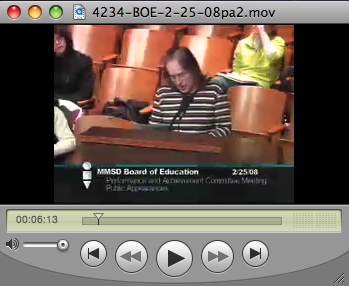

Share

Good grades pay off — literally

Greg Toppo:

Teachers have long said that success is its own reward. But these days, some students are finding that good grades can bring them cash and luxury gifts.
In at least a dozen states this school year, students who bring home top marks can expect more than just gratitude. Examples:
•Baltimore schools chief Andres Alonso last week promised to spend more than $935,000 to give high school students as much as $110 each to improve their scores on state graduation exams.
•In New York City, about 9,000 fourth- and seventh-graders in 60 schools are eligible to win as much as $500 for improving their scores on the city’s English and math tests, given throughout the school year.
•In suburban Atlanta, a pair of schools last week kicked off a program that will pay 8th- and 11th-grade students $8 an hour for a 15-week “Learn & Earn” after-school study program (the federal minimum wage is currently $5.85).

Share

93 Milwaukee Rufus King Students Present International Baccalaureate Papers

Alan Borsuk:

Three things to know about Mohammad Mohammad:
He’s a senior at Milwaukee’s Rufus King High School, he’s a good student, and he’s a big sports fan.
You can serve all that on a silver platter.
At least that’s what Mohammad did this week at a program honoring him and 92 fellow students for completing lengthy research papers as part of their work at the school.
The 3,000- to 4,000-word papers – “extended essays” – are required for students who want to receive the International Baccalaureate diploma. For those who complete such a paper – a process that begins in the spring of their junior years – it is a tradition to present the final product on a silver platter to the teacher who advised the student along the way, followed by the student and the teacher each commenting on what was learned.
The silver platter ceremony was held this week, and the 93 who presented their work are the largest group to complete the formidable research project in King’s nearly 30-year history as an IB school.
The topics they researched included matters from the worlds of science, history, art, religion and beyond. Daniel Gatewood, one of the advisers, said as he commented on one of his student’s papers, “I didn’t learn to write like this until graduate school.”
Mohammad said, “Every time I get one of these papers, I try to incorporate sports into it.” He chose as his topic the effects on American and Soviet psyches of the “Miracle on Ice” victory of the U.S. hockey team over the Russians at the 1980 Winter Olympics.

Links: International Baccalaureate website, Milwaukee Rufus King High School and Clusty search on the school.

Share

Oregon and Monona Grove Add Elementary Spanish

Gena Kittner:

wo Dane County school districts will be saying “hola ” to new language programs at the elementary level this fall.
In the Oregon School District, Spanish will be taught in kindergarten through fourth grades starting this fall, with fifth and sixth grades added in the fall of 2009, said Courtney Odorico, Oregon School Board member.
Teaching only Spanish is a scaled-down version of what the district originally considered — teaching a different language such as Japanese, Chinese or German — at each of its three elementary schools.
“I think parents were a little worried about not having a choice, ” Odorico said. Also, “there were very few certified teachers in Chinese and some of the other languages we were looking at in the state. ”
The School Board approved the program at a meeting Monday.
Spanish also is the language of choice for elementary students in Monona Grove, where the School Board approved the program earlier this month.
The parent response was overwhelmingly for Spanish, said Bill Breisch, curriculum director for the Monona Grove School District.

Share

A Look at Kindergarten Reading in Montgomery County, MD

Daniel de Vise:

The share of kindergarten students in the county who can read simple books has risen from 39 to 93 percent in six years, according to school system data culled from reading assessments given each spring. Achievement is so high, and across so many demographic groups, that school officials plan to test future kindergartners on more challenging text.
“This is the collapsing of the gap,” Weast said, speaking to an audience of parents, students and educators at College Gardens Elementary School in Rockville.
The news conference was called partly for the benefit of the County Council, whose members have been examining the superintendent’s record with the achievement gap. Last week, the county Office of Legislative Oversight released a somewhat critical report on the school system’s progress toward erasing performance disparities among students of different demographic groups.
The report found that the gap has narrowed under Weast’s leadership, particularly on tests of reading and math given in the lower grades. Pass rates on the kindergarten assessment ranged from 87 to 97 percent among students of different races. Progress is slower in the middle grades, and the gap has widened on a few high school measures, such as SAT performance and rates of student suspension.

Share

People Making A Difference: Connie Ferris Bailey

WKOW-TV:

Nationally, about half a million teens drop out of school every year. Without a diploma, many can’t find work, some end up in jail.
A Madison-based charity gives troubled teens hope for a better future.
Connie Ferris Bailey is the executive director of “Operation Fresh Start“. The local charity strives to keep teens in school, employed and out of trouble.
In 37 years, 7,000 young people helped build 190 affordable homes in Dane County.
Typically, these young adults come from low-income families, struggle with school, and may have a criminal record.
Teens commit to at least 900 hours of paid work. They also receive a minimum of $2,365 for college.

Share

Denver School Seeks Freedom From District & Union Rules

Jeremy Meyer:

Teachers at a school in northeast Denver seeking freedom from union and district rules will move forward with their autonomy plan, despite failing to get wholesale approval from their union.
Teachers and administrators at Bruce Randolph School want control over the school’s budget, teacher time, incentives and hiring decisions and to be free from union and district red tape that they say is impeding student progress.
Denver’s school board last month agreed to the Bruce Randolph autonomy proposal, but the teachers union balked Tuesday at permitting much of the school’s request — which sought waivers from 18 articles of the union contract and parts of six other articles.

Joanne has more information. Los Angeles recently set a few schools “free” as well.

Share

1/28/2008 Charter School Policy & Youth Options Discussion

Madison School Board: Performance & Achievement Committee Video.
The Long Range Planning Committee also met and discussed the proposed west side boundary changes (video). More on the boundary changes here.

Share

Bad Parents Don’t Make Bad Schools

Jay Matthews:

A Washington Post poll this month revealed, once again, that D.C. residents put the most blame for their failing public schools on apathetic and uninvolved parents. Many Americans feel the same way about the same school troubles in their areas. They are wrong, but in such a convoluted way that it is difficult for us parents to get a good grasp on what role we play in making our schools bad or good.
Do unsupportive parents create pathetic schools or do pathetic schools create unsupportive parents? It is the most frustrating of chicken-and-egg questions. Many education experts will say it is a bit of both, but that’s a cop-out. Most of our worst schools are full of low-income children in our biggest cities. No one has yet found a way to revive those schools in any significant way by training the students’ parents to be more engaged with their children’s educations. It is too hard to do and too unlikely to have much impact on the chaotic school district leadership.
What has worked, again and again, is the opposite: Bring an energetic and focused leader into the school, let that person recruit and train good teachers and find ways to get rid of those who resist making the necessary changes. Great teaching makes great schools, and once you have a good school, parents become engaged and active.

Share

Have Kid, Will Travel: Meet the parents who still like trips

Janis Cooke Newman,Bonnie Wach:

This week the Travel Section kicks off a monthly column dedicated to the idea that just because you’ve become a parent, it doesn’t mean you have to become an armchair (or playground-bench) traveler.
The column will be written alternately by two moms who’ve refused to let babylust sublimate wanderlust: Bonnie Wach, former editor of Where Magazine, travel book author and a regular contributor to the Chronicle and USAToday.com; and Janis Cooke Newman, a frequent contributor to these pages, as well as to the travel sections of the Los Angeles Times, Dallas Morning News and the Miami Herald. For this first column, Bonnie and Janis write about why – despite the fact that neither can afford to employ Brangelina’s nanny staff – they believe in the credo “Have Kid, Will Travel.”
Bonnie: Ten minutes into a six-hour flight across the country, with my infant son shrieking in my ear as he yanked the hair of my elderly seatmate and stomped cheerfully on my husband’s loins, the words of those sage philosophers, Johnson & Johnson, became painfully prescient: Having a baby changes everything. Especially the part of everything that involved me thinking that kids under 2 in their parents’ laps for six hours constitutes a “free” ride.
It occurred to me suddenly that I was anchored to a wailing little ball of carry-on luggage, and that my grand notions of not letting a child get in the way of my travel plans was absurd.
We managed to weather that first bout of turbulence through the good graces of Ernest & Julio Gallo and my seat neighbor’s mercifully defective hearing-aid battery, and when I got home, I considered my options: Obviously, I couldn’t give up my child, but as a journalist who has dedicated a good part of her career to writing about travel, I was also not willing to give up my traveling.

Share

More on Madison West Side Boundary Changes

channel3000:

Parents on the west side are speaking out about proposed plans that would change school boundaries for more than 100 children.
The Madison School Board drew up four possible plans that would affect students attending Falk, Stephens and Crestwood elementary schools, and all possibilities drew a lot of criticism.
The school board said their “plan A” would divide 151 students living in the Valley Ridge neighborhood between Crestwood and Falk elementary schools. That plan, released in December, garnered strong opposition, leading the board to propose three new plans.
Their “plan B” would call for Valley Ridge students to stay at Stephens Elementary and move students from other neighborhoods, including Spring Harbor and Junction Road.
Their “plan C” calls for the pairing of Stephens and Crestwood schools and “plan D” would call for Crestwood and Falk pairing up.
School board officials said if any of the schools were paired, students would attend one school from kindergarten through second grade, and then move to the other school for grades three through five.

Much more, here.

Share

Middle School Report Cards Future?

I just received an e-mail from a parent stating the Middle School report cards are converting to the elementary format of 1 – 4 and they are dropping the A – F grading system. She spoke to Lisa Wachtel, Head of Teaching and Learning to confirm that this is the direction the district is headed.
DO any of you have any info on this? They claim it is on the website but other than the Standards Base System info, which is pretty general I can not locate this info. This greatly concerns me if it is true.
Related: Can We Talk 3: 3rd Quarter Report Cards.

Share

Bill Strickland: Rebuilding America, one slide show at a time

TedTalks:

With subtle accompaniment by longtime friend Herbie Hancock, and a slide show that has opened the minds (and pocketbooks) of CEOs across the country, Bill Strickland tells a quiet and astonishing tale of redemption through arts, music and unlikely partnerships.
Why you should listen to him:
Bill Strickland’s journey from at-risk youth to 1996 MacArthur ‘genius’ grant recipient would be remarkable in itself, if it were not overshadowed by the staggering breadth of his vision. While moonlighting as an airline pilot, Strickland founded Manchester Bidwell, a world-class institute in his native Pittsburgh devoted to vocational instruction in partnership with big business- and, almost incidentally, home to a Grammy winning record label and a world class jazz performance series. Yet its emphasis on the arts is no accident, as it embodies Strickland’s conviction that an atmosphere of high culture and respect will enervate even the most troubled students.
With job placement rates that rival most universities, Manchester Bidwell’s success has attracted the attention of everyone from George Bush, Sr. (who appointed Strickland to a six year term on the board of the NEA) to Fred Rogers (who invited Strickland to demonstrate pot throwing on Mister Rogers’ Neighborhood). And though cumbersome slide trays have been replaced by PowerPoint, the inspirational power of his speeches and slide shows are the stuff of lecture circuit legend.

Share

It isn’t smart to cheat our brightest pupils

Len LaCara
You don’t need to be an Einstein to know Ohio is cheating its most promising students.
Last week, The Plain Dealer wrote a story about the sorry state of gifted education in Ohio. Consider these facts:

  • 31 states require school districts to provide special services for children identified as gifted. Ohio does not, even though a sixth of its pupils have that classification.
  • Three-fourths of the state’s gifted students receive no special services, according to the Ohio Department of Education. Many of the rest only get partial services.
  • Ohio spends more than $8 billion a year on educating students. But less than 1 percent of that amount – roughly $47 million – goes toward gifted education.

Does this strike you as, well, smart?

Share

On Madison Boundary Changes

Dear Board,
As the opening of a new school is coming close, I was surprised to some extent that the plans were changed with such a short amount of time left before the new year.
So………..I dug up my West Side Long Term Planning Binder and reviewed all the data presented to us, as a member of that committee, and remembered the HOURS we spent debating and reviewing the pros and cons of each plan. I believe this is a very hard process and I am sad it is being altered at this late date.
I think one thing many of us felt on the Long Range Planning Committee was even with the new school and addition to Leopold we did not devise a Long Term Plan. My #1 suggestion to the board would be to revisit the plan of “making the map look better” and balancing the income levels but TO MAKE IT A LONG TERM plan and say in 6 years this is what we are going to do. (and stick to it) I think when you spring it on families that in a few months Johnny has to switch schools, we parents are too invested and comfortable with the school and protest the change. But if a 6 Year Plan was in place with some options to start at the new school, grandfather for a couple of years the protest would be great but families would have lots of time to accept the change and deal with it. It would also be a LONG TERM PLAN.

(more…)

Share

Students flocking to online study as a flexible way to work for degree

Amy Rolph:

Forget those uncomfortable, plastic classroom chairs and their 12-inch, fold-down, wannabe-desk extensions.
Millions of college students around the country attend class from living-room sofas, kitchen tables, home offices and even park benches — part of an ever-escalating trend of attending school online.
The trend is being set largely by community colleges, with their propensity for nontraditional students who need an easier, more flexible way to earn degrees. The number of students taking online classes in Washington has jumped 75 percent in just four years.
In Seattle, North Seattle Community College is leading the way with a course catalog that lists an increasing number of online options.
Sabrina Hutchinson, a busy staffing account manager and recruiter who works as an event planner on the side, enrolled at North Seattle this quarter to see whether she could juggle two jobs and college classes. It had been more than a decade since Hutchinson attended college. She decided on the high-tech option: an online course examining how the study of dinosaurs overlaps with a number of scientific fields.

Share

Virginia Parents Resist Math “Investigations” Curriculum

Ian Shapira:

A group of Prince William County parents is mounting a campaign to repeal a new elementary school math curriculum, using an Internet discussion group and an online petition to gather support and fuel criticism.
The group, whose members include parents from such elementary schools as Westridge, Ashland and Springwoods as well as teachers from various schools, plans to present the Prince William County School Board in February with its petition, which has about 500 names. Parents in the group, whose Web site ( http://www.pwcteachmathright.com) lists several of their complaints, say that the Investigations curriculum is putting their children behind grade level and is too convoluted.
The group’s formation comes right after the school system presented a year-long study of the curriculum that showed 80 percent of second-graders and 70 percent of first-graders are proficient on all 10 subtests of the Stanford Diagnostic Mathematics Test. The school system wants to continue studying the program and incorporate data from student performance on the state Standards of Learning exams.
School Board member Julie C. Lucas (Neabsco) said in an interview that she wants to examine the program inside a classroom to assess its effectiveness. She added that she has been hearing positive reviews from at least one principal in her district but that she wants to withhold making public comments until she visits schools.
The Investigations program has been undergoing a phased-in implementation since the School Board adopted its materials in 2006. In the 2006-07 academic year, kindergarten through second grade started the program; this year, third-graders began it; and next year, fourth-graders will use the material.
Investigations teaches children new ways of learning mathematics and solving problems. For instance, a student may not need to learn how to add 37 and 23 by stacking the figures on top of each other, and carrying the numbers. They may learn to add up the tens and then combine the seven and three to arrive at 60.

Related:

  • Math Forum Audio / Video
  • Madison School District’s Math Task Force
  • Clusty Search: Math Investigations
  • Teaching Math Right website:

    Why this website?
    …Because our children – ALL children – deserve a quality mathematics education in PWCS!!
    In 2006 PWCS directed mandatory implementation of the elementary school mathematics curriculum TERC – “Investigations in Number, Data, and Space” in all PWCS elementary schools. The traditional, proven, successful mathematics program was abandoned for a “discovery learning” program that has a record of failure across the country.
    Of all the VA Department of Education approved elementary math text/materials, “Investigations” least adequately supports the VA Standards of Learning. Yet it was somehow “the right choice” for PWCS children. Parents of 2nd and 3d graders are already realizing the negative impact of this program in only a year and a half’s worth of “Investigations.” Children subjected to this program end up two years behind where they should be in mathematics fluency and competency by the end of 5th grade. PWCS is committed to experimenting with our children’s future. We think our children and our tax dollars deserve better.

Share

Chromosomal Abnormalities Play Substantial Role In Autism

Science Daily:

Genome-wide scans of families affected by autism spectrum disorder (ASD) have revealed new evidence that previously unknown chromosomal abnormalities have a substantial role in the prevalent developmental disorder, according to a new report. Structural variants in the chromosomes were found to influence ASD with sufficiently high frequency to suggest that genomic analyses be considered in routine clinical workup, according to the researchers.

Share

Employers Want New Way to Judge Graduates Beyond Tests, Grades

Mary Beth Marklein:

Colleges have been scrambling over the past year to respond to recommendations from a national commission that they be clearer to the public about what students have learned by the time they graduate.
Sometime in the next several weeks, for example, a national online initiative will be launched that allows families to compare colleges on measures such as whether they improve a student’s critical-thinking skills.
Tools for such measurements were recommended by the national commission, which was created by Education Secretary Margaret Spellings. The group released its recommendations in late 2006.
Now, a sampling of the nation’s employers have weighed in. And they are not terribly impressed.

Share

More Students Head Overseas In Freshman Year

Anjali Athavaley:

Callie Broughton had an eventful freshman year at Florida State University — in Spain.
Ms. Broughton, now a 20-year-old junior, opted to study abroad in Valencia through a program for first-year students at Florida State. For one year, she lived in an apartment and took classes with other FSU students at the university’s Valencia Study Center. In her spare time, she explored Europe.
There were downsides to going abroad the first year of college. “Missing Thanksgiving and stuff I had never missed in 18 years was definitely weird,” she says. But the benefits outweigh the disadvantages: “You’re getting to see the world at such a young age,” she says. Ms. Broughton, an education major, is now a student recruiter for the program.
Freshman year has typically been considered a time for students to settle in and try living on their own for the first time, plan their course schedules and decide on a major. Now, a growing number of schools are expanding their study-abroad options for first-year students. “This was something that was very rarely done at all up until a few years ago,” says Brian Whalen, president and chief executive of the Forum on Education Abroad and executive director of the Office of Global Education at Dickinson College in Carlisle, Pa.
Spending freshman year abroad presents challenges for younger students: easy access to alcohol, lack of supervision and, given the weak dollar, surprisingly high prices for basic goods and services.

Share

www.dyslexia.com/

  1. A fantastic site and resource for LD (learning differently) in general.
  2. In addition, the Davis Technique works! The nearest provider is in Waukesha, but parents can learn about and use the technique.

  3. The Davis program was adapted by a teacher for use in the general reading curriculum grades K-2 at low cost. A CA research study showed its use resulted in no references for special ed and increased references for T&G tracks compared to the control group.

http://www.dyslexia.com/

Share

Clarion Call: “Windows on College Readiness”

“Your essay, which I have now read twice, is terrific.
You are way ahead of everyone on this.”
email 17 January 2008 from: Education Reporter Sara Rimer of the New York Times

This is the one she refers to:
The Bridgespan Group, working for the Bill & Melinda Gates Foundation, has just released a report called “Reclaiming the American Dream.” The study was intended to find out how to get more U.S. high school students prepared for and through college.
Much of the report is about getting kids to go to college, and it finds that if there is enough money provided, and if parents, peers, counselors and teachers say going to college is important, more high school students are likely to go.
The major weakness of the report, in my view, is its suggestions for the kind of high school work that will help students to do college work and to graduate.
One of the concluding statements is that “Inertia is particularly difficult to overcome when people are unaware that a problem exists or that the potential for solving it is real.” What a useful insight. What they recommend for high school students is “a rigorous college preparatory curriculum.” What could be wrong with that?
Two very simple and basic things are wrong with that. Current “college preparatory” curricula, including AP courses, do not include the reading of complete nonfiction books or the writing of serious research papers.
That is almost as if we had a crisis in preparing high school football players for success in college and recommended a standard preparation program which did not give them practice in running, blocking and tackling. ACT found last spring that 49 percent of the high school students it tested could not read at the level of college freshman texts. And the Chronicle of Higher Education reported on a survey in which 90 percent of college professors thought high school students were not well prepared in reading, writing and doing research. A true college education requires reading serious books and writing substantial papers although many schools have watered their requirements down. High school students should be ready for in-depth study.

(more…)

Share

A Discussion on School Models (Traditional, Charter and Magnet)


Madison Superintendent Art Rainwater and Rafael Gomez held an interesting discussion on school models recently [Announcement].

Read the transcript
Watch the Video
or listen to the event (41mb mp3 audio)


Related:

Share

Two-Year Colleges Go Courtin’ Overseas

Jane Porter:

Marketing an obscure Wyoming community college to Vietnamese high schoolers presents special challenges. Many have never heard of Wyoming, and, if they have, it’s usually thanks to the movie Brokeback Mountain. So when recruiter Harriet Bloom-Wilson from Northwest College in Powell, Wyo., visits the International High School in Ho Chi Minh City, she focuses on the college’s nurturing, small-town environment. That’s what sold “Grace” Thienan Nguyen, 19. The business major also notes she can transfer to a full-fledged university.
An American Ivy League education has long been prized by wealthy families in Asia, the Middle East, and elsewhere. Now more and more middle-class kids, whose English-language skills won’t pass muster at universities, are discovering two-year programs. Keen to attract these kids and stand out in a crowded field, schools are ramping up their global marketing efforts.
It’s no secret why Nguyen and her peers are descending on community colleges. Besides being easier to get into than universities, they also cost far less. “The notion of smart shopping for international education has really begun to spread,” says Peggy Blumenthal, executive vice-president of the Institute of International Education.

Share

Pioneering research shows “Google Generation” is a myth

British Library [1.5MB PDF]:

  • All age groups revealed to share so-called “Google Generation” traits
  • New study argues that libraries will have to adapt to the digital mindset
  • Young people seemingly lacking in information skills; strong message to the government and society at large

A new study overturns the common assumption that the “Google Generation” – youngsters born or brought up in the Internet age – is the most web-literate. The first ever virtual longitudinal study carried out by the CIBER research team at University College London claims that, although young people demonstrate an apparent ease and familiarity with computers, they rely heavily on search engines, view rather than read and do not possess the critical and analytical skills to assess the information that they find on the web.

Share

And Then There Were 3: Finalists for the Madison Superintendent Job

Madison Board of Education:

Following a first round of interviews with the five semifinalists, the Board of Education has selected three candidates as finalists for the position of Superintendent of the Madison Metropolitan School District.
In alphabetical order, the three candidates are:
Dr. Steve Gallon, District Administrative Director – Miami/Dade Public Schools, Miami, Florida [Clusty Search / Google Search / Live Search / Yahoo Search]
Dr. James McIntyre, Chief Operating Officer – Boston Public Schools, Boston, Massachusetts [Clusty Search / Google Search / Live Search / Yahoo Search]
Dr. Daniel Nerad, Superintendent of Schools – Green Bay Area Public School District, Green Bay, Wisconsin [Clusty Search / Google Search / Live Search / Yahoo Search ]
The Board interviewed the candidates last evening and today.
Each of the three finalists will spend a day in Madison on January 22, 23 or 24. In addition to a second interview with the Board, the candidates will visit some schools and see parts of Madison, talk to attendees at the Community Meet and Greet, and speak with district administrators.
The community is invited to the Meet and Greets scheduled from 4:00 to 5:15 p.m. at the Monona Terrace Community and Convention Center on January 22, 23 and 24. In the first hour, attendees will be able to briefly meet and greet the candidate as part of a receiving line. From 5:00 to 5:15 p.m. each day, the candidate will make a brief statement and might take questions. The session will end promptly at 5:15 p.m.
The schedule for visits by the finalists:
Tuesday, January 22 Steve Gallon
Wednesday, January 23 James McIntyre
Thursday, January 24 Daniel Nerad
On January 26 or 27, the Board will identify a preferred finalist. To ensure the Board’s research will be as comprehensive as possible, a Board delegation is expected to visit the finalist’s community during the week of January 28. The announcement of the appointment of the new Superintendent is scheduled for early February.

Related:

(more…)

Share

Madison School Superintendent Finalists Named Later Today

Susan Troller:

And then there will be three.
Members of the Madison School Board will narrow the field of candidates for the next superintendent of the school district from five to three late today. School Board President Arlene Silveira said she expected that the three final candidates would be named sometime late this afternoon or early evening, following three candidate interviews today and two on Friday.
The five candidates are: Bart Anderson, county superintendent of the Franklin County Educational Service Center in Columbus, Ohio; Steve Gallon, district administrative director of the Miami/Dade Public Schools; James McIntyre, chief operating officer of the Boston Public Schools; Daniel Nerad, superintendent of schools, Green Bay Public Schools and Marguerite Vanden Wyngaard, chief academic officer, Racine Public School District.
The Capital Times asked candidates why they would like to come to Madison and what accomplishments have given them pride in their careers. Anderson, McIntyre and Vanden Wyngaard were interviewed by phone, and Nerad responded by e-mail. Steve Gallon did not respond to several calls asking for his answers to the two questions.

Related:

(more…)

Share

Suspending Students is Exactly the Wrong Idea

Joel McNally:

We talk so much about the value of education and the need to do something to reduce dropouts that it may surprise some people that nearly half of all the freshmen in the Milwaukee Public Schools have been ordered not to come to school.
In fact, beginning in the sixth grade, more than a third of every grade level until senior year is suspended and told to stay away from school for up to three days at a time. Many are repeatedly told not to attend school.
The good news is that Milwaukee Superintendent William Andrekopoulos, after more than five years on the job, has finally noticed the destructive practice he has been presiding over and decided to do something about it.
Andrekopoulos says Milwaukee may have the highest suspension rates in the country. He has asked outside educational experts, the Council on Great City Schools, to examine Milwaukee’s suspension policies and recommend ways to keep more kids in school.
The highest in the country. Hmmm. That sounds familiar. What else have we read recently about Milwaukee Public Schools leading the country? Oh, we remember now. MPS also had the lowest reading scores in the country.

Share

History Enrichment Opportunies and Summer Programs

Carol Fertig:

In writing this blog, I quite often find that I get a question for which I am not the best person to compose an answer. This was the case here; so I turned to Sandra L. Berger, the author of our recently published, The Ultimate Guide to Summer Opportunities for Teens.
I’ll post Sandra’s Response below. Because the parent posing the question was from Michigan, that state is slightly more represented in the response.
The following programs will have information and/or sponsor courses that may interest your son. This is not a complete list, but it should give you a good start. Please do not be put off by the word “gifted” in the program titles. The term describes a program, not a child. These programs often include a diversity of children who are interested in advanced topics.

Share

Urban Schools Aiming Higher Than Diploma

Sara Rimer:

At Excel High School, in South Boston, teachers do not just prepare students academically for the SAT; they take them on practice walks to the building where the SAT will be given so they won’t get lost on the day of the test.
In Chattanooga, Tenn., the schools have abolished their multitrack curriculum, which pointed only a fraction of students toward college. Every student is now on a college track.
And in the Washington suburb of Prince George’s County, Md., the school district is arranging college tours for students as early as seventh grade, and adding eight core Advanced Placement classes to every high school, including some schools that had none.
Those efforts, and others across the country, reflect a growing sense of urgency among educators that the primary goal of many large high schools serving low-income and urban populations — to move students toward graduation — is no longer enough. Now, educators say, even as they struggle to lift dismal high school graduation rates, they must also prepare the students for college, or some form of post-secondary school training, with the skills to succeed.

Share

Pennsylvania Acts to Bolster High School Requirements

Sean Hamill:

A requirement that students pass a series of state exams before being allowed to graduate from Pennsylvania’s public high schools was unanimously approved Thursday by the State Board of Education.
The requirement faces a yearlong review process involving, among other groups, the state House and Senate Education Committees. If the measure survives, Pennsylvania will join 22 other states with similar requirements, according to the Center on Education Policy, an advocacy group in Washington.
Four additional states — Arkansas, Maryland, Oklahoma and Washington — will require graduation exams by 2012, two years before the Pennsylvania requirement would take effect. Connecticut is debating the idea.
Policy makers like the requirement because “communities are telling them that American kids are leaving high school without adequate skills,” the education center’s president, John F. Jennings, said in a telephone interview on Wednesday.

Share

MAINE PROGRAM BRIGHTENS COLLEGE PROSPECTS – AT BIRTH

Stacy Teicher Khadaroo:

Foundation offers $500 grants to all newborns – provided their parents open a college-savings account.
Just a few days into the new year, Laurie and Keenan Farwell welcomed their daughter Hadley into the world. The hospital staff at MaineGeneral Health in Augusta had the pleasure of delivering not just the baby, but also her first birthday gift: $500 toward her future education.
Hadley is a beneficiary of the new Harold Alfond College Challenge, a first-in-the nation philanthropic program that will give families statewide a $500 starter grant – and assistance with paperwork – to set up 529 college savings accounts for infants.
“It was very exciting to think she’s not even a couple hours old, and she’s already looking at her college fund,” Ms. Farwell said in a phone interview as Hadley patiently sucked on her tiny hand, awaiting a feeding.
Harold Alfond founded Dexter Shoe Co. in Maine in 1958 and shared millions of dollars to promote health and education in the state. After giving many scholarships to college-age students, “he wanted to help build aspirations for college at the front end of life,” says Greg Powell, chairman of the board of the Harold Alfond Foundation. Mr. Alfond laid the groundwork for this legacy before he died in November.

Share

The Translators: The Media and School Choice Research

Andrew Rotherham:

The Media play a pivotal role in determining how and why research influences public opinion with regard to policy. Political scientists Shanto Inyengar and Donald Kinder have shown through experimental research involving televised news how the presentation of news stories can have a powerful impact on what Americans think about issues.1 Prominent columns and articles, especially in the big East Coast papers, influence political behavior among the policy and political elites and offer signals about elite thought and opinion on key issues. The debates about the research on school choice illustrate the broader challenges the media face when translating research for public consumption.
At a superficial level, school choice is a relatively easy debate for the media to cover. It can be simplified into arguments for and against vouchers, charter schools, and altering the definition of “public” schooling, and these arguments are often boiled down to an easy framework of “public” versus “private.” Likewise, the question of increases in test scores fits readily into a debate about whether school choice is “working” or not. While such framing greatly oversimplifies the issues, it nonetheless drives much of the coverage precisely because it offers easy contrasts.

Share

In Praise of Nerds

The Economist:

“AND then, just to show them, I’ll sail to Ka-Troo, and bring back an It-Kutch, a Preep, and a Proo, a Nerkle, a Nerd, and a Seersucker, too!” That typically nifty passage comes from Dr Seuss’s “If I Ran the Zoo”. The book was published in 1950 and contains the first use of the word “nerd”. How very unfortunate that Dr Seuss, whose verbal pyrotechnics have given so much pleasure to so many children, should also have given them, however innocently, the ghastly label “nerd”.
The precise meaning of the word (in its post-Seuss sense) is hard to pin down, as David Anderegg, a child psychologist and academic, argues in this thoughtful and warmly sympathetic book. It denotes a bundle of different qualities: “some combination of school success, interest in precision, unselfconsciousness, closeness to adults and interest in fantasy.”
But the word is no less powerful for its vagueness. Children intuitively understand what a nerd is, with terrible clarity. The bottom line, Mr Anderegg reckons, is that American kids grow up knowing that “nerds are bad and jocks are good”. (His focus is exclusively American: in many other countries academically high-achieving children are revered by their peers.) And this matters because these stereotypes become the basis for choices that children make about their identity and future.
Striving to do badly
Mr Anderegg draws on scores of interviews with his young patients to show what being called a nerd can do to a child. Some are driven to despair or suicide. But most cope by bending to peer pressure. “The kids who will really be hurt by the nerd/geek stereotypes are the kids who will shut down parts of themselves in order to fit in.” When these bright children start switching off their own lights to avoid being branded nerds, it is bad news for everyone—and for the economy. Mr Anderegg points to declining school performance and college enrolment in science subjects in America, and to the fact that employers in certain fields are now having to look abroad to find the best graduates.

Nerds: Who They Are and Why We Need More of Them @ Amazon. Clusty.

Share

Wisconsin at Center of National Debate Over Virtual Schools

AP:

Seventh grader Marcy Thompson is caught in the middle of a national policy debate that could close her school and help determine the future of online education.
Thompson is one of a growing number of students nationwide trading home schooling and public schools for virtual ones where licensed teachers oversee her progress from afar.
She is enrolled in the Wisconsin Virtual Academy, a charter school based north of Milwaukee, but spends her days 130 miles away at home studying everything from literature to algebra under her mother’s guidance and a curriculum provided by the school district.

Share

Math 234 at the University of Wisconsin Madison for High School Students

Via Ted Widerski’s email:

The UW Math dept has decided to offer a section of Math 234 (3rd semester Calculus) at 7:45 am in the fall of 2008. This course will be taught by Professor Andreas Seeger and will meet at 7:45 – 8:35 on MWF for 3 credits. The UW has chosen this time as being somewhat convenient for high school students, as many students can take this course and return to their high school in time for 2nd period.
Madison Schools have 26 students in grades 11 or below that will be completing Calculus II this year. Combined with students in neighboring school districts, there is a possibility that a large percentage of the class will be made of area high school students.
For those students that plan to elect this course, each District has a deadline for accessing the Youth Options [Clusty | Google] program. In Madison, that deadline is March 1. Therefore, I would encourage you to speak with students and parents in your building and make them aware of this opportunity. Also, please pass on this info to other key people in your building such as guidance counselors, math department chairs and Calculus teachers.
If you have questions or concerns, feel free to contact me.
Ted Widerski
Talented and Gifted Resource Teacher
Madison Metropolitan School District
545 W Dayton Street
Madison, WI 53703
(608)442-2152

Related: Credit for non-mmsd courses.

Share

Where Have all the Students Gone? An Update

An update to Barb Schrank’s November, 2005 post:

Comments from a reader:

At $6,000 per child that’s about $16 million per year. At $9,000 per child, that’s about $23 million per year. If we kept 332, that would be $2-3 million more per year.
Also, MMSD not only lost students, which has a negative effect on what the district gets under revenue caps, we’ve increased our low-income population, which means that for every dollar the district gets, more of those dollars need to be spent on non-instructional services.
If the district does not consider the economic development implications of its decisions, we’re likely to

  • see more go to school outside MMSD, or
  • for the non-low income students who go to school here increased family dollars will be spent on private aspects of education- lessons, tutoring, etc.

Madison’s population in 2000 was 208,054 and is estimated to be 223,389, according to the census bureau. Madison’s poverty rate is estimated to be 13%, according to the Small Area Estimates Branch [Website].

District Enrollment
2000-2001
Enrollment
2006-2007
Per Student Spending (06/07 Budget) Administrators Total Staff ACT % Tested (05-06) ACT Comp Score
Madison 25,087 24,755 $12,422 91.5 3544.6 61.1 24.2
Verona 4222 4540 $12,113 22 603.4 69.6 23.6
Middleton-Cross Plains 5125 5640 $12,822 21 756.3 73 24.5
Waunakee 2836 3357 $11,987 14 427.6 70.7 23.3
Sun Priarie 4776 5946 $11,238 20 741.3 62.6 23
McFarland 1951 2017 $11,853 9.5 251.2 64 23.7
Monona Grove 2702 2885 $12,289 13 388 71.4 22.6
Oregon 3430 3588 $11,572 15 465.1 59.2 23.2

Data sources:

Thanks to a number of readers for the updated information.

Share

Tutoring the 3-Rs and developing other “literacies”

Bob Parvin:

This site is about literacy–basic reading and writing and numeracy, and other “literacies:” celestial, geographic, economic, biological, nutritional, etc.
I am a retired resident of San Francisco with a long-time interest in child and adult literacy. I am offering my free program on the Web to help parents and tutors teach children to read, write, spell, and reckon. I have also included a program on English grammar and composition for good measure. In addition I have Web pages reflecting my interest in other subjects in which I want to be “literate.”
If you have an interest in any these subjects, I invite you to check them out:

Tutoring for Mastery of Reading and Writing and Arithmetic
Tutoring English Grammar and Composition
Finding and Reading eBooks
Beginning Urban Skywatching
Physical Geography of the U.S.
Economic Literacy
Global Warming and Warning
Approaching the Bible
Islam: One American’s Findings
DNA: Life’s Common Denominator
Nutrition: What should we eat?
Help for Microsoft Windows XP
Bread Machine Baking
Tips for No-Knead Bread Baked in a Pot
Links to Video Performances of Great Arias
The Home Library, an electronic home reference library
Recollections of an Old Farm Boy

Share

Ed schools put diversity before math

Jay Greene & Catherine Shock:

A good education requires balance. Students should learn to appreciate a variety of cultures, sure, but they also need to know how to add, subtract, multiply, and divide. Judging from the courses that the nation’s leading education colleges offer, however, balance isn’t a goal. The schools place far more emphasis on the political and social ends of education than on the fundamentals.
To determine just how unbalanced teacher preparation is at ed schools, we counted the number of course titles and descriptions that contained the words “multiculturalism,” “diversity,” “inclusion,” and variants thereof, and then compared those with the number that used variants of the word “math.” We then computed a “multiculturalism-to-math ratio”—a rough indicator of the relative importance of social goals to academic skills in ed schools. A ratio of greater than 1 indicates a greater emphasis on multiculturalism; a ratio of less than 1 means that math courses predominate. Our survey covered the nation’s top 50 education programs as ranked by U.S. News and World Report, as well as programs at flagship state universities that weren’t among the top 50—a total of 71 education schools.
The average ed school, we found, has a multiculturalism-to-math ratio of 1.82, meaning that it offers 82 percent more courses featuring social goals than featuring math. At Harvard and Stanford, the ratio is about 2: almost twice as many courses are social as mathematical. At the University of Minnesota, the ratio is higher than 12. And at UCLA, a whopping 47 course titles and descriptions contain the word “multiculturalism” or “diversity,” while only three contain the word “math,” giving it a ratio of almost 16.

Share

Why the Public Schools?

Laurent Lafforgue:

Since my forced resignation from the High Council of Education, I have received hundreds of testimonials from teachers, parents, students and plain citizens of all social groups. Among these messages I have been particularly struck by those parents who have written me, in substance, “We have been so deceived, and we are so appalled, by what has become of the schools that we have decided to remove our children from there, and to teach them ourselves.” Or, “We have joined with other parents and are pooling our talents to form our own classes for our children”. Or, again, “Despite the financial sacrifice it represents, we have placed our children into private schools.” And finally, those most numerous messages which say: “Our children go to school, yes, but every evening we put them to work using old textbooks, and do what we can to give them the kind of rigorous instruction that is no longer given in their classes. But what a labor for them, and what a responsibility for us!”
That parents should go so far as to remove their children from school, to teach them themselves, at home, or to form parallel classes for them in which they, themselves, are the teachers, to prefer a school to which they must pay the fee to the free public school, or to impose on their children and themselves the burden of a night school added to the day school they consider to be nothing but a holding pen, all this became and remains for me a theme of profound dismay. And I notice as well that these are surely the parents who enjoy a high level of education and – for those who can pay the fees of a private school – of income. And then I think of the other children, who do not have the benefits of having been born into families similarly favored.
Students, all the students, are the primary victims of the destruction of the school. This destruction has resulted from educational policies of all the governments of the last few decades. It is not the teachers who are responsible for it, for they are victims themselves: firstly in that they have been prevented from teaching correctly, by the publication of national curricula which are increasingly disorganized, incoherent and emptied of content; then because the knowledge gaps accumulated by their students over the course of years have made the conditions of teaching ever more difficult, and have exposed them to incidents of increasing incivility and violence on the part of adolescents who have never been taught either the elementary understandings, the habits of work, or the self-control which are indispensable to the progress of their studies; and finally because the younger generation of teachers has suffered from an already degraded educational program, so that their own understanding is less certain than that of their elders, and, with the exception of some well tempered characters, has been disoriented by the absurd training so prodigally distributed by the teachers colleges.

Clusty Search: Laurent Lafforgue.

Share

UW-Madison: Saturday Enrichment 2008

UW Madison School of Education Outreach:

The Saturday Enrichment Program provides a student-centered environment to explore a wide range of interests and new academic areas to empower 5th-8th graders to ask and learn about career options, interests, and choices. Students utilize state-of-the-art campus resources and interact with UW-Madison faculty, staff and community professionals in this pre-college program sponsored by the School of Education. This program has open enrollment with course registrations on a first come, first served basis.

Share

Schools failing to nurture gifted children

Julie Henry:

Bright children are being failed by teachers who do not stretch them enough or give them the individual attention they need, Government research has found.
Gifted pupils are routinely put in the wrong ability groups and are set targets that are too low, a study by the Department for Children, Schools and Families discovered. In many schools, young people who show early promise are left to fall behind.
Almost a quarter of the 140,000 children who achieve an above-average level 3 in assessments at the age of seven do not go on to score high marks in tests at 11.
The results are a significant blow to the Government, which has spent almost £400 million in the past decade on gifted and talented programmes in an attempt to convince many middle-class parents that bright children will be nurtured in the state sector.
The report, Able Pupils Who Lose Momentum, found shortcomings in the 37 primaries across England visited by Government advisers.

737K PDF Complete Report.

Share

2008 FIRST Championship

US Foundation for the Inspiration and Recognition of Science and Technology:

The 2008 FIRST Championship will take place April 17-19 at the Georgia Dome in Atlanta.
The FIRST Championship is the culmination of the season’s programs, including the FIRST Robotics Competition, the FIRST Tech Challenge, and the FIRST LEGO League.

The Wisconsin regional competition is March 13-15, 2008 in Milwaukee.
Learn more at www.badgerbots.org.

Share

2008 Wisconsin New Play Development Project

Wisconsin Wrights:

Wisconsin Wrights was created in fall 2006 through a partnership between the UW-Madison Division of Continuing Studies in Theatre, the UW-Madison University Theatre, and the Madison Repertory Theatre. Support for our inaugural year was also provided by Edenfred/Terry Family Foundation and the UW-Madison Anonymous Fund. Three finalists received a one week workshop and residency through Edenfred and University Theatre and received public readings in June 2007. The Madison Repertory Theatre selected one of the three works, “Recovering the Real Me” by Kurt McGinnis Brown, for further development through the 2007 Madison New Play Festival which will take place October 20-21 and October 27-28, 2007. For more details on the Madison New Play Festival click here. (Please note that the name of “Recovering the Real Me” has been changed to “Accent Adios.”) .
The deadline for submissions for Wisconsin Wrights 2008 has been extended to January 14, 2008 with the selection process taking place from January through early April 2008. Finalists will be announced in mid-April 2008 with finalists eligible for several play development opportunities. Three finalists will receive a one week workshop coordinated by University Theatre with a director, dramaturg and full cast and will be featured with public readings June 5, 6 & 7, 2008. These workshops provide an extraordinary opportunity for the expansion and exercise of the playwriting craft, exploration of characters, and constructive critique by caring, invested artists. One finalist will be selected by the Madison Repertory Theatre to take part in their Fall 2008 Madison New Play Festival and one finalist will be selected by the Milwaukee Chamber Theatre for a staged reading in March 2009.

Share

School Rankings That Matter

Cameron Stracher:

The publication this year of U.S. News & World Report’s first ranking of high schools has parents in a twitter, worrying that their property taxes are too high (or too low), or that public education has failed them entirely. But leaving aside the merits and methodology of these particular rankings, we might wonder whether rankings matter at all and, more importantly, if they should.
In fact, there are some numbers that really matter. Getting them is the rub.
To understand this problem, consider another set of rankings, released about the same time as the high-school rankings, that didn’t garner as much attention: bar-exam passage rates. The school at which I teach — New York Law School — jumped to fifth on the list of New York area law schools (with an all-time high passage rate of 90%), while Benjamin N. Cardozo Law School at Yeshiva University leapfrogged to third, behind only NYU and Columbia.
Cardozo, however, is ranked 52nd by U.S. News among all law schools (fourth in New York), while New York Law School is ranked in the “third tier” of law schools (along with Albany, Hofstra, Pace and Syracuse). So which ranking matters?
On the one hand, the U.S. News ranking would seem to be more comprehensive, because bar passage rate is only one of many factors it considers. On the other hand, what good is a law degree if a graduate can’t practice because he doesn’t pass the licensing exam?
Moreover, if the bar exam measures a student’s fitness to practice law (as the bar examiners claim), a school’s bar passage rate should be a pretty good indication of how the school is doing in turning out graduates who know how to practice law.

(more…)

Share

How a School in Florida School Got Mainstreaming Right

Robert Tomsho:

Adam Nystrom remembers being taunted by classmates in middle school for needing so many special-education courses.
“They’d say, ‘Oh, that’s the retard class,’ and everybody would laugh,” recalls Adam, who suffers from a learning disorder that impedes reading ability. “I wouldn’t really say anything because there isn’t anything funny about it.”
Adam, now 20 years old, spent a tumultuous 13 years in the local public-school system. He played pranks on teachers and disrupted lectures with a talking pen that delivered punch lines from the movie “Napoleon Dynamite.” At Choctawhatchee High School, he struggled to pass Florida’s mandatory graduation test, taking the exam six times. Once, he drew a suspension.
But Adam’s academic journey ended in success. He became a varsity wrestler and was selected three times to be a part of the homecoming king and queen’s royal court. After graduating in 2006, he joined the Army, fulfilling a childhood dream.
A major force behind his turnabout: the school district’s program for mainstreaming special-education students into regular classrooms.
As the momentum for such programs has accelerated across the country, many have faced serious obstacles. Special-education students account for a disproportionate amount of discipline problems and sometimes commit violent acts. Teachers say they often lack the training and resources to handle them. Many parents have fought to keep schools and classrooms segregated, saying school administrators have used mainstreaming, also known as “inclusion,” as a pretext for cost cutting.
To free up funds for his special-education overhaul — which initially focused on elementary-school reading — Mr. Gaetz began by making deep cuts in central-office spending. He eliminated more than 40 administrative positions, saving the district about $6 million a year. Some displaced personnel took special-education positions in the schools, which were given additional funds and broad latitude to hire more psychologists, social workers and special-ed teachers as they saw fit. Educators say such site-based management of mainstreaming programs was rare at the time.

Share

At Some NYC High Schools: History, Biology … and Law

Lyneka Little:

“Lawyers, I suppose, were children once,” wrote English essayist Charles Lamb.
Now, it seems, the lawyers are children. Well, maybe not quite. But here in Gotham, a handful of law-themed high schools and middle schools are teaching student the ropes of legislation and litigation. Law-themed high schools? Yep, you heard that right.
The curricula at the public schools, some of which are part of the New Century Initiative, a decade-long effort to improve schools in the inner-cities, isn’t all-law-all-the-time. Students are expected to follow the curriculum outlined by the Department of Education, so reading, writing and ‘rithmetic stay on the agenda.
But much of the curricula relates directly to law. At the Urban Assembly Academy of Government and Law in Manhattan’s Lower East Side, for instance, freshmen take U.S Government for two semesters. By their sophomore year, students begin taking an American law course taught by a former attorney.
Freshmen at the Urban Assembly School for Law and Justice in Brooklyn preside over a hypothetical case involving injury suffered from Fluffy, a ferocious dog, and an apartment building owner that is sued as a result.

Share

Anaheim YMCA invests in kids’ education

Ruben Vives:

Long after the final bell at Thomas Jefferson Elementary School in Anaheim, more than 100 students from first through sixth grade sit quietly at their desks. The only sounds are of pencils moving, chairs squeaking and the occasional whisper.
This is homework time for one of the 46 schools where 4,800 students are enrolled in Anaheim Achieves, an after-school program operated by the Anaheim Family YMCA.
In room 16, first-graders have finished their homework assignments and are drawing a picture of a cat from a book. Some glance at others’ work. Some giggle. Some are fully absorbed. Once done, students must write a sentence describing what is happening in the picture.
“It helps them with their comprehension skills,” said Julia Turchek, a first-grade teacher who volunteers every Monday and Wednesday.
Now in its ninth year, the program works closely with several Orange County school districts, such as Magnolia, Savanna, Centralia and Anaheim, and collaborates with other support groups, including the city of Anaheim, Orange County Department of Education, Boys and Girls Clubs of America and AmeriCorps. Together they help address the academic and mentoring needs of children.

Share

Pushing and Shoving Our Schools into College Readiness

Donna Garner:

Our nation’s classrooms no longer emphasize substantive expository and persuasive writing built upon strong foundational knowledge. This dumbing down of students’ writing and reading is one of the main reasons that students are not ready for college after graduating from our high schools.
During this last decade, public-school teachers have been forced to teach the personal victimization narrative (with an emphasis on “voice”) to get their students ready for the state-mandated tests which contain writing prompts such as “the importance of understanding your heritage,” “a time you made an important choice,” “the importance of accepting others as they are,” “the affect someone you admire can have on your life,” “whether it is important to seek friendships with people who are different from you,” or “the importance of participating in an activity you enjoy.”
Students have been taught that they will get a higher score on these writing prompts if they will build up a dramatic social injustice, victimization essay even if the personal references are bogus. Correct grammar, spelling, usage, punctuation, and capitalization are not factored into the final score so long as they do not “disrupt” communication; and if the student makes a high enough score on his essay, the questions on the multiple-choice editing/revising section count very little.

Share