School Information System

California “gambling with schools”

Manteca Superintendent William Draa:

I will begin by acknowledging there are many facets of the latest California Budget that are onerous to many organizations. With that said, I will focus on the educational piece.
The latest State Budget by our leaders in Sacramento has not only put education in a precarious and unknown position but also ties the hands of the very people who are supposed to protect and lead school districts.
If in January revenues fall $2 billion or more short of projections the following will happen:
School district revenues would be reduced 4 percent, or $1.5 billion (an average of $250 per student)

Share

Questions linger for Indiana school vouchers

Mikel Livingston:

Public schools aren’t the only ones divided over the state’s new private school voucher program that became law Friday and is supposed to be in place by the time classes start in August.
Greater Lafayette private schools are split over the new system — one that some say will expand educational opportunities but others fear could drag state regulations into the mix and restrict freedoms their classrooms currently enjoy.
A handful of Lafayette area schools will be taking advantage of the program. But with such a short time before the new school year starts, the most basic information about how to use the voucher program created by the General Assembly in April still is not available — not even the online application form.
The process likely will face even greater delays in light of a lawsuit filed Friday in Marion County Superior Court by the Indiana State Teacher’s Association. The lawsuit, which seeks an injunction to prevent the disbursement of funds under the new program, will continue to stall the process as it winds its way through the court system. All the while, private schools hoping to participate wait for answers.

Share

Advocating Teacher Content Knowledge: Lessons From Finland #1 – Teacher Education and Training

Bob Compton:

One of the many things I learned producing my film The Finland Phenomenon, was the importance of setting a very high standard for the education and training of teachers.
Finland’s high school teachers are required to have both a Bachelors and Masters degree in the subject they teach (e.g. – math, physics, history, etc) combined with one-year of pedagogical training with very heavy emphasis in real classroom teaching experience under the guidance of an outstanding seasoned teacher.
By contrast, most U.S. States require only a Bachelors degree from a college of education with an emphasis in the subject to be taught – and frequently that subject matter is taught by professors in the Education School, not in the actual subject department. Think of it as content and rigor “light” for teachers.
So, what should America do to apply this obvious lesson from Finland? My thoughts:
1- each U.S. State needs to cut off the supply of teachers not sufficiently prepared to teach this generation at its source. The source is colleges of education. A State legislature and Governor can change the requirements to be a teacher in their State. All it takes is courage to withstand the screams from colleges of education – the sacred cash cow of most universities.
2- To teach at the high school level, a State should require the prospective teacher to have at least an undergraduate degree in the subject they plan to teach and from the department that teaches that subject (e.g. – teaching math? Require a B.S. from the Math department).

Share

The Gist-Ravitch smackdown

The Providence Journal:

A few weeks back, Governor Chafee invited Deborah Gist, Rhode Island’s commissioner of public schools, to sit in on his meeting, arranged by the Rhode Island Federation of Teachers, with noted education historian Diane Ravitch.
The two energetic foes on school reform reportedly did not get along. Ms. Gist says that Ms. Ravitch kept making points irrelevant to Rhode Island. Ms. Ravitch says Ms. Gist interrupted her discourse repeatedly, and that in encounters with the powerful in America since 1958 (such as Sen. John F. Kennedy [D-Mass.]), she had “never encountered such behavior.”
She demanded an apology from Ms. Gist. They later made peace. Mr. Chafee said he saw nothing inappropriate in Ms. Gist’s behavior.
Both women have egos large enough to encompass their educational ambitions — in fact, Ms. Ravitch has two pedagogical histories under her belt. She was once on Ms. Gist’s “side” on school reform. That changed, says Ms. Ravitch, after she lost confidence in testing and charter schools as the prime strategies for success, and started pushing for more respect (pay) for teachers, less reliance on tests, less hope in charter schools and more trust in — well, so far as we can tell — in the status quo.

Share

National Education Assocation 2011 Chicago Convention Notes & Links

Brian Slodysko and Tara Malone:

Vice President Joe Biden lambasted what he called an increasingly union-hostile “new” Republican party, during remarks delivered to National Education Association representatives today, raising the specter of high profile labor fights picked by Republican governors with public workers unions across the country.
“There is an organized effort to place blame for budget shortfalls on educators and other public workers. It is one of the biggest scams in modern American history,” Biden said during a speech laden with political red meat, smoothing over past disagreements between teachers unions and the Obama Administration.
“The new Republican party has undertaken the most direct assault on labor, not just in my lifetime … but literally since the 1920s,” he said. “This is not your father’s Republican party. This is a different breed of cat.”
Biden’s remarks to one of the nation’s largest teachers unions, a speech that lasted about 30 minutes, came a day before its members are expected to decide whether to cast their support behind the administration in the 2012 presidential election.

Mike Antonucci

The National Education Association Representative Assembly opened this morning in Chicago with 7,321 delegates attending, which is by far the lowest number since I began covering the convention in 1998.
The atmosphere still resembles a political party convention, with speeches, confetti and deafening music, including the new NEA theme song, “Standing Strong”:
“Standing strong, standing tall. Standing up for what is right and true, NEA is standing up for me and you!”
Coming soon to a Chevy truck commercial near you.
It is customary for the mayor of the host city to welcome the delegates, but since the mayor is Rahm Emanuel, NEA prudently got hold of Illinois Gov. Quinn instead. After the delegates adopted the standing rules for the assembly, it was time for NEA president Dennis Van Roekel’s keynote speech.

Mike Antonucci:

There were two new business items (NBIs) of note debated this afternoon. The first was NBI C, submitted by the NEA Board of Directors, which directs the NEA president to “communicate aggressively, forcefully, and immediately to President Barack Obama and US Secretary of Education Arne Duncan that NEA is appalled with Secretary Duncan’s practice of…” and then lists 13 of Duncan’s most heinous crimes, like “Focusing so heavily on charter schools that viable and proven innovative school models (such as magnet schools) have been overlooked, and simultaneously failing to highlight with the same enthusiasm the innovation in our non-charter public schools.”

Stephanie Banchero:

Widespread unhappiness among teachers about President Barack Obama’s education policies is threatening to derail a National Education Association proposal to give him an early endorsement for re-election.
The political action committee of the NEA, the nation’s largest union, adopted a resolution in May to endorse Mr. Obama. The proposal will come before the NEA’s 9,000-member representative assembly on Monday at the union’s annual convention here.
The union has never endorsed a presidential candidate this early in the campaign cycle, instead waiting to make the decision during the election year. But union leaders, anticipating a tough re-election campaign, wanted to bolster support for the president early on, a move that has run into opposition from union members.

Associated Press:

Vice President Joe Biden says the “new Republican Party” fundamentally doesn’t believe in public education the way Democrats do.
“There is an organized effort to place blame for budget shortfalls on educators and other public workers. It is one of the biggest scams in modern American history,” he was quoted as saying by the Chicago Tribune.

Much more, here.

Share

Growing Number of Districts Seek Bold Change With Portfolio Strategy

Paul Hill, Christine Campbell, via a Deb Britt email:

A growing number of urban districts across the country are profoundly changing the role of the school district and its relationship to schools in order to bring about dramatically better outcomes for students. New York City, New Orleans, Chicago, Denver, Hartford, Baltimore, and Washington, D.C., are among more than 20 districts pursuing a “portfolio strategy” of continuous improvement. These districts are creating diverse options for families in disadvantaged neighborhoods by opening new autonomous schools, giving existing schools more control of budgeting and hiring, and holding all schools to common performance standards.
CRPE has been studying the development of the portfolio strategy in several cities for the past three years. This interim assessment finds that:

Share

Teaching and Learning in the Midst of the Wisconsin Uprising

Kate Lyman:

It all started when my daughter, also a Madison teacher, called me. “You have to get down to the union office. We need to call people to go to the rally at the Capitol.” I told her I hadn’t heard about the rally. “It’s on Facebook,” she responded impatiently. “That’s how they did it in Egypt.”
That Sunday rally in Capitol Square was just the first step in the massive protests against Gov. Scott Walker’s infamous “budget repair bill.” The Madison teachers’ union declared a “work action” and that Wednesday, instead of going to school, we marched into the Capitol building, filling every nook and cranny. The excitement mounted day by day that week, as teachers from throughout the state were joined by students, parents, union and nonunion workers in the occupation and demonstrations.
Madison teachers stayed out for four days. It was four exhilarating days, four confusing days, four stressful and exhausting days.
When we returned to school the following week, I debated how to handle the days off. We had received a three- page email from our principal warning us to “remain politically neutral” as noted in the school board policy relating to controversial issues. We were to watch not only our words, but also our “tone and body language.” If students wanted to talk about the rallies, we were to respond: “We are back in school to learn now.”

Share

Should Tenure Be Abolished?

Andrew Rotherham:

These days tenure for teachers is such a brawl in America’s elementary and secondary schools that it’s easy to forget that it’s more a cornerstone of higher education. When Austan Goolsbee, Chairman of the President’s Council of Economic Advisors, announced earlier this month that he was leaving the White House to return to the University of Chicago it was a reminder just how strong the ties — and inducements — of university tenure can be, and why it has recently come under fire.
At colleges and universities, tenure basically bestows a job for life unless an institution runs out of money. Originally intended to shield professors from meddling by college administrators, donors or politicians, tenure has evolved into one of the most coveted perks in higher education. It signals excellence and it confers employment stability.

Share

E. B. White, The Art of the Essay No. 1

Interviewed by George Plimpton and Frank H. Crowther:

In the issue of The New Yorker dated two weeks after E. B. White died, his stepson, Roger Angell, wrote the following in the magazine’s “Talk of the Town” section:
Last August, a couple of sailors paid an unexpected visit to my summer house in Maine: young sailors–a twelve-year-old-girl and an eleven-year-old boy. They were a crew taking part in a statewide small-boat-racing competition at a local yacht club, and because my wife and I had some vacant beds just then we were willingly dragooned as hosts. They were fine company–tanned and shy and burning with tactics but amenable to blueberry muffins and our exuberant fox terrier. They were also readers, it turned out. On their second night, it came out at the dinner table that E. B. White was a near neighbor of ours, and our visitors reacted to the news with incredulity. “No!” the boy said softly, his eyes traveling back and forth over the older faces at the table. “No-o-o-o!” The girl, being older, tried to keep things in place. “He’s my favorite author,” she said. “Or at least he was when I was younger.” They were both a bit old for Stuart Little, Charlotte’s Web, and The Trumpet of the Swan, in fact, but because they knew the books so well, and because they needed cheering up (they had done badly in the racing), arrangements were made for a visit to E. B. White’s farm the next morning.
White, who had been ill, was not able to greet our small party that day, but there were other sights and creatures there to make us welcome: two scattered families of bantam hens and chicks on the lawn; the plump, waggly incumbent dog, name of Red; and the geese who came scuttling and hissing up the pasture lane, their wings outspread in wild alarm. It was a glazy, windless morning, with some thin scraps of fog still clinging to the water in Allen Cove, beyond the pasture; later on, I knew, the summer southwest breeze would stir, and then Harriman Point and Blue Hill Bay and the islands would come clear again. What wasn’t there this time was Andy White himself: emerging from the woodshed, say, with an egg basket or a length of line in his hand; or walking away (at a mid-slow pace, not a stroll–never a stroll–with the dog just astern) down the grassy lane that turns and then dips to the woods and shore; or perhaps getting into his car for a trip to town, getting aboard, as he got aboard any car, with an air of mild wariness, the way most of us start up on a bicycle. We made do without him, as we had to. We went into the barn and examined the vacant pens and partitions and the old cattle tie-ups; we visited the vegetable garden and the neat stacks of freshly cut stove wood; we saw the cutting beds, and the blackberry patch behind the garage, and the place where the pigpen used to be–the place where Wilbur was born, surely. The children took turns on the old single-rope swing that hung in the barn doorway, hoisting themselves up onto the smoothed seat, made out of a single chunk of birch firewood, and then sailing out into the sunshine and back into barn-shadow again and again, as the crossbeam creaked above them and swallows dipped in and out of an open barn window far overhead. It wasn’t much entertainment for them, but perhaps it was all right, because of where they were. The girl asked which doorway might have been the one where Charlotte had spun her web, and she mentioned Templeton, the rat, and Fern, the little girl who befriends Wilbur. She was visiting a museum, I sensed, and she would remember things here to tell her friends about later. The boy, though, was quieter, and for a while I thought that our visit was a disappointment to him. Then I stole another look at him, and I understood. I think I understood. He was taking note of the place, almost checking off corners and shadows and smells to himself as we walked about the old farm, but he wasn’t trying to remember them. He looked like someone who had been there before, and indeed he had, for he was a reader. Andy White had given him the place long before he ever set foot on it–not this farm, exactly, but the one in the book, the one now in the boy’s mind. Only true writers–the rare few of them–can do this, but their deed to us is in perpetuity. The boy didn’t get to meet E. B. White that day, but he already had him by heart. He had him for good.

Share

Brain Rhythm Associated With Learning Also Linked to Running Speed, Study Shows

Science Daily:

Rhythms in the brain that are associated with learning become stronger as the body moves faster, UCLA neurophysicists report in a new study.
The research team, led by professor Mayank Mehta, used specialized microelectrodes to monitor an electrical signal known as the gamma rhythm in the brains of mice. This signal is typically produced in a brain region called the hippocampus, which is critical for learning and memory, during periods of concentration and learning.
The researchers found that the strength of the gamma rhythm grew substantially as running speed increased, bringing scientists a step closer to understanding the brain functions essential for learning and navigation.

Share

Winners and losers in the Apple economy

Chrystia Freeland

Once upon a time, the car was the key to understanding the U.S. economy. Then it was the family home. Nowadays, it is any device created by Steven P. Jobs. Call it the Apple economy, and if you can figure out how it works, you will have a good handle on how technology and globalization are redistributing money and jobs around the world.
That was the epiphany of Greg Linden, Jason Dedrick and Kenneth L. Kraemer, a troika of scholars who have made a careful study in a pair of recent papers of how the iPod has created jobs and profits around the world. The latest paper, “Innovation and Job Creation in a Global Economy: The Case of Apple’s iPod,” was published last month in The Journal of International Commerce and Economics.
One of their findings is that in 2006 the iPod employed nearly twice as many people outside the United States as it did in the country where it was invented — 13,920 in the United States, and 27,250 abroad.
You probably aren’t surprised by that result, but if you are American, you should be a little worried. That is because Apple is the quintessential example of the Yankee magic everyone from Barack Obama to Michele Bachmann insists will pull America out of its job crisis — the remarkable ability to produce innovators and entrepreneurs. But today those thinkers and tinkerers turn out to be more effective drivers of job growth outside the United States than they are at home.

Share

School Braces for Hard Truth

Barbara Martinez:

In a ceremony this week, Harlem Day Charter School celebrated its 13 fifth-graders who are moving on to middle school. They represent roughly one-third of the class.
The other two-thirds will have to repeat fifth grade.
That hard truth is one of many that the teachers, students and parents of Harlem Day have been confronting in recent months as the school prepares to become the city’s first attempt at a takeover of a failing charter school.
Only five of 32 teachers will be returning in September. About 100 of all 247 students in the elementary school are being held back. And administrators are having tough conversations with parents about the true state of their children’s academic progress. Parents are being told that students, who for years were passed from grade to grade, lack basic skills.
At Harlem Day, no students were held back last year, despite recent state tests that showed only 20% of students were on grade level in English and 25% were in math.

Share

Using PISA to Internationally Benchmark State Performance Standards

Gary W. Phillips & Tao Jiang via a Dan McGrath email:

This study describes how the Programme for International Student Assessment (PISA) was used for internationally benchmarking state performance standards. The process is accomplished in two steps. First, PISA items are embedded in the administration of the state assessment and calibrated on the state scale. The international item calibrations are then used to link the state scale to the PISA scale through common item linking. The second step is to use the statistical linking as part of the state standard setting process to help standard setting panelists determine how high their state standards need to be in order to be internationally competitive. This process was carried out in Delaware, Hawaii, and Oregon, and results are reported here for two of the states: Hawaii and Delaware.
Key words: Equating, linking, item response theory, international benchmarking.
Introduction
In 2010, the American Institutes for Research obtained permission from the Organization for Economic Cooperation and Development (OECD) to use secure items from the Programme for International Student Assessment (PISA) for purposes of linking state assessments within the United States to the PISA scale. The OECD provided a representative sample of 30 secure PISA items in Reading, Mathematics, and Science. The PISA items covered the 2006 and 2009 PISA assessment cycles. In addition to the PISA items, the Australian Council for Educational Research (ACER), which is the current vender for the OECD contracted to conduct PISA, provided the international item parameters and their standard errors, as well as the linear transformations needed to link the state assessments to the PISA scale. The administration, security, and scoring of the PISA items were carried out by the American Institutes for Research (AIR) based on a License Agreement between AIR and the OECD and monitored by the National Center for Education Statistics (NCES).

Review Wisconsin’s position vs Minnesota, Massachusetts and Singapore, here.

Share

New York Union Sues State to Stop Teacher Evaluations

Jacob Gershman:

New York’s largest teachers union is suing the state Board of Regents over the state’s new system for evaluating public-school teachers, a move that could derail plans by the city and hundreds of other school districts to start basing reviews on how well students perform on standardized tests.
In court papers filed in state Supreme Court late Monday, New York State United Teachers claimed that education officials violated the law when they gave school districts the option of assigning significantly more weight to state assessments in their annual reviews of teachers.
Under the law, teachers could lose their jobs if their students continually fail to improve their scores on state standardized tests.
The union, a labor federation representing hundreds of thousands of teachers, claims that the regulations handed down by the Board of Regents run afoul of the evaluation law, which lawmakers approved last year and is set to take effect in July.
The union’s suit is asking a judge to put the evaluation plan on hold until courts rule on whether it’s legal.

Share

A Letter to Principals About Levers

Tom Vander Ark:

I hope you enjoyed a few days off after a busy year. To the normal craziness of spring, you probably had the heartache of considering budget cuts and layoffs.
You probably work in a state and district that imposes a lot of constraints on your hiring, curriculum, materials, school hours, and facilities. After food and transportation, if your district takes more than 5% for administration your kids are getting shorted.
Let’s think about the improvement levers you’ve been able to influence:
1) Culture: the behavior you model, the tone of your communications, and the way you deal with challenges shape the culture of your school community.
2) Goals: the way you describe and champion learning expectations for your students and goals for your staff may be your most important role. The habits of mind that you encourage could shape student thinking for decades.

Share

The GOP Fails Pennsylvania Kids

William McGurn:

The next time some Republican wonders why the African-American community doesn’t just come to its senses and start to vote the GOP ticket, point him to Pennsylvania.
This past November, Republican Tom Corbett successfully campaigned for governor on a platform that included giving Pennsylvania moms and dads more options for where they can send their children to school. Given that he enjoys Republican majorities in both the House and Senate, prospects for making good on this promise were, as the Philadelphia Inquirer recently put it, “once considered a slam dunk.” With just two days before the legislature takes off for the summer, however, the GOP leadership is sending mixed signals. As we go to press, school choice is in political limbo.
At the heart of this debate is Senate Bill 1. Co-sponsored by Republican Sen. Jeffrey Piccola and Democrat Anthony Williams, it would allow parents of a needy child to take the money the state pays to their home school district and apply it to the public, private or parochial school of their choice. The plan would be phased in and expanded over three years. It further includes a $25 million increase in a popular state program that gives tax credits to businesses that donate money for scholarships.

Share

Labor Pushes Back at Chicago Mayor Emanuel

HUNTER CLAUSS and DAN MIHALOPOULOS:

Barely six weeks after his inauguration as mayor, Rahm Emanuel faced his first open dispute Wednesday with a unionized workforce that largely opposed his candidacy.
In a statement issued Wednesday afternoon, labor officials responded testily to Emanuel’s public threat earlier in the day to lay off hundreds of city workers unless their unions accept his demands for unspecified “work rule changes and efficiencies.”
Emanuel said his proposal would save the city $20 million, and its rejection would force him to lay off more than 600 city workers, but labor leaders shot back that the plan was “unacceptable.”
The impasse came as a two-year contract concession agreement with city worker unions was set to expire Thursday. Under the deal, forged by Mayor Richard M. Daley in 2009, workers took as many as 24 unpaid days off work each year and gave up overtime pay and wage increases.

Share

Justice approves bill allowing school boards to be removed en masse

Nancy Badertscher and Kristina Torres:

The U.S. Department of Justice on Tuesday approved a new law that gives Gov. Nathan Deal the power to suspend the entire Atlanta school board for jeopardizing the city district’s accreditation.
With that consent, state school board members will hold a hearing that involves the local nine-member board no later than July 31. They will then make a recommendation to the governor.
Deal does not have to follow the state board’s recommendation. But if he suspends local members, Deal will make interim appointments and ousted board members will be allowed to appeal for reinstatement.
“I’m pleased,” said House Majority Whip Edward Lindsey, R-Atlanta, who helped write the bill that gave Deal such extraordinary power over the board’s future. “Now we can focus on the best needs of the 48,000 children in Atlanta Public Schools.”

Share

WEAC & Teacher Union Dues

Steve Gunn, via a kind reader’s email:

No wonder bullying remains a persistent problem in public schools.
When teachers engage in such behavior, kids can be expected to follow their example.
It’s become apparent that bullying may be necessary to guarantee the survival of the Wisconsin Education Association Council, the state’s largest teachers union.
That’s because state law will no longer bully on behalf of the union.
Until now, anyone who secured a teaching job at a Wisconsin public school automatically became a de facto member of the teachers union. Teachers had the option of avoiding official membership, but dues were still deducted from their paychecks and they were still represented by the union.

Share

Those Tweedy Old Admissions Deans? They’re All Business Now

Eric Hoover:

Years ago, he wore a tweed jacket and smoked a pipe. He was friendly but aloof, a thoughtful fellow toiling in the shade of mystique.
Back then, he was more of a sage than a salesman. It’s said that he could judge applicants’ potential by reading their essays and absorbing their words in interviews. His college’s bottom line was someone else’s concern; he was paid to counsel students, not to crunch numbers.

Steve Hsu has more.

Share

Florida Leads the Nation in the Percentage of High School Students Enrolled in High Level Classes; Some States Still Leave Low-Income Students Behind; Others Make Surprising Gains

by Sharona Coutts and Jennifer LaFleur:

Florida is a state of stark contrasts. Travel a few miles from the opulent mansions of Miami Beach and you reach desperately poor neighborhoods. There’s the grinding poverty of sugar cane country and the growing middle class of Jacksonville. All told, half the public-school students in Florida qualify for subsidized lunches. Many are the first in their families to speak English or contemplate attending college.
In many states, those economic differences are reflected in the classroom, with students in wealthy schools taking many more advanced courses.
The Opportunity Gap
But not in Florida. A ProPublica analysis of previously unreleased federal data shows that Florida leads the nation in the percentage of high-school students enrolled in high-level classes–Advanced Placement and advanced math. That holds true across rich and poor districts.
Studies repeatedly have shown that students who take advanced classes have greater chances of attending and succeeding in college.
Our analysis identifies several states that, like Florida, have leveled the field and now offer rich and poor students roughly equal access to high-level courses.
In Kansas, Maryland and Oklahoma, by contrast, such opportunities are far less available in districts with poorer families.
That disparity is part of what experts call the “opportunity gap.”

Wisconsin’s results are here, while Madison’s are here.

Share

WEAC sues over law giving Wisconsin Governor Walker power over DPI rules

Jason Stein:

Members of state teachers unions sued Thursday to block part of a law giving Gov. Scott Walker veto powers over rules written by other state agencies and elected officials.
The lawsuit is the latest in a series of legal skirmishes between the GOP governor and public employee unions.
In the case, parents of students and members of the Wisconsin Education Association Council and Madison Teachers Inc. challenge the law for giving Walker the power to veto administrative rules written by any state agency. That law wrongly gives Walker that power over the state Department of Public Instruction headed by state schools superintendent Tony Evers, the action charges.
“The state constitution clearly requires that the elected state superintendent establish educational policies,” WEAC President Mary Bell, a plaintiff in the suit, said in a statement. “The governor’s extreme power grab must not spill over into education policy in our schools.”
The measure, which Walker signed in May, allows the governor to reject proposed administrative rules used to implement state laws.

Share

Hollowing out the ivory tower

Tim Black:

‘The idea – which I have to say has affected large numbers of politicians – that you can just give people at university a certificate and, hey presto, they’ll earn this amount more and the country will be x-amount richer has always seemed so bizarre to me that I have to pinch myself that so many apparently rational people believe exactly that.’
Professor Alison Wolf is a breathless speaker – as I discovered while trying to keep up during the course of our interview. But as the author of Does Education Matter? Myths About Education and Economic Growth, and more recently of the government-commissioned Review of Vocational Education, Wolf is certainly worth listening to on the plight of British universities. And nowhere is her insight more valuable than when it comes to tackling what she has called ‘the great secular faith of our age’ – namely, the idea that education is the key to economic growth, swelling both an individual’s bank balance and expanding a nation’s GDP.

Share

Oregon Gov. Kitzhaber’s school reforms mark a decline in teachers’ union influence

Nigel Jaquiss:

The state’s most powerful political force got rolled in the 2011 Legislature.
Last week, Gov. John Kitzhaber and his allies rammed a dozen education bills through roadblocks erected by the 48,000-member Oregon Education Association.
A coalition of Kitzhaber, House Republicans, a few Democrats willing to buck the teachers’ union, and newly emboldened interest groups handed the OEA its biggest policy setbacks in years.
“There is a strong desire for real movement forward on education, and people were willing to break a few eggs to get there,” says Rep. Chris Garrett (D-Lake Oswego), one of three Democrats who voted “yes” on HB 2301, a controversial online charter-school bill that catalyzed the breakthrough.
To be sure, OEA successfully pushed for a $175 million increase in the K-12 budget over Kitzhaber’s opening proposal, and the union helped forestall any significant changes to the Public Employees Retirement System this session. But in terms of educational politics, this session saw substantive bills that have been stymied for many sessions zip through.

Share

L.A. School District Decides To Go Easier On Homework

Eyder Peralta:

After banning flavored milk, the Los Angeles Unified School District is doing something kids all over will cheer about: They issued a decree that homework can only count for only 10 percent of a student’s grade. The policy goes into effect July 1.
The idea behind the new rule is that it will level the playing field for students who don’t have educational support at home. Also, Los Angeles isn’t alone in this new approach. The Los Angeles Times reports:

In many districts, limits are being placed on the amount of homework so students can spend more time with their families or pursue extracurricular activities like sports or hobbies. The competition to get into top colleges has left students anxious and exhausted, with little free time, parents complain.

Share

Fog of Common Core (Lessons from Arizona’s Adoption)

David Griffith:

Today marks one year since Arizona adopted the common core state standards, but you wouldn’t know it based on any information provided by public officials or the press in Arizona. Indeed, you would have an impossible time finding any details about the Arizona State Board’s official action to adopt the standards.
Last year, I wrote about the bizarre situation where states that were completely overhauling their K-12 reading and math standards in favor of the more advanced, 21st century common core state standards were not only downplaying this standards transformation, but in some instances, also appeared to be proactively burying the information.
Arizona fell into this last group as I mentioned last July:

Share

Kaukauna Area School District projects $1.5 million surplus after contract changes to health care, retirement savings; Milwaukee Plans to Lay Off 354 Teachers

Appleton Post-Crescent:

As changes to collective bargaining powers for public workers take effect today, the Kaukauna Area School District is poised to swing from a projected $400,000 budget shortfall next year to a $1.5 million surplus due to health care and retirement savings.
The Kaukauna School Board approved changes Monday to its employee handbook that require staff to cover 12.6 percent of their health insurance and to contribute 5.8 percent of their wages to the state’s pension system, in accordance with the new collective bargaining law, commonly known as Act 10.
“These impacts will allow the district to hire additional teachers (and) reduce projected class sizes,” School Board President Todd Arnoldussen wrote in a statement Monday. “In addition, time will be available for staff to identify and support students needing individual assistance through individual and small group experiences.”

Karen Herzog

Milwaukee Public Schools Superintendent Gregory Thornton announced at a news conference this afternoon that 519 layoff notices would be issued for next school year, including 354 teachers.
Most of the teacher cuts come at the elementary level. The district has about 125 elementary schools. The elementary schools most affected are those that lost funding for a program that reduces class sizes.
The layoffs are the result of a number of budgetary factors, including the loss of $84 million in state aid to MPS for the next fiscal year, Thornton said.
Thornton called on the Milwaukee Teachers’ Education Association to reconsider the district’s request that teachers pay 5.8% of their salaries toward their pensions, which would have reduced the number of layoffs by about 200 teachers.

More on Kaukana, here.

Share

Wisconsin School District Administrative Cost Comparison

WISTAX via sp-eye:

Phil Frei and his Traveling Pie-in-the-Sky Budget Show like to compare Sun Prairie administrative costs to the state average. And we look great! That trick’s not working so well anymore. As they say in the deep south, “that dog don’t hunt”. Heck even the new associate editor for the STAR, covering the recent budget hearing, asked if we didn’t have a more realistic comparison.
Well… here’s where we rank: 45th. Not even in the top 10%. At least when we look at Administrative costs per student.

Madison spends $1003/student (7.8% of operating expenditures).

Share

Third Circuit, Landmark Victories for Student Speech Limit Schools’ Ability To Censor Students Online

Erica Goldberg:

Yesterday, the full court for the United States Court of Appeals for the Third Circuit issued two simultaneous opinions to resolve how much control grade schools and high schools may exercise over their students’ off-campus, online speech. In Layshock v. Hermitage School District and J.S. v. Blue Mountain School District, the 14-judge court delivered two landmark victories for free speech, holding that school officials cannot “reach into a child’s home and control his/her actions there to the same extent that it can control that child when he/she participates in school sponsored activities.” In the cases, two students had been disciplined for creating parody MySpace profiles mocking their respective principals. The Third Circuit held that schools cannot punish students’ online speech simply because it is vulgar, lewd, or offensive. In addition to their impact in the grade school and high school settings, these decisions further solidify the robust free speech rights that must be afforded to college students engaging in online speech.
We previously blogged about Layshock and J.S. last year, when separate three-judge panels of the Third Circuit issued contrary decisions despite the very similar facts in the two cases. In Layshock, the Third Circuit had held that a then-senior in high school could not be suspended, placed in a special education class, and banned from extracurricular activities for a parody MySpace profile which described his principal as being a “big steroid freak” and belittled the size of the principal’s penis, among other insults. In J.S., a different panel of the Third Circuit had held that a then-middle school honor student could be suspended, without violating the First Amendment, for her MySpace profile. J.S.’s profile parodied her principal as stating, “I love children, sex (any kind), dogs, long walks on the beach, tv, being a dick head, and last but not least my darling wife [a guidance counselor at the school] who looks like a man.”

Share

Another study points to advantages of printed textbooks

Nicholas Carr:

Even as administrators and legislators push schools to dump printed books in favor of electronic ones, evidence mounts that paper books have important advantages as tools for learning. Last month, I reported on a study out of the University of Washington which showed that students find printed books more flexible than e-books in supporting a wide range of reading and learning styles. Now comes a major study from the University of California system showing that students continue to prefer printed books to e-books and that many undergraduates complain that they have trouble “learning, retaining, and concentrating” when reading from screens.
The University of California Libraries began a large e-textbook pilot program in 2008. In late 2010, more than 2,500 students and faculty members were surveyed to assess the results of the program. Overall, 58% of the respondents said they used e-books for their academic work, with the percentage varying from 55% for undergraduates to 57% for faculty to 67% for graduate students. The respondents who used e-books were then asked whether they preferred e-books or printed books for their studies. Overall, 44% said they preferred printed books and 35% said they preferred e-books, with the remainder expressing no preference. The preference for print was strongest among undergraduates, 53% of whom preferred printed books, with only 27% preferring e-books. Graduate students preferred printed books by 45% to 35%, and faculty preferred printed books by 43% to 33%.

Share

Operations bring smiles back to cleft-palate tots

Lana Lam:

Moments after Mao Dongmei gave birth to her first son, doctors in her hometown of Qidong Lusi in Jiangsu province gave her one piece of advice: get rid of your baby because he is deformed.
“After I gave birth, the doctors suggested I abandon my son because he would not be able to suck on the breast,” 26-year-old Mao said.
Her son, Gu Yanhu, who is now 15 months old, was born with a cleft lip and palate, a congenital deformity that affects one in 600 children born on the mainland.
“But I felt confident that I could look after my baby. I could never abandon him. It was the right choice,” Mao said, as she stroked the dozing toddler after his operation at a charity hospital in Hangzhou run by Operation Smile.

Share

Self-evaluation a key skill students must acquire for effective learning

David Carless

One of the most effective ways students can improve their ability to learn for themselves is through the development of self-evaluative skills.
Self-evaluation is judging the quality of one’s performance and planning strategies for self-improvement.
This is important, because students learn best when taking responsibility for their own progress.
Students must understand what constitutes quality work. Without an appreciation of quality, it is difficult for students to use feedback to improve their performance. Children can develop such skills by being asked to consider what they are learning, and identify strengths and weaknesses in their work.

Share

Pro-reform member of state education board will not seek another term

Andrew Vanacore:

One of the more reliable backers of the reform movement that has radically altered public schools in New Orleans is planning to retire from the state board of education.
Glenny Lee Buquet, from Houma, said Monday that she will not run for another term on the state Board of Elementary and Secondary Education, or BESE, when elections come up this fall. Buquet has served on BESE since 1992 and is one of the six-member majority on the 11-member board that has helped push through the controversial reforms championed by former State Superintendent Paul Pastorek.
Nowhere in the state have those reforms been more far-reaching than in New Orleans. The state took over most schools in the city following Hurricane Katrina, and under the state’s Recovery School District, most of those have been transformed into independent charter schools.

Share

Group works on alternatives for troubled schools

Associated Press:The Indiana Department of Education is spending nearly $700,000 to develop strategies for overseeing troubled schools that don’t involve a traditional school board.
The work by The MindTrust is being done as the state prepares to recommend which of 18 failing public schools should be removed from district control and given to private school operators to attempt a turnaround.
All 18 schools have scored in the lowest category on the state ISTEP+ exam for five straight years. A 1999 state law allows the state to take over schools if test scores are in the lowest category for a sixth consecutive year.
The education department has paid more than $680,000 to The MindTrust in an effort to make sure none of the failing schools — seven of which are in the Indianapolis Public Schools system — return to the hands of a school board that will lead it back to failure.
“The fact that we have as many failed schools in IPS as we do reflects a larger issue in the overall system,” David Harris, chief executive officer of The MindTrust, told the Indianapolis Business Journal. “The state doesn’t want to return schools to a governance structure that isn’t going to produce conditions that are optimal for success.”

Share

Whan I Retire

Mr. Foteah:

I recently wrote about how having friends at work was never a priority. However, the fact of the matter is I have made some close ones – people I really respect and enjoy being around. That makes work pleasant, as we’re all dealing with similar challenges together, instead of battling alone. Of course, it makes you want to go to work everyday, knowing that you’re going to a place where you are liked and like the people around you.
Now, I’ve heard anecdotes recently from a variety of schools about colleagues not being so supportive of each other, saying nasty things behind others’ backs and the like. I hope no one is doing this to me, and if any of my colleagues have any kind of issue with me, that they can bring it to my attention and we can work it out.
Like everyone else, I want to be recognized for my positive attributes, and I want those to be my hallmarks and form my reputation.
We recently celebrated the end of the school year with our annual party. This one had the added wrinkle of being a defacto retirement party for some much loved members of the staff.
I was moved by the way people spoke about each retiree. I didn’t expect such wonderful things to be said, and more importantly, the honorees were genuinely surprised and touched.

Share

US Teachers’ Instructional Hours Among the Longest

Phil Izzo:

Students across the U.S. are enjoying or getting ready for summer vacation, but teachers may be looking forward to the break even more. American teachers are the most productive among major developed countries, according to Organization for Economic Cooperation and Development data from 2008 — the most recent available.

Among 27 member nations tracked by the OECD, U.S. primary-school educators spent 1,097 hours a year teaching despite only spending 36 weeks a year in the classroom — among the lowest among the countries tracked. That was more than 100 hours more than New Zealand, in second place at 985 hours, despite students in that country going to school for 39 weeks. The OECD average is 786 hours.

And that’s just the time teachers spend on instruction. Including hours teachers spend on work at home and outside the classroom, American primary-school educators spend 1,913 working in a year. According to data from the comparable year in a Labor Department survey, an average full-time employee works 1,932 hours a year spread out over 48 weeks (excluding two weeks vacation and federal holidays).

Curriculum is certainly worth a hard look.

Share

Culture and the Achievement Gap

Charlene Collazo:

A couple of weeks ago, I attended the Education Testing Service’s Achievement Gap Symposium, which addressed research and solutions for our education system in Pre-K-third grade, especially for low-income, minority and African American students. What I found most interesting was a comment Jerry D. Weast, Superintendent of the Montgomery County Public Schools and one of the speakers, said: “structure drives your culture and culture drives your expectations.” Weast believes the achievement gap can be solved if a district or school can establish a culture with high expectations.
To do this, teachers should be mentors and role models. All children, especially minority students need someone like Mrs. Menendez, my kindergarten teacher, who told me that I would grow up to be a great lawyer one day. She also told my parents that they needed to make sure they did everything in their power to get me through high school and college. Today, my master’s program is nearly done and law school is next on the schedule. Parents of minority and low-income children need this kind of one-on-one advice.

Share

‘That’s Racist!’ How A Serious Accusation Became A Commonplace Quip

Neda Ulaby:

My editor proposed this story about “that’s racist” after hearing her young son’s friends using it as a joke. Just the night before, it had been a punchline on one of my favorite sitcoms, Parks And Recreation. (Someone calls sorting laundry into whites and darks racist.)
Our sense that “that’s racist” was evolving into a commonplace catchphrase that only occasionally had to do with racism and race was confirmed by conversations with parents, teachers and a website that tracked how it started as an online meme. A video clip from the cult TV show Wonder Showzen showed an African-American kid with the words “that’s racist” underneath. It became a virtual retort on online message boards. People started dropping it into Internet arguments, to quench or inflame them.

Share

Charter school bill passes Delaware House

J L Miller:

Legislation to reform Delaware’s charter school system by requiring background checks for charter founders and board members and placing the schools under tighter financial oversight got a unanimous passing grade in the House Thursday.
House Bill 205, sponsored by Rep. Terry Schooley, D-Newark, was prompted by a News Journal investigation that found the state Department of Education failed to check the credentials or criminal background of the founder of Reach Academy. Reach Academy is facing closure amid serious financial problems and a fight over control of the board.
The legislation, which now moves to the Senate for consideration, would require yearly mandatory external audits for charter schools and allow the Office of Management and Budget to analyze the financial status of a struggling school and manage some of the school’s finances. It also would require that decisions to close a school be made no later than January so parents can enter their children in the school-choice program and meet deadlines to get into charter schools.

Share

Wisconsin Read to Lead Meeting 5-31-2011 – Live Tweet Stream

Chan Stroman:

Wisconsin’s “Read to Lead” Task Force convened for its second meeting last month to address teacher training and reading interventions. Here’s an excellent debrief (via School Information System) from Wisconsin Reading Coalition on the discussion. And here are my notes from the gallery:

Share

New Detroit Schools boss vows to cut everything but corners, sets ‘focus on educating kids’

Associated Press:

After only about a month as top boss of Detroit Public Schools, Roy Roberts, a 72-year-old former General Motors executive and private equity firm founder, is well aware that some people already want him gone.
The district’s new financial manager said he’s OK with that reality, adding that differing opinions have value. His only request: Stay out of the way as he tries to turn around one of the nation’s worst public school systems.
I don’t care what people think about me, really … because I know what parents are going to think,” Roberts told The Associated Press during an interview in his Detroit Midtown office. “They’re going to love it because I’m trying to do the right thing for their children, and you won’t find a parent that doesn’t want that. I’m simply going to look at a system and say ‘What is the best system we can put in place to educate these kids?’ I don’t care about the politics.”
What concerns him, he said, is a massive budget deficit and students who either don’t receive a legitimate education or flee the district in search of one. Those mountainous challenges form the ridge that for decades has left the 74,000-student district on the shadowy side of progress.

Related: Ripon Superintendent Richard Zimman’s speech to the Madison Rotary Club.

Share

Higher ed bubble?

Steve Hsu:

What are the economic returns from a college degree, net of individual ability? Does college add value, or is it mainly a signaling device (e.g., for intelligence and work ethic)?
Results from two new studies are discussed here and here in the Times.

Share

Baltimore’s Alonso on cheating schools: There will be more

Erica Green:

Baltimore city schools Andres Alonso said last week that while the school district has gone to great lengths to tighten testing security, he anticipates coming before the city again to announce that more schools attempted to game the system.
There are two more investigations pending, from a batch of four schools referred to the state last year. The 2011 Maryland School Assessments will be released next week.
In a news conference last week, Alonso told reporters that it may take one or two more years before cheating is eradicated from the system. He vowed, however, that at some point, “we will emerge from this conversation–it may take one or two years–but we will emerge with our heads held high.”
He also indicated that Maryland’s new teacher evaluation system, which is partly based on student progress, will spur a “perverse incentive to do something wrong.” Baltimore is one of seven districts that will pilot the new state evaluation system in the fall.

Share

Judge Milwaukee educational outcomes on the facts

Larry Miller:

School voucher advocates have had two recent op-eds in the Milwaukee Journal Sentinel: “The story behind school choice study” by John Witte and Patrick Wolf on May 28 and “Special needs students benefit from many choices” by Susan Mitchell on June 19. Both are at best misinformed and at worst deceptive. The facts should matter.
State law says voucher schools must accept special education students. Then why are so few special education students (the number hovers near 1%) attending voucher schools? I put this question to a voucher school principal, who said her school has no special education services or students.
I asked her how that was possible. She stated that she simply tells parents of special education students that she cannot provide the services that their children need. Parents then choose another school, she said – most likely in Milwaukee Public Schools.
MPS does receive more money per student than voucher schools receive. But Mitchell claims MPS receives $15,000 per student while voucher students receive $6,442. She somehow arrived at these numbers without doing her homework. One needs to subtract from the total the amount transferred to voucher schools for a variety of programs.

Share

The Disadvantages of an Elite Education

William Deresiewicz:

It didn’t dawn on me that there might be a few holes in my education until I was about 35. I’d just bought a house, the pipes needed fixing, and the plumber was standing in my kitchen. There he was, a short, beefy guy with a goatee and a Red Sox cap and a thick Boston accent, and I suddenly learned that I didn’t have the slightest idea what to say to someone like him. So alien was his experience to me, so unguessable his values, so mysterious his very language, that I couldn’t succeed in engaging him in a few minutes of small talk before he got down to work. Fourteen years of higher education and a handful of Ivy League degrees, and there I was, stiff and stupid, struck dumb by my own dumbness. “Ivy retardation,” a friend of mine calls this. I could carry on conversations with people from other countries, in other languages, but I couldn’t talk to the man who was standing in my own house.
It’s not surprising that it took me so long to discover the extent of my miseducation, because the last thing an elite education will teach you is its own inadequacy. As two dozen years at Yale and Columbia have shown me, elite colleges relentlessly encourage their students to flatter themselves for being there, and for what being there can do for them. The advantages of an elite education are indeed undeniable. You learn to think, at least in certain ways, and you make the contacts needed to launch yourself into a life rich in all of society’s most cherished rewards. To consider that while some opportunities are being created, others are being cancelled and that while some abilities are being developed, others are being crippled is, within this context, not only outrageous, but inconceivable.

Share

Race to the Top Promises Delayed

Brett Turner:

After months of work across the state to define multiple measures of student growth, the Delaware Department of Education has asked the United States DOE for, and – word is – will receive, permission to delay implementation of our DPAS II teacher evaluation system, which will impact the roll-out of numerous other Race to the Top reforms.
The revised DPAS II evaluation system would have identified teachers as “highly-effective,” “effective,” “needs improvement,” or “ineffective,” ultimately impacting eligibility for various initiatives. Below are programs and policies that will be affected by delaying DPAS II implementation:

Share

To Curb Childhood Obesity, Experts Say Keep Baby Fat In Check

Linda Thraysbule:

The number of overweight kids and adolescents in the U.S. has almost tripled since the 1980s. That’s pretty troubling, but the Institute of Medicine says we need to be paying more attention to the littlest kids: those under five.
Almost 10 percent of babies and toddlers carry too much weight for their size. And more than 20 percent of children 2 through 5 are already overweight, the IOM says, which could have pretty serious repercussions later in life.
“Contrary to the common perception that chubby babies are healthy babies and will naturally outgrow their baby fat, excess weight tends to persist,” Leann Birch, chair of the IOM’s childhood obesity prevention committee, said in a statement. The committee’s report released today makes some recommendations on what to do about it.

Share

Recovery School District to lay off more than 70 employees

Andrew Vanacore:

The Recovery School District, a state body that oversees the majority of New Orleans public schools, is laying off more than 70 employees at its central office, part of a sweeping organizational overhaul initiated by the district’s new leader.
RSD officials have been saying for weeks that the district will need to downsize as it turns over more of the schools it manages to independent charter operators and closes others. That’s been the RSD’s strategy since it took over schools in the city following Hurricane Katrina.
But in an interview Friday, RSD Superintendent John White said the district has now begun to notify employees who will lose their jobs as a result of cutbacks, which will take the central office head count down by 35 percent, from 220 people to 144.

Share

Harvard MBA Program Sees Largest Female Percentage

Associated Press:

Early statistics are showing that this year’s incoming MBA class at the Harvard Business School will have its greater percentage of women.
The school said this week that of the 918 students in the MBA class of 2013, 39 percent will be female. Women comprised 36 percent of the enrolled MBA students in the two previous classes.
School spokesman Brian Kenny said the school’s admissions strategy has evolved over the last several years on trying to find ways to increase diversity
He said Harvard Business School has no fixed targets when it comes to industry, geographical, or gender representation.

Share

Science’s 10 hottest fields

Clive Cookson:

Understanding the genome
The sequencing of the 6 billion chemical “letters” of human DNA was completed in draft in 2000 and in final form in 2003. But clinical benefits have arrived more slowly than the initial hype suggested. This is mainly because the human genome actually works in a much more complex way than predicted by the late-20th-century model.
Twenty-first-century research shows that we have only 21,000 genes, one-fifth of the number predicted when the project started, and that just 1.5 per cent of the genome consists of conventional protein-coding genes. Efforts are under way to understand the vital regulatory and other functions of the non-coding regions of the genome, once dismissed wrongly as “junk DNA”.

Share

Generation FB

Katrin Bennhold:

“My e-mail?” The boy looks at me as if I had just suggested staying in touch by carrier pigeon. “What, you don’t have an email?” I ask, insecure now. “Sure I do. But I only use it for my parents and my grandparents,” he says. “Aren’t you on Facebook?” I am. Phew. Of course I mostly check my Facebook profile when I’m prompted by an e-mail notification, but I don’t tell him that. Trevor Dougherty is 19 and to him, I am a geriatric 36-year-old who belongs to that amorphous generation of people-who-don’t-really-get-social-networking that stretches all the way back to, well, his grandparents.
I met Trevor in January, during a dinner debate on social networking at the World Economic Forum in Davos, where he was by far the youngest and most eloquent speaker on the subject. I have perhaps 100 people in my life I call friends. Trevor has 1,275. At one point he tried to add someone called Trevor in every capital so he would have friends to visit across the world. He chats, posts, tweets and consults “his community” on important decisions: “I’m going to start producing/DJing electronic music. What should my stage name be? #youtellme.”
The encounter made me curious: what does it do to teenagers to be “on” all the time? Are they just doing what we did 20 years ago — gossiping, dating, escaping pubescent solitude — and simply channeling those age-old human urges through this new technology? Or is this technology changing humanity in a more fundamental way? What kind of citizens, voters, consumers, leaders will kids like Trevor grow up to be?

Share

UK Education standards ‘not good enough’ warns former Tesco boss

The UK Telegraph:

Sir Terry, who stepped down from the helm of Britain’s largest private employer earlier this year after 14 years in charge, was addressing an audience of teachers at the Wellington College Festival of Education.
“Standards in schools vary too widely, more widely than you would find in business,” he said.
“The standards in too many schools are simply not good enough.
“The answer is deceptively simple. It is about good leadership in each school, good teachers in each classroom and support in their work by the wider society.”
He said this was often hampered by a “myriad” of well-meaning Government initiatives and a tendency to “micromanage” education, with “too much management, and not enough help or trust”.

Share

Mandarin in the Sun Prairie Schools?

sp-eye:

Remember how Culver and a group of his peeps were going to explore the possibility of an elementary charter school/ Mandarin Chinese immersion program and report back to the board?
Well skip the board and just sign up because we’re hearing that incorporating Mandarin Chinese into the district is a done deal that will occur by the start of the 2012-1 school year.
POINT – COUNTERPOINT ON THE MANDARIN CHINESE PLAN
POINT
Mandarin Chinese? Really? Don’t go screamin’ “xenophobia”, now, but one has to wonder: Is Culver thinking that the economy is tanking so badly that we all should be brushing up on the new landlords’ language? Or is he still trying to catch up with his district administrator buddy in Verona? And why are we worrying about what ANYBODY is up to instead of just focusing on our own kids?
And while we’re on the subject. We’re hoping that the rumors we’re hearing are just that…rumors. ‘Cause we’d be wondering how much it would cost John Q. TaxPayer to develop this little Mandarin Chinese program.

Share

Kaleem Caire’s Speech on the Proposed Madison Preparatory Academy IB Charter School to the Madison Rotary Club

Kaleem Caire, via email:

Based on current educational and social conditions, the fate of boys of color is uncertain. African American and Latino boys are grossly over-represented among young men failing to achieve academic success and are at greater risk of dropping out of school. Boys in general lag behind girls on most indicators of student achievement.

  • In 2009, just 52% of African American boys and 52% of Latino boys graduated on-time from Madison Metropolitan School District compared to 81% of Asian boys and 88% of White boys.
  • In the class of 2010, just 7% of African American seniors and 18% of Latino seniors were deemed “college-ready” by ACT, makers of the standardized college entrance exam required for all Wisconsin universities.

Madison Preparatory Academy for Young Men (Madison Prep) is a public charter school being developed by the Urban League of Greater Madison. Madison Prep will serve as a catalyst for change and opportunity, particularly young men of color. Its mission is to prepare scholars for success at a four year college by instilling excellence, pride, leadership and service. A proposed non-instrumentality charter school located in Madison, Wisconsin and to be authorized by the Madison Metropolitan School District, Madison Prep will serve 420 students in grades 6 through 12 when it reaches full enrollment in 2017-2018.

Watch a video of the speech, here.

Share

New College Board Research on Young Men of Color Stirs Demand for Action

Jamaal Abdul-Alim, via a kind reader’s email

While a panel discussion held by The College Board on Capitol Hill this week was meant to highlight a new report on the lagging rates of educational attainment among non-White men, some of the panelists questioned the need for more research on the subject.
“How much data do we need?” asked panelist Dr. Roy Jones, executive director for the Eugene T. Moore School of Education’s Call Me MISTER Program at Clemson University. (MISTER is an acronym for Mentors Instructing Students Toward Effective Role-models).
His remarks came after a discussion of the new report titled “The Educational Experience of Young Men of Color: A Review of Research, Pathways and Progress,” co-authored by John Michael Lee Jr., a co-panelist and policy director at the College Board’s Advocacy and Policy Center.

Share

Civics education and Virginia’s school standards

Henry Borger:

The June 18 editorial “Students of history” outlined steps that should be taken to correct the distressing ignorance of U.S. students about civics. I am sure most education professionals will endorse those recommendations, such as civic-oriented activities, because they follow modern theories of education. Unfortunately, these actions would introduce gross inefficiencies and time-wasting activities into the curriculum. Modern education theories are the main reason students complain of too much work but show themselves to be poorly educated in most subjects.
I took a one-year high school course in civics 60 years ago that was taught by our football-basketball-baseball coach, whose main interest was athletics, not civics. We never took any field trips or did any community service. Yet we learned civics. How? We went through the textbook. It wasn’t sexy or exciting — real learning seldom is — but it worked. To really improve students’ knowledge, schools need only buy good textbooks and tell the teachers to teach the book. It’s that easy.

Share

Major Education Reform Bills Pass the Oregon House & Senate

jmartens:

Both the Oregon House and Senate this week passed 3 groundbreaking education bills that are now on their way to the Governor’s desk to be signed into law. The bills bring more choice to Oregon’s public education system and allow students to learn in schools where they best grow, learn and succeed.
From the standpoint of the state Republican party, who sponsored and supported these bills, they accomplish 3 goals:

  1. allow students to enroll in the school district of their choice
  2. raise the enrollment cap on virtual charter schools
  3. empower community colleges and public universities to create charter schools.

“The Legislature is on track to have its most successful session on education reform in decades,” said House Education Committee Co-Chair Matt Wingard (R-Wilsonville). “Together, these reforms help promote choice, accountability and innovation in our educational system. I’m particularly pleased with the progress we’ve made in expanding choice for parents and their children.”

Share

A growing number of skeptics wonder whether college is worth the time or the cost

Bill Gross:

A mind is a precious thing to waste, so why are millions of America’s students wasting theirs by going to college? All of us who have been there know an undergraduate education is primarily a four year vacation interrupted by periodic bouts of cramming or Google plagiarizing, but at least it used to serve a purpose. It weeded out underachievers and proved at a minimum that you could pass an SAT test. For those who made it to the good schools, it proved that your parents had enough money to either bribe administrators or hire SAT tutors to increase your score by 500 points. And a degree represented that the graduate could “party hearty” for long stretches of time and establish social networking skills that would prove invaluable later on at office cocktail parties or interactively via Facebook. College was great as long as the jobs were there.
Now, however, a growing number of skeptics wonder whether it’s worth the time or the cost. Peter Thiel, an early investor in Facebook and head of Clarium Capital, a long-standing hedge fund, has actually established a foundation to give 20 $100,000 grants to teenagers who would drop out of school and become not just tech entrepreneurs but world-changing visionaries. College, in his and the minds of many others, is stultifying and outdated – overpriced and mismanaged – with very little value created despite the bump in earnings power that universities use as their raison d’être in our modern world of money.
Fact: College tuition has increased at a rate 6% higher than the general rate of inflation for the past 25 years, making it four times as expensive relative to other goods and services as it was in 1985. Subjective explanation: University administrators have a talent for increasing top line revenues via tuition, but lack the spine necessary to upgrade academic productivity. Professorial tenure and outdated curricula focusing on liberal arts instead of a more practical global agenda focusing on math and science are primary culprits.

Share

Kentucky seeks to replace No Child Left Behind standards

Courier-Journal:

Kentucky is seeking to become the first state in the nation to use its statewide accountability system to determine whether schools are meeting the requirements of the federal No Child Left Behind law.
Gov. Steve Beshear sent a letter to U.S. Secretary of Education Arne Duncan on Monday, asking for a waiver that would allow Kentucky to replace the current method for determining if schools are making adequate yearly progress under the federal law with a new measuring stick that state officials are still developing.
That would allow Kentucky more control over determining whether schools are making sufficient academic progress each year.
“I believe that federal law should set high expectations for education goals, but grant power and judgment to states and districts with regard to the means of achieving those goals,” Beshear said in a statement Monday.
There’s a lot at stake for Kentucky schools.

Share

District rejects community efforts to help Celesta

Laurie Rogers:

[Note from Laurie Rogers: This is part 3 of a series of articles on Celesta, a grade-11 student in Spokane, WA. I interviewed her for a June 4 episode of “Cut to the Chase,” a local radio show hosted by Rob Chase for the ACN Network. Part 1 of the series described Celesta as lacking multiple basic skills in mathematics. Part 2 discussed the district’s response to my queries about how to help Celesta and her classmates.]
I’ve been writing about Celesta, a high school student who was carrying a 3.6 GPA, who passed her math tests, got As in her math classes, was placed into honors pre-calculus, and who – like many of her classmates – suddenly found out she was missing multiple critical skills in elementary math. She was struggling to pass her honors math class. She also has few skills in grammar.
I’ve been trying to figure out a way to help Celesta and her classmates.
The best way to help the students:
Go back in time and teach the students the grammar and the six years of math skills the district refused to give them. I need a time machine to do that, and no one has invented one – not that they’ve told me, anyway.

Share

If teaching is such a sweet deal, why isn’t everyone doing it?

Tom Breuer:

There’s a certain childlike innocence that goes along with the popular modern sport of teacher bashing. I say this because most people get over the idea that teachers are ultra-powerful beings who live unattainable lives of luxury at around the age of 7, when they realize that rumpled, coffee-stained JC Penney office apparel is not haute couture. Many critics of teachers, however, manage to hang on to this silly notion way past the time when their skulls have fully hardened.
Call me a fuzzy-headed liberal, but I just don’t see the point in bashing people who help train our future workforce.
Of course, the tired old canard that teachers are remorseless, mustache-twisting budget-drainers has been resurrected in the past few months – first when the governor’s budget repair bill touched off mass protests among public employees, and most recently when the Wisconsin Supreme Court removed the final barrier to the bill’s enactment.
Some have reacted to teachers’ and other public employees’ reluctance to lie down and simply accept significant cuts in compensation and the stripping of their collective bargaining rights with everything from derision to rancor.
For example, some local wags took to calling Walkerville – the protest village near the Capitol that was inhabited by disgruntled public employees and their supporters – “Entitledtown.”

Share

Peeking Into Private-School Paranoia

Alexandra Cheney:

At a time when it is harder than ever to secure a kindergarten spot in one of New York City’s elite private schools, Delaware transplants Jeffrey and Samantha Jasinski decided to jettison any decorum and lie their 5-year-old daughter, Beatrice, into a top-flight institution. The couple had tried the traditional route, attending open houses and informational interviews, only to be summarily dismissed by more than a half dozen schools. So they hired a consultant and concocted a complex fabrication. Jeffrey, a computer programmer, suddenly became a renowned poet with a forthcoming collection culled from sexually explicit text messages. With that, the Jasinskis were granted a rare interview with the headmistress at Coventry Day School.
At least, that’s how it all happened in the mind of filmmaker Josh Shelov, whose new movie, “The Best and the Brightest,” takes a satirical look at the lengths to which parents often go to get their children into the city’s private schools.
“I was eager to write something deeply uncensored,” said the first-time director, who based the story on his own experiences trying to get his son into kindergarten about five years ago. He succeeded.

Share

Investing? With Kids? That’s A Good One

Karen Blumenthal:

Amid the frantic pace of daily family life, it seems almost comical to try to find time to discuss investing with our kids.
Honestly, who really wants to talk about mutual funds in the precious time you have when you’re all together?
Yet, many families find a way to share their values about money and investing from generation to generation, whether they’re offering tips on being smart shoppers, making the family budget stretch just enough or opening brokerage or savings accounts for youngsters.
In my Getting Going column, in honor of Father’s Day, I reflected on the lessons I learned from my father and my grandfather.
They came from very different generations, one influenced by the Great Depression, the other by the growth and prosperity of the 1950s and ’60s. One believed in bonds and the other in stocks. Together, they introduced me to the basics of investing–and more importantly, to how to keep the whole process in perspective. While my style is different from either of theirs-( have less tolerance for risk than my dad, but more than my grandfather had-their advice continues to resonate as I plan for my own future.

Share

Colorado Board Of Education Being Sued By Three Civil Liberties Unions

Andrea Rael:

Three civil liberties unions plus some Douglas County parents filed a lawsuit this morning against the authorization of funds by the state treasurer to a lottery program created to subsidize scholarships to private schools–many of which are religious schools.
The national Americans Civil Liberties Union (ACLU) and ACLU of Colorado, Americans United for the Separation of Church and State filed the lawsuit in Denver District Court on behalf of plaintiffs who allege that the Douglas County Pilot Voucher Program disrupts the separation between church and state.
The Douglas County school board-approved Pilot Voucher Program is a scholarship lottery for 500 students to attend one of 19 private schools, but 14 of those schools are religious. In charge of implementing the state’s first ever voucher program is Dr. Christian Cutter, assistant superintendent for the Douglas County School District.

Share

San Francisco losing kids as parents seek schools, homes

Heather Knight:

For Kearsley Higgins, raising a baby in San Francisco was idyllic. She and her husband owned a small two-bedroom house in the Castro, she found plenty of activities for her daughter, Maya, and made friends through an 11-member mothers’ group.
Now as the mother of an almost 4-year-old, with a baby boy due in September, Higgins has left. A year ago, she and her husband, a digital artist, bought a four-bedroom home with a large backyard in San Rafael. Maya easily got into a popular preschool and will be enrolled in a good public elementary school when the time comes.
The other moms in Higgins’ group have moved on, too – to the East Bay, the Peninsula, Michigan and Texas. Just one of the 11 still lives in San Francisco.
“Everyone was very committed to the city when we were starting, and then they all left,” said Higgins, 36, a stay-at-home mom. “You see tons of strollers in the city and people running around with the little ones, but then the vacuum occurs.”

Share

Seattle Schools’ report card: faltering progress on academic goals

Dick Lilly:

In an unusually blunt assessment, the board says its academic-performance goals, particularly for disadvantaged students, “are not on track to be met.”
Each year about this time Seattle School Board members evaluate their only employee, the district’s superintendent. With an interim superintendent on the job only a few months, this year had to be a little different.
In fact, you could say the board did the evaluation three months ago when they fired the previous superintendent, Maria Goodloe-Johnson, following revelations that an employee had spent money on contracts for which the district received little or nothing in return.
With Goodloe-Johnson gone and no need to attach accomplishments or failures to the superintendent or go through the agony of determining whether or not she got a raise, the board in a report at its regular meeting last week focused on what the district itself had or had not accomplished. The result was surprising and refreshingly candid language about where the district stands.

Charlie Mas has more.

Share

Q & A with Jon Schwartz of Kids Like Blogs

Katherine Vander Ark:

Jon Schwartz is an elementary school teacher and runs the site Kids Like Blogs! He believes that blogs motivate students to write, read, create art, and the use of technology. See the Q & A with Jon and be sure to see the work that his students are producing.

Q: There are many ways to incorporate technology in the classroom. What made you decide to have the children begin to blog?
A: There were several factors. One, I always had my students write a lot, whether I am teaching first or fifth grade. What happens is they end up with a huge amount of work, and I was never satisfied with how it just went in a folder at school, a binder, their desk, or got sent home. I wanted to be able to keep an efficient record of their work that could easily be referenced and shared with others. For example, they may not have written a lot in the previous year, and when their prior teachers want to see how much they have grown, with a blog, you send them a url, rather than sending over a bunch of papers (which they already have stacks of). By either having the students type on a blog, or have them write on paper and then scanning their handwritten work and art and posting it on the blog as a jpeg, you basically have an online gallery and portfolio. This can be shared with the principal who can then look it over quickly and give a quick high five to the kid as they pass in the halls.
One of the biggest advantages is that by creating an online portfolio, you are in effect creating virtual office hours. With class sizes in some cases doubling (I had a 4/5 combo class this year with 39 kids nearly equally split between 4th and 5th grade), you can imagine there is very little opportunity for one on one conferences, the time when you can give input to children on their work.

Share

At High School in Queens, R.O.T.C.’s Enduring Influence

Michael Winerip:

In 1994, when retired First Sgt. Richard Gogarty arrived at Francis Lewis High School in Queens to start an Army Junior R.O.T.C. program, only two staff members, one of them a custodian, would talk to him. The sergeant sat by himself in the teachers’ cafeteria, hoping someone would say something, even if it was just “please pass the salt.”
The union representative, Arthur Goldstein, did not want him there. “I said, ‘Oh my God, he’s going to have kids marching in circles doing stupid stuff,’ ” recalled Mr. Goldstein, who teaches English to immigrant students and describes himself as “politically to the left.”
But Sergeant Gogarty, using his military training, disarmed Mr. Goldstein, volunteering to come in an hour early each day to tutor a Hispanic girl who was failing. “She was completely lost,” Mr. Goldstein said. “But something clicked. She started passing tests — it was Richard reading with her in the morning.”

Share

Best American High Schools; Wisconsin: 12 out of 500, None from Dane County


Newsweek:

To compile the 2011 list of the top high schools in America, NEWSWEEK reached out to administrators, principals, guidance counselors, and Advanced Placement/International Baccalaureate coordinators at more than 10,000 public high schools across the country. In order to be considered for our list, each school had to complete a survey requesting specific data from the 2009-2010 academic year. In total, more than 1,100 schools were assessed to produce the final list of the top 500 high schools.
We ranked all respondents based on the following self-reported statistics, listed with their corresponding weight in our final calculation:
Four-year, on-time graduation rate (25%): Based on the standards set forth by the National Governors Association, this is calculated by dividing the number of graduates in 2010 by the number of 9th graders 2006 plus transfers in minus transfers out. Unlike other formulas, this does not count students who took longer than four years to complete high school.
Percent of 2010 graduates who enrolled immediately in college (25%): This metric excludes students who did not enroll due to lack of acceptance or gap year.
AP/IB/AICE tests per graduate (25%): This metric is designed to measure the degree to which each school is challenging its students with college-level examinations. It consists of the total number of AP, IB, and AICE tests given in 2010, divided by the number of graduating seniors in order to normalize by school size. AP exams taken by students who also took an IB exam in the same subject area were subtracted from the total.
Average SAT and/or ACT score (10%)
Average AP/IB/AICE exam score (10%)
AP/IB/AICE courses offered per graduate (5%): This metric assesses the depth of college-level curriculum offered.  The number of courses was divided by the number of graduates in order to normalize by school size.

Just 12 Wisconsin high schools made the list, not one from Dane County. It would be interesting to compare per student spending (Madison spends about $14,476 per student) , particularly in light of a significant number of “southern” high schools in the top 50. Much more on United States per student spending, here. Wisconsin State Tax Based K-12 Spending Growth Far Exceeds University Funding.

Share

Sometimes, the best we can do for kids’ education is to get out of the way and let them do it themselves.

Steve Rankin, via email:

Mikko Utevsky, 17, of Madison, decided to form a student-led chamber orchestra, so he did. Their premiere was June 17 on the UW-Madison campus, and here’s what Mikko had to say to Jacob Stockinger, a classical music blogger from Madison, at the beginning of a week of intensive rehearsal: http://welltempered.wordpress.com/2011/06/15/classical-music-qa-high-school-conductor-mikko-utevsky-discusses-the-madison-area-youth-chamber-orchestra-which-makes-its-debut-this-friday-night-in-vivaldi-beethoven-and-borodin/
Obviously, these kids did not arrive at their musical talents without adult teaching and guidance. Many of them began in their school bands and orchestras. They continue to study with their own teachers and with adult-run orchestras such as WYSO (http://wyso.music.wisc.edu/) and school-based bands and orchestras. As school funding continues to be in jeopardy, and arts programming is first on the chopping block (the MMSD strings program has been under threat of elimination a number of times and has been cut twice since most of these students began, (https://www.schoolinfosystem.org/archives/2007/01/elementary_stri_3.php, https://www.schoolinfosystem.org/archives/2006/05/speak_up_for_st.php, https://www.schoolinfosystem.org/archives/000241.php, https://www.schoolinfosystem.org/archives/2006/05/on_wednesday_ma.php, https://www.schoolinfosystem.org/archives/2006/05/speak_up_for_st_2.php – many more citations available through SIS), the chances for a student-led ensemble such as MAYCO (Madison Area Youth Chamber Orchestra) to continue to thrive are also in jeopardy.

Share

Who cares about American history?

Jeff Jacoby

WHEN THE DEPARTMENT OF EDUCATION last week released the results of the latest National Assessment of Educational Progress — “the Nation’s Report Card” — the bottom line was depressingly predictable: Not even a quarter of American students is proficient in US history, and the percentage declines as students grow older. Only 20 percent of 6th graders, 17 percent of 8th graders, and 12 percent of high school seniors demonstrate a solid grasp on their nation’s history. In fact, American kids are weaker in history than in any of the other subjects tested by the NAEP — math, reading, science, writing, civics, geography, and economics.
How weak are they? The test for 4th-graders asked why Abraham Lincoln was an important figure in US history and a majority of the students didn’t know. Among 8th-graders, not even one-third could correctly identify an advantage that American patriots had over the British during the Revolutionary War. And when asked which of four countries — the Soviet Union, Japan, China, and Vietnam — was North Korea’s ally in fighting US troops during the Korean War, nearly 80 percent of 12th-graders selected the wrong answer.
Historically illiterate American kids typically grow up to be historically illiterate American adults. And Americans’ ignorance of history is a familiar tale.
When it administered the official US citizenship test to 1,000 Americans earlier this year, Newsweek discovered that 33 percent of respondents didn’t know when the Declaration of Independence was adopted, 65 percent couldn’t say what happened at the Constitutional Convention, and 80 percent had no idea who was president during World War I. In a survey of 14,000 college students in 2006, more than half couldn’t identify the century when the first American colony was founded at Jamestown, the reason NATO was organized, or the document that says, “We hold these truths to be self-evident, that all men are created equal.” Numerous other surveys and studies confirm the gloomy truth: Americans don’t know much about history.
Somewhere in heaven, it must all make Harry Truman weep.
He never attended college and had no formal intellectual credentials, but Truman was an avid, lifelong student of history. As a boy he had devoured Plutarch’s Lives and Charles Horne’s four-volume Great Men and Famous Women, developing an intimacy with history that would later become one of his greatest strengths. “When Truman talked of presidents past — Jackson, Polk, Lincoln — it was as if he had known them personally,” the historian David McCullough wrote in his landmark biography of the 33rd president.
Truman may have been exaggerating in 1947 when he told Clark Clifford and other White House aides that he would rather have been a history teacher than president. Yet imagine how different the NAEP history scores would be if more teachers and schools in America today routinely imparted to their students a Trumanesque love and enthusiasm for learning about the past.


Alas, when it comes to history, as Massachusetts educator Will Fitzhugh observes, the American educational system imparts a very different message.
While the most promising high school athletes in this country are publicly acclaimed and profiled in the press and recruited by college coaches and offered lucrative scholarships, there is no comparable lauding of outstanding high school history students. A former public school history teacher, Fitzhugh is the publisher of The Concord Review, a journal he began in 1987 to showcase the writing of just such exceptional student scholars. The review has printed 924 high-caliber research papers by teenagers from 44 states and 39 nations, The New York Times reported in January, winning a few “influential admirers” along the way.
But this celebration of what Fitzhugh calls “Varsity Academics®” amounts to just drops of excellence in the vast sea of mediocrity that is American history education. Another kind of excellence is represented by the National History Club that Fitzhugh launched in 2002 in order to encourage middle and high school students to “read, write, discuss, and enjoy history” outside the classroom. Beginning with a single chapter in Memphis, the club has grown into an independent national organization, with chapters in 43 states and more than 12,000 student members involved in a rich array of history-related activities.
“Our goal,” says Robert Nasson, the club’s young executive director, “is to create kids who are life-long students of history.” He and Fitzhugh have exactly the right idea. But as the latest NAEP results make dismally clear, they are swimming against the tide.
(Jeff Jacoby is a columnist for The Boston Globe).
— ## —
———————–
“Teach by Example”
Will Fitzhugh [founder]
The Concord Review [1987]
Ralph Waldo Emerson Prizes [1995]
National Writing Board [1998]
TCR Institute [2002]
730 Boston Post Road, Suite 24
Sudbury, Massachusetts 01776-3371 USA
978-443-0022; 800-331-5007
www.tcr.org; fitzhugh@tcr.org
Varsity Academics®
www.tcr.org/blog

Share

Is it time to kill the liberal arts degree?

Kim Brooks:

Every year or two, my husband, an academic advisor at a prestigious Midwestern university, gets a call from a student’s parent. Mr. or Mrs. So-and-so’s son is a sophomore now and still insistent on majoring in film studies, anthropology, Southeast Asian comparative literature or, god forbid … English. These dalliances in the humanities were fine and good when little Johnny was a freshman, but isn’t it time now that he wake up and start thinking seriously about what, one or two or three years down the line, he’s actually going to do?
My husband, loyal first and foremost to his students’ intellectual development, and also an unwavering believer in the inherent value of a liberal arts education, tells me about these conversations with an air of indignation. He wonders, “Aren’t these parents aware of what they signed their kid up for when they decided to let him come get a liberal arts degree instead of going to welding school?” Also, he says, “The most aimless students are often the last ones you want to force into a career path. I do sort of hate to enable this prolonged adolescence, but I also don’t want to aid and abet the miseries of years lost to a misguided professional choice.”
Now, I love my husband. Lately, however, I find myself wincing when he recounts these stories.

Share

School Spotlight: Oregon Middle School greenhouse will supply students with veggies

Pamela Cotant:

The locally grown movement has reached Oregon Middle School where vegetables grown over the summer in its new hoop-style greenhouse will be served to students when classes resume.
“We wanted to get some things cranked up so in the fall we can pull off our first salad in the cafeteria,” said Nate Mahr, eighth-grade science teacher.
Tomatoes, cucumbers, beans, watermelon and pumpkins have been started. Salad greens will be grown right when students come back and raspberries also will be planted in the fall.
“(We’re) trying to have some of the food locally produced,” said Darren Hartberg, eighth grade health teacher. “That’s what will be happening under this piece of plastic.”

Share

Stay-at-home fathers are getting much-needed companionship through Hong Kong Dads

Ben Sin:

It’s midday, mid-week in Mid-Levels and a group of middle-aged men are enjoying a few beers together. This part of the day is down time for Rob Daniel, Donald Knapp, Edo Fuijkschot and Chris Lee because they aren’t employed in traditional jobs.
All are stay-at-home dads, full-time fathers, house husbands, Mr Moms or whatever label society has given them. They are meeting when their children are either at school or with the family helper, and their wives have yet to leave work.
The number of men who have quit or scaled back their jobs to take on homemaking duties traditionally ascribed to women forms a miniscule demographic. But their numbers are edging up – at least in the West. According to the United States Census, there were an estimated 160,000 full-time fathers in 2007. That only accounts for about 3 per cent of all stay-at-home parents. Nonetheless, it is triple the 1997 figure. In Britain, a Guardian report estimates there are 250,000 stay-at-home fathers.

Share

Let’s hear it for plain speakers

Harry Eyres:

I think you’ll know what I mean by the “higher guff” – the kind of sonorous and empty talk which often issues from the mouths of heads of state and princes. I heard a classic example recently at a British media awards ceremony from the admirable Prince Felipe of Spain. He was being courteous and diplomatic, praising the links and similarities “between our two great countries”, once imperial powers and once sworn enemies. “We have so much in common,” he enthused; an ironic commentary came from my neighbour, a photographer with a wicked wit: “Yes,” said Michael, “we’re both in deep shit.” The prince can’t have heard this, because he went on: “Indeed, so many of your citizens decide to move to Spain.”
“Yep,” was the uncharitable response from Michael: “All the criminals.”
The rule is that the higher the language soars, unless you’re careful, the more it leaves itself open to attack from below. Shakespeare was the dramatist who knew this best, especially in the excruciating scene from Troilus and Cressida where Thersites provides a scabrous commentary on the seduction of Cressida by Diomedes. “Lechery, lechery, still wars and lechery” is his conclusion: the pretensions of the Trojan war reduced to an itch and a scratch.

Share

Equilibration in progress

Steve Hsu:

The US salary figure for MBAs from “leading schools” seems too low to me. Is this apples to apples? Still, it’s incredible what people are earning in China and India. One private equity guy I know told me they are hiring top talent in Beijing/Shanghai for USD $100k+ these days.

Share

After Home Schooling, Pomp and Traditional Circumstances

Tamar Lewin:

The 26 young men and women, seated in alphabetical order, were nearly silent as they waited for their high school graduation to start. No giggles. No buzz. No camaraderie. And no wonder: they had met just once before, at the rehearsal two weeks earlier where they got their caps and gowns.
They had come on this muggy June evening to the Miami Zoo, past the flamingos and the tiger, for an hourlong ceremony that Gloria Rodriguez, the organizer, proudly called “the very first South Florida home-school graduation ever created.”
Ms. Rodriguez’s “home-school class of 2011” had no prom, no yearbook, no valedictorian. Still, for these students who had sidestepped a traditional education — and especially for their parents — there was “Pomp and Circumstance” and shiny turquoise tassels to shift from one side of a cap to the other.

Share

CDC: 1 in 4 high schoolers drink soda every day

Mike Stobbe:

A new study shows one in four high school students drink soda every day — a sign fewer teens are downing the sugary drinks.
The study also found teens drink water, milk and fruit juices most often – a pleasant surprise, because researchers weren’t certain that was the case.
“We were very pleased to see that,” said the study’s lead author, Nancy Bener of the Centers for Disease Control and Prevention.
Still, a quarter have at least one soda each day. And when other sugary drinks like Gatorade are also counted, the figure is closer to two-thirds of high school students drinking a sweetened beverage every day.
That’s less than in the past. In the 1990s and early 2000s, more than three-quarters of teens were having a sugary drink each day, according to earlier research.

Share

Flaws in my college-for-all fix

Jay Matthews:

I find myself more and more interested in the growing debate over how much and what to teach high school students. I support the side that thinks all students should be given skills that will make them ready for college because the same abilities—to write, read, do math and manage their time–are necessary if they want good jobs or trade school slots after high school.
On the other side are those who think college prep for all is a failed experiment. They say it alienates too many students and must be replaced by vocational programs that get to the heart of what employers want without killing student interest with required essays on the Romance poets and the Federalist papers. A recent report by the Harvard Graduate School of Education, which I trashed here, is the best and most complete recent example of this argument.
I hadn’t encountered any promising efforts to bring the two sides together until I saw a commentary, “Untangling the Postsecondary Debate,” by Mike Rose, professor of social research methodology at UCLA, in the latest Education Week “Diplomas Count” report. He is critical of both sides, but helped me most in understanding where my arguments are weak.

Share

Administrators who want to push harder

Jay Matthews:

We have been discussing the issue of tracking in high school, particularly the standard system of regular (or general), honors (or advanced) and Advanced Placement or International Baccalaureate courses. Parents in Fairfax County are resisting the school district’s elimination of honors courses, leaving only a choice between regular or AP classes. I suggested the district get rid of the regular and leave only honors and AP, because research shows that the college skills taught in honors classes are also important for students who want to get a good job or go to trade school right out of high school.
This generated much comment from around the country, including the two responses below from high school administrators who share the belief that they are not giving all of their students the enriched education they need. I think they provide a useful perspective from inside schools. What do you think of what they are saying?
Mike Musick is the principal of Conifer High School in Conifer, Colo. About nine percent of its students are low-income, and its AP test participation rate is high enough to rank well on my annual Challenge Index list. Amy Fineburg, an assistant principal, asked that I identify her high school only as a high-achieving one in Alabama. But I can say that its demographic and academic characteristics are similar to Conifer High’s.

Share

Bilingual education called best of both worlds

Michelle Mitchell

“¿Qué es esto?” Martha Arriola asks her kindergarten class, holding a picture of a bed.
“Cama!” the students respond in unison. “Cah … ahh … mmm … ahh,” they sound out each letter.
Arriola picks one student to find the letters that make those sounds from a group of cards and place them in the right order to spell the word.
Later, she turns an invisible switch on her head. “Click, click click, English time,” she said as the students mimic the gesture.
They repeat the same exercise in English — this time with “bed.”
The class at Coral Mountain Academy is one of about 12 bilingual classes in kindergarten through fourth grade at the Coachella school.

Share

Hardship puts formidable hurdles on the path to scholastic achievement

Alan Borsuk:

“It’s one thing to talk about these issues on high,” says Howard Fuller, who has done that often as one of the nation’s most eloquent and best known education activists.
“But when you get over here on 33rd and Brown . . . ” His sentence trails off. That’s where CEO Leadership Academy is located, and that’s where Fuller has come face to face with how tough it is to achieve high results among exactly the students he most wants to help.
Howard Fuller: Former Milwaukee Public Schools superintendent. Leading advocate for Milwaukee’s private school voucher program. Local and national leader in charter school issues.
Howard Fuller: Hands-on chair of the board of a small high school where test scores for 10th-graders last fall were awful and where the record of success has been plainly disappointing.
A couple years ago, Fuller told me that, as much as he thought he knew about how hard it is to achieve educational success in a high-poverty, urban setting, he didn’t know how hard it really was until he got involved at CEO.

Share

Sex selection and the shortage of women: is science to blame?

Richard Dawkins:

In nature, the balance of males and females is maintained by natural selection acting on parents. As Sir Ronald Fisher brilliantly pointed out in 1930, a surplus of one sex will be redressed by selection in favour of rearing the other sex, up to the point where it is no longer the minority. It isn’t quite as simple as that. You have to take into account the relative economic costs of rearing one sex rather than the other. If, say, it costs twice as much to rear a son to maturity as a daughter (e.g. because males are bigger than females), the true choice facing a parent is not “Shall I rear a son or a daughter?” but “Shall I rear a son or two daughters?”
So, Fisher concluded, what is equlibrated by natural selection is not the total numbers of sons and daughters born in the population, but the total parental expenditure on sons versus daughters. In practice, this usually amounts to an approximately equal ratio of males to females in the population at the end of the period of parental expenditure.
Note that the word ‘decision’ doesn’t mean conscious decision: we employ the usual ‘selfish gene’ metaphorical reasoning, in which natural selection favours genes that produce behaviour ‘as if’ decisions are being made.

Share

College-Readiness Low Among New York State Graduates, Data Show

Sharon Otterman:

Heightening concerns about the value of many of its high school diplomas, the New York State Education Department released new data on Tuesday showing that only 37 percent of students who entered high school in 2006 left four years later adequately prepared for college, with even smaller percentages of minority graduates and those in the largest cities meeting that standard.
In New York City, 21 percent of the students who started high school in 2006 graduated last year with high enough scores on state math and English tests to be deemed ready for higher education or well-paying careers. In Rochester, it was 6 percent; in Yonkers, 14.5 percent.
The new calculations, part of a statewide push to realign standards with college readiness, also underscored a racial achievement gap: 13 percent of black students and 15 percent of Hispanic students statewide were deemed college-ready after four years of high school, compared with 51 percent of white graduates and 56 percent of Asian-Americans.

Share

The Department of Education, Yale, And the New Threat to Free Speech on Campus

Greg Lukianoff:

Yale University’s decision last month to punish a fraternity that made pledges chant offensive slogans was heralded by some as a blow against sexual harassment in the college setting. But it may be the beginning of a new wave of campus censorship of politically incorrect speech. The reason lies in the relationship between the Department of Education’s Office for Civil Rights (OCR), which is in charge of enforcing federal antidiscrimination laws on campus, and the ever-growing ranks of campus bureaucracy.
On April 4, 2011, OCR issued a 19-page letter laying out detailed procedures every university in the country must follow in cases involving claims of sexual harassment or sexual assault. A college that fails to follow these guidelines risks an OCR investigation and the loss of federal funding, a devastating blow for many schools. In the case of Yale, for example, OCR has the power to withhold half a billion dollars in federal funds.

Share

Reinforcing Privilege

The Atlantic

This video has been all over New York-based internet sites in the past few days. But I don’t think it has yet been on any of the Atlantic’s sites, and it is worth another look for “the way we live now” purposes.
It shows a young woman passenger chewing out a train conductor who has asked her to stop talking so loudly on the phone and swearing. OK, I’ve sometimes gotten exasperated with officialdom, and I am glad that no one had a camera running when I did. But the approach the passenger takes is significant, and stunning.

Share

Knowing How to Know

Students in schools of education pay a lot of attention to the problems of learning how to learn, lifelong leaning, and the like. In the absence of much knowledge of history, economics, physics, literature, foreign languages, chemistry, calculus and so on, this can degenerate into what Professor E.D. Hirsch, Jr., calls “How-to-ism,” an absorption in “pedagogy” without any secure foundation in academic knowledge.
It is also the case that most graduates of our schools of education are shocked by the day-to-day problems of managing youngsters with Twitter, popular music, sports, popularity, and Grand Theft Auto on their minds. But it should be noted that it is very hard to get students interested in academic work, for instance history, if the teacher doesn’t know any history herself. This problem causes some number of coaches who teach Social Studies to shy away from the Renaissance in favor of current events, which may seem more approachable both to them and their students. How ’bout those Bruins!
In the meantime, even American students who are Seniors in high school show a pitiful ignorance of the most basic knowledge of the history of their own country, as revealed in the latest National Assessment of Educational Progress report released this month.
In The Knowledge Deficit, E.D. Hirsch, Jr., tried to get across the point that teaching learning skills, for example, which pedagogy graduates are supposed to be good at, does little or nothing for helping students acquire knowledge. He argues that the only way to increase knowledge is to build on a stronger and stronger base of knowledge, not by wasting time on the dubious techniques of “Learning How to Learn.”
I am convinced that one of the reasons even some students who do not require remediation in reading and writing when they get to college still fail to gain a degree after six or eight years, in part go under academically because they do not bring enough knowledge to help them understand what the professor is talking about. Their ignorance makes them feel lost. Some become determined to find the knowledge they have not been given in high school, but too many quit instead.
To be more fair to the education schools, even Harvard has had great difficulty in committing its faculty to teach certain basic areas of knowledge. The faculty tried to avoid arguing over what needed to be taught, so they fell back on allowing each department to teach “the skills” of its discipline, which they believed could be taught with any subject matter (such as that which the professor’s research happened to focus on at the moment).
The problem, as pointed out in an article by Caleb Nelson in The Atlantic called “Harvard’s Hollow Core,” is that “One cannot think like a physicist, for example, without actually knowing a great deal of physics.” Similarly, it is quite hard to think like a historian if you don’t know any history.
So the whole “Learning How to Learn” paradigm collapses of its own emptiness and leads to academic failure for many students who have been offered rubrics, techniques and skills as a substitute for the academic knowledge they would need to survive in college.
The Common Core is offering national goals for knowledge. Others have critiqued their weakness in math, but I would suggest that their goals for reading in history are scarcely challenging for eight graders. Reading The Declaration of Independence and A Letter from the Birmingham Jail is not a waste of time, but for high school students, why not offer Mornings on Horseback, Washington’s Crossing, Battle Cry of Freedom and The Path Between the Seas? In other words, actual history books? I cannot find out when it was decided (or by whom) that American high school students can manage European history, calculus, Latin, chemistry and so on, but cannot be expected to read through even one complete history book? How did our expectations for nonfiction reading (and gathering knowledge thereby) get so dramatically dumbed down? Of course STEM is very important, but even engineers and scientists need to read and write.
To demonstrate how far we have slid down the slope of expectations since Thomas Jefferson’s day, here is an example from The Knowledge Deficit (p. 9):

“In our pre-romantic days, books were seen as key to education. In a 1786 letter to his nephew, aged fifteen, Jefferson recommended that he read books (in the original languages and in this order) by the following authors: [history] Herodotus, Thucydides, Xenophon, Anabasis, Arian, Quintus Curtius, Diodorus Siculus, and Justin. On morality, Jefferson recommended books by Epictetus, Plato, Cicero, Antoninus, Seneca, and Xenophon’s Memorabilia, and in poetry Virgil, Terence, Horace, Anacreon, Theocritus, Homer, Euripides, Sophocles, Milton, Shakespeare, Ossian, Pope and Swift.”

Will Fitzhugh
The Concord Review
17 June 2011
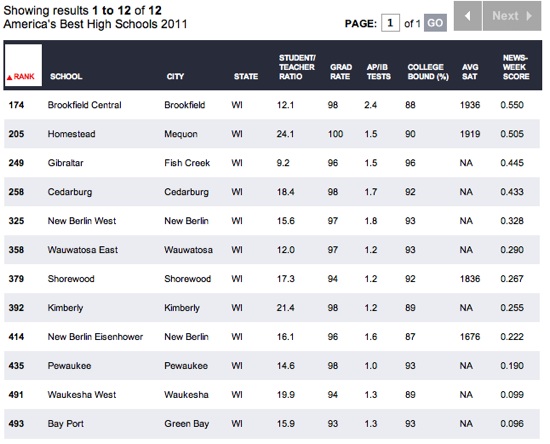
Share

State budget will force most Wisconsin school districts to cut property taxes

Jason Stein and Karen Herzog:

The state budget bill now in Gov. Scott Walker’s hands would leave schools with roughly $900 million less in state aid and property tax authority over the next two years, state figures show.
Going beyond simple cuts in state aid to schools, the budget bill would also end up requiring many districts – perhaps two-thirds of them statewide – to cut their property tax levies, according to one analysis by a University of Wisconsin-Madison professor.
Now that the 2011-’13 budget bill stands on the verge of becoming law and the protests have died down, schools – and taxpayers – can start to digest the changes in store for them. Those range from new savings on teachers’ benefits to expansions of private school voucher programs in Milwaukee and Racine.
“We’re really entering a new phase in school funding,” said Dan Rossmiller, lobbyist for the Wisconsin Association of School Boards. “It suggests huge challenges.”
The cuts to schools are the single biggest item in the Republican budget toward closing a two-year, $3 billion budget deficit without relying on tax increases. The controversy about the cuts is likely to continue, with at least one district saying it’s considering a lawsuit.

Related: Wisconsin State Tax Based K-12 Spending Growth Far Exceeds University Funding.

Share

Saving the NJEA from Itself

Laura Waters:

What’s wrong with this picture?
Last week Democratic heavyweight George Norcross got up on a stage with Gov. Chris Christie to announce that not only does he support the Opportunity Scholarship Act (the voucher bill) but also he’s opening charter schools Camden.
To add to the cognitive dissonance, the New Jersey Education Association (NJEA) joined forces with the nepotistic Elizabeth school board to campaign against Sen. Ray Lesniak (D-Union), the former chair of the NJ Democratic party — and the chief sponsor of the school voucher bill.
To muddy matters further, Assembly Speaker Sheila Oliver (D-Essex), a steadfast ally of the teachers union, looks likely to overcome her initial opposition to a health and pension benefits reform bill — despite protestations from NJEA leaders. The legislation would require public employees, including teachers, to contribute substantially more than the current 1.5 percent of base pay toward pension and healthcare premiums. (The Assembly Budget Committee just announced it will hear the bill on Monday.)

Share

Kids, Get High Off Drugs, Not Debt. It’s More Fun And People Are Nicer To You When It’s Time To Recover.

Elie Mystal:

Let’s say that instead of taking on huge debts while I was in law school, I had taken up a wicked cocaine habit. Let’s say I had done loads and loads of blow from 2000 to 2007 and then went into a 12-step program. If I had been lucky enough to avoid an overdose or jail, you could argue that things would be better for me right now — even if I had a really serious cocaine problem where I spent my all my disposable income on the drug, and even if I put a good job and a good marriage straight up my nose. If I had been through all that and then wrote an essay about the highs and the lows of doing cocaine throughout my legal career, if I was telling kids that they could overcome a wicked cocaine habit even though the consequences were severe, if I was truthfully telling people that even though I’m trying to stay clean and sober now I’m not “ashamed” of my past life, I’d have nearly everybody in my corner.
Instead, I didn’t have a cocaine habit in law school and beyond. I defaulted on my student debts.
Really, the smart thing to do would have been to default on all my loans, then blame it on the cocaine that I was “powerless” to stop. But instead of playing the victim, I marshaled what autonomous power I had and chose not to pay back my loans in a timely manner. I decided to go down on my own terms, not the terms set out for me in a promissory note.

Share

In Homework Revolt, School Districts Cut Back

Winnie Hu:

After Donna Cushlanis’s son, who was in second grade, kept bursting into tears midway through his math problems, which one night took over an hour, she told him not to do all of his homework.
“How many times do you have to add seven plus two?” Ms. Cushlanis, 46, said. “I have no problem with doing homework, but that put us both over the edge. I got to the point that this is enough.”
Ms. Cushlanis, a secretary for the Galloway school district, complained to her boss, Annette C. Giaquinto, the superintendent. It turned out that the district, which serves 3,500 kindergarten through eighth-grade students, was already re-evaluating its homework practices. The school board will vote this summer on a proposal to limit weeknight homework to 10 minutes for each year of school — 20 minutes for second graders, and so forth — and ban assignments on weekends, holidays and school vacations.

Share

High-stakes school war

Joe Williams:

As he won control of the city’s public schools nine years ago this week, Mayor Bloomberg boldly promised: “We will not have to tolerate an incapable bureaucracy which does not respond to the needs of the students.”
Sadly, New York City isn’t even close to achieving that bold vision: We learned this week that only one in three city high-school graduates is prepared for college-level work.
Meanwhile, Bloomberg’s promise is being put to the test like never before.
As the school year winds down, City Hall and the United Federation of Teachers have ratcheted up an intense game of chicken over the future direction of the city’s school system. What schools will look like come the fall is anyone’s guess.

Share

Why We’re Going Back to Single-Sex Dorms

John Garvey:

My wife and I have sent five children to college and our youngest just graduated. Like many parents, we encouraged them to study hard and spend time in a country where people don’t speak English. Like all parents, we worried about the kind of people they would grow up to be.
We may have been a little unusual in thinking it was the college’s responsibility to worry about that too. But I believe that intellect and virtue are connected. They influence one another. Some say the intellect is primary. If we know what is good, we will pursue it. Aristotle suggests in the “Nicomachean Ethics” that the influence runs the other way. He says that if you want to listen intelligently to lectures on ethics you “must have been brought up in good habits.” The goals we set for ourselves are brought into focus by our moral vision.
“Virtue,” Aristotle concludes, “makes us aim at the right mark, and practical wisdom makes us take the right means.” If he is right, then colleges and universities should concern themselves with virtue as well as intellect.
I want to mention two places where schools might direct that concern, and a slightly old-fashioned remedy that will improve the practice of virtue. The two most serious ethical challenges college students face are binge drinking and the culture of hooking up.

Share

Wisconsin Senate Democrat Members’ Proposed Budget Amendment: Save Talented & Gifted Funding

JR Ross:

The second Dem amendment includes a whole host of provisions on education.

See it here.

Here are some details, according to a summary from Minority Leader Mark Miller’s office:

-increase funding to K-12 by $356 million.

-repeal expansion of the choice program.

-repeal elimination of funding for gifted and talented programs, AODA grants, and science, technology, engineering and match grants.

-Fund the Wisconsin GI Bill and tie financial aid to increases in tuition.

-Boost funding to tech colleges by $17 million annually.

-repeal a provision JFC put into the budget that would create an individual income tax credit derived from property assessed as manufacturing or agricultural property. The tax credit would kick in Jan. 1, 2013, and when fully phased in for tax year 2016 would be worth $128.7 million annually.

— By JR Ross

Fascinating. I wonder what’s behind this?

Share

Wisconsin Voucher debate reveals deep divisions about public schools

Susan Troller:

As of early afternoon Wednesday the fate of voucher schools in Green Bay is uncertain. Rumors are flying that the proposal to use tax dollars to pay families to send their children to private and religious schools in that city will be pulled from the state budget.
It’s been a hot topic.
The voucher story I posted on Chalkboard last week detailed Green Bay Supt. Greg Maass’ unhappy reaction to both the proposal and the abrupt legislative process that put it in the budget. It definitely struck a nerve, and drew many comments.
Some of the most interesting reactions went well beyond the issue of vouchers and whether public money should be used to fund private schools. They expressed the heart of the debate surrounding public schools, or “government” schools as some folks call them.
Are public schools failing? Who’s to blame? What responsibilities does a civil society owe to children who are not our own? What kind of reforms do parents, and taxpayers, want to see?
Here are some excerpts that are revealing of the divide in the debate:

VHOU812 wrote: …As a consumer of the public (or private) educational institutions, I am demanding more value. If it is not provided, I will push to refuse to purchase and home school. This is not what I want. I want security knowing that I am satisfied with the investment in my children’s education. I don’t get that feeling right now from publc schools, and that is the core of the problem that public schools need to fix. I also see that private institutions, by their nature, can make changes to respond to consumer demands very quickly, and it is clear public schools either can’t, or won’t.

I’m glad Susan posted these comments. Looking at the significant growth in Wisconsin K-12 spending over the past few decades along with declining performance, particularly in reading compels us all: parents, taxpayers, students, teachers, administrators and the ed school community, to think different.
Wolfram’s words are well worth considering: “You have to ask, what’s the point of universities today?” he wonders. “Technology has usurped many of their previous roles, such as access to knowledge, and the social aspects.

Share

Seattle Schools’ Strategic Plan Update

Melissa Westbrook:

Here is the presentation from today’s Work Session on the Strategic Plan with survey results.

Highlights:

  • 5905 responses – 64% family member, 26% teacher or school staff, 1% principals, 5% community, 4% Central Office
  • By zip code – looks like a somewhat even distribution with  NE – 98115 with 528 responses, SE – 98118 with 221 responses, SW – 98136 with 118 responses, West Seattle – 98116 with 182 responses and NW – 98117 with 433 responses.  (There were more zip codes than those.)
  • page 8 has a breakdown of coaches and costs – overall it costs $6.4M for 65.6 coaches  (the salary swings are interesting)
  • Professional development in math, science and reading helping teachers and students – the big answer was …. no opinion.  And, out of the nearly 6,000 responses, only 3443 people answered this question.  Effective/somewhat effective (families-27%/teachers-51%). Ineffective/somewhat ineffective (families-22%/teachers-28%)
  • MAP test results effectiveness.  Effective/Somewhat Effective (families-41%/teachers-33%).  Somewhat effective/ineffective (families-45%/teachers50%).   Out of 6k responses, only 3682 respondents answered.
  • MAP- how many times a year should it be used?  3x- families-30%, teachers-23%, principals-40%.  Hmm, looks like principals like it more than teachers.   2x -families-29%,teachers-30%, principals, 40%.  That’s a lot closer.  And hey, they ARE reducing MAP to two times a year for 2011-2013 (winter and spring)
  • NSAP.   More efficient/somewhat more – families-42%/teachers 23%/principals 55%.   Somewhat less/less efficient – families-27%/teachers-29%/principals-31%. 

Download the Seattle Strategic Plan update, here.

Share

Wisconsin Governor Walker’s Read to Lead task force met on May 31st at the State Capitol. Following are observations from WRC.

Wisconsin Reading Coalition, via email:

Governor Walker’s Read to Lead task force met on May 31st at the State Capitol. Following are observations from WRC.
Note: Peggy Stern, an Oscar-winning filmmaker currently working on a project about dyslexia, had a crew filming the meeting. If we are able to acquire footage, we will make it available. If you would like Wisconsin Eye to record future meetings, please contact them at comments@wiseye.org.
Format: Unlike the first task force meeting, this meeting was guided by two facilitators from AIR, the American Institutes for Research. This was a suggestion of Senator Luther Olsen, and the facilitators were procured by State Superintendent Tony Evers. Evers and Governor Walker expressed appreciation at not having to be concerned with running the meeting, but there were some problems with the round-robin format chosen by the facilitators. Rather than a give-and-take discussion, as happened at the first meeting, this was primarily a series of statements from people at the table. There was very little opportunity to seek clarification or challenge statements. Time was spent encouraging everyone to comment on every question, regardless of whether they had anything of substance to contribute, and the time allotted to individual task force members varied. Some were cut off before finishing, while others were allowed to go on at length. As a direct result of this format, the conversation was considerably less robust than at the first meeting.
Topics: The range of topics proved to be too ambitious for the time allowed. Teacher preparation and professional development took up the bulk of the time, followed by a rather cursory discussion of assessment tools. The discussion of reading interventions was held over for the next meeting.
Guests:
Dawnene Hassett, Asst. Prof. of Curriculum and Instruction and new elementary literacy chair, UW-Madison
Tania Mertzman Habeck, Assoc. Prof. of Curriculum and Instruction, UW-Milwaukee
Mary Jo Ziegler, Reading Consultant, Wis. Department of Public Instruction
Troy Couillard, Special Education Team, Wis. Department of Public Instruction
Next Meetings: The Governor’s office will work to set up a schedule of meetings for the next several months. Some of the meetings may be in other parts of the state.
Action: WRC suggests contacting the offices of the Governor, Luther Olsen, Steve Kestell, and Jason Fields and your own legislators to ask for several things:
Arrange for filming the next meeting through Wisconsin Eye
Bring in national experts such as Louisa Moats, Joe Torgesen, and Peggy McCardle to provide Wisconsin with the road map for effective reading instruction, teacher preparation, and professional development . . . top university, DPI, and professional organization leaders at the May 31st meeting asked for a road map and admitted they have not been able to develop one
Arrange the format of the next meeting to allow for more authentic and robust discussion of issues
Summary
Teacher Training and Professional Development
The professors felt that the five components of reading (phonemic awareness, phonics, fluency, vocabulary, and comprehension) are generally taught in preparation programs, but that instruction varies widely from one institution to another. Reading course work requirements can vary from 12 credits to just one course. They also felt, as did the teachers on the panel, that there needs to be more practical hand-on experience in the undergraduate program. There was a feeling that teachers “forget” their instruction in reading foundations by the time they graduate and get into the classroom. They have better luck teaching masters level students who already have classroom experience. The linguistic knowledge means very little without a practicum, and we may need to resort to professional development to impart that information. Teachers need to be experts in teaching reading, but many currently don’t feel that way. It is important, especially with RTI coming, to be able to meet the needs of individual students.Both professors and teachers, as well as others on the panel, felt a “road map” of critical information for teacher preparation programs and literacy instruction in schools would be a good idea. This was a point of agreement. Hassett felt that pieces of a plan currently exist, but not a complete road map. The professors and some of the teachers felt that teacher prep programs are doing a better job at teaching decoding than comprehension strategies. They were open to more uniformity in syllabi and some top-down mandates.
Marcia Henry mentioned studies by Joshi, et al. that found that 53% of pre-service teachers and 60% of in-service teachers are unable to correctly answer questions about the structure of the English language. Tony Pedriana cited another Joshi study that showed college professors of reading were equally uninformed about the language, and the majority cannot distinguish between phonemic awareness and phonics. He also said it was very difficult to find out what colleges were teaching; one college recently refused his request to see a syllabus for a reading course. Steve Dykstra read from the former Wisconsin Model Academic Standards and the current Wisconsin Model Early Learning Standards, which contained incorrect definitions and examples of phonemic awareness. He questioned whether teachers were being adequately prepared in decoding skills. Rep. Steve Kestell was concerned with the assessment that most teachers do not feel like experts in teaching reading, and he wondered if updated techniques for training teachers would make a difference.
Sarah Archibald (aide to Luther Olsen) proposed looking at a more rigorous foundations of reading test, as found in other states, as a requirement for teacher licensure. This would be one way to move toward more uniform instruction in teacher prep programs. Steve Dykstra pointed out that a test alone will not necessarily drive changes in teacher preparation, but publishing the passage results linked to individual colleges or professors would help. Evers indicated that DPI has been looking for several months into teacher testing and licensure.
Gov. Walker asked if the ed schools were looking at the latest trends in teacher preparation to become better. The professors indicated that the ed schools confer with local districts in an effort to improve.
Supt. Evers said it was probably not a good idea that teacher prep programs across Wisconsin vary so much.
Hassett indicated that some flexibility needs to be retained so that urban and rural areas can teach differently. There was some disagreement as to whether teachers of upper grades need to be trained in reading, or at least trained the same way.
Linda Pils pointed out that the amount and quality of professional development for Wisconsin teachers is very spotty. Most panel members felt that a coaching model with ongoing training for both teachers and principals was essential to professional development, but the coaches must be adequately trained. There was some discussion of Professional Development Plans, which are required for relicensure, and whether the areas of development should be totally up the individual teacher as they are now. Steve Dykstra felt that much existing professional development is very poor, and that money and time needs to be spent better. Some things should not count for professional development. Michele Erikson felt that it would be good to require that Professional development be linked to the needs of the students as demonstrated by performance data. Mary Read pointed out that coaching should extend to summer programs.
The main consensus here was that we need a road map for good reading instruction and good teacher training and coaching. What is missing is the substance of that road map, and the experts we will listen to in developing it.
Assessment
Mary Jo Ziegler presented a list of formal and informal assessment tools used around Wisconsin. Evers pointed out that assessment is a local district decision. Many former Reading First schools use DIBELS or some formal screener that assesses individual skills. Balanced literacy districts generally use something different. Madison, for example, has its own PLA (Primary Language Assessment), which includes running records, an observational survey, word identification, etc. MAP assessments are widely used, but Evers indicated that have not been shown to be reliable/valid below third grade. Dykstra questioned the reliability of MAP on the individual student level for all ages. PALS was discussed, as was the new wireless handheld DIBELS technology that some states are using statewide. Many members mentioned the importance of having multiple methods of assessment. Kathy Champeau delivered an impassioned plea for running records and Clay’s Observational Survey, which she said have been cornerstones of her teaching. Kestell was surprised that so many different tools are being used, and that the goal should be to make use of the data that is gathered. Dykstra, Henry, and Pedriana mentioned that assessment must guide instruction, and Archibald said that the purpose of an assessment must be considered. Couillard said that the Wis. RTI center is producing a questionnaire by which districts can evaluate assessment tools they hear about, and that they will do trainings on multiple and balanced assessments. Dykstra questioned the three-cue reading philosophy that often underlies miscue analysis and running records. no consensus was reached on what types of assessment should be used, or whether they should be more consistent across the state. Hassett questioned the timed component of DIBELS,and Dykstra explained its purpose. Some serious disagreements remain about the appropriateness of certain assessment tools, and their use by untrained teachers who do not know what warning signs to look for.
Intervention
Evers began the topic of intervention by saying that DPI was still collecting data on districts that score well, and then will look at what intervention techniques they use. Henry suggested deferring discussion of this important topic to the next meeting, as there were only 8 minutes left.

Share

B-Schools Embrace China

Beth Gardiner:

Just like large companies eager to get a foothold in one of the world’s most important markets, international business schools are moving into China in a big way.
Eager to capitalize on demand in a fast-growing economy that has a huge need for well-trained managers, big name B-schools from Europe and the U.S. are launching and expanding M.B.A.-program collaborations with Chinese universities or going it alone with courses aimed at mid-career executives.
Experience in China is also a selling point at home, since Western students increasingly see the benefits of studying at an institution whose faculty have close-up experience of the country. Such links can also give M.B.A. students the chance to study in China for a module or a semester.
“The lure is to go and learn about what’s happening, and be in the middle of the action in one of the most dynamic economies in the world,” says Krishna Palepu, senior associate dean for international development at Harvard Business School. The school has had a faculty research base in China for about 20 years but now shares a new Shanghai classroom with other Harvard schools.

Share

“You have to ask, what’s the point of universities today?” he wonders. “Technology has usurped many of their previous roles, such as access to knowledge, and the social aspects.”

The Economist:

“THERE is no dramatic distinction between the processes of the weather and the workings of the human brain,” says Stephen Wolfram, a physicist and the founder of Wolfram Research, a software company. “There isn’t anything incredibly special about intelligence, it’s just sophisticated computational work that has grown up throughout human history.” Dr Wolfram is hardly the first scientist to compare the human brain to a computer. Alan Turing, who helped develop the precursors of today’s programmable computers during the second world war, began considering the possibility of thinking machines in the 1940s. The difference is that Dr Wolfram claims to have succeeded in codifying vast areas of human knowledge and even replicating supposedly uniquely human attributes such as creativity.
“One of my realisations, or maybe it’s just a piece of arrogance, is that the amount of knowledge and data in the world is big, but it’s not that big,” he says. “In astronomy, there’s a petabyte–a million gigabytes–of data about what’s out there in the universe. There are also swathes of data from digital cameras, Twitter feeds and even road-traffic movements. It’s a bit daunting, but I soon realised that the bigger challenge is not the underlying data but the computations that get done on them.”

Share

The 10 Steps To Make Your Kid A Millionaire

William Baldwin:

We’re spending our children’s money. So goes the refrain from people appalled at the government’s deficits. As long as entitlement spending and tax collections continue on their present course, it’s an undeniable truth.
Instead of wringing your hands, do something about it. Make your children so prosperous that they can withstand the Medicare cutbacks and tax increases that lie ahead. Here are ten tactics for boosting the net worth of your offspring.
1 Don’t Overeducate
That master’s degree your son or daughter wants to get may be a bad investment. This heretical thought comes from Laurence Kotlikoff, a Boston University economist who studies earning and consumption patterns. An advanced degree confers a higher salary, but it comes at a high cost, too. It includes tuition, often borrowed, plus a year or more of lost earnings.

Share