School Information System

Charter pros, foes sharpen knives

Daniel Massey:

Amid a sea of moms and dads wearing T-shirts declaring themselves “Proud charter parents” and kids waving handmade signs that read, “I am College Bound,” Daniel Clark grabbed a microphone at P.S. 92 in Harlem earlier this month and told the more than 150 people gathered for a Department of Education hearing that his son Daniel Jr. and four friends now proudly call themselves the “Geek Five.”
Mr. Clark says his son was a “super slacker” before he arrived at the Democracy Prep charter school two and half years ago. But the eighth grader “now goes around telling everyone he’s going to be mayor–and he believes it.”

Share

D.C. Schools Chanceller Rhee taps media adviser Anita Dunn to help improve image

Bill Turque:

Schools Chancellor Michelle A. Rhee, whose image has been frayed by a series of high-profile news controversies, is turning to former White House communications director and veteran Democratic media consultant Anita Dunn for help.
A D.C. schools spokeswoman confirmed Friday that the agency is negotiating a contract with Dunn’s firm, Squier Knapp Dunn. The objective is to more effectively handle the heavy load of local and national news media attention that Rhee attracts and to help roll out major stories to greater strategic advantage. The spokeswoman said Dunn has devoted time to District school issues but would not elaborate.

Share

RTI and Gifted – Revisited

Tamara Fisher:

A few months back, I wrote here at “Teacher Magazine” about RTI (“Response to Intervention”) and its possible implications for and adaptations for gifted students. The response to that post has been really interesting and I’ve enjoyed hearing from so many of you about how RTI is being adapted to included the gifted population in your schools. I wanted to take a moment today to post a couple updates for you regarding happenings since I last wrote about the topic.
First, ASCD contacted me a couple months ago wanting to interview me about RTI and Gifted Education. The transcript of the interview is now available online and includes some great new links at the bottom with relevant RTI/GT information.

Share

Commentary: It’s change or die for the Detroit Public Schools

Nolan Finley:

Robert Bobb’s vision for radically restructuring Detroit’s failing education system is validated by the decision of Kansas City to shutter half of its schools.
Bobb intends to tear apart the Detroit Public Schools and rebuild the district on a foundation of small, nimble schools that are responsive to the needs of all children and fully accountable for how students perform. Everything will change, from how schools are managed to how teachers teach, and schools that don’t perform will be quickly shut down.
His proposals are raising howls from the special interests that benefit from keeping things as they are, as well as from some parents who aren’t willing to endure the sacrifice — closed schools and more rigorous standards — to make the changes possible.

Share

Understanding Teachers Contracts

Andrew Rotherham & Elena Silva:

Whether it’s the contentious multi-year negotiations over the teachers contract in Washington, D.C., or the debates in many states over competing for Race to the Top funds, teachers contracts are at the center of the education reform debate today. Once of interest only to education insiders, contract issues and calls for reform are now widespread. High profile editorial boards at major newspapers including The New York Times, The Washington Post, and The Wall Street Journal regularly weigh-in on the topic. Articles in magazines like The New Yorker detail the effects of various contract provisions and processes.1 National voices as diverse as former Speaker of the House Newt Gingrich and current Secretary of Education Arne Duncan are calling for more flexibility in how teachers are hired, fired, evaluated, and paid.
Despite increasing attention to contract reform, the public often has no idea what a typical teachers contract looks like. Although they are public documents, most contracts are not easily found on the Web sites of school districts or teachers unions; newspapers and local media do not publish them (and often offer only cursory coverage of the issues being discussed during collective bargaining negotiations).2 Meanwhile, those negotiations are often held out of public view, and the deals cut late at night. The documents themselves can be cumbersome, lawyerly, heavily influenced by side agreements and addendums, and generally hard for non-experts to figure out.

Share

British Students ‘Confused’ On Historic Facts

Morning Edition:

Queen Elizabeth may seem ancient to school children, but did she really invent the telephone? Ten percent of British students think so, according to a survey of science knowledge. They also believe Sir Isaac Newton discovered fire, and Luke Skywalker was the first person on the moon.

It’s not just the British. While on travel recently, a seatmate (probably 30) asked me where Denver and Chicago were on the map (we were flying to Denver). Another seatmate some time later mentioned that their retail business deals with many citizens who don’t know the difference between horizontal and vertical

Share

Fixing No Child Left Behind

Wall Street Journal:

The Obama Administration wants to revise the No Child Left Behind education law, which is understandable because the law has flaws. But it’s too bad many of the proposed fixes would weaken the statute and undermine the Administration’s twin goal of raising state education standards.
Some of the White House proposals make sense, such as the push for more charter schools that can focus on the specific needs of their student populations by operating outside of collective bargaining agreements. We also like using student test scores to measure an instructor’s effectiveness and influence teacher pay. Both reforms are strongly opposed by the teachers unions, and Team Obama deserves credit for putting children ahead of the National Education Association.
Other parts of its proposal leave us scratching our heads. The Administration wants to junk NCLB’s requirement that all students be proficient in reading and math by 2014 and replace it with an equally unrealistic goal of making all kids “college ready” by 2020. By this thinking, it’s impossible to teach every kid to read at grade level within the next three years, but getting all of them ready for higher education six years later is doable.

Share

Obama’s Education Proposal Still a Bottomless Bag

Neal McCluskey:

This morning the Obama Administration officially released its proposal for reauthorizing the Elementary and Secondary Education Act (aka, No Child Left Behind). The proposal is a mixed bag, and still one with a gaping hole in the bottom.
Among some generally positive things, the proposal would eliminate NCLB’s ridiculous annual-yearly-progress and “proficiency” requirements, which have driven states to constantly change standards and tests to avoid having to help students achieve real proficiency. It would also end many of the myriad, wasteful categorical programs that infest the ESEA, though it’s a pipedream to think members of Congress will actually give up all of their pet, vote-buying programs.
On the negative side of the register, the proposed reauthorization would force all states to either sign onto national mathematics and language-arts standards, or get a state college to certify their standards as “college and career ready.” It would also set a goal of all students being college and career ready by 2020. But setting a single, national standard makes no logical sense because all kids have different needs and abilities; no one curriculum will ever optimally serve but a tiny minority of students.

Share

Will Issaquah Pick Poor Math Books?

Charlie Mas:

Issaquah and Sammamish are home to a well educated population, many of which are employed in professional and high tech occupations. Thus, it is surprising that the Issaquah School District administration is doing everything possible to place very poor math books in its schools.
Tomorrow (Wednesday, March 24) night the Issaquah School Board will vote on the administration’s recommendation for the Discovering Math series in their high schools. These are very poor math texts:
(1) Found to be “unsound” by mathematicians hired the State Board of Education.
(2) Found to be inferior to a more traditional series (Holt) by pilot tests by the Bellevue School District
(3) That have been rejected by Bellevue, Lake Washington, North Shore, and Shoreline (to name only a few)
(4) Whose selection by the Seattle School District was found to be arbitrary and capricious by King County Judge Spector.
(5) That are classic, weak, inquiry or “reform” math textbooks that stress group work, student investigations, and calculator use over the acquisition of key math skills.

http://saveissaquahmath.blogspot.com/

Share

Madison School District Outbound Open Enrollment Applications 2010-2011 School Year; As of 3/18/2010


Complete Report 36k PDF, via a kind reader:

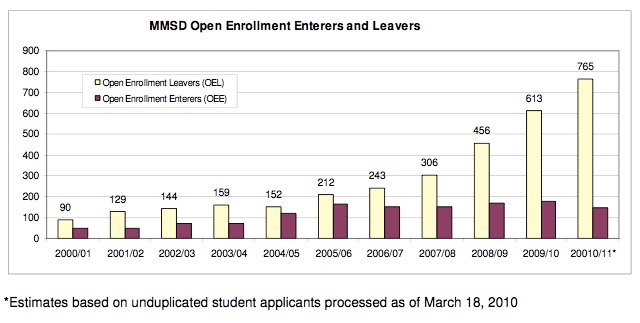
The pattern of an increasing number of open enrollment transfer applications continued this spring. As of March, 18, 2010 there were 765 unique resident MMSD students applying to attend non-MMSD districts and schools. The ratio of number of leaver applications to enterer applications is now 5:1.
It is important to note that not all applications result in students actually changing their district or school of enrollment. For example, for the 2009-10 school year although 402 new open enrollment students were approved by both MMSD and the non-resident districts to attend the non-resident district, only 199 actually were enrolled in the non-resident district on the third Friday September 2009 membership count date. Still, the trend has been upward in the number of students leaving the district.

Related: 2009 Madison School District Outbound Open Enrollment Parent Survey.
A school district’s student population affects its tax & spending authority.

Share

“Anything But Knowledge”: “Why Johnny’s Teacher Can’t Teach”

from The Burden of Bad Ideas Heather Mac Donald, Chicago: Ivan R. Dee, 2000, pp. 82ff.
America’s nearly last-place finish in the Third International Mathematics and Sciences Study of student achievement caused widespread consternation this February, except in the one place it should have mattered most: the nation’s teacher education schools. Those schools have far more important things to do than worrying about test scores–things like stamping out racism in aspiring teachers. “Let’s be honest,” darkly commanded Professor Valerie Henning-Piedmont to a lecture hall of education students at Columbia University’s Teachers College last February. “What labels do you place on young people based on your biases?” It would be difficult to imagine a less likely group of bigots than these idealistic young people, happily toting around their handbooks of multicultural education and their exposés of sexism in the classroom. But Teachers College knows better. It knows that most of its students, by virtue of being white, are complicitous in an unjust power structure.
The crusade against racism is just the latest irrelevancy to seize the nation’s teacher education schools. For over eighty years, teacher education in America has been in the grip of an immutable dogma, responsible for endless educational nonsense. That dogma may be summed up in the phrase: Anything But Knowledge. Schools are about many things, teacher educators say (depending on the decade)–self-actualization, following one’s joy, social adjustment, or multicultural sensitivity–but the one thing they are not about is knowledge. Oh, sure, educators will occasionally allow the word to pass their lips, but it is always in a compromised position, as in “constructing one’s own knowledge,” or “contextualized knowledge.” Plain old knowledge, the kind passed down in books, the kind for which Faust sold his soul, that is out.
The education profession currently stands ready to tighten its already viselike grip on teacher credentialing, persuading both the federal government and the states to “professionalize” teaching further. In New York, as elsewhere, that means closing off routes to the classroom that do not pass through an education school. But before caving in to the educrats’ pressure, we had better take a hard look at what education schools teach.
The course in “Curriculum and Teaching in Elementary Education” that Professor Anne Nelson (a pseudonym) teaches at the City College of New York is a good place to start. Dressed in a tailored brown suit, and with close-cropped hair, Nelson is a charismatic teacher, with a commanding repertoire of voices and personae. And yet, for all her obvious experience and common sense, her course is a remarkable exercise in vacuousness.
As with most education classes, the title of Professor Nelson’s course doesn’t give a clear sense of what it is about. Unfortunately, Professor Nelson doesn’t either. The semester began, she said in a pre-class interview, by “building a community, rich of talk, in which students look at what they themselves are doing by in-class writing.” On this, the third meeting of the semester, Professor Nelson said that she would be “getting the students to develop the subtext of what they’re doing.” I would soon discover why Professor Nelson was so vague.
“Developing the subtext” turns out to involve a chain reaction of solipsistic moments. After taking attendance and–most admirably–quickly checking the students’ weekly handwriting practice, Professor Nelson begins the main work of the day: generating feather-light “texts,” both written and oral, for immediate group analysis. She asks the students to write for seven minutes on each of three questions; “What excites me about teaching?” “What concerns me about teaching?” and then, the moment that brands this class as hopelessly steeped in the Anything But Knowledge credo: “What was it like to do this writing?”

(more…)
Share

Bill targets school board standards

Jim Walls:

The fallout from Clayton County schools’ recent meltdown, in all likelihood, will drift down on Georgia’s 179 other boards of education this summer.
Lawmakers are nearing final approval of a bill that would set minimum ethics standards for local school boards and empower the governor, in some cases, to remove members who can’t adhere to them. It would take effect July 1.
The measure is a response to the Clayton school system being stripped of accreditation in 2008 over ethical breaches by several board members.
They met behind closed doors and berated staff in public. One worked behind the scenes to fire her son’s football coach. Several aligned themselves with competing teachers’ groups and voted along union lines.

Share

Supercool School wants to be the Ning of online education

Paul Boutin:

Supercool School, which allows anyone to create an online learning environment for which they can charge students, says it has a $450 million dollar total addressable market opportunity in the U.S. alone, with over two million potential customers.
Supercool founder Steli Efti told me what he’s trying to create is the Ning of Education, allowing anyone to build their own educational site.
“We provide a white label platform that allows everyone to create and customize an online school,” he said in an email. “The platform allows for social learning and real-time virtual classrooms and can be turned into a business by monetizing content and courses online.”

Share

K-12 Job Trends Amidst Stimulus Funds: Early Findings

Marguerite Roza, Chris Lozier & Cristina Sepe, via a Deb Britt email:

In February 2009, with some 600,000 education jobs threatened by the worst fiscal downturn in decades, the American Recovery and Reinvestment Act (ARRA) allocated about $100 billion to states. Topping the list of ARRA’s goals was saving and creating jobs. Since then, states have had to provide quarterly estimates of ARRA-funded jobs, and yet these reports stop far short of telling the whole story on whether the stimulus plan is meeting its job goals. Some have voiced methodological concerns, and many have acknowledged that identifying those jobs paid for by ARRA funds does not imply that the jobs were indeed saved or created.
The larger question that has been left unanswered, however, is whether ARRA has indeed worked to stabilize education employment from what otherwise might have been heavy losses in the current fiscal environment. Or for some, a parallel question is whether ARRA has prompted states to grow their education workforce, thereby making them more vulnerable to a “funding cliff” with larger layoffs when ARRA ends. Answering these questions requires evidence of the greater trend in total K-12 jobs, not just the trends in ARRA-funded jobs.

Share

K-12 Tax & Spending Climate: Moody’s fears social unrest as AAA states implement austerity plans

Ambrose Evens-Pritchard:

The world’s five biggest AAA-rated states are all at risk of soaring debt costs and will have to implement austerity plans that threaten “social cohnesion”, according to a report on sovereign debt by Moody’s.
The US rating agency said the US, the UK, Germany, France, and Spain are walking a tightrope as they try to bring public finances under control without nipping recovery in the bud. It warned of “substantial execution risk” in withdrawal of stimulus.
“Growth alone will not resolve an increasingly complicated debt equation. Preserving debt affordability at levels consistent with AAA ratings will invariably require fiscal adjustments of a magnitude that, in some cases, will test social cohesion,” said Pierre Cailleteau, the chief author.
“We are not talking about revolution, but the severity of the crisis will force governments to make painful choices that expose weaknesses in society,” he said.
If countries tighten too soon, they risk stifling recovery and making maters worse by eroding tax revenues: yet waiting too is “no less risky” as it would test market patience. “At the current elevated debt levels, a rise in the government’s cost of funding can very quickly render debt much less affordable.”

Share

“Are you a PC or a Mac?”: an interview with Principal David Elliott on the tech focus of Seattle’s Queen Anne Elementary

Mary Cropp:

Among piles of paperwork and shelves crowded with books on edu-topics, David Elliott’s office at Coe Elementary is crammed with pictures of baseball teams he has coached, crayoned drawings, and letters with childish handwriting careening all over the page. There’s a lot of stuff that he is going to need to haul out of here at the end of June when he moves to become principal at Queen Anne Elementary.
Elliott concedes that a recent shift in focus at this soon-to-open school, coupled with a lack of publicity, has a lot of parents scratching their heads about whether or not to enroll their child in this so called “Option School.” And time is running out — the Open Enrollment period will come to a close on March 31st. To that end, Elliott sat down with me earlier this week (full disclosure: my kids go to Coe Elementary) to discuss this new venture he is heading up. Elliot’s answers to my questions are in italics.

At first Seattle Public Schools said that Queen Anne Elementary was going to be a Montessori school. Now it is going to have a “technology” focus. How did that change come about?

Share

School Districts Losing Public Support: Kansas City

Nicholas Riccardi:

The Kansas City, Mo., district is closing nearly half its campuses after 10 years of dwindling student population. It’s what happens when a district loses support of the public it is meant to serve.
During the warm months, when students at Westport High School got too hot, they cooled down by moving to one of the many vacant classrooms on campus. It was one of the advantages of having 400 students assigned to a school that could hold 1,200.
The downside became apparent last week, though, when the Kansas City school board voted to close Westport and 25 other schools — nearly half of the district’s campuses.
Big-city districts shutter schools all the time. Cities such as Denver and Portland, Ore., have seen childless young families repopulate their urban cores and have adjusted accordingly.
But what is happening in Kansas City is different in scale than anywhere else in the country. It’s an extreme example of what happens when a school system loses the support of the public it’s meant to serve.

Share

Principal, teacher clash on cheating

Jay Matthews:

Last week’s column, full of practical suggestions on how to limit cheating, did not seem controversial to me. Many teachers sent their own ideas. Many recommended small adjustments, such as having the questions in different order for different students, to hinder copying.
So I was surprised to hear from Erich Martel, an Advanced Placement U.S. History teacher at Wilson High School in the District, that his principal, Peter Cahall, was critical of him doing that.
Martel’s classroom, 18 by 25 feet, feels like shoebox to him. Some days he squeezes in 30 students, plus himself. That is 15 square feet per student, which Martel has been told is well below the district standard of 25 square feet. The cramped conditions led to a disagreement when Cahall assessed Martel’s work under the school district’s IMPACT teacher evaluation system.

Share

We don’t know how to fix bad schools

Rod Dreher:

From Slate’s review of Dianne Ravitch’s new book, in which the former advocate of No Child Left Behind and charter schools admits they’ve failed. Excerpt:

The data, as Ravitch says, disappoints on other fronts, too–not least in failing to confirm high hopes for charter schools, whose freedom from union rules was supposed to make them success stories. To the shock of many (including Ravitch), they haven’t been. And this isn’t just according to researchers sympathetic to labor. A 2003 national study by the Department of Education (under George W. Bush) found that charter schools performed, on average, no better than traditional public schools. (The study was initially suppressed because it hadn’t reached the desired conclusions.) Another study by two Stanford economists, financed by the Walton Family and Eli and Edythe Broad foundations (staunch charter supporters), involved an enormous sample, 70 percent of all charter students. It found that an astonishing 83 percent of charter schools were either no better or actually worse than traditional public schools serving similar populations. Indeed, the authors concluded that bad charter schools outnumber good ones by a ratio of roughly 2 to 1.
Obviously, some high-visibility success stories exist, such as the chain run by the Knowledge Is Power Program, or KIPP, which I’ve previously discussed here. But these are the decided exceptions, not the rule. And there’s no evidence that a majority of eligible families are taking advantage of charters, good or bad. “While advocates of choice”–again, Ravitch included–“were certain that most families wanted only the chance to escape their neighborhood school, the first five years of NCLB demonstrated the opposite,” she writes. In California, for example, less than 1 percent of students in failing schools actually sought a transfer. In Colorado, less than 2 percent did. If all this seems a little counterintuitive, Ravitch would be the first to agree. That’s why she supported charters in the first place. But the evidence in their favor, she insists, simply hasn’t materialized.

Share

When A Stands for Average: Students at the UW-Madison School of Education Receive Sky-High Grades. How Smart is That?

Marc Eisen:

Lake Wobegon has nothing on the UW-Madison School of Education. All of the children in Garrison Keillor’s fictional Minnesota town are “above average.” Well, in the School of Education they’re all A students.
The 1,400 or so kids in the teacher-training department soared to a dizzying 3.91 grade point average on a four-point scale in the spring 2009 semester.
This was par for the course, so to speak. The eight departments in Education (see below) had an aggregate 3.69 grade point average, next to Pharmacy the highest among the UW’s schools. Scrolling through the Registrar’s online grade records is a discombobulating experience, if you hold to an old-school belief that average kids get C’s and only the really high performers score A’s.
Much like a modern-day middle school honors assembly, everybody’s a winner at the UW School of Education. In its Department of Curriculum and Instruction (that’s the teacher-training program), 96% of the undergraduates who received letter grades collected A’s and a handful of A/B’s. No fluke, another survey taken 12 years ago found almost exactly the same percentage.
A host of questions are prompted by the appearance of such brilliance. Can all these apprentice teachers really be that smart? Is there no difference in their abilities? Why do the grades of education majors far outstrip the grades of students in the physical sciences and mathematics? (Take a look at the chart below.)

The UW-Madison School of Education has no small amount of influence on the Madison School District.

Share

The foibles of progressive schooling prompt a search for a better alternative

Warren Kozak:

Here’s how my formal education began: On a September morning in 1957, my mother and I walked the block and a half to 53rd Street School on Milwaukee’s northwest side. We went to the school office, she filled out some forms, said goodbye and “see you at lunch.” Here was another Kozak for the Milwaukee Public Schools to educate.
There was, of course, no choice, which made the entire process much simpler. Since we weren’t Catholic, the parochial alternative wasn’t an option, and if there were any private schools in Milwaukee at the time (there was one), I’m sure my parents never considered it.
There was good reason for my parents’ carefree attitude. The public school system in Milwaukee circa 1957 was first-rate. The teachers were committed professionals. The curriculum had not changed appreciably since my parents’ day. They were satisfied with their experience and found the public schools perfectly adequate for their children.

Share

Preschool education: Should it be extended?

Laura Bruno:

One by one the preschoolers washed their hands after having their milk and snacks and sat on a rug, waiting for teacher Jill Dunlop 001 ? 0008.00 00001to introduce the letter of the day.
Using a Hippopotamus hand puppet, Dunlop sounded out the letter “h” and asked the five children, ages 3 to 5, to each identify words such as house, horse and hammer from various pictures on her easel. The abilities of the children ranged from 4-year-old Emma, who can write her name, to 3-year-old Kimberly, a native Spanish speaker who is so painfully shy she doesn’t speak a word during the 2 1/2 hour class.
At Butler’s Aaron Decker School, these preschoolers are learning to become students three days a week this year, down from five days last year. Local voters rejected the school budget last year, forcing cuts, including the preschool program. Federal stimulus funding was used to restore the limited program, so it’s unclear if the program will survive next year.
“We’re trying to hold on as much as we can. Three days is better than no days,” said Virginia Scala, Decker’s principal.

Share

Tweak Hartford’s Teacher Seniority System To Preserve School Strengths

Hartford Courant:

It is easy to get drawn into the union-management aspects of public education and forget that the schools are there for the kids. What the kids need are stars in the classroom: great teachers.
With that in mind, the public should support the effort by Hartford school leaders to change from a system of district-wide teacher seniority to one of school-based seniority.
The city’s Board of Education voted Tuesday to ask the State Board of Education to step in and change this contractual guarantee. The state board has the authority to intervene in low-achieving schools to alter a union contract, but to date has never done so.
Under the current rules, the least experienced teachers are the first to be laid off and can be “bumped” by more experienced teachers from any school in the district. This can result in a disruptive shuffle of teachers among various schools.
Supporters of the proposed change say this endangers the quality of specialty schools, where particular themes or methods require teachers to have special qualifications or training.

Share

PCSB School Performance Reports

District of Columbia Public Charter School Board 2009:

The D.C. Public charter school board (Pcsb) has produced a detailed annual performance report for each school under its oversight since 1999. Each school report provides a school profile, including enrollment, attendance and discipline, demographic, graduation and college acceptance data; a review of the Pcsb’s evaluations of each school’s academic, financial, compliance and governance performance, as well as board actions; test data, and each school’s self- described unique accomplishments. the reports are intended to be a resource for consumer decision-making and public accountability. the notes on page 5 and 6 explain each section of the school performance report and the source of the data, as appropriate.
the 2009 school Performance reports include data collected during the 2008-2009 school year. as the sole chartering authority in Washington, D.C., the D.C. Public charter school board remains committed to its role as a partner in the city-wide effort to raise student academic achievement and improve public education in D.c., by providing families with quality public charter school options.

Share

“Don’t blame teachers unions for our failing schools”

For the motion: Kate McLaughlin, Gary Smuts, Randi Weingarten Against the motion: Terry Moe, Rod Paige, Larry Sand Moderator: John Donvan:

Before the debate:
24% FOR 43% AGAINST 33% UNDECIDED
After the debate:
25% FOR 68% AGAINST 7% UNDECIDED
Robert Rozenkranz: Thank you all very much for coming. It’s my pleasure to welcome you. My job in these evenings is to frame the debate. And we thought this one would be interesting because it seems like unions would be acting in their own self interest and in the interest of their members. In the context of public education, this might mean fighting to have the highest number of dues paying members at the highest possible levels of pay and benefits. With the greatest possible jobs security. It implies resistance to technological innovation, to charter schools, to measuring and rewarding merit and to dismissals for almost any reason at all. Qualifications, defined as degrees from teacher’s colleges, trump subject matter expertise. Seniority trumps classroom performance. Individual teachers, perhaps the overwhelming majority of them do care about their students but the union’s job is to advocate for teachers, not for education. But is that a reason to blame teachers unions for failing schools? The right way to think about this is to hold all other variables constant. Failing schools are often in failing neighborhoods where crime and drugs are common and two parent families are rare. Children may not be taught at home to restrain their impulses or to work now for rewards in the future, or the value and importance of education. Even the most able students might find it hard to progress in classrooms dominated by students of lesser ability who may be disinterested at best and disruptive at worse. In these difficult conditions, maybe teachers know better than remote administrators what their students need and the unions give them an effective voice. Maybe unions do have their own agenda. But is that really the problem? Is there strong statistical evidence that incentive pay improves classroom performance? Or is that charter schools produce better results? Or that strong unions spell weak educational outcomes, holding everything else constant? That it seems to us is the correct way to frame tonight’s debate, why we expect it will give you ample reason to think twice.

Share

Fall 2011 could be end for Alabama tuition plan

Phillip Rawls:

Alabama’s prepaid college tuition plan appears unable to pay tuition beyond the fall semester of 2011 and still have enough money to provide refunds to the 44,000 participants, administrators said.
For leaders of the Save Alabama PACT parents group, that creates the need for the Legislature to find a solution in the current legislative session.
Patti Lambert of Decatur, the group’s co-founder, said she would prefer a solution in the Statehouse rather than the courthouse, but members may have no choice but to join a handful of parents who have already sued the state to demand the program keep its promise of full tuition.
“I suspect we will be forced to. We are certainly not going to wait until we have no room to maneuver,” Lambert said in an interview Tuesday.

Share

Incoming Milwaukee Public Schools’ chief Thornton gives clues to his priorities

Alan Borsuk:

Gregory Thornton wants to fly pretty much below the radar right now.
The incoming superintendent of Milwaukee Public Schools says he doesn’t take over until July 1, he doesn’t want to interfere with the current superintendent, William Andrekopoulos, and he’s just beginning to know the people and issues in his visits to Milwaukee. So he doesn’t want to get too specific or out front with what he wants to do with his new job.
But talk to him for 75 minutes in a private room at a cafe and you begin to see where he wants to go, and it includes places that might please some who didn’t favor him being hired and displease some who did.
In short: If you like what Michael Bonds is doing as president of the School Board, there’s a strong chance you’ll like Thornton.
Bonds has become a strong force within MPS in the year since he became head of the nine-member board. He is assertive, firm and smart politically. He wants the board to have more power over MPS, and that’s happening. He was at the center of the fight to stop Gov. Jim Doyle and Mayor Tom Barrett’s bid to switch to mayoral control of MPS, and he’s winning.

Share

Teachers Skeptical Of Obama’s Education Plan

All Things Considered:

President Obama is proposing a massive rewrite of the No Child Left Behind policy. But many teachers are skeptical. Randi Weingarten, president of the American Federation of Teachers, says the president’s plan gives teachers full responsibility but no authority.

Share

The Case for Saturday School

Chester Finn:

Kids in China already attend school 41 days a year more than students in the U.S. Now, schools across the country are cutting back to four-day weeks. Chester E. Finn Jr. on how to build a smarter education system.
“He who labors diligently need never despair, for all things are accomplished by diligence and labor.” –Menander
How many days a year did the future Alexander the Great study with Aristotle? Did Socrates teach Plato on Saturdays as well as weekdays? During summer’s heat and winter’s chill?
Though such details remain shrouded in mystery, historians have unearthed some information about education in ancient times. Spartans famously put their children through a rigorous public education system, although the focus was on military training rather than reading and writing. Students in Mesopotamia attended their schools from sunrise to sunset.
In the face of budget shortfalls, school districts in many parts of the United States today are moving toward four-day weeks. This is despite evidence that longer school weeks and years can improve academic performance. Schoolchildren in China attend school 41 days a year more than most young Americans–and receive 30% more hours of instruction. Schools in Singapore operate 40 weeks a year. Saturday classes are the norm in Korea and other Asian countries–and Japanese authorities are having second thoughts about their 1998 decision to cease Saturday-morning instruction. This additional time spent learning is one big reason that youngsters from many Asian nations routinely out-score their American counterparts on international tests of science and math.

Share

The New Public Option

Michael Bendetson:

How has the United States responded to this global challenge in education? We continue to lower our standards. While No Child Left Behind (NCLB) was a major step in education reform, it has inadvertently created a system where states continue to lower the expectations bar. In 2007, only 18% of Mississippi students scored proficient in the standardized national reading test. However, 88% scored proficient in the standardized state reading test. While Mississippi can be considered an extreme, a Department of Education report acknowledged, “state-defined proficiency standards are often far lower than proficiency standards on the NAEP.” While under this system test scores have improved slightly, our student’s education level has remained constant. As states are under enormous pressure to show improvements in test scores, standards are lowered. While politicians avoid future trouble, our children inherit it.
Even our once seemingly monopoly on higher education has eroded in recent years. While ranking 2nd in the world in older adults with a college diploma, the U.S. has slipped to 8th in the world in young adults with a college diploma. As other countries continue to provide numerous incentives for their students to attend universities, the United States seems content in allowing higher education to climb ever higher out of the reach of ordinary Americans. Furthermore, China and other Asian countries have created a higher education system that is far more useful in equipping its students with the needs to survive in a 21st century economy. More than 50 percent of undergraduate degrees awarded in China are in the fields of science, technology, engineering and math, compared to just 16 percent in the United States. While we are focused on creating litigators and lawyers, China and our competitors are creating the entrepreneurs and engineers of the future.

Share

Academics and state wealth

David Shaffer & David Wright:

Even before the current recession hit, the competitive challenges of a global economy were putting ever more pressure on the economic development efforts mounted by state governments across the country.
States that once could dangle their low costs of doing business to lure industry from other states have suddenly faced competition from even lower-cost places such as China and Southeast Asia. Many have been scrambling to catch up with ever-growing packages of tax incentives and grants – so much so that critics have fretted about “an economic war between the states,” as the organization Good Jobs Now calls it.
But while states scramble, the ground has shifted beneath them. The economic development contest is changing.
Traditional economic development efforts have focused on leveraging money, in one guise or another. Some states had lower costs and lower taxes to brag about – money. Some emphasized helping new industry by improving roads and water and sewers – money. Some tried to make up for high costs by offering various grants and tax breaks – in other words, money.

Share

Despite Gains, Albany Charter School Is Told to Close

Trip Gabriel:

ccountability is a mantra of the charter school movement. Students sign pledges at some schools to do their homework, and teachers owe their jobs to students’ gains on tests.
Attrition rates have been criticized, but Mr. Jean-Baptiste said, “We attract more than the amount of students we lose.”
But as New York State moves to shut down an 11-year-old charter school in Albany, whose test scores it acknowledges beat the city’s public schools last year, it is apparent that holding schools themselves accountable is not always so easy, or bloodless, as numbers on a page.
The principal, teachers and families of the New Covenant school have mounted a furious defense, citing rising achievement as well as their fears for the loss of a safe harbor from chaotic homes and streets, where teachers deliver homework to parents who are in jail to keep them involved, and the dean of students chases gang members from a nearby park.

Share

Detroit Plan Would Close 45 Schools

Susan Saulny:

In a continuing overhaul of one of the most troubled school systems in the nation, officials in Detroit on Wednesday announced a plan to close 45 of 172 public schools at the end of the academic year. The move is the latest in a string of efforts aimed at rescuing an academically failing district in the midst of a financial crisis.
Detroit has closed more than 100 schools since 2004, yet still has more than 50,000 excess seats throughout the system.
Robert C. Bobb, the emergency manager appointed last year by Gov. Jennifer M. Granholm to take control of the schools, proposed the closings, which would eliminate as many as 2,100 jobs, in the face of a deficit expected to peak at $316.6 million and a dwindling student population.
Only 3 percent of Detroit fourth graders were proficient in math on the last National Assessment of Educational Progress, an annual test of basic skills. The district is the largest in Michigan, with 87,000 students, most of whom are poor and black.

Share

One Classroom, From Sea to Shining Sea

Susan Jacoby:

AMERICAN public education, a perennial whipping boy for both the political right and left, is once again making news in ways that show how difficult it will be to cure what ails the nation’s schools.
Only last week, President Obama declared that every high school graduate must be fully prepared for college or a job (who knew?) and called for significant changes in the No Child Left Behind law. In Kansas City, Mo., officials voted to close nearly half the public schools there to save money. And the Texas Board of Education approved a new social studies curriculum playing down the separation of church and state and even eliminating Thomas Jefferson — the author of that malignant phrase, “wall of separation” — from a list of revolutionary writers.
Each of these seemingly unrelated developments is part of a crazy quilt created by one of America’s most cherished and unexamined traditions: local and state control of public education. Schooling had been naturally decentralized in the Colonial era — with Puritan New England having a huge head start on the other colonies by the late 1600s — and, in deference to the de facto system of community control already in place, the Constitution made no mention of education. No one in either party today has the courage to say it, but what made sense for a sparsely settled continent at the dawn of the Republic is ill suited to the needs of a 21st-century nation competing in a global economy.

Share

More Than 40 Detroit Schools to Close in June

Associated Press:

Doors are expected to shut on more than a quarter of Detroit’s 172 public schools in June as the district fights through steadily declining enrollment and a budget deficit of more than $219 million, an emergency financial manager said Wednesday.
Three aging, traditional and underpopulated high schools would be among the 44 proposed closures. Another six schools are to be closed in June 2011, followed by seven more a year later, emergency financial manager Robert Bobb said Wednesday. This summer’s closings also include a support building.
The proposed closures are part of a $1 billion, five-year plan to shrink a struggling school district while improving education, test scores and student safety in a city whose population has declined with each decade. The 2010 U.S. Census is expected to show that fewer than 900,000 people now live in Detroit.

Share

Discussing the Madison School District’s 2010-2011 Budget

Don Severson & Vicki McKenna on WIBA AM Radio: 23MB mp3 audio.
Much more on the 2010-2011 budget here.

Share

K-12 Tax & Spending Climate: Highest & Lowest States for Property Taxes: Dane County, WI (Madison) is ranked 53rd as a % of Income


AOL Real Estate:

Hoping for lower property taxes? Head south. A 2009 Tax Foundation ranking shows that the 10 states with the lowest property taxes are all in the South. The homeowners there pay, on average, less than $1,000 a year in property taxes, while those in the East can pay more than six times as much.
A Tax Foundation map of states (pictured) shows 16 states, highlighted in blue, where residents pay in property taxes 1.2% or greater of their home’s value. The 19 white states fall between 0.65% and 1.20%, while the 15 yellow states pay the least.a

Share

A Setback for Educational Civil Rights

Theodore Hesburgh:

I cannot believe that a Democratic administration will let this injustice of killing D.C. vouchers stand.
When President Dwight D. Eisenhower asked me to become one of the founding members of the newly formed U.S. Commission on Civil Rights, African-Americans drank at separate water fountains and our schools were segregated. A decade later, when people came together to march against these injustices, the idea that a black man could ever be elected president of the United States was still something for dreamers. My experience with that great movement gives me a particular appreciation for the historic importance of the presidency of Barack Obama–and the new dreams that his example will inspire in our young.
If Martin Luther King Jr. told me once, he told me a hundred times that the key to solving our country’s race problem is plain as day: Find decent schools for our kids. So I was especially heartened to hear Education Secretary Arne Duncan repeatedly call education the “civil rights issue of our generation.” Millions of our children–disproportionately poor and minority–remain trapped in failing public schools that condemn them to lives on the fringe of the American Dream.

Share

Why Isn’t Everybody Learning Online?

Tom Vander Ark:

Pretty good free online K-12 learning options exist in most states, so why aren’t more students learning online? There are more than 2 million students learning online and that’s growing by more than 30% annually, but there are five significant barriers to more rapid adoption:

  1. Babysitting: Don’t underestimate the custodial aspect of school–it’s nice to have a place to send the kids every day. Homeschooling continues to grow aided by online learning but will never exceed 10% because most folks don’t want their kids around all day every day or just can’t afford to stay home.
  2. Money & Jobs: At the request of employee groups, the Louisiana state board recently rejected three high quality virtual charter applications. Districts don’t want to lose enrollment revenue and unions don’t want to lose jobs.
  3. Tradition: Layers of policies stand in the way of learning online starting with seat time requirements–butts in seats for 180 hours with a locally certificated teacher plowing through an adopted textbook.

There are likely many opportunities to offer online learning options for our students, particularly in tight budget times.

Share

High schools should dare to measure success differently

Jay Matthews:

On my blog, washingtonpost.com/class-struggle, I gush over my many genius ideas, worthy of the Nobel Prize for education writing if there was one. Here is a sample from last month:
“Why not take the Collegiate Learning Assessment, a new essay exam that measures analysis and critical thinking, and apply it to high schools? Some colleges give it to all of their freshmen, and then again to that class when they are seniors, and see how much value their professors at that college have added. We could do the same for high schools, with maybe a somewhat less strenuous version.”
Readers usually ignore these eruptions of ego. But after I posted that idea, a young man named Chris Jackson e-mailed me that his organization had thought of it four years ago and had it up and running. Very cheeky, I thought, but also intriguing. I never thought anyone would try such a daring concept. If your high school’s seniors didn’t score much better than your freshmen, what would you do? What schools would have the courage to put themselves to that test or, even worse, quantify the level of their failure, as the program does?

Share

The education president

Chicago Tribune:

Rhode Island’s Central Falls High School faces a world of problems. Not quite half of the freshmen class of 2005 went on to graduate last year. A little more than half of the juniors passed a state reading test. In math, just 7 percent passed.
Superintendent Frances Gallo asked her teachers to step up, to help her turn around their failing school. She asked them to teach 25 minutes more each day. She asked them to tutor the kids, to eat lunch once a week with the kids, to spend more time learning how to teach effectively.
She also offered to increase their pay. Teachers at Central Falls do well: $72,000 to $78,000 a year. Gallo offered them a $3,400 bump.
The teachers union said no.

Share

Education Reform: Has Obama Found a Bipartisan Issue?

Alex Altman:

When the bare-knuckled brawl over health-care reform finally wraps up, and the Obama Administration pivots to less divisive topics, education reform may be one of the few issues capable of drawing bipartisan support. The Obama Administration’s proposed overhaul of No Child Left Behind (NCLB) could resonate with Republicans, many of whom have been disappointed with the results of George W. Bush’s signature education initiative. Obama’s blueprint, which was sent to Congress March 15, sets forth an ambitious national standard –that by 2020, all students graduate high school ready for college or a career — but leaves the specifics on how to achieve this goal up to state and local authorities. “Yes, we set a high bar,” President Obama said in his weekly radio address. “But we also provide educators the flexibility to reach it.”
With more than 1 million high school students dropping out every year and the U.S. lagging behind many of its competitors on achievement benchmarks, no one can argue with the need to better prepare students for college and beyond. NCLB, which earned broad bipartisan majorities when the legislation passed in 2002, has drawn praise for shining a light on achievement gaps by forcing the nation’s 99,000 public schools to disaggregate student data. But the legislation’s emphasis on accountability and standardized testing has had some unintended results. By requiring schools to demonstrate adequate yearly progress — toward a goal of 100% proficiency in reading and math by 2014 — Bush’s landmark bill has led many districts to narrow their curricula and some states to lower their standards in order to meet annual targets.

Share

State & Local Tax Increases vs Teacher Union Pay Increases: New Jersey

New Jersey Left Behind:

Here’s the bottom line: it is now mathematically impossible for school districts to sustain annual salary increases of 4-5% and fully subsidized health benefits, historically the proud mantle swaddling NJEA’s wide shoulders. Call it a sea change, call it a paradigm shift, call it a zero-sum game, call it (if you’re Barbara Keshishian, NJEA Pres.) a “political vendetta.” The times they have a-changed.
Where does this leave local school boards and NJEA affiliates? So much depends on whether local bargaining units are able to exercise some autonomy and collaborate with school district officials on producing agreements that are fair to teachers and within legislative fiscal constraints. Will locals be able to disentangle themselves from the lockstep of NJEA’s directives? Is there hope that public education in Jersey can have a relatively healthy adjustment to a new fiscal austerity, a shared vision, a new kind of calculus in assessing appropriate compensation?

These calculations are not limited to New Jersey.
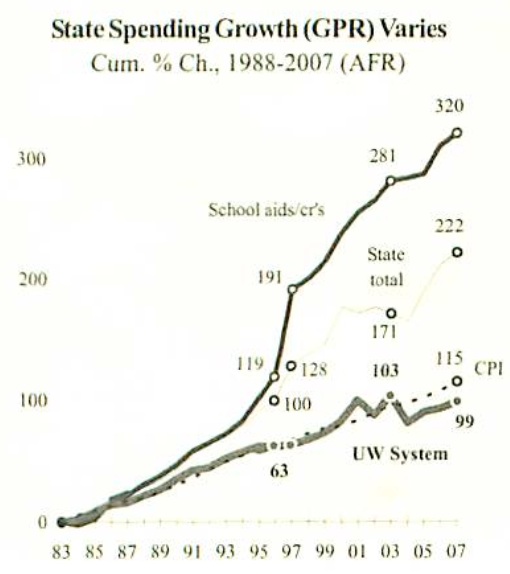
It’s important to remember how much Wisconsin State K-12 spending has grown over the past 25 years, as this chart illustrates:

Many organizations, public and private, are using this period of change to evaluate their major services and determine the effectiveness of all expenditures. Public school districts are no different. It will be interesting to see how this plays out locally.

Share

Video Report on the Madison School District’s Budget: Raising Fees for Adult Programs

WKOW-TV, via a kind reader’s email:

Share

Madison’s $30M Spending Increase & Tax Gap Rhetoric Dissected

School Board Vice President Lucy Mathiak:

So what does this mean? Well, assuming that the board will use its levying authority under the referendum and the state funding formula, the gap is smaller than the reported (and internalized) $30 million. It is probably more like the $17 million in state aid cuts plus the $1.2 million in budget items for which there is no funding source. Or, by higher math, c. $18.2 million BEFORE the board makes its budget adjustments and amendments. (This process will take place between now and the final vote on May 4, and will likely involve a combination of cuts recommended by administration and cuts proposed by the board.)
This means that the draconian school closings and massive staff layoffs reported earlier are unlikely to happen. Indeed, the board added one cut to the list at Monday’s meeting when it voted to cut $43,000 in funding budgeted to produce a communication plan.

Share

Tiny school’s fate roils rural California district

Louis Sahagun:

Class divisions fuel furor over a plan to close college-prep academy in the eastern Sierra Nevada. ‘The situation has unleashed pandemonium,’ says the district’s superintendent.
When Eastern Sierra Unified School District Supt. Don Clark stared down a projected budget deficit, he did what school administrators across the nation have had to do: consider laying off teachers and closing campuses.
But that decision, in a rural district sprawled along U.S. 395 between the snowy Sierra and the deserts of Nevada, has exposed deep resentments between parents of students in traditional high schools and those with teenagers in a college-prep academy designed for high achievers.
The trouble started a week ago when Clark announced that the district, facing a budget shortfall of $1.8 million, was considering laying off more than a dozen teachers and closing the 15-year-old Eastern Sierra Academy, among other measures.

Share

Princeton School District’s Budget Math: Cajole Teacher Unions into Accepting Contract Concessions

New Jersey Left Behind:

Princeton Township Public Schools offers a template on what will most likely occur across many districts on the heels of Gov. Christie’s budget: an effort by school boards to cajole local unions into accepting contract concessions. With cuts of up to 5% of total school budgets, increases in health benefits, and annual salary increases ranging in the mid-4%, there’s no other way to find the money. Other costs – supplies, utilities, transportation – are not fungible.
A few quick facts about Princeton, a 3,500-student school district with sky-high test scores. The annual cost per pupil there is $18,340 compared to a state average of $15,168. (These are 2008-2009 figures from the state database.) The median teacher salary is $69,829 plus benefits. The state median salary is $59,545 plus benefits. Costs of benefits in Princeton come to 23% of each teacher’s salary.

Princeton’s “User Friendly Budget“.

Share

Quality Schools

Charlie Mas:

It has been, for some time now, the District’s contention that they are working to “make every school a quality school”. This is a significant goal of the Strategic Plan, “Excellence for All”, and a pre-requisite for the New Student Assignment Plan.
So one might wonder how the District defines a “quality school”. In fact, many more than one might wonder about it. The entire freakin’ city might wonder about it. Well, they can just go on wondering because the District doesn’t have an answer.
That’s right. They have been ostensibly working for two years now towards a goal that they have not defined. Although the District defines accountability as having objectively measurable goals and insists that everyone is accountable, there are no objectively measurable goals tied to the definition of a “quality school”. This would appear to be an intentional effort to evade accountability. Not only are there no objectively measurable goals, there are no metrics, no benchmarks, and no assessments. Nice, eh?

Share

It starts with good teachers

Los Angeles Times Editorial:

Congratulations to the panel of teachers, administrators and parents who put together groundbreaking proposals on smarter ways to hire, pay, evaluate and fire teachers in the Los Angeles Unified School District. Improbable as it is that many of the proposals will be adopted by the school board, which is heavily influenced by the teachers union, they have opened a conversation sought by parents and school reformers, and that conversation is unlikely to be silenced until major changes are made.
We have long supported some of these recommendations: Not allowing seniority to rule which teachers are laid off. Expanding the probationary period before teachers get tenure. Including test scores and parent and student opinions in teacher evaluations. Paying more for excellent teachers who are willing to work in low-performing schools.

Share

Education magic bullets are often blanks

Joseph Staub:

Those who wonder why California was excluded from the first round of federal Race to the Top grants would do well to examine their own commentary for clues. It is typical of editorials and other articles on this topic to speak in general terms — to throw out noble-sounding phrases that, in the end, don’t offer specifics. The Times’ March 4 editorial, “Another setback for California schools,” reflects this kind of commentary.
Take, for example, The Times’ assertion that “district administrators, not union contracts,” should determine teacher assignments in the Los Angeles Unified School District. Really? If you were a teacher, would you completely trust administrators to always make good assignment decisions? The same people who inspired the term “dance of the lemons” as incompetent (and sometimes criminal) administrators were transferred from one school to another by their downtown buddies? Would you want to be forced to an overcrowded school terrorized by crime and violence, hobbled by a lack of supplies and a crumbling infrastructure, in a neighborhood beset by a multitude of social ills, with only a district administrator to count on for support and security? Most administrators are talented, committed and fair, but too many are none of those things.

Share

Obama Retreats on Education Reform

Karl Rove:

In a week dominated by health care, President Barack Obama released a set of education proposals that break with ideals once articulated by Robert F. Kennedy.
Kennedy’s view was that accountability is essential to educating every child. He expressed this view in 1965, while supporting an education reform initiative, saying “I do not think money in and of itself is necessarily the answer” to educational excellence. Instead, he hailed “good faith . . . effort to hold educators responsive to their constituencies and to make educational achievement the touchstone of success.”
But rather than raising standards, the Obama administration is now proposing to gut No Child Left Behind’s (NCLB) accountability framework. Enacted in 2002, NCLB requires that every school be held responsible for student achievement. Under the new proposal, up to 90% of schools can escape responsibility. Only 5% of the lowest-performing schools will be required to take action to raise poor test scores. And another 5% will be given a vague “warning” to shape up, but it is not yet clear what will happen if they don’t.

Share

What Values Are Apparent in Your School Textbooks?

Holly Epstein Ojalvo:

Students: Take a look at some of the changes to the Texas curriculum, and then at a passage from your own American history or government textbook. Considering word choice and the inclusion and treatment of leaders and movements, what values and ideas do you think it conveys? What connotations do the terms used have for you? Tell us what ideas you think are expressed in how your textbook is written.
Adults, please note: Though, of course, anyone can be a “student” at any age, we ask that adults respect the intent of the Student Opinion question and refrain from posting here. There are many other places on the NYTimes.com site for adults to post, while this is the only place that explicitly invites the voices of young people.

Math textbooks are an area ripe for this type of inquiry.

Share

Textbooks in Texas: Jefferson v Board of Education

The Economist:

THE good news is that more Texans are paying attention to social-studies lessons than ever before. The bad news is that they suddenly have cause. On March 12th, the state board of education voted for a series of changes to the state’s history and social-sciences curricula. The changes look small enough–a word here and there, a new name included, maybe a different way of phrasing an issue. But the overall effect, if the changes are approved in May, will to be to yank public education to the right.
The board alluded to the controversial amendments in a polite press release: “All those who died at the Alamo will be discussed in seventh grade Texas history classes. Hip hop will not be part of the official curriculum standards.” The most dramatic change is that Thomas Jefferson has gotten the boot. The conservatives on the board deemed him to be a suspiciously secular figure. The new guidelines would pay more fond attention to their favoured presidents, Ronald Reagan and Richard Nixon. Phyllis Schlafly and the National Rifle Association are in. So are the Black Panthers.
Some of the oddest changes concern economics. Milton Friedman and Friedrich von Hayek will join Adam Smith, John Maynard Keynes, and Karl Marx. And the board decided that references to “capitalism” and the “free market” should be changed to say “free enterprise”, because capitalism has a bad reputation at the moment. That decision is almost inexplicable. Capitalism has been through a rough patch, but surely the term itself is no more inflammatory than free enterprise.

Share

Madison School Board Candidate Issue Essays

Tom Farley School district must shift philosophy:

an Madison afford a new School Board member who requires time to understand the issues, study the research, or develop a good relationship with board members and union leaders? These are all certainly desirable objectives, and over time it is important that they occur. Yet these are exceptional times for Madison and its public school system.
The federal government has demanded that educational leaders in every community must start demonstrating a willingness to challenge the status quo, seek innovative solutions, and begin executing change management efforts. Only those school districts that show a willingness to radically alter their approaches to education, in order to achieve real results, will be supported and funded. The time has come to bring that level of leadership to the Madison School Board.
Management of the Madison School District cannot continue operating in its present form, or under its current philosophies. We have called for additional funding and referendums to increase taxes, and this has not produced the promised results. Clearly, it is not lack of money that hinders our education system; it is the system itself. That needs to change.

James Howard: We must make cuts, but not in classroom

As parents, teachers, taxpayers and voters evaluate the financial woes our Madison public schools face, there are several key points to keep in mind.
First, the taxpayers in our district have been very generous by passing several referendums that have helped close the gap between what schools can spend and what it really costs to educate our kids. However, due to the depressed economy voters are focused on direct family financial impacts and less on the indirect costs that result from any decline in quality of our public schools. Since the district is currently operating under a three-year recurring referendum, it would be a lot to ask of taxpayers to vote yes on a new referendum.
That means we must look elsewhere for answers on how to close what might be a gap of as much as $30 million. Let me be very clear as to where I wouldn’t look: the classroom. We need to protect learning by keeping class sizes small; by funding initiatives that help at-risk children perform up to grade level in basic subjects; and by funding those things that make Madison schools so special, like programs in the arts and athletics.

Share

Another Madison High School Option? Learn more on 3/25/2010 @ 7:00p.m.

via a Michelle Sharpswain email:

A group of parents is gathering information from Madison-area community members about whether or not parents would like to see another high school option in the area and, if so, what it might look like. Would it be an independent school or a charter school? Would it be a math and science academy, a performing arts school, an Expeditionary Learning school, or something else?
If you would like to share your ideas, wish list, or perspective, please join us for what is likely to be a stimulating conversation about possibilities. A discussion will take place Thursday evening, March 25th, at 7 p.m. at Wingra School (3200 Monroe St.). Please feel welcome to bring neighbors, family members, etc. who would like to participate.
Note: Wingra has very generously offered space for this conversation to take place. This is not a Wingra-sponsored event, nor is it a discussion about Wingra starting a high school.

Share

What’s News: Monona Grove might be in the vanguard of Obama’s education plans

Chris Murphy:

Monday’s story from Susan Troller about standardized tests explains how large school districts like Madison and Milwaukee are interested in what small Monona Grove is doing because its program offers much more detailed results than the standard Wisconsin Knowledge and Concepts Exam (WKCE) and delivers them far more quickly. But it’s also interesting to consider how Monona Grove might be in the vanguard of national changes in how students are taught and tested.
On Monday, President Barack Obama sent a blueprint to Congress for an overhaul of No Child Left Behind, the 2001 law pushed by President George W. Bush that ties federal funding to students’ standardized test results. Annual testing would still be required under Obama’s plan, but one major focus would change from meeting narrow grade-by-grade benchmarks and move toward achieving a common set of skills needed for life after high school, according to the Christian Science Monitor.

Share

Edu-Innovation, an Oxymoron?

Tom Vander Ark:

In preparation for the New Schools Summit, following are a few thoughts for a great group.
Acknowledging the difficulty of penetrating the complex decentralized maze of US public education, a New Schools regular asked a dinner gathering of notable reformers last week if education innovation was an oxymoron.
After a few laughs and couple hopeful responses, a former urban deputy superintendent dampened enthusiasm by reminding us not to underestimate the power of resistance from elaborate political bulwarks. Barriers to edupreneurs clearly deflect talent and investment from the sector.
Charter schools emerged in the 90’s as an entry point that allowed edupreneurs to open mission-designed new schools, then to create mission-designed school networks. Kim Smith created New Schools Venture Fund (NSVF) to create an edupreneurial ecoysystem around schools, tools, and talent. NSVF supported the most important work in education over the last decade.

Share

Senate votes against reopening D.C. voucher program

Michael Birnbaum:

The D.C. voucher program’s future appeared limited Tuesday after the Senate voted down a measure that would have reopened the initiative to new students.
The voucher program, which since 2004 has provided low-income D.C. students with as much as $7,500 in scholarships to attend private schools, has foundered in the Democratic-controlled Congress. President Obama and Education Secretary Arne Duncan have signaled their opposition to the program, instead advocating charter schools as alternatives to poorly performing conventional public schools.
Tuesday’s 55 to 42 vote was widely seen as one of the final chances for the program to be extended beyond the students who are already currently enrolled. Funding will continue for current students until they graduate high school, but has been cut off to new students for a year.
Sen. Joseph I. Lieberman (I-Conn.) introduced an amendment to a reauthorization bill for the Federal Aviation Administration that would have extended the voucher program for five years and funded it at $20 million a year, opening it to new students. The Senate killed Lieberman’s attempt to amend a different bill earlier this month.

Share

MPS cuts list – though unlikely – includes eliminating athletics, early kindergarten

Erin Richards:

Instead of cutting what could be almost 400 teaching positions in Milwaukee Public Schools next year to balance the budget, the Milwaukee Board of School Directors could instead eliminate all athletics, the entire 3- and 4-year-old kindergarten program or all the school nurses, according to a new list of non-mandatory programs released by the district’s central office.
Superintendent William Andrekopoulos said he has not recommended that the board cut any of the attention-grabbing, discretionary programs on the list – such as the $10 million the district spends to bus high school students around the city, or the $12 million it spends to fund art, music, foreign language and class-size reduction programs at the high schools. But, he said, it’s important to make the board aware of non-mandatory areas it can trim or cut altogether.
The School Board will discuss the list of items included on the superintendent’s informational report at a budget work session Thursday. Some of the items on the list include

Share

Are ‘Early College’ High Schools A Good Idea?

Eliza Krigman:

In recent years, high schools that are configured to provide students the opportunity to earn both a high-school diploma and a college associate’s degree or up two years of credit toward a bachelor’s degree have grown in popularity. The Early College High School Initiative, a private partnership made up of 13 member organizations, has started or redesigned more than 200 such schools since 2002. In addition, the National Center on Education and the Economy is spearheading a similar initiative. Dozens of public schools in eight states next fall will adopt a program that lets 10th-grade students test out of high school and go to community college. The first generation of these schools targeted low-income, minority students who were likely to be the first in their family to attend college.

Share

Pleasantville Blast

New Jersey Left Behind:

We looked at Pleasantville High School last week in the context of Diane Ravitch’s new book, chosen at random among the cohort of segregated, impoverished, and failing Jersey schools. Coincidentally this challenged Abbott district made non-bloggy headlines s a day later because at that week’s Board meeting Pleasantville Superintendent Gloria Grantham blasted away at teachers to the consternation of her Board, The Press of Atlantic City reports,

Grantham spoke at length Tuesday night about the benefits teachers get – vacation days, free health coverage, free professional development – and the effort they owe their students.
“This is not to hurt anyone, this is just to present the facts. We have got to do a better balancing act between what our students receive and what our adults receive,” Grantham said. “They’re benefiting pretty well from the opportunity to teach in our high school.”

Share

Formula for better schools

Providence Journal:

For years, many people, including politicians and unions, have complained that Rhode Island is the only state without a school-funding formula. The public’s distrust of the legislature, however, has made it difficult to proceed. Not without reason, people feared that vast amounts of money would be simply siphoned away, without accountability, to benefit teachers unions and other powerful interests, not students.
But now there seems hope that Rhode Island can move beyond such cynicism. State Education Commissioner Deborah Gist and the state Board of Regents have approved a plan more focused on students. The formula is now before the General Assembly.
Under their plan, state school-aid dollars would “follow the students” — even to charter schools, public institutions that operate outside the red tape of standard schools and are sometimes anathema to teachers unions.

Share

The Academic Performance Tournament

David Motz:

For the fifth consecutive year, Inside Higher Ed presents its Academic Performance Tournament – a unique look at what the National Collegiate Athletic Association’s Division I Men’s Basketball Tournament would look like if teams advanced based solely on their outcomes in the classroom.
The winners were determined using the NCAA’s Academic Progress Rate, a nationally comparable score that gives points to teams whose players stay in good academic standing and remain enrolled from semester to semester. When teams had the same Academic Progress Rates, the tie was broken using the NCAA’s Graduation Success Rate – which, unlike the federal rate, considers transfers and does not punish teams whose athletes leave college before graduation if they leave in good academic standing.

Share

The $2 Trillion Hole: Promised pensions benefits for public-sector employees represent a massive overhang that threatens the financial future of many cities and states.

Jonathan Laing:

LIKE A CALIFORNIA WILDFIRE, populist rage burns over bloated executive compensation and unrepentant avarice on Wall Street.
Deserving as these targets may or may not be, most Americans have ignored at their own peril a far bigger pocket of privilege — the lush pensions that the 23 million active and retired state and local public employees, from cops and garbage collectors to city managers and teachers, have wangled from taxpayers.
Some 80% of these public employees are beneficiaries of defined-benefit plans under which monthly pension payments are guaranteed, no matter how stocks and other volatile assets backing the retirement plans perform. In contrast, most of the taxpayers footing the bill for these public-employee benefits (participants’ contributions to these plans are typically modest) have been pushed by their employers into far less munificent defined-contribution plans and suffered the additional indignity of seeing their 401(k) accounts shrivel in the recent bear market in stocks.
And defined-contribution plans, unlike public pensions, have no protection against inflation. It’s just too bad: Maybe some seniors will have to switch from filet mignon to dog food.

Share

Cheaters never prosper when teachers get in the way

Jay Matthews:

What should we do about the computer hackers at Winston Churchill High School in Montgomery County who changed dozens of grades? What is the solution to student cheating in general?
Research suggests that rising pressure to get into good colleges has led students to cut corners. One study cited by the Educational Testing Service said only about 20 percent of college students in the 1940s said they had cheated in high school, and the proportion is four times as large today.
Deemphasize the college race, some experts say, and much of this nonsense will go away. I have written for many years about research showing that adult success really doesn’t depend on the prestige of one’s alma mater. But that approach to easing cheating isn’t going to get us far. Competition is too much a part of American culture. Also, college pressure tends to affect only the top 20 percent of students who seek selective schools (it’s a higher percentage in the affluent Washington area) and not students who cheat for other reasons, such as laziness or boredom.

Share

They Spend WHAT? The Real Cost of Public Schools

Adam Schaeffer:

Although public schools are usually the biggest item in state and local budgets, spending figures provided by public school officials and reported in the media often leave out major costs of education and thus understate what is actually spent.
To document the phenomenon, this paper reviews district budgets and state records for the nation’s five largest metro areas and the District of Columbia. It reveals that, on average, per-pupil spending in these areas is 44 percent higher than officially reported.
Real spending per pupil ranges from a low of nearly $12,000 in the Phoenix area schools to a high of nearly $27,000 in the New York metro area. The gap between real and reported per-pupil spending ranges from a low of 23 percent in the Chicago area to a high of 90 percent in the Los Angeles metro region.
To put public school spending in perspective, we compare it to estimated total expenditures in local private schools. We find that, in the areas studied, public schools are spending 93 percent more than the estimated median private school.

Madison spends $15,241.30 per student, according to the 2009-2010 Citizen’s Budget.

Share

K-12 Tax & Spending Climate:

Chris Giles & David Oakley:

Moody’s Investor Service, the credit rating agency, will fire a warning shot at the US on Monday, saying that unless the country gets public finances into better shape than the Obama administration projects there would be “downward pressure” on its triple A credit rating.
Examining the administration’s outlook for the federal budget deficit, the agency said: “If such a trajectory were to materialise, there would at some point be downward pressure on the triple A rating of the federal government.”
It projects that the federal borrowing is so high that the interest payments on government debt will grow to more than 15 per cent of government revenues, about the same by the end of the decade as the previous 1980s peak.
This time the servicing burden would be harder to reverse, however, because it would not be caused by high interest rates but by high debt levels.

Share

Civil Rights Overreach Quotas for college prep courses?

Wall Street Journal:

Education Secretary Arne Duncan said last week that the Obama Administration will ramp up investigations of civil rights infractions in school districts, which might sound well and good. What it means in practice, however, is that his Office of Civil Rights (OCR) will revert to the Clinton Administration policy of equating statistical disparity with discrimination, which is troubling.
OCR oversees Title VI of the 1964 Civil Rights Act, which prohibits discrimination by race, color or national origin in public schools and colleges that receive federal funding. In a speech last week, Mr. Duncan said that “in the last decade”–that’s short for the Bush years–“the Office for Civil Rights has not been as vigilant as it should have been in combating racial and gender discrimination.” He cited statistics showing that white students are more likely than their black peers to take Advanced Placement classes and less likely to be expelled from school.
Therefore, Mr. Duncan said, OCR “will collect and monitor data on equity.” He added that the department will also conduct compliance reviews “to ensure that all students have equal access to educational opportunities” and to determine “whether districts and schools are disciplining students without regard to skin color.”

Share

What Stuck? Key EdReformer Question

Tom Vander Ark:

What Stuck? What faded? As an EdReformer, it’s interesting to think about the investment of time and money with a little hindsight.
Seven years ago, Caprice Young chaired the LAUSD board. She went on to run the California charter association and is now CEO of KCDL, a leading virtual education provider. About her work as a board member in LA, Caprice observed that :

  • Buildings and charters stuck,
  • Reading and arts programs didn’t.

When Caprice was elected, LA was about 200,000 seats short. The board she chaired initiated one of the largest building projects in the world–a $19 billion ten year effort. Those buildings, for good or bad, will mark the LA landscape for a generation to come.

Share

New Jersey Governor Proposes 2.5% Tax Increase Limits & Spending Cuts

Claire Heininger & Josh Margolin:

The governor’s $29.3 billion budget will shave $2.9 billion off state spending from last year, about a 9 percent drop. The cuts include reductions in aid to municipalities and school districts, said two officials, who spoke on the condition of anonymity ahead of the announcement.
Unlike the current 4 percent limit, the new “hard” 2.5 percent cap on municipal, school and county property tax levies would be all-encompassing, without exceptions for such essentials as rising health insurance or debt payments. The tax could be raised higher only if local voters grant their approval in referendums. The state also would be constitutionally barred from increasing its own spending on direct state services by more than 2.5 percent per year.

Share

Obama Flaw: Achievement Gap

Jay Matthews:

Also, I see a problem in the president using the achievement gap as a measure of schools in his suggested revisions. This could mean that a wonderfully diverse school like T.C. Williams High in Alexandria, a recent subject on this blog, would be motivated to ignore its best students, who want to get even better, and focus all its money and time on those at the bottom of the achievement scale so they can narrow the gap. That is not a good idea, and I hope the president will get it out of his proposal.

Share

Monona Grove School District (WI) uses ACT-related tests to boost academic performance

Susan Troller:

Test early, test often, and make sure the results you get are meaningful to students, teachers and parents.
Although that may sound simple, in the last three years it’s become a mantra in the Monona Grove School District that’s helping all middle and high school students increase their skills, whether they’re heading to college or a career. The program, based on using ACT-related tests, is helping to establish the suburban Dane County district as a leader in educational innovation in Wisconsin.
In fact, Monona Grove recently hosted a half-day session for administrators and board members from Milwaukee and Madison who were interested in learning more about Monona Grove’s experiences and how the school community is responding to the program. In a pilot program this spring in Madison, students in eighth grade at Sherman Middle School will take ACT’s Explore test for younger students. At Memorial, freshmen will take the Explore test.
Known primarily as a college entrance examination, ACT Inc. also provides a battery of other tests for younger students. Monona Grove is using these tests — the Explore tests for grades 8 and 9, and the Plan tests for grades 10 and 11 — to paint an annual picture of each student’s academic skills and what he or she needs to focus on to be ready to take on the challenges of post-secondary education or the work force. The tests are given midway through the first semester, and results are ready a month later.
“We’re very, very interested in what Monona Grove is doing,” says Pam Nash, assistant superintendent for secondary education for the Madison district. “We’ve heard our state is looking at ACT as a possible replacement for the WKCE (Wisconsin Knowledge and Concepts Exam), and the intrinsic reliability of the ACT is well known. The WKCE is so unrelated to the students. The scores come in so late, it’s not useful.

The Madison School District’s “Value Added Assessment” program uses data from the oft-criticized WKCE.

Share

Students’ success in Milwaukee Public high school a matter of expectations

Alan Borsuk:

One key to the successful small high schools, almost without exception, is that they grew from the ground up. They weren’t created by some order from above. The people involved in launching the school knew what they wanted, were willing to do the hugely demanding work of making the school a reality and committed to continually working on improving what they did.
Montessori High fits that description. A charter school staffed by MPS employees, it is led by three teachers with no conventional principal. It is one of just a handful of Montessori high school programs in the U.S., and an even smaller number that combine the Montessori style of learning, with emphasis on individual development, with rigorous International Baccalaureate courses.
The environment in the school is somewhat casual, but serious. For example, 10 couches set the atmosphere for Chip Johnston’s history class, where the lively discussion on a recent morning dealt with reacting to the statement, “Liberty means responsibility.” Overall at the school, there is a strong emphasis on arts, on projects involving real-world issues, and on working with partners or in small groups.

Share

Why is Obama Unafraid of the Teacher Unions?

Greg Forster:

Two extraordinary things happened in the world of education recently. Taken together, they’re powerful confirmation of just how precipitously the teachers’ unions are declining in power and influence. Yet I can see a very plausible outcome in which we conservatives fumble the ball on the one yard line — and hand them back their power.
First, a Rhode Island school district decided it was fed up with chronic failure at one of the state’s (and probably the country’s) worst schools, and announced it would fire every single teacher at the school. In an industry where pretty much nobody ever gets fired for anything, that was an earthquake.
Then something even more amazing occurred: President Obama gave the firings an unambiguous endorsement. Noting that only 7 percent of the school’s 11th graders pass the state math test, he remarked: “If a school continues to fail its students year after year after year, if it doesn’t show signs of improvement, then there’s got to be a sense of accountability.”

Share

A consolidation in the Dodgeland School district that may be paying dividends

Barry Adams:

Count the Dodgeland School District in central Dodge County as among those that have closed schools in outlying communities. Voters in 2001 approved a $17 million referendum to construct one school facility on Juneau’s south side to house all of the district’s students from kindergarten through 12th grade.
That meant closing a middle school in Reeseville and an elementary school in Lowell. An elementary school in Clyman had closed in the late 1990s, according to Superintendent Annette Thompson.
She said trying to adequately fund the previous school arrangement in today’s fiscal environment would be difficult. The change has been for the better.
“It was a hard transition, but we recognized that to be the most cost-effective, we needed a facility that meets the needs of all students,” Thompson said. “I think we’re moving in a really positive direction.”

Share

The Push-Back on Charter Schools

Geoffrey Canada, Harlem Children’s Zone, Richard D. Kahlenberg, Century Foundation, Jeffrey Henig and Luis Huerta, Teachers College, Columbia, Michael Goldstein, Match Charter Public School:

Two recent New York Times articles have described opposition to the thriving charter school movement in Harlem. An influential state senator, Bill Perkins, whose district has nearly 20 charter schools, is trying to block their expansion. Some public schools in the neighborhood are also fighting back, marketing themselves to compete with the charters.
This is a New York battle, but charter schools — a cornerstone of the Obama administration’s education strategy — are facing resistance across the country, as they become more popular and as traditional public schools compete for money. The education scholar Diane Ravitch, once a booster of the movement, is now an outspoken critic.
What is causing the push-back on charter schools, beyond the local issues involved ? Critics say they are skimming off the best students, leaving the regular schools to deal with the rest? Is that a fair point?

Share

No Education Silver Bullet

Dana Goldstein:

In the United States, the education debate has been framed as a zero-sum game. But a look at Finland, whose schools rank No. 1 in global surveys, shows that a national commitment to education can neutralize political debates over school reform.
Last spring, Timo Jaatinen, a Finnish high school teacher living in Virginia, was surfing Internet job boards looking for a position in his home country. After a few phone interviews, Jaatinen was offered a spot as an English and Swedish teacher at Alppila Upper Secondary School in Helsinki, a popular general education high school with a reputation for attracting students interested in the arts.
“The principal said, ‘This job is yours,'” remembered Jaatinen, one of those young, dynamic teachers who you’d guess teenagers instinctively respect. “And then she said, ‘Do you want to go to Rome?'”
Jaatinen was lucky. Alppila had scored well on the city of Helsinki’s educational benchmarks for the 2007-2008 school year, and all the school’s teachers were rewarded with modest salary bonuses and a free Italian vacation, to which new teachers were also invited. Jaatinen headed back to Finland to begin his new job and claim his trip.

Share

Wisconsin Charter Schools Conference in Madison March 22-23: many important keynote speakers, including politicians + important topics for education

Laurel Cavalluzzo 160K PDF:

Featured speakers at the conference include Greg Richmond, President and founding board member of the National Association of Charter School Authorizers and establisher of the Chicago Public School District’s Charter Schools Office; Ursula Wright, the Chief Operating Officer for the National Alliance for Public Charter Schools; Sarah Archibald of the Consortium for Policy Research in Education at UW-Madison and the Value-Added Research Center; and Richard Halverson, an associate professor of Educational Leadership and Policy Analysis at the University of Wisconsin-Madison.
Also speaking at the Conference will be:

  • State Senator John Lehman (D-Racine), Chair Senate Education Committee
  • State Senator Luther Olsen (R-Berlin), Ranking Minority Member, Senate Education
  • State Representative Sondy Pope-Roberts (D-Middleton), Chair, Assembly Education Committee
  • State Representative Brett Davis (R-Oregon), Ranking Minority Member, Assembly Education

The Conference will feature interactive sessions; hands-on examples of innovative learning in classrooms; networking; a coaching room open throughout the conference; and keynote speakers that highlight the importance of quality in and around each classroom, and the impact that quality has on the learning of students everywhere. More details are attached.
Thank you for your consideration and your help in getting word out! If you would like to attend on a press pass, please let me know and I will have one in your name at the registration area.

Share

Madison School District’s 2009-2010 Citizen’s Budget Released ($421,333,692 Gross Expenditures, $370,287,471 Net); an Increase of $2,917,912 from the preliminary $418,415,780 2009-2010 Budget

Superintendent Dan Nerad 75K PDF:

Attached to this memorandum you will find the final version of the 2009-10 Citizen’s Budget. The Citizen’s Budget is intended to present financial information to the community in a format that is more easily understood. The first report groups expenditures into categories outlined as follows:

  • In-School Operations
  • Curriculum & Teacher Development & Support
  • Facilities, Other Than Debt Service
  • Transportation
  • Food Service
  • Business Services
  • Human Resources
  • General Administration
  • Debt Service
  • District-Wide
  • MSCR

The second report associates revenue sources with the specific expenditure area they are meant to support. In those areas where revenues are dedicated for a specific purpose(ie. Food Services) the actual amount is represented. In many areas of the budget, revenues had to be prorated to expenditures based on the percentage that each specific expenditure bears of the total expenditure budget. It is also important to explain that property tax funds made up the difference between expenditures and all other sources of revenues. The revenues were broken out into categories as follows:

  • Local Non-Tax Revenue
  • Equalized & Categorical State Aid
  • Direct Federal Aid
  • Direct State Aid
  • Property Taxes

Both reports combined represent the 2009-10 Citizen’s Budget.

Related:

I’m glad to see this useful document finally available for the 2009-2010 school year. Thanks to the Madison School Board members who pushed for its release.

Share

Is Obama really dumping No Child Left Behind or just giving it a new name?

Maureen Downey:

President Obama outlined his own education vision Saturday, one that he hopes will replace the punitive elements of the sweeping No Child Left Behind Act and give schools more flexibility in bringing students up to speed. To convey the new focus, the law will get a new name, although it has not been announced. (I am sure a few of you will have some pithy suggestions.)
The president and Ed Secretary Arne Duncan have clearly heard the cries from the classrooms where teachers complained that they were teaching to the tests in a futile attempt to meet impossible and overly rigid standards. Details are few right now, but the president did outline a new direction that is supposed to be kinder, fairer and more realistic.
I am not sure that teachers will agree that the plan is more realistic and fairer as it still seems to have high expectations that schools will make strides with all students.

Nia-Malika Henderson:

President Barack Obama unveiled his plan for a sweeping overhaul of the nation’s school system Saturday, proposing changes he says would shift emphasis from teaching to the test to a more nuanced assessment of judging school and student progress.
On Monday, Obama will submit his blueprint for reauthorizing the No Child Left Behind law to Congress, and he’s given lawmakers a powerful incentive to take up the bill this year–his budget proposal includes a $1 billion bonus should new legislation land on his desk this year.
Obama’s proposal would toss out the core of the Bush-era law, which calls for across-the-board proficiency from all students in reading and math by 2014, and instead emphasize revamped assessment tools that link teacher evaluations to student progress, and a goal of having students career and college ready upon graduation.

Share

The Key To Saving American Education: Retrain or Replace Teachers?

Evan Thomas & Pat Wingert:

I’m excited for the opportunity to “debate.” The term violates my traditional sensibilities, but I’ll try to get over it. What resolution should we discuss? Resolved: “The problem with education is teachers,” as one online headline for your story read. Resolved: “The best way to deal with underperforming teachers is to fire them.” Resolved: “Much of the ability to teach is innate,” as the lead story in your package declares.
My reporting for The New York Times Magazine turned up counter-arguments to each of these declarations. But it also turned up many facts that appear in your story. Here are some premises we can probably agree on: The quality of teaching plays a major role in determining whether children learn. An upsetting number of teachers are not helping children learn as much as we want them to. A smaller group of teachers are actively impeding learning. It is insanely difficult to fire these bad teachers, and the teaching profession at large is an insanely isolated one in which it is not unusual for the only people who ever observe the professional at work to be 9 years old.
That said, the overwhelming conclusion of my reporting is that efforts to change this picture must go beyond simply firing the lowest performers. One reason is just plain money. Firing employees–in many professions, not just teaching–brings a lot of legal hurdles and therefore costs a lot of money. The bill is especially high for firing teachers; to fire underperforming teachers in New York City, Chancellor Joel Klein invested $1 million a year in a fleet of fancy attorneys tasked solely with this responsibility. In the two years the project has gone on so far, the city only fired three teachers charged with incompetence.

Share

Harvard study: Are weighted AP grades fair?

Debra Viadero:

To encourage high school students to tackle tougher academic classes, many schools assign bonus points to grades in Advanced Placement or honors courses. But schools’ policies on whether students should receive a grade-point boost and by how much are all over the map.
My local public school district, for instance, used to add an extra third of a grade-point to students’ AP course grades while the private high school on the other side of town would bump up students’ grades by a full letter grade.
Since students from both schools would be applying to many of the same colleges, and essentially competing with one another, it didn’t seem fair to me that the private school kids should get such a generous grade boost.
That’s why I was heartened to come across a new study by a Harvard University researcher that takes a more systematic look at the practice of high school grade-weighting.
He found that for every increasing level of rigor in high school science, students’ college course grades rose by an average of 2.4 points on a 100- point scale, where an A is 95 points and a B is worth 85 points and so on. In other words, the college grade for the former AP chemistry student would be expected to be 2.4 points higher than that of the typical student who took honors chemistry in high school. And the honors students’ college grade, in turn, would be 2.4 points higher than that of the student who took regular chemistry.
Translating those numbers, and some other calculations, to a typical high school 1-to-4-point grade scale, Sadler estimates that students taking an honors science class in high school ought to get an extra half a point for their trouble, and that a B in an AP science course ought to be counted as an A for the purpose of high school grade-point averages.

Share

DC high school football team gets female coach

Joseph White:

The football players at Calvin Coolidge Senior High School, Mayor Adrian Fenty and a room full of cheering staff needed only one word to describe her: coach.
Natalie Randolph, a 29-year-old biology and environmental sciences teacher, was introduced Friday as the coach of the school’s Coolidge Colts. She’s believed to be the nation’s only female head coach of a high school varsity football team.
“While I’m proud to be part of what this all means,” Randolph said, “being female has nothing to do with it. I love football. I love football, I love teaching, I love these kids. My being female has nothing to do with my support and respect for my players on the field and in the classroom.”
The news conference drew the kind of attention usually reserved for the Washington Redskins and was delayed nearly two hours so Fenty, who is up for re-election this year, could be there and proclaim “Natalie Randolph Day” in the city.

Share

Duncan wants 3 ratings for schools in education overhaul

Greg Toppo:

The Obama administration will ask Congress to toss out the two-tiered pass/fail school rating system of the No Child Left Behind education law and replace it with one that labels schools one of three ways: high-performing, needs improvement or chronically low-performing, according to U.S. Education Secretary Arne Duncan.
President Obama announced the change Saturday during his weekly radio address, saying the administration plan sets “an ambitious goal: all students should graduate from high school prepared for college and a career – no matter who you are or where you come from. Achieving this goal will be difficult. It will take time. And it will require the skills, talents, and dedication of many: principals, teachers, parents, students. But this effort is essential for our children and for our country.”
In a briefing Friday, Duncan told reporters he will give the high performers both freedom and financial incentives to stay that way.
“We want to get out of their way,” Duncan said. “But we also want to learn from them.”

Share

National School Standards, at Last

New York Times Editorial:

The countries that have left the United States behind in math and science education have one thing in common: They offer the same high education standards — often the same curriculum — from one end of the nation to the other. The United States relies on a generally mediocre patchwork of standards that vary, not just from state to state, but often from district to district. A child’s education depends primarily on ZIP code.
That could eventually change if the states adopt the new rigorous standards proposed last week by the National Governors Association and a group representing state school superintendents. The proposal lays out clear, ambitious goals for what children should learn year to year and could change curriculums, tests and teacher training.

Share

Obama’s contradictions on education

Valerie Strauss:

Among the 10 organizations to which President Obama donated his Nobel Prize Award are the United Negro College Fund, the Hispanic Scholarship Fund, the Appalachian Leadership and Education Foundation, the American Indian College Fund, and the Posse Foundation.
What do those groups — each of which is receiving $125,000 of the total $1.4 million that he received — have in common?
They all work to help underserved populations of young people get ready to attend and be successful in college.
Obama has said repeatedly that his education goal is to make sure that every child has a quality education and the opportunity to graduate from college — and he displayed his commitment to that with his own award money.
Yet his education policies to this point cannot ever reach this goal. Nor can they do what he promised during the presidential campaign: Stop high-stakes standardized testing from driving our public education system.

Share

Obama’s plan for education reform: short on specifics, so far

Patrik Jonsson:

In Saturday’s address, Obama called for Congress to reauthorize the Elementary and Secondary Education Act, which in 2002 became known as the No Child Left Behind Act.
With a goal of having every child read at grade level by 2014, No Child Left Behind has been criticized by current Education Secretary Arne Duncan as “utopian” and as failing to properly reward schools for progress. One change under his proposed legislative blueprint, Obama said, would be that schools that perform well would be rewarded, while underperforming schools would face tough consequences.
A focus on education reform may be a politically astute move for the president and fellow Democrats in Congress, some of whom face difficult elections in the fall. Education reform, unlike financial regulatory reform or new environmental laws, is a kitchen-table issue that many Americans support.
“The announcement’s timing suggests Obama is looking beyond the health care proposal that still lingers in Congress, has delayed the president’s international trip next week, and threatens his party’s electoral prospects in November,” writes the Associated Press.

Share

Where’s the school funding fix?

Wisconsin State Journal Editorial:

So much for school funding reform.
Gov. Jim Doyle has dropped his broad proposal, and state lawmakers aren’t forwarding any of their own ideas for fixing the system.
Once again our leaders have lobbed this festering problem onto the “too hard to fix” pile. Consequently, Wisconsin remains stuck with a funding system that’s outdated and unfair.
Wisconsin’s next governor needs to make this huge issue a priority during the fall campaign, with specific plans voters can assess.
The state’s “three-legged stool” of school financing — revenue caps, two-thirds state funding, and limits on teacher raises — has fallen over because state leaders kicked out two of the legs.

Share

Grier has opened door to system of great Houston schools

Chris Barbic & Mike Feinberg:

In his 2010 State of the Schools address, Houston Independent School District Superintendent Terry Grier commented on the district’s relationship with the public charter schools we founded more than a decade ago, YES Prep and KIPP. Grier referred to the relationship as a partnership as well as a competition, stating that HISD is ready to “get busy” in order to ensure parents are not leaving failing HISD schools to attend YES Prep, KIPP or other high-performing charters in Houston. We could not be more pleased to hear these comments from Grier. In fact, we’ve been hoping for many years that our existence would indeed result in this type of relationship with HISD and a superintendent ready to “get busy” and compete. The recent changes that Grier and the board have implemented regarding a longer calendar and focus on human capital show that they are committed to this idea.
YES Prep and KIPP were both born inside HISD in the mid-1990s when we were both classroom teachers in underserved communities in search of a better way to educate our students. We had a number of theories we wanted to test about what it would take to educate our students in a way that would allow them to compete with students from our city’s very best schools. What we learned in those early years was that for us to have the freedom to be experimental, nimble and fleet-footed, for us to be able to make sometimes unorthodox decisions in the best interest of our students, we would need to leave HISD’s political bureaucracy to operate as independent public charter schools.

Share

K-12 Tax & Spending Climate: 52 Million (36%) of Tax Returns Pay Zero Income Tax

TaxProf:

A record number of the 142 million tax returns filed in 2008 resulted in no tax payment, according to a Tax Foundation analysis of IRS data. That means the tax filers got back every dollar that had been withheld from their paychecks, and often more. Roughly 51.6 million tax returns, or 36.3 percent, were filed by such “nonpayers,” people whose exemptions, deductions and credits wiped out any federal income tax due.
A family of four earning more than $50,000 can have no income tax liability after taking the standard deduction and the child tax credit.

Share

A Turning Point on Education Reform

Chester Finn:

If the nation’s education system finally makes a meaningful turn for the better, March 10 may very well mark the turning point.
On Wednesday, two influential organizations of state leaders — the National Governors Association and the Council of Chief State School Officers — released drafts of new “common core” academic standards for American schools, covering English and math from kindergarten through 12th grade. The standards are intended — if states embrace them, teachers teach them and children study hard — to prepare tomorrow’s young people to be “college- and career-ready” by the end of high school and to help the U.S. become more internationally competitive.
A closely related development will soon occur, when Education Secretary Arne Duncan unveils a program that will let states compete for up to $350 million in federal funds to develop new tests “aligned” with the new standards.

Share

Madison School Leaders Consider Late Tuesday High School Start for Teacher Collaboration

Gayle Worland:

High school students would have an extra hour to sleep on Tuesday mornings next year under a plan being considered by the Madison School District and the teachers union.
Officials are in negotiations to make Tuesdays a “late start” day for students at East, West, Memorial and possibly La Follette High Schools in 2010-11 to give teachers a morning hour to collaborate with colleagues.
“Collaboration among professionals is like cross-fertilization,” John Matthews, executive director of Madison Teachers Inc., said Thursday. The weekly sessions could give teachers a chance to discuss “what is a better way to approach a subject, a concept, what works with this kid and his individual learning style, etc.”

Fascinating.

Share

The School Board Job

Charlie Mas:

I don’t know what job the members of the school board came to do. I don’t know what job they think they are doing. But I do know what job they aren’t doing: they aren’t doing the Board job.
The Board job begins with serving as the elected representatives of the public. But the Board members aren’t representing the public’s voice in Seattle Public Schools. They certainly aren’t advocating for the public’s perspective. We know that they aren’t because if they were, we would hear them begin their sentences with the words: “My constituents want… ” and they don’t. We don’t hear them say “My constituents want equitable access to language immersion programs.” or “My constituents want equitable access to Montessori programs.” or “My constituents want access to a real Spectrum program for their Spectrum-eligible children.” or “My constituents want reduced class sizes.” We aren’t hearing that. And we sure aren’t hearing them follow these statements with “So let’s make it happen for them.”

Share

Can you lead a school system if you can’t write a clear sentence?

Maureen Downey:

In a provocative Detroit News column, columnist Laura Berman describes the troubling case of Detroit school board president Otis Mathis. Mathis appears to be a decent man admired by his colleagues. He is fair and open. He can also barely construct a sentence, as Berman shows by sharing his e-mails.
One Mathis example that she provides:

If you saw Sunday’s Free Press that shown Robert Bobb the emergency financial manager for Detroit Public Schools, move Mark Twain to Boynton which have three times the number seats then students and was one of the reason’s he gave for closing school to many empty seats.

Mathis does not deny his writing problems or his weak education record and speaks openly with Berman about them. He says his own struggles and deficiencies don’t disqualify him from leading a school system that shares many of those same struggles and shortcomings on an epic scale.

Share

Does the Size of a School Matter?

Herbert J. Walberg, Don Soifer, Leonie Haimson, Valerie E. Lee, professor, Rudy Crew:

Facing low enrollment and a $50 million budget deficit, the Kansas City Board of Education announced on Wednesday that it would close almost half of the city’s public schools. The “Right-Size” plan will mean closing 28 of the city’s 61 schools and eliminating 700 out of 3,000 jobs.
National education experts have said that the Kansas City schools were not responding to demographic changes and academic failure. District officials say the closings will improve achievement by allowing the system to focus its resources.
How much does school size matter? And what are the lessons learned from Kansas City?

Share

What’s next after K.C. school closures?

Barbara Shelley:

Faced with a deficit and troubled school system, Kansas City’s Board of Education voted to close 28 out of 61 schools. Barbara Shelley, columnist for the Kansas City Star, talks with Kai Ryssdal about what led to the decision and its impact.
TEXT OF INTERVIEW
KAI RYSSDAL: The board of education in Kansas City, Mo., took a vote last night on how to save their city’s long-troubled school system. It was close. But by the end of the evening a plan to shut down 28 of the district’s 61 schools and lay off 700 people did pass. The vote was 5-4. The district says the plan should cut $50 million from the budget.
Barbara Shelley is a columnist for the Kansas City Star. She’s been writing about schools there and the city itself for quite a while. Barb, it’s good to have you with us.
BARBARA SHELLEY: Good to be here.
RYSSDAL: What’s the reaction in town today after this announcement?
SHELLEY: Well, I think you have two different reactions. You have the reaction from people that are going to be directly affected. And that’s the families and the teachers and the students. And there’s a lot of anguish in that group. You have another reaction from I would say business types and people that see this as a hope that a smaller, more streamlined school district will mean better performance and a better academic potential for the district.

Share

Profit!

Andrew Rotherham:

Big front page story in the WaPo todayabout a debate over getting rid of congressional “earmarks” for for-profit entities. But is the problem that for-profits can get earmarks or that the earmark process is just not very meritorious in its selection regardless of the tax status of the recipient? Plenty of for-profits will continue to get federal money through a variety of avenues. Meanwhile, not every non-profit is a model of efficiency, virtue, or effectiveness.
In K-12, and education more generally, we have a similar problem when it comes to thinking about quality.

Share

Teachers Union Tops List of California Political Spenders

Patrick McGreevy:

Fifteen special interest groups including casino operators, drug firms and unions for teachers and public employees spent more than $1 billion during the last decade trying to influence California public officials and voters, the state’s watchdog agency reported today.
The money went for lobbying, campaign contributions to state politicians and ballot measure campaigns to get voters to advance the groups’ agendas, according to the report by the state Fair Political Practices Commission.
“This tsunami of special interest spending drowns out the voices of average voters, and intimidates political opponents and elected officials alike,” said Commission Chairman Ross Johnson, a former state senator.

The Wisconsin Education Association Council also tops the Badger State’s lobbying expenditures.

Share

School Districts vs. A Good Math Education

Charlie Mas:

If you are a parent in cities such as Bellevue, Issaquah or Seattle, your kids are being short-changed–being provided an inferior math education that could cripple their future aspirations–and you need to act. This blog will tell the story of an unresponsive and wrong-headed educational bureaucracies that are dead set on continuing in the current direction. And it will tell the story of how this disaster can be turned around. Parent or not, your future depends on dealing with the problem.
Let me provide you with a view from the battlefield of the math “wars”, including some information that is generally not known publicly, or has been actively suppressed by the educational establishment. Of lawsuits and locking parents out of decision making.
I know that some of you would rather that I only talk about weather, but the future of my discipline and of our highly technological society depends on mathematically literate students. Increasingly, I am finding bright students unable to complete a major in atmospheric sciences. All their lives they wanted to be a meteorologist and problems with math had ended their dreams. Most of them had excellent math grades in high school. I have talked in the past about problems with reform or discovery math; an unproven ideology-based instructional approach in vogue among the educational establishment. An approach based on student’s “discovering” math principles, group learning, heavy use of calculators, lack of practice and skills building, and heavy use of superficial “spiraling” of subject matter. As I have noted before in this blog, there is no competent research that shows that this approach works and plenty to show that it doesn’t. But I have covered much of this already in earlier blogs.

Related: Math Forum audio / video.

Share

Kansas City Adopts Plan to Close Nearly Half Its Schools

Susan Saulny:

The Kansas City Board of Education voted Wednesday night to close almost half of the city’s public schools, accepting a sweeping and contentious plan to shrink the system in the face of dwindling enrollment, budget cuts and a $50 million deficit.
In a 5-to-4 vote, the members endorsed the Right-Size plan, proposed by the schools superintendent, John Covington, to close 28 of the city’s 61 schools and cut 700 of 3,000 jobs, including those of 285 teachers. The closings are expected to save $50 million, erasing the deficit from the $300 million budget.
“We must make sacrifices,” said board member Joel Pelofsky, speaking in favor of the plan before the vote. “Unite in favor of our children.”

Share