School Information System

Hillsborough teachers will soon be rated by their peers

Dong-Phuong Nguyen

Starting as early as this fall, every Hillsborough County schoolteacher will be subject to ratings by his or her peers.
The School Board on Tuesday unanimously approved the move as part of a reform effort under way to improve schools through the Bill & Melinda Gates Foundation.
The board’s vote dedicates $360,000 to an online training course for the peer evaluation system that, by 2013, will help determine whether teachers qualify for tenure or merit pay.
Within a month or so, teachers will be able to see how the system works in real life. The optional six-hour course by national teacher evaluation expert Charlotte Danielson includes an overview and video clips from actual classrooms where similar evaluations have been used.

Share

Gates Funds Aid University of Oregon’s College-Prep Efforts

University of Oregon:

Developing a set of core content standards to prepare high school students with the academic foundation and skills necessary to succeed on any college campus is the goal of a new initiative at the University of Oregon.
Specifically targeted are the subject areas of mathematics and English, as well as a set of career-oriented two-year certificate programs.
David T. Conley, a professor of education and founder and chief executive officer of the non-profit Educational Policy Improvement Center (EPIC), will lead the ambitious project, which is partially funded by a $794,000 grant from the Bill & Melinda Gates Foundation.
The Seattle-based foundation announced in February a $19.5 million package of 15 grants to develop and launch new instructional tools and assessments to assure college readiness across the nation. Other support for the UO project comes from the Council of Chief State School Officers and the National Governors Association as part of the Common Core State Standards Initiative.

Share

K-12 Tax & Spending Climate: US Sales Taxes Hit Record High

William P. Barrett:

Shopping blues: Top tax 12%. Chicago’s 10.25% highest big-city rate. More Internet tax fights loom.
While President Obama’s push to raise federal income taxes for the wealthy gets lots of attention, the continuing upward creep in the sales tax rates imposed by state and local governments has gotten less notice.
But Vertex Inc., which calculates sales tax for Internet sellers, reports that the average general sales tax rate nationwide reached 8.629% at the end of 2009, the highest since the Berwyn, Pa., company started tracking data in 1982. That was up a nickel on a taxable $100 purchase from a year earlier and up nearly 40 cents for the decade. The highest sales tax rate in the country now stands at 12%.
During 2009 seven states and the District of Columbia raised sales tax rates, with one jurisdiction–North Carolina–actually doing it twice. Only four states hiked rates in 2008 and only one in 2007. Given state budget problems, the 2009 state sales tax increases aren’t surprising. States have also been raising income tax rates on the wealthy and on corporations and boosting excise taxes on alcohol and tobacco. With states now facing record budget shortfalls, more tax increases seem likely.

There has been discussion regarding the shift of school additional school spending to the sales tax.
Related: Federal Withholding Tax Revenues.

Share

Feds examine LA schools’ English learner program

Associated Press:

The U.S. Education Department is planning to examine the Los Angeles Unified School District’s low achieving English-language learning program to determine whether those students are being denied a fair education.
The department’s Office for Civil Rights will investigate whether the nation’s second-largest school district is complying with federal civil rights laws with regard to English-language learners, who comprise about a third of the district’s 688,000 pupils, according to the Los Angeles Times.
The inquiry was sparked by the low academic achievement of the district’s English learners. Only 3 percent are proficient in high-school math and English.
Problems in LAUSD’s English-language learning program were highlighted last fall in a study by the Tomas Rivera Policy Institute.

Share

Draft US K-12 “Core Standards” Available for Comment

National Governors Association Center for Best Practices and Council of Chief State School Officers:

As part of the Common Core State Standards Initiative (CCSSI), the draft K-12 standards are now available for public comment. These draft standards, developed in collaboration with teachers, school administrators, and experts, seek to provide a clear and consistent framework to prepare our children for college and the workforce.
Governors and state commissioners of education from 48 states, 2 territories and the District of Columbia committed to developing a common core of state standards in English-language arts and mathematics for grades K-12. This is a state-led effort coordinated by the National Governors Association Center for Best Practices (NGA Center) and the Council of Chief State School Officers (CCSSO).
The NGA Center and CCSSO have received feedback from national organizations representing, but not limited to teachers, postsecondary education (including community colleges), civil rights groups, English language learners, and students with disabilities. These standards are now open for public comment until Friday, April 2.

Share

Governors, state school superintendents to propose common academic standards

Nick Anderson:

The nation’s governors and state school chiefs will propose standards Wednesday for what students should learn in English and math, from kindergarten through high school, a crucial step in President Obama’s campaign to raise academic standards across the country.
The blueprint aims to replace a hodgepodge of state benchmarks with common standards. The president has aggressively encouraged the states’ action as a key to improving troubled schools and keeping the nation competitive. Instituting new academic standards would reverberate in textbooks, curriculum, teacher training and student learning from coast to coast.
Fourth-graders, for example, would be expected to explain major differences between poetry and prose and to refer to such elements as stanza, verse, rhythm and meter when writing or speaking about a poem. Eighth-graders would be expected to use linear equations to solve for an unknown and explain a proof of the Pythagorean theorem on properties of a right triangle — cornerstones of algebra and geometry.
“It’s hugely significant,” said Michael Cohen, a former Clinton education official, who is president of the standards advocacy organization Achieve. “The states recognize they ought to have very consistent expectations for what their students should learn.”

Share

Jordan, Utah school board looks to rein in time spent on comments

Rosemary Winters:

After a rowdy, four-hour meeting last month, the Jordan School District Board is considering tightening its policy on public comments.
A proposal for tonight’s Board of Education meeting would make a number of changes to the district’s rules regarding public participation at board meetings, including limiting the time spent on comments. At the last board meeting, hundreds of people showed up to protest a proposal to lay off 500 workers, including 250 teachers. The board’s regular agenda was suspended to make time for four hours of comment.
“It cannot continue to do that every meeting, or the district will come to a halt,” Jordan spokeswoman Melinda Colton wrote in an e-mail, noting that people also can chime in via letters, e-mails and phone calls. “The board feels it needs to restore decorum to its board meetings. Their meetings are meetings held in public, not public hearings.”
Robin Frodge, president of the Jordan Education Association, said she hopes the board keeps in mind the importance of public input. “One of the primary purposes for public meetings is to conduct business in front of the public and to also take public response on board actions,” Frodge said.

Share

Spending at Co-Located New York Schools

Kim Gittleson:

Buried on the Department of Education’s website is a page that lists per pupil spending on a school-wide, district-wide, and system-wide basis. Using this information, as well as expense data from the 2007-2008 audits and the recent Independent Budget Office report, we compared spending by charter schools and traditional public schools that are located in the same building.
We found that charter schools spent $365 less per pupil than their co-located traditional public schools in 2007-2008. You can see our calculations in a workbook here.
Some notes on our methodology:

Share

We must right-size KC School District, now

Airick Leonard West:

At first glance, the right-sizing of the Kansas City School District just feels wrong.
It feels wrong to close more schools in struggling neighborhoods, to punish scholars with longer bus rides home, to let teachers go with little more than “we wish we didn’t have to,” to take beautiful buildings that stood for community and put boards in their windows, to ask families to bear the burden of a solution after years of school boards — which now include myself — failing to fix the problems. In the storm of controversy, it is easy to overlook what is right in the journey we are on.
Beyond all that may feel wrong, there is so much that is right in our district and with the right-sizing plan. We should celebrate that our superintendent has led a thoughtful, data-driven, six-month, three-stage process to arrive at the plan.

Share

Notes on the Alliance for Education Teacher Quality Survey

Melissa Westbrook:

just finally got around to looking over the Alliance for Education survey called “Teaching Quality Community Survey”. What were they thinking? (Sorry to be a little late to this party but I was out of town last week.) I’m not going to even provide a link. I answered every question “don’t know” so I could read through the whole thing.
Just from a survey standpoint, it’s a mess. There are multiple values in questions starting with the very first one. It’s about (1) redesigning the salary schedule AND (2) eliminating coursework incentives AND (3) “reallocating pay to target the district’s challenges and priorities.” What?!? You can’t write a survey question like that.
Question two has a classic “leading the reader” form using phrases like “redouble efforts” and “as attempted by the current superintendent”. How does the reader know this actually DID happen? Also, the “latest” negotiations haven’t even formally started; is the district showing its hand here?
And it goes on and on. “Gather teacher data so that teachers are equitably distributed among schools.” So elsewhere they want to eliminate pay for more education for teachers but at the same time in this question they want to spread the number of teachers who do have more education more equitably among the schools?

Share

School cuts: Size matters

Savannah Morning News:

Savannah-Chatham school board should consider temporary increases to class size.
LOCAL SCHOOL officials say everything is on the table when it comes to cutting the budget, but there are some measures that would be a bit less painful.
For instance, the Savannah-Chatham Board of Education should consider a temporary increase in class sizes.
While the state last year increased class size regulations marginally, the local system remains, on average, about two or three students below those limits. There is more leeway in elementary schools, with class sizes closer to state limits in the middle and upper grades.
More students per class will likely mean more stress on educators. However, this move can be easily undone when the economy (and school tax revenue) improves.
Superintendent Thomas Lockamy said that out of the system’s roughly 3,200 teaching positions, some 300 to 400 come vacant at the end of each year through resignations or retirement.

Share

Pressed by Charters, Public Schools Try Marketing

Jennifer Medina:

Rafaela Espinal held her first poolside chat last summer, offering cheese, crackers and apple cider to draw people to hear her pitch.
She keeps a handful of brochures in her purse, and also gives a few to her daughter before she leaves for school each morning. She painted signs on the windows of her Chrysler minivan, turning it into a mobile advertisement.
It is all an effort to build awareness for her product, which is not new, but is in need of an image makeover: a public school in Harlem.
As charter schools have grown around the country, both in number and in popularity, public school principals like Ms. Espinal are being forced to compete for bodies or risk having their schools closed. So among their many challenges, some of these principals, who had never given much thought to attracting students, have been spending considerable time toiling over ways to market their schools. They are revamping school logos, encouraging students and teachers to wear T-shirts emblazoned with the new designs. They emphasize their after-school programs as an alternative to the extended days at many charter schools. A few have worked with professional marketing firms to create sophisticated Web sites and blogs.

Share

Wisconsin Governor Doyle drops plan on school funding

Jason Stein:

The reason, spokesman Adam Collins said Monday, is that focus shifted to pursuing federal stimulus money for education and a lack of interest from state lawmakers in the proposal.
But the top leaders of the Senate and Assembly and the chairs of their education committees said Doyle never put forward a bill or detailed specifics for them to evaluate and that the last contact from his aides on the issue was about a year ago.
“More finger-pointing on education reforms from the administration without a proposal that has strong public support isn’t going to help Wisconsin students,” Senate Majority Leader Russ Decker (D-Weston) said in a statement.
The news amounts to the latest setback for the Democratic governor as he seeks to build on his legacy before the Legislature finishes its regular business April 22. Fellow Democrats in the Legislature already have rejected Doyle’s plans to put the mayor in charge of the Milwaukee Public Schools and have called for changes to a sweeping proposal to limit greenhouse gases and boost renewable energy.

Share

Schools’ New Math: the Four-Day Week

Chris Herring:

A small but growing number of school districts across the country are moving to a four-day week, in a shift they hope will help close gaping budget holes and stave off teacher layoffs, but that critics fear could hurt students’ education.
State legislators and local school boards are giving administrators greater flexibility to set their academic calendars, making the four-day slate possible. But education experts say little research exists to show the impact of shortened weeks on learning. The missed hours are typically made up by lengthening remaining school days.
Of the nearly 15,000-plus districts nationwide, more than 100 in at least 17 states currently use the four-day system, according to data culled from the Education Commission of the States. Dozens of other districts are contemplating making the change in the next year–a shift that is apt to create new challenges for working parents as well as thousands of school employees.
The heightened interest in an abbreviated school week comes as the Obama administration prepares to plow $4.35 billion in extra federal funds into underperforming schools. The administration has been advocating for a stronger school system in a bid to make the U.S. more academically competitive on a global basis.

Share

Ed chief: Agency to review equal access at schools

Bob Johnson:

Education Secretary Arne Duncan said Monday the federal government will become more vigilant to make sure students have equal access and opportunity to everything ranging from college prep classes to science and engineering programs.
“We are going to reinvigorate civil rights enforcement,” Duncan said on a historic Selma bridge to commemorate the 45th anniversary of a bloody confrontation between voting rights demonstrators and state troopers.
Duncan said the department also will issue a series of guidelines to public schools and colleges addressing fairness and equity issues.
“The truth is that, in the last decade, the office for civil rights has not been as vigilant as it should be. That is about to change,” Duncan said.
Duncan spoke to a crowd about 400 people on the Edmund Pettus Bridge in observance of “Bloody Sunday,” the day in 1965 when several hundred civil rights protesters were beaten by state troopers as they crossed the span over the Alabama River, bound for Montgomery.

Share

The Legal Requirement of Public Input

Charlie Mas:

Dan has been working hard snooping around in the RCW. It’s pretty amazing what you can find in there if you look.
Here’s what he found: RCW 28A.320.015

School boards of directors — Powers — Notice of adoption of policy.
(1) The board of directors of each school district may exercise the following:
(a) The broad discretionary power to determine and adopt written policies not in conflict with other law that provide for the development and implementation of programs, activities, services, or practices that the board determines will:
(i) Promote the education and daily physical activity of kindergarten through twelfth grade students in the public schools; or
(ii) Promote the effective, efficient, or safe management and operation of the school district;
(b) Such powers as are expressly authorized by law; and
(c) Such powers as are necessarily or fairly implied in the powers expressly authorized by law.
(2) Before adopting a policy under subsection (1)(a) of this section, the school district board of directors shall comply with the notice requirements of the open public meetings act, chapter 42.30 RCW, and shall in addition include in that notice a statement that sets forth or reasonably describes the proposed policy. The board of directors shall provide a reasonable opportunity for public written and oral comment and consideration of the comment by the board of directors.

Share

Teachers union rips Florida Senator Thrasher’s education bill

Brandon Larrabee:

The state’s largest teachers union ripped into a proposed overhaul of teacher contracts Monday, saying the bill represented an effort to score political points instead of serious education reform.
“It attacks the very people who work in our school system each and every day as opposed to giving them the resources that are needed to succeed,” said Andy Ford, president of the Florida Education Association, at a news conference called to slam the proposal from Sen. John Thrasher, R-St. Augustine.
Thrasher’s bill, filed last week, would base half of a teacher’s salary on student performance while extending to five years the period during which a new teacher can be fired at the end of each school year without cause.
It would also dismantle teacher tenure in the three counties, including Duval County, where it exists as well as other employment protections in other parts of the state. In most parts of the state, teachers can obtain a “professional service contract” after three or four years and can only be fired for cause.

Share

Parents love it, but Wisconsin’s open enrollment option puts school districts on edge during tough economic times

Appleton Post-Crescent:

Zachary Dupland was a kindergartner at Menasha’s Gegan Elementary School when his parents split up. His dad, Eric Dupland, moved to Appleton. His mom, Tauna Carson, moved to Neenah.
As part of their custody agreement, however, they opted to keep Zachary, now a third-grader, at a school in Menasha by applying for open enrollment.
His parents felt no reason existed to uproot him from his friends and teachers, at least until middle school.
“We wanted to avoid any more dramatic changes in his life,” Eric Dupland said.
“This option has been wonderful for us,” Carson said. “It has allowed us to do just what we need to do for Zachary.”

Share

Education reformers making progress

Charles Davenport, Jr.:

ittle Johnny can’t read or write because, in government schools, the interests of teachers’ unions prevail over the interests of children. Unions may be beneficial to educators, but they are indifferent — if not hostile — to the intellectual development of children.
But education reformers nationwide are celebrating a rare victory for the kids. Last month in Rhode Island, Superintendant Frances Gallo fired the entire staff of Central Falls High School — a total of 93 people. The grateful citizens of Central Falls have erected a billboard in Gallo’s honor. Rightly so. Gallo, Rhode Island Education Commissioner Deborah Gist and the Central Falls school board (which approved the firings on a 5-2 vote) are an inspiration to the public school reform movement.
Central Falls High is one of the worst schools in Rhode Island. Only 45 percent of the students are proficient in reading, 29 percent in writing and, incredibly, only 4 percent in math. Compare those abysmal numbers to Rhode Island’s (somewhat less embarrassing) statewide averages in the same subjects: 69, 42 and 27 percent, respectively. Furthermore, half of the students at Central Falls are failing every subject, and the school’s graduation rate is 48 percent.
Only teachers’ unions could defend such a spectacular failure. Several hundred bused-in, placard-waving educators and their union representatives showed up in Central Falls hours before the firings. “We are behind Central Falls teachers,” proclaimed Mark Bostic of the American Federation of Teachers, “and we will be here as long as it takes to get justice.” But on Tuesday, the Central Falls union publicly pledged to support Gallo’s reforms, and she said she’s willing to negotiate.

Share

In Harlem, Epicenter for Charter Schools, a Senator Wars Against Them

Jennifer Medina:

When hundreds of parents went to Albany last month to rally for charter schools, they were greeted by a parade of politicians offering encouragement and promises.
But when Bill Perkins, the state senator from Harlem who represents many of the parents, took the stage, they drowned him out with boos.
Some parents confronted him later in the vestibule outside the Senate chamber, demanding that he meet with them that afternoon and chanting “Move Bill, get out the way, get out the way,” before he could even speak.
As advocates of charter schools, including the Bloomberg administration, try to persuade legislators to lift the limit on the number of such schools in the state, no one is as likely to stand in their way as Mr. Perkins, whose district encompasses nearly 20 charter schools. Several more are planned next year.

Share

K-12 Tax & Spending Climate: What’s Wrong with the Public Sector?

Charlie Mas:

I read this comment on Crosscut and I just have to share it.
Here is a link to the original article. It was about the (lack of a) Republican party alternative to the state budget.
The comment came from Stuka at 8:44pm on Thursday, March 4. I won’t quote all of it, but I absolutely want to share this part:

The fundamental problem with the public sector is not lack of taxes but lack of performance monitoring and improvement over time. Witness the public school system for evidence of the failure to monitor the quality of teachers, of teaching performance, of student performance, and of school performance. Same with the criminal-justice system: who is monitoring the quality of inmates produced by our prisons? The quality of justice by our judges and prosecutors? and the quality of policing by our police departments?
Unfortunately, we don’t pay for outcomes, but for staffing levels at fixed salary levels. A secondary effect of good government seems to be sometimes adequate government. Maybe we ought to reward for performance instead. That will happen only when compensation is tied to performance and not taking up space in a bureaucracy until the bureaucrat can collect a pension for enduring the bureaucracy, a feat that may be quite difficult and challenging, but in and of itself, produces no output that citizens value.
I highly value the services that government intends to provide (unlike many Republicans), but am unwilling to pay (unlike many Democrats) for monopolistic and ineffective government bureaucracies that have no handle on how to be effective and efficient in what they’re doing. This leaves me in a quandry since the demand for services is unceasing and the inertia of ineffective government is entrenched. Mostly I try to vote for anything that smacks of actual reward for performance, and vote against anything that looks like hoggish behavior (as in pigs get fat, hogs get slaughtered).

Share

Grades continue to climb, but does it matter?

Todd Findelmeyer:

Grades awarded to undergraduates attending college in the United States have gone up significantly in the past couple decades according to a report titled “Grading in American Colleges and Universities,” which was published in the Teachers College Record.
The article was written by UW-Madison graduate Stuart Rojstaczer and Christopher Healy, an associate professor of computer science at Furman University. Rojstaczer is a retired professor of geophysics at Duke University and the creator of GradeInflation.com, a website that tracks grading trends.
Rojstaczer has posted a free copy of the article on his Forty Questions blog.
The report analyzes decades of grading patters at American four-year institutions and notes that “grading has evolved in an ad hoc way into identifiable patterns at the national level. The mean grade point average of a school is highly dependent on the average quality of its student body and whether it is public or private. Relative to other schools, public commuter and engineering schools grade harshly. Superimposed on these trends is a nationwide rise in grades over time of roughly 0.1 change in GPA per decade.”

Share

Bill Ayers and friends eat their young

Mike Petrilli:

Amidst the Race to the Top excitement this week, an important story may have gotten lost in the buzz. On Wednesday, my colleague Jamie Davies O’Leary, a 27 year-old Princeton grad, liberal Democrat, and Teach For America alumna described her surprise bookshop encounter with former Weatherman and lefty school reformer Bill Ayers.
If Bill Ayers and Fred and Mike Klonsky were 22 again, they would be signing up for Teach For America. The whole thing is worth reading (it’s a great story) but note this passage in particular, about Ayers’ talk:

[Ayers] answered a young woman’s question about New York Teaching Fellows and Teach For America with a diatribe about how such programs can’t fix public education and consist of a bunch of ivy leaguers and white missionaries more interested in a resume boost than in helping students. Whoa.
And:
As someone who read Savage Inequalities years ago and attribute my decision to become a teacher partially to the social justice message, I almost felt embarrassed. But that was before I learned a bit of context, nuance, data, and evidence surrounding education policy debates. It’s as if Bill Ayers hasn’t been on the planet for the last two decades.

Almost as soon as Jamie’s essay was posted, the Klonsky brothers (Fred and Mike–both longtime friends and associates of Ayers, both involved in progressive education causes) went after her. Fred posted a missive titled, “File under misguided sense of one’s own importance.” Mike tweeted that her depiction of the encounter was a “fantasy.”

Share

Cops vs Kids

Bob Herbert:

If you don’t think the police in New York City need to be reined in, consider the way the cops and their agents are treating youngsters in the city’s schools.
In March 2009, a girl and a boy in the sixth grade at the Hunts Point School in the Bronx were fooling around and each drew a line on the other’s desk with an erasable marker. The teacher told them to erase the lines, and the kids went to get tissues. This blew up into a major offense when school safety officers became involved.
The safety officers, who have been accused in many instances of mistreating children, are peace officers assigned to the schools. They wear uniforms, work for the New York Police Department and have the power to detain, search, handcuff and arrest students. They do not carry guns.
In this case, the officers seized the two pupils and handcuffed them. Before long, an armed police officer showed up to question the youngsters. The girl asked for her mother and began to cry. Tears were no defense in the minds of the brave New York City law enforcers surrounding this errant child. They were determined to keep the city safe from sixth graders armed with Magic Markers.

Share

Building a Better Teacher

Elizabeth Green:

ON A WINTER DAY five years ago, Doug Lemov realized he had a problem. After a successful career as a teacher, a principal and a charter-school founder, he was working as a consultant, hired by troubled schools eager — desperate, in some cases — for Lemov to tell them what to do to get better. There was no shortage of prescriptions at the time for how to cure the poor performance that plagued so many American schools. Proponents of No Child Left Behind saw standardized testing as a solution. President Bush also championed a billion-dollar program to encourage schools to adopt reading curriculums with an emphasis on phonics. Others argued for smaller classes or more parental involvement or more state financing.
Lemov himself pushed for data-driven programs that would diagnose individual students’ strengths and weaknesses. But as he went from school to school that winter, he was getting the sinking feeling that there was something deeper he wasn’t reaching. On that particular day, he made a depressing visit to a school in Syracuse, N.Y., that was like so many he’d seen before: “a dispiriting exercise in good people failing,” as he described it to me recently. Sometimes Lemov could diagnose problems as soon as he walked in the door. But not here. Student test scores had dipped so low that administrators worried the state might close down the school. But the teachers seemed to care about their students. They sat down with them on the floor to read and picked activities that should have engaged them. The classes were small. The school had rigorous academic standards and state-of-the-art curriculums and used a software program to analyze test results for each student, pinpointing which skills she still needed to work on.
But when it came to actual teaching, the daily task of getting students to learn, the school floundered. Students disobeyed teachers’ instructions, and class discussions veered away from the lesson plans. In one class Lemov observed, the teacher spent several minutes debating a student about why he didn’t have a pencil. Another divided her students into two groups to practice multiplication together, only to watch them turn to the more interesting work of chatting. A single quiet student soldiered on with the problems. As Lemov drove from Syracuse back to his home in Albany, he tried to figure out what he could do to help. He knew how to advise schools to adopt a better curriculum or raise standards or develop better communication channels between teachers and principals. But he realized that he had no clue how to advise schools about their main event: how to teach.

Share

K-12 Tax & Spending Climate: More on the Battle Between Public Sector Compensation/Benefits and Tax Increases

David Warren:

Yet when we speak of “entitlements,” or more precisely, against them, the first thing we face is public sector entitlements — in Canada as in every other western or quasi-western country. The troubles the Greeks are now experiencing with their civil service, which is in a position to bring the country to a halt, is a warning for the road ahead.
And forget Greece, look at California. There one may see in clear North American daylight what a vast unspeakable public bankruptcy looks like. It was not an inevitable thing. Gentle reader need only compare, candidly, California with Texas — which is flourishing, and whose voters know why. Economic decline is a choice, not a fate, and it has everything to do with big, intrusive government.
Said reader and I could argue till death about the numbers, playing selectively with the statistics; yet what is obvious remains obvious. Among the games at which I am most inclined to sneer, is the percentage of almost any published budget that is assigned to “administrative costs” — in departments that are essentially all administration.

Share

Get back in bid for better schools

Wisconsin State Journal Editorial:

To no great surprise, Wisconsin will not be one of the handful of states leading a national push to transform public education.
President Barack Obama announced Thursday that Wisconsin failed to survive even a preliminary round of competition for billions of dollars in federal innovation grants.
It’s a huge disappointment – especially since Obama came to Madison last fall to officially launch the nationwide effort, which he calls a “Race to the Top.”
It’s not yet clear why Wisconsin didn’t make the cut. That’s because the U.S. Department of Education hasn’t released our state’s scores and comments from the judges.
Yet Gov. Jim Doyle’s criticism Thursday of the entrenched Milwaukee School Board and reform-averse state lawmakers was dead-on. The Legislature’s failure to shake up the failing Milwaukee public school district had to hurt our state’s bid for as much as $254 million in Race to the Top funds.
At the same time, Rep. Brett Davis’ criticism of Doyle and the Democratic-run Legislature for kowtowing to the big teachers union was equally apt. The Wisconsin Education Association Council has long resisted big changes in public education, including pay for performance. And the teachers union spent more – by far – on lobbying last year than any other special interest group at the state Capitol.

Share

Public School District Referendum Marketing


One of the reasons I place Google ads on this site (they generate very little money) is to periodically observe what type of advertisements their algorithms place around the content. I found this ad supporting a Brodhead referendum interesting, in that it links directly to the District’s website. The link includesdoubleclick” tracking logic.
Perhaps the District is paying for the ad campaign from their operating funds, or an advocacy group is funding it?

Share

Teacher Unions Trade High Health Care Costs for Members: “Simple Change Could Ease Milwaukee Public Schools’ Budget Crunch”

Alan Borsuk:

But changing benefits is, of course, a matter for labor negotiations, and the unions, particularly the Milwaukee Teachers’ Education Association, don’t want to change what they have.
Union’s response
Mike Langyel, president of the MTEA, said in a lengthy telephone conversation that the union just does not accept that there would be any savings by shifting more, if not all, employees to the lower cost plan. He called the notion that money could be saved this way “a fantasy” and accused Bonds and Superintendent William Andrekopoulos of engaging in “a theatrical production” aimed at making teachers scapegoats for MPS’ problems.
He said teachers earned their health insurance by accepting lower wage increases, going back more than 20 years, and members feel strongly about the Aetna plan. Langyel also questioned the honesty of the administration’s cost figures, although he did not give any specific instance that he believed was wrong.
“This is a calculated attempt by this administration to provide false choices,” Langyel said. “This will not solve the funding problems of this district one bit. . . .  The needs of this district are not going to be met on the backs of those people who are already sacrificing to be Milwaukee teachers.”
Langyel said that if all MPS employees were on the HMO plan, that would drive up the costs of that plan to a point that might eliminate the claimed savings. MPS administrators agree that the actual results of such a switch are not known and most likely would be less than the simple calculation that yielded the $47 million figure. Many older employees with higher health care costs are now on the Aetna plan, for one thing. But they do not agree there would be no savings.

This strategy is not unique to Milwaukee.

Share

K-12 Tax & Spending Climate: Federal pay ahead of private industry

Dennis Cauchon:

Federal employees earn higher average salaries than private-sector workers in more than eight out of 10 occupations, a USA TODAY analysis of federal data finds.
Accountants, nurses, chemists, surveyors, cooks, clerks and janitors are among the wide range of jobs that get paid more on average in the federal government than in the private sector.
Overall, federal workers earned an average salary of $67,691 in 2008 for occupations that exist both in government and the private sector, according to Bureau of Labor Statistics data. The average pay for the same mix of jobs in the private sector was $60,046 in 2008, the most recent data available.
These salary figures do not include the value of health, pension and other benefits, which averaged $40,785 per federal employee in 2008 vs. $9,882 per private worker, according to the Bureau of Economic Analysis.

Share

Rhode Island teacher firings, a Race to the Top case study

Bridgette Wallis:

One of the first high-profile examples of President Obama’s public education reforms comes from Rhode Island, a participant in Race to the Top (RttT).
Superintendent Frances Gallo, overseeing the persistently failing Central Falls High School, decided to fire all the school’s teachers after the teacher union proved to be the road block to reform. The superintendent was set to initiate an intervention program at the high school which involved many changes including a longer school day, lunch with the students, and more after school tutoring. The union rejected the proposal because there was not enough monetary compensation attached. Because the intervention plan was refused, the superintendent had to resort to a different model of school reform – the turnaround model — which involves firing the majority of the faculty and staff. Deborah Gist, Rhode Island’s new education commissioner approved the turnaround model for the school.

Share

A Charter Friendly Superintendent

Jay Matthews:

Zina McGowan-Thomas, the energetic public information officer for St. Mary’s County public schools, sends me many announcements and news releases that I am tempted to delete, as I do most e-mails from local school districts. I know this is a bad idea, because sometimes you will find, in the smallest bulletin, something astonishing, like such as the e-mail she sent me a few weeks ago about the Chesapeake Public Charter School.
She told me and her long list of contacts that the school was about to have an open house. Ho-hum. All schools have open houses. Wait a minute: McGowan-Thomas works for a public school district with 27 schools and 17,000 students. Her job is to spread information about them, not a charter school. To most public school employees in the United States, charter schools are the enemy. Finding McGowan-Thomas promoting a charter school event is like seeing your local post office displaying a FedEx poster.
Charter schools are independent public schools that use tax dollars but do not have to follow a lot of school district rules. They can have different hours, different textbooks, different teaching methods and whatever else appeals to the teachers and parents who have gotten permission to set them up.

Share

40,000 Teachers Give Their Views on Education Reform in “Primary Sources: America’s Teachers on America’s Schools”

Sarah Trabucci:

Teachers call for engaging curriculum, supportive leadership, clear standards common across states in survey by Scholastic Inc. and the Bill & Melinda Gates Foundation.
Scholastic Inc. and the Bill & Melinda Gates Foundation today released Primary Sources: America’s Teachers on America’s Schools, a landmark report presenting the results of a national survey of more than 40,000 public school teachers in grades pre-K to 12. The survey reveals that, while teachers have high expectations for their students, they overwhelmingly agree that too many students are leaving unprepared for success beyond high school. Primary Sources reveals teachers’ thoughtful, nuanced views on issues at the heart of education reform – from performance pay and standardized tests to academic standards and teacher evaluation. Teacher responses reveal five powerful solutions to raise student achievement.
“Teachers are a critical part of preparing our children for the future, and their voices are an essential addition to the national debate on education,” said Margery Mayer, Executive Vice President and President, Scholastic Education. “At Scholastic, we work daily with teachers and we know that they have powerful ideas on how best to tackle the challenges facing our schools. Since teachers are the frontline of delivering education in the classroom, the reform movement will not succeed without their active support. Primary Sources is a step in ensuring that teachers’ voices are a part of this important conversation.”

Jay Matthews has more.

Share

Rhode Island School Shake-Up Is Embraced by the President

Steven Greenhouse & Sam Dillon:

A Rhode Island school board’s decision to fire the entire faculty of a poorly performing school, and President Obama’s endorsement of the action, has stirred a storm of reaction nationwide, with teachers condemning it as an insult and conservatives hailing it as a watershed moment of school accountability.
The decision by school authorities in Central Falls to fire the 93 teachers and staff members has assumed special significance because hundreds of other school districts across the nation could face similarly hard choices in coming weeks, as a $3.5 billion federal school turnaround program kicks into gear.
While there is fierce disagreement over whether the firings were good or bad, there is widespread agreement that the decision would have lasting ripples on the nation’s education debate — especially because Mr. Obama seized on the move to show his eagerness to take bold action to improve failing schools filled with poor students.
“This is the first example of tough love under the Obama regime, and that’s what makes it significant,” said Michael J. Petrilli, a vice president at the Thomas B. Fordham Institute in Washington, an educational research and advocacy organization.

Share

KIPP helps worst students, study says

Jay Matthews:

Among the many controversies surrounding the Knowledge Is Power Program, the nation’s most successful charter school network, is the suggestion that KIPP scores look good because their weakest students drop out. A new and unusually careful survey has found that in the case of at least one KIPP school, that’s not true.
Last year I wrote a book, “Work Hard. Be Nice,” about KIPP co-founders Dave Levin and Mike Feinberg. I promised readers who think this makes me biased that I would mention this in future columns on KIPP. I don’t think I’m biased, but I am obsessed. I think KIPP–and schools like it–are the most interesting phenomenon to emerge in public education in my lifetime. I make sure that all important developments in KIPPland–both good and bad–are reported here.
The new study, “Who Benefits From KIPP,” [[[this link is to a page that makes you pay for the report. The link to the report directly for free is http://econ-www.mit.edu/files/5311, but I could not copy and paste it. Yet the WSJ managed to use it as a link in a blog post. Maybe our experts can figure this out.]]]was done by Joshua D. Angrist, Parag A. Pathak and Christopher R. Walters of the Massachusetts Institute of Technology, Susan M. Dynarski of the University of Michigan and Thomas J. Kane of Harvard University, for the National Bureau of Economic Research. It is the first to use a randomized control group method to determine the effects of KIPP’s long school days, energetic teaching and strong work ethic on fifth- through eighth-graders.

Share

As public education goes, so goes California

San Jose Mercury News Editorial:

How appropriate that, as one of the biggest education protests in history unfurled across the state, California’s application for a Race to the Top school reform grant was rejected by federal officials. Could there possibly be a louder wake-up call?
Given the chaos and infighting that muddied the state’s halting attempt to qualify for Race to the Top, the rejection is no surprise. But if education funding continues to decline, and if turf battles continue to prevent real reform, it’s not just students who will suffer. California’s greatness is at risk.
For much of the late 20th century, our public schools, colleges and universities were the envy of the nation, driving an economic boom that made the Golden State a global power. It’s no coincidence that this happened when taxpayers’ commitment to education was at its zenith.
That support has been declining for years, and the results are alarming.
Community colleges are required to accept everyone, but next fall, they’ll turn away some 200,000 students because they can’t afford to offer enough classes. With unemployment around 12 percent, what will those students — with only a high school diploma — do while waiting for a spot on campus?

Share

Teachers as reformers: L.A. Unified teachers won the right to run several new or underperforming schools. Can they pull it off?

Los Angeles Times Editorial:

Los Angeles schools did not undergo the transformation we had expected from the Public School Choice initiative, which in its first year opened more than 30 new or underperforming public schools to outside management. Top-notch charter operators applied for relatively few schools and then were removed from the running at the last minute. The school board once again mired itself in political maneuvers instead of putting students first.
What transformation there was came, more surprisingly, from the teachers. They agreed to allow and create more pilot schools, which are similar to charter schools but employ district personnel. They formed partnerships and, with the help of their union, United Teachers Los Angeles, drew up their own, often strong applications for revamping schools. It would be wrong to underestimate the effort and skills needed to pull this off. The time frame was short and the list of requirements long. Unlike charter operators, which submit such applications as a matter of course, the teachers had no particular background for this work. They met with parents who have long fumed that the schools discourage their participation. They listened. They responded.
This is a tremendous step in a school district where, too often, teachers and their union have not been the agents of change but impediments to it. In fact, had the process worked as it was supposed to, the reform initiative would have served as a much stronger application for federal Race to the Top funds than anything the Legislature came up with.

Share

K-12 Tax & Spending Climate & Local Property Tax Increase Rhetoric

Walter Alarkon:

President Barack Obama’s budget will lead to deficits averaging nearly $1 trillion over the next decade, the CBO estimated Friday.
The Congressional Budget Office (CBO) said President Barack Obama’s budget would lead to annual deficits averaging nearly $1 trillion for the next decade.
The estimates are for larger deficits than the budget shortfalls expected by the White House.
Annual deficits under Obama’s budget plan would be about $976 billion from 2011 through 2020, according to a CBO analysis of Obama’s plan released Friday.

Susan Troller:

Madison school ‘budget gap’ really a tax gap
Try “tax gap” or “revenue problem.” These are terms that Superintendent Dan Nerad — who is slated to offer his budget recommendations to the School Board on March 8 — and other school district players are starting to use to describe the financial troubles the district is facing.
What’s commonly been defined as the district’s budget gap in the past — the difference between the cost to continue existing programs and salaries and what the district is allowed to tax under state revenue caps — is actually $1.2 million. That’s the amount the district would still have to cut if the board were willing to tax to the maximum amount allowed under the state revenue limits. (And in past years, Madison and almost every other district in the state have taxed to the limit.) But if you add in the drop in revenue from the state — about $17 million for the 2010-2011 budget — the gap grows to $18.2 million.
It’s fair to ask then, what makes up the other $11.6 million that the administration calls the $29.8 million 2010-2011 budget gap? In a rather unorthodox manner, Nerad and company are including two other figures: $4 million in levying authority the district was granted through the 2008 referendum and $7.6 million in levying authority within the revenue limit formula.
Confused? You’re not alone. It’s got many folks scratching their heads. But the bottom line is this: Although the district has the authority to raise property taxes up to $312 on an average $250,000 home, it’s unlikely the board would want to reap that amount of revenue ($11.6 million) from increased taxes. Large property tax hikes — never popular — are particularly painful in the current economy.

The Madison School District has yet to release consistent total spending numbers for the current 2009/2010 budget or a total budget number for 2010-2011. Continuing to look at and emphasize in terms of public relations, only one part of the puzzle: property taxes seems ill advised.
The Madison School District Administration has posted 2010-2011 “Budget Gap” notes and links here, largely related to the property tax, again. only one part of the picture. For reference, here’s a link to the now defunct 2007-2008 Citizen’s Budget.
Doug Erickson has more:

Madison school administrators laid out a grim list of possible cuts big and small Friday that School Board members can use as a starting point to solve a nearly $30 million hole in next year’s budget.
The options range from the politically painless — restructuring debt, cutting postage costs — to the always explosive teacher layoffs and school closings.
But the school-closing option, which would close Lake View, Lindbergh and Mendota elementary schools on the city’s North Side as part of a consolidation plan, already appears to be a nonstarter. A majority of board members said they won’t go there.
“It’s dead in the water for me,” said Lucy Mathiak, board vice president.
President Arlene Silveira said the option is not on the table for her, either. Ditto for board members Marj Passman and Maya Cole, who said she immediately crossed out the option with a red pen.
Board members could decide to raise taxes enough to cover almost all of the $30 million, or they could opt to not raise taxes at all and cut $30 million. Neither option is considered palatable to board members or most residents, so some combination of the two is expected.

Share

Frosh will need to show writing skills

Anne Simons, via a kind reader’s email:

Seniors will have to “show evidence of their writing” in order to graduate, beginning with the class of 2013, Dean of the College Katherine Bergeron will announce Thursday.
“All students are expected to work on their writing both in general courses and in their concentration,” Bergeron wrote in an e-mail to be sent to students Thursday. Sophomores will have to reflect on their writing in their concentration forms, according to the letter.
The changes come out of recommendations from the Task Force on Undergraduate Education, Bergeron told The Herald. Based on the findings of an external review and discussions with faculty and academic committees, the College Writing Advisory Board and the College Curriculum Council collaborated on a new, clearer delineation of the expectations of writing at Brown, she said.
Bergeron’s letter ends with a statement on writing, explaining why it is an important skill for all graduates. “Writing is not only a medium through which we communicate and persuade; it is also a means for expanding our capacities to think clearly,” she wrote.

Share

Fire the teachers? When schools fail, it may work

Ray Henry:

When all the teachers were fired from Central Falls High School last week in a sweeping effort at school reform, their superintendent gave them a taste of the accountability President Barack Obama says is necessary.
It is a strategy that has been used elsewhere, such as in Chicago and Los Angeles. But while there have been some improvements in test scores, schools where most teachers have been replaced still grapple with problems of poverty and discipline. Even advocates of the approach say firing a teaching staff is just one of several crucial steps that must be taken to turn around a school.
Central Falls teachers have appealed the firings and both they and the administration are now indicating a willingness to go back to the table to avoid mass firings. Teachers say wholesale firings unfairly target instructors who work with impoverished children who have been neglected for years.
“We believe the teachers have been scapegoated here,” American Federation of Teachers President Randi Weingarten said of the Central Falls firings this week.

Share

“Clearly what’s needed and lacking in the district is a curriculum.”

New Jersey Left Behind:

That’s a real quote. The speaker is Asbury Park School District’s new superintendent Denise Lowe, who says that “major changes have to be made to the schools or the school district will cease to exist, ” according to the Asbury Park Press. Enrollment is dropping because students are leaving for parochial schools and charter schools, so she’s put together a five-year plan to improve achievement.
She’s got her work cut out for her. Asbury Park High School, for example, with 478 kids, has a 45.7% mobility rate. (The state average is 9.6%.) 72% of students failed the 11th grade HSPA test in language arts and 86.1% failed the math portion. Average SAT scores are 325 in math and 330 in verbal. Attendance rates in 9th grade are 83%. A whopping 64.6% of kids never pass the HSPA and end up taking the Special Review Assessment, a back-door-to-diploma-route that is impossible to fail. The total comparative cost per pupil? $24,428. (DOE data here.)

Share

We only get one chance to educate our children

EastBayRI:

The East Providence School Committee can step off the main stage. Their formerly astounding move to cut teacher pay and increase benefit co-pays is no longer the most dramatic school administration move in the state.
Sure, it got a little national attention. But did the president talk about it?
No.
But he had something to say about the situation in Central Falls this week, where the entire high school teaching staff was recently fired by the superintendent. It is not easy to make this long story short, but here goes: The snowball that resulted in the firings rolled downhill from Washington, DC to Central Falls. President Obama’s education secretary, Arne Duncan, asked the states to identify their lowest-performing schools. RI Education Commissioner Deborah Gist did just that. Her list included Central Falls High School, where barely half of the students graduate and hardly any of them can pass the math standards tests. She told the superintendent there to implement one of four federally mandated changes. The superintendent chose to negotiate a plan in which teachers would spend more time with the students outside of class and do a couple weeks of training in the summer.

Share

Jordan School District seeks ruling on seniority layoffs could bring spate of lawsuits

Lisa Schencker & Katie Drake:

The Jordan School Board is asking a state judge to rule on how seniority must be calculated for its employees as it plans to lay off about 500 staff members and educators.
Without clarification about how seniority should be considered, the district could face liability in numerous potential lawsuits, the 3rd District Court complaint said. It names the Jordan Education Association (JEA) and the Jordan Classified Education Association, and has been assigned to Judge Joseph Fratto.
Whatever the judge determines could well decide who among Jordan’s teachers would be most vulnerable to layoffs.
The Jordan board, in the face of a projected $30 million shortfall, has decided to cut about 500 jobs, including 200 to 250 teachers. When terminating workers, school districts in Utah must abide by a “last in, first out” policy that provides job security to those with the most seniority.
The board now plans to eliminate employees in each school based on the number of years they have worked for the district. In other words, the jobs of those teachers with the least district seniority in each school would be at risk.

Share

A Decent Education

Chicago Tribune Editorial:

When state Sen. James Meeks asks fellow Democrats to give education vouchers to kids who attend some of the worst schools in Chicago, the legislators often tell him they don’t want to divert dollars from public education.
Meeks’ response: “If the public schools are not doing their job, why do you want to continue to reward them with money?”
Good question.
We have yet to hear a good answer.
Meeks is trying valiantly to shake up the status quo in public education, and we stand with him in that effort. He is pushing a solid plan to create a voucher program for Chicago. The Senate’s executive subcommittee on education is set to discuss the bill on Wednesday.

Share

17 states to fight dismal college completion rates

Jessie Bonner:

More than a dozen states have formed an alliance to battle dismal college completion rates and figure out how to get more students to follow through and earn their diplomas.
Stan Jones, Indiana’s former commissioner for higher education, is leading the effort with about $12 million in startup money from several national nonprofits including the Bill and Melinda Gates Foundation.
About one in every two Americans who start college never finish, said Jones, who founded Complete College America, a Washington, D.C.-based nonprofit, last year.
The U.S. has focused on access to higher education for the past several decades, and states need to turn their focus toward how many students actually graduate after they get in, even if it means using a funding structure that is based on degree completion instead of attendance, Jones said Tuesday.

Share

DFER Report on Accountability Systems

Complete PDF Report via Democrats for Education Reform:

I think it is very difficult for a person who lives in a community to know whether, in fact, his educational system is what it should be, whether if you compare his community to a neighboring community they are doing everything they should be, whether the people that are operating the educational system in a state or local community are as good as they should be.
… I wonder if we couldn’t have some kind of system of reporting … through some testing system that would be established [by] which the people at the local community would know periodically … what progress had been made.”
Senator Robert Kennedy,
U.S. Senate hearing, 1965

Share

Survey: Supportive leadership helps retain top teachers

Nick Anderson:

A national survey of more than 40,000 public school teachers suggests that while higher salaries are far more likely than performance pay to help keep top talent in the classroom, supportive leadership trumps financial incentives.
The survey, funded by a philanthropy active in education reform, also shows that teachers have mixed feelings about proposals for new academic standards: Slightly more than half think that establishing common standards across all states would have a strong or very strong impact on student achievement, but two-thirds believe the rigor of standards in their own state is “about right.”
The survey, to be released Wednesday, was sponsored by the Bill & Melinda Gates Foundation in collaboration with the publisher Scholastic Inc. Harris Interactive canvassed the teachers via telephone and online questionnaires from March 2009 to June 2009, as the Obama administration was developing strategies to promote higher standards and more sophisticated use of test data to improve achievement and reward effective teachers.

Share

The key to education

Harriet Brown:

I wish to take issue with some of the assumptions made by the four teachers who were interviewed concerning the Gates Foundation grant (“Teachers in transition,” Views, Feb. 28).
It was said several times that good parenting is essential for children’s success in school. Not true! My two brothers and I grew up in a totally dysfunctional home, filled with constant criticism, hatred, anger, punishment, a mostly absent father, and one in which our mother constantly set us one against the other. There were no books, no magazines, no art on the walls and certainly no love or encouragement. Never once did we hear, “I’m proud of you!” or “Good job!”
We should have been poster children for not succeeding in school, but we weren’t. Today, my older brother is a medical doctor. My younger brother has two master’s degrees and is a life-long learner with a huge book collection. I started and completed my BA in English at age 25, with two toddlers to care for and no help from anyone, graduated in three years and had a successful career. We all still read voraciously.

Share

School Salary & Benefit Growth Driving Budget “Cuts”

New Jersey Left Behind:

NJEA President Barbara Keshishian has a news release out today slamming Gov. Christie’s seizure of $475 million in local district surplus accounts. Add to that a possible 15% cut in state aid, she intones, and it’s a “doomsday scenario for families” which will have “a devastating impact next fall, with many [districts] forced to lay off teachers and staff, cut academic programs or raise taxes.”
Fair enough. Local school districts are frantically calculating draconian cuts to accommodate projected shortfalls. But here’s the missing link in her jeremiad: those cuts are driven less by loss of surplus and state aid than by payroll and benefits increases radically out of sync with economic realities and private sector compensation. However, the solution’s pretty simple: NJEA should direct its local affiliates to proffer a one-year freeze on salaries, and encourage small contributions to health benefits.
Here’s an example. District A has a budget of $50 million. Typically 75% of those costs are payroll and benefits, or $37.5 million. If NJEA would exercise meaningful leadership and promote flat salaries for one year, those lay-offs, academic cuts, and tax raises would be almost entirely mitigated.

Share

A Once Great American Scholar

Tom Vander Ark:

Last week I attended Education Industry Days in a hotel between the AFT and the NEA-a bit ironic, don’t you think?. On the opening day, the front page of the USA Today reported that public sector union members now outnumber private sector members-we are well protected from ourselves.
The once respected scholar Diane Ravitch has joined the unions in monopoly protection-no choice, no market, no testing. She nearly made me crash my car in Phoenix this morning during her ridiculous back-to-the future NPR interview suggesting a return to free-for-all teach what-ever-however past. A former conservative, she now shuns markets, choice, testing-basically everything necessary to drive performance at scale. Hard to follow the logic of how her proposals would make things better for low income kids.
If you care about equality and excellence, see Education Equality Project and their case for accountability. Folks like Ravitch complain about accountability but don’t offer an alternative that has a reliable chance for making this significantly better for low income kids.

Share

50 State Report on College Readiness


Daniel de Vise:

Many states have made measurable progress in recent years toward the elusive goal of college readiness, according to a new report by the nonprofit Achieve.
Maryland, Virginia and the District have made more progress than some, but less than most. Each state has achieved only one of five college-readiness goals identified in the report.
“What started off as isolated efforts among a few states five years ago has produced a national consensus: All students should receive a quality education that prepares them to succeed in college, career and life,” said Mike Cohen, Achieve’s president, in a release.
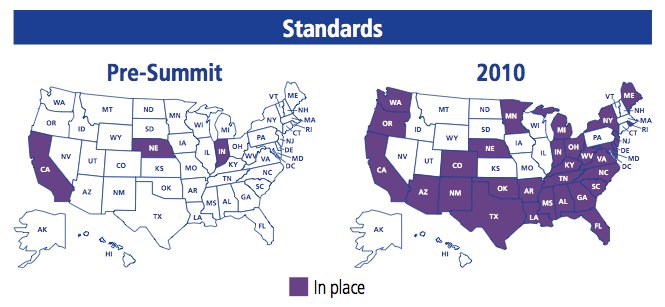
Achieve’s fifth annual “Closing the Expectations Gap” report finds that the majority of states, 31, now have high school standards in English and mathematics that align with the expectations of colleges and business. (Meaning that collegiate and business officials were involved in drafting the standards and approved the final product.) In 2005, by contrast, only three states had such standards.

Complete report here, which mentions:

Four additional states: new Hampshire, New Mexico, Wisconsin and Wyoming reported plans to administer college and career ready assessments, although their plans are not yet developed enough to include in the table on page 16.

Share

Blaska’s Blog says let education compete for business

David Blaska:

Government-run, union-controlled education is as antiquated in 21st Century America as a mimeograph machine and as outdated as the New Deal.
The entire history of this great country is choice — except in the all-important field of education, wherein one size shall fit all.
Imagine an America restricted to one mobile cell phone provider, one television station, never mind cable or satellite, one car insurance company — that is the government-monopoly education system.
Confreres, here is change you can believe in. In the previous blog, I engaged in a colloquy with the delusional Matt Logan, who encourages us law and order types to volunteer for school breakfast. I’m game, but think we’d be welcome?
Imagine the Blaska Man grabbing the empty belt loop of a gangsta wannabe and saying, “Time-out, young fella.”
The kid would laugh at my time out as they laugh at the teachers’ time outs and the squire of Stately Blaska Manor would be brought up on charges of belt-loop grabbing with intent to instill values.

Share

Margaret Spellings defends ‘No Child Left Behind’

Share

Seeking the Definition of a “Quality School”

Southeast Seattle for an Excellent Education:

SES4EE requests
1. SPS to publicly define a Quality School (as stated in SPS Strategic Plan Vision 2008) which will include objective measures of that quality.
2. SPS to compare each SE School to that definition of a Quality School and make those results available in a public manner.
3. For each school that does not fall within the parameter of a Quality School, SPS to provide
a. a public, written Plan with specific deadlines and timeframe to make that school a Quality School.

Share

Teachers Criticise Australia’s National Education Curriculum

Big Pond News:

Teachers have criticised the federal government’s draft national education curriculum, saying such a document alone won’t improve educational outcomes.
Australian Education Union president Angelo Gavrielatos says they’re also disappointed because there should have been more teacher involvement in the curriculum’s development.
Mr Gavrielatos says a curriculum document alone won’t improve educational outcomes and what teachers need are more resources.

Share

Leaders Program Suffers for Lack of Milwaukee Public Schools Support

Alan Borsuk:

A startling ebb tide has been building in recent days across the Milwaukee Public Schools system, as principals and school councils make plans for next year.
Schools losing two teachers. Six teachers. A dozen teachers. More cuts in music, gym and art teachers, as well as librarians. Class sizes increasing – some principals say they are facing 25 or 30 in first-grade classes, with no aides for the teachers. High school classes that could reach 50 or more in some high schools. (“That’s not a classroom, that’s a lecture hall,” one principal said.)
Here’s one important part of that tide: New Leaders for New Schools will not launch a new class this summer to be trained as principals in MPS.
New Leaders is one of the hot acts in American education. Like Teach for America, the New Teacher Project and a few similar efforts, it is a hard-driving effort to bring talent into administrative and teaching positions in urban schools across the country.

Share

Getting Tough in Kansas City

Frederick Hess:

Across the nation, districts are only enduring the first phase of what is likely a several-year stretch of tough budgets. Why? First, property taxes account for so much of school spending, residential real estate prices are only now bottoming, commercial properties will be falling into 2011, and states adjust valuation on a rolling basis. This means the impact of the real estate bubble likely won’t fully play out until 2014 or so. Second, thus far, districts have been cushioned by more than $100 billion in stimulus funds. Third, going forward, K-12 is going to be competing with demands for Medicaid, transportation, public safety, and higher education–all of which have been squeezed and will be hungry for fresh dollars when the economy recovers. And, fourth, massively underfunded state and local pension plans will require states to redirect dollars from operations. All of this means that the funding “cliff” looming in 2010 to 2011 is steeper and likely to be with us longer than most district leaders have publicly acknowledged.
Early responses to this situation have been inadequate, to put it mildly. Districts first took out the scalpel and turned up thermostats, delayed textbook purchases, and reduced maintenance. Now they’re boosting class sizes, raising fees, and zeroing out support staff and freshmen athletics. It’s going to take a lot more for districts to thrive in their new fiscal reality. It would behoove them to take a page from the playbook of new Kansas City Superintendent John Covington.

Share

More schools add online class options to traditional schedules

Erin Richards:

When Lindsey Lecus heads to the library for her literature studies class at Fritsche Middle School, she checks the assignments posted by her teacher in Maine and may enter a discussion forum with a classmate in Switzerland.
It’s the second online English class Lecus has taken thanks to Fritsche’s partnership with an international provider of online courses, and the seventh-grader said she likes the fact that she can work ahead of the traditional curriculum and earn credits toward high school.
In Milwaukee and elsewhere, more middle and high schools are starting to offer online classes to students during the day in place of one or more face-to-face classes.
Fully virtual schools in Wisconsin continue to attract students who pursue their entire educations through the Internet, but adding online classes to the options students have during a traditional school day is a trend that may combine the best of both worlds.
Advocates say students learn to work independently and can take harder courses in preparation for college while also getting in-school support from teachers and peers.

Share

District May End North Carolina Economic Busing Program

Robbie Brown:

When Rosemarie Wilson moved her family to a wealthy suburb of Raleigh a couple of years ago, the biggest attraction was the prestige of the local public schools. Then she started talking to neighbors.
Don’t believe the hype, they warned. Many were considering private schools. All pointed to an unusual desegregation policy, begun in 2000, in which some children from wealthy neighborhoods were bused to schools in poorer areas, and vice versa, to create economically diverse classrooms.
“Children from the 450 houses in our subdivision were being bused all across the city,” said Ms. Wilson, for whom the final affront was a proposal by the Wake County Board of Education to send her two daughters to schools 17 miles from home.
So she vented her anger at the polls, helping elect four new Republican-backed education board members last fall. Now in the majority, those board members are trying to make good on campaign promises to end Wake’s nationally recognized income-based busing policy.

Share

2009-2010 Madison School District Equity Report

Complete Report 700K PDF

Share

Teacher Layoffs: Rethinking “Last-Hired, First-Fired” Policies

National Council on Teacher Quality:

In September of 2009, Washington, DC, schools Chancellor Michelle Rhee laid off nearly 400 teachers, citing a serious shortfall in funds for the DC school system. The move, coming as it did after Washington hired more than 900 new teachers in the summer of 2009, made jaws drop — some in outrage, some in awe. But the controversy was due only partly to the fact that Rhee axed jobs so close on the heels of a hiring spree; she also took full advantage of a clause in DC regulation that made “school needs,” not seniority, the determining factor in who would be laid off.
Approve of Rhee’s move or not, the highly scrutinized and controversial layoffs spotlight an important question: what factors should be considered when school districts must decide who will stay and who will go?
In the past year, cash-strapped districts have been handing out pink slips by the hundreds, and some, by the thousands. The Bureau of Labor Statistics estimates that nearly 60,000 teachers were laid off in 2009. State budget gaps and deficit projections, with federal stimulus funding already spent, suggest more of the same for 2010. Some observers expect current cuts to come faster even than those of the 1970s, when the baby boom generation waned, emptying out schools across the country.

Share

Obama’s unfortunate comments on teacher firings

Valerie Strauss:

I have an uncle who was for years a Chicago public school teacher. Passionate and articulate about his subject, biology, Arnie cared a great deal about whether the kids learned in his class.
But here’s the disturbing thing he recalls about his career:
In the years that his classes were filled with kids from poor, broken homes who didn’t eat or sleep with any regularity, he worried that he wasn’t nearly as effective as he wanted to be. He reached some of the kids, sometimes, with some material, but not enough to his liking, no matter what he did or how hard he tried.
When he changed schools and suddenly was teaching kids from middle-class families who valued education, he instantly became a brilliant teacher. His students progressed at a fast clip, and everything he did seemed to work.
What some school reformers seem to forget is that the kids’ circumstances outside school affect their class performance: how much they eat, how much they sleep, how many words they heard when they were young, how many books were made available to them, the abilities and the disabilities with which they were born, etc.

Share

Idaho School Budgets Face 7.5 Percent Cut in 2011

Business Week:

Idaho schools will likely make do with 7.5 percent less in total funding next year, according to a plan that includes reducing salaries for first-year teachers.
The Joint Finance-Appropriations Committee aims to give schools $128 million less in fiscal year 2011 than they’re getting this year from all funding sources. State general fund spending is due to drop 1.4 percent, to $1.21 billion.

Share

A Partial Madison School District Budget Update, Lacks Total Spending Numbers

Madison School District Superintendent Dan Nerad 292K PDF:

In November of 2008 the district was given voter approval for a three year operating referendum: $5 million in 2009-2010, $4 million in 2010-2011, and $4 million in 2011-2012, The approved operating referendum has a shared cost plan between property tax payers and the district.
During the fall adoption of the 2009-2010 budget the Board of Education worked to reduce the impact for property tax payers by eliminating costs, implementing new revenues, and utilizing fund balance (see Appendix A). The Wisconsin State 2009-2011 budget impacted the district funding significantly in the fall of2009-2010 and will again have an impact on the 2010-2011 projections.
The district and PMA Financial Network, Inc, have worked to prepare a five year financial forecast beginning with the 2010-2011 budget year, which is attached in pgs 1-2.
2010-2011 Projection Assumptions:
The following items are included in the Budget Projection:
1. The budget holds resources in place and maintains programs and services.
2. October enrollment projections
3. Salary and Benefits – Teacher salary projections are based on their current settlement, and all other units are at a projected increase consistent with recent contract settlements.
4. Supplies & Materials – A 1% (~$275,000) projection was applied to supply and material budgets each year
5. Revenues – The district utilized revenue limit and equalization aid calculations based on the 2009-2011 State Budget. All other revenues remained constant.
6. Grants – Only Entitlement Grants are included in the forecasted budget. Example ARRA funds are not included as they areĀ· not sustainable funds.
7. Debt – The forecast includes a projection for the WRS refinancing as of January 26th Attached on pgs 3-4 is a current Debt Schedule for the District which includes thecurrently restructured debt and the estimated WRS refinanced debt.
8. The 4-k program revenues, expenditures and enrollment have been added to the
projections beginning in 2011-2012.

Much more on the budget, including some total budget numbers via a Board Member’s (Ed Hughes) comment. The recent State of The District presentation lacked total budget numbers (it presented property taxes, which are certainly important, but not the whole story). There has not been a 2009-2010 citizen’s budget, nor have I seen a proposed 2010-2011 version. This should be part of all tax and spending discussions.

Share

More on the Madison School District High School’s Use of Small Learning Communities & A Bit of Deja Vu – A Bruce King Brief Evaluation

Pam Nash 4.5MB PDF:

Introduction and Overview
1. Background and Overview Daniel A. Nerad, Superintendent of Schools
Prior to the fall of 2008, MMSD high schools functioned as four separate autonomous high schools, with minimal focus on working collaboratively across the district to address student educational needs.
In 2008 MMSD received a Federal Smaller Learning Communities for $5.3 million dollars over a five year period. The purpose of that grant is to support the large changes necessary to:

  • Increase student achievement for all students.
  • Increase and improve student to student relationships and student to adult relationships.
  • Improve post-secondary outcomes for all students.

District administration, along with school leadership and school staff, have examined the research that shows that fundamental change in education can only be accomplished by creating the opportunity for teachers to talk with one another regarding their instructional practice. The central theme and approach for REaL has been to improve and enhance instructional practice through collaboration in order to increase stndent achievement. Special attention has been paid to ensure the work is done in a cross – district, interdepartmental and collaborative manner. Central to the work, are district and school based discussions focused on what skills and knowledge students need to know and be able to do, in order to be prepared for post-secondary education and work. Systemized discussions regarding curriculum aligll1nent, course offerings, assessment systems, behavioral expectations and 21 st century skills are occurring across all four high schools and at the district level.
Collaborative professional development has been established to ensure that the work capitalizes on the expertise of current staff, furthers best practices that are already occurring within the MMSD high school classrooms, and enhances the skills of individuals at all levels from administration to classroom teachers needed. Our work to date has laid the foundation for further and more in-depth work to occur.
While we are at the formative stages of our work, evidence shows that success is occurring at the school level. Feedback from principals indicates that district meetings, school buildings and classrooms are feeling more collaborative and positive, there is increased participation by teachers in school based decisions, and school climate has improved as evidenced by a significant reduction in behavior referrals.
This report provides a summary of the REaL Grant since fall of2008 and includes:
1. Work completed across all four high schools.
2. School specific work completed.
3. District work completed.
4. REaL evaluation
5. Future implications
In addition the following attachments are included:
1. Individual REaL School Action Plans for 09-10
2. REaL District Action for 09-10
3. ACT EP AS Overview and Implementation Plan
4. AVID Overview
5. Templates used for curriculum and course alignment
6. Individual Learning Plan summary and implementation plan
7. National Student Clearninghouse StudentTracker System
8. Student Action Research example questions
2. Presenters

  • Pam Nash, Assistant Superintendent of Secondary Schools
  • Darwin Hernandez, East High School AVID Student
  • Jaquise Gardner, La Follette High School AVID Student
  • Mary Kelley, East High School
  • Joe Gothard, La Follette High School
  • Bruce Dahmen, Memorial High School
  • Ed Holmes, West High School
  • Melody Marpohl, West High School ESL Teacher

3. Action requested of the BOE
The report is an update, providing information on progress of MMSD High Schools and district initiatives in meeting grant goals and outlines future directions for MMSD High schools and district initiatives based on work completed to date.

MMSD has contracted with an outside evaluator, Bruce King, UW-Madison. Below are the initial observations submitted by Mr. King:
The REaL evaluation will ultimately report on the extent of progress toward the three main grant goals. Yearly work focuses on major REaL activities at or across the high schools through both qualitative and quantitative methods and provides schools and the district with formative evaluation and feedback. During the first two years ofthe project, the evaluation is also collecting baseline data to inform summative reports in later years of the grant. We can make several observations about implementation ofthe grant goals across the district.
These include:
Observation 1: Professional development experiences have been goal oriented and focused. On a recent survey of the staff at the four high schools, 80% of responding teachers reported that their professional development experiences in 2009-10 were closely connected to the schools’ improvement plans. In addition, the focus of these efforts is similar to the kinds of experiences that have led to changes in student achievement at other highly successful schools (e.g., Universal Design, instructional leadership, and literacy across the curriculum).
Observation 2: Teacher collaboration is a focal point for REaL grant professional development. However, teachers don’t have enough time to meet together, and Professional Collaboration Time (PCT) will be an important structure to help sustain professional development over time.
Observation 3: School and district facilitators have increased their capacity to lead collaborative, site-based professional development. In order for teachers to collaborate better, skills in facilitation and group processes should continue to be enhanced.
Observation 4: Implementing EP AS is a positive step for increasing post-secondary access and creating a common assessment program for all students.
Observation 5: There has been improved attention to and focus on key initiatives. Over two- thirds ofteachers completing the survey believed that the focus of their current initiatives addresses the needs of students in their classroom. At the same time, a persisting dilemma is prioritizing and doing a few things well rather than implementing too many initiatives at once.
Observation 6: One of the important focus areas is building capacity for instructional leadership, work carried out in conjunction with the Wallace project’s UW Educational Leadership faculty. Progress on this front has varied across the four schools.
Observation 7: District offices are working together more collaboratively than in the past, both with each other and the high schools, in support of the grant goals.
Is it likely that the four high schools will be significantly different in four more years?
Given the focus on cultivating teacher leadership that has guided the grant from the outset, the likelihood is strong that staff will embrace the work energetically as their capacity increases. At the same time, the ultimate success ofthe grant will depend on whether teachers, administrators, anddistrict personnel continue to focus on improving instruction and assessment practices to deliver a rigorous core curriculum for all and on nurturing truly smaller environments where students are known well.

Related:

Share

What happens to Madison’s bad teachers?

Lynn Welch:

It’s absurd to believe anyone wants ineffective teachers in any classroom.
So when President Barack Obama, in a speech last fall at Madison’s Wright Middle School, called for “moving bad teachers out of the classroom, once they’ve been given an opportunity to do it right,” the remark drew enormous applause. Such a pledge is integral to the president’s commitment to strengthen public education.
But this part of Obama’s Race to the Top agenda for schools has occasioned much nervousness. Educators and policymakers, school boards and school communities have questions and genuine concern about what it means. What, exactly, is a bad teacher, and how, specifically, do you go about removing him or her from a classroom?
Many other questions follow. Do we have a “bad teacher” problem in Madison? Does the current evaluation system allow Madison to employ teachers who don’t make the grade? Is our system broken and does it need Obama’s fix?
A look into the issue reveals a system that is far from perfect or transparent. But Madison school board President Arlene Silveira agrees it’s an issue that must be addressed.

Share

United STATES Coalition for World Class Math!

via a Jill Gladstone email:

The Florida State DOE posted (leaked) the January 13th confidential draft of the Common Core Standards in their Race to the Top Application. Thank you Florida!
Read them here:
January 13th Draft of Common Core Mathematics.pdf
January 13th Draft of Common English-language Arts.pdf
A few of NJ Coalition for World Class Math’s Major Concerns on Jan. 13, 2010 Mathematics draft:

Share

K-12 Tax & Spending Climate: Class War How public servants became our masters

Steven Greenhut:

In April 2008, The Orange County Register published a bombshell of an investigation about a license plate program for California government workers and their families. Drivers of nearly 1 million cars and light trucks–out of a total 22 million vehicles registered statewide–were protected by a “shield” in the state records system between their license plate numbers and their home addresses. There were, the newspaper found, great practical benefits to this secrecy.
“Vehicles with protected license plates can run through dozens of intersections controlled by red light cameras with impunity,” the Register’s Jennifer Muir reported. “Parking citations issued to vehicles with protected plates are often dismissed because the process necessary to pierce the shield is too cumbersome. Some patrol officers let drivers with protected plates off with a warning because the plates signal that drivers are ‘one of their own’ or related to someone who is.”
The plate program started in 1978 with the seemingly unobjectionable purpose of protecting the personal addresses of officials who deal directly with criminals. Police argued that the bad guys could call the Department of Motor Vehicles (DMV), get addresses for officers, and use the information to harm them or their family members. There was no rash of such incidents, only the possibility that they could take place.

Share

Portland School Board approves new contract with district teachers

Kimberly Melton:

The Portland School Board this morning unanimously approved a three-year contract between Portland Public Schools and the district’s nearly 4,000 teachers.
The new contract gives teachers a 2 percent cost-of-living pay increase in 2008-09 and in 2010-11. For 2009-10, teachers will receive no pay raise. The district gained the ability to extend the student day, which means additional support and tutoring classes could be available to kids before or after school.
“The important message is that we’re trying to balance the challenges of the economy with being fair to our teachers,” board co-chair Trudy Sargent said after the vote, “and I think the 0 percent cola in the current year, which has been a really tough year for everybody … that was an important place to balance the budget and teachers were willing to sacrifice in that year.”
Added schools Supt. Carole Smith: “We hit a sweet spot of being able to both protect services to students and reflect the tough economic times that we’re in.”

KATU:

The Portland School Board voted unanimously Saturday to approve a three-year contract between Portland Public Schools and the Portland Association of Teachers, ending a negotiation that has stretched on for more than a year and a half.
“This agreement allows us to live within our means,” said Portland School Board co-chair Trudy Sargent in a prepared statement Saturday. She said it garners two goals: It “increases instructional time for students and honors the good work of educators in Portland Public Schools,” Sargent said.
Key details of the approved contract agreement include:

Related: Madison School District & Madison Teachers Union Reach Tentative Agreement: 3.93% Increase Year 1, 3.99% Year 2; Base Rate $33,242 Year 1, $33,575 Year 2: Requires 50% MTI 4K Members and will “Review the content and frequency of report cards”.

Share

An Update on the Madison School District’s Efforts to Increase Teacher Use of the “Infinite Campus” Student Portal

Superintendent Dan Nerad 2.1MB PDF:

The Board of Education has shown concern with current levels of participation among staff, parents, and students in the use of the Infinite Campus student information system. This concern comes despite many efforts to engage the stakeholders with various professional development opportunities and promotional campaigns over the past three years. In December 2009, the Board was provided a summary from a staff survey conducted on the topic explaining why staff had been reluctant to use the teacher tools. That report is found as an attachment to this report (see Attachment 1).
A survey of Wisconsin school districts was completed to determine the standards for teacher use of student information system technologies in the state. The survey gathered information about the use of grade book, lesson planners, and parent and student portals. Responses were collected and analyzed from over 20 Wisconsin districts. Nearly all responding districts report either a requirement for online grade book use, or have close to 100 percent participation. (See Attachment 2).
Describe the action requested of the BOE
The administration is requesting that the Board of Education take action in support of the proposed action steps to enhance the overall use of the teacher and portal tools among our stakeholders.
The proposed time line for full teacher use of grade level appropriate Infinite Campus teacher tools is: High school teachers – 2011-2012 End of 4th Quarter, Middle school teachers – 2010-2011 End of 4th Quarter, Elementary school teachers – End of 4th Quarter, 2011-2012 (calendar feature only)

Fascinating tone. I support the Board’s efforts to substantially increase usage of this system. If it cannot be used across all teachers, the system should be abandoned as the District, parents and stakeholders end up paying at least twice in terms of cost and time due to duplicate processes and systems.

Share

Problem children should be helped, not excluded, says schools report

Anushka Asthana:

The system of excluding badly behaved pupils from school should be abolished because it punishes the most vulnerable children, a major new report on education has concluded, writes Anushka Asthana.
The study, by the thinktank Demos, says that difficult children are being pushed out of schools too often and finds that exclusions do not solve behavioural problems. Instead, they are linked to very poor results and in three out of four cases relate to children with special educational needs who should receive additional support. The report finds that 27% of children with autism have been excluded from school.
Sonia Sodha, co-author of the report, said: “Most other countries do not permanently exclude children from school in the same way we do. Instead of helping these children, we are punishing and then banishing them.”
The report comes as figures from the Conservatives show that 1,000 pupils are excluded or suspended for physical and verbal assaults every day. Speaking at the Tory party spring conference, Michael Gove, shadow children’s secretary, promised that in power he would make it easier for teachers to remove violent and disruptive pupils.

Share

Starting them young: Nursery schools are the latest front-line in the Scandinavian integration debate

The Economist:

N SOFT, southern countries, snow is enough to close schools. In Sweden–a place that lives by the maxim that “There is no such thing as bad weather, just the wrong clothes”–fresh snow is a cue to send 18-month-olds into the playground, tottering around in snowsuits and bobble hats. It is an impressive sight at any time. But it is particularly striking in a Stockholm playground filled with Somali toddlers, squeaking as they queue for sledge-rides.
The playground belongs to Karin Danielsson, a headmistress in Tensta, a Stockholm suburb with a large immigrant population. Mrs Danielsson calls her municipal preschool “a school for democracy”. In keeping with Swedish mores, even young children may choose which activities to join or where to play. All pupils’ opinions are heard, but they are then taught that the group’s wishes must also be heeded.
Swedes take preschool seriously. Though education is not compulsory until seven, more than 80% of two-year-olds are enrolled in preschool, and many begin earlier. Among European countries only Denmark has higher enrolment rates at that age.

Share

Book: From A Wisconsin Soapbox

Mark H. Ingraham Dean Emeritus, College of Letters & Science, University of Wisconsin
Professor Emeritus of Mathematics, University of Wisconsin [Click to view this 23MB PDF “book”]:

Contents
Preface
Part I Liberal Education
The Omnivorous Mind 3
Given May 16, 1962, to the University of Wisconsin Chapter of Phi Beta Kappa. Republished from The Speech Teacher of September 1962.
Truth-An Insufficient Goal 17
The Keniston Lecture for 1964 at the University of Michi- gan; March 17, 1964. Republished from the Michigan Quarterly Review of July 1964.
On the Adjective “Common” 31
An editorial for the February 1967 Review of the Wisconsin Academy of Arts, Letters, and Sciences, February 23, 1967.
Part II Educational Policy
Super Sleep-A Form of Academic Somnambulism 37
First given as retiring address as President of A.A. U.P . This much revised version was given to the Madison Literary Club, March 12, 1940.
No, We Can’t; He Has a Committee Meeting 57
Madison Literary Club; May 11, 1953.
Is There a Heaven and a Hell for Colleges? 70
Commencement address, Hiram College; June 8, 1958.
The College of Letters and Science 79
Talk given to the Board of Regents of the University of Wisconsin, May 3, 1958.
Some Half Truths About the American Undergraduate 84
Orientation conference for Whitney-Fulbright Visiting Scholars. Sarah Lawrence College, September 6, 1962.
Maps Versus Blueprints 94
Honors Convocation, University of Wisconsin, May 18, 1973.
Part III To Students
A Talk to Freshmen 103
University of Wisconsin; September 18, 1951
Choice: The Limitation and the Expression of Freedom 112
Honors Convocation, University of Wisconsin; June 17, 1955. Republished from the Wisconsin Alumnus.
“The Good is Oft Interred with Their Bones” 121
Commencement, University of Wisconsin-Oshkosh; Janu- ary 19, 1968.
Talk at Honors Convocation at Ripon College
Talk at Honors Convocation at Ripon College 129
April 9, 1969
The Framework of Opportunity 136
Thanksgiving Address, University of Wisconsin; November, 1947
Part IV A Little Fun
Food from a Masculine Point of View 149
Madison Literary Club; November 11, 1946
On Telling and Reading Stories to Children 165
Attic Angel Tower, Madison, Wisconsin; March 6, 1978
Three Limericks 179
Fragments 181
a. From an address given to the University oF Wyoming Chapter of Phi Beta Kappa, April 26, 1965
b. A comment
Part V Somewhat Personal
Letter of Resignation from Deanship 185
April 5, 1961
Retirement Dinner Talk 188
May 24, 1966

Thanks to Richard Askey for extensive assistance with this digitized book. Search Mark Ingraham.

Share

Parent Feedback on the Madison School District’s “Branding” Expenditures

via a kind reader’s email: Parent Diane Harrington:

Dear Board Members, Dr. Nerad, and Madison Alders,
My 11-year-old and I visited John Muir Elementary for basketball practice one recent evening. Their gym has banners noting that for several years they’ve been named a “School of Excellence.”
Ben’s school, Orchard Ridge Elementary, had just been dubbed a “School of Promise.”
Which school would YOU rather go to?
But Ben didn’t need a marketing effort to tell him which school was which; he knows some John Muir kids. Ben, too, would like to go to a school where kids are expected to learn and to behave instead of just encouraged to.
Just like those banners, the very idea of your upcoming, $86,000 “branding” effort isn’t fooling anyone.
You don’t need to improve your image. You need to improve your schools.
Stop condescending to children, to parents and to the public. Skip the silly labels and the PR plans.
Instead, just do your #^%* job. (If you need help filling in that blank, head to ORE or Toki. Plenty of kids – some as young as kindergarten – use several colorful words in the hallways, classrooms, lunchroom and playground without even a second look, much less disciplinary action, from a teacher or principal.)
Create an environment that strives for excellence, not mediocrity. Guide children to go above and beyond, rather than considering your job done once they’ve met the minimum requirements.
Until then, it’s all too obvious that any effort to “cultivate relationships with community partners” is just what you’re branding it: marketing. It’s just about as meaningless as that “promise” label on ORE or the “honor roll” that my 13-year-old and half the Toki seventh graders are on.
P.S. At my neighborhood association’s annual Winter Social earlier tonight, one parent of a soon-to-be-elementary-age child begged me to tell him there was some way to get a voucher so he could avoid sending his daughter to ORE. His family can’t afford private school. Another parent told me her soon-to-be-elementary-age kids definitely (whew!) were going to St. Maria Goretti instead of ORE. A friend – even though her son was finishing up at ORE this year – pulled her daughter out after kindergarten (yes, to send her to Goretti), because the atmosphere at ORE is just too destructive and her child wasn’t learning anything. These people aren’t going to be fooled by a branding effort. And you’re only fooling yourselves (and wasting taxpayer money) if you think otherwise.

Parent Lorie Raihala:

Regarding the Madison School District’s $86,000 “branding campaign,” recent polls have surveyed the many families who have left the district for private schools, virtual academies, home schooling or open enrollment in other districts.
Public schools are tuition free and close to home, so why have these parents chosen more expensive, less convenient options? The survey results are clear: because Madison schools have disregarded their children’s learning needs.
Top issues mentioned include a lack of challenging academics and out-of-control behavior problems. Families are leaving because of real experience in the schools, not “bad press” or “street corner stories.”
How will the district brand that?
Lorie Raihala Madison

Share

Excellence in Action: Seven Core Principles

Foundation for Excellence in Education:

High academic standards: High academic standards are based on the principle that all students can learn. Raising expectations for what students are required to learn in the classroom will better prepare students for success. Standards in core subjects must be raised to meet international benchmarks to ensure American students can compete with their peers around the globe.
Standardized measurement: To provide an accurate depiction of where our students are, annual standardized testing must be continued and expanded in all 50 states. Measuring whether students are learning a year’s worth of knowledge in a year’s time is essential for building on progress, rewarding success and correcting failures. To accurately measure progress, modern data and information systems should be utilized, and there must be maximum transparency across the board.
Data-driven accountability: Holding schools accountable for student achievement – measured objectively with data such as annual standardized tests and graduation rates – improves the quality of an education system. Success and learning gains no longer go unnoticed and problems are no longer ignored, resulting in efforts to effectively narrow achievement gaps.

Tom Vander Ark has more.

Share

Boarding school spreads message to Milwaukee Public Schools’ kids

Erin Richards:

Standing outside a snow-covered garden at Nature’s Classroom Institute, teacher Dave Oyama poses a question to the group of bundled-up elementary-school children from Milwaukee:
“Though it’s not in use right now, this garden is organic. Does anyone know what organic means?”
Brows furrow. A few mittens go up. One child guesses “healthy.” Another thinks the word means “whole grains.”
On their second day at the Nature’s Classroom Institute, a residential environmental science school near Mukwonago, the children from Craig Montessori School are in the middle of a lesson that looks different than their traditional classroom work in the city.
As members of a pilot project between Milwaukee Public Schools and the nonprofit institute, the 25 students from Craig are the first from MPS to stay at the facility on 600 picturesque acres in northeastern Walworth County.
The students’ tuition from Feb. 16-19 was funded by an anonymous $6,000 grant from a Chicago donor, but organizers hope that the pilot will prompt fund raising to allow more city students to participate next years.

Share

The charter school test case that didn’t happen

Howard Blume:

If they hadn’t been mostly shut out of bids to run a slew of new L.A. Unified campuses, the groups might have demonstrated how they handle students with challenging needs.
Los Angeles school officials lost a chance this week to test whether the booming charter movement can take on all the problems of the district’s traditional, and often troubled, schools.
On Tuesday, the Board of Education denied proposals from three major charter organizations that had sought to run newly built neighborhood schools, which would have included substantial numbers of limited-English speakers, special education students, foster children and low-income families.
That is exactly the population that charter schools have been criticized for not sufficiently reaching.
Charters are independently managed and exempt from some rules that govern traditional schools. They’re also schools of choice — campuses that parents seek and select. And researchers have found that charters enroll fewer students with more challenging, and often more expensive, needs.

Share

Virginia acts to limit use of exam for special-ed students after criticism

Michael Alison Chandler:

Virginia officials are moving to sharply limit an alternative testing program that many schools in the Washington suburbs use to measure the abilities of special education students who traditionally have fared poorly on the state’s Standards of Learning exams.
The effort by state lawmakers and education officials targets “portfolio” tests, which have helped increase passing rates at many schools by allowing students to avoid the multiple choice tests in favor of more flexible, individually tailored assessments. Critics have said that the alternative tests undermine Virginia’s widely praised accountability system and overstate the progress districts are making in closing achievement gaps between racial groups.

Share

It’s not just Lower Merion!: Bronx school watches unwitting students via Webcam

Holly Otterbein

In this week’s A Million Stories, we explored the messy Webcam scandal that’s going down at Lower Merion School District. The district insists that it only peered through students’ Webcams in order to find lost or stolen laptops, and did so using a security software called LANrev. Insanely enough, Douglas Young, the district’s spokesperson, told us that it wasn’t the only school district using such software: “The software feature isn’t just utilized in this school district,” says Young. “It’s utilized by other school districts and organizations.” (He said he couldn’t name any offhand.)

Share

Business principles won’t work for school reform, former supporter Ravitch says

Nick Anderson:

For those who believe that performance pay and charter schools pose a threat to public education and that a cult of testing and accountability has hijacked school reform, an unlikely national spokeswoman has emerged.
Diane Ravitch, an education historian, now renounces many of the market-oriented policies she promoted as a former federal education official with close ties to Democrats and Republicans. In large part because of her change of heart, Ravitch’s critique of the reform ideas that prevail in government, philanthropies and think tanks is reverberating in the world of education.
“In choosing his education agenda, President Obama sided with the economists and the corporate-style reformers,” Ravitch writes in her book “The Death and Life of the Great American School System,” circulating in advance of its general release Tuesday.
She stoutly defends teachers unions, questions the value of standardized test data and calls the president’s affinity for independently operated charter schools “puzzling.”

Share

Charter schools take PEP meeting as chance to launch PR blitz

Maura Walz:

Last night’s Panel for Educational Policy meeting was the second in as many months to be packed to the gills with parents and teachers passionately pleading their case.
But this time it was charter school parents, not teachers and parents at closing district schools, who drove to the meeting in busloads.
“What we are pleading for this evening is space,” Trevor Alfred, a parent at Explore Empower Charter School, told the panel. “We deserve it.”
At first blush, the level of passion, and sometimes anger, directed towards the panel could seem odd. Although 16 school space proposals were up for a vote, the board had never voted down a city proposal, and none of the charter school proposals on the agenda yesterday was defeated.

Share

Protests and Promises of Improvements at Chicago Schools

Crystal Yednak:

Josephine Norwood, a Bronzeville mother of three Chicago public school students, has rebounded from two rounds of school closings that displaced her children from their schools. As she watched the Board of Education approve another set of schools for closing or turnaround last week, Mrs. Norwood had a simple question: Can Chicago Public Schools officials promise that the new schools will be better?
“If this process could guarantee the child the best and they would benefit from the school closing, then maybe it is a positive thing,” Mrs. Norwood said. But she spoke out last week, along with many others, about the need for more transparency and proof that the disruptions are warranted.
As the public schools system entered its annual process of selecting schools for closing or turnarounds, parents, teachers and community groups leveled criticism at school officials for the lack of communication with the communities involved and questioned data from the central office that does not match the reality in the schools. Some also pleaded for the district to delay any action until the corrective measures taken at the lowest-performing schools — the wholesale turnover of administrators and teachers — could be better evaluated and a comprehensive plan for school facilities could be developed by a new task force.

Share

Going with the Google for School District Email

Peter Sobol:

Technology director Bill Herman has migrated the district’s email over to Google. Our new email addresses are firstname.lastname@mgschools.net. You can still continue to use the old addresses so the change should be transparent from the outside. The change is motivated by a desire to provide a more reliable system with less maintenance and support.

A few related links:

Share

The Proposed Madison School District Administrative Reorganization Plan

Superintendent Dan Nerad, via an Arlene Silveira email 1.4MB PDF:

Processes of the Administration
The following administrative processes are currently being utilized to provide administrative leadership within the district:

  1. Superintendent’s Management Team Comprised of the Superintendent and department administrators, this team meets weekly and serves as the major decision making body of the administration.
  2. Strategic Plan Monitoring and Support
    The Superintendent meets monthly with administrators with lead responsibility for the five priority strategies within the Strategic Plan.
  3. Superintendents-Assistant Superintendents, Chief of Staff and Executive Director, Human Resources
    The Superintendent meets weekly with the Assistant Superintendents, Chief of Staff and Executive Director of Human Resources to discuss key operational issues.
  4. Board Liaison Team
    The Board Liaison Team, consisting of designated administrators, meets three times a month to coordinate Board agenda planning and preparation. District Learning Council The District Learning Council consists of curriculum, instruction and assessment related administrators and teacher leaders. This council meets bi-weekly to discuss major instructional issues in the district and provides coordination across related departments.
  5. Department Meetings Administrators assigned to each department meet as needed.
  6. Principal Meetings Assistant Superintendents meet minimally one time per month with all principals
  7. Committee Meetings
    There are numerous administrative/staff committees that meet as specific tasks require.

General Strengths of the Current Administrative Structure
The strengths of the current administrative structure within the district are as follows:

  1. The basic structure of our district has been in place for many years. As a result, the current department structure is known by many and has predictable ways of operating.
      There exist needed checks and balances within the current system, given the relative equal status of the departments, with each department leader along with the Assistant Superintendents and Chief of Staff directly reporting to the Superintendent of Schools.

    General Weaknesses of the Current Administrative Structure
    The weaknesses of the current administrative structure within the district are as follows:

    1. The degree to which the mission-work of the district, teaching and learning, is central to the function of administration is of concern especially in the way professional development is addressed without a departmental focus.
    2. Traditional organizational structures, while having a degree of predictability, can become bureaucratically laden and can lack inventiveness and the means to encourage participation in decision making.

    Organizational Principles
    In addition to the mission, belief statements and parameters, the following organizational principles serve as a guide for reviewing and defining the administrative structure and administrative processes within the district.

    1. The district will be organized in a manner to best serve the mission of the district .and to support key district strategies to accomplish the mission.
    2. Leadership decisions will be filtered through the lens of our mission.
    3. Central service functions will be organized to support teaching and learning at the schools and should foster supportive relationships between schools and central service functions.
    4. The district’s organizational structure must have coherence on a preK-12 basis and must address the successful transition of students within the district.
    5. The district will be structured to maximize inter-division and intra-division collaboration and cooperation.
    6. The district’s organizational structure must have an orientation toward being of service to stakeholders, internally and externally.
    7. The district must be organized in a manner that allows for ongoing public engagement
      and stakeholder input.

    8. To meet the district’s mission, the district will embrace the principles of learning organizations, effective schools, participative and distributive leadership and teamwork.
    9. The district will make better use of data for decision making, analyzing issues, improving district operations, developing improvement plans and evaluating district efforts.
    10. The need for continuous improvement will be emphasized in our leadership work.
    11. Ongoing development and annual evaluation of district leaders is essential.

    Leadership Needs
    Given these organizational principles, as well as a review of the current administrative structure and administrative processes within the district, the following needs exist. In addition, in the development of this plan, input was sought from all administrators during the annual leadership retreat, individual Management Team members and individual members of the Board of Education. These needs were specifically referenced in identifying the recommended changes in our administrative structure and related administrative processes that are found in this report.

    1. There is a need to better align the administrative structure to the district’s mission and Strategic Plan and to place greater priority on the mission-work of our organization (improved achievement for all students and the elimination of achievement gaps).
    2. From an administrative perspective, the mission-work of our district is mainly delivered through teaching and learning and leadership work being done in our schools. Central service functions must act in support of this work. In addition, central service functions are needed to ensure constancy of focus and direction for the district.
    3. New processes are needed to allow for stakeholder engagement and input and to create greater inter-department and division collaboration and cooperation
    4. The mission of the district must be central to decisions made in the district.
    5. The organizational structure must support PreK -12 articulation and coordination needs within the district.
    6. Leadership work must embody principles of contemporary learning organizations, effective school practices, participative and distributive leadership and teamwork. Included in this will be a focus on the purposeful use ofteacher leadership, support for our schools and a focus on positive culture within the district.
    7. There must be an enhanced focus on the use of data in our improvement and related accountability efforts.
    8. There is a need to unifonnly implement school and department improvement plans and to change administrative supervision and evaluation plans based on research in the field and on the need for continuous improvement of all schools, departments and all individual administrators.

    In addition, as this plan was constructed there was a focus on ensuring, over the next couple of years, that the plan was sustainable from a financial point of view.

Share

The hype of ‘value-added’ in teacher evaluation

Lisa Guisbond:

As a rookie mom, I used to be shocked when another parent expressed horror about a teacher I thought was a superstar. No more. The fact is that your kids’ results will vary with teachers, just as they do with pills, diets and exercise regimens.
Nonetheless, we all want our kids to have at least a few excellent teachers along the way, so it’s tempting to buy into hype about value-added measures (VAM) as a way to separate the excellent from the horrifying, or least the better from the worse.
It’s so tempting that VAM is likely to be part of a reauthorized No Child Left Behind. The problem is, researchers urge caution because of the same kinds of varied results featured in playground conversations.
Value-added measures use test scores to track the growth of individual students as they progress through the grades and see how much “value” a teacher has added.

The Madison School District has been using Value Added Assessment based on the oft – criticized WKCE.

Share

Commentary on the Seattle School District Budget….. Deja Vu?

Melissa Westbrook:

Mr Kennedy said that next week they would announce the cuts from the Central Administration budget. He said they needed to be at $6M and are at $5.4 so far. Kay said that in Meg’s report that there had been growth in Central Administration and if we grew by $7M, shouldn’t we be cutting $12M? Kennedy said he would get to that later in the meeting (but I don’t remember it happening). There was some discussion again about how the coaches had been inproperly coded by OSPI standards.
Michael again said that the district needs to have transparency in these kinds of budget issues (coding and labeling and sorting) because of the confusion it causes. He said we can’t have internal accounting that differs from external accounting.
Kay asked about comparing our Central office numbers with other districts but the answer was that it was too difficult to do because of the differences. (That didn’t seem to stop the State Auditor two years ago – I’ll have to send that report to Kay.)
(According to the report, both Viewlands and Rainier View Elementaries will have ELL and Special Ed programs.)

Share

Some School Board Members Concerned About Edgewater TIF Funds

Channel3000:

As design issues get worked out on the Edgewater Hotel expansion project, some local school board members are raising concerns about city tax money being used on the redevelopment.
Much of the focus on the Edgewater development so far has been on the design of the building. But what might affect residents more is the city financing for the project, WISC-TV reported.
The bottom line is we need a public discussion about how these districts benefit us and how they might hurt us,” said Lucy Mathiak, vice president of the Madison School Board.
Mathiak has some concerns about a $16 million loan from the city to the Edgewater developer.
“There are things we need to do as a (school) district and do differently with our budget, but this takes revenue away from us,” said Mathiak.

Share

Digital Dilettantism

Will Fitzhugh
The Concord Review
26 February 2010
The Kaiser Foundation, in its January 2010 report on the use of electronic entertainment media by U.S. students, aged 8-18, found that, on average, these young people are spending more than seven hours a day (53 hours a week) with such (digital) amusements.
For some, this would call into question whether students have time to read the nonfiction books and to write the research papers they will need to work on to get themselves ready for college and careers, not to mention the homework for their other courses.
For the John D. and Catherine T. MacArthur Foundation, however, the problem appears to be that we are not paying enough attention to the possible present and future connections between digital media and learning, so they have decided to invest $50,000,000 in grants to explore that relationship.
One recent two-year grant, “for $650,000 to study the effect of digital media on young people’s ethical development and to develop curricula for parents and teachers,” went to the Harvard Education School, which has distinguished itself for, among other things, seeming to have no one on its faculty with any research or teaching interest in the actual academic work of high school students, for example in chemistry, history, economics, physics, foreign languages, calculus, and the like.
The Harvard Ed School faculty do show real interest in poverty, disability, psychological problems, race, gender, ethnicity, and the development of moral character, so they may take to this idea of studying the relation between electronic media and student ethics. A visit to the Harvard Ed School website, and a review of the research interests of the faculty would prove enlightening to anyone who thought, for some odd reason, that they might be paying attention to the academic work of students in the schools.
Whether Harvard will conclude that seven hours a day doesn’t help much with the ethical development of students or not, one could certainly wish that they would discover that spending a lot of their time on digital media does very little for student preparation for college academic work that is at all demanding, not to mention the actual work of their careers, unless they are in the digital entertainment fields, of course.
The National Writing Project, which regularly has received $26,000,000 each year in federal grants for many years to help thousands of teachers feel more comfortable writing about themselves, has now received $1.1 million in grants from the MacArthur Foundation, presumably so that they may now direct some of their efforts to helping students use digital media to write about themselves as well.
Perhaps someone should point out, to MacArthur, the National Writing Project, the Harvard Ed School, and anyone else involved in this egregious folly and waste of money, that our students already spend a great deal of their time each and every day writing and talking about themselves with their friends, using a variety of electronic media.
In fact, it is generally the case that the students (without any grants) are already instructing any of their teachers who are interested in the use of a variety of electronic media.
But like folks in any other self-sustaining educational enterprise, those conversing on the uses of digital media in learning about digital media need a chance to talk about what they are doing, whether it is harmful to serious academic progress for our students or not, so MacArthur has also granted to “the Monterey Institute for Technology and Education (in Monterey, California) $2,140,000 to build the field of Digital Media and Learning through a new journal, conferences, and convenings (over five years).”
The MacArthur Foundation website has a list of scores more large grants for these projects in digital media studies and digital learning (it is not clear, of course, what “digital learning” actually means, if anything).
This very expensive and time-consuming distraction from any effort to advance respectable common standards for the actual academic work of students in our nation’s schools must be enjoyable, both for those giving out the $50 million, and, I suppose, for those receiving it, but the chances are good that their efforts will only help to make the college and career readiness of our high school students an even more distant goal.
“Teach by Example”
Will Fitzhugh [founder]
Consortium for Varsity AcademicsĀ® [2007]
The Concord Review [1987]
Ralph Waldo Emerson Prizes [1995]
National Writing Board [1998]
TCR Institute [2002]
730 Boston Post Road, Suite 24
Sudbury, Massachusetts 01776-3371 USA
978-443-0022; 800-331-5007
www.tcr.org; fitzhugh@tcr.org
Varsity AcademicsĀ®
www.tcr.org/blog

Share

The Next Wave of Digital Textbooks – DynamicBooks from Macmillan

Thomas:

ne of the most firmly entrenched academic practices centers upon the use of textbooks as the fundamental drivers of curricula. Ultra-expensive, these items represent one of the largest costs for public school systems as well as those attending college.
As the digital age continues to work its way into the stuffy world of academics, there are clear indications that textbooks are gradually being phased out in many areas of the country. The sheer volume of resources available on the net is leading many school districts to create and share their own materials.
Macmillan, considered one of the largest players in that old, conservative world, apparently has now also seen the “handwriting on the wall.” The company recently announced it will offer academics an entirely new format: DynamicBooks.

Share

Mass firings at R.I. school may signal a trend

Greg Toppo:

The mass firing of teachers at a Rhode Island high school this week is hardly new: For nearly two decades, states and school districts have been “reconstituting” staffs at struggling public schools.
But Tuesday’s move by Central Falls, R.I., Superintendent Frances Gallo to remove all 74 teachers, administrators and counselors at the district’s only high school may be the first tangible result of an aggressive push by the Obama administration to get tough on school accountability — and may signal a more fraught relationship between teachers unions and Democratic leaders.
“This may be one school in one town, but it represents a much bigger phenomenon,” says Andy Smarick of the Thomas B. Fordham Institute, a Washington, D.C., education think tank. “Thanks to years of work battling the achievement gap and the elevation of reform-minded education leaders, we may finally be getting serious about the nation’s lowest-performing schools.”

Share

How Corrupted Language Moved from Campus to the Real World

Harvey Silvergate:

In some quarters I’m viewed as a lawyer with a professional identity problem: I’ve spent half of my time representing students and professors struggling with administrators over issues like free speech, academic freedom, due process and fair disciplinary procedures. The other half I’ve spent representing individuals (and on occasion organizations and companies) in the criminal justice system.
These two seemingly disparate halves of my professional life are, in fact, quite closely related: The respective cultures of the college campus and of the federal government have each thrived on the notion that language is meant not to express one’s true thoughts, intentions and expectations, but, instead, to cover them up. As a result, the tyrannies that I began to encounter in the mid-1980s in both academia and the federal criminal courts shared this major characteristic: It was impossible to know when one was transgressing the rules, because the rules were suddenly being expressed in language that no one could understand.
In his 1946 linguistic critique, Politics and the English Language, George Orwell wrote that one must “let meaning choose the word, not the other way around.” By largely ignoring this truism, administrators and legislators who craft imprecise regulations have given their particular enforcement arms—campus disciplinary staff and federal government prosecutors—enormous and grotesquely unfair power.

Share

SES: Creating the Future or Endangered Future?

Tom Vander Ark:

You would think that raising standards and pushing for an extending day and year would be a great time to embrace a couple thousand entrepreneurial organizations that specialize in targeted tutoring and compelling after-school learning. You would think that a disruptive effort to fix or replace the lowest performing schools would be accompanied by an insurance policy of direct support for low income students that have been trapped in low performing schools. You would think that 500,000 low income minority students receiving targeted tutoring sounded like a good idea. However, Supplemental Educational Service (SES) providers are getting the message that they are not needed; more specifically, they are getting the message that school districts want the $3b Title 1 set aside back.
Maybe we just got off on the wrong foot; SES was inserted as what seemed like punishment in a progression of interventions in NCLB and, a result, most districts didn’t do much to market these extended learning opportunities. Where districts embraced SES providers as partners in student success, tailored solutions worked well for schools, kids, and parents.

Share

Progress Slow in City Goal to Fire Bad Teachers

Jennifer Medina:

The Bloomberg administration has made getting rid of inadequate teachers a linchpin of its efforts to improve city schools. But in the two years since the Education Department began an intensive effort to root out such teachers from the more than 55,000 who have tenure, officials have managed to fire only three for incompetence.
Ten others whom the department charged with incompetence settled their cases by resigning or retiring, and nine agreed to pay fines of a few thousand dollars or take classes, or both, so they could keep their jobs. One teacher lost his job before his case was decided, after the department called immigration officials and his visa was revoked. The cases of more than 50 others are awaiting arbitration.
Lawyers for the department said an additional 418 teachers had left the system after finding out that they could face charges of incompetence. Because no formal charges were brought in these cases, the number is hard to corroborate; officials from the teachers’ union said they doubted it was that high.

Share

3 Pivot Points to a Performance-Based Education System

Tom Vander Ark:

In education, there’s a lot up in the air right now: standards, testing, employment practices, budgets, student technology, online learning, and federal policy. It’s conceivable that if we took advantage of the uncertainty, a few places could emerge with a better and cheaper education system. Here’s three pivot points that could anchor next generation systems:
1. Merit Badges: the goal of college and career readiness and development Common Core standards will require most states, district to make lots of course and curriculum. States could use the opportunity to replace the 100 year old seat time and credit system with a new merit badge system–a bundle of assessments would be used to demonstrate learning of a bundle of competencies. Take ratios and fractions as an example; a merit badge would describe what students need to know and a combination of ways they can show it including content-embedded assessment (e.g., game score), performance assessment (e.g., project), adaptive assessment (e.g., online quiz), and an end of unit test. Mastery-based learning and merit badge evidence would replace grades and courses as the primary mechanism to mark student progress.

Share

Rhee reports to D.C. Council on teacher misconduct

Bill Turque:

Schools Chancellor Michelle A. Rhee has fired 10 D.C. teachers for administering corporal punishment and two for sexual misconduct since July 2007, according to a report she submitted to D.C. Council Chairman Vincent C. Gray.
Another 28 teachers served suspensions of as long as 10 days for administering corporal punishment, defined by District law as the use or attempted use of force against a student as punishment or discipline.
The report, sent to Gray (D) on Feb. 12, does not include names and offers only fragmentary descriptions of the incidents. Most involve grabbing, shoving, slapping, scratching or arm-twisting. One teacher drew a five-day suspension for putting a student in a closet and turning the lights off in February 2008. A case of spanking in November 2007 resulted in a teacher’s dismissal and reinstatement after a hearing officer’s decision. An instructor who threatened students with a knife if they misbehaved received a one-day suspension.

Share

Pull in more parents to school

Wisconsin State Journal Editorial:

A reading day with student performances and food.
A clothing swap for families that doubles as a PTO meeting.
Free transportation, child care and translators so more parents can participate in after-school functions.
Madison schools are doing a lot to draw more parents – especially minority and low-income parents – into their children’s educations. And much of the credit goes to creative parent leaders and teachers.
The stepped-up effort is encouraging and should continue in Madison and across Wisconsin.
The more parents of all backgrounds spend time at their children’s schools, the more likely their children will engage and succeed.

Share

Beloit Teachers Voluntarily Taking Furloughs to Reduce School District Costs

Channel3000:

The Beloit School District is facing a $1.5 million budget shortfall, but teachers are offering their help by taking days off.
The Beloit Education Association, which is the teacher’s union in the district, previously agreed to open its contract if state aid decreased from one year to the next.
“We went back to the table and worked out a voluntary settlement with the district regarding furlough days and salary reductions for those furlough days,” said Tim Verda, president of the Beloit Education Association.
The teacher’s union is going beyond a pay freeze by offering to take one furlough day this year and two next year.
The school district said it will result in a savings of $658,000.

Share

More Rhetoric on the Seattle School District’s Court Loss on the Use of Discovery Math

Melissa Westbrook:

For entertainment value read the Discovering Math Q&A in this article in the Seattle Times. The Discovering Math guy (1) doesn’t always answer the question asked, (2) answers but doesn’t address the topic properly – see the question on if Discovering Math is “mathematically unsound” and (3) sounds like he works for the district.
Here’s one example:
The Discovering books have been criticized by parents, but they’ve been the top pick of a couple of districts in our area, including Seattle and Issaquah. Any thoughts on why the textbooks seem to be more popular with educators than with parents?
Ryan: I think because (parents) lack familiarity — this doesn’t look like what I was taught. I don’t know how you get students to a place where more is required of them by repeating things that have been done in the past. That’s not how we move forward in life.
What?

Much more on the successful community lawsuit vs. the Seattle School District’s implementation of Discovery Math. Math Forum audio / video.

Share

Hysteria Around School Turnarounds

Tom Vander Ark:

The NYTimes ran a story with this misleading headline and byline:

A Vote to Fire All Teachers at a Failing High School
CENTRAL FALLS, R.I. — A plan to dismiss the entire faculty and staff of the only public high school in this small city just west of the Massachusetts border was approved Tuesday night at an emotional public meeting of the school board.

When the teachers failed to adopt a ‘transformation’ plan that included a modest lengthening of the day, the superintendent shifted to Plan B, what federal School Improvement Grants (SIG) call Turnaround, which requires that at least 50% of the staff be replaced. Under Rhode Island law, teachers must be notified of the potential for nonrenewal by March 20, hence the board vote and notices. All the teachers will have the opportunity to reapply, up to half will be rehired.
The hysteria is now reverberating on CNN and papers around the country. Central Falls may be an early example but there are thousands to come. As I began reporting in October, SIG will cause widespread urban disruption. But we’ll all need to be cautious to use language carefully and differentiate between ‘firing all the teachers’ and notifying them of the requirement to reapply for their positions.

Related: Ripon Superintendent Richard Zimman’s speech to the Madison Rotary:

Last Wednesday, Ripon Superintendent Richard Zimman spoke to the Madison Rotary Club on “What Wisconsin’s Public Education Model Needs to Learn from General Motors Before it is too late.” 7MB mp3 audio (the audio quality is not great, but you can hear the talk if you turn up the volume!).
Zimman’s talk ranged far and wide. He discussed Wisconsin’s K-12 funding formula (it is important to remember that school spending increases annually (from 1987 to 2005, spending grew by 5.10% annually in Wisconsin and 5.25% in the Madison School District), though perhaps not in areas some would prefer.
“Beware of legacy practices (most of what we do every day is the maintenance of the status quo), @12:40 minutes into the talk – the very public institutions intended for student learning has become focused instead on adult employment. I say that as an employee. Adult practices and attitudes have become embedded in organizational culture governed by strict regulations and union contracts that dictate most of what occurs inside schools today. Any impetus to change direction or structure is met with swift and stiff resistance. It’s as if we are stuck in a time warp keeping a 19th century school model on life support in an attempt to meet 21st century demands.” Zimman went on to discuss the Wisconsin DPI’s vigorous enforcement of teacher licensing practices and provided some unfortunate math & science teacher examples (including the “impossibility” of meeting the demand for such teachers (about 14 minutes)). He further cited exploding teacher salary, benefit and retiree costs eating instructional dollars (“Similar to GM”; “worry” about the children given this situation).

Share

Confront Wisconsin teacher lobby on reform

Wisconsin State Journal Editorial:

Wisconsin Manufacturers and Commerce is often maligned for throwing its weight around at the state Capitol.
But it was the big state teachers union (WEAC) that spent – by far – more money on lobbying last year than any other special interest group.
It helps explain why the teachers got precisely what they wanted from the Democratic-run Legislature and governor’s office in the last state budget: repeal of state limits on teacher compensation.
It also shows why reforming public education – to require more accountability and innovation – won’t be easy. The teachers union has resisted pay for performance, something commonplace in most professions, and frowned on innovative charter schools. State leaders will need to stand up to the union if public education is to be transformed.

Share