School Information System

Vermont Attempts to Slow School Spending Growth as Enrollments Decline

Wilson Ring:

Pelham said Vermont schools are among the best-funded in the nation and have been getting more money and more staff while the number of students continues to decline.
“Vermont’s best-in-the-nation spending on K-12 education provides a very reasonable basis to ask the education lobby to temper their exuberant self-interest and to work with others to find a more balanced response to Vermont’s current economic and fiscal concerns,” Pelham said in a Dec. 29 letter to legislative leaders.
John Nelson of the Vermont School Boards’ Association said he took exception to Pelham’s letter.
“What I know from talking with board members around the state is that there are truly agonizing discussions going on about this year’s budget,” Nelson said. “We’re aware of the economic climate, but we’re also aware of the continuing demand on schools.”
State Sen. Peter Shumlin, a Putney Democrat, the senate president pro tem and one of the lawmakers to whom Pelham’s letter was addressed, said it was “disrespectful and destructive” to blame school boards for rising costs.
“Clearly, the tone of the letter suggests there is real animosity between the governor, the tax commissioner and hard working school board members. When that spills over into the public dialogue it is a disservice to all Vermonters,” Shumlin said.

Links:

Share

On Detroit’s Union Work Rules

Logan Robinson:

The collective bargaining agreement with the UAW is a heavily negotiated document the size of a small telephone book. It is virtually identical for each of the Detroit Three, owing to “pattern” bargaining, but it doesn’t exist at all in their U.S. competition, the nonunionized transplants. Not only work rules, but fundamental business decisions to sell, close or spin-off plants are forbidden without permission. That permission may come, but only at a price, since everything that affects the workplace must be negotiated.
Both the UAW and the Detroit Three maintain large staffs of lawyers, contract administrators, and financial and human-resources representatives whose principal job is to negotiate with the other side. These staffs are at all levels, from the factory floor to corporate headquarters and the UAW’s “Solidarity House” in downtown Detroit.
The collective bargaining agreements are now renegotiated every four years; in each negotiation the power and penetration of the union grows. If the company asks to change the flow of work for any reason, from cost-savings to vehicle improvements, the local union president will listen politely, and then say something like, “We can help you with this, but what’s in it for my guys?”
Typically, he will have a list of things he wants, some understandable (better cafeterias) some questionable (hire my nephew), but there is always a quid pro quo. These mutually sustaining bureaucracies exist to negotiate with each other.
In an environment of downsizing, the problem is exacerbated, as the entrenched bargaining structure causes innumerable inefficiencies. Typically each plant or warehouse is a “bargaining unit” and has a union president, who has a staff. If the company consolidates facilities, there will be no need for two presidents and two staffs. Since neither president wants to play musical chairs, they will both point to the bargaining agreement and resist consolidation. As a result, unnecessary facilities are not sold, but kept open, lit and heated, just to preserve a redundant bargaining-unit president and his team.

Many teacher union agreements are patterned after the United Auto Workers. Here’s a look at several agreements:

Teacher Union’s “Exposed” looks at work rules and reform, among other topics.

Share

A look at Chicago’s School Reforms

Maria Glod:

At Cameron Elementary School west of downtown, most kids don’t know the alphabet when they start kindergarten, nearly all are poor, and one was jumped by a gang recently, just off campus. But the school this year posted its highest reading and math scores ever — a feat that earned cash bonuses for teachers, administrators, even janitors.
City schools chief executive Arne Duncan, President-elect Barack Obama’s choice for education secretary, pushed that performance-pay plan and a host of other innovations to transform a school system once regarded as one of the country’s worst. As Duncan heads to Washington, the lessons of Chicago could provide a model for fixing America’s schools.
“Obama chose Arne Duncan for a reason, and part of that reason is the experimentation that Duncan has done in Chicago and his real attention to data and outcomes,” said Elliot Weinbaum, assistant professor at the University of Pennsylvania’s Graduate School of Education. “Duncan’s willing to try new things and see if they work, hopefully keep the ones that do and drop the ones that don’t. I expect that experimentation to continue on a national scale.”

Share

Obama’s $10,000,000,000 Early Childhood Education Pledge

Sara Mead:

Advocates for early childhood education are understandably excited about their prospects under President-elect Barack Obama’s administration. During the campaign, Mr. Obama pledged to increase federal early education spending by $10 billion annually.
Currently, the two largest federal early childhood programs, Head Start and the Child Care and Development Block Grant, spend about $12 billion annually combined. A $10 billion increase would almost double that investment.
Just as remarkably, Mr. Obama deliberately singled out early education as an important investment he would prioritize even in tight economic times. Add in a potentially $1 trillion economic stimulus package that’s raising the prospects for even previously inconceivable public investments, and advocates are downright giddy.
It seems terribly Grinch-like to throw cold water on these hopes. But in fact this is a dangerous moment for both Mr. Obama and the early education movement.

Share

CRG Network Posts Milwaukee Public Schools’ Expenditures Online

Alan Borsuk:

CRG Network, the citizen organization that emerged from the recall campaign against Milwaukee County Executive Tom Ament in 2002, has come up with more than 432,000 answers to the question of how Milwaukee Public Schools spends its money.
The organization has posted a massive database with that many bills paid by MPS in 2006, 2007 and the first half of 2008.
Given that MPS is, among other things, a $1.2 billion-a-year business, there’s a lot of stuff there, ranging from payments for a few bucks to reimburse a principal for parking at a conference to six-figure amounts for contracts with University of Wisconsin researchers and millions of dollars in payments to bus companies.
Conservative talk show hosts and bloggers in recent weeks have targeted items in the database for attention, such as $16,958 in 49 invoices for Cousins Subs, many of them involving food for events involving teacher training.
Chris Kliesmet, executive administrator of CRG Network, said there have been more than 50,000 hits on the Web site with the database, some of them from foreign countries, including Iraq.

A great idea. Every school district should do this.

Share

Should voters pick School Board representatives?

Doug Hissom:

Milwaukee Ald. Bob Donovan apparently doesn’t have room for democracy, at least when it comes to the Milwaukee School Board.
Donovan wants an appointed School Board as opposed to letting the public choose their representatives. He calls it a priority on his Christmas wish list.
“To me (improvements and gains made under appointed boards) shows that the problems lie with bloated bureaucracy and poor governance that keep real improvements from happening in the classroom,” Donovan says.
“Sadly, this mayor (Tom Barrett) and this administration can’t seem to make up its mind on what to do, and so we continue to drift.”
Perhaps the timing is right for major changes at MPS, Donovan says, seemingly unaware that no one is actually calling for a wholesale sacking of the School Board and the MPS administration.
“The clock is ticking,” he says.

Free Maryland Teachers from Unions

Tom Neumark:

Though some teachers may not realize it, Maryland’s laws infringe on their freedoms, place the interests of unions over individual teachers and restrict the ability of teachers to become entrepreneurs.
Teachers ought to have the right to be represented by a union. But they should also have the right to not be represented. Maryland forces teachers to be represented by unions, which violates teachers’ rights and has negative consequences for teachers and students.
There is an important distinction between being “represented” by a union and being a “member” of a union. Maryland law – like that in many other states – does not require that teachers be members of a union, but it does require them to be represented. This means that individual teachers are not permitted to negotiate their own salaries, benefits and working conditions, even if they want to. Forbidding workers from negotiating on their own behalf and requiring that a third party be involved serves no public purpose, but it does benefit unions.

Loretta Johnson responds

Share

2005-2007 US County Property Tax Comparison

Tax Foundation:

Interestingly, while local property taxes have remained relatively flat, taxpayers have supported a large increase in State of Wisconsin taxes spent on K-12 public school districts. Of course these funds largely come from the same wallets that support property taxes.
Related:

Share

Illinois Ripples Reach Vallas

Sarah Carr:

The sudden rise of one Chicagoan and fall of another in recent days holds a unique significance for New Orleans’ Recovery School District superintendent, Paul Vallas.
Arne Duncan, President-elect Barack Obama’s pick for secretary of education, was among Vallas’ trusted deputies when Vallas led the Chicago Public Schools.
Rod Blagojevich, the scandal-ridden Illinois governor, edged out Vallas to secure the Democratic Party nomination in the 2002 gubernatorial election.
Vallas’ former protege in urban education has made a name for himself in use of innovations such as a financial reward system for successful teachers, a pay-for-performance strategy. His former political rival, on the other hand, has become a household name because of pay-to-play allegations.
Shortly after his loss to Blagojevich, Vallas left his native city to lead the Philadelphia school system. A year-and-a-half ago, he moved to New Orleans to take over the recovery schools position.

Share

Obama’s Education Secretary is a “Diplomatic Reformer”

The Economist:

DURING the election campaign the economy submerged most talk of education. But beneath the surface, a debate churned between the self-proclaimed reformers and the teachers’ unions. By choosing Arne Duncan, Chicago’s schools chief and one of his own basketball buddies, Barack Obama this week has managed to please both sides.
School reformers had been edgy for weeks, noting that Mr Obama’s transition team included Linda Darling-Hammond, an education professor at Stanford University. Ms Darling-Hammond is a vocal critic of No Child Left Behind (NCLB), the federal law that promotes testing and accountability. Many feared that she would nudge Mr Obama towards the unions or even become education secretary herself.
If Ms Darling-Hammond represented one end of the debate, at the other extreme were Joel Klein and Michelle Rhee, chancellors of the school systems of New York and Washington, DC, respectively. Both have supported charter (independently-run but government-funded) schools and paying teachers by results. Both have championed tough accountability. But both have infuriated unions, and Mr Obama has opted not to pick a fight.

Share

Wisconsin Virtual Schools Leader Running For State Post

Channel3000:

The leader of an independent coalition for families of students who attend virtual schools wants to become the Wisconsin state superintendent.
Rose Fernandez announced her candidacy for education secretary on Wednesday.
She joins three other announced candidates. They are Beloit schools superintendent Lowell Holtz, Concordia University professor Van Mobley and deputy state superintendent Tony Evers.

Share

No Democrat Left Behind

RiShawn Biddle:

There wasn’t much celebration yesterday for Barack Obama’s nomination of Arne Duncan as Secretary of Education from either the American Federation of Teachers President Randi Weingarten (who praised Duncan for helping “students with the greatest needs”) or from National Education Association honcho Van Roekel (who said nothing at all). The unions, long used to getting their way with Democratic Party leaders, were more disappointed that their favorite pick — Obama adviser and No Child Left Behind Act critic Linda Darling-Hammond — didn’t get the nod.
But the real celebration came from another corner of the Democratic National Committee — the motley crew of centrist city officials and liberal activists who have long-championed (and helped pass) No Child in the first place. Declared former Daily News reporter, Joe Williams, who runs the New York-based Democrats For Education Reform: “[Duncan] will lead the charge of breaking the existing ideological and political gridlock to promote new, innovative and experimental ideas in education.”

Share

Obama Education Pick Backs Test-Heavy Regime

John Hechinger, Janet Adamy & Robert Tomsho:

The Obama administration’s selection of Chicago schools chief Arne Duncan as education secretary signals an intent to maintain a rigorous system of standardized tests in public schools, while experimenting with reforms disliked by unions, such as teacher merit pay.
In announcing the appointment Tuesday at a Chicago news conference, President-elect Barack Obama said he and Mr. Duncan share a “deep pragmatism” and a willingness to tap ideas often associated with conservatives. “Let’s not be clouded by ideology when it comes to figuring out what helps our kids,” Mr. Obama said.
Mr. Duncan’s “strength is really his openness to ideas and a real interest in data and how things are working,” said John Easton, executive director of the Consortium of Chicago School Research, a University of Chicago program that has studied the city’s schools.
One of Mr. Duncan’s first tasks will be deciding what to do about the federal No Child Left Behind law, enacted in 2002, and now due for reauthorization. The statute, which has divided educators, requires all students to be proficient in math and reading by 2014. Schools that don’t make adequate progress on tests measuring student achievement face sanctions.

Share

Obama’s Education Choice:

Wall Street Journal Editorial:

Barack Obama has chosen Chicago schools chief Arne Duncan to be his Secretary of Education. As scarred veterans of the school-reform wars, we applaud the choice with great caution.
We’ve long said there is no more urgent domestic issue than the collapsed state of inner-city education. Going back to the Clinton Presidency, we have argued on behalf of vouchers that would let parents of students in the poorest public schools have the same shot at a sound education as do more affluent children, such as those of Mr. Obama. The opposition from public teachers’ unions to this or almost any significant reform is legendary. Thus, we listened closely when Senator Obama said nearly nothing during the campaign that would offend the unions, mostly urging more spending on preschool and after-school programs.
We now read that Mr. Duncan is an ardent proponent of public charter schools, though probably not of vouchers for private schools. Chester E. Finn Jr., the president of the Thomas B. Fordham Institute and a frequent contributor to this page on school reform, likes Mr. Duncan. “He’s a proven and committed and inventive education reformer,” Mr. Finn wrote yesterday on the Institute’s blog, “not tethered to the public-school establishment and its infinite interest groups.”

Share

Uncertainty on Obama Education Plans

Sam Dillon:

As President-elect Barack Obama prepares to announce his choice for education secretary, there is mystery not only about the person he will choose, but also about the approach to overhauling the nation’s schools that his selection will reflect.
Despite an 18-month campaign for president and many debates, there remains uncertainty about what Mr. Obama believes is the best way to improve education.
Will he side with those who want to abolish teacher tenure and otherwise curb the power of teachers’ unions? Or with those who want to rewrite the main federal law on elementary and secondary education, the No Child Left Behind Act, and who say the best strategy is to help teachers become more qualified?
The debate has sometimes been nasty.
“People are saying things now that they may regret saying in a couple of months,” said Jack Jennings, a Democrat who is president and chief executive of the Center on Education Policy in Washington. “Unfortunately, they’re all friends of mine, which makes it awkward.”

Share

Montgomery County Schools Seek 2% Budget Increase

Daniel de Vise:

Montgomery County School Superintendent Jerry D. Weast released a budget request yesterday that seeks almost level funding for the coming school year, a gesture of fiscal restraint likely to be repeated across the region’s school systems in coming months.
The $2.1 billion spending proposal for the fiscal year that begins in July reflects a net increase of $40 million, or 2 percent, the smallest year-to-year bump Weast has requested in nine years as Montgomery superintendent. The budget assumes just $20 million in new local funds, all cost savings from this year that Weast would carry over as revenue for next year, and $20 million from the state, chiefly to cover enrollment growth.
“It’s a flat budget,” Weast said. It is the first formal fiscal 2010 spending plan for a major local school system.
Weast said he had to close a $176 million revenue gap to balance the budget. He did that by eliminating contracted cost-of-living increases for all school system employees and by cutting $36 million in projected spending across the 139,000-student system, shedding 300 jobs.

Share

WEAC Wisconsin 2008 Legislature Campaign Expenditures in Five Districts: About $2M

David Blaska:

Through Oct. 20, WEAC spent:

  • $539,660 on into the 43rd Assembly District to support freshman Dem Rep. Kim Hixson in his re-match with Republican Debi Towns.
  • The 47th Assembly District north of metro Madison, where it spent $513,132 supporting Dem Trish O’Neil and opposing Republican Keith Ripp.
  • The 68th Assembly District in Eau Claire, where it spent $406,322 supporting Dem Kristen Dexter and opposing GOP Rep. Terry Moulton.

Share

The next bailout: Here comes public education

Jim Carlini:

Public schools will be the next institutions to want more money to fix crumbling buildings, patch bloated budgets, buy more buses, and perpetuate stagnated objectives but in reality they need to re-invent education to take wholesale advantage of proven technologies from sophisticated software and broadband connectivity to distance learning and interactive video capabilities.
For the most part, public schools are an anachronism. They were designed in the Industrial Age to assimilate an agrarian society into a workforce for the Industrial Age. The Industrial Age surged into the Information Age a good forty years ago and we did not do much to change the framework of education. If anything, we bloated it with multiple assistant superintendents, curriculum advisors, crisis counselors, and a dozen more positions that were unheard of twenty years ago.
We are now well past the Information Age and are in what some would call a Mobile Internet Age. We need to embrace a whole new set of educational concepts and discard those that include teaching obsolete skills, protecting deadwood teachers and adhering to schedules that reflect the harvesting of crops.

Share

Obama’s Big Test on Education

Jake Tapper:

Interestingly, though Rhee is a Democrat, she almost voted for Sen. John McCain, R-Ariz.
“It was a very hard decision,” Rhee says. “I’m somewhat terrified of what the Democrats are going to do on education.”
What does President-elect Obama think? Tough to say. He has supported merit pay for teachers, which teachers’ unions oppose, and heralded Rhee. He has been a strong advocate of charter schools and in 2002 said he was “not closed minded” on the subject of vouchers, though since then he has come out against vouchers. Over the Summer, I asked him why.
“The problem is, is that, you know, although it might benefit some kids at the top, what you’re going to do is leave a lot of kids at the bottom,” he said. “We don’t have enough slots for every child to go into a parochial school or a private school. And what you would see is a huge drain of resources out of the public schools. So what I’ve said is let’s foster competition within the public school system. Let’s make sure that charter schools are up and running. Let’s make sure that kids who are in failing schools, in local school districts, have an option to go to schools that are doing well.
“But what I don’t want to do is to see a diminished commitment to the public schools to the point where all we have are the hardest-to-teach kids with the least involved parents with the most disabilities in the public schools,” Obama continued. “That’s going to make things worse, and we’re going to lose the commitment to public schools that I think have been so important to building this country.”
In March, Josh Patashnik of The New Republic took a closer look at PEBO and education, writing that Obama “has long advocated a reformist agenda that looks favorably upon things like competition between schools, test-based accountability, and performance pay for teachers. But the Obama campaign has hesitated to trumpet its candidate’s maverick credentials. As an increasingly influential chorus of donors and policy wonks pushes an agenda within the Democratic Party that frightens teachers’ unions and their traditional liberal allies, Obama seems unsure how far he can go in reassuring the former group that he’s one of them without alienating the latter. And this is a shame, because Obama may represent the best hope for real reform in decades.”

Share

Can She Save Our Schools? Michelle Rhee

Amanda Ripley:

In 11th grade, Allante Rhodes spent 50 minutes a day in a Microsoft Word class at Anacostia Senior High School in Washington. He was determined to go to college, and he figured that knowing Word was a prerequisite. But on a good day, only six of the school’s 14 computers worked. He never knew which ones until he sat down and searched for a flicker of life on the screen. “It was like Russian roulette,” says Rhodes, a tall young man with an older man’s steady gaze. If he picked the wrong computer, the teacher would give him a handout. He would spend the rest of the period learning to use Microsoft Word with a pencil and paper.
One day last fall, tired of this absurdity, Rhodes e-mailed Michelle Rhee, the new, bold-talking chancellor running the District of Columbia Public Schools system. His teacher had given him the address, which was on the chancellor’s home page. He was nervous when he hit SEND, but the words were reasonable. “Computers are slowly becoming something that we use every day,” he wrote. “And learning how to use them is a major factor in our lives. So I’m just bringing this to your attention.” He didn’t expect to hear back. Rhee answered the same day. It was the beginning of an unusual relationship.
The U.S. spends more per pupil on elementary and high school education than most developed nations. Yet it is behind most of them in the math and science abilities of its children. Young Americans today are less likely than their parents were to finish high school. This is an issue that is warping the nation’s economy and security, and the causes are not as mysterious as they seem. The biggest problem with U.S. public schools is ineffective teaching, according to decades of research. And Washington, which spends more money per pupil than the vast majority of large districts, is the problem writ extreme, a laboratory that failure made. (See pictures of a diverse group of American teens.)

Related: Nurith Aizenman:

“It was a very hard decision,” Rhee said of her vote. “I’m somewhat terrified of what the Democrats are going to do on education.”
No word on whether the intermediary was Jason Kamras, a top Rhee aide who advised the Obama campaign on education issues.
Now that Obama has won office, Rhee has reasons for both hope and alarm.
Before clinching the nomination, Obama bucked the National Education Association to introduce a Senate bill that would reward teachers according to the sort of statistically-based rating system Rhee champions. In his book “The Audacity of Hope,” Obama also stressed the need for linking increased teacher pay to greater accountability. And in his last debate with McCain, Obama even praised Rhee, describing her as “a wonderful new superintendent … who’s working very hard with the young mayor … who initiated, actually supports, charters.” (Rhee said she slept through that moment.)

Share

Change Our Public Schools Need

Terry Moe:

Can Barack Obama bring change to American education? The answer is: Yes he can. The question, however, is whether he actually will. Our president-elect has the potential to be an extraordinary leader, and that’s why I’ve supported him since the beginning of his campaign. But on public education, he and the Democrats are faced with a dilemma that has boxed in the party for decades.
Democrats are fervent supporters of public education, and the party genuinely wants to help disadvantaged kids stuck in bad schools. But it resists bold action. It is immobilized. Impotent. The explanation lies in its longstanding alliance with the teachers’ unions — which, with more than three million members, tons of money and legions of activists, are among the most powerful groups in American politics. The Democrats benefit enormously from all this firepower, and they know what they need to do to keep it. They need to stay inside the box.
And they have done just that. Democrats favor educational “change” — as long as it doesn’t affect anyone’s job, reallocate resources, or otherwise threaten the occupational interests of the adults running the system. Most changes of real consequence are therefore off the table. The party specializes instead in proposals that involve spending more money and hiring more teachers — such as reductions in class size, across-the-board raises and huge new programs like universal preschool. These efforts probably have some benefits for kids. But they come at an exorbitant price, both in dollars and opportunities foregone, and purposely ignore the fundamentals that need to be addressed.
What should the Democrats be doing? Above all, they should be guided by a single overarching principle: Do what is best for children. As for specifics, here are a few that deserve priority.

Share

The Sidwell Choice: The Obama Family Leads by Example

Wall Street Journal Editorial:

Michelle and Barack Obama have settled on a Washington, D.C., school for their daughters, and you will not be surprised to learn it is not a public institution. Malia, age 10, and seven-year-old Sasha will attend the Sidwell Friends School, the private academy that educates the children of much of Washington’s elite.
Vice President-elect Joe Biden’s grandchildren attend Sidwell — as did Chelsea Clinton — where tuition is close to $30,000 a year. The Obama girls have been students at the private University of Chicago Laboratory Schools, where tuition runs above $21,000. “A number of great schools were considered,” said Katie McCormick Lelyveld, a spokeswoman for Mrs. Obama. “In the end, the Obamas selected the school that was the best fit for what their daughters need right now.”
Note the word “selected,” as in made a choice. The Obamas are fortunate to have the means to send their daughters to private school, and no one begrudges them that choice given that Washington’s public schools are among the worst in America.

Share

Education remains the elephant in the room

Lori Sturdevant:

You know that line about “the best-laid plans”? It came to mind earlier this month as I sat in on a west-metro League of Women Voters briefing on big plans to tidy up the mess that’s been made of Minnesota’s school-funding system.
A “New Minnesota Miracle.” That idea was supposed to be the big issue in state House races this summer and fall. It was supposed to be top-tier policy stuff at the 2009 Legislature. The studies have been done; the proposal drafted; the stakeholders’ coalition built, and the hearings held around the state.
And the state senator who led the briefing, Minnetonka DFLer Terri Bonoff — well, according to her plan last winter, she wasn’t even going to be in the Legislature in 2009. She aimed to be off to Congress as the newly elected successor to Third District Rep. Jim Ramstad.
Plans go awry. Bonoff is still in the state Senate. The education issue is being eclipsed by economic distress and — temporarily, let us pray — by the Coleman-Franken recount.

Share

“The Obamas Walk Away from Public Schools” and a Look at Sidwell Friends

Andrew Coulson:

Not that there’s anything wrong with that. In fact, it’s wonderful that the Obamas had such a broad range of public and private school choices available to them. What’s puzzling is that the president-elect opposes programs that would bring that same easy choice of schools within reach of families who lack his personal wealth. By his actions, Senator Obama is demonstrating that he is not willing to wait for his own policy prescriptions to “fix and improve” public schools, but he expects folks with less ample bank accounts to patiently await his hoped-for change.
And while many reports will no doubt trumpet the $25,000+ tuition at Sidwell Friends, implying that this is extravagantly beyond what is spent in D.C. public schools, they will be mistaken. As I wrote in the Washington Post and on this blog, D.C. public schools also spent about $25,000 per child in the 2007-08 school year.
It’s not that president-elect Obama is against spending a lot of money on other people’s kids — he’s just against letting their parents choose where that money is spent.

Michael Binyon:

It is the Quaker ethos that is the most striking feature of Sidwell Friends School, the one chosen by President-elect Obama for his daughters Sasha and Malia. A sense of community, equality and friendship runs through every classroom: children are encouraged to strive for their best, but to value above all their relations with each other and their place in the school family.
For any president trying to ensure that his children enjoy as normal an education as possible, such an ethos is invaluable. However rich, influential or politically important the parents – as many at Sidwell are – what matters is the “inner light” in every child. Pupils are not ranked by academic scores, and Sidwell never releases its SAT scores or college admission list. In race, wealth and nationality and in all else, all are treated the same. The two Obama girls will find their White House address is officially all but irrelevant.
Sidwell, founded in 1883 and now enrolling more than 1,000 children from kindergarten to 18, was a committed pioneer of integration and coeducation. More than one third of its intake belongs to ethnic minorities and one fifth receives financial assistance to help with the fees. The only preference is to those with Quaker connections. Since my wife and I went to Quaker schools, our daughter spent three happy primary years there during my time as bureau chief in Washington.

Share

US officials flunk test of Amerian history, economics, civics

2008-2009 American Civic Liberty Report:

US elected officials scored abysmally on a test measuring their civic knowledge, with an average grade of just 44 percent, the group that organized the exam said Thursday.
Ordinary citizens did not fare much better, scoring just 49 percent correct on the 33 exam questions compiled by the Intercollegiate Studies Institute (ISI).
“It is disturbing enough that the general public failed ISI’s civic literacy test, but when you consider the even more dismal scores of elected officials, you have to be concerned,” said Josiah Bunting, chairman of the National Civic Literacy Board at ISI.
“How can political leaders make informed decisions if they don’t understand the American experience?” he added.
The exam questions covered American history, the workings of the US government and economics.
Among the questions asked of some 2,500 people who were randomly selected to take the test, including “self-identified elected officials,” was one which asked respondents to “name two countries that were our enemies during World War II.”

Take the quiz.

Share

The Battle over State Tax Dollar K-12 Funding in NY State

New York Times Editorial:

Lost in all the noise of this week’s budget fight in Albany was a proposal from Gov. David Paterson that could fundamentally change the unfair way in which school aid is apportioned across New York State.
The change, which would benefit needier districts like New York City, is long overdue. It also is bound to face strong political resistance. Mr. Paterson should stick to his guns in December when he presents his budget for the next fiscal year.
Over the years, school aid in New York has been calculated with dozens of mind-bending formulas — income levels, taxing powers and so on. But year after year, no matter what numbers were plugged into the formulas, New York City invariably received about 39 percent of any increases in school spending, Long Island (championed by powerful state senators) got between 12 percent and 13 percent and the rest of the state the balance.

Share

Obama’s Education Transition Team

Nanette Asimov:

Darling-Hammond, a teacher-friendly educator, has been tapped by President-elect Barack Obama to head his transition team on education policy.
Her name appears on some – not all – of the guessing-game lists put out by education observers speculating about who Obama will pick to head the huge U.S. Department of Education. And she is the subject of an online petition begun by a teacher in Hawaii that’s attracted thousands of people – many of them teachers – urging the president-elect to choose her.
“I have no idea who it will be,” says Darling-Hammond, switching the topic to what she described as an education agenda “more bold and ambitious than anything we’ve seen since the Elementary and Secondary Education Act in 1965 … and the Education for All Handicapped Children Act” a decade later.
At this point, it’s still all about big money and big concepts: $10 billion to develop preschool programs for all children; $8 billion to narrow the achievement gap in elementary and secondary schools; $11 billion to send more students to college.

Share

With Democrats in charge, Wisconsin teacher pay cap could bite the dust

Jason Stein:

I don’t think it’s any secret that we think the QEO should be eliminated,” said Bell, whose union spent more than $2 million to help Democrats win control of the Assembly this fall. “It’s not productive for our school districts or my members.”
The union appears to have found a willing partner in the next Legislature. Already, state schools superintendent Libby Burmaster has included repealing the QEO in her budget request to Doyle. Carrie Lynch, a spokeswoman for Senate Majority Leader Russ Decker, D-Weston, said Decker supports a repeal, and Senate Democrats voted for it in the last budget. Assembly Speaker-elect Mike Sheridan, D-Janesville, said Democrats in his house would be “looking at it very closely.”
But Beloit homeowner Dwight Brass said he feared school boards would end up allowing teachers’ pay to rise too much, and with it property taxes. “The trend would be the school board would want to avoid conflict” with the union, he said.
Dan Rossmiller, a lobbyist for the Wisconsin Association of School Boards, said removing the QEO while leaving revenue caps in place would mean disaster for schools. Their main expense — teacher salaries — would grow much faster than their revenues would be permitted to grow, he said.
“It’s certainly going to mean cuts in teachers’ positions if it does go away,” he said of the QEO.

Share

Public School Parents, Unite!

Sandra Tsing Loh:

Now that we’ve made history by electing our first African-American president, what has changed? On first blush, not much, especially when it comes to our schools. Indeed, as the spiraling United States economy takes precedence, education is moving to the back burner, though sadly it was never really on the front burner during the campaign. Meanwhile Washington high society is swooning as chatty lifestyle stories document the courtship of Barack Obama’s daughters by a bevy of exclusive private schools. Am I the only one who is outraged here?
Again, I feel compelled to point out, one last time: Sarah Palin was taken tirelessly to the mat for every detail of her personal life — her mothering skills, hunting proclivities, reading habits (such as they were), the wacky names of her children, her pricey outfits and even the height of her heels. By contrast, the Obama family’s move from toney Chicago private school (chosen before presidential security was an issue) to toney Washington private school draws little national commentary. Why? Because for the ruling American political and professional class, not to mention the news media, sending one’s child to public school is unthinkable; and has nothing to do with public education policy. (Love that Teach for America, though! And universal preschool — it’s great! Computers! Innovation! Stimulation! Richard Branson! Aspen Technology Conference! Blah, blah blah.)
Meanwhile, as the fall days darken earlier, in my own Los Angeles Unified school district, citizens here have just passed a $7 billion construction bond — not because we need more new schools (we’ve already approved $20 billion via four previous bond issues), but because a consulting firm deduced that $7 billion was the size of a blank check most likely to be approved by voters.

Much more on Sandra Tsing Loh.
Classic

Share

Wisconsin Poll on Public Education:
A Slight Majority Believe They Received a Better Education than Students Do Today
Residents Support Major Reforms in Teacher Compensation

Wisconsin Policy Research Institute:

There are some issues that seemingly never change. Twenty years ago 49% of Wisconsin residents thought they had received a better education in elementary and secondary schools than students today. In 2008, 47% of Wisconsin residents had the same view. Twenty years ago 70% of our residents rated their local schools as excellent or very good. Today, 69% rated their local schools as excellent or good.
Twenty years ago 76% of our residents supported merit pay for teachers; today 77% of our residents support merit pay for teachers. Twenty years ago 58% of our residents thought that discipline in our public schools was too lenient; today 60% hold this view.
These are among the key findings about statewide policy issues from the most recent survey of 600 Wisconsin residents conducted by the Wisconsin Policy Research Institute, Inc. and Diversified Research between November 9 and 10, 2008.
The Overall Quality Of Education
47% of the respondents in this survey thought that they had received a better education at the elementary and secondary level than students do today; 44% disagreed. Twenty years ago 49% thought they had received a better education and 45% thought they had not. Demographically there is a large gap in this response based on race–46% of Whites in 2008 thought they had received a better education, but 90% of Black respondents thought they had received a better education and only 10% thought that students today received a better education.

Alan Borsuk has more.

Share

Teachers union talks of big goals in Washington

Greg Toppo:

The head of the American Federation of Teachers signaled the union’s willingness Monday to work broadly on education reform with the incoming Obama administration. It said that, with the exception of school vouchers, “no issue should be off the table.”
AFT president Randi Weingarten cautioned lawmakers nationwide against a “disinvestment in education” in the face of the economic meltdown. She warned that cutting aid to schools “places our economy in a race to the bottom for years to come.”
Weingarten already has told Congress that schools must be included in economic stimulus plans. She testified last month that lawmakers should add $20 billion to a social-services block grant to help state and local governments balance budgets without cutting education. She also said schools need $286 billion for buildings improvements.

Share

“Good News isn’t News”: Addressing Health Care Costs

FoxPolitics via a Steve Loehrke email:

Fremont School District Board of Education and FoxPolitics reader, wrote to update me with positive (!!) financial news from a school district. Refreshing!
In early March, 2007, the Post-Crescent, striving to illustrate the Freedom of Information Act for readers, requested invoices for legal charges from Weyauwega Fremont (W-F), a 1000-student school district west of Appleton. Per one of the newspaper’s articles at the time:

Using the state’s Open Records law, the newspaper fought for 10 months to see detailed invoices for attorney services after the district released heavily redacted copies ….

(P-C, March 11, 2007. The articles are no longer linkable. You can pay the P-C for an archived copy, or access articles from 1999 and later, free with your library card via Newsbank on the Appleton Public Library website.)
Loehrke objected to carte blanche (unredacted) release of the information and the P/C suit ended up costing district taxpayers about $25,000.
Quoting again from the March 11, 2007 P/C article:

District officials maintain they have not broken the law nor spent money irresponsibly, that the media is hyping the issue, and a handful of antagonistic residents are digging for dirt where none exists.
“We have willingly and openly responded promptly to more than 30 open records requests in the last year,” school board president Steve Loehrke wrote in an e-mail to The P-C this past week.

Much of the legal work paid for by W-F and questioned by the P-C, was in response to actions by district retirees unhappy with health insurance changes the board and administration were considering – changes which ultimately led to substantial savings for the District.
Loehrke is proud of his school district and concerned that good news isn’t reported.

To update you, our school district changed to a self-funded insurance plan and got rid of the WEAC owned insurance carrier. This year the school district put $800,000 (8%) of our budget into the Fund Balance. Tax rate is lowest of all surrounding school districts. Test scores are up. Permanently fixed the OPEB [Other Post-Employment Benefits] problem. Balanced the next year’s budget. Many things the newspaper could have and should have reported. Instead they wanted a whipping boy to help them sell papers. They never showed up at this year’s annual meeting. News silence. Good news isn’t news.

I talked with W-F District Administrator Jim Harlan to confirm Loehrke’s claims, and if accurate, to get the low-down on how the district achieved all this good stuff.
It seems to me the primary story is one of doggedly doing everything they can to reduce costs – to reduce costs that don’t impact learning in the classroom. Lo and behold, one way W-F reduced costs was by controlling – surprise, surprise – health insurance costs.

(more…)

Share

Fenty, Rhee Look for Ways Around DC Teacher’s Union
Proposals Would Set Stage For School System Rebuild

Bill Turque:

Mayor Adrian M. Fenty and Schools Chancellor Michelle A. Rhee are discussing a dramatic expansion of their effort to remove ineffective teachers by restoring the District’s power to create nonunionized charter schools and seeking federal legislation declaring the school system in a “state of emergency,” a move that would eliminate the need to bargain with the Washington Teachers’ Union.
If adopted, the measures would essentially allow the District to begin building a new school system. Such an effort would be similar to one underway in New Orleans, where a state takeover after Hurricane Katrina placed most of the city’s 78 public schools in a special Recovery School District. About half of the district’s schools are charters, and it has no union contract.
Pursuit of the ideas would intensify the considerable national attention that Washington has drawn as a staging ground for school reforms. The moves could force a major confrontation with the union and its parent organization, the American Federation of Teachers, which has denounced the changes in New Orleans. The proposals also could place Fenty (D) and Rhee at odds with President-elect Barack Obama, who has praised their reform efforts but who also counts federation President Randi Weingarten as a major supporter in the labor movement.
Fenty and Rhee referred questions about the proposals to mayoral spokeswoman Mafara Hobson.

Share

Social Security Administration looks at Dallas schools’ practice of issuing fake numbers

Tawnell Hobbs:

he Social Security Administration is looking into DISD’s practice of issuing fake Social Security numbers to employees hired from foreign countries and will determine whether a formal investigation is needed, Wes Davis, the agency’s spokesman in Dallas, said Friday.
Mr. Davis said the review would look at whether there was any criminal intent by the Dallas Independent School District and whether further investigation or prosecution is called for by the U.S. attorney’s office. He said he hasn’t heard of any other school districts issuing false Social Security numbers.
Richard Roper, U.S. attorney in Dallas, said he could not comment on whether his agency would investigate the matter.
DISD had been issuing the fake numbers – some of which had already been assigned to people elsewhere – for several years before ending the practice this past summer. The false numbers were issued to get the foreign citizens – mostly teachers brought in on visas to teach bilingual classes – on the payroll quickly.

Share

A Fascinating Look at Wisconsin’s K-12 and Higher Ed Finance Battles


Much continues to be written about Wisconsin’s K-12 and Higher Education spending growth, an issue that will be front and center as the State grapples with a structural deficit and slowing tax revenue growth. Following is a recent roundup of rhetoric on this matter:

We’ll certainly see many more articles on this topic as the Governor and Legislature address the state’s spending difficulties.

Share

Putting education — not unions — first

Ben DeGrow:

This year brought the biggest electoral Democratic wave in more than three decades. Yet Colorado teachers union officials may have lost, rather than gained, political ground.
Sometimes, the interests of the Democratic Party and teachers union officials align closely. The Colorado Education Association and Colorado Federation of Teachers together give Democrats about $50 in contributions for every $1 they give Republicans.
Of course, not all Democratic legislators are in the pockets of the teachers union hierarchy. It is remarkable, though, to see not one but two legislators without union connections assume the highest positions at our state Capitol. Peter Groff’s Democratic peers voted to re-elect him as state Senate president, and Rep. Terrance Carroll was selected to become the new speaker of the House.
Supporters of public school parental choice could find no better friends in the Democratic caucus than Groff and Carroll. Both men have a strong record of protecting charter schools against union-backed legislative attacks, even attacks launched by other Democrats.

Share

Universal preK brings new challenges for public elementary schools

David McKay Wilson:

In 2005, when Boston mayor Thomas Menino announced his plan to make prekindergarten available to all four-year-olds in the city, parents and early childhood advocates applauded this initiative to add a 14th year to the city’s public school system.
Three years later, after preK classrooms were established in 50 of the city’s 67 elementary schools, educators say implementing the mayor’s vision has proved to be a major challenge. There were facility issues: none of the classrooms had running water or bathrooms, so administrators lobbied to build toilet facilities in the rooms–at the cost of $35,000 each. There were oversight issues: many of the elementary school principals weren’t sensitive to the needs of four-year-olds, so Boston established a professional development academy for administrators faced with the prospect of educating preschoolers.
Then there was the impact on the elementary schools where those four-year-olds were getting ready for kindergarten. When those students turned five, they were so well prepared that the district had to retool its kindergarten curriculum to keep pace with children much more ready to learn.

Share

Vouchers in Texas, A Worthy Experiment

The Economist:

THE Edgewood independent school district covers an unassuming part of west San Antonio, a district of fast-food joints and car-body shops, with houses that run from modest to ramshackle. It is mostly poor and mostly Hispanic, and in 1968 its government-funded public schools were so bad that a parents’ group sued the state, prompting a debate over school funding that lasted for decades. By 1998 the situation had improved. The National Education Association, America’s largest teachers’ union, said that Edgewood could be a model for other urban school districts.
Then its voucher programme started. In 1998 the Children’s Educational Opportunity Foundation, a private group, announced that it would put up $50m over the next ten years to provide vouchers for private education to any low-income Edgewood student who wanted one. The “Horizon” plan was meant to show legislators that vouchers could help students and motivate schools through competition.
Critics said the programme would take money from a school district that was poor already. One teacher wrote an angry editorial comparing Horizon to Napoleons invasion of Russia“>Napoleon’s invasion of Russia, destined for “history’s trash heap of bad ideas”.
But a report published in September [3.5MB PDF Report] by the Texas Public Policy Foundation (TPPF), a conservative think-tank, argues that the programme was a hit over its ten-year span. More than 4,000 students claimed the vouchers; their test scores jumped, and only two dropped out.

Share

Obama Is Expected to Put Education Overhaul on Back Burner

Robert Tomsho & John Hechinger:

With the federal government under pressure to rescue banks, auto makers and homeowners, as well as a federal budget deficit that could double to $1 trillion this fiscal year, many observers question whether Mr. Obama will undertake education measures that require significant spending.
Tom Loveless, a senior fellow at the Brookings Institution, a think tank, said he expects Mr. Obama to sidestep most major issues involving public schools and instead focus on small, symbolic initiatives in the mold of former President Bill Clinton’s promotion of school uniforms as a way to instill discipline in classrooms.
Economically, the new president faces a “tough, tough balancing act,” said Arne Duncan, chief executive of the Chicago Public Schools and an education adviser to Mr. Obama. Even so, Mr. Duncan said education has been pivotal to Mr. Obama’s personal story, and he predicted “a very strong, aggressive and comprehensive strategy” on the issue. “This is something that is hugely important to him,” said Mr. Duncan, who has been mentioned as a possible secretary of education in the Obama administration.
Incoming White House Chief of Staff Rahm Emanuel, speaking on ABC’s “This Week” on Sunday, said stimulating the economy and getting people back to work will be the new administration’s top priority. But he added that the president-elect sees the financial crisis as an opportunity to make changes in energy policy, health care and education. “Those issues that are usually referred to as long-term are immediate,” he said.

Share

A Look Back at the November, 2008 Madison School District’s “Easy Referendum” Win

Tamira Madsen:

In the aftermath of the successful Madison Metropolitan School District referendum, many critics and supporters agree on one thing: They were surprised with district voters’ overwhelming approval of the operating referendum.
Nearly 68 percent of voters favored the referendum, which will allow the district to exceed its tax limits by $5 million during the 2009-10 school year, then by an additional $4 million in each of the following two years. The total increase of $13 million will be permanent for every year after that.
The referendum won a majority in almost every ward in the district, but Superintendent Dan Nerad admitted afterward that he wasn’t sure that the initiative would pass due to the tumultuous economy. District officials say the referendum will increase taxes for the owner of an average Madison home by $27.50 the first year, then $43 more the second year and an additional $21 in the third.

Much more on the recent referendum here.

Share

School Spending Climate: State & Federal Deficits

Greg Bump:

He said all agencies are going to have to tighten their belts.
“The new increase is a flat line,” he said.
Doyle said one of his priorities will be to protect K-12 education and the university system from major cuts, but said the state “may have to save some money on school aids” and the UW System is “definitely going to have to participate in this.”
“The bottom line of this,” Doyle said, “is I’m willing to make very deep cuts.”
Doyle added, “But I don’t want to see schools go into total crisis mode.”

Jason Stein:

Sen. Mark Miller, D-Monona, co-chairman of the Legislature’s budget committee, said he would not rule out a general income or sales tax increase but would see it as a “last resort.”
“I think the priority needs to stay on job creation,” Miller said of the budget. He said new jobs would help the state begin to climb out of its budget hole.
Todd Berry, president of the Wisconsin Taxpayers Alliance, said he would want to know more about how the budget shortfall was calculated, including more about the size of agencies’ requested spending increases, before he could truly say how serious it was. That’s because governors have an incentive to play up the size of the budget shortfall to emphasize the challenge they face, he said.

Randall Forsyth:

WHAT ONCE WAS UNTHINKABLE has come to pass this year: massive bailouts by the Treasury and the Federal Reserve, with the extension of billions of the taxpayers’ and the central bank’s credit in so many new and untested schemes that you can’t tell your acronyms or abbreviations without a scorecard.
Even more unbelievable is that some of the recipients of staggering sums are coming back for a second round. Or that the queue of petitioners grows by the day.
But what happens if the requests begin to strain the credit line of the world’s most creditworthy borrower, the U.S. government itself? Unthinkable?

Patrick Marley:

The $5 billion shortfall includes up to $500 million in the current budget, which runs through June 30. Doyle stressed that the deficit may continue to balloon as the scope of the national economic crisis becomes clear. Less than a month ago, Doyle estimated the deficit at more than $3 billion.
Sen. Mike Ellis (R-Neenah) said the deficit was mostly caused by matters out of the control of lawmakers, but that it was significantly worsened by bad budgeting practices in the past.
“This is a monster problem,” he said.
Projections change
When lawmakers approved a budget-repair bill in May, state officials believed revenue would increase by a modest 1.5% through next June. Now, they say, revenue will instead drop 2.5% because declining jobs and fewer sales translate into lower tax collections.
Revenue will drop further in the first year of the next budget, Doyle said.
Doyle said his No. 1 priority is funding education. He said he also wants to protect state health care programs, as well as key economic development programs that fund biotechnology and renewable energy programs.

Share

The Obamas: Public or Private School?

Jay Matthews:

This is a tricky subject. School choice is very personal. The president-elect’s fifth-grade daughter, Malia, and second-grade daughter, Sasha, have been attending the first-rate, private University of Chicago Laboratory Schools. I bet they transfer to Georgetown Day School, a good fit because of its similarity to their current school, its historic role as the city’s first racially integrated school and the presence of Obama senior legal adviser Eric H. Holder Jr. on its board of trustees. It would be a sensible decision by two smart, caring people.
But it wouldn’t hurt to look around first. Georgetown Day, like other private schools, would charge them nearly $56,000 a year for two kids. Why not see what their tax dollars are paying for? One educational gem happens to be the closest public school to their new home. Strong John Thomson Elementary School is at 1200 L St. NW, three-fifths of a mile from 1600 Pennsylvania Ave. Go north on 15th, turn right on L and three blocks farther it’s on the right.

Greg Toppo has more along with the AP.

Share

20,000 Milwaukee Students Now Use Vouchers

Alan Borsuk:

The number of Milwaukee children attending private schools using publicly funded vouchers has crossed 20,000 for the first time, according to data released by the Wisconsin Department of Public Instruction.
At the same time, the number of students in the main roster of Milwaukee Public Schools elementary, middle and high schools has fallen below 80,000 for the first time in well over a decade and declined for at least the 10th year in a row.
Amid a host of other factors shaping the school landscape in Milwaukee, those two trends point to some of the key stresses and looming issues for both MPS, which remains one of the nation’s larger school systems, and the voucher program, the largest, oldest and arguably most significant urban school voucher program in the United States.
For MPS, declining enrollment means greater financial pressure, a need to close school buildings and a continual search for ways to attract students and raise overall levels of achievement.
For the voucher program, the increase means the state-imposed cap on its size is coming into view, and issues related to the property-tax impact of the funding program are becoming more urgent. In addition, with Democrats having gained control of the state Legislature, efforts to impose more regulations on schools with voucher students are likely to become much more serious.
Nationwide, the momentum behind support for voucher programs such as the one in Milwaukee has been limited, and most likely has lost further steam with the election of Sen. Barack Obama to be president. Although Obama favors charter schools – generally, independent publicly funded schools that have more public accountability than private schools – he has not favored vouchers, and the Congress, controlled firmly by Democrats, is not going to support such plans either.

Somewhat related: A Madison School District enrollment analysis discloses an increase in outbound open enrollment.

Share

Education Issues for the Republicans in the Obama Era

Lance Izumi:

Decentralization must be accompanied by transparency so the public easily understands how tax dollars are being used or misused. One way to make education financing more transparent is to simplify the way Washington doles out money. Federal dollars could be attached to the individual child — so-called backpacking — and that money would be portable, meaning it would follow the child to whichever school he or she attends.
Dan Lips, an education analyst at the Heritage Foundation, notes that federal Title I dollars, which are supposed to go to disadvantaged students but because of complicated financing formulas result in wide per-student funding differences from school to school, “could be delivered through a simple formula based on the number of low-income students in a state” and “states could be allowed to use Title I funds in ways that make it follow the child.” The result would be a “simple and transparent system of school funding.”
Furthermore, Republicans should advocate for widespread state-based parental empowerment, specifically through school-choice options, to ensure that the state and local affiliates of Mr. Obama’s friends at the National Education Association and the American Federation of Teachers do not hijack decision-making power. Only if all children, not just those who are poor or have special needs, have an exit ticket out of the public school system through, say, a voucher or a tuition tax credit will state and local officials have the incentive to use their greater powers for the benefit of students rather than special interests.

Share

Wisconsin School Finance Climate: $3,000,000,000 Budget Hole

Steven Walters & Patrick Marley:

The 2009-’10 budget that Doyle must recommend early next year will be his hardest, for several reasons. It’s the last budget before he is expected to seek a third term in 2010. The current budget had $750 million in tax and fee increases, which raised taxes on cigarettes and license plate renewals. Accounting tricks used by both parties over the past eight years are no longer available. Long-term debt has risen dramatically, raising questions about how much more debt the state can handle.
“This is going to be a very difficult time,” Doyle said.
Rep. Mark Pocan (D-Madison) said Democrats would quickly pass bills to increase job training, boost spending on green energy, require businesses to more publicly disclose their tax liabilities and bar the state from contracting with companies that ship jobs overseas.
“Our number one thing we want to do is get in there and work on the economy and jobs and the cost of living,” Pocan said. “And when working on the (state) budget, we’re going to do it with working families and the middle class first and foremost in mind, and not the special interests.”
Republican Sen. Ted Kanavas of Brookfield said Thursday that Republicans know they won’t be able to pass anything in the next legislative session, but they can be advocates for taxpayers.
“We can’t lead, but we can point out” problems in the choices Democrats make, Kanavas said.

Much more on Wisconsin state finances & school spending here.

Share

Indiana’s New School Superintendent

John Tuohy:

The state’s new superintendent of public instruction said he would begin his tenure by taking a long look at the Indiana Department of Education as an organization to make sure it is run as efficiently as possible.
“I want to make this a customer service resource that school districts can depend on,” Republican Tony Bennett said.
He defeated Democrat Richard D. Wood, who had been superintendent of Tippecanoe County Schools, on Tuesday.
Bennett, superintendent of Greater Clark County Schools, said another priority will be to reduce regulations from the state Department of Education so districts can work on improving student achievement.
“We need to see some deregulation,” he said. “Regulation handcuffs the schools from pursuing their agendas. I intend on spending the first 60 to 90 days going through each state regulation and deciding which are restrictive and which are not.”

Share

Minneapolis Voters Approve School Board Geographic Districts

Suzanee Ziegler:

The school board now has seven members, all elected at large from the entire district. The new plan board will expand from six to nine members, with six of those members to be elected from districts that correspond with the current Minneapolis park board districts. The remaining three board members would be at large. That measure passed 104,283 to 54,042.
Supporters argued that it would guarantee representation from every part of the city and give parents just one point person to contact. Opponents said it would balkanize the board into factions with local, rather than citywide, concerns, could lead to political deal-making on budgets and school closings, and might diminish minority representation. Voters rejected a similar proposal in 1987.

Madison should move to geographic representation, which would significantly reduce the cost of running, and hopefully attract more candidates.

Share

Politics holds new role in high school classrooms

Greg Toppo:

Tuesday’s historic election of Barack Obama was, to most onlookers, a watershed event — a political game-changer, a passing of the generational torch and a defining moment in American race relations.
To the students in Gil Stange’s second-period AP Economics class at Towson High School, it was a chance to test a theory: What if the Republican candidate had been the African American and the Democrat the 72-year-old white guy?
“Is it really overcoming race?” asked Allison Rich, 17, dressed in a bright-red University of New Hampshire sweatshirt. “Or is it just a party issue?”
As the results of the election sank in Wednesday, teachers in high school classrooms across the USA found themselves debriefing a group of young people who are, by all accounts, more informed and civic-minded than any in recent memory. They came of age after 9/11, after all.

Share

Madison School District’s November 2008 Referendum Passes, 68% in favor

Preliminary voter results. Tamira Madsen:

The tumultuous state of the economy was a nagging concern for supporters of the $13 million Madison Metropolitan School District referendum, but it passed Tuesday night with a surprisingly large 68 percent of the vote.
A handful of wards were still uncounted after midnight, but the totals then were 84,084 in favor and 39,116 opposed to the measure that will allow the school district to raise its taxing limits.
Voters approved an operating referendum to maintain current services, which district officials say shows that the community places a high value on quality education.
“We also knew this was not an easy time for people and that was not lost on us,” Superintendent Dan Nerad said late Tuesday night. “We are heartened by this response, and what this will allow us to do is to maintain our existing programs as we move into a new discussion about what should our priorities be going forward, and involving the community in that discussion in regard to the strategic planning.”
The referendum allows the district to exceed its tax limits by $5 million during the 2009-10 school year, then by an additional $4 million in each of the following two years. The referendum will add $27.50 onto the taxes of a $250,000 home in the first year, district officials say, and add an extra $43 to that tax bill in 2010-11 and an additional $21 to the bill in 2011-12.
The recurring referendum will increase the current tax limit by $13 million in 2011-12 and in every year after that.

Andy Hall:

The measure, a “recurring referendum,” gives the district permission to build on the previous year’s revenue limit increase by additional amounts of $4 million in 2010-11 and another $4 million in 2011-12. The measure permits a total increase of $13 million — a change that will be permanent, unlike the impact of some other referendums that end after a specified period.
By comparison, the district’s total budget for the current school year is $368 million.
Referendum backers hoped voters would set aside concerns about the economy to help the district avert multimillion-dollar budget cuts that would lead to larger class sizes and other changes in school operations.
The measure faced no organized opposition.

Arlene Silveira:

A big thanks to those who voted in support of the school referendum. Your support is appreciated.
To those who chose not to support the referendum, please let us know why. This feedback is very important to us.
So…what are the next steps? As we have been saying throughout the referendum campaign, the referendum is really only one piece of a bigger picture. A couple of things about the bigger picture. On November 10 we continue our discussions on board-superintendent governance models. How can we best work together to strengthen our focus on student achievement?

My sense of these local questions after observing them for a number of years is that:

  • 33 to 40% of the voters will always vote yes on school related issues, and
  • 30 to 35% will always vote no, or anti-incumbent and,
  • elections are won or lost based on the remaining 25 to 35% who will vote “independently”.
Share

Teen arrested in threats at Middleton High School that forced relocation of polling places

Wisconsin State Journal:

Middleton police have arrested a 16-year-old male Middleton High School student in connection with a bomb threat at the high school that forced the evacuation of the school Tuesday and caused election officials to move the polling place from the school to the new Middleton fire station at 7600 University Ave.
Lt. Charles Foulke of the Middleton Police Department said in a release that the student used the school’s computer lab to access an Internet relay Web site which translated a typed threat into a verbal message which he then sent to a school official.
Foulke said the student would be charged with making a bomb threat at the Dane County Juvenile Reception Center, and that Middleton police would consult with state and federal officials about the disruption of the voting process.

Share

Vote!


Wisconsin polling locations can be found here.

Share

November 2008 Madison School District Referendum Watch List Report Card

Active Citizens for Education presents this “Watch List Report Card” as a means of reporting relevant information, facts and analyses on topics appropriate for consideration by taxpayers in voting on the Madison Metropolitan School District referendum question November 4, 2008. This document is dynamic in nature, thus it is updated on a regular basis with new information and data. Questions, analyses, clarifications and perspectives will be added to the entries as appropriate. Review Ratings will be applied to report the progress (or lack thereof) of the Board of Education and Administration in its plans, data, information, reports and communications related to the referendum.
Complete PDF Document. Madison School District Revenue Summary 2005-2011 PDF

Share

What School Sports Taught These Political Contenders

Preston Williams:

For the 2008 presidential hopefuls, the road to the White House included an extended stay in the field house. No matter which ticket prevails Tuesday, a pair of former high school athletes will run the country come January.
Sen. Barack Obama (D-Ill.) was a reserve on the Punahou Academy basketball team that won the 1979 state title in Hawaii. He would be the first serious basketball player to occupy the Oval Office.
Sen. John McCain (R-Ariz.) competed in several sports at Episcopal High School in Alexandria, most notably wrestling.

Share

Salvaging School Accountability

Thomas Toch & Douglas Harris, via a kind reader’s email:

George W. Bush rode to the White House pledging high standards for all students. He’ll leave Washington with the nation’s public education system focused on teaching basic skills to disadvantaged student populations, with the United States lagging in international comparisons of educational attainment, and with his signature education law plagued by so many problems and mired in so much controversy that it has put at serious risk two decades of work to improve public schooling by making educators accountable for their students’ success.
The most important thing Barack Obama or John McCain could do quickly to salvage the accountability movement is change the way that the federal No Child Left Behind Act judges schools. Not by abandoning NCLB’s focus on students’ meeting standards, a move that would be unwise on both policy and political grounds, but by making the law a more legitimate report card of school performance, one that provides a fair and accurate gauge of educators’ contribution to their students’ achievement. Since its inception, NCLB has instead held schools responsible for factors they can’t control and perversely encouraged states to set standards low.
It’s critical in any accountability system that the metrics used to judge performance reflect accurately the contributions of those being judged. In education, that means measuring how much progress a school’s students make during the school year, a “value added” approach that accounts for the disadvantages (or advantages) students may bring to school because of the quality of prior instruction or their family backgrounds. It’s a strategy that pressures schools working with disadvantaged students to work hard in their students’ behalf without penalizing educators for taking on tough assignments. And it’s a strategy that doesn’t reward rich schools merely for having privileged students.

Clusty Search Thomas Toch and Douglas Harris.

Share

The Election Choice: Education Obama says schools need more money, McCain wants more accountability

Joseph Rago:

Though education has not figured prominently in the campaign, John McCain and Barack Obama have their proposals. Each falls squarely within their respective party’s established political framework: Boiled down, Mr. Obama believes that schools require more resources and federal support, while Mr. McCain wants to introduce to the education system more choice and accountability.
School choice. Mr. McCain would pursue education reforms that institute equality of choice in the K-12 system. He would allow parents whose kids are locked into failing public schools to opt out, whether in favor of another public school, a charter school or through voucher or scholarship programs for private options. Parents, he believes, ought to have more control over their education dollars. Teachers’ unions and school administrators find none of this amenable.
Mr. McCain supports merit pay for teachers and would establish a bonus program for high-performing educators, as well as devote more funds toward attracting successful college graduates into the field. He would also give principals more control over their schools, including spending decisions, instead of district school boards.

Share

On the Minneapolis Spending & Governance Referendum

Tom Weber:

Anyone keeping tabs of next week’s election in the Minneapolis School District is likely aware of a $60 million levy that would raise property taxes to garner more funding for schools. But there’s also a second question on the ballot that’s not getting much attention.
Minneapolis, Minn. — The first question would raise property taxes on a $250,000 house by about $200 a year.
Supporters, like Superintendent Bill Green, say the extra money is needed because the state hasn’t kept pace with education funding, and the district will have to make deep budget cuts without the extra money.
When we ran the previous referendum, it was based on an assumption that the state and federal government would continue the allocation formula they had set out,” Green said. “That we would be able to anticipate that they would keep pace with the cost of living and other factors.
“They didn’t, and so we feel we can’t make the same assumptions (now).”
There is no formal campaign opposing the levy, but voters have expressed opposition.

Share

Advocating for the November, 2008 Madison School District Referendum

Paul Soglin:

On next Tuesday’s ballot there is a referendum for Madison Metropolitan School District residents to vote on supporting public education.
As one Wisconsin business leader put it when discussing the challenges of global competition which includes everything from taxation to environmental regulation, “What I need is an intelligent workforce.”
We invest every day. Some investments turn out better than others.
There is really no wiser and prudent investment than the education of our children.
An educated child makes more money and pays taxes. An uneducated child is in need of public support for housing, healthcare, and food. An educated child is less likely to go to prison and more likely to support charities. An uneducated child is more likely to become a parent at a young age and is likely to have greater health problems.

Much more on the referendum here.
Related: Don Severson & Vicki McKenna discuss the referendum (25mb mp3 audio).

Share

California education leaders told to brace for big budget cuts

Evan Halper:

Educators say Arnold Schwarzenegger told them to prepare for immediate cuts of $2 billion to $4 billion. They say the governor also plans to keep pushing for a sales tax hike.
Gov. Arnold Schwarzenegger told education leaders this morning that he will push for a tax hike and deep cuts to schools to help close the state’s yawning budget gap, according to several participants in the meeting.
The news, delivered in a conference room outside the governor’s office, came as a shock to the educators, who were told to prepare for immediate cuts in the range of $2 billion to $4 billion.
“There is just no way we would be able to cut that much,” said Scott Plotkin, executive director of the California School Boards Assn., who was at the meeting. “For virtually every district I know of, this would be catastrophic.”
Administration officials confirmed that the meeting took place but refused to discuss details.

Related:

Facing a $3,000,000,000 deficit, it is hard to see how significant increases in redistributed state tax dollars will find their way to K-12 school districts over the next few years.

Share

Madison School District Final $368M 2008/2009 Budget

1.5MB PDF. Property tax levy:

2005-2006: $200,363,255
2006-2007: 209,206,079
2007-2008: 220,290,484
2008-2009: 226,330,285
The District’s “Fund Equity” was $28,880,778.90 as of 6/30/2008, an increase from $21,966,265.61 on 6/30/2006.

The final budget will be discussed at this evening’s Madison School Board meeting.
Tamira Madsen has more.

Share

Palin Promises School Choice for Disabled Students

Kate Zernike:

In her first policy speech of the presidential campaign, Gov. Sarah Palin vowed Friday that a McCain administration would allow all special-needs students the choice of attending private schools at public expense, a controversial and potentially costly proposal likely to be welcomed by many parents and bitterly opposed by many school districts.
Ms. Palin, the Republican nominee for vice president, also promised that she and Senator John McCain would finally provide public schools the federal money that was promised when the law covering students with special needs was passed in 1975. Her pledge was intended to address the top concern of many school districts, and is one that has been made by many other politicians but never fulfilled.
The policy speech was a departure for Ms. Palin, whose métier is the kind of foot-stomping pep rally she headlined the night before, at a stop north of Pittsburgh, where she recalled an anecdote about “Joe the quarterback” — as in Namath, a local native — to “guarantee” that she and Mr. McCain would come from behind to win.
In a hotel meeting room before about 150 parents and children with special needs, Ms. Palin was more subdued, and departed slightly from her prepared remarks to speak of her fears when she learned that the baby she was carrying earlier this year would have Down syndrome.

The Madison School District spent $70,582,539 on Special Education, according to the 2007/2008 Amended Budget (,a href=”https://www.schoolinfosystem.org/pdf/2008/10/2007_MMSD_BOE_Amended_Budgetocr.pdf”>460K PDF). Total budget was $365,248,476 according to the same document.

Share

November 2008 Madison Schools’ Referendum Roundup

Dave Blaska:

The prevailing wisdom is that the referendum will pass. The prevailing wisdom is probably correct. There has been no organized effort to fight it, unlike three years ago. And the surge of Obama voters, the scent of victory in their flaring nostrils, will carry along the schools in that high tide that lifts all boats. The Wisconsin State Journal has yet to do any serious journalism on the issue. It’s been lost in the shuffle.
On the other hand, the stock market is in the toilet and with it, people’s retirement plans. Home values are falling. Layoffs are accelerating. Energy prices are moderating but still expensive. And in the near future: a recession of unknown duration. So, maybe it doesn’t pass.
The referendum was recommended 7-0 August 26 by the overly harmonious school board, including Lucy Mathiak, who once teamed with Ruth Robarts and Laurie Kobza. Those two, however, are no longer serving.
I give Ed Hughes credit for reaching out to this irascible blogger. The schools have not done enough of that in the past. I am thinking now of former TV-3 news anchor Beth Zurbuchen, who infamously dissed of opponents of the referendum three years ago for being “selfish.”
Two of the three spending referenda were defeated that year, in no small part to such arrogance. I made that point with Ed Hughes. For arrogance this year, we have Marge Passman of Progressive Dane. You can hear Mitch Henck sputtering with amazement on his WIBA radio program Outside the Box as Passman makes the most ridiculous comments.

Channel3000:

One Madison voter with a ballot discrepancy said that she’s now questioning whether these mistakes are really mistakes, WISC-TV reported.
When Carole McGuire received her absentee ballot, she said something didn’t look right. “The ballot came, and I thought, ‘That’s odd,'” said McGuire.
She said that noticed that among all the races, the Madison Metropolitan School District referendum was nowhere to be found.
“Here is where the school district referendum would be, and it’s not there,” said McGuire, who then called the city clerk.
“I said, ‘This isn’t the correct ballot,'” said McGuire. “She said, ‘Oh well, tear it up and we’ll give you a new one.’ I said, ‘No, I don’t want to tear it up at the moment, I’ll come back.’

Paul Caron on declines in state income, sales tax and fee revenues:

States are beginning to report revenue collections for the July-September 2008 quarter, and the new figures raise the likelihood that large, additional budget shortfalls are developing. Of 15 mostly large and mid-sized states that have published complete data for this period, the majority collected less total tax revenue in July-September 2008 than was collected in the same period in 2007. … After adjustment for inflation, total revenue collections are below 2007 levels in 14 of the 15 states.

Greg Mankiw on proposed federal income tax changes:

Shelly Banjo compares McCain & Obama’s tax plans.
Much more on the November 4, 2008 Madison referendum here.

Share

Advocating Mayoral Takeover of the Milwaukee Public Schools

Charlie Sykes:

In the first place, God made idiots. That was for practice. Then he made school boards.–Mark Twain
The “goody bags” may have been the tipping point.
In August, a Milwaukee Journal Sentinel investigation highlighted massive waste and failure in the Milwaukee Public Schools (MPS): after spending more than a $100 million on neighborhood schools, the paper reported, many of the new buildings were unused and the classrooms empty. “With a few exceptions” the paper reported, “student achievement has shown little improvement–and in some cases it has fallen dramatically–at 22 schools that were among the largest beneficiaries of the district’s school construction program.”
But it was the bags that caught the public’s attention.
A week after the series on the failed building project, columnist Dan Bice reported that Milwaukee School Board member Charlene Hardin, accompanied by a high school data-processing secretary, had junketed at taxpayer expense to Philadelphia in mid-July, ostensibly to attend a conference on school safety. But organizers of the conference said that Hardin never showed up for any of the conference itself.

Share

Milwaukee School board OKs 14.6% levy increase

Alan Borsuk:

After acting to protect their travel budget and to keep their right to receive a $150-a-year car allowance and $3 for each time they go somewhere in the city on official business, Milwaukee School Board members early Friday approved a budget for this year that will raise the amount to be collected in property taxes for schools by 14.6%.
The approval came on a 6-3 vote at 1:46 a.m., seven minutes after the board voted down an otherwise-identical proposal that would have taken away the car allowance and tightened up travel spending.
The mini-drama over the board members’ travel budget came at the same meeting the board approved a much tighter set of rules for out-of-town trips for members, a reaction to Journal Sentinel stories about travel by board member Charlene Hardin, including a trip to a conference she reportedly did not actually attend.
The budget vote means Milwaukee Public Schools is returning to spending the maximum amount allowed by state law, a practice that had been followed in every recent year except for a year ago, when the tax levy increase was held to 9% although state law permitted an increase of more than 16%.
Because of provisions in the state school funding formula, holding down spending cost MPS more than $5 million in state aid this year, which was one of the arguments for returning to spending at the maximum level.

Share

The New WEAC

George Lightbourn:

This is an especially timely discussion as control of the Wisconsin Legislature hangs in the balance with the upcoming fall election. While it is widely believed that the state Senate will remain in Democratic hands, the Assembly is altogether another matter. With a mere five vote majority and a nation anxious to blame Republicans for both the war in Iraq as well as the weak economy, Republican retention of an Assembly majority is definitely in play. If the Assembly were to tumble into Democratic hands, Democrats would control all of state government. At long last, the thinking goes, WEAC will rise up and ensure its minions in the Capitol do what they have promised; expunge the QEO from state law books.
But is that the case? Maybe not. That picture might have been clear a few years ago, but it is less clear today.
The QEO Through Time
To understand the roots of the popular caricature of WEAC, a short history lesson is in order. As we close in on a generation under the QEO, it is easy to forget what life was like before Tommy Thompson signed the QEO into law. In the 1980s and into the early 1990s a statewide furrowing of the brow and wringing of hands occurred every Christmas season when local governments slid property tax bills into our mailboxes. In 1989 school taxes rose 9% followed by a 9.4% increase in 1990 and a 10% jump in 1991. The last straw came in 1993 when schools added 12.3% to the property tax bill. Of course every year the school tax was layered on top of the tax bill from cities, villages and town so property taxes were routinely increasing at double-digit rates.
While property taxes might not have stirred the public psyche as much as say the Vietnam War had, it was close. Every state budget discussion started and ended with property taxes. It was the third rail of Wisconsin politics. The property tax discussion drove a wedge between Democrats and Republicans; it caused short fuses between state and local governments and between general governments and schools. And everyone understood who was operating the jack that kept ratcheting up property taxes: it was teachers.
No, it wasn’t just teachers, it was WEAC. What generations of teachers had known as a helpful service organization, overnight had assumed the pale of a hard-line labor union. It was as though WEAC had undergone its own version of the Invasion of the Body Snatchers. The side of the organization that provided teacher services was taken over by the union side. Overnight it became clear that nothing mattered to the staff at WEAC if it didn’t entail: raising teacher pay, protecting jobs, or improving working conditions. This was the familiar mantra of every labor union from the autoworkers to air traffic controllers.

Share

In Support of the November, 2008 Madison Schools’ Referendum

In just a few days we have the opportunity and the responsibility to show our continuing support for Madison Public Schools by voting yes for the school district referendum. Please remember to vote for the referendum as you do your balloting and please talk with friends and family and urge their support for the referendum also.
In case you didn?t see the Wisconsin State Journal endorsement of the referendum, please click on the following link. For the Cap Times endorsement, click on this link. Then, read my guest column which appeared in the State Journal on October 10 and the Cap Times on October 22; here is the link to that letter. Cumulatively, these three pieces help explain the educational importance of the district initiative and the responsibility of Madison residents to support it.
If Madison residents need help understanding the property tax implications of the referendum, the following paragraphs may help some.
Passage of the referendum will permanently increase the revenue cap for operating costs by $5 million in 2009-2010, and by $4 million in both 2010-11 and 2011-12 for a total request of $13 million over the three-year period.
The average Madison homeowner would see their tax bill increase by $27.50 in 2009; $43.10 in 2010; and $20.90 in 2011. However, in 2008, school property taxes on the average home will decrease about $40. Therefore, in 2011, average homeowners will pay $51.50 more in school taxes than they paid in 2007. That means many of us will still pay less school tax in 2011 than we paid in 1994. Unbelievable, but true.
In 1993-94 Madison’s mil rate for its schools was 19.15; in 2007 it was 10.08, almost half of what it was. Unless your home assessment has doubled in that period of time (which it may have), your school property tax has gone down. If your home assessment doubled, your school property tax would be about the same now as it was in 1993-94. Again, even with passage of the referendum, many Madison taxpayers will be paying less in school taxes in 2011 than they did in 1994.
Thank you for your continued support of Madison Schools and Madison kids. Together we make the community a stronger, more vibrant place for all of us to live.
Barbara Arnold, member of GRUMPS (Grandparents United For Madison Public Schools) Steering Committee and a former President of the Madison Board of Education
barbaraarnold@charter.net

Share

Pint-Size Politicians Channel McCain, Obama in School Elections

Ellen Gamerman:

‘Change’ Factors Big in Tykes’ Talking Points; A Third-Grader’s Economic Platform
In his recent stump speech, Thomas Fleming took a stand against nuclear power, violence, weapons and war. He told voters there was no greater honor than serving them and requested their support. “I ask nothing in return except a better America,” he said.
Then the 8-year-old candidate, dressed in his Cub Scout uniform, sang a song from “The Simpsons,” waved his fists over his head and rejoined his fellow third-graders in the cafeteria at Altruria Elementary School in Bartlett, Tenn. Thomas, who won the election, serves as the student council sergeant-at-arms when he isn’t busy practicing piano or dancing like a robot.

Share

Advocating a Yes Vote for the November, 2008 Madison Referendum

A Capital Times Editorial:

Even with approval of the referendum, district administrations would have to run a tight ship. They are not asking taxpayers to bridge all the gaps created by the anticipated deficits. They are prepared to trim budgets and delay the initiation of programs until economic circumstances improve or, ideally, the state accepts more of its deferred responsibilities.
Weighing the big-picture educational challenges that we face as a community, a state and a nation, as well as the hometown reality of strong schools facing genuine threats, this referendum does not pose a difficult choice.
The only vote that makes sense is “yes.”
It is essential for everyone who is heading to the polls on Nov. 4 to decide the presidential race between two men who say education is a priority — as well as every voter who casts an early ballot — and to make the extra effort to find the referendum question and mark that “yes” box.

Much more on the referendum here. Related: “Formal opposition begins to form“.

Share

Madison November 2008 Referendum Updates

Channel3000:

In Oregon, if the referendum passes, it’ll mean $10 more a year for property tax payers.
In Madison though, the bill is higher, over the three years of the referendum the average cost to taxpayers is about $65.
Some parents told WISC-TV if it means more money out of their pocket, then they’re saying no to a referendum.
But most Madison parents WISC-TV spoke with facing those tough cuts say they’ll support it.
There are other issues on ballots in the area including, the MMDS asking to exceed revenue limits by $13 million.

Andy Hall & Chris Rickert:

A clerical mistake in the Madison city clerk’s office means about 20 voters within the Madison School District got absentee ballots that do not have the district’s $13 million referendum question on it, city and district officials said Tuesday.
Madison City Clerk Maribeth Witzel-Behl said six of those voters have come forward, and she urged other district residents who aren’t sure if they voted on the question to call her office so her staff can destroy their old ballots and issue new ones.
Witzel-Behl said the mistake occurred because one of her employees created mailing labels for the absentee ballots’ envelopes that did not identify the voter as a resident of the School District.
“My best guess is we’re looking at less than 20 ballots total,” she said.

WKOW-TV:

There was plenty of food and equally as much information at the Goodman Community center.
The Tenny Lapham Neighborhood Association held a spaghetti dinner to help community members understand the madison school districts recurring referendum on the November ballot.
“The school referendum us a complicated issue especially in the times that we are in– people are concerned about something that is going to increase their tax bill,” says association member Carole Trone.
Here’s how the referendum works.
The referendum asks to exceed the revenue limit by $5 five million next school year.

Much more on the November, 2008 Madison referendum here.

Share

Milwaukee May Trim School Budget

Dani McClain:

New budget constraints could prevent Milwaukee Public Schools from paying for all 11th-graders to take the ACT and from expanding its driver education program.
Those were among the improvements the School Board added to Superintendent William Andrekopoulos’ preliminary budget over the summer, but the latest state aid figures, received last week, have forced the district to trim almost all those additions from its spending plan, officials said Monday.
The district’s proposed budget would require a 13.6% increase in the property tax levy, based on numbers the state Department of Public Instruction provided last week, showing a $15.8 million drop in total state aid to MPS.
There are two major reasons for the drop. Under the current funding formula, the more a district spends, the more state money it can subsequently expect, and the board decided last year not to spend to the limit allowed under state law.

Share

McCain: Education’s Disruptor-in-Chief?
The Republican took an early lead over Obama in supporting disruptive innovation in education that can revamp how today’s classrooms are run

Clayton M. Christensen and Michael B. Horn:

For a candidate who’s been criticized as being out of touch on technology, Senator John McCain (R-Ariz.) has been refreshingly ahead of the curve when it comes to disruptive innovation in education.
While Republican Presidential candidate McCain and the Democratic candidate, Senator Barack Obama (D-Ill.), both see the benefits of using technology in revamping how classrooms run, McCain’s campaign early on embraced the benefits of nontraditional online education in some key ways.
Whichever candidate prevails on Nov. 4,, the most successful educational policies will be those that approach education challenges from an innovation perspective.
CUSTOMIZATION IS KEY
One of the core reasons schools struggle is because their structure compels standardization in the way they teach and test. This standardized, monolithic experience would be fine if all students learned in the same way. But as we know from our own experience, we all learn in different ways. Different things motivate different people, we each have different intelligence strengths and learning styles, and people learn at different paces. Standardization in schools therefore will not do the trick. We need customization.

Much more on Clayton Christensen here.

Share

Referendum Climate: Fiscal Policy Report on the Nation’s Governors

Chris Edwards:

evenue poured into state governments as the U.S. economy expanded between 2003 and 2007, prompting the nation’s governors to expand state budgets and offer the occasional tax cut. But now that the economy has slowed and revenue growth is down, governors are taking various actions to close rising budget deficits.
This ninth biennial fiscal report card examines the tax and spending decisions made by the governors since 2003. It uses statistical data to grade the governors on their taxing and spending records – governors who have cut taxes and spending the most receive the highest grades, while those who have increased taxes and spending the most receive the lowest grades.
Three governors were awarded an “A” in this report card – Charlie Crist of Florida, Mark Sanford of South Carolina, and Joe Manchin of West Virginia. Eight governors were awarded an “F” – Martin O’Malley of Maryland, Ted Kulongoski of Oregon, Rod Blagojevich of Illinois, Chet Culver of Iowa, Jon Corzine of New Jersey, Bob Riley of Alabama, Jodi Rell of Connecticut, and C. L. “Butch” Otter of Idaho.

Wisconsin’s Governor Doyle received a “D”:

When running for governor, James Doyle pledged not to raise taxes. He mostly kept that promise his first few years, and even provided a smattering of tax cuts. His fiscal policies then took a turn for the worse. In 2007 he proposed an array of large tax increases totaling about $900 million, including higher cigarette taxes, hospital taxes, oil company taxes, and increased real estate transfer taxes. Doyle has also refused to go along with the legislature in providing property tax relief, and he is fond of using increased debt to finance spending. But Doyle’s spending record is better than his tax record, and this year he is insisting on budget restraint to eliminate a deficit.

Much more on Madison’s November, 2008 referendum here.

Share

On Milwaukee’s School Budget

Milwaukee Journal Sentinel Editorial:

Milwaukee Public Schools is crippled by a broken state funding system that needs to be changed, or the district will be destitute within a decade, if not sooner.
In one sense, the financial crisis at MPS is similar to that of the banks: MPS essentially is asking the Legislature for a rescue plan.
MPS officials say the state funding formula needs to change so that it can sustain itself and perform its core mission of educating some of the state’s poorest students. Like most urban districts, MPS is dealing with low test scores, high dropout rates and violence in addition to money problems.
We back MPS in its push, and we urge the Legislature to do two things: Change the overall formula that places MPS in such a tough situation, and correct a specific problem with the way Milwaukee’s voucher schools are funded that places undue burden on Milwaukee property owners.
First, let’s consider the state’s overall funding formula. Its goal is to try to equalize funding between rich and poor districts so that students in property-poor districts are not penalized because of where they live. The idea is that a taxpayer in a property-poor district should not have to pay much higher taxes to achieve the same per-student funding.

Share

Buttons: The Sequel

Stanley Fish:

Last week’s column about the propriety or impropriety of teachers wearing campaign buttons in class provoked many questions, and today I would like to respond to those that were asked most often.
Some of the questions concerned the psychology of students. Several respondents scoffed at the likelihood of students being influenced by their teachers at all: “Prof. Fish’s belief in the power of faculty to influence students’ political choices is touching, but not borne out by research” (David Taylor).
But whatever the research disclosed would be irrelevant to the professional issue: is it a part of an instructor’s job to let students (susceptible or not) know what his or her political preferences are? What pedagogical purpose does such self-revelation serve?
Jason D’Cruz has an answer to that question. He believes that “when students know exactly what their professor’s political commitments are, they are in a better position to evaluate the points of view from which their teacher’s ideas arrive.”

Share

Milwaukee School Board’s Budget Dilemna

Alan Borsuk:

Here’s a tough decision: The Milwaukee School Board must decide whether to increase property taxes for schools this year by a double-digit percentage or make cuts in the budget, or maybe both.
Here’s a group that seems to be having a hard time making tough decisions: the Milwaukee School Board.
The board — and the Milwaukee Public Schools system as a whole — face one of the most demanding points in memory.
Specifically, this is the point when the budget has to be finalized for this year, along with the property tax level. Superintendent William Andrekopoulos is expected to propose something in the vicinity of a 14% one-year increase in property tax collections to support schools (school spending accounts for roughly a third of the total tax bill).
It is also the point when decisions loom about what schools to merge or move for next year because decision-making on enrollment starts soon and administrators say they need to reduce the number of school buildings to save money in the long run. That is also expected to come to a head this week.

Share

Madison 2008 Referendum: Vote ‘yes’ and expect more

Wisconsin State Journal Editorial:

It’s a difficult time for Madison schools to be asking property taxpayers for more money.
But it also is a very tough time for Madison schools to be reducing services for students — a large and growing percentage of whom need extra or tailored help to succeed.
That’s why Madison should vote “yes” on its school referendum Nov. 4 — with one big demand in return. Moving forward, school leaders and, especially, the teachers union need to commit to more innovation and evaluation of existing school programs.
That means more charter and specialty schools to excite parents and to give struggling students concrete evidence of a successful career path after graduation

Much more on the November, 2008 Madison referendum here.

Share

Obama Questioned on Vouchers
MANY MINORITY PARENTS ARE AT ODDS WITH THE DEMOCRATIC NOMINEE ON THE ISSUE OF SCHOOL CHOICE.

Kelly Petty:

Minority voters have long favored the Democratic Party’s push for increased federal funding for public schools. But over the past few years, some of these voters have embraced the conservative-backed idea of private-school vouchers for low-income students.
Pro-voucher voters among racial minorities overwhelmingly support Barack Obama, but they are baffled by the Democratic nominee’s opposition to vouchers. They also say they are frustrated that Democratic leaders appear to be more concerned about keeping the peace with teachers unions — which adamantly oppose vouchers — than about finding alternatives that could advance desperately needed education reforms for minority students.
Obama’s “change” message has attracted millions of minorities, particularly African-Americans. Yet he cannot afford to lose minorities who are demanding greater school choice for their children.
In February, Obama seemed open to the idea of private-school vouchers. In an editorial board meeting with the Milwaukee Journal-Sentinel, he was asked about his opposition to Wisconsin’s voucher program. If he saw more proof that vouchers are successful, Obama said, he would “not allow my predispositions to stand in the way of making sure that our kids can learn…. You do what works for the kids.”
But at the American Federation of Teachers convention this year, Obama repeated his attack against spending government money to help low-income students attend private schools. He criticized John McCain’s school-choice reform as “using public money for private-school vouchers,” and he called instead for overhauling public schools.

Share

Obama & McCain on Education

CBS Evening News:

When it comes to sports, whether it’s on the basketball court or on the ice, high school seniors Brit Schneiders and Raven Gary know what it’s like to be the best.
Both girls star on Illinois state championship teams, but when it comes to the public schools they each attend, these two aren’t even in the same league.
Raven’s high school, John Marshall, is on Chicago’s tough West Side. It’s part of the third largest school district in the country, Chicago Public Schools, where students average a meager 17 out of 36 on the ACT – the all important college entrance exam.
But the average at Marshall is only 14. The graduation rate hovers around 50 percent. Less than 8 percent of Marshall students read at grade level and fewer than 3 percent are at grade level in math.
“I’m goin’ to college,” said Raven, who is an A-student. But she and her mom Sharon Williams say it’s been a real struggle at a school that doesn’t even have enough textbooks to send home with students.
“When look at other schools … do you feel ripped off, and why do you think the country is letting that happen?” Bowers asked Raven.
“Maybe they don’t see the big picture,” she said. “We need the tools to learn.”

Share

“Madison Schools Referendum Prospects Look Good”

Jason Shephard:

November’s referendum seeks to permanently increase the revenue cap for operating costs by $5 million in 2009-10, and an additional $4 million in both 2010-11 and 2011-12, for a total of $13 million. These increases would be permanent.
The projected tax hike on an average $250,000 home is $27.50 in 2009, $70.60 in 2010, and $91.50 in 2011, for a total three-year increase of $189.60.
To demonstrate fiscal discipline, Nerad has committed to making $1 million in cuts this year, including $600,000 in staff positions, even if the referendum passes. And Nerad pledges $2.5 million in additional spending cuts in the two subsequent years. The district will also transfer $2 million from its cash balance to offset the budget deficit.
Other savings will come from a new fund that allows the district to spread out capital costs over a longer period of time, remove some costs from the operating budget, and receive more state aid.
“We are committed to making reductions, finding efficiencies and being good stewards of tax dollars,” Nerad says. “We realize this is a difficult time for people. At the same time, we have an obligation to serve our children well.”
Don Severson, head of the fiscally conservative watchdog group Active Citizens for Education and a persistent referendum critic, wishes the district would have developed its new strategic plans before launching a ballot initiative.
“This money is to continue the same services that have not provided increases in student achievement” and come with no guarantees of program evaluations or instructional changes, Severson says.

Much more on the November, 2008 Madison referendum here.

Share

ACE Update on the November 2008 Madison Referendum, Information Session Tonight

REMINDER: The MMSD district is holding its second of four “Information Sessions” regarding the referendum tonight (Thursday, October 16), 6:30 pm, Jefferson Middle School. You are urged to attend.
The Madison Metropolitan School District seeks approval of the district taxpayers to permanently exceed the revenue cap for operations money by $13 million a year. In the meantime, to establish that new tax base over the next three years, a total of $27 million in more revenue will have been raised for programs and services. The district has also projected there will continue to be a ‘gap’ or shortfall of revenue to meet expenses of approximately $4 million per year after the next three years, thereby expecting to seek approval for additional spending authority.
Whereas, the Board of Education has staked the future of the district on increased spending to maintain current programs and services for a “high quality education;”
Whereas, student performance on the Wisconsin Knowledge and Concepts Exams has languished at the 7, 8, and 9 deciles (in comparison with the rest of the state’s schools where 1 is the highest level and 10 is the lowest) in 4th, 8th and 10th grade reading, math, science, social studies and language arts exams for the past five years. The total percentage of MMSD students performing at either “proficient” or “advanced” levels (the two highest standards) has consistently ranged in mid 60%s to mid 70%s;
Whereas, the district Drop Out Rate of 2.7% (2006-07) was the highest since 1998-99. With the exception of two years with slight declines, the rate has risen steadily since 1999.
Whereas, the Attendance Rate for all students has remained basically steady since 1998-99 in a range from 95.2% (2005-06) to a high of 96.5% (2001-02);
Whereas, the district Truancy Rate of students habitually truant has risen again in the past three years to 6.0% in 2006-07. The truancy rate has ranged from 6.3% (1999-2000) to 4.4% in 2002-03;
Whereas, the district total PreK-12 enrollment has declined from 25,087 (2000-01) to its second lowest total of 24,540 (2008-09) since that time;
Whereas, the district annual budget has increased from approximately $183 million in 1994-1995 (the first year of revenue caps) to approximately $368 million (2008-09);
Whereas, the board explains the ‘budget gap’ between revenue and expenses as created by the difference between the state mandated Qualified Economic Offer of 3.8% minimum for salary and health benefits for professional teaching staff and the 2.2% average annual increases per student in the property tax levy. The district, however, has agreed with the teachers’ union for an average 4.24% in annual increases since 2001;
Whereas, the district annual cost per pupil is the second highest in the state at $13,280 for the school year 2007-08;
The Madison Metropolitan School District seeks approval of the district taxpayers to permanently exceed the revenue cap for operations money by $13 million a year. In the meantime, to establish that new tax base over the next three years, a total of $27 million in more revenue will have been raised for programs and services. The district has also projected there will continue to be a ‘gap’ or shortfall of revenue to meet expenses of approximately $4 million per year after the next three years, thereby expecting to seek approval for additional spending authority.
Whereas, the Board of Education has staked the future of the district on increased spending to maintain current programs and services for a “high quality education;”
Whereas, student performance on the Wisconsin Knowledge and Concepts Exams has languished at the 7, 8, and 9 deciles (in comparison with the rest of the state’s schools where 1 is the highest level and 10 is the lowest) in 4th, 8th and 10th grade reading, math, science, social studies and language arts exams for the past five years. The total percentage of MMSD students performing at either “proficient” or “advanced” levels (the two highest standards) has consistently ranged in mid 60%s to mid 70%s;
Whereas, the district Drop Out Rate of 2.7% (2006-07) was the highest since 1998-99. With the exception of two years with slight declines, the rate has risen steadily since 1999.
Whereas, the Attendance Rate for all students has remained basically steady since 1998-99 in a range from 95.2% (2005-06) to a high of 96.5% (2001-02);
Whereas, the district Truancy Rate of students habitually truant has risen again in the past three years to 6.0% in 2006-07. The truancy rate has ranged from 6.3% (1999-2000) to 4.4% in 2002-03;
Whereas, the district total PreK-12 enrollment has declined from 25,087 (2000-01) to its second lowest total of 24,540 (2008-09) since that time;
Whereas, the district annual budget has increased from approximately $183 million in 1994-1995 (the first year of revenue caps) to approximately $368 million (2008-09);
Whereas, the board explains the ‘budget gap’ between revenue and expenses as created by the difference between the state mandated Qualified Economic Offer of 3.8% minimum for salary and health benefits for professional teaching staff and the 2.2% average annual increases per student in the property tax levy. The district, however, has agreed with the teachers’ union for an average 4.24% in annual increases since 2001;
Whereas, the district annual cost per pupil is the second highest in the state at $13,280 for the school year 2007-08;

(more…)
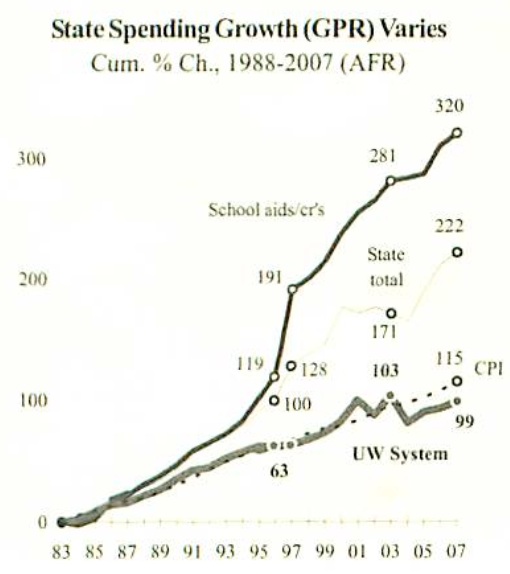
Share

Picturing Wisconsin School Trends

Wisconsin Taxpayers Alliance:

Wisconsin schools budgeted to spend $9.94 billion last year, or $11,522 per pupil. About 58% of that went to instruction. Over the past decade, increases in per pupil spending have averaged 4.0% per year. Meanwhile, statewide enrollments have dropped for five consecutive years.
T he world in which Wisconsin public schools operate today is markedly different from the one in the early 1990s. Enrollments and expenditure trends, and spending and staffing patterns, have all changed–in some cases, dramatically. But, simple pictures often tell the story.
One of the most noticeable developments over the past 20 years has been the ebb and flow of student numbers. The “baby boom echo” led to K-12 enrollments rising from 757,050 in 1990 to 874,042 in 2003. Since then, however, the student count dropped to 863,660 in 2008, the fifth consecutive year of decline.

Share

Wisconsin DPI Superintendent Interviews

WisPolitics:

uddenly, there’s another major state race brewing for early 2009.
Supreme Court Chief Justice Shirley Abrahamson has been preparing for a challenge from conservatives in her bid for re-election, sparking speculation of a repeat of the past two partisan-ized races that saw conservatives take over the court majority. Emerging as a likely candidate is Jefferson County Circuit Judge Randy Koschnick.
And now conservatives and liberals are expected to battle over the state school superintendent’s job following Department of Public Instruction chief Libby Burmaster’s surprise announcement she’ll pass on a re-election bid. Though the post is officially non-partisan, Burmaster has been seen as a big ally of Dem Gov. Jim Doyle. Doyle has strong ties to Madison West High School, where Burmaster worked as principal.
Already, the potential list of competitors is up to three.
Tony Evers, Burmaster’s deputy of the past seven-plus years, immediately e-mailed supporters announcing his intention to run for the post. Van Mobley, a history professor at Concordia University in Mequon and a member of the Thiensville Village Board, is mulling a run and will make his decision in November.
And Rose Fernandez, president of president of the Wisconsin Coalition of Virtual School Families, has been considering a run for DPI superintendent, according to a state campaign veteran with ties to her.
Evers, who ran unsuccessfully for the job in 2001, and Mobley gave interviews to WisPolitics this week about their visions for the job. Attempts to reach Fernandez were unsuccessful.

Share

Madison School district hopes to be anchor for homeless students

Pat Schneider:

That is sometimes the function — although not the intent, really, of the TEP program — which provides academic and emotional support for students whose chaotic life circumstances can set them grades behind their classmates.
The Zavala kids are among more than 280 students identified as homeless in the school district in the first six weeks of the school year. That number is a rolling count, updated throughout the school year as the district as students become homeless.
The district is on pace to exceed last year’s total, which was up sharply from the year before. The nation’s growing economic crisis is a likely culprit for at least some of the increase. One longtime TEP teacher says more homeless students are coming from established Madison families, not just those who have recently arrived to the city without housing.
As a result, homeless students are now in the attendance areas of schools all over the city — and not just those near homeless shelters and motels used to house homeless families. As a result, school officials this year are re-examining how best to use their limited resources, said Nancy Yoder, director of alternative programs. The school district now spends more than $750,000 on homeless services, but more district dollars are highly unlikely, Superintendent Dan Nerad said Thursday. District officials are preparing for a November referendum asking voters to approve increasing their spending limit by a total of $13 million over the next three years just to preserve current programs.

Share

Is the 2008 School Referendum Just More of the Same? No!

On November 4, the Madison School Board is asking voters to vote yes on a referendum that will increase the property tax support base for Madison’s public schools by a total of $13 million after three years. For owners of a $250,000, that translates to an additional $90 in property taxes by the third year.
This is not the first school referendum in recent years. But is it just more of the same? No. The need for a referendum stems from our broken system for funding Wisconsin’s public schools, but that is where the connections end. From the earliest planning through the unanimous Board of Education vote to go to referendum, the 2008 request is a big change from what voters have seen in the past.
The referendum is about funding a community service – K12 education – that is essential to vital neighborhoods and property values, an educated workforce, and, most important, a strong start for the children and youth who hold our future in their hands.
Our proposal is one of two major elements in Superintendent Nerad’s vision of a new partnership between the Madison Metropolitan School District and its communities. The second part is commitment to a long-range planning process that will include strong community input, assessment and review of district staffing and programs, and reallocation of resources to critical areas of need.
The 2008 plan was developed with input from the community. The final proposal represents more than some people want and less than others want; all comments were taken into account by the superintendent and the board.
Additional financial steps that reduce the tax impact on homeowners:

1) Using our 2008 windfall to pay off short term debt and reduce the amount we are asking by $400,000 per year
2) enacting Fund 41 to manage on-going maintenance and protect the district from losing state aid;
3) decreasing the community service fund (Fund 80) property tax levy by $2 million for one year to offset the referendum’s property tax increases;
4) revising our financial forecasts so that the referendum asks only for what we believe we will need; and,
5) using a recurring referendum so that the district will not face the significant new gap that would occur after a fixed-term referendum.

The 2008 referendum does not fix the way that Wisconsin pays for public schools, which has not worked for Madison or other communities. The referendum does not restore programs that were among the $35 million in budget cuts made by the board in the past 5 years, nor does it include new programs. It is one step in our ongoing work to balance school needs with taxpayer means under state laws.

Share

Wisconsin State & School Finance Climate Update

I recently had an opportunity to visit with Todd Barry, President of the Wisconsin Taxpayers Alliance [29 minute mp3]. A summary of this timely conversation follows:
[2:25] Post Retirement Liabilities: Milwaukee Public Schools Post Retirement Health Care Liabilities: $2.2 to $2.5 billion
[3:01] Wisconsin’s $2.44 Billion structural deficit. The State debt load ($4billion to $9billion from 2000 to 2007) is now among the top 10.
[7:48] On property values and assessment changes. Two years ago, property values grew 9%, last year 6%, 3% this year with most of the recent growth coming from commercial properties.
[8:57] Wisconsin Income Growth: Per Capita personal income “The canary in the mineshaft” and how we lag the national average by 6% or more.
Why?
The population is aging. Senior population will double by 2030. School age population is stagnant.
Employment growth peaked before the nation (04/05)
Wisconsin wages per worker is about 10% less than the national average. 1969; 4% below national average, 1980’s; 10 or 11% below national average. Wisconsin wagers per worker are now 14% below national average. We’ve been on a 40 year slide.
We’ve hid this because the labor force participation of women has increased dramatically.
Wisconsin is losing corporate headquarters.
[18:18] What does this all mean for K-12 spending?
“If there is going to be growth in any state appropriation,it is going to be schools and Medicaid“. The way the Legislature and Governor have set up these two programs, they are more or less on auto-pilot. They will grab whatever money is available and crowd out most everything else. So you get this strange situation where state aid to schools has tripled in the last 25 years while funding for the UW has barely doubled. That sounds like a lot, but when you look at it on a year by year basis, that means state funding for the University of Wisconsin System has grown less than the rate of inflation on an annual average basis while school aids has outpaced it (inflation) as has Medicaid.”
Is there anything on the horizon in terms of changes in school finance sources? A discussion of shifting state school finance to the sales tax. “It’s clear that in states where state government became even more dominant (in K-12 finance) than in Wisconsin, the net result, in the long run, was a slowing of state support for schools. The legislature behaves like a school board, micromanaging and mandating. California is the poster child.
[20:52] On why the Madison School District, despite flat enrollment and revenue caps, has been able to grow revenues at an average of 5.25% over the past 20 years. Barry discussed: suburban growth around Madison, academic competition amongst Dane County high schools. He discussed Madison’s top end students (college bound kids, kids of professionals and faculty) versus the “other half that doesn’t take those (college entrance) tests” and that the “other half” is in the bottom 10 to 20% while the others are sitting up at the top on college entrance exams.
[23:17]: This is a long way of saying that Madison has made its problem worse and has put itself on a course toward flat enrollment because of social service policies, school boundary policies and so forth that have pushed people out of the city.
[23:42] “If there is a way within state law to get around revenue caps, Madison has been the poster child”. Mentions Fund 80 and frequent and successfully passing referendums along with Madison’s high spending per pupil.
People think of the Milwaukee Public Schools as a high spending District. When you really look start to dig into it, it is above average, but Madison is way out there compared to even MPS. People argue that argue that MPS is top heavy in terms of administrative costs per student, Madison actually spends more in some of those categories than Milwaukee. (See SchoolFacts, more)
[26:45] On K-12 School finance outlook: The last time we blew up the school finance system in Wisconsin was in 1994. And, it happened very quickly within a span of 2 to 3 months and it had everything to do with partisan political gotcha and it had nothing to do with education.
[28:26] “Where are the two bastians of Democratic seats in the legislature? Madison and Milwaukee. Madison is property rich and Milwaukee is relatively property poor. Somehow you have to reconcile those two within a Democratic environment and on the Republican side you have property rich suburbs and some very property poor rural districts.

Share

Wisconsin School districts were told of investments’ risks, firm says

Amy Hetzner:

Five Wisconsin school districts suing over investments made two years ago were given “significant disclosure” of what was in those deals and represented themselves as sophisticated investors, an official with a financial institution targeted by the lawsuit said Tuesday.
“We made full disclosure of the merits and the risks associated with these transactions, and we were never guarantors in any fashion of the performance of those investments,” said David DeYoung, senior vice president and managing director of the Wisconsin public finance unit for St. Louis-based Stifel, Nicolaus & Co. Inc.
Stifel acted as no more than a placement agent in the transactions, DeYoung said. In that capacity, the firm connected the five districts to Royal Bank of Canada, which sold them complex financial products as a way to help fund retiree benefits, and DEPFA Bank in Ireland, which lent the districts most of the money to buy the investments, he said.
“We had a very limited role in this,” DeYoung said.

Share

On Milwaukee’s Schools: A clearer picture of the district’s financial problems is essential, but a broader discussion of its challenges also must take place.

Milwaukee Journal – Sentinel Editorial:

Gov. Jim Doyle and Milwaukee Mayor Tom Barrett will hire a consultant within the next week to get a clearer picture of Milwaukee Public Schools’ financial underpinnings.
Their joint announcement Saturday feels like progress. But it’s only a first step.
Yes, by all means, learn as much as possible about the district’s troubled books. But then take action to shore up those finances and focus on other looming issues — namely the question of governance.
That broader discussion is essential. It’s one that Doyle and Barrett must lead. But before that, they agree that they need to know what works financially and what doesn’t within the district. Fair enough, because if money is the problem, then an audit will help them deliver that message to the public.

Share

Seattle School District’s Community Advisory Approach

Via a kind reader’s email [900K PDF]:

THE CASE FOR CHANGE
Seattle Public Schools has pockets of excellence and many outstanding principals, teachers and programs. WASL scores have improved consistently over the last five years and SAT scores surpass state and national averages. However, we cannot accept a system with a 59% graduation rate and a 22% dropout rate. We cannot accept the lack of proficiency demonstrated in core subjects, particularly in math. We cannot accept a system with uneven school quality. And we cannot accept the glaring, persistent achievement gap among student groups.
We cannot accept a system facing years of multimillion dollar structural deficits. Nor can we accept the burdensome, complex and inadequate state-funding model to which the District is subjected.
We cannot accept these conditions and results. Instead, we must view this as an opportunity for decision makers to demonstrate true leadership and respond to this call to action.
WHAT IT WILL TAKE
It begins with leadership, including:

  • More forceful direction from the Superintendent and greater unity and cohesion on the part of the School Board
  • Greater mission clarity and a more focused and concise strategic plan;
  • An organizational culture-shift that values creativity, fosters adaptability, demands accountability and rewards innovation, teamwork and risk-taking.

It will take resourcefulness to increase investment inacademic outcomes. This will entail a financial strategy truly driven by student achievement goals and aimed at improved outcomes for all.
It will take a resolute approach to establishing long-term fiscal viability. This must include an honest assessment of demographic realities and opportunities for improved operational and program efficiencies across the board. Business as-usual cannot continue.

Related:

Share

2008 Madison Schools’ Referendum – Key Issues

1. Mortgage on future property with permanent increase: Asking taxpayers to refinance/mortgage their futures and that of the school district with a permanent increase of $13 million yearly for the operations budget. It has been stated the district needs the money to help keep current programs in place. It is expected that even after 3 years of this referendum totaling $27 million, the Board is projecting a continued revenue gap and will be back asking for even more.
2. No evaluation nor analysis of programs and services: The Board will make budget cuts affecting program and services, whether or not this referendum passes. The cuts will be made with no assessment/evaluation process or strategy for objective analyses of educational or business programs and services to determine the most effective and efficient use of money they already have as well as for the additional money they are asking with this referendum.
3. Inflated criteria for property value growth: The dollar impact on property to be taxed is projected on an inflated criteria of 4% growth in property valuation assessment; therefore, reducing the cost projection for the property tax levy. The growth for property valuation in 2007 was 3.2% and for 2008 it was 1.0%. Given the state of the economy and the housing market, the growth rate is expected to further decline in 2009. [10/13 Update: The above references to property valuation assessment growth are cited from City of Madison Assessor data. See ACE document “Watch List Report Card” [2008 Referendum Watch List 755K PDF] for State Department of Revenue citations for property valuation base and growth rate used for determination of MMSD property tax levy.]
4. No direct impact on student learning and classroom instruction: There is District acknowledgement of a serious achievement gap between low-income and minority student groups compared with others. There are no plans evident for changing how new or existing money will be spent differently in order to have an impact on improving student learning/achievement and instructional effectiveness.
5. Lack of verification of reduction in negative aid impact on taxes: District scenarios illustrating a drastic reduction in the negative impact on state aids from our property-rich district is unsubstantiated and unverified, as well as raising questions about unknown possible future unintended consequences. The illustrated reduction is from approximately 60% to 1% results by switching maintenance funds from the operations budget and 2005 referendum proceeds to a newly created “Capital Expansion Fund–Fund 41” account. [Update: 10/13: The reduction in the negative aid impact will take affect regardless of the outcome of the referendum vote. See the ACE document “Watch List Report Card” [2008 Referendum Watch List 755K PDF] for details.]

(more…)

Share

A Taxing Question

David Moltz:

A November ballot referendum to repeal Massachusetts’ income tax has many educators scared. Though supporters of the referendum argue it would make the government more efficient and effective, detractors argue that it would put valuable public services at risk. Especially concerned are public college and university administrators, who warn that, for the state’s higher education system, the consequences of an income tax repeal would be grim.
A similar referendum failed in 2002. But to the surprise of many in the state, the measure — which would have abolished the income tax immediately — received a respectable 45 percent of the vote.
This year’s referendum would reduce the state’s income tax rate from 5.3 percent to 2.65 percent in the upcoming year and eliminate it entirely beginning in 2010. Many fear the measure will pass this time, since it is more gradual than the 2002 measure and comes before voters at a time of exceptional concern over their finances. If the measure passes, Massachusetts would join nine other states that do not tax income. Many of those states have never had an income tax and have developed, over the years, alternative sources of income. This is not the case in Massachusetts.

Share

A Look at the Milwaukee Public Schools’ Fringe Benefit Costs

Alan Borsuk:

Milwaukee Public Schools retirees and part-time employees earn “considerably more generous benefit levels” than other groups, according to a major consultant’s report to the School Board.
The report, which comes as financial and political pressures on MPS are at levels that may be unprecedented, found that fringe benefits cost the school system 61.5 cents for every dollar spent on wages. That compared with 24.5 cents when figures for a dozen comparable employers and MPS were calculated all together.
The New York-based consulting firm, the Segal Co., analyzed data from MPS and 33 comparable employers, including school districts in Wisconsin and elsewhere and other government units. The results of the analysis are to be presented to the School Board’s finance committee Thursday night, but no action will be taken then.
With two supplemental pension funds for early retirees, MPS makes payments to four pension funds, with annual payments equal to 14% of its payroll, compared with an average of 9.9% for other public employers in the study.
And practices such as giving full health insurance to people who work 20 hours a week, and in some cases less, and giving people who retire at 55 almost the same health insurance as active workers are uncommon among employers, the report says.

Share

Governor & Mayor Plan Review of Milwaukee Public Schools

Dani McClain:

Gov. Jim Doyle and Milwaukee Mayor Tom Barrett plan to hire a consultant to analyze Milwaukee Public Schools’ finances and operations, and the study is to be finished in time for Doyle to make recommendations to the Legislature in January.
Doyle said he expects the next steps to include changing the state funding formula, changing practices in MPS or some combination of the two.
The consultant, who will be hired in the next 10 days, will be paid by local donors and will have national experience in restructuring and strategic planning, Barrett said in a conference call Saturday.
“We have to have a very solid understanding of the financial underpinnings of this district so we can decide as a community what steps are necessary to move the district forward,” he said.
Both officials expressed support for teachers and students in MPS and a desire to know whether the district is using its funds efficiently.

Share

Referendum Climate: Tax-cutting questions appear on ballots next month

Steve LeBlanc:

For years, Massachusetts was known derisively as “Taxachusetts.” But voters could help shed that label in November by completely eliminating the state’s income tax in a single stroke.
If approved, the ballot initiative would wipe out 40 percent of state revenues and give back to each taxpayer an average of $3,600.
The Massachusetts proposal is the most notable of several tax-cutting questions that will appear next month on ballots around the nation.
Others include a North Dakota initiative to cut individual income tax rates in half and trim corporate rates by 15 percent; an Arizona measure to mandate that any initiatives requiring spending or tax increases be approved by majority of all registered voters, not just those casting ballots; and a Maine plan to repeal new taxes on beer, wine and soda.
In Massachusetts, critics say there’s no way to chop $11 billion out of a $28 billion budget without decimating services, which could include closing schools and fire stations. Aid to cities and towns would also decline, placing enormous pressure on property taxes.

Massachusetts, is of course, home of the “Boston Tea Party“.

Share

Teachers Sue Over Right to Politic

Jennifer Medina:

The New York City teachers’ union filed a federal lawsuit on Friday claiming that a policy banning political pins and signs in schools violates teachers’ First Amendment rights by blocking them from political expression.
The lawsuit comes nearly two weeks after the Department of Education sent a memo to principals directing them to enforce the longstanding regulation, which requires that all school staff members show “complete neutrality” while on duty. The policy also prohibits teachers from using school property to promote a candidate.
Randi Weingarten, president of the union, the United Federation of Teachers, said that while the policy has been on the books for more than two decades, it has rarely been enforced, and that teachers have routinely worn political buttons as recently as this year’s presidential primaries.
But in the lawsuit, the union — which has endorsed Senator Barack Obama, the Democratic presidential nominee — states that the principal of Community School 134 in the Bronx removed an Obama poster that a teacher placed on the union bulletin board, and that a teacher at another school who wore political buttons was warned against it.

Share

Can the candidates fix America’s decidedly mediocre schools?

The Economist:

“OUR nation is at risk. Our once unchallenged pre-eminence in commerce, industry, science and technological innovation is being overtaken by competitors throughout the world.” So reported an education commission in 1983. That report was a turning point for American schools, helping spur a wave of reform. But 25 years later the state of American education is in a muddle.
In some ways its public schools have improved. America’s nine-year-olds scored 22 points higher on a national maths test in 2004 than they had in 1982. But in many areas America still languishes, as described in a recent report by Ed in ’08, an advocacy group. The percentage of 17-year-olds with basic reading skills has dropped, from 80% in 1992, when the current test was introduced, to 73% in 2005. On the international stage, American students are doodling while others scribble ahead. The Organisation for Economic Co-operation and Development has a glum statistic: in the most recent ranking of 15-year-olds’ skill in maths, America ranked 25th out of 30. Though America’s universities remain pre-eminent in the world, they have grown increasingly unaffordable. Barack Obama notes that between 2001 and 2010, 2m qualified students will not go to university because they cannot afford it.

Share

Alabama’s State Budget & Education Spending Forecast looks “Grim”

The Birmingham News:

Hubbert said he expects Education Trust Fund revenues to fall short at least 5 percent, or at least $318 million, of what the Legislature budgeted for the fiscal year that began Oct. 1. As bad as that sounds, it could get worse. Hubbert said if the economy continues to slide, the shortfall could top $400 million.
Trust fund revenues already are more than $200 million below what lawmakers expected. That’s mainly because tax collections for the fiscal year that ended Sept. 30 grew $146 million less than forecast, and Riley last year drained a $440 million reserve to avoid education spending cuts. Lawmakers had expected to have from $64 million to $109 million left in the reserve fund to spend this year. Instead, that money is gone.
The Legislature didn’t help matters by passing a $6.36 billion education budget for 2009. That amount exceeds by $102 million the average revenue forecasts of the state finance director and the Legislative Fiscal Office. Essentially, lawmakers decided that cutting almost $370 million from the $6.7 billion education budget from 2008 was hard enough, and they didn’t want to carve another $100 million-plus for 2009.

Tax base growth is certainly not a given at the moment. Related: November 2008 Madison School District referendum notes and links.

Share

A Public Hearing on Madison’s November, 2008 Referendum

Channel3000:

Taxpayers got a chance to ask the questions Tuesday night about the upcoming multimillion dollar Madison school referendum.
More than a dozen people turned out to Sherman Middle School for the first of four public hearings across the city.
Superintendent Dan Nerad gave a brief presentation before opening the forum up for questions.
Voters questioned everything from Fund 80 to the Capital Expansion Fund and student achievement.
Active Citizens for Education said they would like to have seen the referendum scheduled for the spring in order to give the district time to re-evaluate programs that they say are not working – programs that could be cut or changed.
“Where they’re talking about maintaining current programs and services it’s not getting good results,” said ACE’s Don Severson. “You look at the achievement gap, look at increased truancy, look an an increased drop-out rate, decreased attendance rates, more money isn’t going to get different results.”
Referendum supporters, Communities And Schools Together, know the $13 million referendum will be a tough sell, but worth it.
“I think it is going to be a hard sell,” said CAST member and first-grade teacher Troy Dassler. “We really need to get people out there who are interested still in investing in infrastructure. I can think of no greater an investment — even in the most difficult tough times that we’re facing that we wouldn’t invest in the future of Madison.”

Tamira Madsen:

School Board President Arlene Silveira was pleased with the dialogue and questions asked at the forum and said she hasn’t been overwhelmed with questions from constituents about the referendum.
“It’s been fairly quiet, and I think it’s been overshadowed by the presidential election and (downturn with) the economy,” Silveira said. “People are very interested, but it does take an explanation.
“People ask a lot of questions just because it’s different (with the tax components). Their initial reaction is: Tell me what this is again and what this means? They realize a lot of thought and work has gone into this and certainly this is something they will support or consider supporting after they go back and look at their own personal needs.”
Superintendent Dan Nerad has already formulated a plan for program and service cuts in the 2009-2010 budget if voters do not pass the referendum. Those include increasing class sizes at elementary and high schools, trimming services for at-risk students, reducing high school support staff, decreasing special education staffing, and eliminating some maintenance projects.
Nerad said outlining potential budget cuts by general categories as opposed to specific programs was the best route for the district at this juncture.

Share

“The Bomber As School Reformer”

Sol Stern:

Calling Bill Ayers a school reformer is a bit like calling Joseph Stalin an agricultural reformer. (If you find the metaphor strained, consider that Walter Duranty, the infamous New York Times reporter covering the Soviet Union in the 1930s, did, in fact, depict Stalin as a great land reformer who created happy, productive collective farms.) For instance, at a November 2006 education forum in Caracas, Venezuela, with President Hugo Chávez at his side, Ayers proclaimed his support for “the profound educational reforms under way here in Venezuela under the leadership of President Chávez. We share the belief that education is the motor-force of revolution. . . . I look forward to seeing how you continue to overcome the failings of capitalist education as you seek to create something truly new and deeply humane.” Ayers concluded his speech by declaring that “Venezuela is poised to offer the world a new model of education–a humanizing and revolutionary model whose twin missions are enlightenment and liberation,” and then, as in days of old, raised his fist and chanted: “Viva Presidente Chávez! Viva la Revolucion Bolivariana! Hasta la Victoria Siempre!”
As I have shown in previous articles in City Journal, Ayers’s school reform agenda focuses almost exclusively on the idea of teaching for “social justice” in the classroom. This has nothing to do with the social-justice ideals of the Sermon on the Mount or Martin Luther King’s “I Have a Dream” speech. Rather, Ayers and his education school comrades are explicit about the need to indoctrinate public school children with the belief that America is a racist, militarist country and that the capitalist system is inherently unfair and oppressive. As a leader of this growing “reform” movement, Ayers was recently elected vice president for curriculum of the American Education Research Association, the nation’s largest organization of ed school professors and researchers.

Share

Burmaster Won’t Seek 3rd Term as Wisconsin Education Superintendent, Tony Evers Announces Run

Tamira Madsen:

There had been some speculation Burmaster was interested in running for governor if Gov. Jim Doyle didn’t seek re-election in 2010, but she said that type of campaign is not in her plans.
She would not elaborate on her future career endeavors except to say, “I’m an education leader and I want to continue to serve in that capacity.” She also said she will get back to working in community schools with students in a “hands-on” role.

Interviews with 2005 Candidates for the Wisconsin DPI Superintendent position can be seen here.
WisPolitics interview with Burmaster.

Share

Milwaukee District’s financial hole makes everything harder

Milwaukee Journal-Sentinel:

Milwaukee Public Schools’ biggest problem may be financial, but the district must not lose sight of a key goal: giving students a quality education and restoring confidence in parents.
The thought of Milwaukee Public Schools going bankrupt is scary, but like some of those big financial institutions in the headlines lately, MPS also must be considered too big to fail.
The public isn’t in any mood to hear that a big part of the system’s problems are financial. But it is inescapable.
We’d support thoughtful change to the state’s funding formula that acknowledges the special needs and challenges facing urban districts such as MPS. And we encourage MPS administrators, the School Board and the teachers union to face up to the legacy costs that are weighing the district down.
But no one should support just throwing more money at MPS — not until we know for certain how well the district is using the money it has. To say that the public lacks confidence in the district’s abilities is a vast understatement.

Share

Referendum Climate: Madison Mayor Proposes 6% City Budget Spending Increase

Dean Mosiman:

Cieslewicz today will propose a $237.9 million “share the pain” operating budget that raises city taxes $53 on the average $247,974 home.
The proposed budget, a 6 percent spending increase — the largest Cieslewicz has ever offered — delivers new money for police, fire, the library and Metro Transit, but freezes or cuts spending in many areas.
“You’ll find no extreme cuts to any one agency, but many small cuts,” Cieslewicz said. “We did manage to keep long-term commitments.”
The 2.9 percent increase in taxes on the average home is among the fifth-lowest in 30 years, but overall tax collections are up 8 percent, the biggest increase since 1993.
“I was focused primarily on taxes on the average home,” Cieslewicz said. “That is what people experience.”

Much more on the 2008 Madison School District referendum here.

Share