School Information System

Colorado Amendment 59: Education Funding and TABOR Rebates

Fort Collins Coloradoan:

1. Without raising taxes, Amendment 59 provides a future source of money for educating Colorado’s children. This money may be used to increase per-student funding and for preschool through 12th-grade, or P-12, education improvements, including expanding preschool and full-day kindergarten programs, reducing class size, expanding technology education and providing performance pay for teachers. Providing new sources of money to invest in P-12 education helps schools teach children the skills needed for the jobs of the future. A well-educated work force is necessary to attract new businesses, generate new jobs and keep existing jobs in Colorado.
1. Amendment 59 permanently eliminates all future TABOR rebates to Colorado taxpayers. It is effectively a tax increase that will grow the size of state government. In addition, while the TABOR rebates are supposed to be spent on education, the money could instead replace existing education spending, allowing growth in other state programs. Amendment 59 also allows the only major source of money that is spent on the state’s buildings to be transferred for spending on P-12 education at a time when the state is currently unable to keep up with building maintenance and construction needs.

Share

Invisible Ink in Collective Bargaining Agreements: Why Key Issues Are Not Addressed

Emily Cohen, Kate Walsh & RiShawn Biddle [305K PDF]:

NCTQ takes a close look at the governance of the teaching profession and finds that state legislators and other state-level policymakers crafting state laws and regulation, not those bargaining at the local level, decide some of the most important rules governing the teaching profession.
As a number of big school districts around the country such as San Diego, Broward County, and Philadelphia hammer out new teacher contracts over the next few months, both sides will no doubt bring laundry lists of “must-haves” to the bargaining table. The common assumption is that the important action happens when district administrators and union representatives sit down at the bargaining table. Yet the reality is that well before anyone meets to negotiate a collective bargaining agreement, many issues will have already been decided.
State legislators and other state-level policymakers crafting state laws and regulation, not those bargaining at the local level, decide some of the most important rules governing the teaching profession. Though the teacher contract still figures prominently on such issues as teacher pay and the schedule of the school day, it is by no means the monolithic authority that many presume it to be. In fact, on the most critical issues of the teaching profession, the state is the real powerhouse. State law dictates how often teachers must be evaluated, when teachers can earn tenure, the benefits they’ll receive, and even the rules for firing a teacher.
A recent example out of New York State illustrates the growing authority of the state legislature in shaping rules that were traditionally in the purview of the local school district. Last year New York City Public Schools sought to change the process for awarding teachers tenure by factoring in student data. The local teachers’ union, the United Federation of Teachers protested the district’s new policy, not through a local grievance (because the union, by state law, had no say on tenure issues), but by lobbying state legislatures to pass a bill that would effectively make the district’s action illegal.1 Guided by the heavy hand of the state teachers’ union and the UFT, the New York State Legislature blocked New York City’s tenure changes by embedding a provision in the 2008-2009 budget that made it illegal to consider a teacher’s job performance as a factor in the tenure process.2 The placement of the provision in the large, unwieldy budget virtually assured the union of a win, as few legislators or the governor would have been prepared to have the budget go down on the basis of a single provision.

Share

Gubernatorial Candidates on Education

Rita Truschel:

Lee only just emerged as an active campaigner since the Sept. 9 primary elections. He was a late and reluctant draftee in May, after former Happy Harry’s drugstore executive Alan Levin unexpectedly backed out in January. Since then, Lee’s strategy was more about freezing out Republican primary opponent Mike Protack than honing his own positions.
So here we are a month before election day, with Lee finally on the spot to explain himself. The University of Delaware’s Clayton Hall auditorium was full of hundreds of people knowledgeable and focused on education. And Lee declared he wouldn’t deviate from the Vision 2015 plan in which many of them had had a hand.
So why was there laughter?
The trouble is Lee didn’t seem to have a sense that there is serious dissent even among the framers of Vision 2015 about elements such as consolidated purchasing and changing teacher compensation. There are political fights in all corners.

Share

McCain & Obama’s Art Policy Statements

Salt Lake City Tribune:

Here are the arts policy statements of John McCain and Barack Obama:
John McCain
“John McCain believes that arts education can play a vital role fostering creativity and expression. He is a strong believer in empowering local school districts to establish priorities based on the needs of local schools and school districts. Schools receiving federal funds for education must be held accountable for providing a quality education in basic subjects critical to ensuring students are prepared to compete and succeed in the global economy. Where these local priorities allow, he believes investing in arts education can play a role in nurturing the creativity of expression so vital to the health of our cultural life and providing a means of creative expression for young people.”
Barack Obama Reinvest in Arts Education: To remain competitive in the global economy, America needs to reinvigorate the kind of creativity and innovation that has made this country great. To do so, we must nourish our children’s creative skills. In addition to giving our children the science and math skills they need to compete in the new global context, we should also encourage the ability to think creatively that comes from a meaningful arts education. Unfortunately, many school districts are cutting instructional time for art and music education. Barack Obama believes that the arts should be a central part of effective teaching and learning

Share

American Math Chuckleheads

Rich Karlgaard:

I got an e-mail titled “An Angry American With An Idea.” This e-mail must have gone viral, because I received it a half-dozen times. You probably got it too. Here is what it said:

“I’m against the $85,000,000,000 bailout of AIG. Instead, I’m in favor of giving $85,000,000,000 to America in a ‘We Deserve It Dividend.’ To make the math simple, let’s assume there are 200,000,000 bona fide U.S. Citizens 18+. Our population is about 301,000,000 +/-, counting every man, woman and child. So 200,000,000 might be a fair stab at adults 18 and up. So divide 200 million adults 18+ into $85 billion. That equals $425,000. My plan is to give $425,000 to every person 18+ as a ‘We Deserve It Dividend.’ “

The letter goes on and describes the many wonderful things that could happen in America if each adult had an extra $425,000.
Now the funny part. Friends and colleagues–they shall remain anonymous–who passed this e-mail along would append a note: “You should read this.” “This actually makes sense.”
Not once did anyone point out the Angry American’s wee calculation flaw. Eighty-five billion dollars divided by 200 million people is $425, not $425,000.

Share

Madison School District Facing Class-Action Lawsuit Over Open Enrollment

Channel3000:

he Madison Metropolitan School District is facing a federal class-action lawsuit.
An East High School parent claims a request to transfer her daughter out of the district was been denied based on race.
The class-action lawsuit, filed in federal court on Wednesday, claims the Madison school district discriminated against a white, female student who wanted to transfer from East High School using open enrollment.
At the time, in the 2006-2007 school year, the transfer request was denied because it would increase the racial imbalance in the district. It was the district’s policy at the time, but that policy was changed earlier this year after a Supreme Court ruling involving school districts in Seattle and Louisville, WISC-TV reported.
“I believe this district had a policy that was absolutely consistent with state law,” Madison Schools Superintendent Daniel Nerad said. “When there was a legal decision by the highest court of the land… that was no longer a factor. I believe the district responded very responsibly in making a change in the policy.”

Much more on open enrollment here.
More:

Andy Hall has more:

In the 2006-07 school year, Madison was the only one of the state’s 426 school districts to deny transfer requests because of race, rejecting 126 white students’ applications to enroll in other districts, including online schools, records show.

Share

Arizona AG: “Virtual Meetings OK

Paul Davenport:

Arizona school boards, city councils and other public bodies can meet online to discuss public business but that they still need to accommodate the public, Attorney General Terry Goddard said Tuesday.
Telecommunications technology offers the promise of widening public access to meetings held through webcasts and other means, Goddard said. “This promise, however, is counterbalanced by the potential for abuse or technical obstacles for some citizens to access the meeting.”
Goddard discussed the issue in a legal opinion that reviewed a plan by the Camp Verde Unified School District’s governing board to meet online to discuss a document.

Share

Referendum Climate: Wisconsin Property Tax Ranking


The Tax Foundation, Via TaxProf. Much more on the November, 2008 referendum here.

Share

2008 Education Next-PEPG Public Opinion Survey

William G. Howell, Martin R. West and Paul E. Peterson:

Americans think less of their schools than of their police departments and post offices
Americans clearly have had their fill of a sluggish economy and an unpopular war. Their frustration now may also extend to public education. In this, the second annual national survey of U.S. adults conducted under the auspices of Education Next and the Program on Education Policy and Governance (PEPG) at Harvard University, we observe a public that takes an increasingly critical view both of public schools as they exist today and, perhaps ironically, of many prominent reforms designed to improve them.
Local public schools receive lower marks than they did a year ago. More significantly, perhaps, survey respondents claim that their local post offices and police forces outperform their local schools. Meanwhile, support for the most far-reaching federal effort to reform public schools–the No Child Left Behind Act–has slipped. A considerable portion of the public remains undecided about charter schools. And the poll found no enthusiasm for the use of income rather than race as a basis for assigning students to schools.
This does not mean that Americans are unwilling to explore alternate ways of educating young people. A large majority of Americans would let their child take some high school courses for credit over the Internet. An equally large majority favor the education of students with emotional and behavioral disabilities in separate classrooms rather than “mainstreaming” them, as is common practice. A plurality support giving parents the option of sending their child to an all-boys or all-girls public school. And a rising number of Americans know someone who is home schooling a child.

Share

Madison School Referendum Training 10/2/2008

Via a Matt Calvert email:

Community and Schools Together

Referendum Training
Thursday, October 2, 2008
7:00 PM (We’ll be done at 8 so you can catch most of the v.p. debate)
MTI Conference Room
821 Williamson St. (parking available)
Familiarize yourself with the details of the referendum.
Get information to share with others.
Sign up for opportunities to meet with groups or staff tables before the November election.
RSVP to Matt Calvert at 255-9417 or calvert.matthew@gmail.com

Share

Bilingual Debate: English Immersion

Lance Izumi & Bruce Fuller:

In this installment of Education Watch, Bruce Fuller and Lance T. Izumi discuss the candidates’ positions on bilingual education. Go to Mr. Fuller’s post.
Lance T. Izumi, a senior fellow in California studies and the senior director of education studies at the Pacific Research Institute for Public Policy, is the co-author of the book “Not as Good as You Think: Why the Middle Class Needs School Choice.” (Full biography.)
Making effective appeals to Hispanic voters is a tricky business. Barack Obama’s education proposals are a case in point.
Mr. Obama’s campaign notes that, “African-American and Latino students are significantly less likely to graduate than white students,” which is true. To combat such achievement gaps, Mr. Obama’s education plan specifically advocates, among other things, “transitional bilingual education” for English-learners. Yet, the question for Mr. Obama is whether his commitment to bilingual education, which emphasizes classroom instruction in languages other than English, overrides his interest in closing achievement gaps.

Share

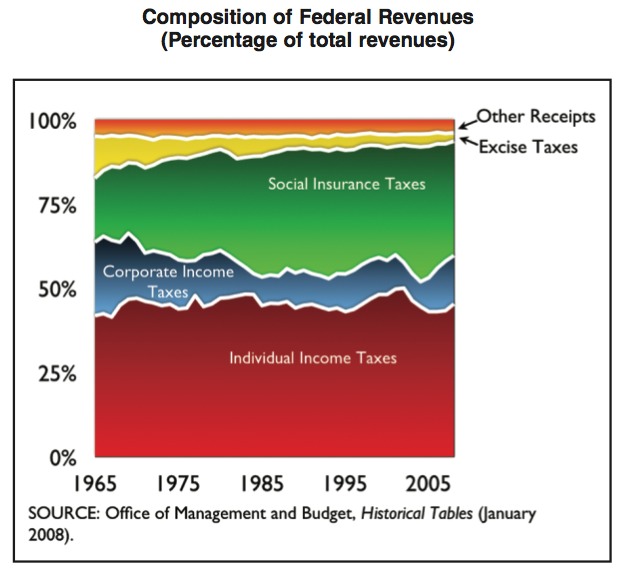
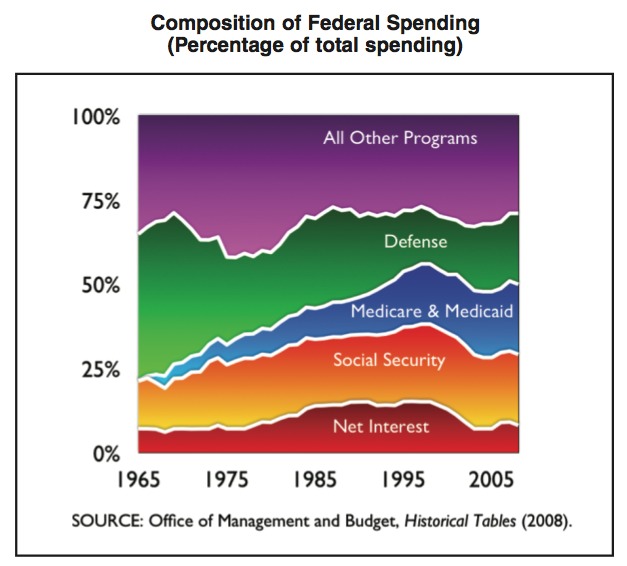
Referendum Climate: A Look at the US Government Budget

.

NY Times Graphics.
Related:

Further proof that there is no free lunch. The ongoing calls for additional state redistributed tax dollars for K-12 public education will likely have an effect on other programs, as this information illustrates. I do think that there should be a conversation on spending priorities.

The current financial system “crisis” presents parents with an excellent opportunity to chat with our children about money, banks, politics and taxes (When you deposit the baby sitting money, where does it go? What happens if the funds are no longer in the bank?). It is a rather potent mix. Much more, here.

Share

The Early Education of Our Next President

Peter Meyer:

One of them, Barack Obama, was awakened at four in the morning in Jakarta to study from a correspondence course; the other, John McCain, attended grade school in old airplane hangars. Both went on to elite private high schools.
Whether it is the image of Abraham Lincoln studying by log cabin candlelight or George Washington dutifully copying the Rules of Civility and Decent Behaviour in Company and Conversation into his schoolboy notebooks, presidential schooling has long been a national fascination (see Figure 1).
Today we have a graduate of Columbia College and Harvard Law (Obama) taking on a graduate of the Naval Academy and National War College (McCain). Harvard boasts seven presidents as alumni (including George W. Bush’s business degree); the Naval Academy, just one (Jimmy Carter). But it is the early schooling–how did they get there?–that is most fascinating. George Washington’s early education is remarkable for what is not known about it, but there is general agreement that if he had much formal education, it ended at about age 15. Teddy Roosevelt, said to have had an “uneven” education at home (strong in biology, French, and German but deficient in math, Latin, and Greek), graduated from Harvard magna cum laude. Harry Truman, the only president since 1897 who did not graduate from college, got up early too, at five in the morning, to practice piano.

Share

Madison 2008 Referendum: Watch List Report Card

10/6/2008 update
Active Citizens for Education presents this “Watch List Report Card” as a means of reporting relevant information, facts and analyses on topics appropriate for consideration by taxpayers in voting on the Madison Metropolitan School District referendum question November 4, 2008.
This document is dynamic in nature, thus it is updated on a regular basis with new information and data. Questions, analyses, clarifications and perspectives will be added to the entries as appropriate. Review Ratings will be applied to report the progress (or lack thereof) of the Board of Education and Administration in its plans, data, information, reports and communications related to the referendum.
The question which shall appear on the ballot is as follows:

“Shall the following Resolution be approved?
RESOLUTION AUTHORIZING THE SCHOOL DISTRICT BUDGET TO EXCEED REVENUE LIMIT FOR RECURRING PURPOSES
BE IT RESOLVED by the School Board of the Madison Metropolitan School District, Dane County, Wisconsin that the revenues included in the School District budget be authorized to exceed the revenue limit specified in Section 121.91, Wisconsin Statutes, for recurring purposes by: $5,000,000 beginning in the 2009-2010 school year; an additional $4,000,000 beginning in the 2010-2011 school year (for a total of $9,000,000); and an additional $4,000,000 beginning in the 2011-2012 school year (for a total of $13,000,000 in 2011-2012 and each year thereafter).”

(Source: MMSD Administration 09/15/08)
Continue reading here (277K PDF).

Share

Effective education, kindergarten to retirement

Mitch Daniels:

Last week I wrote that building the best possible business environment in America was the key to attracting jobs and investment to Indiana. Our state has recently achieved top-tier rankings as a place to do business, with low taxes and utility costs, reduced regulation, new infrastructure investments, and the highest credit rating in history. But we will not maximize these advantages if we do not also have enough well-educated workers. Jobs and investment that would otherwise come to Indiana will wind up somewhere else if we can’t provide a large enough pool of skilled labor.
As our economy diversifies, jobs in all sectors, including manufacturing, increasingly require skills and knowledge beyond high school. Right now, too many of our workers lack the education and training they need to perform — or even qualify for — the kinds of skilled jobs that we want to bring to or grow here in Indiana. Thousands of jobs are open and waiting in fields such as information technology, health and logistics, but are not being filled because of this skills mismatch.

Share

Voters told new Germantown school could pay for itself

Term Kertscher:

A School Board member says voters can approve a $22.5 million school referendum without seeing an increase in property taxes – and a pro-referendum committee goes even further, saying a successful referendum could actually lower property tax bills.
The president of the Wisconsin Taxpayers Alliance has his doubts, and some Germantown School District residents question the idea that borrowing $22.5 million for a new elementary school wouldn’t raise their taxes.
“It just makes people all the more suspicious,” resident Anne Bastow said about the Nov. 4 referendum. “To say your (property tax) payments are going down when you’re getting something new, it just doesn’t jibe.”
But a top official with the state Department of Public Instruction says school districts can increase their state aid – and simultaneously reduce property tax levies – by increasing enrollment.

Share

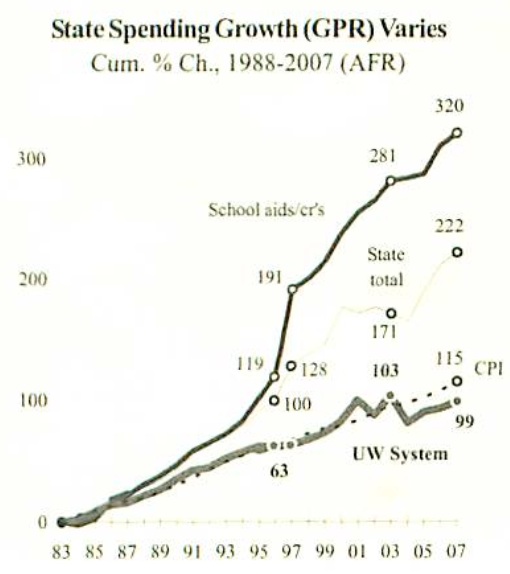
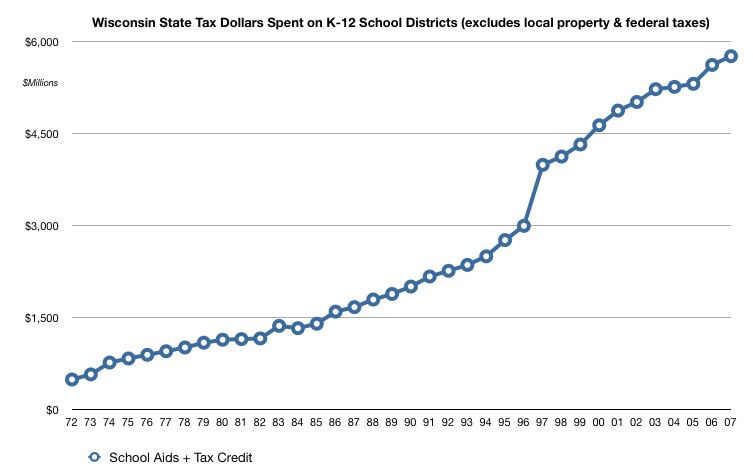
Wisconsin State Tax Based K-12 Spending Growth Far Exceeds University Funding

via WISTAX

WISTAX published a fascinating chart in their most recent issue of FOCUS [Page 1, Page 2]:

However, the state pledge to provide two-thirds of schools revenues in 1996-97 changed the budget landscape. By 2006-07, state-tax support for the UW System had almost doubled during Ihe 25 years prior. However, inflation (CPI, up 115%). school aids/credits (320%). and overall slate GPR expenditures (222%) rose more.

Related:

Further proof that there is no free lunch. The ongoing calls for additional state redistributed tax dollars for K-12 public education will likely have an effect on other programs, as this information illustrates. I do think that there should be a conversation on spending priorities.

Share

Beware of the Easy School Fix

Jay Matthews:

When fixing schools, beware of miracle cures. Every week people send me ideas they say will change the future of education and lead all humanity to enlightenment. So, when management expert William G. Ouchi let me look at his new work on the surprising power of total student loads per teacher, or TSL, I was skeptical.
He says when middle or high school principals are given control of their schools’ budgets — a rare occurrence in big districts — they tend to make changes in staffing, curriculum and scheduling that sharply reduce TSL, the number of students each of their teachers is responsible for. Some urban districts have TSLs approaching 200 kids per teacher. But after principals get budgeting power, the load drops sharply, sometimes to as low as 80 kids per instructor. When that happens, the portion of students scoring “proficient” on state tests climbs. A group of New York schools had a surge of 11 percentage points after they reduced average TSL by 25 students per teacher.
I hear the mumbles out there. Yes, correlation is not causation. Test scores are not a perfect measure. Many other factors could explain the rise in achievement. For instance, the principals might be using their new powers to hire good teachers and fire bad ones.

Share

McCain, Obama Advisers to Debate Education

Mitchell Landsberg:

On Oct. 21, the education advisors to the two candidates — Lisa Graham Keegan for McCain; Linda Darling-Hammond for Obama — will face off in a debate at Teachers College, the venerable education school at Columbia University in New York. The debate, which begins at 4 p.m. PDT, will be webcast by Education Week. The moderator will be Susan Fuhrman, the president of Teachers College.
In the meantime, you can read the education platforms for McCain here and Obama here. And here is Edweek’s blog on the campaign. For those who don’t want to go to that much trouble, we’ll helpfully reduce the platforms to fit on the head of a pin: McCain believes in school choice and local control; Obama believes in an expansion of early childhood education and increased federal funding for education.

Share

Minnesota Democrat-Farm Laborers Believe in new School “Miracle”

Norman Draper:

In the face of a strained economy and an almost-certain state budget shortfall, the party is pushing a bold new education initiative. Better schools, they say, will be an investment that counters the downturn.
When DFL state Rep. Denise Dittrich went door to door campaigning for re-election in Champlin last week, a smattering of homeowners brought up education.
One worried that the enrollment at her child’s elementary school would drop so low that the school would shut down. Another fretted about property taxes that have soared, in part because voters approved increases in school funds.
One resident, Shelley Peterson, said she was equally concerned about education and the economy. She said she wants more money for education and wants to lower the high activity fees in the Anoka-Hennepin School District. But would she be willing to consider higher taxes to do that?

Share

You say “accountability,” I say “longitudinal study”

Milwaukee’s Public Policy Forum:

In a report released last week that did not get press other than a post on the education blog of the Journal Sentinel, the Legislative Audit Bureau rehashed the first-year findings of the School Choice Demonstration Project’s study of the Milwaukee Parental Choice Program (MPCP). Interestingly, the Bureau found the study’s data cannot provide information about performance in individual schools. In response, a prominent school choice lobbying group has called for test scores to be reported annually on a school-by-school basis.
The overall findings, released last February, were not as positive as education reform supporters had anticipated. The Audit Bureau re-analyzed the data and confirmed these findings. For example, the sample of choice students in the private schools had lower reading scores on state standardized tests than a matched sample of MPS students at three of six grade levels. At all six grade levels tested, the private school students scored lower than a random sample of MPS students. In nearly all cases, however, the differences were not statistically significant.

Share

Weekly Update

This past week on the board I have moved in varied circles, hopefully which may lead our district in a new and better direction as we improve our connections with the broader community.
Early in the week the Madison Board of Education approved the submission of two resolutions for the state school board association’s annual meeting. I was happy to be an author of one and to get assistance from the Middleton/Cross Plains board on the second.
One meeting that I’m always happy to attend is with community organizers and childcare providers working to bring quality early childhood education to all students in Madison. We met at a local business, Ground Zero coffee shop, and enjoyed much in the way of conversation and goal-setting. If you would like to learn how to get involved in this effort feel free to contact me and I will put you in touch with some great people working on behalf of young children and through an investment in our future.
In addition, I may start holding listening sessions at local businesses to better communicate with the community.
Personal blog, RSS Feed.

Share

Madison High School Students Organize and Push Referendum

Tamira Madsen:

Kaley Stroup has seen the impact school budget cuts have had on classmates and friends at La Follette High School.

Officials at La Follette were forced to drop the Italian language program from the curriculum for the 2008-09 school year, and students had to scramble to restructure their class schedules.

Stroup said elimination of the courses put many seniors like her in a tough situation when thinking ahead to college.

“Their schedules are messed up now because colleges want you to have four years of the same foreign language, and they’ve had to switch to French and Spanish, and it’s thrown things off for them,” Stroup said.

She is part of a group of Madison Metropolitan School District students intent on bolstering community approval for the school referendum so deeper budget cuts won’t have to be made going forward. Leaders of the group hope to have some two dozen students getting out the word about voting “yes” on Nov. 4.

Much more on the 2008 Madison Referendum here.

Share

“Let’s You and Him Fight over School Vouchers”

Political Insider:

David Poythress called. The only announced Democratic candidate for governor wanted to pick a fight with Eric Johnson over school vouchers.
“To re-direct public money from public education into unregulated private entities with the magical expectation that somehow the private sector was going to remedy all the education problems in the state — that’s just wrong. It’s not going to happen,” Poythress said.
Johnson, currently the Senate president pro tem, has seized on the voucher issue as a likely ticket to the Republican nomination for lieutenant governor in 2010.
To set the stage:

Share

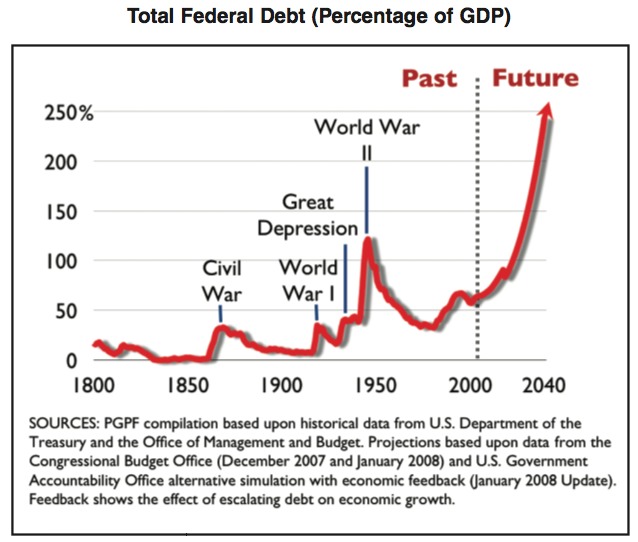
Referendum Climate: Washington must heed fiscal alarm bell

Dave Walker:

Beyond the turmoil for banks and homeowners, however, there is a super-sub-prime crisis brewing in Washington. Our fiscal policies have created a disconnect between today’s citizens and future taxpayers. Today’s taxpayers benefit from high government spending and low taxes, while future generations are expected to pay the bill. Our real challenge is where we are headed on our do-nothing fiscal path.
Washington has charged everything to the nation’s credit card – engaging in tax cuts and spending increases without paying for them. Washington’s imprudent, unethical and even immoral behaviour is facilitated by a lack of transparency. For example, as of September 30, 2007 the federal government was in a $53,000bn dollar fiscal hole, equal to $455,000 per household and $175,000 per person. This burden is rising every year by $6,600-$9,900 per American. Medicare represents $34,000bn of this deficit and the related Medicare trust fund is set to run dry within 10 years. The Social Security programme is projected to have negative cash flow within about 10 years.

Share

Nobody’s Waiting to Bail the Milwaukee Public Schools Out

Eugene Kane:

In a week when America’s financial markets experienced a meltdown, perhaps it shouldn’t have been that surprising to learn Milwaukee Public Schools was also apparently in dire financial straits.
Last week, a shake-up of major Wall Street firms sent shock waves through the stock market. The federal government announced a risky, multibillion-dollar bailout of endangered institutions amid concerns about the worst financial crisis in decades. With all that turmoil afoot, it was almost anticlimactic to learn the School Board had voted to look into ways to dissolve the public school system because of increasing financial problems.
Yes, that’s right; dissolve it.
Most folks knew things were bad at MPS; nobody suspected it was that bad. At least one board member, Michael Bonds, still isn’t convinced.
“I was outraged,” said Bonds, who left the room shortly after a 6-3 vote by MPS board members to consider options for dissolving the state’s largest school district. “Yes, that’s why I left the room.”

Share

How Well Do You Know Your State Board of Education?

Katy Vine:

Ever wonder who decides what your kids are taught in school? It’s not their principals and teachers. Nor is it their school’s superintendent. The Legislature, maybe? Not quite; the Legislature’s responsibility is to write the education code, fund the schools, and keep the state’s commitment to an accountability system. Every once in a while a lawmaker might pass a bill that authorizes Bible classes or requires daily recitation of the pledge of allegiance to the Texas flag, but the Legislature isn’t responsible for curriculum. Okay, then, how about the Texas Education Agency and the commissioner of education? Sounds right, but you’re wrong again. The TEA’s role is simply (or not so simply) to administer the education code.
Ready for the answer? The folks who decide what Texas schoolchildren will learn are the fifteen members of the State Board of Education. Don’t worry if you can’t name a single one. Almost nobody can! Members of this obscure panel are elected in down-ballot races that generate about as much media attention as an appointment to the Funeral Service Commission, but they are the ones who determine the classroom content for every public- or charter-school student in Texas. The board, currently composed of ten Republicans and five Democrats, oversees the process that establishes curriculum standards–known as Texas Essential Knowledge and Skills–and adopts or rejects textbooks. Members serve four-year terms and receive no financial compensation. (You heard right: They do this for free.) So how well do you know the powerful volunteers who control your children’s education? Take this quiz and see.

Share

Referendum Climate: “Missing Step: Control Spending”

Wisconsin State Journal Editorial:

Wisconsin received more evidence this week that its taxes are too high.
This time the evidence arrived in a study suggesting that Wisconsin may be just a few tax cuts away from becoming one of the nation’s economic hot spots.
The study, from the Pacific Research Institute in association with Forbes magazine, should give state and local policymakers new incentive to control spending so that taxes can be reduced.
The study of all 50 states, called the economic freedom index report, considered a variety of factors from tax levels to justice systems to make conclusions about how much economic freedom each state allows.
The goal was to forecast which states offer the freedom that should lead to prosperity in years to come.
The study showed that Wisconsin made the biggest leap forward among all states since a similar study was completed in 2004.

Much more on the November, 2008 Madison referendum here.

Share

Education Awareness Building in Hawaii

The Learning Coalition:

Everyone seems to have an opinion about education and they seem more than happy to share it. Nelson Mandela called education the most powerful tool you can use to change the world, while Mark Twain joked that he never let his schooling interfere with his education.
One thing we can agree on: We all want our children to have the best education possible — one that will help them to achieve their potential in life, no matter which path they choose.
Our kids in Hawaii deserve our best efforts to give them a good start on life, and we have a unique opportunity to do just that. With a culturally rich and ethnically diverse student population, Hawaii represents a microcosm of the world’s future. We have teachers, principals and administrators deeply committed to equipping our children with the knowledge and skills they’ll need, and parents ready to support them in their efforts. We have a Board of Education responsible for setting policies and standards to ensure all children a quality education, regardless of their economic background or ZIP code. By working together and coordinating our efforts, we have the potential to transform our island state into an educational model for others to emulate.

Share

Wisconsin Governor Doyle Wants a Study of the Milwaukee Public Schools

Alan Borsuk:

Gov. Jim Doyle called Friday for “a complete evaluation of exactly where MPS is” as a first step toward any action by state government to do more for Milwaukee schools or change the way the school system is run.
“The School Board has really opened this up now,” Doyle said, referring to a surprising 6-3 vote by Milwaukee School Board members Thursday night in favor of exploring the dissolving of Milwaukee Public Schools, which is under financial pressure. Such a step might leave responsibility for Milwaukee schools in the state’s lap.
“I take this vote very seriously by the board and, if they are moving in this direction at all, it can only be done through state law,” Doyle said in an interview. “I think we need — everybody needs — to have a good clear understanding of where exactly the Milwaukee schools are.”
He said he wants to know whether MPS is making the best use of the money it has. He expects to announce plans for conducting such an evaluation next week.
“You can’t just sort of speculate that maybe we’re going to dissolve and have the state just sort of stand there,” Doyle said. “We have to be prepared.”

Share

Issues 08: Education

Tom Ashbrook @ OnPoint:

Crisis in the financial markets on a scale not seen since the Great Depression. And Americans awakening to challenges that go to the bedrock of the nation’s strength.
Nothing is ultimately more bedrock than the education of our children — the readiness of our citizens and coming generations to compete and lead in a global economy. To carry the responsibilities of democracy.
Where do McCain and Obama stand? This hour, we’ll ask their top advisers where McCain and Obama would lead on a basic issue for America — education.

Share

Future of ‘No Child’ Left Behind

Maria Glod:

For the next president, one of the first domestic challenges will be to reshape the No Child Left Behind law, hailed six years ago as a bipartisan solution to America’s education troubles.
But in their race for the White House, Sens. John McCain (R-Ariz.) and Barack Obama (D-Ill.) are distancing themselves from what has become a tainted brand.
Education experts say the candidates have offered, at best, a fuzzy vision for the future of the No Child Left Behind law. Obama pledges to “fix the failures” of the law, while McCain seeks to avoid mention of it.

Share

Madison CAST November, 2008 Referendum Neighborhood & PTO Newsletter

We are asking if you would put this in your school newsletters and share it with your members as we need your help to spread the word about the referendum to your friends and neighbors. Please feel free to share the attached with your neighborhood newsletters as well.
Jackie Woodruff jkwoodruff@charter.net
Communites and Schools Together Treasurer
On November 4, 2008 voters in the Madison school district will decide on a funding referendum that is crucial to the future of our children and our community.
Good schools are the backbone of a healthy community. Our public schools are essential for expanding prosperity, creating opportunity, overcoming inequality, and assuring an informed, involved citizenry. Madison’s public schools have been highly successful and highly regarded for many years. We’ve learned that quality public education comes from well-trained teachers, the hard work of our students and teachers, and also from a steady commitment from the community at large.
After several public forums, study, and deliberation, the Board of Education has unanimously recommended that our community go to referendum, to allow the board to budget responsibly and exceed the revenue caps for the 2009-2012 school years. The referendum is a compromise proposal in that it seeks to offset only about 60% of the estimated budget shortfall in order to keep tax increases low.
The projection is that school property taxes would increase by less than 2%. Even with increased property values and a successful referendum, most property owners will still pay less school property taxes than they did in 2001.
Most importantly, this November 4th, the voters in Madison can recommit to public education and its ideals by passing a referendum for the Madison Metropolitan School District.
Thank you so much for your work and support for Madison’s Public Schools, Communities and Schools Together (CAST) – a grassroots organization devoted to educating and advocating on behalf of quality schools — needs your help in support of the November referendum. We need volunteers to help distribute literature, put up yard signs, host house parties for neighbors, write letters to the editor–but most of all we need your support by voting YES on the referendum question.
Keep our schools and communities strong by supporting the referendum. To learn more, donate to the campaign or get involved–visit Community and Schools Together (CAST) at www.madisoncast.org.

Share

Beyond “No Child”

Anthony Brooks, Jeremy Miller, Seppy Basili, Sara Mead and Jordan Meranus:

How to improve under-achieving schools in America’s poorest communities has vexed policy makers for generations. President Bush’s No Child Left Behind law insists on accountability. But critics charge it encourages teaching to the test at the expense of real learning.
The law still sparks a loud argument — but as one of our guests today writes in the current issue of Harper’s magazine, there’s debate that test-prep companies such as Kaplan are profiting handsomely from the federal mandate to test, and test, and test again.

Share

Talking with Jeremy Miller, Author of “Tyranny of the Test”

Benjamin Austen:

Jeremy Miller is the author of “Tyranny of the Test,” the September cover story. The article, which explains how No Child Left Behind has changed the structure of our schools-and how “teaching the test” takes more away from students than it gives-was based on his years of experience working as a test-prep “coach” for Kaplan, Inc. Associate Editor Ben Austen follows up with Jeremy Miller now that the issue is on newsstands.
1. At some point last year, you decided you wanted to write about working for Kaplan in New York City’s public schools. This kind of reporting, in which the participant’s journalistic intentions are not made explicit, is always complicated. But the issues here seemed to be compounded by your background as a full-time classroom teacher and by your desire to succeed at a job that you increasingly saw as problematic. What were some of the difficulties you faced in reporting this story?

Share

Want Schools to Work? Meet the Parents

Sandra Tsing Loh, making sense, continues her whirlwind media tour, this time at the Washington Post (thanks to a kind reader’s email for this link):

Yea, public school parents’ priorities are routinely placed below those of building inspectors, plant managers, even, given an errant bell schedule, cafeteria workers. Although, teachers are down in the bunkers with us, too. You’d be amazed how many extraordinary schoolteachers, who’ve served faithfully, conscientiously, daily for 40 years, just keep their heads down at this point.
Since most politicians have never dealt with U.S. public schools as customers themselves (in the same way that precious few of them put their own children in the Army), it might shock you, Mr. Future President, how poorly parents are treated out here in Public-School-Landia. You know how when you walk into a Wal-Mart or a McDonald’s, someone greets you with, “Hello! May I help you?” It’s startling how seldom you can expect this basic courtesy in public schools, how often we parents approaching the counter are treated as felons, or more often simply ignored by the frantically typing office-administrator-type-person. It’s a peculiar thing, in this 21st century. Forget best-practice research and technology-driven classrooms. I really believe if anyone in the multibillion-dollar industry called U.S. public education were ever listening to us, improved schools would start, simply, with this: “Hello! May I help you?”
Where does this culture of committee-oriented time wastage — even for parents who work — spring from? Here’s a clue. L.A. Unified recently faced such a budget shortfall that the district was actively recruiting potential save-our-schools spokesparents to submit their resumes and come to the central offices for “media training” if selected. Cut to the bone as it is, though, next year’s budget still slates a hefty $78.8 million for consultants (last year a consultant was paid $35,000 to teach our superintendent how to use a computer). And yes, I realize that I’m getting off-message by noting that our school district wastes money.. . . That’s like waving red meat in front of America’s seniors, who’ll probably vote to cut taxes again! Even though it’s not the bureaucracy, but the children who get squeezed. That’s all budget cuts mean, in the end. My kids have their assemblies on cracked asphalt. Now the cracked asphalt will have weeds.
But here’s the good news, Mr. Future President. In a testament to the incredible can-do American spirit (and I mean that in the most drop-dead-serious way), activist public school parents are fighting back against U.S. public education’s wasteful and unresponsive corporate “professionalism.” (Remember George Bernard Shaw’s quip about the professions being “conspiracies against the laity”?) City by city, homegrown “parents for public schools”-style Web sites are springing up daily, little rebel force fires on the horizon. From New York to Chicago, Seattle to San Francisco and beyond, activist parents are starting to blog their outrage over millions of education dollars wasted on non-working computer technology, non-child-centered programs and, of course, those entities whose education dollars are never, ever cut — the standardized-testing companies.

Some years ago, I sketched a chart illustrating the influence of various factions on our nearly $400M local school system. Topping the list were Administrators of both the school system and local teachers union. Far down were teachers (think of the “downtown math police”) and parents. Further still were students themselves. Taxpayers were not represented.
Observing public education rather closely for a number of years, it seems to me that all players, especially teachers, parents and students, would be better off with a far more diffused governance model (charters, smaller districts/schools, choice?).

Share

School Choice Better Choice for Poor

Amy Hall:

Barack Obama, whose campaign is heavily funded by teachers unions, plans to funnel more money into the existing public education system. In this system, poor kids remain the only ones who don’t get to choose which school they attend. Mr. McCain is a strong supporter of school choice and has a record of this in Arizona.
As a teacher of 30 years, I am outraged that the liberal leaders in this country pretend to champion the poor, while, through their opposition to school choice, they act to keep the poor uneducated and poor.

Share

Accounting change may aid November 2008 Madison referendum

Andy Hall:

More than 60 Wisconsin school districts got an earlier start than Madison did in instituting a bookkeeping change that potentially saves local property owners millions of dollars in taxes.
But led by a new superintendent and business manager, Madison last month adopted the accounting measure — a move that school officials hope will strengthen community support for a Nov. 4 referendum.
The referendum will ask voters for a three-year series of permanent tax increases to generate $13 million to avert multimillion-dollar budget cuts.

Much more on the November 2008 referendum here.

Share

Bellevue, WA Teacher Strike: District Offers Teachers a 5% Raise over 3 Years

Lynn Thompson:

The Bellevue School District increased its salary offer to teachers in a late-night bargaining session Thursday.
The total pay raise would be 5 percent over the three-year contract.
Union officials praised the move and said they planned to hold an “optimism” rally at Crossroads Park in Bellevue today while bargaining was expected to continue.
“It’s a move in the right direction,” said Michele Miller, Bellevue Education Association president.
The school district initially offered teachers 3 percent in wage increases over the three-year contract but raised the offer to 4.5 percent last week, saying the increase was contingent on voter approval of a levy in the third year of the contract.

Bellevue, WA Teacher Salary Schedule with 2008-2009 District Offer: 16k PDF
Curriculum is also an issue in this strike [32K PDF]:

Language Arts 4th – 12th grade: Many teachers believe there far too few lessons on punctuation and grammar. You cannot add lessons in these areas, since that might supplant the scripted lesson goal of the day.

Middle School Math: Since the district only allows one level of math at each grade in Middle School, there are many bored and overwhelmed students simultaneously stuck in the same class. The District’s current curriculum proposal wouldn’t allow a teacher to develop entirely new topics of instruction to engage the bored students. Additionally, while teachers would be allowed to make small adjustments for struggling kids, they couldn’t use those changes the following year without the approval of the Curriculum Department.

Certainly, Math and writing skills are fertile ground for curriculum controversy.
I asked Madison’s three superintendent candidates earlier this year if they supported a “top down” curricular approach or, simply hiring the best teachers. It’s hard to imagine a top down approach actually working in a large organization.

Share

2008 Presidential Candidates & School Choices

Sandra Tsing Loh:

As usual, Bruce Fuller and Lance Izumi , my fellow Education Watch contributors, make some fascinating points, none more startling to me than Lance’s casual throw-away that Barack Obama sends his children to private school. As a rabid public school Democrat, I crumpled in despair at the news.
Look, I am not in politics, I get no money from foundations, I do not get invited to lecture on third world eco-sustainability on luxury cruises. I have no highly placed blue-state friends and I will soon be a divorced woman because my die-hard Democratic husband will not brook any dissent, public or private, about our party.

Candidate websites: Bob Barr, McCain/Palin, McKinney/Clemente, Obama/Biden
Megan Mcardle @ the Atlantic has more.

Share

Obama & McCain on Federalism & Schools

Sam Dillon:

Senator Barack Obama learned how hard it can be to solve America’s public education problems when he headed a philanthropic drive here a decade ago that spent $150 million on Chicago’s troubled schools and barely made a dent.
Drawing on that experience, Mr. Obama, the Democratic nominee for president, is campaigning on an ambitious plan that promises $18 billion a year in new federal spending on early childhood classes, teacher recruitment, performance pay and dozens of other initiatives.
In Dayton, Ohio, on Tuesday, Mr. Obama used his education proposals to draw a contrast with Senator John McCain, his Republican opponent, and to insist to voters that he, more than his rival, would change the way Washington works.
Were he to become president, Mr. Obama would retain the emphasis on the high standards and accountability of President Bush’s education law, No Child Left Behind. But he would rewrite the federal law to offer more help to high-need schools, especially by training thousands of new teachers to serve in them, his campaign said. He would also expand early childhood education, which he believes gets more bang for the buck than remedial classes for older students.

Sam Dillon:

Among his short list of initiatives, Mr. McCain, the Republican presidential nominee, includes bonus pay for teachers who raise student achievement or who take jobs in hard-to-staff schools, an expansion of after-school tutoring, and new federal support for online schools and for the voucher program in Washington, D.C.
The brevity of Mr. McCain’s plan reflects his view that the federal government should play a limited role in public education, and his commitment to holding the line on education spending, said Lisa Graham Keegan, a McCain adviser and former Arizona education commissioner.
“Education is obviously not the issue Senator McCain spends the most time on,” Ms. Keegan said, adding that his plan’s limited scope should not be interpreted as a lack of commitment to education and school reform. “He’s been a quiet and consistent supporter of parents and educators who he thinks are making a difference.”

Share

Property Tax Effect – Madison School District

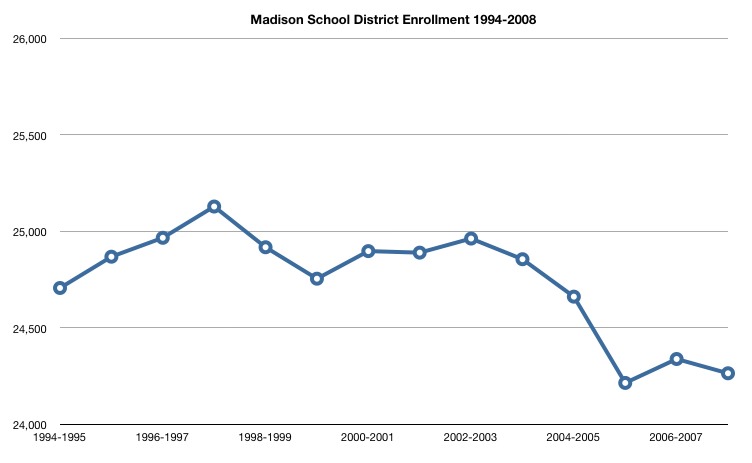
As the cost of running the district continues to rise, and as Madison homeowners and families find it increasingly difficult to make ends meet, it is easy to think that our property taxes are also ever rising. But that’s not the case, at least as regards the portion that goes toward our schools. Over the past 15 years, the schools’ portion of Madison property taxes has declined 6%, on average. The decrease is 9% if you adjust for today’s higher enrollment figures (1993 = 23,600; 2007 = 24,200). And it plunges to a 36% decrease if you adjust for inflation; (a dollar today is worth 30% less than it was 15 years ago).
The chart below, based on local funding of MMSD and data from the city assessor’s office, shows the recent history of school mill rates, the rate that is applied to your assessed property value to determine how much you contribute towards Madison schools (10 mills = 1.0% of the assessed property value). The reported rate has dropped from 20 mills to 10, but property values have doubled thanks to the general rise in home prices (termed “revaluations” by the assessor’s office), so the rate is more appropriately captured below by the “Net of Revaluations” line. That line is then adjusted for school enrollment (the red line), and inflation (the heavier blue line).
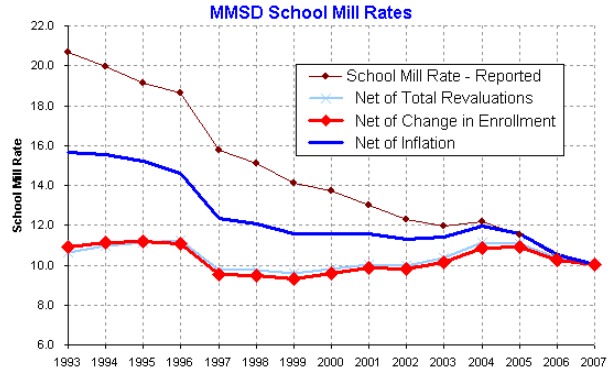
There are three important caveats to the above statements: 1.) school taxes are lower on average, but if your home has increased in value by more than about 110% since 1993, then you will be paying more for schools; 2.) it is the schools portion of property taxes that is lower on average; the remaining portion of property taxes that pays for the city, Dane County, Wisconsin, and MATC, has risen; 3.) other sources of Madison school funding (state and federal funds, and grants and fees) have also gone up; (I have not done the much more complicated calculation of real increase in funding there).
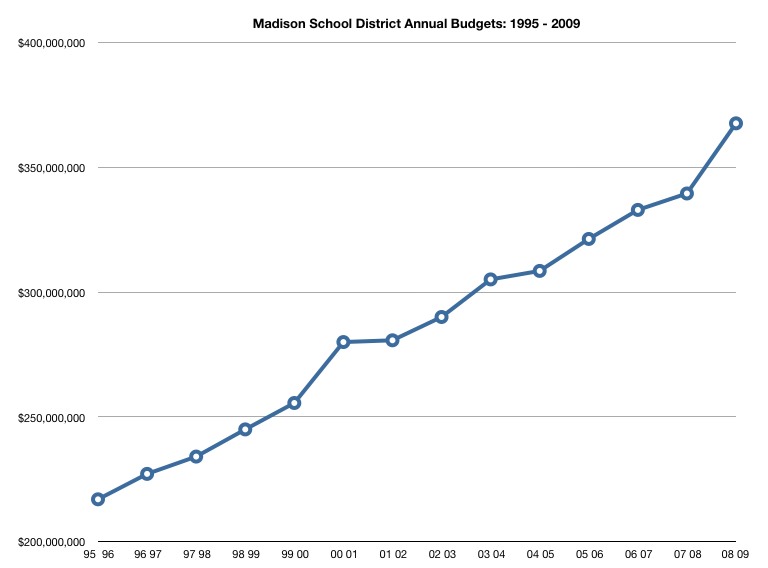
That the infamous schools’ portion of property taxes has declined over these past 15 years is quite a surprising result, and certainly counterintuitive to what one might expect. How is this possible? First, the school finance structure put in place by the state years ago has worked, at least as far as holding down property taxes. The current structure allows about a 2% increase in expense each year, consistent with the CPI (Consumer Price Index) at the state level. (In fact, local funding of the MMSD has increased from $150 million in 1993 to $209 million in 2007, equivalent to about a 2.4% increase each year.) Of course, the problem is that same structure allows for a 3.8% wage hike for teachers if districts wish to avoid arbitration, an aspect that has essentially set an effective floor on salary increases (with salaries & benefits representing 84% of the district budget). The difference between the revenue increases and the pay increases, about 1-2% annually, is why we face these annual painful budget quandaries that can only be met by cuts in school services, or by a referendum permitting higher school costs, and taxes.
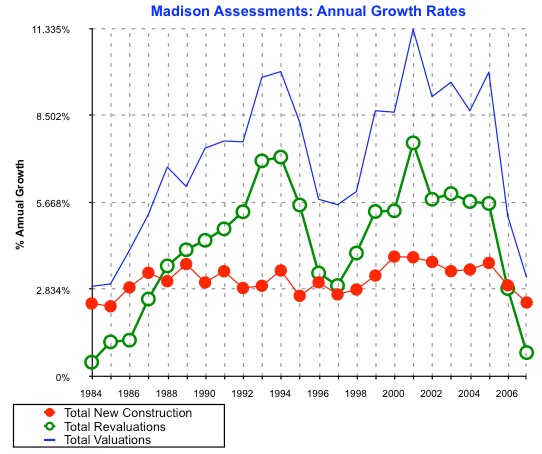
The second reason today’s property taxes are lower than they have been historically is growth, in the form of new construction (i.e. new homes & buildings, as well as remodelings). What we each pay in school property taxes is the result of a simple fraction: the numerator is the portion of school expenses that is paid through local property taxes, while the denominator is the tax base for the entire city (actually the portion of Madison and neighboring communities where kids live within the MMSD). The more the tax base grows, the larger the denominator, and the more people and places to share the property taxes with. Since 1993, new construction in Madison has consistently grown at about 3% per year. Indeed, since 1980 no year has ever seen new construction less than 2.3% nor more than 3.9%. So every year, your property taxes are reduced about 3% thanks to all the new construction in town. I leave it to the reader to speculate how much the pace of new construction and revaluations will decline if the schools here should decline in quality.
FYI, the figure below shows how new construction and revaluations have behaved in Madison since 1984, as well as total valuations (which is the sum of the two).
Share

Does Spending More on Education Improve Academic Achievement?


Dan Lips & Shanea Watkins:

Debates about how to improve public education in America often focus on whether government should spend more on education. Federal and state policy makers proposing new education programs often base their arguments on the need to provide more resources to schools to improve opportunities for students.
Many Americans seem to share this view. Polling data show that many people believe that government allocates insufficient resources to schools. A poll conducted annually from 2004 through 2007 found that American adults list insufficient funding and resources as a top problem facing public schools in their communities.[1]
While this view may be commonly held, policy makers and citizens should question whether histori cal evidence and academic research actually support it. This paper addresses two important questions:
How much does the United States spend on public education?
What does the evidence show about the relationship between public education spending and stu dents’ academic achievement?
The answers to these questions should inform federal and state policy debates about how best to improve education.
Twenty-nine states and the District of Columbia face budget shortfalls totaling approximately $48 billion for fiscal year 2009.[2] Even more states could face shortfalls in the near future. At the federal level, long-term budgets face a challenging fiscal climate. Pro jected growth of entitlement programs is expected to place an ever-increasing burden on the federal budget, limiting the resources available for other purposes, including education.[3]

Related: Charts – Enrollment; Local, State, Federal and Global Education Spending

Share

Some Texas school districts trying to bump up taxes

Terrance Stutz:

Two years after the Legislature cut school property taxes by a third, more than 100 school districts – including several from North Texas – will try to persuade voters this fall to bump their tax rates back up.
And a majority of those districts have found a way to avoid a tax rate election on the same day as the Nov. 4 general election, improving their prospects for voter approval of higher property taxes. Most are holding elections in early October.
The 103 school districts – about one in 10 statewide – say they are being squeezed financially and have to increase taxes to meet basic expenses and give their teachers a pay raise. Among them are the Austin and Corpus Christi districts.
“Most districts are hurting,” said Clayton Downing, president of the Texas School Coalition and former superintendent of Lewisville schools, noting that many districts in need of more revenue probably decided against a tax rate election this year because of the worsening economy.

Share

Colorado Amendment 59: does it shore up education or undermine TABOR?

Benry Morson:

It seemed like a good idea at the time.
Amendment 23, approved by voters in 2000, required funding increases to raise the state’s support for public schools to the national average.
But when Colorado’s economy soured in the early part of this decade, legslators found themselves slashing other programs — such as health care and higher education — to keep the promise to public schools.
Amendment 59 on the Nov. 4 ballot would resolve that problem in the future by creating a savings account for schools to be filled when economic times are good and spent when times are bad.
During those lean years, the legislature balanced the budget with “a lot of baling wire and duct tape,” said House Speaker Andrew Romanoff. “This (Amendment 59) is a much more responsible way to balance the budget.”

Share

School Governance in Washington, DC: The “Nuclear Option”

Paul Tough:

Today’s paper brings the news that Michelle Rhee, the superintendent of the D.C. public schools, has come up with a Plan B to use if the D.C. teachers union refuses to accept her proposed new contract.
Plan A, as I wrote last week, was a contract under which teachers could give up tenure in return for large pay increases. Plan B, essentially, is a system in which teachers lose tenure and don’t get large pay increases. Rhee says she and the state superintendent could also change the licensing requirements for the district’s teachers so as to require them to demonstrate classroom performance–the kind that would have earned them big bonuses under the contract–merely to keep their jobs.
The story in the Washington Post suggests that Rhee is not only aware of the city’s generation gap among teachers, she also plans to take advantage of it.
Rhee’s ultimate goal is clear: to weed the District’s instructional corps of underperformers and remake it, at least in part, with younger, highly energized graduates of such alternative training programs as Teach for America, where she began her career. Unlike many tenured Washington teachers, those emerging from such programs are unlikely to invest their entire working lives in education. But they will, in Rhee’s estimation, be more inclined to embrace her core message: that children can learn no matter what economic and social conditions they face beyond the classroom and that teachers should be held directly accountable for their progress through test scores and other measurements.

Share

24/7 School Reform

Paul Tough:

In an election season when Democrats find themselves unusually unified on everything from tax policy to foreign affairs, one issue still divides them: education. It is a surprising fault line, perhaps, given the party’s long dominance on the issue. Voters consistently say they trust the Democrats over the Republicans on education, by a wide margin. But the split in the party is real, deep and intense, and it shows no signs of healing any time soon.
On one side are the members of the two huge teachers’ unions and the many parents who support them. To them, the big problem in public education is No Child Left Behind, President Bush’s signature education law. Teachers have many complaints about the law: it encourages “teaching to the test” at the expense of art, music and other electives, they say; it blames teachers, especially those in inner-city schools, for the poor performance of disadvantaged children; and it demands better results without providing educators with the resources they need.
On the other side are the party’s self-defined “education reformers.” Members of this group — a loose coalition of mayors and superintendents, charter-school proponents and civil rights advocates — actually admire the accountability provisions in No Child Left Behind, although they often criticize the law’s implementation. They point instead to a bigger, more systemic crisis. These reformers describe the underperformance of the country’s schoolchildren, and especially of poor minorities, as a national crisis that demands a drastic overhaul of the way schools are run. In order to get better teachers into failing classrooms, they support performance bonuses, less protection for low-performing teachers, alternative certification programs to attract young, ambitious teachers and flexible contracts that could allow for longer school days and an extended school year. The unions see these proposals as attacks on their members’ job security — which, in many ways, they are.
Obama’s contention is that the traditional Democratic solution — more money for public schools — is no longer enough. In February, in an interview with the editorial board of The Journal Sentinel in Milwaukee, he called for “a cultural change in education in inner-city communities and low-income communities across the country — not just inner-city, but also rural.” In many low-income communities, Obama said, “there’s this sense that education is somehow a passive activity, and you tip your head over and pour education in somebody’s ear. And that’s not how it works. So we’re going to have to work with parents.”

Share

Trickledown Ballot Should Help Madison Schools

Scott Milfred:

Holding school referendums in liberal Madison during major national elections has shown to have strategic advantages.
For one thing, young people vote in much higher numbers. And young adults will overwhelmingly support school referendums no matter the details or cost. That’s because they don’t pay property taxes, at least directly. They also have a high appreciation for schools because they are, or not long ago were, students.
Another advantage is that huge majorities of middle-aged and older voters in Madison are fed up with President Bush. Madison and the rest of the nation produced a Democratic landslide on Nov. 7, 2006, with the Iraq war overshadowing a largely-ignored Madison school building referendum that easily passed.

Share

Cry for change resounds in St. Paul schools

Emily Johns:

The St. Paul School District this fall is planning on engaging community members, parents and school district staff in an indepth discussion about the district’s future with one major premise: Things need to change.
The district, which serves about 38,800 students, faces considerable challenges. It has made more than $93 million in budget cuts over the last nine years. Only half its students are proficient in reading, the achievement gap between white students and students of color is among the widest in the nation, and federal and state expectations for student achievement are accelerating.
The district “is at a crossroads,” according to a presentation that district staff made to school board members on Thursday night. “Business as usual is not a sustainable option for achieving our mission.”
The St. Paul district’s efforts to comply with federal and state desegregation laws over the past 30 years and retain students have resulted in a complex network of magnet and neighborhood schools.

Share

A Look Back at a 2001 Dayton School Board’s Results

Scott Elliott:

Let’s remember back for a moment to the excitement of 2001. Gail Littlejohn, a retired corporate attorney, and three allies won four seats on the school board, taking control with a majority and promising big changes that would help lead the district back to respectability.
And for the first few years, the Kids First team had a remarkable run of successes. They replaced a well meaning but floundering superintendent with an efficient manager in Percy Mack, a move that was well received in the community. They put a reform in place that emphasized teacher training and focused on math and reading instruction. They got the NAACP and the state to agree to settle the 20-year-old desegregation case, bringing millions in cash and releasing the district from court supervision. They got a huge bond issue passed to rebuild all the schools in the city. Eventually, Dayton even had enough test score gain to jump from “academic emergency to “continuous improvement” in the state ratings. And for at least those first few years, Kids First got support from the rest of the school board, business leaders and much of the community.

Share

The nation’s fiscal wake-up call

Allan Knepper:

Recently, I joined a throng of 25 people in a theater with a capacity of 250 to view the premiere of the documentary “IOUSA.” The film, directed by Patrick Creadon, outlines the U.S. national debt, how we got to where we are and the dire predictions for the future. It is loosely coordinated around the “Fiscal Wake-up Tour,” a road show featuring former U.S. Comptroller General David Walker and Robert Bixby, executive director of the Concord Coalition.
I have been a huge fan of the straight-talking Walker since seeing him on CBS’ “60 Minutes” more than a year ago. He gave an impassioned interview then, outlining the rapidly growing federal deficit and its impact on current and future generations.
Joining in a live panel discussion after the film’s showing were Walker, Warren Buffett, Blackstone Group co-founder Peter Peterson, Cato Institute Chairman William Niskanen and AARP CEO Bill Novelli.
While I’m sure they were not as entertaining as the fantasy thrillers being shown in adjacent theaters, the facts and figures laid out in the movie were every bit as chilling as a horror movie to anyone who cares about the future of our country and the country we will leave to our children and grandchildren.
The movie commented on four types of deficits: the U.S. budget deficit, the U.S. trade deficit with other nations, the U.S. deficit of personal savings and a deficit of leadership in addressing these problems.

Share

Detroit’s Education Emergency

Bob DeVries:

The state of Michigan has had and continues to have significant financial problems. This is why it is baffling to me why the Granholm administration continues to pretend everything is OK in the Detroit public schools system.
Currently, Detroit Public Schools has a $400 million budget deficit. This is due to severe financial mismanagement, corruption, and the fact that families are removing their children from the public schools because of their inability to provide effective education. An attorney representing DPS has admitted that there is reason to believe there was some corruption, citing $46 million that was paid out by one department within the school district that was not apparently used to purchase goods or services. The FBI is currently investigating this and other allegations of corruption.
I think that it’s about time that we declare an “education emergency.” The purpose of this declaration will have three goals. First, we need to take drastic steps to make sure we are providing effective education to the children of Detroit. Second, Gov. Granholm needs to put DPS into state receivership. This means that the state Department of Education would temporarily appoint a financial manager for DPS who would have the final say on all financial decisions. Finally, we need to root out the corrupt and incompetent administration officials so that this tragedy does not again occur.

Share

Indiana Governor Candidates Discuss Education

Niki Kelly:

ill Long Thompson unveiled a handful of education initiatives Wednesday while Republican Gov. Mitch Daniels introduced five campaign commercials, three of which focus on his own education proposals.
The two face off in November’s gubernatorial election.
“I don’t have all the answers, but we are not meeting our objectives,” Long Thompson said at a Statehouse news conference Wednesday.
One of her proposals is to provide a free book every month to all Hoosier children from birth to age 5. This is modeled after Tennessee’s partnership with Dolly Parton’s “Imagination Library,” but Long Thompson’s program would be paid for with private donations.
She also wants to allow kids who need the extra time and help to attend a fifth year of high school in an effort to improve Indiana’s graduation rate of about 76 percent.

Share

Campaign to Keep Schools Under the NYC Mayor’s Thumb

Jennifer Medina & Elissa Gootman:

Close allies of the Bloomberg administration have set up a political organization to campaign for renewal of the landmark state law giving New York City’s mayor control of its public schools, hiring a veteran operative and planning to raise up to $20 million for television advertisements, lobbying and grass-roots organizing.
The group, called Mayoral Accountability for School Success, is officially headed by three well-known and respected city figures, among them a nun lauded for her work with struggling students and a popular Harlem minister. But it is backed by top City Hall and Education Department officials, for whom persuading Albany to extend mayoral control is the No. 1 goal for the school year that starts on Tuesday.
The group filed papers in recent weeks to become designated a 501(c)(4), a nonprofit that can lobby and participate in political campaign activity. The move is the first salvo in the pitched battle expected to unfold between now and the end of June 2009, when the 2002 law giving Mayor Michael R. Bloomberg authority over the nation’s largest school system is set to expire.
Renewal is crucial to Mr. Bloomberg’s legacy, since he has staked his reputation on overhauling the schools and has repeatedly argued that without City Hall at the wheel, the system would be doomed to fail.

Share

Is it really ‘public’ education if voters get no say?

Andrew Coulson:

At 9 a.m. Wednesday, the state Supreme Court will hear oral arguments in a case that will shape the future of education in Florida. At issue are two constitutional amendment questions slated to go before voters in November.
A lawyer for Florida’s teachers union will argue that they should be removed from the ballot; the secretary of state’s lawyer will ask the court to leave them in place, allowing voters to decide these questions. The court should let Floridians have their say.
The first question, Amendment 7, deals with religious discrimination. This amendment would make it illegal to exclude any person or organization from participating in a public program because of religion. It also would allow the state to continue operating programs under which religious organizations can receive funding as long as the purposes and primary effects of those programs are secular (as required by the First Amendment of the U.S. Constitution).
The second question, Amendment 9, would require at least 65 percent of school-district operating expenditures to be spent in the classroom rather than on administration. It also would allow legislators to create alternative education programs in addition to the constitutionally required public-school system (though it wouldn’t create any new programs).

Share

Democrats, teachers unions now divided on many issues

Greg Toppo:

A funny thing happened to the Democratic Party on the way to an education platform: The party has visibly split with teachers unions, its longtime allies, on key issues.
The ink is barely dry on the official document, which outlines the party’s guiding principles, but it shows that in this fall’s general election, Democrats will stake out a few positions that unions have long opposed.
Among them: paying teachers more if they raise test scores, teach in “underserved areas” or take on new responsibilities such as mentoring new teachers.
Randi Weingarten, the American Federation of Teachers‘ new president, says she’s willing to entertain merit-pay plans. But most union leaders, as well as rank-and-file members, have long resisted, saying teachers would compete for jobs rather than cooperate and share ideas.

Share

Learn schools’ value to economy

Wisconsin State Journal Editorial:

Today is one of the most important days of the year for Wisconsin’s economy.
It’s the first day of the school year.
The state’s families and policymakers should take the opportunity to remind themselves of the link between education and economic success.
Education and the economy have long been related, but that relationship is growing closer in the age of the global, knowledge-based economy.

Share

A time for heat – and light – on Milwaukee schools

Milwaukee Journal-Sentinel Editorial:

Mayor Tom Barrett and the Milwaukee School Board agree on this much: The community needs an accurate reading on the district’s finances.
Unfortunately, that may be the only thing they agree on.
Both are moving separately on plans to get the numbers. The School Board wants to spend $50,000 of taxpayers’ money to perform an audit to see where the Milwaukee Public Schools can be more efficient. Barrett is seeking funding from local foundations for an assessment of the struggling district’s financial and operational situation — a study that also could take the next step and recommend restructuring and how to best direct resources to the classroom where they can most help educate Milwaukee’s kids.
On paper, we believe Barrett’s plan goes beyond that of the School Board, because it will home in on a half-dozen or so top priorities that, when funded adequately, will improve MPS performance and increase the district’s credibility among parents, taxpayers and decision-makers in Madison.
For Barrett’s plan to have bite, he needs the support of foundations to retain a firm expert in urban school system finance and operations. Then the mayor needs to pressure the board and administration to get to work.

Share

School District Consolidation feasibility study grants

Wisconsin Department of Public Instruction:

The Department of Public Instruction has awarded consolidation feasibility study grants for six consortiums (a total of 14 school districts). The grants, $10,000 to each consortium, are intended to provide funding for the identification of issues, data analysis, and the development of reports to inform the communities on the possibility of consolidation.
The grants went to consortiums consisting of: Chetek and Weyerhaeuser, Glidden and Park Falls, Bruce and Ladysmith-Hawkins; Benton, Cuba City, Southwestern, and Shullsburg; Montello and Westfield; and Prairie Du Chien and Wauzeka-Steuben.

Share

Why Doesn’t Plagiarism Matter?

Jonathan Beecher Field:

As David Horowitz would be quick to remind you, academics tend to skew to the left in their political outlook relative to the general population. I am no exception. Like so many of my colleagues, I have followed Barack Obama’s presidential campaign with interest and excitement. South Carolina had an early primary this year, and nearly all of the major candidates came to speak at Clemson University, where I teach. Obama spoke outdoors, on a chilly and gray afternoon, but the energy he shared with that crowd of teachers, staff, and students made the event the most compelling political spectacle I’ve witnessed personally. The sight of an integrated crowd cheering a black presidential candidate not far from a campus building named in honor of Benjamin Tillman, an ardent segregationist, made politics seem exciting again.
Remembering this sense of exhilaration I sensed in seeing a new field of political possibilities makes the sense of betrayal I feel today even more powerful. By choosing Joe Biden as his running mate, Barack Obama has insulted academics — students and teachers alike — a constituency that was significant in bringing him the nomination of his party. Especially in a year that has seen two prominent political careers hamstrung by sex scandals, and in an era where choosing vice presidential candidates seems to be foremost an exercise in avoiding skeletons in the closet, it’s surprising that Biden’s record of plagiarism did not disqualify him from Obama’s consideration.
Joe Biden, you will remember, ran for president in 1988. He delivered a speech that presented the thoughts of British Labour Party Leader Neil Kinnock is if they were his own, and was slow to explain or apologize for this transgression. The ensuing scrutiny of Biden’s record revealed that he had also plagiarized in law school, failing a course for doing so. Shortly after these revelations, he dropped out of the race.

Share

Referendum Climate: “State Budget Keeps Getting Worse”

Wisconsin State Journal Editorial:

The house of cards known as the state budget is predictably collapsing.
A Dane County judge heard arguments this week on the legality of a $200 million raid state leaders made on a special fund that’s supposed to cover large medical malpractice awards.
Doctors pay into the fund to hold down their insurance rates. So the Wisconsin Medical Society, which represents about 60 percent of doctors, sued the state last year after the governor and Legislature raiding the fund to patch a state budget hole.
The state raid was just the latest in a series of poor financial moves that voters should remember when voting for legislative candidates this fall.
Voters should favor those candidates willing to scrutinize spending and resist expensive new programs. The accounting tricks and money raids need to stop. And the longer Wisconsin waits to get its financial house in order, the harder and more painful it will be to fix.

Share

The Road to Education Reform

Wisconsin State Representative Brett Davis (R-Oregon):

As families across Wisconsin get ready to send their kids back to school, it is important to focus on how we are going to continue to improve student achievement for all our children. As chairman of the state Assembly Education Committee and having my son Will entering the ranks of pre-school, I understand the need to constantly look to improve our education system in Wisconsin so our kids and grandkids can compete in a competitive global economy and be productive citizens.
To increase student achievement in Wisconsin, I recently announced a comprehensive K-12 education improvement plan that I believe will reduce property taxes, make our school finance system more sensible, modernize student assessments, and direct more resources to classroom instruction. First, however, it is necessary to point out the current financial commitment to K-12 education in Wisconsin.
Wisconsin has 426 school districts educating approximately 868,000 students. The current state budget will spend more than $12.3 billion during the next two years on K-12 education, the most amount of money ever spent on education in our state’s history. This amount represents 44 percent of our state’s general purpose revenue (our tax dollars) and appropriately is our number one state financial commitment. In 2008-09 it is estimated local school districts, primarily through property taxes, will spend another $5 billion. When all funding is combined, including the $600 million we receive from the federal government, we spend about $12,600 per student. In 2005-2006, our state spending level ranked Wisconsin 14th nationwide, according the US Census Bureau.

Related: Local, state, federal and global education spending charts.

Share

Making new school year resolutions

Mary Bell, President of WEAC:

When I began my teaching career at Rhinelander High School 31 years ago, I started the school year by making resolutions the same way many of us do in early January. When you work in public education, you don’t just resolve to exercise more often or cut down on your caffeine, you resolve to monitor the cleanliness of your students’ desks (before it is too late), to not let your lesson plans cut into recess and lunch periods, to assign less (or more) homework, or to finish your master’s degree.
I made these resolutions at the start of every school year, long after I had gone from a first-year English teacher in Rhinelander to a veteran library media specialist in Wisconsin Rapids. Most educators I know make new school year resolutions, because every school year starts with a clean slate and a sense of unlimited possibility.
Great schools benefit everyone, and throughout Wisconsin it is not just educators but whole communities taking pride in the public schools they have created and sustained. This sense of ownership and investment has paid big dividends, as Wisconsin’s schools are the envy of the nation. We have one of the highest high school graduation rates. On the ACT college entrance exam, our high school seniors have ranked in the nation’s top three for 19 years in a row.

Related: Local, state, federal and global education spending charts.

Share

Radical idea: Open the doors of affluent suburban schools to Chicago students

Richard Kahlenberg via a kind reader’s email:

Sen. James Meeks’ (D-Chicago) proposed student boycott of Chicago public schools next month has sparked furious controversy. Should students miss their first day of class for the worthy goal of promoting equity in public school spending? Leaders such as Mayor Richard Daley and Chicago Public Schools Chief Arne Duncan are worried about the disruption involved as Meeks seeks to enroll Chicago students at New Trier High School in Winnetka.
Missing from the discussion is a bigger point: The main reason New Trier’s students achieve and graduate at much higher levels isn’t per-pupil expenditure; it’s differences in the socioeconomic status of the student bodies in Chicago and New Trier.
Decades of research have found that the biggest determinant of academic achievement is the socioeconomic status of the family a child comes from and the second biggest determinant is the socioeconomic status of the school she attends. The main problem with Chicago schools isn’t that too little is spent on students but that the school district has overwhelming concentrations of poverty.
In the 2005-06 school year, Chicago public schools spent $10,409 per pupil, much less than New Trier ($16,856), but slightly more than several high-performing suburban school districts, including ones in Naperville ($9,881) and Geneva ($9,807). The key difference is that while 84.9 percent of Chicago students come from low-income homes, New Trier has a low-income population of 1.9 percent, Naperville has 5 percent and Geneva 2.4percent.

Share

November 2008 Referendum Chatter

Mitch Henck discusses Monday evening’s Madison School Board 7-0 vote to proceed with a recurring referendum this November. 19 minutes into this 15mb mp3. Topics include: property taxes, uncontested elections, health care costs, concessions before negotiations and local control. Via a kind reader’s email.

Share

When Education is Unequal

Cheryl Jackson via a kind reader’s email:

his week, in a lawsuit brought against the State of Illinois and the State Board of Education, the Chicago Urban League and Quad County Urban League called on the courts to end the discriminatory and unconstitutional way public school education is funded in Illinois. This is not just an educational issue, but a civil rights issue, too, for thousands of African-American and Latino students whose social and economic future is being shortchanged by a flawed state policy.
After more than a decade of legislative gridlock on education funding reform, set against a bleak backdrop of crumbling schoolhouses, moldy books and shamefully low graduation rates–the time has come to dismantle the current property-based system of school financing.
That system is discriminatory in its impact, sustaining huge funding gaps between black and white schools.
It makes quality education nearly impossible for thousands of students of color. It confounds the best efforts of well-meaning parents, teachers and administrators. And it puts children on a pathway to lifelong poverty and social pathologies that squander their potential and exact enormous social costs.

Share

In Support of the November, 2008 Madison School District Referendum

Community and Schools Together:

We have a referendum!
Community and Schools Together (CAST) has been working to educate the public on the need to change the state finance system and support referendums that preserve and expand the good our schools do. We are eager to continue this work and help pass the referendum the Madison Metropolitan School District Board of Education approved on Monday, August 25, 2008.
“The support and interest from everyone has been great,” said Franklin and Wright parent and CAST member Thomas J. Mertz. “We’ve got a strong organization, lots of enthusiasm, and we’re ready to do everything we can to pass this referendum and move our schools beyond the painful annual cuts. Our community values education. It’s a good referendum and we are confident the community will support it.”
Community and Schools Together (CAST) strongly supports the Madison Metropolitan School District Board of Education’s decision to place a three-year recurring referendum on the November 4, 2008 ballot. This is the best way for the district to address the legislated structural deficit we will face over the next few years.

Much more on the November, 2008 Referendum here.

(more…)

Share

Madison School Board OKs Nov. referendum

Tamira Madsen:

Members of the Madison School Board will ask city taxpayers to help finance the Madison Metropolitan School District budget, voting Monday night to move forward with a school referendum.
The referendum will be on the ballot on Election Day, Nov. 4.
Superintendent Dan Nerad outlined a recommendation last week for the board to approve a recurring referendum asking to exceed revenue limits by $5 million during the 2009-10 school year, $4 million for 2010-11 and $4 million for 2011-12. With a recurring referendum, the authority afforded by the community continues permanently, as opposed to other referendums that conclude after a period of time.
Accounting initiatives that would soften the impact on taxpayers were also approved Monday.
One part of the initiative would return $2 million to taxpayers from the Community Services Fund, which is used for afterschool programs. The second part of the initiative would spread the costs of facility maintenance projects over a longer period.

Andy Hall:


Madison School District voters on Nov. 4 will be asked to approve permanent tax increases in the district to head off projected multimillion-dollar budget shortfalls.
In a pair of 7-0 votes, the Madison School Board on Monday night approved a proposal from Superintendent Daniel Nerad to hold a referendum and to adopt a series of accounting measures to reduce their effect on taxpayers.
Nerad said the district would work “day and night” to meet with residents and make information available about the need for the additional money to avert what school officials say would be devastating cuts in programs and services beginning in 2009-10, when the projected budget shortfall is $8.1 million.

WKOW-TV:

“I understand this goes to the community to see if this is something they support. We’re going to do our best to provide good information,” said Nerad.
Some citizens who spoke at Monday’s meeting echoed the sentiments of board members and school officials.
“Our schools are already underfunded,” said one man.
However, others spoke against the plan. “This is virtually a blank check from taxpayers.

Channel3000:

Superintendent Dan Nerad had to act quickly to put the plan together, facing the $8 million shortfall in his first few days on the job.
“I will never hesitate to look for where we can become more efficient and where we can make reductions,” said Nerad. “But I think we can say $8 million in program cuts, if it were only done that way, would have a significant impact on our kids.”
The plan was highly praised by most board members, but not by everyone who attended the meeting.
“This virtually gives the board a blank check from all of Madison’s taxpayers’ checkbooks,” said Madison resident David Glomp. “It may very well allow the school board members to never have to do the heavy lifting of developing a real long-term cost saving.”

NBC 15:

“We need to respect the views of those who disagree with us and that doesn’t mean they’re anti-school or anti-kids,” says board member Ed Hughes.
Board members stressed, the additional money would not be used to create new programs, like 4-year-old kindergarten.
“What’s a miracle is that our schools are continuing to function and I think that’s the conversation happening around Wisconsin, now, says board vice president Lucy Mathiak. “How much longer can we do this?”
The referendum question will appear on the November 4th general election ballot.
The board will discuss its educational campaign at its September 8th meeting.

Much more on the planned November, 2008 referendum here.
TJ Mertz on the “blank check“.

Share

On Nevada State K-12 Funding

Clark County Superintendent Walt Ruffles:

As a former chief financial officer in both public and private organizations, I recognize the gravity of Nevada’s current financial condition and the need to cut costs where possible. But, as your current superintendent, I also recognize the disservice being done to Nevada’s next generation of adults.
Make no mistake about it, education in Nevada is hurting. Clark County receives the lowest per-pupil funding in the state, and the state funds its students at one of the lowest rates in the nation. That puts the Clark County School District near the bottom of the nation in per-pupil funding. Cuts of the magnitude we are experiencing are making a bad situation worse.

Links:

Share

Give students the choice to attend charter schools where kids perform well

Collin Hitt via a kind reader’s email:

In protest of Chicago’s failing school system, Sen. James Meeks (D-Chicago) is staging a field trip of sorts. He’s urging kids from his legislative district to skip the first day of school, board buses, travel to Winnetka, and attempt to enroll in New Trier High School.
One can understand why Meeks would want better educational options for Chicago kids. But on his way to Winnetka, the senator might want to take a look out the window where there are already many Chicago public schools–charter schools–that are performing on par with top-notch suburban and downstate schools. One such school, Chicago International Charter School, graduates its students 86 percent of the time–comparing quite favorably with public schools Downstate and suburban Chicago, which have an average graduation rate of 84 percent. Overall, charter public schools in Chicago graduate 77 percent of their students, compared with a citywide average of 51 percent.
Why aren’t there more charter schools in Chicago? Because state law caps the number of charters in the city at 30. Today, approximately 13,000 Chicago public school children are on a waiting list to get into charters–schools that have offered a proven formula for success. To give inner-city kids the opportunities they deserve, the charter-school cap should be lifted.

Share

Education Reformers call for Longer School Days, Performance-Driven Teacher Pay & Expanded School Choice

PRNewswire:

America’s leading voices on education reform joined in Denver to call on Democratic leaders to steer public education in a new direction. On the eve of the Democratic National Convention, more than two dozen progressive elected officials, education reform advocates, school leaders and civil rights groups from across the country gathered at the Denver Art Museum to release the Ed Challenge for Change, which highlights new ideas for closing America’s devastating achievement gap.
“An entrepreneurial explosion has occurred over the last few years in public education,” said Joe Williams, Executive Director of Democrats for Education Reform, the organization responsible for conceiving the Ed Challenge for Change. “The creativity exhibited by this new group of educators is helping raise student achievement, empower teachers, close the minority learning gap, and bring hope to places where it’s been in very short supply. It’s a movement that we believe Sen. Obama and other Democrats have taken to heart, and we hope to see these reforms increase in schools across America during the Obama Administration.”

Nancy Mitchell:

An eclectic mix of Democratic wunderkinds, tough-talking education reformers and one elder statesman – former Gov. Roy Romer – are challenging their party to step away from teachers unions and return to fighting for the educational rights of poor and minority children.
“It is a battle for the heart of the Democratic Party,” said Corey Booker, the 39-year-old rising star mayor of Newark, N.J.
“We have been wrong in education,” Booker said of his party and its alliances with teachers unions that put adults before children. “It’s time to get right.”
Booker was among those who appeared Sunday at the Denver Art Museum to challenge the Democratic Party to reconsider its course on education.
In references sometimes veiled and sometimes blunt, they tackled the party’s often- cozy relationship with the National Education Association and the American Federation of Teachers, which typically support – financially and otherwise – Democratic candidates.

Mickey Kaus:

One panelist–I think it was Peter Groff, president of the Colorado State Senate, got the ball rolling by complaining that when the children’s agenda meets the adult agenda, the “adult agenda wins too often.” Then Cory Booker of Newark attacked teachers unions specifically–and there was applause. In a room of 500 people at the Democratic convention! “The politics are so vicious,” Booker complained, remembering how he’d been told his political career would be over if he kept pushing school choice, how early on he’d gotten help from Republicans rather than from Democrats.

Share

Madison’s City Budget & Education

TJ Mertz:

I’ve been so tied up with life and the referendum stuff that I haven’t been much paying attention to the city budget process. A story in today’s Wisconsin State Journal got my attention, this graphic in particular. Two items on the possible cut list will directly impact the school district budget and at least three more will make things harder for our schools to do their job.
These possible cuts have been identified early in the budget process. Mayor Cieslewicz asked all departments to list what they would propose in the way of a 5% budget cut. If things go as the Mayor envisions, about 37% of these cuts will need to be enacted. Nothing is set in stone at this point. The Mayor will propose his budget in October and the Common Council will act in November.

Share

Referendum Climate: Charts – Enrollment; Local, State, Federal and Global Education Spending

Variations of this question are often asked: “Are we spending too much, too little or just the right amount on education?” I thought it might be useful to have a look at some local, state, federal and global information. Click to view the charts in detail:

Madison School District Enrollment: 1994-2007 (the demographics have changed during this time)

Madison School District Budgets: 1995-2009

Percentage of Wisconsin General Purpose State Tax Revenue Spent on K-12 School Districts: 1972-2007

Wisconsin State Tax Dollars Spent on K-12 School Districts: 1972-2007

US Government Tax Revenue, by Source: 1965-2005

Composition of US Government Spending: 1965-2005

Total US Governement Debt, as a percentage of GDP

Wisconsin General Purpose Revenue Tax Receipts by Category: 1971-2007

Global Distribution of public expenditure on Education: ages 5 to 25

Data via the Madison School District (various budget documents and statistics), The Wisconsin Taxpayers Alliance, I.O.U.S.A: One Nation, Under Stress, in Debt and the UNESCO Institute for Statistics Database.
US Bureau of Labor Statistics: Consumer Price Index. $1000 in 1995 requires $1443.33 according to their inflation calculator, while $1000 in 1972 requires $5,262.30 in 2008.
November Madison School District Planned November, 2008 Referendum notes & links. Tax climate notes & links: When is a Tax Cut Really a Tax Hike by Gene Epstein, 20 Reasons to Kill Corporate Taxes by James Pethokoukis, I.O.U.S.A the Movie, the Economist: Inflation’s Last Hurrah and Dave Blaska on the proposed referendum.

Share

Another view: MPS analysis must address all the issues

Karen Royster:

Milwaukee’s children are the city’s future, and their education is a profound concern to all of us. Milwaukee Public Schools is responsible for ensuring students have the knowledge and skills to be capable workers and good citizens.
Like other urban school districts in the country, MPS struggles against mighty odds to fulfill this mission. There are major successes and many problems. Trying to overcome these problems is crucial, and there is room for all sectors of the city and region to share in the work.
A new initiative to audit or otherwise examine MPS could be very helpful if the analysis addresses all the fundamental issues at play, including the following:
• The households MPS students come from are in increasing economic distress, and almost one in five students come to the classroom with special needs — emotional, physical and cognitive — that require additional personnel and resources.

Karen Royster is executive director of the Institute for Wisconsin’s Future; Jack Norman is the institute’s research director. The institute is funded by national foundations and does not receive money from state or local teachers unions.

Share

Schools As Social Service Centers?

Greg Forster:

Believe it or not, that more or less sums up the big new marketing campaign the teachers’ unions are using to try to lure you into giving them more money. It’s actually called “Broader, Bolder.” If you’ve ever seen a title that sounded more like a gimmick to sucker people out of their money, you’ve seen more marketing gimmicks than I have.
The argument runs like this: kids do better in school when they’re well fed, healthy, and so forth. Therefore schools should be transformed into social-service centers that will not only teach students, but also provide health care and lots of other services. Schools would be open all day and provide a wide variety of community programs.
This will, of course, cost a ton of money and entail a huge expansion of the government educational bureaucracy. Which has nothing to do with why the unions want it.

Share

Taxpayers should NOT be asked to give the Madison School Board a blank check!

Active Citizens for Education (ACE) calls for the Madison Metropolitan School District Board of Education to delay making specific decisions for the presentation of a recurring referendum to the taxpayers for a vote on the November election ballot.
Passage of a recurring referendum on the November 2008 ballot would allow the board and school administration to permanently exceed the state mandated revenue spending caps. Such a move to fix a so-called current “budget gap” would allow the board and administration to exceed annual spending caps permanently, every year into the future. This would virtually give the board a “blank check” from district taxpayers to plug future budget gaps or shortfalls. It could prevent the board and administration from having to carefully and thoughtfully budget, like every taxpayer must do when their household budget faces tough economic times and shortfalls.
The plans and communications presented in recent weeks by the board and administration provide greater hope for more effective decision-making now and in the future. The recommendations for changes in policy and accountability options in community services, transportation, lease contracts, fund balances and capital expansion (maintenance) will have positive impacts on reducing the so-called “budget gap.”
The Board must earn the trust of the taxpayers by clearly showing that they can be “good stewards” of taxpayer dollars. Past experience has not earned that trust! If a referendum is ultimately required to fix upcoming budgets, it should be a non-recurring referendum, thereby preventing ‘mortgaging’ the future with year-after-year, permanent increases in spending authority.
The Board and administration must correct the absence of specific processes and strategies for analysis and evaluation of business and educational services, programs, practices and policies. Urgent and substantial investments of time and work are critical for these processes to evolve into hard evidence. This evidence is absolutely necessary to show the public that serious steps are under way to provide clear, concrete data and options for identifying the most effective and efficient results-oriented management of the financial resources of the district. It must be shown that the resources will be directly applied to improvements in student learning and achievement.

(more…)

Share

Connecticut Faces a School Tax Revolt: Distinguishing Between Needs and Wants

Lewis Andrews:

On June 30, the board of education and the town council in Enfield, Conn., convened to hear the results of a citizen cost-cutting committee. Among its other recommendations, the 17 residents recommended replacing some public school teachers with low-cost college interns, restricting the use of school vehicles, and increasing employee contributions to benefit plans.
These may seem modest steps toward fiscal responsibility — but they are emblematic of a significant change in this very blue state: growing disenchantment with the price of government, especially of public education.
Over the past two and a half decades, the student population in Connecticut has increased only 10%. Yet the cost of schooling more than doubled — to $8.8 billion in 2006, up from $3.4 billion in 1981. Seventeen years ago, the state enacted an income tax with promises to cut other taxes. Instead, real-estate assessments soared, creating a massive income transfer from the private to the public sector, fueled in part by a state cost-sharing formula that uses taxes on residents in the suburbs to subsidize urban schools. Helping to soak up all that money were binding arbitration laws, skewed to give teacher unions an advantage in collective bargaining negotiations.

Non-Partisan Action for a Better Redding:

Redding is a fabulous place. And Connecticut is a great state. Our goal is to help make Redding even better!
Since about three-quarters of our budget supports our schools, we explored ways to get a bigger bang for the education buck while simultaneously improving the quality of education. So we developed The School Choice Plan. Not only does it save money for all taxpayers, it also empowers parents with choice and improves education. The Plan is summarized in our School Choice Plan brochure as is the School Grants Calculator we developed. Take a look at the brochure.

Yankee Institute.

Share

“Protect Our Kids from Preschool”

Shikha Dalmia & Lisa Snell:

Barack Obama says he believes in universal preschool and if he’s elected president he’ll pump “billions of dollars into early childhood education.” Universal preschool is now second only to universal health care on the liberal policy wish list. Democratic governors across the country — including in Illinois, Arizona, Massachusetts and Virginia — have made a major push to fund universal preschool in their states.
But is strapping a backpack on all 4-year-olds and sending them to preschool good for them? Not according to available evidence.
“Advocates and supporters of universal preschool often use existing research for purely political purposes,” says James Heckman, a University of Chicago Noble laureate in economics whose work Mr. Obama and preschool activists routinely cite. “But the solid evidence for the effectiveness of early interventions is limited to those conducted on disadvantaged populations.”
Mr. Obama asserted in the Las Vegas debate on Jan. 15 that every dollar spent on preschool will produce a 10-fold return by improving academic performance, which will supposedly lower juvenile delinquency and welfare use — and raise wages and tax contributions. Such claims are wildly exaggerated at best.

Share

A Tax Revolt Is Quietly Brewing In Some States

Tom Herman:

And to think they used to call it “Taxachusetts.”
On Election Day, Massachusetts will vote on whether to eliminate its state income tax. Advocates hope victory in a place long thought of as a free-spending liberal bastion will pave the way for similar initiatives in other states over the next few years. Critics insist a yes vote would lead to fiscal disaster.
While Americans are focusing on the presidential and congressional races, voters in Massachusetts and other states will decide the fate of dozens of state and local tax and spending issues.
It’s still unclear precisely how many of these issues will be on ballots on Nov. 4. Some still haven’t received final approval from state officials or may face challenges in court. But Kristina Rasmussen, director of government affairs at the National Taxpayers Union, a nonprofit group based in Alexandria, Va., estimates there are more than 60 ballot measures that would have “some significant impact” on taxpayers.

Share

Independent Group Seeks Change in the Milwaukee Public Schools

Dani McClain:

A new group calling itself the Milwaukee Quality Education Initiative has joined the accelerating, behind-the-scenes conversations about the future of the city’s schools, and is hosting a retreat this weekend at the Wingspread Conference Center in Racine.
The group’s goal is to brainstorm ways to improve K-12 education in the city, including public, voucher and charter schools, Metropolitan Milwaukee Association of Commerce President Tim Sheehy said Friday.
“We didn’t come down here to blow up MPS,” he said Friday when reached at Wingspread. “We came down here to figure out what action steps we might take to reach a starting point to a broader conversation in the city.”
Sheehy, voucher school advocate and former MPS superintendent Howard Fuller and former state Secretary of Commerce Cory Nettles launched the group several months ago but hadn’t made their efforts known to the larger public, Fuller said. He added that their work hasn’t been particularly influenced by events this week such as Mayor Tom Barrett’s call for an independent audit of MPS or a Journal Sentinel investigation of the district’s Neighborhood Schools Initiative.

Share

Chicago Urban League Lawsuit makes school funding a civil rights matter

via a kind reader’s email. Matt Arado:

Illinois courts refused twice in the 1990s to enter the school-funding debate, saying the matter belonged with state lawmakers, not the judiciary.
The Chicago Urban League, which filed a new school-funding lawsuit against the state this week, believes it can make the courts rethink that position.
The lawsuit characterizes the school-funding question as a civil rights matter, alleging that the current system, which uses property taxes to fund schools, discriminates against low-income minority students, especially blacks and Hispanics.
Using civil rights law should ensure that the courts will hear the case this time around, Urban League Executive Vice President Sharon Jones said.
“Courts have been deciding racial discrimination cases for years,” she said, adding that the Illinois Civil Rights Act of 2003 didn’t exist during earlier school-funding cases.

Maudlyne Ihejirika:

A day after a civil rights lawsuit called the state’s school funding system discriminatory, those who have been battling inequities in the Chicago Public Schools were optimistic, pointing to a historic win in New York.
“The New York suit was successful, and very similar, so we’re hoping that case will set precedent,” said Julie Woestehoff of Parents United for Responsible Education.
As in Illinois, previous suits challenging New York State’s school funding system had failed. But in 1993, a coalition there filed suit alleging for the first time that the system had a “disparate racial impact” based on the Civil Rights Act of 1964.
After 10 years and several appeals, New York’s highest court ruled in 2003 in favor of the plaintiffs. Further appeals by New York’s governor ended with the Court of Appeals upholding the ruling in 2006 and ordering the state to meet a minimum funding figure. That new funding level was finally enacted in April 2007.
Those involved in two previous lawsuits in Illinois said that without the new “disparate impact” claim, the Chicago Urban League’s suit would face bleak prospects.

Links:

Notes and links on funding and education from Kansas City (where a judge ordered a massive spending increase during the early 1990’s and Texas.

Share

Madison Property Tax History: 2001-2007

via the City of Madison Assessor’s office: “The 2008 Property Tax Base of the City of Madison (52K PDF)”. The City’s tax base continues to expand. There are 71,939 parcels in Madison, up from 40,069 in 1990. The Total 2008 assessed value is 21,496,000,000, up from $13,791,000,000 in 2002. Such growth provides great latidude in easing mill rates. Of course, as valuations flatten or decline, the mill rate may dramatically increase, depending on the magnitude of government/school spending increases.

Share

Buildings rise, test scores fall
Spate of school expansions is no tonic for student proficiency

Alan Borsuk & Dave Umhoefer:

The $102 million spent on reviving the concept of the neighborhood school in Milwaukee hasn’t improved academic success at most of the schools where the money was used, a Journal Sentinel investigation found.
With a few exceptions, student achievement has shown little improvement – and in some cases it has fallen dramatically – at 22 schools that were among the largest beneficiaries of the district’s school construction program.
The district’s Neighborhood Schools Initiative was conceived as a way to get children off buses and into their local schools – which MPS officials hoped to improve with new classrooms, before-school and after-school services, and such things as state-of-the-art science labs and libraries.
But bricks and mortar have not raised student performance, testing data shows.
In 16 of the 22 schools, the percentage of fourth-graders rated as proficient or better in reading was lower last year than it was in 2002 – the year the school building initiative hit high gear. Nine schools saw their math scores drop.
Overall, combined fourth-grade reading and math scores have declined sharply at a half dozen of the22 schools where more than $1 million was spent on improvements. Only five schools have had major increases in their combined reading and math performance.

Share

Beth Moss, Arlene Silveira & Lucy Mathiak on the Fall, 2008 Madison Schools’ Referendum

Tamira Madsen:

But Silveira also said the 2005 referendum campaign suffered because the School Board itself was divided on it, “and it was a pretty split community speaking out on both sides in favor and being opposed.
“We are on the same page now. We’re really changing our focus to one of really spending more time on student achievement.”
For board member Lucy Mathiak, a key difference between Nerad’s proposal and past ones are the measures he has taken to cut costs already.

Share

(Madison) School Referendum News

I have appreciated having the opportunity to talk about our schools with you and value your insights, so I wanted to let you know where matters stand on the possibility of a school spending referendum on the November ballot.
As you probably know, Superintendent Dan Nerad submitted his recommendations to the Board at a School Board meeting Monday night (1MB PDF, 3 year financial forecast PDF). In summary, the structural deficit the school funding law imposes on districts as well as increased fixed costs result in a projected budget deficit of $8.1 million for the 2009-2010 school year, $4.4 million for the 2010-2011 school year, and $4.3 million for the 2011-2012 school year, calculated on a same-service basis.
To meet these gaps, the superintendent recommends that the Board approve a referendum asking the voters to authorize the district to exceed our spending limits by $5 million next year, and $4 million in each of the following two years. This would be a recurring referendum, meaning that the authorization for the increased spending in the specified amounts would continue indefinitely.
The amount of extra spending authority we would seek is less than the projected budget gaps. The idea is that this a shared-sacrifice sort of proposal – we would be asking the community to permit us to erase some of the gap through additional taxes while we pledge to address the remainder through seeking out savings and efficiencies that will not have a detrimental impact on classroom learning. As is probably apparent, the referendum is not designed to allow us to restore in a significant way any of the painful cuts we have made in previous years.

(more…)

Share

Referendum Discussion: Vicki McKenna & Don Severson

Download or listen to this 15MB mp3 audio file.
Related:

  • $367M+ Budget notes and links
  • Don Severson’s memo to the Madison School Board on the current financial situation.
  • Marj Passman and Don Severson discuss school finance with Mitch Henck.
  • Madison Superintendent Dan Nerad’s budget and recommendations memorandum to the School board (1MB PDF):

    In 1993, three pieces of legislation were enacted by the State of Wisconsin directly affecting school districts throughout the state. These pieces of legislation created revenue limits, created the state’s commitment to two·thirds funding, and created the qualified economic offer (QEO) in Wisconsin. Since 1993 revenue limits in Wisconsin have allowed the Madison Metropolitan School District to increase revenues annually by 2.2% on average. Conversely the QEO requires school boards to offer a comprehensive salary and benefit package to certified teaching staff of not less than 3.8% annually to avoid binding arbitration. Recognizing that the Madison Metropolitan School District’s budget is comprised of 84% salary and benefits, it must be recognized that while our revenues increase annually by 2.2%, the largest portion of our budget is mandated to minimally increase by 3.8%. Due to these competing pieces of legislation, the Board of Education since 1993 has reduced program and services by over $60 million to comply with state mandated revenue limits, of which $35 million has occurred within the past five years.
    Since the 1992·93 School Year the Madison Metropolitan School District has increased the total tax levy by $74,944,431 through the projected 2008·09 property tax levy. This amounts to an average annual increase of 2.56% since the 1992·93 School Year (see Attachment A). During that same time frame from 1992·93 through the projections for the 2008·09 property tax rate, the Madison Metropolitan School District has decreased the total tax rate from $20.69 to a projected rate of $9.92 for the 2008·09 School Year (see Attachment B).

    Nerad also posted a 3 year financial forecast (250K PDF)

  • City of Madison Assessor: 2008 Madison Property Tax base (PDF)
  • A look at the growth in Madison’s tax base: In 1990, the City of Madison included 40,069 parcels, a number that grew to 64,976 in 2005. Assessment and parcel growth mitigates tax levy increases, or allows it to decline (though this of course, depends on the real estate market along with tax policies).
Share

Don Severson & Marj Passman on School Spending & The Proposed November Madison School Referendum

Chart via Global Education Spending data via UNESCO Institute for Statistics

Mitch Henck @ WIBA: 15MB mp3 audio file. Marj discussed her views on US taxes vis a vis education spending versus other countries.
Much more on the Madison School District’s $367M 2008-2009 budget along with the referendum.

Share

Madison Superintendent Recommends Three Year Recurring Spending Increase via a November, 2008 Referendum

Channel3000:

Nerad told school board members on Monday night that he’s recommending a three-year recurring referendum.
It’s part of what he called a partnership plan to address the budget shortfall.
The plan would put a referendum on the November ballot for $5 million and would ask voters for $4 million in the two following years.
Nerad said to make up the remaining $3 million gap the district would move $2 million from the district’s fund balance, eliminate $600,000 in unallocated staff, which are positions set aside in case of additional enrollment, and make up the remaining $400,000 through other reductions, which he has not yet named.
“We’re working both sides of this and in the end our kids need things from us, our taxpayers need us to be sensitive and all I can say is we tried every step of putting these recommendations together to be responsive on both fronts,” said Nerad.

Andy Hall:

The measure, a “recurring referendum,” would give the district permission to build on the previous year’s spending limit increase by additional amounts of $4 million in 2010-11 and another $4 million in 2011-12. The measure would permit a total increase of $13 million — a change that would be permanent, unlike the impact of some other referendums that end after a specified period.
Approval of the referendum would cost the owner of a home with an assessed value of $250,000 an estimated $27.50 in additional taxes in the 2009-10 school year. That represents an increase of 1.1 percent of the School District’s portion of the tax bill.
But for at least the next two years, the schools’ portion of that homeowner’s tax bill would decline even if the referendum is approved, under the plan developed by Nerad and Erik Kass, assistant superintendent for business services.
They estimate the tax bill for 2010-11 would be $27.50 lower than it is now, and the bill the following year would be about $100 below its current level if voters back the referendum and the School Board implements proposed changes in accounting measures.

Tamira Madsen:

In the first year, the referendum would add an additional $27.50 onto the tax bill of a $250,000 home. Another initiative in Nerad’s recommendation, drawn up along with Assistant Superintendent of Business Services Erik Kass, is to enact changes to help mitigate the tax impact of the referendum. Nerad and Kass said these changes would decrease taxes for homeowners in the second and third year of the referendum.
One aspect of the proposal would return $2 million of an equity to the taxpayers in the form of a reduced levy in the Community Services Fund (Fund 80) for the 2009-10 school year. The second part of the tax impact referendum would be implementation of a Capital Expansion Fund, called Fund 41, in an effort to levy a property tax under revenue limits to spread the costs of facility maintenance projects over a longer period.
Nerad said the referendum process has been a deliberative process, and he’s been cognizant of weighing board members and community questions.

Links:

Links:

Share

Preschool programs feel kindergarten squeeze
More parents opt for ‘free’ classes for 4-year-olds

Patti Zarling @ Green Bay Press-Gazette:

Kindergarten classes for 4-year-olds through a few area public school systems haven’t started yet, but some local private preschools already are losing students.
Two local programs are ending or on the verge of it, saying they can’t afford to maintain preschools, partly because of the launch of public 4-year-old kindergarten.
A few area school districts, including Ashwaubenon, Green Bay and West De Pere, are starting 4-year-old kindergarten programs this fall.
Advocates say the programs provide education and school-preparation to students regardless of family income. But critics liken the programs to free babysitting and worry that districts will dumb down curriculum.
Green Bay has more than 800 children enrolled so far in its 4-year-old kindergarten program for 2008-2009; Ashwaubenon has more than 100 and West De Pere has 178. State rules require districts to partner with private day cares to receive state grants for the programs.

Recently arrived Madison Superintendent Dan Nerad spent most of his career in the Green Bay Schools.

Share

Advocating a November 4, 2008 Madison School District Referendum

Capital Times Editorial:

But even those who might oppose a referendum should be in favor of board action at this point.
If the board moves now, the referendum question can be on the Nov. 4 ballot.
Because the presidential race between Democrat Barack Obama and Republican John McCain is expected to draw a record voter turnout on that day, there could be no better point at which to assess the level of support for the school district in general and the current board’s strategies in particular.
Wisconsin has a great tradition of involving all taxpayers in the process of setting and supporting education priorities. We keep the decision-making process at the grass roots level. We elect school boards. We put major spending and building questions to the voters in the form of referendums. The system has worked well — even as state meddling in the structures of school financing has made things difficult. And it works best when referendums attract maximum participation.

Transcript & mp3 audio file: 7/28/2008 Madison School Refererendum Discussion.
Referendum climate.
Don Severson: Madison School District’s Financial Situation: Memo to the School Board & Administration.

Given the critical values briefly outlined above, it is premature at this time to make recommendations or decisions on a course or courses of action to seek more spending authority as a solution regarding the financial needs of the district. The groundwork for decision-making and the development of improved levels of public confidence in the Board and administration have to continue to be proactively matured for both short- and long-term successes in the district. We urge you to proceed carefully, firmly and in a strategic and progressive manner.

Share

Milwaukee Public Schools spent $102 million on a building spree meant to reduce busing by convincing parents to enroll students in bigger, better neighborhood schools. Today, many of those new classrooms go unused.

Dave Umhoefer & Alan Borsuk:

A massive building expansion by Milwaukee Public Schools has saddled the district with tens of millions of dollars worth of vacant or severely underused school additions, a Journal Sentinel investigation found.
he $102 million Neighborhood Schools Initiative was supposed to get students off buses and into revamped schools near their homes. Instead, darkened classrooms and half-empty buildings serve as monuments to the program’s failures.
The district spent $30 million on major additions to schools where enrollment has actually declined. An additional $19.5 million went toward construction at schools where enrollment gains have fallen far short of expectations. Construction began in 2001, and almost all additions were completed by 2005.
In the most expensive misfire, MPS spent $7 million upfront to lease new classroom space from an affiliate of Holy Redeemer, a prominent Milwaukee church.
That MPS addition is one of the nicest facilities in a district that still uses century-old buildings. And it’s vacant.

A rare piece of school finance related investigative journalism.

Share

Transcript: Madison School Board 7/28/2008 Referendum Discussion

Meeting Transcript:

We begin the presentation by focusing on why is there a problem. And we wanna first and foremost point out that the issues affecting this school district are issues that are also occurring in other school districts in the state. While there may be some circumstances, and there are circumstances that are unique to one place or another, we know that this funding dilemma and the gap that exists between what the current state funding formula provides and how expenses are being dealt with in school district is not unique to this school district. Although we have our story here that is certainly unique. And again I want to emphasize that it really lies at the heart of it is the constraint between the current formula that was put into place in 1993 which basically asserted that the state provide more resources to schools through the two thirds funding if, in turn, school districts would control their costs in two ways. One was through the revenue cap and the second was through the qualified economic offer. And so that was the kind of exchange or the quid pro quo that was made at that time in public policy; to be able to provide more state funding for schools at the same time to place limitations on how much a school district could spend.
In the document we point out examples of this dilemma as it is affecting some of the top ten school districts in the state. Ranging in, for example Waukesha school district of 2.6 million dollar program and service reduction for the 08/09 school year. The district that I am most recently familiar with, Greenbay with a 6.5 million program and service reduction. And just to point out the difference we mentioned we seen there, we use a wording increase revenue authority that represents their gap but that’s also, its described that way because of having more authority through a successfully passed referendum to exceed the revenue cap within that community. So that is what’s meant by an increase revenue of authority.
Now the funding formula is one that school districts across the state are wrestling with. You know the history that this school district has had in terms of the types of decisions that have been made which we are going to underscore in just a minute to accommodate that funding formula but as I turn this over to Eric for the bulk of the rest of the presentation, I’ll conclude its all with the idea yes there is a need to have school funded but its around the assertion that our kids have to have a high quality education to be successful in the world that they are growing into. And yes we do have a fiscal responsibility to use community resources in the most cost effective manner and the reality of it is there are constraints in meeting that proposition. So with that, and I will return for the conclusion, I’ll turn it to Eric who will provide us with more detail of the nature of the problem.

Related:

Share

Madison School District’s Financial Situation: Memo to the School Board & Administration

Thank you for engaging the community in such a meaningful way with the forums this week. I believe the forums were successful in that the participating citizens had the opportunity to openly ask questions, seek information and give suggestions for consideration. The information provided by Dan and Erik was clear and helpful. We believe, that with the actions of the board and administration in recent weeks, there is a new openness, a willingness for exercising greater due-diligence, and an openness to examine more fully the opportunities and challenges with fresh insights and strategies.
There is a challenging road ahead with very heavy lifting to be done to continue to more fully communicate with and engage the public in the decision-making process regarding the future of the district in the educational, business and financial elements. These processes are absolutely critical to charting the course toward more effectivenss in student achievement results and business management. At this point in time, the plans and communications provide greater hope for more effective decision-making. However, time is critical for these processes to evolve with hard evidence to show the public that serious steps are actually underway and are producing information and results in order to provide for clearer future options and enlightened decision-making.
Given the critical values briefly outlined above, it is premature at this time to make recommendations or decisions on a course or courses of action to seek more spending authority as a solution regarding the financial needs of the district. The groundwork for decision-making and the development of improved levels of public confidence in the Board and administration have to continue to be proactively matured for both short- and long-term successes in the district. We urge you to proceed carefully, firmly and in a strategic and progressive manner.
I am available and willing at any time to engage in discussion regarding these statements and recommendations.
Sincerely,
Don Severson
President
Active Citizens for Education
577-0851

Share

Colorado Lt. Gov. O’Brien talks education reform

Charlotte Burrous:

Many educators and visitors had an opportunity to learn how Colorado is addressing education reform during the back-to-school kick-off workshop Wednesday at Cañon City High School.
“Gov. Ritter and I are doing (this) all over the state” to kick off the beginning of the school year, Lt. Gov. Barbara O’Brien said prior to her speech. “We want to talk about changes that we’re implementing through the P-20 Education Coordinating Council. P is for preschool and the 20 is to get us all ready for graduate school.”
During her presentation, she explained how several recommendations were passed through the Legislature that took affect July 1.

Share

Referendum or no referendum? First school forum draws dozens

Tamira Madsen:

On Aug. 18 Nerad will present his recommendations to the board on whether a referendum is the way to trim an $8.2 million hole in the budget, and the board likely will vote Aug. 25 to formulate referendum questions for the Nov. 4 election. In addition, the gap is expected to be $6 million in the 2010-11 school year and $5.1 million in 2011-12.
Since a state-imposed revenue formula was implemented in 1993 to control property taxes, the district has cut $60 million in programs, staffing and services. The district did not have to make budget reductions during the 2008-09 school year after it benefited from a one-time, $5.7 million tax incremental financing district windfall from the city. The district will spend approximately $367.6 million during the 2008-09 school year, an increase of about 0.75 percent over the 2007-08 school year budget.

Andy Hall:

In addition to exploring reductions, Madison officials are researching how much it would cost to begin offering kindergarten to 4-year-olds in the district — a program offered by two-thirds of the school districts in Wisconsin.
Resident William Rowe, a retired educator, urged school officials to generate excitement by offering 4K, which research has shown can help improve academic achievement.
“I believe this is the time to go for it,” said Rowe, who proposed that a 4K referendum be offered separately from a referendum that would help avert budget cuts.
Don Severson, president of Active Citizens for Education, a district watchdog group, praised district officials for making the process so open to the public. However, he urged officials to provide more information about the costs and benefits of specific programs to help the public understand what’s working and what’s not. He predicted a referendum is “going to be very difficult to pass” but said he still hasn’t decided whether one is needed.

Much more on the budget here.

Share

LA’s $7,000,000,000 School Bond

LA Times:

The Los Angeles Unified School District’s Board of Education voted on Aug. 1 to put a $7 billion school bond on the Nov. 4 ballot. That’s more than twice the amount the school board was mulling just two weeks earlier. The size of the bond may have jumped because polling showed voters would approve it, and because the Community College District trustees voted the previous week to put a $3.2 billion bond on the same ballot.
But the board may have overreached. About $2 billion of the bond is not yet allocated to any particular project. That lack of specificity may run afoul of the California constitutional amendment that allows school bonds to pass with just a 55% vote, rather than the two-thirds needed for other local bonds. The larger number may also be more of a reflection of bargaining with charter schools over funding and backing for the bond, and Mayor Antonio Villaraigosa’s desire to demonstrate progress on improving schools, than actual need.

Share

Education spending spree has “failed pupils”

Jack Grimston:

THE literacy and numeracy of new employees have tumbled over the past decade despite Labour’s £28 billion increase in annual education spending, according to research by a leading employers’ organisation.
The Institute of Directors (IoD) found that 71% of its members believe the writing abilities of new employees had worsened, while 60% believed numeracy had also declined; 52% reported a worsening of the basic ability to communicate.
With the exam results season under way, more than 60% of company directors now think GCSEs and A-levels are less demanding than a decade ago. Overall, only 27% believe schools have got better under Labour.
A-level results to be released this Thursday are expected to show the number of passes going above 97% and the proportion of A grades rising slightly from last year’s 25.3%, the 11th successive annual rise.

Share

If We Lose Our Children We Lose America

Karl Priest:

John Stossel (of television’s “20-20”) produced an outstanding report entitled “Stupid in America” which reported that a South Carolina governor would not send his own children to public schools because—it would “sacrifice their education”. The governor wanted to allow the free market to deliver an alternative to public schools. Teacher unions and politicians (who are controlled by teacher unions) complained. They asked, “How can we spend state money on something that hasn’t been proven?” In other words, it’s better to spend state money on something that is proven NOT to work.
Stossel described how the national School Board’s Association (NSBA) claimed, “America’s Public Schools out perform Private Schools when variables are controlled.” Actually, the Private School students scored higher on the tests, but there were adjustments for race, ethnicity, income, and parent’s education backgrounds. That may be a valid statistical tool, but it’s prone to bias and leads to statistical hocus-pocus.
Many public school teachers are nice people trying to make a living, but the number of good teachers and administrators, whether Christian or not, has been decreasing from retirement. The good teachers that remain are entangled victims of the agenda that controls what they can do. Textbook publishers are puppets of the education establishment thereby making it nearly impossible for well-meaning teachers to avoid participating in the indoctrination.

Share

Teacher’s Group “Way off Mark in Attack on No Child Left Behind Law”

DeWayne Wickham:

But this time, the group has an unlikely adversary in its long-shot effort to gut NCLB. It’s being opposed by the Leadership Conference on Civil Rights — a coalition of 192 organizations, including the NEA — that supports “the enactment and enforcement of effective civil rights legislation and policy.”
The Leadership Conference says NCLB is civil rights legislation. Given the yawning achievement gap in public schools between whites, blacks and Hispanics, the umbrella group argues that improving public education is a civil rights issue.
“While NCLB is a flawed law — and we have repeatedly called on Congress to make improvements through the reauthorization process — NCLB has been crucial in exposing the extent of the opportunity and achievement gaps plaguing chronically underperforming schools and creating an atmosphere conducive for fundamental education reform,” Wade Henderson, president of the Leadership Conference on Civil Rights, said last month.
The bill pending in the House would temporarily exempt states from enforcing some NCLB accountability requirements until fixes are made to the 2002 law. But in an editorial earlier this month, The New York Times called the House bill “a stealth attempt to gut the national school accountability effort.”

Share

Referendum Climate: Stupid Budget Tricks

Michael Granof:

STATE governments across the country are reeling from the effects of the current economic downturn. New York, facing a $26.2 billion deficit over the next three years, is particularly hard hit. Like most other states, it is looking to balance its budget mainly by cutting spending.
But if history is a guide, governors and legislators across the country will seek to avoid the difficult choices that are required. Instead, they will likely pass the costs of the services that we enjoy today on to our children and grandchildren, through creatively deceptive budgeting.
This is a time-honored practice. In 1991, the State of New York sold Attica prison to none other than itself. The buyer was a state agency that financed the $200 million purchase price by issuing bonds. The agency then leased the prison back to the state, with the lease payments being equal to the debt service on the bonds.
In substance, of course, the transaction was nothing more than a borrowing arrangement — the equivalent of borrowing $200 million from the buyers of the bonds. Nevertheless, the state booked the entire sale price as revenue for the year. The previous year, the state sold the Cross Westchester Expressway to the New York Thruway Authority — in other words, to itself.

Share