School Information System

Reforming too slowly

Baltimore Sun:

The Obama administration sent up a bright yellow warning flag Monday to states vying for billions of dollars in federal education funds intended to encourage school reform efforts. Of the 40 states that entered the first round of the Race to the Top competition in January, only 16 were named as finalists last month, and of those only two states — Delaware and Tennessee — actually ended up winning part of the federal largesse this week. Delaware was awarded $102 million, while Tennessee got just more than $500 million.
In rejecting the bids of big states such as Florida, New York and Illinois, all of which had been considered strong contenders for the prize, U.S. Education Secretary Arne Duncan sent a powerful signal that the feds won’t be satisfied by half-measures grudgingly adopted by state lawmakers without strong support from local teachers unions. The message was that everybody needs to get behind meaningful reform.
The results of this first round of judging should be sobering to anyone who believed that all Maryland had to do was wave around its No. 1 ranking in Education Week to walk away with a big pile of federal money. More than a dozen states with stronger education reform credentials than Maryland were shut out, and this state surely would have been as well had it not belately recognized how unprepared it was to compete seriously.

Share

2010 Madison School Board Candidate Forum


Thanks to Jeff Henriques for recording this event.
Beth Moss and Maya Cole are running unopposed while Tom Farley faces James Howard in the one contested seat.

Share

Maryland Senate Votes to Increase the Dropout Age from 16 to 18

John Wagner:

It’s become a common lament this session among lobbyists and journalists and other Annapolis insiders: not much is happening.
Perhaps, but in case anyone missed it, two bills with major implications for Maryland education policy cleared the Senate on Wednesday without much fanfare.
One would gradually raise the state’s dropout age from 16 to 18. The other would create a new tax credit with the hope of stemming the tide of Catholic school closures. Debate over both measures has been heavily colored by concerns over the state’s fiscal situation. Neither has made it through the House.

Share

Poor Strategy, Muddled Efforts and Strong Opposition Killed the Doyle-Barrett plan to Overhaul Milwaukee’s Crisis Ridden Schools

Alan Borsuk:

It was an off-the-record conversation early last summer with a major figure in education politics in Wisconsin. I suggested that if a serious move was made to put the Milwaukee Public Schools under mayoral control, the outcome would be decided by a few specific people.
“Gwen Moore?” the source suggested.
No, but what an interesting thought. And it pointed to several key reasons that the proposal, when it came a couple months later from Gov. Jim Doyle and Milwaukee Mayor Tom Barrett, faltered from the start, never picked up momentum, and soon became a dead idea walking.
When Moore, the popular congresswoman who is influential among Milwaukee’s African Americans, promptly came out against mayoral control, her decision pointed to three major flaws in the Doyle-Barrett plan:
*** There is almost no evidence that Doyle and Barrett prepared a strategy for building support for the idea before they went public. Was the fight even worth instigating if it had garnered so little support over the preceding years, and there was so little evidence anything had changed?

Share

Madison School Board gives proposed marketing campaign the ax

Gayle Worland:

In an effort to save money and save face, the Madison School Board has nixed its plans to launch a “positive branding” effort for the school district.
Board members voted unanimously earlier this month to shelve the idea of hiring a marketing firm to help sing the district’s praises at a budgeted cost of $43,000 per year for two years. The vote took place during a discusssion of the district’s looming budget deficit for the 2010-11 school year, at the time estimated at close to $30 million.
“If we’re looking at as many millions of dollars in cuts as we are, it’s a little much to ask the community to pay more property tax so that we can publicize our school district,” School Board member Marj Passman said during the meeting.

Share

Madison School District Administration PR on Budget Tax & Spending Discussions

Madison School District, via a kind reader’s email:

Video Answers to Budget Questions
Answers from Superintendent Dan Nerad and Asst. Supt. for Business Services Erik Kass
Recorded on March 24
At their meeting on March 22, the Board of Education took actions related to the 2010-11 budget. What did they do regarding their use of taxing authority?

Much more on the 2010-2011 budget here.
Tangentially related with respect to ongoing tax & spending growth during the “Great Recession”: What Does Greece Mean to You by John Mauldin.

Share

History of School Reform Offers Glimmer of Hope

Laura Impellizzeri:

Saving Schools: From Horace Mann to Virtual Learning” (Belknap Press, 336 pages, $25.95) by Paul E. Peterson: Education reformers have left the essential teacher-pupil relationship untouched for more than a century, fighting instead for changes outside the classroom: desegregation, teacher pay hikes, funding equality, increased testing, vouchers and changes in curriculum.
Harvard University government professor Paul Peterson argues that although many of those efforts have been well-intentioned, even noble, American schools haven’t kept pace with changes in society. And they’re just not very good.
In a compelling and enlightening narrative, “Saving Schools: From Horace Mann to Virtual Learning,” Peterson traces a variety of reform movements by profiling their leaders or other key players. Horace Mann fostered public schools nationwide, creating a global model in the 19th century; in the early 1900s, John Dewey pushed for education that respected children as individuals and erased social strata; the Rev. Martin Luther King Jr., in leading the civil rights movement, forced schools to start doing as courts and legislators told them; Albert Shanker pushed for better pay and conditions for teachers; a series of “rights” reformers tried to improve quality across the board, while a series of scholars measuring their work found precious little benefit, and that led to the “adequacy” and choice movements, including the push for publicly funded vouchers and charter schools, which together involve less than 10 percent of U.S. schoolchildren.

Share

Lawmakers Say Needs of Rural Schools Are Overlooked

Sam Dillon:

An Oklahoma senator complained that federal rules on teacher credentials had driven thousands of experienced educators out of rural schools. A North Carolina lawmaker complained that formulas for distributing federal education money favored big-city districts at the expense of poor students in small towns.
And a senator from Alaska wanted to know how school-turnaround strategies based on firing ineffective instructors would work in a remote village on the Bering Sea that she said already had tremendous teacher turnover.
Lawmakers who represent rural areas told Secretary of Education Arne Duncan in a hearing Wednesday that the No Child Left Behind law, as well as the Obama administration’s blueprint for overhauling it, failed to take sufficiently into account the problems of rural schools, and their nine million students.

Share

Delaware, Tennessee Win US Race to the Top Grants

Neil King, Jr.:

The Obama administration has decided to award just two states–Delaware and Tennessee–with hundreds of millions in education grants, the culmination of a hard-fought competition that originally drew applications from 40 states, according to people familiar with the decision.
That the administration has picked only two states, and passed up states like Florida and Louisiana that were widely seen as favorites, will surprise many in the education world.
The grants, the first of two rounds under the administration’s $4.35 billion Race to the Top program, are designed to reward states that are pushing ahead on tough teaching standards to overhaul lagging schools.
The fact that just two states won will placate critics, who warned that the administration appeared to be watering down its own standards for the awards. Skeptics have also raised concerns that the Race to the Top program, a cornerstone of the administration’s education policy, would reward states making big promises instead of only those best prepared to impose real change.

Share

Research concludes that students don’t learn more science under Chicago Public Schools College-Prep-for-All Policy

Nicholas Montgomery & Elaine Allensworth:

A Chicago Public Schools policy that dramatically increased science requirements did not help students learn more science and actually may have hurt their college prospects, according to a new report from the Consortium on Chicago School Research at the University of Chicago.
The science policy was part of a larger CPS initiative to expose all students to a college-preparatory curriculum by increasing course requirements across a range of subjects.
Though CPS high school students took and passed more college-prep science courses under the new policy, overall performance in science classes did not improve, with five of every six students earning Cs or lower. College-going rates declined significantly among graduates with a B average or better in science, and they dipped for all students when researchers controlled for changes in student characteristics over time.

Commentary from Melissa Westbrook.

Share

More on Diane Ravitch & School Choice

Alan Borsuk:

Milwaukee, in the strongly revised opinion of Diane Ravitch, is almost a textbook example for showing that the prediction that the tide of school choice will lift all educational boats is wrong.
“One might wonder about how much (Milwaukee Public Schools) is coming apart at the seams because of the competition,” Ravitch said in a telephone conversation. “The competition was supposed to make things better.”
A few years ago, Ravitch was a prominent voice for that latter sentiment. But in a way that has caused a stir in education circles nationwide, she now has come down emphatically in the opposite camp when it comes to private school vouchers, charter schools and the testing-based accountability regimen that is at the heart of the No Child Left Behind education law.
Those ideas just haven’t worked, she argues in “The Death and Life of the Great American School System: How Testing and Choice Are Undermining Education.” It is time to return to emphasizing better curriculum and instruction as the key to better success, she says, and it is time for emphasizing the needs of the mainstream of public school students.

Share

NJEA responds to Christie’s heavy criticism

Tom Hester, Sr.:

Under public pressure from Gov. Chris Christie to renegotiate contracts with local school boards and being accused by him as part of the problem of high education costs and not part of the solution, the 200,000-member state teachers’ union criticized him in return Friday.
New Jersey Education Association President Barbara Keshishian said Christie has chosen the welfare of residents who earn over $400,000 annually over full school funding for the benefit of children.
“The choice could not be more stark: tax cuts for millionaires, or full school funding for New Jersey kids,” Keshishian said. “Just a few weeks into his term Governor Christie has staked out his position, slashing nearly $1.5 billion from state aid to schools and higher education.
“At the same time, he has rejected out of hand any consideration of reinstating a very modest tax on the very wealthiest New Jersey residents, those making more than $400,000 per year,” she said. “Last year, that surcharge generated nearly $1 billion in revenue for the state, enough to close much of the hole that his reckless budget opened in local school budgets.”

Share

Senate Votes to Overhaul Student-Loan Industry

Corey Boles:

The Senate voted to implement a major shakeup of the student loan industry Thursday, in a move that will lead to the most dramatic changes in the way college loans will be made since the Clinton era.
Under the proposal, all private lenders will be banned from originating student loans, with the federal Department of Education stepping in to become the sole provider of loans through a government-backed program.
The overhaul bill still needs to clear the U.S. House once more before it is sent to President Barack Obama for his expected signature. The House is scheduled to consider the bill later Thursday, and Democratic leaders have expressed confidence that it should be approved in that vote.

Share

Obama Retreats on Education Reform

Karl Rove:

“Teaching to the test” means teaching real skills.
In a week dominated by health care, President Barack Obama released a set of education proposals that break with ideals once articulated by Robert F. Kennedy.
Kennedy’s view was that accountability is essential to educating every child. He expressed this view in 1965, while supporting an education reform initiative, saying “I do not think money in and of itself is necessarily the answer” to educational excellence. Instead, he hailed “good faith . . . effort to hold educators responsive to their constituencies and to make educational achievement the touchstone of success.”
But rather than raising standards, the Obama administration is now proposing to gut No Child Left Behind’s (NCLB) accountability framework. Enacted in 2002, NCLB requires that every school be held responsible for student achievement. Under the new proposal, up to 90% of schools can escape responsibility. Only 5% of the lowest-performing schools will be required to take action to raise poor test scores. And another 5% will be given a vague “warning” to shape up, but it is not yet clear what will happen if they don’t.

Share

Illinois State Senate OKs school vouchers

Dave McKinney:

Parents with students in the lowest-performing elementary schools in Chicago could obtain vouchers to move their children into better-performing private schools under a plan that passed the Illinois Senate on Thursday.
The voucher legislation pushed by Sen. James Meeks (D-Chicago) passed 33-20, with three voting present, could affect thousands of children in the lowest-performing 10 percent of city schools. It now moves to the House.
“By passing this bill, we’ll give 22,000 kids an opportunity to have a choice on whether or not they’ll continue in their failing school or go to another non-public school within the city of Chicago,” Meeks said.
“Just as we came up with and passed charter schools to help children, now is an opportunity to pass this bill so we can help more children escape the dismal realities of Chicago’s public schools,” Meeks said.

Share

Lousy School Lunch Bill Closer to Passage

Jill Richardson:

Why do Democrats put their least loyal Senator in charge of one of their highest profile issues? Michelle Obama started her government-wide “Let’s Move” program to improve children’s health and nutrition, but Blanche Lincoln’s the author of the Senate child nutrition bill that just passed out of the Senate Agriculture Committee yesterday. And Blanche Lincoln is no Michelle Obama. She’s not even as progressive as Barack Obama, who called for $10 billion in new money over 10 years for child nutrition, a number Lincoln reduced by more than half.
To put that in easier to understand terms, Obama’s proposal would have given up to $.18 in addition funds to each child’s school lunch. Lincoln’s bill gives each lunch $.06. Compare that to the School Nutrition Association’s request to raise the current $2.68 “reimbursement rate” (the amount the federal government reimburses schools for each free lunch served to a low income child) by $.35 just to keep the quality of the lunches the same and make up for schools’ current budgetary shortfall. School lunch reformer Ann Cooper calls for an extra $1 per lunch to actually make lunches healthy. So any amount under $.35 is no reform at all, and Lincoln gave us $.06.

Share

A Look at Arne Duncan’s VIP List of Requests at Chicago Schools and the Effects of his Expansion of Charter Schools in Chicago

Amy Goodman & others, via a Laura Chern email:

When President Obama’s Education Secretary, Arne Duncan, was the head of Chicago’s Public Schools, his office kept a list of powerful, well-connected people who asked for help getting certain children into the city’s best public schools. The list–long kept confidential–was disclosed this week by the Chicago Tribune. We speak with the Chicago Tribune reporter who broke the story and with two Chicago organizers about Duncan and his aggressive plan to expand charter schools. [includes rush transcript]
JUAN GONZALEZ: When President Obama’s Education Secretary, Arne Duncan, was the head of Chicago’s Public Schools, his office kept a list of powerful, well-connected people who asked for help getting certain children into the city’s best public schools. The list–long held confidential–was disclosed this week by the Chicago Tribune.
The paper reports that the nearly forty pages of logs show admissions requests from twenty-five aldermen, Mayor Daley’s office, the state House Speaker, the state attorney general, the former White House social secretary, and a former United States senator. The log noted “AD”–initials for Arne Duncan–as the person requesting help for ten students and a co-requestor about forty times.
A spokesman for Duncan denied any wrongdoing and said Duncan used the list, not to dole out rewards to insiders, but to shield principals from political interference.
AMY GOODMAN: Duncan was chief executive of the Chicago schools, the nation’s third-largest school system, from 2001 to 2009. During that time, he oversaw implementation of a program known as Renaissance 2010. The program’s aim was to close sixty schools and replace them with more than 100 charter schools. Now as President Obama’s Education Secretary, Duncan is overseeing a push by the administration to aggressively expand charter schools across the country.

Share

Education lessons are lost on Obama

Steve Chapman:

I can’t pinpoint the moment the Obama administration went wrong on the subject of education. But I can pinpoint the moment when it demonstrated it can’t be taken seriously.
I can’t pinpoint the moment when the Obama administration went wrong on the subject of education. But I can pinpoint the moment when it demonstrated that it can’t be taken seriously.
It happened on Monday, March 15, when Education Secretary Arne Duncan was expounding to reporters about revising the No Child Left Behind law. The new policy, he asserted, “is going to revolutionize education in our country.”
No, it’s not. We have been at the task of education for a long time, and one thing we know is that you cannot revolutionize it. The American system of schooling is vast, complicated, self-protective, slow to change and even slower to improve.
On these points, No Child Left Behind, or NCLB, leaves no doubt. It was inaugurated with grand promises eight years ago. “As of this hour, America’s schools will be on a new path of reform, and a new path of results,” exulted President George W. Bush upon signing it.

Share

School Reform: The Next Test

The Economist:

HEALTH reform was supposed to be the crowning achievement of Barack Obama’s first year as president. Instead it has riled Republicans, alienated leftists and exhausted everyone else. However, on March 15th Mr Obama presented Congress with a plan that ought to have a greater chance of support: reforming No Child Left Behind (NCLB), America’s main federal education programme. Everyone agrees that America’s public schools are floundering, and NCLB is widely considered to have failed.
NCLB, enacted in 2002, transformed education policy. It gave the federal government a crucial role in education, forcing states to set standards and hold their schools accountable for meeting them. Schools that failed to make progress would face financial sanctions. All students were to be proficient in reading and maths by 2014. George Bush championed the law; Congress supported it wholeheartedly.

Share

Test time for Madison school board candidates James Howard and Tom Farley

Lynn Welch:

Madison voters will soon be put to a test, perhaps one of the more important ones they’ve faced in recent years. On April 6, they’ll get to decide who will fill an open seat on the Madison Metropolitan School District Board of Education during its biggest financial crisis.
It’s apt, then, that the opposing candidates — James Howard and Tom Farley — also be put to the test. We gave them a series of essay questions on a range of pertinent topics, from how they’d cut the school budget to challenges they’ve faced with their own children in Madison schools.
Their answers, lightly edited for length and style, follow.
Isthmus: What are two specific programs you would suggest cutting or policies you would suggest changing due to ongoing budget challenges, and why?
Howard: In Wisconsin, for 17 years, since 1993, we have had a school funding plan that caps a school district’s annual revenue increase at 2.1%, although the actual cost to run a school district has averaged 4% during those years. Secondly, the state of Wisconsin is supposed to pay two-thirds of the cost of schools. This has never happened. So I’d suggest lifting the revenue caps and legislating complete state funding of public education.
Farley: Certainly, the state’s funding formulas and current economic cycles have had a major effect on this current budget crisis. However, budget challenges will be “ongoing” until the district addresses our own systemic issues. Policies regarding talented and gifted students should be based on national best practices. We should also address length of school year and school day, which are far too limiting and lag other countries.

Share

K-12 Tax & Spending Climate: Personal Income Drops in 42 US States, 2.5% in Wisconsin; Not a great time to raise taxes


Sara Murray:

Personal income in 42 states fell in 2009, the Commerce Department said Thursday.
Nevada’s 4.8% plunge was the steepest, as construction and tourism industries took a beating. Also hit hard: Wyoming, where incomes fell 3.9%.
Incomes stayed flat in two states and rose in six and the District of Columbia. West Virginia had the best showing with a 2.1% increase. In Maine, Kentucky and Hawaii, increased government benefits, such as unemployment insurance and Social Security, offset drops in earnings and property values.
Nationally, personal income from wages, dividends, rent, retirement plans and government benefits declined 1.7% last year, unadjusted for inflation. One bright spot: As the economy recovered, personal income was up in all 50 states in the fourth quarter compared with the third. Connecticut, again, had the highest per capita income of the 50 states at $54,397 in 2009. Mississippi ranked lowest at $30,103.

Share

Yet another reason for school reform

Wisconsin State Journal Editorial:

Worst in the nation?
What an embarrassment.
More importantly, what a loss of young talent for our state.
Wisconsin must do better when it comes to teaching students – especially black students – to read.
Black fourth-graders in Wisconsin just posted the lowest reading scores among the 50 states and the District of Columbia, according to the 2009 National Assessment of Educational Progress.
Only 9 percent of black fourth-graders in Wisconsin performed at or above the proficient level. That compares to 38 percent of white fourth-graders, itself a discouraging number.
Those percentages increase to 38 percent for blacks and 75 percent for whites when fourth-graders who can read at a “basic” level are included.

Share

Florida Senate kills teacher tenure pay system; raises tied to student success

Josh Hafenbrack:

In a major shift, the salaries of Florida’s 167,000 teachers could soon be tied to student test scores, rather than seniority and education level.
The state Senate on Wednesday approved a controversial bill by a 21-17 vote to dismantle teacher tenure, a decades-old system in which educators’ pay is based on years of experience and whether they earn upper-level degrees.
New teachers hired after July 1 would work on one-year contracts and face dismissal if their students did not show learning gains on end-of-year exams for two years in any five-year period. For them, job security would be based soley on two factors: standardized scores and job reviews by principals. Existing teachers would have future pay raises tied to student scores and reviews but would keep their current job security.
“It takes a sledgehammer to the teaching profession,” Sen. Dan Gelber, D-Miami Beach, said Wednesday.

Share

The Fordham Institute’s expert reviewers have analyzed the draft Common Core K-12 education standards (made public on March 10) according to rigorous criteria. Their analyses lead to a grade of A- for the draft mathematics standards and B for those in Eng

Sheila Byrd Carmichael, Chester E. Finn, Jr., Gabrielle Martino, Kathleen Porter-Magee, W. Stephen Wilson, Amber Winkler:

Two weeks ago, American education approached a possible turning point, when the National Governors Association (NGA) and Council of Chief State School Officers (CCSSO) released drafts of proposed new academic standards in English language arts and math for kindergarten through high school. Already the object of much interest–and some controversy–these are standards that, once revised and finalized, will be candidates for adoption by individual states in place of those they’re now using.
For months before they were made public, the “Common Core” standards were much discussed. Between now and April 2–the end of the public comment period on this draft–there will be plenty more. That is a healthy thing, both because the more thoughtful scrutiny these drafts receive, the better the final product is apt to be, and because the only way for these standards ever to gain traction in our far- flung, highly-decentralized, and loosely-coupled public education system is if peo- ple from all walks of life–parents, educators, employers, public officials, scholars, etc.–take part in reading, commenting, and shaping the final product.
But ought they gain traction? We think so. Assuming this draft only improves in the process of revision, the Common Core represents a rare opportunity for American K-12 education to re-boot. A chance to set forth, across state lines, a clear, ambi- tious, and actionable depiction of the essential skills, competencies, and knowledge that our young people should acquire in school and possess by the time they gradu- ate. Most big modern nations–including our allies and competitors–already have something like this for their education systems. If the U.S. does it well and if–this is a big if–the huge amount of work needed to operationalize these standards is earnestly undertaken in the months and years to follow, this country could find itself with far-better educated citizens than it has today. Many more of them will be “college- and career-ready” and that means the country as a whole will be stronger, safer, and more competitive.

Share

Parents & The Detroit Public Schools

Marisa Schultz:

Less than five months after Detroit voters passed a $500.5 million school construction plan, nearly half of the 18 schools that were to be rebuilt or renovated are now headed for closure or plans for them have been altered.
The changes have outraged some supporters of the Proposal S bond who say they feel cheated for voting for a plan they were told would mean new construction or renovation in their neighborhood, but instead their schools will be shuttered as soon as this summer, according to the facilities plan released this week by Robert Bobb, emergency financial manager for Detroit Public Schools.
“It’s a slap in the face to the community,” said Tia Shepherd, whose children’s schools, Cooley High School and Bethune Academy, were slated for $17 million in upgrades but now are closing. “Our community got shortchanged twice.”

Share

Wyo education leaders not impressed with federal education law

Tom Lacock:

The proposed overhaul of No Child Left Behind is prompting concern from the Wyoming teachers’ union.
President Barack Obama last week announced his administration would revamp the federal education law, officially known as the Elementary and Secondary Education Act (ESEA), during an upcoming re-authorization process. The Wyoming Education Association sees the rewrite as both promising and troubling.
“The blueprint earns a grade of incomplete,” WEA President Kathryn Valido said. “There are a lot of areas that need to be re-thought. There are some pieces in it that are a step in the right direction, but the overemphasis on one or two test scores to determine the effectiveness of a teacher or a school doesn’t make sense.”

Share

Schools use referendums to balance budgets

Gina Duwe:

When Parkview Superintendent Steve Lutzke talks to fellow superintendents, the question isn’t, “Are you going to referendum?”
The question is, “When are you going to referendum?”
Declining enrollments and increasing costs that exceed revenue limits plague the Orfordville-based Parkview School District and its neighbor to the west, Brodhead. The results are referendums in both districts April 6 asking voters for permission to exceed state revenue caps.
“They have a lot of company,” said John Ashley, executive director of the Wisconsin Association of School Boards.
Parkview and Brodhead join 34 other districts in the state planning 48 referendums on next month’s ballot. Of those, 26 referendums are to exceed revenue caps.

Share

James Howard Endorsed for the Madison School Board

The Capital Times:

Across decades of interviewing candidates for the Madison School Board, the members of The Capital Times editorial board have talked with dozens of able contenders — and a few not-so-able ones.
We have endorsed liberals and conservatives, friends and foes of the teachers union, veteran board members and newcomers — always in response to a basic question: Which candidate would make the most valuable contribution to the seven-member board that sets the direction for what has been, is and we hope will always remain one of the finest urban school districts in the nation?
With this history providing a sense of perspective, we can say without a doubt that we have rarely if ever encountered a first-time candidate as impressive as James Howard.

Wisconsin State Journal:

James Howard is best prepared for the challenging job of serving on the Madison School Board.
Voters should support him in the April 6 election.
Howard, 56, a research economist, says he’s trained and committed to analyzing data before making decisions. He’ll bring that strong trait to a School Board that has sometimes let emotion get the best of it.
A good example is the difficult issue of consolidating schools with low enrollments to save money during tight times. The School Board backed down from its smart vote in 2007 to consolidate elementary schools on the Near East Side.

Share

Districts need short-term power to raise taxes without voters’ approval, Minnesota Rep. Greiling says

Megan Boldt:

School administrators are staring down a triple-barreled threat.
State aid for schools is frozen. Minnesota is borrowing more than $2 billion in funding promised to schools to help balance the books, forcing districts to dip into their reserves and take out loans. And lawmakers still need to fill in an additional $1 billion shortfall.
So does that mean school districts should have more authority to raise property taxes without voter approval? Some education leaders believe so. The notion has been batted around for years but never gained traction.
“In any other year, I would be horrified by the idea,” said Rep. Mindy Greiling, DFL-Roseville. “But I will consider this as a short-term solution. Education funding should be from the state. But schools need a lifeline right now.”

Share

The takeover takedown

Charlie Sykes:

Even in a year of notable failures-from the stimulus to health care reform-the collapse of efforts to reform the Milwaukee Public Schools stands out as an epic flop. As veteran education reporter Alan J. Borsuk writes in our cover story, the stars seemingly were aligned for a mayoral takeover of the dysfunctional system.
“[Y]ou had the president of the United States, the secretary of education, the governor of Wisconsin and the mayor of Milwaukee-all Democrats-coming down firmly for what they wanted to see happen in the Democratic-controlled Wisconsin Legislature.
“And they didn’t prevail.”
The debate over the mayoral takeover, writes Borsuk, “could have been a real chance to discuss how to energize the deeply troubled MPS system. It could have been a catalyst for re-energizing the whole subject of improving education in Milwaukee. “Instead, it became a plodding tour of why things don’t change easily in Milwaukee….”

Share

Duncan’s staff kept list of politicians’ school requests

Azam Ahmed and Stephanie Banchero:

While many Chicago parents took formal routes to land their children in the best schools, the well-connected also sought help through a shadowy appeals system created in recent years under former schools chief Arne Duncan.
Whispers have long swirled that some children get spots in the city’s premier schools based on whom their parents know. But a list maintained over several years in Duncan’s office and obtained by the Tribune lends further evidence to those charges. Duncan is now secretary of education under President Barack Obama.
The log is a compilation of politicians and influential business people who interceded on behalf of children during Duncan’s tenure. It includes 25 aldermen, Mayor Richard Daley’s office, House Speaker Michael Madigan, his daughter Illinois Attorney General Lisa Madigan, former White House social secretary Desiree Rogers and former U.S. Sen. Carol Moseley Braun.
Non-connected parents, such as those who sought spots for their special-needs child or who were new to the city, also appear on the log. But the politically connected make up about three-quarters of those making requests in the documents obtained by the Tribune.

Share

Understanding Teachers Contracts

Andrew Rotherham & Elena Silva:

Whether it’s the contentious multi-year negotiations over the teachers contract in Washington, D.C., or the debates in many states over competing for Race to the Top funds, teachers contracts are at the center of the education reform debate today. Once of interest only to education insiders, contract issues and calls for reform are now widespread. High profile editorial boards at major newspapers including The New York Times, The Washington Post, and The Wall Street Journal regularly weigh-in on the topic. Articles in magazines like The New Yorker detail the effects of various contract provisions and processes.1 National voices as diverse as former Speaker of the House Newt Gingrich and current Secretary of Education Arne Duncan are calling for more flexibility in how teachers are hired, fired, evaluated, and paid.
Despite increasing attention to contract reform, the public often has no idea what a typical teachers contract looks like. Although they are public documents, most contracts are not easily found on the Web sites of school districts or teachers unions; newspapers and local media do not publish them (and often offer only cursory coverage of the issues being discussed during collective bargaining negotiations).2 Meanwhile, those negotiations are often held out of public view, and the deals cut late at night. The documents themselves can be cumbersome, lawyerly, heavily influenced by side agreements and addendums, and generally hard for non-experts to figure out.

Share

Fixing No Child Left Behind

Wall Street Journal:

The Obama Administration wants to revise the No Child Left Behind education law, which is understandable because the law has flaws. But it’s too bad many of the proposed fixes would weaken the statute and undermine the Administration’s twin goal of raising state education standards.
Some of the White House proposals make sense, such as the push for more charter schools that can focus on the specific needs of their student populations by operating outside of collective bargaining agreements. We also like using student test scores to measure an instructor’s effectiveness and influence teacher pay. Both reforms are strongly opposed by the teachers unions, and Team Obama deserves credit for putting children ahead of the National Education Association.
Other parts of its proposal leave us scratching our heads. The Administration wants to junk NCLB’s requirement that all students be proficient in reading and math by 2014 and replace it with an equally unrealistic goal of making all kids “college ready” by 2020. By this thinking, it’s impossible to teach every kid to read at grade level within the next three years, but getting all of them ready for higher education six years later is doable.

Share

Obama’s Education Proposal Still a Bottomless Bag

Neal McCluskey:

This morning the Obama Administration officially released its proposal for reauthorizing the Elementary and Secondary Education Act (aka, No Child Left Behind). The proposal is a mixed bag, and still one with a gaping hole in the bottom.
Among some generally positive things, the proposal would eliminate NCLB’s ridiculous annual-yearly-progress and “proficiency” requirements, which have driven states to constantly change standards and tests to avoid having to help students achieve real proficiency. It would also end many of the myriad, wasteful categorical programs that infest the ESEA, though it’s a pipedream to think members of Congress will actually give up all of their pet, vote-buying programs.
On the negative side of the register, the proposed reauthorization would force all states to either sign onto national mathematics and language-arts standards, or get a state college to certify their standards as “college and career ready.” It would also set a goal of all students being college and career ready by 2020. But setting a single, national standard makes no logical sense because all kids have different needs and abilities; no one curriculum will ever optimally serve but a tiny minority of students.

Share

Bill targets school board standards

Jim Walls:

The fallout from Clayton County schools’ recent meltdown, in all likelihood, will drift down on Georgia’s 179 other boards of education this summer.
Lawmakers are nearing final approval of a bill that would set minimum ethics standards for local school boards and empower the governor, in some cases, to remove members who can’t adhere to them. It would take effect July 1.
The measure is a response to the Clayton school system being stripped of accreditation in 2008 over ethical breaches by several board members.
They met behind closed doors and berated staff in public. One worked behind the scenes to fire her son’s football coach. Several aligned themselves with competing teachers’ groups and voted along union lines.

Share

K-12 Tax & Spending Climate Obama (US Government) Pays More Than Buffett as U.S. Risks AAA Rating

Daniel Kruger & Bryan Keogh:

The bond market is saying that it’s safer to lend to Warren Buffett than Barack Obama.
Two-year notes sold by the billionaire’s Berkshire Hathaway Inc. in February yield 3.5 basis points less than Treasuries of similar maturity, according to data compiled by Bloomberg. Procter & Gamble Co., Johnson & Johnson and Lowe’s Cos. debt also traded at lower yields in recent weeks, a situation former Lehman Brothers Holdings Inc. chief fixed-income strategist Jack Malvey calls an “exceedingly rare” event in the history of the bond market.
The $2.59 trillion of Treasury Department sales since the start of 2009 have created a glut as the budget deficit swelled to a post-World War II-record 10 percent of the economy and raised concerns whether the U.S. deserves its AAA credit rating. The increased borrowing may also undermine the first-quarter rally in Treasuries as the economy improves.
“It’s a slap upside the head of the government,” said Mitchell Stapley, the chief fixed-income officer in Grand Rapids, Michigan, at Fifth Third Asset Management, which oversees $22 billion. “It could be the moment where hopefully you realize that risk is beginning to creep into your credit profile and the costs associated with that can be pretty scary.”

Share

K-12 Tax & Spending Climate: Moody’s fears social unrest as AAA states implement austerity plans

Ambrose Evens-Pritchard:

The world’s five biggest AAA-rated states are all at risk of soaring debt costs and will have to implement austerity plans that threaten “social cohnesion”, according to a report on sovereign debt by Moody’s.
The US rating agency said the US, the UK, Germany, France, and Spain are walking a tightrope as they try to bring public finances under control without nipping recovery in the bud. It warned of “substantial execution risk” in withdrawal of stimulus.
“Growth alone will not resolve an increasingly complicated debt equation. Preserving debt affordability at levels consistent with AAA ratings will invariably require fiscal adjustments of a magnitude that, in some cases, will test social cohesion,” said Pierre Cailleteau, the chief author.
“We are not talking about revolution, but the severity of the crisis will force governments to make painful choices that expose weaknesses in society,” he said.
If countries tighten too soon, they risk stifling recovery and making maters worse by eroding tax revenues: yet waiting too is “no less risky” as it would test market patience. “At the current elevated debt levels, a rise in the government’s cost of funding can very quickly render debt much less affordable.”

Share

School Districts Losing Public Support: Kansas City

Nicholas Riccardi:

The Kansas City, Mo., district is closing nearly half its campuses after 10 years of dwindling student population. It’s what happens when a district loses support of the public it is meant to serve.
During the warm months, when students at Westport High School got too hot, they cooled down by moving to one of the many vacant classrooms on campus. It was one of the advantages of having 400 students assigned to a school that could hold 1,200.
The downside became apparent last week, though, when the Kansas City school board voted to close Westport and 25 other schools — nearly half of the district’s campuses.
Big-city districts shutter schools all the time. Cities such as Denver and Portland, Ore., have seen childless young families repopulate their urban cores and have adjusted accordingly.
But what is happening in Kansas City is different in scale than anywhere else in the country. It’s an extreme example of what happens when a school system loses the support of the public it’s meant to serve.

Share

We don’t know how to fix bad schools

Rod Dreher:

From Slate’s review of Dianne Ravitch’s new book, in which the former advocate of No Child Left Behind and charter schools admits they’ve failed. Excerpt:

The data, as Ravitch says, disappoints on other fronts, too–not least in failing to confirm high hopes for charter schools, whose freedom from union rules was supposed to make them success stories. To the shock of many (including Ravitch), they haven’t been. And this isn’t just according to researchers sympathetic to labor. A 2003 national study by the Department of Education (under George W. Bush) found that charter schools performed, on average, no better than traditional public schools. (The study was initially suppressed because it hadn’t reached the desired conclusions.) Another study by two Stanford economists, financed by the Walton Family and Eli and Edythe Broad foundations (staunch charter supporters), involved an enormous sample, 70 percent of all charter students. It found that an astonishing 83 percent of charter schools were either no better or actually worse than traditional public schools serving similar populations. Indeed, the authors concluded that bad charter schools outnumber good ones by a ratio of roughly 2 to 1.
Obviously, some high-visibility success stories exist, such as the chain run by the Knowledge Is Power Program, or KIPP, which I’ve previously discussed here. But these are the decided exceptions, not the rule. And there’s no evidence that a majority of eligible families are taking advantage of charters, good or bad. “While advocates of choice”–again, Ravitch included–“were certain that most families wanted only the chance to escape their neighborhood school, the first five years of NCLB demonstrated the opposite,” she writes. In California, for example, less than 1 percent of students in failing schools actually sought a transfer. In Colorado, less than 2 percent did. If all this seems a little counterintuitive, Ravitch would be the first to agree. That’s why she supported charters in the first place. But the evidence in their favor, she insists, simply hasn’t materialized.

Share

“Don’t blame teachers unions for our failing schools”

For the motion: Kate McLaughlin, Gary Smuts, Randi Weingarten Against the motion: Terry Moe, Rod Paige, Larry Sand Moderator: John Donvan:

Before the debate:
24% FOR 43% AGAINST 33% UNDECIDED
After the debate:
25% FOR 68% AGAINST 7% UNDECIDED
Robert Rozenkranz: Thank you all very much for coming. It’s my pleasure to welcome you. My job in these evenings is to frame the debate. And we thought this one would be interesting because it seems like unions would be acting in their own self interest and in the interest of their members. In the context of public education, this might mean fighting to have the highest number of dues paying members at the highest possible levels of pay and benefits. With the greatest possible jobs security. It implies resistance to technological innovation, to charter schools, to measuring and rewarding merit and to dismissals for almost any reason at all. Qualifications, defined as degrees from teacher’s colleges, trump subject matter expertise. Seniority trumps classroom performance. Individual teachers, perhaps the overwhelming majority of them do care about their students but the union’s job is to advocate for teachers, not for education. But is that a reason to blame teachers unions for failing schools? The right way to think about this is to hold all other variables constant. Failing schools are often in failing neighborhoods where crime and drugs are common and two parent families are rare. Children may not be taught at home to restrain their impulses or to work now for rewards in the future, or the value and importance of education. Even the most able students might find it hard to progress in classrooms dominated by students of lesser ability who may be disinterested at best and disruptive at worse. In these difficult conditions, maybe teachers know better than remote administrators what their students need and the unions give them an effective voice. Maybe unions do have their own agenda. But is that really the problem? Is there strong statistical evidence that incentive pay improves classroom performance? Or is that charter schools produce better results? Or that strong unions spell weak educational outcomes, holding everything else constant? That it seems to us is the correct way to frame tonight’s debate, why we expect it will give you ample reason to think twice.

Share

Fall 2011 could be end for Alabama tuition plan

Phillip Rawls:

Alabama’s prepaid college tuition plan appears unable to pay tuition beyond the fall semester of 2011 and still have enough money to provide refunds to the 44,000 participants, administrators said.
For leaders of the Save Alabama PACT parents group, that creates the need for the Legislature to find a solution in the current legislative session.
Patti Lambert of Decatur, the group’s co-founder, said she would prefer a solution in the Statehouse rather than the courthouse, but members may have no choice but to join a handful of parents who have already sued the state to demand the program keep its promise of full tuition.
“I suspect we will be forced to. We are certainly not going to wait until we have no room to maneuver,” Lambert said in an interview Tuesday.

Share

Incoming Milwaukee Public Schools’ chief Thornton gives clues to his priorities

Alan Borsuk:

Gregory Thornton wants to fly pretty much below the radar right now.
The incoming superintendent of Milwaukee Public Schools says he doesn’t take over until July 1, he doesn’t want to interfere with the current superintendent, William Andrekopoulos, and he’s just beginning to know the people and issues in his visits to Milwaukee. So he doesn’t want to get too specific or out front with what he wants to do with his new job.
But talk to him for 75 minutes in a private room at a cafe and you begin to see where he wants to go, and it includes places that might please some who didn’t favor him being hired and displease some who did.
In short: If you like what Michael Bonds is doing as president of the School Board, there’s a strong chance you’ll like Thornton.
Bonds has become a strong force within MPS in the year since he became head of the nine-member board. He is assertive, firm and smart politically. He wants the board to have more power over MPS, and that’s happening. He was at the center of the fight to stop Gov. Jim Doyle and Mayor Tom Barrett’s bid to switch to mayoral control of MPS, and he’s winning.

Share

Teachers Skeptical Of Obama’s Education Plan

All Things Considered:

President Obama is proposing a massive rewrite of the No Child Left Behind policy. But many teachers are skeptical. Randi Weingarten, president of the American Federation of Teachers, says the president’s plan gives teachers full responsibility but no authority.

Share

Public Education Reform: Still Separate But Not Equal in 2010

Tamara Holder:

In 1954, Brown v. Board of Education (of Topeka) ruled that separate was not equal. The ruling allowed for the integration of students from all races and socio-economic status to receive an equal education under the same roof. But now, America’s public school system is in shambles, and the poorest kids are the only ones underneath the rubble. (For example, Chicago’s public schools have dwindled from 75,000 students to 25,000 students, thanks to charter schools and private schools.)
No Child Left Behind was a complete failure.
Now, it is the duty of the administration to fix America’s destroyed public education system.

Share

The New Public Option

Michael Bendetson:

How has the United States responded to this global challenge in education? We continue to lower our standards. While No Child Left Behind (NCLB) was a major step in education reform, it has inadvertently created a system where states continue to lower the expectations bar. In 2007, only 18% of Mississippi students scored proficient in the standardized national reading test. However, 88% scored proficient in the standardized state reading test. While Mississippi can be considered an extreme, a Department of Education report acknowledged, “state-defined proficiency standards are often far lower than proficiency standards on the NAEP.” While under this system test scores have improved slightly, our student’s education level has remained constant. As states are under enormous pressure to show improvements in test scores, standards are lowered. While politicians avoid future trouble, our children inherit it.
Even our once seemingly monopoly on higher education has eroded in recent years. While ranking 2nd in the world in older adults with a college diploma, the U.S. has slipped to 8th in the world in young adults with a college diploma. As other countries continue to provide numerous incentives for their students to attend universities, the United States seems content in allowing higher education to climb ever higher out of the reach of ordinary Americans. Furthermore, China and other Asian countries have created a higher education system that is far more useful in equipping its students with the needs to survive in a 21st century economy. More than 50 percent of undergraduate degrees awarded in China are in the fields of science, technology, engineering and math, compared to just 16 percent in the United States. While we are focused on creating litigators and lawyers, China and our competitors are creating the entrepreneurs and engineers of the future.

Share

Despite Gains, Albany Charter School Is Told to Close

Trip Gabriel:

ccountability is a mantra of the charter school movement. Students sign pledges at some schools to do their homework, and teachers owe their jobs to students’ gains on tests.
Attrition rates have been criticized, but Mr. Jean-Baptiste said, “We attract more than the amount of students we lose.”
But as New York State moves to shut down an 11-year-old charter school in Albany, whose test scores it acknowledges beat the city’s public schools last year, it is apparent that holding schools themselves accountable is not always so easy, or bloodless, as numbers on a page.
The principal, teachers and families of the New Covenant school have mounted a furious defense, citing rising achievement as well as their fears for the loss of a safe harbor from chaotic homes and streets, where teachers deliver homework to parents who are in jail to keep them involved, and the dean of students chases gang members from a nearby park.

Share

Detroit Plan Would Close 45 Schools

Susan Saulny:

In a continuing overhaul of one of the most troubled school systems in the nation, officials in Detroit on Wednesday announced a plan to close 45 of 172 public schools at the end of the academic year. The move is the latest in a string of efforts aimed at rescuing an academically failing district in the midst of a financial crisis.
Detroit has closed more than 100 schools since 2004, yet still has more than 50,000 excess seats throughout the system.
Robert C. Bobb, the emergency manager appointed last year by Gov. Jennifer M. Granholm to take control of the schools, proposed the closings, which would eliminate as many as 2,100 jobs, in the face of a deficit expected to peak at $316.6 million and a dwindling student population.
Only 3 percent of Detroit fourth graders were proficient in math on the last National Assessment of Educational Progress, an annual test of basic skills. The district is the largest in Michigan, with 87,000 students, most of whom are poor and black.

Share

More Than 40 Detroit Schools to Close in June

Associated Press:

Doors are expected to shut on more than a quarter of Detroit’s 172 public schools in June as the district fights through steadily declining enrollment and a budget deficit of more than $219 million, an emergency financial manager said Wednesday.
Three aging, traditional and underpopulated high schools would be among the 44 proposed closures. Another six schools are to be closed in June 2011, followed by seven more a year later, emergency financial manager Robert Bobb said Wednesday. This summer’s closings also include a support building.
The proposed closures are part of a $1 billion, five-year plan to shrink a struggling school district while improving education, test scores and student safety in a city whose population has declined with each decade. The 2010 U.S. Census is expected to show that fewer than 900,000 people now live in Detroit.

Share

Discussing the Madison School District’s 2010-2011 Budget

Don Severson & Vicki McKenna on WIBA AM Radio: 23MB mp3 audio.
Much more on the 2010-2011 budget here.

Share

K-12 Tax & Spending Climate: Highest & Lowest States for Property Taxes: Dane County, WI (Madison) is ranked 53rd as a % of Income


AOL Real Estate:

Hoping for lower property taxes? Head south. A 2009 Tax Foundation ranking shows that the 10 states with the lowest property taxes are all in the South. The homeowners there pay, on average, less than $1,000 a year in property taxes, while those in the East can pay more than six times as much.
A Tax Foundation map of states (pictured) shows 16 states, highlighted in blue, where residents pay in property taxes 1.2% or greater of their home’s value. The 19 white states fall between 0.65% and 1.20%, while the 15 yellow states pay the least.a

Share

A Setback for Educational Civil Rights

Theodore Hesburgh:

I cannot believe that a Democratic administration will let this injustice of killing D.C. vouchers stand.
When President Dwight D. Eisenhower asked me to become one of the founding members of the newly formed U.S. Commission on Civil Rights, African-Americans drank at separate water fountains and our schools were segregated. A decade later, when people came together to march against these injustices, the idea that a black man could ever be elected president of the United States was still something for dreamers. My experience with that great movement gives me a particular appreciation for the historic importance of the presidency of Barack Obama–and the new dreams that his example will inspire in our young.
If Martin Luther King Jr. told me once, he told me a hundred times that the key to solving our country’s race problem is plain as day: Find decent schools for our kids. So I was especially heartened to hear Education Secretary Arne Duncan repeatedly call education the “civil rights issue of our generation.” Millions of our children–disproportionately poor and minority–remain trapped in failing public schools that condemn them to lives on the fringe of the American Dream.

Share

The education president

Chicago Tribune:

Rhode Island’s Central Falls High School faces a world of problems. Not quite half of the freshmen class of 2005 went on to graduate last year. A little more than half of the juniors passed a state reading test. In math, just 7 percent passed.
Superintendent Frances Gallo asked her teachers to step up, to help her turn around their failing school. She asked them to teach 25 minutes more each day. She asked them to tutor the kids, to eat lunch once a week with the kids, to spend more time learning how to teach effectively.
She also offered to increase their pay. Teachers at Central Falls do well: $72,000 to $78,000 a year. Gallo offered them a $3,400 bump.
The teachers union said no.

Share

West Virginia To Turn School Buses Into Ticket Machines

The Newspaper:

Faced with a $120 million budget deficit, West Virginia lawmakers are turning to school buses to bring in desperately needed revenue. The House of Delegates voted 98-0 Saturday to give final approval to House Bill 4223 which allows county school boards to deploy buses to issue $500 automated tickets. The proposal becomes law with the signature of Governor Joe Manchin (D).
“Every county board of education is hereby authorized to mount a camera on any school bus for the purpose of enforcing this section or for any other lawful purpose,” House Bill 4223 states.
Private companies have been traveling to school boards around the country offering to install the cameras at no cost. The company would then issue tickets, collect on the fines and deposit a significant cut of the profits into the school board’s bank account with no work required on the school’s part. The Italian firm Elsag, for example, ran a test of the system in New York state last year. West Virginia’s law, however, would require photographing the driver when issuing the citations. For the first ticket, a thirty-day license suspension is mandatory, with a judge having discretion to impose a six-month jail sentence. After a third ticket is mailed, jail time is mandatory. Arizona currently is the only state that jails vehicle owners based solely on the evidence provided by a ticket camera.

Share

Education Reform: Has Obama Found a Bipartisan Issue?

Alex Altman:

When the bare-knuckled brawl over health-care reform finally wraps up, and the Obama Administration pivots to less divisive topics, education reform may be one of the few issues capable of drawing bipartisan support. The Obama Administration’s proposed overhaul of No Child Left Behind (NCLB) could resonate with Republicans, many of whom have been disappointed with the results of George W. Bush’s signature education initiative. Obama’s blueprint, which was sent to Congress March 15, sets forth an ambitious national standard –that by 2020, all students graduate high school ready for college or a career — but leaves the specifics on how to achieve this goal up to state and local authorities. “Yes, we set a high bar,” President Obama said in his weekly radio address. “But we also provide educators the flexibility to reach it.”
With more than 1 million high school students dropping out every year and the U.S. lagging behind many of its competitors on achievement benchmarks, no one can argue with the need to better prepare students for college and beyond. NCLB, which earned broad bipartisan majorities when the legislation passed in 2002, has drawn praise for shining a light on achievement gaps by forcing the nation’s 99,000 public schools to disaggregate student data. But the legislation’s emphasis on accountability and standardized testing has had some unintended results. By requiring schools to demonstrate adequate yearly progress — toward a goal of 100% proficiency in reading and math by 2014 — Bush’s landmark bill has led many districts to narrow their curricula and some states to lower their standards in order to meet annual targets.

Share

State & Local Tax Increases vs Teacher Union Pay Increases: New Jersey

New Jersey Left Behind:

Here’s the bottom line: it is now mathematically impossible for school districts to sustain annual salary increases of 4-5% and fully subsidized health benefits, historically the proud mantle swaddling NJEA’s wide shoulders. Call it a sea change, call it a paradigm shift, call it a zero-sum game, call it (if you’re Barbara Keshishian, NJEA Pres.) a “political vendetta.” The times they have a-changed.
Where does this leave local school boards and NJEA affiliates? So much depends on whether local bargaining units are able to exercise some autonomy and collaborate with school district officials on producing agreements that are fair to teachers and within legislative fiscal constraints. Will locals be able to disentangle themselves from the lockstep of NJEA’s directives? Is there hope that public education in Jersey can have a relatively healthy adjustment to a new fiscal austerity, a shared vision, a new kind of calculus in assessing appropriate compensation?

These calculations are not limited to New Jersey.
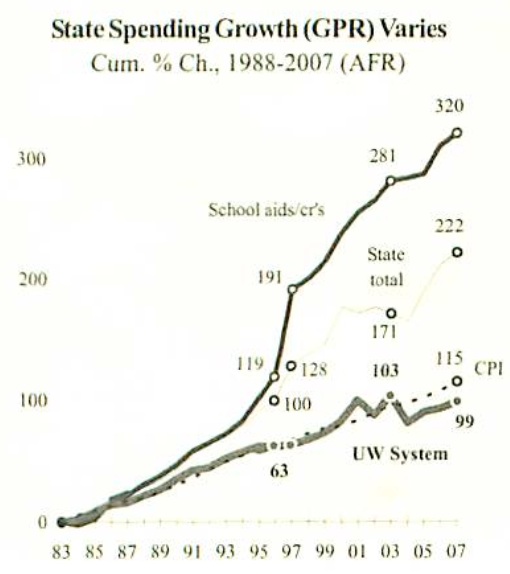
It’s important to remember how much Wisconsin State K-12 spending has grown over the past 25 years, as this chart illustrates:

Many organizations, public and private, are using this period of change to evaluate their major services and determine the effectiveness of all expenditures. Public school districts are no different. It will be interesting to see how this plays out locally.

Share

Video Report on the Madison School District’s Budget: Raising Fees for Adult Programs

WKOW-TV, via a kind reader’s email:

Share

Madison’s $30M Spending Increase & Tax Gap Rhetoric Dissected

School Board Vice President Lucy Mathiak:

So what does this mean? Well, assuming that the board will use its levying authority under the referendum and the state funding formula, the gap is smaller than the reported (and internalized) $30 million. It is probably more like the $17 million in state aid cuts plus the $1.2 million in budget items for which there is no funding source. Or, by higher math, c. $18.2 million BEFORE the board makes its budget adjustments and amendments. (This process will take place between now and the final vote on May 4, and will likely involve a combination of cuts recommended by administration and cuts proposed by the board.)
This means that the draconian school closings and massive staff layoffs reported earlier are unlikely to happen. Indeed, the board added one cut to the list at Monday’s meeting when it voted to cut $43,000 in funding budgeted to produce a communication plan.

Share

Tiny school’s fate roils rural California district

Louis Sahagun:

Class divisions fuel furor over a plan to close college-prep academy in the eastern Sierra Nevada. ‘The situation has unleashed pandemonium,’ says the district’s superintendent.
When Eastern Sierra Unified School District Supt. Don Clark stared down a projected budget deficit, he did what school administrators across the nation have had to do: consider laying off teachers and closing campuses.
But that decision, in a rural district sprawled along U.S. 395 between the snowy Sierra and the deserts of Nevada, has exposed deep resentments between parents of students in traditional high schools and those with teenagers in a college-prep academy designed for high achievers.
The trouble started a week ago when Clark announced that the district, facing a budget shortfall of $1.8 million, was considering laying off more than a dozen teachers and closing the 15-year-old Eastern Sierra Academy, among other measures.

Share

Princeton School District’s Budget Math: Cajole Teacher Unions into Accepting Contract Concessions

New Jersey Left Behind:

Princeton Township Public Schools offers a template on what will most likely occur across many districts on the heels of Gov. Christie’s budget: an effort by school boards to cajole local unions into accepting contract concessions. With cuts of up to 5% of total school budgets, increases in health benefits, and annual salary increases ranging in the mid-4%, there’s no other way to find the money. Other costs – supplies, utilities, transportation – are not fungible.
A few quick facts about Princeton, a 3,500-student school district with sky-high test scores. The annual cost per pupil there is $18,340 compared to a state average of $15,168. (These are 2008-2009 figures from the state database.) The median teacher salary is $69,829 plus benefits. The state median salary is $59,545 plus benefits. Costs of benefits in Princeton come to 23% of each teacher’s salary.

Princeton’s “User Friendly Budget“.

Share

Obama Retreats on Education Reform

Karl Rove:

In a week dominated by health care, President Barack Obama released a set of education proposals that break with ideals once articulated by Robert F. Kennedy.
Kennedy’s view was that accountability is essential to educating every child. He expressed this view in 1965, while supporting an education reform initiative, saying “I do not think money in and of itself is necessarily the answer” to educational excellence. Instead, he hailed “good faith . . . effort to hold educators responsive to their constituencies and to make educational achievement the touchstone of success.”
But rather than raising standards, the Obama administration is now proposing to gut No Child Left Behind’s (NCLB) accountability framework. Enacted in 2002, NCLB requires that every school be held responsible for student achievement. Under the new proposal, up to 90% of schools can escape responsibility. Only 5% of the lowest-performing schools will be required to take action to raise poor test scores. And another 5% will be given a vague “warning” to shape up, but it is not yet clear what will happen if they don’t.

Share

Textbooks in Texas: Jefferson v Board of Education

The Economist:

THE good news is that more Texans are paying attention to social-studies lessons than ever before. The bad news is that they suddenly have cause. On March 12th, the state board of education voted for a series of changes to the state’s history and social-sciences curricula. The changes look small enough–a word here and there, a new name included, maybe a different way of phrasing an issue. But the overall effect, if the changes are approved in May, will to be to yank public education to the right.
The board alluded to the controversial amendments in a polite press release: “All those who died at the Alamo will be discussed in seventh grade Texas history classes. Hip hop will not be part of the official curriculum standards.” The most dramatic change is that Thomas Jefferson has gotten the boot. The conservatives on the board deemed him to be a suspiciously secular figure. The new guidelines would pay more fond attention to their favoured presidents, Ronald Reagan and Richard Nixon. Phyllis Schlafly and the National Rifle Association are in. So are the Black Panthers.
Some of the oddest changes concern economics. Milton Friedman and Friedrich von Hayek will join Adam Smith, John Maynard Keynes, and Karl Marx. And the board decided that references to “capitalism” and the “free market” should be changed to say “free enterprise”, because capitalism has a bad reputation at the moment. That decision is almost inexplicable. Capitalism has been through a rough patch, but surely the term itself is no more inflammatory than free enterprise.

Share

Madison School Board Candidate Issue Essays

Tom Farley School district must shift philosophy:

an Madison afford a new School Board member who requires time to understand the issues, study the research, or develop a good relationship with board members and union leaders? These are all certainly desirable objectives, and over time it is important that they occur. Yet these are exceptional times for Madison and its public school system.
The federal government has demanded that educational leaders in every community must start demonstrating a willingness to challenge the status quo, seek innovative solutions, and begin executing change management efforts. Only those school districts that show a willingness to radically alter their approaches to education, in order to achieve real results, will be supported and funded. The time has come to bring that level of leadership to the Madison School Board.
Management of the Madison School District cannot continue operating in its present form, or under its current philosophies. We have called for additional funding and referendums to increase taxes, and this has not produced the promised results. Clearly, it is not lack of money that hinders our education system; it is the system itself. That needs to change.

James Howard: We must make cuts, but not in classroom

As parents, teachers, taxpayers and voters evaluate the financial woes our Madison public schools face, there are several key points to keep in mind.
First, the taxpayers in our district have been very generous by passing several referendums that have helped close the gap between what schools can spend and what it really costs to educate our kids. However, due to the depressed economy voters are focused on direct family financial impacts and less on the indirect costs that result from any decline in quality of our public schools. Since the district is currently operating under a three-year recurring referendum, it would be a lot to ask of taxpayers to vote yes on a new referendum.
That means we must look elsewhere for answers on how to close what might be a gap of as much as $30 million. Let me be very clear as to where I wouldn’t look: the classroom. We need to protect learning by keeping class sizes small; by funding initiatives that help at-risk children perform up to grade level in basic subjects; and by funding those things that make Madison schools so special, like programs in the arts and athletics.

Share

What’s News: Monona Grove might be in the vanguard of Obama’s education plans

Chris Murphy:

Monday’s story from Susan Troller about standardized tests explains how large school districts like Madison and Milwaukee are interested in what small Monona Grove is doing because its program offers much more detailed results than the standard Wisconsin Knowledge and Concepts Exam (WKCE) and delivers them far more quickly. But it’s also interesting to consider how Monona Grove might be in the vanguard of national changes in how students are taught and tested.
On Monday, President Barack Obama sent a blueprint to Congress for an overhaul of No Child Left Behind, the 2001 law pushed by President George W. Bush that ties federal funding to students’ standardized test results. Annual testing would still be required under Obama’s plan, but one major focus would change from meeting narrow grade-by-grade benchmarks and move toward achieving a common set of skills needed for life after high school, according to the Christian Science Monitor.

Share

Senate votes against reopening D.C. voucher program

Michael Birnbaum:

The D.C. voucher program’s future appeared limited Tuesday after the Senate voted down a measure that would have reopened the initiative to new students.
The voucher program, which since 2004 has provided low-income D.C. students with as much as $7,500 in scholarships to attend private schools, has foundered in the Democratic-controlled Congress. President Obama and Education Secretary Arne Duncan have signaled their opposition to the program, instead advocating charter schools as alternatives to poorly performing conventional public schools.
Tuesday’s 55 to 42 vote was widely seen as one of the final chances for the program to be extended beyond the students who are already currently enrolled. Funding will continue for current students until they graduate high school, but has been cut off to new students for a year.
Sen. Joseph I. Lieberman (I-Conn.) introduced an amendment to a reauthorization bill for the Federal Aviation Administration that would have extended the voucher program for five years and funded it at $20 million a year, opening it to new students. The Senate killed Lieberman’s attempt to amend a different bill earlier this month.

Share

MPS cuts list – though unlikely – includes eliminating athletics, early kindergarten

Erin Richards:

Instead of cutting what could be almost 400 teaching positions in Milwaukee Public Schools next year to balance the budget, the Milwaukee Board of School Directors could instead eliminate all athletics, the entire 3- and 4-year-old kindergarten program or all the school nurses, according to a new list of non-mandatory programs released by the district’s central office.
Superintendent William Andrekopoulos said he has not recommended that the board cut any of the attention-grabbing, discretionary programs on the list – such as the $10 million the district spends to bus high school students around the city, or the $12 million it spends to fund art, music, foreign language and class-size reduction programs at the high schools. But, he said, it’s important to make the board aware of non-mandatory areas it can trim or cut altogether.
The School Board will discuss the list of items included on the superintendent’s informational report at a budget work session Thursday. Some of the items on the list include

Share

Pleasantville Blast

New Jersey Left Behind:

We looked at Pleasantville High School last week in the context of Diane Ravitch’s new book, chosen at random among the cohort of segregated, impoverished, and failing Jersey schools. Coincidentally this challenged Abbott district made non-bloggy headlines s a day later because at that week’s Board meeting Pleasantville Superintendent Gloria Grantham blasted away at teachers to the consternation of her Board, The Press of Atlantic City reports,

Grantham spoke at length Tuesday night about the benefits teachers get – vacation days, free health coverage, free professional development – and the effort they owe their students.
“This is not to hurt anyone, this is just to present the facts. We have got to do a better balancing act between what our students receive and what our adults receive,” Grantham said. “They’re benefiting pretty well from the opportunity to teach in our high school.”

Share

Formula for better schools

Providence Journal:

For years, many people, including politicians and unions, have complained that Rhode Island is the only state without a school-funding formula. The public’s distrust of the legislature, however, has made it difficult to proceed. Not without reason, people feared that vast amounts of money would be simply siphoned away, without accountability, to benefit teachers unions and other powerful interests, not students.
But now there seems hope that Rhode Island can move beyond such cynicism. State Education Commissioner Deborah Gist and the state Board of Regents have approved a plan more focused on students. The formula is now before the General Assembly.
Under their plan, state school-aid dollars would “follow the students” — even to charter schools, public institutions that operate outside the red tape of standard schools and are sometimes anathema to teachers unions.

Share

The $2 Trillion Hole: Promised pensions benefits for public-sector employees represent a massive overhang that threatens the financial future of many cities and states.

Jonathan Laing:

LIKE A CALIFORNIA WILDFIRE, populist rage burns over bloated executive compensation and unrepentant avarice on Wall Street.
Deserving as these targets may or may not be, most Americans have ignored at their own peril a far bigger pocket of privilege — the lush pensions that the 23 million active and retired state and local public employees, from cops and garbage collectors to city managers and teachers, have wangled from taxpayers.
Some 80% of these public employees are beneficiaries of defined-benefit plans under which monthly pension payments are guaranteed, no matter how stocks and other volatile assets backing the retirement plans perform. In contrast, most of the taxpayers footing the bill for these public-employee benefits (participants’ contributions to these plans are typically modest) have been pushed by their employers into far less munificent defined-contribution plans and suffered the additional indignity of seeing their 401(k) accounts shrivel in the recent bear market in stocks.
And defined-contribution plans, unlike public pensions, have no protection against inflation. It’s just too bad: Maybe some seniors will have to switch from filet mignon to dog food.

Share

They Spend WHAT? The Real Cost of Public Schools

Adam Schaeffer:

Although public schools are usually the biggest item in state and local budgets, spending figures provided by public school officials and reported in the media often leave out major costs of education and thus understate what is actually spent.
To document the phenomenon, this paper reviews district budgets and state records for the nation’s five largest metro areas and the District of Columbia. It reveals that, on average, per-pupil spending in these areas is 44 percent higher than officially reported.
Real spending per pupil ranges from a low of nearly $12,000 in the Phoenix area schools to a high of nearly $27,000 in the New York metro area. The gap between real and reported per-pupil spending ranges from a low of 23 percent in the Chicago area to a high of 90 percent in the Los Angeles metro region.
To put public school spending in perspective, we compare it to estimated total expenditures in local private schools. We find that, in the areas studied, public schools are spending 93 percent more than the estimated median private school.

Madison spends $15,241.30 per student, according to the 2009-2010 Citizen’s Budget.

Share

K-12 Tax & Spending Climate:

Chris Giles & David Oakley:

Moody’s Investor Service, the credit rating agency, will fire a warning shot at the US on Monday, saying that unless the country gets public finances into better shape than the Obama administration projects there would be “downward pressure” on its triple A credit rating.
Examining the administration’s outlook for the federal budget deficit, the agency said: “If such a trajectory were to materialise, there would at some point be downward pressure on the triple A rating of the federal government.”
It projects that the federal borrowing is so high that the interest payments on government debt will grow to more than 15 per cent of government revenues, about the same by the end of the decade as the previous 1980s peak.
This time the servicing burden would be harder to reverse, however, because it would not be caused by high interest rates but by high debt levels.

Share

New Jersey Governor Proposes 2.5% Tax Increase Limits & Spending Cuts

Claire Heininger & Josh Margolin:

The governor’s $29.3 billion budget will shave $2.9 billion off state spending from last year, about a 9 percent drop. The cuts include reductions in aid to municipalities and school districts, said two officials, who spoke on the condition of anonymity ahead of the announcement.
Unlike the current 4 percent limit, the new “hard” 2.5 percent cap on municipal, school and county property tax levies would be all-encompassing, without exceptions for such essentials as rising health insurance or debt payments. The tax could be raised higher only if local voters grant their approval in referendums. The state also would be constitutionally barred from increasing its own spending on direct state services by more than 2.5 percent per year.

Share

Obama Flaw: Achievement Gap

Jay Matthews:

Also, I see a problem in the president using the achievement gap as a measure of schools in his suggested revisions. This could mean that a wonderfully diverse school like T.C. Williams High in Alexandria, a recent subject on this blog, would be motivated to ignore its best students, who want to get even better, and focus all its money and time on those at the bottom of the achievement scale so they can narrow the gap. That is not a good idea, and I hope the president will get it out of his proposal.

Share

A consolidation in the Dodgeland School district that may be paying dividends

Barry Adams:

Count the Dodgeland School District in central Dodge County as among those that have closed schools in outlying communities. Voters in 2001 approved a $17 million referendum to construct one school facility on Juneau’s south side to house all of the district’s students from kindergarten through 12th grade.
That meant closing a middle school in Reeseville and an elementary school in Lowell. An elementary school in Clyman had closed in the late 1990s, according to Superintendent Annette Thompson.
She said trying to adequately fund the previous school arrangement in today’s fiscal environment would be difficult. The change has been for the better.
“It was a hard transition, but we recognized that to be the most cost-effective, we needed a facility that meets the needs of all students,” Thompson said. “I think we’re moving in a really positive direction.”

Share

The Push-Back on Charter Schools

Geoffrey Canada, Harlem Children’s Zone, Richard D. Kahlenberg, Century Foundation, Jeffrey Henig and Luis Huerta, Teachers College, Columbia, Michael Goldstein, Match Charter Public School:

Two recent New York Times articles have described opposition to the thriving charter school movement in Harlem. An influential state senator, Bill Perkins, whose district has nearly 20 charter schools, is trying to block their expansion. Some public schools in the neighborhood are also fighting back, marketing themselves to compete with the charters.
This is a New York battle, but charter schools — a cornerstone of the Obama administration’s education strategy — are facing resistance across the country, as they become more popular and as traditional public schools compete for money. The education scholar Diane Ravitch, once a booster of the movement, is now an outspoken critic.
What is causing the push-back on charter schools, beyond the local issues involved ? Critics say they are skimming off the best students, leaving the regular schools to deal with the rest? Is that a fair point?

Share

Madison School District’s 2009-2010 Citizen’s Budget Released ($421,333,692 Gross Expenditures, $370,287,471 Net); an Increase of $2,917,912 from the preliminary $418,415,780 2009-2010 Budget

Superintendent Dan Nerad 75K PDF:

Attached to this memorandum you will find the final version of the 2009-10 Citizen’s Budget. The Citizen’s Budget is intended to present financial information to the community in a format that is more easily understood. The first report groups expenditures into categories outlined as follows:

  • In-School Operations
  • Curriculum & Teacher Development & Support
  • Facilities, Other Than Debt Service
  • Transportation
  • Food Service
  • Business Services
  • Human Resources
  • General Administration
  • Debt Service
  • District-Wide
  • MSCR

The second report associates revenue sources with the specific expenditure area they are meant to support. In those areas where revenues are dedicated for a specific purpose(ie. Food Services) the actual amount is represented. In many areas of the budget, revenues had to be prorated to expenditures based on the percentage that each specific expenditure bears of the total expenditure budget. It is also important to explain that property tax funds made up the difference between expenditures and all other sources of revenues. The revenues were broken out into categories as follows:

  • Local Non-Tax Revenue
  • Equalized & Categorical State Aid
  • Direct Federal Aid
  • Direct State Aid
  • Property Taxes

Both reports combined represent the 2009-10 Citizen’s Budget.

Related:

I’m glad to see this useful document finally available for the 2009-2010 school year. Thanks to the Madison School Board members who pushed for its release.

Share

Is Obama really dumping No Child Left Behind or just giving it a new name?

Maureen Downey:

President Obama outlined his own education vision Saturday, one that he hopes will replace the punitive elements of the sweeping No Child Left Behind Act and give schools more flexibility in bringing students up to speed. To convey the new focus, the law will get a new name, although it has not been announced. (I am sure a few of you will have some pithy suggestions.)
The president and Ed Secretary Arne Duncan have clearly heard the cries from the classrooms where teachers complained that they were teaching to the tests in a futile attempt to meet impossible and overly rigid standards. Details are few right now, but the president did outline a new direction that is supposed to be kinder, fairer and more realistic.
I am not sure that teachers will agree that the plan is more realistic and fairer as it still seems to have high expectations that schools will make strides with all students.

Nia-Malika Henderson:

President Barack Obama unveiled his plan for a sweeping overhaul of the nation’s school system Saturday, proposing changes he says would shift emphasis from teaching to the test to a more nuanced assessment of judging school and student progress.
On Monday, Obama will submit his blueprint for reauthorizing the No Child Left Behind law to Congress, and he’s given lawmakers a powerful incentive to take up the bill this year–his budget proposal includes a $1 billion bonus should new legislation land on his desk this year.
Obama’s proposal would toss out the core of the Bush-era law, which calls for across-the-board proficiency from all students in reading and math by 2014, and instead emphasize revamped assessment tools that link teacher evaluations to student progress, and a goal of having students career and college ready upon graduation.

Share

The Key To Saving American Education: Retrain or Replace Teachers?

Evan Thomas & Pat Wingert:

I’m excited for the opportunity to “debate.” The term violates my traditional sensibilities, but I’ll try to get over it. What resolution should we discuss? Resolved: “The problem with education is teachers,” as one online headline for your story read. Resolved: “The best way to deal with underperforming teachers is to fire them.” Resolved: “Much of the ability to teach is innate,” as the lead story in your package declares.
My reporting for The New York Times Magazine turned up counter-arguments to each of these declarations. But it also turned up many facts that appear in your story. Here are some premises we can probably agree on: The quality of teaching plays a major role in determining whether children learn. An upsetting number of teachers are not helping children learn as much as we want them to. A smaller group of teachers are actively impeding learning. It is insanely difficult to fire these bad teachers, and the teaching profession at large is an insanely isolated one in which it is not unusual for the only people who ever observe the professional at work to be 9 years old.
That said, the overwhelming conclusion of my reporting is that efforts to change this picture must go beyond simply firing the lowest performers. One reason is just plain money. Firing employees–in many professions, not just teaching–brings a lot of legal hurdles and therefore costs a lot of money. The bill is especially high for firing teachers; to fire underperforming teachers in New York City, Chancellor Joel Klein invested $1 million a year in a fleet of fancy attorneys tasked solely with this responsibility. In the two years the project has gone on so far, the city only fired three teachers charged with incompetence.

Share

Duncan wants 3 ratings for schools in education overhaul

Greg Toppo:

The Obama administration will ask Congress to toss out the two-tiered pass/fail school rating system of the No Child Left Behind education law and replace it with one that labels schools one of three ways: high-performing, needs improvement or chronically low-performing, according to U.S. Education Secretary Arne Duncan.
President Obama announced the change Saturday during his weekly radio address, saying the administration plan sets “an ambitious goal: all students should graduate from high school prepared for college and a career – no matter who you are or where you come from. Achieving this goal will be difficult. It will take time. And it will require the skills, talents, and dedication of many: principals, teachers, parents, students. But this effort is essential for our children and for our country.”
In a briefing Friday, Duncan told reporters he will give the high performers both freedom and financial incentives to stay that way.
“We want to get out of their way,” Duncan said. “But we also want to learn from them.”

Share

National School Standards, at Last

New York Times Editorial:

The countries that have left the United States behind in math and science education have one thing in common: They offer the same high education standards — often the same curriculum — from one end of the nation to the other. The United States relies on a generally mediocre patchwork of standards that vary, not just from state to state, but often from district to district. A child’s education depends primarily on ZIP code.
That could eventually change if the states adopt the new rigorous standards proposed last week by the National Governors Association and a group representing state school superintendents. The proposal lays out clear, ambitious goals for what children should learn year to year and could change curriculums, tests and teacher training.

Share

Obama’s contradictions on education

Valerie Strauss:

Among the 10 organizations to which President Obama donated his Nobel Prize Award are the United Negro College Fund, the Hispanic Scholarship Fund, the Appalachian Leadership and Education Foundation, the American Indian College Fund, and the Posse Foundation.
What do those groups — each of which is receiving $125,000 of the total $1.4 million that he received — have in common?
They all work to help underserved populations of young people get ready to attend and be successful in college.
Obama has said repeatedly that his education goal is to make sure that every child has a quality education and the opportunity to graduate from college — and he displayed his commitment to that with his own award money.
Yet his education policies to this point cannot ever reach this goal. Nor can they do what he promised during the presidential campaign: Stop high-stakes standardized testing from driving our public education system.

Share

Obama’s plan for education reform: short on specifics, so far

Patrik Jonsson:

In Saturday’s address, Obama called for Congress to reauthorize the Elementary and Secondary Education Act, which in 2002 became known as the No Child Left Behind Act.
With a goal of having every child read at grade level by 2014, No Child Left Behind has been criticized by current Education Secretary Arne Duncan as “utopian” and as failing to properly reward schools for progress. One change under his proposed legislative blueprint, Obama said, would be that schools that perform well would be rewarded, while underperforming schools would face tough consequences.
A focus on education reform may be a politically astute move for the president and fellow Democrats in Congress, some of whom face difficult elections in the fall. Education reform, unlike financial regulatory reform or new environmental laws, is a kitchen-table issue that many Americans support.
“The announcement’s timing suggests Obama is looking beyond the health care proposal that still lingers in Congress, has delayed the president’s international trip next week, and threatens his party’s electoral prospects in November,” writes the Associated Press.

Share

Where’s the school funding fix?

Wisconsin State Journal Editorial:

So much for school funding reform.
Gov. Jim Doyle has dropped his broad proposal, and state lawmakers aren’t forwarding any of their own ideas for fixing the system.
Once again our leaders have lobbed this festering problem onto the “too hard to fix” pile. Consequently, Wisconsin remains stuck with a funding system that’s outdated and unfair.
Wisconsin’s next governor needs to make this huge issue a priority during the fall campaign, with specific plans voters can assess.
The state’s “three-legged stool” of school financing — revenue caps, two-thirds state funding, and limits on teacher raises — has fallen over because state leaders kicked out two of the legs.

Share

Our Stand on Standards

Jim Stergios:

Seems our report and the release of the common core standards draft have set off a lot of interest in Massachusetts’ view, and especially in Pioneer’s take on the national standards effort. See Jay Greene’s blog for a long string of comments. Here is a bit of a longish overview of some of the issues we see in this from the Massachusetts and the national perspective. First, the Mass perspective:

1. Standards are the lifeblood of student achievement in public schools; and that includes even those site-based managed schools that are based on parental choice. You all know the stories of charters and voucher programs that don’t deliver the kind of transformational improvement we all want. In MA, our charters for the most part are of a higher quality than elsewhere and far outperform their district counterparts. In part that is because of the great upfront business planning/vetting and accountability/closure processes (yes, regulation), but it is even more because MA has set really high academic standards, assessments, and teacher testing. Charters are effective at attaining goals but you have to set high academic goals for them to be good schools with high-achieving students. Arizona, with its numerous but too often lower quality charter schools, take note.

Share

K-12 Tax & Spending Climate: 52 Million (36%) of Tax Returns Pay Zero Income Tax

TaxProf:

A record number of the 142 million tax returns filed in 2008 resulted in no tax payment, according to a Tax Foundation analysis of IRS data. That means the tax filers got back every dollar that had been withheld from their paychecks, and often more. Roughly 51.6 million tax returns, or 36.3 percent, were filed by such “nonpayers,” people whose exemptions, deductions and credits wiped out any federal income tax due.
A family of four earning more than $50,000 can have no income tax liability after taking the standard deduction and the child tax credit.

Share

A Turning Point on Education Reform

Chester Finn:

If the nation’s education system finally makes a meaningful turn for the better, March 10 may very well mark the turning point.
On Wednesday, two influential organizations of state leaders — the National Governors Association and the Council of Chief State School Officers — released drafts of new “common core” academic standards for American schools, covering English and math from kindergarten through 12th grade. The standards are intended — if states embrace them, teachers teach them and children study hard — to prepare tomorrow’s young people to be “college- and career-ready” by the end of high school and to help the U.S. become more internationally competitive.
A closely related development will soon occur, when Education Secretary Arne Duncan unveils a program that will let states compete for up to $350 million in federal funds to develop new tests “aligned” with the new standards.

Share

The School Board Job

Charlie Mas:

I don’t know what job the members of the school board came to do. I don’t know what job they think they are doing. But I do know what job they aren’t doing: they aren’t doing the Board job.
The Board job begins with serving as the elected representatives of the public. But the Board members aren’t representing the public’s voice in Seattle Public Schools. They certainly aren’t advocating for the public’s perspective. We know that they aren’t because if they were, we would hear them begin their sentences with the words: “My constituents want… ” and they don’t. We don’t hear them say “My constituents want equitable access to language immersion programs.” or “My constituents want equitable access to Montessori programs.” or “My constituents want access to a real Spectrum program for their Spectrum-eligible children.” or “My constituents want reduced class sizes.” We aren’t hearing that. And we sure aren’t hearing them follow these statements with “So let’s make it happen for them.”

Share

Can you lead a school system if you can’t write a clear sentence?

Maureen Downey:

In a provocative Detroit News column, columnist Laura Berman describes the troubling case of Detroit school board president Otis Mathis. Mathis appears to be a decent man admired by his colleagues. He is fair and open. He can also barely construct a sentence, as Berman shows by sharing his e-mails.
One Mathis example that she provides:

If you saw Sunday’s Free Press that shown Robert Bobb the emergency financial manager for Detroit Public Schools, move Mark Twain to Boynton which have three times the number seats then students and was one of the reason’s he gave for closing school to many empty seats.

Mathis does not deny his writing problems or his weak education record and speaks openly with Berman about them. He says his own struggles and deficiencies don’t disqualify him from leading a school system that shares many of those same struggles and shortcomings on an epic scale.

Share

Does the Size of a School Matter?

Herbert J. Walberg, Don Soifer, Leonie Haimson, Valerie E. Lee, professor, Rudy Crew:

Facing low enrollment and a $50 million budget deficit, the Kansas City Board of Education announced on Wednesday that it would close almost half of the city’s public schools. The “Right-Size” plan will mean closing 28 of the city’s 61 schools and eliminating 700 out of 3,000 jobs.
National education experts have said that the Kansas City schools were not responding to demographic changes and academic failure. District officials say the closings will improve achievement by allowing the system to focus its resources.
How much does school size matter? And what are the lessons learned from Kansas City?

Share

What’s next after K.C. school closures?

Barbara Shelley:

Faced with a deficit and troubled school system, Kansas City’s Board of Education voted to close 28 out of 61 schools. Barbara Shelley, columnist for the Kansas City Star, talks with Kai Ryssdal about what led to the decision and its impact.
TEXT OF INTERVIEW
KAI RYSSDAL: The board of education in Kansas City, Mo., took a vote last night on how to save their city’s long-troubled school system. It was close. But by the end of the evening a plan to shut down 28 of the district’s 61 schools and lay off 700 people did pass. The vote was 5-4. The district says the plan should cut $50 million from the budget.
Barbara Shelley is a columnist for the Kansas City Star. She’s been writing about schools there and the city itself for quite a while. Barb, it’s good to have you with us.
BARBARA SHELLEY: Good to be here.
RYSSDAL: What’s the reaction in town today after this announcement?
SHELLEY: Well, I think you have two different reactions. You have the reaction from people that are going to be directly affected. And that’s the families and the teachers and the students. And there’s a lot of anguish in that group. You have another reaction from I would say business types and people that see this as a hope that a smaller, more streamlined school district will mean better performance and a better academic potential for the district.

Share

Profit!

Andrew Rotherham:

Big front page story in the WaPo todayabout a debate over getting rid of congressional “earmarks” for for-profit entities. But is the problem that for-profits can get earmarks or that the earmark process is just not very meritorious in its selection regardless of the tax status of the recipient? Plenty of for-profits will continue to get federal money through a variety of avenues. Meanwhile, not every non-profit is a model of efficiency, virtue, or effectiveness.
In K-12, and education more generally, we have a similar problem when it comes to thinking about quality.

Share

Obama-Care Meets Obama-Ed

Peter Wood:

Of President Obama’s three big takeovers–cap ‘n trade, health care, and higher ed–higher ed has garnered the least public attention. That may change now that the administration is attempting to impose its wishes by legislative trickery.
The health care bill that the Democrats hope to pass by “reconciliation” to avoid the normal Senatorial voting procedure is now being amended to include the administration’s Big Grab on federal student loans. If this works, we will have one bill in which the federal government not only takes primary control of American health care but also simultaneously takes practical control of American higher education.
Some background: last September, The Wall Street Journal (“The Quietest Trillion”) gave an early heads-up to the administration’s then-plan to move the Department of Education from a 20 percent to an 80 percent share of the student loan market. A bill passed the House that month that would have eliminated private lenders from the federally guaranteed student loan market by July 1, 2010. It came with a promise that taxpayers would save some $87 billion from substituting a government-run service for the rough-and-tumble of private lenders. In October, Secretary of Education Arne Duncan sent a letter to colleges and universities across the country advising them to get their institutions ready for a 2010 implementation of the new rules, dubbed “Direct Lending.” College officials, some House Democrats, and a few Republicans expressed their uneasiness at the new plan.

Share

Teachers Union Tops List of California Political Spenders

Patrick McGreevy:

Fifteen special interest groups including casino operators, drug firms and unions for teachers and public employees spent more than $1 billion during the last decade trying to influence California public officials and voters, the state’s watchdog agency reported today.
The money went for lobbying, campaign contributions to state politicians and ballot measure campaigns to get voters to advance the groups’ agendas, according to the report by the state Fair Political Practices Commission.
“This tsunami of special interest spending drowns out the voices of average voters, and intimidates political opponents and elected officials alike,” said Commission Chairman Ross Johnson, a former state senator.

The Wisconsin Education Association Council also tops the Badger State’s lobbying expenditures.

Share

Kansas City Adopts Plan to Close Nearly Half Its Schools

Susan Saulny:

The Kansas City Board of Education voted Wednesday night to close almost half of the city’s public schools, accepting a sweeping and contentious plan to shrink the system in the face of dwindling enrollment, budget cuts and a $50 million deficit.
In a 5-to-4 vote, the members endorsed the Right-Size plan, proposed by the schools superintendent, John Covington, to close 28 of the city’s 61 schools and cut 700 of 3,000 jobs, including those of 285 teachers. The closings are expected to save $50 million, erasing the deficit from the $300 million budget.
“We must make sacrifices,” said board member Joel Pelofsky, speaking in favor of the plan before the vote. “Unite in favor of our children.”

Share

K-12 Tax & Spending Climate: US Sales Taxes Hit Record High

William P. Barrett:

Shopping blues: Top tax 12%. Chicago’s 10.25% highest big-city rate. More Internet tax fights loom.
While President Obama’s push to raise federal income taxes for the wealthy gets lots of attention, the continuing upward creep in the sales tax rates imposed by state and local governments has gotten less notice.
But Vertex Inc., which calculates sales tax for Internet sellers, reports that the average general sales tax rate nationwide reached 8.629% at the end of 2009, the highest since the Berwyn, Pa., company started tracking data in 1982. That was up a nickel on a taxable $100 purchase from a year earlier and up nearly 40 cents for the decade. The highest sales tax rate in the country now stands at 12%.
During 2009 seven states and the District of Columbia raised sales tax rates, with one jurisdiction–North Carolina–actually doing it twice. Only four states hiked rates in 2008 and only one in 2007. Given state budget problems, the 2009 state sales tax increases aren’t surprising. States have also been raising income tax rates on the wealthy and on corporations and boosting excise taxes on alcohol and tobacco. With states now facing record budget shortfalls, more tax increases seem likely.

There has been discussion regarding the shift of school additional school spending to the sales tax.
Related: Federal Withholding Tax Revenues.

Share

Feds examine LA schools’ English learner program

Associated Press:

The U.S. Education Department is planning to examine the Los Angeles Unified School District’s low achieving English-language learning program to determine whether those students are being denied a fair education.
The department’s Office for Civil Rights will investigate whether the nation’s second-largest school district is complying with federal civil rights laws with regard to English-language learners, who comprise about a third of the district’s 688,000 pupils, according to the Los Angeles Times.
The inquiry was sparked by the low academic achievement of the district’s English learners. Only 3 percent are proficient in high-school math and English.
Problems in LAUSD’s English-language learning program were highlighted last fall in a study by the Tomas Rivera Policy Institute.

Share

Draft US K-12 “Core Standards” Available for Comment

National Governors Association Center for Best Practices and Council of Chief State School Officers:

As part of the Common Core State Standards Initiative (CCSSI), the draft K-12 standards are now available for public comment. These draft standards, developed in collaboration with teachers, school administrators, and experts, seek to provide a clear and consistent framework to prepare our children for college and the workforce.
Governors and state commissioners of education from 48 states, 2 territories and the District of Columbia committed to developing a common core of state standards in English-language arts and mathematics for grades K-12. This is a state-led effort coordinated by the National Governors Association Center for Best Practices (NGA Center) and the Council of Chief State School Officers (CCSSO).
The NGA Center and CCSSO have received feedback from national organizations representing, but not limited to teachers, postsecondary education (including community colleges), civil rights groups, English language learners, and students with disabilities. These standards are now open for public comment until Friday, April 2.

Share

Governors, state school superintendents to propose common academic standards

Nick Anderson:

The nation’s governors and state school chiefs will propose standards Wednesday for what students should learn in English and math, from kindergarten through high school, a crucial step in President Obama’s campaign to raise academic standards across the country.
The blueprint aims to replace a hodgepodge of state benchmarks with common standards. The president has aggressively encouraged the states’ action as a key to improving troubled schools and keeping the nation competitive. Instituting new academic standards would reverberate in textbooks, curriculum, teacher training and student learning from coast to coast.
Fourth-graders, for example, would be expected to explain major differences between poetry and prose and to refer to such elements as stanza, verse, rhythm and meter when writing or speaking about a poem. Eighth-graders would be expected to use linear equations to solve for an unknown and explain a proof of the Pythagorean theorem on properties of a right triangle — cornerstones of algebra and geometry.
“It’s hugely significant,” said Michael Cohen, a former Clinton education official, who is president of the standards advocacy organization Achieve. “The states recognize they ought to have very consistent expectations for what their students should learn.”

Share

Jordan, Utah school board looks to rein in time spent on comments

Rosemary Winters:

After a rowdy, four-hour meeting last month, the Jordan School District Board is considering tightening its policy on public comments.
A proposal for tonight’s Board of Education meeting would make a number of changes to the district’s rules regarding public participation at board meetings, including limiting the time spent on comments. At the last board meeting, hundreds of people showed up to protest a proposal to lay off 500 workers, including 250 teachers. The board’s regular agenda was suspended to make time for four hours of comment.
“It cannot continue to do that every meeting, or the district will come to a halt,” Jordan spokeswoman Melinda Colton wrote in an e-mail, noting that people also can chime in via letters, e-mails and phone calls. “The board feels it needs to restore decorum to its board meetings. Their meetings are meetings held in public, not public hearings.”
Robin Frodge, president of the Jordan Education Association, said she hopes the board keeps in mind the importance of public input. “One of the primary purposes for public meetings is to conduct business in front of the public and to also take public response on board actions,” Frodge said.

Share

We must right-size KC School District, now

Airick Leonard West:

At first glance, the right-sizing of the Kansas City School District just feels wrong.
It feels wrong to close more schools in struggling neighborhoods, to punish scholars with longer bus rides home, to let teachers go with little more than “we wish we didn’t have to,” to take beautiful buildings that stood for community and put boards in their windows, to ask families to bear the burden of a solution after years of school boards — which now include myself — failing to fix the problems. In the storm of controversy, it is easy to overlook what is right in the journey we are on.
Beyond all that may feel wrong, there is so much that is right in our district and with the right-sizing plan. We should celebrate that our superintendent has led a thoughtful, data-driven, six-month, three-stage process to arrive at the plan.

Share

Wisconsin Governor Doyle drops plan on school funding

Jason Stein:

The reason, spokesman Adam Collins said Monday, is that focus shifted to pursuing federal stimulus money for education and a lack of interest from state lawmakers in the proposal.
But the top leaders of the Senate and Assembly and the chairs of their education committees said Doyle never put forward a bill or detailed specifics for them to evaluate and that the last contact from his aides on the issue was about a year ago.
“More finger-pointing on education reforms from the administration without a proposal that has strong public support isn’t going to help Wisconsin students,” Senate Majority Leader Russ Decker (D-Weston) said in a statement.
The news amounts to the latest setback for the Democratic governor as he seeks to build on his legacy before the Legislature finishes its regular business April 22. Fellow Democrats in the Legislature already have rejected Doyle’s plans to put the mayor in charge of the Milwaukee Public Schools and have called for changes to a sweeping proposal to limit greenhouse gases and boost renewable energy.

Share