School Information System

Bullies: They can be stopped, but it takes a village.

Alan Kazdin & Carlo Rotella:

Let’s say you find out that your child is being bullied by a schoolmate. Naturally, you want to do something right now to make it stop. Depending on your temperament and experience, one or more of four widely attempted common-sense solutions will occur to you: telling your child to stand up to the bully, telling your child to try to ignore and avoid the bully, taking matters into your own hands by calling the bully’s parents or confronting the bully yourself, or asking your child’s teacher to put a stop to it.
These responses share three features:
1) They all express genuine caring, concern, and good intentions.
2) You will feel better for taking action.
3) They are likely to be ineffective.

Share

Duncan on Chicago School Violence

Mary Mitchell:

.S. Education Secretary Arne Duncan got a painful reminder last week that not enough has been done to save schoolchildren from violence.
On July 25, Christina Waters, 18, was shot in the head in the 8700 block of South Wood after leaving a picnic.
Waters’ best friend, Kris Owens, was wounded in the attack. Waters remains in a coma, fighting for her life.
Duncan was in Florida, heading for Chicago, when people started calling and e-mailing him about the tragedy.
Waters had attended Ariel Community Academy, a small school founded by John W. Rogers Jr., head of Ariel Investments. The school is part of the Ariel Education Initiative, which Duncan led before becoming the Chicago Public Schools CEO.
Best friends since childhood, Duncan and Rogers went to see Waters together.
Duncan was in town to discuss the U.S. Department of Education’s “Race to the Top” fund. The will award states an unprecedented amount of money to dramatically overhaul schools.

Share

School safety ‘insult’ to Pullman

BBC:

Several high-profile authors are to stop visiting schools in protest at new laws requiring them to be vetted to work with youngsters.
Philip Pullman, author of fantasy trilogy His Dark Materials, said the idea was “ludicrous and insulting”.
Former children’s laureates Anne Fine and Michael Morpurgo have hit out at the scheme which costs £64 per person.
Officials say the checks have been misunderstood and authors will only need them if they go to schools often.
The Home Office says the change from October will help protect children.
The measure was drafted in response to recommendations made by the inquiry into the murders of Holly Wells and Jessica Chapman in 2002, by school caretaker Ian Huntley.

Share

Stop Cyberbullying with Education

Larry Magid:

The first things you need to know about cyberbullying are that it’s not an epidemic and it’s not killing our children. Yes, it’s probably one of the more widespread youth risks on the Internet and yes there are some well publicized cases of cyberbullying victims who have committed suicide, but let’s look at this in context.
Bullying has always been a problem among adolescents and, sadly, so has suicide. In the few known cases of suicide after cyberbullying, there are other contributing factors. That’s not to diminish the tragedy or suggest that the cyberbullying didn’t play a role but–as with all online youth risk, we need to look at what else was going on in the child’s life. Even when a suicide or other tragic event doesn’t occur, cyberbullying is often accompanied by a pattern of offline bullying and sometimes there are other issues including long-term depression, problems at home, and self-esteem issues. And the most famous case of “cyberbullying”–the tragic suicide of 13-year-old Megan Meier–was far from typical. Cyberbullying is almost always peer to peer, but this was a case of an adult (the mom of one of Megan’s peers) being accused of seeking revenge on a child who had allegedly bullied her own child.

Share

Madison School Board Discussion: Private/Parochial, Open Enrollment Leave, Open Enrollment Enter, Home Based Parent Surveys

22MB mp3 audio file. A summary of the survey can be seen here. The Board and Administration are to be commended for this effort. It will be interesting to see how this initiative plays out.

Share

Madison police chief: Time to gang up on gangs

Steven Verburg:

Madison police chief Noble Wray wants to send more officers after gang members, and he plans to talk to the mayor next week about an initiative to make that possible.
A recent assessment by the police department’s two-officer Gang Unit indicated more than 900 confirmed Madison gang members and another 500 people considered associates of gang members.
“It is clear the number of young people connected to gangs is on the rise, and we need to respond to that growth,” Wray said in a press release issued Friday.
Many gang members and their associates commit burglaries, robberies, assaults, shootings, and they deal drugs, he said. Wray wants to form a new “Gang/Crime Prevention Unit.”
The unit would work closely with neighborhood officers, community policing teams, detectives and others by tapping the expertise of staffers who analyze crime data.

Related: Gangs & School Violence Forum.

Share

Madison School District: Private/Parochial, Open Enrollment Leave, Open Enrollment Enter, Home Based Parent Surveys

Kurt Kiefer, MMSD Chief Information Officer [1.3MB PDF]:

This memo is a summary of the results from the surveys completed during the past school year with various parent groups whose children reside within the MMSD attendance area but receive certain alternative education options. Also included are results of the survey conducted with non-residents who attend MMSD schools via the Open Enrollment program (Le., Open Enrollment Enter).


Background
Groups were surveys representing households whose students were enrolled in one of four different educational settings: MMSD resident students attending private/parochial schools, MMSD resident students attending other public schools via the Open Enrollment program, non-resident students attending MMSD schools via the Open Enrollment program, and MMSD resident students provided home based instruction.


The surveys were conducted between December 2008 and February 2009. The surveys were mailed to households or they could complete the survey online. Two mailings were conducted – the initial mailing to all households and a second to non-respondents as a reminder request. Total group sizes and responses are provided below.

This document will be discussed at Monday evening’s Madison School Board meeting.
UPDATE:

Share

Notes and Links on Last Week’s Southwest Madison Student Murder

David Blaska mentions that Madison’s Mayor is holding a meeting this morning. The meeting includes Madison School District Superintendent Dan Nerad:

Several landlords have invited the mayor to take up residence on our troubled streets so that he can experience firsthand what many of our neighbors must put up with in their daily lives. Some of them extended the invitation/challenge even before — hours before — the murder. [Let the Mayor come to Meadowood.]
In the meantime, Mayor Dave Cieslewicz has made good on his promise to convene a meeting to deal with the “Lord of the Flies” chaos in certain sections of southwest Madison.
The mayor’s meeting will be held Wednesday morning — exactly one week after Madison woke up to the news that a 17-year-old boy had been shot to death at Leland and Balsam Roads the previous evening, June 9, on the troubled southwest side. Shortly afterward, three 16-year-olds boys were apprehended and charged in connection with his murder — two of them as adults for first degree intentional homicide.
Some of us, including Ald. Pham-Remmele, saw the trouble coming long agI blogged on May 20, quoting a neighbor, “Unless the police are able to get a handle on the roaming gangs, this summer is going to be bloody.” [Going to be a long, hot summer]

A previous post mentioned this:

Police officer Amos said the principal of Toki Middle School will not permit him to arrest children in the school, even though some of them are chronic drug users.
“These people know how to work the system,” said another. Yes, they know their rights but not their responsibilities.

Nearly four years ago, Rafael Gomez organized a Gangs & School Violence forum. The conversation, which included local high school principals, police personnel and Luis Yudice, among others, is worth revisiting.
Related: Police calls near local high schools 1996-2006 and more recent police calls via a map.

Share

Eastern Michigan University Newest Safety Tool is Crime Mapping

USNewswire:

One of the most important tools in crime prevention and safety is getting an accurate and timely picture of what is going on.
Eastern Michigan University and the City of Ypsilanti are taking that picture one step further.
By partnering with EMU’s Institute for Geospatial Research, EMU’s Department of Public Safety and the Ypsilanti Police Department have created a mapping/tracking system for area crime.
“We saw an opportunity to use EMU resources to help the campus and the community by providing timely, accurate information that enhances the safety of our campus,” said Sue Martin, president of EMU.
“This is part of our commitment to having a transparent police agency,” said Greg O’Dell, executive director of public safety at EMU. “With this addition to our Web site, people have total access to a lot of information.”
“We want to increase the awareness of what’s going on out there. If we increase awareness, people will have a better understanding of what is going on and take appropriate action,” said O’Dell.
The crime mapping application is located on the DPS Web site (http://geodata.acad.emich.edu/Crime/Main.htm) and provides users with a visual representation of where crime is occurring by adding markers to a map of the campus and the city. The application uses the Google mapping Web interface to plot the points where crimes occur.
“DPS posts the data daily to its Web site and the application looks at that data and maps it,” said Mike Dueweke, manager of EMU’s Institute for Geospatial Research.

Share

School data: School Performance Reports

The School Performance Report is the annual “report card” that is required under Wisconsin law (Wi.Stat.115.38) to be compiled and published for each public school and public school district. DPI’s recent announcement (noted here) that selected School Performance Report information will now be available online at the DPI web site is a step in the right direction, but this important tool for school accountability and information for parents and the public has yet to reach its full potential, due to inconsistent compliance with the requirements of the reporting law.
The School Performance Report has been required since 1991. The items that are to be included in each report are (emphases added):

(a) Indicators of academic achievement, including the performance of pupils on the tests administered under s. 121.02 (1) (r) and the performance of pupils, by subject area, on the statewide assessment examinations administered under s. 118.30.
(b) 1. Other indicators of school and school district performance, including dropout, attendance, retention in grade and graduation rates; percentage of habitual truants, as defined in s. 118.16 (1) (a); percentage of pupils participating in extracurricular and community activities and advanced placement courses; percentage of graduates enrolled in postsecondary educational programs; and percentage of graduates entering the workforce.
2. The numbers of suspensions and expulsions; the reasons for which pupils are suspended or expelled, reported according to categories specified by the state superintendent; the length of time for which pupils are expelled, reported according to categories specified by the state superintendent; whether pupils return to school after their expulsion; the educational programs and services, if any, provided to pupils during their expulsions, reported according to categories specified by the state superintendent; the schools attended by pupils who are suspended or expelled; and the grade, sex and ethnicity of pupils who are suspended or expelled and whether the pupils are children with disabilities, as defined in s. 115.76 (5).
(c) Staffing and financial data information, as determined by the state superintendent, not to exceed 10 items. The state superintendent may not request a school board to provide information solely for the purpose of including the information in the report under this paragraph.
(d) The number and percentage of resident pupils attending a course in a nonresident school district under s. 118.52, the number of nonresident pupils attending a course in the school district under s. 118.52, and the courses taken by those pupils.
(e) The method of reading instruction used in the school district and the textbook series used to teach reading in the school district.

It should be noted (and is acknowledged by DPI) that the School Performance Report information on the DPI site does not cover all of these items.
In 2005, the statute was amended to require that parents be alerted to the existence and availability of the report and given the opportunity to request a copy, and to require that each school district with a web site post the report on its web site (amended language italicized below):

Annually by January 1, each school board shall notify the parent or guardian of each pupil enrolled in the school district of the right to request a school and school district performance report under this subsection. Annually by May [amended from January] 1, each school board shall, upon request, distribute to the parent or guardian of each pupil enrolled in the school district, including pupils enrolled in charter schools located in the school district, or give to each pupil to bring home to his or her parent or guardian, a school and school district performance report that includes the information specified by the state superintendent under sub. (1). The report shall also include a comparison of the school district’s performance under sub. (1) (a) and (b) with the performance of other school districts in the same athletic conference under sub. (1) (a) and (b). If the school district maintains an Internet site, the report shall be made available to the public at that site.

This information, if fully compiled and made available as intended by the statute, could be a valuable resource to parents and the public (answering, perhaps, some of the questions in this discussion). There may be parents who are unaware that this “report card” exists, and would benefit from receiving the notice that the statute requires. For parents without access to the Internet, the right to request a hard copy of the report may be their only access to this information.
Districts who do not post their School Performance Reports on their web sites may do well to follow the example of the Kenosha School District, which does a good job of highlighting its School Performance Reports (including drop-down menus by school) on the home page of its web site.
Share

At-Risk Need a Mix of Good Teachers, Social Service Help

Jay Matthews:

Karen Kaldenbach, an 18-year-old high school senior in Arlington County, remembers vividly what life was like when she was 11: “I saw Social Services almost as much as I saw my mother, who was always drunk. Her best friends, alcohol and money, were always there for her. She spent so much time with them, she couldn’t raise my little sister and me. Social Services always came to talk to me at school. They asked questions about my family. My response? A lie, always.”
Such stories are not uncommon in the Washington area. They often end unhappily. Yet these days, Kaldenbach is thriving, with a supportive adoptive mother, plus awards, scholarships and an acceptance letter from George Mason University.
We are in the midst of a national debate, its outcome uncertain, over what should be the emphasis of efforts to fix public schools. Some say the focus should be on improving teaching. Only in the classroom, they say, is there a chance to give students — particularly those in poverty — the tools they need to succeed. Others say teachers cannot reach those children until their family lives, shaken by parental joblessness or mental or physical illness, are straightened out by government action.

Share

Schools Using Dangerous Discipline Methods

Talk of the Nation:

Handcuffs, tape and isolation are tools used on children with behavioral disorders in some classrooms. Restraint and isolation techniques are sometimes necessary to prevent students from harming themselves and others. But some educators argue for emphasizing prevention.

Share

Report Prompts Call for Rules on Restraining Students

Maria Glod:

Citing “disturbing” reports of schoolchildren harmed when teachers physically restrained them, U.S. Education Secretary Arne Duncan called on state school chiefs yesterday to develop plans this summer to ensure that restraints are used safely and sparingly.
Virginia and Maryland have policies that call on teachers to use other means to calm students and to turn to physical restraint only when a student is in danger of hurting himself or others. D.C. law provides no guidance on the issue for public schools but restricts public money from going to private schools if they restrain students in ways that are physically dangerous.
Duncan’s announcement came a day after federal investigators revealed word of hundreds of allegations that youngsters were improperly held, bound or isolated in schools over the past two decades. Investigators with the Government Accountability Office highlighted a 2002 case in Texas that involved a teacher who now works in Loudoun County. Teacher Dawn Marie Hamilton lay on a 14-year-old boy who refused to stay in his seat, and the boy died, according to the report.

Share

A New Approach to Gang Violence Includes a Multiple-Choice Test

Nicholas Casey:

In more than 40 years of studying this city’s street gangs as a social psychologist, Malcolm Klein says his home was burglarized nine times. Now, the retired University of Southern California professor is offering the city what he hopes one day will help stem crime: A test that he says could predict if a child is destined to join a gang.
The multiple-choice screening, some 70 questions long, shows how closely Los Angeles has begun to examine the work of social scientists to tackle complex policy issues like gang violence. Last year, city officials turned to Dr. Klein and his colleagues at USC to design a test that they hope will empirically identify which children are headed toward a life on the street. This year, the test will help decide the direction of the millions of dollars the city spends annually on gang-prevention efforts.
Los Angeles is relying more on data to stop youths from joining gangs.
The screening, intended for children between 10 and 15 years old, asks a range of questions on issues ranging from past relationships to drug use to attitudes toward violence. One question asks test takers if they recently had a breakup with a boyfriend or girlfriend; another asks test takers if they are kind to younger children.
In order to avoid stigmatizing children with the label of potential criminal, Dr. Klein says test takers aren’t told that the questions are intended to screen for future gang involvement.

Share

School bullies are going high-tech

Martina Cermakova:

The video appeared on YouTube last June. Posted by a group of ninth-graders from a school in Železný Brod, a small town in northern Bohemia, it depicted a teacher requesting that a 15-year-old student clean the mess around his desk.
“Pick it up yourself, you piece of trash,” the boy snapped back. Within seconds, the teacher charged the student and slapped him in the face.
The mobile recording received widespread attention, including a snippet on BBC News. Although it wasn’t the cruelest and certainly not the only case of cyber-bullying in the Czech Republic, the video highlights how fast things have evolved in the past few years.

Share

Bullying, Thefts Persist Despite Drop in Violence

Valerie Strauss:

Even though spasms of intense violence erupt on campuses occasionally and linger in the social consciousness, violence at schools across the country has been decreasing for a number of years.
That doesn’t necessarily mean schools are safe havens. Consider:
— Eighty-six percent of public schools in 2005-06 reported that one or more violent incidents, thefts of items valued at $10 or greater or other crimes had occurred — a rate of 46 crimes per 1,000 enrolled students.
— Almost a third of students ages 12 to 18 reported being bullied inside school.
— Nearly a quarter of teenagers reported the presence of gangs at their schools.

Indicators of School Crime and Safety.

Share

The Economic Impact of the Achievement Gap in America’s Schools

McKinsey [772K PDF]:

McKinsey’s report, The Economic Impact of the Achievement Gap in America’s Schools, examines the dimensions and economic impact of the education achievement gap. While much controversy exists on the causes of the gap and on what the nation should do to address it, the full range of the achievement gap’s character and consequences has been poorly understood.

This report examines the dimensions of four distinct gaps in education: (1) between the United States and other nations, (2) between black and Latino students and white students, (3) between students of different income levels, and (4) between similar students schooled in different systems or regions.

The report finds that the underutilization of human potential as reflected in the achievement gap is extremely costly. Existing gaps impose the economic equivalent of a permanent national recession—one substantially larger than the deep recession the country is currently experiencing. For individuals, avoidable shortfalls in academic achievement impose heavy and often tragic consequences via lower earnings, poor health, and higher rates of incarceration.

Share

Dave Cullen: The Lessons of Columbine

Lynn Neary:

Ten years ago Monday, news started trickling out of Colorado about a shooting at a high school called Columbine. It didn’t take long for the news media to descend, and reporter Dave Cullen was one of the first journalists on the story.
Cullen would go on to spend another nine years delving deeper into the massacre than perhaps any other journalist. He presents his account of the tragedy — and examines some of the myths and mistakes surrounding the shootings — in his new book, Columbine.
The book walks readers through the events of that day, laying out Eric Harris and Dylan Klebold’s murderous plan, which left 15 people dead (including the killers) and 23 injured.

Share

High schools rife with hazing, Maine study finds

AP:

Authors of an ambitious survey of hazing in colleges and universities have turned their attention to high schools and discovered that many freshmen arrive on campus with experience — with 47 percent reporting getting hazed in high school.
As in college, high school hazing pervaded groups from sports teams to the yearbook staff and performing arts, according to professors Elizabeth Allan and Mary Madden of the University of Maine’s College of Education and Human Development.
The hazing included activities from silly stunts to drinking games, with 8 percent of the students drinking to the point of getting sick or passing out, they said.
Just like college students, high schoolers are susceptible to getting swept up in group activities and doing things they might not otherwise do, the authors said.
“That group dynamic can lead to the escalation where you have the hazing that’s been reported in the news, some horrendous incidents,” Madden said.
Among them: a “powder puff” event in which several seniors at a suburban Chicago high school were suspended or charged with roughing up junior girls, and junior varsity football players being sodomized by teammates at their New York high school.

Share

Examining District Data on the Effects of PBIS

As noted in an earlier post, the school district presented data at Monday night’s meeting on the effects of implementing a strategy of Positive Behavioral Interventions and Support (PBIS). As the report notes, “Documenting behavior referrals is inconsistent across middle schools both in terms of what is recorded and where it is recorded.” While this makes it unwise to make comparisons across middle schools, as one school may refer students who are late to class while another only makes referrals as a consequence of fighting, it is valid to make comparisons across time within the same school in order to see what effect the implementation of PBIS has made on student behavior. Unfortunately, as readers of the report will observe, not even that data is consistently presented across the 11 middle schools where PBIS has been implemented. Some schools only have data for the current academic year, others only have data from February 2008 through February 2009, and others provide more.
While the behavioral scientist in me wants to comment on the parts of the report that are incomprehensible (the self-assessment survey schoolwide system analysis from each school) or redundant (providing charts that show time saved in both minutes, in hours, and in days), I will restrict my comments to the data that documents the effects of the implementation of PBIS. While there have been some impressive successes with PBIS, e.g., Sherman, there have also been failures, e.g., Toki. One interpretation would be that some schools have been successful implementing these strategies and we need to see what they are doing that has led to their success, another interpretation would be that PBIS has by and large failed and resulted in an increase in behavioral referrals across our middle schools. At this point, I’ll take the middle ground and say that this new approach to dealing with student behavior hasn’t made any difference. You can look at the table below and draw your own conclusions, Keep in mind though, as noted above, there is not consistency across schools in what sorts of behavioral problems get documented. It is also true that there is considerable variability in the absolute number of referrals across the 11 middle schools and across months, such that a 30% change in the number of behavioral referrals may reflect 45 referrals at Blackhawk, 10 referrals at Wright, and 170 referrals at Toki.

MMSD Behavioral Referral Data
(presented 4/13/09)

Comparison Data Provided Schools Results: Change from 07/08 to 08/09*
None

Cherokee

Jefferson

Whitehorse

 
One month only (February)

Blackhawk

30% decline (decrease of 40 referrals)

O’Keefe 10% decline (decrease of 10 referrals)
Spring Harbor 35% increase (increase of 8 referrals)
Wright 20% increase (increase of 7 referrals)
Six months (Sept. – Feb.)

Hamilton

Declines in Sept. (20%), Nov. (20%) and Dec. (10%); Increases October (40%) and Jan. (20%); No change in February

Sennett

Increases every month ranging from 5% (Dec.) to 75% (Feb.), median increase in referrals – 20%

Toki

Increases every month ranging from 7% (Nov.) to 200% (Sept), median increase in referrals – 68%

Multiple years Sherman Decreases every month ranging from 30% (Feb.) to 70% (Oct., a drop of more than 250 referrals), median decrease in behavioral referrals – 42%

* Note that these percentages are approximate based on visual inspection of the charts provided by MMSD

Share

Positive Behavior Intervention and Support (PBIS) Implementation in the Madison Middle Schools

3.3MB PDF File:

The attached report provides information about the PBIS model and referral information from each of the middle schools.
The data for this report comes from both information that has been entered in to Infinite Campus and school based alternate data collection system, Documenting behavior referrals is inconsistent across middle schools both in terms of what is recorded and where it is recorded.
This is an issue we will address as we move forward,
Also included in the report is a variety of “tools” recommended for use by the PBIS network and examples of how these tools are being used in the schools, One of the tools included for each school is the Self-Assessment Survey School Wide System Analysis, Each staff member at an individual school has been given the opportunity to rate if they feel that various systems in their school are in place, A fully implementing school will have scores at 80% or above on all scales, This tool is used to assist schools in future planning, pointing out areas of need as well as strength,
Another tool included is “Tier Analysis”, The goal is to have the following percentages represented at an individual school:
Tier 1 – Universal systems (students receiving 0-1 behavior referral, and needing only universal supports) = 80-90% of students
Tier 2 – Secondary systems (students receiving 2-5 behavioral referrals and needing some form of secondary intervention) = 5-10% of students
Tier 3 – Tertiary systems (students receiving 6+ behavioral referrals and needing some form of tertiary intervention) = 1-5 % of students
As schools reach high fidelity implementation levels at each tier, further training and support is provided at the following tier next more intensive tier.

The report includes data from all Madison middle schools.

Share

The Safety Lessons of Columbine, Re-Examined

Stephanie Simon:

The carnage at Columbine High on April 20, 1999, prompted a swift and aggressive response around the U.S.
Hundreds of millions of dollars flooded into schools after two seniors stalked the halls of Columbine in trench coats, killing 12 students and a teacher before committing suicide in the school library.
The money — federal, state and local — bought metal detectors, security cameras and elaborate emergency-response plans. It put 6,300 police officers on campuses and trained students to handle bullying and manage anger.
Ten years later, the money is drying up. The primary pot of federal grants has been cut by a third, a loss of $145 million. The Justice Department has scrapped the cops in schools program, once budgeted at $180 million a year. States are slashing spending, too, or allowing districts to buy textbooks with funds once set aside for security measures.
Money is so tight that the Colorado district that includes Columbine High, which reopened four months after the shootings, has canceled its annual violence-prevention convention. Miami can afford to send just half as many students as it used to through anger-management training. Many educators and security consultants find the cutbacks frightening.

Share

School Reform must include Expulsions

Christopher Thomas:

Some kids just can’t be saved.
There just isn’t a place in our schools for bullies, drug dealers or those that intimidate or assault teachers. While every kid should be given an opportunity to change, we need to ask ourselves, do we need to give them a place to hang out during the day and cause problems while endangering other students? The answer is no.
If they don’t want to be at school, the school shouldn’t be forced to keep them. And yes, that means public schools should be able to expel these students.
There are virtual schools on the internet — schools that provide lesson plans and opportunities for students to learn the basics but don’t have the social interaction with other students. Many of the more troublesome kids may very well do fine with an internet based school. They may even thrive in that atmosphere. But then again, some will show the same lack of commitment to their own betterment that they have in the classroom.

Share

Playing Nice: Teachers Learn to Help Kids Behave in School

Sue Shellenbarger:

When teacher Deena Randle took over a Portland, Ore., preschool class three years ago, behavior problems were so bad that “kids were bouncing off the walls, pushing and shoving, not listening — it was wild,” she says.
You’d never know it now. When Ms. Randle calls out, “Eyes up here! I need your attention,” one recent day, all 16 pairs of eyes in her class of 3- to 5-year-olds turn toward her. Beyond Ms. Randle’s considerable teaching skill, she and school officials credit a fast-growing curriculum that builds deliberate training in self-control right into the daily routine.
Behavior problems among small children are a growing issue. The possible causes are many: pressure on teachers to stress math and reading over emotional skills; family instability; a decline in playtime; heavy use of child care; or a rise in learning problems such as attention-deficit disorder. Based on preliminary findings from a federal child-care study, discussed last week at a conference for the Society for Research in Child Development in Denver, the slight increase in behavior problems found in children who spent lots of early time in child care persists all the way to age 15, in the form of more impulsivity and risk-taking.

Share

St. Maria Goretti Student Faces Weapons Charge

Capital Newspapers:

A 14-year-old Madison teen faces weapons charges after he allegedly brought a pellet gun to St. Maria Goretti School on Thursday morning.
The student was tentatively charged with possession of a dangerous weapon by a person under the age of 18 and also was tentatively charged with burglary after admitting committing other crimes, including a residential burglary from 2007, police said. Madison police said a school staff member found a black, plastic pellet gun in the student’s backpack.
The student “claimed he did not mean to bring the weapon to school and had forgotten it was in his backpack,” said police spokesman Joel DeSpain. “But the investigating officer was also told the suspect might have threatened to shoot another student.”
St. Maria Goretti is a K-8 parochial school at 5405 Flad Ave. on the city’s West Side.

Share

Teachers Alleging Attacks by Youths Find Themselves Scrutinized

Bill Turque:

Woodson Academy teacher William Pow had just finished writing on the blackboard one January afternoon, he said, when he turned to face his algebra class and saw the textbook “Mathematics in Life” hurtling toward his head.
He ducked, he said, but it caught him in the neck and shoulder. His colleagues at Woodson have not been as lucky. English teacher Randy Brown said he was hit just above the left ear by a book thrown by a student last month. He was treated for a concussion and said he has since suffered from headaches and nausea.
“They think it’s a game to hit people in the head,” said Brown, who, like Pow, has not returned to school.
They say the 260-student ninth-grade academy, housed at Ronald H. Brown Middle School in Northeast Washington while a new Woodson High is under construction, is overcrowded and dangerous. Brown and Pow count five other teachers or administrators who they said have been attacked this academic year, including one who was pelted by textbooks and another pinned to a desktop and choked. Other teachers, Brown and Pow said, are routinely subjected to verbal threats of violence.

Share

Dallas ISD records show school held ‘cage fights’

Emily Ramshaw and Tawnell Hobbs:

The principal and other staff members at South Oak Cliff High School were supposed to be breaking up fights. Instead, they sent troubled students into a steel utility cage in an athletic locker room to battle it out with bare fists and no head protection, records show.
Documents obtained by The Dallas Morning News say the “cage fights” took place between 2003 and 2005. The records don’t say how many fights may have taken place.
Donald Moten, who was principal at South Oak Cliff High at the time, denied any wrongdoing when contacted Wednesday.
District investigators learned of the fights as part of an investigation into grade-changing for student athletes that ultimately cost the school its 2006 boys state basketball championship.
Internal district reports obtained by The News describe a culture of sanctioned violence in which school employees and even the principal relied on “the cage” to settle disputes and bring unruly students under control.

Share

Written Bomb Threat at Madison West High School: Letter to Parents

Principal Ed Holmes [9K PDF] via a kind reader’s email:

When Madison Schools receive any information that jeopardizes or threatens the safety of our schools, we immediately report the incident to Madison Police and consult with them to determine what the best course of action should be.
The Madison School District has well-defined protocols that are implemented anytime a threat is made against schools. The decisions regarding a response to safety situations are always made in close consultation with the Madison Police Department and other law enforcement agencies.
The safest place for students is in school where we provide structure and supervision. Therefore any decision to remove students from that environment has to be weighed carefully with a potential for placing them in a less structured environment that potentially raises other safety concerns.
These procedures were followed today at West High in response to a written bomb threat.
After consulting with District Administration, the building was searched at 6:00 a.m. using trained Madison Metropolitan School district engineers, architects and custodial supervisors. This procedure has been used in other schools under similar circumstances. Our goal is to maintain a safe educational environment for all students and staff. We have an excellent relationship with our students and encourage them to talk with us about possible issues. We ask you, as families, to help keep our lines of communication open by encouraging your students to talk about their concerns.
West High continues to be a safe place. We pledge that we will continue to focus our time, attention, and resources to keep it so.
Ed Holmes, Principal
Madison West High School [Map]

Related: Police calls near Madison high schools 1996-2006 and recent Madison police calls (the event referenced in the letter above is not present on the police call map as of this morning (3/13/2009)).

Share

Students post videos of schoolyard brawls online

Sudhin Thanawala:

In schoolyards across the country, all it takes to attract a crowd are the words “Fight! Fight! Fight!”
But students are increasingly showing up with cameras to record the brawls, then posting the footage on the Internet. Some of the videos have been viewed more than a million times.
Now school officials and cyberspace watchdogs are worried that the videos will encourage violence and sharpen the humiliation of defeat for the losers.
“Kids are looking for their 15 megabytes of fame,” said Parry Aftab, executive director of the Internet safety group WiredSafety.org. “Kids’ popularity is measured by how many hits they get, how many people visit their sites.”
Not all of the fights are spontaneous or motivated strictly by animosity. Some are planned ahead of time by combatants who arrange for their own brawling to be recorded.
Scores of bare-knuckled fights appear on YouTube or on sites devoted entirely to the grainy and shaky amateur recordings, which are usually made with cell phones or digital cameras.
In one recent video, two girls are egged on by friends and soon begin punching and choking one another. In other videos, a boy appears to be knocked unconscious by a well-placed haymaker, and a second boy spits out blood after suffering a blow to the mouth.

Share

Three students under investigation after device was ignited outside of Whitehorse Middle School

Gena Kittner:

Three students are being investigated after a “homemade explosive device” was ignited around 1 p.m. outside of Whitehorse Middle School on Madison’s East Side.
Police responded after “a 12-year old was caught throwing an improvised explosive device (IED) against the school building,” according to a Madison Police Department news release. “A 13-year old student had made the ball-looking device out of some caps, coins, aluminum foil, and black electrical tape,” the release said.
The 13-year old had given other “balls” to a second 12-year-old student who put the device in his locker, the release said.
The Dane County Sheriff’s Department Bomb Squad rendered that device safe. The school was not evacuated, but the hallway around the locker was kept clear, police said.
“There was no damage, there were no injuries,” said Ken Syke, spokesman for the Madison School District. “There’s no indication of an intent to do harm. There’s no indication that this small explosive device would go off on its own.”

Share

iReport.com: My School District

via a kind reader’s email, who wonders if a student posting on this site violates the Madison School District’s “Code of Conduct“:

The Obama administration has pledged to reform the country’s school system and we want to know: Are there problems in the school district where you live? Education Secretary Arne Duncan will appear on Campbell Brown’s “No Bias, No Bull” Friday, and your stories may be part of the interview.
Whether you’re a dedicated teacher or concerned parent, we want to hear about the issues facing your school district. Express your concerns, questions and suggested solutions on video.

Share

Madison Crime Maps

The Madison Police Department is posting police call data on crimereports.com. Check out these links:

Share

Some schools are finding rehabilitation for playground bullies can save otherwise decent students from lives of despair

Lau Kit-wai:

Ah Ho’s story is more common than many realise. Lee Tak-wai, an outreach worker with the Hong Kong Playground Association, says bullying has become a pervasive problem in schools.
“In the past, things were black and white: we had the bad youngsters and the good ones. But the line has become blurred and problematic behaviour is more common among teenagers,” Lee says. “Bullying has spread like an epidemic.”
A survey of 1,552 lower secondary students last year found that aggressive physical action – including shoving and kicking – had increased by 31 per cent compared with a similar study in 2001. Conducted jointly by the Playground Association and City University, the survey found that threatening behaviour such as taking others’ belongings and forcing victims to pay for snacks had risen by 42 per cent.
Educators and social workers view most bullies as products of circumstance. “School bullies are usually low achievers,” Lee says. “They often don’t receive sufficient attention from their parents and their relationships with teachers are strained. Since they can’t get a sense of achievement in school, they resort to improper behaviour to draw people’s attention and build their self-image. It’s a vicious cycle.”

Share

DC Discipline Code Under Review As Suspensions Lose Impact

Bill Turque:

Senior class president Christopher Jolly says suspensions are so common at Anacostia High School — where eight students were injured, including three who were stabbed, in a melee two months ago — that they have become meaningless as a form of discipline.
“The fact that everyone knows someone who has been suspended before often causes kids not to respect the suspension process,” Jolly said at a community forum this month on D.C. Schools Chancellor Michelle A. Rhee’s proposal to revise the District’s student behavior code.
Rhee’s changes would move the system in a direction that makes sense to Jolly: away from out-of-school suspension as the disciplinary method of choice and toward counseling, peer influence and more options for keeping suspended students in school.
Officials said reliable data on suspensions are hard to come by because recordkeeping has been slipshod. But the available numbers suggest a dramatic surge. According to District figures, suspensions grew 72 percent between the 2006-07 and 2007-08 school years, from 1,303 to 2,245. That represents 4.5 percent of total enrollment. Numbers through November, the latest available for the current academic year, show suspensions running slightly behind last year.

Share

Chicago Public League to ban cheering at basketball games

Ethel Fenig:

ell that didn’t take long; the glow from the inauguration of the first African-American president is rapidly dimming. In President Barack Hussein Obama’s (D) Chicago, the school system, recently under the superintendency of new Education Secretary Arne Duncan,
issued the following directives for high school sports competitions.
The Public League is taking drastic measures to curb a rash of violence that has erupted at its basketball games in the last week.

Share

Studies Examine Major Influences on Freshmen’s Academic Success

By PETER SCHMIDT
Three new studies of college freshmen suggest that even the most promising among them can run into academic difficulties as a long-term consequence of experiences like attending a violence-plagued high school or being raised by parents who never went to college.
And two of the studies call into question a large body of research on the educational benefits of racial and ethnic diversity on campuses, concluding that most first-year students do not reap any gains that can be measured objectively.
Taken together, the reports not only challenge many of the assumptions colleges make in admitting and educating freshmen, but could also influence discussions of how to improve the nation’s high schools to promote college preparation.
In one of the studies, Mark E. Engberg, an assistant professor of higher education at Loyola University Chicago, and Gregory C. Wolniak, a research scientist at the National Opinion Research Center at the University of Chicago, looked at how high-school experiences influenced the academic success of students at several highly selective colleges.
Using data on 2,500 students from the National Longitudinal Survey of Freshmen, the two researchers found that freshmen who entered college with comparable academic records and family backgrounds had levels of success that depended on their high-school environments. Those from schools with high levels of violence tended to have lower grades. Having attended a well-maintained and well-equipped school seemed to offer many freshmen advantages over their peers.
A study published in the University of Arkansas’s Education Working Paper Archive also considered high-school quality in analyzing the records of 2,800 students at an unnamed midsize, moderately selective public university.
Serge Herzog, the study’s author and director of institutional analysis at the University of Nevada at Reno, found that, even after controlling for differences in background and academic preparation, low-income freshmen tended to post lower grades if their high schools had high levels of violence or disorder. The same was true if the schools had enrollments that were heavily black or Hispanic, or had a high percentage of students with limited proficiency in English.
Mr. Herzog found little evidence of a link between the number of courses students took from part-time instructors and the likelihood of their dropping out. That finding runs counter to other recent research on adjuncts.
And, in a finding that contradicts much available research on racial and ethnic diversity in higher education, Mr. Herzog found no evidence that being exposed to diversity in their classrooms, or taking classes intended to promote appreciation of diversity, fostered students’ cognitive growth. He did, however, find that black, Hispanic, and American Indian students appeared to benefit, in terms of college completion, from frequent exposure to members of their own racial or ethnic group.
In the third study, two doctoral students in higher education at the University of Iowa, Ryan D. Padgett and Megan P. Johnson, examined data on about 3,100 students from 19 colleges, collected in the Wabash National Study of Liberal Arts Education. The Iowa researchers found that the educational benefits of taking part in various programs promoting diversity were “minimal and inconsistent.”
The researchers also concluded that students who were the first in their families to attend college did not necessarily benefit from educational practices shown to help students whose parents did attend college. For example, while students on the whole appeared to benefit from interactions with faculty members, first-generation students who experienced the most contact with faculty members generally had the worst educational outcomes. The findings, the researchers concluded, suggest that those students “have not been conditioned to the positive benefits of interacting with instructors.”
http://chronicle.com
Section: Students
Volume 55, Issue 14, Page A21
Copyright © 2008 by The Chronicle of Higher Education

Share

Pakistan vows to keep schools open despite threats: minister

AFP:

Pakistan will keep schools open in the troubled northwestern Swat valley despite a ban on girls issued by the local Taliban, a minister pledged Sunday.
It follows a threat last month by a local Taliban commander to kill any girls attending classes after January 15, and to blow up schools where they are enrolled.
Officials said last week that, as a result of the threat, about 400 private schools were unlikely to open their doors after the winter holidays, depriving tens of thousands of students of an education.
But Pakistan’s information minister Sherry Rehman vowed to keep open all girls schools in Swat and North West Frontier Province (NWFP).
“From March 1, all closed schools in Swat and NWFP will be reopened after the winter break,” Rehman told reporters in the southern city of Karachi.

Share

Dane County schools tighten security measures

Andy Hall:

The Verona School District is planning to become the first in Dane County to lock all doors at some schools and require visitors to appear on camera to receive permission to enter, and the first to require that high school students display identification badges at all times. Many students support the moves, even as others question whether they’re really needed in the community that calls itself “Hometown, USA.”
In Middleton, educators are deep into discussions that could lead to asking taxpayers for $3.5 million for cameras, other equipment and remodeling projects to tighten security at their 10 schools. Madison school officials have begun a major review of security measures that by spring could lead to proposals to control the public’s access to that district’s 48 schools.
These are signs that despite tight budgets, Wisconsin educators are pushing ahead in their efforts to keep schools safe — efforts that took on added urgency with the 2006 slaying of Weston High School principal John Klang by a student, and other tragedies across the nation.

Related: Gangs & School Violence forum and police calls near Madison high schools: 1996-2006.

Share

ACLU Report Reveals Arrests At Hartford-Area Schools On Rise

ACLU:

Police arrests of students at Hartford-area schools are on the rise, according to a new American Civil Liberties Union report released today, a trend that disproportionately impacts children of color.
The ACLU report, entitled “Hard Lessons: School Resource Officer Programs and School-Based Arrests in Three Connecticut Towns,” also shows how the use by school districts in Hartford, East Hartford and West Hartford of school resource officers who are not adequately trained and whose objectives are not clearly defined leads to the criminalization of students at the expense of their education.
The report’s findings are just the latest examples of a disturbing national trend known as the “school to prison pipeline” wherein children are over-aggressively funneled out of public schools and into the juvenile and criminal justice systems.
“Our goal is to ensure that everyone has an equal opportunity to receive a quality education,” said Jamie Dycus, staff attorney with the ACLU Racial Justice Program and the primary author of the report. “Relying too heavily on arrests as a disciplinary measure impedes that goal and only serves to ensure that some of our most vulnerable populations are criminalized at very young ages before alternatives are exhausted that could lead to academic success.”
According to the report, students in West Hartford and East Hartford are arrested at school at a rate far out of proportion to their numbers. During the 2006-07 school year, for example, black and Hispanic students together accounted for 69 percent of East Hartford’s student population, but experienced 85 percent of its school-based arrests. In West Hartford during the same year, black and Hispanic students accounted for 24 percent of the population, but experienced 63 percent of the arrests.

Related:

Share

Obama Pledges Schools Upgrade in Stimulus (“Splurge”) Plan

Libby Quaid:

Barack Obama probably cannot fix every leaky roof and busted boiler in the nation’s schools. But educators say his sweeping school modernization program – if he spends enough – could jump-start student achievement.
More kids than ever are crammed into aging, run-down schools that need an estimated $255 billion in repairs, renovations or construction. While the president-elect is likely to ask Congress for only a fraction of that, education experts say it still could make a big difference.
“The need is definitely out there,” said Robert Canavan, chairman of the Rebuild America’s Schools coalition, which includes both teachers’ unions and large education groups. “A federal investment of that magnitude would really have a significant impact.”
Educators argue that spiffy classrooms help children learn and also remove health risks. But they warn that Obama’s school spending plan won’t stimulate the economy if it requires matching funds from state and local governments whose tax revenues have been slashed by the recession.
And they caution that throwing huge sums of money at programs that haven’t proven effective, such as the federal “E-Rate” program that gives technology discounts to schools, won’t help student achievement or the economy.

Share

Murders of Black Teens Are Up 39% Since 2000-01

Gary Fields:

Homicides in which blacks ages 14 to 17 years old were the victims rose to 927 over the two-year period of 2006-07, the last years for which statistics are available, compared with 666 during 2000-01, according to the study by criminal-justice professors at Boston’s Northeastern University. The 39% increase is much greater than the rise in overall homicides, which jumped 7.4% from 2000-01 to 2006-07.
Murders rose among black teens in 2006 and 2007 as overall homicides dropped compared with the previous year. And the 2000-07 rate of increase among black teens was more than twice the rate of increase among white teens, the study found.
The authors explained that they compared two-year periods to try to limit a statistical skewing of the numbers that might have occurred if they had simply looked at differences in 2000 and 2007.
The data confirm a pattern identified earlier this year by The Wall Street Journal, which found that while most communities in the U.S. were seeing a decline in homicides, many African-American neighborhoods were continuing to see an increase. The Northeastern University research shows that the pattern is more pronounced among juveniles.

Complete report 240K PDF.

Share

Gangs in Dane County? Yes, they’re everywhere, detective says

Karyn Saemann:

Gangs are everywhere in Dane County, from the largest Madison high schools to the smallest rural hamlets.
In the latest of a series of informational meetings led by a Dane County detective who monitors local gang activity, Sun Prairie parents were told their help is needed.
Detective Joel Wagner estimated that 3 to 4 percent of Dane County youths are involved in a gang. Recruiting begins in the fourth grade, he said; gang members can be of any race and socioeconomic status, but are primarily kids who have fallen away from school and family and are looking for a group to belong to.
“The best thing is prevention,” Wagner said. “We need to get back to eyes and ears.”
“Know your children’s friends. Know them well,” he said. “Know your children’s friends’ parents. Know them better.”
Wednesday night’s meeting at Sun Prairie High School stretched more than two hours and included disturbing video of gang fights and other violence from Dane County and across the nation as well as online photos of gang members who identify themselves as being from Sun Prairie and other Dane County communities.
Particularly disturbing was video — not from Dane County — of a gang initiation in which a teen’s head was smashed into a cement curb and into a florescent light tube. In another video, a teen was beaten in a bathroom as part of an initiation.

Related:

Share

Number of MPS students suspended is down 15%

Alan Borsuk:

Suspensions across the Milwaukee Public Schools system are down sharply so far this school year, Superintendent William Andrekopoulos said Monday.
Andrekopoulos released figures that show suspensions in MPS, as of the end of November, down sharply from last year, showing declines of about 15% in the number of students who have been suspended and of more than 20% in the number of days students have spent on suspensions, compared with the same period a year ago.
The new figures come as MPS is under pressure to lower its high suspension rate – Andrekopoulos has called it “appalling” in the past – and improve the overall behavior climate in schools.
The Council of the Great City Schools, an organization of large urban districts, submitted a report to MPS officials last spring that called for an urgent districtwide mobilization over behavior issues, especially related to suspensions. The report says MPS schools used suspensions, often for minor matters, instead of lesser steps that could bring more constructive results. It suggests the MPS suspension rate was among the highest in the country.
Andrekopoulos said data through last week showed that 12.3% of students had been suspended at least once so far this year, compared with 14.4% in the same period last year, and that the number of “suspension days” had declined from 42,994 to 33,846.

Share

Obama’s Big Test on Education

Jake Tapper:

Interestingly, though Rhee is a Democrat, she almost voted for Sen. John McCain, R-Ariz.
“It was a very hard decision,” Rhee says. “I’m somewhat terrified of what the Democrats are going to do on education.”
What does President-elect Obama think? Tough to say. He has supported merit pay for teachers, which teachers’ unions oppose, and heralded Rhee. He has been a strong advocate of charter schools and in 2002 said he was “not closed minded” on the subject of vouchers, though since then he has come out against vouchers. Over the Summer, I asked him why.
“The problem is, is that, you know, although it might benefit some kids at the top, what you’re going to do is leave a lot of kids at the bottom,” he said. “We don’t have enough slots for every child to go into a parochial school or a private school. And what you would see is a huge drain of resources out of the public schools. So what I’ve said is let’s foster competition within the public school system. Let’s make sure that charter schools are up and running. Let’s make sure that kids who are in failing schools, in local school districts, have an option to go to schools that are doing well.
“But what I don’t want to do is to see a diminished commitment to the public schools to the point where all we have are the hardest-to-teach kids with the least involved parents with the most disabilities in the public schools,” Obama continued. “That’s going to make things worse, and we’re going to lose the commitment to public schools that I think have been so important to building this country.”
In March, Josh Patashnik of The New Republic took a closer look at PEBO and education, writing that Obama “has long advocated a reformist agenda that looks favorably upon things like competition between schools, test-based accountability, and performance pay for teachers. But the Obama campaign has hesitated to trumpet its candidate’s maverick credentials. As an increasingly influential chorus of donors and policy wonks pushes an agenda within the Democratic Party that frightens teachers’ unions and their traditional liberal allies, Obama seems unsure how far he can go in reassuring the former group that he’s one of them without alienating the latter. And this is a shame, because Obama may represent the best hope for real reform in decades.”

Share

Janesville’s Craig High School Considers Closing Campus

http://www.channel3000.com/education/18055586/detail.html:

According to Dr. Mike Kuehne, the principal of Craig High School, the reasons for keeping students has to do with the fact that some students who leave for lunch don’t come back.
“What we’re really trying to do is look out for the best interest of our students,” Kuehne said.
Safety is another concern for Kuehne. School officials said that they can’t control who visits students off school property.
“They hang around young adults — 18-, 19-, 20-year-olds — many of them not from our community and they’re just hanging there to associate with the kids who are going to lunch,” Kuehne said. “It’s not an environment that we think is safe for some of our students.”
So far, if the campus is closed next year it would only affect incoming students.

Share

Washington DC Schools’ Chancellor Michelle Rhee Proposes Parent Academy, Better Security

Bill Turque:

Revamped security and discipline policies, more specialized schools, a “Parent Academy” to help District parents take charge of their children’s education and the possibility of more school closures are part of the long-term vision proposed by Chancellor Michelle A. Rhee in a new document.
The 79-page “action plan,” which Rhee will present to the D.C. Council tomorrow, pulls together a broad variety of ideas that have been only hinted at publicly, including a possible end to out-of-school suspensions and an increase in the number of “theme” schools, focusing on high technology, language immersion, or gifted and talented students.
Other goals in the draft document — the need for new and better-paid teachers, higher test scores, closing the achievement gap between white and minority students — are ones she has frequently articulated. Taken together, they provide the most detailed picture of Rhee’s aspirations for the 120-school system, which is affected by declining enrollment and poor academic performance.

Share

Should Schools Tackle Poverty?
Yeah, let’s add that between recess and lunch.

Alexander Russo:

Don’t be surprised if you hear a lot more from teachers and board members about “out of school” social issues and programs this year. Chatter about more daring and wider-ranging approaches to school improvement is all the rage right now, as part of a longer-term pushback against accountability-based reform like NCLB.
Jumping into efforts to reach children in their home lives, however, may stretch schools’ abilities to make a real difference–and may take you and your team’s eyes off quality classroom instruction and academic improvement.
Over the past few months, there has been a slew of ideas and proposals to move beyond reform efforts that are primarily school-based. Just as the Democratic primary was wrapping up, a coalition of educators put out a call for a “broader, bolder” approach to education reform. Later in the summer, aft president-elect Randi Weingarten called for “community schools” that would provide social services as well as education. Early in the fall, Democratic presidential nominee Barack Obama began touting a proposal to create “Promise Neighborhoods” around the country, in which low-income children and their parents would receive a comprehensive set of medical and social services in addition to a quality education. About a third of states have recently embarked on new antipoverty programs, according to Stateline.org .

Share

DeForest High To Reopen After Threat Closed School Tuesday

Channel3000:

DeForest Area High School was closed Tuesday after school officials found a threatening note, but officials said the school will reopen on Wednesday.
Officials said that the note, which was found on Monday afternoon in the school, said that there would be a bomb in a boys’ restroom.
School officials, along with the DeForest Police Department, were unable to determine whether the threat had merit. As a precaution, officials made the decision to cancel all classes, events and after-school activities Tuesday at the high school.
On Tuesday, the DeForest police, along with school administrators and a canine unit from the University of Wisconsin-Madison, searched the entire high school and grounds, and did not find any signs of explosive devices. Based on the search and the status of the investigation, school officials and law enforcement personnel said they feel confident that they can reopen the school Wednesday.

Share

Bullying, Brawling and Bringing Weapons; Maryland Students Discuss Realities of School Life

Nelson Hernandez:

As about 200 students from across Maryland took their seats at a summit to discuss the problem of school violence, the stereo played an instrumental version of a song familiar, questionable and yet somehow appropriate: “Gangsta’s Paradise.”
Coolio’s elegy to gang violence (sample lyric: “You better watch how you talking, and where you walking/Or you and your homies might be lined in chalk”) perhaps didn’t speak to the experience of the students from rural Garrett County in western Maryland, but the causes and tragic outcomes of school violence haven’t changed much since the hit song was released in 1995.
Gossip, rumors, dirty looks exchanged in the hallway. Neighborhood beefs or quarrels over a girlfriend or boyfriend. The temptation to bully somebody defenseless or different. All could kick off a fight back then, and to listen to the students who spoke at the summit last week in Greenbelt, they still do.
A girl from Parkville High School in Baltimore County rattled off a list of the things she sees at her school: “Gang violence. Student-teacher violence. Sexual harassment. Bullying.”

Share

Teen arrested in threats at Middleton High School that forced relocation of polling places

Wisconsin State Journal:

Middleton police have arrested a 16-year-old male Middleton High School student in connection with a bomb threat at the high school that forced the evacuation of the school Tuesday and caused election officials to move the polling place from the school to the new Middleton fire station at 7600 University Ave.
Lt. Charles Foulke of the Middleton Police Department said in a release that the student used the school’s computer lab to access an Internet relay Web site which translated a typed threat into a verbal message which he then sent to a school official.
Foulke said the student would be charged with making a bomb threat at the Dane County Juvenile Reception Center, and that Middleton police would consult with state and federal officials about the disruption of the voting process.

Share

Juvenile Crime During the School Year, 2000-2006


City of Jacksonville, NC:

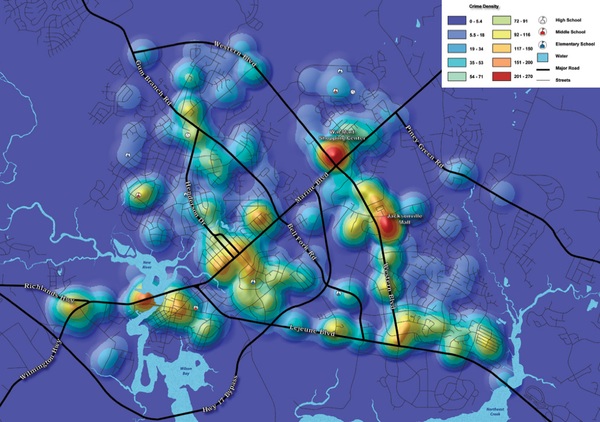
The map was created at the request of the Jacksonville Police Department to show juvenile crime patterns over space and time. Using the city’s criminal geodatabase and ArcGIS, it was possible to query the system for arrests of people younger than 18 and arrests during school days. Organizing the crimes by hour clearly showed patterns in which the bulk of criminal activity occurred during school hours, with some after school, and the least number of crimes occurring in the evening.

Share

Kids Focus on School Safety

John-John Williams IV:

A student from an Anne Arundel County high school said she’s seen guns on campus. A Howard County girl said squabbles that start as Internet exchanges lead to fights at school. And a senior at a Baltimore school told of fights that are part of gang initiations.
One of the main messages from students across Maryland who gathered yesterday at a summit on school violence is that the issue cannot be ignored.
“We have so many problems in our school system that we don’t think about,” said Josh Maley, 16, a junior at Howard High in Ellicott City. “We overlook so much. This summit is good because it lets [adults] hear their stories.”
The event drew more than 250 students from middle and high schools to Martin’s Crosswinds in Greenbelt to talk about school safety. Every jurisdiction in the state was represented, and organizers said they hope to use the students’ observations and ideas to craft plans to stem violence.

Share

Fight at Madison Memorial shows difficulty of keeping school hallways safe

Jessica VanEgeren:

If art really does imitate life, then a peek into the interracial dynamics of high school life in Madison can be found every morning inside Room 272 at West High School. There, the students, hand-picked because of their ethnicity, respond to bullying, gang-related activities, body awareness issues and racial stereotyping by creating skits that mimic common situations students experience in school.
Lounging on pillows and passing around a bag of suckers at 9 a.m., the students, from varying backgrounds including Hmong, Chinese, African-American, Albanian and Laotian, are at ease with one another. This is not a dynamic reflected by every student in every school.
Sometimes an inspiration for a skit can be found right outside the classroom door, as junior Louisa Kornblatt found out on a recent morning when a student yelled, “Watch where your tall white ass is going, bitch,” during a break between classes. Although Kornblatt returned to the classroom with a flushed face, asking if anyone else had heard the comment, most of the students reacted to it nonchalantly.
“That’s just part of a day,” said senior John Reynolds, one of the students in the Multico theater group, which performs in schools all over the district. “You learn to ignore it. West is a culturally diverse place, and you’ll hear those kinds of statements in the hallways. You just need to learn to focus on the good, not the bad.”

Related: Police calls near Madison High Schools 1996-2006.

Share

Detroit School Board to Discuss Fatal Shooting

Chastity Pratt Dawsey:

The fatal shooting of one Henry Ford High student and the wounding of three other teens is expected to be discussed at a special Detroit Board of Education meeting at 6 p.m. Monday at Spain Elementary-Middle School, 3700 Beaubien.
The agenda includes a 2008-’09 “Checklist for Preventing and Responding to School Violence” the district has submitted to the Michigan Department of Education for Ford, Mumford, Central and Crosman high schools.

Share

In wake of turmoil, Madison Memorial students seek solutions

Mark Pitsch:

More parental involvement. Peer-to-peer mentoring. Community programs.
Those are some of the ideas students, parents and others offered in the wake of a fight at Memorial High School last week between black and Latino students and early closure of the school Friday amid rumors of a gun at the school.
Tim Maymon, whose two teenagers attend Memorial and who had another graduate this year, said he believes the school is safe, that his children aren’t in danger and that the racial tension is limited to small groups of students.
But he also said some students — including those involved in the altercation last week — aren’t getting proper parental guidance.
“The two groups need more parental control,” Maymon said. “There’s a lot of people promoting their kids to fight and be stupid. Any smart parent would want to see their kids be safe and egging them on to fight is not safe.”

Share

Madison’s Memorial High School Closes Early Today Amid Safety Concerns

Channel3000:

Students at James Madison Memorial High School in Madison were let out early on Friday amid ongoing safety concerns, according to a Madison Metropolitan School District spokesman.
There was increased police presence at the school and officials postponed an early lunch on Friday, according to Ken Syke.
The students were released at 12:55 p.m. Officials said that buses will be there to pick up students.
They said that all of the schools extracurricular activities are scheduled, but there will be an extra police presence at each event.
Syke said that no incidents occurred at the school on Friday, but that officials are concerned about safety after a fight broke out at the school earlier this week. The fight apparently involving two groups of students on Thursday and seven students were ultimately arrested.

Sandy Cullen has more along with WKOW-TV and NBC-15. Madison School District statement.
Related: Gangs & School Violence Forum Audio & Video and police calls near Madison high schools 1996-2006.

Share

Police: Fight At Memorial High School Leads To 7 Arrests

Channel3000:

A fight involving two groups of students at Memorial High School has led to the arrest of seven students, Madison police said.
Madison police responded to a fight a Memorial High school around 9:11 a.m. on Thursday.
The fight involved two groups of students and during the incident, a 16-year-old girl was knocked to the floor and is believed to have lost consciousness, according to police.
Another student is accused of battering the girl when she was knocked down. The girl suffered abrasions but did not require hospitalization.
A 17-year-old girl has been arrested and tentatively charged with substantial battery and disorderly conduct.

Related: Police calls near Madison high schools: 1996-2006.

Share

2008 Madison Schools’ Referendum – Key Issues

1. Mortgage on future property with permanent increase: Asking taxpayers to refinance/mortgage their futures and that of the school district with a permanent increase of $13 million yearly for the operations budget. It has been stated the district needs the money to help keep current programs in place. It is expected that even after 3 years of this referendum totaling $27 million, the Board is projecting a continued revenue gap and will be back asking for even more.
2. No evaluation nor analysis of programs and services: The Board will make budget cuts affecting program and services, whether or not this referendum passes. The cuts will be made with no assessment/evaluation process or strategy for objective analyses of educational or business programs and services to determine the most effective and efficient use of money they already have as well as for the additional money they are asking with this referendum.
3. Inflated criteria for property value growth: The dollar impact on property to be taxed is projected on an inflated criteria of 4% growth in property valuation assessment; therefore, reducing the cost projection for the property tax levy. The growth for property valuation in 2007 was 3.2% and for 2008 it was 1.0%. Given the state of the economy and the housing market, the growth rate is expected to further decline in 2009. [10/13 Update: The above references to property valuation assessment growth are cited from City of Madison Assessor data. See ACE document “Watch List Report Card” [2008 Referendum Watch List 755K PDF] for State Department of Revenue citations for property valuation base and growth rate used for determination of MMSD property tax levy.]
4. No direct impact on student learning and classroom instruction: There is District acknowledgement of a serious achievement gap between low-income and minority student groups compared with others. There are no plans evident for changing how new or existing money will be spent differently in order to have an impact on improving student learning/achievement and instructional effectiveness.
5. Lack of verification of reduction in negative aid impact on taxes: District scenarios illustrating a drastic reduction in the negative impact on state aids from our property-rich district is unsubstantiated and unverified, as well as raising questions about unknown possible future unintended consequences. The illustrated reduction is from approximately 60% to 1% results by switching maintenance funds from the operations budget and 2005 referendum proceeds to a newly created “Capital Expansion Fund–Fund 41” account. [Update: 10/13: The reduction in the negative aid impact will take affect regardless of the outcome of the referendum vote. See the ACE document “Watch List Report Card” [2008 Referendum Watch List 755K PDF] for details.]

(more…)

Share

Parents upset that Arlington school sex assault case wasn’t reported earlier

Chris Hawes:

A suspect was put in custody Friday but many parents of children at Coble Middle School say that’s not the issue. They’re outraged they weren’t told an assault had taken place on campus.
Parents lining up to pick up their children Friday received something else – a letter. The more they read, the more disturbed they became: A young girl reported she was sexually assaulted at school.
But two weeks passed before the children were told what was going on. The school says they had to protect the investigation.
Counselors handed out the letter in the car lane. The letter detailed the reported the sexual assault of a 13-year-old girl on campus, during school.
“He had a valid reason to be on campus and chose to pull this girl into a locker room and sexually assault her,” said Lt. Blake Miller from Arlington police.
But even more disturbing to one father was the date of the crime, Sept. 26.

Share

How NCLB Ignored the Elephant in America’s Classroom — POVERTY

Jim Trelease:

A politician after politician and CEO after CEO have pontificated for 20 years about what is wrong in American schools, all the while offering simple-minded solutions (higher expectations girded by more high-stakes testing), nearly all have ignored the great elephant in the classroom: poverty. Their behavior said, “If we pretend it isn’t there, either it will go away or cease to exist.”
Before looking at the single most intelligent approach to urban school woes (see Harlem solution below), let’s look at what most impacts the classroom from outside the classroom. It is the weight of poverty that rides the at-risk child like a six-ton elephant. Consider the observations of Pulitzer-winning reporter David K. Shipler:

About 35 million Americans live below the federal poverty line. Their opportunities are defined by forces that may look unrelated, but decades of research have mapped the web of connections. A 1987 study of 215 children attributed differences in I.Q. in part to ‘social risk factors’ like maternal anxiety and stress, which are common features of impoverished households. Research in the 1990’s demonstrated how the paint and pipes of slum housing — major sources of lead — damage the developing brains of children. Youngsters with elevated lead levels have lower I.Q.’s and attention deficits, and — according to a 1990 study published in The New England Journal of Medicine — were seven times more likely to drop out of school.
Take the case of an 8-year-old boy in Boston. He was frequently missing school because of asthma attacks, and his mother was missing work so often for doctors’ appointments that she was in danger of losing her low-wage job. It was a case typical of poor neighborhoods, where asthma runs rampant among children who live amid the mold, dust mites, roaches and other triggers of the disease.”1

The inherent suggestion in NCLB is that all of that will go away if we just expect more of our teachers and students. That is an insult to both of them and it diminishes the enormity of the problem while doing nothing to solve it.

Related: “Limit Low Income Housing“.

Share

High School Taps Institute on Ethics

Leonel Sanchez:

East County’s largest school district has introduced a character education program that aims to reduce cheating and other bad conduct by promoting ethical behavior.
“What you allow, you encourage,” said ethics expert Michael Josephson, who is working with the Grossmont Union High School District on the Character Counts program. “It’s about helping kids form better values, make better choices.”
The Josephson Institute of Ethics plans to release in a few weeks its 2008 national survey of student attitudes and behavior.
Two years ago, the institute’s survey of more than 30,000 students showed alarming rates of cheating, lying and theft at schools across the United States.
Six out of 10 high school students said they had cheated at least once during a test during the past year.

Share

“Limit Low Income Housing” – Madison Police Official

Patricia Simms:

A top Madison Police Department official says the city should reduce or freeze building low-income housing because the tenants are overwhelming police services.
In addition, Jay Lengfeld, captain of the West District, wrote an e-mail to Madison Alderman Thuy Pham-Remmele, 20th District, on Monday in which he suggested the city should license landlords to “weed out the bad ones” and give landlords more leeway to reject applicants with a history of bad behavior.
“The city needs to reduce or freeze the number of subsidized housing units in the city,” he wrote. “The at-risk population in Madison has exceeded the ability of service providers to service them.”
Lengfeld’s comments, part of an exchange of e-mails between Lengfeld and Pham-Remmele over quality of life issues on the West Side, sparked the wrath of at least one affordable housing advocate.

Share

Owl Creek neighborhood raises red flags for city, schools

Sandy Cullen:


The first thing the school principal noticed was the large number of new students coming from a tiny, isolated neighborhood that didn’t exist two years ago.
Then it was the repeated fights — which would begin on the bus ride home, fester in the neighborhood, then come back to school the next day, said Glendale Elementary School Principal Mickey Buhl.
And there were other troubling signs — youngsters shaving their eyebrows and cutting their hair in ways that Buhl said indicated flirtation with the idea of gangs. Glendale staff who went to the Owl Creek neighborhood, off Voges Road on the southeast side near McFarland, saw an unfinished development sandwiched between two industrial parks and far from stores, social services and bus lines.
Madison police also noticed problems. From March 1 to June 30 of this year, police responded to 81 calls for service, ranging from theft to battery, in the tiny development, said Lt. Carl Strasburg.

Related: Police calls near Madison area high schools: 1996-2006.

Share

DCPAC Dan Nerad Meeting Summary

A video tape of the entire presentation and discussion with Dr. Nerad may be viewed by visiting this internet link: https://www.schoolinfosystem.org/archives/2008/09/ madison_superin_10.php

Dan Nerad opened his remarks by stating his commitment to efforts for always continuing change and improvement with the engagement of the community. He outlined four areas of focus on where we are going from here.

  1. Funding: must balance district needs and taxpayer needs. He mentioned the referendum to help keep current programs in place and it will not include “new” things.
  2. Strategic Plan: this initiative will formally begin in January 2009 and will involve a large community group process to develop as an ongoing activity.
  3. Meet people: going throughout the community to meet people on their own terms. He will carefully listen. He also has ideas.
  4. Teaching and learning mission: there are notable achievement gaps we need to face head-on. The “achievement gap” is serious. The broader mission not only includes workforce development but also helping students learn to be better people. We have a “tale of two school districts” – numbers of high achievers (including National Merit Scholars), but not doing well with a lot of other students. Low income and minority students are furtherest away from standards that must be met. Need to be more transparent with the journey to fix this problem and where we are not good. Must have the help of the community. The focus must be to improve learning for ALL kids, it is a “both/and” proposition with a need to reframe the issue to help all kids move forward from where they are. Must use best practices in contemporary assessment, curriculum, pedagogy and instructional methods.

Dr. Nerad discussed five areas about which he sees a need for community-wide conversations for how to meet needs in the district.

  1. Early learning opportunities: for pre-kindergarten children. A total community commitment is needed to prevent the ‘achievement gap’ from widening.
  2. High schools: How do we want high schools to be? Need to be more responsive. The curriculum needs to be more career oriented. Need to break down the ‘silos’ between high school, tech schools and colleges. Need to help students move through the opportunities differently. The Small Learning Communities Grant recently awarded to the district for high schools and with the help of the community will aid the processes for changes in the high schools.
  3. School safety: there must be an on-going commitment for changes. Nerad cited three areas for change:

    a. A stronger curriculum helping people relate with other people, their differences and conflicts.

    b. A response system to safety. Schools must be the safest of sanctuaries for living, learning and development.

    c.Must make better use of research-based technology that makes sense.

  4. Math curriculum and instruction: Cited the recent Math Task Force Report

    a. Good news: several recommendations for curriculum, instruction and policies for change.

    b. Bad news: our students take less math than other urban schools in the state; there are notable differences in the achievement gap.

  5. Fine Arts: Cited recent Fine Arts Task Force Report. Fine arts curriculum and activities in the schools, once a strength, has been whittled away due to budget constraints. We must deal with the ‘hands of the clock’ going forward and develop a closer integration of the schools and community in this area.

(more…)

Share

Locke High: The Real Charter Challenge

Paul Tough:

The new union-friendly charter school in the Bronx I wrote about last week is not the only big project that Green Dot Public Schools has taken on this fall. The other is the attempted transformation of Locke High School in the Watts neighborhood of Los Angeles. The school, which currently has about 2,500 students, has long been notorious as one of the worst in the city, with what the L.A. Times recently described as a “reputation for student fisticuffs and an appallingly high dropout rate.”
Green Dot was founded by Steve Barr, a garrulous, outspoken Irish American in his late 40s who helped start Rock the Vote in 1990 and nine years later decided his role in life was to run high schools. His organization now manages 10 of them, mostly in L.A., and his new mission is to transform the way public education works in the city (and then in the rest of the country).

Share

Mentoring, in addition to metal detectors, are needed to curb violence in schools.

Milwaukee Journal – Sentinel Editorial:

The stabbing at Hamilton High School last week, in which a 15-year-old girl was attacked with a knife by another girl in a bathroom, came on the day the school was to roll out its airport-quality metal detector.
But while metal detectors can keep weapons out of schools when properly used, we believe no machine could have guaranteed this attack wouldn’t have happened. Students can be attacked anywhere. In order to get a handle on violence, more mentoring is needed among at-risk youth.
The Violence-Free Zones program, now in use in seven local high schools, has been successful in reducing violence and suspensions by offering a big brother, big sister type of approach.

Police calls at and near Madison high schools: 1996-2006.

Share

Public TV documentary details Green Bay East High School shooting threat in 2006

Warren Gerds:

Coming at a difficult topic from many angles, a new TV documentary examines the 2006 threats of violence against Green Bay East High School.
“Any School, Any Time” is a compelling hour.
It seeks balance and perspective in a case where deadly harm appears to have been averted.
Everything is told through a sophisticated technique that uses no narration, which could take on a slant. Rather, only the voices of people interviewed or recorded in news conferences, court or jail are heard.
Also, instead of quick sound bites, key people are allowed to be heard at length so explanations are fleshed out. This includes the Brown County district attorney, a representative of the U.S. Secret Service, Green Bay police chief, defense attorneys, a forensic psychiatrist and presiding judge.

Share

You Need to Take My Son to Jail

Ann Bauer:

MY husband and I were sitting down to dinner when the police called. It was a female dispatcher whose voice I recognized from previous incidents involving my 20-year-old son, Andrew, who has autism.
In recent years, this police department has picked him up for shoplifting, taken reports from restaurants where he had dined and dashed, and once even brought him back from the airport after he tried to stow away on a plane.
Roughly half of the force has lectured me about keeping a closer eye on him, placing him in a secure facility, and finding a better psychiatrist, while the other half has been sweet and apologetic, concerned about how I’m bearing up.
On this occasion the dispatcher explained that my car, which I had earlier reported stolen, had been found on the side of the highway some 70 miles away in St. Cloud, Minn. — scratched, filthy and out of gas but otherwise undamaged. I would need to retrieve it from the impound lot. My son, unhurt, was waiting at the station. When would I be able to pick him up?
I swallowed a sip of Chianti and recited the line I had been rehearsing all afternoon: “I want to press charges.”
“I told you, the car is fine. Your son is fine. All you have to do is come pick them both up.”
“I want to press charges,” I said again, resolved to see this through.
“Against your son?” she asked, incredulous.

Share

Safety Climate: A look at Police Calls to Madison High Schools

Doug Erickson:

Total police calls to Madison’s four main high schools declined 38 percent from the fall semester of 2006 to last spring. But those figures tell only a partial story, and not a very meaningful one.
That’s because the numbers include all police calls, including ones for 911 disconnects, parking lot crashes and stranded baby ducks. (It happened at La Follette last May.)
The State Journal then looked at police calls in eight categories closely related to safety — aggravated batteries, batteries, weapons offenses, fights, bomb threats, disturbances, robberies and sexual assaults. Those calls are down 46 percent from fall 2006 to spring 2008.
The schools varied little last spring in the eight categories. Memorial and West each had 13 such calls, La Follette 14 and East 16.
School officials are relieved by the downward trend but careful not to read too much into the figures.
“We know there’s almost a cyclical nature to crime statistics and even to individual behavior,” said Luis Yudice, who is beginning his third year as district security coordinator.
Art Camosy, a veteran science teacher at Memorial, said he thinks the climate is improving at his school. Yet he views the police figures skeptically, in part because the numbers are “blips in time” but also because he wonders if the district’s central office is behind the drop.
“Are our building administrators being pressured not to call police as often?” he asks.
John Matthews, the longtime executive director of Madison Teachers Inc. (MTI), the district’s teachers union, contends that the district’s leadership has indeed done this from time to time, directing building administrators to hold off on calling police so often.
Yudice, a former Madison police captain, said there was a time years ago when the district was extremely sensitive about appearing to have a large police presence at its schools. He rejects that notion now.
“It’s just the opposite,” he said. “We are more openly acknowledging that we have issues that need to be dealt with by the police. Since I’ve been working here, there has never been a directive to me or the school principals to minimize the involvement of police.”

All four Madison high schools feature an open campus. It appears that Erickson only reviewed calls to the High Schools, not those nearby. 1996-2006 police calls near Madison High Schools is worth a look along with the Gangs & School violence forum.
Finally, I hope that the Madison Police Department will begin publishing all police calls online, daily, so that the public can review and evaluate the information.

Share

Madison Police Chief Noble Wray Sees “Serious Gang Connection” in Crime Hike

Kristin Czubkowski:

Making connections among various types of crimes and ways to remedy them was the theme of the night as Police Chief Noble Wray gave a talk on public safety in Madison to the City Council Wednesday night.
Statistically, crime in Madison was a mixed bag in 2007, Wray said. While overall crime was up 5.5 percent from 2006, according to the FBI’s Uniform Crime Reports, that increase stemmed primarily from an 8.3 percent increase in property crimes such as burglary, theft and arson. By contrast, violent crime, which includes acts such as homicide, rape and aggravated assault, decreased 14.2 percent in 2007.
Wray explained that the rising rates of property crimes came from the increased theft of precious metals, in particular copper, as well as thefts of big-ticket items such as televisions from businesses, which were directly related to gang activity and the drug trade, he said.
“This is the first time that I’ve noticed this, and I’ve worked for the Madison department for 24 years, that there is a serious gang connection with these (burglaries),” he said. “We haven’t had that in the past.”

Related:

Share

Groups: End physical discipline in school

Greg Toppo:

Saying corporal punishment disproportionately targets minority students and creates a “violent and degrading school environment,” two groups want federal and state lawmakers to ban it.
In a report being issued today, Human Rights Watch and the American Civil Liberties Union cite U.S. Education Department statistics that find school personnel in the 2006-07 school year reported disciplining 223,190 students by hitting, spanking or similar means. In interviews, Alice Farmer, the report’s author, found that children in Texas and Mississippi are routinely paddled for “minor infractions” such as chewing gum or violating school dress codes.

Share

Student Control

Thomas Crocker:

In a world of increased occasions for forms of social control, the university is extending its reach. In an AP story today we learn that universities are broadening the scope of their campus behavior codes to apply to student conduct off campus, in an effort to cultivate humanity, to borrow from Martha Nussbaum. One purpose is to make students better citizens within the community. From the article:

We have a responsibility to educate our students about being responsible citizens,” said Elizabeth A. Higgins, Washington’s director of community standards and student conduct, whose office has ‘educated’ 19 students since the extended code of conduct took effect in January.
The scope of these codes can be quite broad, as the article reports that the University of Colorado code “regulates any conduct that ”affects the health, safety or security of any member of the university community or the mission of the university.” The article further reports that Seattle University “has put its students on notice that cyber-patrolling will continue this year.”

Tangentially, this is one of the issues worth looking into around local high schools: given the open campus, how much undesirable activity occurs near those facilities, and who has jurisdiction? This data: Madison police calls near local high schools: 1996-2006.

Share

Millionaire Patriot Offers to Train Every Teacher in Texas School District at Front Sight Firearms Training Institute

Market Wire:

Dr. Ignatius Piazza — founder and director of Front Sight Firearms Training Institute near Las Vegas, NV is referred to as the Millionaire Patriot by the hundreds of thousands of students who have attended Front Sight Firearms Training courses because he has given away tens of millions of dollars in training so law abiding Americans can enjoy what he refers to as the “Comfort of Skill at Arms.”
Dr. Piazza has offered to provide a $2,000 Four Day Defensive Handgun course to every school teacher in the entire Harrold Independent School District to thank Harrold School District administrators for their progressive and rational decision to allow school teachers to carry concealed handguns to protect students against violent attack.
With more than 50 teachers and administrators within the Harrold, Texas School District, Dr. Piazza’s commitment represents over $100,000 in training to the Harrold Independent School District.

Share

Texas School District to Let Teachers Carry Guns

Reuters:

A Texas school district will let teachers bring guns to class this fall, the district’s superintendent said on Friday, in what experts said appeared to be a first in the United States.
The board of the small rural Harrold Independent School District unanimously approved the plan and parents have not objected, said the district’s superintendent, David Thweatt.
School experts backed Thweatt’s claim that Harrold, a system of about 110 students 150 miles northwest of Fort Worth, may be the first to let teachers bring guns to the classroom.

Share

As Program Moves Poor to Suburbs, Tensions Follow

Solomon Moore:

rom the tough streets of Oakland, where so many of Alice Payne’s relatives and friends had been shot to death, the newspaper advertisement for a federally assisted rental property in this Northern California suburb was like a bridge across the River Jordan.
Ms. Payne, a 42-year-old African-American mother of five, moved to Antioch in 2006. With the local real estate market slowing and a housing voucher covering two-thirds of the rent, she found she could afford a large, new home, with a pool, for $2,200 a month.
But old problems persisted. When her estranged husband was arrested, the local housing authority tried to cut off her subsidy, citing disturbances at her house. Then the police threatened to prosecute her landlord for any criminal activity or public nuisances caused by the family. The landlord forced the Paynes to leave when their lease was up.
Under the Section 8 federal housing voucher program, thousands of poor, urban and often African-American residents have left hardscrabble neighborhoods in the nation’s largest cities and resettled in the suburbs.
Law enforcement experts and housing researchers argue that rising crime rates follow Section 8 recipients to their new homes, while other experts discount any direct link. But there is little doubt that cultural shock waves have followed the migration. Social and racial tensions between newcomers and their neighbors have increased, forcing suburban communities like Antioch to re-evaluate their civic identities along with their methods of dealing with the new residents.

Why is crime rising in so many American cities? The answer implicates one of the most celebrated antipoverty programs of recent decades by Hanna Rosin @ the Atlantic Monthly:

Lately, though, a new and unexpected pattern has emerged, taking criminologists by surprise. While crime rates in large cities stayed flat, homicide rates in many midsize cities (with populations of between 500,000 and 1 million) began increasing, sometimes by as much as 20percent a year. In 2006, the Police Executive Research Forum, a national police group surveying cities from coast to coast, concluded in a report called “A Gathering Storm” that this might represent “the front end … of an epidemic of violence not seen for years.” The leaders of the group, which is made up of police chiefs and sheriffs, theorized about what might be spurring the latest crime wave: the spread of gangs, the masses of offenders coming out of prison, methamphetamines. But mostly they puzzled over the bleak new landscape. According to FBI data, America’s most dangerous spots are now places where Martin Scorsese would never think of staging a shoot-out–Florence, South Carolina; Charlotte-Mecklenburg, North Carolina; Kansas City, Missouri; Reading, Pennsylvania; Orlando, Florida; Memphis, Tennessee.
Memphis has always been associated with some amount of violence. But why has Elvis’s hometown turned into America’s new South Bronx? Barnes thinks he knows one big part of the answer, as does the city’s chief of police. A handful of local criminologists and social scientists think they can explain it, too. But it’s a dismal answer, one that city leaders have made clear they don’t want to hear. It’s an answer that offers up racial stereotypes to fearful whites in a city trying to move beyond racial tensions. Ultimately, it reaches beyond crime and implicates one of the most ambitious antipoverty programs of recent decades.

Related:

Share

Success in education

Arthur Rothkopf:

Jan Morrison of the Gates Foundation recently posed a rhetorical question that perfectly sums up the state of K-12 education: “Do our schools still look like they did in the 1950s – now ask yourself, do our companies still look like they did in the 1950s?”
The answer is quite clear – the world economy has changed dramatically since the 1950s, and any company that refuses to keep up is soon out of business. The same cannot be said of American schools, where the curricula are largely unchanged since the 1950s and classroom technology isn’t much better. Even our school calendar is still based on an agrarian society. How many bushels of corn has your child harvested this summer?
Although our schools are not going out of business, their results are akin to a company ready to file for Chapter 11. While 90 percent of the fastest-growing jobs in America require some postsecondary education, about a third of our nation’s students do not even finish high school in four years. Our highest-performing state, Massachusetts, can only boast that 51 percent of its eighth grade students are proficient in math. There is a growing consensus that education reform is critical to our nation’s competitiveness, and there should be when confronted by statistics like these.

Share

Milwaukee Schools Urged to Revise Discipline Policy

Alan Borsuk:

A team of national experts has urged a major overhaul in the way Milwaukee Public Schools handles behavior issues in schools, saying MPS does not do enough to deal with problems short of suspending students and may have the highest suspension rate of any urban school system in America.
“District staff members need to mobilize to meet this challenge” of dealing with behavior issues in ways that don’t involve suspensions but are more effective in improving both a student’s behavior and academic work, the team said in a report to MPS officials.
Superintendent William Andrekopoulos said in an interview that changes in line with the report’s recommendations are under way, including a new policy in which every parent will be given a written statement this fall on the disciplinary practices that will be used in a child’s classroom.
The report, submitted several months ago, is the second in two years by a team from the Council of Great City Schools that was critical of major aspects of what goes on in MPS classrooms. In both cases, the reports were not made public until a Journal Sentinel reporter asked for them. In 2006, a report from the council criticized academic practices and low achievement by students, called for more direction from the central administration of what was being done in schools, and said people involved in MPS, from the School Board to the classroom, “appear fairly complacent.”

Madison police calls near local high schools 1996-2006.

Share

Madison police calls near local high schools: 1996-2006

Madison School District Safety Coordinator
Luis Yudice
(retired police officer and East High graduate) at a recent
West High School neighborhood crime discussion (10/18/2007):

Big picture perspective:

Our community really has changed a lot within the past five years. I sense a great deal of stress within the police department.

Citywide issues:

  • Increasing violence involving girls. He has looked at a lot of data with the District Attorney’s office. Girls are extremely angry.
  • Angry parents are coming into the schools.
  • Increasing issues in the neighborhood that end up in the schools. Mentioned South Transfer Point beating and that Principal Ed Holmes mediated the situation at an early stage.
  • Growing gang violence issue, particularly in the east side schools. We do have gang activity at Memorial and West, but most of the issues are at La Follette and East. Dealing with this via training and building relationships.
  • What the schools are experiencing is a reflection of what is going on in the community.

Madison Police Chief Noble Wray, via Bill Lueders @ Isthmus (7/30/2008):

He (Wray) began by talking about perceptions of crime, and especially the notion that it’s getting worse in Madison. He stressed that it wasn’t just the media and public who felt this way:
If I would ask the average beat cop, I think they would say it’s gotten worse.
But, he added, Worse compared to what?

The absence of local safety data spurred several SIS contributors to obtain and publish the police call data displayed below. Attorney and parent Chan Stroman provided pro bono public records assistance. Chan’s work on this matter extended to the Wisconsin Attorney General’s office.

A few important notes on this data:

  • 13% of the records could not be
    geocoded
    and therefore are not included in the summary information. The downloadable
    1996-2006 police call data .zip file
    is comprehensive, however.
  • Clicking on the numbers below takes the reader to a detail page. This page includes all matching police calls and a downloadable .csv file of same. The .csv file can be opened in Excel, Numbers, and many data management tools.
  • This summary is rather brief; I hope others download the data and have a look.

Police Calls within 0.25 miles of Madison High School Areas (1996–2006)
Year Madison East Area Edgewood Area La Follette Area Memorial Area West Area
General Police Calls
1996 1285 392 324 869 728
1997 1351 455 403 896 750
1998 1340 343 488 875 703
1999 1281 352 477 969 772
2000 1391 300 528 888 933
2001 1476 305 480 769 1034
2002 1470 363 491 886 1019
2003 1362 349 403 865 921
2004 1455 346 449 989 1012
2005 1311 325 465 994 917
2006 1221 330 389 1105 838
Weapons Incident / Offense
1996 5 0 3 4 6
1997 5 0 3 4 0
1998 10 0 5 2 1
1999 10 0 5 4 0
2000 4 0 6 2 5
2001 3 0 3 0 0
2002 11 0 3 5 5
2003 4 1 1 4 5
2004 4 0 9 7 4
2005 9 0 6 6 2
2006 10 1 5 7 3
Drug Incident
1996 10 0 10 9 7
1997 16 0 7 6 4
1998 12 1 8 10 6
1999 18 0 7 18 4
2000 16 2 13 17 12
2001 18 0 10 20 12
2002 22 0 14 16 12
2003 23 2 18 15 8
2004 26 0 20 17 7
2005 19 0 17 20 12
2006 24 2 11 15 8
Arrested Juvenile
1996 59 1 35 28 38
1997 72 0 83 52 29
1998 21 0 34 17 14
1999 16 0 29 24 7
2000 42 0 76 14 15
2001 52 0 66 19 15
2002 51 0 69 13 12
2003 9 0 9 9 3
2004 8 0 8 9 4
2005 11 0 10 7 3
2006 6 0 21 11 4
Bomb Threat
1996 1 0 0 0 1
1997 1 0 1 0 0
1998 4 2 0 0 1
1999 7 0 15 0 1
2000 4 0 17 2 1
2001 1 0 8 10 11
2002 2 0 9 0 4
2003 1 0 2 1 11
2004 6 0 4 0 6
2005 1 0 4 0 0
2006 3 0 0 0 4

Related Links

Share

Eric Hainstock: Free at Last
Prison may be the best thing that ever happened to Eric Hainstock

Bill Lueders:

Eric Hainstock’s first letter to Isthmus, dated April 15, 2008, got right to the point: “When I was 15 years old I shot my high school principal. I never meant for this to happen. He grabbed me from behind and I got scared. I was already pretty stressed, so that freaked me out even more. Please don’t get me wrong, I am not blaming Mr. Klang for grabbing me. But I am blaming him, the teachers, social services and the school as a whole for never listening to me…. No one ever listened.”
Like other communications to follow, the letter is a plaintive appeal for understanding, with a heavy dollop of self-pity. “No one ever listened”? Perhaps it felt that way to Hainstock.
“I want my story told,” wrote Hainstock, now 17, who picked Isthmus on the recommendation of his “celly,” a former Madison resident. “I want all the social service agencies to listen, the schools, parents all over the state.” He pegged his purpose as altruistic — to make sure no one else would ever have to “live in the hell that I did.” (Quotations from Hainstock’s letters have been edited for spelling and style.)

Share

Externalities in the Classroom: How Children Exposed to Domestic Violence Affect Everyone’s Kids

Justin Wolfers
Many teachers believe that a “few bad apples” can spoil a whole classroom, reducing the learning of everyone in the room. While this is part of the folk wisdom of teaching, it has been surprisingly difficult to find these effects in the data.
But a very convincing new paper, by Scott Carrell of U.C. Davis and Mark Hoekstra of U.Pitt, “Externalities in the Classroom: How Children Exposed to Domestic Violence Affect Everyone’s Kids” (available here), suggests that these effects can be pretty big.
The real difficulty in this style of research is to find a useful proxy for whether or not a classroom is affected by a disruptive student. Previously researchers have used indicators like whether a student has low standardized test scores, but as any teacher knows, the under-performing kids may not be the disruptive ones. And if you analyze only a weak statistical proxy for classroom disruption, you get weak estimates, even when the true effects are large.
The truly innovative part of the Carrell and Hoekstra study begins with their search for potentially disruptive kids: they looked for those coming from particularly difficult family situations. In particular, they combed through court records and linked every domestic violence charge in Alachua County, Florida to the county schooling records of kids living in those households.
It’s a sad story: nearly 5 percent of the kids in their sample could be linked to a household with a reported domestic violence incident. (And given under-reporting, the true number may be much larger.)
The costs of this dysfunction are even more profound. Kids exposed to domestic violence definitely do have lower reading and math scores and greater disciplinary problems. But the effects of this dysfunction are not limited to the direct victims of this violence: kids exposed to kids exposed to domestic violence also have lower test scores and more disciplinary infractions.

(more…)

Share

Attention all faculty and staff: The principal is out of the building. Again.

Ray Cox:

I thoroughly enjoy working for my principal. He’s a great guy, has a no-nonsense approach to dealing with discipline and doesn’t try to micromanage the staff. He’s not perfect (e.g. he still requires me to wear a tie), but after reading all of the comments about other principals, he does an outstanding job. That said, I would very much enjoy to see him more at school, not off at DISD-mandated principals’ meetings.
Now, I don’t know the exact number he has gone to meetings across Dallas, but it’s often more than once a week, and usually half a day or longer. He tries to make it every morning, give the announcements, meet with parents, etc., but then he’s off in a flash to learn about some new initiative, see how our OHI scores are faring, or TAKS test security guidelines. And when we hit the AYP list the first time, he was gone almost twice as much. I’ve yet to see the man take a day off and I wonder how he maintains his sanity sitting in meetings all the time.

Share

Taking Aim at Youth Gun Violence

Rodrigo Zamith:

A new initiative for Minneapolis and Hennepin County will increase penalties for juveniles caught with firearms, both replica and real.
Minneapolis and Hennepin County officials hope to reduce juvenile gun crime this summer by stiffening penalties for youths caught with BB guns, real guns or replicas.
The new Juvenile Gun Offender Initiative was announced Tuesday by Minneapolis Mayor R.T. Rybak, Hennepin County Attorney Michael Freeman and others. It will also increase enforcement of youth curfew laws, replica firearms ordinances and supervision of juveniles on probation for gun offenses.
The new rules apply to offenders between 10 and 17 years old. First-time offenders with a real gun will be given probation, four to six weeks of out-of-home placement and 40 hours of education on the dangers and effects of guns. If the requirements aren’t met, youths will be given four to six months of out-of-home placement.

Gangs & School Violence Forum.

Share

Crime & College: Off-Campus Incidents aren’t always reported

Marc Parry:

That rape made headlines. But if you’re a UAlbany student or parent, chances are you wouldn’t know about many other crimes. Most don’t appear in the data UAlbany reports to the federal government. Records show many failed to trigger e-mail alerts to students.
A Times Union investigation of the UAlbany off-campus crime problem spotlights a gap in the federal law that forces colleges nationwide to disclose crime data. That law, the Clery Act, holds schools accountable only for campuses, noncampus buildings such as fraternity houses, and adjacent public property like sidewalks.
The U.S. Department of Justice reports that 93 percent of violent crimes against college students occurred off campus. But even if students are repeatedly robbed and assaulted blocks from the college, a school has no legal obligation to report the crimes or warn students.

Share

Police, sheriff’s units tackle growing Seattle-area gang problem

Jennifer Sullivan & Lauren Vane:

Tearing through the winding streets of the Central Area and Rainier Valley at 70 mph last Friday night, Seattle gang detectives Jim Dyment and Tom Mooney experienced an unsettling déjà vu — it was the third shooting they had responded to in a week.
As they drew near the scene of a drive-by shooting, Dyment and Mooney saw a group of officers gathered around five teens who sat handcuffed on a sidewalk in the Rainier Beach neighborhood. The hands of two teens were eventually wrapped in brown-paper sacks to protect any telltale gunpowder residue.
Dyment, a sergeant who has spent years investigating drugs, prostitutes and youth violence, muttered to no one in particular: “Being a gangster is a young man’s sport.”
And chasing gang members is becoming a full-time priority for police officers and sheriff’s deputies throughout the Puget Sound region, where authorities say gang membership is surging. From graffiti spray-painted on a mailbox in Kent’s West Hill neighborhood to recent shootings at area shopping malls, police say crimes associated with gangs appear to be on the upswing.

Gangs & School Violence Forum.

Share

Anti-Gang Education for Third & Fourth Graders

Katie Wang:

In a second floor classroom at St. Lima School in Newark today, 22 pupils were mulling over questions about anger.
What, they were asked, do they do if they are angry?
What makes them angry?
And what can they do to control their anger?
“Go to anger management class,” suggested Sean Smart, a fourth-grader.
The real lesson, though, was about a topic that was never mentioned in class yesterday: gangs.
With street gangs recruiting at a younger age, law enforcement officials are trying to get to them sooner through the federally-funded Gang Resistance Education and Training program. The state parole board’s gang unit began working with sixth graders two years ago, but then expanded it to third and fourth-graders this year.

Share

Juvenile courts can confuse kids, parents, report says

Hans Laetz:

Two years in the making, a report on California’s juvenile courts warns that children and parents are often bewildered by what happens in courtrooms, and judges and attorneys don’t always have access to all the information they need to make decisions.
The California Judicial Council’s stem-to-stern inspection is the first full-scale examination of court procedures and effectiveness. Juvenile courts were established statewide in 1961.
Many courts are failing in their basic responsibility to make sure children and parents know what is happening to them, according to the report, which was released in April.
“A lot of it is as basic as a kid who doesn’t understand what the word allegation’ means,” said Judge Brian John Back, who headed the examination. “And when we have a room full of prosecutors, defense lawyers all using numbers from penal codes, shorthand and jargon, the kids just cannot comprehend what has just happened to them,” said Back, who spent six years as presiding judge at Ventura County’s Juvenile Court. “Juveniles uniformly said, We have no idea what just happened in court.’ There is an inability for them to know what judges and attorneys do.”

Share

Sent home: The suspension gap

James Walsh:

Black students are far more likely to be suspended from school than are their white classmates — and Minnesota’s disparity in suspensions is twice the national average. Why? What are the consequences?
Keenan Hooper likes to joke around and admits he has a motormouth. He also admits to getting into trouble again and again with teachers weary of his antics. School officials have sent him home more times than Keenan or his mom can count. ¶ So often, in fact, during his past couple years at Jackson Middle School in Champlin that he was referred to special education for a “behavioral disability” and saw his grades plummet.
This is not what Keisha Hooper wants for her son, who is black. She said she has asked how sending him away is helping.
“Teachers need order in the classroom, I agree,” Keisha Hooper said. “I think where we part ways is that they seem to lose patience with the black kids more than they do the white.”

Share

Stats show alarming growth in violent racial and girl-on-girl incidents, including Blair’s ‘Day of Six Fights’

Andre Coleman:

The expulsion of four elementary school students for bringing knives onto campus and a rise in violence involving female African-American students have left city and school officials scrambling for solutions.
Records obtained by the Pasadena Weekly show that more than half of the 31 students expelled from the start of the school year through March were African American, and 11 of those 17 kids were girls, including five former students of Blair International Baccalaureate Magnet School who were involved in what has come to be known by teachers, students and administrators as “The Day of Six Fights” on Feb 18.
Although all those incidents involved weapons or violence or both, and a multijurisdictional board had been working since October on combating instances of youth- and gang-related violence, that information was not shared with the former 14-member Committee on Youth Development and Violence Prevention — even though that board included two sitting members of the Board
of Education, which ultimately approved all of the expulsions.
Further, the Pasadena Unified School District has few programs in place to address the rise in violence and no facilities available to help with the increase in expulsions from the district’s elementary schools.

The Madison School District’s Security Coordinator, Luis Yudice mentioned increased school violence involving girls during meeting on West High School / Regent area neighborhood crime last fall.

Share

Parents seek safety report cards

Erica Perez:

The unsolved murder of a college student in Madison, a string of robberies near Marquette University and a recent spike in assaults at the University of Wisconsin-Milwaukee have some parents packing summer orientation sessions at local colleges, anxious about students’ safety.
Colleges, in turn, are trying to ease those fears while helping parents take an active role.
In a new twist, UWM parents can now sign up for emergency text alerts on their cell phones, a service that previously has been available only for students, faculty and staff. With only about a fifth of UWM students registered for the S.A.F.E. alerts, administrators are making a harder push this summer to get new freshmen to hand over their cell phone numbers and sign up. Once registered, they would be notified via text message or e-mail in the event of a campus emergency.
UW-Madison administrators are making a similar push to register freshmen for new cell-phone alerts at orientation, although their service is not yet available to parents.
For the hundreds of parents gathered in UWM’s Zelazo Center this week, a few assurances from a campus police officer produced some visible signs of relief.

Share

Bullied boy’s parents say West Islip school responsible

Jennifer Maloney:

Patrick Kohlmann was scared. For more than a year at Udall Road Middle School in West Islip, the soft-spoken 13-year-old had been taunted and shoved, chased through the halls and slammed into lockers.
Then one day last month, Patrick says, one of his regular tormentors said, “I’m going to kill you tomorrow.”
The next morning, Patrick’s mother says, she warned the school’s vice principal about the threat. That afternoon, Patrick says, the bully struck him on the head with a rock.
He suffered a concussion.

Share

San Francisco Prosecutes Adults for Student Truancy

Nanette Asimov:

San Francisco District Attorney Kamala Harris issued citations Tuesday against six parents whose young children missed at least 50 days of school this year, the first time the city has prosecuted adults for student truancy.
Harris cited the parents of four children, ages 6 to 13, on charges that they kept the children home despite repeated efforts by the school district and law enforcement to address the problem.
“The charges are that they have violated California’s Education Code and allowed their children to go without an education,” Harris said at a news conference with the city’s school chief, Carlos Garcia.
She called chronic truancy a matter of public safety and said the vast majority of prison inmates and homicide victims are dropouts or habitual truants.

Share

The school bully dilemma

Sharon Noguchi:

It started with four older girls calling her vulgar names, one pouring a bottle of water on her head, then yanking a fistful of hair from her scalp – right in the Los Gatos High School cafeteria.
It led to school authorities summoning police, suspending the lead bully, convening mediation sessions and checking in daily with the freshman who was bullied. The school even mapped routes around campus to ensure the antagonists remain apart after the victim’s parents took out a restraining order against their daughter’s harasser.
But at a time when awareness of harassment at schools seems to be growing, the Los Gatos incident underscores the difficulty of dealing with the problem: Short of kicking a bully out of school, even when educators do a lot they are often accused of doing too little to appease parents and ease victims’ fears.
“We’re trying to help on a daily basis,” Los Gatos-Saratoga Union School District Superintendent Cary Matsuoka said. “But there’s only so much we can control in the world of 14-, 15-year-old adolescents.”
Across the valley, parents of harassment victims insist school authorities don’t react quickly or forcefully enough to protect their children – even as school officials say they’re working harder than ever to prevent and respond to bullying and aggression.
Harassment peaks in middle school, the time when kids are sorting out themselves and their place in life. In California, 42 percent of seventh-graders, 38 percent of ninth-graders and 33 percent of 11th-graders reported being victims of harassment, according to the 2005-07 Healthy Kids survey.

Share

Proposed West Bend School District Harassment Policy

Owen Robinson:

At tomorrow’s meeting of the West Bend School Board, they will he hearing the third reading and possibly passing a new harassment policy. This proposed policy goes way overboard. Here is the proposed policy:
Sorry for the images, but that’s all I have. A policy like this is a good idea. What constitutes harassment and what should be done about it should be defined to protect both the students and the faculty. But this policy is way too broad and fraught with problems. Let’s look at a couple of them. Here is the definition of “harassment:”

Harassment means verbal or physical conduct related to an individual’s membership in a protected class (including, but not limited to: sex, race, religion, national origin, ancestry, creed, pregnancy, marital or parental status, sexual orientation or physical, mental, emotional or learning disability) that has the purpose or effect of creating an intimidating, hostile, or offensive working or learning environment or interferes with the individual’s work or learning performance.

Share

Fairfax County Schools Report on Student Behavior

Michael Alison Chandler:

Fairfax County School Board members said they are likely to abandon a staff report that showed racial and ethnic gaps in some measures of student behavior, including in the demonstration of “sound moral character and ethical judgment.”
The board had delayed an April vote to approve the report after concerns were raised that findings were based on subjective measures, such as elementary report card data, and that they would fuel negative stereotypes.
Board member Phillip A. Niedzielski-Eichner (Providence) said yesterday that he plans to propose at a June 19 meeting that a vote on the report be postponed indefinitely. Several board members have indicated their support, he said.
Board member Martina A. Hone (At Large) said that the original report is “fatally flawed” and that it doesn’t make sense “to work on fixing it.” She said she is pleased with the way the board is rethinking it. “I think we have come out a stronger school board,” she said.

Share

Prevention called cure for school violence

Liz Bowie:

Communities and schools should take a preventive approach to school violence rather than focus solely on punishing students who have behavior problems, experts said yesterday at a summit on school violence.
Students are looking for structure, high academic expectations, and teachers who understand and can communicate with them, said Ivan J. Juzang, a consultant who gave the keynote address at the daylong meeting at the University of Maryland, Baltimore County. Providing those basics will make schools safer, he said.
The summit was organized by Rep. Elijah E. Cummings and State Superintendent of Schools Nancy S. Grasmick after several high-profile incidents of violence in schools this year, including the beating of a Baltimore teacher that became nationwide news after it was recorded on a student’s cell phone and posted on the Internet.
The summit was called to find solutions to the problems of school violence, but the conversation among participants and speakers focused more broadly on the need to intervene in the lives of troubled children as early as elementary school. The participants included legislators, teachers, school board members, community leaders, parents and students from across the state.

Related:

Share

Discipline comes first and frequent at boot-camp-style academy

Dan Benson & Alan Borsuk:

Keith Shields says he needed tough love.
He got it, and in big doses.
Hours of physical training and military drills every day. Orders, sometimes given in nose-to-nose style, for what he was supposed to do every moment. Strict codes of conduct and dress – no cussing, no talking back, most everything done at double time, books carried with your left arm so you can salute with your right at any moment.
Last fall, when his mother brought him for the first time to Right Step, a military-style boot camp school for high school kids who generally have been failures in every other setting they’ve been in, Shields, now 16, said to himself, “Can’t nobody change me.”
The first day, he says, he mouthed off to a drill sergeant and found himself on his knees, with his arms pinned behind his back.
It was the start of a happy relationship – a process that, in Shields’ description, turned him from being a street tough who had been into every form of wrongdoing into something he is proud to call himself: a cadet

Share

Violence & Drugs in Middle School?

Kamela Harris:

Last week, a 6-year-old boy brought a gun to Cleveland Elementary School in San Francisco. And that was only three weeks after an Oakland first-grader had his skull fractured by another student and a few days after a 17-year-old brought a semiautomatic pistol to Lowell High School.
It’s terrible when even one child has a gun, has drugs or gets violent in school, but apparently nearly half the students in some Bay Area elementary and middle schools are being suspended for this kind of conduct. On Monday, The Chronicle reported that some Bay Area elementary and middle schools suspend up to 40 percent of their students a year for drugs or violence.
This is an outrage. But school suspensions aren’t the problem; they’re a symptom of a much more serious problem. In some schools, guns, drugs and violence are becoming the norm. The students getting suspended are typically the same students who are chronically truant, end up dropping out and wind up in the criminal justice system. But they’re not the only ones at risk here. Every student in these schools is being robbed of the chance to learn. Students can’t learn when they’re worried that someone might bring a gun to class. Students can’t learn when fights are breaking out around them. Even bright, eager students can become truants or dropouts when they fall behind or get too scared to go to school.

Share

Graffiti, bomb threat found at Janesville school

Janesville Gazette:

A bomb threat found written on doors at Kennedy Elementary School this morning prompted a search inside the school and police combing the neighborhood, but school went on as normal, said Principal Niel Bender.
The threat included “racial inferences” in addition to a threat of an explosion today at the school, Deputy Police Chief Dave Moore said.
The graffiti was done in what appeared to be white crayon on the front doors and one other door, and it was removed, Bender said.
The school is located at 3901 Randolph Road on the city’s east side.

( Map )

Share

Cyber Bully Charges

Scott Glover & PJ Huffstutter:

Invoking a criminal statute more commonly used to go after computer hackers or crooked government employees, federal prosecutors in Los Angeles on Thursday charged a Missouri mother with fraudulently creating a MySpace account and using it to “cyber-bully” a 13-year-old girl who later committed suicide.
The girl, Megan Meier, hanged herself in her upstairs bedroom two years ago, shortly after being jilted by an Internet suitor she thought was a 16-year-old boy. The case caused a national furor when it was alleged that the “boy” was actually Lori Drew, the mother of one of Megan’s former friends.

Share