School Information System

A Partial Look (School Climate) at the Outbound Madison School District Parent Survey

Samara Kalk Derby:

Madison school district parents dissatisfied with local schools got a boost after a 2007 U.S. Supreme Court decision which trumped state law and made it easier for students living in the district to attend schools in other districts, a practice known as open enrollment.
The case was brought by Seattle parents who challenged the use of race in assigning students to schools, arguing it violated the Constitution’s right of equal protection. The ruling was celebrated by those who favor color-blind policies, but criticized by civil rights groups as a further erosion of Brown vs. Board of Education, the landmark 1954 case that outlawed school segregation.
Last year it became easier in Madison, and in school districts across the country, for white students to transfer even if it meant increasing the district’s racial imbalance.
After a flood of local students left the district last year, Madison Superintendent Dan Nerad decided to investigate why.
“We had an interest in knowing ideas from people that had made the decision for open enrollment,” Nerad says. “We are attempting to learn from those experiences to see if there are some things as a school district that we can constructively do to address those concerns.”
To that end, the district surveyed households of district residents who left Madison schools and transferred to another district for the 2008-09 school year to find out why the families left. The majority of parents who took their kids out of the Madison school district last year under open enrollment said they did so for what the district classifies as “environmental reasons”: violence, gangs, drugs and negative peer pressure. Other reasons were all over the map. Many cited crowded classrooms and curriculum that wasn’t challenging enough.
Only a few responses pointed directly to white flight.

The Private/Parochial, Open Enrollment Leave, Open Enrollment Enter, Home Based Parent Survey, including School Board discussion, can be found here. David Blask comments.

Share

2009-2010 Read On Wisconsin Book Club Reading List

Via email:

Dear Read On Wisconsin! Book Club Members,
Welcome to the 2009-2010 school year!
We are pleased to announce that we have finalized the book selections! Thanks to the hard work of our Literacy Advisory Committee (LAC), we have decided on wonderful collections for all age groups. Each submission was carefully considered, and we feel that our assortment features inspiring books that will both enrich and entertain students. We think that you will all be very pleased with these engaging and inspiring choices!
We look forward to hosting Reading Days at the Residence this upcoming school year. Please check this website often for dates and details. We remind you that for each book, the LAC has developed discussion questions. Please encourage your students to be active participants in the student web log. As always, we welcome any questions or feedback regarding the book club or Reading Days.
On Wisconsin!
Jessica Doyle
First Lady of Wisconsin
Ashley Huibregtse
Assistant to the First Lady

(more…)

Share

K-12 Tax & Spending Climate: Madison Firefighter’s Union New 2 Year Contract

Mayor Dave Cieslewicz:

Yesterday a two year contract agreement with city firefighters was ratified by the union membership. It’s a good deal for both the union and the city and its taxpayers. The agreement, which still needs to be approved by the City Council, calls for what is essentially a two year pay freeze with a modest 3% increase at the end of the contract period in 2011.
Other levels of government are using furloughs (which are essentially pay cuts) and layoffs to cut their budgets, but I think the city should take a different approach. After all, the city provides many basic direct services that will have a very noticeable impact for our customers if they are cut back. We can’t shut down the fire department or the police department for one day a month. We can’t just not pick up the garbage for a week. It’s far better for our residents if we can manage our way through these tough budget years while keeping our city staff intact to the greatest extent that we can. But if we’re going to do that, then we’ll need cooperation from our unions on wage and benefit settlements.
That kind of cooperation is exactly what we got from Local 311. The firefighters gave us a responsible start to negotiations with the other dozen unions that represent city employees. I said from the start of this recession that we need to approach our challenges with the understanding that we’re all in this together. This settlement is a very strong indication that we’re moving in that direction.

The Madison School District (Board member Johnny Winston, Jr. is a firefighter) and Madison Teachers Union are still working on a new contract. It will be interesting to see how that plays out.
There are at least two interesting challenges to an agreement this year:

  1. The elimination of “revenue limits and economic conditions” from collective bargaining arbitration by Wisconsin’s Democratically controlled Assembly and Senate along with Democratic Governer Jim Doyle:

    To make matters more dire, the long-term legislative proposal specifically exempts school district arbitrations from the requirement that arbitrators consider and give the greatest weight to
    revenue limits and local economic conditions. While arbitrators would continue to give these two factors paramount consideration when deciding cases for all other local governments, the importance of fiscal limits and local economic conditions would be specifically diminished for school district arbitration.

  2. The same elected officials eliminated the QEO, a 3.8% cap (in practice, a floor) on teacher salaries and wages in addition to “step” increases based on years of experience among other factors:

    As the dust settles around the new state budget, partisan disagreement continues over the boost that unions – particularly education unions – got by making it easier for them to sign up thousands of new members and by repealing the 3.8% annual limit on teachers’ pay raises.
    The provisions passed because Democrats, who got control of the Legislature for the first time in 14 years, partnered with Democratic Gov. Jim Doyle to advance changes the governor and unions had been pushing for years.
    Unions traditionally help elect Democratic politicians. The largest teachers union, the Wisconsin Education Association Council, spent about $2.1 million before last November’s elections, with much of that backing Democrats.
    Most of the labor-related provisions in the budget were added to provide people with “good, family-supporting jobs,” said Rep. Mark Pocan (D-Madison), co-chairman of the Legislature’s Finance Committee.
    “The idea that we’re shifting back to the worker, rather than just big business and management, that’s part of what Democrats are about,” Pocan said.
    It also helped that the two top Democratic legislators, Assembly Speaker Mike Sheridan of Janesville and Senate Majority Leader Russ Decker of Weston, are veteran labor leaders.

Share

Harvard, Ivy Leagues Bust Tuition Cost Bubble:

John Wasik:

A high-priced college may not be worth the price of admission.
As the economy forces more students out of the classroom and graduates into under- or unemployment, a college enrollment bubble may be starting to deflate.
The recession, combined with rising college costs, has accelerated a college affordability crunch that is exacerbated by shrinking family incomes, diminished home equity and reduced household wealth.
As many as one-third of all private colleges surveyed by the National Association of Independent Colleges and Universities (Complete Report) said they expected enrollment to drop in the next academic year.
Almost 40 percent of those colleges said some of their students dropped out due to personal economic reasons and a quarter said full-time attendees switched to part time. Half said families had to cut back their expected contributions as the value of college savings plans dropped 21 percent last year.
The job market is so awful that I have encountered several graduates this summer who weren’t able to line up full-time employment, even though they had sound academic records. Some are even “taking the year off” or doing internships.

Share

Performance Management in Portfolio School Districts

Robin Lake & Paul Hill, via a Deb Britt email:

Under pressure from state standards-based reform and No Child Left Behind, and with increasing competition from schools of choice, urban school districts are looking for ways to offer a high-performing mix of schools that meet the diverse needs of their communities.
Many districts see themselves as portfolio managers, operating some schools in the traditional way, hiring independent groups to run other schools, and holding all schools accountable under the same performance standards.
Portfolio management requires school districts to do three things they were not designed to do: judge the performance of individual schools, decide which are effective enough to continue supporting, and decide whether to shore up struggling schools or create new ones. Districts currently adopting a portfolio strategy, partially or fully, include New York, Chicago, New Orleans, Denver, Philadelphia, Hartford, and the District of Columbia. Many other districts are considering the strategy.
Performance Management in Portfolio School Districts provides ideas for portfolio school districts and others that are trying to manage schools for performance. Based on studies of other government agencies and businesses that have shifted from inputs- to performance-based accountability, this report:

Complete report: 1.3MB PDF.

Share

South Park meets Harvard Business School

Simon Daniel:

Sometimes you aim for the moon and get surprisingly close. This summer I’m at Nasa Ames research centre in California, attending Singularity University, a new institution that aims to educate “a cadre of leaders” about the rapid pace of technology and to address humanity’s grand challenges, such as climate and health (www.singularityu.org).
The university is the brainchild of Peter Diamandis, who founded the X-Prize challenge to encourage private spaceflight, and Ray Kurzweil, a futurist in exponential technologies. It is supported by Google, Nasa and ePlanet Ventures.
I’m part of the inaugural “student” class of 40 entrepreneurs and scientists from around the world, selected from more than 1,200 applications.
The nine-week course promises lectures and discussions with some of the world’s best technologists (such as internet pioneers Vint Cerf and Bob Metcalfe), Nobel laureates and NGO leaders to share ideas, undertake practical experiments and build businesses. The goal is ambitious – to work out how technology could help a billion people within 10 years.
Arriving at the campus, housed on Federal land, I pass through the nearby town of Mountain View, which is adorned with university flags emblazoned with messages such as “How would you feed a billion people?”

Share

Families, Activists Rally to Restore 216 Rescinded Washington, DC Tuition Vouchers

Michael Birnbaum:

Classes in District public schools start Monday, and 216 students are hoping they won’t have to go back. About 70 parents, children and activists joined Thursday in front of the U.S. Department of Education to encourage Secretary of Education Arne Duncan to award vouchers to help the students pay for private school.
The students, who were offered vouchers worth as much as $7,500 toward tuition from the D.C. Opportunity Scholarship Program this spring before Duncan rescinded them in the face of the program’s uncertain future, were left to find placements in public and charter schools. Some families have complained that by the time the vouchers were rolled back, there were few spots available at competitive public schools.
“We’re hoping that Secretary Duncan is going to look out the window so he can see how strongly the parents support it,” said Virginia Walden Ford, executive director of D.C. Parents for School Choice, one of the groups that organized the protest. “They just put families into a bad situation.”

Share

Stars Aligning on School Lunches

Kim Severson:

ANN COOPER has made a career out of hammering on the poor quality of public school food. The School Nutrition Association, with 55,000 members, represents the people who prepare it.
A meal from the cafeteria at P.S. 89 in Manhattan does not contain processed food.
Imagine Ms. Cooper’s surprise when she was invited to the association’s upcoming conference to discuss the Lunch Box, a system she developed to help school districts wean themselves from packaged, heavily processed food and begin cooking mostly local food from scratch.
“All of a sudden I am not the fringe idiot trying to get everyone to serve peas and carrots that don’t come out of a can, like that’s the most radical idea they have ever heard of,” she said.
The invitation is a small sign of larger changes happening in public school cafeterias. For the first time since a new wave of school food reform efforts began a decade ago, once-warring camps are sharing strategies to improve what kids eat. The Department of Agriculture is welcoming ideas from community groups and more money than ever is about to flow into school cafeterias, from Washington and from private providers.
“The window’s open,” said Kathleen Merrigan, the deputy secretary of agriculture. “We are in the zone when a whole lot of exciting ideas are being put on the table. I have been working in the field of sustainable agriculture and nutrition all my professional life, and I really have never seen such opportunity before.”

Share

Search for teachers goes overseas

Marketplace:

School districts from Maryland to California are turning their focus outside the United States to fill certain teaching jobs. Gigi Douban reports from Birmingham, Ala.
This just in: Next month, President Obama will appear in a back-to-school special with American Idol Kelly Clarkson and basketball star LeBron James. The 30-minute documentary will air on Viacom stations like MTV and BET. It’s part of an education initiative by the Bill & Melinda Gates Foundation called “Get Schooled.”
Of course, to get schooled, you need to have a qualified instructor. And you’d figure in this job market there’d be plenty of teachers vying for every slot. But from Maryland to California, school districts are turning their focus overseas to fill certain teaching jobs. From Birmingham, Ala., Gigi Douban reports.

Share

Rejected Milwaukee voucher schools sue

Erin Richards:

Eleven organizers who planned to open new voucher schools this fall but were rejected by the recently formed New Schools Approval Board have sued State Superintendent of Public Instruction Tony Evers and Marquette University.
In a lawsuit filed this month, the organizers contend that Evers and Marquette University violated the due process clause of the U.S. Constitution’s 14th Amendment by turning over the legislative authority to approve voucher schools to a private party, the Institute for the Transformation of Learning at Marquette.
The school organizers are asking for an injunction restraining Evers from enforcing the new provisions passed by the Legislature this summer that tightened regulations on schools within the Milwaukee Parental Choice Program, or voucher program.
Those provisions required that plans for new voucher schools be approved by the New Schools Advisory Board, part of the Institute for the Transformation of Learning, which is led by voucher and charter school advocate Howard Fuller.

Share

Study Finds That Online Education Beats the Classroom

Steve Lohr:

A recent 93-page report on online education, conducted by SRI International for the Department of Education, has a starchy academic title, but a most intriguing conclusion: “On average, students in online learning conditions performed better than those receiving face-to-face instruction.”
The report examined the comparative research on online versus traditional classroom teaching from 1996 to 2008. Some of it was in K-12 settings, but most of the comparative studies were done in colleges and adult continuing-education programs of various kinds, from medical training to the military.
Over the 12-year span, the report found 99 studies in which there were quantitative comparisons of online and classroom performance for the same courses. The analysis for the Department of Education found that, on average, students doing some or all of the course online would rank in the 59th percentile in tested performance, compared with the average classroom student scoring in the 50th percentile. That is a modest but statistically meaningful difference.

Share

The Adolescent Politics of Virtual Education

Tom Vander Ark:

In 1995, I was sure that the explosion of the web would result in a good deal of online learning competition — and fast. I may have been right about the first but not the second. It took a dozen years for online learning to get big and competitive, but it is finally a force to be reckoned with. Next month there will be close to two million students learning online at home and at school.
Back then I was superintendent in Federal Way Washington, between Seattle and Tacoma. We were a founding district in Microsoft’s Anytime Anywhere Learning initiative and began rolling out laptop programs to all of our secondary schools. The brave new world of education blending the best of online and onsite learning seemed right around the corner.
In September 1996, we opened the Internet Academy, the nation’s first K-12 virtual school. It was a bootstrapped operation; a group of intrepid teachers staying a day ahead of the kids and testing the application of the state’s seat time requirements.
Enrollment quickly grew to over 1,000 students with about half new to public education (i.e., home and private school students) with an even split between students seeking acceleration and those seeking credit recovery. For most of a decade, Internet Academy had Washington’s virtual space to itself.

Share

Special-Education Stigmatization
School vouchers may be the best way to curb abuse of public funds.

Marcus Winters & Jay Greene:

Federal law first insisted in 1975 that public schools educate disabled students. Since then, the portion of students receiving special education services has increased 64%. Today, 13.5% of all public school students have been diagnosed with a disability. Special education, it turns out, is no longer particularly special at all.
Taxpayers pay a substantial price for the growth in special education. In New York state, for instance, in 2007, the average special education student cost $14,413 more to educate than a regular-enrollment student.
What has produced such rapid growth in the percentage of American students identified as disabled? Don’t worry–it’s not “something in the water.”
Better means of identification explain part of special education’s expansion. However, a growing body of research points to a less benign cause: Schools see a financial incentive to designate low-achieving students as disabled, while they may not actually be disabled at all.

Share

Grand Rapids Teacher Union Ratifies Contract

Kym Reinstadler:

The Grand Rapids Education Association has ratified a four-year tentative labor agreement with the Grand Rapids school district.
The contract was approved 727-236, with one ballot thrown out.
The Grand Rapids Board of Education has a special meeting to consider the contract at 4:30 p.m. Wednesday at the district’s administration building, 1331 Franklin St. SE.
After informational meetings last week, several teachers said they were frustrated the pact includes no retroactive salary increase for the two years they worked without a contract and a modest 2 percent salary raise for the coming school year.
Many are also dismayed the contract does not cap class sizes, language they say claim they sought to include.

Share

Free education for Thai disabled

Bangkok Post:

All disabled people will be entitled to free education to the level of graduating with a bachelor’s degree starting next year, Education Minister Jurin Laksanavisit said on Tuesday.
Mr Jurin said this was a resolution made by the Committee on Education for the Disabled.
The disabled will be entitled to free education to the bachelor’s degree level in either state-run or private universities.
They will not have to pay tuition or other fees to the universities where they study. Their expenses will be covered by the offices of he Basic Education Commission and the Higher Education Commission, he said.

Share

Nigeria: Outdated Curricula, Challenge to West Africa Education – UNESCO

Aisha Umar:

The problem of education in Sub-Saharan Africa is due to outdated curricula and minimal sustainable reforms undertaken since independence, the Director, Regional Bureau of Education (BREDA) UNESCO, Mrs. Ann-Therese Ndong-Jatta, has said.
Speaking at a regional workshop held yesterday in Abuja on Revitalising Technical and Vocational Education and Training (TVET) provision in the Economic Community of West Africa (ECOWAS) region, she said: “It is unfortunate that there is a bifurcation if not undervaluing of skills development in the provision of education.
This, she said, “has resulted in school graduates without skills, and led to the present disenchantment among young people who are loosing faith in education system and political leadership to address their needs.”
Education minister Sam Egwu said regular curriculum review, followed by appropriate staff development and the expansion of the knowledge base on information and communication technology, are vital ingredients in reversing the situation.

Share

The education business: Lapdesks

Maria Karaivanova:

Imagine you are nine years old, you go to school, it’s winter. You enter the unheated classroom and sit on your chair or on the floor. And then you start your daily lessons.
But wait – you don’t have anything to write on. You don’t have a desk… 
I have just had a life-altering experience. I helped with the handover ceremony of 385 desks at the King Zwelithini primary school in the impoverished black township of Soweto, only 20 minutes from Johannesburg’s glossy financial district. The ceremony was masterminded by Lapdesk in Johannesburg, where I am now an intern.
I heard about Lapdesk on my first day of class at Harvard Business School, when I was handed a case study about the company.
But why, I asked myself, were we focused on a South African company whose goal was to eradicate classroom desk shortages throughout Africa, by making desks out of recyclable plastic? Why was I not learning about a Fortune 500 company?
After the discussion I realised why: there are 80m children in Africa without a desk and Lapdesk is addressing this social problem with a private-sector proposition.

More here.

Share

Washington, DC School Choice Advocates Step Up Campaign

Tim Craig:

School choice advocates are gearing up for a final push this week to try to get U.S. Education Secretary Arne Duncan to reverse his decision to rescind scholarships for 216 low-income District students.
The advocates, led by D.C. Parents for School Choice and DC Children First, are planning radio, newspaper and Internet ads. The advocates, who have formed www.savethe216.com, are also holding a vigil at noon Thursday outside the U.S. Department of Education.
The campaign, billed as a major escalation of their efforts, is designed to get Duncan to reinstate the scholarships before the school year begins.
“Time is truly running out for Secretary Duncan to reverse his disastrous decision and to save these 216 children,” said former Ward 7 D.C. Council member Kevin Chavous, a Democrat who is heading up efforts to save the students’ scholarships. “Scholarship money is already available for the 216 students and there is no law or regulation preventing them from accessing these scholarships. Secretary Duncan needs to show the nation that this administration is serious about reforming education.”

Share

Do Teachers Need Education Degrees?

New York Times via a Doug Newman email:

In a Room for Debate forum in June on the value of liberal arts master’s degrees, one group of readers — teachers and education administrators — generally agreed a higher degree was well worth the investment. They pointed out that pay and promotion in public schools were tied to the accumulation of such credentials and credits, specifically from colleges of education.
But current teacher training has a large chorus of critics, including prominent professors in education schools themselves. For example, the director of teacher education at the Harvard Graduate School of Education, Katherine Merseth, told a conference in March that of the nation’s 1,300 graduate teacher training programs, only about 100 were doing a competent job and “the others could be shut down tomorrow.” And Obama administration officials support a shift away from using master’s degrees for pay raises, and a shift toward compensating teachers based on children’s performance.
Should the public schools reduce the weight they give to education school credentials in pay and promotion decisions? Is this happening already, and, if so, what is replacing the traditional system for compensating teachers?

Share

Madison School Board Talented & Gifted (TAG) Plan Discussion & Approval

There were several public appearances [4.1MB mp3 audio] Monday evening related to the Madison School District’s Talented & Gifted plan. TJ Mertz, Kris Gomez-Schmidt, Janet Mertz (not related) and Shari Galitzer spoke during the public appearance segment of the meeting. Their comments begin at 3:13 into this mp3 audio file.
The School Board and Administration’s discussion can be heard via this 6MB mp3 audio file. The previous week’s discussion can be heard here. Madison United for Academic Excellence posted a number of useful links on this initiative here.
Finally, the recent Private/Parochial, Open Enrollment Leave, Open Enrollment Enter, Home Based Parent Surveys provides a useful background for the interested reader.

Share

Hard-Hit Schools Try Public-Relations Push

Stephanie Simon:

Public schools in the U.S. have added professional marketing to their back-to-school shopping lists.
Financially struggling urban districts are trying to win back students fleeing to charter schools, private schools and suburban districts that offer open enrollment. Administrators say they are working hard to improve academics — but it can’t hurt to burnish their image as well.
A bus in Washington, D.C., carries an ad for the city’s public schools, which have seen enrollment plunge from nearly 150,000 students in 1970 to less than 50,000 last year. The district spent $100,000 this spring on a campaign that also included radio spots in an effort to win back students who have left public schools. The ads include quotes from students who say they are glad they stayed in public school.
So they are recording radio ads, filming TV infomercials and buying address lists for direct-mail campaigns. Other efforts, by both districts and individual schools, call for catering Mexican dinners for potential students, making sales pitches at churches and hiring branding experts to redesign logos.
“Schools are really getting that they can’t just expect students to show up any more,” said Lisa Relou, who directs marketing efforts for the Denver Public Schools. “They have to go out and recruit.”
Administrators working on the public-relations push say the potential returns are high. State funding for public schools is based on attendance, so each new student brings more money, typically $5,000 to $8,000 per head. In addition, schools with small enrollments are at constant risk of being shuttered in this recession, and full classrooms help.
Some districts also hope a better image will entice more local business sponsorship and persuade voters to support school levies and bond issues

Substance, such as a rigorous curriculum, strong school leadership, extensive education options (languages, arts, science and math, among others) will always be better than simple pr/marketing/advertising efforts. General Motors tried re-brand their business repeatedly over the past few decades.

Share

An Interview with Diane Ravitch

John Merrow:

The Obama Administration and nearly every state have now endorsed national or common standards. Is this a good thing? Or is now the time to get worried, the logic being that, when ‘everyone’ is for something, the rest of us should watch out?
I have favored common standards for a long time. When I worked for Bush I in the early 1990s, I helped to launch federally funded projects to develop voluntary national standards in the arts, English, history, geography, civics, economics, science, and other essential school subjects. Some of the projects were successful; others were not. The whole enterprise foundered because a) it was not authorized by Congress, and b) it came to fruition during the transition between two administrations and had no oversight, no process of review and improvement. So, yes, I believe the concept is important.
However, I worry about today’s undertaking, first, because it will focus only on reading and mathematics, nothing else; and second, because I don’t know whether the effort will become a bureaucratic nightmare. But I won’t prejudge the outcome. I will hope for the best, and hope that today’s standardistas learned some lessons from what happened nearly two decades ago.

Related:

Share

At Sinclair Community College, Focus Is Jobs

Steven Greenhouse:

When Todd Sollar was laid off after 11 years at General Motors, he enrolled at Sinclair Community College in downtown Dayton to study robotics.
“Hopefully, with a degree I’ll be marketable for a job,” said Mr. Sollar, 32, who has overcome his nervousness about not fitting in because of his age. In fact, he is thriving, getting A’s and B’s, far better than in high school where he said officials had wrongly pegged him as having a learning disability.
As legions of displaced autoworkers and others face the prospect that their onetime jobs may be gone forever, many like Mr. Sollar will need training for a fresh start.
And perhaps the best place for them will be community colleges, long the workhorses of American higher education, workhorses that get little respect. In an unforgiving economy, these colleges provide lifelines not only for laid-off workers in need of a new career, but for recent high school graduates who find that many types of entry-level jobs now require additional skills.

Share

School spotlight: Program provides taste of medical research

Pamela Cotant:


West High School student Tulika Singh spent part of her summer studying epilepsy in rodents — an experience that made her feel like a contributor to research being conducted at the UW School of Medicine and Public Health.
Singh, who will be a senior this year, was one of 15 students in a Research Apprentice Program based at the school.
“Tulika (was) basically doing the work that college undergrads do for research experience and credits during the year,” said Dr. Thomas Sutula, neurology department chairman. He said apprentices are part of the team for the summer.
Singh, who wrote a research paper and presented it, was involved in a study of how genes influence epilepsy. Her mentor was Craig Levenick, senior research specialist.
“It’s just absolutely cool,” Singh said of the experience.
In its 29th year, the seven-week Research Apprentice Program is designed to help increase diversity in science and health professions. The program is geared toward incoming juniors and seniors from Dane County high schools. It’s based on academic performance and an interest in medicine.

Share

Newt Gingrich, Al Sharpton won’t hold back on education tour

Mark Silva:

Reporting from Washington – Here’s an unlikely trio for a road tour:
Education Secretary Arne Duncan plans to take the Obama administration’s vision of educational improvements, innovation and the “challenges facing America’s school systems” on a multi-city tour. And he’s taking former House Speaker Newt Gingrich (R-Ga.) as well as the Rev. Al Sharpton, civil rights leader and onetime Democratic presidential candidate.
Duncan, who met with Gingrich and Sharpton earlier this year, called them “two of the most candid people I have ever known.”
“They are willing to challenge conventional thinking, and I can absolutely promise some provocative conversations on education reform.”
The tour starts Sept. 29 in Philadelphia, heads to New Orleans Nov. 3, then Baltimore on Nov. 13 — cities selected for what they can teach others about school reform. The Department of Education plans to add other stops, including a rural venue.

Share

Tulsa Public Schools Proposal to the Gates Foundation

Tulsa Public Schools:

America is at a crossroads. After leading the way in universal primary and secondary education, the academic achievements of American students have fallen behind those in many other countries. Over half of these deficiencies come as a result of the wide achievement gaps that exist along racial/ethnic and socio-economic lines. Tulsa Public Schools (TPS) represents just one of many American school districts combating the challenges of deficient academic performance.
Tulsa Public Schools believes that the best weapon in the battle to bring about greater academic success and college-readiness in the American student is an effective teacher. It is eager to seize the opportunity to become a model and catalyst for change for the rest of the nation.
TPS will swiftly implement its Teacher Effectiveness initiative with the support of a Gates’ partnership but is determined to execute this initiative in the absence of a Gates’ partnership if necessary. The plan outlined below was developed out of the painstaking work of dozens of teachers, principals, and central office employees. Three Tulsa Classroom Teachers Association officers were intimately involved in every step of the development process. The TPS Board of Education is enthusiastically supportive and will make all necessary changes to local regulations to enable the full implementation. Likewise, Oklahoma legislative leadership and senior executives at the Oklahoma State Department of Education have committed to promoting changes in state law and practice necessary to make these strategies possible. Moreover, local business leaders and philanthropists have pledged to generate local funding support.

View the complete Tulsa proposal here (7MB PDF).

Share

A Real-Life School Of Rock

NPR:

Do you really need to go to school to learn about rocking out? Many musicians might say no: Lock yourself in your room with a bunch of records and a guitar, put in your days on the road playing in scummy clubs, and you’ll master the craft eventually.
Or, starting this Monday, you could go to the real-life “school of rock” — the brand-new Academy of Contemporary Music at the University of Central Oklahoma. The program has true rock cred — it was started by Steven Drozd and Scott Booker, respectively the guitarist and manager of the Flaming Lips, a Grammy-winning rock band.
“The idea here is not that we’re just a school of rock,” Booker says. “The idea behind this program is really as much about business and learning how the industry works while you’re learning to play better.”
Unlike the original Academy of Contemporary Music in Guildford, England, the University of Central Oklahoma ACM offers an actual college degree. Booker adds, “not only are you taking general ed, but you’re also taking aural skills and music theory and those things that anyone who’s getting a music degree has to take.”

Share

Milwaukee Schools’ Power struggle likely to be messy

Alan Borsuk:

The decision by Gov. Jim Doyle and Milwaukee Mayor Tom Barrett last week to push for giving Barrett control of some major aspects of Milwaukee Public Schools will prompt a historic, intense and almost surely messy test of the body politic of the city and the state when it comes to education issues.
Here’s an early guide on what to watch for when it comes to body parts and their role in the debate:
• Spine: Any major change in the status quo around here takes a lot of backbone – this is Milwaukee, after all. Making a change as controversial as this will take an especially large amount of determination. Are Doyle and Barrett willing to put that much of their spines into this fight?
Are opponents such as the Milwaukee teachers union sufficiently determined to fight a powerful list of backers, including not only Doyle and Barrett but major business leaders, U.S. Secretary of Education Arne Duncan and state school superintendent Tony Evers?

Share

Hillsborough schools and teachers’ union join hands with Florida voucher advocates to train private school teachers

Tom Marshall:

On a normal day, oil and water just don’t mix.
Public schools and teachers’ unions don’t say nice things about those who support school vouchers, sending kids to private schools with public money. Most of the time, such folks just don’t get along.
But Wednesday wasn’t a normal day.
In a move that experts are calling nearly unprecedented, the Hillsborough County schools and teachers’ union have joined forces with a nonprofit Florida voucher group to help train private school teachers.
Step Up for Students — which runs the state’s tax credit voucher program — plans to spend at least $100,000 on classes for teachers who serve its scholarship students, among the county’s most economically disadvantaged children. The school district and union will provide space in the jointly developed Center for Technology and Education.

Share

Detroit School Woes Deepen

Alex Kellogg:

Five employees of the Detroit public school system were charged Wednesday with multiple felonies as part of an investigation into alleged corruption and the loss of tens of millions of dollars in school funds.
The charges come as the Detroit Public Schools is struggling with an estimated budget deficit of $259 million and weighing a potential bankruptcy filing.
Zuma Press
Robert Bobb, emergency financial manager for Detroit Public Schools, shown last week, is expected to decide this month whether to make a bankruptcy filing.
Kym Worthy, the prosecutor for Wayne County, announced the charges Wednesday. If convicted, the accused could face decades of jail time because Michigan law allows harsh penalties for public officials found guilty of wrongdoing.
The allegations include eight felony embezzlement charges against a district administrative staffer and a high-school teacher’s aide who together allegedly embezzled more than $50,000. Another clerical worker at an elementary school was charged with writing checks and withdrawing roughly $25,000 of the district’s money. The smallest alleged crime was related to a food-services employee accused of stealing more than $400 of lunch money at another elementary school.

Share

The Madison School District = General Motors?

A provocative headline.
Last Wednesday, Ripon Superintendent Richard Zimman spoke to the Madison Rotary Club on “What Wisconsin’s Public Education Model Needs to Learn from General Motors Before it is too late.” 7MB mp3 audio (the audio quality is not great, but you can hear the talk if you turn up the volume!).
Zimman’s talk ranged far and wide. He discussed Wisconsin’s K-12 funding formula (it is important to remember that school spending increases annually (from 1987 to 2005, spending grew by 5.10% annually in Wisconsin and 5.25% in the Madison School District), though perhaps not in areas some would prefer.
“Beware of legacy practices (most of what we do every day is the maintenance of the status quo), @12:40 minutes into the talk – the very public institutions intended for student learning has become focused instead on adult employment. I say that as an employee. Adult practices and attitudes have become embedded in organizational culture governed by strict regulations and union contracts that dictate most of what occurs inside schools today. Any impetus to change direction or structure is met with swift and stiff resistance. It’s as if we are stuck in a time warp keeping a 19th century school model on life support in an attempt to meet 21st century demands.” Zimman went on to discuss the Wisconsin DPI’s vigorous enforcement of teacher licensing practices and provided some unfortunate math & science teacher examples (including the “impossibility” of meeting the demand for such teachers (about 14 minutes)). He further cited exploding teacher salary, benefit and retiree costs eating instructional dollars (“Similar to GM”; “worry” about the children given this situation).
Zimman noted that the most recent State of Wisconsin Budget removed the requirement that arbitrators take into consideration revenue limits (a district’s financial condition @17:30) when considering a District’s ability to afford union negotiated compensation packages. The budget also added the amount of teacher preparation time to the list of items that must be negotiated….. “we need to breakthrough the concept that public schools are an expense, not an investment” and at the same time, we must stop looking at schools as a place for adults to work and start treating schools as a place for children to learn.”
In light of this talk, It has been fascinating to watch (and participate in) the intersection of:

Several years ago, former Madison Superintendent Art Rainwater remarked that “sometimes I think we have 25,000 school districts, one for each child”.
I found Monday evening’s school board meeting interesting, and perhaps indicative of the issues Zimman noted recently. Our public schools have an always challenging task of trying to support the growing range of wants, needs and desires for our 24,180 students, staff members, teachers, administrators, taxpayers and parents. Monday’s topics included:

I’ve not mentioned the potential addition of 4K, high school redesign or other topics that bubble up from time to time.
In my layperson’s view, taking Zimman’s talk to heart, our public schools should dramatically shrink their primary goals and focus on only the most essential topics (student achievement?). In Madison’s case, get out of the curriculum creation business and embrace online learning opportunities for those students who can excel in that space while devoting staff to the kids who need them most. I would also like to see more opportunities for our students at MATC, the UW, Edgewood College and other nearby institutions. Bellevue (WA) College has a “running start” program for the local high school.

Chart via Whitney Tilson.
Richard Zimman closed his talk with these words (@27 minutes): “Simply throwing more money at schools to continue as they are now is not the answer. We cannot afford more of the same with just a bigger price tag”.
General Motors as formerly constituted is dead. What remains is a much smaller organization beholden to Washington. We’ll see how that plays out. The Madison School District enjoys significant financial, community and parental assets. I hope the Administration does just a few things well.

Share

Milwaukee boarding school plan revived, tweaked

Erin Richards:

When a proposal for a public boarding school in Milwaukee failed to win financial support from state lawmakers this summer, the concept of a college preparatory boarding school for local, urban teens appeared dead.
But now, Milwaukee Board of School Directors President Michael Bonds is reviving the idea, with a twist:
He wants to open a boarding school for 150 high school students next fall that would operate as a charter school by an organization other than MPS. The district would provide funding for the day school, while the charter school would handle the costs of supervision and instruction outside of normal academic hours.
“It’s an opportunity to provide at-risk kids an environment that’s conducive to learning,” Bonds said. “We would have to put out a (request) to see what kinds of proposals are out there. There may be models of boarding schools that are feasible academically and economically.”
Members of the School Board’s Innovation/School Reform committee will vote on Bonds’ boarding school resolution Tuesday. It would put the board on record for supporting the idea and ask for outside proposals.

Share

Wealthy Suburbs Accept Low-Income Homes

Nick Timiraos:

Westchester County, a mostly affluent suburb outside New York City, agreed Monday to build hundreds of affordable housing units in heavily white communities, part of a settlement that could challenge other U.S. counties to expand housing for minorities.
The settlement with the U.S. Department of Justice and the Department of Housing and Urban Development ended a $180 million federal lawsuit brought by the Anti-Discrimination Center of Metro New York, a nonprofit housing group in New York, over Westchester’s responsibility to enforce fair housing laws.
Westchester, which runs along New York City’s northern boundary, will spend more than $50 million over the next seven years to build or acquire 750 homes, including at least 630 in cities with few minorities.
Federal housing officials portrayed the settlement as a warning sign they would step up enforcement on communities that accept federal money for housing redevelopment.

Share

Pilot math project involves SRI, USF and Helios Education Foundation

Tampa Bay Business Journal:

SunBay Digital Mathematics, a math education pilot project, began this week in Pinellas County.
The Helios Education Foundation and the Pinellas County School District are partnering with SRI International and the University of South Florida’s College of Education in a project to set the direction for middle school mathematics, a release said.
The one-year project involves 15 seventh-grade teachers in seven Pinellas schools. They will attend workshops and monthly meetings focused on using technology-based curriculum based on advanced math concepts.
The Pinellas Education Foundation is the fiscal agent for funding the project.

Share

Monona Grove School District “Tentative” Goals

Peter Sobol:

The board met 7/22 to discuss district goals for the coming year. The tentative goals, which we will be discussing at Wednesday’s board meeting are currently:
1) Achieve measureable increase in student achievement in core academic areas using these assessments: DIBELS, MAP , WKCE, EXPLORE, PLAN and ACT.
2) Develop measures ot assess student achievement in Encore areas and electives.
3) Align curriculum, instruction and assessment wiht standards/skill in core academic areas as defined by DIBELS, MAP , WKCE, EXPLORE, PLAN and ACT.
4) Close the achievement gaps with attention to race, ethnicity and socio economic status, using measureable assessments provide DIBELS, MAP , WKCE, EXPLORE, PLAN and ACT and reduce disproportionality with regard to placement of minority students in special edcuation.

Monona Grove School District.

Share

$11,654,078 Additional Madison School District Spending Via the Federal Taxes & US Treasury Borrowing (“Stimulus”)

Madison School District Superintendent Dan Nerad [838K PDF]:

As part of Federal Stimulus funding iliat will be made available the district will receive American Recovery and Reinvestment Act (ARRA) funds to be used over a two year period.
These funds are in IDEA, IDEA EC and Title 1.
Program Costs/FundingiConsultation Service Employment Contract
The district has prepared a two year funding proposal along with a budget analysis for 2009-10 and 2010-11 for each of the sources for your review. The proposal amounts are as follows:
IDEA – $6,199,552
IDEA EC – $293,082
Title I – $5,161,444
Salary Savings
The funding proposals would increase FTE’s and include funding sources during the two year period of the ARRA funds

The proposal includes quite a bit of professional development, such as $400,000 for dual language immersion, $1.48M for 4K staff and $456,000 for 4K furniture and $100,000 for talented & gifted assessment.
Plan B, without 4K spending, includes $1,150,000 for professional development in the following areas: Topics include universal design, differentiation, mental health,
inclusive practices, autism, and quality IEPs.

Share

The growth of home-schooling
Barack Obama could hasten the spread of educating children at home

The Economist:

THE first thing you notice about Karen Allen’s house is that it is spotless. Even in her teenage boys’ bedrooms, not a thing is out of place. And her boys, Thomas and Taylor, are polite and engaging. Your correspondent found himself being grilled about his travels by a boy who had clearly Googled him. In this household, every chance to learn something new is eagerly seized, explains Mrs Allen.
The Allens are home-schoolers. Instead of sending their children to a public (non-fee-paying) or private school, they teach them at home. They are far from alone. A generation ago, home-schooling was rare and, in many states, illegal. Now, according to the Department of Education, there are roughly 1.5m home-schooled students in America, a number that has doubled in a decade. That is about 3% of the school-age population. The National Home Education Research Institute puts the number even higher, at between 1.8m and 2.5m.
Why do people teach their children at home? Many of the earliest were hippies who thought public schools repressive and ungroovy. Now they are far more likely to be religious conservatives. At a public school, says Mrs Allen, her boys would get neither much individual attention nor any Christian instruction. At home they get plenty of both.
In a 2007 survey by the Department of Education, 88% of home-schooling parents said that their local public schools were unsafe, drug-ridden or unwholesome in some way. Some 73% complained of shoddy academic standards. And 83% said they wanted to instil religious or moral values in their children–a number that has risen from 72% in 2003.

I think the article overplays the religious angle.

Share

Local Program Teaches Teenagers How To Join Workforce

Channel3000:

Despite good news this past week about the nation’s unemployment rate, the job market remains tough.
But one group in particular – teenagers – is facing harder prospects than ever.
In fact, the employment rate nationwide for 16- to 19-year-olds is only about 29 percent, which is the lowest recorded rate for teens in history.
Now a local group, Common Wealth Development, is hoping to change teenagers’ employment fortunes.
One local employed teen, LaFollette High School senior Cieria Childress, finds bagging groceries at Metcalfe’s Sentry to be a pleasure.
In the six months since she landed her job, Childress has learned many life lessons – including simply being thankful to be employed.

Share

KIPP 15th Anniversary Gala Photos, Videos, Notes & Links and The Case for School Reform

Knowledge is Power Program

Share

A middle school for the artist

Jessica Jordan:

An educational dream pitched by three Hall County teachers takes flight Monday when 120 students and six teachers come together for the first day of school at the da Vinci Academy.
The pilot program provides innovative learning opportunities for gifted students with a penchant for the arts and sciences. But that’s only half of the reason it’s making a splash with educators across the Southeast. The program also will operate at about 60 percent to 70 percent of the cost per student compared to a traditional middle school, Hall County school Superintendent Will Schofield said.
Though states have made unprecedented cuts to public school funds, educators are trying to make the most of every penny while pushing programs that engage students and get results.
Schofield said the da Vinci Academy is a great example of how schools can do more with less.
“I think it truly is some Renaissance thinking is these difficult times,” he said. “It’s the exciting side of chaotic and difficult times.
That’s when you see the best in people and that’s when you see the worst in people, and I think what we’re seeing is the best in terms of innovative thinking, new ways of doing something that we’ve done the same way for a long time.

Share

Madison School District Elementary Math Curriculum Purchases

Superintendent Dan Nerad [64K PDF]:

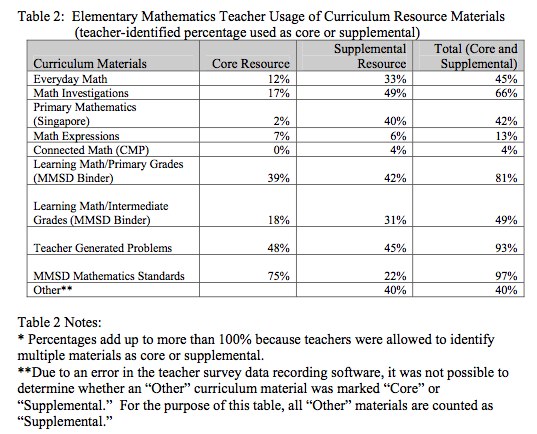
MMSD has begun a three-year implementation plan to achieve an equitable and balanced mathematics program at tbe elementary level. The plan was developed and refined through collaboration with teachers, Instructional Resource Teachers and principals over the course of the past several years. The plan includes the materials described below (details via this 64K PDF),
With the attached order, MMSD has provided each classroom teacher in the District with a Learning Mathematics in the Primary/Intermediate Grades instructional guide and the set of teacher resources from the Investigations program. The third component of the teacher materials is Teaching Student Centered Mathematics by John Van de Walle, which is in place in most classrooms but will continue to be ordered using ELM or Title I funds, as necessary. Additional professional resources have been or are being purchased at the building level to create a library available for all staff to access as needed. Those resources include Primary Mathematics textbooks and teacher guides, Thinking Mathematically and Children’s Mathematics by Thomas Carpenter, Teaching Number series from Wright, among other recommended titles.
MMSD has provided all Title I schools with the Primary Mathematics (Singapore) workbooks and Extra Practice workbooks for the 2009-2010 school year. All manipulatives have been ordered for Title I schools over tbe past two years and are in place. Non-Title I schools have been and will continue to use ELM funds to purchase tbe student components for the implementation of a balanced mathematics classroom.

Related:

Share

Speaking of Fine Arts: 2009 Suzuki Camp @ UW-Stevens Point


2009 Suzuki Performance University of Wisconsin-Stevens Point from Jim Zellmer. Aber Suzuki Center.

Share

Madison Public Schools’ Arts education gets needed support

Anne Katz & Barbara Schrank, co-chairwomen, MMSD Arts Task Force, via a kind reader’s email:

Kudos and thanks to the Madison School District Board of Education and Superintendent Dan Nerad for their support of arts education opportunities for all students, with additional thanks to members of the Arts Education Task Force.
The task force of art teachers and citizens has worked since 2007 with Board members and administrative and teaching staff on a plan that supports, enhances and sustains arts education in Madison’s public schools. The Board approved the plan on July 20.
In adopting the plan, the Board showed support of the arts as a priority for a quality public education.
The process took hard work by committee members, administrative and teaching staff and input from over 1,000 community members who have been thoughtful, inquisitive and dedicated to nurturing students’ talent and creativity through the arts. These plans will move forward with leadership, support and a strong partnership between the district and the community.
We are proud to live in a community with educational leaders who understand that arts and creativity are essential components of a 21st century education.

Share

1 Year Summary of Madison’s Implementation of “Standards Based Report Cards”

Notes and links on “Standards Based Report Cards” here.

Share

Proposed Madison School District Talented & Gifted Plan

Madison School District Superintendent Dan Nerad’s memo [100K PDF] on the Proposed Talented & Gifted Plan [1.2MB PDF]:

Background
Wisconsin Administrative Rule 8.01 (2)(t)2 states that each school district shall establish a plan and designate a person to coordinate the gifted and talented program. The previous Talented and Gifted (TAG) Plan approved by the Madison Metropolitan School District (MMSD) Board was in 1991. 2008-09 highlighted several independent yet related events which served to underscore both the urgency of and District-wide benefit for an updated Plan. Among the events that converged to result in the need to update the Talented and Gifted Plan were:

  • Superintendent Dr. Daniel Nerad was hired in July 2008. Dr. Nerad recognized the need for addressing the issues related to Talented and Gifted programming;
  • The last TAG Plan (1991) approved by the District was found by the DPI to be out of compliance;
  • An increase in open enrollment leaving the District spurred conversation regarding strategies to attract and retain students;
  • Families leaving the District were surveyed to gather information regarding their reasons for leaving MMSD. A desire for improved Talented and Gifted programming was one of several emerging themes; and
  • A new Strategic Plan was developed through extensive community involvement. The Strategic Plan clearly demands a rigorous and challenging education for all students.

Process In response to the events described above, the Superintendent charged the Teaching & Learning TAG Division to develop a process to create an updated Plan. The TAG Division met on a regular basis to define major areas for improvement in alignment with the National Association for Gifted Children standards. A Talented and Gifted Advisory Committee comprised of 30 members was convened in early spring. This group met five times between February and June to provide input and critique the evolving draft. The Superintendent and TAG Coordinator hosted a community input session on March 26. Senior Management, Instructional Council and Principals reviewed drafts and provided input. In order to ensure a timely and high quality Plan, a subcommittee of the Talented and Gifted Advisory Committee was invited to continue to work with TAG staff to complete the Plan during June and July.
There have been significant challenges in the process leading to the development of the enclosed plan. These challenges include communication, changes in leadership and an evolving level of District and community trust in MMSD’s commitment to providing high quality education for all stUdents. Overcoming these challenges is an on-going process, one captured in the language of the plan with respect to continual improvement. Although there are aspects of current MMSD talented and gifted programming that are sound and valued, the need for overall structural improvements and re-vitalization is recognized byal!.
In addition to the TAG Division staff, we sincerely appreciate the members of the TAG Advisory Committee for their extraordinary gift of time and dedication toward creating this plan. Special recognition goes to TAG Advisory Subcommittee members Kerry Berns, Bettine Lipman, Laurie Frost, Chris Gomez Schmidt and Carole Trone for their continuing support and input through the final draft of this plan.
MMSD Strategic Planning The enclosed TAG Plan aligns, supports and strengthens important aspects of the Strategic Plan. In particular, the TAG Plan undergirds District-wide efforts to: enhance assessments to guide appropriate levels of instruction; accelerate learning for all students; embed differentiation as core practice in all classrooms; and map and develop a comprehensive and articulated curriculum K-12 in order to increase curricular rigor for all students.
Executive Plan Summary Based upon the framework set forth by the National Association for Gifted and Children standards and areas identified by MMSD for improvement, eight key goal areas addressed in this Plan are:

(more…)

Share

Charter Schools Eschew Teacher Tenure

Danielle Williamson:

The agreement between teachers and management at the North Central Charter Essential School is similar to one that may be found at almost any traditional public school. There is a salary scale with lanes and steps, and stipends for extra duties. Some teachers serve as representatives for the larger group in a “collaborative bargaining process.”
Absent from the school’s teachers’ employee handbook, however, is a clause that gives veteran teachers job protection. “Professional status,” more commonly known as tenure, doesn’t exist there. Everyone is an employee at will, and a teacher of 10 years can be dismissed as easily as a first-year educator.
“If a teacher is not a fit, we have to be honest about that,” said Patricia May, principal of the Fitchburg school. “That’s not working for anybody.”
Having no union affiliations appears to be working for the area’s charter schools. Despite a full-court press from the state’s second largest teachers union, charter schools in Central Massachusetts haven’t hopped onto the union bandwagon. Statewide, only one charter school has signed up with the American Federation of Teachers in the two years the organization has been approaching charters, which are publicly financed but operate outside of school districts.

Share

‘Obama Effect’ at school: Black parents volunteer, expect more

Greg Toppo:

A new survey suggests that President Obama’s victory last November had a positive effect not just on the academic expectations of black Americans — it may have raised parents’ interests in volunteerism.
The “Obama Effect,” documented last winter, showed that Obama’s rise during the 2008 presidential election helped improve African Americans’ performance on skills tests, which helped narrow a black-white achievement gap.
In the new findings, African-American parents of children in K-12 schools say they’re much more likely to volunteer in a classroom this fall, in effect narrowing a volunteering gap.
The survey, being released today by GreatSchools, a San Francisco non-profit that promotes parental involvement, finds a jump of 37 percentage points in the portion of African-American parents who say they’ll volunteer in their child’s school — 60% vs. 23% a year ago.

Share

Michelle Rhee: Partnering With City Year DC to Tackle Dropout “Catastrophe”

Alice Korngold:

Washington, D.C.’s public school system has 45,000 students and an abysmal dropout rate of about 50%, typical of large cities. With a goal to remedy this dropout “catastrophe” (Gen. Colin Powell’s term), while being constrained by a tight economy, D.C. Chancellor Michelle Rhee is looking to–in her words–“leverage opportunities for the greatest change.”
To this end, Rhee believes that one of the best investments that D.C. Public Schools (DCPS) has made in the past year is its partnership with City Year DC. In 2008/09, City Year corps members proved themselves in a pilot program in 4 of Washington’s most challenging elementary schools.
Jeff Franco, Executive Director of City Year DC explained that “we offered to help the Chancellor to solve her worst headaches.” After rigorous training, corps members coached, tutored, and mentored children in grades K to 2, and successfully demonstrated that they could help improve children’s reading ability. This achievement will be instrumental in changing the life trajectory of these kids–ultimately increasing the likelihood that they will graduate from high school, go to college, and later, earn greater incomes.
“I’ve been thrilled with the results of this first year,” Rhee told me. So thrilled that she and Franco plan a “feeder pattern” strategy to have corps members continue working with these same children all through elementary school, middle school, and high school, while also expanding City Year’s involvement with additional schools. The end game: reduce the dropout rate.

Share

Breakthrough Cincinnati:

Believing in the Power of Young People:

Breakthrough Cincinnati is a four year, tuition free academic enrichment program that offers both summer and school year programs for under-served Cincinnati public middle school students. Breakthrough students apply in the fifth grade (sixth and seventh graders are welcome to apply, but spots are limited) and attend through the summer preceding their 9th grade year.
School Year Program
Starting in the fall of 2009, Breakthrough Cincinnati will be offering twice a week tutoring, homework help and academic enrichment lessons for all students who participated in the Summer Academic Session. Breakthrough Cincinnati is actively recruiting talented high school and college students to serve as teachers in this program. Please click on the link on the left-hand side of this page for more information on the school year program, including teacher application forms.
In addition, Breakthrough Cincinnati will be hosting a High School information Night and a Reunion Party in the fall. Information on these events will be mailed home and posted on the News and Events section of this web-site as it becomes available.

Share

Federal Tax Receipts Decline 18%, Dane County (WI) Tax Delinquencies Grow

Stephen Ohlemacher:

The recession is starving the government of tax revenue, just as the president and Congress are piling a major expansion of health care and other programs on the nation’s plate and struggling to find money to pay the tab.
The numbers could hardly be more stark: Tax receipts are on pace to drop 18 percent this year, the biggest single-year decline since the Great Depression, while the federal deficit balloons to a record $1.8 trillion.
Other figures in an Associated Press analysis underscore the recession’s impact: Individual income tax receipts are down 22 percent from a year ago. Corporate income taxes are down 57 percent. Social Security tax receipts could drop for only the second time since 1940, and Medicare taxes are on pace to drop for only the third time ever.
The last time the government’s revenues were this bleak, the year was 1932 in the midst of the Depression.
“Our tax system is already inadequate to support the promises our government has made,” said Eugene Steuerle, a former Treasury Department official in the Reagan administration who is now vice president of the Peter G. Peterson Foundation.

Channel3000.com recently spoke with Dane County Treasurer Dave Worzala on the growing property tax delinquencies:

While there aren’t any figures for this year, property tax delinquencies have been on a steep climb the last few years, WISC-TV reported.
Delinquencies increased 11 percent in 2006, 34 percent in 2007 and 45 percent in 2008, where there is now more than $16 million in unpaid taxes in the county.
“It affects us in that we have to be sure that we have enough resources to cover county operations throughout the year even though those funds aren’t here. And we do that, we are able to do that, but 40 percent increases over time become unsustainable,” said Dane County Treasurer David Worzala.
“I can see that there are probably some people that either lost their jobs or were laid off, they’re going to have a harder time paying their taxes,” said Ken Baldinus, who was paying his taxes Thursday. “But I’m retired, so we budget as we go.”
Big portions of those bills must go to school districts and the state. Worzala said the county is concerned about the rise in delinquencies because if the jumps continue the county could run into a cash flow issue in paying bills.

Resolution of the Madison School DistrictMadison Teachers, Inc. contract and the District’s $12M budget deficit will be a challenge in light of the declining tax base. Having said that, local schools have seen annual revenue increases for decades, largely through redistributed state and to a degree federal tax dollars (not as much as some would like) despite flat enrollment. That growth has stopped with the decline in State tax receipts and expenditures. Madison School District revenues are also affected by the growth in outbound open enrollment (ie, every student that leaves costs the organization money, conversely, programs that might attract students would, potentially, generate more revenues).

Share

Dumb Money Too many nations are wasting their school spending. Here’s how to get it right.

Stefan Theil:

“If we want to become a strong economy again, the best thing we can do is have an educated workforce.” Few would object to U.S. Secretary of Education Arne Duncan’s explanation of why Washington is funneling $100 billion to schools and universities as part of February’s giant stimulus package. Indeed, other countries are following suit, with Britain, Germany, Canada, China, and others making new education funding part of their anticrisis strategies.
What’s far less clear is that this money is going where it’s most needed–or likely to have the greatest social and economic payoff. In Germany, the bulk of nearly €10 billion in new school spending is being used to renovate buildings–a bonanza for construction companies and popular with parents and teachers, but unlikely to have much effect on the quality of German graduates. In Britain, Prime Minister Gordon Brown is pushing for more PCs and Web access in schools–another policy that’s popular but considered irrelevant by educators. In the United States, a July audit by the Government Accountability Office found that schools were not using the stimulus money to boost student achievement, as promised by Duncan, but to fund their general budgets. And in still other countries, governments are using money to help build new world-class universities–projects that a World Bank study in July warned risk bleeding resources away from more desperately needed areas. “I’m not sure that the people making these decisions even realize the trade-offs involved,” says Jamil Salmi, author of the study.
That’s particularly unfortunate today, given the economic stakes. According to an April report by McKinsey, the United States’ GDP would have been 9 to 16 percent–or $1.3 trillion to $2.3 trillion–higher in 2008 had U.S. high-school graduates attained the average skills of their peers in Canada, Finland, or South Korea. This fall, the Organization for Economic Cooperation and Development (OECD) will unveil a similar study in Paris detailing the losses suffered by other laggards. Andreas Schleicher, author of the OECD study, says that “in a whole row of countries, the economic losses of educational underperformance are significantly higher than the costs of the financial crisis.” What’s worse, he says, countries pay the price for their mistakes year after year.

Share

Woodside Priory keeps boarding school tradition

Sam Whiting:

At the end of the school day, as their classmates pile into cars for the commute home, 50 students at the Woodside Priory, near Stanford University, turn and lug their backpacks uphill. These 30 high school boys and 20 girls are already home. They call themselves the “dormers,” and they are the last of their kind between San Francisco and Monterey.
“I have roommates instead of a mom. It’s better, I think,” says sophomore Allegra Thomas, 14, as she sits in a vinyl booth in the mock ’50s-style diner in her residence hall. It is 5 p.m., which is right about when she would be getting home to the Santa Cruz Mountains, with her mother shuttling.
“Before being in the dorms, I never really had an opportunity to hang out with people after school because it was such a long drive home,” says Thomas, who started the Priory as a freshman day student, then became a boarder midyear. “Because I’m on foot, I can do more things around the school, be part of the community. I like the structure. My grades have been better.”

Share

Bay Area is Biggest Little Italy for Preschools

Patricia Yollin:

Abigail Call corrects her mother’s grammar when they speak Italian and has started to teach her father the language, sometimes making up nonexistent words just to toy with him a bit. She is not quite 4 years old.
“When she’s by herself with her dolls, she sings all these songs in Italian,” said Abigail’s mother, Jessica Hall. “I’m a parent, so of course it makes me want to cry – to think that her little brain, in those unprompted moments of alone time, chooses to do that.”
Abigail doesn’t know it yet, but she is part of a trend.
Italian playgroups, preschools and language centers for children are proliferating in the Bay Area these days in a manner unequaled anywhere in the country, according to Marco Salardi of the Italian Consulate in San Francisco.
“It’s just exploding,” said Salardi, director of the consulate’s office of education. “It’s very new. And it’s becoming bigger and bigger. It’s a very nice surprise.”
La Piccola Scuola Italiana on Potrero Hill in San Francisco. Spazio Italiano Language Center in North Beach. The tiny Vittoria Italian Preschool in the Mission District. Girotondo Italian School and Parliamo Italiano, both in Marin County. Mondo Bambini in Berkeley, purchased a few months ago by Girotondo so it can expand to meet a swelling demand in the East Bay.

Share

Time for tutors to think about getting rid of `exam tips’ label

The Hong Kong Standard:

The education sector is well- prepared for the new senior secondary, or NSS, academic structure that will be implemented in the coming school year. So too are tutorial centers – they have already launched promotions to attract students.
Apart from preparatory talks, the centers have been offering free trial lessons. Their focus is on liberal studies, a compulsory subject under the NSS and hence one where tutorial centers expect tough competition as they try to boost enrollment.
Brochures show that the leading tutorial centers have their own selling points on liberal studies.
During the recent Hong Kong Book Fair many publishers offered books and learning materials on the subject.
Tutorial centers were not slow to seize the opportunity either.

Share

Wisconsin Governor Doyle going after student performance, federal money

Mark Pitsch:


Gov. Jim Doyle is planning a series of education reforms designed to boost student achievement and help the state compete for billions of dollars in federal school improvement grants.
The changes include better tracking of student performance, using test data to help evaluate teachers and raising high school graduation requirements.
“We’re going to be working very hard in my administration with the Legislature, with educators in the state, to put together really, I think, a transformational application that will help Wisconsin education for years to come,” Doyle said in a recent interview.
But it’s unclear whether the state would even qualify for the federal money — part of a $4.35 billion program dubbed “Race to the Top” — because of a state law that bars using student test scores to evaluate teachers.
Draft rules for the program prohibit states that have such laws in place from receiving the money. Secretary of Education Arne Duncan last week called Wisconsin’s law “ridiculous.”

Wisconsin Representative Mike Huebsch:

Cut education funding by 3 percent. Check.
Make sure teachers’ raises aren’t jeopardized by the cuts. Check.
Pretend property taxes won’t go up. Check.
Begin dismantling Wisconsin’s School Choice Program. Check.
Jeopardize Wisconsin’s eligibility for new federal education funding. Check.
This is the state of public education in Wisconsin under the leadership of self-proclaimed education governor Jim Doyle and Democrat majorities in the state Senate and Assembly.
Governor Doyle and Democrat lawmakers wrote a state budget that cuts school funding $294 million, raises property taxes $1.5 billion, repeals the Qualified Economic Offer, says local school boards can’t consider the recession, job loss rates, and property values when negotiating teacher compensation and makes politically-motivated changes to the Milwaukee Parental Choice Program (School Choice).
Now the governor shrugs off reports that Wisconsin won’t be eligible to participate in the Obama Administration’s Race to the Top grant program, while Democrat lawmakers remain predictably silent. Approximately $4.35 billion will be doled out to states with plans for reforming public education. Under the proposed application guidelines released by the United States Department of Education last week, only Wisconsin, New York and California would be barred from receiving federal funds.

Share

School spotlight: Summer program combines science and black history

Pamela Cotant:

For the last 14 years, a summer program has found a way to make learning about a particular area of science fun while also exposing elementary and middle school students to blacks who have made a difference in that field.
This year, flight was the theme for the program, called a Celebration of Life. In general, about two-thirds of those in attendance are returning participants like Synovia Knox, who also had four siblings who attended.
“Each year I would leave wanting to be someone else,” said Knox, who has attended since third grade. “They just make everyone seem so interesting.”
The annual event is one of the programs put on by the African American Ethnic Academy of Madison. The site of the program and its co-sponsor is the BioPharmaceutical Technology Center Institute, the non-profit affiliate of Promega, which offers the use of its Fitchburg facilities.
The program, which is held during the morning for two weeks, is divided into two sessions — one for students entering grades three through five and another for students going into grades six through eight. A total of 28 students attended this year and the organizers hope the numbers will grow, said Barbara Bielec, who helps run the Celebration of Life as the K-12 program coordinator for the BioPharmaceutical Technology Center Institute.

Promega offered the Madison School District free land in the mid-1990’s for a tech oriented Middle School. The offer was turned down and the proposed school eventually became Wright Middle School.

Share

At School, Lower Expectations Of Dominican Kids

Claudio Sanchez:

Parents and teachers often expect less of students who are the children of Dominican immigrants. This causes their grades and ambitions to suffer.
Now, why some immigrants’ children do better in school than others. Yesterday, we heard about the kids of Chinese immigrants and the tensions between what their parents want for them academically and what they want. Today, the achievement gap between Chinese-American students and students of Dominican background. In Boston, researchers have zeroed-in on that gap. They’ve looked at whether one culture values education more than the other and what role do schools play. NPR’s Claudio Sanchez has the second of two reports.
CLAUDIO SANCHEZ: Carmen Merced has had two sons in the Boston Public Schools. Fernando, an eighth grader, and Wildo, her oldest, just finished high school. They were born in Boston and grew up speaking English. In school, though, both were tagged learning disabled. Merced is convinced that it’s because they’re Latino.
Ms. CARMEN MERCED: (Foreign language spoken)
SANCHEZ: Latinos, even if they know English, are always discriminated, says Merced. It’s not something schools even try to hide. Like the time one of Wildo’s teachers told him he was never going to amount to anything in life.

Share

Washington Steps Up on Schools

New York Times Editorial, via a kind reader’s email:

The federal government talks tough about requiring the states to improve schools in exchange for education aid. Then it caves in to political pressure and rewards mediocrity when it’s time to enforce the bargain. As a result, the country has yet to achieve many of the desperately needed reforms laid out in the No Child Left Behind Act of 2002 and other laws dating back to the 1990’s.
Education Secretary Arne Duncan is ready to break with that tradition as he prepares to distribute the $4.3 billion discretionary pot of money known as the Race to the Top Fund. States that have dragged their feet or actively resisted school reform in the past are screaming about the rigorous but as yet preliminary criteria by which their grant applications will be judged.
President Obama gave fair notice of this shift in a speech earlier this year, when he talked about pressuring the states to do better by the country’s 50 million schoolchildren. But Mr. Duncan will need cover from the White House to weather the storm.
The long and detailed list of criteria just released by the administration includes a fine-grained evaluation process under which states get points for reforms they have made and points for changes they promise to make — and conditional funding that can be revoked if they don’t make them. The process finally allows the federal government to reward states that have made progress and to bypass slackers.

Share

Harvard Schmarvard: A Small College Shines

Jay Matthews:

This will be the first in an occasional series of blog postings on little-known colleges that prove their worth. My 2003 book Harvard Schmarvard argued that the big name schools don’t provide a better education than the little name schools. Research indicates that qualities that bring success—persistence, humor, kindness, patience—are acquired before we ever take an SAT test. The brand name schools look good because they lure lots of students with those qualities, but students with similar character strengths who go to unknown schools often do just as well, particularly if they pick colleges with great strengths in areas that interest them.
I tend to ramble about this topic a lot. Parents who write and seek my advice on college selection get an email-full of such Jayisms. In many cases they go away realizing I am a bore. But occasionally I say the right thing, and years later they let me know that. Here is a message I received today from Michael Bledsoe, pastor of the Riverside Baptist Church in southwest D.C. and an adjunct at the Howard University Divinity School. Four years ago, when he and his wife were agonizing over where to send their first child, Kelley, off to college, they read some of my columns and wrote for more advice. Kelley was attracted to Agnes Scott College in Decatur, Ga., I told them that in many ways that school would be better for her than an Ivy League university. In his new message, Bledsoe said this:

Share

True democracy is not just about taking part

John Kay:

Like most people, I want to eat rich desserts, but do not want to get fat. I want to enjoy a secure retirement, but I do not want to save towards it. I want lower taxes, and I also want better public services. Of course I do. It would be odd if I did not. Irrationality does not lie in wanting inconsistent things. Irrationality is being unwilling to make choices between inconsistent things.
There was a time when crowds would wait for hours for a once in a lifetime opportunity to see and hear William Gladstone. But technology has steadily increased possibilities for the public to participate in the political process. It has not, however, created a corresponding increase in the time the public wants to devote to the political process. If anything, the opposite: by offering so many other ways to spend leisure time and by spreading prosperity, the modern age has reduced the intensity of public commitment to politics.
Many people take the view that more avenues for participation make democracy more real. They are excited by the opportunities offered by the internet: Barack Obama was elected after a campaign that made extensive use of computers and mobile phones. Our leaders blog and twitter, receive online petitions and e-mails, consult focus groups and monitor opinion polls. If the measure of democracy is the frequency of communication between politicians and their voters, then society is steadily becoming more democratic.
But these developments do not make society better governed. If these methods of participation are extensive, they are also superficial. If democracy is about delivering what the electorate wants, it is not clear that policies that respond to every angry headline in the Daily Mail achieve that result. Popular esteem for politicians and public approval of political decisions have declined, not increased. When Winston Churchill was advised to keep his ear to the ground, he commented that the public would not have much respect for leaders observed in that position. Politicians planning appearances on YouTube might reflect on his advice.

Share

TEENAGE SOAPBOX

Will Fitzhugh, The Concord Review
30 July 2009
Little Jack Horner sat in the corner
Eating his Christmas pie:
He stuck in his thumb, and pulled out a plum
And said, “What a good boy am I!”

I publish history research papers by secondary students from around the world, and from time to time I get a paper submitted which includes quite a bit more opinion than historical research.
The other day I got a call from a prospective teenage author saying he had noticed on my website that most of the papers seemed to be history rather than opinion, and was it alright for him to submit a paper with his opinions?
I said that opinions were fine, if they were preceded and supported by a good deal of historical research for the paper, and that seemed to satisfy him. I don’t know if he will send in his paper or not, but I feel sure that like so many of our teenagers, he has received a good deal of support from his teachers for expressing his opinions, whether very well-informed or not.
From John Dewey forward, many Progressive educators seem to want our students to “step away from those school books, and no one gets hurt,” as long as they go out and get involved in the community and come back to express themselves with plenty of opinions on all the major social issues of the world today.
This sort of know-nothing policy-making was much encouraged in the 1960s in the United States, among the American Red Guards at least. In China, there was more emphasis on direct action to destroy the “Four Olds” and beat up and kill doctors, professors, teachers, and anyone else with an education. Mao had already done their theorizing for them and all they had to do was the violence.
Over here, however, from the Port Huron Statement to many other Youth Manifestos, it was considered important for college students evading the draft to announce their views on society at some length. Many years after the fact, it is interesting to note, as Diana West wrote about their philosophical posturing in The Death of the Grown-Up:
“What was it all about? New Left leader Todd Gitlin found such questions perplexing as far back as the mid-1960s, when he was asked ‘to write a statement of purpose for a New Republic series called ‘Thoughts of Young Radicals.’ In his 1978 memoir, The Sixties, Gitlin wrote: ‘I agonized for weeks about what it was, in fact, I wanted.’ This is a startling admission. Shouldn’t he have thought about all this before? He continued: “The movement’s all-purpose answer to ‘What do you want?’ and ‘How do you intend to get it?’ was: ‘Build the movement.’ By contrast, much of the counterculture’s appeal was its earthy answer: ‘We want to live like this, voila!'”
For those of the Paleo New Left who indulged in these essentially thoughtless protests, the Sixties are over, but for many students now in our social studies classrooms, their teachers still seem to want them to Stand Up on the Soapbox and be Counted, to voice their opinions on all sorts of matters about which they know almost nothing.
I have published research papers by high school students who have objected to eugenics, racism, China’s actions in Tibet, gender discrimination, and more. But I believe in each case such opinions came at the end of a fairly serious history research paper full of information and history the student author had taken the trouble to learn.
When I get teenage papers advising Secretary Clinton on how to deal with North Korea, or Timothy Geitner and Ben Bernanke on how to help the U.S. economy correct itself, or telling the President what to do about energy, if these papers substitute opinion for research into these exceedingly complex and difficult problems, I tend not to publish them.
My preference is for students to “step away from that soapbox and no one gets hurt,” that is, to encourage them, in their teen years, to read as many nonfiction books as they can, to learn how little they understand about the problems of the past and present, and to defer their pronouncements on easy solutions to them until they really know what they are talking about and have learned at least something about the mysterious workings of unintended consequences, just for a start.
Since 1987, I have published more than 860 exemplary history research papers by secondary students from 36 countries (see www.tcr.org for examples), and I admire them for their work, but the ones I like best have had some well-earned modesty to go along with their serious scholarship.
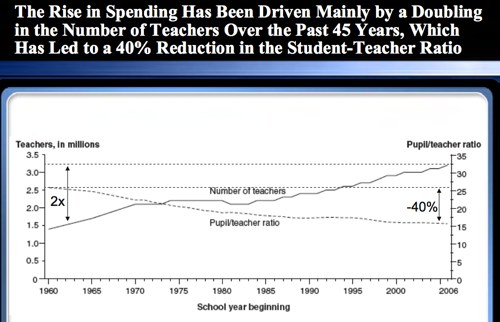
Share

A Message from Wisconsin State Senate President Fred Risser on the K-12 Budget, the QEO and Tax Redistributions

Fred Risser, via a kind reader’s email:

July 30, 2009
Dear ________
Due to your interest in the public education, I am writing to update you on the outcome of the 2009 State Budget and how it will impact K-12 Education in Wisconsin.
Despite the financial difficulties that the state finds itself in, a number of programs in this budget will have a positive and lasting effect on public education.  The high point of the budget this year is the repeal of the Qualified Economic Offer (QEO). Since the QEO was passed, teacher pay has lost more than 7% to inflation and fallen even further behind in per capita income. Wisconsin has long prided itself in having a top-notch public education system, yet we have lost countless qualified educators over this law. The elimination of the QEO removes one obstacle toward ensuring that our children have access to the best educators possible.
Other items of note in this budget include additional funding for the expansion of Four-Year-Old Kindergarten programs; increases in aid for high-poverty districts; and additional grant funding to improve school safety efforts.
Unfortunately, the reduction in available state funding resulted in some cuts in school aids.  However, I was pleased that overall funding for public education was maintained at a reasonable level under current circumstances, ensuring that we are able to give Wisconsin students the best resources possible. Funding education is an investment in the future of Wisconsin.
Thank you for your continued support of public education in Wisconsin.  If I can ever be of assistance to you, please do not hesitate to contact my office.
Most sincerely,
FRED A. RISSER
President,
Wisconsin State Senate

Share

“How can I help to get these kids a Lapdesk?

Maria Karaivanova:

“How can I help to get these kids a Lapdesk?” – I get this question all the time from my friends and classmates. And I want to have a good answer. An actionable, simple answer such as: “Go to our website, choose a school from the database and buy a Lapdesk for them.”
So how can our company make this happen? One of my main goals this summer is to launch an online initiative and to develop a plan for scaling it up – creating a home for individual donors who will become “Lapdesk friends”.
While our current website www.lapdesk.co.za is functional and rich in information, I want to take it to the next level: to turn it into a dynamic communications platform connecting Lapdesk’s partners, sponsors and beneficiaries. I want to enable individuals to donate Lapdesks to a school of their choice and to track our progress – all online.

Share

Oregon Symphony’s outreach program falls silent

David Stabler, via a kind reader’s email:

The drums have gone quiet. The gongs no longer shimmer. The bells go unchimed. The instruments that kids in small towns around Oregon used to hit, rub and scrape as part of the Oregon Symphony’s award-winning outreach effort went quiet this summer.
Another victim of the economy.
The Roseburg-based Ford Family Foundation, the program’s primary funder, suffered losses to its endowment and declined to continue paying the program’s $150,000 annual cost, said Norm Smith, the foundation’s president.
Since 2002, the Oregon Symphony has “adopted” a different town each two years: Klamath Falls, North Bend, Redmond, Baker City, Estacada, La Grande, Cove, Tillamook. The idea was to flood the zone with repeated trips by symphony musicians. Break into tactical units and invade the schools, fill community centers, start a jazz band, launch a string orchestra. Then go back the next year to water the seeds.
What made the program unusual was the effort to make music a lasting presence. Unlike in other outreach efforts, the orchestra didn’t just show up, coach a few kids, play a concert and get back on the bus. The focus encouraged local teachers to design a music curriculum for years to come and involved arts groups in adding a concert series to bring performers to town, using Oregon Symphony staff for ideas and follow-up.

Share

Education in Chicago: Why School Reform Won’t Happen

Bill Sweetland:

At the end of my last blog, I said that in my next post I would show why so-called “school reform” has become another empty abstraction, a slogan for politicians. I said I would demonstrate why there is no chance that real school reform will ever happen in Chicago. Here are half a dozen reasons:
(1) For 50 years we — the public, the critics of education, the education establishment itself — have known that schooling is in deep trouble, and not just public instruction in ghetto schools. Yet no substantive reforms have been carried out.
Everything has been proposed, everything tried — several times. The latest cure-all promises tough, real action and painless, revolutionary, unprecedented, serendipitous, timely benefits. Its results have proven to be mixed — and puny.
The more we talk, the greater the uncertainty about what to do grows. The more ideas put forward, the more difficult practical action becomes. The more we “innovate,” the more resistant and hardened the problems of removing ignorance become.

Share

More on Wisconsin, California and New York’s Law Against Tying Teacher Pay to Class Performance

PBS NewsHour:

“If you set and enforce rigorous and challenging standards and assessments, if you put outstanding teachers at the front of the classroom, if you turn around failing schools, your state can win a ‘Race to the Top’ grant that will not only help students out-compete workers around the world, but let them fulfill their God-given potential,” President Obama said.
Some reforms are controversial.
The reforms touted by the Obama administration have supporters and detractors.
California, New York and Wisconsin have laws against tying teacher pay to how their students perform in class. Teacher unions, which are organizations with teacher members that use collective bargaining to get better pay and benefits, are also wary of teacher pay reform.
“The devil really is in the details. On the issues where you have differences, you try to work those out,” Randi Weingarten, president of the American Federation of Teachers, told the Washington Post.
As head of schools in Chicago, Secretary Duncan started a program that paid some teachers according to how their students performed to see if it worked.

Share

A Race to the Bottom? Wisconsin’s Academic Standards & Teacher Accountability

Charles Barone:

One of the funnest and most instructive concepts in philosophy is the “logical fallacy.” Here’s an example:

  1. Nothing is better than eternal happiness.
  2. Eating a hamburger is better than nothing.
  3. Therefore, eating a hamburger is better than eternal happiness.

The arguments being advanced by the interest groups that are lining up in opposition to President Obama’s and Secretary Duncan’s call to tear down teacher-student data firewalls bear a striking similarity to hamburger eating and eternal happiness.

First up, the great state of New York:
1. The Race to the Top Guidance issued by Secretary Duncan on Friday states that:
“to be eligible under this program, a State must not have any legal, statutory, or regulatory barriers to linking student achievement or student growth data to teachers for the purpose of teacher and principal evaluation.”
2. New York law states that:
“The regents shall, prescribe rules for the manner in which the process for evaluation of a candidate for tenure is to be conducted. Such rules shall include a combination of the following minimum standards: a. evaluation of the extent to which the teacher successfully utilized analysis of available student performance data and other relevant information when providing instruction but the teacher shall not be granted or denied tenure based on student performance data.”

Reactions in California and Wisconsin.

Share

“What if it has all been a huge mistake?”

The Chronicle Review
July 27, 2009
A Rescue Plan for College Composition and High-School English
By Michael B. Prince:

The new administration in Washington promises fresh resources for our failing school systems. The need is great. Yet at a time when every penny counts, we had better be sure that new investments in education don’t chase after bad pedagogical ideas.
I propose a rescue plan for high-school English and college composition that costs little, apart from a shift in dominant ideas. For the sake of convenience and discussion, the rescue plan reduces complex matters to three concrete steps.
First, don’t trust the SAT Reasoning Test, especially the writing section of that test, as a college diagnostic, and don’t allow the writing test to influence the goals of high-school English.
The news last year that Baylor University paid its already admitted students to retake the SAT in order to raise the school’s ranking in U.S. News and World Report would be funny if it weren’t so sad. The test is a failure.
Even the manufacturer of the SAT admits that the new test, which includes writing, is no better than the old test, which didn’t. As The Boston Globe reported on June 18, 2008: “The New York-based College Board, which owns the test, released the study yesterday showing that the current SAT rated 0.53 on a measure of predictive ability, compared with 0.52 for the previous version. A result of 1 would mean the test perfectly predicts college performance. Revising the SAT ‘did not substantially change’ its capacity to foretell first-year college grades, the research found.”
How could this happen? College professors frequently ask their students to write. Shouldn’t a test that includes actual writing tell us more about scholastic aptitude than a test that doesn’t? Yes, unless the test asks students to do something categorically different from what college professors generally ask their students to do. Is that the problem with the SAT? You be the judge.
The following essay question appeared on the December 2007 SAT. It was reprinted on the College Board’s Web site as a model for high-school students to practice; it was subsequently disseminated by high schools and SAT-prep Web sites. The question runs as follows:
“Think carefully about the issue presented in the following excerpt and the assignment below.
“‘Our determination to pursue truth by setting up a fight between two sides leads us to believe that every issue has two sides–no more, no less. If we know both sides of an issue, all of the relevant information will emerge, and the best case will be made for each side. But this process does not always lead to the truth. Often the truth is somewhere in the complex middle, not the oversimplified extremes.’
“[Adapted from Deborah Tannen, The Argument Culture]

(more…)

Share

Join me at the REACH Awards Day next Wed 8/5; Education Reform’s Moon Shot; A $4B Push for Better Schools; Taken to school: Obama funding plan must force Legislature to accept education reforms; President Obama Discusses New ‘Race to the Top’ Program

1) I hope you can join me a week from Wednesday at the REACH Awards Day from 10-12:30 on Aug. 5th at the Chase branch on 39th and Broadway (see full invite at the end of this email).
REACH (Rewarding Achievement; www.reachnyc.org) is a pay-for-performance initiative that aims to improve the college readiness of low-income students at 31 inner-city high schools in New York by rewarding them with up to $1,000 for each Advanced Placement exam they pass. I founded it, with funding from the Pershing Square Foundation and support from the Council of Urban Professionals.
This past year was the first full year of the program and I’m delighted to report very substantial gains in the overall number of students passing AP exams at the 31 schools, and an even bigger gain among African-American and Latino students (exact numbers will be released at the event). As a result, more than 1,000 student have earned nearly $1 MILLION in REACH Scholar Awards! Next Wednesday, the students will come to pick up their checks, Joel Klein will be the highlight of the press conference at 11am, and there will be a ton of media. I hope to see you there! You can RSVP to REACH@nycup.org.
2) STOP THE PRESSES!!! Last Friday will go down in history, I believe, as a key tipping point moment in the decades-long effort to improve our K-12 educational system. President Obama and Sec. Duncan both appeared at a press conference to announce the formal launch of the Race to the Top fund (KIPP co-founder Mike Feinberg also spoke and rocked the house!). Other than not being there on vouchers, Obama and Duncan are hitting ALL of the right notes, which, backed with HUGE dollars, will no doubt result in seismic shifts in educational policy across the country.
Here’s an excerpt from Arne Duncan’s Op Ed in the Washington Post from Friday (full text below — well worth reading):

Under Race to the Top guidelines, states seeking funds will be pressed to implement four core interconnected reforms.
— To reverse the pervasive dumbing-down of academic standards and assessments by states, Race to the Top winners need to work toward adopting common, internationally benchmarked K-12 standards that prepare students for success in college and careers.
— To close the data gap — which now handcuffs districts from tracking growth in student learning and improving classroom instruction — states will need to monitor advances in student achievement and identify effective instructional practices.
— To boost the quality of teachers and principals, especially in high-poverty schools and hard-to-staff subjects, states and districts should be able to identify effective teachers and principals — and have strategies for rewarding and retaining more top-notch teachers and improving or replacing ones who aren’t up to the job.
— Finally, to turn around the lowest-performing schools, states and districts must be ready to institute far-reaching reforms, from replacing staff and leadership to changing the school culture.
The Race to the Top program marks a new federal partnership in education reform with states, districts and unions to accelerate change and boost achievement. Yet the program is also a competition through which states can increase or decrease their odds of winning federal support. For example, states that limit alternative routes to certification for teachers and principals, or cap the number of charter schools, will be at a competitive disadvantage. And states that explicitly prohibit linking data on achievement or student growth to principal and teacher evaluations will be ineligible for reform dollars until they change their laws.

(more…)

Share

Should Higher Education Be Free?

Max Page:

Andrew Delbanco effectively describes the tragedy that is unfolding at American universities: after a generation of expanding of opportunity, both private and public colleges are increasingly out of reach of the lower classes [“The Universities in Trouble,” NYR, May 14]. Unfortunately, Delbanco avoids the solution that is sitting right before him: free higher education. That’s the way most of the civilized world deals with the cost of higher education. And we have past and present examples in our own nation of providing free higher education–the GI Bill, CUNY, California’s community colleges, Georgia’s HOPE scholarships. My father went from immigrant to soldier to Ph.D. in the space of a decade, thanks to the GI Bill.
Would this be insanely expensive? The total cost of sending every single public university undergraduate to college for a year (that group makes up 75 percent of the total college enrollment) was $39.36 billion in 2006-2007. That’s not chicken feed, but it’s less than the bailout amount for two large banks, or the cost of three or four months in Iraq.

Share

Nearly 75% of DC Residents Want Vouchers: Where Does Washington, DC Go in K-12 Education?

Paul DePerna & Dan Lips:

Historically, the District of Columbia has struggled to improve the educational opportunities available to students living in the nation’s capital. Over the past decade, District residents have witnessed signifi cant changes in the D.C. education system. New reforms have included the creation of nearly sixty public charter schools on approximately ninety campuses; Mayor Adrian Fenty and Chancellor Michelle Rhee’s overhaul of the traditional public school system; and the creation of the federal D.C. Opportunity Scholarship Program.
As policymakers in District government and on Capitol Hill consider the future of these and other education reform initiatives, attention should be paid to the views of D.C. citizens. In July 2009, the Friedman Foundation for Educational Choice commissioned Braun Research, Inc. to conduct a statistically representative survey of 1,001 registered voters in the District of Columbia.
Why conduct a survey on education issues in the District of Columbia? Why now?
This is a critical moment for the District and its residents. With so many proposals being suggested in the public domain – to initiate, expand, scale back, or eliminate programs and policies – it can be dizzying to policy wonks and casual observers alike. We hope that this survey can bring a pause for perspective. Each of the organizations endorsing this survey’s fi eldwork felt it was important to take a step back and refl ect on the wishes of
D.C. citizens regarding their city’s education system.

Joanne has more.

Share

School spotlight: Apprenticeship provides taste of product engineering

Pamela Cotant:

In between summertime activities, recent Oregon High School graduate Erik VanderSanden is focusing on winter as he helps redesign a device that makes cross country skiing accessible to the disabled.
VanderSanden spent his senior year assisting in the design and redesign of parts and items for Isthmus Engineering and Manufacturing of Madison through the Dane County Youth Apprenticeship Program.
In Dane County, nearly 130 students have participated this school year and into the summer, said Diane Kraus, school to career coordinator for the Dane County consortium of 16 school districts. The county program offers 11 program areas and the most popular right now are health care, information technology, automotive and biotechnology, said Kraus, adding that her program is always looking for more businesses that want to participate.
One of the items VanderSanden worked on for his apprenticeship is a device that allows people to sit while skiing. VanderSanden is now being retained as needed to finish up a prototype, which will be used by Isthmus to manufacture 100 more. The unit was originally designed by UW-Madison mechanical engineering students under professor Jay Martin through the Center for Rehabilitation Engineering and Assistive Technology, which is also known as UW-CREATe.
“I tried to optimize what they had already done … and take it a step further than what they had time for in their class,” said VanderSanden said.

Share

Don Severson & Vicki McKenna Discuss the Madison School District’s $12M Budget Deficit

26MB mp3 audio file.

Share

Madison School District Strategic Planning Update, with Links

Madison Board of Education President Arlene Silveira, via email:

TO: MMSD Strategic Planning Committee
Good afternoon,
I am writing to provide you with a Board update on the MMSD strategic plan. Before getting into details, I again want to thank you for all of the time and effort you put into development of the plan. It is appreciated.
On July 21, the Board of Education held our second meeting to review the strategic planning document that you, our community-based strategic planning committee, submitted. The Board unanimously approved the following components of the new strategic plan. The mission, beliefs and parameters were approved with no changes to the plan you submitted. Some language in the strategic objectives was modified for clarity and completeness.

We have not yet approved any of the action plans.

Much more on the Strategic Planning Process here.

Share

A story from the trenches — send me more!; DAVID STEINER ELECTED COMMISSIONER OF EDUC FOR NY; As Charter Schools Unionize; Must unions always block innovation in public schools?; NEA Discovers It Is a Labor Union; So You Want to Be a Teacher for America?

1) If you read anything I send out this year, let this be it. One of my friends responded to the survey I sent around a couple of weeks ago by emailing me this story of his experience as a TFA teacher in the South Bronx a decade ago (though he’s no longer there, he is still (thankfully) very much involved with educating disadvantaged kids). It is one of the most powerful, heart-breaking, enraging things I have ever read — and perfectly captures what this education reform struggle is all about. Stories like this about what REALLY goes on in our failing public schools need to be told and publicized, so please share yours with me:

Whitney,
Thanks so much for putting this survey together. It brought back some memories well beyond the few questions about what it was like to teach in the South Bronx with TFA back in the late nineties. I want to emphasize here that I no longer teach in the Bronx, so I have little idea how things have changed and have seen the current Administration take a number of important steps that may be making a great impact. I’m not close enough to the ground to know, but my guess is that there are still plenty of schools in the Bronx and in every other low-income community in the country that reflect some of the miserable stuff I saw in my school. You should really start collecting a book of stories like these. Among all the people I know who’ve done TFA, these stories are just a few among many sad ones.
As I filled out the survey, I was first reminded of the art teacher in our school. She was truly a caricature of bad teaching. Like something out of the movies. She spent almost every minute of every day screaming at the top of her lungs in the faces of 5-8 year olds who had done horrible things like coloring outside the lines. The ART teacher! Screaming so loud you could hear her 2-3 floors away in a decades old, solid brick building. When she heard I was looking for an apt, she sent me to an apt broker friend of hers. I told the friend I wanted to live in Washington Heights. “Your mother would be very upset with me if I let you go live with THOSE PEOPLE. We fought with bricks and bats and bottles to keep them out of our neighborhoods. Do you see what they have done to this place?” This same attitude could be heard in the art teacher’s screams, the administration’s ambivalence towards the kids we were supposed to be educating and the sometimes overt racism of the people in charge. The assistant principal (who could not, as far as I could tell, do 4th grade math, but offered me stop-in math professional development for a few minutes every few months with gems like “these numbers you see here to the left of the zero are negative numbers. Like when it is very cold outside.”) once told me “I call them God’s stupidest people” referring to a Puerto Rican woman who was blocking our way as we drove to another school. She also once told me I needed to put together a bulletin board in the hallway about Veteran’s Day. I told her we were in the middle of assembling an Encyclopedia on great Dominican, Puerto Rican and Black leaders (all of my students were Dominican, Black or Puerto Rican). “Mr. ____, we had Cin-co de May-o, and Black History Month, and all that other stuff. It is time for the AMERICAN Americans.”
Not everyone in the school was a racist. There were many hard working teachers of all ethnicities who did not reflect this attitude at all. But the fact that the leadership of the school and a number of the most senior teachers was either utterly disdainful of the students they taught, or has completely given up on the educability of the kids, had a terrible effect on overall staff motivation. And many of the well-meaning teachers were extremely poorly prepared to make a dent in the needs of the students even if they had been well led. The Principal told more than one teacher there that “as long as they are quiet and in their seats, I don’t care what else you do.” This was on the day this person was HIRED. This was their first and probably last instruction. He never gave me a single instruction. Ever. And I was a new teacher with nothing but TFA’s Summer Institute under my belt. The Principal proceeded to get a law degree while sitting in his office ignoring the school. When we went to the Assistant Superintendent to report that the school was systematically cheating on the 3rd grade test (i.e., the third grade team met with the principal and APs, planned the cheating carefully, locked their doors and covered their windows and gave answers) she told the principal to watch his back. A few months later, inspectors came from the state. After observing our mostly horrible classes for a full day, they told us how wonderful we were doing and that they had just come down to see what they could replicate in other schools to produce scores like ours. And the list goes on and on.
Like when I asked the principal to bring in one of the district’s special education specialists to assess two of my lowest readers, both of whom had fewer than 25 sight-words (words they could recognize on paper) in the 3rd grade, he did. She proceeded to hand one of the students a list of words that the child couldn’t read and tell her to write them over again. Then she went to gossip with the Principal. After explaining to him in gory detail, IN FRONT OF THE STUDENT, that she had just been “dealing with a case where a father had jumped off a roof nearby and committed double-suicide with his 8 year old daughter in his arms”, she collected the sheet with no words on it, patted the child on the head and left. No IEP was filed nor was I allowed to pursue further action through official channels (I lobbied the mother extensively on my own). I never asked for her to come back to assess the other student.
Our Union Rep was said to have tried to push another teacher down a flight of stairs. The same Union Rep, while I was tutoring a child, cursed out a fellow teacher in the room next door at the top of her lungs so the child I was tutoring could hear every word. When I went to address her about it, the other teacher had to restrain the Rep as she threatened to physically attack me. And when the cheating allegations were finally take up by city investigators, the same Union Rep was sent to a cushy desk job in the district offices. I hear that most of the people I’m referencing here are long gone now, and some of them actually got pushed out of the system, but how rare can this story really be given the pitiful results we see from so many of our nation’s poorest schools and how far the system goes to protect horrible teachers and administrators like the ones I worked with?
At the same time as all of this was happening, by the way, the few good teachers in the building often became beaten down and disillusioned. One of the best in my building was consistenly punished for trying to make her corner of the school a better place for learning. They put her in a basement corner with no ventilation, no windows and nothing but a 6-foot-high cubicle-style partition separating her from the other 5 classrooms in the basement. After fighting the good fight she went to teach in the suburbs. When I got a financial firm to donate 20 computers, the principal said he didn’t have the resources to get them setup for use and refused to allow them into the school. When I had my students stage a writing campaign to get the vacant lot behind the building turned into a playground, the principal wanted me silenced.
The saddest thing about the whole damn mess was that our K-3 kids still REALLY WANTED TO LEARN. Every day they came eager for knowledge. And every day this cabal of cynicism, racism and laziness did everything within their powers to drain it out of them. It was unreal. Don’t get me wrong. There were some good teachers there. And some well meaning, but poor teachers. But in many classrooms, the main lesson learned was that school became something to dread, many adults thought you were capable of very little, and some adults couldn’t be bothered to lift a finger.
I hope if any of the good, hard-working teachers who fought so hard to rid the school of this mess read this, they’ll know I’m not lumping them in with the rest. But the problem was, when I addressed the worst practices in the school at a staff meeting, the bad teachers laughed and the good teachers took it the hardest and thought I was criticizing them.
Thanks again for the survey. Let’s make these stories known.

(more…)

Share

College Courses for High School Students: Bellevue, Washington

Bellevue College:

Running Start provides academically motivated students an opportunity to take college courses as part of their high school education.
Students may take just one class per quarter, or take all of their courses on the BC campus. If you are eligible for the program, you will earn both high school and college credit for the classes you take.
Classes taken on the college campus as part of the Running Start program are limited to “college level” courses (most classes numbered 100 or above qualify).
Tuition is paid for by the school district. Books, class related fees and transportation are the responsibility of the student.
Running Start was created by the Washington State Legislature in 1990 and is available at all community and technical colleges in the State of Washington.

Smart.
Related: The ongoing battle: Credit for Non-MMSD Courses.

Share

Do You Know a High-Achieving Student Kept From College Because of Money?

Jay Matthews:

I try to stay away from the New York Review of Books. It is a trap for aimless readers like me. I may enjoy a piece on the last Khan of Mongolia. But that makes me want to sample a letter about derivatives or a review of what Titian thought of Tintoretto. Pretty soon it’s bedtime and I have forgotten to do important stuff like talk to my wife and watch “The Closer” on TNT.
Yet I couldn’t resist a piece in the May 14 issue by Columbia University humanities professor Andrew Delbanco about the sorry state of American higher education. In most respects, it was a splendid analysis of what ails our universities: bad investments, recession, elitism, etc. But on one crucial point he lost me. That was his conclusion that “a great many gifted and motivated young people are excluded from college for no other reason than their ability to pay, and we have failed seriously to confront the problem.”
I noticed he did not identify even one person to whom this had happened. Like many writers in the review, Delbanco was observing from the scholarly heights. His was a wide-angle view, full of national statistics and global analysis. That was one of the pleasures of reading the piece, to see all these issues in historical and social context.

Share

WIBA’s Mitch Henck Discusses the Madison School District’s Budget with Don Severson

24MB mp3 audio file. Mitch and Don discuss the Madison School District’s $12M budget deficit, caused by a decline in redistributed tax dollars from the State of Wisconsin and generally flat enrollment. Topics include: Fund 80, health care costs, four year old kindergarten, staffing, property taxes (which may increase to make up for the reduced state tax dollar funding).
Madison School District Board President Arlene Silveira sent this message to local Alders Saturday:

Good afternoon,
Below is an update of the MMSD budget situation.
As you know, the biennial budget was signed into law at the end of June. The budget had numerous provisions that will effect the future of public education that include:

  • Repeal of the Qualified Economic Offer (QEO)
  • Decrease in funding for public education by the state of approximately $14720million
  • Decrease in the per pupil increase associated with revenue limits

The repeal of the QEO will potentially impact future settlements for salries and benefits. The decrease in funding for public education by the state creates the need for a tax increase conversation in order to sustain current programs. The decrease in the revenue limit formula will cause MMSD to face more reductions in programs and services for the next 2 years at a minimum.
EFFECT OF STATE BUDGET ON MMSD

  • Decrease in state aid: $9.2 million
  • Reduction in revenue: $2.8 million (decrease in the per pupil increase from $275 to $200/pupil)

Total decrease: projected to to be $12 million
Last May, the Madison Board of Education passed a preliminary 2009-10 budget that maintained programs and services with a modest property tax increase. The groundwork for our budget was laid last fall when the Board pledged our commitment to community partnership and the community responded by supporting a referendum that allowed us to exceed revenue caps to stabilize funding for our schools. Two months later, with programs and staff in place for next year, we find ourselves faced with State funding cuts far exceeding our worst fears.
HOW DID THIS HAPPEN?
We are in this position in part because Wisconsin’s school funding formulas are so complicated that the legislature and supporting agencies did not accurately predict the budget’s impact on school districts. State aid to Madison and many other districts was cut by 15%. In practical terms, coupled with additional State cuts of $2.8 million, MMSD is saddled with State budget reductions of $12 million this year.
This grim situation is a result of a poor economy, outdated information used by the legislature, and a Department of Public Instruction policy that penalizes the district for receiving one-time income (TIF closing in Madison). Federal stimulus funds will, at best, delay cuts for one year. We are left with a gaping budget deficit when many fiscal decisions for the upcoming school year cannot be reversed.
WHAT ARE WE GOING TO DO?
We are working on strategies and options and are looking carefully at the numbers to ensure our solutions do not create new problems. We will evaluate options for dealing with the budget in early August.
To repair our budget, we are working with legislators and the DPI to appeal decisions that have placed us in this position. We continue to look for changes in resource management to find additional cost reductions. We are seeking ways to offset the impact of school property tax increases if we need to increase our levy.
At the same time, we pledge that we will not pass the full cost of the cuts along as increased property taxes. We will not resort to massive layoffs of teachers and support staff, t he deadline having passed to legally reduce our staff under union contracts.
I will be back in touch after our August meeting when we have made decisions on our path forward.
If you have any questions, please do not hesitate to contact me.
Arlene Silveira
Madison Board of Education
608-516-8981

Related: Sparks fly over Wisconsin Budget’s Labor Related Provisions.

Share

Online classes: Convenient option or growing cash cow for the University of Wisconsin-Milwaukee?

Erica Perez:

Students registering for fall classes this summer at the University of Wisconsin-Milwaukee will see a 30% increase in the number of online classes, but the convenience comes with a price: as much as $275 per course on top of regular tuition.


University officials say the increase is part of a strategy to boost enrollment and revenue by meeting a growing demand for the online format, which appeals to students who commute, work full time or have families.


But the move is also a way for UWM to pass more of its costs to students at a time when it faces a $20 million budget cut over the next two years that will be only partially offset by a tuition increase.


The trend toward online courses raises two key questions at a time when UWM students are registering for fall classes: Will the shift in scheduling mean more local students have to take the pricier online courses, and where does the money raised by the online fees go?


The pricing of online courses varies by college, but the fees particularly frustrate some undergraduates in the College of Letters and Science, which charges $275 above regular tuition for each online course.

Share

Discovery learning in math: Exercises versus problems Part I

Barry Garelick, via email:

By way of introduction, I am neither mathematician nor mathematics teacher, but I majored in math and have used it throughout my career, especially in the last 17 years as an analyst for the U.S. Environmental Protection Agency. My love of and facility with math is due to good teaching and good textbooks. The teachers I had in primary and secondary school provided explicit instruction and answered students’ questions; they also posed challenging problems that required us to apply what we had learned. The textbooks I used also contained explanations of the material with examples that showed every step of the problem solving process.
I fully expected the same for my daughter, but after seeing what passed for mathematics in her elementary school, I became increasingly distressed over how math is currently taught in many schools.
Optimistically believing that I could make a difference in at least a few students’ lives, I decided to teach math when I retire. I enrolled in education school about two years ago, and have only a 15-week student teaching requirement to go. Although I had a fairly good idea of what I was in for with respect to educational theories, I was still dismayed at what I found in my mathematics education courses.
In class after class, I have heard that when students discover material for themselves, they supposedly learn it more deeply than when it is taught directly. Similarly, I have heard that although direct instruction is effective in helping students learn and use algorithms, it is allegedly ineffective in helping students develop mathematical thinking. Throughout these courses, a general belief has prevailed that answering students’ questions and providing explicit instruction are “handing it to the student” and preventing them from “constructing their own knowledge”–to use the appropriate terminology. Overall, however, I have found that there is general confusion about what “discovery learning” actually means. I hope to make clear in this article what it means, and to identify effective and ineffective methods to foster learning through discovery.

Garelick’s part ii on Discovery learning can be found here.
Related: The Madison School District purchases Singapore Math workbooks with no textbooks or teacher guides. Much more on math here.

Share

The Dad Who Holds Schools to the Rules

Emily Alpert:

David Page says the problem is that parents are on their own. Teachers have a union. So do principals. School board members get to vote plans up or down and top administrators make decisions in the salmon-pink offices of San Diego Unified.
But parents are often too intimidated to speak up or too star-struck with school staffers to question them, Page said. Education is a world loaded with its own numbing lingo — categorical funding, supplement not supplant, program improvement — and it seems overwhelming to understand it, let alone to fight it.
“They think, ‘They make six figures and they’re educated. Who am I to second guess them?'” Page said.
Yet Page has done just that. If parents at the poorer schools in San Diego Unified did have a union, he might be their leader, with all the fans and foes that entails. Seventeen years after the father of six first walked into a parents’ meeting at Ross Elementary in Kearny Mesa, unsure of his rights and unfamiliar with the jargon, Page has become a human encyclopedia on the rules that govern funds for disadvantaged kids and a dogged fighter for parents in communities sometimes left out of decisions.
He is one of the few parents across the state that jets to Sacramento for meetings of the state Board of Education, pores over complex regulations on education spending, and explains it all to befuddled parents at the school district committee that oversees funds for children in poverty, which he has led for six years. Page also leads the nonprofit California Association of Compensatory Education and sits on the board of the Family Area Network, which advises the state on parent involvement.

Share

As More Charter Schools Unionize, Educators Debate the Effect

Sam Dillon:

Dissatisfied with long hours, churning turnover and, in some cases, lower pay than instructors at other public schools, an increasing number of teachers at charter schools are unionizing.
Labor organizing that began two years ago at seven charter schools in Florida has proliferated over the last year to at least a dozen more charters from Massachusetts and New York to California and Oregon.
Charter schools, which are publicly financed but managed by groups separate from school districts, have been a mainstay of the education reform movement and widely embraced by parents. Because most of the nation’s 4,600 charter schools operate without unions, they have been freer to innovate, their advocates say, allowing them to lengthen the class day, dismiss underperforming teachers at will, and experiment with merit pay and other changes that are often banned by work rules governing traditional public schools.
“Charter schools have been too successful for the unions to ignore,” said Elizabeth D. Purvis, executive director of the Chicago International Charter School, where teachers voted last month to unionize 3 of its 12 campuses.
President Obama has been especially assertive in championing charter schools. On Friday, he and the education secretary, Arne Duncan, announced a competition for $4.35 billion in federal financing for states that ease restrictions on charter schools and adopt some charter-like standards for other schools — like linking teacher pay to student achievement.

Share

An innovative British special needs school is setting new standards

Brendan O’Malley:

One side of Heron Road, south London, is lined with grey-brick, bay-windowed Victorian terraced houses. The other is dominated by a strikingly modern building.
Michael Tippett School stands within a frame of timber pillars spanned by orange and maroon louvres, its walls are covered with slats of chestnut cladding and its eco-roof is topped with a thin carpet of mauve plants.
Many schools for children with severe and complex special needs are designed to protect the children from the outside world and seem to hide them away.
But through the front doors of Michael Tippett you can see the social hub of the school, a double-storey atrium, the garden and the undulating landscape of a small community park beyond.
Situated in a part of Lambeth borough that is dominated by vast regimented blocks of flats and crammed terraces, this generous entrance is a bold statement about the value put on educating the least able in the community.
“It has to do with dignity and respect for the people we work with,” said head Jan Stogdon. “The building reflects the ethos of the school.”
Michael Tippett is named after the British composer whose music celebrated the resilience of the human spirit in the face of oppression. The 70 pupils, aged 11 to 19, have their own daily struggles against the limitations of their own complex needs and severe or profound learning difficulties. Some have sight or hearing impairments, a number have gastrotomy tubes and others are at various points on the autistic spectrum.

Share

Laid Off Sales Manager Goes Back to School to Teach a Foreign Language

Related: Janet Mertz on Teaching Hiring criteria.

Share

So You Want to Be a Teacher for America?

Cecilia Capuzzi Simon:

At 50, Paula Lopez Crespin doesn’t fit the Teach for America demographic of high-achieving college senior. The program rarely draws adults eligible for AARP membership. In fact, just 2 percent of recruits are over 30.
But what Ms. Crespin lacks in youth, she makes up for in optimism, idealism and what those in Teach for America call “relentless pursuit of results.” Ms. Crespin beat out tens of thousands of applicants to get where she is: fresh off her first year teaching math and science at Cole Arts and Science Academy in a gang-riddled section of Denver.
Many friends thought she was crazy to give up a career in banking for a $32,000 pay cut teaching in an urban elementary school. But the real insanity, Ms. Crespin insists, would have been remaining in a job she “just couldn’t stomach anymore,” and surrendering a dream of doing “something meaningful with my life.”
These days, crazy never looked so normal. Teaching has always been a top choice for a second career. Of the 60,000 new teachers hired last year, more than half came from another line of work, according to the National Center for Education Information. Most bypassed traditional teacher education (for career changers, a two-year master’s degree) for fast-track programs like Teach for America. But unemployment, actual or feared, is now causing professionals who dismissed teaching early on to think better of its security, flexibility (summers off, the chance to be home with children) and pension. Four of Ms. Crespin’s colleagues at Cole are career changers, ages 46 to 54, including a former information technology executive and a psychologist.

Teach for America
, the teacher-training program that has evolved into a Peace Corps alternative for a generation bred on public service, is highly competitive and becoming more so: this year, a record 35,178 applied — a 42 percent increase over 2008 — to fill 4,100 slots. Eleven percent of all new Ivy League graduates applied.

Share

At Foothill, a college-level program for middle school students lagging in math

Jessie Mangaliman:

Maria Mendoza is hunkered over her math workbook, diligently copying a work sheet, “Adding 3 & 4 Digit Numbers.” She had copied it once already, and completed the problems. But there were two minor errors and the math teacher, Agnes Kaiser, had returned it to be done over.
Mendoza, 13, happily complied.
“Now I get it,” she said, satisfied.
Maria, who will be in eighth grade this fall at Graham Middle School, was one of 81 students from Mountain View in the four-week summer math program that ended Friday at Foothill College in Los Altos.
This is no ordinary summer math camp for students behind many grades in their learning of math. The curriculum used to teach Maria and other students is Math My Way, the program the college has been using successfully for years to teach intensive, remedial math to incoming community college students with elementary-level math skills. The camp was funded with a $77,000 grant from the Silicon Valley Community Foundation, part of an initiative to close the education achievement gap, a learning disparity among different racial groups.

Share

Charter schools need a shout-out in Madison action plans

Scott Milfred:

Yet try to find any mention of charter schools in the Madison School District’s new strategic plan and you’ll feel like you’re reading a “Where’s Waldo?” book. You almost need a magnifying lens to find the one fleeting reference in the entire 85-page document. And the words “charter school” are completely absent from the strategic plan’s lengthy and important calls for action.
It’s more evidence that much of liberal Madison clings to an outdated phobia of charter schools. And that attitude needs to change.
Nearly 10 percent of Wisconsin’s public schools are charters. That ranks Wisconsin among the top five states. Yet Madison is below the national average of 5 percent.
Charter schools are public schools free from many regulations to try new things. Parents also tend to have more say.
Yet charters are held accountable for achievement and can easily be shut down by sponsoring districts if they don’t produce results within a handful of years.
One well-known Madison charter school is Nuestro Mundo, meaning “Our World” in Spanish. It immerses kindergartners, no matter their native language, in Spanish. English is slowly added until, by fifth grade, all students are bilingual. My daughter attends Nuestro Mundo.
It was a battle to get this charter school approved. But Nuestro Mundo’s popularity and success have led the district to replicate its dual-language curriculum at a second school without a charter.
The School Board has shot down at least two charter school proposals in recent years, including one for a “Studio School” emphasizing arts and technology.
Madison School Board President Arlene Silveira told me Friday she supports adding charter schools to the district’s action plans in at least two places: under a call for more “innovative school structures,” and as part of a similar goal seeking heightened attention to “diverse learning styles.”

I agree. I believe that diffused governance, in other words a substantive move away from the current top down, largely “one size fits all” governance model within the Madison public schools is essential.

Share

Chicago Report: STILL LEFT BEHIND

Civic Committee of The Commercial Club of Chicago
June 2009
KEY FINDINGS 150K PDF
Most of Chicago’s students drop out or fail. The vast majority of Chicago’s elementary
and high schools do not prepare their students for success in college and beyond.
There is a general perception that Chicago’s public schools have been gradually
improving over time. However, recent dramatic gains in the reported number of CPS
elementary students who meet standards on State assessments appear to be due to
changes in the tests made by the Illinois State Board of Education, rather than real
improvements in student learning
.
At the elementary level, State assessment standards have been so weakened that most
of the 8th graders who “meet” these standards have little chance to succeed in high
school or to be ready for college
. While there has been modest improvement in real
student learning in Chicago’s elementary schools, these gains dissipate in high school.
The performance of Chicago’s high schools is abysmalwith about half the students
dropping out of the non-selective-enrollment schools, and more than 70% of 11th
grade students failing to meet State standards
. The trend has remained essentially flat
over the past several years. The relatively high-performing students are concentrated
in a few magnet/selective enrollment high schools. In the regular neighborhood high
schools, which serve the vast preponderance of students, almost no students are
prepared to succeed in college
.
In order to drive real improvement in CPS and fairly report performance to the public,
a credible source of information on student achievement is essential. Within CPS
today, no such source exists. CPS and the State should use rigorous national
standardized tests. Also, the Board of Education should designate an independent
auditor with responsibility for ensuring that published reports regarding student
achievement in CPS are accurate, timely and distributed to families and stakeholders
in an easily understood format.
Efforts to provide meaningful school choices to Chicago’s families must be aggressively
pursued–including expanding the number of charter and contract schools in
Chicago. Most of these schools outperform the traditional schools that their students
would otherwise have attended; and the choices that they offer parents will help spur
all schools in CPS to improve.

Share

Private Schools as Charities: The war against fee-paying schools takes on new life

The Economist:

EVEN among left-wingers, few talk about banning independent schools nowadays. There are craftier ways of overhauling the education system to fight privilege. One of them hit the headlines this week when the Charity Commission published its first “public-benefit” assessment, including five private schools among its chosen charitable specimens. Two–Highfield Priory in Lancashire and S. Anselm’s in Derbyshire–failed the tough new requirement to show that they are helping the general public. The schools have a year to come up with a plan to get on track, or risk being taken over or closed down.
For centuries education has been considered a charitable activity, with no questions asked. In 2006 the rules were changed. Under the Charities Act of that year, schools are no longer entitled to the tax breaks that charitable status confers simply because they provide teaching. Instead, they have to demonstrate that they are actively benefiting the public. It has fallen to the regulator to interpret and apply the law: the commission says charities that charge fees, such as private schools, must ensure that “people in poverty” can use their services. The two schools that the commission flunked did not provide those who cannot afford the fees “sufficient opportunity to benefit”.

Share

Proposed “Common Core Standards”

The Common Core State Standards Initiative is a joint effort by the National Governors Association Center for Best Practices (NGA Center) and the Council of Chief State School Officers (CCSSO) in partnership with Achieve, ACT and the College Board [10MB PDF]:

Governors and state commissioners of education from across the country committed to joining a state-led process to develop a common core of state standards in English-language arts and mathematics for grades K-12. These standards will be research and evidence-based, internationally benchmarked, aligned with college and work expectations and include rigorous content and skills. The NGA Center and CCSSO are coordinating the process to develop these standards and have created an expert validation committee to provide an independent review of the common core state standards, as well as the grade-by-grade standards. The college and career ready standards are expected to be completed in July 2009. The grade-by-grade standards work is expected to be completed in December 2009.

“>10MB Proposed standards pdf document.

Share

Madison School District Strategic Planning Update

On July 21, the Board unanimously approved the following components of the new strategic plan.

  • Mission
  • Beliefs
  • Parameters
  • Strategic Objectives

We have not yet approved any of the action plans.
New Mission: Our mission is to cultivate the potential in every student to thrive as a global citizen by inspiring a love of learning and civic engagement, by challenging and supporting every student to achieve academic excellence, and by embracing the full richness and diversity of our community.
Strategic Objectives:

Student
We will ensure that all students reach their highest potential and we will eliminate achievement gaps where they exist. To do this, we will prepare every student for kindergarten, raise the bar for all students, create meaningful student-adult relationships, and provide student-centered programs and supports that lead to prepared graduates.
Curriculum
To improve academic outcomes for all students and to ensure student engagement and student support, we will strengthen comprehensive curriculum, instruction and assessment systems in the District.
Staff
We will implement a formal system to support and inspire continuous development of effective teaching and leadership skills of all staff who serve to engage and support our diverse student body while furthering development of programs that target the recruitment and retention of staff members who reflect the cultural composition of our student body.
Resource/Capacity
We will rigorously evaluate programs, services and personnel through a collaborative, data-driven process to prioritize and allocate resources effectively and equitably, and rigorously pursue the resources necessary to achieve our mission.
Organization/Systems
We will promote, encourage, and maintain systems of practice that will create safe and productive learning and work environments that will unify and strengthen our schools, programs, departments and services as well as the District as a whole.

Next steps:
We did not approve any action plans. We went around the table and listed our priority areas and the Administration will develop action plans to support those areas and bring them back to the Board in August. There will be plenty of opportunity for discussion around the action plans brought forward. We have structured our process this way to ensure we keep moving forward as the plan is Important for setting the future direction of the District.
Arlene

Share

Who Will Congress Put First? Children or Teachers Unions?; Testing Tactics Helped Fuel D.C. School Gains; Why Cory Booker Likes Being Mayor of Newark; No Ordinary Success; Gates Says He Is Outraged by Arrest at Cambridge Home

1 & 2 here
3) A wise comment in response to one of my recent emails:

Petrilli is right on the money – I can’t tell you how many times I’ve heard certain reformers denigrate “higher order thinking” and “problem solving” as just more union code words for an anti-accountability agenda. The problem is, when they insist that all that matters is basic skills and proficiency tests, they sound ridiculous to parents and teachers, and that limits their effectiveness. Basic skills, just because they’re easily tested, are NOT all that matter, and our pursuit of more and more accountability needs to not be accompanied by a dumbing down of the accountability systems so we can have an easier time measuring and can make an argument against those who inappropriately assert that everything is unmeasurable.

4) A great blog post following the recent death of Frank McCourt, the author of Angela’s Ashes, who taught in NYC public schools for decades before becoming an author:

Frank McCourt was my English teacher in my senior year at Stuyvesant (class of ’74). He introduced us to African literature such as Chinua Achebe’s Things Fall Apart, which sounded even more dramatic in his thick brogue.
When one student asked why we should read this book, what possible use would it be to us in our lives, he answered, “You will read it for the same reason your parents waste their money on your piano lessons. So you won’t be a boring little shyte the rest of your life.”
It was the most honest answer to such a question I ever heard from any teacher. Whenever the question came to my head about any subject thereafter I fondly remembered Mr. McCourt and resolved not to be a boring little shyte.

(more…)

Share

OP hopefuls meet for first time, critique Jim Doyle’s tenure, make their cases to be governor.

Marc Eisen & Charlie Sykes via a kind reader’s email:

Sykes: The Milwaukee Public Schools have been an educational and fiscal disaster for a long time. Is it time to blow up MPS? Is it time to consider a state takeover?
Walker: It’s time to do something dramatic. Whether or not it’s a state takeover–Tommy Thompson talked about that a decade ago. An alternative would be to break it up into smaller districts. When you start talking about anywhere from 80,000 to 100,000 kids, it becomes very difficult for anybody to get their hands around it.
I would lift the lid entirely on school choice. I would allow schools throughout the county to [participate]. Take Thomas Moore, which has a very successful program, but can’t currently operate [as a choice school] because part of its property is in St. Francis. I would allow for expansion, and I would lift some of the limits on charter schools,
Neumann: There is dramatic change needed in education. What’s going on in policy in Madison right now is that more rules, regulations and red tape are being thrown at our choice and charter schools so that less and less dollars get to the classroom. They’re tying the hands of the innovative people in education. We need to expand the opportunity in choice and charter schools.

Share

K-12 Wisconsin Tax & Spending Climate: A look at Wisconsin’s Economic Base

Thomas Hefty & John Torinus, Jr:

Our state motto is “Forward,” but Wisconsin is falling behind in the economic race to create jobs and raise family incomes.
As we’ll show here, Wisconsin is lagging its own economic performance of the 1990s and losing ground to other states–especially to other upper Midwest states like Minnesota, Iowa and Illinois. It is even failing to meet its own goals–established in 1997 with much fanfare by a blue ribbon commission–for ramping up the state economy.
Although our political and media leaders ignore these failings, Wisconsin residents intuitively understand how our economic anemia has sapped their incomes and diminished their opportunities.
Since 2005, Wisconsin has experienced growing out-migration. Our citizens have voted with their feet, moving to states where they foresee a better future.
In the end, gauging economic success is really pretty simple for most people. Is Wisconsin gaining jobs? Are family incomes rising? Are wages increasing? In a word: No. Yet our state officials go out of their way (perhaps understandably) to emphasize the good news about Wisconsin business while ignoring the bad.
Consider how officials in the Doyle administration have massaged the unemployment rate to make Wisconsin job performance look better than it really is.

Share

Madison School Proposed Board Strategic Plan Discussion – Audio

The Madison School Board discussed the proposed Strategic Plan [PDF] last evening. Listen to this discussion via this 85MB mp3 audio file. Much more on the proposed Strategic Plan here. Some recent written questions from the Board to the Administration can be found here.

Share

Seat Assignment? Check. Student Playlist? Check. School of the Future? Check.

Jennifer Medina:

The seating arrangements are compared to airport traffic patterns. The student schedules are called playlists. And lesson plans are generated by a complicated computer algorithm for the 80 students in the class.
This could be the school of the future, according to the schools chancellor, Joel I. Klein, who visited Middle School 131 in Chinatown on Tuesday to promote a pilot program called School of One.
The program, which is being held in a converted library, consists mainly of students working individually or in small groups on laptop computers to complete math lessons in the form of quizzes, games and worksheets. Each student must take a quiz at the end of every day, and the results are fed into a computer program to determine whether they will move on to a new topic the next day.
Mr. Klein said the program would allow learning in a way that no traditional classroom can, because it tailors each lesson to a student’s strengths and weaknesses, as well as the child’s interests.
“The model we are using throughout the United States in kindergarten to 12th-grade education is fundamentally the same as it was 100 years ago,” Mr. Klein said.

Share

India makes education compulsory and free under landmark law

Dean Nelson:

The Indian parliament has passed a bill to provide universal, free and compulsory education for all children aged between six and 14.
The law, passed more than 60 years after India won independence, has been hailed by children’s rights campaigners and educationalists as a landmark in the country’s history.
India’s failure to fund universal education until now, and its focus on higher education, have been cited as factors in its low literacy rates. More than 35 per cent of Indians are illiterate, and more than 50 per cent of its female population cannot read.
Official figures record that 50 per cent of Indian children do not go to school, and that more than 50 per cent of those who do drop out before reaching class five at the age of 11 or 12.
Campaigners say children from poor families are often discouraged by parents who need them to work, while financial obstacles are put in the way of families who would like their children to be educated. Families are often deterred by the cost of school books and uniforms.
The Right to Free and Compulsory Education Bill will now guarantee 25 per cent of places in private schools are reserved for poor children, establish a three-year neighbourhood school-building programme, and end civil servants’ discretion in deciding which children will be given places.

Share

Just 3 new Milwaukee voucher schools approved

Alan Borsuk:

A board authorized by the state Legislature to control the entry of schools into Milwaukee’s controversial private school voucher program is beginning its life with a powerful statement that it will stop any school it doesn’t think is prepared to provide a quality education from getting off the ground.
The New Schools Approval Board, part of the Institute for the Transformation of Learning at Marquette University, voted last week to give a green light to only three new voucher schools for this fall. Each of them involves an existing education program that has not received public voucher payments previously.
The board stopped 16 schools from opening, generally start-up operations that were on track to meet the requirements for opening that existed prior to this year.
Leaders of some of those organizations were angered by the decisions and say they will meet soon to consider further action, such as a lawsuit. The new state law provides no appeals process for decisions by the New Schools Approval Board.
Three schools will be the smallest number of new voucher participants in years. In the past five years, there have been between eight and 15 new schools in the voucher program each September. Combined with the closing of other schools, the total number of participating schools has stayed in the range of 120 to 125.

Share

Singapore Math Workbook Only Purchase Discussion (No textbooks or teacher guides) at the Madison School Board

26MB mp3 audio file. Marj Passman, Lucy Mathiak and Maya Cole raised a number of questions regarding the purchase of $69K worth of Singapore Math Workbooks (using Federal tax dollars via “Title 1“) without textbooks or teacher’s guides at Monday evening’s Board Meeting. The purchase proceeded, via a 5-2 vote. Ed Hughes and Beth Moss supported the Administration’s request, along with three other board members.
Related Links:

The Madison Math Task Force Report [3.9MB PDF] found that local elementary school teachers used the following curricular materials (page 166):

What, if anything has the Math Task Force report addressed?

Share

Parent-Paid Aides Ordered Out of New York City Schools

Winnie Hu:

For years, top Manhattan public schools have raised hundreds of thousands of dollars from parents to independently hire assistants to help teachers with reading, writing, tying shoelaces or supervising recess. But after a complaint by the city’s powerful teachers union, the Bloomberg administration has ordered an end to the makeshift practice.
Principals have been told that any such aides hired for the coming school year must be employees of the Department of Education, their positions included in official school budgets.
But such employees can command nearly double the pay of the independently hired assistants, and several schools on the Upper East Side either have told current employees they will probably not have jobs in the fall or have put off hiring new employees. That has incensed many parents, who see the aides less as a perk than as a necessity to cope with growing class sizes in well-regarded schools like the Lower Lab School for gifted children, where the average class size is now 28, and Public School 290, where broom closets are used as offices and the cafeteria doubles as a gym.
“The reason the teaching assistants are here is because they’ve been stuffing so many kids in these classes,” said Patrick J. Sullivan, co-president of the Parent-Teacher Association at the Lower Lab School (P.S. 77), where parents spend $250,000 a year on the teaching assistants. “Nobody wants to break any rules, but 28 is just too many kids for one teacher.”

Share