School Information System

Campaign to Keep Schools Under the NYC Mayor’s Thumb

Jennifer Medina & Elissa Gootman:

Close allies of the Bloomberg administration have set up a political organization to campaign for renewal of the landmark state law giving New York City’s mayor control of its public schools, hiring a veteran operative and planning to raise up to $20 million for television advertisements, lobbying and grass-roots organizing.
The group, called Mayoral Accountability for School Success, is officially headed by three well-known and respected city figures, among them a nun lauded for her work with struggling students and a popular Harlem minister. But it is backed by top City Hall and Education Department officials, for whom persuading Albany to extend mayoral control is the No. 1 goal for the school year that starts on Tuesday.
The group filed papers in recent weeks to become designated a 501(c)(4), a nonprofit that can lobby and participate in political campaign activity. The move is the first salvo in the pitched battle expected to unfold between now and the end of June 2009, when the 2002 law giving Mayor Michael R. Bloomberg authority over the nation’s largest school system is set to expire.
Renewal is crucial to Mr. Bloomberg’s legacy, since he has staked his reputation on overhauling the schools and has repeatedly argued that without City Hall at the wheel, the system would be doomed to fail.

Share

Is it really ‘public’ education if voters get no say?

Andrew Coulson:

At 9 a.m. Wednesday, the state Supreme Court will hear oral arguments in a case that will shape the future of education in Florida. At issue are two constitutional amendment questions slated to go before voters in November.
A lawyer for Florida’s teachers union will argue that they should be removed from the ballot; the secretary of state’s lawyer will ask the court to leave them in place, allowing voters to decide these questions. The court should let Floridians have their say.
The first question, Amendment 7, deals with religious discrimination. This amendment would make it illegal to exclude any person or organization from participating in a public program because of religion. It also would allow the state to continue operating programs under which religious organizations can receive funding as long as the purposes and primary effects of those programs are secular (as required by the First Amendment of the U.S. Constitution).
The second question, Amendment 9, would require at least 65 percent of school-district operating expenditures to be spent in the classroom rather than on administration. It also would allow legislators to create alternative education programs in addition to the constitutionally required public-school system (though it wouldn’t create any new programs).

Share

Democrats, teachers unions now divided on many issues

Greg Toppo:

A funny thing happened to the Democratic Party on the way to an education platform: The party has visibly split with teachers unions, its longtime allies, on key issues.
The ink is barely dry on the official document, which outlines the party’s guiding principles, but it shows that in this fall’s general election, Democrats will stake out a few positions that unions have long opposed.
Among them: paying teachers more if they raise test scores, teach in “underserved areas” or take on new responsibilities such as mentoring new teachers.
Randi Weingarten, the American Federation of Teachers‘ new president, says she’s willing to entertain merit-pay plans. But most union leaders, as well as rank-and-file members, have long resisted, saying teachers would compete for jobs rather than cooperate and share ideas.

Share

Open Source Textbooks Challenge a Paradigm

Chris Snyder:

A small, digital book startup thinks it has a solution to the age-old student lament: overpriced textbooks that have little value when the course is over. The answer? Make them open source — and give them away.
Flat World Knowledge is the brainchild of two former textbook industry executives who learned from the inside about the wacky economy of textbooks.
In a nutshell, there is a huge, inelastic demand for college texts, even though textbook prices are high. Because of this there is a lot of piracy and a robust secondary market for textbooks — but not for long, because they are updated every couple of years, rendering old editions virtually worthless.

Perhaps a way to save some money?

Share

“Parent’s Guide to Education Reform” Points the Way to Better Schools

MarketWatch:

The following was released today by The Heritage Foundation:
One of every four children in America’s public schools isn’t going to graduate. And in many large cities, the graduation rate is twice as bad: two of every four kids will fail to graduate.
Staying in school doesn’t guarantee a good education, either. Fewer than a third of 12th-graders can identify why the Puritans sailed to these shores. Only four in 10 know the more recent significance of the fall of the Berlin Wall.
These and other eye-popping facts make for compelling reading in A Parent’s Guide to Education Reform, a new, 35-page booklet from The Heritage Foundation ( http://www.heritage.org/). Taxpayers, it makes clear, aren’t getting much of a return on the roughly $9,300 a year they spend on each child in public schools.

Share

Learn schools’ value to economy

Wisconsin State Journal Editorial:

Today is one of the most important days of the year for Wisconsin’s economy.
It’s the first day of the school year.
The state’s families and policymakers should take the opportunity to remind themselves of the link between education and economic success.
Education and the economy have long been related, but that relationship is growing closer in the age of the global, knowledge-based economy.

Share

Why Some Kids Aren’t Heading to School Today
Choosing the most radical education reform there is

Tony Woodlief:

So we frown on radicalism. Yet we have embarked on one of the most radical endeavors families can undertake: home-schooling. Given preconceptions about this practice, I should note that we are not anti-government wingnuts living on a compound. We like literature, and nice wines, and Celeste would stab me in the heart with a spoon if I gave her one of those head bonnets the Amish women wear. We are not, in other words, stereotypical home-schooling parents. But neither are most actual home-schooling parents.
Even though Ma and Pa Ingalls sent their children off to the little schoolhouse in Walnut Grove, we’ve decided to start our own. In the eyes of Kansas authorities that’s exactly what we’ve done; regulations require us to establish a school and name it. Ours is the Woodlief Homestead School. I wanted to go with something like: “The School of Revolutionary Resistance,” but Celeste said that was just inviting trouble.
The reason we’ve broken with tradition, or perhaps reverted to a deeper tradition, is not because we oppose sex education, or because we think their egos are too tender for public schools. It’s because we can do a superior job of educating our children. We want to cultivate in them an intellectual breadth and curiosity that public schools no longer offer.
Somewhere there is now an indignant teacher typing an email to instruct me about his profession’s nobility. Perhaps some public schools educate children in multiple languages and musical instruments, have them reading classic literature by age seven, offer intensive studies of math, science, logic, and history, and coach them in public speaking and writing. The thing is, I don’t know where those schools are.

A wise friend recently mentioned that “choice is good”. It will be interesting to see if the upcoming Madison School District math review addresses ongoing concerns over reduced rigor. Math Forum audio / video.

Share

Study: “Ohio State Tests Invalid for Rating Schools”

Randy Hoover:

This is the table of contents to the final findings from the research study of Ohio school district performance on the OPT and OSRC. This site is the data, graph, links, and comment page for Hoover’s research study of Ohio school district proficiency test and school report card performance accountability. These data and findings have been released to the public as of February 27, 2000. The entire study is available online for your use. If you wish to be included in the emailing list of updates about OPT and OSRC issues, click on the logo at the top of this page and send me your request.
The graphs and data presented here are from the final replication of the study. This final analysis represents the culmination of several hundred hours of work put forth to gain empirical insights into OPT performance across all Ohio school districts. At the time the study was completed there were 611 school districts in the State of Ohio. This study uses data from 593 districts out of the 611 total. 18 districts were not included in the study because of incomplete data or because the districts were too small such as North Bass Island. All data were taken from EMIS online data and no data other than the data presented by the State of Ohio were used. My confidence level is high that there are very few errors in the data array. Though errors are certainly possible, I am confident that if they exist they are minor and do not significantly affect the overall conclusions of this study. (RLH)

Scott Elliott has more.
Related: The Madison School District’s “Value Added Assessment” program uses the Wisconsin Department of Public instruction’s WKCE results. The WKCE’s rigor has been criticized.

Share

Great Teaching, Not Buildings, Make Great Schools

Jay Matthews:

As happens in many urban school systems, D.C. school and D.C. Council officials have been in a tiff over the repair and renovation of aging buildings. Nobody wants children to walk into schools with peeling paint, leaky roofs and windows that won’t open. Many inner-city educators believe such neglect sends the dispiriting message that nobody cares about these kids.
But are fresh plaster, up-to-date wiring and fine landscaping real signs of a great school?
Take a look at the 52-year-old former church school at 421 Alabama Ave. in Anacostia. Teachers say some floors shake if you stomp on them. Weeds poke out from under the brick walls. Yet great teaching has occurred inside. Two first-rate schools, the Thurgood Marshall Academy Public Charter High School and the KIPP DC: AIM Academy, have occupied that space in the past few years, and the Imagine charter network, also with a good record, is opening a school there. Or check out the School Without Walls, a D.C. public high school sought out by parents with Ivy League dreams. Its building, now being renovated, was a wreck, but inside, students embraced an A-plus curriculum.
How about the suburbs? Drive past the rust-stained, 44-year-old campus at 6560 Braddock Rd. in the Alexandria area of Fairfax County. Dean Tistadt, chief operating officer of Fairfax schools, says the place needs an electrical upgrade. A lot of windows should be replaced. He is sorry that his crews can’t do the major work until 2012. It doesn’t look like a place I would want to send my kids, yet the sign in front says it is the Thomas Jefferson High School for Science and Technology, maybe the best public school in America.
Ten years ago, I wrote a book about high schools with golden reputations in some of the country’s most expensive suburbs. They were full of Advanced Placement classes and fine teachers, but I was astonished at how bad some of the buildings were. Mamaroneck High School, in one of the most affluent parts of Westchester County, N.Y., had three 66-year-old boilers that repeatedly broke down and many clocks that didn’t work. La Jolla High School, north of San Diego, full of science fair winners, was a collection of stained stucco classrooms and courtyards of dead grass.

Matthews is right, great teaching is key. Somewhat related, it will be interesting to see what Madison’s new far west side elementary school’s (Olson) enrollment looks like this month.

Share

Helping Kids Who Hate High School

Jay Matthews:

A couple of years ago I debated Chris Peters, a thoughtful and energetic high school teacher in San Bernardino, Calif., about vocational education. He thought it had more value than I did and could energize students who can’t stand dry academics. I thought high schools were incapable of doing vocational ed well, and too often made it a dumping ground for students from low-income families thought incapable of college.
We did not convince each other, but my recent column on the surprising results of research into high school career academies, showing they had great benefit for students’ job and family prospects, led him to conclude I was still educable on the subject. He came back to me with a plan to shake up high school in a way that would give both college-oriented and job-oriented students an equal chance, rather than force kids who don’t like school to stew in English and science classes.
Peters’ plan, which he conceived without benefit of well-paid staff, shares important elements with the very expensive report of the New Commission on the Skills of the American Workforce, which Peters had not seen until I pointed it out to him. Many people, it seems, want to fix high school in this way, which I trashed in a previous column.

Share

A Good School Can Revitalize A Downtown

Kane Webb:

Fifth and sixth grades are in the newsroom, middle school dominates the Clinton campaign’s War Room, and seventh-graders have the run of the sports department.
While some cities try to lure athletic teams, mega-retailers or a few large employers to revitalize their downtowns, Little Rock is getting an economic-development boost from an unlikely source: eStem charter schools, which have taken over the old Arkansas Gazette building and is bringing new life to a formerly abandoned part of the city.
The Gazette won two Pulitzer Prizes in 1958 for its courageous coverage and editorials on the Central High desegregation crisis, but lost a drawn-out newspaper war with the Arkansas Democrat and closed on Oct. 18, 1991.
After that, the Gazette’s building was used temporarily by the Clinton presidential campaigns in 1992 and 1996, and by an occasional retailer. But for the most part, it sat vacant. Over time, the surrounding neighborhood began to slump as well. A grand, wide-columned building across the street once called home by the Federal Reserve is empty. A building catty-corner from the school — an urban-renewal atrocity that once headquartered Central Arkansas’ NBC-TV affiliate — sits idle too. Before eStem schools opened, you could work downtown and never find reason to pass by the Gazette building. (Full disclosure, the Gazette building is owned by the newspaper I work for, the Arkansas Democrat-Gazette, which leases it to eStem.)
Now it’s busy enough that some folks worry about traffic jams, as parents drop their kids off and head to work, or pick them up for lunch.
On July 21, eStem schools opened the doors. There are actually three schools in one historic 1908 building: an elementary, middle and high school. The schools’ name stands for the economics of science, technology, engineering and mathematics. And their curricula, which emphasize languages like Latin and even Mandarin Chinese, as well as economics and the sciences, are proving to be popular.

Share

Restoring Schools to the Havens They Should Be

Roger Lewis:

As Labor Day marks the end of summer and beginning of another school year, citizens presume that teachers are ready, but they may wonder if school buildings are, too.
The District’s public schools have faced this question annually, and owing to a history of insufficient funding coupled with chronic mismanagement, the answer usually has been “no.” As schools opened this week, however, strong leadership from Mayor Adrian M. Fenty, the D.C. Council and Schools Chancellor Michelle A. Rhee may have changed the answer to “mostly yes.”
But this question about school buildings is symptomatic of a national problem. It illuminates America’s persistent unwillingness to invest what it takes to create, operate and maintain public infrastructure, of which schools are a vital component.
Physically dysfunctional school buildings, like defective bridges and roadways or deteriorating water and sewer systems, ultimately are attributable to misguided policies and spending priorities.

Share

Boycott backlash
Parents say Meeks’ plan for Chicago Public Schools’ kids to skip 1st day of classes isn’t answer to funding woes

Erica Green & Mary Wisniewski:

Parents at a Humboldt Park back-to-school festival Saturday said “no thanks” to the Rev. James Meeks’ planned student boycott of the Chicago Public Schools’ opening day of class Tuesday.
“The boycott is not good,” said Maybeline Juarez, who makes sure her 13-year-old daughter always attends school. “My daughter is in special education classes, and she needs all the help she can get. Colleges look at that.”
Angelo Valentin, who has five children in Chicago Public Schools, agreed that a boycott isn’t the answer to the schools’ money problems.
“The schools should get their money, but it shouldn’t be in the lap of the children,” said Valentin. “You can’t use them as pawns.”
Meeks, a state senator and pastor of the South Side Salem Baptist megachurch, wants to bus 2,000 students to wealthy Winnetka to protest school-funding inequities in Illinois. The children will try to register at New Trier High School’s Northfield Campus.

Share

Better Education Through Innovation
Today, the shame of our cities isn’t bubonic plague; it’s ignorance

Cory Booker, John Doerr and Ted Mitchell:

In the summer of 1918, as tuberculosis, bubonic plague and a flu pandemic threatened America’s newly crowded cities, the chemist Charles Holmes Herty took a walk through New York City with his colleague J.R. Bailey. Herty posed a question: Suppose Bailey discovered an exceptionally powerful medicine. What institution would allow him to take his breakthrough from lab experiment to widespread cure?
Bailey replied, “I don’t know.”
That alarming answer moved Herty to propose a visionary solution — an institution that would encourage research and development throughout the country. It would find its value, Herty said, “in the stimulus which it gives” to research, thought and discovery by practitioners in the field.
Nearly a century later, that vision stands as the National Institutes of Health. Its record, from deciphering and mapping the human genome to finding the source of AIDS, leaves no doubt about the NIH’s ability to stimulate innovation.
Today, the shame of our cities isn’t bubonic plague; it’s ignorance. In our urban areas, only one child in five is proficient in reading. On international tests, we rank behind the Czech Republic and Latvia; our high school graduation rate barely makes the top 20 worldwide. As columnist David Brooks has noted, educational progress has been so slow that “America’s lead over its economic rivals has been entirely forfeited.” Under-education may not end lives the way infectious diseases do, but it just as surely wastes them. For all the hard work of our good teachers, our system is failing to keep pace with the demands of a new century.

Share

A time for heat – and light – on Milwaukee schools

Milwaukee Journal-Sentinel Editorial:

Mayor Tom Barrett and the Milwaukee School Board agree on this much: The community needs an accurate reading on the district’s finances.
Unfortunately, that may be the only thing they agree on.
Both are moving separately on plans to get the numbers. The School Board wants to spend $50,000 of taxpayers’ money to perform an audit to see where the Milwaukee Public Schools can be more efficient. Barrett is seeking funding from local foundations for an assessment of the struggling district’s financial and operational situation — a study that also could take the next step and recommend restructuring and how to best direct resources to the classroom where they can most help educate Milwaukee’s kids.
On paper, we believe Barrett’s plan goes beyond that of the School Board, because it will home in on a half-dozen or so top priorities that, when funded adequately, will improve MPS performance and increase the district’s credibility among parents, taxpayers and decision-makers in Madison.
For Barrett’s plan to have bite, he needs the support of foundations to retain a firm expert in urban school system finance and operations. Then the mayor needs to pressure the board and administration to get to work.

Share

Another Milwaukee view: Voucher schools are part of the problem

Barbara Miner:

You want truly radical education reform in Milwaukee?
Form a countywide system so that Milwaukee children can, without restrictions, attend schools in Whitefish Bay and Greendale. Or launch a regional onslaught against the economic, housing and transportation disparities that, in the absence of locally owned breweries, now make Milwaukee famous.
Unfortunately, it’s not likely to happen. If you even mention the region’s divides, you are labeled as anti-suburban.
Luckily, the U.S. Census Bureau isn’t afraid of Milwaukee’s culture of silence about such realities. Once again (I’ve lost count of the many similar reports) Milwaukee made the news last week, for having the seventh-worst poverty rate of any major city. Waukesha County, in contrast, had the fifth-lowest poverty rate of any major county.

Share

Milwaukee Schools to Reduce Busing

Dani McClain:

The Milwaukee School Board has voted to reduce busing at the high school level, which means a phasing out of district-funded busing for students living north of Capitol Drive who want to attend south side high schools.
The full board on Thursday unanimously supported the measure, which had stalled several times in the finance committee.
“The intent is to ensure that quality programs are available all over the city,” said finance committee chair Michael Bonds, who has proposed extensive transportation cuts that would reduce busing by $20 million.

Share

A Watershed Teacher Labor Negotiation in Washington, DC

Steven Pearlstein:

As we head into the Labor Day weekend, it is only fitting that we consider what may be the country’s most significant contract negotiation, which happens to be going on right here in Washington between the teachers union and the District’s dynamic and determined new schools chancellor, Michelle Rhee.
Negotiations are stalled over Rhee’s proposal to give teachers the option of earning up to $131,000 during the 10-month school year in exchange for giving up absolute job security and a personnel-and-pay system based almost exclusively on years served.
If Rhee succeeds in ending tenure and seniority as we know them while introducing merit pay into one of the country’s most expensive and underperforming school systems, it would be a watershed event in U.S. labor history, on a par with President Ronald Reagan’s firing of striking air traffic controllers in 1981. It would trigger a national debate on why public employees continue to enjoy what amounts to ironclad job security without accountability while the taxpayers who fund their salaries have long since been forced to accept the realities of a performance-based global economy.
Union leaders from around the country, concerned about the attention the Rhee proposal has received and the precedent it could set, have been pressing the Washington local to resist. But Rhee clearly has the upper hand. The chancellor has the solid support of the mayor and city council, and should it come to a showdown, there is little doubt that the voters would stand behind her in a battle with a union already badly tarnished by an embezzlement scandal and deeply implicated in the school system’s chronic failure.

There are signs that things may be a bit different in Madison today, compared to past practices.

Share

New York City Class Action Strips Teacher Parking Permits

David Seifman:

More than 50,000 teachers returning to school next month will get a tough lesson about parking in congested urban areas when the Bloomberg administration yanks their long-cherished parking permits, officials announced yesterday.
Deputy Mayor Ed Skyler, assigned by the mayor to whittle down the school system’s permits by at least 20 percent as part of a citywide crackdown, discovered there were 63,390 school permits in circulation but only 10,007 reserved spaces around the schools.
As a result, Skyler reduced the number of parking permits by an astonishing 82 percent, to 11,150, which includes those for teachers and other school personnel.
Some 10,000 of them are good only in spots specifically reserved for school personnel; the others are universal, meaning they can be used wherever a vehicle on “official business” can park. That includes at expired meters and in no-parking zones.
“We found the amount of parking placards outweighed the number of parking spots for the agency as a whole by about 6, or so, to 1,” Skyler said.

Share

School District Consolidation feasibility study grants

Wisconsin Department of Public Instruction:

The Department of Public Instruction has awarded consolidation feasibility study grants for six consortiums (a total of 14 school districts). The grants, $10,000 to each consortium, are intended to provide funding for the identification of issues, data analysis, and the development of reports to inform the communities on the possibility of consolidation.
The grants went to consortiums consisting of: Chetek and Weyerhaeuser, Glidden and Park Falls, Bruce and Ladysmith-Hawkins; Benton, Cuba City, Southwestern, and Shullsburg; Montello and Westfield; and Prairie Du Chien and Wauzeka-Steuben.

Share

Madison School District Goes to Court Over Athletic Directors

Andy Hall:

On June 19, Rainwater told the Wisconsin State Journal that the district wouldn’t appeal Flaten’s decision, saying, “The standard to overturn an arbitrator’s ruling is just really, really high.”
“It is,” Bob Nadler, the district’s executive director of human resources, agreed in an interview Friday.
The district, Nadler said, filed the suit because Friday was the deadline for filing a challenge to Flaten’s decision, and the district needed to preserve that option in case ongoing talks break down.
The district and union will continue to negotiate, outside of court and the WERC, to seek a settlement, Nadler said. The next session is Tuesday.
Nadler said the suit shouldn’t be viewed as a signal that Daniel Nerad, who succeeded Rainwater as superintendent on July 1, is taking a harder line with the union.
“I think this is just a very specific case that we feel we may have to challenge in the future,” Nadler said.
But John Matthews, executive director of the teachers union, called the filing of the suit “a stupid waste of money because there’s absolutely no way that they can succeed.

Certainly a change from past practices.

Share

Raising the Bar: How Parents Can Fix Education

Daniel Akst:

Everyone, it seems, has a complaint about the schools. Indifferent bureaucracy, change-averse unions, faddish curricula, soaring school taxes matched with mediocre student performance — the list is long and seemingly unchanging.
At the start of yet another school year, it’s time for some radical change in your local schools — a specific change that only parents can bring about. It’s a thing already being done in some far-off countries but that remains strangely rare here in America. It’s something I’ve tried — and, despite the skepticism of friends and neighbors, it seems to work.
What is this miracle that lies within the reach of nearly every family? It’s simple. All you have to do is to start insisting that your children fully apply themselves to their studies — and commit yourself to doing your part. That means making sure they do all the work expected of them as well as their abilities allow. It also means making sure everything at home stands behind these principles and supports the idea of learning.
These will sound like obvious ideas. In fact, given all the distractions of modern life, it is a radical departure from the normal order of things. Let’s face it: More than budgets or bureaucrats, more than textbooks or teachers, parents are the reason that kids perform as they do in school.

Share

The “War of Milwaukee Public Schools”

Bruce Murphy:

ast week all hell broke loose regarding the fate of Milwaukee Public Schools. Mayor Tom Barrett proposed an outside audit of the system. As a candidate for mayor, Barrett floated the idea of a mayoral takeover of the schools, so this looks like a first step toward establishing control – and a clear message the MPS ship is sinking.
Meanwhile, a new group called Milwaukee Quality Education was formed, led by Metropolitan Milwaukee Association of Commerce President Tim Sheehy and former MPS Superintendent Howard Fuller. Reforms tried in other cities were supposed to be discussed, with the obvious aim of dramatically changing MPS. “We have urgency coming out of our ears,” Sheehy declared.
Add to this the Milwaukee Journal Sentinel’s three-part series suggesting MPS wasted most of a $100 million effort to cut back busing, and the takeaway message is that a dysfunctional school system needs rescue.
Meanwhile, the Greater Milwaukee Committee has been engaged in an ongoing effort to improve MPS, creating a plan of “corrective action.” One insider tells me Sister Joel Read, former Alverno College president, was very influential in formulating the plan.

Share

Time for Low Income Affirmative Action

Robert Reich @ Marketplace:

Commentator Robert Reich says Democrats have acknowledged the obstacles racial minorities face in hiring and education for a long time. Now, he says, they ought to look at the economically disadvantaged, too.

Share

Referendum Climate: “State Budget Keeps Getting Worse”

Wisconsin State Journal Editorial:

The house of cards known as the state budget is predictably collapsing.
A Dane County judge heard arguments this week on the legality of a $200 million raid state leaders made on a special fund that’s supposed to cover large medical malpractice awards.
Doctors pay into the fund to hold down their insurance rates. So the Wisconsin Medical Society, which represents about 60 percent of doctors, sued the state last year after the governor and Legislature raiding the fund to patch a state budget hole.
The state raid was just the latest in a series of poor financial moves that voters should remember when voting for legislative candidates this fall.
Voters should favor those candidates willing to scrutinize spending and resist expensive new programs. The accounting tricks and money raids need to stop. And the longer Wisconsin waits to get its financial house in order, the harder and more painful it will be to fix.

Share

The Road to Education Reform

Wisconsin State Representative Brett Davis (R-Oregon):

As families across Wisconsin get ready to send their kids back to school, it is important to focus on how we are going to continue to improve student achievement for all our children. As chairman of the state Assembly Education Committee and having my son Will entering the ranks of pre-school, I understand the need to constantly look to improve our education system in Wisconsin so our kids and grandkids can compete in a competitive global economy and be productive citizens.
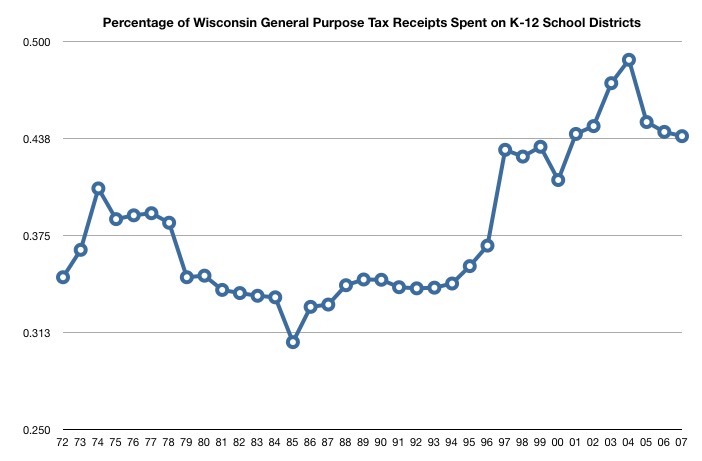
To increase student achievement in Wisconsin, I recently announced a comprehensive K-12 education improvement plan that I believe will reduce property taxes, make our school finance system more sensible, modernize student assessments, and direct more resources to classroom instruction. First, however, it is necessary to point out the current financial commitment to K-12 education in Wisconsin.
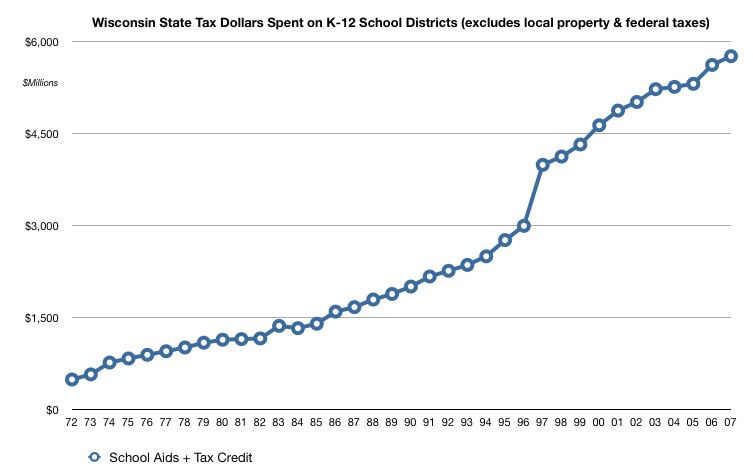
Wisconsin has 426 school districts educating approximately 868,000 students. The current state budget will spend more than $12.3 billion during the next two years on K-12 education, the most amount of money ever spent on education in our state’s history. This amount represents 44 percent of our state’s general purpose revenue (our tax dollars) and appropriately is our number one state financial commitment. In 2008-09 it is estimated local school districts, primarily through property taxes, will spend another $5 billion. When all funding is combined, including the $600 million we receive from the federal government, we spend about $12,600 per student. In 2005-2006, our state spending level ranked Wisconsin 14th nationwide, according the US Census Bureau.

Related: Local, state, federal and global education spending charts.

Share

Making new school year resolutions

Mary Bell, President of WEAC:

When I began my teaching career at Rhinelander High School 31 years ago, I started the school year by making resolutions the same way many of us do in early January. When you work in public education, you don’t just resolve to exercise more often or cut down on your caffeine, you resolve to monitor the cleanliness of your students’ desks (before it is too late), to not let your lesson plans cut into recess and lunch periods, to assign less (or more) homework, or to finish your master’s degree.
I made these resolutions at the start of every school year, long after I had gone from a first-year English teacher in Rhinelander to a veteran library media specialist in Wisconsin Rapids. Most educators I know make new school year resolutions, because every school year starts with a clean slate and a sense of unlimited possibility.
Great schools benefit everyone, and throughout Wisconsin it is not just educators but whole communities taking pride in the public schools they have created and sustained. This sense of ownership and investment has paid big dividends, as Wisconsin’s schools are the envy of the nation. We have one of the highest high school graduation rates. On the ACT college entrance exam, our high school seniors have ranked in the nation’s top three for 19 years in a row.

Related: Local, state, federal and global education spending charts.

Share

Prosecutors begin looking into Milwaukee School Board Member’s Philadelphia trip

Daniel Bice:

County prosecutors have launched a probe to determine if School Board member Charlene Hardin broke the law when she took a taxpayer-funded junket to Philadelphia but then failed to attend a national conference on school safety.
“I would consider this to be at the fact-finding stage,” said Milwaukee County Deputy District Attorney Kent Lovern on Tuesday. “We’ll have to see where it leads.”
Lovern said the white-collar unit in his office is working with Milwaukee Public Schools auditors to find out what exactly happened — and didn’t happen — on Hardin’s trip to Philadelphia to attend the annual conference of the National Association of School Safety & Law Enforcement Officers on July 14-16.
Two officials with the organization told No Quarter this week that Hardin and Lolita Pearson, a data-processing secretary at the Milwaukee High School of the Arts, spent no more than five minutes at the three-day event. They said the two attended no seminars or meetings.

Share

‘New’ Voice Speaks About Teachers at Convention

Michele McNeil:

The teachers’ unions weren’t the only voices representing teachers on the first night of the Democratic National Convention.
Enter Jon Schnur.
The CEO of the reform group New Leaders for New Schools, also an adviser to Barack Obama’s campaign, got a prime seat on the stage of the Democratic National Convention Monday night during the first of three American town halls.
The 15-minute town hall meeting managed to cram in issues including health care, tax reform, and education

Share

Radical idea: Open the doors of affluent suburban schools to Chicago students

Richard Kahlenberg via a kind reader’s email:

Sen. James Meeks’ (D-Chicago) proposed student boycott of Chicago public schools next month has sparked furious controversy. Should students miss their first day of class for the worthy goal of promoting equity in public school spending? Leaders such as Mayor Richard Daley and Chicago Public Schools Chief Arne Duncan are worried about the disruption involved as Meeks seeks to enroll Chicago students at New Trier High School in Winnetka.
Missing from the discussion is a bigger point: The main reason New Trier’s students achieve and graduate at much higher levels isn’t per-pupil expenditure; it’s differences in the socioeconomic status of the student bodies in Chicago and New Trier.
Decades of research have found that the biggest determinant of academic achievement is the socioeconomic status of the family a child comes from and the second biggest determinant is the socioeconomic status of the school she attends. The main problem with Chicago schools isn’t that too little is spent on students but that the school district has overwhelming concentrations of poverty.
In the 2005-06 school year, Chicago public schools spent $10,409 per pupil, much less than New Trier ($16,856), but slightly more than several high-performing suburban school districts, including ones in Naperville ($9,881) and Geneva ($9,807). The key difference is that while 84.9 percent of Chicago students come from low-income homes, New Trier has a low-income population of 1.9 percent, Naperville has 5 percent and Geneva 2.4percent.

Share

Maryland Charter School Growth

Liz Bowie:

When 850,000 Maryland students head back to classrooms this week, a tiny but growing percentage will be in public schools that had only been imagined a decade ago. There’s a primary school that lets children work at their own pace, an elementary school where 7-year-olds speak French a good portion of the day and a middle school where a sixth-grader can experience the outdoors.
In the first few years of Maryland’s experiment with charter schools, Baltimore led the way with an explosion of new schools of all varieties. More slowly and cautiously, county districts are following the city’s lead, allowing more of these publicly funded and privately operated schools to open as alternatives to the traditional public-school education.
Baltimore County’s first charter school expects to open Tuesday in the Woodlawn area, and charters already operate in Harford, Frederick, St. Mary’s and Anne Arundel counties. The newest additions this week will bring the statewide total to 34 schools and nearly 8,000 students.
Yet charters still face hurdles in getting started – from the local school officials who view them as competition to the pressure of construction costs. Of the 20 charter applications received statewide last school year, 16 were denied.

Share

November 2008 Referendum Chatter

Mitch Henck discusses Monday evening’s Madison School Board 7-0 vote to proceed with a recurring referendum this November. 19 minutes into this 15mb mp3. Topics include: property taxes, uncontested elections, health care costs, concessions before negotiations and local control. Via a kind reader’s email.

Share

Future of education is online, Web-school pioneer says

The Arizona Republic:

Damian Creamer, founder of Primavera Online High School, was the guest last week on Live Talk Wednesday, talking about secondary education via the computer.
Creamer formerly was an enrollment counselor at the University of Phoenix.
“Their (online) program was in its infancy and it was a unique opportunity to be involved with such a dynamic organization as they pioneered online education at the post-secondary level,” he said.
Afterward, he helped a small charter school in the West Valley found two additional charter schools.
Creamer opened Primavera Technical Learning Center (the predecessor to Primavera Online High School) in 2001.
” In its first year, Primavera had a few hundred students. Last year, I believe that we carried an average daily membership of 2,700 students,” Creamer said.
Last year, Primavera graduated 469 students, according to Creamer.
Info: www.primaveratech.org.

Share

When Education is Unequal

Cheryl Jackson via a kind reader’s email:

his week, in a lawsuit brought against the State of Illinois and the State Board of Education, the Chicago Urban League and Quad County Urban League called on the courts to end the discriminatory and unconstitutional way public school education is funded in Illinois. This is not just an educational issue, but a civil rights issue, too, for thousands of African-American and Latino students whose social and economic future is being shortchanged by a flawed state policy.
After more than a decade of legislative gridlock on education funding reform, set against a bleak backdrop of crumbling schoolhouses, moldy books and shamefully low graduation rates–the time has come to dismantle the current property-based system of school financing.
That system is discriminatory in its impact, sustaining huge funding gaps between black and white schools.
It makes quality education nearly impossible for thousands of students of color. It confounds the best efforts of well-meaning parents, teachers and administrators. And it puts children on a pathway to lifelong poverty and social pathologies that squander their potential and exact enormous social costs.

Share

In Support of the November, 2008 Madison School District Referendum

Community and Schools Together:

We have a referendum!
Community and Schools Together (CAST) has been working to educate the public on the need to change the state finance system and support referendums that preserve and expand the good our schools do. We are eager to continue this work and help pass the referendum the Madison Metropolitan School District Board of Education approved on Monday, August 25, 2008.
“The support and interest from everyone has been great,” said Franklin and Wright parent and CAST member Thomas J. Mertz. “We’ve got a strong organization, lots of enthusiasm, and we’re ready to do everything we can to pass this referendum and move our schools beyond the painful annual cuts. Our community values education. It’s a good referendum and we are confident the community will support it.”
Community and Schools Together (CAST) strongly supports the Madison Metropolitan School District Board of Education’s decision to place a three-year recurring referendum on the November 4, 2008 ballot. This is the best way for the district to address the legislated structural deficit we will face over the next few years.

Much more on the November, 2008 Referendum here.

(more…)

Share

For Better Schools, Raise Expectations

Steve Barr & Kai Ryssdal @ Marketplace:

KAI RYSSDAL: The Democrats have gathered in Denver. They’ll be partying and schmoozing and, yes, talking policy for the rest of the week. While the convention’s in session, we’ve asked some prominent Democratic policy types to complain. That is, tell us where they think the party has gone astray on key issues. Today, commentator and education reformer Steve Barr says Democrats are behind the curve on education.
STEVE BARR: Check out any national poll on issues important to Americans, and they’ll tell you the same thing: On education, voters trust Democrats more than they do Republicans. And it’s been that way for decades.
But my fellow Democrats haven’t done much in recent years to earn that trust. Party leaders aren’t addressing education in a real way. And when they do, it’s usually to condemn No Child Left Behind or to make a vague appeal for better schools. Rarely do Democratic party leaders offer a clear vision for what a 21st century education should look like.
Now, the Dems don’t have it easy. There are two warring tribes in their ranks — teachers unions and school-reform advocates who are wary of teachers unions.
So, let me offer a new progressive vision to my beloved party, so it can challenge these tribes to come together: Community-based, decentralized school districts composed of small schools.
Study after study shows that a smaller school gives a kid the best chance to succeed. A decentralized district would streamline money to school sites, where each school would control its own budget. School leaders, including teachers, would make the hires.

Clusty Search: Steve Barr. Green Dot Public Schools

Share

The Impact of Educational Quality on the Community: A Literature Review

Stephen Carroll & Ethan Scherer [328K PDF]:

This briefing synthesizes the empirical research on the effects of educational quality on the community. First, please note the word “empirical.” RAND reviewed empirical studies — studies in which some evidence was offered in support of the arguments. In the course of the literature review, we ran across books and articles in which the authors put forth logical arguments about the relationship between educational quality and the community, but did not offer any empirical evidence in support of those arguments. We do not suggest that these arguments are wrong, but we did not include them in this review because no evidence was offered in support of them.
This briefing focuses on results reported in the literature that apply to K-12 education, public and private. In our review, we generally did not consider studies that examined the effects of educational quality in either post-secondary education or early childhood education on the community.
We excluded studies that we considered of low quality, either because the methodology or the data were inadequate and which, therefore, reported findings that we thought were not well supported by empirical evidence. We also excluded studies that reported findings not adequately supported by the analysis, even if the study used accepted methodologies and substantial data.
Also, our review did not include research on how to improve quality or the cost of doing so. We looked at how educational quality affected the community, but not at what might be done to improve quality, or what that might cost.

Links:

Share

It’s not a tax. It’s a fee — for school sports and a whole lot more

David Dahl:

Schools throughout greater Boston are raising fees for sports and other activities. While it’s not a property tax increase, the school fees are yet another way local governments are reaching into the pockets of parents to raise money.
North of Boston, for example, Hamilton-Wenham football games will cost close to $100 a pop this fall. That’s not for seats on the 50-yard line, but what players who suit up for the Generals pay to play: a $969 user fee, the highest for football in communities north of Boston.

Share

Madison School Board OKs Nov. referendum

Tamira Madsen:

Members of the Madison School Board will ask city taxpayers to help finance the Madison Metropolitan School District budget, voting Monday night to move forward with a school referendum.
The referendum will be on the ballot on Election Day, Nov. 4.
Superintendent Dan Nerad outlined a recommendation last week for the board to approve a recurring referendum asking to exceed revenue limits by $5 million during the 2009-10 school year, $4 million for 2010-11 and $4 million for 2011-12. With a recurring referendum, the authority afforded by the community continues permanently, as opposed to other referendums that conclude after a period of time.
Accounting initiatives that would soften the impact on taxpayers were also approved Monday.
One part of the initiative would return $2 million to taxpayers from the Community Services Fund, which is used for afterschool programs. The second part of the initiative would spread the costs of facility maintenance projects over a longer period.

Andy Hall:


Madison School District voters on Nov. 4 will be asked to approve permanent tax increases in the district to head off projected multimillion-dollar budget shortfalls.
In a pair of 7-0 votes, the Madison School Board on Monday night approved a proposal from Superintendent Daniel Nerad to hold a referendum and to adopt a series of accounting measures to reduce their effect on taxpayers.
Nerad said the district would work “day and night” to meet with residents and make information available about the need for the additional money to avert what school officials say would be devastating cuts in programs and services beginning in 2009-10, when the projected budget shortfall is $8.1 million.

WKOW-TV:

“I understand this goes to the community to see if this is something they support. We’re going to do our best to provide good information,” said Nerad.
Some citizens who spoke at Monday’s meeting echoed the sentiments of board members and school officials.
“Our schools are already underfunded,” said one man.
However, others spoke against the plan. “This is virtually a blank check from taxpayers.

Channel3000:

Superintendent Dan Nerad had to act quickly to put the plan together, facing the $8 million shortfall in his first few days on the job.
“I will never hesitate to look for where we can become more efficient and where we can make reductions,” said Nerad. “But I think we can say $8 million in program cuts, if it were only done that way, would have a significant impact on our kids.”
The plan was highly praised by most board members, but not by everyone who attended the meeting.
“This virtually gives the board a blank check from all of Madison’s taxpayers’ checkbooks,” said Madison resident David Glomp. “It may very well allow the school board members to never have to do the heavy lifting of developing a real long-term cost saving.”

NBC 15:

“We need to respect the views of those who disagree with us and that doesn’t mean they’re anti-school or anti-kids,” says board member Ed Hughes.
Board members stressed, the additional money would not be used to create new programs, like 4-year-old kindergarten.
“What’s a miracle is that our schools are continuing to function and I think that’s the conversation happening around Wisconsin, now, says board vice president Lucy Mathiak. “How much longer can we do this?”
The referendum question will appear on the November 4th general election ballot.
The board will discuss its educational campaign at its September 8th meeting.

Much more on the planned November, 2008 referendum here.
TJ Mertz on the “blank check“.

Share

DC Teachers Torn as Rhee Tries to Allay Fears About Pay Plan

Bill Turque:

The morning began with the buoyant spirit of a pep rally — all cheers, prizes and inspirational words from Mayor Adrian M. Fenty and other officials to launch the District’s teachers into the fall term that starts Monday.
Before it ended, however, the “welcome back” assembly at the Walter E. Washington Convention Center yesterday took a more anxious turn. Schools Chancellor Michelle A. Rhee and Washington Teachers’ Union President George Parker each seized the opportunity to speak to the audience of 4,000 teachers about Rhee’s pay package proposal, which has roiled and divided them.
Rhee was there to win hearts and minds. Parker was there to count them.
Rhee is offering teachers a “green tier” plan that would boost many of them over the $100,000 mark in salary and performance bonuses. In exchange, they must surrender tenure protections for a year and risk dismissal by going on probation. Teachers who want to retain tenure can opt for the “red tier,” which would offer lower, but still significant, raises and bonuses.

Share

On Nevada State K-12 Funding

Clark County Superintendent Walt Ruffles:

As a former chief financial officer in both public and private organizations, I recognize the gravity of Nevada’s current financial condition and the need to cut costs where possible. But, as your current superintendent, I also recognize the disservice being done to Nevada’s next generation of adults.
Make no mistake about it, education in Nevada is hurting. Clark County receives the lowest per-pupil funding in the state, and the state funds its students at one of the lowest rates in the nation. That puts the Clark County School District near the bottom of the nation in per-pupil funding. Cuts of the magnitude we are experiencing are making a bad situation worse.

Links:

Share

Education Officials Predict More Iowa School District Consolidation

AP:

State and school leaders say there is a new wave of school district consolidation that could alter the landscape of education in Iowa.
The consolidation is happening in school districts that are facing budget crunches because of shrinking enrollment, skyrocketing expenses and troubles cutting back. And the cash-strapped schools aren’t getting the same type of help they used to from the state.
“They’re in a real balancing act,” said Judy Jeffrey, director of the Iowa Department of Education. “I think there’s going to be another wave of consolidation.”
Just how many Iowa school districts will consolidate depends on whether some can dig themselves out of a financial hole.

Share

Give students the choice to attend charter schools where kids perform well

Collin Hitt via a kind reader’s email:

In protest of Chicago’s failing school system, Sen. James Meeks (D-Chicago) is staging a field trip of sorts. He’s urging kids from his legislative district to skip the first day of school, board buses, travel to Winnetka, and attempt to enroll in New Trier High School.
One can understand why Meeks would want better educational options for Chicago kids. But on his way to Winnetka, the senator might want to take a look out the window where there are already many Chicago public schools–charter schools–that are performing on par with top-notch suburban and downstate schools. One such school, Chicago International Charter School, graduates its students 86 percent of the time–comparing quite favorably with public schools Downstate and suburban Chicago, which have an average graduation rate of 84 percent. Overall, charter public schools in Chicago graduate 77 percent of their students, compared with a citywide average of 51 percent.
Why aren’t there more charter schools in Chicago? Because state law caps the number of charters in the city at 30. Today, approximately 13,000 Chicago public school children are on a waiting list to get into charters–schools that have offered a proven formula for success. To give inner-city kids the opportunities they deserve, the charter-school cap should be lifted.

Share

Education Reformers call for Longer School Days, Performance-Driven Teacher Pay & Expanded School Choice

PRNewswire:

America’s leading voices on education reform joined in Denver to call on Democratic leaders to steer public education in a new direction. On the eve of the Democratic National Convention, more than two dozen progressive elected officials, education reform advocates, school leaders and civil rights groups from across the country gathered at the Denver Art Museum to release the Ed Challenge for Change, which highlights new ideas for closing America’s devastating achievement gap.
“An entrepreneurial explosion has occurred over the last few years in public education,” said Joe Williams, Executive Director of Democrats for Education Reform, the organization responsible for conceiving the Ed Challenge for Change. “The creativity exhibited by this new group of educators is helping raise student achievement, empower teachers, close the minority learning gap, and bring hope to places where it’s been in very short supply. It’s a movement that we believe Sen. Obama and other Democrats have taken to heart, and we hope to see these reforms increase in schools across America during the Obama Administration.”

Nancy Mitchell:

An eclectic mix of Democratic wunderkinds, tough-talking education reformers and one elder statesman – former Gov. Roy Romer – are challenging their party to step away from teachers unions and return to fighting for the educational rights of poor and minority children.
“It is a battle for the heart of the Democratic Party,” said Corey Booker, the 39-year-old rising star mayor of Newark, N.J.
“We have been wrong in education,” Booker said of his party and its alliances with teachers unions that put adults before children. “It’s time to get right.”
Booker was among those who appeared Sunday at the Denver Art Museum to challenge the Democratic Party to reconsider its course on education.
In references sometimes veiled and sometimes blunt, they tackled the party’s often- cozy relationship with the National Education Association and the American Federation of Teachers, which typically support – financially and otherwise – Democratic candidates.

Mickey Kaus:

One panelist–I think it was Peter Groff, president of the Colorado State Senate, got the ball rolling by complaining that when the children’s agenda meets the adult agenda, the “adult agenda wins too often.” Then Cory Booker of Newark attacked teachers unions specifically–and there was applause. In a room of 500 people at the Democratic convention! “The politics are so vicious,” Booker complained, remembering how he’d been told his political career would be over if he kept pushing school choice, how early on he’d gotten help from Republicans rather than from Democrats.

Share

Madison’s City Budget & Education

TJ Mertz:

I’ve been so tied up with life and the referendum stuff that I haven’t been much paying attention to the city budget process. A story in today’s Wisconsin State Journal got my attention, this graphic in particular. Two items on the possible cut list will directly impact the school district budget and at least three more will make things harder for our schools to do their job.
These possible cuts have been identified early in the budget process. Mayor Cieslewicz asked all departments to list what they would propose in the way of a 5% budget cut. If things go as the Mayor envisions, about 37% of these cuts will need to be enacted. Nothing is set in stone at this point. The Mayor will propose his budget in October and the Common Council will act in November.

Share

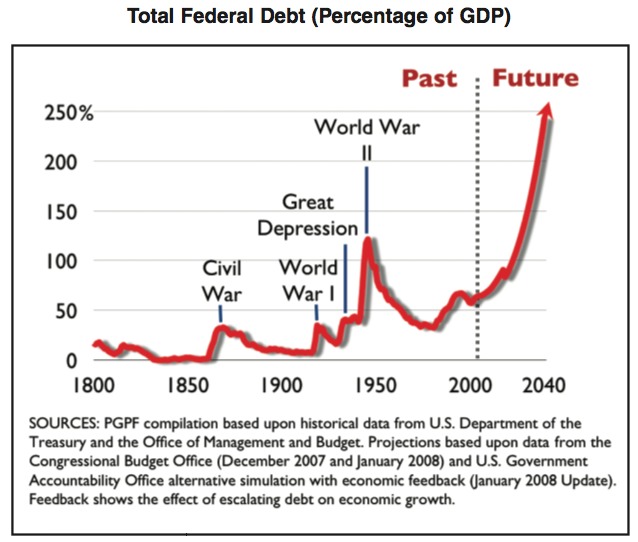
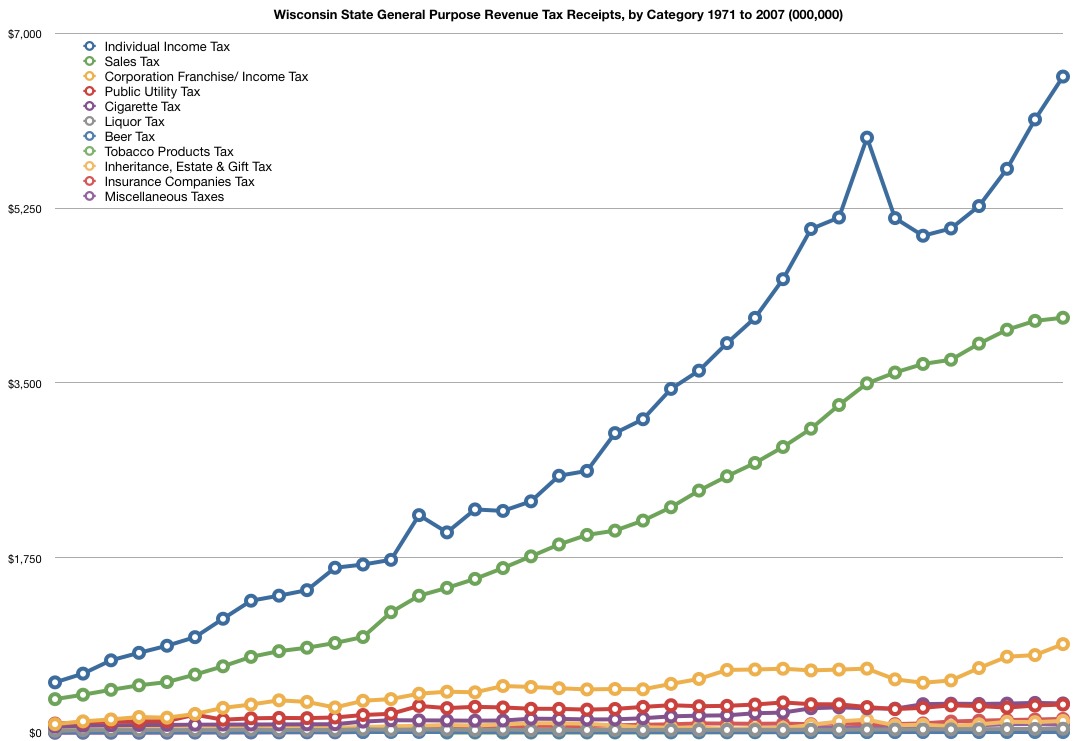
Referendum Climate: Charts – Enrollment; Local, State, Federal and Global Education Spending

Variations of this question are often asked: “Are we spending too much, too little or just the right amount on education?” I thought it might be useful to have a look at some local, state, federal and global information. Click to view the charts in detail:

Madison School District Enrollment: 1994-2007 (the demographics have changed during this time)

Madison School District Budgets: 1995-2009

Percentage of Wisconsin General Purpose State Tax Revenue Spent on K-12 School Districts: 1972-2007

Wisconsin State Tax Dollars Spent on K-12 School Districts: 1972-2007

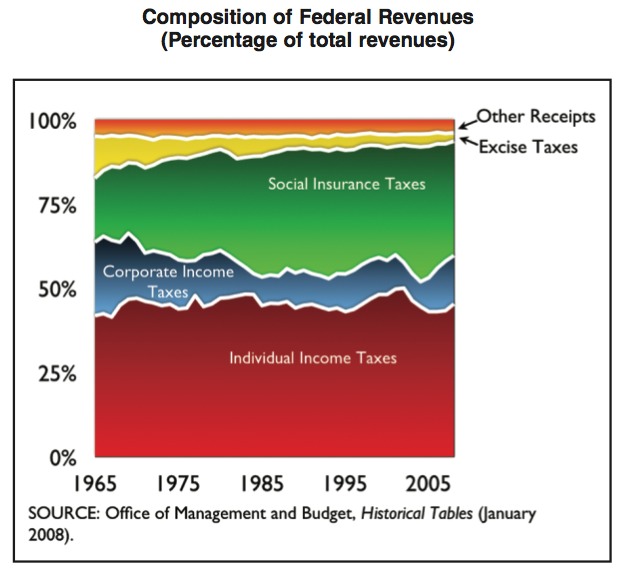
US Government Tax Revenue, by Source: 1965-2005

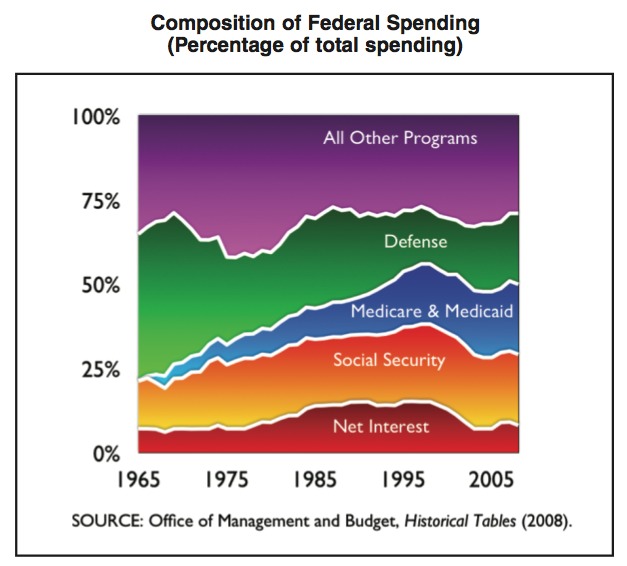
Composition of US Government Spending: 1965-2005

Total US Governement Debt, as a percentage of GDP

Wisconsin General Purpose Revenue Tax Receipts by Category: 1971-2007

Global Distribution of public expenditure on Education: ages 5 to 25

Data via the Madison School District (various budget documents and statistics), The Wisconsin Taxpayers Alliance, I.O.U.S.A: One Nation, Under Stress, in Debt and the UNESCO Institute for Statistics Database.
US Bureau of Labor Statistics: Consumer Price Index. $1000 in 1995 requires $1443.33 according to their inflation calculator, while $1000 in 1972 requires $5,262.30 in 2008.
November Madison School District Planned November, 2008 Referendum notes & links. Tax climate notes & links: When is a Tax Cut Really a Tax Hike by Gene Epstein, 20 Reasons to Kill Corporate Taxes by James Pethokoukis, I.O.U.S.A the Movie, the Economist: Inflation’s Last Hurrah and Dave Blaska on the proposed referendum.

Share

Another view: MPS analysis must address all the issues

Karen Royster:

Milwaukee’s children are the city’s future, and their education is a profound concern to all of us. Milwaukee Public Schools is responsible for ensuring students have the knowledge and skills to be capable workers and good citizens.
Like other urban school districts in the country, MPS struggles against mighty odds to fulfill this mission. There are major successes and many problems. Trying to overcome these problems is crucial, and there is room for all sectors of the city and region to share in the work.
A new initiative to audit or otherwise examine MPS could be very helpful if the analysis addresses all the fundamental issues at play, including the following:
• The households MPS students come from are in increasing economic distress, and almost one in five students come to the classroom with special needs — emotional, physical and cognitive — that require additional personnel and resources.

Karen Royster is executive director of the Institute for Wisconsin’s Future; Jack Norman is the institute’s research director. The institute is funded by national foundations and does not receive money from state or local teachers unions.

Share

For many Milwaukee parents, the nearby school never entered their reckoning

Alan Borsuk:

Auer Avenue Elementary School was “the poster child,” as one school official put it, for why Milwaukee Public Schools needed a Neighborhood Schools Initiative.
The reason was obvious: In the fall of 1999, kids from the attendance area for the school at N. 24th St. and W. Auer Ave. were enrolled in more than 90 schools all over Milwaukee, many of them no better than Auer Avenue.
So MPS spent $2 million to improve facilities for the school’s students, added sixth-, seventh- and eight-grade classes and added before- and after-school services, all to encourage neighborhood enrollment.
The result? Today, students in the area attend more than 90 schools elsewhere in Milwaukee. The percentage of students in Auer Avenue who are from the neighborhood has actually gone down, as has total enrollment in the school.
Those facts tells you an awful lot about how little impact the $102 million neighborhood school plan has had.

Share

Dissolve the Milwaukee Public Schools?

Milwaukee Journal-Sentinel Editorial:

Gov. Jim Doyle and Milwaukee Mayor Tom Barrett must act to bring radical change to the city school district. Everything must be on the table this time — even dissolution.
For years, the Journal Sentinel has chided, prodded and coaxed the administrators and the School Board of Milwaukee Public Schools. We’ve backed plan after plan to “fix” MPS. Time after time, we’ve been disappointed.
Now Journal Sentinel reporters have laid bare the mind-numbing incompetence of those who implemented the Neighborhood Schools Initiative. This $102 million building plan was forced on the city’s parents and taxpayers, and then many of those millions were thrown to the gentle wind, even after it was clear that the plan was failing.
For the sake of the thousands of kids MPS is leaving behind, fundamental change is a necessity. It might even be time to dissolve MPS and start over.

Large organizations (public or private) rarely make significant changes.
Related: Starting from scratch in the New Orleans public schools.

Share

Schools As Social Service Centers?

Greg Forster:

Believe it or not, that more or less sums up the big new marketing campaign the teachers’ unions are using to try to lure you into giving them more money. It’s actually called “Broader, Bolder.” If you’ve ever seen a title that sounded more like a gimmick to sucker people out of their money, you’ve seen more marketing gimmicks than I have.
The argument runs like this: kids do better in school when they’re well fed, healthy, and so forth. Therefore schools should be transformed into social-service centers that will not only teach students, but also provide health care and lots of other services. Schools would be open all day and provide a wide variety of community programs.
This will, of course, cost a ton of money and entail a huge expansion of the government educational bureaucracy. Which has nothing to do with why the unions want it.

Share

Madison’s superintendent seeking balance, gaining fans

Andy Hall:

One of the biggest differences between Nerad and Rainwater, according to School Board members, is that Nerad provides the board with more information about what’s happening in the district. Silveira said Nerad’s weekly memos help board members feel engaged, and she’s hopeful that after the current financial questions are settled, the board can turn its focus to improving student achievement.
Mathiak said she was thrilled last week after hearing Nerad’s plan. “I think there is a honeymoon period and I think we’re still in it.”
Winston said after watching Nerad at work, “I’m convinced we made the right choice. I think he’s here for the long haul, too.”

Notes and links on Dan Nerad, the planned November, 2008 referendum and Active Citizens for Education Memo: Taxpayers should NOT be asked to give the Madison School Board a blank check!.

Share

L.A. teacher goes to Washington to the Teaching Ambassador Fellowship

Steven Hicks:

hat would you say if you were given the opportunity to tell the Department of Education how the policies and programs that the federal government supported were affecting the students and teachers in our schools? Well, that is exactly what I will be doing for the next year along with 24 colleagues from around the country.
I am a kindergarten/first grade teacher in Los Angeles, but have a one-year appointment to work with the Department of Education in Washington, D.C. This is the first time that the department has formally involved teacher input into the policies and programs that affect our children. The program is called the Teaching Ambassador Fellowship Program. There are five Washington ambassadors that work in the department offices and 20 classroom ambassadors who work from their classrooms for the year.
We want to get the word out about how policies are made and how teachers can have an impact as leaders. Another teacher, Jocelyn Pickford, brought the idea to Secretary Margaret Spellings, who loved it. The teacher ambassadors represent urban, rural and suburban communities and K-12 levels. These are teachers who have dedicated themselves to make a real difference in public education. We want to share our stories and be part of the solution.

Share

Taxpayers should NOT be asked to give the Madison School Board a blank check!

Active Citizens for Education (ACE) calls for the Madison Metropolitan School District Board of Education to delay making specific decisions for the presentation of a recurring referendum to the taxpayers for a vote on the November election ballot.
Passage of a recurring referendum on the November 2008 ballot would allow the board and school administration to permanently exceed the state mandated revenue spending caps. Such a move to fix a so-called current “budget gap” would allow the board and administration to exceed annual spending caps permanently, every year into the future. This would virtually give the board a “blank check” from district taxpayers to plug future budget gaps or shortfalls. It could prevent the board and administration from having to carefully and thoughtfully budget, like every taxpayer must do when their household budget faces tough economic times and shortfalls.
The plans and communications presented in recent weeks by the board and administration provide greater hope for more effective decision-making now and in the future. The recommendations for changes in policy and accountability options in community services, transportation, lease contracts, fund balances and capital expansion (maintenance) will have positive impacts on reducing the so-called “budget gap.”
The Board must earn the trust of the taxpayers by clearly showing that they can be “good stewards” of taxpayer dollars. Past experience has not earned that trust! If a referendum is ultimately required to fix upcoming budgets, it should be a non-recurring referendum, thereby preventing ‘mortgaging’ the future with year-after-year, permanent increases in spending authority.
The Board and administration must correct the absence of specific processes and strategies for analysis and evaluation of business and educational services, programs, practices and policies. Urgent and substantial investments of time and work are critical for these processes to evolve into hard evidence. This evidence is absolutely necessary to show the public that serious steps are under way to provide clear, concrete data and options for identifying the most effective and efficient results-oriented management of the financial resources of the district. It must be shown that the resources will be directly applied to improvements in student learning and achievement.

(more…)

Share

A Promise of Pre-K for All Is Still Far Off in New York

Winnie Hu:

More than 10 years after New York’s political and education leaders promised to work toward providing access to pre-kindergarten classes to every 4-year-old across the state, more than a third of the 677 local school districts have no such programs. Last year, fewer than 91,000 children attended state-financed pre-kindergarten classes — 38 percent of the state’s 4-year-olds.
The early promise of universal pre-kindergarten programs was undermined by state budget problems, especially after 9/11, and local districts were never required to offer them. But even as funding dedicated to pre-kindergarten has more than doubled over the last three years, hundreds of mainly suburban and rural districts have rejected the state money, with many saying they would have to cut other things or raise taxes to establish the programs.
Last year, local districts passed up $67.5 million of the $438 million the state set aside for pre-K.
“Universal pre-K is an idea that looks good on paper, but it doesn’t work for a district of this size,” said Superintendent Edward Ehmann of the Smithtown school district on Long Island, which turned down $459,000 in state aid because, he said, it would cover only a quarter of the cost of providing pre-kindergarten to 750 children.

Share

Five school districts consider lawsuit in investment downturn

Amy Hetzner:

Five Wisconsin school districts could face combined losses of tens of millions of dollars in a complex investment scheme to help fund employee retirement benefits, according to investigators hired by the districts.
The value of district investments has declined by $120 million – or 60% – since the transactions were undertaken within the last two years, according to a news release from a public relations firm for the attorneys who examined the deals.
School district officials released statements accompanying the news release Wednesday, saying they were misled by a financial adviser, and that the investments were much riskier than they had been told.

Share

Connecticut Faces a School Tax Revolt: Distinguishing Between Needs and Wants

Lewis Andrews:

On June 30, the board of education and the town council in Enfield, Conn., convened to hear the results of a citizen cost-cutting committee. Among its other recommendations, the 17 residents recommended replacing some public school teachers with low-cost college interns, restricting the use of school vehicles, and increasing employee contributions to benefit plans.
These may seem modest steps toward fiscal responsibility — but they are emblematic of a significant change in this very blue state: growing disenchantment with the price of government, especially of public education.
Over the past two and a half decades, the student population in Connecticut has increased only 10%. Yet the cost of schooling more than doubled — to $8.8 billion in 2006, up from $3.4 billion in 1981. Seventeen years ago, the state enacted an income tax with promises to cut other taxes. Instead, real-estate assessments soared, creating a massive income transfer from the private to the public sector, fueled in part by a state cost-sharing formula that uses taxes on residents in the suburbs to subsidize urban schools. Helping to soak up all that money were binding arbitration laws, skewed to give teacher unions an advantage in collective bargaining negotiations.

Non-Partisan Action for a Better Redding:

Redding is a fabulous place. And Connecticut is a great state. Our goal is to help make Redding even better!
Since about three-quarters of our budget supports our schools, we explored ways to get a bigger bang for the education buck while simultaneously improving the quality of education. So we developed The School Choice Plan. Not only does it save money for all taxpayers, it also empowers parents with choice and improves education. The Plan is summarized in our School Choice Plan brochure as is the School Grants Calculator we developed. Take a look at the brochure.

Yankee Institute.

Share

“Protect Our Kids from Preschool”

Shikha Dalmia & Lisa Snell:

Barack Obama says he believes in universal preschool and if he’s elected president he’ll pump “billions of dollars into early childhood education.” Universal preschool is now second only to universal health care on the liberal policy wish list. Democratic governors across the country — including in Illinois, Arizona, Massachusetts and Virginia — have made a major push to fund universal preschool in their states.
But is strapping a backpack on all 4-year-olds and sending them to preschool good for them? Not according to available evidence.
“Advocates and supporters of universal preschool often use existing research for purely political purposes,” says James Heckman, a University of Chicago Noble laureate in economics whose work Mr. Obama and preschool activists routinely cite. “But the solid evidence for the effectiveness of early interventions is limited to those conducted on disadvantaged populations.”
Mr. Obama asserted in the Las Vegas debate on Jan. 15 that every dollar spent on preschool will produce a 10-fold return by improving academic performance, which will supposedly lower juvenile delinquency and welfare use — and raise wages and tax contributions. Such claims are wildly exaggerated at best.

Share

A Tax Revolt Is Quietly Brewing In Some States

Tom Herman:

And to think they used to call it “Taxachusetts.”
On Election Day, Massachusetts will vote on whether to eliminate its state income tax. Advocates hope victory in a place long thought of as a free-spending liberal bastion will pave the way for similar initiatives in other states over the next few years. Critics insist a yes vote would lead to fiscal disaster.
While Americans are focusing on the presidential and congressional races, voters in Massachusetts and other states will decide the fate of dozens of state and local tax and spending issues.
It’s still unclear precisely how many of these issues will be on ballots on Nov. 4. Some still haven’t received final approval from state officials or may face challenges in court. But Kristina Rasmussen, director of government affairs at the National Taxpayers Union, a nonprofit group based in Alexandria, Va., estimates there are more than 60 ballot measures that would have “some significant impact” on taxpayers.

Share

Independent Group Seeks Change in the Milwaukee Public Schools

Dani McClain:

A new group calling itself the Milwaukee Quality Education Initiative has joined the accelerating, behind-the-scenes conversations about the future of the city’s schools, and is hosting a retreat this weekend at the Wingspread Conference Center in Racine.
The group’s goal is to brainstorm ways to improve K-12 education in the city, including public, voucher and charter schools, Metropolitan Milwaukee Association of Commerce President Tim Sheehy said Friday.
“We didn’t come down here to blow up MPS,” he said Friday when reached at Wingspread. “We came down here to figure out what action steps we might take to reach a starting point to a broader conversation in the city.”
Sheehy, voucher school advocate and former MPS superintendent Howard Fuller and former state Secretary of Commerce Cory Nettles launched the group several months ago but hadn’t made their efforts known to the larger public, Fuller said. He added that their work hasn’t been particularly influenced by events this week such as Mayor Tom Barrett’s call for an independent audit of MPS or a Journal Sentinel investigation of the district’s Neighborhood Schools Initiative.

Share

Cash Incentives and Achievement in School

Zubin Jelveh:

In the second half of the 1990’s, student grades in Ecuador started to fall. In response, the government set up a conditional cash transfer program for poor families which would pay parents for making sure their children attended school for a predefined number of days.
While most research has shown that the cash payment program has indeed increased attendance levels, there’s little known about how students performed.
Now, Ecuadorian economist Juan Ponce and Arjun Bedi of the Institute for the Study of Labor have run the numbers and conclude that there was no positive (or negative) impact on grades from the incentive pay program.

Share

Chicago Urban League Lawsuit makes school funding a civil rights matter

via a kind reader’s email. Matt Arado:

Illinois courts refused twice in the 1990s to enter the school-funding debate, saying the matter belonged with state lawmakers, not the judiciary.
The Chicago Urban League, which filed a new school-funding lawsuit against the state this week, believes it can make the courts rethink that position.
The lawsuit characterizes the school-funding question as a civil rights matter, alleging that the current system, which uses property taxes to fund schools, discriminates against low-income minority students, especially blacks and Hispanics.
Using civil rights law should ensure that the courts will hear the case this time around, Urban League Executive Vice President Sharon Jones said.
“Courts have been deciding racial discrimination cases for years,” she said, adding that the Illinois Civil Rights Act of 2003 didn’t exist during earlier school-funding cases.

Maudlyne Ihejirika:

A day after a civil rights lawsuit called the state’s school funding system discriminatory, those who have been battling inequities in the Chicago Public Schools were optimistic, pointing to a historic win in New York.
“The New York suit was successful, and very similar, so we’re hoping that case will set precedent,” said Julie Woestehoff of Parents United for Responsible Education.
As in Illinois, previous suits challenging New York State’s school funding system had failed. But in 1993, a coalition there filed suit alleging for the first time that the system had a “disparate racial impact” based on the Civil Rights Act of 1964.
After 10 years and several appeals, New York’s highest court ruled in 2003 in favor of the plaintiffs. Further appeals by New York’s governor ended with the Court of Appeals upholding the ruling in 2006 and ordering the state to meet a minimum funding figure. That new funding level was finally enacted in April 2007.
Those involved in two previous lawsuits in Illinois said that without the new “disparate impact” claim, the Chicago Urban League’s suit would face bleak prospects.

Links:

Notes and links on funding and education from Kansas City (where a judge ordered a massive spending increase during the early 1990’s and Texas.

Share

A remarkable legacy as education champion

Des Moines Register:

Marvin Pomerantz will be remembered for many accomplishments: successful self-made businessman, powerhouse in Iowa politics, generous philanthropist. But his greatest public achievement is his longstanding commitment to improving the quality of education for all Iowa youngsters.
Pomerantz, a Des Moines resident who died Thursday at age 78, was one of nine children of Polish Jewish immigrants. He graduated from Roosevelt High School in Des Moines and the University of Iowa, and wanted others to benefit from getting an outstanding education, just as he had.

Share

D.C. Tries Cash as a Motivator In School

V. Dion Haynes & Michael Birnbaum:

D.C. Schools Chancellor Michelle A. Rhee announced plans yesterday to boost dismal achievement at half the city’s middle schools by offering students an unusual incentive: cash.
For years, school officials have used detention, remedial classes, summer school and suspensions to turn around poorly behaved, underachieving middle school students, with little results. Now they are introducing a program that will pay students up to $100 per month for displaying good behavior.
Beginning in October, 3,000 students at 14 middle schools will be eligible to earn up to 50 points per month and be paid $2 per point for attending class regularly and on time, turning in homework, displaying manners and earning high marks. A maximum of $2.7 million has been set aside for the program, and the money students earn will be deposited every two weeks into bank accounts the system plans to open for them.
The system has 28 middle-grade schools. Rhee will select the schools to participate in the pilot program.
“We believe this is the time for radical intervention,” Rhee said at a news conference outside Hardy Middle School in Northwest Washington. “We’re very excited about this particular program.”

Not a promising trend.

Share

Milwaukee Mayor Seeks Private Funds for Public School Financial Audit

Dave Umhoefer & Dani McClain:

He downplayed his previously stated interest in mayoral control of the district, but said all options for control of the district should be explored.
“I’m not interested in a power grab,” Barrett said. “I’m interested in MPS performance. But confidence is not high right now.”
Barrett made his comments after a Journal Sentinel investigation this week of the district’s neighborhood schools plan. Despite spending $102 million to expand schools, MPS failed to reduce busing as hoped or attract more students to local schools, leaving a trail of empty or severely underused building additions. Many of the schools that got new classrooms and other improvements also have seen a decline in student test scores.
Two School Board leaders, reacting to the mayor Thursday night, said a study would merely duplicate one soon to get under way.
The mayor said that in recent months, he has stepped up his behind-the-scenes efforts regarding the “very stressed” district. He said he has been talking with a firm that specializes in financial and operational reviews of urban school systems

Related Milwaukee Journal-Sentinel editorial:

And now, thanks to the in-depth reporting this week by the Journal Sentinel’s Alan J. Borsuk and Dave Umhoefer, we know that the district has wasted millions of taxpayer dollars on the failed Neighborhood Schools Initiative.
What isn’t known precisely is how bad things are.
Milwaukee Mayor Tom Barrett said Thursday he wants to hire a consultant to do an audit of the district. The audit would be paid for, he hopes, by local foundations. Previously, the School Board had ordered a “long-term stability” audit to be performed by Robert W. Baird & Co., the district told reporters.

Share

Fort Wayne wants schools reorganized into magnets

AP:

School officials hope to reorganize the city’s six public high schools into specialty magnet schools designed to connect students with real-world experiences and increase their chances for success after graduation.
The proposal presented to the community on Friday calls for partnering with businesses, increasing the number of rigorous classes and strengthening existing programs.
“Our high schools aren’t broken,” said Fort Wayne Community Schools Superintendent Wendy Robinson. “They’re just not as good as they need to be.”
Officials plan to have public meetings to solicit input from the community and to meet with business leaders about possibly funding portions of the plan. Each high school will offer a different program of study, and students can take courses based around the subject to give them a taste of the career path.

Share

Welcome to the Nerad era
Madison’s new school chief seems ready for a tough job

Marc Eisen:

Nerad is earnest, diplomatic and clear spoken. It’s a good bet that most anybody who hears him talk will find something they like in his message. Whether that adds up to support for a coherent educational program remains to be seen.
He faces huge challenges: not just closing the achievement gap while maintaining programs that attract middle-class families, but doing it while state fiscal controls continually squeeze his budget.
Equally hard will be overcoming the district’s own organizational stasis — it’s tendency to stick with the status quo. For all of Madison’s reputation as a progressive community, Madison schools are conservatively run and seriously resistant to change.
Authoritarian, top-down management grew under Nerad’s predecessor, Art Rainwater. Innovations like charter schools are still viewed skeptically, including by Nerad. Four-year-old kindergarten, which could be key to narrowing the achievement gap, is still seen as a problem. The middle school redesign project of a few years ago has been judged by insiders as pretty much a non-event. The high school redesign effort that Nerad inherited seems intent on embracing a program that is still unproven at West and Memorial.

Much more on Dan Nerad here, including his January, 2008 public appearance video.

Share

When Schools Offer Money As a Motivator
More Districts Use Incentives To Reward Top Test Scores; So Far, Results Are Mixed

Jeremy Singer-Vine:

In the latest study of student-incentive programs, researchers examining a 12-year-old program in Texas found that rewarding pupils for achieving high scores on tough tests can work. A handful of earlier studies of programs in Ohio, Israel and Canada have had mixed conclusions; results of a New York City initiative are expected in October. Comparing results is further complicated by the fact that districts across the country have implemented the programs differently.
Still, school administrators and philanthropists have pushed to launch pay-for-performance programs at hundreds of schools in the past two years. Advocates say incentives are an effective way to motivate learning — especially among poor and minority students — and reward teaching skills. Critics argue that the programs don’t fix underlying problems, such as crowded classrooms or subpar schools.
In Texas, high-school students enrolled in Advanced Placement classes who got top scores on math, science and English tests were paid up to $500. (AP classes are considered more difficult than traditional high school curricula, and some colleges award credit for AP coursework.) The research, by C. Kirabo Jackson, an economics professor at Cornell University, found that over time, more students took Advanced Placement courses and tests, and that more graduating seniors attended college. Most of the gains came from minority students in the 40 high schools studied, accounting for about 70,000 students in all. The study, set for release on Thursday, will appear in the fall issue of Education Next, a journal published by Stanford University’s Hoover Institution.

Share

Madison Property Tax History: 2001-2007

via the City of Madison Assessor’s office: “The 2008 Property Tax Base of the City of Madison (52K PDF)”. The City’s tax base continues to expand. There are 71,939 parcels in Madison, up from 40,069 in 1990. The Total 2008 assessed value is 21,496,000,000, up from $13,791,000,000 in 2002. Such growth provides great latidude in easing mill rates. Of course, as valuations flatten or decline, the mill rate may dramatically increase, depending on the magnitude of government/school spending increases.

Share

The 2008 Education Next-PEPG Survey of Public Opinion

William G. Howell, Martin R. West and Paul E. Peterson:

Americans clearly have had their fill of a sluggish economy and an unpopular war. Their frustration now may also extend to public education. In this, the second annual national survey of U.S. adults conducted under the auspices of Education Next and the Program on Education Policy and Governance (PEPG) at Harvard University, we observe a public that takes an increasingly critical view both of public schools as they exist today and, perhaps ironically, of many prominent reforms designed to improve them.
Local public schools receive lower marks than they did a year ago. More significantly, perhaps, survey respondents claim that their local post offices and police forces outperform their local schools. Meanwhile, support for the most far-reaching federal effort to reform public schools–the No Child Left Behind Act–has slipped. A considerable portion of the public remains undecided about charter schools. And the poll found no enthusiasm for the use of income rather than race as a basis for assigning students to schools.
This does not mean that Americans are unwilling to explore alternate ways of educating young people. A large majority of Americans would let their child take some high school courses for credit over the Internet. An equally large majority favor the education of students with emotional and behavioral disabilities in separate classrooms rather than “mainstreaming” them, as is common practice. A plurality support giving parents the option of sending their child to an all-boys or all-girls public school. And a rising number of Americans know someone who is home schooling a child.
These and other findings appear in the 2008 Education Next -PEPG survey, which once again examines the views of U.S. adults taken as a whole, as well as those of white, African American, and Hispanic subgroups. In addition to the opinions of respondents from different ethnic backgrounds, we
take a special look at those of public school teachers. Responses for the public as a whole and for the subgroups are reported at the bottom of each of the pages that follow. We have also posted responses to additional questions not discussed in this essay.

Share

How Well Are They Really Doing? Criticism for State’s “Weak Student Tests”

NY Times Editorial:

Congress has several concerns as it moves toward reauthorizing the No Child Left Behind Act of 2002. Whatever else they do, lawmakers need to strengthen the requirement that states document student performance in yearly tests in exchange for federal aid.
The states have made a mockery of that provision, using weak tests, setting passing scores low or rewriting tests from year to year, making it impossible to compare progress — or its absence — over time.
The country will have difficulty moving ahead educationally until that changes.
Most states that report strong performances on their own tests do poorly on the more rigorous and respected National Assessment of Educational Progress, which is often referred to as NAEP and is also known as the nation’s report card. That test is periodically given to a sample of students in designated grades in both public and private schools. States are resisting the idea of replacing their own tests with the NAEP, arguing that the national test is not aligned to state standards. But the problem is that state standards are generally weak, especially in math and science.

Letters, in response to this editorial:

In discussing how some states game their student test results, you state, “The federal government could actually embarrass the laggard states by naming the ones that cling to weak tests.” The evidence on these states has been available for some time.
In 2005, Tennessee tested its eighth-grade students in math and found 87 percent of students performed at or above the proficiency level, while the National Assessment of Educational Progress, or NAEP, test indicated only 21 percent of Tennessee’s eighth graders proficient in math.
In Mississippi, 89 percent of fourth graders performed at or above proficiency on the state reading test, while only 18 percent demonstrated proficiency on the federal test. In Alabama, 83 percent of fourth-grade students scored at or above proficient on the state’s reading test, while only 22 percent were proficient on the NAEP test.
Other states were also found guilty in their determinations of proficient when compared with the federal NAEP test.
The No Child Left Behind Act will never be able to realize its potential as long as entire states are left behind because of the duplicitous efforts of their state officials. If Congress adopted national standards with a corresponding set of national exams in its reauthorization of the law, it could effectively minimize or eliminate these individual state shenanigans.
Paul Hoss
Marshfield, Mass., Aug.

Locally, the Madison School District’s Value Added Assessment Program is based on the State Department of Instruction’s Standards.

Share

Buildings rise, test scores fall
Spate of school expansions is no tonic for student proficiency

Alan Borsuk & Dave Umhoefer:

The $102 million spent on reviving the concept of the neighborhood school in Milwaukee hasn’t improved academic success at most of the schools where the money was used, a Journal Sentinel investigation found.
With a few exceptions, student achievement has shown little improvement – and in some cases it has fallen dramatically – at 22 schools that were among the largest beneficiaries of the district’s school construction program.
The district’s Neighborhood Schools Initiative was conceived as a way to get children off buses and into their local schools – which MPS officials hoped to improve with new classrooms, before-school and after-school services, and such things as state-of-the-art science labs and libraries.
But bricks and mortar have not raised student performance, testing data shows.
In 16 of the 22 schools, the percentage of fourth-graders rated as proficient or better in reading was lower last year than it was in 2002 – the year the school building initiative hit high gear. Nine schools saw their math scores drop.
Overall, combined fourth-grade reading and math scores have declined sharply at a half dozen of the22 schools where more than $1 million was spent on improvements. Only five schools have had major increases in their combined reading and math performance.

Share

Beth Moss, Arlene Silveira & Lucy Mathiak on the Fall, 2008 Madison Schools’ Referendum

Tamira Madsen:

But Silveira also said the 2005 referendum campaign suffered because the School Board itself was divided on it, “and it was a pretty split community speaking out on both sides in favor and being opposed.
“We are on the same page now. We’re really changing our focus to one of really spending more time on student achievement.”
For board member Lucy Mathiak, a key difference between Nerad’s proposal and past ones are the measures he has taken to cut costs already.

Share

Free digital texts begin to challenge costly college textbooks in California

Gale Holland:

Would-be reformers are trying to beat the high cost — and, they say, the dumbing down — of college materials by writing or promoting open-source, no-cost online texts.
The annual college textbook rush starts this month, a time of reckoning for many students who will struggle to cover eye-popping costs of $128, $156, even $198 a volume.
Caltech economics professor R. Preston McAfee finds it annoying that students and faculty haven’t looked harder for alternatives to the exorbitant prices. McAfee wrote a well-regarded open-source economics textbook and gave it away — online. But although the text, released in 2007, has been adopted at several prestigious colleges, including Harvard and Claremont-McKenna, it has yet to make a dent in the wider textbook market.
“I was disappointed in the uptake,” McAfee said recently at an outdoor campus cafe. “But I couldn’t continue assigning idiotic books that are starting to break $200.”
McAfee is one of a band of would-be reformers who are trying to beat the high cost — and, they say, the dumbing down — of college textbooks by writing or promoting open-source, no-cost digital texts.

Yian Mui & Susan Kinzie:

The rising cost of college textbooks has driven Congress and nearly three dozen states — including Maryland and Virginia — to attempt to curtail prices and controversial publishing practices through legislation. But as the fall semester begins, students are unlikely to see much relief.
Estimates of how much students spend on textbooks range from $700 to $1,100 annually, and the market for new books is estimated at $3.6 billion this year. Between 1986 and 2004, the price of textbooks nearly tripled, rising an average of 6 percent a year while inflation rose 3 percent, according to a 2005 report by the Government Accountability Office. In California, the state auditor reported last week that prices have skyrocketed 30 percent in four years.
“It’s really hard just paying for tuition alone,” said Annaiis Wilkinson, 19 and a student at Trinity Washington University who spends about $500 a semester on books. “It really sets people back.

Well worth looking into, including in the K-12 world.

Share

(Madison) School Referendum News

I have appreciated having the opportunity to talk about our schools with you and value your insights, so I wanted to let you know where matters stand on the possibility of a school spending referendum on the November ballot.
As you probably know, Superintendent Dan Nerad submitted his recommendations to the Board at a School Board meeting Monday night (1MB PDF, 3 year financial forecast PDF). In summary, the structural deficit the school funding law imposes on districts as well as increased fixed costs result in a projected budget deficit of $8.1 million for the 2009-2010 school year, $4.4 million for the 2010-2011 school year, and $4.3 million for the 2011-2012 school year, calculated on a same-service basis.
To meet these gaps, the superintendent recommends that the Board approve a referendum asking the voters to authorize the district to exceed our spending limits by $5 million next year, and $4 million in each of the following two years. This would be a recurring referendum, meaning that the authorization for the increased spending in the specified amounts would continue indefinitely.
The amount of extra spending authority we would seek is less than the projected budget gaps. The idea is that this a shared-sacrifice sort of proposal – we would be asking the community to permit us to erase some of the gap through additional taxes while we pledge to address the remainder through seeking out savings and efficiencies that will not have a detrimental impact on classroom learning. As is probably apparent, the referendum is not designed to allow us to restore in a significant way any of the painful cuts we have made in previous years.

(more…)

Share

Referendum Discussion: Vicki McKenna & Don Severson

Download or listen to this 15MB mp3 audio file.
Related:

  • $367M+ Budget notes and links
  • Don Severson’s memo to the Madison School Board on the current financial situation.
  • Marj Passman and Don Severson discuss school finance with Mitch Henck.
  • Madison Superintendent Dan Nerad’s budget and recommendations memorandum to the School board (1MB PDF):

    In 1993, three pieces of legislation were enacted by the State of Wisconsin directly affecting school districts throughout the state. These pieces of legislation created revenue limits, created the state’s commitment to two·thirds funding, and created the qualified economic offer (QEO) in Wisconsin. Since 1993 revenue limits in Wisconsin have allowed the Madison Metropolitan School District to increase revenues annually by 2.2% on average. Conversely the QEO requires school boards to offer a comprehensive salary and benefit package to certified teaching staff of not less than 3.8% annually to avoid binding arbitration. Recognizing that the Madison Metropolitan School District’s budget is comprised of 84% salary and benefits, it must be recognized that while our revenues increase annually by 2.2%, the largest portion of our budget is mandated to minimally increase by 3.8%. Due to these competing pieces of legislation, the Board of Education since 1993 has reduced program and services by over $60 million to comply with state mandated revenue limits, of which $35 million has occurred within the past five years.
    Since the 1992·93 School Year the Madison Metropolitan School District has increased the total tax levy by $74,944,431 through the projected 2008·09 property tax levy. This amounts to an average annual increase of 2.56% since the 1992·93 School Year (see Attachment A). During that same time frame from 1992·93 through the projections for the 2008·09 property tax rate, the Madison Metropolitan School District has decreased the total tax rate from $20.69 to a projected rate of $9.92 for the 2008·09 School Year (see Attachment B).

    Nerad also posted a 3 year financial forecast (250K PDF)

  • City of Madison Assessor: 2008 Madison Property Tax base (PDF)
  • A look at the growth in Madison’s tax base: In 1990, the City of Madison included 40,069 parcels, a number that grew to 64,976 in 2005. Assessment and parcel growth mitigates tax levy increases, or allows it to decline (though this of course, depends on the real estate market along with tax policies).
Share

Don Severson & Marj Passman on School Spending & The Proposed November Madison School Referendum

Chart via Global Education Spending data via UNESCO Institute for Statistics

Mitch Henck @ WIBA: 15MB mp3 audio file. Marj discussed her views on US taxes vis a vis education spending versus other countries.
Much more on the Madison School District’s $367M 2008-2009 budget along with the referendum.

Share

Madison Superintendent Recommends Three Year Recurring Spending Increase via a November, 2008 Referendum

Channel3000:

Nerad told school board members on Monday night that he’s recommending a three-year recurring referendum.
It’s part of what he called a partnership plan to address the budget shortfall.
The plan would put a referendum on the November ballot for $5 million and would ask voters for $4 million in the two following years.
Nerad said to make up the remaining $3 million gap the district would move $2 million from the district’s fund balance, eliminate $600,000 in unallocated staff, which are positions set aside in case of additional enrollment, and make up the remaining $400,000 through other reductions, which he has not yet named.
“We’re working both sides of this and in the end our kids need things from us, our taxpayers need us to be sensitive and all I can say is we tried every step of putting these recommendations together to be responsive on both fronts,” said Nerad.

Andy Hall:

The measure, a “recurring referendum,” would give the district permission to build on the previous year’s spending limit increase by additional amounts of $4 million in 2010-11 and another $4 million in 2011-12. The measure would permit a total increase of $13 million — a change that would be permanent, unlike the impact of some other referendums that end after a specified period.
Approval of the referendum would cost the owner of a home with an assessed value of $250,000 an estimated $27.50 in additional taxes in the 2009-10 school year. That represents an increase of 1.1 percent of the School District’s portion of the tax bill.
But for at least the next two years, the schools’ portion of that homeowner’s tax bill would decline even if the referendum is approved, under the plan developed by Nerad and Erik Kass, assistant superintendent for business services.
They estimate the tax bill for 2010-11 would be $27.50 lower than it is now, and the bill the following year would be about $100 below its current level if voters back the referendum and the School Board implements proposed changes in accounting measures.

Tamira Madsen:

In the first year, the referendum would add an additional $27.50 onto the tax bill of a $250,000 home. Another initiative in Nerad’s recommendation, drawn up along with Assistant Superintendent of Business Services Erik Kass, is to enact changes to help mitigate the tax impact of the referendum. Nerad and Kass said these changes would decrease taxes for homeowners in the second and third year of the referendum.
One aspect of the proposal would return $2 million of an equity to the taxpayers in the form of a reduced levy in the Community Services Fund (Fund 80) for the 2009-10 school year. The second part of the tax impact referendum would be implementation of a Capital Expansion Fund, called Fund 41, in an effort to levy a property tax under revenue limits to spread the costs of facility maintenance projects over a longer period.
Nerad said the referendum process has been a deliberative process, and he’s been cognizant of weighing board members and community questions.

Links:

Links:

Share

From Crayons to Condoms: The Ugly Truth About America’s Public Schools

Summary:

Synopsis
The American public school system, once the envy of the world, is now a cesspool of political correctness, ineptitude and violence, yet its administrators demand – and receive – far more funding per child than do higher-performing private and religious schools.
From “teachers” who can barely comprehend English to the elevation of foreign cultures and ideals above our own, from the mainstreaming of violent juvenile felons to demands that “queer studies” be considered as vital as math, our classrooms have become havens for indoctrination, sexual license and failed educational fads.
In From Crayons to Condoms, you’ll experience today’s public schools as never before, through the voices of parents and children left stranded in the system, the same voices that teachers unions and school administrators are determined to stifle. Here’s a “must-read” for every parent concerned about their child’s future, and for every taxpayer sick of being dunned endlessly to prop up a failed system.

via Barnes & Noble. Clusty Search: Steve Baldwin & Karen Holgate.

Share

Denver Teacher Contract Negotiations: Controversey over Incentive Pay and Increased Compensation for Younger Teachers

Stephanie Simon:

National education experts are dismayed. If merit pay can’t work in Denver, “future initiatives are destined to fail,” said Matthew Springer, director of the National Center on Performance Incentives at Vanderbilt University in Tennessee.
The breakdown stems from a philosophical disagreement between the school district and the union.
The district is offering large increases in incentive pay. But the biggest rewards will go to early- and midcareer teachers — and to those willing to take risks by working in impoverished schools or taking jobs few others want, such as teaching middle-school math. Yearly bonuses for such work would nearly triple, to about $3,000.
The union is all for boosting bonuses but also wants an across-the-board pay increase. Most crucially, union leadership objects to proposed changes that would hold down the salaries of veteran teachers to free more money for novices.
Mediation is scheduled to begin Wednesday. If it fails, the union could begin job actions just as the Democratic National Convention comes to town.

Much more on Denver incentive pay here.
It will be interesting if similar issues arise in Madison’s next teacher contract.

Share

Great Little Schools Without a Name

Jay Matthews:

For awhile I figured that didn’t matter. These schools are raising student achievement to new heights without a cool, overarching label. Maybe they don’t need one. But I changed my mind about that after reading David Whitman’s splendid new book about these schools, “Sweating the Small Stuff.”
Whitman is a terrific reporter whose 365-page paperback, published by The Thomas B. Fordham Institute, provides a lively, readable and exhaustive account of this fast-growing phenomenon. Whitman focuses on six schools that represent different forms of this approach–the American Indian Public Charter School in Oakland, the Amistad Academy in New Haven, the Cristo Rey Jesuit High School in Chicago, the KIPP Academy in the South Bronx, the SEED public charter school in Washington, D.C. and the University Park Campus School in Worcester, Mass. The profiles of the schools and their founders are well-written. Whitman’s analysis of what has made them work is thoughtful and clear.
My problem is this: I hate his subtitle, “Inner-City Schools and the New Paternalism.” And I like his decision to refer to this group as “the paternalistic schools” even less.

Share

Preschool programs feel kindergarten squeeze
More parents opt for ‘free’ classes for 4-year-olds

Patti Zarling @ Green Bay Press-Gazette:

Kindergarten classes for 4-year-olds through a few area public school systems haven’t started yet, but some local private preschools already are losing students.
Two local programs are ending or on the verge of it, saying they can’t afford to maintain preschools, partly because of the launch of public 4-year-old kindergarten.
A few area school districts, including Ashwaubenon, Green Bay and West De Pere, are starting 4-year-old kindergarten programs this fall.
Advocates say the programs provide education and school-preparation to students regardless of family income. But critics liken the programs to free babysitting and worry that districts will dumb down curriculum.
Green Bay has more than 800 children enrolled so far in its 4-year-old kindergarten program for 2008-2009; Ashwaubenon has more than 100 and West De Pere has 178. State rules require districts to partner with private day cares to receive state grants for the programs.

Recently arrived Madison Superintendent Dan Nerad spent most of his career in the Green Bay Schools.

Share

Advocating a November 4, 2008 Madison School District Referendum

Capital Times Editorial:

But even those who might oppose a referendum should be in favor of board action at this point.
If the board moves now, the referendum question can be on the Nov. 4 ballot.
Because the presidential race between Democrat Barack Obama and Republican John McCain is expected to draw a record voter turnout on that day, there could be no better point at which to assess the level of support for the school district in general and the current board’s strategies in particular.
Wisconsin has a great tradition of involving all taxpayers in the process of setting and supporting education priorities. We keep the decision-making process at the grass roots level. We elect school boards. We put major spending and building questions to the voters in the form of referendums. The system has worked well — even as state meddling in the structures of school financing has made things difficult. And it works best when referendums attract maximum participation.

Transcript & mp3 audio file: 7/28/2008 Madison School Refererendum Discussion.
Referendum climate.
Don Severson: Madison School District’s Financial Situation: Memo to the School Board & Administration.

Given the critical values briefly outlined above, it is premature at this time to make recommendations or decisions on a course or courses of action to seek more spending authority as a solution regarding the financial needs of the district. The groundwork for decision-making and the development of improved levels of public confidence in the Board and administration have to continue to be proactively matured for both short- and long-term successes in the district. We urge you to proceed carefully, firmly and in a strategic and progressive manner.

Share

Why Resist a Successful School Strategy?

Boston Business Journal:

Imagine this scenario: You are the head of a declining business. Without much fanfare, you have developed a new product that is highly effective and wildly popular when test-marketed on a limited basis. What would you do? Most likely, expand the new product as rapidly as possible while you reach out to potential new customers.
This first part of this situation exists in our own city in a key enterprise with great significance for the region: the Boston public school system. The product is the pilot school, which gives autonomy to individual schools, enabling them to control their budgets, staffing, schedule and curriculum. Research has established that Boston school students thrive in pilot schools, outperforming their peers in traditional schools. They test better, accrue fewer suspensions, are less likely to drop out and more likely to further their schooling.

Clusty search: Boston Pilot Schools.

Share

London City academies spell good news for education

Julie Henry:

First it was the Sats fiasco. Then results for 14-year-olds revealed that more than 30 per cent of boys were three years behind in reading. Finally, last week’s A-level data exposed a north/south divide in achievement that shattered Labour’s claims that huge investment was changing the fortunes of children in the poorest communities.
And with GCSE results out this week, which are expected to show a similar disparity, the exam season is making life distinctly uncomfortable for the Department for Children, Schools and Families.
But while Ed Balls, the Education Secretary, and Jim Knight, the schools minister, scramble round trying to distance themselves from the mess, one minister has gone about his business seemingly untouched by the fallout.
Lord Adonis, the architect behind city academies, has – at least for the moment – the plum education job. Late last month, at the height of the general condemnation over the Sats debacle, he emerged heckle-free from a speech he gave at a teachers’ conference. While national newspapers slam the mind-boggling inefficiency of Sats administration, the culpability of the department, and A-level grade inflation, local papers carry positive pieces about schools bidding to become academies.

Share

Milwaukee Public Schools spent $102 million on a building spree meant to reduce busing by convincing parents to enroll students in bigger, better neighborhood schools. Today, many of those new classrooms go unused.

Dave Umhoefer & Alan Borsuk:

A massive building expansion by Milwaukee Public Schools has saddled the district with tens of millions of dollars worth of vacant or severely underused school additions, a Journal Sentinel investigation found.
he $102 million Neighborhood Schools Initiative was supposed to get students off buses and into revamped schools near their homes. Instead, darkened classrooms and half-empty buildings serve as monuments to the program’s failures.
The district spent $30 million on major additions to schools where enrollment has actually declined. An additional $19.5 million went toward construction at schools where enrollment gains have fallen far short of expectations. Construction began in 2001, and almost all additions were completed by 2005.
In the most expensive misfire, MPS spent $7 million upfront to lease new classroom space from an affiliate of Holy Redeemer, a prominent Milwaukee church.
That MPS addition is one of the nicest facilities in a district that still uses century-old buildings. And it’s vacant.

A rare piece of school finance related investigative journalism.

Share

Transcript: Madison School Board 7/28/2008 Referendum Discussion

Meeting Transcript:

We begin the presentation by focusing on why is there a problem. And we wanna first and foremost point out that the issues affecting this school district are issues that are also occurring in other school districts in the state. While there may be some circumstances, and there are circumstances that are unique to one place or another, we know that this funding dilemma and the gap that exists between what the current state funding formula provides and how expenses are being dealt with in school district is not unique to this school district. Although we have our story here that is certainly unique. And again I want to emphasize that it really lies at the heart of it is the constraint between the current formula that was put into place in 1993 which basically asserted that the state provide more resources to schools through the two thirds funding if, in turn, school districts would control their costs in two ways. One was through the revenue cap and the second was through the qualified economic offer. And so that was the kind of exchange or the quid pro quo that was made at that time in public policy; to be able to provide more state funding for schools at the same time to place limitations on how much a school district could spend.
In the document we point out examples of this dilemma as it is affecting some of the top ten school districts in the state. Ranging in, for example Waukesha school district of 2.6 million dollar program and service reduction for the 08/09 school year. The district that I am most recently familiar with, Greenbay with a 6.5 million program and service reduction. And just to point out the difference we mentioned we seen there, we use a wording increase revenue authority that represents their gap but that’s also, its described that way because of having more authority through a successfully passed referendum to exceed the revenue cap within that community. So that is what’s meant by an increase revenue of authority.
Now the funding formula is one that school districts across the state are wrestling with. You know the history that this school district has had in terms of the types of decisions that have been made which we are going to underscore in just a minute to accommodate that funding formula but as I turn this over to Eric for the bulk of the rest of the presentation, I’ll conclude its all with the idea yes there is a need to have school funded but its around the assertion that our kids have to have a high quality education to be successful in the world that they are growing into. And yes we do have a fiscal responsibility to use community resources in the most cost effective manner and the reality of it is there are constraints in meeting that proposition. So with that, and I will return for the conclusion, I’ll turn it to Eric who will provide us with more detail of the nature of the problem.

Related:

Share

At School, Technology Starts to Turn a Corner

Steve Lohr:

COUNT me a technological optimist, but I have always thought that the people who advocate putting computers in classrooms as a way to transform education were well intentioned but wide of the mark. It’s not the problem, and it’s not the answer.
Yet as a new school year begins, the time may have come to reconsider how large a role technology can play in changing education. There are promising examples, both in the United States and abroad, and they share some characteristics. The ratio of computers to pupils is one to one. Technology isn’t off in a computer lab. Computing is an integral tool in all disciplines, always at the ready.
Web-based education software has matured in the last few years, so that students, teachers and families can be linked through networks. Until recently, computing in the classroom amounted to students doing Internet searches, sending e-mail and mastering word processing, presentation programs and spreadsheets. That’s useful stuff, to be sure, but not something that alters how schools work.

Share

California’s Algebra Problem

Los Angeles Times Editorial:

Even if there were money to pay for it, the state’s new algebra mandate would still be a bad idea.
ow that the State Board of Education is foolishly requiring every eighth-grader to take algebra, starting in three years, all that remains to be figured out is, how on Earth is this going to happen when so few kids are on track to get there?
The solution, according to state Supt. of Public Instruction Jack O’Connell, is to spend $3.1 billion on a “California Algebra I Success Initiative” that would recruit and train math teachers, lengthen the middle-school day, reduce class sizes in math and so forth.
The ideas are good enough. Essentially, though, they’re a political ball tossed to Gov. Arnold Schwarzenegger, who pushed for the eighth-grade requirement. (O’Connell opposed it.) The governor took on the easy part of school reform, in which he got to call for an unrealistic standard and proclaim that California was the first in the land with such high expectations. Will he now refuse to pay for the math requirement that he said was so necessary? That’s a possibility. The algebra funding would add about 5% to the state’s total allocation for public education, money that is not readily available even in a good budget year.

Share

A Teachable Moment: On Changes in Governance and Curriculum in New Orleans Schools


Paul Tough:

But it wasn’t only sympathy for the survivors of Katrina that drew them to New Orleans. The city’s disastrously low-performing school system was almost entirely washed away in the flood — many of the buildings were destroyed, the school board was taken over and all the teachers were fired. What is being built in its place is an educational landscape unlike any other, a radical experiment in reform. More than half of the city’s public-school students are now being educated in charter schools, publicly financed but privately run, and most of the rest are enrolled in schools run by an unusually decentralized and rapidly changing school district. From across the country, and in increasing numbers, hundreds of ambitious, idealistic young educators like Hardrick and Sanders have descended on New Orleans, determined to take advantage of the opportunity not just to innovate and reinvent but also to prove to the rest of the country that an entire city of children in the demographic generally considered the hardest to educate — poor African-American kids — can achieve high levels of academic success.
Katrina struck at a critical moment in the evolution of the contemporary education-reform movement. President Bush’s education initiative, No Child Left Behind, had shined a light on the underperformance of poor minority students across the country by requiring, for the first time, that a school successfully educate not just its best students but its poor and minority students too in order to be counted as successful. Scattered across the country were a growing number of schools, often intensive charter schools, that seemed to be succeeding with disadvantaged students in a consistent and measurable way. But these schools were isolated examples. No one had figured out how to “scale up” those successes to transform an entire urban school district. There were ambitious new superintendents in Philadelphia, New York City, Denver and Chicago, all determined to reform their school systems to better serve poor children, but even those who seemed to be succeeding were doing so in incremental ways, lifting the percentage of students passing statewide or citywide tests to, say, 40 from 30 or to 50 from 40.

Related:Clusty Search:

Fascinating. Innovation occurs at the edges and is more likely to flourish in the absence of traditional monolithic governance, or a “one size fits all” approach to education.
More from Kevin Carey.

Share

Colorado Lt. Gov. O’Brien talks education reform

Charlotte Burrous:

Many educators and visitors had an opportunity to learn how Colorado is addressing education reform during the back-to-school kick-off workshop Wednesday at Cañon City High School.
“Gov. Ritter and I are doing (this) all over the state” to kick off the beginning of the school year, Lt. Gov. Barbara O’Brien said prior to her speech. “We want to talk about changes that we’re implementing through the P-20 Education Coordinating Council. P is for preschool and the 20 is to get us all ready for graduate school.”
During her presentation, she explained how several recommendations were passed through the Legislature that took affect July 1.

Share

Pay to ride the school bus or walk? That’s what Mount Horeb students must decide

Gena Kittner:

About 800 Mount Horeb students should lace up their walking shoes or get ready to pay to take the bus to school this fall.
High diesel costs have prompted the Mount Horeb School District to start charging students $25 per year to ride the bus if they live within two miles of their school. A family would be charged a maximum of $50.
Previously, only students living within a half-mile of school had to find their own way to school, except for kindergartners, who were bused no matter where they lived. Other students who qualified for busing — based on age or whether they lived in a hazardous area — were bused for free.

I can hear my father’s words: “I used to bike 6 miles to my school, in each direction”.

Share

Doyle hires director for Wisconsin Covenant program

Tamira Madsen:

Amy Bechtum has been named the first-ever director of the Wisconsin Covenant, a new program designed by Gov. Jim Doyle to offer eighth-grade students financial incentives for college if they meet certain objectives throughout their high school careers.
Approximately 17,000 students in 72 counties across the state in 2007 signed the covenant, promising to earn a B average in high school, take college preparatory courses, stay out of trouble and perform community service work. If students meet these objectives, they are guaranteed a spot in the University of Wisconsin System, the Wisconsin Technical College System or one of the state’s 20 private, nonprofit and independent colleges. The first group of Wisconsin Covenant scholars will begin college in 2011.
Bechtum, a La Crosse native who currently works as assistant director at Morgridge College of Education at the University of Denver, will begin her job with the Wisconsin Covenant in mid-September with a salary of $89,000.

Much more on the Wisconsin Covenant here.

Share

Parents must have choices on their children’s education

Lydia Glaize:

Although it is the first week of school, my husband and I refused to send our twins, Aaron and Abigail, to our local Fulton County high school.
With its low test scores and dangerous incidents on campus, we have been hoping and praying for a miracle to find the money to return them to private school. Over the years, we have depleted our savings, our retirement funds, used our home equity, taken extra jobs and received gifts to send our four older children to private school to escape failing public schools.
But as our two youngest enter ninth grade, we have hit the end of our financial road.
To read the resistance to school vouchers editorialized at The Atlanta Journal-Constitution makes us want to ask opponents if they would like to spend a day in our family’s shoes.

Share

Wisconsin Web Academy Now Open

Wisconsin Department of Public of Instruction:

State Superintendent Elizabeth Burmaster and Cooperative Educational Service Agency (CESA) 9 Administrator Jerome Fiene announced the launch of the Wisconsin Web Academy (WWA), a partnership of the two agencies which makes online courses available to students throughout Wisconsin.
The WWA operates as a supplemental online course provider, which means that students taking courses through the academy remain enrolled in their home districts. They also receive credit for their WWA courses through their home district.
“Virtual education is an innovative reality in the 21st century and an effective educational strategy for some students,” said Burmaster. “The Wisconsin Web Academy will ensure that all children in our state, regardless of where they live, will have access to quality online courses taught by appropriately licensed educators.”

Share

Referendum or no referendum? First school forum draws dozens

Tamira Madsen:

On Aug. 18 Nerad will present his recommendations to the board on whether a referendum is the way to trim an $8.2 million hole in the budget, and the board likely will vote Aug. 25 to formulate referendum questions for the Nov. 4 election. In addition, the gap is expected to be $6 million in the 2010-11 school year and $5.1 million in 2011-12.
Since a state-imposed revenue formula was implemented in 1993 to control property taxes, the district has cut $60 million in programs, staffing and services. The district did not have to make budget reductions during the 2008-09 school year after it benefited from a one-time, $5.7 million tax incremental financing district windfall from the city. The district will spend approximately $367.6 million during the 2008-09 school year, an increase of about 0.75 percent over the 2007-08 school year budget.

Andy Hall:

In addition to exploring reductions, Madison officials are researching how much it would cost to begin offering kindergarten to 4-year-olds in the district — a program offered by two-thirds of the school districts in Wisconsin.
Resident William Rowe, a retired educator, urged school officials to generate excitement by offering 4K, which research has shown can help improve academic achievement.
“I believe this is the time to go for it,” said Rowe, who proposed that a 4K referendum be offered separately from a referendum that would help avert budget cuts.
Don Severson, president of Active Citizens for Education, a district watchdog group, praised district officials for making the process so open to the public. However, he urged officials to provide more information about the costs and benefits of specific programs to help the public understand what’s working and what’s not. He predicted a referendum is “going to be very difficult to pass” but said he still hasn’t decided whether one is needed.

Much more on the budget here.

Share

LA’s $7,000,000,000 School Bond

LA Times:

The Los Angeles Unified School District’s Board of Education voted on Aug. 1 to put a $7 billion school bond on the Nov. 4 ballot. That’s more than twice the amount the school board was mulling just two weeks earlier. The size of the bond may have jumped because polling showed voters would approve it, and because the Community College District trustees voted the previous week to put a $3.2 billion bond on the same ballot.
But the board may have overreached. About $2 billion of the bond is not yet allocated to any particular project. That lack of specificity may run afoul of the California constitutional amendment that allows school bonds to pass with just a 55% vote, rather than the two-thirds needed for other local bonds. The larger number may also be more of a reflection of bargaining with charter schools over funding and backing for the bond, and Mayor Antonio Villaraigosa’s desire to demonstrate progress on improving schools, than actual need.

Share

America’s Fastest-Dying Cities

Joshua Zumbrun:

The turmoil of the mortgage market granted a temporary reprieve from hearing about the woes of America’s Rust Belt. That doesn’t mean things are better. Despite a decade of national prosperity, the former manufacturing backbone of the U.S. is in rougher shape than ever, still searching for some way to replace its long-stilled smokestacks.
Where’s it worst? Ohio, according to our analysis, which racked up four of the 10 cities on our list: Youngstown, Canton, Dayton and Cleveland. The runner-up is Michigan, with two cities–Detroit and Flint–making the ranking.

Share

The demographic inversion of the American city

Alan Ehrenhalt:

Thirty years ago, the mayor of Chicago was unseated by a snowstorm. A blizzard in January of 1979 dumped some 20 inches on the ground, causing, among other problems, a curtailment of transit service. The few available trains coming downtown from the northwest side filled up with middle-class white riders near the far end of the line, leaving no room for poorer people trying to board on inner-city platforms. African Americans and Hispanics blamed this on Mayor Michael Bilandic, and he lost the Democratic primary to Jane Byrne a few weeks later.
Today, this could never happen. Not because of climate change, or because the Chicago Transit Authority now runs flawlessly. It couldn’t happen because the trains would fill up with minorities and immigrants on the outskirts of the city, and the passengers left stranded at the inner-city stations would be members of the affluent professional class.
In the past three decades, Chicago has undergone changes that are routinely described as gentrification, but are in fact more complicated and more profound than the process that term suggests. A better description would be “demographic inversion.” Chicago is gradually coming to resemble a traditional European city–Vienna or Paris in the nineteenth century, or, for that matter, Paris today. The poor and the newcomers are living on the outskirts. The people who live near the center–some of them black or Hispanic but most of them white–are those who can afford to do so.

Share

Give Education a Sporting Chance

Frederic J. Fransen
Center for Excellence in Higher Education
Perhaps it’s time for college fundraisers to come clean about the differences between giving to colleges and universities and giving to their athletic programs.
When donors give to athletics their gifts may produce visible results (a winning season, perhaps, or an NCAA tournament spot), but such gifts do not help colleges achieve their primary mission: the education of tomorrow’s leaders.
Not that there is anything wrong with giving to athletic programs, but a spade needs to be called a spade.
We’ve all heard the rationalizations. College athletic programs — especially big-time football and basketball — boost school spirit and spur alumni giving.
College athletic programs give some students a shot at a college education they wouldn’t get otherwise. And sports competition helps us become well-rounded individuals. None of these points is inherently untrue. They’re just irrelevant.
Americans, through tax dollars, tuition, and philanthropy, support some 2,500 public and private four-year colleges and universities for a reason: to educate those who will lead and sustain us in the future.
As much as I might enjoy the Indiana Pacers and Indianapolis Colts, their services are fundamentally unnecessary for the survival, prosperity, well-being and enlightenment of the country.
Yet, 26 percent of all dollars donated to Division I-A colleges and universities now go to athletics, according to an analysis published in the April 2007 issue of the Journal of Sport Management. In 1998, the comparable figure was 14.7 percent.
The Chronicle of Higher Education reported late last year that overall spending on sports has been growing “at a rate three times faster than that for spending on the rest of the campus.” And for most schools, according to recently released NCAA research, sports program costs exceed revenues. Only the top athletic powerhouses make money — and, frequently, only when they win.
Where’s the money going? Mostly, the money goes to build new stadiums, arenas and practice facilities to showcase the schools’ gladiators.
Schools in the six top college athletic conferences received more than $3.9 billion in donations for athletic facilities from 2002 to 2007 alone, the Chronicle of Higher Education says.
The question that needs to be asked is why are schools spending big bucks on athletic facilities for a relative handful of semi-pro athletes when academics should be their focus?
One reason many philanthropists choose to give to college athletics is because they know what they are getting. Who can blame them?
When you donate a large sum of money to support University of Wisconsin athletic programs, you do so because the Badgers have a winning tradition and you hope your gift will help produce additional championships.
When you write the same check to the English or history department, you may never know where the money went.
If education is to be the primary focus of our colleges and universities, officials involved in the “rainmaking” process need to do a better job of demonstrating to donors what their educational gifts accomplish in an equally transparent and powerful way.
They do higher education a disservice when they spend money excessively on the game, while shortchanging the end game: a highly educated workforce to face the competitive challenges of the 21st century — and a tolerant and enlightened public capable of making intelligent personal and political choices.
That’s what we need. And that’s what a new field house doesn’t buy.
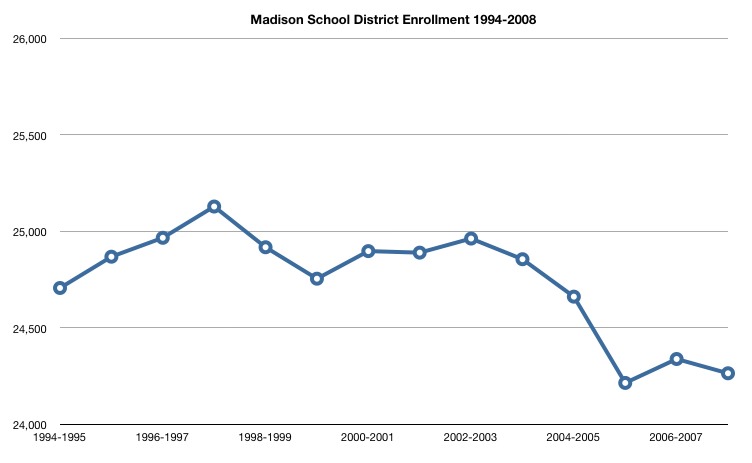
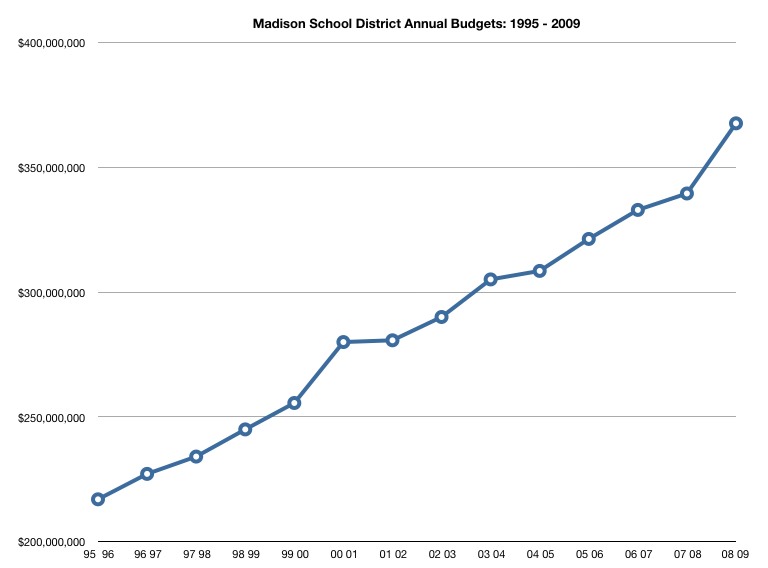
Share

Meeks Solicits Support for Chicago School Boycott Plan

Fran Spielman:

State Sen. James Meeks (D-Chicago) met privately with the City Council’s Black Caucus last week to explain his plan to have hundreds of Chicago Public School students boycott the first four days of classes.
Implied, but not stated, was the fact that Meeks would like aldermanic support for his controversial tactics. Apparently, he’s not going to get it.
On Tuesday, the Black Caucus will hold a news conference to turn up the heat on Gov. Blagojevich and the General Assembly to address the school funding disparity between rich and poor districts.
But, the aldermen will not take a stand on Meeks’ boycott threat.
“We can’t take an official position. We didn’t have a consensus. All of us want our children in school. That’s really the bottom line,” said Ald. Freddrenna Lyle (6th).

Share