School Information System

For Kids’ Sake, Power to Fire Teachers Crucial

Jay Matthews:

Sarah Hayes, principal of the KIPP DC:KEY Academy, realized that two new teachers were not working out. Their résumés and recommendations had been good. They were nice people. But their classes were disorganized, their standards low. Efforts to help them improve had little effect.
If KEY were a traditional school, Hayes’s only reasonable option would have been to mentor the teachers, note her dissatisfaction on their evaluations and recommend that they not be kept after a two-year probation. That is the way it goes in most school systems. Staffing rules, tenure agreements and low expectations tend to favor weak teachers unless they do something awful.
But KEY is a public charter school, one of many in the District that do not have such rules. Hayes was able to get the teachers out of her middle school by Christmas and replace them with proven talents, who were freed from other duties at KEY because of flexibility allowed such schools.

Share

Working Without a Safety Net: How Charter School Leaders Can Best Survive on the High Wire

Christine Campbell & Betheny Gross, via a kind reader’s email:

When charter school directors step into the job, they step onto a high wire with no safety net below them. Though they take on a broader set of responsibilities than traditional public school leaders, charter directors rarely have the “back office” administrative support of a district central office. Instead, it is up to them to secure and manage facilities, recruit students and teachers, raise and manage funds, and coordinate curriculum and instruction.
How are charter school leaders facing this challenge? In Working Without a Safety Net: How Charter School Leaders Can Best Survive on the High Wire, authors Christine Campbell and Betheny Gross explain that today’s charter school directors, though deeply motivated by their school’s mission and the students they serve, can have their confidence shaken by many of the extras they face.
Drawing from a six-state survey, the authors find that, like traditional public school principals, today’s charter school directors often come to their positions from other jobs in education and with training from schools of education. However, charter school leaders tend to be younger and newer to leadership positions; many have only a couple years of experience in school administration.

Share

Clarke Street School is focus of new college-going effort

Alan Borsuk:

About eighty first- and second-graders at Clarke Street School are being offered a deal that could shape their lives.
Mayor Tom Barrett and a group of local philanthropists will be at the school today to say they will pay for extra help for the children, both in and out of school, and will guarantee that the children will be able to pay for college, provided the kids and their families follow through and make it that far.
It is the first Milwaukee effort of the I Have a Dream Foundation, an effort that grew out of a businessman’s impulsive decision in 1981 to offer to pay for college when he spoke to a group of sixth-graders in New York’s Harlem. I Have a Dream efforts are under way in 29 cities.
Barrett, who has been closely involved in putting together the effort, announced in his “state of the city” address in February that Ted and Mary Kellner, major figures on Milwaukee’s charitable scene, would be the lead sponsors for the first-graders at Clarke. Barrett will announce today that the Brady Corp. Foundation will be the lead sponsor for the second grade. Other area organizations and charities, including Milwaukee Public Schools itself, also will support the effort.
The guarantee of affordable higher education is based on donors providing “the last dollar” students would need, beyond other financial help, to carry their educations beyond high school, with in-state tuition as the minimum total amount.

Share

2008 Education Next-PEPG Public Opinion Survey

William G. Howell, Martin R. West and Paul E. Peterson:

Americans think less of their schools than of their police departments and post offices
Americans clearly have had their fill of a sluggish economy and an unpopular war. Their frustration now may also extend to public education. In this, the second annual national survey of U.S. adults conducted under the auspices of Education Next and the Program on Education Policy and Governance (PEPG) at Harvard University, we observe a public that takes an increasingly critical view both of public schools as they exist today and, perhaps ironically, of many prominent reforms designed to improve them.
Local public schools receive lower marks than they did a year ago. More significantly, perhaps, survey respondents claim that their local post offices and police forces outperform their local schools. Meanwhile, support for the most far-reaching federal effort to reform public schools–the No Child Left Behind Act–has slipped. A considerable portion of the public remains undecided about charter schools. And the poll found no enthusiasm for the use of income rather than race as a basis for assigning students to schools.
This does not mean that Americans are unwilling to explore alternate ways of educating young people. A large majority of Americans would let their child take some high school courses for credit over the Internet. An equally large majority favor the education of students with emotional and behavioral disabilities in separate classrooms rather than “mainstreaming” them, as is common practice. A plurality support giving parents the option of sending their child to an all-boys or all-girls public school. And a rising number of Americans know someone who is home schooling a child.

Share

Madison School Referendum Training 10/2/2008

Via a Matt Calvert email:

Community and Schools Together

Referendum Training
Thursday, October 2, 2008
7:00 PM (We’ll be done at 8 so you can catch most of the v.p. debate)
MTI Conference Room
821 Williamson St. (parking available)
Familiarize yourself with the details of the referendum.
Get information to share with others.
Sign up for opportunities to meet with groups or staff tables before the November election.
RSVP to Matt Calvert at 255-9417 or calvert.matthew@gmail.com

Share

Wilmette Agrees to a 5 Year Teacher’s Contract

Chicago Tribune:

The contract includes average salary increases of 5 percent the first two years and 5.5 percent the last three, according to the release. It also adds 20 minutes per day to the schedule for kindergarten through 4th-grade teachers.

Wilmette Education Association and Wilmette Public Schools.

Share

Referendum Climate: A Look at the US Government Budget

.

NY Times Graphics.
Related:

Further proof that there is no free lunch. The ongoing calls for additional state redistributed tax dollars for K-12 public education will likely have an effect on other programs, as this information illustrates. I do think that there should be a conversation on spending priorities.

The current financial system “crisis” presents parents with an excellent opportunity to chat with our children about money, banks, politics and taxes (When you deposit the baby sitting money, where does it go? What happens if the funds are no longer in the bank?). It is a rather potent mix. Much more, here.

Share

Disrupting Class: Student-Centric Education Is the Future

Clayton M. Christensen & Michael B. Horn:

The answer isn’t simply investing more in computer equipment and technology for schools, either. The United States has spent more than $60 billion equipping schools with computers during the last two decades, but as countless studies and any routine observation reveal, the computers have not transformed the classroom, nor has their use boosted learning as measured by test scores. Instead, technology and computers have tended merely to sustain and add cost to the existing system.
That schools have gotten so little back from their investment comes as no surprise. Schools have done what virtually every organization does when implementing an innovation. An organization’s natural instinct is to cram the innovation into its existing operating model to sustain what it already does. This is perfectly predictable, perfectly logical — and perfectly wrong.
Student as Consumer
The key to transforming the classroom with technology is in how it is implemented. We need to introduce the innovation disruptively — not by using it to compete against the existing paradigm and serve existing customers, but to target those who are not being served — people we call nonconsumers. That way, all the new approach has to do is be better than the alternative — which is nothing at all.
To convey what we mean, we need to briefly explain the disruptive-innovation theory. In every market, there are two trajectories: the pace at which technology improves and the pace at which customers can utilize the improvements. Customers’ needs tend to be relatively stable over time, whereas technology improves at a much faster rate. As a result, products and services are initially not good enough for the typical customer, but, over time, they improve and pack in more features and functions than customers can use.

Much more on Clayton Christensen.

Share

Investigation into the LA School District’s Administration

Beth Barrett:

Managing almost 900 schools and more than 650,000 students is a huge task. But a Daily News review of salaries and staffing shows LAUSD’s bureaucracy ballooned by nearly 20 percent from 2001 to 2007. Over the same period, 500 teaching positions were cut and enrollment dropped by 6 percent.
The district has approximately 4,000 administrators, managers and other nonschool-based employees – not including clerks and office workers – whose average annual salary is about $95,000. About 2,400 administrators are among the 3,478 LAUSD employees who earn more than $100,000 annually.
Meanwhile, the average salary for an LAUSD teacher is $63,000. And the average household income in Los Angeles County is less than $73,000.
The Daily News obtained the LAUSD salaries database through the California Public Records Act. The database – searchable by name, job title and salary range – is posted at dailynews.com.
“(The bureaucracy) grows whether it’s fat or lean times,” said United Teachers Los Angeles union leader A.J. Duffy, a longtime critic of the district’s administrative staffing.

Share

DCPAC Dan Nerad Meeting Summary

A video tape of the entire presentation and discussion with Dr. Nerad may be viewed by visiting this internet link: https://www.schoolinfosystem.org/archives/2008/09/ madison_superin_10.php

Dan Nerad opened his remarks by stating his commitment to efforts for always continuing change and improvement with the engagement of the community. He outlined four areas of focus on where we are going from here.

  1. Funding: must balance district needs and taxpayer needs. He mentioned the referendum to help keep current programs in place and it will not include “new” things.
  2. Strategic Plan: this initiative will formally begin in January 2009 and will involve a large community group process to develop as an ongoing activity.
  3. Meet people: going throughout the community to meet people on their own terms. He will carefully listen. He also has ideas.
  4. Teaching and learning mission: there are notable achievement gaps we need to face head-on. The “achievement gap” is serious. The broader mission not only includes workforce development but also helping students learn to be better people. We have a “tale of two school districts” – numbers of high achievers (including National Merit Scholars), but not doing well with a lot of other students. Low income and minority students are furtherest away from standards that must be met. Need to be more transparent with the journey to fix this problem and where we are not good. Must have the help of the community. The focus must be to improve learning for ALL kids, it is a “both/and” proposition with a need to reframe the issue to help all kids move forward from where they are. Must use best practices in contemporary assessment, curriculum, pedagogy and instructional methods.

Dr. Nerad discussed five areas about which he sees a need for community-wide conversations for how to meet needs in the district.

  1. Early learning opportunities: for pre-kindergarten children. A total community commitment is needed to prevent the ‘achievement gap’ from widening.
  2. High schools: How do we want high schools to be? Need to be more responsive. The curriculum needs to be more career oriented. Need to break down the ‘silos’ between high school, tech schools and colleges. Need to help students move through the opportunities differently. The Small Learning Communities Grant recently awarded to the district for high schools and with the help of the community will aid the processes for changes in the high schools.
  3. School safety: there must be an on-going commitment for changes. Nerad cited three areas for change:

    a. A stronger curriculum helping people relate with other people, their differences and conflicts.

    b. A response system to safety. Schools must be the safest of sanctuaries for living, learning and development.

    c.Must make better use of research-based technology that makes sense.

  4. Math curriculum and instruction: Cited the recent Math Task Force Report

    a. Good news: several recommendations for curriculum, instruction and policies for change.

    b. Bad news: our students take less math than other urban schools in the state; there are notable differences in the achievement gap.

  5. Fine Arts: Cited recent Fine Arts Task Force Report. Fine arts curriculum and activities in the schools, once a strength, has been whittled away due to budget constraints. We must deal with the ‘hands of the clock’ going forward and develop a closer integration of the schools and community in this area.

(more…)

Share

Madison 2008 Referendum: Watch List Report Card

10/6/2008 update
Active Citizens for Education presents this “Watch List Report Card” as a means of reporting relevant information, facts and analyses on topics appropriate for consideration by taxpayers in voting on the Madison Metropolitan School District referendum question November 4, 2008.
This document is dynamic in nature, thus it is updated on a regular basis with new information and data. Questions, analyses, clarifications and perspectives will be added to the entries as appropriate. Review Ratings will be applied to report the progress (or lack thereof) of the Board of Education and Administration in its plans, data, information, reports and communications related to the referendum.
The question which shall appear on the ballot is as follows:

“Shall the following Resolution be approved?
RESOLUTION AUTHORIZING THE SCHOOL DISTRICT BUDGET TO EXCEED REVENUE LIMIT FOR RECURRING PURPOSES
BE IT RESOLVED by the School Board of the Madison Metropolitan School District, Dane County, Wisconsin that the revenues included in the School District budget be authorized to exceed the revenue limit specified in Section 121.91, Wisconsin Statutes, for recurring purposes by: $5,000,000 beginning in the 2009-2010 school year; an additional $4,000,000 beginning in the 2010-2011 school year (for a total of $9,000,000); and an additional $4,000,000 beginning in the 2011-2012 school year (for a total of $13,000,000 in 2011-2012 and each year thereafter).”

(Source: MMSD Administration 09/15/08)
Continue reading here (277K PDF).

Share

Effective education, kindergarten to retirement

Mitch Daniels:

Last week I wrote that building the best possible business environment in America was the key to attracting jobs and investment to Indiana. Our state has recently achieved top-tier rankings as a place to do business, with low taxes and utility costs, reduced regulation, new infrastructure investments, and the highest credit rating in history. But we will not maximize these advantages if we do not also have enough well-educated workers. Jobs and investment that would otherwise come to Indiana will wind up somewhere else if we can’t provide a large enough pool of skilled labor.
As our economy diversifies, jobs in all sectors, including manufacturing, increasingly require skills and knowledge beyond high school. Right now, too many of our workers lack the education and training they need to perform — or even qualify for — the kinds of skilled jobs that we want to bring to or grow here in Indiana. Thousands of jobs are open and waiting in fields such as information technology, health and logistics, but are not being filled because of this skills mismatch.

Share

“Open Detroit School District to Choices”

Stephen Henderson:

When I covered the Detroit Public Schools for the Free Press in the mid 1990s, writing umpteen stories about failed programs, stolen money and incompetent management, I reached a point where it seemed to me better just to shut the system down and start fresh, to build something that worked, rather than continuing with what clearly didn’t.
People laughed when I would say that out loud. What would you do with the kids? You can’t just give up on the whole thing.
But who’d be laughing now? If I said it’s time to embrace the rapid decommissioning of the very idea of a Detroit Public Schools system, would I even get a chuckle?
The truth is that the system is imploding, and every family with the ability to roll with something other than DPS appears to be grabbing that choice. The student population plummeted by an estimated 17,000 over the past year, equal to the total number of people living in Auburn Hills.

Share

Voters told new Germantown school could pay for itself

Term Kertscher:

A School Board member says voters can approve a $22.5 million school referendum without seeing an increase in property taxes – and a pro-referendum committee goes even further, saying a successful referendum could actually lower property tax bills.
The president of the Wisconsin Taxpayers Alliance has his doubts, and some Germantown School District residents question the idea that borrowing $22.5 million for a new elementary school wouldn’t raise their taxes.
“It just makes people all the more suspicious,” resident Anne Bastow said about the Nov. 4 referendum. “To say your (property tax) payments are going down when you’re getting something new, it just doesn’t jibe.”
But a top official with the state Department of Public Instruction says school districts can increase their state aid – and simultaneously reduce property tax levies – by increasing enrollment.

Share

Wisconsin State Tax Based K-12 Spending Growth Far Exceeds University Funding

via WISTAX

WISTAX published a fascinating chart in their most recent issue of FOCUS [Page 1, Page 2]:

However, the state pledge to provide two-thirds of schools revenues in 1996-97 changed the budget landscape. By 2006-07, state-tax support for the UW System had almost doubled during Ihe 25 years prior. However, inflation (CPI, up 115%). school aids/credits (320%). and overall slate GPR expenditures (222%) rose more.

Related:

Further proof that there is no free lunch. The ongoing calls for additional state redistributed tax dollars for K-12 public education will likely have an effect on other programs, as this information illustrates. I do think that there should be a conversation on spending priorities.

Share

Madison Schools “Individual Endowments”

Foundation for Madison Public Schools:

The Foundation for Madison’s Public Schools developed the Individual School Endowment Initiative, which is unique in the country. This initiative was designed to build an endowment fund for each of the 48 schools in the district. Through the generosity of John Taylor and the Clay-Price Fund, each school was offered a challenge grant of $5,000. Schools needed to raise $5,000 toward the establishment of an endowment fund in order to earn the $5,000 match and establish their $10,000 Individual School Endowment Fund. We are thrilled to announce that as of June, 2007, all 48 schools had met the match and established endowment funds. 32 schools have endowment fund balances greater than $20,000 and 6 schools have over $50,000 in their endowments. This initiative has raised over $1.45 million and endowment balances continue to grow. Our long-term goal is to see every school have a $50,000 endowment as well as a mutually beneficial relationship with a community partner. To that end, we have established our Adopt-A-School Program.

2008 FMPS Grants:

$10,000
Madison – Our History
Dept of T/L
This proposal would support the completion of Phase II of this project to write a book, Madison-City of Four Lakes, Our History and Our Home and the accompanying curriculum for third grade history instruction for Madison schools. Phase II includes funding for the graphic artist to complete the layout for the book and printing 2000 copies and the web based construction.
$9,120
AVID Summer Training
East High School
AVID is a program designed to provide underachieving and underserved populations training for skills they will need to be successful in advanced level high school courses and four year college programs. This grant would support summer training for teachers at the AVID institute.
$9,900
Literacy Initiative Grant
East High School
This proposal would fund 5 and 1/2 days of training for 12 East High teachers to learn content area reading strategies across all major content areas. The professional development is part of a sustained coordinated effort to improved literacy at East. Funds would also support some of the materials necessary to implement literacy instruction.

Share

District Improvement Plan

East Hartford Public Schools [300K PDF]:

The East Hartford Public Schools District Improvement Plan represents the evolution of work begun five years ago. Although it has undergone several transformations as a result of extensive professional development, it continues to serve as the blueprint for action and a path to excellence.
The generally upward trajectories in student achievement confirm the application of researched-based strategies can make a difference in student achievement. This result has provided encouragement and motivation to staff.
Although pleased with the district’s accomplishments and the progress we have made, sustained focus, reinforcement, and fidelity of implementation must continue to be priority. Accomplishments, along with current work in progress, encompass many important areas of focus:

Kate Farrish:

The board of education has unanimously endorsed a state-mandated district improvement plan that aims to raise standardized test scores, reduce school suspensions and narrow significant achievement gaps between black and white students and poor students and their wealthier peers.
Superintendent of Schools Marion H. Martinez will present the plan, approved Monday night, to the State Board of Education on Oct. 2. It will then be detailed for the public at a local board meeting on Oct. 6. The state requires such plans when districts or schools have been deemed “in need of improvement” under the federal No Child Left Behind Act.
The plan calls for raising the percentage of students reaching proficiency in reading, writing and math scores on the Connecticut Mastery Test and Connecticut Academic Performance Test by at least 15 points over the next three years. It also calls for reducing the test score gap between racial and ethnic groups and socioeconomic groups by 30 percent in the same three years. Currently, for example, there is a 30 percent average gap in reading scores between those groups in grades 3 to 9, and the plan calls for the gap to be narrowed by 9 percentage points — a 30 percent drop — by 2010-11.

Share

Beware of the Easy School Fix

Jay Matthews:

When fixing schools, beware of miracle cures. Every week people send me ideas they say will change the future of education and lead all humanity to enlightenment. So, when management expert William G. Ouchi let me look at his new work on the surprising power of total student loads per teacher, or TSL, I was skeptical.
He says when middle or high school principals are given control of their schools’ budgets — a rare occurrence in big districts — they tend to make changes in staffing, curriculum and scheduling that sharply reduce TSL, the number of students each of their teachers is responsible for. Some urban districts have TSLs approaching 200 kids per teacher. But after principals get budgeting power, the load drops sharply, sometimes to as low as 80 kids per instructor. When that happens, the portion of students scoring “proficient” on state tests climbs. A group of New York schools had a surge of 11 percentage points after they reduced average TSL by 25 students per teacher.
I hear the mumbles out there. Yes, correlation is not causation. Test scores are not a perfect measure. Many other factors could explain the rise in achievement. For instance, the principals might be using their new powers to hire good teachers and fire bad ones.

Share

McCain, Obama Advisers to Debate Education

Mitchell Landsberg:

On Oct. 21, the education advisors to the two candidates — Lisa Graham Keegan for McCain; Linda Darling-Hammond for Obama — will face off in a debate at Teachers College, the venerable education school at Columbia University in New York. The debate, which begins at 4 p.m. PDT, will be webcast by Education Week. The moderator will be Susan Fuhrman, the president of Teachers College.
In the meantime, you can read the education platforms for McCain here and Obama here. And here is Edweek’s blog on the campaign. For those who don’t want to go to that much trouble, we’ll helpfully reduce the platforms to fit on the head of a pin: McCain believes in school choice and local control; Obama believes in an expansion of early childhood education and increased federal funding for education.

Share

Use of School Budgets in State Funding Lawsuit Questioned

Laura Diamond:

Gov. Sonny Perdue has asked the attorney general’s office to determine whether school districts can use state and local school money to pay for a lawsuit over how Georgia funds education.
The Consortium for Adequate School Funding in Georgia, a group of about 50 mostly rural systems, filed the suit in 2004. The trial was scheduled to begin next month, but the group withdrew the action last week after the case was assigned to a new judge. Consortium leaders, who argue insufficient state funding has resulted in low student achievement, said they will file a new lawsuit.
In a letter Perdue sent to the attorney general’s office Tuesday, he cited a provision in the state constitution that requires school money be spent on schools, academics and support programs.
“Taxpayers in these school districts need to know that their education tax dollars have been used to pay lawyers suing the state instead of in their children’s classrooms,” Perdue said Thursday in a news release. “My hope is that in the future decisions on school funding will be made through the public policy process, not in a courtroom where the plaintiffs’ lawyers are paid with local education tax dollars to battle defense lawyers paid with state tax dollars.”

Share

Minnesota Democrat-Farm Laborers Believe in new School “Miracle”

Norman Draper:

In the face of a strained economy and an almost-certain state budget shortfall, the party is pushing a bold new education initiative. Better schools, they say, will be an investment that counters the downturn.
When DFL state Rep. Denise Dittrich went door to door campaigning for re-election in Champlin last week, a smattering of homeowners brought up education.
One worried that the enrollment at her child’s elementary school would drop so low that the school would shut down. Another fretted about property taxes that have soared, in part because voters approved increases in school funds.
One resident, Shelley Peterson, said she was equally concerned about education and the economy. She said she wants more money for education and wants to lower the high activity fees in the Anoka-Hennepin School District. But would she be willing to consider higher taxes to do that?

Share

Reinventing the School Lunch

TedTalks:

Speaking at the 2007 EG conference, “renegade lunch lady” Ann Cooper shares her passionate belief in remaking the school lunch. She uses scathing language to describe how most American kids are fed at the noon bell, out of cans, boxes and plastic bags — sowing the seeds of the obesity epidemic that is spreading from the US around the globe. But, she says, there’s a coming revolution in the way kids eat at school — local, sustainable, seasonal and even educational food. (Recorded December 2007 in Los Angeles, California. Duration: 19:42.)

Share

You say “accountability,” I say “longitudinal study”

Milwaukee’s Public Policy Forum:

In a report released last week that did not get press other than a post on the education blog of the Journal Sentinel, the Legislative Audit Bureau rehashed the first-year findings of the School Choice Demonstration Project’s study of the Milwaukee Parental Choice Program (MPCP). Interestingly, the Bureau found the study’s data cannot provide information about performance in individual schools. In response, a prominent school choice lobbying group has called for test scores to be reported annually on a school-by-school basis.
The overall findings, released last February, were not as positive as education reform supporters had anticipated. The Audit Bureau re-analyzed the data and confirmed these findings. For example, the sample of choice students in the private schools had lower reading scores on state standardized tests than a matched sample of MPS students at three of six grade levels. At all six grade levels tested, the private school students scored lower than a random sample of MPS students. In nearly all cases, however, the differences were not statistically significant.

Share

When Tough Times Weigh on the Kids

Sue Shellenbarger:

At a little under three years of age, Bailey Haag can’t understand the turmoil on Wall Street. But last week, the little girl’s brow furrowed and her face grew sad as she overheard her mother on the phone, reacting to a ripple effect of the nation’s economic problems — her father’s layoff.
Although her mother, Claire Crawford Haag, had hoped to shield Bailey from stress, the child knew from her mother’s voice that “it was not a good conversation,” Ms. Haag says. Noticing her daughter’s face crumple, Ms. Haag began fashioning in her head an explanation a small child could understand.
Amid fallout from the nation’s worsening financial picture, many parents are trying to protect their children from worries about layoffs and financial hardship. But children are actually silent carriers of family financial stress, research shows. They’re not only keenly aware of it, but it makes them more likely to behave badly or develop emotional problems. To help kids cope, psychologists and researchers say, parents need to communicate in ways they can understand, keep family relationships on track, and give children a role in helping solve family problems.

Share

“Data Driven” Education Research

Javier Hernandez:

Roland G. Fryer Jr., a Harvard economist, has often complained that while pharmaceutical companies have poured billions of dollars each year into studying new drugs and Boeing devoted $3 billion to develop the 777 jet, there has been little spent on efforts to scientifically test educational theories.
Now Dr. Fryer has quit his part-time post as chief equality officer of the New York City public schools to lead a $44 million effort, called the Educational Innovation Laboratory, to bring the rigor of research and development to education. The initiative will team economists, marketers and others interested in turning around struggling schools with educators in New York, Washington and Chicago.
Backed by the Broad Foundation, founded by the billionaire philanthropist Eli Broad, and other private groups, the research is intended to infuse education with the data-driven approach that is common in science and business, Dr. Fryer said. He compared the current methods of educational research to the prescriptions of an ineffective doctor.

Share

Weekly Update

This past week on the board I have moved in varied circles, hopefully which may lead our district in a new and better direction as we improve our connections with the broader community.
Early in the week the Madison Board of Education approved the submission of two resolutions for the state school board association’s annual meeting. I was happy to be an author of one and to get assistance from the Middleton/Cross Plains board on the second.
One meeting that I’m always happy to attend is with community organizers and childcare providers working to bring quality early childhood education to all students in Madison. We met at a local business, Ground Zero coffee shop, and enjoyed much in the way of conversation and goal-setting. If you would like to learn how to get involved in this effort feel free to contact me and I will put you in touch with some great people working on behalf of young children and through an investment in our future.
In addition, I may start holding listening sessions at local businesses to better communicate with the community.
Personal blog, RSS Feed.

Share

Madison High School Students Organize and Push Referendum

Tamira Madsen:

Kaley Stroup has seen the impact school budget cuts have had on classmates and friends at La Follette High School.

Officials at La Follette were forced to drop the Italian language program from the curriculum for the 2008-09 school year, and students had to scramble to restructure their class schedules.

Stroup said elimination of the courses put many seniors like her in a tough situation when thinking ahead to college.

“Their schedules are messed up now because colleges want you to have four years of the same foreign language, and they’ve had to switch to French and Spanish, and it’s thrown things off for them,” Stroup said.

She is part of a group of Madison Metropolitan School District students intent on bolstering community approval for the school referendum so deeper budget cuts won’t have to be made going forward. Leaders of the group hope to have some two dozen students getting out the word about voting “yes” on Nov. 4.

Much more on the 2008 Madison Referendum here.

Share

The Special Needs Kindergarten Crunch

Christine Gralow:

It’s the third week of pre-school. Kids are still settling in, and many are still crying when their parents drop them off in the morning. During these first weeks of school, pre-school teachers do a lot of waiting and wondering — waiting patiently for the separation tears to end and wondering what fascinating young characters will begin to emerge in this year’s class. My students’ parents, however, are already thinking about next year — they’re worried about getting their kids into kindergarten.
As a pre-school special needs teacher in New York, I’ve learned that the city’s culture of cut-throat competition extends to kindergarten admissions. And from that, an unexpected part of my job has evolved — providing psychological and emotional support to parents as they undertake the daunting task of finding an appropriate placement for their child. Securing a good spot in an oversubscribed New York City kindergarten, whether public or private, is difficult enough for most parents. But for the parents of children with special needs, it is especially challenging.

Share

“Let’s You and Him Fight over School Vouchers”

Political Insider:

David Poythress called. The only announced Democratic candidate for governor wanted to pick a fight with Eric Johnson over school vouchers.
“To re-direct public money from public education into unregulated private entities with the magical expectation that somehow the private sector was going to remedy all the education problems in the state — that’s just wrong. It’s not going to happen,” Poythress said.
Johnson, currently the Senate president pro tem, has seized on the voucher issue as a likely ticket to the Republican nomination for lieutenant governor in 2010.
To set the stage:

Share

Officials Propose Large Scale Changes to the Milwaukee Public Schools

Alan Borsuk:

A chancellor who would coordinate all the schools in town, including private schools and universities?
Clamping down on busing of Milwaukee Public Schools students, high salaries in central office and other high-cost items?
Creating new programs to get disruptive students out of classrooms?
Ideas were flying Monday as the spotlight continued to shine on MPS and its financial problems.
In its specifics, the proposal endorsed by School Board members on a 6-3 vote last week to explore dissolving MPS may or may not go forward. A meeting Thursday night at which the board will consider it formally is the next main event.

Share

Minnesota Governor Outlines School Reform Plans

Duluth News Tribune & AP:

Gov. Tim Pawlenty is taking another stab at changing teacher pay, preparation and recruitment in a series of proposals he’ll present to the 2009 Legislature.
“This is serious business,” Pawlenty said during a news conference at Monaco Air Duluth this morning. “Research shows that a student who has the benefit of successive years in a row of an effective teacher has a significantly higher performance than a student who does not. Having two or three ineffective teachers in a row it can decrease a student’s performance by as much as 50 percent, he said.
Pawlenty and Education Commissioner Alice Seagren are visiting Duluth, Moorhead, St. Cloud, St. Paul, Winona and Albert Lea today to release details of his K-12 education reform initiatives — called the Teaching Transformation Act — his first initiative for next year’s session.

Via Tim Pawlenty’s website:

The Teaching Transformation Act includes:

  • Tying increases in teacher pay to improved student performance.
  • Setting tougher entrance requirements for admission into teacher preparation programs. This would include setting minimum entrance requirements for college students before admission into teacher preparation programs; strengthening the state’s teacher certification test, including raising cut scores for prospective teachers; revising the standards for approving college teacher preparation programs and including more rigorous standards on content, technology and instructional strategies; enhancing academic preparation that reflects challenges facing teachers today; using data to analyze student needs; utilizing technology in relevant, exciting ways; and developing strategies with higher education institutions to recruit students to become math or science teachers.
  • Creating the SMART Program (State of Minnesota Mid-Career Alternative Route to Teaching) to recruit mid-career professionals to teach in high-need subject areas in math, science and other teacher shortage areas. The program would be modeled after similar programs in New York City and Texas that have been effective in bringing mid-career professionals and other high-quality, dedicated individuals into teaching. It would be developed in partnership with non-profit organizations or universities and local school districts would be able to hire from the pool of teachers.
  • Modernizing professional development for teachers by focusing on more time for continuous training, providing teachers with performance feedback through evaluations, and encouraging teacher collaboration to better use data to improve student achievement. The Governor’s proposal would improve the current system of professional development that relies too heavily on periodic seminars and programs that fail to relate directly to the classroom. Currently, two percent of the general education funding formula is utilized for staff development.

Share

Referendum Climate: Washington must heed fiscal alarm bell

Dave Walker:

Beyond the turmoil for banks and homeowners, however, there is a super-sub-prime crisis brewing in Washington. Our fiscal policies have created a disconnect between today’s citizens and future taxpayers. Today’s taxpayers benefit from high government spending and low taxes, while future generations are expected to pay the bill. Our real challenge is where we are headed on our do-nothing fiscal path.
Washington has charged everything to the nation’s credit card – engaging in tax cuts and spending increases without paying for them. Washington’s imprudent, unethical and even immoral behaviour is facilitated by a lack of transparency. For example, as of September 30, 2007 the federal government was in a $53,000bn dollar fiscal hole, equal to $455,000 per household and $175,000 per person. This burden is rising every year by $6,600-$9,900 per American. Medicare represents $34,000bn of this deficit and the related Medicare trust fund is set to run dry within 10 years. The Social Security programme is projected to have negative cash flow within about 10 years.

Share

Locke High: The Real Charter Challenge

Paul Tough:

The new union-friendly charter school in the Bronx I wrote about last week is not the only big project that Green Dot Public Schools has taken on this fall. The other is the attempted transformation of Locke High School in the Watts neighborhood of Los Angeles. The school, which currently has about 2,500 students, has long been notorious as one of the worst in the city, with what the L.A. Times recently described as a “reputation for student fisticuffs and an appallingly high dropout rate.”
Green Dot was founded by Steve Barr, a garrulous, outspoken Irish American in his late 40s who helped start Rock the Vote in 1990 and nine years later decided his role in life was to run high schools. His organization now manages 10 of them, mostly in L.A., and his new mission is to transform the way public education works in the city (and then in the rest of the country).

Share

Nobody’s Waiting to Bail the Milwaukee Public Schools Out

Eugene Kane:

In a week when America’s financial markets experienced a meltdown, perhaps it shouldn’t have been that surprising to learn Milwaukee Public Schools was also apparently in dire financial straits.
Last week, a shake-up of major Wall Street firms sent shock waves through the stock market. The federal government announced a risky, multibillion-dollar bailout of endangered institutions amid concerns about the worst financial crisis in decades. With all that turmoil afoot, it was almost anticlimactic to learn the School Board had voted to look into ways to dissolve the public school system because of increasing financial problems.
Yes, that’s right; dissolve it.
Most folks knew things were bad at MPS; nobody suspected it was that bad. At least one board member, Michael Bonds, still isn’t convinced.
“I was outraged,” said Bonds, who left the room shortly after a 6-3 vote by MPS board members to consider options for dissolving the state’s largest school district. “Yes, that’s why I left the room.”

Share

Scrap the Sacrosanct Teacher Salary Schedule

Jacob Vigdor:

On what basis should we distribute rewards to salespeople?
It seems like a silly question, doesn’t it? First, “we,” meaning the public at large, don’t usually get to decide such matters. Second, there are obvious systems of rewards for salespeople already in place, foremost among them the system of commissions, which pays salespersons for the value they directly contribute to a firm’s operation.
Replace the word “salespeople” with “teachers,” however, and we move from the realm of silly questions to the arena of intense policy debate. Teachers are in most cases public employees. So we do, in theory at least, get to decide how they are paid. The commission model for teachers, variants of which have been proposed for many years, would involve compensating them for the value they provide to their school’s operation, that is, the degree to which they educate their students. Unfortunately, the amount of education a student receives in a given year is much harder to quantify than the total sales recorded by a clerk in a store. Measuring student growth has been made somewhat easier by recent advances in the tracking of student performance on standardized tests over time. But the notion of paying teachers on the basis of their ability to improve test scores, often termed “merit pay,” while earnestly debated by education policy researchers, is strongly opposed by teachers unions and is a political nonstarter in many parts of the country.

Share

Monona Grove Enrollment Numbers

Peter Sobol:

Preliminary 2008-9 enrollment numbers show a total of 3076 students “in seats” as of 9/10. This includes 85 4k students and community daycare sites, 107 4k students at Maywood and TP, and 133 open enrollment in (vs. 39 oe out).

It will be interesting to see County and Statewide open enrollment numbers.

Share

Georgia School districts try to avoid ‘outspoken’ judge

Bill Torpy:

A consortium of rural school districts suing the state to change its funding formula withdrew its long-running case from Fulton last week and said it would refile it in another venue after it was reassigned to Schwall.
“We have been transferred to a judge who is new to the subject, and we have a judge whose political views are well-known,” said Joe Martin, the group’s executive director and a Democrat who has run for state school superintendent. “We could barrel ahead, but it is unlikely we would get a fair hearing” because of his political connections.
Gov. Sonny Perdue, who is fighting the school suit, appointed Schwall to the bench after Judge Roland Barnes was allegedly shot to death by Nichols in 2005. Perdue lashed out at the group’s “transparent attempt at forum shopping.”
Schwall, in an e-mail to The Atlanta Journal-Constitution, said: “The integrity of our judicial system depends on a judge’s ability to make decisions based upon the law and the facts presented, not upon politics or any other outside influence.”

Share

Marquette University Receives $4M US Reading Grant

Dani McClain:

Spellings was in town to present the grant to Marquette University, but she used the opportunity to defend the success of Early Reading First and Reading First, two initiatives financed through the law.
“No Child Left Behind has taken a flat line in student achievement, and it’s starting to tick upward,” Spellings said at a meeting with the Journal Sentinel editorial board.
Congress already has cut back on the $1 billion-a-year Reading First initiative. The program’s budget was reduced by 60% last year following revelations of mismanagement.
The Education Department’s inspector general reported in 2006 that Reading First administrators had violated conflict-of-interest rules when awarding grants and steered contracts to favored textbook publishers. The program’s director at the time, Chris Doherty, resigned shortly before the report was made public. Also, an Education Department study made public in May concluded that Reading First failed to improve reading comprehension among participating children.
Spellings said Thursday that “the ship has been righted” and that she hopes the agency will avoid further cuts to the program.

Share

What Happens When a School District Fails?

Jessica Calefati:

Students, families, and educators in Georgia still are struggling to make sense of how a school district recently lost its accreditation and what impact the ruling will have on the students’ chances of getting into competitive colleges. The Southern Association of Colleges and Schools, one of the nation’s major accrediting agencies, revoked the Clayton County school system’s accreditation in late August after the district’s leaders failed to achieve eight of nine mandates for improvement set by SACS in February. Some of the unmet mandates include establishment of a responsible school board, removal of outside influences that disrupt the district’s ability to function, and adherence to a code of ethics.
SACS Chief Executive Officer Mark Elgart said the board’s problems permeated the system, but that dysfunction did not directly affect the quality of learning offered by the 50,000-student district located just south of Atlanta. Revocation of accreditation, he said, was the only way to prevent further damage to that system. The last school system to lose its accreditation in the United States was Florida’s Duval County in 1969.

Share

Referendum Climate: “Missing Step: Control Spending”

Wisconsin State Journal Editorial:

Wisconsin received more evidence this week that its taxes are too high.
This time the evidence arrived in a study suggesting that Wisconsin may be just a few tax cuts away from becoming one of the nation’s economic hot spots.
The study, from the Pacific Research Institute in association with Forbes magazine, should give state and local policymakers new incentive to control spending so that taxes can be reduced.
The study of all 50 states, called the economic freedom index report, considered a variety of factors from tax levels to justice systems to make conclusions about how much economic freedom each state allows.
The goal was to forecast which states offer the freedom that should lead to prosperity in years to come.
The study showed that Wisconsin made the biggest leap forward among all states since a similar study was completed in 2004.

Much more on the November, 2008 Madison referendum here.

Share

A Look at Madison’s Multi-age Classrooms

Andy Hall:

A third of the elementary classrooms in the Madison School District are multi-age. That figure, which has held steady for more than five years, makes Madison one of the biggest users of multi-age classrooms — some educators say the largest user — in Dane County.
Also, Madison’s Sennett Middle School is in its 33rd year of offering a unique multi-age classroom setting that blends sixth, seventh and eighth graders.
“I think it really does foster that sense of family,” said Sennett Principal Colleen Lodholz, who said the arrangement is so popular that several former students have returned to teach at the East Side school.
There’s nothing new about putting children of more than one grade level into a single classroom.
“Look at the one-room schoolhouse. That was all multi-age. That’s where we started in the United States,” said Sue Abplanalp, the assistant superintendent overseeing Madison’s elementary schools.

Share

Education Awareness Building in Hawaii

The Learning Coalition:

Everyone seems to have an opinion about education and they seem more than happy to share it. Nelson Mandela called education the most powerful tool you can use to change the world, while Mark Twain joked that he never let his schooling interfere with his education.
One thing we can agree on: We all want our children to have the best education possible — one that will help them to achieve their potential in life, no matter which path they choose.
Our kids in Hawaii deserve our best efforts to give them a good start on life, and we have a unique opportunity to do just that. With a culturally rich and ethnically diverse student population, Hawaii represents a microcosm of the world’s future. We have teachers, principals and administrators deeply committed to equipping our children with the knowledge and skills they’ll need, and parents ready to support them in their efforts. We have a Board of Education responsible for setting policies and standards to ensure all children a quality education, regardless of their economic background or ZIP code. By working together and coordinating our efforts, we have the potential to transform our island state into an educational model for others to emulate.

Share

Schools use treats to maximize attendance on state’s annual tally date

Alan Borsuk:

It was 7:10 a.m. and the line of children and parents stretched across the gym at the Academy of Accelerated Learning, through the lobby and then down a long corridor of classrooms. Hundreds of people, families sharing a special time together, united by two things:
School and pancakes.
Oh, and one more thing: third Friday.
The pancake breakfast is a tradition at the southwest side elementary school in Milwaukee Public Schools. “There’s something special about pancakes and school,” said Principal Susan Miller as she cheerfully presided over the scene.
“My kids are really excited about it,” said Felicia Wilson, as she waited in line with Keandra, a second-grader, and Keandre, a 5-year-old kindergartner.

Share

Wisconsin Governor Doyle Wants a Study of the Milwaukee Public Schools

Alan Borsuk:

Gov. Jim Doyle called Friday for “a complete evaluation of exactly where MPS is” as a first step toward any action by state government to do more for Milwaukee schools or change the way the school system is run.
“The School Board has really opened this up now,” Doyle said, referring to a surprising 6-3 vote by Milwaukee School Board members Thursday night in favor of exploring the dissolving of Milwaukee Public Schools, which is under financial pressure. Such a step might leave responsibility for Milwaukee schools in the state’s lap.
“I take this vote very seriously by the board and, if they are moving in this direction at all, it can only be done through state law,” Doyle said in an interview. “I think we need — everybody needs — to have a good clear understanding of where exactly the Milwaukee schools are.”
He said he wants to know whether MPS is making the best use of the money it has. He expects to announce plans for conducting such an evaluation next week.
“You can’t just sort of speculate that maybe we’re going to dissolve and have the state just sort of stand there,” Doyle said. “We have to be prepared.”

Share

Inside Bay Area KIPP Schools

Jay Matthews:

One of the benefits of finding public schools that work is the chance to study them and discover exactly what they are doing that other schools are not doing. Sadly, this rarely seems a blessing to the educators at those schools, who have to fill out surveys, sit for long interviews and have strangers recording their every move. Often they feel like Michael Phelps might have felt, told to take a drug test every time he won an Olympic gold medal.
I sense these often intrusive assessments have been particularly galling for many teachers at KIPP (Knowledge Is Power Program). It has become the most studied school network in the country, one more indication that it is probably also the best. KIPP serves children from mostly low-income minority families at 66 schools in 19 states and the District, a network way too big for most researchers to handle. But since KIPP began to expand in 2001 from the two successful charter middle schools created by co-founders Dave Levin and Mike Feinberg, scholars have been examining pieces of the growing enterprise.
KIPP has cooperated with the research; one of its “Five Pillars” — its philosophy of success — is “Focus on Results.” Five independent studies of KIPP have been done so far. A sixth has just been released, available at http://policyweb.sri.com/cep/publications/SRI_ReportBayAreaKIPPSchools_Final.pdf.

Share

Maryland Charter “School learns its lesson”

Nicole Fuller:

Since opening inside a Hanover office park three years ago, the county’s only public charter school has delivered strikingly high standardized test scores and, this year, produced a semifinalist – the only one in Anne Arundel County – in a national science competition.
But Chesapeake Science Point Public Charter School has also struggled. It faced the threat of closure after it failed to adhere to the county school system’s standards in special education, and in administrative and staffing matters. Fulfilling its plan to expand to include high-schoolers, the charter school expanded to ninth-graders last year but was ultimately forced to downsize back to sixth through eighth grades amid space concerns.
Though it remains on probation through June, administrators at the school said the outlook for this year is bright, pointing to improved communication with school system officials that has led to a greater understanding of expectations.

Share

Milwaukee Considers Dissolving School District

Alan Borsuk:

The Milwaukee School Board voted Thursday night to begin looking into dissolving the Milwaukee Public Schools system.
The completely unexpected 6-to-3 vote followed a gloomy assessment of the short- and long-term financial situation of MPS from Superintendent William Andrekopoulos and several board members.
The resolution called for the administration to examine state and federal guidelines for dissolving the school district and who would be responsible for educating children in Milwaukee if that happened.
Voting for the resolution were board members Danny Goldberg, Jennifer Morales, Jeff Spence, Bruce Thompson, Terry Falk and Tim Petersons. Voting against were Peter Blewett, Michael Bonds and Charlene Hardin.
While it is extremely far from this step to MPS going out of business — and the action might turn out to be largely a symbolic protest of the MPS financial situation — it was by far the board’s most dramatic reaction to the pressures it is under. Those pressures include wide demands for better student achievement, a tightening money vise and the strong prospect of a double-digit increase in the property tax levy to be imposed this fall.
“We have ample evidence the current model is going to move us to ruination sooner or later,” Goldberg said.

Share

Answer not ‘No Child Left Ahead’

Cincinnati Enquirer
Advocates for gifted education say states need three things in order to serve high-ability students well: a mandate to identify them, a mandate to serve them and the money to carry out those mandates.
Very few states have all three.
Ohio is one of a handful to only have one, a mandate to identify gifted children. Indiana is one of very few to do all three, after mandating identification and service last January and putting state funds into executing those mandates. Kentucky mandates service, but under funds.
Now Ohio is stepping up its gifted education program with new standards that set minimums for minutes-per-week and students-per-classroom in gifted instruction. But some parents and gifted educators fear that, with little state money attached, schools may shrink away from serving gifted students.
It’s part of a long and contentious debate on if, when and how to serve brilliant students. And it’s only gotten more divisive since No Child Left Behind forced school districts to focus harder on low-achieving students or face sanctions.
Gifted advocates say the move to make everyone proficient shortchanges students who can achieve much more academically. They say there’s little incentive for students to push the upper levels of achievement, and that boiling the focus down to reading and math – on which most standardized tests focus – means gifted kids often lose time in subjects they love, like science and the arts.

Share

Educating Migrant Children

The Economist:

How migrants fare in school, and what schools can learn from them.
MOST teachers admit that occasionally, when a lesson is going badly, they suspect the problem lies not with the subject or pedagogy, but with the pupils. Some children just seem harder to teach than others. But why? Is it because of, say, cultural factors: parents from some backgrounds place a low value on education and do not push their children? Or is it to do with schools themselves, and their capacity to teach children of different abilities?
It might seem impossible to answer such a question. To do so would require exposing similar sorts of children to many different education systems and see which does best. As it happens, however, an experiment along those lines already exists–as a result of mass migration. Children of migrants from a single country of origin come as near to being a test of the question as you are likely to find.

Share

Madison Superintendent Dan Nerad’s Remarks at a Dane County Public Affairs Council Event

Watch the 70 minute presentation and discussion or listen to this 29MB mp3 file

I took a few notes (with apologies for their brevity):

Dan Nerad:

Revisit strategic plan in January with local stakeholders. Preferred to lead with strategic plan but budget came first.
Hopes (MMSD) literacy programs are maintained.
He wants to listen to the community.
The District’s mission is teaching and learning.
The District has several strengths and some notable weaknesses, including achievement gaps.
Schools have a broader mission than workforce development, including helping students be good people.
Achievement gap is a significant issue. There is a compelling need to face an issue that affects Madison’s viability. These are not quick fix kind of issues. We need to talk more openly about this.
If I speak openly, I hope that people will be supportive of public education.
He wishes to reframe conversation around improvements for all students.
Five areas of discussion:

  1. 4k community conversation
  2. SLC grant (More here).  Use the grant to begin a conversation about high schools. The structure has been in place for over 100 years. Discussed kids who are lost in high school.
  3. Curriculum can be more workforce based. Green bay has 4 high schools aligned with careers (for example: Health care).
  4. Revisit school safety
  5. Curriculum
    – safety plan and response system
    – schools should be the safest place in the community
    – technology is not the complete answer
    math task force; Madison high school students take fewer credits than other Wisconsin urban districts
    – reaffirms notable  math achievement gap

  6. Fine Arts task force report: Fine arts help kids do better academically,

Erik Kass, Assistant Superintendent of Business Services:

Discussed budget gaps.
Plans to review financial processes.
He previously worked as a financial analyst.
Goal is to provide accurate, honest and understandable information.

Jonathan Barry posed a useful question (46 minutes) on how the current MTI agreement prohibits participation in alternative programs, such as Operation Fresh Start (“nobody shall educate that is not a member of Madison Teachers”). Barry mentioned that a recent United Way study referenced 4,000 local disconnected youth (under 21). This topic is relevant in a number of areas, including online learning and credit for non-MMSD courses. This has also been an issue in the local lack of a 4K program.

Share

Issues 08: Education

Tom Ashbrook @ OnPoint:

Crisis in the financial markets on a scale not seen since the Great Depression. And Americans awakening to challenges that go to the bedrock of the nation’s strength.
Nothing is ultimately more bedrock than the education of our children — the readiness of our citizens and coming generations to compete and lead in a global economy. To carry the responsibilities of democracy.
Where do McCain and Obama stand? This hour, we’ll ask their top advisers where McCain and Obama would lead on a basic issue for America — education.

Share

Madison’s Leopold Elementary School’s Overcrowding in the News

Click to view a map displaying Leopold and nearby schools.

Tamira Madsen:

Five days after Madison Metropolitan School District and Madison School Board officials learn if voters approved a referendum to help finance the district budget, they’re expected to vote on options to ease overcrowding at Leopold Elementary.
And those fixes, especially the long-range ones, won’t be cheap.
Overcrowding at the largest elementary school in the district has been a hot-button topic the past several years, and the School Board has put the issue at the top of its priority list. Leopold had 718 students last year (new figures aren’t available yet), making it more than double the size of many district elementary schools and larger even than all but one middle school.
A decision can’t come quickly enough for the Leopold community, as evidenced by the 130 parents, teachers and faculty who attended a meeting Sept. 9 at the school. District officials were there to outline a variety of options (see them at www.mmsd.org/boe/longrange) they’re considering for the south Madison school located on Post Road.

Distance from Leopold Elementary to:

Share

New school year, new programs in Minneapolis, St. Paul

James Sanna:

As a host of new charter schools opened this year in the metro area, trying to lure disaffected parents away from public school systems, both Minneapolis and St Paul public schools are rolling out new programs and programming changes to keep these families – and the state funding dollars that come with them – in the school systems. In particular, Minneapolis public schools have fired the opening salvo in a multi-year offensive against their poor reputation, with a thorough-going re-design of district high schools.
St Paul
Fortunately for St. Paul Public Schools (SPPS), the district does not have as serious a credibility problem as Minneapolis Public Schools (MPS). St Paul school board members Tom Goldstein and Keith Hardy told this reporter in July that district leadership believes not all parents want a “one-size-fits-all” public school. Some parents, Hardy said, are looking for specific types of programming, such as gender-segregated education or career-specific training in high school, and the district has to provide these or risk losing these families to charter schools.

Share

An Email to Madison Superintendent Dan Nerad on Credit for non MMSD Courses

Dear Superintendent Nerad:
I was rather surprised to learn today from the Wisconsin State Journal that:
“The district and the union also have quarreled over the role of MTI members in online learning for seven years. Under the new agreement, ANY (my emphasis) instruction of district students will be supervised by Madison teachers. The deal doesn’t change existing practice but confirms that that practice will continue.”
You are quite new to the MMSD. I am EXTREMELY disappointed that you would “cave in” to MTI regarding a long-standing quarrel it has had with the MMSD without first taking the time to get input from ALL affected parties, i.e., students and their parents as well as teachers who might not agree with Matthews on this issue. Does this agreement deal only with online learning or ALL non-MMSD courses (e.g., correspondence ones done by mail; UW and MATC courses not taken via the YOP)? Given we have been waiting 7 years to resolve this issue, there was clearly no urgent need for you to do so this rapidly and so soon after coming on board. The reality is that it is an outright LIE that the deal you just struck with MTI is not a change from the practice that existed 7 years ago when MTI first demanded a change in unofficial policy. I have copies of student transcripts that can unequivocally PROVE that some MMSD students used to be able to receive high school credit for courses they took elsewhere even when the MMSD offered a comparable course. These courses include high school biology and history courses taken via UW-Extension, high school chemistry taken via Northwestern University’s Center for Talent Development, and mathematics, computer science, and history courses taken at UW-Madison outside of the YOP. One of these transcripts shows credit for a course taken as recently as fall, 2005; without this particular 1/2 course credit, this student would have been lacking a course in modern US history, a requirement for a high school diploma from the State of Wisconsin.
The MMSD BOE was well aware that they had never written and approved a clear policy regarding this matter, leaving each school in the district deciding for themselves whether or not to approve for credit non-MMSD courses. They were well aware that Madison West HAD been giving many students credit in the past for non-MMSD courses. The fact is that the BOE voted in January, 2007 to “freeze” policy at whatever each school had been doing until such time as they approved an official policy. Rainwater then chose to ignore this official vote of the BOE, telling the guidance departments to stop giving students credit for such courses regardless of whether they had in the past. The fact is that the BOE was in the process of working to create a uniform policy regarding non-MMSD courses last spring. As an employee of the BOE, you should not have signed an agreement with MTI until AFTER the BOE had determined official MMSD policy on this topic. By doing so, you pre-empted the process.
There exist dozens of students per year in the MMSD whose academic needs are not adequately met to the courses currently offered by MTI teachers, including through the District’s online offerings. These include students with a wide variety of disabilities, medical problems, and other types of special needs as well as academically gifted ones. By taking appropriate online and correspondence courses and non-MMSD courses they can physically access within Madison, these students can work at their own pace or in their own way or at an accessible location that enables them to succeed. “Success for all” must include these students as well. Your deal with MTI will result in dozens of students per year dropping out of school, failing to graduate, or transferring to other schools or school districts that are more willing to better meet their “special” individual needs.
Your rush to resolve this issue sends a VERY bad message to many families in the MMSD. We were hoping you might be different from Rainwater. Unfortunately, it says to them that you don’t really care what they think. It says to them that the demands of Matthews take primarily over the needs of their children. Does the MMSD exist for Matthews or for the children of this District? As you yourself said, the MMSD is at a “tipping point”, with there currently being almost 50% “free and reduced lunch” students. Families were waiting and hoping that you might be different. As they learn that you are not based upon your actions, the exodus of middle class families from the MMSD’s public schools will only accelerate. It will be on your watch as superintendent that the MMSD irreversibly turns into yet another troubled inner city school district. I urge you to take the time to learn more about the MMSD, including getting input from all interested parties, before you act in the future.
VERY disappointingly yours,
Janet Mertz
parent of 2 Madison West graduates
Tamira Madsen has more:

“Tuesday’s agreement also will implement a measure that requires a licensed teacher from the bargaining unit supervise virtual/online classes within the district. The district and union have bickered on-and-off for nearly seven years over the virtual/online education issue. Matthews said the district was violating the collective bargaining contract with development of its virtual school learning program that offered online courses taught by teachers who are not members of MTI.
In the agreement announced Tuesday, there were no program changes made to the current virtual/online curriculum, but requirements outlined in the agreement assure that classes are supervised by district teachers.
During the 2007-08 school year, there were 10 district students and 40 students from across the state who took MMSD online courses.
Though Nerad has been on the job for less than three months, Matthews said he is pleased with his initial dealings and working relationship with the new superintendent.
“This is that foundation we need,” Matthews said. “There was a lot of trust level that was built up here and a lot of learning of each other’s personalities, style and philosophy. All those things are important.
“It’s going to be good for the entire school district if we’re able to do this kind of thing, and we’re already talking about what’s next.”

Share

The Death of WKCE? Task Force to Develop “Comprehensive Assessment System for Wisconsin”

The Wisconsin Department of Public Instruction [150K PDF], via a kind reader’s email:

Wisconsin needs a comprehensive assessment system that provides educators and parents with timely and relevant information that helps them make instructional decisions to improve student achievement,” said State Superintendent Elizabeth Burmaster in announcing members of a statewide Next Generation Assessment Task Force.
Representatives from business, commerce, and education will make recommendations to the state superintendent on the components of an assessment system that are essential to increase student achievement. Task force members will review the history of assessment in Wisconsin and learn about the value, limitations, and costs of a range of assessment approaches. They will hear presentations on a number of other states’ assessment systems. Those systems may include ACT as part of a comprehensive assessment system, diagnostic or benchmark assessments given throughout the year, or other assessment instruments and test administration methods. The group’s first meeting will be held October 8 in Madison.

A few notes:

.

Share

Madison Schools & Madison Teachers Union Settle Online Class Administration & Athletic Director Conflict

Wisconsin State Journal:

At a joint news conference at MTI headquarters, Madison schools Superintendent Daniel Nerad and MTI Executive Director John Matthews said the settlement resolves issues that have festered for up to eight years.
Among other things, the agreement reinstates Boyce Hodge, the longtime West High School athletic director, to that position and as coach of the boys basketball team for the current school year. The district’s other three major high schools also will have full-time athletic directors.
The district and the union also have quarreled over the role of MTI members in online learning for seven years. Under the new agreement, any instruction of district students will be supervised by Madison teachers. The deal doesn’t change existing practice but confirms that that practice will continue.

Tamira Madsen:

Matthews said he was pleased with the negotiations and agreements, and added that he’s enjoyed working with Nerad.
“I think probably the over-reaching issue that this resolution provides is an improved problem-solving relationship between the union and the school district that’s possible now with the coming of Dan Nerad as the superintendent in Madison,” Matthews said.

Fascinating and an interesting look at new Superintendent Dan Nerad’s approach.
Related: Madison Teachers June, 2008 Athletic Director Issue Press Release 12K PDF and Arbitrators award 222KB PDF.

Share

Madison CAST November, 2008 Referendum Neighborhood & PTO Newsletter

We are asking if you would put this in your school newsletters and share it with your members as we need your help to spread the word about the referendum to your friends and neighbors. Please feel free to share the attached with your neighborhood newsletters as well.
Jackie Woodruff jkwoodruff@charter.net
Communites and Schools Together Treasurer
On November 4, 2008 voters in the Madison school district will decide on a funding referendum that is crucial to the future of our children and our community.
Good schools are the backbone of a healthy community. Our public schools are essential for expanding prosperity, creating opportunity, overcoming inequality, and assuring an informed, involved citizenry. Madison’s public schools have been highly successful and highly regarded for many years. We’ve learned that quality public education comes from well-trained teachers, the hard work of our students and teachers, and also from a steady commitment from the community at large.
After several public forums, study, and deliberation, the Board of Education has unanimously recommended that our community go to referendum, to allow the board to budget responsibly and exceed the revenue caps for the 2009-2012 school years. The referendum is a compromise proposal in that it seeks to offset only about 60% of the estimated budget shortfall in order to keep tax increases low.
The projection is that school property taxes would increase by less than 2%. Even with increased property values and a successful referendum, most property owners will still pay less school property taxes than they did in 2001.
Most importantly, this November 4th, the voters in Madison can recommit to public education and its ideals by passing a referendum for the Madison Metropolitan School District.
Thank you so much for your work and support for Madison’s Public Schools, Communities and Schools Together (CAST) – a grassroots organization devoted to educating and advocating on behalf of quality schools — needs your help in support of the November referendum. We need volunteers to help distribute literature, put up yard signs, host house parties for neighbors, write letters to the editor–but most of all we need your support by voting YES on the referendum question.
Keep our schools and communities strong by supporting the referendum. To learn more, donate to the campaign or get involved–visit Community and Schools Together (CAST) at www.madisoncast.org.

Share

Re-examine testing of special ed students

George Skelton:

Almost half of children with special needs failed their high school exit exam this year. Legislation calls for identifying new ways to assess performance and devising new methods.
The predictable result came in last week from forcing students with disabilities to pass a high school exit exam in order to earn a diploma. Nearly half failed.
Failed. Demoralizing words for some kids who struggle daily to perform tasks most teens carry out with ease.
The psychological damage “is horrific,” says Sid Wolinsky, director of litigation for Disability Rights Advocates, which fought unsuccessfully for alternative ways to measure the knowledge of special education students.
“We had dozens of sworn declarations from parents about the deep depression that their disabled children went into when they didn’t pass the exit exam,” Wolinsky says. “When you’re a child with a disability, you start with problems of stigma, societal stereotyping and self confidence.
“Then you’re shattered when you can’t pass the exit exam. You blame yourself and have terrible problems with self worth.”

Share

States hire foreign teachers to ease shortages

AP:

The school system in coastal Baldwin County — 60 miles by 25 miles of Alabama farmland framed on two sides by waterfront towns — was short on teachers, especially in courses such as math and science.
So short, in fact, that district officials went around the world last year, with expenses paid by a teacher recruiting firm, and brought back Michel Olalo of Manila and 11 other Filipinos to teach along the shores of the Gulf Coast and Mobile Bay and in the communities in between.
That raised some eyebrows in Baldwin County, where nine out of 10 people are white, just one in 50 is foreign-born and, as the county’s teacher recruiter Tom Sisk noted recently, “Many of our children will never travel outside the United States.”
Yet school administrators throughout the U.S. are plucking from an abundance of skilled international teachers, a burgeoning import that critics call shortsighted but educators here and abroad say meets the needs of students and qualified candidates.

Share

Want Schools to Work? Meet the Parents

Sandra Tsing Loh, making sense, continues her whirlwind media tour, this time at the Washington Post (thanks to a kind reader’s email for this link):

Yea, public school parents’ priorities are routinely placed below those of building inspectors, plant managers, even, given an errant bell schedule, cafeteria workers. Although, teachers are down in the bunkers with us, too. You’d be amazed how many extraordinary schoolteachers, who’ve served faithfully, conscientiously, daily for 40 years, just keep their heads down at this point.
Since most politicians have never dealt with U.S. public schools as customers themselves (in the same way that precious few of them put their own children in the Army), it might shock you, Mr. Future President, how poorly parents are treated out here in Public-School-Landia. You know how when you walk into a Wal-Mart or a McDonald’s, someone greets you with, “Hello! May I help you?” It’s startling how seldom you can expect this basic courtesy in public schools, how often we parents approaching the counter are treated as felons, or more often simply ignored by the frantically typing office-administrator-type-person. It’s a peculiar thing, in this 21st century. Forget best-practice research and technology-driven classrooms. I really believe if anyone in the multibillion-dollar industry called U.S. public education were ever listening to us, improved schools would start, simply, with this: “Hello! May I help you?”
Where does this culture of committee-oriented time wastage — even for parents who work — spring from? Here’s a clue. L.A. Unified recently faced such a budget shortfall that the district was actively recruiting potential save-our-schools spokesparents to submit their resumes and come to the central offices for “media training” if selected. Cut to the bone as it is, though, next year’s budget still slates a hefty $78.8 million for consultants (last year a consultant was paid $35,000 to teach our superintendent how to use a computer). And yes, I realize that I’m getting off-message by noting that our school district wastes money.. . . That’s like waving red meat in front of America’s seniors, who’ll probably vote to cut taxes again! Even though it’s not the bureaucracy, but the children who get squeezed. That’s all budget cuts mean, in the end. My kids have their assemblies on cracked asphalt. Now the cracked asphalt will have weeds.
But here’s the good news, Mr. Future President. In a testament to the incredible can-do American spirit (and I mean that in the most drop-dead-serious way), activist public school parents are fighting back against U.S. public education’s wasteful and unresponsive corporate “professionalism.” (Remember George Bernard Shaw’s quip about the professions being “conspiracies against the laity”?) City by city, homegrown “parents for public schools”-style Web sites are springing up daily, little rebel force fires on the horizon. From New York to Chicago, Seattle to San Francisco and beyond, activist parents are starting to blog their outrage over millions of education dollars wasted on non-working computer technology, non-child-centered programs and, of course, those entities whose education dollars are never, ever cut — the standardized-testing companies.

Some years ago, I sketched a chart illustrating the influence of various factions on our nearly $400M local school system. Topping the list were Administrators of both the school system and local teachers union. Far down were teachers (think of the “downtown math police”) and parents. Further still were students themselves. Taxpayers were not represented.
Observing public education rather closely for a number of years, it seems to me that all players, especially teachers, parents and students, would be better off with a far more diffused governance model (charters, smaller districts/schools, choice?).

Share

Performance Artist Writes ‘Mother on Fire’

Scott Simon @ NPR continues the Sandra Tsing Loh media frenzy:

Artist and author Sandra Tsing Loh has a new book about her life as a mother of two young children and the agony and ecstasy of sending them to Los Angeles public schools.

audio
Tsing Loh contrasts fine arts in the public schools versus “general music”.

Share

School Choice Better Choice for Poor

Amy Hall:

Barack Obama, whose campaign is heavily funded by teachers unions, plans to funnel more money into the existing public education system. In this system, poor kids remain the only ones who don’t get to choose which school they attend. Mr. McCain is a strong supporter of school choice and has a record of this in Arizona.
As a teacher of 30 years, I am outraged that the liberal leaders in this country pretend to champion the poor, while, through their opposition to school choice, they act to keep the poor uneducated and poor.

Share

Accounting change may aid November 2008 Madison referendum

Andy Hall:

More than 60 Wisconsin school districts got an earlier start than Madison did in instituting a bookkeeping change that potentially saves local property owners millions of dollars in taxes.
But led by a new superintendent and business manager, Madison last month adopted the accounting measure — a move that school officials hope will strengthen community support for a Nov. 4 referendum.
The referendum will ask voters for a three-year series of permanent tax increases to generate $13 million to avert multimillion-dollar budget cuts.

Much more on the November 2008 referendum here.

Share

New Berlin board agrees to sell school to new air co-ed Military Academy

Erin Richards:

A Union Grove resident who has tried for 2 1/2 years to start a private, co-ed military school for sixth- through 12th-graders in southeastern Wisconsin may have finally found a home for the school – the old Prospect Hill Elementary School near the intersection of Racine and National avenues.
New Berlin’s School Board agreed this week to sell the property at 5330 S. Racine Ave. for $1.25 million to Jeff Starke, a retired U.S. Navy serviceman and lieutenant in the volunteer Civil Air Patrol who is eager to launch his Wisconsin Air Academy.
Starke’s quest to create a day academy and boarding school for middle school and high school students, a venture that even experts in the field say is a tough business, has been fraught with difficulties.
Plans for sites in three municipalities have fallen through because of legalities, municipal demands or neighborhood opposition. Two contracting firms are suing Starke over development issues, and Bill Orris, the Wisconsin Air Academy’s intended president and dean of admissions, was fired mid-year from his last job as dean of admissions at the Florida Air Academy, according to that school’s president, James Dwight.

Share

South Dakota Schools “Adequately Funded”

Chet Brokaw:

State Education Secretary Rick Melmer testified Thursday he believes South Dakota’s school districts get enough money.
“Do I believe they’re adequately funded? The answer is yes,” Melmer said in the trial of a lawsuit challenging the state’s education funding system.
Melmer was called as a witness by lawyers representing parents and children who filed the lawsuit. They are supported by nearly 100 of the state’s 168 school districts. The education secretary also will testify as an expert witness for the state when state lawyers start presenting their defense to the lawsuit.
The lawsuit alleges the state is violating the South Dakota Constitution by underfunding public school districts, but the state contends the funding system is constitutional and provides students with adequate opportunity.

This must be a first, coming from an education Administrator.

Share

Madison School District & Teacher’s Union Near “Comprehensive Settlement” of Old Grievances

Andy Hall:

The Madison School District and Madison Teachers Inc., the teachers union, may be nearing a wide-ranging settlement on staffing issues that have divided them for up to eight years.
“I would say it is a big deal and that’s about all I can tell you at the moment,” MTI Executive Director John Matthews said Friday afternoon. “I just feel compelled to keep my mouth shut. That’s the agreement I reached with the superintendent so I’m not going to violate it.”
Matthews said he expects to announce details at a news conference early next week with Madison schools Superintendent Daniel Nerad.

Share

Bellevue, WA Teacher Strike: District Offers Teachers a 5% Raise over 3 Years

Lynn Thompson:

The Bellevue School District increased its salary offer to teachers in a late-night bargaining session Thursday.
The total pay raise would be 5 percent over the three-year contract.
Union officials praised the move and said they planned to hold an “optimism” rally at Crossroads Park in Bellevue today while bargaining was expected to continue.
“It’s a move in the right direction,” said Michele Miller, Bellevue Education Association president.
The school district initially offered teachers 3 percent in wage increases over the three-year contract but raised the offer to 4.5 percent last week, saying the increase was contingent on voter approval of a levy in the third year of the contract.

Bellevue, WA Teacher Salary Schedule with 2008-2009 District Offer: 16k PDF
Curriculum is also an issue in this strike [32K PDF]:

Language Arts 4th – 12th grade: Many teachers believe there far too few lessons on punctuation and grammar. You cannot add lessons in these areas, since that might supplant the scripted lesson goal of the day.

Middle School Math: Since the district only allows one level of math at each grade in Middle School, there are many bored and overwhelmed students simultaneously stuck in the same class. The District’s current curriculum proposal wouldn’t allow a teacher to develop entirely new topics of instruction to engage the bored students. Additionally, while teachers would be allowed to make small adjustments for struggling kids, they couldn’t use those changes the following year without the approval of the Curriculum Department.

Certainly, Math and writing skills are fertile ground for curriculum controversy.
I asked Madison’s three superintendent candidates earlier this year if they supported a “top down” curricular approach or, simply hiring the best teachers. It’s hard to imagine a top down approach actually working in a large organization.

Share

American Federation of Teachers Initiates School Reform Plan

Greg Toppo:

Education reformers have long criticized the big teachers unions for blocking efforts to shake up public school bureaucracies, but a new, $1 million campaign from one of the largest may help put some of that criticism to rest.
The American Federation of Teachers, the USA’s second-largest teachers union, plans to announce today it will put up $1 million and seek additional philanthropic funding to help school systems try “sustainable, innovative and collaborative reform projects” developed by AFT teachers over the past several years.
AFT has more than 1.4 million members; about half currently work in schools.

Share

More on the Waukesha School District’s Investment Difficulties

Amy Hetzner:

Trouble with a complex investment to help pay for retirement benefits has spread to other areas of the Waukesha School District’s bottom line, driving up the cost of a routine borrowing transaction by more than $300,000 this year, a district official estimated.
nterim business manager, said the district will pay about 1 percentage point more in interest on a $26 million short-term bond issue because of a recent decision by Moody’s Investors Service to downgrade its outlook to negative from stable. That translates to $260,000.
In addition, the district is paying $60,000 more in fees related to disclosures about its investment and a change in both financial adviser and bound counsel for the deal, Demerath said. The transaction is scheduled to be voted on tonight by the Waukesha School Board.
Demerath attributed the extra costs to the district’s 2006 investment in controversial financial instruments known as collateralized debt obligations, which have plummeted in value over the last year and could lead to legal action.

Share

Obama & McCain on Federalism & Schools

Sam Dillon:

Senator Barack Obama learned how hard it can be to solve America’s public education problems when he headed a philanthropic drive here a decade ago that spent $150 million on Chicago’s troubled schools and barely made a dent.
Drawing on that experience, Mr. Obama, the Democratic nominee for president, is campaigning on an ambitious plan that promises $18 billion a year in new federal spending on early childhood classes, teacher recruitment, performance pay and dozens of other initiatives.
In Dayton, Ohio, on Tuesday, Mr. Obama used his education proposals to draw a contrast with Senator John McCain, his Republican opponent, and to insist to voters that he, more than his rival, would change the way Washington works.
Were he to become president, Mr. Obama would retain the emphasis on the high standards and accountability of President Bush’s education law, No Child Left Behind. But he would rewrite the federal law to offer more help to high-need schools, especially by training thousands of new teachers to serve in them, his campaign said. He would also expand early childhood education, which he believes gets more bang for the buck than remedial classes for older students.

Sam Dillon:

Among his short list of initiatives, Mr. McCain, the Republican presidential nominee, includes bonus pay for teachers who raise student achievement or who take jobs in hard-to-staff schools, an expansion of after-school tutoring, and new federal support for online schools and for the voucher program in Washington, D.C.
The brevity of Mr. McCain’s plan reflects his view that the federal government should play a limited role in public education, and his commitment to holding the line on education spending, said Lisa Graham Keegan, a McCain adviser and former Arizona education commissioner.
“Education is obviously not the issue Senator McCain spends the most time on,” Ms. Keegan said, adding that his plan’s limited scope should not be interpreted as a lack of commitment to education and school reform. “He’s been a quiet and consistent supporter of parents and educators who he thinks are making a difference.”

Share

Property Tax Effect – Madison School District

As the cost of running the district continues to rise, and as Madison homeowners and families find it increasingly difficult to make ends meet, it is easy to think that our property taxes are also ever rising. But that’s not the case, at least as regards the portion that goes toward our schools. Over the past 15 years, the schools’ portion of Madison property taxes has declined 6%, on average. The decrease is 9% if you adjust for today’s higher enrollment figures (1993 = 23,600; 2007 = 24,200). And it plunges to a 36% decrease if you adjust for inflation; (a dollar today is worth 30% less than it was 15 years ago).
The chart below, based on local funding of MMSD and data from the city assessor’s office, shows the recent history of school mill rates, the rate that is applied to your assessed property value to determine how much you contribute towards Madison schools (10 mills = 1.0% of the assessed property value). The reported rate has dropped from 20 mills to 10, but property values have doubled thanks to the general rise in home prices (termed “revaluations” by the assessor’s office), so the rate is more appropriately captured below by the “Net of Revaluations” line. That line is then adjusted for school enrollment (the red line), and inflation (the heavier blue line).
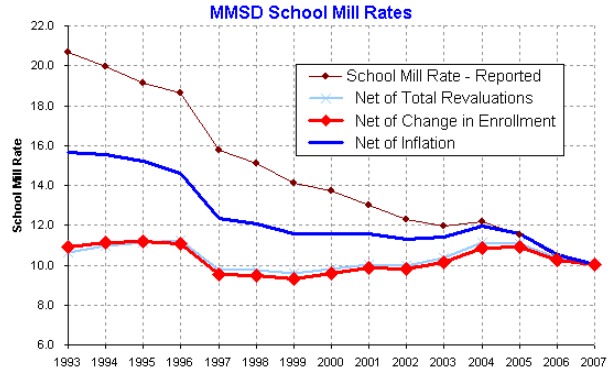
There are three important caveats to the above statements: 1.) school taxes are lower on average, but if your home has increased in value by more than about 110% since 1993, then you will be paying more for schools; 2.) it is the schools portion of property taxes that is lower on average; the remaining portion of property taxes that pays for the city, Dane County, Wisconsin, and MATC, has risen; 3.) other sources of Madison school funding (state and federal funds, and grants and fees) have also gone up; (I have not done the much more complicated calculation of real increase in funding there).
That the infamous schools’ portion of property taxes has declined over these past 15 years is quite a surprising result, and certainly counterintuitive to what one might expect. How is this possible? First, the school finance structure put in place by the state years ago has worked, at least as far as holding down property taxes. The current structure allows about a 2% increase in expense each year, consistent with the CPI (Consumer Price Index) at the state level. (In fact, local funding of the MMSD has increased from $150 million in 1993 to $209 million in 2007, equivalent to about a 2.4% increase each year.) Of course, the problem is that same structure allows for a 3.8% wage hike for teachers if districts wish to avoid arbitration, an aspect that has essentially set an effective floor on salary increases (with salaries & benefits representing 84% of the district budget). The difference between the revenue increases and the pay increases, about 1-2% annually, is why we face these annual painful budget quandaries that can only be met by cuts in school services, or by a referendum permitting higher school costs, and taxes.
The second reason today’s property taxes are lower than they have been historically is growth, in the form of new construction (i.e. new homes & buildings, as well as remodelings). What we each pay in school property taxes is the result of a simple fraction: the numerator is the portion of school expenses that is paid through local property taxes, while the denominator is the tax base for the entire city (actually the portion of Madison and neighboring communities where kids live within the MMSD). The more the tax base grows, the larger the denominator, and the more people and places to share the property taxes with. Since 1993, new construction in Madison has consistently grown at about 3% per year. Indeed, since 1980 no year has ever seen new construction less than 2.3% nor more than 3.9%. So every year, your property taxes are reduced about 3% thanks to all the new construction in town. I leave it to the reader to speculate how much the pace of new construction and revaluations will decline if the schools here should decline in quality.
FYI, the figure below shows how new construction and revaluations have behaved in Madison since 1984, as well as total valuations (which is the sum of the two).
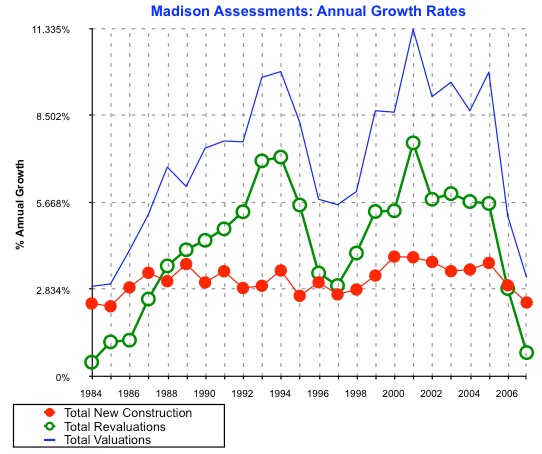
Share

Does Spending More on Education Improve Academic Achievement?


Dan Lips & Shanea Watkins:

Debates about how to improve public education in America often focus on whether government should spend more on education. Federal and state policy makers proposing new education programs often base their arguments on the need to provide more resources to schools to improve opportunities for students.
Many Americans seem to share this view. Polling data show that many people believe that government allocates insufficient resources to schools. A poll conducted annually from 2004 through 2007 found that American adults list insufficient funding and resources as a top problem facing public schools in their communities.[1]
While this view may be commonly held, policy makers and citizens should question whether histori cal evidence and academic research actually support it. This paper addresses two important questions:
How much does the United States spend on public education?
What does the evidence show about the relationship between public education spending and stu dents’ academic achievement?
The answers to these questions should inform federal and state policy debates about how best to improve education.
Twenty-nine states and the District of Columbia face budget shortfalls totaling approximately $48 billion for fiscal year 2009.[2] Even more states could face shortfalls in the near future. At the federal level, long-term budgets face a challenging fiscal climate. Pro jected growth of entitlement programs is expected to place an ever-increasing burden on the federal budget, limiting the resources available for other purposes, including education.[3]

Related: Charts – Enrollment; Local, State, Federal and Global Education Spending

Share

Some Texas school districts trying to bump up taxes

Terrance Stutz:

Two years after the Legislature cut school property taxes by a third, more than 100 school districts – including several from North Texas – will try to persuade voters this fall to bump their tax rates back up.
And a majority of those districts have found a way to avoid a tax rate election on the same day as the Nov. 4 general election, improving their prospects for voter approval of higher property taxes. Most are holding elections in early October.
The 103 school districts – about one in 10 statewide – say they are being squeezed financially and have to increase taxes to meet basic expenses and give their teachers a pay raise. Among them are the Austin and Corpus Christi districts.
“Most districts are hurting,” said Clayton Downing, president of the Texas School Coalition and former superintendent of Lewisville schools, noting that many districts in need of more revenue probably decided against a tax rate election this year because of the worsening economy.

Share

Rhee’s ‘Plan B’ Targets Teacher Quality
Strategy Might Include New Evaluation Process, Linking Licenses to Classroom Performance

Bill Turque:

Schools Chancellor Michelle A. Rhee is preparing to bypass the Washington Teachers’ Union in pursuit of the objective she considers essential to overhauling the District’s public schools: the power to fire at will teachers she deems ineffective.
What she calls “Plan B” involves a more aggressive use of powers she already has and that are not subject to contract negotiations with the union. These could include strengthening the existing system of annual personnel evaluations that spell out procedures for terminating teachers.
Rhee is also positioned to benefit from a potentially groundbreaking revision that has unfolded largely outside public view during contract talks. It would make the District school system one of the few in the country to link the licensing of teachers to their classroom performance, rather than their academic credentials. New rules, scheduled to go into effect this week, would grant State Superintendent of Education Deborah A. Gist the discretion to create an advanced teaching credential specifying the bench marks instructors would have to meet to keep their jobs.

Share

Performance-Pay Plans Leave Teachers Divided

Larry Abramson:

Two major urban school districts are working on new teacher contracts that could help decide the future of performance pay — which some consider the “flavor of the month” in education reform.
Public school administrators in the District of Columbia and Denver say their plans to reward effective teachers are the best way to raise teacher pay and improve student performance. But teachers are not always quick to agree.
D.C. Chancellor of Schools Michelle Rhee says teachers are getting a shot at an incredible pay increase.

Share

Colorado Amendment 59: does it shore up education or undermine TABOR?

Benry Morson:

It seemed like a good idea at the time.
Amendment 23, approved by voters in 2000, required funding increases to raise the state’s support for public schools to the national average.
But when Colorado’s economy soured in the early part of this decade, legslators found themselves slashing other programs — such as health care and higher education — to keep the promise to public schools.
Amendment 59 on the Nov. 4 ballot would resolve that problem in the future by creating a savings account for schools to be filled when economic times are good and spent when times are bad.
During those lean years, the legislature balanced the budget with “a lot of baling wire and duct tape,” said House Speaker Andrew Romanoff. “This (Amendment 59) is a much more responsible way to balance the budget.”

Share

Teacher Compensation Generation Gap

Paul Tough:

ne striking phenomenon revealed by the Denver negotiations was a generational split among teachers. Younger teachers were generally in favor the deal being offered, and older teachers tended to oppose it. (Some veteran teachers told the Denver Post that they felt “dissed.”)
A similar generational divide has appeared in D.C., where, as the Washington Post reported last month,
many of the District’s 4,000 public school teachers are locked in a heated debate over Chancellor Michelle A. Rhee’s proposal to offer salaries exceeding $100,000 for those willing to give up job security and tie their fates to student achievement. … The split in the teaching corps largely, but not exclusively, is occurring along generational lines, with younger teachers more willing to accept the risks and older ones often questioning the proposal.
The Post story mentioned an anonymous young teacher-blogger, “D.C. Teacher Chic,” who is a fan of Chancellor Rhee and is decidedly in favor of her new deal (under which teachers could choose a “green plan” that would trade tenure for a higher salary or a more traditional “red plan”). Her blog–often funny, usually outraged–offers a great insight into the mind of a teacher on the young side of this growing generational divide.

Share

We scrutinize MPS because we care about the community

Thomas Koetting:

Q. It seems sometimes that the Journal Sentinel does nothing but bash the Milwaukee Public Schools. There are a lot of people working for MPS who work hard to make a difference in kids’ lives. They are writing grant proposals to make it possible for kids to attend camps they couldn’t otherwise attend, and creating programs to keep kids involved in school and off the streets. As a former camp counselor and volunteer in the classroom, I know how important these things are.
A. I share your concern that our coverage can seem, at times, negative – not just about MPS, but about any number of community institutions we cover. It is an issue we talk about a great deal because we don’t just report on this area – we live here ourselves. What I would ask you to think about is that what drives us to report what may seem like a negative story is actually our concern, our passion, for our community.
When we write about a school board member going to a convention but never attending its sessions, it is because that money could have been used to improve the educational experience of students and teachers. When we write about the failure of the $102 million Neighborhood Schools Initiative building plan, it is because that money could have been used for other projects to transform the lives of students, teachers and staff alike. When we write about the district receiving a low level of funding to educate disabled children, it is because other districts seem to be taking better advantage of available money to improve the lives of children who already face so many challenges.

Share

Grand Prairie (Texas) parents drop schools not making grade

Katherine Leal Unmuth:

Rae Ann Forester was losing confidence in Grand Prairie High School’s academic program. Even though she was president of the Parent Teacher Student Association, she took a decisive step away from the school.
Parents whose children attend struggling public schools may feel like there’s no way out. But Ms. Forester and other persistent parents are taking control of their children’s education and finding options.
“What do you do in a school that’s low-performing?” Ms. Forester asked. “If we can’t get what we need from that specific campus, we do what we need to as a family. I do want people to have options, and that’s what I’m advocating.”
After the Texas Education Agency rated Grand Prairie High School “academically unacceptable” the previous two years, the school’s poor reputation prompted some families to act.

Share

School Governance in Washington, DC: The “Nuclear Option”

Paul Tough:

Today’s paper brings the news that Michelle Rhee, the superintendent of the D.C. public schools, has come up with a Plan B to use if the D.C. teachers union refuses to accept her proposed new contract.
Plan A, as I wrote last week, was a contract under which teachers could give up tenure in return for large pay increases. Plan B, essentially, is a system in which teachers lose tenure and don’t get large pay increases. Rhee says she and the state superintendent could also change the licensing requirements for the district’s teachers so as to require them to demonstrate classroom performance–the kind that would have earned them big bonuses under the contract–merely to keep their jobs.
The story in the Washington Post suggests that Rhee is not only aware of the city’s generation gap among teachers, she also plans to take advantage of it.
Rhee’s ultimate goal is clear: to weed the District’s instructional corps of underperformers and remake it, at least in part, with younger, highly energized graduates of such alternative training programs as Teach for America, where she began her career. Unlike many tenured Washington teachers, those emerging from such programs are unlikely to invest their entire working lives in education. But they will, in Rhee’s estimation, be more inclined to embrace her core message: that children can learn no matter what economic and social conditions they face beyond the classroom and that teachers should be held directly accountable for their progress through test scores and other measurements.

Share

School districts walk fine line between integration, discrimination

Kerry Lester:

The U.S. Supreme Court’s June 2007 decision to strike down integration plans in two public school districts was based on a simple premise: discrimination is discrimination.
“The way to stop discrimination on the basis of race,” Chief Justice John Roberts declared, “is to stop discriminating on the basis of race.”
In the wake of that ruling, large, ethnically diverse districts are now finding themselves in uncharted waters.
Though prohibited from using race-conscious measures to integrate their schools, districts also must ensure academic success for all students – regardless of skin color or neighborhoods in which they live.
The class-action racial bias suit pending against Elgin Area School District U-46 is one of the first major school discrimination cases to be decided since last year’s Supreme Court ruling.
Its outcome, experts say, could have for far-reaching effects.
“Class-action school cases are relatively rare,” said Michael Kaufman, Academic Dean and Director of the Child Law and Education Institute at Loyola University Chicago. “This case will almost by definition have profound implications in regards to remedies after last summer’s ruling.”

Share

You’re invited to attend the first national GREEN CHARTER SCHOOLS CONFERENCE November 7-9, 2008 in Madison, Wisconsin

The conference is presented by the Green Charter Schools Network, UW-Madison’s Nelson Institute for Environmental Studies, and many partnering educational and environmental organizations.
SEE CONFERENCE PROGRAM & ONLINE REGISTRATION HERE
Conference Keynoters:
William Cronon is UW-Madison Professor of History, Geography & Environmental Studies. His research seeks to understand the history of human interactions with the natural world and how we depend on the ecosystems around us to sustain our material lives, He is the author of several books, including Uncommon Ground: Rethinking the Human Place in Nature and Nature’s Metropolis: Chicago and the Great West.
Morgan Brown — Assistant Commissioner Morgan Brown oversees charter school programs, special education policy, food and nutrition services, adult basic education, and American Indian education programs at the Minnesota Department of Education (MDE). Previously, he served as the Assistant Deputy Secretary for the Office of Innovation & Improvement at the U.S. Department of Education.

Share

24/7 School Reform

Paul Tough:

In an election season when Democrats find themselves unusually unified on everything from tax policy to foreign affairs, one issue still divides them: education. It is a surprising fault line, perhaps, given the party’s long dominance on the issue. Voters consistently say they trust the Democrats over the Republicans on education, by a wide margin. But the split in the party is real, deep and intense, and it shows no signs of healing any time soon.
On one side are the members of the two huge teachers’ unions and the many parents who support them. To them, the big problem in public education is No Child Left Behind, President Bush’s signature education law. Teachers have many complaints about the law: it encourages “teaching to the test” at the expense of art, music and other electives, they say; it blames teachers, especially those in inner-city schools, for the poor performance of disadvantaged children; and it demands better results without providing educators with the resources they need.
On the other side are the party’s self-defined “education reformers.” Members of this group — a loose coalition of mayors and superintendents, charter-school proponents and civil rights advocates — actually admire the accountability provisions in No Child Left Behind, although they often criticize the law’s implementation. They point instead to a bigger, more systemic crisis. These reformers describe the underperformance of the country’s schoolchildren, and especially of poor minorities, as a national crisis that demands a drastic overhaul of the way schools are run. In order to get better teachers into failing classrooms, they support performance bonuses, less protection for low-performing teachers, alternative certification programs to attract young, ambitious teachers and flexible contracts that could allow for longer school days and an extended school year. The unions see these proposals as attacks on their members’ job security — which, in many ways, they are.
Obama’s contention is that the traditional Democratic solution — more money for public schools — is no longer enough. In February, in an interview with the editorial board of The Journal Sentinel in Milwaukee, he called for “a cultural change in education in inner-city communities and low-income communities across the country — not just inner-city, but also rural.” In many low-income communities, Obama said, “there’s this sense that education is somehow a passive activity, and you tip your head over and pour education in somebody’s ear. And that’s not how it works. So we’re going to have to work with parents.”

Share

Trickledown Ballot Should Help Madison Schools

Scott Milfred:

Holding school referendums in liberal Madison during major national elections has shown to have strategic advantages.
For one thing, young people vote in much higher numbers. And young adults will overwhelmingly support school referendums no matter the details or cost. That’s because they don’t pay property taxes, at least directly. They also have a high appreciation for schools because they are, or not long ago were, students.
Another advantage is that huge majorities of middle-aged and older voters in Madison are fed up with President Bush. Madison and the rest of the nation produced a Democratic landslide on Nov. 7, 2006, with the Iraq war overshadowing a largely-ignored Madison school building referendum that easily passed.

Share

Cry for change resounds in St. Paul schools

Emily Johns:

The St. Paul School District this fall is planning on engaging community members, parents and school district staff in an indepth discussion about the district’s future with one major premise: Things need to change.
The district, which serves about 38,800 students, faces considerable challenges. It has made more than $93 million in budget cuts over the last nine years. Only half its students are proficient in reading, the achievement gap between white students and students of color is among the widest in the nation, and federal and state expectations for student achievement are accelerating.
The district “is at a crossroads,” according to a presentation that district staff made to school board members on Thursday night. “Business as usual is not a sustainable option for achieving our mission.”
The St. Paul district’s efforts to comply with federal and state desegregation laws over the past 30 years and retain students have resulted in a complex network of magnet and neighborhood schools.

Share

A Look Back at a 2001 Dayton School Board’s Results

Scott Elliott:

Let’s remember back for a moment to the excitement of 2001. Gail Littlejohn, a retired corporate attorney, and three allies won four seats on the school board, taking control with a majority and promising big changes that would help lead the district back to respectability.
And for the first few years, the Kids First team had a remarkable run of successes. They replaced a well meaning but floundering superintendent with an efficient manager in Percy Mack, a move that was well received in the community. They put a reform in place that emphasized teacher training and focused on math and reading instruction. They got the NAACP and the state to agree to settle the 20-year-old desegregation case, bringing millions in cash and releasing the district from court supervision. They got a huge bond issue passed to rebuild all the schools in the city. Eventually, Dayton even had enough test score gain to jump from “academic emergency to “continuous improvement” in the state ratings. And for at least those first few years, Kids First got support from the rest of the school board, business leaders and much of the community.

Share

Later school start is good for state

Edward Lump:

I’d like to remind readers that the Wisconisn laws enacted in 1999 and 2001 actually came closer to reinstating a much older tradition of starting public school after Labor Day that goes back many, many years. As a matter of fact, school used to get out before Memorial Day as well.
A later school start date provides more time for family vacations and is good for the tourism industry. These days, family time is so important. Everyday life is hectic with so many activities and so much to do. Family time and the age-old tradition of the family vacation is critical to building strong families. And August has some of the best weather that Wisconsin has to offer, which makes it a great month for vacations.
On the other hand, June is usually cooler and wetter than August, and water temperatures are much cooler. Wisconsin summer tourism is based on water activities — late August is prime water sport season; June is not. Great family activities — such as Green Bay Packers training camp, the Milwaukee Brewers pennant drive and many county fairs — all create excitement and entertainment in late August.

Share

The nation’s fiscal wake-up call

Allan Knepper:

Recently, I joined a throng of 25 people in a theater with a capacity of 250 to view the premiere of the documentary “IOUSA.” The film, directed by Patrick Creadon, outlines the U.S. national debt, how we got to where we are and the dire predictions for the future. It is loosely coordinated around the “Fiscal Wake-up Tour,” a road show featuring former U.S. Comptroller General David Walker and Robert Bixby, executive director of the Concord Coalition.
I have been a huge fan of the straight-talking Walker since seeing him on CBS’ “60 Minutes” more than a year ago. He gave an impassioned interview then, outlining the rapidly growing federal deficit and its impact on current and future generations.
Joining in a live panel discussion after the film’s showing were Walker, Warren Buffett, Blackstone Group co-founder Peter Peterson, Cato Institute Chairman William Niskanen and AARP CEO Bill Novelli.
While I’m sure they were not as entertaining as the fantasy thrillers being shown in adjacent theaters, the facts and figures laid out in the movie were every bit as chilling as a horror movie to anyone who cares about the future of our country and the country we will leave to our children and grandchildren.
The movie commented on four types of deficits: the U.S. budget deficit, the U.S. trade deficit with other nations, the U.S. deficit of personal savings and a deficit of leadership in addressing these problems.

Share

Detroit’s Education Emergency

Bob DeVries:

The state of Michigan has had and continues to have significant financial problems. This is why it is baffling to me why the Granholm administration continues to pretend everything is OK in the Detroit public schools system.
Currently, Detroit Public Schools has a $400 million budget deficit. This is due to severe financial mismanagement, corruption, and the fact that families are removing their children from the public schools because of their inability to provide effective education. An attorney representing DPS has admitted that there is reason to believe there was some corruption, citing $46 million that was paid out by one department within the school district that was not apparently used to purchase goods or services. The FBI is currently investigating this and other allegations of corruption.
I think that it’s about time that we declare an “education emergency.” The purpose of this declaration will have three goals. First, we need to take drastic steps to make sure we are providing effective education to the children of Detroit. Second, Gov. Granholm needs to put DPS into state receivership. This means that the state Department of Education would temporarily appoint a financial manager for DPS who would have the final say on all financial decisions. Finally, we need to root out the corrupt and incompetent administration officials so that this tragedy does not again occur.

Share

Healthy school meal vs a Big Mac. Which one wins? Ask your inner child

Tim Hayward:

England is bringing in ‘the most robust nutrient standards for school lunches in the world’ – but we might have to force them down children’s throats
This week “the most robust nutrient standards for school lunches in the world” come into force in English primary schools. The new menus announced by the schools secretary, Ed Balls, include healthy versions of lunchroom standards – “from traditional roasts to chilli con carne and shepherd’s pie; from homemade salmon fingers and stir fries to risotto, with fresh fruit, vegetables and salads”.
Junk food is already banned from school canteens and vending machines – but the new standards specify the maximum (fat, saturated fat, sugar, salt) and minimum (carbohydrate, protein, fibre, vitamin A, vitamin C, folate, calcium, iron, zinc) nutrient value of an average school lunch.
Getting high-quality food into schools is only half the issue. According to Balls, many children who eat healthy lunches at primary school stop when they go to senior school – put off by long queues, unpopular menus or having to eat in the same room as teenagers six or seven years older. The guidelines move into new territory by suggesting kids won’t be put off school meals if they are treated “like the paying customers they are”.

Share

Indiana Governor Candidates Discuss Education

Niki Kelly:

ill Long Thompson unveiled a handful of education initiatives Wednesday while Republican Gov. Mitch Daniels introduced five campaign commercials, three of which focus on his own education proposals.
The two face off in November’s gubernatorial election.
“I don’t have all the answers, but we are not meeting our objectives,” Long Thompson said at a Statehouse news conference Wednesday.
One of her proposals is to provide a free book every month to all Hoosier children from birth to age 5. This is modeled after Tennessee’s partnership with Dolly Parton’s “Imagination Library,” but Long Thompson’s program would be paid for with private donations.
She also wants to allow kids who need the extra time and help to attend a fifth year of high school in an effort to improve Indiana’s graduation rate of about 76 percent.

Share

US Senator Herb Kohl Supports Merit Pay for Teachers

Pete Selkowe:

Kohl spoke at length about education, especially the failure of the public school system in Milwaukee, “where many neighborhoods are not inhabitable … a problem spread across the country. When we have a large number of people unproductive, who do you think pays for it? We all do.”
In answer to a question about school choice, and what the questioner called the “horrible” academic gap here in Racine, Kohl responded: “Anybody who had the answer would be lauded and sainted.”
He mentioned meeting with New York Mayor Mike Bloomberg and NY School Chancellor Joel Klein, and hearing from them “how important high standards and accountability are. We all know it’s not only the schools that fail; it’s the homes and neighborhoods the kids come out of. I would have very high, very high accountability, and reward good teachers, measure teachers. We need to find a way to pay teachers more, and the better ones more than that, and schools that fail should be closed.”
Kohl related his approach toward education to his firing of the Bucks GM and coach last year. “We were not getting the job done.” Ditto in education. “For too long we’ve not been willing to do enough to get the job done.”

Share

“Hole in the Wall” Education Researcher on Kids Teaching Themselves

TED:

In 1999, Sugata Mitra and his colleagues dug a hole in a wall bordering an urban slum in New Delhi, installed an Internet-connected PC, and left it there (with a hidden camera filming the area). What they saw was kids from the slum playing around with the computer and in the process learning how to use it and how to go online, and then teaching each other.
In the following years they replicated the experiment in other parts of India, urban and rural, with similar results, challenging some of the key assumptions of formal education. The “Hole in the Wall” project demonstrates that, even in the absence of any direct input from a teacher, an environment that stimulates curiosity can cause learning through self-instruction and peer-shared knowledge. Mitra, who’s now a professor of educational technology at Newcastle University (UK), calls it “minimally invasive education.”

Share

L.A. elementary school adds a year to keep students on track

Mitchell Landsberg:

Armando Sosa’s elementary school is just a quick scramble up a steep dirt path and over a crosswalk from his home in Ramona Gardens, an Eastside housing project known for its crime and violence. If he’s late, he can hear the school bell from his bedroom.
His mother, Liliana Martinez, loves Murchison Elementary but worries that Armando’s zeal for learning will wither in middle school. She has seen too many children from the projects nose dive in sixth grade and begin gravitating toward the gang life that has devoured the youth of Ramona Gardens for generations.
So, along with other mothers, most of them Mexican immigrants struggling for a foothold in U.S. society, Martinez helped start a movement to keep children at Murchison at least through sixth grade. That is typically the first year of middle school.
Goal achieved.
When the new school year starts Wednesday, about 100 sixth-graders will be staying at Murchison, instead of being bused across the tracks to El Sereno Middle School, where parents and teachers say they face teasing and bullying because they are poor and come from a housing project.

Share

College prep blends with job training

Chris Moran:

Sometimes it’s unclear which of Manuel Santos’ classes are college prep and which are vocational. Last year, he took medical terminology, classified as vocational but heavy on the advanced vocabulary he’ll need if he majors in pre-med in college.
And though the Sweetwater High School senior has taken all the advanced science courses he needs to be admitted to his top college choice, the University of California Berkeley, it may be another vocational course, medical assistant training, that is best preparing him for pre-med.
National City’s Sweetwater High and schools across San Diego County are developing a new brand of education that is a hybrid of college-prep and job training, a series of classes that will equip high school graduates to simultaneously impress employers and university admissions counselors.
New and more sophisticated job-training classes have emerged as a response to calls from industry for a skilled, homegrown work force and the rising awareness of a dropout epidemic among students who don’t find school relevant.

Share

Improving School Leadership

OECD – Directorate for Education:

School leaders in OECD countries are facing challenges with the rising expectations for schools and schooling in a century characterized by technological innovation, migration and globalization. As countries aim to transform their educational systems to prepare all young people with the knowledge and skills needed in this changing world, the roles and expectations for school leaders have changed radically. They are no longer expected to be merely good managers. Effective school leadership is increasingly viewed as key to large-scale education reform and to improved educational outcomes.
With 22 participating countries, this activity aims to support policy development by providing in-depth analyses of different approaches to school leadership. In broad terms, the following key questions are being explored:

Share

The first day of school meant a host of changes for one district, which had to close two elementary schools last year.

Norman Draper:

The first day of school Tuesday marked a big change for Naomi Wills and her kids: They started out at a bus stop bound for a big, new school.
In past years, the morning routine involved Wills walking son Luke and daughter Larissa the two blocks to Osseo Elementary. Younger daughter Natalie, not yet in school, would tag along. Then, more often than not, Wills would linger and chat with the principal and teachers.
But Osseo Elementary, loved by parents, teachers and kids for its small size, hometown feel, and convenient walking distances, was closed by the cash-strapped Osseo School District last year.
“One of the first things that hit me when we found out the school was closing was that all those years my kindergartner would walk with her older siblings to school, and, now, she won’t get to walk there,” Wills said.

Share

Head of the Class: Finding the Right School for Your Child

Ariel Swartley:

For 20 years Sandra Tsing Loh has taken satirical shots at Los Angeles and her own growing pains without making the tiresome error, committed by nonnative observers from Joan Didion to Caitlin Flanagan, of conflating the two. Her aim is generally dead-on; her gun emplacement is even better. We not only can read the Malibu-raised Loh in The Atlantic Monthly, where she’s a contributing editor, on her Los Angeles Times blog, and in comic memoirs like A Year in Van Nuys. We can also hear her on KPCC and see her turn her elegant Chinese German face to Silly Putty in performance pieces.
Whatever the target–eye bags, ethnicity, envy, Christmas–Loh’s a linguistic Muhammad Ali, floating and stinging at a pace that would drive a hummingbird to wing splints. At times her approach has left some of her frailer subjects exhausted along with her audience. With Mother on Fire (Crown, 320 pages, $23), her new memoir expanding on the one-woman show of the same name that debuted in 2005, she’s taken on an issue scary enough to warrant her biggest guns: getting your child an education.
How harrowing, you tax-gouged nonparents may wonder, can this be? In my experience the trauma of a difficult birth is nothing compared with the scars of being polite to a teacher who has forbidden a second grader to look at a book that intrigues her “because it’s too hard.” These don’t fade even after said child has obtained a graduate degree. Schooling, in short, pushes buttons. In Los Angeles, it’s also tied to a full range of inflammatory issues, from immigration to celebrity.

Clusty Search: Sandra Tsing Lo.

Share

Schools use 4-day week to cut costs

Jeremy Hobson @ Marketplace:

One of the states that’s most on-board with the four day school week is Colorado. Mostly because it’s so rural, which means long bus routes.
WENDY DUNAWAY: As of 2007, we had 67 out of 178 districts that are on a four-day week.
That’s Wendy Dunaway with the Colorado Department of Education. She says the districts that have switched are almost all rural and are generally happy with the change.
On a rainy afternoon at a hotel in Colorado Springs, about 25 people gather in a medium-sized conference room. They are parents, teachers and administrators from the Calhan School District, which has been on a four-day schedule since the last energy crisis nearly three decades ago.

Share

School District Consolidation in Pennsylvania

Martha Raffaele & Ramesh Santanam:

Pennsylvania will be shedding a school district by the end of this school year — a significant development even after years of nationwide efforts to nudge and sometimes force school systems to share services or merge.
The merger unfolding between two western Pennsylvania public school systems with sharply declining enrollments is the state’s first district consolidation in at least 20 years, and most notably, its first voluntary one.
Officials say the move will save money and improve educational offerings, yet parents in both districts worry that some losses will accompany any gains. In any case, the consolidation is expected to be closely watched.
The willingness of two school districts to dissolve boundary lines is rare in states where local school board control is sacrosanct and school traditions that define a community are deeply ingrained. In recent years, at least a few states have tried to force mergers, with mixed results.
Yet the marriage of the Center Area and Monaca school districts northwest of Pittsburgh is part of a gradual, ongoing national progression toward fewer districts educating public school students.

Share