School Information System

Success and Scrutiny at Hebrew Charter School

Jennifer Medina:

Every so often, Aalim Moody, 5, and his twin sister, Aalima, break into a kind of secret code, chatting in a language their father does not understand.
Walking along Flatbush Avenue in Brooklyn, they make out the lettering on kosher food shops and yeshiva buses, showing off all they learn at the Hebrew Language Academy Charter School in Midwood, where they both attend kindergarten.
Ask Aalim his favorite song and he will happily belt out:
“Eretz Yisrael sheli yaffa v’gam porachat!” — My land of Israel is beautiful and blossoming! — and then he continues in Hebrew:
Who built it and who cultivated it?
All of us together!
I built a house in the land of Israel.

Share

What’s holding up the FCAT scores?

Cara Fitzpatrick:

For students and their parents, the wait for FCAT scores has been endless.
Results of this year’s writing tests were due in April, but the state Department of Education has yet to release them.
The same goes for the reading, math and science scores that the state had expected to release by late May for fourth graders through high school juniors. So far, only third graders have received their math and reading results.
Even with the DOE finally planning to issue the scores early next week, people want to know: What went wrong?
The answer centers on Pearson Plc., a giant London-based media and education company that last year won a $254 million, multiyear contract with the state to handle Florida’s high-stakes standardized test.

Share

Education Secretary Arne Duncan Gets Unwelcomed at Foothill College

E. Wentworth:

Union buster and privatizer Arne Duncan is the US Secretary Of Education. He has supported the mass firing of teachers and is working with privateers to destroy public education. Demonstrators protested at Foothill Community College where Duncan was the keynote speaker yesterday. Duncan is scheduled to speak again at DeAnza College graduation ceremony in Cupertino this morning.
United Public Workers for Action (UPWA) called for a demonstration when it was announced that US Secretary of Education Arne Duncan would be the keynote speaker at Foothill Community College’s graduation ceremony on June 25. After receiving permission from the college administration early this week to stage a peaceful protest, Skyline Community College instructor George Wright received calls from Foothill College president Judy Miner asking that he cancel the planned demonstration. He also received calls from Arne Duncan’s counsel trying to convince George that Duncan should not be the target of protesters.

Share

School Is Turned Around, but Cost Gives Pause

Sam Dillon:

As recently as 2008, Locke High School here was one of the nation’s worst failing schools, and drew national attention for its hallway beatings, bathroom rapes and rooftop parties held by gangs. For every student who graduated, four others dropped out.
Now, two years after a charter school group took over, gang violence is sharply down, fewer students are dropping out, and test scores have inched upward. Newly planted olive trees in Locke’s central plaza have helped transform the school’s concrete quadrangle into a place where students congregate and do homework.
“It’s changed a lot,” said Leslie Maya, a senior. “Before, kids were ditching school, you’d see constant fights, the lunches were nasty, the garden looked disgusting. Now there’s security, the garden looks prettier, the teachers help us more.”

Share

Milwaukee Teacher’s Union Eats Its Young

Bruce Murphy:

In the last couple weeks, we’ve seen the dispiriting spectacle of layoff notices going to nearly 500 Milwaukee Public Schools teachers. This includes some excellent ones let go simply because they have less seniority. This will mean even bigger average class sizes – and further declines in quality – for a district already struggling badly. And a clear culprit is the teachers union.
The union has always been more concerned about its veteran teachers, more worried about pensions than starting salaries for new teachers. Union officials have argued that this “career ladder” will attract new teachers, but that’s nonsense: What twentysomething teacher is thinking about a retirement that is at least 30 years away? Milwaukee teachers were already part of the excellent state pension system, yet back in the late 1990s, the union successfully pushed for an unneeded, supplementary plan that used local tax dollars to sweeten the pension for a select group of long-term teachers.
MPS officials argue that none of the recent layoffs would have been necessary if the union would agree to switch from its Aetna insurance plan to a lower-cost plan offered through United Healthcare. This could save the district some $48 million, enough to prevent any job layoffs for teachers, school board president Michael Bonds claims. “I’m not aware of any place in the nation that pays 100 percent of teachers’ health care benefits and doesn’t require a contribution from those who choose to take a more expensive plan,” Bonds told the press.

Share

Three Phases of Educational Technology

Douglas Crets:

A teacher and techie gives a presentation on how technology gets integrated into teaching in systematic ways.

Share

Scary things in U.S. report on school vouchers: “The Program significantly improved students’ chances of graduating from high school”

Valerie Strauss:

This isn’t actually about vouchers. It’s about a new government report (pdf) on a school vouchers program in Washington, D.C., that reveals just how perversely narrow our view of “student achievement” has become.
Issued this week by the Education Department, the report is the final evaluation of the D.C. Opportunity Scholarship Program ordered by Congress.
The program was the first federally funded private school voucher program in the country. Since 2004, more than 3,700 students — most of them black or Hispanic — have been awarded scholarships, each worth up to $7,500 tuition. Since Congress refused to reauthorize the program, no new students are being accepted.
The new evaluation of the program is remarkable for how it describes student achievement. It says: “There is no conclusive evidence that the OSP affected student achievement.”
What is student achievement? In this report it is all about standardized test scores. The evaluation says:
“On average, after at least four years students who were offered (or used) scholarships had reading and math test scores that were statistically similar to those who were not offered scholarships.”

I wonder how much was spent per student in the voucher schools vs the traditional public districts?
Somewhat related: Wisconsin Senator Russ Feingold voted to kill the DC Voucher program, along with the Democrat majority.

Share

U.S. education chief talks change at Mill Valley event

Rob Rogers:

America needs to make “fundamental, dramatic change” to the kind of education called for in the No Child Left Behind Act of 2001, U.S. Secretary of Education Arne Duncan said Friday in a meeting with local educators in Mill Valley.
The nation’s education chief said the federal government should reward rather than punish struggling schools, that it should support art, music and physical education classes in addition to math and science and that it should encourage reforms that come from the local level, rather than imposing them from on high.
“The law needs to be less punitive. Right now, there are 50 ways for schools to fail for every way there is for them to succeed,” Duncan said. “And we have to make sure students have a more well-rounded education, not just in high school, but in the first and second grade.”
But Duncan had few specific examples of those changes, which he outlined before a crowd of Marin and Sonoma teachers, administrators and school board members at an event hosted by Rep. Lynn Woolsey, D-Petaluma, at Tamalpais High School.

Share

Ed. Secretary Duncan: Black Male Teachers Needed

NewsOne:

He’s the head of education for the entire United States and he’s calling all black men to the front- of the classroom- that is.
This fall, Education Secretary Arne Duncan plans on touring historically black colleges and universities in hopes of increasing the number of black men teaching in America’s public schools- which is currently less than 2 percent.
Is placing black men in the classroom the answer to solving some of the problems in the black community such as gang violence, high school drop out rates, and fatherless homes? Secretary Duncan thinks so. Do you agree, or disagree?

Share

Google Moves Encrypted Search to New Domain

Audrey Watters:

Google announced today that it was moving domains for its encrypted search from https://www.google.com to https://encrypted.google.com.
In May Google launched an encrypted version of its Web search, allowing users to enable a Secure Sockets Layer (SSL) connection to encrypt their information as they searched.
As ReadWriteWeb reported, this move ran afoul of some school districts’ web filtering requirements, forcing them to possibly block access to other parts of the Google secure domain.

There is certainly a message in this change.

Share

Fox Valley leaders take wait, see approach on school funding overhaul

Ben Jones:

“The devil is in the details, obviously,” Paul Hauffe, director of business services in the Neenah Joint School District, said Friday. “And how will it affect one district versus another, and what actually is the change going to be? We’re keeping an eye on it.”
Wisconsin education leaders on Thursday praised the proposed plan, which would do away with $900 million in property tax credits for homeowners and instead give the money directly to schools.

Share

Vicki McKenna on Reduced Class Time for Madison’s Grade 6-12

25mb mp3 audio file. Much more on the increased adult to adult expenditures and staff time in the Madison School District here.

Share

Vancouver School Board’s Budget pain is not unique

Gary Mason:

Name-calling going on in the city belies reality that education budgets being slashed across Western Canada
For weeks now there has been an entertaining fight going on between the Vancouver School Board and the B.C. Education Ministry. It has often devolved into petty name-calling. There have been public tears, accusations and counter-accusations.
The public doesn’t quite know who to believe.
Boards in B.C. have to balance their budgets by law. The Vancouver board says it has a $17-million shortfall, mostly because the province doesn’t give it enough money to operate. Balancing its budget will mean closing schools, the board chair has said, which will be a blow to many parents and their children.
The government blames the problem on the incompetence of the board. It remains to be seen just how long Education Minister Margaret MacDiarmid will allow the current group of trustees to continue running the show.
Such drama.

Share

Education innovation in the slums

Charles Leadbeater:

Charles Leadbeater went looking for radical new forms of education — and found them in the slums of Rio and Kibera, where some of the world’s poorest kids are finding transformative new ways to learn. And this informal, disruptive new kind of school, he says, is what all schools need to become.

Share

Aviary Online Education Tools

www.aviaryeducation.com:


• Create private student accounts
• Manage assignments and projects
• Use the image editor, vector editor, audio editor & music creator
• All content and images are 100% school safe

Share

Mathematica Study on KIPP Middle Schools

Mathematica Policy Research:

To understand our impact and communicate it to the public, KIPP has commissioned Mathematica Policy Research to conduct a rigorous, third-party evaluation that will examine how KIPP students fare over the long term. The Atlantic Philanthropies, the Laura and John Arnold Foundation, and the William and Flora Hewlett Foundation provided the lead support for the Mathematica evaluation of KIPP middle schools.
The Mathematica study will help us understand the degree to which KIPP schools make a difference for our students in both academic and non-academic outcomes, including achievement and motivation. The first report from the Mathematica study of KIPP middle schools was published on June 22, 2010. The next report is due to be released in late 2012.
Key Findings:
1. KIPP does not attract more able students (as compared to neighboring public schools).
2. KIPP schools typically have a statistically significant impact on student achievement.
3. Academic gains at many KIPP schools are large enough to substantially reduce race and income-based achievement gaps.
4. Most KIPP schools do not have higher levels of attrition than nearby district schools.

Share

A Proposal To Rewrite Wisconsin’s $5,200,000,00 in Redistributed State Tax Dollars for K-12 Districts

Scott Bauer:

The school levy credit shows up as a reduction on property tax bills mailed in December, and killing it would be difficult politically.
But according to Dale Knapp of the Wisconsin Taxpayers Alliance, the proposal would simply move money around and would have little effect on the problems schools face.
“Some districts will pay less, some will pay slightly more, but the schools will be in the same boat they were before,” he said.
The state uses the school levy tax credit to help reduce property taxes that provide local money for schools. It was created in 1996 and it has grown by more than 400 percent since.
Evers stressed that putting the tax credit money into the aid formula, then redistributing it to schools under a reworked formula, would not result in a net increase statewide in property taxes. It would, however, mean higher or lower taxes for individuals, depending on their school district.

Share

Study: N.Y. Soda Tax Would Curb Obesity, Diabetes

R.M. Schneiderman:

New Yorkers seem to oppose Gov. Paterson’s proposed penny-per-ounce tax on sugar-sweetened beverages. But over the next decade, the tax could curb soda consumption and prevent tens of thousands of cases of adult obesity and Type 2 diabetes, a change that would save state residents an estimated $2.1 billion in related medical expenditures, according to a new study commissioned by the New York City Health Department.
The study, conducted by Dr. Claire Wang, a professor of health policy and management at Columbia University, analyzed various surveys on sugary drink consumption, related health risks and the effects of price on consumer choices. The findings: a soda tax would reduce consumption of sugary beverages by 15% to 20%. It would also prevent an estimated 37,000 or more cases of Type 2 diabetes and an estimated 145,000 or more cases of adult obesity over the next decade.

Share

Bloomberg: Obama’s Greatest Challenge is Education

Keren Blankfeld:

New York City Mayor Michael Bloomberg just spent 20 minutes speaking with New York Times’ chairman Arthur Sulzberger, Jr. at the New York Forum.
Following are some of the highlights from that conversation:
– The government’s first job is to promote economic activity. Give people the ability to enjoy life, keep food on plate, roof on head.
– The big problem NY State faces is that its number one industry is finance. Washington has forgotten that the economic engine for the United States is finance. Nothing works without it. Credit derivative swaps don’t sound good, so the government decided to go after the banks. That is potentially very damaging to the country. If you want to create jobs you have to have banks willing to provide loans. You can’t have it both ways.

Share

Nashville mayor: Education is key to attracting tech jobs

G. Chambers Williams:

Improving public education remains the top goal of Mayor Karl Dean as his administration and the Nashville Area Chamber of Commerce begin work on a new five-year economic development plan.
Education is the key to bringing higher-paying technology jobs to Nashville, a key focus of the so-called Partnership 2020 initiative outlined at a chamber gathering Monday afternoon.
It’s a new take on the program the city and the chamber first launched in 1990, which most recently has been known as Partnership 2010 and has been credited with bringing more than 600 new companies to the area over those two decades.
“Our focus has changed,” the mayor said before addressing chamber members. “There will be more of an emphasis on facets of our economy such as music, where a lot of the technology jobs will be created. But education is the single biggest thing we need to get right.”

Share

Ottawa-Carleton School board passes two-year budget (C$10,829/student)

Matthew Pearson:

Committing a future board to making cuts — particularly when this is an election year — was difficult for some trustees to swallow, but the Ottawa-Carleton District School Board passed a balanced budget late Tuesday night.
Weary applause broke out after the final vote was tallied and board chair Cathy Curry declared the process over for another year.
“Superintendent Clarke, your blood pressure can go right back down to normal levels,” she joked.
With the public school board facing a $14.9-million deficit, it was Michael Clarke, the board’s chief financial
officer, who devised a two-year plan that would see trustees approve some cuts for the 2010-2011 school year and some for the following year.
Otherwise, Clarke said, a year from now, the board could face even tougher challenges and have less money to address them.
But with a school board election in the fall and fears the proposed cuts could cause unnecessary grief for the public, some trustees opposed the idea of a two-year plan.

The Ottawa-Carleton proposed budget was C$731,100,000 for 67,511 students (C$10,829/student). Madison spends US$15,241 per student.

Share

K-12 Tax & Spending Climate: Chancellor Merkel Rebuffs President Obama’s Call to Boost Spending (and deficits)

Marcus Walker & Matthew Karnitschnig:

Chancellor Angela Merkel roundly rebuffed U.S. President Barack Obama’s call for Germans to aid the global recovery by spending more and relying less on exports, even as she warned that Europe’s own financial crisis is far from over.
In an interview with The Wall Street Journal in her Berlin chancellery, an unapologetic Ms. Merkel said the nations that share the beleaguered euro have merely bought some time to fix the flaws in their monetary union. She called on the Group of 20 industrial and developing nations meeting in Toronto this weekend to send a signal that tougher financial-market regulation is on its way to dispel the impression that momentum is fading amid resistance by big banks.
She took aim at an idea voiced by France, the U.S. and others that Germany could help global producers by spurring its persistently weak consumer demand. The latest call came in a letter last Friday from Mr. Obama to the G-20, in which he asked big exporters–Germany, China and Japan–to rebalance global demand by boosting consumer spending rather than exports.

Share

HP to sell $300 netbook for heavy-duty classroom use

Frank Michael Russell:

Palo Alto computer and printer giant Hewlett-Packard is introducing a $300 netbook PC for heavy-duty classroom use.
The HP Mini 100e Education Edition is designed “to close the digital divide by offering students and teachers an interactive learning experience at an affordable price,” HP said in a statement Wednesday.
“HP is committed to helping schools adapt to students’ changing needs and to creating solutions that provide better interactivity, connectivity and learning,” Dan Forlenza, vice president and general manager of business notebooks in HP’s personal systems group, said in the statement.

Share

Moody’s downgrades Waukesha School District credit rating

Amy Hetzner:

For the second time in two years, Moody’s Investors Service has downgraded the credit rating of the Waukesha School District, the latest time after the School Board voted to not allocate any money toward a $47.5 million debt owed to a European bank.
According to a Moody’s report, the amount owed represents about 35% of the district’s annual operating budget.
As a rule, lower credit ratings translate into higher interest rates for borrowing. However, Waukesha School Board President Daniel Warren said Monday that the credit rating drop should not have an immediate effect.
“When Moody’s does a downgrade, it primarily affects long-term borrowing, and we don’t have any long-term borrowing on our horizon,” he said.
The A1 rating given to the district, which has a substantial tax base and relatively wealthy residents, is the lowest rating given by the service to school districts in the state, according to information from Moody’s Investors Service.
Warren said his board decided not to allocate any money toward resolving the debt to DEPFA Bank because “the school district was not in a position to afford an additional $48 million in next year’s budget.”

Madison’s current Assistant Superintendent for Business Services, Erik Kass, previously worked for the Waukesha School District.

Share

Grockit offers online tutoring, test prep

Douglas MacMillan:

Think of it as summer school for the Facebook generation.
That’s the idea behind Grockit Inc., a San Francisco startup that offers tutoring and test prep online. The company aims to take on companies like Kaplan and the Princeton Review Inc. by undercutting their prices, offering more custom features and using social networking to appeal to students.
The site lets users collaborate and socialize while studying, giving them more reasons to keep coming back. The challenge is winning the trust of parents, who may be more comfortable relying on established names to get their kids into top colleges. A handful of players dominate test preparation and course supplements, a market worth more than $1 billion, according to research firm Outsell Inc.

Share

D.C. school vouchers — the last word?

Mike DeBonis:

On Tuesday, the U.S. Department of Education issued its final evaluation of the D.C. Opportunity Scholarship Program — aka school vouchers.
To review, the federally funded voucher program is on life support. The Democratic Congress has thus far resisted attempts to reauthorize the program. The Obama administration last year budgeted enough money to allow current voucher holders to complete their high school educations, but not enough to allow new applicants; Congress has maintained that approach since.
So will the study move the ball? Here’s what it found: (a) “There is no conclusive evidence that the [voucher program] affected student achievement.” (b) The program “significantly improved students’ chances of graduating from high school” — by 12 percent. And (c), the program “raised parents’, but not students’, ratings of school safety and satisfaction.”
An initial glance at those results — no rise in test scores, but a significant rise in graduation rates — would fall into the category of mixed results. And mixed results, given the heated political climate under which the voucher program operates, means plenty of room for spin.

Share

Fulton school board adopts $803 million budget (About $8,922 per student. Madison Spends $15,241 Per Student)

Gracie Bonds Staples:

The Fulton County Board of Education gave final approval Tuesday to a $803.1 million budget for the 2011 school year.
Although the district is still waiting on numbers from the tax assessor’s office, the final tally was based on increasing the millage rate by 1 mill.
“This has been the must difficult budget year that I’ve ever seen,” said Superintendent Cindy Loe.
The board is expected to tentatively adopt the millage rate at 11 a.m. Tuesday at the district’s administrative center. It will then hold three public hearings: on July 6 at 11 a.m. at the administrative center and at 6 p.m. at Dunwoody Springs Elementary Charter School in Sandy Springs; and 10:30 a.m. July 15 at the administrative center.

Fulton County Schools statistics. Notes and links on Madison’s per student spending here.

Share

DC Vouchers Boost Graduation Rate

Matthew Ladner:

The Department of Education released the final report of the evaluation of the DC Opportunity Scholarship Program today. The major finding of this report, and it is MAJOR, is that students who were randomly selected to receive vouchers had an 82% graduation rate. That’s 12 percentage points higher than the students who didn’t receive vouchers. Students who actually used their vouchers had graduation rates that were 21% higher. Even better, the subgroup of students who received vouchers and came from designated Schools in Need of Improvement (SINI schools) had graduation rates that were 13 percentage points higher than the same subgroup of students who weren’t offered vouchers-and the effect was 20 percentage points higher for the SINI students who used their vouchers!
This is a huge finding. The sorry state of graduation rates, especially for disadvantaged students, has been the single largest indicator that America’s schools are failing to give every student an equal chance at success in life. Graduating high school is associated with a number of critical life outcomes, ranging from lifetime earnings to incarceration rates. And, despite countless efforts and attempts at reform, changing the dismal state of graduation rates has been an uphill battle.
Of course, the uphill battle will continue. As most are aware, Congress voted to kill the DC voucher program last year, despite evidence that the program had significantly improved reading achievement for students who received scholarships. That evidence didn’t count for much when faced with opposition from teachers’ unions.

Share

Growth of AP in Seattle – sort of

Charlie Mas:

In the Advanced Learning work session there was a slide that showed the growth of AP and IB in the District. It is true that many more students are taking AP classes than ever before. But it doesn’t necessarily mean what you think it means.
Take, for example, Roosevelt High School. At Roosevelt about half of the 10th grade students used to take AP European History. This is typically the first AP available to students, one of the few open to 10th grade students on the typical pathway. The class is challenging for 10th grade students and the fact that about half of the students took it is a testament to Roosevelt’s academic strength. The other half of the students took a history class similar to the one that students all across district and the state take in the 10th grade.

Share

Reduced Grade 6-12 Class Time in the Madison School District?

Susan Troller:

What’s one sure-fire way to stress out parents? Shorten the school day.
And that’s exactly what the Madison school district is proposing, starting next year, for grades six to 12. According to a letter recently sent to middle school staff by Pam Nash, the district’s assistant superintendent of secondary schools, ending school early on Wednesdays would allow time for teachers to meet to discuss professional practices and share ideas for helping students succeed in school.
“I am pleased to announce that as a result of your hard work, investment and commitment, as well as the support of central administration and Metro busing, together we will implement Professional Collaboration Time for the 10-11 school year!” Nash wrote enthusiastically.
Despite Nash’s letter, district administrators appeared to backpedal on Monday on whether the plan is actually a done deal. Thus far there has not been public discussion of the proposal, and some teachers are expressing reservations.
Some middle school teachers, however, who also happen to be parents in the district, say they have some serious concerns about shortening the day for sixth-, seventh- and eighth-graders. Not only will there be less time spent on academics each week, they say, but the additional unsupervised hours will pose a problem for parents already struggling to keep tabs on their adolescent kids.

This expenditure appears to continue the trend of increased adult to adult expenditures, which, in this case, is at the expense of classroom (adult to student) time.
Related: Ripon Superintendent Richard Zimman:

“Beware of legacy practices (most of what we do every day is the maintenance of the status quo), @12:40 minutes into the talk – the very public institutions intended for student learning has become focused instead on adult employment. I say that as an employee. Adult practices and attitudes have become embedded in organizational culture governed by strict regulations and union contracts that dictate most of what occurs inside schools today. Any impetus to change direction or structure is met with swift and stiff resistance. It’s as if we are stuck in a time warp keeping a 19th century school model on life support in an attempt to meet 21st century demands.” Zimman went on to discuss the Wisconsin DPI’s vigorous enforcement of teacher licensing practices and provided some unfortunate math & science teacher examples (including the “impossibility” of meeting the demand for such teachers (about 14 minutes)). He further cited exploding teacher salary, benefit and retiree costs eating instructional dollars (“Similar to GM”; “worry” about the children given this situation).
Share

Competition boosts public schools

The Tampa Tribune:

During a debate last February in Tallahassee on a proposal to expand a scholarship program that allows poor children to go to private schools, state Sen. Frederica Wilson decried the legislation.
“We’re taking children out of the public schools and making them weaker,” the Miami Democrat said. “This is not America.”
A recent study by a highly regarded Northwestern University researcher shows how wrong Wilson was. Florida voters are fortunate that the Legislature passed the bill and Gov. Charlie Crist signed it into law.
The study found public schools’ performance improved when they were faced with the possibility of losing students to private schools.
At issue is the Florida Tax Credit Scholarships, which provide vouchers to children from poor families.

Share

Birthplace of charter schools tightens controls and increases accountability of sponsors

Maureen Downey:

One thing that remains murky to me is how accountable the state Charter Schools Commission – which a Fulton County judge recently ruled is constitutional – is for the schools that it approves over the objections of local boards of education. The commission is here in Atlanta, but it is approving schools across the state.
As the authorizer of the schools, how is the commission held accountable if one goes bad or if parents are unhappy and can’t go to the local school board to complain since the local folks had nothing to do with the school’s approval?
At a media briefing earlier this year, Charter Schools Commission member Jennifer Rippner surprised me when I asked whether parents of students in a commission charter school could ultimately turn to the charter commission with complaints that they felt were not being dealt with by the school itself or its board of directors.

Share

Wisconsin Gubernatorial Candidate Mark Neumann Wants To Get Rid Of Teacher Certification

Channel3000.com, via a kind reader:

Republican gubernatorial candidate Mark Neumann is proposing to get rid of state certification for teachers as part of an education reform plan.
Neumann also is proposing a series of incentives that will encourage private schools and public charter schools to compete with and replace failing public schools.
Neumann is outlining his plans during news conferences in Milwaukee, Madison and Green Bay.
In a phone interview, he said the state should provide suggested qualifications for educators, but actual hiring decisions should be left up to local school boards, superintendents and principals.
Neumann acknowledges that many of his proposals would need approval from the Legislature.

Related: Janet Mertz: An Email to Madison Superintendent Dan Nerad on Math Teacher Hiring Criteria.

Share

San Francisco Schools $578,572,407 Budget Discussions ($10,331 per student, 47% less than Madison)

Jill Tucker:

The San Francisco school board will face the unsavory task Tuesday of approving a budget that cuts virtually every program offered to the city’s schoolchildren.
Art would be cut. Music too. Counselors. Physical education. Books. Summer school. Teachers. Custodians. Administrators.
All cut by a little or a lot.
The 444-page budget document up for a vote Tuesday, the board’s last meeting before summer break, has been months in the works as district officials struggled to figure out how to balance the books despite a $113 million budget shortfall expected over the next two years.
“It’s not a good budget,” said board member Rachel Norton. “How could you say that cutting 20 percent of the programs is a good budget? But it really could have been so much worse.”
The $578 million spending plan includes $255 million in restricted money that has to be spent on specific programs, including special education, school meals and facilities. The rest pays for salaries and the day-to-day costs of educating the district’s nearly 50,000 students and running its 105 schools, 34 preschool sites and nine charter schools.

Madison’s 2009-2010 budget was $370,287,471, according to the Citizen’s Budget, $15,241 per student (24,295 students). More here.
San Francisco’s 3.4MB budget document includes detailed per school allocations (numbered page 51, document page 55)

Share

New York U.’s Abu Dhabi Campus to Start With Academically Elite Class

Andrew Mills:

Having accepted just 2.1 percent of applicants for its first freshman class, the liberal-arts college that New York University plans to open in Abu Dhabi this fall has positioned itself as one of the world’s most selective undergraduate colleges.
NYU Abu Dhabi, which its administrators like to call the “world’s honors college,” announced on Monday that its first class would be made up of 150 students who speak 43 different languages in all and hail from 39 countries.
The 63 women and 87 men, forming a female-to-male ratio of 42 percent to 58 percent, have met high standards.
Their SAT critical-reading scores are projected to be 770 at the class’s 75th percentile. Their 75th-percentile scores for SAT mathematics are projected to be 780, according to statistics released by NYU Abu Dhabi.

Share

Protecting Georgia schools 
is Porter’s passion

Bill Rankin:

In the Legislature, Porter chaired key education committees and proved to be a quick study who mastered the intricacies of complex legislation. As then-Gov. Zell Miller’s floor leader, he sponsored the HOPE scholarship bill that has paid college tuition for Georgia students and funded voluntary pre-kindergarten programs.
Last year, Porter popped into a third-grade classroom at Saxon Heights Elementary School when he saw a teacher giving a lesson on Thurgood Marshall. Porter, a longtime lawmaker, newspaper publisher and lawyer, sat down and observed before finally asking, “May I?”
With the teacher’s permission, he then recounted the life and times of the groundbreaking NAACP lawyer and first African-American to serve as a U.S. Supreme Court justice

Share

A Struggle to Educate the Severely Disabled

Sharon Otterman:

Donovan Forde was dozing when the teacher came around to his end of the table. Pale winter light filtered in through the grated classroom window, and the warm room filled softly with jazz. It fell to his teacher’s aide to wake him up from his mid-morning nap.
She shined a small flashlight back and forth in his eyes like a dockworker signaling a ship, and called his name. Then she put her hand on his cheek, steering his head forward as he focused his eyes.
The teacher, Ricardo Torres, placed a red apple against Donovan’s closed left hand, and then held it near his nose so he could smell it. “Donovan, the fruit holds the seeds of the plant,” he said.
Then Mr. Torres held a plastic container of apple seeds to Donovan’s ear, shaking it, and placed Donovan’s hand inside so he could feel them. “And these are the seeds,” Mr. Torres said.

Share

Indian Education Reform Discussion

India-Server:

A meeting of the Central Advisory Board of Education (CABE), the highest advisory body in the sector, here Saturday formed consensus on a bill for an apex regulator, considered a panel to remove hurdles to implemeting the right to education act and decided on a common curriculum for science and mathematics students across the country.
The CABE met in the national capital Saturday with the National Commission for Higher Education and Research (NCHER) topping its agenda.
In a step ahead towards creating an apex regulator for higher education, a broad consensus on the issue appeared for the first time among the states.
“There is a broad consensus, not just on the structure but also on the purpose of the bill,” Human Resource Development (HRD) Minister Kapil Sibal said.

Share

Free education costs in Burma

Marwaan Macan-Markar:

Once again, parents in military-ruled Myanmar are counting the cost of a primary education for their children in public schools. It is an annual ritual that comes with the beginning of the new school year, which coincides with the onset of the monsoon rains in June.
Although the Southeast Asian nation has laws affirming that primary school education is free and compulsory, the economic headaches parents have to cope with at this time of the year suggest otherwise, according to a parent from Yangon, the former capital, who spoke on condition of anonymity.

Share

Madison School Board Member Ed Hughes New Blog: A Number of Comments on Maintenance Spending & Budgeting

Ed Hughes:

I plan to write in more detail about why I dislike the tradition of explaining property tax levy changes in terms of the impact on the owner of a house assessed at a value of $250,000. The editorial in this morning’s State Journal is evidence of how reliance on the $250,000 house trope can lead to mischief.
Here are the third and fourth paragraphs of the editorial:
“The Madison School Board just agreed to a preliminary budget that will increase the district’s tax on a $250,000 home by about 9 percent to $2,770. The board was dealt a difficult hand by the state. But it didn’t do nearly enough to trim spending.
“Madison Area Technical College is similarly poised to jack up its tax bite by about 8 percent to $348. MATC is at least dealing with higher enrollment. But the 8 percent jump follows a similar increase last year. And MATC is now laying the groundwork for a big building referendum.”

Blog address: http://edhughesschoolblog.wordpress.com/, RSS Feed.
I’m glad Ed is writing online. Two Madison School Board seats are open during the spring, 2011 election: the two currently occupied by Ed and Marj Passman.

Share

Double-Dipping: More public-school superintendents in Ohio are collecting pensions and paychecks

Ben Fischer:

Nearly one out of every three public school superintendents in Greater Cincinnati collect taxpayer-subsidized pensions while continuing to work.
This legal practice of “retiring” – thereby triggering pension benefits – and then returning to work within days at a handsome salary has become widespread among top local schools executives in recent years.
Occasionally, the deals make news, as it did for Kevin Bright in Mason and Gary Gellert in North College Hill, two relatively recent “retire-rehires.”
But dozens of other superintendents across the state have simply agreed to a deal with a friendly school board with little fanfare. They’re members in an exclusive club of superintendents who retire and return to their same job or rotate to another school district after signing lucrative contracts.
An analysis by Ohio’s eight largest newspapers found:

Share

Newark Teachers Face Tough Bargaining

Barbara Martinez:

When New Jersey agreed last year to give Newark teachers a 5% raise for working an extra four days, the union announced the news in a memo that included two dollar signs in large type and declared: “no health benefits give-back!!”
One year later, the Newark Teachers Union is back at the negotiating table–and this time things may not work out so favorably. Gov. Chris Christie earlier this year implored taxpayers to vote down local budgets that did not freeze teacher pay. Because the Newark schools are controlled by the state, it is one of the few teacher contracts over which Mr. Christie actually has veto power.
Newark Teachers Union Head Supports Merit Pay, Open to Abolishing Seniority
“Certainly, a 4.9% raise is out of the question,” said Michael Drewniak, a spokesman for the governor. He said the administration “has established clear guidelines” for the contract negotiations between the state-appointed Newark superintendent and the union of more than 5,000 teachers.

Share

High School Engineers Build Revolutionary Assistive Writing Device

NewsHour:

What happens when a group of teenagers sets their minds on making something to help people with disabilities? In Boise, Idaho, a group of aspiring engineers teamed up with Bill Clark, a businessman in their community who suffers from hand tremors that keep him from being able to write legibly. They set about designing an easy-to-use, portable device that would steady Mr. Clark’s hand and, after many hours working with prototypes in their garage, came up with a design they call the PAWD – a Portable Assistive Writing Device.
When the team took their PAWD to the National Engineering Design Challenge in Washington, D.C. and won “Best Design,” they say it was just icing on the cake. Three of the student engineers behind the project spoke with NewsHour Extra about the design process, what it’s like to make something for a client and why they like engineering.

Share

Investment guru Peter Lynch funds US education initiative

Ros Krasny & Svea Herbst-Bayliss:

Legendary investor Peter Lynch is donating $20 million to train school principals in Boston, making him the latest in a growing list of high net worth individuals to publicly champion philanthropy.
Last week, Microsoft (MSFT.O) founder Bill Gates and investor Warren Buffett of Berkshire Hathaway (BRKa.N) (BRKb.N) the two wealthiest Americans, said they were asking hundreds of U.S. billionaires to give away at least 50 percent of their wealth.
Lynch’s fortune is considerably more modest — at an estimated $350 million — but he shares the belief that the wealthy should give back.
“The people who have been luckier than others should give away a lot of money,” Lynch said in an interview.
Lynch, 66, made his fortune running Fidelity Investments’ Magellan Fund. Between 1977 and 1990, when he resigned as a fund manager, the fund grew to Fidelity’s flagship, with more than $14 billion in assets, from a mere $20 million, and averaged a 29.2-percent annual return.
Lynch, now vice chairman of Fidelity Management and Research Co.,and his wife, Carolyn, have long funded educational initiatives through the Lynch Foundation, their philanthropic organization.
The new initiative, at Boston College’s Lynch School of Education, will be the first to give specific training to principals as a way to raise overall educational attainment.

Share

N.J. School Boards Association to spend millions on renovations despite cutbacks at schools

Elise Young:

The publicly financed lobby for New Jersey’s school boards is spending millions to renovate its headquarters, even as local districts face massive state aid cuts, defeated budgets and construction proposals, and pending teacher layoffs
The New Jersey School Boards Association collects more than $7 million a year from 588 member districts, which are legally required to join. It has socked away so much in dues and conference fees — $12.3 million, an amount greater than the group’s annual operating budget — that it is paying cash for the improvements.
It also paid $1.6 million in cash for 10 suburban acres where it had hoped to build an $18 million conference center. But the board abandoned that plan and put the land back on the market.
The most recent projected cost for the headquarter’s renovations was $6.3 million. But that figure could grow an additional $600,000 to $1 million, as the contractor decides whether to fix or replace the building’s walls of glass windows, officials said. In the meantime, its 70 employees — including five lobbyists paid to influence legislation — are working in leased office space.

Share

Teacher: ‘Worst year in the classroom’ in decades

Gary Groth:

As a classroom teacher with 30+ years experience, I just completed the absolute worst year in the classroom I have ever endured (and it was NOT the fault of my students–they were great).
“This year I was told what to teach, when to teach, how to teach, how long to teach, who to teach, who not to teach, and how often to test. My students were assessed with easily more than 120 tests of one shape or another within the first 6 months of the school year.
“My ability to make decisions about what is best for my students was taken away by an overzealous attempt to impose ‘consistency’ within my grade group. My school hired an outside consultant who threatened us with our jobs, demanded that everyone comply, and required us to submit data on test results on a weekly basis. If your class didn’t do well, you were certainly going to be in trouble.
“In addition, my class was visited at least twice a month by the consultant, two superintendents, principal, assistant principal, reading coach, math coach, and sometimes even more people. If I was not teaching exactly what they wanted to see, I was in trouble.

I asked Madison’s 3 Superintendent candidates in 2008 if they believed in either “hiring the best teachers” and essentially setting them free, or a “top down” approach to teaching. Madison continues to expand adult to adult spending (“coaches”, “professional development”).

Share

Andrew Cuomo to New York State School Districts: Drop Dead

David Singer:

Governor-in-Waiting Andrew Cuomo loves how lame duck Governor David Paterson has grown a set of balls and has rammed through nearly half the state budget through the piecemeal passage of budget extenders — daring any legislator who votes no to be accused of voting to shut down state government.
The state fiscal year is nearly one-quarter over — and there’s still no adopted state budget. Governor Paterson has twice rammed through extenders to keep the state government operating — and incorporated components of his budget proposal each time. Next up, supposedly, is the diciest and arguably most important part of the budget; education. On Fred Dicker’s radio show on Friday, Andrew Cuomo suggested that the Governor embed a property tax cap in the next budget extender. What’s that about? A property tax cap has nothing to do with the state budget. A bit of advice to the wanna-be Governor: take the job of being governor seriously. I serve on a school board in Westchester County — and we’ve taken a look at the cost of state mandates on our budget (ergo our school tax burden) and in the aggregate they total over 15% of our entire school budget. Neither the Governor nor the legislature seems to be able to deal with rolling back state mandates (the unfunded costs for which get pushed down to local municipalities and school districts). That’s hard. Advocating for a property tax cap? That’s easy.

Share

A State Transformed: Immigration and the New California

Steven Camarota & Karen Jensen:

etween 1970 and 2008 the share of California’s population comprised of immigrants (legal and illegal) tripled, growing from 9 percent to 27 percent.1 This Memorandum examines some of the ways California has changed over the last four decades. Historically, California has not been a state with a disproportionately large unskilled population, like Appalachia or parts of the South. As a result of immigration, however, by 2008 California had the least-educated labor force in the nation in terms of the share its workers without a high school education. This change has important implications for the state.
Among the changes in California:

  • In 1970, California had the 7th most educated work force of the 50 states in terms of the share of its workers who had completed high school. By 2008 it ranked 50th, making it the least educated state. (Table 1a)
  • Education in California has declined relative to other states. The percentage of Californians who have completed high school has increased since 1970; however, all other states made much more progress in improving their education levels; as a result, California has fallen behind the rest of the country. (Table 1b)
  • The large relative decline in education in California is a direct result of immigration. Without immigrants, the share of California’s labor force that has completed high school would be above the national average.
  • There is no indication that California will soon close the educational gap. California ranks 35th in terms of the share of its 19-year-olds who have completed high school. Moreover, one-third (91,000) of the adult immigrants who arrived in the state in 2007 and 2008 had not completed high school.
  • In 1970 California was right at the national average in terms of income inequality, ranking 25th in the nation. By 2008, it was the 6th most unequal state in the country based on the commonly used Gini coefficient, which measures how evenly income is distributed. (Tables 2a and 2b)
  • California’s income distribution in 2008 was more unequal than was Mississippi’s in 1970. (Tables 2a and 2b)
  • While historical data are not available, we can say that in 2008 California ranked 11th highest in terms of the share of its households accessing at least one major welfare program and 8th highest in terms of the share of the state’s population without health insurance. (Tables 3 and 4)
  • The large share of California adults who have very little education is likely to strain social services and make it challenging for the state to generate sufficient tax revenue to cover the demands for services made by its large unskilled population.

Share

Michael Gove fast tracks UK parents’ schools

Jessica Shepherd:

Planning laws are being torn up so that hundreds of parents can set up their own schools in shops and houses, the education secretary, Michael Gove, announced today. Gove said at least 750 groups of teachers, parents and charities had expressed an interest in establishing the schools that will be run as academies.
Applications to set up the schools opened today. The plan, a flagship Tory education policy, is modelled on Sweden’s free schools and charter schools in the US.
Teachers argue it would strip existing schools of much-needed cash and increase social segregation. They say only middle class parents would start their own schools. The man in charge of Sweden’s schools, Per Thulberg, has said free schools do not improve standards.
Gove said the amount spent per pupil would stay the same and the policy would reduce the attainment gap between rich and poor pupils. Planning laws and regulations were being rewritten to make it far easier for the schools to be established, he said.

Share

Michael Gove has a precious chance to save our schools from the state

Matthew d’Ancona:

In the past few days, we have heard much sound sense from the Education Secretary, Michael Gove, about schools reform. But here is what the Prime Minister had to say, and it is worth quoting at length: “No one will be able to veto parents starting new schools or new providers coming in, simply on the basis that there are local surplus places. The role of the LEA [local education authority] will change fundamentally. There will be relentless focus on failing schools to turn them round. Ofsted will continue to measure performance, albeit with a lighter touch. But otherwise the schools will be accountable not to government at the centre or locally, but to parents, with the creativity and enterprise of the teachers and school leaders set free.”
The PM continued: “Where parents are dissatisfied, they need a range of good schools to choose from; or where there is no such choice, [to be] able to take the remedy into their own hands. Where business, the voluntary sector, philanthropy, which in every other field is an increasing part of our national life, want to play a key role in education, and schools want them to, they can. Where local employers feel local schools aren’t meeting local skill needs, they can get involved. The system is being empowered to make change. The centre will provide the resources and enable local change-makers to work the change. We will set the framework and make the rules necessary for fairness. Where there is chronic failure, we will intervene. But the state’s role will be strategic; as the system evolves, its hand will be lifted, except to help where help is needed.”

Share

Brookfield, CT School Board Plans to Adopt Strategic Plan

Scott Benjamin:

The Brookfield Board of Education plans to adopt an updated strategic plan this summer that, according to its chairman, Mike Fenton, will be, among other things, “paying closer attention to technology” and “changes in the world.”
Assistant Superintendent of Schools Genie Slone told the school board at its regular meeting Wednesday night that longtime school district consultant Jack Devine, an instructor at Western Connecticut State University in Danbury, has been coordinating discussions with a committee that is updating the strategic plan for the next five years.
The committee includes staff members, local residents, students, as well as two school board members, Jane Miller and Mr. Fenton.
Mr. Fenton said in an interview after the meeting that the plan is updated every five years and is a valuable document that provides direction in how the school board makes decisions.
“It is part of how we formulate the budget every year,” he said.

Brookfield, CT Strategic Plan 2 page pdf brochure.

Share

Strategy Roundtable: Online Education Startups

Sramana Mitra:

oday’s roundtable was organized in collaboration with TiE Delhi, and had a special emphasis on the online education sector with three out of the five entrepreneurs presenting education businesses.
Ankur Mehra and his associate Aditya started off by introducing GuruVantage. Ankur and Aditya have determined that training managers at various Indian companies need help with vetting the quality, methodology and infrastructures of various training institutes, training vendors and such.
Sramana Mitra is a technology entrepreneur and strategy consultant in Silicon Valley. She has founded three companies, writes a business blog, Sramana Mitra on Strategy, and runs the 1M/1M initiative. She has a master’s degree in electrical engineering and computer science from the Massachusetts Institute of Technology. Her Entrepreneur Journeys book series, Entrepreneur Journeys, Bootstrapping: Weapon Of Mass Reconstruction, Positioning: How To Test, Validate, and Bring Your Idea To Market and her latest volume Innovation: Need Of The Hour, as well as Vision India 2020, are all available from Amazon.

Share

Newark Teachers Union Head Supports Merit Pay, Open to Abolishing Seniority

Barbara Martinez:

he New Jersey Education Association, the state’s largest teachers’ labor group, has been railing against Gov. Chris Christie’s ideas for revamping the state’s education system, particularly merit pay and tying teacher’s evaluations to student test scores. (See related stories from The Journal on teacher absences and contract negotiations.) But the president of the Newark Teachers Union thinks those ideas aren’t so bad. It could be because he is, like Gov. Christie, a Republican. Whatever the reason, Joseph Del Grosso shares his views on what are some contentious issues in education:
WSJ: What do you think of merit pay?
Del Grosso: I think it’s good. We would have to negotiate it.
WSJ: Would you tie merit pay to student test scores?
DG: Absolutely. It has to be part of it. It can’t be tied to a single test score, but it has to be part of it. It can’t live without it. If that’s not part of the equation we’d be fooling ourselves.
WSJ: What are some other elements that you would use to determine merit pay?

Share

Missing in Newark: Its Teachers

Barbara Martinez:

Poor attendance has been plaguing the beleaguered Newark schools–but the teachers are the ones missing class.
Nearly half of all Newark teachers took at least two weeks of sick leave last year, and more than a quarter of them took three weeks or more off.
The district instituted an attendance-improvement program in October, but even so about 7% of the district’s teachers are absent on an average day, nearly twice the urban-district average of 4%, said Valerie Merritt, a spokeswoman for the system.
With more than 40,000 students, Newark represents one of the largest and most vexing school systems in the Northeast. The district was taken over by the state in 1995 and since then has seen three state-appointed superintendents and little change in student performance

Share

Cyberschools approved: Georgia kids can have full K-12 experience

D. Aileen Dood:

Some Georgia students will be able to log on to a home computer and attend high school in their pajamas this fall.
The Georgia Charter Schools Commission on Friday approved the state’s first virtual charter high schools, opening the door for kids across the state to have a full k-12 experience online.
The two statewide virtual campuses, Kaplan Academy of Georgia, for students in grades 4-12, and the Provost Academy Georgia high school, will expand choice for families of gifted, struggling and special needs students who want the flexibility of learning at their own pace. Virtual schools provide the curriculum, the teachers and, for those who qualify, the computers , too, for free.
Kaplan and Provost follow the state’s first and largest virtual charter, Georgia Cyber Academy, a K-8 cyberschool of 5,000 , in serving public school students online.
“I think it is going to be a wonderful opportunity, especially for kids who have some very unique special needs,” said Ben Scafidi, state charter commission chairman. “These virtual schools are a lifeline to them.”

Share

Houston School District’s Strategic Plan, an Update


Houston Board of Education:

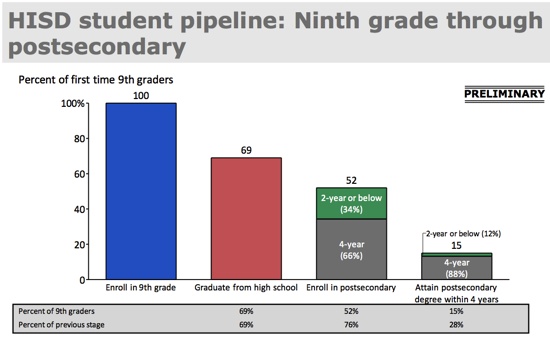
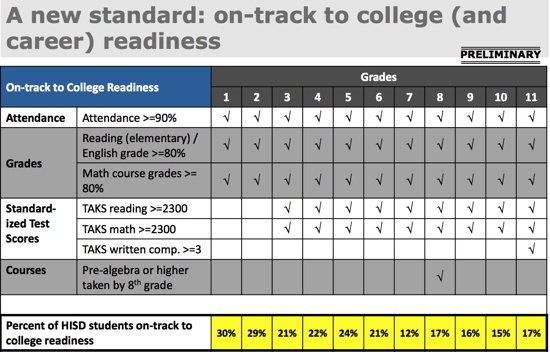
HISD is working to develop a long-term strategic plan for the district that will build upon the Declaration of Beliefs and Visions and provide a road map for our future. The purpose of this strategic direction is to provide clarity around our priorities of Placing an Effective Teacher in Every Classroom, Supporting the Principal as the CEO, Developing Central Standards, Ensuring Accountability, and Cultivating Stakeholder Commitment. We believe these key, overarching strategies will help HISD achieve its goals and become the best school district in America.

To develop our long-term Strategic Direction, we are working with a in a six-month effort that started in February, 2010 and will culminate in August with the release of the final plan. The first step involved a diagnostic research effort to understand the current state of the district across a number of critical dimensions such as student achievement and organizational effectiveness. It also included analyzing other transformation efforts within HISD and across the country to ensure that the best ideas are being considered in our planning process. We have also started to gather input from members of Team HISD and we will continue to do so over the next several months. Click here to view the preliminary findings (.pdf)

True transformation does not happen overnight and cannot happen without the participation of every member of Team HISD. For this process to be authentic and meaningful, HISD needs all of you -parents, teachers, principals, students, the business community, nonprofit partners, and broader community members- to be fully engaged.

312K PDF
Ericka Mellon: Only 15 percent of HISD freshmen graduate college.
Related: Notes and links on Madison’s Strategic Planning Process. More here.

Share

Madison Schools $23,000,000 Maintenance Referendum Spending Continues to Raise Questions

Don Severson, Vicki McKenna and Brian Schimming discuss what happened to the Madison School District’s $23,000,000 2005 maintenance referendum. 26MB mp3 audio file.

Share

Houston School District loses four more principals to KIPP

Ericka Mellon:

Pamela Farinas, the principal of Houston ISD’s Foerster Elementary, was honored Wednesday night as Principal of the Year for the district’s west region. It turns out that was her final hurrah in the state’s largest school district. Farinas is headed to the popular KIPP charter school chain. She will be a deputy head of schools and school leader (KIPP lingo for principal) at LIPP Liberation College Prep).
KIPP-co-founder Mike Feinberg, who began his career as a Teach for America teacher in HISD, also confirmed today that he has snagged a few other leaders from the school district:
-Daphane Carter, the principal of Bonham Elementary, is leaving to be a deputy head of schools and school leader at KIPP Spirit College Prep.
-Bill Sorrells, the principal of Thomas Middle School, is the new school leader at KIPP Polaris Academy for Boys.

Share

Charter Schools are the Wrong Answer

Alan Singer:

As promised, I will respond directly to people who objected to my earlier posts critiquing the charter school movement.
On June 14, The New York Times ran a front-page article about kindergarten children at the Clara E. Coleman Elementary School from Glen Rock, New Jersey who are learning about the principles of engineering through hands-on activities before they even know how to read. Their task was to design housing that would protect the three little pigs from the big, bad, wolf.
This was a wonderful project, in a wonderful classroom, with an excellent teacher, in an affluent suburban school district. Pictures that accompanied the article showed that the children in this class and school are almost all white. According to real estate estimates and the 2000 census report, in the borough of Glen Rock, about twenty miles from New York City, the medium household income was over $100,000 a year, about 60% of adults are college graduates, houses sell for about $500,000, and the population was 90% White, 6% Asian, 3% Latino, and 2% African American. For the High School graduating classes of 2004 through 2006, over 95% of students indicated that they would move on to a two-year or four-year college.

Share

Too narrow, too soon? America’s misplaced disdain for vocational education

The Economist in Waunakee, WI:

SARAH ZANDER and Ashley Jacobsen are like many teenage girls. Sarah likes soccer. Ashley was captain of her school’s team of cheerleaders this year. They are also earning good money as nursing assistants at a retirement home. Sarah plans to become a registered nurse. Ashley may become a pharmacologist. Their futures look sunny. Yet both are products of what is arguably America’s most sneered-at high-school programme: vocational training.
Vocational education has been so disparaged that its few advocates have resorted to giving it a new name: “career and technical education” (CTE). Academic courses that prepare students for getting into universities, by contrast, are seen as the key to higher wages and global prowess. Last month the National Governors Association proposed standards to make students “college and career ready”. But a few states, districts and think-tanks favour a radical notion. In America’s quest to raise wages and compete internationally, CTE may be not a hindrance but a help.

Share

Churches Mix With Charters

Joy Resmovits:

Four of the 27 new charter schools opening in New York City this fall have ties with religious organizations, although leaders assert curriculum and instruction will be secular.
Supporters say the new schools are a welcome addition amid overcrowded classrooms and heightened demand for charters, especially in neighborhoods with low-performing schools. But the development blurs the line between church and state, and also calls into question the distinction between public education and private groups, an issue with which charter schools already contend.
Four pastors are involved in starting charter schools, which receive public funding but can be privately run.
The Rev. A.R. Bernard’s Brooklyn-based nondenominational Christian Cultural Center boasts a membership of 33,000, with 5,000 coming to services on any given Sunday. Now, 120 kindergarteners and first-graders will be attending Monday through Friday as it opens a charter school called the Culture Arts Academy Charter School at Spring Creek. The charter school will share the same building–but on a different floor–as the private school Mr. Bernard previously founded, Brooklyn Preparatory School.

Share

That’s Debatable: Funding public education

Brian Fraley & Scot Ross:

Scot, looks like the Son of Stimulus, although stalled, is still on the agenda in Washington. You know, the plan to bail out local and state units of government with another boatload of “one time” money. Predictably, they are dressing this up as the salvation of “teachers” and will use the inflated figure of 300,000 teachers whose will be canned if this bloat doesn’t pass. But all it means is the federalization of local and state deficits, which will only accelerate our descent into Greece-like insolvency. At some point this ridiculous spending spree has to stop, because it has already exceeded our ability to pay. But, I know, “It’s for the kids!”
Ross Actually, I’d say “It’s for our future.” Thousands of Wisconsin teachers are facing layoffs, and students from all across the state could be forced into larger classes with less personal attention, fewer course choices and even cuts to instructional time. This responsible education funding plan would provide badly needed support in Wisconsin to save or create 6,100 jobs. Education has to be a top priority. After decades of underfunding at the hands of Republican administration and failed promises made through “No Child Left Behind,” we have a simple choice: Support education and our children, or give up on this country’s future greatness.

Share

Recess

Melissa Westbrook:

Recess will be one of the topics on today’s The Conversation starting at noon. Call in if you have thoughts, 543-KUOW. Here’s their report on it. Interesting finding:
Another big difference between the schools is that at Thornton Creek, most of the students are white and middle-class. At Dunlap, nearly all of the students are black, Latino or Asian and from low-income families.
That corresponds to what KUOW found when we surveyed recess times across the Seattle school district. For instance, we looked at the 15 highest-poverty and lowest–poverty schools. Kids at the low-poverty schools average 16 minutes more recess than kids at the high-poverty schools. That amounts to about one whole recess more.
And amount of recess?
Dornfeld: “A lot of schools in the district give kids 45 minutes to an hour of recess every single day. Is that something that you see as realistic for this school?”

Share

K-12 Tax & Spending Climate: Can’t Pay, Won’t Pay

The Economist:

THE state of Illinois has a rather crude way of coping with its ballooning budget deficit. It stops paying bills. Already, it has failed to pay more than $5 billion-worth. State legislators are paying their own office rent to avoid eviction. Schools and public universities are having their budgets cut.
Illinois owes Shore Community Services, a non-profit agency in suburban Chicago, some $1.6m for services to the mentally disabled. The agency has had to lay off a dozen staff. Jerry Gulley, the executive director, says his outfit’s line of credit could be exhausted soon. The bank will not accept the state’s IOUs as collateral. “That’s how sad it is,” shrugs Mr Gulley.

Share

UW System Patronage? Officials say appointment was necessary to avoid lengthy search

Patrick Marley:

A state lawmaker accused University of Wisconsin System President Kevin Reilly of engaging in political patronage for giving a high-paying state job to Gov. Jim Doyle’s top lieutenant without considering other candidates.
State Administration Secretary Michael Morgan’s new job as the system’s senior vice president for administration and fiscal affairs provides him with a 79% boost in pay.
Morgan, who makes $136,944 as administration secretary, will receive $245,000 a year when he takes the new job July 6. It is the same pay as that of the current person in the position, Tom Anderes, who has 30 years of experience in higher education and is leaving to head the University of Arizona system.
An aide to Reilly said Thursday that Morgan’s hiring was appropriate and the UW System was simply trying to avoid a protracted and costly search to fill the job at a time when the system is in the midst of major projects. Top-level system jobs are normally advertised so national searches can be conducted.

Share

Madison School District Tax Climate:

Wisconsin State Journal Editorial:

It’s beginning to look a lot like another lump of coal will land on local property taxpayers just before the holidays in December.
That’s when tax bills go out to mailboxes. And so far, the tax burden is shaping up to soar at a rate far out of scale with ordinary people’s ability to pay.
The Madison School Board just agreed to a preliminary budget that will increase the district’s tax on a $250,000 home by about 9 percent to $2,770. The board was dealt a difficult hand by the state. But it didn’t do nearly enough to trim spending.
Madison Area Technical College is similarly poised to jack up its tax bite by 9 percent to $348. MATC is at least dealing with higher enrollment. But the 9 percent jump follows a nearly 8 percent increase last year. And MATC is now laying the groundwork for a big building referendum.
Then comes Dane County and the city of Madison.

Related: Wisconsin State Tax Based K-12 Spending Growth Far Exceeds University Funding.

Share

K-12 Tax & Spending Climate: Reality of America’s fiscal mess starting to bite & Greenspan Says U.S. May Soon Reach Borrowing Limit

Gillian Tett:

If you pop into a toilet on the Seattle waterfront this summer, you might see over-flowing bins. The reason? A polite notice explains that “because of 2010 budget reductions”, the Seattle government can no longer afford to “service this comfort station” each day. Hence the dirt.
Investors would do well to take note. In recent months, America’s fiscal mess has assumed a rather surreal air. On paper, the country’s federal-level deficit and debt numbers certainly look very scary. But in practical terms, the impact of those ever-swelling zeroes still seems distinctly abstract.

Jacob Greber:

Former Federal Reserve Chairman Alan Greenspan said the U.S. may soon face higher borrowing costs on its swelling debt and called for a “tectonic shift” in fiscal policy to contain borrowing.
“Perceptions of a large U.S. borrowing capacity are misleading,” and current long-term bond yields are masking America’s debt challenge, Greenspan wrote in an opinion piece posted on the Wall Street Journal’s website. “Long-term rate increases can emerge with unexpected suddenness,” such as the 4 percentage point surge over four months in 1979-80, he said.

Clearly, public and private organizations must endeavor to manage the funds available wisely.

Share

A View From Both Ends of the Educational Spectrum

James Warren:

I attended my first Chicago Board of Education meeting in decades Tuesday and my first Chicago Public Schools kindergarten graduation the next morning. The inadequacies of the former were underscored by the inspiration of the latter.
The board reaffirmed the existing teachers contract, guaranteeing a generous 4 percent raise negotiated by the weak-kneed duo of Mayor Richard M. Daley and Arne Duncan, then the superintendent of Chicago Public Schools and now the United States secretary of education. The board thus eliminated the chance of a strike in the fall as it also gave Mr. Duncan’s successor, Ron Huberman the power to perhaps lay off teachers and raise the number of students in classrooms.
“Door Open to 35 in a Class,” declared a Chicago Sun-Times headline, reflecting the prime concern of what essentially is a superficial debate.
In fact, the meeting itself might as well have been choreographed by the Goodman Theatre, given all the role-playing.

Related: The 4% Solution.

Share

Rhode Island’s new school aid formula: Some will win, some will lose

Jennifer Jordan:

After years of failed attempts, Rhode Island finally has a statewide school-financing formula, its first in two decades.
The complex formula, which was developed by the state Department of Education and researchers at Brown University, goes into effect for the 2011-12 school year and is intended to redistribute about $705 million a year in direct aid to school districts, charter and state-operated schools — without adding a lot of new money to the system.
Critics have been quick to point out that the formula creates a new system of winners and losers, giving more state aid to districts where student enrollments have increased or that serve high numbers of low-income students, while cutting districts that have lost students or serve fewer poor students.

Share

On Seattle’s Superintendent

Melissa Westbrook:

I missed the report from KUOW reporter, Phyllis Fletcher, so I looked it up. Guess what? The Superintendent has this to say:

Goodloe-Johnson: “They don’t really get the opportunity to see the humane person that I am as it relates to children, and that I’ve committed my life to this work. And I don’t think they get to see that, which I’m gonna work on, because they don’t really know me. They know the Superintendent, the CEO of a business. And our business is about children. But they really don’t know me as a person and as a mom.”

So much can be said about these comments. I always get scared when I hear that education is a business but now Dr. G-J says children are her business. Great. And frankly, I don’t want to know her as a person or a mom. I don’t need to know the School Board that way to know if they are doing their jobs and I don’t need that from her.

Share

California and the “Common Core”: Will There Be a New Debate About K-12 Standards?

EdSource:

A growing chorus of state and federal policymakers, large foundations, and business leaders across the country are calling for states to adopt a common, rigorous body of college- and career-ready skills and knowledge in English and mathematics that all K-12 students will be expected to master by the time they graduate.
This report looks at the history of efforts to create common education standards, in particular the Common Core State Standards Initiative. It also describes factors California may consider when deciding whether to adopt them.
Highlights:
The Common Core is the latest effort to create rigorous, common academic standards among states
California is supporting the concept of common standards, but state law calls for further review and leaves the adoption decision to the State Board of Education
Issues surrounding the adoption include the quality of the Common Core standards and their relationship to the state’s current standards as well as costs and other implementation concerns
Common Core or not, California might decide to review its current standards and expectations for students

Related: California State Academic Content Standards Commission:

On January 7, 2010, the Governor signed into law Senate Bill X5 1 (Steinberg). The bill calls for California’s academic content standards in English Language Arts and Mathematics to be examined against the Common Core Standards that were released in final form on June 2, 2010. The bill also calls for the establishment of the California Academic Content Standards Commission. The Governor and Legislature have made the required appointments to the commission.

Share

Candidates call for Oklahoma education reform

Megan Rolland:

The five candidates for Oklahoma’s superintendent of schools were asked Wednesday how they would reform education in a state that ranks near the bottom of the nation for funding and also lags behind in the number of college graduates.
All agreed the state’s education system is in need of change, but differed in their vision of a successful system.
Democrat Jerry Combrink said after 30 years as the superintendent of two school districts in rural southeastern Oklahoma, he knows students need options, and not every student is going to college.
“I believe that we need to prepare students for the future they want. Develop a two-track system … so students who are not going to college are not diluting the teaching efforts of the students who are.”
His opponent in the July 26 primary, state Sen. Susan Paddack, D-Ada, said the state needs a strategic plan that will use test results to track improvements and failures.

Share

Stanford program tries to improve education for China’s poor

John Boudreau:

Hu Yu Fan, a 12-year-old boy with doleful eyes, is the face of the other China — the one untouched by the nation’s economic miracle.
He is among tens of millions of young Chinese who have moved from rural provinces to major cities but are being denied the education needed to thrive in modern society. Instead, they end up in shabby migrant schools in places like Beijing and Shanghai, with few resources and few opportunities.
“I have never dreamed of anything for the future,” the boy said.
Hu and those like him are the focus of a program run jointly by Stanford University and Chinese research centers, called Rural Education Action Project, or REAP, which is researching ways to improve education for China’s rural and urban poor.
Financially supported by American companies such as San Jose’s Adobe Systems and Dell Inc., the researchers produce reports that are reviewed by the country’s top officials, including Premier Wen Jiabao. China’s leaders have grown increasingly concerned that the widening wealth and income gap between the country’s urban and rural citizens is a threat to social stability.

Share

Memphis Gates Foundation Grant: Students learning that school is cool

Jane Roberts:

The idea that only a few people in a room are smart and the rest have a lot to prove is on trial this week in camp designed to change hearts and minds and eventually the culture of Memphis City Schools.
It all comes down to some simple brain theory, which 15 middle schoolers are soaking up at Douglass Elementary and five other city schools.
“Smart is not just something you are but something you get,” says Barbara Logan, director of School Services and Training at the Efficacy Institute in Waltham, Mass.
With $1.1 million this year from the Bill & Melinda Gates Foundation grant to Memphis City Schools, Efficacy plans to train several hundred “student envoys” responsible for preaching the gospel of discipline and self-esteem, and delivering the message that smart isn’t by chance.

Related: Small Learning Communities.

Share

Why are we having this fight again?

Matthew Ladner:

Could the adoption of common core standards lead to substantial academic gains, even if somehow developed and kept at a high level in some imaginary Federal Reserve type fortress of political solitude and kept safe from the great national dummy down?

I ran NAEP numbers for all 50 states and the District of Columbia and calculated the total gains on the main NAEP exams (4th and 8th grade Reading and Math) for the period that all states have been taking NAEP (2003-2009). In order to minimize educational and socio-economic differences, I compared the scores of non-special program (ELL, IEP) children eligible for a free or reduced price lunch.

I then ranked those 50 states, and the table below presents the Top 10, along with the total grades by year for the strength of state proficiency standards as measured by Paul Peterson. Peterson judges state assessments by comparing scores on the state exam to those on NAEP.

Share

K-12 Tax & Spending Climate: Are State Public Pensions Sustainable? Why the Federal Government Should Worry About State Pension Liabilities

Joshua D. Rauh:

This paper analyzes the flow of state pension benefit payments relative to asset levels and contributions. Assuming future state contributions fund the full present value of new benefits, many state systems will run out of money in 10-20 years if some attempt is not made to improve the funding of liabilities that have already been accrued. The expected shortfalls raise the possibility that the federal government will be faced with a decision as to whether to bail out states driven to insolvency by their pension programs.

Share

KINDERREADY GRADS CHEERED\ PROGRAM THAT GETS CHILDREN READY FOR KINDERGARTEN CELEBRATES ITS FIRST GRADUATES.

Andy Hall, via a kind reader:

Two dozen children donned homemade mortarboards Wednesday for a commencement ceremony marking their graduation from a program designed to help them be ready for kindergarten this fall.
As many of their parents snapped photos, the children received certificates and were cheered by a crowd that included the graduates’ siblings and officials from government and nonprofit agencies.
The ceremony and a picnic at Madison’s Vilas Park celebrated the end of the first year of the KinderReady program, which served 320 children ages 3 to 5, far exceeding its goal of 200.
The surge was largely credited to a weekly call-in program, “Families Together,” on La Movida, 1480-AM, a Spanish-language station, that includes learning activities for children, said Andy Benedetto, who is directing KinderReady for the nonprofit Children’s Service Society of Wisconsin.
Although data measuring KinderReady’s effects won’t be available until next year, interviews with parents and officials suggest the program is helping prepare children for kindergarten.

Share

Chicago Teachers Increasingly Complaining About TIF

Adam Doster:

Facing an estimated $427 million FY 2011 deficit, the Chicago Board of Education gave CPS CEO Ron Huberman emergency power to raise class sizes and lay-off almost 3,000 public school teachers. The schools’ chief has not agreed to follow through with that plan quite yet. Instead, he’s offering a “menu of possible concessions” to the Chicago Teachers Union and its new president-elect, Karen Lewis. Neither side will disclose what’s on the list, although Lewis told the Reader’s Hunter Clauss that she’s hoping to survey her members this summer to find out exactly where they are willing to budge. “These official actions were partly procedural, and partly a way for Huberman and the board to publicly and skillfully back the teachers union into a corner,” adds Catalyst’s Sarah Karp.
In several print and television interviews yesterday morning, Lewis offered Huberman some alternative ways to trim costs. The new president set her sights on the city’s contracts with consultants, which she said cost $300 million per year. She also discussed trimming the central office payroll and eliminating a $60 million program that provides curriculum packages and coaching to high schools. But to get a clear sense of the Daley administration’s priorities, and find out where waste might exist, Lewis stressed that the budgeting process needs to be considerably more transparent to teachers and parents alike.
It took repeated Freedom of Information Act requests, for example, for the city to post basic payroll information online. And they’ve ignored consistent appeals to provide serious internal data on the effect of the city’s tax increment financing system (TIF) on schools. From her acceptance speech this weekend (watch it here):

Share

District Graduation Rate Map Tool

Education Week, via a kind reader:

EdWeek Maps is the only place to find comparable, reliable, readily accessible data on graduation rates and other indicators for every school district and high school in the country.
The Editorial Projects in Education Research Center is proud to present this powerful online mapping tool to help the public, policymakers, and educational leaders combat the nation’s graduation crisis. EdWeek Maps is the only place to find comparable, reliable data on graduation rates for every school district and high school in the country.
This Web-based application allows users to easily map out graduation rates by zooming in on any of the nation’s individual school districts. Users can then access detailed information for that district or any of its high schools.

Share

Madison district got $23M from taxpayers for aging schools; where did it go?

Susan Troller:

A maintenance referendum may well be a tougher sell this time around than it was when back-to-back, five-year maintenance referendums were approved in 1999 and 2005. Not only do voters feel pinched by the ongoing recession, but taxpayers are facing a likely $225 hike in property taxes this year as part of the effort to balance the Madison schools budget, which took a heavy hit in reduced state aid.
Community support could also be compromised because a growing number of Madison School Board members have become frustrated by what they say is the district’s reluctance to adequately account for how maintenance dollars have been spent.
As chair of the School Board’s finance and operations committee, Lucy Mathiak has persistently asked for a complete accounting of maintenance jobs funded through the 2005 referendum. The minutes from a March 2009 committee meeting confirm that district administrators said they were working on such a report but Mathiak says the information she’s received so far has been less than clear.
“Trying to get this information through two administrations, and then trying to figure it out, is exhausting. The whole thing is a mess. I’m not, by any means, the first board member to ask these kind of questions regarding accountability,” Mathiak says. “You ask for straightforward documentation and you don’t get it, or when it comes it’s a data dump that’s almost impossible to understand.”
That lack of transparency might make it more difficult for other School Board members to get on board with another referendum.
“We have a responsibility to provide an accurate record of what happened with the funding,” says board member Arlene Silveira, who has supported all other school referendums. “I think people understand that other projects may come up and there may be changes from the original plan, but you do need to tell them what was done and what wasn’t done and why. It affects (the district’s) credibility in the community.”

Much more on the 2005 referendum and the District’s 2010-2011 budget (including what appears to be a 10% property tax increase here.
Related: “Accountability is important, now more than ever“.

Share

Schools Face Test on Budget Math

Mark Whitehous & Amy Merrick:

For seventh-grader Kyle Scarpa, budget strains affecting schools across the country are hitting where it hurts.
In the wake of the worst recession in more than half a century, many communities find themselves with no choice but to cut funding for education. In Downe Township, N.J., the cuts are hitting where it hurts.
In addition to freezing wages and jettisoning its librarian, the school he attends here in southern New Jersey will cancel his after-school remedial math and literacy classes. His teacher believes the tutoring helped him build confidence and get his average grade up to a C from a D.
“He could fall through the cracks,” says teacher Rose Garrison, noting that Kyle is among four kids in her class having trouble keeping up. “When you’re teaching exponents and you have kids who don’t know the multiplication tables, how are you going to teach them?”
The struggles at Downe Township School illustrate the challenges public schools face across America as a convergence of factors–ravaged state and local finances, tapped-out taxpayers and a reform push by the Obama administration–force wrenching change. As the school year winds down, educators are grasping for new ways to do more with less, and to remedy an embarrassing reality: Despite spending more per student than the average developed country, U.S. schools perform below average in core subjects such as math and reading.

Share

Digital Students, Industrial-Era Universities

Arthure Levine:

The American university, like the nation’s other major social institutions — government, banks, the media, health care — was created for an industrial society. Buffeted by dramatic changes in demography, the economy, technology, and globalization, all these institutions function less well than they once did. In today’s international information economy, they appear to be broken and must be refitted for a world transformed.
At the university, the clash between old and new is manifest in profound differences between institutions of higher education and the students they enroll. Today’s traditional undergraduates, aged 18 to 25, are digital natives. They grew up in a world of computers, Internet, cell phones, MP3 players, and social networking.

Share

Students With Autism Learn How To Succeed At Work

Jon Hamilton:

People with autism often have a hard time finding and keeping jobs, so more schools are creating programs to help students with autism get prepared for the workplace. One of those programs helped change the life of Kevin Sargeant.
Just a few years ago, when Kevin was still in elementary school, things weren’t looking good for him. He was antisocial, desperately unhappy and doing poorly in school.
“He was pretty much a broken child, the way I would describe it,” says his mother, Jennifer Sargeant. “We really didn’t see that he would be able to go to college, even have a job. That just wasn’t in our future for him.”
Kevin, now 18, says his autism left him unable to handle the social interactions at school.

Share

Race to Top Buy-In Level Examined

Michele McNeil:

States significantly increased buy-in from local teachers’ unions in round two of the Race to the Top competition, but made far less progress in enlisting districts or expanding the number of students affected by the states’ education reform plans.
Those patterns emerged from an Education Week analysis of applications from 29 states and the District of Columbia, all of which entered both rounds of the $4 billion federal grant contest.
Although the changes made in applications from the first to the second round varied widely from state to state, union buy-in increased on average by 22 percentage points, with states such as Florida, Michigan, and Wisconsin making big leaps.
At the same time, the overall level of district support and students affected in the 30 applications barely budged, mostly owing to California’s loss of support from about 500 districts representing nearly 2 million students. That negated progress other states made in improving buy-in.

Share

The rise, and rise, of Seattle schools: The Seattle Public Schools are undergoing dramatic changes. However, the story is not one of doom and gloom but of steady progress.

Seattle Times Editorial:

THERE is much to be optimistic about as Seattle Public Schools transform into an urban model of education quality and accessibility.
Dramatic change doesn’t happen by tinkering around the edges. Nor is Seattle’s thrust occurring in isolation. It is part of a welcome push by urban school districts across the country to improve access to good teaching, strong curriculum and better school resources.
The work under way is most visible in Seattle’s shift from a costly open-choice system to a neighborhood assignment plan. Families got that they were exchanging choice — which worked for a lucky few — for a cheaper, simpler and fairer way to access schools and programs.
Making improvements in the middle of a deep recession required Superintendent Maria Goodloe-Johnson and her team to aggressively leverage millions of dollars from credible organizations such as the Bill & Melinda Gates Foundation and federal school-improvement grants.
Wholly appropriate, and much appreciated, is Seattle’s civic and business organizations’ willingness to fill a recession-driven vacuum in education funding. This kind of support has allowed the district to continue key improvements, including professional development for all principals and teachers and increasing popular programs such as foreign-language immersion and advanced classes.

Share

Early Achievement Impacts of The Harlem Success Academy Charter School in New York City

Jonathan Supovitz & Sam Rikoon:

Researchers at the University of Pennsylvania conducted two external analyses of the performance of Harlem Success Academy Charter School (HSA) 2008-9 3rd graders on the New York State Test in English language arts (ELA) and mathematics. The first analysis was based on a comparison of the performance of 2006-7 first graders (who became the 2008-9 3rd graders) who were chosen through a random selection lottery process to attend HSA, and remained in HSA through the 3rd grade, relative to those who were not admitted by lottery to attend HSA and remained in New York City public schools. The second analysis compared the same HSA 3rd graders to 3rd graders in geographically proximate and demographically comparable New York City public schools. Student results were compared separately for ELA and mathematics using ordinary least squares regression and controlling for student gender, age, and special education status. The results indicated that HSA 3rd graders performed statistically significantly better than did either the randomized comparison group or the students in the demographically similar schools. More specifically, attendance at HSA was associated with 34-59 additional scale score points (depending on test subject) for non-special education students, after adjusting for differences in student demographic characteristics. Described another way, these results represent between 13-19 percent higher test performance associated with attending Harlem Success Academy.
The Harlem Success Academy Charter School (HSA) opened its doors in August 2006. The school, located in Harlem Community School District 3 of New York City at 118th street and Lenox Avenue, is currently a K-4 school that intends to add a grade each year as students matriculate until it is a full K-8 school. HSA is one of four existing Harlem Success Academies founded by the Success Charter Network. Over the next ten years, the Success Charter Network plans to expand the network to 40 schools.
Students are admitted into HSA through an annual lottery which randomly selects students to attend the school from the pool of applicants. Any student who lives in New York City can apply to HSA and the school uses the lottery process to determine who will attend the school. Since the school has documented both the students who applied to HSA and were accepted through the lottery, as well as those who applied and were not selected, these conditions make for an experimental study of the impact of HSA on student learning outcomes.

Share

Jing For Student Authoring

Joshua Kim:

Have you thought about having your students create voice-over presentations to share with your class? Instead of (or in addition to) having your students give live class presentations, a voice-over PowerPoint can be easily recorded and shared through the LMS.
The 5 best things about using Jing, PowerPoint and the Discussion Board:

Share

Abolishing Department of Education isn’t extreme

Mona Charen:

Newly minted Nevada senate candidate Sharron Angle is a kook. That’s what Sen. Harry Reid’s people are telling reporters. ABC, CNN, and other outlets seem to agree, noting that Mrs. Angle wants to shutter the federal Department of Education, get the U.S. out of the U.N., phase out Social Security, and eliminate the IRS.
We haven’t yet heard her explanations of these positions — many of which can be justified in the proper context. It’s certainly possible that she is a little eccentric (that prison massage program doesn’t pass the smell test). But this much is certain: It is not kooky to favor the elimination of the Department of Education. That this proposal is routinely labeled “extremist” is a reminder of the one-way ratchet that operates in government. Enshrine something in a federal agency and it becomes sacrosanct. Democrats cheerlead for federal programs because they are the party of government, and Republicans quietly go along because they’re afraid.
But if Republicans know how to argue for smaller government — as Gov. Chris Christie is demonstrating in New Jersey — they need not be intimidated. There are hundreds of federal programs that could be eliminated tomorrow with only the happiest consequences for the nation. And yes, the whole Department of Education could be scrapped. It vacuums up money and produces … what exactly?

I’m not an optimist with respect to our exploding Federalism and the related money printing approach to spending.

Share

K-12 Tax & Spending Climate: Pennsylvania‟s Taxpayer Relief Act: Big Gamble Pays Off for Some, But Most Lose Their Shirt

Jaime Bumbarger:


There is perhaps no greater debate in America than the one surrounding taxes, whether it is at the national, state, or local level. While taxes serve the important purpose of funding government programs, they also bear quite a burden on taxpayers. For example, property taxes account for the majority of revenue for local governments across the country.1 Pennsylvania is no different. In 2000, property taxes accounted for nearly $10 billion of revenue in Pennsylvania, which was 30 percent of total local government revenues and 70 percent of all local government tax revenues.2
Property taxes accounted for an even larger piece of the pie when it came to school districts: approximately 85 percent of the total tax revenues for Pennsylvania school districts in 2000.3 Nearly half of all school district revenue came from the collection of property taxes.4 Only counties relied more heavily on property taxes as a source of revenue.5
The state‟s heavy reliance on property taxes by school districts hit the wallets of Pennsylvania taxpayers and led to several attempts by legislators to harness the spending.6 The most recent attempt was Act 1 of 2006.7 Act 1 attempts to do what other legislation failed to do: provide property tax relief to all Pennsylvanians, but it, too, falls short of its mark.8
Although it was enacted more than three years ago, the Act still plays a prominent role today. Less than two years ago, homeowners started reaping the benefits of Act 1 when the first reduction in property tax bills occurred.9 Last fall, taxpayers could have faced another referendum on their ballots, asking whether they favor increasing the local income tax to offset a decrease in property tax.10 Officials faulted public confusion for the last referendum overwhelmingly failing across the Commonwealth.11 Also, last year‟s budget impasse resulted in new legislation that could significantly alter property tax relief in the future.12

Share

First-year charter schools often face turmoil

Rosemary Winters:

The charter school’s popular director resigned abruptly at mid-year. One third of the faculty vowed not to return next year. E-mail allegations of poor management and failed communication clogged the in-boxes of parents, teachers and board members.
And that’s just in Excelsior Academy’s first year.
The K-8 charter school in Erda — Tooele County’s first charter — has had a rocky start.
So do many charter schools, which have to find or build a school house, navigate state laws and recruit a board and staff, typically with limited funds and expertise. The public schools receive money from the state for each pupil they enroll at the same rate as other public schools, but must raise funds for other expenses.
New schools often face opposition from parents and teachers when they don’t function as expected.

Share

Autism and Education in France

Chantal Sicile-Kira:

Recently I was invited to Paris to present at a prestigious international colloquium on autism and education, which was organized by the INS HEA, the French Ministry of Education’s training institute for special education teachers. Seventeen years earlier, I had left France because in those days, children with autism did not have the right to an education, and my son, Jeremy, was severely impacted by autism.
It was an emotional moment for me, standing there, addressing 500 attendees in a lecture hall of the Universite Paris Descatres in Bolulogne – Billancourt, explaining my son’s educational experience in the United States, where all children have the right to a free and appropriate education under IDEA.
In 1993, my family left France, where we had been living since 1981. Both Jeremy and his sister, Rebecca (who is neurotypical), were born in Paris at the time when children with autism were considered mentally ill, not developmentally disabled. They had no right to an education. Instead, they were enrolled in day programs on hospital sites, where they were treated with psychoanalysis. Parents had no right to visit the day program, nor did they receive any communication about what went on during the hours their child spent there.

Share

Looking back at a nine-year experiment to get kids to college

Minnesota Public Radio:

Almost a decade ago, third graders at seven high-poverty schools in the Twin Cities got an offer: Stay in school, and we’ll give you $10,000 for college. All the students had to do was stay in the Minneapolis or St. Paul public schools, graduate, and go to college. Midday looks at how the experiment turned out.

Share

It’s the Public’s Data: Democratizing School Board Records

J. H. Snider, via a kind reader:

Consider just a few of the questions whose answers might help a community’s leaders and citizens make better decisions about how to improve their schools:

  • What has been said and written about school start times in districts with comparable demographics and financial resources, but better student test scores?
  • What is the relationship between student test scores and systems for electing school board members in comparable school districts?
  • How do superintendent contracts vary in comparable districts?

Parents, teachers, administrators, and taxpayers have legitimate reasons to ask questions like these. But it has been incredibly hard for them to do so. One reason is that much public information remains locked in the file cabinets of America’s more than 14,000 school districts. Another is that even if the information is posted to school websites, it may be posted in ways, such as a scanned document, that Internet search engines cannot read. Public information that should be available instantaneously and at no cost, like so much other information now available via search engines, instead takes hundreds of work-lifetimes and a fortune to gather–if it can be gathered at all.

Well worth reading.

Share

Atlanta schools’ travel tab high

Rich McKay:

While school systems are cutting jobs or furloughing teachers to shore up withering budgets, Atlanta Public Schools has spent more than twice as much money per student on travel as most other metro districts.
Atlanta spent more than $1.4 million on travel in 2008-09, the latest year from which complete data was available. That works out to $28.77 per student, far higher than neighboring DeKalb County and more than double per pupil what Clayton, Cobb, Fulton and Gwinnett counties spent on travel, an Atlanta Journal-Constitution investigation found.
And Atlanta was slated to spend even more in 2009-2010 — about $1.8 million, a 28 percent jump.
Atlanta public school officials say travel is important so teachers can get the training they need and bring new skills and insights to the classroom. Much of the travel represents teachers going to education conferences, district officials said.

Share

Commentary: Time to end teacher union stranglehold on education

Sara Longwell:

For young teachers looking to get their first gig after graduating from education school, times are tough.
In New York City, the Success Charter network advertised 135 openings; it received 8,453 resumes in response. In Westchester, a school announced seven openings. More than 3,000 candidates responded.
New York isn’t alone: School districts across the country, faced with budget shortfalls, have put a freeze on hiring any new educators. This is bad news for newly minted teachers entering the work force.
There is a silver lining, however: This glut of new educators gives administrators a golden opportunity to revamp rules protecting bad teachers.
Reformers can take advantage of this surplus of labor by pointing out that anyone who doesn’t like new rules that will improve the nation’s quality of education can quickly be replaced by those who will play ball.

Share

Obama’s attack on education

Critical Reading:

Ravitch was assistant secretary of education in the administration of George H.W. Bush and a board member of various right-wing think tanks, who has now become a leading critic of the market-based school “reform” that has been embraced by both Democrats and Republicans. Ravitch is “still looking” for an elected official to take a stand against these changes, but opposition is more likely to come from below. One encouraging piece of news is the landslide victory this week of the Caucus Of Rank-and-file Educators in the election for the leadership of the Chicago Teachers Union. –PG

Share

Our View: We need more innovation in education

Wausau Daily Herald:

As a part of the economic stimulus package of January 2009 — you may have heard of it — the federal government created a $100 billion education fund for states that were willing to take bold action to reform and improve their schools.
The fund, known as Race to the Top, is having the desired effect in many places. With state budgets in dire shape across the nation, it has provided a real incentive for states to look for ways to innovate in order to address real problems in the educational system — failing schools, bureaucratic deadlock, the achievement gap between rich and poor students.
In Wisconsin, though, what it has inspired is something more like a few pro-forma changes and half-hearted applications.
Wisconsin ranked in the bottom half of all the states that applied for Race to the Top funding in the first round in March. (The federal government placed our state’s application 26th out of 41 states and the District of Columbia that applied.)

Share

New Wisconsin teacher rules hitting classrooms

Amy Hetzner:

Ten years after Wisconsin overhauled its licensure system for public school educators, the first big wave of teachers is set to advance under the rules – and reports are mixed on whether the change has made a difference.
Expectations for the new licensure regulations were high when they were first approved in 2000. In addition to requiring that teachers pass basic knowledge and skills tests and receive mentors for their first year in the profession, the rules also provided that teachers would have to demonstrate they had grown enough in their careers to attain a “professional” license.
For some beginning teachers, the new rules have been stressful additions to the start of an unfamiliar career with many bugs still left to be worked out. Others say they appreciate that they could set their own teaching goals and pursue related professional development activities while also reflecting on their experiences.
“I think teachers who really take the process seriously and do it with fidelity – they choose a goal that they really believe in and they want to achieve – that’s fine, that’s good, it serves its purpose,” said Judy Gundry, a citywide mentor for educators with initial teaching licenses in Milwaukee Public Schools.

Share

K-12 Tax & Spending Climate

Peter Scheer:

For public employee unions – those representing police, firefighters, teachers, prison guards and agency workers of all kinds at the state and local levels – these are the worst of times.
Despite record high membership and dues, and years of unparalleled clout in state capitols, public-sector unions find themselves on the defensive, desperately trying to hold onto past gains in the face of a skeptical press and angry voters. So far has the zeitgeist shifted against them that on one recent weekend, government employees were the butt of a “Saturday Night Live” skit, and the next day, a New York Times Magazine cover article proclaimed “The Teachers’ Unions’ Last Stand.”
Public unions’ traditional strength – the ability to finance their members’ rising pay and benefits through tax increases – has become a liability. Although private-sector unions always have had to worry that consumers will resist rising prices for their goods, public sector unions have benefited from the fact that taxpayers can’t choose – they are, in effect, “captive consumers.”

Share

Houston School District forces 162 teachers out of under-performing schools

Ericka Mellon:

More than 160 teachers in Houston ISD’s under-performing middle and high schools weren’t offered jobs at those campuses next year, the district announced Friday evening. The decision affects staffing at nine schools targeted in Superintendent Terry Grier’s “Apollo 20” reform plan.
Of the 600 teachers at those schools last year, 358 — or 60 percent — learned on Friday that the district wants them to return to help with the improvement efforts. But the district is forcing 162 teachers, or 27 percent of the staff, out of those schools. The administration made the decisions based on “an exhaustive data-driven evaluation” of the teachers, according to the news release, which didn’t specify what data were used.
An additional 80 teachers at the targeted schools previously had decided to retire, resign or transfer to other campuses, according to HISD. “In some cases, teachers opted not to stay due to a personal conflict with the longer school year and longer school day schedules of the Apollo schools,” the news release said.

Share