School Information System

In Hong Kong, Flashy Tutors Gain Icon Status

Jonathan Cheng:

When Richard Eng isn’t teaching English grammar to high-school students, he might be cruising around Hong Kong in his Lamborghini Murciélago. Or in Paris, on one of his seasonal shopping sprees. Or relaxing in his private, custom-installed karaoke room festooned with giant Louis Vuitton logos.
Mr. Eng, 43 years old, is one of Hong Kong’s best-known celebrity “tutor gods.”
Hong Kong parents are often desperate to help their children succeed in this city’s pressure-cooker public-examination system, which determines students’ college-worthiness. That explains why many are willing to pay handsomely for extracurricular help. Mr. Eng and others like him have made a lucrative business out of tapping that demand. They use flashy, aggressive marketing tactics that have transformed them into scholastic pop stars — “tutor gods,” as they’re known in Cantonese.
Private tutoring is big business around the world. Programs that help people prepare for standardized tests — such as SAT-prep courses in the U.S. — have become a multibillion-dollar industry. Tutoring agencies are also booming in places like mainland China and Japan. Several years ago, Hong Kong’s government estimated that the city’s families spent nearly half a billion dollars a year on tutoring.
Hong Kong stands out, though, for instructors who boldly tout their success rate — and their own images. They pay to have their faces plastered throughout the city on 40-foot-high billboards and the sides of double-decker buses. They’re also known for buying ads that take up the entire front page of newspapers — space more commonly filled by banks and property developers. One local television station is even preparing to launch a fictional drama series based on the lives of the tutor gods.

Fascinating

Share

MMSD Misses Notification Date, Will Again Provide Private School Bus Rides

Anita Clark:


The Madison School District said Tuesday it will provide bus rides for children attending private schools this year because it missed a legal deadline to notify families that the service was ending.
Hoping to save about $229,000, the School Board voted last spring to abolish bus routes that carried 208 children to six Catholic schools.
Instead, the district would pay their parents a transportation subsidy of about $450 per student.
The district has been working this summer with the Catholic Diocese of Madison to help it set up an alternative transportation system, but it did not realize there was an Aug. 4 deadline for notifying parents affected by the change, Superintendent Art Rainwater said Tuesday.
“We were so engrossed, it just went by us, ” he said. “The statute is very clear and we did not meet it. ”
Michael Lancaster, superintendent of schools for the diocese, said he ‘s happy that children will be receiving safe rides to school.
“Safety was a huge parental concern and ours as well, ‘ ‘ he said.
The financial effect on the district will be evaluated in October when it deals with “hundreds of pluses and minuses ‘ ‘ in making final budget adjustments after receiving data on enrollment, state aid and other factors, Rainwater said.
“We really don ‘t know until October how this fits in,” he said.

Much more on last spring’s private school busing budget change and commentary.
Perhaps this matter is related to gaining voter support for a 2008 referendum, which was discussed at Monday’s Madison School Board meeting:

Approval of Minutes dated April 30, May 7, May 14, May 22, May 29, June 27, July 16 (two sets), 2007
Announcements
There are no announcements.
Initial Discussion of Potential 2007-08 Referendum.

Susan Troller:

An oversight by the Madison school district’s administration means that the prayers of some Catholic school parents have been answered.
The school district announced Tuesday that it must continue to provide yellow school bus service for students at six local Catholic schools through the 2007-08 school year because it missed a deadline for notifying parents that there would be a change in transportation policy.
The Madison School Board voted last spring to eliminate busing for parochial school students and instead provide a stipend of $450 per child so parents can pay the cost of transportation themselves. State statutes mandate that public schools must provide transportation to all students in their districts, even those attending private schools.
According to Superintendent Art Rainwater, the district has been working over the summer with the Catholic Diocese of Madison to establish alternative means of getting parochial students to school, and it inadvertently missed the 30-day legal deadline for notifying individual parents that there would be a change in transportation policy.

Share

‘Tested’ examines difficult choices

Gregg Toppo:

Since 2002, when No Child Left Behind became law, states have spent millions of dollars giving standardized reading and math tests; one estimate puts the total cost above $5 billion through 2008.
The law requires that about half of all students take the tests and that schools improve each spring so they can stay off federal “needs improvement” lists. Many educators say that’s turning schools into test-prep factories where history, science and even recess get shortchanged.
Linda Perlstein, a former Washington Post reporter, wanted to see the effects firsthand, so she spent an academic year inside a high-poverty elementary school in Annapolis, Md.
The result is Tested: One American School Struggles to Make the Grade. USA TODAY’s Greg Toppo talks with her about testing:
Q: You spent a year getting to know kids at Tyler Heights Elementary School. How did this change your outlook on their education and tests?
A: I don’t have a problem with testing children. I have a problem with thinking test results tell you most of what you need to know. They simply don’t — these tests are often very narrow instruments. Where reforms have forced educators to notice children who might otherwise have been neglected, I give credit. But I wrote this book because school reforms intended to abolish a two-class system were in some ways exacerbating it. There’s one world where students pass the test as a matter of course and get to write poems, and another where children write paragraphs about poems.
Meanwhile, there’s supposed to be a movement in American schools to educate each child as an individual. The teachers at Tyler Heights work mightily to do that, but they have to get everybody to the same place in the same amount of time, and follow daily curriculum agendas handed down from above.

Share

An Interview with the Gates Foundation’s New Education Director

Rob Manning:

Portland schools superintendent Vicki Phillips starts her job as education director at the Bill and Melinda Gates’ Foundation on Wednesday.
With more than $3 billion in grant money to give away, Phillips is arguably in one of the most powerful K-12 jobs in the country.

Audio.

Share

An Experienced Teacher:The Oakland A’s and Public Education

Jim V:

Moneyball didn’t lead to a paradigm shift for my students, but it did for me. I have not thought about my own work in the same way since reading it. How do we determine what counts as excellence in teaching? I wish I could be evaluated according to the nice things students write about me in my yearbook, but something tells me that isn’t a sound approach. In financial terms, my employer considers my work a little more valuable every year I choose to stick around. And when I earned an additional graduate degree a few years back I got a substantial raise. But I can assure you that my graduate work did not translate into student performance that was worth several thousand more dollars per year to my school system.
The direction we’re moving in, of course, is evaluating teacher performance according to student test scores. Now I’ve never been a knee-jerk opponent of standardized tests. When I’m charged with proctoring them and examine their contents, I rarely see anything that I would not want my own children to know or be able to do at that age. That said, a good standardized test score should be a side effect of a rich education, not the point of the education. Almost anyone who is in a public school classroom today would agree that tests are becoming the point. If our teaching performance were to be evaluated according to our students’ test scores, tests would become the point once and for all.
And yet my inner Billy Beane asks, “Given that the tests are far from perfect and given that you have limited control over student performance, aren’t students supposed to learn knowledge and skills in your classroom? Is there a better statistic to evaluate your performance by than your students’ test scores?” Not really.

Share

18 Milwaukee “Year Round” Schools

Alan Borsuk:

“Welcome back! Today is Monday, August 6, 2007.”
That was the message on a chalkboard in Debra Alpert’s classroom at Wheatley Elementary School, 2442 N. 20th St.
It was humid and warm outside and inside the building – no question about it, an August day.
And school was in session?
Indeed, as it was on Monday at 17 other schools in the Milwaukee Public Schools system, all of them using a “year-round” schedule, which does not mean kids go to school year-round, or even that they go to school more days than the 175 to 180 of students on traditional schedules. But they do have a school calendar that gives them a shorter summer break (six weeks or so) and three breaks of three to four weeks throughout the year.
Some educators – as well as many teachers, parents and even kids – think that schedule is preferable when it comes to the impact on a child’s learning and, in some cases, a child’s safety or social development.
Research overall is mixed on the impact of reducing that three-month break. But there are arguments for saying maybe that long summer vacation isn’t such a hot idea after all.

Share

Teaching the trades: High school apprenticeship program gives students on-the-job training

Joe Dresang:

“It’s hard to find opportunities like this, where a company will give you that start,” Rewolinski says, loud enough to be heard over the fan that cools him. “A lot of companies now, they want you to have the experience right away. And with a program like this, I can get that start, and then I can move on and maybe move to something better or stay here and just get better at it.”
Rewolinski is talking about Wisconsin’s Youth Apprenticeship program.
He’s demonstrating his skills to Roberta Gassman, secretary of the state Department of Workforce Development.
For months, Gassman has been visiting youth apprentices at schools, factories, fabricators, machine shops and nursing homes.
She’s stumping for Gov. Jim Doyle’s plan to double the budget for youth apprenticeships to $2.2 million a year.

Share

Today’s Geography: Classroom to Boardroom

Claudine Bianchi:

Educators have always insisted they not leave out the “three Rs”: reading, writing and arithmetic. That paradigm may be shifting to “three Rs and a G” – and world enterprise is most appreciative.
The “G” is for geography – the science that links a range of interests and information from a variety of cultures based on a visual map. This subject is moving to the forefront of the minds of educators as its utility, later in life, in developing business strategy within public and private sectors around the world becomes more and more evident.
As a nation, the United States has received a clear signal from studies like the 2006 National Geographic/Roper survey, which followed an earlier survey in 2002. In the latest survey, young adults aged 18 to 24 in nine countries were surveyed and the results showed that Americans were outperformed in geographic literacy by young adults in seven countries – Sweden, Germany, Italy, France, Japan, Great Britain and Canada. Only 13% of the Americans surveyed correctly identified Iraq on a map of Asia and the Middle East. Only about half of young Americans were able to locate landmasses such as Japan and India on a global map. And 20% of those surveyed could not find the Pacific Ocean.
But set aside our less-than-satisfactory performance at a Geography Bee, and jump ahead to the terrain of public and private firms where geography has become one of the most powerful weapons in the arsenal. Maybe our educational system does not play out well in a Geography Bee, but you need to look at the extra edge firms are getting when they embrace not just geography, but the story that it tells. With the coming of age of GIS, the geography story becomes one where decisions can be made like never before. Almost anything can be plotted on a map.

Share

Grading Mayoral Control of Schools

Sol Stern:

Mayoral control, the hot new trend in urban school reform, began in Boston and Chicago in the 1990s. Now it’s the New York City school system, under the authority of Mayor Michael Bloomberg, that’s become the beacon for education-mayor wannabes like Adrian Fenty of Washington, D.C., and Antonio Villaraigosa of Los Angeles. Influential philanthropic foundations, such as the Los Angeles–based Broad Foundation (headed by Bloomberg friend and fellow billionaire Eli Broad) and the Gates Foundation, are investing in Bloomberg as the model big-city mayor who uses his new executive powers over the schools to advance a daring reform agenda. Meanwhile, the national media’s positive coverage of mayoral control in Gotham is adding to the luster of a possible Bloomberg presidential run.
For New Yorkers, though, the original appeal of mayoral control was entirely parochial. The old Board of Education—with seven members, appointed by six elected city officials—offered a case study of the paralysis that sets in when fragmented political authority tries to direct a dysfunctional bureaucracy. New Yorkers arrived at a consensus that there was not much hope of lifting student achievement substantially under such a regime. The newly elected Bloomberg made an offer that they couldn’t refuse: Give me the authority to improve the schools, and then hold me accountable for the results.

Share

The Tough Road to Better Science Teaching

Jeffrey Brainard:

The principal effort is led by the University of Wisconsin at Madison. In 2003 the NSF gave the university a five-year, $10-million grant to establish the Center for the Integration of Research, Teaching, and Learning. The center has worked with more than 1,000 new faculty members and graduate students at Madison and other universities to try the new teaching methods and conduct research on the process of putting them into practice.
The project also works on ways to attract science professors to join in the innovation. Trying the new teaching methods, the center’s leaders say, should be viewed as conducting an experiment with measurable results — an approach that appeals to the instincts of researchers. Organizers also argue that the new methods are more professionally satisfying than delivering conventional lectures.
Observers hope that the Wisconsin project will show results different from those of a similar NSF-financed effort that ran from 1993 to 2002. An evaluation of that program found that participants, who were graduate students, rated it highly but felt pressure to “conceal” the work from their professors, who viewed it as distracting them from research. What’s more, the new teaching methods often did not take root in the students’ departments, which was a goal of the project.
If young researchers delay trying the new teaching methods until their careers are established, though, they may put the attempt off for good, advocates say. And if American science is to stay competitive, that is a problem. “We don’t really have the time to wait around for another 20 years,” says Madison’s Ms. Millar, “for this kind of sea change to occur.”

Via Kevin Carey.

Share

Top Online Learning Resources

Jose Fermoso:

Want an education? Open up a browser. With the information available online, you could probably get a complete education without ever leaving your house.
But for more traditional students, as well as their parents and teachers, it can be tricky to find online information that is safe, relevant and age-appropriate. You don’t want your kids to jump knee-deep into DNA sequences if they haven’t even reached their third grade Mesozoic-era workshop.
Here is Wired News’ selection of the best educational resources on the net. Sure, the sites on this list aren’t going to replace Wikipedia or Google, or even a trip to the local public library. But if it’s education you want, and you’re at a computer, these sites are great places to start.

Share

Steve Barr Mission to Fix LA’s Schools

OnPoint with Tom Ashbrook:

Entrepreneur Steve Barr is on a mission to replace the worst public school in Los Angeles with charter schools. Barr has got an army of supporters behind him, from union organizers to teachers unions, from LA’s mayor to the Bill and Melinda Gates Foundation.
Barr has got brass knuckles, and with ten schools up and running he is getting results.
On Point speak with Steve Barr about fixing America’s troubled schools.

Audio.

Share

At Odds Over Immigrant Assimilation

Karin Brulliard:

But he knows that not everyone sees people such as him — an immigrant who prefers to speak his mother tongue — that way. To this, he responds that the U.S. government should demand that newcomers know English — and help them learn it.
“This country was founded by immigrants. There should be a lot of cultures,” Ruiz, 48, said. “But at the base is the government.”
Ruiz’s idea lies at the heart of a question that has recently entered the national immigration debate, one some researchers say is important as new trends challenge old integration patterns: Should the government encourage assimilation?
The Bush administration is taking steps to do that. The Task Force on New Americans, created by executive order last year, recently presented initiatives that supporters say will help immigrants “become fully American.”

Share

More on Communities Withdrawing from Milwaukee’s MATC

Tom Kertscher & Erica Perez:

A movement that began in Germantown is spreading in Ozaukee County, where the county itself and the Cedarburg Common Council, School Board and Town Board are all exploring the possibility of leaving the Milwaukee Area Technical College District.
In addition, an alderman in Mequon says he plans to ask city staff to look into whether a secession by Mequon is feasible.
The movement began with a Germantown Village Board trustee who is upset about MATC’s property tax levy, which has risen nearly 25% in the past four years.

Share

The Organized Student

Donna Goldberg:

Denville, N.J.: How to start a preschooler with good organization skills?
Donna Goldberg: That’s a wonderful question. There are ways you can start a preschooler. Actually, organization starts with preschool, and even with toddlers. As parents, we give toddlers a routine of the day. If it’s time to clean up, you say to your child, “now it’s clean up time.” And make your child be a part of that process. While you’ll be doing 99-percent of the cleanup, and the child 1 percent, you’ve set the tone that it’s part of play. After that, it’s usually time for dinner, and after that, it’s usually bath time. After bath time, it’s story book time and then bed. And these are the precursors, children begin to predict and anticipate. They start to understand time.
So to start to repeat routines they will go through the day is the beginning of teaching your children to be organized, because they can anticipate what happens next, and the steps that happen. And that really is what organization is, it’s a step-by-step procedure.

Share

Status of Education in Rural America

Stephen Provasnik, Angelina KewalRamani, Mary McLaughlin Coleman, Lauren Gilbertson, Will Herring, and Qingshu Xie:

This report presents a series of indicators on the status of education in rural America, using the new NCES locale classification system. The new system classifies the locale of school districts and schools based on their actual geographic coordinates into one of 12 locale categories and distinguishes between rural areas that are on the fringe of an urban area, rural areas that are at some distance, and rural areas that are remote. The findings of this report indicate that in 2003-04 over half of all operating school districts and one-third of all public schools in the United States were in rural areas; yet only one-fifth of all public school students were enrolled in rural areas. A larger percentage of public school students in rural areas than those in any other locale attended very small schools. A larger percentage of rural public school students in the 4th- and 8th-grades scored at or above the Proficient level on the National Assessment of Educational Progress (NAEP) reading, mathematics, and science assessments in 2005 than did public school students in cities at these grade levels. However, smaller percentages of rural public school students than suburban public school students scored at or above the Proficient level in reading and mathematics. In 2004, the high school status dropout rate (i.e., the percentage of persons not enrolled in school and not having completed high school) among 16- to 24-year-olds in rural areas was higher than in suburban areas, but lower than in cities.

Share

“Formal Education Slows Down the Process of Growing Up”

Bruce G. Charlton:

In a recent Medical Hypotheses editorial, I suggested the name psychological neoteny (PN) to refer to the widely-observed phenomenon that adults in modernizing liberal democracies increasingly retain many of the attitudes and behaviors traditionally associated with youth. I further suggested that PN is a useful trait for both individuals and the culture in modernizing societies; because people need to be somewhat child-like in their psychology order to keep learning, developing and adapting to the rapid and accelerating pace of change. Thirdly, I put forward the hypothesis that the major cause of PN in modernizing societies is the prolonged duration of formal education. Here I present a preliminary empirical investigation of this hypothesis of psychological neoteny. Marriage and parenthood are indicative of making a choice to ‘settle down’ and thereby move on from the more flexible lifestyle of youth; and furthermore these are usually commitments which themselves induce a settling down and maturation of attitudes and behaviors. A sevenfold expansion of participation in UK higher education up to 2001 was reflected in delay in marriage and parenthood. Increasing number of years of education is quantitatively the most important predictor of increasing age of the mother at the time of her first birth: among women college graduates about half are aged 30 or older at the time of their first birth – a rise of 400% in 25 years.

Via Tyler Cowen. Clusty search on Bruce Charlton.

Share

As States Tackle Poverty, Preschool Gets High Marks


Deborah Solomon:

In Washington and statehouses across the country, preschool is moving to the head of the class.
Florida and Oklahoma are among the states that have started providing free preschool for any 4-year-old whose parents want it. Illinois and New York plan to do the same. Hillary Rodham Clinton wants to spend $15 billion over five years on universal preschool funding. Federal Reserve Chairman Ben Bernanke calls preschool one cure for inequality.
The movement represents one of the most significant expansions in public education in the 90 years since World War I, when kindergarten first became standard in American schools. It has taken off as politicians look for relatively inexpensive ways to tackle the growing rich-poor gap in the U.S. They have found spending on children is usually an easy sell.
It took a well-orchestrated campaign to put pre-K on the top of political agendas — and new tactics that didn’t rely on do-gooder rhetoric. Among those working on the issue are the research director of the Federal Reserve Bank of Minneapolis, a billionaire Oklahoma oil man and a foundation executive in Philadelphia.
Their winning pitch: Making pre-K as prevalent as kindergarten is a prudent investment. Early schooling, they say, makes kids more likely to stay in school and turn into productive taxpayers.

Related: The Economics of Preschool.

Share

Madison Police Chief Hears About West Side Crime

Brittany Schoepp:


Children seeing people run from police through their backyard, waking up to the sound of a gunshots, watching drug deals.
These were some of the scenes described by West and Southwest Side residents as hundreds of them turned out Wednesday to voice their concerns about crime in their neighborhoods at a meeting with Madison Police Chief Noble Wray.
“Allied Drive is not the only problem on Madison ‘s West Side, ” said Suzanne Sarhan, who owns property there, prompting hundreds to rise to their feet in applause.
Ald. Thuy Pham-Remmele, 20th District, who set up the neighborhood listening session for Wray, said the safety problems need both short- and long-term solutions.
“I don ‘t ask for any quick fix, ” she said.

Lisa Subeck has more.

Share

Some Wonder if Cash for Good Test Scores Is the Wrong Kind of Lesson

Joseph Berger:

Should cash be used to spur children to do better on reading and math tests?
Suzanne Windland, a homeowner raising three children in a placid enclave of eastern Queens, doesn’t think so. Her seventh grader, Alexandra, she said, had perfect scores last year. But she doesn’t want New York City’s Department of Education to hand her $500 in spending cash for that achievement. That’s what Alexandra would earn if her school was part of a pilot program that will reward fourth and seventh graders with $100 to $500, depending on how well they perform on 10 tests in the next year.
Mrs. Windland wants Alexandra to do well for all the timeless reasons — to cultivate a love of learning, advance to more competitive schools and the like. She has on occasion bought her children toys or taken them out for dinner when they brought home pleasurable report cards, but she does not believe in dangling rewards beforehand.
“It’s like giving kids an allowance because they wake up every morning and brush their teeth and go off to school,” she said. “That’s their job. That’s what they’re supposed to be doing.”

Share

Summer Reading Programs Gain Momentum for Students About to Enter College

Tamar Lewin:

For students starting college, August is the time to quit the summer job, dump the high school sweetheart and, finally, open the book their college has asked them to finish before classes start.
Nationwide, hundreds of colleges and universities, large and small, public and private, assign first-year students a book to read over the summer, hoping to create a sense of community and engage students intellectually.
While there are no reliable statistics on summer reading programs, a recent survey of more than 100 programs by a student researcher at Gustavus Adolphus College in St. Peter, Minn., found that most had started in the last four years, although a few go back decades.
The range of books colleges use is enormous, covering fiction and nonfiction. Classics are largely absent, with most of the works chosen falling closer to Oprah than academic.

Share

Inside the KIPP School Summit

Jay Matthews:

The first thing I noticed about the KIPP School Summit, the annual meeting of the country’s most intriguing public school network, was the food. It was cheap, simple and abundant — potato chips, popcorn, corn chips, juice bars, hamburgers and fajitas available outside the many meeting rooms last week. This was fuel for teachers half my age, about 1,200 of them, nearly all in their 20s and early 30s.
The second thing I noticed were the principals. Each time I met a school leader, as they are called at KIPP, my generational surprise alarm sounded. Forgive me, but my 62-year-old brain still thinks of principals as men in the middle to later years of their lives. About half of the KIPP school leaders were women. Nearly all of them were, like the teachers, also in their 20s or early 30s, and much more representative of inner-city ethnicities than any other school organization I have seen.
KIPP is short for Knowledge Is Power Program. Each school is an independent public school, typically a charter or contract school that does not have to follow the usual rules in its district. Most are fifth-through-eighth grade middle schools, but some KIPP high schools and elementary schools have been established. The schools are small, usually about 300 students. The school leaders are carefully selected from the best available teachers and given a year of special training. They have power to hire and fire their staffs and use any curriculum they like as long as it produces significant gains in the achievement of their students, more than 80 percent of whom are from low-income families.

Share

A Look at Houston’s $805M Referendum in light of Enrollment Declines

Ericka Mellon:

First, the Houston school board, which is expected to approve that $805 million bond proposal Thursday, signed a $3.8 million contract with Magellan Consulting, a Conroe-based firm that specializes in analyzing school buildings. Magellan consultants – with the help of HISD’s former in-house demographer, who now works for the company – also estimated student enrollment for each of the district’s schools over the next decade. Magellan projects the district’s overall enrollment will continue dropping – about 4 percent over the next decade. With that decline, several people have asked why the district needs taxpayers to dip into their pockets to fund new campuses.

Share

Waukesha Virtual School Generates a Cash Surplus

Amy Hetzner:

The School District’s virtual high school has delivered its first financial surplus to the school system more than a year after it faced an uncertain future amid budgetary losses.
The district received about $65,000 more than it spent on the 3-year-old school, called iQ Academies at Wisconsin, for 2006-’07 in the first year of a renegotiated contract with KC Distance Learning, the private company that manages the virtual high school.
The school raised about $4 million through the state’s open enrollment system; special-education and tuition payments; and student fees, said Erik Kass, Waukesha’s executive director of business services. A little more than $1.5 million of that revenue went to the School District, which pays employee salaries and benefits as well as some supply costs for iQ.
In a report Monday to members of the School Board’s Finance and Facilities Committee, district officials attributed the financial turnaround to a change in the revenue-sharing arrangement with the company as well as better cost controls in the recently ended school year.

Share

Fresh from the frontlines, New York Teaching Fellows tell all

Stacy Cowley and Neil deMause:

The subway ads promise inspiration, fulfillment, and the kind of career satisfaction rarely found in an office cube. “Your spreadsheets won’t grow up to be doctors and lawyers,” one gently chides. “You remember your first-grade teacher’s name. Who will remember yours?” asks another.
The posters are an effective lure for enticing dissatisfied corporate professionals and idealistic college grads to apply for the New York City Teaching Fellows program. Set up in 2000 as a collaboration between the city and the nonprofit New Teacher Project, the program aims to address the city’s chronic teacher shortage, epecially in hard-to-fill areas like math, science, and special education. It offers a subsidized master’s degree in education and a quick on-ramp to a new career. This year, nearly 20,000 would-be educators from across the country applied.
But recent fellows warn aspirants not to fall for the gauzy sales pitch. Recounting their initiation into leading a classroom, the novice teachers describe a scene that’s more Full Metal Jacket than Goodbye, Mr. Chips. Seven weeks of crash-course training and summer school student teaching, they say, is no preparation for the realities of city classrooms.
“The year before I came, the kids set three or four fires in the school,” recalls one fellow about to enter her fifth year of teaching first and second graders. “You’re prepared that some of the kids aren’t going to listen, but not for the things they’re going to do—like throwing desks across the room. I had a kid taken away in an ambulance my first year because he just flipped out and was ramming into the door.”

Share

People Gives Students A Leg Up

Anita Weier:

The UW-Madison PEOPLE program helped Nana Asante struggle against a feeling of non-acceptance at the mostly white Verona Area High School.
Asante, who will be a senior at the high school this fall, said that being able to interact with other academically achieving minorities from other schools through the program helped her confidence grow.
“I had experience with people like myself,” Asante said.
The Pre-College Enrichment Opportunity Program for Learning Excellence (PEOPLE), administered by the School of Education at UW-Madison, encourages racial and ethnic minorities and low-income students to work hard and achieve the grades that can help them attend UW-Madison. Tuition scholarships are offered to those who make the grade.

Share

Dual Income Families & Tax Burden

Todd Zywicki:

EVALUATING THE TWO-INCOME TRAP HYPOTHESIS: As I’ve been working on my book on bankruptcy this summer, I’ve been going back through the various hypotheses that have been advanced for the rise in American bankruptcy filings in the 1980s and 1990s. One hypothesis was that advanced in The Two-Income Trap: Why Middle Class Mothers and Fathers are Going Broke by Professor Elizabeth Warren and Amelia Warren Tyagi.
Warren & Tyagi’s argument can be easily summarized. They focus on the rise in the number of households with two parents working as an indication of economic distress. Conventional economic theory would indicate that one benefit of having a second wage-earner is that it will make the family more resilient to a financial setback or loss of job than a traditional family with only one wage-earner. Families today, unlike those a generation ago, can save the second earner’s income as precautionary savings, thereby making it easier to withstand a setback.
So I got out my handy calculator and calculated what the indicated percentage of taxes translates into in terms of actual dollars paid in taxes. In turns out that for the 1970s family, paying 24% of its income in taxes works out to be $9,288. And for the 2000s family, paying 33% of its income (a higher rate presumably because of progressivity hitting the second wage-earners income) in taxes works out to be $22,374.

Share

Building ‘Smart Education Systems’

Robert Rothman:

As the unprecedented push to improve American education enters the midpoint of its third decade, reformers can claim some success. Yet no one would argue that the job is done, particularly in the nation’s cities. Even the most successful urban school districts, the winners of the Broad Prize for Urban Education, would acknowledge that they have a long way to go toward ensuring that every child receives an excellent education and develops the knowledge and skills needed for a fulfilling and productive future.
There is no shortage of ideas for improving urban education, and there are efforts under way in nearly every city to improve schooling for urban youths: New schools are proliferating, high schools are being redesigned, new curricula are being developed and implemented, accountability systems are being strengthened, and much more. But there is also a growing recognition that improving schools and school systems, while essential, is not enough. Ensuring that every child becomes proficient and beyond will require the support and active engagement of organizations and agencies outside of schools as well.
The role of out-of-school factors in educational success has sparked heated debate. But the debate over whether in-school or out-of-school factors are more salient in children’s learning—a debate that has raged at least since the 1966 publication of James S. Coleman’s Equality of Educational Opportunity—is in many respects a false one. Both factors are important, and both must be addressed if the nation is to fulfill its 60-year-old promise of equal educational opportunity, and its more recent pledge to ensure that all children learn to high levels.
The experiences of middle-class and affluent children make this proposition clear. To be sure, relatively affluent students tend to have schooling advantages that support higher levels of learning. Numerous studies have documented the disparities in school facilities, teacher quality, and curriculum offerings that favor more-advantaged students.

Share

A bit of Tangential, International News

Both articles below are at best, thinly related to this site’s purpose. However, I think they each merit a link and a read:

  • Thailand to keep on repatriating Hmong to Laos by Pracha Hariraksapitak:

    Thailand has no plans to halt its repatriation of ethnic Hmong to communist Laos despite appeals by U.S. Congressmen and the United Nations, Prime Minister Surayud Chulanont said on Monday.
    Thailand had not sent any Hmong, many of whom fought alongside the United States during the Vietnam War, back forcibly, he told reporters.
    We did not deport them. There have been repatriations as they hold the nationality of our neighbour. The process is under the care of third countries to ensure no human rights are violated after their return,’ Surayud said.
    Thailand’s policy was influenced partly by the burden of caring for Hmong who continued to cross over from Laos three decades after the end of the war, he said.

    Madison has a large Hmong community which was recently in the news over the naming of a new elementary school.

  • Former Wisconsin DPI Employee Madeline Uranek:

    In November 2006, I left my home in Madison, trading a wonderful, decently paid job with the state Department of Public Instruction for the opportunity to volunteer two years with the Peace Corps. I am posted in Lesotho, in southern Africa.
    Lesotho is a tiny country, about the size of Maryland, with a population of about two million. It is surrounded on all sides by South Africa, the continent’s richest country. The wealth of South Africa is a magnet for the men of Lesotho, who travel there to work in diamond and copper mines, and for Lesotho’s handful of professionals, who go to be teachers, lawyers, nurses and electrical engineers. But most women venture no further than the nearest grimy camp town, and most children have never left their village.
    I sense desolation in the tired red soil, the wispy corn plants, marching in bedraggled rows like defeated soldiers. Yet the beauty of this country is breathtaking, and it comes in 360-degree vistas. I can stand in any high place and see ranges upon ranges of mountains in all directions, vast open valleys through which a river trickles.
    In Madison, it is summer, lush and green. In Lesotho, it is winter, brown and windy. Before the missionaries and Boer settlers came, the Basotho people wore animal skins to keep warm. Now they wear beautiful blankets, whose designs are based on English mill weavings of the mid-1800s, evolved over the decades since to be uniquely Basotho. The blankets come in patterns dominated by a single color, and have intriguing names meaning, for example, blanket of royalty, heart of the chief, or thigh of a woman in labor.

Share

The Violence-Free Zone initiative seems to be tamping down violence at two Milwaukee high schools

Milwaukee Journal-Sentinel Editorial:

There isn’t just one right answer to preventing school violence – you try what works. But a program that will expand this fall to five Milwaukee high schools shows promise.
The Violence-Free Zone initiative places young people from the community into schools as youth advisers. These advisers form relationships within the school and nearby community, and they work to identify students labeled as the most disruptive. They may help a kid find a safe place to go after school or better living arrangements for families. At South Division High School, they have even helped families with tax forms.
In the hallways, advisers defuse arguments before they boil over, and they confront unruly students with a stern message: Violent behavior is not acceptable. But along with that message, healthy alternatives are offered.
The program is all about making stronger connections with troubled kids and offering them hope.

Share

Mary Gulbrandsen Reflects

Retiring Madison School District Chief of Staff Mary Gulbrandsen:

I can use the words privileged and honored when I think of all of the people with whom I have been lucky enough to work, but it is much more than that. I have learned so much from the occupational and physical therapy staff, the psychology and social work staff, the R&E staff, the SAPAR staff, the principals, the teachers, all of the central office staff, the management team with whom I have closely worked the last nine years and last, but not least, the group with whom I started, the health services staff.
For me, the most difficult part of leaving the district is realizing that I won’t see the same people that I’m accustomed to seeing, worrying with, planning with, caring about, arguing with, and celebrating with on a daily basis. I will miss you all.

Much more on Mary, here.

Share

Schools Bypass Budget Caps

Amy Hetzner:

A little-publicized exemption to a state law that caps school district revenue has kept a nurse in the Greenfield School District and cops in South Milwaukee’s middle and high schools in recent years.
It could also help pay the Waukesha School District’s share of a new traffic light, and for a part-time aide to record student immunization data for the Oak Creek-Franklin School District.
And there is a possibility such cases, in which school systems are allowed to raise extra money if they have to replace a service that had been provided by another governmental entity, could grow.
“I think there is a potential but it varies from school district to school district, community to community,” said Woody Wiedenhoeft, executive director for the Wisconsin Association of School Business Officials. “But, in tight times, to try to make budget fits, I can see people discuss ‘Well, should we move it from one budget to another?’ ”
In recent years, the exemption has led school districts to raise their revenue caps so they can pay for everything from police liaison officers and nurses to grass cutting and snow plowing. Since 2003, school districts have been allowed to collect more than $1.8 million under the exemption, according to records from the state Department of Public Instruction, which has to approve all requests under the law.

Non revenue limited spending growth in the Madison School District’s Fund 80 has drawn local attention. The Milwaukee Journal Sentinel applauds this loophole.

Share

Gestures Convey Message: Learning in Progress

Rick Weiss:

Susan Wagner Cook stands at the front of a third-grade classroom, an unfinished equation printed neatly on the whiteboard.
4 + 3 + 6 = __ + 6
“I want to make one side,” she says, as her left hand sweeps under the left side of the equation, “equal to the other side,” she continues, now sweeping her right hand under the right side of the equation.
It’s a concept that third-graders are just ready to learn: The total value on one side of an equal sign should equal that on the other.
Some kids get it quickly as Cook goes through her carefully choreographed tutorial. Others take longer. But what none of them know is that they are subjects in an experiment that is helping scientists understand one of the most familiar and yet mysterious components of human behavior: the hand gesture.

Share

Professor pans ‘learning style’ teaching method

Julie Henry:

A leading scientist has dismissed the latest approach to teaching that has been endorsed by the Government and embraced by teachers.
Under the new system children are considered to have different “learning styles” and instead of being taught by the conventional method of listening to a teacher, they should be allowed to wander around, listen to music and even play with balls in the classroom.
But now Baroness Greenfield, the director of the Royal Institute and a professor of pharmacology at Oxford University, has dismissed as “nonsense” the view that pupils prefer to receive information either by sight, sound or touch.
She said that the method of classifying pupils on the basis of “learning styles” is a waste of valuable time and resources.
The approach, first introduced in the United States following research on brain development, is being adopted by an increasing number of schools, colleges and local authorities and forms a key part of the Government’s drive for “personalised learning”. In effect, it dismisses so-called “chalk and talk” teaching as inadequate.

Share

Apollo Image Archive

Arizona State University:

To record their historic voyages and collect scientific observations many thousands of photographs were acquired with handheld and automated cameras during all the Apollo missions. After returning to Earth, the film was developed and stored at Johnson Space Center (JSC), where they still reside. Due to the historical significance of the original flight films, typically only duplicate (2nd or 3rd generation) film products are currently available for study and used to make prints.
To allow full access to the original flight films for both researchers and the general public, Johnson Space Center and Arizona State University’s Space Exploration Resources are scanning and creating an online digital archive of all the original Apollo flight films. Through this online interface, users may browse through the archive and download any of the images. This web site also provides a suite of resources regarding the images and the cameras that were used during the Apollo program. Finally, the scanning process is estimated to take three years with the first production scans recorded in late June 2007.

Share

More on MATC – Milwaukee Property Tax Blowback

Mike Nichols:

The folks running Milwaukee Area Technical College want your money, deserve your money, have a right to your money, and it matters not a bit what they do with it.
In fact, the technical college district doesn’t just want your money for technical education. It deserves your money because, I guess, that’s just the way things are around here – so quit whining.
Quit being, as one Milwaukee state representative put it recently, I noted in my blog, so “political.”
Or, better yet, consider – seriously – quitting MATC itself.

Share

What Autistic Girls Are Made Of

Emily Bazelon:

Caitlyn & Marguerite sat knee to knee in a sunny room at the Hawks Camp in Park City, Utah. On one wall was a white board with these questions: What’s your favorite vacation and why? What’s your favorite thing about yourself? If you could have any superpower, what would it be?
Caitlyn, who is 13, and Marguerite, who is 16 (I’ve used only their first names to protect their privacy), held yellow sheets of paper on which they had written their answers. It was the third day of the weeklong camp, late for icebreakers. But the Hawks are kids with autistic disorders accompanied by a normal or high I.Q. And so the main goal of the camp, run on a 26-acre ranch by a Utah nonprofit organization called the National Ability Center, is to nudge them toward the sort of back and forth — “What’s your favorite video game?” — that comes easily to most kids.
Along with Caitlyn and Marguerite, there were nine boys in the camp between the ages of 10 and 18. They also sat across from one another in pairs, with the exception of one 18-year-old who was arguing with a counselor. “All I require is a purple marker,” the boy said over and over again, refusing to write with the black marker he had been given. A few feet away, an 11-year-old was yipping and grunting while his partner read his answers in a monotone, eyes trained on his yellow paper. Another counselor hurried over to them.

Share

Let’s get real about Indiana school data

Indianapolis Star-Tribune Editorial:

At the beginning of the 2005-06 school year, there were 969 seniors left in Indianapolis Public Schools’ graduating class.
By the end of the school year, nearly 1,300 seniors collected diplomas from the district.
Yes, you read that correctly. IPS had 33 percent more graduates than seniors who began the year, the second consecutive school year it has done so.
There’s no way that IPS, which promoted a mere 31 percent of the eighth-graders who made up the original graduating class, experienced a sudden influx of transfers. The fact that just 52 of them would have graduated the previous year shows that holdovers don’t account for this.
As the nonprofit Education Trust notes in a report released today, parents and state officials “cannot allow such dubious figures to go unexplained — or unchallenged.”
That admonition must also extend to the Indiana Department of Education and its boss, Superintendent Suellen Reed. After all, IPS’ graduation numbers reflect the agency’s longstanding difficulty in accurately reporting the condition of education in our state.

Education Trust:

GRADUATION MATTERS: How NCLB allows states to set the bar too low for improving high school grad rates.

The first ingredient in education reform is to tell parents the truth.”
Lawrie Kobza’s Performance & Achievement Committee discussed “A Model to Measure Student Performance” Monday evening.

Share

Remarks on the Future of No Child Left Behind

Congressman George Miller:

Second, the legislation will encourage a rich and challenging learning environment, and it will promote best practices and innovation taking place in schools throughout the country.
In so many meetings I have had in my district and elsewhere, employers say that our high school graduates are not ready for the workplace. Colleges say that our high school graduates are not ready for the college classroom. This is unacceptable.
In my bill, we will ask employers and colleges to come together as stakeholders with the states to jointly develop more rigorous standards that meet the demands of both. Many states have already started this process. We seek to build on and complement the leadership of our nation’s governors and provide them incentives to continue.

Share

“Madison School Board Progress Report – July 2007”

Arlene Silveira:

I hope everyone is enjoying their summer. Below is the July progress report for the Board of Education. As you will see, it has been a busy summer. We have started committee meetings and have also been working
in preparation for the search for a new Superintendent.
As always, if you have any questions or comments, please do not hesitate to contact me(asilveira@madison.k12.wi.us) or the full Board
(comments@madison.k12.wi.us).
Arlene Silveira
Board Priorities
Listed below are the MMSD Board of Education priorities for the 2007-08 school year. In addition to these priorities the Board and committees will also be working on many other issues throughout the year.
1. Hire a new Superintendent to lead the school district by April 2008.
2. Develop specific, measurable goals to evaluate student progress and success.
3. Evaluate the need and weigh options for going to the community for an Operating referendum. If a decision is made to go to referendum, plan strategy and define referendum question(s).
4. Consider revisions to the BOE’s equity policy and the development of guidelines to implement the policy to support the BOE goals of reading, math and attendance.
5. Study and address issues that affect the educational environment and student achievement such as attendance, dropouts, truancy, expulsions and bullying.

Share

School Bus Safety Discussion

Robert Farago:

Passenger vehicles’ passive safety has improved dramatically over the last four decades. Yet millions of children continue to ride to and from school in buses little changed from those used when the Who wrote “Magic Bus.” The family of a boy injured in a Kentucky bus crash may finally change that. Lawyers representing Cody Shively, a 12-year old boy who suffered brain and eye injuries in a bus accident, are suing the vehicles’ manufacturers (Navistar International Corporation, Navistar International Transportation Corporation, International Truck and Engine Corporation and IC Corporation) and the Grant County School Board. Lawyer Stanley Chesley has a not-so-secret weapon: on-board video of the children during the crash, and he’s not afraid to use it.

Share

To Teach or Not to Teach?
Teaching Experience and Preparation Among 1992-93 Bachelor’s Degree Recipients 10 Years After College

Martha Naomi Alt, Robin Henke and Kristin Perry [1MB PDF]:

Nearly all graduates (93 percent) who were teaching in 2003 expressed overall satisfaction with that job (figure C). Teachers were more likely to be satisfied with the learning environment at their 2003 school (77 percent) than with such aspects as pay, parent support, and students’ motivation to learn (48 percent of
teachers were satisfied with each of these aspects).
On other measures reflecting job satisfaction, 90 percent of 2003 teachers reported that they would choose teaching again, and 2 in 3 (67 percent) said they would remain a teacher for the rest of their working life (text table 4). Male and female teachers did not differ measurably in how long they planned to remain in the profession. However, more male than female teachers (94 vs. 88 percent) said they would choose teaching if they had a chance to make the decision again (figure 9). White teachers were more likely than Black teachers to plan to teach until retirement (70 vs. 37 percent; figure D).
About 11 percent of the 1992−93 cohort were teaching in 2003, and 9 percent had taught but were not currently teaching (text table 2). Roughly as many graduates had thus left teaching as had stayed in the field by 2003, whether leaving was on a temporary or permanent basis.

via Mike Antonucci.

Share

“Value Added Assessment” Madison School Board’s Performance & Achievement Committee Looks at “A Model to Measure Student Performance”

Video / 20MB Mp3 Audio

Superintendent Art Rainwater gave a presentation on “Value Added Assessment” to the Madison School Board’s Performance & Achievement committee Monday evening. Art described VAA “as a method to track student growth longitudinally over time and to utilize that data to look at how successful we are at all levels of our organization”. MMSD CIO Kurt Kiefer, Ernie Morgan, Mike Christian and Rob Meyer, a senior scientist at WCER presented this information to the committee (there were two others whose names I could not decipher from the audio).

Related Links:

The fact that the School Board is actually discussing this topic is a positive change from the recent past. One paradox of this initiative is that while the MMSD is apparently collecting more student performance data, some parents (there are some teachers who provide full report cards) are actually receiving less via the report card reduction activities (more here and here). Perhaps the school district’s new parent portal will provide more up to date student data.
A few interesting quotes from the discussion:

45 minutes: Kurt has built a very rich student database over the years (goes back to 1990).
46 Superintendent Art Rainwater: We used to always have the opinion here that if we didn’t invent it, it couldn’t possibly be any good because we’re so smart that we’ve have thought of it before anybody else if it was any good. Hopefully, we’ve begun to understand that there are 15,000 school districts in America and that all of them are doing some things that we can learn from.
47 Art, continued: It’s a shame Ruth (Robarts) isn’t sitting here because a lot of things that Ruth used to ask us to do that we said we just don’t have the tools to do that with I think, over time, this will give us the tools that we need. More from Ruth here and here.
55 Arlene Silveira asked about staff reaction in Milwaukee and Chicago to this type of analysis.
69 Maya asked about how the School Board will use this to determine if this program or that program is working. Maya also asked earlier about the data source for this analysis, whether it is WKCE or NAEP. Kurt responded that they would use WKCE (which, unfortunately seems to change every few years).
71 Lawrie Kobza: This has been one of the most interesting discussions I’ve been at since I’ve been on the school board.

Lawrie, Arlene and Maya look like they will be rather active over the next 8 months.

Share

A Teacher Grows Disillusioned After a ‘Fail’ Becomes a ‘Pass’

Samuel G. Freedman:

Several weeks into his first year of teaching math at the High School of Arts and Technology in Manhattan, Austin Lampros received a copy of the school’s grading policy. He took particular note of the stipulation that a student who attended class even once during a semester, who did absolutely nothing else, was to be given 45 points on the 100-point scale, just 20 short of a passing mark.
Mr. Lampros’s introduction to the high school’s academic standards proved a fitting preamble to a disastrous year. It reached its low point in late June, when Arts and Technology’s principal, Anne Geiger, overruled Mr. Lampros and passed a senior whom he had failed in a required math course.
That student, Indira Fernandez, had missed dozens of class sessions and failed to turn in numerous homework assignments, according to Mr. Lampros’s meticulous records, which he provided to The New York Times. She had not even shown up to take the final exam. She did, however, attend the senior prom.
Through the intercession of Ms. Geiger, Miss Fernandez was permitted to retake the final after receiving two days of personal tutoring from another math teacher. Even though her score of 66 still left her with a failing grade for the course as a whole by Mr. Lampros’s calculations, Ms. Geiger gave the student a passing mark, which allowed her to graduate.

Share

No Standards Left Behind

Neal McCluskey:

NCLB’s biggest problem is that it’s designed to help Washington politicians appear all things to all people. To look tough on bad schools, it requires states to establish standards and tests in reading, math and science, and it requires all schools to make annual progress toward 100% reading and math proficiency by 2014. To preserve local control, however, it allows states to set their own standards, “adequate yearly progress” goals, and definitions of proficiency. As a result, states have set low standards, enabling politicians to declare victory amid rising test scores without taking any truly substantive action.
NCLB’s perverse effects are illustrated by Michigan, which dropped its relatively demanding standards when it had over 1,500 schools on NCLB’s first “needs improvement” list. The July 2002 transformation of then-state superintendent Tom Watkins captures NCLB’s power. Early that month, when discussing the effects of state budget cuts on Michigan schools, Mr. Watkins declared that cuts or no cuts, “We don’t lower standards in this state!” A few weeks later, thanks to NCLB, Michigan cut drastically the percentage of students who needed to hit proficiency on state tests for a school to make adequate yearly progress. “Michigan stretches to do what’s right with our children,” Mr. Watkins said, “but we’re not going to shoot ourselves in the foot.”
Today, evasion syndrome is epidemic. According to a report last month from the Institute of Education Sciences, a research branch of the U.S. Department of Education, while states are declaring success on their tests, almost none have standards even close to those of the federal National Assessment of Educational Progress — the so-called “Nation’s Report Card.” Almost all states have set their standards below NAEP’s “proficiency” level.

Share

Governance Changes in the Milwaukee Public Schools

Alan Borsuk:

A surge of action and proposed action, a president who wants his hands on a lot of things and bad blood between board members – the heat is growing at Milwaukee School Board meetings, and it is creating an environment in which Superintendent William Andrekopoulos is facing the stiffest political challenges of his five years in office.
The election in April of Michael Bonds to replace Ken Johnson on the board, followed by the election of Peter Blewett as the board’s president, have put into power two people with strong feelings about doing things differently from the way Andrekopoulos wants.
And they are acting on those feelings.
A central role for the board president is to name members of the committees that do most of the board’s work. The president usually gives his allies the dominant positions but doesn’t put himself in many roles.
Blewett has done much more than that – he named himself chairman of two committees, one that handles the budget and strategic direction of Milwaukee Public Schools and one that handles questions of policy and rules, and he named himself as a member of two other major committees, handling finance and safety. He also named Bonds to head the Finance Committee, an unusual step, given that Bonds was brand new.
Blewett and Bonds, who have formed a generally close relationship, have also been submitting a relative flood of proposals for the board to take up. Since May 1, the two have submitted 34 resolutions between them, with nine others coming from the other seven members of the board.
Some seek major changes in MPS practices or to reopen issues previously decided by the board. Included would be reopening Juneau High School, reuniting Washington High School into one operation (it has been broken into three), restoring ninth-grade athletics and building up arts programs in schools.
The total of 43 resolutions is more than board members submitted in the entire year in six of the eight previous years. Seventeen resolutions were introduced at a board meeting last week, 14 of them written or co-written by Blewett or Bonds.
Although this might seem like a bureaucratic matter, it is a key element of efforts by Blewett and Bonds to shake up the central administration of MPS. They are challenging Andrekopoulos openly in ways not seen in prior years, when a firm majority of board members supported Andrekopoulos.
He and Bonds have been critical of Andrekopoulos and the previous board for not doing enough to listen to people in the city as a whole and for not providing enough information to the board.
Blewett said his main agenda item as president is “to engage the community.” Just holding public hearings or meetings around the community is not enough, he said, referring to a round of community meetings last fall on a new strategic plan for MPS as “spectacular wastes of time and money.” He said people who work in schools, parents and the community in general need meaningful involvement.
“I really want to make sure that we’re investigating every opportunity to engage the public and provide our students with quality learning experiences that get beyond reading and math,” he said.
Bonds said, “I have a very aggressive agenda to change the direction of the School District.”
He was strongly critical of policies such as the redesigning of high schools led by Andrekopoulos in recent years, including the creation of numerous small high schools.
“Given the resources we (MPS) have, we should be providing a better product,” he said. “I feel the administration has led us down a failed path.”

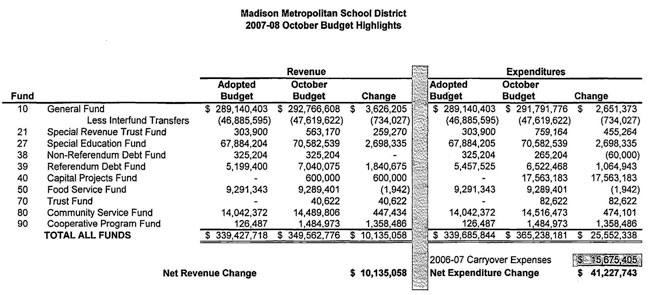
There are similar issues at play in Madison. The local school board’s composition has significantly changed over the past few years – much for the better. Time will tell, whether that governance change translates into a necessary new direction for our $339M+, 24, 342 student Madison School District. Alan Borsuk is a Madison West High Grad.

Share

Elementary School Foreign Language Courses: Then and Now

The recent news that Oregon (WI) is considering the addition of foreign language courses to their elementary schools caused me to wonder what, if anything has happened in this important area within the MMSD? Pamela Cotant’s 5/22/1990 article contains this snippet:

Foreign languages: At the regular school board meeting Monday, the board voted unanimously in favor of seven recommendations made by an ad-hoc foreign language evaluation committee. The recommendations include hiring a half-time foreign language coordinator, consideration of an elementary school pilot program, and evaluation of offering a five-year sequence of the same languages in middle and high schools.

The 1990-1991 MMSD budget was $149.2M. (2007-2008 budget is $339M+).
Celeste Roberts adds some useful comments on the importance of elementary foreign language offerings here.

Share

Recent Change in Per Pupil Public Elementary and Secondary School Current Expenditures Per State: 1986 to 2005 (Constant 2005 Dollars)

18K PDF. Wisconsin’s K-12 funding has increased, in “real dollars” 45.3% from 1986 to 2005 (25th). Interestingly, from a tax perspective, Wisconsin ranks 17th in public elementary and secondary school revenue per $1,000 personal income in 2004 [20K PDF]. Via Morgan Quitno Press: State Trends.
MQ also publishes an annual “Smartest State” award. Wisconsin ranked 8th in 2006/2007.

Share

U of Chicago Requires 4 PowerPoint Slides with Application

Justin Pope:

At business meetings the world over, PowerPoint-style presentations are often met with yawns and glazed eyes.
But at one of the world’s top business schools, such slide shows are now an entrance requirement. In a first, the University of Chicago will begin requiring prospective students to submit four pages of PowerPoint-like slides with their applications this fall.
The new requirement is partly an acknowledgment that Microsoft Corp.’s PowerPoint, along with similar but lesser-known programs, have become a ubiquitous tool in the business world. But Chicago says so-called “slideware,” if used correctly, also can let students show off a creative side that might not reveal itself in test scores, recommendations and even essays.
By adding PowerPoint to its application, Chicago thinks it might attract more students who have the kind of cleverness that can really pay off in business, and fewer of the technocrat types who sometimes give the program a bad name.
“We wanted to have a freeform space for students to be able to say what they think is important, not always having the school run that dialogue,” said Rose Martinelli, associate dean for student recruitment and admissions. “To me this is just four pieces of blank paper. You do what you want. It can be a presentation. It can be poetry. It can be anything.”

A dark day. Much more on PowerPoint and Education, here. The Cognitive Style of PowerPoint, by Edward Tufte.

Share

CUNY Plans to Raise Its Admissions Standards: “the math cutoff would be raised first because that was where the students were “so woefully unprepared””

Karen Arenson:

The City University of New York is beginning a drive to raise admissions requirements at its senior colleges, its first broad revision since its trustees voted to bar students needing remedial instruction from its bachelor’s degree programs nine years ago.
In 2008, freshmen will have to show math SAT scores 20 to 30 points higher than they do now to enter the university’s top-tier colleges — Baruch, Brooklyn, City, Hunter and Queens — and its six other senior colleges.
Students now can also qualify for the bachelor’s degree programs with satisfactory scores on the math Regents examination or on placement tests; required cutoffs for those tests will also be raised.
Open admissions policies at the community colleges will be unaffected.
“We are very serious in taking a group of our institutions and placing them in the top segment of universities and colleges,” said Matthew Goldstein, the university chancellor, who described the plan in an interview. “That is the kind of profile we want for our students.”
Dr. Goldstein said that the English requirements for the senior colleges would be raised as well, but that the math cutoff would be raised first because that was where the students were “so woefully unprepared.”

Speaking of Math, I’m told that the MMSD’s Math Task Force did not obtain the required NSF Grant. [PDF Overview, audio / video introduction] and Retiring Superintendent Art Rainwater’s response to the School Board’s first 2006-2007 Performance Goal:

1. Initiate and complete a comprehensive, independent and neutral review and assessment of the District’s K-12 math curriculum. The review and assessment shall be undertaken by a task force whose members are appointed by the Superintendent and approved by the BOE. Members of the task force shall have math and math education expertise and represent a variety of perspectives regarding math education.

Share

2007 International Math Olympiad Results

Hanoi:

VietnamNet Bridge has more.

Share

Improving education must be the top priority

Milwaukee Journal-Sentinel Editorial:

What’s needed is a regional response, which should include more involvement of businesses outside Milwaukee County in MPS and other school districts’ programs, more collaborative efforts such as the Kern Family Foundation and the Greater Milwaukee Foundation’s Lead the Way program and a debate on what fundamental changes need to be made at MPS and other troubled districts, including whether to change their governing structure. Such a debate should be considered for other local governments, the idea being to make them more manageable, more accountable and more in control of their own affairs and budgets.
Businessman Sheldon Lubar of the Greater Milwaukee Committee put his finger on the problem early in the discussion: “You cannot reach the levels that I think all of you want to see us reach if you have a dropout rate of 50% of your high school students.”
Milwaukee Mayor Tom Barrett said one of his biggest surprises after taking office was the need to improve work force development. “If there’s one issue where I would love to take this community and shake it by the shoulders, it is how important education is in this world economy now,” he said.
Milwaukee County Executive Scott Walker talked about breaking up MPS into several districts; Waukesha County Executive Dan Vrakas argued for the need to reduce health care costs, the single biggest driver of government and school district costs; state Rep. Jason Fields (D-Milwaukee) talked about the politics of changing the educational system.
“This issue has been occurring for the last 20 years, but nothing’s been done about it,” Fields said. “If I sit at this table and we all agree that we need to do something, when we leave this room not a damn thing will change, and those black kids, kids in my neighborhood and my community, will still be in the same position.”
That needs to change for the sake of giving those kids a reasonable chance at a better life but also for the sake of southeastern Wisconsin’s ability to compete in the global marketplace.

Share

Parents still seek the elusive ‘right’ school

Howard Blume & Carla Rivera:

When it comes to looking out for her children and grandchildren, Patricia Britt, a no-nonsense hospital nursing director, is nobody’s fool. Yet here she is, in late July, beside herself because she hasn’t yet settled on a school for her 8-year-old grandson Corey to attend in the fall.
Britt and her son, who are raising Corey together, gradually became dissatisfied with the private school that’s putting a $400-a-month strain on the family budget. But they have concerns about the quality of the public schools close to their Hyde Park home. And schools that they do like, such as the View Park Preparatory charter school run by Inner City Education, have a discouragingly long waiting list.
“My son has been looking,” Britt said. “He’s getting kind of frustrated. It’s almost to the 99th hour of making the decision.”
No one knows exactly how many students are still without a school, but indicators show that the annual last-ditch scramble for a seat at a school of choice is in high gear:

Share

Madison Parents Seek Court Order to Open Enroll into Monona Grove School District

Andy Hall:


Madison resident Allison Cizek, 5, is about to enter kindergarten, but a recent U.S. Supreme Court ruling that restricts the use of race in assigning children to schools may influence which school district she attends.
Allison ‘s parents, Jeff and Jennifer Cizek, filed a petition in Dane County Circuit Court on Thursday seeking an immediate court order that would allow her to attend Taylor Prairie School in the Monona Grove School District this fall.
“I wouldn ‘t be spending money on this if it wasn ‘t important to me, ” Jeff Cizek said Friday evening.
“The color of a person ‘s skin doesn ‘t matter. They should all be treated the same. ”
The family ‘s attempts to transfer Allison from Madison to Monona Grove have been rejected by Madison School District officials who ruled that because she is white, her departure would increase racial imbalance in her Madison school.
Allison ‘s family lives on Madison ‘s Southwest Side in the 2800 block of Muir Field Road. The home is in the Madison School District ‘s Huegel Elementary attendance area.
But her mother teaches in the Monona Grove School District, and last year Allison attended a pre-kindergarten program in that district east of Madison.

Share

“The Peyton Manning of Charter Schools”

David Skinner:

And now his successor, Bart Peterson, a Democrat, has laid down a bold challenge to the city’s troubled public school system: improve or see your students migrate to the city’s growing roster of impressive charter schools authorized by the mayor himself.
This is no idle threat. In the 2006–07 academic year, the mayor oversaw 16 charter schools serving 3,870 students. Peterson is currently the only mayor in the nation running a charter school authorizer out of his office and has proven himself willing to be judged by the results. The charter school office issues an annual report on its schools that, in its candor and analytical sophistication, rivals just about any report out there. But what makes the mayor’s experiment far more interesting than, say, improvements in the city’s bus service, is that his charter schools are achieving results—in some cases, great results—with seriously disadvantaged kids. The Indianapolis experience shows that government, when ably led, can adapt and usher in its own set of reforms.
The story also shows that charter schools are much more than a right-wing hobbyhorse—that Democrats, too, are capable of using them to buck the system. Peterson himself says, “I’m not interested in striking ideological notes,” but he has certainly struck a chord with education thinkers like Andy Rotherham, former education adviser to President Clinton and co-founder of Education Sector in Washington, D.C. Rotherham says Peterson’s example proves that school choice is perfectly compatible with the philosophy of the left. Such a philosophy, however, must be a “liberalism of people,” devoted above all to the interests of students and families, not a “liberalism of institutions,” devoted to preserving the bureaucracy and the unions.

Family Guide to public schools in Indianapolis.
via Democrats for Education Reform.

Share

Teacher Preparation and Licensure: “EDUCATOR QUALITY TAKES ANOTHER SLAM: ABYSMAL GRE SCORES ACROSS THE BOARD”

National Council on Teacher Quality:

A letter to the editor in today’s Wall Street Journal brings more attention to the low academic performance of the average teacher with more meaningful data than just how well (or poorly) aspiring teachers perform on the SAT. On the Graduate Record Exam (GRE) which many teachers take before entering a Master’s program, we find the best evidence to date of substandard performance for the nation’s educators.
While the letter cited older data, more recent data from the ETS site tells a sorrowful tale. With the notable exception of secondary school teachers, the large majority of teachers score at the bottom. Out of the 50 intended graduate majors ETS collected data on, seven of the lowest scoring 10 majors on the list are education fields. Only one field–social work–scored lower.
The most popular choice of graduate degrees for teachers with aspirations for school or district leadership is a degree in education administration. The average GRE score was 948, comparing poorly with the national average score of 1058 for all fields of study.

Tom Shuford:

“When public officials want to reduce crime,” says Reg Weaver, president of the National Education Association, “they listen to police officers. When they want to control flooding, they talk to engineers. . . .” (Letters, July 16). Implication: Want to improve education? Talk to the teachers union. A laughable proposition. Digest these data: Applicants for graduate study in education administration — tested between July 1, 2001, and June 30, 2004 — had a combined mean total GRE (Graduate Record Examination) score of 950 (Verbal, 427; Math, 523). That is sixth from the bottom of 51 fields of graduate study tabulated by the Educational Testing Service.
The mean total GRE score across all fields was 1066. Which applicants had still lower total GRE scores than applicants in education administration? Social work, 896; early childhood, 913; student counseling, 928; home economics, 933; special education, 934 —
education fields all. Other fields with mean GRE scores on the far left side of the GRE bell curve? Seventh, eighth, ninth and 10th from the left tip of the curve, respectively: public administration (“practices and roles of public bureaucracies”), 965; other education, 968; elementary education, 970; education evaluation and research, 985; other social science, 993. Note the pattern: Eighty-plus percent on the far-left-side-of-the-GRE-bell-curve are headed for — or, more likely, already employed by — public education systems. Ninety-plus percent are headed for some form of government employment. This GRE snapshot of the capabilities of the people who run government schooling monopolies is not unrelievedly bleak: There is one education “outlier,” secondary education, that has a mean score of 1063, in the middle of the bell curve distribution.
Tom Shuford
Lenoir, N.C.

Share

Funds for ‘Reading First’ Program in Peril

Morning Edition:

Congress wants to slash funding for “Reading First,” in part because the program has been attacked for conflicts of interests. But teachers love the program, and say it’s one of the most effective parts of No Child Left Behind.

Share

Parents, kids chew on recipe for school success

Pat Schneider:

When the school bell rings this fall, high school freshmen will enter a period when they are most at risk of drifting away from school and the hopes and dreams of their families, statistics on local students show.
That’s why United Way of Dane County joined with the Madison Metropolitan School District on Tuesday in hosting a forum of parents and students to strategize on better ways to help students succeed.
Some 25 parents — and a half-dozen incoming ninth-graders — talked about their hopes for high school. The forum, held at James Wright Middle School, was part of the work of United Way’s Delegation on Disconnected and Violent Youth, which seeks to improve community support for young people and their families so students stay interested in and attending school, and away from drugs and crime.
“Disconnected” youth are not committed to school or work, underachieve and are alienated from adults, said Corey Chambas, co-chairman of the United Way delegation and CEO of First Business Financial Services. “They are really on the wrong path,” he said. United Way estimates there are 3,000 “disconnected” youth in Dane County.

Share

English, Math Time Up in ‘No Child’ Era: 44% of Schools Polled Reduce Other Topics

Jay Matthews:

In the five years since a federal law mandated an expansion of reading and math tests, 44 percent of school districts nationwide have made deep cutbacks in social studies, science, art and music lessons in elementary grades and have even slashed lunchtime, a new survey has found.
The most detailed look at the rapidly changing American school day, in a report released today, found that most districts sharply increased time spent on reading and math.
The report by the District-based Center on Education Policy, which focuses on a representative sample of 349 school districts, found recess and physical education the only parts of the elementary school day holding relatively steady since enactment of the No Child Left Behind measure in 2002.
The survey provides grist for critics who say the federal testing mandate has led educators to a radical restructuring of the public school curriculum in a quest to teach to new state tests. But backers of the law, which is up for renewal this year, say that without mastery of reading and math, students will be hampered in other areas.

Full Report: 772K PDF

Share

Bloomberg on the K-12 Status Quo

NYC Mayor Michael Bloomberg, speaking to the Urban League:

“Next year is the 25th Anniversary of the publication of ‘A Nation at Risk,’ the landmark study that showed how American students were falling behind students in other nations – and the consequences we would face if it continued. Well, it did continue – and it got worse. Much worse. Today, our schools are further behind than they were 25 years ago –even though we’ve doubled education spending over the last several decades. If you did that with your 401(K) or your pension fund, you’d work for the rest of your life and die broke!
“In many cities, including New York, the money was squandered by politicians and special interests who protected their own jobs first, and worried about classroom learning second. A generation of students paid a terrible price, and let’s face facts: No group of children paid more than African-Americans.
“Today, black and Latino 12th graders – who should be reading college catalogs – are reading at the same level as white 8th graders. And a shockingly high percentage of black and Latino 4th graders – who should be reading Harry Potter – cannot even read a simple children’s book. This is not only not acceptable – it’s shameful. Whitney Young Jr. must be turning over in his grave!
“Here we are in the greatest country on earth – home of the best universities in the world. Is this really the best we can do? No way. We’re better than that. But let me tell you something. Let me tell you exactly who’s at fault: Us. That’s right. We are the ones to blame. And here’s why: Politicians have pandered to us by selling us on the idea that all we need is more money and smaller classes – and we’ve bought it. They’ve given us cheap platitudes and slogans instead of real solutions – and we’ve bought it. Whoever’s in power, they’ve pointed fingers at the other party when nothing improves – and we have bought it!

Share

Middle-schoolers get a glimpse of higher learning at UW-Waukesha

Amy Hetzner:

UW-Waukesha has held individual courses and camps before, aimed at drawing younger students to its campus and feeding their imagination over the summer break. This year, however, was the first time it organized a full week of classes for students 11 to 14 to learn from the same instructors who teach young adults at the two-year campus.
It’s been an eye-opening experience for the instructors teaching the academy courses in science subjects from chemistry and ecology to astronomy and meteorology.
“The middle school is just wonderful to teach because the kids are in that part of their childhoods in which they become very, very curious about the world and are very easy to talk to about many different issues,” said Bob Birmingham, a UW-Waukesha archaeology lecturer and one of the teachers for the academy. “They ask a lot of questions. It seems to be an age where they’re putting a lot of things together.”

Share

Madison School District Small Learning Community Grant Application

136 Page 2.6MB PDF:

Madison Metropolitan School District: A Tale of Two Cities-Interrupted
Smaller Learning Communities Program CFDA #84.215L [Clusty Search]
NEED FOR THE PROJECT
Wisconsin. Home of contented cows, cheese curds, and the highest incarceration rate for African American males in the country. The juxtaposition of one against the other, the bucolic against the inexplicable, causes those of us who live here and work with Wisconsin youth to want desperately to change this embarrassment. Madison, Wisconsin. Capital city. Ranked number one place in America to live by Money (1997) magazine. Home to Presidential scholars, twenty times the average number of National Merit finalists, perfect ACT and SAT scores. Home also to glaring rates of racial and socio-economic disproportionality in special education identification, suspension and expulsion rates, graduation rates, and enrollment in rigorous courses. This disparity holds true across all four of Madison’s large, comprehensive high schools and is increasing over time.
Madison’s Chief of Police has grimly characterized the educational experience for many low income students of color as a “pipeline to prison” in Wisconsin. He alludes to Madison’s dramatically changing demographics as a “tale of two cities.” The purpose of the proposed project is to re-title that unfolding story and change it to a “tale of two cities-interrupted” (TC-I). We are optimistic in altering the plot based upon our success educating a large portion of our students and our ability to solve problems through thoughtful innovation and purposeful action. Our intent is to provide the best possible educational experience for all of our students.

Much more on Small Learning Communities here [RSS SIS SLC Feed]. Bruce King’s evaluation of Madison West’s SLC Implementation. Thanks to Elizabeth Contrucci who forwarded this document (via Pam Nash). MMSD website.
This document is a fascinating look into the “soul” of the current MMSD Administration ($339M+ annual budget) along with their perceptions of our community. It’s important to note that the current “high school redesign” committee (Note Celeste Roberts’ comments in this link) is rather insular from a community participation perspective, not to mention those who actually “pay the bills” via property taxes and redistributed sales, income and user fees at the state and federal level.

Share

Advocating Teacher Merit Pay

Wisconsin State Journal Editorial:

Wisconsin should reward hard-working, innovative teachers such as William Farnsworth with merit pay.
Farnsworth, a science teacher at Waunakee Intermediate School, received the 2006 Presidential Award for Excellence in Mathematics and Science Teaching. He was the only Wisconsin teacher among the 93 teachers honored.
Performance-based pay serves as an incentive for better work, makes salaries competitive and reflects the complexity of many teaching jobs. It’s time has come in Wisconsin.

Share

A Smart Parent Criticizes AP

Jay Matthews:

Last week Pomona College president David Oxtoby tried to educate me in this column about what he sees as the flaws of the Advanced Placement program, the college-level courses and tests given in high school of which I am American journalism’s biggest supporter. This column will look at AP from the perspective of a well-informed parent in Anne Arundel County, Md., who thinks the program has fallen prey to the worst aspects of the movement to make public schools accountable through regular testing.
I was pretty aggressive with Oxtoby, since I know him well and figure he is used to being disrespected by self-important reporters. In the discussion below, I am much more polite to Anne E. Levin Garrison, since she is under no obligation to talk to me and has a very personal perspective that even a know-it-all like me has to respect. Part of this column’s role as asource of information on AP, International Baccalaureate and other efforts to improve our high schools is my insistence that it be the most important forum for criticism of AP and IB. So I am thankful to both Oxtoby and Garrison for helping me fulfill that obligation and hope other critics will email me when they have something to say.

Share

The Centralization of K-12 Education

Arnold Kling:

“We have been inexorably centralizing control over the schools in this country for 150 years. We’ve gone from one-room schoolhouses overseen directly by the parents of the children who attended them to sprawling bureaucracies that consume half of the operating budgets of their respective states. We’ve gone from 127,000 school districts in 1932 to fewer than 15,000 today — despite a massive increase in the number of students.”
Andrew J. Coulson

Share

Schools Beat Back Demands for Special Ed Services

Daniel Golden:

Paul McGlone, an iron worker, and his wife, Tricia, became worried in 2006 that their autistic son knew fewer letters in kindergarten than he had in preschool.
When the East Islip school district refused their request for at-home tutoring by an autism specialist, they exercised their right under federal special-education law to an administrative hearing. There, a hearing officer ordered East Islip to pay for seven hours a week of home therapy. The McGlones hired a tutor, and their son “started to click again,” his mother says.
Then the district appealed the decision to Paul F. Kelly, the New York state review officer for special-education cases. He denied any reimbursement for home services. “The child’s progress was consistent with his abilities,” Mr. Kelly found in February. The family canceled the tutoring.
The McGlone case is part of a pattern that has many parents and advocates for the disabled in an uproar. They say administrative reviews in many parts of the U.S. overwhelmingly back school districts in disputes over paying for special-education services. State education departments, which have an interest in keeping down special-education costs, typically train or hire the hearing officers. Also, recent U.S. Supreme Court decisions and changes to federal law have made it harder for parents to win cases.

Share

Germantown Wants to Leave Milwaukee’s MATC Tax District

Tom Kertscher & Erica Perez:

A proposal to remove Germantown from the Milwaukee Area Technical College District is a step into largely uncharted territory, but it is attracting interest from other communities that want to cut property taxes.
Meanwhile, MATC is waiting to see whether it could lose millions of dollars to the Moraine Park Technical College District, should Germantown succeed in moving to the lower taxing district.
Gaining approval from the state technical college board for such a move probably would be difficult, given that it would take money away from the Milwaukee district, said Germantown Village Trustee Al Vanderheiden.

Share

Politics, Indoctrination and Education

Michael Levy:

Two stories recently caught my eye, one in the Washington Post that discussed the publication of a new Russian teaching manual, written ”in-part by Kremlin political consultants,” that is very nationalist in outlook and a BBC report that a new Israeli textbook to be used in Israeli-Arab schools provides a more nuanced and balanced view of Israel’s creation in 1948, acknowledging that some Arabs consider it a “catastrophe” and that some Palestinians were expelled and lands confiscated following statehood. (These are but two examples of controversies that regularly arise over history textbooks; for example, Japanese textbooks and their portrayal of that country’s imperial history have always been a lightning rod throughout Asia.)

Share

“The first ingredient in education reform is to tell parents the truth.”

National Alliance for Public Charter Schools:

OK, so the Lieberman/Landrieu/Coleman bill is technically second out of the gate, but [this one] really gets the NCLB reauthorization debate started. Making its debut at a Senate-side shindig featuring Chancellors Klein (NY) and Rhee (DC), the Lieberman-led proposal lays done some important markers, to wit:

  • Lets schools move away from input-driven “Highly Qualified Teachers” rules and toward a new standard based on effectiveness in the classroom
  • Permits growth measures in Adequate Yearly Progress, and fund the technologies needed to move rapidly toward measuring student-level longitudinal gains
  • Morphs NAEP’s governing body into a new commission that would write voluntary standards – – and make states tell parents about the gap between their own state assessments and prevailing national norms

More sunshine is better. Props to Madison Magazine for taking a closer look at our local schools.

Share

Seacamp

David Koeppel:

SARAH JONES’S first real sense of what it might be like to be a marine biologist came during summers at Seacamp San Diego, a camp for middle-school and high-school students. It was there that her curiosity about the field evolved into an academic and career choice.
Ms. Jones, 25, is about to begin a Ph.D. program in biological oceanography at the Florida Institute of Technology in Melbourne. She wants to become a marine biology professor and to conduct research into seahorse conservation and preservation.
The type of camp that inspired Ms. Jones as a teenager is gaining popularity, and is part of a larger trend toward environmental and science camps. About 50 camps, most of them near the ocean, now specialize in marine biology studies, according to the American Camp Association. That is an increase of about 25 percent since 1998.

Share

Walking to school goes by wayside

Mike Stobbe:

Fewer than half of American children who live close to school regularly walk or bike to classes, according to a new study that highlights a dramatic shift toward car commuting.
Children in the South did the least amount of walking or cycling, partly because of safety concerns, experts say.
The issue is considered important because it is linked to escalating rates of childhood obesity. And many schools have been cutting back on recess and physical education, said Sarah Martin, the study’s lead author.

Share

California’s students get into college, but not always out

Justin Pope:

For most of history, higher education has been reserved for a tiny elite.
For a glimpse of a future where college is open to all, visit California — the place that now comes closest to that ideal.
California’s community college system is the country’s largest, with 109 campuses, 4,600 buildings and a staggering 2.5 million students. It’s also cheap. While it’s no longer free, anyone can take a class, and at about $500 per term full-time, the price is a fraction of any other state’s.
There is no such thing as a typical student. There are high achievers and low ones, taking courses from accounting to welding. There are young and old, degree-seekers and hobbyists — all commingled on some of the most diverse campuses in the country, if not the world.
Many students, for one reason or another, simply missed the onramp to college the first time around — people like 31-year-old Bobbie Burns, juggling work and childcare and gradually collecting credits at San Diego City College in hopes of transferring to a media program at a nearby university.

Share

College Essay Contest

NY Times Magazine:

“College as America used to understand it is coming to an end.”
In the turbulent late ’60s and early ’70s, college campuses played a major role in the culture and politics of the era. Today, according to author and historian Rick Perlstein, colleges have lost their central place in the broader society and in the lives of undergraduates.
We invite all college students to read “What’s the Matter with College,” Perlstein’s full article on the subject, and submit an essay of no more than 1,200 words in response.
Is the college experience less critical to the nation than it was a generation ago? We invite you to join the debate.

Share

New Manuals Push A Putin’s-Eye View In Russian Schools

Peter Finn:

With two new manuals for high school history and social studies teachers, written in part by Kremlin political consultants, Russian authorities are attempting to imbue classroom debate with a nationalist outlook.
The history guide contains a laudatory review of President Vladimir Putin’s years in power. “We see that practically every significant deed is connected with the name and activity of President V.V. Putin,” declares its last chapter. The social studies guide is marked by intense hostility to the United States.
Both books reflect the themes dominating official political discourse here: that Putin restored Russian strength and built what the Kremlin calls a “sovereign democracy” despite American efforts to isolate the country.
The principal author of the history manual — “The Newest History of Russia, 1945-2006” — is Alexander Fillipov, deputy head of the National Laboratory of Foreign Policy, a research institute affiliated with the Kremlin.

Share

Helping students become ‘responsible citizens’?

Vin Suprynowicz:

John Taylor Gatto, honored on several occasions as New York City and New York state teacher of the year, has made it the second part of his life’s work to determine why our government schools are so ineffective — why he always had to fight the bureaucracy above him in order to empower his young charges (many of them minority kids, given to him as “punishment” because the administrators thought them “hopeless”) to spread their wings and learn.
What Gatto discovered is enough to cause a massive paradigm shift for anyone who reads his books, whether you start with the slim “Dumbing Us Down” or his weightier master work, “The Underground History of American Education.”
America’s schools aren’t failing, Gatto discovered. They’re doing precisely what they were re-designed to do between the 1850s and the early 1900s, when America embarked on our current imperial/mercantilist adventure — that is, to churn out little soldiers and factory workers with mindless obedience drilled in and with the higher critical faculties burned out of them through the process of feeding them learning in small unrelated bits like pre-digested gruel, till they neither know how nor feel any inclination to discern higher patterns, which might lead them to challenge the “party line.”
Who dreamed up such a system?
Thus, if we want to see what our “reverse-engineered” copy of the German school system has in mind for us, it might pay to simply take a look at what’s happening with government-run schooling … in Germany.

Share

On Early Childhood Education

Milwaukee Journal-Sentinel Editorial Board:

Kindergarten for 3-year-olds has been a smash hit at Bruce Guadalupe Community School on Milwaukee’s near south side, where, bucking what is supposed to be their fate, low-income students perform at a high academic level.
Jill Matusin, who teaches 5-year-olds at the charter school, swears by 3K.
“The difference – it was amazing,” she says of two sisters in her classroom in successive years – one who started in 5K and the other in 3K. The sister with the head start was far more advanced in numbers, colors, language and social skills.
The results so impressed Bruce Guadalupe that it is set to open four more 3K classrooms this fall – setting a splendid example for the state, which must boost preschool education, particularly for needy children. This strategy would narrow, if not close, the gaps in academic achievement between the poor and the middle class, whites and blacks, Anglos and Latinos.
Decades of study have led educators to this consensus: When aimed at kids from lower-income families, quality early childhood education boosts academic attainment, high school graduation rates, college attendance and future wages, and it reduces truancy, crime and teenage pregnancies.

Share

Harvesting Kids

Andrew Gumbel:

When I told some actor friends about my experience, they immediately labeled it a scam. So did officials from the Association of Talent Agents, and from the Screen Actors Guild. What surprised me was how sophisticated the scam was – the company had my children (and, I would imagine, many parents) eating out of its hand before it asked for the money. What I didn’t yet realize, though, was how the scam worked – and how the entire industry essentially relies on shysters and con artists to provide a steady flow of child labor.
Here’s how the system operates. Aly Hartman referred a few times to Parent Guide’s “Burbank office,” but what she was really talking about was a child-actor management company called Kids! Background Talent, which is indeed in the business of finding children work on television and in the movies. Kids! Background Talent charges no upfront fees, other than a refundable $30 registration designed mainly to maintain a modicum of seriousness among its would-be clients.

Share

Lancaster parents blast 4-day school week plan

Kathy Goolsby & Karen Ayres:

Nearly 1,000 parents and students packed into Lancaster High School’s auditorium Thursday night to hear district officials pitch a plan for a four-day school week that drew fiery criticism from the crowd.
Many parents at the emotion-charged meeting said the proposal – which would take effect this fall and is being presented as a one-year pilot program – would allow unsupervised students to get into trouble while home alone Fridays and would force parents to spend hundreds of dollars on child care for young children.

Share

150 Years of Milwaukee Marquette High School

Alan Borsuk:

They don’t have that at Marquette University High School anymore.
“I may have been in the last class where you were required to take Latin,” said Milwaukee Mayor Tom Barrett, who graduated in 1972. “There was something about the Gallic Wars the second year, that’s about all I remember.”
Some things do change at Marquette High. But look at all the things that haven’t changed over the past 150 years – it’s still in the heart of the city, still all-boys, still Jesuit, still producing a generous portion of the political, judicial, corporate and civic leaders of the city.
The school will celebrate its 150th birthday Saturday; its roots go back nearly to the founding of Milwaukee.
(Latin, by the way, is still offered as an elective, and 103 students are scheduled to take it this fall. Also, not everyone disliked Latin. Milwaukee historian and author John Gurda, a 1965 graduate, said he treasures his four years of Latin and two years of Greek, and they still strengthen his perspective on language and its roots.)

Share

The Students Behind NCLB’s ‘Disabilities’ Designation

Erin Dillon:

It’s not hard to find news reports about the federal No Child Left Behind Act claiming that the law is requiring teachers to give standardized tests to severely disabled students.1 These stories frequently portray all special education students as having the same severe disabilities and bolster calls for changes to NCLB’s accountability provisions for special education students. But the majority of special education students are not severely handicapped. With special services and accommodations, they are able to perform at grade level.
As part of its accountability requirements, NCLB calls for schools to separate test-score data by student subgroup—categories of students that include major racial groups, low-income students, English language learners, and students with disabilities. This prevents schools, school districts, or states from letting high overall student achievement hide low achievement among certain groups of students. NCLB defines the students-with-disabilities subgroup as all students served under the Individuals with Disabilities Education Act (IDEA). As Chart 1 shows, this is a broad definition and includes students with a wide range of disabilities.

Share

History lessons ‘are becoming a thing of the past’

Graeme Paton:

HISTORY is becoming an endangered subject as growing numbers of children drop the subject at 14, according to Ofsted, the education watchdog.
Less than a third of pupils study GCSE history, meaning few learn about important historical themes when they are “mature enough” to do so.
In a critical report published today, inspectors said pupils were being driven away because of overloaded timetables and lessons that were often dumbed down.
Ofsted insisted the curriculum focused on a “relatively small number of issues” with pupils failing to make connections between different periods or answering the “big questions” thrown up by the past.
The report also said the Government’s drive to promote so-called “Britishness” was being undermined by lessons that focus too strongly on England while shunning Scotland, Wales and Ireland.

Share

College Board Tries to Police Use of ‘Advanced Placement’ Label

Tamar Lewin:

When Bruce Poch, the dean of admissions at Pomona College, sees a high school transcript listing courses in AP Philosophy or AP Middle Eastern History, he knows something is wrong. There is no such thing. Neither subject is among the 37 in the College Board’s Advanced Placement program.
“Schools just slap AP on courses to tag them as high-level, even when there’s no Advanced Placement exam in the subject,” Mr. Poch said. “It was getting to be like Kleenex or Xerox.”
But now, for the first time, the College Board is creating a list of classes each school is authorized to call AP and reviewing the syllabuses for those classes. The list, expected in November, is both an effort to protect the College Board brand and an attempt to ensure that Advanced Placement classes cover what college freshmen learn, so colleges can safely award credit to students who do well on AP exams.
“We’ve heard of schools that offered AP Botany, AP Astronomy, AP Ceramics, and one Wyoming school with AP Military History,” said Trevor Packer, director of the board’s Advanced Placement program. “We don’t have those subjects. One of the reasons colleges called for the audit was that they wanted to know better what it means when they see an AP on a transcript.”

Share

New learners must spend 4 hours a day on English

Pat Kossan:

All kids still learning English will have to spend at least four of their five or six class hours in new courses in English grammar, phonetics, conversation, reading and writing.
It’s a big change in the way the state’s K-12 schools will teach English to about 135,000 kids, whose primary language is most often Spanish, but also Navajo, Somali and dozens of others. Many of those kids now get about an hour of English a day.
“More time on task. That’s a tried-and-true educational standard,” said economist Alan Maguire, who headed a task force that created the state’s new language-learning requirements. “If you want to learn how to play the piano, what do they tell you to do? They tell you to practice.”
The new model is based on a law passed last summer.

Share

Learning, Growth and Socialization: A paper presented to the Association of Teacher Educators Summer Conference, Milwaukee: July 29, 2007

UW-Milwaukee Professor Emeritus Martin Haberman (and create of MMTEP):

I recently examined the four most widely used texts sold to faculty in schools of education to teach “learning” to future teachers. The courses these texts are used in are well known to teacher educators. They carry titles such as “Principles of Learning for Teachers,” or “Introduction to Educational Psychology,” or “Learning in Classrooms.” There is no accredited teacher preparation program in the country that does not require at least one such course. There is no state department of education that does not require such courses before they will accredit a college or university as having an approved program of teacher education. No other academic discipline has any where near such total control and influence over the “knowledge” required of future teachers.
As I scanned these texts I asked myself a simple question. If I were a classroom teacher how would the learning theories being presented in these texts help me to deal with the following subgroups in a class of 25 to 35 students:
1.4-6 students feign helplessness regardless of how much the assignments are watered down and never complete assignments.
2.6-8 students need for attention prevents them from staying on task and interferes with the work of others.
3.1-2 students see themselves as having been hurt by teachers and seek revenge regardless of the task or assignment at hand.
4.3-4 students challenge the teacher for control of the classroom
5.6-8 students come to school everyday and function as observers rather than participants. They devote most of their time to observing the interactions ( i.e. the cold or hot war) between the teacher and each of the four student groups cited above.
Ultimately, this group comprises the majority of school dropouts; these are students with very low achievement who declare they quit school because it was”boring.”
6.4-6 officially labeled special needs students with IEP’s.
It is important to understand that the causes of feigned helplessness, the need for constant attention, assurance, control, revenge, or to observe rather than participate cannot be fully explained by psychological constructs.At least a dozen academic disciplines provide valid theoretic and research based constructs that explain these student behaviors. Thinking of classes in real schools comprised of these six subgroups I found little in the texts that explain either why students take on these roles or what a teacher could do to best teach students assuming these roles. But worst of all, I found no connection anywhere in the four texts between the endless lists of recommended behaviors given to prospective teachers and any theory of learning. In a desperate attempt to convince myself that surely these texts on “learning” would have some relevance to the real world I looked up the terms “classroom management” and “discipline” in their glossaries. Each of these volumes consisted of over 300 pages. In each case I found less that two pages of do’s and don’ts dealing with discipline and no connection of these recipes to any theory of learning.The volumes themselves are endless lists of things teachers should do without any connections whatever between their endless admonitions to any psychological theory. The reason for this is simple. The interminable advocacies are not based on or derived from any psychological theory… none.

Martin Haberman Clusty Search.

Share

“A primer on “Madison Math” – when is a ‘cut’ really a cut?”

Rep. Karl Van Roy:

Calling an increase in spending or funding a ‘cut,’ just because it isn’t as much as someone proposed, is a textbook example of “Madison Math.” In the coming weeks, you’ll be hearing a lot about the Assembly version of the budget and a good portion of the criticism will be false claims that our version cuts our most important programs. For example, you’ll hear that the Assembly budget cuts funding for the UW system and K-12 education. Both of these claims are patently false. In fact, the Assembly version of the budget increases spending on K-12 education by $464,404,400 ($16 million more than Governor Doyle proposed). And the UW system receives a $62.3 million increase above their funding level in the last budget, but yet you will hear cries of ‘cuts’ to the UW system simply because they were offered more in the Governor’s and Senate’s versions of the budget.

K-12 spending increases annually. The debate is always over the amount (and sometimes the source such as the redistribution of income, sales or property taxes) of the increase. The current state of Wisconsin Budget is $54,268,817,100. Senate Democrats proposed a new budget of $66,106,668,800 while Assembly Republicans proposed spending $56,336,765,800 in the next budget cycle. TJ Mertz has more on the proposed state budget here and here.

Share

“The “White Privilege” Fetish Of Seattle’s Public Schools”

Matt Rosenberg:

On its Web site, the Seattle Public Schools Office of Equity and Race Relations details what it expects of the students from four Seattle high schools who are being sent to the eighth annual White Privilege Conference April 18-21 in Colorado Springs. The SPS white privilege conference “expectations” document states that for student attendees, ensuing goals should include: “educate youth and people who work with youth about issues of privilege;” and, “support and develop youth leadership for social and economic justice.” White privilege, as I discuss in a Seattle Times op-ed today, is about the pernicious cult of individualism and self-determination.

Share

Best And Worst School Districts For The Buck

Via a reader email: Christina Settimi:

More spending doesn’t necessarily buy you better schools. With property taxes rising across the country, we took a look at per-pupil spending in public schools and weighed it against student performance–college entrance exam scores (SAT or ACT, depending on which is more common in the state), exam participation rates and graduation rates.
Winners in this rating system are counties whose schools deliver high performance at low cost. The losers spend a lot of money and have little to show for it.
Marin County, Calif., provides the best bang for the buck. In 2004 Marin spent an average of $9,356 ($6,579 adjusted for the cost of living relative to other metro areas in the U.S.) per pupil, among the lowest education expenditures in the country. But in return Marin delivered results above the national average: 96.8% of its seniors graduated, and 60.4% of them took the SAT college entrance exam and scored a mean 1133 (out of 1600). The others in the top five are Collin, Texas; Hamilton, Ind.; Norfolk, Mass.; and Montgomery, Md.
In Pictures: Best And Worst School Districts For The Buck
On the opposite end of the spectrum, Alexandria City, Va., which sits just six miles outside of our nation’s capital, spent $13,730 ($11,404 adjusted) per pupil, but its high schools registered only a 73% graduation rate, with 65.0% of the seniors participating in the SAT for a mean score of 963. According to John Porter, assistant superintendent, Administrative Services and Public Relations for the Alexandria City Public Schools, their graduation rate is reflective of a large number of foreign-born students who may take longer than the traditional four years to graduate. He also noted that their performance measures are rising, along with their expenditures. Per-pupil spending in Alexandria City is now over $18,000. Others on the bottom of the list include Glynn, Ga.; Washington, D.C.; Ulster, N.Y.; and Beaufort, S.C.
Using research provided by the Tax Foundation, a nonpartisan tax research group based in Washington, D.C., Forbes began with a list of the 775 counties in the country with populations greater than 65,000 that had the highest average property taxes. From this list we isolated the 97 counties where more than 50% of per-pupil spending contributions comes from property taxes. ( Click Here For Full Rankings)
Since it costs more to educate a student in New York than Alabama, we adjusted expenditures for each metropolitan area based on Economy.com’s national cost of living average. We then chose to compare spending to the only performance measures that can be used to compare students equally across the country. With a nod toward recognizing the importance of education, performance was weighted twice against cost. Performance and cost numbers are county averages; individual school districts within a county can vary greatly.

Dane County ranked 63rd (Other Wisconsin Districts in the Top 97 include: Ozaukee – 16, -43 and Walworth – 91).
Daniel de Vise:

Education scholars and school system officials greeted the study as a flawed answer to a fascinating question: Which school districts deliver the best results for the tax dollars citizens invest?
“The value of this kind of analysis is to remind us that simply pouring more [money] into existing school systems is no formula for producing higher achievement out the other end,” Chester E. Finn Jr., president of the Thomas B. Fordham Foundation, said in an e-mail.
But Finn derided this analysis as “just plain dumb” for failing to consider other factors, such as wealth and parent education, that affect test scores and graduation prospects.
The Forbes study takes the unusual approach of rating school systems from a stockbroker’s perspective — or, more specifically, the perspective of a stockbroker raising a family in the D.C. suburbs. Rather than simply rank them by SAT participation or outcome or graduation rate, it considers all three measures and a fourth, dollars spent.
The endeavor is skewed toward affluent and suburban schools, educators said, because of the focus on local property taxes; wealthier jurisdictions tend to pay a greater share of education costs from their own tax coffers. The top three systems in the resulting ranking are all suburban: Marin County, just north of San Francisco; Collin County, near Dallas; and Hamilton County, outside Indianapolis.

Share

The Rush to Take More AP Courses Hurts Students, High Schools, and Colleges

David Oxtoby:

An entering student at Pomona College last fall submitted the results of 14 Advanced Placement tests, all but one with the top score of 5. In all, 20 members of the entering class each reported the results of 10 or more such exams. Obviously, these are highly talented students who will benefit from the broad range of advanced courses that Pomona offers. But it is far from clear that this proliferation of AP courses — along with the accompanying pressures — truly makes for the best high-school education, or, for that matter, prepares students to get the most out of their college years.
When I was a high-school student in the 1960s, students in good schools might have taken several AP courses, all during their senior year. Now, however, in order to accumulate 10 or more AP exams, it is necessary to begin far earlier. At some high schools, a 10th-grade chemistry course (the first chemistry course a student takes) is now designated as “advanced placement” so that introductory as well as college-level material can be compressed into a single year of work. In a few subjects, AP courses are now available as early as ninth grade. Can a ninth grader truly be said to be doing “college level” work in European history?

Jay Matthews:

David Oxtoby is one of the most interesting men in American higher education today. He first strikes you as another brilliant but nerdy scientist, which is how he got started, with a doctorate in chemistry from Berkeley and a splendid record as a professor and researcher. But he also had people skills and became president of Pomona College just as my daughter was arriving in 2003 for the start of her freshman year.
I think he is a terrific person and teacher, which is why I was so upset when I saw he had written a piece for the April 27 edition of the Chronicle of Higher Education titled “The Rush to Take More AP Courses Hurts Students, High Schools and Colleges.”
I think he is wrong, and wrong in a way that reveals the frustrating refusal of some of our best colleges to see what great benefits AP and other college courses are bringing to the vast majority of high schools that rarely, if ever, send students to extremely selective colleges like Pomona.

Share

Learn to read Thai, get an education

Amy Kazmin:

In the dilapidated former canteen of Thailand’s Wat Si Sutharam School, about 20 Burmese children – aged five to 15 – sit on benches, carefully copying the first letter of the Thai alphabet in lined notebooks. Among them is 10-year-old Sai Htaw, a boy from Burma’s ethnic Mon minority, whose mother, San Aye, a worker in the coastal province of Samut Sakorn’s vast seafood-processing factory, hovers nearby.
Sai Htaw has a Thai name (Amporn) and speaks Thai with ease. But he neither reads nor writes it. During what should have been the early years of his education he was barred from Thai schools because he lacked a birth certificate, something issued only to Thai citizens.
Now, toiling in the spartan classroom, supervised by volunteer teachers from a labour rights group, Sai Htaw is on the front line of what is likely to be an arduous struggle: the push to secure formal education for the often Thai-born children of migrant workers from Burma.
With a recent decision by Bangkok to open schools to all, Sai Htaw and his classmates have been promised places in schools alongside Thai children – once they grasp the basics of reading and writing Thai. Ms San Aye is elated: “I want him to study as much as he can.”

Share

Abolish the SAT

Charles Murray:

The SAT got him into Harvard from a small Iowa town. But now, CHARLES MURRAY wants to abolish the test. It’s unnecessary and, worse, a negative force in American life.
For most high school students who want to attend an elite college, the SAT is more than a test. It is one of life’s landmarks. Waiting for the scores—one for verbal, one for math, and now one for writing, with a possible 800 on each—is painfully suspenseful. The exact scores are commonly remembered forever after.
So it has been for half a century. But events of recent years have challenged the SAT’s position. In 2001, Richard Atkinson, president of the University of California, proposed dropping the SAT as a requirement for admission. More and more prestigious small colleges, such as Middlebury and Bennington, are making the SAT optional. The charge that the SAT is slanted in favor of privileged children—“a wealth test,” as Harvard law professor Lani Guinier calls it—has been ubiquitous. I have watched the attacks on the SAT with dismay. Back in 1961, the test helped get me into Harvard from a small Iowa town by giving me a way to show that I could compete with applicants from Exeter and Andover. Ever since, I have seen the SAT as the friend of the little guy, just as James Bryant Conant, president of Harvard, said it would be when he urged the SAT upon the nation in the 1940s.

Share

High School of the Arts gets creative to erase debt

Sarah Carr:

Prospects are looking brighter for the coming school year at cash-strapped Milwaukee High School of the Arts. But long term, the school’s fate will provide a case study for some of the major challenges facing public education today:

  • Can a financially struggling public school find major private donors?
  • Can a school with a distinct – and sometimes, more costly – specialty, such as the arts, preserve that focus at a time of slimmed-down budgets?
  • And if help comes, will it be from the arts community, business leaders, alumni and parents, or from established funding channels? Where does a public school in need of extra money turn first?

Under a new plan, the high school will likely borrow money from a pool of funds from other city schools with budget surpluses. The move will probably allow the school to restore a few teaching positions in the fall. The plan has brought a fresh sense of optimism to the school community. But the High School of the Arts’ situation also underscores the obstacles in store as public schools, in unprecedented numbers, try to dive into the world of private fund raising.

Share

Test for Success, Not Failure, in Education

Richard Rusczyk:

A wide-ranging study of pedagogy could bring about revolutionary advances in education, much as similar studies have brought about changes in medicine, as Gawande documents. Instead, nearly all efforts go into producing yet more new methods.
Why?
I run a small business producing educational materials, so I know well why: No one makes money testing existing procedures (outside of the politically-connected testers, of course, but innovators need not apply), nor by making incremental changes over a generation, even if those incremental changes amount to tremendous benefit to students.

Share

Detroit Superintendent No Fan of Charters

Jennifer Mrozowski:

New Detroit Public Schools superintendent Connie Calloway said Thursday that she does not support charter schools, and she intends to present ideas that will help draw students back to the struggling school system.
“Charter schools mean suicide for public schools,” said Calloway during her first board meeting, causing the crowd at Kettering High School to erupt in applause.
Calloway said Detroit Public Schools must get to the root of the persistent enrollment loss plaguing the 116,000-student district.
She identified two immediate reasons: ongoing disputes the district faces and the desire of parents to have safe, clean and orderly schools.
“We have to think about the presence that we put forth to the media, to the state department, to the rest of the United States as a Detroit Public Schools community,” she said. “What is it that we are doing that causes us to drive families away?”

Joanne has more.

Share

The “Small School Hype”

Diane Ravitch:

I like small schools, but I also like middle-size schools. About ten years ago, Valerie Lee of the University of Michigan did a study in which she asked what was the ideal size for a high school, and she concluded that the ideal school was small enough for kids to be known by the teachers, but large enough to mount a reasonable curriculum. The best size for a high school, she decided, based on a review of student progress in schools of different sizes, is 600-900 students. You may think this is too large, but it sure beats schools of 2,000-3,000. I think we can all agree that the mega-schools that were created in the past forty years or so are hard, difficult environments for adolescents, where they can easily get lost in the crowd. Anonymity is not good for kids or for adults, either.
Anyway, American education seems to be engaged in yet another statistical sham, this time involving small high schools. Everyone wants Gates money, so almost every big-city school district is breaking up big schools into small schools. To make sure that they look good and get good press (the same thing), the leadership of some districts stack the deck by screening out the lowest performing kids—the special education students, the limited-English speakers, and kids with low test scores.

Much more on Madison’s Dance with “Small Learning Communities” here, including outgoing Superintendent Art Rainwater’s presentation on the proposed “High School Redesign”.

Share

“Fuzzy Math” War in Seattle

Rachel Tuinsta:

Educators and parents say it’s a debate between conceptual vs. computational math.
It’s a battle centered around curriculum, teaching materials and textbooks with the question on everyone’s mind: What is the best way for students to learn math?
The debate has spurred Eastside parents to sign petitions and lobby district officials for changes; some even have decided to run for school board.
What most students are learning in Eastside classrooms and across the nation is known as “conceptual” math, sometimes called new math, or what Killeen and other parents call “fuzzy” math.
In elementary grades, it focuses more on the “why,” not just the “how.” Students are asked to explain what the numbers mean, not just what the correct answer is. They are shown different ways to do the same problem and are encouraged to find their own methods.
But some parents say this method is shortchanging children, leaving them without a solid foundation in basic math concepts.

Share

Too Many California Students Not Ready for College

Pamela Burdman and Marshall S. Smith

California’s vibrant economy is in jeopardy because we aren’t producing enough educated workers to meet the state’s future needs, according to a recent study by the Public Policy Institute of California. The authors see only one solution: improving college attendance and graduation rates of Californians.
High-profile attempts by top universities to serve more low-income and minority students are important, but they won’t solve this problem. Only a limited number of students can attend these schools. Substantially increasing graduation rates will require lifting achievement levels for students who are not admitted to public universities.
If approved by lawmakers, a $33 million investment tucked inside the state budget represents a rare attempt to work toward that goal. The funds would ensure continuation of an audacious initiative that is shining a spotlight on a problem that has historically seemed intractable: the large number of students who don’t succeed in college because they don’t complete remedial English or math.
This effort represents the best chance in years to reverse that trend. It is being coordinated by instructors at the state’s community colleges, and no one is better positioned to tackle the problem. But the plan will not work without the serious engagement of colleges and sustained state support.

Share

Progress is slow under Bush’s 2001 education reform, but No Child Left Behind is worth improving

Ronald Brownsein:

THE COMPLAINTS are reaching a crescendo as Congress moves closer to reauthorizing No Child Left Behind, the education reform law that President Bush passed with rare bipartisan support in 2001. Conservatives are wailing about federal intrusion. Teachers unions and some leading Democrats moan that the law relies too much on testing as the measure of student progress. And some parents echo each of those indictments.
There’s no doubt the law has minted enemies. But Kati Haycock, president of the Education Trust, a nonpartisan group that advocates for low-income children, has it right when she says the law wasn’t designed “to make people happy.” It was passed because too many students in too many places were not learning enough. It wouldn’t be doing its job if it left in place the practices that produced those unacceptable results. Grumbling, in education as in everything else, is the inevitable price of change.
And the evidence is that change is generating some progress. The Center for Education Policy, an independent research organization, recently found that the share of students demonstrating proficiency in reading and (especially) math is up in most states since the law’s passage. In most places, achievement gaps between white and minority students are narrowing. The problem, on both fronts, is that improvement is coming too slowly. The overall gains remain relatively modest. And the gaps between white and minority students, though narrowed, remain dauntingly wide in many places.
Those numbers — not the whining from teachers, the right or, yes, even parents — ought to be the beacon as Bush and Congress reconsider the law. Washington shouldn’t try to silence the complainers but to sharpen the law’s focus on helping the schools and students most in need. In some cases, such an emphasis may even mute the discontent.

Share

Breaking Away

Dana Spiotta:

MY parents were not hippies. We were a deeply conventional, middle-class American family, but my clean-cut mother and father tried to embrace, in a haphazard and innocent way, the values of the counterculture — at least enough to send me, their moody 14-year-old daughter, alone on a four-week bike trip through Greece.
My parents always approached my sister and me with an open-mindedness that was part idealism and part indulgence. So even when we were tiny, they let us stay up with the adults. We drifted off to sleep on various laps amid the murmur of late-night conversation. We attended an experimental school that, in sixth grade, gave us the option of studying math or doing book reports. (To this day, I don’t really understand fractions.) We were the only ones in our suburban neighborhood who ate brown bread and made yogurt.
My housewife mother was never without makeup and high heels, but she wanted to be sure I was raised with the hard-won feminist insistence on limitless possibility. So we listened to Marlo Thomas’s record “Free to Be You and Me,” her effort to instill women’s lib in the coming generation.
Later, we sang along to Carole King and “Jesus Christ Superstar.” My sister and I would perform the entire rock opera during car rides on our summer vacations.
Those vacations consisted exclusively of visits to our relatives, often at a rented house at the Jersey Shore. There I would tag along after my older sister and my older cousins as they discussed boyfriends and rock ’n’ roll. They wore gauze blouses and tousled Stevie Nicks perms.
And then my cousins became teenagers and they began to go on bike trips, with others their own age, to exotic places like France or the Netherlands. And whichever cousin went off would come back transformed: fit, tan, smoking clove cigarettes, carrying tooled-leather items and wearing a seen-it-all continental daze that never appeared in suburbia.

About Dana Spiotta

Share

Text Messages Sent on Phone of Driver Before Wreck

AP:

Text messages were sent back and forth on the cell phone of a 17-year-old driver moments before her sport-utility vehicle slammed head-on into a truck, killing her and four other recent high school graduates on June 28, the police said today.
A text message was sent from the phone of the S.U.V. driver, Bailey E. Goodman, at 10:05:02 p.m., according to Sheriff Philip C. Povero of Ontario County, adding that a friend here sent a text message to Ms. Goodman’s phone asking, “What are you doing?”
“The message was received on the cell phone at 10:06:29,” Sheriff Povero said.
A call reporting the accident to the authorities from a passenger in a car the S.U.V. had passed just before the crash was made at 10:07, according to The Rochester Democrat and Chronicle.
“The records indicate her phone was in use,” he said. “We will never be able to clearly state that she was the one doing the text messaging.”

Share

Schools Diversity Based on Income Segregates Some

Jonathan Glater & Alan Finder:

When San Francisco started trying to promote socioeconomic diversity in its public schools, officials hoped racial diversity would result as well.
It has not worked out that way.
Abraham Lincoln High School, for example, with its stellar reputation and Advanced Placement courses, has drawn a mix of rich and poor students. More than 50 percent of those students are of Chinese descent.
“If you look at diversity based on race, the school hasn’t been as integrated,” Lincoln’s principal, Ronald J. K. Pang, said. “If you don’t look at race, the school has become much more diverse.”
San Francisco began considering factors like family income, instead of race, in school assignments when it modified a court-ordered desegregation plan in response to a lawsuit. But school officials have found that the 55,000-student city school district, with Chinese the dominant ethnic group followed by Hispanics, blacks and whites, is resegregrating.
The number of schools where students of a single racial or ethnic group make up 60 percent or more of the population in at least one grade is increasing sharply. In 2005-06, about 50 schools were segregated using that standard as measured by a court-appointed monitor. That was up from 30 schools in the 2001-02 school year, the year before the change, according to court filings.

Share