School Information System

Academic Decathlon faces coach shortages

Erin Richards:

It’s early in the season for Academic Decathlon, but several previously successful Milwaukee-area schools are already out of the game.
The problem isn’t a lack of smarts for the battle of the brains between school teams – it’s a lack of coaches.
Wisconsin Academic Decathlon last week announced the 60 schools that advanced to the regional competition on Jan. 9. Officials from previously successful institutions that failed to make the list – Nicolet, Wauwatosa West, Bay View and Kettle Moraine high schools – said they didn’t field teams because they couldn’t find coaches to lead the groups.
“Funding has been easier to get than teachers,” state Academic Decathlon Director Mollie Ritchie said. “Usually a school drops its program because a coach left or retired.”
For schools around Milwaukee, and Rhinelander High School in northern Wisconsin, filling the shoes of a coach who left or gave up the position has posed problems because of the nature of the job – a time consuming, seven-month commitment if the team is successful, not counting hours inevitably spent fund raising.

Share

With Democrats in charge, Wisconsin teacher pay cap could bite the dust

Jason Stein:

I don’t think it’s any secret that we think the QEO should be eliminated,” said Bell, whose union spent more than $2 million to help Democrats win control of the Assembly this fall. “It’s not productive for our school districts or my members.”
The union appears to have found a willing partner in the next Legislature. Already, state schools superintendent Libby Burmaster has included repealing the QEO in her budget request to Doyle. Carrie Lynch, a spokeswoman for Senate Majority Leader Russ Decker, D-Weston, said Decker supports a repeal, and Senate Democrats voted for it in the last budget. Assembly Speaker-elect Mike Sheridan, D-Janesville, said Democrats in his house would be “looking at it very closely.”
But Beloit homeowner Dwight Brass said he feared school boards would end up allowing teachers’ pay to rise too much, and with it property taxes. “The trend would be the school board would want to avoid conflict” with the union, he said.
Dan Rossmiller, a lobbyist for the Wisconsin Association of School Boards, said removing the QEO while leaving revenue caps in place would mean disaster for schools. Their main expense — teacher salaries — would grow much faster than their revenues would be permitted to grow, he said.
“It’s certainly going to mean cuts in teachers’ positions if it does go away,” he said of the QEO.

Share

Milwaukee Schools Change Teaching, Reading & Writing Strategies; Search for New Teaching & Learning Director

Alan Borsuk:

Major changes in how Milwaukee Public Schools teaches reading and writing are coming soon, according to school Superintendent William Andrekopoulos.
He said a team of outside experts has been evaluating MPS literacy efforts and he expects to get its report in December. He said he has been given indications of what the experts will recommend.
“I think you will see this report turning things upside down, changing some past practices, and making some bold changes that we hope will improve the performance of our kids,” he said earlier this week.
He said the state Department of Public Instruction had put together the expert team and was paying for the study as part of plans aimed at bringing MPS into compliance with goals set by the federal No Child Left Behind law.
“We’re going to take it to heart, what’s in that report,” he said. “The status quo is unacceptable. . . . We realize if we just continue to do the same thing, we’re going to get the same results.”
He did not provide details of what is expected to be in the report.

Share

A Surprisingly Sensible 21st-Century Report

Jay Matthews:

Only six weeks have passed since my last cranky diatribe about teaching what are called “21st-century skills” in our schools. I think the 21st-century skills movement is mostly a pipe dream, promoted by well-meaning people who embrace the idea of modernity but fail to consider how these allegedly new and important lessons can be taught by the usual victims of such schemes, classroom teachers.
Now I am forced to calm down, take a breath and consider the possibility that I was wrong about this, because a scholar whose work I admire has produced the first sensible report on 21st-century skills I have read. “Measuring Skills for the 21st Century” was written by Elena Silva, senior policy analyst at the Education Sector think tank in Washington. It is available at http://www.educationsector.org/research/research_show.htm?doc_id=716323. It suggests that this idea is vital, important and ought to be pursued, no matter what I say.
I telephoned Silva to express my concern that we differ on this issue, since she always knows what she is talking about and I sometimes don’t. Our conversation reassured me. She has the same doubts I do about the loose and overheated way the 21st-century skills concept has been marketed, and the failure to give teachers useful guidance on what to do with it. She agrees with me that much of what is labeled 21st-century learning is not new, but represents what our best educators have been teaching for several centuries.

Share

Putting the Student Before the Athlete

Michael Wilbon:

I’m dropping the pretense of having no rooting interest this week. I’m rooting for Myron Rolle as if he’s a blood relative. I’m rooting for his flight from Birmingham, Ala., to Baltimore-Washington International Marshall Airport to be on time. I’m rooting for him to make it to Byrd Stadium by halftime at the very latest, for him to get into uniform and play as many snaps as possible for Florida State. Most of all, I’m rooting for him to wow the panelists in his Rhodes Scholarship interview earlier in the day.
Texas Tech and Oklahoma will get the majority of the college football attention this weekend, but Rolle is the best story. He’s not the first football player up for one of 32 Rhodes Scholarships. In fact, a Yale defensive back, Casey Gerald, will be in Houston today as one of 13 region finalists. But while Yale is as much a part of college football’s history as Florida State, let nobody suggest that the football pressures in the Ivy League match those at a school such as Florida State, where Rolle’s defensive coordinator once suggested the kid might be devoting too much time to academics and not enough to football.

Share

Alan Kay: A powerful idea about teaching ideas

TED Talks:

Share

Public School Parents, Unite!

Sandra Tsing Loh:

Now that we’ve made history by electing our first African-American president, what has changed? On first blush, not much, especially when it comes to our schools. Indeed, as the spiraling United States economy takes precedence, education is moving to the back burner, though sadly it was never really on the front burner during the campaign. Meanwhile Washington high society is swooning as chatty lifestyle stories document the courtship of Barack Obama’s daughters by a bevy of exclusive private schools. Am I the only one who is outraged here?
Again, I feel compelled to point out, one last time: Sarah Palin was taken tirelessly to the mat for every detail of her personal life — her mothering skills, hunting proclivities, reading habits (such as they were), the wacky names of her children, her pricey outfits and even the height of her heels. By contrast, the Obama family’s move from toney Chicago private school (chosen before presidential security was an issue) to toney Washington private school draws little national commentary. Why? Because for the ruling American political and professional class, not to mention the news media, sending one’s child to public school is unthinkable; and has nothing to do with public education policy. (Love that Teach for America, though! And universal preschool — it’s great! Computers! Innovation! Stimulation! Richard Branson! Aspen Technology Conference! Blah, blah blah.)
Meanwhile, as the fall days darken earlier, in my own Los Angeles Unified school district, citizens here have just passed a $7 billion construction bond — not because we need more new schools (we’ve already approved $20 billion via four previous bond issues), but because a consulting firm deduced that $7 billion was the size of a blank check most likely to be approved by voters.

Much more on Sandra Tsing Loh.
Classic

Share

Abandoned Wal-Marts Become Schools & Churches

Julia Christensen:

The big-box aesthetic does not immediately lend itself to any other use. The buildings are often upward of 150,000 square feet. There simply aren’t many enterprises that need that much space, and because the buildings are built for a single-use purpose, it’s not so easy to break them up into smaller units. Yet all over the country, resourceful communities are finding ways to reuse these buildings, turning them into flea markets, museums, schools–even churches.

Share

Academic Credit for Sports in Texas

Terrence Stutz:

The proposal, which could go into effect as early as next school year, would allow four years of sports to count as elective credits toward graduation instead of the current maximum of two years.
The board’s 10-5 vote followed often emotional debate, with both Dallas members – Republican Geraldine Miller and Democrat Mavis Knight – voting no.
Supporters said the move would keep kids in school and spur them to do well in academic courses. Critics charged that the plan would de-emphasize academics and return to the days of “football comes first.”
Ms. Miller was among the most vocal opponents, insisting the plan would “completely dismantle” many of the education reforms enacted in Texas over the last two decades.
“This takes us back to the way things used to be,” she said. “Our school reform movement put everything in perspective, with academics coming first. Now, we are opening the door to water down all the efforts we have made to strengthen standards in our schools.”
But Craig Agnew, the Brenham High School coach and teacher who petitioned the board to adopt the rule, said an “unfair burden” exists for student athletes who must meet stringent course requirements to retain their athletic eligibility.

Share

Reform Teacher Training & Education Research

David Moltz:

Bryk said, noting that less than 0.25 percent of the overall education budget — an estimate based on education as a $500 billion a year industry in the United States — is allocated to research and development. By contrast, he noted, in fields such as medicine and engineering, 5 to 15 percent of the total budget is spent on R&D.
Bryk expressed, moreover, concern that most research is being conducted in the university setting where, as he wrote, “new theory development is more valued than practical solutions.” This environment, he said, is not conducive to the creation of workable solutions in education reform — not as long as scholarly articles in journals are considered the acme of accomplishment in educational research.

Share

The Test Passes, Colleges Fail

Peter Salins:

FOR some years now, many elite American colleges have been downgrading the role of standardized tests like the SAT in deciding which applicants are admitted, or have even discarded their use altogether. While some institutions justify this move primarily as a way to enroll a more diverse group of students, an increasing number claim that the SAT is a poor predictor of academic success in college, especially compared with high school grade-point averages.
Are they correct? To get an answer, we need to first decide on a good measure of “academic success.” Given inconsistent grading standards for college courses, the most easily comparable metric is the graduation rate. Students’ families and society both want college entrants to graduate, and we all know that having a college degree translates into higher income. Further, graduation rates among students and institutions vary much more widely than do college grades, making them a clearer indicator of how students are faring.
So, here is the question: do SATs predict graduation rates more accurately than high school grade-point averages? If we look merely at studies that statistically correlate SAT scores and high school grades with graduation rates, we find that, indeed, the two standards are roughly equivalent, meaning that the better that applicants do on either of these indicators the more likely they are to graduate from college. However, since students with high SAT scores tend to have better high school grade-point averages, this data doesn’t tell us which of the indicators — independent of the other — is a better predictor of college success.

Share

At Transition High, teens leave past behind

Dani McClain:

From the corner of N. 27th St. and North Ave., Transition High School looks more like a strip mall than a place where teenagers are turning their lives around.
The Milwaukee public school, which opened in March, is home to students working through challenges beyond the scope of what most traditional high schools can handle. Some have been expelled. Others have served sentences in the House of Correction or a youth facility. Some have been truant for more than a year.
But on a recent day, as they wrapped up online coursework and got ready for an afternoon of off-campus rock climbing, students talked about how safe they felt.
“This is a non-violent place,” said Charles Banster, 16, and a sophomore. “Nobody has problems here.”
Another student, who said he had spent time in a large school on the city’s south side, agreed. The small environment makes him feel like he’s among family.
“I don’t like too many people around me,” said 14-year-old Tim Owens-Rice. “I just feel paranoid.” In the past, that need to define and defend his personal space has led to fights, he said.

Share

Study Abroad Flourishes, With China a Hot Spot

Julia Christensen:

The big-box aesthetic does not immediately lend itself to any other use. The buildings are often upward of 150,000 square feet. There simply aren’t many enterprises that need that much space, and because the buildings are built for a single-use purpose, it’s not so easy to break them up into smaller units. Yet all over the country, resourceful communities are finding ways to reuse these buildings, turning them into flea markets, museums, schools–even churches.

“>Tamar Lewin:

Record numbers of American students are studying abroad, with especially strong growth in educational exchanges with China, the annual report by the Institute on International Education found.
The number of Americans studying in China increased by 25 percent, and the number of Chinese students studying at American universities increased by 20 percent last year, according to the report, “Open Doors 2008.”
“Interest in China is growing dramatically, and I think we’ll see even sharper increases in next year’s report,” said Allan E. Goodman, president of the institute. “People used to go to China to study the history and language, and many still do, but with China looming so large in all our futures, there’s been a real shift, and more students go for an understanding of what’s happening economically and politically.”

Share

Washington DC Schools’ Chancellor Michelle Rhee Proposes Parent Academy, Better Security

Bill Turque:

Revamped security and discipline policies, more specialized schools, a “Parent Academy” to help District parents take charge of their children’s education and the possibility of more school closures are part of the long-term vision proposed by Chancellor Michelle A. Rhee in a new document.
The 79-page “action plan,” which Rhee will present to the D.C. Council tomorrow, pulls together a broad variety of ideas that have been only hinted at publicly, including a possible end to out-of-school suspensions and an increase in the number of “theme” schools, focusing on high technology, language immersion, or gifted and talented students.
Other goals in the draft document — the need for new and better-paid teachers, higher test scores, closing the achievement gap between white and minority students — are ones she has frequently articulated. Taken together, they provide the most detailed picture of Rhee’s aspirations for the 120-school system, which is affected by declining enrollment and poor academic performance.

Share

You are Invited: Varsity Academics in Madison Tonight, 11/19 @ 7:00p.m.

Wednesday, November 19, 2008; 7:00p.m. in Madison. [PDF Flyer]
Lecture Hall 1345
Health Sciences Learning Center (HSLC)
750 Highland Avenue Madison, WI [Map]

We hope that Mr. Fitzhugh’s appearance will create new academic opportunities for Wisconsin students.

Parking

Metered parking is available at the University Hospital (UWHC) Patient/Visitor Lot [Map], just south of the HSLC. Free parking is available in Lot 85, across the street from the HSLC and next to the Pharmacy Building at 2245 Observatory Drive [Map].

About the Speaker:

Low standards led Will Fitzhugh to quit his job as a history teacher in 1987 and begin publishing the journal [The Concord Review] out of his home in Concord, Mass.

Concerned that schools were becoming anti-intellectual and holding students to low standards, he thought the venture could fuel a national–even international–interest in student research and writing in the humanities.
“As a teacher, it is not uncommon to have your consciousness end at the classroom wall. But I came to realize that there was a national concern about students’ ignorance of history and inability to write,” he said.
During his 10 years of teaching at Concord-Carlisle High School, the 62-year-old educator said in a recent interview, he always had a handful of students who did more than he asked, and whose papers reflected serious research.

Those students “just had higher standards, and I was always impressed by that,” Mr. Fitzhugh said. “I figured there have got to be some wonderful essays just sitting out there. I wanted to recognize and encourage kids who are already working hard, and to challenge the kids who are not.”

Fitzhugh will discuss the problems of reading, writing and college readiness at the high school level. There will be an extended discussion period.

For more information, or to schedule some time with Mr. Fitzhugh during
his visit, contact Jim Zellmer (608 213-0434 or zellmer@gmail.com), Lauren Cunningham (608 469-4474) or Laurie Frost (608 238-6375).

Share

Wisconsin Poll on Public Education:
A Slight Majority Believe They Received a Better Education than Students Do Today
Residents Support Major Reforms in Teacher Compensation

Wisconsin Policy Research Institute:

There are some issues that seemingly never change. Twenty years ago 49% of Wisconsin residents thought they had received a better education in elementary and secondary schools than students today. In 2008, 47% of Wisconsin residents had the same view. Twenty years ago 70% of our residents rated their local schools as excellent or very good. Today, 69% rated their local schools as excellent or good.
Twenty years ago 76% of our residents supported merit pay for teachers; today 77% of our residents support merit pay for teachers. Twenty years ago 58% of our residents thought that discipline in our public schools was too lenient; today 60% hold this view.
These are among the key findings about statewide policy issues from the most recent survey of 600 Wisconsin residents conducted by the Wisconsin Policy Research Institute, Inc. and Diversified Research between November 9 and 10, 2008.
The Overall Quality Of Education
47% of the respondents in this survey thought that they had received a better education at the elementary and secondary level than students do today; 44% disagreed. Twenty years ago 49% thought they had received a better education and 45% thought they had not. Demographically there is a large gap in this response based on race–46% of Whites in 2008 thought they had received a better education, but 90% of Black respondents thought they had received a better education and only 10% thought that students today received a better education.

Alan Borsuk has more.

Share

Head of Teachers’ Union Offers to Talk on Tenure and Merit Pay

Sam Dillon:

Randi Weingarten, president of the American Federation of Teachers, said Monday that given the economic crisis, her union would be willing to discuss new approaches to issues like teacher tenure and merit pay.
“Faced with declining tax revenues, state and local governments are cutting” education budgets nationwide, Ms. Weingarten said in a speech to education policy makers in Washington.
“In the spirit of this extraordinary moment, and as a pledge of shared responsibility, I’ll take the first step,” she said. “With the exception of vouchers, which siphon scarce resources from public schools, no issue should be off the table, provided it is good for children and fair to teachers.”
It is unclear how much practical effect Ms. Weingarten’s speech will have on the stance her 1.4-million-member union and its locals take in negotiations with school districts or in lobbying state legislatures.

Share

My Son Was Autistic. Is He Still?

Jayne Lytel:

Paging through 176 MRI scans of my 9-year-old’s brain on my home computer, I discovered a button that let me play them as a movie. Gray swirls burst onto the screen, dissolving into one another and revealing a new set of patterns. Beams of light faded in and out, some curving and traveling around the different regions of his brain. I saw the squiggly folds of his cerebral cortex, the gray matter that is the center of human intelligence.
These scans, the most intimate pictures I had ever seen of my son, Leo, may help researchers understand what’s going on in his head — and relieve him of a diagnosis that I have devoted several years to helping him overcome.
Leo, identified as No. C1059, underwent the scans as part of a research study at the Olin Neuropsychiatry Research Center at Hartford Hospital in Connecticut. He was thrilled to earn $200 for taking part. I smiled along with him, because I could remember the days when he had a limited range of emotions, and pride was not one of them.

Share

Charter schools to buy three Minneapolis district buildings

Tom Weber:


The Minneapolis School District is close to finalizing the sale of three of its shuttered buildings. But unlike previous real estate deals, the district this time entertained offers from charter schools.
St. Paul, Minn. — Minneapolis School Board member Pam Costain calls the sale of Franklin, Putnam, and Morris Park Schools “uncharted territory.” That’s because, even though the district has leased space to private schools before, there used to be a policy banning the sale of any of district buildings to charter schools — with the idea that they’re the competition.
But that’s exactly who’s in line to move into these buildings, in North, Northeast, and South Minneapolis.

Share

On College Choice

Stephen Kreider Yorder & Isaac Yoder:

When we get lots of reader email, we know we’ve struck a chord. College choice is clearly a chord.
After our column discussing how much college is worth — and my plan to narrow my search to small liberal-arts schools — many readers agreed with us that getting the best-fitting education is the top priority.
Marina E. Marra from Tucson, Ariz., writes that her son, like me, “was very concerned about spending his parents’ money for a degree that can be purchased for less elsewhere. I, too, advised him that it is his job to be accepted at the best school possible with the best education and it is my job to figure out how to pay for it.” She adds: “There is an intangible element that isn’t apparent in a cost/benefit comparison among colleges, something that can be found only at smaller liberal-arts colleges.”
Others held that price should be a top consideration. “YES — Price DOES Matter!,” writes Pat Diamond, also of Tucson. “I can’t understand why either of you would consider going into debt for a college education when there’s the option of a perfectly good state university system that would provide an education equal to that of a small expensive elite liberal-arts college.”
An expensive education is fine if I know what I plan to do with it, writes Robert Lowrie of Georgetown, Texas. “To spend $48,000/year, and then not know what he’s going to do with the B.A. degree after four years, is insanity,” he says, suggesting that I “look into getting [my] bachelor’s degree at a less expensive state university, and then enter a small, probably more prestigious and expensive school for [my] graduate studies.”

Share

Not Everyone Wants to Move Toward Rating Educators by Student Progress

Jay Matthews:

For a while, the fight over how to improve public schools seemed to be quieting down. During the presidential campaign, Republican and Democratic education advisers happily finished each other’s sentences on such issues as expanding charter schools, recruiting better teachers and, in particular, rating schools by how much students improve.
Moving to the growth model for school assessment, by measuring each student’s progress, seems to be the favorite education reform of the incoming Obama administration. Up till now, we have measured schools by comparing the average student score one year with the average for the previous year’s students. It was like rating pumpkin farmers by comparing this year’s crop with last year’s rather than by how much growth they managed to coax out of each pumpkin.
The growth model appeals to parents because it focuses on each child. It gives researchers a clearer picture of what affects student achievement and what does not. Officials throughout the Washington area have joined the growth model (sometimes called “value-added”) fan club. The next step would be to use the same data to see which teachers add the most value to their students each year.

Share

Keeping Notes Afloat in Class

Michael Alison Chandler:

Third-graders at Hunters Woods Elementary School are required to learn the fundamentals of the violin. They know how to stand up straight, how to hold their instruments and how to use the tippy tips of their fingers when they press on the strings so they don’t make what their teacher calls “an icky sound.”
After learning a grand total of eight notes, they also know how to make music. Their repertoire one fall morning included pieces from a range of cultures and styles: “Caribbean Island,” “Seminole Chant,” “Good King Wenceslas.”
In Fairfax County and elsewhere, students often begin studying violin in fourth grade. Hunters Woods, an arts and science magnet school in Reston, gives them a one-year head start. Experts say the earlier children begin, the more likely they are to succeed in music.
Hunters Woods, with 950 students, is one of more than a dozen local schools in which teachers are trained through the Kennedy Center for the Performing Arts to infuse arts education into other subjects. For instance, students might build instruments from recycled materials, learn science through lessons on sound and vibration or study math through measurement and patterning. Some also compose songs with lyrics inspired by Virginia history.
But music programs and the rest of the education budget are under scrutiny as the county School Board seeks to close a $220 million budget shortfall for the fiscal year that begins in July. One proposal to save about $850,000 would trim band and strings teaching positions, making it tough to keep such programs in third and fourth grades, said Roger Tomhave, fine arts coordinator for Fairfax schools.

This tune sounds familiar. Madison formerly offered a 4th grade strings program (now only in 5th).

Share

Another Look at the Madison School District’s Use of “Value Added Assessment”


Andy Hall:

The analysis of data from 27 elementary schools and 11 middle schools is based on scores from the Wisconsin Knowledge and Concepts Examination (WKCE), a state test required by the federal No Child Left Behind law.
Madison is the second Wisconsin district, after Milwaukee, to make a major push toward value-added systems, which are gaining support nationally as an improved way of measuring school performance.
Advocates say it’s better to track specific students’ gains over time than the current system, which holds schools accountable for how many students at a single point in time are rated proficient on state tests.
“This is very important,” Madison schools Superintendent Daniel Nerad said. “We think it’s a particularly fair way … because it’s looking at the growth in that school and ascertaining the influence that the school is having on that outcome.”
The findings will be used to pinpoint effective teaching methods and classroom design strategies, officials said. But they won’t be used to evaluate teachers: That’s forbidden by state law.
The district paid about $60,000 for the study.

Much more on “Value Added Assessment” here.
Ironically, the Wisconsin Department of Public Instruction stated the following:

“… The WKCE is a large-scale assessment designed to provide a snapshot of how well a district or school is doing at helping all students reach proficiency on state standards, with a focus on school and district-level accountability. A large-scale, summative assessment such as the WKCE is not designed to provide diagnostic information about individual students. Those assessments are best done at the local level, where immediate results can be obtained. Schools should not rely on only WKCE data to gauge progress of individual students or to determine effectiveness of programs or curriculum.”

Related:

Share

Teachers union talks of big goals in Washington

Greg Toppo:

The head of the American Federation of Teachers signaled the union’s willingness Monday to work broadly on education reform with the incoming Obama administration. It said that, with the exception of school vouchers, “no issue should be off the table.”
AFT president Randi Weingarten cautioned lawmakers nationwide against a “disinvestment in education” in the face of the economic meltdown. She warned that cutting aid to schools “places our economy in a race to the bottom for years to come.”
Weingarten already has told Congress that schools must be included in economic stimulus plans. She testified last month that lawmakers should add $20 billion to a social-services block grant to help state and local governments balance budgets without cutting education. She also said schools need $286 billion for buildings improvements.

Share

Public vs. Private Schooling: Is There A Wrong Answer?

NPR:

As the Obama family prepares to transition into the White House, one of the most pressing matters is choosing a school for their two daughters, Sasha and Malia. Mary Lord, of D.C. State Board of Education; Mark Gooden, an education professor and Jay Matthews, education columnist for the Washington Post talk about the sometimes complicated choice between public or private schooling for children.

Share

New York City’s School Grades

Jennifer Medina:

The A-through-F grading system for New York City schools is billed as a public information tool, helping people sort out which schools are teaching children and which schools are just moving them along. Instead of inscrutable education jargon and endless score charts, the letter grades act like billboards broadcasting achievements and failures.
But for parents shopping for the best schools, the letter grades can obscure some of the most salient information, because they are determined largely by how much progress students make year to year rather than how well their skills stand up against objective standards.
While the question of how effective teachers are at moving students forward is a critical one for their bosses, many parents are equally interested in which schools are most likely to, say, have students reading at grade level or ensure that sophomores are mastering algebra. The heavy emphasis on peer comparisons to schools serving similar populations is clearly a fairer yardstick for educators, but it can hide schools burdened by particularly challenging demographics.

Share

Bill Gates: “breaking large high schools into smaller units, on its own guaranteed no overall success”

Via a kind reader’s email:

Excerpt: “A main strategy of the schools, breaking large high schools into smaller units, on its own guaranteed no overall success, Gates said.
He said the New York City small schools were an example of successes in raising high school graduation rates — but a disappointment in that their graduates were no likelier than any city student to be prepared to go onto college.
Gates said the small number of successful schools did well not because they were structured as small schools, but because they enacted many different innovations: improved teaching quality, a longer school day, innovative instructional tools, a focus on tracking student achievement data.”

The implementation of “Small Learning Communities” in Madison has not been without controversy.

Share

“Good News isn’t News”: Addressing Health Care Costs

FoxPolitics via a Steve Loehrke email:

Fremont School District Board of Education and FoxPolitics reader, wrote to update me with positive (!!) financial news from a school district. Refreshing!
In early March, 2007, the Post-Crescent, striving to illustrate the Freedom of Information Act for readers, requested invoices for legal charges from Weyauwega Fremont (W-F), a 1000-student school district west of Appleton. Per one of the newspaper’s articles at the time:

Using the state’s Open Records law, the newspaper fought for 10 months to see detailed invoices for attorney services after the district released heavily redacted copies ….

(P-C, March 11, 2007. The articles are no longer linkable. You can pay the P-C for an archived copy, or access articles from 1999 and later, free with your library card via Newsbank on the Appleton Public Library website.)
Loehrke objected to carte blanche (unredacted) release of the information and the P/C suit ended up costing district taxpayers about $25,000.
Quoting again from the March 11, 2007 P/C article:

District officials maintain they have not broken the law nor spent money irresponsibly, that the media is hyping the issue, and a handful of antagonistic residents are digging for dirt where none exists.
“We have willingly and openly responded promptly to more than 30 open records requests in the last year,” school board president Steve Loehrke wrote in an e-mail to The P-C this past week.

Much of the legal work paid for by W-F and questioned by the P-C, was in response to actions by district retirees unhappy with health insurance changes the board and administration were considering – changes which ultimately led to substantial savings for the District.
Loehrke is proud of his school district and concerned that good news isn’t reported.

To update you, our school district changed to a self-funded insurance plan and got rid of the WEAC owned insurance carrier. This year the school district put $800,000 (8%) of our budget into the Fund Balance. Tax rate is lowest of all surrounding school districts. Test scores are up. Permanently fixed the OPEB [Other Post-Employment Benefits] problem. Balanced the next year’s budget. Many things the newspaper could have and should have reported. Instead they wanted a whipping boy to help them sell papers. They never showed up at this year’s annual meeting. News silence. Good news isn’t news.

I talked with W-F District Administrator Jim Harlan to confirm Loehrke’s claims, and if accurate, to get the low-down on how the district achieved all this good stuff.
It seems to me the primary story is one of doggedly doing everything they can to reduce costs – to reduce costs that don’t impact learning in the classroom. Lo and behold, one way W-F reduced costs was by controlling – surprise, surprise – health insurance costs.

(more…)

Share

Research scientist helps Edgewood eighth-graders explore biochemistry

Pamela Cotant:


Students at Edgewood Campus School are learning with the help of a research scientist.
This is the third year Edgewood is participating in the SMART (Students Modeling A Research Topic) Team program where students learn what active research scientists investigate in their labs. Along the way, students learn hands-on molecular modeling to better understand biochemistry and what happens when diseases occur.
“It tries to show students what research science is like,” said Edgewood Campus School teacher Dan Toomey. “Science is not a collection of facts.”
Toomey’s three eighth-grade science classes are participating in the program, which was integrated into his classroom after he first ran it as an after-school program.
For one activity this year, the students created a three-dimensional model of amino acids to learn how they interact.
“It’s a lot easier than, like, seeing a picture,” said eighth-grader Anna Heffernan.

Share

Fenty, Rhee Look for Ways Around DC Teacher’s Union
Proposals Would Set Stage For School System Rebuild

Bill Turque:

Mayor Adrian M. Fenty and Schools Chancellor Michelle A. Rhee are discussing a dramatic expansion of their effort to remove ineffective teachers by restoring the District’s power to create nonunionized charter schools and seeking federal legislation declaring the school system in a “state of emergency,” a move that would eliminate the need to bargain with the Washington Teachers’ Union.
If adopted, the measures would essentially allow the District to begin building a new school system. Such an effort would be similar to one underway in New Orleans, where a state takeover after Hurricane Katrina placed most of the city’s 78 public schools in a special Recovery School District. About half of the district’s schools are charters, and it has no union contract.
Pursuit of the ideas would intensify the considerable national attention that Washington has drawn as a staging ground for school reforms. The moves could force a major confrontation with the union and its parent organization, the American Federation of Teachers, which has denounced the changes in New Orleans. The proposals also could place Fenty (D) and Rhee at odds with President-elect Barack Obama, who has praised their reform efforts but who also counts federation President Randi Weingarten as a major supporter in the labor movement.
Fenty and Rhee referred questions about the proposals to mayoral spokeswoman Mafara Hobson.

Share

Social Security Administration looks at Dallas schools’ practice of issuing fake numbers

Tawnell Hobbs:

he Social Security Administration is looking into DISD’s practice of issuing fake Social Security numbers to employees hired from foreign countries and will determine whether a formal investigation is needed, Wes Davis, the agency’s spokesman in Dallas, said Friday.
Mr. Davis said the review would look at whether there was any criminal intent by the Dallas Independent School District and whether further investigation or prosecution is called for by the U.S. attorney’s office. He said he hasn’t heard of any other school districts issuing false Social Security numbers.
Richard Roper, U.S. attorney in Dallas, said he could not comment on whether his agency would investigate the matter.
DISD had been issuing the fake numbers – some of which had already been assigned to people elsewhere – for several years before ending the practice this past summer. The false numbers were issued to get the foreign citizens – mostly teachers brought in on visas to teach bilingual classes – on the payroll quickly.

Share

Milwaukee’s neighborhood schools’ troubles go unaddressed

Dave Umhoefer:

A slight improvement in enrollment this fall – equal to about one student per building – is about all that has changed for 25 schools that were at the heart of a troubled $102 million construction program for Milwaukee Public Schools.
Officials have taken no major steps to change the situation at schools where enrollment is far below the goals set when the Neighborhood Schools Initiative was launched in 2000. A series of stories in the Journal Sentinel in August described how millions of dollars of building projects had brought little visible gain.
The lack of action has at least one School Board member unhappy.
“I see waste in the district, but no one wants to cut,” said Michael Bonds, chair of the board’s finance committee. “We have to reduce the number of buildings we have. It’s almost a mockery.”
No serious proposals related to the neighborhood project have been discussed publicly this fall to close schools or take other steps aimed at getting more bang from the $102 million.

Share

Outliers by Malcolm Gladwell

Jonah Raskin:

Still, “Outliers” is unabashedly inspiring. Education is at its vital heart; teachers and parents ought to put it on Christmas lists and bring it to PTA meetings. The students in my own classes, many of whom never seize opportunities, and blame others for failures, would benefit greatly by reading Gladwell’s provocative and practical book about the landscape of success.

Gladwell’s website. Jeffrey Trachtenberg has more.

Share

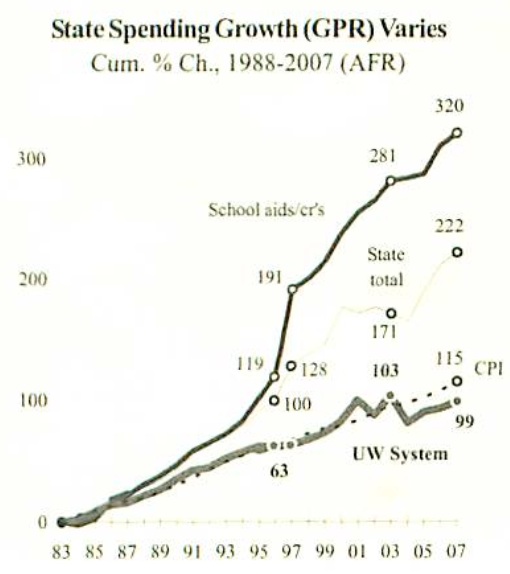
A Fascinating Look at Wisconsin’s K-12 and Higher Ed Finance Battles


Much continues to be written about Wisconsin’s K-12 and Higher Education spending growth, an issue that will be front and center as the State grapples with a structural deficit and slowing tax revenue growth. Following is a recent roundup of rhetoric on this matter:

We’ll certainly see many more articles on this topic as the Governor and Legislature address the state’s spending difficulties.

Share

High School Rugby Team Breaks Down Barriers

Will Bardenwerper:

The rugby practice field at Hyde Leadership Public Charter School bears little resemblance to the manicured lawns of the English boarding school where the sport was born. It is more brown than green, and sirens sometimes drown out the shouts of players. Then there are the occasional interruptions, like when play was briefly halted during a recent practice as a man darted about wildly on a nearby street, calling football plays and evading imaginary tacklers.
But this patch of mud and grass is more than the home of what is believed to be the nation’s first all-African-American high school rugby team. It is also where a growing number of students have been exposed to a sport they once knew nothing about and to parts of society that once seemed closed to them.
Hyde players have a hard time explaining rugby to friends who do not attend their school and who do not know much about the sport. Others say things like, “You’re crazy, that’s a white person’s sport,” said Lawrenn Lee, a senior on the team. One parent, Clifford Lancaster, recalled his reaction when his son Salim announced he was going to play: “My eyes got this big. I said, ‘That’s a wild sport.’ “

Share

Putting education — not unions — first

Ben DeGrow:

This year brought the biggest electoral Democratic wave in more than three decades. Yet Colorado teachers union officials may have lost, rather than gained, political ground.
Sometimes, the interests of the Democratic Party and teachers union officials align closely. The Colorado Education Association and Colorado Federation of Teachers together give Democrats about $50 in contributions for every $1 they give Republicans.
Of course, not all Democratic legislators are in the pockets of the teachers union hierarchy. It is remarkable, though, to see not one but two legislators without union connections assume the highest positions at our state Capitol. Peter Groff’s Democratic peers voted to re-elect him as state Senate president, and Rep. Terrance Carroll was selected to become the new speaker of the House.
Supporters of public school parental choice could find no better friends in the Democratic caucus than Groff and Carroll. Both men have a strong record of protecting charter schools against union-backed legislative attacks, even attacks launched by other Democrats.

Share

ADHD Primer for Parents Part I

Susan Crum:

Although called Attention Deficit Disorder, and thus many parents and teachers believe that the primary problem is distractibility or poor attention, in reality this disorder is primarily a disorder of impaired executive function. When an individual has ADHD, executive functions are not emerging or unfolding as expected for the child chronological age. By executive functions I refer to a wide range of central control process of the brain that temporaneously connect, prioritize and integrate cognitive functions in the same manner that a conductor directs a band. Clearly, this does not refer to a single task at a given point in time such as focusing on getting a hamburger when hungry, or pushing a button at a given moment in order to stop a character is a video game from going forward. But, it does mean there is impairment in the ability to sustain concentrated focus on a task that requires constant monitoring and adjustment, as well as intermediate and long-term projection into the future such as driving a car, following a complicate classroom lecture or interacting with others and anticipating their reactions and the long-term outcomes of my statements or actions. In short, impaired executive functions negatively impact the real stuff of day to day life.

Share

Should Schools Tackle Poverty?
Yeah, let’s add that between recess and lunch.

Alexander Russo:

Don’t be surprised if you hear a lot more from teachers and board members about “out of school” social issues and programs this year. Chatter about more daring and wider-ranging approaches to school improvement is all the rage right now, as part of a longer-term pushback against accountability-based reform like NCLB.
Jumping into efforts to reach children in their home lives, however, may stretch schools’ abilities to make a real difference–and may take you and your team’s eyes off quality classroom instruction and academic improvement.
Over the past few months, there has been a slew of ideas and proposals to move beyond reform efforts that are primarily school-based. Just as the Democratic primary was wrapping up, a coalition of educators put out a call for a “broader, bolder” approach to education reform. Later in the summer, aft president-elect Randi Weingarten called for “community schools” that would provide social services as well as education. Early in the fall, Democratic presidential nominee Barack Obama began touting a proposal to create “Promise Neighborhoods” around the country, in which low-income children and their parents would receive a comprehensive set of medical and social services in addition to a quality education. About a third of states have recently embarked on new antipoverty programs, according to Stateline.org .

Share

Competing for Grammar School

Lisa Freedman:

It’s a brisk Friday morning and a skinny little boy in a large blazer stands shivering by locked school gates. Close beside him are his mother, his father and his two grandmothers, both in saris. The trembling child is right to be anxious. He is about to sit the entrance tests for Queen Elizabeth’s School in Barnet, north London, one of England’s leading grammar schools, and the odds against him passing through this narrow gateway to academic success are extremely slim. There are just 180 places available in the school’s Year Seven each year and 1,200 boys hoping to fill them.
Grammar schools have always been popular but with the financial meltdown affecting many affluent families, a free education in a traditional environment is looking highly attractive to parents of bright 10-year-olds. Fees for three children at independent secondary schools cost £50,000 or more a year, and four out of five parents pay those fees out of income.
Jenny Jones, secretary of the National Grammar Schools Association, a non-political body of parents, teachers and heads promoting grammar schools, confirms that “there have definitely been more applications from families who would normally go to independent schools”.

Share

Universal preK brings new challenges for public elementary schools

David McKay Wilson:

In 2005, when Boston mayor Thomas Menino announced his plan to make prekindergarten available to all four-year-olds in the city, parents and early childhood advocates applauded this initiative to add a 14th year to the city’s public school system.
Three years later, after preK classrooms were established in 50 of the city’s 67 elementary schools, educators say implementing the mayor’s vision has proved to be a major challenge. There were facility issues: none of the classrooms had running water or bathrooms, so administrators lobbied to build toilet facilities in the rooms–at the cost of $35,000 each. There were oversight issues: many of the elementary school principals weren’t sensitive to the needs of four-year-olds, so Boston established a professional development academy for administrators faced with the prospect of educating preschoolers.
Then there was the impact on the elementary schools where those four-year-olds were getting ready for kindergarten. When those students turned five, they were so well prepared that the district had to retool its kindergarten curriculum to keep pace with children much more ready to learn.

Share

AP Students Forced to Accept Less

Jay Matthews:

A teacher with the sign-on name of pfelcher posted a provocative comment on the Web version of my Nov. 3 column for the Post’s Metro section. I was repeating for the 4,897th time my view that even low-income students who have not performed well in school can learn in a college-level high school course, like Advanced Placement or International Baccalaureate, if given extra time and encouragement.
Pfelcher would have none of my argument. To support his opinion, he cited a personal experience in his classroom. I always find first-person accounts helpful when debating this issue. I decided to send his comment to a few other AP teachers I knew, and see what they had to say.
Here is the post from pfelcher, whom I do not know and cannot identify further, followed by the reactions of three teachers, plus a student who sent me his view. If we want to make our high schools better, we have to work this out. I think such exchanges help us figure out what to do:
……
It’s not about who wins in a class of students with such disparate preparation and skill; it’s about who loses. The students ready to march ahead are forced instead to grind to a halt as the other students have to be taught the basics with which they should have entered the class.
At the end of the year, those unprepared students who might have gained from my class but who still had too far to go to attain the literacy and competence the test requires, failed miserably on the AP exam. So, did these lower-end students gain from the experience? Yes, they did to some degree, even though egos that had never really been tried suffered when they saw how they compared to the nation.

Share

Madison School Board Update

Board President Arlene Silveira:

Thank You: On behalf of the BOE, I would like to thank the community for their support in the recent referendum vote. Your support of our students and schools is appreciated. Because of your support, you have maintained our foundation and provided us three years to focus on ways to improve our schools without the constant specter of compulsory budget slashing. We are committed to continuing the “Partnership Plan” that was at the heart of the referendum. We look forward to working together, with each other and with the community. More information on our future plans is below.
Governance: As we have stated, the referendum was only a piece of a bigger plan for the district. This week the Board and the Superintendent have continued discussions on governance models which will allow us to focus our energies and attention on student achievement. We plan on starting the implementation of a new governance model in December. Community engagement will be a key part of any model we pursue. More details will be available after our November 24 BOE meeting.

Share

Vouchers in Texas, A Worthy Experiment

The Economist:

THE Edgewood independent school district covers an unassuming part of west San Antonio, a district of fast-food joints and car-body shops, with houses that run from modest to ramshackle. It is mostly poor and mostly Hispanic, and in 1968 its government-funded public schools were so bad that a parents’ group sued the state, prompting a debate over school funding that lasted for decades. By 1998 the situation had improved. The National Education Association, America’s largest teachers’ union, said that Edgewood could be a model for other urban school districts.
Then its voucher programme started. In 1998 the Children’s Educational Opportunity Foundation, a private group, announced that it would put up $50m over the next ten years to provide vouchers for private education to any low-income Edgewood student who wanted one. The “Horizon” plan was meant to show legislators that vouchers could help students and motivate schools through competition.
Critics said the programme would take money from a school district that was poor already. One teacher wrote an angry editorial comparing Horizon to Napoleons invasion of Russia“>Napoleon’s invasion of Russia, destined for “history’s trash heap of bad ideas”.
But a report published in September [3.5MB PDF Report] by the Texas Public Policy Foundation (TPPF), a conservative think-tank, argues that the programme was a hit over its ten-year span. More than 4,000 students claimed the vouchers; their test scores jumped, and only two dropped out.

Share

The Best Places in the USA to Raise Your Children

Prashant Gopal:

A Chicago suburb beats out thousands of other communities around the U.S. as the best, most affordable place to raise kids.
Mount Prospect, Ill., is a quiet Chicago suburb with a population of just over 56,000. It is a tight-knit town where over the past eight years Prospect High School’s football team won three state championships, its Marching Knights picked up their 26th straight grand champion title at the annual state marching band festival, and just last month the school itself ranked 12th among all state high schools. Now the town is also the winner of Businessweek’s second annual roundup of the Best Places in America to Raise Kids.
Founded by German immigrants and incorporated in 1917, Mount Prospect hasn’t strayed far from its values of fiscal conservatism and community involvement, even as it has expanded to include new immigrants from Poland, Mexico, Korea, and India. It is a middle-class community with low crime, affordable homes, award-winning schools, ethnic restaurants, a major regional mall, and a small-town charm that makes the big city less than an hour away seem much farther away.

Other cities mentioned include: Euless, TX, Murfreesboro, TN, Huntsville, AL and Eau Claire, WI.

Share

Tempe High relishes chance to become IB school

Georgann Yara:

A 3.7 grade-point average and a schedule stacked with honors classes may be enough for Tempe High School sophomore Fabian De La Cruz to attain his goal of attending Harvard University.
A new program slated for implementation at his school next year could only help the aspiring surgeon reach his dream and become the first person in his family to go to college.
The International Baccalaureate program comprises a rigorous interdisciplinary curriculum that emphasizes an international perspective and critical and creative thinking skills.

Share

Arts Integration Aids Students’ Grasp of Academics

Julie Rasicot:

Teacher Karen McKiernan’s science class at Dr. Charles R. Drew Elementary School seemed more like a lesson in art appreciation than the laws of physics as students focused on a poster of an abstract painting propped against the blackboard.
The room buzzed with questions as the fifth-graders at the Silver Spring school queried each other about the piece, “People and Dog in the Sun,” by Joan Miró.
“What would this painting look like if it was not abstract?” 10-year-old Annesha Goswami asked her classmates.
“Why do you think there are so many dark colors and only one bright color?” asked Elizabeth Iduma, 10.
The students, participants in the school’s talented and gifted magnet program, were practicing a thinking routine called “creative questions” which was designed to help them “think outside the box,” McKiernan said. For the class’s next meeting, McKiernan said, she planned to have students relate their thoughts about the artwork to the concepts of force, motion and energy that the fifth-graders had been studying.

Share

Bill Gates on Ed in ’08 & School Reform Impediments

Erik Robelen quotes Bill Gates:

“We have not found a way to do it. We have not been very successful at it…the problem we tend to run into is that the most influential and well-educated people either have their kids in private schools, or they have their kids in an enclave inside the high school that are called honor’s courses, where the teaching is pretty decent and so, if we go to a school and say, let’s change things here, they say, no way, you’re going to mess our little enclave up. All the kids go through the same front door, but really it’s a separate school inside there that’s allowing us not to be part of that insanity, and so don’t mess with the thing that works well for us. And I do think, if you want to stand up to some of the practices that are not focused on the needs of the students, you need a broad set of parents. I think we’re very weak on this point.
During the presidential election, we had two advocacy efforts. One about global development, and one about education. And we didn’t end up spending the amount of money that we had available for the advocacy because most of what we were causing people to do was to mouth platitudes. … On global development, which I thought was the harder of the two, we actually succeeded because people never even talked about it at all, and we actually got them to talk about it.”

Share

India’s Colleges Battle a Thicket of Red Tape


Geeta Anand:

Under the labyrinthine regulations that govern technical colleges nationwide, the Principal K.M. Kundnani College of Pharmacy must provide 168 square feet of building space for each student. The rule is intended to ensure students have enough space to learn. But it effectively caps enrollment at 300, even though students are spread so thinly in the eight-story building that the top floor remains unused, its lecture halls padlocked.
The rules also stipulate the exact size for libraries and administrative offices, the ratio of professors to assistant professors and lecturers, quotas for student enrollment and the number of computer terminals, books and journals that must be on site.
“I am not free to run this school as I wish,” Ms. D’Mello, 51 years old, says. “I am at the whim of unrealistic demands.”

Share

On College-Entrance Exam Day, All of South Korea Is Put to the Test

Sungha Park:

One foggy morning last November, officer Kang Jin-jin heard the distress call on his police radio: An 18-year-old girl about to take the national college-entrance exam had left her admission ticket at home.
Mr. Kang dashed off to the girl’s apartment, got the ticket from her father, and raced across town on his motorcycle, arriving at the school just in time for the test.
“I had to ignore traffic signs and turn on the siren,” he said. “It was a bit risky, but I tried my best.”
Mr. Kang’s heroic effort is hardly an isolated one. On the day each November that high-school seniors take the college-entrance test — Nov. 13, this year — South Korea is a changed country.
Many offices and the stock market open at 10 a.m., an hour later than usual, to keep the roads free for students on their way to the test. All other students get the day off to keep schools quiet for the test takers. And while students are taking the listening portions of the tests, planes can’t land or take off at the nation’s airports. Aircraft arriving from other countries are ordered to circle at altitudes above 10,000 feet.

Share

How Much Homework is Too Much?

Linda Thomas, via email:

Q: My son is in elementary school and has already gotten far more homework than last year, going from fourth to fifth grade. The work isn’t difficult, but there’s a lot of it. Keeping him on task is a nightly struggle at our house. I’ve talked with his teacher and she says no one else has complained. How much is too much homework?
A: I hate homework. Do I lose my mom sash and crown for admitting that?
I understand the importance of homework: It gives students a chance to review what they’re learning in class; it is feedback for teachers so they’ll know whether students understand the subjects covered in school; it’s a way to extend learning by having students discover new information about a subject; it’s practice; it gives parents an opportunity to be involved in their kids’ education. That’s all positive. But some nights, the homework routine in our house makes me feel like a crinkled, crumpled sheet of notebook paper.
Seattle Public Schools requires its teachers to assign homework. The district’s homework policy was adopted way back in 1983 and hasn’t been modified since. Here are the district’s guidelines for the minimum/maximum amount of homework a student should receive:
Grades K-2: Five to 10 minutes per day or 20 to 40 minutes each week
Grades 3-4: 10 to 20 minutes per day, 40-80 minutes each week
Grades 5-6: 20 to 40 minutes per day, 80-160 minutes a week
Middle School: One to two hours per night, five to 10 hours per week
High School: Two hours per night, 10 hours each week

Share

Obama Is Expected to Put Education Overhaul on Back Burner

Robert Tomsho & John Hechinger:

With the federal government under pressure to rescue banks, auto makers and homeowners, as well as a federal budget deficit that could double to $1 trillion this fiscal year, many observers question whether Mr. Obama will undertake education measures that require significant spending.
Tom Loveless, a senior fellow at the Brookings Institution, a think tank, said he expects Mr. Obama to sidestep most major issues involving public schools and instead focus on small, symbolic initiatives in the mold of former President Bill Clinton’s promotion of school uniforms as a way to instill discipline in classrooms.
Economically, the new president faces a “tough, tough balancing act,” said Arne Duncan, chief executive of the Chicago Public Schools and an education adviser to Mr. Obama. Even so, Mr. Duncan said education has been pivotal to Mr. Obama’s personal story, and he predicted “a very strong, aggressive and comprehensive strategy” on the issue. “This is something that is hugely important to him,” said Mr. Duncan, who has been mentioned as a possible secretary of education in the Obama administration.
Incoming White House Chief of Staff Rahm Emanuel, speaking on ABC’s “This Week” on Sunday, said stimulating the economy and getting people back to work will be the new administration’s top priority. But he added that the president-elect sees the financial crisis as an opportunity to make changes in energy policy, health care and education. “Those issues that are usually referred to as long-term are immediate,” he said.

Share

An Interview with Madison’s Glendale Elementary Principal Mickey Buhl

Melanie Conklin:

Mickey Buhl, 40, became principal at Glendale in 2005, taking the helm of a Madison school with significant challenges: the highest rate of low-income students at 80 percent, annual student turnover rate around 40 percent and a majority of students in either special education or English as a Second Language classes. He’s passionate about the good things happening at Glendale and working with staff members to beat those statistical odds. He’s also clearly obsessed with baseball.
MC: Is it true you worked in the Congressional Budget Office?
MB: It was my first job working for anyone other than my father. I started at the CBO after I got my master’s degree in public policy. They would send a bill and I’d estimate the cost of it. The Family and Medical Leave Act came through and I got that. The politics of Washington permeated every aspect of life, and there was enough nastiness to it that I just decided I didn’t want to make a life of it.
MC: How did you end up as a principal?

Share

Obese kids have arteries of 45-year-old

John Fauber:

Neck arteries of obese children as young as 10 resembled those of a typical 45-year-old, a new study has found.
The research is more evidence that the process of artery disease can begin early in life, increasing the risk of premature heart disease in adulthood.
“These findings confirm some of our big picture concerns about childhood obesity,” said Aaron Carrel, an associate professor of pediatrics at the University of Wisconsin School of Medicine and Public Health. “It is a very direct link with disease.”
Carrel, who was not a part of the research, said artery disease in obese children was something that doctors had long suspected, but the level of disease found in the study was higher than anticipated.
UW doctors also have been finding abnormally high levels of cholesterol in obese kids ages 5 to 18, Carrel said.

Share

Chinese Language Part Of Day At School

David Steinkraus:

The melody was familiar – “Frere Jacques,” the nursery rhyme sung by generations of schoolchildren – but the words weren’t.
“Xia zhou jian, Xia zhou jian,” intoned Xu Chen to the final notes of the song. Gathered around her, the children attending the first day of the first Panda Academy at the Racine Montessori School followed along even if they didn’t know what they were saying. Roughly translated it meant “See you next week,” and it was the phrase which students would be expected to repeat as they left the room following their first lesson in the Chinese language.
The academy, which began Sept. 27, grew out of a desire to teach adopted Asian children about their heritage, to offer the language of a nation important to modern commerce, and to eliminate long drives for parents.
“I think every community has a burgeoning Asian population and not necessarily by adoption. The percentage of Asians in the country is very small, but it’s the fastest-growing,” said Kelly Gallaher, one of the people who organized the academy.

Share

Washington, DC School Chief Takes on Teacher Tenure, and Stirs a Fight

Sam Dillon:

Michelle Rhee, the hard-charging chancellor of the Washington public schools, thinks teacher tenure may be great for adults, those who go into teaching to get summer vacations and great health insurance, for instance. But it hurts children, she says, by making incompetent instructors harder to fire.
So Ms. Rhee has proposed spectacular raises of as much as $40,000, financed by private foundations, for teachers willing to give up tenure.
Policy makers and educators nationwide are watching to see what happens to Ms. Rhee’s bold proposal. The 4,000-member Washington Teachers’ Union has divided over whether to embrace it, with many union members calling tenure a crucial protection against arbitrary firing.
“If Michelle Rhee were to get what she is demanding,” said Allan R. Odden, a professor at the University of Wisconsin who studies teacher compensation, “it would raise eyebrows everywhere, because that would be a gargantuan change.”
Last month, Ms. Rhee said she could no longer wait for a union response to her proposal, first outlined last summer, and announced an effort to identify and fire ineffective teachers, including those with tenure. The union is mobilizing to protect members, and the nation’s capital is bracing for what could be a wrenching labor struggle.

Share

ACT or SAT? More Students Answering ‘All Of the Above’

Daniel de Vise:

For students in the Washington region, picking a college entrance test has become a multiple-choice question.
The SAT has long dominated the bustling college-prep market in the District and its suburbs. But the rival ACT is making inroads, buoyed by a shift in conventional wisdom, which now holds that the tests are of about equal value and that a student would be wise to take both. Colleges are driving the trend because admission officers are spreading the word that it doesn’t matter which test students take.
The ascendance of the ACT has brought Hertz-Avis style competition to the test-obsessed D.C. region. It’s a boon to students, who find they have more ways than ever to impress colleges. The SAT tests how students think. The ACT measures what they have learned. Each is a better fit for some students than others.

Share

A Look Back at the November, 2008 Madison School District’s “Easy Referendum” Win

Tamira Madsen:

In the aftermath of the successful Madison Metropolitan School District referendum, many critics and supporters agree on one thing: They were surprised with district voters’ overwhelming approval of the operating referendum.
Nearly 68 percent of voters favored the referendum, which will allow the district to exceed its tax limits by $5 million during the 2009-10 school year, then by an additional $4 million in each of the following two years. The total increase of $13 million will be permanent for every year after that.
The referendum won a majority in almost every ward in the district, but Superintendent Dan Nerad admitted afterward that he wasn’t sure that the initiative would pass due to the tumultuous economy. District officials say the referendum will increase taxes for the owner of an average Madison home by $27.50 the first year, then $43 more the second year and an additional $21 in the third.

Much more on the recent referendum here.

Share

Charters lead California’s traditional schools in achievement for poor children, survey finds

Mitchell Landsberg:

Four Southern California charters and one L.A. Unified campus are among the top 15 serving students living in poverty.
The burgeoning charter school movement in California has largely made its mark as an alternative to low-performing inner-city schools. An analysis being issued today suggests that, at their best, charters are doing that job well, outperforming most traditional public schools that serve children in poverty.
Using the Academic Performance Index as a measuring tool, the California Charter Schools Assn. found that 12 of the top 15 public schools in California that cater primarily to poor children are charters.
“These results show that charter schools are opening doors of opportunity for California’s most underserved students, and effectively advancing them on the path to academic success,” said Peter Thorp, interim head of the association. He urged traditional public schools to study the charters to replicate their success.
The association, which is an advocate for charter schools, focused on schools where at least 70% of the children qualify for free or reduced price lunch. Of more than 3,000 public schools statewide that fit that description, the highest API score — 967 — was earned by American Indian Public Charter, a middle school in Oakland whose students are primarily Asian, black and Latino, and have a poverty rate of 98%. It was followed by its sibling, American Indian Public High School, with a score of 958.

Share

On Class Size & Adversity

Malcolm Gladwell:

The man who boasts of walking seven miles to school, barefoot, every morning, happily drives his own grandchildren ten blocks in an S.U.V. We have become convinced that the surest path to success for our children involves providing them with a carefully optimized educational experience: the “best” schools, the most highly educated teachers, the smallest classrooms, the shiniest facilities, the greatest variety of colors in the art-room paint box. But one need only look at countries where schoolchildren outperform their American counterparts–despite larger classes, shabbier schools, and smaller budgets–to wonder if our wholesale embrace of the advantages of advantages isn’t as simplistic as Carnegie’s wholesale embrace of the advantages of disadvantages.
In E. J. Kahn’s Profile, he tells the story of a C.E.O. retreat that Weinberg attended, organized by Averell Harriman. It was at Sun Valley, Harriman’s ski resort, where, Kahn writes, it emerged that Weinberg had never skied before:

Share

A School District Asks: Where Are the Parents?

Winnie Hu:

Then teachers and administrators noticed something else: Jericho High School’s 90-member orchestra had become 70 percent Asian-American (the student body over all is about 30 percent Asian-American), but it still played for a mostly white audience at concerts with many empty seats.
The Chinese and Korean families that flocked to Jericho for its stellar schools shared their Jewish and Italian predecessors’ priorities on excellent education. But the new diversity of the district has revealed a cultural chasm over the meaning of parental involvement. Many of the Asian-Americans whose children now make up a third of the district’s enrollment grew up in places where parents showed up on campus only when their children were in trouble.
“They think, ‘My kids are doing well — why should I come?’ ” said Sophia Bae, 38, a Korean immigrant who shied away from P.T.A. meetings when she first moved here from Queens four years ago. Now a member of the organization, she invites other Koreans to her home and encourages them to participate in pretzel sales. “They don’t realize it’s necessary to come and join the school to understand their kids’ lives.”
Parental involvement is a perennial struggle in poor urban neighborhoods, where many innovative school leaders have run parent academies and strongly encouraged school visits or committee membership in hopes of mimicking the success of the suburbs. Now Jericho is taking a page from that handbook, trying to lure Asian parents into the schools with free English classes and a multicultural advisory committee that, among other things, taught one Chinese mother what to wear and what to bring to a bar mitzvah. The P.T.A. has been trying to recruit more minority members and groom them for leadership roles.

Share

School Spending Climate: State & Federal Deficits

Greg Bump:

He said all agencies are going to have to tighten their belts.
“The new increase is a flat line,” he said.
Doyle said one of his priorities will be to protect K-12 education and the university system from major cuts, but said the state “may have to save some money on school aids” and the UW System is “definitely going to have to participate in this.”
“The bottom line of this,” Doyle said, “is I’m willing to make very deep cuts.”
Doyle added, “But I don’t want to see schools go into total crisis mode.”

Jason Stein:

Sen. Mark Miller, D-Monona, co-chairman of the Legislature’s budget committee, said he would not rule out a general income or sales tax increase but would see it as a “last resort.”
“I think the priority needs to stay on job creation,” Miller said of the budget. He said new jobs would help the state begin to climb out of its budget hole.
Todd Berry, president of the Wisconsin Taxpayers Alliance, said he would want to know more about how the budget shortfall was calculated, including more about the size of agencies’ requested spending increases, before he could truly say how serious it was. That’s because governors have an incentive to play up the size of the budget shortfall to emphasize the challenge they face, he said.

Randall Forsyth:

WHAT ONCE WAS UNTHINKABLE has come to pass this year: massive bailouts by the Treasury and the Federal Reserve, with the extension of billions of the taxpayers’ and the central bank’s credit in so many new and untested schemes that you can’t tell your acronyms or abbreviations without a scorecard.
Even more unbelievable is that some of the recipients of staggering sums are coming back for a second round. Or that the queue of petitioners grows by the day.
But what happens if the requests begin to strain the credit line of the world’s most creditworthy borrower, the U.S. government itself? Unthinkable?

Patrick Marley:

The $5 billion shortfall includes up to $500 million in the current budget, which runs through June 30. Doyle stressed that the deficit may continue to balloon as the scope of the national economic crisis becomes clear. Less than a month ago, Doyle estimated the deficit at more than $3 billion.
Sen. Mike Ellis (R-Neenah) said the deficit was mostly caused by matters out of the control of lawmakers, but that it was significantly worsened by bad budgeting practices in the past.
“This is a monster problem,” he said.
Projections change
When lawmakers approved a budget-repair bill in May, state officials believed revenue would increase by a modest 1.5% through next June. Now, they say, revenue will instead drop 2.5% because declining jobs and fewer sales translate into lower tax collections.
Revenue will drop further in the first year of the next budget, Doyle said.
Doyle said his No. 1 priority is funding education. He said he also wants to protect state health care programs, as well as key economic development programs that fund biotechnology and renewable energy programs.

Share

Madison school cafeterias have “impressive” safety records

Melanie Conklin:


While there’s no controlling what happens once kids get their hands on the food, some of the safest public places to buy meals are Madison school cafeterias.
A review of Madison-Dane County Health Department records of Madison school cafeteria inspections showed that school scores were far better than the average restaurant score. Out of 164 Madison cafeteria inspections, 49 resulted in a perfect score of zero and 115 found no critical violations.
To put that in perspective, the average score for restaurants hovers around 20, and anything above 50 is viewed as troublesome. Madison school cafeterias averaged 3.3 over the past four years. The worst school score — Spring Harbor Middle School with a score of 22 in 2005 — was on par with restaurants. And the next two years Spring Harbor scored a perfect zero.

Share

Sun Prairie parents turn up heat on school boundaries, and board responds

Karyn Seamann:

Eight months after the Sun Prairie School Board capped a hugely divisive debate over elementary boundaries by deciding to bus town of Bristol children to Westside school, Bristol parents are demanding further review.
After the March decision some School Board members said they wanted to form a committee to look long-term at elementary boundaries and related issues such as socio-economic and racial balance between buildings.
The committee never materialized.

Share

DeForest High To Reopen After Threat Closed School Tuesday

Channel3000:

DeForest Area High School was closed Tuesday after school officials found a threatening note, but officials said the school will reopen on Wednesday.
Officials said that the note, which was found on Monday afternoon in the school, said that there would be a bomb in a boys’ restroom.
School officials, along with the DeForest Police Department, were unable to determine whether the threat had merit. As a precaution, officials made the decision to cancel all classes, events and after-school activities Tuesday at the high school.
On Tuesday, the DeForest police, along with school administrators and a canine unit from the University of Wisconsin-Madison, searched the entire high school and grounds, and did not find any signs of explosive devices. Based on the search and the status of the investigation, school officials and law enforcement personnel said they feel confident that they can reopen the school Wednesday.

Share

Gates Foundation releases new giving plans for education & Plans “National Standards”

Linda Shaw:

The Bill & Melinda Gates Foundation today unveiled new directions for its education giving, which include working to double the number of students who complete some kind of postsecondary degree.
Efforts also would be made to identify and reward good teaching, help average teachers get better, devise better tests and create a national set of learning standards for high schools.
Bill and Melinda Gates announced these and other plans today to a group of about 100 guests in Seattle that included many big names in U.S. education.
The leaders of the nation’s two largest teachers unions were there, as well as superintendents of some of the biggest districts in the country, including New York, Chicago, and Washington D.C. Advisers to president-elect Barack Obama also were present, as were several people who are rumored to be in the running to be the next U.S. Secretary of Education.

More here.

Share

Madison Business Employees Help Tutor Students; Local Reading Scores

Channel3000:

Years after graduation, he’s hearing the ring of the school bell at Sherman Middle School on Madison’s north side.
“I’ve had an effect on a number of the kids’ math scores,” said Schmidt, 44, whose background is in computer software design. “I know they’re doing better because they tell me they’re doing better.”
He said that he isn’t happy to take the credit, which is something that almost has to be pulled out of him. But the five students who he tutors weekly in math as part of the “Schools of Hope” tutoring program sing his praises when he’s out of the room.
“Monty’s awesome,” said seventh-grader Henrietta Allison.
“They know that when he comes in on Monday, he’s going to be asking, ‘Did you do your homework? What are you missing?'” said teacher Chrissy Mitlyng. “They expect that, and I think that’s a really good relationship to have.”
Teachers report that students who work with the tutors are more confident after their sessions, and are more likely to speak up in class and participate in group work. While classroom confidence might be the most notable impact, it trickles down to fill the racial achievement gap the program was designed to help close, WISC-TV reported.
In 1995, 28.5 percent of black students in the Madison Metropolitan School District tested below the minimal standard on the third grade reading test, along with 9.7 percent of Latino students, 24.2 percent of Asian students and 4.1 percent of white students.

Related: When all third graders read at grade level or beyond by the end of the year, the achievement gap will be closed…and not before:

On November 7, Superintendent Art Rainwater made his annual report to the Board of Education on progress toward meeting the district’s student achievement goal in reading. As he did last fall, the superintendent made some interesting claims about the district’s success in closing the academic achievement gap “based on race”.
According to Mr. Rainwater, the place to look for evidence of a closing achievement gap is the comparison of the percentage of African American third graders who score at the lowest level of performance on statewide tests and the percentage of other racial groups scoring at that level. He says that, after accounting for income differences, there is no gap associated with race at the lowest level of achievement in reading. He made the same claim last year, telling the Wisconsin State Journal on September 24, 2004, “for those kids for whom an ability to read would prevent them from being successful, we’ve reduced that percentage very substantially, and basically, for all practical purposes, closed the gap”. Last Monday, he stated that the gap between percentages scoring at the lowest level “is the original gap” that the board set out to close.
Unfortunately, that is not the achievement gap that the board aimed to close.
……
What the superintendent is saying is that MMSD has closed the achievement gap associated with race now that roughly the same percentage of students in each subgroup score at the minimal level (limited achievement in reading, major misconceptions or gaps in knowledge and skills of reading). That’s far from the original goal of the board. We committed to helping all students complete the 3rd grade able to read at or beyond grade level as demonstrated by all students in all subgroups scoring at proficient or advanced reading levels on the WRCT.

More here and here.

Share

Faulkner or Chaucer? AP Teachers Make the Call

Valerie Strauss:

At Clarksburg High School in Montgomery County, teacher Jeanine Hurley’s English class finished “The Canterbury Tales” and just started “Hamlet.” Senior Raphael Nguyen says he doesn’t spend a lot of time on homework because Hurley doesn’t give much.
At Langley High School in Fairfax County, teacher Kevin Howard’s English class is studying “Othello” after reading William Faulkner’s “Light in August.” Senior Ryan Ainsworth, 17, said he does an average of 75 minutes reading and writing each night because Howard can pour it on.
Although students in these classes don’t read the same works, they are taking the same course: Advanced Placement English Literature and Composition. And their teachers have the same goal: for students to learn how to connect text to meaning through skills assessed on the AP exam in May.

Share

Should Kids Be Able to Graduate After 10th Grade?

Kathleen Kingsbury:

High school sophomores should be ready for college by age 16. That’s the message from New Hampshire education officials, who announced plans Oct. 30 for a new rigorous state board of exams to be given to 10th graders. Students who pass will be prepared to move on to the state’s community or technical colleges, skipping the last two years of high school. (See pictures of teens and how they would vote.)
Once implemented, the new battery of tests is expected to guarantee higher competency in core school subjects, lower dropout rates and free up millions of education dollars. Students may take the exams — which are modeled on existing AP or International Baccalaureate tests — as many times as they need to pass. Or those who want to go to a prestigious university may stay and finish the final two years, taking a second, more difficult set of exams senior year. “We want students who are ready to be able to move on to their higher education,” says Lyonel Tracy, New Hampshire’s Commissioner for Education. “And then we can focus even more attention on those kids who need more help to get there.”

Joanne has more.

Share

LA Private Schools Feel The Pinch

Carla Rivera:

At the private New Roads School in Santa Monica, 20 families decided not to re-enroll in the fall because of financial nervousness.
At Loyola High School near downtown, 40 families have come forward since the beginning of the school year seeking financial aid to help cover tuition costs, even as the school’s endowment — heavily invested in equities — has taken a battering in the financial market.
Pacific Hills School in West Hollywood is creating flexible payment schedules for some families and is tightening its own belt with an eye toward more tough times ahead.
The economic meltdown that has ravaged many banks and homeowners is also affecting private schools in Los Angeles and nationwide, forcing educators to revise budgets, plan extra fundraising appeals and brace for possible lower enrollments next year. The distress comes at a time when some independent schools already have seen potential students gravitate to public charter schools, which are free and offer some of the same advantages of private campuses.

Share

School Bake Sales Fall Victim to Push for Healthier Foods

Patricia Leigh Brown:

Tommy Cornelius and the other members of the Piedmont High School boys water polo team never expected to find themselves running through school in their Speedos to promote a bake sale across the street. But times have been tough since the school banned homemade brownies and cupcakes.
The old-fashioned school bake sale, once as American as apple pie, is fast becoming obsolete in California, a result of strict new state nutrition standards for public schools that regulate the types of food that can be sold to students. The guidelines were passed by lawmakers in 2005 and took effect in July 2007. They require that snacks sold during the school day contain no more than 35 percent sugar by weight and derive no more than 35 percent of their calories from fat and no more than 10 percent of their calories from saturated fat.
The Piedmont High water polo team falls woefully short of these standards, selling cupcakes, caramel apples and lemon bars off campus in a flagrant act of nutritional disobedience.

Share

Navigating 9th Grade

Jenna Johnson:

Teacher Rebecca Cline was walking her ninth-grade class through the intricacies of scientific notation when, in the back of the room, a student rested his head on his desk. Another instructor quickly stepped in to get him back on task, which was no surprise. Classes at the newly opened Fairlead Academy in St. Mary’s County match two teachers with about 10 kids.
The 60 students enrolled at the public school this year were quiet underachievers in middle school. Although they didn’t warrant placement in special education programs, they tended to score consistently lower than their peers on standardized tests. Their teachers worried that they might fall behind as freshmen and eventually drop out of school.

Share

The Obamas: Public or Private School?

Jay Matthews:

This is a tricky subject. School choice is very personal. The president-elect’s fifth-grade daughter, Malia, and second-grade daughter, Sasha, have been attending the first-rate, private University of Chicago Laboratory Schools. I bet they transfer to Georgetown Day School, a good fit because of its similarity to their current school, its historic role as the city’s first racially integrated school and the presence of Obama senior legal adviser Eric H. Holder Jr. on its board of trustees. It would be a sensible decision by two smart, caring people.
But it wouldn’t hurt to look around first. Georgetown Day, like other private schools, would charge them nearly $56,000 a year for two kids. Why not see what their tax dollars are paying for? One educational gem happens to be the closest public school to their new home. Strong John Thomson Elementary School is at 1200 L St. NW, three-fifths of a mile from 1600 Pennsylvania Ave. Go north on 15th, turn right on L and three blocks farther it’s on the right.

Greg Toppo has more along with the AP.

Share

Charter School Fights for Funding

AP:

Advocates of a new charter school in this city’s Potowomut neighborhood are fighting for state help after winning a $750,000 federal grant.
Backers of the proposed Nathanael Greene/Potowomut Academy of Technology and Humanities said they were disappointed with budget cuts the state Board of Regents budget made to charter schools.
The group is vowing to pressure lawmakers to include funding for the school in the state budget.

Share

Paterson Says NY Schools and Medicaid Will Face Cuts

Danny Hakim:

Gov. David A. Paterson said in an interview on Sunday that he would almost certainly seek billions of dollars in cuts to Medicaid, as well as midyear reductions in school aid, to address New York’s worsening fiscal condition.
He also said he expected to urge labor unions to reopen the contracts they have struck on behalf of public employees as a way to avoid or decrease layoffs.
Such a step is reminiscent of measures taken by New York City in the financial crisis of the 1970s or moves made more recently by the Big Three domestic automakers to reduce their labor costs after years of granting steady raises and comprehensive health and pension benefits.
Those same types of wage and benefit concessions have long weighed on New York, though the catalyst for the state’s current predicament has been the collapse in tax revenue from Wall Street.

Share

Needed: fresh ideas for school lunches

NewsDay:

Do as I say, not as I do. That’s the lesson being taught every day in school cafeterias across Long Island. According to a series of Newsday reports, school lunches are high in fat and sodium, and low on fresh ingredients. Lunch programs, which are expected to pay their own way without help from the school budget, rely on chip and cookie sales – not to mention sugary soda machines – to amp up their profits.
We are sending kids all the wrong messages by placing these bad-habit-forming temptations in their paths. For a few cents more per meal, children could be eating healthfully and learning by example about good nutrition.
Sure, the few cents add up. But aren’t we already paying a price? New Yorkers spend $242 million a year to treat obesity-related illness in children, and $6.1 billion a year on adults. Studies show that overweight children often carry the weight into adulthood.

Share

20,000 Milwaukee Students Now Use Vouchers

Alan Borsuk:

The number of Milwaukee children attending private schools using publicly funded vouchers has crossed 20,000 for the first time, according to data released by the Wisconsin Department of Public Instruction.
At the same time, the number of students in the main roster of Milwaukee Public Schools elementary, middle and high schools has fallen below 80,000 for the first time in well over a decade and declined for at least the 10th year in a row.
Amid a host of other factors shaping the school landscape in Milwaukee, those two trends point to some of the key stresses and looming issues for both MPS, which remains one of the nation’s larger school systems, and the voucher program, the largest, oldest and arguably most significant urban school voucher program in the United States.
For MPS, declining enrollment means greater financial pressure, a need to close school buildings and a continual search for ways to attract students and raise overall levels of achievement.
For the voucher program, the increase means the state-imposed cap on its size is coming into view, and issues related to the property-tax impact of the funding program are becoming more urgent. In addition, with Democrats having gained control of the state Legislature, efforts to impose more regulations on schools with voucher students are likely to become much more serious.
Nationwide, the momentum behind support for voucher programs such as the one in Milwaukee has been limited, and most likely has lost further steam with the election of Sen. Barack Obama to be president. Although Obama favors charter schools – generally, independent publicly funded schools that have more public accountability than private schools – he has not favored vouchers, and the Congress, controlled firmly by Democrats, is not going to support such plans either.

Somewhat related: A Madison School District enrollment analysis discloses an increase in outbound open enrollment.

Share

Quality Education

YP Gupta writes from India:

Free and compulsory education for all children in the age group of 6-14 has become a fundamental right under the Constitution. Its objective is to improve the socio-economic status of the backward communities.
But it is not an easy task to enforce this because a majority of the children in this age group continue to remain half-fed and educationally backward. The goal of education for all seems a distant reality because states have been lagging behind in implementing Sarva Shiksha Abhiyan, and owing to poverty there has been severe discrimination against girls in having access to schooling. The World Education Forum has urged removal of gender disparity for equal enrolment of girls and boys to achieve education for all.
At the same time, the need for quality education should not be overlooked. The backward communities must have access to quality education to uplift them to improve their living standards. It is proposed that some seats be reserved for children of poor families in the affluent private schools to provide them with quality education. But it is argued that this step may be detrimental to their interests as the children from a poor background may develop an inferiority complex while interacting with children from a higher status; this could be embarrassing to their respective families

Share

Milwaukee Gives Used Computers to Students

Dani McClain:

Georgia Jordan walked into the North Division High School building Friday afternoon holding her mother’s hand and stating her mission.
“I’m going to get my laptop, I’m going to get my laptop,” the 2-year-old sang.
On Friday, Milwaukee Public Schools gave away 42 computers – a mix of iMacs and PCs and all of them desktops, despite Georgia’s wish for a laptop – to the families of students at African-American Immersion High School.
Georgia’s 17-year-old brother is a student there, so the family received a computer, a modem, free Internet access and a password that will allow Delisa Scott to check her children’s grades, attendance and, in some cases, homework through the Parent Assistant link on the MPS homepage.
The district’s Digital Inclusion Program, new this school year, is expected to distribute about 8,000 out-of-warranty computers to families whose children qualify for a free- or reduced-price lunch. The computers will be given to families throughout the year. Applications are available at district schools, said Trinette Harmon-Patterson, MPS’ coordinator of learning technologies.

Share

Stoughton teacher hopes to get kids stuck on fruits, veggies

Pamela Cotant:

Physical education teacher John Ames wants to teach kids about the importance of healthy eating habits while they’re young.
So for the last couple of months Ames has been spending his lunch hour in the Kegonsa Elementary School cafeteria handing out stickers to kids who eat a fruit or vegetable in their lunch. The students have been excitedly showing him empty grape vines, apple cores and banana peels — evidence that they are eating fruit.
The students placed the stickers on the large wall poster that reads, “We Go Bananas for Physical Education.” The students filled up one letter and then moved on to the next on the poster in the cafeteria, which also is the school’s gym.
Ames calls the effort Project Banana.
“I wanted to get the kids excited about physical education class and add a health component to it,” said Ames, who was wearing a yellow “Banana Man” T-shirt he found on the Internet. “Diet and exercise are the main staples to a healthy life.”

Share

Education Issues for the Republicans in the Obama Era

Lance Izumi:

Decentralization must be accompanied by transparency so the public easily understands how tax dollars are being used or misused. One way to make education financing more transparent is to simplify the way Washington doles out money. Federal dollars could be attached to the individual child — so-called backpacking — and that money would be portable, meaning it would follow the child to whichever school he or she attends.
Dan Lips, an education analyst at the Heritage Foundation, notes that federal Title I dollars, which are supposed to go to disadvantaged students but because of complicated financing formulas result in wide per-student funding differences from school to school, “could be delivered through a simple formula based on the number of low-income students in a state” and “states could be allowed to use Title I funds in ways that make it follow the child.” The result would be a “simple and transparent system of school funding.”
Furthermore, Republicans should advocate for widespread state-based parental empowerment, specifically through school-choice options, to ensure that the state and local affiliates of Mr. Obama’s friends at the National Education Association and the American Federation of Teachers do not hijack decision-making power. Only if all children, not just those who are poor or have special needs, have an exit ticket out of the public school system through, say, a voucher or a tuition tax credit will state and local officials have the incentive to use their greater powers for the benefit of students rather than special interests.

Share

The Most Promising Schools in America

Jay Matthews:

My publisher and I had a fight over the subtitle of my upcoming book, “Work Hard. Be Nice,” about the Knowledge Is Power Program (KIPP). Okay, it wasn’t a fight exactly. My editor at Algonquin Books, Amy Gash, is too polite and professional for that. It was a spirited discussion. Gash said the Algonquin view was that my subtitle, “How Two Inspired Teachers Created America’s Best Schools” was off-putting and hyperbolic. Who was I to say what was best and what wasn’t?
I defended the loaded adjective because I thought it was accurate and would inspire useful arguments about how to make schools better. Nonetheless, Algonquin seemed more interested in selling books than encouraging my pugnacious tendencies, and I saw their point. We considered more than 100 alternatives before settling on “How Two Inspired Teachers Created the Most Promising Schools in America.” That seems like a trivial change, but it’s not. A new research assessment by Columbia University scholar Jeffrey R. Henig suggests it is the right way to think about these intriguing but still developing schools, and about other new approaches to schooling that may bloom in the future.
The 66 KIPP schools in 19 states and the District feed off the work of KIPP co-founders Dave Levin and Mike Feinberg, who started teaching impoverished children in Houston when they were just out of college in 1992. The first KIPP class began in 1994. It had a longer school day, required summer school, required homework, frequent contact with parents, consistent methods of discipline, imaginative and energetic teaching and lots of singing and fun. It has become the best known and most researched network of independent public charter schools in the country.

Share

Parents expect way too much from their kids.

Alan Kazdin:

Because parents love their children and want the best for them, they worry about them a lot, and one of the things that parents worry about most is whether their children are hitting age-appropriate targets for behavior. Shouldn’t a child be toilet trained by the age of 4? Should a 10-year-old to be able to sit down and do an hour of homework? One reason why such questions produce so much conflict and woe in the home is that parents’ expectations for their children’s behavior tend to be too high. I’m not talking about permissiveness or strictness here; I’m talking about accurately estimating children’s actual abilities. A reliable body of research shows that we expect our children to do things they’re not yet able to do and that we judge and punish them according to that expectation.

Share

Green Charter School Conference

Anita Weier:

“No child will be left inside.”
That’s the theme of the Green Charter Schools Network, an organization headquartered in Madison that links environmental charter schools around the nation. It was also the theme of a conference Saturday at the Pyle Center that drew 200 people from around Wisconsin and more than 10 other states.
“We hope to make this a national movement,” said Jim McGrath, president of the new Green Charter Schools Network. “We have identified 135 green charter schools around the country, and we believe there are another 150.”
That includes 18 in Wisconsin, in locations as far flung as Green Lake, Merrimac, Rhinelander, Oshkosh and Stevens Point.
Charter schools are innovative public schools that provide educational choices for families and school-site accountability for results. Forty states allow charter schools, and they are formed in Wisconsin when a contract is signed between a charter school and its school district or school board. The arrangement gives the school more autonomy, more on-site decision-making, but also considerable responsibility for results.

Share

Fairfax County Schools to Address Tough Grading Policy

Michael Alison Chandler and Michael Birnbaum:

Deputy Superintendent Richard Moniuszko said he will direct principals to prepare a grade distribution chart for this year’s seniors to show, for example, how many students earned 4.0 or 3.0 grade-point averages at a given school. The form, meant to accompany college applications, also will be sent as an addendum to thousands of early applications that have been filed by students in the region’s largest school system.
The action was prompted by parents who are lobbying to change the county’s grading scale, which requires 94 percent for an A and gives no extra credit for honors courses. They say the policy is punitive compared with the 90 percent standard used in many other places, including Montgomery County, and puts their children at a disadvantage in applying for colleges and scholarships. Fairfax County gives half a point for Advanced Placement or International Baccalaureate classes, less than what many other school systems give.

Share

Beauty Contests & High School Diplomas in Vietnam


Da Nang, Vietnam

James Hookway:

Vietnam’s new penchant for beauty pageants took an ugly turn after government inspectors found that the new Miss Vietnam didn’t live up to their exacting standards.
Like many up-and-coming nations, Vietnam has been using beauty contests to quickly make its mark on the world. In July, Vietnam played host to the Miss Universe pageant, which was presided over by Jerry Springer and former Spice Girl Melanie Brown (the one known as “Scary Spice”).
For many ordinary Vietnamese, the event was more compelling evidence that the country has arrived than joining the World Trade Organization was the year before. Newspapers and TV channels repeatedly pointed out that this was the first time Miss Universe has been held in a Communist country.
But that pride crumbled after government investigators found that the new Miss Vietnam, crowned on Aug. 31, hadn’t finished high school.

Share

Wisconsin School Finance Climate: $3,000,000,000 Budget Hole

Steven Walters & Patrick Marley:

The 2009-’10 budget that Doyle must recommend early next year will be his hardest, for several reasons. It’s the last budget before he is expected to seek a third term in 2010. The current budget had $750 million in tax and fee increases, which raised taxes on cigarettes and license plate renewals. Accounting tricks used by both parties over the past eight years are no longer available. Long-term debt has risen dramatically, raising questions about how much more debt the state can handle.
“This is going to be a very difficult time,” Doyle said.
Rep. Mark Pocan (D-Madison) said Democrats would quickly pass bills to increase job training, boost spending on green energy, require businesses to more publicly disclose their tax liabilities and bar the state from contracting with companies that ship jobs overseas.
“Our number one thing we want to do is get in there and work on the economy and jobs and the cost of living,” Pocan said. “And when working on the (state) budget, we’re going to do it with working families and the middle class first and foremost in mind, and not the special interests.”
Republican Sen. Ted Kanavas of Brookfield said Thursday that Republicans know they won’t be able to pass anything in the next legislative session, but they can be advocates for taxpayers.
“We can’t lead, but we can point out” problems in the choices Democrats make, Kanavas said.

Much more on Wisconsin state finances & school spending here.

Share

Civic Spirit Shines in School Vote

Wisconsin State Journal Editorial:

It also says something about Madison that, despite a troubled economy, people still felt they could afford to pay more. No other school referendum across the state passed with such a big majority — and many failed.
By more than a 2-1 margin, voters gave Madison schools permission to spend millions more than the state would otherwise allow.
The public seemed to recognize the difficult predicament the district is in. And good vibes from the historic election of Barack Obama framed every question on Tuesday’s ballot with a theme of hope.
Another factor in the school district’s favor was the vote of the many residents who don’t directly pay property taxes because they’re in college or rent apartments.

Share

Racine Promise: City officials explore college funding for Racine graduates

Dustin Block:

A group of city officials are exploring a program that would pay for Racine high school graduates to attend college.
The idea is based on the Kalamazoo Promise, a program started three years ago in Kalamazoo, Mich. to attract families to the city. The program is simple: If a child graduates from a Kalamazoo High School, their tuition is paid to any Michigan university or tech school. That could amount to $36,000 for a student attending the University of Michigan. The only requirement is that a student maintains a 2.0 GPA and makes continual progress toward their high school diploma.
Aldermen Aron Wisneski and Greg Helding, and City Administrator Ben Hughes, are seeking two $8,000 grants to study creating a similar program here. The City Council is expected to grant permission to pursue the grant on Wednesday.

Share

Bullying, Brawling and Bringing Weapons; Maryland Students Discuss Realities of School Life

Nelson Hernandez:

As about 200 students from across Maryland took their seats at a summit to discuss the problem of school violence, the stereo played an instrumental version of a song familiar, questionable and yet somehow appropriate: “Gangsta’s Paradise.”
Coolio’s elegy to gang violence (sample lyric: “You better watch how you talking, and where you walking/Or you and your homies might be lined in chalk”) perhaps didn’t speak to the experience of the students from rural Garrett County in western Maryland, but the causes and tragic outcomes of school violence haven’t changed much since the hit song was released in 1995.
Gossip, rumors, dirty looks exchanged in the hallway. Neighborhood beefs or quarrels over a girlfriend or boyfriend. The temptation to bully somebody defenseless or different. All could kick off a fight back then, and to listen to the students who spoke at the summit last week in Greenbelt, they still do.
A girl from Parkville High School in Baltimore County rattled off a list of the things she sees at her school: “Gang violence. Student-teacher violence. Sexual harassment. Bullying.”

Share

Are We Pushing Our Young Athletes Too Hard?

Scott Shafer:

When Lori Molitor’s 9-year-old daughter, Madison, participates in gymnastics, she wears a heel cushion. After her training session she ices. And before she goes to bed she stretches. All of this is done in hopes of keeping her injury-free as she continues her progression as a budding gymnast.
The Verona mother’s cautious approach with her daughter was borne partially from observing her eldest daughter deal with injuries while competing in sports, but many parents remain in the dark about the dangers of overtraining.
To address that problem, Harbor Athletic Club will host a presentation on the topic on Tuesday, Nov. 11. Guest speakers include Dr. David Bernhardt, a pediatric physician at UW Sports Medicine, and Kierstin Kloeckner, a personal trainer at the Middleton club.
Their message: Young athletes may think they’re indestructible, but they must be treated with care.

Share

So You think the Milwaukee Public Schools Have Financial Troubles?

Rob Henken:

Those who think there couldn’t possibly be another major urban school district under greater fiscal stress than Milwaukee Public Schools (MPS) need look no further than across Lake Michigan. Articles in Saturday’s and today’s Detroit News report how Detroit Public Schools (DPS) was required either to accept a consent decree issued by a state review team examining its fiscal situation, or have a state-appointed manager take control of its finances. The school board opted to accept the decree, which requires it to submit a deficit elimination plan within four weeks and abide by a host of stringent reporting requirements.
How did the Detroit school district get into this predicament? To start, there is the district’s perennial budget deficit (at least $10 million per year since 2000), which at one point earlier this year was estimated at $400 million in a $1.1 billion annual budget. Then there was the district’s inability to meet payroll obligations during two separate months last summer, necessitating a $103 million advance in state aid payments, and its continued heavy reliance on borrowing to address cash flow needs.
DPS also faces steep declining enrollment, with a reduction of 67,000 students since 2000 to the current estimate of 98,000 students. In a recent article in Education Week, an official with the Council of the Great City Schools attributed this decline both to the flight of Detroit residents with school-age children out of the city and to competition from charter schools.

Share

Indiana’s New School Superintendent

John Tuohy:

The state’s new superintendent of public instruction said he would begin his tenure by taking a long look at the Indiana Department of Education as an organization to make sure it is run as efficiently as possible.
“I want to make this a customer service resource that school districts can depend on,” Republican Tony Bennett said.
He defeated Democrat Richard D. Wood, who had been superintendent of Tippecanoe County Schools, on Tuesday.
Bennett, superintendent of Greater Clark County Schools, said another priority will be to reduce regulations from the state Department of Education so districts can work on improving student achievement.
“We need to see some deregulation,” he said. “Regulation handcuffs the schools from pursuing their agendas. I intend on spending the first 60 to 90 days going through each state regulation and deciding which are restrictive and which are not.”

Share

Uneducated

Sanitsuda Ekachai:

The issue is not about the quality of education for the children who can afford it. It is about a serious lack of access for those who cannot.
One of our national problems that has been swept under the carpet because of the preoccupation with the current political crisis is our education system.
With a high youth literacy rate and a primary school attendance ratio at 98 per cent, you might feel there is nothing to worry about. But sighing with relief will be our big mistake.
Although the constitution ensures every child’s right to a free 12-year education, many are still falling through the cracks. And that starts early; only 88 per cent of primary school pupils make it to lower secondary and a mere 69 per cent to higher secondary. It is the same pattern when the pupils move up the education pyramid.
The issue here is not about the quality of education for the children who can afford it. It is about a serious lack of access for those who cannot – even though compulsory education is supposed to be free.
According to a recent study by Thai Education Watch Network, more than 1.3 million children still do not have access to compulsory education. They are primarily poor children from ethnic minorities along the borders as well as those in the restive deep South, and immigrant children. Other vulnerable groups include street children, slum children and those who live in very remote villages.

Share

Minneapolis Voters Approve School Board Geographic Districts

Suzanee Ziegler:

The school board now has seven members, all elected at large from the entire district. The new plan board will expand from six to nine members, with six of those members to be elected from districts that correspond with the current Minneapolis park board districts. The remaining three board members would be at large. That measure passed 104,283 to 54,042.
Supporters argued that it would guarantee representation from every part of the city and give parents just one point person to contact. Opponents said it would balkanize the board into factions with local, rather than citywide, concerns, could lead to political deal-making on budgets and school closings, and might diminish minority representation. Voters rejected a similar proposal in 1987.

Madison should move to geographic representation, which would significantly reduce the cost of running, and hopefully attract more candidates.

Share

Politics holds new role in high school classrooms

Greg Toppo:

Tuesday’s historic election of Barack Obama was, to most onlookers, a watershed event — a political game-changer, a passing of the generational torch and a defining moment in American race relations.
To the students in Gil Stange’s second-period AP Economics class at Towson High School, it was a chance to test a theory: What if the Republican candidate had been the African American and the Democrat the 72-year-old white guy?
“Is it really overcoming race?” asked Allison Rich, 17, dressed in a bright-red University of New Hampshire sweatshirt. “Or is it just a party issue?”
As the results of the election sank in Wednesday, teachers in high school classrooms across the USA found themselves debriefing a group of young people who are, by all accounts, more informed and civic-minded than any in recent memory. They came of age after 9/11, after all.

Share

Virtual School Chalks Up Gains

Veronica Dagher:

Students at Wyoming Virtual School don’t have to worry about what to wear on the first day of school. They just stay home, log on to personal computers lent by K12 Inc., and start the day.
The Herndon, Va., technology-based education company provides specialized curriculum and educational services to students in kindergarten through 12th grade. It launched its first offering seven years ago for 900 students in two states. Since then, it has seen enrollment climb. K12 now enrolls about 40,800 students in 21 states and the District of Columbia.
K12 says virtual schools are a viable alternative for students in a range of different circumstances. For instance, it might help students who are gifted, have special needs, are unhappy with the education in the local schools, or are located in rural areas. The services also can alleviate overcrowding in urban schools, the company says.
One of K12’s founders was William J. Bennett, the former U.S. education secretary, although he subsequently resigned as chairman. The company’s stock went public in December.
K12’s growth may be challenged, however, by education budget cuts on the local, state and federal levels, mounting competition and opposition coming from proponents of traditional education.

Share

Madison School District’s November 2008 Referendum Passes, 68% in favor

Preliminary voter results. Tamira Madsen:

The tumultuous state of the economy was a nagging concern for supporters of the $13 million Madison Metropolitan School District referendum, but it passed Tuesday night with a surprisingly large 68 percent of the vote.
A handful of wards were still uncounted after midnight, but the totals then were 84,084 in favor and 39,116 opposed to the measure that will allow the school district to raise its taxing limits.
Voters approved an operating referendum to maintain current services, which district officials say shows that the community places a high value on quality education.
“We also knew this was not an easy time for people and that was not lost on us,” Superintendent Dan Nerad said late Tuesday night. “We are heartened by this response, and what this will allow us to do is to maintain our existing programs as we move into a new discussion about what should our priorities be going forward, and involving the community in that discussion in regard to the strategic planning.”
The referendum allows the district to exceed its tax limits by $5 million during the 2009-10 school year, then by an additional $4 million in each of the following two years. The referendum will add $27.50 onto the taxes of a $250,000 home in the first year, district officials say, and add an extra $43 to that tax bill in 2010-11 and an additional $21 to the bill in 2011-12.
The recurring referendum will increase the current tax limit by $13 million in 2011-12 and in every year after that.

Andy Hall:

The measure, a “recurring referendum,” gives the district permission to build on the previous year’s revenue limit increase by additional amounts of $4 million in 2010-11 and another $4 million in 2011-12. The measure permits a total increase of $13 million — a change that will be permanent, unlike the impact of some other referendums that end after a specified period.
By comparison, the district’s total budget for the current school year is $368 million.
Referendum backers hoped voters would set aside concerns about the economy to help the district avert multimillion-dollar budget cuts that would lead to larger class sizes and other changes in school operations.
The measure faced no organized opposition.

Arlene Silveira:

A big thanks to those who voted in support of the school referendum. Your support is appreciated.
To those who chose not to support the referendum, please let us know why. This feedback is very important to us.
So…what are the next steps? As we have been saying throughout the referendum campaign, the referendum is really only one piece of a bigger picture. A couple of things about the bigger picture. On November 10 we continue our discussions on board-superintendent governance models. How can we best work together to strengthen our focus on student achievement?

My sense of these local questions after observing them for a number of years is that:

  • 33 to 40% of the voters will always vote yes on school related issues, and
  • 30 to 35% will always vote no, or anti-incumbent and,
  • elections are won or lost based on the remaining 25 to 35% who will vote “independently”.
Share

Food allergies on rise in children

Erin Richards:

One M&M, swallowed whole, and little Noelle’s skin turned as red as a Cortland apple.
A month later, after eating soy ice cream, the 2-year-old turned colors again and started drooling, prompting her mother to inject a syringe full of epinephrine into the child’s leg.
Karen Tylicki of Mukwonago has no idea why her daughter’s body treats certain foods as if they were poison. Tylicki, like parents of a growing number of food-allergic kids in Milwaukee and elsewhere around the country, is familiar with the fear, uncertainty, grief and sorrow that frequently accompany the condition.
Add hope to that list. Thanks to a La Crosse clinic that’s gaining attention for its work desensitizing patients with food allergies, Noelle, now 6, can ingest almost 2 ounces of milk without a reaction.
The spike in the number of kids with food allergies – an 18% increase nationwide over the past decade, according to a newly released study from the U.S. Centers for Disease Control and Prevention – has prompted many schools and day-care facilities to develop new safety measures.

Share

Toyota Eyes India Market, Builds School to Get Edge

John Murphy:

To get ahead in India’s increasingly competitive auto market, Toyota Motor Corp. is building a new plant and freshening its lineup. It has also made an unusual investment: It opened a school.
Built on a rugged hillside in southern India that is populated by wildcats and monkeys, Toyota’s sprawling technical training school, which opened last year, gives about 180 junior-high-school graduates an education in everything from dismantling transmissions to Japanese group exercises.
Toyota wants to turn students like Satish Lakshman, the son of a poor farmer, into a skilled employee who can boost the auto maker’s fortunes in this key emerging market. “We are learning discipline, confidence and continuous improvement,” says Mr. Lakshman, an energetic 18-year-old.
Competition for entrance to Toyota’s school is tough. The institute received 5,000 applications for 64 slots when it opened last year. The draw for these young men, all from poor families, is a free education and a job if they do well. The first class will graduate from the three-year program in 2010, when Toyota plans to open the plant to make its new small car.

Share