Schools of Hope Needs More Math Tutors
Expanding on its efforts to increase the reading skills of elementary school students, the Schools of Hope project led by the United Way of Dane County also is focusing on helping middle school students develop the math skills needed to be successful in high school, college, employment and daily life.
Since the Madison School Board adopted the goal that all students would complete algebra by the end of ninth grade and geometry by the end of 10th grade, the option of taking less rigorous classes, such as general or consumer math, has disappeared.
All high school students are now required to take algebra and geometry – or two credits of integrated mathematics, combining algebra, statistics and probability, geometry and trigonometry – in order to graduate.
“These are really gate-keeping courses and skills,” said Mary Ramberg, the district’s director of teaching and learning. She added that without them, students “will have a lot of options closed.”
Rafael Gomez is organizing a Forum on Math Curriculum Wednesday evening, February 22, 2006 at McDaniels Auditorium. Look for more information soon.
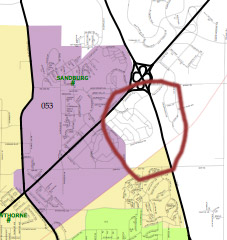 A reader emailed this interesting MMSD budget item. The land and buildings around East Towne Mall are not in the MMSD,