School Information System

Discouraging political trashtalk in kids

Katie Allison Granju:

As a parent, I am very bothered when I hear other parents teach their children that it’s acceptable or useful to mock or insult candidates or the President in ways that aren’t directly related to issues. I hate hearing children spout nasty, ad hominem stuff like “Bush is stupid.” When I hear that from a child or teenager, I challenge him or her to clearly articulate at least three substantive policy issues on which they disagree with Bush. If they can’t, I point out that calling him “stupid” only draws attention to their own ignorance on the issues. And frankly, in my anecdotal experience (your mileage may vary), it’s more likely to be progressive/liberal parents who encourage this sort of political trashtalk from their children, some too young to even understand what the president even does.

Share

Personal finance urged for Oregon schools

Kimgerly Melton:

Since she started working at the mall six months ago, Joy Stout has come close to draining her bank account to buy clothes and eat out with friends.
The Cleveland High School senior hoped to save about half the cash from her weekend job at Jamba Juice in the Lloyd Center but found she was going paycheck to paycheck.
She’s getting better — her parents encouraged her to open a bank account and keep track of where her money went. And this fall, only a couple of months into her first personal finance class, she’s learning lessons about spending and saving that can take years to master.
“When you are trying to figure out whether to buy something, you got to ask yourself if you want this or if you need it,” says Stout, 18. “If you only want it, is it worth spending on if you could save money for later? I want to save money to have a car.”

Share

Teen arrested in threats at Middleton High School that forced relocation of polling places

Wisconsin State Journal:

Middleton police have arrested a 16-year-old male Middleton High School student in connection with a bomb threat at the high school that forced the evacuation of the school Tuesday and caused election officials to move the polling place from the school to the new Middleton fire station at 7600 University Ave.
Lt. Charles Foulke of the Middleton Police Department said in a release that the student used the school’s computer lab to access an Internet relay Web site which translated a typed threat into a verbal message which he then sent to a school official.
Foulke said the student would be charged with making a bomb threat at the Dane County Juvenile Reception Center, and that Middleton police would consult with state and federal officials about the disruption of the voting process.

Share

Sun Prairie Family Adopts 10 Children, Advocates For Adoption

Channel3000:

November is National Adoption Month, and in the United States, about 51,000 children were adopted in 2006, according to the U.S. Department of Health and Human Services.
With this in mind, one local family shared their adoption experience they said in hopes of encouraging others to do so, WISC-TV reported.
Ten years ago, Reed and Sharon Leonard adopted their daughter from China.
“On the plane ride home, my wife said, ‘Well, we have our daughter, we’re done.’ I said, ‘No, I think we’ll be back,'” said Reed Leonard.
“I said no way,” laughed Sharon Leonard.

Share

Vote!


Wisconsin polling locations can be found here.

Share

Boston’s Single Sex Academies hit a Snag

James Vaznis:

One of the most eye-catching elements of Boston School Superintendent Carol R. Johnson’s reorganization plan – the creation of two single-gender academies – seems to have just one problem: They appear to be illegal in Massachusetts.
Public schools cannot deny a student admission based on gender under state law, which could prevent Boston from trying a strategy that has been gaining momentum in other cities nationwide and that advocates say leads to much higher rates of learning.
The problem could lead to one of several possible changes to the reorganization plan, which Johnson is scheduled to revisit with the School Committee tonight after passionate objections were raised by many parents, students, and teachers who do not want their schools to close.
The School Committee requested more details on the plan to close about a dozen schools, which would leave five buildings empty while the others would be used to house new schools or expand popular ones.

Share

Meet a ‘Mother on Fire’ for public school

Greg Toppo:

Last June, when Los Angeles performance artist and public radio commentator Sandra Tsing Loh helped lead a rally to the California Capitol for more school funding, perhaps no one was more surprised than Loh herself. Her transformation from popular author and comic to public schools activist began four years earlier, when her plans to get her older daughter into a good kindergarten went awry. She eventually started an organization called Burning Moms. Loh recounts the journey in Mother on Fire (Crown, $23). She talks with USA TODAY about her experience.
Q: It’s 2004. You, your musician husband and your two daughters live in Van Nuys. Your 4-year-old is in preschool and you begin searching for a kindergarten. What happens next?
A: We’re a middle-class family, which feels like we’re the last middle-class family in Los Angeles — the last one had packed up the Volvo wagon and gone to Portland a year earlier. When kids hit school age, people just start fleeing the city unexplained. So I didn’t have much real information. … I’d go on www.greatschools.net, look at the statistics, freak out and not even visit my local school, which is what many parents do.
Q: You began looking into private schools, but many had “nosebleed tuition.”
A: I found that the religious ones were more affordable — the more religious, the more affordable. Catholics were more expensive, Lutherans middle and Baptists were the only ones we could afford. The Quakers were off the charts, particularly if there’s the word “Friends” in the title — or if the kids were being taught in an old Quaker wooden schoolhouse with authentic Shaker furniture.

Much more on Sandra Tsing Loh here.

Share

Open Yale Courses

Yale University:

Open Yale Courses provides free and open access to a selection of introductory courses taught by distinguished teachers and scholars at Yale University. The aim of the project is to expand access to educational materials for all who wish to learn.
Open Yale Courses reflects the values of a liberal arts education. Yale’s philosophy of teaching and learning begins with the aim of training a broadly based, highly disciplined intellect without specifying in advance how that intellect will be used. This approach goes beyond the acquisition of facts and concepts to cultivate skills and habits of rigorous, independent thought: the ability to analyze, to ask the next question, and to begin the search for an answer.

Share

Fixing the Freshman Factor

Nelson Hernandez:

The ninth-grader slouched in the chair one fall day, avoiding the principal’s glare. He had the body of a boy, but he was deciding right there what kind of man he would be.
At the start of the school year, this child’s education was flying off the rails. Mark E. Fossett, principal of Suitland High School in Prince George’s County, called up the boy’s attendance record on a computer and rattled off a lengthy list of days missed and classes cut. Unless something changed, he would fail ninth grade.
As schools push to raise graduation rates, many educators are homing in on ninth grade as a moment of high academic risk. Call it the freshman factor.
Last week, Maryland reported that one of every six seniors statewide is at risk of not receiving a diploma in spring because they have not reached minimum scores on four basic tests in algebra, biology, government and English. At Suitland High and countywide in Prince George’s, more than a third of seniors are in jeopardy. But for many of those students, troubles began in their freshmen year. That’s often when the state algebra test is taken.

Share

Study First to Link TV Sex To Real Teen Pregnancies

Rob Stein:

Teenagers who watch a lot of television featuring flirting, necking, discussion of sex and sex scenes are much more likely than their peers to get pregnant or get a partner pregnant, according to the first study to directly link steamy programming to teen pregnancy.
The study, which tracked more than 700 12-to-17-year-olds for three years, found that those who viewed the most sexual content on TV were about twice as likely to be involved in a pregnancy as those who saw the least.
“Watching this kind of sexual content on television is a powerful factor in increasing the likelihood of a teen pregnancy,” said lead researcher Anita Chandra. “We found a strong association.” The study is being published today in Pediatrics, the journal of the American Academy of Pediatrics.
There is rising concern about teen pregnancy rates, which after decades of decline may have started inching up again, fueling an intense debate about what factors are to blame. Although TV viewing is unlikely to entirely explain the possible uptick in teen pregnancies, Chandra and others said, the study provides the first direct evidence that it could be playing a significant role.

Share

Online Grading Systems Mean No More Changing D’s to B’s

Daniel de Vise:

Parents and students in a growing number of Washington area schools can track fluctuations in a grade-point average from the nearest computer in real time, a ritual that can become as addictive as watching political polls or a stock-market index.
The proliferation of online grading systems has transformed relations among teachers, parents and students and changed the rhythm of the school year. Internet-based programs including SchoolMAX and Edulink are pushing mid-term progress reports into obsolescence. Prospective failure is no longer a bombshell dropped in a parent-teacher conference. A bad grade on a test can’t be concealed by discarding the evidence. A student can log on at school, or a parent at work, to see the immediate impact of a missed assignment on the cumulative grade or to calculate what score on the next quiz might raise an 89.5 to a 90. Report cards hold little surprise.
“Half of the time, I know what grade my daughter got on something before she does,” said Susan Young, mother of an eighth-grader at Montgomery Village Middle School in Montgomery County.
Parents say the programs reconnect them to the academic lives of their children, a relationship that can decay as students move from elementary to middle and high school.

The Madison School District uses a system called “Infinite Campus“. A number of nearby districts use Powerschool, among others.

Share

Cap on New Jersey school adminstrator buyouts challenged

Newsday:

A proposed cap on payouts for vacation and sick time for New Jersey school administrators is being challenged in federal court on Monday.
The Record of Bergen County reports that taxpayers are footing the bill for more than $36 million in sick pay and vacation time accrued by school administrators.
The newspaper reports that buyouts will reach $9 million in Bergen and Passaic counties alone, and that some school leaders are due to receive six-figure checks when they leave a district because of contracts that allow them to cash out on unused sick and vacation time.
The New Jersey Association of School Administrators has filed suit to preserve the payouts and challenge a new contract rule that caps accrued time payouts at $15,000.

Share

Madison School District Enrollment Data Analysis

The Madison Metropolitan School District [724K PDF]:

The following document explores enrollment trends based on four different factors: intemal transfers, private school enrollments, inter-district Open Enrollment, and home based enrollments. The most current data is provided in each case. Not all data are from the current school year. Certain data are based on DPI reports and there are lags in the dates upon which reports are published.
Summary
Most internal transfers within the MMSD are a function of two factors: programs not offered at each home school (e.g., ESL centers) and students moving between attendance areas and wishing to remain in the school they had been attending prior to the move. Notable schools in regard to transfers include Shorewood Elementary which has both a very high transfer in rate and a very low transfer out rate, Marquette which has a high transfer in rate, and Emerson which has a high transfer out rate.
Based on data reported to the Department of Public Instruction (DPI), private school enrollments within the MMSD attendance area have held fairly steady for the past several years, with a slight increase in the most recent two years. The District’s percentage of private school enrollment is roughly average among two separate benchmark cohort groups: the largest Wisconsin school districts and the Dane County school districts. Using data supplied annually to the MMSD by ten area private schools it appears that for the past three year period private school elementary enrollment is declining slightly, middle school enrollment is constant, and high school enrollment has been variable. Stephens, Midvale, Leopold, and Crestwood Elementary Schools, and Cherokee and Whitehorse Middle Schools have experienced declines in private school enrollment during this period. Hawthorne and Emerson Elementary Schools, Toki and (to a lesser extent) Sherman Middle Schools, and West and Memorial High Schools have experienced increases in private school enrollments. The East attendance area has very limited private school enrollment.
Home based education has remained very steady over the past six years based on data reported to the DPI. There is no discernible trend either upward or downward. Roughly 420 to 450 students residing within the MMSD area are reported as participating in home based instruction during this period. Like private school enrollment, the MMSD’s percentage of home based enrollment is roughly average among two separate benchmark cohort groups: the largest Wisconsin school districts and the Dane County school districts.
Open Enrollment, which allows for parents to apply to enroll their Children in districts other than their home district, is by far the largest contributor to enrollment shifts relative to this list of factors. In 2008-09, there are now over 450 students leaving the MMSD to attend other districts compared with just under 170 students entering the MMSD. Transition grades appear to be critical decision points for parents. Certain schools are particularly affected by Open Enrollment decisions and these tend to be schools near locations within close proximity to surrounding school districts. Virtual school options do not appear to be increasing in popularity relative to physical school altematives.

Share

Wide Access To AP, IB Isn’t Hurting Anybody

Jay Matthews:

Jason Crocker, an educational consultant in Prince George’s County, is exasperated with me and my rating of high schools, called the Challenge Index, based on how many college-level Advanced Placement or International Baccalaureate tests schools give. In response to one of my columns, Crocker vowed to refute anything nice I say about AP, particularly in his county.
He reflects the views of many in the Washington area. People wonder why kids are taking wearisome three-hour AP exams (or five-hour IB exams) in history, calculus or physics when their grades aren’t that good and their SAT scores are low. Crocker, who is African American, is particularly worried about what all this testing is doing to black students.
“Mr. Mathews, AP in Prince George’s County is about setting African American students up for failure to satisfy your Challenge Index,” he said. “The flip side of this is that most of these new students taking the exam are not adequately prepared for the exam and Prince George’s County cannot recruit enough teachers to teach the exam who are highly qualified.”

Related: Dane County, WI High School AP course offering comparison.

Share

Healthier meals served at pricier Long Island private schools

Jennifer Sinco Kelleher:

Typical lunchtime fare includes quinoa, bean cakes, Swiss chard, fresh beets, tofu, tempeh, kimchee.
There are no sloppy joes. Hamburgers are served only three times a year during field days, and the beef is organic.
Private schools such as the Ross School in East Hampton don’t operate under the same cost constraints public schools face when attempting to serve healthy food, allowing them more freedom to go beyond traditional school cafeteria meals.
Ross’ food often is held up as a model for student dining.
A staff of 17 line chefs with impressive culinary backgrounds cook from scratch in a kitchen that rivals a five-star restaurant. And students actually like the healthy offerings, evidenced by the fact that they go through about 25 pounds of tofu per day.

Share

Vanishing Native Languages

Nicholas Ostler and Francene Patterson, both linguists, discuss the perils of monolingualism and the need to protect endangered languages

Share

Incentives Can Make Or Break Students

Bill Turque:

The inducements range from prepaid cellphones to MP3 players to gift certificates. But most of them are cash: $10 for New York City seventh-graders who complete a periodic test; $50 for Chicago high school freshmen who ace their courses; as much as $110 to Baltimore students for improved scores on the Maryland High School Assessments.
Desperate for ways to ratchet up test scores and close the achievement gap separating white and minority students, school officials from Tucson to Boston are paying kids who put up good numbers.
The District joined the list this fall, launching a one-year study of 3,300 middle schoolers who can earn up to $100 every two weeks for good grades, behavior and attendance. On Oct. 17, the first payday for the Capital Gains program, students collected an average of $43.
The efforts vary widely in scope and objective. But nearly all trigger pa

Share

On an Amazing Journey, and He’s Only 12

Lary Bloom:

A FEW weeks ago, the youngest of the 20,953 students at the Storrs campus of the University of Connecticut went shopping for a calculator. Colin Carlson, who lives in nearby Coventry, took his mother along, as she had the driver’s license and the money. He also took a reputation well beyond his 12 years.
Another male student spotted him and said, “Hey, Colin, I hear you’re a babe magnet.” The boy smiled. But with a full course load and the usual schedule of public appearances ahead of him, he had yet to make finding a girlfriend a priority. So he suspected a bit of social manipulation afoot. The guys know that several female students have become friendly with Colin, and, in his view, they’re cozying up to him so that women will notice them.
Even at Colin’s tender age, his emergence at Storrs is no longer an oddity. He became a full-time student this fall, but has been a familiar face since he was 8, beginning with a course in French, and a year later in environmental physics and European history. This made him a local celebrity but also resulted in a view in some academic quarters that he is too small for his breeches.

Share

School’s Success Gives Way to Doubt

Adam Nossiter:

MiShawna Moore has been a hero in the worn neighborhoods behind this city’s venerable mansions, a school principal who fed her underprivileged students, clothed them, found presents for them at Christmas and sometimes roused neglectful parents out of bed in the nearby housing projects.
As test scores rocketed at her school, Sanders-Clyde Elementary, the city held her up as a model. The United Way and the Rotary Club honored her, The Charleston Post and Courier called her a “miracle worker,” and the state singled out her school to compete for a national award. In Washington, the Department of Education gave the school $25,000 for its achievements.
Somehow, Ms. Moore had transformed one of Charleston’s worst schools into one of its best, a rare breakthrough in a city where the state has deemed more than half the schools unsatisfactory. It seemed almost too good to be true.
It may have been. The state has recently started a criminal investigation into test scores at Ms. Moore’s school, seeking to determine whether a high number of erasure marks on the tests indicates fraud.

Share

Fewer Children Entering Gifted Programs

Elissa Gootman & Robert Gegeloff:

The number of children entering New York City public school gifted programs dropped by half this year from last under a new policy intended to equalize access, with 28 schools lacking enough students to open planned gifted classes, and 13 others proceeding with fewer than a dozen children.
The policy, which based admission on a citywide cutoff score on two standardized tests, also failed to diversify the historically coveted classes, according to a New York Times analysis of new Education Department data.
In a school system in which 17 percent of kindergartners and first graders are white, 48 percent of this year’s new gifted students are white, compared with 33 percent of elementary students admitted to the programs under previous entrance policies. The percentage of Asians is also higher, while those of blacks and Hispanics are lower.
Parents, teachers and principals involved in the programs, already worried at reports this spring that the new system tilted programs for the gifted further toward rich neighborhoods, have complained since school began that they were wasteful and frustrating, with high-performing children in the smallest classes in a school system plagued by pockets of overcrowding.

Share

O’Conner on the Crisis in K-12 Civics Education

Chloe White:

A survey shows more young people today can name the Three Stooges than the three branches of government, former Supreme Court Justice Sandra Day O’Connor told a packed auditorium Friday at the University of Tennessee. Civic education has “really lost ground” in the United States, and “unless we do something to reverse that disturbing trend, the joke may be on us,” O’Connor said at the 1,000-seat Cox Auditorium at the UT Alumni Memorial Building.
O’Connor was at UT to celebrate the opening of the Howard H. Baker Jr. Center for Public Policy.
“Only an educated citizen can ensure our nation’s commitment to liberty is upheld. If we fail to educate young people to be active and informed participants at all levels, our democracy will fail,” said O’Connor, the first woman on the nation’s high court.
She spoke about the need for civic education, citing three problems with what she calls “civic illiberty”: the lack of time schools spend teaching civics; a static approach to civic education; and the lack of modern teaching methods such as computer programs in teaching civics.
“Creating engaged and active citizens is too important a priority to shortchange in curriculum planning in schools,” she said.
O’Connor, 78, is co-chairwoman of the National Advisory Council of the Campaign for the Civic Mission of Schools, a group with which the Baker Center works. The campaign promotes civic education and provides K-12 curriculum.

Share

Graduate Opportunities 2009

The Economist:

The biggest winner from recession may be the teaching profession–particularly in maths and physics, where it has long struggled to compete for talent with banking and finance. Applications for teacher training in these subjects go up when the government offers golden hellos and other incentives, say Alan Smithers and Pamela Robinson of Buckingham University–but high graduate unemployment causes a surge too. It looks as if the pattern is set to repeat: the Training and Development Agency, which oversees teacher training, says its website has received a third more hits this year than last, and registrations of interest are also up. Hidden inside one crisis may be the solution to another.

Share

Wisconsin School District’s Global Financial Gamble in “Synthetic Collaterilized Debt Obligations”

Charles Duhigg & Carter Dougherty:

On a snowy day two years ago, the school board in Whitefish Bay, Wis., gathered to discuss a looming problem: how to plug a gaping hole in the teachers’ retirement plan.
It turned to David W. Noack, a trusted local investment banker, who proposed that the district borrow from overseas and use the money for a complex investment that offered big profits.
“Every three months you’re going to get a payment,” he promised, according to a tape of the meeting. But would it be risky? “There would need to be 15 Enrons” for the district to lose money, he said.
The board and four other nearby districts ultimately invested $200 million in the deal, most of it borrowed from an Irish bank. Without realizing it, the schools were imitating hedge funds.
Half a continent away, New York subway officials were also being wooed by bankers. Officials were told that just as home buyers had embraced adjustable-rate loans, New York could save money by borrowing at lower interest rates that changed every day.

SIS Links. NPR covers the story here. Madison Assistant Superintendent for Business Services Erik Kass held the same position at the Waukesha School District, which was involved in this investment strategy.

Share

Juvenile Crime During the School Year, 2000-2006


City of Jacksonville, NC:

The map was created at the request of the Jacksonville Police Department to show juvenile crime patterns over space and time. Using the city’s criminal geodatabase and ArcGIS, it was possible to query the system for arrests of people younger than 18 and arrests during school days. Organizing the crimes by hour clearly showed patterns in which the bulk of criminal activity occurred during school hours, with some after school, and the least number of crimes occurring in the evening.

Share

What School Sports Taught These Political Contenders

Preston Williams:

For the 2008 presidential hopefuls, the road to the White House included an extended stay in the field house. No matter which ticket prevails Tuesday, a pair of former high school athletes will run the country come January.
Sen. Barack Obama (D-Ill.) was a reserve on the Punahou Academy basketball team that won the 1979 state title in Hawaii. He would be the first serious basketball player to occupy the Oval Office.
Sen. John McCain (R-Ariz.) competed in several sports at Episcopal High School in Alexandria, most notably wrestling.

Share

The Cost of Higher Education: This house believes that individuals, not the state, should pay for higher education.

The Economist, Alison Wolf:

Individuals should certainly pay for their higher education. Anything else is deeply unfair to their fellow citizens.

Anders Flodstrom:

A nation is made up of individuals, who identify themselves with it. The nation stands for certain values agreed upon in, hopefully, a democratic way

Share

Salvaging School Accountability

Thomas Toch & Douglas Harris, via a kind reader’s email:

George W. Bush rode to the White House pledging high standards for all students. He’ll leave Washington with the nation’s public education system focused on teaching basic skills to disadvantaged student populations, with the United States lagging in international comparisons of educational attainment, and with his signature education law plagued by so many problems and mired in so much controversy that it has put at serious risk two decades of work to improve public schooling by making educators accountable for their students’ success.
The most important thing Barack Obama or John McCain could do quickly to salvage the accountability movement is change the way that the federal No Child Left Behind Act judges schools. Not by abandoning NCLB’s focus on students’ meeting standards, a move that would be unwise on both policy and political grounds, but by making the law a more legitimate report card of school performance, one that provides a fair and accurate gauge of educators’ contribution to their students’ achievement. Since its inception, NCLB has instead held schools responsible for factors they can’t control and perversely encouraged states to set standards low.
It’s critical in any accountability system that the metrics used to judge performance reflect accurately the contributions of those being judged. In education, that means measuring how much progress a school’s students make during the school year, a “value added” approach that accounts for the disadvantages (or advantages) students may bring to school because of the quality of prior instruction or their family backgrounds. It’s a strategy that pressures schools working with disadvantaged students to work hard in their students’ behalf without penalizing educators for taking on tough assignments. And it’s a strategy that doesn’t reward rich schools merely for having privileged students.

Clusty Search Thomas Toch and Douglas Harris.

Share

Parents cool to short-term solutions for overcrowding at Leopold

Kurt Gutknecht, via a kind reader’s email:

A temporary solution to concerns about Leopold Elementary School will be announced by June 2009, according to Daniel Nerad, superintendent of the Madison Metropolitan School District.
Nerad, members of the school board and other officials held what Nerad called “an engagement session” at Leopold on Oct. 20. About 100 parents attended the session, part of what Nerad called an effort to find “a short-term solution to find a long-term solution.”
But a show of hands after the meeting indicated most of those attending the session opposed the proposed short-term solution, which would involve transferring fifth graders to Cherokee and Wright middle schools.
“I’m confident it (the short-term solution) would work for two years,” Nerad said.
Nerad conceded that the short-term plan would address crowding but not another concern of parents- the high proportion (68 percent) of low-income students at Leopold. The long-term plan would tackle that issue, he said.

Much more on Leopold here.

Share

Maryland Urged to Require Graduation Exams

Liz Bowie:

Maryland’s state school board made a final decision yesterday to hold firm and require this year’s high school seniors to pass four subject tests to graduate in June, although it left open the possibility of exemptions for special education students and those learning English.
The decision leaves 9,059 students across the state – or about 17 percent of the Class of 2009 – at risk of not getting a diploma, according to data released yesterday.
Only 70 percent of African-Americans statewide and 50 percent of special education students have met the requirements. But the group most likely to be barred from graduation are immigrants who are learning English. Many have not yet taken all the tests, and only 15 percent have met the requirements.

Share

No Dropouts Left Behind: New Rules on Graduation Rates

Kathleen Kingsbury:

It’s a staggering statistic: one in four American teenagers drops out of school before graduation, a rate that rises to one in three among black and Hispanic students. But there’s no federal system keeping track of the more than 7,000 American teenagers who drop out of school each day.
That appears to be changing. On Oct. 28, Education Secretary Margaret Spellings issued new rules that will force states to adopt a common system to monitor dropouts. Critics of No Child Left Behind have long accused the federal legislation not only of leading more schools to teach to the test, but of letting — or perhaps even encouraging — struggling students to drop out before they can lower average test scores. But Spellings is trying to address this problem with new regulations that will set a uniform graduation rate so that a high school’s annual progress will now be measured both by how students perform on standardized tests and by how many of them graduate within four years.
Schools that do not improve their graduation rates will face consequences, such as having to pay for tutoring or replace principals. “For too long, we’ve allowed this crisis to be hidden and obscured,” Spellings said in her announcement, made nearly seven years after No Child Left Behind was signed into law. “Where graduation rates are low, we must take aggressive action.”

Share

Protests over Italian Education Cuts

AFP:

Hundreds of thousands of teachers, students and parents took to the streets of Rome and other Italian cities on Thursday, to protest conservative Prime Minister Silvio Berlusconi’s multi-billion-euro education cuts.
Organisers said up to one million people marched in the capital while nine in ten schools across the country were closed.
The Senate on Wednesday approved cuts of more than nine billion euros (11.6 billion dollars) in education spending for the loss of 130,000 jobs in primary schools.
The reforms include a return to the practice of having only one teacher per primary school class and cutting the amount of teaching time starting in the 2009-10 academic year.
Universities, which also face budget cuts, plan a general strike on November 14.

Share

The Election Choice: Education Obama says schools need more money, McCain wants more accountability

Joseph Rago:

Though education has not figured prominently in the campaign, John McCain and Barack Obama have their proposals. Each falls squarely within their respective party’s established political framework: Boiled down, Mr. Obama believes that schools require more resources and federal support, while Mr. McCain wants to introduce to the education system more choice and accountability.
School choice. Mr. McCain would pursue education reforms that institute equality of choice in the K-12 system. He would allow parents whose kids are locked into failing public schools to opt out, whether in favor of another public school, a charter school or through voucher or scholarship programs for private options. Parents, he believes, ought to have more control over their education dollars. Teachers’ unions and school administrators find none of this amenable.
Mr. McCain supports merit pay for teachers and would establish a bonus program for high-performing educators, as well as devote more funds toward attracting successful college graduates into the field. He would also give principals more control over their schools, including spending decisions, instead of district school boards.

Share

Playing the Market, These Kids Are Losing a Lot of Play Money

Jennifer Levitz:

Michael Ashworth slumped by his computer, weary from another rough day in the stock market. All his favorite picks — Domino’s Pizza Inc., Hershey Co. and Gap Inc. — were down.
I’ll be honest with you,” he confided. “Before all this, I asked my mom to get me stocks for Christmas,” but then “I told her not to do it. I asked for a parakeet instead.”
Michael, a 13-year-old at Wilmington’s Skyline Middle School, is one of 700,000 players in the “Stock Market Game,” a scholastic contest in which students from grades four through 12 get a hypothetical $100,000 to invest in stocks, bonds or mutual funds.
The game is run by the Securities Industry and Financial Markets Association, Wall Street’s biggest trade group. Schools pay about $16 a team for a curriculum that includes access to a computer system that executes the simulated trades and ranks teams by states and age group. At the end, the teams in each state with the best returns take home bull-and-bear trophies, gift certificates or other prizes.

Share

Beautiful Math


NOVA:

NARRATOR: You can find it in the rain forest, on the frontiers of medical research, in the movies, and it’s all over the world of wireless communications. One of nature’s biggest design secrets has finally been revealed.
GEOFFREY WEST (Santa Fe Institute): My god, of course. It’s obvious.
NARRATOR: It’s an odd-looking shape you may never have heard of, but it’s everywhere around you: the jagged repeating form called a fractal.
JAMES BROWN (University of New Mexico): They’re all over in biology. They’re solutions that natural selection has come up with over and over and over again.
NARRATOR: Fractals are in our lungs, kidneys and blood vessels.
KEITH DEVLIN (Stanford University): Flowers, plants, weather systems, the rhythms of the heart, the very essences of life.
NARRATOR: But it took a maverick mathematician to figure out how they work.
BENOIT MANDELBROT (Yale University): I don’t play with formulas, I play with pictures. And that is what I’ve been doing all my life.

John Tierney has more.

Share

Monona School Board looks at closing Maywood Elementary

Karyn Saemann:

Just two months after opening a $25 million new middle school, the Monona Grove School Board is considering closing an elementary school and busing students between Monona and Cottage Grove.
Any of those moves could plunge the district into another tense struggle like the one in 2006 that ultimately led to voters approving the new middle school.
On Nov. 12, the board will consider forming a committee to study whether to close Maywood Elementary in Monona and whether to move Monona sixth-graders to Glacial Drumlin Middle School in Cottage Grove.
Glacial Drumlin opened in September for fifth- through eighth-graders from Cottage Grove, and seventh- and eighth-graders from Monona.
The board may also ask the committee to study changes in Cottage Grove, where Taylor Prairie Elementary is at its enrollment capacity and Cottage Grove Elementary is about 35 students over. Potential moves range from building a $2 million to $3 million addition at Cottage Grove Elementary to using portable classrooms to busing fourth-graders to Monona, where classroom space is abundant. With its price tag, a Cottage Grove Elementary building addition would require a referendum.

Share

On the Minneapolis Spending & Governance Referendum

Tom Weber:

Anyone keeping tabs of next week’s election in the Minneapolis School District is likely aware of a $60 million levy that would raise property taxes to garner more funding for schools. But there’s also a second question on the ballot that’s not getting much attention.
Minneapolis, Minn. — The first question would raise property taxes on a $250,000 house by about $200 a year.
Supporters, like Superintendent Bill Green, say the extra money is needed because the state hasn’t kept pace with education funding, and the district will have to make deep budget cuts without the extra money.
When we ran the previous referendum, it was based on an assumption that the state and federal government would continue the allocation formula they had set out,” Green said. “That we would be able to anticipate that they would keep pace with the cost of living and other factors.
“They didn’t, and so we feel we can’t make the same assumptions (now).”
There is no formal campaign opposing the levy, but voters have expressed opposition.

Share

Protests over Italy school reform

BBC:

School pupils, university students and teachers have staged demonstrations across Italy against a school reform law just passed by parliament.
In Rome’s Piazza Navona, a popular tourist spot, several people were lightly injured in a clash between left- and right-wing students.
The reform package is expected to cut the education budget.
In primary schools there will be just one all-purpose teacher per class and a grade system for pupils’ behaviour.
The package will reinstate a 10-point system for grading pupils’ conduct, aimed at curbing bullying.

Share

Kids Focus on School Safety

John-John Williams IV:

A student from an Anne Arundel County high school said she’s seen guns on campus. A Howard County girl said squabbles that start as Internet exchanges lead to fights at school. And a senior at a Baltimore school told of fights that are part of gang initiations.
One of the main messages from students across Maryland who gathered yesterday at a summit on school violence is that the issue cannot be ignored.
“We have so many problems in our school system that we don’t think about,” said Josh Maley, 16, a junior at Howard High in Ellicott City. “We overlook so much. This summit is good because it lets [adults] hear their stories.”
The event drew more than 250 students from middle and high schools to Martin’s Crosswinds in Greenbelt to talk about school safety. Every jurisdiction in the state was represented, and organizers said they hope to use the students’ observations and ideas to craft plans to stem violence.

Share

Advocating for the November, 2008 Madison School District Referendum

Paul Soglin:

On next Tuesday’s ballot there is a referendum for Madison Metropolitan School District residents to vote on supporting public education.
As one Wisconsin business leader put it when discussing the challenges of global competition which includes everything from taxation to environmental regulation, “What I need is an intelligent workforce.”
We invest every day. Some investments turn out better than others.
There is really no wiser and prudent investment than the education of our children.
An educated child makes more money and pays taxes. An uneducated child is in need of public support for housing, healthcare, and food. An educated child is less likely to go to prison and more likely to support charities. An uneducated child is more likely to become a parent at a young age and is likely to have greater health problems.

Much more on the referendum here.
Related: Don Severson & Vicki McKenna discuss the referendum (25mb mp3 audio).

Share

Fight at Madison Memorial shows difficulty of keeping school hallways safe

Jessica VanEgeren:

If art really does imitate life, then a peek into the interracial dynamics of high school life in Madison can be found every morning inside Room 272 at West High School. There, the students, hand-picked because of their ethnicity, respond to bullying, gang-related activities, body awareness issues and racial stereotyping by creating skits that mimic common situations students experience in school.
Lounging on pillows and passing around a bag of suckers at 9 a.m., the students, from varying backgrounds including Hmong, Chinese, African-American, Albanian and Laotian, are at ease with one another. This is not a dynamic reflected by every student in every school.
Sometimes an inspiration for a skit can be found right outside the classroom door, as junior Louisa Kornblatt found out on a recent morning when a student yelled, “Watch where your tall white ass is going, bitch,” during a break between classes. Although Kornblatt returned to the classroom with a flushed face, asking if anyone else had heard the comment, most of the students reacted to it nonchalantly.
“That’s just part of a day,” said senior John Reynolds, one of the students in the Multico theater group, which performs in schools all over the district. “You learn to ignore it. West is a culturally diverse place, and you’ll hear those kinds of statements in the hallways. You just need to learn to focus on the good, not the bad.”

Related: Police calls near Madison High Schools 1996-2006.

Share

Online Learning Policy & Practice; A Survey of the States

The Center for Digital Education, 1.5MB PDF Report:

In 2008, the Center for Digital Education conducted a review of state policy and programs to determine the status of online learning policy and practice across the United States. This report is underwritten by Blackboard and Pearson Education and produced with the advice and consultation of the Council of Chief State School Officers (CCSSO) and the North American Council for Online Learning (NACOL).
The Center for Digital Education (CDE) interviewed state education officials across the nation to evaluate the overall landscape of online learning. The rankings reflect the vision, policies, programs and strategies that states have deployed around online learning in an effort to transform their academic environment to meet the needs of students. Certain characteristics deemed to have a greater impact on statewide leadership and education (such as states with state-led online programs and/or significant policy directives) played a more significant role in the rankings than others.
The national rankings are as follows: (Florida is #1, Minnesota 9, Illinois 13, Iowa 20, Wiscnsin 37)

Share

Wisconsin SAGE program’s 15-student limit is often exceeded, report says

Amy Hetzner:

About half of the classrooms participating in the state’s school class-size reduction program in 2006-’07 exceeded its 15-student limit at least part of the school day, according to a recent report.
Dwindling resources and enrollment fluctuations were the main reasons given for the variation, according to the report by the Wisconsin Center for Education Research at the University of Wisconsin-Madison.
Although the report raises concerns about such practices, including that some school administrators seemed unaware of the program’s 15-student maximum, it concludes, “There are multiple ways to implement reduced class size well.”
The report is part of the state Department of Public Instruction’s regular monitoring of the $111 million SAGE program – Student Achievement Guarantee in Education – that aims to reduce class sizes for kindergarten through third grade in more than 470 Wisconsin schools. The center has another study in the works looking at long-term quantitative results from the program.

Share

California education leaders told to brace for big budget cuts

Evan Halper:

Educators say Arnold Schwarzenegger told them to prepare for immediate cuts of $2 billion to $4 billion. They say the governor also plans to keep pushing for a sales tax hike.
Gov. Arnold Schwarzenegger told education leaders this morning that he will push for a tax hike and deep cuts to schools to help close the state’s yawning budget gap, according to several participants in the meeting.
The news, delivered in a conference room outside the governor’s office, came as a shock to the educators, who were told to prepare for immediate cuts in the range of $2 billion to $4 billion.
“There is just no way we would be able to cut that much,” said Scott Plotkin, executive director of the California School Boards Assn., who was at the meeting. “For virtually every district I know of, this would be catastrophic.”
Administration officials confirmed that the meeting took place but refused to discuss details.

Related:

Facing a $3,000,000,000 deficit, it is hard to see how significant increases in redistributed state tax dollars will find their way to K-12 school districts over the next few years.

Share

Will Blewett be the last Milwaukee Public Schools board president?

Michael Mathias:

If there is a case to be made for dissolving the Milwaukee Public Schools board, several of its members, but particularly its president, Peter Blewett, seemed hell bent on making it during last week’s budget meetings.
That the end result of those meetings–a double digit increase in the district’s property tax levy–was the only responsible option the board could have chosen, won’t do anything to assuage the board’s growing number of critics or even improve its standing among its supporters.
Blewett has had a long time (a year, in fact, since the last budget fiasco) to persuade the public and other elected officials that the board and Superintendent William Andrekopoulos have the ability to manage the district’s complicated finances. And while the scores of people who showed up to support an increase in the tax levy made an impressive display, their presence seemed more in support of an idea and not an endorsement of those behind it. It’s notable that, as far as I know, not one elected official spoke out in support of the board’s actions despite the fact that everyone is aware of the poor hand MPS is dealt when it comes to state funding.

Share

Busy roads, bicyclists make for uneasy mix at Cottage Grove school

Gena Kittner:

The confines of school are shed the instant scores of students at Glacial Drumlin School hop on their bicycles and whiz — many helmetless and some riding two to a bike — down the hill and across the busy streets of this fast-growing village.
Some cruise down the middle of the nearby residential streets, heedless of cars and buses. Others take more care, stopping at stop signs and looking both ways — but not enough.
“A lot of kids just bike right across the intersection,” said Stephanie Carney, who lives in a subdivision near the school. “The kids don’t seem to look either way,” she said.

Share

Low-Cost Multi-point Interactive Whiteboards Using the Wiimote

Johnny Chung Lee:

Since the Wiimote can track sources of infrared (IR) light, you can track pens that have an IR led in the tip. By pointing a wiimote at a projection screen or LCD display, you can create very low-cost interactive whiteboards or tablet displays. Since the Wiimote can track upto 4 points, up to 4 pens can be used. It also works great with rear-projected displays.

Share

Science Evolves in Classrooms

Daniel de Vise:

In the past six years, science has slipped as a priority in public schools while reading and mathematics have grown dominant.
But in coming years, experts say, the same federal law that elevated reading and math could spark a resurgence of science in the classroom.
The 2002 No Child Left Behind law required states to test students in science starting in the 2007-08 year, on top of reading and math assessments mandated from the start. Virginia has given science tests since 1998, but the exams are new for Maryland and the District. (Separately, Maryland tests high school students in biology as a graduation requirement.)
Unlike the reading and math test results, science scores won’t be used to grade schools for accountability. But education leaders predict that the scores will matter when disseminated to the public.

Share

Best Los Angeles Area High Schools; 2008

Los Angeles Magazine:

So how did we choose the best high schools on this honor roll? The Academic Performance Index (API) scores range from 200 to 1000 and are calculated from the results for each school’s students on statewide tests. Public schools in Los Angeles County were considered for this analysis if their 2006-7 API score was at least 800, the median of a basic score (725) and a proficient one (875) and the state’s performance goal for all schools. In addition, schools had to meet minimum standards: an enrollment of 200 students for all schools, a graduating class of 50 students for public schools, and a graduating class of 65 students for private schools. Schools were excluded if they declined to participate or if data were not available. Our index is based on a weighted average of scores assigned to five variables: API score, student-teacher ratio, percentage of students going to college, dropout rate, and advanced placement ratio (this ratio represents the number of AP sections offered, divided by the number of graduates). Private schools had to meet similar standards to avoid exclusion; their index is based on a weighted average of scores assigned to a slightly different set of variables, including the average SAT score for students enrolled at the school. The SAT is scored on a scale of 200 to 800 in each of three sections–writing, mathematics, and critical reading–allowing for a total possible score of 2400. SAT scores were used in evaluating private schools but not public schools. Scores for API testing (taken by public school students only) are considered a more accurate form of measuring students’ academic abilities. If a school was missing only its SAT result, the number was projected through a technique known as imputation.

Share

Endangered languages

The Economist:

The electronic age drives some languages out of existence, but can help save others
THINK of the solitude felt by Marie Smith before she died earlier this year in her native Alaska, at 89. She was the last person who knew the language of the Eyak people as a mother-tongue. Or imagine Ned Mandrell, who died in 1974–he was the last native speaker of Manx, similar to Irish and Scots Gaelic. Both these people had the comfort of being surrounded, some of the time, by enthusiasts who knew something precious was vanishing and tried to record and learn whatever they could of a vanishing tongue. In remote parts of the world, dozens more people are on the point of taking to their graves a system of communication that will never be recorded or reconstructed.
Does it matter? Plenty of languages–among them Akkadian, Etruscan, Tangut and Chibcha–have gone the way of the dodo, without causing much trouble to posterity. Should anyone lose sleep over the fact that many tongues–from Manchu (spoken in China) to Hua (Botswana) and Gwich’in (Alaska)–are in danger of suffering a similar fate?

Share

East German history continues to arouse controversy

The Economist:

EVERY German schoolchild learns to revile Hitler, but what about Erich Honecker, boss of communist East Germany? He was not a dictator, or so most teenagers from eastern Germany seem to think. And the dreaded Stasi, which jailed and tortured citizens who stepped out of line? Just an intelligence service, say young easterners. These findings, from a survey of 5,200 schoolchildren by Berlin’s Free University, dismayed those who think national identity and democratic values rest on shared judgments about the traumatic past.
The ignorance is unevenly spread. Young western Germans know more of East Germany’s history. In Bavaria just 39% of schoolchildren had “little or very little” knowledge; in Brandenburg 72% were ill-informed. A third of eastern German students thought that Konrad Adenauer and Willy Brandt, two western giants, actually governed the east. The same proportion judge West Germany’s political system to have been the better; two-thirds of westerners do. Such differences persist even among children of western and eastern parents who attend the same Berlin schools.

Share

High Schools Add Electives to Cultivate Interests

Winnie Hu:

The students in the jewelry and metalsmithing class at Pelham Memorial High School painstakingly coiled copper and brass wires into necklaces the other morning, while across the hall, the history of rock ‘n’ roll class pondered the meaning of Don McLean’s “American Pie.”
These are two of the 17 electives added this year to the curriculum in this affluent Westchester County suburb, redefining traditional notions of a college-preparatory education and allowing students to pursue specialized interests that once were relegated to after-school clubs and weekend hobbies. Now, budding musicians take guitar lessons, amateur war historians re-enact military battles, and future engineers build solar-powered cars — all during school hours, and for credit.
“It’s letting people learn about what they love rather than dictating what they should be learning,” said Morgan McDaniel, a senior who added the rock ‘n’ roll class to her roster of Advanced Placement classes in calculus, biology, European history and studio art.

Share

Madison School District Final $368M 2008/2009 Budget

1.5MB PDF. Property tax levy:

2005-2006: $200,363,255
2006-2007: 209,206,079
2007-2008: 220,290,484
2008-2009: 226,330,285
The District’s “Fund Equity” was $28,880,778.90 as of 6/30/2008, an increase from $21,966,265.61 on 6/30/2006.

The final budget will be discussed at this evening’s Madison School Board meeting.
Tamira Madsen has more.

Share

Edgewood students study St. Croix River

Pamela Cotant:

Edgewood High School students presented their research findings last week at the St. Croix River Research Rendezvous — concrete evidence of their days of wading knee deep, navigating through dense brush and searching forests for mushrooms.
Eleven students in Edgewood’s advanced environmental field education class spent two weeks this summer studying mussel, rusty crayfish, mushroom, beaver and frog populations in Minnesota’s enormous St. Croix State Park. A first for the school, seven of the students will present their research at the Rendezvous at the Warner Nature Center at Marine on St. Croix, Minn.
The National Park Service at the St. Croix National Scenic Riverway, which is in eastern Minnesota and northwestern Wisconsin, will include the students’ research in data it is compiling.
“It was hard — messy. You’re out there every day … all hours,” said Arial Shogren, a senior this year who studied crayfish. “Our work does get used and that’s exciting.”

Share

Katherine Kersten: New Minnesota charter schools heading into a legal minefield

Katherine Kersten:

The Minnesota Department of Education has received applications for three new taxpayer-funded charter schools.
They include Howard and Mattie Smith Academy, a K-3, 9-12 school proposed for Minneapolis, named for two legendary preachers at Shiloh Temple Church. Another is The Academy, a 10-12 Minneapolis school, and the third is a 7-12 school, St. Paul Rising Sun.
A new charitable organization, Minnesota Education Trust (MET), has applied to sponsor all three schools, and at one point sought to assume sponsorship of a fourth — the Academy for Food Sciences and Agriculture, whose name evokes Minnesota’s heartland. “Minnesota Education Trust” sounds pretty generic, but the name seems to convey a clear sense of the organization’s mission.
Or does it?
MET’s “principal goals” are set forth in its articles of incorporation, filed with the secretary of state in May 2007. The first goal listed is “to promote the message of Islam to Muslims and non-Muslims and promote understanding between them.” Other goals include building a virtuous society and providing education to children and adults. The final goal is to “support schools, community centers, mosques and other organizations that serve the above goals.”

Share

Michelle Rhee & The “Educational Insurgency”

Jay Matthews:

To understand D.C. Schools Chancellor Michelle A. Rhee and the educational insurgency she is part of, you have to know what happened when she taught at Baltimore’s Harlem Park Elementary School in the early 1990s.
The Teach for America program threw well-educated young people such as Rhee — bachelor’s degree from Cornell, master’s from Harvard’s John F. Kennedy School of Government — into classrooms full of impoverished children after only a summer of training. “It was a zoo, every day,” she recalled. Thirty-six children, all poor, suffered under a novice who had no idea what to do.
But within months, for Rhee and other influential educators in her age group, the situation changed. She vowed not “to let 8-year-olds run me out of town.” She discovered learning improved when everyone sat in a big U-pattern with her in the middle and she made quick marks on the blackboard for good and bad behavior without ever stopping the lesson. She spent an entire summer making lesson plans and teaching materials, with the help of indulgent aunts visiting from Korea. She found unconventional but effective ways to teach reading and math. She set written goals for each child and enlisted parents in her plans.

Share

Palin Promises School Choice for Disabled Students

Kate Zernike:

In her first policy speech of the presidential campaign, Gov. Sarah Palin vowed Friday that a McCain administration would allow all special-needs students the choice of attending private schools at public expense, a controversial and potentially costly proposal likely to be welcomed by many parents and bitterly opposed by many school districts.
Ms. Palin, the Republican nominee for vice president, also promised that she and Senator John McCain would finally provide public schools the federal money that was promised when the law covering students with special needs was passed in 1975. Her pledge was intended to address the top concern of many school districts, and is one that has been made by many other politicians but never fulfilled.
The policy speech was a departure for Ms. Palin, whose métier is the kind of foot-stomping pep rally she headlined the night before, at a stop north of Pittsburgh, where she recalled an anecdote about “Joe the quarterback” — as in Namath, a local native — to “guarantee” that she and Mr. McCain would come from behind to win.
In a hotel meeting room before about 150 parents and children with special needs, Ms. Palin was more subdued, and departed slightly from her prepared remarks to speak of her fears when she learned that the baby she was carrying earlier this year would have Down syndrome.

The Madison School District spent $70,582,539 on Special Education, according to the 2007/2008 Amended Budget (,a href=”https://www.schoolinfosystem.org/pdf/2008/10/2007_MMSD_BOE_Amended_Budgetocr.pdf”>460K PDF). Total budget was $365,248,476 according to the same document.

Share

November 2008 Madison Schools’ Referendum Roundup

Dave Blaska:

The prevailing wisdom is that the referendum will pass. The prevailing wisdom is probably correct. There has been no organized effort to fight it, unlike three years ago. And the surge of Obama voters, the scent of victory in their flaring nostrils, will carry along the schools in that high tide that lifts all boats. The Wisconsin State Journal has yet to do any serious journalism on the issue. It’s been lost in the shuffle.
On the other hand, the stock market is in the toilet and with it, people’s retirement plans. Home values are falling. Layoffs are accelerating. Energy prices are moderating but still expensive. And in the near future: a recession of unknown duration. So, maybe it doesn’t pass.
The referendum was recommended 7-0 August 26 by the overly harmonious school board, including Lucy Mathiak, who once teamed with Ruth Robarts and Laurie Kobza. Those two, however, are no longer serving.
I give Ed Hughes credit for reaching out to this irascible blogger. The schools have not done enough of that in the past. I am thinking now of former TV-3 news anchor Beth Zurbuchen, who infamously dissed of opponents of the referendum three years ago for being “selfish.”
Two of the three spending referenda were defeated that year, in no small part to such arrogance. I made that point with Ed Hughes. For arrogance this year, we have Marge Passman of Progressive Dane. You can hear Mitch Henck sputtering with amazement on his WIBA radio program Outside the Box as Passman makes the most ridiculous comments.

Channel3000:

One Madison voter with a ballot discrepancy said that she’s now questioning whether these mistakes are really mistakes, WISC-TV reported.
When Carole McGuire received her absentee ballot, she said something didn’t look right. “The ballot came, and I thought, ‘That’s odd,'” said McGuire.
She said that noticed that among all the races, the Madison Metropolitan School District referendum was nowhere to be found.
“Here is where the school district referendum would be, and it’s not there,” said McGuire, who then called the city clerk.
“I said, ‘This isn’t the correct ballot,'” said McGuire. “She said, ‘Oh well, tear it up and we’ll give you a new one.’ I said, ‘No, I don’t want to tear it up at the moment, I’ll come back.’

Paul Caron on declines in state income, sales tax and fee revenues:

States are beginning to report revenue collections for the July-September 2008 quarter, and the new figures raise the likelihood that large, additional budget shortfalls are developing. Of 15 mostly large and mid-sized states that have published complete data for this period, the majority collected less total tax revenue in July-September 2008 than was collected in the same period in 2007. … After adjustment for inflation, total revenue collections are below 2007 levels in 14 of the 15 states.

Greg Mankiw on proposed federal income tax changes:

Shelly Banjo compares McCain & Obama’s tax plans.
Much more on the November 4, 2008 Madison referendum here.

Share

Advocating Mayoral Takeover of the Milwaukee Public Schools

Charlie Sykes:

In the first place, God made idiots. That was for practice. Then he made school boards.–Mark Twain
The “goody bags” may have been the tipping point.
In August, a Milwaukee Journal Sentinel investigation highlighted massive waste and failure in the Milwaukee Public Schools (MPS): after spending more than a $100 million on neighborhood schools, the paper reported, many of the new buildings were unused and the classrooms empty. “With a few exceptions” the paper reported, “student achievement has shown little improvement–and in some cases it has fallen dramatically–at 22 schools that were among the largest beneficiaries of the district’s school construction program.”
But it was the bags that caught the public’s attention.
A week after the series on the failed building project, columnist Dan Bice reported that Milwaukee School Board member Charlene Hardin, accompanied by a high school data-processing secretary, had junketed at taxpayer expense to Philadelphia in mid-July, ostensibly to attend a conference on school safety. But organizers of the conference said that Hardin never showed up for any of the conference itself.

Share

Long Battle Expected on DC Plan to Fire Teachers

Bill Turque:

D.C. Schools Chancellor Michelle A. Rhee and the Washington Teachers’ Union — aided by its national parent organization — are digging in for what could be a protracted struggle over Rhee’s plan to fire instructors deemed to be ineffective.
School officials have posted job openings for an unspecified number of “helping teachers” to counsel instructors who have received notice to improve or face termination. Principals have been asked to identify teachers who can be placed on the so-called 90-day plan, which gives teachers 90 school days — or about five months — to upgrade their performance. The helping teachers will also document all assistance given to instructors and report to central office administrators, according to the job description posted on the D.C. schools Web site.

Share

Students Learning from Financial Crisis

Julian Guthrie:

Alex Gould paced the stage of an auditorium at Stanford University last week, imploring students to think about why the U.S. Treasury bought preferred stock rather than common stock in nine major banks, and how the nation’s economic meltdown began with home mortgages.
Gould, who teaches a course at Stanford on money, banking and the financial markets, searched the faces of his 100 students, many of whom are preparing to graduate in the spring. Students asked questions about their midterm exam, but many grappled with a bigger question: What does a destabilized economy mean for their future?
Related story: A case of balance as credit card rules change.
Educators across the Bay Area are using the biggest financial crisis since the Great Depression to teach everything from behavioral finance and social justice to the recasting of capitalism.
“What’s happening now affects every one of us,” Gould said. “It provides an unparalleled laboratory of real-world applications upon which to test theories.”

Share

Colleges Continue Irrational Policies on IB Program

Jay Matthews:

American education has a tattered reputation in many respects, except for our colleges and universities. They are world leaders in quality and accessibility. The desire to provide our children the best in higher education unites Americans in a unique way.
So it dismays me to report that on one issue, the leaders of nearly every four-year college in the country have shown appalling ignorance and hypocrisy. They say they want high schools to provide challenging courses for students thinking of college, but at the same time they discriminate against the most demanding college-level program in high school: International Baccalaureate.
College officials in Maryland, Virginia and the District have proven especially dense on this subject. In February, I wrote about their refusal to give credit to students who did well on final exams in one-year IB courses while giving credit to students who did well in final exams for similar (but in many cases less-demanding) one-year Advanced Placement courses. The culprit seemed to be an old committee report that had wormed its way into university regulations without any data behind it. IB students can generally get college credit only after taking two-year IB courses.

Share

An In-depth Look at School Lunches on Long Island


Newsday:

Newsday examined hundreds of school menus, budgets and vending machine contracts, and spoke to professionals and leaders. What we found might disturb you.

Share

Milwaukee School board OKs 14.6% levy increase

Alan Borsuk:

After acting to protect their travel budget and to keep their right to receive a $150-a-year car allowance and $3 for each time they go somewhere in the city on official business, Milwaukee School Board members early Friday approved a budget for this year that will raise the amount to be collected in property taxes for schools by 14.6%.
The approval came on a 6-3 vote at 1:46 a.m., seven minutes after the board voted down an otherwise-identical proposal that would have taken away the car allowance and tightened up travel spending.
The mini-drama over the board members’ travel budget came at the same meeting the board approved a much tighter set of rules for out-of-town trips for members, a reaction to Journal Sentinel stories about travel by board member Charlene Hardin, including a trip to a conference she reportedly did not actually attend.
The budget vote means Milwaukee Public Schools is returning to spending the maximum amount allowed by state law, a practice that had been followed in every recent year except for a year ago, when the tax levy increase was held to 9% although state law permitted an increase of more than 16%.
Because of provisions in the state school funding formula, holding down spending cost MPS more than $5 million in state aid this year, which was one of the arguments for returning to spending at the maximum level.

Share

Schools Open, and First Test Is Iraqi Safety


Sam Dagher in Baghdad via a Dexter Filkins email:

On the first day of school, 10-year-old Basma Osama looked uneasy standing in formation under an already stifling morning sun. She and dozens of schoolmates listened to a teacher’s pep talk — probably a necessary one, given the barren and garbage-strewn playground.
“Security has returned to Baghdad, city of peace and land of pan-Arabism,” the teacher told the students, many as young as 5, who were loaded down with bright backpacks.
Basma’s mother, Hind Majid, who had just returned with her two daughters after a year in Egypt waiting out Iraq’s uncertainties, was not yet convinced about the security part.
“I am still fearful of the situation,” she said. “I have taken a gamble with my return to Iraq.”
It was certainly not the gamble it would have been a year ago, as calm has settled over ever-larger areas of Iraq. But still there are many reasons for worry: Only a few hours after Basma arrived, the school was evacuated when Iraqi commandos stormed in and warned that two women were planning suicide bombing attacks on schools in the area.
The first day of school feels like a fresh start everywhere, and Iraq’s six million schoolchildren returned to much more hope and far less violence this year.

Filkins covered Iraq for a number of years and has recently written an excellent book: “The Forever War“.

Share

The New WEAC

George Lightbourn:

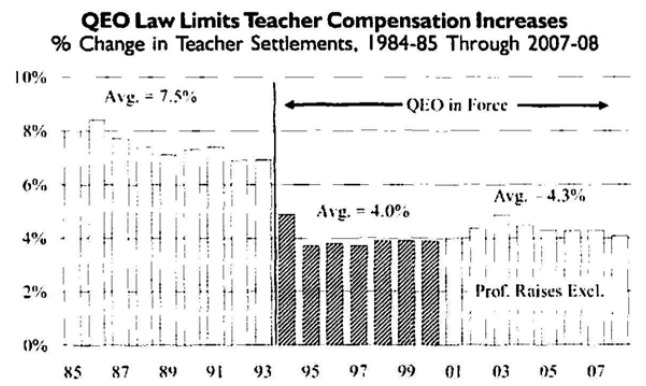
This is an especially timely discussion as control of the Wisconsin Legislature hangs in the balance with the upcoming fall election. While it is widely believed that the state Senate will remain in Democratic hands, the Assembly is altogether another matter. With a mere five vote majority and a nation anxious to blame Republicans for both the war in Iraq as well as the weak economy, Republican retention of an Assembly majority is definitely in play. If the Assembly were to tumble into Democratic hands, Democrats would control all of state government. At long last, the thinking goes, WEAC will rise up and ensure its minions in the Capitol do what they have promised; expunge the QEO from state law books.
But is that the case? Maybe not. That picture might have been clear a few years ago, but it is less clear today.
The QEO Through Time
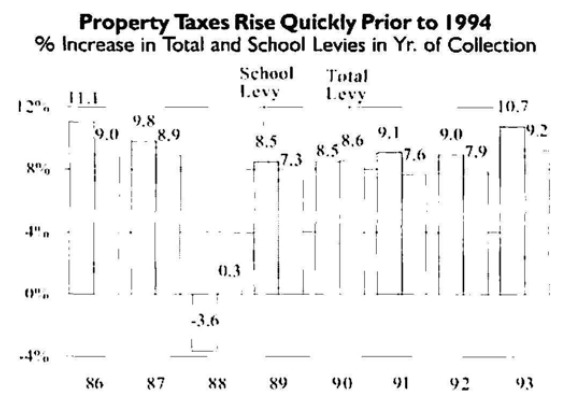
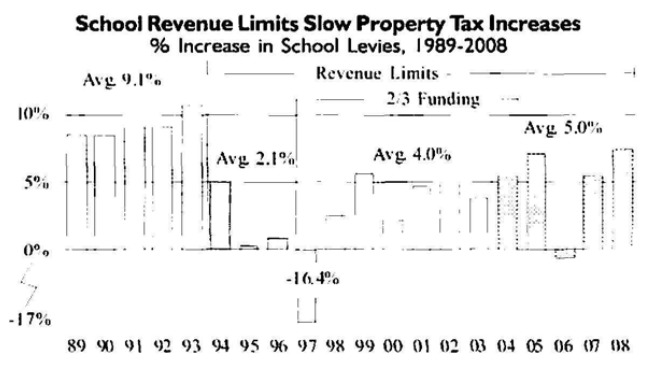
To understand the roots of the popular caricature of WEAC, a short history lesson is in order. As we close in on a generation under the QEO, it is easy to forget what life was like before Tommy Thompson signed the QEO into law. In the 1980s and into the early 1990s a statewide furrowing of the brow and wringing of hands occurred every Christmas season when local governments slid property tax bills into our mailboxes. In 1989 school taxes rose 9% followed by a 9.4% increase in 1990 and a 10% jump in 1991. The last straw came in 1993 when schools added 12.3% to the property tax bill. Of course every year the school tax was layered on top of the tax bill from cities, villages and town so property taxes were routinely increasing at double-digit rates.
While property taxes might not have stirred the public psyche as much as say the Vietnam War had, it was close. Every state budget discussion started and ended with property taxes. It was the third rail of Wisconsin politics. The property tax discussion drove a wedge between Democrats and Republicans; it caused short fuses between state and local governments and between general governments and schools. And everyone understood who was operating the jack that kept ratcheting up property taxes: it was teachers.
No, it wasn’t just teachers, it was WEAC. What generations of teachers had known as a helpful service organization, overnight had assumed the pale of a hard-line labor union. It was as though WEAC had undergone its own version of the Invasion of the Body Snatchers. The side of the organization that provided teacher services was taken over by the union side. Overnight it became clear that nothing mattered to the staff at WEAC if it didn’t entail: raising teacher pay, protecting jobs, or improving working conditions. This was the familiar mantra of every labor union from the autoworkers to air traffic controllers.

Share

A look at Madison Memorial’s Small Learning Communities

Andy Hall:

In 2000, Memorial became the first Madison school to land one of the U.S. Department of Education grants. It was awarded $438,000 to create its neighborhood social structure. West High School became the second, winning a $500,000 grant in 2002 and reorganizing its ninth and 10th grades around core courses.
In August, district officials were thrilled to learn the district was awarded $5.5 million over five years for its four major high schools — Memorial, West, La Follette and East — to build stronger connections among students and faculty by creating so-called “small learning communities” that divide each high school population into smaller populations.
Officials cite research showing that schools with 500 to 900 students tend to be the most effective, and recent findings suggest that students at schools with small learning communities are more likely to complete ninth grade, less likely to become involved in violence and more likely to attend college after graduation. However, the latest federal study failed to find a clear link between small learning communities and higher academic achievement.
Each Madison high school will develop its own plan for how to spend the grant money. Their common goals: Make school feel like a smaller, friendlier place where all students feel included. Shrink the racial achievement gap, raise graduation rates, expand the courses available and improve planning for further education and careers.
The high schools, with enrollments ranging from 1,600 to 2,000 students, are being redesigned as their overall scores on state 10th grade reading and math tests are worrisome, having declined slightly the past two years.

Share

America’s Most Overrated Product: The Bachelor’s Degree

Marty Nemko:

Among my saddest moments as a career counselor is when I hear a story like this: “I wasn’t a good student in high school, but I wanted to prove that I can get a college diploma. I’d be the first one in my family to do it. But it’s been five years and $80,000, and I still have 45 credits to go.”
I have a hard time telling such people the killer statistic: Among high-school students who graduated in the bottom 40 percent of their classes, and whose first institutions were four-year colleges, two-thirds had not earned diplomas eight and a half years later. That figure is from a study cited by Clifford Adelman, a former research analyst at the U.S. Department of Education and now a senior research associate at the Institute for Higher Education Policy. Yet four-year colleges admit and take money from hundreds of thousands of such students each year!
Even worse, most of those college dropouts leave the campus having learned little of value, and with a mountain of debt and devastated self-esteem from their unsuccessful struggles. Perhaps worst of all, even those who do manage to graduate too rarely end up in careers that require a college education. So it’s not surprising that when you hop into a cab or walk into a restaurant, you’re likely to meet workers who spent years and their family’s life savings on college, only to end up with a job they could have done as a high-school dropout.

Share

Rice on US Education

Steve Gorman:

Secretary of State Condoleezza Rice said on Wednesday that failing public schools pose her greatest national security concern, one she warned could undermine the United States’ ability to lead and to compete in a global economy.
Equal access to educational opportunities, she said, also lies at the heart of one of the nation’s most important core values — the belief in the United States as a true meritocracy.
Rice, a Stanford University professor before joining the Bush administration, spoke at a conference of women organized by former TV journalist Maria Shriver, the wife of California Gov. Arnold Schwarzenegger.
As an educator, Rice said it broke her heart to see “kids who might be the next Nobel Prize winner … trapped in some public school that’s just basically warehousing them.”

Share

For ’09 Grads, Job Prospects Take a Dive

Cari Tuna:

College seniors may have more trouble landing a job next spring than recent graduates, as employers trim their hiring outlooks in response to the slowing economy and financial-sector turmoil.
Employers plan to hire just 1.3% more graduates in 2009 than they hired this year, according to a survey by the National Association of Colleges and Employers.
That’s the weakest outlook in six years and reflects a sharp recent downturn. Just two months ago, a survey by the same group projected a 6.1% increase in hiring. The August survey included 219 employers, 146 of whom responded to the new survey, conducted earlier this month. The big drop in hiring projections is “extremely unusual,” says Edwin Koc, the association’s director of strategic research.
The results continue a pattern of diminishing job prospects for college graduates. A year ago, employers told the association they would increase hiring for the class of 2008 by 16%. By this spring, though, the projected increase had fallen to 8%. The association doesn’t report how actual hiring compares with its projections.

Share

DC Schools’ Chancellor Michelle Rhee: “The Lightning Rod”

Clay Risen, via a kind reader’s email:

Since her arrival, in the summer of 2007, Rhee, just 38 years old, has become the most controversial figure in American public education and the standard-bearer for a new type of schools leader nationwide. She and her cohort often seek to bypass the traditional forces of education schools and unions, instead embracing nontraditional reform mechanisms like charter schools, vouchers, and the No Child Left Behind Act. “They tend to be younger, and many didn’t come through the traditional route,” says Margaret Sullivan, a former education analyst at the Georgetown Public Policy Institute. And that often means going head-to-head with the people who did.
Rhee, responsible not to a school board but only to the mayor, went on a spree almost as soon as she arrived. She gained the right to fire central-office employees and then axed 98 of them. She canned 24 principals, 22 assistant principals, and, at the beginning of this summer, 250 teachers and 500 teaching aides. She announced plans to close 23 underused schools and set about restructuring 26 other schools (together, about a third of the system). And she began negotiating a radical performance-based compensation contract with the teachers union that could revolutionize the way teachers get paid.
Her quick action has brought Rhee laudatory profiles everywhere from Newsweek to the Memphis Commercial-Appeal, and appearances on Charlie Rose and at Allen & Company’s annual Sun Valley conference. Washington is now ground zero for education reformers. “People are coming from across the country to work for her,” says Andrew Rotherham, the co-director of Education Sector, a Washington think tank. “It’s the thing to do.” Rhee had Stanford and Harvard business-school students on her intern staff this summer, and she has received blank checks from reform-minded philanthropists at the Gates and Broad foundations to fund experimental programs. Businesses have flooded her with offers to help–providing supplies, mentoring, or just giving cash.

Clusty search: Michelle Rhee.

Share

Business – School Partnerships

Susan Gvozdas:

Two years ago, Marilyn Wilhelm of Annapolis faced a difficult decision. Her husband had lost his job, and the family of six couldn’t make it on the single income of a school day-care worker. Her sister suggested she look into a computer networking career, so she enrolled in the Cisco Networking Academy at Anne Arundel Community College.
After two semesters of working part time and living off savings, Wilhelm became a Cisco-certified network associate. The entry-level certification ensures technicians know how to connect and manage the wiring and switches to link computers and provide Internet access. The college held a career fair last year with companies that had partnerships with California-based Cisco Systems Inc.
Her training and enthusiasm landed her a summer internship and later a job at Chesapeake Netcraftsmen, a networking company in Arnold. This year, she began teaching the basic networking courses she took at the college and started studying for higher-level certification through her company.

Share

Wisconsin Forum on Special Education 11/17/2008 in Madison

Via a kind reader’s email:

The State Superintendent’ s Council on Special Education will be holding a public forum to gather input on matters related to special education in Wisconsin. Information obtained will be used by the Council in advising the Department of Public Instruction on matters affecting the education of Wisconsin ‘s children and youth with disabilities.
This public forum will be held Monday evening, November 17, 2008 from 5:00 to 7:00 PM at the Madison Marriott West, Salon D (1313 John Q. Hammons Drive Middleton, Wisconsin; 608/831-2000).
Should you have any questions related to this public forum, do not hesitate to contact Chair Myrah at gary.myrah@pwssd.k12.wi.us or (262) 268-6079.

Share

Nanotechnology 101

Margaret Blohm @ GE: “Nanotechnology lets you do stuff we thought impossible”.

via Grey Goo News. GE Podcasts.

Share

Just What Exactly is a Charter School?

Open Education:

One of the more consistent, ongoing suggestions for improving America’s educational system centers upon the creation of greater competition amongst public schools. The reason for the steady drumbeat centers upon a belief that a change to the free market system would be one of the best methods for creating better educational opportunities for children.
In direct response to the push for greater competition, forty states across America have now initiated legislation to allow the construction of new public schools called charter schools. Minnesota was the first state to pass laws regarding charter schools, doing so in 1991.
The concept is definitely catching on. Today, according to USCharterSchools.org, there are nearly 4,000 charter schools across our country educating more than 1.1 million children. The state of California, the second to enact such legislation, has more than 600 such schools educating about one-fifth of all charter school students.
While the number of schools continues to grow, large numbers of Americans, many even within the field of education, simply do not know what a charter school really consists of or how this new school concept differs from traditional public schools. Today at OpenEducation.net, we provide our readers the fundamentals of the charter school concept.

Share

Can Interdistrict Choice Boost Student Achievement?
The Case of Connecticut’s Interdistrict Magnet School Program

Robert Bifulco, Casey Cobb & Courtney Bell [320K PDF]:

In response to a landmark civil rights ruling, the state of Connecticut has adopted models of choice-based interdistrict desegregation that appear to satisfy current legal constraints. In this paper, we focus on Connecticut’s interdistrict magnet schools, and estimate the effects these schools have had on student achievement. We use longitudinal data on individual student test performance and information from admissions lotteries to implement quasi-experimental, regression-based, and propensity score estimators. Preliminary analyses show that lottery based methods, propensity score methods, and regression analysis provide similar estimates of achievement effects of for the small set of schools for which all three methods can be implemented. We then proceed to use the latter two methods to estimate effects for all of the interdistrict magnet high schools and middle schools that serve students from Hartford, Waterbury and New Haven. Results indicate that, on average, interdistrict magnet high schools have positive effects on both math and reading achievement, and interdistrict magnet middle schools have positive effects on reading achievement. Extensions of our analysis indicate that interdistrict magnet high schools have positive effects particularly on the achievement of students in Hartford, New Haven and Waterbury and do so regardless of how much attending an interdistrict magnet high school reduces racial isolation. The positive effects of magnet middle schools appear to be limited to suburban students, except in those schools that are able to achieve substantial reductions in racial isolation for their central city students.

Share

On School Start Times

Tania Lopez:

One main proposal reverses the start times for high school and elementary students. High-schoolers now start at 7:30 a.m. and elementary students begin at 8:45 a.m.
School officials cited a University of Minnesota study that found high school students benefit from later start times. Westfield teachers say older students have problems concentrating and often fall asleep in class. Elementary school students don’t have that problem until after lunchtime when they reportedly “tend to tire and lose concentration.”
Traffic problems, bus and bus driver availability and a new elementary school set to open next year also are factors in the need for change.
The five proposals will be posted to the district’s Web site on Monday, and parents will get a chance to weigh in via an online survey.

Share

Milwaukee Looks for Feedback on its Planned Sex Education Curriculum

Erin Richards:

After overhauling its K-12 sex education curriculum this summer with the help of community partners and health experts, Milwaukee Public School district officials have released the first draft of lessons to be taught to kids in kindergarten through fifth grade.
The problem: Despite calls to every elementary school principal for help in reaching parents, and a link to the proposed human growth and development curriculum on the MPS home website, only a handful of people have offered feedback.
“I’d like to hear from anyone in the community, but I really need parents,” said Brett Fuller, curriculum specialist for health, wellness and safe and drug-free schools.
Responses to the new curriculum can be directed to this online survey.
Expedient feedback is important to the district for several reasons. For one, sex education can be a touchy subject and the more people who see the proposed changes, the better chance there is of everyone feeling comfortable with what’s being taught.

Related: Sex Education for Primary Schools:

Primary school children are to be given compulsory lessons in sex education and the dangers of drugs, the Government confirmed.
The shake-up of lessons is aimed at cutting Britain’s high teenage pregnancy rate and steering youngsters away from drug and alcohol misuse.
It will mean primary school children will learn about puberty and the facts of life from the age of seven. From the age of five, pupils will be taught about topics such as the parts of the body, relationships and the effects of drugs on the body.
As pupils progress through school they will be given detailed information about contraception and sexually transmitted infections as well as the risks of drug and alcohol misuse.

Share

Students Show a Growing Appreciation for Classical Music

Lindsay Christians:

Zou Zou Robidoux loves classical music and is not ashamed to talk about it.
“I’m a geek about it,” said the 16-year-old Robidoux, who began playing in fourth grade. “It’s 90 percent of the music I listen to.”
As for the cello, she added, “I can’t even describe how much I love it and how much it fits me.”
Robidoux may seem like an anomaly among teens, most of whom are more interested in listening to Lil Wayne or Panic! at the Disco. But in Madison, that’s not exactly true.
Robidoux is one of hundreds of local young people with a growing interest in classical music. And while the majority of the Overture Center’s audiences for symphony, chamber orchestra and opera may be over 50, that’s not an indication that classical music is dying. Interest in the classics is part of a national trend that runs counter to conventional wisdom.

Share

Counting on the Future: International Benchmarks in Mathematics for American School Districts

Dr. Gary W. Phillips & John A. Dossey [2.5MB PDF Report]:

Students in six major U.S. cities are performing on par or better in mathematics than their peers in other countries in grades 4 and 8, according to a new study by the American Institutes for Research (AIR). However, students from five other major cities are not faring as well, and overall, U.S. student performance in mathematics falls off from elementary to middle school grades — and remains behind many industrialized nations, particularly Asian nations.
The AIR study offers the first comparison between students from large U.S. cities and their international peers. The study compares U.S. 4th grade students with their counterparts in 24 countries and 8th grade students with peers in 45 countries.
“Globalization is not something we can hold off or turn off…it is the economic equivalent of a force of nature… like the wind and water” (Bill Clinton)
If you are a student today competing for jobs in a global economy, the good jobs will not go to the best in your graduating class–the jobs will go to the best students in the world. Large urban cities are intimately connected to the nations of the world. Large corporations locate their businesses in U.S. cities; foreign students attend U.S. schools; and U.S. businesses export goods and services to foreign nations. Large urban cities need to know how their students stack up against peers in the nations with which the U.S. does business. This is especially important for students in the fields of science, technology, engineering, and mathematics. The students in these fields will allow our future generation to remain technologically innovative and economically competitive.
This report provides a comparison of the number of mathematically Proficient students in Grades 4 and 8 in 11 large cities in the United States with their international peers.
This comparison is made possible by statistically linking the National Assessment of Educational Progress (NAEP) in 2003 and the Trends in International Mathematics and Science Study (TIMSS) in 2003 when both assessments were conducted in the United States in the same year and in the same grades.
After the statistical linking was completed, it was possible to compare the most recent NAEP results (from 2007) to the most recent TIMSS results (from 2003). How the United States compares to the overall international average.
At Grade 4, five countries (Singapore, Hong Kong SAR, Chinese Taipei, Japan, and the Flemish portion of Belgium) performed significantly better than the United States (Figure 1). However, the United States (at 39% proficiency) performed better than the international average (27% proficiency) of all 24 countries (Figure 13).
At Grade 8, eight countries (Singapore, Hong Kong SAR, Republic of Korea, Chinese Taipei, Japan, Belgium (Flemish), Netherlands, and Hungary) performed significantly better than the United States (Figure 1). However, the United States (at 31% proficiency) performed better than the international average (21% proficiency) of all 44 countries (Figure 14).
….
Because of the persistent requests of urban school districts, the U .S . Congress authorized NAEP to assess, on a trial basis, six large urban school districts beginning in 2002 . Since then, more districts have been added, resulting in 11 school districts in 2007 (and plans are underway to include even more districts in the future) . The urban school chiefs in these 11 large school districts, which voluntarily participated in the 2007 NAEP, recognized the global nature of educational expectations and the importance of having reliable external data against which to judge the performance of their students and to hold themselves accountable . They should be commended for their visionary goal of trying to benchmark their local performance against tough national standards. National standards provide a broad context and an external compass with which to steer educational policy to benefit local systems . The purpose of this report is to further help those systems navigate by providing international benchmarks.

Clusty Search: Gary W. Phillips and John A. Dossey.
Greg Toppo has more:

Even if the findings are less-than-stellar, he says, they should help local officials focus on improving results.
“In that sense, I think it could be a very positive thing to use in-house, in the district, to keep their nose to the grindstone,” says Kepner, a former middle- and high-school math teacher in Iowa and Wisconsin.”If they can show they’re improving, they might be able to attract more companies to a system that’s on the move.”
Phillips says the findings prove that in other countries “it is possible to do well and learn considerably under a lot of varied circumstances — in other words, being low-income is not really an excuse when you look around the rest of the world.”

Math Forum audio & video.

Share

Pint-Size Politicians Channel McCain, Obama in School Elections

Ellen Gamerman:

‘Change’ Factors Big in Tykes’ Talking Points; A Third-Grader’s Economic Platform
In his recent stump speech, Thomas Fleming took a stand against nuclear power, violence, weapons and war. He told voters there was no greater honor than serving them and requested their support. “I ask nothing in return except a better America,” he said.
Then the 8-year-old candidate, dressed in his Cub Scout uniform, sang a song from “The Simpsons,” waved his fists over his head and rejoined his fellow third-graders in the cafeteria at Altruria Elementary School in Bartlett, Tenn. Thomas, who won the election, serves as the student council sergeant-at-arms when he isn’t busy practicing piano or dancing like a robot.

Share

Advocating a Yes Vote for the November, 2008 Madison Referendum

A Capital Times Editorial:

Even with approval of the referendum, district administrations would have to run a tight ship. They are not asking taxpayers to bridge all the gaps created by the anticipated deficits. They are prepared to trim budgets and delay the initiation of programs until economic circumstances improve or, ideally, the state accepts more of its deferred responsibilities.
Weighing the big-picture educational challenges that we face as a community, a state and a nation, as well as the hometown reality of strong schools facing genuine threats, this referendum does not pose a difficult choice.
The only vote that makes sense is “yes.”
It is essential for everyone who is heading to the polls on Nov. 4 to decide the presidential race between two men who say education is a priority — as well as every voter who casts an early ballot — and to make the extra effort to find the referendum question and mark that “yes” box.

Much more on the referendum here. Related: “Formal opposition begins to form“.

Share

Teachers take test scores to the bank as bonuses

Greg Toppo:

cross the USA, a small but growing number of school districts are experimenting with teacher-pay packages that front-load higher salaries and offer bonuses — sometimes tens of thousands of dollars’ worth — if student test scores improve or if teachers work in hard-to-staff schools.
At least eight states are moving away from a traditional pay model, which increases salaries based on seniority and advanced degrees. Many of the pay packages are funded by private foundations. In dozens of districts, test scores already have earned teachers more money. A few examples:

  • In Chicago, teachers at a handful of schools can earn up to $8,000 in annual bonuses for improved scores, while mentor teachers and “lead teachers” can earn an extra $7,000 or $15,000, respectively.
  • In Nashville, middle-school math teachers can earn up to $15,000 based on student performance.

Do such plans work? A research center launched at Vanderbilt University to study performance pay has found mostly promising, if limited, results.

Share

Updates on Madison’s Leopold Elementary School Enrollment / Capacity Discussions

Tamira Madsen:

The school district has made a number of efforts to handle Leopold’s enrollment over the years, with mixed results. Eight classrooms were added in 2003, but a $14.5 million referendum to make upgrades to the existing school and build a second school on the site failed in 2005. In 2006, the cafeteria and several areas of the campus were remodeled. In addition, attendance boundaries were adjusted on two occasions, and third-graders were transported to other schools for two years.
To handle overcrowding this year, the district approved transfers of 31 students both within and outside the district. An additional classroom was also added by moving the computer lab to the library.
Meanwhile, Nerad urged the community to be patient as the planning process continues to unfold. The district’s ultimate goals are to cap enrollment at 650 students and to implement a better balance of students according to family income. Sixty-eight percent of students at Leopold come from low-income families.
“We really want to make sure that we have dotted all of our I’s and crossed our T’s and looked at a variety of options,” Nerad said. “And I can assure you relative to the long-term solution that we have not taken anything off the table. It’s just a matter in these tough (economic) times of assuring our community that we have done that due diligence.

Much more on Leopold here.

Share

Governance Conflict: German Chancellor Angela Merkel Looks for Ways to Improve Schools

The Economist:

AMID her other distractions Angela Merkel’s attention will on October 22nd shift to a new issue: the poor state of German education. She is gathering the premiers from all of Germany’s 16 states for an “education summit” in Dresden. Its vaunted aim is to transform Germany from a mediocre performer into a dazzling “education republic”. Yet the chancellor’s powers to achieve this goal are limited.
Nobody thinks that Germany can afford mediocrity. If its performance on international tests improved from average to excellent, growth would rise by 0.5-0.8 percentage points in the long run, says Ludger Wössmann, an economist at Ifo, a research institute in Munich. But the real stakes are higher still. Almost half the children in some cities come from immigrant families; many speak mainly their mother tongue. In Germany parents’ social status plays a bigger role in children’s fates than in most other rich countries. As many as 8% of 15-17-year-olds are school dropouts; unemployment among them is three times higher than among university graduates. Yet, with Germany’s population ageing, “who will pay our pensions, if not the migrants?” asks Jörg Dräger, head of education at the Bertelsmann Foundation.

Chris Bryant has more:

Although the chancellor’s public relations offensive helped put education in the political spotlight it also raised expectations for the summit – some say to too high a level.
This was a risky strategy given the profound suspicion among Germany’s 16 states – responsible for most aspects of education policy – of federal government interference in these issues.
“Education is unequivocally for the Länder [states] to decide,” Wolfgang Böhmer, Christian Democrat premier of Sachsen-Anhalt told a German newspaper before the event.
Such is the tension between Berlin and the regions, and between the CDU and coalition partner the Social Democrats, that many of the most pressing issues never made it onto the agenda.

Share

Plans to reform the Italian school system run into criticism

The Economist:

TALY may be facing recession, but for Siggi, a textile firm near Vicenza in the north-east of the country, 2009 offers the promise of unprecedented growth. Siggi is the biggest producer of grembiuli, or school smocks. Once universal in Italian primary schools, they were becoming as outdated as ink-wells. But in July the education minister, Mariastella Gelmini, backed the reintroduction of grembiuli to combat brand- and class-consciousness among schoolchildren. Siggi’s output this year has almost sold out and its chairman, Gino Marta, says that “next year could see an out-and-out boom.”
The decision on whether pupils should wear the grembiule has been left to head teachers. It does not figure in either of the two education bills that have been introduced by Ms Gelmini. But it has become a symbol of her efforts to shake up Italian education. Her critics argue that these are a vain attempt to turn back the clock; her supporters see them as a necessary first step to a more equitable, efficient system.
On October 30th the opposition she has aroused will culminate in a one-day teachers’ strike. The union’s main complaint is a programme of cuts aimed at saving almost €8 billion ($11 billion). It includes the loss by natural wastage of 87,000 teachers’ jobs over the three academic years to 2012 and the return to a system in which just one teacher is allotted to each year of elementary school.

Share

The ‘Trophy Kids’ Go to Work

Ron Alsop:

With Wall Street in turmoil and a financial system in crisis mode, companies are facing another major challenge: figuring out how to manage a new crop of young people in the work force — the millennial generation. Born between 1980 and 2001, the millennials were coddled by their parents and nurtured with a strong sense of entitlement. In this adaptation from “The Trophy Kids Grow Up: How the Millennial Generation Is Shaking Up the Workplace,” Ron Alsop, a contributor to The Wall Street Journal, describes the workplace attitudes of the millennials and employers’ efforts to manage these demanding rookies.
When Gretchen Neels, a Boston-based consultant, was coaching a group of college students for job interviews, she asked them how they believe employers view them. She gave them a clue, telling them that the word she was looking for begins with the letter “e.” One young man shouted out, “excellent.” Other students chimed in with “enthusiastic” and “energetic.” Not even close. The correct answer, she said, is “entitled.” “Huh?” the students responded, surprised and even hurt to think that managers are offended by their highfalutin opinions of themselves.
If there is one overriding perception of the millennial generation, it’s that these young people have great — and sometimes outlandish — expectations. Employers realize the millennials are their future work force, but they are concerned about this generation’s desire to shape their jobs to fit their lives rather than adapt their lives to the workplace.

Share

Madison November 2008 Referendum Updates

Channel3000:

In Oregon, if the referendum passes, it’ll mean $10 more a year for property tax payers.
In Madison though, the bill is higher, over the three years of the referendum the average cost to taxpayers is about $65.
Some parents told WISC-TV if it means more money out of their pocket, then they’re saying no to a referendum.
But most Madison parents WISC-TV spoke with facing those tough cuts say they’ll support it.
There are other issues on ballots in the area including, the MMDS asking to exceed revenue limits by $13 million.

Andy Hall & Chris Rickert:

A clerical mistake in the Madison city clerk’s office means about 20 voters within the Madison School District got absentee ballots that do not have the district’s $13 million referendum question on it, city and district officials said Tuesday.
Madison City Clerk Maribeth Witzel-Behl said six of those voters have come forward, and she urged other district residents who aren’t sure if they voted on the question to call her office so her staff can destroy their old ballots and issue new ones.
Witzel-Behl said the mistake occurred because one of her employees created mailing labels for the absentee ballots’ envelopes that did not identify the voter as a resident of the School District.
“My best guess is we’re looking at less than 20 ballots total,” she said.

WKOW-TV:

There was plenty of food and equally as much information at the Goodman Community center.
The Tenny Lapham Neighborhood Association held a spaghetti dinner to help community members understand the madison school districts recurring referendum on the November ballot.
“The school referendum us a complicated issue especially in the times that we are in– people are concerned about something that is going to increase their tax bill,” says association member Carole Trone.
Here’s how the referendum works.
The referendum asks to exceed the revenue limit by $5 five million next school year.

Much more on the November, 2008 Madison referendum here.

Share

Kids’ Cereals Saltier, Report Says

Julie Jargon & Aaron Patrick:

Cereal makers that reduce the amount of sugar in kids’ cereals tend to ratchet up the salt content to improve flavor, says a report expected to be released Tuesday by Consumers International.
Cereal makers have been under pressure from consumer groups to reduce the sugar content of their kids’ cereals, and Consumers International, in its report, “Cereal Offenses,” says “manufacturers are likely to add salt to boost the flavor of the product, and may use salt to maintain customer appeal when sugar levels are reduced.”
The London-based organization, an umbrella group representing 220 consumer groups globally, focused on products made by two of the world’s largest makers of cereal for children, Nestlé SA of Vevey, Switzerland, and Kellogg Co., Battle Creek, Mich. The group defined children’s cereals as those that feature cartoon characters on the packaging, are endorsed by celebrities popular with kids and are advertised on kids’ television programming.

Share

One Goal: Extending the School Day

Mariam Brillantes:

Jennifer Davis is on an educational mission to extend the school day. She’s president and CEO of the National Center on Time and Learning, an organization that describes itself as “dedicated to expanding learning time to improve student achievement and enable a well-rounded education for all children.” Ms. Davis’s says under her organization’s scenario, children would be happier because they have more time to learn, teachers would be able to devote more time for enrichment programs that go beyond standardized tests, and parents-especially those from lower-income families-would be reassured their children are safe in a learning environment. Below are excerpts from an interview with Ms. Davis:
I think it’s safe to say that most schoolchildren would probably hate the thought of an extended school day. How can a longer day help them?
The initiative we are promoting involves the redesign of the school day to include more enrichment opportunities like music and art and apprenticeship. It includes significant recess and lunch time. And it also includes a lot of project-based learning and one-on-one time with teachers — and all those things, students like. If you interviewed students in the schools we’re working with… the students are enjoying the schedule in part because it gives them lots of opportunities. What’s happening all over the country is that classes like physical education, arts and even recess and lunch time have been shortened or eliminated because of the pressures of testing and classes that are tested like math and English.

Share

School Choices: What to Look For?

Jennifer Merritt:

Tomorrow morning my husband and I are going on our very first public school tour. Our son is only 3, but he’ll be attending universal pre-kindergarten next year and we hope to make use of the good public schools in our area. We’ve also been encouraged to attend tours at two other elementary schools in our district and to make use of a kindergarten fair held at a nearby YWHA next week. It seems awfully soon to think about kindergarten for a kid who enters in fall of 2010. But as other parents have pointed out to me, there’s a lottery system in place in New York City and knowing which schools you are most interested in is important.
After I got over the surprise of school tours taking place a full four months before applications were even available, I realized something. I don’t really know what to look for in a school. Outside of a desire for smaller class size, caring teachers and a decent reputation in the community, I’m not really sure what these tours and fairs are supposed to teach me.

Share

Inside New Orleans High

National Geographic Video:

NGC roams the halls with students as they tell their unvarnished accounts of high school life. Through student video diaries and personal accounts, NGC offers an exclusive glimpse into this gritty young world.

Share

Milwaukee May Trim School Budget

Dani McClain:

New budget constraints could prevent Milwaukee Public Schools from paying for all 11th-graders to take the ACT and from expanding its driver education program.
Those were among the improvements the School Board added to Superintendent William Andrekopoulos’ preliminary budget over the summer, but the latest state aid figures, received last week, have forced the district to trim almost all those additions from its spending plan, officials said Monday.
The district’s proposed budget would require a 13.6% increase in the property tax levy, based on numbers the state Department of Public Instruction provided last week, showing a $15.8 million drop in total state aid to MPS.
There are two major reasons for the drop. Under the current funding formula, the more a district spends, the more state money it can subsequently expect, and the board decided last year not to spend to the limit allowed under state law.

Share

McCain: Education’s Disruptor-in-Chief?
The Republican took an early lead over Obama in supporting disruptive innovation in education that can revamp how today’s classrooms are run

Clayton M. Christensen and Michael B. Horn:

For a candidate who’s been criticized as being out of touch on technology, Senator John McCain (R-Ariz.) has been refreshingly ahead of the curve when it comes to disruptive innovation in education.
While Republican Presidential candidate McCain and the Democratic candidate, Senator Barack Obama (D-Ill.), both see the benefits of using technology in revamping how classrooms run, McCain’s campaign early on embraced the benefits of nontraditional online education in some key ways.
Whichever candidate prevails on Nov. 4,, the most successful educational policies will be those that approach education challenges from an innovation perspective.
CUSTOMIZATION IS KEY
One of the core reasons schools struggle is because their structure compels standardization in the way they teach and test. This standardized, monolithic experience would be fine if all students learned in the same way. But as we know from our own experience, we all learn in different ways. Different things motivate different people, we each have different intelligence strengths and learning styles, and people learn at different paces. Standardization in schools therefore will not do the trick. We need customization.

Much more on Clayton Christensen here.

Share

Brightstorm Raises $6 Million For Online High School Video Tutorials

Erick Schonfeld:

If high-school education is failing in the U.S., maybe Web video can help. Founded last April, Brightstorm is a Web video site that brings bright, talented teachers together with students who need some extra help. Backed by Korea’s KTB Ventures, which invested the entire $6 million in the startup’s A round, Brightstorm is launching today to the public.
There are about 20 teachers on the site offering video courses in subjects such as Geometry, the SAT, and A.P. U.S. History. Each course is broken up into episodes that are about 10 to 20 minutes each. Each course is $50, which is split between Brightstorm and the teachers. Students can watch a free promotional video to decide if they like the teacher and want to purchase the course. These tend to be overproduced with cheesy video graphics (stop with the jump cuts already), but they do the job of getting across each teacher’s personality and teaching style.
The videos are supplemented with interactive challenges, pop-up quizzes, and other bonus material. You can certainly see the appeal. If you were a high school student who needed a tutor, wouldn’t you rather watch videos on your computer for ten minutes a day than endure a live tutorial for an hour or more? Now, whether you are actually going to learn more is still debatable.
But there are plenty of startups trying. Here in the U.S., there is PrepMe, ePrep, Teach The People, and Grockit. In Asia, there is iKnow in Japan and perhaps the biggest success to date is Korea’s Megastudy.

Related: Credit for non-Madison School District courses.

Share

On Washington, DC’s Special Education Governance

Bill Turque:

The District’s top special education official testified in federal court yesterday that some school personnel ignore scheduled meetings with parents, contributing to the city’s failure to meet the needs of students with learning disabilities or behavioral challenges.
Richard Nyankori, acting deputy chancellor for special education, said the backlog of D.C. children awaiting special education services is lengthy in part because school staff don’t show up for meetings, leaving cases unresolved and parents in the lurch.
“Sometimes it is willful on the part of some staff not to make it to meetings,” Nyankori said under questioning from U.S. District Judge Paul L. Friedman.
Friedman called the hearing to quiz officials about the District’s lack of progress in complying with a 2006 consent decree that settled a class action brought by parents of children with learning problems. The District’s public and public charter schools have nearly 11,000 special education students. About 20 percent attend private schools, at a cost to taxpayers of about $200 million, because D.C. cannot meet their needs.

Share

Referendum Climate: Fiscal Policy Report on the Nation’s Governors

Chris Edwards:

evenue poured into state governments as the U.S. economy expanded between 2003 and 2007, prompting the nation’s governors to expand state budgets and offer the occasional tax cut. But now that the economy has slowed and revenue growth is down, governors are taking various actions to close rising budget deficits.
This ninth biennial fiscal report card examines the tax and spending decisions made by the governors since 2003. It uses statistical data to grade the governors on their taxing and spending records – governors who have cut taxes and spending the most receive the highest grades, while those who have increased taxes and spending the most receive the lowest grades.
Three governors were awarded an “A” in this report card – Charlie Crist of Florida, Mark Sanford of South Carolina, and Joe Manchin of West Virginia. Eight governors were awarded an “F” – Martin O’Malley of Maryland, Ted Kulongoski of Oregon, Rod Blagojevich of Illinois, Chet Culver of Iowa, Jon Corzine of New Jersey, Bob Riley of Alabama, Jodi Rell of Connecticut, and C. L. “Butch” Otter of Idaho.

Wisconsin’s Governor Doyle received a “D”:

When running for governor, James Doyle pledged not to raise taxes. He mostly kept that promise his first few years, and even provided a smattering of tax cuts. His fiscal policies then took a turn for the worse. In 2007 he proposed an array of large tax increases totaling about $900 million, including higher cigarette taxes, hospital taxes, oil company taxes, and increased real estate transfer taxes. Doyle has also refused to go along with the legislature in providing property tax relief, and he is fond of using increased debt to finance spending. But Doyle’s spending record is better than his tax record, and this year he is insisting on budget restraint to eliminate a deficit.

Much more on Madison’s November, 2008 referendum here.

Share

The High School Dropout’s Economic Ripple Effect

Gary Fields:

Mayors Go Door to Door, Personally Encouraging Students to Stay in the Game for Their Own Good — and for the Sake of the City
As the financial meltdown and economic slump hold the national spotlight, another potential crisis is on the horizon: a persistently high dropout rate that educators and mayors across the country say increases the threat to the country’s strength and prosperity.
According to one study, only half of the high school students in the nation’s 50 largest cities are graduating in four years, with a figure as low as 25% in Detroit. And while concern over dropouts isn’t new, the problem now has officials outside of public education worried enough to get directly involved.
The U.S. Conference of Mayors [PDF Report] is focusing its education efforts on dropouts. Mayors in Houston and other Texas cities go door to door to the homes of dropouts, encouraging them to return to school. Atlanta Mayor Shirley Franklin meets on weekends with students and helps them with life planning. Other cities, like Milwaukee and Kansas City, Mo., have dropout prevention programs.
Some new studies show far fewer students completing high school with diplomas than long believed. “Whereas the conventional wisdom had long placed the graduation rate around 85%, a growing consensus has emerged that only about seven in 10 students are actually successfully finishing high school” in four years, said a study by the Editorial Projects in Education Research Center, a nonprofit group based in Bethesda, Md. It was released this year by America’s Promise Alliance, a nonpartisan advocacy group for youth. In the nation’s 50 largest cities, the graduation rate was 52%.

Share

Reaching an Autistic Teenager

Melissa Fay Greene:

On a typical Monday morning at an atypical high school, teenage boys yanked open the glass doors to the First Baptist Church of Decatur, Ga. Half-awake, iPod wires curling from their ears, their backpacks unbuckled and their jeans baggy, the guys headed for the elevator. Arriving at Morning Meeting in the third-floor conference room, Stephen, his face hidden under long black bangs, dropped into a chair, sprawled across the table and went back to sleep. The Community School, or T.C.S., is a small private school for teenage boys with autism or related disorders. Sleep disturbances are common in this student body of 10, so a boy’s staggering need for sleep is respected. Nick Boswell, a tall fellow with thick sideburns, arrived and began his usual pacing along the windows that overlook the church parking lot and baseball diamond. Edwick, with spiky brown hair and a few black whiskers, tumbled backward with a splat into a beanbag chair on the floor.
“O.K., guys, let’s talk about your spring schedules,” said Dave Nelson, the 45-year-old founding director. He wore a green polo shirt, cargo shorts and sneakers and had a buzz haircut and an open, suntanned face. After his son Graham, 19, was given a diagnosis of autism spectrum disorder (A.S.D.) as a young child, Nelson left the business world and went into teaching and clinical and counseling work. On that Monday, he was instantly interrupted.
“I had a very bad night!” Edwick yelled from the floor. “Nightmares all night!”

Share

On Milwaukee’s School Budget

Milwaukee Journal Sentinel Editorial:

Milwaukee Public Schools is crippled by a broken state funding system that needs to be changed, or the district will be destitute within a decade, if not sooner.
In one sense, the financial crisis at MPS is similar to that of the banks: MPS essentially is asking the Legislature for a rescue plan.
MPS officials say the state funding formula needs to change so that it can sustain itself and perform its core mission of educating some of the state’s poorest students. Like most urban districts, MPS is dealing with low test scores, high dropout rates and violence in addition to money problems.
We back MPS in its push, and we urge the Legislature to do two things: Change the overall formula that places MPS in such a tough situation, and correct a specific problem with the way Milwaukee’s voucher schools are funded that places undue burden on Milwaukee property owners.
First, let’s consider the state’s overall funding formula. Its goal is to try to equalize funding between rich and poor districts so that students in property-poor districts are not penalized because of where they live. The idea is that a taxpayer in a property-poor district should not have to pay much higher taxes to achieve the same per-student funding.

Share

Buttons: The Sequel

Stanley Fish:

Last week’s column about the propriety or impropriety of teachers wearing campaign buttons in class provoked many questions, and today I would like to respond to those that were asked most often.
Some of the questions concerned the psychology of students. Several respondents scoffed at the likelihood of students being influenced by their teachers at all: “Prof. Fish’s belief in the power of faculty to influence students’ political choices is touching, but not borne out by research” (David Taylor).
But whatever the research disclosed would be irrelevant to the professional issue: is it a part of an instructor’s job to let students (susceptible or not) know what his or her political preferences are? What pedagogical purpose does such self-revelation serve?
Jason D’Cruz has an answer to that question. He believes that “when students know exactly what their professor’s political commitments are, they are in a better position to evaluate the points of view from which their teacher’s ideas arrive.”

Share