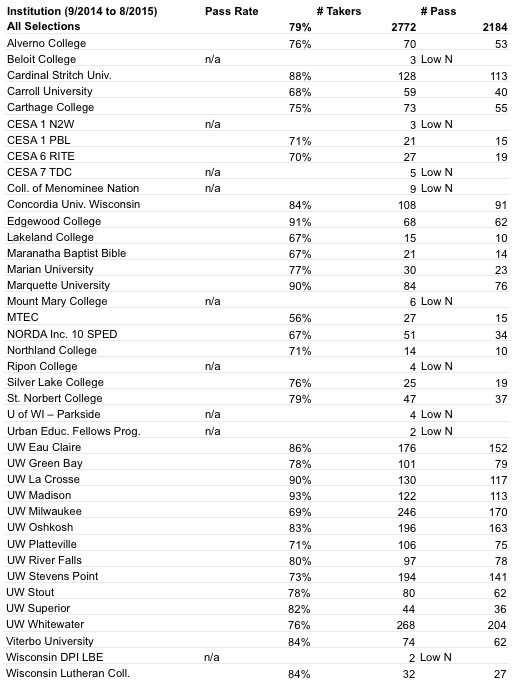
School Information System

Literature and Money

Dora Zhang:

When I try to explain to my students this mysterious thing called “close reading,” I often use a metaphor. Books are like people, I say. They’re complicated and multilayered, and they take time to get to know. Like people, they’re not always upfront about (or even aware of) their intentions and motivations. You have to listen carefully and observe closely and read between the lines.

I was introduced to this metaphor as a graduate student during a talk on pedagogy by a brilliant, beloved English professor, and I remember how apt it seemed. Some of my favorite people have always been novels. They were my steady companions through adolescence and heady crushes in college, and I went to graduate school because I wanted to get to know them more intimately. Embarking on a doctorate seemed like the natural way to take our relationship to the next level.

Share

Teaching Math As An Art form

Karen Herzog:

The numbers reflect her success. So does the admiration of her students and colleagues. Stalder will be honored at Friday’s UW System Board of Regents meeting with one of three annual Regents Teaching Excellence Awards, based on letters of recommendation from colleagues and students. Professor Gregory S. Aldrete of UW-Green Bay’s Department of History and the UW-La Crosse Department of Mathematics were also selected.

Stalder and colleague Paul Martin of UW-Marathon County — who was among those who nominated her for the award — developed a course that’s so successful and promising for teaching college students who struggle with math, it’s being used with impressive results at UW-Milwaukee, where more than 36% of freshmen require developmental math to prepare them for college-level math.

A version of the course also is being adapted for the UW System’s new competency-based Flex Option degree program for adult learners who set out to finish a degree started years ago, but who may have forgotten math they learned in high school.

Share

A Texas Solution To The Nation’s College Debt Crisis?

Tom Lindsay:

But there could be better news on the horizon. The Texas Legislature is currently considering a bill—the “I CAN” Bill (“Incentivizing College Affordability Now”)—that would take statewide a new initiative called the Texas Affordable Baccalaureate Program (TABP), which offers targeted college degrees for far less than what Texas public university students currently pay.

The breakthrough can’t come fast enough for students. According to a recent summary of data compiled by the Texas comptroller’s office, “In 2012, 20.5 percent of . . . [Texas’s] student loan borrowers were more than 90 days delinquent, surpassing the national rate of 17 percent and marking the 10th highest rate in the country.” The comptroller’s report adds, “Particularly worrying is the fact that rising tuition rates are driving an equally steep increase in college loan debt. . . . Many Texas college graduates and former students are entering adult life hobbled by years and even decades of crippling debt.”

Share

Colleges, how in good conscience can you do this to kids?

Chris Lehman:

This year has been a fantastic year for Science Leadership Academy college acceptances. We’ve seen our kids get into some of the most well respected schools in record numbers – and many of our kids are the first SLA-ers to ever get accepted into these schools.

Whether or not they are able to go to is another question.

Today, I was sitting with one of our SLA seniors. She’s gotten into a wonderful college – her top choice. The school costs $54,000 a year. Her mother makes less than the federal deep poverty level. She only received the federal financial aid package with no aid from the school, which means that, should she go to this school, she would graduate with approximately $200,000 of debt.

She would graduate with approximately $200,000 of debt – for a bachelor’s degree.

Related: How much should you pay for a degree?

Now, how in good conscience could a college do that? I’ve sat with kids as they’ve opened the emails from their top choice schools. Watching the excitement of getting into a dream school is one of the real joys of being a principal. It’s just the best feeling to see a student have that moment where a goal is reached

Share

What Can Quebec Teach Us? A Preliminary Analysis of the University as a Site of Struggle

William Clare Roberts:

Though the basic course of events in Que­bec over the past sev­eral months has been widely reported, I want to address two ques­tions that might be of greater inter­est to those strug­gling in and around uni­ver­si­ties elsewhere.

First, I want to look at how the Que­bec stu­dent strike artic­u­lates, on the one hand, the con­flict and inter­play between the social­ist aspi­ra­tions and cor­po­ratist real­i­ties of a pub­lic uni­ver­sity sys­tem, and on the other, the pres­sures put on that sys­tem by the dreams of dol­lar bills float­ing through the heads of admin­is­tra­tors and the “aus­ter­ian” belt-tightening of gov­ern­ments. These are not sim­ple real­i­ties; uni­ver­sity admin­is­tra­tors hop­ing to open the flood­gates of tuition and donor dol­lars are con­tin­gently allied with gov­ern­ment min­is­ters con­vinced by fear that fis­cal aus­ter­ity is the only way for­ward. I believe that a Marx­ist analy­sis of the university’s place in the cap­i­tal­ist econ­omy will clar­ify the stakes of the stu­dents’ strug­gle against this con­tin­gent alliance of hope and fear within the admin­is­tra­tive apparatus.

Sec­ond, I want to ask, very briefly, whether this analy­sis has any trac­tion out­side of Que­bec. What con­di­tions have pro­duced these 100 days of increas­ingly wide­spread and increas­ingly ambi­tious clamor? Can these con­di­tions be repli­cated by oth­ers elsewhere?

Share

March Madness Makers and Takers

David Ingold and Adam Pearce:

Twenty five years ago, the NCAA decided something had to be done about March Madness money. The year before, CBS agreed to pay a record $1 billion to broadcast the 1991-1997 tournaments. That was fine with the powerhouse basketball schools that routinely made it into the postseason: Under the rules at the time, they divided most of the revenue based on the number of games they won.

Conference officials feared that without a change, a handful of schools would get rich while others got nothing, and the student athletes competing in the tournament would face increasing financial pressure to win games.

Share

What’s on a third grader’s mind? Find out at Young at Art

Gayle Worland:

Every art teacher in a Madison public school was invited to submit up to three works of art from among their students for Young at Art. MMOCA staff picked up the art works, prepared them for display and designed the exhibition based on what teachers selected.

“We don’t edit anything. Whatever is submitted to the exhibition is installed in the exhibition,” Castelnuovo said. “We leave it to (the teachers) to decide what is going to best reflect what’s going on in the schools in terms of the art education curriculum.”

Share

Bill Increasing Power of Student School Board Member Seems Poised for Passage

Louis Peck:

There has been a student member of the county school board since the late 1970s, elected by middle and high school students throughout the county and who serves for a year alongside seven adult board members. A 1989 law gave the student member limited voting rights, and the pending legislation would expand those rights to include issues such as capital and operating budgets, collective bargaining, changes in school population boundaries and school closings. At least one other major jurisdiction in the state, Anne Arundel County, now accords similar powers to the student school board member.

Under the bill, the one area in which the student member would continue to be barred from voting involves so-called negative personnel matters, such as disciplinary action against teachers and other school employees.

Share

Playgrounds

James Mollison:

For school kids, recess is the big release in a sometimes-tedious day of sitting still, paying attention, keeping quiet and leaving one’s neighbors alone. It’s a collective blowing off of steam and nervous energy that, one has to think, is necessary to prevent all-out mutiny.

During these periods of outdoor recreation, small collections of students engage in all manner of self-guided activity, from sports to games to climbing and innocent flirtation. There are injuries and frustrations and conflicts that kids have to work through. These small scenes of joy and drama are captured beautifully in James Mollison’s latest book, Playground, published this month by Aperture.

In Mollison’s photographs, playground landscapes from schools all over the world—Britain, Bhutan, India, Nepal, Kenya and the U.S., among many countries—are filled with young people who are fully engaged, oblivious to the camera. The images are scenic and delightful, illustrating both the common activity of recreation and the differences in the places children have available to them. Some are wooded, others paved and urban. Some look posh, others hardscrabble. Some are majestic. Some aren’t playgrounds at all. The work is a continuation of Mollison’s interest in the lives of children around the world, which began with his book Where Children Sleep, a bestseller that depicted children of different nationalities, from widely varying socioeconomic backgrounds, in their bedrooms.

Share

Warwick Uni to outsource hourly paid academics to subsidiary

Fighting Against Casualisation in Education:

Teach Higher is a company which will effectively outsource hourly paid academic staff, whereby they will no longer be employed directly by the university but by a separate employer: ‘Teach Higher’. Teach Higher has been set up by Warwick University-owned ‘Warwick Employment Group’, and is about to be piloted at Warwick University. But it is a national company, which intends to be rolled out across UK universities.

(In this sense it is very similar to Uni Temps, which mainly employed, catering, cleaning and security staff at universities. We don’t know why Warwick decided to set up a separate company for outsourced academic staff, except that they possibly felt the need for ‘re-branding’ because it slightly more difficult to impose hyper-casualised positions on a previously more prestigious type of work such as academia.)

Share

The Education of Detained Chinese Feminist Li Tingting

Eric Fish:

ever taken more flak for walking into a men’s room than Li Tingting.

In the run-up to Women’s Day in 2012, the feminist college student was distressed by the one-to-one ratio of public restroom facilities for males and females. She believed that women’s longer wait times necessitated legislation to enforce giving women twice as many toilets. Determined to correct the oversight, she organized demonstrations for true “toilet parity.”

The “Occupy Men’s Room” movement involved some 20 women who took over male public restrooms periodically over the course of an hour in Guangzhou and Beijing. Outside they distributed fliers and held signs with slogans like “Care for women, starting with toilets.”

The two events were small and cheeky, causing no more trouble than a little embarrassment for a few men. Most onlookers just laughed it off and expressed support for the cause. Li Tingting did not figure that her action could draw the wrath of authorities. She could not have been more wrong.

“We didn’t think it was sensitive,” she laughed. “But I guess we can’t gauge the risk since the government is so strange.”

Share

High expectations At success Academy charter school

Kate Taylor:

At most schools, if a child is flailing academically, it is treated as a private matter.

But at Success Academy Harlem 4, one boy’s struggles were there for all to see: On two colored charts in the hallway, where the students’ performance on weekly spelling and math quizzes was tracked, his name was at the bottom, in a red zone denoting that he was below grade level.

The boy, a fourth grader, had been in the red zone for months. His teacher, Kristin Jones, 23, had held meetings with his mother, where the teacher spread out all the weekly class newsletters from the year, in which the charts were reproduced. If he studied, he could pass the spelling quizzes, Ms. Jones said — he just was not trying. But the boy got increasingly frustrated, and some weeks Ms. Jones had to stop herself from looking over his shoulder during the quizzes so she would not get upset by his continued mistakes.

Locally, Madison lacks a diverse K-12 environment, as evidenced by the rejection of the proposed Madison Preparatory IB charter school.

Share

Ms. Reformer Speaks

Caroline Bermudez:

One of the biggest lies generated by critics of education reformers is our dismissal of the effects of poverty on children. This is a straw man, a canard devised to mask the cynicism prevalent among people who throw out lines like “too hard to teach” or “not everybody should go to college.”

And I can think of one prominent figure in particular who has erected enough straw men to populate a wheat field.

Recently, Diane Ravitch, a person who has yet to meet an education reform she didn’t used to like, gave a talk at the Lehigh University College of Education.

Unfortunately, it wasn’t a talk so much as an imaginary debate with a character of her own creation dubbed “Mr. Reformer.” It brings to mind the condescending stunt pulled off by Clint Eastwood at the 2012 Republican National Convention when he addressed an empty chair onstage filled by an invisible President Obama.

Ravitch’s “debate” was no less disingenuous, or in the words of a Lehigh education professor who attended the event, “her depiction of Mr. Reformer was superficial at best, disrespectful at worst.”

Then again, she was honest about this from the very beginning when she said, “It won’t be a fair debate because I will always get the last word.”

Share

We will pay for our lack of respect for teachers, Disresepect in education

Deborah Loewenberg-Ball:

Teaching matters. We know that it can make the difference between a child learning to read by third grade, being confident in math, and developing the mindset necessary for success. Yet skillful teaching is not commonplace, and it’s hurting our society. Three reasons stand out:

We do not agree on a minimum competency level to enter the teaching profession.

We do not have a professional system for preparing teachers.

Our teaching force does not reflect the diversity of our nation’s school-age population. Although 44% of schoolchildren are students of color — a number expected to rise to 55% by 2023 —only 17% of teachers are from communities of color.

Luke Palmer:

The theme tying these anecdotes together is disrespect. I do believe that teachers have the best intentions for their students, and in many cases love them. But if you respect your students, you would not give them as a word problem a situation you have never come across to convince them that math is useful in the world. Why not give them a problem of algebra similar to problems people actually face — how much should a tech company expand its datacenter capacity given a projection of its growth; when will it cost more energy to drill for oil than the energy it returns; should a company with a given amount of capital build its own infrastructure at a fixed up-front cost or lease it at a monthly rate? The fact that the “real world” presented to students is one of travel times, house building, and saving and spending sends a strong message to them about what they can become. Algebra is used in engineering, science, and business, not purchases of milk and eggs at the grocery store. You will ignite a student’s passion for math when she understands that she can use it to become something, not that it is (pretending to be) an essential skill for a consumerist greyface. Conversely, if the student has no interest in engineering, science, or business, he is right to be disinterested in math class; let him do something useful with his time.

I felt disrespected that my teachers felt I was squandering my potential by failing to do the work that was assigned to me. I felt disrespected when I couldn’t use my creation to assist me with my homework. I felt disrespected when, despite getting high test scores, I was punished for not doing the work assigned “to help me learn”. No attention was paid to my developing programming skills or my talent for music — they never asked what I did with my time instead of doing homework. (I wonder what they thought?) This was all confusing to me at the time, and I rebelled from my heart, not my intellect; now that I have a more acute awareness of society, I am grateful that I rebelled. In retrospect the message shines through with clarity: school is not for me. I had assumed that I was there to learn the content and the teachers were all just blind or crazy — I know now that I was there to learn to follow orders, and my education is for the ones who give them. When teachers talk of my squandered future, they refer to a future of subservience to authority. (If I’m going to squander a future, please let it be that one!) The disrespect for my personal autonomy was pervasive enough that the idea that I could be an entrepreneur, an artist, or a leader were not even considered possibilities.

Share

Apathy & School Board Elections

Alan Borsuk:

Fatigue, indifference, apathy, resignation — they’re in the mix. There are supporters and loyalists, but, frankly, a lot of them are employees of the system.

More important, so much of the power to make hefty decisions shaping MPS — and school districts in general — really lies in Madison and (to a declining degree) in Washington.

With finances and politics the way they are in both Milwaukee and Madison, there doesn’t seem to be much willpower or much of a way to take bold action by the MPS board. For the most part, the thrust of decision making (or lack thereof) involves trying to hold on to what MPS has — buildings, programs, practices, kids — for fear change will be for the worse.

In fairness, there are good things to say about the current school board. It is a less contentious group than boards of 10 or 15 years ago, more focused on getting its business done. It has handled some things well — the MPS financial picture isn’t as gloomy as a few years ago, some better programs (Montessori, for example) are expanding, and the board made a swift but well-grounded choice of a new superintendent, Darienne Driver, in 2014. MPS continues to have some high performing schools and many dedicated, talented teachers.

But the big picture is low on energy and so are these elections.

To the degree there is a policy issue at stake Tuesday, it involves the future of charter schools that are authorized by the school board but operated by separate organizations, not employing MPS teachers.

MPS’ attitude toward these schools has run hot and cold over the years. But lately, the Milwaukee Teachers’ Education Association has been turning up its opposition, and so has the board. Even in the post-Act 10 world, the union remains a powerful force.

Madison has two uncontested candidates on the April 7 ballot.

Share

NJ’s Dept of Ed is becoming a bottleneck for charter schools’ potential

Laura Waters:

Last week, the Paterson Charter School of Science and Technology held its annual enrollment lottery. There were 1,437 applicants for 99 openings, and so each student had less than a 10 percent chance of selection. Edwin Rodriguez, whose seven-year-old daughter, Natalie, and five-year-old son, Juelz, attend School 6, one of the worst-performing schools in the state, was one of the unlucky parents. He told The Record, “our name is on the waiting list but there are hundreds of names on the waiting list.”

This week the New Jersey Department of Education announced that, after a careful review of its most recent pool of charter applicants, it would authorize the opening of just one new charter school. As such, the D.O.E., as well as the Christie Administration, demonstrates an overabundance of caution that ignores the plight of children like Natalie and Juelz Rodriguez.

But let’s not be too harsh. The politics of charter school authorization in New Jersey is a contact sport. Some suburban voters hate these independent public schools because they envision them siphoning cash from depleted district budgets like petty criminals huddled over the gas tank of an SUV. NJEA leaders and other anti-choice lobbyists describe the growth of charters in urban districts like Paterson (although in this case they were referring to Camden) as an “out-of-control corporate takeover.” N.J.’s 20 year-old charter school law is flawed and obsolete, but the D.O.E. may feel threatened by some proposed revisions skulking around the Statehouse that would further curtail charter expansion. Or maybe this was just a particularly weak pool of contenders.

Share

Diminishing Returns in Wisconsin K-12 Education Spending Growth


Tap to view a larger version of these images.

Martin F. Lueken, Ph.D., Rick Esenberg & CJ Szafir, via a kind reader (PDF):

Robustness checks: Lastly, to check if the estimates from our main analysis behave differently when we modify our models, we conduct a series of robustness checks in our analysis. We estimate models with alternate specifications, disaggregate the spending variable by function, and examine an alternate data set that includes one year of school-level expenditures. Details about these approaches and their results are described and reported in Appendix B. As with our main analysis, we did not find conclusive evidence to indicate that marginal changes in spending had a significant impact on student outcomes.

Conclusion: We do not find reliable evidence in the data that a systematic relationship exists between additional spending and student outcomes. These results are similar to a larger body of research on the effectiveness of spending. Economist Eric Hanushek (2003), for example, systematically reviewed research on the effectiveness of key educational resources in U.S. schools. In examining the impact of per-pupil educational expenditures, he tallied the statistical significance and impact of 163 estimates on the impact of spending on student outcomes and found that 27% of these estimates were positive and statistically significant, while 66% were not statistically significant, meaning no impacts were detected.

Advocates for keeping the status quo argue for increasing education spending to solve problems with our education system. But, it is not the case that resources alone will bring about improvement – even substantial infusions of resources, as was the case with Kansas City’s experience. One plausible explanation may be that districts have reached what economists call diminishing returns. This occurs when an organization reaches a point where additional dollars spent do not produce proportional benefits, holding everything else constant. For example, a dollar spent on education in developing counties, such as India, is more likely to have a greater impact than in Wisconsin – or elsewhere in the United States – which spends more than most of the developed world.

This raises a question for policymakers: Has Wisconsin hit a wall where an additional dollar in education spending will not bring improvements in student outcomes? The results of our research indicate that this may be the case.

….

Funding disparities between schools
As Figure 8 shows, significant disparities in public funding exist among traditional public schools and both private schools in the choice program and independent public charter schools. The amount that independent charters and choice schools receive is set by state law. Currently, the amount of a voucher for the choice programs is $7,210 for K- 8 and $7,856 for grades 9-12.

Independent charters in Milwaukee receive the same amount (state law reflects that). Public school districts, on average, receive $12,512 per pupil. Milwaukee Public Schools (MPS) receives $14,333 per pupil (Figure 8).

This disparity is not new. Since 2000, expenditures increased for public schools statewide by 3% while it decreased for independent charter and private schools in the parental choice program by 7% to 8% (adjusted for inflation, i.e. “real”).43 Notably, revenues for MPS increased by 15% in real terms.

Locally, Madison spends double the national average per student, or more than $15K annually, yet has long tolerated disastrous reading results.

Share

A revolt is growing as more people refuse to pay back student loans

Danielle Douglas-Gabriel:

Remember those 15 people who refused to repay their federal student loans? Their “debt strike” has picked up 85 more disgruntled borrowers willing to jeopardize their financial future to pressure the government into forgiving their student loans.

And the government is starting to listen. The Consumer Financial Protection Bureau has invited the group to Washington on Tuesday to discuss their demand for debt cancellation. Although the CFPB doesn’t have the power to grant that request, the agency’s overture shows that the strike is being taken seriously.

It’s been a month since 15 former students of the failing for-profit giant Corinthian Colleges said they would not pay a dime of their student loans because the school broke the law.

Share

American students head to Germany for free college

Kirk Carapezza:

“I love it here. I really like the city. I love the culture,” she says. “Cologne is a very open city, a very friendly city. I definitely get the vibe that Germans appreciate a foreign presence in the city.”

Smith is one of almost 100 Americans studying at the University of Cologne. And, like everyone else, she’s doing it tuition-free.

“I wouldn’t have studied my master’s in the United States — just the cost was not an option,” Smith says. “I have enough debt from studying my undergrad, so I didn’t want to pile that on. But when I found this program, I realized it could be an actual option.”

Share

Massive study on MOOCs

Harvard Gazette:

Today, a joint Harvard and MIT research team published one of the largest investigations of MOOCs (massive open online courses) to date. Building on their prior work — a January 2014 report describing the first year of open online courses launched on edX, a nonprofit learning platform founded by the two institutions — the latest effort incorporates another year of data, bringing the total to nearly 70 courses in subjects from programming to poetry.

“We explored 68 certificate-granting courses, 1.7 million participants, 10 million participant-hours, and 1.1 billion participant-logged events,” said the study’s co-lead author, Andrew Ho, a professor at the Harvard Graduate School of Education and chair of the HarvardX research committee. The research team also used surveys to ­gain additional information about participants’ backgrounds and intentions.

Ho and MIT’s Isaac Chuang, professor of physics, professor of electrical engineering and computer science, and senior associate director of digital learning, led a group effort that delved into the demographics of MOOC learners, analyzed participant intent, and looked at patterns that “serial MOOCers,” or those taking more than one course, tend to pursue.

Share

Secret Teacher: we have one of the best jobs in the world, so stop moaning

Secret Teacher:

In recent years the internet has provided an undeniably wonderful platform for teachers to share advice, ideas and experiences. But it has also provided a soapbox for tireless negativity and tiresome self-regard.

The corner of the staffroom where the moaners always congregate – elaborating on how much better things could be – has always been reassuringly easy to avoid. However, give these people a screen and a keyboard and they’ll exercise their thumbs until everyone’s as miserable as them.

It’s worth taking a step back and remembering that teaching is up there with the best jobs in the world. I’m loathe to say the best, for fear of sounding like one of those people who are paid vast amounts of money to come in and fill up half an inset day with disarmingly facile platitudes. Every day is different, every day is a step forward and even when you feel like you’re in a rut, the longest you have to wait for a change is September.

Share

The Myth of Universal Pre-K: There is little proof that universal pre-K programs fulfill their promises for disadvantaged children.

Katharine Stevens:

The problem is that there’s no evidence that universal pre-K comes even close to its touted capacity to move the needle for disadvantaged children. Pre-K advocates widely cite two well-run demonstration projects from a half century ago – Perry Preschool and the Abecedarian Project – as proof that pre-K has lasting benefits for low-income kids. Perry Preschool, run from 1962 to 1967 in Ypsilanti, Michigan, placed a total of 64 three- and four-year-old poor children in morning preschool for two-and-a-half hours per day and made weekly home visits to their mothers. Abecedarian, run from 1972 to 1975 in Chapel Hill, North Carolina, placed a total of 57 poor children in a full-time, full-year, high-quality childcare/preschool setting from infancy through age five. Both programs had major positive impacts on participants’ educational and life outcomes, sustained for decades into adulthood, with big economic benefits to society through lower social welfare costs, decreased crime rates and increased tax revenue over the lifetimes of program participants.

Skeptics point out that Perry and Abecedarian were small, boutique programs, carried out decades ago, with limited applicability to large-scale pre-K in 2015. But perhaps the most important problem is that the design of those programs bears little resemblance to pre-K – much less universal pre-K – in the first place. Perry could just as well have been called the Perry Home Visiting Project, since the weekly home visiting component of the program was at least as intensive as the 15-hours-per-week preschool part. And Abecedarian wasn’t even a pre-K: Children were enrolled full-time starting when they were infants, not at the preschool age of three or four.

Perry and Abecedarian clearly show that it’s possible for early intervention (in the case of Abecedarian, starting shortly after birth), when done correctly, to significantly change the lives of poor children for the better, with considerable benefits to society. But they show absolutely nothing about universal pre-K.

Share

The End of History, Part II

Lynne Cheney:

No one worried much about the College Board having this de facto power over curriculum until that organization released a detailed framework—for courses beginning last year—on which the Advanced Placement tests on U.S. history will be based from 2015 onward. When educators, academics and other concerned citizens realized how many notable figures were missing and how negative was the view of American history presented, they spoke out forcefully. The response of the College Board was to release the sample exam that features Ronald Reagan as a warmonger.

It doesn’t stop there. On the multiple-choice part of the sample exam, there are 18 sections, and eight of them take up the oppression of women, blacks and immigrants. Knowing about the experiences of these groups is important—but truth requires that accomplishment be recognized as well as oppression, and the exam doesn’t have questions on subjects such as the transforming leadership of Martin Luther King Jr.

The framework requires that all questions take up sweeping issues, such as “group identity,” which leaves little place for transcendent individuals. Men and women who were once studied as inspirational figures have become examples of trends, and usually not uplifting ones. The immigrant story that the exam tells is of oppressed people escaping to America only to find more oppression. That many came seeking the Promised Land—and found it here—is no longer part of the narrative.

Critics have noted that Benjamin Franklin is absent from the new AP U.S. history framework, and perhaps in response, the College Board put a quotation from Franklin atop the sample exam. Yet not one of the questions that were asked about the quotation has to do with Franklin. They are about George Whitefield, an evangelist whom Franklin described in the quote. This odd deflection makes sense in the new test, considering that Franklin was a self-made man, whose rise from rags to riches would have been possible only in America—an example of the exceptionalism that doesn’t fit the worldview that pervades the AP framework and sample exam.

Share

Stop Giving Everyone a Student Loan

Megan McArdle:

A group of student-loan borrowers has declared that they’re not going to repay their student loans, and they are asking the Department of Education to cancel their debt.

They are former students — perhaps I should say “victims” — of a for-profit college operator that lost eligibility for federal student loans last year and has been purchased by a company that specializes in … collecting student-loan debts. The students claim that before the denouement, the school did everything but turn them upside down and shake the loose change out of their pockets. They’re now deeply in debt, with degrees that don’t seem to be worth much. And that’s those who graduated; those who didn’t are in even worse shape. So they want the Department of Education to forgive their loans and allow them to get back on their feet.

I feel their pain acutely. Years ago I paid a five-figure sum in today’s dollars for technical training to a for-profit school, financed not by student loans but by my day job as a secretary and my credit card. That’s how I discovered what too many students have learned since then: My impressive-sounding certification (CNE, for tech types who want to cringe in sympathy) was basically worthless without work experience. Happily, I lucked into a job that was mostly secretarial, with a bit of network admin thrown in, and that gave me just enough experience to get a full-time job in tech consulting when that company went out of business. But most of my classmates were not so lucky. They basically paid a lot of money, much of it borrowed, for a credential they never used. It was a terrible scam, and it has permanently tainted my view of for-profit education services. But I still have to ask: Should the government really have made us whole?

Share

Why I Teach Plato to Plumbers

Scott Samuelson:

Once, when I told a guy on a plane that I taught philosophy at a community college, he responded, “So you teach Plato to plumbers?” Yes, indeed. But I also teach Plato to nurses’ aides, soldiers, ex-cons, preschool music teachers, janitors, Sudanese refugees, prospective wind-turbine technicians, and any number of other students who feel like they need a diploma as an entry ticket to our economic carnival. As a result of my work, I’m in a unique position to reflect on the current discussion about the value of the humanities, one that seems to me to have lost its way.

As usual, there’s plenty to be worried about: the steady evaporation of full-time teaching positions, the overuse and abuse of adjunct professors, the slashing of public funding, the shrinkage of course offerings and majors in humanities disciplines, the increase of student debt, the peddling of technologies as magic bullets, the ubiquitous description of students as consumers. Moreover, I fear in my bones that the supremacy of a certain kind of economic-bureaucratic logic—one of “outcomes,” “assessment,” and “the bottom-line”—is eroding the values that undergird not just our society’s commitment to the humanities, but to democracy itself.

Share

Push for Private Options in Education Gains Momentum

Caroline Porter:

A growing number of statehouses are considering measures that would allow school districts, parents and students increasingly to use taxpayer funds to explore alternatives to traditional state-backed public education.

The flurry of new bills—which range from supporting private-school options to putting education dollars directly into parents’ hands—comes amid concerns of federal overreach in schools and a backlash against the widespread implementation of common education benchmarks and standardized testing.

It has also gained momentum from elections last November that increased state legislatures’ numbers of Republican lawmakers—traditionally backers of school choice.

A bill that passed in the Nevada Assembly Thursday proposes tax credits for businesses that support private-school scholarships. Meanwhile, a measure to establish so-called education savings accounts, which put state funds into special savings accounts for some parents to pay for certain services directly, on Thursday passed in both chambers in Mississippi. This latest form of flexibility has caught the eyes of legislators in many states since Arizona and Florida began programs in recent years.

Share

No Girls, Blacks, or Hispanics Take AP Computer Science Exam in Some States

Liana Heitin:

In fact, no African-American students took the exam in a total of 11 states, and no Hispanic students took it in eight states, according to state comparisons of College Board data compiled by Barbara Ericson, the director of computing outreach and a senior research scientist at Georgia Tech.

The College Board, which oversees AP, notes on its website that in 2013 about 30,000 students total took the AP exam for computer science, a course in which students learn to design and create computer programs. Less than 20 percent of those students were female, about 3 percent were African American, and 8 percent were Hispanic (combined totals of Mexican American, Puerto Rican, and other Hispanic).

Deborah Davis, spokeswoman for the College Board, wrote in an email, “We were not surprised by Barbara Ericson’s findings because unfortunately, computing courses have historically been dominated by white, male students.”

Even so, Ericson’s breakdown of the test-takers offers a stark illustration of gender and racial inequities at the high school level. And it comes at a time when the College Board has stepped up its focus on seeing that traditionally underrepresented groups of students have access to AP courses and tests.

Share

Manual Labor, All Night Long: The Reality of Paying for College

Alana Semuels:

One day earlier this month, for instance, she attended a lab from 3 p.m. to 6:45, went to dinner with her mother, and then at midnight went in to work at UPS, where she sorts packages from midnight to 4:30 a.m.

McLin, 21, is training to be a teacher, and so after she got off work and had some breakfast, she drove to an elementary school at 7:40 a.m to observe classes for four hours. That afternoon, she attended a parent-teacher conference, capping off more than 24 straight hours of work and school with no sleep.

It wasn’t an unusual day for McLin, who is attending the University of Louisville for free through a program that pays her tuition if she works the overnight shift at UPS and keeps her grades above a “C.” The program, called Metropolitan College, has been held up as a model of a public-private partnership, helping students pay for school while filling holes in the workforce.

Share

Parents Must Sign Permission Slip Before Kids Can Eat Oreos

Lenore Skenazy:

There are 18-wheelers with brake problems, hungry bears just stumbling out of hibernation, and lawnmowers that suddenly shift into reverse. And then there’s the unparalleled danger of Double Stuf Oreos. Thank goodness this teacher requires parents to sign off on cookie consumption—if they dare.

Share

Wisconsin DPI Electronic Teacher Licensing

Madison Teachers, Inc. Solidarity Newsletter, via a kind Jeannie Kamholtz email (PDF):

The Department of Public Instruction receives 36,000 teacher license applications each year (initial and renewal applications). To help make this process more efficient, DPI created the Educator Licensing Online (ELO) System in December, 2013. DPI no longer accepts paper applications for license renewal; one must complete and submit the renewal application through this online system.

Don’t wait until the last minute to prepare for a license renewal. If your license is set to expire on June 30 of this year, start collecting the required documentation early. You will need to provide information about the certifications currently held (they can all be renewed), and where and when you completed your certification (you can provide multiple IHEs). If you were licensed in 2004 or after, you must have your PDP reviewed and approved. Once that is accomplished, the District will provide that information directly to DPI.

Madison Teachers, Inc. Solidarity Newsletter, via a kind Jeannie Kamholtz email (PDF):

Share

Former Edgewood student sues school alleging racial harassment

Ed Treleven:

A former Edgewood High School student sued the school, its president and its principal this week over a described pattern of racial harassment and bullying that he said Edgewood was well aware of but took little action to stop.

Blake Broadnax, who was a student at Edgewood High School from 2011 through December 2013, along with his parents, Keith and Rena Broadnax, allege the treatment Broadnax received from students and staff at the high school breached the school’s duty to provide him an education in a safe environment.

“Defendants also have been aware for years that Edgewood had a recurring problem with racial incidents and have allowed a culture of racism and racial bullying to persist and grow at Edgewood,” the lawsuit states.

Share

K-12 Tax & Spending Climate: $1,185,613,000,000: Federal Taxes Hit Record Through February; Gov’t Still Runs $386B Deficit

Ali Meyer:

In constant 2015 dollars, the $1,185,613,000,000 that the federal government collected from October through February in fiscal 2015 was $94,803,620,000 more than the $1,090,809,380,000 it collected in October through February in fiscal 2014.

That $1,090,809,380 that the federal government brought in in October through February of fiscal 2015 is now the second-highest-ever federal tax intake through February.

Although the federal government brought in a record of approximately $1,185,613,000,000 in revenue in the first five months of fiscal 2015, according to the Treasury, it also spent approximately $1,572,149,000,000—leaving a deficit of approximately $386,537,000,000.

Share

Commentary on Madison’s April 7, 2015 Maintenance Referendum; District spending data remains MIA

Molly Beck:

If approved, the referendum would raise property taxes about $62 on the average $237,678 Madison home for 10 years. The district is still paying off $30 million in referendum debt for the construction of Olson and Chavez elementary schools in the late 2000s, according to the district. The final payment, for the Olson project, is due in 2026.

The aggressive school district campaign to get the word out to voters about the proposal and a community group that has been knocking on doors advocating for its passage have largely been met with very little opposition.

“It’s really quiet,” said board vice president James Howard. “I guess we’ll just have to wait until April 7 to find out” whether it has community support.

Board member T.J. Mertz, who has worked closely with the pro-referendum nonprofit Community And Schools Together, said the board has received about a half-dozen emails questioning the increase in property taxes.

“But there is no organized opposition,” Mertz said. “Whether that’s a function of apathy, the political culture of Madison or the lack of a strong Republican Party (in the city), or whether this is a popular measure, it’s impossible to read in the absence of no organized opposition,” adding that there also has not been a conservative school board candidate in about six years.

The proposal comes at a time when the school district faces at least a $12 million gap in its $435 million operating budget for the 2015-16 school year. The maintenance work and $2 million in technology costs also included in the proposal would ease pressure on the district’s budget, Mertz said.

I emailed Michael Barry to confirm Ms. Beck’s $435,000,000 Madison Schools’ budget number, which is 8% or $32,000,000 higher than the previously discussed $402,000,000 2014-2015 budget. I’ve not heard from Mr. Barry.

That said, pity the poor citizen who wishes to determine total spending or changes over time using the District’s published information.

Pat Schneider:

At a forum this week on the referendum projects, many in the crowd on the city’s near west side focused on property taxes and “what we’re doing to save money,” Silveira said Tuesday in a meeting with the Capital Times editorial board.

“People get confused. They think if we pass the referendum, we won’t have the gap on the operating side,” said Silveira, the current president of the school board who is retiring at the end of her term next month.

In fact, cuts in state funding will contribute to a shortfall that, if voters approve the referendum bond sale, would demand a property tax increase next year of up to nearly 5.2 percent to balance the budget, about 1 percent of which would be due to spending approved by the referendum.

Those projects to expand crowded schools, add accessibility and update mechanical systems, as listed in this article about referendum advocacy and detailed on a school district web page.

Wisconsin State Journal:

The State Journal editorial board endorses this reasonable request.

Madison’s per-pupil spending on schools is more than $1,000 above the state average of about $12,000. That’s mostly due to operational costs, including higher pay and benefits for employees.

Madison property taxes are high, too. That’s partly because the state sends less aid to Madison, based on a formula that penalizes communities with higher property value.

But when it comes to construction, the Madison School District has been conservative. The district with nearly 50 schools and 28,000 students has built only three new schools in the last 45 years.

Moreover, Madison’s debt per student is the lowest among all of the school districts in Dane County, and half the state average, according to district figures. At the same time, interest rates are incredibly low.

The proposed maintenance tax & spending referendum includes plans to expand two of the District’s least diverse schools: Van Hise & Hamilton.

Only 20 Percent Turnout Expected Statewide for Tuesday’s Election.

Share

Online learning could disrupt higher education, but many universities are resisting it

The Economist:

One reason is that universities are wary of undermining the value of their degrees. So the certificates that students get for completing MOOCs do not, by and large, count towards degrees, and are therefore unlikely to make much difference to their earnings. And online degrees tend to be priced so that they do not undercut the traditional, campus-based sort: at ASU they cost $60,000, compared with $40,000 for campus-based degrees for in-state students and $80,000 for out-of-state students. Thus they have not helped hold down costs.

Resistance by faculty also slows down the adoption of new technology. When academics at San Jose State University were asked to teach a course on social justice created for EdX, a MOOC, by Michael Sandel, a Harvard professor, they refused, telling Mr Sandel that such developments threatened to “replace professors, dismantle departments and provide a diminished education for students in public universities”. Similar protests have been echoing around the country. For now, the interests of academics generally prevail over those of students.

Share

Welcome to Ohio State, Where Everything Is for Sale

Steven Conn:

I’m excited to announce that my university has changed its motto. Out with the old and in with: “Omnia Venduntur!”

Our old motto, “Disciplina In Civitatem,” or “Education for Citizenship,” just sounded so, you know, land-granty, so civic-minded. It certainly doesn’t capture our new ethos of entrepreneurial dynamism and financial chicanery. Besides, the state legislature here, dominated for years now by the GOP, hasn’t been interested in either education or citizenship for a long time.

So instead: “Everything Is for Sale!” (Actually, the trustees originally wanted to carve “Every Asset a Monetizable Asset” into stone, but it turns out “monetizable” doesn’t have a Latin translation.) Yes, sir, we are open for business! And by “open for business” I mean: Make us an offer for something, and we’ll sell it to you like a pair of pants at a department-store closeout.

We’ve been moving in this direction for some time. We were among the first to become a “Coke campus,” which means that in exchange for some cash, we’ve agreed that Coke and Coke products are the only soft drinks permitted on campus. Periodically we all get helpful email reminders of our beverage obligations, which say things like: “If you go to the grocery store to purchase beverages for a university event, you must purchase Coke products regardless of the price of other items.” How else can the university hope to achieve its stated goal of moving from “excellence to eminence”?

Share

The End of College? Not So Fast

Donald Heller:

In his new book, The End of College: Creating the Future of Learning and the University of Everywhere, Kevin Carey lays out a dystopian future for American higher education as we know it. Colleges and universities will cease to exist, with the exception of perhaps “15 to 50” of them, and will be replaced by the “University of Everywhere,” which will provide “abundant and free” educational resources that for centuries have been locked up in the monopoly enjoyed by universities. The reasons for this revolution? Carey ascribes his predictions largely to the availability of massive open online courses and the coming revolution in badging, or microcredentials.

In Carey’s educational future, students will no longer need to spend tens of thousands of dollars per year for four (or often, six) years on a bachelor’s degree. Any courses they could take at an accredited institution will be available for free on the Internet, and third-party certification organizations will crop up that will attest to the learning achieved in each of these courses. These certification badges, in Carey’s model, will verify free or at very low cost the equivalent education and training that students today receive in a bachelor’s-degree program. Voila! The end of college.

Share

The smartest kids in the world, my arse

Chester Finn, Jr:

The idea for this book was born two years ago, when I read Amanda Ripley’s volume The Smartest Kids in the World. I hate to be promiscuous with compliments, but it’s a very adequate effort. Its title, however, is highly misleading, which I realizedas soon as I checked the book’s index and didn’t see any of my granddaughters mentioned. That’s like Romeo and Juliet without Juliet. The Old Testament without Moses. Black Swan without swans.

So I decided then and there to write a book that’s actually about the smartest kids in the world—and how countries around the globe educate them.

Regular Fordham followers know that we’re not fans of how America’s schools treat gifted students; benign neglect is usually the best they can hope for, like Mary and Kitty Bennet, Jan Brady, and the members of Coldplay not named Chris Martin.

So how do other nations do it? Especially those whose high-achieving kids are knocking the socks off ours? We began with a hypothesis: that the strongest nations would practice what we call the Quarantine Strategy. At the earliest possible moment—never later than preschool—identify children with outstanding academic potential and cordon them off from all exposure to their dim-witted peers, as well as any influence from pop music, competitive athletics, or vaccines. This is what my parents did for me, and it worked like a charm.

Share

Why More Education Won’t Fix Economic Inequality

Neil Irwin:

In their simulation, they assume that 10 percent of non-college-educated men of prime working age suddenly obtained a college degree or higher, which would be an unprecedented rise in the proportion of the work force with advanced education.

They assume that these more educated men go from their current pay levels to pay that is in line with current college graduates, minus an adjustment for the fact that more college grads in the work force could depress their wages a bit.

There is no doubt that in this simulated world with a more educated labor force, middle-income workers earn more — $37,060 in simulated 2013 earnings for a person at the 50th percentile, compared with $34,000 in the real world, a 9 percent improvement.

Share

Why My MOOC is Not Built on Video

:

The problem with making videos “central” to the student experience is that it comes at the expense of higher-order learning activities. More worrying is that students will spend almost all their time watching videos, as if that could magically elicit learning, without the hard work.

Videos can be one device for building a MOOC or a small online or blended course, but not generally the most important one. We need to acknowledge the limitations of video and place emphasis on authentic learning and not just “engagement” (time watching, # of clicks). [6]

Hardy Boys and Girls: On Undergraduates and Self-Infantilization

Andy Seal:

There has recently been a spate of essays investigating a striking tendency on campuses across the nation: many undergraduates are seeking more and more to avoid or pre-empt encounters with speech or images that they deem “triggering” or traumatizing. Instead of allowing these encounters to happen (as they would be forced to do in the world after college), they either try to form safe spaces in which they “burrow” as in a “cocoon” or they attempt to secure remedial action by school authorities after the fact.

I’m going to address one of these essays specifically here rather than the genre, Judith Shulevitz’s “In College and Hiding from Scary Ideas,” from the New York Times. Shulevitz references a couple of other similar pieces should you care to catch up, but her piece covers most of the arguments I’ve heard regarding students’ “self-infantilization.” To cut to the chase, I think what she and others have described is neither a process of infantilization nor a process initiated by the students themselves, and her essay badly misdirects readers from the larger transformations in higher education that I believe are actually at issue here.

Let us begin with one of the subtexts of Shulevitz’s essay: that undergraduates today are less mentally strong and flexible than students of yore. Well, it’s not much of a subtext, in fact. She writes, “it’s disconcerting to see students clamor for a kind of intrusive supervision that would have outraged students a few generations ago. But those were hardier souls. Now students’ needs are anticipated by a small army of service professionals — mental health counselors, student-life deans and the like.”

Share

PhD ‘overproduction’ is not new and faculty retirements won’t solve it

Melonie Fullick:

In my last post I took a look at some of the history and context of Canadian universities’ hiring of contract faculty. While I was digging around for information, I couldn’t help noticing the relevance of some of the material to another ongoing debate in higher education: that of the “overproduction” of PhDs. Since “too many PhDs” is a recurring theme in media commentary about graduate education (e.g. Nature, The Economist), I thought I’d explore the issue in more depth and connect it to some of the research I found. Are we really “producing” too many PhDs, and if so, is this a recent problem?

Let’s start with doctoral enrollment increases: how have PhD numbers increased over time, for example in Ontario? Recent graduate expansion has been significant within a short period. On this COU page, we find the specifics spelled out: “Between 2003 and 2011, the government added funding for 15,000 additional graduate spaces. In the 2011 budget, the government announced funding for an additional 6,000 graduate spaces” to 2015. That’s more than 20,000 places added in about 10 years, some of it clearly an echo of the Double Cohort’s undergraduate enrollment bulge. Over that period, PhD students have comprised about 35 percent of total graduate enrollments.

Share

Everything to Like About Kevin Carey’s End of College & Reasons to Pause

Miloš Milovanović:

Kevin Carey’s new book, “The End of College: Creating the Future of Learning and the University of Everywhere” has legs. It has been in the New York Times, on NPR and has an active Twitter hashtag (#endofcollege). Carey’s thesis is that technology can make learning happen anywhere. Rather than go to college once or twice, people will go to college forever. Colleges have grown greedy and short-sighted in their quest for prestige. Online degrees and short-term credentials of various sorts can, should, and probably will be the death of traditional higher education. The thesis should sound familiar. It’s been made enough times. But the thesis is better at describing than prescribing because it ignores the faultlines that created the problem: the politics of race, class, gender and inequality.

Carey’s take on higher education disruption is not unique for ignoring politics some people would rather not deal with. Many technological solutions to social problems have a blind spot for politics. And I don’t just mean electoral politics and public policy (although both are major). I mean the politics of how we choose where we live, how we live, and who we are. Fundamentally, most architects of the end of college want an apolitical solution to a political problem. Like Carey, they provide solutions for problems as we wished they worked and not the problems as they actually work.

Share

Education is not a design problem with a technical solution. It’s a social and political project neoliberals want to innovate away.

Megan Erickson:

The point was this: forget the cash. Forget that American teachers spend an average of $500 a year supplying their classrooms with materials. Anything is possible, if you put your mind to it.

Similarly, Design Thinking for Educators, the eighty-one page “design toolkit” made available to teachers as a free download by New York City-based firm IDEO — which has designed cafeterias for the San Francisco Unified School District, turned libraries into “learning labs” for the Gates Foundation, and developed a marketing plan for the for-profit online Capella University — contains no physical tools. Problems ranging from “I just can’t get my students to pay attention” to “Students come to school hungry and can’t focus on work” are defined by the organization as opportunities for design in disguise.

Tim Brown, IDEO’s CEO and a regular at Davos and TED talks, has described design thinking as a way to inject “local, collaborative, participatory” planning into the development of products, organizational processes, and now schools.

Share

Why Is So Much of Our Discussion of Higher Ed Driven by Elite Institutions?

Corey Robin:

One of the things that makes me crazy about the media’s discussion of higher education is how much of it is driven and framed by elite schools. During the 90s, when it seemed like every college and university was fighting over whether Shakespeare should give way to Toni Morrison on the syllabus, it occurred to few pundits to look at what was happening in community colleges or lower-tier public universities, where most students get their education. And where the picture looks quite different.

The same goes today for the wars over trigger warnings and safe spaces: on both sides of the debate, this is primarily an argument over elite schools. Which has little to do with a place like Brooklyn College, where I teach. Seriously: just check out Judith Shulevitz’s recent piece on the topic in the Times, which got so much notice. In a 2100-word oped, here are all the institutions that make an appearance: Brown, Columbia, Northwestern, Oxford, Smith, Hampshire, Barnard, and the University of Chicago. There are fewer students in all of these institutions combined than there are at CUNY alone; between them, these colleges and universities enroll less than .5% of all students in America (not counting Oxford, of course, though it wouldn’t really change the numbers).

Share

Everything you need to know about Quebec’s latest student strike

Ethan Cox:

He was quoted in Le Devoir explaining that the austerity regime enacted by the provincial government would not allow him to pay for a makeup semester in late summer, as was held in 2012. “I don’t see how I can take money away from primary and secondary schools to fund people who decide to walk out the door of their university.”

The minister broke with the government policy of referring to student strikes as “boycotts” by calling on students who opposed the strike to show up to their general assemblies and vote against. Nevertheless, he insisted there was no right to strike accorded to students.

Can the minister follow through on his threat to make students pay if the strike continues? We’ll get to the bottom of it, along with all your burning questions about the current Quebec student strike, in this handy explainer.

Share

Why America’s obsession with STEM education is dangerous

Fareed Zakaria:

If Americans are united in any conviction these days, it is that we urgently need to shift the country’s education toward the teaching of specific, technical skills. Every month, it seems, we hear about our children’s bad test scores in math and science — and about new initiatives from companies, universities or foundations to expand STEM courses (science, technology, engineering and math) and deemphasize the humanities. From President Obama on down, public officials have cautioned against pursuing degrees like art history, which are seen as expensive luxuries in today’s world. Republicans want to go several steps further and defund these kinds of majors. “Is it a vital interest of the state to have more anthropologists?” asked Florida’s Gov. Rick Scott. “I don’t think so.” America’s last bipartisan cause is this: A liberal education is irrelevant, and technical training is the new path forward. It is the only way, we are told, to ensure that Americans survive in an age defined by technology and shaped by global competition. The stakes could not be higher.

This dismissal of broad-based learning, however, comes from a fundamental misreading of the facts — and puts America on a dangerously narrow path for the future. The United States has led the world in economic dynamism, innovation and entrepreneurship thanks to exactly the kind of teaching we are now told to defenestrate. A broad general education helps foster critical thinking and creativity. Exposure to a variety of fields produces synergy and cross fertilization. Yes, science and technology are crucial components of this education, but so are English and philosophy. When unveiling a new edition of the iPad, Steve Jobs explained that “it’s in Apple’s DNA that technology alone is not enough — that it’s technology married with liberal arts, married with the humanities, that yields us the result that makes our hearts sing.”

Share

“The Future Should Belong To K-12 Spending Accounts”

Pascal-Emmanuel Gobry:

The tragedy of the discussion around “school choice” in America is the hidden presumption that “school choice” doesn’t exist already. But it does — for the privileged. This is not only a matter of the privileged being able to afford private schools, but also the fact that, through the public school catchment system, the real estate market is really the market for schools. Every family in America wants to buy a house in a place where there are good schools. Every commonwealth tries to boost real estate values by improving schools. That’s how the system works. The rich get school choice, the poor get… whatever.

The drive for school choice is not a drive to turn schools into a marketplace, it’s only to give the poor a way to access the preexisting market, which is currently closed off to them.

Charter schools are a step in the right direction, but the future should belong to K-12 spending accounts, whereby parents can spend their tuition dollars not just on a specific school but on a broad panel of educational activities, including internships, apprenticeships, and more. Families could pool accounts together and the poor and disabled would received fatter accounts.

I wholeheartedly agree. Madison is exhibit 1. Decades of monolithic K-12 governence combined with spending double the national average per student has failed to address its long term disastrous reading results.

Share

University protests around the world: a fight against commercialisation

Rebecca Ratcliffe:

University of Amsterdam, Netherlands
Dutch student protests ignite movement against management of universities
Read more

What’s happening? Students are occupying Maagdenhuis, the university’s main administrative building, calling for a democrastisation of the institution.

What prompted the protest? Protesters want to increase the transparency and accountability of the university decision-making processes and to pause and reconsider its programme of restructuring, cuts and sell-offs.

Share

Stop Using College Students as Political Pawns

Elizabeth Stoker Bruenig

Among other collegiate eccentricities, Shulevitz details the somewhat infantile soothing materials set aside in a private room for Brown University students who felt upset by discussions of sexual assault. The walls of this room took on a near apocalyptic metaphorical significance for the chattering class, with the Foundation For Individual Rights in Education worrying that “universities cannot fulfill their vital function as places where students learn how to think, research, and debate if community members strive to avoid speech that makes them uncomfortable.” At the National Review Online, Charles C. W. Cooke adduced the Brown safe space as an apparatus of a new McCarthyism, while Reason’s Robby Soave declared that such accommodation “emboldens [undergraduates] to seek increasingly absurd and infantilizing restrictions on themselves and each other.”

All this coincided with an incident at Reed College in which an undergraduate was asked not to attend discussion sections of a required humanities course after he repeatedly made remarks about rape and feminism that the course instructor deemed disruptive. Conservative outlets took up the cause, convinced that the student’s non-PC perspective was responsible for his censure. As Mary Emily O’Hara pointed out at The Daily Beast, the misguided undergraduate swiftly became a stand-in for all of the conservative angst about political correctness and constitutional issues that would normally fester.

Share

Social Studies [and history] Education in Crisis

Gorman Lee, via Will Fitzhugh:

The Massachusetts Board of Elementary and Secondary Education’s decision to indefinitely suspend the History and Social Science MCAS in 2009 has placed social studies education in a high risk of marginalization in K-12 public school districts across the Commonwealth. The problem has only exacerbated with increased emphases of English language arts and mathematics in the Common Core State Standards that was adopted in 2010. Therefore it comes to no surprise that once school districts have started to face budgetary constraints, social studies is now among the subject areas first on the chopping block… and it’s already happening.

There have been recent concerning reports of K-12 school districts reducing social studies departments in order to secure support to “high stakes” subject areas, despite the promised commitments to uphold civic ideals and to prepare students to become active and productive adult citizens as described in their mission statements. Many school districts have begun to merge social studies and English language arts departments into a Humanities department, where the social studies curriculum takes a secondary role to support the English language arts curriculum. In some schools, teachers whose primary subject area is other than social studies have been assigned to teach one social studies class; it now appears that “highly qualified” is no longer applicable when it comes to social studies. In some elementary schools, social studies instruction has been reduced to no more than twenty minutes per week so that classes can spend more time for instructions in literature, mathematics, and science.

If we continue to allow social studies education become marginalized in our K-12 schools, our students will continue to graduate from high school with limited knowledge and understanding of their nation’s heritage, government, economy, and role in international affairs. The deterioration of a rigorous social studies curriculum will limit our students’ appreciation of community and national identity. The absence of a comprehensive K-12 social studies education will deny our students crucial learning opportunities to learn and apply higher-order critical thinking skills to address and find solutions to real world problems and issues.

We would like to hear the current status of the K-12 social studies program in your school district. Please go to our online survey and tell us what’s happening in your school district and building. The results of the survey will be collected on March 31, 2015. http://goo.gl/forms/UpJ0yFXOE6 or you can email me at president@masscouncil.org.

Social studies educators must unite and let our elected representatives know that social studies education is facing a serious civic crisis. As President of the Massachusetts Council for the Social Studies, I am recommending that we coordinate a statewide Advocacy Day, where K-12 social studies educators schedule a meeting with their respective elected representatives at their local offices or at the Massachusetts State House in Boston.

If you are doing a special project with your students, I strongly encourage you to invite members of your school committee and your elected local representatives to your classroom and showcase what your students are learning in their social studies classes. It is our civic responsibility to express our collective concerns to our legislators and enlighten them on the importance and necessity to support and promote a strong K-12 social studies education in our public, charter, and private schools across the Commonwealth.

Please forward this letter to your colleagues and staff.

We need your help!
Sincerely,

Gorman Lee, Ed.D.
Mass Council President

Share

The Electronic Panopticon

Neil Richards, via Will Fitzhugh:

Is the web private enough for you? Maybe you’re OK with every search you’ve made, every site visited, every email sent all being stored in databases linked to your name or account by your service provider, your phone carrier, or Google. Maybe you’re OK with Amazon knowing not just what’s in your Kindle library but also what you’ve actually read from it, and when. Maybe you’re OK with that data not just being stored in the cyberequivalent of a dusty warehouse, but vigorously sought after, bid on, and pursued through coercion by marketers, the police, and spies eager to know you better. Not to mention the aggregated identity and financial information compromised repeatedly by hackers breaching the firewalls of retailers, banks, and government agencies.

It’s just the cost of doing business, right? The trade-off for convenience and safety.

Really? The web is little more than 25 years old. Are we already fatalistically resigned to the intrusiveness that accompanies this infant technology? We shouldn’t be. We should be outraged that the Internet carries with it so much prying, that it has become an electronic panopticon. But to curb these tendencies, we have to channel our indignation into a unified political voice. We must let policy makers and corporate chiefs know that electronic privacy is a primary concern, one that factors into our values, our votes, and our spending.

Freedom of thought and freedom of speech are our most valuable civil liberties because on them depend our lifelong intellectual and emotional development and satisfaction. Sampling ideas, viewpoints, and aesthetics without being unduly judged by or associated with them are part of learning, maturing, becoming individuals, figuring out the world on our own terms. We need the free, unmonitored ability to think, read, and speak with confidants before presenting our ideas for public consumption.

That freedom is an idea with very old roots in our law and culture, and it is the basis for democratic self-government, individuality, diversity, and, yes, also the eccentricity, the vibrant weirdness, that often makes life so delectable.

When we are watched, when we even sense that we might be watched, we act differently. Writers and critics from Bentham to Orwell to Foucault have explored how surveillance drives our behavior toward the boring, the bland, the mainstream.

A growing body of empirical evidence supports these insights. One study at a British university measured the money its tea-drinking professors put into a contribution box for shared milk. The reminders to chip in were changed: The words stayed the same, but the background graphic was switched from flowers one week to eyeballs the next. The penetrating gaze of the eyeballs spurred significantly higher contributions. Other studies have documented the normalizing effects of surveillance in such contexts as drug testing and police ethics. Results are unequivocal: When we are watched, we “behave,” whatever that means in context.

Surveillance is warranted where it deters police brutality, but we shouldn’t deter new or unpopular ideas. In a free society, there is no such thing as a thought crime. Orwell’s warnings about surveillance are particularly resonant here. A recent study at MIT found that after the Snowden revelations, Google users searched far less for the sorts of terms (“dirty bomb” or “homeland security”) that might raise the attention of the U.S. government. More important, it found, the awareness that web searches might be monitored also apparently led people to search less about things having nothing to do with terrorism but that were just personally sensitive or embarrassing (“body odor,” “coming out,” “divorce lawyer,” “erectile dysfunction”). Being watched deters us from the kind of free and fearless inquiry on which political and personal freedoms depend.

Three aspects of intellectual privacy in particular need to be zealously guarded: freedom of thought, the right to read, and confidential communications. Each of these ancient liberties is threatened by new digital technologies and practices.

Freedom of thought: your ability to think and believe what you want, no matter how radical or weird. If any human right is absolute, it is this one. Supreme Court Justice Benjamin Cardozo once called it “the matrix, the indispensable condition, of nearly every form of freedom.” The prohibition on thought crimes is reflected in both the Fourth Amendment’s protection of “papers” and the Fifth Amendment’s protection against self-incrimination. These foundational Bill of Rights guarantees made it much harder to haul radical diarists or dissenting thinkers into court to answer for their beliefs. But our thoughts, once safely hidden in our heads, have started to be revealed by digital technology. As we increasingly use search engines to ask questions or cloud servers to store our documents, we create digital echoes and copies of those thoughts.

When we use search engines, we are thinking with the aid of technology. And when the National Security Agency’s surveillance chills our searches, it curbs our freedom of thought.

Once we have read and thought, we often want to consult our friends to see if our ideas are important, just a bit crazy, or both. Letters have long been protected by both the Fourth Amendment and ancient laws protecting postal privacy. But most modern communications are electronic. The Supreme Court ruled in 1967 that we have a reasonable expectation of privacy in our phone conversations, and that the police must get a warrant supported by probable cause before they listen in. Yet there remain open questions about whether the warrant requirement also protects emails or communication metadata. When it comes to digital technology, the confidentiality of our communications is up for grabs.The right to read is equally fundamental. Making sense of the world requires access to the ideas that other people have written down. Librarians have long protected their patrons’ reading habits, and those professional ethics have been backed up by law. But new technologies create new kinds of records. When the Supreme Court nominee Robert Bork’s movie-rental history was disclosed by a Washington video store, Congress quickly passed the Video Privacy Protection Act, which protects not just old records of VHS rentals but also the confidentiality of your Netflix queue. Bizarrely, though, in most states records of book sales are unprotected. So when Fifty Shades of Grey became a best seller on e-books, it happened under an illusion of reader privacy. No one on the subway might have known what you were reading on your Kindle, but Amazon did, down to the time you read each page and which ones you might have reread.

If we care about intellectual freedom and free speech, we must protect intellectual privacy. Protecting free speech is no good if surveillance stops us from thinking up anything new or original to say. We want to be safe, and we don’t want to regulate businesses needlessly, but sensitive data about our mental activities need special protection. We’ll have some choices to make as we update our laws, but we can create a world in which we have both intellectual privacy and the many benefits of our digital tools.

First, we should interpret the Fourth Amendment to make search results confidential and to require warrants before the government obtains records of Internet searches. When users can trust that sensitive data regarding their thoughts are held securely, they will search more fearlessly, with more confidence in and greater loyalty to their digital intermediaries. Privacy can be good for business, as companies like Mozilla, DuckDuckGo, Apple, and Microsoft are starting to argue.

We should treat records of both digital and paper reading as confidential, as we have done with library and video-rental records. Companies like Amazon provide a helpful service when they recommend books and movies to us on the basis of information we have shared about our preferences, but such data should be used only to help the customer. The information should not be put toward influencing preferences, or sold to the highest bidder, or potentially used for blackmail, as Uber is alleged to have contemplated to silence its critics.

Communications data, including metadata, should also be better protected. We should be able to trust that our digital communications are secure, and that the government can intrude on private confidences only when it establishes probable cause that the parties are involved in crime. Blanket warrantless surveillance of the conversations or metadata of a free people chills discussion and is ultimately inconsistent with self-government.

We must ensure that intellectual privacy is a basic norm of digital life. We should compel our elected representatives to impose fundamental rules of fairness on the companies whose tools increasingly affect our lives and political freedoms. As consumers, we should encourage companies to protect our privacy against the state through the use of encryption, and we should reject government calls to weaken encryption through “back doors.” A back door to our security services can be used by malicious hackers and criminals as well as by the state. Rather than weaken encryption, we should rely on impartial judges and the tested strengths of the legal process.

Some might argue that intellectual privacy, like other civil liberties, could make us less safe, that we must trade some liberty for security in a dangerous world. We should certainly strike a thoughtful balance — but one that preserves our ability to think, read, and communicate on our own terms. We already have tested methods for investigation and prosecution of crimes, ways that preserve the basic presumption that free people must be trusted with dangerous ideas and dangerous books.

And we already make trade-offs between freedom and safety in other areas. We allow people to drive fast cars and eat unhealthful cheeseburgers. We have chosen to live with the risk of car accidents and heart attacks. Such freedoms matter to us despite their dangers because, on balance, they make life better. In the seductive glow of our electronic age, let’s not give away the far more crucial liberties of intellectual privacy.

Share

The real case against AP U.S. History

Alexandra Petri, via Will Fitzhugh:

Stepping back from State Legislatures And Their Strange Hobbies, if you wanted to object to AP U.S. History—which is run by the College Board, a private company, not, as many legislators seem to suspect, a Vast Conspiracy To Take Over State Control Of Learning — a better case might be not that it was Insufficiently Nice To America but that maybe, just maybe, that it should require the mention of some specific facts, any facts at all.

I understand that it is supposed to be an advanced course, operating at the college level, under the assumption that this is not students’ first exposure to American history. As the authors of its framework note in an open letter, “The AP U.S. History course is an advanced, college-level course—not an introductory U.S. history course—and is not meant to be students’ first exposure to the fundamental narrative of U.S. history. Because countless states, districts, and schools have their own standards for U.S. history teaching, we did not want to usurp local control by prescribing a detailed national curriculum of people, places, and events. As a result, we created a framework, not a full curriculum, so that local decision makers and teachers could populate the course with content that is meaningful to them and that satisfies their state mandates.”

If the students learning AP U.S. History already know U.S. history, they will not have any problems. If, however, there are any gaps—well, there’s the rub.

So far the people in the anti-APUSH movement have complained, “How dare you not mention Martin Luther King or George Washington at any point in your 142-page framework!” and the people behind the framework have replied, “No, no, you don’t understand. We don’t mention ANYONE! It’s just a framework that you can fill in with facts of your own choosing!”

That’s to say, the framework lists everything you should learn about American history to get college credit—except, er, specific facts about American history.

I appreciate that this is how we do things now. This is the way courses work. We emphasize “critical thinking skills” and “approaches” and “concepts,” and we have put rote memorization behind us. Dates, names, places? Please. Google exists.

This is the product of something called Backward Design. Here’s how it’s described in “Getting to the Core of Literacy for History/Social Studies, Science, and Technical Subjects,” a book put together by Vicky M. Giouroukakis and Maureen Connolly to assist teachers in meeting Common Core standards in these content areas (yes, I know the Common Core and AP are different, but the principle of Backward Design is the same):

“Many teachers initially think about their teaching—what they will teach and how— without considering what student outcomes they want at the end of their instruction. In other words, they are concerned with inputs rather than outputs first. For example, they select a topic (civil rights), then the text (Martin Luther King’s Letter From Birmingham Jail), followed by instructional methods (discussion and cooperative learning) and learning experiences (close reading and analysis of text, identification of rhetorical devices, and argument writing), to help students meet the state standard. In contrast, BD ensures that teachers identify first the standards that they want their students to meet, followed by student results called for by the standards, and then learning activities that will lead to the desired results.” (Wiggins & McTighe, 2001, pp. 7-8).

The College Board has been answering critics of the framework’s suggestions by making the case that any good teacher will know which facts to teach to fill the framework, which is why the framework did not mention them.

“When the new framework was first reviewed by AP U.S. History teachers,” the framework notes, “they indicated that it would be useful to provide examples for teaching some of the concepts. For most concepts, AP U.S. History teachers know exactly what figures, events, and sources they will focus on, but for others, they asked that the framework provide suggestions.” (bold mine)

But, well, how did those teachers know what figures and events to focus on? Because someone at some point taught them specific facts from the American past and said that those facts were worth knowing and other facts were less worth knowing—if only because they were more connected to the mass of facts around them. This incident inspired pamphlets and cartoons and protests; this one didn’t. Citing this one strengthens your argument more than citing that one does. In other words, it matters which facts you use to make your arguments.

The problem is not that we need to be nicer to the Founders, that we must insist they were angels who rode golden clouds to form cities on hills while falling short zero times. That’s not history. That’s hagiography. It’s not that we should not take new cases for beginning and ending historical periods into account, or give short shrift to minority experiences.

But is it worth making sure you know certain names and dates? Not just so you can use Paul Revere and John Adams as examples in your essay on how “The resulting independence movement was fueled by established colonial elites, as well as by grassroots movements that included newly mobilized laborers, artisans and women, and rested on arguments over the rights of British subjects, the rights of the individual, and the ideas of the Enlightenment”—but so you can move freely about arguments for the rest of your life? I think it is.

If you really want to argue with the College Board, don’t argue that AP U.S. History isn’t nice enough to America. Argue that which specific facts you use to teach U.S. history— even at an advanced level—isn’t something you can just handwave like this. As the state legislators are demonstrating when they try to craft their own requirements, which facts and documents you include and which ones you don’t makes a difference. Do you want speeches by Ronald Reagan and sermons by John Edwards, or speeches by Lyndon Johnson and poems by Walt Whitman? This choice is nontrivial. You’d think the AP would have some interest in making certain there’s a balanced diet of facts—not just laudatory, not just condemnatory, but somewhere in between, where history is.

Alexandra Petri writes the ComPost blog, offering a lighter take on the news and opinions of the day.

Share

The real reason research blaming black poverty on black culture has fallen out of favor

Jenee Desmond-Harris:

This year marks the 50th anniversary of sociologist-turned-US Senator Daniel Patrick Moynihan’s 1965 study, The Negro Family: The Case for National Action. Generally referred to as the Moynihan Report, it primarily blames black poverty on “ghetto culture,” failure to marry, and absent black fathers, in an analysis that was instantly controversial and is still debated today.

But the report’s focus on the weakening of the black nuclear family as the key explanation for racial inequality has largely fallen out of favor in academic circles. Why? Some believe liberal backlash against the report has had a chilling effect on research that focused on so-called “cultural pathologies” — versus structural issues — for problems faced by African Americans.

But University of Maryland sociologist Philip N. Cohen, author of The Family: Diversity, Inequality, and Social Change, says that’s ridiculous. The shift in sociology to a “new, less victim-blamey perspective” about the black experience in America, Cohen wrote in a recent blog post, wasn’t because liberal scholars were scared to look at black culture as a way to explain black poverty and inequality. Rather, he said, it was that they simply didn’t agree those factors were the real problem.

I spoke to Cohen about why he says the narrative about liberals stifling studies like Moynihan’s doesn’t make sense, and how it connects to modern-day complaints about “political correctness.”

Share

End near for Dictionary of American Regional English?

Mark Johnson:

The end may be near for one of the University of Wisconsin-Madison’s most celebrated humanities projects, the half-century-old Dictionary of American Regional English. In a few months, the budget pool will drain to a puddle. Layoff notices have been sent, eulogies composed.

“It’s a damned shame. It’s a shame that this country can no longer support scholarly work of this magnitude,” says Grant Barrett, co-host and co-producer of the public radio show, “A Way With Words.” “It’s one of the great reference works.”

The dictionary, often referred to by its acronym DARE, pulls together regional words from 1,002 communities across the country, drawn from newspapers, novels, maps, menus, diaries, obituaries and, most of all, from long interviews with ordinary Americans willing to plow through a survey of more than 1,800 questions. Planned in 1963 by its first editor Frederic Gomes Cassidy, the project stretched far beyond its first deadline of 1976, and even beyond Cassidy’s death in 2000 at the age of 92.

DARE finally reached the final volume including “Z” in 2012. A digital version was published in December 2013, by which time editors already had begun working to update the early volumes.

Share

Milwaukee ‘turnaround schools’ plan likely to be scaled back

Alan Borsuk:

While the proposal didn’t specify a targeted zone, there were more than 40 Milwaukee public schools in the state’s lowest performance category (“fails to meet expectations”) in the most recent round of school report cards.

Kooyenga said in an interview last week that he and Darling wanted to get feedback before they created a formal proposal. And they’ve gotten plenty.

That includes adamant opposition from the Milwaukee School Board and the Milwaukee teachers union. For example, the board brought to Milwaukee three people last week who are critics of what has happened in New Orleans since Hurricane Katrina in 2005. And the union has been making opposition to charter schools outside of MPS one of its urgent focal points.

But the feedback also includes advice from some who are more favorably inclined, including some charter leaders in Milwaukee. Their message: Go slow, mostly because there isn’t much alternative. The higher quality existing charter operators in town are not interested in growing rapidly and know the difficulties of doing that. And better national charter organizations are not eager to enter the Milwaukee scene, given the frustrations and difficulties such operations have encountered already.

“Doing it wholesale, taking every school that doesn’t meet expectations, and (saying) let’s flip those schools around next year, is a scaling problem,” as Kooyenga put it.

But a small number of schools — that’s different. Kooyenga said the goal is for legislative action before summer and to launch the “turnaround” schools in 2016. Kooyenga said he and Darling are working on what to propose when it comes to specifics, such as how schools would be picked and who would have oversight.

Share

Academia’s 1 Percent

Sarah Kendzior:

Will your Ph.D. lead to an academic job? To answer that question, prospective students are often encouraged to see how recent graduates fared — a task easier said than done. Department placement lists are catalogs of untold stories, a logroll of the disappeared. Those who left academia are erased: According to my own alma mater, for example, I never existed, along with the majority of my colleagues who failed to find academic jobs in the Great Recession. There is no placement list for the displaced.

A more useful indicator of whether your doctoral program is a pathway to employment lies in whom the department hires. Because chances are, you will see the same few institutional names again and again. During my own time in graduate school, my department hired several faculty members, all with different specialties and skills, all with one thing in common: Harvard, Harvard, Harvard, Harvard.
– See more at: https://chroniclevitae.com/news/929-academia-s-1-percent#sthash.P9IHjPLv.dpuf

Share

My big fail: losers come clean on their all-time low

Tom LaMont:

Failure is universal in a way that success is not. A failure confessed tends to make somebody endearing, while their successes, told aloud, may make us want to bite them. And still it is success we dwell on. Search your social media newsfeeds for admissions of failure, and you’ll find them; but the success story, the achievement post, rules.

My daughter loved the app. Her friends loved it. And, of course, you feel this is going to be the next Snapchat
I became interested in failure having got up close to a good few success stories myself. As a writer, I’ve profiled people who have got somewhere close to where they want to be: high in the album charts, at a Cup final or in a CEO’s chair, front and centre in a Hollywood film. Research and retell the histories of enough achievers, and their rise begins to look less talent-fuelled – not so much the result of hard, solitary toil – and more like a bet that has paid off. The flourishing musician, the medal-winning sportsperson, the profitable entrepreneur: all of them took a punt, once, and we come to consider their story because that punt came good.

There’s another narrative we’ve become familiar with: failure as a past-tense business, something overcome. It’s a narrative that fuels a self-help industry, books titled Success Through Failure, How To Fail Most Successfully, How I Raised Myself From Failure, Fail Better, Fail Up and Failure: The Womb Of Success. But I wonder what there is to learn from the countless others we don’t hear about, those relative failures without whom there could be no corresponding successes. The people who simply fail.

What does failure feel like in the low, crummy moment of it? I speak to a couple of musicians, hopefuls who had high ambitions in rock or pop and for whatever reason had to shelve them. It is possible to get by as perfectly OK teachers, lawyers, chefs or journalists, but there are certain pursuits that seem to insist on binary dealings with success and failure, and the music industry is one.

Share

NYU Asks Employees For Donations To Help Students Pay Crippling Cost Of Attending NYU

Gothamist:

The tipster who sent it works in admissions, and said that the request was widely perceived as “tone deaf,” though “unfortunately somewhat indicative of the culture within the university, particularly within the upper echelons of the administration.”

“The ever-increasing tuition is very much a concern for our students and some of our administration, so that request to employees for money to help subsidize financial aid awards is absurd and asinine,” the tipster writes. “Especially when you factor in the millions of dollars spent on expansion of the University’s presence around the world and NYC.”

So where is the money going? That’s the question posed by Professor Mark Crispin Miller, who teaches media studies at the school. “It’s not going to the faculty,” he said, adding that he and his colleagues receive, on average, raises of 2.5 percent—a “stark contrast” to the princely sum poured into the coffers of the higher-ups.

Nor, he said, is it going to the “lower administrative level.” After the Princeton Review ranked the school’s financial aid and administration the worst in the country, Miller said the quality has only continued to diminish: “There just aren’t enough people who know how to get things done—they’ve been kind of squeezed out,” he said.

Share

Paly school board rep: ‘The sorrows of young Palo Altans’

<A href=”http://www.paloaltoonline.com/news/2015/03/25/guest-opinion-the-sorrows-of-young-palo-altans”>Carolyn Walworth</a>: <blockquote>We are not teenagers. We are lifeless bodies in a system that breeds competition, hatred, and discourages teamwork and genuine learning. We lack sincere passion. We are sick.

We, as a community, have completely lost sight of what it means to learn and receive an education.

Why is that not getting through to this community? Why does this insanity that is our school district continue?

It is time to rethink the way we teach students. It is time to reevaluate and enforce our homework policy. It is time to impose harsher punishments upon teachers who do not comply with district standards such as not assigning homework during finals review time. It is time we wake up to the reality that Palo Alto students teeter on the verge of mental exhaustion every single day. It is time to realize that we work our students to death. It is time to hold school officials accountable. Right now is the time to act.</blockquote> 

Share

The library Of The Future

Oxford:

ARE you sitting comfortably? Here is the Story of the Decline of the Academic Library.

Once Upon A Time libraries were the gatekeepers to most of the information students and academics needed. Books had the information and libraries had the books. Then one day the Big Bad Internet came along and made hundreds of millions of books, articles and manuscripts freely available to anyone with access to a computer. The library was no longer the only game in town. Most of today’s students have used computers since a young age and Googling is second nature to them. Why would they go to a library when they could find the answers from the comfort of their own home — or Starbucks?

Share

Even without Teacher evaluation agreement, LAUSD may not lose $171 million

Vanessa Romo:

But Hilary McLean, communications director for CORE, says the absence of an agreement on a three-tier system is not a deal breaker. Even without an agreement, “we believe that LAUSD will be in a position to submit an application,” she told LA School Report.

“This is also a somewhat iterative process,” McLean added, explaining that even after the district plans are submitted, “CORE is constantly in communication with the Department of Education so even as we meet certain deadlines on the calendar, we continue sharing information for their review purposes.”

The district will submit a proposal regardless of whether it can strike a deal with UTLA. But Cortines said in a statement today, “I think it’s important we do this together…It’s more powerful if we do it together.”

Teacher evaluations have been part of the current contract negotiations between the district and the union, which are now in the hands of a federal mediator who is not scheduled to meet with the sides again until April 6 and April 15.

Share

More and more money is being spent on higher education. Too little is known about whether it is worth it

The Economist:

“AFTER God had carried us safe to New England, and we had builded our houses, provided necessaries for our livelihood, reared convenient places for God’s worship and settled Civil Government, one of the next things we longed for and looked for was to advance learning and perpetuate it to posterity.” So ran the first university fundraising brochure, sent from Harvard College to England in 1643 to drum up cash.

America’s early and lasting enthusiasm for higher education has given it the biggest and best-funded system in the world. Hardly surprising, then, that other countries are emulating its model as they send ever more of their school-leavers to get a university education. But, as our special report argues, just as America’s system is spreading, there are growing concerns about whether it is really worth the vast sums spent on it.

The American way
The modern research university, a marriage of the Oxbridge college and the German research institute, was invented in America, and has become the gold standard for the world. Mass higher education started in America in the 19th century, spread to Europe and East Asia in the 20th and is now happening pretty much everywhere except sub-Saharan Africa. The global tertiary-enrolment ratio—the share of the student-age population at university—went up from 14% to 32% in the two decades to 2012; in that time, the number of countries with a ratio of more than half rose from five to 54. University enrolment is growing faster even than demand for that ultimate consumer good, the car. The hunger for degrees is understandable: these days they are a requirement for a decent job and an entry ticket to the middle class.

Share

The 10 Best States For College Grads to Get a Job

Akane Otani:

For a report released this week, the Georgetown University Center on Education and the Workforce analyzed job postings on 15,000 websites to see where jobs were most plentiful. Massachusetts, Delaware, and Washington produced the most job ads per college-educated worker, while West Virginia, Rhode Island, and South Carolina produced the fewest. “If you look at college degrees on average, the numbers on the payoff [for a degree] are very positive and powerful,” says Anthony Carnevale, director of the center and one of the report’s authors. But the return on investment for a college degree “really depends on not just your major, but also what part of the country you’re in.”

Share

Teachers as role models in changing classrooms

David Johns:

This school year is the first in U.S. history where the majority of public school students are non-white. Long referred to as “minority,” the term no longer applies.

This has huge implications for our schools and kids. As we seek to do more to support the learning and development of our most diverse group of American students yet, we face a major challenge. Today, while student demographics shift, our teaching force remains mostly white. African-American and Latino teachers comprise less than 15 percent of the teaching workforce. In over 40 percent of public schools there is not a single teacher of color. Working to close the teacher diversity gap stands as a critical element of our work to close the educational opportunity gap more broadly. As in all industries, we need leaders as diverse as the people they serve.

Share

Latest glitch delays Common Core exam in Wisconsin

Erin Richards:

The new standardized state achievement exam has been in the works for years, and is expected to be a much better gauge of student performance than the old pencil-and-paper, fill-in-the-bubble Wisconsin Knowledge and Concepts Exam.

The Badger Exam will be taken online and should be tougher, because it will align with the more rigorous Common Core academic standards.

It was also designed to feature test questions that would automatically adapt to individual students’ skill levels, but that feature was dropped because it wasn’t ready.

Because of concerns about testing time, DPI also eliminated a set of performance tasks that were to accompany the English portion of the exam.

State officials blamed the problems on Educational Testing Service, the company it contracted to administer the exam. It has not yet paid anything to the company, DPI Spokesman John Johnson said in an interview Thursday.

Share

Finland’s reforms won’t scrap subjects altogether

Pasi Sahlberg:

Finland’s plans to replace the teaching of classic school subjects such as history or English with broader, cross-cutting “topics” as part of a major education reform have been getting global attention, thanks to an article in The Independent, one of the UK’s trusted newspapers. Stay calm: despite the reforms, Finnish schools will continue to teach mathematics, history, arts, music and other subjects in the future.

But with the new basic school reform all children will also learn via periods looking at broader topics, such as the European Union, community and climate change, or 100 years of Finland’s independence, which would bring in multi-disciplinary modules on languages, geography, sciences and economics.

It is important to underline two fundamental peculiarities of the Finnish education system in order to see the real picture. First, education governance is highly decentralised, giving Finland’s 320 municipalities significant amount of freedom to arrange schooling according to the local circumstances. Central government issues legislation, tops up local funding of schools, and provides a guiding framework for what schools should teach and how.

Share

Mathematics magazine

Chalkdust.

Share

Why the SAT Isn’t a ‘Student Affluence Test’

Charles Murray:

Spring is here, which means it’s time for elite colleges to send out acceptance letters. Some will go to athletes, the children of influential alumni and those who round out the school’s diversity profile. But most will go to the offspring of the upper middle class. We all know why, right? Affluent parents get their kids into the best colleges by sending them to private schools or spending lots of money on test preparation courses. Either way, it perpetuates privilege from generation to generation.

The College Board provides ammunition for this accusation every year when it shows average SAT scores by family income. The results are always the same: The richer the parents, the higher the children’s SAT scores. This has led some to view the SAT as merely another weapon in the inequality wars, and to suggest that SAT should actually stand for “Student Affluence Test.”

It’s a bum rap. All high-quality academic tests look as if they’re affluence tests. It’s inevitable. Parental IQ is correlated with children’s IQ everywhere. In all advanced societies, income is correlated with IQ. Scores on academic achievement tests are always correlated with the test-takers’ IQ. Those three correlations guarantee that every standardized academic-achievement test shows higher average test scores as parental income increases.

Share

The Point of No Return

Sophie Monk:

A few days ago, audio emerged from negotiations between university management and members of the Free Education occupation of Rootes Building from last term. The recording features our Academic Registrar Mike Glover and head of security Mark Kennel telling students that the only way to make their complaint heard is through something called the ‘democratic channels’ of the university.

In other words, if you have a problem, it can only be mediated through the student’s union. We are certainly lucky to have an SU that supports and sympathises with our aims, but how is it that the terms of our dissent are now being dictated to us by the object of that dissent – by the very structure we oppose?

This is problematic firstly because the notion that the university is responsive and cooperative with our legitimate concerns, is patently a lie. Since presenting our reasons for fossil fuel divestment to the university’s finance managers last spring, followed by submissions of letters of support from members of our sabbatical team and university staff, we have been persistently ignored and stalled at every turn. Every attempt at dialogue has been met with shallow attempts to distract and repress us, and the promise of these issues being taken to Council has been repeatedly postponed, from February, to May, to July.

Share

Cuomo Fights Rating System in Which Few Teachers Are Bad

Kate Taylor:

“In New York last year, about 99 percent of the teachers were rated effective while only 38 percent of high school graduates are ready for college or careers,” he wrote in an op-ed article in Newsday this month. “How can that be?” (During his State of the State address, he was even more blunt, calling it “baloney.”)

The governor’s proposal, which is strongly opposed by the state’s teachers’ unions, would reduce the weight of principals’ observations to just 15 percent of a rating. The judgment of an independent evaluator from outside the school would make up 35 percent. Fifty percent would be based on how much students improved, or slipped, on state exams; alternative measures would be used for teachers whose subjects do not include state exams, like art and physical education.

Whether the Legislature will go along with his plan is still unclear. But if nothing else, the fight between the governor and what seems like every principal, teacher and parent-teacher group in the state shows the enduring difficulty of finding an evaluation system that works.

Share

Can education change Japan’s ‘depressed’ generation?

Mariko Oi:

A few hours later, they queue quietly before being served their lunch.

Towards the end of their education this conformist attitude is still evident. Each year, more than half a million university students start looking for work together.
The first step is to perfect a handwritten resume, or CV, because many in Japan believe that students’ characteristics and personalities can be judged by the way they write.
All dressed in a black “recruit suit”, they then visit hundreds of companies. Bold hues of black, navy or dark grey are the recommended colours for their job-hunting suits.
Stripes are not encouraged. According to the teachers and career counsellors, it is considered risky to be fashionable.

Share

Grading Teachers by the Test

<A href=”http://www.nytimes.com/2015/03/25/business/economy/grading-teachers-by-the-test.html?smprod=nytcore-ipad&smid=nytcore-ipad-share“>Eduardo Porter</a>: <blockquote>The question is, what will happen when teachers are systematically rewarded, or punished, based to some extent on standardized tests? If we really want our children to learn more, the design of any system must be carefully thought through, to avoid sending incentives astray.

“When you put a lot of weight on one measure, people will try to do well on that measure,” Jonah Rockoff of Columbia said. “Some things they do will be good, in line with the objectives. Others will amount to cheating or gaming the system.”

The phenomenon is best known as Goodhart’s Law, after the British economist Charles Goodhart. Luis Garicano at the London School of Economics calls it the Heisenberg Principle of incentive design, after the defining uncertainty of quantum physics: A performance metric is only useful as a performance metric as long as it isn’t used as a performance metric.</blockquote> 

Share

Finland’s radical new plan to change school means an end to subjects

Max Ehrenfreund:

Finland’s classrooms are very different from America’s — far more permissive, with less of an emphasis on academics. There are no standardized tests until high school, and children get 15 minutes of recess in between lessons — more than an hour of recess a day. “Play is important,” one Finnish teacher told the Smithsonian magazine. “We value play.”

Yet Finnish kids always get good grades on comparisons of student achievement between countries. Their average scores on the Program for International Student Assessment, a test that’s given to 15-year-olds in 65 countries, are among the highest in the developed world. As a result, critics of education reform in the United States often cite the Finnish example. It’s a stark contrast to America’s reliance on using test scores in public school teacher evaluations, or the strict, “no-excuses” model of discipline in charter schools that many have touted as improving academic results.

Now, Finnish schools are embracing an even more radical approach to teaching. One major initiative is to encourage teaching by topic instead of by subject. According to The Independent, instead of teaching geography and foreign language classes separately, teachers will ask kids to name countries on a map in a foreign language. Instead of separate lessons on history and economics, they’ll talk about the European Union.

Share

Income, Education and Inequality in the “Recovery”: Prepare to be Surprised

Charles Hugh-Smith:

ote to the higher education industry: issuing diplomas doesn’t magically create new jobs in the real world.

By virtually any standard, wealth inequality has soared to historic levels in the six years of “recovery” since the Great Recession of 2008-09. Economist Emmanuel Saez, who has long collaborated with Thomas Piketty, described the recent extremes of wealth inequality in a recent paper Striking it Richer: The Evolution of Top Incomes in the United States, which provides an in-depth look at the widening gulf between the top 1% and the bottom 90% from 2009 to 2012.

Here is a chart of the top 10% share of income, based on their research (the note in red marking the beginning of financialization in 1982 is my own):

Share

What Happens When A 38-Year-Old Man Takes An AP History Test?

Drew Magory:

I never took an AP course in high school. I’m pretty sure it was because I never qualified for it (I went straight B-minuses throughout my high school career), but it was also because I went to school back when taking AP courses wasn’t the dire necessity that it is for today’s students. According to this article, taking just one AP course now doubles your odds of getting a college degree; according to this other article, “Approximately 85 percent of selective colleges and universities reported that they looked at whether or not a student had taken an AP course to make their admissions decision.”

In other words, if you haven’t taken an AP class, you are fucked. Or, at the very least, you will feel as if you are inadequate, dumb, and doomed to a life of washing cheese off of fajita platters at the local Don Pablo’s. Students and parents alike know all this by now: They also know that doing well in an AP course gets you college credit (and I like that you can learn so much in high school that expensive colleges will be like, “Yeah, you don’t have to learn as much here”). I wonder if there are advanced placement courses WITHIN the AP infrastructure, so that Harvard can only admit kids who have taken AP AP AP AP calculus. I have children in the public school system, and I’m already a bit intimidated by all this potential AP jockeying. It lords over everything.

Share

Dutch student protests ignite movement against management of universities

Jonathan Grey:

On 24 February 2015, mounted police, live television crews, protestors and crowds of onlookers surrounded a building called the Bungehuis, a six storey art deco style construction that currently houses the University of Amsterdam’s humanities faculty. The building is scheduled to be converted into a luxury hotel and spa complex as part of an international chain of private members’ clubs called Soho House.

Only 11 days earlier dozens of students had occupied the Bungehuis in response to a programme of sweeping changes that the university’s administration was apparently unwilling to discuss.

The students’ demands for a “new university” included greater democratisation of university governance, greater transparency of the university’s finances, halting plans to restructure and cut a number of departments, a referendum on plans for departmental mergers with other universities, better conditions and protections for temporary staff, and an end to risky financial and property speculation with university funds.

The pretext for the cuts and structural changes being opposed is an unprecedented crisis in the university’s finances – including a deficit rumoured to be up to €12m or €13m, according to an internal letter sent by a professor.

Share

The Sweet Briar Dilemma: Will Predatory Lending Take Down More Colleges?

Alan Smith:

After 114 years of educating young women in rural Virginia, Sweet Briar College recently announced that the 2015 academic year would be its last. It’s closing its doors, administrators say, because its model is no longer sustainable.

There are plenty of people coming out of the woodwork to explain Sweet Briar’s problems. Dr. James F. Jones, the school’s president, claims that there are simply not enough people who want to attend an all-women’s rural liberal arts school (though application numbers and some pundits disagree); he blames the discount that the school was giving to low-income students for the institutional budget shortfall. Billionaire investor Mark Cuban says that Sweet Briar has fallen victim to the student loan bubble and that students are unwilling to commit the money to attend, which sounds a lot like the blame-the-homeowner narrative that came out of the 2008 financial crisis. Others are wringing their hands that small colleges in general are doomed.

These takes are varied and complex, but they are all missing an important point: that predatory banking practices and bad financial deals played an important and nearly invisible role in precipitating the school’s budget crisis.

A quick look at Sweet Briar’s audited financial reports (easily available in public records) reveals enough confusing and obfuscating financial-speak to last a lifetime, but a few days of digging did manage to unearth a series of troubling things.

Share

Majority of Minnesotans favor performance over seniority during teacher layoffs

Ricardo Lopez:

More than two-thirds of Minnesotans believe performance, not seniority, should be the deciding factor in determining which teachers keep their jobs when public schools conduct layoffs.

The Star Tribune Minnesota Poll, taken March 16-18, found that 68 percent of the state’s residents say layoffs should be based on a teacher’s performance, as measured by recently implemented state evaluation standards.

Support for performance over seniority was strong across the state, among all age groups, and across party lines.

Fewer than one in five Minnesotans agree that seniority should continue to be the primary factor in determining who loses their jobs, as currently dictated by state law and union contracts.

“Experience does come with teaching for a number of years, but I don’t think it should be the only factor in teachers being laid off,” said Janelle Kanz, 77, a retired educator and Winona resident. “Seniority is for the advantage of the teacher. Performance is for the advantage of the student.”

Share

Obama and Walker: Both Wrong

Matthew T. Hora and Ross J. Benbow and Amanda K. Oleson :

While touring a factory in northern Wisconsin that makes millions of aluminum cans on a daily basis, we asked the plant manager whether he thought regional colleges and universities were meeting his company’s needs. He looked surprised by the question and answered, “You can’t teach [in a classroom] the way we make cans here.” If he had employees with basic skill sets in the field, he said, his company could train new hires to use their machinery and learn their procedures.

Similarly, the human resources director of a large plastics manufacturer told us, “As long as [employees] have the basic knowledge and certain abilities, we can typically teach them the skills that they need on the job — that’s the bottom line.”

Such responses beg the question: What are these fundamental, even nonnegotiable skill sets that employers seek in their employees? This is a question that our research group is investigating within the biotechnology and advanced manufacturing industries in Wisconsin. As part of a three-year study, we have interviewed over 150 C.E.O.s, plant managers and human resource directors in companies large and small, as well as educators and administrators at two- and four-year colleges and universities across the state, asking them about the skills and aptitudes required to succeed.

Share

Brooklyn pre-K for adults is the latest thing in self-indulgence

Anne Cadet:

“My parents are psyched,” said student Sarah Fader.
“My fake parents are psyched,” said Ms. Devereux.

“I need to find some parents,” said Mr. Chu.

During the arts-and-crafts session, Ms. Fader, a 35-year-old Park Slope mother of two, decorated a folder with purple finger paint and sequins. “I despise organization, so I’m trying to embrace this,” she said.

She is a substitute teacher, blogger and the CEO of a fledgling mental-health nonprofit with chapters around the globe. There is not much time in her schedule for fun. “It sounded so freeing, to go play and not deal with adult problems,” she says of the preschool.

The very notion of a preschool for adults has inspired a lot of negative commentary online, much of it unprintable.

Share

The Problem With History Classes

Michael Conway:

Before the release of Selma, I wonder how many people ever reflected on President Lyndon B. Johnson’s attitude toward the 1965 marches in Selma. I wonder if anybody thought that conventional wisdom afforded him either too much or too little credit for the Voting Rights Act. I imagine that Johnson’s legacy was not on the average American’s radar until Selma ripped it into the public consciousness.

The movie compelled many Americans to reconsider their perceptions of Johnson. The curators of his legacy lambasted the film for portraying the 35th president as a prickly antagonist to Martin Luther King Jr., asserting that the film unfairly reduces Johnson to an irascible politician who was forced by King into advancing the Voting Rights Act. Joseph A. Califano Jr., Johnson’s top assistant for domestic affairs from 1965 to 1969, wrote in the Washington Post that Selma distorts these facts so considerably that the movie “should be ruled out this Christmas and during the ensuing awards seasons.” Selma director Ava DuVernay fired back, tweeting that the “notion that Selma was LBJ’s idea is jaw dropping.”

Share

How to Write a Thesis, by Umberto Eco

Robert Eaglestone:

These seem to be very bad times for graduate research students in the arts and humanities, the intended audience for this book. The job market is not great; funding is scarce; casualisation, which might appear to serve grad students but actually exploits them, proceeds apace; the smooth, high walls of the ivory tower seem ever more exclusive and imposing; the groves of academe (odd, I’ve always thought, to have groves inside a tower) ever more remote. Even from the pages of Times Higher Education, our little world’s local paper, opinion pieces declare that, to prevent them getting “exalted notions of themselves” (forfend!), researchers in the arts and humanities should realise that they are simply “trainspotters in their field” about whom no one cares (wait: trainspotters in a…field?). Instead of doing research, it’s argued, they should simply teach, concentrating, as Jorge of Burgos demands, in Umberto Eco’s bestselling 1980 novel The Name of the Rose, on “the preservation of knowledge” or at best “a continuous and sublime recapitulation” of what is known.

Into this bleak picture comes the first English translation of Eco’s How to Write a Thesis, continuously in print in Italy since 1977. That was a long time ago in academia, and, at first sight, lots of this book looks just useless, rooted in its historic and specific Italian context. Who uses index cards any more? (I mean, I used to, but I wrote my PhD on a computer with no hard drive, using 5¼-inch diskettes, when the internet was still for swapping equations at Cern or firing nukes at Russia.) Who has typists copy up their thesis? The sections on using libraries and research sources sound like an account of a lost, antediluvian culture.

Share

The 1 percent’s white privilege con: Elites hold “conversations” about race, while resegregating our schools

Corey Robin:

Facebook can be a weird place on Martin Luther King Day. Some of my friends post famous passages from MLK’s speeches. Others post statistics on racial inequality. Still others, mostly white parents, post photographs of their children assembled in auditoriums and schoolyards. These are always hopeful images, the next generation stirring toward interracial harmony. Except for one thing: nearly everyone in the photos is … white.

In her public school this year, my first-grade daughter learned that Daisy Bates helped integrate the Little Rock schools. She knows that Ella Baker, someone I’d never heard of till I went to college, was part of the civil rights movement. Meanwhile, her school has a combined black and Latino population of 15 percent, down from nearly 30 percent just seven years ago.
Other stories recommended for you

In school, white children are taught to be conscious of race and racism in a way I never was when I was as a kid in the 1970s. Yet they go to schools that are in some respects more segregated now than they were in the 1970s. In 1972, under Richard Nixon, 36 percent of black students in the South attended white-majority schools. By 2011, under Barack Obama, that number had plummeted to 23 percent. In every region of the country, a higher percentage of black students go to nearly all-minority schools than was the case in 1988. The same is true of Latino students in the South, the West and the Midwest.

Related: One size fits all vs. increased rigor and expanding the least diverse schools.

Share

Who Should Pay for Workers’ Training?

Room for Debate:

A recent article about the demand for welders in Texas and the Gulf Coast region highlighted a growing partnership between the energy industry and community colleges. As the economy still struggles, and a so-called skills gap persists, who should pay for workers’ training?

Yet, we spend more than any other country. What’s missing?

Share

The Shifting Landscape in Management Education

Margaret Andrews:

I’ve worked in management education for over fifteen years and continue to do so because I believe that developing management talent is important, the need is universal and growing, and that how we develop talent will continue to evolve. While educating managers is expensive, not educating them is even more costly – to the individuals they manage, the companies they run, and the societies in which they live.

All of this said, the management education landscape is evolving rapidly, offering both opportunities and threats for universities and their business schools. New players are entering the market, students have an expanding array of offerings – and providers – from which to choose, the need for internationally-savvy managers is increasing, society questions the value of what business schools produce in terms of research and student skills, and technology is changing the way we think about and deliver education – and has the potential to create new winners and losers in the m

Share

Academy Report Stresses Importance of Science and Engineering Research for American Prosperity and Competitiveness

American Academy of Arts & Sciences (PDF), via a kind Richard Askey email:

The Academy is also working with the university community to identify steps that could be taken on campuses across America to advance the recommendations from Restoring the Foundation. Com- mittee member Venkatesh Narayanamurti (Harvard University) presented the report at the November 2014 annual meeting of the Association of Public and Land-grant Universities as part of a panel moderated by Kelvin Droegemeier, Vice President for Research at the University of Oklahoma and Vice Chair of the National Science Board. The Academy is now working with Dr. Droegemeier to orga- nize a conference in the summer of 2015 that will convene univer- sity research vice presidents and state officials from nsf epscor (Experimental Program to Stimulate Competitive Research). The objective of the meeting is to foster new interinstitutional collab- orations that encourage the sharing of experience and the rapid adoption of innovative policies and practices.

The conversations taking place across the country will provide a venue for a system-wide assessment of progress on overcoming barriers to the discovery of new scientific knowledge and technol- ogies, the translation of these discoveries to business and industry, and the training of a future stem workforce that is commensurate with maintaining America’s position of scientific leadership in the world. Together, they will ensure that Restoring the Foundation–and similar reports from other organizations–do not fade from the col- lective consciousness, but continue to drive thoughtful discussions for years to come.

Robert D. Ballard video presentation.

Share

Promoting school quality can be done on many fronts

Alan Borsuk:

Some of the best schools in Milwaukee are independent charters, Ziebarth said, and he’s right. Later Wednesday, I got a news release from a reputable research organization known as CREDO at Stanford University, which found that students in independent charter schools in Milwaukee were making more progress overall than students in Milwaukee Public Schools.

Why aren’t there more green lights to create such schools? Ziebarth asked. Good question.

Then, in the afternoon, I got a call encouraging me to take an interest in a statement signed by the leaders of more than 30 government and nongovernment bodies involved in Milwaukee’s complex education scene. A lot of them aren’t known for cooperating with one another, and this was an encouraging example of working together, initiated by the Milwaukee Succeeds campaign.

Many of the signers have bigger fish to fry with the Legislature and state budget now. But they set that aside to support a relatively modest request for $250,000 in each of the next two years to increase tutoring in reading for children in all types of schools. One of the most shocking statistics about Milwaukee as a whole is that close to six out of seven third-graders do not read proficiently.

Share

Madison’s Teacher Team Toolkit

Madison School District (PDF):

Purpose Overview

“Great teaching matters most! Great teaching, when well defined and supported, benefits all students and should serve as the foundation for success” (MMSD Strategic Framework, 2013). This will serve as the focus of our teacher teamwork. Teacher teams will use data to inform their long-term and short-term planning and to monitor implementation and outcomes throughout the year. Teams will demonstrate effective data use, analysis, and instructional planning that is communicated with other school teams as needed. The Teacher Team Toolkit provides a set of guidelines and resources to support the important work of teacher teams.

Overview
The Teacher Team Toolkit begins with the MMSD Great Teaching
Framework. This is followed by information on Multi-Tiered System
of Supports (MTSS) and how teacher teams fit into MTSS. Together,
these frame MMSDs effective teaching practices and the work of
highly effective teacher teams. The toolkit is then organized into
five sections. The first section, Prepare for Success, provides
guidance on developing collaborative and effective teacher
teams. This is followed by the components of the Great Teaching
cycle. At the center is Culturally & Linguistically Responsive Practices. Around this is Plan, Teach, Reflect & Adjust. As teacher teams move through the cycle, they intentionally ask and answer: What do we want all students to know and be able to do? How will we know they have learned it? What instructional strategies will we use? and How will we respond when they haven’t learned it? or What do we do for those who already know it?

Within each of these components, the toolkit provides:

An overview of the section
The actions teacher teams take
The purpose
The tools and resources to support actions

Great Teaching Matters Framework (PDF):

Strengthening core instruction through weekly planning that focuses on the Great Teaching cycle.

Great Teaching Matters (PDF):

Research shows that the teacher is the strongest school-based predictor of student success (Cantrell, S. & Kane, T., 2013). MMSD’s Great Teaching Matters Framework communicates the district’s vision and goals for effective teaching that is responsive to the cultural and language assets of all students. This vision is grounded in a commitment to all students as we prepare them to be college, career and community ready. Culturally and linguistically responsive practices are at the center and embedded throughout Great Teaching. The plan, teach, reflect and adjust cycle represents key teacher actions that advance students learning.

Share

Madison Teachers, Inc. “Employee Handbook” Planning Meetings

Solidarity Newsletter, via a kind Jeanie Kamholtz email (PDF):

Plan now to attend one of the MTI ALL-MEMBER meetings scheduled for the week of March 23. Because of the importance of the Employee Handbook, MTI has scheduled meetings, hopefully one convenient to all members, on March 23, 24 and 26.

Governor Walker’s 2011 Act 10 eliminated all public employee collective bargaining agreements (except for police and firefighters) and mandated that terms and conditions of employment be placed in an “employee handbook.” Of 424 Wisconsin school districts, MTI members have the benefit of the only Contracts which run through the 2015-16 school year. It has been agreed that the various current Collective Bargaining Agreements will be the foundation of the handbook. A joint Union/District committee is now in the process of developing the handbook. Union committee members include five MTI appointees; two from AFSCME and one from the Building Trades Council. Three building principals and five other administrators round out the joint committee.

The handbook will replace the Collective Bargaining Agreements when they expire at the end of the 2015-16 school year. Come and learn about the handbook development process, and share your thoughts about what you believe the Union’s priorities should be.

Much more on the “employee handbook“, here.

Share

Goodbye, math and history: Finland wants to abandon teaching subjects at school

Kabir Chibber:

Finland already has one of the best school education systems. It always ranks near the top in mathematics, reading, and science in the prestigious PISA rankings (the 2012 list, pdf) by the Organisation for Economic Co-operation and Development. Teachers in other countries flock to its schools to learn from a country that is routinely praised as just a really, really wonderful place to live.
But the country is not resting on its laurels. Finland is considering its most radical overhaul of basic education yet—abandoning teaching by subject for teaching by phenomenon. Traditional lessons such as English Literature and Physics are already being phased out among 16-year-olds in schools in Helsinki.

Instead, the Finns are teaching phenomena—such as the European Union, which encompasses learning languages, history, politics, and geography. No more of an hour of history followed by an hour of chemistry. The idea aims to eliminate one of the biggest gripes of students everywhere: “What is the point of learning this?” Now, each subject is anchored to the reason for learning it.

Share

I Gave My Child Autism

Juniper Russo:

My first clue that I gave my child autism came when she was in the middle of an evaluation by a speech-language pathologist at two and a half years of age. The therapist had noted that her eye contact was poor, but acceptable for her age.

“Oh,” I explained, looking straight at my lap, “Well, that’s probably a learned behavior. We just don’t really ‘do’ eye contact in our little family. I’ve never been much of an eye contact type.”

The speech therapist bit her lip.

The same pattern was played out time and time again as we danced between physical therapists, occupational therapists, speech therapists, neurologists, psychologists, and teachers.

“No, she’s not potty-trained, but I still had accidents all the way into second grade. It just runs in the family.”

“Hyperlexia? Yeah, she’s a great reader. My family is full of early readers.”

“Picky eating is just something she got from me. I don’t like food much. And as a kid, I would completely flip out if someone tried to make me eat with a spoon or eat foods that had touched each other on my plate. No big deal.”

“Clumsiness runs in the family. I couldn’t ride my bike until I was eight, so the motor delays are just in her DNA, that’s all.”

“Oh, sure, she won’t wear her pants correctly, but that’s just another thing she got from me. You should have seen how I use to shriek if someone put a turtleneck on me!”

Share

Common Core’s cyber spies

Stephanie Simon:

But Pearson is hardly the only company keeping a watchful eye on students.

School districts and colleges across the nation are hiring private companies to monitor students’ online activity, down to individual keystrokes, to scan their emails for objectionable content and to scrutinize their public posts on Twitter, Facebook, Vine, Instagram and other popular sites. The surveillance services will send principals text-message alerts if a student types a suspicious phrase or surfs to a web site that raises red flags.

Share

Music Education Needs to Be a Click Away

David Gelernter

Most children learn nothing about serious music in school and don’t expect to learn anything. Outside school, the music world is being upended and shaken vigorously. The ways we choose music and listen to it are being transformed by iTunes and Spotify and other such sites.

For most young people, music is a minor consumable, like toothpaste. Musicians and music majors aside, my students at Yale—and there are no smarter, more eager, more open students anywhere—just barely know who Beethoven is. Beethoven. “He composed music”—that is the general consensus.

To know nothing about Beethoven? That is cultural bankruptcy. That is collapse. It goes far beyond incompetence, deep into betrayal and farce.

“Why should we know anything about Beethoven?” The question was asked in all seriousness by a sophomore just a few months ago. When I dredged up old, tired clichés, he listened carefully—and seemed convinced! What could be sadder? He was only waiting for the smallest bit of encouragement.

Ironically, the Madison School District Administration tried for a number of years to kill the “strings program“.

Share

K-12 Tax & Spending Climate: As the U.S. celebrates 50th anniversaries of many Great Society social programs, Americans ought to re-evaluate their effectiveness.

Martin Conrad:

One important answer is that most of our inflation in the period has been concentrated in the government-subsidized sectors of education, housing, and health care, which are all less affordable because costs for social engineering far outran benefits.

Millions of students leave increasingly expensive public schools prepared for mass consumption and mass opinions but unable to do simple arithmetic or to read or write simple sentences.

College students have accumulated more than $1 trillion of debt, and their default rates are soaring. Too often they are paying for a commodified education and empty credentials that don’t guarantee the practical problem-solving skills employers want.

The U.S. spends twice as much of our gross domestic product as other developed nations do for health care, yet we rank only 34th (tied with Costa Rica) in longevity. Studies show that a third of that spending is unnecessary.

The true success of our government housing policies can be measured in the trillions of dollars and millions of jobs that were lost in the recent meltdown.

Indeed, we spend more than any country on education.

Share

Would You Rather Be a New Mom in the U.S. or Germany?

Sabine Muscat

Sometimes I wonder what my son’s first year would have been like if he had been born in my native Germany. Or what my first year as a mother would have been like.

As a German expat and mother of a one-year-old living in the U.S., I find myself constantly torn between family policies and attitudes on both sides of the Atlantic – and I often wish that it would be possible to combine the best of these two worlds.

American moms are tough – because they have to be. This starts at giving birth. Most pregnant women in the U.S. work until at least a week or two before their due date. Once labor sets in, most are in and out of the hospital in less than 48 hours.

Share

Austin Community College’s Experiment With Personalized Remedial Mathematics

Paul Fain:

Administrators and instructors at Austin Community College decided to go big when they tried a new approach to remedial math — like 600 computer stations in the nation’s largest learning lab big.
“We wanted to do something very bold,” said Richard Rhodes, Austin’s president. “After all, we’re in Texas.”
Most students arrive at community colleges with remedial needs in math and English. And relatively few ever complete their developmental course work, often dropping out of college completely.
Dismal remedial success rates have been a problem at Austin, which enrolls 60,000 students. So faculty members from the college looked around for alternative approaches to teaching math.

Share

Yale’s First Online Degree Gets Complaints From Alumni, Cheers From Investors

Molly Hensley-Clancy:

When Yale announced it last week that it would offer its first fully online degree, the backlash was almost immediate. Students and alumni of of the physician assistant program that Yale will offer online vocally opposed the move, urging the university to reverse the decision and stoking a letter-writing campaign. At a meeting in the wake of the announcement, they warned that offering an online degree would devalue the program, the profession, and the university.

On the student newspaper’s article about the move, the most popular comment read simply: “This seems like an unbelievably bad idea.”

But the idea received a much more positive response from another group: investors in 2U Inc., the online education company that is partnering with Yale to offer the degree. 2U’s stock is up 24% since the announcement, and its market capitalization is now just shy of $1 billion — a rapid rise for a company that had flown relatively under the radar since it went public last April. It is not yet profitable, but revenues have grow steadily , and it expects to turn a profit by 2017.

Share

India students caught ‘cheating’ in exams in Bihar

BBC:

Most of the incidents of cheating this year have been reported from Saharsa, Chhapra, Vaishali and Hajipur districts.

Local newspapers have been full of photos of parents and relatives trying to help their children cheat even at considerable risk to their own lives, BBC Hindi’s Manish Saandilya reports from the state capital, Patna.

Some photos even show policemen posted outside the centres accepting bribes to look the other way, our correspondent adds.

Share

Commentary on tension in the Madison Schools over “One Size Fits All” vs. “Increased Rigor”

Maggie Ginsberg interviews Brandi Grayson:

Can you give an example of what you’ve described as “intent versus impact?”

The Behavior Education Plan that the [Madison Metropolitan] school district came up with. The impact is effed up, in so many words, and that’s because the voices that are most affected weren’t considered. It’s like standing outside of a situation and then coming in and telling people what they ought to do and should be doing, according to your experience and perspective, which is totally disconnected from the people you’re talking to and talking at. In order to come up with solutions that are effective, they have to come from the people who are living in it. When I first heard about this Behavior Education Plan, I immediately knew that it was going to affect our kids negatively. But people sitting on that board thought it was an amazing idea; we’ll stop suspensions, we’ll stop expulsions, we’ll fix the school-to-prison pipeline, which is all bullcrap, because now what’s happening is the impact; the school is putting all these children with emotional and behavioral issues in the same classroom. And because of the lawsuit with all the parents suing for advanced placement classes and resources not being added, they’ve taken all the introduction classes away. They can’t afford it. So then our students who may need general science or pre-algebra no longer have that. So then they take all these students who aren’t prepared for these classes and throw them in algebra, throw them in biology and all together in the same class. And you know it’s very intentional because if you have a population of two percent Blacks at a school of two thousand and all the Black kids are in the same class, that is not something that happens by random. And then you have kids like my daughter, who is prepared for school and can do well in algebra, but she’s distracted because she’s placed in a class with all these kids with IEP issues who, based on the Behavior Education Plan, cannot be removed from the classroom. So what does that do? It adds to the gap.

Speaking of education, you’ve mentioned the critical need to educate young Black kids on their own history.

Our children don’t know what’s happening to them in school, when they are interacting in these systems. Whether it’s the system of education, the justice system, the human services system, the system within their own families—that’s programming them to think they’re inferior. We have to educate our kids so they know what they’re dealing with. In Western history, we’re only taught that our relevance and our being started with slavery, but we know as we look back that that’s a lie. That we are filled with greatness and magnificence and if our children can connect the link between who they are and where they’ve come, then they can discover where they’re going. But with that disconnection, they feel hopeless. They feel despair. They feel like this is all life has to offer them and it’s their fault and there’s no way out. We have to begin to reprogram that narrative at kindergarten on up. We have to teach our children the importance of reading and knowledge and educating yourself and not depending on the education of the system because it’s already biased, based on the very nature of our culture.

Related: Brandi Grayson.

Talented and gifted lawsuit

English 10

High School Redesign

Madison’s long term, disastrous reading results. This is the core issue, one that has simmered for decades despite Madison spending double the national average per student.

Ironically, the April, 2015 Madison schools tax increase referendum includes a plan to expand two of the least economically diverse schools:

Van Hise Elementary / Hamilton Middle

Problem: With enrollment numbers on the rise, this combination elementary/middle school exceeded capacity in 2013 and 2014. Because the building is designed for a smaller student enrollment, simply adding classroom space is not a solution.

Proposed Solution: Relocating the library to the center of the building and dividing it into elementary and middle school spaces will free up seven classroom-sized spaces currently used for library activities. Est. Cost: $3,151,730 – View Plan Details.

Share

Madison School District keeps education, ahem, old school

Chris Rickert:

Finances are always a consideration; they can also be an excuse. The district has cried poor at budget time for years, and yet somehow continued to find the money to, say, cover the full cost of union employees’ health insurance.

Board member Ed Hughes said he wouldn’t vote for Madison Prep because the district’s plan to address the gaps is better now.

“As compared to 2011, there is much more of a districtwide focus on addressing the achievement gap as well as improving outcomes for all students through an emphasis on a rigorous, coherent curriculum and great teaching in every classroom,” Hughes said.

The district’s shifting efforts to address the achievement gap is a story in itself.

After Madison Prep failed, then-Superintendent Daniel Nerad proposed a plan to address the gap that would have cost $105 million over five years. It was later whittled down to $49 million. Current Superintendent Jennifer Cheatham’s plan was advertised as costing nothing.

Share