School Information System

No middle school report cards??!!

I received a newsletter in the mail yesterday from Toki Middle School, where my son is now a sixth-grader. The principal’s letter says:
“With the introduction of standards-based middle school report cards, we decided to send first quarter progress reports only to students currently not meeting grade level standards in curricular areas.”
So, assuming my child meets the standards, he just doesn’t matter? He’s not worth the time to figure out how to fill out the new report cards? The teachers are taking an extra half day today (early release: 11:30) to work more on dealing with these new report cards – and they’ve already taken at least one or two other days – but it’s still too hard to give my child a report card?
What if I want to know how well my child is doing? What if I want to know if he’s EXCEEDING the standards? Oh, wait…. I forgot. MMSD doesn’t care if he exceeds them. They just want to know if he MEETS them. God forbid I learn how MUCH he’s exceeding them by, or if he’s just skating and is merely meeting the standards. Or if he excels in one subject but is simply OK in another. We went through this in elementary school, so I suppose it should be no surprise that it’s happening in middle school.
I know there’s a teacher conference coming up, but if they’re not giving us report cards, then I’m thinking 15 minutes isn’t enough time to really lay out my child’s strengths and weaknesses in several different subjects. It’s not enough time for the teacher to give me a thorough assessment of my child’s progress. Oh, wait….I forgot. MMSD doesn’t care about giving me a thorough assessment. Judging from our experience in elementary school, the teachers just want you in and out of there as quickly as possible. They don’t want to answer my questions about how we can help him at home so he can do better in any subjects. (“Your son is a joy to have in class. He’s doing well in all subjects. He talks a little too much, but we’re working on that. Thanks for coming!”)
They DID send home a note asking if I needed to meet with any of his Unified Arts teachers (in addition to just his homeroom teacher) – but I checked no, because I assumed we’d be getting report cards with information from all his teachers! Nice of MMSD to wait until AFTER those papers had been turned in to let us know we wouldn’t be GETTING report cards. (Yes, I’ll be emailing the principal to let her know I’ve changed my mind.)
Oh, and I CAN sign in to Infinite Campus to see what’s going on with my child’s record (which hopefully is updated more often that the Toki Web site, which we were told would be updated every three or four weeks, but hasn’t been updated since before the beginning of school). But to do this, I have to **go into the school during school hours** with a photo ID. I can’t just use social security numbers or anything else to access this online. Could they be more clear in the message that they’d rather you not use Infinite Campus?
Isn’t it bad enough that MMSD doesn’t do thorough third-quarter report cards, because they believe not enough time has elapsed between the second and third quarters to make any discernible improvement? If my child isn’t making any improvement, if my child’s work isn’t worthy of a report card, then WHAT’S HE DOING IN SCHOOL?
We moved here four years ago, so looking forward to the “great” Madison schools. We couldn’t have been more wrong. My bright children are lagging. My sixth-grade son who tested as gifted before we moved to Madison is no longer (witness his dropping test scores – oh, wait…they’re still average or above, so MMSD doesn’t care).
I’ve brought up my concerns repeatedly. I’ve offered constructive suggestions. I’ve offered to help, at school and at home. I did two years as a PTO president in the elementary school and struggled unsuccessfully to get improvements. I might as well have thrown myself in front of a semi truck for all the good it’s done and for how beaten down I feel by this school system. The minute this housing market turns around, I’m investigating the nearby schooling options with an eye toward getting the heck out of here. I’m SO FED UP with MMSD and it’s reverse-discrimination against children who are average and above.
Class-action lawsuit, anyone?
Share

November 2008 Madison School District Referendum Watch List Report Card

Active Citizens for Education presents this “Watch List Report Card” as a means of reporting relevant information, facts and analyses on topics appropriate for consideration by taxpayers in voting on the Madison Metropolitan School District referendum question November 4, 2008. This document is dynamic in nature, thus it is updated on a regular basis with new information and data. Questions, analyses, clarifications and perspectives will be added to the entries as appropriate. Review Ratings will be applied to report the progress (or lack thereof) of the Board of Education and Administration in its plans, data, information, reports and communications related to the referendum.
Complete PDF Document. Madison School District Revenue Summary 2005-2011 PDF

Share

A Letter to Jay Matthews

To Jay Matthews:
Let me suggest that Gerald Bracey is not an appropriate person to quote when dealing with mathematics education. First, it was TIMSS in 1995 rather than 1999 when students in the last year of high school were tested. Second, while some of our students who took the advanced math test had only had precalculus, all of them had studied geometry and we did worse in geometry than we did in calculus. Bracey never mentions this. Check the figures yourself to see the disastrous results in geometry.
We had 14% of our students take this test so the fact that some other countries did not test students in vocational tracts is irrelevant since they have a much larger fraction of their students in academic programs than 14%, as we do. About the ETS restudy, while they claim that the original sample was not comparable with other countries, their population was also not comparable with that of other countries. When you take the top say 7% of our students, judged by the courses they take which is not a perfect match but
not bad, and compare them with the top say 20% of the students in another country, that is not the same as comparing them with the top 7% in another country. ETS never mentions this in their press releases on this study.
Richard Askey

Share

School taxes lower than expected

The Madison Metropolitan School District has announced that the school portion of the local property tax will be lower than anticipated in 2008-09.
The drop in the rate translates to an anticipated savings of $67.50 in 2008-09 for a home assessed at $250,000.
“What this means is that property tax rates will be lower because the overall district property values have increased more than we originally expected, while building the 2008-09 budget estimates,” according to Superintendent Dan Nerad.
“The referendum on November 4, 2008 is still necessary to avoid $8.1 million of reductions to direct programs to students within the classroom for the 2009-10 school year,” according to Nerad. “This positive news simply reduces the school portion of individual property tax bills beginning in the 2008 tax year. The Madison School District would still need permission to go above state imposed revenue limits on property tax increases to meet increasing annual expenditures such as utilities, transportation, and employee compensation increases guided by state law.”
With a successful passage of a referendum on November 4, 2008 the Madison School District is committed to creating efficiencies or reducing services by $3.1 million in the 2009-10 school year. This will be accomplished by planned cost saving measures and further financial strategies that will have the least impact on learning in the classroom.
Under the current funding formula in Wisconsin, the property tax levy is set by a state law referred to as the revenue limit formula. The total levy for the 2008-09 school year was approved to increase by $6,039,802 or 2.74% over the prior year. Due to property values increasing at a higher rate than expected, residents within the school district boundaries will see a direct benefit as the property tax bill into the future. With a successful referendum passage for a home valued at $250,000 in 2007-08 the total property tax bill is projected to increase $22 by the 2011-12 school year.
This chart shows the estimated tax impact to owners of a $250,000 in 2007 from 2007-08 through 2011-12.
Estimated school tax rate 2007-08 to 2011-12
Y
Year Tax Rate Tax Bill
2007-08 $10.08 $2,520.00
2008-09 $ 9.81 $2,452.50
2009-10 $ 9.92* $2,480.00*
2010-11 $ 9.70* $2,522.00*
2011-12 $ 9.40* $2,542.00*
*These amounts are estimates
Original estimate of property value increase in 2008 for Madison area property values was 4%
Actual increase in property value in 2008 for Madison area property values was 5.60% (SOURCE: WI Department of Revenue)

Share

Local elected leaders: Vote ‘yes’ Nov. 4 for Madison schools

The Capital Times — 10/27/2008 4:31 am
Dear Editor:
As elected officials, we work hard to make Madison and Fitchburg the best places in the country.
The foundation of our vibrant community is our public schools. Our kids and schools need our support this fall. We urge you to vote for the Madison schools referendum on Nov 4.
Talented professionals, the people who start and build new businesses, don’t do it in a vacuum. They choose communities with the resources for a good life, as well as a good business. First among those resources is quality schools.
Schools in Madison and across Wisconsin are suffering from state-imposed cuts in funding. Some public schools are literally on the verge of bankruptcy. Madison schools have cut programs and services by over $60 million since 1993, when the restrictions began. Every year it’s harder and harder to provide our children the education they need and deserve.
The long-term solution lies with the Wisconsin Legislature. But until there’s a majority working toward a solution, we have to protect our kids.
The Nov. 4 proposal will increase taxes by about $28 on a $250,000 home in 2009, $43 in 2010, and $21 in 2011. The school district’s Web site has details: www.madison.k12.wi.us.
For that investment, we’ll maintain smaller class sizes, keep first rate teachers, help our special needs kids, keep up with basic maintenance — and much more. This referendum is very reasonable. The increase in taxes is modest. The commitment to our kids is enormous.
In America, every child deserves a chance to succeed — not just the rich. Public schools make the American dream a reality.
Join us by voting YES on the Madison schools referendum on Nov 4!
Madison School Board: Arlene Silveira, Ed Hughes, Lucy Mathiak, Beth Moss, Marjorie Passman, Johnny Winston Jr.
Madison Mayor Dave Cieslewicz
Madison Alders: Brenda Konkel, Mike Verveer, Robbie Webber, Marsha Rummel, Eli Judge, Brian Solomon, Tim Gruber, Satya Rhodes-Conway, Julia Kerr, Tim Bruer, Larry Palm, Judy Compton, Joe Clausius, Mark Clear
Fitchburg Alders: Roger Tesch, Bill Horns, Steve Arnold
Dane County Executive Kathleen Falk
Dane County Supervisors: Scott McDonell, Barbara Vedder, Brett Hulsey, Wyndham Manning, John Hendrick, Matt Veldran, Carousel Andrea Bayrd, Dianne Hesselbein, Paul Rusk, Chuck Erickson, Melanie Hampton, Dave de Felice, Tom Stoebig, Dorothy Wheeler, Sheila Stubbs, Kyle Richmond

State Senators:
Mark Miller, Fred Risser, Jon Erpenbach
Assembly Representatives: Sondy Pope-Roberts, Joe Parisi, Mark Pocan, Spencer Black, Terese Berceau

Share

Final Budget With Lower Taxes

From the Wisconsin State Journal (similar article in Cap Times). Counter-intuitive but true.

Madison School Board OKs tax rate cut

Wisconsin State Journal
The Madison School Board approved lowering taxes on the average Madison home by $67.50, or 2.70 percent, at its meeting Monday night.
The tax rate will be $9.81 per $1,000 of assessed value, down from $10.08 for the 2007-2008 school year, a decrease of 2.7 percent. The owner of a $250,000 home in Madison will pay $2,452.50 in school taxes for 2008, according to the district. Last year, school taxes on a $250,000 home were $2,520.
Of the total budget, $226 million will come from the local property tax levy, an increase of $6 million, or 2.74 percent, according to district figures. The vote was 7-0.
A preliminary budget was approved in the spring. The board makes adjustments in October after enrollment and state aid figures are in for the school year.
A referendum appearing on voters’ ballots next week would increase property taxes for schools by $13 million over three years. If passed, the referendum would add about $28 to the property tax bill of a home assessed at $250,000.

Share

Parallel Universe

Progressive educators often argue that a focus on standards, testing and accountability prevents teachers from exercising their creativity and imagination on the job. As an experiment in imagination, I offer the following suggested parallel universe.
In this universe, there is an Edupundit who gives 200 lectures a year to athletic directors and administrators in the schools (at $5,000 each) on the subjects of competition, standards, testing, and accountability (keeping score) in athletics.
He points out that exercise is a bad idea, that physical fitness is harmful, and that sports destroy a sense of community in education. He argues that rewarding coaches for good performance by their teams and individual athletes is “odious,” and about merit pay for such work, he says, “If you jump through hoops, we’ll give you a doggie biscuit in the form of money.”
He reveals that poor athletes often fail to succeed in sports and that this constitutes “what could be described as” athletic “ethnic cleansing.” He says that the number of games and matches student athletes take part in is “mind-boggling.”
Keeping score in games and matches, he says, is “not just meaningless. It’s worrisome.” And concludes that “Standards,” scoring, “and Other Follies” (like competition) have no place in the athletic program in the schools. He has written popular books calling for an end to discipline, rewards, and competition in sports.
This may be all very well in that universe, but how would it play in ours? When it comes to athletics, I doubt very much if anyone advocating such views would be invited to speak by a high school athletic director anywhere in the country. And I assume that books making those arguments would have no sales at all.
However, in our own space-time situation, we do have Alfie Kohn, whose books include: The Homework Myth; What Does it Mean to be Well-Educated?, and More Essays on Standards, Grading, and Other Follies; Punished by Rewards; No Contest: The Case Against Competition; The Case Against Standardized Testing; Beyond Discipline, etc.
It has been reported that he does indeed give 200 speeches a year, mostly to administrators and educators, at $5,000 each, and that in them he fights against academic work, standards, testing, discipline, competition, and accountability just as his imaginary counterpart opposes all those things for athletics in that other universe.
But Alfie Kohn’s books do sell here, he gets invited to share these ideas of his, and large audiences of our educators come to be told that if they do their jobs very well, and receive financial rewards, they are good dogs and are being given doggie biscuits for jumping through hoops.
It is not clear whether he regards his own lecture fees as doggie biscuits, but he does claim that when students do poorly in school, the remedy is not more and better homework, because he has already made the case against homework. And rather than calling for higher academic standards, and more student diligence in school, he thinks what we need is an end to “educational ethnic cleansing” instead.
The damage done by such an Edupundit to the effort to achieve educational reform through higher academic standards and better accountability is not easy to gauge. Perhaps some who attend his 200 lectures think he is funny, somewhat like those progressive educators who are so intent on “hands-on learning,” “field trips,” and “social activism” on the part of students that one can almost imagine them saying to students, in effect, “Step away from that book and no one gets hurt!”
Surely Mister Kohn is one of a kind, but we would not have achieved the high and world-renowned levels of mediocrity in our nation’s schools if there were not thousands of educational workers who think as he does, and dedicate themselves each day to keeping academic standards low, preventing students from being challenged academically, and fighting hard against any information which might come from tests which could hold them accountable for the ignorance and academic incompetence of their (our) students.
We need to find educators for our schools who have succeeded academically themselves and as a result are not trying to block the academic achievement of their students. Steve Jobs of Apple Computer used to say that “A people hire A people, and B people hire C people.” We need more ‘A’ people looking for their peers to help them raise academic standards for our students. Educators who have done poorly in school may like Mr. Kohn’s arguments. Most of those who have done well would not.
[Mr. Kohn’s quotes are from a story by Lisa Schnecker in The Salt Lake Tribune from 17 October 2008]
Will Fitzhugh [founder]
Consortium for Varsity Academics® [2007]
The Concord Review [1987]
Ralph Waldo Emerson Prizes [1995]
National Writing Board [1998]
TCR Institute [2002]
730 Boston Post Road, Suite 24
Sudbury, Massachusetts 01776 USA
978-443-0022; 800-331-5007
www.tcr.org; fitzhugh@tcr.org
Varsity Academics®

Share

Solution for the Education Maelstrom

CNET Story on OLPC — a comment
In the comments to a CNET article discussing One Laptop Per Child (OLPC) XO computer, the commentator below perhaps hit a key point.
by tudza October 24, 2008 5:55 PM PDT
Let’s not forget that almost all the K12 classes in the U.S. get are getting a bad reputation for not teaching those students well. Switching technologies from new to old doesn’t necessarily get you any better results.
The true solution is to buy everyone Korean parents.
Korean parents for sale
You say you’re not all
That you want to be
You say you got a bad environment
Your work at school’s not going well
Korean parents for sale
You say you need a little discipline
Someone to whip you into shape
They’ll be strict but they’ll be fair
Look at the numbers
That’s all I ask
Who’s at the head of every class?
You really think
They’re smarter than you are
They just work their ***** off
Their parents make them do it

Share

In Support of the November, 2008 Madison Schools’ Referendum

In just a few days we have the opportunity and the responsibility to show our continuing support for Madison Public Schools by voting yes for the school district referendum. Please remember to vote for the referendum as you do your balloting and please talk with friends and family and urge their support for the referendum also.
In case you didn?t see the Wisconsin State Journal endorsement of the referendum, please click on the following link. For the Cap Times endorsement, click on this link. Then, read my guest column which appeared in the State Journal on October 10 and the Cap Times on October 22; here is the link to that letter. Cumulatively, these three pieces help explain the educational importance of the district initiative and the responsibility of Madison residents to support it.
If Madison residents need help understanding the property tax implications of the referendum, the following paragraphs may help some.
Passage of the referendum will permanently increase the revenue cap for operating costs by $5 million in 2009-2010, and by $4 million in both 2010-11 and 2011-12 for a total request of $13 million over the three-year period.
The average Madison homeowner would see their tax bill increase by $27.50 in 2009; $43.10 in 2010; and $20.90 in 2011. However, in 2008, school property taxes on the average home will decrease about $40. Therefore, in 2011, average homeowners will pay $51.50 more in school taxes than they paid in 2007. That means many of us will still pay less school tax in 2011 than we paid in 1994. Unbelievable, but true.
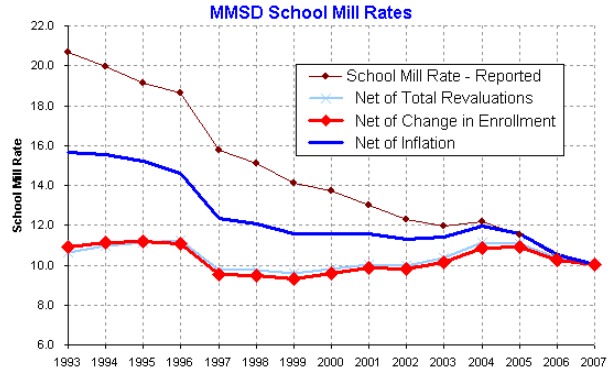
In 1993-94 Madison’s mil rate for its schools was 19.15; in 2007 it was 10.08, almost half of what it was. Unless your home assessment has doubled in that period of time (which it may have), your school property tax has gone down. If your home assessment doubled, your school property tax would be about the same now as it was in 1993-94. Again, even with passage of the referendum, many Madison taxpayers will be paying less in school taxes in 2011 than they did in 1994.
Thank you for your continued support of Madison Schools and Madison kids. Together we make the community a stronger, more vibrant place for all of us to live.
Barbara Arnold, member of GRUMPS (Grandparents United For Madison Public Schools) Steering Committee and a former President of the Madison Board of Education
barbaraarnold@charter.net

Share

THE REAL WEALTH OF THE NATION; Green Charter School Conference – Madison 11/7 – 11/8

Tia Nelson:

Wisconsin has long been an incubator for prescient ideas about the connection between human society and the natural environment.
John Muir’s boyhood in the backwoods near Portage, Wis., provided a foundation for his early leadership in a dawning environmental protection movement.
A Sand County Almanac, Aldo Leopold’s description of the area around his Sauk County, Wis., home, has inspired natural stewardship throughout the world and is required reading for anyone with an interest in conservation.
My father, the late U.S. Sen. Gaylord Nelson, launched the first Earth Day on April 22, 1970, as an annual day of observance and nationwide teach-in about environmental issues because he recognized the significance of educating children and young adults about the natural world.
Today, as we reap the effects of pernicious economic activity, a failing energy policy and atmospheric warming, I find my father’s words both foreboding and reassuring:
“Forging and maintaining a sustainable society is The Challenge for this and all generations to come. At this point in history, no nation has managed to evolve into a sustainable society. We are all pursuing a self-destructive course of fueling our economies by drawing down our natural capital–that is to say, by degrading and depleting our resource base–and counting it on the income side of the ledger. … [T]he real wealth of a nation is its air, water, soil, forests, rivers, lakes, oceans, scenic beauty, wildlife habitats, and biodiversity.”
Papa often talked about the importance of raising the next generation with environmental ethics so they make informed decisions about the use of our natural resources, which are the authentic foundation of a healthy economy. Imagine a robust and equitable economy with clean and abundant energy resources, sustainably managed farms and forests, where innovation and green jobs give us healthy choices that can lead us to a better future.

(more…)

Share

Doggie Biscuit for Kohn: Author rips testing, other sacred classroom concepts

By Lisa Schencker:

Rising test scores are no reason to celebrate, author Alfie Kohn told teachers at the Utah Education Association (UEA) convention on Friday.
Schools that improve test scores do so at the expense of other subjects and ideas, he said.
When the scores go up, it’s not just meaningless. It’s worrisome,” Kohn told hundreds of educators on the last day of the convention. “What did you sacrifice from my child’s education to raise scores on the test?”
Kohn, who’s written 11 books on human behavior, parenting and schools, spent nearly two hours Friday morning ripping into both established and relatively new education concepts. He slammed merit pay for teachers, competition in schools, Advanced Placement classes, curriculum standards and testing–including Utah’s standards and testing system — drawing mixed reactions from his audience.
“Considering what we hear a lot, it was pure blasphemy,” said Richard Heath, a teacher at Central Davis Junior High School in Layton.
Kohn called merit pay–forms of which many Utah school districts are implementing this year–an “odious” type of control imposed on teachers.
If you jump through hoops, we’ll give you a doggie biscuit in the form of money,” Kohn said.

(more…)

Share

Consortium for Varsity Academics: Video Interviews

Thanks to Craig Evans, there is now a page on the tcr website for the Consortium for Varsity Academics®. Click on the page for The Concord Review…
There are QuickTime clips of the interviews with Arthur Schlesinger, Jr., Bill Fitzsimmons of Harvard, and Sarah Valkenburgh [Emerson Prize winner, summa cum laude graduate of Dartmouth, and graduate of Harvard Medical School].
Will Fitzhugh
www.tcr.org

Share

NAEP Writing Assessment 2011

An Interview with Will Fitzhugh: About Assessing Writing EdNews.org Houston, Texas, 24 January 2007
Michael F. Shaughnessy Senior Columnist EdNews.org:

1) I understand that you have just finished a stint on the ACT/NAGB Steering Committee for the 2011 NAEP (National Assessment of Educational Progress) Writing Assessment. What was that like? (And what does NAGB stand for?)
WF: NAGB is the National Assessment Governing Board, which runs the NAEP, “America’s Report Card,” as they say. I was glad that Diane Ravitch recommended me for the Steering Committee for the new national writing assessment scheduled for 2011. I was very impressed with the intelligence and competence of Mary Crovo, representing NAEP, and Rosanne Cook, who is running the project for American College Testing. Many people on the Committee were from the National Council of Teachers of English and the College Composition world, which have little interest in having students read history books or write history research papers. In fact that world favors, or has favored in the past, personal and creative writing and the five-paragraph essay, which do a terrible job of preparing high school students for the nonfiction books and the academic term papers most will be asked to cope with in college.
2) Given the paucity of writing that goes on in the high schools of America, is it really fair to ask high school students to engage in a robust writing assessment?
WF: It would not be fair to ask high school students to play in a football game if they hadn’t had an opportunity for lots of practice, and it is very hard to ask high school students to do the sort of academic expository writing they should be doing if they have never done it in all their years in school. But we need to start somewhere. Every high school student does not need to be able to play football, but they all need to be able to read nonfiction books and write serious term papers.
3) On the other hand, since so much of the college experience is writing, are high school teachers doing students a disservice by NOT requiring more writing?
WF: High school teachers would make terrible football coaches and their teams would lose most if not all of their games, if the teacher/coaches did not have time to practice their teams. We take football seriously, and we take band seriously, so ample time and money are made available to produce the best teams and the best bands the high school can manage. We allow really no time for a public high school teacher to work with students on heavy-duty term papers. We don’t make time for them, because we don’t think they are that important. Not as important as drama practice, yearbook, chorus, debate or a host of other activities. As a result our high school students are, once again, ill-prepared for college reading and writing. AP courses in history do not require, in most cases, that students read a complete nonfiction book, and most of the AP teachers say they don’t have time to ask the student to write a research paper, because they “have to get students ready for the AP Exam.”

(more…)

Share

At Pinnacle, Stepping Away From Basketball

JERÉ LONGMAN
NEWARK, Del. — Students kept filing into the tiny hideaway gym at the University of Delaware, but most seemed interested in swimming and the fitness center, not volleyball. Only 150 or so fans attended Wednesday’s match, 200 tops, family and friends tucked into a small set of bleachers.
Elena Delle Donne, a 6-foot-5 middle hitter, took her position near the net and played the way a novice does, dominating at some moments, uncertain at others. She spiked the ball ferociously to end the suspense in a three-set victory over Villanova, but it remained jarring even for her father to see her in the tights and kneepads of volleyball instead of the flowing shorts of basketball.
“If Tom Brady was your son, you would really enjoy that he was a darn good Ping-Pong player, but you’d feel like, Why’s he playing Ping-Pong?” Ernie Delle Donne, a real estate developer, said, referring to the New England quarterback.
Only months ago, Elena Delle Donne was the nation’s top female high school basketball recruit, a signee with the University of Connecticut, an expected central figure in what many predict will be the Huskies’ sixth national title season in 2008-9. After two days of classes last June, though, Delle Donne acknowledged what few athletes of her visibility have ever acknowledged publicly — she was burned out on basketball at 18

Share

What Does it Mean to be an Educated Person?

New Roots to rethink old education model
Tina Nilsen-Hodges:

The State University of New York Board of Trustees approved the charter application last week for the New Roots Charter School, an innovative new high school that will be one of the first fully integrated models of education for sustainability at the secondary level in the nation. Students in my spring 2007 “Teaching Sustainability” course contributed to the development of the initial school concept paper, which provided the foundation for the charter application submitted in June.
Why this school, why here and why now? New Roots Charter School answers the call of the U.N. Decade for Education for Sustainable Development for the rethinking of education necessary to address the problems of the 21st century. Gov. David Paterson was quoted as saying, “Global warming presents each of us with a question. Do we continue with the status quo or are we ready to make significant cultural and lifestyle alterations?”
Consider our energy crisis, expanding poverty and the degradation of essential ecosystem services, and Paterson’s conclusion becomes even more urgent. “Future actions will require a fundamental change of philosophy in how we live our lives,” he said.

Green Charter Schools National Conference in Madison on November 7- 9
The Urban Environment:

HER giggling friends suddenly quiet down when Jamilka Carrasquillo, her large silver hoop earrings swinging, describes the day her class killed chickens.
“We actually had to go up to the woods to do it,” she says, perched on the back of a chair in a classroom at Common Ground High School in New Haven.
Each student who wanted one got a bird. Following a modified-kosher method (no rabbi), the students stunned the birds with an electric shock, hung them upside down and cut the jugular vein. They call the chickens “meat birds” to maintain emotional distance, but the experience can be difficult.
Jamilka cried; others, even teachers, did too. A lot emerged as vegetarians. Jamilka did not, but she says she came to understand that the pinkish slabs wrapped in plastic on the grocery shelf actually come from living animals. She pledged not to waste food.

Share

ACE Update on the November 2008 Madison Referendum, Information Session Tonight

REMINDER: The MMSD district is holding its second of four “Information Sessions” regarding the referendum tonight (Thursday, October 16), 6:30 pm, Jefferson Middle School. You are urged to attend.
The Madison Metropolitan School District seeks approval of the district taxpayers to permanently exceed the revenue cap for operations money by $13 million a year. In the meantime, to establish that new tax base over the next three years, a total of $27 million in more revenue will have been raised for programs and services. The district has also projected there will continue to be a ‘gap’ or shortfall of revenue to meet expenses of approximately $4 million per year after the next three years, thereby expecting to seek approval for additional spending authority.
Whereas, the Board of Education has staked the future of the district on increased spending to maintain current programs and services for a “high quality education;”
Whereas, student performance on the Wisconsin Knowledge and Concepts Exams has languished at the 7, 8, and 9 deciles (in comparison with the rest of the state’s schools where 1 is the highest level and 10 is the lowest) in 4th, 8th and 10th grade reading, math, science, social studies and language arts exams for the past five years. The total percentage of MMSD students performing at either “proficient” or “advanced” levels (the two highest standards) has consistently ranged in mid 60%s to mid 70%s;
Whereas, the district Drop Out Rate of 2.7% (2006-07) was the highest since 1998-99. With the exception of two years with slight declines, the rate has risen steadily since 1999.
Whereas, the Attendance Rate for all students has remained basically steady since 1998-99 in a range from 95.2% (2005-06) to a high of 96.5% (2001-02);
Whereas, the district Truancy Rate of students habitually truant has risen again in the past three years to 6.0% in 2006-07. The truancy rate has ranged from 6.3% (1999-2000) to 4.4% in 2002-03;
Whereas, the district total PreK-12 enrollment has declined from 25,087 (2000-01) to its second lowest total of 24,540 (2008-09) since that time;
Whereas, the district annual budget has increased from approximately $183 million in 1994-1995 (the first year of revenue caps) to approximately $368 million (2008-09);
Whereas, the board explains the ‘budget gap’ between revenue and expenses as created by the difference between the state mandated Qualified Economic Offer of 3.8% minimum for salary and health benefits for professional teaching staff and the 2.2% average annual increases per student in the property tax levy. The district, however, has agreed with the teachers’ union for an average 4.24% in annual increases since 2001;
Whereas, the district annual cost per pupil is the second highest in the state at $13,280 for the school year 2007-08;
The Madison Metropolitan School District seeks approval of the district taxpayers to permanently exceed the revenue cap for operations money by $13 million a year. In the meantime, to establish that new tax base over the next three years, a total of $27 million in more revenue will have been raised for programs and services. The district has also projected there will continue to be a ‘gap’ or shortfall of revenue to meet expenses of approximately $4 million per year after the next three years, thereby expecting to seek approval for additional spending authority.
Whereas, the Board of Education has staked the future of the district on increased spending to maintain current programs and services for a “high quality education;”
Whereas, student performance on the Wisconsin Knowledge and Concepts Exams has languished at the 7, 8, and 9 deciles (in comparison with the rest of the state’s schools where 1 is the highest level and 10 is the lowest) in 4th, 8th and 10th grade reading, math, science, social studies and language arts exams for the past five years. The total percentage of MMSD students performing at either “proficient” or “advanced” levels (the two highest standards) has consistently ranged in mid 60%s to mid 70%s;
Whereas, the district Drop Out Rate of 2.7% (2006-07) was the highest since 1998-99. With the exception of two years with slight declines, the rate has risen steadily since 1999.
Whereas, the Attendance Rate for all students has remained basically steady since 1998-99 in a range from 95.2% (2005-06) to a high of 96.5% (2001-02);
Whereas, the district Truancy Rate of students habitually truant has risen again in the past three years to 6.0% in 2006-07. The truancy rate has ranged from 6.3% (1999-2000) to 4.4% in 2002-03;
Whereas, the district total PreK-12 enrollment has declined from 25,087 (2000-01) to its second lowest total of 24,540 (2008-09) since that time;
Whereas, the district annual budget has increased from approximately $183 million in 1994-1995 (the first year of revenue caps) to approximately $368 million (2008-09);
Whereas, the board explains the ‘budget gap’ between revenue and expenses as created by the difference between the state mandated Qualified Economic Offer of 3.8% minimum for salary and health benefits for professional teaching staff and the 2.2% average annual increases per student in the property tax levy. The district, however, has agreed with the teachers’ union for an average 4.24% in annual increases since 2001;
Whereas, the district annual cost per pupil is the second highest in the state at $13,280 for the school year 2007-08;

(more…)

Share

Is the 2008 School Referendum Just More of the Same? No!

On November 4, the Madison School Board is asking voters to vote yes on a referendum that will increase the property tax support base for Madison’s public schools by a total of $13 million after three years. For owners of a $250,000, that translates to an additional $90 in property taxes by the third year.
This is not the first school referendum in recent years. But is it just more of the same? No. The need for a referendum stems from our broken system for funding Wisconsin’s public schools, but that is where the connections end. From the earliest planning through the unanimous Board of Education vote to go to referendum, the 2008 request is a big change from what voters have seen in the past.
The referendum is about funding a community service – K12 education – that is essential to vital neighborhoods and property values, an educated workforce, and, most important, a strong start for the children and youth who hold our future in their hands.
Our proposal is one of two major elements in Superintendent Nerad’s vision of a new partnership between the Madison Metropolitan School District and its communities. The second part is commitment to a long-range planning process that will include strong community input, assessment and review of district staffing and programs, and reallocation of resources to critical areas of need.
The 2008 plan was developed with input from the community. The final proposal represents more than some people want and less than others want; all comments were taken into account by the superintendent and the board.
Additional financial steps that reduce the tax impact on homeowners:

1) Using our 2008 windfall to pay off short term debt and reduce the amount we are asking by $400,000 per year
2) enacting Fund 41 to manage on-going maintenance and protect the district from losing state aid;
3) decreasing the community service fund (Fund 80) property tax levy by $2 million for one year to offset the referendum’s property tax increases;
4) revising our financial forecasts so that the referendum asks only for what we believe we will need; and,
5) using a recurring referendum so that the district will not face the significant new gap that would occur after a fixed-term referendum.

The 2008 referendum does not fix the way that Wisconsin pays for public schools, which has not worked for Madison or other communities. The referendum does not restore programs that were among the $35 million in budget cuts made by the board in the past 5 years, nor does it include new programs. It is one step in our ongoing work to balance school needs with taxpayer means under state laws.

Share

Nick Saban’s Fine Print

Buzz Bissinger
It’s a couple of weeks ago and I am watching the Alabama-Clemson football game. It’s a pretty good contest, actually. The Crimson Tide is in the groove against a Top 10 team. But that’s not what truly interests me.
I am watching the fans in various states of rabidity, wondering how long it takes to wash all that school-color gunk off your body once you lacquer it on, not to mention what precisely motivates someone to apply such gunk in the first place. I am watching the cheerleaders in their somersaults and squats of perfect synchronism with those slapped-on smiles. I am just watching the crazy spectacle of it all — frenzy and bloodlust and the low rumble of moans and the high-pitch of screams. I wonder why we need any more studies showing our nation’s education system to be in the tank when all you have to do is attend a college football game.

Share

2008 Madison Schools’ Referendum – Key Issues

1. Mortgage on future property with permanent increase: Asking taxpayers to refinance/mortgage their futures and that of the school district with a permanent increase of $13 million yearly for the operations budget. It has been stated the district needs the money to help keep current programs in place. It is expected that even after 3 years of this referendum totaling $27 million, the Board is projecting a continued revenue gap and will be back asking for even more.
2. No evaluation nor analysis of programs and services: The Board will make budget cuts affecting program and services, whether or not this referendum passes. The cuts will be made with no assessment/evaluation process or strategy for objective analyses of educational or business programs and services to determine the most effective and efficient use of money they already have as well as for the additional money they are asking with this referendum.
3. Inflated criteria for property value growth: The dollar impact on property to be taxed is projected on an inflated criteria of 4% growth in property valuation assessment; therefore, reducing the cost projection for the property tax levy. The growth for property valuation in 2007 was 3.2% and for 2008 it was 1.0%. Given the state of the economy and the housing market, the growth rate is expected to further decline in 2009. [10/13 Update: The above references to property valuation assessment growth are cited from City of Madison Assessor data. See ACE document “Watch List Report Card” [2008 Referendum Watch List 755K PDF] for State Department of Revenue citations for property valuation base and growth rate used for determination of MMSD property tax levy.]
4. No direct impact on student learning and classroom instruction: There is District acknowledgement of a serious achievement gap between low-income and minority student groups compared with others. There are no plans evident for changing how new or existing money will be spent differently in order to have an impact on improving student learning/achievement and instructional effectiveness.
5. Lack of verification of reduction in negative aid impact on taxes: District scenarios illustrating a drastic reduction in the negative impact on state aids from our property-rich district is unsubstantiated and unverified, as well as raising questions about unknown possible future unintended consequences. The illustrated reduction is from approximately 60% to 1% results by switching maintenance funds from the operations budget and 2005 referendum proceeds to a newly created “Capital Expansion Fund–Fund 41” account. [Update: 10/13: The reduction in the negative aid impact will take affect regardless of the outcome of the referendum vote. See the ACE document “Watch List Report Card” [2008 Referendum Watch List 755K PDF] for details.]

(more…)

Share

Polonius Redux

New England History Teachers Association
Newsletter Fall 1999
In Hamlet, Polonius offers his introduction to the players by describing them as: “The best players in the world, either for tragedy, comedy, history, pastoral, pastoral-comical, historical-pastoral, tragical-historical, tragical-comical-historical-pastoral or poem unlimited.”
Modern American education has been visited with an echo of this brief 1602 disquisition on what a cool combinatorial plaything the permu-tations of presentation can be in the right hands. Our version is called Multiple Intelligences, and an article in the Magazine of History lays out a simplified version of a lesson plan for teaching the Spanish-American War. It offers the basics of this new orthodoxy–methods which can cater to: Intrapersonal Intelligence, Verbal/ Linguistic Intelligence, Musical/Rhythmic Intelligence, Visual/Spatial Intelligence, Bodily/Kinesthetic Intelligence, Interpersonal Intelli-gence, and Mathematical Intelligence.
This is clearly the introductory form of this approach, and does not try to get into the more arcane techniques of Mathematico-Spatial-Verbal or Linguistic-Rhythmic-Kinesthetic or Interpersonal-Intrapersonal-Visual-Bodily methods of curriculum design.
The founder of this new way to develop individual learning plans for each student and all combinations of students in a class is Howard Gardner, MacArthur Fellow at the Harvard Graduate School of Education. He was interviewed, not too long ago, on public radio in Boston, and when he was asked why he chose the term Multiple Intelligences, he quite candidly replied, “If I had called them Talents, no one would have paid any attention.”
To be fair to this academic psychologist looking for a new field to make a name in, it is quite likely that he has very little conception of the damage he has done in American education. Polonius was in part a figure of fun, although he does have some of Shakespeare’s most famous lines (“To thine own self be true”), but Professor Gardner cannot get off quite so easily, because his work is not recognized as comical by enough of our educators.
He has made it possible for teachers everywhere to say that whatever they feel like doing in class, from gossiping about scandal to reminiscing about Vietnam to showing travel slides, to you name it, is designed to appeal to one of the many talents (Intelligences) that students bring to school with them.

(more…)

Share

Out of the Ordinary: Historical Fiction for Middle Grade Readers

Michelle Barone:

Excerpt from Chapter 1: The Crime
“Woosh! Splat!’ A gooshy, white spitball whizzed past Julia’s ear. It smushed onto the blackboard and stuck. Julia watched a wet stream travel down from the wad. It left a shiny black trail on the board. There was only one person in the room who would do such a thing. Julia knew who it was.
Julia knew what would happen next. It was the same thing that happened every time Teddy Parker misbehaved.
Miss Crawford, the teacher, spun around and faced the class like a fighter squaring off against an opponent. “Who made this spitball?” she demanded.
Julia clamped her skinny legs together and froze in her seat. Her knobby knees bumped each other.
“Who made this spitball?” Miss Crawford repeated.
“It wasn’t any of the sixth graders,” said Frank O’Malley, a blond haired, Irish boy. He stood, as was the custom, to speak for his age group.
Julia knew she was expected to answer. She was the only fifth grader in the room who spoke English. The other fifth grade girl sat wide-eyed with sealed lips.
Julia wished they didn’t have to go through this ritual every time Teddy Parker acted up. Teddy’s family came to Phippsburg long before Julia’s. Teddy lived in a real house. Julia’s family lived in an old boxcar that had been taken off of the rails. There were other families from Italy, Ireland, and Greece living in the boxcar section of town.
Julia didn’t know why Teddy was a trouble maker. He was luckier than all of the other kids. Teddy’s father ran the coal mine where everyone else’s father worked.
The fourth graders didn’t do it,” said a girl popping up and down in one motion.
Julia had missed her turn to answer.
“It wasn’t any of the third graders, Miss Crawford,” said another girl.
“The second graders didn’t do it,” said Teddy’s sister, Paulina.
A small boy stood. “It wasn’t the first grade, Teacher,” he said.
There will be a punishment for this, “Miss Crawford Said.
“Whoever made this spitball will have to come to the front of the room.”
Julia watched Miss Crawford focus on Teddy. He shifted in his wooden seat at the end of the sixth grade row.
“What do you have to say, Teddy?” asked Miss Crawford.
Julia looked at Teddy sitting in his new clothes from Denver. He wore a new shirt under a new sweater, new knickers, and new knee socks. Julia guessed his underwear was new, too. Teddy’s clothes were the right size, not patched and baggy hand-me-downs like Julia’s. Most of the kids were dressed like her, in clothes that had once been worn by their parents.
Julia watched Teddy slowly rise. He stepped out to the side of his desk. Julia waited for Teddy to make his confession. It was his chance to show off every day. She knew in a moment he would proudly walk to the front of the room, stand on tip toe, and place his nose on a chalk dot Miss Crawford drew on the board. The class would watch him stand there on pointed toe while he took his punishment. Miss Crawford wouldn’t make Teddy stand at the board for a whole hour like she would any other student. Teddy was her pet. She’d call off his punishment after five or ten minutes.
It was the same every time. Nothing exciting ever happened in Phippsburg. Why couldn’t it be a little bit different this once?
Julia reached up and felt a rag curl in her hair. Mama tied the rags into her hair last night. Julia liked how the curls made a soft half circle around her plain face.
Julia closed her eyes and made one silent wish. “Please let something exciting happen today for a change.”
She opened her eyes and blinked three times for good luck.
Miss Crawford was waiting for an answer. Teddy straightened his shoulders and drew in a long, deep breath.
“Miss Crawford, I must tell the truth,” he said.
“Yes, you must,” said Miss Crawford.
All eyes were glued on Teddy Parker.
“It was…Julia!” he announced.

Share

Fine Arts Task Force Report Available On-line

Last night, Fine Arts Task Force co-chairs Barb Schrank and Anne Katz presented the committee’s report at the regular school board meeting. It is a fine document and a reminder of how fortunate we are to have a community that is rich in arts resources and people with a clear understanding of the importance of the arts in educational programs. We all owe this group a significant debt for their diligence in putting together a comprehensive document and set of recommendations.
The report and committee minutes and meeting materials are available on-line at:
http://www.madison.k12.wi.us/boe/finearts/
Last night the board voted to receive the report and turn it over to administration and staff for analysis and comment. Later this school year, the superintendent and board will hold input sessions to give the community a chance to weigh in on the report and on priorities. I am not sure if this will be done as part of the strategic planning process that the new superintendent has in mind or as a separate process, but I am confident that there will be opportunities to weigh in.
For now, this group deserves a big THANK YOU for their work.

Share

Academic Fitness

The NACAC Testing Commission has just released its report [PDF]on the benefits of, and problems with, current standardized admission tests. The Commission says that “a ‘one-size-fits-all’ approach for the use of standardized tests in undergraduate admission does not reflect the realities facing our nation’s many and varied colleges and universities.”
It might be pointed out, by an outside observer, that standardized tests not only do not reflect the realities of acceptance for high school students receiving athletic scholarships, but such tests have nothing whatever to do with whether high school athletes are recruited or not and nothing to do with whether they receive college athletic scholarships or not.
Athletic scholarships are based on athletic performance in particular athletic activities, not on tests of the athletic or physical fitness of high school athletes. The cost of failure for college coaches is too high for them to think of relying on any standardized test of sports knowledge or of anything else in their efforts to recruit the best high school athletes they can.
The NACAC Testing Commission also says that standardized tests may not do a good enough job of telling whether applicants to college are academically fit. They recommend the development and use of good subject matter tests which are “more closely linked to the high school curriculum” than the SAT and ACT exams.
This suggestion begins to approach the rigor of assessment in the recruiting and selection of high school athletes, but there are still important differences. The high school athletic curriculum includes such subjects as football, basketball, soccer, baseball, etc., but college coaches do not rely on tests of athletes’ knowledge of these sports as determined by sport-specific tests. They need to know a lot about the actual performance of candidates in those sports in which they have competed.
The parallel is not perfect, because of course students who can demonstrate knowledge of history, biology, literature, math, chemistry, and so on, are clearly more likely to manage the demands of college history, biology, literature, math and chemistry courses when they get there, while athletes who know a lot about their sport may still perform poorly in it.
But college academic work does not just consist of taking courses and passing tests. In math there are problem sets. In biology, chemistry, etc., there is lab work to do. And in history courses there are history books to read and research papers to write. Such performance tasks are not yet part of the recommended tests for college admission.
It is now possible, for example, for a student who can do well on a subject matter test in history to graduate from high school without ever having read a complete history book or written a real history research paper in high school. That student may indeed do well in history courses in college, but it seems likely that they will have a steep learning curve in their mastery of the reading lists and paper requirements they will face in those courses.
New standard college admissions tests in specific academic subjects will no doubt bring more emphasis on academic knowledge for the high school students who are preparing for them, but a standard independent assessment of their research papers would surely make it more likely that they would not plan to enter college without ever having done one in high school.
The reading of complete nonfiction books is still an unknown for college admissions officers. Interviewers may ask what books students have read, but there is no actual standard expectation for the content, difficulty and number of nonfiction books high school students are expected to have read before college.
The increased emphasis on subject matter tests is surely a good step closer to the seriousness routinely seen in the assessments for college athletic scholarships, but it seems to me that some regular examination of the reading of nonfiction books and an external assessment of at least one serious research paper by high school students would help in their preparation for college, as well as in the assessment of their actual demonstrated academic fitness which, as the Commission points out, is not now provided by the SAT and ACT tests.
Will Fitzhugh [founder]
Consortium for Varsity Academics® [2007]
The Concord Review [1987]
Ralph Waldo Emerson Prizes [1995]
National Writing Board [1998]
TCR Institute [2002]
730 Boston Post Road, Suite 24
Sudbury, Massachusetts 01776 USA
978-443-0022; 800-331-5007
www.tcr.org; fitzhugh@tcr.org
Varsity Academics®

Share

Arts Task Force to present findings and recommendations to Madison School Board: Presentation at 6 pm, Monday, October 6, 2008

Doyle Administration Building, 545 West Dayton Street, Madison [Map]

“The arts are not a luxury; they are essential”. State Supt. of Public Instruction Elizabeth Burmaster
Being concerned about the effect of cuts to funding, staffing and instruction time on arts education and the effect of these cuts on low-income students and students of color, the Madison Metropolitan School District’s (MMSD) Board of Education formed the district’s Fine Arts Task Force in January 2007 to respond to three charges:

  1. Identify community goals for Madison Metropolitan School District K-12 Fine Arts education including curricular, co-curricular and extra-curricular.
  2. Recommend up to five ways to increase minority student participation and participation of low-income students in Fine Arts at elementary, middle and high school levels.
  3. Make recommendations regarding priorities for district funding of Fine Arts.

Members of the Task Force will present the findings and recommendations to the MMSD School Board on Monday, October, 6, 2008, at 6:15 pm, in the McDaniels Auditorium of the Doyle Administration Building, 545 West Dayton Street, Madison.
Students, parents and the general public are encouraged to attend to show support for the role of the arts in ensuring a quality education for every MMSD student. Attendees can register in support of the report at the meeting.
Nineteen community members, including 5 MMSD students, were appointed by the School Board to the Task Force, which met numerous times from February 2007 through June 2008. The Task Force received a great deal of supportive assistance from the Madison community and many individuals throughout the 16 month information gathering and , deliberation process. More than 1,000 on-line surveys were completed by community members, parents, artists, arts organizations, students, administrators and teachers, providing a wealth of information to inform the task force?s discussions and recommendations.
The full Task Force report and appendices, and a list of Task Force members, can be found at http://mmsd.org/boe/finearts/.
Fine Arts Task Force Report [1.62MB PDF] and appendices:

For more information, contact Anne Katz, Task Force co-chair, 608 335 7909 | annedave@chorus.net.

Share

Contentless Writing

Mr. Fitzhugh [fitzhugh@tcr.org] is Editor and Publisher of The Concord Review and Founder of the National Writing Board and the TCR Institute [www.tcr.org].
Abraham Lincoln’s address at Gettysburg was short. Indeed, the President had spoken and taken his seat before many in that large crowd gathered outdoors even realized that he had spoken. Fortunately, an alert reporter took down his words. Short as the speech was, it began with a date and a fact–the sort of factual content that is being drained away from student writing today.
The very idea of writing without content takes some getting used to. I was taken aback not long ago to read the comments of a young woman who had been asked how she felt about having a computer grade the essays that she wrote on the Graduate Management Admission Test (Mathews, 2004). She replied that she didn’t mind, noting that the test givers were more interested in her “ability to communicate” than in what she actually said.
Although style, fluency, tone, and correct grammar are certainly important in writing, folks like me think that content has value as well. The guidelines for scoring the new writing section on the SAT seem to say otherwise, however. Readers evaluating the essays are told not to take points off for factual mistakes, and they must score the essays “holistically”–at the rate of 30 an hour (Winerip, 2005).
Earlier this year, Linda Shaw of the Seattle Times (2006), reported that the the rules for the Washington Assessment of Student Learning (WASL) do not allow dictionaries, but “when it comes to the writing section, there’s one rule they can break: They can make things up. Statistics. Experts. Quotes. Whatever helps them make their point.” According to Shaw, the state’s education office announced that “making up facts is acceptable when writing nonfiction, persuasive essays on the WASL.”
Lest you conclude that writing without content, or writing nonfiction with fictional content–think James Frey’s A Million Little Pieces–is limited to the Left Coast, think again. Across the United States, even the most prestigious writing workshops for teachers generally bypass the what to focus on the how.
All writing has to have some content, of course. So what are students encouraged to put down on the page? In its 2003 report, The Neglected ‘R’, The National Commission on Writing in America’s Schools and Colleges, gave us a clue. According to the report, the following passage by a high school student about the September 11 terrorist attacks shows “how powerfully children can express their emotions.”
“The time has come to fight back and we are. By supporting our leaders and each other, we are stronger than ever. We will never forget those who died, nor will we forgive those who took them from us.”
Or look at the National Assessment of Educational Progress (NAEP) the supposed gold standard for evaluating academic achievement in U.S. schools, as measured and reported by the National Center for Education Statistics. In its 2002 writing assessment, in which 77 percent of 12th graders scored “Basic” or “Below Basic,” NAEP scored the following student response “Excellent.” The prompt called for a brief review of a book worth preserving. In a discussion of Herman Hesse’s Demian, in which the main character grows up and awakens to himself, the student wrote,

(more…)

Share

DCPAC Dan Nerad Meeting Summary

A video tape of the entire presentation and discussion with Dr. Nerad may be viewed by visiting this internet link: https://www.schoolinfosystem.org/archives/2008/09/ madison_superin_10.php

Dan Nerad opened his remarks by stating his commitment to efforts for always continuing change and improvement with the engagement of the community. He outlined four areas of focus on where we are going from here.

  1. Funding: must balance district needs and taxpayer needs. He mentioned the referendum to help keep current programs in place and it will not include “new” things.
  2. Strategic Plan: this initiative will formally begin in January 2009 and will involve a large community group process to develop as an ongoing activity.
  3. Meet people: going throughout the community to meet people on their own terms. He will carefully listen. He also has ideas.
  4. Teaching and learning mission: there are notable achievement gaps we need to face head-on. The “achievement gap” is serious. The broader mission not only includes workforce development but also helping students learn to be better people. We have a “tale of two school districts” – numbers of high achievers (including National Merit Scholars), but not doing well with a lot of other students. Low income and minority students are furtherest away from standards that must be met. Need to be more transparent with the journey to fix this problem and where we are not good. Must have the help of the community. The focus must be to improve learning for ALL kids, it is a “both/and” proposition with a need to reframe the issue to help all kids move forward from where they are. Must use best practices in contemporary assessment, curriculum, pedagogy and instructional methods.

Dr. Nerad discussed five areas about which he sees a need for community-wide conversations for how to meet needs in the district.

  1. Early learning opportunities: for pre-kindergarten children. A total community commitment is needed to prevent the ‘achievement gap’ from widening.
  2. High schools: How do we want high schools to be? Need to be more responsive. The curriculum needs to be more career oriented. Need to break down the ‘silos’ between high school, tech schools and colleges. Need to help students move through the opportunities differently. The Small Learning Communities Grant recently awarded to the district for high schools and with the help of the community will aid the processes for changes in the high schools.
  3. School safety: there must be an on-going commitment for changes. Nerad cited three areas for change:

    a. A stronger curriculum helping people relate with other people, their differences and conflicts.

    b. A response system to safety. Schools must be the safest of sanctuaries for living, learning and development.

    c.Must make better use of research-based technology that makes sense.

  4. Math curriculum and instruction: Cited the recent Math Task Force Report

    a. Good news: several recommendations for curriculum, instruction and policies for change.

    b. Bad news: our students take less math than other urban schools in the state; there are notable differences in the achievement gap.

  5. Fine Arts: Cited recent Fine Arts Task Force Report. Fine arts curriculum and activities in the schools, once a strength, has been whittled away due to budget constraints. We must deal with the ‘hands of the clock’ going forward and develop a closer integration of the schools and community in this area.

(more…)

Share

Madison 2008 Referendum: Watch List Report Card

10/6/2008 update
Active Citizens for Education presents this “Watch List Report Card” as a means of reporting relevant information, facts and analyses on topics appropriate for consideration by taxpayers in voting on the Madison Metropolitan School District referendum question November 4, 2008.
This document is dynamic in nature, thus it is updated on a regular basis with new information and data. Questions, analyses, clarifications and perspectives will be added to the entries as appropriate. Review Ratings will be applied to report the progress (or lack thereof) of the Board of Education and Administration in its plans, data, information, reports and communications related to the referendum.
The question which shall appear on the ballot is as follows:

“Shall the following Resolution be approved?
RESOLUTION AUTHORIZING THE SCHOOL DISTRICT BUDGET TO EXCEED REVENUE LIMIT FOR RECURRING PURPOSES
BE IT RESOLVED by the School Board of the Madison Metropolitan School District, Dane County, Wisconsin that the revenues included in the School District budget be authorized to exceed the revenue limit specified in Section 121.91, Wisconsin Statutes, for recurring purposes by: $5,000,000 beginning in the 2009-2010 school year; an additional $4,000,000 beginning in the 2010-2011 school year (for a total of $9,000,000); and an additional $4,000,000 beginning in the 2011-2012 school year (for a total of $13,000,000 in 2011-2012 and each year thereafter).”

(Source: MMSD Administration 09/15/08)
Continue reading here (277K PDF).

Share

[For] Crying Out Loud

September 24, 2008 By Glenn Ricketts:

Yes, yes, we know that you’ve been an outstanding high school history student and that you’d like to major in that subject in college, but we’re not sure why you’re inquiring about scholarships here. Wait, not so fast: it’s certainly impressive that you’ve had some original research published, and your grades are indeed outstanding. But if, as you say, you’re looking for a scholarship, we’d like to hear about your curve ball. Oh, you didn’t play baseball in high school? Well, then how about football or basketball? No? Lacrosse, soccer, swimming, maybe? Golf, bowling, tennis? In that case, do you sing or dance? You don’t appear to have any disabilities, not that we’d ask.
No, sorry, speaking fluent French is not really what we had in mind by “diversity.” Do you by chance play the xylophone? What’s that? History scholarships? You mean something geared specifically towards outstanding high school history students? Ho! Ho! Good one.
No, not here. Haven’t heard of ’em anywhere else, either. Where’d you come up with that idea anyway? Look, we’re not sure we can do anything for you at this point unless…wait a minute, did you say you were a cheerleader? Sit down. I think we’re finally on to something. Yes, that’s right, we have several scholarships for cheerleaders. Can you send us all of the relevant information about your high school cheerleading experience? We may also be able to direct you to other sources of support for promising college cheerleading prospects. Why didn’t you tell us this at the outset, instead of getting sidetracked with all of that stuff about history? We’re very busy in this office, you know. No doubt you’re an outstanding history student, and by all means major in it if you like, but that’s not going to get you anywhere if you’re looking for a scholarship. Good thing you mentioned the cheerleading angle, especially since we have to be careful to choose only the most outstanding applicants.
I made up this little drama, but it is based on the “true facts.” History scholarships are rare. Cheerleading scholarships are pretty common–even at colleges and universities that one might think value intellectual achievement over human pyramids.
Will Fitzhugh is a former high school history teacher who, frustrated with the lack of opportunities to showcase academic achievement among young students, in 1987 founded The Concord Review, (www.tcr.org) a quarterly journal devoted entirely to outstanding research essays by high school students. Anyone who doubts the possibility of impressive research skills and consummate writing ability among some of today’s secondary school students should read at least one issue of the Review, where future historians and teachers might well be making their first appearances. These students don’t need remedial English, and could probably be bumped up beyond the usual introductory survey courses in history to begin work as history majors on the fast track.
Trouble is, as Will has pointed out to us, the students who write in The Concord Review don’t get much recognition beyond that, to say nothing of scholarship assistance. A few colleges–most notably Reed College–have recently started supporting The Concord Review financially–which is bound to encourage some bright, highly capable students to consider attending college out in Portland, Oregon. But by and large, the prospect for students winning scholarships on the basis of outstanding ability to engage in historical scholarship isn’t very bright.

(more…)

Share

Weekly Update

This past week on the board I have moved in varied circles, hopefully which may lead our district in a new and better direction as we improve our connections with the broader community.
Early in the week the Madison Board of Education approved the submission of two resolutions for the state school board association’s annual meeting. I was happy to be an author of one and to get assistance from the Middleton/Cross Plains board on the second.
One meeting that I’m always happy to attend is with community organizers and childcare providers working to bring quality early childhood education to all students in Madison. We met at a local business, Ground Zero coffee shop, and enjoyed much in the way of conversation and goal-setting. If you would like to learn how to get involved in this effort feel free to contact me and I will put you in touch with some great people working on behalf of young children and through an investment in our future.
In addition, I may start holding listening sessions at local businesses to better communicate with the community.
Personal blog, RSS Feed.

Share

History Lesson

Bob McGum:

Want to read another story about the dumbing down of American students? How far SAT scores have dropped or standards fallen?
If so, look elsewhere.
We wish instead to draw your attention to one of those little starbursts of intelligence sparkling over our dreary educational landscape: The Concord Review. The first and only academic journal dedicated to the work of high school students, The Concord Review has published essays on everything from the sinking of the Lusitania to the Pullman Strike of 1894 and the Harlem Renaissance. Appropriately enough, it is published out of the same town where, more than two centuries back, embattled farmers fired the shot heard ’round the world.
The Review is the child of Will Fitzhugh, a Harvard alumnus who started publishing it out of his own home in 1987 while a high school teacher himself. The next year he quit his job and dedicated himself to the journal full-time. Not least of the spurs behind his decision was having witnessed two of his fellow Concord teachers propose an after-school program to help a select group of students prepare a serious history essay-only to be shot down by the administration on the grounds of “elitism.”
Like most such academic adventures, the Review isn’t going to challenge People magazine any time soon; it still has only about 850 subscribers, and among the high schools that don’t subscribe are a number whose students have been published in the Review itself. But it is attracting attention. The Concord Review has received endorsements from a cross-section of prominent historians such as David McCullough, Eugene Genovese, Diane Ravitch, and Arthur Schlesinger, Jr., who says “there should be a copy in every high school.” Another fan is James Basker, a Barnard and Columbia professor who also serves as president of the Gilder Lehrman Institute of American History.
“Students rise to the expectations you have of them,” states Mr. Basker. “All you have to do is show them they are capable of writing serious historical essays, and off they go.” To emphasize the point, his institute will on June 10 inaugurate three annual Gilder Lehrman Essay Prizes in American History drawn from Concord Review essayists. This year’s first prize, for $5,000, goes to Hannah S. Field for her contribution about library efforts to suppress Frank Baum’s Wizard of Oz.
All this acclaim notwithstanding, Mr. Fitzhugh believes today’s culture retains a pronounced bias against academic achievement and excellence. He cites the example of a Concord Review essayist from Connecticut who subsequently went on to Dartmouth and will be studying medicine this fall at Harvard. When Mr. Fitzhugh paid a visit to her high school, he found that though everyone knew she was all-state in soccer, no one knew that an essay of hers had appeared in the Review, beating out hundreds of the finest student essays from not only the U.S. but other parts of the English-speaking world. It’s one of the things that tells him that the need for such a journal remains strong.
“Varsity athletics and athletes are celebrated everywhere,” Mr. Fitzhugh says. “We’ve decided to celebrate varsity academics.”

Share

Answer not ‘No Child Left Ahead’

Cincinnati Enquirer
Advocates for gifted education say states need three things in order to serve high-ability students well: a mandate to identify them, a mandate to serve them and the money to carry out those mandates.
Very few states have all three.
Ohio is one of a handful to only have one, a mandate to identify gifted children. Indiana is one of very few to do all three, after mandating identification and service last January and putting state funds into executing those mandates. Kentucky mandates service, but under funds.
Now Ohio is stepping up its gifted education program with new standards that set minimums for minutes-per-week and students-per-classroom in gifted instruction. But some parents and gifted educators fear that, with little state money attached, schools may shrink away from serving gifted students.
It’s part of a long and contentious debate on if, when and how to serve brilliant students. And it’s only gotten more divisive since No Child Left Behind forced school districts to focus harder on low-achieving students or face sanctions.
Gifted advocates say the move to make everyone proficient shortchanges students who can achieve much more academically. They say there’s little incentive for students to push the upper levels of achievement, and that boiling the focus down to reading and math – on which most standardized tests focus – means gifted kids often lose time in subjects they love, like science and the arts.

Share

History Scholar

Will Fitzhugh, The Concord Review
9/18/2008
College scholarships for specific abilities and achievements are not news. There are football scholarships and volleyball scholarships and music scholarships and cheerleading scholarships, and so on – there is a long list of sources of money to attract and reward high school students who have talent and accomplishments if those are not academic.
Consider an example: there is a high school student in Georgia, in an IB program, who spent a year and a half working on an independent study of the Soviet-Afghan War in the 1980s. This paper, a bit more than 15,000 words, with endnotes and bibliography was published in the Fall 2008 issue of The Concord Review, the only journal in the world for the academic research papers of secondary students, and it is a strong candidate for the Ralph Waldo Emerson Prize. If he were an outstanding baseball player, a number of college baseball coaches would have heard about him, and would be doing what they could to persuade him to accept an athletic (baseball) scholarship to their colleges.
But suppose he were not a HS athlete, but only a HS history students of extraordinary academic promise at the high school level. Would college professors of history know about and take an interest in his work? No. Would there be college history scholarships competing for him? No. Would his teacher, who worked with him on his independent study, attract attention from his peers at the college and university level? No.
I hope I am wrong, but based on what I have found out so far, there are no college scholarships available specifically for outstanding secondary students of history. There is abundant moaning and gnashing of teeth by edupundits and professors about the widespread ignorance of history among our young people, but when someone shows unusually strong knowledge of history at the Lower Education Level, no one pays any attention at the Higher Education Level.
In 21 years of working to publish 824 history research papers by secondary students of history from 44 states and 34 other countries in The Concord Review, I have not learned of a single instance of an author being offered a college scholarship based on their academic work in history.
When we lament that our adolescents seem more interested in sports than in academics, we might consider how differently we celebrate and reward those activities. High school coaches who are well known to and almost treated as peers by their college counterparts, receive no attention at all for their work as teachers, no matter how unusually productive that work may happen to be. Higher Education simply does not care about the academic work being done by teachers and students at the Lower Education level.
Behavioral psychology argues that by ignoring some behavior you will tend to get less of if, and by paying attention to and rewarding other behavior you are likely to find that there is more of it.
I know that students are being recruited for college scholarships in cheerleading, and I would dearly love to hear from anyone who can tell me of students being recruited for their specific academic work in a high school subject, like history, literature, physics, Chinese, chemistry and so on.
I realize there are scholarships for disadvantaged students, for students of high general intellectual ability, and the like, but where are the scholarships for specific HS academic achievement? After all, athletic and dance scholarships are not awarded on the basis of general tests of physical fitness, but because of achievement in the actual performance of particular athletic or artistic activities.
It is said that you get what you pay for, and it seems likely that you get more of what you value and reward in academics as well. If we continue to overlook and ignore the academic achievement of our secondary-level scholars of history and other subjects, that does not mean that some students will no longer work hard in their areas of academic interest. There may be fewer of them, and fewer teachers who see the point of putting in the extra coaching time with exceptionally diligent students, but if we continue down this road, at least folks in Higher Education ought to be aware that they are working just as hard to discourage good academic work at the secondary level as anyone, and they should stop complaining about the attitudes toward scholarship of the students in their classrooms, which, after all, are in part a result of their own contempt for and neglect of academic work at the secondary (aka “pre-college”) level.
Will Fitzhugh [founder], Consortium for Varsity Academics® [2007]
The Concord Review [1987], Ralph Waldo Emerson Prizes [1995]
National Writing Board [1998], TCR Institute [2002]
730 Boston Post Road, Suite 24, Sudbury, Massachusetts 01776 USA
978-443-0022; 800-331-5007, www.tcr.org; fitzhugh@tcr.org, Varsity Academics®

Share

Wisconsin Task Forces on Arts and Creativity

New, critical support for arts education is mounting from business, government, and education. Wisconsin leaders are capitalizing on these opportunities in unparalleled ways.
For more information, read

WI Forces for 21st Century Arts Education.pdf by Karin Wolf, Arts Program Administrator, Madison Arts Commission, City of Madison, Wisconsin

Share

An Email to Madison Superintendent Dan Nerad on Credit for non MMSD Courses

Dear Superintendent Nerad:
I was rather surprised to learn today from the Wisconsin State Journal that:
“The district and the union also have quarreled over the role of MTI members in online learning for seven years. Under the new agreement, ANY (my emphasis) instruction of district students will be supervised by Madison teachers. The deal doesn’t change existing practice but confirms that that practice will continue.”
You are quite new to the MMSD. I am EXTREMELY disappointed that you would “cave in” to MTI regarding a long-standing quarrel it has had with the MMSD without first taking the time to get input from ALL affected parties, i.e., students and their parents as well as teachers who might not agree with Matthews on this issue. Does this agreement deal only with online learning or ALL non-MMSD courses (e.g., correspondence ones done by mail; UW and MATC courses not taken via the YOP)? Given we have been waiting 7 years to resolve this issue, there was clearly no urgent need for you to do so this rapidly and so soon after coming on board. The reality is that it is an outright LIE that the deal you just struck with MTI is not a change from the practice that existed 7 years ago when MTI first demanded a change in unofficial policy. I have copies of student transcripts that can unequivocally PROVE that some MMSD students used to be able to receive high school credit for courses they took elsewhere even when the MMSD offered a comparable course. These courses include high school biology and history courses taken via UW-Extension, high school chemistry taken via Northwestern University’s Center for Talent Development, and mathematics, computer science, and history courses taken at UW-Madison outside of the YOP. One of these transcripts shows credit for a course taken as recently as fall, 2005; without this particular 1/2 course credit, this student would have been lacking a course in modern US history, a requirement for a high school diploma from the State of Wisconsin.
The MMSD BOE was well aware that they had never written and approved a clear policy regarding this matter, leaving each school in the district deciding for themselves whether or not to approve for credit non-MMSD courses. They were well aware that Madison West HAD been giving many students credit in the past for non-MMSD courses. The fact is that the BOE voted in January, 2007 to “freeze” policy at whatever each school had been doing until such time as they approved an official policy. Rainwater then chose to ignore this official vote of the BOE, telling the guidance departments to stop giving students credit for such courses regardless of whether they had in the past. The fact is that the BOE was in the process of working to create a uniform policy regarding non-MMSD courses last spring. As an employee of the BOE, you should not have signed an agreement with MTI until AFTER the BOE had determined official MMSD policy on this topic. By doing so, you pre-empted the process.
There exist dozens of students per year in the MMSD whose academic needs are not adequately met to the courses currently offered by MTI teachers, including through the District’s online offerings. These include students with a wide variety of disabilities, medical problems, and other types of special needs as well as academically gifted ones. By taking appropriate online and correspondence courses and non-MMSD courses they can physically access within Madison, these students can work at their own pace or in their own way or at an accessible location that enables them to succeed. “Success for all” must include these students as well. Your deal with MTI will result in dozens of students per year dropping out of school, failing to graduate, or transferring to other schools or school districts that are more willing to better meet their “special” individual needs.
Your rush to resolve this issue sends a VERY bad message to many families in the MMSD. We were hoping you might be different from Rainwater. Unfortunately, it says to them that you don’t really care what they think. It says to them that the demands of Matthews take primarily over the needs of their children. Does the MMSD exist for Matthews or for the children of this District? As you yourself said, the MMSD is at a “tipping point”, with there currently being almost 50% “free and reduced lunch” students. Families were waiting and hoping that you might be different. As they learn that you are not based upon your actions, the exodus of middle class families from the MMSD’s public schools will only accelerate. It will be on your watch as superintendent that the MMSD irreversibly turns into yet another troubled inner city school district. I urge you to take the time to learn more about the MMSD, including getting input from all interested parties, before you act in the future.
VERY disappointingly yours,
Janet Mertz
parent of 2 Madison West graduates
Tamira Madsen has more:

“Tuesday’s agreement also will implement a measure that requires a licensed teacher from the bargaining unit supervise virtual/online classes within the district. The district and union have bickered on-and-off for nearly seven years over the virtual/online education issue. Matthews said the district was violating the collective bargaining contract with development of its virtual school learning program that offered online courses taught by teachers who are not members of MTI.
In the agreement announced Tuesday, there were no program changes made to the current virtual/online curriculum, but requirements outlined in the agreement assure that classes are supervised by district teachers.
During the 2007-08 school year, there were 10 district students and 40 students from across the state who took MMSD online courses.
Though Nerad has been on the job for less than three months, Matthews said he is pleased with his initial dealings and working relationship with the new superintendent.
“This is that foundation we need,” Matthews said. “There was a lot of trust level that was built up here and a lot of learning of each other’s personalities, style and philosophy. All those things are important.
“It’s going to be good for the entire school district if we’re able to do this kind of thing, and we’re already talking about what’s next.”

Share

Madison CAST November, 2008 Referendum Neighborhood & PTO Newsletter

We are asking if you would put this in your school newsletters and share it with your members as we need your help to spread the word about the referendum to your friends and neighbors. Please feel free to share the attached with your neighborhood newsletters as well.
Jackie Woodruff jkwoodruff@charter.net
Communites and Schools Together Treasurer
On November 4, 2008 voters in the Madison school district will decide on a funding referendum that is crucial to the future of our children and our community.
Good schools are the backbone of a healthy community. Our public schools are essential for expanding prosperity, creating opportunity, overcoming inequality, and assuring an informed, involved citizenry. Madison’s public schools have been highly successful and highly regarded for many years. We’ve learned that quality public education comes from well-trained teachers, the hard work of our students and teachers, and also from a steady commitment from the community at large.
After several public forums, study, and deliberation, the Board of Education has unanimously recommended that our community go to referendum, to allow the board to budget responsibly and exceed the revenue caps for the 2009-2012 school years. The referendum is a compromise proposal in that it seeks to offset only about 60% of the estimated budget shortfall in order to keep tax increases low.
The projection is that school property taxes would increase by less than 2%. Even with increased property values and a successful referendum, most property owners will still pay less school property taxes than they did in 2001.
Most importantly, this November 4th, the voters in Madison can recommit to public education and its ideals by passing a referendum for the Madison Metropolitan School District.
Thank you so much for your work and support for Madison’s Public Schools, Communities and Schools Together (CAST) – a grassroots organization devoted to educating and advocating on behalf of quality schools — needs your help in support of the November referendum. We need volunteers to help distribute literature, put up yard signs, host house parties for neighbors, write letters to the editor–but most of all we need your support by voting YES on the referendum question.
Keep our schools and communities strong by supporting the referendum. To learn more, donate to the campaign or get involved–visit Community and Schools Together (CAST) at www.madisoncast.org.

Share

Colleges spend billions to prep freshmen

Justin Pope
It’s a tough lesson for millions of students just now arriving on campus: even if you have a high school diploma, you may not be ready for college.
In fact, a new study calculates, one-third of American college students have to enroll in remedial classes. The bill to colleges and taxpayers for trying to bring them up to speed on material they were supposed to learn in high school comes to between $2.3 billion and $2.9 billion annually.
“That is a very large cost, but there is an additional cost and that’s the cost to the students,” said former Colorado governor Roy Romer, chair of the group Strong American Schools, which is issuing the report “Diploma to Nowhere” on Monday. “These students come out of high school really misled. They think they’re prepared. They got a 3.0 and got through the curriculum they needed to get admitted, but they find what they learned wasn’t adequate.”
Christina Jeronimo was an “A” student in high school English, but was placed in a remedial course when she arrived at Long Beach Community College in California. The course was valuable in some ways but frustrating and time-consuming. Now in her third year of community college, she’d hoped to transfer to UCLA by now.
Like many college students, she wishes she’d been worked a little harder in high school.
“There’s a gap,” said Jeronimo, who hopes to study psychology. “The demands of the high school teachers aren’t as great as the demands for college. Sometimes they just baby us.”

Share

Property Tax Effect – Madison School District

As the cost of running the district continues to rise, and as Madison homeowners and families find it increasingly difficult to make ends meet, it is easy to think that our property taxes are also ever rising. But that’s not the case, at least as regards the portion that goes toward our schools. Over the past 15 years, the schools’ portion of Madison property taxes has declined 6%, on average. The decrease is 9% if you adjust for today’s higher enrollment figures (1993 = 23,600; 2007 = 24,200). And it plunges to a 36% decrease if you adjust for inflation; (a dollar today is worth 30% less than it was 15 years ago).
The chart below, based on local funding of MMSD and data from the city assessor’s office, shows the recent history of school mill rates, the rate that is applied to your assessed property value to determine how much you contribute towards Madison schools (10 mills = 1.0% of the assessed property value). The reported rate has dropped from 20 mills to 10, but property values have doubled thanks to the general rise in home prices (termed “revaluations” by the assessor’s office), so the rate is more appropriately captured below by the “Net of Revaluations” line. That line is then adjusted for school enrollment (the red line), and inflation (the heavier blue line).

There are three important caveats to the above statements: 1.) school taxes are lower on average, but if your home has increased in value by more than about 110% since 1993, then you will be paying more for schools; 2.) it is the schools portion of property taxes that is lower on average; the remaining portion of property taxes that pays for the city, Dane County, Wisconsin, and MATC, has risen; 3.) other sources of Madison school funding (state and federal funds, and grants and fees) have also gone up; (I have not done the much more complicated calculation of real increase in funding there).
That the infamous schools’ portion of property taxes has declined over these past 15 years is quite a surprising result, and certainly counterintuitive to what one might expect. How is this possible? First, the school finance structure put in place by the state years ago has worked, at least as far as holding down property taxes. The current structure allows about a 2% increase in expense each year, consistent with the CPI (Consumer Price Index) at the state level. (In fact, local funding of the MMSD has increased from $150 million in 1993 to $209 million in 2007, equivalent to about a 2.4% increase each year.) Of course, the problem is that same structure allows for a 3.8% wage hike for teachers if districts wish to avoid arbitration, an aspect that has essentially set an effective floor on salary increases (with salaries & benefits representing 84% of the district budget). The difference between the revenue increases and the pay increases, about 1-2% annually, is why we face these annual painful budget quandaries that can only be met by cuts in school services, or by a referendum permitting higher school costs, and taxes.
The second reason today’s property taxes are lower than they have been historically is growth, in the form of new construction (i.e. new homes & buildings, as well as remodelings). What we each pay in school property taxes is the result of a simple fraction: the numerator is the portion of school expenses that is paid through local property taxes, while the denominator is the tax base for the entire city (actually the portion of Madison and neighboring communities where kids live within the MMSD). The more the tax base grows, the larger the denominator, and the more people and places to share the property taxes with. Since 1993, new construction in Madison has consistently grown at about 3% per year. Indeed, since 1980 no year has ever seen new construction less than 2.3% nor more than 3.9%. So every year, your property taxes are reduced about 3% thanks to all the new construction in town. I leave it to the reader to speculate how much the pace of new construction and revaluations will decline if the schools here should decline in quality.
FYI, the figure below shows how new construction and revaluations have behaved in Madison since 1984, as well as total valuations (which is the sum of the two).

Share

You’re invited to attend the first national GREEN CHARTER SCHOOLS CONFERENCE November 7-9, 2008 in Madison, Wisconsin

The conference is presented by the Green Charter Schools Network, UW-Madison’s Nelson Institute for Environmental Studies, and many partnering educational and environmental organizations.
SEE CONFERENCE PROGRAM & ONLINE REGISTRATION HERE
Conference Keynoters:
William Cronon is UW-Madison Professor of History, Geography & Environmental Studies. His research seeks to understand the history of human interactions with the natural world and how we depend on the ecosystems around us to sustain our material lives, He is the author of several books, including Uncommon Ground: Rethinking the Human Place in Nature and Nature’s Metropolis: Chicago and the Great West.
Morgan Brown — Assistant Commissioner Morgan Brown oversees charter school programs, special education policy, food and nutrition services, adult basic education, and American Indian education programs at the Minnesota Department of Education (MDE). Previously, he served as the Assistant Deputy Secretary for the Office of Innovation & Improvement at the U.S. Department of Education.

Share

World Class Writing

Michael Shaughnessy:

Over the past few weeks, much has been said by Senator Clinton, Michelle Obama and Senator Obama about “world class education”. Those three words have resounded in all of their speeches of late. I would like to acknowledge some “world class writing” which has recently appeared in The Concord Review, edited by Will Fitzhugh.
Below are the papers, the authors, and the high school with which the student is affiliated or enrolled. We should acknowledge the teachers, and principals of these schools, as well as the parents of these fine “world class writers”.
Congratulations to these fine young scholars on their exemplary research and writing.
Bessemer Process…Pearson W. Miller……Hunter College High School, Manhattan Island, New York.
Soviet- Afghan War…Colin Rhys Hill…….Atlanta International School, Atlanta, Georgia
Silencio!…Ines Melicias Geraldes Cardoso …Frank C. Carlucci American International School of Lisbon
Jews in England…Milo Brendan Barisof…Homescholar, Santa Cruz, California
United States Frigates…Caleb Greinke….Park Hill South High School, Riverside, Missouri
Roxy Stinson….Elizabeth W. Doe….Deerfield Academy, Deerfield, Massachusetts
Mary, Queen of Scots….Elizabeth Pitts….Charlotte Country Day School, Charlotte, North Carolina
Viking Gifts….Elisabeth Rosen….St. Ann’s School, Brooklyn, New York
Hugh Dowding….Connor Rowntree…William Hall High School, West Hartford, Connecticut
Confederate Gold….Steffi Delcourt….Frederica Academy, St. Simons Island, Georgia
Max Weber…Diane (Elly) Brinkley….Dalton School, Manhattan Island, New York
I daresay that social studies, history teachers and even history professors would learn a great deal about a variety of topics by reading these essays.Further, I would hope that these essays would serve as models of excellent scholarship and writing for high school students across America.

Share

Schools warned of pupils hooked on energy drinks

Polly Curtis:

Children are becoming dependent on energy drinks that have dramatic effects on their concentration and behaviour in schools, drug experts have warned.
Schools are being advised to observe children for signs of agitation which could be a result of excessive caffeine consumption. It follows reports of pupils drinking large quantities of energy drinks or taking caffeine-based pills.
The warning, from the anti-drugs advisory group Drug Education UK, comes as ministers prepare to unveil new measures tomorrow to improve school dinners and advise parents on children’s packed lunches.
Bob Tait, from Drug Education UK, said: “There is a growing problem of caffeine abuse in schools. Most schools have a drug education programme to advise kids against illegal drugs, but there is less known about legal highs.”
He made his warning at a conference of school nurses this week, the Nursing Standard reported. Tait said: “Children will drink them on the walk to school, at break and lunch time. If you have got a child who is worked up on an energy drink, they are going to be agitated during lesson time.”

Share

Wheelbarrow

There is an old story about a worker, at one of the South African diamond mines, who would leave work once a week or so pushing a wheelbarrow full of sand. The guard would stop him and search the sand thoroughly, looking for any smuggled diamonds. When he found none, he would wave the worker through. This happened month after month, and finally the guard said, “Look, I know you are smuggling something, and I know it isn’t diamonds. If you tell me what it is, I won’t say anything, but I really want to know. The worker smiled, and said, “wheelbarrows.”
I think of this story when teachers find excuses for not letting their students see the exemplary history essays written by their high school peers for The Concord Review. Often they feel they cannot give their students copies unless they can “teach” the contents. Or they already teach the topic of one of the essays they see in the issue. Or they don’t know anything about one of the topics. Or they don’t have time to teach one of the topics they see, or they don’t think students have time to read one or more of the essays, or they worry about plagiarism, or something else. There are many reasons to keep this unique journal away from secondary students.
They are, to my mind, “searching the sand.” The most important reason to show their high school students the journal is to let them see the wheelbarrow itself, that is, to show them that there exists in the world a professional journal that takes the history research papers of high school students seriously enough to have published them on a quarterly basis for the last 21 years. Whether the students read all the essays, or one of them, or none of them, they will see that for some of their peers academic work is treated with respect. And that is a message worth letting through the guard post, whatever anyone may think about, or want to do something with, the diamonds inside.
Will Fitzhugh
The Concord Review
And of course some teachers are eager to show their students the work of their peers….
The Concord Review — Varsity Academics®

I am happy to send along this letter describing both “logistical” and pedagogical dimensions of how I have used The Concord Review in class since employing the first class sets in the 1988-1989 academic year. You know from the fact that we have expanded our class subscription “coverage” from all U.S. History classes to all U.S. History and World History since 1500 classes that we have been very satisfied with the Review. In fact, I am glad to say that, due to an expanding school enrollment, our class set for this year will number about 80 subscriptions.

(more…)

Share

SAT Comparison: Wisconsin, Minnesota, Illinois, Michigan and Iowa

The average SAT scores for Wisconsin and the neighboring states are summarized below. The higher the percentage of students who take the test, the lower
the average score is likely to be.

State % Taking Test Critical Reading Math Writing
Minnesota 8 596 609 579
Illinois 7 583 601 578
Michigan 6 581 598 572
Wisconsin 5 587 604 577
Iowa 3 603 612 582
The Wisconsin Department of Public Instruction Press Release [255K PDF] only compared Wisconsin to the National Average, below.
National Average 45 502 516 494

College Board 2008 SAT information.

Share

The Impact of Educational Quality on the Community: A Literature Review

Stephen Carroll & Ethan Scherer [328K PDF]:

This briefing synthesizes the empirical research on the effects of educational quality on the community. First, please note the word “empirical.” RAND reviewed empirical studies — studies in which some evidence was offered in support of the arguments. In the course of the literature review, we ran across books and articles in which the authors put forth logical arguments about the relationship between educational quality and the community, but did not offer any empirical evidence in support of those arguments. We do not suggest that these arguments are wrong, but we did not include them in this review because no evidence was offered in support of them.
This briefing focuses on results reported in the literature that apply to K-12 education, public and private. In our review, we generally did not consider studies that examined the effects of educational quality in either post-secondary education or early childhood education on the community.
We excluded studies that we considered of low quality, either because the methodology or the data were inadequate and which, therefore, reported findings that we thought were not well supported by empirical evidence. We also excluded studies that reported findings not adequately supported by the analysis, even if the study used accepted methodologies and substantial data.
Also, our review did not include research on how to improve quality or the cost of doing so. We looked at how educational quality affected the community, but not at what might be done to improve quality, or what that might cost.

Links:

Share

Value-added evaluation being tried in Ohio schools

Scott Stephens
Tests measure what students know. Like a Polaroid, they give a snapshot of knowledge frozen at one moment in time. But what if you could measure how much a child learns over the course of a school year? What if you could gauge what a school actually adds to a child’s learning experience?
In Ohio, you can. This year’s district and school report cards, which will be released Tuesday by the Ohio Department of Education, for the first time will include a measurement known as value-added. The revolutionary formula, designed more than two decades ago by a homespun statistical guru from the rolling hills of eastern Tennessee, has rocked the education world. Put simply, value-added tracks whether a year’s worth of learning is actually happening in the course of a school year — regardless of whether a child passes a test at the end of that year.

Share

Taxpayers should NOT be asked to give the Madison School Board a blank check!

Active Citizens for Education (ACE) calls for the Madison Metropolitan School District Board of Education to delay making specific decisions for the presentation of a recurring referendum to the taxpayers for a vote on the November election ballot.
Passage of a recurring referendum on the November 2008 ballot would allow the board and school administration to permanently exceed the state mandated revenue spending caps. Such a move to fix a so-called current “budget gap” would allow the board and administration to exceed annual spending caps permanently, every year into the future. This would virtually give the board a “blank check” from district taxpayers to plug future budget gaps or shortfalls. It could prevent the board and administration from having to carefully and thoughtfully budget, like every taxpayer must do when their household budget faces tough economic times and shortfalls.
The plans and communications presented in recent weeks by the board and administration provide greater hope for more effective decision-making now and in the future. The recommendations for changes in policy and accountability options in community services, transportation, lease contracts, fund balances and capital expansion (maintenance) will have positive impacts on reducing the so-called “budget gap.”
The Board must earn the trust of the taxpayers by clearly showing that they can be “good stewards” of taxpayer dollars. Past experience has not earned that trust! If a referendum is ultimately required to fix upcoming budgets, it should be a non-recurring referendum, thereby preventing ‘mortgaging’ the future with year-after-year, permanent increases in spending authority.
The Board and administration must correct the absence of specific processes and strategies for analysis and evaluation of business and educational services, programs, practices and policies. Urgent and substantial investments of time and work are critical for these processes to evolve into hard evidence. This evidence is absolutely necessary to show the public that serious steps are under way to provide clear, concrete data and options for identifying the most effective and efficient results-oriented management of the financial resources of the district. It must be shown that the resources will be directly applied to improvements in student learning and achievement.

(more…)

Share

(Madison) School Referendum News

I have appreciated having the opportunity to talk about our schools with you and value your insights, so I wanted to let you know where matters stand on the possibility of a school spending referendum on the November ballot.
As you probably know, Superintendent Dan Nerad submitted his recommendations to the Board at a School Board meeting Monday night (1MB PDF, 3 year financial forecast PDF). In summary, the structural deficit the school funding law imposes on districts as well as increased fixed costs result in a projected budget deficit of $8.1 million for the 2009-2010 school year, $4.4 million for the 2010-2011 school year, and $4.3 million for the 2011-2012 school year, calculated on a same-service basis.
To meet these gaps, the superintendent recommends that the Board approve a referendum asking the voters to authorize the district to exceed our spending limits by $5 million next year, and $4 million in each of the following two years. This would be a recurring referendum, meaning that the authorization for the increased spending in the specified amounts would continue indefinitely.
The amount of extra spending authority we would seek is less than the projected budget gaps. The idea is that this a shared-sacrifice sort of proposal – we would be asking the community to permit us to erase some of the gap through additional taxes while we pledge to address the remainder through seeking out savings and efficiencies that will not have a detrimental impact on classroom learning. As is probably apparent, the referendum is not designed to allow us to restore in a significant way any of the painful cuts we have made in previous years.

(more…)

Share

Madison School District’s Financial Situation: Memo to the School Board & Administration

Thank you for engaging the community in such a meaningful way with the forums this week. I believe the forums were successful in that the participating citizens had the opportunity to openly ask questions, seek information and give suggestions for consideration. The information provided by Dan and Erik was clear and helpful. We believe, that with the actions of the board and administration in recent weeks, there is a new openness, a willingness for exercising greater due-diligence, and an openness to examine more fully the opportunities and challenges with fresh insights and strategies.
There is a challenging road ahead with very heavy lifting to be done to continue to more fully communicate with and engage the public in the decision-making process regarding the future of the district in the educational, business and financial elements. These processes are absolutely critical to charting the course toward more effectivenss in student achievement results and business management. At this point in time, the plans and communications provide greater hope for more effective decision-making. However, time is critical for these processes to evolve with hard evidence to show the public that serious steps are actually underway and are producing information and results in order to provide for clearer future options and enlightened decision-making.
Given the critical values briefly outlined above, it is premature at this time to make recommendations or decisions on a course or courses of action to seek more spending authority as a solution regarding the financial needs of the district. The groundwork for decision-making and the development of improved levels of public confidence in the Board and administration have to continue to be proactively matured for both short- and long-term successes in the district. We urge you to proceed carefully, firmly and in a strategic and progressive manner.
I am available and willing at any time to engage in discussion regarding these statements and recommendations.
Sincerely,
Don Severson
President
Active Citizens for Education
577-0851

Share

Give Education a Sporting Chance

Frederic J. Fransen
Center for Excellence in Higher Education
Perhaps it’s time for college fundraisers to come clean about the differences between giving to colleges and universities and giving to their athletic programs.
When donors give to athletics their gifts may produce visible results (a winning season, perhaps, or an NCAA tournament spot), but such gifts do not help colleges achieve their primary mission: the education of tomorrow’s leaders.
Not that there is anything wrong with giving to athletic programs, but a spade needs to be called a spade.
We’ve all heard the rationalizations. College athletic programs — especially big-time football and basketball — boost school spirit and spur alumni giving.
College athletic programs give some students a shot at a college education they wouldn’t get otherwise. And sports competition helps us become well-rounded individuals. None of these points is inherently untrue. They’re just irrelevant.
Americans, through tax dollars, tuition, and philanthropy, support some 2,500 public and private four-year colleges and universities for a reason: to educate those who will lead and sustain us in the future.
As much as I might enjoy the Indiana Pacers and Indianapolis Colts, their services are fundamentally unnecessary for the survival, prosperity, well-being and enlightenment of the country.
Yet, 26 percent of all dollars donated to Division I-A colleges and universities now go to athletics, according to an analysis published in the April 2007 issue of the Journal of Sport Management. In 1998, the comparable figure was 14.7 percent.
The Chronicle of Higher Education reported late last year that overall spending on sports has been growing “at a rate three times faster than that for spending on the rest of the campus.” And for most schools, according to recently released NCAA research, sports program costs exceed revenues. Only the top athletic powerhouses make money — and, frequently, only when they win.
Where’s the money going? Mostly, the money goes to build new stadiums, arenas and practice facilities to showcase the schools’ gladiators.
Schools in the six top college athletic conferences received more than $3.9 billion in donations for athletic facilities from 2002 to 2007 alone, the Chronicle of Higher Education says.
The question that needs to be asked is why are schools spending big bucks on athletic facilities for a relative handful of semi-pro athletes when academics should be their focus?
One reason many philanthropists choose to give to college athletics is because they know what they are getting. Who can blame them?
When you donate a large sum of money to support University of Wisconsin athletic programs, you do so because the Badgers have a winning tradition and you hope your gift will help produce additional championships.
When you write the same check to the English or history department, you may never know where the money went.
If education is to be the primary focus of our colleges and universities, officials involved in the “rainmaking” process need to do a better job of demonstrating to donors what their educational gifts accomplish in an equally transparent and powerful way.
They do higher education a disservice when they spend money excessively on the game, while shortchanging the end game: a highly educated workforce to face the competitive challenges of the 21st century — and a tolerant and enlightened public capable of making intelligent personal and political choices.
That’s what we need. And that’s what a new field house doesn’t buy.

Share

Keeping The Concord Review Afloat

Kathleen Kennedy Manzo:

A year ago, Will Fitzhugh was wondering if the next issue of The Concord Review, the renowned history journal he founded in 1987 to recognize high school students’ outstanding history research papers, would be the last. On a tattered shoestring budget, Fitzhugh has just published the Summer 2008 edition [18/4], and with some support from schools and other fans in the private sector, he has hopes for four more issues over the next year.
But the former high school history teacher is proceeding mostly on a wing and a prayer, and a driving passion for promoting rigorous academic work for teenagers. Last year, the salary for the curmudgeonly 71-year-old was a measly $8,600. This for a scholar who has won widespread praise among education thinkers in the country for demanding, and rewarding, excellence and earnestness in the study of history. Thousands of high school students—mostly from private schools, but many from public schools, including diverse and challenged ones—have responded with work that has impressed some prominent historians and many college-admissions officers.
So how is it that such an undertaking is only scraping by, while other worthy programs, such as the National Writing Project and the Teaching American History Grants, manage to garner millions of dollars each year in federal and foundation support?
Right now, the Review is staying afloat on the commitment of Fitzhugh and some 20 secondary institutions that have ponied up $5,000 each to join a consortium that was created a year ago to cover the costs of publishing the journal. The National Writing Board, also founded by Fitzhugh, brings in some money from students who pay for an evaluation of their research papers that can be sent in with their college applications.
Why is it that some extraordinary efforts in education, which seem to have vision and the right end goal, struggle so?

Share

Externalities in the Classroom: How Children Exposed to Domestic Violence Affect Everyone’s Kids

Justin Wolfers
Many teachers believe that a “few bad apples” can spoil a whole classroom, reducing the learning of everyone in the room. While this is part of the folk wisdom of teaching, it has been surprisingly difficult to find these effects in the data.
But a very convincing new paper, by Scott Carrell of U.C. Davis and Mark Hoekstra of U.Pitt, “Externalities in the Classroom: How Children Exposed to Domestic Violence Affect Everyone’s Kids” (available here), suggests that these effects can be pretty big.
The real difficulty in this style of research is to find a useful proxy for whether or not a classroom is affected by a disruptive student. Previously researchers have used indicators like whether a student has low standardized test scores, but as any teacher knows, the under-performing kids may not be the disruptive ones. And if you analyze only a weak statistical proxy for classroom disruption, you get weak estimates, even when the true effects are large.
The truly innovative part of the Carrell and Hoekstra study begins with their search for potentially disruptive kids: they looked for those coming from particularly difficult family situations. In particular, they combed through court records and linked every domestic violence charge in Alachua County, Florida to the county schooling records of kids living in those households.
It’s a sad story: nearly 5 percent of the kids in their sample could be linked to a household with a reported domestic violence incident. (And given under-reporting, the true number may be much larger.)
The costs of this dysfunction are even more profound. Kids exposed to domestic violence definitely do have lower reading and math scores and greater disciplinary problems. But the effects of this dysfunction are not limited to the direct victims of this violence: kids exposed to kids exposed to domestic violence also have lower test scores and more disciplinary infractions.

(more…)

Share

Camp Codependence

A response to last week’s NYT story on summer camps by Judy Warner.

I’m sure we all read, with equal parts disgust and delectation, The Times’ story last week on affluent parents who just can’t let go when their children abandon them for sleep-away camp.
In case you missed it, the article presented fathers and mothers so used to instant service that they call camp directors at all hours of the day and night to sound the alarm if they suspect Junior isn’t using sunscreen. It showcased “high-end” sleep-away camps that employ full-time “parent liaisons” just to handle such phone calls and e-mail traffic, “almost like a hotel concierge listening to a client’s needs,” as a camp consultant put it.

(more…)

Share

History Books

Will Fitzhugh
The Concord Review
29 July 2008
Katherine Kersten tells me that at Providence Academy in Plymouth, Minnesota, high school history students are required to read James McPherson’s Battle Cry of Freedom [946 pages] and Paul Johnson’s History of the American People [1,104 pages] in their entirety.
It seems likely to me that when these students get to college and find reading lists in their courses in History, Political Science, Economics, and the like, which require them to read nonfiction books, they will be somewhat ready for them, having read at least two serious nonfiction books in their Lower Education years.
For the vast majority of our public secondary students this may not be the case. As almost universally, the assignment of reading and writing is left up to the English departments in the high schools, most students now read only novels and other fiction.
While the National Endowment for the Arts has conducted a $300,000 study of the pleasure reading habits of young people and others, no foundation or government agency, including the National Endowment for the Humanities, has show an interest in asking whether our secondary students read one complete nonfiction book before graduation and if so, what book would it be?

(more…)

Share

Will West High School’s Tierney Chamberlain “Get In the Picture”?

West High School senior Tierney Chamberlain is one of six East Coast finalists in the reality-t.v. show “High School Musical: Get In the Picture.” Watch the performance that moved her from semi-finalist to finalist.
As many of you surely know, Tierney has a huge and amazing voice. Check out this 2006 video of her singing the national anthem. Tierney was last seen in the role of Cassie in West’s spring, 2008, production of “A Chorus Line.”
Tierney, our hats are off to you back here in Madison, not just at West, but all over town. You are an AMAZING talent. We’re rooting for you all the way!

Share

In Memory of Randy Pausch …

“Last Lecture” Professor Randy Pausch, 47, Dies
Tara Parker-Pope
The New York Times

Randy Pausch, the Carnegie Mellon computer science professor whose last lecture became an Internet sensation and bestselling book, has died of pancreatic cancer. He was 47.

(more…)

Share

Meeting special needs through art

Pamela McLoughlin
Early in her career teaching special education, Beverly Levett Gerber once had an unusual mix of students; some had behavior problems, others developmental disabilities and some were gifted.
It was quite the challenge, but she knew how to achieve harmony.
“There were few things we could do together, but we could do the art work together at their rate and level,” Gerber said. “When you reach them at their level, they succeed.”
Gerber, a professor emeritus at Southern Connecticut State University who still teaches a course each semester, is a nationally recognized star in the fields of both art education and special education, most noted for combining the two seemingly divergent fields. Gerber taught at her alma mater, Southern, for 33 years before retiring from full-time work in 2003.
“Because of the uniqueness of the two fields coming together, I call myself a matchmaker,” Gerber, of Milford said with a twinkle in her eye.
Gerber’s commitment to the notion that art is a vehicle for special needs students to learn other subjects, to express themselves emotionally and show their level, has led to such groundbreaking progress in the field that colleagues from the National Art Education Association established The Beverly Levett Gerber Lifetime Achievement award to go each year to an outstanding art educator who works with special needs children.

Share

Autism is “A Fraud, a Racket”

From Media Matters:

On July 16, the No. 3 syndicated radio talk show host in the country, Michael Savage, made the following statement on autism:
“Now, you want me to tell you my opinion on autism? … A fraud, a racket.”
Savage went on to say:
Now, the illness du jour is autism. You know what autism is? I’ll tell you what autism is. In 99 percent of the cases, it’s a brat who hasn’t been told to cut the act out. That’s what autism is.
What do you mean they scream and they’re silent? They don’t have a father around to tell them, “Don’t act like a moron. You’ll get nowhere in life. Stop acting like a putz. Straighten up. Act like a man. Don’t sit there crying and screaming, idiot.”
Autism — everybody has an illness. If I behaved like a fool, my father called me a fool. And he said to me, “Don’t behave like a fool.” The worst thing he said — “Don’t behave like a fool. Don’t be anybody’s dummy. Don’t sound like an idiot. Don’t act like a girl. Don’t cry.” That’s what I was raised with. That’s what you should raise your children with. Stop with the sensitivity training. You’re turning your son into a girl, and you’re turning your nation into a nation of losers and beaten men. That’s why we have the politicians we have.
During the same broadcast, Savage also attacked those in “the minority community” who suffer from asthma. He stated: “[W]hy was there an asthma epidemic amongst minority children? Because I’ll tell you why: The children got extra welfare if they were disabled, and they got extra help in school. It was a money racket. Everyone went in and was told [fake cough], ‘When the nurse looks at you, you go [fake cough], “I don’t know, the dust got me.” ‘ See, everyone had asthma from the minority community.”
Michael Savage’s mean-spirited comments are disgusting and are an affront to basic decency.
Find your local Savage Station, log into our calling tool and tell your Savage station manager what you think of Savage’s tirade.

Share

We Know What Works. Let’s Do It

by Leonard Pitts Miami Herald lpitts@miamiherald.com
This will be the last What Works column.
I reserve the right to report occasionally on any program I run across that shows results in saving the lives and futures of African American kids. But this is the last in the series I started 19 months ago to spotlight such programs.
Let me begin by thanking you for your overwhelming response to my request for nominations, and to thank everyone from every program who allowed me to peek behind the scenes. From the Harlem Children’s Zone in New York City to SEI (Self-Enhancement Inc.) in Portland, Ore., I have been privileged and uplifted to see dedicated people doing amazing work.
I am often asked whether I’ve found common denominators in all these successful programs, anything we can use in helping kids at risk. The short answer is, yes. You want to know what works? Longer school days and longer school years work. Giving principals the power to hire good teachers and fire bad ones works. High expectations work. Giving a teacher freedom to hug a child who needs hugging works. Parental involvement works. Counseling for troubled students and families works. Consistency of effort works. Incentives work. Field trips that expose kids to possibilities you can’t see from their broken neighborhoods, work.
Indeed, the most important thing I’ve learned is that none of this is rocket science. We already know what works. What we lack is the will to do it. Instead, we have a hit-and-miss patchwork of programs achieving stellar results out on the fringes of the larger, failing, system. Why are they the exception and not the rule? If we know what works, why don’t we simply do it? Nineteen months ago when I started, I asked Geoffrey Canada of the Harlem Children’s Zone why anyone should pay to help him help poor kids in crumbling neighborhoods. He told me, “Someone’s yelling at me because I’m spending $3,500 a year on ‘Alfred.’ Alfred is 8. OK, Alfred turns 18. No one thinks anything about locking him up for 10 years at $60,000 a year.” Amen. Forget the notion of a moral obligation to uplift failing children. Consider the math instead. If that investment of $3,500 per annum creates a functioning adult who pays taxes and otherwise contributes to the system, why would we pass that up in favor of creating, 10 years later, an adult who drains the system to the tune of $60,000 a year for his incarceration alone, to say nothing of the other costs he foists upon society? How does that make sense? Nineteen months later, I have yet to find a good answer.
Instead, I find passivity. “Save the Children,” Marvin Gaye exhorted 27 years ago. But we are losing the children in obscene numbers. Losing them to jails, losing them to graves, losing them to illiteracy, teen parenthood, and other dead-ends and cul-de-sacs of life. But I have yet to hear America – or even African America – scream about it. Does no one else see a crisis here? “I don’t think that in America, especially in black America, we can arrest this problem unless we understand the urgency of it,” says Tony Hopson Sr., founder of SEI. “When I say urgency, I’m talking 9/11 urgency, I’m talking Hurricane Katrina urgency, things that stop a nation. I don’t think in black America this is urgent enough. Kids are dying every single day. I don’t see where the NAACP, the Urban League, the Black Caucus, have decided that the fact that black boys are being locked up at alarming rates means we need to stop the nation and have a discussion about how we’re going to eradicate that as a problem. It has not become urgent enough. If black America don’t see it as urgent enough, how dare us think white America is going to think it’s urgent enough?”
In other words, stand up. Get angry. Stop accepting what is clearly unacceptable. I’ll bet you that works, too.

Share

On Being More Like Ted Widerski

I’ve been convinced that a comment I made on another thread about Ted Widerski deserves to be shared as a post. –LAF
“I’ll miss him” only begins to capture it for me. Ted was HUGELY important to the student advocacy work I do in the District. I think I/we won’t know — fully — what we’ve lost until the school year begins to unfold.
People have said that Ted was a tireless and “courageous” advocate for TAG students, and that he was. I couldn’t agree more. At the same time, I can’t help but think “why should it require boundless courage and limitless persistence simply to get smart kids’ educational needs met?” Sigh.
On a more positive note, it has occurred to me that there are two things each of us could do to honor Ted’s memory. The first is to donate to the “Ted Widerski Mathfest Fund.” There is no better way to honor Ted than to insure that the mathfests he worked so hard to create, implement and protect KEEP HAPPENING. Send your check — appropriately marked “Ted Widerski Mathfests” — to the Foundation for Madison’s Public Schools, 455 Science Drive, Madison, WI, 53711.
The second thing each of us could do to honor Ted’s memory is to approach the coming school year with the happy intention of becoming more like him. So much of what we are up against in our advocacy work is a matter of misunderstanding, misinformation and misguided attitude. With a change in all of that – and few, if any, more dollars – the situation for our students could be profoundly different.
Practically speaking, what might it mean to “become more like Ted?” Well, here are a few beginning thoughts about that. I’m sure some of you will have many more.

(more…)

Share

Nobelist Slams Education

Physics Nobel prize winner Dr. Leon Lederman criticizes the state of science education in the U.S. In this ScienCentral video, he explains who’s to blame and what it will take to make a change.

Share

Madison School Board Update

Hi all,
I hope you are enjoying you summer. Below is the school board update. Please let me know if you have any questions.
1. Our new superintendent, Dan Nerad, took over on July 1. Dan has spent a great deal of time meeting with board members, staff and community members. The transition has gone really well. One of the reasons for the seamless transition is that Dan committed 10 days prior to starting in Madison, to visit the district and meet people and learn about many of the programs/plans. He also spent a few weekends in Madison attending school and neighborhood events.
2. You will start to hear talk of a referendum in November as there is a community group starting to form in support of this action. At this point in time, the Board has not had any discussions on a future referendum. We will have a meeting on July 28 to start the discussion on this topic. The budget gap for the 09/10 school year is projected to be approximately $9.2M. Dan Nerad has our business office reviewing numbers in preparation for our discussion. IF, after our discussions and public hearing, we vote to go to referendum in November, the question(s) are due to the clerk’s office in early September. There will be an opportunity for public input. There is quite a bit of discussion that will take place in a short period of time. If you have any questions/comments, please let me know.

(more…)

Share

Madison teacher’s impact fondly recalled

Tamira Madsen
In his job as an educator, Ted Widerski left an indelible imprint on the lives of many Madison Metropolitan School District students. Friends and family are remembering Widerski as an exemplary teacher and person as they come to terms with his unexpected death at age 56 on June 29. Widerski suffered a massive heart attack at his Cambridge home.
Widerski was so influential to Bailey Wundrow during her prep years at La Follette High School that she followed in his footsteps and became a math teacher. Besides being Wundrow’s homeroom teacher for four years, Widerski laid a strong foundation for Wundrow with math as she prepared to pursue an education degree at his alma mater, the University of Wisconsin-Madison.
Wundrow, a 2002 La Follette graduate, recently completed her second year teaching math at Verona High School. She said Widerski set an example she wanted to follow. “He enjoyed what he did every day,” Wundrow said. “He sold me on that end of teaching. He wrote me a letter of recommendation for (UW) Madison and I told him I wanted to teach. He always joked, ‘I’ll wait and when I retire and you graduate, you can have my job.’ ”
Widerski got a bachelor’s degree in 1973 from UW-Madison and received a master’s degree in math education from UW-Milwaukee in 1976. He taught in Green Bay and Waterloo and eventually became a school principal in Waterloo before starting in Madison 12 years ago. Widerski taught at La Follette for seven years and joined the school district’s Talented and Gifted (TAG) program three years ago as a resource teacher. Widerski oversaw programming for talented students at the middle and high school levels.
He also was instrumental in creating the district’s first MathFests, events that gave students the opportunity to compete individually and in groups to decipher math problems. Welda Simousek, who will retire in August as coordinator of the Talented and Gifted program, said her staff will create a fund in Widerski’s name so the MathFest competition can be held on an annual basis.

Share

Education: Where’s the Pride; Where’s the Shame?

William Falzett III
I live in a small town, the kind of town many parents seek out in an effort to raise their children away from the precocious material culture of the suburbs, and the tough third world neighborhoods in and around the cities. We have successfully escaped most of that stuff in our small town, but we have not been able to escape the creeping clutches of political correctness.
My daughter is in the third grade, and recently came home with an assignment to prepare a presentation about a famous historical figure. One of her favorite films “A Night at the Museum” includes a part about Sacajawea, the famous native American, working mother, and guide of the Lewis and Clark expedition. We suggested Sacajawea would be a good choice for her project. She worked on it over a two week period, researching on the Internet, reading a book we bought, and preparing visual aids. She was very excited about the project, and practiced the presentation over and over again at home. After her open house event, I asked what kind of grade she got on it, to which she flatly replied she had gotten 102, an A+. I was surprised by her lack of enthusiasm, so I asked how her grade compared to the other kids. She told me she did not know, because kids are not allowed to share their grades with other students.
A little probing exposed this as a politically correct “don’t ask; don’t tell” rule I have encountered many other times in speaking to the kids about school. Very simply it has no purpose but to ensure no one gets hurt feelings or diminished self-esteem over poor performance. The children are taught that expressions of pride for performance are bad, and there is no shame in performing poorly. Poor performance, mediocrity, and outright failure are all treated the same. Little or no effort is equivalent to diligence, and there is therefore little incentive in the system to perform. Kids learn they can get by doing the bare minimum. Curiously there seems to be no similar treatment of performance when it comes to school sports. The poorest performers are often cut from the team, while the gifted advance, often accompanied by extreme celebration, aggressive coaching, poor sportsmanship and in-your-face trash-talking. The message seems to be that to be good in sports is serious and worth bragging about, but being excellent in academics is not.

Share

Ted Widerski

All,
The Board received the following sad news today. I am sorry to inform you that Ted Widerski, an Instructional Resource Teacher-Secondary in the Talented and Gifted area, passed away unexpectedly this past weekend.
I apologize for the informal way of notifying all of you of Ted’s passing but I know many of you have worked with Ted and I wanted to make sure you were aware of this sad news. My understanding is that there will be an obituary in the paper on Tuesday.
Sadly,
Arlene Silveira

Share

Gifted Programs in the City Are Less Diverse

Elissa Gootman and Robert Gebeloff
When New York City set a uniform threshold for admission to public school gifted programs last fall, it was a crucial step in a prolonged effort to equalize access to programs that critics complained were dominated by white middle-class children whose parents knew how to navigate the system.
The move was controversial, with experts warning that standardized tests given to young children were heavily influenced by their upbringing and preschool education, and therefore biased toward the affluent.
Now, an analysis by The New York Times shows that under the new policy, children from the city’s poorest districts were offered a smaller percentage than last year of the entry-grade gifted slots in elementary schools. Children in the city’s wealthiest districts captured a greater share of the slots.
The disparity is so stark that some gifted programs opened by Mayor Michael R. Bloomberg in an effort to increase opportunities in poor and predominantly minority districts will not fill new classes next year. In three districts, there were too few qualifiers to fill a single class.

Share

No Child Left Behind may be a drag on the gifted

By Anya Sostek, Pittsburgh Post-Gazette:

The school accountability movement is leaving the nation’s most gifted students behind, according to a report released yesterday by the Thomas B. Fordham Institute.
The report, “High-Achieving Students in the Era of NCLB,” uses scores on the National Assessment of Educational Progress to compare changes in the top 10 percent and the bottom 10 percent of students since the introduction of No Child Left Behind.
The good news is that NCLB seems to be making progress toward its goal of closing the “achievement gap,” states the report: In fourth-grade reading, for example, NAEP scores for the bottom tenth increased 16 points from 2000 to 2007, compared to 3 points for the top tenth.
But what does the narrowing of that gap mean for students scoring at the top of the spectrum?
“The progress of our top students has been modest at best,” said the report, noting that the focus of NCLB on bringing students to the “proficient” level might result in the neglect of gifted students who are already proficient.
“People can look at this data and say, ‘This is great news,’ and maybe that’s what our national education policy should be,” said Michael J. Petrilli, a vice president at the Fordham Institute. “But you see that the performance of the high-achieving students is languid, and the question is whether languid is going to cut it in a global economy.”

Share

Schools can’t take gifted students for granted

Niki Paul
With the recent news about Salem-Keizer’s talented and gifted program under scrutiny again, I would like to commend the parents for their continual push and voice. Too often, important issues in education are dropped because the matters are not repeatedly brought to light.
Gifted students deserve appropriate learning opportunities and academic challenges so that they may become talented. We certainly reward competent athletes. It would be unthinkable to eliminate varsity or college football; we value the process of preparing professionals. Should we not then strive to add to our society highly talented artists, exceptional engineers, literary geniuses and the like?
School districts do not worry about their gifted students because from them, districts get better attendance, great test scores and graduates. School leaders view the parents as an annoyance and tune out their voices whenever possible. Yet the message has been sent and stands clear: Gifted and talented students are a special population needing special services.
What happens to bright, active learners when they aren’t challenged is they challenge the system. The underperforming gifted and talented become intellectually depressed in an academic environment that fails to challenge them. They are the “too smart for their own good” students who can pass every test without doing any of the time-filling work created to fill mandatory seat time.
When a gifted learner senses that learning opportunities are absent, he or she responds with challenging behavior. Wouldn’t it be wiser for teachers to be in the place of challenging learners rather than creating and managing challenging behaviors?
Again, district and schools respond to the needs of gifted and talented learners with blank stares, especially at the high school level. Students who attend, pass state tests and graduate do not arouse the attention of bureaucrats. Teachers cannot implement what is not programmatically available. They need tools, resources and time to challenge learners.

Share

MMSD Retirees — A Season of Thanks

In case you haven’t seen it yet, here is a link to the list of MMSD teachers, administrators and staff who will be retiring at the end of the year. Take a look and see if maybe your child’s favorite elementary school teacher — or perhaps your own favorite secretary — might be there. If so, consider taking a moment to send them a note of thanks.

http://www.madison.k12.wi.us/today/880.htm

As the 2007-2008 school year winds down, it is the season for saying “thank you.” “Thank you” to all of the teachers and other District staff to whom we feel genuinely and deeply grateful. Does your school host a “teacher appreciation” event? If so, make sure your family participates. Or consider making a contribution to your school’s PTO — especially if there is a special fund for classroom teacher support — or one to your own teacher’s classroom supply fund. (We all know teachers purchase classroom supplies with their own money.) Or just take the time to write a note of thanks, perhaps encouraging your child to do the same. We have found that it feels good to end the year on a note of gratitude.
Whatever else I may say about the Madison school district and particular MMSD administrators, I also think we are blessed to have some absolutely incredible teachers in our schools. Our hats are off to each and every one of them.

Share

Private vs. Public Schools

The lawn is meticulously manicured, as if the groundskeeper’s tools include a cuticle scissors. Classic brick buildings, a bell tolling the hour and concrete lion statues almost convince me that I’m at an East Coast college. But this is Lakeside School in Northeast Seattle.
This is where super-achievers went to school – Bill Gates, Paul Allen and Craig McCaw to name a few. Many of Seattle’s affluent families send their kids here for a challenging private education. With an acceptance rate of 24 percent, Lakeside is the most elite private high school in the Northwest. So what am I doing here?
Just wandering, and wondering if my children would have a better start in life if they went to private schools.
“As someone who has experienced both public schooling and private schooling, there is absolutely no doubt in my mind: sending your child to a private school is one of the best decisions you can make for him or her,” says Peter Rasmussen, a recent Lakeside alumnus. “In retrospect, if my parents made me pay my tuition all by myself, I would have. That’s how valuable a Lakeside education is.”
Words from an e-mail conversation with Rasmussen scroll across my brain as I glance around Lakeside: “Absolutely no doubt … one of the best decisions … that’s how valuable.”
A lot of families are like the Rasmussens. In Seattle, almost one out of four students attends private schools, according to an estimate from Seattle Public Schools. The national average is one in 10.
I’ve talked with the president of Seattle Preparatory School, the mom of a Holy Names Academy student, researchers at the Center on Education Policy and a local education author. They’ve given me a better understanding of why private education is extraordinary and also what public schools do well. Which is better for my kids? For your kids?
Related Links:

Continue reading here.

Share

Psychiatric Help 5c

Will Fitzhugh
The Concord Review
15 May 2008
In Peanuts, when we see Lucy offering Psychiatric Help for a nickel, we know it is a joke: (“The Psychiatrist is IN”), but when English teachers in the schools insist that students write about the most intimate details of their private lives for school assignments, that is not a joke, it is an unwarranted intrusion.
There are a couple of major problems with the “personal writing” that has taken over so many of the writing assignments for the English classes in our schools.
First, the teachers are asking students to share information about their personal lives that is none of the teachers’ business. The vast majority of English teachers are not qualified as psychologists, much less as psychiatrists, and they should not pretend that they are.
Second, the time spent by students writing assignments for their teachers in their personal diaries is subtracted from time they need to spend learning how to do the academic expository writing they will need to be able to do when they leave school, for college and for work.
I will leave it to others to explain why English teachers have gone down this road in so many of our schools. I have written a number of articles about Creative Nonfiction and Contentless Writing, and the like, to try to encourage some attention to the retreat (or flight) from academic writing in our schools.

(more…)

Share

A One Page Reaction to “Check the Facts: Few States Set World-Class Standards”

In their scheme of things, Peterson and Hess1 used the NAEP scale to designate three states – Massachusetts, South Carolina and Missouri – as having “world class standards.” In the process, they classified my state – Idaho – among a group of 12 states that have pitched their expectation far below the other states. So what?
There is no reason to expect that setting a “world-class standard” will cause “world-class achievement.” Indeed, a recently released research study using the NAEP scale and state standards and achievement scores found little relationship between the rigor of a state’s standard and the overall achievement of its students.2
What happens when the overall reading and mathematics achievement in grades 4 and 8 on NAEP 2007 in the three Peterson and Hess “world-class standards” states is compared to the overall achievement in one of their “low expectation” states such as Idaho? Zero correlation! This is clearly illustrated in the following table:

“Proficient” has several meanings. It is important to understand clearly that the [NAEP] Proficient achievement level does not refer to “at grade” performance. Nor is performance at the Proficient level synonymous with “proficiency” in the subject. That is, students who may be considered proficient in a subject, given the common usage of the term, might not satisfy the requirements for performance at the NAEP achievement level.3
1 Peterson, P.E., and Hess, F.M. (2008, Summer). Check the facts: Few states set world-class standards. Education Next, 8(3). Retrieved May 13, 2008, from http://www.hoover.org/publications/ednext/18845034.html
2 McLaughlin, D.H., Bandeira de Mello, V., Blankenship, C., Chaney, K., Esra, P., Hikawa, H., Rojas, D., William, P., and Wolman, M. (2008). Comparison Between NAEP and State Reading Assessment Results: 2003 (NCES 2008-474). National for Education Statistics, Institute of Education Sciences, U.S. Department of Education. Washington, DC. Retrieved May 13, 2008, from http://nces.ed.gov/pubsearch/pubsinfo.asp?pubid=2008474
3 Loomis, S.C., and Bourque, M.L. (Eds.) (2001). National Assessment of Educational Progress achievement levels 1992-1998 for reading. National Assessment Governing Board, U.S. Department of Education. Washington, D.C. Retrieved May 13, 2008, from http://www.nagb.org/pubs/readingbook.pdf

58K PDF

Share

Are gifted students getting left out?

Carla Rivera
Highly intelligent, talented students need special programs to keep them engaged and challenged. But experts say too often they aren’t even identified — especially in low-income and minority schools.
If you reviewed Dalton Sargent’s report cards, you’d know only half his story. The 15-year-old Altadena junior has lousy grades in many subjects. He has blown off assignments and been dissatisfied with many of his teachers. It would be accurate to call him a problematic student. But he is also gifted.
Dalton is among the sizable number of highly intelligent or talented children in the nation’s classrooms who find little in the standard curriculum to rouse their interest and who often fall by the wayside.
With schools under intense pressure from state and federal mandates such as No Child Left Behind to raise test scores of low-achieving pupils, the educational needs of gifted students — who usually perform well on standardized tests — too often are ignored, advocates say.
Nationally, about 3 million kindergarten through 12th-grade students are identified as gifted, but 80% of them do not receive specialized instruction, experts say. Studies have found that 5% to 20% of students who drop out are gifted.
There is no federal law mandating special programs for gifted children, though many educators argue that these students — whose curiosity and creativity often coexist with emotional and social problems — deserve the same status as those with special needs. Services for gifted students vary from state to state. In California, about 512,000 students are enrolled in the Gifted and Talented Education program, which aims to provide specialized and accelerated instruction.
But many gifted students who might benefit from the program are never identified, particularly those in economically disadvantaged communities, advocates say. Legislation sponsored by state Sen. Louis Correa (D-Santa Ana) aimed at training teachers to identify gifted students from low-income, minority and non-English speaking families stalled last year after estimates found that it could cost up to $1.1 million.

Share

Muggles in America

Fired, Accused of Wizardry
PASCO COUNTY, Fla. — A Florida substitute teacher says his job disappeared after doing a magic trick in front of his students.
Substitute teacher Jim Piculas made a toothpick disappear, then reappear in front of a classroom at Rushe Middle School in Land O’ Lakes, Florida. The Pasco County School District says there were several other performance issues, but none compared to his “wizardry.”
“I get a call the middle of the day from head of supervisor of substitute teachers. He says, ‘Jim, we have a huge issue. You can’t take any more assignments. You need to come in right away.’ I said, ‘Well, Pat, can you explain this to me?’ ‘You’ve been accused of wizardry,'” Piculas explained.
The assistant superintendent with the district said Piculas had other issues, like not following lesson plans and allowing students to play on unapproved computers.
Piculas said he’s concerned the incident may prevent him from getting future jobs.
My take? Muggles — got to love’m! J.K. Rowlands has said the term “muggles” is derived from the English word “mug” which means a person easily fooled.

Share

Latest Author Letter……

Mr. William Fitzhugh
The Concord Review
730 Boston Post Road, Suite 24
Sudbury, Massachusetts 01776
Dear Mr. Fitzhugh,
I am happy to tell you that I was admitted early action to Yale and will be going there this fall. I also want to thank you again for including my [10,453-word] paper on the Philippine War in the Winter 2007 issue of The Concord Review. I was honored to have my work included among so many impressive pieces.
Writing my essay gave me a chance to learn something not only about a specific historical event, but also about the nature of scholarship. Throughout high school I have been an inquisitive and capable history student, but my papers did little more than synthesize the views of other historians. When I decided to submit a paper to you for consideration, I started from one I had written for my tenth-grade American history class. As I edited the essay, I became motivated to steep myself in primary materials—from soldiers’ accounts to congressional testimony to newspaper articles, many of them conflicting—in an attempt to piece together some sort of orderly narrative from these fragmented and contradictory stories. I then turned to secondary sources, considering the views of different historians, assessing their sources, and always trying to draw my own conclusions.
This process of revision was challenging and exciting. I enjoyed reading the stories and first-person narratives. But I also learned to think more critically, and to draw parallels between past events and the present. In the words of H.G. Wells, “History is a race between education and catastrophe.” Perhaps through careful study of the past, we can glean insight as to how to approach the future.
Even if the Review had not accepted my paper for publication, doing this research and writing would still remain one of the most intellectually rewarding experiences of my high school years. I am deeply honored that you chose to publish it and I thank you again.
Sincerely,
Benjamin Loffredo
Fieldston School
Bronx, New York

Share

Art Without Craft

On the website www.michelangelo.com/buon/bio, I learn that:

“When Michelangelo turned 13-years-old he shocked and enraged his father when told that he had agreed to apprentice in the workshop of the painter Domenico Ghirlandaio. After about one year of learning the art of fresco, Michelangelo went on to study at the sculpture school in the Medici gardens and shortly thereafter was invited into the household of Lorenzo de’ Medici, the Magnificent…During the years he spent in the Garden of San Marco, Michelangelo began to study human anatomy. In exchange for permission to study corpses (which was strictly forbidden by The Church), the prior of the church of Santo Spirito, Niccolò Bichiellini, received a wooden Crucifix from Michelangelo (detail of Christ’s face). But his contact with the dead bodies caused problems with his health, obliging him to interrupt his activities periodically.
“Michelangelo produced at least two relief sculptures by the time he was 16 years old, the Battle of the Centaurs and the Madonna of the Stairs (both 1489-1492), which show that he had achieved a personal style at a precocious age…”…(and later) “Michelangelo also did the marble Pietà (1498-1500), still in its original place in Saint Peter’s Basilica. One of the most famous works of art, the Pietà was probably finished before Michelangelo was 25 years old.”

My apologies for quoting at such length from a biography, but I have seen his Pietà in Rome on several occasions, and it seems clear to me that it took a gifted young man, with great acquired skill in the craft of shaping marble with hammer and chisel, perhaps two years to achieve this masterwork.

(more…)

Share

A Sociologist Says Students Aren’t So Web-Wise After All

Catherine Rampell:

Eszter Hargittai, an assistant professor in Northwestern University’s sociology department, has discovered that students aren’t nearly as Web-savvy as they, or their elders, assume.
Ms. Hargittai studies the technological fluency of college freshmen. She found that they lack a basic understanding of such terms as BCC (blind copy on e-mail), podcasting, and phishing. This spring she will start a national poster-and-video contest to promote Web-related skills.
Q. Why do people think young people are so Web-wise?
A. I think the assumption is that if it was available from a young age for them, then they can use it better. Also, the people who tend to comment about technology use tend to be either academics or journalists or techies, and these three groups tend to understand some of these new developments better than the average person. Ask your average 18-year-old: Does he know what RSS means? And he won’t.
Q. What demographic groups are less Web-savvy?
A. Women, students of Hispanic origin, African-American students, and students whose parents have lower levels of education, which is a proxy for socioeconomic status.

Share

2008 MMSD Joe Thomas Community Service Awards

On April 14, the Madison Metropolitan School District’s Board of Education honored eight students with the Joe Thomas Community Service Award. The award was initiated in 1995 to honor the memory of a highly respected minority services coordinator at West High School.
The award recognizes high school seniors who have made a measurable impact through community service, demonstrate commitment to high academic standards and go above and beyond expectations.
The 2008 Joe Thomas Community Service Award winners are: Marcus Thomas Chavous, Tony Freiberg, Allison Freid, Amadou Fofana, Tiffany Jones, Dorothea McDonald, Namratta Sehgal and Darnell Small.
Read more at at The Capital City Hues.
Congratulations to each of these outstanding young people!

Share

Meet Ruth Simmons, President of Brown University

I had the great pleasure of spending a couple of days on the Brown University campus last week. Among other things, I learned about the enormous respect and affection Brown students have for their President, Ruth Simmons. Then yesterday, someone sent me this link with the memo “Another Reason to Go to Brown.” (Current high school seniors have until May 1 to decide where they will go next year.) Another reason to go to Brown? Perhaps. But I’d rather call this inspiring video snippet “another reason to dream big and believe in yourself.”

Ruth Simmons — America’s Best Leaders 2007

Share

“Acting Black” — A Factor in Achievement Gap?

From The Madison Times
by Nisa Islam Muhammad – Special to the NNPA from The Final Call
(NNPA) — For too many Black students going to high school means fitting a stereotype of what it means to be “Black” developed by images in music, movies and media. It means “acting Black” to fit in a peer group or in response to social pressures.
According to researchers, “acting Black” is contributing to the education and achievement gap between Black and White students. They also believe it is one reason why Black students are underrepresented in gifted programs.
“If you are a Black student and are doing well in school you are accused of “acting White.” Black students performance then begins to suffer,” study author Donna Ford, professor of special education and Betts chair of education and human development at Vanderbilt University’s Peabody College, told The Final Call.
“Part of the achievement gap, particularly for gifted Black students, is due to the poor images these students have of themselves as learners. Our research shows that prevention and intervention programs that focus on improving students’ achievement ethic and self-image are essential to closing the achievement gap.”
The research, one of the first to examine the concept of “acting Black,” was published in the March 2008 issue of Urban Education.

(more…)

Share

AP Drops Four Courses, Three over Demographics

Scott Cech:

Officials overseeing the Advanced Placement program have announced that they intend to drop AP classes and exams in four subject areas, in a pullback expected to affect about 12,500 students and 2,500 teachers worldwide.
Following the end of the 2008-09 academic year, there will be no AP courses or exams in Italian, Latin literature, French literature, and computer science AB, said officials at the College Board, the New York City-based nonprofit organization that owns the AP brand.
The College Board has in past years withdrawn one undersubscribed AP course at a time, but has never taken so many courses off its table of offerings in the half-century since the program started as a way for students to take college-level courses and potentially earn college credit while still in high school.
Trevor Packer, the College Board vice president who oversees the AP program, said the decision was made at a trustee meeting on March 27, and that AP teachers in the affected subjects were notified by e-mail April 3. “Of course, it’s sad for them,” he said of the teachers.
Mr. Packer said the decision was made principally because of demographic considerations.
Only a tiny fraction of the members of underrepresented minority groups who take AP exams take the tests in one of those four affected subject areas, he said.
The College Board has made it a priority to reach such students, including those who are African- American and Hispanic.
“For us, [the question is], are we able to achieve our mission of reaching a broader range of students?” Mr. Packer said.
He added that no additional AP courses would be cut for at least the next five years.

(more…)

Share

Gifted or not, challenge students to reach higher

Des Moines Register
Nicholas Colangelo is director of the Belin-Blank Center for Gifted Education and Talent Development, Iowa City, established in 1988 at the University of Iowa. His hands-on experience includes teaching middle-school social studies in New York and serving as an elementary-school counselor in Vermont in the 1970s. Four years ago, he co-authored with colleagues the report “A Nation Deceived: How Schools Hold Back America’s Brightest Students.”
Q. The alarm has been sounded that U.S. students are not prepared for the growing global competition they face. But is that true of this country’s brightest students? Are our most gifted students being challenged with sufficient rigor?
A. When it comes to matching top students to top students, we are probably pretty close. But what concerns me is that the top students in the United States do not necessarily get the challenge they need across the board. It really is about ZIP code. We have taken for granted that our top students are getting what they need. If we gave our top students more opportunities to take Advanced Placement and International Baccalaureate and other [accelerated opportunities], they would reveal they are capable of doing much more than we think.
Q. Has the federal No Child Left Behind law affected the ability of schools to challenge all students to excel?
A. As far as I’m concerned, the No Child Left Behind law has done nothing on behalf of high-ability students. Essentially, No Child Left Behind has focused on kids below a standard, ignoring kids above that standard. You should have no law that makes a portion of the students invisible. They are all our kids, and they all deserve our attention and energy.

Share

Sadly, kids’ struggle with writing goes on

In light of West High School Principal Ed Holmes’s budgetary decision to shut down the Writing Lab after almost 40 years in existence, I share this recent column from Barbara Wallraff, who writes the column Word Court.
America’s eighth-graders and high school seniors got their writing “report cards” the other day — the results for the writing part of the 2007 National Assessment of Educational Progress were announced. Just a third of eighth-grade students and a quarter of high school seniors are “proficient” in writing. Oh, dear! And yet federal authorities consider this encouraging news — that’s how bad the situation is.
Granted, the average scores are a few points higher than they were when the test was given in 2002. And the improvement is almost across the board, at least among the eighth-graders. Students in every ethnic group except American Indians are doing better, and the gap white and black eighth-graders is narrowing. Also granted, better is better — and mountains of behavior modification research demonstrate that praising successes is a more effective way to bring about change than criticizing failures.
But still, isn’t cheering because a third of the kids are doing well like congratulating ourselves that we made it a third of the way to the finish line in a race? Or that we managed to pay a third of our bills? Speaking of thirds, a 2003 survey by the College Board concluded that a third of employees at America’s blue-chip corporations are pretty bad at writing and need remedial training. And speaking of writing, can everybody see the handwriting on the wall? The message is terribly disheartening. Writing isn’t just a skill that people tend to need to earn a good living — it’s one of our basic means of communication.
The question is what to do about the two-thirds or three-quarters of our young people who are less than proficient. Keeping on doing whatever we’ve been doing isn’t suddenly going to start yielding different results. Admittedly, the sorry state of America’s writing skills is a vast, long-term problem to which experts have devoted whole careers. So who am I to propose a solution?
Writing is different from other skills. In math, you either get the concept or you don’t. In history, you either know who did what when or you don’t. But writing isn’t right or wrong, just better or worse. Learning to write is something each of us does individually, in our own way — which makes me suspect that sweeping initiatives, no matter how brilliant and well-funded (hah!), aren’t what’s needed.
May I suggest, instead, that anybody who has the time , energy and interest in young people encourage them, one at a time, to write — and read? (Reading skills and writing skills go hand in hand.) Ask kids to write you emails. Lend them a favorite book , and tell them what the book has meant to you. Ask them about what they’ve been reading.
If you’re a parent, you’re probably doing this for your own kids, and you probably know the statistics about what a huge advantage it gives kids if their parents take an interest in their education. If you’re only, or also, a concerned citizen — well, there are plenty of kids who aren’t lucky enough to be growing up in your family. Wouldn’t it make you proud to help a few of them?
For more:

Share

Unready in MA

Many Mass. graduates unprepared in college
Thousands need remedial classes, are dropout risks
By Peter Schworm
Boston Globe Staff / April 16, 2008
Thousands of Massachusetts public high school graduates arrive at college unprepared for even the most basic math and English classes, forcing them to take remedial courses that discourage many from staying in school, according to a statewide study released yesterday.
The problem is particularly acute in urban districts and vocational schools, according to the first-of-its kind study. At three high schools in Boston and two in Worcester, at least 70 percent of students were forced to take at least one remedial class because they scored poorly on a college placement test.
The study raises concern that the state’s public schools are not doing enough to prepare all of their students for college, despite years of overhauls and large infusions of money.
The findings are also worrisome because students who take remedial courses, which do not count toward a degree, are far more likely to drop out of college, often without the skills needed to land a good job. That has broad implications for the state’s workforce, economy, and social mobility.
The report, conducted jointly by the state Departments of Elementary and Secondary Education and Higher Education, found that the problem crossed socioeconomic lines. One third of high school graduates in suburban Hanover took remedial classes, as did 27 percent of graduates in Lynnfield and Needham.

(more…)

Share

ARTICULATION

Back in the day [1980], Articulation was the name given to the process to ensure that elementary students were not surprised by the demands of seventh grade, and middle school students were not surprised by the demands of ninth grade (or tenth grade).
Educators had meetings in which they discussed articulation – not better diction for all, but a better fit between different levels of schooling – and it was always a problem. Each level wanted control over what it taught and when, and what academic standards would be enforced, and there was a lamentable inclination by high school educators to look down a bit on middle school educators and for middle school educators to look down a bit on elementary school educators.
While I am sure that this never happens now, in the new Millennium, there is another articulation problem which I believe gets far less attention than students deserve. It has been reported recently that nationally about 30% of our high school students in general drop out of high school and that the percentage rises to a shocking 50% for black and Hispanic students.
But what about the 70% (or 50%) who do graduate and get the diploma certifying that they have met the requirements of an American high school education? In Massachusetts, of those who pass the Massachusetts Comprehensive Assessment System [MCAS] tests and get their diplomas, 37% are now found to be “not ready for college work,” according to a report last month in The Boston Globe.
In an article on EducationNews.org on student writing in Texas, Donna Garner quoted a parent who said about the writing her daughter is doing for the Texas Assessment of Knowledge and Skills [TAKS] tests: “She basically just writes about her feelings on anything of her choice and often is encouraged to just make things up as long as it is flowery and emotional. This is apparently what they look for on TAKS.” And Donna Garner observed: “It is no wonder that college professors think our Texas high-school graduates are not ready for college. The brutal fact is that they are not ready.”

(more…)

Share

Green Charter School News

Environmental Charter High School (CA)
Michael Frome Academy (MN)
“Hands On, Feet Wet” at River Crossing Charter School (WI)
Yuba Environmental Science Charter Academy (CA)
Prairie Crossing Charter School (IL)
Laura Jeffrey Academy (MN)
Keyes to Learning Charter School (CA)

(more…)

Share

Creative Nonfiction

There is a new genre of teenage writing in town: Creative Nonfiction. It allows high school students (mostly girls) to complete writing assignments and participate in “essay contests” by writing about their hopes, experiences, doubts, relationships, worries, victimization (if any), and parents, as well as more existential questions such as “How do I look?” and “What should I wear to school?”
This kind of writing is celebrated by Teen Voices, where teen girls can publish their thoughts about their hopes, experiences, doubts, relationships, worries, victimization (if any), and parents, etc. and by contests such as the one sponsored by Imagine, the magazine of the Johns Hopkins Center for Talented Youth.
College admissions officers also ask applicants to write about themselves, rather than, for example, asking to see their best extended research paper from high school. The outcome is that many of our public high school graduates encounter college term paper assignments which ask them to learn and write about something other than themselves, and thanks to the kudzu of Creative Nonfiction, this they are unprepared to do.
How teen autobiography came to be a substitute for nonfiction reading and academic writing is a long story, but clearly many now feel that a pumped-up diary entry is worthy of prizes in high school “essay contests,” and may be required in college application materials.
Of course teen girls should write about anything they want in their diaries, that is what diaries are for, after all, but it is a crime and a shame to try to confine their academic writing experiences in such a small, and poorly-gilded, cage of expectations.

(more…)

Share

Texas Student Writing

She basically just writes about her feelings on anything of her choice and often is encouraged to just make things up as long as it is flowery and emotional. This is apparently what they look for on TAKS.”

“It is no wonder that college professors think our Texas high-school graduates are not ready for college. The brutal fact is that they are not ready.”

“An Expose of the TAKS Tests” (excerpts)
[TAKS: Texas Assessment of Knowledge/Skills
ELA: English/Language Arts]
by Donna Garner
Education Policy Commentator EducationNews.org
10 April 2008
….Please note that each scorer spends approximately three minutes to read, decipher, and score each student’s handwritten essay. (Having been an English teacher for over 33 years, I have often spent over three minutes just trying to decipher a student’s poor handwriting.) Imagine spending three minutes to score an entire two-page essay that counts for 22 % of the total score and determines whether a student is allowed to take dual-credit courses. A student cannot take dual-credit classes unless he/she makes a “3” or a “4” on the ELA TAKS essay…
The scorers spend only about three minutes scanning the essays and do not grade students down for incorrect grammar, punctuation, spelling, and capitalization unless the errors interfere significantly with the communication of ideas. Students are allowed to use an English language dictionary and a thesaurus throughout the composition portion of the test, and they can spend as much time on the essay as they so choose…

(more…)

Share

Poole council spies on family over school claim

Telegraph UK
A council has used powers intended for anti-terrorism surveillance to spy on a family who were wrongly accused of lying on a school application form.
For two weeks the middle-class family was followed by council officials who wanted to establish whether they had given a false address within the catchment area of an oversubscribed school to secure a place for their three-year-old.
The “spies” made copious notes on the movements of the mother and her three children, who they referred to as “targets” as they were trailed on school runs. The snoopers even watched the family home at night to establish where they were sleeping.
In fact, the 39-year-old mother – who described the snooping as “a grotesque invasion of privacy” – had held lengthy discussions with the council, which assured her that her school application was totally in order.
Poole borough council disclosed that it had legitimately used the Regulation of Investigatory Powers Act (RIPA) to spy on the family.
This has led to fears that parents all over the country could be monitored by councils cracking down on those who bend the rules to get their children into a good school.
The Act was pushed through by the Government in 2000 to allow police and other security agencies to carry out surveillance on serious organised crime and terrorists. It has since been taken up by councils to catch those carrying out any “criminal activity”.
The mother, who wishes to remain anonymous, said: “I’m incensed that legislation designed to combat terrorism can be turned on a three-year-old. It was very creepy when we found out that people had been watching us and making notes.

Share

Technology in the Madison Schools

I am the parent of 2 children, one in first grade and the other soon to enter Kindergarten. I recently registered my child for Kindergarten where I was handed a very helpful folder with lots of great information in it. It had pictures of children learning in various contexts and text touting the wonderful education Madison children receive. The curious thing is that in the center of the folder is a picture of children using computers that are most likely more than 10 years old. Across the picture in large print it says “Welcome to Madison’s Award Winning Schools!” Opposite the picture is a paragraph stating that there is a 4 to 1 computer ratio and that computers are integral to the K-12 instructional program. While I don’t doubt all this to be true, just how old is that computer that is “integral” to my child’s instructional program? Is my child getting the experiences that meet today’s standards for knowledge in this area? While this is just a picture, it caused me to look around my daughter’s school and to talk to a few teachers. What I learned was appalling.
Many teachers do their grades at home, not because of time, but because their classroom computer is so old and slow that it freezes on them or times out during an upload and they lose all of their data. I was stunned and confused. We as parents have been hearing about this new system that will allow us better access to seeing how our kids are doing in school and yet the teachers can’t even enter data from their classrooms. Should we not be embarrassed as a district? Can we really claim truth in the text filled folds of the aforementioned folder?

(more…)

Share

New Microphones Are Bringing Crystal-Clear Changes

Jay Mathews
The little black devices, the shape and size of small cellphones, have begun to appear in hundreds of Washington area classrooms. Hanging from the necks of elementary school teachers in Alexandria and kindergarten and first-grade teachers in Prince George’s County, they might herald the most significant change in classroom technology since the computer, some predict.
They are infrared microphones, designed to raise the volume and clarity of teachers’ voices above the distracting buzz of competing noises — the hum of fluorescent lights, the rattle of air conditioning, the whispers of children and the reverberations of those sounds bouncing off concrete walls and uncarpeted floors.
“It makes it so much easier for the children but also for the teachers,” said Lucretia Jackson, principal of Alexandria’s Maury Elementary School, one of the first in the area to use the audio enhancement systems for all classrooms. All Alexandria elementary school teachers now have them. “They are no longer suffering from laryngitis,” Jackson said. “They don’t have to project their voices as much as they needed to do in the past.”

Share

Invitation to HOPE/SIS Forum on Educational Equity – April 3

You are all enthusiastically invited to attend a public forum on Educational Equity on April 3, 2008 at 6:30pm at Centro Hispano of Dane County [Map] organized by HOPE (Having Options in Public Education) and SIS (School Info System). Rafael Gomez will be leading a panel discussion on the topic of Equity in Public Education followed by an audience Q & A that will focus on the following questions:

  1. Are equal programs the same as equitable programs?
  2. How do recent Board decisions (e.g., attendance boundaries and high school design) ensure equity and/or address the achievement gap?
  3. Have other recent decisions/changes been made that will positively impact closing the achievement gaps?
  4. How are we addressing the issue of ensuring equity in education in a diverse urban population?

Other panelists will include a member of the MMSD Board of Education, a representative from the Urban League, a representative from Centro Hispano, and a former member of the MMSD Equity Task Force. (The Equity Task Force’s final report from March 2007 is attached.)
Thank you for your commitment to quality in our public schools and we sincerely hope you will be able to join us for this interesting and informative conversation.
Nancy Donahue, HOPE Organizer
320-9847

Share

PSYCHOLOGYZATION

At Harvard University, the Harvard Graduate School of Law is called Harvard Law School, the Harvard Graduate School of Medicine is called Harvard Medical School, but Harvard Education School is called the Harvard Graduate School of Education—surely that indicates something…
In any case, Harvard Education School is kind enough to offer, on its website, an insight into the research interests of its faculty. Their centers for research include: “The Center on the Developing Child; Change Leadership Group; Chartering Practice Project; Civil Rights Project; Collaborative on Academic Careers in Higher Education; Dynamic Development Laboratory; Everyday Antiracism Working Group; GoodWork Project; Harvard Family Research Project; Language Diversity & Literacy Development Research Group; National Center for the Study of Adult Learning and Literacy (NCSALL); NICHD Study of Early Child Care & Youth Development; Project IF; Project on the Next Generation of Teachers; Project Zero; Projects in Language Development; Project for Policy Innovation in Education; Public Education Leadership Project (PELP); and Understanding the Roots of Tolerance and Prejudice.”
The mission of some may be less clear. The “GoodWork®” Project explains that: “The GoodWork® Project is a large scale effort to identify individuals and institutions that exemplify good work—work that is excellent in quality, socially responsible, and meaningful to its practitioners—and to determine how best to increase the incidence of good work in our society.” There is no indication that they are interested in good academic homework. Project IF is about “Inventing the Future.” Project Zero is home to work on multiple intelligences, among other things.
If you dig down further into the research interests of individual faculty, also kindly provided on the site, you may have the same difficulty I do in finding anyone interested in the work of the schools in teaching math, science, history, literature and foreign languages. There may be exceptions, but the overall impression is that academic work, of the sort we are asking students to do in our schools, gets little attention.
There is concern for finding and retaining teachers, but not too much for seeing that they have the academic preparation to be successful in promoting the study of math, science, history, literature, and foreign languages among their students.

(more…)

Share

Gifted Kids Blog: Unwrapping the Gifted

Tamara Fisher:

I have a pet peeve. Well, my sister would tell you that I have more than one pet peeve … but when it comes to the education of gifted children, there’s something that really irritates me. I have a few examples that will help me to explain and illustrate…
A month or two ago, a tiny article appeared deep in an area newspaper with the headline, “Chancellor wants math, science program for elite high schoolers.” The article stated that the chancellor at Montana Tech (an excellent engineering, math, science, and mining school) is considering creating a residential program for about 40 of Montana’s top math and science students. They would be dual enrolled in high school and college for the two year program. The students would be selected based on test scores, interviews, and recommendations, and would have to be Montana residents at least 15 years old. An anonymous donor is willing to help significantly with the program’s costs.
While many, if not most, of you live in states where Governor’s Schools and other such similar options are available for some of your gifted students, nothing of the sort exists here in Montana. To my knowledge, this would be the first option of its kind in my state.
I excitedly read the little article until I came upon the last paragraph. And that’s when my ears started steaming: “Concerns include the effect on local school districts if their top students transferred to the program at Tech. Districts’ financial support is based partly on the size of enrollment, and outstanding students often help to boost schools’ composite scores on standardized tests.”

RSS feed

Share

How to Fix K-12 Education

David Bessoud:

This month, I want to use this forum to publicize a report that came out last fall with solid advice for how to improve our schools. As we think about K-12 mathematics education, as we engage in the debate of what should succeed No Child Left Behind, I believe that this report provides a useful, research-based framework in which to situate that debate. And I believe that this report has implications for how we think about mathematics teaching in our colleges and universities, a topic to which I shall return in later columns.
The report in question was issued by McKinsey & Company in September, 2007, How the world’s best-performing school systems come out on top [1]. Their procedure was straight-forward. They took the ten top-performing countries according to the OECD’s Programme for International Student Assessment (PISA): Australia, Belgium, Canada, Finland, Hong Kong, Japan, Netherlands, New Zealand, Singapore, and South Korea, and asked what practices are common among them. They tested their conclusions by comparing these practices with those in the US school systems that have seen the most dramatic increase in National Assessment of Educational Progress (NAEP) or TIMSS scores or have been consistent finalists for the Broad Prize for Urban Education. These school systems are Atlanta, Boston, Chicago, New York, and Ohio.
None of their conclusions should be surprising. The three practices that they identified are on most people’s lists of what they would like to see. What is eye-opening is how effective these practices can be and how important it is to focus on them. In my own paraphrase, they are

  1. Recruit teachers from among the most highly literate and numerate college students.
  2. Support teachers with continual coaching, peer-mentoring, and professional development.
  3. Have clear standards for system performance, intervene quickly and effectively when problems arise, and allocate resources so that those with the greatest need get the most support.

Share

Expectations Lose to Reality of Sports Scholarships

Bill Pennington
At youth sporting events, the sidelines have become the ritual community meeting place, where families sit in rows of folding chairs aligned like church pews. These congregations are diverse in spirit but unified by one gospel: heaven is your child receiving a college athletic scholarship.
Parents sacrifice weekends and vacations to tournaments and specialty camps, spending thousands each year in this quest for the holy grail.
But the expectations of parents and athletes can differ sharply from the financial and cultural realities of college athletics, according to an analysis by The New York Times of previously undisclosed data from the National Collegiate Athletic Association and interviews with dozens of college officials.
Excluding the glamour sports of football and basketball, the average N.C.A.A. athletic scholarship is nowhere near a full ride, amounting to $8,707. In sports like baseball or track and field, the number is routinely as low as $2,000. Even when football and basketball are included, the average is $10,409. Tuition and room and board for N.C.A.A. institutions often cost between $20,000 and $50,000 a year.

Share

MUAE “Conversation With the Candidates”

Madison United for Academic Excellence (MUAE) will be hosting a “Conversation With the Madison School Board Candidates” on Tuesday, March 11, at 7:00 p.m. in the Wright Middle School LMC, 1313 Fish Hatchery Road. Marjorie Passman and Ed Hughes are running for Seats 6 and 7, respectively. Both are running unopposed. Please join us for a relaxed and productive dialogue, sans political sparring. Bring your questions, comments, concerns and ideas. The candidates are as eager to listen as they are to speak.
As an introduction to the candidates —
Isthmus Take-Home Test, Week One: http://www.thedailypage.com/daily/article.php?article=21758

Isthmus Take-Home Test, Week Two: http://www.thedailypage.com/isthmus/article.php?article=21825
Marjorie Passman’s website: http://marjpassmanforschoolboard.com/

Ed Hughes’s website: http://www.edhughesforschoolboard.com/
All are welcome!

Share

‘Acting Black’ Hinders Gifted Black Student Achievement

NASHVILLE, Tenn., March 6 (AScribe Newswire) — Gifted black students often underachieve in school because of efforts to “act black,” new research has found, offering insights into the achievement gap between black and white students in the United States and why black students are under-represented in gifted programs.
“Part of the achievement gap, particularly for gifted black students, is due to the poor image these students have of themselves as learners,” study author Donna Ford, professor of special education and Betts Chair of Education and Human Development at Vanderbilt University’s Peabody College, said. “Our research shows that prevention and intervention programs that focus on improving students’ achievement ethic and self-image are essential to closing the achievement gap.”
The research, one of the first to examine the concept of “acting black,” was published in the March issue of Urban Education. Ford and co-authors Gilman Whiting and Tarek Grantham set out to determine how gifted black students achieve compared to their white counterparts, what can be learned about the achievement gap by studying these students, and how gifted students view “acting black” and “acting white.” They surveyed 166 black 5th- through 12th-graders identified as gifted in two Ohio school districts.
“Many studies have been conducted about students, with little information collected from them,” the authors wrote. “It is with students themselves that many of the answers and solutions to underachievement, low achievement, and the achievement gap may be found.”
Most of the students were familiar with the terms “acting white” and “acting black.” They described “acting white” as speaking properly, being smart or too smart, doing well in school, taking advanced courses, being stuck up, and not acting your race. Terms they used to describe “acting black” were having a “don’t care” attitude, being laid back, being dumb or uneducated and pretending not to be smart.

(more…)

Share

The Whole Child

Here in Massachusetts these days, we are hearing more and more from the Governor and educators about “The Whole Child.” They say we should be sure, in our schools, not to get distracted from a focus, in a holistic way, on the whole child.
I have heard about this “whole child,” but I have yet to have anyone explain what that could mean. I know that it has been said, of boys, for instance, that they are made of “snakes and snails and puppy dogs’ tails,” and of girls, that they are mostly “sugar and spice and everything nice,” but I can’t believe that completes the inventory.
Each student may be considered from a neuro-psychological, socio-economic, philosophical, dental, muscular-skeletal, ethnic, spiritual, academic, motivational, personality configuration, family, allergic, drug-resistant, blood-type, intellectual, gastrointestinal and athletic point of view, among a large group of other perspectives.
This raises the question of what parts of the whole child the school might be best qualified and equipped to work with? Surely no imaginable set of teachers, nurses, hall monitors, principals, bus drivers, coaches, and so on can deal with all the various characteristics of each human being who comes as a student to their school.
It would appear that a school and its staff might have to choose which aspects of the whole child should be their focus. In recent decades, self-esteem, tolerance, social consciousness, respect for differences, and environmental awareness have taken up a good deal of time in the schools. Perhaps as a consequence, our students tend to be in-numerate and a-literate. The Boston Globe reports today that: “37 percent of public high school graduates who enter public higher education may not be ready.”

(more…)

Share

Report: American Schools Trail Behind World In Aptitude Of Child Soldiers


Report: American Schools Trail Behind World In Aptitude Of Child Soldiers

Share

Update on Madison BOE policy regarding students taking non-MMSD courses:

The February 25, 2008 Meeting of the Performance & Achievement Committee was devoted to developing a policy regarding students taking non-MMSD courses. The proposal Pam Nash suggested to the committee was essentially identical to the highly restrictive one she had originally proposed during the December, 2006 meeting of this committee: students would be permitted to earn a maximum of TWO ELECTIVE credits for course work and only when no comparable course is offered ANYWHERE in the District. Even Rainwater felt these rules were overly restrictive. He seemed willing (i) to increase the number of credits a student could earn, and (ii) to permit students to take a course offered elsewhere in the District if the student could not reasonably access the District’s course. Discussion of the Nash proposed policy ensued, but no specific revisions to it were made during this committee meeting. Both Maya and Johnnie (2 or the 3 members of the committee) suggested that the District needed to research the topic better, e.g., investigate what other comparable school districts in WI (e.g., Appleton which has in place a much less restrictive policy) were doing and to obtain feedback from the guidance departments of each of the 5 high schools, before the BOE should vote on approving a policy. Lawrie, chair of this committee, bypassed having a vote on whether to recommend the Nash version of the policy to the full BOE since she clearly would have lost such a vote. Instead, she simply stated that she had ALREADY placed this topic on the agenda for a special meeting of the BOE to be held March 10th, a meeting at which public appearances will NOT be permitted. Why the urgency now after we have been waiting for 6 years for the District to develop a policy in this matter? Possibly, the new Board that starts in April would approve a different policy, one that better meets the needs of students. Thus, folks, your only remaining opportunities to influence this policy to be approved by the BOE on March 10th are (i) to email and phone members of the BOE between now and March 10, telling them your opinions and why, ideally with examples of specific students, and (ii) to attend the March 10th meeting so the Board members will know you are watching how they vote.
Related:

Share

Hunting the genes of genius

The Telegraph
Colin Blakemore,Professor of Neuroscience at the Universities of Oxford and Warwick
If we identify and eliminate the genes that cause mental disorders, do we risk destroying the rich creativity that often accompanies them?
Isaac Newton was able to work without a break for three days. Einstein took a job in a patent office because he was too disruptive to work in a university. HG Wells was so gawky and insecure at school that he had only one friend. Are these psychiatric disorders that should be treated or genius that should be cherished?
In a new book, Genius Genes, Irish psychiatrist Michael Fitzgerald argues that special forms of creativity are associated with a variety of cognitive disorders.
Fitzgerald describes how Charles de Gaulle’s Asperger’s syndrome was critical to his success as a politician. He was aloof, had a phenomenal memory, lacked empathy with other people, and was extremely controlling and dominating. He also showed signs of autistic repetitiveness and was similar in many respects to other politicians whom Fitzgerald argues also had Asperger’s, including Thomas Jefferson in the US and Enoch Powell in Britain.
The oddness of many great writers is well documented and a surprisingly high proportion of poets, in particular, had symptoms that indicate manic depression. See Touched with Fire and An Unquiet Mind
The richness of humanity and the power of our culture are, in no small way, attributable to the diversity of our minds. Do we want a world in which the creativity linked to the oddness at the fringes of normality is medicated away?

Share