School Information System

Gifted education audit in Waukesha

Amy Hetzner
Journal Sentinel
June 4, 2009

In the year that the Waukesha School District laid off all but one staff member devoted to gifted and talented education, identification of students for the gifted program dropped 29%, according to an audit by the state Department of Public Instruction.
Nominations of students for the gifted program dropped even more — by 65% — in the 2007-’08 school year. This followed a school year in which nominations and identifications already were down from the year before.
At the time they made the GT staff cuts, Waukesha school board members said they hoped that regular classroom teachers would take on the task of providing special programming for gifted students, as required by state law.
But district officials acknowledge difficulty without specialty staff.
“Any time you have budget reductions it is going to have an effect,” Ben Hunsanger, Waukesha’s new GT coordinator, said in an e-mail. “There was a drop in GT identifications because we lost GT resource teachers. The GT student population also lost direct resources as a result of the staffing reductions.”
In an April letter to Waukesha’s superintendent, the DPI recommended the district refine its methods for identifying students as gifted and talented and provide professional development for staff on providing special services for such students.
The state audit was performed after a group of district parents filed a complaint last year alleging numerous deficiencies in Waukesha’s program for gifted students.
One of those parents, Amy Gilgenbach, said she wishes the audit had focused less on policy corrections and more with what was going on in the program itself. She said the state agency should have looked into what happened to instruction due to the loss in staffing.
“At the elementary level, when you have already overburdened teachers with 28 or more kids in their classes and then expect them to take on added responsibilities without additional training or instruction, obviously you’re not creating a good situation for GT students in those classes,” she wrote in an e-mail.
“At the middle and high school levels, not having appropriate guidance and course selections and potential college and career paths is a huge pitfall for GT students.”
Share

Report From China: “Novels are not taught in class, and teachers encourage outside reading of histories rather than fiction.”

Annie Osborn in the Boston Globe:

Teen’s lessons from China. I am a product of an American private elementary school and public high school, and I am accustomed to classrooms so boisterous that it can be considered an accomplishment for a teacher to make it through a 45-minute class period without handing out a misdemeanor mark. It’s no wonder that the atmosphere at Yanqing No. 1 Middle School (“middle school” is the translation of the Chinese term for high school), for students in grades 10-12, seems stifling to me. Discipline problems are virtually nonexistent, and punishments like lowered test scores are better deterrents for rule breaking than detentions you can sleep through.
But what does surprise me is that, despite the barely controlled chaos that simmers just below the surface during my classes at Boston Latin School, I feel as though I have learned much, much more under the tutelage of Latin’s teachers than I ever could at a place like Yanqing Middle School, which is located in a suburb of Beijing called Yanqing.
Students spend their days memorizing and doing individual, silent written drills or oral drills in total unison. Their entire education is geared toward memorizing every single bit of information that could possibly materialize on, first, their high school entrance exams, and next, their college entrance exams. This makes sense, because admission to public high schools and universities in China is based entirely on test scores (although very occasionally a rich family can buy an admission spot for their child), and competition in the world’s most populous country to go to the top schools makes the American East Coast’s Harvard-or-die mentality look puny.
Chinese students, especially those in large cities or prosperous suburbs and counties and even some in impoverished rural areas, have a more rigorous curriculum than any American student, whether at Charlestown High, Boston Latin, or Exeter. These students work under pressure greater than the vast majority of US students could imagine.

(more…)

Share

Learn from three success stories

Rising above IQ
Nicholas Kristoff
In the mosaic of America, three groups that have been unusually successful are Asian-Americans, Jews and West Indian blacks — and in that there may be some lessons for the rest of us. Asian-Americans are renowned — or notorious — for ruining grade curves in schools across the land, and as a result they constitute about 20 percent of students at Harvard College. As for Jews, they have received about one-third of all Nobel Prizes in science received by Americans. One survey found that a quarter of Jewish adults in the United States have earned a graduate degree, compared with 6 percent of the population as a whole. West Indian blacks, those like Colin Powell whose roots are in the Caribbean, are one-third more likely to graduate from college than African-Americans as a whole, and their median household income is almost one-third higher.
These three groups may help debunk the myth of success as a simple product of intrinsic intellect, for they represent three different races and histories. In the debate over nature and nurture, they suggest the importance of improved nurture — which, from a public policy perspective, means a focus on education. Their success may also offer some lessons for you, me, our children — and for the broader effort to chip away at poverty in this country.

Share

The 2009 HUES Row of Excellence

The Capital City HUES is proud to present the fourth annual HUES Row of Excellence. This honor is bestowed on seniors of color graduating with a cumulative grade point average of 3.0 or above.
Read more at http://www.capitalcityhues.com/052809RowofExcellence1.html
Congratulations to these fine young scholars!!! We wish you well as you follow your dreams.

Share

It’s Not About You

3 June 2009 
Will Fitzhugh
The Concord Review
Although many high school students do realize it, they all should be helped to understand that their education is not all about them, their feelings, their life experiences, their original ideas, their hopes, their goals, their friends, and so on.
While it is clear that Chemistry, Physics, Chinese, and Calculus are not about them, when it comes to history and literature, the line is more blurred. And as long as many writing contests and college admissions officers want to hear more about their personal lives, too many students will make the mistake of assuming the most important things for them to learn and talk about in their youth are “Me, Myself, and Me.”
Promoters of Young Adult Fiction seem to want to persuade our students that the books they should read, if not directly about their own lives, are at least about the lives of people their own age, with problems and preoccupations like theirs. Why should they read War and Peace or Middlemarch or Pride and Prejudice when they have never been to Russia or England? Why should they read Battle Cry of Freedom when the American Civil War probably happened years before they were even born? Why should they read Miracle at Philadelphia when there is no love interest, or The Path Between the Seas when they are probably not that interested in construction projects at the moment?
Almost universally, college admissions officers ask not to see an applicant’s most serious Extended Essay or history research paper, to give an indication of their academic prowess, but rather they want to read a “personal essay” about the applicant’s home and personal life (in 500 words or less). 
Teen Magazines like Teen Voices and Teen People also celebrate Teen Life in a sadly solipsistic way, as though teens could hardly be expected to take an interest in the world around them, and its history, even though before too long they will be responsible for it.
Even the most Senior gifted program in the United States, the Johns Hopkins Center for Talented Youth, which finds some of the most academically promising young people we have, and offers them challenging programs in Physics, Math, and the like, when it comes to writing, it asks them to compose “Creative Nonfiction” about the events and emotions of their daily lives, if you can believe that.
The saddest thing, to me, is that I know young people really do want to grow up, and to learn a lot about their inheritance and the world around them, and they do look forward to developing the competence to allow them to shoulder the work of the world and give it their best effort. 
So why do we insist on infantilizing them with this incessant effort to turn their interests back in on themselves? Partly the cause is the enormous, multi-billion-dollar Teen market, which requires them to stay focused on themselves, their looks, their gear, their friends and their little shrunken community of Teen Life. If teens were encouraged to pursue their natural desires to grow up, what would happen to the Teen Market? Disaster.
In addition, too many teachers are afraid to help their students confront the pressure to be self-involved, and to allow them to face the challenges of preparing for the adult world. Some teachers, themselves, are more comfortable in the Teen World than they think they would be “out there” in the Adult World, and that inclines them to blunt the challenges they could offer to their students, most of whom will indeed seek an opportunity to venture into that out-of-school world themselves. 
We all tend to try to influence those we teach to be like us, and if we are careful students and diligent thinkers as teachers, that is not all bad. But we surely should neither want nor expect all our students to become schoolteachers working with young people. We should keep that in mind and be willing to encourage our students to engage with the “Best that has been said and thought,” to help them prepare themselves for the adulthood they will very soon achieve.
For those who love students, it is always hard to see them walk out the door at the end of the school year, and also hard when they don’t even say goodbye. But we must remember that for them, they are not leaving us, so much as arriving eagerly into the world beyond the classroom, and while we have them with us, we should keep that goal of theirs in mind, and refuse to join with those who, for whatever reason, want to keep our young people immature, and thinking mostly about themselves, for as long as possible.
“Teach by Example”
Will Fitzhugh [founder]
Consortium for Varsity Academics® [2007]
The Concord Review [1987]
Ralph Waldo Emerson Prizes [1995]
National Writing Board [1998]
TCR Institute [2002]
730 Boston Post Road, Suite 24
Sudbury, Massachusetts 01776 USA
978-443-0022; 800-331-5007
www.tcr.org; fitzhugh@tcr.org
Varsity Academics®

Share

Alternative Teacher Certification Works

UW-Madison professors Peter Hewson and Eric Knuth took up a valid cause in their May 15 guest column when they voiced concerns about having under-prepared teachers in Wisconsin classrooms.
But they’re off base in implying that alternative certification programs such as the American Board for Certification of Teacher Excellence, proposed in SB 175, will mean more students won’t have effective teachers.
Research has shown otherwise.
A recent study in “Education Next” showed states with genuine alternative certification programs see higher test scores and more minority teachers. A Brookings Institute study from 2006 showed that teachers who have come through colleges of education are no more effective than teachers who come through an alternative certification program or no certification program at all.
In addition, ABCTE’s rigorous teacher preparation program includes nearly 200 hours of workshops on topics such as pedagogy and classroom assessment. Our exams are difficult, with only 40 percent of candidates passing on the first try. As a result, our teacher retention rate is 85 percent after three years, compared to less than 65 percent for traditional certification routes.
I understand Hewson and Knuth’s motivation for suggesting that an alternative to traditional certification may not produce great teachers. That philosophy is good for their employer, but not — as research has shown — any better for students.
/– David Saba, president, ABCTE, Washington, D.C./

Share

An Email to Madison Superintendent Dan Nerad on Math Teacher Hiring Criteria

Thanks much for taking the time from your busy schedule to respond to our letter below.  I am delighted to note your serious interest in the topic of how to obtain middle school teachers who are highly qualified to teach mathematics to the MMSD’s students so that all might succeed.  We are all in agreement with the District’s laudable goal of having all students complete algebra I/geometry or integrated algebra I/geometry by the end of 10th grade.  One essential component necessary for achieving this goal is having teachers who are highly competent to teach 6th- through 8th-grade mathematics to our students so they will be well prepared for high school-level mathematics when they arrive in high school.
The primary point on which we seem to disagree is how best to obtain such highly qualified middle school math teachers.  It is my strong belief that the MMSD will never succeed in fully staffing all of our middle schools with excellent math teachers, especially in a timely manner, if the primary mechanism for doing so is to provide additional, voluntary math ed opportunities to the District’s K-8 generalists who are currently teaching mathematics in our middle schools.  The District currently has a small number of math-certified middle school teachers.  It undoubtedly has some additional K-8 generalists who already are or could readily become terrific middle school math teachers with a couple of hundred hours of additional math ed training.  However, I sincerely doubt we could ever train dozens of additional K-8 generalists to the level of content knowledge necessary to be outstanding middle school math teachers so that ALL of our middle school students could be taught mathematics by such teachers.
Part of our disagreement centers around differing views regarding the math content knowledge one needs to be a highly-qualified middle school math teacher.  As a scientist married to a mathematician, I don’t believe that taking a couple of math ed courses on how to teach the content of middle school mathematics provides sufficient knowledge of mathematics to be a truly effective teacher of the subject.  Our middle school foreign language teachers didn’t simply take a couple of ed courses in how to teach their subject at the middle school level; rather, most of them also MAJORED or, at least, minored in the subject in college.  Why aren’t we requiring the same breathe and depth of content knowledge for our middle school mathematics teachers?  Do you really believe mastery of the middle school mathematics curriculum and how to teach it is sufficient content knowledge for teachers teaching math?  What happens when students ask questions that aren’t answered in the teachers’ manual?  What happens when students desire to know how the material they are studying relates to higher-level mathematics and other subjects such as science and engineering?
The MMSD has been waiting a long time already to have math-qualified teachers teaching mathematics in our middle schools.   Many countries around the world whose students outperform US students in mathematics only hire teachers who majored in the  subject to teach it.  Other school districts in the US are taking advantage of the current recession with high unemployment to hire and train people who know and love mathematics, but don’t yet know how to teach it to others.  For example, see
http://www.reuters.com/article/domesticNews/idUSTRE54L2W120090522
If Madison continues to wait, we will miss out on this opportunity and yet another generation of middle schoolers will be struggling to success in high school.
The MMSD has a long history of taking many, many year to resolve most issues.  For example, the issue of students receiving high school credit for non-MMSD courses has been waiting 8 years and counting!  It has taken multiple years for the District’s math task force to be formed, meet, write its report, and have its recommendations discussed.  For the sake of the District’s students, we need many more math-qualified middle school teachers NOW.  Please act ASAP, giving serious consideration to our proposal below.  Thanks.

Share

Students surging out of Madison School District

Gayle Worland
Wisconsin State Journal

More than 600 students living in the Madison School District have applied to leave their hometown schools through open enrollment next fall — more than any previous year.
While district officials say it’s likely only about half will actually leave, the district wants to know why so many want to go.
The net number of students who left the Madison district through open enrollment jumped from 156 in 2007-08 to 288 this school year.
One explanation for the jump, district officials say, is that since 2008, the district no longer considers the effect of open enrollment on its racial balance. The district suspended that practice in February 2008, eight months after a U.S. Supreme Court ruling cast doubt on the enforceability of a state law the district cited in denying transfer requests.
Still, Madison superintendent Dan Nerad said the increasing numbers are a concern.
“There’s all kinds of reasons that people make this choice,” he said, “but it’s not a dissimilar pattern than you’ll find in other quality urban districts surrounded by quality suburban districts.”

Share

Superintendent Dan Nerad’s Response to “Action Needed, Please Sign on…. Math Teacher Hiring in the Madison School District”

Madison School District Superintendent Dan Nerad via email:

Dr. Mertz-
Thank you for sharing your thoughts regarding this critical issue in our middle schools. We will continue to follow the conversation and legislative process regarding hiring Teach for America and Math for America candidates. We have similar concerns to those laid out by UW Professors Hewson and Knuth (http://www.madison.com/wsj/home/forum/451220). In particular they stated, “Although subject-matter knowledge is essential to good teaching, the knowledge required for teaching is significantly different from that used by math and science professionals.” This may mean that this will not be a cost effective or efficient solution to a more complex problem than many believe it to be. These candidates very well may need the same professional learning opportunities that we are working with the UW to create for our current staff. The leading researchers on this topic are Ball, Bass and Hill from the University of Michigan. More information on their work can be found at (http://sitemaker.umich.edu/lmt/home). We are committed to improving the experience our students have in our mathematics class and will strive to hire the most qualified teachers and continue to strengthen our existing staff.
Dan Nerad

Share

School data: School Performance Reports

The School Performance Report is the annual “report card” that is required under Wisconsin law (Wi.Stat.115.38) to be compiled and published for each public school and public school district. DPI’s recent announcement (noted here) that selected School Performance Report information will now be available online at the DPI web site is a step in the right direction, but this important tool for school accountability and information for parents and the public has yet to reach its full potential, due to inconsistent compliance with the requirements of the reporting law.
The School Performance Report has been required since 1991. The items that are to be included in each report are (emphases added):

(a) Indicators of academic achievement, including the performance of pupils on the tests administered under s. 121.02 (1) (r) and the performance of pupils, by subject area, on the statewide assessment examinations administered under s. 118.30.
(b) 1. Other indicators of school and school district performance, including dropout, attendance, retention in grade and graduation rates; percentage of habitual truants, as defined in s. 118.16 (1) (a); percentage of pupils participating in extracurricular and community activities and advanced placement courses; percentage of graduates enrolled in postsecondary educational programs; and percentage of graduates entering the workforce.
2. The numbers of suspensions and expulsions; the reasons for which pupils are suspended or expelled, reported according to categories specified by the state superintendent; the length of time for which pupils are expelled, reported according to categories specified by the state superintendent; whether pupils return to school after their expulsion; the educational programs and services, if any, provided to pupils during their expulsions, reported according to categories specified by the state superintendent; the schools attended by pupils who are suspended or expelled; and the grade, sex and ethnicity of pupils who are suspended or expelled and whether the pupils are children with disabilities, as defined in s. 115.76 (5).
(c) Staffing and financial data information, as determined by the state superintendent, not to exceed 10 items. The state superintendent may not request a school board to provide information solely for the purpose of including the information in the report under this paragraph.
(d) The number and percentage of resident pupils attending a course in a nonresident school district under s. 118.52, the number of nonresident pupils attending a course in the school district under s. 118.52, and the courses taken by those pupils.
(e) The method of reading instruction used in the school district and the textbook series used to teach reading in the school district.

It should be noted (and is acknowledged by DPI) that the School Performance Report information on the DPI site does not cover all of these items.
In 2005, the statute was amended to require that parents be alerted to the existence and availability of the report and given the opportunity to request a copy, and to require that each school district with a web site post the report on its web site (amended language italicized below):

Annually by January 1, each school board shall notify the parent or guardian of each pupil enrolled in the school district of the right to request a school and school district performance report under this subsection. Annually by May [amended from January] 1, each school board shall, upon request, distribute to the parent or guardian of each pupil enrolled in the school district, including pupils enrolled in charter schools located in the school district, or give to each pupil to bring home to his or her parent or guardian, a school and school district performance report that includes the information specified by the state superintendent under sub. (1). The report shall also include a comparison of the school district’s performance under sub. (1) (a) and (b) with the performance of other school districts in the same athletic conference under sub. (1) (a) and (b). If the school district maintains an Internet site, the report shall be made available to the public at that site.

This information, if fully compiled and made available as intended by the statute, could be a valuable resource to parents and the public (answering, perhaps, some of the questions in this discussion). There may be parents who are unaware that this “report card” exists, and would benefit from receiving the notice that the statute requires. For parents without access to the Internet, the right to request a hard copy of the report may be their only access to this information.
Districts who do not post their School Performance Reports on their web sites may do well to follow the example of the Kenosha School District, which does a good job of highlighting its School Performance Reports (including drop-down menus by school) on the home page of its web site.

Share

Green School News

Learn at National Conference How to Create a Green Charter School
Developing Environmentally Literate Kids
Energy Fair Sparks Charter School Students (UT)
Environmental Extravaganza at Four Rivers Charter School (MA)
Education with Aloha at Kua O Ka La Charter School (HI)
Environmental and Place-Based Education at Proposed Discovery Charter School (IN) Learn Green. Live Green
Easy Being Green at Westlake Academy (TX)
Green Thinking at New Roots Charter School (NY)
US House Approves $6.4 Billion for Green Schools
Building students’ skills in complex scientific reasoning with BioKids program at Academy of the Americas (MI)
Stars Aligned for Charter Schools
Proposed Green School (AZ) Focused on Green Jobs
It’s Easy Being Green at Environmental Charter High School (CA)
The Urban Environment and Common Ground High School (CT — NY Times Story)
Relying on Nature to Teach Lessons at Green Woods Charter School (PA)
Eco-Education Links
Children and Nature Network
Earth Day Network’s Green Schools Campaign
BioKids
NAAEE ( Environmental Education )
NEXT – Art+Design+Environment
Center for Ecoliteracy
Join the Green Charter Schools Network in supporting the development of schools with environment-focused educational programs and practices. “The Real Wealth of the Nation” by Tia Nelson, daughter of Earth Day founder Gaylord Nelson, describes the Network’s beginnings and mission. Please complete and return the GCSNet membership form.
Thank You !
Senn Brown, Executive Director *
Green Charter Schools Network
5426 Greening Lane, Madison, WI 53705
Tel: 608-238-7491 Email: senn@greencharterschools.org
Web: www.greencharterschools.org
* Founding Executive Secretary (2000 – 2007), Wisconsin Charter Schools Association

Share

Horace Mann High School

Imagine that somewhere in the United States there is a Horace Mann (American educator)“>Horace Mann High School, with a student who is a first-rate softball pitcher. Let us further imagine that although she set a new record for strikeouts for the school and the district, she was never written up in the local paper. Let us suppose that even when she broke the state record for batters retired she received no recognition from the major newspapers or other media in the state.
Imagine a high school boy who had broken the high jump record for his school, district, and state, who also never saw his picture or any story about his achievement in the media. He also would not hear from any college track coaches with a desire to interest him in becoming part of their programs.
In this improbable scenario, we could suppose that the coaches of these and other fine athletes at the high school level would never hear anything from their college counterparts, and would not be able to motivate their charges with the possibility of college scholarships if they did particularly well in their respective sports.
These fine athletes could still apply to colleges and, if their academic records, test scores, personal essays, grades, and applications were sufficiently impressive, they might be accepted at the college of their choice, but, of course they would receive no special welcome as a result of their outstanding performance on the high school athletic fields.
This is all fiction, of course, in our country at present. Outstanding athletes do receive letters from interested colleges, and even visits from coaches if they are good enough, and it is then up to the athlete to decide which college sports program they will “commit to” or “sign with,” as the process is actually described in the media. Full scholarships are often available to the best high school athletes, so that they may contribute to their college teams without worrying about paying for tuition or accumulating student debt.
In turn, high school coaches with very good athletes in fact do receive attention from college coaches, who keep in touch to find out the statistics on their most promising athletes, and to get recommendations for which ones are most worth pursuing and most worth offering scholarships to.
These high school coaches are an important agent in helping their promising athletes decide who to “commit to” or who to “sign with” when they are making their higher education plans.
On the other hand, if high school teachers have outstanding students of history, there are no scholarships available for them, no media recognition, and certainly no interest from college professors of history. For their work in identifying and nurturing the most diligent, the brightest, and the highest-achieving students of history, these academic coaches (teachers) are essentially ignored.
Those high school students of history, no matter whether they write first-class 15,000-word history research papers, like Colin Rhys Hill of Atlanta, Georgia (published in the Fall 2008 issue of The Concord Review), or a first-class 13,000-word history research paper, like Amalia Skilton of Tempe, Arizona (published in the Spring 2009 issue of The Concord Review), they will hear from no one offering them a full college scholarship for their outstanding high school academic work in history.
College professors of history will not write or call them, and they will not visit their homes to try to persuade them to “commit to” or “sign with” a particular college or university. The local media will ignore their academic achievements, because they limit their high school coverage to the athletes.
To anyone who believes the primary mission of the high schools is academic, and who pays their taxes mainly to promote that mission, this bizarre imbalance in the mechanics of recognition and support may seem strange, if they stop to think about it. But this is our culture when it comes to promoting academic achievement at the high school level. If we would like to see higher levels of academic achievement by our high school students, just as we like to see higher levels of athletic achievement by our students at the high school level, perhaps we might give some thought to changing this culture (soon).
“Teach by Example”
Will Fitzhugh [founder]
Consortium for Varsity Academics® [2007]
The Concord Review [1987]
Ralph Waldo Emerson Prizes [1995]
National Writing Board [1998]
TCR Institute [2002]
730 Boston Post Road, Suite 24
Sudbury, Massachusetts 01776 USA
978-443-0022; 800-331-5007
www.tcr.org; fitzhugh@tcr.org
Varsity Academics®

Share

Children Full of Life

On Youtube:
In the award-winning documentary Children Full of Life, a fourth-grade class in a primary school in Kanazawa, northwest of Tokyo, learn lessons about compassion from their homeroom teacher, Toshiro Kanamori. He instructs each to write their true inner feelings in a letter, and read it aloud in front of the class. By sharing their lives, the children begin to realize the importance of caring for their classmates.
The stories: Compassion, empathy. (1 of 5), Taking responsibility: bullying. (2 of 5),
Rafting, a challenge to the teacher, learning. (3 of 5), Just hang in there (4 of 5), One last letter (5 of 5)

Share

Teacher Professional Development Programs

In MA, teachers have state-mandated professional development points or (PDPs) that they must compile every year. Naturally, the Massachusetts Teacher’s Association (MTA), the state’s largest teachers’ union, is also a big professional development provider. Below, is a listing of their professional development workshop offerings (link included). [From Jamie Gass, Pioneer Institute]
Top 10 Best Teacher Union Professional Development offerings:
Effective Advocacy: Grievance Processing (PDP)
This workshop will focus on how to use the grievance procedure as an orderly process for resolving contract disputes. Participants will be actively engaged in a comprehensive review of the grievance process, from the “what” and “why” to the “how” and “when.” They will leave the session with an understanding of how to write and process grievances in the steps prior to arbitration. The three-hour morning session will focus on procedural and substantive concerns relative to the grievance process and will introduce the filing process. In the one-and-one-halfhour afternoon session, participants will investigate, write up and present grievances.
Lessons through Balloon Twisting (PDP)
There are life lessons to be learned when making a balloon animal, and there may be several academic ones as well. Participants in this workshop will learn to make at least two animals and learn some lessons together.
Union Response to Advanced Placement Grants (PDP)
Has your district applied for an Advanced Placement grant? Will it do so in the future? Did you know that the grants include payments for test scores? This session will provide straight talk about what the AP grants require and strategies on how to best enforce your contract rights.
Easy Tie-Dye (PDP)
Travel back in time to the 1960s and 1970s while creating a groovy tie-dyed T-shirt to awe your friends and family. Mood rings optional. Easy tie-dye methods will be tried, a lesson plan will be provided and student examples will be shared. Bring your T-shirts, socks, vests and shorts, and we will tie-dye up a storm!
Two Teacher Unions – One Cause
Two Teacher Unions – One Cause This workshop will focus on the MTA and AFT Massachusetts collaboratively working together to improve conditions for our students and our members. Come and find out what we have done so far, some issues of the day and where we will go from here to make things better. Participants are asked to bring their curiosity and a sense of humor.
Use Your Noodle (PDP & PTP)
Get inspired and learn fun new teaching approaches to motivate students to think outside the box. Participants will experience hands-on improvisational theater skills and games for the classroom, explore how the dynamic Use Your Noodle “design challenge” curriculum gets K-8 students thinking critically and take home the curriculum for free!
MTA’s Lens on Beacon Hill (PDP)
MTA lobbyists will provide an update on the impact of the economic crisis on the association’s legislative agenda. The presenters will discuss strategies that locals can implement to advance an agenda concerning state revenues, Chapter 70 preK-12 funding, public higher education funding and the retiree COL A. They also will talk about how to fight cuts in local aid and attacks on collective bargaining, which are affecting every constituency within the MTA as this tsunami-like budget crisis continues to unfold.
Native American Bead Weaving (PDP)
In this workshop, participants will learn something about the tradition of Native American beading. They will use math concepts to graph several designs, make simple and inexpensive wood looms suitable for classroom use and learn how to use the loom and the graphed designs to “sew” seed beads to create wristbands.
The Power of Embracing Diversity (PDP)
What is the power of embracing diversity? How does it affect professional and personal growth? The Sun Poem, with its powerful diversity message, has been introduced in schools across Massachusetts since 1987. Now it has been introduced at colleges and universities in 40 states. This interactive workshop – through a DVD presentation of the story of The Sun Poem, interactive dialogue and exercises – will empower participants with a deeper understanding of diversity.
Performance Evaluation: How the Union Can Effectively Help the Teacher in Trouble (PDP)
This workshop is geared to union officers, grievance representatives and building representatives who may find themselves working with a teacher whose performance is found wanting by a supervisor. Your job as the union representative is to be an advocate for the teacher and to protect the integrity of the evaluation procedure. You will leave this workshop with powerful tools to ensure that the negotiated evaluation system is being used fairly and that any improvement plan is constructed so that both the teacher and the evaluator are held accountable.
Online Registration.

Share

CALL FOR PAPERS

News from The Concord Review:

We are looking for the best history research papers we can find by secondary students from anywhere in the English-speaking world. Papers may be on any historical topic, ancient or modern, domestic or foreign, and should be 4,000-6,000 words or more [one of our Emerson Prize winners this year had 15,292 words on the Soviet-Afghan War by Colin Rhys Hill of Atlanta, Georgia…see our website], and with Chicago-style (Turabian) endnotes and bibliography. Authors should send a printed copy to the address below, and may include a Macintosh disk with the paper in Microsoft Word.
We have published 857 exemplary history papers by high school students from 44 states and 35 other countries since 1987. There is a submission form on our website and 60 examples of papers we have published. The submission fee is $40, to The Concord Review, and the author receives the next four issues of the journal. We publish about 7% of the papers we receive.
John Silber of Boston University wrote that: “The Concord Review is one of the most imaginative, creative, and supportive initiatives in public education. It is a wonderful incentive to high school students to take scholarship and writing seriously.” Denis Doyle wrote that: “One of the most remarkable publications in American education sails proudly on though it is virtually unsung and almost unnoticed except among a small coterie of cognoscenti: The Concord Review. It is time once again to sing its praises and bring it to the attention of the larger audience it so richly deserves.”

fitzhugh@tcr.org

Share

Kindergarten Cram

Peggy Orenstein
About a year ago, I made the circuit of kindergartens in my town. At each stop, after the pitch by the principal and the obligatory exhibit of art projects only a mother (the student’s own) could love, I asked the same question: “What is your policy on homework?”
And always, whether from the apple-cheeked teacher in the public school or the earnest administrator of the “child centered” private one, I was met with an eager nod. Oh, yes, each would explain: kindergartners are assigned homework every day.
Bzzzzzzt. Wrong answer.
When I was a child, in the increasingly olden days, kindergarten was a place to play. We danced the hokey­pokey, swooned in suspense over Duck, Duck, Gray Duck (that’s what Minnesotans stubbornly call Duck, Duck, Goose) and napped on our mats until the Wake-Up Fairy set us free.
No more. Instead of digging in sandboxes, today’s kindergartners prepare for a life of multiple-choice boxes by plowing through standardized tests with cuddly names like Dibels (pronounced “dibbles”), a series of early-literacy measures administered to millions of kids; or toiling over reading curricula like Open Court — which features assessments every six weeks.
According to “Crisis in the Kindergarten,” a report recently released by the Alliance for Childhood, a nonprofit research and advocacy group, all that testing is wasted: it neither predicts nor improves young children’s educational outcomes. More disturbing, along with other academic demands, like assigning homework to 5-year-olds, it is crowding out the one thing that truly is vital to their future success: play.

Share

2009-2010 MMSD Budget

We passed the 2009-2010 Madison public school district budget last night. This was the second year in a row that we were able to reallocate to avoid ugly ugly cuts.
This was the first year that we moved to undo damage by reallocating money to put back beginning of the year “Ready Set Goal” parent-teacher conferences AND stop doubling up our art, music, gym, and computer classes through “class and a half.” Both items were cuts from past years that were absolute disasters for elementary students.
We expect to receive the strategic planning report in June, and it will inform planning for the 2010-11 budget as we move forward this coming year. In the meantime, we are waiting to hear how the state budget will impact school finance. And we are continuing work to modernize and refine the ways that we work with resources to find additional ways to strengthen our schools.

Share

Writing in Trouble

For many years, Lucy Calkins, described once in Education Week as “the Moses of reading and writing in American education” has made her major contributions to the dumbing down of writing in our schools. She once wrote to me that: “I teach writing, I don’t get into content that much.” This dedication to contentless writing has spread, in part through her influence, into thousands and thousands of classrooms, where “personal” writing has been blended with images, photos, and emails to become one of the very most anti-academic and anti-intellectual elements of the education we now offer our children, K-12.
In 2004, the College Board’s National Commission on Writing in the Schools issued a call for more attention to writing in the schools, and it offered an example of the sort of high school writing “that shows how powerfully our students can express their emotions“:
“The time has come to fight back and we are. By supporting our leaders and each other, we are stronger than ever. We will never forget those who died, nor will we forgive those who took them from us.”
Or look at the National Assessment of Educational Progress (NAEP), the supposed gold standard for evaluating academic achievement in U.S. schools, as measured and reported by the National Center for Education Statistics. In its 2002 writing assessment, in which 77 percent of 12th graders scored “Basic” or “Below Basic,” NAEP scored the following student response “Excellent.” The prompt called for a brief review of a book worth preserving. In a discussion of Herman Hesse’s Demian, in which the main character grows up, the student wrote,
“High school is a wonderful time of self-discovery, where teens bond with several groups of friends, try different foods, fashions, classes and experiences, both good and bad. The end result in May of senior year is a mature and confident adult, ready to enter the next stage of life.”

(more…)

Share

Muscular Mediocrity

It is excusable for people to think of Mediocrity as too little of something, or a weak approximation of what would be best, and this is not entirely wrong. However, in education circles, it is important to remember, Mediocrity is the Strong Force, as the physicists would say, not the Weak Force.
For most of the 20th century, as Diane Ravitch reports in her excellent history, Left Back, Americans achieved remarkably high levels of Mediocrity in education, making sure that our students do not know too much and cannot read and write very well, so that even of those who have gone on to college, between 50% and 75% never received any sort of degree.
In the 21st century, there is a new push to offer global awareness, critical thinking, and collaborative problem solving to our students, as a way of getting them away from reading nonfiction books and writing any sort of serious research paper, and that effort, so similar to several of the recurring anti-academic and anti-intellectual programs of the prior century, will also help to preserve the Mediocrity we have so painstakingly forged in our schools.
Research generally has discovered that while Americans acknowledge there may be Mediocrity in our education generally, they feel that their own children’s schools are good. It should be understood that this is in part the result of a very systematic and deliberate campaign of disinformation by educrats. When I was teaching in the high school in Concord, Massachusetts, the superintendent at the time met with the teachers at the start of the year and told us that we were the best high school faculty in the country. That sounds nice, but what evidence did he have? Was there a study of the quality of high school faculties around the country? No, it was just public relations.
The “Lake Woebegone” effect, so widely found in our education system, is the result of parents continually being “informed” that their schools are the best in the country. I remember meeting with an old friend in Tucson once, who informed that “Tucson High School is one of the ten best in the country.” How did she know that? What was the evidence for that claim at the time? None.
Mediocrity and its adherents have really done a first-class job of leading people to believe that all is well with our high schools. After all, when parents ask their own children about their high school, the students usually say they like it, meaning, in most cases, that they enjoy being with their friends there, and are not too bothered by a demanding academic curriculum.
With No Child Left Behind, there has been a large effort to discover and report information about the actual academic performance of students in our schools, but the defenders of Mediocrity have been as active, and almost as successful, as they have ever been in preserving a false image of the academic quality of our schools. They have established state standards that, except in Massachusetts and a couple of other states, are designed to show that all the students are “above the national average” in reading and math, even though they are not.
It is important for anyone serious about raising academic standards in our schools to remember that Mediocrity is the Hundred-Eyed Argus who never sleeps, and never relaxes its relentless diligence in opposition to academic quality for our schools and educational achievement for our students.
There is a long list of outside helpers, from Walter Annenberg to the Gates Foundation, who have ventured into American education with the idea that it makes sense that educators would support higher standards and better education for our students. Certainly that is what they hear from educators. But when the money is allocated and the “reform” is begun, the Mediocrity Special Forces move into action, making sure that very little happens, and that the money, even billions of dollars, disappears into the Great Lake of Mediocrity with barely a ripple, so that no good effect is ever seen.
If this seems unduly pessimistic, notice that a recent survey of college professors conducted by the Chronicle of Higher Education found that 90% of them reported that the students who came to them were not very well prepared, for example, in reading, doing research, and writing, and that the Diploma to Nowhere report from the Strong American Schools program last summer said that more than 1,000,000 of our high school graduates are now placed in remedial courses when they arrive at the colleges to which they have been “admitted.” It seems clear that without Muscular Mediocrity in our schools, we could never have hoped to achieve such a shameful set of academic results.
“Teach by Example”
Will Fitzhugh [founder]
Consortium for Varsity Academics® [2007]
The Concord Review [1987]
Ralph Waldo Emerson Prizes [1995]
National Writing Board [1998]
TCR Institute [2002]
730 Boston Post Road, Suite 24
Sudbury, Massachusetts 01776 USA
978-443-0022; 800-331-5007
www.tcr.org; fitzhugh@tcr.org
Varsity Academics®

Share

MMSD WKCE Report

The entry The Madison School District on WKCE Data is not accepting comments, so this entry will make a quick note.
The last pages of the MMSD document is a copy of the agenda for a workshop entitled “WKCE DATA ANALYSIS WORKSHOP” for principals and IRT Professional Development, held on May 1 at Olson Elementary School. In this half day workshop, a couple of hours is spent introducing the software package from Turnleaf which allows detailed analysis of student data — according to their site.
This is promising, I would hope. Maybe we will finally be seeing some real analysis of student data and begin to answer the “whys” of the WKCE results. See WKCE Scores Document Decline in the Percentage of Madison’s Advanced Students

Share

Inside the Box

Teachers, students, employees, employers, everyone these days, it seems, is being exhorted to think, act, imagine and perform “Outside the Box.”
However, for students, there is still quite a bit that may be found Inside the Box for them to learn and get good at before they wander off into OutBoxLand.
Inside the Box there still await grammar, the multiplication tables, the periodic table, Boyle’s Law, the Glorious Revolution, the Federalist Papers, Shakespeare, Isaac Newton, Bach, Mozart, Giovanni Bellini, recombinant DNA, Albrecht Durer, Edward Gibbon, Jan van Eyck, and a few other matters worth their attention.
Before the Mission Control people in Houston could solve the unique, immediate, and potentially fatal “Out of the Box” problems with the recovery of Apollo 13 and its crew, they had to draw heavily on their own InBox training and knowledge of mechanics, gases, temperatures, pressures, azimuth, velocity and lots of other math, science, and engineering stuff they had studied before. They may have been educated sitting in rows, and been seen in the halls at Mission Control wearing plastic pocket protectors, but in a very short time in that emergency they came up with novel solutions to several difficult and unexpected problems in saving that crew.
It seems clear to me that a group of ignorant but freethinking folks given that same set of novel tasks would either have had to watch Apollo 13 veer off into fatal space or crash into our planet with a dead crew on board, in a creative way, of course.
Many situations are less dramatic demonstrations of the clear necessity of lots of InBox education as preparation for any creative endeavor, but even high school students facing their first complete nonfiction book and a first history research paper when they arrive in college would have been much better off if they had been assigned a couple of complete nonfiction books and research papers before they left high school.
Basketball coach John Wooden of UCLA was of course happy with players who could adapt to unexpected defenses on the court during games, but according to Bill Walton, when he met with a set of new freshmen trying to make his team, the first thing he taught them was how to put on their socks…Perhaps some of his (and their) success came because he was not above going back into the Old Box to lay the groundwork for the winning fundamentals in college basketball.
Many teachers and edupundits decry the insufficiency of novelty, creativity and freethinking-out-of-the-box in our schools, but I have to wonder how many have realized the overriding importance of the education equivalent of having students put on their socks the right way?
Basic knowledge in history, English, physics, Latin, biology, math, and so on is essential for students in school before they can do much more than fool around with genuine and useful creativity in those fields.
True, they can write about themselves creatively, but if the teacher has read Marcel Proust, and would share a bit of his writing with the students, they might come to see that there is creativity in writing about oneself and there is also fooling around in writing about oneself.
Samuel Johnson once pointed out that: “The irregular combinations of fanciful invention may delight a-while, by that novelty of which the common satiety of life sends us all in quest, but the pleasures of sudden wonder are soon exhausted…”
The pleasures of foolish playacting Outside of the Box of knowledge and skill by students (and their teachers: witness the damage shown in Dead Poets Society) may delight them for a time because they are tired of the hard work involved in learning and thinking about new knowledge in school, but the more they indulge and are indulged in it, the lower our educational standards will be, and the worse the education provided students in our schools.
Novelty and innovation have their place and there they are sorely needed, but the quality of that innovation depends, to a great extent, on the quality of the knowledge and skill acquired while students were still working hard Back in the Box.
www.tcr.org

Share

All-Athletics

The Boston Globe has been publishing for 137 years, and the news that it may have to fold has distressed its many readers. Each Fall, Winter and Spring the paper publishes a special section, of 14 pages or so, on notable local public high school athletes and their coaches. There is a mention of athletes and coaches at local prep schools as well.
The latest Boston Globe’s Winter “ALL-SCHOLASTICS” section arrived, with the “ten moments that stood out among the countless athletic stories in Massachusetts.” There are reports on the best athletes and coaches in Skiing, Boys’ Basketball, Girls’ Basketball, Boys’ Hockey, Girls’ Hockey, Boys’ Track, Girls’ Track, Boys’ Swimming, Girls’ Swimming, Preps, Wrestling, and Gymnastics. The Preps and Gymnastics parts consolidate boys’ and girls’ accomplishments, perhaps to save space (and cost).
Each full-page section also features photographs of 9-16 athletes, with perhaps a twitter-sized paragraph on their achievements. In addition, there are 30 photos and tweets about some coaches, spread among the various sports. There are 26 “Prep” athletes mentioned, from various sports, but I didn’t see any “Prep” coaches profiled. For each high school sport there are two “athletes of the year” identified, and all the coaches are “coaches of the year” in their sport.
There may be, at this time, some high school “students of the year” in English, math, Chinese, physics, Latin, chemistry, European history, U.S. history, biology, and the like. There may also be high school “teachers of the year” in these and other academic subjects, but their names and descriptions are not to be found in The Boston Globe, perhaps the most well-known paper in the “Athens of America” (Boston).
It may be the case, indeed it probably is the case, that some of the athletes featured in the Winter “All-Scholastics” section today are also high school students of math, history, English, science, and languages, but you would not know that from the coverage of The Boston Globe. The coaches of the year may in many, if not all, cases, also be teachers of academic subjects in the Massachusetts public and private schools, but that remains only a guess as well.
When the British architect Christopher Wren was buried in 1723, part of his epitaph, written by his eldest son, Christopher Wren, Jr., read: “Lector, si monumentum requiris, Circumspice.” If you wanted to judge his interest, efforts and accomplishments, all you had to do was look around you. His work was there for all to see.
The work of Massachusetts high school athletes and coaches is all around us in The Boston Globe on a regular basis, but the work of our high school scholars and teachers is nowhere to be seen in that public record.
If one seeks a monument to anti-academic and anti-intellectual views and practices in Boston today, one need look no further than The Boston Globe. I read it every day, and I will be sorry to see it fold, if it does, but I will not miss its attention to and recognition of the academic efforts and accomplishments of Massachusetts secondary students and their teachers, because there is none now, and never has been any, no matter how many reports on education reform and academic standards it may have published over the years. If you ask how much The Boston Globe editors (and I am sure The Globe is not alone in this) cares about the good academic work now actually being done by high school teachers and their students in Massachusetts, the answer is, from the evidence, that they do not.

Share

WKCE Scores Document Decline in the Percentage of Madison’s Advanced Students

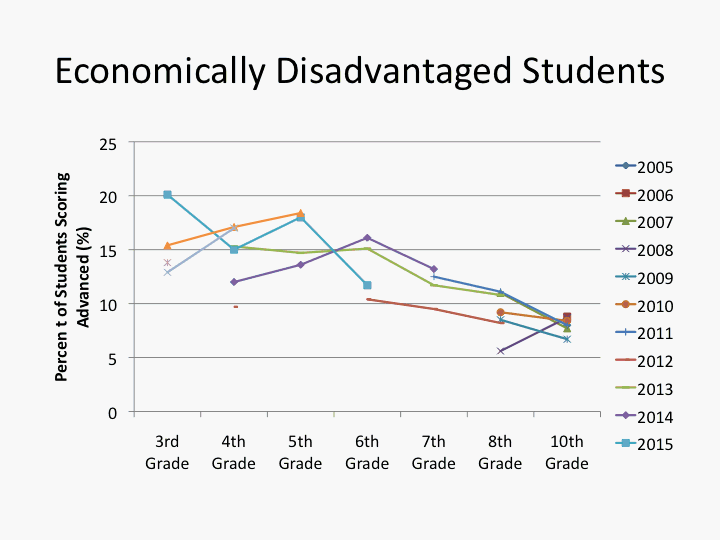
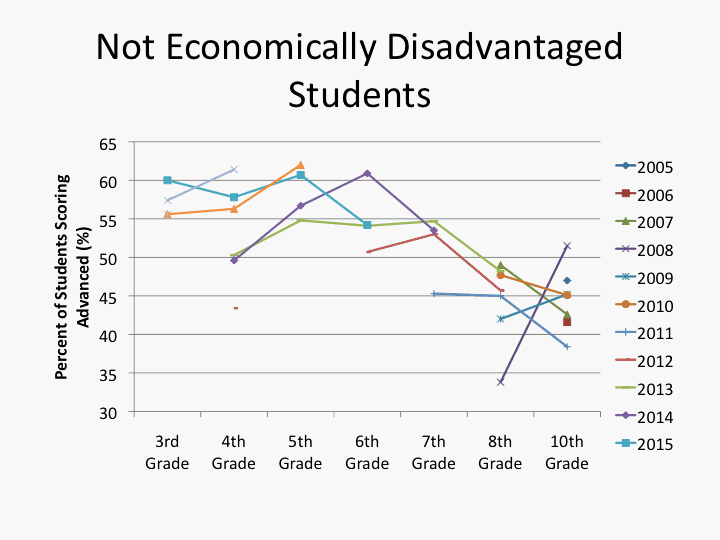
For many years now, parents and community members, including members of Madison United for Academic Excellence, have expressed concerns about the decline in rigor and the lack of adequate challenge in our district’s curriculum. The release this week of WKCE scores for the November 2008 testing led me to wonder about the performance of our district’s strongest students. While most analyses of WKCE scores focus on the percentages of students scoring at the Advanced and Proficient levels, these numbers do not tell us about changes in the percent of students at each particular level of performance. We can have large increases in the percent of students scoring at the Proficient and Advanced levels because we have improved the performance of students who were previously at the Basic level on the WKCE, but yet fail to have any effect on the performance of our district’s strongest students. This is the argument that we are improving the performance of our low ability students, but failing to increase the performance of our already successful students. An examination of the numbers of students who are performing at just the Advanced level on the WKCE provides us with some insight into the academic progress of our more successful students.
I decided to examine WKCE math scores for students across the district. While it is not possible to track the performance of individual students, it is possible to follow the performance of a cohort as they advance through the system. Thus students who are now in 10th grade, took the 8th grade WKCE in 2006 and the 4th grade test in 2002. Because there have been significant changes in the demographics of the district’s students, I split the data by socio-economic status to remove the possibility of declines in WKCE performance simply being the result of increased numbers of low income students. Although the WKCE has been criticized for not being a rigorous enough assessment tool, the data on our students’ math performance are not encouraging. The figures below indicate that the percent of students scoring at the Advanced level on the WKCE decreases as students progress through the system, and this decline is seen in both our low income students and in our Not Economically Disadvantaged students. The figures suggest that while there is some growth in the percent of Advanced performing students in elementary school, there is a significant decline in performance once students begin taking math in our middle schools and this decline continues through high school. I confess that I take no pleasure in sharing this data; in fact, it makes me sick.

Because it might be more useful to examine actual numbers, I have provided tables showing the data used in the figures above. Reading across a row shows the percent of students in a class cohort scoring at the Advanced level as they have taken the WKCE test as they progressed from grades 3 – 10.

Percent of Economically Disadvantaged Students Scoring at the Advanced Level on the WKCE Math Test Between 2002 and 2008

Graduation Year 3rd Grade 4th Grade 5th Grade 6th Grade 7th Grade 8th Grade 10th Grade
2005
8
2006
8.8
2007
11
7.7
2008
5.6
8.7
2009
8.5
6.7
2010
9.2
8.4
2011
12
12.5
11.1
8
2012
9.7
10.4
9.5
8.2
2013
15.3
14.7
15.1
11.7
10.8
2014
12
13.6
16.1
13.2
2015
20.1
15
18
11.7
2016
15.4
17.1
18.4
2017
12.9
17
2018
13.8

(more…)

Share

Cornell ’69 And What It Did

Donald Downs:

Forty years ago this week, an armed student insurrection erupted on the Cornell campus. I was a sophomore on campus at the time and later wrote a book on the events, Cornell ’69: Liberalism and the Crisis of the American University. To some the drama represented a triumph of social justice, paving the way for a new model of the university based on the ideals of identity politics, diversity, and the university as a transformer of society. To others, it fatefully propelled Cornell, and later much of American higher education, away from the traditional principles of academic freedom, reason, and individual excellence. “Cornell,” wrote the famous constitutional scholar Walter Berns, who resigned from Cornell during the denouement of the conflict, “was the prototype of the university as we know it today, having jettisoned every vestige of academic integrity.”
In the wee hours of Friday, April 19, 1969, twenty-some members of Cornell’s Afro-American Society took over the student center, Willard Straight Hall, removing parents (sometimes forcefully) from their accommodations on the eve of Parents Weekend. The takeover was the culmination of a year-long series of confrontations, during which the AAS had deployed hardball tactics to pressure the administration of President James Perkins into making concessions to their demands. The Perkins administration and many faculty members had made claims of race-based identity politics and social justice leading priorities for the university, marginalizing the traditional missions of truth-seeking and academic freedom.
Two concerns precipitated the takeover: AAS agitation for the establishment of a radical black studies program; and demands of amnesty for some AAS students, who had just been found guilty by the university judicial board of violating university rules. These concerns were linked, for, according to the students, the university lacked the moral authority to judge minority students. They declared that Cornell was no longer a university, but rather an institution divided by racial identities.

(more…)

Share

Expert panel says gifted students must be challenged

Wendy Owen, The Oregonian
For gifted children to succeed, they must be challenged, according to a panel of experts. Nearly 200 parents and educators filled the auditorium at Westview High School Thursday night to learn about the unique characteristics, best practices and identification methods for Talented and Gifted (TAG) students.
Gifted children lose their motivation when the work is too easy. Having never been challenged, they will lack the tools to deal with difficult work in the future, said Jean Gubbins, associate director of The National Research on the Gifted and Talented at the University of Connecticut. Beaverton, Hillsboro and Forest Grove school districts sponsored the panel as part of an ongoing review of their own TAG programs.
The panelists also stressed the importance of grouping gifted students in middle school, at least during some lessons. “They need time with like-ability peers,” said Hilda Rosselli, dean of the College of Education, Western Oregon State University. Educators should also seek out TAG students among English language learners, students from poverty and other under-served children, who are often overlooked as gifted, the panel said.

Share

Response to the Madison School District’s Math Task Force Recommendations

To: comment@madison.k12.wi.us
Cc: askey@math.wisc.edu
There are a number of points in the Summary of Administrative Response to MMSD Mathematics Task Force Recommendations which should be made. As a mathematician, let me just comment on comments on Recommendation 11. There are other comments which could be made, but I have a limited amount of time at present.
The first question I have is in the first paragraph. “One aspect of the balanced approach is represented in the four block approach to structuring mathematics lessons. The four blocks include Problem Solving, Number Work, Fluency and Maintenance and Inspecting Equations.” There is a missing comma, since it is not clear whether Maintenance goes with the previous word or the last two. However, in either case, “Inspecting Equations” is a strange phrase to use. I am not sure what it means, and when a mathematician who has read extensively in school mathematics does not understand a phrase, something is wrong. You might ask Brian Sniff, who seems to have written this report based on one comment he made at the Monday meeting, what he means by this.
In the next paragraph, there are the following statements about the math program used in MMSD. “The new edition [of Connected Math Project] includes a greater emphasis on practice problems similar to those in traditional middle and high school textbooks. The new edition still remains focused on problem-centered instruction that promotes deep conceptual understanding.” First, I dislike inflated language. It usually is an illustration of a lack of knowledge. We cannot hope for “deep conceptual understanding”, in school mathematics, and Connected Math falls far short of what we want students to learn and understand in many ways. There are many examples which could be given and a few are mentioned in a letter I sent to the chair of a committee which gave an award to two of the developers of Connected Mathematics Project. Much of my letter to Phil Daro is given below.
The final paragraph for Recommendation 11 deals with high school mathematics. When asked about the state standards, Brian Sniff remarked that they were being rewritten, but that the changes seem to be minimal. He is on the high school rewrite committee, and I hope he is incorrect about the changes since significant changes should be made. We now have a serious report from the National Mathematics Advisory Panel which was asked to report on algebra. In addition to comments on what is needed to prepare students for algebra, which should have an impact on both elementary and middle school mathematics, there is a good description of what algebra in high school should contain. Some of the books used in MMSD do not have the needed algebra. In addition, the National Council of Teachers of Mathematics has published Curriculum Focal Points for grades PK-8 which should be used for further details in these grades. Neither of these reports was mentioned in the response you were sent.

(more…)

Share

Severson on McKenna

Jim, thank you for posting the link to this fascinating set of rants on the MMSD school board. I STRONGLY suggest that people watch the committee meeting video that is available at: http://mediaprodweb.madison.k12.wi.us/Board+Meetings
Simply put, many of the critiques that Severson complains are not happening are in fact very much alive in school board debate, whether it comes to what needs to happen to improve the math curriculum to the reviews and changes in fiscal practice that are making it possible to close the spending gap without further trashing programs. I guess that Don was napping during the three meetings when the discussions were underway?
Or, I may be wrong. This may not be a manipulation of the truth for political purposes. You be the judge – watch the video – and see whether nothing is being done on significant issues as Severson asserts.

Share

Examining District Data on the Effects of PBIS

As noted in an earlier post, the school district presented data at Monday night’s meeting on the effects of implementing a strategy of Positive Behavioral Interventions and Support (PBIS). As the report notes, “Documenting behavior referrals is inconsistent across middle schools both in terms of what is recorded and where it is recorded.” While this makes it unwise to make comparisons across middle schools, as one school may refer students who are late to class while another only makes referrals as a consequence of fighting, it is valid to make comparisons across time within the same school in order to see what effect the implementation of PBIS has made on student behavior. Unfortunately, as readers of the report will observe, not even that data is consistently presented across the 11 middle schools where PBIS has been implemented. Some schools only have data for the current academic year, others only have data from February 2008 through February 2009, and others provide more.
While the behavioral scientist in me wants to comment on the parts of the report that are incomprehensible (the self-assessment survey schoolwide system analysis from each school) or redundant (providing charts that show time saved in both minutes, in hours, and in days), I will restrict my comments to the data that documents the effects of the implementation of PBIS. While there have been some impressive successes with PBIS, e.g., Sherman, there have also been failures, e.g., Toki. One interpretation would be that some schools have been successful implementing these strategies and we need to see what they are doing that has led to their success, another interpretation would be that PBIS has by and large failed and resulted in an increase in behavioral referrals across our middle schools. At this point, I’ll take the middle ground and say that this new approach to dealing with student behavior hasn’t made any difference. You can look at the table below and draw your own conclusions, Keep in mind though, as noted above, there is not consistency across schools in what sorts of behavioral problems get documented. It is also true that there is considerable variability in the absolute number of referrals across the 11 middle schools and across months, such that a 30% change in the number of behavioral referrals may reflect 45 referrals at Blackhawk, 10 referrals at Wright, and 170 referrals at Toki.

MMSD Behavioral Referral Data
(presented 4/13/09)

Comparison Data Provided Schools Results: Change from 07/08 to 08/09*
None

Cherokee

Jefferson

Whitehorse

 
One month only (February)

Blackhawk

30% decline (decrease of 40 referrals)

O’Keefe 10% decline (decrease of 10 referrals)
Spring Harbor 35% increase (increase of 8 referrals)
Wright 20% increase (increase of 7 referrals)
Six months (Sept. – Feb.)

Hamilton

Declines in Sept. (20%), Nov. (20%) and Dec. (10%); Increases October (40%) and Jan. (20%); No change in February

Sennett

Increases every month ranging from 5% (Dec.) to 75% (Feb.), median increase in referrals – 20%

Toki

Increases every month ranging from 7% (Nov.) to 200% (Sept), median increase in referrals – 68%

Multiple years Sherman Decreases every month ranging from 30% (Feb.) to 70% (Oct., a drop of more than 250 referrals), median decrease in behavioral referrals – 42%

* Note that these percentages are approximate based on visual inspection of the charts provided by MMSD

Share

19th Century Skills

13 April 2009
John Robert Wooden, the revered UCLA basketball coach, used to tell his players: “If you fail to prepare, you are preparing to fail.” According to the Diploma to Nowhere report last summer from the Strong American Schools project, more than one million of our high school graduates are in remedial courses at college every year. Evidently we failed to prepare them to meet higher education’s academic expectations.
The 21st Century Skills movement celebrates computer literacy as one remedy for this failing. Now, I love my Macintosh, and I have typeset the first seventy-seven issues of The Concord Review on the computer, but I still have to read and understand each essay, and to proofread eleven papers in each issue twice, line by line, and the computer is no help at all with that. The new Kindle (2) from Amazon is able to read books to you–great technology!–but it cannot tell you anything about what they mean.
In my view, the 19th (and prior) Century Skills of reading and writing are still a job for human beings, with little help from technology. Computers can check your grammar, and take a look at your spelling, but they can’t read for you and they can’t think for you, and they really cannot take the tasks of academic reading and writing off the shoulders of the students in our schools.
There appears to be a philosophical gap between those who, in their desire to make our schools more accountable, focus on the acquisition and testing of academic knowledge and skills in basic reading and math, on the one hand, and those who, from talking to business people, now argue that this is not enough. This latter group is now calling for 21st Century critical thinking, communication skills, collaborative problem solving, and global awareness.

(more…)

Share

Teachers union sent scripted questions to New York City Council members

Elizabeth Green:

At today’s education committee hearing, City Council members took turns questioning Department of Education officials on the rise of charters schools. Their questions were passionate, specific, and universally accusatory. They may have also been scripted.
Just before the hearing began, a representative of the city teachers union, which describes itself as in favor of charter schools, discreetly passed out a set of index cards to Council members, each printed with a pre-written question.
One batch of cards offered questions for the Department of Education, all of them challenging the proliferation of charter schools. “Doesn’t the Department have a clear legal and moral responsibility to provide every family in the city guaranteed seats for their children in a neighborhood elementary school?” one card suggested members ask school officials. “Isn’t the fundamental problem here the Department’s abdication of its most important responsibility to provide quality district public schools in all parts of the city?” another card said. (View more of the cards in the slideshow above.)
Several council members picked up on the line of thought. “Shouldn’t we aspire to have every school in the city good enough for parents to feel comfortable sending their children?” Melinda Katz, a Council member from Queens, said in questioning school officials. “I remember when Joel Klein became the chancellor,” the committee chair, Robert Jackson, said. “Back then, he used to talk about making every neighborhood school a good school where every parent would want to send their children. I don’t hear him talk about that anymore.”
Asked about the cards, union president Randi Weingarten provided a statement saying that she regretted the tactic. “We are often asked by the council for information and ideas about various issues. Additionally, when I am available, I often respond to what others testify to. In this instance, I was in Washington and couldn’t be at City Hall,” she said in the statement. “I am proud of the testimony we gave today, but I regret the manner in which our other concerns were shared.”

Share

Adolescent Literacy Flim-Flam

The Concord Review
3 April 2009
There is no question that lots of people around the nation are concerned about the literacy of American adolescents. They must be worried about the ability of our students to read and write, one would assume. It might also seem reasonable to take for granted that professionals interested in teen skills in reading books and writing papers would give close attention to those students who are now reading a fair amount of nonfiction and writing really exemplary research papers at the high school level.
At this point, expectations need to be altered a bit. Surely coaches of Adolescent Sports have a tremendous fascination with the best teen athletes in the country. There are lots of prizes and even scholarships for high school students who perform very well in football, soccer, basketball, baseball, etc., and there are even college scholarships for good teen cheerleaders. We might think it odd if all high school coaches cared about was physical education classes and even in those, only those student/athletes who were most un-coordinated and incompetent. Not that it is unimportant to worry about teens who are overweight and cannot take part in sports, but nevertheless, coaches tend to focus on the best athletes, and colleges and the society at large seem to think that is fine for them to do, and is even their job, some would say.
But when it comes to students who read well and write good term papers, the Literacy Community has no interest in them. It is only able to focus on the illiterate and incompetent among Adolescents, and their professional peers seem to think that is fine for them to do, and is even their real job. And it surely is important for them to help those who need help. They should do research and develop curricula and programs to help teens become more literate. They have been doing this for many decades, and yet more than a million of our high school graduates each and every year are in remedial (non-credit) courses when they are “admitted” (conditionally) to colleges around the country.
Perhaps the current approach to literacy training for young people might deserve a second look. The Chronicle of Higher Education surveyed college professors, 90% of whom reported that they thought the freshmen in their classes were not well prepared in reading, doing research, or writing term papers. Their high school teachers had thought they were well prepared, but college professors didn’t see it that way.
No doubt many of those students had the benefit of the Adolescent Literacy Initiatives of AdLit.org, National Council of Teachers of English, National Writing Project, Young Adult Library Services Association (YALSA), Alliance for Excellent Education, Partnership for Reading, National Adolescent Literacy Coalition, Learning Point Associates, Education Development Center, Council of Chief State School Officers, Scholastic, Adolescent Literacy Coaching Project (ALCP), National Governors’ Association, Journal of Adolescent & Adult Literacy, Adolescent Literacy Research Network, Adolescent Literacy Support Project, WGBH Adolescent Literacy website, and the International Reading Association, not to mention the many state and local literacy programs, and yet our students’ literacy still leaves a lot to be desired, even if they can graduate from high school.
To me it seems that, unlike coaches, the literacy pros are almost allergic to good academic work in reading and writing by our teens. I am not really sure why that would be the case, but in the last 20 years of working with exemplary secondary students of history from 44 states and 35 other countries, I have not found one single Literacy Organization or Literacy Program which had the slightest interest in their first-rate work, which I have been privileged to publish in 77 issues of The Concord Review so far. They have heard about it, but they don’t want to know about it, as far as I can tell.
It does seem foolish to me, that if they truly want to improve the reading and writing of adolescents, they don’t take a tiny bit of interest in exemplary reading and writing at the high school level, not only in the students’ work, but even perhaps in the work of the teachers who guided them to that level of excellence, just as high school coaches are interested in the best athletes and perhaps their coaches as well.
They could still spend the bulk of their time on grants given them to do “meta-analyses” of Literacy Strategies and the like, but it seems really stupid not to glance once or twice at very good written work by our most diligent teens (the Literate Adolescents).
Of course, I am biased. I believe that showing teachers and students the best term papers I can find will inspire them to try to reach for more success in literacy, and some of my authors agree with me: e.g. “When a former history teacher first lent me a copy of The Concord Review, I was inspired by the careful scholarship crafted by other young people. Although I have always loved history passionately, I was used to writing history papers that were essentially glorified book reports…As I began to research the Ladies’ Land League, I looked to The Concord Review for guidance on how to approach my task…In short, I would like to thank you not only for publishing my essay, but for motivating me to develop a deeper understanding of history. I hope that The Concord Review will continue to fascinate, challenge and inspire young historians for years to come.” Emma Curran Donnelly Hulse, Columbia Class of 2009; North Central High School (IN) Class of 2005……”The opportunity that The Concord Review presented drove me to rewrite and revise my paper to emulate its high standards. Your journal truly provides an extraordinary opportunity and positive motivation for high school students to undertake extensive research and academic writing, experiences that ease the transition from high school to college.” Pamela Ban, Harvard Class of 2012; Thomas Worthington High School (OH) Class of 2008…
But what do they know? They are just some of those literate adolescents in whom the professional adolescent literacy community seems to have no interest.
“Teach by Example”
Will Fitzhugh [founder]
Consortium for Varsity Academics® [2007]
The Concord Review [1987]
Ralph Waldo Emerson Prizes [1995]
National Writing Board [1998]
TCR Institute [2002]
730 Boston Post Road, Suite 24
Sudbury, Massachusetts 01776 USA
978-443-0022; 800-331-5007
www.tcr.org; fitzhugh@tcr.org
Varsity Academics®

Share

Wider testing to ID kids

Rhonda Bodfield
Arizona Daily Star

Even as schools across the state brace for sky-is-falling budget cuts, the Tucson Unified School District program for gifted and talented students is prepping for dramatic growth in the next school year.
The district plans to double the number of students it tests — up to 10,000 — and will send postcards to every family about testing opportunities.
As a result of state and federal requirements, it also will begin offering gifted classes for kindergartners and for juniors and seniors in high school.
Currently, parents request testing to see if their children qualify. That’s a system that can be full of pitfalls in lower-income areas where parents miss the newsletter because they may be working two jobs, for example, or where language barriers might lead to missed deadlines, let alone confusion over how to access the program.

Share

Reading Test Dummies

E.D. Hirsch
In his recent education speech, President Obama asked the states to raise their standards and develop “assessments that don’t simply measure whether students can fill in a bubble on a test.” With the No Child Left Behind law up for reauthorization this year, the onus is now on lawmakers and educators to find a way to maintain accountability while mitigating the current tendency to reduce schooling to a joyless grind of practice exams and empty instruction in “reading strategies.”
Before we throw away bubble tests, though, we should institute a relatively simple change that would lessen the worst effects of the test-prep culture and improve education in the bargain.
These much maligned, fill-in-the-bubble reading tests are technically among the most reliable and valid tests available. The problem is that the reading passages used in these tests are random. They are not aligned with explicit grade-by-grade content standards. Children are asked to read and then answer multiple-choice questions about such topics as taking a hike in the Appalachians even though they’ve never left the sidewalks of New York, nor studied the Appalachians in school.
Teachers can’t prepare for the content of the tests and so they substitute practice exams and countless hours of instruction in comprehension strategies like “finding the main idea.” Yet despite this intensive test preparation, reading scores have paradoxically stagnated or declined in the later grades.
This is because the schools have imagined that reading is merely a “skill” that can be transferred from one passage to another, and that reading scores can be raised by having young students endlessly practice strategies on trivial stories. Tragic amounts of time have been wasted that could have been devoted to enhancing knowledge and vocabulary, which would actually raise reading comprehension scores.

Share

Core Knowledge Foundation Blog, Take That, AIG!

Published by Robert Pondiscio on March 20, 2009 in Education News and Students:

An upstate New York high school student could teach a course in character to the bonus babies of AIG. Nicole Heise of Ithaca High School was one of The Concord Review’s six winners of The Concord Review’s Emerson Prize awards for excellence this year. But as EdWeek’s Kathleen Kennedy Manzo tells the story, she sent back her prize, a check for $800, with this note:
“As you well know, for high school-aged scholars, a forum of this caliber and the incentives it creates for academic excellence are rare. I also know that keeping The Concord Review active requires resources. So, please allow me to put my Emerson award money to the best possible use I can imagine by donating it to The Concord Review so that another young scholar can experience the thrill of seeing his or her work published.”
The Concord Review publishes research papers by high school scholars. It’s a one-of-a-kind venue for its impressive young authors. Manzo notes TCR “has won praise from renowned historians, lawmakers, and educators, yet has failed to ever draw sufficient funding…It operates on a shoestring, as Founder and Publisher Will Fitzhugh reminds me often. Fitzhugh, who has struggled for years to keep the operation afloat, challenges students to do rigorous scholarly work and to delve deeply into history. His success at inspiring great academic work is juxtaposed against his failure to get anyone with money to take notice.”
Young Ms. Heise noticed. Anyone else?

“Teach by Example”
Will Fitzhugh [founder]
Consortium for Varsity Academics® [2007]
The Concord Review [1987]
Ralph Waldo Emerson Prizes [1995]
National Writing Board [1998]
TCR Institute [2002]
730 Boston Post Road, Suite 24
Sudbury, Massachusetts 01776 USA
978-443-0022; 800-331-5007
www.tcr.org; fitzhugh@tcr.org
Varsity Academics®

Share

Wisconsin State Budget Forum, Wed. April 1, Wright Middle School, 6 p.m.

Joe Quick:

Dear MMSD Advocate,
Every two years, state government adopts a biennial budget that funds nearly every program in state government. Gov. Jim Doyle’s budget mostly protects K-12, but many K-12 programs were cut by 1%. Due to the floundering national/state economy millions of dollars in federal stimulus funds for Wisconsin are being used to provide a one-time boost to state funding for schools over the next two years.
Short-term, there are some important items in the budget that will help MMSD; but long-term, little is being done to end the annual ritual of either going to referendum or determining what programs and services for students must be cut to balance the local budget.
In the two-year legislative cycle, April in odd years is probably the most important time to contact your legislator to advocate for school programs. Whether it’s SAGE, the K-3 class size reduction program funded by the state, or funding for students in special education — the biennial budget provides the resources.
If you want to advocate to protect school programs/services, please come to the State Budget Forum on April 1st (see attached flier [54K PDF]) to learn about the issues, receive information to help you with that advocacy and find out what is being done to bring about comprehensive school funding reform.
Please forward this information to others who might be interested. Hope to see you April 1st,
Joe Quick
Legislative Liaison/Communication Specialist
Madison Schools
608 663-1902

Share

Students See Value in History-Writing Venue

Education Week “Curriculum Matters”
Kathleen Kennedy Manzo 17 March 2009:

It is difficult to figure why some education ventures attract impressive financial and political support, while others flounder despite their value to the field. For years, I’ve written about The Concord Review and the really amazing history research papers it publishes from high school authors/scholars.
The Review has won praise from renowned historians, lawmakers, and educators, yet has failed to ever draw sufficient funding. The range of topics is as impressive as the volume of work by high school students: In 77 issues, the 846 published papers have covered topics from Joan of Arc to women’s suffrage, from surgery during the Civil War to the history of laser technology. (The papers average more than 7,000 words, and all have been vetted for accuracy and quality. Many of the students do these research papers for the experience and knowledge they gain, not for school credit.)
But here’s the kicker: It operates on a shoestring, as Founder and Publisher Will Fitzhugh reminds me often. Fitzhugh, who has struggled for years to keep the operation afloat, challenges students to do rigorous scholarly work and to delve deeply into history. His success at inspiring great academic work is juxtaposed against his failure to get anyone with money to take notice.
Well, if the grown-ups in the world have failed to recognize and reward the Review for its 22 years of contributions, the students themselves have not.
Fitzhugh has shared many of the letters he receives from students whose work has been published in The Concord Review over the years. Yesterday, he shared with me one of the most memorable of those letters, which arrived recently at his Sudbury, Massachusetts, office.
Nicole Heise won one of the Review’s Emerson Prize awards for excellence this year. The senior at Ithaca High School in Upstate New York sent the check back, with this note:
“As you well know, for high school-aged scholars, a forum of this caliber and the incentives it creates for academic excellence are rare. I also know that keeping The Concord Review active requires resources. So, please allow me to put my Emerson award money to the best possible use I can imagine by donating it to The Concord Review so that another young scholar can experience the thrill of seeing his or her work published.”

(more…)

Share

Degree of Difficulty

Will Fitzhugh
The Concord Review
7 March 2009
In gymnastics, performances are judged not just on execution but also on the degree of difficulty. The same system is used in diving and in ice skating. An athlete is of course judged on how well they do something, but their score also includes how hard it was to do that particular exercise.
One of the reasons, in my view, that more than a million of our high school graduates each year are in remedial courses after they have been accepted at colleges is that the degree of difficulty set for them in their high school courses has been too low, by college standards.
Surveys comparing the standards of high school teachers and college professors routinely discover that students who their teachers judge to be very well prepared, for instance in reading, research and writing, are seen as not very well prepared by college professors.
According to the Diploma to Nowhere report issued last summer by the Strong American Schools project, tens of thousands of students are surprised, embarrassed and depressed to find that, after getting As and Bs in their high school courses, even in the “hard” ones, they are judged to be not ready for college work and must take non-credit remedial courses to make up for the academic deficiencies that they naturally assumed they did not have.
If we could imagine a ten point degree-of-difficulty scale for high school courses, surely arithmetic would rank near the bottom, say at a one, and calculus would rank at the top, near a ten. Courses in Chinese and Physics, and perhaps AP European History, would be near the top of the scale as well.
When it comes to academic writing, however, and the English departments only ask their students for personal and creative writing, and the five-paragraph essay, they are setting the degree of difficulty at or near the bottom of the academic writing scale. The standard kind of writing might be the equivalent of having math students being blocked from moving beyond fractions and decimals.

(more…)

Share

Killers of Writing

“Even before students learn to write personal essays.” !!!
[student writers will now become “Citizen Composers,” Yancey says.]
Wednesday, March 4, 2009
Eschool News
NCTE defines writing for the 21st century
New report offers guidance on how to update writing curriculum to include blogs, wikis, and other forms of communication
By Meris Stansbury, Associate Editor:

Digital technologies have made writers of everyone.
The prevalence of blogs, wikis, and social-networking web sites has changed the way students learn to write, according to the National Council of Teachers of English (NCTE)–and schools must adapt in turn by developing new modes of writing, designing new curricula to support these models, and creating plans for teaching these curricula.
It’s time for us to join the future and support all forms of 21st-century literacies, [both] inside…and outside school,” said Kathleen Blake Yancey, a professor of English at Florida State University, past NCTE president, and author of a new report titled “Writing in the 21st Century.”
Just as the invention of the personal computer transformed writing, Yancey said, digital technologies–and especially Web 2.0 tools–have created writers of everyone, meaning that even before students learn to write personal essays, they’re often writing online in many different forms.
“This is self-sponsored writing,” Yancey explained. “It’s on bulletin boards and in chat rooms, in eMails and in text messages, and on blogs responding to news reports and, indeed, reporting the news themselves…This is a writing that belongs to the writer, not to an institution.”

(more…)

Share

Madison School Board: Legislative Session and Fine Arts Task Force

Legislative Informational Community Session: We are holding a special Board meeting to focus on legislative issues on Wednesday April 1 at 6:00pm at Wright Middle School. At this session we will provide updates on school funding and state budget issues that affect the MMSD. We will discuss and share strategies on how the community can get involved in advocating for our schools.
Fine Arts Task Force (FATF) Informational Community Sessions: The focus of each session will be a presentation of the findings and recommendations of the FATF followed by an opportunity for discussion. The Executive Summary and complete FATF report can be found at http://www.madison.k12.wi.us/boe/finearts/ Tuesday, March 10, 6:00-8:00pm, Memorial High School. Thursday, March 12, 6:00-8:00pm, La Follette High School LMC.

Share

How To Be A Genius

Forbes – Scott Berkun
Have you got what it takes to be seen as a genius? Do you really want to?
Geniuses don’t exist in the present. Think of the people you’ve met: Would you call any of them a genius in the Mozart, Einstein, Shakespeare sense of the word? Even the MacArthur Foundation’s “genius” grants don’t call their winners geniuses.
We throw the g-word around where it’s safe: in reference to dead people. Since there’s no one alive who witnessed Wolfgang Amadeus Mozart pee in his kindergarten pants or saw young Pablo Picasso eating crayons, we can call them geniuses in safety, as their humanity has been stripped from our memory.
Even if you believe geniuses exist, there’s little consensus on what being a genius means. Some experts say genius is the capacity for greatness. Others believe it’s that you’ve accomplished great things.
Forget this pointless debate. Chasing definitions never provides what we want: a better understanding of how to appreciate, and possibly become, interesting creative people.
Be obsessed with work
Show me a genius and I’ll show you a workaholic. Van Gogh produced 2,000 works of art between 1880 and 1890 (or 1,100 paintings and 900 sketches). That’s four works of art a week for a decade. He didn’t even get started until age 25.
Da Vinci’s journals represent one clear fact: Work was the center of his life. He had neither a spouse nor children. Picasso was a machine, churning out 12,000 works of art. He said, “Give me a museum and I’ll fill it” and made good on that boast. Shakespeare wrote more than 40 plays, plus dozens of sonnets, poems and, of course, grocery lists.
These are people who sacrificed many ordinary pleasures for their work.
The list of lazy geniuses is short. There are burnouts, suicides and unproductive years in retreat–but none could be called slackers.
Have emotional or other serious problems
For all their brilliance, most geniuses did not live well-adjusted lives. Picasso, Van Gogh, Edison, Einstein and Nietzsche (and most major modern philosophers) were often miserable. Many never married or married often, abandoned children and fought depression.
Newton and Tesla spent years in isolation by choice and had enough personality disorders to warrant cabinets full of pharmaceuticals today. Michelangelo and da Vinci quit jobs and fled cities to escape debts.
Kafka and Proust were both hypochondriacs, spending years in bed or in hospitals for medical conditions, some of which were psychological. Voltaire, Thoreau and Socrates all lived in exile or poverty, and these conditions contributed to the works they’re famous for.
Happily positive emotions can work as fuel, too. John Coltrane, C.S. Lewis and Einstein had deeply held, and mostly positive, spiritual beliefs that fueled their work.
But the real lesson is that all emotions, positive or negative, provide fuel for work and geniuses are better at converting their emotions into work than more ordinary people.
Don’t strive for fame in your own lifetime
Most people we now consider geniuses received little publicity in their lifetimes compared with the accolades heaped on them after their deaths. Kafka and Van Gogh died young, poor and with little fame.
Desiring fame in the present may spoil the talents you have. This explains why many young stars have one amazing work but never rise to the same brilliance later: They’ve lost their own opinions. Perhaps it’s best to ignore opinions except from a trusted few and concentrate on the problems you wish to solve.
To focus on learning and creating seems wise. Leave it to the world after you’re gone to decide if you were a genius or not. As long as you’re free to create in ways that satisfy your passions and a handful of fans, you’re doing better than most, including many of the people we call geniuses.

Share

West High School presents Stephen Sondheim’s “Into the Woods”

An ambivalent Cinderella? A blood-thirsty Little Red Riding Hood? Prince Charming with a roving eye? A Witch… who raps? They’re all among the cockeyed characters in James Lapine and Stephen Sondheim’s fractured fairy tale “Into the Woods.” When the Baker and his Wife learn they’re cursed with childlessness, they embark on a quest for the special objects required to break the spell ­ swindling, lying and stealing from Cinderella, Little Red, Rapunzel, and Jack (of beanstalk fame). One of Sondheim’s most popular works, this timeless yet relevant piece is a rare modern classic.
Performance and ticket information:
March 6, 7, 13 and 14 • 7:30 pm • West High Auditorium
Tickets are $8 for students and $10 for adults
Buy your tickets online now at www.seatyourself.biz/mwhs
Please join the West HS community in a celebration of the arts in our schools. This year’s cast is exceptionally talented and a Sondheim musical is always a treat. “Into the Woods” is a production not to be missed!
Note: “Into the Woods” is not appropriate theater fare for elementary school and younger, less mature middle school children; however, do not worry if you’re child’s class is going to the school performance on March 10. They are only doing the first act for that performance and the first act is delightfully appropriate for young audiences.

Share

What’s Memorial Done Lately?

Madison Memorial has had a pretty good couple of weeks. Last night the boys basketball team won its sixth straight Big Eight conference championship in a rollicking and highly-entertaining showdown with conference runner-up Madison East. Last week, Memorial’s boys swimming team won the state championship. Today’s State Journal reports that Memorial senior Suvai Gunasekaran will be heading off to Washington as one of the 40 finalists in the Intel Science Talent Search. And last week Memorial senior violinist Ben Seeger was the winner of the Steenbock Youth Music Award in the Bolz Young Artist Competition.
It’s also worth pointing out that Suvai will be joined by Gabriela Farfan of West at the Intel Science Talent Search (and so MMSD is supplying 5% of the nation’s finalists), and that Ben was joined in the Bolz Young Artists Competition finals by Alice Huang of West (the overall winner) and Ansel Norris of East (and so MMSD supplied 75% of the finalists in this statewide competition).
Madison schools – a diversity of excellence.

Share

Moscow Math Festival for 6th and 7th Graders

Click on the photo to view a larger version.

Here are the problems from this past Sunday’s Moscow Math Festival for Grade 6 [PDF] (1,275 participants) and Grade 7 [PDF] (888 participants), along with a few photos (the competition was held at Moscow State University, using three buildings).

Share

Letters: ‘A’ Is for Achievement, ‘E’ Is for Effort

Letters to the Editor: NY Times:

Student Expectations Seen as Causing Grade Disputes” (news article, Feb. 18) indicates a rather recent phenomenon among college students.
Students from the earliest grades are encouraged to work hard and told that the rewards will follow. Students must realize that a grade is earned for achievement and not for the effort expended.
Yes, some students can achieve at higher levels with far less effort than others.
This mirrors the world beyond college as well.
In my experience as dean, when students complain about a professor’s grading, they seem to focus more on their “creative” justifications (excuses) rather than on remedies. Most faculty members stress the remedy that leads to achievement of instructional goals.
The time-honored mastery of the material should remain paramount. After all, this is what our society expects!
Alfred S. Posamentier
Dean, School of Education
City College of New York, CUNY
New York, Feb. 18, 2009

To the Editor:
As someone who recently went through the ordeal of contesting a grade, I was quite impassioned on reading your article. I have done this only once in four years, so not all of us take the matter lightly.
I resent the suggestion that students feel “entitled” to “get/receive” good grades.
What is so irrational about believing that hard work should warrant a high grade? I would argue that the very core of the American dream is the sentiment that one can achieve any greatness that he or she aspires to if he or she works hard enough.
When one puts one’s all into a class, it’s not shameful to hope that grades reflect that. The same applies to professionals and their salaries. Instead of psychoanalyzing their students, perhaps these professors should ask themselves this question: If your students are all really this despicable, why are you teaching?
Aimee La Fountain
New York, Feb. 18, 2009
The writer is a senior at Marymount Manhattan College.

Share

Teaching Techno-Writing

Insidehighered.com:

A new report calls on English instructors to design a new curriculum and develop new pedagogies — from kindergarten through graduate school — responding to the reality that students mostly “write to the net.”
“Pencils are good; we won’t be abandoning them,” said Kathleen Blake Yancey, author of “Writing in the 21st Century,” a report from the National Council of Teachers of English.”They’re necessary, as a philosopher would put it, but not sufficient to the purpose.”
Yancey, a professor of English at Florida State University and immediate past president of NCTE, described by way of example the case of Tiffany Monk, a Florida teen who, during a flood caused by Tropical Storm Fay, observed that her neighbors were trapped in their homes. She took photos and sent an e-mail to a radio station; help soon arrived.
This was composing in the 21st century. She chose the right technology, she wrote to the right audience,” Yancey said, during a panel presentation at the National Press Club Monday.
Where did Monk learn to do this? Not in school, said Yancey, where “we write on a topic we haven’t necessarily chosen. We write to a teacher; we write for a grade.”
Also on Monday, NCTE announced a National Day of Writing (October 20) and plans to develop a National Gallery of Writing intended to expand conventional notions of composition. Starting this spring, NCTE is inviting anyone and everyone to submit a composition of importance to them, in audio, text or video form; acceptable submissions for the gallery include letters, e-mail or text messages, journal entries, reports, electronic presentations, blog posts, documentary clips, poetry readings, how-to directions, short stories and memos.
Amid all the focus on new platforms for writing, a panelist who made his name as a nonfiction writer in pre-digital days, Gay Talese, made a case for old-fashioned research methods. Research, he said, “means leaving the desk; it means going out and spending lots of time with people [or books? Will F.]…The art of hanging out, I call it.”
“Googling your way through life, acquiring information without getting up, I think that’s dangerous,” Talese said.
“The modality isn’t what’s crucial,” said Kent Williamson, executive director of NCTE. What is, he continued, is “a commitment to the process” and deep engagement with a subject.
— Elizabeth Redden

Complete report [436K PDF]

Share

Don’t Show & Don’t Tell

It is an actual true fact that many if not most educators in our high schools do not allow students in general to see the exemplary academic work of their peers in their own school. (Academic work in this case does not include dance, drama, newspaper, music, band, yearbook, etc.).
The feeling seems to be that if students are exposed to this good work they will be surprised, envious, discouraged, intimidated, and more likely just to give up and stop trying to do good academic work themselves.
For these reasons, it is another actual true fact that many history and social studies teachers at the high school level have taken care not to let their students see the exemplary history research papers published in The Concord Review over the last twenty years, for many of the same reasons, including a general desire to protect their students from the dangerous and damaging effects of academic competition, which are believed to have the same risk of producing those feelings of envy, depression, anxiety, and intimidation mentioned above.
Putting aside for the moment those risks seen to be attendant on having students shown and/or told about the exemplary academic work of their high school peers, isn’t it about time that we turned our attention to another potential source of those same harmful feelings we have described?
In fact, many, if not most, high school basketball players are known not only to be exposed to and to watch games played by other students at their own school, but also they may be found, in season, watching college basketball games, and even professional NBA games, with no educator or counselor even monitoring them while they do.
Surely, the chances of the majority of high school basketball players getting a four-year college athletic scholarship are slim, and their chances are vanishingly small of ever playing for an NBA team. And yet, we carelessly allow them to watch these players, whose skill and performance may far exceed their own, even though the chance of their experiencing envy, anxiety, intimidation, and so on, must be as great as they would feel in being exposed to exemplary academic work, which we carefully guard them from!
While there may be nothing we can practically do at present to prevent them from watching school concerts, plays, dance recitals, and band performances, or reading the school newspaper, we must take a firmer line when it comes to allowing them, especially in their own homes, or visiting with their friends, to watch college and professional sports presentations.
We should try to be consistent. If we truly believe that showing students and/or telling them about fine academic work by people their own age is harmful, we must take a firmer stand in blocking their access to games and matches, particularly on national television, which expose them to superior athletic performances.

(more…)

Share

A More Joyous Approach: “The War of the Roses”

The Economist:

Queenly Cate Blanchet turns her attention to Richard II
Cate Blanchett is known for the pale beauty of her face and her vivid film performances. Her latest work marks a significant change of pace. As the curtain rises at the Sydney Theatre, she sits centre-stage, a still figure in a white blouse and trousers, blond hair, high cheekbones. A storm of golden petals drifts down from the ceiling, and she wears a crown.
It has become fairly commonplace for film actors to star in London’s West End and on Broadway, but this transposition is different. Miss Blanchett is playing the king in Shakespeare’s Richard II, the first part of a rigorously condensed version of the eight history plays. Miss Blanchett and her husband, Andrew Upton, have become artistic directors of the Sydney Theatre Company, an organisation which already has a fine opinion of itself. “In so far as there is a National Theatre in Australia, the Sydney Theatre Company is it,” says Bob Brookman, the general manager.
Sydney’s “The War of the Roses” ruthlessly cuts the histories down to two evening performances, each lasting a little under four hours, focusing on the death of kings and the hollowness of their crown. If this production, performed as part of the Sydney Festival and now on tour, is a clue to the nature of Miss Blanchetts’ regime, it will be energetic, controversial, ambitious, and, to use one of Miss Blanchett’s favorite adjectives, “noisy.” Casting her as Richard II was the bold idea of the director, the fearless 36-year-old Benedict Andrews. Having an actress play Richard II is not original: Fiona Shaw did it in London in 1995. But casting a woman as Richard III most certainly is. He is played by Pamela Rabe, one of Australia’s most accomplished actors, without a hump and with a heavy sense of irony, which provokes tense laughter in unlikely places.
Miss Rabe is not as self-consciously feminine as Miss Blanchett, who deploys laughter–her own–to dramatise the alienation of the king from his court, and fondly adopts girlish poses during the deposition scene in which Richard passes the crown to Bolingbroke. Shakespearean actors need to drill their vocal cords and Miss Blanchett seemed a little short of training, but she made a likeable, vulnerable, androgynous monarch. Given the extent of the cuts and transpositions, there could be no lingering over the development of character. The playful relationship between Prince Hal (Ewen Leslie) and Falstaff (John Gaden), for example, was speedily established by Hal fellating Falstaff. Sydney was not fazed.
Many of Australia’s best actors have emigrated in search of larger audiences and new writers. Miss Blanchett want to bring in a younger audience to the Sydney Theatre Company’s performances. “We’re hoping to take a more joyous approach,” Mr. Upton said recently. Miss Blanchett and Mr. Upton also want to develop the company’s reputation abroad as well as at home. Later this year their production of A Streetcar Named Desire, directed by Liv Ullman with Miss Blanchett as Blanche Dubois, travels to the Kennedy Centre in Washington, DC, and the Brooklyn Academy of Music. In this case of celebrity culture, the emphasis will be on the culture.

Share

Our Greatest National Shame

Nicholas Kristof

So maybe I was wrong. I used to consider health care our greatest national shame, considering that we spend twice as much on medical care as many European nations, yet American children are twice as likely to die before the age of 5 as Czech children — and American women are 11 times as likely to die in childbirth as Irish women.
Yet I’m coming to think that our No. 1 priority actually must be education. That makes the new fiscal stimulus package a landmark, for it takes a few wobbly steps toward reform and allocates more than $100 billion toward education.
That’s a hefty sum — by comparison, the Education Department’s entire discretionary budget for the year was $59 billion — and it will save America’s schools from the catastrophe that they were facing. A University of Washington study had calculated that the recession would lead to cuts of 574,000 school jobs without a stimulus.
“We dodged a bullet the size of a freight train,” notes Amy Wilkins of the Education Trust, an advocacy group in Washington.
So for those who oppose education spending in the stimulus, a question: Do you really believe that slashing half a million teaching jobs would be fine for the economy, for our children and for our future?

Share

College is Too Hard

For the last twenty years of so, I and others have argued, without much success, that our high schools should assign students complete nonfiction books and serious academic research papers at least once in their high school careers, so that if they decide to go on to college, they will be partly prepared for the reading lists of nonfiction books and the term paper assignments they would find there.
I now realize that I have been going about this all the wrong way. Instead of publishing 846 exemplary history research papers by high school students from 36 countries since 1987, in an effort to inspire high school students and their teachers to give more attention to real history books and research papers, I should have lobbied for a change in the academic requirements at the college level instead!
If colleges could simply extend many of their current efforts to eliminate books by dead white males, and to have students write more about themselves in expository writing courses, and could gradually guide students away from the requirements for reading nonfiction books and writing term papers, then the pressure to raise academic standards for reading and writing in our high schools could be further relaxed, relieving our students of all that pressure to become well educated.
Many colleges are leading the way in this endeavor, abandoning courses in United States history, and reducing the number of assigned books, many of which are even older than the students themselves. It is felt that movies by Oliver Stone and creative fiction about vampires may be more relevant to today’s 21st Century students than musty old plays by Shakespeare, which were not even written in today’s English, and long difficult history books written about events that probably happened before our students were even born!
Courses about the oppression of women, which inform students that all American presidents so far have been men, and courses which analyze the various Dracula movies, are much easier for many students to relate to, if they have never read a single nonfiction book or written one history research paper in their high school years.

(more…)

Share

February 1994: Now They Call it 21st Century Skills

Charles J. Sykes:

Dumbing Down Our Kids–What’s Really Wrong With Outcome Based Education
Charles J. Sykes, Wisconsin Interest, reprinted in Network News & Views 2/94, pp. 9-18
Joan Wittig is not an expert, nor is she an activist. She just didn’t understand why her children weren’t learning to write, spell, or read very well. She didn’t understand why they kept coming home with sloppy papers filled with spelling mistakes and bad grammar and why teachers never corrected them or demanded better work. Nor could she fathom why her child’s fourth-grade teacher would write, “I love your story, especially the spelling,” on a story jammed with misspelled words. (It began: “Once a pona time I visited a tropical rian forist.”)
While Wittig did not have a degree in education, she did have some college-level credits in education and a “background of training others to perform accurately and competently in my numerous job positions, beginning in my high school years.” That experience was enough for her to sense something was wrong. She was not easily brushed off by assurances that her children were being taught “whole language skills.” For two years, she agonized before transferring her children from New Berlin’s public schools to private schools.
After only a semester at the private schools, her children were writing and reading at a markedly higher level. Their papers were neatly written, grammatical, and their spelling was systematically corrected.
Earlier this year, she decided to take her story to her local school board.

(more…)

Share

That is Personal

When English teachers ask students to write personal journals and then turn them in for the teacher to read, the teachers have a chance to learn about the students’ hopes, wishes, dreams, fantasies, family life, anxieties, ambitions, fears, and so on.
There are several problems with this practice. The first is, of course, that none of this information is any of the teachers’ business. It is personal. The second problem is that asking students to spend time thinking about and writing about themselves for schoolwork is essentially anti-academic.
Teachers and students have real academic tasks. Teachers of literature should bring students to an understanding and appreciation of great writing that is not about the students themselves. Teachers of history have an obligation to introduce their students to historical events and persons well beyond the lives and experiences of the students. Math, science, foreign languages and other disciplines have little interest in the personal lives of the students. Teachers of those subjects have academic material they want students to learn as soon as they can.
However, in the English departments, there seems to be an irresistible attraction to probing the personal lives of the students. For some, the excuse is relevance. It seems hard to get students interested in anything besides themselves, they complain, so why not have students write, if they write about anything, about their own lives. This is seen as reaching out to where the students are, when what they should be doing is encouraging students to reach outside themselves to the grand and wide worlds of knowledge to be found in academic tasks and pursuits.
For some teachers, the excuse is perhaps curiosity. It can be amusing and diverting to read what students reveal about their personal lives, and some teachers may tell themselves that they will be better teachers if they can invade students’ privacy in this way, and perhaps tailor their instruction and counsel to each student’s personal fears and concerns. But this is not their job, nor is it a job for which they have been trained, educational psychology classes notwithstanding.

(more…)

Share

Singapore Math Bill Approved in Utah

Lisa Schencker:

Some lawmakers want Utah to follow the lead of a tiny Asian country when it comes to teaching math.
A senate committee Friday morning approved a bill, SB 159, that would allow districts and charter schools to apply for grants to use the Singapore method to teach math. Singapore is one of the highest scoring countries on international math tests.
In Singapore, math students are encouraged to think visually and develop mental strategies to solve problems. They’re discouraged from using paper to compute math problems.
“We seek to create a school system that will produce a significant percentage of the scientists and engineers needed by our country,” said Sen. Howard Stephenson, R-Draper, who is sponsoring the bill.
SB 159 would offer competitive grants to districts that come up with plans for teaching Singapore math in kindergarten through sixth grade and some secondary school classes. The bill would also require districts to train teachers in Singapore math and offer grants to colleges and other groups to train mathematicians to be teachers.
“I believe this will raise the math abilities of everyone in the state,” said Aaron Bertram, chairman of the University of Utah mathematics department.

Share

Is it ‘merit pay’ if nearly all teachers get it?

Emily Johns:

A state program meant to give only effective Minnesota teachers merit pay raises instead appears to be rewarding nearly all the teachers participating in it with more money.
The program, called “Q Comp,” is one of Gov. Tim Pawlenty’s top initiatives to improve schools, and many educators say it is strengthening teacher evaluations and training. But others are questioning whether Q Comp has just become a cash handout.
In 22 school districts whose Q Comp practices were examined by the Star Tribune, more than 99 percent of teachers in the program received merit raises during the most recent school year.
Only 27 of the roughly 4,200 teachers eligible did not get a pay raise.
The state gave schools $64 million to spend on Q Comp, which stands for quality compensation, during the 2007-08 school year. Pawlenty is now proposing to increase spending on the program by $41 million next year. But some lawmakers are questioning that step.
“Why should we expand it statewide when there is no evidence that it’s improving anything?” asked Rep. Mark Buesgens, R-Jordan.
“Let’s quit the charade, let’s give every district another $300 per pupil, and quit bluffing.”
Pawlenty’s spokesman Brian McClung defended the program Friday as “a move towards greater emphasis on student achievement and the measures that lead to [it].” He added, “Ideally Q Comp would demand more, but we had to compromise with a Legislature that was uncomfortable going further.”
Test data suggest that, so far, students in school districts in at least their third year of Q Comp have not shown more improvement in reading and math than students in schools not participating in the program.
The Minnesota Department of Education asserts that it is too early in the program’s life to make substantive comparisons about how Q Comp is affecting student achievement. In a statement Friday, Education Commissioner Alice Seagren said the department has faith in the program.
“We believe that Q Comp will lead to higher levels of student achievement, students who are college-and-work ready upon graduation, and a larger supply of qualified workers for our state’s employers,” she said.
School superintendents, meanwhile, say the money involved–up to $260 per pupil this year–has been a major draw in an era of budget cuts.

(more…)

Share

New way urged for gauging schools
Lawmakers: Measure using college-readiness

Pat Kossan; The Arizona Republic 7:25 am | 55°:

Half of Maricopa County’s high-school graduates who enter Arizona universities or colleges must take a remedial math class. And just under a quarter must take a remedial English class.
The new findings are helping legislators push for a change in how Arizona decides if its high schools are excelling or failing, a move that would topple AIMS test scores as the main measurement.
Two key House leaders are proposing a pilot program that could lead to making the percentage of students who graduate “college-ready” the prime indicator of how well a high school performs.
Rating schools by AIMS scores sets the bar too low because the state’s standardized student tests are based on 10th-grade skills, said Reps. Rich Crandall, a Mesa Republican, and David Lujan, a Phoenix Democrat.
Some educators fear that the new approach would put too much emphasis on college-bound students and not enough on marginal students who need extra help or students who don’t want to attend college.
The findings come from an Arizona Community Foundation study released this week that aimed to measure how well high schools prepared their college-bound students.
The College Readiness Report calculated how many 2006 high-school graduates could directly enter freshman-level English and algebra classes and how many had to take remedial classes first.

(more…)

Share

Middle School Report Cards Continues

Several parents from Jefferson Middle School have been meeting with Dr. Nerad and administrators to discuss the evolution of the standards based report cards in Middle School.
After much research on my part, it is clear standard based report cards are the “new” thing and a result of NCLB. It is easily adaptable at the elementary school, but very FEW school districts have implemented these changes in the middle school and in the high school it is almost nonexistent due to the difficulty adapting them for college entrance. It seems the goal of standard based report cards from the NCLB legistation is to make sure teachers teach the standards. It is kind of backwards that way but many teachers feel it makes sure they cover all the required standards.
Our local concerns and response from district include:

  1. Infinite Campus, which was up and running last year is no longer functioning for middle school students.
    Their response: Yes there are problems and we have provided training but the staff have not taking us up on the paid training made available.
    My response: If you are going to implement a change, since when is it optional to learn a new system the district is implementing. My daughter has no grades, assignments, or anything on IC accept the final grade. When asked if this will be mandatory in the future I was told we have no idea and we can’t promise that it will be. It is clear after two meetings and several discussion with Lisa Wachtel that IC will not accommodate standards based grading. Basically elementary students will never be up. She projected 5 years and the middle school while up it is not easy to use the grade book for a program designed for 100% grading. I am only left to believe 2/3 of MMSD students will not benefit from a potentially good way for parents to stay informed about their students progress, grades, test, assignments, etc…..

  2. While some areas are better (Language Arts, Spanish, PE) evaluation includes written, oral,as well as comprehension for the languages, and for PE it includes evaluation for knowledge, skill, and effort.
    In Math my child made a 4 on Content 1, 2 on Content 2, 1 on Content 3, and a 3 on Content 4. She received a cummulitative grade of D. When I add 4 + 3 + 2 + 1 and divide by 4 it equals 2.5 which is not a D. After much research I found out each area is weighted different which is not explained on the report card. I also asked and it required much investigation to find out what each content area (1,2,3,4) was evaluating. She clearly understands one of them and has poor understanding in the one weighed higher but I had no idea what they were as they were only labelled by a number.
    Administration response: Math is a problem we are working on.

I accept with many reservations that we are doing standards based reporting for middle school students. I am angry that the district picked Infinite Campus at about the same time they were discussing going to Standards Based Report cards and did not realize 2/3 of the students will not benefit from IC. I am also upset that a pilot of the middle school report card was not conducted with staff, parents and student input. At Jefferson the staff feel under trained, overwhelmed and as though this was pushed down their throats. It says to me the staff were not consulted. When the staff person that was in charge of training the rest of the staff at Jefferson is not even using the I.C. it says a lot about the implementation of the middle school reporting. As far as standards based report cards moving to high school for MMSD, this would be very difficult. Not just due to college entrance but because MMSD high schools do not have standards to base the report cards upon.

Share

Give All You Can: My New “Spread the Wealth” Grading Policy

Mike S. Adams, Townhall.com 26 January 2009:

Good afternoon students! I’m writing you this email to announce that I’m making some changes in the grading policies I announced two weeks ago when I sent an email with an attached course syllabus. As you know, we now have a new president and I thought it would be nice to align our class policies with some of the policies he will be implementing over the next four years. These will be changes you can believe in and, I hope, changes that will inspire hope, which is our most important American value.
Previously, I announced that I would use a ten-point grading scale, which means that 90% of 100 is an “A,” 80% is a “B,” 70% is a “C,” and 60% is enough for a passing grade of “D.” I also announced that I will refrain from using a “plus/minus” system – even though the faculty handbook gives me that option.
The new policy I am announcing today is that those who score above 90 on the first exam will have points deducted and given to students at the bottom of the grade distribution. For example, if a student gets a 99, I will then deduct nine points and give them to the person with the lowest grade. If a person scores 95 I will then deduct five points and give them to the person with the second lowest grade. If someone scores 93 I will then deduct three points and give them to the next lowest person. And so on.
My point, rather obviously, is that any points above 90 are really not needed since you have an “A” regardless of whether you score 90 or 99. Nor am I convinced that you need to “save” those points for a rainy day. Those who are failing, however, need the points–not unlike the failing banks and automakers that need money to avoid the danger of bankruptcy.
After our second examination, I intend to take a more complex approach to the practice of grade redistribution. I will not be looking at your second test scores but, instead, at the average of your first two test scores. In the process, I may well decide to start taking some points from students in the “B” range. For example, if someone has an average of 85 after two tests I may take a few points and give them away to someone who is failing or who is in danger of failing. I think this is fair because the person with an 85 average is probably unlikely to climb up to an “A” or fall down to a “C.” I may be wrong in some individual cases but, of course, my principal concern is not the individual.

(more…)

Share

Informational Community Sessions on the Madison Fine Arts Task Force

Tuesday March 10, 2009 6 to 8p.m.
Memorial High School – Wisconsin Neighborhood Center [Map]
Thursday March 12, 2009 6 to 8p.m.
LaFollette High School in the LMC [Map]
The Madison Metropolitan School District (MMSD) will be sharing the recommendations of the Fine Arts Task Force. We are cordially inviting you to attend one or both of these sessions.
The focus of each session will be a presentation of the findings and recommendations of the Fine Arts Task Force followed by an opportunity for discussion. The Executive Summary and complete Fine Arts Task Force Report can be found at http://www.mmsd.org/boe/finearts/.
We are looking forward to sharing this information with you and hearing your thoughts about the research and recommendations provided by the Fine Arts Task Force.
Feedback from sessions and the recommendations from the Fine Arts Task Force will assist in improving the MMSD K-12 Fine Arts program and opportunities for our students,
If you have any questions or comments, please contact Julie Palkowski at jpalkowski@madison.k12.wi.us
Lisa Wachtel
Executive Director of Teaching and Learning
Julie Palkowski
Coordinator of Fine Arts
Please share this information with others that may be interested in attending these sessions and/or sharing their comments.

Share

Update on the Harlem Children’s Zone

Bear Market for Charities
Mike Spector
Wall Street Journal

NEW YORK — Geoffrey Canada has spent decades building a strategy for saving poor children from crime-ridden streets and crumbling public schools.
His “Harlem Children’s Zone” now serves thousands of kids, some of whom are showing impressive test scores. He has attracted the attention of the new White House because of his charity’s model: Instead of tackling problems here and there, the program envelops an entire neighborhood, with services ranging from parenting classes to health clinics to charter schools.
But Wall Street’s meltdown and money manager Bernard Madoff’s alleged financial fraud threaten the donor base that bankrolls Mr. Canada’s work. Facing declining revenues, he’s had to lay off staff and cancel plans to expand. He says he doesn’t yet “have a Plan B” for replacing his Wall Street support, which had reached upwards of $15 million annually.
Mr. Canada’s difficulties show how dependent nonprofits can become on certain steady donors, and how their plans can be derailed when those revenues dry up. It underscores the challenges facing nonprofits, which grew and proliferated amid the bull-market earlier this decade.
Today, the U.S. boasts more than one million nonprofits, up from about 774,000 ten years ago. Their biggest donations come from corporations, foundations and the ultra-wealthy. Many have been hit hard by the deepening recession. A drop in charitable contributions could shutter as many as 100,000 nonprofits over the next year, says Paul Light, a professor at New York University’s Wagner School of Public Service.
Mr. Canada, a 57-year-old social worker, calls his strategy the “conveyor belt,” because it aims to give children an intensive experience in a succession of programs until they graduate from college. Children in pre-kindergarten are taught foreign languages, for instance. From there, children enter Mr. Canada’s charter schools with longer school days and a calendar lasting until the first week of August.
The approach is starting to deliver results. Last year, nearly all the third-graders in Mr. Canada’s charter schools scored at or above grade-level in math, better than recent citywide averages. Eighth-graders outperformed the average New York student in math, according to New York state data.
“The math thing is just so far above anything I’ve ever seen,” says Roland Fryer, a Harvard economist who heads a new education lab. “The real hard work is to figure out why it’s working and whether that kind of thing can be exported so we can help more kids.”
President Barack Obama’s advisers met with Mr. Canada recently to learn more about his approach. Mr. Obama said during the campaign that he wants to create “promise neighborhoods” modeled on Mr. Canada’s charity in 20 cities across the U.S. Today, that initiative remains part of the White House’s publicized agenda.

Read more …

Breaks my heart to post this.

Share

Studies Examine Major Influences on Freshmen’s Academic Success

By PETER SCHMIDT
Three new studies of college freshmen suggest that even the most promising among them can run into academic difficulties as a long-term consequence of experiences like attending a violence-plagued high school or being raised by parents who never went to college.
And two of the studies call into question a large body of research on the educational benefits of racial and ethnic diversity on campuses, concluding that most first-year students do not reap any gains that can be measured objectively.
Taken together, the reports not only challenge many of the assumptions colleges make in admitting and educating freshmen, but could also influence discussions of how to improve the nation’s high schools to promote college preparation.
In one of the studies, Mark E. Engberg, an assistant professor of higher education at Loyola University Chicago, and Gregory C. Wolniak, a research scientist at the National Opinion Research Center at the University of Chicago, looked at how high-school experiences influenced the academic success of students at several highly selective colleges.
Using data on 2,500 students from the National Longitudinal Survey of Freshmen, the two researchers found that freshmen who entered college with comparable academic records and family backgrounds had levels of success that depended on their high-school environments. Those from schools with high levels of violence tended to have lower grades. Having attended a well-maintained and well-equipped school seemed to offer many freshmen advantages over their peers.
A study published in the University of Arkansas’s Education Working Paper Archive also considered high-school quality in analyzing the records of 2,800 students at an unnamed midsize, moderately selective public university.
Serge Herzog, the study’s author and director of institutional analysis at the University of Nevada at Reno, found that, even after controlling for differences in background and academic preparation, low-income freshmen tended to post lower grades if their high schools had high levels of violence or disorder. The same was true if the schools had enrollments that were heavily black or Hispanic, or had a high percentage of students with limited proficiency in English.
Mr. Herzog found little evidence of a link between the number of courses students took from part-time instructors and the likelihood of their dropping out. That finding runs counter to other recent research on adjuncts.
And, in a finding that contradicts much available research on racial and ethnic diversity in higher education, Mr. Herzog found no evidence that being exposed to diversity in their classrooms, or taking classes intended to promote appreciation of diversity, fostered students’ cognitive growth. He did, however, find that black, Hispanic, and American Indian students appeared to benefit, in terms of college completion, from frequent exposure to members of their own racial or ethnic group.
In the third study, two doctoral students in higher education at the University of Iowa, Ryan D. Padgett and Megan P. Johnson, examined data on about 3,100 students from 19 colleges, collected in the Wabash National Study of Liberal Arts Education. The Iowa researchers found that the educational benefits of taking part in various programs promoting diversity were “minimal and inconsistent.”
The researchers also concluded that students who were the first in their families to attend college did not necessarily benefit from educational practices shown to help students whose parents did attend college. For example, while students on the whole appeared to benefit from interactions with faculty members, first-generation students who experienced the most contact with faculty members generally had the worst educational outcomes. The findings, the researchers concluded, suggest that those students “have not been conditioned to the positive benefits of interacting with instructors.”
http://chronicle.com
Section: Students
Volume 55, Issue 14, Page A21
Copyright © 2008 by The Chronicle of Higher Education

Share

What’s It All About, Alfie?

In many books, more articles, and perhaps 200 appearances a year, Alfie Kohn does what he can to spare United States students the evils of competition. While he can’t do much about athletic competition, or economic competition or the unfairness of love and war, he tries hard and successfully to persuade educators that making academic distinctions among students hurts them.
A story is told of an unpopular officer at the U.S Naval Academy who knew he was disliked (his nickname was “The Wedge” as “the simplest tool known to man”) and he was always on the lookout for ways to assert his dominance. Once he berated a formation of midshipman for being unsatisfactory by pointing out that while their toes were all lined up, their heels were as much as two or three inches out of line! The officer candidate in charge of the formation replied that he recognized the problem, and would try to see that all midshipmen in future could be issued the same size shoes!
Of course, Mr. Kohn would not, I believe, argue that having different size feet should be corrected to prevent some students from feeling inferior, but he does object to anything in school which might reveal that some are brighter and some more diligent than others. It is not clear how he thinks students can be prevented from noticing this for themselves, but he is insistent that testing and other forms of academic competition should not be allowed to reveal such differences.
Some people feel that in law, for instance, competition among arguments makes arriving at the facts of a case more likely. Competition among the producers of goods and services are thought by some to make improvements in quality and reduction in price more likely. It is even claimed that some works of art and literature are better than others, although serious efforts have of course been made to make such judgments less common.

(more…)

Share

Brave New Dorms

George Leef:

Political indoctrination in the guise of “Residence Life” programs took a pounding during a National Association of Scholars debate.
In last week’s Clarion Call, I wrote about the debate over academic freedom at the recent National Association of Scholars conference in Washington, D.C. But equally important was the contentious final session, devoted to the agenda of the “Residence Life” movement.
That movement is a nationwide initiative that has managers of student dorms teaching a leftist political catechism to students under their control in an effort to radicalize them.
The discussion focused on the infamous ResLife program at the University of Delaware. It took some interesting turns, including opposition to the programs from AAUP president Cary Nelson. He is a man of the left, but nevertheless doesn’t want to see curriculum and instruction handed over to people who aren’t even remotely scholars.
First to speak was Adam Kissel of the Foundation for Individual Rights in Education (FIRE). He explained the objectives of the Residence Life movement generally and concentrated on the University of Delaware, where the program was first seen in all its authoritarian splendor: prying questions, indoctrination sessions, and special “treatment” for students who were either uncooperative or, worse, had the temerity to disagree. Kissel made it clear that the ResLife agenda consists of clumsy, authoritarian indoctrination of students meant to color their thinking toward leftist bromides about the environment, capitalism, institutional racism and so forth.

(more…)

Share

Public High Schools & The Concord Review

Thomas Oberst:

It was a great pleasure to speak with you at the National Association of Scholars meeting in Washington. Thank you for sending me information about The Concord Review.
The Concord Review represents an opportunity for high school students to challenge themselves in both History and Expository Writing Skills. It would appear that many of the leading private and selective public schools take advantage of the opportunity to publish in The Concord Review. I am surprised more schools are not taking advantage of the opportunity that The Concord Review is providing, particularly given the state of writing and history in high schools.
I have noticed over the past 10 years that a number of the better public schools in the more financially advantaged suburban towns around Boston have been extending their reach of academic experiences and academic engagements outside of the standard High School Curriculum. I attribute this, in part, to the number of suburban parents that have some children in elite private schools and others in local elite public schools and have brought to the public schools many of the tactics and practices of the private schools.
The Concord Review is an opportunity for high school students to publish and should be more aggressively pursued by the public schools whose students lack writing skills. I am certainly going to make my local high school and its headmaster aware of The Concord Review.
Best Regards,
Tom Oberst

Thomas P. Oberst
Principal
Strategic Technology
27 Snow Street
Sherborn, Massachusetts 01770

Share

Persistence: TIMSS Questionnaire

Malcolm Gladwell, Outliers
New York: Little, Brown, 2008, pp. 247-249:

Every four years, an international group of educators administers a comprehensive mathematics and science test to elementary and junior high students around the world. It’s the TIMSS (the same test you read about earlier, in the discussion of fourth graders born near the beginning of a school cutoff date and those born near the end of the date), and the point of the TIMSS is to compare the educational achievement of one country with another’s.
When students sit down to take the TIMSS exam, they also have to fill out a questionnaire. It asks them all kinds of things, such as what their parents’ level of education is, and what their views about math are, and what their friends are like. It’s not a trivial exercise. It’s about 120 questions long. In fact, it’s so tedious and demanding that many students leave as many as ten or twenty questions blank.
Now, here’s the interesting part. As it turns out, the average number of items answered on that questionnaire varies from country to country. It is possible, in fact, to rank all the participating countries according to how many items their students answer on the questionnaire. Now, what do you think happens if you compare the questionnaire rankings with the math ranking on the TIMSS? They are exactly the same. In other words, countries whose students are willing to concentrate and sit still long enough and focus on answering every single question in an endless questionnaire are the same countries whose students do the best job of solving math problems.
The person who discovered this fact is an educational researcher at the University of Pennsylvania named Erling Boe, and he stumbled across it by accident. “It came out of the blue,” he says. Boe hasn’t even been able to publish his findings in a scientific journal, because, he says, it’s just a bit too weird. Remember, he’s not saying that the ability to finish the questionnaire and the ability to excel on the math test are related. He’s saying that they are the same: If you compare the two rankings, they are identical.
Think about this another way. Imagine that every year, there was a Math Olympics in some fabulous city in the world. And every country in the world sent its own team of one thousand eighth graders. Boe’s point is that we could predict precisely the order in which every country would finish in the Math Olympics without asking a single math question. All we would have to do is give them some task measuring how hard they were willing to work. In fact, we wouldn’t even have to give them a task. We should be able to predict which countries are best at math simply by looking at which national cultures place the highest emphasis on effort and hard work.
So, which places are at the top of both lists? The answer shouldn’t surprise you: Singapore, South Korea, China (Taiwan), Hong Kong, and Japan. What those five have in common, of course, is that they are all cultures shaped by the tradition of wet-rice agriculture and meaningful work. They are the kinds of places where, for hundreds of years, penniless peasants, slaving away in the rice paddies three thousand hours a year, said things to one another like “No man who can rise before dawn three hundred sixty days a year fails to make his family rich.” *
* note: There is actually a significant scientific literature measuring Asian “persistence.” In a typical study, Priscilla Blinco gave large groups of Japanese and American first graders a very difficult puzzle and measured how long they worked at it before they gave up. The American children lasted, on average, 9.47 minutes The Japanese children lasted 13.93 minutes, roughly 40 percent longer.

Share

Boston grads falter in public colleges, Are more likely to get degrees at private university

James Vaznis:

The local public colleges that enroll the most Boston high school graduates have had a dismal record seeing them through to a degree, with many posting graduation rates of less than 25 percent, according to a study that reviewed the collegiate careers of the city’s class of 2000.
Only 20.7 percent of the 150 students from the class who attended the University of Massachusetts at Boston – the most popular four-year public college for Boston high school students – graduated by the spring of 2007. By contrast, the most popular private school, Northeastern University, has handed degrees to 82.5 percent of the 80 Boston students from that class who enrolled there by the fall of 2001.
The rates at other popular public colleges were even worse. Bunker Hill Community College graduated 14.2 percent of its 155 Boston students, while Roxbury Community College had a graduation rate of 5.9 percent for its 101 Boston enrollees, according to new data released by the Boston Private Industry Council at the Globe’s request. The council is a group of city business leaders who work on education policy issues.

More here.

Share

Daniel Willingham on “Learning Styles”

Clusty Search: Daniel Willingham.

Share

Best and worst Public schools rating

http://www.walletpop.com/specials/best-and-worst-public-school-systems-in-us
The most interesting part of this evaluation is the continued poor rating our standards receive. Those lovely standards we are basing our new middle school report cards upon. Otherwise Wisconsin stacks up pretty well.

Share

Are we testing kids too much?

Julie Mack
Ten-year-old Cole Curtiss is no stranger to assessment tests.
As a third-grader last year at Portage’s Amberly Elementary School, here’s what Cole took:
• The Michigan Educational Assessment Program tests, which involves more than eight hours of testing during two weeks in October.
• The Standardized Test for Assessment of Reading, a computer exam given four times annually to determine his grade-equivalent reading level.
• The Dynamic Indicators of Basic Early Literacy Skills test, administered three times during the school year to check reading progress.
• The Otis-Lennon School Ability Test, which is essentially an IQ-type exam.
This year, Cole won’t take the Otis-Lennon test, but otherwise he is taking the fourth-grade versions of all the other exams.
“It’s a lot,” said Cole’s mother, Shari Curtiss, who has mixed feelings about assessment testing.
While “it’s reassuring” to see hard data on her children’s academic abilities, Curtiss said, “It seems that schools live or die by the MEAP.”
Portage Public Schools is not unique in its increased reliance on assessment tests, a trend that some find unsettling but others see as one of the most positive recent developments in education through high school.
Advocates say assessment tests help school districts measure the quality of their curricula and instruction. They also help pinpoint children’s strengths and weaknesses and have encouraged schools to develop broader supports and strategies to deal with educational issues.

Share

American Students Set International Benchmark in Academic Expository Writing!

The Concord Review is the only journal in the world for the academic expository writing
of secondary students, and provides a benchmark for students in other countries to
try to reach. In this case, it is the performance mostly of United States secondary students that sets the world benchmark/standard which other countries can aspire to emulate…:

Share

10 Lessons of an MIT Education

Gian-Carlo Rota:

Lesson One: You can and will work at a desk for seven hours straight, routinely. For several years, I have been teaching 18.30, differential equation, the largest mathematics course at MIT, with more than 300 students. The lectures have been good training in dealing with mass behavior. Every sentence must be perfectly enunciated, preferably twice. Examples on the board must be relevant, if not downright fascinating. Every 15 minutes or so, the lecturer is expected to come up with an interesting aside, joke, historical anecdote, or unusual application of the concept at hand. When a lecturer fails to conform to these inexorable requirements, the students will signify their displeasure by picking by their books and leaving the classroom.
Despite the lecturer’s best efforts, however, it becomes more difficult to hold the attention of the students as the term wears on, and they start falling asleep in class under those circumstances should be a source of satisfaction for a teacher, since it confirms that they have been doing their jobs. There students have been up half the night-maybe all night-finishing problem sets and preparing for their midterm exams.
Four courses in science and engineering each term is a heavy workload for anyone; very few students fail to learn, first and foremost, the discipline of intensive and constant work.
Lesson Two: You learn what you don’t know you are learning. The second lesson is demonstrated, among other places, in 18.313, a course I teach in advanced probability theory. It is a difficult course, one that compresses the material typically taught in a year into one term, and it includes weekly problem sets that are hard, even by the standards of professional mathematicians. (How hard is that? Well, every few years a student taking the course discovers a new solution to a probability problem that merits publication as a research paper in a refereed journal.)
Students join forces on the problem sets, and some students benefit more than others from these weekly collective efforts. The most brilliant students will invariably work out all the problems and let other students copy, and I pretend to be annoyed when I learn that this has happened. But I know that by making the effort to understand the solution of a truly difficult problem discovered by one of their peers, students learn more than they would by working out some less demanding exercise.

Share

In College, But Only Marginally

Globe Editorial
The Boston Globe
In college, but only marginally
December 23, 2008
MUCH SOUL-SEARCHING is taking place on local college campuses after a recent study showing that college was a bust for almost two-thirds of Boston high school graduates in the class of 2000. Students attending two-year community colleges–the least-expensive option–fared the worst in the survey by the Center for Labor Market Studies at Northeastern University, with an abysmal 12 percent graduation rate.
Specific results for all public and private colleges in the study should be available shortly after Christmas. But some figures are trickling in. Roxbury Community College fell flat. Of the 101 students from the high school class of 2000 who enrolled in RCC shortly after high school, only 6 percent would go on to earn a diploma there–or anywhere else–by June 2007. Quincy College, a low-profile, two-year college on the South Shore, did comparatively well (but not good enough) by its 62 Boston students, posting a 19 percent graduation rate. Bunker Hill Community College, which drew 155 enrollees from Boston’s class of 2000, yielded a 14 percent graduation rate.
The study, which was funded by the Boston Foundation, strips away some of the hype about college attendance rates in Boston. Seven out of 10 public school graduates may get into college, but many lack the preparation to succeed. At Bunker Hill, for example, more than 80 percent of the Boston students from the class of 2000 required a remedial math course. Wisely, Bunker Hill and Boston school officials are now introducing students at some city high schools to the placement exams they will face on campus in the coming year.
The study should put an end to common claims by community college officials that their graduation rates don’t reveal much because many of their students transfer to four-year colleges before earning associate degrees. In this study, a student merely needed to earn a diploma or certificate from any institution of higher education, not just the original college. And by providing at least a six-year window, the study made allowances for students who often juggle college with work or family obligations. Rationalizations are now off the table.

(more…)

Share

State of the Art
OLIVE GARDEN ASKS KIDS HOW TO USE THE INTERNET TO BETTER THEIR COMMUNITIES

Olive Garden’s 13th-annual Pasta Tales essay contest begins October 6, 2008
Kids and teens lead the digital revolution, sharing their ideas online every day. Now Olive Garden wants them to channel that knowledge and creativity to make a difference in their local communities. This year, Olive Garden’s 13th-annual Pasta Tales essay writing contest asks students in first through 12th-grade: “How would you use the Internet to change your community for the better?” The grand prize winning essay is worth a three-day trip to New York and a $2,500 savings bond.
Beginning Monday, Oct. 6 through Friday, Dec. 19, Olive Garden will accept essays of 50 to 250 words from students in the U.S. and Canada. Entry forms and complete rules will be available beginning Oct. 6 at local Olive Garden restaurants or by logging on to www.olivegarden.com/company/community/pasta_tales_entries.asp
The grand prize is a trip to New York, dinner at the Olive Garden in Times Square and a $2,500 savings bond. A winner also will be chosen in each grade category and will receive a $500 savings bond and a family dinner at their local Olive Garden.

(more…)

Share

Informational and Community Discussion Sessions on the Madison Mathematics Task Force

Date: January 6th, 2009

Time: 6:00 – 8:00 pm

Where: LaFollette High School – LMC

Date: January 7th, 2009

Time: 6:00 – 8:00 pm

Where: Memorial High School – Wisconsin Neighborhood Center

You are cordially invited to attend an information session and discussion about the findings and recommendations of the Math Task Force which recently completed a review of the MMSD K-12 Mathematics program. Please also share this information with others who may be interested in attending.
At each session, there will be a brief informational presentation followed by an opportunity for discussion. The Executive Summary and complete Task Force Report can be found at http://www.madison.k12.wi.us/boe/math/.
We are looking forward to sharing this information with you and learning about your reactions to the research and recommendations included in the report. Your thoughts are important to us as we work to improve the MMSD K-12 Mathematics program.
Questions/comments? Please contact Brian Sniff at bsniff@madison.k12.wi.us
Looking forward to seeing you on January 6th or 7th.

Share

High School Elites (no HS history scholars need apply)

$100,000 WINNERS ANNOUNCED IN THE 2008 SIEMENS COMPETITION IN MATH, SCIENCE & TECHNOLOGY
TEXAS AND NORTH CAROLINA STUDENTS TACKLE LIFESAVING RESEARCH IN CHEMISTRY AND GENETICS, TAKING HOME THE GRAND PRIZE AT NATION’S PREMIER HIGH SCHOOL SCIENCE COMPETITION
$100,000 WINNERS ANNOUNCED IN THE 2008 SIEMENS COMPETITION IN MATH,SCIENCE & TECHNOLOGY
Wen Chyan of Denton, Texas, Wins Individual Grand Prize;
Sajith M. Wickramasekara of Raleigh, North Carolina and Andrew Y. Guo of Cary, North Carolina, Win Team Grand Prize
NEW YORK, NY, December 8, 2008 – The nation’s brightest minds and the innovators of tomorrow bravely took on groundbreaking research of life-threatening infections and deadly side effects of chemotherapeutics. As a result, Wen Chyan and the team of Sajith M. Wickramasekara and Andrew Y. Guo were named $100,000 Grand Prize winners in the 2008 Siemens Competition in Math, Science & Technology. The prestigious Siemens Competition, a signature program of the Siemens Foundation, is administered by the College Board. The annual awards were presented this morning at New York University, host of the Siemens Competition National Finals.
Wen Chyan, a senior at Texas Academy of Mathematics and Science in Denton, Texas, won the $100,000 scholarship in the individual category for chemistry research on combating hospital-related infections. Sajith M. Wickramasekara and Andrew Y. Guo, both seniors at North Carolina School of Science and Mathematics in Durham, North Carolina, won the $100,000 prize in the team category, which they will share equally, for genetics research of chemotherapy. The three science superstars have an exciting journey ahead; they will ring The Closing Bell™ at the New York Stock Exchange in February among other honors.
“These remarkable students have achieved the most coveted and competitive high school science recognition in the nation,” said Thomas McCausland, Chairman of the Siemens Foundation. “There is no doubt that these scholars will change the world, starting right now, with their passion for math and science,” he said.
The national finals were judged by a panel of nationally renowned scientists and mathematicians headed by lead judge Dr. Joseph Taylor, winner of the Nobel Prize in Physics and James S. McDonnell Distinguished University Professor of Physics, Emeritus, Princeton University. Eighteen national finalists competed in this year’s national finals, including six individuals and six teams. The finalists previously competed at one of six regional competitions held at leading research universities throughout the month of November.

(more…)

Share

Student Weeks

The High School Survey of Student Engagement (Indiana University, 2004) found that 55% of the 80,000 students surveyed said they did fewer than three hours of homework each week, and most received As and Bs anyway.
I just received a paper by a HS student from Oregon, and her information sheet
included a listing of the hours per week she spends on activities:
Equestrian Team: 5 hours a week [52 weeks a year]
Theater/Drama: 15 hours a week [13 weeks a year]
Teach Africa: 3 hours a week [40 weeks a year]
Volunteering at the Hunt Club: 1 hour a week [50 weeks a year]
Volunteering for NARAL: 10 hours a week [1 week a year]
Scholars’ Alliance: 3 hours a week [10 weeks a year]
Food Drive: 15 hours a week [2 weeks a year]
Total outside of homework and school: 52 hours a week for one or more weeks.
[To be fair, the “Scholars’ Alliance” is a Saturday seminar taught by the superintendent
of the district on critical thinking skills, metacognition, the Art of War, the Tao, etc.]
Even so, it might be instructive to note this level of commitment (52 hours/week), in addition to any computer games, television, and instant messaging and other social activities during perhaps an average HS student week–the Kaiser Foundation has found that the average American teen spends nearly 45 hours a week on electronic entertainment media–and compare it with the Indiana University finding of half the HS students spending less than three hours a week on homework.
Could this have something to do with current levels of academic achievement? Is the question of the number of hours American HS students spend on non-academic activities during their waking periods each week worthy of a research study? I think so. If this has been done, please refer me to the study.
Will Fitzhugh
The Concord Review
www.tcr.org

Share

Wide world of greed

by Yvonne Abraham
Globe Columnist / December 7, 2008
The Boston Globe
The Dorchester Eagles, the powerhouse of their Pop Warner football league, had another undefeated season this year.
Their regional championship earned them a spot in the national playoffs in Florida. Oh, and a week of acute anxiety over how to get there.
It’s as messed up as it is predictable. Every year around this time, talented kids and their coaches across the country scramble to raise tens of thousands of dollars so they can compete in the Pop Warner superbowl.
Little Leaguers go to their World Series in Williamsport, Pa., for free. Why do Pop Warner teams have to come up with as much as 45 grand to go to the playoffs they’ve spent an entire season working toward?
One big reason: unlike Little League, Pop Warner doesn’t have its own stadium or dorms. So, for more than a decade now, the Super Bowl has been held at Disney’s Wide World of Sports Complex in Orlando.
And under its contract with Pop Warner, Disney has the whole thing locked down. To compete in Disney’s pristine facilities, players must stay at Disney hotels and buy passes to its theme parks. They eat in Disney restaurants, with nonrefundable Disney dining cards, and they use Disney transportation.

(more…)

Share

Math Task Force Feedback Sessions Slated for January

Last year the MMSD School Board appointed a committee to look at the math curriculum in the district. The task force recently presented their findings to the School Board. We accepted their report and referred it to the Superintendent for recommendations. The next step in the process is a community input session.
Sessions were originally scheduled for December 8 and 9. Those sessions have been postponed until January in order to better publicize the sessions and avoid conflicts with holiday-season events. The dates have not yet been selected, and I will post the dates, places, and times when they have been confirmed.
If you want to comment directly on the math curriculum/task force recommendations, you can send e-mail comments@madison.k12.wi.us or post here. I’ll make sure the Superintendent receives your feedback.

Share

Children Offended: Red pen too aggressive, Queensland teachers told

By Gabrielle Dunlevy
December 03, 2008 12:54 pm
* Teachers told to “reconsider pen colour”
* Children might be offended by red
* Pictures: Evil red pens from The Courier-Mail
TEACHERS have been told to stop marking schoolchildren’s work with red pen because it is an “aggressive” colour.
Queensland’s Deputy Opposition Leader Mark McArdle told parliament today that teachers were being advised to reconsider their pen choice because it may offend children.
Mr McArdle tabled a Queensland Health document proposing “strategies for addressing mental health wellbeing in any classroom.”
It says: “Don’t mark in a red pen (which can be seen as aggressive)–use a different colour.”
“Given your 10-year-old Labor government presides over the lowest numeracy and literacy standards of any state in Australia, don’t you think it’s time we focused on classroom outcomes rather than these kooky, loony, loopy, lefty policies?” Mr McArdle asked.
Premier Anna Bligh called the question trivial at a time of “such economic peril.”

Share

“Rice Paddies and Math Tests”

Malcolm Gladwell, Outliers
New York: Little, Brown, 2008, pp. 247-249
“Rice Paddies and Math Tests”
Every four years, an international group of educators administers a comprehensive mathematics and science test to elementary and junior high students around the world. It’s the TIMSS…and the point of the TIMSS is to compare the educational achievement of one country with another’s.
When students sit down to take the TIMSS exam, they also have to fill out a questionnaire. It asks them all kinds of questions, such as what their parents’ level of education is, and what their views about math are, and what their friends are like. It’s not a trivial exercise. It’s about 120 questions long. In fact, it is so tedious and demanding that many students leave as many as ten or twenty questions blank.
Now, here’s the interesting part. As it turns out, the average number of items answered on that questionnaire varies from country to country. It is possible, in fact, to rank all the participating countries according to how many items their students answer on the questionnaire. Now, what do you think happens if you compare the questionnaire rankings with the math rankings on the TIMSS? They are exactly the same. In other words, countries whose students are willing to concentrate and sit still long enough to focus on answering every single question in an endless questionnaire are the same countries whose students do the best job of solving math problems.
The person who discovered this fact is an educational researcher at the University of Pennsylvania named Erling Boe, and he stumbled across it by accident. “It came out of the blue,” he says. Boe hasn’t even been able to publish his findings in a scientific journal, because, he says, it’s just a bit too weird. Remember, he’s not saying that the ability to finish the questionnaire and the ability to excel on the math test are related. He’s saying that they are the same: if you compare the two rankings, they are identical.
Think about this another way. Imagine that every year, there was a Math Olympics in some fabulous city in the world. And every country in the world sent its own team of one thousand eighth graders. Boe’s point is that we could predict precisely the order in which every country would finish in the Math Olympics without asking a single math question. All we would have to do is give them some task measuring how hard they were willing to work. In fact, we wouldn’t even have to give them a task. We should be able to predict which countries are best at math simply by looking at which national cultures place the highest emphasis on effort and hard work.
So, which places are at the top of both lists? The answer shouldn’t surprise you: Singapore, South Korea, China (Taiwan), Hong Kong, and Japan. [Mainland China doesn’t yet take part in the TIMSS study.] What those five have in common, of course, is that they are all cultures shaped by the tradition of wet-rice agriculture and meaningful work. They are the kind of places where, for hundreds of years, penniless peasants, slaving away in the rice paddies three thousand hours a year, said things to one another like “No one who can rise before dawn three hundred and sixty days a year fails to make his family rich.”

Share

It’s 3 p.m. – do you know where your kids are?

As a child, 9:59 p.m. was a crucial time for me.
The local television news was about to begin. My dad was asleep in his easy chair in the living room. If he woke up, the first words he’d say would be “up to bed,” and then I’d never know what happened in the world outside my Iowa farm. To delay the inevitable I crept over to the TV set (we didn’t have remotes back then) and turned the volume down so the news program’s theme song wouldn’t disturb him.
Standing inches from the television, I heard this public service announcement every night: “It’s 10 p.m.: Do you know where your children are?”
I didn’t understand that. Where else would I be, but home? Even as a teenager I was in my room most nights giving my parents little reason to wonder or worry about my location. They had it too easy.
Many parents today aren’t so lucky.
More moms and dads are working outside the home and their jobs demand more hours than ever before. They’d love to be home when their kids finish school in the afternoon or during winter and summer breaks from school, but many can’t be there.
Continue reading here.

Share

MMSD Board of Education Progress Report – November, 2008

The major focus of our meetings in November was on aligning the work of the Board to the district’s mission and research regarding effective school boards. The emerging literature regarding the role of school board governance in improving student achievement suggests that the manner in which the Board does its work can lead to positive student achievement results. Superintendent Nerad has provided us with great amount of research and experience to guide us in our discussions. An overview of some of our major changes is below. There are a lot of details behind each of the items listed below. If you have any questions, please let us know via email: comments@madison.k12.wi.us
Arlene Silveira (516-8981)
Committees: We voted to replace the existing committees with the committees listed below in order to create a greater focus on student achievement and the need for improved student achievement and related development outcomes for the district. The committees are structured along key governing lines. Each committee is composed of the board as a whole with co-chairs.
Student Achievement and Performance Monitoring: Focuses on the district’s mission and will consist of matters related to factors leading to the improvement of student learning. Governance function: district’s mission – work and related accountability for student learning. Co-chairs: Johnny Winston Jr., Maya Cole
Planning and Development: Focuses on ensuring effective planning related to the district’s strategic plan, demographic planning, facility planning and budget planning. Governance function: planning for improved results. Co-chairs: Ed Hughes, Marj Passman
Operational Support: Focuses on financial management, building maintenance and operations, land purchase and district administrative operations, retention and hiring of staff and staff equity issues. Governance function: internal functions and ensuring quality business, finance and human resource systems. Co-chairs: Lucy Mathiak, Beth Moss
Engaging/Linking Stakeholders: We are expanding engagement practices with the goals of determining stakeholder perceptions about the district and educating members of the public to build public will and support.
6 Regular board meeting/year will be held in different schools. As part of the agenda, principals and staff will present learning data and their School Improvement Plan.
Each Board member will serve as a liaison to 7 schools to assist the Board in understanding the learning-related work in our schools.
The Board will schedule 4-6 meetings/year within the community to collect input from community stakeholders regarding “big” questions related to the district’s strategic plan and/or educational programs/services.
Ensuring a Focus on Results and Accountability:
Data retreats: As part of the work of the Student Achievement and Performance Monitoring committee, 4 meetings/year will include a data presentation related to specific student achievement and student performance measures.
Program evaluation: As part of the Student Achievement and Performance Monitoring committee, a schedule of program evaluations will be identified and implemented.
Improvement benchmarks: When the district’s strategic plan is completed. District level improvement benchmarks will be identified for each student based strategy within the plan.

Share

Community Forum – Math Task Force Recommendations

There will be 2 forums to receive community feedback on the Math Task Force report/recommendations.
* Monday, December 8 – 6:00-8:00pm at Memorial High School
* Tuesday, December 9 – 6:00-8:00pm at La Follette High School
There will be a brief presentation on the task force recommendations, followed by a break-out session for community feedback and comments.
The Superintendent will use the feedback and comments in developing his recommendations for the Board.
As a reminder, the Math Task Force info can be found at http://www.mmsd.org/boe/math/
Thank you.
Arlene

Share

Naval Communication

New York Times: Sunday, July 5, 1998
“News of the Week in Review” p. 7
What follows is a transcript of an actual radio conversation between a U.S. naval vessel and Canadian authorities off the coast of Newfoundland:
Canadians: Please divert your course 15 degrees south to avoid a collision.
Americans: Recommend you divert your course 15 degrees to the north to avoid a collision.
Canadians: Negative. You will have to divert your course 15 degrees to the south to avoid a collision.
Americans: This is the captain of U.S. Navy ship. I say again, divert your course.
Canadians: No. I say again, divert your course.
Americans: This is the Aircraft Carrier U.S.S. Lincoln, the second largest ship in the United States Atlantic Fleet. We are accompanied by three cruisers, three destroyers, and numerous support vessels. I demand that you change your course 15 degrees north. I say again, that’s one five degrees north, or counter-measures will be undertaken to ensure the safety of this ship.

Canadians
: This is a lighthouse. Your call.

Share

An Interview with Will Fitzhugh: About Academic Excellence and Writing

Michael F. Shaughnessy:

1) Will, you recently gave a talk in Madison, Wisconsin. What exactly did you speak about?
WF: A group of professors, teachers, business people, lawyers and community people invited me to speak at the University of Wisconsin in Madison about the work of The Concord Review since 1987, and about the problems of college readiness and academic writing for high school students.
The Boston Public Schools just reported that 67% of the graduating class of 2000 who had gone on to higher education had failed to earn a certificate, an associate’s degree or a bachelor’s degree by 2008. Also, the Strong American Schools program just reported that more than a million of our high school graduates are in remedial education in college each year.
I recommend their report: Diploma to Nowhere, which came out last summer. While many foundations, such as Gates, and others, have focused on getting our students into college, too little attention has been paid to how few are ready for college work and how many drop out without any degree.
2) “We believe that the pursuit of academic excellence in secondary schools should be given the same attention as the pursuit of excellence in sports and other extracurricular activities.” This is a quote from The Concord Review. Now, I am asking you to hypothesize here–why do you think high schools across America seem to be preoccupied with sports and not academics?
WF: In Madison I also had a chance to speak about the huge imbalance in our attention to scholars and athletes at the high school level. I had recently seen a nationally televised high school football game in which, at breaks in the action, an athlete would come to the sidelines, and announce, to the national audience, which college he had decided to “sign” with. This is a far cry from what happens for high school scholars. High school coaches get a lot of attention for their best athletes, but if the coach also happens to be a history teacher, he or she will hear nothing from a college in the way of interest in his or her most outstanding history student.
When Kareem Abdul Jabbar was a very tall high school senior at Power Memorial Academy in New York, he not only heard from the head coaches at 60 college basketball programs, he also got a personal letter from Jackie Robinson of baseball fame and from Ralph Bunche at the United Nations, urging him to go to UCLA, which he did. That same year, in the U.S., the top ten high school history students heard from no one, and it has been that way every year since.
The lobby of every public high school is full of trophies for sports, and there is usually nothing about academic achievement. For some odd reason, attention to exemplary work in academics is seen as elitist, while heaps of attention to athletic achievement is not seen in the same way. Strange…The Boston Globe has 150 pages on year on high school athletes and no pages on high school academic achievement. Do we somehow believe that our society needs good athletes far more than it needs good students, and that is why we are so reluctant to celebrate fine academic work?

(more…)

Share

Children Who Live in Public Housing Suffer in School, Study Says

Manny Fernandez
New York City children who live in public housing perform worse in school than students who live in other types of housing, according to a study by New York University researchers.
The study, which is being released on Monday, found that students living in public housing are more likely to drop out of high school and less likely to graduate in four years than those who do not live in public housing.
It also showed that fifth graders living in public housing did worse on standardized math and reading tests than fifth graders who lived elsewhere. Researchers found this disparity in fifth-grade test scores even when comparing students at the same school who shared similar demographics, like race, gender and poverty status.
The report is the first large-scale study of the academic performance of children growing up in the city’s 343 public housing complexes, researchers said. They suggest that those children face social and economic hurdles at home that affect their success in the classroom and illustrate the often-overlooked role that housing can play in education. The report was done by the university’s Furman Center for Real Estate and Urban Policy and its Institute for Education and Social Policy.

Share

Anything but Knowledge

Why Johnny’s Teacher Can’t Teach” (1998)
from The Burden of Bad Ideas
Heather Mac Donald
Chicago: Ivan R. Dee, 2000, pp. 82ff.
America’s nearly last-place finish in the Third International Mathematics and Sciences Study of student achievement caused widespread consternation this February, except in the one place it should have mattered most: the nation’s teacher education schools. Those schools have far more important things to do than worrying about test scores–things like stamping out racism in aspiring teachers. “Let’s be honest,” darkly commanded Professor Valerie Henning-Piedmont to a lecture hall of education students at Columbia University’s Teachers College last February. “What labels do you place on young people based on your biases?” It would be difficult to imagine a less likely group of bigots than these idealistic young people, happily toting around their handbooks of multicultural education and their exposés of sexism in the classroom. But Teachers College knows better. It knows that most of its students, by virtue of being white, are complicitous in an unjust power structure.
The crusade against racism is just the latest irrelevancy to seize the nation’s teacher education schools. For over eighty years, teacher education in America has been in the grip of an immutable dogma, responsible for endless educational nonsense. That dogma may be summed up in the phrase: Anything But Knowledge. Schools are about many things, teacher educators say (depending on the decade)–self-actualization, following one’s joy, social adjustment, or multicultural sensitivity–but the one thing they are not about is knowledge. Oh, sure, educators will occasionally allow the word to pass their lips, but it is always in a compromised position, as in “constructing one’s own knowledge,” or “contextualized knowledge.” Plain old knowledge, the kind passed down in books, the kind for which Faust sold his soul, that is out.
The education profession currently stands ready to tighten its already viselike grip on teacher credentialing, persuading both the federal government and the states to “professionalize” teaching further. In New York, as elsewhere, that means closing off routes to the classroom that do not pass through an education school. But before caving in to the educrats’ pressure, we had better take a hard look at what education schools teach.
The course in “Curriculum and Teaching in Elementary Education” that Professor Anne Nelson (a pseudonym) teaches at the City College of New York is a good place to start. Dressed in a tailored brown suit, and with close-cropped hair, Nelson is a charismatic teacher, with a commanding repertoire of voices and personae. And yet, for all her obvious experience and common sense, her course is a remarkable exercise in vacuousness.

(more…)

Share

Those who have led now choose to teach

Kerry Hill
Neither man set out to be an educational leader. One did research and taught electrical engineering. The other coached high school football.
Circumstances, opportunities, new interests and inspiration led both from their roots in Evansville, Ind., and Charleston, Ark., to two of the most visible education posts in Madison — chancellor of the state’s flagship university and superintendent of the state’s second- largest public school district.
As leaders, neither shied away from controversy. And, as they stepped down from those posts in mid-2008, accolades far outnumbered criticisms.
Now, John Wiley and Art Rainwater — the former UW-Madison chancellor and Madison Metropolitan School District superintendent, respectively — are sharing their experience and knowledge with current and future leaders through the Department of Educational Leadership and Policy Analysis (ELPA).

(more…)

Share

Critical Thinking

The Pioneer Institute [April 2006]
A Review of E.D. Hirsch’s The Knowledge Deficit (Houghton Mifflin, 2006)
by Will Fitzhugh, The Concord Review
E.D. Hirsch, Jr., who published Cultural Literacy in 1987, arguing that there was knowledge which every student ought to have, has now published another book, The Knowledge Deficit, (Houghton Mifflin, 2006) suggesting that the bankruptcy of the “transfer of thinking skills” position has lead to preventing most U.S. schoolchildren, and especially the disadvantaged ones who really depend on the schools to teach them, from acquiring the ability to read well.
Not too long after the beginning of the twentieth century, the U.S. mental measurement community convinced itself, and many others, that the cognitive skills acquired in the study of Latin in school did not “transfer” to other important tasks, one of which at the time was teaching students “worthy home membership.”
As a result, not only was the study of the Latin language abandoned for many students, but at the same time the “baby”–of Caesar, Cicero, Horace, Tacitus, Virgil and others–was thrown out with the “bathwater.” In losing the language, we also lost Roman history, law, poetry, and prose.
In place of this classical knowledge which had been thought essential for two thousand years, the mental measurement community offered “thinking skills,” which they claimed could be applied to any content.

Professor Hirsch reaches back beyond the mental measurement folks to Thomas Jefferson, for someone who shares his view of the value of the knowledge in books:
“In our pre-romantic days, books were seen as key to education. In a 1786 letter to his nephew, aged fifteen, Jefferson recommended that he read books (in the original languages and in this order) by the following authors: [history] Herodotus, Thucydides, Xenophon, Anabasis, Arian, Quintus Curtius, Diodorus Siculus, and Justin. On morality, Jefferson recommended books by Epictetus, Plato, Cicero, Antoninus, Seneca, and Xenophon’s Memorabilia, and in poetry Virgil, Terence, Horace, Anacreon, Theocritus, Homer, Euripides, Sophocles, Milton, Shakespeare, Ossian, Pope and Swift. Jefferson’s plan of book learning was modest compared to the Puritan education of the seventeenth century as advocated by John Milton.” (p. 9)

(more…)

Share

Gifted and challenged: When enlightening has to strike twice

Sarah Lemagie
Tyler Lehmann could read “Harry Potter” books before he started first grade, yet an anxiety disorder left him unable to speak to his teacher and all but one of his classmates in Woodbury. Simon Fink attends a school for gifted students in St. Paul, but Asperger’s syndrome can make it hard for him to interact with peers and focus on lessons.
School can be tough for kids with challenges ranging from emotional disorders to ADHD or dyslexia. For gifted students, too, it’s not always a cakewalk, between boredom and the sense of isolation that can result from being a “brainiac.”
Then there are students such as Tyler and Simon, who fall into both categories.
Raising children with learning barriers is a task in itself, “but when they’re bright and gifted and have a high IQ, it’s even more frustrating, because the teachers just don’t understand how to work with these kids,” said Bloomington parent Chelle Woolley, whose 17-year-old son, Matt, was in fifth grade when he tested out for both giftedness and attention deficit disorder.
A growing awareness of so-called “twice-exceptional” or “2X” students, many of whom qualify for both gifted and special education services, is prompting some researchers to take a closer look at their needs. This fall, educators at the University of St. Thomas and four metro-area school districts are using a $490,000 federal grant to launch a five-year project aimed at developing better ways to teach 2X children, helping schools identify them and training teachers to work with them.

Share

William Fitzhugh, Editor of Concord Review Presentation

William Fitzhugh, Editor of Concord Review. Varsity Academics®

QT Video
The video of this presentation is about 1 1/2 hours long. Click on the image at left to watch the video. The video will play immediately, while the file continues to download. MP3 Audio is available here.

We are pleased to have William Fitzhugh, Editor of The Concord Review, present this lecture on history research and publication of original papers by high school students.
From an interview with Education News, William Fitzhugh summarizes some items from his Madison presentation:
“A group of professors, teachers, business people, lawyers and community people invited me to speak at the University of Wisconsin in Madison about the work of The Concord Review since 1987, and about the problems of college readiness and academic writing for high school students.
The Boston Public Schools just reported that 67% of the graduating class of 2000 who had gone on to higher education had failed to earn a certificate, an associate’s degree or a bachelor’s degree by 2008. Also, the Strong American Schools program just reported that more than a million of our high school graduates are in remedial education in college each year.
I recommend their report: Diploma to Nowhere, which came out last summer. While many foundations, such as Gates, and others, have focused on getting our students into college, too little attention has been paid to how few are ready for college work and how many drop out without any degree.
In Madison I also had a chance to speak about the huge imbalance in our attention to scholars and athletes at the high school level. I had recently seen a nationally televised high school football game in which, at breaks in the action, an athlete would come to the sidelines, and announce, to the national audience, which college he had decided to “sign” with. This is a far cry from what happens for high school scholars. High school coaches get a lot of attention for their best athletes, but if the coach also happens to be a history teacher, he or she will hear nothing from a college in the way of interest in his or her most outstanding history student.

(more…)

Share

Community Input on Math Task Force Recommendations – SAVE THE DATES!

Hi – there will be 2 community input forums to gather input from the community on the recommendations of the Math Task Force. The report of the MTF can be found at:
http://www.mmsd.org/boe/math/
The forums are scheduled for:
Monday, December 8 from 6:00-8:00pm at Memorial High School
Tuesday, December 9 from 6:00-8:00pm at LaFollette High School
I am not sure of the format yet but know this is a busy time of year so wanted to give you an opportunity to mark your calendars if you plan on attending on of the forums. I’ll send more information when available.
Arlene

Share

Obama and the War on Brains

NICHOLAS D. KRISTOF
Barack Obama’s election is a milestone in more than his pigmentation. The second most remarkable thing about his election is that American voters have just picked a president who is an open, out-of-the-closet, practicing intellectual.
We can’t solve our educational challenges when, according to polls, Americans are approximately as likely to believe in flying saucers as in evolution, and when one-fifth of Americans believe that the sun orbits the Earth.
Yet times may be changing. How else do we explain the election in 2008 of an Ivy League-educated law professor who has favorite philosophers and poets?
Granted, Mr. Obama may have been protected from accusations of excessive intelligence by his race. That distracted everyone, and as a black man he didn’t fit the stereotype of a pointy-head ivory tower elitist.
An intellectual is a person interested in ideas and comfortable with complexity. Intellectuals read the classics, even when no one is looking, because they appreciate the lessons of Sophocles and Shakespeare that the world abounds in uncertainties and contradictions….

Share

Incompletes
Most from class of 2000 have failed to earn degrees

James Vaznis:

About two-thirds of the city’s high school graduates in 2000 who enrolled in college have failed to earn degrees, according to a first-of-its-kind study being released today.
The findings represent a major setback for a city school system that made significant strides in recent years with percentages of graduates enrolling in college consistently higher than national averages, according to the report by the Boston Private Industry Council and the School Department.
However, the study shows that the number who went on to graduate is lower than the national average.
The low number of students who were able to earn college degrees or post-secondary certificates in a city known as a center of American higher education points to the enormous barriers facing urban high school graduates – many of whom are the first in their families to attend college. While the study did not address reasons for the low graduation rates, these students often have financial problems, some are raising children, and others are held back by a need to retake high school courses in college because they lack basic skills.
The students’ failure to complete college could exacerbate the fiscal problems in the state’s economy, which requires a highly skilled workforce, say business leaders and educators. While tens of thousands of students around the globe flock to the region’s colleges each fall, many of them leave once receiving their degrees.

(more…)

Share

Top national honor goes to Simpson Street Free Press

The Capital Times
Madison’s Simpson Street Free Press, the newspaper written and produced by young people for other young people, was recognized Thursday in a White House ceremony as one of the country’s best youth programs.
The paper, which was founded in 1992 to help struggling students on the south side of Madison improve their writing and academic skills, received the 2008 “Coming Up Taller” award, an initiative of the President’s Committee on the Arts and the Humanities that is designed to recognize the nation’s best and most innovative youth programs.
The national honor is one of several awards the paper has earned in recent years for its effective methods of engaging and building the skills of young people.
The Free Press’ first headquarters was a makeshift community center in the old Simpson Street apartments on the city’s southeast side and involved just a handful of students. It now has its office and newsroom in nearby South Towne Mall and has a staff of nearly 40 student reporters who come from diverse backgrounds and neighborhoods. Young people apply for jobs at the paper and, once hired, meet assignment deadlines and attendance and school performance guidelines while they produce regular issues of the newspaper.
The staff, which ranges in age from 11 to 18, writes and produces the content of the Free Press. They research and produce articles on history, geography, science, literary criticism and the arts. Some write sports stories, and others write regular columns. The young reporters all work in an authentic newsroom environment. They write and rewrite articles several times before they are accepted for publication.
The paper is circulated at numerous outlets in the Madison area, including in all city schools. The Free Press provides lesson plans to teachers who want to use the paper in their classroom. Currently about 23,000 copies of each issue are printed. Subscription information is available online.

Share

BIBLIOPHOBIA
Will Fitzhugh in Madison 11/19 @ 7:00p.m.

Madison meeting details here
The Boston Globe reported recently that Michelle Wie, the 16-year-old Korean-American golfing phenomenon, not only speaks Korean and English, but has also taken four years of Japanese, and is beginning to study Mandarin. She is planning to apply early to Stanford University. I would be willing to bet, however, that in high school her academic writing has been limited to the five-paragraph essay, and it is very likely that she has not been assigned a complete nonfiction book.
For the last two years, and especially since the National Endowment for the Arts unveiled the findings of its large ($300,000) study of reading of fiction in the United States, I have been seeking funding for a much smaller study of the assignment of complete nonfiction books in U.S. public high schools. This proposed study, which education historian Diane Ravitch has called “timely and relevant,” has met with little interest, having so far been turned down by the National Endowment for the Humanities as well as a number of foundations and institutes both large and small.
Still, I have a fair amount of anecdotal evidence some of it from people who would be quite shocked to hear that high school English departments were no longer assigning any complete novels that the non-assignment of nonfiction books on subjects like history is unremarkable and, in fact, accepted.
A partner in a law firm in Boston, for instance, told me there was no point in such a study, because everyone knows history books aren’t assigned in schools. This was the case, he said, even decades ago at his own alma mater, Phillips Academy in Andover, Massachusetts, where he was assigned only selections, readings, and the like, never a complete book. A senior fellow at the Manhattan Institute, said when I lamented that I couldn’t find anyone who agrees that high school students should read at least one nonfiction book, “The only hope is parents introducing their kids to reading, and that’s a mighty slim hope.”

(more…)

Share

Page Per Year Plan

Diane Ravitch recently pointed out that, “the campaign against homework goes on. Its success will guarantee a steady decline in the very activities that matter most in education: independent reading; thoughtful writing; research projects.”
It is clearer and clearer that most high school students, when they do read a book, read fiction. The College Board’s Reading List of 101 Books for the College-Bound Student includes only four works of nonfiction: Walden, Emerson’s Essays, Night, and The Autobiography of Frederick Douglass. Nothing by David McCullough, David Hackett Fischer, or any other great contemporary (or past) historian is suggested for the “College-Bound Student.”
The SAT, ACT, and NAEP writing assessments, and most state writing standards, require no prior knowledge and challenge students to write their opinions and personal stories in 25 minutes. Unless college history professors start assigning term papers by saying: “‘History repeats itself.’ See what you can write about that in 25 minutes and turn it in six weeks from now,” our high school graduates will continue to find that they have been sadly misled about the demands for academic writing they will face.
A national study done for The Concord Review in 2002, of the assignment of high school history term papers, found that 81% of public high school history teachers never assign a 20-page paper, and 62% never assign a 12-page paper any more, even to high school seniors. The Boston Latin School, a famous exam school, no longer assigns the “traditional history term paper.”
One reason for this, I believe, is that teachers find that by the time their students are Juniors and Seniors in high school, they have done so little academic expository writing that they simply could not manage a serious history research paper, if they were asked to do one.

(more…)

Share

Are Schools Really to Blame for Poor Eating?

Tara Parker-Pope
Schools have been vilified for giving kids access to soda in vending machines. But new data suggests that school soft drink sales may not be an important factor in how much soda kids drink.
In the current issue of The Journal of Nutrition Education and Behavior, researchers compared soda consumption among nearly 500 students in Maine who attended seven schools over two school years. Four of the schools cut back on soft drink availability at the schools, while three of the schools made no changes.
Notably, all the students were drinking less soda by the end of the study period, but there were no meaningful differences in overall soft drink consumption among the different schools. The data suggest that curbing soft drink availability at school doesn’t result in meaningful changes in beverage consumption patterns. While there were no changes in overall soda consumption, there was a notable shift in diet soda drinking among girls. If the school cut back on soda availability, girls were less likely to drink diet soda, compared to girls in schools that made no changes.
The data are the latest to suggest that schools may not play as big of a role in kids’ poor eating habits as widely believed. Last year, The American Journal of Public Health published a provocative study showing that childhood weight problems often get worse in the summer, when kids are out of school.
Data from kindergarteners and first graders found that body mass index increased two to three times as fast in summer as during the regular school year. Minority children were especially vulnerable, as were children who were already overweight.

Share

Athletes Choose Colleges
They’re good to go For some top high school athletes, decision on college comes this week

Brendan Hall:

Her dazzling fastball and sizzling bat have been on the radar of college coaches for quite a while. As a junior at Ashland High School, Nicole D’Argento was named the state’s softball player of the year.
Letters from colleges started arriving for D’Argento, a senior this year, in the summer of 2005, before her freshman year. Now, that stack of letters sits in her living room and “looks at least a foot tall,” she said recently with a laugh.
Softball has long been a year-round commitment for D’Argento. Her older brother, Russ, played baseball at Old Dominion and the University of Connecticut after helping propel Ashland High to the Division 3 state title in 2000.
Last spring, Nicole hurled the Clocker softball team to a perfect 28-0 season, and the Division 2 state title. She has a career earned-run average hovering under 0.50 and she will enter her senior season just 16 strikeouts shy of the exclusive 500 mark for her high school career.
With so many colleges lining up for her services, D’Argento made her decision early.
Last fall, she made a nonbinding verbal agreement to attend Boston College, which nosed out the University of Massachusetts at Amherst and the University of Virginia.

(more…)

Share

Bake Sales Fall Victim to Push for Healthier Foods

It’s not just Madison…
Patricia Leigh Brown
Tommy Cornelius and the other members of the Piedmont High School boys water polo team never expected to find themselves running through school in their Speedos to promote a bake sale across the street. But times have been tough since the school banned homemade brownies and cupcakes.
The old-fashioned school bake sale, once as American as apple pie, is fast becoming obsolete in California, a result of strict new state nutrition standards for public schools that regulate the types of food that can be sold to students. The guidelines were passed by lawmakers in 2005 and took effect in July 2007. They require that snacks sold during the school day contain no more than 35 percent sugar by weight and derive no more than 35 percent of their calories from fat and no more than 10 percent of their calories from saturated fat.
The Piedmont High water polo team falls woefully short of these standards, selling cupcakes, caramel apples and lemon bars off campus in a flagrant act of nutritional disobedience.

Share

Singing Our Song

6 November 2008
Dear Mr. Fitzhugh,
My name is Lindsay Brown, and I am the chair of the history department at St. Andrew’s School in Delaware. I have been thinking about the role of academics and athletics in college placement for some time, and being at a boarding school I wear many hats and so see multiple sides of this issue. I do a great deal of work with athletes that I coach in the sport of rowing, helping them to be recruits for college coaches. I began talking to people and commenting about how I had never done any recruiting for our top history students, and that there was a significant contrast between athletic and academic interest in the admission process for colleges.
With these vague thoughts, I decided to write something, possibly to send to some publication(?) or maybe just to do some therapeutic venting on my keyboard. I sent a draft of my thoughts to several of my colleagues, including our librarian who is a relentless researcher. In response to my short essay, she sent me your article on the “History Scholar” on very similar ideas–I guess I wasn’t as original as I thought! But I wanted to send you my thoughts, ask if you had a moment to give me any feedback, and then also ask if you think it was acceptable for me to potentially send my essay out–where exactly I’m not sure.
In any case, I was impressed with your work and your information on this topic.
Many thanks,
Lindsay Brown
History
St. Andrew’s School
My essay is copied below and attached:
The headlines are meant to grab our attention and alert us to a crisis in education: “High school graduates are not ready for college” or some variation on this idea that college freshmen can’t do the work their professors demand of them. Colleges and professors lament this situation, and, in a related vein, often complain that athletics and athletic recruiting are running out of control to the detriment of the academic mission of their institutions. And not just the big schools that compete for national championships in football or basketball are sounding this alarm; even top tier, highly selective colleges and universities sing a similar melody. What should happen to correct this situation?
Ironically, I would like to suggest that colleges look to their athletic departments for inspiration and a possible way to improve the academic strength of their student body.

(more…)

Share

Start-Up Teaches Math to Americans, Indian-Style

Claire Cain Miller
The New York Times recently reported on a study that found, once again, that the United States is failing to develop the math skills of its students, particularly girls, especially compared to other countries where math education is more highly valued.
Indian Math Online is a start-up that aims to take on that disparity by teaching math to American kids using techniques from Indian schools.
Bob Compton, an Indianapolis-based venture capitalist and entrepreneur who co-founded Indian Math Online, hatched the idea when he was producing Two Million Minutes, a documentary comparing high school education in India, China and the United States. He realized that Indian teenagers who were the same age as his daughters were three years ahead of them in math.
“If you don’t get mathematics to the highest level you possibly can in high school, your career options shrink dramatically in the 21st century,” Mr. Compton said. “Our society basically tells girls they’re not good at math. I was determined that was not going to happen to my daughters.”

Share