School Information System

My Suggested Changes to the Proposed MMSD Policy on Students Taking Outside Courses

February 25, 2008 draft proposal from Janet Mertz regarding the proposed MMSD Policy.
It is the policy of the Board to expand the opportunities for students to take courses outside of the District without increasing the costs to the District and without undermining the integrity of the diploma a student receives from the District. A student may receive credit for taking such outside courses. No District funds shall be utilized to pay for the costs to a student taking courses under this policy.
Taking outside courses if a student wishes to receive credit toward graduation.

  • By May 1 of the previous school year for first semester courses and by December 1 for second semester courses, the student shall submit to his/her principal or the principal’s designee the student’s request to take a course under this policy. Within 15 school days after receiving the student’s request, the principal, in consultation with the appropriate staff member(s), shall make a recommendation to the Superintendent or his/her designee as to whether the course shall be approved. Within 15 school days after receiving the principal’s recommendation, the Superintendent or his/her designee shall notify the student whether his/her request has been granted or denied.
  • A student may receive credit toward graduation. The grade will be recorded but not counted in the GPA.
  • Credits toward graduation shall be granted in the following manner:
  • No more than 4 credits per year.
  • No more than 11 credits may be applied to the total graduation requirement.
  • The student’s transcript shall include a description of the course, the institution, if any, the date the course was completed, the credit, and the grade.
  • No grades shall be included as part of a student’s grade point average (GPA).
  • All costs related to taking the course shall be the responsibility of the student and/or his/her parent/guardian.
  • Taking outside courses if a student does not wish to receive credit.
  • By May 1 of the previous school year for first semester courses and by December 1 for second semester courses, the student shall submit to his/her principal or the principal’s designee the students’ request to take a course under this policy. Within 15 days after receiving the student’s request, the principal, in consultation with the appropriate staff member(s), shall make a recommendation to the Superintendent or his/her designee as to whether the course shall be approved. Within 15 days after receiving the principal’s recommendation, the Superintendent or his/her designee shall notify whether his/her request has been granted or denied.
  • The student’s transcript shall include a description of the course, the institution, if any, the date the course was completed, and the pass/fail grade unless the student or his/her parent/guardian request that the student’s letter grade appear on the transcript in which case the student’s letter grade will appear on the transcript.
  • No grade shall be included as part of the student’s GPA.
  • All costs related to taking the course shall be the responsibility of the student and/or the student’s parent/guardian.
Share

Madison School District Memo on Students Taking Outside Courses

MMSD Legal Services; 18 Page 758K PDF

On January 8, 2007, the Board took the following action:
lt is recommended that the Board direct the Administration to: 1) freeze new procedures or guidelines for credit towards graduation for courses taken outside the MMSD until the Administration reports to the Board about whether current MMSD policies need to be updated or changed in view of any technological changes in the law and other opportunities; 2) develop a proposal on either the implementation and communication of the policies and procedures to parents and students for consistency across the District at the levels affected; and 3) have the Administration give the Board the pros and cons of adopting a policy like the one proposed by Dr. Mertz as a draft proposal. It is further recommended that the Administration review all nine of the policies, including the proposed “Guidelines for Coursework Outside the MMSD'” for possible revision, consolidation, or propose a newly created policy.
Attached is Exhibit 1, an amended draft of the policy previously submitted to the Board in a memo from Pamela Nash dated May 4, 2007. The amendments modify the timing of a student’s appiication to take courses outside the MMSD and the response time of the District. This time frame is modeled after the Youth Options time frame.
Also attached to this Memorandum is a copy of a policy proposal previously submitted by Dr. Janet Mertz, Exhibit 2A, and the District’s analysis of that proposal,
Exhibits 2 and 2B. These documents were also submitted to the Board of Education under cover of Dr. Nash’s memo of May 4, 2007. This matter is scheduled to be heard before the Performance and Achievement Committee on February 25, 2008.

Background audio, video and documents are available here. The School Board’s Performance & Achievement Committee meets today @ 5:00p.m to discuss this memorandum. [Directions & Map] Attend the meeting and send your thoughts to: comments@madison.k12.wi.us

Share

Madison United for Academic Excellence meeting on MMSD Math

The Madison United for Academic Excellence (MUAE) meeting of 21 February 2008 offered a question and answer session with Welda Simousek, TAG coordinator, Lisa Wachtel, Director of Teaching and Learning, and Brian Sniff, Math Coordinator, each of MMSD.


QT Video
The video of the meeting is about 1 hours and 30 minutes long, but does not include the last 15 minutes of a spirited discussion. Click on the image at left to watch the video. The video will play immediately, while the file continues to download.

The topics covered during remarks and the question and answer sessions are

  • Middle School Math Assessment
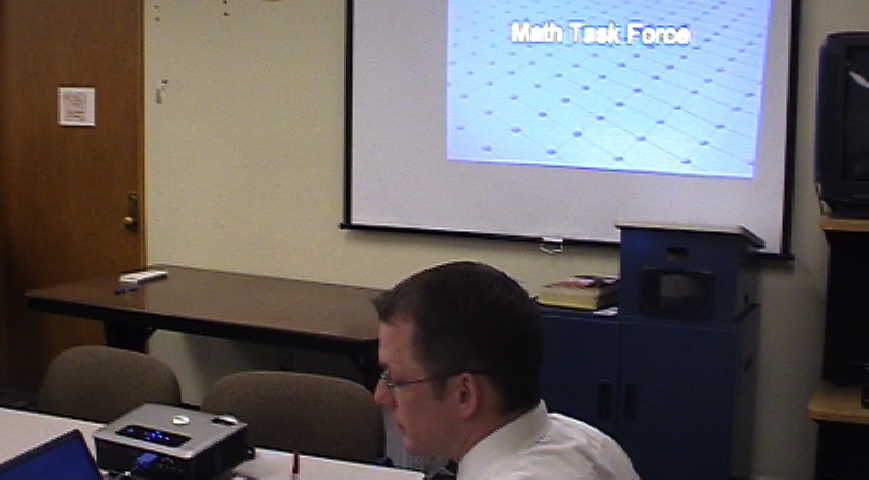
  • Math Task Force
  • Teacher Certifications in Math
  • Connected Math Curriculum in Middle Schools
  • High School Math Curriculum and variations among schools

The slide materials for Lisa’s and Brian’s presentation are included in Powerpoint format and PDF format. (Thanks to Brian for sending).
The handouts from this presentation (thanks to Welda): In-STEP Teacher Checklist, 2007-8 Middle School Math Assessment – Draft, Math Assessment Report.
NB: The last slides discussed during this meeting are slides numbered 15 and 16 (Math Physics, Math Chemistry, respectively). These latter slides prompted the spirited discussion mentioned above, but is not part of the video. Slides 17-19 were neither discussed nor displayed.

Share

Pangea Day, May 10 2008


Pangea Day taps the power of film to strengthen tolerance and compassion while uniting millions of people to build a better future.
In a world where people are often divided by borders, difference, and conflict, it’s easy to lose sight of what we all have in common. Pangea Day seeks to overcome that – to help people see themselves in others – through the power of film.
On May 10, 2008 – Pangea Day – sites in Cairo, Dharamsala, Kigali, London, New York City, Ramallah, Rio de Janeiro, and Tel Aviv will be videoconferenced live to produce a 4-hour program of powerful films, visionary speakers, and uplifting music.

Share

Green Charter Schools Meeting

You’re invited to an important discussion about “green” public schools with environment-focused educational programs and practices.
Date: February 11, 2008 (Monday Afternoon)
Time: 1:30pm to 3:30pm
Site: U.W.- Madison Arboretum
Join this facilitated discussion among educators, students, environmental leaders, policymakers, green charter school friends, news media, school officials, and founding directors of the new Green Charter Schools Network.
Discussion & Reception
Facilitator: Doug Thomas, Director, EdVisions
Share your opinions about:
Green Charter School Choices in Public Education
Student Experiences at Green Charter Schools including River Crossing Charter School Students
What’s It Mean to Be an Educated Person?
Creating the Capacity for Change
Young People and the Environmental Legacies of:
Aldo Leopold
Gaylord Nelson
Sigurd Olson
Innovating with School and Schooling — “Innovating” linked at Education / Evolving
VICTORIA RYDBERG and STUDENTS from River Crossing Charter School will join us at the February 11 discussion along with TIA NELSON, Gaylord Nelson’s daughter; JEFF NANIA, Director, Wisconsin Waterfowl Association; SARA LAIMON, Teacher, Environmental Charter High School, L.A., California; JIM McGRATH, JULIE SPALDING, & JIM TANGEN-FOSTER, Educators & Founders of Green Charter Schools; STEFAN ANDERSON, Headmaster, Conserve School, and many other environmentalists and educators.
Please RSVP to sennb@charter.net or 608 238 7491

Share

Middle School Report Cards Future?

I just received an e-mail from a parent stating the Middle School report cards are converting to the elementary format of 1 – 4 and they are dropping the A – F grading system. She spoke to Lisa Wachtel, Head of Teaching and Learning to confirm that this is the direction the district is headed.
DO any of you have any info on this? They claim it is on the website but other than the Standards Base System info, which is pretty general I can not locate this info. This greatly concerns me if it is true.
Related: Can We Talk 3: 3rd Quarter Report Cards.

Share

It isn’t smart to cheat our brightest pupils

Len LaCara
You don’t need to be an Einstein to know Ohio is cheating its most promising students.
Last week, The Plain Dealer wrote a story about the sorry state of gifted education in Ohio. Consider these facts:

  • 31 states require school districts to provide special services for children identified as gifted. Ohio does not, even though a sixth of its pupils have that classification.
  • Three-fourths of the state’s gifted students receive no special services, according to the Ohio Department of Education. Many of the rest only get partial services.
  • Ohio spends more than $8 billion a year on educating students. But less than 1 percent of that amount – roughly $47 million – goes toward gifted education.

Does this strike you as, well, smart?

Share

On Madison Boundary Changes

Dear Board,
As the opening of a new school is coming close, I was surprised to some extent that the plans were changed with such a short amount of time left before the new year.
So………..I dug up my West Side Long Term Planning Binder and reviewed all the data presented to us, as a member of that committee, and remembered the HOURS we spent debating and reviewing the pros and cons of each plan. I believe this is a very hard process and I am sad it is being altered at this late date.
I think one thing many of us felt on the Long Range Planning Committee was even with the new school and addition to Leopold we did not devise a Long Term Plan. My #1 suggestion to the board would be to revisit the plan of “making the map look better” and balancing the income levels but TO MAKE IT A LONG TERM plan and say in 6 years this is what we are going to do. (and stick to it) I think when you spring it on families that in a few months Johnny has to switch schools, we parents are too invested and comfortable with the school and protest the change. But if a 6 Year Plan was in place with some options to start at the new school, grandfather for a couple of years the protest would be great but families would have lots of time to accept the change and deal with it. It would also be a LONG TERM PLAN.

(more…)

Share

www.dyslexia.com/

  1. A fantastic site and resource for LD (learning differently) in general.
  2. In addition, the Davis Technique works! The nearest provider is in Waukesha, but parents can learn about and use the technique.

  3. The Davis program was adapted by a teacher for use in the general reading curriculum grades K-2 at low cost. A CA research study showed its use resulted in no references for special ed and increased references for T&G tracks compared to the control group.

http://www.dyslexia.com/

Share

Clarion Call: “Windows on College Readiness”

“Your essay, which I have now read twice, is terrific.
You are way ahead of everyone on this.”
email 17 January 2008 from: Education Reporter Sara Rimer of the New York Times

This is the one she refers to:
The Bridgespan Group, working for the Bill & Melinda Gates Foundation, has just released a report called “Reclaiming the American Dream.” The study was intended to find out how to get more U.S. high school students prepared for and through college.
Much of the report is about getting kids to go to college, and it finds that if there is enough money provided, and if parents, peers, counselors and teachers say going to college is important, more high school students are likely to go.
The major weakness of the report, in my view, is its suggestions for the kind of high school work that will help students to do college work and to graduate.
One of the concluding statements is that “Inertia is particularly difficult to overcome when people are unaware that a problem exists or that the potential for solving it is real.” What a useful insight. What they recommend for high school students is “a rigorous college preparatory curriculum.” What could be wrong with that?
Two very simple and basic things are wrong with that. Current “college preparatory” curricula, including AP courses, do not include the reading of complete nonfiction books or the writing of serious research papers.
That is almost as if we had a crisis in preparing high school football players for success in college and recommended a standard preparation program which did not give them practice in running, blocking and tackling. ACT found last spring that 49 percent of the high school students it tested could not read at the level of college freshman texts. And the Chronicle of Higher Education reported on a survey in which 90 percent of college professors thought high school students were not well prepared in reading, writing and doing research. A true college education requires reading serious books and writing substantial papers although many schools have watered their requirements down. High school students should be ready for in-depth study.

(more…)

Share

DOUBLE VISION

When was the last time a college history professor made it her business to find out the names and schools of the best high school history students in the United States?
When was the last time a college basketball coach sat in his office and waited for the admissions office to deliver a good crop of recruits for the team?
When was the last time a high school history teacher got scores of phone calls and dozens of visits from college professors when he had an unusually promising history student?
When was the last time a high school athlete who was unusually productive in a major sport heard from no one at the college level?
Not one of these things happens, for some good reasons and some not-so-good reasons.
Before you think of the reasons however, we should be aware that sometimes the high school coach who is besieged with interest from the colleges is the same person who is ignored by colleges as a teacher. And sometimes the athlete who gets a number of offers from college coaches is the same person who, as an outstanding student, draws no interest at all. Not only do they observe this demonstration of our placing a higher value on athletics than on academics at the high school level, but their peers, both faculty and student, see it as well, and it teaches them a lesson.
Now it is obvious that if college coaches don’t scramble for the best high school athletes they can find, they may start to lose games, and, before long, perhaps their jobs as well.

(more…)

Share

Critics on all sides of teacher pay law:

In rare move, arbitration threatened in Waukesha

Amy Hetzner:

Next week, Waukesha School District leaders plan to take an unusual step, one they contend is necessary after cutting $9.4 million worth of services over the past seven years: They will sit down with their teachers union to hash out a contract with help from a mediator.
What’s more unusual is the culprit that Waukesha Superintendent David Schmidt blames in part for the district’s financial woes: the state law intended to help school districts keep down teacher compensation costs.
“To some degree, we’d like to say we can control our labor costs,” Schmidt said. “The QEO makes that harder.”
Schmidt has company in other state school officials who contend the QEO, known more formally as the qualified economic offer law, has created fiscal problems for them. After 15 years with the law, considered one leg of the state’s so-called three-legged stool for school funding, calls for change are coming from many quarters.
At issue is what some have called the cap gap that exists between the roughly 2% increase in school revenue allowed annually under current law and the 3.8% boost in salaries and benefits practically guaranteed by the QEO, which says school boards can avoid arbitration if they offer teachers compensation increases in that amount.
“That’s probably the core issue right now within our system that’s causing some frustration from school district administrators,” said state Rep. Brett Davis (R-Oregon).
Although Waukesha school officials have not revealed the details of talks with the teachers union, indications are that their unusual move this year toward mediation and possible arbitration is to seek less than a 3.8% package increase for their teachers.
In addition to school leaders who complain the law’s conflict with revenue caps has forced staff cuts, teachers say the QEO increase has suppressed salaries. Critics contend it has helped educators keep inflated benefits.

Share

Complete the Madison School District’s Fine Arts Survey

There’s still time to complete the MMSD Board of Education Community Fine Arts Task Force’s Arts Education Survey.
Access to the on-line surveys will remain open through December 31, 2007. Input from the community is very important and will help inform and strengthen the Task Force?s recommendations on arts education (dance, music, theater, visual arts). The results of this work will be compiled and presented to the Madison Metropolitan School District Board of Education next spring and shared with the public. All individual answers will be kept confidential. In appreciation of your time in completing the on-line survey, your name, if provided at the end of the survey, will be entered into a drawing for a chance to win a pair of complimentary tickets to a Madison performance or admission to local arts venues.
If you have any questions, please feel free to contact task force members at fineartstaskforce@madison.k12.wi.us.
here are three distinct surveys. Please select the one on-line survey that best represents you. Click here for the survey, available in English, Spanish, and Hmong: http://mmsd.org/boe/finearts/.

Share

Mother sent stripper to school as treat

http://www.telegraph.co.uk/ (search for “stripper school”)
A schoolboy had a 16th birthday to remember after a stripper ordered by his mother turned up at his drama class.
The boy’s mother apparently booked a “gorilla” to mark her son’s big day through an agency, but a stripper turned up instead.
The woman even asked her son’s teacher at Nottingham’s Arnold Hill School and Technology College to film the event so the family could see the boy’s reaction.
The stripper, who arrived halfway through the lesson, first walked the unnamed boy around the class on all fours like a dog.
She then spanked him 16 times – once for each year – to the sound of Britney Spears, before stripping down to her bra and knickers.

Boy, do I miss the good ‘ol days.

Share

School To Continue Electric Shock

WCVB Boston
Officials Give School One Year Extension
BOSTON — State officials are allowing a controversial special education school to use electric shock treatments on students for another year.
But the state’s Office of Health and Human Services said the extension for the Judge Rotenberg Educational Center comes with conditions.
The decision comes after an August incident in which two emotionally disturbed students were wrongly given dozens of shocks after a prank call from a person posing as a supervisor.
After the Aug. 26 call, the teens, ages 16 and 19, were awakened in the middle of the night and given the shock treatments, at times while their legs and arms were bound. One teen received 77 shocks and the other received 29. One boy was treated for two first-degree burns.

Share

MIT Open Courseware for High Schools

From ACM Technews
MIT recently announced the completion of its OpenCourseWare project, a pioneering effort launched in 2002 to digitize classroom material for all of MIT’s 1,800 academic courses. The course material is available for free online for anyone to use.
At the completion celebration on the MIT campus in Cambridge, Mass., university President Susan Hockfield announced a new portal for OCW, one specifically designed for high school teachers and students, called “Highlights for High School.” The portal’s home page provides MIT’s introductory science, engineering, technology, and math courses, with lecturer’s notes, reading lists, exams, and other classroom information. The OCW resources, including video-taped labs, simulations, assignments, and hands-on material, have been specifically tailored to match the requirements of high school Advanced Placement studies.
Since its launch five years ago, the data on usage has been impressive. On a 50-course pilot site, an estimated 35 million users logged in, with about 15 percent being educators, 30 percent students, and the rest being what MIT calls “self learners” with no education affiliation, says OCW’s Steve Carson. The recently formed OCW Consortium has 160 member institutions creating and sharing their own course materials sites based on MIT’s model.
One of the most surprising findings is that two of MIT’s course videos, “classical mechanics” and “differential equations,” ranked in iTunes top 10 videos, at number three and number seven, respectively. “This expresses, to me, the hunger in this world for learning, and for good learning materials,” says Hockfield.
OCW Consortium
Network World Article
MIT Open Courseware For High Schools

Share

December 12, 2007 HOPE (Having Options in Public Education) Meeting

All are invited to the monthly meeting of the HOPE (Having Options in Public Education) meeting on Wednesday, 12/12, 6:30-8:00pm at Escape Coffee House, 916 Willy St. [Map] Featured will be brief presentations by UW Professor John Witte regarding recent research on school choice and charters, and Bryan Grau of Nuestro Mundo Community School regarding what the NMCS Board has learned navigating MMSD.
Name Lauren Cunningham
E-mail: cunningham.lauren@sbcgobal.net
Telephone 221-9338

Share

2006 Program for International Student Assessment (PISA)

Education Week
U.S. Students Fall Short in Math and Science
Teenagers in a majority of industrialized nations taking part in a leading international exam showed greater scientific understanding than students in the United States—and they far surpassed their American peers in mathematics, in results that seem likely to add to recent consternation over U.S. students’ core academic skills.
New results from the 2006 Program for International Student Assessment, or PISA, released today, show U.S. students ranking lower, on average, than their peers in 16 other countries in science, out of 30 developed nations taking part in the exam.

2006 PISA Report

Share

Wisconsin Way Forum on School Funding

As all of you are well aware, one of the most vexing issues facing public education today is funding and 14 years of revenue controls that have been placed on Wisconsin schools, causing on-going erosion in programs and services.
On Thursday, December 6, 7:00-9:00 PM, 1919 Alliant Energy Center Way, Alliant Energy Center, Madison [Map], a community forum sponsored by the Wisconsin Way will be held to discuss the issue of taxation and public investment.
The Wisconsin Way is a non-partisan, grassroots effort to create a fair and equitable funding system that promotes excellence in education and public service. Area residents with different viewpoints are being invited to come together for a public conversation on taxes and possible solutions to the challenges we face in protecting and preserving Wisconsin?s quality of life and our great schools.
To learn more about Wisconsin Way, you can the website: http://www.wisconsinway.org
We are attempting to get a head count for turnout, so if you think you might attend, please contact me (even at this late date).
Also, if you have questions, don?t hesitate to contact me. Friends and neighbors are welcome as well.
Thanks much for your consideration.
Jeff Leverich leverichj@weac.org Telephone 608 276-7711

Share

Prufrock’s Gifted Child Information Blog

When I took my first serious history course in college, the president of the university (a history buff himself) spoke to our class and encouraged us to submit our papers to various journals for publication. Being rather inexperienced, it had never occurred to me to submit anything I had ever written to anyone for publication. In my mind, I was “just” a student and couldn’t imagine anyone being interested in what I wrote.
Now it is possible not only for serious college students to publish their work, but it is also possible for serious high school history students to publish the papers that they have researched. The Concord Review gives young people this opportunity. The Review is the only quarterly journal in the world to publish the academic expository research papers of secondary history students. Papers may be on any historical topic, ancient or modern, foreign or domestic.
Many of these young authors have sent reprints of their papers along with their college application materials. Their research has helped them to gain admission to some of the nation’s (and world’’s) best universities.

(more…)

Share

Matching Top Colleges, Low Income Students

Jim Carlton
Wall Street Journal
Last year, when Amherst College welcomed 473 new students to its idyllic campus, 10% of them came from QuestBridge.
But QuestBridge is no elite private school. It’s a nonprofit start-up in Palo Alto, Calif., that matches gifted, low-income students with 20 of the nation’s top colleges. In return, the schools — including Princeton, Yale, Stanford and Columbia — give scholarships to the students and pay QuestBridge for helping to diversify their student bodies.
The program is gaining in popularity because it addresses a growing interest of private and public colleges: increasing the diversity of their student bodies without relying solely on race. Since some states banned racial preferences in college admissions, many public colleges have begun focusing on income as a means to broaden the backgrounds of their students. Private schools, while not bound by the states’ restrictions, are also eager to admit more students from low-income families.
QuestBridge isn’t the only program that helps schools achieve diversity by focusing on the economically disadvantaged. The Posse Program, launched in 1993 by a New York nonprofit, specializes in sending groups of students who already know each other to top colleges. It got its start after the founder, Deborah Biel, discovered that several of the inner-city youth she had worked with in New York had dropped out of college. When she asked why, one responded that he didn’t have his posse with him.
Another program called Mathematics, Engineering, Science Achievement, or MESA, helps recruit low-income students for the University of California, California State University and other California colleges. Upward Bound, a long-running federal program, feeds low-income high-school students into colleges all over the country. And some colleges, including schools that are partnering with QuestBridge, have begun their own recruiting programs for low-income students.
The efforts come as diversity remains elusive, particularly at elite colleges. According to a 2004 study by the Century Foundation, a New York-based research group, at the 146 most selective colleges in the U.S., just 3% of the students came from families that ranked in the bottom 25% in income, while 74% came from the top 25%.

(more…)

Share

Update on Credit for non-MMSD Courses, including Youth Options Program:

Madison School Board Performance & Achievement Committee Meeting 11/26/2007At the November 26, 2007 meeting of the MMSD BOE’s Performance and Achievement Committee [18MB mp3 audio], the District’s Attorney handed out a draft of a policy for the District’s Youth Options Program dated November 20, 2007. It is a fine working draft. However, it has been written with rules making it as difficult as possible for students to actually take advantage of this State-mandated program. Thus, I urge all families with children who may be affected by this policy now or in the future to request a copy of this document, read it over carefully, and then write within the next couple of weeks to all BOE members, the District’s Attorney, Pam Nash, and Art Rainwater with suggestions for modifications to the draft text. For example, the current draft states that students are not eligible to take a course under the YOP if a comparable course is offered ANYWHERE in the MMSD (i.e., regardless of whether the student has a reasonable method to physically access the District’s comparable course). It also restricts students to taking courses at institutions “located in this State” (i.e., precluding online courses such as ones offered for academically advanced students via Stanford’s EPGY and Northwestern’s CTD).
The Attorney’s memorandum dated November 21, 2007 to this Committee, the BOE, and the Superintendent outlined a BOE policy chapter entitled “Educational Options” that would include, as well, a policy regarding “Credit for Courses Taken Outside the MMSD”. Unfortunately, this memo stated that this latter policy as one “to be developed”. It has now been almost 6 years (!) since Art Rainwater promised us that the District would develop an official policy regarding credit for courses taken outside the MMSD. A working draft available for public comment and BOE approval has yet to appear. In the interim, the “freeze” the BOE unanimously approved, yet again, last winter has been ignored by administrators, some students are leaving the MMSD because of its absence, and chaos continues to rein because there exists no clearly written policy defining the rules by which non-MMSD courses can be taken for high school credit. Can anyone give us a timetable by which an official BOE-approved policy on this topic will finally be in place?
Links:

Share

Memory’s Forgotten Daughter

The National Endowment for the Arts has released a new study of studies of the decline of reading in the United States. Some kinds of reading were apparently not considered.
Zeus and Mnemosyne [Memory] were the parents of the nine Muses. Calliope was the muse of epic poetry, Clio was the muse of history, Erato was the muse of love poetry, Euterpe was the muse of music, Melpomene was the muse of tragedy, Polyhymnia was the muse of sacred poetry, Terpsichore was the muse of dance, Thalia was the muse of comedy, and Urania was the muse of astronomy.
Of these nine, two are now off the reservation. Urania has clearly taken Astronomy over to the Science side of the Arts, and Clio has had the misfortune of presiding over history and nonfiction, and so, at least for the National Endowment for the Arts, has evidently lost her status among the Arts.
In 2004, the National Endowment of the Arts conducted a $300,000 study of the reading habits of Americans. It found a significant decline in literary reading for pleasure among just about every group. In The Washington Post, on Friday, July 9, 2004, Jacqueline Trescott wrote that the NEA study found that an industry group “predicts that annual sales for all types of books will top $44 billion by 2008, up 59 percent from last year. Nevertheless, only 46.7 percent of adults say they are reading literature, compared with 56.9 percent two decades ago.”
Their new study of studies continues this limited focus on literary reading for pleasure.

(more…)

Share

America’s Most Obese Cities

Rebecca Ruiz:

To better understand the local and state implications of the obesity epidemic, we ranked the nation’s heaviest cities. In doing so, we discovered states with multiple offenders, metropolitan areas with expanding waistlines and a high representation of Southern cities. Worse yet, after claiming the title of the most sedentary city, Memphis, Tenn., has also ranked first as the country’s most obese.
Behind the Numbers
To determine which cities were the most obese, we looked at 2006 data on body mass index, or BMI, collected by the Centers for Disease Control’s Behavioral Risk Factor Surveillance System, which conducts phone interviews with residents of metropolitan areas about health issues, including obesity, diabetes and exercise.
In this case, participants report their height and weight, which survey analysts use to calculate a BMI. Those with a BMI between 18.5 and 24.9 are considered at a healthy weight, those with a BMI between 25 and 29.9 are considered overweight, and those with a BMI of 30 or higher are considered obese. About 32% of the nation is obese, according to the Centers for Disease Control; Memphis ranked above the national average at 34%.

Share

Different Notions of Honesty?

Friends from Hanover came into town this weekend and mentioned this story: “A small town in New Hampshire is coming to grips with a scandal at the public high school where nine students face criminal charges for allegedly breaking into a classroom and stealing advance copies of final exams.
The incident at Hanover High School in Hanover, N.H., is sparking debate between those who believe the students are being treated fairly and those who think the charges go too far.”
But what I found most interesting about this story was this:”Teachers also may be sending kids the wrong message about cheating.
Students say they know they won’t get in trouble for things like sharing homework or finding out what’s on a test from kids who’ve already taken it. “That is cheating, and some teachers don’t classify it as cheating,” said Junior Cory Burns. “Or some don’t see it as such a serious issue, ” added Dillon Gregory.
The millennial generation (born between 1980 and 2000) seems to have a different notion about honesty than previous generations.
Aine Donovan, executive director of the Dartmouth College Ethics Institute, said kids today are more apt to rationalize their behavior as a means to an end; and they seem to have invented their own particular code of right and wrong.
“When I ask my students: ‘Is there anything unethical about downloading music?'” Donovan said. “(They answer) ‘Absolutely not.’ They don’t have a problem with it. And yet, those same kids would never in a million years, walk into a K-mart and steal a CD. They just have a different kind of orientation of morality.”

(more…)

Share

Comparing Sports, Arts is Dangerous Business

“I’m afraid the game is over. In our American academia, the arts must be satisfied with the leftovers.”
Frank Deford
Morning Edition, NPR
A few weeks ago, I offered up the thoughts of Gary Walters, the distinguished athletic director at Princeton, that sport should be held in the same high regard as art.
I thought it was a rather interesting and cogent opinion for someone to posit, but in the fabled words of the longtime football announcer, Keith Jackson: “Whoa, Nellie!” Never have I suffered such a battering. I think the nicest thing I was called in the responses that poured in, dripping with blood, was “apologist dingbat.”
But then, after I withdrew the slings and arrows from my person and assessed the reaction, I realized how almost all the responses didn’t really bother to address the question posed: Whether, in fact, sport might be an art. No, they were just mad, full of rage and fury. But it did serve to inform me all the more how much antipathy there does exist toward the American system of school sports.
Here are just a few of the more restrained comments:

(more…)

Share

Report Gives Good Grades to Precollege Courses

Peter Schmidt in The Chronicle of Higher Education reports that “(t)he Thomas B. Fordham Institute, a nonprofit research organization, favorably reviews several Advanced Placement and International Baccalaureate programs in a report scheduled to be released this week.
The study evaluated course materials, teacher’s guides, and examinations used in connection with Advanced Placement and International Baccalaureate programs in biology, English, history, and mathematics. Based on reviews of the materials conducted by experts in the fields covered, the report concludes that the courses generally merit praise. The biology offerings in particular deserve high marks, it says.
The researchers did not examine how well the courses are actually being taught, and its report warns that “successful implementation of these programs depends on the availability of talented, motivated, and well-educated teachers.”
The institute plans to make the report available online as of Tuesday, although it is not scheduled for release to the public until the following day.”

Share

When a new super arrives #1

Will the board continue to be weak — letting the super set the agenda and following along? Or, will the board exert some leadership?

Share

Math Task Force Working Group Meeting Notice

Notice of Madison School Board Meetings
Week of November 12, 2007

Thursday, November 15
1025 West Johnson Street
Madison, WI 53706
Room 247
Math Task Force – Student Achievement and Data Working Group
9:00 a.m.
1. Introductions and Review of Agenda
2. Main Questions to be Answered by Data for the Mathematics Task Force and the Priority of the Questions
3. Data Sources and Availability
4. Necessary Resources to Produce the Needed Analyses
5. Adjournment Education Sciences Bldg.

Share

Drama at East and West

Need a Little Drama in Your Life?
Come support the drama communities at East and West!
At West HS [Map] — “I Hate Hamlet”
Friday, November 9, 7:30
Saturday, November 10, 7:30
Tickets $5.00
At East HS [Map] — “The Crucible”
Thursday, November 15, 7:30
Friday, November 16, 7:30
Saturday, November 17, 2:30 and 7:30
Tickets $5.00

Share

Seeking Parents’ Help in Saving a Great Elementary School Program

The program is a small, mixed-age classroom for first through third graders at the Montessori Children’s House on Madison’s west side, where my eldest child currently attends preschool. It is in danger of being eliminated because of diminishing enrollment. I think that this would be a horrible loss to many academically talented children who would do so well there. They do so many things right there, such as:

  • Nurturing, home-like environment in which intense curiosity is normal
  • Mixed-age classroom, which encourages children to work at their own pace
  • Elegant learning materials
  • Freedom of movement and plenty of outside time
  • Freedom to follow their own intellectual curiosity
  • No busy work
  • No homework (unless the child chooses to keep working on something after school)
  • Emphasis on peace and global citizenship
  • Healthy snacks provided, healthy lunch to be brought from home
  • Parental involvement welcomed (the school is a parent run co-op)

As a small community, it would only take a few more children to keep the program viable. If you are the parent of a child who would benefit from such an environment, would you please look at the school’s website http://www.madisonmontessori.org/programs/elementary/Elem_intro.html
and maybe take some time to observe the classroom?
Our family is committed to public schools, and we know that a school district needs talented kids and engaged families to thrive. This program would allow kids to integrate back into the public schools at a fairly young age, while protecting and nurturing them through a critical period of development.
Upon re-reading this message, it sounds like I’m making a blatant marketing pitch (which, frankly, I am). Please forgive me and understand that my only interest in the program is that it survive so that it is an option for my two children, ages 4 and 1, when they are old enough to need it. I hope that there are a few families here who might find a home there. Sincerely, Dawn M. Rappold [drappold@gmail.com]

Share

Academic Achievement

By Michael Strand
Critics with a bent for sarcasm, for years, have derided the No Child Left Behind law by giving it what they think is a more descriptive title.
No Child Allowed Ahead, they call it.
And it’s not hard to see why. Newspapers and news magazines across the country have documented state after state and district after district gutting or eliminating millions of dollars in funding for programs for their highest-achieving students, diverting that money into programs for low-achieving students in order to meet the mandates of the law.
“I don’t think we’ve seen a tremendous change in our district, for which I’m grateful,” said Salina School Board president Carol Brandert, who later described the situation as “fortunate.”
If Brandert — a former English teacher well-known for being a stickler for using the right word — is using words that sound oddly passive, there’s a reason.
The question of cutting programs for top students has never come up, she said.
When Kay Scheibler first started heading the gifted program at Salina Central High School, 13 states mandated programs for top students. Today, Kansas is the only state with such a mandate.
“It’s mandated, so we’re not going to see any major changes without some legislative action,” she said.
“We’re unique, one out of 50,” confirmed Kansas Commissioner of Education Alexa Posny.
State law regarding those formally identified by their school as gifted closely parallels that for special education students, even using the same terminology — gifted students have an “Individual Education Plan.”

Share

A Taste of College Work Provides Just the Spark

Anita Weier
A class started by a UW-Madison professor four years ago to give disadvantaged people a university experience has blossomed, resulting in about 40 of 100 “graduates” going on to college at the University of Wisconsin and elsewhere.
It’s also inspiring the current Odyssey class of 31, who gather every Wednesday night in a classroom at the Harambee Center in south Madison to stimulate their minds and learn literature and writing techniques, as well as history and philosophy.
“These are people who don’t have money but have extraordinary potential. We give them a chance and it’s amazing what can happen,” literature professor Emily Auerbach said before a recent class began. “This gives them a sense of the riches they can find.”

Read more about The Odyssey Project … and consider making an end-of-year contribution.

Share

Board of Education Progress Report — October, 2007

I hope your school year is going well. Below is the October BOE update.
If you have any questions please do not hesitate to contact myself at
asilveira@madison.k12.wi.us or the entire board at
comments@madison.k12.wi.us
Arlene Silveira

Superintendent Search: Our consultants presented a summary of the
community input sessions on the desired characteristics for a new
superintendent. Read the entire report at www.mmsd.org/topics/supt/.
The desired superintendent characteristics approved by the BOE are
also available at this site. The consultant firm is recruiting and
screening candidates and will bring a slate of candidates back to the
BOE in January.
Fine Arts Task Force (FATF): The FATF is seeking community input on
their goals for Fine Arts education. The survey is available at
www.mmsd.org/boe/finearts/.
Referendum: The District will receive an approximate $5.5M windfall
from the city as a result of closing 2 tax incremental districts (TID).
The BOE voted to use this money to close our projected budget gap for
the ’08/09 school year. Because we will use the money to close the
projected gap, we also made the decision that we will not go to
referendum in the Spring ’08. In the summer of ’08, the BOE will begin
discussions of a possible operating referendum to cover the gap for the
’09/10 school year and beyond.
Performance and Achievement Committee: (Lawrie Kobza, Johnny Winston
Jr., Maya Cole). The committee started discussions on different school
models (charter, magnet, neighborhood, etc.). Discussions will continue
in committee. The committee reviewed a plan/proposal to expand our Play
and Learn program by making the program “mobile”. Further discussion
will continue at full BOE. The committee began the discussion of
updating district performance goals to make them more measurable and
relevant. The first goal being evaluated is focused on improving
student achievement.
Human Resources Committee: (Johnny Winston Jr., Lawrie Kobza, Beth
Moss). The committee reviewed the results of a study that had been
requested by the BOE to determine how the MMSD Administrator pay and
benefits structure and related policies compare to other selected school
districts in Wisconsin. Discussion will continue in committee.
Communications Committee: (Beth Moss, Lawrie Kobza, Carol Carstensen).
WAES (Wisconsin Alliance for Excellent Schools) made a presentation on
state funding. A legislative update on the state budget was also
provided.
Finance and Operations Committee: (Lucy Mathiak, Carol Carstensen, Maya
Cole). The committee took the lead at analyzing the TID and referendum
options and making recommendations to the full BOE for vote (above).
Long Range Planning: (Carol Carstensen, Lucy Mathiak, Beth Moss).
There was a presentation on all of the initiatives in the District’s
Energy Management Program. There are many exciting programs in place
across the District. Since our program was put into effect, we have
decreased consumption rates and expenditures. Had we continued to
consume at 1997 consumption rates, our utility expenditures would have
been $4,400,000 more.
Community Partnerships: (Maya Cole, Johnny Winston Jr., Lucy Mathiak).
The committee is in the process of defining “Partnerships”. They are
also reviewing the policy on parent involvement in the schools.

Share

“Math Power: How to Help Your Child Love Math Even If You Dont’

“Math Power: How to Help Your Child Love Math Even If You Dont’,” the only
book by a mathematician written for parents of children aged 1-10, is
about to go out of print for the second time. Both times the publisher
sold its trade books to another publisher just as it was published, so
none of the four publishers made any effort to publicize it. This time,
however, I have a good offer to buy the remaining copies. I really want
it to get into as many libraries as possible — and many hands. There
are many copies left.
If you can get a library to offer me a thank you note and give me the
address, I will send that library an autographed copy free for the tax
deduction. If you want an autographed copy, I will be glad to send you a
copy for $10. The price on the cover is $19.95, and it’s fine to resell
them at this time. If you can find an outlet or use them yourself, I can
send a box of 18 books for $140. (No autographs on those books because
they will be inside the box.) There are MANY boxes available.
“Math Power” had excellent reviews from both sides of the “Math Wars” when
it first appeared in 1997, and another from “The Library Journal,” but
without some publisher publicity, books don’t sell. It may be that math
is not a popular subject in this culture; there is other evidence.

(more…)

Share

Madison United for Academic Excellence Meeting on Charter Schools

Please join us at the next Madison United for Academic Excellence meeting on Monday, October 29, at 7:00 p.m. in the Wright Middle School LMC, 1717 Fish Hatchery Road. Our guests will be Paula Sween and Dory Witzeling from the Odyssey-Magellan charter school for gifted students in grades 3-8 in Appleton and Senn Brown of the Wisconsin Charter Schools Association. Ms. Sween was one of the founders of the Odyssey-Magellan program. She is currently the TAG Curriculum Coordinator for the Appleton school district. Ms. Witzeling is a teacher and parent at the school.
All are welcome!

Share

Madison School Board Fine Arts Task Force Seeks Input From the Community

Dear Community Members,
The Madison Metropolitan School District (MMSD) values the arts as an integral component of a quality education for all students. Research has shown that involvement in the arts teaches children many important academic skills as well as enriches personal growth and development. Tight budgets, however, have increasingly affected the arts education we offer our children. Further, the District has monitored a downward trend in participation in arts offerings among low-income students and students of color for a number of years.
The Madison Board of Education formed the Community Fine Arts Task Force to gather information from the community and provide recommendations to the Board on MMSD’s arts education program. Specifically, the Board asked the Task Force to:

  1. Identify community goals for MMSD K-12 arts education including curricular, co-curricular and extracurricular;
  2. Recommend approaches for increasing participation in arts education for low-income students and
    students of color; and

  3. Recommend priorities for District funding of fine arts education.

October through December, the Task Force will be distributing surveys and conducting community conversations to gather information from the community on its goals for fine arts education. Your input is very important and will help inform and strengthen the Task Force’s work. The result of this work will be completed and presented to the School Board next spring.
We appreciate your participation in this important effort. To take the online survey and to learn more about the Community Fine Arts Task Force, go to www.mmsd.org/boe/finearts/ .
Sincerely,
Arlene M. Silveira, President

Share

Violence at Lapham

Police were called to the alternative program at Lapham Elementary after a teacher tried to break up a fight on Tuesday. She fell, was kicked in the head, and taken away in an ambulance.
The Madison police Web site includes no incident report on the event.

Share

“Reach Out and Read” Founder to Visit Madison

Reach Out and Read” (ROR) is a national non-profit organization that promotes early literacy by giving new books to children and advice to parents about the importance of reading aloud in pediatric exam rooms across the nation. ROR founder Dr. Perri Klass will be in Madison this week to celebrate the arrival of the program here in Madison. Dr. Klass will be giving a public talk on Thursday, October 25, at 7:00 p.m. at the Harambee Center, 2202 South Park Street. All are welcome!

Share

The Math Lady

Jacquelyn Mitchard
There have been a few people, in a life cram-jammed with the opposite message, who have told my second son that he was smart.
One of them, Donna Mahr, a math tutor in our tiny town, was the first.
She died just a couple of days ago.

How many lives did she transform?
How big are the boundaries of the universe? For every child she believed in, she gave comfort to a family whose heart was broken at the core. She gave hope to a family who knew, who KNEW, that their son or daughter had gifts that didn’t fit the traditional mold….
Despite the best efforts of the rather nice public school system in our town to prevent this, our son graduated with a low B average, in part because of Donna Mahr, who was an angel before she ever got her wings.

Share

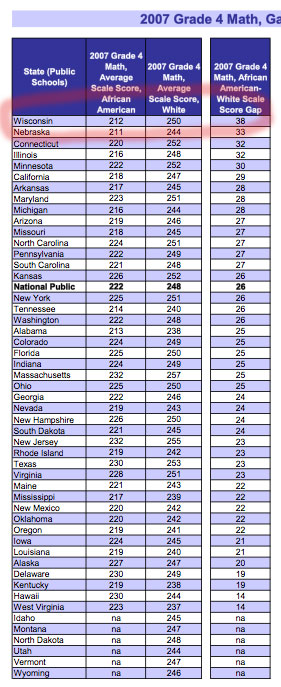
A Different Look at NAEP 4th Grade Math

The NAEP 2007 reports leave me without real understanding of the results, and charts included in the reports do not help. Looking at the state and ethnic data in a slightly different but very simple way, information that seemed to be lacking in the official reports stand out.
For the first steps, we’ll look at only the 4th grade math scores by state.
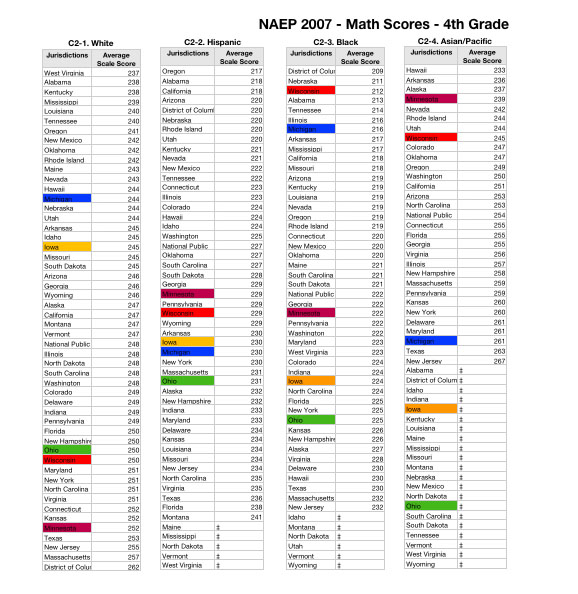
The following is the state (jurisdiction) data by ethnic groups which I will use throughout. I’ve highlighted several of our neighboring states: Wisconsin in red, Michigan in blue, Iowa in yellow, Ohio in green, Minnesota in lavendar.
naep2007-c2-1-4.jpg
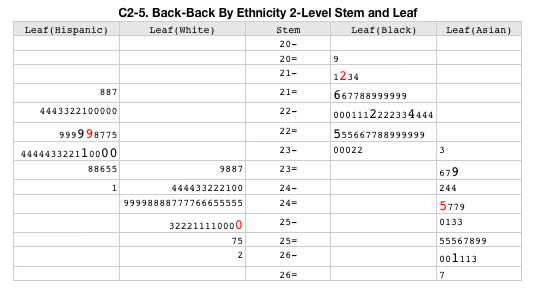
Using a simple 2-level stem and leaf plot shows a general skewed normal (bell curve) distribution for each ethnic group. Scores of the states mentioned above are in a larger font, with Wisconsin further in red. The stem portion of this chart consists of the first two digits of a state’s score (with a – or =), and the leaves are the final digit. A stem ending with – will have final digits of 0-4, a stem ending with = are for scores ending with 5-9.
The Hispanic score seems bi-modal, with the White distribution showing a slight tail on the high side, Blacks and Asian distribution showing low end tails. Asian scores show a definite tendency to score on the high end of states scores, while white scores are definitely skewed to the low end. What can be seen here also, but subtly, is there does not seem to be an overlap of the aggregated state scores for whites and blacks. For Blacks in Wisconsin generally, the chart visually represents the quality of education Wisconsin they are receiving here — very poor.
Of course, this says nothing about how well individual students did on the test — aggregation hides most information that is necessary to make data-driven decisions.
NAEP2007-c2-5.jpg
We need to spread out this chart’s distributions to detect other interesting facts.
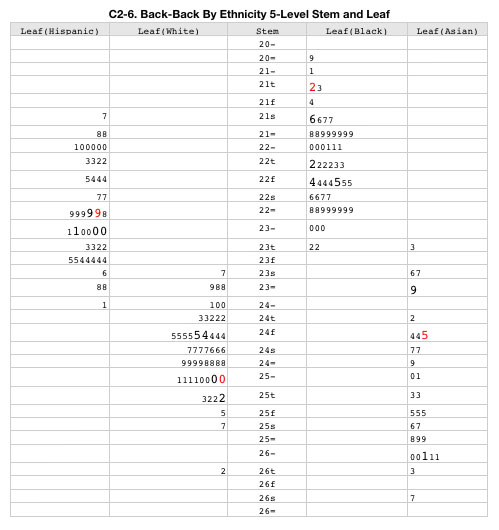
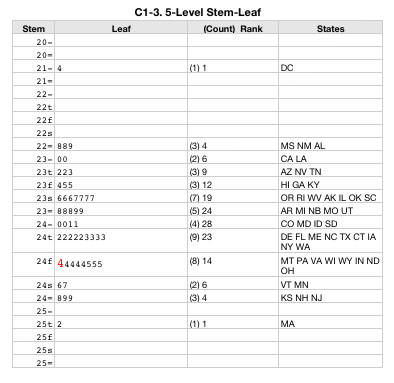
In this 5-level stem and leaf chart, the stem values end with the symbols -, t, f, s, =, where the – bin is for scores ending with 0 or 1, t for 2 and 3, f for 4 and 5, s for 6 and 7, = for 8 and 9.
NAEP2007-c2-6.jpg
Now we can see most definitely that the distributions for blacks and whites do not overlap, that Wisconsin Black scores are way out in the tail of the distribution. Looking at the extremes of these distributions show surprising results (at least to me). Notice that DC whites score at the top and might be statistical outliers, while DC Blacks are at the opposite end and also may be statistical outliers, and the NJ Asians are at the top, but unlikely to be outliers due to the wide spread of their state average scores. (Outliers are points that are numerically distant from the main distribution).
The DC results by ethnicity for whites was surprising. Looking only at the state scores without separating by ethnicity, the distribution of points look like:
NAEP2007-c1-3.jpg
A separate calculation shows that indeed, DC is an outlier when ethnicity is ignored and is only 2 points away from being an extreme outlier. (The outlier cut-score is 224 and the extreme outlier cut-score is 212, DC score is 214).
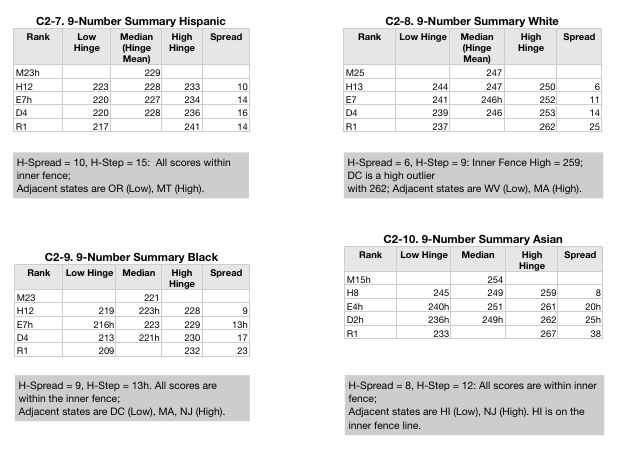
Going back to the disaggregation by ethnicity the summary calculations are
NAEP2007-c2-7-10.jpg
The 9-Number Summaries are used to calculate outliers, and determine drift in the distributions. Each row of the summary table is a kind of percentile. Line M is the median, H represents the low and high 25%, E is the low and high 12.5%, D is the 6.25% cut point, and R represents the range lowest and highest values. (The numbers following these letter designations are the score rank at these cut points).
With a score of 212, Wisconsin Blacks score in the lower 6% of the states (D4 is 213) but this score does not make it an outlier, but that is hardly a badge of honor given how poorly all states are doing. Wisconsin Hispanics score at the median of all Hispanics with a score of 229, and Wisconsin Asians score on the cusp of the lower 25% of all Asians at 245, and Wisconsin whites score on the cusp of the upper 25% of all whites at 250.
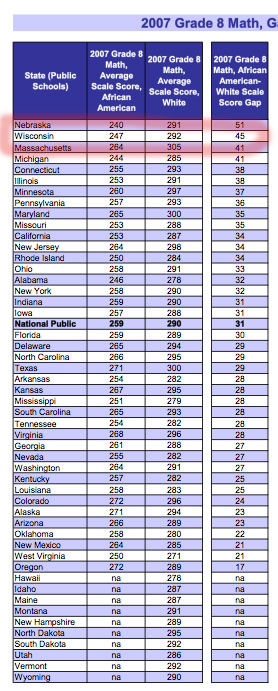
The drift calculations (in the Median column) do not show distribution drift, but outlier calculations do show that DC whites are high-end outliers. (A little preview of the NAEP 8th grade math: NAEP numbers show that there was not enough whites in DC public schools by 8th grade to be measured — in our nation’s capital, the public schools are fully segregated?)
Surprisingly, Hawaii (HI) in the Asian category is on the cusp of being an outlier at the low end with a state score of 233.
The HI score was surprising to me since it has a very large Asian/Pacific Islander population, and I expected this ethic group to have the political power to ensure schools would function for them. However, further reading indicates that whites are the upper class and have the power, followed by people of Chinese descent. The rest, native Hawaiians, Japanese, and other Pacific Islander groups are at the bottom of the power and wealth hierarchy. Without a better ethnic categorization, the NAEP test will not show the likely educational imbalance among franchised and disenfranchised.
Continuing with the Asian/Pacific Islander category, I was surprised to see NJ as the top state. At 267, NJ is not an outlier (the cut point is 271), but it is close. An improvement of 1/3 grade level (assuming 12 points separates one grade from the next), would bring them to high-end outlier status.
Looking at the scores for Wisconsin Blacks, it’s quite clear that Wisconsin (Milwaukee schools primarily?) are doing very poorly for Blacks. It’s not just a matter of how the scores rank among states, but how Wisconsin fits within the distribution of all states. The data above shows not only low rank but Wisconsin Blacks are educated with far below the efforts of other states, represented by the main body of the distribution.

Share

System-wide Change for All Learners and Educators (SCALE) research project at UW-Madison

I would like to direct readers’ attention to our our web site where we have highlighted key concepts of the System-wide Change for All Learners and Educators (SCALE) research project here at the Wisconsin Center for Research Education, UW Madison. The vision of the SCALE partnership is to make it the rule, instead of the exception, for every student, every year, to experience high-quality teaching of core mathematics and science concepts. The partnership brings together mathematicians, scientists, engineers and education practitioners to build a new approach to reforming K-12 mathematics and science education. The partnership seeks to improve the mathematics and science achievement of all students at all grade levels in the four partner school districts (MMSD is one of them) by engaging them in deep and authentic science and mathematics instructional experiences. Simultaneously, the partnership seeks to improve pre-service and in-service mathematics and science professional learning. Finally, the partnership seeks to improve models of collaboration among K-12 and post-secondary institutions in ways that more fully integrate engineering, mathematics and science faculty. The goal is to provide a seamless K-through-Infinity education system in the service of mathematics and science education for all.
Christine Javid
E-mail: cgjavid@wisc.edu
Telephone 608-890-1795

Share

Involving the Community (in High School Reform)

I will periodically provide updates for the community so that you can read what the Board of Education (BOE) is working on during the year. I also do so when I have particular interest in, or concerns regarding, decisions made on behalf of the Madison Metropolitan School District (MMSD).
One area that I believe is of utmost importance and may be on the mind of the public is high school reform.
I am particularly interested in answering two questions as they relate to this issue.
First, what are the problem(s) we are trying to address as a district in our high schools?
Second, how does the current high school framework align with the skills and knowledge required by colleges and employers and in the overall reform movement of standards and accountability?
To address this issue as a board member, I look for specific timelines, benchmarks and periodic updates.
I think it would well serve the community and the entire board to know exactly where we are in the process. Originally, high school reform in MMSD was presented to the community in a BOE Special Meeting and referred to as a “blank slate.”
Recently, the district submitted an application for a Small Learning Communities (SLC) federal grant. It was not awarded. It was at this time that I had requested that the BOE review the process of high school reform in MMSD at a BOE Special Meeting. I have also raised concerns that the administration has decided to apply for the grant again. The board has been told that we have a good chance that we will get the grant on the second round. I have again requested that the board meet as soon as possible.
However, as a board member of seven – there must be four BOE members willing to submit such a request to put this topic on the agenda. So far, I am the only member requesting this motion.
I raise this issue because of my firmly held belief that my role as a BOE member is to represent the community and provide, to the best of my ability, an accessible, open process when major decisions are made on behalf of the community.
It appears that as of today, the grant will be resubmitted before the only scheduled BOE meeting on high school reform on the 19th of November.
A little history. The high school reform process should be transparent and accessible to the entire community. I am trying to get a handle on this process myself. Here is a look at what has transpired so far:

(more…)

Share

No Child Left Behind Act faces overhaul, political donnybrook

Zachary Coile
In 2002, two of Congress’ liberal Democratic lions – Rep. George Miller of Martinez and Massachusetts Sen. Edward Kennedy – stood behind President Bush as he signed the No Child Left Behind Act, a law they promised would shine a bright light on the failures in America’s public schools and kick-start reforms.
Five years later, Miller, now chairman of the House Education and Labor Committee, is still a believer. But after traveling the country – listening to complaints from parents, teachers, school administrators and governors about the law’s testing regime and stiff sanctions – he now admits it needs fixing.
“We’ve learned a lot, and we shouldn’t ignore that evidence,” said Miller, who is leading the overhaul of the law in the House, which starts this week. “What we’re trying to do in this reauthorization bill is to look for those changes to make this a smarter, fairer, better law.”
Reform is coming to No Child Left Behind, but the question is what kind. Teachers unions, which bitterly oppose the law, are pushing to relax its rigid testing rules and penalties. Business groups, eager for better-educated workers, want to see the tough accountability measures preserved or expanded. Many states and local school districts are clamoring for more flexibility in implementing the law, which expires this year.
Miller is seeking a middle ground: He wants to keep the law’s requirement of annual tests in reading and math for third- to eighth-graders and 10th-graders, but add other measurements – such as percentage of kids in college-prep classes – to help schools show they are meeting the law’s demands to make yearly progress in student achievement.

Share

Desired Superintendent Characteristics

The Board of Education of the Madison Metropolitan School District, after consulting staff, students, parents and community members, seeks an educational leader who is student-centered and demonstrates the following characteristics:
Possessing:

  • Leadership experience and demonstrated success in a diverse community and school district

  • Leadership experience and demonstrated success in challenging and engaging students at all points along the educational performance continuum

  • Effective communication skills

  • Strong collaborative and visionary leadership skills

  • Unquestioned integrity

  • Excellent organizational and fiscal management skills

Ability to:

  • Deal directly and fairly with faculty, staff, students, parents and community members

  • Be accessible, open-minded and consider all points of view before making decisions

  • Build consensus and support for a shared vision for the future

  • Develop positive working relationships with a wide variety of constituent groups

The individual selected is expected to be highly visible in and engaged with the schools and community. Successful experience as a superintendent or district level administrator in a similar urban environment and school district size is preferred.
Hazard, Young, Attea & Associates, Ltd. Executive Summary 960K PDF File:

This report summarizes the findings of the Leadership Profile Assessment conducted by Hazard, Young, Attea & Associates, Ltd. (HYA) for the Board of Education of Madison Metropolitan School District (MMSD). The data contained herein were obtained from reviewing approximately 185 completed Leadership Profile Assessment forms, 220 emailed responses and interviews with approximately 240 persons identified b y the Board, in either individual, focus group or community input settings, on September 19 and 20, 2007. The questionnaire, interviews and focus groups were structured to gather data to assist the Board in detennining the primary characteristics it might seek in its next superintendent of schools. Through this process, the consultants attempted to identify the personal and professional characteristics desired in the superintendent, as well as the skill sets necessary to maintain what constituent groups value and to address current and emerging issues which the District might be facing.
Information obtained through interviews, emails and completed questionnaires reflects similar views from all groups with respect to the multiple strengths of MMSD. Respondents were extremely proud of their District’s national recognition for educational excellence. They voiced pride in their students’ excellent test scores, the District’s exceedingly high number of National Merit Semifinalists and its ability to provide top quality academic programs in an environment of rapidly changing demographics. Given the changes in the socio-economic, racial and ethnic make-up of the student body, residents identified as major strengths the District’s commitment to reduce the achievement gap between Caucasian and minority students, its willingness to address issues of diversity and its provision of training in best practices to assist staff in meeting the special needs of a diverse student population.
Respondents also pointed to MMSD’ s commitment to neighborhood schools, retention of small class sizes in most elementary schools, rigorous curriculum, support of music programs and the arts, broad range of sports and other extra-curricular activities, high expectations of a well educated parent constituency and its excellent special education program with the focus on the inclusion of students in regular classrooms. Residents cited the strong support for the District by caring, involved parents and by a community that values high academic standards and achievement. Other strengths cited included the District’s bright, motivated students and its highly competent, dedicated, hard-working teachers and support staff committed to the success of all students. Building administrators were commended for their dedication, accessibility and innovative leadership in providing programs that reflect the needs of their individual school populations. All respondents cited MMSD’s proximity to and partnership with UW-Madison and Edgewood College as invaluable assets.
The over-arching challenge cited by all respondents centered on the MMSD’ s future ability to maintain its excellent academic programs and student performance, given the District’s insufficient financial resources, significant budget cuts and ever-growing low-income and ELL student populations. These concerns are interrelated and if not addressed successfully could eventually become the self-fulfilling cause of what respondents feared the most: the exodus of a considerable number of high-performing upper/middle class students to private or suburban schools as a “bright flight” mentality overrides parental desire to provide children with a “real world” enviromnent of socio-economic, ethnic and racial diversity.
Concern over the funding issue was expressed in several ways: failure to cut the personnel costs of a “top heavy” central office, more equitable funding of the various schools, state level politics that restrict local access to property taxes and fail to increase state funding, the cost of responding to the arbitrary mandates of t he NCLB law, the future need for a referendum to increase property taxes and a strong teachers’ union perceived as placing its salary/benefit issues, restrictions on management prerogatives and undue influence over the Board ahead of the District’s interests. The impact of continued budget cuts strikes at the quality and reputation of the educational program, with fear of an erosion of the comprehensive curriculum and after-school activities, reduction in aides who help classroom teachers with ELL and special education students; curtailment of music, fine arts and gifted programs; increases in class size; lack of classroom supplies; postponed maintenance and renovation of aging facilities; need to update technology and the lack of long-range financial planning as the District confronts one financial crisis after another.
Concern over the impact of the changing demographics was also expressed in various ways: fear that the rising cost of responding to the special needs of an increasingly diverse student population and efforts to close the achievement gap will reduce the dollars available to maintain electives and enrichment programs for regular and gifted students; the changing school culture in which gang activity, fights between students, a pervasive lack of respect by students toward authority are perceived as the norm, which in turn generates fear that the schools are no longer as safe as they used to be; the need to provide more relevant programs for the non-college bound students and the need to address the high minority student dropout rate. Concern that students from minority group populations are disproportionately disciplined, suspended and/or expelled was also expressed.
Almost all constituent groups felt that the Board and Administration need to gain the trust of parents and the community through communication that clearly identifies the fiscal issues and the criteria on which funding and budget decisions are based. Many expressed the view that the Board and Administration’s lack of transparency in district decision-making and show of disrespect toward those who question administrative proposals have eroded constituent support. A concerted effort by the Board and Administration to become more creative in publicizing the successes of MMSD’s outstanding educational opportunities might encourage mor e young upper/middle class families to move into the District and convince others to remain.
Respondents agreed on many of the attributes that would assist a new superintendent in addressing the issues confronting MMSD. They want a student-centered, collaborative educational leader of unquestioned integrity with superior communication, interpersonal and management skills. He/she should have strategic plmming skills and feel comfortable with the involvement of parents, teachers and community members in shaping a vision for the District’s future direction. The successful candidate should be a consensus builder who has had experience in meeting the needs of an ethnically and socio-economically diverse student population. He/she should b e sensitive and proactive in addressing diversity issues and a strong advocate of effective programs for ELL and gifted students and of inclusion programs for special education students. The new superintendent should be open to new ideas and encourage staff to take risks with research-based initiatives that engage students in learning and maintain high academic expectations as they work together toward common goals. When confronted with controversial issues, he/she should be willing to seek the views of those affected, examine all options and then make the tough decisions. The new superintendent should have the courage of his/her convictions and support decisions based on what is best for all students
The successful individual should have a firm understanding of fiscal management and budgets, K-12 curriculum and best practice and the importance of technology in the classroom. He/she should be a strong supporter of music, fine arts and after-school activities. The new superintendent should have successful experience dealing collaboratively with a Board and establishing agreement on their respective govemance roles. He/she should have a proven record of recruiting minority staff and hiring competent people who are empowered to strive for excellence and are held accountable.
He/she should b e visible in the school buildings and at school events, enjoy interacting with students and staff, be actively involved in the community and seek opportunities to develop positive working relationships with state and local officials, business and community groups. The individual should be a personable, accessible, open-minded leader who engages staff, students, parents and the community in dialogue, keeps them well informed and responds respectfully to inquiries in a timely, forthright manner.
While it is unlikely tofind a candidate who possesses all of the characteristics desired by respondents, HYA and the Board intend to meet the challenge of finding an individual who possesses many of the skills and character traits required to address the issues described b y the constituent groups. We expect the new superintendent to provide the leadership that inspires trust and unites the community in its support for MMSD’s efforts to achieve an even higher level of performance for its students and staff.
Respectfully submitted,
Marvin Edwards
Jim Rickabaugh
Joan Levy

960K Executive Summary.

Share

Update on funding for task forces

From Art Rainwater:

The Math Task Force was not funded by NSF. We have received funding from the University to conduct the Mathematics Evaluation part of the proposal that went to NSF. The rest of the proposal funded a case study of the actual process used by the Task Force we will not conduct that part.
We were notified last week that the Smaller Learning Communities Grant was not funded. We are reviewing the critique from the reviewers with plans to reapply in November.

Share

Mathiak’s “concerns” about small learning communities

In response to my open records request to Lucy Mathiak for her records about small learning communities, I received a copy of the following e-mail which she sent to Jim Zellmer on July 6, 2007. I asked Lucy whether she wanted to post it or whether she’d prefer that I post it. Since she didn’t respond, here’s the memo:

Hi Jim,
This is provided as background only. I am not ready to go public with my concerns – yet. FWIW, tho, this is what I said to administration and the P&A committee:
Thank you for all of the hard work and time that has gone into developing the SLC grant proposal. I understand that this is an important opportunity to bring resources into the district to help focus on high school transitions and achievement.
While I am, in principle, supportive of the idea of SLC’s, I confess that I am baffled and disappointed by the proposal that I received for the reasons outlined below. I apologize in advance for what has turned out to be a lengthy iteration of what I view as significant problems in the proposal and in the programs if they are enacted.

(more…)

Share

Have you read “HANDS ON, FEET WET,” a fascinating story about River Crossing Environmental Charter School and its students?

Jen McCoy:

They proclaim to hate textbooks, but River Crossing Environmental School students now have a soft spot for at least one, because they are featured in it.
The “Hands On, Feet Wet,” book chronicles the five-year history of the charter school through stories, photographs and a DVD. Publication was made possible through the Department of Public Instruction Charter Schools Dissemination Grant.
“I get very bored when I am sitting at a desk reading a textbook, but here I have something I can look forward to in the morning,” said Aaron Christensen, 12. “There is a different way of learning.”
The grant, $84,217, was used toward the book and the first phase of a math curriculum, according to Victoria Rydberg, River Crossing teacher. She submitted the grant in December 2005, and by this summer Rydberg was suffering from writer’s cramp.
“If I could do it again, I would definitely recruit more help for the DVD and writing. Many of the people who contributed writing did so on a very tight timeline,” Rydberg said. “It was a great experience, and I hope that next summer, I can get out on the river and kayak.”

Ask Victoria Rydberg, teacher / author, to send you a FREE copy: rydbergv@portage.k12.wi.us
Students Like River Crossing
Hands On, Feet Wet
GREEN CHARTER SCHOOLS NETWORK

Share

Absent From Class

There are many important variables to consider in evaluating the causes for academic failure or success in the high school classroom. The training of the teacher, the quality of the curriculum, school safety, the availability of books, and so on, are factors studied extensively, and all of them play a part.
But I would argue that the most important variable in student academic achievement is student academic work, including classroom work.
Why do so many of our high school students do so little academic work? Because they can get away with it.

A close study of the academic demands on students in the vast majority of our high school classrooms would disclose, I feel certain, that one of the principal reasons for students’ boredom is that they really have nothing to do but sit still and wait for the bell.
In most classrooms, the chances of a student being called on are slight, and of being called on twice are almost non-existent. If a student is called on and has not done the required reading or other class preparation, most probably the teacher will just call on someone else. There are no real consequences for being unprepared. As a result, many, if not most, students are not contributing in class and that can only deepen their boredom.
By contrast, on the football or soccer field, every player is called on in every practice and in nearly every game. Even for players on the bench, there is a constant possibility that they will be asked to perform at any time. If they don’t know what to do then, the embarrassment and disapproval will be swift and obvious. The same also could be said for high school theater productions, performances of the band or chorus, participation in model United Nations, and most of the students’ other activities.
In extracurricular activities, the student faces a kind of peer pressure to do well that is usually lacking in the classroom. Peers in the classroom may even think it is cool for another student to “get away with” having done no preparation.

(more…)

Share

NAEP Math Results: Ohio and Wisconsin Comparison

The 2007 NAEP results have just been released. There are many interesting results one can learn by looking at this data. In addition to the very serious racial gap in Wisconsin which has been commented on by The Educational Trust [Grade 4 Math NAEP Analysis | 80K PDF ] [Grade 8 Math NAEP Analysis | 80K PDF] and the Wisconsin Department of Public Instruction [172K PDF], there are strong indications of other problems in mathematics education in Wisconsin. Consider the following data comparing results for whites and blacks in Ohio and Wisconsin from the first year NAEP results were given by states and the 2007 results. As background, 12 points on NAEP is generally thought to be about the change from one year to the next on a given test. This is not a good estimate when looking over 15 to 17 years, since part of the rise in the test score likely came from changes made in textbooks and in what teachers teach because of the change in the NAEP Framework in the early 1990s.


For example, in Trends in Mathematics and Science Study, TIMSS, fourth grade math was tested in 1995 and 2003, and the results were flat while the NAEP results went up enough to allow statisticians to conclude the increase was statistically significant.


I assume that some of the rise in NAEP over this period is because students are learning more about the topics covered in NAEP, but that this is not the only
reason for the rise in NAEP scores.


The data below is comparison data between the results in two states at two different years, so the point estimate for a year of schooling seems to be a reasonable guideline. If so, Wisconsin has lost about a year to Ohio. Something needs to be done about this.

NAEP Fourth Grade Mathematics
Whites 1992 2007
Wisconsin 233 250
Ohio 222 250 Ohio gained 11 points on Wisconsin
Blacks 1992 2007
Wisconsin 195 212
Ohio 194 225 Ohio gained 14 points on Wisconsin
NAEP Eighth Grade Mathematics
Whites 1990 2007
Wisconsin 279 292
Ohio 268 291 Ohio gained 10 points on Wisconsin
Blacks 1990 2007
Wisconsin 236 247
Ohio 233 258 Ohio gained 14 points on Wisconsin

Share

WI reading gap is nation’s worst

From a story by Alan J. Borsuk in the Milwaukee Journal Sentinel:

The average reading ability for fourth- and eighth-grade black students in Wisconsin is the lowest of any state, and the reading achievement gap between black students and white students in Wisconsin continues to be the worst in the nation.
Those are among the facts found in a mass of testing results released Tuesday by the U.S. Department of Education, the latest results from a long-standing federal program called the National Assessment of Education Progress. It is the closest thing to a nationwide standardized testing program for reading and math ability.
The gap between blacks and whites was worse in Wisconsin than, say, Louisiana? Yes.
The average score for black fourth-graders in reading was lower than, say, Washington, D.C., or Alabama? Yes.

Share

Board Talks Will Focus on a New Blueprint

Susan Troller
The Capital Times
September 25, 2007

Football coach Barry Switzer’s famous quote, “Some people are born on third base and go through life thinking they hit a triple,” could easily apply to schools and school districts that take credit for students who enter school with every advantage and continue as high achievers all along.
But how do you fairly judge the job that teachers, schools and districts with many children who have significant obstacles — obstacles like poverty, low parental expectations, illness and disability or lack of English proficiency — are doing? Likewise, how do you make certain that your top students are adding growth every year as they go through school, rather than just coasting toward some average or proficient standard?

(more…)

Share

A UW-Madison education prof seeks middle school science teachers to participate in a professional development project.
Improving science teaching with hypertext support

Researcher: Sadhana Puntambekar
Email puntambekar@education.wisc.edu
Phone: (608) 262-0829
Link to site: www.compassproject.net/info
News context:
Science Magazine: The World of Undergraduate Education
Previous participants include:
Contacts:
Kelly Francour: kfrancou@marinette.k12.wi.us
Dana Gnesdilow: gnesdilow@wisc.edu
Hands-on science lab activities provide students with engaging ways to learn. But sometimes students don’t fully learn the concepts behind what they’re doing.
A hypertext computer environment being developed and field tested gives students graphical ways to practice learning and relating science concepts like ‘force’ and ‘energy,’ for example.
The program, called CoMPASS, helps ensure that hands-on construction activities leads to student understanding of the underlying deep science principles and phenomena.
UW-Madison education professor Sadhana Puntambekar points out that reading, writing, and communicating are an essential part of science instruction.
Research has pointed out the important role of language in science. Yet informational text is seldom used to complement hands-on activities in science classrooms.
This CoMPASS computer environment gives students a graphical, interactive, hypertext ‘concept map’ to help students visualize concepts and their relations. Navigating these ‘concept maps’ helps student make connections between abstract concepts, and to select text resources based on the relatedness of the documents to each other.
Eighth-grade students using the CoMPASS ‘concept maps’ performed better on essay question requiring depth. On a concept mapping test, students using CoMPASS made richer connections between concepts in their own maps (6th and 8th grades)
The CoMPASS environment helps teachers, too. It gives them another way to observe how well students learn.
The system is being used in inquiry-based curriculum units in sixth and eighth grade science classes. To date, CoMPASS has been used by over 1000 students in sixth and eighth grades in Wisconsin and Connecticut.

(more…)

Share

“PROXIMITY is not destiny, educationally speaking”

Joanne Jacobs:

A generation of experience with racial integration has taught a clear lesson: Sitting black kids next to white kids in school is not a silver bullet that zaps unequal achievement.
However, the faith that proximity leads to equal achievement remains the cargo cult of education. In June, the U.S. Supreme Court barred school assignments based on race to increase racial diversity. So school leaders immediately began considering economic integration plans instead.
Sit poor kids next to middle-class kids. That should work!
Presidential candidate John Edwards – Mr. Two Americas – has made this the core of his education proposals. He promises “a million housing vouchers” over five years to move poor kids to better schools in the `burbs plus $200 million to create magnet schools that will lure affluent kids to inner-city schools.
The magnet school scheme was tried from 1985 to 1997 in Kansas City, Mo., at a cost of $2billion. To lure suburban white students, Kansas City’s inner-city schools were equipped with lavish facilities: Indoor pools, gymnasia, high-tech science labs, computers, etc. But programs designed for the needs and interests of middle-class white suburbanites did not serve inner-city blacks. And few suburban students were willing to commute to city schools for a luxury athletic complex or a classics magnet. Test scores remained dreadful. By 1997, the district actually had a smaller percentage of white students than when the plan started.
Well, what about moving poor kids to better schools?

Much more on Kansas City here.

Share

www.coleschoolcast.org

In an effort to keep people informed of my activities on the Madison School Board, and to encourage people to participate in school-related activities, I have started a podcast, which I am calling the Maya Cole Schoolcast. You can find it at www.coleschoolcast.org. You can also subscribe to the podcast with iTunes or any other podcast software. You can find it by searching the podcast directory for Maya Cole.
Please feel free to give me your comments and suggestions. This edition includes a discussion with several Madison Alders regarding safe walk to school among other topics.

Share

Madison schools’ lunch period isn’t what it used to be

Andy Hall:

And somehow, in a time window one third the size that many adults take for lunch, 215 young children crowd around picnic-style tables, consume chicken nuggets — or whatever they brought from home — and hustle outside to play.
Squeezed by tight school budgets, the federal No Child Left Behind law and Wisconsin Department of Public Instruction rules on instructional time, the school lunch period isn’t what it used to be in many school districts.
ver the years,” said Frank Kelly, food services director of the Madison School District, who estimates that overall, school lunch periods in the district have been trimmed about 10 minutes over the past 10 years.
“I don’t think people are going to accept anything less than this.”
In fact, in response to complaints from parents four years ago, Madison officials eased the lunch crunch a bit for elementary students by using the last five minutes of the class period before lunch to move students to the cafeteria.
There was talk four years ago of expanding the elementary lunch period to 35 minutes. But the idea was dropped after officials estimated it might cost more than $2 million to pay teachers and lunch supervisors.
“We don’t have much flexibility in extending that,” said Sue Abplanalp, an assistant superintendent who oversees Madison’s elementary schools.
While DPI leaves it up to local officials to determine the length of lunch periods, Madison educators say they believe they attain a decent compromise by giving:
•Elementary students 20 minutes.
•Middle school students 30 to 34 minutes.
•High school students about 35 minutes (except at West High School, where most students get 55 minutes under a plan initiated last year).
Those schedules are typical of what’s found around Wisconsin, said Kelly, who has worked in food service for 31 years.
“For most of our people, it works very well,” Madison schools Superintendent Art Rainwater said.

Share

A Beloved Professor Delivers the Lecture of a Lifetime

Moving On
Jeff Zaslow
Wall Street Journal
September 20, 2007

Randy Pausch, a Carnegie Mellon University computer-science professor, was about to give a lecture Tuesday afternoon, but before he said a word, he received a standing ovation from 400 students and colleagues.
He motioned to them to sit down. “Make me earn it,” he said.
What wisdom would we impart to the world if we knew it was our last chance? For Carnegie Mellon professor Randy Pausch, the question isn’t rhetorical — he’s dying of cancer. Jeff Zaslow narrates a video on Prof. Pausch’s final lecture.
They had come to see him give what was billed as his “last lecture.” This is a common title for talks on college campuses today. Schools such as Stanford and the University of Alabama have mounted “Last Lecture Series,” in which top professors are asked to think deeply about what matters to them and to give hypothetical final talks. For the audience, the question to be mulled is this: What wisdom would we impart to the world if we knew it was our last chance?
It can be an intriguing hour, watching healthy professors consider their demise and ruminate over subjects dear to them. At the University of Northern Iowa, instructor Penny O’Connor recently titled her lecture “Get Over Yourself.” At Cornell, Ellis Hanson, who teaches a course titled “Desire,” spoke about sex and technology.
At Carnegie Mellon, however, Dr. Pausch’s speech was more than just an academic exercise. The 46-year-old father of three has pancreatic cancer and expects to live for just a few months. His lecture, using images on a giant screen, turned out to be a rollicking and riveting journey through the lessons of his life.
He began by showing his CT scans, revealing 10 tumors on his liver. But after that, he talked about living. If anyone expected him to be morose, he said, “I’m sorry to disappoint you.” He then dropped to the floor and did one-handed pushups.
[photo]
Randy Pausch and his three children, ages 5, 2 and 1.
Clicking through photos of himself as a boy, he talked about his childhood dreams: to win giant stuffed animals at carnivals, to walk in zero gravity, to design Disney rides, to write a World Book entry. By adulthood, he had achieved each goal. As proof, he had students carry out all the huge stuffed animals he’d won in his life, which he gave to audience members. After all, he doesn’t need them anymore.
He paid tribute to his techie background. “I’ve experienced a deathbed conversion,” he said, smiling. “I just bought a Macintosh.” Flashing his rejection letters on the screen, he talked about setbacks in his career, repeating: “Brick walls are there for a reason. They let us prove how badly we want things.” He encouraged us to be patient with others. “Wait long enough, and people will surprise and impress you.” After showing photos of his childhood bedroom, decorated with mathematical notations he’d drawn on the walls, he said: “If your kids want to paint their bedrooms, as a favor to me, let ’em do it.”
While displaying photos of his bosses and students over the years, he said that helping others fulfill their dreams is even more fun than achieving your own. He talked of requiring his students to create videogames without sex and violence. “You’d be surprised how many 19-year-old boys run out of ideas when you take those possibilities away,” he said, but they all rose to the challenge.
He also saluted his parents, who let him make his childhood bedroom his domain, even if his wall etchings hurt the home’s resale value. He knew his mom was proud of him when he got his Ph.D, he said, despite how she’d introduce him: “This is my son. He’s a doctor, but not the kind who helps people.”
He then spoke about his legacy. Considered one of the nation’s foremost teachers of videogame and virtual-reality technology, he helped develop “Alice,” a Carnegie Mellon software project that allows people to easily create 3-D animations. It had one million downloads in the past year, and usage is expected to soar.
“Like Moses, I get to see the Promised Land, but I don’t get to step foot in it,” Dr. Pausch said. “That’s OK. I will live on in Alice.”
Many people have given last speeches without realizing it. The day before he was killed, Martin Luther King Jr. spoke prophetically: “Like anybody, I would like to live a long life. Longevity has its place.” He talked of how he had seen the Promised Land, even though “I may not get there with you.”
Dr. Pausch’s lecture, in the same way, became a call to his colleagues and students to go on without him and do great things. But he was also addressing those closer to his heart.
Near the end of his talk, he had a cake brought out for his wife, whose birthday was the day before. As she cried and they embraced on stage, the audience sang “Happy Birthday,” many wiping away their own tears.
Dr. Pausch’s speech was taped so his children, ages 5, 2 and 1, can watch it when they’re older. His last words in his last lecture were simple: “This was for my kids.” Then those of us in the audience rose for one last standing ovation.
Write to Jeffrey Zaslow at jeffrey.zaslow@wsj.com

Share

The HOPE (Having Options in Public Education) Coalition

The HOPE (Having Options in Public Education) Coalition is a grassroots group of concerned parents, educators, and community members who believe creating and sustaining new educational options would strengthen MMSD. New options in public schools would benefit students, families, teachers, and our community. Options are needed because “one size does not fit all”! The diversity of students’ backgrounds and learning styles requires a diversity of learning models.
The HOPE Coalition met last week to discuss the superintendent search. We found 3 characteristics to be important for our incoming superintendent. Using the points below, and/or your own words, please make your voice heard! You may copy and paste the below paragraphs if you are pressed for time. The superintendent should:

  • be an innovative problem solver. The candidate should have a demonstrated record of running a district that has successfully implemented new ideas and creative approaches (charter schools, magnet schools, 4K, etc.) to serve a diverse population of learners. The new superintendent should be committed to offering a variety of educational models within public schools so that families have options that can address the needs of students with a wide range of strengths, interests and learning styles.
  • demonstrate a collaborative leadership style. The candidate should have a history of fostering open, frequent communication with parents and other taxpayers; non-profit organizations; university faculty; and city, county and state government officials. The new superintendent should build collaborative partnerships that bring parents, teachers and community members together for the benefit of students.
  • cultivate a climate of less centralized authority throughout MMSD. The candidate should empower staff both at the district and individual school sites, giving them the authority to use their specific expertise to its fullest potential. The superintendent should allow local school administrators the flexibility to run their school, in collaboration with teachers, so that it most effectively addresses the needs of the students and families that it serves. School-based decisions may involve curriculum, budgeting, staffing, extracurricular programming, etc.

Make your voice heard…
… to the Board! Email them all (comments@madison.k12.wi.us) or contact them individually (go to www.mmsd.org/boe and scroll down to find contact information). This may be the most influential means of sharing your opinion!
… to the consultants hired for the search! Complete their survey by going to www.mmsd.org/topics/supt and scrolling down to find the link to it. You will also find information about the community input sessions. Please attend one! and tell us your impression of how successful it was.
Encourage friends, neighbors, and coworkers to make their voices heard too! Please contact Sarah Granofsky (s.granofsky@gmail.com) or Lauren Cunningham (cunningham.lauren@sbcglobal.net) with any questions or suggestions, or if you would like to learn more about HOPE for Madison.

Share

The Achievement Trap: How American is Failing Millions of High-Achieving Students from Lower-Income Families

Groundbreaking report just released by the Jack Kent Cooke Foundation. Here is the September 10, 2007, press release:
MAJOR TALENT DRAIN IN OUR NATION’S SCHOOLS, SQUANDERING THE POTENTIAL OF MILLIONS OF HIGH-ACHIEVING, LOWER-INCOME STUDENTS, NEW REPORT UNCOVERS
Current education policy focused on “proficiency” misses opportunity to raise achievement levels among the brightest, lower-income students
WASHINGTON, DC – A disturbing talent drain in our nation’s schools, squandering the potential of millions of lower-income, high-achieving students each year was exposed today before the U.S. House of Representative’s Education Committee. New research cited at the hearing shows that students who demonstrate strong academic potential despite obstacles that come with low incomes, are currently ignored under No Child Left Behind (NCLB).
Alternative NCLB legislation being debated in the Education Committee hearing today includes provisions that could, for the first time, hold schools accountable for the academic growth of students performing at advanced levels. The report cited in the testimony -Achievement Trap: How America is Failing 3.4 Million High-Achieving Students from Lower-Income Families – is a first-of-its-kind look at a population below the median income level that starts school performing at high levels, but loses ground at virtually every level of schooling and suffers a steep plummet in college.

(more…)

Share

Lucy, please answer!

Lucy,
A week ago Laurie Frost and I posted the following, but you haven’t posted a response:

Lucy, Would you be willing to tell us — preferably with some substance and detail — how the BOE has been involved in the development and submission of the SLC grant? What role have you played? What on-going discussion has there been? What impact have you had? And so forth. I confess, it’s a mystery and a concern to me, as well. Thanks.
Posted by: Laurie Frost at September 7, 2007 5:04 PM
————————-
To make the issue even simpler, Lucy, do you support the direction of high school reform outlined in the grant application?
If yes, say no more.
If no, go back and answer Laurie’s questions.
Posted by: Ed Blume at September 7, 2007 7:44 PM

Would you please answer, Lucy? It’s part of being responsive to the citizens you serve and accountable for what you do or don’t do when you hold a public office — concepts foreign to the MMSD BOE in the past and the present.

Share

The Toughest Assignment: A Year with Montie Apostolos’ Eighth Grade Class

Stephanie Banchero & Heather Stone:

At a school where every other reform had failed, Montie Apostolos was the last, best chance for students to succeed.
She had been brought in because she produced impressive gains in reading test scores at her last school. She was tough. Her lessons were rooted in the best research, and she was trained for inner-city schools.
She’s an uncompromising, charismatic 56-year-old grandmother with an irresistible life story: She had fought off water cannons, attack dogs and white supremacists to get her own education in the segregated South. Nothing her students faced was going to surprise her.
But on a fall morning last year, at Sherman School of Excellence on Chicago’s South Side, Apostolos’ steely demeanor met its match.
A baby-faced 8th-grade boy stood at a lectern analyzing a poem. In a squeaky voice, he talked about feeling alone and neglected, like the narrator. And, matter-of-factly, he ticked off events that brought him there.
He had been taken away from his crack-addicted mother. His brother had been shot in the heart and head during a gang fight. His young cousin had died of neglect.

Share

Middle School String Participation Fee – Error Corrected

During Middle School Registration, some middle schools collected a $70 string participation fee. This fee, which was posted on the District’s Fee webpage, was in error and has been corrected. Those parents who paid a fee should be receiving a refund per a letter from the Administration to parents (MS String Participation Fee Reimbursement).

Share

Madison School District Citizen’s Budget 2007-2008


PDF Version 2007-2008 enrollment: 24,268 [24,342 in 2006/2007 and 24218 in 2005/2006]

(more…)

Share

Madison Reading Conference: October 12 – 13, 2007

Blowing the Lid Off Reading Achievement: Putting All the Pieces Together [120K PDF Conference Program] [160K PDF Registration Form]
Alliant Energy Center, Exhibition Hall, Madison, WI [Map]
October 12-13, 2007
Conference Program
Friday, October 12, 2007________________________________________________________
9:00-12:00 Keynote Speakers:
Drs. Sally and Bennett Shaywitz, Overcoming Dyslexia
Extraordinary progress in understanding the nature of reading and dyslexia, including their neural underpinnings, have direct implications for the earlier and more accurate identification and more effective treatment of dyslexia. This presentation focuses on these discoveries and their translation into clinical practices for overcoming dyslexia and for appreciating the sea of strengths associated with dyslexia.
12:00-1:30 Luncheon: Entertainment provided by Ervin Allen and the Walbridge Choir
2:45-3:45 Breakout Sessions

  1. Karin Chenowith from the Education Trust answers questions following her keynote address and provides a book signing opportunity.
  2. Fort Atkinson, WI Public School District, Principal of Barrie Elementary, Tony Bolz, and his staff outline their study and implementation of Overcoming Dyslexia and their overall K-12 reading plan.
  3. SRA/McGraw-Hill, Resources For Reaching Students With Disabilities The most proven and popular Direct Instruction Programs presented by professionals in this field.
  4. Project Read presenters share their research-based curriculum and instructional methodology for at-risk students in grades kindergarten through third grade and special education students.
  5. Wisconsin Branch of the International Dyslexia Association (WIBIDA) creates an awareness of what it is like to be dyslexic with simulations and a description of the association’s programs and services.
  6. Madison Reading and Learning Center Director, Janice Schreiber-Poznik, M.S., with staff, parents, and students, describe their remedial and enrichment programs of one-on-one tutoring for children and adults, which includes evidence based instruction, parent participation, and community partnerships.
Share

West HS English 10: More from Pam Nash

As many of you know, I have been in touch with the District and West HS administration — as well as with our BOE — with a request for “before-and-after” data on the English elective choices of West’s juniors and seniors. The reason for my request is that one of the primary reasons why English 10 was implemented was the concern that some groups of West students were not choosing to take challenging electives in their upper class years. Here are links to my earlier posts:
https://www.schoolinfosystem.org/archives/2007/08/west_hs_english_4.php
https://www.schoolinfosystem.org/archives/2007/08/west_hs_english_5.php
On August 29, I received the following email from Pam Nash:
Laurie-
Our Research and Evaluation staff reported today that the district does not keep course requests and course assignments beyond one year. Therefore, we cannot retrieve information that shows, historically, what English courses were chosen by whom over time.
We will be able to give you this year’s information by the end of next week.
Pam

(more…)

Share

West HS English 10: Request for Data — Reply from Pam Nash

I received the following reply to my request for English 10 data from Assistant Superintendent for Secondary Schools Pam Nash:
Date: Fri, 24 Aug 2007 14:27:48 -0500
From: pnash@madison.k12.wi.us>
To: lauriefrost@ameritech.net, eholmes@madison.k12.wi.us, hlott@madison.k12.wi.us, arainwater@madison.k12.wi.us, mbking1@wisc.edu
Laurie-
Mr. Holmes and his staff will do this. Pam
Pamela J. Nash
Assistant Superintendent
for Secondary Schools
Madison Metropolitan School District
(608) 663-1635
(608) 442-2149 (fax)

And here’s what I wrote back:
Date: Fri, 24 Aug 2007 15:21:06 -0500
To: pnash@madison.k12.wi.us, eholmes@madison.k12.wi.us, hlott@madison.k12.wi.us, arainwater@madison.k12.wi.us, mbking1@wisc.edu
From: “Laurie A. Frost”
Subject: Re: English 10 early results request
Cc: asilveira@madison.k12.wi.us, lkobza@boardmanlawfirm.com, lucym@charter.net, jwinstonjr@madison.k12.wi.us, mcole@madison.k12.wi.us, bmoss@madison.k12.wi.us, ccarstensen@madison.k12.wi.us
Thank you, Pam. I will look forward to receiving the data.
I know you all probably see me as a thorn in your side. Please try to understand, I am simply trying to keep you honest with the public … and empirically based.
If the results are positive — if English 10 is associated with a significant change in the target variable of concern (rigor of elective choices in 11th and 12th grade) — wouldn’t you want to know?
And if the results are not positive, wouldn’t you want to know?
Laurie

Share

West HS English 10: Request for Data

Here is an email I sent to the BOE, asking them to request important outcome data for West HS’s English 10 initiative. Embedded in the email is my own request for such data. As both a content and a process issue, I should think this would be of interest to all SIS readers. By all means, feel free to write to these people with your own request. –LAF
August 22, 2007
Dear BOE (especially Performance and Achievement Committee members Kobza, Winston and Cole):
Please see my email below to various people involved with the West HS English 10 initiative. Thank you for taking the appropriate and expected responsibility to obtain these data and make them public. We need to know if the things we are doing to our high school students are actually having the desired impact, in part, to guard against our doing things for our own misguided adult reasons (things like politics and stubborn pride).
I should think that the gap-closing effectiveness (or lack thereof) of a core course in 10th grade English at one of our four high schools would be of significant interest to community members throughout the District, including parents, teachers and students at the other three high schools … and especially members of our School Board.
Many thanks,
Laurie
Date: Wed, 22 Aug 2007 08:42:39 -0500
To: hlott@madison.k12.wi.us,mbking1@wisc.edu,eholmes@madison.k12.wi.us,pnash@madison.k12.wi.us,arainwater.k12.wi.us
From: “Laurie A. Frost”
Subject: English 10 early results request
Dear All:
One of the primary reasons for the implementation of English 10 at West High School was concern about the failure of some groups of West students to take rigorous English electives in their upper class years.
Can you please send me the data regarding the English electives chosen by this year’s 11th graders when they registered for classes six months ago? (Needless to say, I would also like to see the English elective data for the past few years, so that a meaningful comparison can be made between the choices of English 10-era versus pre-English 10-era students.)
This is the first group of West students to take English 10, so a look at the early results of the curricular initiative seems appropriate, as does sharing that information with the West community. I assume that the data are appropriately disaggregated by race and SES, given your concerns and your hypotheses about the impact of the new core course.
Many thanks.
Laurie Frost
West HS parent

Share

Kewaunee High School goes solar

From WFRV:

KEWAUNEE (WFRV) – Tuesday morning, solar-electric panels were installed on the roof of Kewaunee High School.
The panels are part of a system that will produce about 2,800 kilowatt-hours of electricity each year – that’s enough electricity to power three classrooms, which amounts to approximately $200 in energy savings per year to the school.
In addition to the solar panels, the school was awarded a three-week renewable energy curriculum to be integrated into the science curriculum. Students and teachers can access data from the solar-electric system via the Internet and use the information in classroom projects throughout the year.
The system was donated to the school by WPS Community Foundation as part of the SolarWise® for Schools program. Every year three or four new high schools are selected. Since 1996, 41 high schools in the Wisconsin Public Service area have participated in the program.
This program is funded by donations from 3,800 Wisconsin Public Service customers, as well as state grants.


For more information on solar energy, go to Focus on Energy.

Share

Open records request re: private school busing

I want to know who knew what when about missing the August 4 deadline to notify parents of the MMSD decision on busing private school students, so I sent the following to Steve Hartley:

I am sending this message to you because I was told that you are now the legal custodian of district records.
This is an open records request under sec. 19.35 of the Wisconsin Statutes for all records, prepared between August 22, 2006 and August 22, 2007, that relate to or mention in any way the busing of private school students by the Madison Metropolitan School District.
As I hope that you know, Wisconsin statues define records rather broadly. It is my understanding that the definition would include any e-mail between staff on their personal computers or MMSD computers and all e-mail that might have a format such as b710146.admin.admin1@madison.k12.wi.us and b717934.mailpo1.maildomi@madison.k12.wi.us.
I look forward to your prompt response to this request.
Ed Blume

Share

Where does MMSD get its numbers from?

One of the reasons that I have devoted more time than I should to analyzing the outcomes from the District’s SLC grants (way too much time, given that I don’t get paid for this and given that the District is going to continue on its merry way with restructuring our high schools into Small Learning Communities no matter what the data indicates) has to do with the frustration I experience when I try and find consistency in the District’s data. Frankly, there isn’t any. MMSD is consistently inconsistent with their numbers, see for example my earlier post trying to identify what the District spent in 2004/05.
The District’s latest press release trumpeting the success of our high school students on the ACT is just the latest example of this problem. According to MMSD, the percentage of Madison students who took the ACT is significantly higher than the percentages that are reported by DPI.
The District reports that “Sixty-nine percent of all MMSD 12th grade students participated in the ACT during 2006-07, compared to 70% last year. Over the last 13 years, MMSD participation has ranged from 67-74% (see pg. 2 table).”

ACT Score Comparison by Year
Average Composite:

                                    %MMSD 12th
 Year     Madison   WI     US     Graders Tested 
2006-07    24.6     22.3    21.2        69%
2005-06    24.2     22.2    21.1        70%
2004-05    24.3     22.2    20.9        74%
2003-04    24.2     22.2    20.9        70%
2002-03    23.9     22.2    20.8        68%
2001-02    24.4     22.2    20.8        67%
2000-01    24.1     22.2    21.0        70%
1999-00    24.2     22.2    21.0        72%
1998-99    24.4     22.3    21.0        67%
1997-98    24.5     22.3    21.0        67%
1996-97    24.5     22.3    21.0        70%
1995-96    23.8     22.1    20.9        71%
1994-95    23.5     22.0    20.8        70%

According to DPI, a much smaller percentage of the District’s 12th graders have taken the ACT in their junior or senior years. (The table below is taken from DPI)


ACT Results – Composite – All Students

Madison Metropolitan
  Enrollment
Grade 12
Number Tested % Tested Average Score – Composite
1996-97 1,552 982 63.3 24.5
1997-98 1,650 1,016 61.6 24.5
1998-99 1,639 1,014 61.9 24.4
1999-00 1,697 1,127 66.4 24.2
2000-01 1,728 1,091 63.1 24.1
2001-02 1,785 1,113 62.4 24.4
2002-03 1,873 1,126 60.1 23.9
2003-04 1,920 1,198 62.4 24.2
2004-05 2,055 1,247 60.7 24.3
2005-06 2,035 1,244 61.1 24.2
2006-07 1,983 1,151 58.0 24.6

An examination of minority student participation in the ACT reveals that the percentage of African American and Hispanic students taking the test has declined over the last three years. Only 20.1% of African American students in the District took the ACT as compared to 34.6% of African American students across the state.
I am more than willing to believe that DPI’s numbers are inaccurate, but don’t they get this data from the District? Several months ago I was attempting to clarify discrepancies between MMSD and DPI in the cost per student data, and that experience is perhaps informative here. I wrote to clarify this issue:

I am writing to ask about the data that the district lists on its web site regarding cost per pupil. The excel spreadsheet t1.xls on the page (http://www.madison.k12.wi.us/re/dataprofile.htm) lists numbers that do not match those listed on DPI’s web site (http://data.dpi.state.wi.us/data/selschool.asp). Specifically, the numbers that MMSD lists as the state average cost per student are greater than the numbers that DPI lists on its site, while at the same time the MMSD cost per student listed is less than what DPI states that our District spends per student.
I am attaching the spreadsheet I downloaded from the District web site, along with the numbers that I got from DPI. If you could help me understand the discrepancy in these numbers it would be most appreciated.

The response that I got back from Roger Price was:

Jeff,
Both data sources are from the DPI. They calculate both tables. I am not sure what the differences are between the two. We utilize the “Basic Facts” data as published by the Wisconsin Taxpayers Alliance.
Roger

Why the District with its extensive Data Warehouse has to rely on the Wisconsin Taxpayers Alliance to tell it what they spend per student is beyond me, but it doesn’t fill me with any confidence about the accuracy of their data.

Share

Don’t fund Small Learning Community grant sought by MMSD

August 20, 2007
Gregory Dennis
U.S. Department of Education
400 Maryland Avenue, SW., room 3W243 FB6
Washington, DC 20202-6200
Dear Mr. Dennis,
As a long-time advocate for academic excellence in the Madison Metropolitan School District (MMSD, Madison, Wisconsin), I urge the Department of Education to reject the MMSD’s recent application for a Small Learning Centers grant, Smaller Learning Communities Program CFDA #84.215L.
Please visit a popular Madison blog, schoolinfosystem.org, where you will find long threads with comments, questions, and concerns about the grant application, as well as the MMSD’s pilot efforts in small learning centers.
Blog commentators, some of whom as statistics instructors at the University of Wisconsin-Madison, clinical psychologists, and other professionals with advanced degrees, express little support for the MMSD’s implementation of small learning communities.
When people try to get evaluation data from the MMSD on the current small learning communities, the district cannot or will not produce the information. The little available information about the MMSD’s small learning communities does not point to success, but rather to no impact on academic achievement. (See the evaluation on the MMSD Web site by Bruce King, whose services the MMSD wrote into its grant proposal.)
As the MMSD implements small learning schools, it simply amounts to closing the achievement gap by limiting opportunities for academic success of advanced students without raising the academic performance of low-performing ones.
Finally, the MMSD would be better off not to launch a major program change, especially when the current superintendent, the champion for the changes, will leave the district in the summer of 2008.
Sincerely,
Ed Blume

Share

Dane County High School Rankings and ACT results

While the rankings of high schools in Madison Magazine (MM) have been out for awhile, they’ve continued to stick in my craw. That may have something to do with my involvement with the school that’s ranked 21st of 21. Top-ranked Edgewood, I’m sure, has a different take on the rankings, which it highlights on its website.
The magazine says it used average ACT scores as one of the two signifiers of academic achievement, which comprise 60% of its ranking formula. This week DPI released 2007 ACT scores for all the state’s public high schools. How do this year’s performances on the ACT by Dane County high schools compare with the MM rankings?

(more…)

Share

District SLC Grant – Examining the Data From Earlier Grants, pt. 3

Because the recent MMSD Small Learning Communities (SLC) grant submission failed to include any discussion of the success or failure of the SLC initiatives already undertaken at Memorial and West High Schools, I have been examining the data that was (or in some cases should have been) provided to the Department of Education in the final reports of those previous grants. Earlier postings have examined the data from Memorial and the academic achievement data at West. It is now time to turn our attention to the data on Community and Connection, the other major goal of the West SLC grant.
West’s SLC grant, which ran from 2003/04 to 2005/06 (and highlighted in the tables below), targeted 6 goals in the area of increasing community and connection amongst their students.

  • 2.a. Suspension and Expulsion data
  • 2.b. Safe and Supportive Climate
  • 2.c. Stakeholder Perceptions
  • 2.d. Extracurricular Participation
  • 2.e. Student Leadership
  • 2.f. Parent Participation

The available data suggest that West’s restructuring has not had the anticipated effect on these measures. While I have been more than skeptical about the impact of the SLC restructuring on academic performance, I did expect that there would be positive changes in school climate, so I am surprised and disappointed at the data.
2.a. Suspension and Expulsion data -The final report claims that “Progress has been made overall for both suspensions and expulsions at West High.” We reach a very different conclusion when we examine the data available from the Wisconsin Department of Public Instruction (DPI). I don’t know what to make of the large discrepancies in the numbers reported by West in their final report and those on the DPI website (West reports a much higher number of suspensions), but I am inclined to believe that the data DPI collected from the District is the data we should rely on. That data shows that number of students suspended and more importantly the percentage of students suspended has actually increased over the time course of the SLC grant. Note that percentages are the more appropriate statistic to examine because they take into account the number of students enrolled which has declined over this period of time.


Total Suspensions

West Final Report

Total Suspensions

DPI WINSS Data

Suspensions (% of Students)

DPI WINSS Data

African Am. Suspensions

West Final Report

African Am. Suspensions

DPI WINSS Data

African Am. Suspensions

(% of Students)

DPI WINSS Data

2000/01 280 189 9.0% 100 71 23.1%
2001/02 265 154 7.3% 145 82 26.0%
2002/03 230 142 6.6% 115 71 24.0%
2003/04 255 142 6.7% 147 79 27.6%
2004/05 160 159 7.5% 90 89 28.1%
2005/06 not reported 181 8.9% not reported 98 34.6%

Examining the suspension data on the DPI website revealed that the increases in the suspension rates amongst West High students were particularly pronounced for 9th and 10th grade students – the students specifically targeted by the SLC restructuring and implementation of a core curriculum.

Suspension Data for 9th & 10th Graders
  9th Grade Suspensions 10th Grade Suspensions
2000/01 13.1% 8.5%
2001/02 9.9% 9.3%
2002/03 10.2% 6.4%
2003/04 11.0% 9.3%
2004/05 11.3% 9.9%
2005/06 14.8% 10.1%

2.b. Safe and Supportive Climate – This goal was supposed to be assessed by examining changes in ratings of physical and emotional safety and school connected-ness on the District climate survey. Although climate data is supposedly collected from students each year, this data is not presented in West’s Final Report. However, information presented in the recent MMSD proposal suggests that there haven’t been any changes at West. In that proposal, it is noted that 53% of West students agreed with the statement “I am an important part of my school community.” This percentage is essentially unchanged from the 52% of students in 2001/02 whom West said reported feeling attached to their school, when the school applied for their initial SLC grant.

(more…)

Share

Bringing Diversity to New York Elite High Schools

by Christine Kiernan
Luis Rosario just completed fifth grade but he already thinks about attending an Ivy League college. And he would seem to be on his way. He won first prize in his district’s fifth grade science fair, scored high on the state math test, gets straight A’s and is fascinated by robotic sciences.
His mother, Judith Pena, wanted to get him into a program to prepare him for one of the city’s specialized high schools. Then she learned about the Columbia Secondary School for Math, Science and Engineering. ”This is even better,” she said. And so, next month Luis Rosario will join the first sixth grade class of Columbia Secondary, a new select school in upper Manhattan.
Columbia Secondary is aimed at top students like Luis, students who one would expect to attend an elite public high school. But over the years the so-called specialized schools have not attracted a large number of gifted black and Hispanic students. In fact, over the past decade, the percentage of students from the city’s large black and Hispanic population who attend these select schools has decreased significantly.
Under the banner “strength in diversity,” Columbia Secondary School for Math, Science and Engineering will try to change that. The school, a partnership of the Department of Education and Columbia University, is aggressively recruiting black and Hispanic students and plans to try out new methods to achieve a more equitable racial balance.

Share

Proposals won’t close book on gifted kids

Some see little change in picking top students
Amy Hetzner
Frustrated in her efforts over the years to have her son’s academic abilities recognized, Gina Villa-Grimsby finally asked the Oconto Falls School District to provide her with its criteria for identifying gifted students.
What she got was its policy on how to appeal decisions in such cases.
Soon after, she began home-schooling her 12-year-old son, Rodrigo. And, through networking with parents of other gifted children throughout the state, she learned that her situation was not unique.
“There are amazing gifted programs in some school districts and none in others,” Villa-Grimsby said. “There are amazing identification procedures and tests and programming in some school districts and not in others.”
Some proponents of gifted education in the state were hoping a change in state rules regarding how gifted students are identified would help address such complaints.
The change was ordered by a Dane County judge earlier this year, and public hearings on the state Department of Public Instruction’s proposed rule for the identification of gifted children are set for the week of Aug. 20.
But some parents and educators who have studied the DPI’s proposal wonder if the new rule, which instructs public schools to use “multiple measures” validated for identifying students in five areas of giftedness, is that different from the one found inadequate by the court.

Share

Just The Facts

f a college basketball coach is interested in a hot high school prospect this is a checklist of the kind of information that is made available to him about the student:

# of points for season yes (made available)
% of goals per game yes
# of three-pointers yes
% of three-pointers yes
# of free throws yes
% of free throws yes
# of blocked shots yes
# of rebounds yes
# of takeaways/steals yes
Average points per game yes
# of minutes per game yes
# of assists yes
# of fouls per game yes
# of suspensions yes
Height/Weight yes
Coach’s rec. yes
etc. yes

If a college history professor were interested in a hot high school prospect for the history department (there is no such interest), he could not find out:

# of history books read (no)
# of book reports written (no)
# of 2,000-word history research papers written (no)
# of 3,000-word history research papers written (no)
# of 5,000-word history research papers written (no)

(more…)

Share

District SLC Grant – Examining the Data From Earlier Grants, pt. 2

An earlier posting examined the results of the small school initiative at Memorial high school. This post aims to examine West’s SLC grant. Similar to the Memorial grant, the goal of West’s SLC grant was to reduce the achievement gap and to increase students’ sense of community.
The final report is a major source of frustration for anyone who values data analysis and statistics. Essentially, there are no statistics reported. The data is presented in figures that are cluttered and too small, which makes them difficult to interpret. Changes over time are discussed as trends without any sort of statistical tests being reported. Most of the data presented are no more detailed than what anyone can pull off the DPI web site.
Before examining the impact of West’s restructuring on student achievement and on students’ connection to the school, it is necessary to identify just a few of the components of the West proposal that were never enacted:

  • “C.2.c Advocate Mentor. Each student will have an adult advocate from their learning community (LC) who stays with them through their years at West. Students will meet weekly with their advocate to review academic progress and attendance, preview the upcoming week, discuss school or personal issues, etc.” A rather ambitious aspect of the proposal, and considering District finances a totally unrealistic proposal. It was not implemented.
  • “C.2.d. Academic/Career Pathways. Beginning early in freshman year, each student will work with their LC guidance counselor and parent(s) to develop an Individualized Graduation Plan (IGP) that includes (1) personal, academic, and career/avocation exploration goals, and (2) academic coursework and learning experiences beyond the classroom that help students achieve these goals. Updated periodically, the IGP will be based on the student’s academic record and a current assessment of their skills and competencies, intellectual interests, and personality.” As far as I know, this never happened, at the very least parents were never involved.
  • “C.5.e. Strategies for securing/maintaining staff, community, and parent buy-in. … We will provide frequent formal (e.g., surveys, focus groups) and informal chances for staff and other stakeholders to raise concerns with the project leadership (Principal and hired project staff).” Parents were never surveyed and the only focus groups that I am aware of were two meetings conducted following parents’ uproar over English 10
    “The SLC Coordinator will also provide frequent progress reports through a variety of school and community-based media (e.g., special staff newsletter and memos from the principal; school newsletter sent home; media coverage of positive developments, etc.). Also our community partners will serve as ambassadors for the project via communications to their respective constituencies.” There were two presentations to the PTSO summarizing the results of the grant. I am not aware of anything in the school newsletter or in the “media” that reported on the results of the restructuring.
  • “E.1 Overall Evaluation Strategy
    Third-Party Evaluator. … He will develop survey instruments and analyze the formative and summative data described below, and prepare annual reports of his findings for all stakeholder groups. Parents (one of the stakeholders) never received annual reports from the evaluator, and I have no idea about what surveys were or were not developed
    Also the outcome data for West will be compared to the same data elements for a school with similar demographic characteristics that is not restructuring into learning communities.” Rather than comparing West’s outcome data to a comparable school, the final report compares West’s data to the District’s data.
  • Finally, one of the goals of the grant (2.f. Parent Participation) was to increase the % of parents of color who attend school functions. This data was to come from attendance logs collected by the LC Assistant Principals. This objective is not even listed as one of the goals on the Final Report, and if attendance at PTSO meetings is any indicator, the SLC grant had no impact on the participation of parents of color. It is interesting to note that the recently submitted high school redesign grant does not include any efforts at increasing parental participation. Given the extensive literature on the importance of parental involvement, especially for low income students (see the recent meta analysis by Jeynes (2007) in Urban Education, Vol. 42, pp. 82-110), it is disappointing to see that the District has given up on this goal.

On to the data…

(more…)

Share

Innovating School & Schooling

Center for Policy Studies and Hamline University:

  1. Traditional schooling is ‘torqued out’. We need to create radically different models of school/ing.
  2. Existing organizations don’t innovate well. Most different schools will have to be created new.
  3. The states’ charter laws make it possible now to create new and different schools.
  4. In redesigning schools we should focus on motivating the workers: both students and teachers.
  5. We can now customize student learning using today’s digital electronics.
  6. Without new models of school K-12 might not be sustainable economically

Share

High School Small Communities

I noticed the district is applying for a grant to the BOE in relation to the High School Small Communities. I have a couple of thoughts relating to this issue.
First of all, I applaud your effort in making our large high school more intimate. It seem in an emotional way logical that the high school would be divided into smaller communities to allow for connectiveness.
The funny thing is, as I celebrate my 25th year since I was in high school this year, I look back and see this same thing occurred back in my day. It was called clubs, athletics, and band.
High schools have been a breeding ground for fun, involvement, participation and community building. MMSD has been cutting this very foundation you are asking for a grant to “Create through artificial means” since I moved here in 2000. The non-academic athletics, the non-essential music, the unnecessary theater and arts have been cut, cut and cut some more. I understand the need for cutting and you can’t cut curriculum, but now we are going to create the “connectivity” artificially.
My son loves sports. He matriculates to others like him. He has met kids from Toki, Hamilton, Spring Harbor and even private school from sports. If you ask him where he wants to go to High School next year he will tell you Memorial to play BB or some other sport. He has a strong since of community based on his interest.
My daughter loves the arts. Drawing, acting, and especially singing. If you ask her where she wants to go to high school she will tell you Memorial because she has seen several plays there and want to participate in the drama club. She is also a pretty good swimmer and has senior role models on Memorial Swim Team.
Neither will say Memorial because the Math is great! They already have established a type of community through their interest, as we did as kids. It is so sad that NONE of the MMSD schools have a marching band, as that club can involve hundreds of students and attach them to a community of students of all ages and interest through music. Instead we are trying to create the communities randomly, via what a computer, that does not account for interest.
It is also sad we are cutting our athletics slowly but surely. This year it is the AD at the High School Level. I heard the BOE at MMSD was unwilling to raise the fees to allow these actives that provide a community for low, middle and high income students. Since many of you do not have children participating in sports let me clue you in on a few things.

(more…)

Share

2007 Design Achievement Awards

Adobe Education:

The Adobe® Design Achievement Awards celebrate student achievement that reflects the powerful convergence of technology and creative arts. Winners represent work by some of the most talented and promising student graphic designers, photographers, illustrators, animators, digital filmmakers, and computer artists from the world’s top institutions of higher education.

The student finalists and winners were honored by Adobe and the community during an awards gala and gallery on August 2, 2007 in the de Young Museum in San Francisco.

Share

Cartoonist among role models for high school boys.

Oh, that every one of our high schools had a “AAA” (“African American Achievement”) Team. —LAF
Susan Troller
The Capital Times
8/1/2007
The only guy who can truly hold you back is the guy in the mirror,” cartoonist Robb Armstrong told a group of mostly male, mostly African-American students at La Follette High School on Tuesday.
He is the creator of the nationally syndicated comic strip JumpStart, which focuses on an African-American family and until recently ran in the Wisconsin State Journal. He was in Madison, speaking to members of the African-American Achievement Team, based at La Follette.
Armstrong grew up in a tough West Philadelphia neighborhood with his fiercely ambitious mother and four siblings.
An advocate for education who talks to over 5,000 students a year, Armstrong held his audience spellbound for about an hour as he talked about his family, his friends and the hard choices he had to make to pursue his passion as a cartoonist.

(more…)

Share

District SLC Grant – Examining the Data From Earlier Grants, pt. 1

The Madison Metropolitan School District (MMSD) recently submitted a five year, $5 million grant proposal to the US Department of Education (DOE) to support the creation of Small Learning Communities (SLCs) in all four high schools (See here for post re. grant application). While the grant proposal makes mention of the two smaller SLC grants the district received earlier, there is no examination of the data from those two projects. One would think that DOE would be curious to know if MMSD’s earlier efforts at creating SLCs had produced the desired results before agreeing to provide further funding. Furthermore, one would think it important to examine if the schools implemented the changes that they proposed in their applications. It is my intention to provide some of that analysis over the course of several posts, and I want to encourage other community members to examine the Memorial grant proposal and final report and the West grant and final report themselves.
We begin by examining Memorial High School’s SLC grant which was funded from 2000-2003. Memorial’s SLC grant is a good place to start, not only because it was the first MMSD SLC grant, but because they lay out clearly the outcome measures that they intend to evaluate and their final report provides hard numbers (as opposed to graphics) over a number of years before and after the implementation of the SLC grant. Memorial had two goals for their SLC grant: 1) to reduce the achievement gap and 2) to increase students’ connectedness to the school.
Examining student achievement suggests mixed results for Memorial’s restructuring. Student GPA’s indicate a slight narrowing of the achievement gap for African American students and essentially no change for Hispanic students when compared to their fellow white students over the period of the grant.

Difference Between
2000
2001
2002
2003
White & African American
1.35
1.35
1.16
1.24
White & Hispanic
0.75
0.87
0.74
0.79

Student WKCE performance can be considered an external indicator of student success, and these data indicate no change in the proportion of students scoring at the Proficient and/or Advanced levels, an especially noteworthy result given that the criteria for the WKCEs were lowered in 2002/03 which was the last year of the grant. I’ve included data up through this past school year since that is available on the DPI website, and I’ve only presented data from math and reading in the interests of not overloading SIS readers.

WKCE 99/2000 2000/01 2001/02 2002/03 2003/04 2004/05 2005/06 2006/07
Reading                
African American
45.09
54.90
36.00
33.00
40.5
45.8
42.9
29.8
Hispanic
63.16
80.00
47.00
54.00
53.6
51.7*
53.1*
29.3*
White
93.33
85.55
86.00
89.00
90.2
86.2
89.0
84.2
Low Income
53.33
56.36
36.00
36.00
32.9
40.7
43.7
25.7
Not Low Income      
88.00
86.9
84.7
89.8
80.2
Math                
African American
18.00
27.45
20.00
29.00**
39.2
32.2
27.3
39.4
Hispanic
42.11
40.00
33.00
49.00
42.9
62.1*
59.4*
36.2*
White
77.44
76.48
68.00
90.00
89.7
89.3
89.0
86.4
Low Income
18.64
16.37
16.00
29.00**
29.4
38.4
38.7
35.7
Not Low Income      
90
85.8
86.9
89.2
84.2

* note. data for Hispanic students includes 4 Native American students in 03/04 and 2 in the following two years
** note. DPI actually reports higher percentages of students scoring proficient/advanced: 34% and 37% respectively for these two cells
The data from DPI looking at ACT test performance and percentage of students tested does not suggest any change has occurred in the last 10 years, so the data presented here would suggest that Memorial’s SLC restructuring hasn’t had any effect on the achievement gap, but what about the other goal, student connectedness?

(more…)

Share

How Schools Get It Right

Experienced teachers, supplemental programs are two key elements to helping students thrive
Liz Bowie
Baltimore Sun
July 22, 2007
Tucked amid a block of rowhouses around the corner from Camden Yards is an elementary school with a statistical profile that often spells academic trouble: 76 percent of the students are poor, and 95 percent are minorities.
But George Washington Elementary has more academic whizzes than most of the schools in Howard, Anne Arundel, Carroll and Baltimore counties.
These students don’t just pass the Maryland School Assessment – they ace it. About 46.2 percent of George Washington students are scoring at the advanced level, representing nearly half of the school’s 94 percent pass rate.
An analysis by The Sun of 2007 MSA scores shows that most schools with a large percentage of high achievers on the test are in the suburban counties, often neighborhoods of middle- and upper-middle-class families. But a few schools in poorer neighborhoods, such as George Washington, have beaten the odds.
Statewide, Howard County had the highest percentage of students with advanced scores, and Montgomery and Worcester counties weren’t far behind.
Of the top five elementary schools, two are in Montgomery County, two in Anne Arundel and one in Baltimore County.
Whether they are in wealthy or poor neighborhoods, schools with lots of high-scoring students share certain characteristics. They have experienced teachers who stay for years, and they offer extracurricular activities after school. Sometimes, they have many students in gifted-and-talented classes working with advanced material.

Share

Tests Shouldn’t Be Last Word on State of Writing

Katherine Kersten:

Minnesotans got what seemed like great news on the education front last month. The state Department of Education announced that in 2007, 92 percent of Minnesota 10th-graders and 91 percent of ninth-graders passed a writing test needed to graduate from high school.
Cause for celebration? I must confess to skepticism.
These through-the-roof passage rates don’t square with complaints about recent graduates’ writing skills that I’ve heard from friends who teach college or hire for businesses.
Young people’s shortcomings often range, I’m told, from limited vocabularies to difficulty writing clear, serviceable prose.
Nor do the high passing rates square with other test results. In the 2005 National Assessment of Educational Progress test of eighth-graders, 62 percent of Minnesota eighth-graders tested at basic or below in reading. A basic score denotes only “partial mastery” of the skills necessary for proficient performance.
In order to write well, you have to read well. The low NAEP reading scores suggest that Minnesota’s writing test must be easy.
Plenty of evidence
Evidence of weak writing skills is plentiful. Last fall, for example, nearly 50 percent of students entering Normandale Community College in Bloomington were required to take a remedial, or “developmental,” writing course, according to college spokesman Geoffrey Jones. Such courses merely get students ready for college-level work.
Minnesota isn’t alone in its writing deficit. Today, many kids from across the country — graduates of suburban and private high schools as well as inner-city schools — struggle to craft a logical argument, analyze ideas or otherwise convey their thoughts on paper.

Share

Rating Our High Schools

Mary Erpanbach:

Art Rainwater didn’t want us to do this.
“I cannot imagine anything more destructive to how hard people in this community are trying to work together,” the city’s school superintendent said when we called to ask him the best way to compare Dane County’s high schools.
And yet.
It’s lost on no one, least of all Rainwater, that education is increasingly a game of numbers, that numerals have practically replaced consonants in our national dialogue on schools.
Take the feds, who are at this moment gathering mountains of data on schools to satisfy the requirements of No Child Left Behind. Add the state, which harvests a bumper crop of test scores and school statistics each year. And throw in the institutions themselves; while they understandably don’t like statistics because numbers can never tell the whole story, high schools still, for example, condense the whole story of every senior into one make-or-break number: the class rank. (And don’t let any school tell you it doesn’t–whether by actual number or by some version of a “grade-distribution” grid, high school guidance counselors routinely document for colleges where a given student ranks scholastically in relation to his or her peers.)
For numbers you need– and can actually use–we turned to experts: parents, counselors, principals, consultants. Does academic achievement matter when it comes to ranking schools? Absolutely, say college admissions advisors and parents. So we included each school’s average score on the state Knowledge and Concepts Exam and on the national ACT test. How about a school’s overall learning environment? Some of the ways to measure that, say the consultants, are to look at graduation rates, student-to-teacher ratios, and the number of courses and advanced-placement courses offered by each school. How about measuring a climate that’s more cultural than academic? Take extracurriculars into account, advise experts. Schools that offer a healthy number of sports programs and academic and social clubs accomplish two things at once: They give students good chances to participate and they enrich the overall fabric of the school.

Rating Our High Schools.

Share

Texas District Makes Gains With Special Education

Christina Samuels:

When leaders of the North East Independent district realized some students weren’t succeeding, they rolled up their sleeves and went to work. The results were dramatic.
The North East Independent School District, serving part of the city of San Antonio, cherishes its image as a diverse system of high-achieving students bound for college. But two years ago, the 61,000-student district received a jolt when 10 of its 61 schools failed to make adequate yearly progress, or AYP, under the federal No Child Left Behind Act. At each, the performance of students with disabilities tipped the scale downward. Four were considered “academically unacceptable” under state standards, a rating that was successfully appealed but still a blow.
Superintendent Richard A. Middleton, who has led the district for 17 years, said the results were demoralizing: “When we have a school that for the large part is very successful, if a smaller cell of student scores creates a low ranking, there’s an air of disbelief and confusion.”
The plan required both a practical and a philosophical change for district professionals. Principals, in partnership with district-level data-coaching teams, dug deeper into student achievement data than they ever had before. All students, particularly those with disabilities, had to be taught the most rigorous classwork teachers believed they could master. Administrators were asked to internalize a belief that all students could learn—no excuses.
Not every school leader was immediately on board. Linda Skrla, an associate professor at Texas A&M University, in College Station, and a graduate school classmate of Ms. Thomas’, gave a presentation to district administrators the summer after the 2005-06 test administration. Along with James J. Scheurich, Ms. Skrla wrote a book called Leadership for Equity and Excellence, contending that unconscious biases can lead administrators to have low expectations for students. The authors urge administrators to confront those biases and institute reforms.

Share

Bubble Kids Benefit

David J. Hoff
A new study out of Chicago suggests that low-achieving and high-achieving students haven’t benefited from No Child Left Behind.
When comparing changes in Chicago students’ test scores pre- and post-NCLB, researchers Derek Neal and Diane Whitmore Schanzenbach found a “strikingly consistent pattern” in the test scores of students with lowest-achievement test scores. They scored “the same or lower” under NCLB’s accountability system than they did in the 1990s under the Chicago’s accountability measures.
When looking at gifted students, the researchers found “mixed evidence of gains” in the NCLB era.
Kids in the middle–the ones closest to proficiency–performed better under NCLB than they did before.
This study lends credence to common critiques of that law encourages teachers to focus on the so-called bubble kids–the ones that are close to reaching proficiency.

Share

Students Swim In Knowledge of Aqua Biology Class

Susan Troller
The Capital Times
You can’t blame them for screaming, even if it does scare the fish.
The high school students in Paul du Vair’s aqua biology summer school course have learned to be extraordinarily game as they explore and record scientific data about Lake Mendota and its Six Mile Creek tributary. But there are a few things that make even these field-tested young ecologists shriek or howl out loud.
Like when they emerge from Lake Mendota or Six Mile Creek with blood-sucking leeches firmly attached to their legs. Or when they are hauling nets through waist-deep, murky water and big dark shapes bump against them. Or when they are wading along and suddenly step deep into a hidden, muck-filled hole.
The 20-odd students who are part of du Vair’s three-week summer enrichment biology class are not faint of heart, and they don’t complain much. Like generations before them, they are taking part in a Madison institution, the only summer school enrichment course that has survived mostly unchanged from the 1960s.

Paul du Vair is the legendary TAG Biology teacher at Madison East High School.

Share

Six Myths About the Financial Impact of Charter Schools

Matthew Arkin and Bryan Hassel [2.33MB PDF]:

School districts across the country are having financial problems, and charter schools are increasingly getting blamed. Charters are accused of taking money from “the public schools,” although they are public schools themselves. Charters are even taking the blame for rising taxes. These assertions certainly paint a clear picture of some district administrators’ feelings about charter schools – but they don’t tell the full story.
In fact, high-quality public charter schools have positive financial impacts for communities that more than offset the obvious and immediate revenue losses to districts. Accurately measuring the financial impact of charters requires looking at not only the revenue shifts for the school district but also these benefits to the broader community.

Share

Parent Training Opportunity with Corwin Kronenberg

The District will be holding a parent training session with Corwin Kronenberg on Wednesday, August 22, from 7:00 p.m. to 8:30 p.m. at the Hilton Garden Inn on Deming Way. Mr. Kronenberg’s focus will be “A Parent’s Approach to Above-the-Line-Behavior for Students.” Teachers will be doing an all-day training with Mr. Kronenberg on August 20 that will focus on creating a common understanding of behavioral expectations in the classroom.
Each MMSD principal was asked to work with their parent organization to send a representative team of five parents to the event. It is not clear if this happened at each school or if the program has reached capacity.
If you did not hear about this event before the school year ended and are interested in going, contact either your principal or the appropriate Assistant Superintendent — for elementary parents, that would be Sue Abplanalp (sabplanalp@madison.k12.wi.us, 663-1639); for middle and high school parents, Pam Nash (pnash@madison.k12.wi.us, 663-1635).
Read more about the MMSD’s adoption of Kronenberg’s system —
https://www.schoolinfosystem.org/archives/2007/06/madisons_adopti.php#c195268

Share

Board of Education Activity in 2006-07

A few weeks ago, the Madison BOE received a summary of what the board and its committees had done in its meetings during the past year. I am posting the entire document as an extended entry as community information. It provides a lot more detail, a good overview, and a glimpse at the pieces that didn’t make it into the print and broadcast media.

(more…)

Share

“New” words in Webster’s 2007 Edition

Merriam-Webster:

Just two years after a majority of visitors to Merriam-Webster OnLine declared it to be their “Favorite Word (Not in the Dictionary),” the adjective “ginormous” (now officially defined as “extremely large: humongous”), has won a legitimate place in the 2007 copyright update of Merriam-Webster’s Collegiate® Dictionary, Eleventh Edition.
Merriam-Webster updates its best-selling Collegiate® Dictionary every year with a number of new words, senses, and variants. This year, the word “ginormous” was one of approximately 100 neologisms to make the cut, while many others will stay “closely watched” by our editors for possible inclusion in future revisions. (This, of course, begs the question: so just exactly how does a word get into the Merriam-Webster dictionary?)

Share

Wisconsin Assembly’s Proposed State Budget

Patrick Marley and Steven Walters:

The Republican-run Assembly passed a budget late Tuesday that avoids tax increases by funding education, the University of Wisconsin System and local governments with much less than what Democratic legislators insist is needed to protect programs for two years.
The $56.3 billion Assembly budget, passed on a 51-44 vote, diverges from the version passed June 26 by the Democrat-led Senate in almost every area of spending.
Next, eight legislative leaders – four Republicans and four Democrats – will meet as a conference committee to negotiate a compromise two-year budget. Those talks could stretch into the fall or beyond, since Senate Democrats voted to spend $9.8 billion more than Assembly Republicans.
K-12 state spending growth: Provide $150 million in new school aid, $85 million less than what Democrats want. Current annual school aid is $4.7 billion.

Share

Appleton’s Charter Schools have Developed A “Wow Factor”

Kathy Walsh Nufer:

Appleton’s Board of Education hopes to maintain momentum — or what one member calls the “wow factor” — the school district has built in attracting outsiders, especially in an increasingly competitive landscape.
In tight budget times, the district’s financial health and survival depends on it.
John Mielke said the school cannot rest on its laurels.
“I think the charter schools have developed a ‘wow factor,'” Mielke said at the annual school board retreat recently. “We are a leader in the charter school movement and I think people look at what we’ve done with charters and think: ‘Other things must be interesting in that district.’ Our challenge is what’s the next ‘wow factor.’ You can’t exist on just the wow factor of charter schools. What’s the next step up?”
During the June 25-26 retreat, he and other board members learned that while many larger Wisconsin districts are losing students, Appleton, the sixth largest in the state, is an “aberration,” owed in large part to the draw of its charter schools to outsiders.
Last school year 879 students, or 6 percent of the district’s total enrollment of 15,228, open enrolled to Appleton from outside the district. A total of 617, or 70 percent who came into the district attended charter schools.
Charter schools are public schools that are allowed to waive state regulations to deliver their programs. Appleton offered 13 charter schools last school year, offering families choices for students interested in everything from the environment and fine arts to engineering and such approaches as Montessori, Core Knowledge and online virtual education.
By contrast, 160 students open enrolled out of the district.

Share

ABSENT FROM CLASS

There are many important variables to consider in evaluating the causes for academic failure or success in the high school classroom. The training of the teacher, the quality of the curriculum, school safety, availability of books, etc., etc., are extensively studied, and all these have a part to play.
But I would argue that the most important variable in student academic achievement is student academic work, including classroom work. Why do so many of our high school students do so little academic work? Because they can get away with it.
A close study of the academic demands on students in the vast majority of our high school classrooms would disclose, I feel certain, that one of the principal reasons for their boredom is that they really have nothing to do but sit still and wait for the bell.
In most classrooms the chances of a student being called on are slight, and of being called on twice are almost nonexistent. If a student is called on and has not done the reading or other class preparation, most probably the teacher will just call on someone else. There are no real consequences for being unprepared, and as a result many, if not most, students are unprepared, and that also contributes to their boredom.

(more…)

Share

East student injured; principal pushed

RELEASE DETAILS FOR CASE# 2007-72110: Arrested Juvenile
Case Date:06/25/07 Case Time:12:19 PM
Release Date:06/26/07 Release Time: 9:55 AM
Released By: PIO Joel DeSpain
Address 2222 E. Washington Ave. (East High School)
Arrested person/suspect Male, Age 14, Madison
Tentative Charges: Batter to a School Official, Battery, and Disorderly Conduct
Male, Age 16, Madison
Tentative Charges: Substantial Battery, Disorderly Conduct
Male, Age 16, Madison
Tentative Charges: Substantial Battery, Disorderly Conduct
Male, Age 15, Madison
Tentative Charges: Violation of a Restraining Order, Disorderly Conduct
Victim/Injuries Male, Age 15, Madison
Taken to a local hospital with multiple cuts/bruises and possible broken arm
Details On June 25th, starting at 12:20 p.m., 7 Madison Police Officers were sent to Madison East High School for a fight. Four teens were arrested. They had teamed up against a 15 year old. One suspect indicated the victim had said something about his mother. He did not like the comment. In the course of the scuffle a Principal was pushed to the ground, and a security guard was jostled. At one point some of the teens rolled down a staircase and the victim’s arm was injured.

Share

More on WKCE scores – Missing Students

Chan Stroman posted a valuable and in-depth examination of the District’s WKCE scores, and is it in the spirit of that posting that I would like to share my own little examination of our most recent test results. Rather than focusing on the scores of our students, this is an investigation of the numbers of MMSD students who took the WKCE exams. My intention is to simply present the data and let the reader draw their own conclusions.
This journey began with a question: How did students at West High School do on the WKCE exams now that the school has completed their three year Small Learning Communities grant. A relatively straightforward question that can be addressed by a visit to the DPI web site. However, in the process of looking at West High School’s test data from the Fall of 2006, it was surprising to see that only 39 African American students had been tested. Certainly there had to be more than 39 African American 10th graders at West this year, and if we want WKCE scores to provide an accurate assessment of the
“success” of a school, it is important that there isn’t any bias in which groups of students provide the assessment data.
The District makes available a number of breakdowns of student enrollment data by grade, by school, by ethnicity, by income status, and combinations thereof. However, there is not a breakdown that provides enrollment numbers by school by grade by ethnicity. Thus, if we want to know the number of African American 10th graders at a particular school we have to make an educated guess. We can do that by taking the percentage of African American students enrolled in the school and multiplying that by the number of students in the 10th grade. This gives us a rough estimate of the number of students enrolled. We can then compare that to the number of students who took the WKCE test to estimate the percentage of missing students.
West High School had 517 10th graders enrolled this past year, and 14% of the student body was African American. This suggests that there should be approximately 73 African American 10th graders at West which means that 34 students or 46.6% were not tested. This is very different from the overall proportion of West 10th graders not tested: 14.5% (DPI data show that 442 of the 517 students in the 10th grade were tested this past year). However, this is only one year’s data at one of our high schools. We need to put this data in context if we are to draw any conclusions. So here is the data for the four high schools for the past five years.

High School Year MMSD Enrollment Proportion African American Enrolled Predicted AA 10th Graders African American Tested Total 10th Grade Tested % AA Missing % Total Missing Discrepancy (AA% – Total %)
West 2002/03
624
14%
85.86
73
529
14.99%
15.22%
-0.24%
  2003/04
591
14%
79.45
54
484
32.04%
18.10%
13.93%
  2004/05
523
15%
77.09
68
457
11.78%
12.62%
-0.83%
  2005/06
563
14%
77.91
75
489
3.74%
13.14%
-9.41%
  2006/07
517
14%
72.98
39
442
46.56%
14.51%
32.05%
East 2002/03
598
21%
125.91
85
481
32.49%
19.57%
12.93%
  2003/04
538
22%
116.39
91
437
21.81%
18.77%
3.04%
  2004/05
538
21%
113.54
94
444
17.21%
17.47%
-0.26%
  2005/06
501
23%
114.15
93
443
18.53%
11.58%
6.95%
  2006/07
472
22%
105.64
81
385
23.32%
18.43%
4.90%
La Follette 2002/03
416
12%
50.23
42
373
16.38%
10.34%
6.05%
  2003/04
464
14%
63.72
41
385
35.66%
17.03%
18.63%
  2004/05
427
16%
67.40
50
355
25.81%
16.86%
8.95%
  2005/06
456
17%
79.57
53
389
33.39%
14.69%
18.69%
  2006/07
466
21%
96.88
76
413
21.55%
11.37%
10.18%
Memorial 2002/03
577
14%
80.75
74
502
8.36%
13.00%
-4.64%
  2003/04
612
13%
87.55
74
528
15.47%
13.73%
1.75%
  2004/05
592
15%
92.74
59
491
36.38%
17.06%
19.32%
  2005/06
552
14%
96.48
77
471
20.19%
14.67%
5.52%
  2006/07
542
14%
94.01
94
488
0.01%
9.96%
-9.95%

What about other ways to look at the number of high school students who took the WKCE’s?

(more…)

Share

No Child Left Behind setting below-average goals

Mary Wolf-Francis
When Margaret Spellings visited the Southeast Valley this spring, she was asked to respond to the question about the effects of No Child Left Behind on the average and above-average students.
Her response was frightening.
Spellings declared that No Child Left Behind is about the “vast, vast number of young Americans who lack the ability to be successful in our country. That is our prime directive, our highest priority.”
The highest public education official in our country essentially stated that public schools should be dedicated to below-average students. This may be seen as a call for all parents of average to above-average students to run, don’t walk, to their nearest private school.
Spellings takes it a step further by defining the problem as related to race, saying, “We’re only graduating half of our Hispanic and half our African-American students on time.”
Did I hear you say public education is dedicated to underachieving students of color? Political correctness aside, these are not the only students who lack the ability to be successful. Would you be surprised if we told you that many of our best and brightest students fit this category?
As many as 40 percent of all gifted students are underachievers, according to the Davidson Institute for Talent Development, and between 10 and 20 percent of all high school dropouts test in the gifted range.
Consider, then, that many other populations of students are being left behind, especially as funds are diverted into meeting the mandates of this narrow legislation.

Share

Naming our newest elementary school

In the interest of transparency, I am posting one of the e-mails received in relation to the decision to restart the naming process for the new school on Madison’s far West side. I also am posting my response, which shares the reason for my apology to the Hmong community on Monday night, and also for advocating that the board go back to square one on the naming process.
It is my expectation/understanding that the board will establish a time line for the nomination and selection process at our July 9 meeting. People who nominated names the first time can resubmit the materials without revision. People who want to submit new or alternate names must follow the process (e.g., commentary on public forums does not constitute a nomination or formal objection).

Dear Board members:
Thank you for doing the right thing and removing Vang Pao*s name from the new west side elementary school. I know it was a difficult decision for you, although I*m not sure why. I was a bit disconcerted about the *regret* and apologies issued to the Hmong community about your votes. How much controversy does a person need before he is unacceptable as a name for an elementary school? You would have never considered General Westmoorland*But, I digress. I really do appreciate the political situation you felt yourself to be in and appreciate your vote for what is best for the children of Madison. You are to be commended!
On another note, I*d like to encourage you to amend your policy to proceed with naming by using the three names left on the original list. My concerns are that the community is not going to heal properly if we have to go through all this again. Naming a school shouldn*t be this difficult. You have an opportunity here to take the best way out and allow the community to move on and give yourselves the chance to deal with more pressing issues*like budget!
Please*take the high road and go back to the list of three and let*s be done with this.
Thanks again, for removing Vang Pao*s name. Your courage is greatly appreciated.
Heidi Reynolds

=============
MY RESPONSE:
Dear Ms. Reynolds,
Thank you for taking the time to write. I am not sure that I understand your response, since you so often said – and have gone to great lengths to present yourself to the media as someone who wants to compromise, have nothing against the Hmong, and want to heal the rift between communities.
I cannot speak for my fellow board members, but state for the record that my apologize comes from compassion for the pain and suffering that the Hmong community have experienced in their lives and have been experiencing again since Vang Pao’s arrest. My comments are sincere, just as are my comments that there are no winners in this unfortunate set of events.
As for reopening the process, it seems to me that we have been subjected to repeated allegations that we did not follow board policy the first time around. I cannot speak for my colleagues, but it is my personal hope that by going back to square one we can ensure that the process is followed to the fullest. (There is no policy that mandates going back to the list of finalists in a case such as this, so we are in fact following board policy by starting over.)
Sincerely,
Lucy Mathiak

Share

Statement on MMSD/MTI Tentative Collective Bargaining Agreement Vote

After much consideration, I have decided to vote against the tentative agreement negotiated by the District and the MTI teachers union. I will do so because the agreement fails to include significant health insurance changes, and as a result, unreasonably depresses the salary increases that can be provided to our teachers.
While the total salary and benefit increase to our teachers under the proposed agreement is 4.02%, our teachers will only receive a 1% increase in their salaries in each of the next two years. This is so even though we ask our teachers to do more and more each year given budget cuts and changes in our student demographics. The rest of the increase is eaten up by benefits, the vast majority of which is for health insurance.
I would like to see our teachers’ salaries increase by more than 1% per year. I believe a greater increase is well-deserved, and is needed to continue to keep and retain excellent teachers. I also believe a greater increase is needed so that the District’s starting salary for new teachers is competitive.
While money is obviously very tight, we could provide teachers with higher salaries if the District and the MTI teachers union – working together – would negotiate health insurance changes. The District’s initial proposal regarding health care insurance was to offer teachers the choice of three different HMO options or WPS. If a teacher chose one of the HMO options – Group Health Cooperative, Physicians Plus, or Dean Care– the District would pay the full cost of that HMO. If however a teacher chose coverage under WPS, which would still be available, the District would only pay the cost of the most expensive HMO, and the teacher would pay the rest of the cost of WPS. This proposal would have provided for a 2.81% salary increase for teachers for 2007-2008 – as opposed to a 1% increase.
The District and other employees groups have successfully worked together to revise health insurance coverages during this past year with the result that more money was available for employee wages to these groups. I was hopeful that similar results could be achieved for our teachers.
When I have raised this concern about how teacher salaries have been unreasonably depressed by the increasing cost of WPS, I have been told by some that it is none of the District’s business how MTI decides to split the negotiated salary and benefit package. I just cannot agree with this view.
While it is true that the total dollar impact to the District is the same regardless of how MTI splits the money between salary and benefits, I believe it is very important to the District how the money is spent. It is essential to the District that we have good, competitive teacher salaries and that our health insurance costs not drain money away from those salaries. It is essential that our teachers are paid fairly and equitably. It is not fair that a teacher who takes WPS insurance should receive $7,500 more in salary and benefits than a teacher who takes Group Health Cooperative. It is not fair that a majority of our teachers take Group Health Cooperative, yet they continue to have their compensation reduced to fund the benefits of others.
I am extremely disappointed that the District and MTI, working together, could not reach an agreement that puts more money into teachers salaries and less into health insurance costs. I truly believe that if the interests of the whole had been put first, this could have been done. Because we failed to take advantage of this opportunity, I feel I have no choice but to vote against the tentative agreement.

Share