PISA 2025 Results (Volume I) “Future-Ready Students”
OECD:
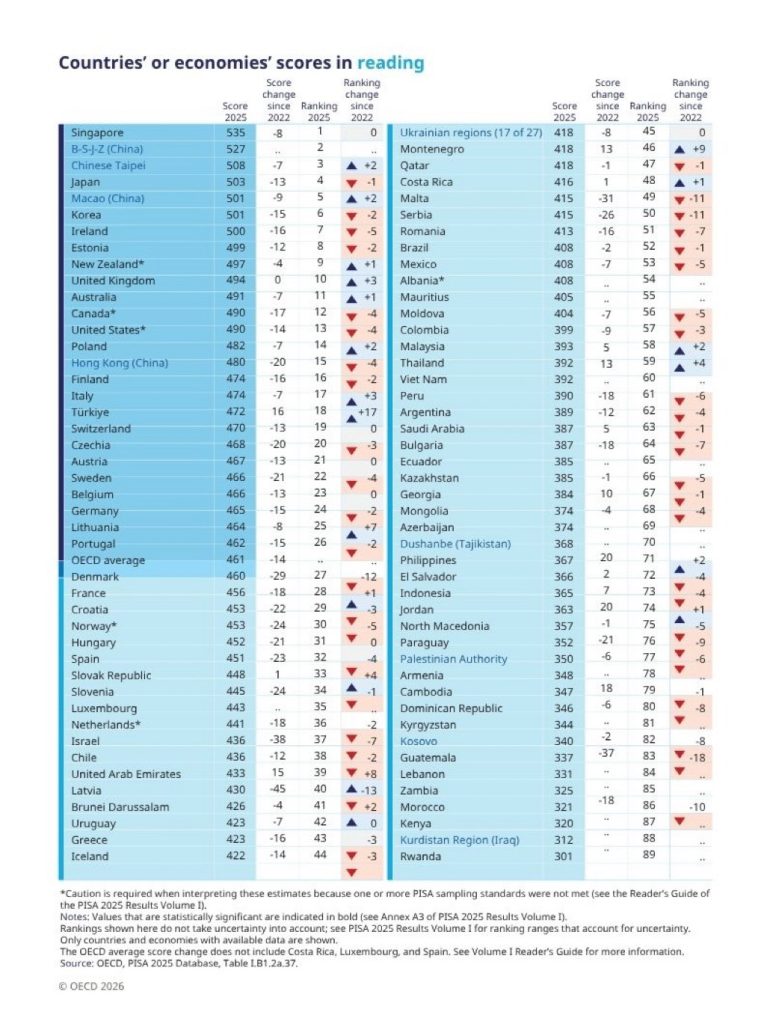
More than 760 000 students took the PISA science, mathematics and reading test in 2025 across 91 countries and economies, representing around 33 million 15-year-olds across the world. The highest performers in PISA 2025 across these three domains were the Chinese jurisdictions of Beijing, Shanghai, Jiangsu and Zhejiang, and Singapore. Additionally, Estonia, Japan, Korea, Macao (China), Chinese Taipei and the United Kingdom were among the top 10 performing education systems. The overall performance of OECD countries declined, with the lowest average levels of performance ever observed in science, reading and mathematics. However, there have been some improvements; for example, among OECD countries, Costa Rica, the Slovak Republic, Türkiye and the United Kingdom have seen increases in science scores since 2022. Overall reading scores saw particularly steep declines in the past three years, including in skills that matter most in the AI age: evaluating information, making connections across multiple sources and thinking critically about what we read. The instances of “hasty reading” – in which students read quickly but inaccurately – nearly doubled to 9% between 2018 and 2025.
and;
Across OECD countries, reading performance fell by the equivalent of around one and a half years of learning between 2015 and 2025.
———-
OECD:
Who made the top 10 in science, reading and maths, according to #OECDPISA?
▶️ Chinese jurisdictions of Beijing, Shanghai, Jiangsu and Zhejiang
▶️ Estonia
▶️ Japan
▶️ Korea
▶️ Macao (China)
▶️ Chinese Taipei
▶️ Singapore
▶️ United Kingdom
————
China’s PhD Glut Drives Top Graduates to High School Teaching Jobs
1. A growing number of doctoral graduates from elite global and domestic universities are bypassing traditional careers in academia to become secondary school teachers in China’s major cities, driven by an oversupplied labor market and fierce competition for university posts. [para. 1] At Shenzhen Middle School, all 21 prospective hires hold master’s degrees or higher, including five PhDs. [para. 2] These include a Tsinghua electrical engineering PhD teaching math, a Cambridge electrical engineering PhD teaching physics, a Fudan materials physics PhD for chemistry, and a University of Chinese Academy of Sciences PhD recruited as a math Olympiad coach. [para. 3]
2. The trend is not new for Shenzhen Middle School; a 2019 hiring list featured 20 graduates from Tsinghua and Peking University plus one from Harvard, following Principal Zhu Huawei’s 2017 push for world-class status. [para. 4][para. 5] Currently, the school employs more than 100 teachers with doctoral degrees, over 150 graduates from Tsinghua and Peking, and more than 100 alumni of top global institutions like Harvard, Oxford, and Cambridge. [para. 6] The phenomenon extends to tier-one and tier-two cities, as seen in 2021 when the Affiliated High School of South China Normal University hired nine PhDs or postdocs from top institutions, and in 2025 when Suzhou High School hired 10 Tsinghua/Peking graduates and eight with doctorates. [para. 7][para. 8][para. 9]
3. This shift has sparked public debate over perceived underemployment. Qi Yifan, a Tsinghua optical engineering PhD joining Tianjin No.1 High School, defended his decision on social media, stating that helping hundreds of students enter top universities could yield a greater societal contribution than working in an isolated research post. [para. 10][para. 11]
————-
By every measure, American students are being outperformed by students in Singapore and parts of China who had top scores on the Program for International Student Assessment, or PISA, taken by 15-year-olds around the world.
———-
The good news from the latest PISA results, released Tuesday, is that the U.S. has gained relative standing in recent decades. Today, U.S. students score well above average in science and reading. Math scores, long America’s weakest subject, are now on par with other developed countries.
The bad news is how this happened. The U.S. has steadily moved up largely because other countries’ scores have deteriorated faster than ours over the last decade. A bevy of data pointsshow American students are learning less than they used to. Even U.S. PISA scores in math and reading are at or near their lowest level.
———-
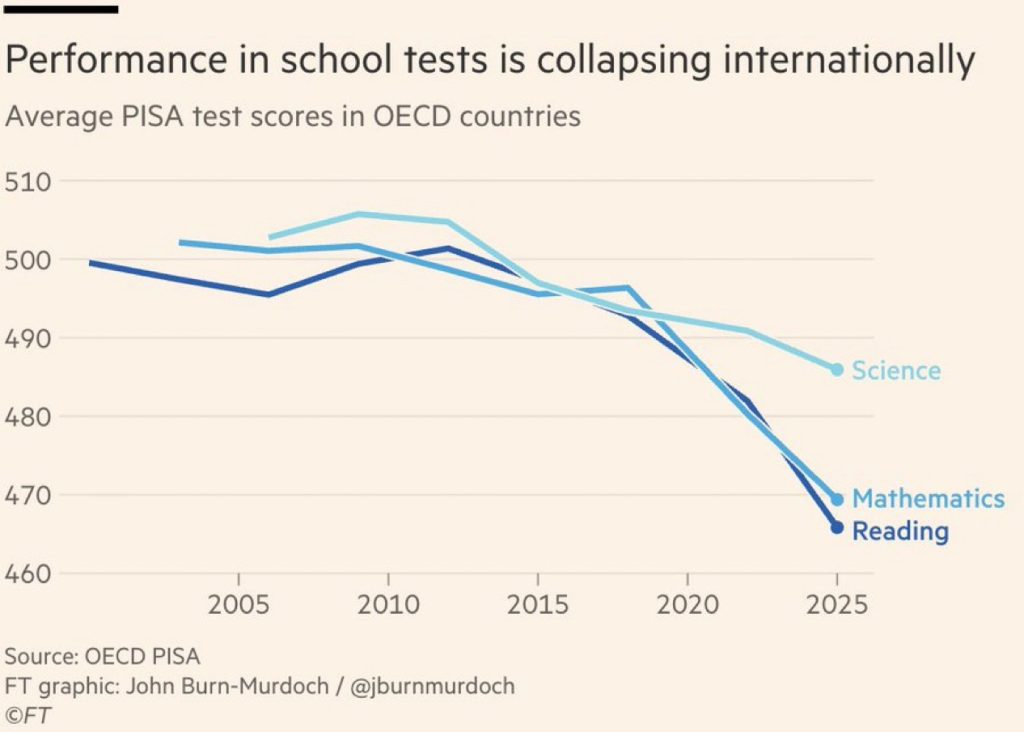
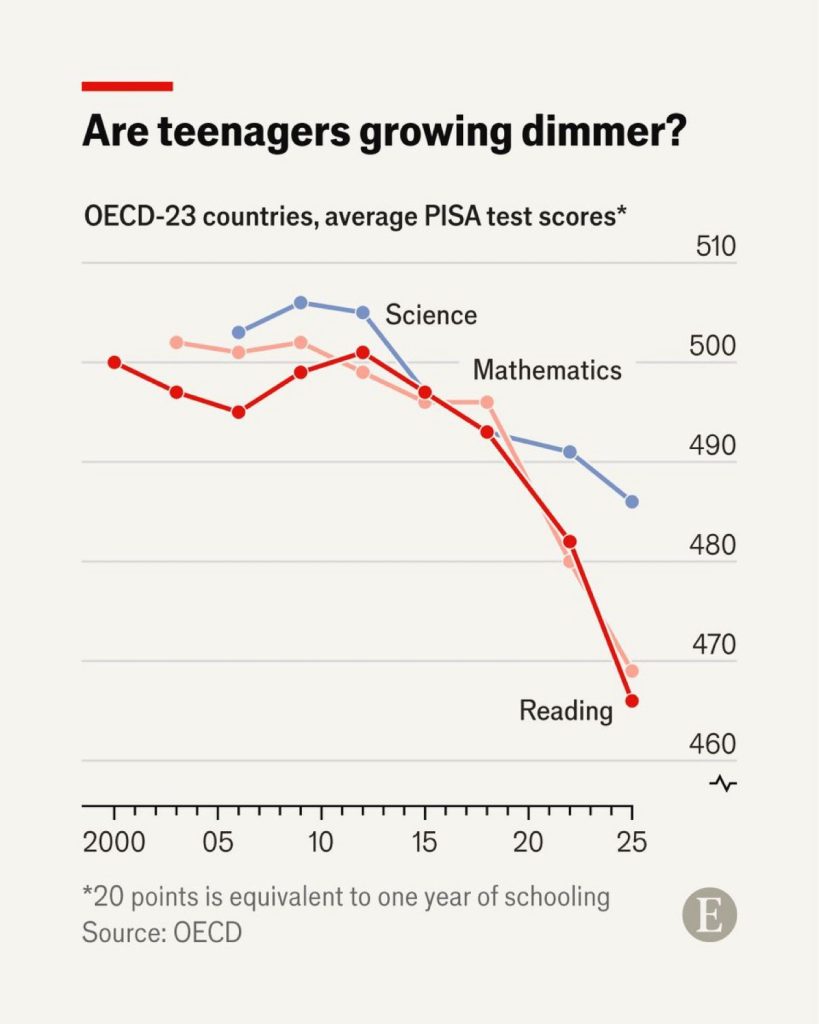
Two extraordinary charts from today’s PISA test results:
1) School test scores continue to collapse internationally, underscoring how this is no longer a Covid effect but sustained decline.
Those falls in reading and maths are equivalent to about two years of lost schooling.
———
The PISA 2025 results are out today. Some quick insights.
- The major story is very significant global decline. The last PISA study was in 2022, and saw big declines in reading and maths scores from 2018. Obviously the pandemic played a part.
- But this 2025 round has seen further falls even from the 2022 lows!
Things haven’t gone back to normal post-pandemic – they’ve got worse.
Every generation thinks the generation below is less smart – but this time they might be right!
…….
I also think that we shouldn’t overlook the impact of educational fads. Over the last twenty years or so, a lot of influential global organisations have encouraged fads like 21st century skills, discovery learning, etc., and a lot of countries have adopted them.
But these are evidence-free fads that are not going to improve education.
———
Canadian students’ reading and math scores decline in OECD’s global assessment
Canadian high-school students are outperforming many of their international peers in science, math and reading, but their overall scores in these subjects are also declining, according to a new international ranking by the Organisation for Economic Co-operation and Development.
Results for the OECD’s Program for International Student Assessment, released Tuesday, show Canada in the top 10 among 91 countries and economies that were evaluated.
The OECD conducts the assessment, which measures the performance of 15-year-olds in science, math and reading, every three years. Science was the main focus of this latest round of assessments. Math and reading were also tested, but there were fewer questions asked.
In 2025, about 24,600 students from across the 10 provinces participated in the assessment.
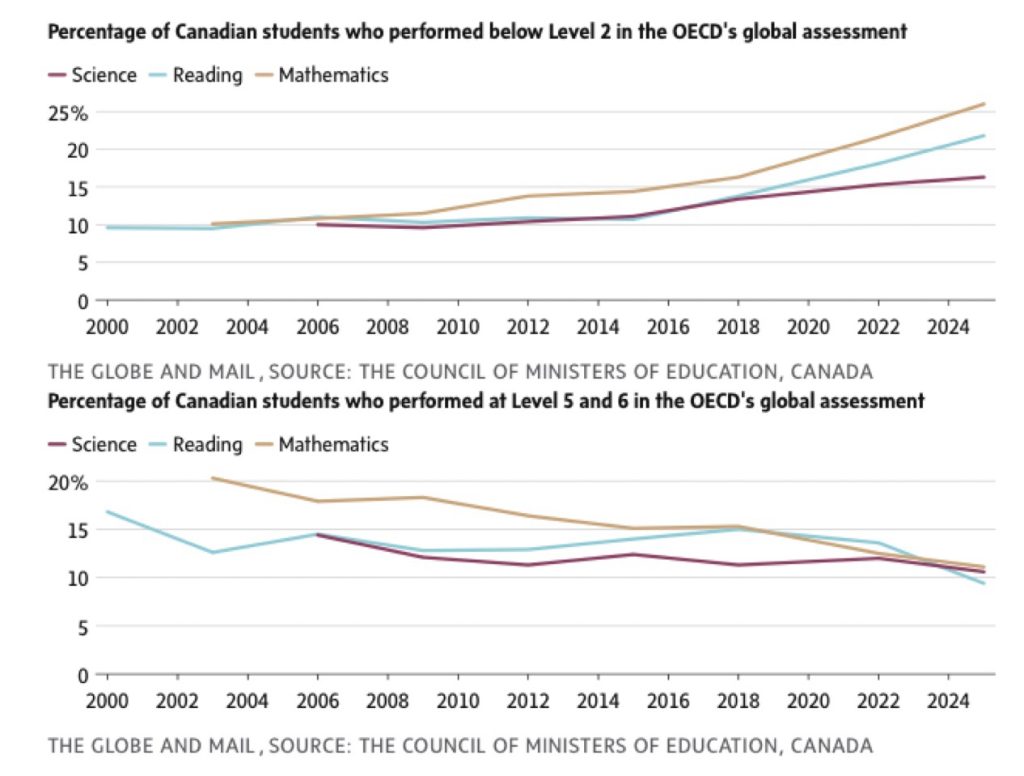
The results showed that Canada’s scores in science, math and reading have all been declining, a trend also seen in other countries.
In science, Canada’s mean performance dropped five points compared to 2022. Its math score dropped 12 points, while reading saw a drop of 17 points.
Most other countries saw similar, if not worse, declines.
2/2 This is important. More Canadian students are struggling and fewer Canadian students are excelling. This started before COVID and it continues.
———
The percentage of American 15 year olds who scored at the top level of PISA held relatively steady while the percentage scoring at the lowest level increased.
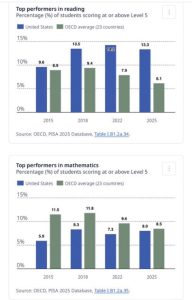
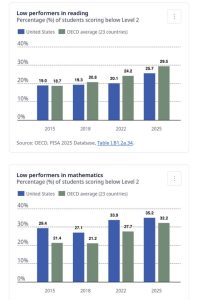
———
Finally, comparative data further bolsters the claim that Gibb and co.’s reforms positively affected the quality of English schools. Between 2010 and 2024, the constituent nations of the United Kingdom ran something of a natural experiment in education policy. While England embraced phonics, a knowledge-rich curriculum, explicit teacher-led instruction, and greater school autonomy, Scotland and Wales eschewed the evidence on early literacy instruction, doubled down on national curricula focused on the acquisition of amorphous “generalizable” skills, and promoted self-directed “discovery” learning as state of the art. During this period, the international metrics show that England forged ahead, while its fellow home nations stagnated (see Figure 2).
———
1/ PISA 2025 says advantaged students fell more than disadvantaged ones. Today we publish a paper explaining t’s a measurement change. Measure students the same way in both years and the top-quartile drop in maths goes from −14 to −6 points. 🧵
———
———
Coincidentally given we just got a new PISA release, but not long ago, I was working on testing whether tests had equal intervals and the PISA was one of my examples.
It lacks equal intervals.
So, for example, the distance between a PISA IQ of 90 and 95 is less than 110 to 115.

Most commentators on today’s PISA results will be incurious and irresponsible.
Their focus will be on an alleged score decline that they will make no efforts to assess for measurement invariance.
They will hastily interpret observed scores, to the detriment of public knowledge.
———
The Banality of Deeper Learning
Irony has its place, of course: Scotland’s Curriculum for Excellence: Into the Future
———
This is because those outcomes are the most reliable measure of the quality of school systems, and thus one of the most powerful predictors for the long-run success of economies. Researchers at Stanford University estimate that if all 15-year-old Americans achieved at least the PISA baseline Level 2, this could add over $40trn—one and a quarter times America’s nominal GDP—to the country’s economy over their working lives.
Yet in 2025, 22% of American 15-year-olds failed to reach this benchmark in science (up from 19% in 2018), 35% in mathematics (up from 27%) and 26% in reading (up from 19%). These students struggle to interpret simple data, identify evidence in a graph or understand simple texts.
The picture is similar in many countries. Indeed, the world is no longer sharply divided between rich and well-educated nations and poor and badly educated ones: national wealth accounts for just half of the variation in countries’ performance, according to PISA.
In the same vein, good policies and wise spending choices are far stronger predictors for learning outcomes than just how much countries spend per student. Luxembourg spends $288,521 per student from the beginning of primary school up to the age of 15, by far the most, but it still posts lower science scores than Ireland, France or Italy—all of which invest less than half that amount per student.
Students in the Chinese jurisdictions of Beijing, Shanghai, Jiangsu and Zhejiang topped the PISA science test, with all more than 100 points above the OECD average, where 20 points typically equals a school year’s progress. Even if they represent just a small part of China, they make the largest contribution (27%) to the global talent pool of PISA’s top performers. These students can tackle challenging scientific concepts, evaluate claims and identify flaws in scientific arguments, making them prime candidates for tomorrow’s top jobs. The education systems next on the list—Singapore, Macao, Chinese Taipei and Japan—are all from East Asia, too.
The greatest cause for concern emerges not from a single snapshot of PISA, but from the direction of travel. At a moment when artificial intelligence is transforming how humans work, learn and live, one would expect education systems to be raising the bar. Instead, in many places, outcomes have declined.
Reading, the gateway to all learning, has declined sharply. Between 2018 and 2025 performance fell in three-quarters of the countries. Across the OECD it was down by 25 points—more than a year of learning. Much of this decline happened between 2022 and 2025. The biggest surprise is who fell furthest behind. It was not the most disadvantaged students, but those from wealthy families, which points to a much broader challenge than inequality alone.
Few countries would allow millions of children to receive a new vaccine without first demanding rigorous clinical trials. Yet in education we introduce new technologies into millions of classrooms with remarkably little evidence about their impact, turning students into unwitting crash dummies for tools we do not yet fully understand.
———
Germany’s PISA score rises 41 points if you exclude immigrant kids. Switzerland: +30. The UAE’s score drops 45 points without immigrants.
———-
First, the initial PISA promise that testing will raise achievement has failed spectacularly – as evidenced in a relentless decline in results over two decades.
———-
Poor Pisa ranking for France: “We have collectively lost interest in knowledge,” accuses Laetitia Strauch-Bonart, journalist and essayist
————
Also quite interesting — countries with the largest gap between their top and bottom decile. The US and Israel at the top aren’t surprising; Taiwan probably is.
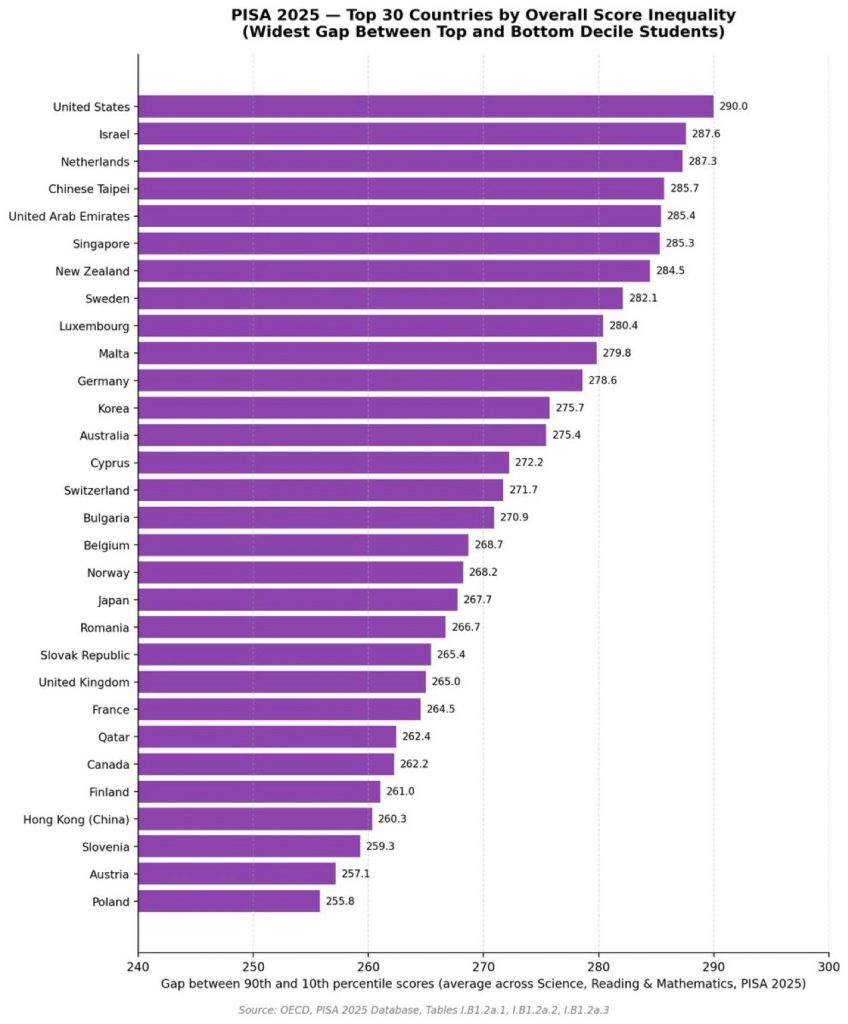
———
For me, it’s obvious that this generalized decline in scores across OECD countries reflects the systemic failure of an educational model that has become totally self-referential.
If you look at it in detail, you’ll see that the most devastating drop doesn’t just affect the mechanical reproduction of knowledge,
but the most vital skill for our intellectual survival: analytical reading, the critical evaluation of sources, & the ability to cross-reference facts.
In fact, I get the feeling that an entire generation finds itself disarmed in the face of the continuous flow of information, unable to slow down its cognition to extract the pure signal from the ambient noise.
I believe ONCE AGAIN that this atrophy of discernment stems directly from teaching disconnected from reality, and I’ve seen it very clearly for years.
———-
I’d like to observe better what happens in classrooms, evaluate new methods, and measure how much each school contributes to learning.
In short, I’d like us to devote as much energy to testing our theories as we do to defending them.
———-
2025-2026 Madison 4k-3rd grade Early Literacy Screener report: The bar moves faster than the kids.
Joe Gothard, Becky Kundert and Sonia Spencer Remarks on Madison’s K-12 Literacy Crisis.
2026-2027 Madison K-12 $pending continues to grow, fueled by a 9.7% (!) property tax increase. Total spending will be at least $706,000,000 for 25,003 students, or $28,236 per student.
May 2026 Madison School District Presentation: 7,095 adults for 25,003 students (3.52 students per adult!)
2024-2025 Early Literacy Screener Map.
Map: Foundations of Reading Results: 2015–2024
Where have all the students gone?
3,887 Madison 4 year old to third grade students scored lower than 75% of the students in the national comparison group.
Madison taxpayers have long supported far above average k-12 tax & $pending. This despite our long term, disastrous reading results. May, 2026: 7,095 Staff for 25,003 students; $pending > $26k per student!
Madison Schools: More $, No Accountability
The taxpayer funded Madison School District long used Reading Recovery…
The data clearly indicate that being able to read is not a requirement for graduation at (Madison) East, especially if you are black or Hispanic.
My Question to Wisconsin Governor Tony Evers on Teacher Mulligans and our Disastrous Reading Results
2017: West High Reading Interventionist Teacher’s Remarks to the School Board on Madison’s Disastrous Reading Results
Madison’s taxpayer supported K-12 school district, despite spending far more than most, has long tolerated disastrous reading results.
“An emphasis on adult employment”
Wisconsin Public Policy Forum Madison School District Report[PDF]
WEAC: $1.57 million for Four Wisconsin Senators
Friday Afternoon Veto: Governor Evers Rejects AB446/SB454; an effort to address our long term, disastrous reading results
Booked, but can’t read (Madison): functional literacy, National citizenship and the new face of Dred Scott in the age of mass incarceration.
When A Stands for Average: Students at the UW-Madison School of Education Receive Sky-High Grades. How Smart is That?