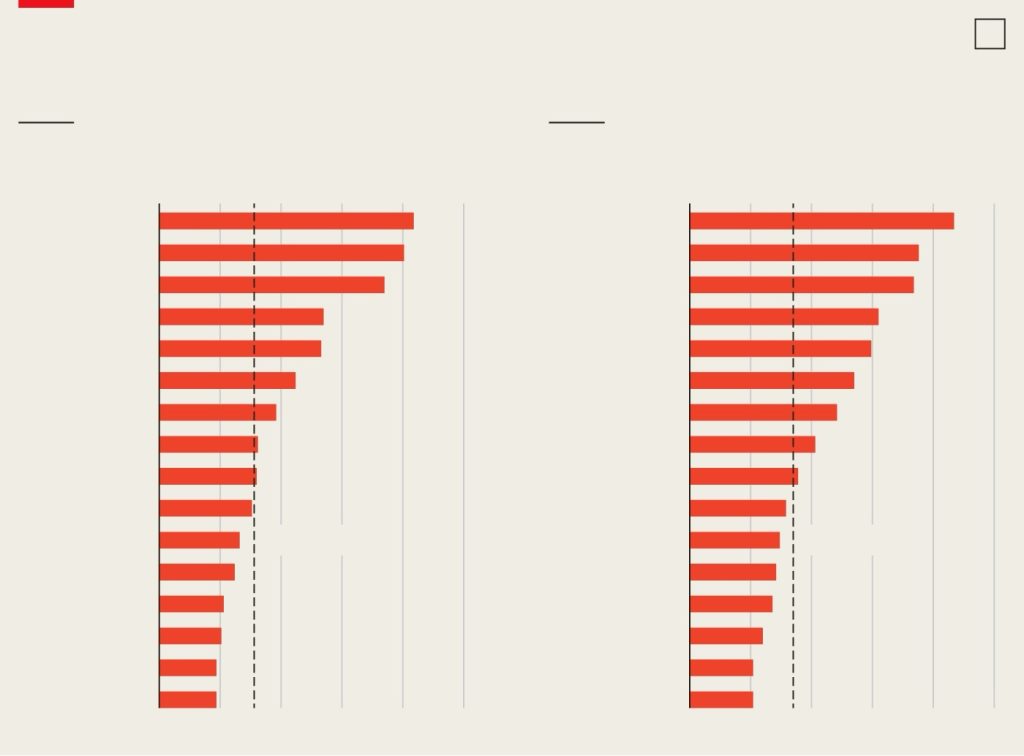
America’s scores, by contrast, are among the most disappointing. One in seven of its tertiary students scored at or below primary-school level in the literacy tests, up from about one in twenty a decade ago. The share at or below the bottom level for numeracy, meanwhile, was almost one in five.
What is going on? In part, colleges and universities are inheriting problems that have originated in the world’s schools. One cannot overestimate the impact of the pandemic. Countries enforced national school closures lasting 20 weeks on average. Rota systems for in-person learning, and quarantines for “close contacts”, then disrupted lessons more. In the years immediately after that disaster it was as if some students “had not gone to high school”, says Jessica Hooten Wilson, a professor at Pepperdine University in California. “It was actually a very scary thing to see.”
Yet colleges and universities that claim to be merely passive observers of this are marking their own homework. In many countries they enjoy broad control of their own admissions policies. They have frequently failed to use these freedoms to hold standards high.
For decades critics have accused college and university officials of lowering entry criteria to capitalise on growing demand. Nowadays the dynamics are a bit different: in some rich countries the number of 18-year-olds is nearing or past its peak. Administrators may find it even harder to resist watering down standards when the alternative is to downsize. Indeed, comparing the OECD’s data on students’ skills with the changing number of students in tertiary systems throws up a correlation that deserves further study: shrinking systems are especially likely to have collected lots of students who score in the lowest levels of those tests.
Falling achievement in schools has mostly been driven by children who already ranked in the bottom half of their classes, not by clever clogs at the top. So the drip of unprepared students into some of America’s best universities demands additional explanation. The irate academics in California, and in many other parts of the country, blame it on the scrapping of entry tests. Before the pandemic more than half of bachelors-granting universities in America required applicants to sit tests of numerical and verbal reasoning—usually the SAT or ACT (these tests help substitute for the standardised exams that exist in many other countries). Now it is as few as 10%.
———
2026-2027 Madison K-12 $pending continues to grow, fueled by a 9.7% (!) property tax increase. Total spending will be at least $706,000,000 for 25,003 students, or $28,236 per student.
May 2026 Madison School District Presentation: 7,095 adults for 25,003 students (3.52 students per adult!)
Early Literacy Screener Map.
Map: Foundations of Reading Results: 2015–2024
Where have all the students gone?
3,887 Madison 4 year old to third grade students scored lower than 75% of the students in the national comparison group.
Madison taxpayers have long supported far above average k-12 tax & $pending. This despite our long term, disastrous reading results. May, 2026: 7,095 Staff for 25,003 students; $pending > $26k per student!
Madison Schools: More $, No Accountability
The taxpayer funded Madison School District long used Reading Recovery…
The data clearly indicate that being able to read is not a requirement for graduation at (Madison) East, especially if you are black or Hispanic”
A.B.T.: “Ain’t been taught.”
My Question to Wisconsin Governor Tony Evers on Teacher Mulligans and our Disastrous Reading Results
2017: West High Reading Interventionist Teacher’s Remarks to the School Board on Madison’s Disastrous Reading Results
Madison’s taxpayer supported K-12 school district, despite spending far more than most, has long tolerated disastrous reading results.
“An emphasis on adult employment”
Wisconsin Public Policy Forum Madison School District Report[PDF]
WEAC: $1.57 million for Four Wisconsin Senators
Friday Afternoon Veto: Governor Evers Rejects AB446/SB454; an effort to address our long term, disastrous reading results
Booked, but can’t read (Madison): functional literacy, National citizenship and the new face of Dred Scott in the age of mass incarceration.
When A Stands for Average: Students at the UW-Madison School of Education Receive Sky-High Grades. How Smart is That?