Mississippi Fixed Its Schools. Here’s How Other States Can Too.
For the past year, my phone hasn’t stopped ringing from callers wanting to learn more about how Mississippiimproved its public schools.
Frustrated by sagging reading and math scores, educators, advocates and lawmakers across the country are curious about reforms that transformed Mississippi from a national punchline into a leader in reading and math proficiency—policies I spent much of my career championing.
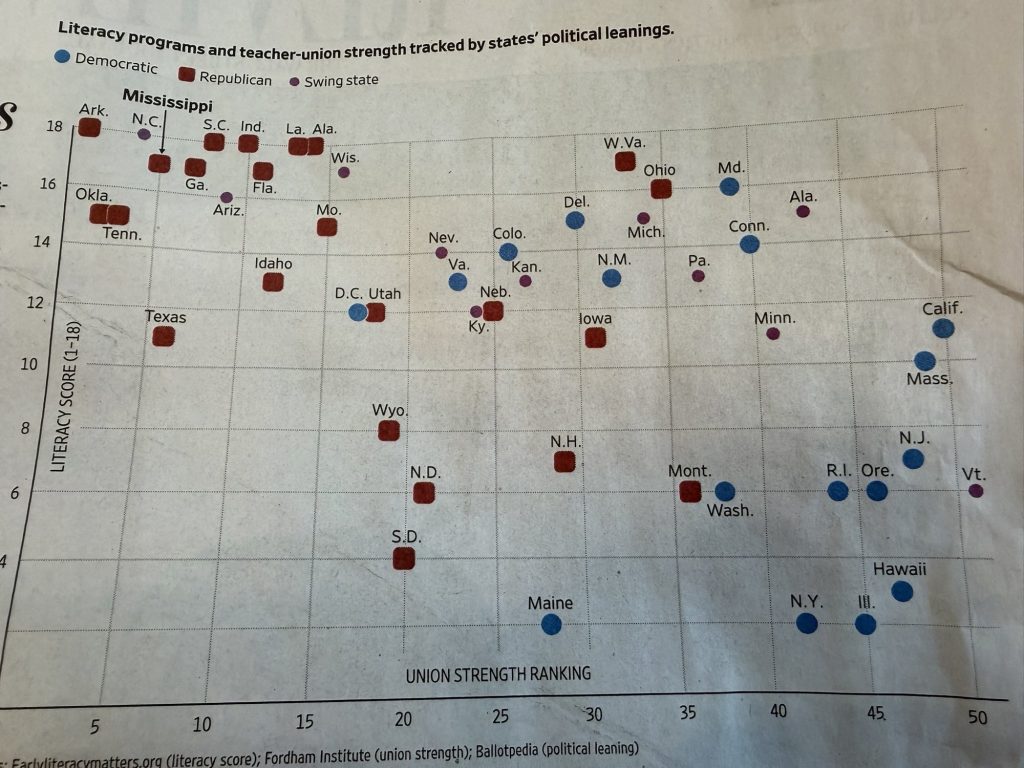
Democrats, however, don’t often ask me how to replicate Mississippi’s success; they ask if it’s possible at all, given the power of teachers’ unions in their home states. As one audience member skeptically asked me at a recent panel discussion: “You’ve done your work in a red state. Do you really think blue states can do this?”
My answer is unequivocally yes, even if blue-state politics may make Mississippi-style reforms harder to pass.
If helping kids to read and do math at grade level is the goal, the evidence shows that what we’ve been doing in schools across the country for the last 12 or so years hasn’t worked. Children have lost so much ground, they not only know less than their counterparts did a decade ago; older children know as little as they have this century.
More.
———
2025-2026 Madison 4k-3rd grade Early Literacy Screener report: The bar moves faster than the kids.
Joe Gothard, Becky Kundert and Sonia Spencer Remarks on Madison’s K-12 Literacy Crisis.
2026-2027 Madison K-12 $pending continues to grow, fueled by a 9.7% (!) property tax increase. Total spending will be at least $706,000,000 for 25,003 students, or $28,236 per student.
May 2026 Madison School District Presentation: 7,095 adults for 25,003 students (3.52 students per adult!)
2024-2025 Early Literacy Screener Map.
Map: Foundations of Reading Results: 2015–2024
Where have all the students gone?
3,887 Madison 4 year old to third grade students scored lower than 75% of the students in the national comparison group.
Madison taxpayers have long supported far above average k-12 tax & $pending. This despite our long term, disastrous reading results. May, 2026: 7,095 Staff for 25,003 students; $pending > $26k per student!
Madison Schools: More $, No Accountability
The taxpayer funded Madison School District long used Reading Recovery…
The data clearly indicate that being able to read is not a requirement for graduation at (Madison) East, especially if you are black or Hispanic.
My Question to Wisconsin Governor Tony Evers on Teacher Mulligans and our Disastrous Reading Results
2017: West High Reading Interventionist Teacher’s Remarks to the School Board on Madison’s Disastrous Reading Results
Madison’s taxpayer supported K-12 school district, despite spending far more than most, has long tolerated disastrous reading results.
“An emphasis on adult employment”
Wisconsin Public Policy Forum Madison School District Report[PDF]
WEAC: $1.57 million for Four Wisconsin Senators
Friday Afternoon Veto: Governor Evers Rejects AB446/SB454; an effort to address our long term, disastrous reading results
Booked, but can’t read (Madison): functional literacy, National citizenship and the new face of Dred Scott in the age of mass incarceration.
When A Stands for Average: Students at the UW-Madison School of Education Receive Sky-High Grades. How Smart is That?